Editor’s Note from February 04, 1972

The older we grow, the more likely we are to realize that few things are as simple as they might seem at first glance. A crucial issue that continues to provoke hot tempers and bad manners and bitter litigation is the relation of church and state. Bishop Nolan B. Harmon of the United Methodist Church in his essay “Church and State—A Relation in Equity” offers some practical suggestions for working our way through this thicket.

Our fellow journalist Sherwood Wirt, editor of Decision, sets forth some lively opinions on what he sees as “a new note” in Christian journalism—a note of bitterness, of rancorous rumor-mongering, of negativism. “I am for truth in journalism even when it hurts,” he says. But does that mean that the public is entitled to know all the facts? Deciding how much to reveal is often a vexing problem.

John Mackay, former president of Princeton Seminary, has a word for our readers on the subject of an evangelical renaissance. At a time when there is a deepening movement of the Holy Spirit, we note that many theological seminaries have not yet been caught up in this growing evangelistic thrust. It may well be that people who look toward the ministry will be turned off by what they see in the seminaries unless those institutions too experience renewal.
Defending Christian Mission

What does god command the Church to do about the earth’s unevangelized two billion people? This is one of the crucial problems facing Christendom today. The Church’s mission has always required justification before the “cultured despisers” of Christianity. Today, however, the entire question of the validity of the Christian mission is under scrutiny within the Church itself.

The evangelical wing of the Church, as well as the “liberal” churches, feels the impact of a changing world. Respected leaders of evangelical missions are being tempted to feel that the foreign outreach of the Church needs drastic revision. The growth of nationalism around the world has led some to conclude that national churches are now able to walk, and no longer need the “crutch” of missions.

Other evangelical leaders feel that this is a counsel of despair, resembling too closely the mood of the ecumenists. They suggest that this pessimistic conclusion rests, not upon contemplation of a task that is largely completed, nor upon a lack of financial potential, but upon a lack of motivation. The “Wheaton Declaration” spoke eloquently to this problem.

The significance of the contemporary crisis in the Christian mission is shown by the “Frankfurt Declaration” (see CHRISTIANITY TODAY, June 19, 1970), issued by fifteen professors in Germany and endorsed by a large number of other qualified persons. These Continental theologians here expressed strong reaction to the pronouncements of the WCC meeting held in Uppsala, Sweden, in 1968. The Frankfurt Declaration draws the lines clearly: it is historic evangelism versus a purely humanistic movement directed toward changing the political, social, and economic structures of the world.

It is becoming increasingly apparent that the ecumenical movement has been captured by persons of humanistic bent who are determined to refashion the Church’s outreach along lines of universalism, syncretism, and “absolute” religious toleration.

The reasons for this shift of emphasis are varied and complex. Many churchmen hold that as long as we in the West cannot straighten out the coathangers of our own civilization, we have no right to regard our religion as a product worthy of export. The same leaders tend to insist that to assert the uniqueness and the Lordship of Jesus Christ violates the spirit of intellectual and spiritual tolerance.

Evangelicals have without doubt given some impetus to these and other objections by unwise approaches to those in non-Christian societies and, even more, by a one-sided insistence upon the purely other-worldly outreach of the Christian Gospel. There is danger that, in reaction against the horizontalism of the ecumenical church, evangelicals will make too little of the power of the Evangel to penetrate social conditions in history, and to transform man’s relations with his fellows.

Thus the Christian mission requires both clarification and justification. Professor D. Elton Trueblood has come to grips with both these tasks in a book just now due to appear under the title The Validity of the Christian Mission. In this thoughtful volume, the veteran Quaker author comes to grips with nearly every thorny problem confronting evangelical missions in our time.

He deals in succession with the objections raised against the worldwide Christian mission: that the West is too deeply involved in failures to attempt to export the faith that has been closely associated with it; that the mission implies a violation of the spirit of religious tolerance; that all phases of man’s cultural life, including the religious, are relative. He analyzes the hypermoralism that underlies these objections, and shows that the objections would apply with equal validity to the preaching of the Gospel anywhere. Had the early apostles taken them seriously, they would have been silenced at the outset.

Dr. Trueblood’s chapter entitled “The Theology of Mission” sets forth the basic principles that he feels must underlie the outreach of the Church. Using the metaphors of the parables of our Lord, he sees that the concepts “salt,” “light,” and “leaven” demand an active projection of the Gospel. He insists, with Bishop Stephen Neill, that the order of priority for mission must be “first conversion and then social change.”

In dealing with the content of the Church’s proclamation, our author focuses attention upon the very elements that are repudiated by the ecumenical view of “mission.” Emphasizing that “tolerance” and non-interference in the spiritual lives of others find no support in Scripture, he declares that “soul saving” is the cutting edge of the church’s mission, and more important still, that it is the final truth of Christianity that undergirds the entire Christian task.

Nor does Friend Trueblood permit any simplistic view of “mission” to neutralize or invalidate the overseas obligations of the Church. While recognizing that the entire human scene is the proper locus of evangelical endeavor, he insists that there are areas of the world that have a special claim upon the Church’s outreach.

This volume should serve to call all branches of the Church to face up to the central elements of the Christian proclamation: natural man’s forsaken condition outside Christ, his common need for the touch of the hand of the Resurrected One, the reality of Christ’s continuing presence to the believer, and the transcendent hope that men and women find in him.

Trueblood’s volume is full of challenges to those who deny the validity of the Christian mission. He reminds us all that the day may come when virtually every “service” that missions (and especially the ecumenical “mission”) have rendered will be taken over by governmental agencies. He asks, “Will the case for the existence of the World Christian Mission then be stripped of its validity? It will, unless there is another factor which involves real permanence.”

An interesting metaphor underlies a great deal that the volume expresses, that of “the narrow way with wide gutters on both sides.” With this Trueblood challenges the familiar cliché about all roads eventually reaching heaven, and at the same time cautions both evangelicals and ecumenists at the point of their particular peril.

Perhaps the most penetrating insight of our author (and this pervades the volume) is that the social outreach of the Church must be justified and validated by its evangelistic message, and not the reverse. Thus the ministry of the servant of Christ to the hungry, the cold, the disadvantaged of the world must be regarded as a verification of the Christian faith, not a substitute for it.

The final justification of the Church’s mission is of course the mandate of the Lord of the Church. Beyond all logical arguments for the validity of the Christian mission, the final appeal must be to the power of the Risen Christ to change the lives of men and women.

HAROLD B. KUHN

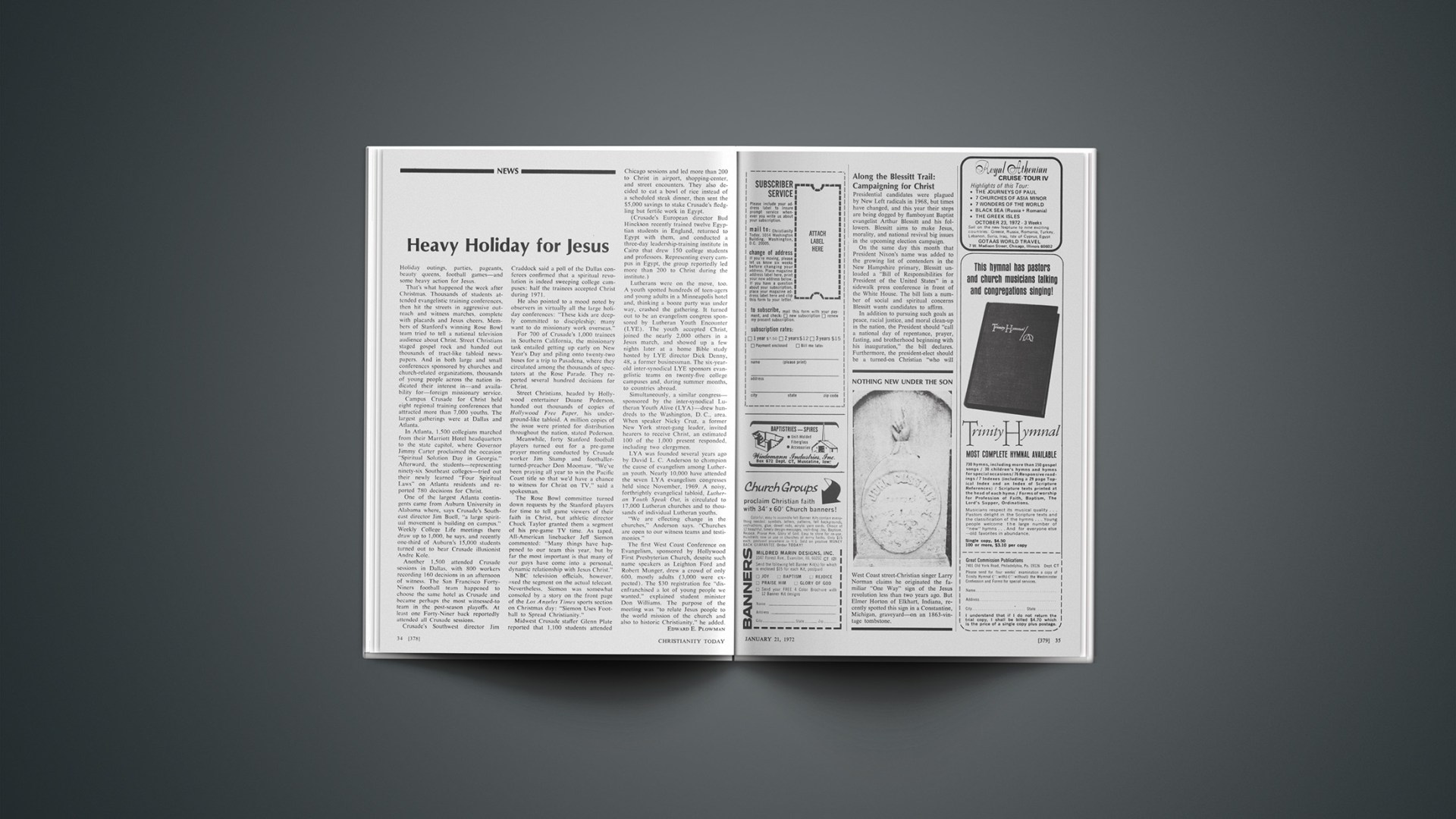
Heavy Holiday for Jesus

Holiday outings, parties, pageants, beauty queens, football games—and some heavy action for Jesus.

That’s what happened the week after Christmas. Thousands of students attended evangelistic training conferences, then hit the streets in aggressive outreach and witness marches, complete with placards and Jesus cheers. Members of Stanford’s winning Rose Bowl team tried to tell a national television audience about Christ. Street Christians staged gospel rock and handed out thousands of tract-like tabloid newspapers. And in both large and small conferences sponsored by churches and church-related organizations, thousands of young people across the nation indicated their interest in—and availability for—foreign missionary service.

Campus Crusade for Christ held eight regional training conferences that attracted more than 7,000 youths. The largest gatherings were at Dallas and Atlanta.

In Atlanta, 1,500 collegians marched from their Marriott Hotel headquarters to the state capitol, where Governor Jimmy Carter proclaimed the occasion “Spiritual Solution Day in Georgia.” Afterward, the students—representing ninety-six Southeast colleges—tried out their newly learned “Four Spiritual Laws” on Atlanta residents and reported 780 decisions for Christ.

One of the largest Atlanta contingents came from Auburn University in Alabama where, says Crusade’s Southeast director Jim Buell, “a large spiritual movement is building on campus.” Weekly College Life meetings there draw up to 1,000, he says, and recently one-third of Auburn’s 15,000 students turned out to hear Crusade illusionist Andre Kole.

Another 1,500 attended Crusade sessions in Dallas, with 800 workers recording 160 decisions in an afternoon of witness. The San Francisco Forty-Niners football team happened to choose the same hotel as Crusade and became perhaps the most witnessed-to team in the post-season playoffs. At least one Forty-Niner back reportedly attended all Crusade sessions.

Crusade’s Southwest director Jim Craddock said a poll of the Dallas conferees confirmed that a spiritual revolution is indeed sweeping college campuses: half the trainees accepted Christ during 1971.

He also pointed to a mood noted by observers in virtually all the large holiday conferences: “These kids are deeply committed to discipleship; many want to do missionary work overseas.”

For 700 of Crusade’s 1,000 trainees in Southern California, the missionary task entailed getting up early on New Year’s Day and piling onto twenty-two buses for a trip to Pasadena, where they circulated among the thousands of spectators at the Rose Parade. They reported several hundred decisions for Christ.

Street Christians, headed by Hollywood entertainer Duane Pederson, handed out thousands of copies of Hollywood Free Paper, his underground-like tabloid. A million copies of the issue were printed for distribution throughout the nation, stated Pederson.

Meanwhile, forty Stanford football players turned out for a pre-game prayer meeting conducted by Crusade worker Jim Stump and footballer-turned-preacher Don Moomaw. “We’ve been praying all year to win the Pacific Coast title so that we’d have a chance to witness for Christ on TV,” said a spokesman.

The Rose Bowl committee turned down requests by the Stanford players for time to tell game viewers of their faith in Christ, but athletic director Chuck Taylor granted them a segment of his pre-game TV time. As taped, All-American linebacker Jeff Siemon commented: “Many things have happened to our team this year, but by far the most important is that many of our guys have come into a personal, dynamic relationship with Jesus Christ.”

NBC television officials, however, axed the segment on the actual telecast. Nevertheless, Siemon was somewhat consoled by a story on the front page of the Los Angeles Times sports section on Christmas day: “Siemon Uses Football to Spread Christianity.”

Midwest Crusade staffer Glenn Plate reported that 1,100 students attended Chicago sessions and led more than 200 to Christ in airport, shopping-center, and street encounters. They also decided to eat a bowl of rice instead of a scheduled steak dinner, then sent the $5,000 savings to stake Crusade’s fledgling but fertile work in Egypt.

(Crusade’s European director Bud Hinckson recently trained twelve Egyptian students in England, returned to Egypt with them, and conducted a three-day leadership-training institute in Cairo that drew 150 college students and professors. Representing every campus in Egypt, the group reportedly led more than 200 to Christ during the institute.)

Lutherans were on the move, too. A youth spotted hundreds of teen-agers and young adults in a Minneapolis hotel and, thinking a booze party was under way, crashed the gathering. It turned out to be an evangelism congress sponsored by Lutheran Youth Encounter (LYE). The youth accepted Christ, joined the nearly 2,000 others in a Jesus march, and showed up a few nights later at a home Bible study hosted by LYE director Dick Denny, 48, a former businessman. The six-year-old inter-synodical LYE sponsors evangelistic teams on twenty-five college campuses and, during summer months, to countries abroad.

Simultaneously, a similar congress—sponsored by the inter-synodical Lutheran Youth Alive (LYA)—drew hundreds to the Washington, D. C., area. When speaker Nicky Cruz, a former New York street-gang leader, invited hearers to receive Christ, an estimated 100 of the 1,000 present responded, including two clergymen.

LYA was founded several years ago by David L. C. Anderson to champion the cause of evangelism among Lutheran youth. Nearly 10,000 have attended the seven LYA evangelism congresses held since November, 1969. A noisy, forthrightly evangelical tabloid, Lutheran Youth Speak Out, is circulated to 17,000 Lutheran churches and to thousands of individual Lutheran youths.

“We are effecting change in the churches,” Anderson says. “Churches are open to our witness teams and testimonies.”

The first West Coast Conference on Evangelism, sponsored by Hollywood First Presbyterian Church, despite such name speakers as Leighton Ford and Robert Munger, drew a crowd of only 600, mostly adults (3,000 were expected). The $30 registration fee “disenfranchised a lot of young people we wanted,” explained student minister Don Williams. The purpose of the meeting was “to relate Jesus people to the world mission of the church and also to historic Christianity,” he added.

Along The Blessitt Trail: Campaigning For Christ

Presidential candidates were plagued by New Left radicals in 1968, but times have changed, and this year their steps are being dogged by flamboyant Baptist evangelist Arthur Blessitt and his followers. Blessitt aims to make Jesus, morality, and national revival big issues in the upcoming election campaign.

On the same day this month that President Nixon’s name was added to the growing list of contenders in the New Hampshire primary, Blessitt unloaded a “Bill of Responsibilities for President of the United States” in a sidewalk press conference in front of the White House. The bill lists a number of social and spiritual concerns Blessitt wants candidates to affirm.

Nothing New Under The Son

West Coast street-Christian singer Larry Norman claims he originated the familiar “One Way” sign of the Jesus revolution less than two years ago. But Elmer Horton of Elkhart, Indiana, recently spotted this sign in a Constantine, Michigan, graveyard—on an 1863-vintage tombstone.

In addition to pursuing such goals as peace, racial justice, and moral clean-up in the nation, the President should “call a national day of repentance, prayer, fasting, and brotherhood beginning with his inauguration,” the bill declares. Furthermore, the president-elect should be a turned-on Christian “who will openly share his personal commitment to Jesus Christ,” an “open witness for Jesus” who will seek “to live his life and lead this nation on the teachings of the Bible so that it can truly be said, ‘In God we trust,’ ” the bill continues.

As for the incumbent: “If President Nixon is a Christian he ought to come out and say so,” Blessitt declared in an interview.

The evangelist, whose staff has been working for months in New Hampshire (see September 24 issue, page 41), is now foraging for the signatures of 20,000 New Hampshire residents to add clout to his ultimatum.

“We will raise these issues at every shopping-center rally and town meeting where a candidate speaks,” Blessitt vows. The candidates can expect some heavy witnessing during hand-shaking sessions. “Our people will grab hold and say, ‘Senator, do you know Jesus?’ ”

No reactions were immediately forthcoming from camps of candidates. Some churchmen oppose Blessitt’s injection of religion into the campaign, and even some fellow evangelicals have expressed doubts whether anyone could measure up to the ideals stated in the bill. But many young believers say they dig Blessitt’s call for a Christian leader in the White House. While Blessitt spoke with newsmen in front of the executive mansion, a contingent of Washington-area youths prayed, sang, and handed out tracts to passersby—until halted by police who threatened to bust them for demonstrating without a permit.

Blessitt interrupted his election doings for one weekend this month to fly to Great Britain at the request of BBC television and talk for an hour about Jesus to viewers in Scotland. He said a BBC official telephoned him on New Year’s Eve with word of a spiritual awakening taking place in the land.

The evangelist, known popularly as “the Minister of Sunset Strip,” spent the last months of 1971 carrying a large cross and conducting meetings during a witness march throughout England, Scotland, and Ireland. The Anglican bishop of Birmingham joined him in leading a witness trek of more than 1,000 people through the streets of that city, according to front-page news stories. And more than 15,000 marched behind Blessitt in Manchester.

During the trek, says Blessitt, he spoke in many churches and on college campuses. “There’s a spirit of revival in the churches of Great Britain—even in the Anglican churches,” he says. His visit snagged wide press coverage.

Blessitt was apparently a hit among Catholics in Dublin, and in strife-ripped Belfast both Catholics and Protestants joined him in the line of march.

“Pray for the believers of Belfast,” he exhorted an Arlington, Virginia, church audience this month. “There are forty-two groups witnessing openly out on the streets: they’re sowing the seeds of revival that can heal the land.”

EDWARD E. PLOWMAN

Archbishop Ahead Of Press—Hands Down

It might be called—by the secular press at least—the Great Ecumenical Sleight-of-Hand Trick.

An important ecumenical “breakthrough” at a New Mexico consecration of an Episcopal bishop apparently went unnoticed by secular journalists, according to Religious News Service.

Roman Catholic archbishop James Peter Davis of Santa Fe laid his hands on the head of the Reverend Richard M. Trelease at his consecration December 15 as Episcopal coadjutor bishop of New Mexico. So said the Right Reverend John H. Burt, bishop of the Episcopal diocese of Ohio, who with Presiding Bishop John E. Hines was co-consecrator during the Albuquerque ceremonies.

Burt said this complete participation in a consecration was “a first” in U. S. Episcopal-Roman Catholic relations. He added that Davis had informally announced his intention to “lay on hands” before the rite. Burt placed his own hand atop Davis’s at the moment of consecration.

Observers said journalists covering the event failed to report the action.

“I only know of one earlier case of a Roman Catholic bishop laying on hands in an Episcopal consecration,” Burt said later. “That was when David R. Thornberry [now Episcopal bishop of Wyoming] was consecrated in Laramie. A Catholic bishop did lay his hands on Dr. Thornberry’s head, but I don’t believe he meant to.”

Kinky Cathedral

Not since Ian Paisley’s supporters tried to interrupt a visiting popish prelate has St. Paul’s known such controversy.

It began when an overture from the management of the rock musical Hair led to the cast’s being invited to sing at a Communion service in the famous London cathedral last month. Anglicans of very different churchmanship promptly mounted a steady barrage of protest, pointing out that the play simulated onstage sexual activity (“masturbation can be fun”), glorified drugs (“marijuana is a gift from God”), and contained blasphemous elements.

Dean Martin Sullivan remained unmoved, even when diocesan synod members added their voice to the criticism. St. Paul’s was for all, he insisted, and the service would take place. So it did.

Doors were locked more than an hour before it began, the police were out in force, but the planned demonstration and open-air service on the steps by several hundred clergy and others were dignified and orderly. Only twice during the cathedral service itself (the cast sang three numbers) were there individual interruptions (“what does this have to do with Jesus Christ?”) and ejections.

A chapter spokesman pointed out that St. John’s cathedral, New York, had hosted the Hair cast last April. Since then New Zealand-born Sullivan, whose trendy tendencies have hit past headlines, has visited America to raise money for the 250-year-old Wren masterpiece. The current publicity has given welcome boosts, not only to this cause, but to the flagging sales of Hair; both sides were intent on that going-on which is the motto of show business.

Still, it was left—astonishingly—to a national newspaper to put the Christian position most succinctly: “Christ died for sinners, we are taught,” said an editorial comment. “We are not taught that His Body and Blood should be treated as stage properties to further the ends of commercial publicity.”

J. D. DOUGLAS

Olympic Gospel Blitz

Thousands of young Christians from throughout the world plan to blitz this summer’s Olympic Games in Munich, Germany—with the Gospel. The witness campaign will be mounted by Campus Crusade for Christ, Youth With a Mission, and other organizations—including German churches and church-related groups—as well as hosts of street Christians traveling on their own.

Evangelical Christianity, revived churches, and a thriving native-grown Jesus movement in Germany have received wide media attention in Europe of late, and some outreach spokesmen predict the revival climate will be “just right” when the summer’s visitors arrive. As many as three million persons are expected to attend the Olympics, according to press estimates.

The Munich YMCA is recruiting a number of U. S. Jesus-movement leaders to participate in the gigantic witness fest. David Rose, 22, head of the House of Agape ministries in Kansas City, Missouri, was one of the first to sign up. In an Olympian feat of sorts, his Agape group has reportedly accounted for more than 10,000 conversions in the past year and a half. Most of the new converts are long-haired youths. Many have been channeled into churches, according to Rose, though not necessarily into the mainstream of church life. More than 1,000, he says, hold forth in their own Sunday-night meetings in the Second Presbyterian Church. They recently sponsored a charismatic teaching seminar attended by thousands.

Rose and his wife Toni came to Kansas City in mid-1970 from Berkeley, where he was a leader in the Christian World Liberation Front and an elder in the House of Pergamos street-Christian ministry. He had been led to Christ from the Sunset Strip drug scene in Hollywood a year earlier by evangelist Arthur Blessitt, and had received training at Campus Crusade for Christ headquarters.

Rose says he found the Kansas City street scene spiritually barren when he arrived: “Nothing was really being done to reach the kids.” But response to his witnessing snowballed. The Agape ministry today has ten houses, a dozen elders, and scores of full-time volunteer workers.

Munich evangelicals hope a similar spiritual explosion will rock their city.

EDWARD E. PLOWMAN

Evil Machinations, $26 Million Worth

When the head of the Baptist Foundation of America, Incorporated, a Los Angeles-based, tax-exempt, non-profit organization, was indicted in July, 1970, on charges of grand theft, writing bad checks, and giving a kick-back to a loan officer, BFA executive committee member Ray Chappell was sure that “when all the information is in” the charges wouldn’t amount to anything (see August 21, 1970, issue, page 43).

The U. S. House Crime Committee thought otherwise last month. About $26 million otherwise, in fact.

That is how much the Crime Committee—during three days of hearings—accused the hapless foundation of bilking out of numerous legitimate businesses through “major swindles.” The BFA issued $26 million in worthless promissory notes through the infiltration of organized crime, congressional testimony related.

“Using a phony statement of assets and a glowing brochure describing hospitals that were never built and a retirement plan for clergymen that never paid a dime, the so-called foundation was run by a preacher and reportedly manipulated by mobsters,” said the American Baptist News Service.

The president of the now-bankrupt BFA and its chief executive officer was the Reverend T. Sherron Jackson, who is under criminal indictment in California and Ohio. According to his brother-in-law, the Reverend S. Taylor Sullivan (who was vice-president of the foundation), Jackson is in Germany after suffering a “slight heart attack.” He is the son of a nationally known Baptist leader, Dr. D. N. Jackson of Oklahoma City, publisher of the American Baptist.

Dr. Hubert Porter, an American Baptist official at Valley Forge, Pennsylvania, said that the BFA “has no connection whatsoever with any of the major Baptist groups.” Sherron Jackson, according to a House Crime Committee spokesman, “is the person most responsible for the debacle.”

In addition to three BFA directors (Sullivan, Chappell, and secretary Thomas E. Dacus of Pomona, California), other witnesses were Lawrence Tapper, a California official assigned to investigate BFA financial statements, and Gilbert Robinson, a California court-appointed attorney named as receiver of BFA assets. Tapper reported all listed assets to be non-existent, and Robinson said there were no funds to pay more than $26 million worth of outstanding foundation notes.

Three reputed underworld figures, also appearing before the committee, pleaded the Fifth Amendment and refused to testify.

In an opening statement at the hearings, the Crime Committee chairman, Representative Claude Pepper (D.-Fla.), said the BFA flap “is only one of the many manipulations which have been perpetrated by this national apparatus of sophisticated criminals. It is important to note that the activities demonstrated here are no reflection on the 25 million Baptists (of whom I’m one) who had no control over the machinations of the criminals.…”

Courage Amid Unrest

A member of the Salvation Army was killed last month when Belfast’s Central Citadel was damaged after a bomb explosion in a nearby factory. Bomb blasts have become a regular feature of life in Northern Ireland’s capital, causing much destruction, with death and injury to ordinary people.

Dr. James Dunlop, a former moderator of the Irish Presbyterian General Assembly, pastors a church bordering a disturbed area in North Belfast. “One gladdening and heartening thing,” he commented recently, “has been to find the steadfastness and quiet courage of most people, and particularly of Christians, amid all the unrest.”

Since last July a hundred families connected with his church have left the area, many because of bombing or intimidation. Most of the present confrontations are between troops and Roman Catholic IRA sympathizers, not between Catholic and Protestant crowds.

S. W. MURRAY

Religion In Transit

There were more baptisms by Southern Baptists in 1971 than in any other year in the denomination’s history except 1959; more than 412,600 were reported last year. “There is a moving of the spirit of God in America and a new openness to the Gospel of Christ,” declared SBC evangelism head Kenneth L. Chafin of Atlanta.

Membership in the Christian Church (Disciples of Christ) in the United States and Canada dropped nearly 40,000 between the 1970 and 1971 reporting periods.

The Layman’s Hour, the radio ministry of the United Presbyterian Lay Committee, went off the air last month after a year and a half, largely because of financial considerations.

The Federal Communications Commission has approved the sale by Bob Jones University of its stations WAVO and WAVO-FM in Decatur, Georgia, to new owners who have promised to avoid racial discrimination in both programming and personnel. Bob Jones U. offered to sell rather than contest a complaint to the FCC charging segregationist policies and asking that BJU’s station licenses not be renewed.

The Pay Board ruled last month that a $2-a-week increase in the allowance of a Salvation Army lieutenant would not be inflationary; unmarried lieutenants now get $37.50 weekly.

One approach to teaching about religion is being tried in the Park Ridge (New Jersey) High School. Local ministers teach in rotation (under supervision of the social-studies chairman) an elective course looking at the scriptures, history, and contemporary life of such diverse groups as Hare Krishna, Judaism, Mormonism, Pentecostalism, and Presbyterianism.

The Stony Brook School on Long Island, New York, cream of boys-only Christian prep schools for forty-nine years, will admit girls as boarding students next September, completing a move to coeducation started last fall when thirty girls—all day students—joined 227 boys.

Personalia

Mabel Pew Myrin, 82, daughter of Sun Oil Company founder Joseph N. Pew and brother of the late J. Howard Pew, died this month in a Philadelphia hospital. The widow of H. A. W. Myrin, founder of Kimberton Farms School, Mrs. Myrin was on the board of several charitable, medical, and educational institutions. She was a major contributor to evangelical causes and the Republican party.

A Rockville, Maryland, United Methodist minister has opened a strip joint. But the only legs revealed at Gordon Lewis Wilson’s business are attached to old desks, chairs, and tables; he owns the Circuit Rider Shop, which removes paints and varnishes from furniture, auto parts, brass beds, and iron work.

Louis A. Moore, news director of Southern Baptist Seminary for the past several years, will become religion editor of the Houston Chronicle next month, taking the place of Janice Law, who is on an extended tour overseas … After twenty-four years as editor of the Catholic World, John B. Sheerin retired with last month’s issue.

The board of the Graduate Theological Union (GTU) in Berkeley, California—a pioneer cooperative of ten seminaries—reportedly accepted the resignation of its president, John Dillenberger, “with deep regret.” But informed sources indicated Dillenberger was pressed to tender the resignation.

Dr. David L. Vikner has succeeded Dr. Arne Sovik as executive secretary of the Board of World Missions of the Lutheran Church in America.

The first biography of fundamentalist firebrand Ian Paisley, written by a Southern Irish Methodist, has been published in Dublin. But it will require translation before its subject can read it: Ian Paisley agus Tuaisceart Eireann (Ian Paisley and the North of Ireland) has been written in Irish by Risteard O Glaisne.

“If you serve the Lord … and serve him with all your heart, he’ll find the way for you,” intoned Margaret HoIIen, 99, who has been married to Edd Hollen, 105, for eighty-two years. The Kentucky couple gives the Lord the credit for nuptial bliss in what may be the world’s longest marriage on record.

Missouri Synod Lutheran clergyman and Yale professor Jaroslav Pelikan has become the first non-Catholic to win the top honor of the American Catholic Historical Society, for his book The Emergence of the Catholic Tradition … United Methodist ecumenist Albert C. Outler of Southern Methodist University meanwhile became the first non-Catholic president of the association.

Navigating Time

Jesus Christ was nominated 1,800 times for Time magazine’s Man of the Year, but Richard Nixon, the runner-up, trailing far behind, was the magazine editors’ selection for the January 3 cover story.

Never before had the Man from Galilee received so many “votes,” but then, it was also the first time that the Navigators had organized a write-in campaign. All but twenty of the nomination letters for Jesus that floated into Time’s office during the first three weeks of December were steered there by Navs, a Time researcher said.

World Scene

Increasing financial support enabled the Church of the Nazarene to increase its world mission budget by $800,000 in 1971 to a total of almost $8 million. This is an increase of 11.4 per cent over the 1970 budget. The denomination also opened gospel work in two new areas during the year: Singapore-Indonesia, and Nassau, Bahama Islands.

The flow of Jews from the Soviet Union to Israel is now so large that El A1 Airlines plans to use Boeing 747s to transport the immigrants from Vienna to Israel, according to an Israeli Radio report. (Vienna is a major stopover point for emigrant Soviet Jews.)

The Irish Christian Advocate, weekly journal of the Irish Methodist Church, was forced to suspend publication recently after the destruction of its offices by a bomb explosion in downtown Belfast. The paper published for more than a century.

The Orthodox Church in America (formerly the Russian Orthodox Greek Catholic Church of America)—second largest Orthodox church in the Western Hemisphere—has threatened to withdraw from the Standing Conference of Canonical Orthodox Bishops in the Americas if voting power in that organization isn’t realigned. The OCA council objected to election of officers from groups related to the Orthodox Ecumenical Patriarchate in Istanbul.

Dr. Carino Alvaro, president of the Lutheran Church of the Philippines, is the new chairman of the National Council of Churches in the Philippines.

United Church of Canada officials said they were “completely bewildered” at news from Helsinki that the denomination’s director of planning assistance, a former United Presbyterian Church employee, had been arrested on charges of an armed hijacking attempt of a 707 jet. Leonard (Jock) Milne, 49, reportedly said he planned to rescue Simas Kudirka, the Lithuanian sailor sentenced to ten years in a Soviet prison for trying to defect from a fishing vessel to a U. S. Coast Guard cutter a year ago.

For the first time in its six-year history, the Christian Service Corps, headquartered in Washington, D. C., is sending two volunteers on short-term missionary assignment at the direct invitation of a government. The Muslim government of the Republic of Niger has asked John and Dorothy Luke of Lake Worth, Florida, to spend the next two years teaching in a Niger village.

Deaths

CALVIN P. BULTHUIS, 47, editor-in-chief of the Reformed Journal, a leading evangelical publication, and editor-in-chief of the William B. Eerdmans Publishing Company; in Grand Rapids, of cancer.

F. RUPERT GIBSON, 65, moderator of the 1971 General Assembly of the Irish Presbyterian Church, and superintendent of the Irish Mission since 1954; in Belfast, following a seizure.

METROPOLITAN IAKOVOS, 51 (formerly Bishop James of Philadelphia), head of the Greek Orthodox Church in Germany; in Bonn, in an auto accident.

WILLIAM A. POEHLER, 67, president of Concordia College, St. Paul, from 1946 to 1970, and since then interim president of California Concordia College (Oakland); in Bloomington, Minnesota.

HANS PUTTFARCKEN, 60, former Ministry of Justice official in the state of Hesse, president of the Synod of the Evangelical Church (EKID) in Germany from 1961 to 1970; in Wiesbaden.

WILLIAM F. ROSE, 52, Baptist minister, religion writer for the Oakland (California) Tribune for eighteen years; at his desk at the paper, of an apparent heart attack.

CLAUDE HOLMES THOMPSON, 63, United Methodist professor at Candler School of Theology, Emory University, since 1950; in Atlanta, of cancer.

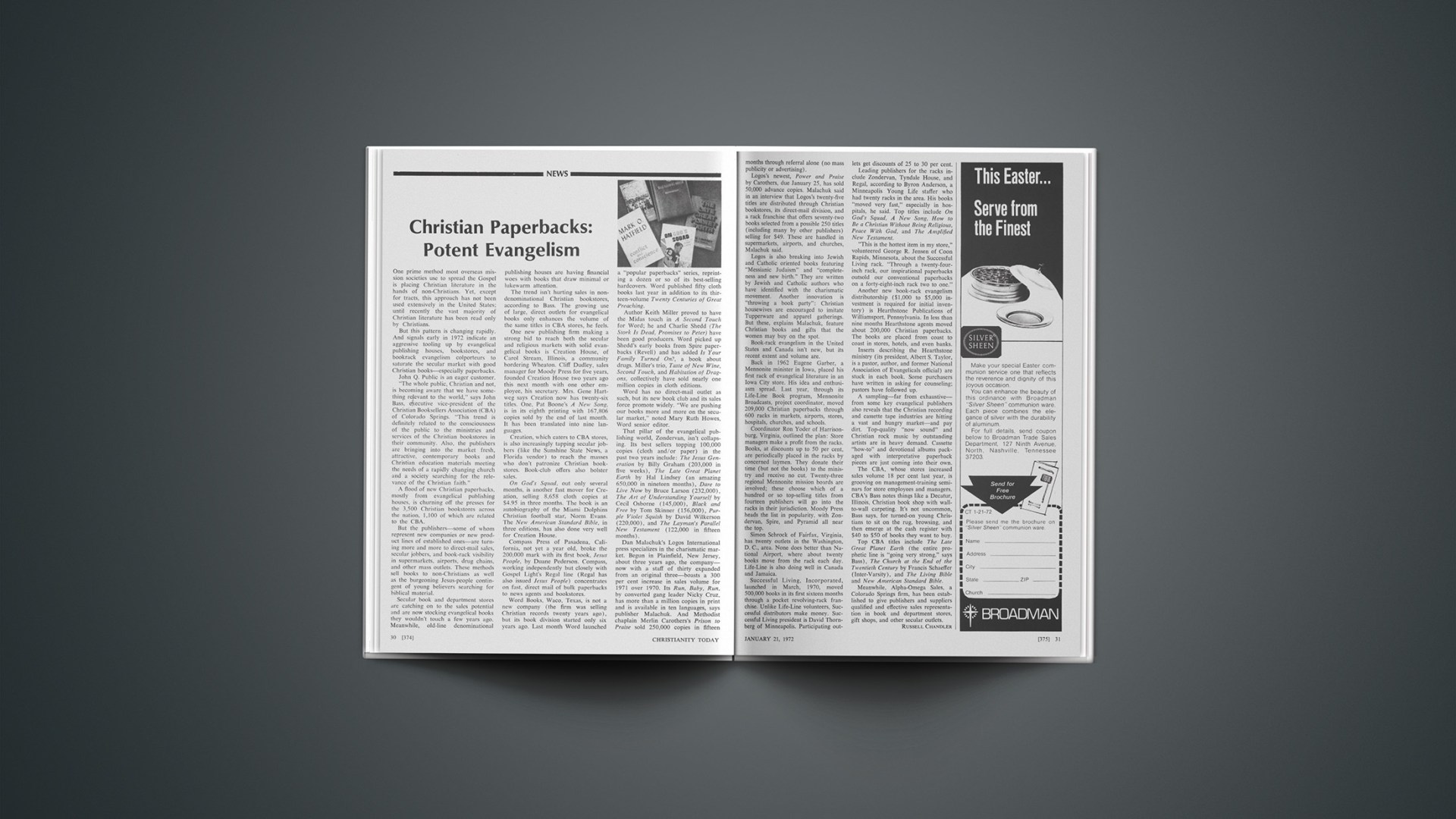
Christian Paperbacks: Potent Evangelism

NEWS

One prime method most overseas mission societies use to spread the Gospel is placing Christian literature in the hands of non-Christians. Yet, except for tracts, this approach has not been used extensively in the United States; until recently the vast majority of Christian literature has been read only by Christians.

But this pattern is changing rapidly. And signals early in 1972 indicate an aggressive tooling up by evangelical publishing houses, bookstores, and bookrack evangelism colporteurs to saturate the secular market with good Christian books—especially paperbacks.

John Q. Public is an eager customer.

“The whole public, Christian and not, is becoming aware that we have something relevant to the world,” says John Bass, executive vice-president of the Christian Booksellers Association (CBA) of Colorado Springs. “This trend is definitely related to the consciousness of the public to the ministries and services of the Christian bookstores in their community. Also, the publishers are bringing into the market fresh, attractive, contemporary books and Christian education materials meeting the needs of a rapidly changing church and a society searching for the relevance of the Christian faith.”

A flood of new Christian paperbacks, mostly from evangelical publishing houses, is churning off the presses for the 3,500 Christian bookstores across the nation, 1,100 of which are related to the CBA.

But the publishers—some of whom represent new companies or new product lines of established ones—are turning more and more to direct-mail sales, secular jobbers, and book-rack visibility in supermarkets, airports, drug chains, and other mass outlets. These methods sell books to non-Christians as well as the burgeoning Jesus-people contingent of young believers searching for biblical material.

Secular book and department stores are catching on to the sales potential and are now stocking evangelical books they wouldn’t touch a few years ago. Meanwhile, old-line denominational publishing houses are having financial woes with books that draw minimal or lukewarm attention.

The trend isn’t hurting sales in non-denominational Christian bookstores, according to Bass. The growing use of large, direct outlets for evangelical books only enhances the volume of the same titles in CBA stores, he feels.

One new publishing firm making a strong bid to reach both the secular and religious markets with solid evangelical books is Creation House, of Carol Stream, Illinois, a community bordering Wheaton. Cliff Dudley, sales manager for Moody Press for five years, founded Creation House two years ago this next month with one other employee, his secretary. Mrs. Gene Hartweg says Creation now has twenty-six titles. One, Pat Boone’s A New Song, is in its eighth printing with 167,806 copies sold by the end of last month. It has been translated into nine languages.

Creation, which caters to CBA stores, is also increasingly tapping secular jobbers (like the Sunshine State News, a Florida vendor) to reach the masses who don’t patronize Christian bookstores. Book-club offers also bolster sales.

On God’s Squad, out only several months, is another fast mover for Creation, selling 8,658 cloth copies at $4.95 in three months. The book is an autobiography of the Miami Dolphins Christian football star, Norm Evans. The New American Standard Bible, in three editions, has also done very well for Creation House.

Compass Press of Pasadena, California, not yet a year old, broke the 200,000 mark with its first book, Jesus People, by Duane Pederson. Compass, working independently but closely with Gospel Light’s Regal line (Regal has also issued Jesus People) concentrates on fast, direct mail of bulk paperbacks to news agents and bookstores.

Word Books, Waco, Texas, is not a new company (the firm was selling Christian records twenty years ago), but its book division started only six years ago. Last month Word launched a “popular paperbacks” series, reprinting a dozen or so of its best-selling hardcovers. Word published fifty cloth books last year in addition to its thirteen-volume Twenty Centuries of Great Preaching.

Author Keith Miller proved to have the Midas touch in A Second Touch for Word; he and Charlie Shedd (The Stork Is Dead, Promises to Peter) have been good producers. Word picked up Shedd’s early books from Spire paperbacks (Revell) and has added Is Your Family Turned On?, a book about drugs. Miller’s trio, Taste of New Wine, Second Touch, and Habitation of Dragons, collectively have sold nearly one million copies in cloth editions.

Word has no direct-mail outlet as such, but its new book club and its sales force promote widely. “We are pushing our books more and more on the secular market,” noted Mary Ruth Howes, Word senior editor.

That pillar of the evangelical publishing world, Zondervan, isn’t collapsing. Its best sellers topping 100,000 copies (cloth and/or paper) in the past two years include: The Jesus Generation by Billy Graham (203,000 in five weeks), The Late Great Planet Earth by Hal Lindsey (an amazing 650,000 in nineteen months), Dare to Live Now by Bruce Larson (232,000), The Art of Understanding Yourself by Cecil Osborne (145,000), Black and Free by Tom Skinner (156,000), Purple Violet Squish by David Wilkerson (220,000), and The Layman’s Parallel New Testament (122,000 in fifteen months).

Dan Malachuk’s Logos International press specializes in the charismatic market. Begun in Plainfield, New Jersey, about three years ago, the company—now with a staff of thirty expanded from an original three—boasts a 300 per cent increase in sales volume for 1971 over 1970. Its Run, Baby, Run, by converted gang leader Nicky Cruz, has more than a million copies in print and is available in ten languages, says publisher Malachuk. And Methodist chaplain Merlin Carothers’s Prison to Praise sold 250,000 copies in fifteen months through referral alone (no mass publicity or advertising).

Logos’s newest, Power and Praise by Carothers, due January 25, has sold 50,000 advance copies. Malachuk said in an interview that Logos’s twenty-five titles are distributed through Christian bookstores, its direct-mail division, and a rack franchise that offers seventy-two books selected from a possible 250 titles (including many by other publishers) selling for $49. These are handled in supermarkets, airports, and churches, Malachuk said.

Logos is also breaking into Jewish and Catholic oriented books featuring “Messianic Judaism” and “completeness and new birth.” They are written by Jewish and Catholic authors who have identified with the charismatic movement. Another innovation is “throwing a book party”: Christian housewives are encouraged to imitate Tupperware and apparel gatherings. But these, explains Malachuk, feature Christian books and gifts that the women may buy on the spot.

Book-rack evangelism in the United States and Canada isn’t new, but its recent extent and volume are.

Back in 1962 Eugene Garber, a Mennonite minister in Iowa, placed his first rack of evangelical literature in an Iowa City store. His idea and enthusiasm spread. Last year, through its Life-Line Book program, Mennonite Broadcasts, project coordinator, moved 209,000 Christian paperbacks through 600 racks in markets, airports, stores, hospitals, churches, and schools.

Coordinator Ron Yoder of Harrisonburg, Virginia, outlined the plan: Store managers make a profit from the racks. Books, at discounts up to 50 per cent, are periodically placed in the racks by concerned laymen. They donate their time (but not the books) to the ministry and receive no cut. Twenty-three regional Mennonite mission boards are involved; these choose which of a hundred or so top-selling titles from fourteen publishers will go into the racks in their jurisdiction. Moody Press heads the list in popularity, with Zondervan, Spire, and Pyramid all near the top.

Simon Schrock of Fairfax, Virginia, has twenty outlets in the Washington, D. C., area. None does better than National Airport, where about twenty books move from the rack each day. Life-Line is also doing well in Canada and Jamaica.

Successful Living, Incorporated, launched in March, 1970, moved 500,000 books in its first sixteen months through a pocket revolving-rack franchise. Unlike Life-Line volunteers, Successful distributors make money. Successful Living president is David Thornberg of Minneapolis. Participating outlets get discounts of 25 to 30 per cent.

Leading publishers for the racks include Zondervan, Tyndale House, and Regal, according to Byron Anderson, a Minneapolis Young Life staffer who had twenty racks in the area. His books “moved very fast,” especially in hospitals, he said. Top titles include On God’s Squad, A New Song, How to Be a Christian Without Being Religious, Peace With God, and The Amplified New Testament.

“This is the hottest item in my store,” volunteered George R. Jensen of Coon Rapids, Minnesota, about the Successful Living rack. “Through a twenty-four-inch rack, our inspirational paperbacks outsold our conventional paperbacks on a forty-eight-inch rack two to one.”

Another new book-rack evangelism distributorship ($1,000 to $5,000 investment is required for initial inventory) is Hearthstone Publications of Williamsport, Pennsylvania. In less than nine months Hearthstone agents moved about 200,000 Christian paperbacks. The books are placed from coast to coast in stores, hotels, and even banks.

Inserts describing the Hearthstone ministry (its president, Albert S. Taylor, is a pastor, author, and former National Association of Evangelicals official) are stuck in each book. Some purchasers have written in asking for counseling; pastors have followed up.

A sampling—far from exhaustive—from some key evangelical publishers also reveals that the Christian recording and cassette tape industries are hitting a vast and hungry market—and pay dirt. Top-quality “now sound” and Christian rock music by outstanding artists are in heavy demand. Cassette “how-to” and devotional albums packaged with interpretative paperback pieces are just coming into their own.

The CBA, whose stores increased sales volume 18 per cent last year, is grooving on management-training seminars for store employees and managers. CBA’s Bass notes things like a Decatur, Illinois, Christian book shop with wall-to-wall carpeting. It’s not uncommon, Bass says, for turned-on young Christians to sit on the rug, browsing, and then emerge at the cash register with $40 to $50 of books they want to buy.

Top CBA titles include The Late Great Planet Earth (the entire prophetic line is “going very strong,” says Bass), The Church at the End of the Twentieth Century by Francis Schaeffer (Inter-Varsity), and The Living Bible and New American Standard Bible.

Meanwhile, Alpha-Omega Sales, a Colorado Springs firm, has been established to give publishers and suppliers qualified and effective sales representation in book and department stores, gift shops, and other secular outlets.

Consubstantial Agreement?

The Anglican-Catholic international report on the doctrine of the Eucharist, approved by Pope Paul and the archbishop of Canterbury, Arthur Michael Ramsey, claims that substantial agreement has been reached. Catholic co-chairman Bishop Alan Clark of Northampton called the consensus “extraordinarily startling on the subject which separated the Church at the Reformation.”

The agreement turns on two pivots: first, seeing the Eucharist as a memorial of the life, death, and resurrection of Jesus Christ; it is not, however, “a mere remembrance to keep alive the memory of Christ’s redeeming death and resurrection” but is a memorial that makes “present and real his historic sacrifice each time the Eucharist is celebrated” and that brings the worshiper into active involvement. The second pivotal point is the agreement that Christ is really there in the Eucharist independently of what the congregation think or believe, “as an offering to the believer awaiting his welcome. When this offering is met by faith, a life-giving encounter results.”

Despite significance claimed for the report (the commission called it “the most important statement for Anglicans and Roman Catholics since the Reformation”), it initially got lukewarm notice in British Catholic publications. Britain’s 1,300-membcr Catholic priests’ association urged complete rejection.

Asked for his reaction, the president of the evangelical and influential Islington Clerical Conference, the Reverend Peter Johnston, said that despite some good points the report was really offering “transubstantiation dressed up in a refined form shorn of some cruder superstitions.” He criticized especially the statement that “the bread and wine become the body and blood of Christ by the action of the Holy Spirit so that in Communion we eat the flesh of Christ and drink his blood.” The view that “something happens” to the bread and wine is very dangerous, said Johnston, though many Anglicans would agree with it.

CHRISTIANITY TODAY then asked the one evangelical Anglican commissioner, the Reverend Julian Charley, how he would counter Protestant criticism. He said: “The report is very explicit that there is no repetition of or addition to the work of Calvary,” yet makes clear that the Eucharist is not simply a meal but the Lord’s Supper in which Christ genuinely offers himself to us apart from our feelings.

Charley said the Roman Catholics were anxious to safeguard the point that this was entirely the grace of God. Protestants were slow to acknowledge that in the Eucharist there is a mystery, something we cannot fully explain.

The high-powered commission was composed of seven bishops, ten university and college teachers, and a Vatican undersecretary. Their report, which took two years to prepare, does not advocate intercommunion. The Catholic Church still doesn’t recognize as valid the Anglican priesthood; only its own priests can consecrate the elements. The subject of the priesthood will be discussed when the committee reconvenes this May in Woodstock, New York.

J. D. DOUGLAS

Evangelical Thought: Putting It All Together

Editor Harold Lindsell of CHRISTIANITY TODAY has urged evangelical scholars to bring academic disciplines to bear upon one another so that an authentic Christian world view relevant to the times might emerge.

At the present time, he told the annual meeting of the Evangelical Theological Society last month, there is too little interdisciplinary interaction. Theologians, he said, are divorced from evangelical scholars in economics, political science, sociology, philosophy, and ethics.

The latter, Lindsell declared, “read their Bibles, say their prayers, attend their churches, and confess their commitment to Christ—but they live in two worlds.”

The “theologians do no better,” he added. “Steeped in their preoccupation with God’s revelation, they do not often relate what they know to politics, economics, sociology, and the like.”

Lindsell made the proposal for vigorous interaction among evangelical scholars in his presidential address to the members of the society, meeting at Gordon-Conwell Seminary in South Hamilton, Massachusetts.

Professor Robert L. Saucey of Talbot Seminary was elected to succeed Lindsell as president.

South America Crusades

Participants in major evangelistic campaigns in Brazil and in Peru last month reported large attendances and responsive seekers answering altar calls.

San Diego, California, charismatic evangelist Morris Cerullo presided over the closing session of what he called the largest evangelistic crusade ever conducted in the upper Amazon jungles. A total of 150,000 persons came to the eight-day crusade, led by Cerullo’s associate, Argemiro Figueiro. It was reportedly the largest crusade ever held by a “national evangelist” in Brazil; nationals—following the World Evangelism format for mass evangelism in foreign countries—were in complete charge. Thousands streamed to the front of the hall at the invitation to receive Christ, and many sick persons came for prayer.

A concurrent Deeper Life Ministers’ Institute conducted by Cerullo stressing charismatic gifts and motivation techniques was said by participants to have had “the greatest spiritual impact in the area’s history.” Pastors and lay leaders came to the training sessions by cart, bicycle, auto, foot, and horseback.

Meanwhile, in Lima, 15,000 persons nearly filled the 18,500-seat Acho Bull Ring for the closing meeting of twelve nights of a Luis Palau crusade. There were 650 decisions that day. Total attendance was 103,000, with 4,585 decisions recorded. Television outreach included thirteen programs.

In his year-end report, Palau listed as 1971 accomplishments: ten million taught the Word through daily radio “Crusada”; fifty telecasts in four countries; 500,000 gospel tracts placed; preaching in person to 350,000; and 15,000 professions of faith in Christ.

Dishwasher For Jesus

For the last years of his life, an elderly man in his seventies or eighties worked as a dishwasher in the Life Line Mission on the San Francisco waterfront. Eight months ago, the man, who asked to remain anonymous, died—a skid row benefactor.

He left $150,000 to the mission where he worked, which shelters destitute men, and $128,000 to 540-student Messiah College in south central Pennsylvania. Both are operated by the Brethren in Christ Church.

The story of the unusual bequeathment came out on Christmas eve, when a check for $110,000 arrived at the Messiah campus ($18,000 more was expected later). Messiah president D. Ray Hostetter said he knew who the man was but was respecting his wish to keep his name secret. “He apparently worked for years and saved almost every nickel he earned to invest in the stock market,” Hostetter said. The money will be used to build a kitchen in the new Eisenhower Student Center on the Grantham campus.

“We thought it would be appropriate, since the old man spent most of his time just before his death working in the kitchen of the mission, washing dishes,” Hostetter added.

Let’s Send Our Youth Abroad This Summer

This summer more Christian young people than ever before will be visiting such places as Honduras, Mexico, the Caribbean islands, Colombia, the Philippines, India, and Nigeria, not as wandering vagabonds but as missionary interns. And, if past statistics are an indication, a sizable number will later return to devote themselves full-time to the Christian cause. Meanwhile virtually all these summer apprentices—culturally and spiritually deepened—will be a boon to the churches.

Many churches, Christian colleges, and both independent and denominational agencies sponsor intern programs. Most mission boards have made arrangements for such programs, and some enlist young people directly. Interns are assigned to work under the supervision of specific missionaries.

The recruiting and sending procedure differs from group to group. Our church began sending young people on missionary tours of duty several years ago, and here is how we put our program together:

Initially, we established a Missionary Fellowship Club for high-schoolers and college-agers. Then we spread the word about opportunities for summer travel for Christ, opened the club to all comers, and proceeded with training.

Our program is simple. We establish the biblical frame of reference: the divine imperative to “go.” We discuss the responsibilities and experiences of missionaries, inviting missionaries to share their blessings and trials. We prepare the young people for cultural shock (it is in bad taste for boys and girls to sit together in the Virgin Islands), the rigors of hard work (perhaps helping to build a church by hand), climatic conditions (there are no air conditioners in the jungle), and other problems (missionaries have tempers too).

This mental and spiritual conditioning is important. As candidates realize they will not be going as visiting spectators but as co-workers with little time for relaxation or junketing, they are better able to analyze their motives for wanting to participate.

We select a committee of six from the ranks of deacons or elders, parents of missionaries, missionaries home on furlough, Sunday-school teachers of teens and collegians, and the church’s missionary committee to help us select those who are to be sent. The selection process usually takes only a few weeks.

During the selection period, the committee prays daily for all candidates, evaluates letters candidates are required to write telling why they want to participate, and interviews each candidate, discussing strengths and weaknesses of the personalities involved. We always hope the Lord will place his stamp of approval on candidates through unanimous selection by the committee, and we have always achieved this goal, through much personal and group prayer regarding the decision.

Besides writing the letter telling why he wants to serve as a summer missionary, each candidate must satisfactorily complete a number of other steps:

1. Read and discuss Glover’s Bible Basis of Missions, Hudson Taylor’s Spiritual Secret (Taylor), and The Ugly American by Burdick and Lederer.

2. Write a report on the culture and customs of the people in the area to be visited, giving information on history, religion, politics, important people (including entertainers and sports stars), currency, potential dangers for a visitor, and problems that may be encountered. Each report is discussed by the club group.

3. Memorize certain Scriptures (Matt. 28:19, 20; Mark 16:15; Luke 24:47; John 20:21; Acts 1:8; and others).

4. Translate (into the language of the people to be visited) and memorize a personal testimony one or two minutes long.

5. Learn a few conversational phrases.

6. Raise funds for travel expenses and room and board.

Candidates share their plans with every department and group in the church, asking only that the church pray that God will move individuals and groups to contribute. This works quite well most of the time. If complete expense money is not raised in time, the church’s missionary board quietly takes up the slack. We estimate it will cost a candidate $3.50 to $6 a day (depending on area) beyond travel expenses if he lives in a missionary’s home. We also think it is a good idea for the church to send a contribution to the missionaries to help them in their work.

During meetings with the candidates we pray for the upcoming trip and try to prepare them for teaching Bible lessons, providing special music, and providing other program help. We discuss taboos, and actions that could be misinterpreted by nationals (such as handholding in public, whispering and giggling when others present might not understand, bragging about conditions in the United States, and criticizing local standards and customs). An offense on the mission field may destroy in a moment what has taken years to build.

While on the field the intern keeps a diary that is reviewed in a debriefing session upon his return. His missionary supervisor also submits a critique of him.

The work opportunities range from menial to adventurous: construction, teaching, camp counseling, visitation and tract distribution, child care, clerical work, and the like. The worker may live in a home, a dormitory, or a camp.

We have found that a group of four in any one location works out quite well. We usually send two fellows and two girls, preferably not dating couples. If they are in a dating relationship and we have absolute confidence in them, we spell out precisely what we expect by way of conduct on the field, and we check out in advance with the assigned missionaries what standards pertain locally.

The length of stay may vary. It should not be less than three weeks; many find it takes that long just to get acclimated.

Young people come home from their summer of service with a better sense of values, a greater understanding of missionary outreach, a more compassionate outlook toward the needs of others, and often a deeper personal commitment to Christ.—ALBERT I. DASBURG, director of Christian education and youth, Cherrydale Baptist Church, Arlington, Virginia.

Ideas

No Other Gospel

The beginning of another year is a good time to think about one of the most familiar terms in the vocabulary of faith. All Christendom uses the word gospel, which is simply another way of saying “good news.” To stop and look again at what the “good news” really is—this is always profitable, and particularly in times like these.

We call the first four books of the New Testament “the Gospels,” but this is a post-biblical usage. These books contain but are not themselves the Gospel.

What, then, is the Gospel? It is the great good news “that Christ died for our sins in accordance with the scriptures, that he was buried, that he was raised on the third day in accordance with the scriptures” (1 Cor. 15:3, 4). This is the Gospel proclaimed by the apostles and the early Church after Christ’s ascension, and by Christians ever since. This is the message that changed the course of human history. This is the truth that is “the power of God for salvation,” a fact demonstrated through nearly 2,000 years, from Peter’s preaching at Pentecost to the Jesus movement today.

The Gospel must be neither abridged nor added to. Its integrity stems from the grace of God, who “so loved the world that he gave his only Son, that whoever believes in him should not perish but have eternal life.”

Integrity means wholeness, and with the Gospel it is a matter of all or nothing. To truncate the Gospel, whether by denying the deity of Christ, who is its center, or by reducing the efficacy of his death for our sins to an example of martyrdom, or by repudiating the reality of his resurrection, is to destroy the Gospel. Likewise, to substitute for it any other way of redeeming men dishonors the living God, who originated the Gospel as the only means of reconciling the world to himself. Among the most severe words in the New Testament are these from the greatest of the apostles: “But even if we, or an angel from heaven, should preach to you a gospel that is different from the one we preached to you, may he be condemned to hell!” (Gal. 1:8, TEV)—a kind of plain speaking that rather grates on the ear in this time of covert universalism.

“But why,” someone asks, “go back now to these old truths in a time of change when society is making one of the great right-angle turns in history?” Simply because an understanding of what the Gospel is and what God requires of us through it remains indispensable for Christian life and service.

Although a child can believe it, the Gospel expresses the unfathomable love of God. As with other basic Christian concepts, to oversimplify it can violate its integrity.

In the Bible there is only one Gospel, but it has various facets. The saving work of Jesus Christ was its consummation; its origin goes back, beyond the Messianic prophecies and the record of God’s mighty acts in Israel’s history, to “the definite plan and foreknowledge of God” (Acts 2:23), who “destined” his Son to be the Saviour “before the foundation of the world” (1 Pet. 1:20). When in the fullness of time Christ came, he began his Galilean ministry with the announcement, “The time is fulfilled, and the kingdom of God is at hand; repent, and believe in the gospel” (Mark 1:15). This was the Messianic aspect of the Gospel, and its overtones are still sounding. The King had come and was preaching the good news of his kingdom, to be established on the central gospel facts of his death and resurrection. To these he pointed when he said to his disciples, “The Son of man also came not to be served but to serve, and to give his life as a ransom for many” (Mark 10:45), and when he told them, “Everything that is written of the Son of man by the prophets will be accomplished. For he will be delivered to the Gentiles.… They will scourge him and kill him, and on the third day he will rise” (Luke 18:31–33).

The center of gravity of the four Gospels, which have been called “narratives of the Passion with detailed introduction,” lies in the records of the final days of our Lord’s life. For the actual accomplishment of the Gospel took place on the cross and in the resurrection. Whereas the evangelists used the term gospel only six times (not counting parallels), Paul, looking back on Christ’s redeeming work, used it sixty times. And ever since, whenever the Gospel has been proclaimed men have been accountable for their response to the Saviour. “There is salvation in no one else, for there is no other name under heaven given among men by which we must be saved” (Acts 4:12).

What should we say, then, when we are told that calling men individually to repent and believe in the Lord Jesus Christ as Saviour is passé and that we must instead proclaim and work toward the redemption of social structures? What should be our response to this contemporary variant of the “social gospel” of early twentieth-century liberalism? Well, we must insist that God redeems men one by one. We must point out the ultimate futility of trying to bring lasting change in social structures apart from changed lives. We must declare that to substitute for the Gospel according to the Scriptures any plan to regenerate men or society by human effort alone falls into the category of “another gospel.”

But let no reader of this editorial stop here. Something more must be said. Everyone who is committed to the one Gospel of Christ, everyone who insists earnestly upon its priority, must be aware of this “something more,” for it is just as biblical as the proclamation of salvation. The Gospel cannot be divorced from the context of Scripture and from the totality of Christ’s ministry. He taught us to love our neighbors and to minister to the bodies as well as the souls of the poor, the sick, and the outcasts. It was by his deeds of compassion that he validated his mission (Matt. 11:2). He was not aloof from this lost, suffering, sinful world. He cared enough for us to identify himself with us in bearing our sins on his cross. His great commission (Matt. 28:18–20) orders us not only to evangelize but also to teach all things he has commanded us, among which concern for mercy and love and justice bulk very large. And how he would have us serve he summed up in these words: “As the Father has sent me, so have I sent you” (John 20:21).

So it is quite as wrong and unbiblical to say, “Just preach the gospel and everything will be all right,” and then turn one’s back on the great social problems of today, as it is to declare that the redemption of social structures has made personal evangelism obsolete.

The Bible knows no other gospel than that of Christ crucified and risen. To proclaim it is imperative. To substitute any other message for it is to come under divine condemnation. And to sever it from Christian action in behalf of the poor and needy is to face the judgment of him who declared, “Truly, I say to you, as you did it not to one of the least of these, you did it not to me” (Matt. 25:45).

How do we resolve the tension between faith and action? How do we relate our unpurchasable salvation to our inescapable obligation to do good works? Paul shows us how in these memorable words (Eph. 2:8–10): “By grace you have been saved through faith; and this is not your own doing, it is the gift of God—not because of works, lest any man should boast. For [and here he continues with inexorable logic, showing that for a Christian to be unconcerned about good works would thwart the very purpose for which God saved him] we are his workmanship, created in Christ Jesus for good works, which God prepared beforehand, that we should walk in them.”

Deflecting Dictatorship

Elsewhere in this issue there is a report from two recent travelers to East Germany (see page 12). The bleak situation for Christians in the cradle of the Protestant Reformation is a stark challenge to Americans. Even though Protestantism received a new birth of vitality through the opening of North America to European settlement, that is no guarantee that we any more than the Germans will always have freedom. It is extremely difficult to dislodge a totalitarian regime once it has come to power. What Christians in America must do is to try to keep totalitarianism from taking over in the first place. It makes little difference whether dictatorship comes from the “left” as with Communism or from the “right” as with Fascism. Both forms oppose biblical Christianity.

If we learn from the past, we will oppose all truly totalitarian tendencies in our nation while they are still weak enough to be quenched. But such opposition must be in accordance with our constitution. Indeed, the flippant setting aside of a nation’s constitutional guarantees is itself a totalitarian trend. To fight Communist or Fascist tendencies with their own weapons is in reality to have been defeated before we begin.

In the meantime we should do what little we can do for our brethren who are living under dictatorships. But whatever we attempt—beaming radio programs, providing literature, visiting, trying to bring diplomatic pressure for more freedom—should be done in consultation with representative believers whom God has called to live in those countries. Unilateral action by outsiders is paternalistic and potentially harmful to those who live permanently, not just temporarily, in totalitarian nations.

Britain’S Big Secret

Monarchies might make a comeback one of these days, and if they do the world can thank the British. They have carved out a new role for royalty, one that provides not only a bridge out of the past but also a bridgehead into the future.

Many democratic countries have leadership problems today simply because they lack a widely respected head of state. Political leaders become so enmeshed in issues (and in getting reelected) that they invariably alienate large segments of the populace. There is no strong figure to supply continuity.

The limits of political process become only too obvious at times, and politicians themselves realize that solving a problem often requires that it be disengaged from politics. A case in point is the recently created United States Postal Service; it came into being only after many years of inefficiency caused by hiring practices governed by political considerations more than by good managerial principles.

Communist countries acknowledge the need for heads of state. Moreover, Communist political leaders themselves play the part of monarchs because the absence of popular debate on domestic issues preserves the “neutrality” of these leaders in the eyes of the citizenry. They maintain respect because they do not have to take sides.

This is too large a price to pay. Free people must retain the right to exchange ideas, even at the risk of national disharmony.

For the British, the crown serves to give the people the best of both worlds. The Queen maintains a taxing schedule, some 1,600 public engagements a year. Contrary to what non-Britons sometimes think, she serves much more than nostalgic and ceremonial purposes. Political debate is allowed to rage about her, but she remains majestically aloof. She retains respect because it is understood that she will outlast the issues that consume the politicians.

The British Parliament recently awarded its royal family an increased expense account. Some estimate the annual cost now at 5.5 million pounds, and it is substantially a worthwhile investment. The British sovereign provides assets not lightly obtained in this turbulent world and, as one observer has put it, “beyond any accountant’s pricing.”

Darwinism Under Fire

Since the Scopes trial in 1925, many have assumed that belief in Darwin’s theory of evolution is necessary if one is to be a member in good standing of the intelligentsia. But in a time when so many other long-dominant views are being questioned, can Darwinism expect to go unchallenged? Not likely. At the annual year-end meeting of the American Association for the Advancement of Science, John Moore, a professor of natural science at Michigan State, read a paper charging that evolution is a “religion” but not a science; it is worth discussing and investigating, but more and more the results of disciplined experimentation fail to conform to what would be expected if Darwinism were true. Moore is co-editor of a high-school text, Biology: A Search for Order in Complexity (Zondervan, 1969, 548 pp., $7.95), and a leader in the evangelically motivated Creation Research Society.

Christians have always opposed the agnostic and anti-biblical aspects of Darwinism, and when some have offered reasonable arguments questioning scientific aspects of the theory, these too have been widely dismissed as special pleading. But now a new book by a lawyer who does not argue for Christianity or creationism, Norman MacBeth, may challenge at least some Darwinians to face the objections of their critics. At least, if they ignore the scientific arguments marshalled in Darwin Retried (Gambit, 1971, 178 pp., $6.95), they will simply be confirming Macbeth’s suspicions that biologists believe in Darwinism not scientifically but as one believes in his religion—and, unlike biblical Christianity, this religion is one whose bases are not to be too closely scrutinized lest they collapse.

That some evolution takes place—as in the variations that breeders have long been accustomed to—is indisputable. But can we from this demonstrable kind of variation extrapolate an explanation for the development of all species?

Christian truth does not rest on the outcome of the debate over scientific theories, and certainly Christians may disagree among themselves on such matters. But as those who are committed to the dispassionate study of the universe that God has created and placed us in, they should encourage any attempt to prevent false religious elements from impeding the quest for knowledge.

Accord On The Eucharist?

Roman Catholic and Anglican scholars have formulated a statement on the Eucharist (the sacrament of the supper, or the Holy Communion) that has been hailed not only as a breakthrough in ecumenical theology but also as a key step to Anglican reunion with Rome (see News, page 32). Already, however, dissenters in both communions have expressed reservations. It is by no means clear yet whether these two churches will endorse the statement.

There is no doubt that the Roman Catholics have yielded ground; the statement appears to be more in line with traditional Anglican opinions than with commonly held Catholic views. It is encouraging to note the clear affirmation that “Christ’s redeeming death and resurrection took place once and for all in history. Christ’s death on the cross … was the one, perfect and sufficient sacrifice for the sins of the world.” Having said this, however, we must ask a number of questions.

The first is: Does not the statement still constitute a formidable barrier for those who do not hold to the realistic view of the presence of Christ in the sacrament? Both Anglicans and Roman Catholics believe in the real presence. Since Christ cannot be separated from his body, they say, if he is really present then his body must be present too. Calvin said Christ’s body is in heaven and cannot be anywhere else; hence Christ cannot be bodily present. Zwingli said Christ was symbolically present. A further complication develops, for if Christ is present in bodily form, then his body is ubiquitous, for his body must be present everywhere the Eucharist is observed and it is being observed in a thousand places at once. Certainly ubiquity can be deduced if one starts with the realistic view of Christ’s presence. But those in the Baptist and Reformed traditions, among others, do not do this.

A second and an exceedingly thorny question has to do with how and when the bread and wine become the body and blood of Jesus Christ. The Catholic Church has always insisted that the priest alone can consecrate the elements, and that it is in the act of consecration that the substance of the bread and wine become the body and blood while retaining the appearance of bread and wine. But that church so far does not recognize the validity of the Anglican priesthood. Therefore this agreement is meaningless unless Catholics concede that Anglican priests can consecrate validly. For, according to their belief, if there is no valid consecration the substance of the bread and wine is unchanged, Christ is not really present, and there is no Eucharist.

Thirdly, does not the new statement leave unclear what the precise role of the priest is in the consecration that produces the change? Does this mean that Roman Catholics will modify their traditional views in the months ahead? This question is high on the agenda for joint consideration by the two churches in the future.

Let there be no mistake about it. The questions involved are important, and in an age of rapid and unprecedented change, Lutherans, Presbyterians, Baptists, and others have a stake in the proceedings. There should be a unity of the faith, and ideally this would include agreement on the nature of the Eucharist. No one need fear discussion of this question if it is agreed that Scripture is the source from which the doctrine should be developed.

Waldheim’S Titan Task

The new secretary general of the United Nations, Dr. Kurt Waldheim of Austria, takes the reins of the world organization at a time when its prestige could hardly be lower. After earnest but ineffective attempts to resolve the Viet Nam war, U Thant apparently precipitated the Six Days’ War between Israel and the Arab nations by immediately yielding to Nasser’s demands to withdraw the U. N. peacekeeping force from Egyptian territory. The United Nations did nothing substantial during the bloody eight months of repression in East Pakistan, and proved itself impotent when India finally took matters into its own hands and invaded. Thus the new secretary general is taking on an authority that has been sadly undermined by the failures of his predecessor.

Dr. Waldheim, who volunteered for the cavalry at the age of nineteen, before Hitler took over Austria, also served with distinction in the German army on the Eastern Front during World War II. Thus, unlike his predecessor, he has first-hand knowledge not only of the horrors of war but also of total military defeat. On the other hand, if there is one country that has proved able to negotiate itself out of almost insuperable difficulties despite its lack of a strong bargaining position, it is Waldheim’s Austria. Divided and subjected to four-power occupation after World War II, Austria is the only country ever to rid itself of occupying Soviet troops.

For the Austrians, charm and tact are by no means inconsistent with a determination that gets results. Dr. Waldheim will need them all as he seeks to rehabilitate the enfeebled world organization and to bring its discordant voices into harmony. Our prayers and best wishes accompany him.

Rhoda’S Joy

God allowed the apostle James to be killed. However, when the Jerusalem authorities imprisoned Peter and intended to lead him to the same fate, God said no—Peter’s time had not yet come (Acts 12:2 ff). Peter’s fellow believers did not know whether or not he would be spared, but they prayed earnestly for him. Since God had let James die, they no doubt did not demand that Peter be rescued; surely they prayed that God would see to his release “if it be thy will.” Yet it doesn’t seem as if they expected God to grant their wish, for when Peter actually showed up at a house where many were praying, everyone was astonished.

Rhoda, the maid who answered the door, recognized Peter’s voice but was so overcome by joy that she didn’t have the presence of mind to unlock the gate. She represents the enthusiastic Christian who is ever ready to believe God for miracles but is not so good at following through. Many a Christian who has long prayed for revival and has seen it come lets his rejoicing keep him from appropriate, down-to-earth follow-up.

On the other hand, the more sober believers at the prayer meeting, those who thought Rhoda mad when she reported that Peter was at the door, represent all too many of the rest of us. We pray and pray but don’t really expect God to answer.

It would have been easy enough to check on Rhoda’s jubilant report by sending someone else to the gate. Instead the gathered believers spent time arguing with Rhoda about her state of mind and engaging in theological speculation about the possibility that some angel representing Peter was at the gate (in which case the angel should surely have been invited in, not left out in the cold!).

Instead of wasting time trying to persuade the doubters by her words, Rhoda should have brought Peter right in. How many arguments in the church would be avoided if living evidence were presented instead of heated affirmation!

Yet those of us not given to over-exuberance and easy credulity also have the responsibility of seeking the evidence for answered prayer instead of arguing that it couldn’t be so. Joy is wonderful, but it must not get in the way of doing what is right. Doubt has its value—for we do not want to believe what is not true—but not when it paralyzes us from checking the claim about which we’re skeptical.

In virtually every major city in our land, there is some expression of a “Jesus” revival among youth. The Rhodas who wish to tell the established churches about it should remember to introduce the living proof. And those who doubt whether it is true should go to the door and see for themselves, instead of merely sitting back and discussing it.

Justification

We laymen are prone to shy away from theological terms. This can cause poverty in our understanding of the meaning of Christianity.

Ask the average person, even many church members, what Christianity is and what it means to be a Christian and you will get a variety of answers. For example, “Christianity is a religion, and being a Christian means you are a follower of that religion.” And, “Christianity is a religion of good people trying to do good to others.” Neither of these two definitions would be much more accurate than describing a human being as a “finger,” or a “toe,” or an “ear.”

On God’s part, Christianity is a supernatural work of his love, grace, and mercy in the lives of men through which fellowship with himself is restored. It is a mysterious manifestation of God’s power that enables people to become new creatures, born again from above. Even the very wicked can be made clean, pure, and righteous in God’s sight.

On man’s part Christianity means realization of sinfulness and need—conviction. It requires sorrow for and repentance for sin. It requires confession. And it requires that in full humility man accept what God has done for him through Christ Jesus. In other words, he must put his faith in the Person and Work of the Lord Jesus Christ.

God does not violate man’s right to decide, his privilege of accepting or rejecting Christ. Some may say there is a conflict between election and predestination on the one hand and man’s free will on the other. I do not believe there is any conflict. The one side looks at God’s offer of salvation from the standpoint of God’s infinite knowledge. The other view is from man’s side: his response to God’s invitation, “Whosoever will, let him come.”

Involved in this entire question of salvation, of Christianity, and of becoming a Christian is the fact of justification. This is not a matter of character. We cannot justify ourselves in God’s sight by being good. Nor is justification freedom from sin. Rather, it is freedom from the guilt and punishment that inevitably follow unforgiven sin. Justification does not mean that we are guiltless; it means that the Judge has paid the penalty for us.

Under ordinary circumstances a criminal has three things against him—the law, the judge, and the jury.

But through justification, the “criminal” in God’s sight—the sinner—can have everything going for him. First of all, God is on his side; none can dare to accuse him, for this God gave His Son to redeem him. In this amazing situation the Christian finds that the Judge has taken on himself the penalty for his sins and in so doing has declared him “not guilty”! All this is a reality that stems from the past, but the present and future are also secured by the fact that the Judge himself is pleading as an Advocate in the divine presence, so that the past is forgiven and the present and future assured by the Forgiver.

That is the meaning of Christianity and the assurance of the Christian. Because God in the person of his Son has taken on himself the guilt and penalty of our sins, we stand justified in God’s presence—“just-as-if-I’d” never sinned.

What is the result? Peace with God and the peace of God in our hearts. The rebellion is over, willful disobedience is ended, and Christ the Judge is now Saviour and Lord.

The Apostle Paul tells us, “Since then it is by faith that we are justified, let us grasp the fact that we have peace with God through our Lord Jesus Christ. Through him we have confidently entered into this new relationship of grace, and here we take our stand, in happy certainty of the glorious things he has for us in the future” (Rom. 5:1, 2, Phillips).

Perhaps some who read this have been searching and longing for peace with God but have remained frustrated and miserable. A possible explanation is found in these words of the Apostle Paul: “They do not know God’s righteousness, and all the time they are going about trying to prove their own righteousness they have the wrong attitude to receive his. For Christ means the end of the struggle for righteousness-by-the-Law for everyone who believes in him” (Rom. 10:3, 4, Phillips).

Ever present in the ignorant heart is the feeling that our salvation depends on achieving. But becoming a Christian is a matter, not of doing anything good, but of believing the marvelous thing Christ has done for us.

In his statement that the Christian is justified by faith, the Apostle Paul opens with the word therefore. This connects the whole matter with saving faith.

He uses Abraham as an illustration of righteousness by faith: “For what does the scripture say? ‘Abraham believed God, and it was reckoned to him as righteousness’ ” (Rom. 4:3).

What did Abraham believe? He believed the seemingly preposterous promise that God would give him a son when he was one hundred years old and his wife, Sarah, was ninety-one. When that son came as promised and had grown to early manhood, Abraham believed that if, in obedience to God’s command, he offered the boy as a sacrifice, God would bring him back to life, for in this boy reposed the hope of God’s covenant. “By faith, Abraham, when he was tested, offered up Isaac, and he who had received the promises was ready to offer up his only son, of whom it was said, ‘Through Isaac shall your descendants be named.’ He considered that God was able to raise men even from the dead; hence, figuratively speaking, he did receive him back” (Heb. 11:17–19).

What was the secret of Abraham’s faith, a faith that we too should have? Abraham believed God’s promises. “No distrust made him waver concerning the promise of God, but he grew strong in his faith as he gave glory to God, fully convinced that God was able to do what he had promised” (Rom. 4:20, 21).

Surely we should believe God’s promises! Surely we should believe that the Creator of the universe, the sovereign God of all history, has the power to carry out what he has promised!

Justification proceeds from faith, a childlike faith which is centered in what God has done for us and which we receive as his loving gift. “He saved us, not because of deeds done by us in righteousness, but in virtue of his own mercy, by the washing of regeneration [the new birth] and renewal in the Holy Spirit, which he poured out upon us richly through Jesus Christ our Saviour, so that we might be justified by his grace and become heirs in hope of eternal life. This saying is sure” (Titus 3:5–8).

Justification is nothing more or less than God’s offering us forgiveness, cleansing, and infilling with himself on the basis of what his Son has done for us.

To an unbelieving world that is utter foolishness, but for that same world it can be hope and joy and peace.

Book Briefs: January 21, 1972

Trumpeting Some Good News

Listen to the Green, by Luci Shaw (Harold Shaw, 1971, 96 pp., paperback, $1.95), Six Days: An Anthology of Canadian Christian Poetry, edited by H. Houtman (Wedge [Box 10, Station L, Toronto 10, Ontario], 1971, 144 pp., paperback, $2.50), and Adam Among the Television Trees: An Anthology of Verse by Contemporary Christian Poets, edited by Virginia R. Mollenkott (Word, 1971, 218 pp., $4.95), are reviewed by Elva McAllaster, poet-in-residence, Westmont College, Santa Barbara, California.

Good news. Good news. Good news for people who love poetry and love God—and for people who up to now have loved one but not the other. Books are appearing that Christians who like to use mind and imagination will be glad to know about.

Luci Shaw’s Listen to the Green is a tactile and visual delight even before one reads a line of its poetry: the graceful typography, clean spacing on a good quality of paper, and sensitively chosen photographs proclaim this to be a book to savor and keep, or to savor and give away, or both.

The poem titles announce a lithe, eclectic mind. The poems themselves reveal a close knowledge of Scripture, a wide-ranging responsiveness to human experience, a gleeful zest in wordcraft. Awkward touches are not totally absent, but a lovely precision of diction and careful authenticity of emotion are prevailingly present. The poem “Circles” alone is easily worth the price of the book: “I sing of circles, rounded things,/ apples and wreaths and wedding rings,/ and domes and spheres,/ and falling tears …”

Six Days seldom touches the excellence that Listen to the Green sustains, but it contains moments of ecstasy and affirmation and excitement in using words. It also contains creativity not yet under harness and rein: prosiness, murky meanings, distorted syntax trying to stand as profundity, capricious enjambment.

The eight contributors to Six Days speak with very different voices. Among them, clearly young David Toews (Goshen College, ’71) is a writer to listen for in the future. His writing is spare, experimental, compassionate, earnest. His tiny poem, “A Prophet, Maybe,” is worth pages of expository prose. Mat Cupido’s attractive black-and-white line drawings enhance both Canadian and Christian accents of Six Days’ voices.

Adam Among the Television Trees is a far more important anthology. Upon opening it, my first reaction was vexation with myself, that after seeing a published invitation to contributors, I never did find the minutes to ship Mrs. Mollenkott some of my own poems to consider. My second reaction: glee that I didn’t do so. Now, quite impartially, I can blow some trumpet fanfares for her book.

Here is a landmark among publishing events in the evangelical world. Here is a book that ought to be on coffee tables and in conversations in alert Christian homes all over America. (And why stop with the borders of America?)

Carefully defining her project as poems by self-affirmed Christian writers, Mrs. Mollenkott has brought together 201 poems she appreciates, by forty-one contemporary poets: older and younger, from many employments, and from many denominational labels, or none. To each writer, poetry is a genuinely important mode of expression for moments of experience that are genuinely important to him. Although the same might be said for hundreds of equally effective writers who are not represented here, it’s still true of these forty-one.

Some of the poems included are flawed, even badly flawed, but as a whole Adam Among the Television Trees is a book certainly worthy of Mrs. Mollenkott’s vigorous, well-trained, and experienced intellect. (She teaches English at Paterson, New Jersey, State College.) Deciding precisely what one dislikes about the weaker poems will be an immensely valuable exercise for readers at any level of poetic inexperience or poetic sophistication. Deciding precisely what one likes about the stronger poems: well, bring out the trumpets and sound the fanfares.

From The Crucible

Faith on Trial in Russia, by Michael Bourdeaux (Harper & Row, 1971, 192 pp., $5.95), is reviewed by Paul D. Steeves, Ph.D. candidate in Russian history, University of Kansas, Lawrence.

Ten years have passed since the opening of a deep schism in the evangelical movement in Russia. This division has proven to be one of the most significant events of the sixties in Soviet society, for what began as a church reform movement has led, by direct and indirect influences, to a widespread civil-rights movement that reaches well beyond the confines of the believing population. Michael Bourdeaux tells the story of the reform movement in this splendid book.

In August, 1961, three Baptist believers, two of them laymen, organized an “Action Group” in a revolt against the national leadership of the so-called Baptist movement. (“Baptist” is a shorthand designation for the evangelicals of Russia, encompassing Pentecostals, Plymouth Brethren, Baptists, and Mennonites.) No substantive doctrinal matters were at issue; the Baptists of Russia are thoroughly committed to biblical orthodoxy. The question that divided the evangelicals was one of political relationships. The official Baptist leadership has consistently followed a policy of co-operation with the civil government. The Action Group rejected this policy and the men who represented it. Very quickly, support for the Action Group came from all over the U.S.S.R. Its adherents began to practice flagrant civil disobedience, for which many were arrested and sentenced.

The ordeals of the Baptist dissidents are detailed in a veritable flood of illegal documents that have poured into the West. Professor Bourdeaux has ably distilled these materials to produce a lucid, reliable account of a drama that has by no means concluded. The account includes verbatim court records, texts of dissenters’ petitions, and extracts from their literature. This material is the stuff of which sensational books are easily made. It must be said to his credit that Bourdeaux resists that temptation.

Unfortunately, Bourdeaux presents a tendentious picture of the tensions among Russia’s evangelicals. His sympathies obviously lie with the dissidents, and he shows too little sensitivity to the position of the legal Baptist leaders. He unfairly depicts them as dupes of the Communists. In his description of the formation of the legal Baptist council, Bourdeaux wrongly implies that the Communists found some faceless Baptists and turned them by fiat into executives of the church. He faults these leaders for not resisting the pressures placed on them by the Khrushchev anti-religious campaign, without facing realistically the alternatives confronting them. He prejudices the case against them by repeatedly asking of them an explanation for actions which he himself admits they took under duress and of which they have publicly repented.

It is lamentable that Bourdeaux makes no attempt to discuss the complex ethical questions of political collaboration by church leaders in the Soviet setting. He simply assumes that collaboration is cowardly and worthy of censure. It is the non-collaborators who are “brave” and “dedicated.” He has failed to explore the kind of courage and moral suffering entailed in the decision, evidently taken by the legal Baptists, that obedience is the proper expression of submission to established authority, even when that authority is aggressively atheist. The moral issues here are profound; Bourdeaux’s book provides many data with which to begin exploring them.

In the final analysis, one can hardly find a better statement of the worth of this book than the author’s own concluding sentence: “From the crucible of their experience, Russian Christians have—and will continue to have—much to teach us.” Will we learn?

Let’S Be Consistent

The Beginnings of the Church in the New Testament, by Ferdinand Hahn, August Strobel, and Eduard Schweizer (Augsburg, 1970, 104 pp., $2.25), is reviewed by Daniel P. Fuller, dean of faculty and associate professor of hermeneutics, Fuller Theological Seminary, Pasadena, California.

Here three German theologians attempt to show by “up-to-date theological research”—as post-Bultmannians, it would seem—how the early Church is inextricably bound up with the nucleus of disciples that the historical Jesus gathered around himself. Bultmann found nothing about Jesus’ teaching or life style to be essential for Christian faith. By contrast these men affirm that the recollection that Jesus had summoned men to be his disciples was essential to the post-Easter faith shared by the New Testament authors. This summons possessed an authority so absolute that men believed that in Jesus “was God’s act of grace, the event in which the reign of God came upon men, made them whole, and called them to obedience.”

Hahn’s essay spells out the terms of discipleship laid down by the historical Jesus. Strobel argues that in the death of Christ, God gave full authority to these terms of discipleship that Jesus had taught. What was primary in the Easter event, according to Strobel, was that God’s confirmation of Jesus’ life style and teaching somehow came to the disciples objectively in “a personal encounter with the living Christ and his Word.” Schweizer then proceeds beyond Easter to show that the authoritative grace of God, so evident in the earthly Jesus’ call to discipleship, is at the base of the varied ways in which the New Testament writers witness to Christ.

The primary emphasis of each of these essayists is that the unique authority by which the historical Jesus called men to discipleship is the indispensable kernel of the New Testament and of all Christian faith. As post-Bultmannians, however, they want to preserve this New Testament emphasis on Jesus’ unequaled authority while bypassing its teaching about Jesus’ person. Hahn, for example, says, “It would be a mistake to attempt to explain [how Jesus could make such a radical demand on men] with the help of the titles [Christ, Lord, Son of Man, Son of God] which were given to Jesus by the early church.” But according to Hahn, Jesus’ unique authority in calling and gathering disciples is to be fundamentally explained by “the fact that God had acted in Jesus.” Easter brought this fact home to the disciples, so that thereafter “a different and stronger emphasis than previously is now placed upon the Person of Jesus Christ.”

According to the post-Bultmannians, this early Christian emphasis on the person of Christ was and is not essential to faith. But how is it possible to conceive of God acting finally and absolutely in affirming the life style and teaching of one who (according to post-Bultmannians) could be of no different quality than other men? The early Christians did not find it possible to be indifferent to Jesus’ person while stressing that God had made him authoritative. If one wants to affirm God’s absolute authority in Jesus, it would seem more consistent to declare, as did the New Testament writers, that he has this authority because he is God’s only Son.

The Price Of ‘Relevance’

The Decline and Fall of Radical Catholicism, by James Hitchcock (Herder and Herder, 1971, 228 pp., $6.50), and Authority and Rebellion, by Charles E. Rice (Doubleday, 1971, 252 pp., $5.95), are reviewed by James P. Degnan, associate professor of English, University of Santa Clara, California.

Both these books make essentially the same point: The reforms—radical and not so radical—that started in the Roman Catholic Church during the early 1960s have proved disastrous for the church. James Hitchcock, who identifies himself as a church progressive (as that term was understood in the fifties), makes the point succinctly. Even though conservative critics of church progressives and radicals have during the past decade often been “mean-spirited and fanatical,” he writes, they nevertheless have been “correct in virtually every particular [my italics] of their criticism of reform and in their prediction of the effects it would have on the Church.”

There is, Hitchcock writes in partial illustration of his point, “scarcely a single traditional doctrine of the Church which is not seriously questioned by some prominent [Catholic] theologians, not excluding the existence of God.” Thomism, he continues, “has disappeared almost without a trace.” The sacraments are largely ignored; the Virgin Birth is denied; the “Eucharist is regarded as at best a symbolic meal”; and “not only is papal infallibility repudiated, but often episcopal and priestly authority as well.…”

All this, Hitchcock points out, was supposed to result into a “renewed,” a revitalized, a “freer” church—one that would attract dramatically increased numbers of lay converts and of candidates for the religious orders. But the precise opposite has happened. Vocations to the religious orders are at an all-time low, and Catholic laymen are leaving the church in droves. At this stage, Hitchcock contends, “no one can predict with any certainty that the Church will have a visible existence by the end of this century.”

Of the two books Hitchcock’s is clearly the more readable and convincing. Rice’s book, though filled with interesting, often fascinating detail, (his chapter on the chaos and idiocy that church radicals have introduced into certain Catholic universities is especially fine), emerges more as a hodge-podge of unsubordinated notes than as a tightly sustained argument. And his optimistic conclusion—that the Church, by somehow returning to a clearly defined orthodoxy, will again flourish—seems, on the basis of the inadequate evidence he adduces, nothing more than wishful thinking.

Some years ago, in an article for CHRISTIANITY TODAY, I remarked that when various leading Catholic liberals and publications—e.g., Leslie Dewart, Father Gregory Baum, Father Eugene Shallart, Michael Novak, Daniel Callahan, Father Robert Adolfs, Commonweal, The National Catholic Reporter—succeeded in persuading people that concern about matters of faith (such questions as, Is there a world of the spirit?, Is there a heaven and hell?, Was Christ truly divine?, Is the soul immortal?) is “irrelevant” or “childish,” and that the Church at its most “relevant” and desirable is really nothing more than an international social-welfare agency, then people of good sense were simply going to demand in justified disgust: Who needs the Roman Catholic Church? Why not simply beef up UNESCO?

It seems to me that these two books amply document what I said.

Newly Published

Is Your Family Turned On?, by Charlie W. Shedd (Word, 148 pp., $4.95). The result of an essay contest, “Why I Don’t Use Drugs,” is now a book. Creative and imaginative, with good layout. Deserves a wide circulation, among both users and nonusers.

Despair: A Moment or a Way of Life?, by C. Stephen Evans (Inter-Varsity, 135 pp., paperback, $1.50). Hope has disappeared for twentieth-century man. We see this in literature, painting, and films. Evans, concentrating on specific works of Nietzsche, Dostoevsky, Sartre, Camus, and Heller, explores the development of despair in a search for hope. Intellectually gripping and spiritually exciting.

Truth and Expression, by Edward MacKinnon (Newman, 212 pp., $7.50), and Words and the Word, by Kenneth Hamilton (Eerdmans, 120 pp., paperback, $2.95). These two books are both about words and the search for truth. But Hamilton’s is concrete, defined, and directed, while MacKinnon’s is a rambling study in useless verbosity and frustrating abstractions.

The Future of Our Religious Past, edited by James M. Robinson (Harper & Row, 372 pp., $18.95). English translation of fifteen essays selected from the Festschrift to Bultmann in 1964. Most of the “big names” in academic theology are represented.

Dietrich Bonhoeffer: Theologian of Reality, by André Dumas (Macmillan, 306 pp., $7.95). English translation of a well-received, comprehensive study.

Church and Cinema, by James M. Wall (Eerdmans, 135 pp., $4.50). The Christian Advocate managing editor (a movie connoisseur) builds a convincing case for the cinema’s importance to Christians. He asserts that films offer a presentation of reality that can enrich our lives—a film need not be inherently religious to benefit the Christian viewer. A valid and long overdue discussion.

The Gospel and Authority: A P. T. Forsyth Reader, edited by Marvin W. Anderson (Augsburg, 199 pp., $5.95). Eight journal articles published 1899–1911 by a leading British evangelical theologian.

How to Talk to God When You Aren’t Feeling Religious, by Charles Merrill Smith (Word, 223 pp., $4.95). Points out the incongruities in every Christian’s life with wit, sensitivity, and humility. Those who read this book should expect to be seared by Smith’s branding iron.

Toward a Theology for the Future, edited by Clark H. Pinnock and David F. Wells (Creation House, 329 pp., $4.95). Eleven evangelicals write on such topics as “The Outlook for Biblical Theology,” “A Discussion with Hans Küng,” “The Future of the Church,” and “Ethics in the Theology of Hope.”

The Pilgrim Way, by Robert M. Bartlett (Pilgrim, 371 pp., $12). A well-illustrated, lively, yet scholarly account of the settlers of Plymouth colony, focusing on the years before 1620 and on the Pilgrims’ pastor, John Robinson.

Herbert W. Armstrong and His Worldwide Church of God: A Bibliography, by John D. Pearson (Pearson Publishers [2698 Fessey Ct., Nashville, Tenn. 37204], 10 pp., $1). Useful for those combating this growing heretical movement.

Early Christians Speak, by Everett Ferguson (Sweet, 258 pp., $7.95). A scholar in the Church of Christ (non-instrumental) looks chiefly at second-century practices of baptism, the Lord’s Supper, church organization, and style of living. Many brief extracts from ancient authors preface each chapter.

Biblical Theology, Volume One: Old Testament, by Chester K. Lehman (Herald Press, 480 pp., $15.95). The long-time head of the Bible department at Eastern Mennonite presents an introductory survey text.

Church History in the Age of Science: Historiographical Patterns in the United States 1876–1918, by Henry Warner Bowden (University of North Carolina, 269 pp., $10). Since the issues within the historical profession of several generations ago are still unresolved, this is a timely collection of essays.

Pulpit Speech, by Jay E. Adams (Presbyterian and Reformed, 169 pp., paperback, $3.50). Designed as a classroom text but adaptable for home study by the preaching teacher at Westminster Seminary.

Scientific Studies in Special Creation, edited by Walter E. Lammerts (Presbyterian and Reformed, 343 pp., $6.95). Another selection of articles first published in Creation Research Society Quarterly, 1964–68.

Wisdom the Principal Thing, by Kenneth L. Jensen (Pacific Meridian [13540 39th Ave., N.E., Seattle, Wash. 98125], 167 pp., paperback, $2.95). Sermons on Proverbs reflecting the style of the widely known expositor Robert Thieme.

Man in Transition: The Psychology of Human Development, by Gary R. Collins (Creation House, 203 pp., $4.95), and The Christian’s Handbook of Psychiatry, by O. Quentin Hyder (Revell, 192 pp., $4.95). Introductions by evangelical practitioners to their respective approaches to understanding and helping men, especially Christians. Simple without being simplistic.

Herod the Great, by Michael Grant (American Heritage, 272 pp., $12.95). Fascinating account of the crafty politician who ruled Judea at the time of Jesus’ birth. The interesting photographs add to the book’s value. But the author considers the biblical account of Herod’s massacre of the children to be myth, not history.

Historiography: Secular and Religious, by Gordon H. Clark (Craig, 381 pp., paperback, $7.50). The well-known Christian philosopher interacts with various secular and religious views of the meaning of human events.

The Sayings of Jesus in the Churches of Paul, by David L. Dungan (Fortress, 180 pp., $6.95), and Mark—Traditions in Conflict, by Theodore J. Weeden (Fortress, 182 pp., $6.95). Two technical studies of the first-century Church. The one on Mark is highly speculative, but the study of Paul shows his continuity with the Synoptics.

A Body of Divinity, by John Gill (Sovereign Grace, 994 pp., $10.95). A 200-year-old comprehensive systematic theology by one of the leading Calvinistic Baptists.

Bible, Archaeology, and Faith, by Harry Thomas Frank (Abingdon, 352 pp., $12.50). A well-illustrated, large-size introductory survey of ancient Palestine and its neighbors to the time of Paul.

The Infallibility Debate, edited by John J. Kirvan (Paulist, 154 pp., paperback, $1.95). Three Catholics and a Protestant reflect on Küng’s well-known book questioning papal infallibility.

No Man Is Alien: Essays on the Unity of Mankind, edited by J. Robert Nelson (Brill, 334 pp., 48 guilders). Thirteen essays, mostly by Americans, honoring W. A. Visser ’t Hooft, long-time leader of the World Council of Churches. Sample titles: “Signs of Mankind’s Solidarity,” “Mohammed and All Men.”

New Trends in Moral Theology, by George M. Regan (Newman, 213 pp., paperback, $3.75). A good introduction to recent Catholic ethical thought.

Eutychus and His Kin: January 21, 1972

CHAPTER V THE CARE AND FEEDING OF MINISTERS

In the previous chapter we dealt with the relatively tranquil thirties. We now come to the anxious forties. Forty is an age of great fears. Those who have to care for the forty-year-old should have some idea of the stresses that will plague him during this period. He will probably become subject to one or more of the following traumas.

Retreating goals. The greatness for which he felt destined suddenly seems unlikely rather than inevitable. That call to the large urban ministry that was to thrust him in the forefront of the work of the kingdom now seems highly doubtful. For some, goals that occupied their fantasies during the ambitious twenties have become extinct. The missionary-statesman is now as dead as the dodo bird. Coming to terms with these changes in his world can cause a great deal of strain on our charge.

Redefinition of roles. The forty-year-old has to adjust to changes in his role. He is no longer the sex symbol of the parish—he is becoming instead a father figure. In addition, his own children may be old enough to put grand-fatherhood within sight. At home, instead of being a towering, fearsome figure, he is becoming a slightly eccentric fixture to whom the children refer in such kindly but patronizing terms as “poor old dad.”

Increasing responsibilities. While his goals have become more elusive and his role has begun eroding, the forty-year-old’s responsibilities have grown.

Making a change in pastorates (a simple matter a few years ago) is now all complications. His children are old enough to be attached to their surroundings and to resist moving. He must also consider such questions as: If we move to a new state will my son be eligible to attend state college at resident tuition rates?

The forty-year-old sees money flowing out of the checking account as a cascade. The outflow is beginning to exceed the inflow by an alarming margin. The child who was content with an electric train just yesterday now asks Santa for an eight-speaker stereo tape player for his car. And reading the estimated expenses outlined in the church college’s catalogue may be enough to precipitate nervous prostration.

As a result of such stresses, the forty-year-old may suffer a change in personality. His confident, easy-going youthfulness may give way to insecure, indecisive, somewhat irritable middle age.

In handling the minister during this period those around him should take care to remove all unnecessary stress. His wife should avoid reminding him of the successes of his friends and seminary classmates. Major monetary transactions should be treated as lightly as possible and completed as quickly as possible. Minor indiscretions of his children should be kept from him for everyone’s good.

If the proper care is taken, the minister may successfully negotiate this painful part of his development and even be good for another twenty or so productive years.

TEACHER’S AID

[Let me express] my personal appreciation for the ministry of CHRISTIANITY TODAY. I cannot recommend it too highly to my students, especially those studying theology. In a day when the “winds of change” have meant not only “fresh air” but sometimes “foul breezes,” it is a help in my teaching ministry to have a lucid and reliable source of religious news and evangelical conviction to commend to my students.

Associate Professor of History

Capital University

Columbus, Ohio

ONLY HALF TRUTHS

It was with real sorrow that I read the subtly biased and occasionally distorted article by Michael Cassidy, “A South African Christian Confronts Apartheid” (Nov. 19). Although native to that country, it is obvious that the author does not know the inner feelings of his black countrymen, even black evangelical Christians, and that he does not sense the intense frustration and even physical danger that they constantly undergo.…

One of the worst accusations to be made against the article is that it is deceptive. Listed first among the “encouraging factors” is the “authentic concern in the country … and a developing sense of conscience.…” The sole evidence given is the split in the Nationalist party, implying that voices for positive change are becoming powerful. Yet the split really indicates just the opposite: the new party, the “Verkramptes,” is even more extreme than the ruling Nationalists! It is in opposition to even the most symbolic loosening of the apartheid noose. In the Natal election, where the Nationalists were “soundly defeated,” it is left unstated that they were defeated by the United Party, certainly the right of our own George Wallace—a move toward freedom and equality?

It is correctly stated that 75 per cent of the people are given 13 per cent of the land. Incredible figures in themselves! Yet it is not mentioned that the Africans, Coloreds, and Indians are given none of the cities, none of the harbors, none of the land containing gold, diamonds, or uranium, and that much of their land is barely suitable even for agriculture. The theory of self-governing “Bantustans,” or African areas, is given, yet we are not told that these “governments” have no power whatsoever in the areas of international relations, taxation, police, or even the laws governing the movement of persons (in some places Africans may not be outside the fence after 11:00 P.M.). He never even mentions the hated passbooks that all nonwhites must carry at all times! To use the term “unfair” to describe this malapportionment of land and power is incredibly naïve. This is not unfairness—it is gross immorality and exploitation.…

Lastly, because it is most important, I must note the ease with which accommodation has been reached with something admitted to be “unscriptural” and “sinful.” Can you imagine an article in CHRISTIANITY TODAY discussing adultery in the church which accepted as an encouraging factor that there is an “authentic concern for what is going on and a developing sense of conscience about it”? I can only agree with the author that many have not really dared to put political realism to one side and embrace their Christian faith in a life-risking commitment.

Evangelical Committee for Urban Ministries

Boston, Mass.

WHAT EDITORS SHOULD KNOW

Thank you for your excellent report on the prayer amendment (“Prayer Bill Hasn’t One,” Dec. 3). It is the best we have seen with the most comprehensive analysis in terms of what people want to know. The all-out effort of Baptist Fred Schwengel netted him only nine other Baptist votes against the amendment while twenty-seven Baptists voted for it. The merits of the amendment are also reflected in the fact that the Presbyterian, Methodist, and Lutheran congressmen all supported it by a ratio of almost three to one.

This is why we were surprised to see your editorial (“Making No Amends for Prayer”) in which you state: “Even school authorities, congressmen, and clergymen—most of whom should know better—persistently believe that the U. S. Supreme Court decisions of 1962 and 1963 banned prayer and Bible reading from public classrooms. That is simply untrue.” Without wanting to be unkind it seems to us that editors should also know better.

The only issue before the high court in those decisions was voluntary prayer and Bible reading in the classroom, and both were banned. Under the “Facts in Each Case” the Court said: “Participation in the opening exercises (at issue) … is voluntary.” And these “exercises” were banned. For you to say “That is simply untrue” and skirt the real issue not only begs the question but is contrary to fact.

Private prayer and the other types of activities outside the classroom which you discuss were not an issue before the Court and are not germane to the prayer amendment. The proponents of the prayer amendment seek to restore what has been banned, namely: the right to have voluntary corporate prayer in the classroom.

The vote on the prayer amendment was impressive and encouraging even though it failed. Notwithstanding your implied opinion to the contrary, we think the 240 congressmen who voted for it were probably as well informed as the 162 who voted against it. And the public polls tell us that more than 80 per cent of the population still believe that what you refer to as mini-worship (which you and Tom Clark want outlawed) served the public schools far better than the maxi-secularism which has prevailed since voluntary corporate prayer and Bible reading were banned from the public classroom.

Assistant to the General Director

National Association of Evangelicals

Washington, D. C.

The [news story] says that “the stated position of the United Methodist Church was against the amendment.” I wonder where you secured this information. No one officially speaks for United Methodism excepting General Conference, which doesn’t meet until 1972. No bishop, board, or commission has the authority to represent that he or they speak for the whole church.

The United Methodist Church

East Springfield, Ohio

• The stated position was actually that of the United Methodist Board of Christian Social Concerns.—ED.

A GOOD IDEA

The brief editorial, “Settling Educational Priorities” (Oct. 22), contained a gem of an idea, extremely worthy of implementation. I refer to the expressed need to hold an Evangelical Education Congress. It would be laudable if CHRISTIANITY TODAY, with its well-deserved prestige, would take the initiative and convene such a congress. I’m sure that several associations such as the National Union of Christian Schools would participate meaningfully if a congress were called.

Director

National Union of Christian Schools

Grand Rapids, Mich.

NEITHER ADULTS NOR YOUTH

It appears to me that Addison Leitch (Current Religious Thought, “Accent on Youth,” Dec. 3) has not searched the Scriptures very diligently in quest of a precedent for youth emphasis. If he had he surely would have cited Mark 10:13–16 or 1 Tim. 4:12. He might have taken a more positive view toward young people’s less-than-professional contribution to worship had he consulted the words of our Lord Jesus or David (Matt. 21:15–16; Psalm 8:2). I agree with Leitch that there is a cliché attitude toward youth in the church today, but I don’t like his solution. The real heresy of this youth consciousness is that it asserts that “the future of our church depends on our youth.” The future of the church depends only on Jesus Christ. As I read Leitch’s column, he is saying that the future of the church really depends on adults—and that is just as bad.

Ringoes, N. J.

What is so “current” about Addison Leitch’s “Current Religious Thought” (Dec. 3)? It seems amazing to me that Leitch is attacking youth work on the sole basis that it is not scripturally specified. (“If you are a Bible-believing Christian, you might want to look in the Bible for a youth program. I search in vain …”). But he fails to mention that the list of unspecifieds in the Bible also include such things as church buildings, Sunday schools, morning worship services, and Christian news magazines.

Simply because “we know nothing about the youth of Christ” does not license us to deny that he ever had one. The article appears to me to be simply another attempt by evangelical Christianity to eliminate its inadequacies by just sweeping them under the rug. What Mr. Leitch doesn’t know is that he picked up his broom about twenty-five years too late.

Youth Specialties

San Diego, Calif.

FROM TRICKLE TO TORRENT

It is deeply rewarding to observe how many Jewish youth are turning on to Jesus (“Turning On to Jeshua,” Dec. 17). Although they have … been doing this for many years, what was once only a trickle is now a torrent.

(The Rev.) VICTOR BUKSBAZEN, JR. Capital City Greater Gospel Association

Washington, D. C.

Christianity in East Germany Today

One of the great enigmas of our time is the Communist state of East Germany, known officially as the German Democratic Republic (GDR). On the one hand significant economic progress is everywhere evident, and the population enjoys a standard of living higher than that in any other country in the Communist bloc. Yet a harsh totalitarian regime continues in power, virtually untouched by the winds of change blowing in other Eastern European countries.

Few Westerners have any understanding of East Germany other than highly impressionistic opinions gained through brief visits to Berlin, but for several reasons interest in this country has been increasing. Some of these are: the direct negotiations between the two German states that the Brandt government in West Germany initiated as part of the new Ostpolitik (Eastern policy), the accelerating pace of the four-power talks over the status of Berlin, and the decision of Walter Ulbricht last May to step down as chief of the Eastern German Communist party. Equally important to evangelical Christians, most of the major events of the Lutheran Reformation occurred in this area. The following report seeks to give some idea of the current mood of the country and how East German Christians are bearing up under the latest pressures.

Politically, no one is expecting any significant change of direction, at least not in the immediate future. The official banners now contain a new face, that of Erich Honecker, Ulbricht’s successor as party boss, but no East German with whom we spoke believed he would try to follow a more independent line.

Everywhere we turned we experienced the monotonous sloganeering and propaganda of a totalitarian state, and we saw no indication that the rigorous police controls over inhabitants and visitors alike had been relaxed.

The contrast between economic prosperity and the virtual absence of personal freedom is more striking than ever. The rubble in such major cities as Berlin, Dresden, Leipzig, Magdeburg, and Karl-Marx-Stadt has been cleared away, and new high-rise structures are springing up like mushrooms. Large industrial complexes are to be found in many places. The collective farms that dominate East German agriculture are faring appreciably better than a few years ago. Automobiles, few though they may be, are newer and flashier than those in other Soviet-bloc countries. Nobody seems to be starving, and most people have adequate housing. Yet one frequently senses he is being watched, and nearly everybody speaks in low tones when in public places. Since internal police checks are a regular occurrence, one is never without his identity papers. However, one seldom runs afoul of the authorities if he does what he is told and does not step out of line. Most East Germans have long since learned to survive by adopting this very practical philosophy.

The overwhelming presence of men in uniform, both Russian and German, offers ample proof that militarism in East Germany is far from dead. In a square in Eisleben only a few steps from Luther’s birthplace we witnessed the induction ceremony for a crop of 1971 draftees into the East German army. The small children of the Young Pioneers (the youth arm of the Communist party) delivered a bouquet of flowers to each soldier at the conclusion of the rite in a glorification of the fatherland, the party, and the military reminiscent of Nazi Germany. As the new recruits goosestepped away, we had an eerie feeling that all this had happened before. We noticed the expressionless faces of a number of elderly women beside us and realized that they must have stood on this very same square and watched their husbands in 1914 and their sons in 1939 march off to war. Now their grandsons were doing it, in the same enthusiastic manner.

Christians find themselves in a peculiarly awkward situation in the GDR. Although the regime is Marxist-Leninist, the state officially is neutral in matters of religion and actually grants freedom of worship. The 1968 constitution affirms clearly that all citizens of the German Democratic Republic have the same rights and duties, “irrespective of philosophy or religious confession,” and “freedom of conscience and freedom of belief are guaranteed.” Furthermore, every citizen “has the right to profess a religious creed, and to carry out religious activities.” In accordance with this, churches are allowed to hold public worship services, give religious instruction to the young, operate a few kindergartens and rest homes, and publish newspapers and books. The East German successor to the Berlin Bible Society, the Evangelisches Haupt-Bibel-gesellschaft, continues to publish and distribute Bibles and Scripture portions. The state even supports theological faculties at some of the universities and permits churches to maintain schools for training ministerial candidates.

Nevertheless the East German regime is fundamentally inimical to Christianity. Although it apparently does not wish an open confrontation with the church, it tries to undermine the influence of religion in the country. Individual believers often experience subtle and sometimes not so subtle forms of discrimination. For example, we heard of a recent case of a Christian girl who completed her high-school work with exceptionally high grades but was denied admission to the university because she had not been involved enough politically—that is, she had not participated sufficiently in the activities of the Free German Youth, the Communist organization for older young people. Our informant assured us this was not an unusual instance of discrimination.

Another tactic is the substitution of pseudosacral rites for the traditional Christian ceremonies of baptism, confirmation, and marriage. Best known of these is the “youth dedication” (Jugendweihe), a form of confirmation rite. It is administered to young people at age thirteen or fourteen after a period of formal instruction in the principles of dialectical materialism, the historical evolution of socialism, and the nature of the present class struggle. In this ceremony the teen-agers pledge to devote their entire energy to the building of socialism, the struggle for world peace, and the welfare of the German Democratic Republic. A person may still be confirmed, but only after he has gone through the youth dedication.

The Christian who is a citizen of the GDR lives in a distinct state of tension. Naturally he desires to fulfill his responsibilities as a citizen and to make his country a better place in which to live. He will justifiably take pride in his nation’s achievements, which are most remarkable, considering the devastation of the Second World War, the harshness of the Soviet occupation, and the almost complete lack of foreign economic aid. At the same time he wishes to uphold an uncompromised Gospel and bear a meaningful witness for Christ. Evangelicals in the West need to be more understanding and appreciative of the efforts of their brothers in the East. The Christian there must weigh the consequences of his actions in a manner that is almost incomprehensible to us who live outside the Communist bloc.

What we found encouraging is the vitality that is evident in East German Christianity despite the obstacles placed before believers. Although some have chosen to flee the country, others feel called of God to stay and serve. The following experiences of three typical East Germans are indicative of the problems faced by Christians in this Marxist land. Although they are personal acquaintances of ours, for obvious reasons we have concealed their true identities and are using fictitious names.

Professor Dr. Georg Schmidt of the Karl Marx University in Leipzig is a Christian scholar in the humanities with a distinguished academic career. Some of his works are quite well known in the West. For him the most difficult aspect of life in East Germany is the deprivation of the three freedoms that mean the most to a professor: the freedom to speak, read, and travel. He is not allowed to lecture on many topics that lie among his principal concerns; he can no longer obtain books and periodicals from the West in his field, which means he is cut off from current developments in his discipline; and he may not travel outside the Soviet bloc even though the information for his research is largely unavailable in East Germany and he has received many invitations to speak at Western universities. As he said to us in his study: “Life here is like living in a prison.”

Pastor Wilhelm Eisner ministers to a medium-sized congregation in East Berlin. He told us that the principal problem for him is converting over to a free church economy. Now that the ancient tradition of depending on funds derived from the state (especially the church tax) to maintain the ecclesiastical establishment has come to an end, his parishioners must be re-educated to support the church through their own contributions. According to him, church attendance is lower than it used to be, and because of the youth dedication the number of confirmands has dropped off. Nevertheless, the depth of faith of those who remain is greater than before. In his ministry Pastor Eisner has been emphasizing the lordship of Christ and the necessity for the full commitment of one’s life and goods to him. Official pressures have not emptied his church, but the built-in disabilities for believers have made life more difficult for Pastor Eisner’s flock, and for his family as well. His spirit and courage in standing for the integrity of the Gospel in the face of hostility from the regime were most impressive.

Ernst Vohsen is a highly trained chemist who works for a large, state-owned pharmaceutical concern in Dresden. He and his wife, Erika, and their three school-age children live in a comfortable apartment in a new development, and with an annual salary of $4,000 he is prosperous by East German standards. He is also a Christian layman and is wrestling with the problems of living a Christian life in the contemporary world. Herr Vohsen has turned to theology in his search for answers. In the last few months he has been reading Dietrich Bonhoeffer and Karl Barth as well as the Bible. Some day he intends to write some articles applying philosophy and theology to human problems, but he doubts that he will be allowed to publish them. He is convinced that Christianity, not Marxism-Leninism, offers hope for mankind. In their home the Vohsens maintain regular family devotions, but he confided to us his concern for his children’s future, especially since they are outstanding students in their classes in school.

All three are Christians in a society that is basically anti-Christian. Like thousands of others, they find they must accept things as they are, not as they might wish them to be. Despite the obvious personal disadvantages, they have chosen to take a stand for Christ. At the same time they are trying to be “good” citizens of the country that is their home. It is not an easy existence, but this is the life to which God has called believers in East Germany.

Many Christians in the West find it easy to criticize such persons, to observe blithely that they ought to offer resistance to this “godless” Communist regime. However, given the apparatus of total police control in the GDR and the presence of 200,000 or more Soviet troops garrisoned in a territory half the area of Kansas, this is not really an option for them. Their duty is to bear a witness to Christ in the midst of adverse circumstances. □

Richard V. Pierard is associate professor of history at Indiana State University, Terre Haute, and Robert D. Linder is associate professor of history at Kansas State University, Manhattan. Both received the Ph.D. from the University of Iowa. Dr. Pierard’s fields of specialty are modern German history and religious and political conservatism. Dr. Linder’s are the Reformation and the history of religious and political ideas and movements. In mid-1971 they traveled to East Germany to gain some idea of conditions of life in this Communist land. Dr. Pierard had visited East Germany several times previously, and Dr. Linder has traveled in most of the Communist-bloc states of Eastern Europe.

Apple PodcastsDown ArrowDown ArrowDown Arrowarrow_left_altLeft ArrowLeft ArrowRight ArrowRight ArrowRight Arrowarrow_up_altUp ArrowUp ArrowAvailable at Amazoncaret-downCloseCloseEmailEmailExpandExpandExternalExternalFacebookfacebook-squareGiftGiftGooglegoogleGoogle KeephamburgerInstagraminstagram-squareLinkLinklinkedin-squareListenListenListenChristianity TodayCT Creative Studio Logologo_orgMegaphoneMenuMenupausePinterestPlayPlayPocketPodcastRSSRSSSaveSaveSaveSearchSearchsearchSpotifyStitcherTelegramTable of ContentsTable of Contentstwitter-squareWhatsAppXYouTubeYouTube