On ‘Separation’

Down through the years the issue of leaving the church, of “splitting the church,” of “separating from apostasy,” has been a live one, and it is still very alive today.

It should be remembered that Martin Luther never intended to leave the corrupt ecclesiastical organization of which he was a part. This step was later forced upon him. The Wesleys had no intention of starting a new church; it was only after Anglicanism had rejected them and a large following was clamoring for a church that Methodism came into being.

We are now confronted in America with a theological liberalism that seems willing to embrace almost any heresy, while at the same time the message of the church is often so attenuated that it has neither meaning nor power. In response there is much discussion about the necessity or desirability of “pulling out” of an existing church to form a fellowship where there is no compromise of the Christ-centered Gospel.

At the beginning let me say that conditions vary so much that a course of action that would be right for one person could well not be God’s will for another. Our decision to stay or to separate should follow very definite prayer for God’s leading, with the request that we be kept from allowing personalities and prejudice to dictate our decision. There seem to be two indisputable causes for separation. If those who control the church to which I belong should demand that I not teach, preach, or witness according to the plain teachings of Scripture, then I would have no choice but to renounce such leadership and seek an environment in which I could continue to witness.

In the second place, should my church, by official action of its governing body, renounce the Christian faith in favor of some syncretistic religion that denies the uniqueness of Jesus Christ as God’s Son together with his atoning death and actual resurrection, I would be forced to renounce and denounce such apostasy.

But in the question of separation there are many gray areas where, if we are not careful, we may let personalities, prejudices, defeats, and extraneous activities become determinative factors while we fail to look at the basic issue that should determine our decision.

For one thing, the “doctrine of separation” can lead people to abandon the opportunity for witness where it is most greatly needed. The Bible teaches that we should be separated from sin, but not from the sinner. Surely we should not remove ourselves from the scene where we are needed most.

When we become aware of a departure from the faith on the part of a church or its leaders, it is easy to assume a self-righteous attitude, wrap around ourselves the robes of personal piety, and give up, rather than to stand up for the truth.

Several years ago a couple came to see me who were members of a different denomination from my own. Both were teaching classes of teen-agers in Sunday school. They were finding that the official literature of their church was filled with attacks on the veracity of the Scriptures and that it fostered social activism in a way little removed from the Communist line. They wanted to substitute well-known evangelical literature in their classes, but their pastor was apprehensive lest he find himself under fire from his superiors. I suggested that they take their pastor to visit the district superintendent and show him samples of the literature they wished to use, together with some of their own denominational literature. This they did and as a result were given the permission they sought.

How easy it would have been for them to give up in disgust and leave those teen-agers without spiritual guidance! The example of the husband in this case was particularly effective, because he had been a popular and successful athletic coach.

It is highly distressing that perhaps the greatest field for Christian witnessing today is within the Church because of the ignorance of the Bible on the part of the members. Our church-related colleges and seminaries have continued to send out a host of people who only too often have at best a foggy notion of the message of the Gospel. Social concerns have occupied the primary efforts of many church leaders. As a result, in both pulpit and pew there is abysmal ignorance and a hunger for spiritual food.

Confronted with this situation many feel like giving up in despair, or going to some other church where the Gospel is proclaimed.

Had I children who were being spiritually starved—or poisoned—by the teaching, preaching, and programs of my local church, I would try my best to remedy the situation; and if this proved impossible, I would take these children elsewhere.

But at the adult level, my own reaction would be to stay in and witness with love and conviction, praying that the Holy Spirit will use this witness to help those who need to be changed.

There is a temptation against which we must guard: frustration because of failure to gain our own way in the church courts—that is, defeat in these courts on positions that we are convinced are right. We need to remember that our risen Lord commissioned his disciples to witness for him. He did not say that our witness would always be effective. In fact, we are not responsible for the effectiveness of our witness (unless, on the negative side, we violate Christian principles in what we say or do), for the fruit of an effective witness is produced by the Holy Spirit and not by us or any ecclesiastical organization.

I happen to belong to a denomination in which many positions that I have felt to be right have been overruled and defeated again and again. This makes some of my friends very unhappy, and some have looked for another church in which their views might predominate. I too would enjoy such a fellowship, but, win or lose, I feel it my duty to stand by, acting perhaps as the “bur under the saddle” or the “catfish in the well,” and hoping and praying that my own witness for what I feel to be the truth will, by God’s grace, be effective in the hearts of some.

Another cause of unhappy ecclesiastical divisions is the feeling on the part of evangelicals that they are discriminated against. Many of these true Christians are an “oppressed minority” within their own communions. Pastorates are denied them and membership on important boards is closed to them, all because they are outspoken in their evangelical beliefs. After a while this does something to one’s spirit, and it can lead to separation. But if this discrimination is accepted with meekness, and a loving spirit is exhibited rather than anger or sullenness, it may well be that God will use this for his own glory.

In general, the history of the separatist movement is a dismal one. Because of personality differences or genuine convictions, there is a tendency to continue bickering and attacks on those from whom the separation has been made. I do not say that separation is always wrong, but if the separatists are led by the Spirit they will exhibit Christian grace and love, even toward those with whom they strongly disagree.
Book Briefs: October 8, 1971

Old Wine In New Bottles

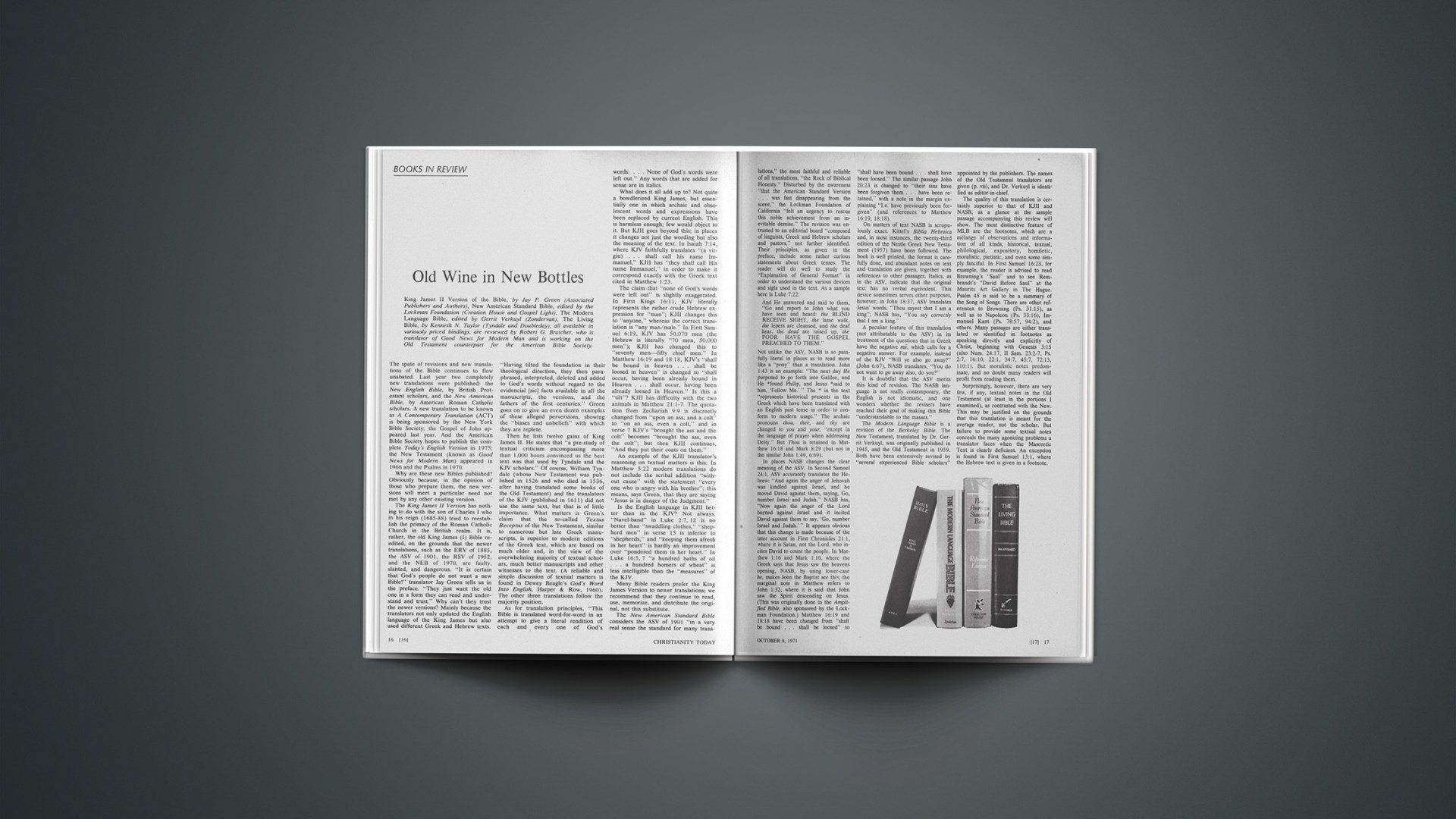
King James II Version of the Bible, by Jay P. Green (Associated Publishers and Authors), New American Standard Bible, edited by the Lockman Foundation (Creation House and Gospel Light), The Modern Language Bible, edited by Gerrit Verkuyl (Zondervan). The Living Bible, by Kenneth N. Taylor (Tyndale and Doubleday), all available in variously priced bindings, are reviewed by Robert G. Bratcher, who is translator of Good News for Modern Man and is working on the Old Testament counterpart for the American Bible Society.

The spate of revisions and new translations of the Bible continues to flow unabated. Last year two completely new translations were published: the New English Bible, by British Protestant scholars, and the New American Bible, by American Roman Catholic scholars. A new translation to be known as A Contemporary Translation (ACT) is being sponsored by the New York Bible Society; the Gospel of John appeared last year. And the American Bible Society hopes to publish the complete Today’s English Version in 1975; the New Testament (known as Good News for Modern Man) appeared in 1966 and the Psalms in 1970.

Why are these new Bibles published? Obviously because, in the opinion of those who prepare them, the new versions will meet a particular need not met by any other existing version.

The King James II Version has nothing to do with the son of Charles I who in his reign (1685–88) tried to reestablish the primacy of the Roman Catholic Church in the British realm. It is, rather, the old King James (I) Bible reedited, on the grounds that the newer translations, such as the ERV of 1885, the ASV of 1901, the RSV of 1952, and the NEB of 1970, are faulty, slanted, and dangerous. “It is certain that God’s people do not want a new Bible!” translator Jay Green tells us in the preface. “They just want the old one in a form they can read and understand and trust.” Why can’t they trust the newer versions? Mainly because the translators not only updated the English language of the King James but also used different Greek and Hebrew texts.

“Having tilted the foundation in their theological direction, they then paraphrased, interpreted, deleted and added to God’s words without regard to the evidencial [sic] facts available in all the manuscripts, the versions, and the fathers of the first centuries.” Green goes on to give an even dozen examples of these alleged perversions, showing the “biases and unbeliefs” with which they are replete.

Then he lists twelve gains of King James II. He states that “a pre-study of textual criticism encompassing more than 1,000 hours convinced us the best text was that used by Tyndale and the KJV scholars.” Of course, William Tyndale (whose New Testament was published in 1526 and who died in 1536, after having translated some books of the Old Testament) and the translators of the KJV (published in 1611) did not use the same text, but that is of little importance. What matters is Green’s claim that the so-called Textus Receptus of the New Testament, similar to numerous but late Greek manuscripts, is superior to modern editions of the Greek text, which are based on much older and, in the view of the overwhelming majority of textual scholars, much better manuscripts and other witnesses to the text. (A reliable and simple discussion of textual matters is found in Dewey Beagle’s God’s Word Into English, Harper & Row, 1960). The other three translations follow the majority position.

As for translation principles, “This Bible is translated word-for-word in an attempt to give a literal rendition of each and every one of God’s words.… None of God’s words were left out.” Any words that are added for sense are in italics.

What does it all add up to? Not quite a bowdlerized King James, but essentially one in which archaic and obsolescent words and expressions have been replaced by current English. This is harmless enough; few would object to it. But KJII goes beyond this; in places it changes not just the wording but also the meaning of the text. In Isaiah 7:14, where KJV faithfully translates “(a virgin) … shall call his name Immanuel,” KJII has “they shall call His name Immanuel,” in order to make it correspond exactly with the Greek text cited in Matthew 1:23.

The claim that “none of God’s words were left out” is slightly exaggerated. In First Kings 16:11, KJV literally represents the rather crude Hebrew expression for “man”; KJII changes this to “anyone,” whereas the correct translation is “any man/male.” In First Samuel 6:19, KJV has 50,070 men (the Hebrew is literally “70 men, 50,000 men”); KJII has changed this to “seventy men—fifty chief men.” In Matthew 16:19 and 18:18, KJV’s “shall be bound in heaven … shall be loosed in heaven” is changed to “shall occur, having been already bound in Heaven … shall occur, having been already loosed in Heaven.” Is this a “tilt”? KJII has difficulty with the two animals in Matthew 21:1–7. The quotation from Zechariah 9:9 is discreetly changed from “upon an ass, and a colt” to “on an ass, even a colt,” and in verse 7 KJV’s “brought the ass and the colt” becomes “brought the ass, even the colt”; but then KJII continues, “And they put their coats on them.”

An example of the KJII translator’s reasoning on textual matters is this: In Matthew 5:22 modern translations do not include the scribal addition “without cause” with the statement “every one who is angry with his brother”; this means, says Green, that they are saying “Jesus is in danger of the Judgment.”

Is the English language in KJII better than in the KJV? Not always. “Navel-band” in Luke 2:7, 12 is no better than “swaddling clothes,” “shepherd men” in verse 15 is inferior to “shepherds,” and “keeping them afresh in her heart” is hardly an improvement over “pondered them in her heart.” In Luke 16:5, 7 “a hundred baths of oil … a hundred homers of wheat” is less intelligible than the “measures” of the KJV.

Many Bible readers prefer the King James Version to newer translations; we recommend that they continue to read, use, memorize, and distribute the original, not this substitute.

The New American Standard Bible considers the ASV of 1901 “in a very real sense the standard for many translations,” the most faithful and reliable of all translations, “the Rock of Biblical Honesty.” Disturbed by the awareness “that the American Standard Version … was fast disappearing from the scene,” the Lockman Foundation of California “felt an urgency to rescue this noble achievement from an inevitable demise.” The revision was entrusted to an editorial board “composed of linguists, Greek and Hebrew scholars and pastors,” not further identified. Their principles, as given in the preface, include some rather curious statements about Greek tenses. The reader will do well to study the “Explanation of General Format” in order to understand the various devices and sigla used in the text. As a sample here is Luke 7:22:

And He answered and said to them, “Go and report to John what you have seen and heard: the BLIND RECEIVE SIGHT, the lame walk, the lepers are cleansed, and the deaf hear, the dead are raised up, the POOR HAVE THE GOSPEL PREACHED TO THEM.”

Not unlike the ASV, NASB is so painfully literal in places as to read more like a “pony” than a translation. John 1:43 is an example: “The next day He purposed to go forth into Galilee, and He *found Philip, and Jesus *said to him, ‘Follow Me.’ ” The * in the text “represents historical presents in the Greek which have been translated with an English past tense in order to conform to modern usage.” The archaic pronouns thou, thee, and thy are changed to you and your, “except in the language of prayer when addressing Deity.” But Thou is retained in Matthew 16:18 and Mark 8:29 (but not in the similar John 1:49; 6:69).

In places NASB changes the clear meaning of the ASV. In Second Samuel 24:1, ASV accurately translates the Hebrew: “And again the anger of Jehovah was kindled against Israel, and he moved David against them, saying, Go, number Israel and Judah.” NASB has, “Now again the anger of the Lord burned against Israel and it incited David against them to say, ‘Go, number Israel and Judah.’ ” It appears obvious that this change is made because of the later account in First Chronicles 21:1, where it is Satan, not the Lord, who incites David to count the people. In Matthew 1:16 and Mark 1:10, where the Greek says that Jesus saw the heavens opening, NASB, by using lower-case he, makes John the Baptist see this; the marginal note in Matthew refers to John 1:32, where it is said that John saw the Spirit descending on Jesus. (This was originally done in the Amplified Bible, also sponsored by the Lockman Foundation.) Matthew 16:19 and 18:18 have been changed from “shall be bound … shall be loosed” to “shall have been bound … shall have been loosed.” The similar passage John 20:23 is changed to “their sins have been forgiven them … have been retained,” with a note in the margin explaining “I.e. have previously been forgiven” (and references to Matthew 16:19; 18:18).

On matters of text NASB is scrupulously exact. Kittel’s Biblia Hebraica and, in most instances, the twenty-third edition of the Nestle Greek New Testament (1957) have been followed. The book is well printed, the format is carefully done, and abundant notes on text and translation are given, together with references to other passages. Italics, as in the ASV, indicate that the original text has no verbal equivalent. This device sometimes serves other purposes, however; in John 18:37, ASV translates Jesus’ words, “Thou sayest that I am a king”; NASB has, “You say correctly that I am a king.”

A peculiar feature of this translation (not attributable to the ASV) in its treatment of the questions that in Greek have the negative , which calls for a negative answer. For example, instead of the KJV “Will ye also go away?” (John 6:67), NASB translates, “You do not want to go away also, do you?”

It is doubtful that the ASV merits this kind of revision. The NASB language is not really contemporary, the English is not idiomatic, and one wonders whether the revisers have reached their goal of making this Bible “understandable to the masses.”

The Modern Language Bible is a revision of the Berkeley Bible. The New Testament, translated by Dr. Gerrit Verkuyl, was originally published in 1945, and the Old Testament in 1959. Both have been extensively revised by “several experienced Bible scholars” appointed by the publishers. The names of the Old Testament translators are given (p. vii), and Dr. Verkuyl is identified as editor-in-chief.

The quality of this translation is certainly superior to that of KJII and NASB, as a glance at the sample passage accompanying this review will show. The most distinctive feature of MLB are the footnotes, which are a mélange of observations and information of all kinds, historical, textual, philological, expository, homiletic, moralistic, pietistic, and even some simply fanciful. In First Samuel 16:23, for example, the reader is advised to read Browning’s “Saul” and to see Rembrandt’s “David Before Saul” at the Maurits Art Gallery in The Hague. Psalm 45 is said to be a summary of the Song of Songs. There are other references to Browning (Ps. 31:15), as well as to Napoleon (Ps. 33:16), Immanuel Kant (Ps. 78:57; 94:2), and others. Many passages are either translated or identified in footnotes as speaking directly and explicitly of Christ, beginning with Genesis 3:15 (also Num. 24:17; 2 Sam. 23:2–7; Ps. 2:7; 16:10; 22:1; 34:7; 45:7; 72:13; 110:1). But moralistic notes predominate, and no doubt many readers will profit from reading them.

Surprisingly, however, there are very few, if any, textual notes in the Old Testament (at least in the portions I examined), as contrasted with the New. This may be justified on the grounds that this translation is meant for the average reader, not the scholar. But failure to provide some textual notes conceals the many agonizing problems a translator faces when the Masoretic Text is clearly deficient. An exception is found in First Samuel 13:1, where the Hebrew text is given in a footnote.

Occasionally there are harmonizations of the text, which should have been confined to footnotes. The Hebrew text of Second Samuel 21:19 says that Elhanan killed the giant Goliath; MLB translates “Elhanan … overcame Beth-Hal-Lahmi with Goliath of Gath,” and a footnote conjectures that the phrase originally read “Lahmi, the brother of Goliath” (as stated in First Chronicles 20:5). In Second Samuel 24:1 the text clearly says that God incited David to number Israel; MLB translates, “But the Lord’s anger was again inflamed against Israel, and one aroused David against them, saying …” The footnote refers to First Chronicles 21:1, where it is Satan who incites David.

An interesting example of harmonization is seen in the translation of the hours of the day in the Gospel of John. Dr. Verkuyl’s translation of 1945 correctly translated these by “about four in the afternoon” (1:39), “about noon” (4:6), “at one o’clock” (4:52), and “about twelve o’clock” (19:14). But MLB now has “about ten in the morning,” “about six in the evening,” “at seven o’clock,” and “about six in the morning” without footnotes explaining that John and the Synoptists used different ways of telling time. In Matthew 23:35 a murdered Zechariah is said to be the son of Barachiah, whereas in Second Chronicles 24:20–22, to which MLB refers, he is said to have been the son of Jehoiada. A footnote says that “doubtless Jehoiada was Zechariah’s grandfather, whereas Barachiah was his father,” but without explanation. At the Second Chronicles reference, MLB says that the murdered Zechariah is not to be confused with the son of Berechiah of Zechariah 1:1. (Disregarding such advice, the Harper Study Bible—the RSV annotated by Harold Lindsell and now, like MLB, published by Zondervan—does equate the Zechariahs of Matthew 23:35 and Zechariah 1:1.) In Matthew 27:9 the saying of Zechariah is attributed to Jeremiah; the text is translated faithfully, but the note says that “doubtless ‘Zechariah’ in vs. 9 is due to a copyist’s error.” This is possible, of course, but in the complete absence of any textual evidence to support it, one doubts the validity of “doubtless.” Indeed, the Harper Study Bible offers an explanation that sees no copyist’s error at all!

It seems the purpose of such handling of the text is to deal with apparent discrepancies. But this is certainly not the translator’s task; it is the annotator’s. The translator must render the text as it is, and not try to edit and correct it. Many of the textual problems we have first arose when ancient scribes could not resist “improving” the text as they laboriously copied it. One regrets that these things are still done.

MLB is gratifyingly lacking in any covert or overt attacks on other translations. All the publishers say is that “while some modern translations of the Scriptures tend to be paraphrases, this version of the Bible aims to achieve plain, up-to-date expression which reflects as directly as possible the meaning of the Hebrew, Aramaic, and Greek.” This is fair enough, notwithstanding the pejorative sense given the word “paraphrase.”

2 Corinthians 10:13–16 In Five Versions

KJV

13 But we will not boast of things without our measure, but according to the measure of the rule which God hath distributed to us, a measure to reach even unto you. 14 For we stretch not ourselves beyond our measure, as though we reached not unto you; for we are come as far as to you also in preaching the gospel of Christ: 15 not boasting of things without our measure, that is, of other men’s labors; but having hope, when your faith is increased, that we shall be enlarged by you according to our rule abundantly, 16 to preach the gospel in the regions beyond you, and not to boast in another man’s line of things made ready to our hand.

MLB

13 On our part, we shall not boast extravagantly but rather stay within the limit of the sphere which God has allotted to us, the boundary of which stretches far enough to include you. 14 We are not overextending ourselves, as if we did not reach as far as you, for we were the first to reach you with the good news about Christ. 15 Neither are we boasting unduly about fields in which others are serving but we entertain the hope that your growing faith may enlarge our sphere of influence so greatly with your help, 16 that we may evangelize those beyond you, rather than brag about labor that has been accomplished in another’s field.

KJII

13 Now we will not boast as to the things beyond measure, but according to the measure of the rule which the God of measure gave to us, one reaching even to you. 14 For we do not outstretch ourselves, as though we did not reach to you. For we have come to you before also in the gospel of Christ—15 not boasting in other men’s labors, as to the things beyond measure, but we had hope—your faith increasing among you—to be increased more and more, according to our rule to overflowing abundance. 16 And this so as to preach the gospel to that region beyond you, not to boast in another’s rule in regard to the things ready to hand.

LB

13 But we will not boast of authority we do not have. Our goal is to measure up to God’s plan for us, and this plan includes our working there with you. 14 We are not going too far when we claim authority over you, for we were the first to come to you with the Good News concerning Christ. 15 It is not as though we were trying to claim credit for the work someone else has done among you. Instead, we hope that your faith will grow and that, still within the limits set for us, our work among you will be greatly enlarged. 16 After that, we will be able to preach the Good News to other cities that are far beyond you, where no one else is working; then there will be no question about being in someone else’s field.

NASB

13 But we will not boast beyond our measure, but within the measure of the sphere which God apportioned to us as a measure, to reach even as far as you. 14 For we are not overextending ourselves, as if we did not reach to you, for we were the first to come even as far as you in the gospel of Christ; 15 not boasting beyond our measure, that is, in other men’s labors, but with the hope that as your faith grows, we shall be, within our sphere, enlarged even more by you, 16 so as to preach the gospel even to the regions beyond you, and not to boast in what has been accomplished in the sphere of another.

I came to the Living Bible tremendously impressed with the work of Kenneth Taylor. The foreword “At Last!” to the last published volume in the series, “Living History of Israel,” is an eloquent statement of his emotions as he finished his work: “For now, at last, I lay down my commission and my pen—the task is finished to the best of my ability after these fourteen arduous years.” His closing prayer is in line with other great prayers, such as Augustine’s at the end of his De Trinitate (which is a good prayer for translators also, and not only for theologians). What Taylor has done is to take the ASV of 1901 and make a clear, plain, and idiomatic paraphrase. As he defines it (in his introduction to “Living Prophets”), paraphrasing attempts to retain the accuracy while removing the wordiness. “It tries to clear away from the fertile fields of Scripture the rocks and brush and rubble of literal translation.…” In the preface to “Living Letters” he stated it more precisely: a paraphrase is “a restatement of an author’s thoughts, using different words than he did.” No one can object to his aim, which is that of all good translators. For those who make an invidious distinction between “translation” (good) and “paraphrase” (bad), Ronald Knox has the scornful retort, “The word ‘paraphrase’ is a bogey of the half-educated.… It is a paraphrase when you translate ‘Comment vous portez-vous’ by ‘How are you?’ ” A translator of the New Testament wants to make the writers say in good, natural English of the twentieth century exactly the same thing they said in Greek in the first century. But what no translator can do and no paraphrase should do is to make the writer say something quite different from what he said or, under the furthest stretch of the imagination, what he would say if he were writing in English today.

So my initial good will began to dissipate somewhat as I found numerous instances of clear and obvious mistranslations. Second Samuel 24:1 is softened so as not to contradict First Chronicles 21:1; Second Samuel 21:19 is made in the text to conform to First Chronicles 20:5, with the correct translation in the footnote; First Samuel 13:1 is also correctly translated in the footnote, but not in the text. In Second Samuel 15:7 the Hebrew has the difficult “forty years,” but Taylor follows the Lucianic Septuagint, Syriac, and Josephus and has “four years,” without any footnote.

These are serious matters for a translator, even if they are not of tremendous consequence for the readers. The translator’s first, second, and last duty is to be faithful to the meaning of the text, and he must resist all attempts to improve it or correct it in any way. A high view of Scripture demands that we treat it seriously and faithfully represent its meaning. In this way we honor the Lord of the Scriptures. In the LB rendering of Matthew 5:18, the plain meaning of “Till heaven and earth pass away” (ASV) is evaded, and the two temporal clauses are telescoped into the non-troublesome “until its purpose is achieved.” Sometimes words are added, with the footnote “implied,” and so the reader knows that this is the translator’s understanding of the text: “premature” in Hebrews 5:7, “as proof of Christ’s death” in 9:18, and “sometimes” in Job 24:22 are examples. A reader will judge for himself whether the added information is really implicit in the text.

In Job 27:23, “Everyone will cheer at his death, and boo him into eternity” is somewhat free, and the subject “Everyone” cannot be sustained; it is either “it” (the wind) or “he” (God). Mark 13:30 and Matthew 24:34 do not represent the plain and obvious meaning of the text (both of the Greek and of the ASV). Mark 13:30 says (ASV), “This generation shall not pass away, until all these things be accomplished,” and Matthew 24:34 says identically the same thing. But Taylor has, “Yes, these are the events that will signal the end of the age” in Mark, and “Then at last this age will come to its close” in Matthew. Why should this be done? Could it be that the translator felt the text would cause difficulty to the reader and so must not be allowed to say what it clearly says?

In his preface to “Living Letters” Taylor deals with the question of what is a translator to do when the original text is not clear. He says that in this case “the theology of the translator is his guide, along with his sense of logic, unless perchance the translation is allowed to stand without any clear meaning at all. The theological lodestar in this book has been a rigid evangelical position.” Certainly when the original text is not clear, the translator cannot avoid letting other considerations affect his choices. But when the original is very clear, what right does the translator have to change its meaning? I regret having to be this negative in tone, especially when LB has so many excellent qualities.

In summary, I think that the King James II and the New American Standard are not sufficiently worthy improvements over their predecessors; in some places the new translation is a step backward. However, used with care, the Modern Language Bible and the Living Bible offer worthwhile additions to the great variety of translations of the Word of God that are available to the English reader.

Describing Dialectic

Great Dialecticians in Modern Christian Thought, by Ernest B. Koenker (Augsburg, 1971, 159 pp., $5.95), is reviewed by Bert B. Dominy, assistant professor of theology, Southwestern Baptist Theological Seminary, Fort Worth, Texas.

This author describes a dialectical thinker as one “for whom tensions and contradictions have been more fundamental than unity,” one who has refused “to reduce the mighty opposites which present themselves to human experience into a rational system.” However, dialectic is not adequately explained by contradiction alone, for a true dialectician seeks to overcome contradiction in reality or thinking by transcending the incongruities of life to arrive at a complex whole. Accordingly, much of the history of modern thought can be written as a description of dialectical thinking. What Koenker does is illustrate this history by describing the dialectical elements in the thought of ten representative theologians and philosophers since the Reformation. The ten are Luther, Boehme, Pascal, Hegel, Kierkegaard, Barth, Tillich, Heidegger, Bultmann, and Elert.

Koenker’s work is almost wholly descriptive. He presents the thought of his “dialecticians” with fairness and succeeds in clearly explaining the thrust of each man’s thought in a brief space. There is no attempt, however, at critical evaluation (except for a one-page criticism of Elert’s dialectic law and grace). Koenker affirms rather than argues his own perspective. He leaves no doubt of his belief in the adequacy of the dialectic method. For example, he insists that “where serious thinking is engaged, there dialectic, the examination of contradictions, is inescapable. The opponents of dialectic in this sense … are simply opposed to any genuine quest for truth, for even divine truth must be expressed in the earthen vessels of human words.”

The dialectical method has profound implications for theology. That Koenker is aware of these implications is evident in several passing remarks. With reference to Tertullian as an opponent of dialectic, he speaks of “a different theory of truth, the view that one must know absolutely if he can know at all, in contrast to the view that sees knowledge as always relative to circumstances.” Further, he writes that the “dialecticians have always dissolved fixations of doctrines: with their contradictions and insistence on dialogue they have introduced movement into thought, a movement which spurns provisional resting places and launches forth into the uncertainties of an endless quest.” Koenker’s failure to discuss directly the broader implications of dialectic for theology is disappointing and reduces the contribution of the book.

Yet a book should be judged not merely by what a reviewer thinks the author should have done but by the significance of what it actually accomplishes. Koenker has given us a readable introduction to dialectical thinking by surveying some of its notable practitioners. The book is a good starting place for those unfamiliar with dialectic and the thought of such men as Boehme, Hegel, Heidegger, and Kierkegaard. For help in dealing with the more substantive issues raised by the dialectical method, one will have to look elsewhere.

A Book With No Audience

Humanistic Psychology: A Christian Interpretation, by John A. Hammes (Grune and Stratton, 1971, 203 pp., $7.95), is reviewed by Glenn R. Wittig, reference librarian, Speer Library, Princeton Theological Seminary, Princeton, New Jersey.

The primary purpose of this book, written by a professor of psychology at the University of Georgia, is “to present the compatibility of scientifically established psychological truth with the truths proposed by a Christian frame of reference.” The intended audience is college students with little or no background in philosophy or theology. Despite some distinctive features, the book does not fulfill the author’s intentions.

Hammes begins his work with a deplorable scissors-and-paste presentation of eight views regarding contemporary man. No effort is made to establish a framework for this investigation, to present an overview regarding possible perspectives of man, or to justify the validity of presenting only eight points of view. The chapter serves no discernable purpose for this book.

Should the reader nevertheless be determined enough to proceed further, he will find in the remaining portion of Part One—“Basic Principles”—a most incisive examination of the methodology of science. Hammes clearly exposes the limitations of relativism and operationism as methods of science, and he admirably advocates the usefulness of philosophy and “divine revelation” for explaining human nature. To this extent he has satisfied his primary purpose. These several chapters constitute a solid piece of work, a truly Christian philosophy of science, and deserve very careful reading.

But the rest of the book leaves much to be desired. In Parts Two and Three, Hammes covers the broad basics of psychology, such as human nature and personal adjustment, from a Teilhardian frame of reference in combination with a vague conception of Christianity. The Ten Commandments, it seems, are the sole standard for man’s behavior. Moral development is possible through education, but there is no apparent need of reference to Christ or Christianity.

In Part Four the work falters even more noticeably. While Hammes proposes to present a synthesis of man’s origin, purpose, and destiny, he does little more than quote in proof-text fashion a sequence of Scripture verses. Very little original text, and no synthesis, accompanies the biblical material.

It is doubtful that this work could serve as a textbook. It has no unifying concept. It is too elementary for most of today’s college students, would have little appeal to lay people, and is hardly suitable for a high-school curriculum. The chapters are embarrassingly brief, and the subheadings fail to distinguish levels of discussion.

Tapestry Of Truth

Romans: Exposition of Chapters 3:20 to 4:25, by Martyn Lloyd-Jones (Zondervan, 1971, 250 pp., $5.95), is reviewed by Earl D. Radmacher, president, Western Conservative Baptist Theological Seminary, Portland, Oregon.

This is no average book. Nor will you read it indifferently. It is the kind of book that will grip your mind and heart as you soar with this great pastor-teacher in his superb exposition of the doctrines of atonement and justification as found at the heart of Romans—chapters 3:30–4:25. My life has been enriched by my encounter with these messages from Romans, first delivered by Dr. Lloyd-Jones at Westminster Chapel in London.

Several carefully interwoven skills are much in evidence in this book. First, what is said is exegetically sound. Throughout the book it is transparently clear that the author has given careful attention to time-honored principles of interpretation, such as the priority of the original languages, the progress of revelation, the unity of Scripture, and the law of the content. He practices what he preaches in such statements as, “Every statement in the Scriptures should always be taken in its context and in its setting.”

Second, Lloyd-Jones is theologically consistent in the results of his inductive studies. Though he is careful to give attention to the meaning of individual words, he is also very much aware that often scholars have sought to decide vital issues according to an odd meaning or shade of meaning of a word. For example, in dealing with the translation of “expiation” as opposed to “propitiation” in Romans 3:25, he pointedly demonstrates that “it is very rarely indeed that the philologist settles any question.” One must get the total teaching of the Word of God, not just a possible meaning of a word.

Another strong point of this volume, one that is often missing in commentaries, is the practical application of the truth to contemporary ideas and developments. For example, in speaking about our constant tendency to do violence to the doctrine of the Trinity, the author observes, with reference to Roman 4:23–25:

I sometimes have a fear that there is much today that passes as faith which never mentions the name of God at all. I am thinking of those who only speak about the Lord Jesus Christ. They always pray to the Lord Jesus Christ, and always speak about Him, and never refer to God the Father.

There tends to be a subtle development of a unitarianism of the Son or of the Spirit.

Finally, I appreciate very much the evangelistic thrust of the book. Lloyd-Jones keeps both content and methodology of evangelism constantly before his readers. In summary, it has been a long time since I have read a book I enjoyed so thoroughly as this. I anxiously await the rest of the series!

Mumbling Morality

Science and Human Values in the Twenty-first Century, edited by Ralph Wendell Burhoe (Westminster, 1971, 203 pp., $6.95), is reviewed by Tommy W. Rogers, associate professor of sociology, Georgia Southern College, Statesboro, Georgia.

Despite the potentially intriguing nature of the general topic, this volume is more promise than accomplishment. It contains papers by five scholars, written at the invitation of Pittsburgh Seminary on the occasion of its 175th anniversary. But it offers remarkably little general insight for the person seeking an understandable treatment of questions related to science and human values. Perhaps some readers accustomed to “communication” in seminars with minds of adequate conceptual ability would find meaning in such assertions as, “There is among us a growing sense of the cosmic relationship and involvement, and therefore of the cosmic consequentiality of everything we do and are.” Most people probably will not, particularly since the process is carried out ad infinitum.

There is very little appeal in this volume’s repeated pages of complex analogies. For example: “Once a water molecule is enlisted in a crystal of ice it is immediately constrained by its interactions with its neighbors and relaxes back into its initial state whenever it acquires sufficient energy to depart from its ordered position”—this is used to illustrate the need for “new means of thawing out our increasingly frozen and unresponsive social order.” This particular presentation—and it is very typical—is followed by what is called “another analogue of peculiar relevance”: “Given an inverted population in which a large fraction of the atoms are in a common high energy state, this ensemble can be triggered to yield, autocatalytically, the coherent rapid release of that energy into the intense, narrowly directed beam of the laser.” To the author this suggests “an affluent, leisured, human population that can be stimulated into a coherent, rapid release of much of their latent energy into very specific channels. Consider Woodstock or the space program.” Before the reader can utter a cry for help, he is assured that such “analogies from science are not just intellectual play, for out of cooperative interactive processes new phenomena arise, and what we humans call emergence is born.” This is representative of practically every page of the entire volume, and probably signifies a near total lack of general appeal.

There is mumbling about “integrating theology into the scientific myth or symbol system.” One writer proclaims that the “shortest path from A to C is the hypotenuse of the triangle, but often ‘morality’ says that we shall not go from A to C by this route but that we shall take the longer route ABC,” i.e., “keep off the grass.” One gets the feeling that some of it (e.g., “We now see that wholes are not only derivative, determined by their parts, but that the character and functions of the parts depend upon the wholes”) contains truths that Joe down at the barber shop would likely recognize in translation as things he himself had agreed with all along. Perhaps philosophers sometimes find that dense, complex language has the value of disguising the simplicity of the ideas being expounded.

Serious scholars have expressed doubts about the wisdom of permitting science and technology to continue their unabated progress. University of Maryland physicist Johannes M. Burger proposed a fifty-year moratorium on experiments that might lead to man’s duplication of himself. While some of these grave matters are touched upon in Science and Human Values in the Twenty-first Century, it is mostly by way of the incidental remark rather than through insight-lending analysis.

Newly Published

Turned On to Jesus, by Arthur Blessitt (Hawthorn, 1971, 242 pp., $5.95), The Jesus Kids, by Roger Palms (Judson, 1971, 96 pp., paperback, $1.95), Jesus People, by Duane Pederson (Compass, 1971, 128 pp., paperback, $1.25), and The Jesus Movement in America, by Edward E. Plowman (David C. Cook, 1971, 128 pp., paperback, $.95). The so-called Jesus movement is sweeping across the land, and these four books offer insight from a variety of vistas. Blessitt and Pederson tell of their own personal involvement as leaders, Palms probes attitudes and beliefs through extensive quoting of persons in the movement, and Plowman traces the movement’s beginnings and tracks its extent—from the street scene to the Catholic Pentecostal phenomenon.

I Married You, by Walter Trobisch (Harper & Row, 135 pp., $4.95; paperback, $1.95). A beautiful, moving story of the author’s experiences while lecturing on sex and marriage in an African city. Marriage problems of both Trobisch and his listeners are solved by applying concepts from the lectures.

Listen to the Green, by Luci Shaw (Harold Shaw, 93 pp., no price given), and Six Days, selected by H. Houtman (Wedge, 142 pp., $2.50). Luci Shaw’s slim volume and the anthology of Canadian verse are evidence that Christian poets can indeed keep pace with their secular counterparts.

The Church Music Handbook, by Lynn W. Thayer (Zondervan, 190 pp., $5.95). Rightly states that the heart of any church’s music program is the adult choir, and gives elaborate suggestions on how to better it. Unfortunately, ability to sing is not one of the requirements the author emphasizes. But overall, this could be a helpful handbook.

I Have Met Him: God Exists, by André Frossard (Herder and Herder, 125 pp., $4.95). The compelling, stimulating story of a young atheist’s conversion to the more mystical quarter of Christianity.

Growing Up With Sex, by Richard F. Hettlinger (Seabury, 162 pp., paperback, $2.25). Hettlinger explains male and female sexuality to teen-agers without talking down to them. Though not specifically Christian, his approach to problems of restraint, love, and early marriage is unusually realistic, tempering permissiveness with caution.

C. S. Lewis: Speaker and Teacher, edited by Carolyn Keefe (Zondervan, 144 pp., $3.95). An informative book for those who want to know more about Lewis as instructor or professor. The chapter “To the Martlets” by Walter Hooper is especially interesting.

New Gods in America, by Peter Rowley (McKay, 1971, 208 pp., $5.95), and The Complete Art of Witchcraft, by Sybil Leek (World, 1971, 205 pp., $6.95). Interest in the occult and Eastern religion continues to rise, especially among the young, making it strategically important for Christians to know content and appeal. Rowley gives a score of cults, mostly Eastern-spawned, the once-over-lightly survey treatment based on personal visits and interviews. For those wanting amplification of the witchcraft section, Miss Leek—“the world’s leading witch”—provides a biased but informative inside account of what it’s like to be a witch.

The Era of the Spirit, by J. Rodman Williams (Logos, 1971, 119 pp., paperback, $1.95). An important contribution to the theology of the charismatic movement by a prominent Presbyterian theologian. He relates Reformed doctrines to neo-Pentecostalism, and examines the references to the Holy Spirit by Barth, Brunner, Tillich, and Bultmann.

The Church Is Alive, by Lambert T. Dolphin, Jr. (Good News, 1971, 96 pp., $2.95). A series of somewhat disjointed articles on the need for—and illustrations of—change in church forms and structures; redeemed by the epilogue, a deeply moving account of a visit to Christians in India.

Theological Dictionary of the New Testament, Volume 7: Sigma, edited by Gerhard Friedrich (Eerdmans, 1971, 1104, $25). English translation of a standard German work published in 1964. One more volume is completed in German and the final one is in progress. This volume has articles on eighty-nine words and word-groups that begin with s. The longest are on the Greek words for flesh, sign, wisdom, synagogues, salvation, and body.

Counter Culture and the Vision of God, by Robert L. Johnson (Augsburg, 168 pp., $4.50). Convinced that Christians need to understand the counterculture, this campus pastor from the University of North Carolina attempts to explain youth to older, more conservative Christians.

The Marriage Affair: The Family Counselor, edited by J. Allan Petersen (Tyndale, 420 pp., paperback, $2.95). An anthology of eighty short, easy-to-read articles on problems of sexuality, marriage, parenthood, divorce, and widowhood. The conservative, evangelical perspective is unnecessarily narrow on political and social issues, such as male-female roles.

Popcorn and Parable, by Roger Kahle and Robert E. A. Lee (Augsburg, 128 pp., paperback, $2.95). A convincing case for the use of contemporary films in church programs as discussion instigators.

The Ghost in My Life, by Susan B. Anthony (Chosen Books, 1971, 221 pp., $5.95). This book could make even the most hardened cynic idealistic. The second Susan B. Anthony, great-niece of the first, tells of the agonies and joys of her life and of the power of God.

The Future Shape of Preaching, by Thor Hall (Fortress, 140 pp., paperback, $3.50). The James Sprunt Lectures, 1970, given at Union Theological Seminary, consider in depth the role of homiletics today.

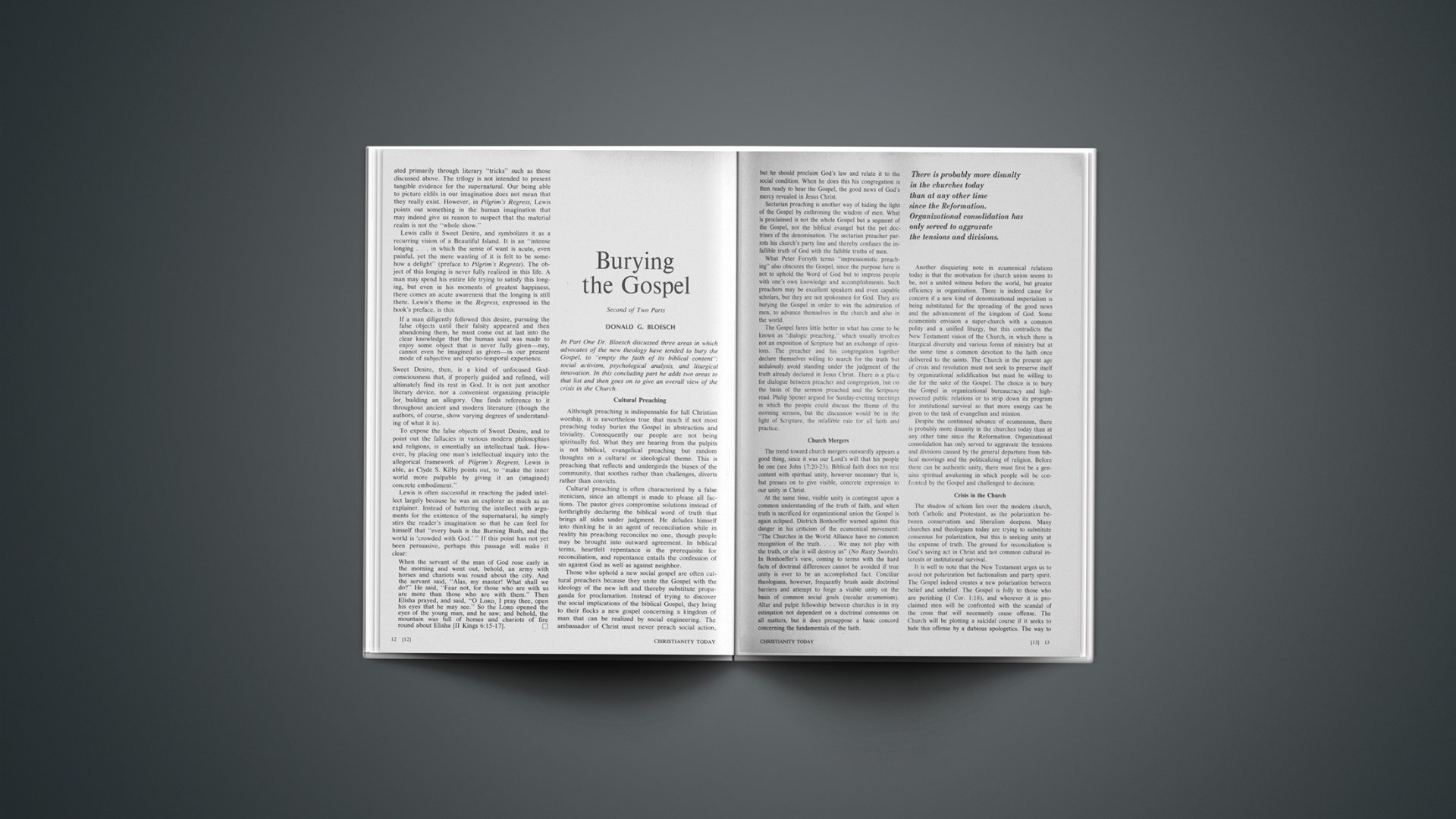
Burying the Gospel: Second of Two Parts

In Part One Dr. Bloesch discussed three areas in which advocates of the new theology have tended to bury the Gospel, to “empty the faith of its biblical content”: social activism, psychological analysis, and liturgical innovation. In this concluding part he adds two areas to that list and then goes on to give an overall view of the crisis in the Church.

Cultural Preaching

Although preaching is indispensable for full Christian worship, it is nevertheless true that much if not most preaching today buries the Gospel in abstraction and triviality. Consequently our people are not being spiritually fed. What they are hearing from the pulpits is not biblical, evangelical preaching but random thoughts on a cultural or ideological theme. This is preaching that reflects and undergirds the biases of the community, that soothes rather than challenges, diverts rather than convicts.

Cultural preaching is often characterized by a false irenicism, since an attempt is made to please all factions. The pastor gives compromise solutions instead of forthrightly declaring the biblical word of truth that brings all sides under judgment. He deludes himself into thinking he is an agent of reconciliation while in reality his preaching reconciles no one, though people may be brought into outward agreement. In biblical terms, heartfelt repentance is the prerequisite for reconciliation, and repentance entails the confession of sin against God as well as against neighbor.

Those who uphold a new social gospel are often cultural preachers because they unite the Gospel with the ideology of the new left and thereby substitute propaganda for proclamation. Instead of trying to discover the social implications of the biblical Gospel, they bring to their flocks a new gospel concerning a kingdom of man that can be realized by social engineering. The ambassador of Christ must never preach social action, but he should proclaim God’s law and relate it to the social condition. When he does this his congregation is then ready to hear the Gospel, the good news of God’s mercy revealed in Jesus Christ.

Sectarian preaching is another way of hiding the light of the Gospel by enthroning the wisdom of men. What is proclaimed is not the whole Gospel but a segment of the Gospel, not the biblical evangel but the pet doctrines of the denomination. The sectarian preacher parrots his church’s party line and thereby confuses the infallible truth of God with the fallible truths of men.

What Peter Forsyth terms “impressionistic preaching” also obscures the Gospel, since the purpose here is not to uphold the Word of God but to impress people with one’s own knowledge and accomplishments. Such preachers may be excellent speakers and even capable scholars, but they are not spokesmen for God. They are burying the Gospel in order to win the admiration of men, to advance themselves in the church and also in the world.

The Gospel fares little better in what has come to be known as “dialogic preaching,” which usually involves not an exposition of Scripture but an exchange of opinions. The preacher and his congregation together declare themselves willing to search for the truth but sedulously avoid standing under the judgment of the truth already declared in Jesus Christ. There is a place for dialogue between preacher and congregation, but on the basis of the sermon preached and the Scripture read. Philip Spener argued for Sunday-evening meetings in which the people could discuss the theme of the morning sermon, but the discussion would be in the light of Scripture, the infallible rule for all faith and practice.

Church Mergers

The trend toward church mergers outwardly appears a good thing, since it was our Lord’s will that his people be one (see John 17:20–23). Biblical faith does not rest content with spiritual unity, however necessary that is, but presses on to give visible, concrete expression to our unity in Christ.

At the same time, visible unity is contingent upon a common understanding of the truth of faith, and when truth is sacrificed for organizational union the Gospel is again eclipsed. Dietrich Bonhoeffer warned against this danger in his criticism of the ecumenical movement: “The Churches in the World Alliance have no common recognition of the truth.… We may not play with the truth, or else it will destroy us” (No Rusty Swords). In Bonhoeffer’s view, coming to terms with the hard facts of doctrinal differences cannot be avoided if true unity is ever to be an accomplished fact. Conciliar theologians, however, frequently brush aside doctrinal barriers and attempt to forge a visible unity on the basis of common social goals (secular ecumenism). Altar and pulpit fellowship between churches is in my estimation not dependent on a doctrinal consensus on all matters, but it does presuppose a basic concord concerning the fundamentals of the faith.

Another disquieting note in ecumenical relations today is that the motivation for church union seems to be, not a united witness before the world, but greater efficiency in organization. There is indeed cause for concern if a new kind of denominational imperialism is being substituted for the spreading of the good news and the advancement of the kingdom of God. Some ecumenists envision a super-church with a common polity and a unified liturgy, but this contradicts the New Testament vision of the Church, in which there is liturgical diversity and various forms of ministry but at the same time a common devotion to the faith once delivered to the saints. The Church in the present age of crisis and revolution must not seek to preserve itself by organizational solidification but must be willing to die for the sake of the Gospel. The choice is to bury the Gospel in organizational bureaucracy and high-powered public relations or to strip down its program for institutional survival so that more energy can be given to the task of evangelism and mission.

Despite the continued advance of ecumenism, there is probably more disunity in the churches today than at any other time since the Reformation. Organizational consolidation has only served to aggravate the tensions and divisions caused by the general departure from biblical moorings and the politicalizing of religion. Before there can be authentic unity, there must first be a genuine spiritual awakening in which people will be confronted by the Gospel and challenged to decision.

Crisis In The Church

The shadow of schism lies over the modern church, both Catholic and Protestant, as the polarization between conservatism and liberalism deepens. Many churches and theologians today are trying to substitute consensus for polarization, but this is seeking unity at the expense of truth. The ground for reconciliation is God’s saving act in Christ and not common cultural interests or institutional survival.

It is well to note that the New Testament urges us to avoid not polarization but factionalism and party spirit. The Gospel indeed creates a new polarization between belief and unbelief. The Gospel is folly to those who are perishing (1 Cor. 1:18), and wherever it is proclaimed men will be confronted with the scandal of the cross that will necessarily cause offense. The Church will be plotting a suicidal course if it seeks to hide this offense by a dubious apologetics. The way to end polarization is by conversion and submission to Jesus Christ, the Lord of the Church.

Liberal theologians never tire of asserting that the crisis today is one of ethical obedience. That the people of God are not obeying his will in the present situation cannot be denied, but behind this disobedience is the deeper crisis of faith. One cannot do the truth unless he is in the truth, and therefore the trumpet of the modern church gives an uncertain sound (cf. 1 Cor. 14:8). Many churches and seminaries today have become fields for evangelism rather than forces of evangelism. This means that apostasy is rife even among the sons of the kingdom. It is well to recognize that unbelief is constantly pictured in the Old Testament as a more heinous sin even than social injustice. The Church has been addressing itself to symptoms and has been ignoring the source of the cancer that afflicts modern society.

New idolatries are emerging to fill the spiritual vacuum created by the Church’s reluctance to let the truth of the Gospel shine into the hearts of men. Among these new objects of deification are the group mind or the social consciousness (as in groupism and progressive education); the nation or race (as in the new nationalism and militarism); the social class (as in Marxism); and the vital instincts (as in pansexualism). The Church today is challenged to unmask these pseudo-gods, but it is greatly hampered in this task by its subservience to ideology, whether of the right or of the left.

Hand in hand with the new idolatries is a new morality that is openly skeptical of any moral absolute and that for all practical purposes serves the technological revolution. The aim of this morality is adjustment to the cultural norm, and its high priests are the social scientists and psychologists. Jacques Ellul is one theologian and social analyst who has been alert to the encroaching danger of a “technological morality,” which, in his words “appears as a suppression of morality through the total absorption of the individual into the group” (To Will and To Do).

A new “democratic” totalitarianism has arisen that seeks to enlist the aid of both the right and the left. Those who give their allegiance to “the rights of man” in the abstract instead of the glory of God and whose slogan is “All power to the people” are unwittingly preparing the way for a totalitarian takeover. They give lip service to the democratic ideal, but in reality the society they envision would be tightly controlled by an oligarchy of sociologists, educationists, and psychologists.

The Church can cope with the present crisis only if it becomes ever more sensitive to social reality by freeing itself from its bondage to ideology. Instead of trying to come to terms with the growing unbelief in our times, it should seek to unmask unbelief as well as proclaim the faith in all its purity and power. It should also be alive to apostasy from within and particularly to the secular humanism that has infiltrated the new social-gospel movement. This kind of humanism is also present in the conciliar movement, as well as in the circles of religious education and pastoral theology. For the sake of true ecumenism and an authentically Christian education, church theologians should begin applying themselves to the task of the defense of the faith within the Church.

What is needed today is a new kind of dogmatics that will at the same time be an apologetics, one that will neither hide nor embellish the Gospel but will confront the world with it. This would be an apologetics in the service of a kerygmatic theology. It would not seek to make the Gospel credible or plausible to the world, but it would not hesitate to expose the pitiful delusions of a great many moderns and the emptiness of their own philosophies in the face of the world crisis.

Martin Marty, rightly I believe, maintains that we are entering an apocalyptic age, an age when the certainties of yesterday will probably be taken from us. The shallow optimism that has permeated secular and political theology will prove insufficient to cope with the harsh realities that lie ahead. Instead of an optimism based on the inherent perfectibility of man and evolutionary progress, the world stands in need of an optimism founded on the divine realities of justification and regeneration. The death of God will be followed by the death of the Church unless the Church abandons the gods of popular culture-religion and begins listening again to the voice of the true God as this is found in Holy Scripture. Then it might rediscover its true role and mission, which is to uphold the glorious Gospel of redemption before a lost and despairing world and thereby prepare the way for the coming kingdom of God.

Another Underground

Thousands of students, laymen, clergymen, and nuns have gone underground in revolt against the traditional structures and forms of their churches.… Basically they seek spiritual renewal and satisfaction for themselves. They hope the wider Church will join their quest. I have found little bitterness among them and almost no inclination to mount a holy war of liberation against the formal church. They are mostly straight Establishment-type people. Unlike the multitudes of hippie converts, these have not dropped out of mainstream society. Many are even in their usual pews and places of service on Sunday—but they also worship with kindred spirits in cell-like meetings later in the week.—EDWARD E. PLOWMAN, The Jesus Movement in America (David C. Cook, 1971), p. 10. Used by permission.

C. S. Lewis: Apostle to the Imagination

Everyman is tired. He’s tired of taxes. He’s tired of traffic jams. He’s tired of telephones, timetables, and TV dinners. He’s tired of promises, tired of threats. Tired of democrats, dandelions, deadlines, and demilitarized zones. He’s tired of shallow optimism, and shallow pessimism. He’s tired of pollution, corruption, and racism, and he’s tired of being blamed for them. He’s tired of false hopes, false friends, and false advertising. He’s tired of trying to make sense out of it all. Tired.

He feels that there must be some meaning behind the monotony, but he doesn’t even know where to look. He has tried cheap thrills, and not-so-cheap thrills, only to discover that pleasure wasn’t happiness and happiness wasn’t joy. He tried check books, hymn books, textbooks, and sex books, but it all was “striving after wind.” He even tried philosophy and theology, yet he could never get beyond the pious platitudes, formless generalities, and cold abstractions. The Church to him was just a collection of hypocrites, social workers, and tired old ladies. “If those are the people God works with, then, he must not be my kind of guy.” Gradually, Everyman’s search for meaning sagged into a resolve not to be engulfed by the meaninglessness that surrounded him. So one day, with civilization chattering all around him, he just stopped listening.

Once this state of mind has been reached (and it often is among moderns), Everyman is virtually impervious to traditional forms of persuasion. He is convinced that neither the Christian nor anyone else has anything to tell him. Christians have everything to tell him, but often they don’t know how to make him understand. An explanation of the internal and external consistency of their faith is likely to bore Everyman right out of the kingdom of heaven. A Pepsodent smile, an arm around the shoulder, and a promise of a new life style are likely to remind him of Madison Avenue’s latest scheme. He has endured so many frontal assaults on his intellect that he has reached his last, yet most impenetrable, line of defense: indifference.

Yet even while apathy and cynicism rule his rational faculties, his imagination remains free and active. He cannot maintain strict control over his imagination any more than over his heartbeat. For example, realizing that his fear of public speaking (or of the dark, or of heights) is irrational doesn’t help ease the fear. His intellect may declare ghosts to be an impossibility, but under certain scary conditions his imagination doesn’t make much of a distinction between possibilities and impossibilities. Imagination frees a man to fly to the moon and back in a second, to visualize an atom that his eyes can never see, or to feel angered and saddened as he reads of an unjust crucifixion that took place almost two thousand years ago.

Of course, the imagination is not merely a tool for taking mental vacations from “serious thinking.” In fact, “serious thinking” is often the process by which man’s rational faculty tries to organize and interpret the images it receives from his image-making faculty, the imagination. Whether one reacts to the image of immortality by building a complex philosophical system or by simply dreaming of the Happy Hunting Grounds, he is trying to be at peace with his imagination. As the Preacher tells us, “God has put eternity into man’s mind, yet so that he cannot find out what God has done from the beginning to the end” (Eccles. 3:11). Even though Everyman’s intellect has despaired of ever answering the question of meaning, his imagination does not stop asking it. He can stop listening, but he cannot stop wondering, for he has eternity in his mind.

C. S. Lewis was not a Christian apologist in the normal sense of the term; he was a Christian artist. This is precisely what makes his works so effective in helping non-Christians understand the real significance of Christianity. Lewis’s Christian world view does not appeal only to the intellect; it steals into the imagination.

Lewis viewed human imagination as an indispensable tool for understanding ourselves and our existence. This is well illustrated by his interpretation of myth. While most moderns consider myth a synonym for fiction, notes Clyde S. Kilby, Lewis defined myth as the “embodiment of universal truth” The Christian World of C. S. Lewis). He saw myths as reflections of the fundamental patterns of human existence. For example, in Perelandra Ransom discovers that the classical deities Mars and Venus are earthly images of Malacandra and Perelandra, and is told that “our mythology is based on a solider reality than we dream.” In That Hideous Strength Merlin walks right out of medieval legend to become one of the novel’s main protagonists. Till We Have Faces is actually a Christian myth; it is patterned after the story of Cupid and Psyche. In the preface to Pilgrim’s Regress, Lewis explains that “when allegory is at its best, it approaches myth, which must be grasped with the imagination, not with the intellect.” Since Lewis believed that the imagination was needed to unlock the meanings of the universe, his belief in the value of man’s imagination is obvious. Since he felt that the imagination was, in many cases, the most direct route to truth, it is not surprising that he took such care to try to capture the imagination of his readers.

One of Lewis’s primary goals in the space trilogy (Out of the Silent Planet, Perelandra, and That Hideous Strength) is to instill a profound sense of the reality of the supernatural in the minds of his readers. Though this calls in part for a rational demonstration of the difficulties of the materialist view (which Lewis does in some of his expository writings, such as Miracles), it is primarily a matter of stimulating the imagination. If the question of God’s existence becomes firmly implanted in the imagination, it necessarily becomes urgent to the intellect.

Unlike many other fantasy writers, Lewis does not ask his readers to cast off all sentimental attachments to reality before venturing into his novels. Instead, he carefully juxtaposes the natural and supernatural realms until the distinction between them seems somewhat arbitrary. In That Hideous Strength he does this by placing what would normally be considered supernatural events into a naturalistic setting. He begins the novel by describing ordinary, even humdrum, persons and activities in such detail that the credibility of his account rests secure. Then come a few casual hints, and later more concrete clues, that something very unusual is taking place behind those everyday scenes. By the time the quiet little community of Edgestow has become a battlefield between the Forces of Good and the Forces of Evil, the reader is amazed to discover the awesome supernatural forces that lie just beneath the surface of the common workaday world. He feels a little like those who heard Orson Welles’s 1938 War of the Worlds radio broadcast, when a supposedly factual newscast began describing an interplanetary holocaust. Of course, the reader realizes he is only reading fiction; yet his imagination delights in every opportunity it gets to trample on the distinction between the real and the unreal.

Lewis also uses the opposite technique from the one described above for the same purpose, that of making the supernatural realm less remote: he takes common human experiences and charges them with significance by placing them in a supernatural context. For example, everyone has had the experience of thinking he was alone when suddenly, by some unknown perception, he feels there is someone in the room with him, someone silently watching, listening. He glances around, sees nothing, and shrugs the happening off as a little odd. In Perelandra, Ransom senses an unseen Presence whenever he attempts to assert his independence or to shy away from the hard task before him. The Presence is not a mere psychological curiosity; it communicates with Ransom (though not in words) whenever he needs to realize the flaws in his own rationalizations. Once this impression has entered into our imaginations, we cannot help recalling it whenever we have that sense of an unseen Person in our midst. The implication to the reader (and particularly to the Christian reader, who already considers himself under God’s guiding hand) is that his decisions do not affect himself and his immediate circumstances; each decision made is either in accordance with God’s plan or in defiance of it.

Another example of Lewis’s device of putting common experiences into supernatural settings is his description of eldils, or angels. He does not portray them as magnificent creatures clothed in radiant garments. Instead they are barely perceptible “footsteps of light.” In Ransom’s first encounter with an eldil (Out of the Silent Planet), he doesn’t even see it. The next one he meets can hardly be distinguished from the dance of sunlight on the lake. Once again, a spark has been lit in the reader’s imagination that will not easily die. After reading the trilogy he will probably find that every peculiar slant of light asks for a second look. “Why, that’s only the moonlight filtering through the trees. And yet, for a moment …”

In the space trilogy, Lewis crosses the barrier between the natural and the supernatural so often that it doesn’t seem much of a barrier at all. This effect is created primarily through literary “tricks” such as those discussed above. The trilogy is not intended to present tangible evidence for the supernatural. Our being able to picture eldils in our imagination does not mean that they really exist. However, in Pilgrim’s Regress, Lewis points out something in the human imagination that may indeed give us reason to suspect that the material realm is not the “whole show.”

Lewis calls it Sweet Desire, and symbolizes it as a recurring vision of a Beautiful Island. It is an “intense longing … in which the sense of want is acute, even painful, yet the mere wanting of it is felt to be somehow a delight” (preface to Pilgrim’s Regress). The object of this longing is never fully realized in this life. A man may spend his entire life trying to satisfy this longing, but even in his moments of greatest happiness, there comes an acute awareness that the longing is still there. Lewis’s theme in the Regress, expressed in the book’s preface, is this:

If a man diligently followed this desire, pursuing the false objects until their falsity appeared and then abandoning them, he must come out at last into the clear knowledge that the human soul was made to enjoy some object that is never fully given—nay, cannot even be imagined as given—in our present mode of subjective and spatio-temporal experience.

Sweet Desire, then, is a kind of unfocused God-consciousness that, if properly guided and refined, will ultimately find its rest in God. It is not just another literary device, nor a convenient organizing principle for, building an allegory. One finds reference to it throughout ancient and modern literature (though the authors, of course, show varying degrees of understanding of what it is).

To expose the false objects of Sweet Desire, and to point out the fallacies in various modern philosophies and religions, is essentially an intellectual task. However, by placing one man’s intellectual inquiry into the allegorical framework of Pilgrim’s Regress, Lewis is able, as Clyde S. Kilby points out, to “make the inner world more palpable by giving it an (imagined) concrete embodiment.”

Lewis is often successful in reaching the jaded intellect largely because he was an explorer as much as an explainer. Instead of battering the intellect with arguments for the existence of the supernatural, he simply stirs the reader’s imagination so that he can feel for himself that “every bush is the Burning Bush, and the world is ‘crowded with God.’ ” If this point has not yet been persuasive, perhaps this passage will make it clear:

When the servant of the man of God rose early in the morning and went out, behold, an army with horses and chariots was round about the city. And the servant said, “Alas, my master! What shall we do?” He said, “Fear not, for those who are with us are more than those who are with them.” Then Elisha prayed, and said, “O LORD, I pray thee, open his eyes that he may see.” So the LORD opened the eyes of the young man, and he saw; and behold, the mountain was full of horses and chariots of fire round about Elisha [2 Kings 6:15–17].

David Downing attends Westmont College, Santa Barbara.

A Truce Proposal for the Tongues Controversy

Evangelical Christians are divided against themselves. At a time when the world is hungering to hear “good news” in the midst of the secular wasteland, an acrimonious debate about the legitimacy of tongues in the Christian life divides our ranks and saps our energies. This article is an attempt to clear the air and raise the level of rhetoric on both sides. If the evangelical community followed the guidelines proposed, greater harmony would descend and the mission of the Church would advance.

On a corporate level, it is pleasing to see signs of a growing cooperation between Pentecostals and non-Pentecostals. The involvement of Pentecostals in the National Association of Evangelicals and the leadership of Dr. Thomas Zimmerman, president of the Assemblies of God, in the international Key ’73 evangelistic program are two examples of this. However, on the grass-roots level there is little cooperation and a great deal of suspicion.

Two important points must be clarified at the outset. First, the debate over whether tongues in the apostolic age and today were real languages or ecstatic utterances—which many consider crucial to the question of the validity of glossolalia today—is not really vital to the connection between the two. Actually, there is no uniformity of opinion. Frederick D. Bruner (A Theology of the Holy Spirit. Eerdmans, 1970) says that the charismatic movement as a whole affirms both characteristics, “even though the ecstasy may at times appear somewhat peculiar to observers and the language usually unknown to hearers.” The biblical evidence is also somewhat ambiguous. One must agree with the contention that at Ephesus Luke does not delineate the nature of the gift, nor does Paul at Corinth. Arguments may rage, but no conclusion may be drawn, for Scripture itself is silent. Today it is claimed that both types are manifest (see Morton T. Kelsey, Tongue Speaking: An Experience in Spiritual Experience [Doubleday, 1964], pp. 152–60, for an example of tongues as real languages). This would be possible biblically, for while Pentecost featured known languages, First Corinthians 13:1 and 14:2 point to ecstatic speech. The important point is that the nature of the gift cannot be the criterion for veracity. This must be determined from other considerations, especially the manifestation of the fruit of the Spirit (Gal. 5:22, 23) in the life of the tongue-speaker.

The other preliminary point is the supposed distinction between tongues as an initial sign of Spirit-baptism and as the gift of the Spirit. Many Pentecostals teach a definite difference, holding that according to Acts all Christians must experience the former as the necessary step to a higher Christian walk, but that the latter is given by the Spirit as a gift to the individual believer (see Article 7 of the “Statement of Faith” of the Assemblies of God). It is the thesis of this study that Scripture upholds no such distinction. The first section will show that tongues as a gift for this age is valid biblically, while the second section will make the point that glossolalia as the normative, initial evidence of Spirit-baptism cannot be upheld scripturally.

For The Non-Glossolalist

1. Tongues are a legitimate gift of the Spirit to the Church today.

Those who contest the validity of the tongues movement generally do so along the lines suggested in Benjamin Warfield’s Miracles: Yesterday and Today. He argued that miracles, including the gift of tongues, were signs designed to authenticate the apostles, and gradually ceased with the passing of that age. In addition, it is held that glossolalia, where it does appear in church history, arises in heterodox circles like the Montanists; therefore, it is concluded that the gift ceased after the canon was concluded and never truly appeared again (see Anthony Hoekema, What About Tongue Speaking?, Eerdmans, 1966, p. 111 f.). Exegetical evidence is taken from the book of Acts, and from First Corinthians 13:8–12, where it is asserted that Paul prophesied the imminent cessation of this gift.

These arguments are far from convincing. Not only does Paul acknowledge that tongues is a genuine spiritual gift; he also states that he himself practiced it (1 Cor. 14:2, 18). His remarks against it have entirely to do with its abuse in the assembly. When employed in public, tongues must be accompanied with an interpretation, otherwise it is profitless for the Church (v. 27).

Moreover, the New Testament nowhere teaches that the gifts were given solely to authenticate the apostles or that they were to cease after the apostolic age. Geoffrey W. Bromiley writes,

Scripture does not explicitly restrict these gifts to the apostles or their day, and hence we have no ground on which to limit the sovereign disposing of the Spirit.… Though we may not command or claim the charismata, or any specific charisma, the Spirit’s donation may still be looked for as and when he himself decides [The Fundamentals of the Faith, ed. by Carl F. H. Henry, Zondervan, 169, p. 159].

Irenaeus, in his Against Heresies, mentions “many brethren in the Church … who through the Spirit speak all kinds of languages.” John Calvin in his commentary on First Corinthians not only regarded glossolalia as a legitimate gift of the Spirit but wrote against those who “declaim against them with furious zeal,” saying: “Paul, nevertheless, commands the use of tongues. So far is he from wishing them abolished or thrown away.” In his journal for November 25, 1795, John Wesley noted the occurrence of tongues and expressed the opinion that the danger was less an overemphasis than a suppression or denial of spiritual gifts.

Finally, Paul does not teach the cessation of tongues in particular at the close of the apostolic age. First Corinthians 13 is a bridge passage between his remarks on the distribution of gifts (chapter 12) and their regulation (chapter 14). In it the Apostle indicates that love is the context in which all the gifts must be exercised. The only cessation to which he refers is that which occurs at the coming of Christ (v. 10).

Our approach to tongues must be open-minded, inductive exegesis of the biblical text. Outright repudiation is unscriptural.

2. The glossolalist should be welcomed into Christian fellowship and accepted into all cooperative endeavors.

Divisions over the tongues question are due as much to the harsh condemnation meted out by non-glossolalists as to anything else. Tongues is not a matter of fundamental truth and thus cannot be determinative of fellowship. Contrary to popular opinion, most glossolalists do not weave their entire theology or personal religion around this gift. An even superficial acquaintance with the movement will make clear the centrality of Christ. Honesty requires us to admit that very often there is an exuberance and joy in charismatic circles for which all believers deeply yearn. Instead of condemning and ostracizing, let us put glossolalists to the test: welcome them into worship, fellowship and service. That is the only Christian way.

There is a caricature that must be smashed. Many Christians look down on the glossolalist as a neurotic, insecure person who can express himself only in unseemly emotional ways. But some psychological tests have indicated that the opposite may be true. Glossolalists do not suffer from a higher incidence of abnormal personality than other people, and in many cases the gift as a religious experience seems to contribute to mental health (see L. M. Vav Eetveldt Vivier, Glossolalia, unpublished doctoral dissertation, University of Chicago, 1960, and E. Mansell Pattison, “Behavioral Scientific Research on the Nature of Glossolalia,” Journal of the American Scientific Affiliation, XX [1968], 73–86). Hyper-emotionalism is no necessary ingredient of tongues.

There is a tendency also to practice social discrimination with glossolalists. They are thought to belong only to the lower strata of society, economically and intellectually. The prominence of leaders such as Dennis Bennett, Episcopal rector from Seattle, and the appearance of the gift on prestigious campuses throughout the United States reveal this as a baseless charge.

Speaking practically, of course, there are distinctives that make difficult a united worship of Pentecostals and non-Pentecostals. Differing styles of church meeting have developed along denominational lines, just as have differences over the sacraments. However, this need have no bearing on interdenominational fellowship and cooperation; there is a very real basis for unity in all major issues. Moreover, churches need not split when tongues breaks out within them. Paul left room within the worship service for such manifestations (1 Cor. 14:26, 39), so long as certain guidelines were followed—edification (14:5, 26), interpretation (14:5, 13, 28), self-control (14:27), order (14:40), and the absence of proselytizing (12:18–31). This last is the foundation stone of combined worship and continued unity. Anyone who insists on propagating his distinctive practice—be it tongues, a certain mode of baptism, or foot-washing—removes himself from those who do not practice such. The proper view of glossolalia will recognize it as an individual gift depending on the sovereign choice of the Spirit, not a corporate experience every Christian must undergo.

On the positive side, it is impossible to ignore the place of tongues in several highly significant evangelistic movements of our day. The young “Jesus people,” a large body of newly converted Christians, belong, for the most part, to the charismatic movement. It is difficult, after reading David Wilkerson’s The Cross and the Switchblade, to doubt that tongues has played a role in the rehabilitation of many drug addicts.

At the end of Paul’s discussion of the problem, he commands that tongues not be forbidden (1 Cor. 14:39). Granted, it is not the best gift with which tc edify the Church. Nevertheless, it has validity and should be gratefully received by all Christians as coming from God.

For The Glossolalist

1. Tongues is not the normative sign of Spirit-baptism.

Here we must consider the first aspect of the Pentecostal distinction, that the universal, initial sign of Spirit-baptism, itself subsequent to salvation, is tongues. As such it differs from the gift of the experience, given only to some. In all fairness, however, it must be said that many Pentecostals insist that the experience should continue to be enjoyed after the initial reception. Bruner (p. 144) writes, “This reasoning is not difficult to follow, for given the necessity of the evidence of tongues in the Spirit-baptism, not to continue speaking in tongues after having begun seems to be not only unspiritual but unnatural, indicating, it is sometimes argued, a lack of faith (Mark 16:17) and of obedience (1 Cor. 14:5).”

The Book of Acts is held to demonstrate the normative value of tongues. Six special passages are used to defend its necessity—Acts 2 (Pentecost), 4:31 (the second Pentecost), 8 (Samaria), 9 (conversion of Saul), 10–11 (convers on of Cornelius), and 19 (the “Ephesian Pentecost”). Pentecostals argue that in every case in Acts, tongues is present as the conspicuous evidence of the power of the Spirit’s coming upon the individual. Also, they teach that this is meant for every age of the Church.

This argument is weak methodologically and exegetically. Didactic portions of Scripture must have precedence over historical passages in establishing doctrine. We ought to move here from the teaching of First Corinthians to the narrative of Acts rather than the reverse. When one follows this proper methodology, one notes that there is no manifestation of tongues that is normative. Each member of the body of Christ, according to Paul, enjoys a manifestation of the Spirit for the common good (1 Cor. 12:7, 11). There is not one gift that all Christians share (v. 19 f.). Glossolalia is simply not normative. The infallible sign of spiritual fullness is moral and religious (see Gal. 5:22–6:2; Eph. 5:18–20; Col. 3:16). It is germane to point out that the Corinthian Christians, with their overemphasis, tended to be carnal and unspiritual (1 Cor. 3:1–4).

More important to the issue, the Book of Acts does not establish a normative experience for the believer today. Without doubt Acts describes the appearance of glossolalia on at least three important occasions (2:4–13; 10:46; 19:6). It is only fair to point out, however, that in, the other instances alluded to by Pentecostals, Scripture does not mention tongues and does not require such a manifestation. Moreover, each of the three cases mentioned above was a special circumstance that marked a turning point in the spread of the Gospel. The appearance of glossolalia in each instance meant God’s authentication of that progression of the Gospel.

Three further points may be gleaned from the evidence of Acts. For one thing, there is a significant absence of the “seeking” of tongues, a central Pentecostal distinctive. There is no record that any person sought the gift, according to the primary passages—Acts 2; 8; 10, and 19. Also, there is no evidence of a Spirit-baptism subsequent to salvation. The phenomenon in many instances accompanies salvation, as in the case of Cornelius and Paul. Moreover, there may be repeated fillings (e.g., Acts 4:31) that are not equated with charismatic gifts. Finally, it is striking how often the outpouring of the Spirit is referred to where glossolalia is not mentioned (see, for example, Acts 2:41; 4:4; 6:7; 8:36; 9:42).

We may conclude that the historical narrative of Acts does not establish the normative role of tongues. Indeed, Acts seems to stress bold witness as a sign of spiritual depth (4:31). This explains the success in the lives of men like Wesley, Moody, Torrey, Graham—each of whom has known the fullness of the Spirit and yet has not been reported to have spoken in other tongues. Men such as these are living proof that this exegesis is correct—there is no Spirit-baptism subsequent to salvation that is initially evidenced by tongues.

2. The glossolalist should not take a superior attitude toward those who have not experienced tongues, nor should he coerce others to do so.

It must be stated that Pentecostals themselves are among the harshest critics of such a “spiritual aristocracy” attitude among adherents. One can easily understand how the person who accepts tongues as the only initial evidence of Spirit-baptism and as a natural subsequent experience could come to look on the person who hasn’t experienced it as spiritually stunted.

However, it is the thesis of this study that glossolalia is not to be sought nor propagated. Of course, one must expect Pentecostals, given their doctrinal stand, to propagate their views; they could hardly do otherwise. The purpose here is to seek the biblical standard against which these views must be examined.

The Book of Acts shows, as we have already seen, that tongues was never sought in the apostolic age. First Corinthians 12–14 places the historical description there on a doctrinal plane. A brief perusal of this passage will establish Paul’s view of tongues. In chapter 12 he discusses the distribution of the gifts of the Spirit, focusing on tongues. In 12:4–11 he teaches that this, like all other gifts, is given according to the sovereign choice of the Spirit rather than the individual desire of man. Verses 12–27 add that each person has a separate function, and that the various gifts distributed to different men unite in a combined whole; the gifts are separately given but corporately united, each with its part in the Body of Christ. The conclusion is seen in verses 28–31, which definitely show that no gift is meant to be universally distributed. In verse 30, which should be translated “All do not speak in tongues, do they?,” the principle is enunciated that this gift is meant only particularly and not universally.

Chapter 13, usually separated from its context, is meant to establish the principle that must guide the exercise of these gifts: self-giving love. In verses 1–3 tongues is placed among other gifts and is not seen as universal any more than the others. The last part of the chapter, beginning with verse 8, then continues this theme, pointing to tongues as one among many gifts, all of which cease at the Parousia, when they will be absorbed by Love.

Finally, chapter 14 applies this practically. While an exegesis of this comprehensive passage is not possible here, a few significant points may be made. First, glossolalia must not be practiced publicly apart from interpretation, and its goal must always be edification (vv. 1–13). Furthermore, it is better for private use than for public demonstration (vv. 14–19), because in public it is a negative sign that will only further the unbeliever in his state (vv. 20–25). Finally, the very strict regulations governing its public manifestation are relevant to this study—the restriction of the number who may speak, the necessity of an interpreter and of rational judgment regarding the proceedings, the prohibition against speaking (a point whose applicability to our time is controversial), women, and the overriding importance of order in the service (vv. 26–40).

These chapters presuppose the limited distribution and use of this particular gift. There is no room for active seeking, only for passive waiting for the particular gift the sovereign Spirit bestows on each one. This is intended for both the initial baptism, which is not sought but is automatically received at conversion, and for the gift, which is different for each individual. In view of such considerations, it is common sense to insist that the value of this gift be soberly measured and its practice carefully controlled. “The spirits of the prophets are subject to the prophets” (14:32).

Conclusion

Non-glossolalists run the risk of quenching the Spirit (1 Thess. 5:19–21). So long as the biblical safeguards are observed, there is no reason why glossolalia should alarm us or hinder the work of God. Glossolalists for their part often place too great an emphasis on the gift and engage in unscriptural proselytizing. It is clear that the spirit of First Corinthians 13 is to condition and control this discussion between brethren. A. B. Simpson was right when he wrote:

We believe the Scripture teaching to be that the gift of tongues is one of the gifts of the Spirit, and that it may be present in the normal Christian assembly as a sovereign bestowal of the Holy Spirit upon such as he wills. We do not believe that there is any Scriptural evidence for the teaching that speaking in tongues is the sign of having been filled with the Spirit, nor do we believe that it is the plan of God that all Christians should possess the gift of tongues. This gift is one of many gifts and is given to some for the benefit of all. The attitude toward the gift of tongues held by pastor and people should be, “Seek not, forbid not” [quoted in the Alliance Witness, May 1, 1963, p. 19].

Clark H. Pinnock is professor of theology at Trinity Evangelical Divinity School in Deerfield, Illinois. He has the Ph.D. from the University of Manchester. Grant R. Osborne is a student and instructor in Greek at Trinity, from which he received the M.A. degree in 1971.

Black Origins of the Pentecostal Movement

While blacks in America are searching for a genuinely black theology, they might do well to rediscover that an authentic black faith already exists. It is known as Pentecostalism.

If this description of Pentecostalism as a black faith is offensive to some whites, especially to those within the movement itself, the reason may be a general lack of knowledge about the origins and sources of Pentecostalism. For the origins of the movement—which includes practicing charismatics in nearly every denomination—are distinctively African and Afro-American.

This fact has some startling implications. First, since scholars consider some elements of Pentecostalism to resemble closely the early Church, primitive Christianity is not foreign to the experience of American Negroes and hence is not totally a white imposition. Second, while it is true that whites have tended to impose certain aspects of a culturized religion on black churches, it is also true that blacks have given to more than a million whites a religious form that is significantly Afro-American. Third, since isolated incidents of glossolalia have appeared and disappeared at regular intervals in church history, it is not unreasonable to suggest that without the important role of blacks, there might be no Pentecostal movement of any magnitude today in the United States or the world. Fourth, the ecumenical and interracial factors inherent in Pentecostalism may offer mainstream Christianity, both Catholic and Protestant, some direction in building a truly integrated church.

White charismatics, as distinct from black participants, have captured considerable attention in the news media. Much notice has been given to the appearance of glossolalia in the large denominations and on university campuses, to the fervent proselytism of the Full Gospel Businessmen’s Fellowship International, to the fast growth of the Assemblies of God and several Churches of God, and now to the explosion of the Jesus movement. All these groups are bastions of white membership. Little wonder, then, that the glossolalic churches have come to be viewed as fringes of the white religious establishment.

Consider, however, that there are 800,000 members of fourteen all-black Pentecostal denominations and probably an equal number in the storefront churches of the ghettos. The white Pentecostal churches are virtually all-white, sharing in a politically conservative or Southern mentality. There is almost no visiting back and forth between the two racial groups, and no mention is ever made of any past withdrawal of black churches from white ones. Is it not strange that no one has inquired about the origin of the black Pentecostal bodies? Evidently popular assumption has it that the gift of tongues fell spontaneously and separately on the non-glossolalist black and white churches. However, this is far from the truth.

Both black and white Pentecostalism in America can be traced back to a little band of black believers who met in a storefront church on Azusa Street in Los Angeles in 1906. Nearly every charismatic denomination in this country can trace its beginnings back to that black church setting. Whatever its biblical base or lack of it, Pentecostalism derives from black people in an immediate, although not exclusive, sense.

Some will say this is overly simplified. For example, the Church of God (Cleveland, Tennessee) has long preferred to emphasize a singular outpouring of charisma in 1896 in Tennessee as its antecedent. But that phenomenon did not last long, and the main introduction of tongues to that body of churches ten years later was linked to Azusa.

Others may suggest that C. F. Parham’s Bethel Bible College, a short-lived, racially integrated school in Topeka, Kansas, should be considered the starting point for the movement. It is true that many of the forty students enrolled there received the manifestation of tongues in 1901, five years prior to Azusa, but the incident was virtually isolated. The flame did not pass to other areas of the country at that time. Sister Lucy Farrow, a black minister, took the message of Pentecostalism from the college in Topeka to Houston, paving the way for Parham to establish a similarly short-lived, racially integrated Bible school there in 1905. By this time, Parham’s evangelistic efforts had been so successful that there were 25,000 Pentecostal believers in Texas alone. From Houston it was a black minister, W. J. Seymour, who took the message to Los Angeles.

Here begins the modern genesis of the movement. When he arrived in Los Angeles, Seymour gathered a body of Negro saints into homes and later into the refurbished lumber store that became the Azusa Mission to pray for a recurrence of apostolic signs and miracles. Then it happened: multitudinous gifts, signs, and manifestations—including tongues-speaking—heralded the advent of the Spirit. For days these black saints shouted and spoke in tongues while others were converted or healed. News of the continuous revival and of the recurrence of glossolalia flashed across the United States.

Soon, in a kind of reverse desegregation, white people began attending and receiving the same experiences through the ministry of the blacks who led the meetings. The disunity of races was temporarily mended, and on the terms of God as proclaimed by a black man, W. J. Seymour.

A chain reaction followed.

The Church of God in Christ, originally a Wesleyan body, heard of the Los Angeles occurrences and sent its overseer, C. H. Mason, to investigate. He returned to Memphis headquarters speaking in tongues. The church then reorganized as a Pentecostal denomination. Today, with more than 400,000 members, it is the second-largest Pentecostal body in America and the largest such black group.

The largest and best known of the white Pentecostal fellowships, the Assemblies of God, has its roots in the Topeka and Azusa sites also. In fact, some of the men who founded the Assemblies in 1914 had previously received ordination credentials from Mason and his all-black Church of God in Christ.

The Pentecostal Holiness Church, a white denomination headquartered in Franklin Springs, Georgia, was also influenced by Azusa. Three Holiness bodies officially accepted the additional Pentecostal doctrine and reorganized as one tongues-speaking church a few years after one of their ministers, G. B. Cashwell, returned from the black-dominated California revival.

Furthermore, it was during a church service conducted by Cashwell that the Church of God (Cleveland, Tennessee) general overseer A. J. Tomlinson received his first Pentecostal experience in 1908 in Cleveland. Many other early ministers and missionaries of the Church of God received their “baptism of the Spirit” at Azusa. So the line of succession extends to one white denomination after another, all of them heirs of the black mission.

But the tale is not complete. Soon after the organization of these denominations, the Pentecostal movement was shaken by a modern Sabellian heresy, one that denied the Trinity and taught that Jesus Christ was God the Father. This particular branch now has more than 200,000 members, most of whom are affiliated with the United Pentecostal Church. This white church, like the others, owes much to black men, since its Christo-Unitarian doctrine was greatly influenced by the preaching of a black Pentecostal evangelist in Indianapolis in 1915.

It should be apparent by this time that Pentecostalism, unlike the major expressions of Protestantism, was not imported by the slave master to justify slavery and pacify those in chains. On the contrary, Pentecostalism developed on the black scene and became a contribution of the ghetto to the Christian nation at large. Neither can it be said that black Pentecostal churches deserve the criticisms now being made of post-Civil War black denominations. Vocal members of the Afro-American community accuse the post-War churches of acquiescing to white demands, teaching Booker T. Washington’s inferiority doctrine, and following forms of white middle-class religion. However, black Pentecostalism was not yet in existence during those post-War decades.

Even today, the virile Pentecostal version of soul religion is often a bitter opponent of the more traditional black Protestants and their less exuberant forms of worship. Pentecostalism may be more essentially black in its mode of worship. Many have observed that the percussive sounds that fill the air in charismatic churches are importations from Africa. Although the timbrel or small hand drum is mentioned in Scripture, extensive use of drums is a contribution of black Pentecostalism. As James Baldwin has pointed out, the drum is the indispensable Africanism in Pentecostal worship, and shuffling and dancing are in its convoy, along with highly emotionalized motor reactions, including ecstatic tongues.

However, this is not to suggest that every white Pentecostal church retains prominent African forms in its services. In fact, the degree to which a congregation seeks or obtains a more significant role in the white culture often corresponds to the degree to which it discards these once-universal Pentecostal expressions.

The white stream of Pentecostalism has continually moved further away from both its black heritage and its black brethren. Within four months of the Azusa launching date, the white members of the mission withdrew from the black environment to form an all-white Upper Room Mission. Another organization that had been truly bi-racial in membership followed this precedent; the white constituency withdrew from the large black membership and reorganized as an all-white fellowship in 1924. The white body is today known as the United Pentecostal Church.

The only churches that remain integrated today are the Church of God, and the International Church of the Four-square Gospel, which has headquarters in Azusa. And only in the Foursquare churches are thoroughly integrated local congregations more than minimal. However, the Assemblies of God has recently begun a ministry to inner-city blacks and attempted to attract black ministers and assemblies.

This failure of the Pentecostal movement to remain racially integrated is more the result of a conservative socio-political mentality than a doctrinally inspired action. In its original forms the movement was inspiring for its truly interracial character, achieved largely through the Spirit’s ingenuity rather than man’s planning.

The current revival of tongues-speaking within the mainstream Christian churches witnesses to a natural ecumenical flavor. Perhaps the charismatic movement is an opportunity to rebuild interracial cooperation as well. The historic white churches could include a greater degree of emotional response in worship, use black gospel singing along with modern jazz and rock religious music, and share leadership positions with blacks. Rather than scattering whites, this might attract both black and white participation as it originally did at Azusa in 1906. In this way white churches could relate directly to the black people by means other than social activism. Meanwhile, charismatics could incorporate black members into fellowship groups within the historic churches by recognizing ecstatic speech and experience as recently rediscovered Africanisms.

Thus through the Holy Spirit, blind emphasis on race and dogma could be replaced by a fulfillment of our Lord’s prayer “that they all may be one.”

James S. Tinney teaches black studies at Central High School in Kansas City, Missouri. He holds the B.S.E. from Arkansas State University and has done graduate work at Nazarene Theological Seminary in Kansas City.

Editor’s Note from October 08, 1971

This issue of CHRISTIANITY TODAY will no doubt arouse substantial reactions, pro and con, on the matter of tongues. The truce proposal suggested by Pinnock and Osborne should open the door wide to further, and we hope elevating, dialogue between those who are enthusiastically for tongues-speaking and those who oppose it. Tinney’s essay on the black origins of Pentecostalism provides background material that is important to a historical understanding of the religious movement that is the fastest growing in Latin America and has prospered in North America as well.

Our executive editor, L. Nelson Bell, in his “Layman” column speaks to an issue that is splitting the Presbyterian Church U. S. (see September 24 issue, page 42). Dr. Bell, a medical missionary in China for twenty-five years, was one of the founders of both the Presbyterian Journal and CHRISTIANITY TODAY. He has had to grapple with the question of staying in or leaving the denomination with which he has been connected for a lifetime. Some of his best friends have decided it is time to leave. He has decided to stay. This kind of decision is always difficult, and one can be sure of both plaudits and brickbats whichever way he decides. This much is clear: whenever a church becomes apostate, the true believer must leave. What is not always clear is when a church has indeed become apostate.

Pummeling the Prelates

“It ain’t jest the thing,” admonished Oliver Wendell Holmes, “to grease your ex with ile o’ vitrul.” Oblivious to such sagacity is Michael de-la-Noy, who was fired last year as the Archbishop of Canterbury’s press officer, ostensibly for speaking and writing sympathetically about the permissive society. The 37-year-old journalist is convinced, however, that the real reason was the establishment’s fear of “someone who, because of their own deep insecurity, they actually believed was a threat to them.”

But a threat to Them he undoubtedly was, as no one can deny who reads his recently published book, A Day in the Life of God (Citadel Press). This scorcher attacks the Church of England and all top brass who sail in her. The ship is sinking, affirms de-la-Noy, the dinosaur is dying (though after the manner of dinosaurs the process is unconscionably protracted), the administration is “a shambles.” Thereafter, for those who don’t get bogged down in the metaphorical morass, the author offers snappy assessments, juicy titbits, waspish recriminations—all trotted out with an unswervable sense of inner rectitude that first astounds, then merely irritates.

After serving the establishment for more than three years de-la-Noy concludes that “the hypocrisy and cowardice of the established religion of this realm is really frightening.” That’s just a warmer-upper for what comes next. “The average intellectual standing of the bishops,” he calmly announces, “has probably never been lower.” While this might be true (all but five or six of the present diocesans are Oxford/Cambridge men) it is difficult to prove. And eleven of the bishops, we are told for good measure, are still domiciled in castles or palaces.

A certain pummeling of prelates then ensues. De-la-Noy names names. The Archbishop of York’s best friends, we are assured, can hardly hold that “he has done anything to enhance the dignity of his province or to promote any major cause in the interests of Church or State.” Of his lordship of London, “future generations are unlikely to remember the name of the present bishop,” who is devoid of “flair and imagination.”

Other senior bishops are dealt with after the same manner. Four samples: “Equally well known for his egocentricity and a certain pastoral insensitivity”.… “A sort of do-it-yourself catholic-evangelical. While he is exhorting you to go to confession you almost expect him to ask if you are saved”.… “Some of the radical members tend to suspect the facade he can adopt of a wounded spaniel”.… “An autocrat, a prince-bishop of the old school, not the sort … you would lightly telephone on a Saturday.

Much space is given to a patchy and pathetic vignette of Dr. Ramsey, who this year celebrated his tenth anniversary at Canterbury. Here the journalist provides some interesting and relatively innocuous information about his erstwhile boss, who seems to have treated him kindly. The primate can’t replace a fuse, is accident-prone, “often feels free to hide behind his eccentricity” (who doesn’t?), cannot bear to be under attack, has “a shrewd assessment of his own capabilities,” is “essentially a sad and lonely man with no close friends apart from his wife,” and is personally anglo-catholic, but “like most diocesan bishops … is perfectly capable of being all things to all men.”

Other details about Dr. Ramsey are more significant: he would like to see a measure of disestablishment; he has no time for “the secular implementation of the gospel in radical terms”; often fails to give the nation clearcut leadership on certain issues because of his intellectual honesty (I find this a little hard to grasp); “all his judgments tend to be clouded by irrational prejudices”; and, though theology fascinates him, “the world God actually made is for him in far too many ways a closed … book.”

Some readers may think that because of Mr. de-la-Noy’s own irrational prejudices his too will remain for many a closed and unread book. (Moreover, I could find no religious bookstore that stocked it.) If it will do nothing for the Church of England’s image it will do even less for the author’s. That he sensed this belatedly is suggested by a report that he tried unsuccessfully to have it withdrawn before publication.

But some of de-la-Noy’s points have more than a little validity. The bishop whom he had criticized for “a certain pastoral insensitivity” has since advised all couples to marry in a civil ceremony; only those “who want something more” should have a church wedding later. If a marriage collapses, adds the 55-year-old prelate, himself a bachelor, the wisest course may be to end the contract and let the couple start afresh independently.

Another topic about which de-la-Noy has serious misgivings is the established—therefore privileged—status of the Church of England. Here he has the support of the newly appointed Bishop of Manchester, the Right Rev. Patrick Rodger (the Russian-speaking Scot originally nominated as successor to Dr. Visser ’t Hooft as WCC general secretary, and rejected solely because of a procedural wrangle). “It has long seemed to me,” said Bishop Rodger, “that the Church of England’s connection with the State … tended to produce some serious self-deception (and) to exaggerate our supposed influence upon the public life and policies of our country.”

De-la-Noy discloses too that Dr. Ramsey considered resigning when the scheme of union with the Methodists was rejected. This is a sore point with the establishment, for again and again it has returned to it—lobbying, cajoling, pleading, unwilling to accept a decision which before the voting was to be regarded as definitive.

Meanwhile from the sidelines its Methodist counterpart is putting up alarm signals. The denomination’s newspaper says that the Methodist Church’s ministry is on “a spiral of death,” shrinking annually at the rate of 3.5 per cent; a mere forty-nine men were ordained this year. Conference secretary Kenneth Greet said this summer that if the present trend of accelerated decrease in membership continues, the organized church in Britain will disappear within forty years.

Neither these pitiful pressures nor the fury of establishment scored is softening the hearts of that thirty-five per cent of the Anglican general synod whose opposition to the plan of union at the last vote continued to frustrate the unionists. Apart from that alliance of evangelicals and anglo-catholics which always made William Temple tremble (so he said), the more broadly based Anglican Association has also urged rejection of the merger, contending (albeit late in the day) that the plan is theologically unsound and would divide the church.

Moreover, past evidence suggests that while a referendum among Methodist laity might achieve a straight majority in favor of union, it would not come near the required 75 per cent. A strong minority remains unconvinced that an injection of Anglicanism is the panacea for ailing Methodism. And Michael de-la-Noy’s book will only confirm their resistance.

What’s New: Christian Higher Education

Church-related and Christian colleges are acutely aware—more than ever this fall—that educational success lies in beating the cost spiral, rising as much as 18 per cent a year in many cases.

Although financing is the most obvious problem (see “Crisis in Christian Education,” May 21 issue, page 4), there are also difficulties over school purpose, image, and programs.

These matters are not unrelated: well-heeled alumni of evangelical institutions grow uneasy and tend to zip their pocketbooks when controversy erupts over parietal rules, dress codes, and outspoken campus newspapers, and when rumors buzz about “liberal” teaching emanating from some professor’s classroom.

Spirits of some church college administrators soared in midyear when the U. S. Supreme Court ruled that public funds may be used to build academic buildings on campus (thus holding constitutional a 1963 law). Nonetheless, the Association of American Colleges has reported on the basis of a poll of 571 private institutions that the financial situation is worsening; deficits at responding schools totaled $87 million. A prime cause was an inflation rate of 7 per cent.

And enrollment in private schools, including Christian colleges, is declining; these schools account for only one-third of the student population this year, according to the AAC.

The crisis has spurred fresh thinking and innovation, however, and some evangelical alternatives to the traditional Christian college are beginning to catch hold.

Among them is Satellite Christian Institute (formerly Skyline Christian Institute), a residential study center in the San Diego, California, area that opened with a handful of students last September, a year later than expected. (See August 30, 1968, issue, page 45, and September 12, 1969, issue, page 49.)

Satellite’s head, Dr. George Failing, aims to quadruple the school’s size this month to about sixty students; he estimates there can be seventy-five as soon as a full year’s program is offered. The cost, adds the gray-haired former editor of the Wesleyan Methodist and onetime public-relations director of Houghton College, will be about one-quarter that of a typical Christian college.

Top enrollment for Satellite will be 200, but Failing thinks that the concept is highly “copyable” and that many similar technical-type schools “dedicated to training Christians for positions of leadership either in the Church or in the secular world” will soon spring up.

Satellite now provides three avenues of Christian leadership preparation: lay Christian ministry (for college graduates who want to devote their lives to secular professions but who also want to have a significant influence as Christians), licensed Christian ministry (for those interested in church-related Christian service), and alienated-youth ministry (for persons ministering to counterculture young people).

Although SCI grads receive degrees from secular academic communities nearby (or have already earned them before coming to SCI), they also qualify for the Fellow in Christian Leadership (FCL) after completing SCI course, vocation, residence, and chapel requirements. Failing said California approval for accreditation is expected “very soon.”

Seed money for SCI was given by S. S. Kresge of the well-known dime-store chain. More modest capital gifts have followed from foundations, board members, and three churches. The 1971–72 operating budget is about $60,000 according to Failing. He and Paul W. Dekker, acting head of the World Mission and Evangelism Department, are SCI’s only full-time faculty.

Meanwhile, several new Christian institutions planned to open their doors this month:

In Miami, Florida, the Baptist University of America will use facilities of the New Testament Baptist Church1An independent, fundmentalist church affiliated with the Baptist Bible Fellowship. and the Dade Christian Schools, a church-affiliated elementary and high school. A. C. Janney, pastor of the church and director of Dade, will be president of the college, which expects 150 students this fall.

The college will initially offer degrees in education and add others as demand develops. Construction of dorms and an administrative building is set for 1972.

Also in Miami, an outgrowth of Miami Bible College, Miami Christian University, announced the appointment of three vice-presidents for administrative areas. This school year launches a ten-year development plan for the university. Its name, Miami Christian University, was chosen in 1970; Miami Bible College is now a division of the university. A target of 5,000 students has been set for 1981.

In Phoenix, Arizona, sessions opened at Arizona College of the Bible under the leadership of president Paul Eymann, who taught Bible and theology for several years at the now defunct Arizona Bible College. The new school will offer a three-year diploma based on a major in biblical studies.

On September 7 the Christianview Bible College opened in Willowdale, Ontario, under the auspices of the Pentecostal Holiness Church of Canada. Dr. Noel Brooks, a graduate of the University of London and a recent arrival from England, is the first president. A B.A. degree with a Bible major and a Bachelor of Christian Education degree will be offered.

In other recent developments, Dr. Kenneth Monroe has been named president pro tem of Westmont (California) College until a successor to Dr. John Snyder is found (see March 12 issue, page 57). Rangy, affable Monroe, who came out of retirement to fill the slot, held the same assignment twenty-one years ago until Dr. Roger Voskuyl was named president.

While Monroe came back on campus, forty-five Westmonters left it September 7 on a four-month Europe-Israel study junket that encompasses six countries and offers twelve to sixteen academic credits.

In another appointment, Dr. Edward Neteland has been named first full-time director of the recently formed Christian College Consortium (CCC), an association of ten prominent evangelical colleges (see April 9 issue, page 44). Neteland, who was president of a learning-resources company in Chicago, and before that, dean and vice-president of development for Trinity (Deerfield) College, has proposed a $1 million three-year expenditure to test the feasibility of an open university system of Christian colleges.

The ten-year-old Florida Bible College has been moved from Miami to a Hollywood, Florida, resort hotel purchased for more than $5 million. Some 850 students pay $10 a week for rooms formerly renting for $70 a day.

A palace revolt in the court of radio preacher Dr. Carl McIntire has produced yet another school: Biblical

School of Theology, scheduled to open this month in a former public school building in suburban Philadelphia.

The revolt occurred in early summer after the Faith Theological Seminary board, on the recommendation of board chairman McIntire, who cited mounting economic problems, voted to sell Faith’s multi-million-dollar estate campus in Elkins Park near Philadelphia and move to the vacated premises of McIntire’s Shelton College in Cape May, New Jersey. Faith’s veteran president of thirty-seven years, Allan A. MacRae—who had announced his retirement in June—and all but one of Faith’s full-time faculty members bolted from McIntire’s camp. They joined evangelist John W. Murray, an ex-McIntire backer, and his Bible Evangelism organization to found the new school, to be headed by MacRae.

One teacher who insisted on anonymity said the proposed move to Cape May was “the last straw” in overall disenchantment with McIntire’s administrative policies and political activities.

After the rift opened, McIntire decided against moving to New Jersey, where Faith would be subjected to the close scrutiny of state schools chief Ralph Dungan. Dungan had led the state’s case against Shelton for alleged inadequacies and misrepresentations, stripping Shelton of degree-granting rights. (Shelton reopened this month in the milder climate of Cape Canaveral, Florida, with a student body said to number 130). The Faith board decided to postpone indefinitely McRae’s pension voted earlier.

McIntire, meanwhile, as Faith’s new president, wrote letters to the school’s new and returning students (many reportedly committed to following their professors to the new school), warning that the new school was not accredited.

As registration approached, Faith was rummaging for faculty replacements, and the splinter school was scouting for students.

China Revisited

A retired Candian diplomat who was born in China and served there as a missionary recently paid a return visit to find church buildings still standing and a small number of Christians still meeting regularly.

Chester A. Ronning, now 76, went back at the personal invitation of Premier Chou En-lai, with whom he had developed a friendship while serving in the Canadian diplomatic mission to China. His month-long trip was described in an article in The Lutheran, published by the Lutheran Church in America.

In returning to the town deep in China’s interior where he was born, Ronning found a church building he remembered and learned that a group of believers, mostly old people, met in a guest room. “I don’t know whether there is a pastor or not,” Ronning declared.

The article, written by Edgar Trexler, an editor of The Lutheran, said that Ronning had been principal of an academy in Fancheng, and that his return visit included a week there.

The church still stands on the academy grounds, but an old hospital on the site had been torn down. “It’s significant that the church is still standing,” Ronning declared.

He argued that the anti-Christian campaign of the Communists was a reaction to practices of the church. “The emphasis was on the expulsion of a foreign political and cultural power, not religious persecution,” Ronning added.

The Toils Of Greece

Even the prospect that some of the may meet the biblical requirement for angels unawares has not deterred the Greek Orthodox Church from a distinctly chilly attitude toward the two million strangers that will visit the country this year. A prayer announced by the holy synod says in stoutly unequivocal words:

“Lord Jesus Christ, Son of God, have mercy on the cities, the islands and the villages of our Orthodox Fatherland, as well as the Holy monasteries, which are scouraged by the worldly touristic wave. Grace us with a solution of this dramatic problem and protect our brethren who are sorely tried by the modernistic spirit of these contemporary western invaders.”

When the wave passes over them, however, Greeks will have the further difficulty of knowing what to do with the estimated $250 million that the accursed tourists will inflict on the fatherland.

J. D. DOUGLAS

Asian To Head Ifes

Anglo-American domination is no longer a problem for the International Fellowship of Evangelical Students (IFES). Chua Wee Hian, 31, a native of Singapore, will be general secretary of the IFES in 1972, following the resignation of C. Stacey Woods, 61, who has held the post since the group’s founding in 1947.

Furthermore, several new national movements were admitted to membership in the organization of evangelical Christian students by the Eighth General Committee, meeting in Austria last month. (Inter-Varsity Christian Fellowship is the U. S. movement of the IFES, which emphasizes the autonomy and cultural integrity of each national group.) With more than thirty member movements, the IFES is working in about seventy countries to bring college students to Christ.

Newly accepted members are the Union des Groupes Bibliques Universitaires d’Afrique Francophone (a French-speaking African group), and groups from Nigeria, Ghana, and (provisionally) Pakistan.

“During the four years since the last General Committee, the most impressive development of the student work of the IFES has been in French-speaking Africa,” reports Harold O. J. Brown, who served as theological secretary until last month.

Extensive debate on the meaning of “entire trustworthiness” when applied to the Scriptures occupied much of the week of meetings, ending in the reaffirmation of the doctrinal basis of the IFES that confesses “the divine inspiration and entire trustworthiness of Holy Scripture, as originally given, and its supreme authority in all matters of faith and conduct.”

The subcommittee that drew up the reaffirmation also said:

“The words ‘entire trustworthiness’ have a wider and richer meaning than infallibility and inerrancy. Scripture is entirely trustworthy in the sense that its message conveys the true knowledge of God and of His works, especially the way of salvation, and that whatever Scripture teaches or states is altogether reliable and will never, if properly interpreted, lead into error those who receive it.

“Proper interpretation takes into account the sacred writers’ intentions, use of language, style and contexts. It also consistently acknowledges the divine origin of Scripture and its organic unity. It not only requires the use of the tools of philological and historical sciences, but also unqualified submission to the teaching of Scripture and prayerful dependence upon God’s Holy Spirit.

“We were asked whether ‘entire trustworthiness’ applies to chronology, history, geography, etc. This is a more complex question than it might seem to be and no comprehensive answer has been possible in the time available. We would, however, state that in the practice of interpretation, difficulties often arise from the inappropriate imposition of modern scholarly and scientific conventions. On the other hand, we would stress that no a priori limitations should be set to the authority of the Bible.”

The General Committee also approved moving IFES headquarters from Lausanne, Switzerland, to London. In 1962, the headquarters was transferred from the United States to Switzerland to avoid the impression of domination by the numerically strong British and American Inter-Varsity movements. With Hian as general secretary (he was the associate general secretary for East Asia), and with increased world membership, the problem of domination appears to be resolved. A smaller European office will remain in Lausanne, however.

Internal Problems Vitiate Christian Peace Conference

Domination by Orthodox members from the Soviet Union in the Christian Peace Conference (CPC) has finally all but wiped out the Prague-based organization’s influence as a vehicle for East-West church interaction.

The U. S. Association of the CPC in effect severed formal relations late last month when it decided not to send official delegates to the fourth All-Christian Peace Assembly in Prague this month. Princeton Seminary professor Charles West, chairman of the American group, said the U. S. association will change its name and devote itself to the problem of East-West relations from a Christian perspective.

West said there was no indication the assembly would “provide a platform for fruitful dialogue among the delegates in public, or that the delegates will have any appreciable influence on the personnel or politics of the CPC.”

The CPC situation rapidly fell apart after the Soviet invasion of Prague in 1968. Dr. Jaroslav Ondra was forced out as CPC general secretary, and Dr. Joseph L. Hromādka (who taught at Princeton Seminary during World War II) resigned as president shortly before he died in late 1969 (see December 19, 1969, issue, page 35).

Some Western delegates walked out of a CPC committee meeting after CPC chairman Metropolitan Nikodim refused to allow debate on Ondra’s ouster. Then the British CPC unit folded, the French were expelled, and Dutch and Swiss committees withdrew support because of the Soviet-dominated structure.

Religious News Service reported that the Prague CPC invited Southern Christian Leadership Conference president Ralph David Abernathy to this month’s conference in an apparent attempt to give the impression of prominent U. S. participation.

Hromādka founded the CPC a decade ago; until recent years it was considered the major channel between Christians in Socialist lands and those of the West.

Mennonite Mandates

The General Conference Mennonite Church, meeting in Fresno, California, last month, pledged its support to its draft-age youth who refuse to cooperate with the Selective Service System, and to those “who feel called to resist the payment of that portion of taxes being used for military purposes.”

The support by the traditionally pacifist church extended even to young men unwilling to perform “alternate service,” Mennonite-sponsored work that “identifies with the suffering in the world and thereby seeks to prevent violence and war.”

The General Conference admitted ten new congregations with a combined membership of 1,150, bringing the Newton, Kansas-based church’s total membership to about 57,000 in 314 congregations in the United States, Canada, and South America.

But General Conference historian Robert S. Kreider told the convention he predicts the denomination will become smaller in the next twenty years and will send out fewer missionaries (currently there are 400 people in mission and relief assignments). Kreider said the decline would result from a lower birthrate and the upward mobility of present members. “Going on to college and entering a profession is especially hazardous for Mennonite church membership,” he said.

Miss Hedy Sawadsky became the first woman to be elected a Conference executive officer. Director of Christian education for a Henderson, Nebraska, church, she defeated two male candidates for the position of Conference secretary after she was nominated from the floor. The Reverend Henry Poettcker, president of Canadian Mennonite Bible College in Winnipeg, was reelected Conference president. □

Godless Minister Goes

It took three hours of debate, but the British Methodist conference last month showed its heart was still in the right place by expelling one of its ministers who no longer believed in God. Not that the facts were in dispute: the Reverend Raymond Billington, 41, freely admitted he had not used the divine name for three years (“if you want to call a sense of duties and values ‘God’ that is fine”).

Billington made headlines in 1964 when he joined Nicolas Stacey’s team based on the Anglican parish of Woolwich, which is well known for radical experiments (one of the most controversial was the obtaining of a license to sell hard liquor to youth). Stacey finally resigned as rector and went into a relief organization.

In that same year the Methodist Conference expelled another of its ministers who did not believe in the Virgin Birth. Generally, however, the denomination avoids drastic action: both Leslie Weatherhead and Lord Donald Soper in previous years had been acquitted of similar charges of heresy, and both went on to become president of the conference. Billington, now a humanities lecturer at Bristol Polytechnic, said he felt no bitterness about the decision: “The Methodist Church was caught up in its machinery and had to act.”

South Africa

Sanctioning U.S. Business?

The Episcopal Church, along with several other mainline U. S. denominations, has for several years been trying to persuade American businesses to withdraw from South Africa in protest against the republic’s policy of apartheid. But after a recent trip to that country on behalf of Presiding Bishop John E. Hines, two top-ranking Washington, D. C., Episcopalians said they now feel American presence through business investment in South Africa should be continued, not withdrawn.

Bishop William F. Creighton and Dean Francis B. Sayre of Washington Cathedral said that economic sanctions in South Africa accomplish little and that U. S. business activity there “offers the possibility of some kind of social leadership through that investment.” Creighton said bridges between the people of South Africa and the outside world “are so fragile that where you have a bridge you have to use it and build on it and not destroy it.” Sayre added that economic sanctions will work only “as they give spirit and courage to the black population, who have never before been really conscious that people outside Africa are concerned about them.”

The two clergymen, along with Episcopal layman and New York jurist William Booth, a Negro, were sent to report on the case of the Anglican dean of Johannesburg, who heads the only integrated congregation in South Africa. Dean Gonville ffrench-Beytagh was arrested last January and charged this summer with violating the country’s Terrorism Act, including plotting to overthrow the white government of South Africa, and distributing funds to banned organizations.

The dean pleaded innocent last month to a thirty-eight-page indictment that also includes charges against the Foreign Mission Board of the United Church of Christ. The prosecution presented as evidence letters allegedly written by ffrench-Beytagh, and a tape recording also supposed to contain conversation about sources of funds for some black African liberation movements.

Sayre said many people in South Africa believe the aim behind the prolonged legal actions against ffrench-Beytagh is to “[intimidate] the eight million dark-skinned victims of a system that holds them in virtual slavery” and to silence dissenting voices among churches, students, and the press. Since the dean has not been deported, added Sayre, the general feeling is that the move is an attempt to put pressure on the Anglican Church. The larger Dutch Reformed Church nas not taken the vigorous stand against apartheid that the Anglicans have.

Religion In Transit

The United Presbyterian Church’s Commission on Ecumenical Mission and Relations (COEMAR) will have $1.1 million trimmed in 1972 from its present $14.7 million budget. Overseas personnel, already severely pruned, will be reduced another 220 over the next two years; headquarters staff and budget will also be pared.

Asbury College in Wilmore, Kentucky, has received the largest grant for capital development in the eighty-year history of the liberal-arts school: $500,000 in a conditional grant from the Kresge Foundation for a $1.5 million women’s residence hall.

The Iowa Board of Public Instruction has exempted all Amish children from state education standards for another year; a U. S. Supreme Court decision on the issue is expected soon.

Of the nation’s 100 largest Sunday schools—all over 1,000 in membership—87 are Baptist. In its fourth annual survey of Sunday schools, Christian Life magazine also said nineteen of the largest schools write their own materials.

Only 16 per cent of American blacks feel white churches “really care” about achieving racial equality, according to a recent Harris Poll. Trailing close behind were local realtors; 14 per cent of blacks surveyed felt realtors “really care.”

Pennsylvania governor Milton J. Shapp, a Jew, signed into law last month a bill that provides direct cash to parents with children in nonpublic schools; the measure was expected to receive an immediate court test.

Sale of two FM stations (KBBI and KBBW) in Los Angeles and San Diego by Biola Schools and Colleges has been approved. A Pacific Southwest Airlines subsidiary bought the stations, which lost $350,000 for Biola, for $1,150,000; they will now have a commercial format.

Personalia

Steve Board, for three years a worker in the Inter-Varsity Christian Fellowship in Chicago, has replaced Paul Fromer as editor of His magazine. Fromer is on sabbatical at Wheaton Graduate School; Board’s qualifications include “reading magazines most of [my] literate life.”

Commander Gordon E. Paulson, a Baptist General Conference U. S. Navy chaplain, has received the nation’s first graduate degree in alcohol studies: a Master of Arts from the Pacific School of Religion, an inter-denominational seminary in Berkeley, California.

Bishop William W. Baum of Springfield-Cape Girardeau has been appointed by the Pope as a special nondelegate representative to the general assembly of bishops at the World Synod opening in Rome September 30. Four other prelates were elected by the U. S. hierarchy.

South Vietnamese president Nguyen Van Thieu has awarded two Christian leaders in Saigon the highest civilian decoration for service to the South Vietnamese, Newsasia Religious News Service reported. The men are World Vision director Doug Cozart, and Christian Missionary and Alliance missionary Garth Hunt.

Elected to the top post in a vast area of western Canada last month was Ralph Dean, bishop of Cariboo, now Archbishop of the Anglican Church of British Columbia and the Yukon.

New York Jets footballer Steve Thompson, a six-foot-five, 245-pound defensive tackle from the University of Washington and a three-year pro veteran, has retired from the team because he “received direction from the Lord to do something else”—perhaps a teaching job in Eugene, Oregon.

Anti-Communist evangelist Dr. Billy James Hargis has vowed he will fight attempts by the Internal Revenue Service to collect $218,481 it claims he owes for back taxes. Hargis says the assessment is a “vendetta” and has called for Congress to investigate the IRS.

Nathan F. Leopold, convicted in 1924 with another man for the “thrill-killing” of a 14-year-old boy and sentenced to life plus ninety-nine years, died in San Juan, Puerto Rico, August 29 at the age of 66. Paroled in 1957, he worked for thirteen years in a small mission hospital maintained in the Puerto Rican highlands by the Church of the Brethren.

World Scene

More than 50,000 Jehovah’s Witnesses from twenty nations packed into a London stadium for the Witnesses’ biggest convention yet in Britain. The sect is said to be one of the two fastest-growing religious groups in the land. The Mormon church is the other group.

The first edition of the Canadian Mennonite Reporter, published in Kitchener, Ontario, rolled off the presses last month; the new paper is intended to be the successor to the Canadian Mennonite, suspended last February.

A new United Evangelical Lutheran Church in Southwest Africa has been constituted, joining the Rhenish Mission Church and the Ovambokavango Evangelical Lutheran Church. The 285,000 members of the new body represent 95 percent of the territory’s Lutherans.

The transfer of thirty-five mission stations, dispensaries, and Bible schools from the Sudan Interior Mission (SIM) to the Evangelical Churches of West Africa in Nigeria was reported by Africa Now, an SIM publication.

A new Baptist chapel in northern Guatemala was burned to the ground, climaxing months of harassment. The mission in Pocola is a product of a movement toward Christ among the Kekchi Indians that is bitterly opposed by leaders of the area’s traditional religion, a mixture of Mayan beliefs and Catholicism.

Pope Paul has issued a statement making it possible for a marriage annulment to be pronounced after a single trial, instead of the two and sometimes three now necessary. The reform, effective October 1, is expected to cut years off the duration of some matrimonial cases, easing the burden on church courts and saving money and spiritual anguish for Catholic couples.

In a move toward “complete normalization” of church-state relations, Poland’s government granted the Roman Catholic Church full title to church property in territories acquired from Germany after World War II. Many of the 4,700 churches, 2,200 other buildings (mostly clerical residences), and 2,000 acres of church gardens had belonged to Protestants.

The Evangelical Lutheran Church of Cameroon and the Central African Republic and the Lutheran Church in Malaysia and Singapore have been accepted for membership in the Lutheran World Federation, bringing its total membership to eighty-four churches and 54 million people.

Israeli police have several times forcibly barred Jewish youths from conducting prayer meetings in Jerusalem’s Temple Mount compound where two Muslim mosques now stand. Fearing that Jews might accidentally stand over the now-obliterated site of the sacred Holy of Holies—the ancient Temple room accessible only to Jewish high priests—the Orthodox Rabbinate has decreed that Jews may not pray on the mount. (Tourists meanwhile swarm over the area daily.)

Protestants in East Germany have contributed more than $100,000 to the controversial World Council of Churches’ Program to Combat Racism. WCC funds in the past have been given to guerrilla-type liberation groups operating in some African nations.

Conservative Fallout

Can two walk together, except they be agreed?

Amos 3:3

Two major U. S. denominations held tumultuous national conventions last summer. In both cases debate waxed hot over ecclesiastical and administrative matters. Underneath, the gut issue was essentially doctrinal: the authority of Scripture.

Now, several months later, conservative fallout is descending like the latter rain, and organized campaigns to split the churches are in motion in the Presbyterian Church, U. S., and in the Lutheran Church-Missouri Synod.

Within the Southern Presbyterian Church, opinion is divided over whether the creation of a solidly conservative wing of the church “loyal to the Scriptures and the Reformed faith” will further fracture the conservative cause, or unify it. The conservative-moderate spectrum within the 960,000-member denomination—itself separate from its larger, Northern arm (the 3.3-million-member United Presbyterians) since the Civil War—is divided over procedures, if not principles.

Here’s what has happened since the General Assembly at Massanetta Springs in June (see July 2 issue, page 31):

On August 11, in Weaverville, North Carolina, the leaders of four conservative, evangelical organizations of the denomination announced specific plans to form a new church. About 550 supporters attended the announcement rally, spearheaded by the weekly Presbyterian Journal magazine. The other organizations are Concerned Presbyterians, Presbyterian Churchmen United, and the Presbyterian Evangelistic Fellowship. A steering committee was named to lead conservatives throughout the church in preparation fbr the “inevitable division.”

One of the Journal Day speakers, Concerned Presbyterians president Kenneth S. Keyes, a wealthy Miami realtor, noted: “The liberals are so strongly entrenched on the boards and agencies and the strategic committees and commissions that it will not be possible in the foreseeable future to return the leadership to conservative hands.”

Although the Weaverville announcement carefully avoided saying a word about union with the United Presbyterian Church, that was in the background of Keyes’s speech. Those working for pullout now are convinced that such a merger, which they deplore, cannot be averted. That test, they say, already took place at Massanetta Springs, and the conservatives lost—barely—when synod restructure and union proposals were passed.

Other conservatives disagree that their cause is lost. One of the most notable of these spokesmen is Dr. L. Nelson Bell, executive editor of CHRISTIANITY TODAY and instrumental in the founding of the Presbyterian Journal. Bell, unhappy with the prospective split, resigned last month from the Journal’s board and editorial roster. His last column, signed “regretfully yours” and explaining his stand, appeared in the September 1 Journal.

The proposed plan to form a new denomination is “a disaster for the conservative cause … and divides conservatives at a time when we should stand together,” Bell said in a letter of resignation to the publication’s executive committee. “It is, it seems to me, a calculated plan to schism prior to an issue which involves basic doctrine. In effect, it calls for a battle without a cause and a concession of defeat before the battle is joined.”

The Reverend Andrew Jumper, a St. Louis pastor and the chief spokesman for a moderate-conservative coalition in the church called the Covenant Fellowship of Presbyterians, was even more outspoken. Speaking for the Covenanters’ executive committee, he declared:

“It is our unanimous opinion that any efforts to withdraw from the PCUS at this time are illegal and unconstitutional and violate our ordination vows, especially in light of the fact that no clear-cut issue of conscience is involved; thus any withdrawal plans are unjustifiably schismatic. We will not be a party to any such action. It is our duty to oppose this in every court of the church.”

Jumper said the Covenant Fellowship was represented at an early meeting of the conservative groups but that it voted unanimously “not to pull out with such a schismatic group” and declined to attend subsequent meetings.

On the other hand, those voting at the gatherings of the four dissident organizations were unanimous in their vote to pull out—with the exception of Dr. Bell, according to Arthur Matthews, assistant editor of the Journal.

W. Jack Williamson of Greenville, Alabama, a lawyer and secretary of Concerned Presbyterians, vigorously denies there is anything illegal or unconstitutional about the move to withdraw. “We’re not in favor of any rump session or fragmentation,” he told CHRISTIANITY TODAY. “We have sworn allegiance to the constitution. We are bound in honor thereby. But the escape clause in the plan of union [with the United Presbyterian Church] is a constitutional door that can be used with honor.”

Williamson said that people in the church who want union with the Northern brethren and those who do not should both support the plan for now. Then “we will elect not to participate,” he added, by the escape clause option. As presently worded, this would permit congregations to remain out of the proposed union and retain their own property.

Williamson says the steering committee’s goal is “a national and unified church based on theology, not geography.” He thinks that the breakaway conservative church can muster “at least 1,700 of the Southern church’s 4,000 congregations, plus perhaps 800 or more now in the Northern church.

Jumper isn’t for union, either, nor is the Covenant Fellowship. But he says interest in his group has grown since the Weaverville announcement. Jumper believes the conservatives’ decision to split may actually strengthen the moderate-conservative bloc because some people on the fence will now swing toward the Covenant group. “They have been opposed to some personalities in the [more] conservative wing,” he explained. “The moderate-conservative wing could become a stabilizing influence and form the major bloc of the church’s leadership.… My hope is that within the PCUS umbrella we can develop mutual tolerance and appreciation for unity in diversity.”

The Covenant Fellowship also wants to expand across Southern Presbyterian lines and tap conservative forces in the UPUSA church. “We want to be a viable evangelical force from within,” he stressed.

Bell, who says his resignation is final despite the fact that the Journal board hadn’t officially accepted it by the second week of September, agreed. “I must continue to witness within … until … I may be prohibited from so doing,” he wrote in his resignation. Letters—many from evangelicals—are running 100 to 1 in support of his stand, Bell observed.

But to Keyes, Williamson, and the others committed to a new church, it is already too late for effective reform from within.

How soon will pullout happen? The union vote may be held in 1973. Those concerned appear to agree that they are “at the mercy and goodwill of the denomination for a timetable,” to use Williamson’s words.

Meanwhile, a hitching post for unhappy Lutherans who find the Missouri Synod too liberal is already imbedded in conservative soil. The Federation for Authentic Lutheranism (FAL) has a constitution and plans are set for a formal constituting convention to be held at Chicago in November. FAL organizers want to pull in two small evangelical Lutheran bodies for a broader base so that conservatives can provide schools, seminaries, and missionarysending agencies.

Holy Trinity Lutheran Church in Okauchee, Wisconsin, was the first to withdraw from the Missouri Synod last month in the wake of disagreement with “false doctrine” and “unscriptural fellowship” approved by the LC-MS convention at Milwaukee in July. That withdrawal was followed shortly by two other churches in the South Wisconsin District, including the largest, the 2,835-member St. John’s of Watertown.

At least fifteen other churches are expected to leave the Missouri Synod over dissatisfaction with the Synod’s alleged failure to discipline “false teachers and errorists” at the July convention.

The Case Of The Missing Eye

With the current upswing of the charismatic movement and accompanying interest in faith healing it is not uncommon to hear reports of sight restored to blind eyes. But restoration of sight to an empty eye socket is something else. Yet doctors, ministers, and newsmen attest that this has happened to 9-year-old David Pelletier, an Asheville, North Carolina, youth who lost his left eye in an accident three yars ago.

One day a few weeks ago the boy came running to his parents and told them he could see through his plastic eye insert.

With an opaque patch over his good eye, David has identified letters, words, and objects—with and without the plastic eye—to incredulous physicians, reporters, and other visitors.

Prominent opthamologist William powell confirms that the boy does indeed see. A Christian surgeon who tested David says the apparent miracle is “of the Lord.”

David’s father, a former announcer for several Christian radio stations, agrees. “I’ve been praying for this miracle for three years,” he told an Asheville reporter.

Pitcairn’S ‘Problem’

Residents of Pitcairn Island confirm reports that the door to its only jail has rusted open.

“It is true that we haven’t had anyone in the jail except to sweep it out as long as I can remember,” said Tom Christian, Pitcairn radio announcer. “But to have the door stuck open could be a threat to the day when it might be needed.”

In a report to producers of the Voice of Prophecy, well-known Seventh-day Adventist radio program, Christian declared that “we just don’t have serious crime on Pitcairn.”

Ninety-two persons now live on the island, all descendants of the nine mutineers of the HMS Bounty. They settled there in 1790 with twelve Polynesian women from Tahiti after setting Captain William Bligh adrift in a small boat. An Adventist missionary arrived on Pitcairn about 1890. The only church is Adventist, and most islanders attend it.

Apple PodcastsDown ArrowDown ArrowDown Arrowarrow_left_altLeft ArrowLeft ArrowRight ArrowRight ArrowRight Arrowarrow_up_altUp ArrowUp ArrowAvailable at Amazoncaret-downCloseCloseEmailEmailExpandExpandExternalExternalFacebookfacebook-squareGiftGiftGooglegoogleGoogle KeephamburgerInstagraminstagram-squareLinkLinklinkedin-squareListenListenListenChristianity TodayCT Creative Studio Logologo_orgMegaphoneMenuMenupausePinterestPlayPlayPocketPodcastRSSRSSSaveSaveSaveSearchSearchsearchSpotifyStitcherTelegramTable of ContentsTable of Contentstwitter-squareWhatsAppXYouTubeYouTube