St. Paul and the Liberated Woman

In the First Stasimon of Euripides’ Medea, the chorus sings in an ode that the world’s anti-feminist ways are about to be reversed, because women are finally going to achieve the prominence due them. It is time, announces the chorus, for women to assert themselves.

Later by half a millennium came Paul of Tarsus. He is as unpopular with modern feminists as the Greek playwright must have been popular with Athenian women. Many in today’s Women’s Liberation movement view Paul as an “elderly, invalid bachelor” who clung to a rigid anti-feminist theology; women were a luxury his austere apostleship could not permit (“I say therefore to the unmarried and widows, it is good for them if they abide even as I”—1 Cor. 7:8). Many Liberationists view Paul as a man annoyed by women who troubled the churches (“I beseech Euodias, and beseech Syntyche, that they be of the same mind in the Lord”—Phil. 4:2). Thus Paul appears to be the theological forebear of St. Thomas, who said that woman was at best only an “imperfect man” and an “incidental being.”

A glance at some statements Paul made does seem to reveal a blatant anti-feminist:

• “Let the woman learn in silence with all subjection” (1 Tim. 2:11).

• “Let women keep silence in the churches” (1 Cor. 14:34).

• “I suffer not a woman to teach” (1 Tim. 2:12).

• “The head of the woman is the man” (1 Cor. 11:2).

• “Neither was the man created for the woman; but the woman for the man” (1 Cor. 11:9).

• “Wives, submit … unto your husband” (Eph. 5:22).

Silence, submission, subjection—these prescriptions for women make the Apostle seem the arch-tyrant of sex discrimination. I propose, however, that Paul was a moderate on the subject of women—certainly a long way from radical feminism, but not radically anti-feminist either. Let us consider these two extremes.

First of all, the left wing: Women’s Lib. The movement held to a rather moderate course until October 17, 1968. Then Betty Friedan, author of the popular book The Feminine Mystique and at that time the president of N.O.W. (National Organization of Women), gave an address in which she announced, “I want to get women into positions of power.” In response Ti-Grace Atkinson spoke the sentiments of the more radical wing. “We want to destroy positions of power,” she objected, “not get into those positions.” Small groups of dissenters left the ranks to form the Seventeenth of October movement, and radical feminism was born. The new radical feminist groups spawned by the Seventeenth of October movement took such names as WRAP (Women’s Radical Action Project), WITCH (Women’s International Terrorist Conspiracy from Hell), and the Redstockings (more moderate than the other groups).

If the names of those groups were to leave any doubt about their extremism, the fiery oratories of their members would not. Roxanne Dunbar, in a kind of feminine Patrick Henryism, has said:

Free our Sisters! Free ourselves!…

Our history has been stolen from us. Our heroes died in childbirth, from peritonitis; … our geniuses were never taught to read and write. We must invent a history adequate to our ambitions. We must create a future adequate to our needs.

Women are the real Left. We are rising, powerful in our unclean bodies; bright, glowing mad in our inferior brains; wild hair flying, wild eyes staring … laughing at our own beauty, we who have lost our sense of humor: We are rising with a fury older and potentially greater than any force in history, and this time we will be free or no one will survive. Power to all the people or none [Celestine Ware, Woman Power, Tower, 1970, p. 25].

No matter how clear it became that Paul was a moderate, he could never score many points with those whose red hot opinions leave no room for moderation.

On the right wing are evangelicals who have incorrectly represented Paul’s views on womanhood. Far too often we have sprinkled our sermons with Paul’s admonitions about silence and submission and ignored other things he said that were unfriendly to our biases. This is a grave error. We have long praised the Ruth and Mary type of woman (the biblical homemaker); now we must hold up for reevaluation the Deborahs and Miriams.

Perhaps Paul’s strongest statement in support of women is Galatians 3:28, where he reminds us that in Christ there is “neither Jew nor Greek, there is neither bond nor free, there is neither male nor female.” And in First Corinthians 11:12 he says, “For as the woman is of the man, even so is the man also by the woman; but all things of God.” How beautiful is this simple point: although woman was taken out of man (Gen. 2:23), without woman, man could never be born; and both depend for their existence on God.

Anyone in doubt about Paul’s esteem for Christian womanhood should consider the sixteenth chapter of his letter to the Romans; of the twenty-five people he salutes, one-third are women. To only two of the eight women does he send greetings without comment. He has complimentary things to say about the other six. Priscilla, he says, laid down her neck for his. Mary “bestowed much labor on us.” Tryphaena and Tryphosa “labor in the Lord.”

Two of the women deserve special attention: Phoebe and Junia. A subscript following Romans 16:27 indicates that Phoebe carried Paul’s letter from Corinth to Rome, a distance of several hundred miles. In a day when travel was insecure at best, Phoebe’s courage as courier cannot escape notice. Into her keeping the Apostle Paul entrusted the greatest theological document of the New Testament.

In the first verse of chapter sixteen, Phoebe is called a deaconess. This is the only place in the New Testament where the title is used in the feminine. While there is much debate as to whether “deaconess” was an office in the New Testament churches, one thing is sure: it is a title of respect.

Junia, mentioned in verse seven, is thought by many to have been a woman (though the masculine Junias appears in the RSV). She is accorded the rank of apostle and seems to have been the only woman in the New Testament so honored. John Chrysostom had no doubt that Junia was both a woman and an apostle, for he said: “Oh! how great is the devotion of this woman, that she should be even counted worthy of the appellation of apostle.” Whether or not female apostleship is implicit in this verse, it is clear that Junia, like Phoebe, is accorded a place of dignity and respect. Should it be proved that Junia is really Junias, and therefore a man, still Romans sixteen would be convincing evidence that Paul honored women who played active roles in the church.

Let those who see Paul as a woman-degrader consider all the evidence. And let us all remember that, as he stated in Ephesians five, the Apostle believed in the liberation of women—and of men—through submission to Christ and his Lordship. That is true liberty.

Calvin Miller is pastor of Westside Baptist Church in Omaha, Nebraska. He received the B.S. degree from Oklahoma Baptist University and the M.Div. from Midwestern Baptist Theological Seminary. He has written four books.
Right Answers, Wrong Questions

The questions a man asks not only reveal his character; they also determine what kind and how much of truth he will discover. The questions a religion asks and the answers it gives will do the same. When the Greeks asked, What is man’s relation to God? they got back the answer: Man is finite, God is infinite; man is temporal, God is eternal; man is weak, God is almighty. When the Hebrews asked the same question, they got back the same answers, plus. And it was this plus, this extra, that led them into the heart of their greatest contribution to the world. Their “plus” looked deeper into both the nature of man and the nature of God, and declared that at the deepest level of truth and at the deepest level of communication between God and man, God is holy and man is sinful. Their monotheism was not simply belief in one God; it was ethical monotheism, belief in one God who is the ultimate in ethical personhood, and who has created men in his image as ethical persons.

Now when the Gospel was first preached to the Greeks, and during those first few centuries when the Jewish religion was being adapted to Gentile thought forms, the main source of the controversies that arose was the effort to adapt Jewish answers to Greek questions. Many years ago when I was still a missionary in India, Reinhold Niebuhr opened my eyes to the significance of this for our whole understanding of the history of religions and the relation of Christianity to non-Christian religions. This passage is from his work The Nature and Destiny of Man:

The obsession of the Greek mind with the problem of finiteness and eternity had two consequences, as Greek thought sought to appropriate the “foolishness” of the gospel. One was that it exhausted itself in accepting an un-Greek answer to a Greek problem. It did accept the Christian affirmation that the eternal had made itself known in history. But it regarded the fact, of itself, as the answer to the final problem of life. It did not fully understand that the particular content of the divine disclosure was the knowledge of the mercy and the justice of God in their paradoxical relationship, in other words the Atonement. The specific theological formulation of this error lies in the emphasis upon the Incarnation, to the exclusion of the doctrine of the Atonement or, at least, its relegation to a subordinate position. This error persists in certain types of Catholic and Anglican thought, sometimes more particularly in the latter because of its great dependence upon patristic theology [II, 59].

The Greeks sought after wisdom and the Jews sought after power. Paul and the early apostles preached Christ as both the wisdom of God and the power of God; but they early recognized that the cross, which was both the wisdom and the power of God, was a stumbling block to both. That was right, and that was all right. Christ was continuous with much of Jewish religion and practice from the Old Testament; he came to fulfill. But he was also discontinuous; the shoot that sprang out of the stump of Jesse soon became a new tree itself. Christ also had his points of contact with Greek philosophy and with the Graeco-Roman world. But he was essentially discontinuous with its ideas. Many church fathers made a basic mistake in trying to fit a Judeo-Christian answer to a Greek question. But they made a more basic mistake when they accepted the Greek question as the central question, and then tried to find the Christian answer to this central question. It was more important to convince the Greeks, first of all, that they could not get the right answer until they asked the right question.

The Greek problem was the problem of the finite, the temporal, and the weak creature in relation to the infinite, the eternal, and the Almighty God. They believed that the chasm between the two could not be bridged. What they appropriated from the Gospel, therefore, was the affirmation that this chasm can be bridged and has been bridged. Clement of Alexandria was one of the first Greek philosophers to become a Christian: saturated with the thought that Greek philosophy was a handmaid to lead him to Christ, Clement declared: “The word of God became man in order that thou mayst learn from man how man becomes God.” Origen, greatest of the Alexandrian theologians, thought of Christ primarily as the mediator between the “uncreated One and the created many.” These and the Greek fathers generally were inclined to regard Christ, not so much as an answer to the problem of sin as the Bible defined it, but as an answer to the problem of death, so that incorruptibility and immortality in Greek terms was emphasized more than holiness in Christian terms as the goal of salvation. Sometimes Christ seemed no more than a supplement to the answer that Plato and the philosophers had already given. Sometimes he was regarded as a more adequate bridge between the historical and the eternal than Greek philosophy afforded.

This is not to say that these men were not Christians, as to both inward faith and outward life. Nor is it to say that they were lacking in study of the Scriptures or in emphasis upon the grace of God in the forgiveness of sins. But it is to point out their two mistakes, from which we may learn in our Christian approach to non-Christian religions today. We need to avoid trying to fit a Christian answer to a question it was not meant to answer. And we need to emphasize that the Christian insight into the nature of God and man raises ultimately profound questions not raised by other religions, and then gives answers to those questions that can be found only in Jesus Christ.

Take Mohammedanism, for example, or rather Islam, as it should properly be called. It raises one question out of which all others grow: How can man the creature fulfill the will of Almighty God? The answer is simple: through submission (Islam) to the Will of God, sometimes interpreted as Fate. One’s whole interpretation of the nature of Almighty God (Allah) and the nature of man comes into focus in the answer to this question. We can use the same words as the Mohammedans—for instance, our Bible says, “He that doeth the will of God abideth forever”—but mean entirely different things and come up with different answers. The real difference is in the concept of God and man held by the person asking the question and the person giving the answer. Submission to the will of Allah involves the devotee in at least six practical duties: recital of the confession of faith, recital of daily prayers, thirty days’ fast of Ramadan, almsgiving, pilgrimage to Mecca, and, when necessary, religious war against unbelievers. Islam, from its Judeo-Christian background, sees man as a sinner needing reconciliation with God. But the method proposed is performing religious duties; the God to whom one is to be reconciled provides no atonement, and the heaven he offers is sensual rather than holy. Although Islam is more like Judaism than Christianity, neither in its questions nor in its answers does it come very close to either. Our Gospel would deal radically with both Islam’s questions and its answers.

Take another example, from Hinduism. It raises one central question out of which all others grow: How can the individual Soul (Atman) be reabsorbed into the Universal Soul (Paramatman)? The whole system of thinking associated with karma (retribution), reincarnation, rebirth, and transmigration, so characteristic of both Hinduism and its offshoot, Buddhism, will come into focus in the answer given to this one central question.

God can use and does use all forms of knowledge and investigation, and I am loath to condemn the bands of Christian scholars in India today who seek to find bridges by which one may pass over from Hinduism to Christianity. Christ is the fulfillment of all truth, wherever found, in all religions. But these scholars are dealing essentially with the same problem faced by the early Greek fathers. And if in their effort to find Christian answers to Hindu questions about the relation of the Individual Soul to the Universal Soul they are led to give preeminence to the incarnation of Jesus Christ rather than the atonement, they will be missing the point. Incarnation, atonement, sinlessness, resurrection, love, power, and second coming: all these are important. But the central insight of the Gospel is that man is a sinner who needs above everything else to be reconciled to God, and then to his fellow man, by the death of Jesus Christ on the cross and his resurrection from the dead.

Hinduism wavers between a God who is passible and one who is impassible, between one who is personal and one who is impersonal, between polytheism and monotheism in the form of monism, between ethical responsibility and spiritual mysticism, between dualistic Samkhya and monistic Vedanta, between many incarnations, non-incarnation, and pantheistic all-incarnation. It has a burdensome consciousness of both collective and individual sin, and it offers four ways in which one may escape from rebirth caused by sin and be reabsorbed into the Universal Soul. But it always misses the point of vicarious suffering for another, whereby the Son of God reconciles sinful man to holy God. Some have been tempted to see Christ’s death as a short-cut by which one might escape all future rebirths and immediately be reabsorbed into the Universal Soul. But even this would be a travesty on the nature of God and of man, and the foisting of a Christian answer onto a Hindu question, for which it was not suited.

A PRAYER

Come in, God.

Come in with your fire

And kindle me.

My faith won’t believe.

I have stirred it

With a poker,

And stoked it,

And soaked it

With combustible reasons,

Including fifteen to show

That you actually do exist,

But it won’t burn.

My faith is a clinker, God.

Make it a red-hot coal.

COLIN CAMPBELL

Take one further example. In no sense was Confucius the founder of the religion that bears his name, nor was he even a great religious reformer. He was a pragmatic moralist interested in religion in so far as it would produce courteous gentlemen, just to inferiors and obedient to superiors and parents. To him filial piety was the prime virtue, and, he observed with scrupulous care the ancestral worship that had been handed down to him from previous ages. But he said nothing about the actual existence of the spirits of the dead, which ancestral worship presupposes, and he seldom referred to God in any personal way, speaking instead of heaven, impersonally. He was a true humanist. To see where humanism, even Christian humanism, will lead, look at Confucianism, for humanism reaches its peak here.

Now, with this kind of introduction, we are prepared to have it said that Confucius never asked any of the profound religious questions, nor came up with any of the profound or practical answers, that we have been considering. The one central question he faced was: Is religion for this life or for the next? And he answered, For this life only. But when we as Christians answer that religion is both for this life and for the next, we must not assume that we have found a bridge between the two religions, nor that the Christian means the same thing the Confucian means. To the Confucian, man’s nature is essentially good, has been spoiled by ignorance, and could be corrected by knowledge. And so he never raises the question of reconciliation to a holy God by a sinful man who has disobeyed God and is at enmity with him. The Confucian must learn, therefore, to see deeper and to ask profounder questions before he will even be ready for the deeper answers that the Christian proclamation brings.

The Frankfurt Declaration, a missionary document issued last year by a group of German theologians (see June 19, 1970, issue, page 3), is authentically biblical. From Jesus Christ our Lord we have the authoritative assertion, “No one comes to the Father but by me. I am the way, the truth, and the life.” Peter, true to his Master, declares, “There is salvation in no one else, for there is no other name under heaven given among men by which we must be saved.” But Peter did not know what all the other religions of the world had to say. Our situation is different from his. By today, all the world’s religions have been minutely studied. Thousands of people in all lands are well informed about the breadth and depth of the alternatives to Christianity, and they are not willing to assert the superiority of Christianity, except on the basis of the fullest information possible. A detailed study of the questions raised and the answers given by other religions will confirm to us the profound insight involved in the Christian proclamation of its answer to the question that is basic to all others: How can sinful man be reconciled to holy God? A detailed knowledge of the sacred scriptures of other religions will forcefully support the Frankfurt Declaration.

Maurice Blanchard is pastor of Austin-Second Baptist Church in Chicago. He spent twenty-five years in India as an American Baptist missionary and has written twelve books in the Telugu language of South India. He has the Th.D. from Northern Baptist Seminary; his thesis was a comparison of the New Testament with the Bhagavad Gita.

The Street ‘Seminaries’ of Chile

Until the publication in 1969 of the masterly study of the Latin American Protestant church by Read, Monterroso, and Johnson (Latin American Church Growth, Eerdmans), few were aware that fully two-thirds of Latin America’s rapidly multiplying Protestants are Pentecostals of one kind or another. This proportion is likely to continue to increase.

Pentecostal growth patterns are not entirely uniform. In windswept Bolivia, for example, they make up only 7.5 per cent of the Protestants. But in Chile, the string-bean country on South America’s Pacific coast, 82.8 per cent of the Protestants are Pentecostals. Although many investigators have become fascinated by the Pentecostal growth phenomenon, as yet no one has made a definitive study of comparative growth rates and their dynamics. All agree, however, that the cultural factor is one of the keys. Somehow the Latin American Pentecostals have developed more culturally meaningful patterns of church life than many of the other Protestant denominations.

In any younger church, the training of the ministry is often one of the most sensitive indicators of that church’s ability to fit certain necessary functions of church life into culturally relevant forms. The training pattern based on residence seminaries in the United States, for example, is culturally appropriate and has been helpful to the churches. It is quite different from the German system, though, and even from the American system of a century ago. Some observers also suspect that, though the current system of training in seminaries may be relevant to the WASP culture, the assumption that it could function equally well in the black American church community is an anthropological blunder.

Although the cause-and-effect relation has yet to be demonstrated, it is a rather safe generalization that in the more sluggish denominations in Latin America, ministerial training has been transplanted from the sending to the receiving churches with minimal cultural adaptation, while in most of the rapidly growing denominations, some forms that seem quite unusual to Anglo-Saxon observers have developed.

One of the most interesting laboratories for observing this phenomenon at work is Chilean Pentecostalism. Since ministers are trained in streets rather than in seminaries there, it seems appropriate to enter this laboratory through the street.…

We plan our visit so that we are in the capital city of Santiago on a Sunday afternoon. Around five o’clock we take a bus, get off near the railroad station, and begin walking down one of the larger streets. If we look both ways at every intersection, we will soon spot a crowd on a street corner or in a small plaza. As we hear either singing or a voice coming over the portable amplifier, we realize that we have found one of the several open-air meetings held by groups from the Methodist Pentecostal Church, one of the larger indigenous groups in Chile.

As we approach the crowd, which might number between 50 and 300, we make sure we have our Bibles in plain sight. With these we will be accepted as hermanos, and no one will try to convert us on the spot. Our group might include seventy-five other people with Bibles under their arms. Maybe fifteen or twenty will have guitars and accordions, long red sashes flowing from the guitars. Between songs, three or four will step up to the microphone and give their personal testimony of how God saved them from drink, adultery, wife-beating, stealing, and cheating, and gave them a new life. They will recommend him to the curious onlookers. “Gloria” and “Amen” will ring out from the other Christians from time to time.

When the meeting is finished, the listeners are not simply asked to go to church “sometime” and given a tract. They are invited to come along with the crowd to church that very night. Many decide to go, and the group begins to march through the street, singing and reciting Bible verses in unison. Then it stops for a similar meeting on another street corner.

The leader keeps check on his watch, and at the proper time the final parade begins toward what is known as the Jotabeche Church. The same thing had been happening in virtually every neighborhood within parading distance of the church. At about seven o’clock the several groups, with many visitors among them, converge on the church from all sides. No motor traffic moves on Jotabeche Street at this time. The church officers come out in front of the church and form two lines of welcome, while the open-air campaigners file between them and enter the church building, singing praises to God. Anyone who wants a good seat has to get there early. The last time I was there, the Jotabeche Church seated only 5,000, and the overflow crowd had to listen through loudspeakers in the street.

The several Chilean Pentecostal denominations (many of which are split-offs from others) trace their beginnings to a Pentecostal revival in the Methodist Church in 1909, and a break from Methodism by the Reverend Willis Hoover. Except for the ministry of Hoover, these churches have not been subject to missionary influence of any consequence. Unlike many other churches in Latin America they have been free to develop along Chilean cultural lines, and therefore many things they do seem strange to other Protestants, both Latin Americans and Anglo-Saxons. But they do not seem strange to Chileans, and the Pentecostals in Chile are growing rapidly.

The half hour between seven and seven thirty, for example, is bedlam. Singing stops, but a social time begins. Everyone greets everyone else. People ask one another about their family’s health, tell what the Lord has done for them during the past week, and share in a time of fellowship. The orchestra, composed mostly of guitars and accordions, gathers in the balcony—500 strong—tuning the instruments and providing a melange of sound as background to the chattering below.

A few minutes after 7:30, pastor Javier Vásquez steps on the platform with the ten or so others who will take part in the service. The noise stops and the service begins. Faces radiate joy—the people would rather be in church than anywhere else in the world. During the special numbers or hymns, a dozen or two will stand and begin to dance through the aisles, hands upraised, in time to the music. Some prayer times will sound like a free-for-all, but they will all stop at a signal. Instead of passing offering plates, the pastor invites all 5,000 to come up front and leave their offerings at the altar. The seeming mass confusion that results is a pattern well accepted by the congregation. After the service a long line forms in front of the pulpit as people wait to shake hands with the pastor, give him a present, or have him pray briefly for their health or some spiritual problem.

Although I haven’t been able to double-check this, I was told in Santiago that when Javier Vásquez was elected pastor of the church, he received 40,000 secret-ballot votes! These came not only from the Jotabeche Church itself, since that is only the “mother church”; some thirty-five daughter churches also participated in the election. Little wonder that most Chilean politicians are interested in keeping on the good side of the evangelicals there!

Vásquez has his church organized like an army. Not only the open-air teams minister on Sunday afternoons; an elite corps of around eighty bicycle riders in red and white uniforms move out with guitars and Bibles to many parts of the city beyond walking distance. One Tuesday night Pastor Vásquez invited me to speak to his men’s group. A fierce storm of wind and rain drenched the city about an hour before the meeting and continued through the night. I thought the meeting might be called off but went along, wet shoes and all. Vásquez apologized to me that only four hundred men had come that night! I learned that several hundred of the men form what is called the “volunteer army”; they put themselves at the orders of the pastor to engage in any type of ministry—visiting hospitals or jails, praying for the sick, holding open-air meetings, planting new churches, or what have you. They are all working men who support their families well with their jobs but give their spare time to the work of the Lord.

One of the phenomena of the Chilean Pentecostals is what has been called “growth by splits.” A man like Pastor Vásquez obviously has outstanding gifts of leadership. He knows how to manage his huge church with the skill of an army general. He has many characteristics of the type of man called a caudillo in the Latin American political world. Most of the growing Pentecostal churches in Chile are led by pastors of the caudillo type, a familiar and well-accepted pattern among the Chileans. But the disadvantage is that there is seldom room for two caudillos in the same church. As Catholic sociologist Emilio Willems says:

Two opposing principles are operative in the Pentecostal sects, one “democratic” and the other “authoritarian.” They clash as soon as rival leaders with similar divine endowments arise and accuse the ones in power of misusing their authority or, as they sometimes put it, of “antidemocratic behavior.” If the rival is able to sway enough followers, the split occurs and a new sect is born. There is much bitterness during the conflict, and such words as caudillo and cacique are freely used, but little of it seems to remain once the secession has taken place [Followers of the New Faith, Vanderbilt, 1967, p. 113].

Back in 1942, for example, Bishop Enrique Chávez had come up through the ranks in the Methodist Pentecostal Church, but he found no room at the top. In caudillo style he split off from the Methodist Pentecostals in 1946, took some people with him, and started his own denomination called The Pentecostal Church of Chile. Within ten years Chávez’s central, mother church had given birth to twenty-six other congregations and 136 preaching points. Statistics in Chile are hard to come by, but estimates of current membership in Bishop Chávez’s church run from 13,500 (Read, Monterroso, and Johnson) to over 60,000 (Chávez). According to J. B. A. Kessler, Chávez “does not share the horror for church division which is usually felt in ecumenical circles”; he believes that division has helped more than hindered the amazing growth of Chilean Pentecostals. Read, Monterroso, and Johnson say, “The influence of strong personalities vying for leadership has produced a proliferation of Pentecostal groups and denominations. The dynamic force behind a newborn church creates a certain spiritual momentum that results in growth” (Latin American Church Growth, p. 104).

Not only did Chávez’s split-off grow; so did the church he split from. Just this year the Jotabeche Church left a building that could hold only 5,000 and moved into a gigantic new edifice that seats 15,000, has rooms for 200 overnight guests, and boasts its own independent water and electrical supply. It was all built with Chilean money—not a cent of foreign subsidy!

The question we have been leading up to is this: How are ministers like Vásquez and Chávez trained? It is hard to believe at first, but virtually none of the great leaders of the Chilean Pentecostal churches has spent any time in a seminary or Bible institute. The training system of these churches is vastly different from what other churches have developed in the twentieth century and has been a mystery to most outsiders. It was commonly said that the pastors were “untrained,” and scores of outsiders felt very sorry for the Chilean Pentecostal ministers.

Now the picture is clearer, thanks to a brilliant study published by sociologist Christian Lalive d’Epinay in 1967 (“The Training of Pastors and Theological Education,” International Review of Missions, April, 1967, pp. 185–92). We can now understand the inner operation of this strange but highly successful method of “training in the streets.”

Lalive found there were seven rungs on the ladder to the pastorate. Anyone can start; in fact, all believers are expected to try the first rung. Any of the six rungs may break, sending the candidate back down the ranks. The rungs may be described as follows:

1. Street preaching. When a person is converted, he or she is expected to give his testimony in public in a street meeting the very next Sunday. Those who are gifted and successful in this ministry can go up to the next rung.

2. Sunday-school class. Sunday school meets on Sunday morning. If the teacher can communicate simple Bible truths to his students and hold their interest, he may be advanced to a more important class, and is ready for the third rung.

3. “Preacher.” As a “preacher” the candidate is permitted to lead worship and is asked to bring messages on occasion. If his pastor is pleased with his performance, he will promote him to the following rung.

4. New preaching point. When the candidate is sent out to a new preaching point (avanzada), his success is measured in an objective way—he must produce converts to demonstrate to others that God has given him the gifts necessary for the ministry. If he does, his position can become official on the next rung.

5. Christian worker. Upon application to the Annual Conference of pastors, he is proposed and accepted as a Christian worker (obrero del Señor). This gives him an official title for the first time, and he is under the orders of the denominational leadership.

6. Pastor-deacon. He is assigned an area (viña nueva), in which he is expected to plant a church. As this takes place he may be named pastor-deacon. If he does not gain converts and form the nucleus of a new church, he goes no higher, nor does he receive the title.

7. Pastor. The probationer (probando) then comes up against his last test. To be promoted to pastor, he must present evidence to the Annual Conference that he can leave the secular world, dedicate his full time to the ministry, and be financially supported in it by the congregation he has gathered together.

This is no three-year Bible-institute program. Reaching the top rung may take a candidate twenty years. But by the time he gets there, both he and the church are quite certain that he has the gifts, the spirituality, and the dedication needed for the Christian ministry. One of the results of such a long process is that 57 per cent of the pastors are over fifty. Also, 56 per cent have less than six grades of primary school. But they are God’s men for the job, and as such officially recognized by their churches.

Few seminary-trained pastors gain the affection and allegiance of their people in the way that the Chilean Pentecostal pastors do. David Brackenridge has described the pastor’s position in these words:

It is astonishing to note the care and reverence the people show toward their pastor. Everything is done for him. Besides monetary support, members bring gifts of meat, vegetables and fruit. His table is usually full. He entertains lavishly and no member is turned away who is in need. But it must be said that the pastor controls everything—finances and all the activities. Nothing is done without his consent [quoted in J. B. A. Kessler, Jr., A Study of the Older Protestant Missions and Churches in Peru and Chile, Oosterbaan and le Cointre, 1967, p. 318].

Curiously, through the years many of the relatively static, non-growing denominations have tried to help the Pentecostals improve their ministerial training. This was partly the reason why the conciliar groups set up the Theological Community in Santiago some years ago. The Assemblies of God in the United States expected that the indigenous Pentecostal churches would use their Bible institute in Santiago. Others have tried also. All have been notably unsuccessful, for the Pentecostals prefer “training in the streets.” As a matter of fact, the top leaders consistently turn down lavish scholarship offers, knowing that if they enter some institution they will lose their status in most of the churches. In his article cited earlier Lalive makes this astute comment:

Without claiming that there may be a causal relationship between the theological level of the pastors and the evangelical dynamism of their denominations, the existence of correlation between these two facts makes us less confident of the benefits of theological education, and even of the method of training in the developed countries which we impose on Protestants in the developing nations [“The Training of Pastors …,” p. 185].

One disadvantage of training in the streets soon becomes evident to the outsider who listens to these pastors preach. There is an appalling lack of theological and even biblical content in their sermons. The susceptibility of this huge group of Christians to the entrance of some heresy is terrifying to one who holds in high esteem the “faith once delivered to the saints.” God has seemed to protect the Chileans against this so far, although similar groups in Brazil and Mexico have developed a very low (not to say erroneous) doctrine of the Trinity, for example.

Could it be possible that two-thirds of the Latin American Protestant Church will be led down the road of doctrinal heresy? While it may not be time to push the panic button, the possibility cannot be discounted. If some non-traditional and non-institutional method of theological training could be found that would preserve the cultural values already incorporated in Pentecostal “training in the streets,” a new theological and biblical revival might begin to characterize this church.

Advocates of the recently developed system of extension theological education now being used throughout Latin America feel that the flexibility of this method makes it ideal for the indigenous Pentecostal churches. But Pentecostal leaders, informed about what others are doing in extension education, are still very suspicious that it is merely a disguised form of traditional institutional training. Only when they become convinced that their ministers can receive high-quality theological training without sacrificing the benefits of the apprenticeship system will they begin to open the doors for it. Perhaps one more spiritual caudillo is needed to bring in this tremendously important innovation.

C. Peter Wagner received the M.A. from Fuller Seminary and the Th.M. from Princeton. He is executive director of the Fuller Evangelistic Association and teaches at the Fuller Seminary School of World Mission. This article is taken from a forthcoming book on extension theological education that he co-authored with Dr. Ralph Lovell.

Editor’s Note from August 06, 1971

To provide time for staff vacations, this issue of CHRISTIANITY TODAY is dated August 6, three weeks from the July 16 issue. The next publishing date is August 27, again a three-week gap, after which we’ll be back on the regular fortnightly schedule.

I recently spent several weeks in California. In San Francisco I heard Billy Graham deliver a masterly address to the Kiwanis Club International. I spent a week at Mt. Hermon Conference Grounds, ably managed by Bill Gwinn, a former student of mine. The following week I gave ten lectures on apologetics to staff members of Campus Crusade at the headquarters in Arrowhead Springs; Bill Bright, also one of my former students, is doing a great work for God on campuses around the world.

Two other former students have come into my ken recently as contributors to this issue of the magazine: Peter Wagner writes of the method of training an indigenous ministry in Chile, a country whose future is obscure since its election of a Marxist president; and Maurice Blanchard, longtime American Baptist missionary to India, skillfully deals with the importance of religious questions and answers. As I write this editor’s note, President Nixon has just told the nation of his projected trip to Red China, and that merits comment (see page 24).

Christians and Tomorrow’s World

Much is being written in our time about the probable shape of the Christian Church in the decades ahead. It is currently fashionable to use such clichés as “the post-Christian era” and “man come of age” to describe the coming role of the Church. Conventional wisdom has it that if the Church is to survive, it must come to terms with technopolitan man “with all of his secularity and profaneness.”

Judgments implied by the words “post-Christian era” have gained acceptance by repetition rather than by logic. One is astonished, upon reflection, at the naïveté of those who assume we have passed through a genuinely Christian epoch from which Modern Man has emerged.

One day, scholars may look back with amazement at how religious thinkers of the sixties and seventies have taken at face value the depressed view of a man who translated his own helplessness in a Nazi prison into terms of God’s powerlessness. More astonishing still is the acceptance, by scholars who were not in prison for resisting a godless tyranny, of the view that persons young and old who shrieked mindlessly in Nuremberg for a triumph of Hitler’s armies represented mankind come of age. We can respect the courage and dedication of Dietrich Bonhoeffer without being under obligation to accept his theological judgments.

Since Hegel, it has been fashionable for those who formulate philosophies of history to find culmination in the events of their own present. Few have been able to resist the temptation to paint their own generation, their own group, or even themselves into the picture in a self-congratulatory manner. We wonder whether the “secular theologians” have not fallen into the same intellectual trap.

D. Elton Trueblood has projected the “shape” of the Christian in the world just ahead of us in his book entitled The Future of the Christian (Harper & Row, 1971). He proposes several challenging theses. Beginning with a survey of the Church’s history as a “miracle of survival,” he confidently proclaims that in an affluent and technological age, man will increasingly demand a type of committed fellowship that the Christian Church is in a strategic position to provide. The vast need of the time appears, not as a signal to the Church to surrender to the forces of secularity, but as a challenge to the Church to proclaim its message aggressively. That is to say, the Church’s task is to provide a new set of dimensions for man in his hunger.

That the Church will survive, Trueblood has no doubt. Yet no generation should take this survival for granted, he says. Trueblood summons the Church in our time to a new and deepened understanding of ministry, one that blends the servant role with participation in communities or groups marked by the committed fellowship of Christ’s own.

He expresses deep concern over vast areas of human resource virtually untouched by today’s Church: laymen, women, retired people, and youth. Failure to develop available resources is sinful, he says, and he proposes a vast forward thrust to bring persons in these four categories out of noninvolvement into unconditional commitment.

Trueblood is convincing in his assertion that these groups offer persons of strong intellectual perception, keen moral and spiritual sensitivity, and a relative freedom from religious professionalism. Many of them will also be less preoccupied with the grinding pressures of today’s life than some currently in church leadership roles.

In attempting to use those who are now largely unused, the churches must have something more than “busy work” to offer them. Trueblood is persuaded that there must be a clear understanding of that to which commitment is made, and he calls for clearer articulation of the Christian faith and the production of “an entire generation of Christian intellectuals.” It is intriguing that he sees women as a major potential source for such a development.

The strategy of the Church should involve the use of the resources of both the “mainline churches” and the “sects,” says Trueblood. He keenly appreciates the genius of the “hitherto despised Christian groups” and the insights and usages they bring to the Christian enterprise. He is likewise very optimistic about the small groups that are arising within the churches as agencies for the revitalization of the Church as a whole.

It is also heartening, he thinks, to see how small groups “intent upon making a difference in the world” are calling up the submerged energies and gifts of persons hitherto uninvolved. These offer great promise, he thinks, of penetrating circles, such as the academic, that desperately need a new thrust of the Good News.

In a penetrating chapter entitled “The New Evangelicalism,” Trueblood offers a highly sympathetic appraisal of Basic Christianity. He sees it as a “third force” between an ingrown obscurantism and a sterile liberalism. Men such as John Baillie, C. S. Lewis, and William Temple he credits with providing a great deal of the “background music” of today’s evangelicalism. (Here he is not as explicit as he could have been in noting that its orchestration has been largely the work of those whose roots are in fundamentalism.)

Trueblood directs attention to the manner in which leading analysts of today’s religious scene largely ignore the presence and influence of evangelicals. Certainly the thrust of this volume is toward a fairer appraisal of their place in the Christian movement. Perhaps its author might have said more about the growing sense of social responsibility that marks the more recent evangelicalism.

In envisioning the role of the individual Christian in the times just ahead, Trueblood says that the influence that Christians wield through the Church may well be exerted most vitally from within small groups of committed persons.

The Christian will also, thinks our author, welcome any support given to the cause by the usages of “Civil Religion,” of which he speaks perceptively in the final chapter of the book. What matters is that the committed Christian shall not seek to fulfill his spiritual needs by a mere gesture toward “Christianity beyond the Church.”

Trueblood maintains that the Christian can move into tomorrow with a calm confidence that he and his message will have a significant future. His commitment to Basic Christianity binds him to a Christ who is utterly dependable and perennially meaningful to man in his predicament. In Him men and women find resources to maintain idealism in a forbidding world, without cynicism or moral shock. More important still, the Christian’s hope of “the Life Everlasting” gives wholeness to life and affords resources for godly and creative living, whatever the shape of his world.

Panorama

Panorama

Speaking at a rare joint session of both houses of the California legislature in Sacramento, Billy Graham lobbied for Jesus power instead of police power as a method of handling disruptive demonstrations.

Membership in the Evangelical Free Church of America, with a constituency of 120,000 persons, grew by a record 10.6 per cent last year, according to figures released at the church’s annual conference in Seattle.

Dillwyn T. Evans, last year’s moderator of the Presbyterian Church in Canada, has been appointed Canada’s first “chaplain on call” by Holiday Inns (see also June 18 issue, page 31).

The Reverend Charles A. Tipp, director of Christian services and associate professor of history and missions at Ontario Bible College, Toronto, has been elected president of the Evangelical Theological Society of Canada.

The Christian Century has named Stephen Rose to be an associate editor based in New York.

Prebendary Maurice A. P. Wood has been nominated the next Anglican bishop of the 900-year-old diocese of Norwich. A longtime contributing editor of CHRISTIANITY TODAY, Wood has been principal of Oak Hill Theological College in London for ten years. His appointment is the first granted to a conservative evangelical in many years. Billy Graham welcomed the news, saying, “I do not know any man in Great Britain more qualified to be a bishop in the Church of England.”

Dean M. Miller, 36, pastor of York Center Church of the Brethren in Lombard, Illinois, was elected moderator of the 190,000-member Church of the Brethren during its annual meeting in St. Petersburg, Florida, last month. He will serve in 1972–73.

A new group within the Christian Church (Disciples) called Disciples Concerned is working to make evangelism the top priority in the church.

Jim Vaus’s Youth Development group has provided a $10,000 grant to the year-old Satellite Christian Institute in San Diego, California, to reach wayward youth.

Deaths

GEORGE C. PIDGEON, 99, first moderator of the United Church of Canada on its formation in 1925; in Toronto.

GODFREY CLIVE ROBINSON, 57, vice-president and president-elect of the Baptist Union of Great Britain and Ireland; unexpectedly in London.

Parochaid Disallowed

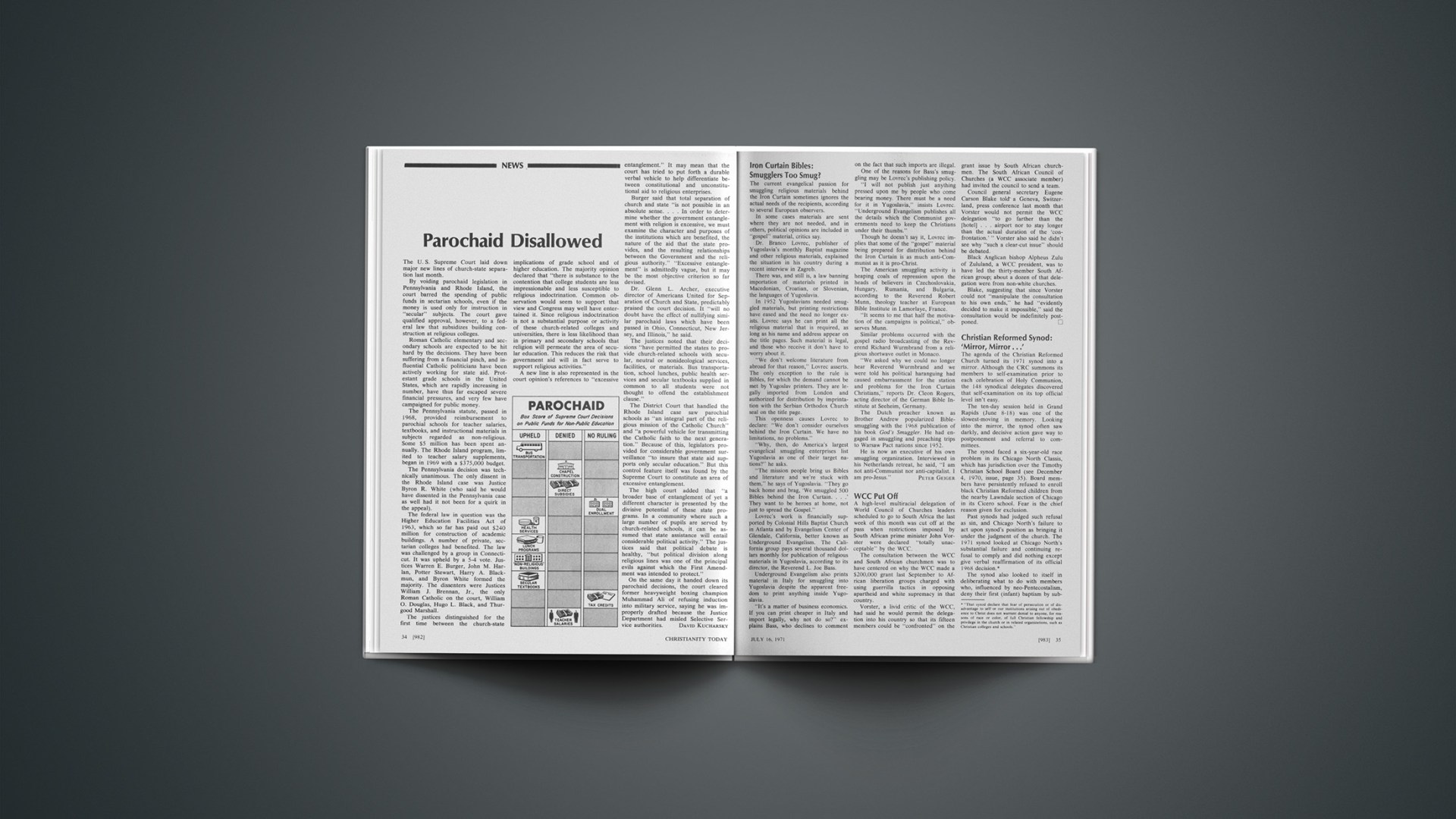
The U. S. Supreme Court laid down major new lines of church-state separation last month.

By voiding parochaid legislation in Pennsylvania and Rhode Island, the court barred the spending of public funds in sectarian schools, even if the money is used only for instruction in “secular” subjects. The court gave qualified approval, however, to a federal law that subsidizes building construction at religious colleges.

Roman Catholic elementary and secondary schools are expected to be hit hard by the decisions. They have been suffering from a financial pinch, and influential Catholic politicians have been actively working for state aid. Protestant grade schools in the United States, which are rapidly increasing in number, have thus far escaped severe financial pressures, and very few have campaigned for public money.

The Pennsylvania statute, passed in 1968, provided reimbursement to parochial schools for teacher salaries, textbooks, and instructional materials in subjects regarded as non-religious. Some $5 million has been spent annually. The Rhode Island program, limited to teacher salary supplements, began in 1969 with a $375,000 budget.

The Pennsylvania decision was technically unanimous. The only dissent in the Rhode Island case was Justice Byron R. White (who said he would have dissented in the Pennsylvania case as well had it not been for a quirk in the appeal).

The federal law in question was the Higher Education Facilities Act of 1963, which so far has paid out $240 million for construction of academic buildings. A number of private, sectarian colleges had benefited. The law was challenged by a group in Connecticut. It was upheld by a 5–4 vote. Justices Warren E. Burger, John M. Harlan, Potter Stewart, Harry A. Blackmun, and Byron White formed the majority. The dissenters were Justices William J. Brennan, Jr., the only Roman Catholic on the court, William O. Douglas, Hugo L. Black, and Thurgood Marshall.

The justices distinguished for the first time between the church-state implications of grade school and of higher education. The majority opinion declared that “there is substance to the contention that college students are less impressionable and less susceptible to religious indoctrination. Common observation would seem to support that view and Congress may well have entertained it. Since religious indoctrination is not a substantial purpose or activity of these church-related colleges and universities, there is less likelihood than in primary and secondary schools that religion will permeate the area of secular education. This reduces the risk that government aid will in fact serve to support religious activities.”

A new line is also represented in the court opinion’s references to “excessive entanglement.” It may mean that the court has tried to put forth a durable verbal vehicle to help differentiate between constitutional and unconstitutional aid to religious enterprises.

Burger said that total separation of church and state “is not possible in an absolute sense.… In order to determine whether the government entanglement with religion is excessive, we must examine the character and purposes of the institutions which are benefited, the nature of the aid that the state provides, and the resulting relationships between the Government and the religious authority.” “Excessive entanglement” is admittedly vague, but it may be the most objective criterion so far devised.

Dr. Glenn L. Archer, executive director of Americans United for Separation of Church and State, predictably praised the court decision. It “will no doubt have the effect of nullifying similar parochaid laws which have been passed in Ohio, Connecticut, New Jersey, and Illinois,” he said.

The justices noted that their decisions “have permitted the states to provide church-related schools with secular, neutral or nonideological services, facilities, or materials. Bus transportation, school lunches, public health services and secular textbooks supplied in common to all students were not thought to offend the establishment clause.”

The District Court that handled the Rhode Island case saw parochial schools as “an integral part of the religious mission of the Catholic Church” and “a powerful vehicle for transmitting the Catholic faith to the next generation.” Because of this, legislators provided for considerable government surveillance “to insure that state aid supports only secular education.” But this control feature itself was found by the Supreme Court to constitute an area of excessive entanglement.

The high court added that “a broader base of entanglement of yet a different character is presented by the divisive potential of these state programs. In a community where such a large number of pupils are served by church-related schools, it can be assumed that state assistance will entail considerable political activity.” The justices said that political debate is healthy, “but political division along religious lines was one of the principal evils against which the First Amendment was intended to protect.”

On the same day it handed down its parochaid decisions, the court cleared former heavyweight boxing champion Muhammad Ali of refusing induction into military service, saying he was improperly drafted because the Justice Department had misled Selective Service authorities.

Iron Curtain Bibles: Smugglers Too Smug?

The current evangelical passion for smuggling religious materials behind the Iron Curtain sometimes ignores the actual needs of the recipients, according to several European observers.

In some cases materials are sent where they are not needed, and in others, political opinions are included in “gospel” material, critics say.

Dr. Branco Lovrec, publisher of Yugoslavia’s monthly Baptist magazine and other religious materials, explained the situation in his country during a recent interview in Zagreb.

There was, and still is, a law banning importation of materials printed in Macedonian, Croatian, or Slovenian, the languages of Yugoslavia.

In 1952 Yugoslavians needed smuggled materials, but printing restrictions have eased and the need no longer exists. Lovrec says he can print all the religious material that is required, as long as his name and address appear on the title pages. Such material is legal, and those who receive it don’t have to worry about it.

“We don’t welcome literature from abroad for that reason,” Lovrec asserts. The only exception to the rule is Bibles, for which the demand cannot be met by Yugoslav printers. They are legally imported from London and authorized for distribution by imprintation with the Serbian Orthodox Church seal on the title page.

This openness causes Lovrec to declare: “We don’t consider ourselves behind the Iron Curtain. We have no limitations, no problems.”

“Why, then, do America’s largest evangelical smuggling enterprises list Yugoslavia as one of their target nations?” he asks.

“The mission people bring us Bibles and literature and we’re stuck with them,” he says of Yugoslavia. “They go back home and brag, ‘We smuggled 500 Bibles behind the Iron Curtain.…’ They want to be heroes at home, not just to spread the Gospel.”

Lovrec’s work is financially supported by Colonial Hills Baptist Church in Atlanta and by Evangelism Center of Glendale, California, better known as Underground Evangelism. The California group pays several thousand dollars monthly for publication of religious materials in Yugoslavia, according to its director, the Reverend L. Joe Bass.

Underground Evangelism also prints material in Italy for smuggling into Yugoslavia despite the apparent freedom to print anything inside Yugoslavia.

“It’s a matter of business economics. If you can print cheaper in Italy and import legally, why not do so?” explains Bass, who declines to comment on the fact that such imports are illegal.

One of the reasons for Bass’s smuggling may be Lovrec’s publishing policy.

“I will not publish just anything pressed upon me by people who come bearing money. There must be a need for it in Yugoslavia,” insists Lovrec. “Underground Evangelism publishes all the details which the Communist governments need to keep the Christians under their thumbs.”

Though he doesn’t say it, Lovrec implies that some of the “gospel” material being prepared for distribution behind the Iron Curtain is as much anti-Communist as it is pro-Christ.

The American smuggling activity is heaping coals of repression upon the heads of believers in Czechoslovakia, Hungary, Rumania, and Bulgaria, according to the Reverend Robert Munn, theology teacher at European Bible Institute in Lamorlaye, France.

“It seems to me that half the motivation of the campaigns is political,” observes Munn.

Similar problems occurred with the gospel radio broadcasting of the Reverend Richard Wurmbrand from a religious shortwave outlet in Monaco.

“We asked why we could no longer hear Reverend Wurmbrand and we were told his political haranguing had caused embarrassment for the station and problems for the Iron Curtain Christians,” reports Dr. Cleon Rogers, acting director of the German Bible Institute at Seeheim, Germany.

The Dutch preacher known as Brother Andrew popularized Bible-smuggling with the 1968 publication of his book God’s Smuggler. He had engaged in smuggling and preaching trips to Warsaw Pact nations since 1952.

He is now an executive of his own smuggling organization. Interviewed in his Netherlands retreat, he said, “I am not anti-Communist nor anti-capitalist. I am pro-Jesus.”

PETER GEIGER

Wcc Put Off

A high-level multiracial delegation of World Council of Churches leaders scheduled to go to South Africa the last week of this month was cut off at the pass when restrictions imposed by South African prime minister John Vorster were declared “totally unacceptable” by the WCC.

The consultation between the WCC and South African churchmen was to have centered on why the WCC made a $200,000 grant last September to African liberation groups charged with using guerrilla tactics in opposing apartheid and white supremacy in that country.

Vorster, a livid critic of the WCC, had said he would permit the delegation into his country so that its fifteen members could be “confronted” on the grant issue by South African churchmen. The South African Council of Churches (a WCC associate member) had invited the council to send a team.

Council general secretary Eugene Carson Blake told a Geneva, Switzerland, press conference last month that Vorster would not permit the WCC delegation “to go farther than the [hotel] … airport nor to stay longer than the actual duration of the ‘confrontation.’ ” Vorster also said he didn’t see why “such a clear-cut issue” should be debated.

Black Anglican bishop Alpheus Zulu of Zululand, a WCC president, was to have led the thirty-member South African group; about a dozen of that delegation were from non-white churches.

Blake, suggesting that since Vorster could not “manipulate the consultation to his own ends,” he had “evidently decided to make it impossible,” said the consultation would be indefinitely postponed.

Christian Reformed Synod: ‘Mirror, Mirror …’

The agenda of the Christian Reformed Church turned its 1971 synod into a mirror. Although the CRC summons its members to self-examination prior to each celebration of Holy Communion, the 148 synodical delegates discovered that self-examination on its top official level isn’t easy.

The ten-day session held in Grand Rapids (June 8–18) was one of the slowest-moving in memory. Looking into the mirror, the synod often saw darkly, and decisive action gave way to postponement and referral to committees.

The synod faced a six-year-old race problem in its Chicago North Classis, which has jurisdiction over the Timothy Christian School Board (see December 4, 1970, issue, page 35). Board members have persistently refused to enroll black Christian Reformed children from the nearby Lawndale section of Chicago in its Cicero school. Fear is the chief reason given for exclusion.

Past synods had judged such refusal as sin, and Chicago North’s failure to act upon synod’s position as bringing it under the judgment of the church. The 1971 synod looked at Chicago North’s substantial failure and continuing refusal to comply and did nothing except give verbal reaffirmation of its official 1968 decision.1“That synod declare that fear of persecution or of disadvantage to self or our institutions arising out of obedience to Christ does not warrant denial to anyone, for reasons of race or color, of full Christian fellowship and privilege in the church or in related organizations, such as Christian colleges and schools.”

The synod also looked to itself in deliberating what to do with members who, influenced by neo-Pentecostalism, deny their first (infant) baptism by submitting to a second rite of baptism but do not wish to leave the CRC. Since the Christian Reformed theology of church membership limits excommunication to those judged to have “no part in the kingdom of Christ” and permits membership transfer only to Reformed churches, the synod could make no decision. The matter was referred for long-term study.

A request from one of its Canadian classes that the CRC re-express its faith in a new confession that would replace its current confessions produced a long and serious discussion—to the surprise of many delegates. The CRC is one of the most creedally bound churches in the United States. Yet there was such an urgent desire to be a truly confessing church that a committee was appointed to study the whole matter.

Many delegates felt the church could not adequately speak its faith to the contemporary world through the CRC’s 400-year-old confessions. The decision may be historic.

JAMES DAANE

Rejuvenating The Ucc?

Youth delegates numbered 140 among a field of 700 at the eighth biennial General Synod of the 1.9-million-member United Church of Christ at Grand Rapids, Michigan, last month. Right from the outset they made their presence felt, pushing through amendments at the first session that pointed to Christ as the answer to the “crisis of faith” in the UCC. They urged their church to “wrestle” with the biblical meaning of life and “to become committed to behavior consistent with beliefs.”

Although the statement by the young people—accepted less enthusiastically by their elders—smacked of old-fashioned religion, the proposed applications to modern life were far from conservative.

Dealing with the issue of “Peace and United States Power” the synod favored: support for “indigenous liberation movements throughout the world which oppose elitist oppression or totalitarian subversion”; diplomatic relations with Red China and her admission to the United Nations; amnesty and church support for draft evaders; and withdrawal of U. S. economic aid to Pakistan.

The UCC became the first major denomination to act on the controversial Pentagon papers. By a vote of 614–23 the delegates said the papers show that the American people were deceived by government officials and that war aims and strategies in Indochina are “cruel” and “unjust” and must therefore be condemned by Christians. Delegates also called the U. S. “Vietnamization” program immoral, and they requested President Nixon to end the Indochina conflict “within the next six to nine months.”

In a showdown between the UCC’s social-action and foreign-missions units on the subject of U. S. business operations in southern Africa, the UCC voted not to ask Gulf Oil Company and other firms to withdraw but to ask that they use their influences to help “liberate” the African countries from minority and colonial rule. The UCC stance was bitterly contested by social-action leaders who have especially opposed Gulf’s alleged support of Portuguese control over Angola. Missions spokesmen argued successfully that American interests would simply be taken over by other industrialized nations, a point emphasized by Gulf executives in preconvention hearings.

One measure asked UCC leaders to probe attitudes of the Christian Reformed Church and the Reformed Church of America toward apartheid practices of their sister churches in South Africa.

Delegates were unmoved by Wisconsin layman John Esch’s charges that they were hypocritical for judging Portugal and South Africa by name while refusing to similarly denounce North Viet Nam and Russia for their roles in global unrest.

In the area of women’s liberation the synod adopted a substitute motion that called for “repeal of all legal prohibitions of physician-performed abortions” and asked that more room be made for women in UCC pastorates and other leadership offices.

UCC blacks were given a piece of the action but not as much as they had wanted. Instead of a campaign for $10 million and establishment of a black university, delegates decided to let the UCC Executive Council launch a “major campaign” (no amount specified) and to negotiate loans up to $3 million for black students in the next two years.

The youth caucus backed out of a move to ask for legal defense funds for Angela Davis and other “political prisoners” in the United States. Instead the young people supported an easily passed statement simply endorsing Miss Davis’s right to a fair trial. A youth spokesman said Miss Davis had more than enough money already for her trial. The Davis family’s pastor, Andrew L. Cooper of a Birmingham, Alabama, UCC church, argued for UCC support.

A North Dakota Indian rancher, August Little Soldier, became the first Indian to serve on the UCC Executive Council. David Colwell, a Seattle minister, was elected moderator. Although last year’s income was down $500,000 to $16.9 million, an optimistic budget of $17.7 million was proposed for each of the next two years.

A bylaw change ensures that at least 20 per cent of future UCC delegates will be young people. In the convention’s final moments, the youths led the way in defeating a measure that would disqualify UCC top leadership after age 65. Said one young delegate: “Youth is a matter of spirit, not age.” Everyone applauded.

EDWARD E. PLOWMAN

Computerizing Sampson: When Push Comes To Shove

Four professors at Kansas State University, assisted by an electronic computer and an engineering equation, say they have “proven” the plausibility of the biblical record of Samson’s destruction of the Philistine temple.

Mechanical-engineering professor Wilson Tripp first struggled with the reliability of the text when he audited a course in English Bible. “Then it came to me that perhaps the grandstands in the Samson story had two main, slender wooden columns that bowed under because of the weight of the people on the roof,” relates Tripp. “As long as the crossbrace was in place, it prevented buckling. Samson knew if he got between and pushed outward the pillars would bow the other way and break.”

So Tripp enlisted English professor Dale B. Jones and two other faculty members to test his theory. Architecture and design professor Alden Krider served as artist for the model, depicted as the grandstand of a ballpark rather than the traditional temple.

“There was a tendency for Hebrew writers to call any large, important building a temple,” noted Jones. The profs estimated that the 3,000 Philistines on the roof put a load of 246,082 pounds on each column. The pillars were envisioned as twelve inches by twelve inches and thirty feet long, crossbraced in the middle, and bowed inward one and one-half inches.

Using Euler’s Buckling Load Formula, the men then fed the calculations into a CDC 6400 computer, using an interactive time-sharing device. Results showed that Samson would have had to push 917.57 pounds. K-State weight lifters assured them that one could push 600 pounds. And Tripp theorized: “Persons under emotional stress sometimes do things they can’t normally do. This is evidently what happened.”

JAMES S. TINNEY

Massanetta Mandates

Two explosive issues to come before the General Assembly of the Presbyterian Church U. S. on its final two days at Massanetta Springs, Virginia, last month were the Indochina war and the relation of an independent missions group to the denomination. Commissioners declared continuation of the Viet Nam conflict “cannot be morally justified” and called the Executive Commission on Overseas Evangelism (ECOE) a “grave departure” from normal church organizations likely to cause “grievous harm” to the life and health of the church.

Debate on these and other matters—there were a record forty-one resolutions introduced by commissioners—waxed even warmer than that generated earlier on main events like synod restructure and continuing membership in the National and World Councils of Churches (see July 2 issue, page 31).

The assembly praised President Nixon’s efforts to end the Indochina war. But the compromise statement of conservative and liberal positions added: “The continuation of this war cannot be morally justified. The killing must be stopped.”

This, the denomination’s strongest antiwar statement, wasn’t biting enough to suit the majority of the seventy youth delegates, appearing at an assembly for the first time. In protest (some were in tears), the youth entered a statement of “deepest disappointment” into the records. They had favored a deleted part of the resolution that called for an immediate ceasefire and concurrent withdrawal of all U. S. military forces from Indochina.

The independent mission agency, ECOE, an arm of the Presbyterian Evangelistic Fellowship, has been an increasingly sore point for denominational leaders because it siphons money from Southern Presbyterians contrary to Board of World Missions policy and sends it to selected missionaries deemed theologically and politically conservative. A motion that would have recommended that presbyteries take no disciplinary action against members involved in ECOE prior to the assembly failed on a close vote.

Newly elected moderator Ben Lacy Rose in a press conference thumped conservative groups that work outside regular church channels. “I wish they would all go out of existence,” he said, stressing that “loyal” opposition is that which works within the official boards and agencies. Rose also frowned on the so-called escape clause still extant in the proposed union plan with the United Presbyterians. It would permit dissident congregations to retain property.

In an action related to secession, a resolution to allow realignment of the church into two continuing bodies (conservatives and liberals) was turned down. The Constitution Committee ruled that the constitution grants no such authority to the General Assembly, thus scuttling hopes of some conservative for a peaceful and equitable division of properties, institutions, and funds on that basis.

Other actions at Massanetta Springs:

• Approval of continued work on a new confession of faith, despite an attempt to suspend the work.

• Overwhelming approval of a major study, “The Person and Work of the Holy Spirit,” after several attempts to recommit it for study. Tongues-speaking, the 11,000-word paper said, should be regarded as God’s gift. Criticism of the work centered on identifying “ecstatic utterances” and modern miracles with those described in the New Testament.

• Funding of a total of $40,000 for the Black Presbyterian Leadership Caucus for this year and next.

• Refusal to dissociate the denomination from three controversial publications: Colloquy, an interdenominational magazine attacked as “profane, blasphemous, and immoral”; FOCUS, a tabloid newspaper criticized because it allegedly gave open support to drug use by youth; and the social-action monthly Church and Society.

• Adoption of five position papers on welfare, social development, and drug abuse. Youth delegate Rusty Wright, a Campus Crusade staffer, was instrumental in getting the drug-abuse paper amended to include recognition that Christ can bring new life to those hooked on drugs.

Catholics Get the Spirit

There are signs that revival, low-key Pentecostal in style, may be on the way for the Roman Catholic Church. Tens of thousands of Catholics meet weekly in churches, homes, dorm rooms, and borrowed halls for Bible study, prayer, spirited gospel singing, and exercise of the “gifts of the Spirit”: healing, prophecy, speaking in tongues.

Indeed, the average Catholic Pentecostal meets one night with a small home group, another night with a large “prayer community.” The ranks have swelled in just four years to an estimated 50,000 American and Canadian Catholics.

Last month 5,000 registrants and about 500 gate-crashers crowded onto the Notre Dame University campus at South Bend, Indiana, for the Fifth International Conference on the Charismatic Renewal in the Catholic Church. There were street people, straight collegians and young professionals, middle-American adults of all ages and vocations, hundreds of priests and nuns, a smattering of Protestants, a few blacks. (Registration for the 1970 conference was 1,270, with some 10,000 to 20,000 in the movement at that time.)

“Let us proclaim right from the start that Jesus Christ is our King,” declared leader James Cavnar, 25, on the first night. The crowd responded with a standing ovation, cheers, and uplifted fingers in “One Way” signs. Without cue, the people burst into a chorus, “Jesus Is Lord.” Afterward, the rather startled Cavnar mildly rebuked: “This is not a spiritual jamboree. We are an assembly of believers gathered here for worship and praise.”

Amid the songs and prayers were testimonies. Teenager Chris Jaerling told how Catholic Pentecostals at Ann Arbor, Michigan, led her from drugs to Christ and into the Spirit-filled life. “Life isn’t hopeless now,” she beamed, and the crowd applauded. She is devoting her summer to street evangelism.

Cavnar’s father, a much decorated war hero, said he submitted to “Spirit baptism” a year ago after long and bitter hostility over his son’s involvement in the movement. Because of his suspicions he once arranged for a federal investigation of the movement, he said; the investigators, reporting it was the first time they had ever met a group of young men who prayed so much, gave it a clean bill of health. The elder Cavnar organized a Dallas group that meets in a Dominican high school and now numbers nearly 300.

Loyola chaplain Harold Cohen, one of 150 who came from the New Orleans area, said that he was baptized in the Spirit in the 1969 conference and that the Loyola prayer group he subsequently organized now numbers more than 500, with satellite groups “all over Louisiana and Mississippi.”

The weekend, saturated with bubbly joy and conversation that centered on Jesus, featured scores of workshops and seminar talks on topics ranging from marriage and sexual concepts in “the charismatic renewal” to principles of Bible study. Couples lounged in the sunshine, holding hands over open Bibles and praying. Impromptu groups gathered under shade trees to sing, pray, and share their Christian experiences. New converts lugged copies of the massive Jerusalem Bible to discussions on the Christian life.

“Let’s get away from the psychology and other junk we give out in our sermons,” Cohen urged fifty parish priests. “Let’s give out Jesus.” The event concluded with a colorful folk mass presided over by San Angelo, Texas, bishop Stephen Leven and Auxiliary Bishop Joseph McKinney of Grand Rapids.

The Catholic Pentecostal movement began spontaneously on several fronts in early 1967, most notably at a weekend retreat of students at Duquesne University in Pittsburgh. It was preceded, say spokesmen, by mounting frustration over spiritual stagnation, prayers of concerned laymen, and the reading of evangelist David Wilkerson’s book The Cross and The Switchblade. News spread to Notre Dame University where students and faculty members enlisted local charismatic Protestants to help launch a group. Early members included theology professor Edward O’Connor, who has emerged as the movement’s respected theologian. From Notre Dame the revival fanned out quickly to other campuses, then to lay groups in parishes.

Other fronts, independent of the Duquesne-Notre Dame beginnings, opened at about the same time. Influences of Wilkerson’s book and charismatic Protestants led to the establishment of large groups in St. Louis and the Maryland suburbs of Washington, D. C.

Disturbed, the Catholic hierarchy in 1968 instructed its Committee on Doctrine to investigate. The committee’s report in 1969 (see January 2, 1970, issue, page 41) spoke rather favorably of the movement. It noted “a strong biblical basis,” deepening of spiritual life for many, and an attraction to Bible study. But it cautioned adherents to avoid “the mistakes of classic Pentecostalism,” and warned against substitution of religious experience for doctrine. The committee recommended that the bishops involve “prudent priests” in the movement.

The bishops seem divided over the movement today. Archbishop Philip M. Hannan and black auxiliary Harold R. Perry of New Orleans have been prayed over and reportedly are favorably impressed. Canadian bishop G. Emmett Carter endorsed the movement in a pastoral letter, stating his hope that its spirit would spread and affect his diocese. McKinney joined up at a Michigan retreat for priests last year. (He says that to protect his role he has not yet publicly prayed in tongues but “could have” on numerous occasions.) He received an ovation at the South Bend mass in his call for the Holy Spirit to be the chief delegate at the Synod of Bishops in Rome this fall.

Los Angeles archbishop Timothy Manning, however, on the eve of the South Bend conference issued a pastoral letter warning against ecumenical “equation with other denominations.” (Catholic Pentecostals often attend pan-denominational charismatic meetings, and about one-fourth of those who attend the average Catholic meeting are Protestants. Some Catholics operate Teen Challenge centers under Assembly of God sponsorship.) He also warned against disengaging the Holy Spirit from the institutional church and its hierarchy “as if they were two antagonistic expressions of Christianity.”

Manning’s concern reflects growing anti-institutional inclinations among a minority of the Catholic Pentecostals (home masses, lack of interest in traditional liturgies, objections to certain doctrines). On the other hand, Cavnar, O’Connor, and other leaders strive to keep operating within the bounds of parish life. Only in this way, they say, will Pentecostalism stay intact to renew the Church.

National communications coordinator James Byrne of Notre Dame says those who leave the church are “disobedient to the Spirit and cause the charismatic renewal great damage.” Besides, says Byrne, the church needs them because it’s undergoing crises in faith and leadership and the charismatic renewal is a remedy for both.

Catholic charismatics are generally not as emotional in worship nor as narrow in viewpoint as classic Pentecostalists. Most leaders say they can be Spirit-baptized without speaking in tongues; all that is needed is a sincere desire for the Spirit’s filling and the laying on of hands. Reformed Church of America minister Robert Eggebeen of Grand Haven, Michigan, says he has found a “home” in Catholic Pentecostalism because of “this balance between shallow emotionalism and cold theological correctiveness.”

Initiates are given a six-lesson course on “Life in the Spirit” that is strongly evangelical in content. Kevin Walsh, 22, a graduate of Loyola of Chicago and a part of the 1,500-member Chicago prayer community, says he realized he was “blowing my mind trying to get into Christ when what I really needed to do was let him get into me.” Says George Keen, 23, former Society of Mary priest who is now supervisor of the Cleveland Catholic Boys Home: “The Lord has convicted me of my sins, but I’ve discovered a fantastic concept of God’s forgiveness. He holds on and doesn’t let go.”

At the same time, he—like many other Catholic charismatics—says he has new appreciation for Mary and sees deeper meanings in the sacraments.

Will the movement be able to continue its evangelical course amid the maze of institutional tradition? Canadian bishop Carter hopes so: “We had no right to doubt that God would make himself felt, but at times we felt almost abandoned. The dawn of a new spiritual era in the church may be beginning to break.”

Conservative Baptists

World evangelism was the chief topic for the nearly 1,000 delegates at the twenty-eighth annual meeting of Conservative Baptists last month in Wheaton, Illinois. Of thirty-nine missionary appointees, twenty-seven are slated for foreign work. And more than 200 have applied this year for short-term service of one year or more.

Bible Prophecy in the Prophets’ City

NEWS

As trumpets blared, a procession of conference personalities filed in to take their places on the platform of the Benyenei Ha’ooma (convention hall), opening the four-day Conference on Biblical Prophecy in the city of the prophets. Leading the procession, the Reverend Shlomo Hizak, a Hebrew Christian who heads the Mount of Olives Bible Center, carried a large Bible, open to Isaiah 61: “The spirit of the Lord is upon me.…” He placed it under the conference emblem depicting the citadel of David and the Old City walls. With the spotlight on the Bible, delegates were assured they would get what they had come for: a Bible-centered conference.

None of the 1,300 attending evangelicals, who came from thirty-two countries (the majority were from the United States), entered without a pass. Even local Christians who wished to attend had to pay $75 for the privilege. Still the sponsors are likely to be left holding a sizable bag. But no one complained.

The music alone was worth the price of admission. Featured musicians included Metropolitan Opera star Jerome Hines, recording and television artist Anita Bryant, the Azusa choir from California, and the Jerusalem Symphony Orchestra conducted by director-composer Ronn Huff of Nashville.

Former Israeli prime minister David Ben-Gurion, 85, told the assembly the Jews have given three great ideas to the world: the concept of one God, love for one’s fellow man as for oneself, and the teaching against war.

The warmer issues were not slow in coming. Rather than dividing the delegates into opposing camps, they produced subdued confusion—an indication that not all had done their homework. Or perhaps it was too soon after the June, 1967, war, when the Israelis united the city of Jerusalem and claimed administration over the Temple Mount.

The two addresses during the first afternoon that caught the prophetic-minded with their futures down were “Prospectives on the Rebuilding of the Temple,” presented by President Edmund P. Clowney of Westminster Seminary in Philadelphia and Charles L. Feinberg, dean of Talbot Seminary in La Mirada, California.

Dr. Clowney, espousing a traditional Reformed view, held there would not be a literal edifice to replace the ancient Temple. It was God’s presence that made it the “house of God,” he said, and it’s impossible to “shut God up in a box or imprison him on a hilltop.” Jesus ended the old Temple concept with his words: “Destroy this Temple and in three days I will rebuild it.” Now, the speaker insisted, Jesus is the Lord of the Temple but greater than the Temple. The symbolic yields to the person of the Lord. The veil is torn away, “and there remains only Jesus.”

With his logic straight but his theology open to assault, the speaker concluded that “the greatest teaching of the Old Testament is fulfilled in the Church. Jesus’ blood was the final sacrifice, and there can be no going back.”

Some wondered where this leaves restored, modern Israel today. It is no longer a corpse but very much alive and flourishing. Although the speaker challenged Israelis to join in that “heavenly citizenship,” most of them will take a dim view of the idea of a modern, physical state’s renouncing its historical and present reality for a non-literal, undefined spirit existence.

Feinberg, born and reared in an Orthodox Jewish home, held that there would be a literal rebuilding of the Temple and insisted that the last nine chapters of Ezekiel are to be taken whole as written. His outlook represented that of mainline dispensationalism (the ultras with their charts and diagrams were not in evidence at the conference).

Feinberg methodically employed a sharply honed mind to cut down one by one the arguments against the literal interpretations of a restored Temple as seen in Ezekiel 30–38. First, he noted, some say the literal view is too Jewish. But, from Abraham to Jesus, including the disciples and the apostles, he said, it was Jewish all the way. “If the literal interpretation is too Jewish, where do you stop?” Feinberg asked.

“Speak to a Jew who does not believe that Jesus is the Messiah. You assure him that Micah’s word concerning Bethlehem, Isaiah’s prediction of the miraculous birth, the psalmist’s foretelling of the crucifixion, and others, are all to be understood literally. But when he refers to numerous passages involving peace through Messiah’s rule … with Israel … in its own land according to promises made by the Father, you inform him that these passages must be treated ‘spiritually’ or ‘symbolically.’ Do you wonder that he cannot follow your interpretive logic?”

Dr. Arnold T. Olson, president of the Evangelical Free Church of America, told delegates in his keynote address that “the interest in rediscovering the historical Jesus by many Jewish scholars calls for a new effort on the part of evangelical Christians to understand the modern Jew, his problems, his thinking, and his faith.” Olson’s address presented one of the few solid emphases on taking modern Israel and the Israelis seriously in today’s eschatological reckoning.

The second day accented youth. Youth for Christ International director Sam Wolgemuth presented a Christian pop group in a musical entitled “Youth and the End of the Age.” Their selections of religious rock and interspersed dialogue sent chills to the cheek bones more than once. By the time they invited the switched-on audience to “Put Your Hand in the Hand,” the delegates, who long since had succumbed to foot-tapping, surrendered and joined in with a solid clap-beat to the music.

With “Amazing Grace,” their downfall was complete. The prophetic enthusiasts sang out with the group in abandon in the here and now; for a while the standing, sustained ovation refused to subside. If prophecy-conference people can’t dance in the aisles, they did what they could to let it out. They sat and wept with joy.

Black evangelist Tom Skinner from Brooklyn kept the pitch with his message on “Modern Youth in Biblical Perspective.” Having already let go, the audience responded to Skinner’s potent points with rousing cheers.

That afternoon the conference considered the Land of Israel. Dr. Herman Ridderbos, professor of New Testament at the Kampen Theological Seminary in the Netherlands, and Dr. John Walvoord, president of Dallas Seminary, spoke on “Prospectives on the Future of Israel.”

Dr. Walvoord believes that the prophecies require the Jews to return to Israel to await the Second Coming, and that the current return of Jews is a principal sign of its nearness.

Up to this point it had been very much a Western, evangelical, premillennial-oriented conference. Perhaps its most noticeable characteristic was a determined, single-faceted approach to prophecy: predictive interpretation all the way. That the prophets also thundered God’s judgments on the injustices of their day, with practical implications for today, scarcely received a nod.

R. J. Zvi Werblowsky of the Department of Comparative Religion at Hebrew University in Jerusalem told the conference that Jews do not constitute a denomination but are a people, bound inseparably to the land.

He pointed out the wide gap between Christian and Jewish thought in the areas of theological and prophetic understanding, holding that biblical prophecy and biblical texts cannot be used to prove Israel’s right to the land. He stressed that the Concept of a “chosen people” is bound up with the idea of a “chosen land.” As a people, Jews can realize their existence only in total union of social and spiritual life in the land, he said, adding wryly: “Some people call this powerful bond a Jewish ‘hang-up.’ ”

Werblowsky’s central point: Israel exists only by right of history (or continuity, for there were always Jews in the land, and those who could not come because of circumstances wanted to come) and not by right of prophecy, though the sense of “rightness” of their claim to the land was nourished by the prophets. “Our claim is in line with prophetic promises, and this is what prophecy means to many in this country,” he said.

Immediately after Werblowsky’s address, theologian Carl F. H. Henry replied in a statement: “Dr. Werblowsky’s alternative exposition of prophecy is a modernistic view insofar as it deprives the inspired prophets of the predictive supernatural and substitutes a religio-philosophic perspective on history.… The cost to Judaism of deleting prophetic specifics is the loss of messianic expectation in its biblical understanding.” But none at the conference appeared to take Werblowsky’s remarks as an evangelical view of prophecy. It was, as he stated, a Jewish view of prophecy, people, and land.

Israeli Christians presented a panel on “The Bible and the Word ‘Israel’ as an Israeli Sees It.” Fuad Sakhnini, pastor of the Nazareth Baptist Church, explained that there are three groups of Arabs in the Middle East: the Arab believer, who agrees that the rebirth of Israel is according to prophecy; the nominal Christian, with ambivalent feelings about the rebirth of the state; and the Arab Muslim, who rejects all prophecies regarding the land of Israel and sees them as Zionist propaganda.

The pastor added: “We Christian Arabs believe in prophecy with justice, recognizing the right of Jews and the rights of Arabs. We are not pro-Israel, nor pro-Arab in a political sense. We are pro-Christ and pro-Gospel.”

Panel chairman and conference host G. Douglas Young, president of the American Institute of Holy Land Studies in Jerusalem, pointed out the irony that “no one questioned the closing of the Western [Wailing] Wall to the Jews in 1948 … yet now … many in the Church are calling for an internationalizing of this city in order to protect the rights of all worshipers—rights which need no protection in view of their having been made free to all.”

On one of Jerusalem’s hottest mornings of the year, the delegates assembled on the Mount of Olives to close the conference with a joint communion service led by Richard C. Halverson, pastor of the Fourth Presbyterian Church of Washington, D. C. The sweltering delegates sublimated their discomfort to the pleasure stimulated by the fabulous setting: the Hebrew University (Mount Scopus campus) amphitheater overlooking the Hills of Moab, the Jordan Valley, and the Dead Sea; the ecumenical atmosphere accentuated by the various ethnic groups, some in their national costumes; and the sheer wonder of being in Jerusalem on the Mount of Olives remembering in Holy Communion the last hours of Jesus before his crucifixion, and on the same hill where he ascended to heaven.

Ministers at the conference distributed the bread, baked by Arab Christians in Bethlehem, and served the wine from Mount Carmel in olive-wood cups. For many—perhaps most—it was a rare and unforgettable hour, ending the conference on its highest and most beautifully prophetic note: “For as oft as yet eat this bread and drink this cup, ye proclaim the Lord’s death till he come.”

Prophecy Statement

Although one of the stated aims of the Conference on Biblical Prophecy was that no statements or declarations be issued, six participants issued the following under their own names:1Meanwhile, Pope Paul VI made a direct call for internationalizing Jerusalem, and twenty-four prominent Catholic and Protestant leaders in a newly organized group called Christians Concerned for Israel supported the reunification of Jerusalem under Israeli jurisdiction (they expressed confidence in Israel’s ability to supervise the holy places in cooperation with Christian and Muslim bodies).

Jew And Baptist Together

They didn’t stand and sing “Onward Judeo-Christian Soldiers,” as one participant quipped, but a three-day colloquium of forty Southern Baptist and Jewish scholars at Hebrew Union College-Jewish Institute of Religion in Cincinnati last month did end on a strong note of amity and affinity.

“You are my brothers,” said Dr. Samuel Sandmel, professor of Bible and Hellenistic literature at HUC-JIR, setting the tone at the beginning with a paraphrase of the greeting given by Pope John XXIII to some Jewish visitors.

The friendliness was seconded by the Reverend Joseph R. Estes, a pastor of DeLand, Florida, who responded, “To my Jewish friend, I want to say that your God is my God, too.”

The two groups disagreed on which theological differences most separated them. Attitudes toward the Law of Moses are the essential difference, according to Rabbi Sandmel. But Dr. Ralph L. Smith, professor of Old Testament at Southwestern Baptist Seminary, argued: “The real issue that separates us is the person and work of Christ. One can retain a worthy respect of the law of Moses and still be a Christian.”

Rabbi Alvin Reines, professor of Jewish philosophy at HUC-JIR, bluntly asked: “Does Baptist theology involve the belief that Jews are to be damned as sinners? Is it possible for a Southern Baptist to say, as did Dr. Sandmel, ‘You’re my brothers’?”

“I’m willing to leave the answer … in the hands of God,” Dr. Smith answered evasively.

JAMES ADAMS

Apple PodcastsDown ArrowDown ArrowDown Arrowarrow_left_altLeft ArrowLeft ArrowRight ArrowRight ArrowRight Arrowarrow_up_altUp ArrowUp ArrowAvailable at Amazoncaret-downCloseCloseEmailEmailExpandExpandExternalExternalFacebookfacebook-squareGiftGiftGooglegoogleGoogle KeephamburgerInstagraminstagram-squareLinkLinklinkedin-squareListenListenListenChristianity TodayCT Creative Studio Logologo_orgMegaphoneMenuMenupausePinterestPlayPlayPocketPodcastRSSRSSSaveSaveSaveSearchSearchsearchSpotifyStitcherTelegramTable of ContentsTable of Contentstwitter-squareWhatsAppXYouTubeYouTube