‘Year of the Woman’ for Baptists, Presbyterians

NEWS

Seminars on the charismatic movement. Let’s get out of Viet Nam as soon as possible. Ralph Carmichael musicals. A vote for womanhood. Jesus-movement kids and street kids in need of Jesus. Black viewpoints. Feed the poor. Show-and-tell attention for Indian Americans. Down with the system. Up with evangelism.

There were soothing sounds for just about everybody at last month’s annual meeting of the American Baptist Convention in Minneapolis. Liberal and evangelical delegates alike went home remarking about the convention’s spirit, which was almost as sweet as the gallons of communion grape juice donated by a Baptist grape-grower in California.

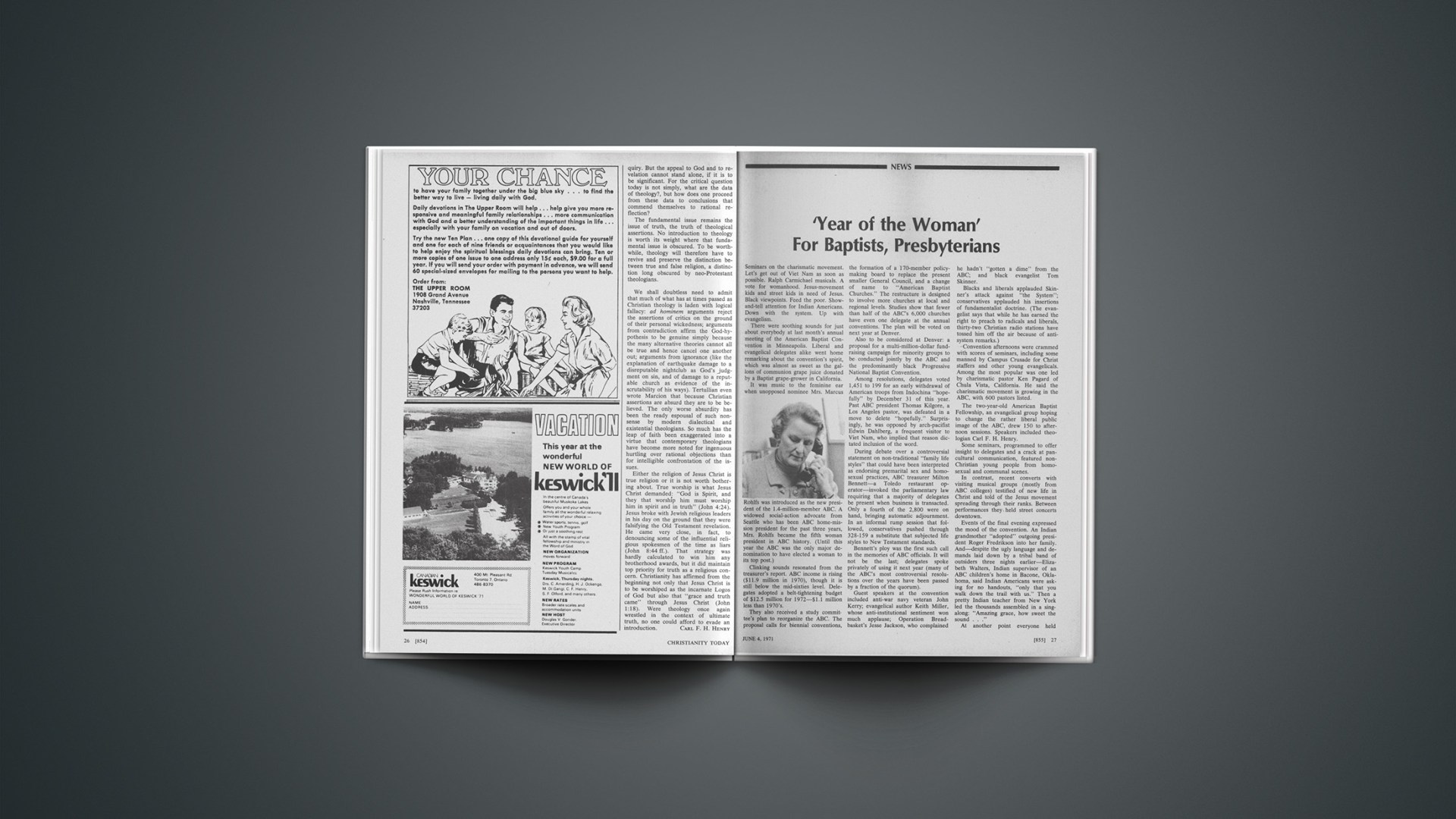
It was music to the feminine ear when unopposed nominee Mrs. Marcus Rohlfs was introduced as the new president of the 1.4-million-member ABC. A widowed social-action advocate from Seattle who has been ABC home-mission president for the past three years, Mrs. Rohlfs became the fifth woman president in ABC history. (Until this year the ABC was the only major denomination to have elected a woman to its top post.)

Clinking sounds resonated from the treasurer’s report. ABC income is rising ($11.9 million in 1970), though it is still below the mid-sixties level. Delegates adopted a belt-tightening budget of $12.5 million for 1972—$1.1 million less than 1970’s.

They also received a study committee’s plan to reorganize the ABC. The proposal calls for biennial conventions, the formation of a 170-member policy-making board to replace the present smaller General Council, and a change of name to “American Baptist Churches.” The restructure is designed to involve more churches at local and regional levels. Studies show that fewer than half of the ABC’s 6,000 churches have even one delegate at the annual conventions. The plan will be voted on next year at Denver.

Also to be considered at Denver: a proposal for a multi-million-dollar fund-raising campaign for minority groups to be conducted jointly by the ABC and the predominantly black Progressive National Baptist Convention.

Among resolutions, delegates voted 1,451 to 199 for an early withdrawal of American troops from Indochina “hopefully” by December 31 of this year. Past ABC president Thomas Kilgore, a Los Angeles pastor, was defeated in a move to delete “hopefully.” Surprisingly, he was opposed by arch-pacifist Edwin Dahlberg, a frequent visitor to Viet Nam, who implied that reason dictated inclusion of the word.

During debate over a controversial statement on non-traditional “family life styles” that could have been interpreted as endorsing premarital sex and homosexual practices, ABC treasurer Milton Bennett—a Toledo restaurant operator—invoked the parliamentary law requiring that a majority of delegates be present when business is transacted. Only a fourth of the 2,800 were on hand, bringing automatic adjournment. In an informal rump session that followed, conservatives pushed through 328–159 a substitute that subjected life styles to New Testament standards.

Bennett’s ploy was the first such call in the memories of ABC officials. It will not be the last; delegates spoke privately of using it next year (many of the ABC’s most controversial resolutions over the years have been passed by a fraction of the quorum).

Guest speakers at the convention included anti-war navy veteran John Kerry; evangelical author Keith Miller, whose anti-institutional sentiment won much applause; Operation Breadbasket’s Jesse Jackson, who complained he hadn’t “gotten a dime” from the ABC; and black evangelist Tom Skinner.

Blacks and liberals applauded Skinner’s attack against “the System”; conservatives applauded his insertions of fundamentalist doctrine. (The evangelist says that while he has earned the right to preach to radicals and liberals, thirty-two Christian radio stations have tossed him off the air because of anti-system remarks.)

Convention afternoons were crammed with scores of seminars, including some manned by Campus Crusade for Christ staffers and other young evangelicals. Among the most popular was one led by charismatic pastor Ken Pagard of Chula Vista, California. He said the charismatic movement is growing in the ABC, with 600 pastors listed.

The two-year-old American Baptist Fellowship, an evangelical group hoping to change the rather liberal public image of the ABC, drew 150 to afternoon sessions. Speakers included theologian Carl F. H. Henry.

Some seminars, programmed to offer insight to delegates and a crack at pancultural communication, featured non-Christian young people from homosexual and communal scenes.

In contrast, recent converts with visiting musical groups (mostly from ABC colleges) testified of new life in Christ and told of the Jesus movement spreading through their ranks. Between performances they held street concerts downtown.

Events of the final evening expressed the mood of the convention. An Indian grandmother “adopted” outgoing president Roger Fredrikson into her family. And—despite the ugly language and demands laid down by a tribal band of outsiders three nights earlier—Elizabeth Walters, Indian supervisor of an ABC children’s home in Bacone, Oklahoma, said Indian Americans were asking for no handouts, “only that you walk down the trail with us.” Then a pretty Indian teacher from New York led the thousands assembled in a sing-along: “Amazing grace, how sweet the sound …”

At another point everyone held hands—black and white, Hispanic and Indian, young and old, liberal and conservative, preacher and layman—and sang, “We shall overcome.”

It was that kind of a convention.

United Presbyterians: Jesus Saves

“Perhaps it’s the year of the woman,” suggested Mrs. Lois H. Stair, first woman in history to be named moderator of the United Presbyterian Church. She was elected by the 183rd General Assembly, meeting in Rochester, New York, last month.

Perhaps so! But if it is the year of the woman, the 48-year-old Wisconsin-born moderator will find it is also the year of the youth, balky commissioners, and a new and critical look at many routine denominational programs.

During opening sessions of the ten-day assembly, the youth advisory delegates, who have speaking privileges but no right to vote, seemed to dominate the microphones while the older commissioners tended to sit back and let the youth speak. This determined much of the debate and some of the action. Thus commissioners, who did not seem to be impressed with the growing programs of the National Presbyterian Church and Center in Washington, D. C., initiated action to provide a minister of evangelism who would “work the streets of Washington with particular attention to youth.”

Youthful delegates and advisors also challenged the report of a Special Committee on the Use of Drugs, maintaining that the committee overlooked the power of the Holy Spirit through Jesus Christ to break the drug habit. An amendment to the report, passed on their insistence, provided that the General Assembly “take note of the fact with thanksgiving that through conversion to Jesus Christ many young people have found and are finding deliverance from drugs” and affirmed the power of Christ “to set them free.”

Another amendment instructed the committee to investigate cases of release from drugs resulting from the ministry of the so-called Jesus people or street Christians.

Some of the Jesus people were in evidence during the opening days of the assembly, though not so many as expected by the United Presbyterian Liberation Front, which had encouraged them to come to Rochester. Did the commissioners approve? In part they did. Said the first woman moderator of the church: “I find the Jesus people both hopeful and disturbing. They express their faith more clearly and with more joy than we do … but some of their movement has been turned inward. The Gospel turns us out to others.”

Outward would be a good direction for the church to go: the 3.1-million-member denomination has lost 77,000 members this year, according to Stated Clerk William P. Thompson. Total contributions were up slightly; most other statistics reflected the downward trend. In recent years the moderator’s own church in Waukesha, Wisconsin, has declined from 1,800 to 1,100 members.

JAMES M. BOICE

Epa: Looking Out For The Evangelicals

It was a case of insiders looking out and outsiders looking in at the twenty-third annual convention of the Evangelical Press Association in Chicago last month. And both focused on how evangelical publications can do a better job of reaching the reading world for Christ.

Outsider John McCandlish Phillips, an evangelical who is a feature writer and reporter for the New York Times, led off the first session with a plea that Christian publications be the base for “a vital assault on the power centers of the nation.”

Insider Sherwood E. Wirt, editor of Decision magazine, urged the 244 representatives of the 200-member EPA not to become so impartial “that you become the devil’s secret weapon.”

A convention highlight was the “over-the-fence” view of a battery of evangelicals who hold key posts in the secular media as they looked at the religious press. Some stinging indictments were made; on the whole, however, the evangelical press was tossed a small bouquet for its increasing relevance and professionalism.

Newsweek Chicago bureau chief Don Holt led a well received workshop on “Where Is America Headed?” “There’s an apathy and a weariness,” he said. “People are suffering from media overload.” He characterized this weariness as a turning back from “even the quest” of solving racial problems. The general feeling, he added, is that “we’ll pull into our campers and retreat.” America may have a cleaner future, Holt hypothesized, but it will be a distracted society—“and that’s a core problem.”

One hopeful sign, according to the Newsweek newsman, is a “strong returning to basics” evidenced in the popularity of camping, family farming, communes, and even the Jesus movement. Holt predicted the Jesus movement “will sweep the country this summer.”

C. Charles Van Ness, editorial director of the David C. Cook Publishing Company, was elected to a two-year term as EPA president, succeeding Wirt. Peter Meussen, business manager of the Banner in Grand Rapids, was chosen vice-president. Mel Banks, president of Chicago’s Urban Ministries and leader of a convention panel on “Blacks and the Evangelical Press,” became the first Negro officer of the association; he and Dick Champion of the Pentecostal Evangel were elected adviser-directors.

RUSSELL CHANDLER

News Coverage Cited

CHRISTIANITY TODAY received a first place in the Evangelical Press Association’s Higher Goals contest in Chicago last month for its news section. The award was conferred in the “standing feature” category. The magazine placed third in the “general” category of the Higher Goals phase.

Campus Life, a publication of Youth for Christ International, was selected as EPA’s Periodical of the Year from sixty-eight entries.

The outstanding characteristic of CHRISTIANITY TODAY’S news, a citation said, “is the almost unbelievable thoroughness of its coverage. This completeness can be seen in the number of separate articles as well as … the presentation within each story. There is evidence of careful selection.…”

Tooling Up For World Revival

“The world stands on the verge of the greatest spiritual awakening since Pentecost!” For Dr. Robert Coleman, professor of evangelism at Asbury Theological Seminary, that’s not just wishful thinking but a calculated prediction. “Never have opportunities for Christ been greater,” he told delegates to the seventy-fourth annual General Council of the Christian and Missionary Alliance in Houston last month.

Coleman feels that the Great Commission will be fulfilled in this generation. A survey of mission fields and an analysis of new means of proclaiming the Gospel suggests he may be right. Whole villages in Indonesia are said to be willing to convert to Christianity, but they have no teacher. Church growth projections in Africa are little short of phenomenal, but hundreds of tribes are without a missionary. Through radio and television it would now be possible for every person on earth to hear the Gospel—if there were enough funds.

Leaders of the CMA, a foremost evangelistic communion, probably sense the possibilities better than most other Christians. Right now, their missionary advance is held back not so much by political restrictions or competing ideologies as by lack of resources in the sending churches. At its six-day meeting in Houston, the CMA took bold steps to strengthen its base in North America.

A sweeping reorganization of the leadership structure was approved in principle. The aim is to encourage new initiatives and better coordination of programs. Regular infusions of fresh blood are to be guaranteed by limited tenure for officers in the future.

CMA congregations exercise considerable autonomy, so extension drives conducted by the international officialdom take some doing. Much of the current burden for building a broader home base lies with Iowa-born Leslie W. Pippert, 57, who under the reorganization will become vice president for North American ministries.

Pippert, a Taylor University graduate, won election at the council in Houston to a fifth three-year term in the office known as “home secretary.” He has presided over a period of steady but unspectacular growth, and has inaugurated a number of long-range programs that last year paid off in spurts in membership, ministerial recruitment, and funding. Pippert has spearheaded aggressive follow-up to recent congresses on evangelism and is going all out for Key 73. Special efforts to promote urban ministries with black people are also under way.

Part of the CMA’s failure to grow faster at home is attributable to the constituency’s vacillation on educational policy. The job of putting the pieces together now falls to the Reverend Jack F. Shepherd, former director of Jaffray School of Missions. The 53-year-old Shepherd succeeds the retiring Dr. Gilbert Johnson as education secretary of the CMA. Johnson was able but buffeted by cross-currents over whether CMA colleges should be Bible or liberal-arts oriented and whether the denomination should start a seminary of its own.

A total of 1,128 voting delegates registered for the Houston sessions. President Nathan Bailey told them the 1,376 CMA churches in North America reported a record number of nearly 18,000 conversions during 1970. The CMA currently supports 919 missionaries and estimates its total overseas community at 500,000.

DAVID KUCHARSKY
Introduction to Theology

A century ago the french author Jules Verne (1828–1905) wrote extravagantly imaginative stories of adventure and travel. In them he foresaw remarkable scientific and mechanical achievements of our own day, such as submarines, aircraft, and television. What he did not foresee, however, was the loss, equally remarkable, of what was almost everywhere taken for granted a hundred years ago: the reality of God.

Far more sure is contemporary man of the landing of astronauts on the moon than of the incarnation of God in Jesus Christ. To Western man in the nineteen seventies, no world seems more strange than that of theology.

Introductions are still popular. This is evident in the success of television “talk shows,” which give viewers a vicarious meeting with otherwise inaccessible personalities. Many people who care little about the Catholic Church want to meet or read about the Pope, and many who care little about the Gospel like to meet Billy Graham.

But speak of an introduction to God, or to the science of God, and many people are sure to look for the nearest exit. An introduction to sex techniques—now there’s a likely best-seller. Or a manual (not on how to avoid the rise and fall of the American empire but) on how to turn rising Dow Jones averages into a John Doe windfall—that’s heaven on earth; that’s practical religion. What dangles a more fascinating future, after all, than the tops of Masters and Johnson, or of Merrill, Lynch, Pierce, Fenner and Smith?

But what future has theology? Has it even a present? Haven’t theologians themselves been telling us that God is dead? Can theology still be considered a serious intellectual pursuit? For our generation, is not the reality of God a questionable matter at best? Is not discussion of a theological world, except in some cult of metaphysical mystics, now more likely to be greeted by incredulity or indifference than by curiosity and inquiry? Not by derision, to be sure, because religion is considered “everyone’s own kettle of fish”—a matter of personal preference, not a commitment to truth held to be universally valid for one and all. Alas, religious propagandists have for so long recommended spiritual decision not for truth’s sake but for the personal comfort or social stability it brings, that untruths are increasingly thought to be the lifeblood of religion.

If theology, then, is not dead, is it sheer bunk? Are we merely chasing a will-o’-the-wisp? Is it, as someone has suggested, a specialized and rather bogus form of philosophy in which the conclusions are laid down before the argument begins? Do not even neo-Protestant theologians today assert that divine revelation is to be believed without questioning, and that it cannot be integrated with any unified system of truth? And has theology not been taught for centuries by men ordained by the various world religions to raise their own flag? Is theology then a spurious form of philosophy that sets out with unquestioned and unquestionable assumptions, refuses to face problems, and corrals its converts into an irrational commitment that is academically closed and intellectually dishonest? Is the skeptic’s doubt about Christianity to be overcome by a hurried appeal to Pascal’s “wager”—a gambling of life on the view that even if a person is intellectually mistaken he stands to gain more by betting on God than on not-God?

That theology simply prepackages a platter of ideas to be hurriedly ingested rather than carefully savored is a standard complaint of modern atheists and agnostics. The notion is now widespread that theology is an outmoded superstition, like alchemy or astrology, that has unfortunately survived from the Dark Ages, and—whether Christian or not—that it is not truly a rational enterprise at all. The world religions offer, it is thought, a variety of man-made convenience foods awaiting the moment when harried persons run into emergencies and will eat anything rather than starve. Richard Robinson writes, for example: “If theology were part of a reasonable inquiry.… In philosophy one is allowed to come out with whichever …” (An Atheist’s Values, Oxford, 1964, p. 116).

Replying to this mood, Peter Baelz of Cambridge University rightly insists that theology must set out not simply with God as a presupposition but with some agreement on rational methods of inquiry, ways of argument, and verificatory criteria. There can be little doubt that spiritual commitment embraces all man’s interests and anxieties; it is not merely a matter of objective inquiry. But the appeal to God and to revelation cannot stand alone, if it is to be significant. For the critical question today is not simply, what are the data of theology?, but how does one proceed from these data to conclusions that commend themselves to rational reflection?

The fundamental issue remains the issue of truth, the truth of theological assertions. No introduction to theology is worth its weight where that fundamental issue is obscured. To be worthwhile, theology will therefore have to revive and preserve the distinction between true and false religion, a distinction long obscured by neo-Protestant theologians.

We shall doubtless need to admit that much of what has at times passed as Christian theology is laden with logical fallacy: ad hominem arguments reject the assertions of critics on the ground of their personal wickedness; arguments from contradiction affirm the God-hypothesis to be genuine simply because the many alternative theories cannot all be true and hence cancel one another out; arguments from ignorance (like the explanation of earthquake damage to a disreputable nightclub as God’s judgment on sin, and of damage to a reputable church as evidence of the inscrutability of his ways). Tertullian even wrote Marcion that because Christian assertions are absurd they are to be believed. The only worse absurdity has been the ready espousal of such nonsense by modern dialectical and existential theologians. So much has the leap of faith been exaggerated into a virtue that contemporary theologians have become more noted for ingenuous hurtling over rational objections than for intelligible confrontation of the issues.

Either the religion of Jesus Christ is true religion or it is not worth bothering about. True worship is what Jesus Christ demanded: “God is Spirit, and they that worship him must worship him in spirit and in truth” (John 4:24). Jesus broke with Jewish religious leaders in his day on the ground that they were falsifying the Old Testament revelation. He came very close, in fact, to denouncing some of the influential religious spokesmen of the time as liars (John 8:44 ff.). That strategy was hardly calculated to win him any brotherhood awards, but it did maintain top priority for truth as a religious concern. Christianity has affirmed from the beginning not only that Jesus Christ is to be worshiped as the incarnate Logos of God but also that “grace and truth came” through Jesus Christ (John 1:18). Were theology once again wrestled in the context of ultimate truth, no one could afford to evade an introduction.

Warning: Danger Ahead

I have just returned from a 5,000-mile trip across America and back, during which I was impressed anew with the beauty and variety of this land of ours. I was also reminded of a line in an old hymn, “Where every prospect pleases, and only man is vile.”

A trip along our highways offers a good illustration of the journey of life. The sources of information—whether official highway signs or advertisements—are for the one purpose of guiding the traveler. There is a great abundance of offers of hotels and motels, restaurants, and various products and services for the traveler’s comfort and enjoyment.

There are also continual provisions for safety and warnings of danger ahead, instructions regarding the right speed for that particular part of the highway and clear statements about the requirements of the law and the punishment for violations. And at stated distances along the superhighways one sees signs promising a “Rest Area” ahead.

Official highway signs are not capricious; they are for the good of all travelers. They are prophetic in that they give notice of what to expect ahead, and they are instructive in that they tell the driver what to do right then.

All across the pages of history God has offered man the information he must have to live aright and die aright. And the past and the present offer abundant evidence that man has refused to heed the Creator’s warnings and obey his laws.

Only the fact of spiritual blindness can explain this ignoring of the evidences of God’s glory all around us. A beautiful passage in Psalm 19 tells of these evidences: “The heavens are telling the glory of God; and the firmament proclaims his handiwork. Day to day pours forth speech, and night to night declares knowledge. There is no speech, nor are there words; their voice is not heard; yet their voice goes out through all the earth, and their words to the end of the world.”

Men see God’s handiwork all about them and in their own earthly wisdom say these things just “happened”—ruling God out of his creation and devising explanations that change from one generation to another.

Centuries after David wrote of the witness of God in creation, the Apostle Paul spoke of this same truth: “What can be known about God is plain to them, because God has shown it to them. Ever since the creation of the world his invisible nature, namely his eternal power and deity, has been clearly perceived in the things that have been made. So they are without excuse” (Rom. 1:19, 20). Because of God’s revelation of himself in creation, in his Son, and in his written Word, man is without excuse if he continues in his blind folly.

In the Old Testament we read of men and nations who disobeyed God and suffered the consequences, and we are inclined to say that they deserved all they got. But we cannot thus dismiss these warnings of the past. The Apostle Paul tells us, “Whatever was written in former days was written for our instruction, that by steadfastness and the encouragement of the scriptures we might have hope” (Rom. 15:4).

In no generation does God leave himself without a witness. Not only does he make plain man’s predicament (he is sinful, estranged, and needy), but he also offers the way out in the Cross of Jesus Christ. For those who will pay attention, God offers information, guidance, and warnings. And he does much more than that: he has made available the solution of a problem that is humanly insoluble.

Through the Prophet Jeremiah, God spoke of those who willfully ignore the warnings he has given: “From the days your fathers came out of the land of Egypt to this day, I have persistently sent all my servants the prophets to them, day after day; yet, they did not listen to me, or incline their ear, but stiffened their neck. They did worse than their fathers” (Jer. 7:25, 26).

One day our Lord told about two men, one a beggar who died and went to glory, the other a rich man who died and went to the place of torment. The rich man interceded with Abraham, asking that the beggar be sent to warn his brothers. “But Abraham said, ‘They have Moses and the prophets; let them hear them.’ And he said, ‘No, father Abraham; but if some one goes to them from the dead, they will repent.’ [Abraham] said to him, ‘If they do not hear Moses and the prophets, neither will they be convinced if some one should rise from the dead’ ” (Luke 16:29–31).

One did rise from the dead!

The resurrected and living Christ is for all the world both a sign of hope and a warning. There is much tawdry sentiment and unworthy commercialization of Easter, and there are those within the Church who “spiritualize” its meaning. Nevertheless, the physical resurrection of Jesus Christ is one of the best attested facts of all history and also the very keystone of our hope of immortality.

Throughout America the traveler sees many tragic indications that our people have failed to heed God’s warnings. The young people whom one sees trying to thumb rides along the highways, living in communes, estranged from their families, in revolt against society—these young rebels are in many cases the elongated shadows of a people who have refused to hear God’s voice. We have not sought first the kingdom of God and his righteousness. We have ignored the truth of cause and effect in the Bible’s message—“the wages of sin is death.” We have rejected the invitation to come to Jesus Christ, the Lord of time and eternity, and find his “rest.”

The law-making bodies across America seem to be vying with one another in striving to legalize sin in various forms, as a concession to a people who willfully reject their Redeemer.

We are rightfully concerned about the effect of polluted air and water on national health, but we seem blind to the unspeakable pollution of mind and spirit that spews from the printed page and the screens.

We not only have history as a warning of the folly of rejecting God and his holy laws; we can also see before our eyes today the effect of sin in the lives of individuals and society as a whole. Truly “we are without excuse.”

Thank God, he is still willing to deal with us on the basis of his love, mercy, and grace. The way to repentance and forgiveness is still open. The day of God’s ultimate reckoning is delayed by his forbearance, for he is “not wishing that any should perish, but that all should reach repentance” (2 Pet. 3:9).

At some point along the highway of time, men find themselves in desperate peril. There is the blinding flash, the realization that they have ignored the warnings and that their lives are wrecked on the inexorable truths of God’s law. How true that men do not break the Ten Commandments—the Commandments break them. But equally true is this promise: “The free gift of God is eternal life in Jesus Christ our Lord” (Rom. 6:23).

To repent is to turn around and go in the opposite direction. Christ will do it all for us if we permit him to take the wheel. Repentance and forgiveness of sin is the central message of the Gospel.

God and the Future

EDITORIALS

From time immemorial men have tried to pierce the veil that shrouds tomorrow. Millions have paid to have their palms read or their heads measured, in search of clues to their future. Throughout history men have scanned the stars, peered into crystal balls, and read decks of cards in an attempt to foretell what lies ahead. For more than 400 years the prophecies of Nostradamus in his book Centuries have captured the fancies of the fatuous. Today horoscopes are readily available in newspapers and in national magazines.

Man’s desire to know the future sets him off from fish, birds, and beasts, who give no thought to either yesterday or tomorrow. This desire is surely unquenchable. Is it also futile? Or is there some means by which man can discern, however dimly, what the future holds for him? The Christian who takes the Bible seriously believes that he finds there an outline of what God has in store for his people. What does this mean? To what extent has God, who not only knows the future but is the same yesterday, today, and forever, revealed the future?

The Bible foretold the first coming of the Lord Jesus, which was of course a future event for the writers of the Old Testament. The Bible also tells us that Jesus Christ will come again, and virtually all the great creeds of Christendom bear witness to this prediction of an event still to come. The Bible foretells the victory of God over Satan and the elimination of evil from the cosmos. It promises the resurrection of the dead and assures believers of their residence in the New Jerusalem, the city of our God, that will come down out of heaven.

The Scriptures sketch the characteristics of the closing days of this age, prior to the consummation of history. They predict a falling away from the faith, the continuation of wars and rumors of wars, and a period of time called the great tribulation. Paul speaks of times of stress in the last days and says that “men will be lovers of self, lovers of money, proud, arrogant, abusive, disobedient to their parents, ungrateful, unholy, inhuman, implacable, slanderers, profligates, fierce, haters of good, treacherous, reckless, swollen with conceit, lovers of pleasure rather than lovers of God, holding the form of religion but denying the power of it … of corrupt mind and counterfeit faith” (2 Tim. 3:2 ff.).

None of us can claim to know whether the last days are now upon us. What we do know is that believers ought not to be surprised when Jesus comes. They are cautioned to be prepared for this event, and not to let the end of the age catch them unawares. This can only mean that while there will be signs that portend Christ’s coming, they will be of such a nature that even Christ’s followers may possibly misread them and thus fail to sense their significance. Christians are not to sleep but to watch.

For a large part of the world, the last days will have no meaning. Jesus says that for them it shall be “as in those days before the flood” (Matt. 24:37). Men will eat, drink, marry, and give in marriage as though nothing extraordinary were occurring; it will be “business as usual.” Even as Noah’s contemporaries laughed at his warnings, so will men laugh at Christians who point to the nearness of Christ’s coming and the end of the age.

It is good that Christians are becoming more interested in the study of prophecy. The Jerusalem Conference on Prophecy this month is one indicator of this concern. We hope that the Church everywhere will reflect this interest and that the pulpits around the world will lay before Christians the great biblical teachings about Christ’s Second Advent. We trust that this will be done, not with gloom and despair over a world that is passing away to be no more, but in a radiant spirit of hope and optimism, reflecting the Christian’s conviction that this will be God’s climactic event in the long history of man.

The Presbyterian evangelist J. Wilbur Chapman caught the right note in his hymn One Day:

One day the trumpet will sound for His coming,

One day the skies with His glories will shine;

Wonderful day, my beloved ones bringing;

Glorious Saviour, this Jesus is mine!

The Fda Versus Scientology

The oldest active case in the District of Columbia Courts comes to trial once again June 7. Way back in January, 1963, the Food and Drug Administration raided the local Scientology church and seized its counseling aid known as the E-meter, charging that it was a false and misleading device. During ensuing trials Scientologists claimed infringement of their freedom of religion and insisted that the E-meter was not used fraudulently or harmfully. The case is not yet settled.

We do not endorse the religion which is known as the Church of Scientology. It claims to be concerned primarily with man’s day-to-day life, and does not have dogmatic beliefs about the nature of God or eternal salvation. Therefore, Scientologists say that one can remain an adherent of some other religion while also identifying with them. Their use of the word “church” is like that of the Buddhist Churches of America, or of the entry “Churches—Jewish” in the yellow pages of many telephone directories. In other words, “church” is the conventional term for a Western religious organization and is not restricted to groups that are specifically Christian. Indeed, Scientology boasts that it is “the spiritual heir of Buddhism in the Western world.”

Anyone who believes, as we do, that in Christ “the whole fullness of deity dwells bodily, and you have come to fullness of life in him …” (Col. 2:9, 10), cannot endorse or participate in a religious system that professes neutrality on the claim that Jesus of Nazareth is God incarnate. But it seems clear that Scientology is indeed a religion, and we believe in freedom of religion (and from religion) for everyone. Only in the gravest of situations, such as religiously motivated human sacrifice or torture, should the state act to prohibit or restrain the free exercise of religion.

No such case can be made against the E-meter. With all the faith healing that goes on, or is attempted, in the name of Roman Catholicism, Christian Science, and roving tent evangelists—sometimes to the accompaniment of devices much more bizarre than the E-meter—we cannot understand why the federal government has picked on this one small religion. There are only some 500 full-time ministers in the country and about 100 local churches and missions (a third of the world total).

Undoubtedly Scientology has created enemies by its attacks on secular psychiatry and psychology. Its short creed includes the belief “that the study of the mind and the healing of mentally caused ills should not be alienated from religion or condoned in non-religious fields.” But Christian Science goes much further than this by believing that all illnesses and injuries, not just those that are mentally caused, should be treated religiously. Scientologists do send people to physicians and surgeons for non-mental illness. And Scientologists claim that they are much better at curing mental problems—major or minor—than secular practitioners. They so emphasize the practical results of their method that it is hard to see why people would long continue in it unless they felt they were receiving benefits. But Scientology has apparently made itself socially useful by providing free rehabilitation programs for drug addicts.

Given the wide debate within secular medicine over the nature and treatment of mental illness, may it not be that in bringing charges against Scientology’s E-meter the FDA has overreached itself? Will not religious freedom suffer if the court sustains the charges?

Biblical Debut At Union?

New York’s Union Theological Seminary, like many other educational institutions today, is in trouble. For all the supposed impact of the ecumenical movement, it is apparently insufficient to sustain the financial health of even one prestigious independent theological school.

But the problem goes far beyond the treasurer’s office, according to a New York Times analysis by Edward B. Fiske. Indeed, President J. Brooke Mosley is quoted as saying that part of the problem is to determine what the problem is, and, alas, what the purpose of the 135-year-old seminary is.

Interestingly enough, the seminary is now said to be undergoing something of a resurgence of theological orthodoxy. A new emphasis on personal piety seems to be taking hold. Small prayer groups are meeting in dormitories, and there is a revival of interest in the parish ministry. Most of the people interviewed at the seminary told Fiske that the new spiritual movement grew out of disillusionment with liberal institutions.

Perhaps President Mosley already has his answer and simply is not aware of it.

Prescription For Pleasure-Seekers

A medical educator says he wants the government to spend millions to develop a safe drug that will alter consciousness. He says many persons in our society think they need some drug to give them pleasure—whether alcohol, marijuana, or something stronger—so let’s give them something safe.

There is a certain benevolence and yet a resignation to hopelessness in what he says. It is the best he can offer to those caught up in the plastic existence of cop-outs and truth evasion.

Many drug-users are searching for a deep sense of well-being. But, as thousands of recent converts from the drug scene attest, you can’t rely on a chemical high. The pleasure-seekers need Jesus Christ. His is a natural high of love, joy, and peace—the best prescription for facing real life.

The Right To Worship

Four years ago this week, Jews and Arabs turned the Holy Land into a major battleground. The six-day war sent map makers back to their drawing boards. Its outcome left tensions and hostility between the two sides more intense than ever. Yet there has been little open warfare ever since. We can be thankful, but not complacent.

The problem in the Middle East is not simply political. Because it involves a city considered holy by three major religions, and for other reasons, it is a problem that deserves special Christian concern. What a service it would be to the cause of Christ and to the human race if Jews who are Christians and Arabs who are Christians could get together and exercise some initiative toward a peaceful settlement.

The immediate focus for such talks could be the question of religious freedom. This is the most basic of all human freedoms. But despite all our supposed sophistication, and as a result of the population explosion, there are more people living today who do not enjoy religious freedom than at any other time in recorded human history.

What’S In A Flag?

Flags are waving all across the country. Demonstrators lower the Stars and Stripes and raise the Viet Cong flag in violent protest against violence and war. Young people wear flag shirts and dresses and ties, even flag motorcycle helmets, and paint stars and stripes—or the peace symbol and stripes—on their cars. Other Americans wear the flag as jewelry (flag pins are seen even on policemen’s uniforms) or display flag stickers on their car windows. The flag has become the symbol of both protest and patriotism.

Unfortunately, protest and patriotism are often considered mutually exclusive. Anyone who criticizes government policy cannot possibly have the country’s welfare at heart, say some flag-wavers. But neither protest or patriotism necessarily excludes the other. Those who love America will want to improve it, and this means pointing out its faults.

As June 14 approaches, let Christians, of all people, honor Old Glory, remembering that the flag can and should symbolize both responsible protest and high-principled patriotism.

When The Foundations Crumble

In America, foundation gifts to educational institutions, Christian organizations, and other works that contribute to the welfare of the nation have been the life blood that has kept many of these endeavors alive. Recent legislation that imposes an income tax on foundations and limits their life span may at first glance seem desirable. The requirement that foundations begin distributing their corpus will increase the amount of money available for charitable causes for a few years. But the long-range effects will be disastrous, for the new law will eventually reduce the amount that can be given, and in time the well will dry up completely.

No one can dispute the fact that some foundations have been set up as tax dodges or have in other ways operated in a manner not intended by the laws under which they were set up. But this is no reason to punish the many foundations that operate legitimately and with commendable motivation.

These past few years have been trying ones for Christian enterprises that look to foundations for funding. When foundations crumble, we can be sure that the government will not—and should not—step in to support religious endeavors. We hope Congress will speedily take steps to maintain the viability of foundations while it makes certain that they operate legally and fairly.

A Blow To The Smut Trade

In two decisions almost unnoticed amid the hubbub of peace demonstrations in Washington May 3, the United States Supreme Court greatly strengthened the hand of law-enforcement officials in dealing with pornography.

In United States v. Norman Reidel, the court by a vote of seven to two reversed the U. S. District Court for Central California, which had held that Reidel’s arrest was unconstitutional. He had offered for sale through the mails a booklet called “True Facts About Imported Pornography” illustrated with obscene photographs, and was arrested by postal inspectors.

The Supreme Court in 1969 in Stanley v. Georgia ruled that a person could not be prosecuted for possessing pornographic material in the privacy of his own home, without intent to exhibit or sell it. The California court held that, if a person had a constitutional right to read it, Reidel had a right to mail it to a prospective purchaser. But the Supreme Court reaffirmed the position it took in Roth v. United States (1957), that the Post Office has the power to prohibit obscene materials from being sold through the mails and that obscenity does not enjoy the protection of freedom of the press. Reidel must therefore face trial.

In the second case, United States v. Thirty-seven Photographs, the court upheld six to three (Black, Douglas, and Marshall dissenting) the right of customs officers to search the baggage of returning tourists and to seize anything that violates U. S. law against importation of obscene materials. The appellant, Milton Luros, contended the photographs were intended for publication in a book he was writing.

Whatever may be the scope of a person’s right to have obscene materials in his personal possession in the privacy of his home, the court majority held that this right “does not extend to one who is seeking to distribute obscene materials to the public or to import obscene materials from abroad, either for private use or public distribution.”

Many law-enforcement officials believe that had decisions in the two cases gone the other way, it would have nearly destroyed two of the government’s most powerful weapons against the smut trade: authority to seize material at customs and authority to bar use of the mails to distribute it.

The Supreme Court has, in these cases, halted its long trend toward permissiveness in this area and dealt a sharp blow to the widespread pornography trade. If prosecutors will follow through, a lot of smut peddlers will soon be heading for appearances in court.

Book Briefs: June 4, 1971

A Treasure Chest Of Insights

Modern Art and the Death of a Culture, by H. R. Rookmaaker (Inter-Varsity, 1970. 256 pp., paperback, $3.95), is reviewed by William Edgar, teacher of French and religion, Brunswick School, Greenwich, Connecticut.

This is a wonderful book. It is a smorgasbord of information, a treasure chest of insights. But more than this it is a remarkably ordered presentation of an extremely complex and difficult body of material. Dr. Rookmaaker, professor of art history at the Free University of Amsterdam, begins with a chapter on the message in art, showing how a painting is more than decoration and always bears a meaning, whether it be Christian or non-Christian. He then gives a lengthy but highly stimulating analysis of Western culture. Beginning with the times before the eighteenth century, he goes on to show how the mentality of the Enlightenment is a turning point, and the basis upon which the modern age is built. He then analyzes the mainstreams of art as following a three-step pathway: first, the loss of the great traditional themes in painting (there is to be no more Venus inspiring love); second, the loss of any reality behind our sensations (no more real subject in art, only colors); and third, the loss of all meaning or universals (only the stark absurdity of life is left).

We then have a rich treatment of the many movements that have grown out of this sequence, particularly the last step. Included in this is a brief look at modern music, especially popular music in its current expression. The last chapter is a tremendously profound section wherein Rookmaaker explores many facets of the problem of Christian art. The facility of his style hides the difficulty of the subject matter, as he goes into such questions as the function and validity of art, form and freedom, truth and beauty, and the Christian artist’s position in the church.

The outstanding virtue of Modern Art and the Death of a Culture is its depth. It is one of the few treatments of the subject we have that are at the same time deep in Christianity and also deep in their understanding of culture. The author thinks of the Christian faith not as a simple set of rules but rather as a rich way of life, in which true humanity and a true fear of the Lord can be realized. He does not leave us to worry that to be Christian means to be superficial or anti-art. Nor does he pretend that modern art can be fathomed by a few easy formulas. He is conscious of the plurality of trends and counter-trends. And in this IVP edition we have a splendid documentation of all these, including fifty-six prints, ample footnotes, and an excellent bibliography for further study.

Though Rookmaaker is sharply critical of the evangelical church in its failure to deal adequately with our cultural revolution, yet he is never condemning. Rather, he is full of hope, and challenges the church to get involved in a really biblical approach to culture. The Christian artist will be truly grateful for this book. But also any Christian who senses that the changes going on around him are overwhelming and seeks to understand our situation better will find Rookmaaker’s work to be of tremendous value—indeed, a real Godsend.

A Note Long Overdue

Competent to Counsel, by Jay Adams (Presbyterian and Reformed, 1970, 287 pp., paperback, $4.50), is reviewed by Robert E. Weinman, minister, First Presbyterian Church, Columbiana, Ohio.

No professional person in our society has as great an opportunity to prevent emotional illness as the parish minister. He has the awesome distinction of having more persons turn to him for help than turn to members of any other profession, vocation, or group in our society. According to a report of the Joint Commission on Mental Health, 42 per cent of people with emotional problems turn first to clergymen. Physicians in general see only 29 per cent.

The author of this book is professor of practical theology at Westminster Seminary and is well trained in counseling; he knows well the language both of theology and of the behavioral sciences and recognizes the dangers of the Freudian and Rogerian approaches to pastoral care. His lucid interpretation of the inadequacies of the typical nondirective Rogerian method and Freudian principles will be very helpful to the pastor.

Dr. Adams cites much evidence of the growing revolution in psychology that is challenging the traditional Freudian ideas. This new movement fails, however, to solve the problem of responsibility, because the responsibility it advocates is a relative, changing human responsibility. And, as Adams points out, social mores change; when pressed about who is to say what is best, the new movement falls into a subjectivism that amounts to saying that each individual sets his own standard—which as a solution to the problem of sin is acutely disappointing.

Having gained many insights through his experiences with Mowrer and other disciples of “reality therapy” in the Eli Lilly Fellowship program at the University of Illinois, Adams set out to develop biblical counseling techniques based on the inerrant Bible as the standard for conduct. Nearly all recent counseling books for ministers, even conservative ones, rest largely upon the presuppositions of the Freudian ethic of non-responsibility. But Competent to Counsel strikes an entirely new note. Rather than encourage pastors to refer troubled persons to psychiatrists steeped in humanistic dogma, Adams challenges them to help these people by cooperating with the Holy Spirit’s healing ministry through the Word of God. Qualified Christian counselors, properly trained in the Scriptures, are competent to counsel, he says—more competent, in fact, than psychiatrists or anyone else, because the fundamental problem of those who come for counseling is not sickness but sin.

Adams believes that Jesus Christ is at the center of all true Christian counseling, and that any counseling that displaces Christ from the center has to that extent ceased to be Christian. He calls his approach “nouthetic counseling,” from the Greek word meaning “to admonish.” Nouthetic confrontation has at least three basic elements. (1) It presupposes the need for a change in the person confronted. The counselor must realize that there is a problem, an obstacle that must be overcome; something is wrong in the person’s life. The fundamental purpose of the confrontation is to bring about personality and behavioral change. (2) Problems are solved nouthetically by verbal means. The nouthetic confrontation aims to straighten out the counselee by helping him change his patterns of behavior to conform to biblical standards. (3) The purpose of the verbal correction is always to benefit the counselee, to change that which hurts him. The counselor strives to meet the obstacles head on and overcome them verbally—not to punish but to help.

Adams gives an excellent exposition of the biblical position of nouthetic confrontation from the point of view of a convinced Calvinist who recognizes the role of covenant theology as a frame of reference for dealing with personal problems. And in the latter part of the book he describes practical applications of nouthesis in many different areas of life.

In The Journals

A warm welcome to Christian Scholar’s Review (255 Grapevine Road, Wenham, Mass. 01984; $6 per volume of 4 issues, single copy $1.75). The first number of this new journal co-sponsored by fifteen diverse evangelical colleges includes articles entitled “On Thinking of God as King” and “Responsibility for the Ecological Crisis” and fifty pages of reviews. Should be in all college and many personal libraries.

Students at Fuller Seminary have begun an annual journal for their best essays, Studia Biblica et Theologica (135 N. Oakland Ave., Pasadena, Cal. 91101; 61 pp., $1.75).

Topics include the image of God, evangelical anti-intellectualism, and baptism in Ephesians.

Evangelical thought from down under is conveniently available in an Inter-Varsity-sponsored journal, Interchange (511 Kent St., Sydney, NSW 2000, Australia; semi-annual, $2.50 per volume of 4 issues). Recent issues include articles on Malcolm Muggeridge, abortion, and a theology of music.

Evangelicals involved in elementary and secondary education will want to subscribe to Spectrum (47 Marylebone Lane, London WIM 6AX, England; thrice-yearly, over 40 pages an issue, $1.50 per year). Although edited for the British situation, this journal has much of value for teachers everywhere. (Don’t confuse it with an American religious-education journal of the same name.)

The eighth annual edition of Macmillan’s New Theology (866 3rd Ave., New York, N.Y. 10022; 312 pp., $1.95) gathers fourteen published articles of merit into an anthology. Presents various aspects of the contemporary cultural revolutions—including those of blacks, women, and Catholics—plus a good bibliographical survey of ecotheology.

Newly Published

Four versions of the whole Bible produced by evangelicals are all appearing at about the same time. The New Testaments only of all four have long been available. Each is available in variously priced editions. The four are: King James II (Associated Publishers and Authors), Living (Tyndale), Modern Language (Zondervan), which is actually only a renaming of the New Berkeley that appeared two years ago, and the New American Standard (Creation). A major comparative review will appear in due time. Meanwhile work is progressing on A Contemporary Translation by a team of evangelical scholars sponsored by the New York Bible Society.

Man: God’s Eternal Creation, by R. Laird Harris (Moody, 190 pp., $4.95). A professor at Covenant Seminary summarizes the Old Testament teaching on man’s nature, society, worship, and destiny. He also briefly interacts with current prevailing views on man’s origins.

Is Gay Good? Ethics, Theology and Homosexuality, edited by W. Dwight Oberholtzer (Westminster, 287 pp., paperback, $3.50), and Christian Homosexuality, by Billy Hudson (Now Library, 240 pp., paperback, $2.95). The first book begins with “Toward a Theology of Homosexuality,” by John von Rohr, and each subsequent article reacts to it. Von Rohr concludes the volume with “A Response to the Responses.” A good, objective collection, including essays by such men as Carl F. H. Henry, Troy Perry, and Norman Pittenger. Christian Homosexuality espouses the idea of Troy Perry, that Christianity and practicing homosexuality are not incompatible.

Brave New Baby, by David Rorvik (Doubleday, 1971, 202 pp., paperback, $5.95). Discusses problems of the present—infertility, embryo implants, sex selection—and then moves on to the future of test-tube babies, cloning, and the cyborg. Interesting, at times frighteningly bizarre, study.

Men Who Knew Christ, by William Sanford LaSor (Regal, 1971, 167 pp., paperback, $.95). A Fuller professor offers a dozen studies—accurate and readable—of New Testament figures.

The Future of Philosophical Theology, by Robert A. Evans (Westminster, 190 pp., $6.95). In April, 1970, a Consultation on the Future of Philosophical Theology was held at McCormick Seminary for twenty-six thinkers. The four public lectures—by Burrell, Harvey, Ogden, and Ott—are included plus a summary of the discussion. The introduction by the editor calls for a life-changing philosophical theology utilizing insights from the “emerging counterculture.”

Confessions of a Workaholic, by Wayne Oates (World, 1971, 112 pp., $5.95.) The author, in what he calls “a serious jest,” looks at a necessity that can become an addiction. If this is your problem, and it is a common one, read this book (written by a professor of psychology of religion at Southern Baptist Seminary) to find out what to do about it.

God’s New Israel, by Conrad Cherry (Prentice-Hall, 381 pp., hardback, $8.95, paperback, $4.95). Thirty selections ranging from Jonathan Edwards and Thomas Jefferson to John Kennedy and Martin Luther King illustrate both constant and varying aspects of America’s civil religion.

Ecology Crisis, by John W. Klotz (Concordia, 176 pp., paperback, $2.75), Earth Tool Kit, edited by Sam Love (Simon and Schuster, 369 pp., paperback, $1.25), and Technology—The God That Failed, by Dorothy M. and Gerald H. Slusser (Westminster, 169 pp., $2.95). The first gives a good summary of the problem, with examples and statistics. The second tells what to do about the problem and is a good, practical discussion. The third is a technological approach to the ecology problem. The thesis is that our love of wealth and worship of technology precipitated the current crisis in ecology.

The Big Little School, by Robert W. Lynn and Elliott Wright (Harper & Row, 108 pp., $3.95). A brief, sprightly, accurate survey of the 200-year-old Sunday-school movement in American Protestantism. Teachers will enjoy reading it. Recognizes that the movement’s “mainstream” is not flowing within ecumenical channels.

Where the Action Is, by Stephen W. Brown (Revell, 128 pp., paperback, $1.95). A young man just beginning his life as a minister tells why he is in this work and what it means to him in this age. As he says at the conclusion of his story: “I am young. I am a minister. I will live during those years. I’m glad.”

Right or Wrong?, by T. B. Matson (Broadman, 1971, 146 pp., $2.95). A standard treatment of the sins of “cheating, gambling, Sunday movies, smoking, drinking [and] petting.” The approach lacks freshness, originality, and—most importantly—sensitivity to young people’s searching, uncomfortable questions.

Revolutionary Priest, edited by John Gerassi (Random, 1971, 460 pp., paperback, $2.45, also in hardback, $10). The editor says, “To many priests all over the world, Camilo Torres will always remain one of the most glorious examples of genuine Christian charity and solidarity.” Here,’ for the first time in one volume, are this priest’s writings. The topics range from social problems to Communism in the Church. In the academic world Torres is best known as a sociologist.

The Christian Way of Death, by Gladys M. Hunt (Zondervan, 1971, 117 pp., $3.50). Sensitively explores the problems of this painful reality.

Philosophy and Religious Belief, by George F. Thomas (Scribner, 372 pp., $10). A constructive, systematic discussion of such fundamental issues as the validity of religious experience, the nature of God, the problem of evil, human freedom, and faith and reason. The author interacts with the views of others in offering the results of his own reflections.

As the Spirit Leads Us, edited by Kevin and Dorothy Ranaghan (Paulist, 250 pp., paperback, $1.45). Twelve Catholic Pentecostal leaders provide insight into their mushrooming movement, counsel on doctrine and structures for followers, valuable documentary account of the movement’s spread, and a penetrating analysis of the crisis of faith in their church. Catholic and evangelical.

The Catacombs and the Colosseum, edited by Stephen Benko and John J. O’Rourke (Judson, 318 pp., paperback, $6.95). A brief overview of this period. Each chapter is footnoted extensively and includes bibliographies for advanced reading. The book begins with a list of first source material for 31 B.C.–A.D. 138. Good for those who know little of the historical and political background of the early Church’s development.

On the Way to Language, by Martin Heidegger (Harper & Row, 1971, 200 pp., $7.95). The author explains, through dialogue and lecture, the meaning of his much misunderstood phrase, “language is the House of Being.” His idea seems to center around the last two lines of the poem “Words,” by Stefan George: “So I renounced and sadly see: Where word breaks off no thing may be.”

The Gods of Atheism, by Vincent P. Miceli (Arlington, 1971, 490 pp., $12.50). A conservative Catholic writes on the views of seventeen thinkers such as Nietzsche, Camus, Bultmann, and Altizer.

Revelation, by Donald Grey Barnhouse (Zondervan, 1971, 432 pp., $5.95), and Of Things Which Soon Must Come to Pass, by Philip Mauro (Reiner, 1971, 623 pp., $6.95). Two commentaries on the last book of the Bible that served the previous generation have now been released in new formats. The first is staunchly “pre-trib”; the second is by a man who left that view to become adamantly “a-mil.” If you read one, then read the other too.

Plug In for Life, by Bill Keith (Nelson, 1971, 158 pp., $4.95). One woman discovers, through her bout with Bright’s disease conquered with the help of a kidney machine, that God can use any, even the most disabled, who willingly give themselves to him.

The Staggering Steeple, by P. C. Conley and A. A. Sorensen (Pilgrim, 1971, 143 pp., $5.95). “The purpose of this book is to explore the social and cultural role of the church in relation to alcoholism and alcohol problems in American society,” the authors state in the preface. The book, which includes a brief history of alcohol and drinking in the United States, presents a reasonable, well-considered approach to drinking that will not, however, find favor with many evangelicals.

The Haunting of Bishop Pike: A Christian View of the Other Side, by Merrill Unger (Tyndale, 1971, 115 pp., paperback, $1.45). The story of the late Bishop Pike’s fall into the occult. Fascinating, frightening reading.

Eutychus and His Kin: June 4, 1971

A PLACE TO STAND

They made it clear that there was absolutely no financial obligation. We would be their guests for the weekend at a motel with dinner and breakfast included. Our only obligation was to view the beautiful vacation property they were developing, complete with Olympic-size swimming pool, $3 million club house, and thousand-acre lake.

“Why not?” said my wife. “We can spend a weekend in the mountains at their expense. And besides, you’ve been talking about buying some land for a weekend retreat.”

Her arguments were persuasive. I knew they had been persuasive when I saw her packing the suitcase.

The land developer was true to his word. We were housed in a nice motel and given dinner and breakfast. After breakfast, the “hostess” rounded us all up to board the bus that would take us to the property.

After a twenty-minute ride the bus pulled off the state highway onto a gravel road. We wound along for several miles, trailing a huge cloud of dust. The restful blue-greens of the forest lining the road were periodically punctuated by garish yellow earth-moving equipment idled by the weekend. Apparently abandoned where four o’clock overtook their operators, the machines looked like Wellesian monsters that had suddenly expired.

The bus came to a halt by a row of dust-covered Continentals, and we were greeted by a sport-shirted salesman named Jim Patterson. His first words to us were a chummy “May I call you by your first name?”

We piled into his tan Continental, which, we were soon informed, cost $8,600. “You like to make money, don’t you?” he inquired cordially. “I mean, you like to make money some other way than by the sweat of your brow, don’t you?”

I answered with a rather weak “I suppose so.”

“Well,” said ol’ Jim, “land’s the way to do it. Do you realize that nothing shows the kind of financial gain you get with land?”

What I realized was that the sales pitch had begun and that there would be no turning it off until it had run its prescribed course.

“Land is giving out,” he said. “You know, pretty soon we’re going to have to require cremation! There just isn’t going to be enough land to use it for a useless thing like burying bodies. The way we’re going, the time will come when there’ll only be a square foot of space for each person. Where will you be then if you haven’t bought a little land? And if you have bought land, think of how much more it’s going to be worth.”

An evangelist’s fervor gripped him as he moved to his conclusion. “Don’t forget,” he said, “God has quit making land, but he keeps on making people.”

It might be well if we all spent some time thinking about the future terrors possibly inherent in that simple truth.

THE RIGHT PERSPECTIVE

The article by Mary Bouma, “Liberated Mothers” (May 7), certainly provided a valuable and refreshing view of the role of the mother in today’s society. It is precisely this attitude that is needed if Christian education is to be successfully reintroduced into the realm originally intended for it, namely the home. So often the only difference between a burden and a privilege lies in the perspective from which it is viewed.

First Baptist Church

Los Angeles, Calif.

DEATH TO OVERKILL

The comments by Dr. Carl H. Reidel in “Christianity and the Environmental Crisis” (April 23) constitute a prime example of how extremism can rear its ugly head in most any situation.

Let’s look at a few facts:

1. We are told by some that the burning of fuels by industry is using up the earth’s oxygen and that eventually there won’t be any left and we will suffocate. The National Science Foundation recently collected air samples at seventy-eight sites around the world and compared them with samples taken sixty-one years ago. Result: there is today precisely the same amount of oxygen in the air as there was in 1910—20.95 per cent.

2. Some say that it cannot be denied that our air is getting more fouled up all the time. In New York City, for example, New York’s Department of Air Resources reports a year-by-year decrease in air pollutants since 1965. The air there is cleaner today than it was a hundred years ago when people burned soft coal and you could cut the smog with a knife.

3. We are told that in the days before America was industrialized our rivers and lakes were crystal clear. True. And those crystal-clear rivers and lakes were the source of the worst cholera, yellow fever, and typhoid epidemics the world has ever known. Just one of these epidemics—in 1793—killed one of every five residents of Philadelphia.

4. How about mercury in tuna fish? Some say it came from American industries. The truth, as scientists will tell you, is that the mercury came from deposits in nature. Fish caught forty-four years ago and just analyzed contain twice as much mercury as any fish processed this year.

5. What about the DDT story? DDT proved its value almost overnight. After World War II, grain fields once ravaged by insects began producing bumper crops. Marshland became habitable. And the death rate in many countries fell sharply. Largely because of food surpluses made possible by DDT, famines became relatively rare. So DDT can be credited with the saving of many hundreds of additional lives. So—what has now happened in the effort to phase-out DDT? Malaria, virtually conquered throughout the world, is having a resurgence. Food production is down in many areas. And such pests as the gypsy moth, in hiding since the 1940s, are now munching away in the forests.

Prudence, of course, must be followed in dealing with ecological problems, but there must be some balance in the discussions. The overkill in the use of words should be stopped.

Aiken, S.C.

Dr. Carl Reidel’s comments were right to the heart of the ecology problem—priorities, self-discipline, and stewardship. Regarding Genesis 1:26–28, God’s purpose was for man to “subdue” and “have dominion over every living thing.” His method at that time called for man to be “fruitful, multiply and fill the earth.” Now, though his purpose remains constant (man is still to rule over the environment God has provided), God’s method (if man uses the intelligence and will that God gave him as part of the “image of God”) would seem to call for control on everything that contributes to pollution, including population growth.

The facts are clear. If we don’t quit multiplying and start controlling, we will soon be subdued. That is hardly what God had in mind

Twin Grove Baptist Church

Buffalo Grove, Ill.

It was with considerable disappointment that I read Dr. Carl H. Reidel’s recommendation of tithing to the church as the primary means of evangelical Christians helping to combat environmental tragedy. This suggestion will simply reinforce the complacency of the wealthy, doctrine-oriented evangelical who is already giving 10 per cent and more but still has a large sum of money left to provide himself with a luxurious style of living. The real issue is not what we give but what we have left and how we use it. Moreover, a fully tithing evangelical church could hardly be expected to “launch direct environmental efforts” with the money and is in no position to “tell the world about a life style that gets at the root of the problem” because we have not yet discovered and do not demonstrate such a life style.

Although the Bible itself is not the culprit in producing the environmental crisis, our materialistic expression of Christianity certainly has to shoulder a lot of the blame. It’s no use blaming the existentialists, as the “Terracide” editorial seems to be trying to do. Existentialism only gained popularity as a disillusioned new generation began to ask, “What sort of earth will we inherit, if any?” Far more stockholders and board chairmen are Christian than existentialist, and some of them were masters of “contextual ethics” long before “do your own thing” was ever heard of.…

Perhaps if we all spent less time and energy pointing our fingers at the alcoholic mote in our brother’s eye and began to concentrate on the gluttonous beam in our own, the Lord could help us find some solutions and give us insights into changes necessary in our own value system. Until then, the followers of Jesus Christ are in no position to “persuade men to change,” as “Terracide” suggests.

Phoenix, Ariz.

WHO SPEAKS FOR WHOM?

The official position of the Episcopal Church on abortion and reform of the laws pertaining thereto is NOT as stated in an article on that subject (News, “The Churches’ Stand On Abortion,” April 23).

What the author quoted is completely out of context. He is probably quoting an action taken by the ladies of the Church—in their 33rd triennial meeting.

The General Convention of the Church is the only body that can make official statements. And, the 62nd General Convention, meeting in Seattle in 1967, adopted a position contrary to the impression your article gives. The action of the Church is stated.… “Resolved, that the 62nd General Convention of the Church support abortion-law reform, to permit the termination of pregnancy, where the decision to terminate has been arrived at with proper safeguards against abuse, and where it has been clearly established that the physical health of the mother is threatened seriously, or where there is substantial reason to believe that the child would be born badly deformed in mind or body, or where pregnancy has resulted from forcible rape or incest.”

The women may speak for themselves, but only General Convention can speak for the Church.

Deputy to 62nd Gen. Con.

Diocese of Pittsburgh

All Saints Church

Verona, Pa.

• We stand corrected.—ED.

Preaching Is Social Action

Preaching is all right. But preaching is not social action.” This is a distinction one frequently hears today when talking to a member of the activist generation. Even in evangelical circles, many now insist that mere preaching is not enough; the minister and the church, as the church, should be involved in social action. In fact, some would almost go to the extreme of saying that preaching is definitely secondary to social action. If the church today is going to make any effective impact on the twentieth-century world, it must act—preaching is only talk and in the long run means very little. Looked at properly, however, the faithful preaching of the Gospel is social action.

The term social action is generally used today to mean the taking of direct action to accomplish some desired social purpose. The action may be taking part in a boycott or some other form of demonstration, working for open housing, setting up a coffeehouse or a day-care or tutoring center, renovating a house for a low-income family, or any of dozens of other worthy possibilities. Yet while these things may be good and useful in their way, they deal only with surface phenomena. They seek to remove a deep-seated tumor from society by applying a plaster to the surface. The world’s deepest need today is not something that merely dulls the pain, but something that goes deep in order to change the basic unit of society, man himself. Only when men individually have experienced a change and reorientation can society be redirected in the way it should go. This we cannot accomplish by either violence or legislation. These methods may indeed alter things for a time, but usually the old disease reasserts itself. Another approach must be found if the problem is to be lastingly solved.

This was Paul’s contention in writing to the Corinthian church. The intellectuals, the Greeks, said that philosophy would meet man’s need. The activists, the Jews, held that man needed power and outward signs to solve his difficulties, whether spiritual or material. Paul, however, pointed out that the trouble with both was that they sought the wrong type of wisdom and the wrong type of power. To deal with the problems of man, they needed to have the wisdom and the power that really came to grips with man’s most basic problem, his fundamental difficulty: himself.

That this is true today seems evident. The intellectuals and the activists have joined hands to bring about a revolution in society that will create a new world. University campuses, the main streets of most large cities, and even church buildings have become the stages for all kinds of direct action to bring about economic and social change. Yet so often the problems have remained when the immediate objectives, however worthy they were, have been attained. In some cases those on whose behalf the action was taken have come to follow a policy toward others that they themselves originally suffered under and condemned. The basic need is to change man’s whole outlook, or what the Bible knows as his “heart.”

This is the purpose of preaching the Gospel. As Paul pointed out in Second Corinthians 5, the apostolic work of the Church is to seek to reconcile God and man. This means that a radical change must come in man himself, for basically he is at enmity with God. He wants to assert his independence, while God calls upon him to acknowledge his creatureliness and sinfulness. Because he is a creature he is utterly dependent upon God’s sustenance and because he is a sinner he can hope in nothing but God’s grace (Col. 1:15 ff.). When the Holy Spirit makes this message effective, a man becomes a new creature who accepts and obeys the Gospel preached to him (1 Cor. 2:10; 2 Cor. 5:17).

The regenerating effect of the preaching of the Gospel is not, as some would maintain, merely a “religious” matter. It affects and changes the whole of a man’s life. It results in his seeking to obey Christ in all things and to put the lordship of Christ into effect in every aspect of his activity.

The first effect of accepting the Gospel is that it changes one’s relations with other persons. The full proclamation of the Gospel must stress that the Christian’s relations in the home, in business, in the church, indeed everywhere, must be subordinate to the kingship of Jesus Christ. The implications of the Christian faith for personal relationships appear whenever the Gospel is properly and fully proclaimed.

This does not end the list of the social contents of preaching or of Christian responsibilities. The individual Christian faces God’s call “to do justice and to love mercy,” something he cannot hope to achieve unless society itself seeks justice and mercy. This too is involved in any adequate preaching of the Christian message. The Christian must recognize that he has the duty of advocating measures that favor justice and equity within the civil society in which he lives, and in assisting those of other societies to do the same thing within their social systems, no matter how different they may be. This may mean certain types of direct “social action”; but much more important, if the Gospel is properly preached, it can become so pervasive that a society gradually comes to the place of seeking to fulfill Christian ideals almost unconsciously.

Looking back in history one may see how preaching has been a highly effective form of social action. The early Church, the sixteenth-century reformers, the evangelical revival of the eighteenth century—all display the same characteristics. None of them put social action in the forefront of their activities. They did not seek to set up new social, economic, or political regimes. They did not provide funds for groups seeking liberation or equality. Their prime—one might even say their sole—objective was winning men to Jesus Christ as Saviour and Lord. They felt that from this achievement all other good results would flow.

The influence of their work shows that they were by no means wrong. The impact of Christianity on the society of the Roman Empire was powerful for the elevation of the status of women, the care of the poor, the abolition of slavery. The Reformation may be said to have had an even greater political, economic, and social influence. Many ideas that are being talked about today, such as the equality of all persons, the rights of the individual, and the responsibility of people to “do their own thing,” are secularized versions of the teachings of Luther, Calvin, and their followers. Many of the social and political reforms of the nineteenth century likewise sprang directly out of the Evangelical Revival, leading to social and political action to protect exploited workers, to free Negro slaves, and to help the poor and downtrodden.

Reforms came, however, not through the efforts of a church lobby, but through individual Christians who took effective steps within the government. Yet measures such as the British factory acts pushed through parliament by the Earl of Shaftesbury would never have been effective had not society supported them. Christians provided the climate of opinion that made the reform laws effective. Christian preachers such as Simon, Chalmers, and Beecher, in preaching the Gospel, called upon Christians to have compassion to their fellow men and laid upon them the responsibility of doing something to show that compassion. In preaching the Gospel, these men made a deep impression that had widespread social effects.

In all ages the Church’s commission is to preach the Gospel of God’s reconciling grace in Jesus Christ. That must be its primary concern, for that was the trust committed to it by its Lord. Contrary to what the Church seemed to think in the Middle Ages and to what many Protestant church executives seem to think today, the Church is not to rule the world. Nor is it to seek to present men with a plan for a new economic or political society. Its job is to bring men into the Kingdom of God through faith and obedience to Christ. But in so doing it faces the Christian with the duty of acknowledging Christ’s lordship over all of life. This demands of the Christian a constant search for righteousness, justice, and equity in all things.

The preacher brings the message of the Gospel to Christians who live in the world, and who should seek to influence society to obey Christ. True, not all in society will become Christians, and many Christians may fail to see or understand fully the social implications of their faith. Yet those who do hear, understand, and act will work toward the regeneration of society as a whole. It is these persons who will take the social action that will really change society, because they themselves have been changed through the preaching of the Gospel of God’s grace.

The social action that results from true gospel preaching is not like that advocated by contemporary revolutionaries, who talk of changing institutions and techniques but nothing more. It goes much deeper, for it deals with sin, which is the cause of our problems in society. Furthermore, because it originates in the grace of God, it is expressed not by hate but by love. It works toward its objectives not by burning or looting or other forms of coercion but by seeking to persuade all men to do justly and to love mercy. Through the preaching of the Gospel, men are brought to Christ, and then sent forth to manifest him in the world by seeking to make his divine righteousness and grace effective in man. Preaching is true social action.

W. Stanford Reid is chairman of the Department of History at Wellington College, University of Guelph, Ontario. He has the Th.M. from Westminster Seminary and the Ph.D. from the University of Pennsylvania.

Mr. Sammler and the God of Our Fathers

I am not primarily a reader of modern literature. I am a would-be Miltonist (or if that sounds too pretentious, a lover of English Renaissance literature) who, having read Milton, Shakespeare, and the numerous excellent minor writers of that era, now looks around in his own age among his own generation for such breadth of spirit, such depth of Christian understanding, such profound love of human life in its cosmic setting.

Coming from the literary world of giant Christians who were giant writers, I feel like a citizen from the fruitful country of Really Real who has lost his way in the desert lands of Cheap and Tawdry. In the words of Thomas Howard, I have come from a world in which everything means everything to one where nothing means anything. Or worse—where that which seems to mean something vanishes under close scrutiny.

Let me explain what I mean. The literary landscape of our age—let’s say since World War II—is not barren. There are magnificent writers, men who express with great clarity what they see and who manifest in their writing both creativity and formal excellence. It is what they see that is disappointing, for it seems to me that they see with eyes shaded by false preconceptions. When they look at man they see a being who cannot understand hinself—a lost and wandering, sentient and self-conscious seeker who wants to know but can’t. Samuel Beckett’s characters come to know only that there’s nothing at all at the heart of them or the universe. Mankind merely waits stupidly for a God who never comes. For Beckett, man has no meaning.

For Camus, and here I am thinking primarily of the superb novel The Plague, man makes his own meaning by affirming—for no good reason, really—the value of other men’s lives. Christianity is explicitly examined, misunderstood, and rejected. The context of man’s significance is determined solely between birth and death, for death is extinction. As a humanist, Camus cannot be bettered; but his humanism has only a subjective, private base.

For Joseph Heller in Catch-22 the sane world of work-a-day experience is madness. Only the insane Yossarian finds a solution—escape. The novel ends with his refusal to participate any longer in society’s life. In the title words of another piece of modernity, Yossarian screams, “Stop the world, I want to get off.” Perhaps Camus in The Myth of Sysiphus is right: the only truly serious philosophic problem is that of suicide.

But something is wrong here. Something is wrong with the vision that sees one-dimensional man caught within the net of a one-dimensional world. The writers of the Renaissance, every one I’m aware of, saw no such trap for man. And the reason is that they saw man in cosmic terms: he was a creation of God, fallen and hence subject to spiritual death in separation from God (note: not extinction; men in hell have the dignity of God’s created, though distorted, image to bear forever), but redeemable and hence worthy to participate in God’s cosmic celebration. Every man was held to be significant “far down into the reaches of foreverness” (to borrow a phrase from Francis Schaeffer).

Now that the world has turned round and Christianity is no longer present in cultural terms, there is much confusion about what makes a novel Christian. Surely, however, a Christian novel is more than a story of Christian Milquetoast going about “spreading the Gospel” and in some simple way getting some non-Christian—a drunk, a dope addict, an adulterer (or some such genuine sinner)—to become like him!

First, a Christian novel is a novel, a work of literary art. As T. S. Eliot once said, before one can decide whether a piece of literature is Christian or not, one must determine whether it is “literature” at all. But assuming that a novel is a novel, what makes it Christian? A Christian novel is a novel in which man is seen as a fallen creature of God, significant because God made him in his image and thus gave him freedom to be and to choose. He not only lives among other men, beasts, and things; he is the midpoint in a vertical framework of angels and devils, of God and Satan. It is not just “soul” that is important; his body too, and what he does, how he responds to the vertical dimension, how he chooses to live in this life, is forever and ever of crucial importance, for he never becomes extinct. God is and God made man ever to be.

One may add, much more, of course—the standard doctrines of the Trinity and the incarnation, death, and resurrection of the Son of God. But these are simply pillars within the framework; they may or may not become a visible part of the Christian novel. Perhaps in most Christian novels they will be detectable through a glass darkly, but they need not be made explicit.

It is in this sense that the plays of Shakespeare (which, in general, do not concern themselves with “theological” themes) are distinctly Christian. And it is in this sense that we need Christian novels today. In such novels the whole fictional world makes no sense apart from its Christian framework. Men may be shown to see themselves as merely machines, for in fact some men see themselves this way; but the novel—not necessarily by explicit comment but by the course of the action—will show that these are the deluded of our world. In such novels, evil (like Iago or Lady Macbeth) may stalk the pages in vivid and graphic detail, but good will be behind all, above all, and in control of all. The novel may end with Christians in doubt, with a church going apostate, or with a character cursing the God of our fathers—because life in this world is like that. But the framework in which the novel’s vision is cast will place the end of one poor Christian, one poor lost man, one wretched church, in the total eschatological perspective of God’s sovereignty.

A writer honest to God must also be a writer honest to the life of men. Such a writer need not fear the consequences of the revelation of his vision.

My trek through the foreign land of modern novels has, I am delighted to say, not been without some reward. There are giants about, Tolkien’s Lord of the Rings and C. S. Lewis’s science-fiction trilogy are well known—and on newsstands! Lewis’s Till We Have Faces and Charles Williams’s seven striking novels of the occult are available too. One can make a good case for considering John Updike’s novels and stories as Christian in the sense defined above, and Graham Greene is not to be forgotten.

But as novelists, Tolkien, Lewis, and Williams deal largely in fantasy. The Christian novels of stature are extremely rare.

There is one novelist, who, while not a Christian, has written an almost Christian novel. Because his achievement is magnificent and because he shows—albeit unwittingly—what some Christian writer could (and, I believe, should) do, his work demands a close examination. The writer is Saul Bellow; the novel is Mr. Sammler’s Planet, winner of the 1971 National Book Award for Fiction.

The story concentrates on a few days in the life of Artur Sammler, who is seventy years old. The time is now, the place New York City. Around Sammler are a handful of skillfully portrayed minor characters, each of whom takes Sammler as a point of reference.

The plot is slight, for the action follows Sammler as he tries to comfort his dying nephew, Dr. Elya Gruner, a man about his own age. The story ends with Dr. Gruner’s death and Sammler’s final prayer for Gruner’s soul.

The real heart of the story, however, is not what Sammler does in these few days; it is rather who Sammler is and what he has done (much of this comes by means of stream-of-consciousness flashback as Sammler thinks about himself, his past, and his present New York circle of friends and relatives). In themes and symbols the novel is incredibly rich and complex, for Sammler’s life is an analog of seventy years of Jewish consciousness. My discussion can only hint at the riches that await the reader.

Born in Poland, Sammler worked as an intellectual journalist, living in England during the 1920s and 30s and supplying articles for Warsaw papers. He was acquainted with Maynard Keynes and Lytton Strachey and was an intimate friend of H. G. Wells (a memoir of whom he is now supposedly writing). Back on the Continent in 1940, he, his wife, and other Polish Jews were lined up, shot, and left for dead in a mass grave. But Sammler escaped, hid in a tomb, and was eventually brought by Dr. Gruner to New York as a displaced person. Here he and his daughter, who had escaped earlier, continue to live supported by the generosity of his nephew and benefactor.

What makes the novel so significant is Sammler’s intellectual and spiritual depth. It is a depth recognized by everyone who comes in more than a casual contact with him. His friend Bruch, for example, confesses to him his strange sexual longings (he falls in love with women’s arms); Angela Gruner, Dr. Gruner’s daughter, confesses her gross sexual liaisons; Feffer, a young radical student, treats him as a guru, a voice from the prechaotic past; his daughter, a lost soul who wanders between intense interest in Judaism and Christianity, looks to him to provide the great work on H. G. Wells; Wallace, Dr. Gruner’s son, wants Sammler to help him locate money that his father has stashed away for performing illegal Mafia-connected abortions. Bellow comments: “His friends and family had made him a judge and a priest” (Mr. Sammler’s Planet, Fawcett, 1970, p. 86).

All around Sammler the world is disintegrating; old ideas of goodness and honor and duty to God and high principles are seeping through the cracks of a crumbling civilization. As Bellow puts it, “Like many people who had seen the world collapse once, Mr. Sammler entertained the possibility it might collapse twice” (p. 34). In this context—a dying friend, a dying culture, a chaotic and turbulent social setting—Sammler reflects, ponders, and refuses to lose hope. For he refuses to see humanity either as a large impersonal machine or as a wart of self-consciousness on the smooth skin of the impersonal. For him man is yet man under God. And though Sammler’s God is not the God who revealed himself in Jesus Christ, he still resembles the God of our fathers, the God of Abraham, Isaac, and Jacob. So rather than giving in to the debasing requests of Wallace or Angela (to help them salvage a good place in their father’s will), rather than securing for himself and his own daughter a stipend for their life after the death of their benefactor, Sammler maintains the dignity of honesty and truth and honor. He is, in fact, one of the noblest creations in modern fiction; here is the old style hero treading the pages of a novel that refuses to be peopled only with anti-heroes.

Dozens of passages from the novel cry out for quotation. Bellow is a great story-teller, a master of English prose. Sammler’s feeling about radical students (pp. 36, 37), for example, culminates in these two sentences: “In their revulsion from authority they would respect no persons. Not even their own persons.” His thoughts on death (a major theme in the novel): “No one made sober decent terms with death.… Wherever you looked, or tried to look, there were the late. It took some getting used to” (p. 11). The passage in which Sammler detects why so many people looked to him for meaning and significance is fraught with power, for here he sees (though not explicitly) how like and unlike Christ’s is his own return from death: “It seldom occurred to him to consider it an achievement. Where was the achievement?… There was no special merit, there was no special wizardry” (p. 249). True. But how much more significant, therefore, we cry out as Christian readers, was one whose return from death signaled the potential life with God for all men!

Sammler’s whole life had been devoted to permeating the crust of hard-core reality, of seeing more than the science of fact could show, of understanding more than H. G. Wells, whose scientific optimism turned so horribly sour before his death in despair. That, in fact, is one reason Sammler is not all that interested in finishing his “great life work”—a memoir of H. G. Wells. For Wells’s life was just one big “explanation,” as Bellow reflects:

Being right was largely a matter of explanations. Intellectual man had become an explaining creature. Fathers to children, wives to husbands, lecturers to listeners, experts to laymen, colleagues to colleagues, doctors to patients, man to his own soul, explained. The roots of this, the causes of the other, the source of events, the history, the structure, the reasons why. For the most part, in one ear out the other. The soul wanted what it wanted. It had its own natural knowledge. It sat unhappily on superstructures of explanation, poor bird, not knowing which way to fly [p. 7].

Throughout the novel, Sammler illustrates vividly what Francis Schaeffer has called the escape from reason. Men, knowing where post-Enlightenment rationalism has led them, refuse to be satisfied with the result, crave the realm of mystery, and escape into mystical affirmation.

This is no more clearly illustrated than in the passage that describes Sammler in a New York library, “reading, as always Meister Eckhart,” this time a meditation on the Beatitudes: “Mr. Sammler could not say that he literally believed what he was reading. He could, however, say that he cared to read nothing but this” (p. 230). Again the Christian reader exclaims: Would that the Sammlers of this world could see and know that the God of our fathers has spoken so that what we read is really true—really so! If Sammler could know that the poor in spirit are really blessed, he would know that he is one of them. How close Bellow comes here to a fully Christian framework for the novel, yet how far he misses the mark by refusing to take that last step!

On the one hand, Sammler says, “I am extremely skeptical of explanations, rationalistic practices,” and thus he rejects the scientific optimism of an H. G. Wells. But he immediately adds, “I dislike the modern religion of empty categories, and people who make the motions of knowledge” (p. 206). That is, he rejects the truncated modern theologies of a Bultmann (not actually mentioned in the novel) who speaks of a resurrection without serious substance. Sammler needs the historical God of our fathers, who fills religious categories with spiritual content and lends to the work-a-day ethical words (honor, truth, human dignity) a genuine specific meaning, a historical base.

The best Sammler can do is make do. His supreme statement, encapsulating his fullest expression of what is for him the good and true, comes in the final paragraph of the novel. Here Sammler prays for his good friend and benefactor, Dr. Elya Gruner, whose body lies before him on a stretcher in the post-mortem room in the labyrinthine depths of the hospital. It is a request that God will “remember” Elya’s soul, for:

[Elya] was aware that he must meet, and he did meet—through all the confusion and degraded clowning of this life through which we are speeding—he did meet the terms of his contract. The terms which, in his inmost heart, each man knows. As I know mine. As all know. For that is the truth of it—that we all know, God, that we know, that we know, we know, we know [p. 285].

But what do we know? For each man it is private, apparently. Without the revealed expression of the God of our fathers, that is all that is left for Sammler. Each and every man (note the universalism) knows beyond reason, beyond words. Sammler himself is caught in an escape from reason and a religion of almost empty categories.

So Mr. Sammler’s Planet, then, is an almost Christian novel—much more Christian than many that pass for such, that spell out in coarse detail, or even precision, the plan of salvation or depict the conversion of a sinner. For this novel plumbs the depths of the human heart and soul and mind, setting an honest man both in the arena of world wars and city madness and in the framework of eternity. But what could such a novel be in the hands of a giant Christian writer? I would like to see the answer to that question, for it, like Mr. Sammler’s Planet, could well be on the New York Times’s best-seller list for four months—and in the minds of readers for eternity.

Wayside Adjustments

Anxious theologians have fallen into a lamentable scramble to adjust to a passing fashion of thought. Why such surrender? A few catch-cries, those ancient substitutes for reason, have had something to do with it. The first century had the same malady. The slogans varied from Galatia to Colossae, from the Nicolaitans to Cerinthus. A longer, closer look will reveal their common hollowness. To say in Corinth, “There is no Resurrection,” neither rolled the stone back into place nor proved Peter a liar. To yell for two hours that Artemis was great did not bring the lump of stone in Ephesus’ temple to life.

Likewise, to write a paperback on man’s coming of age neither kills God nor makes the ruthless, fallen predator of this tormented planet into a new Adam or a Superman. It is an old illusion that some new philosophy can engender a new race. The stoics thought that they had made the “Sapiens,” their “Wise Man.” Today’s delusion is “Homo Maturus,” “man come of age,” no longer needing God, unable to think old Christian thoughts.

Add “religionless Christianity” to the sorry list. Christianity, of course, is religion’s highest expression. On that issue Stalin would second Mao Tse-tung. If the forms of religion are rites of the jungle to be cast off by a now completed man, Christianity will go too.

And consider the delusions that cluster round the awesome word science. Human knowledge does not invalidate intelligent faith. There are Christians in all branches of science who see no clash between the practices and convictions of their religion and the processes by which, with inspired insight and confidence in ultimate law, they move along the paths of their research. A myth has arisen that it is by a certain closed system of logic that all discovery is made, and, dazzled by the assumption, there are those who conclude that it is impossible for a Supreme Being to be involved in human life, indeed to exist at all, much less intrude into history. It is worth observing that the same constricted logic must lead directly to the conclusion that man himself is an automaton, committed to all he is and does by a predestination more stern than any Calvinism. It follows that verbs are largely nonsense.

And what shall I more say? For time would fail me to talk of Tillich and Bultmann, John Robinson and the rest, who allegedly speak the language of today, but often end in speaking no intelligible language at all, if communication, honest and clear, is the criterion of speech.

The tragedy is the easy victory this small band of iconoclasts has won over churchmen of feeble faith—the Munich School of theologians who, in Austin Farrer’s phrase, are always ready to sell the pass in the weak belief that they can stop somewhere in the foothills, people talked easily out of all firm conviction and too busy learning from their enemies to be of any use to those who hoped to be their friends.

Surely it is time to have done with the delusions of the sixties. The weird by-paths have vanished in the wilderness. The Way, and the first Christians were called “the people of the Way,” remains. We must return to the Great Commission. Our only future is in a revival of real Christianity—no secular adaptation, no adjusted shadow, but true biblical Christianity.—E. M. BLAIKLOCK, emeritus professor of classics, University of Auckland, New Zealand.

James W. Sire is editor of Inter-Varsity Press. He received the Ph.D. from the University of Missouri. He is coauthor with Robert Beum of a recent textbook on writing entitled “Papers on Literature: Models and Methods.”

Abortion’s Psychological Price

“I frequently quote myself.” said George Bernard Shaw. “It adds spice and flavor to the conversation.” At the risk of seeming presumptuous I begin by quoting from a sermon on the transcendence of God I preached last January:

In the final analysis the great importance of belief in God’s transcendence is that it makes a difference between reverence and irreverence. Reverence is translated into all of life. Without belief in a God who transcends our own experience and our own consciousness, man must come to believe that he is the Lord of Life, and sooner or later he is led to either arrogance or despair. In his arrogance he will decree when the lives of others shall begin and end. He will develop the perfect world with just the right number of people. No one will be born with physical defects and no one will be born who is unwanted; no one will live longer than is good for himself and the community—all this in the name of humanitarianism. But in a time of despair this earthbound Lord of Life may logically decree the conclusion of his own.

In the context of this I subsequently gave considerable thought to the question of legalized abortion. I consulted the psychiatric, general medical, and legal communities; these should not, of course, be the final determinants of a spiritual conclusion, but theological judgments about an issue made without recourse to experts in related disciplines are often unsound. My presentation is strong on psychiatric reference, but for a good reason: most legal abortions occur with the blessing of psychiatry, since only a small minority can be justified on strictly physical grounds.

In consulting related disciplines I soon found that even accepted facts should be carefully scrutinized; contradictory arguments often use the same evidence. Reflecting on this at a seminar in Miami Beach on “Psychiatry and the Law,” Dr. Carl Marlow, professor of psychiatry at the University of Miami Medical School, called for a careful separation of genuine data from opinion. Applying this to the often posed threat of suicide as a reason for psychiatric abortion, he reported several studies. A typical one dealt with sixty-two women who were denied abortions. All had implied or stated suicidal intentions, but not one suicide had occurred, even several years after the women gave birth. Repeated follow-through of other control groups led to the conclusion that the threat of suicide is a minimal risk, even when the woman is known to suffer from a depression psychosis. Dr. Marlow flatly stated that most abortions performed for psychiatric reasons are at best recommended on the basis of peripheral psychoses but “are generally performed for socio-economic reasons.” He calls for a careful examination of the contraindications for an abortion as well as the positive indications, since the former may well outweigh the latter.

This current warning from a member of the psychiatric community recalls the concern Dr. Sydney Bolter voiced in 1962 before the American Psychiatric Association. Dr. Bolter stated,

Since pregnancy is seldom a serious threat to the life of the mother in the face of modern medical management, it must follow that many of the recommendations for therapeutic abortion are on other than strictly medical grounds. It must follow, also, that these cases fall into the cloudy area of psychiatric indications for interruption of pregnancy and are, at best, of somewhat dubious legality.

He recommends as an alternative to abortion on psychiatric grounds the increased practice of psychotherapy to assist a patient through a pregnancy. The problem for psychiatrists, Dr. Bolter said, is that they are pressed not only by the patient “but every bit as much by the referring physician who has already decided in his own mind that the patient should have a therapeutic abortion but can find no good medical reason for it.”

A psychiatrist in general practice for whom I have a high regard raised a question about the incidence of guilt-related psychoses emerging after a therapeutic abortion. He feels this danger has been exaggerated as an argument against abortion. Perhaps so, but I doubt that enough follow-through evidence is yet available to prove or disprove that opinion. Some doctors, such as Julius Fogel of Columbia Hospital for Women in Washington, D. C., hold otherwise. Colman McCarthy recently reported Dr. Fogel’s observations in the Washington Post (Feb. 28, 1971). Although he does not claim that abortion necessarily brings on mental illness, Fogel does say,

It is not as harmless and casual an event as many in the pro-abortion crowd insist; a psychological price is paid. It may be alienation, it may be a pushing away from human warmth, perhaps a hardening of the maternal instinct. Something happens on the deeper levels of a woman’s consciousness when she destroys a pregnancy. I know that as a psychiatrist.

I can attest to this from a recent experience in personal counseling. One of the problems in the marital relationship of a young couple was found to be an earlier abortion. Even though the woman was quite certain that she suffered no problems of guilt and had properly managed the situation, it became quite apparent that even though she was able to handle the question intellectually she was still paying an emotional price.

The current legal situation of abortion varies considerably from state to state. Even the constitutionality of existing laws is in abeyance because of conflicting and pending decisions of state supreme courts and lower federal courts. However, the Supreme Court has held that the state must demonstrate overwhelming necessity before interfering with basic freedoms, and proponents of liberalized abortion laws generally cite this as well as the constitutional question of the freedom of religion. I agree that if it can be demonstrated that opposition to abortions generally as well as in particular is a peculiar tenet of one or even several religions, laws against abortion should not be imposed on all to insure the responsible actions of members within a particular minority group. However, reverence for life is not peculiar to any one religion. Certainly the overwhelming necessity that a state hold to this reverence for the good of society can be demonstrated.

The question inevitably arises, What is life? I long believed with countless others that the time when a specific human life begins is a question of ethical belief rather than scientific conclusion. I am now not so sure that this is true. Dr. Landrum Shettles of Columbia University states, “From the union of the germ cells there is under normal development a living definite going concern. To interrupt a pregnancy at any state is like cutting the link of a chain; the chain is broken no matter where the link is cut.” Dr. Jules Carles of the French National Center for Scientific Research also reports, “This first cell, formed by sperm and egg union, is already the embryo of an autonomous living being with individual hereditary patrimony.” The scientific community unanimously holds that the tissue of a fetus from the time of conception has a unique nature, though it must be nurtured and protected by the mother until viability. It is far more than simply a biological extension such as a tonsil or an appendix; every aspect bears the attributes of individuality.

My conclusion is that individual life, and not merely life potential, begins at conception. The abortion simply becomes more repugnant as the term of pregnancy increases. Even many who prefer that abortion be an individual matter may feel the law should limit abortion to the first three months, except in clearly demonstrable cases of impaired health to the mother or fetus. Numerous doctors and nurses who have assisted in legal abortions are increasingly squeamish about its practice. One general practitioner in Maryland summed it up to me in this way, “Too many people are concerned more about the issues than the individual fetus or the mother. Everyone who stumps for more legalized abortion should be made to view the operation even under the best operating-room conditions. He might change his mind.”

Certainly our hearts go out to the unfortunate few women who have clearly demonstrable problems of personal health or are carrying a fetus known to be malformed. We are also naturally concerned about victims of rape, although this raises a legal question about anticipating the guilt of the accused before the conclusion of a trial. It is my opinion that the law should make provisions for those desiring abortions under these three circumstances, but even then the decision to terminate pregnancy should be made only after careful personal reflection and competent consultation. I think we all know of cases in which a child born with a serious physical defect not only lived a happy and productive life but also brought resources to individual members of the family that might otherwise not have been present. I must in all charity allow that this situation should not be forced on everyone. But this is a long way from advocating abortion simply because the pregnancy is inconvenient or embarrassing; the result of this approach is to demean all of humanity. Perhaps the time would come when there would be no aftermath of guilt, but I hate to think of what our individual and corporate consciences would then be like.

There are already legal precedents giving exception to the general rule that legal personality begins at live birth. For instance, the law of property grants to a fetus yet unborn a conditional legal personality. Suit may also be brought on behalf of a fetus in case of accidental injuries. Generally this is limited to the time of pregnancy when the fetus is viable—that is, able to live apart from the mother. The present New York state law permits abortion up to twenty-four weeks, well past the viable stage. It is interesting that while medical technology is pushing viability closer to the time of conception, the clamor is loud for later abortions. We are in danger of regressing to a state previous to that of the law of the jungle when we attempt to deny survival to even the fittest. If for no other reason than the question of protecting related human rights, therapeutic abortions must be granted, but only on the basis of clearly demonstrable severe health impairment.

Psychiatry, for which I generally have the profoundest respect, could then return to its real purpose—that is, helping a patient to handle a problem rather than simply removing it and possibly thereby introducing new problems. This means to assist in the acceptance of the fact of pregnancy and stop being a rubber stamp for abortions on questionable legal, medical, and moral grounds. Perhaps the psychiatrist from a professional viewpoint should not worry about morality, but he certainly must concern himself with sound legal and medical practice.

Beyond this the Christian, and anyone of a godly inclination, must always tell himself that what is legal is not necessarily moral. He has the added responsibility of not succumbing to social pressures by simply living within the technicality of the law. There are many instances, some of which I have observed, in which the mother of an unwed pregnant daughter has urged abortion when the girl entertains serious doubts; the mother may think she is doing her daughter a favor when actually she is trying to avoid personal embarrassment.

I conclude with a summary of a counseling situation in which I was personally involved. This is related with the young woman’s full permission, and anonymity is not difficult because the case is frighteningly typical. She was unwed, a college graduate, and significantly employed. She had become pregnant, and even though the father had agreed to marriage, she felt this would compound one mistake with another. Her general practitioner referred her to an obstetrician who in turn referred her to a psychiatrist. After a consultation, arrangement was made for an abortion. There was no parental objection; in fact, everyone seemed to support the idea.

However, one friend, more astute than the others, detected in the girl a definite reservation and spoke of it to a mutual acquaintance who referred her to me. It became apparent that the situation urgently needed further exploration, and the legal abortion was temporarily postponed. I did not at any time sit in judgment but attempted to help the girl come to a decision that would be satisfactory to her. Not without grave concern would I interfere with any medical opinion, but the whole process was handled in such a cursory manner by all the professionals involved that it was difficult to consider this opinion a product of sound medical investigation. The very factors in the girl’s emotional and intellectual composition that were superficially given as reasons for the abortion were significant evidence for deciding against it.

She did decide to continue the pregnancy until full term and gave birth to a healthy baby who is now bringing joy to a previously childless couple. I have seen her several times since. She has changed from an indecisive girl haunted by feelings of inferiority to a wholesome young woman, and is currently happily contemplating marriage to a young man who has been told of the whole situation. Although this can be only an opinion, I believe in this case an abortion would have been devastating.

We began in the context of the transcendence of God—the God who gave order to the universe and commandments for wholesome life, the God who offers forgiveness and reconciliation—and we end with Isaiah’s reflections on this God:

Let the wicked forsake his way, and the unrighteous man his thoughts; and let him return unto the LORD, and he will have mercy upon him; to our God, for he will abundantly pardon. “For my thoughts are not your thoughts, neither are your ways my ways,” says the LORD. “As the heavens are higher than the earth, so are my ways higher than your ways, and my thoughts than your thoughts.”

Kenneth J. Sharp, canon pastor of the Washington Cathedral (Episcopal), Washington, D. C., is a graduate of Franklin and Marshall College and Mount Airy Seminary and did further work at General Theological Seminary.

Editor’s Note from June 04, 1971

The month of June is set to music. “Pomp and Circumstance” or some other stately march is played for capped-and-gowned young men and women about to receive paper proof that their four years of cramming, of dormitory life and institutional food, of interminable lectures, long term papers, and occasional shenanigans, are over. Soon after, some of the same young people walk down another aisle, accompanied by the familiar music from Wagner’s Lohengrin, to the beginning of married life. By a happy turn of events I get to participate in both of June’s celebrated events this year. Daughter Nancy will receive her A.B. degree the morning of the 14th and her MRS. the same evening. I’m older and poorer, having endured four years of college costs; the future Mrs. Daniel Sharp is wiser because of her learning and happier because of her love. It all takes me back thirty-three years to another college commencement, my own, and back twenty-eight years to a church altar where my beloved and I spoke our vows to each other.

In my devotions recently I read again the lovely story of Ruth, who lived during the harsh and unsettled days of the Judges. She and Boaz fell in love and married, and their son Obed was the father of Jesse, who was the father of David, from whose loins came the Lord Jesus in the fullness of time. Marriage in the Lord can be beautiful!

Apple PodcastsDown ArrowDown ArrowDown Arrowarrow_left_altLeft ArrowLeft ArrowRight ArrowRight ArrowRight Arrowarrow_up_altUp ArrowUp ArrowAvailable at Amazoncaret-downCloseCloseEmailEmailExpandExpandExternalExternalFacebookfacebook-squareGiftGiftGooglegoogleGoogle KeephamburgerInstagraminstagram-squareLinkLinklinkedin-squareListenListenListenChristianity TodayCT Creative Studio Logologo_orgMegaphoneMenuMenupausePinterestPlayPlayPocketPodcastRSSRSSSaveSaveSaveSearchSearchsearchSpotifyStitcherTelegramTable of ContentsTable of Contentstwitter-squareWhatsAppXYouTubeYouTube