Eutychus and His Kin: May 7, 1971

ENTERTAINING ANGELS

The other day my family tumbled into our debt-laden station wagon and headed for the circus. It’s been years since I was at a circus and I had forgotten the utter confusion that reigns in the stands. We fought our way through a mass of vendors intent on loading us down with toy monkeys, swords, inflated plastic elephants, ray guns, snoopy dogs, and twirling sparklers.

We reached our seats just as the overture began and the spotlights went on, revealing a display of clowns below.

I am crazy about clowns. The attention given clowns as existential symbols of human existence is well deserved. They, of course, constitute the most intellectual element in the circus. Or, to put it in the words of my seven-year-old, “They’re funny!”

Below us in the arena were clowns of all description in glorious display, obviously outfitted by some mad haberdasher. There were astonishing plaids and incredible stripes in all sorts of neon colors. Some had enlarged shoulders, pinched waists, bell-bottomed trousers, oversized shoes and undersized hats. Others had bouffant hair, bulbous bellies and striped stockings. The whole picture was a comic understatement of our human attention to externals.

Standing out in serious relief against this technicolor display was a poor fat fellow in black and white shredded rags, with a lugubrious expression.

In his hand he held a couple of knitting needles and an incomplete sweater. As the other clowns made their turn around the arena, my ragged friend admired each glimmering costume, feeling the material and gesturing helplessly toward his own rags.

With gestures he indicated to a dwarf that he was knitting himself a new costume to replace his ragged outfit.

After a few minutes the clowns disappeared from the arena. Later during the grand procession he reappeared atop a gold and white rococo carriage, smiling happily, and dressed in magnificent gold lame shredded rags. I laughed out loud at his supreme joy over his new attire. How could he be so happy? Gold lameé rags are still rags.

But then, as they observe the earthly arena and my own comic pursuit of gold rags, perhaps angels are entertained by me unawares.

PIETY’S ALOOFNESS

“Look Redeemed” (April 9, page 19) states an obvious truth; that the Gospel should be proclaimed “with authority and conviction” to make an impact.

The sociologists referred to are probably Stark and Glock. The main thrust of their study had to do with the relationship of religious orthodoxy to “works.” What they find is the sad fact, known to many, that the more Christians are committed to conservative theology the less likely they are to have a social concern. They have demonstrated with statistical charts that the churches of the pietistic sector of Christendom are guilty of real heresy and error. The plain teaching of the Bible on the absolute necessity of loving and serving our fellow man is ignored and sometimes ridiculed by conservative Christians.

Wrote the late Kyle Haselden, “A Christianity which concentrates on personal piety and which makes aloofness from the world’s agonies a prerequisite of piety does more mischief in human relations than a score of atheistic cults.”

Peak Publications

Colorado Springs, Colo.

SUCCINCT SIGNIFICANCE

My thanks to Lon Woodrum for “Easter Is Not For Everybody” (April 9). It is the most succinct, well-written statement of the significance of Easter that I have read in quite some time. It was well placed as the first article.

First United Methodist Church

Cambridge, Ohio

STEPPING FORWARD

We read with great interest the news item, “Evangelical Colleges Plan Consortium” (April 9). This is indeed a step in the right direction in giving students at Christian colleges quality education in more areas than one school alone can supply.

Our interest is personal because we feel we have already taken a small step to meet this need at the Urban Life Center in Chicago. In the spring of 1970, a group of students, professional and lay people, and educators—well acquainted with evangelical colleges—decided to put concrete under our mutually felt need for a “semester in the city” for students from suburban Christian colleges. We brought together both suburban students (mostly from Wheaton College and Trinity College) and urban students (from Roosevelt University and also Upward Bound students) in a live-in concentrated program of urban studies, life, and culture. Our instructors include a former Wheaton professor, a Trinity professor, and a doctoral candidate at the University of Chicago. The academic end of our program is currently accredited through Roosevelt University, but we hope to expand to more formal involvement by several Christian colleges.

The consortium concept, regardless of what it will eventually be called, is an encouragement to us, as we feel Christian colleges should and can lend and consolidate their resources and programs to everyone’s benefit. It is our hope that the Urban Life Center can work hand in hand with this forward step.

Coordinator

Urban Life Center

Chicago, Ill.

FAULT WITH ‘NO FAULT’

Without debating the full merits of the case, I must question the validity of your comparing “no fault” auto insurance with the no-fault provisions of life, health, and fire insurance (“No Fault With ‘No Fault,’ ” April 9). Rarely is a fire loss attributable to anyone but the policyholder. Likewise, rarely is natural death under life insurance or the contraction of a serious illness or an accident under health insurance attributable to anyone other than the policyholder (even though the germs, in the one case, could have come from someone else, rarely can the culprit actually be identified ex post facto).

If you wish to make a comparison, you could perhaps compare fire, life, and health insurance to the physical damage-collision portion of an auto policy, that portion that pays the policyholder if he causes damage to his own car.…

I also would question the need for any kind of criteria for insuring drivers if no-fault insurance were instituted, since the most careful driver might well file numerous claims due to the carelessness of others. Therefore, the safe driver would surely have to pay higher rates, since he would be financially supporting about as many claims for damages as would the careless driver. And, obviously, it would be nearly impossible to award safe-driving discounts or incentives of any kind.

Columbus, Ohio

REFRESHING RAINS OF REVIVAL

It was refreshing to read [the news] report “Revival Reaches Out: SDA Students Carry It On” (March 26). You have done your readers a good service by keeping them informed of the mercy drops that are now falling. We have waited for this revival for a long time. To us it is the “sound of abundance of rain.”

Your report quotes one student as saying that the traditional system failed to communicate Christ. It is hard to imagine how this is possible. Many of us in the ministry and other phases of Adventist work had deep encounters with Christ on Adventist campuses. Christ is the very foundation of the Adventist plan of education. Says Ellen White in Education (page 30): “In the highest sense the work of education and the work of redemption are one, for in education, as in redemption, ‘other foundation can no man lay than that is laid, which is Jesus Christ.’ ” She further adds: “To aid the student in comprehending these principles, and in entering into that relation with Christ which will make them a controlling power in the life, should be the teacher’s first effort and his constant aim.”

As a church we have endeavored to lead our members and our students to Jesus. Perhaps this is why our students are now accepting him as their Lord. For, like Timothy, Adventist students from their youth up have known the holy Scriptures, “which are able to make” them “wise unto salvation through faith which is in Christ Jesus.”

The Hampden Boulevard Seventh-day Adventist Church

Reading, Pa.

I was … fascinated by the statement, referring to an SDA student, that “he and others in the movement speak of new respect for Mrs. White.” My own observations have convinced me of just the opposite.… As a case in point, I cite the March 3, 1971, issue of the Lancastrian, official school publication of Atlantic Union College, an SDA institution in Massachusetts. There it stated on page one that “George W. Target, a Seventh-day Adventist novelist and playwright,” was holding a series of lectures at the institution. When I joined the SDA Church in 1943 I was instructed never to read novels or plays; every SDA knows the writings of Mrs. White are full of denunciations of fiction, especially the youth-oriented “Messages to Young People.” The endorsement of novels by an official SDA journal can only be interpreted as a downgrading of Mrs. White.

Pembroke, N.C.

RIGHT ON TO ‘NO-MAN’S-LAND’

Tell the brother from Candler (“Social Reform: An Evangelical Imperative,” by Claude Thompson, March 26) that there is a rapidly increasing number of evangelicals who dare to join him in the no-man’s-land between fundamentalists who lack social concern and liberals who recklessly cast aside basic doctrines. If daring to be evangelical means catching it from both sides, so be it. Right on, Brother Claude!

Asst. Prof. of History

Messiah College at Temple University

Philadelphia, Pa.

JUST ANOTHER CULT

The news story by Edward Plowman, “Followers of the Way” (March 26), is of much interest to us here in Greenville. In addition to some of their heretical views as stated in Mr. Plowman’s article, The Way does not believe in the deity of Jesus Christ. We believe that their denial of the deity of Christ makes them just another cult.

Principal

Greenville Christian Academy

Greenville, N. C.

TRACKING DOWN LIFE

I read with great interest … “Let’s Put Life in Church Services” (The Minister’s Workshop,” March 26).… [Mr. Plowman] is on the right track.

Administrative Asst.

The United Methodist Church

Hopwood, Pa.

HIGHLY MISLEADING

Peter Wagner’s “High Theology in the Andes” (Jan. 15) is misleading. May I make three observations:

1. There was no such thing as an “Inter-Varsity bloc” at the Cochabama theological conference, December, 1970. Several of those who supported my position have nothing to do with the student movement I represent, and at least one who is on the staff of this movement in Latin America lined up with those who opposed my view. Furthermore, those of us who attended the conference did so on a personal basis, not as representatives of any particular organization or church.

2. The question of an inerrant Bible occupies but a fraction of my paper on the authority of Scripture (one and a half out of twenty-nine pages, to be exact). I find it difficult to understand why Wagner regards that point as representative of the whole paper and why he fails to make clear that my real objection was not to inerrancy as such, but to separating the Bible from the history of salvation, the revelation of Jesus Christ, and the witness of the Holy Spirit, in order to make inerrancy the basic issue on which the whole structure of bibliology should rest.

3. While supporting different opinions on the practical importance of insisting on the inerrancy of the Bible’s original documents, Professor Andrew Kirk and I were in full agreement with regard to most of the issues raised during the conference, notably the question of the propositional or verbal aspect of revelation. Significantly, the article makes no mention of the united voice that Professor Kirk and I, with most of those attending the conference, raised against the exegetical acrobatics Peter Wagner engaged in for the purpose of providing a basis for his church-growth theories.

Buenos Aires, Argentina
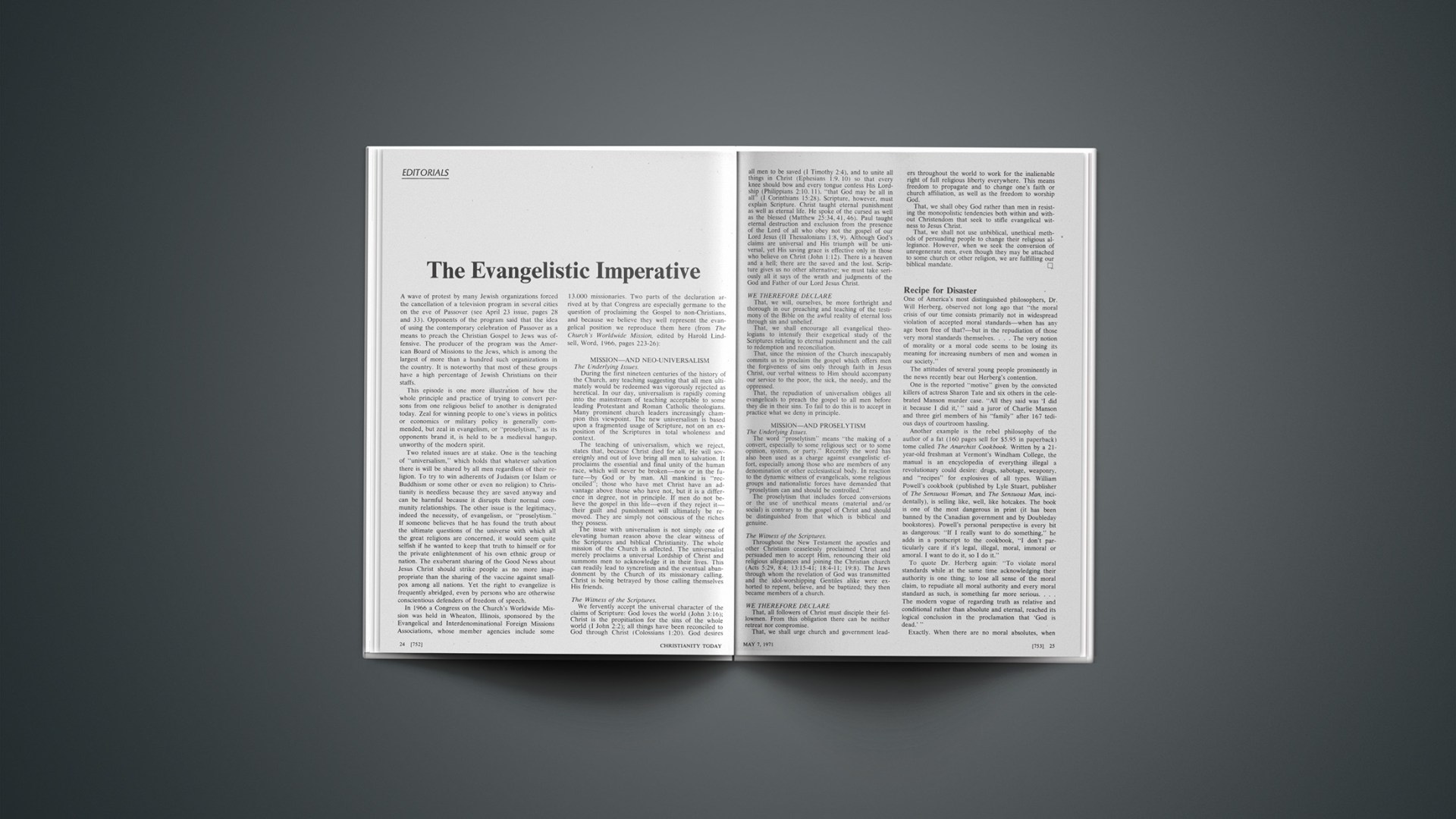
The Evangelistic Imperative

EDITORIALS

A wave of protest by many Jewish organizations forced the cancellation of a television program in several cities on the eve of Passover (see April 23 issue, pages 28 and 33). Opponents of the program said that the idea of using the contemporary celebration of Passover as a means to preach the Christian Gospel to Jews was offensive. The producer of the program was the American Board of Missions to the Jews, which is among the largest of more than a hundred such organizations in the country. It is noteworthy that most of these groups have a high percentage of Jewish Christians on their staffs.

This episode is one more illustration of how the whole principle and practice of trying to convert persons from one religious belief to another is denigrated today. Zeal for winning people to one’s views in politics or economics or military policy is generally commended, but zeal in evangelism, or “proselytism,” as its opponents brand it, is held to be a medieval hangup, unworthy of the modern spirit.

Two related issues are at stake. One is the teaching of “universalism,” which holds that whatever salvation there is will be shared by all men regardless of their religion. To try to win adherents of Judaism (or Islam or Buddhism or some other or even no religion) to Christianity is needless because they are saved anyway and can be harmful because it disrupts their normal community relationships. The other issue is the legitimacy, indeed the necessity, of evangelism, or “proselytism.” If someone believes that he has found the truth about the ultimate questions of the universe with which all the great religions are concerned, it would seem quite selfish if he wanted to keep that truth to himself or for the private enlightenment of his own ethnic group or nation. The exuberant sharing of the Good News about Jesus Christ should strike people as no more inappropriate than the sharing of the vaccine against smallpox among all nations. Yet the right to evangelize is frequently abridged, even by persons who are otherwise conscientious defenders of freedom of speech.

In 1966 a Congress on the Church’s Worldwide Mission was held in Wheaton, Illinois, sponsored by the Evangelical and Interdenominational Foreign Missions Associations, whose member agencies include some 13,000 missionaries. Two parts of the declaration arrived at by that Congress are especially germane to the question of proclaiming the Gospel to non-Christians, and because we believe they well represent the evangelical position we reproduce them here (from The Church’s Worldwide Mission, edited by Harold Lindsell, Word, 1966, pages 223–26):

Mission—And Neo-Universalism

The Underlying Issues.

During the first nineteen centuries of the history of the Church, any teaching suggesting that all men ultimately would be redeemed was vigorously rejected as heretical. In our day, universalism is rapidly coming into the mainstream of teaching acceptable to some leading Protestant and Roman Catholic theologians. Many prominent church leaders increasingly champion this viewpoint. The new universalism is based upon a fragmented usage of Scripture, not on an exposition of the Scriptures in total wholeness and context.

The teaching of universalism, which we reject, states that, because Christ died for all, He will sovereignly and out of love bring all men to salvation. It proclaims the essential and final unity of the human race, which will never be broken—now or in the future—by God or by man. All mankind is “reconciled”; those who have met Christ have an advantage above those who have not, but it is a difference in degree, not in principle. If men do not believe the gospel in this life—even if they reject it—their guilt and punishment will ultimately be removed. They are simply not conscious of the riches they possess.

The issue with universalism is not simply one of elevating human reason above the clear witness of the Scriptures and biblical Christianity. The whole mission of the Church is affected. The universalist merely proclaims a universal Lordship of Christ and summons men to acknowledge it in their lives. This can readily lead to syncretism and the eventual abandonment by the Church of its missionary calling. Christ is being betrayed by those calling themselves His friends.

The Witness of the Scriptures.

We fervently accept the universal character of the claims of Scripture: God loves the world (John 3:16); Christ is the propitiation for the sins of the whole world (1 John 2:2); all things have been reconciled to God through Christ (Colossians 1:20). God desires all men to be saved (1 Timothy 2:4), and to unite all things in Christ (Ephesians 1:9, 10) so that every knee should bow and every tongue confess His Lordship (Philippians 2:10, 11), “that God may be all in all” (1 Corinthians 15:28). Scripture, however, must explain Scripture. Christ taught eternal punishment as well as eternal life. He spoke of the cursed as well as the blessed (Matthew 25:34, 41, 46). Paul taught eternal destruction and exclusion from the presence of the Lord of all who obey not the gospel of our Lord Jesus (2 Thessalonians 1:8, 9). Although God’s claims are universal and His triumph will be universal, yet His saving grace is effective only in those who believe on Christ (John 1:12). There is a heaven and a hell; there are the saved and the lost. Scripture gives us no other alternative; we must take seriously all it says of the wrath and judgments of the God and Father of our Lord Jesus Christ.

WE THEREFORE DECLARE

That, we will, ourselves, be more forthright and thorough in our preaching and teaching of the testimony of the Bible on the awful reality of eternal loss through sin and unbelief.

That, we shall encourage all evangelical theologians to intensify their exegetical study of the Scriptures relating to eternal punishment and the call to redemption and reconciliation.

That, since the mission of the Church inescapably commits us to proclaim the gospel which offers men the forgiveness of sins only through faith in Jesus Christ, our verbal witness to Him should accompany our service to the poor, the sick, the needy, and the oppressed.

That, the repudiation of universalism obliges all evangelicals to preach the gospel to all men before they die in their sins. To fail to do this is to accept in practice what we deny in principle.

Mission—And Proselytism

The Underlying Issues.

The word “proselytism” means “the making of a convert, especially to some religious sect or to some opinion, system, or party.” Recently the word has also been used as a charge against evangelistic effort, especially among those who are members of any denomination or other ecclesiastical body. In reaction to the dynamic witness of evangelicals, some religious groups and nationalistic forces have demanded that “proselytism can and should be controlled.”

The proselytism that includes forced conversions or the use of unethical means (material and/or social) is contrary to the gospel of Christ and should be distinguished from that which is biblical and genuine.

The Witness of the Scriptures.

Throughout the New Testament the apostles and other Christians ceaselessly proclaimed Christ and persuaded men to accept Him, renouncing their old religious allegiances and joining the Christian church (Acts 5:29; 8:4; 13:15–41; 18:4–11; 19:8). The Jews through whom the revelation of God was transmitted and the idol-worshipping Gentiles alike were exhorted to repent, believe, and be baptized; they then became members of a church.

WE THEREFORE DECLARE

That, all followers of Christ must disciple their fellowmen. From this obligation there can be neither retreat nor compromise.

That, we shall urge church and government leaders throughout the world to work for the inalienable right of full religious liberty everywhere. This means freedom to propagate and to change one’s faith or church affiliation, as well as the freedom to worship God.

That, we shall obey God rather than men in resisting the monopolistic tendencies both within and without Christendom that seek to stifle evangelical witness to Jesus Christ.

That, we shall not use unbiblical, unethical methods of persuading people to change their religious allegiance. However, when we seek the conversion of unregenerate men, even though they may be attached to some church or other religion, we are fulfilling our biblical mandate.

Recipe For Disaster

One of America’s most distinguished philosophers, Dr. Will Herberg, observed not long ago that “the moral crisis of our time consists primarily not in widespread violation of accepted moral standards—when has any age been free of that?—but in the repudiation of those very moral standards themselves.… The very notion of morality or a moral code seems to be losing its meaning for increasing numbers of men and women in our society.”

The attitudes of several young people prominently in the news recently bear out Herberg’s contention.

One is the reported “motive” given by the convicted killers of actress Sharon Tate and six others in the celebrated Manson murder case. “All they said was ‘I did it because I did it,’ ” said a juror of Charlie Manson and three girl members of his “family” after 167 tedious days of courtroom hassling.

Another example is the rebel philosophy of the author of a fat (160 pages sell for $5.95 in paperback) tome called The Anarchist Cookbook. Written by a 21-year-old freshman at Vermont’s Windham College, the manual is an encyclopedia of everything illegal a revolutionary could desire: drugs, sabotage, weaponry, and “recipes” for explosives of all types. William Powell’s cookbook (published by Lyle Stuart, publisher of The Sensuous Woman, and The Sensuous Man, incidentally), is selling like, well, like hotcakes. The book is one of the most dangerous in print (it has been banned by the Canadian government and by Doubleday bookstores). Powell’s personal perspective is every bit as dangerous: “If I really want to do something,” he adds in a postscript to the cookbook, “I don’t particularly care if it’s legal, illegal, moral, immoral or amoral. I want to do it, so I do it.”

To quote Dr. Herberg again: “To violate moral standards while at the same time acknowledging their authority is one thing; to lose all sense of the moral claim, to repudiate all moral authority and every moral standard as such, is something far more serious.… The modern vogue of regarding truth as relative and conditional rather than absolute and eternal, reached its logical conclusion in the proclamation that ‘God is dead.’ ”

Exactly. When there are no moral absolutes, when ethics are tied to a shifting relativity, when every man does what is right in his own eyes, anarchy, moral decay and spiritual bankruptcy follow. We are already reaping the whirlwind from sowing the winds of permissive doctrine that shut out belief in God and a firm anchorage to the Scriptures. Biblical moral standards and commitment to God’s immutable laws alone can save our nation—or any nation—from God’s judgment and eventual destruction.

China And Christianity

Now that the “bamboo curtain” has been pierced by a ping-pong ball, the attention of Christians has been focused once again upon the country where approximately one-fourth of the planet’s inhabitants dwell, China. The Church has suffered greatly in that land over the past two decades, and the cost of publicly being a Christian in China is far greater than we in more favored lands can imagine.

In view of the hostile attitudes Chinese leaders have expressed toward America in recent years (not unreciprocated, to be sure), how unexpected was the cordial reception given to our table-tennis team! Is it too much to hope that official attitudes toward religion in general and Christianity in particular can also manifest a dramatic change? China does not have to give up Communism in order to grant more religious freedom. Yugoslavia has maintained both. Nor do we expect freedom for Western missionaries to enter on the terms on which they did before the revolution. Indeed, we doubt that informed Christians would want to do it that overly paternalistic way. But we can hope and pray that our fellow believers in China will someday be granted more freedom to demonstrate that Christianity and good citizenship are fully compatible. Also, we hope that soon Christians from other countries can have opportunities to exchange visits with their Chinese brethren.

Meanwhile we should accept the moves of our government that enhance possibilities for further penetrations of the “bamboo curtain,” both ways. Of great prominence in the foreign-policy views of Christians should be the consideration of what actions are most likely to promote fellowship and evangelism.

Social Action Aborning

Some evangelicals who have not been noted previously for activity promoting social reform have recently been stirred into action by the change of laws on abortion. In taking action they have commendably recognized that rather than trying to make a congregation or denomination the spearhead of the effort, they should form special-purpose pressure groups. In this way they can ally themselves with others such as Catholics and Jews who share their concerns on this issue without compromising or deemphasizing the other issues on which disagreement remains. A broadly based alliance is more likely to accomplish change than a group restricted to people who agree on a broad range of issues.

we do hope, though, that those who have very strong opinions on abortion, anti-Communism, aid to private education, Viet Nam, and the like will not let this disrupt fellowship with their brothers in Christ who disagree with their applications of biblical principles to contemporary problems. This is a major reason for forming special groups, rather than trying to capture church structures for one side or the other. The congregation should be a place where all believers feel welcome no matter what their opinions on matters of specific social policy.

For those who are concerned about the changing climate on abortion, the New Jersey Right to Life Committee (Box 1213, Trenton, New Jersey 08607) offers In Defense of Life, a very practical manual for social action. We urge that the right to a decent life be defended not only for those in the womb but also for those in the ghetto, and that those who oppose abortion as a means of population control support alternative means to that end.

Renewing Church Membership

From time to time it has been suggested that marriages should not be permanently binding. They should be entered into for a specified period of time and be renewable by the consent of the partners when the contract expires. Now the suggestion has been made that church membership be placed on a year-to-year basis with the option to renew.

While we think marriage should be a lasting arrangement, the idea of annual renewal of church membership sounds intriguing. A local minister recently told us that the church to which he recently came has lost contact with a third of its membership. The problem is not only that these “members” do not attend or contribute; they can’t even be located. No one knows whether they are dead or alive.

With tongue partly in cheek we offer the following recommendations: (1) Every church member must reapply for membership by December first of each year. (2) No member will be accepted for renewal who has attended fewer than ten services a year unless he has a good explanation for his delinquency. (3) No one will be renewed who does not give at least 5 per cent (10 per cent preferred) of his income (before taxes) to the work of God’s kingdom. (4) No one can continue who has not led at least one person to Jesus Christ during the year. (5) Each renewal must be accompanied by a pledge to read the Bible through during the year, to pray daily, and to live an orderly and circumspect life.

There go the church statistics!

Drinking In Ireland

Traditionally, the Catholic Church has held a tolerant view of drinking. And in Ireland, land of the stereotyped “hard whiskey-drinking Irish Catholic,” the church’s view has been more than tolerant. But the archbishop of Armagh and primate of all Ireland. William Cardinal Conway, seems intent on changing this stereotype. Last month in a seminar on drugs and alcohol for secondary-school students the archbishop called attention to Ireland’s drinking problem.

The archbishop cited some damning statistics about his country and alcohol. Eleven per cent of personal income is spent on it. Consumption of hard liquor rose 10 per cent in 1969, and most Of the increase, the archbishop said, was due to “the marked growth of drinking among young people.” Cardinal Conway went on to say, “The person with young blood in his veins who needs artificial stimulants to enjoy life has surely something very wrong with him, and it is certainly a topsy-turvy world which regards it as a sign of courage to yield to pressure to take such stimulants.” He stressed that the church will not “pussyfoot” on this issue.

We commend the archbishop for responsibly facing the problem, and for determining to do something about it. However, the Catholic Church seems to be “topsy-turvy” itself in its concern about the drinking problem. At St. Mary’s Hospital, Castleblaney, County Monaghan, the country’s first hospital bar has just opened with nuns tending bar. But the archbishop can be comforted by the fact that the bar will serve only “stout,” not hard liquor. At least the hospital will not be contributing to spirits statistics.

Vanishing Motherhood?

Are mothers a vanishing breed? Aldous Huxley prophesied this in Brave New World. But at that time no one really believed that “test-tube babies” were possible. Now we are in the midst of a biological revolution, with experimentation in artificial insemination, embryo implants, and artificial wombs.

Recently published articles and books tell of a future motherless society. One woman may conceive a child, another carry it to term. Who is the mother? Experiments with sheep in artificial wombs have so far proved successful. And experimentation with human fetuses in tube-like wombs continues. Some scientists are predicting the time when human reproduction will be asexual.

The old Negro spiritual “Sometimes I Feel Like a Motherless Child” may become true physically as well as spiritually. Perhaps a child physically may have two mothers, or be his mother’s genetic twin (see April 9 issue, page 11). The biological revolution raises the fundamental question of the meaning of motherhood, a question that science cannot answer. Motherhood—at least as we now think of it—may be on the way out.

Freedom Trek

Five American churchmen traveled around the world last month to arouse sympathy for American prisoners of war in Indochina. They were received by North Vietnamese diplomats in Sweden and Laos but could not persuade the Communists to allow them to go to Hanoi.

Perhaps the most heartening result of the journey was the measure of attention gained for the plight of five American missionaries taken captive by the Viet Cong. Missouri Synod Lutheran president J. A. O. Preus said that the delegation’s appeal in behalf of the missionaries aroused the most interest in the North Vietnamese. President Nathan Bailey of the Christian and Missionary Alliance said the North Vietnamese officials had “heard the story” of the captives but disclaimed any official knowledge of the events, or of the whereabouts or welfare of the missionaries.

The group, which also included Catholic archbishop Joseph Ryan and Presbyterian George Sweazey, got promises of added help from officials of several neutralist nations plus a sympathetic hearing from Pope Paul VI. Conscientious follow-up is now in order. A breakthrough on the prisoners could be the thing that ends the war.

Something To Sing About

A note of joy is ringing through the land these days. It’s sounding forth from the proliferating new Christian music festivals and marathon concerts, the hundreds of churches visited by touring young choral groups with the latest gospel folk musicals, and just about everywhere tuned-in-to-the-Spirit people—young and old alike—congregate in song. They’re singing about Jesus. A recurring theme heralds his soon return and what it will be like for us to be with him.

The reminder is timely. Evangelicals are currently emphasizing this-world implications of the Gospel. It is a correct emphasis, but we must never lose sight of the other-world realities that keep everything else in focus. Jesus personally resides in that other realm, and sooner (by death) or later (by translation at his coming) we will join him there: “And so shall we ever be with the Lord” (1 Thess. 4:17).

This biblical notice of our impending change of address should comfort (1 Thess. 4:18), not distract or dismay. Admittedly, death is hardly a comforting thought when viewed from the departure side rather than the arrival side. We’ve been conditioned to think of death as coming to destroy everything for which we’ve lived. In reality a committed Christian sustains net gain, not loss, affirms Paul (Phil. 1:21).

Funeral sermons often measure the gain as release from bodily affliction and worldly troubles, which it is. For Paul, however, Christ himself is the ultimate gauge. To live is to experience daily the love and wonders of the Lord Jesus Christ, while “to die is gain.” Phillips translates it: “For living to me means simply ‘Christ,’ and if I die I should merely gain more of him.”

Thus the right approach to death and the hereafter is inseparably linked to our love for Christ here and now. There is a joyous meeting ahead. The fourth and fifth chapters of Revelation show that our first reaction in his presence will be one of worship. Then we’ll hold the biggest music festival ever (Rev. 5:9). It may last a long time, for we’ll have a lot to sing about.

It Makes Sense

God’s revealed truth makes sense. I claim neither brilliance of intellect nor unusual clarity of perception. But everything I see, hear, and feel coincides with convictions based on what God has revealed, not not only about this world and man, but also about himself and his relationship to time and eternity.

It all makes sense because these revealed truths satisfy the needs of the hearts and minds of those who are willing to be taught. We can look at men and events and see that they are just as God has told us and that everything either stands or falls according to what men do about his Son and his Cross.

When I read, “In the beginning God,” it makes sense to me, because without him there can be no logical explanation of anything. And when I read that in the beginning he created the heavens and the earth, I know it is true, for on every hand I see the perfect work of a perfect Creator, and I experience and see evidence of the fact that the One who created all is infinite in wisdom, power, and love.

The Book he has given us explains many things for which we could not find answers in any other place. Genesis—beginning with God the Creator—ends with a dead man “in a coffin in Egypt.” Even as we ask the meaning of this, the answer comes. God said “You shall not,” but Satan said, “Go ahead and you will become wise.” And from that time on there is unfolded the drama of man’s disobedience to God and God’s yearning love and desire to restore him to fellowship.

From there on to Malachi, as one reads of God’s warnings and instructions, there is a growing consciousness of God’s holiness as well as an understanding of the terrible consequences of man’s rejection of God—and of the alternative God has ever offered to those who are willing to believe and repent.

While God’s revelation of truth (and The Truth) has been available, man has deliberately turned from it to fables and his own vain imaginations. Little wonder that the Old Testament ends with the warning that, unless there is a reconciliation, God will “come and smite the land with a curse.”

It makes sense when I read that God’s love was so great that he was unwilling to leave man in his self-caused predicament, and that because of this love he sent his own Son to reverse the whole direction of life—for both time and eternity—for those who put their faith in him. There is a breadth and depth in the simple words, “should not perish but have eternal life,” that man could wisely ponder for a lifetime.

Even as one reads of the cause of man’s predicament (sin, disobedience and rebellion), he can see that the Creator spoken of in Genesis 1:1 is also the Redeemer of the New Testament, and that, having opened the gates of eternal life for all who will believe, he will in his own time ring down the curtain of human history and merge time with eternity. He leaves the written record of divine truth with these words, “Surely I am coming soon” (Rev. 22:20). For the Christian this is the “blessed hope,” but for the unbeliever it is the harbinger of doom.

The truths revealed in the Bible and the consistency of their application all make sense. Created in the image of God, we have given to us the inalienable right of decision; we exercise this right, with all that is implied, for time and for eternity.

We can choose to go our own way, disregarding the pleadings and warnings of a loving God, and for the time being we may be accounted successful by the world’s standards. But there is no word in the Bible that bespeaks more truth than the Lord’s affirmation, “The LORD sees not as man sees; man looks on the outward appearance, but the LORD looks on the heart” (1 Sam. 16:7). Jesus gives us the significance of this divine insight in the words, “Out of the heart come evil thoughts, murder, adultery, fornication, theft, false witness, slander. These are what defile a man” (Matt. 15:19).

Surely it makes sense when we are told that with all these inborn evil proclivities we “must be born again.” To be fit for fellowship with God, as he was at his beginning, man must become a new creation, and that transformation comes through Christ and in no other way.

The Bible makes sense to me, not only because of my personal faith, but also on the basis of my experience and observation. I read: “For our fight is not against any physical enemy: it is against organizations and powers that are spiritual. We are up against the unseen power that controls this dark world, and spiritual agents from the very headquarters of evil” (Eph. 6:12, Phillips). And I know that Satan and his agents are real and very active!

How very much it means to me to know that God has provided a two-way communications system by which I may talk to him and he to me. As the pilot of a plane flying blind in heavy clouds finds safety and comfort in his two-way radio connections with the ground, so we find our safety, comfort, and guidance in talking with God.

Then too, it makes sense to me to know that my heavenly Father never requires anything of me for which he does not at the same time supply the necessary wisdom and strength. Only a great God can so order the affairs of this world as to make “all things work together for good for those who love him” (Rom. 8:28)—fulfilling this promise to millions of his children at the same time.

Finally, it makes sense to know that God has a timetable and that we are moving inexorably to “that day” when the world as we know it will be destroyed and when God will set up his kingdom, “which shall never be destroyed” (Dan. 2:44). It was given to the Old Testament saints and those of the New to look beyond the horizon of time to that eternal city “that cannot be shaken,” and to us today there is given a similar vision and an unshakable hope.

The God of creation and redemption, of time and eternity, has not left himself without a witness. He continues to extend his patient offer of a new life in and through the person and work of his Son. That is why the Gospel makes so much sense. It offers the only way out of the human predicament and provides all that we need to live and die by. We can have assurance in our hearts that we are following not “cleverly devised myths” (2 Pet. 1:16) but the testimony of “those who from the beginning were eyewitnesses and ministers of the word” (Luke 1:2). Like the Apostle Paul we can say, “I know whom I have believed and am persuaded that he is able to keep that which I have committed unto him against that day” (2 Tim. 1:12).

Book Briefs: May 7, 1971

Tradition—For Evangelicals Only

Tradition: Old and New, by F. F. Bruce (Zondervan, 1971, 184 pp., paperback, $2.95), is reviewed by J. Ramsey Michaels, professor of New Testament and early Christian literature, Gordon-Conwell Theological Seminary, South Hamilton, Massachusetts.

Most of what is said in this book has been said before, but it is gratifying to hear it from someone to whom evangelicals will listen. Professor Bruce undertook this study because he had been “increasingly impressed over the years by the prevalence of tradition in churches and religious movements which believed themselves to be free from its influence.” Though he draws illustrations from his own experiences among the Plymouth Brethren, much of what he says is true of evangelicals generally. Few Christians put less emphasis on tradition than they, yet few groups are more influenced by it. All too often “what the Bible teaches” comes to refer to one’s own interpretation (i.e. tradition), while “the traditions of men” becomes a useful label with which to dismiss other points of view. To say this is not to single out anyone for special blame, but only to admit that we all share in the human condition, with its shortcomings.

What is the answer to the problem? Should we cast off our traditions, muster all our historical and exegetical acumen, and find out “what the Bible really teaches”? Or should we acknowledge frankly our indebtedness to tradition and seek to use it positively as a link between biblical times and today, all the while testing it in light of our growing knowledge of Scripture? Though the professional scholar may pursue the first alternative, the Church cannot deny its tradition without denying its own existence in history. Nothing is gained if we affirm the Bible’s historicity at the expense of our own. The evangelical’s task is not to go “back to the Bible,” but to bring the Bible with him into the twentieth century. This cannot be accomplished by historical scholarship alone; tradition too is necessary.

Bruce’s book helps bring these matters into focus by showing that the Bible is itself tradition. Many topics not normally considered under the heading of tradition are discussed here: form criticism (“Tradition and the Gospel,” “The Setting of the Gospel Tradition”), the Nag Hammadi Gospel of Thomas (“Extra-Canonical Tradition”), the use of the Old Testament (“Tradition and Interpretation”), as well as the role of tradition in defining the canon and text of Scripture. Bruce presents a wealth of material; not all of it has direct bearing on the problem with which he began, but almost all of it is interesting and worthwhile. Moreover, it demonstrates the central place of tradition in the Christian faith by reminding us that many things that we call by other names are really aspects of Christian tradition. Some readers will wish that the excellent chapters dealing with tradition in the “traditional” sense (“Tradition in the Early Catholic Church” and “Tradition Today”) were more extensive. Bruce is writing largely for evangelicals, and these are areas in which they need to be better informed.

Professor Bruce calls himself a “biblicist” rather than a traditionalist, but his final appeal is to history. He concludes that Scripture and tradition both must be “tested and validated by historical inquiry as far as such inquiry can take us” and that “where the living voice of the church collides with history, history tends to be victorious in the long run.” This is a very important statement, and one that invites continuing discussion. It is natural for us who study the past to feel that our own discipline is more important than the “living voice of the church,” but it should not be forgotten that the “living voice of the church” is also history. Perhaps the real question is how past and present history are to be related.

Seldom does one find a book with so much of value in so few pages. Besides offering a perspective on tradition, Professor Bruce has allowed us to see a master at work in New Testament criticism and exegesis, Rabbinics and church history. His conservative use of form criticism on page 61 is a gem (though Mark 2:20 has its life-setting in the early Church, verses 18 and 19 “can have no other life-setting than the ministry of Jesus”). And not least in importance are his flashes of humor (for example William Kelly’s judgment that “any unbiased Christian” will affirm the Petrine authorship of Second Peter is called “a good example of the pre-emptive strike in theological controversy”). Minor inconsistencies can be found (for instance, if Paul wrote the Pastoral Epistles, as Bruce seems to assume, why are they dated “towards the end of the New Testament period”?), but they are very rare.

The net effect of this volume is to confirm what we all knew about F. F. Bruce’s preeminence among evangelicals in the biblical field. Everyone interested in Scripture or tradition has reason to be deeply grateful to him.

Timely Analysis In Plain Language

The Church at the End of the Twentieth Century, by Francis A. Schaeffer (Inter-Varsity, 1970, 153 pp., $3.95), is reviewed by John E. Wagner, attorney, Oklahoma City.

God is really at home in the cosmos and has propositionally revealed “true truth” to man in the Bible. This thesis pervades Francis A. Schaeffer’s books, such as Escape From Reason, The God Who Is There, and now The Church at the End of the Twentieth Century, touted as his most significant contribution. In it, he hammers away again in plain language at the central theme unveiled in the prior volumes.

That he surveys the broad horizons of philosophy, history, sociology, and theology, to say nothing of politics, art, music, literature, and films, from the mountaintop of reformation orthodoxy is Schaeffer’s unique gift to the contemporary scene. That he analyzes all this in non-technical language—or at least explains his vocabulary—is his genius.

His latest book speaks more directly to the life of the Church than the first two. Schaeffer opts for a visible and doctrinally pure Church, which he distinguishes from the classic concept of the invisible Church, but he does not tell us where it is to be found. Perhaps it isn’t to be found at all—not even in fundamentally conservative bodies, since they are not as full-orbed in love and holiness as Schaeffer’s vision projects. Unless I am blind to the American scene, the pure Church of which he speaks is a dead ringer for the invisible Church of traditional reformation theology.

His central theme, that God is really present in the cosmos in the way that the Bible says he is, is propounded with intellectual vigor against all comers, sophisticates, scientists, and simple seekers alike. We are in a dying culture, says Schaeffer, that has lost its absolutes: ontological, epistemological, and ethical. This is true because twentieth-century man, who is the victim of Renaissance humanism, no longer posits his epistemology and ethics within the reliable framework of biblical revelation, where “true truth” is made possible. Having cut himself loose from his revelatory base in quest for truth and meaning, man has explored numerous blind alleys and finally has surrendered to irrational despair. The drug culture, the youth revolution, modern art and movies, the New Left, pornography, and ultimately suicide—all these are symptoms of an irrational leap into the void. But the leap is futile, since it is amoral and bears no epistemological content.

In this desperate predicament, Schaeffer says, society will turn either to an establishment elite (whom he likens to Plato’s philosopher-kings) or to a revolutionary left-wing elite, both of whom spell oppression for man, unless biblical, reformation absolutes can be wedged back under the foundations of society and the Church.

How is this to be done? By a doctrinally pure minority involving themselves with holiness and love in the affairs of men. Christians are to do this with humanists and other concerned persons, as the situation demands, but always as ad hoc co-belligerents and never as allies, lest truth be compromised by the alliance. Although Schaeffer does not tell us whether doctrinally orthodox Christians should join with the theologically heterodox to work to solve specific human problems, I gather from his previous volumes that he would not approve.

Moreover, true biblical Christians should beware lest they wander down the seductive path to the idolatrous Moloch of modern theology, where they are sure to be devoured by preachers and theologians who mouth connotation-words—that is, God-words—without orthodox content.

The author chides evangelicals for falling into this trap by calling men to existential commitment to Jesus Christ without giving them authoritative, definitive content from the Bible to explain what they are doing. I question this criticism, since repentance, conversion, and commitment often are initially existential, with intellectual and rational content from the Bible coming afterward. Nevertheless, his criticism is valid if there are those who call men to commitment to a contentless banner called “Christ” with no meaning except the “experience of faith” itself.

Real Christians, he says, should act out their belief with love for the brethren in the pure Church, as well as to the neighbor outside it. His elaboration of this in an appendix called “The Mark of the Christian,” published previously as an independent essay, is a chapter that tempers what some may consider to be a hyper-orthodoxy. His scriptural exegesis of this subject is exciting, filled with the presence of the Word and Holy Spirit, and balances his insistence on theological purity.

Some of the book is elementary Protestant ecclesiology and brings to mind the Declaration and Address of Alexander Campbell when he launched his “restoration movement” in the nineteenth century. Campbell, you will recall, said that the true Church of Christ should return to the primitive New Testament pattern, and should in essentials have unity, but in non-essentials, liberty. Schaeffer calls this “freedom within form,” form being the scriptural essentials for a pure orthodoxy in the Church.

Dr. Schaeffer impresses and enlightens me. Undoubtedly, he is at his best in intellectual circles, but he nevertheless writes well and clearly for readers not technically skilled in the subjects he covers. The book is by no means a profound theological treatise, but rather an analysis of the times and a message to the churches. His historico-philosophical overview will educate thoughtful evangelicals and help them put their biblical faith in intellectual perspective. Moreover, he does not hesitate to touch the flat spots in evangelical life. He is as hard on dead orthodoxy as he is apostate liberalism.

He chastises certain evangelicals for their complacency, brittleness, and unloving rejection of long-haired youth, vomiting drunks, and dark-skinned people. And he thumps hard for an excited and humanly involved Church—excited because it knows the propositionally revealed truth of God and involved because of the indwelling dynamis of the love of Christ. I buy his answer and believe in the vision of the Church that he expounds.

Essays In Sympathy

The Theology of Altizer: Critique and Response, edited by John B. Cobb, Jr. (Westminster, 1970, 269 pp., $7.50), is reviewed by Glenn R. Wittig, reference librarian, Princeton Theological Seminary, Princeton, New Jersey.

The popularized “death of God” fad of the late sixties is past, but its leading provocateur—Thomas J. J. Altizer—is very much alive. And the position established in his newest book, The Descent into Hell, is far more radical than that found in The Gospel of Christian Atheism.

God-is-dead theology never was taken seriously by very many scholars; yet it is the framework of this compendium that Altizer can and should be viewed as a constructive theologian. He has, it should be admitted, raised important issues for Christians that demand serious attention. In attempting to center the reader’s attention on Altizer’s affirmations, rather than his negations, the editor has assembled a collection of sympathetically critical essays. Some are original to this work, but most have been published previously and thus do not always take into account Altizer’s latest position.

The introduction is superb in its summarization and analysis and can be considered the most valuable part of the book. The criticisms are generally solid, insightful, meritorious essays that often point out similarities as well as differences with other thought systems. The essays by Runyon and Beardslee, especially, are fulcrum pieces, and fortunately are the first to appear. They confront—and find wanting—such crucial aspects of Altizer’s thought as his style of doing theology and his understanding of reality, time, history, the Incarnation, and eschatology.

King’s essay—“Zen and the Death of God”—approaches Altizer from the ground of the history of religions and, contrary to his supposed rejection of Buddhism, finds Altizer’s radical immanentalism fully Buddhistic. (That conclusion was established well before the appearance of Descent.)

Altizer’s “Response,” as both a strength and weakness of this book, evokes a different feeling. Its absence would have deprived the collection of its “dialogue”; yet its presence is dispiriting. While Altizer acknowledges having learned from his critics, he remains essentially determined to maintain his extreme position at all costs.

The satire in the appendix is in poor taste for this work; and the bibliography of Altizer’s writings is incomplete.

Cobb’s book is valuable, yet certain assumptions and omissions detract from its effectiveness. For one, its organization around confessional alignments negates the importance of issues. Secondly, some crucial issues—for example, Altizer’s supposedly biblical hermeneutic, his ethical indirection, his nihilistic “wager,” and the relation of his thinking to the idea of revolution are not treated.

Working For Survival

The Future of the Christian, by D. Elton Trueblood (Harper & Row, 1971, 102 pp., $2.95), is reviewed by Cheryl A. Forbes, editorial assistant, CHRISTIANITY TODAY.

While many people predict the death of the institutional church, Elton Trueblood offers hope that it will survive. He presents the church as necessarily institutional and therefore organized, and as vital for meeting today’s spiritual needs. But to overcome pessimism and failure, he says, the churches must recognize the ministering potential of four groups within their membership. The “rebirth of the church” will not come through innovations in the forms of worship—a refreshing idea—but only through a centering of activities in the idea of ministry. In using laymen, women, retired persons, and youth, the church will begin once again to fulfill the role Christ intended it to have.

After briefly explaining the potential of each of these groups, Trueblood concentrates on youth. This is the group most necessary for implementing new evangelical strategies. It is time for the churches to use young people to do things for others, Trueblood says, rather than always doing things for young people. They need to channel the restlessness of youth into productivity for Christ and his church. Trueblood quotes one young woman as saying, “As a young person and a follower of the Way, I often feel almost forsaken by the older Christians in any attempt to witness to my peers. I am excited and willing to act.

What Trueblood calls the “new evangelicalism” involves understanding and using Christ’s own methods to proclaim his message. Mobility and two-by-two witnessing are the keys. A response to Christ’s claims means “a response of the whole person” to a person.

The future of the church depends on how evangelistic “evangelicals” become. Trueblood realizes that to survive, the church must be completely Christ-centered. There is no room and no time for anything less. Quoting Cardinal Newman, Trueblood says of the Church of Christ: “She pauses in her course, and almost suspends her functions; she rises again, and she is herself once more.”

Getting Acquainted With Scholars

Contemporary Old Testament Theologians, by Robert B. Laurin (Judson, 1970, 223 pp., $8.95), is reviewed by Lester J. Kuyper, professor of Old Testament, Western Theological Seminary, Holland, Michigan.

Contemporary Old Testament Theologians reviews the works of seven Old Testament scholars: Walther Eichrodt, Gerhard von Rad, Otto Procksch, Theodorus C. Vriezen, Edmond Jacob. George A. F. Knight, and Paul van Imschoot. Since Procksch and van Imschoot are dead, selection of George E. Wright and William F. Albright, to name only two possibilities, might better have served the “Contemporary” of the title. Besides, American scholars would be recognized!

Walther Eichrodt’s extensive works are reviewed by Norman K. Gottwald (American Baptist Seminary of the West). Eichrodt, emeritus professor of the University of Basel, has long been known for his scholarly and conservative writings on the Old Testament and Gottwald gives him an accurate and careful appraisal. Even though I have used Eichrodt with much appreciation, and have found his exposition of the “Covenant” theme and his emphasis on historical reality congenial to my understanding of the Old Testament, I agree with Gottwald when he finds in Eichrodt a lack of precision—employing the covenant in too embracing a fashion, or too readily declaring that a theology of the Old Testament must be historical because God acted in history. Gottwald’s critique becomes more severe in the last pages of his article, and he calls into question the presuppositions of the Swiss scholar. Presuppositions, however, are inherent in any interpretation of the Old Testament, and therefore expose to attack any scholar who interprets the Scripture.

It is at this very point of presupposition that G. Henton Davies (Regent’s Park College, Oxford) makes his critique of Gerhard von Rad. In contrast to Eichrodt’s emphasis on historical reality, von Rad has dim views of the historicity of the patriarchal narratives and of the Exodus. Davies has a great appreciation for the insights of von Rad, yet calls into question his Credo Motifs—or rather, von Rad’s use of the content of the Credos. Davies both attacks von Rad for a lack of historical sensitivity and praises him for perceptive insights. Although he takes up von Rad’s “Relationship between the Old Testament and the New Testament” and in outline presents his position, elaboration on this point by comparison and contrast with other scholars would have been a welcome addition to this good essay.

The chapter on Otto Procksch by John N. Schofield makes available to English readers materials that are in German. The survey gives adequate coverage with little critical evaluation.

Ronald E. Clements (Cambridge University) writes the rather brief chapter on Th. C. Vriezen, Utrecht University, Netherlands. He accurately places Vriezen among those who hold to the revelation of God in the Old Testament coming in the course of history, and correctly observes that Vriezen relates the understanding of the Old Testament to the revelation of God in Jesus Christ.

Edmund Jacob of the University of Strasbourg is reviewed by Robert B. Laurin (American Baptist Seminary of the West), the editor of this volume. George A. F. Knight, formerly at McCormick Seminary and now at Pacific Theological College, Suva, Fiji, is presented by John I. Durham (Southeastern Baptist Seminary). The last essay, by David A. Hubbard (Fuller Seminary), is on Paul von Imschoot, Ghent, Belgium.

This book invites the interested reader to become acquainted with and enjoy the work of great scholars who present the Old Testament as a living Word from God for our times.

Drama Of Left And Right

Protestant Power and the Coming Revolution, by Will Oursler (Doubleday, 1971, 203 pp., $5.95), is reviewed by David E. Kucharsky, managing editor, CHRISTIANITY TODAY.

If American churches are soon to engage in a second act of the fundamentalist-modernist drama, this is the book that could lift the curtain. And Oursler implies that in this act the struggle could even involve bloodshed.

Oursler brings to popular attention the influence of today’s radicals on Protestant denominational leadership. He accurately describes major confrontations of recent years that the average man in the pew has heard little or nothing about. Whether churchgoers will, upon learning of these perversions, rise in indignation to “throw the bums out” is the next big question.

Oursler’s approach is simple and detached. He is not a polemicist for the right or left, and he tends to ascribe good intentions to both sides. Yet he warns that a showdown seems imminent and could entail considerable violence.

The author chose not to dig very deeply, and the underlying theological issues get little exposure. Perhaps he was taking pains to keep the more obvious facts in reach. Thus we have a volume that is more timely than historical, and deserves to be acquired for church libraries promptly.

Newly Published

Encounter With Books: A Guide to Christian Reading, edited by Harish D. Merchant (Inter-Varsity, 1971, 262 pp., paperback, $3.50). Outstanding. Nearly seventy persons have presented annotations of books in their fields for the general reader and student. Some 1,600 books are covered in seven categories: Bible, doctrine, witness, life, ethics, apologetics, and the arts. Excellent guide for building personal, congregational, and school libraries.

Organizing to Beat the Devil, by Charles W. Ferguson (Doubleday, 1971, 466 pp., $7.95). A popularly written and highly selective account of the main body of Methodists in America. Avoids theology.

Paul, by Gunther Bornkamm (Harper & Row, 1971, 259 pp., $7.50). A fine study of Paul’s life and theology by a leading German scholar. It is limited, however, by the author’s belief that six of Paul’s letters were by others.

The Theology of Karl Barth, by Hans Urs von Balthasar (Holt, Rinehart, and Winston, 1971, 323 pp., $8.95). A leading Swiss Catholic theologian offers one of the best books on his fellow countryman. First published in German twenty years ago.

The Jesus Bag, by William H. Grier and Price M. Cobbs (McGraw-Hill, 1971, 295 pp., $6.95). Two black psychiatrists use case studies to illustrate a non-religious, black-formed basis for a new American morality. More than 100 pages of unannotated bibliography.

The Minister and His Work, edited by Michael R. Weed (Sweet, 1971, 192 pp., $3.95). Fifty brief articles, each on a different aspect of full-time ministry, originally appearing in the Christian Chronicle. The suggestions are practical and basic. However, the seeming simplicity should elicit self-examination rather than scorn. We all know that “listening is important,” but do we listen?

The Street People (Judson, 1971, 64 pp., paperback, $1.50). A collection of some of the best articles, drawings, and photos from Right On, an underground newspaper published by evangelical street Christians in Berkeley. One way to get plugged into the scene.

The Gospel of John, by Rudolf Bultmann (Westminster, 1971, 744 pp., $15). Advanced students who aren’t happy with the author as theologian are nevertheless able to appreciate his exegetical contributions. This translation has long been awaited.

The Faithful Sayings in the Pastoral Letters, by George W. Knight III (Presbyterian and Reformed, 1971, 162 pp., paperback, $3.50). A technical study by a professor at Covenant Seminary of First Timothy 1:15; 3:1; 4:8; Titus 3:4–7; Second Timothy 2:11.

Modern Christian Thought: From the Enlightenment to Vatican II, by James C. Livingston (Macmillan, 1971, 523 pp., $9.95). Intended to be neither comprehensive nor concerned with confessional or systematic developments. The author focuses rather on the encounter of selected Christian thinkers with modern philosophy, science, and biblical criticism. Evangelicals will find it helpful within its limitations but will have to look elsewhere for accounts of their own thinkers’ interactions with modern thought.

Laity Mobilized, by Neil Braun (Eerdmans, 1971, 224 pp., paperback, $3.95). A missionary to Japan uses illustrations from that country and others as a basis for insisting on involving all Christians, not just clergy, in evangelism.

Hope and Planning, by Jurgen Moltmann (Harper & Row, 1971, 228 pp., $6.50). Eight essays written 1960–68 by the author of Theology of Hope. Includes “The Revelation of God and the Question of Truth,” “God and Resurrection,” “Towards an Understanding of the Church in Modern Society.”

Religion in the Age of Aquarius, by John Charles Cooper (Westminster, 1971, 175 pp., paperback, $2.45). A quickie sightseeing tour for beginners through the world of the occult from sex-ism to Satanism, but with mostly shallow and a-Christian interpretations of what it all means.

Successful Church Libraries, by Elmer L. Towns and Cyril J. Barber (Baker, 1971, 103 pp., paperback, $1.95). Every congregation should have a well-used library. Particularly on the mechanics, this book will help achieve that goal. However, the book recommendations do not reflect the diversity of evangelical belief.

Liberation and Reconciliation: A Black Theology, by J. Deotis Roberts (Westminster, 1971, 205 pp., paperback, $3.50). Brief reflections of a black theologian who is problack rather than anti-white.

The Pentecostal Movement in the Catholic Church, by Edward D. O’Connor (Ave Maria, 1971, 301 pp., paperback, $1.95). A theology professor at Notre Dame who helped to fuel the growing charismatic movement among Catholics documents its beginnings and spread, probes dangers, assesses it theologically. Scholarly, definitive, timely.

Learning Through Encounter, by Robert Arthur Dow (Judson, 1971, 174 pp., paperback, $3.50). “We all live in tension between two levels of experience: pain and pleasure.” The problem is how to use this tension for creativity and education (individuals and teachers). The author relies heavily on diagrams throughout his insight-filled discussion.

New Testament Theology: The Proclamation of Jesus, by Joachim Jeremias (Scribner, 1971, 330 pp., $10). A well-known German scholar presents a systematic study of the teaching of the first three Gospels. Sees many legendary elements, but can still be of considerable help to those with more confidence in the evangelists’ accuracy.

Evolution as a Scientific Theory

In light of the numerous recent articles on evolution and the historicity of Genesis 1–3, it seems appropriate for one who is engaged in molecular biological research to write also, in order to clarify the present status of evolution as a scientific theory.

The theory of evolution has been in existence and more or less accepted for more than a hundred years. A large body of circumstantial evidence, much of which was available to Darwin already a century ago, is explained by it. This includes such things as the fossil record, similarities in form among animals and plants, and the geographical distribution of animals and plants. The theory put forward to explain these data is one of gradual development over long periods of time, the logical starting point being inorganic matter, and the logical end point, man.

A theory with such a vast scope, and which by its very prehistoric nature cannot be proved, would undoubtedly be passed off as idle speculation, if it were not for its theological implications. As we all know, the theory offers a naturalistic alternative to the creation account contained in the Bible, and this is considered to be a highly desirable thing by those who do not want to recognize the Creator. The proponents of evolution have done such an effective job of propagandizing this religious theory, in the name of empirical science, that some formerly orthodox theologians are revising their interpretation of the Bible to make room for it.

From the scientific point of view, evolution may have been a plausible hypothesis in Darwin’s day, but it has now become untenable, as a result of fairly recent developments in molecular biology. Darwin was aware that his theory contained various unproved assumptions, which would have to be tested by future generations of scientists. The foremost assumptions were that life could develop from non-life by natural means, and that, given the first cell, all the varied forms of life that we now have could be produced from it.

At one stage, Darwin proposed the supernatural creation of the first cell, but he apparently rejected this notion later in life; the idea was certainly not accepted by his followers. On the second point, Darwin observed that there was sufficient variation among the individuals of a given species to make it possible to breed better strains of domestic cattle or grain, and that a similar process (“natural selection”) occurred in the wild. The assumption has not been borne out either experimentally or by the fossil record. On the contrary, the fossil record would seem to indicate that new classes always appeared suddenly, rather than gradually, as would have been expected by the Darwinian theory.

In the past, evolutionists were confident that the problem of the origin of life would be solved by the new science of biochemistry. To their dismay, the converse has occurred. The more that is learned about the chemical structure and organization of living matter, the more difficult it becomes even to speculate on how it could have developed from lower forms by natural processes. The pat answers given in high school and beginning college textbooks on the origin of life simply do not hold up when submitted to a biochemical analysis.

There is no theory in existence today that even begins to explain the origin of life by natural means. The individual molecules in a living cell are extremely complicated, precisely made, and arranged in a varied but highly ordered network. Both the structure of these molecules and their cellular organization (and thus life itself) are passed on from generation to generation. To think that such a system could ever have come into being by itself is unbelievable. A calculation of the time involved to produce even one of the required molecules by chance shows that four billion years (the estimated age of the earth) is by comparison a very short time.

The weakness of the evolutionary hypothesis is recognized and acknowledged by some members of the scientific community; it is becoming more common to find doubts and reservations concerning the theory expressed in the scientific literature. As a prime example, we may quote from a recent book by two prominent biochemists, Dr. D. E. Green and Dr. R. F. Goldberger (Molecular Insights Into the Living Process, Academic Press, 1967, pp. 406, 407):

There is one step [in evolution] that far outweighs the others in enormity: the step from macromolecules to cells. All the other steps can be accounted for on theoretical grounds—if not correctly, at least elegantly. However, the macromolecule to cell transition is a jump of fantastic dimensions, which lies beyond the range of testable hypothesis. In this area, all is conjecture. The available facts do not provide a basis for postulation that cells arose on this planet. This is not to say that some paraphysical forces were at work. We simply wish to point out that there is no scientific evidence.

A footnote adds that it would be begging the question to suggest that life arose elsewhere, and was transmitted here through space.

These scientists do not propose creation (paraphysical forces) as a way out of the dilemma, because they are speaking as scientists, and supernaturalism is outside the range of empirical science. A scientific appeal to supernaturalism to get out of difficult problems leads to a “god of the gaps”; such a god dies when the gaps are filled with natural explanations.

The origin of life on earth is not properly placed in the domain of science. Scientists might propose mechanisms by which it may have arisen, but how it actually happened is in the domain of history. The mute evidence of the fossil record does give us some historical insight: it tells us, for example, that there are many extinct species; it also tells us that all life apparently did not come into existence at the same time, but that there were several widely separated times at which major new classes of animals or plants appeared. To construct an elaborate causal, historical framework on the foundation of the fossil record is speculation, not science. A written record by someone (an intelligent being) who was present during the events in question is required, before it is possible to say what were the causes and what were the effects.

GOD IS LIKE THAT

So many kinds of prayer there are,

And all the same.

The heart and God, and quietness,

By any name.

To contemplate, to meditate,

Commune, adore;

Hours or minutes consecrate

Invoke, implore.

The heart in words, in acts, in trust,

Aware or cold;

A lighted candle, or a book;

A hope untold.

Adoring knee or head unbent;

Priedieu or mat,

A heart’s “O God,” and He has heard.

God is like that.

JESSIE FAITH HOAG

It is a commonly accepted fact that there were no human beings around to witness the first appearance of life on earth. How then can we have a written record of these events? Only through the revelation of them from God to man. This revelation has occurred, and is recorded for us most fully in Genesis, although numerous references to these events are also found elsewhere in the Bible.

The Genesis record does not contain all the details that we would like to have, but it does give us more than enough information to settle some fundamental questions. For one thing, it tells us that life did not arise spontaneously, but was a creation of God. God did not create only the first cell; rather, at several times he decreed that new forms of life should come into existence. Finally, the first two human beings were direct creations by God; they did not develop from apes. It should be clearly noted that these statements do not contradict science, but actually solve the difficult scientific problems mentioned above. Concerning the last point, it may be noted that the fossil record in no way proves that humans developed from apes, but only shows their similarities, which we knew already from visits to the zoo.

In the minds of many people, it is impossible to reconcile the Genesis account with the observations of natural science. There are two principal reasons for this. In the first place, the observations are frequently confused with the interpretations of natural science; it is also difficult at times to distinguish between valid interpretations based on sound evidence, and mere speculation. I have tried to show above that the general theory of evolution falls into the latter category.

In the second place, the Genesis account is frequently overinterpreted. Problems certainly will arise in reconciling the valid observations of science if we maintain that the six days of creation were six consecutive twenty-four-hour periods. If, on the other hand, we accept the word of those conservative Hebrew scholars who say that it is an overinterpretation of the Hebrew language to hold to this view and that it is equally valid to interpret the days of periods of time of unspecified length, then, though many questions still remain as to the details of the interpretation of both science and Genesis, their basic agreement is evident. This would indeed be expected if they are both forms of revelation from God.

Garret Vanderkooi is assistant professor at the Institute for Enzyme Research at the University of Wisconsin. This article is reprinted by permission from the February 12, 1971, issue of the Christian Reformed “Banner.”

Jesus the Realist: “I Am … the Truth”

“Whosoever heareth these sayings of mine, and doeth them, I will liken him unto a wise man, which built his house upon a rock: and the rain descended, and the floods came, and the winds blew, and beat upon that house; and it fell not: for it was founded upon a rock” (Matt. 7:24, 25).

Jesus’ teaching, as set forth in the Gospels of the New Testament, is thought by many people to have little or no direct relation to the hard, stern world in which we live. To be sure, they feel, what Jesus said would be fine if human nature were other and better than it actually is—if, as W. S. Gilbert put it, “hearts were twice as good as gold, and twenty times as mellow.” But as it is, Jesus’ lofty idealism is too impractical for everyday consumption. George Bernard Shaw once described the Sermon on the Mount as “an unpractical outburst of anarchism and sentimentality.” Sigrid Undest has put the same point in a biting sentence in which she speaks about thinking of Jesus as “a frail and kindly visionary with no knowledge of human nature as it really is, or as an amiable young preacher with a special talent for touching the hearts of Women’s Unions.”

At least two things should be said about this whole viewpoint. For one thing, Jesus would have been painfully surprised—not to say dismayed—to find his teaching dismissed in such a way. Certainly he never considered himself a vague and impractical dreamer, living high above the din and tumult of daily life. Still less did he consider himself an effeminate sentimentalist, more at home at pink teas than in the crowded marketplaces of life. On the contrary, he insisted time and time again that his teaching was meant to be soberly realistic in the highest degree. For example, in the well-known fourteenth chapter of St. John’s Gospel, he describes himself as not only the Way and the Life but also the Truth; and, at the close of the Sermon on the Mount, he claims that whoever hears his sayings, his teachings, and puts them into practice will be like a man who has built his house upon the rock—i.e., the most solid foundation in the world—whereas anyone not applying those teachings he likens to a man who builds his house on shifting sand, the kind of foundation that readily gives way in a storm. There can be no doubt that Jesus meant his teaching to be realistic and practical.

Second, this way of regarding Jesus’ teaching has done untold harm to his cause, for obviously it keeps men from taking his teaching seriously. Says Bishop F. R. Barry:

We have heard too much about Christian “ideals.” Nothing has done more harm to the cause of Christ than flabby talk about the Dreamer of Galilee. For, in fact, there has never been in history a man so wholly devoid of sentimentality. He was the greatest Realist ever born. Before his public activity began, he faced the lure of religious sentimentality, refusing to dwell in an inner world of dreams unrelated to moral actuality. The siren voice called to him in vain. He would be true to the facts at all costs—even at the cost of the Cross and Passion. It is not the authentic religion of Jesus which rides away from life on a vague idealism [The Relevance of the Church, Nisbet, 1935, p. 185].

Let us take some of the basic teachings of Jesus and see whether, in the light of our experience of life, he was a starry-eyed sentimentalist, with his feet solidly planted in mid-air, or a realist of the most practical sort.

To begin with, it was one of Jesus’ basic principles that man’s fundamental need is that of knowing God, and of entering into a fruitful and satisfying experience of fellowship with him. Jesus was not blind to the fact that in human nature there are other needs that cry out for fulfillment—the need for health, for example, and the need for food. He even worked miracles in order to ensure that such needs would be adequately met. But deeper than any other need, he insisted, was the need for a vital experience of fellowship with God. As St. Augustine put it, in well-remembered words, “thou hast made us for thyself, and our hearts are restless until they rest in thee.” Jesus insisted on this; and it was primarily in order to satisfy this need that he came to earth—he came to bring man to God by bringing God to man.

Today this basic truth is coming home to many people who have no particular bias in favor of Jesus and his religion. For many men and women are breaking down in various kinds of mental illnesses, and their fundamental problem is that they have no adequate experience of fellowship with God. Their symptoms may be diverse—nervousness, a sense of futility in life, a breakdown in morale, sometimes some physical ailments. But, however skilled and sympathetic the psychiatrists or doctors or counselors to whom they turn, these people never get right with themselves until they get right with God. Some years ago Dr. Carl Jung, one of the world’s foremost authorities on applied psychology, wrote a book with the significant title Modern Man in Search of a Soul (Keagan, 1933). In it he made the following statement:

Among all my patients in the second half of life—that is to say, over thirty-five—there has not been one whose problem in the last resort was not that of finding a religious outlook on life. It is safe to say that every one of them felt ill because he had lost that which the living religions of every age have given to their followers, and none of them was really healed who did not regain his religious outlook [p. 264].

Dr. Leslie D. Weatherhead of London has had an extensive and successful practice in the art of personal counseling. In his book entitled Psychology in the Service of the Soul (Epworth, 1930), he tells the story of one of his patients:

A lady who heard me lecture on psychotherapy asked me to go to a town fifty miles away to see her gardener.… He had been in her employ for thirty years, and had worked well until the last three years. During that time he had become morose, sulky, brooding. He complained of a pain in the chest, and could not do his work. Several doctors had overhauled him without finding anything wrong.… When I saw him, he was in bed. For a time we got nowhere. He could not speak, save in monosyllables. I intuitively felt that he needed God more than any elaborate treatment. Without asking permission, I prayed with him. Then I got up and earnestly invited him to tell me what was on his mind. Out it all came, higgledy-piggledy, in a torrent of language sometimes choked with tears. It was a pretty ghastly story, and I won’t repeat a fact of it. Then I spoke of God’s forgiveness, of its reality and power. I got him to pray, not asking for but taking God’s forgiveness. Suddenly he said: “The pain in my chest has gone.” I went down and told his employer that he would be better; and, while we were still talking in the hall, he came down dressed in his working clothes, and his face was radiant [p. 11].

In this fundamental matter of mankind’s need of God, Jesus’ teaching is inexorably realistic, and to disobey it brings grave calamities in life.

Consider also Jesus’ way of treating wrongdoers. There are three possible ways of handling wrongdoing. First, there is the way of easy-going indulgence and softness. This method consists in not taking the wrongdoing seriously but rather excusing it and glossing it over, either because it is held not to be serious or because the wrongdoer is not regarded as being very blameworthy. In the state, this method of dealing with wrongdoing leads to anarchy, and in the home it leads to pampering and license. Second, and more common, is the way of retribution and revenge. The idea is that if anyone does wrong, he must be punished, not so much to deter other people from such wrongdoing—though this may enter into the picture somewhat—but rather because it is considered just that punishment be meted out to wrongdoers. It was this attitude that, until fairly recently, prompted the penal legislation of most of Europe and America and made prisons the grim, forbidding places they were and in some places still are.

Within the last two centuries, there has been much thinking and writing of a different kind about the treatment of those who have violated the law. One of the first of these works was Crimes and Punishments (1760) by the Italian Marquis Beccaria. This famous book had many followers. One of the principles laid down by Beccaria and his school is that the correct way to treat wrongdoers is to seek to reform them, to restore them to self-respect, and thus in course of time to enable them to become worthy, respectable, and responsible citizens. In principle, at least, this idea is accepted in all up-to-date penology.

What ought to be realized is that this idea goes back to Jesus Christ. Reclamation and restoration was his way of dealing with wrongdoers. Take, for example, the case of Zacchaeus. He was a publican, that is, a Jew who had sold out to the hated Roman overlords of conquered Palestine. He had become one of their collectors of revenue and as such took more for himself than he was legally entitled to take. Not unnaturally, such a man was cold-shouldered by his fellow Jews. Their attitude was this: “He has gone and sold his soul to the devil; well, let him take the consequences. We will have no dealings with him; we will ostracize him and his kind.” But Jesus did not take this attitude at all. He thought more of the man himself than of his sin. So he sought Zacchaeus out, offered him his friendship, and thus converted and reclaimed him (Luke 19:9).

Again, consider the case of the woman taken in adultery, whose story is told in John 8. The legal Hebrew way to treat such a woman was to stone her to death, and those who brought her before Jesus wanted to inflict that very penalty upon her. Jesus refused to approve of such retribution. Instead, he forgave her.

I Feel Sorta Special

When my first son was hit by a car and killed eight years ago, in his first year of school, I didn’t blame God, but I didn’t rush to ask his help either. I did a lot of wallowing in self-pity and other worthless forms of self-indulgence before I finally turned to God. But when I asked for his help, he blessed me immensely and helped me straighten out my life. He gave me two more sons, and the world looked rosy again. I was on the right track, the glory road, with the Lord Jesus Christ as the main theme in my life every day. How happy I was! Life was rich and full and wonderful.

Then another son lay dead in front of our home, the victim of a pickup truck, because he disobeyed and went into the street without looking. He too was just beginning school. This was far too much to bear, and I could do nothing at all by myself. But I told God about it, and he took my burden and made it lighter. He was there every morning when I got up; when I went to bed at night he tucked me in. I was like a poor Crippled child, and my loving Father looked after me.

Grief is a terrible thing. To lose one you love so much, to have your children precede you in death, is a heavy burden to live with. Yet to refuse to let God use this, too, for good only increases the burden. The heartache is very real, but faith in God can far overshadow that hurt. Many blessings have come out of our Ricky’s death, often to people outside our family. God has opened new doors for me, and I’m wise enough now to leave them open and to go through them.

I really feel “sorta special.” Through my suffering I have been fortunate enough to learn “from whence cometh my help,” and I’ve asked for and received that help time after time. God, my heavenly father, has cradled me in his loving arms and rocked me to sleep on many nights, and you can’t help feeling “sorta special” when God is that close.—INA OLSON, Buena Park, California.

This did not, of course, mean condoning or excusing her sin, but by his forgiveness of her, he restored her to decency and purity and self-respect. This was the way in which he habitually dealt with wrongdoers, and today we are realizing that his way is the way of sanity and realism. Dr. Fosdick once quoted Samuel J. Barrows, an American criminologist, as saying:

We speak of Howard, Livingstone, Beccaria, and others, as great penologists who have profoundly influenced modern life, but the principles enunciated and the methods introduced by Jesus seem to me to stamp him as the greatest penologist of any age. He has needed to wait, however, nearly twenty centuries to find his principles and methods recognized in modern law and penology.

Again, consider the question of how man’s social and corporate relationships are to be ordered—that is, how men and groups and nations are to live together in this world. Here Jesus’ teaching was clear and plain. He said that the whole human race was one family of brothers and sisters, with God as the common Father of all. That being so, the only proper way to act was to treat one another as brothers and sisters in the great human family, adopting toward one another that attitude of intelligent and persistent good will which he called love. Such teaching may have seemed sentimental and unrealistic to the Jews of Jesus’ day to whom it was first given. At any rate, it would seem that one reason why they rejected Jesus was that they believed they were God’s chosen favorites, that his favor did not extend to Gentiles and “lesser breeds without the law.” and that these persons were not to be treated as brothers and sisters.

Not only was Jesus’ teaching rejected and flouted in his day by his contemporaries, but to a large degree it has been similarly violated ever since. That is to say, men have tended to treat members of groups other than their own as strangers and foreigners, not as fellow citizens; as raw material for exploitation and robbery, not for understanding and fellowship and good will. This policy has been largely responsible for the sorry state of race relations in this country, and for that international anarchy which, setting nations against one another, threatens an atomic war in which “all men will be cremated equal.” The bankruptcy of every other way of conducting social and corporate life has shown up the sober, sane realism of Jesus Christ’s way. Even George Bernard Shaw, toward the end of his life, said: “I am ready to admit that after contemplating the world and human nature for nearly sixty years, I see no way out of the world’s misery but the way which would have been found by Christ’s will if he had undertaken the work of a modern practical statesman.”

The fact is that, as the late W. Russell Maltby once said, “life will work only one way, and that is God’s way. God’s way has been revealed fully and finally in Jesus Christ, that inexorable realist from Galilee. The sooner we learn this and take it to heart, the better will life be.”

Norman V. Hope is Archibald Alexander Professor of Church History at Princeton Seminary. He holds the B.D. and Ph.D. degrees from Edinburgh University.

Sex and the Supernatural

The signs of our time are both sexual and supernatural. Men heart-sick for genuine love flaunt the symbol where they lack the reality, in hopes that vicarious excitement in rock, flick, and pulp will dispel the inner ache. Witness the great high priest of hedonism himself, Hugh Hefner: “You know … in the next ten years I would rather meet a girl and fall in love and have her fall in love with me than make another hundred million dollars” (Time, Feb. 14, 1969, p. 70). At the same time those for whom Christ came to give abundant life reach out for some kind of transcendent vitality to halt the pangs of spiritual starvation—from the delightful TV comedy “Bewitched,” through dubious horoscopes and tarot cards, to the darkness of the Ouija board, seances, and Satanism.

What greater efficiency could there be for modern men than to satisfy both sexual and spiritual needs at once? Several practitioners of the media and of the occult have been quick to try; the film Rosemary’s Baby depicts twentieth-century witchcraft invoking the unnamed forces of Satan to impregnate a young woman; Ritual of Evil, a made-for-TV movie, shows a young witch casting spells and inducing astral-projection to satisfy her erotic drives; Anton LeVay, in his California-based Church of Satan, indulges in the ancient sexual rites connected with the Black Mass.

All such efforts are not orgiastic fun and spiritual games, however. Two years ago, in a situation that would make the ministrants of Rosemary’s Baby blush, seventeen-year-old Bernadette Hasles was beaten to death in an attempt to drive the devil out of her. Her murderers, the members of a fanatical European cult, had accused her of having sexual relations with the devil, and had required as penance that she write a 322-page autobiography in which she confessed that the devil often walked beside her, made love to her at Holy Communion, and promised her ten sexually diverse husbands and co-rulership of the world with him. In the March, 1970, issue of Esquire, a description of bizarre and terrifying death-styles in California was chosen to keynote the feature section devoted to the state’s sex-saturated underworld of evil.

The past yields other examples of man’s plunge into the deathly darkness of the evil unknown, taken in careless disregard for the sinister consequences of mingling sex and the supernatural and in sinful ignorance of their divine order. Aleister Crowley, the self-styled “Great Beast” of a generation ago (“Before Hitler was. I AM”), set out to banish the “Dying God” from his New Aeon of Crowleyanity through magic in which sex played a major role. Sex became for Crowley the means whereby he reached up to “Divinity”:

It was his vehicle of consecration, his daily prayers.… Any sexual act (hetero-, homo-, or autosexual) was, in his eyes, a sacred magical deed; he likened it to the blessed sacrament.… Sometimes … The Great Beast reached heights of maniac intensity, ran screaming into the temple, “went all but insane.” He roared out words magical, names barbarous, and in an ecstasy performed his mysterious acts of sex magic [J. Symonds, The Great Beast, 1952, p. 132; see The Confessions of Aleister Crowley: An Autohagiography, 1970].

In her famous history of witchcraft, The Witch-Cult in Western Europe, distinguished Egyptologist Margaret Murray maintains that what we call “witchcraft” was a religion of the people overcome by Christianity. Dishonest and overly zealous Christians, she says, felt duty-bound to discredit the innocuous fertility rites of the defeated religion by making central to them a compact with Satan. Over against this interpretation, Montague Summers in his History of Witchcraft considers witchcraft both heretical and anarchical, a flagrant deviation from the medieval Christian establishment. We ought probably to agree with the mediating judgment of Jules Michelet (Satanism and Witchcraft), who attributes early witchcraft generally to underlying traditions, to dissatisfaction with a decadent church, and to the execrable living conditions endured by the serfs. Alienated from a dead church, abused and exploited by their landlords, serfs found social and spiritual solace in nocturnal revelries we now call witchcraft—activities that prefigured the Witches’ Sabbat of the later Middle Ages. Although it took many forms, for the most part the proto-Sabbat degenerated into a huge carnival of lust under the pretense of magic rites. There were sarcastic buffooneries and mockeries of lord and priest, intermingled with the revived traditions of a vague religious past. With greater form, the developed Sabbat served as a combined religious service and business meeting, followed by an orgy of feasting, dancing, and wild lust. “Indiscriminate intercourse” is a pallid euphemism for the limitless indulgence displayed, and incubi and succubi (the supernatural parties, male and female respectively, in a sexual union between human and demon) were said to have joined the debauch on many occasions.

The Witches’ Sabbat brought a culminating development to the history of witchcraft:

This consummation is only reached in the fourteenth century during the Great Schism when the Papacy had migrated to Avignon, and the two-headed Church seemed no longer a Church at all, when all the nobility of France, and the King himself, are crestfallen prisoners in England, squeezing the uttermost farthing out of their vassals to provide their ransom. Then it is the Sabbats adopt the imposing and grimly terrible ceremonial of the Black Mass [Michelet, Satanism and Witchcraft, 1939, p. 118].

“Imposing and grimly terrible” hardly describe it. Like Crowley’s sex magic, the Black Mass is a diabolical inversion of Christian truth, demonic and perversely sexual from beginning to end. And like the Witches’ Sabbat, the Black Mass gave occasion for widely claimed human-demonic sexual relations. (See Summers. History of Witchcraft, p. 90 f.; D. Hill and P. Williams, Supernatural, 1967; R. E. L. Masters, Eros and Evil: The Sexual Psychopathology of Witchcraft, 1962.)

Alienated from churches hardly worth their name, exploited by employers, taxed to the uttermost—are these conditions familiar? Perhaps then we should not be surprised to find today weird and terrifying combinations of sex and the supernatural that reflect the depraved ingenuity of twentieth-century man. Horrified we must be at such revelations, but not surprised. How can Christians understand the sexual and supernatural signs of our time and offer a way of escape?

Modern demonic manifestations of sex and the supernatural must be interpreted in light of the biblical truth that Satan “speaks from his own nature, for he is a liar, and the father of lies.” He invariably misleads, obscures, and deludes. It is utterly misleading to believe, as most moderns do, that devils and demons are the products of pre-scientific superstition. For a Christian with a knowledge of the Bible and modern occultism, this pandemic notion only serves to confirm C. S. Lewis’s observation that two equal and opposite errors into which our race can fall are disbelief in devils and an excessive and unhealthy interest in them. How then are Satan’s modern converts won? By the obscuring of the demonic in a now familiar appeal. Roman Polanski, director of Rosemary’s Baby and a firm disbeliever in witches (“I’m extremely pragmatic. I went to art school and the electronics school. I know optics and physics”), describes it in words a serf could have used to speak of his evening escapades: “You go to the cinema to have fun …” (Look, June 25, 1968, p. 94). The resultant delusion with regard to the Christian view of sexuality is expressed by R. E. L. Masters: “[The equation of sex with evil] was the poison that Christianity gave to Eros. How much different the world might be, how much healthier … had reasonable men of authority decreed that: The sexual appetite is a normal and healthy one; only Paul bothers about it” (Eros and Evil, p. 167).

Thus Satan brings men to deny his existence, play in his presence, and justify themselves on the basis of a deluded conception of the divine sexual order. In the Satanic inversion of that order, sex becomes paramount. Recall, for example, the hellish atmosphere of 1984, in which Winston demands the reassurance: “You like doing this? I don’t mean simply me; I mean the thing in itself.” He is not content until he gets the answer from Julia: “I adore it.” Paul tells us that men choose not to retain the knowledge of God in their minds and that God gives them up “to impurity … to degrading passions … [and] to a depraved mind.” In the end, divinely ordered sexual love is lost in a cloud of supernatural pollution as Satan arrives to claim another soul. “Eros,” said C. S. Lewis, “honoured without reservation and obeyed unconditionally, becomes a demon. And this is just how he claims to be honoured and obeyed. Divinely indifferent to our selfishness, he is also demonically rebellious to every claim of God or man that would oppose him” (The Four Loves, 1960, pp. 101, 102)

To a world that, like medieval society, is starving for genuine love and spiritual food, the good news of the divine sexual order comes with supreme relevance. The Christian relation of sex and the supernatural is the polar opposite of its demonic perversion: it is love—divine eras—not lust; it causes “undefiled” pleasure, not pain; it knows true freedom, not fear; and it brings life—the “grace of life”—not death. Is there not an important comparison between Crowley’s Satanic understanding of sex as his “blessed sacrament” and the Christian understanding in which “the romantic lover sees in the body of his beloved that ‘the means of grace and the hope of glory are in our bodies also, and the name of them is love’ ”? And does not sex as Crowley’s “vehicle of consecration” have a meaningful counterpart in the Christian view that the beloved’s flesh is “ ‘the physical Image of Christ, the physical vehicle of the Holy Ghost,’ … because in its own right it is holy? It shares the co-inherent nature of very love—which is what it means to be holy” (M. Shideler, The Theology of Romantic Love, 1962, p. 142)?

But most wonderful of all is the divine choice of Christian marriage to symbolize Christ’s coming union with his Church—when men shall reign with God over a defeated Satan. And could it be that if the union of husband and wife is a strong analogy for the mystical union of Christ and his Church, then there is in fact a supernatural dimension to sex that consummates and imbues the whole of married life?

There are some Christian thinkers who regard the first union in marriage as cementing a lifelong mystical unity, which is accompanied by mental, emotional and physical changes which can never—at least to the full—be repeated. The one partner discovers the other in a reciprocal act of sell-giving, and the inmost consciousness of each awakens to the fact that the life of each has been fused in that of the other. There will be other pleasurable and deeper emotional experiences, but it is at this point that the marriage is really consummated [W. M. Capper and H. M. Williams, Toward Christian Marriage, 1958, p. 74].

The way of escape from today’s powers of darkness Christ graciously provided in the redemption of the Cross. The path is lit by the light of Holy Scripture and leads to God’s right hand, where there are “pleasures for evermore.” Charles Williams aptly remarked that for those who follow it, “sensuality and sanctity are so closely intertwined that our motives in some cases can hardly be separated until the tares are gathered out of the wheat by heavenly wit.”

James R. Moore is a student at Trinity Evangelical Divinity School, Deerfield, Illinois. He has the B.S. in electrical engineering from the University of Illinois.

Liberated Mothers

Two articles about housewives recently appeared in the same issue of a church paper. One defended the housewife’s right to have an outside job, inasmuch as women ought not to be satisfied merely to “clean, scrub, knit, and bake.” The other told of an experiment in which a group of “average housewives” had considerable success as psychological counselors. The author pleaded with church members to help with the enormous load of counseling that faces pastors today. He said housewives can be particularly effective in identifying with distraught mothers, and with sick and lonely people in their neighborhoods.

The two articles bring the vocation of homemaking into focus. So much has been said about the “liberration” of women, about their right to find fulfillment outside the home, that a homemaker who is happy with her lot may feel guilty about it, or may at least wonder why she doesn’t feel guilty. If she has a college degree, she may be chided about “wasting” it. In the United States today there are approximately 11.5 million working mothers, and the number has been rising.

The choice for the “liberated” woman today ought not to be between household drudgery and an outside job. There is a third alternative: a conception of homemaking much broader than the usual one. This is part of a larger question: How can we all get our tasks in a better perspective?

Homemakers sell their profession short if they think of it only as a series of chores. Cooking and washing and cleaning do need to be done, and of course can be approached creatively: trying new recipes, dressing the family attractively, redecorating, gardening—tasks like these are challenges for women with skill and talent. But let us not spend our lives upholding a you-can-eat-from-my-floors standard of housekeeping. Christ showed displeasure at one woman’s getting carried away with domestic duties. Martha, “distracted by her many tasks,” wanted Jesus to tell Mary to help instead of sitting listening to Him. Jesus’ disapproval of Martha’s priorities was unequivocal. “Martha, Martha,” he said, “you are fretting and fussing about so many things, but one thing is necessary. The part that Mary has chosen is best.”

If the husband cooperates, the truly liberating option for modern mothers lies in a broadened sense of homemaking. It includes first of all her role as parent. Childbearing and child-rearing are among the greatest of human opportunities and responsibilities. From the Christian perspective, bringing up children properly is a challenge worthy of the talents of the most gifted, educated women.

Unfortunately, our bent for affluence often pushes this perspective aside. An example comes to mind of a mother who had been employed outside her home since her son was a few months old. The family had a beautifully furnished house, an expensive car, and most of the other trappings of financial success. Not until the boy was in the sixth grade did the mother become aware that he could not read!

Intensive research in a whole range of disciplines shows that the first six years of a child’s life have a great bearing on his future development. A Harvard study indicates that skill differences can be spotted readily in babies as young as eight months old. The classic observation from Proverbs (22:6), “Train up a child in the way he should go, and when he is old, he will not depart from it,” is as relevant as ever. A child’s parents—or those to whom his care is entrusted—will be his most important teachers.

Our culture keeps school-age children and fathers away from home for large parts of the day. If the mother too is gone, most of the training of the children is left to hired hands. The Christian mother of small children who is not at home during the day loses much of her opportunity to instruct her children in Christian principles as various situations arise in their daily lives.

One of the saddest cases in our own community involved a teen-ager arrested on a serious charge and turned over to a social worker for counseling. His mother had taken a job as a professional social worker. What this mother was doing for money she had failed to do for love. Now another social worker had to be found to counsel her son.

Let’s look at the home from a wider perspective. The Christian home can be a support post in the larger community, an integral part of a large network of concern helping to hold society together. As society becomes more and more fragmented, opportunities to serve in this way multiply.

Hospitality was required of Old Testament Israelites. In the New Testament it was a qualification for officeholders in the church. Today it is as important as ever. In every community there are lonely people who have no real friends, no one who cares about their welfare. The average North American family moves every few years, leaving relatives and friends behind. A woman who is ready to open her home to those in need of friendship can perform a real service.

And there are many other needs in the community. Hospitals and nursing homes, tutoring and Scouts and Big Sisters and other programs that help children, various projects for alleviating poverty and for combating abuse of the environment—these are only a few of the many avenues available for the exercise of Christian compassion. Normally a woman can set her own hours in this kind of endeavor so that she is free to be home when her family needs her. If a woman is employed full-time outside the home, her opportunities for compassionate service to others are substantially reduced. Can she justify this when needs are so urgent?

There is a tendency today to demean this kind of voluntary service. Instead of trying to be a Good Samaritan, we seem to want increasingly to leave works of compassion to professionals. We still sense that we have a responsibility to other human beings who are in need, but we would rather pay to have that responsibility discharged than do it ourselves. We shift the burden to people who do it as a means of financial support—some conscientiously and some not.

I am reminded of a friend whose field of endeavor is the whole town in which she lives. She is tireless in visiting the sick. If the PTA runs short of pies or casseroles, she can be counted on to bring an extra. When everyone else is too busy to take the neighborhood children swimming, her schedule can be changed. She is the first to appear at a cleaning party at the church. And she is spiritually perceptive; she can sense when a person is in special need of encouragement. Recently a mutual acquaintance reported that this woman was “still holding the community together.” And her husband and eight children “arise up and call her blessed” (Prov. 31:28).

Most crucial of all considerations is that there are people everywhere in our communities who are spiritually distraught and in need of the Gospel. A woman who makes herself available wlll find opportunities all around her to share her faith. Christian women who have tried this have told me they are continually amazed at the variety of ways in which God uses them. After a while they hardly have to look for ways to witness and serve; people in need seem to appear at their doorsteps. And these women are radiantly happy.

There are obviously some situations in which married women and even mothers should work. In some families the wife’s income is an economic necessity, not to make the family affluent but to keep it from poverty. Most young couples now feel that in the first years after marriage, employment for the wife is necessary; this is certainly so if the husband is still a student. Some Christian mothers with grown children have jobs outside the home in which they achieve greater spiritual impact than if they stayed home.

But there are a number of sound reasons why mothers of small children should think long and hard before leaving home for regular employment. First, let us not be fooled into thinking that a job is worthwhile, creative, and fulfilling because one is paid for performing it. Have we become so crass that we can judge the worth of an occupation only in economic terms? It is no more creative to check out groceries or type sales reports than to cook and clean. Even such important professions as nursing and teaching, however, cannot overshadow conscientious homemaking as a high calling.

At the humanitarian level, the wife of an adequately salaried husband ought to weigh the social effects of her holding a job. Often it means that someone else is being kept off the labor force who may need work. In the large American cities, the abundance of married women holding jobs is a major reason for the relatively high unemployment rate and low salaries in minority groups. White mothers in the suburbs take jobs in the cities and push employment opportunities for blacks downward. Then the white mothers hire black mothers from the inner city to come out to the suburbs and look after their children and homes. The black mothers take the jobs because their own husbands don’t make enough. Homes are disrupted in both cases, and the black children may end up having to look out for themselves. When all the figures are in, the suburban parents end up barely breaking even in affluent surroundings that they have little time to enjoy, while the inner-city family continues to suffer a financial pinch (but may actually be happier!).

Not infrequently the mother’s job turns out to be self-defeating as an income source. A survey article by Nadine Brozan of the New York Times pointed out how the new expenses entailed actually can wipe out salary, even for women who earn as much as $20,000 a year. Taxes, baby-sitters, and maids all take a heavy toll. Transportation costs and shopping bills are inflated because of time pressures (taxi fares, more home deliveries, no opportunity to comparison shop). And there is also the temptation toward more luxurious living. Is it worth it?

If a woman is involved all day long in doing something that has no relation to her family, it may be difficult for her to switch roles at the end of the day. She is likely to be preoccupied and tired, to feel more like being served than serving. There are bound to be consequences for husbands and children. There is no territorial imperative cited in Scripture that says a woman’s place is unalterably in the house. But especially today Christian families ought to be thinking how the father, mother, and children can spend more time together rather than less.

Before taking an outside job as a way of finding self-fulfillment, the Christian mother should ponder Christ’s call to discipleship, which means self-denial. “Whosoever will save his life shall lose it; and whosoever will lose his life for my sake shall find it” (Matt. 16:25). Remaining in the home may for some women be a form of sacrifice that they make out of love not only for their family but also for their Lord.

Women are proving that they are quite capable of doing many of the jobs traditionally considered for men only. Well and good. This should surprise no one. But there is one job for which wives and mothers are uniquely qualified. By making our homes havens for our husbands, our children, and those around in need, we can serve Christ in a way that is ours alone. He liberates us even from ourselves.

Merely, Militantly Christian

Of all the centuries, the twentieth is most like the first: city-ridden, marred by tyranny, decadent, and wracked by those crises that man’s abuse of man and of his native earth engenders. When the eighth decade of the first century opened, Rome’s Viet Nam—the Great Rebellion of the Jews—was almost over, save that one grim fortress on the hot rim of the Dead Sea withstood the siege-engines for three more summers. Jerusalem was a heap of calcined stone at the end of 70. The empire itself was staggering, for 69 had seen four aspirants for power stain Italy with blood.…

The Christians who faced A.D. 70, and the dark years that followed, had a body of doctrine that formed the framework of their thought, made the pattern of their living in a dissolute, urbanized world, and gave substance to their proclamation. No program for political action, their Christianity was the proclamation that within living memory God had said his last word to man in Christ and had set seal and authentication on that demonstration by raising that same Christ from the dead. Let man therefore repent.

Nothing deflected them. They were the Church Militant, ranged against mighty odds, but having one clear objective in view: the Christianizing, through individual conversion, of the great imperial system. They left all the clamant questions of their day to find solution in the wider victory. They were merely Christian. The adverb reminds me of C. S. Lewis’s Screwtape Letters. “My dear Wormwood,” said the Senior Tempter, “what we want, if men become Christians at all, is to keep them in that state of mind I call ‘Christianity And.’ You know—Christianity and the Crisis, Christianity and the New Psychology, Christianity and Faith Healing.… Substitute for the faith itself some Fashion with a Christian coloring.” The Fashion then absorbs the Reality.

What would have happened in the first century had the Christians set out to preach “Christianity and the Roman Occupation of Palestine”; or had the first Christians of Antioch channeled their activity into protests about the Roman invasion of Britain, which took place in A.D. 43, about the time they were first called Christians; or if Paul, in the year he reached Rome, had set out to organize a protest on imperialism’s shocking treatment of Boadicea of Norfolk, who had just burned London?

The issues of today, into which so many without a preoccupying gospel pour their surplus words and drive, will go the same way: Christianity and the New Morality, Christianity and Viet Nam, Christianity and the New Theology. We have a Gospel to preach, and we needs must preach it in plain and relevant language. To preach Christ in the language of the day is not to demean or diminish him. The Bible can be related to the preoccupations of the decade without destroying its authority, without softening the impact of its uncompromising theism, without dethroning its Christ. The Church Militant must not surrender its sword.—E. M. BLAIKLOCK, emeritus professor of classics, University of Auckland, New Zealand.

Mary Bouma is the wife of a Christian Reformed minister in Tri-Cities, Washington, and the mother of four children. She graduated from Calvin College. She was featured in the February, 1969, issue of “Family Circle” as a regional winner in the “Homemaker of the Year” contest.

Editor’s Note from May 07, 1971

Holy Week and the week that followed brought pink cherry-blossom loveliness around Washington’s Tidal Basin, busloads and carloads of out-of-towners intent on seeing the nation’s capital, and a contingent of anti-war demonstrators. Among the latter were the stated clerk of the United Presbyterian Church, a Methodist bishop, a Roman Catholic college president, a vice-president of a Quaker college, and a Jewish rabbi. They stood in front of the White House fence daily the week before Easter.

I think the President has indicated clearly that we’re on our way out of Viet Nam. He has kept his word at every point, but he refuses to set a terminal date. Granted that perhaps we should never have gotten into Viet Nam in the first place (and Mr. Nixon didn’t get us in), it still is impossible simply to withdraw overnight. To do so would surely lead to worse results than seem possible in the program the President has embarked upon. All of us should pray that circumstances will not hinder the country from full disengagement and that good may eventually come from an involvement most Americans would like to see terminated.

As Mother’s Day approaches, we mention with satisfaction that CHRISTIANITY TODAY has published more essays by women in the past year than in any previous one. The author of the Mother’s Day-related essay in this issue is a woman and—may our men readers beware—a Father’s Day article that will appear in the June 18 issue was written by a woman, too. We hope our female readers will take courage and submit more articles for consideration.

Does Theology Come in Colors?

White moderates who have sincerely worked to ameliorate the situation of blacks within our society are constantly perplexed as they try to understand the dynamics of black activism in our time. In 1966–67, after a coalition of non-violent blacks and white liberals worked for integration as a national goal, the majority group suddenly heard of black power. Similarly, after seeking to meet the black community at least half-way in theological matters, moderate and liberal churchmen heard to their astonishment the assertion that only a black theology would help blacks fulfill their needs.

The term black theology seems at the moment to be a nebulous one; the system is still being articulated by the black theological community. While it no longer frightens the white community as did the term black power, it does need some explanation. Black radicalism in general takes two forms. On the one hand, there is the radical political movement, which finds its most concrete institutional form in the Black Panther party. This group seems obsessed with the idea that the root of the basic ills of our society, including racism, is to be found in the capitalistic order, which it vows to destroy.

On the other hand, there are the black cultural radicals. These radicals are concerned primarily with racial identity. They insist upon a return to the cultural roots of black men and women, a recapture of the sense of blackness. Their immediate goal is to achieve an identity distinct from the dominant white culture. In some cases, they seek to make common cause with the advocates of a white youth subculture, which also seeks to achieve identity upon the basis of visible differences between itself and the white cultural milieu.

The movement toward a black theology is, in general, a phase of the black cultural, rather than the black political, radicalism. Those Who seek such a theology have in mind the reinforcement of black cultural separation by a form of theological thinking that has its own visibility factor. Such a theology would serve, among other things, to legitimate blackness, both among blacks themselves and in the eyes of the white culture.

As part of the black cultural movement toward separatism, the theologian of blackness faces the problem of the degree to which he will repudiate whiteness; or to put the matter another way, he must determine what aspects of current Christian theology may be identified and rejected as “white.” Like the broader cultural radical, the radical black theologian sees the need for immediate self-transformation; he feels that as blacks are themselves changed, society will be forced to change. Theology is to serve this objective.

It is too early to determine whether radical theologians of blackness wish to carve out theological and ecclesiastical enclaves in the land, after the manner of black political radicals. If the theological separatists seek, by articulating a black theology, to engage in a form of radical religious secession, they would certainly cause concern within the WCC and COCU ranks.

What actually is meant by black theology? Last year I participated in a conference at Howard University on the Black Religious Experience and Theological Education. This congress, which was sponsored by the American Association of Theological Schools, was attended by a minority of whites and encouraged the frankest discussion and criticism of the dominant Protestant culture of America.

The blacks who directed the meeting were not themselves of one mind. One group felt that the solution to the predicament of blacks lay in a radical severance of black theology from the “white acculturated” forms that conventional Christian theology has allegedly assumed. It was suggested that the real genius of black religion might well be found by a recapture of preslavery usages. One speaker advocated that blacks should “fly again to the religious gifts of our fathers,” and embrace again some of the forms of animistic practice that bound blacks to the soil of Africa. This would mean a cultural and religious return to an era before white men both degraded blacks through the slave trade and, perhaps more evilly, divided their sense of black solidarity by the introduction of Western denominationalism.

Others felt—and this position was generally dominant—that the dignity of black personhood could be restored within a theological context marked by less radical methods. Rejecting a return to African tribalism as a means of achieving black spiritual manhood, more moderate thinkers still felt that the needs of blacks demanded a radical revision—in some cases a rejection—of current theological formulations and church structures. It was felt that only a radical restatement of Christian theology can make possible the development by blacks of institutions within which their dignity and their rights can be maintained.

A theology of essential blackness must serve to reinforce the common memories, aspirations, and interests that bind the black community together. The degree to which it will be indigenized is not clear. Certainly it must reflect the shared experiences of a people who, after long being set aside in the march of peoples, are determined to take their legitimate place in society.

A black theology must, as a minimum, delete those features that the white church has used, whether directly or indirectly, to assert white superiority and maintain white dominance. It will inevitably modify the conventional eschatology, by which, it is alleged, white religious leaders have sought to direct black worshipers to concentrate on “rewards in heaven” while their affairs on earth are directed by worldly whites. Black theology will doubtless insist upon a great deal of life-fulfillment for blacks here on earth.

In some quarters, the essence of a black theology seems to inhere in the assertion of the blackness of God, Jesus, Mary, and angels. This may be little more than an attempt to domesticate the Deity in black terms, as the dominant religious culture has covertly tried to capture him in terms of whiteness. Quite probably the formulation will ultimately be less in terms of a black iconology, and more in terms of a functional theology that will serve to enhance the blacks’ sense of personhood. Certainly, as the National Committee of Black Churchmen maintains, it will need to offer a constructive alternative to racism.

It is possible that in their quest for distinctiveness, black theologians may create a color theology of their own. Such a procedure may ultimately be as self-defeating as that of those who “do theology” in white terms, which blacks rightly reject.

One can certainly understand Dr. James H. Cone’s rejection of the idea of an ostensibly “colorless God” who is crypto-white and as such made the servant of white interests. The real question is whether a theology that centers in conceiving the “color” of God or of theology as black can succeed, in the long pull, in delivering black men and women from the injustice and suffering they undergo at the hands of white society.

Apple PodcastsDown ArrowDown ArrowDown Arrowarrow_left_altLeft ArrowLeft ArrowRight ArrowRight ArrowRight Arrowarrow_up_altUp ArrowUp ArrowAvailable at Amazoncaret-downCloseCloseEmailEmailExpandExpandExternalExternalFacebookfacebook-squareGiftGiftGooglegoogleGoogle KeephamburgerInstagraminstagram-squareLinkLinklinkedin-squareListenListenListenChristianity TodayCT Creative Studio Logologo_orgMegaphoneMenuMenupausePinterestPlayPlayPocketPodcastRSSRSSSaveSaveSaveSearchSearchsearchSpotifyStitcherTelegramTable of ContentsTable of Contentstwitter-squareWhatsAppXYouTubeYouTube