Christianity and the Environmental Crisis

An interview with Dr. Carl Reidel, the assistant director of the Center for Environmental Studies at Williams College. The interviewer asks Reidel, “Is the environmental crisis as serious as so many make it out to be?” His response: “Put it this way: Things are much, much worse than most people think.”

To many minds the environmental crisis is the foremost issue of our times. They see it as having displaced the race problem, and even the question of war and peace and the threat of nuclear annihilation. For the latter is “merely” a threat, whereas extermination of human life because of environmental deterioration seems certain unless there is a dramatic turnabout in our way of life.

Feeling that the environment should be a prime concern of Christians, CHRISTIANITY TODAYpresents this interview with Dr. Carl Reidel, assistant director of the Center for Environmental Studies at Williams College. Dr. Reidel holds a master’s degree from Harvard and a Ph.D. from Minnesota. He is a member of the First Baptist Church of Williamstown, Massachusetts.

Question. Dr. Reidel, is the environmental crisis as serious as so many make it out to be?

Answer. Put it this way: Things are much, much worse than most people think.

Q. But how reliable are all the dire predictions? Haven’t so-called experts been wrong before?

A. I can only say that there is an almost unanimous consensus on the gravity of the problem among the scientific community. Most issues are just that, with informed people lined up on both sides. But in ecology there is no significant difference of opinion on the truth that we are headed toward the obliteration of life.

Q. And you are among those who are very concerned, right?

A. Let me give you just two examples. A recent study showed that raw energy consumed in the world now exceeds by 10 per cent the input to the world’s biosphere through photosynthesis—the conversion of sunlight to energy by green plants. We are living on stored energy, namely that in fossil fuels like coal and gas. Or take these statistics: In the United States it took us from 1918 to the present to double our population. But we have doubled our food production since 1940. We have doubled our output of manufactured goods since 1954. We have doubled our use of electric power since 1960.

Q. What do you feel is responsible for the ecological crisis? Has science led us to defile our environment?

A. There is nothing wrong with our science. Science in essence is nothing more than sustained inquiry.

Q. Is technology to blame?

A. Only in a sense. Technological applications of science do not necessarily entail environmental pollution.

Q. So what is really at the heart of the problem?

A. Values, the values we have chosen as individuals and as a society. Sometimes we call it growth. Sometimes progress. What it amounts to is ever-increasing affluence. Not merely a high quality of life but an always climbing standard.

Q. How do you mean that?

A. Charles Reich put his finger on it in The Greening of America. He said, “Technology and production can be great benefactors of man, but they are mindless instruments, and if undirected they careen along with a momentum of their own. In our country, they pulverize everything in their path—the landscape, the natural environment, history and tradition, the amenities and civilities, the privacy and spaciousness of life, much beauty, and the fragile, slow-growing social structures that bind us together.” Reich argues that our society has but one value—“the value of technology as represented by organization, efficiency, growth, progress. No value is allowed to interfere with this one.”

Q. So what you are really saying is that environmental evil springs not from technology itself but from love of the affluence technology has spawned and sustains?

A. Yes. Our relentless pursuit of material affluence sustained by a social system that seems to value technological progress above all else.

Q. Is there still the possibility of a turnabout?

A. Only if we can change from a society that insists on crude and destructive attempts to conquer nature to one that learns instead to live in harmony with her.

Q. Can you explain that?

A. Francis Bacon warned us nearly 400 years ago that we “cannot command nature except by obeying her.” His advice would seem to argue that the solution lies in mankind’s ability to understand and respect the immutable laws of nature. And he is right in a sense. The science of ecology clearly shows that man is inextricably linked to the entire web of life on this planet. Every technological innovation that disrupts the delicate processes of nature threatens the very life-support systems on which we depend. For too long we have been reaping the benefits of exploiting nature without counting the inevitable cost. World-wide pollution is just one indication that we have violated the laws of nature, and have lost command.

Q. But man is not driven solely by the knowledge he possesses, is he?

A. No. We are captives of our culture and tradition. Our ethics are seldom shaped by sheer reason or scientific evidence. We know far more already about the ecological consequences of our technology than we employ in making decisions, simply because we are unable to turn from the affluence that technology provides. Pollution is an inevitable consequence of an affluent society that values material progress above all else. We would rather blame “technology” for pollution than admit it is the result of our love of affluence. But the fact remains that we could control most technological pollution if we would be willing to pay the price, controlling pollution where feasible and reducing consumption generally. It seems we would rather reap short-term benefits and leave the debt to be paid in the future, either by our children or by less fortunate people in other parts of the world.

Q. That seems a bit judgmental, but you would say, then, that some fundamental changes are in order?

A. If we are to do even what we already know how to do, much less respond to new ecological imperatives, there must be a transformation of our society, its culture and values. Such a transformation will be possible only when we are able to understand the bases of our culture and the motivation it fosters in us. From a Christian perspective this demands a re-examination of our convictions and commitments.

Q. Dare we try to introduce Christian truth, considering that in some quarters biblical faith is itself accused of being responsible for our ecological dilemma?

A. You are asking about the now famous essay by the historian Lynn White?

Q. That’s it. The essay first appeared in “Science” magazine, dated March 10, 1967. It was reprinted in “The Environmental Handbook,” published by Friends of the Earth for last year’s teach-in. Other contributors to the “Handbook” also got in some digs about Christianity. What are their grounds for these allegations?

A. White places the blame for the Western world’s exploitation of nature squarely on our Judeo-Christian tradition. The crisis, so the argument goes, has its origin in Genesis 1:26, where man is commanded to “fill the earth and subdue it; and have dominion … over every living thing.” This, White says, “not only established a dualism of man and nature but also insisted that it is God’s will that man exploit nature for his proper ends.”

Q. And doesn’t he argue that modern science is an extrapolation of natural theology?

A. Not only that; White asserts that modern technology, as he puts it, “is at least partially to be explained as an occidental, voluntarist realization of the Christian dogma of man’s transcendence of, and rightful mastery over, nature. But, as we now recognize, somewhat over a century ago science and technology—hitherto quite separate activities—joined to give mankind powers which, to judge by many of the ecologic effects, are out of control. If so, Christianity bears a huge burden of guilt.”

Q. Dr. Reidel, is there a rebuttal to this line of argument?

A. The noted scientist and social philosopher Rene Dubos has argued very persuasively that “Judeo-Christian civilization has been no worse and no better than others in its relation to nature.”

Q. And that throughout human history men have disturbed the ecological equilibrium, right?

A. Right. Dubos declares that the ecological crisis in our time has nothing to do with the Judeo-Christian tradition but rather comes from the tendency now prevalent all over the world to use land and waters, mountains and estuaries for short-range economic benefits. But this doesn’t really take us off the hook as Christians.

Q. What do you mean?

A. I mean that evangelicals must face up to their own measure of guilt. Affluent countries are well on their way to depleting the natural resources of many underdeveloped countries to sustain their affluence. We are still preoccupied with immediate advantages rather than long-range consequences. As one example, we harvest fish from South American waters equivalent to the protein deficits in the diets of South Americans. And most of that fish harvest is used to feed American cats. We in the United States are but 6 per cent of the world’s population, but we account for 40 per cent of the world’s resource depletion.

Q. This fish-for-cats business, isn’t that a somewhat isolated example?

A. It may seem so, only because we don’t realize that many of the things that have become part of our daily lives contribute to the deterioration of the quality of life of others. But starving South Americans do suffer and our cats eat well. Take another example. We are told we are less than American if our families don’t have the latest gadgetry of modern technology. And our economic system encourages us by making the unit price of electricity less as we use more, even though deterioration of the environment is accelerated through power production.

Q. Some observers contend that such talk is mere rhetoric or overkill, don’t they?

A. See for yourself. The projected need for power generation to satisfy our demands is staggering, doubling every ten years, much of which will be consumed to fuel air conditioners in moderate climates and to drive appliances that will make life easier. This will mean more fossil fuel and nuclear generators that create thermal and nuclear pollution, plus a host of other consequences. We are already using world oil reserves at rates that make exhaustion of those resources likely in the foreseeable future.

Q. But aren’t governments intervening in a significant way?

A. Not very much. As one glaring example, more than a billion dollars has already been spent to build an SST that we don’t need and that scientists tell us will have a global impact on the upper atmosphere.

Q. Aren’t you getting carried away here? We’re only talking about a few dozen airplanes at the most for the rest of the century. Isn’t it better to airlift several hundred people across the country in one jet than to have them drive a hundred cars?

A. Those few jets may alter the global climate. What is more, thousands will be subjected to sonic booms and far more pollution than that generated by a hundred cars. But that’s not the issue. A billion dollars spent on local rapid transit could mean better transportation for thousands rather than for an elite few who can afford transcontinental travel. This is just one prime example of national priorities gone astray.

Q. In this connection, wouldn’t it be well to try to induce suburbanites—Christian and otherwise—to use public transportation in getting to and from their jobs? What, specifically, should be done here?

A. We should provide attractive and efficient mass transportation. For the past few decades most efforts have been toward building bigger and faster automobiles, and constructing freeways. In the same period our public transportation systems have been neglected to the point that few people are willing to use them. But here again we get back to values: Many commuters, for example, insist on driving to work for the sake of personal convenience.

Q. What else?

A. One agency, the Army Corps of Engineers, has plans for every major waterway in this nation that will profoundly upset the ecological relationships of these rivers. Governmental policies for the use of pesticides, inorganic fertilizers, irrigation, mining, oil exploitation, highway construction, water and air pollution abatement, forest management, and estuary protection all put expansion of the Gross National Product ahead of long-term values.

Q. But isn’t it true, Dr. Reidel, that unless there is a healthy growth economy there will be unemployment and consequently a whole raft of social problems? And isn’t it also true that although the United States uses the basic resources of foreign countries, it returns those resources in the form of manufactured goods that those countries would not otherwise have?

A. There will clearly be major problems in shifting from an economy based on growth as we now define it to one recognizing the ecological consequences of present trends. The task is to build an economy that calculates GNP on a new value system. We must recognize that a failure to do so may bring a collapse of life-support systems on a global scale that will dwarf the social consequences of unemployment and poor living standards locally. Why can’t the technology that builds an SST be turned to rebuilding a nation’s rapid-transit system? Or to building needed water-treatment plants, or reclaiming our decaying cities? GNP is just a measure of the rate at which we are achieving the values we cherish as a nation. Again, we need a fresh look at those values.

Q. Won’t people starve without pesticides? Indeed, won’t people die unless we continue to use a myriad of pollution-producing technological processes to produce and deliver?

A. Much agricultural production is dependent on pesticide use, but there are other alternatives to pest control. Furthermore, there is growing evidence that pesticides are losing their effectiveness as pests develop resistance. More important, however, is the fact that pesticide residues building up in natural systems—the ocean, soils, and in living organisms—may constitute a far more serious threat to human life than any temporary losses in agricultural production. As for “pollution-producing technological processes,” the most damaging environmentally are producing luxuries, not basic necessities.

Q. Coming back to the biblical perspective …

A. Yes. Dubos points out that the command in Genesis to have dominion over the earth is more than balanced in the second chapter of Genesis by the Lord’s instruction “to till and keep” the Garden of Eden. Stewardship is a clear theme of the Bible, and one that recognizes the ecological fact that man does occupy a superior place in nature. If, as White argues, our superiority has led us astray, it is because some have misinterpreted this position as transcendence rather than as a niche fulfilled through stewardship.

Q. Is White to be taken seriously?

A. Well, again quoting Dubos, White’s thesis has its real impact in that it “threatens to distract attention from the real problems of the relationship between the earth and mankind.”

Q. What should that relationship be? White picks up some thoughts from Francis of Assisi and urges so-called equality or spiritual autonomy of all creatures. Would that help?

A. Hardly. This amounts to pantheism, which does away with categories and distinctions essential to the ecological perspective I have been defending. It raises more problems than answers.

Q. Like what?

A. The science of ecology defines the interrelationships between living organisms and their environment that have given us our emerging environmental understanding. Ecology depends on our ability to define the subtle distinctions that exist in the natural world. We gain a new appreciation for the worth of every individual organism in the creation, from the smallest microrganism to the largest mammal. Pantheism, whether scientific reductionism or White’s new religion, is unable to affirm such distinctions.

Q. Francis Schaeffer addresses himself to this in his book, “Pollution and the Death of Man: The Christian View of Ecology.” He says that out of respect for God’s creation we should, for example, “honor the ant.” Do you agree?

A. Yes, in the way Schaeffer intends. We can honor the ant in that he was created with a unique place in nature, or “niche,” as the ecologist would say. We honor the ant by understanding and respecting his place, not by romanticizing his place in human terms nor by seeking a common essence that destroys the distinctions between us.

Q. How is the New Testament relevant to our environmental problems?

A. Perhaps the most important way the New Testament speaks to this issue is in the simple fact that there is no Christian justification for the accumulation of material wealth at the expense of others. The rich young man was not willing to give up his affluence in exchange for the right to call Jesus “Lord.” You cannot rationalize that you are willing “if someone can prove the need.” Jesus said, “You cannot serve God and mammon.” And his parables are rich with references to stewardship. His own life style and that of his disciples demonstrated more than a simple willingness to live in material modesty or as good stewards. Moreover, the Christian’s view of creation rests on the belief that all of nature is God’s creation, and that we hold it as stewards for him. We simply are not free to exploit nature for our own benefit if in so doing we destroy its life-giving ability. We now know that every disruption of the complex ecological system in nature affects the lives of men everywhere and even into the future.

Q. Dr. Reidel, where ought evangelicals to begin to combat the environmental tragedy? Would it really make any great difference if we were to give up a few cars and detergents?

A. The ultimate answer does not lie in making a few minor changes in our life style, though what you suggest would make considerable difference if adopted on a large scale. But the Christian ought to know better than to offer a few token sacrifices. Jesus did not suggest that a few “good deeds” made the difference between a Christian and everyone else. Only when individual Christians make a radical reassessment of their personal values concerning material affluence, and start expressing that commitment collectively through the Church, will we see the beginning of world-wide action.

Q. But what are some concrete things that have the potential of initiating globally coordinated action?

A. I wish I could suggest a few “best” first steps. I suppose limiting ourselves to one small car using nonleaded gas and using a non-phosphate detergent are good ones. But we must not fool ourselves that this kind of change is the final answer. Sometimes the substitutes turn out to be worse than the original pollutants. Ultimately there are no technological solutions.

Only a change in values that makes a significant reduction in our consumption and in the global consumption of energy will be sufficient. And that must be accompanied with a significant reduction in birth rates.

Q. Can you be more specific?

A. I would offer one simple step, and this, mind you, is for Christians. Begin to tithe. I realize that is a rather shop-worn reply, but I know of no better way to face up to the personal question of one’s own attitude toward material affluence. Learning to give up a tenth of his income will tell a person more about his willingness to make sacrifices for the good of others than any academic discussion. If a really committed Christian can’t share a tenth of his income for the work he claims is most important to him, I don’t think I can convince him to worry about “the ant,” or starving South Americans, or Lake Erie. Furthermore, we can link the tithe to environmental concern by making that reduction in our own consumption count environmentally: supporting those industries that are ecology-conscious, getting a smaller car, and generally consuming less. This would have a major impact nationally and make our tithe count twice—for the Lord and for the environment. A fully tithing church would also be in a position not only to launch direct environmental efforts but also to tell a world about a life style that gets at the root of the problem. Christianity has a lot to say about the effects of materialism on man’s relation to nature and to his fellow man, and how those relations can be changed by a relationship with God through Jesus Christ. Indeed, in terms of value systems, the Christian ideal holds the ultimate answer to the environmental crisis.

Q. And if we don’t take heed?

A. Christianity is becoming a major target of environmental activists, but not because we are worse offenders than anyone else or because we are the contemporary link to the Judeo-Christian heritage some hold responsible for technological pollution. We are criticized, I believe, because we claim the highest values and show little outward evidence of practicing what we preach. And we are back to the tithe. Taking a tenth of our income and time and talent from excess consumption, and putting it into a collective effort to teach the values that motivated the tithe, would say more to a troubled world than any pious defense.

Q. Do we have to behave as if man is going to be here forever?

A. For the Christian I would suggest the opposite. Living as the Bible teaches, that the Lord’s return is imminent, might lead to the immediate reassessment of the meaning of Christian stewardship that I am advocating.

Editor’s Note from April 23, 1971

Recently I preached on covetousness in a Washington church, and after the service several people remarked that they had never before heard a sermon on that subject. It was Dwight Lyman Moody who observed that in his forty years of ministry, multitudes of inquirers had confessed just about every conceivable sin, but he could not recall one who had mentioned covetousness.

Coveting is the most personal of sins. Unlike most others, it usually involves only the one who commits it. I lie to someone; I steal from someone; I murder someone; I commit adultery with someone; but I covet within my own heart. Moreover, most other sins have their origin in covetousness. Before David committed adultery and murder, he first coveted Bathsheba. Before Achan kept the Babylonish garment and the silver and gold, he coveted them. Before Adam and Eve ate of the forbidden fruit, they coveted it. Before Ananias and Sapphira kept back part of the sale price of their property, they coveted both the money and the reputation secured by Barnabas, who sold land and laid the whole purchase price at the apostles’ feet.

To covet means to desire, and thus the word can have a good import as well as a bad one. The Scriptures admonish us to “covet earnestly the best gifts” (1 Cor. 12:31) and to “covet to prophesy” (1 Cor. 14:39). So let’s covet holiness, liberality, love, and kindness. And in line with the theme of this issue of the magazine, let’s also covet cleaner water and air, better soil, a declining birth rate, and whatever else will promote the restoration of the good, green earth that God created.

The Last Days of the Late, Great Synod of Missouri

“One day it was there, the next it was gone,” writes Curt Gentry in his apocalyptic novel, The Last Days of the Late, Great State of California, describing the effect of a cataclysmic earthquake on “the superlative state”—the state with “all the accoutrements of the ‘good life.’ ” A fictional production, to be sure; and yet the recent earthquake damage in California and the continuing menace of the San Andreas fault have given it a prophetic quality. Uncomfortable parallels exist with that bastion of the doctrinal “good life,” that “superlative synod” of biblical orthodoxy, the Lutheran Church-Missouri Synod. The theological seismologist has no difficulty at all observing the deep tremors of this church body, and one need only extrapolate from present conditions to predict an ecclesiastical earthquake of the direst proportions.

In three articles appearing in this column during 1969 (January 17, March 28, June 6), I described the formation and present character of the Missouri Synod’s peculiar San Andreas fault. The intensive strains that may well result in the total fracturing of this church at its forthcoming Milwaukee Convention are caused by (1) an overreaction to the ghetto-like ingrownness of the synod’s early days, such that many in the church are seeking undisciplined theological “relevance” whatever the doctrinal cost; (2) the authoritarian, Germanic tendencies of the synod, which place loyalty to the organization and to its officialdom above virtually all other values, including—on occasion—even loyalty to Scripture and the confessions; (3) the untouchable role of professors at the seminaries, teachers’ colleges, and other educational institutions of the synod, by which in recent years a non-evangelical theology that espouses non-inerrancy has been able to make considerable inroads into the synod’s parishes; and (4) the synod’s latest ecumenical involvements, not with consistently confessional, evangelical bodies, but with the American Lutheran Church (only 23 per cent of whose clergy hold to the entire trustworthiness of the Bible) and the Lutheran Council in the U. S. A. (embracing the ALC and the even less orthodox Lutheran Church in America).

The consequences of this deterioration on the grass-roots level are now appearing. Wrote a Missouri pastor recently in a private communication: “Here briefly is my present theological stance: Christianity is essentially theistic humanism. The Gospel is always good news to a bad situation—therefore the Gospel is always conditioned by the situation. The Church from Paul onward has usually misrepresented Christianity as a Compendium of Creeds and doctrines which must be intellectually accepted rather than a positive force for social and psychological renewal. Genesis 1–11 is poetic myth. I fully agree with O. T. reconstruction, JEPD, Redaction history, etc. Scripture contains the Word of God, but is not coterminous with it. I believe in the afterlife, but have serious doubts about the existence of hell.… I find the people are not as well versed in doctrine and Bible to dispute the discoveries of modern scholarship. I’ve also discovered that people appreciate a ‘breath of fresh air.’ Basically, my theology is an admixture of Job—Jesus—and Kahlil Gibran.”

With “fresh air” like this blowing about the synod, it was not unnatural that concerned laity and pastors elected conservative theologian J. A. O. Preus to the presidency of the church body at its Denver Convention in 1969. The hope was that Dr. Preus would exercise the firm hand necessary to effect a general doctrinal clean-up. This presidential choice left nothing to be desired in either orthodoxy or scholarship (while president, Preus, a Ph.D. in classics, has published a massive translation of seventeenth-century dogmatician Chemnitz’s De duabus naturis—a work that probably no other church president in the world today could read, to say nothing of translating!); but the last two years have shown no significant change in the synod’s condition.

Why? The answer, much as one hates to give it, is the addiction of the president to the besetting sin of twentieth-century administration: politicking. Instead of acting on pure principle—on the clear teaching of Scripture and the confessions—Dr. Preus has allowed himself to be pushed to and fro by real or imagined pressure groups. At the very convention at which he was elected, he had every opportunity to oppose the ALC fellowship resolution. Not only did he neglect to do so, but he has subsequently permitted its implementation on levels where presidential action could certainly have deterred this unfortunate involvement.

When theological liberals in the synod issued their “Call to Openness and Trust” in January of 1970, expressly affirming that differences of opinion should be tolerated in the Missouri Synod on “the question of factual error in the Bible” and “the definition of the presence of Christ in the Lord’s Supper,” President Preus should have immediately disciplined those responsible for violation of their ordination vows. When the American Lutheran Church in 1970 officially approved the ordination of women, contrary to Missouri’s doctrinal stand, Dr. Preus had the right and obligation to suspend fellowship with that body on the ground of de jure and de facto doctrinal disagreement. Nothing has, however, been done on either count; and the highly publicized theological investigation of the central trouble-spot, Concordia Seminary in St. Louis, seems to suffer from hopeless political roadblocks. Moreover, why did not the president initiate such an investigation the morning after taking office, and not a year and a half later?

Herman Sasse, doubtless the greatest living Lutheran dogmatician, has recently (25 January, 1971) written from Australia condemning present Lutheran doctrinal indifferentism in America. He points to Missouri’s forthcoming Milwaukee Convention and warns that unless a stand is taken there “Missouri will be swallowed by the great union of American Protestants which is coming”; and he reminds his readers of Tertullian’s observation that Christ has called himself Veritas (the Truth), not Consuetudo (the Customary).

Even now, many pastors and congregations of the Missouri Synod (including the undersigned) are declaring themselves in statu confessionis—in a state of protest against the toleration of error and false doctrine in the church body. Milwaukee appears to be the point of no return. If the president of the synod does not act unequivocally there, an earthquake is inevitable, and the consequence will be either the formation of a new pan-Lutheran body of authentic confessional commitment or the movement of vast numbers of Missouri people to such consistently Lutheran and evangelically relevant bodies as the Evangelical Lutheran Synod. In order not to preside over the demise of the Missouri Synod, President Preus has but a few months to move beyond translating Chemnitz to reincarnating him. He has our prayers.

JOHN WARWICK MONTGOMERY

Evangelical Colleges Plan Consortium

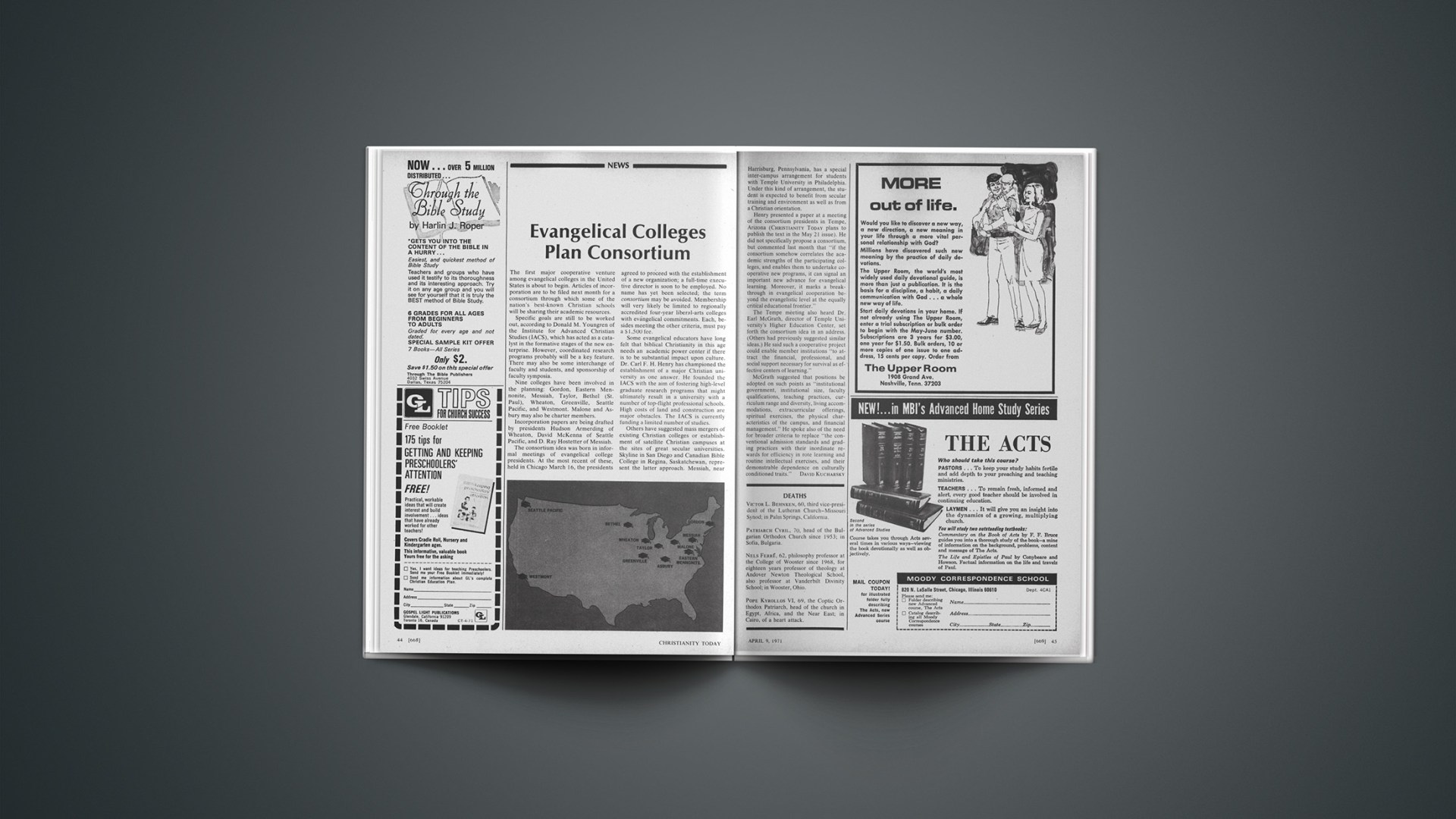
The first major cooperative venture among evangelical colleges in the United States is about to begin. Articles of incorporation are to be filed next month for a consortium through which some of the nation’s best-known Christian schools will be sharing their academic resources.

Specific goals are still to be worked out, according to Donald M. Youngren of the Institute for Advanced Christian Studies (IACS), which has acted as a catalyst in the formative stages of the new enterprise. However, coordinated research programs probably will be a key feature. There may also be some interchange of faculty and students, and sponsorship of faculty symposia.

Nine colleges have been involved in the planning: Gordon, Eastern Mennonite, Messiah, Taylor, Bethel (St. Paul), Wheaton, Greenville, Seattle Pacific, and Westmont. Malone and Asbury may also be charter members.

Incorporation papers are being drafted by presidents Hudson Armerding of Wheaton, David McKenna of Seattle Pacific, and D. Ray Hostetter of Messiah.

The consortium idea was born in informal meetings of evangelical college presidents. At the most recent of these, held in Chicago March 16, the presidents agreed to proceed with the establishment of a new organization; a full-time executive director is soon to be employed. No name has yet been selected; the term consortium may be avoided. Membership will very likely be limited to regionally accredited four-year liberal-arts colleges with evangelical commitments. Each, besides meeting the other criteria, must pay a $1,500 fee.

Some evangelical educators have long felt that biblical Christianity in this age needs an academic power center if there is to be substantial impact upon culture. Dr. Carl F. H. Henry has championed the establishment of a major Christian university as one answer. He founded the IACS with the aim of fostering high-level graduate research programs that might ultimately result in a university with a number of top-flight professional schools. High costs of land and construction are major obstacles. The IACS is currently funding a limited number of studies.

Others have suggested mass mergers of existing Christian colleges or establishment of satellite Christian campuses at the sites of great secular universities. Skyline in San Diego and Canadian Bible College in Regina, Saskatchewan, represent the latter approach. Messiah, near Harrisburg, Pennsylvania, has a special inter-campus arrangement for students with Temple University in Philadelphia. Under this kind of arrangement, the student is expected to benefit from secular training and environment as well as from a Christian orientation.

Henry presented a paper at a meeting of the consortium presidents in Tempe, Arizona (CHRISTIANITY TODAY plans to publish the text in the May 21 issue). He did not specifically propose a consortium, but commented last month that “if the consortium somehow correlates the academic strengths of the participating colleges, and enables them to undertake cooperative new programs, it can signal an important new advance for evangelical learning. Moreover, it marks a breakthrough in evangelical cooperation beyond the evangelistic level at the equally critical educational frontier.”

The Tempe meeting also heard Dr. Earl McGrath, director of Temple University’s Higher Education Center, set forth the consortium idea in an address. (Others had previously suggested similar ideas.) He said such a cooperative project could enable member institutions “to attract the financial, professional, and social support necessary for survival as effective centers of learning.”

McGrath suggested that positions be adopted on such points as “institutional government, institutional size, faculty qualifications, teaching practices, curriculum range and diversity, living accommodations, extracurricular offerings, spiritual exercises, the physical characteristics of the campus, and financial management.” He spoke also of the need for broader criteria to replace “the conventional admission standards and grading practices with their inordinate rewards for efficiency in rote learning and routine intellectual exercises, and their demonstrable dependence on culturally conditioned traits.”

Deaths

VICTOR L. BEHNKEN, 60, third vice-president of the Lutheran Church-Missouri Synod; in Palm Springs. California.

PATRIARCH CYRIL, 70, head of the Bulgarian Orthodox Church since 1953; in Sofia, Bulgaria.

NELS FERRÉ, 62, philosophy professor at the College of Wooster since 1968, for eighteen years professor of theology at Andover Newton Theological School, also professor at Vanderbilt Divinity School; in Wooster, Ohio.

POPE KYROLLOS VI, 69, the Coptic Orthodox Patriarch, head of the church in Egypt, Africa, and the Near East; in Cairo, of a heart attack.

Mission Crisis

Ten Anglican missionary societies—including some of England’s biggest and oldest—are in dire financial straits and their work in overseas fields is threatened, according to a joint statement by their general secretaries.

The message, published in London last month, asserts that the societies’ income is static or declining in the midst of constantly increasing costs. Churches overseas continue to ask for mission help and personnel, but “we are having to delay or refuse many of these requests,” the statement said. “We are facing the prospect in 1971 of withdrawing workers already on the field. There are men and women ready to train for service overseas. What is lacking is the money to support them.”

The societies include the United Society for the Propagation of the Gospel, the Church Missionary Society, and the Society for Promoting Christian Knowledge—three of the largest and oldest Anglican missionary bodies—as well as the Commonwealth and Continental Church Society, the Church’s Ministry among the Jews, the Melanesian Mission, the Mission to Seamen, the Bible Churchmen’s Missionary Society, the South American Missionary Society, and the Jerusalem and the East Mission.

Safari

Who says the lion hunt is passé and the sun helmet old hat in modern missionary circles?

Gospel Missionary Union worker Allan MacLeod reported recently that two lions killed some thirty head of cattle outside various mission villages over a two-month period in the Kita-Sirakoro district of the Mali Republic in Africa. Superstitious natives theorized that the lions were in fact sorcerers who were turning themselves into lions. Others argued that men couldn’t eat so much meat in one night!

The lions—fully animal—were bagged; one was shot only a quarter-mile from the home of missionary MacLeod, who, incidentally, dons a sun helmet.

Churches Receive National Landmark Status

Nine historic New England churches and the Unity Temple, Oak Park, Illinois, have been designated as National Historic Landmarks because they are important examples of American architecture. The edifices will be added to the National Register of Historic Places published by the National Park Service, and will be given plaques and certificates. They will remain in private ownership, but the owners have agreed to maintain them as authentic examples of their architectural periods.

Religious edifices added to the register include:

Center Church (1812), New Haven, Connecticut, “an outstanding example of Federal architecture,” and Trinity Church (1814). “one of the earliest expressions of Gothic Revival style in America.” both to be designated as part of the New Haven Green Historical District. Unity Temple, Oak Park, Illinois, erected in 1906 when architect Frank Lloyd Wright was a member of its congregation. The building, the first in America to employ reinforced concrete as its major building material, “marks a significant achievement in the development of modern American architecture.”

First Church of Christ, Lancaster, Massachusetts (1817), “finest of the existing New England churches designed by Charles Bullfinch.” New Old South Church, Boston (1874), “one of the best ecclesiastical expressions of the High Victorian style of architecture which reached its American heyday in the 1870s.” Old West Church, Boston (1806), remodeled as a library in 1896, but restored as a church in 1963, an example of the architectural work of Asher Benjamin, which “became the prototype of many other New England churches.” St. Paul’s Church, Boston (1820), “the first important Greek Revival structure in New England.” Trinity Church, Boston (1870), built during the rectorship of Dr. Phillips Brooks, “represents the first mature expression of the work of Henry Hobson Richardson that became known as ‘Richardsonian Romanesque.’ ”

First Parish Church, Quincy, Massachusetts (1827), “a fine example of the transition between the Federal and Greek Revival styles, its massive Doric portico Grecian in inspiration, but its main body with graceful arched windows entirely within the earlier Federal and Georgian tradition.” First Baptist Meeting House, Providence, Rhode Island (1775), designated part of the College Hill Historic District. “An outstanding Georgian structure,” apart from its historic connection with the congregation founded by Roger Williams.

GLENN EVERETT

Blow, Gabriel, Blow

Nobody needs to blow the horn for an Oblate priest stationed in a St. Paul, Minnesota, parish. He blows his own. A group of young, talented singers—who write their own lyrics—have teamed up with the trumpeteer priest to record an album called Come Alive that in folk style tells of love and faith in God.

Father Biondolillo believes the Sacred Heart Singers and their album will be a big hit because “we have many things going for us—beautiful music and lyrics, angelic harmony, songs that are fresh and personal.…”

The trumpeting priest has something else going for him: his full name is Father Gabriel Archangel Biondolillo.

Ecumenism, Texas Style

Cooperation between Roman Catholic and Protestant churches in the Texas Conference of Churches (TCC)—considered a model on the ecumenical front—probably can’t be expanded to a national scale. That was the opinion of Jan Cardinal Willebrands of Rome, president of the Vatican Secretariat for Promoting Christian Unity, when he addressed the TCC’s second annual assembly in Austin last month.

The cardinal and Boston archbishop Humberto S. Medeiros (formerly of Texas) called the conference the largest ecumenical organization in the world “of which the Roman Catholic Church is a member.” Greater involvement in church conferences and councils such as the TCC will be slow, depending on local circumstances, the prelates said. Medeiros added that essential unity already exists in the Catholic Church and that further unity would come about not by force “but by free acceptance of union with the Catholic Church.”

The TCC, formed in 1969, brought together the state’s Catholic dioceses and fourteen other bodies including the Greek Orthodox. Fifteen Protestant groups now belong.

After three mostly cordial sessions, the assembly approved a patched-up resolution affirming “the right of farm workers and employers alike to organize for collective bargaining” and supporting “the nonviolent defense of the rights of farm workers to organize through … free elections.” Delegates rejected the original resolution calling for public support of the United Farm Workers Organizing Committee (UFWOC) and Cesar Chavez in their current struggle with California lettuce growers through boycott action.

The TCC also endorsed the idea of state aid for lay teachers of secular subjects in nonpublic schools, and state aid to private higher educational institutions through tuition-equalization grants and purchase-of-services contracts.

MARQUITA Moss

Dead End

Three United Church of Canada ministers who represent three different political parties in the Canadian House of Commons have agreed on one subject: taxation of church property in Canada is inevitable.

Murray McBride (Liberal), Stanley Knowles (New Democratic party), and David MacDonald (Conservative) were taking part in a panel discussion in Glebe United Church in Ottawa. They said churches couldn’t always expect a free ride at the expense of others.

LESLIE K. TARR

Religion In Transit

The first Baptist organization encompassing the entire South that is believed to be thoroughly integrated has been formed. The new American Baptist Churches of the South includes 124 congregations in twelve states.

Roman Catholic priests should be able to choose between celibacy and marriage, the National Federation of Priests’ Councils voted at its annual meeting last month. The federation, which represents about 35,000 of the nation’s 60,000 priests, also expressed solidarity with Philip Berrigan and his co-defendants in the kidnap conspiracy charges and condemned FBI director J. Edgar Hoover for what it called “premature and unfortunate” allegations in the case.

Reversing an earlier decision, the United Presbyterian Board of Christian Education decided to continue funding its forty-six related colleges.

Beginning this fall any congregation of the Episcopal, American Baptist, or Lutheran Church in America that has a vacant pastorate may apply to its national headquarters’ data bank to receive personnel profiles on clergy seeking specified parishes; the clergy similarly may receive congregational listings for jobs tailored to their qualifications.

Christianity and Crisis, the politically left Protestant journal founded by Dr. John C. Bennett, celebrated its thirtieth anniversary on a glum note last month: unless $30,000 in gifts appears by May 1, the biweekly will fold, according to B. J. Stiles, director of the journal’s board and former editor of the also ailing motive magazine. Christianity and Crisis circulation is down from 19,000 to 13,000, and ad revenue has dropped drastically.

Remember the furor over the Episcopal Church’s allocating $200,000 in 1969 for the Black Manifesto-related Black Economic Development Conference? The Black Star Press in Detroit, funded with $100,000 of that money, has published its first book: The Political Thought of James Forman. It says “armed struggle and the seizure of state power … [by] a revolutionary black vanguard party” is an “absolute necessity.”

Three Philadelphia area United Presbyterian churches closed last year, two through merger; Philadelphia Presbytery churches have dropped from 194 to 176 in the past decade.

Last year was the seventh in a row Southern Baptists led in total gifts to the American Bible Society; 1970 SBC contributions were $233,185.

Of 140 names suggested for Carl McIntire’s new college at Cape Canaveral, Florida Reformation College was picked to identify the massive former Boeing building on Astronaut Boulevard.

The Interreligious Foundation for Community Organization (IFCO) decided last month to refuse to fund church-chosen projects unless IFCO also approves them. IFCO’s board also agreed to grant undesignated funds to between nine and eighteen community organizations this year.

Personalia

Brian Faulkner, Protestant moderate widely regarded as an able politician succeeded James Chichester-Clark as prime minister of Northern Ireland The 50-year-old Faulkner was at one time a controversial hard-liner. He is a worshiping Presbyterian.

The New York City Council of Churches’ Family of Man Award, slated for comedian Bob Hope, was set aside instead for posthumous presentation to National Urban League director Whitney M. Young, Jr. A group of activist clergy forced the council to bypass Hope because of his “uncritical endorsement of the military establishment and the Indochina war.”

Former Evangelical United Brethren pastor V. A. Ballantyne has been named the first executive secretary of the three-year-old Evangelical Church of North America. The new denomination has 112 congregations in eleven states making up four annual conferences.

House of Representatives chaplain Dr. Edward G. Latch, former pastor of Metropolitan Memorial Methodist Church (the Nixons attended it when Nixon was vice-president), will officiate at the wedding of Tricia Nixon and Harvard law student Edward F. Cox in the White House on June 5.

Dr. Robert Schuller, pastor of the Garden Grove (California) Community Church, will preach at the 5 A.M. Easter sunrise service at the Hollywood Bowl in southern California.

Ernest T. Wilkinson, 71, president of Brigham Young University, is retiring … C. Emanuel Carlson, for seventeen years the executive director of the Baptist Joint Committee on Public Affairs, retired this month.

After ten years as editor of the weekly magazine of the General Conference Mennonite Church, The Mennonite, Maynard Shelly has resigned.

Miss Georgia and Miss Atlanta, Nancy Karol Carr and Mary Jo Hall, have both served as ministers of youth at Georgia Baptist churches. Both are 22, and each has been a Christian thirteen years.

Father Paul Gauthier, apostle of the poor and one of Roman Catholicism’s principal personalities, is about to announce his official break with the church, according to a respected Milan daily newspaper, Corriere della Sera.

Scripture Union of the Americas has appointed Jose M. Guevara general secretary for Argentina and editor of Spanish-language materials for Latin America.

Sandia Base (New Mexico) chaplain John A. Lindvall has been named vice-president of Southern California College at Costa Mesa and will assist in the opening of a graduate school of theology at the Assemblies of God campus.

A black Baptist minister blind from birth and abandoned as a two-month-old baby on a circus grounds has been awarded a Ph.D. by Columbia University. Dr. Williams Butts, 48, received the academic degree after seven years of study for his dissertation on “The Problem of Meaning in Theological Language.” “Ever since I was a boy I’ve had the idea that God had something for me to do,” says the preacher, singer, and teacher.

An Ursuline nun who is a doctoral-degree student at Southern Baptist Seminary in Louisville, Sister Mary Catherine Vukmanic, has been named one of thirty-eight Garrett Fellows at the school … Sister Helen C. Volkomener of Seattle’s Providence Community is believed to be the first Catholic nun to be employed as a staff member of a national United Methodist agency—the Women’s Division of the Board of Missions.

The Evangelical Fellowship of Canada elected Parliament member Robert N.Thompson of Red Deer, Alberta, as president. Formerly a missionary-educator in Ethiopia, he is chairman of World Vision of Canada and a member of the Evangelical Free Church. Toronto Presbyterian minister Donald MacLeod and Christian and Missionary Alliance layman James Clemenger, also of Toronto, were elected vice-presidents.

William S. Banowsky has been named president of Pepperdine University (Church of Christ) in Los Angeles succeeding M. Norvel Young, who has been made chairman of the board and chancellor of the school.

World Scene

The Central American Mission’s evangelism department, directed by William Wilder, is leading the CAM’s 800 congregations in a year-long total evangelism effort. Overseas Crusades and Argentine evangelist Luis Palau are also cooperating.

The Vatican last month instructed bishops and superiors of religious orders throughout the world to bar men who leave the priesthood from all church work. The Holy See also simplified procedures for release of priests.

Pope Paul sent the head of the Greek Orthodox Church a letter expressing longing for the day “when we will be able to commune together from the same chalice of the Lord.”

Miniature Bibles, sold in Brussels, Belgium, vending machines for twenty cents, are moving well among the young.

Two Catholic lay editors of Shield magazine in Rhodesia resigned to protest a “backing down” by the country’s Catholic bishops on their strong antigovernment position against according special privileges to white Rhodesians. Catholic leaders last year said they would defy the Land Tenure Act; in February they ruled that the church’s multiracial schools would register “under protest.” Observers feel other churches will now also register. The editors called the compromise “immoral.”

The organist and the entire choir of St. Thomas Anglican Church in Golborne, England, resigned because the rector wanted “brighter and more lively hymns.”

Orthodox Jews who pray daily have fewer heart attacks than persons who rarely attend synagogue, according to the Israel Ischemic Heart Disease Project.

Resurrection Land

Thousands of Christian pilgrims from all over the world are thronging to Jerusalem for Holy Week services that began on Palm Sunday. Participating in the “Procession Palmarum,” they bore aloft palm fronds on their way from Bethpage down the Mount of Olives and into the Old City through St. Stephen’s Gate. On Maundy Thursday, the Church of the Holy Sepulchre became again the scene of the “mandatum,” the washing-of-the-feet ceremony.

Beginning early on Good Friday, thousands of pilgrims participate in the traditional Way of the Cross procession. They set out from the first of the fourteen stations, near St. Stephen’s (the Lion’s) Gate, and, proceeding along the Via Dolorosa, retrace Jesus’ last steps leading up to Calvary. Pilgrims from the four corners of the earth split into national groupings, some bearing aloft a wooden cross, a facsimile of the one Jesus carried on his last walk. Holy Week services reach their climax on Saturday night amid the echoes of “Resurrexit sicut dixit” (“he has risen as he said”) in front of the empty tomb.

At Easter dawn as the last stars break their watch over Jerusalem, Christian pilgrims set out for services at the various Catholic and Protestant churches. The first is held at sunrise outside St. Andrew’s Chapel (Church of Scotland) on a hill across the Hinnom Valley from Mt. Zion. There, sitting in the open, the congregation faces the eastern Judean hills watching the sun rise—pink and then purple—at five A.M. and chants while the bells toll in the distance, “Jesus Christ is risen today, hallelujah!”

An hour later, across the valley and inside Jaffa Gate, the Latin Patriarch, Monsignor Giacomo Biltritti, leaves his residence to officiate at a pontifical high mass at the Holy Sepulchre. Flanked by twenty priests, he is preceded by eight kawasses dressed in traditional Turkish uniforms and bearing silver swords, who thump their staves on the ground as they walk.

Evangelical services begin at the Garden Tomb outside the ancient city at 6:30 A.M. and run until early afternoon, with various groups conducting a service each hour. The annual passion drama as re-enacted in Jerusalem always carries an authentic ring, for in the Land of the Resurrection, the untombed Christ is a known member of the family, a Middle Eastern elder brother. The resurrection theme carries the week despite the scars of old wars and the scares of new.

How deep does it all run? Does it spill over into the year and resurrect expressions of hope and peace?

Last summer a group of Jews, Muslims, and Christians led by Brother Bruno Hussar, a Catholic priest of Jewish birth, established Israel’s second non-Jewish settlement in Israel (the first was Nes Ammim, a Christian kibbutz; see April 24, 1970, issue). The interfaith group calls itself “Neve Shalom,” meaning “habitation of peace,” and plans to settle permanently in the Valley of Ajalon about twenty miles west of Jerusalem. The 125-acre site, situated in former no-man’s-land on the borders between Israel and Jordan (now occupied by Israel), has lain idle for nearly twenty-three years.

This past summer the pioneers of Neve Shalom lived nearby at the ruins of the Crusader Fortress, Toron, where Richard the Lion-Hearted once stayed. The local group was joined by volunteers from Israel, Holland, Belgium, New Zealand, and the United States.

Brother Bruno, also founder of the Saint Isaiah House in Jerusalem, a Jewish-Christian dialogue center, said the idea for Neve Shalom came to him following the June 1967 Six-Day War. “I saw the People of the Book—all sons of Abraham—Jews, Muslims, and Christians, as sharing a common hope,” he says. “The Jews await the Messiah and his kingdom of justice and peace; the Muslims look for the resurrection of righteous judgment; and the Christians expect the Messiah to come again. All are awaiting the Day of God, which is a shared eschatological expectation, and this common hope brought us together.”

Neve Shalom would like to be an eschatological prefiguration of Isaiah’s vision of a peaceful life on earth described by the prophet in chapters 2, 11, 52, and 60, according to Hussar. The Neve Shalom vision itself is taken from Isaiah 2:4: “And they shall beat their swords into plowshares.…”

“We would like it to be a community where men strive for peace, perhaps imperfectly, and where they try to live in brotherhood in a diversified society, but loving each other in diversity and trying to overcome the causes of hatred and pride,” Hussar adds.

The atmosphere of this land is hot with the breath and the threat of war. But its soil cannot keep dead His deed. This is Resurrection Land.

‘Never Again’

The international stir over oppressed Jews in the Soviet Union won new attention last month. In Washington, 689 persons were arrested for blocking traffic during a protest demonstration. In Moscow, Soviet rabbis held a national conference to proclaim their well-being and to denounce the Israeli government and Zionism.

The arrests in Washington were said to have constituted the largest number for sit-in-civil disobedience in the city’s history. Most of those arrested were Jews, and all were released the same day after posting $10 collateral.

The Washington rally was led by Rabbi Meir David Kahane, head of the Jewish Defense League, which he founded in 1968. The league’s slogan is “Never Again.” Its chief activity of late has been to hound Soviet diplomats in the United States and to campaign for American sanctions against the Soviet Union.

Kahane is a 38-year-old militant, the son of a Jewish scholar and himself a scholar and holder of a law degree. He urges Jews to “use as much violence as is necessary to survive.” Jewish leaders have either been silent about him or have repudiated his methodology. Several weeks ago in Belgium, a world conference of Jewish leaders had him expelled. He has been arrested several times during protest demonstrations.

Kahane’s cause, if not his tactics, has wide support. Among politicians who have spoken up in behalf of Soviet Jewry is Senator Edward M. Kennedy. He said in a recent speech that the U. S. State Department is not giving “full and active support to diplomatic initiatives” aimed at securing freer emigration of Jews and others from the Soviet Union.

The Moscow meeting of rabbis was apparently inspired by Soviet authorities to counteract the campaign among Jews in the West. A group of dissident Jews told newsmen outside that the rabbis painted too rosy a picture. Some Soviet Jews are being allowed to emigrate to Israel, but many more say they want to go and are forbidden.

Jesus Presses Are Rolling

In its heyday the Oracle, an arty psychedelic monthly spawned in Haight-Ashbury, was one of the better-known underground newspapers and had an international circulation of 100,000. Its pages featured sex, drugs, anarchy, Eastern religion—and eye-poppingly explicit photos. The changing scene brought hard times more than a year ago. This month the Oracle resumes publication—to headline the message of Jesus.

The big switch was set up last fall when editor-publisher David Abraham received Christ on Haight Street in San Francisco. He transferred all rights to the Jesus people who live at Harvest House, a Christian commune in Haight-Ashbury headed by Golden Gate Baptist Seminary graduate Oliver Heath.

Chris D’Alessandro, a former junkie and heroin dealer who led Abraham to Christ, is the new editor. He says the converted Oracle will have an initial press run of 20,000.

“The Oracle has always been dedicated to a search for truth,” said Abraham. Now, he affirmed, it will proclaim the truth.

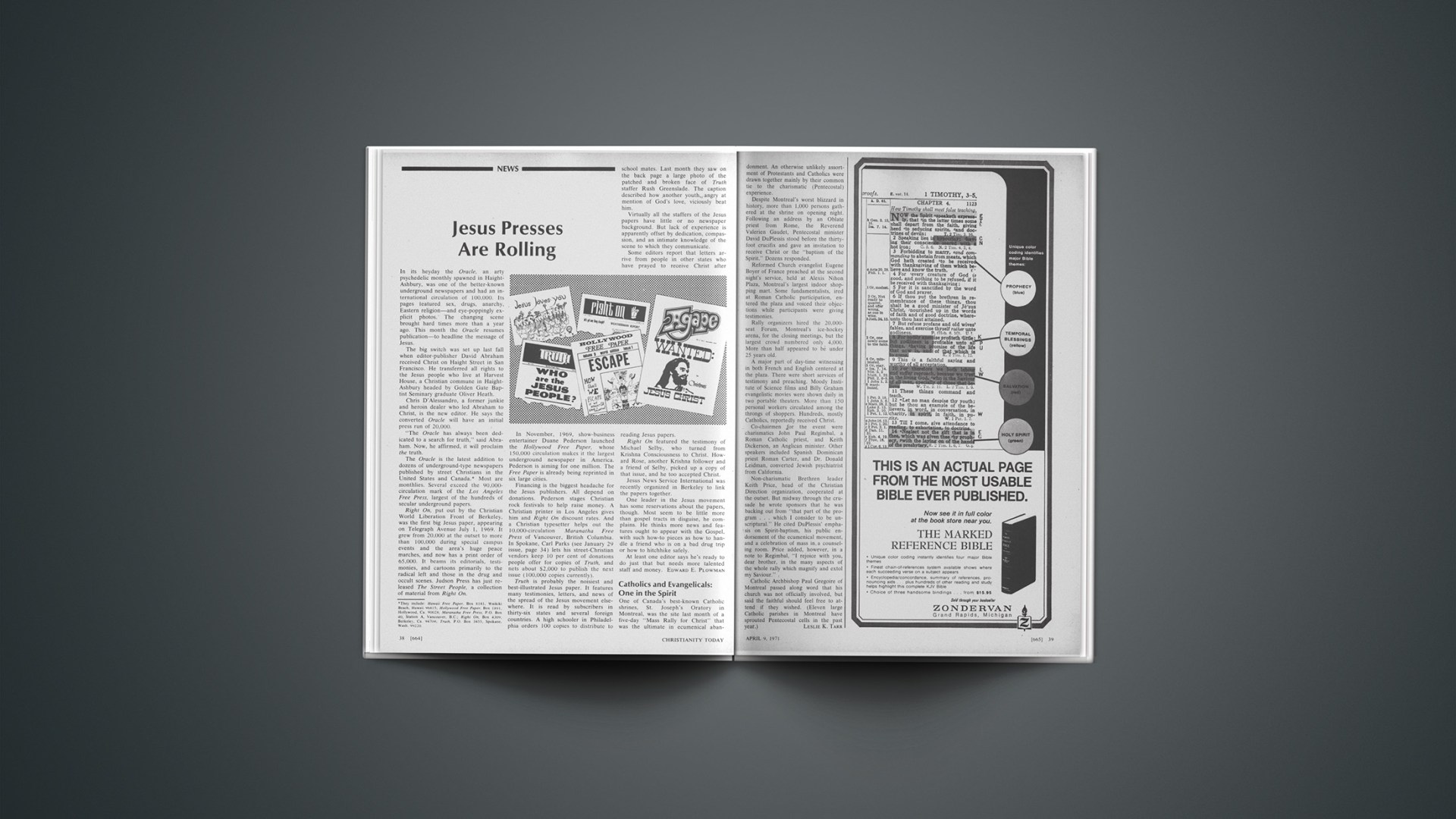
The Oracle is the latest addition to dozens of underground-type newspapers published by street Christians in the United States and Canada.1They include: Hawaii Free Paper, Box 8141, Waikiki Beach, Hawaii 96815; Hollywood Free Press, Box 1891, Hollywood, Ca. 90028; Maranatha Free Press, P.O. Box 40, Station A, Vancouver, B.C.; Right On, Box 4309, Berkeley, Ca. 94704; Truth, P.O. Box 3455, Spokane, Wash. 99220. Most are monthlies. Several exceed the 90,000-circulation mark of the Los Angeles Free Press, largest of the hundreds of secular underground papers.

Right On, put out by the Christian World Liberation Front of Berkeley, was the first big Jesus paper, appearing on Telegraph Avenue July 1, 1969. It grew from 20,000 at the outset to more than 100,000 during special campus events and the area’s huge peace marches, and now has a print order of 65,000. It beams its editorials, testimonies, and cartoons primarily to the radical left and those in the drug and occult scenes. Judson Press has just released The Street People, a collection of material from Right On.

In November, 1969, show-business entertainer Duane Pederson launched the Hollywood Free Paper, whose 150,000 circulation makes it the largest underground newspaper in America. Pederson is aiming for one million. The Free Paper is already being reprinted in six large cities.

Financing is the biggest headache for the Jesus publishers. All depend on donations. Pederson stages Christian rock festivals to help raise money. A Christian printer in Los Angeles gives him and Right On discount rates. And a Christian typesetter helps out the 10,000-circulation Maranatha Free Press of Vancouver, British Columbia. In Spokane, Carl Parks (see January 29 issue, page 34) lets his street-Christian vendors keep 10 per cent of donations people offer for copies of Truth, and nets about $2,000 to publish the next issue (100,000 copies currently).

Truth is probably the noisiest and best-illustrated Jesus paper. It features many testimonies, letters, and news of the spread of the Jesus movement elsewhere. It is read by subscribers in thirty-six states and several foreign countries. A high schooler in Philadelphia orders 100 copies to distribute to school mates. Last month they saw on the back page a large photo of the patched and broken face of Truth staffer Rush Greenslade. The caption described how another youth, angry at mention of God’s love, viciously beat him.

Virtually all the staffers of the Jesus papers have little or no newspaper background. But lack of experience is apparently offset by dedication, compassion, and an intimate knowledge of the scene to which they communicate.

Some editors report that letters arrive from people in other states who have prayed to receive Christ after reading Jesus papers.

Right On featured the testimony of Michael Selby, who turned from Krishna Consciousness to Christ. Howard Rose, another Krishna follower and a friend of Selby, picked up a copy of that issue, and he too accepted Christ.

Jesus News Service International was recently organized in Berkeley to link the papers together.

One leader in the Jesus movement has some reservations about the papers, though. Most seem to be little more than gospel tracts in disguise, he complains. He thinks more news and features ought to appear with the Gospel, with such how-to pieces as how to handle a friend who is on a bad drug trip or how to hitchhike safely.

At least one editor says he’s ready to do just that but needs more talented staff and money. EDWARD E. PLOWMAN

Catholics And Evangelicals: One In The Spirit

One of Canada’s best-known Catholic shrines, St. Joseph’s Oratory in Montreal, was the site last month of a five-day “Mass Rally for Christ” that was the ultimate in ecumenical abandonment. An otherwise unlikely assortment of Protestants and Catholics were drawn together mainly by their common tie to the charismatic (Pentecostal) experience.

Despite Montreal’s worst blizzard in history, more than 1,000 persons gathered at the shrine on opening night. Following an address by an Oblate priest from Rome, the Reverend Valerien Gaudet, Pentecostal minister David DuPlessis stood before the thirty-foot crucifix and gave an invitation to receive Christ or the “baptism of the Spirit.” Dozens responded.

Reformed Church evangelist Eugene Boyer of France preached at the second night’s service, held at Alexis Nihon Plaza, Montreal’s largest indoor shopping mart. Some fundamentalists, ired at Roman Catholic participation, entered the plaza and voiced their objections while participants were giving testimonies.

Rally organizers hired the 20,000-seat Forum, Montreal’s ice-hockey arena, for the closing meetings, but the largest crowd numbered only 4,000. More than half appeared to be under 25 years old.

A major part of day-time witnessing in both French and English centered at the plaza. There were short services of testimony and preaching. Moody Institute of Science films and Billy Graham evangelistic movies were shown daily in two portable theaters. More than 150 personal workers circulated among the throngs of shoppers. Hundreds, mostly Catholics, reportedly received Christ.

Co-chairmen for the event were charismatics John Paul Regimbal, a Roman Catholic priest, and Keith Dickerson, an Anglican minister. Other speakers included Spanish Dominican priest Roman Carter, and Dr. Donald Leidman, converted Jewish psychiatrist from California.

Non-charismatic Brethren leader Keith Price, head of the Christian Direction organization, cooperated at the outset. But midway through the crusade he wrote sponsors that he was backing out from “that part of the program … which I consider to be unscriptural.” He cited DuPlessis’ emphasis on Spirit-baptism, his public endorsement of the ecumenical movement, and a celebration of mass in a counseling room. Price added, however, in a note to Regimbal, “I rejoice with you, dear brother, in the many aspects of the whole rally which magnify and extol my Saviour.”

Catholic Archbishop Paul Gregoire of Montreal passed along word that his church was not officially involved, but said the faithful should feel free to attend if they wished. (Eleven large Catholic parishes in Montreal have sprouted Pentecostal cells in the past year.)

LESLIE K. TARR

Survey Results: How Religious Are Religion Editors?

NEWS

The chief source of information about the religious world for many people today is the daily newspaper and the weekly news magazine. Every day the nation’s secular-press religion writers and editors transmit and interpret news for millions of Americans. Most edit special weekend religion sections that give extended coverage to churches, synagogues, and religious events and thought.

Who are these professional religion journalists? What do they believe about God, Christ, and the Bible? Do they take an active part in a church? And do they consider their jobs a kind of ministry?

Results just compiled from a survey* indicate that the “average” religion editor in the secular media is a religious person. But he is greatly concerned about being fair and balanced in his presentation of all religions, and about giving conflicting views a hearing.

One hundred forty-six of 180 who responded to the survey claimed membership in some religious body (see chart), and 107 said they are active in a local church or synagogue. Twenty-two are active in a larger unit of their communion.

Eighty-three per cent (150) believe “in the reality of God” (some others undoubtedly do but decided not to respond to the question), and 133 said they believe that God “revealed himself in a unique way in Jesus Christ.”

Thirty-seven said they regard the Bible as the “inerrant or verbally infallible” word of God, while 107 said they do not accept this view. But 111 affirmed the choice that the Bible is “a record of God’s self-revelation to men which bears the imprint of both divine inspiration and human fallibility.” Sixty-five either accepted neither formula, or wrote in added or qualifying remarks.

In an apparent contradiction, eighteen responded “yes” to both views: that the Bible is inerrant and bears the imprint of human fallibility. One, questioned later about this, gave an explanation that could reflect the thinking of others who checked both. Wesley Pippert of United Press International, who is a United Methodist clergyman, said he holds to inerrancy but interpreted the “imprint of … human fallibility” to mean “man’s sin or the fall” described in the third chapter of Genesis.

Like reporters who cover politics, those whose beat is religion have quarrels with the establishment. They voiced pet peeves about how churches handle (or mishandle) publicity and news information.

The biggest sin committed by the people who supply the religion editors with news information, according to a write-in question, is missing deadlines and being super-slow in notifying reporters about news information (55 responses). Also high on the list (36) was the complaint that ministers and PR contact people in the churches don’t know what the secular press considers news. Allied griefs included poorly put-together releases (18), self-serving “puffs” that are publicity—not news (31), and the playing down or suppression of controversial matters (14).

William R. Wineke of the Wisconsin State Journal (he is a United Church of Christ minister) put it baldly: “Many ministers are impudent liars when discussing any subject which reflects badly on their churches.”

The next question asked the journalists for advice to bridge the church-media gap. The most frequent suggestion (31) was for religious groups to train someone with basic media understanding as a press contact or officer. Advice given almost as often (20) was for church people to sharpen their news judgment (learn what news is), be honest and open (20), avoid secrecy (11), and stick to the facts (13).

Learning the paper’s policies, being accessible to newsmen, and building mutual confidence between the journalist and the church PR people were suggested often. And sixteen reporters implored: “Keep deadlines.”

Seventy-eight of the respondents were men, ninety-eight were women (four didn’t commit themselves). More are in the over-50 age bracket (57) than are between 30 and 40 or 40 and 50 (38 and 46). Thirty-two are under 30, however, where women (22) hold a better than two-to-one lead over men. Three under-30 religion editors write for circulations of more than 250,000. Four of the thirty-two believe in an inerrant Bible, and eleven believe in God’s unique revelation in Jesus Christ.

Nearly half (44 per cent) of the responding religion editors devote less than one-third of their job time to religion. The next highest group (43) are full-time religion reporters (most are employed by papers of 100,000 circulation or more). Seven of the fifteen ordained clergy write for papers of at least 250,000 circulation. Forty-nine religion editors have held that job for more than ten years, while sixty-eight have been at it less than three.

Ninety-one per cent of the papers represented have special weekend religion or church pages; only twelve papers do not. Saturday is far and away the most popular day (119) for this, and these papers average seven and one-half columns of religion news each Saturday. Friday, Sunday, Monday, and Thursday editions were also listed, in that order, as giving special space to religion news.

What background do the nation’s religion editors bring to their work? Only nineteen said they had a degree in religion or theology, but ninety-three indicated they had taken religion courses at the college level. Interestingly, 150 respondents said they felt such courses or degrees were either unimportant or only somewhat important in their present work. A significant majority (163) had read at least “one serious book on theology” in the last year; forty-one of these had read six or more.

Eighty-five per cent said they think membership and activity in a religious body need not be a conflict of interest for a religion writer of a secular publication. Only 5.5 per cent said such participation was a conflict. In fact, more than half (99) said a personal religious viewpoint is a help rather than a hindrance to a secular-press religion journalist. But thirty-six said “it depends,” and sixteen said personal faith neither helps nor hinders such reporting.

Ron Durham of the Houston Post commented: “I think the personal religious viewpoint that grants that religious faith in general is authentic, legitimate, and needed in the world provides a more balanced reporting viewpoint than that of the skeptic. A sports-writer who is half-convinced that the activities he reports are illegitimate or unauthentic would be handicapped in communicating objectively.”

The journalists split sharply over whether reporters covering religious events should be advocates or participate in the event itself. Seventy-six answered that both secular and religious-press reporters should “never” be advocates or participate in events they are covering. Twenty-four thought it was all right for religious press reporters, and thirty-five thought either secular or religious media people could take part “if they have expertise to contribute.” Almost half those who answered the question added explanations to their multiple-choice answers. Most of these stressed the need for objectivity, absolute fairness, equal treatment to all faiths, and attention to all sides of controversial issues. Nine said advocacy was legitimate in a signed column or by-lined story but not in a straight news piece. “I am explicitly Christian in my column,” said UPI religion writer Louis Cassels.

Los Angeles Times religion editor Dan Thrapp added this note: “In the news business it should never be ‘we,’ but always ‘they.’ You can’t easily wear two hats in this field. This is not to say you shouldn’t have ‘religion,’ or should abandon it when working, but to mix the two is highly dangerous.”

The final question was: “Do you regard your job as religion newswriter in any way as a ministry?” Exactly half said they did. Twenty-eight per cent said they believe their job is a way to promote the Christian faith. But 114 editors explained or qualified their answers. Many said they were just as careful to promote other religions, and at least a dozen stated that the community press is no place to preach or evangelize. Another dozen or so expressed the idea imbedded in a comment by Dorothy Laskey of the Ann Arbor News; “Is writing a ministry? Perhaps as much as teaching is, or serving on the police force. Every person is himself first and whatever he does shows that.”

Another significant group could identify with Eileen C. Spraker of the Wilmington, Delaware, News-Journal papers: “I consider it as a ministry of understanding and reconciliation … a means whereby covering all religious activity can somehow put or bring together people who care in our society, perhaps leading them across the boundaries of their particular religious dogmas, to common understanding and action in a society which badly needs guidance.”

Dan Thrapp put it another way: “I regard the Christian faith, and the Bible, as truth. Any newsman worth his salt is interested in spreading the truth he sees. Besides, there is no hope for the world, or for society, aside from faith and, for me, the Christian faith. I would be less than human if I did not wish to see the world and society survive.”

‘Urbana’ In Germany?

It may not have been as large as Inter-Varsity’s Urbana conference, but Europe’s only continent-wide missions conference had equal significance to those who attended: 300 students and 200 faculty members from twenty-one Bible institutes and seminaries in Europe. It was held last month in Seeheim, Germany, under the sponsorship of the 15-year-old European Student Mission Association (ESMA).

English evangelist Richard Bennett and “Circus Pastor” Eugen Stegmann were among the main speakers. Keynoter Werner Jahnke spoke on “How God Is Working Today.”

The ESMA conference was first envisioned by Greater Europe Mission’s veteran missionary Robert Munn, who outlined his plans to students at the European Bible Institute (EBI) in Paris. EBI students in 1956 invited two other schools in the Paris area to participate in a joint missions conference. Six non-EBI delegates attended. Interest mushroomed in succeeding years.

Seventeen schools now officially belong to ESMA. Rules state that the program in a member school must be run entirely by students and that at least one mission meeting per week must be scheduled. An all-student executive committee oversees ESMA affairs.

Although most member schools were founded to train nationals for Christian service in their own countries, many students, as a result of ESMA’s impact, are now considering foreign work.

In countries such as Italy, where there are few evangelicals, the need for national workers is critical. Yet ESMA influence led two graduates of Rome’s Italian Bible Institute to sign up for service in Africa under the Swiss branch of Sudan Interior Mission. “I attended Istituto Biblico Evangelico because I wanted to train to reach the sick in Italy’s hospitals with the Gospel,” says Italian SIM missionary Laura Emanuele, “but God had other plans for me. ESMA showed me the world’s need, and I knew the Italian church must be represented abroad.”

One missions specialist recently reported that 14,000 to 16,000 Protestant missionary workers from nations outside the United States and Canada are presently serving in countries other than their own. The primary sending nations are Great Britain, Sweden, West Germany, and Australia, which contribute over 80 per cent of the non-North American Protestant missionary force.

More than forty students who have served on the ESMA executive committee over the years are now mission leaders in Europe and elsewhere. Europe’s booming economy is capable of supporting hundreds more. ESMA is out to get them.

ROYAL L. PECK

The Lamp of Prophecy

Renewed interest in prophetic teaching is a likely result of the Jerusalem Conference on Biblical Prophecy, to be held June 15–18.

According to many scientists and military authorities, world affairs cannot long proceed as they are without erupting into global catastrophe, whether a civilization-erasing nuclear war, life-choking environmental pollution, overpopulation and famine, or something else.

Evangelical Christians have always believed, however, on the basis of the inspired Scriptures, that it is God who will consummate the course of history, and that he will do so, moreover, in his own revealed way. Early in this century Western intellectuals looked to science to usher in a global millennium, and accommodating liberal Protestants decided that the scientific method rather than the Holy Spirit would lead men into all truth. For all that, Bible-believers remained confident that human history is moving inexorably toward a catastrophic divine judgment of men and nations, and that if a millennium were in the offing, only God and not human ingenuity would bring it to pass.

Whatever one may think of dispensationalism as a system of biblical interpretation, the fact remains that early in this century, when the historical prospects seemed about as remote as a Swiss Navy, men like C. I. Scofield, A. C. Gaebelein, J. M. Gray, and H. A. Ironside insisted on the basis of Old Testament prophecy that Jewry would be regathered in Palestine, and would at first reassemble in unbelief in Jesus of Nazareth as the Messiah of promise. At the same time, they averred, Russia would emerge as an archfoe from the north.

In view of Paul’s revelational philosophy of history in Romans 9–11 as well as Old Testament passages, many students of biblical prophecy also pointed out that before the second coming of the crucified Lord in power and glory a reawakened Jewry will turn in faith to this Christ so long rejected.

Many other evangelicals, to be sure, held no such eschatological expectations about Israel, and insisted instead that because of the Jews’ rejection of Jesus the Messiah, the prophetic promises were now wholly preempted by the Church of Christ.

All evangelicals agreed, however, in looking for the crucified Messiah’s return in final judgment upon men and nations as the climax of history, an expectation based upon both Old and New Testament writings. Many considered the prophetic vision of an earthly kingdom of universal justice and peace too explicit and insistent to dismiss; others identified such hopes with the Church and the eternal world to come. And some saw no more import in the Jewish return to Palestine than in Russia’s later return to Czechoslovakia, or if they found humanitarian significance in the provision of a Jewish homeland, they made no necessary connection with Old Testament prophecy.

Such differences may encourage dismissal of evangelical eschatology as a maze of contradictions. But the fact remains that evangelicals do indeed share a great deal of conviction about what Winston Churchill called “the awful, unfolding scene of the future”; their confidence holds firm in the scriptural disclosure of God’s purpose in human history and in the divine consummation of the course of the world’s events.

The Jerusalem Conference on Biblical Prophecy proposes to emphasize what it is that evangelicals consider certain about the future outcome of history. In view of the present state of world affairs, it is well indeed that their differences on secondary issues not becloud their major agreements. There need be no doubt about God’s revealed purpose in the redemption of a lost humanity, and its implications for the cosmos and history no less than for the individual.

While devoutly interested Holy Land tourists will constitute the conference audience, the gathering will hope for some hearing at a distance also by the Church as a whole and by the world at large. And it will seek to extend earlier conversations with Jewry. In Christ’s day the Sanhedrin had gone so far as to acknowledge the tomb of Jesus of Nazareth to be empty and had witnessed the subsequent conversion of Saul of Tarsus, its own official persecutor of the first Christians. It was this brilliant Jew who, confessing that Jesus Christ is indeed the Risen Lord, then led the Christian missionary thrust to the Gentile world.

Interestingly, perhaps regrettably, the Jerusalem Conference emerged as an effort wholly independent of the churches. The fact remains that many of Christianity’s enduring concerns have not been nurtured by twentieth-century ecumenism. The once acclaimed eschatological orientation of the World Council of Churches’ Evanston Assembly soon buckled under socio-political priorities. The roller-coaster course of new-Protestant theology, moreover, has played hit and miss with the doctrine of last things; as a result, dialectical and existential restatements of eschatology have forfeited theological initiative to an emphasis instead on the primacy of this world and its material survival needs.

It was Gaylord Briley, an evangelical promoter, who first saw an opportunity to blend the continuing evangelical interest in Holy Land travel with a prophetic conference in Jerusalem. Enlisting the cooperation of the American Institute of Holy Land Studies in Jerusalem, he broached the idea to Editor Robert Walker of Christian Life magazine and Sam Wolgemuth of Youth for Christ International, and then elicited an official conference call by Dr. W. A. Criswell and Dr. Harold John Ockenga. At this stage I was asked for program suggestions and must largely assume responsibility for securing breadth and balance among the speakers.

The conference will, I think, achieve numerous worthy objectives. Among them are those of reminding the ecumenical church and the world that evangelical Christians do indeed take Bible prophecy seriously, and of stimulating fresh and earnest study of the prophetic Scriptures in the context of the Gospel and the Christian mission in the world.

Evangelicals cannot neglect an enlightened interest in persecuted Jewry’s need for a national homeland, but they dare not on that account be uninterested in the requirement of social and political justice throughout the Near East, nor need they make partisan commitments to the expanding political aspirations of one or another of the Bible Land nations. Evangelical compassion reaches to Arab refugees no less than to regathered Jews. In the conflict between Jew and Arab, the Christian community recognizes strategic tensions on which the Bible itself is not silent. Indeed, evangelical Christians see not only the future of Israel and of the Arab world, but also the future of all nations, in relation to the Coming King of kings. And under his holy Lordship, they gladly and confidently look for his soon return.

Man Alive!

Breaking through the gloom of death and hovering over the seeming finality of the grave is the certainty of the resurrection morning—of a morning centuries ago when two men in dazzling robes stood in an empty tomb and exclaimed, “Why seek ye the living among the dead? He is not here, but is risen,” and of a future morning when “the Lord himself shall descend from heaven with a shout, with the voice of the archangel, with the trump of God: and the dead in Christ shall rise first … and so shall we ever be with the Lord.”

The true significance of the Cross is inexorably linked with the empty tomb, for while the Cross is the central event of all history, man’s redemption is validated by the resurrection.

Without the resurrection, our Lord’s death on the Cross would have been the symbol of a lost cause. But because he arose from the dead, the Christian faith and eternal life combine into one glorious hope.

Without the resurrection there is no Gospel to preach. Because of Christ’s victory over death and the grave, the Gospel is a message of life and victory for everyone who believes.

As the plan of God’s redemptive work for sinful man unfolds, the resurrection emerges as an absolute necessity. Prior to any resurrection there must have been death, and we know that death came into this world because of sin. If Christ’s work of redemption was to be effective, then he had to triumph over all the results of sin. The resurrection therefore becomes living proof of his power as Saviour.

Not only has the curse of sin passed from man to man and from generation to generation; the ground itself was a partaker of the curse: “Thorns and thistles shall it cause to bud.” The crown of thorns Christ wore at Calvary was not merely a symbol of the derision of his tormentors. It was a divinely ordained symbol of his bearing in his body the penalty of sin—in man and in nature.

Isaiah, writing of the ultimate triumph of the Gospel, tells of a day when “instead of the thorn shall come up the myrtle tree: and it shall be to the Lord for a name, for an everlasting sign that shall not be cut off.”

That our Lord arose physically and visibly from the dead is one of the best attested facts of history. Remove the resurrection story from the historical records—in the Gospels, in the Acts of the Apostles, in the Pauline and other letters, and in the book of the Revelation—and the crowning proof of Christ as Saviour, and the immortality of the soul, vanishes from sight.

The evidence is so overwhelming, and the effect so transforming, that a study of the records brings with it the certainty of the resurrection. It was first ignored, then disbelieved, and finally accepted as the crowning proof of the Christian faith.

The scriptural record is one of internal evidence beyond the realm of collusion. The disciples never understood our Lord’s frequent references to his death and resurrection. After he had risen from the dead, they still doubted. Only as they were confronted with “many infallible proofs” was their unbelief and hopelessness transformed into a burning assurance.

They knew this same Jesus was alive. They saw him. They heard him speak. They touched him. They ate with him. They were aware of the amazing fact that while in some way he was changed, he had the same body, for they saw scars in his hands and feet, and at least one of them was invited to end his persistent doubts by thrusting his hand into the wound in Christ’s side.

In the succeeding days they frequently enjoyed the fellowship of the risen Lord. His miraculous powers were still in evidence, and his command to them to go out, after they had received the power of the Holy Spirit, and make disciples of all nations, was an impelling commission that turned timid and ignorant men into flaming evangels who, it was said, turned the world upside down.

The Jews made provision to seal and guard the tomb against the Lord’s disciples; they little realized that they could not guard it against Christ himself. No man had anything to do with the resurrection of the crucified Saviour. This was a demonstration of supernatural power; God raised him from the dead. The power of resurrection was also inherent in our Lord, who declared to his disciples: “I lay down my life.… I have power to lay it down, and I have power to take it again.” Man may entomb a dead body, but no man can stay the resurrection power of the Son of God.

The Sabbath day was deeply rooted in the law in the practices of the Jewish religion. Only a cataclysmic event could have changed the old Jewish Sabbath, the seventh day of the week, to the Christian Sabbath, the first day of the week. In fact, the first day of the week is not mentioned until after the resurrection; from that time, as an obvious commemoration of that glorious event, the Sabbath was observed on the first day.

A final impelling truth: His disciples were confused and dull of understanding when he referred to his coming death and resurrection; they frankly admitted they did not at first believe the resurrection story. Collusion for the removal of the body would have been impossible. Then they saw and touched and heard and lived with the risen Lord—and it transformed their lives!

These disciples, who had fled before the torch-lit mob headed by Judas, and one of whom had cursed and sworn that he did not know the Christ—these same disciples stood unafraid and unabashed before the murderers of Jesus and said: “Be it known unto you all, and to all the people of Israel, that by the name of Jesus Christ of Nazareth, whom ye crucified, whom God raised from the dead, even by him doth this man stand here before you whole.” And, when ordered not to preach in his Name and threatened with dire punishment should they do so, they prayed not for protection but for courage: “And now Lord, behold their threatenings: and grant to thy servants, that with all boldness they may speak thy word.…” Weak in faith and turning again to their fishing nets in their disillusionment, these disciples were suddenly transformed by the blinding light of a new faith, a knowledge that the Lord they thought to be decaying in a tomb was alive—that he had triumphed over death and the grave. Instead of returning to a quest for the fish of Galilee, they went out to preach the Gospel of redemption and a new life in their risen Lord.

Nothing less than the visible, bodily resurrection of the Lord Jesus Christ, nothing less than the infallible proofs that they themselves had seen and experienced, could account for the transformation of these men.

That which God did through his disciples nineteen hundred years ago he wants to do through you and me today. Paul saw this same risen Lord and was transformed. Later he was able to make this profound affirmation: “I am crucified with Christ; nevertheless I live; yet not I, but Christ liveth in me: and the life which I now live in the flesh I live by the faith of the Son of God, who loved me, and gave himself for me.”

That is living!

Jesus Is Alive!

EDITORIALS

The perennial Christian symbol, often fashioned in gold, is a cross. This speaks of death. In two thousand years of church history no one has come up with a comparable resurrection symbol. Need we remind ourselves that to affirm the cross but deny the resurrection would empty the Christian faith of its content and make preaching, worship, and witness meaningless nonsense?

The Cross has a threefold frame of reference that spells out the meaning of the death of Jesus Christ in God’s plan for the salvation of sinful men. First, it was the final and ultimate revelation of God’s divine love. There is here no slushy sentimentalism like that which characterizes much of what is called love in our day. God’s love was characterized by sacrifice, suffering, and death, not only by ministry to the lame and the blind. He spared not his own Son, and his Son offered himself as an oblation and a substitute for sinners.

Secondly, the Cross was the measure of the divine judgment on sin. It brought death to the Son of God. Men everywhere like to pretend that death is just a normal part of the natural order; they resist the ugly fact that it is the inevitable, just, and logical consequence of sin. Calvary is no less than God’s judgment on sin.

Thirdly, the Cross is the ground of pardon and forgiveness. There and there alone the sinner finds forgiveness for guilt, release from sin’s penalty, and deliverance from its power. It is this that brings hope to the heart of man.

The Cross without the resurrection, however, would be a monstrous barbarity, a cruel hoax, a dastardly deception. Indeed, it is the resurrection that distinguishes Christianity from every other religion or pseudo-religion in the world. Buddha is dead; Mohammed is dead; Confucius is dead; Zoroaster is dead; Lao Tzu is dead; Gandhi is dead; Marx is dead; Lenin is dead. Jesus is alive!

Christianity is a factual religion, and one of its two central facts is the resurrection of Jesus from the dead. The resurrection is no less a fact because it was a supernatural act. The disciples and followers of Jesus saw him risen even though they did not see him rise. God’s ways are not man’s ways. There is a profound mystery connected with the resurrection, but this does not void the fact, nor does it excuse the unbelieving heart that balks at the thought of the dead made alive.

To believe in Jesus’ resurrection and rest one’s ultimate salvation on it, though essential, is not enough. The Christian does not comprehend the full meaning of the resurrection unless he works out its implications in his daily life. It is incongruous for him to talk of a resurrection that brings pardon and the forgiveness of sin without manifesting deliverance from its power. The unbelieving world cannot see the forgiveness of sin in a visible sense, but it can observe the lives of those who claim their sins have been forgiven. When a man who says he is a Christian lives and walks no differently than his unbelieving neighbor, he denies the resurrection reality of sin’s broken power. The world waits for the witness of the transformed life of purity, holiness, truthfulness, and integrity to validate the Christian’s claims that because of the resurrection he has been born from above through faith in God’s Son.

The greatest sin is not lying or cheating or murder, nor is it lack of love. The greatest of all sins is the refusal to let Jesus Christ be Lord of the life, because it is a violation of the first and the greatest commandment. This sin cannot be remedied unless repentance and confession include commitment of life to Christ as Lord. Otherwise the sin continues, and repentance and confession are without meaning. Once Christ is Lord of the life, then his resurrection has its fullest meaning: the believer subordinates his choices to the will of Jesus and does what Jesus wants him to do. And as Lord. Jesus has a supreme mission for his yielded people: take the Gospel to every creature.

The resurrection certifies that Jesus’ work on the Cross was sufficient and acceptable. In this we can rejoice. But we must not stop there. God intended that the power of the resurrection should be experienced and manifested in every believer’s life. Because Jesus is alive, the Christian should walk and act differently than the world does. If he doesn’t, then the fuller meaning of the resurrection is lost to him; he is deformed, and the unbeliever, failing to see evidence of the new life in Christ, has reason to continue in unbelief.

The first great question about the resurrection has been answered. It happened! Christ is alive! The second great question—whether the power of that resurrection can be seen in the Christian’s life—remains to be answered by each of us this Easter season.

Cocu: Call The Hearse?

The moderator of the United Presbyterian Church, joining his counterpart in the Presbyterian Church U. S., is outspokenly pessimistic about the present chances of success for the giant nine-way merger scheme of the Consultation on Church Union. “At this moment if our church were to vote on joining the Church of Christ Uniting [the proposed name for COCU’s child], we would turn it down,” Dr. William R. Laws told a Detroit reporter in an interview. “I am inclined to think that the national mood now makes church union very difficult if not impossible.”

This gloomy prognostication echoes a statement made a few months earlier by the chairman of the committee that drafted the COCU Plan of Union. Dr. William A. Benfield, Jr., moderator of the Southern Presbyterian Church, noted “strong opposition … in every participating church.”

Laws and Benfield won’t go so far as to say that COCU should be lowered into the coffin; they hope there is time to overcome the present lack of enthusiasm in the five or six years left before the nine denominations must finally turn thumbs up or down on the structural union. These two leaders merit praise for their candor about present COCU ennui. We hope merger proponents will be as candid in assessing how, if the staunch advocates of COCU see its life signs failing, others can be expected to see it as anything more than a corpse.

Missionaries As Guests

Some missionaries have been or are being deported from Taiwan and South Africa because they had become personae non gratae to the governments. From our perspective it is easy to fault the governments, and even easier to justify the missionaries and commend them for speaking out. We must acknowledge, however, that, regrettable as the deportations were, sovereign states have the right to extend or cancel visas, and are not required to justify their actions. It is never valid to assume that governments see things the way the Bible delineates them, or that they consider themselves bound by Christian moral principles and will act in accord with these principles rather than make decisions on the basis of what they think their own interests to be.

Missionaries who are dramatically deported get considerable attention. But some countries today simply will not grant visas to aspiring missionaries or to returning ones. Whether countries expel missionaries or refuse to grant or renew visas matters little. Both procedures effectively deny to the missionaries the privilege of bringing the Gospel to the people of those countries. Fortunately, even in countries such as China and Russia that are totally closed to missionaries from the West, there are other means such as short-wave radio by which the Gospel can be transmitted. Thus there is no place that is wholly impenetrable.

We trust that the situation in Taiwan and South Africa will not reach the point where all foreign missionaries are excluded. To prevent this may require that missionaries remain silent about some things they believe in, in order to accomplish their primary mission, which is to see men and women come to a saving knowledge of Jesus Christ. Since missionaries see their roles and their responsibilities differently, some may not be able to remain silent and as a consequence may be forced to leave their posts. But for those who stay we can predict that if enough people get converted, repressive regimes eventually will go the way of all flesh and the unarticulated views of the missionaries will at last prevail.

Life’S Harmony

God created a harmony in nature that many composers have tried to imitate. Music reflects the balance and harmonic structure of the cosmos. As season blends into season, and storms give way to serenity, we see evidence of the Creator’s harmony. This, however, is not the harmony of prelapsarian perfection in the natural order, for storms and drought often bring disaster. Rather this harmony is the combination of the peace and chaos we find in nature, a blend that is also reflected in our lives. God sends sun and rain spiritually as well as physically.

It is Easter that best exemplifies this combination. As winter changes into spring we remember God’s supreme act of harmony—the blending of sinlessness and shame to bring triumph over death and man’s reconciliation with God.

To know the fullness of life, the reason for Christ’s coming (John 10:10), we need to understand and experience the power of God’s harmony and the joy that it brings. As Wordsworth says in “Tintern Abbey,” “With the eye made quiet by the power/Of harmony, and the deep power of joy/We see into the life of things.”

Charitable Competition

Who is the most admired resident of Washington, the nation’s capital? President Nixon? Mayor Walter Washington? The Reverend Walter Fauntroy, the District of Columbia’s new delegate to Congress?

With the opening of baseball season, the focus swings away from these highly respected men to manager Ted Williams. Washington, as every sports fan knows, has the lamentable reputation of perennially being first in war, first in peace, and last in the American League. The coming two years ago of Williams, who was one of baseball’s greatest hitters, put new life into America’s favorite pastime for Washington area residents.

One thing about Williams that nettles Senator fans, however, is his enthusiastic willingness to give batting instruction to those who play on other teams! In spring training this year, one opposing player asked for and got some batting tips from Williams before an exhibition game, then promptly went on to hit a home run against the Senators his first time up.

In the interests of his own Senators, who are still among the poorest batters in baseball, we’ll not encourage Williams in his charity. But does his spirit offer an example to churchmen who regard denominational loyalties as supreme? Many of the great spiritual advances of our time are those taking place outside the ecclesiastical establishment. We need to encourage and help endeavors that show potential, even if they run “competition” to our own efforts.

Two Marys: A New Beginning

Racial disturbances recently forced Principal Laird Lewis to close down Myers Park High School in suburban Charlotte, North Carolina. Tension was still high when classes reopened days later, But then two girls named Mary, one black and one white, introduced themselves during lunch. After drawing six others in the lunchroom into their circle of companionship, they went outside to get better acquainted. Others joined them.

Conversation gave way to songs and laughter. By the time the bell rang, hundreds of students were caught up in the joyous demonstration. Lewis canceled classes, and he and his 2,200 pupils—including the school’s 450 blacks—and their teachers moved to the stadium for a giant love-in.

An approving eyewitness, Presbyterian minister J. E. Fogarty, said they were like little children as they played together, embraced one another, and laughed away the hostilities. Hand-clapping and songs such as “Amen” and “Let the Sunshine In” created a revival atmosphere. The crowd cheered as appreciative students hoisted Lewis to their shoulders.

Lewis, a Baptist, said it was the greatest experience of his life. Parents telephoned him to report abrupt attitude changes in their young. More concern for others was commonly cited.

Nearly two months have passed, and the glow has continued, according to Lewis. Tensions are gone. The color lines have disappeared in the lunchroom and student lounges. Students show respect for one another.

“A lot of prayer went into this,” said Lewis. “The churches were concerned. The kids were searching for something.”

The love-in may not have solved the deep ingrained problems, commented student council president Robert Lewis, a member of Fogarty’s church. “But it was a beginning.”

Love is the answer to our nation’s simmering racial ills. The two Marys have shown us the way.

Fighting For God

The Catholic University of America found itself embroiled in another controversy last month. Students had contracted for a campus speech by Ti-Grace Atkinson, noted feminist, and university officials originally approved the agreement. Subsequently in a speech at Notre Dame Miss Atkinson used crude terms that some interpreted as a denial of the virgin birth. Catholic University officials then barred Miss Atkinson from the campus, but a student group got a federal court order enabling her to speak.

The speech itself evoked a regrettable incident. While Miss Atkinson was addressing the crowd, Mrs. Patricia Bozell ran to the podium and tried to slap her. Mrs. Bozell, sister of the Buckley brothers, later defended her action. “I think I did what God would have wanted me to do,” she said.

We disagree. God doesn’t need that kind of “help” to preserve his truth. Mrs. Bozell, managing editor of Triumph, got into the auditorium as a member of the press and for that reason alone should have behaved herself.

University officials showed poor judgment in trying to keep Miss Atkinson off the campus after they had approved her coming. If they are eager to preserve the campus from becoming a forum for alien views, they should see that contracts with speakers include escape clauses in which cancellations can be made legally.

There was some talk that Miss Atkinson had a right to speak at Catholic University because the school receives public monies (reportedly one-fourth of its income, mostly through science grants). However. Judge John Lewis Smith, Jr., did not rule on those grounds. He said it is “well established that First Amendment rights are not absolute, and private religious colleges are not public for every purpose.” His order was based on the contractual obligation.

Pressures On Israel

As Egypt and Israel continued their uneasy ceasefire, people everywhere joined in hoping it will not be broken by rash acts committed by either of the parties or by the Soviet Union or the United States.

The focal question seemed to be whether all the territories taken by Israel in the 1967 war will be returned. It is difficult to tell whether Egypt and the other Arab countries will remain obdurate and refuse to negotiate a peace treaty if Israel keeps some of the occupied lands that are strategically important to its security.

From a purely rational perspective, one is hard put to fault Israel and Golda Meir for insisting on retaining some of the occupied territories, since they have excellent reasons for doubting that their territorial integrity and viability as a nation can be maintained any other way. It would be silly for Israel to suppose that the Soviet Union can be trusted as a guarantor of any treaty or that she and her allies would not invade Israel if it served their purposes to do so. The installation of missile sites in Egypt near the Suez Canal immediately after the ceasefire began, and the breach of the agreement that the military situation would remain as it was at the start of the ceasefire, speak far louder than inked signatures on treaties and specious promises sent out for public consumption.

Israel rightly, in our opinion, does not believe the United States can be trusted either. She senses that any promises made by the present government could be disregarded by the next one, and that the will of the American people to live up to its solemn assurances is not above suspicion. At the same time Israel knows only too well that were it not for the United States she could not possibly secure the armaments she must have to defend herself. Golda Meir and her government have to walk a tightrope keeping the armament supply routes open and at the same time resisting the demands by the United States that she return all territories taken in 1967.

Since we do not live in an ideal world and since the probity of the super powers and of Israel’s neighbors is at best questionable, it would seem almost suicidal for Israel to give back the Golan Heights, Sharm el Sheikh, and a fortified line along the Jordan. For other reasons as well we can sympathize with Israel’s desire to control a united Jerusalem. The risk of another war would, in our judgment, be less if Israel were left with adequate defense positions geographically and did not have to depend only on the pledged assurances of nations whose words and performance she has good reason to doubt.

No Fault With ‘No Fault’

Currently the issue of man’s accountability is being raised in connection with automobile insurance. Ever since Cain asked “Am I my brother’s keeper?” men have been trying to evade responsibility for their misdeeds. In recent years the tendency to blame one’s surroundings or parents or abstract pressures instead of oneself has become more pronounced. Christians, who believe that God does hold all of us accountable, have resisted this dehumanizing tendency, which has the effect of regarding men as automatons.

As matters now stand, a person who is injured in an automobile accident is not compensated if he was at fault. If another person was at fault, then the victim must hire lawyers to sue the offender. If the guilty person is inadequately insured, the victim recovers little or nothing, despite the cost of his medical treatment and the income he may have lost (or that the family has lost if the breadwinner was killed). Moreover, the courts are so overloaded that cases are usually delayed for years. Meanwhile the bills keep piling up. The pressure is on to settle “out of court,” sometimes for less than what the victim would get if he could afford to wait. Those suits that do come to trial often prove very lucrative to the lawyers, who take a percentage of the amount awarded rather than a flat fee. One can easily understand why trial lawyers oppose major reform of the system!

The principle of holding men responsible for their misdeeds is sound, but in the matter of automobile insurance we feel there are compelling reasons to support change to a “no fault” system. A much greater percentage of the expenses arising from automobile accidents should be covered by insurance than is presently covered. A no-fault system better upholds the biblical principle that men are to accept responsibility for supporting themselves. Each driver makes his own provision against calamity, as he does already in the areas of health and life and fire. (Even if the fire that destroys your home started in someone else’s, it is your insurance, not his, that compensates you.) There is no good reason why company “overhead” expenses should be far greater in automobile insurance than in life or health or fire insurance. Since the courts are basically bypassed under a no-fault system, they would have more time to devote to the backlog of criminal cases. And, of course, criminal charges against irresponsible drivers should still be vigorously pressed. “No fault” applies to compensation for the victim, rather than punishment for the offender.

The Whole Armor Of God

Paul warns in the concluding summary of his letter to the Ephesians that to stand against the evil tricks of the Devil, we must put on all the armor that God gives us (chapter 6, vv. 10, 13).

We pride ourselves on our areas of strength, but Satan tries to find our weaknesses. He doesn’t “fight fair.” Ninety-nine per cent of the time, “truth” and “righteousness” (v. 14) may indeed be protecting us, but Satan will use the 1 per cent of the time when we fudge the facts or bend the standards of uprightness to negate our witness for God. Even if, by God’s grace, we do live a life of integrity, Satan has his “darts” of illness or catastrophe to fling at us, and we need the faith to see beyond the horizons of our present condition in order to ward off the effects of these attacks, though not the attacks themselves (v. 16).

We will fail more or less of the time. So to keep Satan from neutralizing us permanently, we need to hold on firmly to the assurance of a solution that is dependent not upon us and our weakness but upon Christ and his strength (v. 17). Knowledge of the forgiveness of sins, including sins committed when our armor is not at full strength, is an essential defense against the Evil One. He seeks to divert us from marching forth with the Gospel of peace (v. 15) and penetrating men’s minds like a sword with the Word of God (v. 17). Only with the whole armor of God can he be withstood.

Apple PodcastsDown ArrowDown ArrowDown Arrowarrow_left_altLeft ArrowLeft ArrowRight ArrowRight ArrowRight Arrowarrow_up_altUp ArrowUp ArrowAvailable at Amazoncaret-downCloseCloseEmailEmailExpandExpandExternalExternalFacebookfacebook-squareGiftGiftGooglegoogleGoogle KeephamburgerInstagraminstagram-squareLinkLinklinkedin-squareListenListenListenChristianity TodayCT Creative Studio Logologo_orgMegaphoneMenuMenupausePinterestPlayPlayPocketPodcastRSSRSSSaveSaveSaveSearchSearchsearchSpotifyStitcherTelegramTable of ContentsTable of Contentstwitter-squareWhatsAppXYouTubeYouTube