Pacific Northwest: Revival in the ‘Underground’

Thousands of young people in the Pacific Northwest are forsaking pot to follow Christ. Spokane, Washington, is the latest big city to feel the impact of the movement, which is largely outside the churches.

Citizens have complained to the city council that the self-styled “Jesus People” are “too aggressive” and an embarrassment to the public image. The objects of their complaints: scores of young Bible-toting hip and straight types who take to the streets daily to share their faith. Often they kneel on sidewalks to pray with peers who want to receive Jesus. They show up in strength at community dances and other events to talk about him, stage “Jesus marches” and outdoor rallies, and hold forth in Bible study and outspoken witness sessions in the area’s twelve public high schools.

At the center of the Christian “underground” in Spokane is Carl Parks, 33, married, father of five young children. A nominal Christian for years, Parks grew restless over the emptiness of life and quit his job as a sales executive a year ago in a step toward “all out consecration.” He studied the Bible for one month. Then, engulfed in spiritual crisis, he locked himself in his study for three weeks to seek God. “When I came out,” he says, “I was totally committed to him.”

Parks had never heard of street Christians before, but on an Easter visit to Seattle he met hundreds of them marching in celebration of Christ’s resurrection. He visited among them for three days. “I’d searched ten years for this,” he says. “I had seen it in the Bible but not in the churches—the love of God pouring through people. God used hippies to show me.”

He returned to Spokane and promptly gathered in two dozen converts. He spent weekends witnessing with young Christian activists in Seattle streets and coffeehouses. In June he led his converts and a Seattle contingent to Spokane’s Shadle Park for a week of meetings. But first they stopped at Highbridge Park, a haven for about three hundred pot-smokers and social dropouts. (“A year ago I wasn’t even aware that we had any hippies in town,” says Parks.) The Christians jumped on benches and sang choruses and hymns, preached, then spread out to speak individually about spiritual needs. “We really freaked out the hippies,” Parks recalls with a chuckle. “About fifty of them accepted Christ that day.” Many others made decisions at Shadle Park, and by the end of the week the majority of the Highbridge group had become Christians, he said.

Also in June, members of The Wilson McKinley, one of the Northwest’s top rock bands, announced they had decided for Jesus and would be playing and singing henceforth for him. They joined the Parks group in special outreach projects. Two months ago they agreed to play at a dance for 1,000 teens in the Spokane Coliseum—on three conditions: union scale wages, freedom to do spiritual songs, and free passes for fellow Christians. The promoters concurred and billed them with three other bands. Security police did double takes when a number of youths showed up with Bibles, which were carefully checked as possible hiding places for dope. The crowd stopped dancing to listen when the McKinley went into action. Parks’s young friends mingled with the teen-agers and led some who wanted Christ into a hallway where they kneeled in prayer. One nervous officer cried: “Hey, you can’t do that here! That’s church stuff!”

“I encourage these kids to kneel out in the open,” says Parks. “It makes them stronger.”

The Jesus People opened the “I Am” coffeehouse and two communal “houses”: the House of Abraham and the House of Sarah. (As elsewhere in the spiritual explosion on the West Coast, the houses are important nurture centers for converts. “Elders” are usually in charge. A daily regimen includes group and personal prayer and Bible study, assigned chores, and witness excursions. Drugs are outlawed. Converts are expected to maintain a strict biblical morality. Resources are pooled. Many youths after a few months return to their own homes and a new life; some move on to establish “Jesus houses” elsewhere.) Spokane “missionaries” opened houses in Walla Walla, Yakima, and across the state line in Coeur d’Alene and Lewiston, Idaho. Nearly 100 young people live in them.

Parks also launched The Truth, an underground-type newspaper with a circulation of 100,000, sold on a donation basis. When police harassed the youthful vendors, they were met with smiles and straight-in-the-eyes “Jesus loves you, brother” greetings. Juvenile officer Lynn Howerton says he has received no reports of bad behavior.

As in other cities, the love and zeal displayed by the street Christians attracted young church members—some bored and on the brink of disaffection—into the Bible “raps” and outreach activities.

Pastors and older church members differ on the movement. Some dislike its charismatic flavor (many Jesus People speak in tongues), its “simplistic approach,” its apparent indifference toward the institutional church, its lack of tight discipline. But, avows Christian and Missionary Alliance pastor Richard Staub, “I don’t knock them. Some of the kids in our church have been tremendously changed by the movement.”

Miraculous physical healings reportedly occur frequently, and demon exorcism is practiced in the movement. Former heroin addicts say they experienced no withdrawal symptoms when they discarded the drug.

Jesus People circulate freely among the Jesuits at Spokane’s Gonzaga University. At least one faculty member and six ordination candidates, all charismatics, have participated in street activities.

High school principals, impressed by the changed lives they saw, asked Parks to help them cope with the serious drug problems at their schools. Student Bible-study groups sprouted up before and after school hours. When two principals balked at religion on campus, students promptly changed the meetings to “Dictionary Studies.” Quips Parks: “Those kids explore the full meaning of such words as sin, salvation, love, life.”

Christianity has prevailed so heavily in the underground that a once-popular hippie coffeehouse and newspaper were forced to shut down out of sheer disinterest.

Parks estimates that 500 hippies in the area have turned to Christ in the last six months. Earlier converts and sympathizers from the straight world have swelled the ranks to about 1,000. Logistics—food, rent, utility costs, printing bills, ongoing personal needs—are formidable and depend on donations, including income from the paper. Yet, says Parks, “the Lord has blessed our faith venture; we don’t owe one cent.” His family, he adds, is with him.

Nearly 300 miles away in Seattle, revival fires have burned brightly in the underground for two years. Numerous communes and coffeehouses have sprung up there and spawned ministries elsewhere in the Northwest and British Columbia. The largest coffeehouse is “The Catacombs,” across the street from the Space Needle. Run by Linda Meisner, a former David Wilkerson associate who worked with addicts in New York, it attracts up to 400 on weekend nights for gospel rock, Jesus “rapping,” and friendship. A heavy program of Bible studies and training classes is offered the rest of the week.

Miss Meisner seeks to coordinate all the Northwest street Christians (numbering in the thousands) into a vast underground evangelistic movement she calls “the Jesus People’s Army.” During a huge outdoor rock festival she chartered a small plane and dropped 10,000 copies of her underground paper Agape on the revelers. Meanwhile, street Christians infiltrated the crowd and had a field day of witnessing.

The New Men, a music group, has sung and testified at assemblies in a hundred drug-plagued junior-high and high schools, with spectacular results in some. In one high school, Jesus People were kept busy all day praying with students in halls and lounges; students forced teachers to shut down classes so Christians could come in and answer their questions about Jesus. At least sixty professed Christ that day.

Oregon has felt the impact of the religious awakening. Christian communes are multiplying in rural areas. Strong movements thrive in Portland at the University of Oregon in Eugene, where hundreds of young people recently jolted the campus with a peaceful “March for Christ.”

The colorful vocabulary of the movement has special meaning. To be “freaked out on Jesus” is to be totally under his influence and hence a “Jesus freak.” “Jesus People” translates as “Christians.” “Street” indicates gregariousness and nomadishness, also the sphere of active witness for “street Christians.” “Straights” are mainstream establishment types, usually with no drug experience. Straights who work with street people often, for reasons of affinity or strategy, adopt their jargon, life-style, and outward appearance.

Observers in the Northwest say the awakening shows no signs of peaking yet. Significantly, the Seattle Times listed charismatic developments as the top news story of 1970.

‘Straights’ Meet ‘Streets’

Millions of Americans were introduced to the street Christians this month by NBC television and Look magazine.

NBC’s “First Tuesday” show took viewers inside the Children of God encampment in Thurber, Texas, a communal training center for hundreds of converts from the drug, occult, and radical scenes. Black and white young people alike gave lucid, unrehearsed accounts of the changes Jesus wrought in their lives. The TV cameras caught close-ups of the Children’s communal life and fellowship (shared meals and chores, Bible study, outdoor evangelism classes), and followed the Children on witness excursions into several of the six cities where the group maintains “outposts.” In one scene the youths donned red sackcloths and held a silent Jeremiah-like vigil at the Texas-Arkansas football game. Similar vigils at other public events and in certain liberal churches are punctuated only by a call to repentance.

Producer Robert Rogers, who spent three weeks with them, on another TV show recalled what impressed him most: “These kids had no chips on their shoulders.” Love and joy prevailed, he said. And, he added, he wouldn’t prohibit his daughter from joining the group if she wanted to. Rogers, a Catholic, said about one-third of the Children are former Catholics.

NBC said the “First Tuesday” show drew only favorable audience reaction, mostly from young people who wanted to get in touch with the Children.

The clan was founded by traveling evangelist David Berg, his three children, and an associate five years ago, and came alive in 1968 with the conversion of some drug-users. It numbers more than 400 today. The Children’s Texas and Los Angeles quarters are owned by noted West Coast radio preacher Fred Jordan.

Look, in its February 9 issue out January 26, features an eight-page color-illustrated spread on America’s most unusual church: Calvary Chapel near Costa Mesa, California. Pastor Charles Smith, 43, has baptized thousands of converted hippies in the past two years. Lonnie Frisbee, a former drug-user, heads up the youth work, which has fueled much of the current West Coast spiritual explosion.

Said New York writer Brian Vachon, 29, of his experience: “It was unquestionably the most remarkable week of my life. They had the best sounding music I’ve ever heard. Everyone wanted me to accept Christ, too. I haven’t decided yet, but I’m thinking about it.”

Traveling photographers, Jack and Betty Cheetham, who took the pictures for Look, did receive Christ while on the assignment.

EDWARD E. PLOWMAN

Evangelical-Jewish Dialogue

A major theological dialogue between evangelical and Jewish scholars highlighted the twenty-second annual meeting of the Evangelical Theological Society, held last month at Westmont College, Santa Barbara, California. Fifteen Jewish representatives and their wives were on hand for the exchange with ETS delegates.

The dialogue was built upon two papers. One was by Rabbi Samson H. Levey, professor of rabbinics and Jewish religious thought and director of graduate studies at Hebrew Union College-Jewish Institute of Religion in Los Angeles. The other was by Dr. William W. Bass of Talbot Theological Seminary in Los Angeles.

The basic divergence of viewpoint centers in the person of Jesus Christ. Dr. Levey said that “the idea that God could demand in Jesus a human blood sacrifice is reprehensible to the Jewish mind.” He argued that God could not have demanded the sacrifice of Isaac by Abraham because the Jew cannot accept the notion of offering human blood for atonement of sin. Evangelical discussants articulated their own convictions on the uniqueness of Christianity, its Jewish origins (both Old and New Testament), and the need for both Jew and Gentile to find forgiveness of sins in Jesus Christ.

Dr. Marc H. Tanenbaum, national interreligious affairs director of the American Jewish Committee, and Dr. Robert Cooley, outgoing president of the ETS, expressed satisfaction with the dialogue that pinpointed basic differences but came out solidly in support of religious freedom, the right to propagate and worship according to the dictates of conscience, and the evangelical opposition to anti-Semitism and sympathy for persecuted Jews in the Soviet Union.

Dr. Harold Lindsell, editor of CHRISTIANITY TODAY, was elected president of ETS, which now has nearly 1,000 members. Robert L. Saucy of Talbot Seminary was chosen vice-president.

Hope was expressed that a program committee would arrange for evangelical-Roman Catholic dialogue for the next annual meeting, to be held at Gordon Conwell Theological Seminary, December 27–29, 1971.

Into The Driver’S Seat Of G.M.

General Motors’ board of directors achieved a dual “first” this month by electing to the twenty-three-member board Leon H. Sullivan, pastor of Philadelphia’s Zion Baptist Church—the city’s largest Protestant congregation—and head of Opportunities Industrialization Center (a job-training enterprise he founded in 1964). Sullivan is both the first black and the first clergyman to sit on the GM board.

The company has been under fire from a group called “Campaign to Make General Motors Responsible.”

Sullivan says he will try to obtain more economic participation by blacks in GM, which lists twelve blacks among its 13,000 dealers. According to GM, about 15 per cent of its work force comes from minority groups.

Sullivan says his OIC, initiated as a self-help investment program, has trained 65,000 persons since 1964 and placed 40,000 of them in jobs. OIC is already heavily funded by federal and private funds and is now seeking $100 million from the federal government and $10 million from private sources to train and place one million unemployed persons in the 1970’s.

The cleric says he cannot devote much time to GM affairs because his church was destroyed by a fire two months ago. It was insured for $340,000, but rebuilding will cost $1.5 million he says. He hopes to break ground this summer. The origin of the blaze is still under investigation.

Deaths

GEORGE W. BABER, 72, African Methodist Episcopal bishop of Philadelphia, New Jersey, Delaware, New York, New England, and Bermuda from 1956 to 1964; in Washington, D. C.

ARTHUR A. FORD, 75, psychic medium and Christian Church (Disciples) clergyman noted for his relationship with the late James A. Pike; in Miami, Florida.

EVERETT W. PALMER, 64, bishop of the United Methodist Church for the Portland, Oregon, area; in Palm Springs, California, while vacationing, of a heart attack.

Personalia

Another clergyman is headed for Congress. The Reverend Walter Fauntroy, a Baptist, won the Democratic primary this month in the race for the new post of non-voting delegate from the District of Columbia (see January 15 issue, page 27). In view of the heavy Democratic voter registration in the nation’s capital, he is expected to win the March 23 election handily.

A Jewish rabbi was arrested on charges stemming from an encounter with police during anti-Soviet demonstrations in New York. The rabbi, Meir Kahane, is a leader of a Jewish group that is harassing Soviet diplomats in retaliation for persecution of Jews in Russia.

A military tribunal in Yaounde, Cameroon, sentenced to death the 44-year-old Roman Catholic Bishop of Nkonsamba, Monsignor Albert Ndongmo, for allegedly attempting to overthrow the government. He and five other men were ordered to be executed.

Dr. W. Joseph Hemphill was appointed executive director of the National Sunday School Association. He is a former pastor in San Gabriel, California.

Panorama

A federal grand jury indicted three Roman Catholic priests and a nun on charges of plotting to kidnap presidential adviser Henry A. Kissinger and to plant bombs in federal buildings in Washington. At least two other nuns and a former priest were named as co-conspirators but not defendants.

The Conference on Christianity and Literature chose Amos Wilder’s The New Voices: Literature, Religion, Hermeneutics (Herder and Herder) to receive its annual book award.

A Canadian government report called the country’s religious publications “visually and editorially inferior to the secular press.” The report made several exceptions, however, commending the United Church Observer, the Anglican Canadian Churchman, and two Roman Catholic papers.

A Roman Catholic priest in England won about $250,000 in a football pool this month by correctly forecasting eight tie games. He said he would pay off a small church debt and give most of the rest of the money to charitable causes.

West Indies Mission reports 4,000 professions of faith in southern Haiti during the first eight months of 1970.
Methodist Evangelism Congress: Shattering Stereotypes

“We will waste no time arguing the dichotomy of the supposed pietists and activists,” declared Dr. Joseph Yeakel in the keynote address of the United Methodist Congress on Evangelism at New Orleans this month. “Let’s tuck this one away for good,” continued the general secretary of the denomination’s Board of Evangelism, which, with the Council of Evangelism, planned the four-day event. “We must all be activists and servants … but without commitment to Jesus Christ as Lord and Saviour, our humanism will not last for long.”

The congress, actually a smorgasbord of twelve separate conferences, featured an assortment of workships, seminars, experimental events, and speeches involving key church leaders. Speakers attempted to shatter old stereotypes and categories of evangelism; they appeared to be largely successful.

Recurring themes in plenary sessions and interest-group conferences stressed that the outmoded activist-pietist struggle is unfaithful to the whole Gospel, emphasized the need of ecumenical evangelism for an effective world witness, and urged the discovery of “new and authentic Christian lifestyles.”

Dr. Albert Outler, perhaps Methodism’s greatest living theologian-historian, dazzled the crowd of 2,400 persons (elected evangelism leaders from local congregations formed the largest attendance bloc) with his nightly lectures on “John Wesley’s Theology for Today’s World.”

Updating the eighteenth-century founder of Methodism, Outler, who is professor of church history at Perkins School of Theology in Dallas, Texas, alluded to “striking similarities” between evangelistic concerns of churchmen today and those of Wesley. In this third message, Outler predicted a possible “Third Great Awakening” for America, led not by “professional renewalists” but by a vanguard of Roman Catholics deeply touched by the charismatic movement. Although he said that “Pentecostalism and glossolalia are not my bag,” the puckish professor added that without another spiritual awakening, “current renewalist movements won’t survive this century.… Revival is our only hope.”

According to Outler, the marks of another awakening, if it is to come, must differ from those of the Second Great Awakening of the last century. New revival must be evangelical, modern in its world view, deeply concerned about the Church as a community of faith and the sacraments, ecumenical in its outreach, and social-action oriented, and must be an “outpouring and infilling of the Holy Spirit,” he said. Thus far the growing charismatic movement in the Catholic Church is the most hopeful sign that such an awakening may be stirring, the theologian intimated.

The congress had considerable more zing—and greater participation—than recent Methodist quadrennium thrusts in evangelism. Perhaps prodded by the success of the Good News Methodist conference in Dallas last August (see September 25 issue, page 23), denominational evangelism leaders pulled out the stops to assure doubters that the church is indeed interested in individual as well as social salvation.

The New Orleans event was a programatic potpourri, rather than being mainly inspirational, as was the Dallas meeting. Still, there was spirited gospel singing (“Marching to Zion”) and street witnessing. The final message was given by Methodist healer-evangelist Oral (up from Pentecostalism) Roberts of TV fame.

The National Council of Churches’ evangelism secretaries were belatedly invited to hold their regular meeting in the Roosevelt Hotel with the congress, and at least a dozen NCC types sat in on the UM conference on New Styles in Cooperative Evangelism. There, Methodist ecumenical evangelism director Joe Hale and Missouri Synod Lutheran Ted Raedeke, director of Key 73, outlined the potential of Key 73’s cooperative evangelism push for 1973.

In that conference and others where the Key 73 presentation was made, the concept was warmly received. One annual conference evangelism leader said he thought Key 73 was the most important topic at the congress and several participants left New Orleans unhappy that more attention hadn’t been given to implementing Key 73.

Lord Donald Soper, London’s Methodist open-air preacher for forty-three years and a member of England’s House of Lords, titillated the conference for preachers with his anecdotes and with his defense of outdoor preaching and socialism. Declaring that he is no Marxist, the Hyde Park dean nonetheless said that capitalism is “totally unchristian” while socialism and pacifism are biblically based.

Soper struck a note also sounded by speaker Bruce Larson, president of Faith at Work: A Christian environment or life-style is often more important to winning converts than is orthodox doctrine or evangelical preaching unrelated to persons in need.

Daily street meetings, using musicians, artists, and singers to attract the curious, added an informal touch to the congress. One windy evening during five o’clock rush hour, about 150 gathered at Bourbon and Canal Streets while Wilbur Sales played his chord-a-box (“an accordian with an organ transplant”).

The few passersby who paused were surprised to learn the group was Methodist rather than Salvation Army. The use of “portable congregations” from the hotel guaranteed an audience at each of the sidewalk sorties. But the singing-preaching seemed more of an exercise in flexing Methodist evangelistic muscles (to see if they were still there?) than a true evangelism mission.

Some genuine witnessing did take place, though, including that of two teen-age girls who presented Christ to a black-robed member of the Process, a Satan cult, who was selling Process magazines on the opposite corner of Bourbon Street. And at a late-night rally in historic Jackson Square attended by 500, Southern Baptist Convention president Carl E. Bates testified how he had been converted many years earlier at a nearby hotel through reading a Gideon Bible.

Anti-Protestant Vandalism?

The outspokenly anti-Catholic head of an evangelical ministry in Quebec reported last month that vandals “virtually destroyed” one of his summer camps. Harold George Martin said provincial police estimated $25,000 damage to Camp Laurentide, 35 miles north of Montreal.

Martin blames Catholic influence for a number of reverses his ministry has suffered, including government seizure of property and records and removal of tax-exempt status.

There are dozens of Catholic camps in the same area, including one just across the road, Martin declared, but none of these has been vandalized.

Setback For Scientology

The longest libel action modern Britain has known ended last month when a member of parliament was cleared of libelling the Church of Scientology of California. The latter had claimed that during a 1968 television interview Geoffrey Johnson Smith (in whose East Grinstead constituency the cult has its British headquarters) implied that scientology was a harmful organization. He had repeated a statement made in parliament by the then minister of health that scientologists deliberately directed themselves towards “the weak, the unbalanced, the immature, the rootless and the mentally or emotionally unstable.” In 1968 the Labour government banned foreign nationals from entering the country for the purpose of study at East Grinstead.

At the end of the seven-week hearing, earlier described by scientologists as “the freedom trial of the century,” the jury found that what Johnson Smith had said was not defamatory but substantially true, without malice, and was fair comment. Costs charged against the cult were unofficially estimated at up to $200,000. In a statement made after the court decision, scientology officials said there would be no appeal. They pointed out that the jury had not been asked to adjudicate on scientology itself. Referring to five other libel actions outstanding, a spokesman said they “are lying dormant and in the present calm climate are unlikely to be pursued.”

J. D. DOUGLAS

Storm Over The Bosporus

The oldest American campus abroad, missionary-inspired Robert College in Turkey, may have to write off its current school year because of student demonstrations. The students are protesting a decision to move a graduate school and consolidate two undergraduate campuses.

More than a hundred years ago a New York philanthropist, Christopher Robert, entrusted a respectable sum of money to Cyrus Hamlin, a Congregational missionary, to build a Christian college in Constantinople. The funds served to establish Robert College, situated on the enchanting slopes of the Bosporus at Bebek. At the inception its most prominent academic aspect was a theological school; that school eventually was made independent and ultimately moved to Beirut via Greece to become the Near East School of Theology. Robert College withstood numerous storms, but in the process it lost its missionary identity.

A graduate school was built on the campus in 1953 for engineering, business administration, science, and language students. For a time Robert seemed to be making a notable educational contribution. But financial demands, student unrest, and other problems increased. So the Near East College Association, which administers Robert and a girls’ campus at nearby Arnavutkoy, decided to make the graduate school an independent Turkish university. The Turks are being given the girls’ campus, and the two undergraduate schools are being consolidated at the older but better Bebek campus.

Students at the graduate school, with a current enrollment of about 1,000, reacted vociferously. Demonstrations in Istanbul and Ankara magnified the issue into a quandary of national proportions. The protests took on an anti-American cast. Classes were shut down.

At first Robert College drew many students from racial minorities, mainly Bulgarians and Armenians. Church historian Kenneth Scott Latourette wrote that “as a pioneer in a Western type of higher education it had a profound effect through its graduates, especially in Bulgaria.” In more recent years, the college became a prominent educational institution for the Turks themselves, and many of today’s Turkish high government officials are alumni. Interestingly, a number of leftist leaders were trained there. THOMAS COSMADES

The Loved And Loathed

After studying replies to 3,500 questionnaires issued to visitors, Madame Tussaud’s (London’s famed waxworks) have listed the loved and the hated. Leading the field of favorite figures was Sir Winston Churchill, voted also the hero of all time, ahead of Jesus Christ, John Kennedy, Admiral Nelson and Joan of Arc. The most hated figure was Hitler, who outranked Mao Tse-tung, Enoch Powell and President Nixon. Level in fifth place were Prime Minister Edward Heath, Spiro Agnew, and Dracula.

J. D. DOUGLAS

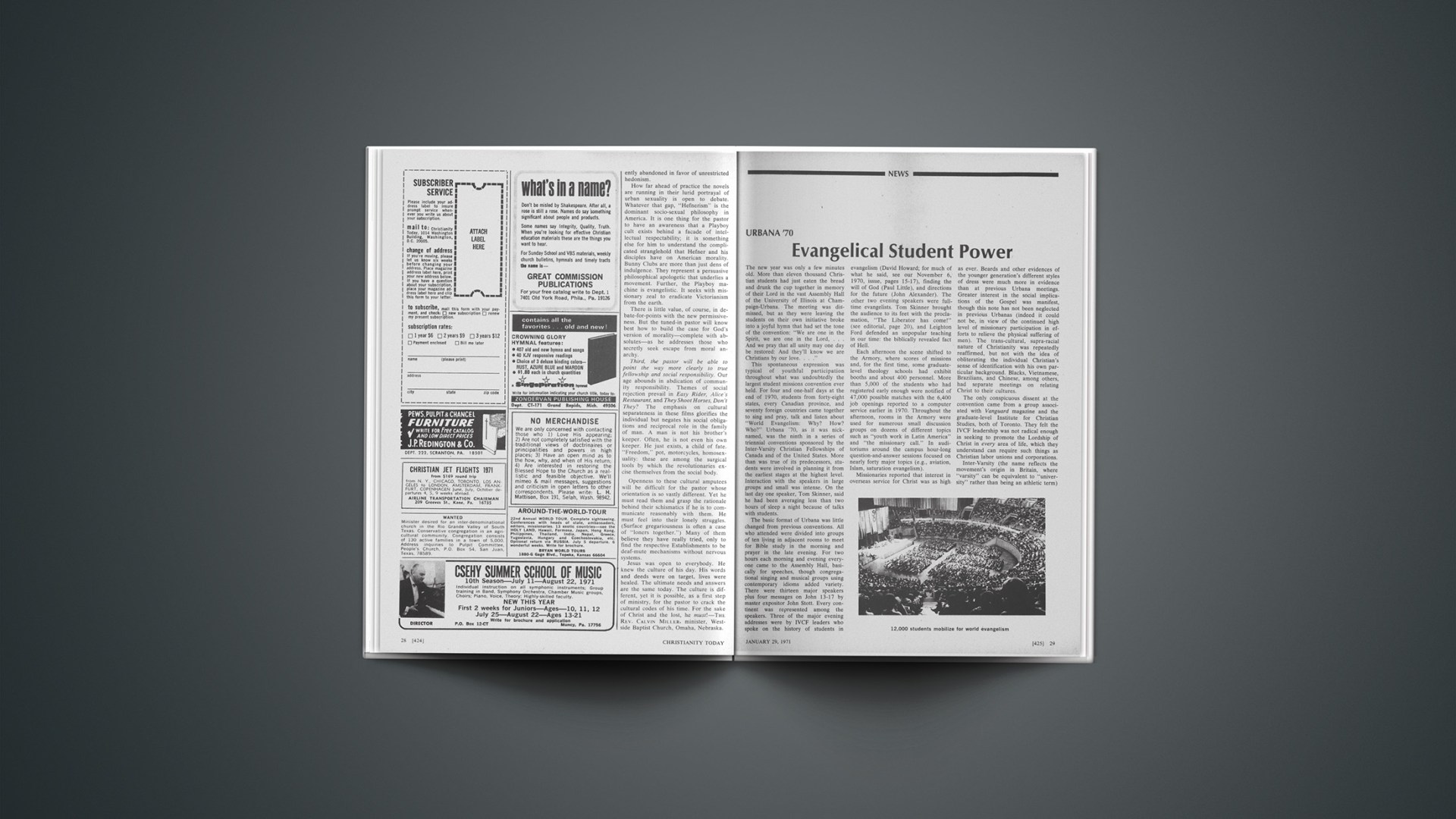
Urbana ′70: Evangelical Student Power

NEWS

The new year was only a few minutes old. More than eleven thousand Christian students had just eaten the bread and drunk the cup together in memory of their Lord in the vast Assembly Hall of the University of Illinois at Champaign-Urbana. The meeting was dismissed, but as they were leaving the students on their own initiative broke into a joyful hymn that had set the tone of the convention: “We are one in the Spirit, we are one in the Lord, … And we pray that all unity may one day be restored: And they’ll know we are Christians by our love.…”

This spontaneous expression was typical of youthful participation throughout what was undoubtedly the largest student missions convention ever held. For four and one-half days at the end of 1970, students from forty-eight states, every Canadian province, and seventy foreign countries came together to sing and pray, talk and listen about “World Evangelism: Why? How?

Who?” Urbana ’70, as it was nicknamed, was the ninth in a series of triennial conventions sponsored by the Inter-Varsity Christian Fellowships of Canada and of the United States. More than was true of its predecessors, students were involved in planning it from the earliest stages at the highest level. Interaction with the speakers in large groups and small was intense. On the last day one speaker, Tom Skinner, said he had been averaging less than two hours of sleep a night because of talks with students.

The basic format of Urbana was little changed from previous conventions. All who attended were divided into groups of ten living in adjacent rooms to meet for Bible study in the morning and prayer in the late evening. For two hours each morning and evening everyone came to the Assembly Hall, basically for speeches, though congregational singing and musical groups using contemporary idioms added variety. There were thirteen major speakers plus four messages on John 13–17 by master expositor John Stott. Every continent was represented among the speakers. Three of the major evening addresses were by IVCF leaders who spoke on the history of students in evangelism (David Howard; for much of what he said, see our November 6, 1970, issue, pages 15–17), finding the will of God (Paul Little), and directions for the future (John Alexander). The other two evening speakers were full-time evangelists. Tom Skinner brought the audience to its feet with the proclamation, “The Liberator has come!” (see editorial, page 20), and Leighton Ford defended an unpopular teaching in our time: the biblically revealed fact of Hell.

Each afternoon the scene shifted to the Armory, where scores of missions and, for the first time, some graduate-level theology schools had exhibit booths and about 400 personnel. More than 5,000 of the students who had registered early enough were notified of 47,000 possible matches with the 6,400 job openings reported to a computer service earlier in 1970. Throughout the afternoon, rooms in the Armory were used for numerous small discussion groups on dozens of different topics such as “youth work in Latin America” and “the missionary call.” In auditoriums around the campus hour-long question-and-answer sessions focused on nearly forty major topics (e.g., aviation, Islam, saturation evangelism).

Missionaries reported that interest in overseas service for Christ was as high as ever. Beards and other evidences of the younger generation’s different styles of dress were much more in evidence than at previous Urbana meetings. Greater interest in the social implications of the Gospel was manifest, though this note has not been neglected in previous Urbanas (indeed it could not be, in view of the continued high level of missionary participation in efforts to relieve the physical suffering of men). The trans-cultural, supra-racial nature of Christianity was repeatedly reaffirmed, but not with the idea of obliterating the individual Christian’s sense of identification with his own particular background. Blacks, Vietnamese, Brazilians, and Chinese, among others, had separate meetings on relating Christ to their cultures.

The only conspicuous dissent at the convention came from a group associated with Vanguard magazine and the graduate-level Institute for Christian Studies, both of Toronto. They felt the IVCF leadership was not radical enough in seeking to promote the Lordship of Christ in every area of life, which they understand can require such things as Christian labor unions and corporations.

Inter-Varsity (the name reflects the movement’s origin in Britain, where “varsity” can be equivalent to “university” rather than being an athletic term) began in 1929 in Canada, where it is now found on almost every English-speaking campus and also has chapters in high schools. The French-speaking work is still in its infancy. IVCF came to the States in 1940 and has chapters on more than 400 campuses that together enroll four-fifths of the nation’s students. In addition, a division for nursing students has 250 groups, and one to promote foreign missions at Christian colleges has well over 100 active chapters.

The two North American groups are part of a worldwide International Fellowship of Evangelical Students, which has some three dozen autonomous and indigenous national member movements and is aggressively seeking to create more. (One night at Urbana, the students were given an opportunity to donate to the work of IFES, and over $77,000 plus $18,000 in pledges was received.) The emphasis upon national autonomy and student, rather than staff, leadership at the chapter level is a key distinction between IFES and another student movement, Campus Crusade. Typically, an IFES member-movement staffer helps groups on several campuses, while several Crusade staffers combine to concentrate their efforts at one campus.

Besides campus ministries and Urbana, IV also sponsors His, a high-quality monthly aimed at collegians (its circulation surpasses 25,000), and Inter-Varsity Press, which in recent years has greatly expanded its range of books and become one of the top evangelical publishers. During the convention, book sales, mostly of IVP titles, amounted to more than $65,000.

Black students—over 400 of them—were more in evidence than before. A black, Bernie Smith, was song leader. Tom Skinner, also black, was one of the featured speakers. Although Skinner has not shrunk from denouncing aspects of white middle-class evangelicalism that seemed to him contrary to Scripture, even in the presence of those he’s criticizing, he said, he could find nothing to complain about in the way that IV leaders had conducted Urbana.

Indeed, the handling of the more than 12,000 registrants (25 per cent more than in 1967), when the university had only 9,000 beds for them, was masterful; convention director Paul Little was quick to acknowledge the providence of God. For example, the consistent Christian testimony of one businessman on the IV board led a Jewish acquaintance of his, when he learned of the situation, to see that 3,000 blankets were on hand just in time. An equal number of cots were purchased. There were a few foul-ups, of course, and there were many long lines in the dining rooms, but these were taken in stride. There was ample opportunity for demonstrating the refrain of the hymn, “They’ll know we are Christians by our love.” Long-distance operators manning greatly overloaded lines commented on the unusual patience of their callers.

Urbana ’70 was thousands of Christians from a wide variety of nations, races, classes, life-styles, and denominations exhibiting the unity that is the will of God for his people, and is especially symbolized in the sharing of the bread and the cup. But the coming together at Urbana was not to encourage Christians to withdraw into some kind of holy huddle until the Lord comes. Hanging in the Assembly Hall behind the platform were giant banners on which was inscribed the essential outward thrust of Urbana: “LOVE YOUR NEIGHBORS./ PROCLAIM THE GOOD NEWS./ GO MAKE DISCIPLES OF ALL MEN./ FOLLOW ME AND I WILL MAKE YOU INTO FISHERS OF MEN.”

Adapting An Outreach

A federal court suit in Virginia and shifts in modern educational methods have started the 35-year-old Children’s Bible Mission, headquartered in Lakeland, Florida, considering new appraaches in its ministry.

Myron H. Schuit, general director of the evangelical work reaching approximately 100,000 elementary-age children each month through seventy-five full-time workers in eight states, said the organization is weighing the manner of its outreach.

“It looks now as if we may go into a correspondence-course type of approach,” he said. “We probably would continue to use Bible clubs and released-time programs in schools where it is legal.”

The CBM’s work has centered on once-a-month programs in public schools. Some of them have been included in the school curriculum. Others have been a part of a released-time approach. And the rest have been after-hours meetings on school property.

The use of the public schools has been challenged in the Virginia suit, Schuit reported, and the organization is preparing to end that program if necessary.

He noted that the standard CBM approach of telling a Bible story and then involving the children in memorizing Bible verses fits in less and less with the teaching methods in secular subjects, where memorization has virtually been abandoned.

“For several years we have anticipated the possible need for changes in our work,” Schuit said.

ADON TAFT

Mcintire: On The Gateway To The Stars

“Freedom is everybody’s business,” Dr. Carl McIntire says repeatedly over the several hundred radio stations that carry his “Twentieth Century Reformation Hour.” And apparently, for him, at least, it is good business.

The tiny city of Cape Canaveral, Florida,1Although the cape was officially renamed Cape Kennedy when President Johnson took office, the city kept the former name of Cape Canaveral. severely depressed by cutbacks in the space program, once more began looking to the stars for its help. Before the year’s end, McIntire proudly announced before 100 television cameramen and newsmen that he was establishing on 300 acres of the city’s choicest commercial and waterfront property “The Gateway to the Stars.”

The city fathers beamed. McIntire’s new freedom center could mean only one thing—thousands of tourists with plenty of the stuff that makes Florida green.

A mecca for freedom lovers and sun worshipers it will be. Included in the 300-acre tract were a convention hall that can seat 2,000, the IBM Building, and 280 apartment units. The three-year-old, $4.5 million Kennedy Hilton was thrown in for good measure.

Almost simultaneously, McIntire announced he had purchased two more hotels in Cape May, New Jersey, home of a combination freedom and fundamentalism complex that last year attracted more than 50,000 persons and supports Shelton College. McIntire says he’s interested in “preserving the Victorian architecture that is the hallmark of America’s first seaside resort.” Despite the controversial nature of the Presbyterian minister, he’s good business for Cape May as well. “We’re the biggest taxpayers in the community,” McIntire said.

A symbol of the Cape May complex is a fleet of double-decker London buses which offer free transportation to the center’s ongoing Bible conferences and other activities that start full swing in June and go on into the fall. One of McIntire’s first moves was to ship two of the buses to Cape Canaveral and place an order for more.

Not that the buses figure into it, but McIntire sees a real shuttle service developing between the two centers, separated by about 1,100 miles. “Many of the same persons who will make use of the facilities at Cape May will want to continue by coming down to Cape Canaveral.” He will open the center next month and keep it operating through May.

Included in the package, besides 600 feet of oceanfront property and much more frontage on the Banana River, is the Boeing Administration Building, whose two stories will house McIntire’s second four-year college. “We plan to open in September,” the evangelist who claims to be “in step with God’s timing” said.

The Kennedy has been renamed the Freedom Center Hotel, but the college has not yet been named. This month McIntire, who purchased prime time on several of Florida’s key radio stations to push Jesus, freedom and his new enterprise, opened a nationwide contest to allow his friends in radioland to name the college. Speculation is that in this manner, somehow the McIntire name will appear.

The impetus for McIntire’s grand entry into the state where he says he gets a large percentage of his support came in the flurry of publicity over his March for Victory last fall in Washington. Among those who encouraged him to come and take a look-see at the convention center were now-replaced Governor Claude Kirk and Representative Louis Frey, Jr., whose district embraces the boom and bust Cape Kennedy area.

Ironically, part of the bust in the space program came because of the high cost of the war.

McIntire was playing coy about the purchase price, although his Christian Beacon newspaper carried in the same issue the purchase price of the New Jersey transaction. He indicated, however, that he would announce the price “in time.”

The evangelist said that although, as a religious non-profit corporation, he is normally exempt from paying property taxes on either property, his organization nonetheless will pay the full property tax.

He admitted that it was largely because the community has hit a depression that he fared so well. “But there’s one thing you’ll always have to consider,” he said. “This will always be remembered as the place where man left the earth and landed on the moon.

It will always be a place of interest.”

“We stand now on the gateway to the stars.”

WILLIAM WILLOUGHBY

Eight Sides To This Conversation Piece

The new building rising at the corner of 16th and I Streets Northwest in Washington, D.C., is Third Church, the downtown branch among the seven Christian Science churches in the nation’s capital. But the sixty-six-foot-high structure, made of what its designers say is “colorful architectural concrete,” already is a conversation piece in Washington, though its doors won’t open until at least this June.

The architect is Araldo Cossutta of New York’s famous I. M. Pei and Partners, designer of the new L’Enfant Plaza in Southwest Washington. Among the unusual features of the unusual church—it is but two blocks from the White House as the crow flies across Lafayette Park—is the location of Sunday-school classrooms on the fifth (top) floor. The octagonal building is designed so that all functions may be held above ground level in natural light. A sixty-two-car garage is under the site, with access to the church by elevator.

The site, owned by the Boston Mother Church, covers 17,560 square feet; about two-thirds of this has been leased by Third Church (first organized in 1918) for the new edifice. An open eighty-foot plaza is included in the plot plan, and a seven-story office building opposite the church will house the denomination’s Washington office for publication and the Christian Science Monitor capital bureau. The building will thus take on the role of a strategic center for sophisticated promulgation of Christian Science dogma.

The shape, design, and building materials of Third Church roused consternation in Washington Post architecture critic Wolf Von Eckardt (he doesn’t like the National Presbyterian Church and Center, either). Von Eckardt calls the Christian Science edifice “the big concrete bunker … rude … brutal … military … uncivilized … a chubby pillbox.…”

The Pastor As Cultural Apologist

Robert taylor begins his book, This Damned Campus, with a poem found tacked to the campus Protest Tree. Its first lines: C is for Chaplain, a regular guy, Who’s keeping his thumb in that pie in the sky.

Unjust indictments aside, let it be a challenge to make us occasionally probe with our other thumb into the contemporary cultural scene. Most churchgoers and non-attenders alike are ingesting a steady diet of the music, drama, and literature of the times. Yet the busy pastor, his attention riveted on the special concerns of the kingdom of God, is often unaware of the very mix in which he seeks to win and disciple new followers for Christ. A study of the current culture, despite its leanness in moral and spiritual content, can impart to the man of God a strategically beneficial awareness of his age, and of the real nature of the secularly soaked “Aquarians” to whom he ministers.

The risks are obvious. Reading certain best-sellers or attending “R” rated movies can have an addicting effect, siphoning off deep commitment. The study will require the highest integrity lest it degenerate into academic license for side trips into Vanity Fair. The pastor who dares to be a cultural apologist must daily reinforce his spiritual lifelines through prayer and Bible study. In every probe he must have the honesty to determine whether he is really acting to understand his culture, or is beginning to condone or even assimilate some of its ungodly aspects.

Beyond this, there is such a continual flood of contemporary materials that to try to sample the entire field would indeed be a foolhardy abuse of time. And a continuous input of contemporaneity can render a pastor so “this worldly” that he will be unable to represent sufficiently the other world of which he is both citizen and ambassador. But for a pastor with the maturity and consecration to manage it, this laboratory understanding of his culture will enable him to do several things communication-wise in confronting people where they are.

First, he will be able to combat the newer philosophies of despair. Many novelists and playwrights are turning out works whose central theme is human futility and despair. This is certainly true of such existentialists as Jean Paul Sartre, Albert Camus, and Tom Stoppard. But it can also be seen in Peter Weiss, Frederico Fellini, and Tennessee Williams.

This despair is substantially different from that pictured in older works such as Victor Hugo’s Les Miserables, Boris Pasternak’s Dr. Zhivago, the non-fictional Diary of Anne Frank, and A Day in the Life of Ivan Denisovich by Alexander Solzhenitsyn. When despair is pictured in these works, it is hopelessness imposed on the despairing by the culture—“from without.”

In modern literature (including screen plays), however, the despair originates philosophically in the human struggle for ultimate meaning. It is angst, the hunger for validity of life. Imposed “from within,” it originates inside the vacuous egos of playwrights and novelists who suffer not from a lack of material affluence or public adulation, but from a purely subjective dialectic that offers them only existential pessimism.

Since the Christian minister is a dispenser of the gospel of hope, he has a valuable contribution to make to the current scene. But before he can offer the angst-infected secularist the solution of Colossians 1:27 or First Peter 1:3, he might be asked whether Waiting for Godot is a more realistic view of life in an orbit of hopelessness. How much more authoritative if the pastor—while setting forth Christ as the only hope of humanity—could show the deficiencies of Samuel Beckett’s alternative!

Not everyone can have the intense awareness and deft skill of Francis Schaeffer (The God Who Is There) in countering this cultural despair with ultimate hope. But every pastor should seek a basic understanding of this hopelessness motif, then speak out positively.

Second, he will be able to make a pertinent apology for biblical morality. Cultural familiarity furnishes insight into the modern moral scene. One need not rear far in The Love Machine or The Couples or Portnoy’s Complaint to discover where part of the culture is. All restrictive behavior codes are apparently abandoned in favor of unrestricted hedonism.

How far ahead of practice the novels are running in their lurid portrayal of urban sexuality is open to debate. Whatever that gap, “Hefnerism” is the dominant socio-sexual philosophy in America. It is one thing for the pastor to have an awareness that a Playboy cult exists behind a facade of intellectual respectability; it is something else for him to understand the complicated stranglehold that Hefner and his disciples have on American morality. Bunny Clubs are more than just dens of indulgence. They represent a persuasive philosophical apologetic that underlies a movement. Further, the Playboy machine is evangelistic. It seeks with missionary zeal to eradicate Victorianism from the earth.

There is little value, of course, in debate-for-points with the new permissiveness. But the tuned-in pastor will know best how to build the case for God’s version of morality—complete with absolutes—as he addresses those who secretly seek escape from moral anarchy.

Third, the pastor will be able to point the way more clearly to true fellowship and social responsibility. Our age abounds in abdication of community responsibility. Themes of social rejection prevail in Easy Rider, Alice’s Restaurant, and They Shoot Horses, Don’t They? The emphasis on cultural separateness in these films glorifies the individual but negates his social obligations and reciprocal role in the family of man. A man is not his brother’s keeper. Often, he is not even his own keeper. He just exists, a child of fate. “Freedom,” pot, motorcycles, homosexuality: these are among the surgical tools by which the revolutionaries excise themselves from the social body.

Openness to these cultural amputees will be difficult for the pastor whose orientation is so vastly different. Yet he must read them and grasp the rationale behind their schismatics if he is to communicate reasonably with them. He must feel into their lonely struggles. (Surface gregariousness is often a case of “loners together.”) Many of them believe they have really tried, only to find the respective Establishments to be deaf-mute mechanisms without nervous systems.

Jesus was open to everybody. He knew the culture of his day. His words and deeds were on target, lives were healed. The ultimate needs and answers are the same today. The culture is different, yet it is possible, as a first step of ministry, for the pastor to crack the cultural codes of his time. For the sake of Christ and the lost, he must!—THE REV. CALVIN MILLER, minister, Westside Baptist Church, Omaha, Nebraska.

Eutychus and His Kin: January 29, 1971

WHEN ANGELS DANCED

Many of my friends are eccentrics. I state this without shame or regret, mindful of the birds-of-a-feather business. One of them collects unanswered or unanswerable questions. He delights in formulating questions to which the answer is obscure like “What was the significance of Bill Bailey’s fine tooth comb?”

He’s even happier when he can find a question that seems unanswerable—such as “What is the explanation for Hamlet’s seeming inability to take decisive action?”

The ultimate accolade of “unanswerable” is given to a question when two or more authorities give diametrically opposed answers.

I remember one occasion in high school when he discovered that medieval theologians posed such questions as “How many angels can dance on the head of a pin?” He went into an Ichabodian blue funk.

The shock of the sudden realization that he had been born into the wrong century was almost too much for him. “How could God do this to me?” he questioned. At the time I was even less of a theologian than I am now and had no answer. Eventually he recovered and went on to new heights of doubt.

A few weeks ago I made the mistake of giving him a collection of recent theological publications I was discarding. I didn’t see him again till we met yesterday at an alumni meeting.

He came over to my table happily waving a sheaf of papers. “Gee, I don’t know how to thank you!” he said. “Those religious magazines are great!” I was puzzled at first. “I didn’t really know you were so interested in theology,” I said.

“I’m not,” he said. “I’m interested in questions. And these things are gold mines,” again waving the sheaf of papers.

Then I realized the papers were pages from those nearly discarded magazines.

“Why didn’t you tell me before this?” His tone was slightly accusing. “I’ve stayed away from religion because I thought it was full of ultimate answers. Here I was contenting myself with superficial questions like ‘Where did Cain get his wife?’ when I could have been asking ‘What is ecclesiastical renewal?’ and ‘What is the anachronistic mind of the believers in the old Individualism?’—or even ‘Who or what is the cosmic Christ?’ ”

“As a matter of fact,” he continued, animation mounting, “I have found so many conflicting statements by the theological experts that I have already classified several questions unanswerable: Is there a God?, What is mission?, and How can you know anything?”

I said hesitantly, “Now that you’ve read those publications, why don’t you try reading the Bible?”

“Why?” he eagerly responded. “Is it full of questions too?”

Next time around I’ll burn my old magazines.

KEEPING SIGHTS STRAIGHT

The article on religious broadcasting, “The Problems and Prospects of Evangelical Radio,” by William R. Wineke (Jan. 1), was superb.… I also find that you pack one surprise an issue and I found it this week in editorials. “Disobeying Orders” was about the best defense I have heard against the rhetoric of the far right.… I could go on and … praise the reviewer of Tom Skinner’s latest books but suffice it to say that I find your publication invaluable in keeping my sights on the goal of the Kingdom and its universal quality.

Oak Brook, Ill.

Your editorial on Commander Eustis did not go far enough. When the axe falls it should get the root of the tree, not just do a little pruning. You blistered Eustis as well you should. But what about … the tarnished brass at the top?

Taylor Avenue Church of God

Lebanon, Mo.

WEAK REASONING

I found the article “Second-Class Citizenship in the Kingdom of God” (Jan. 1) to be exegetically weak and scripturally out of context. Galatians 3:28 was grossly misused. The New Testament, including Galatians 3:28, does not abolish the natural, creative orders when a person becomes a son of God. If we follow the reasoning of the author to logical conclusions, we will not only abolish the male, female order of headship and submission, but also all creative differences must be abolished.… Perhaps Paul’s question in Galatians 3 would apply to the article: “Having begun with the Spirit, are you now ending with the flesh?”

Mount Olive Evangelical Lutheran Church

Anoka, Minn.

I have now seen it demonstrated that you can quote the Bible to prove anything. Although I do not always agree with the position taken in your articles I can usually respect the scholarship of the author and the quality of the article. I am sorry to say that Ruth Schmidt’s article has absolutely nothing to commend it.

Are we to understand that Paul’s explicit instructions concerning women’s role in the church are only his “personal bias”? Should we not then conclude that they are not “profitable for doctrine, for reproof …”? The author apparently does. I am surprised that CHRISTIANITY TODAY would allow such a low view of inspiration in its pages.

Electra Community Church

Electra, Tex.

I am in full agreement with Ruth Schmidt! God ordained that women be used in his worship services long before Christ came to this earth. They were used in such high offices (as judges), and even a prophetess named Anna confirmed what Simeon told the people about Christ.

Springfield, Ohio

Thank you so much for Ruth Schmidt’s article.… I’ve been watching … for one like that for several years now. We can only hope that soon evangelical Christians will see that there are more options open to women to serve Jesus Christ than ever before.…

It was heartening to note that the author clarifies the difference between wives and women. So often verses are used to keep women down when they are referring to the marriage relationship and not relationships between all men and all women.

(Mrs.) BEVERLY WILLIAMS

Saint Cloud, Minn.

OPINIONATED IMPLICATION

Contrary to the inference in the editorial “Religion on the Big Board” (Jan. 1) the Lutheran Church in America does not endorse pre-or extramarital intercourse.

Part of the statement on sex, marriage, and family adopted by the fifth biennial convention of the Lutheran Church in America at Minneapolis, Minnesota, in June and July of 1970 reads:

Because the Lutheran Church in America holds that sexual intercourse outside the context of the marriage union is morally wrong, nothing in this statement on “Sex, Marriage, and Family” is to be interpreted as meaning that this church either condones or approves premarital or extra-marital sexual intercourse.

It should be the goal of every editor to have the facts carefully separated from his opinions.

Blaine Lutheran Church

Blaine, Wash.

OPINION VS. COMMANDMENT

I was quite surprised to read that Dr. Runia in part two of “What Do Evangelicals Believe About the Bible?” (Dec. 18) does not believe that there is any place in the Bible where Paul distinguishes between what he believes as his personal opinion … [and] what he is writing as “God’s word.” Yet, Paul says in First Corinthians 7:6: “I speak this by permission and not of commandment.” And in First Corinthians 7:10 Paul writes, “And unto the married I command, yet not I, but the Lord”.… [These and similar] references make it perfectly clear, it seems to me, that there were times when Paul wishes to make it very clear that it is Paul the man who is giving his opinion of judgment, and that it is not God, who is speaking with the binding authority of divinity and eternity.

Lexington, Mass.

FOR YOUR INFORMATION

The introduction to the article by Hendrik Kraemer, “The Church in Search of Mission” (Jan. 1), failed to indicate that his book, The Christian Message in a Non-Christian World, from which the essay was taken, is still available through Kregel Publications, Grand Rapids, Michigan 49501 ($5.95).

Kregel Publications

Grand Rapids, Mich.

NO LACK OF LIBERTY

In the editorial “Holding the Line on ‘Parochaid’ ” (Dec. 18) you state that the more the government gives money to independent schools, the more their liberty will be sacrificed. This is a popular misconception, and I think that careful reflection will reveal the opposite.

Financial favoritism to one kind of religious philosophy, namely, the humanistic secularism of the government schools, is a realistic way to stifle educational liberty. For most people are unable to pay for two educations: one in the government schools and another in an independent school.… Few tuition-charging schools can compete against the free schools of the state.

If CHRISTIANITY TODAY is to continue its opposition to equal aid for all children in all schools regardless of race, color, or creed, it should abandon its stance of trying to rescue the independent schools from government control. For in reality its stand is causing the schools to close down daily and send their children to humanistic schools against their religious convictions.

Executive Secretary

A Contemporary Translation (A.C.T.)

Wayne, N.J.

ARTFUL CONFUSION

After having read the note in Personalia (Dec. 18) of the National Press Club’s annual art show entry—a bust of Vice-President Agnew—entitled: “Judges 15:15, 16,” I wasn’t sure if the allusion was to the V.P. as an ass, the jaw-bone of an ass, or as Samson. Neither could I be sure that within the scriptural context there wasn’t an allusion to the Press Club as the 1,000 slain, the uncircumcised, the hollow place, or the god who clave the hollow place out of which all must drink.

Hyland Baptist Church

Henderson, Ky.

GOD IN THE STADIUM

Your editorial “God and Games” (Nov. 20) indicts all of the clergymen who have ever prayed at such sporting events. The majority of these men, I believe, were sincere before God. It would also indirectly indict all Christians who attend such events, for if God can’t be invoked there, should Christians be there?… [Such prayers] encourage many hearts to look Godward.… Would not the singing of the national anthem also be perfunctory to many? If so, should not such “disrespect” be eliminated by banning the song? And what about prayer at … the presidential inauguration?

New Life International

Long Beach, Calif.

DISMAYED

I am continually dismayed at the cynicism and sarcasm your writer uses when writing on the subject of homosexuality. I have been a recipient or subscriber to CHRISTIANITY TODAY since its inception. For me it has always filled a great need in reporting evangelical Christianity, and I have defended it against what I believed to be unfair criticism.

For some reason unknown this area of life seems to be galling to your reporter, and the material is not presented in an unbiased manner.… Some research into the subject … would prove helpful to him and to your readers.

Dean

Samaritan Bible Seminary

Los Angeles, Calif.

• Samaritan Bible Seminary is sponsored by a group of homosexually oriented churches which Mr. Ploen serves as elder.—ED.

NO DESIGNATION

In reference to Paul Witte’s article “Can Catholics Learn Anything from Evangelical Protestants?” (Dec. 18) I have only one question. Why any designation at all? Why can’t we be Christians only?

Overlake Christian Church

Kirkland, Wash.

Ecology of the Spirit

All citizens, Christians most of all, should be troubled about our environment’s pollution. “Ecology” is a vital concern. Clean air is essential to health, as is clean water. Contaminated food should be eliminated as should roadside pollution.

Air pollution has come with the industrial age and the automobile, and water pollution results when we dump waste into our streams and rivers. Excessive noise also is part of the problem.

At one time we hailed DDT as one of man’s greatest boons, but now we know this poison remains in the ground or in the water harming our natural resources. The discovery of wide-spread contamination of fish with mercury is shocking.

Suddenly we are talking about “life or death,” or “life and breath,” and some are panicking. Pollution is a great danger, but if our scientists work on it, and the population cooperates, the problem will be solved.

But what about the ecology of the spirit? What about those things that are polluting the minds, hearts and spirits of all people? The answers to these questions lie with individual Christians and with the church.

The tragic fact, however, is that the church is not fulfilling her responsibilities in this area. The concern about social, economic and political issues increases, while the concern about spiritual pollution wanes.

Unfortunately, the church is contributing in some instances to the lowering of moral and spiritual values leading to spiritual pollution. (This began with church endorsement of “situation ethics.”)

Three major denominations cooperate in publishing Colloquy, which provides “resource material” for those engaged in Christian education. In the March, 1970, issue an article by a guest editor derided parents who taught their daughter Christian principles about sex but approved of the girl’s pre-marital sexual activities and drug-taking. This magazine continues to be published with the official approval of the denominations involved.

Two of these denominations cooperate in the publication of another magazine, Church and Society. In the March–April issue a prominent woman employee of the church wrote an article, “Female and Single—What Then?,” in which she advocates that the church encourage lonely, retired persons to live together, unmarried, to provide “loving companionship and sexual enjoyment.” She also suggests that single women should be permitted to establish “sustaining relationships” with married men that could involve coitus, and that the church should be “open” to such arrangements. Finally, the author derides fidelity to the marriage vows and urges the church to consider establishment of communes patterned after those in Scandinavia. In these communes men and women form “families” without marriage.

I protested to a staff member of my own denomination, whose name appeared on the masthead, asking him what had been done about this article and its author. Without approving or disapproving her ideas, he merely defended the author’s freedom to write such an article.

Then I wrote to the executive secretary of the Board of Christian Education of my denomination. His courteous reply stated that one in his sister denomination revealed that “a Task Force on Sexuality … had asked that this particular article be written and made available to conversation.”

After receiving his answer I sent copies of the article along with a personal letter of protest to individual members of the Board of Christian Education. I haven’t received a reply; the board is hiding behind the action of the General Assembly that approved Colloquy as “source material.” But the offensive article appeared in Church and Society.

Soon after this I read an article by a minister of another denomination who had attended a “continuing education seminar” in a Midwestern city. Not only were revolution and violence advocated, but one day was devoted to an “encounter with human sexuality.” (One speaker told how LSD had “enlarged her sexual appetite.”)

During a regional conference for students, a youth leader of my own church had hung on the walls of his hotel room pictures so offensive that the head of the hotel forced him to remove them.

Why recount these sordid facts? Because unless the church comes to her senses and banishes from places of leadership those who are aiding the pollution of the spirit, God’s judgment will fall.

The Bible is explicit about these things. One of Christ’s beatitudes has to do with purity of heart, a purity he typified. All things that contribute to pollution of the spirit should be denounced and those who espouse them dismissed.

The word of the Lord to Ezekiel can be applied to the church today: “Her priests have done violence to my law and have profaned my holy things; they have made no distinction between the holy and the common, neither have they taught the difference between the unclean and the clean …” (Ezekiel 22:26).

The apostle Paul lived in a time of licentiousness and degradation, and writing to the Ephesians he warned: “Take no part in the unfruitful works of darkness, but instead expose them. For it is a shame even to speak of the things they do in secret” (Eph. 5:11, 12). Before this he said: “Let no one deceive you with empty words, for it is because of these things that the wrath of God comes upon the sons of disobedience” (vs. 6).

Today’s trend is increasingly brazen in portraying and exploiting immorality. Only the church is left to stand for purity. Only the church has the message to make men’s hearts and minds clean. Only the church knows of the detergent that makes pure the souls of men: “The blood of Jesus his Son cleanses us from all sin” (1 John 1:7b).

Those concerned for the welfare of our young people, and for the witness of the church against any and all things that contribute to the pollution of the spirit, need to know who is teaching what in this area. If the church contributes to the spiritual pollution of our generation, “Ichabod” will be written across her portals.

EDITORIALS

At the beginning of his public ministry Jesus returned to the synagogue in his boyhood home of Nazareth and read to the congregation from the prophet Isaiah: “The Spirit of the Lord is upon me, because he has anointed me to preach good news to the poor. He has sent me to proclaim release to the captives and recovering of sight to the blind, to set at liberty those who are oppressed, to proclaim the acceptable year of the Lord.” Then Jesus declared: “Today this scripture has been fulfilled in your hearing” (Luke 4:18–21). The mammoth convention of students at Urbana, Illinois, at the close of 1970 (see News, page 29) was essentially a reaffirmation of this startling announcement.

“The Liberator has come!” With these words, evangelist Tom Skinner concluded his address on the second night of the convention, and brought the twelve thousand member audience to its feet with thunderous applause—applause for the speaker, yes, but even more for the Liberator he proclaimed. Among the many titles of Christ, “Liberator” has not been in common use, though “Redeemer,” a term with similar meaning, has been. But as the world gropes about in the anxious seventies, the designation of Christ as Liberator seems especially appropriate. Certainly it was implicit in many of the currents at Urbana.

Christ liberates from aimlessness. Men in rebellion to God have become captive to Satan and hence to the loss or perversion of purpose and meaning in life. Urbana reaffirmed the concern of God that men walk in the ways that he has intended. Only in this way the peace and joy that God intends to accompany life will be found. And the eagerness with which students sought information and counsel from older Christians, as well as from one another, testifies to the desire of many young people to follow God.

Christ liberates men from oppression. Both the victim and the persecutor are (in differing ways) in bondage. Jesus wants to set both free. While still enslaved in body, the Christian can be free in spirit, as has often been demonstrated through the centuries. But in America many white, middle-class Christians are, at least passively, more often identifiable with those who do the oppressing. Many of the speakers at Urbana dealt with this theme at varying lengths. It often goes under the name of “social concern” but it is as much in one’s personal interest, in anticipation of being called to account by God for what he has done and left undone, for all men to be liberated from acting as oppressors.

Christ liberates men from nationalistic and racial bondage. Too often the cause of Christ has been identified with the causes of some nations. The applause of the students at various remarks indicated their approval of the disentangling of the Gospel from Americanism. “Jesus Christ does not wear red, white and blue,” declared Leighton Ford. Christians who, even if unintentionally, imply that Christ is an American must rightly expect the rebuke of the liberated generation. So also with race. Black Christians pay a high price in the disapproval by their unsaved peers for associating with their white brothers. But they do so willingly because Christ has liberated them from having to draw their meaning in life solely from racial solidarity and exclusiveness. White Christians who maintain myths of racial superiority and practices of racial discrimination need the stinging rebuke of those who have, by Christ, been liberated from such worldly bondage as racism.

Christ liberates men from bondage to self. Hell is for those who want to be individuals unrelated to others. Those who are bound for heaven have been set free into a community of brothers and sisters to work and worship and love in every dimension of life, personal and corporate, sacred (for Christians only) and secular (aspects of life in which non-Christians participate as well). Urbana reaffirmed the social implications of the good news that the Liberator has come, while at the same time making it clear that each man must, for himself, accept the Liberator as Saviour and Lord.

Throughout the centuries God has repeatedly used young persons to break forth into new conquests for Christ and to reclaim lost or understressed aspects of the truth which he has revealed. If the enthusiasm, sensitivities, and dedication of those who came to Urbana is representative and persistent, God is indeed bringing new vitality into his people. Such vitality is especially welcome at a time when the world is trying to run its affairs apart from the creator and sustainer of all. May older Christians join in mutual penitence and joy with younger Christians to proclaim through word and deed the good news that the Liberator has come.

A Gulf Spanned At Calvary

Two and half years ago Calvary Chapel, astride the Santa Ana-Costa Mesa boundary in southern California, had a typical cross-section congregation of 150. In 1970 more than 4,000 accepted Christ in the church (see News, page 34). Pastor Charles Smith has baptized more than 2,000 in the Pacific Ocean since May. Thousands of others trace their spiritual heritage to Calvary.

This population explosion was touched off when the church opened a house from which it could reach into the youth drug scene for Christ, and hired a bearded young convert and his bride—Lonnie and Connie Frisbee—to head it up. Soon, in a new sanctuary that seated 300, Calvary had to schedule double, then triple morning services. Recently the church knocked out walls; services are still crowded out.

Most of the thousands of new faces are young “street Christians” who look and talk very much like their peers out in the streets, except that their faces radiate joy and the subject of their conversation is—more often than not—the Lord Jesus Christ.

Calvary is living proof that non-institutional-minded contemporaries and tradition-bound elders can worship together in mutual acceptance and respect. Only five members left because of the youth influx. The cultural gap was bridged, says Smith, during common labor on church building projects: “Businessmen making $25,000 a year and hippies who never held a job saw the love and joy of Christ in each other.”

Smith, who studied at Biola Bible College and the American Baptist seminary at nearby Covina, insists that his preaching is no different from before, and the same order of service is followed as five years ago. His morning sermons are expository, based on ten new Bible chapters assigned to the congregation for study each week. Evening services are question-answer sessions on the same chapters. (Interestingly, the street set prefers to use the King James Version.) Smith is a charismatic, but speaking in tongues and healing are not emphasized in Sunday services.

Why do so many thousands of young people flock to Calvary? Linda Mehler replied that she had been an Episcopalian and a Morman but that Calvary’s people were different: “They weren’t into religion and church; they were into Jesus and the Bible and love.”

A growing number of parents and even grandparents, having seen dramatic changes in the lives of their young, are now attending—and finding Christ and a fellowship of love. Middle-aged Look photographers Jack and Betty Cheetham said they ended a “hate trip” at Calvary (see News, page 34).

The love does not stop at the door. Converts from Calvary are fueling much of the spiritual fire now burning in West Coast states. These activists are proving the song they sign is true; “They’ll know we are Christians by our love.”

Refreshingly, Calvary is pointing the way in a day when so many young Christians tend to write off the institutional churches and when so many older-generation believers, if not downright hostile toward the young, turn their heads and pass by on the other side. We firmly believe that a great spiritual ground swell is building up and may soon flood into the American scene. Christians, young and old, need to open the floodgates to the love of Christ and the power of the Holy Spirit.

Key 73: Bridge Over Troubled Waters

At a time when the nerve for mission seems cut by a lack of confidence within the Church, can evangelicals be used by God to help rekindle the Christian faith? “We can,” says the Reverend Joe Hale, “if pointedly, specifically, and openly we invite other Christians to walk with us, or, perhaps more importantly, we walk with them the road of witness in 1973.”

Hale, director of ecumenical evangelism for the United Methodist Board of Evangelism, was talking about Key 73 during a conference on New Styles in Cooperative Evangelism at the United Methodist Congress on Evangelism in New Orleans this month (see News, page 32). Key 73 is an evangelism movement that seeks to confront every person in North America with the Gospel more fully and forcefully through witness at the individual, congregational, and national levels. Varied programs, determined by the churches that join, will culminate in a year-long effort in 1973.

Hale pointed out that the Key 73 Central Committee, in its meeting last December in St. Louis (see January 1, 1971, issue, page 43), voted to invite Roman Catholic and Orthodox participation in Key 73. Some conservatives in Key 73 have reacted negatively to that decision. Nevertheless, we feel it was wise; there are many in the Catholic and Orthodox communions who are committed to biblical evangelism.

Evangelism and the euaggelion are for the whole Church; the Gospel is not a bone to be growled and fought over by segments of the Body of Christ. The planners of Key 73 wisely drew up broad outlines: the common bond for participants (there are now seventy-three denominations and religious groups involved) is allegiance to Jesus Christ. “Differences in doctrine will be recognized and respected,” a policy statement says. “Varieties in evangelistic expression are expected and will range from traditional forms to vastly new, innovative styles of witness.”

To quote Hale (his enthusiasm is contagious) again: “The concept of Key 73 turns me on.… It is the whole Church speaking.… It may generate a movement of Christian advance that will extend like a tidal wave around the entire globe.” We hope and pray that when our brethren in the Roman Catholic and Orthodox churches receive their invitations, they will respond with wholehearted support and participation.

Christian Endeavor At 90

This magazine reported last year that the once-great Christian Endeavor youth movement was showing new signs of life after a period of decline, and this year CE Week (January 31-February 7) is getting more attention in local churches than it has had in a long time. The Rev. Charles W. Barner, general secretary of the International Society of Christian Endeavor, says requests for organizing kits have hit a thirty-year high. Thus CE enthusiasts mark the movement’s ninetieth anniversary February 2 on an optimistic note.

New interest in Christian Endeavor comes at a time when church youth programming materials produced by many large denominations reflect a secularizing trend that is often stoutly resisted at the grass roots. Planners of all theological stripes are somewhat at a loss as to how to adapt to today’s youthful turbulence. The rally idea used successfully by Youth for Christ after World War II now seems to have limited appeal. The Bible-club approach still has momentum, but innovations are needed.

Development of effective new curriculum materials is probably the big challenge and opportunity facing CE—and, for that matter, all other youth programmers. We have the most literate crop of young people the world has ever produced, and unless their minds are creatively engaged with the cause of the Gospel, alien ideologies will wrest their attention. CE can best honor its late founder, the Rev. Francis E. Clark of Williston Congregational Church in Portland, Maine, by applying itself to the task with renewed intensity.

Though officially creedless throughout its history, CE in its primary thrust has been unabashedly evangelical. It currently has impressive representation in the inner city as well as in suburban and rural areas. These factors point to a bright future if CE leaders bring more young people into their decision-making processes and develop materials that are relevant to the crucial needs of these days.

Financing Murder

One of the most apparent manifestations of moral rot in America is the recent liberalization of state laws on abortion (see also Current Religious Thought, page 38). Human life is now being exterminated at a rate probably not equaled in any war this country has ever fought. Authoritative estimates indicate that 250,000 legal abortions are performed in the United States each year. Precious few voices are raised in protest against this mass homicide of unrestricted abortion on simple demand. And at a time when Christians are becoming involved, on all levels, in political and social efforts, to ignore the question of abortion is a serious mistake.

Compounding the evil is the fact that government (through Medicaid) and insurance companies are defraying the costs of an increasing number of abortions. Society, instead of protecting the helpless unborn, is financing their demise. Never mind that millions of people regard abortion as murder. Their tax dollars and insurance premiums are appropriated along with the rest.

God does not overlook such evil. Let it be no great surprise when America is subjected to severe judgment. The guilt belongs not only to legislators and insurance executives but also to rank-and-file citizens who fail to speak against this wickedness.

Bang Bang

These days, clothes talk. Perhaps the loudest accessory to hit the fashion bull’s-eye recently is a three-pound belt of brass cartridges linked together and fastened by several dummy bullets. What the bullet belt aims to communicate is not entirely clear. Some charge that it says, “Bang, you’re dead.” Others claim its message is, “Better belt it than blast it.”

At least, say those fired up about it, the bullet belt is loaded with fun. Perhaps, but their good humor shoots down good taste. The belt may even be a plowshare of sorts—a macabre sort that retains sword-like characteristics. That it belts a potential big bang even the United States Treasury Department warns: converting cartridges into live ammunition is not only hazardous to one’s health but also illegal without a license.

There must be a more telling accessory for the fun-loving, fashion-conscious peacemaker. A Bible belt maybe? At least that’s a belt with something to say.

Neighborhood Pilgrims

Beginning in February, more weekend pilgrimages will be possible through the new holiday schedules. Although boredom already threatens a generation frantic with efforts to keep moving, leisure time continues to increase, and many advocate a four-day work week. In this mobile age, pilgrims flock to beaches and ski resorts, parks and camps. The variety of weekend pilgrims rivals Chaucer’s famous congregation (many of whom journeyed to Canterbury for diversion, and not because of relitious fervor).

Traveling was popular long before Chaucer made it prominent. Today people seem to consider it the only way to spend holidays. Suggestions to relax, putter, or read are disregarded. Reading and meditating seem rather incompatible with what we call the pace of modern living. There is no time for such things, people insist. Well, there is—particularly on a three-day weekend at home. Read about those pilgrims to Canterbury. Better still, take another look at Acts and learn about a famous pilgrim for God—Paul. And after reading about Paul and his fellow travelers, discover what you, in your own neighborhood, can do for God and your fellow pilgrims.

San Francisco: Sodom Revisited

Last month San Francisco Examiner publisher Charles Gould and his editors decided to stop abetting “the dispensers of depraved ‘entertainment’ ” by bringing advertisement practices into closer alignment with what the newspaper’s editorial pages preached. “We do not seek to impose the Puritan ethic on the community in general or our readers in particular,” they announced editorially. “However, we can no longer permit our advertising columns to be exploited by the panderers of moral pollution.… We should have thrown this ugliness out … long ago. We are sorry we delayed. It is out now. And it will stay out.”

We applaud their decision. They said that for years they had urged movie makers and night club operators to “upgrade and improve” their ads. But this approach, they correctly observed, “merely laundered the advertising … and thus tended to hide the slime of the shows being presented.” The “slime” they cited: movie houses showing women engaged in sex acts with animals; films showing groups of perverts performing vile acts that demoralize homosexuals who seek a higher way of life; films showing prostitutes performing sordid acts that defy description; films showing young girls being beaten, raped, and defiled in sexual aberrations practiced “only by those with maniacal or criminal minds.”

They could have mentioned more. The topless clubs on Broadway feature not only nudity but also simulated sex acts. Shops that openly sell hard-core pornography flourish throughout the city. Nearly one hundred bars, nightclubs, and theaters cater to the homosexual population, estimated to be over 50,000 on weekends. These and other conditions are giving San Francisco an international reputation as the Sodom of our day.

The Examiner’s editors received no guidance from the courts, whose permissiveness has opened a sewer outfall into the very lifestream of society. The Supreme Court decreed, for example, that “community standards” should determine what is and what is not obscene. But, declared the editors: “After witnessing the results of this decision, we are now convinced that community standards do not determine what is pornography. Quite the contrary. We believe the results in San Francisco are proof positive that proliferating pornography creates debased community standards.… We are denouncing the sexual depravity on film and stage that can—and does—breed moral pollution and social degeneracy.”

The depressing situation calls for action and prayer. The city’s Christians should firmly and vocally support the Examiner’s position in the face of threatened lawsuits. It is time for the courts to re-draw the boundaries between liberty and license, this time favoring the greater welfare of society rather than the greed and corrupt nature of the moral subversives. And citizens, without flagging, should prod both government and the filth merchants. We commend the hundreds of young Christians who picketed in protest on Broadway a few months ago; “business” almost came screeching to a halt. The youthful evangelicals did more than protest. They reached for the ultimate solution—changed lives. Dozens of persons received Christ during witness encounters on Broadway.

The Christian effort is admittedly only a drop in the proverbial bucket. More than 450,000 of the city’s 750,000 population claim no religious affiliation whatsoever. In some neighborhoods of 10,000 or more, no churches exist. And the moral spiral speeds downward with little restraint.

We challenge the Christians in and around San Francisco to get involved in the spiritual struggle for the soul of that city. God said he would spare Sodom if some righteous people could be found.

Getting Things From God

One of the purposes of prayer is for Christians to get things from God. He owns the cattle on a thousand hills and he will supply the needs of his children if they petition him to do so. Getting things from God, of course, is not all there is to prayer. Adoration, thanksgiving, and confession too are a part of praying. Here, however, we want to consider the question of getting specific answers to prayer for personal needs, loved ones, friends, and others.

With three words—ask, seek, knock—Jesus laid down the principles of getting things from God. These words have important differences in meaning; yet they are related.

To ask means we should come to God telling him what we want. James says that “you have not because you ask not.” Stated another way, “he who does not ask does not get.” God has graciously ordained the method by which we can expect to get things from him—we must ask!

Asking must be complemented by seeking. Seeking is the human side of this prayer relationship with God. At times there is nothing that Christians can do except wait on him. But most of the time action is necessary. The man who asks God for a job should go out and look for one. The farmer who prays for crops should plow, plant, and cultivate. Asking God does not remove man’s responsibility for doing what he can to bring about the desired result. A story is told about Dwight L. Moody traveling on an ocean liner when a fire broke out. A dear brother in Christ suggested that they go to their cabins and pray. Mr. Moody said, “You pray; I’ll pass the water buckets.” There is a time to pray and a time to work.

Jesus also said we are to knock. This means twofold perseverance; we are not to stop asking until we have received and we are not to stop seeking until we have found. It is always too soon to quit. We are not to become fainthearted and we must continue the pursuit until the answer comes.

Asking, seeking, and knocking are God’s orders for those who expect him to give.

Book Briefs: January 29, 1971

More From C.S. Lewis

God in the Dock, by C. S. Lewis (Eerdmans, 1970, 346 pp., $6.95), is reviewed by Cheryl A. Forbes, a member of the staff ofCHRISTIANITY TODAY.

These essays were collected and edited by the late C. S. Lewis’s private secretary, Walter Hooper. Written over a twenty-four year period, they were originally published in various obscure newspapers and magazines.

Hooper has divided the book into three parts. The first section contains essays that are theological, focusing on miracles. The title of the book comes from the second part: “The ancient man approached God (or even the gods) as the accused person approaches his judge. For the modern man the roles are reversed. He is the judge: God is in the dock” (p. 244). This group of essays discusses problems that are “semi-theological”—they are neither theology nor ethics. The essays in part three treat various ethical topics. The editor has concluded the book with letters by Lewis to various newspapers and magazines on many of the same topics. The tone of Lewis’s essays is never somber, but always serious. His ideas are presented with wit and clarity, without gloom and pessimism.

Some of the ideas found here also can be found in his other books. The essay on miracles is a simplified, greatly shortened version of his book on the subject. But most of the essays will be new to the majority of readers. Some overlap each other, and a few are repetitive. “The Trouble with X …” and “ ‘Miserable Offenders:’ An Interpretation of Prayer Book Language” say the same thing. In too many of the essays example and illustration are repeated, but there is enough variety to compensate for this.

The topics range from miracles and the question of animal pain to sociology and vivesection. One essay, “Priestesses in the Church?,” should infuriate all members of the Women’s Liberation Movement. But his argument cleverly developed from Pride and Prejudice should delight any who admire an intelligent, well-conceived argument.

An interview of Lewis conducted by Sherwood E. Wirt in May, 1963, will interest many evangelicals. Wirt’s language is not that of Lewis, and his attempt to translate Lewis’s ideas into the language of “decision” is interesting but unnecessary.

For those who know little of C. S. Lewis or his ideas this book is a good introduction, perhaps better than Christian Reflections (also edited by Mr. Hooper). God in the Dock contains some of the best of Lewis’s witty apologetics. And for those who have long known and loved the writings of Lewis, this volume is a welcome addition.

Scholarship Come Of Age?

The Bible and Modern Doubt, by Mack B. Stokes (Revell, 1970, 286 pp., $5.95), is reviewed by Watson E. Mills, associate professor of philosophy and religion, Averett College, Danville, Virginia.

One ironic consequence of the historical-critical method of biblical study has been that, just as the human race was “coming of age” and advancing into the future with unprecedented rapidity, scholarship was learning how to push the New Testament backward into the past and even imprison it in a specific time segment. The result was a vast chasm being opened between the first and the twentieth centuries. A serious historical dichotomy was born creating a painful paradox: the more we understand the ancient faith, the more irrelevant it appears for our twentieth century world. It is indeed tragic that critical reconstruction has gradually, however unwittingly, served to make the New Testament more and more remote and less and less relevant.

It is no wonder, then, that there has been a resurgence of interest in hermeneutics. Professor Mack B. Stokes, Associate Dean and Parker Professor of Systematic Theology at the Candler School of Theology, Emory University, has given us a stimulating volume that aims at challenging the Christian to think about his Bible. Stokes hopes—not in a critical sense—to engage the reader in a dialogue by reflecting upon some of the contemporary doubts about major themes of the biblical revelation. He is writing for the general reader rather than the sophisticated theologian—an extremely commendable and refreshing direction!

The author builds his case upon four assumptions: (1) that the major teachings of the Bible are true, but this cannot be taken for granted any longer; (2) while the Bible is relevant, this must be shown through careful interpretation; (3) the major teachings are indispensable to the Christian religion; and (4) the major teachings move in a direction opposite from prevailing modern ideas (pp. 5, 6). Given the audience to whom the book is directed, these suppositions, however simplistic, seem acceptable. He follows this with four principles of biblical interpretation that are well worth pondering. These undercut biblical literalism that results in a piecemeal view of revelation, and encourage the reader to regard the biblical record in terms of the living God whose revelation is dynamic, not static, and confirmed in experience, not in the laboratory.

Parts one through four are respectively theological, anthropological, soteriological, and ethical in emphasis. Part four is the most readable and rewarding. Specifically, chapter fifteen, dealing with race relations, will afford the layman a needed look at the problem from the perspective of sound biblical theology. Stokes suggests specific biblical passages that bear upon the problem, and shows how commitment to the truths of the Christian faith necessarily excludes racism.

While the author presents the major alternatives to such crucial issues as God, alienation, and redemption, the basic question seems to be whether or not Christians are willing to take the Bible seriously. This well organized volume deserves serious consideration because it presents the issues clearly to that segment of Christendom that so desperately needs to know what the questions are as well as how to move toward positive answers. This volume gives a resounding “amen” to a statement made a few years ago by Leander Keck: “There is a way to read the Bible which opens the door to vital faith, without shutting the door to critical thought.”

Christianity Anti-Sexual?

The Christian Response to the Sexual Revolution, by David R. Mace (Abingdon, 1970, 142 pp., paperback, $1.75), is reviewed by David E. Kucharsky, associate editor, CHRISTIANITY TODAY.

David Mace, a Quaker, is professor of family sociology at Wake Forest and former executive director of the American Association of Marriage Counselors. He seeks to “bring home plainly the urgent need for a Christian reinterpretation of sex.” He is deliberately vague on what behavior pattern should emerge, but the direction is clearly away from an objective code. “Sexual intercourse in marriage,” he contends, “can be as immoral and exploitative as it can be outside marriage.”

Christian standards of sexual morality should be based “on the ethical teaching of Jesus,” Mace suggests. The criteria by which the ethics of any sex act should be judged are seen in these questions: “What would it do to me as a child of God and a follower of Christ? What would it do to my sexual partner, who is my neighbor to be loved as myself? What would it do to the family, and to the well-being of children?”

This is regarded as the “healthy” biblical view of sex as opposed to some of the things Paul taught about women and marriage which, Mace intimates, were conditioned by Greek philosophy. The writer of Revelation is accused of having been corrupted by Oriental and Neoplatonic dualism because he said that the 144,000 had not been “defiled with women.”

Mace sees some objectionable aspects in promiscuity and pornography, but what bugs him most is that Christianity has been an “anti-sexual” religion these 1,900 years. And it seems not to occur to him that repressive attitudes toward sex with all their unfortunate consequences have nonetheless been more conducive to human progress than pagan permissiveness.

Missionary Vision

Student Power in World Evangelism, by David M. Howard (Inter-Varsity, 1970, 129 pp., paperback, $1.25), is reviewed by Donald McGavran, dean of the Graduate School of World Mission and Institute of Church Growth, Fuller Theological Seminary, Pasadena, California.

Student Power is the best brief book available on the evangelization of the world. It is fair, balanced, and soundly historical. It sees world evangelization in perspective. It uses facts correctly. Its picture of the part students have played in world mission is accurate.

The book, rising out of the student movement, is written by a young man for the now generation. Howard knows college and university students and their hangups about missions. He uses the contemporary dialect well—and is up-to-date enough to call “tell it like it is” a cliche. He will be read with pleasure and profit in universities and colleges all across the United States and should be translated into Spanish, Portuguese, Japanese, and other languages.

Brevity enhances the value of the volume. A sound, biblical base in both Old and New Testaments, a wide historical approach, and contemporary issues have been compressed into 120 interest-packed pages. Readability is high. Thought moves briskly. Young men and women will study the book chapter by chapter with a sense of newness and advance at every session.

In the current confused era following the collapse of European empires and the rise of over a hundred independent sovereign nations, foreign missions is concluding a major job of self-renovation. Inevitably, reconstruction has been accompanied by criticism and disparagement of the old. Voices, sometimes shrill, denounce “paternalism” and “cultural imperialism.” The errors of missions and missionaries have been overemphasized. The goal was to make missions more effective; but the Church-at-large, seeing missions clobbered every sunrise, grew rather pessimistic about the whole enterprise. David Howard restores the balance. He says each student should ask himself: “Even if missions have made mistakes, what has this got to do with my obedience to God as regards the evangelization of the world?” Student power has still to be applied to the fullest in evangelization of this generation.

This small volume has been produced for the more than eleven thousand students who attended the Ninth Inter-Varsity Missionary Convention, and it was used there to good effect; but it should be used in thousands of other places. Missionary-minded ministers and laymen all over America should get this little volume, study it, and use it with their youth. Student Power can help denominations everywhere recapture their missionary vision and obedience.

Newly Published

One Divine Moment, edited by Robert E. Coleman (Revell, 1970, 123 pp., paperback, $1.95). The revival that began at Asbury College on February 3, 1970, is vividly described along with some of its effects in following months elsewhere.

The Theology of Altizer: Critique and Response, edited by John B. Cobb, Jr. (Westminster, 1970, 269 pp., $7.50). The respectful criticisms of nine scholars representing various positions (none evangelical), together with Altizer’s responses.

King James II New Testament, by Jay P. Green (Associated Publishers and Authors, 1970, 252 pp., paperback). Despite the choice of name, this is not a translation in honor of the last Roman Catholic king of England (1685–88), the one that was finally defeated in the north of Ireland by the forces of William of Orange. The format, English style, and textual basis are all little changed from the King James I. Regrettably, there is no indication where changes have been made or where alternative renderings are possible.

Philosophy and Education in Western Education, by John A. Stoops (Interstate, 1971, 424 pp., $7.95). A textbook that introduces the concepts of philosophy, touching on a few important philosophical orientations of Western civilization (idealism, Thomistic synthesis, pragmatism).

Four Minor Prophets: Their Message for Today, by Frank E. Gaebelein (Moody, 1970, 252 pp., $4.95). These expository addresses on Obadiah, Jonah, Habakkuk, and Haggai have been extensively revised to make a devotional commentary. The author was at one time co-editor of CHRISTIANITY TODAY.

Pray in the Spirit, by Arthur Wallis (Christian Literature Crusade, 1970, 126 pp., paperback, $1.25). Starting with the importance of baptism of the Holy Spirit, the author explores the Spirit’s role in prayer, including tongues-speaking. He cites numerous examples of mystical experiences.

The Opaqueness of God, by David O. Woodyard (Westminster, 1970, 160 pp., paperback, $2.65). A brief introduction to Barth, Bultmann, Bonhoeffer, Van Buren, Ogden, Buri, Pannenberg, and Moltmann.

Ezekiel, A Commentary, by Walther Eichrodt (Westminster, 1970, 594 pp., $12.50). A translation of perhaps the most important recent scholarly commentary on this major prophet.

This Little Planet, edited by Michael Hamilton (Scribner, 1970, 241 pp., $6.95). The only drawing factor about this book, which rehashes the basic issues in ecology today, is the introduction by Senator Edmund S. Muskie.

Roger Williams: Witness Beyond Christendom, by John Garrett (Macmillan, 1970, 306 pp., $7.50). A valuable scholarly work portraying Williams as the biblically guided figure that he was.

Preaching From a Pentecostal Perspective, by Sam F. Middlebrook (Vantage, 1970, 112 pp., $3.75). Sermons by faculty members at the leading Bible college of the International Church of the Foursquare Gospel.

Eyes on Europe, by W. Stuart Harris (Moody, 1970, 156 pp., paperback, $1.95). A helpful, popular, somewhat subjective, country-by-country survey of evangelical presence.

Ben Israel: The Odyssey of a Modern Jew, by Arthur Katz with Jamie Buckingham (Logos, 1970, 207 pp., $4.95). The author leads us through his search for meaning in life—from Communism to hedonism and finally to the recognition of Jesus as Messiah. He found peace when he entered into a “covenant” relationship with God.

Quattlebaum’s Truth, by Mark Gross (Harper & Row, 1970, 145 pp., $4.95). A poor attempt at originality in the discussion of the standard “Who am I? Who is God?” questions.

Hellenistic Ways of Deliverance and the Making of the Christian Synthesis, by John Herman Randall, Jr. (Columbia, 1970, 242 pp., $7.95). Useful for studying the religious background in which Christianity arose, culminating in Augustine, but the author’s evaluations (of Paul, for instance) do not commend themselves.

The Resurrection of Jesus of Nazareth, by Willi Marxsen (Fortress, 1970, 191 pp., $2.95). By one who does not believe it actually happened, yet still claims to be a Christian.

Between Honesty and Hope, translated by John Drury (Maryknoll, 1970, 247 pp., $2.95). Thirty documents since Vatican II issued by Roman Catholic leaders of Latin America.

Conquering the Fear of Death: An Exposition of First Corinthians 15, by Spiros Zodhiates (Eerdmans, 1970, 869 pp., $9.95). Those who liked the author’s other prolix commentaries (i.e., James, John 1; Matt. 5; 1 Cor. 13) should like this one, too.

Dictionary of Pagan Religions, by H. E. Wedeck and Wade Baskin (Philosophical Library, 1971, 363 pp., $10). If you want to know about Oannes, Hohodemi, Ba, and the like, here’s your source.

Some of the above books will later be reviewed at greater length.

In The Journals

A scholarly journal devoted to the person and work of the Holy Spirit from the Pentecostal viewpoint is Paraclete (1445 Boonville Ave., Springfield, Mo. 65802; single copy $.75). Articles in the Winter, 1971, issue include “The Working of Miracles” by R. L. Dresselhaus, “Chrysostom and the Charismata” by A. T. Floris, and “The Spirit’s Authority in the Old Testament” by D. B. Pecota.

American Leadership in World Missions

Just before the atomic bombs were dropped on Japan, I was on leave from the Royal Air Force and read an article by Norman Grubb on the future of missionary work. He expressed the view that although for many years Great Britain had been the leader of the world-wide missionary enterprise, a new day had dawned. Just as political, economic, and military leadership had passed from the old world to the new, so would spiritual and missionary leadership.

As I look back over the intervening twenty-five years, two facts stand out. First, it was striking that at a time when everybody was thinking of little else than how to finish the war, here was one man who was already planning the peace—so far as missionary work was concerned—and doing so with remarkable accuracy.

The second fact that comes to mind is the difficulty I had in accepting the truth of what he had written. When one’s own country has dominated the scene for many years, it is not easy to accept the fact that her influence is on the wane, and this was much harder for the older people than for the young ones. I remember showing the article to an older Christian who rejected it indignantly and commented, “Britain is not finished yet.” National pride and objective judgment make uncomfortable bedfellows.

Now we can see how accurate that forecast was. Before World War II, Britain supplied approximately two-thirds of all the Protestant missionaries in the world. Soon after, it was the United States that was providing two-thirds of the personnel, as well as a much larger percentage of such specialized services as Christian radio, literature, aviation, and linguistics. But Britain was not finished. Although in the past twenty-five years the contribution of the British church to the cause of world evangelism may have dwindled statistically, anybody who has seen the impact of the ministry of John Stott at the Inter-Varsity Missionary Conventions at Urbana, or seen something of the impact of the British Inter-Varsity publishing program overseas, or the influence of British and commonwealth missionary personnel, knows that it still has a vital role to play.

Just as 1945 marked a change in missionary leadership, so could 1970. Kenneth Scott Latourette has observed that missionary leadership has usually been exercised by the nation that holds the place of economic and political leadership in the world. Historically this has been so, but the present age has several distinctives that may radically change this principle. We need to ask ourselves, Does this mean that missionary leadership is about to pass from the United States? And if so, to whom is it passing?

It is likely that future historians will consider 1956 one of the turning points in world history, and it is instructive to review some of the events of that year.

1. It was the year that Great Britain was discredited by her disastrous venture in the Suez Canal.

2. There was the revolution in Hungary that was suppressed with such brutality by Russian tanks that even many people who had been pro-Russian were disillusioned. This disillusionment was felt not only in neutral countries but also in the Communist parties of such countries as France and Italy.

3. Khrushchev denounced the Stalin cult of personality.

4. France granted independence to Tunisia and Morocco.

All these events gave impetus to the movement toward national independence and weakened confidence in the big nations. Prior to that year, the whole world had been mesmerized onlookers as the two giant powers, Russia and America, maneuvered for position and advantage. Now the small nations gained in number and confidence as they were wooed by both East and West.

General de Gaulle seems to have been one of the first statesmen to see the implications of this, at least as far as the eastern European countries were concerned, and to shape his policies accordingly.

We have witnessed a significant reversal of the pattern of history. Previously the pattern had been for small nations to be eliminated by various great nations. Now we have seen a situation in which great countries are continually bringing about the creation of new small nations. One out of three people alive today lives in a country that has been independent for twenty-five years or less. This is the day of the small nations, all of them conscious of their rights and privileges. And these attitudes bear directly upon missionary work.

This process coincides with remarkable developments in the United States itself. In the fifties and early sixties, America experienced a remarkable degree of prosperity in religion in general and Christianity in particular. Americans who have not spent extended time in older countries—and have therefore not seen a contrast—rarely appreciate the extent of this boom, or the effect it had on the missionary contribution.

Recent years have witnessed a decline of much of this interest. Although the decline has often been exaggerated by talk of the “post-Christian era,” church attendance is indeed diminishing, and the state of the Church in America today should lead us to think furiously (though not to panic).

Accurate comparative figures for missionary recruitment are hard to compile because there have been changes in the pattern of missionary service. There are now more specialized and service agencies, more short-term missionaries, more forms of non-professional missionary service. Moreover, some missions do not like to be very frank lest their supporters get the impression that the mission is on the decline. It is probable, however, that there is a fall-off in the number of recruits. Among college students I have seen more interest in foreign missions but less commitment to actual service.

Some of this is to be expected. The increase after World War II was somewhat artificial in the sense that the war itself left a backlog of missionary recruits, a manpower reserve that swelled the number of missionary recruits for some years as men finished their education.

Fifteen years ago there was a period when all over the United States missionary budgets were expanding and money was relatively easy to get. To have a missionary budget that grew larger year by year was the hallmark of a spiritual and vital church and a badge of evangelical respectability. The financial resources of the evangelical church in the United States are still enormous compared with those in other countries, but they no longer seem inexhaustible. In many well-known missionary churches, a plateau seems to have been reached. There are as many explanations of this as there are missionary speakers, but they are beyond the scope of this article.

In many parts of the world there is a growing disenchantment with things American, and it does not make missionary work for Americans any easier. It is no new experience for missionaries to be working among people with whom they are not popular; what is different now is that we are no longer in the age of gun-boat diplomacy, and countries can easily expel all missionaries. Even if they let missionary work continue, they are apt to be choosy about whom they want in their country.

And the critical attitude toward the Westerner is not limited to the governments. A good number of evangelical Christians in churches overseas resent interference and are far less tolerant than they used to be of American leadership. Often the most innocent of actions and opinions are wrongly construed. A missionary friend of mine who is unusually progressive and sensitive was on a panel with some other men when a question was asked about birth control. When my friend pointed out some of the problems of the population explosion, he was told bluntly that he took that view only because like all other Westerners he wanted to keep down the population in younger countries lest he be outnumbered. This critical attitude is sometimes accompanied by a request for financial aid “with no strings attached.”

The situation is further compounded by the internal anguish that is tearing apart the social structure of the United States. The alienation of youth from the Church is a threat not only to the home church but also to its missionary program. To be sure, some churches are coping with this problem; but too many young people have told me they have given up going to church because it is irrelevant and dead for me to take this development lightly. What makes it so serious is that many of these young people have not “lost their faith,” nor are they malcontents; they are consecrated, idealistic Christians who feel that their churches today are out of touch with reality. And often their view of missionary leadership is similar to their view of church leadership.

What should be our response to tighter money and falling recruitment? Probably the most obvious reaction is to upbraid the youth for their unwillingness to undertake a missionary life of sacrifice, and to criticize the Church for lack of sacrificial giving. It is certainly good to consider the fact that what we see is a failure on the part of God’s people, and a healthful type of self-examination is always in order. However, another possibility should be considered.

A decline in the number of American missionaries overseas could be the will of God for this time. It may hurt our pride to admit that God can push us aside and use other nations, but we shall do well to remember that God used Germany to be the spearhead for his purposes during the Reformation, and that it pleased him to use Great Britain for leadership in world evangelization a century ago just as certainly as he used the Church in the United States for the last twenty-five years. God can easily pass on this role to other nations, and indeed it might be to the everlasting good of those nations if he did. The missionary hope of the world is not the United States of America; it is the Lord (though to hear some missionary addresses one would not think so).

There are strong churches in Africa, Latin America, and Asia, and in these days when there is so much resentment against the white man it would be appropriate for spiritual leadership to be exercised by a group of nations in a kind of fraternal partnership rather than by one giant.

Will this be so? It is too early to know. But if it does happen, will we be ready to recognize it and accept it in good grace, or will our national pride get in the way?

To some extent we have been too influenced by the thinking we developed during World War II, when we learned that sheer weight of numbers and economic production coupled with American courage and ingenuity could bring victory against any foe. But we are living in the day of Viet Nam and have learned that victory by the great and powerful is not always so easily guaranteed.

We have not always used our missionaries well. Perhaps too often exorbitant amounts of money have been spent in sending large families to the field so that the expensively trained man can spend his time in maintenance work that could be performed more economically by a national.

With our passion for measuring spiritual blessings by statistics and our confidence in methods and techniques, we may yet need to hear God say to us as he said to Gideon, “The people with you are too many … lest Israel vaunt themselves against me, saying, ‘My own hand was delivered me.’ ” It is well to note that the Lord said that only after the “Spirit of the Lord took possession of Gideon.” After all, in the eyes of the statisticians, Jeremiah was something of a washout, and in the eyes of the specialists in church growth, Samuel Zwemer left a lot to be desired!

Spiritual blessings cannot be measured by the acre, nor missionary effectiveness by the body count or the budget. The American role in world evangelism in the future is going to demand a great deal of imagination and, above all, humility. God can fit his Church to meet this hour.

Eric S. Fife is a former missionary director of Inter-Varsity Christian Fellowship. He has written “A Highway for our God” and is co-author of “Missions in Crisis.”

The Touchstone of Truth and Value in Religions

Is there a touchstone by which all religions may be compared to determine their truth and value? Many have thought there is. Before the modern era, it was common to seek this basis of comparison in the doctrine of God, or of man, or of salvation, or some other central doctrine. But within this century other touchstones have been sought. Schweitzer sought to find it in either their affirmation or their denial of reality to the world, life, and morality. Tillich says it is in their explanation of the meaning of purpose of existence. Toynbee says it is their handling of the problem of suffering. Radhakrishnan says it is their common unity and tolerance found in common symbols and inner certitude of the same truth in all.

Two of these with a Christian orientation, Schweitzer and Tillich, go on to conclude that Christianity is superior to other religions when judged by the touchstone they regard as best. The other with a Christian orientation, Toynbee, ends up about equally divided between Christianity and Mahayanian Buddhism. The fourth, Radhakrishnan, with a Hindu orientation, concludes that ultimately all religions will find their fulfillment in something resembling Hinduism.

All efforts to analyze religions and the history of religions merit study. Each of the four just mentioned is in its own way meaningful. And just as in Christian theology the many theories of the atonement add to our understanding of that mystery, so in the history of religions the many theories of their relations help us to understand more of that mystery. But just as in any theory of the atonement the preeminence must always be given to the Person, Jesus Christ, so in the history of religions the preeminence must always be given to the person or persons around whom each religion is built. And that, it seems to me, is the clue to the supreme touchstone by which all religions may be most properly compared.

In his book Why Christianity of All Religions?, Hendrik Kraemer has pointed to the uniqueness of the personality of Jesus Christ as being the thing above all others that proves Christianity to be the only religion that can claim to be a revelation from God. This is in line with what has been his major premise ever since the publication of his first great work in 1938, that Christianity is “discontinuous” from all other religions.

The proposal I am making approaches the problem from another angle. This proposal gets strength from our experience with the Old Testament as well as the New. The exact relation between the Gilgamesh Epic, including the account of the Creation and the Deluge, and the biblical record of those events, the exact relation between the Code of Hammurabi and the Hebrew Book of the Covenant, is not clear; there are both similarities and differences between them. But the real difference is on the personal level, in the concept of the God who was behind all these events and who gave all these laws.

So when we compare Christianity with other religions, we may expect the touchstone of comparison to be that of the personal founder of each religion, the person in whom each religion centers. We have a right to expect this because we are persons and our problems are personal problems. Truth is not something abstract. Ethics is not something abstract. Both truth and ethics ultimately have a personal foundation. Brunner’s statement, “Schemes of ethics will differ as metaphysics differ,” is nowhere more apt than in the comparison between Hinduism and Christianity. What a religion thinks about distinctions between good and evil depends on what it thinks about the person in whom it centers. And we have a right to expect that the founder of a religion, or the person around whom a religion is developed, will in himself, by his acts, his teaching, and his manner of life, collectively or separately, provide an answer to our problems.

All the great religions are centered in some person or persons. Yet if we removed from each its founder, all except Christianity would still go on. If we removed Jesus Christ from Christianity, however, there would be no Christianity. At first glance, this seems to be a weakness of Christianity and a strength of other religions. It seems to show that other religions have an inner strength, an inner truth, an inherent reason for existence, apart from the founder, that sustains them; that they depend for their following, not on the attractiveness of their founder, not on the strength of their founder, but on their appeal to the reason and conscience of their followers.

But we need to look deeper. We are persons. Our problems are personal problems. And ultimately we need a religion with a personal founder who has given more than a speculative answer to our questions, more than a dogmatic solution to our problems, one who has personally exemplified for us what is involved in his teaching. We cannot be sure of the ultimate truth or value of the religion we follow until we see its teaching proven in a person. It is at this point that the proposals of Schweitzer and Tillich and Toynbee and Radhakrishnan are inadequate for proving the comparative truth or value of religions. These proposals are based too much on speculation.

The reality or non-reality of the world, of life, and of morality—these are profound speculative problems with which all religions have dealt. The solutions to these problems must be found preeminently in a person, and the point where the solutions meet will be personal. Tillich is essentially Greek in his constant reiteration of the meaning of existence as our basic problem, and his assertion that God is the Ground of Existence. To him, our problems are basically philosophical. So his approach to the truth and value of all religions is philosophical. But the more basic question will be: What light does the founder of each religion in his own person give us regarding the meaning of existence?

Krishna’s self-consciousness led him to claim that he came into existence again and again from age to age by his own power of Maya. “Many of my births have passed away,” he says: “Though unborn, though My Self is eternal, though Lord of Beings, resorting to my own material nature, I come into being by my own mysterious power” (Gita 4:5, 6). To Buddha, the whole world seemed filled with suffering, and he became the Enlightened One when he realized the truth that escape from the wheel of suffering could be achieved by the cessation of desire. The teachings of both Krishna and Buddha were based on the doctrine of transmigration and reincarnation. And their claims are antithetical to the claim Jesus Christ makes when he speaks of the glory that he had with the Father before the foundation of the world (John 17:5, 24). With Christ there is no mention of a previous birth or of a previous incarnation. Jesus Christ is set forth as the incarnation of God in full reality, full of grace and truth, once and for all—the Word become flesh, who was tempted in every way that we are, but did not sin (John 1:1, 14; Heb. 4:15; 9:28). The personal claims of the founders, then, are different, and become the points at which the basic differences of the religions may be tested.

For a further example, note how the doctrine of salvation is made personal in the personal claims of Krishna and Christ. Each claims to be a saviour; each claims to be easily accessible; each claims that knowledge of and faith in him is necessary to salvation; each claims that he will come and abide in the one who believes in him. But when we ask what kind of salvation each provides, a great difference appears. Krishna offers salvation from the round of rebirths to identification of the Individual Self with the Supreme Self. Christ offers salvation from sin to righteousness, from Satan to God. The chief antithesis is in the Person, not the claim made by the Person. Christ is an atoner; Krishna is not. Krishna is a saviour who saves without cost to himself; Christ is a saviour who suffers the agony of a cross in order to redeem.

We may find some common metaphysical grounds for all religions, many common ethical ideals, and many common symbols of faith. But this does not justify the conclusion that all roads ultimately lead to God. Some lead to a dead end. Some wander around aimlessly and never get anywhere. And on the road that leads to God, one can go two ways, toward God and away from God. It is not only the power of the person who was lifted up on the cross to draw all men unto him that is important here. It is the assurance that he himself by his death and resurrection has become the Way, the Truth, the Life, and the Resurrection, and that he will draw us along the right road. For no founder of a religion except Jesus Christ has ever claimed—to say nothing of proving his claim—that he himself is the one sure road that leads to God.

Truth and love and life and resurrection are more than abstractions. They are personal. And it is at this personal level that all religions can most properly be compared to determine their truth and value. If the reality of the world and of morality is to be affirmed or denied, it must be at the personal level. If the meaning of existence is to be found, it must be at the personal level. If the meaning of suffering is to be found, it must be at the personal level. If there is anything common to various forms of religious faith and symbols and experience, it must be at this personal level. And it is preeminently here that all other religions fail. The persons in whom they center or from whom they originate do not bear either the holiness or the love, either the authority or the submission, either the majesty or the humility, of the Person of the Son of God, Jesus Christ, our Saviour and our Lord. Yet it is by this touchstone of the person that the real gold in each religion may be found.

Jesus in his Person was Truth. He exemplified Truth. He personified Truth. He did more than teach truth; he was Truth. He exemplified Love. He personified Love. Others have exhorted their followers to love one another. But Jesus could point to himself, to his example, and add the dynamic: “A new commandment I give to you, that you love one another, as I have loved you.” The new thing was not love for one another but “as I have loved you.” Jesus did more than teach love; he was Love.

The problem of suffering is probed deeply by the Hindus in their doctrine of karma and retribution, based upon transmigration and reincarnation. But even they recognized their need for some other explanation when their Great-Souled One, (Mahatma) Gandhi, was assassinated in 1948. His death contradicted their laws of karma and retribution. The theories and speculations were not enough, and they turned to the cruel death of another person, Jesus Christ, for an explanation of the sufferings of their great leader. But that was as far as they could go. They could not go on to the resurrection of their Mahatma. Jesus did more than teach about resurrection. He was and is the Resurrection.

Jesus did not speculate on how temptation entered the world, nor why it should be there. He met it head-on, conquered it, and returned from the conquest filled with the power of the Spirit. He did not lecture men on sinlessness. He lived a life of complete holiness and love, and silenced his critics with the challenge, “Which of you can convict me of sin?” He did not argue that God answers prayer. He prayed, sometimes all night, and when he met men in the morning the power of the Lord was with him to heal. He did not attempt to argue how pain and sorrow in the universe can be compatible with the love of God; but he took on himself at the cross the very extremity of the pain and tragedy and wickedness of man, and thereby revealed the love of God. As E. Stanley Jones once said:

Many teachers of the world have tried to explain everything; they changed little or nothing. Jesus explained little and changed everything. Many teachers have tried to diagnose the disease of humanity; Jesus cures it. Many teachers have told us why the patient is suffering and that he should bear it with fortitude; Jesus tells him to take up his bed and walk. Many, like Socrates, have argued the immortality of the soul. Jesus did not argue. He raised the dead.

One who has been a devotee of one religion and then converted to another can see their comparative truth and value better than one who has remained loyal to his own religion while studying others from the outside. And the experience of Sadhu Sundar Singh rings true and valid in that light. He came to Christianity from the Sikh religion, a reform movement that grew out of Hinduism and condemned its idolatry. He exemplified religious devoutness; his name, Sadhu, means “holy one.” After his conversion he was approached at a youth conference by some young people who wanted to get his answers to some of their questions. They began by asking, “Sadhu, why did you feel it necessary to leave the Sikh religion and join the Christian religion? Was it the higher moral code of the Bible? Was it the belief that the Christians are right in claiming that the Bible is the inspired Word of God? What was it that made you change?” The Sadhu did not have to spend much time in thought before he gave the answer: “My reason for changing was Jesus Christ.” The students pressed further. “Sadhu, what did Christianity offer you that your mother’s religion did not offer you? You say your mother was your example of devoutness. What did you find here that you didn’t find there?” And he answered slowly with only two words, “Jesus Christ.” Then they tried another direction and asked what the central doctrine of Christianity was. Again came his reply, “Jesus Christ.” Finally they asked, “Sadhu, what reward does Christianity offer you that no other religion offers you?” He solemnly replied: “Jesus Christ.”

The touchstone of truth and value in religion is the personal founder in which the religion centers. We are standing on bedrock when we point to the Person, Jesus Christ, as the center of our faith and the center of our proclamation.

Maurice Blanchard, pastor of Austin-Second Baptist Church, Chicago, was for twenty-five years an American Baptist missionary in India, serving 1951–66 as a seminary president and New Testament professor. He has the Th.D. (Northern Baptist Seminary), and has written twelve books in the Telugu language of South India.

The Challenge of Student ‘Idealists’

But do the students stand for anything?” As a university professor, I was participating in a panel discussion of the issues involved in the student strike of May, 1970, when a member of the audience asked the question. The setting for this discussion was significant: university professors, students, and interested non-students were gathered in the fellowship hall of a large evangelical church after the Sunday evening service. The discussion engendered some moments of animated exchange, particularly when members of the audience spoke of the “negative” aspects of student protest, especially at public colleges and universities supported by tax funds: the destruction of property, the repudiation of government policy, the rejection of nationalist pride, and the nonconformist modes of conduct.

Several in the audience had come to the forum, not to listen, but to react because they felt that their values, derived from their social background, education, and religious belief, were threatened. Others, sharing these same values, had come to ask questions and to listen because they were genuinely puzzled about why students were acting as they were. In general, the impression of the campus protesters held by the audience was that students were sure of what they were against but had nothing positive to offer society, that “if the Viet Nam war were over tomorrow,” students would find some other issue about which to demonstrate.

My reply that evening to the question was inadequate, for I merely emphasized that today’s students, like the young people of any era, are idealists and that the ideals dominant on the campuses of the 1970s require special insight from society in general. To speak, however, of a single, monolithic student population with a single set of goals is misleading. Rather, the student body on the larger campuses of the nation has the heterogeneity of any urban community in America. Special interest groups often have specific aims that may not be shared by the rest of the student body: black separatists are such a group, as are other disadvantaged students, Marxist revolutionaries, and the few anarchists. A large percentage of the student body echoes the pragmatism of middle-class America; these students may be politically concerned, but they are inactive with regard to most social questions. Their code of conduct is largely governed by what society expects of them, and they plan to achieve security by following their parents’ life style, despite the generation gap on such issues as sex, marijuana, ecology, and war. As a result, these students are content to “get an education,” find a job, marry, and buy a home. And if a student who is motivated toward achieving material and social security is not already a member of the middle class, he may well be the son or daughter of a blue-collar worker, aspiring to the life pattern of those above him socially.

Another significant number of students are engaged in actively rejecting this same middle-class life style. Usually raised in an atmosphere of material security, these students have worked out a set of ideals so different from that of their parents and of those holding power in society that they feel alienated—and unable to communicate with anyone outside their peer group. These are the “idealists” of the student body in the sense that they reject the materialism of capitalistic society. They are also secular in their approach to life, for they have no religious training and operate as though God were irrelevant to their personal needs. “Pascal should not try to convince us that his God exists because for us it doesn’t,” wrote one of my students concerning the Pensées. In essence these secular idealists are cultural relativists; they would not dream of imposing their personal life styles and codes of conduct on anyone else, though they often try to persuade society that it has humanitarian obligations. Such students pose a unique challenge to the evangelical community, for they espouse many of the ideals of Christ but reject the institution of the church and the life style and world view of most church members.

Perhaps the slogans and slang of the secular idealists provide a key to their attitudes. (Many of these idioms have passed easily into the national vocabulary and have already been replaced by others within the closed social group of the young.) They always use the phrase “up tight” in a pejorative sense to describe anyone who is nervous and tense about small—or important—matters. Certainly the expression denotes one kind of reaction to the neurotic world of the suburbs: the stresses of business competition, the cocktail circuit, and the accumulation of status symbols. But it is also the phrase of a generation profoundly aware that they are the children of an “age of anxiety” and that anxiety cannot be a way of life without destroying the individual. Another negative expression describes the evasion of reality, responsibility, or truth—“copping out.” Anyone can cop out, but parents and the “establishment” are particularly guilty. They have hypocritically mouthed ideals and willfully refused to acknowledge their failure to follow these ideals, creating a world of hatred, suffering, and injustice. A third phrase has a positive force, representing the desire of college youth to liberate themselves from restrictive inhibitions and to decide what they think is best for themselves. To “do one’s own thing” is to declare one’s independence and define one’s own personality—to do what one feels comfortable doing without worrying about what other people think. Key slogans that indicate other positive values of the idealists might be “make love, not war,” or simply “peace.” If there is one aspect of the religionless life style of such college youth that should challenge the religionists of our era, it is certainly their belief that love, selflessness, and sharing are important goals in life. While the situation ethic of the young may occasionally seem shockingly immoral or impulsive to those who are orthodox, few Christians could deny that love, selflessness, and sharing are laudable concepts.

So a generation of youth has opted for honesty, self-expression, freedom from inhibitions, spontaneity, sharing, love—and has rejected authority as hypocritical and the middle class as materialistic. The choices these idealists are making are fraught with dangers, however, for they are frighteningly on their own. Let me cite as an example part of an essay written by a sophomore who was expressing the relevance of Voltaire’s Candide to his personal life.

Candide and I are both lost. We are both traveling through different areas to seek some sort of purpose and meaning for living. Candide moves through the physical world, while I move through the different regions of thought, world travel being not as easy to accomplish. Both of us have left the surroundings which nurtured us. Candide was thrown out of the castle … in Westphalia. I myself have mentally left the middle class values by which I was reared. Together we travel through lands filled with hostility. Candide comes into contact with Bulgarians who try to regiment him into their way of thinking. I myself every day am bombarded by those who would wish to make me conform to a loyalty to which I have no heart felt allegiance, as Candide had none for the King of the Bulgarians. Candide witnesses senseless feuding between groups such as the Bulgarians and the Abares. I, too, feel caught in the middle between different groups fighting one another, but who both neglect the dignity and rights of people that Voltaire was trying to stress in his day. Extreme radicals and extreme reactionaries with their demagoguery are both trying to control the thoughts of the people of this land, while each rejects the life of the individual if he interferes with his plan. I find myself in the same situation as Candide, just trying to find a place where I can live my life in a style suitable to my own desires.

Man rarely can “make it” on his own, and students are human enough to make mistakes, to be caught up in fads, to experiment. Their unusual attempts to find a workable life style often get the public’s attention. They seem to replace faith with hedonism, occultism, mysticism, drugs, rock music, communal life, political activism, and social work. These contradictory choices all represent the reactions of withdrawal from or involvement in society of a generation dissatisfied with a world it did not make, but the reactions of both withdrawal and involvement are explicable in terms of the “new” ideals of the secular student who either tries to reform society or leaves it.

What, then, is the responsibility of the evangelical church member to these students to whom the biblical notion of personal sin is alien and the institutionalized church, anathema? Looking at rebellious youth from the vantage point of maturity, hard work, and a strict upbringing, established Christians may feel a condemnatory spirit of judgment. Are not these students rebellious, self-centered, lazy, coddled, and undisciplined? In certain cases and from certain vantage points, this is true. Perhaps we should begin with an open mind, however, and ask whether we may indeed be unconsciously materialistic and hypocritical. Is it possible that the evangelical Christian equates certain political, social, and economic values with the claims of Christ and biblical truth, when indeed these values are the product of his place in history and society? It is possible, and the students demand of the Christian that he live daily the life of Christ while constantly holding up for examination his everyday values. For instance, does the call of Christ that impels me to work in Sunday school or youth groups also require me, if I am white, not to sell my home when blacks or Puerto Ricans move into my neighborhood and I fear property values may decline? Or does the call of Christ that asks the church to minister to all people also challenge the middle-class congregation not to forsake the inner city for the suburbs? Or does the call of Christ that asks the follower to be a “good soldier” also require that he think carefully about the power of the military in America and the nature of the wars the nation fights?

The students thus challenge all evangelicals not to be stumbling blocks to those seeking truth by either personal or institutional hypocrisies. When students see living examples of Christ, they are open to the Gospel, and dialogue becomes possible. Dialogue is not possible, however, when either side is intolerant of the superficial life style of the other. During the student strike, for instance, many students, still hoping to “rap” with non-students, cut their hair and dressed “straight” so that they could go out into the community and not be rebuffed; often they were rebuffed anyway.

Chances for direct confrontations with nonconformist students may be rare, but church members also have a responsibility to pray for and support Christian students, faculty, and organizations that present the gospel, directly and indirectly on secular campuses. Sooner or later, many secular idealists have an experience that shows them they are inadequate in their own strength. And in such situations, they are often eager to let Christ transform their lives.

Patricia A. Ward is assistant professor in the Department of Comparative and World Literature, State University of NewYork at Albany. She has the B.A. degree from Eastern Nazarene College and the M.A. and Ph.D. from the University of Wisconsin.

Apple PodcastsDown ArrowDown ArrowDown Arrowarrow_left_altLeft ArrowLeft ArrowRight ArrowRight ArrowRight Arrowarrow_up_altUp ArrowUp ArrowAvailable at Amazoncaret-downCloseCloseEmailEmailExpandExpandExternalExternalFacebookfacebook-squareGiftGiftGooglegoogleGoogle KeephamburgerInstagraminstagram-squareLinkLinklinkedin-squareListenListenListenChristianity TodayCT Creative Studio Logologo_orgMegaphoneMenuMenupausePinterestPlayPlayPocketPodcastRSSRSSSaveSaveSaveSearchSearchsearchSpotifyStitcherTelegramTable of ContentsTable of Contentstwitter-squareWhatsAppXYouTubeYouTube