Polarization

In church circles today “polarization” is a dirty word. To polarize, the dictionary tells us, is “to cause to concentrate around two conflicting or contrasting positions.” Ever since the Church was established in Corinth, it has been plagued by divisions based on personalities and nonessential doctrines. This sort of polarization is certainly reprehensible. But polarization is not something to be avoided if it happens because some in the churches are loyal to God and his Word.

Jesus said to his disciples, “Do not think that I have come to bring peace on earth; I have not come to bring peace, but a sword. For I have come to set a man against his father, and a daughter against her mother, and a daughter-in-law against her mother-in-law; and a man’s foes will be those of his own household. He who loves father or mother more than me is not worthy of me; and he who loves son or daughter more than me is not worthy of me; and he who does not take his cross and follow me is not worthy of me. He who finds his life will lose it, and he who loses his life for my sake will find it” (Matt. 10:34–39).

Loyalty to Jesus Christ entails a polarization from which no true believer can escape. All the world is polarized through loyalty to either good or evil. There are two who lay claim to the souls of men—God and Satan. Every man has a captain of his soul—Christ or Satan. Our Lord makes it clear that inaction itself means commitment: “He who is not with me is against me, and he who does not gather with me scatters” (Matt. 12:30). Remember, it is not left to theologians to determine the validity of this distinction. These are our Lord’s words.

To what are you committed—the flesh or the spirit? Is it the Holy Spirit who dominates your life, or is it the dictates of the flesh? Have you surrendered to Jesus Christ, or by ignoring or rejecting him have you placed yourself in Satan’s camp?

A great deal of the much deplored polarization within the Church today results from conflicting attitudes about the nature and mission of the Church, and about the Christ of the Scriptures as contrasted with a “christ” divested of his deity and supernatural power.

The Bible is a book about polarization, and the world is a constant reminder of conflicting opinions and ideas. Perhaps the first time this point was brought forcefully to my mind was when I heard a minister inveigh against the teachings of the first psalm. His thesis was that men do not fall into two camps, one wicked, the other righteous; nor did he like the conclusion that “the LORD knows the way of the righteous, but the way of the wicked will perish” (Ps. 1:6).

The Old Testament is crystal clear about the holiness of God and the sinfulness of man but points to the coming One who was to bridge the gap between man and God. The New Testament further reveals the chasm between the righteous and the unrighteous and the one way by which sinful man can enter the family of the redeemed.

By faith Abraham was “polarized” as one called out to follow God in obedience. Joshua demanded of the people decision: “Choose this day whom you will serve …; but as for me and my house, we will serve the LORD” (Josh. 24:15). Elijah, confronted by the enemies of God and an uncommitted people, cried out, “How long will you go limping with two opinions? If the LORD is God, follow him; but if Baal, then follow him” (1 Kings 18:21); but the people were afflicted with a deadly indifference, and they “did not answer him a word.”

Daniel was a completely committed person, determined not to compromise his conscience by partaking of the king’s rich food or by praying in secret to escape the consequences of the king’s decree. Nor would his three companions compromise their faith in God in order to escape the fiery furnace. In a polarizing situation, these men all took a firm stand for God, as did Stephen and all other Christian martyrs who have died for their faith.

Polarization? That is what the Christian message is all about—the contrasting positions of darkness and light, of death and life, of judgment and forgiveness, of despair and hope.

We make an issue of this because the distinction between the Christian and the world is being assailed on every hand. A neo-universalism has crept into the Church that denies the lostness of sinners and magnifies the love and goodness of God while denying his holy wrath and judgment on those who refuse his Son.

Not only is the content of the Christian faith being blurred and denied, but also God’s call for holy living on the part of believers. It is sometimes very difficult to distinguish between a child of God and a follower of Satan. God has given a solemn warning: “Her priests have done violence to my law and have profaned my holy things; they have made no distinction between the holy and the common, neither have they taught the difference between the unclean and the clean, and they have disregarded my sabbaths, so that I am profaned among them.… And her prophets have daubed for them with whitewash, seeing false visions and divining lies for them, saying, ‘Thus says the Lord GOD,’ when the LORD has not spoken” (Ezek. 22:26, 28).

Although there is a necessary polarization in the churches, there are also divisions that are not of God. The Corinthian church was plagued by quarreling among the brethren. Some claimed allegiance to Paul, some to Apollos, some to Cephas, while losing sight of the fact that believers are bound to the One in whom they believe, not to his servants. Some of the divisions in the Church today are the results of misplaced loyalties that dishonor the great Head of the Church.

Making a clear distinction between the things that should divide and those that should unite requires a wisdom and devotion that God alone can give. There must be a standard above and beyond man and this world, and we have this in the revelation God has given of himself in the Holy Scriptures. The Westminster divines stated this truth in words that are as valid today as they were when written, more than three hundred years ago: “The authority of the Holy Scripture, for which it ought to be believed and obeyed, dependeth not upon the testimony of any man or church, but wholly upon God (who is truth itself), the author thereof; and therefore it is to be received, because it is the word of God” (Westminster Confession of Faith, Chapter I, Section IV).

By and large the movement in the Church today is away from the divine revelation to be found in the Scriptures and toward the opinions of men—opinions and interpretations that often go directly contrary to the clear teachings of the Bible.

Polarization is inevitable; each man is either for or against God and his truth. And what is at stake is each man’s eternal destiny, determined by his reply to the question, “What will you do with Christ?”

Neutrality is impossible. We are either surrendered servants of the Lord of Glory or the captive slaves of the one Christ came to overcome.
Eutychus and His Kin: January 1, 1971

SEND THE WORD

I was sitting there in my office minding my own business when the phone rang. It was a casual acquaintance, the Reverend Mr. William Carey Wentworth. The obviously agitated Mr. Wentworth got right to the point. The news editor of CHRISTIANITY TODAY had refused to run his 2,300-word (unsolicited) story on the first annual convention of the Fundamental Fellowship of Independent Radio Evangelists, and, knowing that I’m acquainted with the editor, Wentworth appealed to me to intercede.

I assured him that the news editor was a walled tower of integrity and independence utterly immune to outside influence. However, realizing his need to verbalize his concern, I put on my best non-directive manner and said, “You feel this convention is of great importance to the Kingdom.”

“Absolutely, my good brother!” he said, snapping to the bait. “Why, it could have a profound effect on the preaching of the Gospel over the air waves for years to come!”

“Tell me more about it,” I said unnecessarily.

“Why, some of the greatest radio evangelists in the country were there! Some of those brethren are really sharp. We spent two hours in one session just discussing how to develop your own schtick.” He paused—expectantly, I thought.

“Schtick?”

“Schtick, my brother, is a show-business term for an identifying device,” he explained with a chuckle. “After all, with so many evangelists on the air waves you want all those good folks out there in radio land to recognize you instantly. A schtick can be almost anything. A musical device with a brass trio or a male quartet, or a catchy phrase or greeting that you always use to begin your program. Or even a folksy benediction. Anything that makes people say, ‘Hey, that’s W. C. Wentworth and the Good Time Gospel Hour.’ ”

I moved the receiver to my fresh rested ear as he continued.

“There were also some wonderful displays. One of the real amazing things was a typewriter that can type letters on different subjects automatically, even including the donor—uh—recipient’s name in the text. The salesman was a real smart fellow. He said you should always include a typographical error. Gives it a ‘human’ element, he said, and keeps it from looking too slick. Do you realize how this can extend the great work we’re trying to do?”

But there was no time to realize anything. “They’ve also got a machine that holds a pen and can actually sign the evangelist’s name to the personalized letter. Just think—machines like this can be a veritable Aaron to hold up the arms of the evangelist in the great work of the Kingdom!”

He paused on this triumphant note, and I seized the opportunity to assure him I was grateful that the forces of automation had been brought to bear on the field of radio evangelism. Then, making a mental note to donate my radio to the Salvation Army, I excused myself and went back to my own unautomated, inefficient, schtickless work.

WHAT WE NEED

This will express my appreciation for Howard Snyder’s “The Fellowship of the Holy Spirit” (Nov. 6). He has, in my opinion, put his finger on something that is vital to the Church if it is to experience the sort of revival indicated for these times.

Director, University Relations

Loma Linda University

Loma Linda, Calif.

Howard A. Snyder has said it. Now, let’s spread the word. His article is the best I have seen. It’s my generation that’s crying for community, and the church of Christ has it. But as a pastor I recognize that we don’t always have it. For that reason we have recently started two small groups and anticipate many more.… Keep up the good work.

First Baptist Church

Glen Ellyn, Ill.

I appreciated Howard A. Snyder’s statement that “the koinonia of the Holy Spirit is most likely to be experienced when Christians meet together informally in small-group fellowships.” … To quote Billy Graham, “I have noticed at various church conferences and retreats that the emphasis is increasing toward the ‘house church’ in many parts of the world. Perhaps the Holy Spirit is getting his Church ready for a trial and tribulation such as the world has never known.”

Heart of America Bible Society

Kansas City, Mo.

ONE TO READ

After wading through the current supply of largely paranoid, contentious, fundamentalist literature, it was refreshing, to say the least, to receive a magazine the stature of CHRISTIANITY TODAY—a magazine as relevant and intellectually inspiring as it is truly evangelical, presenting a credible Christianity to the intelligent unbeliever.

Viva CHRISTIANITY TODAY!

St. Paul, Minn.

THE FACTS OF THE MATTER?

In response to your editorial “Which Way Chile?” (Nov. 6): Let’s get our facts straight! Salvador Allende is not a Communist. He is a Socialist, and has been throughout his political career. He did poll 36 per cent of the votes, as you stated; in his other bids for the presidency he has polled this same percentage of votes. The Chilean Communists consistently poll 12.5 per cent—not even half of Allende’s votes. Where do you get the idea that a Communist takeover is imminent?

You are obviously trying to give validity to a gross generalization by citing Chile as a specific case in point. You are way off base! What leads you to believe that Chile will not continue to function with a multi-party system and free elections? Surely, if you look at Chilean history and its constitutional tradition, you could not come to any other conclusion but that these institutions will continue.

I found this editorial quite superficial: not reflecting analytical thought, but rather echoing preconceived political notions.

East Palo Alto, Calif.

THE BEST ON BEAUTY

Dr. Calvin Linton (“What’s So Great About Heaven?” Nov. 20) has got to be the best writer on beauty and the deepest longings of the heart since C. S. Lewis! Please, oh please, won’t someone compile a Linton anthology and publish it?

Fairfax, Va.

Calvin Linton’s article is helpful in focusing one’s vision of the Christian’s future life. A major reason, however, for the prevalent “imaginative inability to think of anything interesting to do in heaven” is that the locus of the future life is misplaced. The New Testament clearly locates the Kingdom of God on the earth made new.

Lenox, Mass.

Calvin Linton uses First Corinthians 2:9 to show that the details of heaven are “both incommunicable and forbidden.” Whatever the merits of this thesis may be, First Corinthians 2:9 does not deal with that subject. Paul here is not talking about the details of heaven but the “things of the Spirit of God” in general. His point is that “the natural man does not receive the things of the Spirit of God” but “God hath revealed them unto us by his Spirit.”

Covenant Orthodox Presbyterian Church

Vineland, N. J.

WHERE RESPONSIBILITY LIES

Mr. Aaseng in “Male and Female Created He Them” (Nov. 20) made several excellent points. However, it seems to me that he “missed the point” of many who believe that God is capable of correctly stating his unchanging position concerning human relationships.

Mr. Aaseng apparently had no problem inferring that Lydia “took over leadership in the first congregation in Europe,” when all the Bible really shows is that she was hospitable toward Paul and his company. Furthermore, he seems willing to brush aside the inescapable directions that clearly state the different functions of man and woman. Husbands, especially those who love their wives, should not “be subject” to them—any more than Christ is “subject” to the Church, or masters subject to their servants, or fathers subject to their children.…

The Bible as a whole designates the man as responsible and accountable—and God, in his wisdom, delegates the proper authority for man to carry out his function. Real contentment will come only when both man and woman fill their created role in God’s plan for our lives.

Newport News, Va.

GOD’S WILL PER DIEM

The editorial “A Striking Necessity” (Nov. 20) prompts my response. After reviewing the management/labor strife, it concludes that the Bible lays down two principles for capital and labour, namely the employer’s fair pay per diem and labor’s fair work per diem.

I would propose a third principle which is fundamentally Christian. It is: Man and matter are to manifest God’s will per diem. The editorial seemingly implies the defective view that management and labour belong to the “secular” aspect of life which needs a Christian application on it. This hardly squares with Paul, who said that daily life itself (eating, drinking, and whatsoever) exists for the glory of God.

Reformed Presbyterian Church

Almonte, Ont.

NO MORE TO SAY

May I say a few words concerning the article “The Irrationality of Modern Thought” (Dec. 4) by Francis A. Schaeffer: More! More!…

Detroit, Mich.

STOP THE REVOLUTION

Why do men like Leighton Ford (“Revolution for Heaven’s Sake,” Dec. 4) attach the ugly word revolutionist to Jesus, our Lord? The college dictionary says to revolt is “to break away from or rise against constituted authority as by open rebellion.” Obviously a revolutionist is one who revolts. Does that describe Christ? He did not rebel against the government (and that is what we think of today when we think of revolution). On the contrary he said, “Render unto Caesar the things which are Caesar’s and unto God the things which are God’s.” I think Mr. Ford is doing Christians an injustice when he … tries to make a revolutionist of Jesus.

Brinnon, Wash.

HELPING RELATIONS

May I express appreciation for CHRISTIANITY TODAY’S careful analysis and summary of the religious affiliation of members of the incoming Congress. This will be helpful in many ways to me and to others in church public relations.

United Methodist Information

New York, N.Y.

NO SNUB INTENDED

I want to take issue with a statement made by James S. Tinney in “Pentecostals Celebrate Their World Flame” (Dec. 4). He says “no mention was made of the fact that the black, U. S.-based Church of God in Christ had, in effect, snubbed the conference and was holding its own national convocation in Memphis at the same time.” This statement would lead some readers of your magazine to think that the Church of God in Christ intentionally avoided the conference. The several major speakers … were not only just ministers of the Church of God in Christ, but were there to represent this denomination.

Faith Temple Church of God in Christ

Evanston, Ill.

BUTTING THE MASTERMINDS

It saddens my heart to read comments from some of our church leaders such as appear in “Looking Ahead in Anger” (Dec. 4).… I resent the fact that the theological conservative is always the butt and blame for divisions that arise in the Church from time to time. If it were not for the “liberals” trying to mastermind the whole show, would the controversies arise in the first place?

Is it not the “liberal” rather than the “conservative” that becomes dogmatic and unloving in these issues? The words of Dr. Benfield—“A split is inevitable. There is no hope of reconciliation”—are a regrettable comment for one in his position to make. The implication is that the conservative is so stubborn that there is no room for conversation. I wonder if the reverse is not … the true fact. It is my hope that Dr. Benfield, as chairman of the drafting committee for the COCU Plan of Union, does not become so intimately involved that the opposition to the plan as a whole suddenly becomes a personal affront to the committee and/or its chairman.

The First Presbyterian Church

Oklahoma City, Okla.

Religion on the Big Board

EDITORIALS

The market closed mixed in fairly active trading. Investors saw 1970 as a time of consolidation, regrouping, evaluating, catching up with the dizzy speculation of the 1960s. Some issues, particularly blue-chip ecumenical councils, showed aimless drifting with little direction. Some mainline denominational portfolios were curtailed, polarized, and paid stockholders only small dividends. Several splits appear almost certain later this decade. Evangelicals closed up a few points.…

If a financial analyst were to render a terse commentary on the religious scene in 1970, he might say something like the above. Religion, like the economy, never stands still. Shares are traded over the counter (and under it) for what the market will bear. And the 1970 religion market was a bear—no bull. Religious news last year indicated some notable shifts in emphases; some ramifications won’t be clear until at least this year, and maybe not for two or three.

Money—or the lack of it—was one of the big stories of 1970. Practically all the major denominations reported declining income and memberships (it was the fifth straight year for a membership loss for the United Methodists, the second-largest U.S. Protestant denomination).

National church budgets felt the biggest crunch, some of it from a pocketbook revolt of laymen disgruntled by an overemphasis on social activism, and some reflecting the general slump in the U. S. economy. Still, overall church giving was up somewhat. And organizations like the Billy Graham Evangelistic Association, Wycliffe Bible Translators, and Campus Crusade for Christ attracted some of the deflected denominational dollars. Sadly, in several denominations overseas missions staff suffered the biggest cutbacks.

Ecumenical councils, already in trouble in recent years, felt severely the pinch of reduced income; what’s more, studies show that the average layman couldn’t care less about groups like the World and National Councils of Churches. The WCC faces rough waters in 1971; its imprudent granting of funds to some guerrilla groups who use violence to fight racism cost it friends and contributions.

On another ecumenical front, 1970 saw the budding romance between Anglicans and Catholics blossom into a Lutheran-Anglican-Catholic ménage a trois gilded by the announcement this year that a team of Catholic theologians considered valid the Lutheran ministry and Lutheran Communion. Meanwhile the giant superchurch blueprint unveiled in St. Louis last March evoked a lackluster response from Episcopalians; the black Christian Methodist Episcopal Church noted it was more interested in union with sister black Methodist denominations; and by year-end, even COCU engineer William A. Benfield, Jr., was pessimistic about COCU’s future.

War in Southeast Asia and the Middle East perhaps headed the list of secular involvements of the churches during the past year. Strong statements on U. S. disengagement in Viet Nam and selective conscientious objection were passed by several church bodies. Similar concern over the Arab-Israeli conflict was less general though that arena is the most likely spot for World War III to begin.

Overpopulation and poverty were frequent targets of convention resolutions. Race tensions continued, but the James Forman “reparations” era gave way to a low-key “wheel and deal” approach by black caucus groups within most major denominations. Caucus power jarred loose more denominational money than ever before, though some self-determination groups raised local hackles.

The institutional church took its lumps from those inside and outside it. Jesus Freaks, renewal groups, and assorted crusaders accused the organized church of irrelevance, racism, paternalism, and repression. Most agree that structures badly need an overhaul.

Shifting moral attitudes in the churches, especially concerning sexual behavior and abortion, made sensational headlines in 1970. The United Presbyterians, the Lutheran Church in America, and the United Church of Christ sanctioned—or approved for study—documents that appear to endorse pre- or extra-marital intercourse under some circumstances, and to advocate removal of legal penalties for the practice of homosexuality between consenting adults. Meanwhile, homosexuals shrilly interrupted some church gatherings, formed their own chain of congregations, and contended that Scripture condones “responsible” homosexual acts.

Church-state questions, notably over prayers and public schools, and government aid to parochial schools, surfaced again. Lawmakers, educators, and the Supreme Court must squarely face some very complex issues this year. A related issue is the proposal of the Office of Economic Opportunity that would provide parents of all pupils in private, parochial, and public schools with educational vouchers from the federal government so the children could attend the school of their choice.

Ecology theology and the war against pollution seem firmly entrenched as major concerns of the churches. And women, flushed with success over winning ordination rights in several denominations, seek further liberation in the church, though most eschew the grosser forms of emancipation clamored for by their street sisters.

A religious review of 1970 should include the rapid growth of Pentecostalism and the burgeoning charismatic movement, especially among Roman Catholics (an estimated 50,000 of whom are now “baptized in the Spirit”). The Charismatic Communion of Presbyterian Ministers, to cite another example, grew from 190 to 253 members in the past year.

Carl McIntire will make most “top ten” lists of religion stories for 1970, both for his religio-politics (the Washington, D. C., Viet Nam victory rallies) and for his contentious grab to regain control of the American Council of Christian Churches.

Pope Paul’s ninth and longest trip, to the Philippines and Australia, deserves mention as a major story of 1970, but lasting effects seem dubious; in fact, private criticism by some key bishops of the pontiff’s “triumphal” posture may wield more long-range influence on papal affairs of state. And Paul’s barring of cardinals past eighty from electing popes, plus the hint of his retirement in several years, may prove a more significant barometer for the Church of Rome than Paul’s good will tour.

Theologically, it was a year of homogenization, with the Brussels conference of Catholic notables the only international stellar attraction. Still, the Frankfurt Declaration portends a possible boost for evangelicalism and a high view of Scripture.

It was a good year for evangelicals, but not a spectacular one. Infighting among Southern Baptists over curriculum materials and a flap in a Missouri Synod Lutheran seminary tensed two of the largest evangelical denominations. One of the most encouraging signs was the bold visibility of unofficial evangelical groups in at least half a dozen U. S. and three Canadian Protestant bodies. Several of these held national meetings last year; others plan them for 1971.

Other signs of evangelical strength include evangelism congresses throughout the world, the continued success of mass meetings by Billy Graham, Oral Roberts, and other evangelists, the revival at Asbury College that spread to many other campuses, the triennial missionary conclave of the Inter-Varsity Christian Fellowship at Urbana, and the projected Key 73 evangelism thrust.

If the Lord tarries, the Spirit hovers, and the shadows of the Frankfurt Declaration lengthen over Christendom, evangelicals could post large gains on the Big Board this decade.

The Trillion-Dollar Economy

In actual economic terms, 1970 will be remembered more for its gloom than for its glory. But one noteworthy fiscal feature in the United States was that the gross national product crossed the trillion-dollar mark. This milestone in the annual value of goods and services produced should be celebrated soberly, for whom God has put up he can also put down. With affluence there must go a corresponding stewardship responsibility. Failure at this point invites the judgment of God.

The Scriptural Slack

Some research organization looking for a continuing project might do Christians a good turn by measuring the biblical literacy rate. The current secular bent that characterizes so much of what is supposed to be Christian education is taking its toll. There are signs that people know less and less of what the Scriptures teach.

The church was once a place where one could expect to be referred to the Scriptures. Now, however, one must be wary: he may find a clergyman who, instead of recommending biblical answers, is busy telling what he thinks is wrong with the Bible.

One result of modern apostasy is that Bible societies have had to try to take up some of the slack in promoting the use of the Bible. So far they have faced up to the challenge quite boldly and imaginatively—Never before has Scripture been so attractively packaged, and available in such a variety of forms.

Dr. Eugene A. Nida of the American Bible Society said recently that the demand for new translations and revisions of Scripture has been greater in the past year than at any other time. In 1969 the United Bible Societies distributed 145,300,866 copies of Scripture around the world. In the same period in the United States 76,216,533 copies were distributed. People may have lost some faith in the Church, but their hope in the message of divine revelation seems undiminished.

‘Warning: May Be Beneficial To Your Health’

A Johns Hopkins University medical researcher has just discovered what the Presbyterian Ministers’ (Life Insurance) Fund has known for more than two centuries: Attending church is good for your health.

The risk of fatal heart disease is almost twice as high for men who attend church infrequently as for those who attend once a week or more, according to a study made by Dr. George W. Comstock of the university’s department of epidemiology. And, the good doctor observed, the “clean life” associated with regular church-going also appears to be statistically related to a lower incidence of a dozen other major diseases, including cancer, cirrhosis, tuberculosis, and respiratory ailments. The relation may be as significant as that between cigarette smoking and health, Comstock said. Although he didn’t single out any one explanation, such as life-style, for the piety-health correlation, he noted that in any case “going to church is a very favorable input.”

His study involved 189 Caucasian males between forty-five and fifty who had died of heart disease between 1963 and 1966 in a western Maryland community. About 80 per cent were Protestants. Average annual death rate per 100,000 for weekly church-goers was found to be about 500 compared with nearly 900 for those who attended less than once a week. About 600 non-smokers died of heart diseases compared with nearly 900 cigarette smokers.

Presbyterian Ministers’ Fund, which long has been interdenominational and insures only clergymen and their dependents, has had such a good longevity record among its policy-holders that the company is consistently able to offer lower premium rates than most other life-insurance firms.

But regular church attendance does more than make ministers and the faithful flock become better insurance risks. Going to the House of the Lord is good for your heart in more ways than one. To quote Proverbs 4:23, out of the heart are the issues of this life—and the next.

Waiting For Adoption

“The New Year waits, breathes, waits, whispers in darkness./While the labourer kicks off a muddy boot and stretches his hand to the fire,/The New Year waits, destiny waits for the coming.” T. S. Eliot captures the limbo-like quality of the new year’s birth. Remembrances of the past year and prophecies for the one ahead suspend the day in thought, while eating and drinking, the football watching, the conviviality continue. As men wait, caught between two years—the one known and the one to come—they strain with curiosity to see the future.

Paul speaks of such anticipation. “The creation waits with eager longing” for God’s coming, he says, while men “wait for adoption as sons.” This adoption is the destiny, at His coming, of those who know the Son.

Religiously Resolved

Everyone these days has a bag. And at this time of year-switching, those whose bag is self-improvement and resolution-making are in their glory. The resolutionists write new gospels, with enough do’s and don’ts to cause a legalist’s heart to throb a little faster.

Perhaps the king of resolutionists was Count Leo Tolstoy, a man whom all other resolutionists should revere. He resolved to improve himself not only at the new year, though that was a great time for him, but also daily. His diaries are full of self-criticism and promises of better thought and conduct. Any act or response short of perfection was recorded religiously—and his pronouncements eventually became his religion.

This religious phenomenon is common among resolutionists. Weeks before January 1 they are preparing lists of shortcomings. Then, seeing how far short of glory they are, these slate-wipers compile lists that if followed will correct all faults. This is a form of atonement individually conceived, but only a paper rebirth.

There are, of course, resolutions that Christians need to make, and a listing of our shortcomings might be helpful. But most resolutions succeed only in failing. The reason lies in the resolvers’ failure to appropriate the message of the Christmas holiday just passed. Neither paper rebirth nor new-written gospels can accomplish more than a fragment of what the one Atonement, Jesus Christ, was born to do.

Disobeying Orders

The refusal of asylum aboard a United States Coast Guard ship to Simas Kudirka, a Lithuanian, last November 23 was a heartrending blotch upon the record of traditional American welcome to political refugees. According to one report, when President Nixon learned of the incident, long after it happened, “his face turned red with anger; he banged his fist on the arm of his chair.” This is the way, one hopes, most Americans felt.

Apparently, the captain of the Coast Guard vessel Vigilant, Ralph Eustis, stalled for time before allowing Coast Guardsmen to row Kudirka back to the Communist ship. Commander Eustis had been ordered by his superior in Boston to allow the Russians to reclaim the man. On the basis of the information that has come to light, we fault him for obeying such orders. One may never use obedience to other persons as the justification for doing immoral acts, such as permitting a man who was no threat to those around him to be cruelly beaten and taken against his will back to a vessel of the foreign occupiers of his country. (The United States does not recognize the Soviet takeover of Lithuania, which maintains a diplomatic mission in Washington.)

What is this country coming to when obedience is valued more than righteousness? “Acting under orders” is one of the defenses that William Calley’s attorneys have used to justify his role in the Mylai atrocity. Aren’t men in our service academies taught that superior officers can be wrong? Aren’t they taught the consequences that Nuremberg has written into international law for those who commit or permit barbarism, regardless of the orders of those above them? Don’t the chaplains and those who minister at the compulsory chapel services tell them of the consequences before God of doing what is contrary to His law, regardless of how many men they are obeying?

What about the crewmen of the Vigilant? Why did they stand by and let their commander do this? Had they refused to obey, it is clear from the ensuing outcry that they would have been supported by the public.

We do not suggest that authority—whether of officers, employers, elders, parents, husbands, or others—be lightly viewed. There is no basis for disobedience when one merely disagrees with the judgment or wisdom of one’s superior. But in cases where the superior is asking one clearly to transgress the law of God, or laws of men that he has no authority to supersede, or the principles of morality, then disobedience is not only permitted but demanded. Of course, one must be willing to bear the consequences of such disobedience, hoping that exoneration will come from higher authorities or, failing that, from God himself.

It is too late to do right by Simas Kudirka. But it is not too late for Americans to learn that all of us are responsible for our actions. We cannot blame the pressures of society; we cannot excuse our conduct because “everybody is doing it” or “nobody will care”; and we cannot pass the buck to our superiors.

Greece: The Right To Spread Good News

The recent court triumph in Greece for evangelical mission leader Spiros Zodhiates (see December 18 issue, page 43) is an encouraging development in that land where free exchange of ideas was once a hallmark. The Greek Orthodox Church, whose representatives charged that Scripture distribution by Zodhiates amounted to criminal proselytism, has long maintained a stranglehold on religious freedom. It is high time for the World Council of Churches to break its immoral silence on the oppressive Dark Ages climate imposed by one of its member communions. We hope the court decision forecasts complete withdrawal of the government from consorting in unjust Orthodox policies. And the WCC—which speaks with remarkable prophetic ease to certain other governments on occasion—should insist on it.

Although the trial was held in a rather remote town and involved low-echelon officials, at stake was a section of the Greek constitution itself. The second article forbids translation and distribution of the Bible in modern Greek language without official Orthodox approval, a decree profusely ignored by Zodhiates and others over the years. The outcome of the trial rightly relegates that article—and a chunk of Orthodox control—to judicial limbo.

Zodhiates, who heads the New Jersey-based American Mission to Greeks, showed commendable courage in flying to Greece to appear in his own defense. If convicted he could have faced up to five years of imprisonment, a hefty fine, and permanent ban from the country. But he had some weighty exhibits on his side: his mission’s support of hundreds of orphans and poor people, a hospital that is one of Greece’s best, and other philanthropic deeds. His Logos publishing house in Athens released the only contemporary versions of the works of John Chrysostom, foremost Greek church father. His sermonettes, appearing weekly as paid ads in every Greek newspaper for years, had gained for him a wide following. (Indeed, the prosecutor confessed that he regularly read—and enjoyed—the ads, the only offense being an implication that Christ saves apart from the Orthodox Church.) Not least of all was his firm public endorsement of the law-and-order stance of the new military government.

The trial itself was a delightful confrontation between evangelical vitality and decadent orthodoxy. Yet there were sad undertones. The church representatives admitted they could find no proselytistic content in Zodhiates’ New Testaments nor in his invitations to receive Christ. The guilt was by omission, they insisted, in that he neglected to say that salvation is dispensed only by the Greek Orthodox Church, “the only Christian church” (an interesting claim in light of its WCC membership), and that one must see a priest about forgiveness of sins.

In defense, Zodhiates distinguished between evangelism (“bringing someone to Christ”) and proselytism (“persuading someone to change his religion”). Through testimonials and cross examination of the prosecution witnesses, he established that the Orthodox Church had been woefully negligent in Bible distribution and evangelism. He even extracted a confession that a village priest confiscated New Testaments from spiritually hungry high-school students who had ordered them from Zodhiates. (If Greek teenagers are like their American counterparts, the priest’s act may have the opposite effect intended.)

The prosecution collapsed in shambles as Zodhiates launched into a virtual gospel sermon to the three judges and the five hundred spectators jammed into the court. Soon after midnight the president of the court interrupted the defense and pronounced the not-guilty verdict.

The decision vindicates Zodhiates and his fellow workers. It should also hearten those evangelical lay-oriented movements that are already thriving in several localities. A new day may be dawning in Greece.

Something New

Solomon’s God-void man saw life as a repetitious drag. But Solomon’s man was wrong. There are new things under the sun. Our cover date indicates something new for all of us: a new year. And with the new year, new opportunities and new experiences.

To those who insist that it’s the same old scene year in and year out, Jeremiah affirms that the mercies and compassions of God “are new every morning” (Lam. 3:23). God does not maintain status-quo policies toward those he loves, and he does not intend that the Christian life should be static. To get through some of the new experiences that await us in this dawning year, we’ll need those never-before blessings and those fresh touches of God’s special concern that Jeremiah cites.

God will sire more spiritual children this year, each new babe a “new creation” (2 Cor. 5:17) by virtue of a new, transplanted life. (Older members of the family are invited to assist anew through the midwifery of personal witness.) From the nursery will come sounds of a “new song” of joy over new purity, new purpose, and new power. It’s all part of the reality of God’s “new covenant” (Jer. 31:31).

For the Christian in seedy attire, God has a brand new outfit: “Put on the new man” (Eph. 4:24). This year the old man is definitely out, and new values and new vision are in (Rom. 6:4).

The unknown possibilities for our world in this new year are awesome: new crises, new conflicts, new disasters, new decline. There is another possibility, too: the arrival of Jesus Christ, heralding a new age of justice, peace, and righteousness. He will “make all things new” (Rev. 21:5).

So what’s new? Don’t ask Solomon’s man. Ask Jeremiah. Ask Jesus.

Book Briefs: January 1, 1971

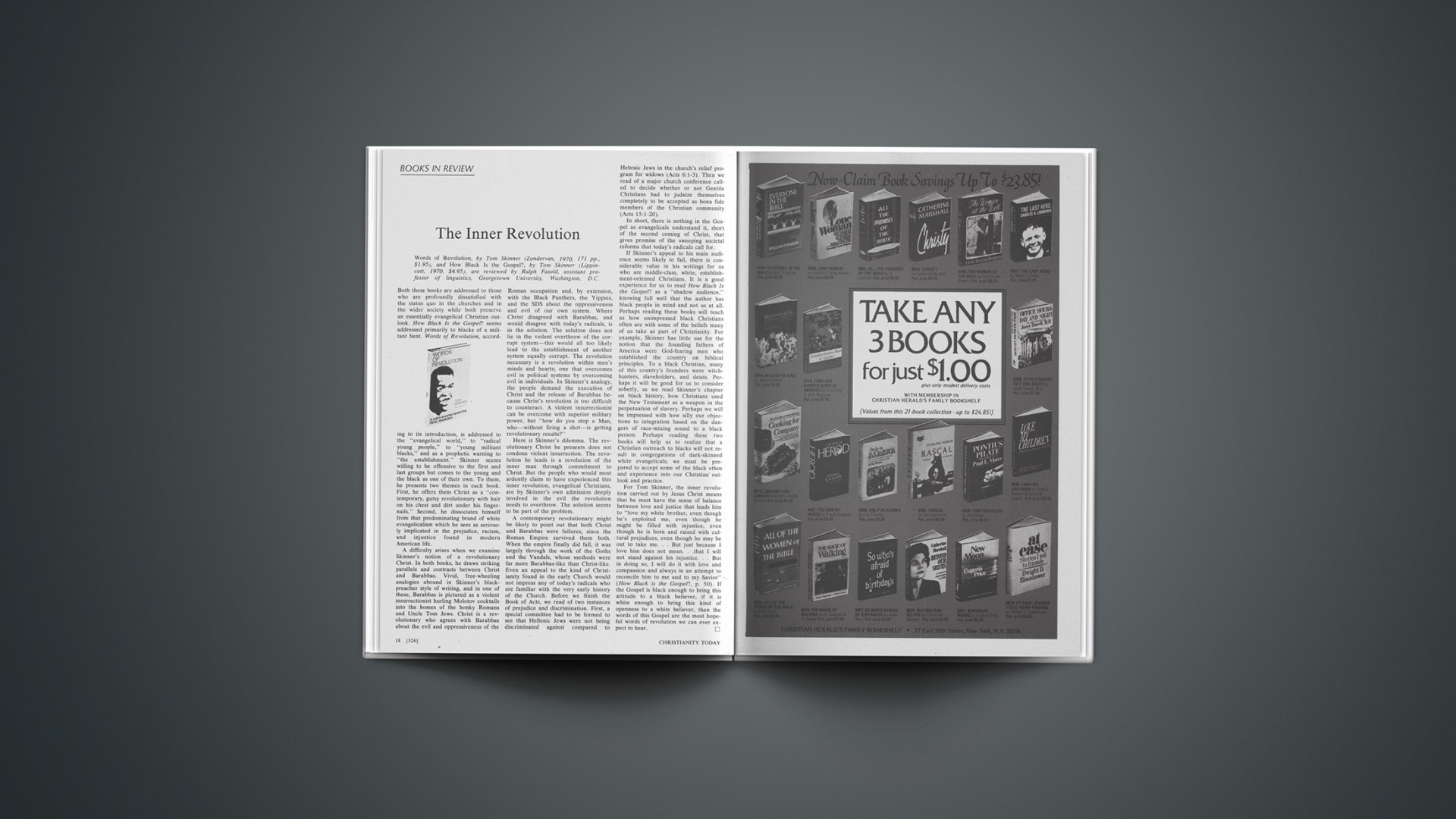
The Inner Revolution

Words of Revolution, by Tom Skinner (Zondervan, 1970, 171 pp., $1.95), and How Black Is the Gospel?, by Tom Skinner (Lippincott, 1970, $4.95), are reviewed by Ralph Fasold, assistant professor of linguistics, Georgetown University, Washington, D.C.

Both these books are addressed to those who are profoundly dissatisfied with the status quo in the churches and in the wider society while both preserve an essentially evangelical Christian outlook. How Black Is the Gospel? seems addressed primarily to blacks of a militant bent. Words of Revolution, according to its introduction, is addressed to the “evangelical world,” to “radical young people,” to “young militant blacks,” and as a prophetic warning to “the establishment.” Skinner seems willing to be offensive to the first and last groups but comes to the young and the black as one of their own. To them, he presents two themes in each book. First, he offers them Christ as a “contemporary, gutsy revolutionary with hair on his chest and dirt under his fingernails.” Second, he dissociates himself from that predominating brand of white evangelicalism which he sees as seriously implicated in the prejudice, racism, and injustice found in modern American life.

A difficulty arises when we examine Skinner’s notion of a revolutionary Christ. In both books, he draws striking parallels and contrasts between Christ and Barabbas. Vivid, free-wheeling analogies abound in Skinner’s black-preacher style of writing, and in one of these, Barabbas is pictured as a violent insurrectionist hurling Molotov cocktails into the homes of the honky Romans and Uncle Tom Jews. Christ is a revolutionary who agrees with Barabbas about the evil and oppressiveness of the Roman occupation and, by extension, with the Black Panthers, the Yippies, and the SDS about the oppressiveness and evil of our own system. Where Christ disagreed with Barabbas, and would disagree with today’s radicals, is in the solution. The solution does not lie in the violent overthrow of the corrupt system—this would all too likely lead to the establishment of another system equally corrupt. The revolution necessary is a revolution within men’s minds and hearts; one that overcomes evil in political systems by overcoming evil in individuals. In Skinner’s analogy, the people demand the execution of Christ and the release of Barabbas because Christ’s revolution is too difficult to counteract. A violent insurrectionist can be overcome with superior military power, but “how do you stop a Man, who—without firing a shot—is getting revolutionary results?”

Here is Skinner’s dilemma. The revolutionary Christ he presents does not condone violent insurrection. The revolution he leads is a revolution of the inner man through commitment to Christ. But the people who would most ardently claim to have experienced this inner revolution, evangelical Christians, are by Skinner’s own admission deeply involved in the evil the revolution needs to overthrow. The solution seems to be part of the problem.

A contemporary revolutionary might be likely to point out that both Christ and Barabbas were failures, since the Roman Empire survived them both. When the empire finally did fall, it was largely through the work of the Goths and the Vandals, whose methods were far more Barabbas-like than Christ-like. Even an appeal to the kind of Christianity found in the early Church would not impress any of today’s radicals who are familiar with the very early history of the Church. Before we finish the Book of Acts, we read of two instances of prejudice and discrimination. First, a special committee had to be formed to see that Hellenic Jews were not being discriminated against compared to Hebraic Jews in the church’s relief program for widows (Acts 6:1–3). Then we read of a major church conference called to decide whether or not Gentile Christians had to judaize themselves completely to be accepted as bona fide members of the Christian community (Acts 15:1–20).

In short, there is nothing in the Gospel as evangelicals understand it, short of the second coming of Christ, that gives promise of the sweeping societal reforms that today’s radicals call for.

If Skinner’s appeal to his main audience seems likely to fail, there is considerable value in his writings for us who are middle-class, white, establishment-oriented Christians. It is a good experience for us to read How Black Is the Gospel? as a “shadow audience,” knowing full well that the author has black people in mind and not us at all. Perhaps reading these books will teach us how unimpressed black Christians often are with some of the beliefs many of us take as part of Christianity. For example, Skinner has little use for the notion that the founding fathers of America were God-fearing men who established the country on biblical principles. To a black Christian, many of this country’s founders were witch-hunters, slaveholders, and deists. Perhaps it will be good for us to consider soberly, as we read Skinner’s chapter on black history, how Christians used the New Testament as a weapon in the perpetuation of slavery. Perhaps we will be impressed with how silly our objections to integration based on the dangers of race-mixing sound to a black person. Perhaps reading these two books will help us to realize that a Christian outreach to blacks will not result in congregations of dark-skinned white evangelicals; we must be prepared to accept some of the black ethos and experience into our Christian outlook and practice.

For Tom Skinner, the inner revolution carried out by Jesus Christ means that he must have the sense of balance between love and justice that leads him to “love my white brother, even though he’s exploited me, even though he might be filled with injustice, even though he is born and raised with cultural prejudices, even though he may be out to take me.… But just because I love him does not mean … that I will not stand against his injustice.… But in doing so, I will do it with love and compassion and always in an attempt to reconcile him to me and to my Savior” (How Black is the Gospel?, p. 50). If the Gospel is black enough to bring this attitude to a black believer, if it is white enough to bring this kind of openness to a white believer, then the words of this Gospel are the most hopeful words of revolution we can ever expect to hear.

Two To Ponder

A Survey of the New Testament, by Robert H. Gundry (Zondervan, 1970, 400 pp., $6.95), and The New English Bible: Companion to the New Testament, by A. E. Harvey (Oxford, 1970, 850 pp., $9.95), are reviewed by Robert A. Guelich, associate professor of New Testament exegesis, Bethel Theological Seminary, St. Paul, Minnesota.

The distinguishing feature of R. H. Gundry’s survey textbook for the New Testament (written from an “evangelical and conservative” position) is its novel format and arrangement of materials. Gundry has arranged background and introductory materials around the biblical text itself, so that the student, by reading the New Testament in conjunction with the textbook, will not lose sight of the primary source, the Scriptures. The book is replete with pertinent photographs, summary outlines, charts, maps, and suggestions for related reading, and each chapter begins and ends with leading questions to stimulate interest.

Part One sets the stage by offering a brief look at the political, religious, and social setting of the New Testament period, and concludes with remarks about the canon and text of the New Testament. Part Two focuses on “Jesus’ career” as the “crucial event.” After introductory comments on the life of Jesus and the Gospels, the author unfolds Jesus’ ministry by means of a harmonistic study of the Four Gospels. The validity of this approach to the Gospels is questionable, however, in light of contemporary gospel studies. One definite disadvantage is that a harmonistic approach tends to perpetuate the common misunderstanding of the intent of the evangelists—that it was biographical rather than kerygmatic-didactic. Part Three turns to the “aftermath” of Jesus’ career in light of the Church’s growth from Jerusalem to Rome under the influence of the Holy Spirit—in other words, the Book of Acts. Part Four then turns to the Epistles and the Apocalypse, as the explanations and implications of the “crucial event.”

Perhaps the main weakness is the author’s tendency to oversimplify and to make assertions about dubious material without giving support or viable alternatives. That “hate thy enemy” comes from rabbinical teaching; “Nazareth” is derived from netzer so that the “Branch-Messiah” would be from a “Branch-Town” (a convenient way to harmonize Matthew 2:22 with Isaiah 11:1); the “true purpose” of Mark was to “win converts to the Christian Faith”; the bridegroom’s delay in the parable was a matter of haggling over a larger dowry—these and other such assertions are questionable in a textbook for serious students. This tendency does not reflect the careful scholarship one has come to associate with the author’s other work.

The work by A. E. Harvey is also designed to be read concurrently with the Scriptures, as a “companion” volume to the New English Bible New Testament. It comes close to being a one-volume commentary. The author’s concern is to present material that would help the reader coming to the New Testament without any previous introduction, and so he avoids the more technical, intramural issues of introduction, backgrounds, and exegesis. Yet his popular exposition is anything but an over-simplification and reflects his astute awareness of the issues and their more technical implications. It would be the rare layman, and even the rare pastor, who could not profit from use of this companion volume.

Its main format follows the headings and divisions of the NEB. Bold type sets off the phrase or verse under consideration. Harvey’s choice of material for comment is judicious, and his comments are lucid and succinct, covering the exegetical gamut from lexical studies to religio-historical setting. Although the introductory comments are generally made in conjunction with the text, there is an excursus on the meaning of “New Testament” and how it came to be applied to the twenty-seven books. There is also a brief but adequate excursus on “Gospels” and another on “Letters.”

One can place this work within the broadly conservative context. Some of Harvey’s comments will be disturbing in certain conservative circles. For instance, he notes “discrepancies” among the Four Gospels as well as between Paul and Acts without attempting to harmonize or rationalize them. And he questions the Pauline authorship of Ephesians (while being reticent to deny it for the Pastorals) and the Petrine authorship of First and Second Peter. Yet one hopes this will not give cause for ignoring or rejecting the valuable contributions of this work. It is a solid, extremely helpful aid in bridging the gap between the reader and what the Bible said.

Are Most Histories Needed?

The Church of the Middle Ages, by Carl A. Volz (Concordia, 1970, 198 pp., $5.95), and The Church of the Renaissance and Reformation, by Karl H. Dannenfeldt (Concordia, 1970, 145 pp., $4.95), are reviewed by Charles Greenwood Thorne, Jr., research associate, Council for Religion in Independent Schools, New York City.

Concordia Press is publishing a “Church in History Series,” and these two volumes together cover the period 600–1600. Both discuss the fourteenth century, as it happens. Volz and Dannenfeldt are specialists in church history and on the subjects at hand. These volumes are straight histories with no thesis, set out in the same format with numerous headings within each chapter. Yet in method of handling the subject, the two authors differ distinctly. A series of books covering only factual ground can easily point up its contributors’ competence through comparison; argument is minimal, if present at all, and the assignment, as here, is for a narrative. Even if Dannenfeldt has not won the competition, Volz never got on the short list.

In The Church of the Middle Ages Volz moves chronologically from 600 to 1400 and with general accuracy from subject to subject, though the plethora of headings inside the chapters is annoying and useless if the story has its own propulsion and obvious limits, which is the reason for chapters themselves. Here the chapter headings are much too unspecific, save for perhaps the first two; furthermore, the vast complexity of the medieval church cannot be reduced to six headings, unless the six are far cleverer than these.

Then, the text is riddled with quotations; few pages are free of them. Usually the quotations are apt, but they should be in the notes and shorter. Moreover, a careful reading of the notes shows that the primary sources are taken from translations, yea quotations of quotations, and indeed from other histories of the period, not monographs. Volz has tried to write easily and with a concern for a link with the present, but the control is not tight and the impression is one of lightness. The facts are here and the choice is good (all the larger issues come in for a respectable treatment, save the Fourth Lateran Council and similar events that are difficult to reduce), but the execution is common garden, unimaginative.

Karl Dannenfeldt has lifted his narrative to a more lively and interpretative plane. Although he has to deal with only three centuries (1300–1600), as opposed to Volz’s eight, the entanglements of the period covered in The Church of the Renaissance and Reformation demand a double understanding in a way that the monolithic medieval church does not. His notes are markedly fewer and reveal more careful preparation, with minimal quotation that then is woven into the text. Genuine understanding of Luther and grace is displayed, and the discussion of humanism rings. He points up a worthwhile comparison between Luther and Zwingli, and the remarks on Trent are not only accurate but also just.

The difference between these two works involves judgment, writing, style, use of sources, and purpose. There is an aimlessness in Volz’s writing where there is an end in view crisply pursued in Dannenfeldt; the latter even gives a chapter to an epilogue when the former gives only a paragraph. Both works contain an index and an appendix of notable source readings.

One final observation: Both authors have included two pages of bibliography “for further reading,” and what irony there is here. The fault lies not with them but with the publisher primarily, for the question forever haunts, and it must, as to why more general histories on these and countless other subjects are needed when splendid updated ones exist already. Both men here have admitted their debts and defeats, for their own sources are listed here as well as in their notes, and, what is more, they have written less completely and skillfully than those they suggest, for yet another book, another series. When publishers begin to do what the author is expected to do, that is, make a genuine contribution to knowledge, then readers and libraries might be able to cope. The responsibility must be carried by both commissioner and commissioned.

A Devotional Exposition

Genesis, by Donald Grey Barnhouse (Zondervan, 1970, 208 pp., $4.95), is reviewed by Samuel J. Schultz, professor of Bible and theology, Wheaton, College, Wheaton, Illinois.

The influence of this well-known Bible expositor is extended through the publication of this devotional commentary on Genesis. This volume ends with Chapter 22. A later volume will complete Genesis.

For those who listened to Dr. Barnhouse as he expounded the Scriptures, these comments on Genesis will sound familiar. The message of God’s Word is applied repeatedly to man’s relationship with God and the society in which man lives. Barnhouse makes use of various versions and often offers his own literal translation of the text in order to communicate his insight and understanding more effectively. Throughout he reflects a deep commitment to the Word of God as divinely inspired.

Repeatedly his comments are inter-related with the fuller revelation given in the rest of the Bible. This is especially true as he develops the theme of man’s salvation through Jesus Christ.

Since the core of the author’s comments is devotional, his use of the text suggests a corrective for prevailing misinterpretations. Note his attempt to “right a great wrong” in his statement on 9:22–25 concerning the curse pronounced on Canaan: “Any attempt to make black skin the fulfillment of this curse is unscholarly, prejudiced to the extreme and certainly without basis in the Bible.”

On the other hand, some of his statements need to be evaluated on the basis of modern scholarship. His assertion that Amraphel can be identified with Hammurabi and therefore chapter 14 “was proven historical” needs careful reappraisal in the light of current knowledge (cf. G. L. Archer, A Survey of Old Testament Introduction, Moody, 1964, p. 204).

For ministers as well as laymen, this commentary is significant as the last volume written by Dr. Barnhouse. His exposition of these introductory chapters of the Bible should stimulate the reading of God’s Word with renewed interest and appreciation.

Newly Published

Astrology, Occultism and the Drug Culture, by Lambert T. Dolphin, Jr. (Good News, 1970, 64 pp., paperback, $.95), The Second Coming: Satanism in America, by Arthur Lyons (Dodd, Mead, 1970, 211 pp., $6.95), and The Case for Astrology, by John Anthony West and Jan Gerhard Toonder (Coward-McCann, 1970, 286 pp., $6.95). Interest in the occult is rising, and Christians should be aware of why. These three timely and important books explore most aspects of the occult.

Theology After Freud, by Peter Homans (Bobbs-Merrill, 1970, 254 pp., paperback). On the responses of Niebuhr and Tillich to Freud, along with evaluations of three lesser-known writers on Freud and Homans’s own thoughts.

Community Mental Health: The Role of Church and Temple, edited by Howard J. Clinebell, Jr. (Abingdon, 1970, 288 pp., paperback, $4.25). Thirty-five chapters by almost as many authorities survey what is being, and can be, done. “Must” reading for those who are, or should be, involved.

Broadman Bible Commentary: Volume 3, First Samuel-Nehemiah, and Volume 10, Acts-First Corinthians, Clifton J. Allen, general editor (Broadman, 1970, 397 and 506 pp., $7.50 each). Eight scholars offer brief but helpful comments. Despite controversy in the Southern Baptist Convention over portions of it, the series as a whole is useful.

Fabricated Man: The Ethics of Genetic Control, by Paul Ramsey (Yale, 1970, 174 pp., $7.50). With deliberation, Dr. Ramsey examines genetic control, an increasingly important issue. We may be seeing the suicide of the species, not from environmental pollution but from the new biology. This book is vital for all Christians.

A Search for Meaning in Nature: A New Look at Creation and Evolution, by Richard M. Ritland (Pacific, 1970, 320 pp., paperback, $2.95). A calm, easy-to-read, somewhat random survey of biological theories and their relation to Scripture. Chapters include “What Is Life?,” “Frozen Mammoths,” “The ‘Missing Links’ Between Man and Ape.”

The Patient as Person, by Paul Ramsey (Yale, 1970, 283 pp., $10). Amid the plethora of books on medical ethics that merely skim the surface, this one solidly examines most aspects of the question—from the definition of death to organ transplantation.

Karl Barth and the Problem of War, by John H. Yoder (Abingdon, 1970, 141 pp., paperback, $2.95). A Mennonite scholar offers a valuable study as a basis for further discussion of this highly relevant topic.

The Living God, by R. T. France (Inter-Varsity, 1970, 128 pp., paperback, $1.50). A non-technical presentation of what the Bible says about God and the implications for us. The Old Testament is featured, but there is a good chapter on the New Testament basis for Trinitarianism.

For Instance …, edited by Donald T. Kauffman (Doubleday, 1970, 263 pp., $5.95). Contemporary illustrations made more useful by suggestive questions on their application and scriptural references.

Mobilizing for Saturation Evangelism, edited by Clyde W. Taylor and Wade T. Coggins (Evangelical Missions Information Service, 1970, 245 pp., $2.95, paperback). Papers presented at a 1969 Swiss conference of leaders in various in-depth evangelism campaigns around the world.

A Survey of Israel’s History, by Leon Wood (Zondervan, 1970, 444 pp., $7.50). A professor at Grand Rapids Baptist Seminary offers a text on the Old Testament period. Thorough and well documented, but with a bit too much certainty on some disputable interpretations of the data.

The Fragmented Layman, by Thomas C. Campbell and Yoshio Fukuyama (Pilgrim, 1970, 252 pp., $12). A study based primarily on responses in 1964 from more than 8,000 members of the United Church of Christ following canonical social scientific methodology. Well done—more like it are needed.

Some of the above books will later be reviewed at greater length.

The Poetry of Henry Vaughan

He now seems to be firmly established as one of the finest of the pure lyric voices of the seventeenth century.” So writes French Fogle in his 1965 edition of The Complete Poetry of Henry Vaughan. But the literary world had been slow enough in its acclaim of the poet-doctor of South Wales, who like St. Luke was a Christian first and a physician second; for the critical attention given Vaughan over the past three decades has far exceeded that of the preceding three centuries. The first book-length biography of him did not appear until 1947. And though recent biographical findings have been extensive, the certain facts of the personal history of Henry Vaughan (1622–95) can still be told in fewer than three hundred words. His poetry must speak for itself, and this is as it should be.

Furthermore, the exhaustive studies that have been made on the major influences on his life and poetry—such as the Wales countryside, George Herbert, the Bible, and Platonism—leave the story incomplete, for they do not take into account the fact of Christian rebirth. Vaughan’s full allegiance to the one Source of man’s truth is reflected in these last lines from his poem “Peace”:

For none can thee secure

But One who never changes,

Thy God, thy life, thy Cure.

It appears constantly throughout his writing, as in “The Sap”:

To show by what strange love He had to our good

He gave his sacred blood.…

Such secret life, and virtue in it lies

It will exalt and rise

And actuate such spirits as are shed.…

Henry Vaughan’s song “The Night,” suggested by St. John’s words about Nicodemus, has been called one of the most exquisitely tender and sensitive of all religious poems. Speaking of the light seen by Nicodemus that “made him know his God by sight,” the poet continues:

Most blest believer he!

Who in that land of darkness and blind eyes

Thy long expected healing wings could see

When thou didst rise,

And what can never more be done,

Did at midnight speak with the Sun!

O who will tell me, where

He found thee at that dead and silent hour!

What hallowed solitary ground did bear

So rare a flower,

Within whose sacred leaves did lie

The fullness of the Deity.

No mercy-seat of gold,

No dead and dusty cherub, nor carved stone,

But his own living works did my Lord

hold And lodge alone

Where trees and herbs did watch and peep;

And wonder, while the Jews did sleep.

Dear night! this world’s defeat;

The stop to busy fools; cares check and curb;

The day of spirits; my soul’s calm retreat

Which none disturb;

Christ’s progress and his prayer time;

The hours to which high heaven doth chime.

Thus the poem becomes an apostrophe to the night where souls may hear God’s “still, soft call;/His knocking time.…” It ends with this often quoted stanza:

There is in God (some say)

A deep, but dazzling darkness; As men here

Say it is late and dusky because they

See not all clear;

O for that night! where I in him

Might live invisible and dim.

In a meditation in The Mount of Olives, Vaughan said, “It is the observation of some spirits that night is the motherof thoughts. And I shall add that these thoughts are stars, the scintillations and the lightnings of the soul struggling with darkness.” In one of his prefaces he asked the reader to “remember that there are bright stars under the most palpable clouds, and light is never so beautiful as in the presence of darkness.”

Other of the “metaphysicals” of the seventeenth century—Donne, Herbert, Crashaw, Traherne—followed the profession of priest or chaplain. Robert Herrick, too, one of the finest of England’s pastoral poets and also of Vaughan’s century, was an Anglican vicar. But, devout though Vaughan was from his earliest years, he turned to medicine and was still seeing his patients in Wales in the last years of his life; for like many another true mystic, Vaughan combined his occult thoughts with a deep regard for his fellow men.

Henry and his twin brother Thomas had been taught by Matthew Herbert, clergyman and noted schoolmaster, before they went to Oxford in 1638, where Thomas was graduated. Henry, however, left Oxford without taking a degree and later studied law in London. Except for his four years of study in England and his short period with the Royalists in the Civil War, Henry spent all his life in his native village of Newton-by-Usk. The river is said to flow through all his poems as if sourced in Eden. For Vaughan loved God’s world of nature quite as much as Herrick; and that love, informed and elevated by the Holy Spirit, sings throughout his works.

It is not known when or where Henry received the M.D. degree that is recorded on his tombstone in his native parish churchyard. But on June 15, 1673, he wrote his cousin John Aubrey that his profession was that of medicine and that he had practiced it then for many years “with good success (I thank God) and a repute big enough for a person of greater parts than myself.” In his writing career he had translated two books by Henry Nollius (Heinrich Nolle), described as a famous professor of medicine: Hermetical Physick and The Chymist’s Key. Vaughan followed Nollius in believing that “the first qualification of the physician (as well as the patient) is that he be a sound Christian, and truly religious and holy.” His feelings about what he called “this iron age” and “exiled religion” were intense, and he deplored the effects of what Plutarch (whom Vaughan also translated) had termed “malevolence, with an implacable and endless resentment of injuries” on the bodies of men as well as on their minds and hearts. Another translation of Vaughan’s had been made from the works of a Platonic writer who found the diseases of the mind far more pernicious than those of the body. In two passages that read like the latest “discovery” by some modern psychiatrist, we find these truths:

The disease of the body hath never yet occasioned wars, but that of the mind hath occasioned many.

The sufferer from bodily ills is made desirous of health and therefore fitter for cure, but the mind, once infected and bewitched, will not so much as hear of health.

The profound spiritual awakening of Vaughan that occurred around 1648 was to yield rich fruit in the famous volume of sacred poetry Silex Scintillans. All commentators on the poet declare that this poetry shows he had been illumined by a rare conversion experience, when, saddened by the misery, sickness, and death about him, he resolved to spend the rest of his life in his native village on the banks of the river and give himself tirelessly to the relief of the physical and spiritual ills of his fellows. His thoughts, writes J. B. Leishman in his volume The Metaphysical Poets, were to be devoted wholly to contemplation of the mercies and mysteries of God:

[The poet-physician would go on] listening for those divine intimations which he cannot hear amid the noises of the busy world, but which come to him in solitude, especially among the sights and sounds of nature, where, as in the days of his childhood—that childhood where he seemed nearest to God and immortality—he is able to detect “some shadows of eternity.”

But Vaughan also wished to “travel back” beyond his childhood days to a new appreciation of those first days of creation of God’s glorious and wonderful universe of life and light. Repose and brightness are the Eternity Vaughan describes as he visioned it:

I saw Eternity the other night

Like a great Ring of pure and endless light,

All calm as it was bright,

And round beneath it, Time in hours, days, years

Driven by the spheres

Like a vast shadow moved, in which the world

And all her train were hurled.…

At the end of this majestic vision, Vaughan condemns as fools those who do not use the Light, that is, the Way “which from this dead and dark abode/Leads up to God.” But, he adds, “as I did their madness so discuss/One whispered thus”:

This Ring, the Bridegroom did for none provide

But for his bride.

This apocalyptic metaphor, like all in Vaughan, was inspired by the Bible he loved.

A companion to the poem in Silex Scintillans referring to his younger brother William’s death in 1648 (which begins “Silence and stealth of days! ’Tis now/Since thou art gone,/Twelve hundred hours”) is the great Ascension Hymn (“He alone/And none else can/Bring bone to bone/And rebuild man …”):

They are all gone into the world of light!

And I alone sit ling’ring here;

Their very memory is fair and bright,

And my sad thoughts doth clear.

It glows and glitters in my cloudy breast

Like stars upon some gloomy grove,

Or those faint beams in which this hill is drest,

After the Sun’s remove.

Thus the hymn continues through its ten exquisite stanzas, including the perfect quatrains:

O holy hope! and high humility,

High as the heavens above!

These are your walks, and you have show’d them me

To kindle my cold love.…

O Father of eternal life, and all

Created glories under thee!

Resume thy spirit from this world of thrall

Into true liberty.

Either dispense these mists, which blot and fill

My perspective (still) as they pass,

Or else remove me hence unto that hill

Where I shall need no glass.

The powerful pulse of the supernatural sounds in Vaughan’s nature poetry precisely as it does in Robert Herrick’s. Each constantly looks to the Giver beyond all human or natural gifts. And the conciseness and simplicity of Herrick’s triplet—“We see Him come, and know Him ours,/Who with His sunshine and His showers,/Turns all the patient ground to flowers”—is echoed throughout Vaughan’s praise of nature. Each poet wrote in effect an apology for his secular verses, though Herrick unlike Vaughan printed in one large volume, The Hesperides (1648), both secular and sacred writings. Henry Vaughan issued his own poetry at first in separate publications. In his preface to Part II of the 1655 reissue of Silex Scintillans, he speaks of his deep dissatisfaction with the literature of the day and his own earlier “guilt” in writing “idle words.”

Vaughan’s poem dedication in the two editions of the Silex, his finest book, begins:

My God! thou that didst die for me,

These thy death’s fruits I offer thee;

Death that to me was life and light

But dark and deep pangs to thy sight.

Some drops of thy all-quick’ning blood

Fell on my heart; those made it bud

And put forth thus, though Lord, before

The ground was curs’d, and void of store.…

In the long first poem, “Regeneration,” we find the poet, stanza by stanza, experiencing his “new spring”:

The unthrift sun shot vital gold A thousand pieces,

And heaven its azure did unfold

Checkered with snowy fleeces,

The air was all in spice And every bush

A garland wore: Thus fed my eyes

But all the ear lay hush

(“Come, thou southwind, and blow upon my garden that the spices may flow out” is appended to this first poem as referring to the imagery in the Song of Solomon.) In “Resurrection and Immortality” with its epigraph from Hebrews—“By that new and living way, which he hath prepared for us through the veil, which is his flesh”—we are given a dialogue between the body and the soul. The soul, having the last word, refers to death as “a change of suits”:

For a preserving spirit doth still pass

Untainted through this mass,

Which doth resolve, produce, and ripen all

That to it fall

It is that spirit which “from the womb of things/ Such treasure brings/ As Phenix-like reneweth/Both life, and youth.”

Evidence of the poet’s genuine rebirth sings throughout the two editions of Silex Scintillans up to the closing L’Envoy: “O the new world’s new, quick’ning Sun!/ Ever the same, and never done!” The author of the famous “The Retreat,” which begins “Happy those early days when I/ Shined in my angel-infancy!” (the poem said to have inspired Wordsworth’s “Ode on the Intimations of Immortality”), accepted Christ’s command, “Except ye become as little children …,” as the necessary requisite for citizens of heaven. So he tells us over and over in his matchless poetry.

The last published book of the poet-doctor of Wales did not appear until the year 1678 and is a second gleaning of early work: Thalia Rediviva. For after the second edition of Silex Scintillans (1655), evidently Vaughan devoted all his energies to the care of the sick in his charge. There had been some obscurity about the publication of his earlier book of poetry, Olor Iscanus, dedicated in 1647, and a smaller volume of poetry the preceding year. Besides translations from Latin poetry, with a small grouping of English and Latin (Vaughan was well-versed in the language) of his own poetic composition, the Olor volume contained four prose translations, including one titled “The Praise and Happiness of the Country Life.” All his prose is in keeping with his poetic gifts. An original treatise is The Mount of Olives or Solitary Devotions (1652). This book of devotions, drawing from the Bible and the Book of Common Prayer, is a remarkable volume to come from a layman, however devout. His full belief (in Christ as “Very God and very Man,” in the Trinity, in the Redemption and Atonement) is explicitly stated. What he says shows that for him as for St. John in Browning’s “Death in a Desert,” such belief had solved “all questions in the earth and out of it.” Nearly half of the Devotions deals with prayers for the right reception of Holy Communion. “The great design and end of thine Incarnation was to save sinners,” Vaughan says in one prayer.

Though the poet had called himself at one time the least of the converts of George Herbert, and has too often been held an imitator of Herbert, whose true disciple he was, his biographer F. E. Hutchinson says that his “devoted churchmanship, so fully evinced in The Mount of Olives, makes it clear that his celebration of the great Christian doctrines and of the Church’s year in Silex Scintillans is no mere imitation of George Herbert but expresses his own mind.” He adds that Vaughan, “with an elevation above Herbert’s, ascends in his greater poems to the remote spaces of eternity.” In both The Mount of Olives and Silex Scintillans Vaughan, dwelling often on thoughts of departed friends and relatives and the eternal order itself, does indeed express his own elevation of soul. That he is receiving far more critical acclaim in our day than in any other period during or since his own far-off lifetime is witness to that unchanging Spirit he wrote of so well, the Spirit that makes all things new. As Emerson once wrote: “One accent of the Holy Ghost/ The heedless world has never lost.”

M. Whitcomb Hess received the A.B. degree from the University of Kansas and the A.M. degree from Ohio University. She is the author of more than one hundred essays on philosophical and literary themes and of many poems.

Second-Class Citizenship in the Kingdom of God

I’m tired of being considered a second-class citizen in the Kingdom of God. I’m not considered that by God, of course, but by men. I’m not black. I am a woman. The church visible has in its life and ministry ignored to a frightening degree the truth of Galatians 3:28: “There is no such thing as Jew and Greek, slave and freeman, male and female; for you are all one person in Christ Jesus” (NEB).

Although early Christianity did help to liberate women from the degrading position of being considered chattel, the Christian Church has not been a leader in the struggle for full equality for women in society, nor has it allowed women to experience freedom from society’s prejudices within the Church. Is it not true that Christ came not only to remove the barrier of sin between man and God but also to break down every wall separating one human being from another? But the wall between women’s and men’s participation in the life of the Church has never been broken down.

Even where the divisions between Christians of different races have been recognized as sinful and contrary to God’s view of mankind, and where these divisions have been reduced to some degree, the old prejudices against women still exist. The pastor of a multi-racial church that has made real progress in overcoming racial divisions expressed surprise when he was asked about the progress his congregation had made in welcoming women to full participation in church life. He had not even identified the prejudices against women in the church as an area of concern, nor had his wife.

Sermons, books, and “talks” on women in the Bible or in the Church are usually focused on the idea that women can be effective helpers to men who are seeking to follow God. The theme is that even women can be worthy servants of God if they will be submissive (to men), exert their influence indirectly, and above all remember their place. That place is seen as somehow very different from, and inferior to, men’s place in the church. Women must inquire of men what place they have designated for women, and this will usually be the kitchen or nursery, not the room where the board of elders meets. Did not our Lord specifically commend Mary for sitting at his feet, that is, for learning directly from him, instead of fulfilling the conventional woman’s role of preparing meals? How many women have missed out on opportunities for spiritual and intellectual growth by being in the kitchen or the nursery, areas rarely staffed by men?

The Church has long invited women to become members, to work in the Sunday school, and to serve refreshments to any and all groups. Their role in the church has been preparing and serving fellowship meals, assisting with the music (but not leading the singing!), preparing missionary outfits, and tending the nursery—all activities that could just as well and perhaps better be carried on as a cooperative effort by men and women. Where are the men now elected to wait at table as in Acts 6:2, 3? Women’s groups have in every sense been auxiliary, not necessarily to the Lord’s work but to the activities of the men who make all decisions in the Church and hold most or all of the important offices.

If we are to judge by the composition of boards and committees in the average church, many pastors and laymen must agree with the pastor who is reported to have said that there are few offices in the church that a woman can hold. Why? Is it that they take more seriously the Apostle Paul’s admonition about women keeping silent in church (how many elders speak in church anyway?) than his statement that in Christ there is no such thing as male and female?

Undoubtedly Paul’s words have had a decisive impact on the Church in its attitude toward women. Statements on the roles of men and women in marriage are cited very often in the Christian community, and it seems clear that Paul expected and commanded wives to be in subjection to their husbands in marriage (see Eph. 5:22–24, 33; Col. 3:18; Titus 2:5). But Paul’s suggestions on another marital possibility, celibacy (see First Corinthians 7), are not taken seriously by very many Protestants, perhaps because of a reaction to Catholic practice. Moreover, the instructions Paul gives on the wife’s role are often associated in the evangelical’s mind with the Apostle’s suggestions concerning the role of women in the Church. But his comparison of the relation of wife to husband with that of the Church to Christ (Eph. 5:22–24) cannot be translated into the affirmation that women in the Church are to be submissive to men in the Church; it means, obviously, that women and men in the Church are to be obedient to Christ. The relation of the female to the male in marriage is compared with the relation of human beings of both sexes to Christ.

In Paul’s most explicit instructions concerning women’s role in the Church, his preference, very likely conditioned by the society around about him, is expressed as his personal wish rather than as a dogmatic prescription for church practice. As in his treatment of celibacy (“I have no instructions from the Lord, but I give my judgment as one who by God’s mercy is fit to be trusted” [1 Cor. 7:25, NEB]), Paul’s preferences in church life—that men should offer the prayers, that women should be learners, not teachers, and that women should be quiet and not domineer over men—are introduced with the phrases “It is my desire …” and “I do not permit …” (1 Tim. 2:8–12), revealing a personal bias in his instructions.

It is understandable that Paul’s command concerning bishops that immediately follows should be expressed in masculine terms (1 Tim. 3:1–7). The statement on the sex of deacons does not appear to be so clearly in favor of men only; a note in the New English Bible includes the word deaconesses also (verse 11).

One clear indication that Paul himself did not follow completely his own policy statements on women in the Church is found in Romans 16:1. The first person mentioned in this section of many names is “Phoebe, a fellow-Christian who holds office in the congregation at Cenchreae.” And Paul requests of the Roman Christians: “Give her, in the fellowship of the Lord, a welcome worthy of God’s people, and stand by her in any business in which she may need your help for she has herself been a good friend to many, including myself” (Rom. 16:2). Mentioned by Paul in another letter are women “who shared my struggles in the cause of the Gospel” (Phil. 4:3). That fewer women than men are mentioned in the epistles as fellow laborers and church officials very likely indicates that the early Church was influenced by the societal pattern of male dominance.

And how are we to deal with First Corinthians 11:5, which indicates that women do pray and prophesy, since directions are given for the covering of their heads while they are engaged in these activities? In the same chapter we read: “In Christ’s fellowship woman is as essential to man as man to woman. If woman was made out of man, it is through woman that man now comes to be; and God is the source of all” (1 Cor. 11:11, 12, NEB). Of course, many women, long trained to be silent in church affairs or to make their influence felt through their husbands, are very reluctant to put themselves forward in seeking church offices, and a great deal of potential for God is being wasted.

What I propose is that the Christian community examine all the Scriptures dealing with women’s role in the Church and that it prayerfully consider the possibility that spiritually mature and capable women should be called upon as often as men possessing these qualities to provide leadership in the Church by serving on governing and policy-making boards.

The prejudices against women in the Church carry over into other religious organizations. The president of a large evangelical organization working with students, wanting to encourage me, revealed his belief that women faculty members can have an effective ministry on the campus, too—as if being a woman is somehow a stigma that prevents one from bearing witness to Christ’s transforming love in the same way that a man might. It is no surprise that this same organization offers a faculty handbook in which one chapter is entitled “The Faculty Member’s Wife and Home.” Faculty “member” means faculty man, apparently.

The small number of women on boards of major denominations shows clearly that although women make up an important segment of the membership and work force of the Church, they are not in positions of leadership generally. One notable exception was the election of Cynthia Wedel as president of the National Council of Churches (something that would probably never happen in the National Association of Evangelicals). Of course, when pressed, some people would admit they preferred a woman to a black, which seemed to be the case with the election of Mrs. Wedel. I asked the missionary-personnel secretary of one denomination whether her church gave equal status to women, and she replied that the few women officers of the church were not paid commensurate with their training or on the same salary scale as the men on the staff.

The Christian Church, in its selective application of the Apostle Paul’s statements, has not been revealing to the world the truth of Galatians 3:28 that in Christ there is no distinction between male and female. It is time for the body of believers to do all things possible to show that humankind’s sinful divisions do not apply in the Church. Certainly heaven will not be segregated according to sex any more than by color. If we truly believe that Christ’s redemption delivers us from seeing people in categories, from stereotyping them from birth according to color, sex and other differences, then let us, as members of the Christian Church and of Christ’s body, begin to be a witness to the fact that Christ does indeed liberate us—all of us, women and men, black and white—to be what he wants us to be, and not what our sin-racked culture with all its prejudices wishes to make of us by squeezing us into its mold.

Ruth A. Schmidt teaches at the State University of New York at Albany; she is an associate professor of Spanish. She received the Ph.D. from the University of Illinois.

The Church in Search of Mission

Hendrik Kraemer, now dead, spent almost two decades as a missionary and translator in Indonesia and later was professor of the history of religions at the University of Leiden in Holland. His book entitled The Christian Message in a Non-Christian World, from which this essay is taken, was published for the International Missionary Council by Harper & Brothers in 1938. In that same year it formed the basis for discussions at the Madras meeting of the International Missionary Council, which has since then become a department of the World Council of Churches. Kraemer’s view of the Church’s mission needs to be heard again for two reasons: first, this conception of mission has been abandoned by the ecumenical movement in its quest for secularization and its desire to let the world determine the Church’s agenda; second, it is essentially a biblical viewpoint, one that, though it is denied by many contemporary churchmen, is faithful to revealed truth. If the Church were to heed what Kraemer has said, it would find itself pointed in the right direction.—ED.

The Church is, as F. R. Barry says in The Relevance of the Church, not a voluntary society but God’s act through Jesus Christ, called into being by His redemptive purpose. Thus, just as Christianity is a theocentric religion, the Church is a theocentric community. Our modern habit of viewing the Church as being essentially an association of religiously like-minded people is by its anthropocentric tendency a disavowal of this theocentric nature of the Church. This, it must again be stressed, is not a theoretical distinction that does not matter very much in practice, but it is a matter of life or death for the Christian Church.…

… The Church is, according to the New Testament, the ecclesia, the community and fellowship of those who are united in common faith, common love and common worship of Him who is their Life and Head, bound in loyalty towards Him, permeated, inspired and chastened by His Spirit. They are “called to be saints” (1 Cor. 1:2), “the royal priesthood, the consecrated nation, the People who belong to Him that you may proclaim the wondrous deeds of Him who has called you from darkness to His wonderful light, you who once were ‘no people’ and now are God’s people, you who once were unpitied and now are pitied” (1 Peter 2:9, 10).

… The sui generis character of the Church … consists in the fact that Jesus Christ is its primal and ultimate King and Lord, whose authority transcends and conditions all other authority and loyalty. The fact of being governed by such a Head and of being obliged to obey Him above all other authorities, determines the unique character of the Church. From this fact is derived its priestly and prophetic character as being at the same time the servant and the critic of the world and all its spheres of life.

The Church is in the world, its members belong to the different spheres of life (family, nation, society, state) and have their obligations towards and relations with these spheres. The Church, however, as the fellowship of those who believe in Christ and love and worship Him, ought never to forget that this fellowship transcends all mundane relations by its loyalty to its Head and Lord. Another very vital aspect is that Christ inaugurated the Kingdom of God, and therefore the fellowship that centres around Him transcends the world by the peculiar nature of the expectation and hope that bind it together, namely, the expectation of the realization of God’s Kingdom in Jesus Christ notwithstanding all human frustrations. This is what is called the eschatological character of the Church. The Church is not an ideal institution, but a fellowship that finds its origin and ends in God’s redemptive Will for the world, and therefore enters fully into the need and peril of the world. If, however, it is true to its nature, it can never feel “at home” in the world because of its eschatological character, for it looks forward to a consummation which transcends our human strivings and achievements, the realization of the Kingdom of God by God Himself. By its expectation of the “Eternal City” it is essentially an interim-institution, living and working in this world between the time when it began its career through the effusion of the Holy Spirit and the time “which the Father has put in His own power” (Acts 1:7), or, in other words, between the time when God revealed in Christ His plan of re-creating this often so hopeless world and the time when this re-creation will become triumphantly evident. If the Church is unconscious of its eschatological nature, it loses one of its most essential characteristics.…

In the faith that the peculiar nature of the Church is to be the divinely-willed fellowship of believers in and lovers of Christ, their Lord, lie the Church’s inspiration and obligation. The empirical Church has to confront itself constantly with this mystery of its divinely-willed fellowship, and be cleansed and inspired by it in order to realize a kind of fellowship in the world that has its roots in eternity and thereby manifests a deeper quality than any other form of fellowship can. Another characteristic of this fellowship is that it does not exist for its own sake but for the sake of the world. To quote again Barry’s book, “The Church is in the world to redeem it. A Church true to its character and mission will be looking outwards upon the world, not inwards upon its own system. An introverted Church has no future. The question is not, Which is the true Church? It is rather, How can the Church come true?”

In this dispensation the problem of the Church consists in the fact that it cannot be defined only by its essential nature. It does not exist in a vacuum but is also a part of this world, operating through our limited human instrumentality and tormented by our sins. It lives and functions in definite times and places, and is composed of human beings with their peculiar temperament and cultural predispositions. The New Testament, which portrays in such clear and forceful language the essential nature of the Church, leaves no doubt whatever on this point by the glimpses it affords as to the actual life of the first Christian communities. The Church, if aware of these two sides, must therefore always remain in tension between the triumphant recognition of its essential nature and the urge to penitence and constant renewal of its life. It is different from all other communities in the world because it is rooted in and governed and permeated by a personal transcendent Authority, subordination to whom is the only real freedom. To awaken this kind of Church-consciousness is to lay the right foundation for a vital Christian Church.

On the other hand, the Church is subject to the same laws and tendencies as all other forms of community in the world, just because it does not exist in a vacuum but in different concrete realities. It becomes entangled consequently in the same turmoil of right and wrong, better and worse, as other institutions. This is the ever-present problem of the Church in this world, under whatever circumstances it may exist. It is heavenly from the heavens and earthly from the earth. Here lie its dangers and temptations, as the whole course of Church history shows abundantly, and also its opportunities and duties. To be exclusively aware of its heavenly nature without evincing any consciousness of its prophetic and apostolic relation to the world ends in sterile dogmatism and in the denial of its dynamic religious nature. To lose the vision of this essential nature results in the Church’s becoming a more or less good or bad segment of human society. The more conscious the Church is of its essential nature and of its obligation to realize this in the relative conditions of this complicated and confused world, the more alive and humble it will be. The more it loses this consciousness, the more it becomes concentrated on self-maintenance and self-interest, and the more dechristianized and secularized it becomes.…

… The Kingdom of God is an operative but transcendental reality, and therefore Christianity will not and cannot pretend to realize ideal cultural, social or political conditions. It has no revealed social or political or cultural programmes nor has it a ready-made set of eternal principles. There are mainly three reasons why this is so. The fundamental reason is that to identify the transcendental Kingdom of God and the realization of God’s Will with some form of human society and culture, which by the nature of the case is relative, imperfect and transient, is a disastrous confusion of human “values” with divine standards. Ultimately this goes back to an idealist and not a Biblical conception of God and man. Second, the Church is called, on the ground of its theocentric ethic, to transform the world by witness and action, but it knows that the forces of evil are as real in the world as the working of the divine Will. It can never, therefore, make its obligation of transforming witness and action dependent on whether this witness and action are successful or not.

In the third place a sober estimate of reality teaches that the Church, however determined its will towards transforming witness and action may be, never can promise the solution of economic, social and political problems. It can put its influence in the scale and ought to do so, but it cannot guarantee a solution, for the simple reason that the Church cannot pretend to govern the economic and political factors that determine the outward course of the world at large. No earthly institution or organization can pretend to that, as the present time abundantly teaches. As A. W. Wasson has demonstrated in Church Growth in Korea, the unwarranted promise of solution necessarily breeds disillusionment. The Church therefore never can compete with communism or fascism or modern idealism, which offer and guarantee in their programmes ideal solutions of economic, social and political problems. It is very pertinent to the present situation of the Christian Church and of missions in the non-Christian world to state this solid fact, because it is natural that in the midst of terrible economic, social and political conditions many ardent young minds should raise the cry of the need for a socially-effective religion. The impatience that rings in this cry is of noble quality. Yet, it seems that the criticism which it contains of the Christian Church is laid at the wrong door. If the criticism means that in the Church the will to be socially effective is far too weak, it is more than justified. If it means, however (and it certainly does in many cases), that the Church ought to promise and guarantee the realization of an ideal social and political order, it derives from an entire misconception of the nature of the Church, and from a wrong view of the dual character of the world which is the battleground of divine and demonic forces. The promises and guarantees of communism and other social idealisms that they will realize an ideal social order are utterly unwarranted. At their best, they are well-meaning but deceitful illusions. To say this connotes no pessimism and quietism, for whoever really believes in the living God and the validity of His Will for all spheres of life is no pessimist and quietist. It is faithful realism.

It was necessary to make these general remarks in order to get the right perspective for the social and cultural activities of the Church and of missions. There is much discussion at present going on as to what is central in missions. H. Vernon White in his A Theology for Christian Missions devotes a whole chapter to it. “The service of man” is accepted there as the regulative aim of Christian missions. It is repeatedly defined as “man-centered.” Much of what Dr. White says is so full of prophetic and genuinely Christian moral fervour that one can heartily agree with it. His ardent plea, however, is blurred by some great defects, which tend to bring the discussion on this important problem to a deadlock, while it should be lifted to a new plane. The standpoint he recommends is too much conceived in an antithetical spirit. He contrasts with each other the programme of proselytizing with that of Christian service and nurture. By proselytism in this connection is meant “the desire to increase the geographical extent and the numerical strength” of the Church or of Christianity, and to have one’s “religious beliefs accepted by ever larger numbers of people,” “the passion for gaining more and more adherents to a creed for the honour of that creed and the cumulative proof of its truth and power”.… Dr. White’s characterization of proselytism not only contains an element of justified criticism, but in no less degree an entire disregard of the religious roots of true proselytism. As truly as Christianity is the prophetic and apostolic religion par excellence and as truly as missions can only endure on that basis, so also an essential element of Christianity and Christian missions is true proselytism. The bad repute in which this word stands must not make us hesitant in using it with all frankness. Dr. White is entirely right in stressing with great fervour that Jesus has emphasized the “doing of God’s Will” as a criterion, and that He likens a man who does so “to a sensible man who built his house on a rock.” The spirit of mercy and helpfulness is as essential an element of the Christian faith as is faith in the forgiveness of sins. The New Testament does not know of distinctions, of higher and lower grades, in this respect. Yet, when Dr. White in his eagerness to press his case declares that the spirit of service and ministry (which are, when rightly conceived, the spontaneous and indispensable expressions of the new mind in Christ) is the supreme meaning of the Christian revelation and of Christ, he remains, whether he likes it or not, eternally imprisoned in a pragmatist and humanist conception of religion and of Christianity, which unintentionally has lost touch with the religion of revelation which we find in the New Testament. It is no mistaken form of proselytism, but it belongs to the very essence of obedience to God, that a Christian and a missionary should live by the ardent desire that all men will surrender to Christ as the Lord of their lives. Whosoever does not stress that, does not sufficiently consider the passionately prophetic and apostolic spirit of the Gospel. The core of the Christian revelation is that Jesus Christ is the sole legitimate Lord of all human lives and that the failure to recognize this is the deepest religious error of mankind. Surrender to Christ does not mean to accept the only right religious tenets, but to accept the Lord, the only One who has a right to be the Lord. Seen in this light, not to recognize Him as the sole legitimate Lord is to serve false gods. To present Christ in this radically religious way is the deepest mode of expressing the well-known first commandment: “Thou shalt have none other gods before me.”

LYRIC

The glorious melodies

of creation

seemed incomplete

without a Word

and so God spoke

Reverberations

of His utterance

keeps all His handiwork

in concert, according

to His multiversal score;

In it I may be no more

than a counter-melodic

grace-note, optional,

but ready for my cue,

should He nod.

POLLYANNA SEDZIOL

Christians and Revolution

Christians alert to the quality of the modern age cannot escape the obligation of assessing the spirit of revolution. And when they examine the structures of revolution, they are likely to feel a strange fascination for the revolutionary movement. Revolutionaries have long claimed Jesus of Nazareth as one of their comrades and have insisted that his contemporary significance is found in the “revolutionary” aspects of his message and life. And Christians cannot help noticing too that there are similarities, on a formal level at least, between the revolutionary life style and that of Christians during the first few decades after Pentecost.

On a deeper level, more and more Christians, especially young ones, are developing authentically biblical sensitivities that make them extremely uncomfortable with the same evils that have driven revolutionaries to reject the establishment. Racial injustice, the hideous ambiguity of contemporary conflict, and the deficiencies of prevailing economic systems generate in many Christians today extreme disenchantment with the present state of affairs. Those who have no vested interest in the status quo can easily develop near-revolutionary attitudes.

There is indeed a coincidence between revolutionary concerns and genuinely Christian interests. For one thing, the revolution repudiates the tyranny of the technocracy, and in this connection, there is much in Herbert Marcuse’s analysis of “true and false” needs with which many Christians will agree (One Dimensional Man, Beacon, 1969, p. 5). On the political level, the revolution is cynical; it considers present political events largely illusory. Revolutionaries feel that few real issues are faced and virtually no really significant changes are introduced by the political instruments now being employed. On the ethical level, revolutionaries offer a harsh critique of all that has engendered apathy and detachment. The mass communications media, especially television, have been subjected to unusually devastating evaluation. Those who live out of the Bible admit that in each of these areas the revolutionary position has much validity.

In addition, a Christian’s sympathy toward the spirit of revolution is bound to be fortified by the pervasive effectiveness of the revolutionary model in our age. This effectiveness preconditions many of us to take the culture of protest seriously. Because the revolutionary style of life has taken Western culture by storm, it is now nearly impossible to disentangle oneself from one’s environment enough to view the spirit of revolution wholly objectively. This nourishes Christian fascination with the idea of revolution. The young, who have grown up in a world singularly uncritical of the revolution, feel this fascination most, and have the greatest difficulty treating revolutionary options objectively.

It should be no great surprise, then, that many within the Christian community are eager not only to underscore the positive elements within revolutionary movements but to appropriate them within a program of Christian action. At the 1966 Conference on the Church and Society in Geneva, several speakers went so far as to suggest that violence would not be inappropriate for Christians bent on producing change in society. There is, in addition, a growing recklessness among some of the most sensitive Christian young people—they want to see both society and the Church turned upside down so that new creations can emerge. Their wanton attack upon just about everything that moves strongly suggests that the similarity of their attitude to the spirit of revolution is not accidental.

Now, there can be little question that radical change is the need of the hour. Those who hunger and thirst after righteousness, as Christians must, may not fail to be involved in programs geared to change—change in the direction of the Kingdom of God. Yet certain elements of the revolutionary world view should caution Christ’s people against appropriating the revolutionary model as they try to accomplish needed change. Indeed, a Christian theory of change, or theology of change, should include a repudiation of the spirit of revolution on the grounds that the revolutionary posture is incompatible with biblical Christianity.

One element of the revolutionary model that disqualifies it as a Christian option is the close alliance between the spirit of revolution and atheism. While the relation is not simple, it is direct enough so as to taint all revolutionary options that there is no possibility for Christian salvage. It would be the height of naïveté to fail to understand that the cry of the French Revolution—“No God, no master!”—is dominant in the revolutionary approach today. At the heart of every revolutionary manifesto there is a rejection of Christ’s Lordship, and this disqualifies the revolutionary model as an option for those whose view of reality is defined by the Bible.

Moreover, when Christians assess the results the revolution has had wherever it has achieved dominance, they can hardly be enthusiastic about this approach. On the one hand, revolutionary success has led to totalitarianism and enslavement of vast populations. This has been accompanied by a sterile rigidity in culture as art has become propaganda and learning has become a specialized expression of the police function of government. On the other hand, and more generally, the spirit of revolution has had a devastating effect on Western culture when it has led to the tyranny of whim and fantasy in music, painting, and drama. But in either case, whether the revolutionary spirit leads to the flatness of modern totalitarianism or to the monstrous “put on” of a cultural quirk like the Andy Warhol school of art, the results are unacceptable and essentially uninteresting for men of God.

However, the atheistic contamination of the spirit of revolution and its unappealing results are not the basic reasons why Christians should not fraternize with it. Fortunately, those who desperately desire cultural change have Christian alternatives to the revolution, and these are extremely promising. It would be a mistake to call the Christian alternatives simply a Christian revolution, for the term revolution is not really usable for Christians anymore, nor does it do the Christian vision justice. Christians can speak of a new order and a new life through the operation of Christ’s Spirit. These possibilities suggest that we may expect radical renewal of both social and individual life through Christ. And those who understand the dynamic of this majestic Christian possibility will not easily use revolutionary terminology to describe their goals. The possibilities for change comprehended in the concept “new life in Christ” are in fact anti-revolutionary.

A biblical description of radical change is found in Second Corinthians 5:17: “Therefore if any man be in Christ, he is a new creature: old things are passed away; behold, all things are become new.”

The biblical alternative to revolution is a new creation. The redundancy in the phrase new creation (for a creation is, by definition, new) underscores the mind-bursting quality of this magnificent idea. God’s new creation is an all-embracing change in status or condition that is caused by an incursion of divine grace. Revolutionary change can be only a rearrangement of society or a redistribution of whatever is already present in human life. In contrast, the change characteristic of the Christian vision is caused by God’s miraculous intervention into human affairs so that new forces are set in motion and new directions are taken. The new creation is God’s achievement, and it occurs when God enters his fallen creation and begins the great process of reclamation through his infinite power.

The path along which the new creation comes is totally different from the path of revolutionary change. There is a tedious similarity in the programs for social revision advanced by classical Marxists, Maoists, and the New Left. In each case the revolution advances under the norm of violence and the new order is born through the destruction of the old. But whatever new state of affairs is introduced is doomed to become as corrupt as the former, as George Orwell saw so clearly in his disarmingly simple allegory, Animal Farm. In startling contrast, the Bible’s new creation is intimately tied up with a person—“if any man be in Christ.” Men become new creatures when they are in Christ, who is the new man par excellence. Though the union with Christ transcends our understanding, it is real nonetheless. True Christians are united with Christ in his death and his resurrection.

Although the union with Christ that stands at the center of the Christian view of change is mystical, it is not an abstraction. For it was realized through a specific event, Pentecost, and is real in the life of believers today through the work of the Holy Spirit within them. The new creatures are the Spirit-filled people of God. For the early Christians, the Holy Spirit was Christ himself come back, and to be “in Christ” was to be influenced by Christ’s Spirit first of all and all the time. The influence of the Spirit was not vague and undefined; it occurred as the people of God lived according to the instruction of the apostles. The Bible, the inscripturated teaching of the apostles, was received in the early Church as the work of the Spirit to equip people for the good works that are the mark of the new order (2 Tim. 3:16).

Second Corinthians 5:17 speaks of change on the individual level, simply because the Bible knows of no change that is not rooted in changed men, no redemption by groups. But those who are new creatures are not meant to exist in isolation from one another. They are swept together into a new nation of God that displays a rich variety of spiritual gifts. Romans 12, First Corinthians 12 and 14, and Ephesians 2 are records of a Spirit-filled people of God who existed within the established non-Christian order as a foreign force. They were the beginning of Christ’s new creation within the world.

Christians, of all people, may not be reactionary or establishmentarian. Yet their vision of the possibility for change in human life bears little resemblance to that of revolutionaries. They envision men changed by the Holy Spirit, joined together in a fellowship of the Spirit, and exerting a radical dynamic for change in the direction of the Kingdom of God. The people of God know their citizenship is in heaven, and their view of reality is determined by the Bible, the Word of God. They receive their orders from heaven. And wherever such obedience is expressed, the Kingdom of God comes, and where that Kingdom comes, the new order becomes a reality.

The Christian concept of change includes, therefore, in addition to a repudiation of the revolutionary model an emphasis on certain characteristically Christian modes of conduct.

Obviously, individual Christians will have to cultivate faithfulness in the exercise of basic piety. Since there can be no change of the kind the Christian faith envisions unless there are new men full of the Spirit, the family and personal devotional life is extremely important. The instituted church is of great importance also, for it remains the place where faith is fortified through the proclamation of the apostolic witness. And the sacramental ministry of the Church is also instrumental in making the faith of the people of God robust and effective. Any ridicule or disdain of basic Christian practices and institutions caused by preoccupation with the great, society-changing perspectives will necessarily sabotage Kingdom-establishing action. For only those who are “in Christ” can function as new creatures, and unity with Christ is initiated and fortified by attention to the basic details of spiritual development.

In addition to the practice of Christian piety, those who are interested in reclaiming this world for Christ must emphasize evangelism as never before. In contrast to the programmatic approach to change found in revolutionary ideology, the Christian nation grows as the Holy Spirit strengthens those who are “in Christ” and adds to them those who are being saved (Acts 2:47). Christians know that helpful change will not be initiated solely through new forms of government nor solely by the rearrangement of economic structures; such change will occur to the degree that new creatures live in the fullness of the new covenant, out of God’s Word, and in the obedience that must characterize kingdom life. The Bible declares that such new creatures are born as the Word of the Gospel is proclaimed to all the world.

Thus a major priority within any Christian theory of social change must be the incessant, broad-scale announcement of the way of salvation. It should not be considered accidental that just now, when the need for new men has never been greater, far-reaching tools for communicating the Gospel are available. Certainly radio is one and television, too. The material wealth of the Christian community, especially in the Western world, must be channeled in a much greater way into new tools for confronting the whole world with Christ and his cross.

The evangelism that must mark Christians who are conscious of the revolutionary alternatives to the Gospel cannot be an unholy waiting upon men to see if they will be pleased to brighten God’s day by turning to him. Rather, it must breathe the fire of the Reformation theology that rejoices in the sovereignty of God’s grace, must advance in the poised confidence that God will accomplish his purposes even in this world. This evangelism consists of a serious call to all men to repent and join themselves to the victorious movement of the Lord through history.

Evangelism in the revolutionary age must also have the depth and cultural awareness that will establish connections between Christ’s salvation and Lordship and the grand cultural enterprises of men. Communities of evangelical scientists, social workers, philosophers, artists, educators, and others who will create Christian alternatives to the revolution are needed today. Surely some who are already within the Christian community can contribute to this cultural enterprise. But it is particularly effective when those who already have such skills become new men in Christ and begin to function within their vocations as Christians. Evangelism is, among other things, the process whereby new talent enters the community of God’s men.

The task before the Christian community as it responds to the challenge of the revolution is staggering. Our assessment of hope for success is naturally colored by our knowledge of the deficiencies of contemporary Christian performance. In some instances Christians have been content with expressing a cultural religion that provided the status quo with its religious foundation. Such conduct is grossly disappointing. It arises out of a total failure to recognize that the people of God are called to be a critical entity within society. Moreover, relatively few Christians seem to sense the tragic quality of the present moment in history, and thus many do not feel a compulsion to live and think in the name of the Lord. Far too many are content with forms of faith that are exclusively emotional—intellectually poverty-stricken and socially paralyzed.

In the face of our pessimism, the Bible’s message remains: There are possibilities for change that transcend the limitations of our imagination and our power. These possibilities become real as men become “new men in Christ.” Is it too much to expect that those who are really new creatures will recognize that they are indeed a unique community in the world? Surely we must believe (and I say believe, for this too is a part of our faith) that the people of God can and will function in the name of the Lord when the real issues of our times are sufficiently crystallized. Perhaps the cause of the present apathy within the Christian community is that the contrast between the Christian way of life and the non-Christian way of death has not yet been made sharp enough. But it will be made sharper, there can be no doubt of that. Perhaps some Christians have not yet broken away from the vagaries of revolutionary thought. But we may expect the time to come when those who are really Christ’s men will recognize the hopelessness of every man-made salvation and will be driven into the work of establishing his great Kingdom.

The change envisioned by Christ and his Word can never be adequately comprehended in any program for change that originates among men. The revolution, therefore, must be rejected. In its place, the faithful people of God, rejoicing in their redemption as new men and women in Christ, must pursue their own vision of the Kingdom that is eternal.

Joel H. Nederhood is the speaker on the “Back to God Hour,” the radio broadcast of the Christian Reformed Church. He has the Th.D. from the Free University of Amsterdam and was a Fulbright Scholar in 1957. This article is taken from a speech to the International Association for Reformed Faith and Action; the full text is in the January issue of the “International Reformed Bulletin.”

The Problems and Prospects of Evangelical Radio

Fifty years ago this week, a Sunday-evening service at Calvary Episcopal Church in Pittsburgh, Pennsylvania, was broadcast over station KDKA. This broadcast marked the advent of religious radio, following by two months the start of commercial broadcasting, also through KDKA. Religious radio has had its ups and downs since then but in the overall picture shows steady growth. Today there are more religious broadcasts than ever, and the great majority of them are sponsored by evangelicals.

As evangelicals pass this milepost, they might well ask what kind of return they are getting on their investment in broadcasting. Thousands of people are expending time, talent, and energy in Christian radio work, and many millions of dollars are spent each year. Is this great outlay getting results?

To listen to some programs in North America is to begin to wonder. One cheerful “evangelist” spends ten minutes each morning plugging a hair restorer. Another so-called clergyman can hardly get off politics long enough to put a word in for Jesus Christ. The “fairness doctrine” imposed on radio stations by the Federal Communications Commission has reduced the number of polemical preachers, but some are still at it, attacking people by name under the guise of the Gospel.

Perhaps the complaint most often heard about religious broadcasters is that they are constantly pleading for money for themselves. A listener to a Christian radio station may during a single morning be subjected to thirty or more appeals. Are these appeals for money to send missionaries overseas? Seldom. For money to train ministers and lay evangelists? Rarely. For money to feed the hungry, visit the imprisoned, clothe the naked? Only occasionally. The listener may begin to feel that all he is getting are pleas for contributions to continue the broadcasting of pleas for contributions!

The opportunities presented by the communications revolution and the need for Christian witness through the mass communications media need not be detailed to readers of this magazine. No other Christian journal has devoted as much space to serious discussion of communication as CHRISTIANITY TODAY. And evangelical churches have attempted to meet the challenge. Non-evangelical churches, for their own reasons, make very little effort to be heard over radio or television these days. In the earlier days of radio, a number of liberal preachers made extensive use of free time offered by networks and stations. But this free-time concept has withered, and so have the liberal radio preachers. Evangelicals kept insisting on the right to buy time and have been using it increasingly.

But even evangelicals still have a long way to go. Certainly a major purpose of Christian broadcasting is evangelism, winning to Christ persons who have not already accepted him as Saviour. We must ask, however, whether the methods used by evangelical broadcasters in North America give men a fair opportunity to accept or reject the saving news of Jesus Christ. Some attempts today almost seem designed to thwart that mission.

It would be easy to say that there will always be some religious kooks on the air, and that there are relatively few. But in some sections of the North American continent, these kooks actually seem to be in the majority among religious broadcasters. And even where they are not, the listener practices guilt by association; when one radio “preacher” goes off on wild tangents, the listener tends to turn away from other religious broadcasts. This happens particularly in the case of Christian radio stations: if one broadcast “turns off” the listener, he may subsequently glide right by that station when turning the dial.

Some years ago the National Religious Broadcasters organization sought to deal with the problem by establishing a code of sound practices. It found it had a monumental task, however, in trying to inform the listening public about the existence of such a code. And those religious broadcasters who found that the code cramped their style simply ignored it. The NRB has no way of disciplining its members, let alone those broadcasters who choose not to belong.

Setting aside the kooks, what about the effectiveness of the more respectable religious broadcasts? When commercial radio broadcasting began, the format evolved into chunks of fifteen, thirty, and sixty minutes, and religious broadcasters adapted “services” to these lengths. For many years the radio was the center of home entertainment. Members of the family sat around the living room listening—for hours at a time. With the advent of television, radio had to find itself a new niche. Now people tend to listen to the radio only while doing something else, like driving, shaving, cooking dinner, or cleaning the house. They don’t stick close enough to the radio to follow long messages, so radio format developed into smaller chunks with little or no continuity between them.

But few gospel programs have kept pace. Their standard format is still the fourteen-minute sermon bracketed by hymns or gospel songs. That the continuation of this format drives away listeners is a theory apparently held by managers of secular stations, since many of them confine their religious broadcasting to the Sunday-morning ghetto—a time when they feel that only “religious” people will be listening anyway. Thus it may be argued that evangelical broadcasts are heard by those who have already responded to the Gospel, rather than by those who stand in need of its saving message, and their evangelistic impact is almost nil. But the theory is not altogether sound; non-churchgoers are likely to be home on Sunday mornings with time on their hands, and may tune in for lack of anything better to do.

The problem is compounded by owners of Christian radio stations who yield to the temptation to sell time to “medicine men,” far-out political types, and the like. Unfortunately, some of these radio speakers are bigoted and malicious, and their programs are little more than forums of obscurantism. Their effect is to nourish prejudices, comfort evil, and foster deceit. No doubt some preach a truncated Gospel sincerely, out of sheer ignorance. But whatever the cause, the effect is to repel intelligent people and mislead the unthinking.

What a tragedy—no, more than that, what blasphemy! As the commercials tell us, radio is with us everywhere. We hear it at the breakfast table, in the car, in the barber shop, and, since the appearance of transistor portables, increasingly on the streets. No medium has greater potential for communicating the Gospel to the man who does not attend church, does not read tracts, does not open the Bible.

Yet in response to some of what he hears paraded on the radio as Christian, he laughs! He does not laugh at the Gospel; he does not hear the Gospel. He laughs at the absurdity of people who think he can be persuaded by such a presentation. And it is sometimes well that he does, for what he has heard may be so far from the authentic Gospel that if he were to accept it he might tune out the real, overriding call of Christ that makes a man confront his entire existence and choose once and for all whether he will follow.

Probably little more can be done to eliminate obnoxious religious broadcasters. As long as they avoid outright slander and fraud, they have a right to be on the air. This is part of the price paid for a free society. (Some may be obliged to leave the air, however, if more quality programs are presented and supported.)

But what can responsible evangelical broadcasters do to enhance their own effectiveness?

One thing to keep in mind is that a great many people do listen to evangelical broadcasts as they are. They enjoy them and would complain if they were changed. Several hundred radio stations now carry evangelical programs for more than half their total air time, and most of these have begun operating within the past ten or fifteen years. That evangelical broadcasting is a big business is evidenced by the conventions of the National Religious Broadcasters, held each January in one of Washington’s big hotels. It is an influential industry that has the respect of many federal officials and communications experts.

One reason why evangelical broadcasting has as much appeal as it does is the current theological climate. Untold thousands of people, dismayed at the demise of biblical teaching in many mainline denominations, turn to radio for spiritual food. Dr. James M. Boice, voice of the “Bible Study Hour,” says mail analysis shows a surprising cross section of people being reached, many of whom have no other real contact with evangelical Christianity. “Often,” he says, “the people that the established church has failed—such as the shut-ins, the mid-city apartment dwellers, the inner-city poor, the geographically isolated—are the very ones who are ministered to by Christian radio.” Through radio there has been a continuing ministry to the lonely; many of them get very attached to the programs, so that radio preachers even get requests to conduct funerals.

Evangelical radio depends directly upon listener response. This makes it easy to determine whether people are listening. But it also makes change more difficult: if listeners do not like the change, they react immediately, and income promptly falls. Many evangelical broadcasters say they would be eager to try more imaginative programming if the constituency would go along.

On the other hand, the evangelical broadcaster must realize that a secular format is not necessarily the best means of communicating the Gospel. There are perhaps effective methods peculiar to the Christian message.

But what about the outsider who is accustomed to the secular format? How is he to be reached? Many evangelical broadcasters would admit they are not reaching people who are flatly hostile to the Christian faith. Most programs are not evangelistic in the pioneering sense. They do try to reach those on the periphery of the Church, those who know the Gospel but have not wholly committed themselves to it. But very few are trying to attract the attention of the religiously illiterate. Some evangelical leaders feel that a coordinated approach is needed for effective evangelism, and there may be a growing willingness to pool resources to this end.

Mass evangelistic appeal over radio is hindered by the trend toward specialization among radio stations and their audiences. One station programs only country music, another is all news, another is educational. But this can also be an asset. Dr. Joel Nederhood of the “Back to God Hour” is one who feels that specialization can be capitalized upon. “Our target is thoughtful people,” he says, “and we feel our approach is working. We are not interested in a mass audience.” One thing going for Nederhood is that the day of the orator seems to be coming back; while many liberals were lamenting what they saw as a growing lack of interest in preaching during the sixties, Martin Luther King was proving anew the power of the spoken word. At the same time, Billy Graham was preaching to more people than any other man in history.

Still, some changes are in order in evangelical programming. “More would be made if the supporting public would go along with them,” says Dr. Boice. “Religious broadcasters have always been on the horns of a dilemma: they desire to reach into a fresh, noncommitted audience with their message, yet they realize the peril of losing the financial support of their committed Christian public that resists any change. Consequently, while there is continual change, it is seldom dramatic, lest it jar the constituency.”

What is desperately needed is for younger Christians to capture the vision of gospel broadcasting and to learn to support innovation as sacrificially as their parents have supported traditional formats. The impact of those earlier programs is beyond question. To cite one outstanding example, many men are in the Christian ministry today as a result of the “Old Fashioned Revival Hour.”

There is a measure of innovative Christian broadcasting today, but few Christians in the West are aware of it. This is being done over short wave and beamed into countries where radio plays a much bigger part in people’s lives than it does in the United States and Canada. Many Christian radio programs overseas are having dramatic effects.

If new ground is to be broken on the domestic front, broadcasters will have to forge shorter and more subtle program formats. They will try to lead the listener to question his mode of living, rather than present him an answer to a question he is not yet asking. The listener may need to be shown Christianity not so much as something desirable but as something necessary. This kind of approach seems to be required for effective evangelism over the air waves today, and for the most part it will have to be made over secular stations.

The task of the Christian station is different. Except for a few uninitiated persons who happen upon the station, the audience of the Christian station already knows the purposes and biases of the broadcaster. This station’s job, then, is to build an audience, not just of those who already believe but of those who are willing to listen. The way to do that is to make the Christian station the most honest, the most reliable, and the most interesting sound on the broadcast band! How this is to be done is something that should inspire a great deal of thought and study and experimentation. But the goal of the Christian station should be to place “religion” into the total context of God’s sovereignty over human life.

If this high aim is widely adopted, the promise of Christian radio is great. With the advent of cable television and videotape cassettes (Electronic Video Recordings), the whole radio and television programming picture will probably begin to undergo drastic change within a year or two. The optimists among evangelical broadcasters see in the realignment new program opportunities and more time available, in both radio and television. Alert churches and Christian organizations should begin to explore the potential immediately.

Religious Radio 1921–1971

The first religious broadcast on a commercially licensed station took place on January 2, 1921, in Pittsburgh, Pennsylvania. It was the airing over station KDKA of the regular Sunday-evening church service from Calvary Episcopal Church. KDKA had begun broadcasting two months earlier with a program reporting the results of the election in which Warren G. Harding was chosen president of the United States.

Everything on the radio in those days was pioneering and experimental, and as KDKA staff members began to develop a program format they wondered what kinds of broadcasts might be appropriate for Sunday. One of them, Fletcher Hallock, was a member of the Calvary Church choir, and he suggested that perhaps his church might agree to broadcast its service. The station obtained the approval of the rector and the vestry and set up its apparatus in the chancel.

There seemed to be no great awareness in the church that history was being made. The sermon, the first ever preached on radio, was delivered not by the rector, the Reverend Dr. Edwin J. van Etten, but by his associate, the Reverend Lewis B. Whittemore. It had apparently been planned before the decision to broadcast was made that Whittemore was to preach that night. As he and the rector were waiting in the choir room just before the start of the service, Whittemore began wondering whether perhaps the service might prove to be a memorable one, and he suggested that van Etten should preach. Van Etten declined, however, and the service went on as previously arranged.

Not many people were equipped to listen to that service. And those who did have one of the first radio receiving sets with earphones were scattered far and wide. But the range of the station extended considerably beyond that of local stations today, so that listeners in distant places were able to hear. The Calvary Church bulletin noted that the service would be “flashed for a radius of more than a thousand miles through space.”

Immediately after the close of the broadcast, the church telephone began ringing as people from far and near called to express their appreciation. All that week the mail poured in. KDKA recognized the popularity of the church broadcast and added Calvary’s morning service to its regular Sunday programming.

Van Etten, though he had passed up the chance to become the first radio preacher, quickly sensed the potential of religious broadcasting and continued the radio ministry in the church. He left the church in 1940 to become the dean of St. Paul’s Cathedral in Boston. Whittemore went on to become bishop of the Episcopal Diocese of Western Michigan. Both have since died. Now a bronze marker at the entrance to the church commemorates the first religious broadcast.

The idea of proclaiming the Gospel over the air waves spread quickly. Within a few years a number of evangelists had regular programs. Paul Rader in Chicago, R.R. Brown in Omaha, John Roach Straton in New York, and Donald Grey Barnhouse in Philadelphia were the best known of the pioneers. Moody Bible Institute began a radio station of its own in 1926. Liberal clergymen also began to be heard, but they gravitated toward cooperative efforts on time donated by stations and networks.

In the thirties a number of programs were started that are still being heard. These include the “Lutheran Hour,” which probably has a wider audience than any other regularly scheduled program in the world, the “Radio Bible Class,” the “Back to the Bible Broadcast,” and the “Back to God Hour” of the Christian Reformed Church.

Not all Christians were immediately enthusiastic about the use of radio. The Good News Broadcaster, in a two-part article on gospel radio, said that some saw it doomed to failure “because it operates in the very realm in which Satan is supreme. Is he not the prince of the power of the air?” A better-founded concern was that people were staying home from church because they said it was enough to hear the service on the radio. Van Etten, the rector of the church where it all began, expressed this anxiety in writing about radio in 1939. He compared the temptation to that presented to Israel by King Jeroboam:

Outside of Jerusalem Jeroboam instituted other centers for worship, one in Bethel and one in Dan. He invited people to go to these more accessible shrines, saying it was needlessly long and difficult for them to make the journey up to Jerusalem. This, I think, is the grave temptation made to many people in connection with radio religion. I believe that the next twenty years will see a swing of the pendulum in this matter. I believe we shall come to understand that listening to the radio cannot be a substitute for common worship.

Religious broadcasts probably did have an effect upon church attendance but secular programming took a higher toll. Some say it was the main reason for the decline of the Sunday-evening service. Television has made even more inroads.

The offsetting factor is that Christian broadcasting is having an impact of its own. Evangelical radio today is bigger than ever and shows no sign of any letup. Its “trade association” is the National Religious Broadcasters organization, which represents about 75 per cent of religious broadcasting. The Reverend Ben Armstrong, NRB executive secretary, estimates that half a million programs are aired each year over some 250 stations. More than twenty religious stations and program-producing organizations have annual budgets of at least $1 million. The annual NRB convention in Washington each year is the biggest evangelical media conclave and attracts hundreds each January.

What of the future? Communications satellites promise to bring the vision of a global village to reality. The scheduled launch this year of Intelstat IV will make available 6,000 voice circuits and twelve TV channels. The evangelistic potential should be obvious to alert believers.

On the ground, cassettes, which are revolutionizing home entertainment, will soon be providing not only sound but also pictures. Called EVR (for Electronic Video Recording), these cartridges will be played through a piece of hardware, already available, that is easily attached to a TV set. Europeans are promoting a plastic disc to rival the cassette. Either way, TV viewing will become more selective in the next few years, and if Christians are on the job, biblical options will become much more visible.

THE CATEGORICAL IMPERATIVE OPTION

Summons comes; awesome paradox:

Loud and clear, softly still;

Intuitive, extraneous suggestion,

Demanding compliance.

Lift the shoulders, shedding it;

Go out to play, in restive disregard;

Or react a little way, and with

A conscience quelled, taper off. Or make

Response as in responsible. The cause

Is always love, the current

Turning people on. Thus

The Kingdom quickens.

HELEN S. CLARKSON

William R. Wineke is religion writer for the “Wisconsin State Journal” (Madison) and an “ordained minister of journalism” in the United Church of Christ. He received the B.D. degree from Chicago Theological Seminary.

Editor’s Note from January 01, 1971

For two years our Eutychus IV has been J. D. Douglas, a doughty Scotsman whose incisive insights, dry wit, and pungent comments on contemporary foibles have hit home again and again. He has done a splendid job. Dr. Douglas is currently hard at work on what may well be a monumental dictionary of the Christian Church; it is due for completion in several years. We wish him well.

Eutychus V takes up his pen in this issue, and as is customary his identity will be kept secret. All we can say is that he prepares his copy in a countryside retreat, in a structure acoustically designed to amplify the praises of the pleased and deflect the pique of the provoked. We hope readers will enjoy his fortnightly musings.

Two feminine voices are heard in this issue. M. Whitcomb Hess, who has appeared in our pages a number of times, writes about the poet Henry Vaughan. Ruth Schmidt takes up a more controversial matter: Women’s status in the Church. Although I do not share all her views, I agree with enough of them to feel a bit uncomfortable. We’ll wait for the male on this one!

Also in this issue: Joel Nederhood of the “Back to God” broadcast has a prophetic word to say about Christians and the revolutionary spirit of the age, while William Wineke discusses “The Problems and Prospects of Evangelical Radio” in an essay that is likely to draw some fire. Finally, we hope readers will read the note that precedes Hendrik Kraemer’s article as well as the article itself. We applaud especially his statement that it is wrong to suppose “that the Church ought to promise and guarantee the realization of an ideal social and political order.” It will come, to be sure, but only with the return of the Saviour. Even so, come quickly, Lord Jesus!

Apple PodcastsDown ArrowDown ArrowDown Arrowarrow_left_altLeft ArrowLeft ArrowRight ArrowRight ArrowRight Arrowarrow_up_altUp ArrowUp ArrowAvailable at Amazoncaret-downCloseCloseEmailEmailExpandExpandExternalExternalFacebookfacebook-squareGiftGiftGooglegoogleGoogle KeephamburgerInstagraminstagram-squareLinkLinklinkedin-squareListenListenListenChristianity TodayCT Creative Studio Logologo_orgMegaphoneMenuMenupausePinterestPlayPlayPocketPodcastRSSRSSSaveSaveSaveSearchSearchsearchSpotifyStitcherTelegramTable of ContentsTable of Contentstwitter-squareWhatsAppXYouTubeYouTube