Tennyson Anyone?

It’s a beautiful day in New England. The sun is bright, the sky is blue, there is a nip in the air, and not all the color has left the trees. I should be out playing tennis, but here I am with Tennyson.

I teach a course here called “Theology in the Great Classics.” We work on Shakespeare—Macbeth, Hamlet, and King Lear—Milton’s Paradise Lost and Paradise Regained, and Dante’s Inferno. At the end of the term, for the icing on the cake, we read and enjoy Idylls of the King. There are a few university English majors who smile benignly upon their old professor when he chooses to consider Idylls of the King. We have all (to quote Bonhoeffer) “come of age” and have put away childish things like Tennyson and Browning in favor of absurdity, despair, and pornography. If we really have “come of age” we have somehow done so by turning out the lights. Virtue has gone out of us. So this good, gray eminence feeds Tennyson into the course to show the boys what it used to be like and to show them maybe what it could be like.

It is my educated guess that sexual freedom tends toward sexual variety all the way to the bizarre, which in turn creates perversion, which generally ends up in cruelty. We don’t think of having bullfights or the Roman arena, but violence by way of TV is often the hallmark of a quiet evening at home. And we do have violence in the streets, so much so that the recent election seemed to turn on that issue. We have some kind of complex equation that seems to include sexuality, cynicism, hardness, violence, and lawlessness, all of which may be descriptive of the jungle King Arthur set out to tame.

So Arthur “made a realm and reigned” (I 19, 517). And he did so by creating an order of knights who were strong and hard but inspired by purity and gentleness, a combination hard to come by in these days.

… my knights have sworn to vows

of utter hardihood, utter gentleness,

and, loving, utter faithfulness in love,

and uttermost obedience to the King.

Some years ago Moberly wrote a book called The Idea of a University, in which he expressed concern that the “uni” had disappeared from the university. There was no longer any summum bonum, he said, no supreme value governing a hierarchy of values, no center of loyalty, and indeed no common language. Biologists had nothing to say to physicists, and neither of them could talk to the sociologists. The uneasy tensions of our universities today illustrate loss of community when there is no center for communion.

Tennyson understood this, and the cohesion of Arthur’s kingdom centered in loyalty to the king and all he stood for. It is the tragedy of King Arthur that he stood for subtlety and then was blatantly destroyed in his own home by his wife Guinevere, his best friend Lancelot, and that scapegrace Modred. But in the days of goodness and glory (the two do go together), Tennyson reports this observation of Arthur’s court:

“So many those that hate him, and so strong,

So few his knights, however brave they be

Hath body enow to hold his foemen down?”

“O King,” she cried, “and I will tell thee; few

Few, but all brave, all of one mind with him;

For I was near him when the savage yells

Of Uther’s peerage died, and Arthur sat

Crowned on the däis, and his warriors cried,

‘Be thou the king, and we will work thy will who love thee.’

But when he spake, and cheered his Table Round

With large, divine, and comfortable words,

Beyond my tongue to tell thee—I beheld

From eye to eye through all their Order flash

A momentary likeness of the King” [I, 250–270].

In these strange days in which we live, strange days of lawlessness and most amazing supports for lawlessness, I keep coming back to what it was that Arthur did and how he did it. Twice in “The Coming of Arthur” Tennyson describes the whole process very briefly. He “made a realm and reigned.” Somehow we have lost sight of what it takes to make a realm. Our young revolutionists have learned no history or have chosen to cut themselves loose from history. Having never mastered the hard lessons of political science, they will break into the streets and create their politics as they go along. Thus revolutions end up in drumhead justice and new tyrants arise.

Does this mean we shall have to go through the weary business once again of figuring out how realms are made? Hardiness there, sacrifice here, bloodletting and some kind of fragile government just to keep life moving, a better government just to make life pleasant, the tyrant, the dictator, the benevolent monarch, government by the consent of the governed, balance of powers—all these things men have struggled over. In the great hopes of all men everywhere, have we lost the understanding of what it takes to put the fabric together?

And Tennyson says that Arthur reigned—“he made a realm and reigned.” Have we come to the place where we really believe that no one should run anything, that there are no powers with the rights to reign? Our founding fathers did not found a democracy—they founded a republic. International affairs, rivers and harbors, trust controls, Alaska fisheries, honest labels, and the costs of conservation cannot be handled by a town meeting of 200 million people. Viet Nam will not be settled by a shouting match on the Boston Common. We believe in representative government, and so by democratic means we choose our representatives who have the right as well as the power to rule in our behalf. But the point is that they do have the power. Checks and balances have been fed into the system, and there are democratic means of recall or reelection. No man has made systems perfect. It has taken all the wisdom we have been able to pull together to create what we have. There is no such thing as a power vacuum, and when the rule of law is destroyed, the realm collapses.

It is interesting to watch how Arthur’s reign caves in. There is a snake in the garden—a little flirtation becomes a scandal in the king’s household. The decay that is not cut out eventually rots the whole body. And most instructive of all is that when the time is rotten ripe, nothing works. It is a point of no return, except for that undying hope of the great Return when peace will come because righteousness will again be established. And we can say, “Be thou our king and we will work thy will who love thee.”

Revival in Russia?

Reports from the Soviet Union reflect a continued growth of religious interest, especially among young people. The latest documentation is a remarkably candid twenty-four-page letter that reached the West over the signature of Anatoly Levitin, an outspoken Russian Orthodox layman.

He cites numerous conversions to Christianity and says that the “religious reaction” among young people in the Soviet Union, “in intensity and strength is no less than the feeling of fiery enthusiasm among the earliest Christians.”

A dispatch from Moscow in November by Harry Trimborn told of a purportedly unbelieving couple in Kiev who caused a big stir by exchanging marriage vows in a beautiful old cathedral instead of at the city registry office or the special “wedding palaces.” Trimborn said the pair represent “a new element in the Soviet view of troublesome youth. For they are part of a growing number of young people attracted to the church, its rites, history and physical beauty.”

“How much of this encompasses a spiritual conversion is difficult to tell,” Trimborn states. The Levitin letter, however, leaves little doubt that the change is most profound. It says “all the efforts of professional anti-religious propagandists in Khrushchev’s1An article in a Brethren periodical in Britain said reports of Khrushchev’s conversion are based on rumor circulated in an inaccurate tract. The rumors add interest to what are said to be the deposed Soviet leader’s memoirs now being published in the West. time to spread anti-religious fanaticism ended in complete failure.” It adds that “more and more frequently there are cases in Moscow where the sons of Communists and even of old tchekists (security police) are baptized.”

In recent years, there have been sporadic reports of what might be called religious awakenings. The Levitin letter is the most substantial documentation of renewal. The writer is described as a schoolteacher who has been in and out of prison as a result of his criticism of Soviet authorities in previous letters. He had been writing under the pseudonym of A. Krasnov. An English translation of the latest epistle appears for the first time this fall in Religion in Communist Dominated Areas, a National Council of Churches newsletter edited by the Reverend Blahoslav Hruby.

Levitin is quoted as asserting that people in the West “very poorly grasp the psychology of the modern Russian person and the position of the Russian Church.” He said he has never had occasion to talk with a foreigner and “cannot turn to any particular one of them” so he addressed the letter to “the Great Foreigner,” Pope Paul VI. The letter says Levitin does not believe in papal infallibility but does regard the pontiff as “supreme high priest of the universal church.” He wrote about the Russian church “so that all corners of the earth may know her inner authentic life.”

The writer regards himself as a loyal Soviet citizen. He is quoted as saying that “one must not imagine the Soviet system as a paradise descended to earth, nor paint it only black.” It is said to rest on “sound foundations,” but “at the same time the Soviet system gave birth to Stalinist tyranny, to Yezhov and Beria secret police, which were the worst crimes against mankind.… But now a new generation is arising, which knew not Stalin. The most interesting thing in Russia now is the youth.…”

The Russian youth are described as seeking “socialist democracy,” which would include “complete freedom of opinion, free scientific research, freedom of philosophical and religious convictions.”

“Modern youth in Russia is a disturbed youth,” the letter declares. “It seethes and passionately seeks for something. A religious reaction is characteristic of quite many of these young men and women.”

It is noted that conversions usually provoke sharp clashes within families and sometimes complete alienation from unbelieving parents.

“In most cases,” the letter says, “the process of conversion to Christ takes place instinctively, and a special role in it belongs to the laity.” (Levitin in previous letters has been critical of church authorities for acquiescing in allowing the state to control ecclesiastical appointments.)

“Young people newly coming to the Church are usually filled with the desire to proselytize, and they in turn lead other young men and women, their companions and friends, to God. There are frequent cases where a young person who has come to the faith converts to Christ his future spouse, and so a Christian family is formed, consisting of two young people who only a short time before were unbelievers.”

The Levitin letter gives numerous accounts of individual conversions: a young engineer whose spiritual pilgrimage began with the witness of a simple, old, woman believer who was a neighbor; another young man baptized after meeting a monk while watching pilgrims at a Moscow cathedral; and several who came to belief through reading the Scriptures. The works of Dostoevsky and Berdyaev are credited with often being the initial impetus toward Christianity.

The letter states that Baptists in the Soviet Union “can be proud of even more conversions” than the Orthodox. “The Baptist church as compared with the Orthodox is more easily understood by the less educated, and thus a strange selectivity takes place: people less mature in spiritual life, of more rationalistic minds, go to the Baptists, whereas people capable of deep mystical experience go to Orthodoxy.” (Most Protestants in the Soviet Union are designated Baptists.)

The Orthodox, the epistle relates, are getting along with other Christians better than ever: “There is an authentic ecumenism, in living religious practice, and this ecumenism takes place without conferences, official speeches or great banquets, as in the case of Amsterdam ecumenism [an apparent reference to the World Council of Churches, which held its organizational assembly in Amsterdam in 1948], but just because of this it is authentic ecumenism.”

Christianity In The Sudan: Facing Arab Colonialism?

Harassed Christians in Sudan suffered a new setback when the Khartoum government nationalized printing presses in October, thus putting the only religious publishing house out of operation. The Sudan Evangelical Council, South, a joint Protestant group that printed Christian literature in dialect on a Roman Catholic press in Khartoum, finds itself with literature supplies cut off. And other laws enacted last summer will curtail even the supply of Bibles into the Sudan by restricting imports from “hostile” (Western) countries.

The Sudan (missionaries were evicted in 1963) has been in turmoil since British rule there ended in 1956. At logger-heads are the country’s two main racial and ethnic groups—blacks and Arabs—who are also largely divided along religious lines. The racially mixed Sudannese of the north are Muslim, style themselves Arab, and speak Arabic. They have close ties with Egypt.

Southern Sudan is black Africa, an area of 4 million pagans, and a sizable Christian minority (a 1968 United Nations estimate gives Sudan’s population as 14.7 million). Even before 1956 the south sought separation or at least federation to forestall northern domination.

Although Sudan’s continuing civil conflict is basically political rather than religious, the fact that most of the educated among the persecuted southerners are Christians has decimated the church there. Untold thousands—pagans, Christians, and some Muslims—were killed during the fourteen-year civil war, which began as a mutiny in the southern army, composed mainly of Christians. Presently there is no southern army and the south is in a state of emergency with the northern Muslim army in occupation.

Sudanese Christians report that the present socialist government of President Jaafar Muhammed Nimeiry seems to regard all religions as dangerous—although Nimeiry is a practicing Muslim. The Christian church is identified as “Western.” One Sudanese Christian described government interference as the most serious problem the church in Sudan now faces.

Permits must be obtained for all church meetings, and lists submitted of those planning to attend. Catechism classes are forbidden in many districts except for specified times. Even small Bible-study groups—if they meet regularly—are subject to investigation. And government spies, often recruited from Christian groups, have aroused mutual suspicion in some congregations.

There is a serious lack of indigenous Christian leadership, and the country’s two seminaries—one Catholic and the other Protestant—have been closed for five years. The Protestant school was burned by government groops.

Church attendance and offerings have decreased, not only because of the scattering of many Christians, but also because government employees who are Christian fear church participation will cause government questioning. Pastors hesitate to perform marriage services in the districts and some Christians are afraid to receive visiting ministers and evangelists.

Although there are a few Christian congregations in the north, ethnic differences and fear of identification with the southerners have kept them from giving much help. One of the few foreign religious leaders remaining in Sudan is Anglican bishop Oliver C. Allison of Khartoum. But he is allowed to travel only to major cities; his two Sudanese assistant bishops are in exile. The Roman Catholic bishop is Sudanese.

Although Christians are not barred from leaving Sudan, they are discouraged from doing so, and with the exception of Arab countries, southern Sudanese are not allowed to study outside the country unless the student or the country he wishes to go to is socialist.

The church of Sudan—facing up to the problems—shows only limited hope. In 1969 a Presbyterian evangelist and a pastor-trainee were sent to Melut, a former Sudan Interior Mission town, to establish a church (the town had been demolished and the pastor killed by government forces in 1964). New converts are often strong since God is their only hope, say Sudanese Christians.

Still, religion is said to be becoming liberal because of the lack of sound instruction and Christian associations. A few converts are made to Christ—but seldom to church attendance.

New French Concordance

An important new tool of French biblical scholarship, a kind of combined Bible dictionary and concordance with a unique classification system, has just been published in Paris by Cerf Company. A 796-page New Testament concordance is the fruit of fifteen years of work by Catholic scholars, at a cost of 100 million (pre-devaluation) francs. The volume will sell for 170 francs ($34) in France, and more abroad.

Since the same Greek word can often be translated into several French ones—with possible confusion—the words have been arranged according to themes or concepts taken from the Greek text. By this system, all the 5,594 Greek words used in the New Testament are grouped under 358 major themes, thus simplifying translation of the work directly into other languages, according to Cerf editors.

The first concordance produced in France was a thirteenth-century work based on the Latin Vulgate version. Concordances of the Greek and Hebrew testaments followed. Several hundred thousand copies of the new concordance are expected to sell in the French-speaking world of about 100 million; an Old Testament companion volume is in preparation.

ROBERT P. EVANS

Religion In Transit

Railroads will continue to offer reduced fares to clergy during 1971, according to the Clergy Bureau of Eastern Railroads.

An appeal by the Second United Presbyterian Church of Johnstown, New York, to the state Supreme Court contesting an earlier ruling to dissolve the church failed; the high court ruled that the local property and assets be vested in the Presbytery of Albany.

Moral Advance is a new organization launched by the Christian Freedom Foundation and its publication Christian Economics, to “watch” institutions and courts, encourage law enforcement, and report on drug abuse and pornography.

The Roman Catholic Society of the Divine Saviour, $8.6 million in debt after sinking millions of borrowed money into the misued funds of a Washington, D.C., real-estate developer, filed for bankruptcy last month—reportedly becoming the first American religious order to go broke.

About a year and a half ago three Catholic priests in Minneapolis launched a team ministry at St. Stephen’s inner-city parish. It was dissolved last month; all three had left the priesthood.

The United Methodist Church, now with 10,671,774 members, suffered a loss for the fifth year in a row, according to figures released in Portland, Oregon, last month. The drop started before the 1968 merger with the Evangelical United Brethren.

The United Presbyterian Commission on Ecumenical Mission and Relations will cut its budget by more than $750,000 next year to $14.8 million.… The United Church of Christ World Ministries has adopted a $6.9 million budget, down $500,000 from 1970; a $1.2 million deficit is expected nonetheless.… Falling income will mean a probable decline in the number of Lutheran Church in America missionaries from 325 in 1969 to 250 by 1972.

Selective Listening

Gospel radio station WIVE in Ashland, Virginia, has a sure way to keep faithful listeners from straying to another frequency: a pretuned radio “for twenty-four-hour listening.” Yes, it will only receive WIVE.

The fixed-tuned table FM receiver ($32.15 including tax and shipping charges) is available through the station’s Christian radio and bookstore division (Box 272), and the ad says the set “is of particular help to the elderly or sick who may have difficulty dialing for their favorite Christian station” (100.1 mc.).

First Baptist Church of Hammond, Indiana, claims that 11,348 present in Sunday-school classes November 8 is a world record.

One thousand Methodists over age 45 said service to the local congregation is the foremost job of the denomination. A survey by a restructure committee also showed that the same members rated ecumenical activity least important in a list of six jobs.

The Episcopal Diocese of Rochester voted $750,000 on a “no-strings” basis for the national Episcopal Church to use as the presiding bishop and the Executive Council “deem most appropriate.” The money comes from a private will bequeathing $7.7 million to the diocese.

The Pennsylvania Senate rejected a house-passed bill that would have permitted church groups to obtain special liquor licenses for picnics and bazaars.

Unusual Film Studios of Bob Jones University in Greenville, South Carolina, is producing a two-hour movie about the Spanish Inquisition. Tentatively titled Flame in the Wind, the picture involves 1,200 students, staff, and faculty and is slated for release next year.

Twenty-two Orthodox priests met at a retreat house in Clinton, Ohio, last month in a first-of-its-kind conference aimed at eventual union of the Greek, Russian, Romanian, Serbian, Bulgarian, and Macedonian Orthodox churches. “We are tired of waiting for our bishops to make the move,” explained the conference convener.

An advertisement for an abortion service agency in the Observer, the University of Notre Dame campus paper, drew ire from Bishop Leo A. Pursley of Fort Wayne-South Bend, among other Catholics.

Personalia

The president of the largest of nine Lutheran Church in America seminaries, Dr. Stewart W. Hermann, 61, has resigned from the Lutheran School of Theology in Chicago; his future plans were unannounced.

The Reverend Paul D. Mork, 37, associate pastor of Immanuel Lutheran Church in Forest City, Iowa, will become president in January of Waldorf College there, the only junior college of the American Lutheran Church.

The new president of the World Convention of Churches of Christ (Disciples) is Dr. J. Daniel Joyce, dean of the Graduate Seminary of Phillips University in Enid, Oklahoma.

“Lutheran Hour” radio speaker Dr. Oswald C. J. Hoffman will spend his second Christmas visiting American servicemen in South Viet Nam this month.

A married man with eight children became the first Canadian Roman Catholic to be ordained a permanent deacon, an office reestablished a year ago by Pope Paul. Louis Levesque, 45, will continue as assistant director of the Quebec Police College.

“I attend services of all denominations,” quipped Bob Hope to 1,100 at a meeting of the Protestant Business Leaders of Greater Chicago. “I don’t want to miss the hereafter on a technicality.”

At the National Press Club’s annual art show there was one entry—a bust of Vice-president Spiro T. Agnew—entitled: “Judges 15:15, 16.”

Boy Scout officials in Foster, Rhode Island, reversed themselves and endorsed James Clark, 16, for eagle rank, after a hassle over whether he is an atheist. The scout council had said a boy who doesn’t believe in a Supreme Being couldn’t qualify as an eagle.

Brigadier General Henry M. Gross of Harrisburg, Pennsylvania, will retire as Selective Service director of the state this month. At 85 Gross is the oldest state director in active service; he has served continuously since 1945. A ruling elder in Pine Street Presbyterian Church, Gross has taught Sunday school there for more than fifty years.

Lance Rentzel, star pass catcher for the Dallas Cowboys, whose name has been associated with the Fellowship of Christian Athletes, was charged with indecent exposure in an incident involving a ten-year-old girl. Rentzel, 27, had been undergoing psychiatric care for some time. An FCA spokesman said the athlete’s participation in the fellowship had been “very limited.”

World Scene

Membership in the Wycliffe Bible Translators increased by 178 this year; total staff is now 2,500, according to executive director Benjamin Elson.

As World Vision International enters its third decade this winter, a major goal is to evangelize Mainland China, says president W. Stanley Mooneyham.

Forty Orthodox Jews laid claim to a wasteland site near El Bira, twelve miles north of Jerusalem, last month, claiming it was the biblical location where ancient Jews erected the first temporary temple over the Ark of the Covenant. The Israeli army prevented a clash between the Jews and angry Arabs.

A bill legalizing divorce in Italy was approved this month despite strong objections by the Pope and the Catholic Church, who consider it legally and morally unacceptable.

The first civil divorce in Israel’s history was granted last month in a district court to a Jewish husband and a Christian wife.

When Israel tried to run an international “Grand Prix” auto race on the Sabbath last month, ultra-orthodox Jews put up $60,000 in “compensation money” and threatened to spread oil, nails, and stones on the track unless the race was shifted. After a rousing pray-in, the race was set for a Sunday—but hordes of teenagers invaded the track, forcing cancellation of the race.

A new college in Bangkok has been established to train Thai Buddhists for missionary work. Eighty priests and 553 novices have applied; enrollment is expected to top 3,500 by 1982. Scholarships to Buddhists are being offered in fourteen Southeast Asian countries.

Greater use of the pill and more abortions have caused less need for the Church of England’s ninety-five Children’s Society homes; seventeen will close within two years, the Bishop of London reported.

During its twenty years of publishing, the Evangelical Alliance Mission (TEAM) has printed 11 million books and 100 million tracts, according to TEAM missionary Kenneth McVety.

Annual income for the Church of England rose from $72 million in 1956 to $140 million in 1968 according to recent figures, but membership decreased by more than 250,000 to a present 2.6 million.

The new Irish School of Ecumenics in Dublin, directed by Jesuit Michael Hurley, has a half Roman Catholic, half non-Roman student body, and the course includes involvement in a local church of another tradition.

After a break of nearly 400 years, Lutheran and Reformed churches in Poland celebrated Communion together, sealing a declaration of pulpit and altar fellowship between them.

U.S. Catholic Bishops: Non-definitions

The American Roman Catholic Church is not a democracy and it is not a fund-raising organization, the head of the nation’s bishops felt it necessary to remind newsmen at the close of the National Conference of Catholic Bishops’ semiannual meeting last month. The two non-definitions are not unrelated.

The newsmen had been pressing the NCCB to open at least a portion of its meetings (at which decisions are made affecting the nation’s 47 million Catholics), and a vote last spring came within a hair of passing. But this time the bishops firmly clanked the doors shut for the foreseeable future by a three-to-one vote, thus keeping deliberations secret except for daily news briefings.

And a small but vocal liberal lay group had been pressuring the bishops for full and open uniform financial reports at all levels of the church. Although some headway is being made in this area, dioceses are still autonomous—and some are superclandestine on financial matters.

The finance squeeze was a dominant theme throughout the five-day conclave in Washington, D. C. The National Association of Laymen (NAL) upstaged the bishops in gaining the attention of the media the day the NCCB convened. Announcing that reluctance to fully disclose diocesan finances “verges on becoming a major scandal,” the NAL issued its own study of the recalcitrant dioceses’ finances and asserted that the Catholic Church hoards vast assets that could be liquidated to “strengthen the church’s credibility” and meet “the spiritual and material needs of the human family.”

Not so, retorted Archbishop Philip Hannan, chairman of the bishops’ press panel, and others, who said NAL “asset properties” were really “deficit-producing liabilities.” And NCCB president John Cardinal Dearden of Detroit insisted that the church need not open full records to the public or its own members.

Meanwhile, the bishops struggled with a projected deficit of $2 million for their 1970 budget of $11.1, and settled for $10.2 million for 1971—a figure that will still require an increase of 50 per cent in diocesan quotas. (Shrinking investment income and a sizable drop in overseas relief collections helped sink income into the red.)

In whittling the budget, another group got what its representatives thought was the ax. The new National Office for Black Catholics (NOBC) asked for $659,000 to work with the church’s 800,000 Negroes; the bishops approved $150,000.

Spokesmen for the NOBC responded angrily that tokenism was “obviously racist,” and declined to take “one cent” of the $150,000. The Mexican-American priests’ group, PADRES, which asked for $125,000, got an undisclosed (lesser) amount.

On one front, at least, the bishops appeared to be moving toward leniency rather than pulling into defensiveness. Following a Vatican reform effective worldwide on October 1, the U. S. hierarchy dropped the ancient rule that the non-Catholic partner in a mixed marriage must formally pledge not to interfere with the rearing of the children as Catholics. The non-Catholic now promises nothing, but the Catholic spouse must still pledge—orally or in writing—to “do all in my power to share the faith I have received with our children by having them baptized and reared as Catholics.”

Following the action of other national Catholic hierarchies, the NCCB also approved weddings between a Catholic and a non-Catholic in non-Catholic religious ceremonies and even by a civil magistrate or by a representative of a non-Christian religion. A dispensation by the diocesan bishop is needed in each case.

The NCCB document states that mixed marriage is not the ideal but allows for exceptions, and encourages the Catholic priest and other “Christian pastors” to jointly prepare such couples for marriage. A canon-law expert told newsmen past dogma requiring a Catholic priest to officiate at a mixed marriage “ignored some sensitive ecumenical problems.” Said the Reverend Thomas Lynch of the NCCB’s Council on Canonical Affairs: “This [pastoral letter] is one of the more complete … jobs. The tone is much more intensely pastoral and truly ecumenical than anything put out so far.…”

The mixed-marriage norms expressly forbid “two religious marriage services” or a single service using both Catholic and non-Catholic ritual. A Catholic marrying a Methodist, for example, could secure a dispensation, and the ceremony be performed by a Methodist clergyman in his church. Theoretically, at least, Catholics can now marry Mormons, Jews, and even Muslims in their respective rituals and the union will be considered valid by the Catholic Church as long as “the conscientious devotion of the Catholic to the Catholic Church is safeguarded.”

In another ecumenical matter, the 200 prelates approved Catholic membership on the fifty-member National Council of Churches Faith and Order Commission by nine “individuals who represent their churches well.”

In other action the bishops:

• Rejected optional reception of the Communion wafer in the communicant’s hand rather than on his tongue.

• Issued their strongest statement to date on abortion, calling it, for the first time, “murder.”

• Turned down a recommendation to shift power to laicize clergy wishing to leave the priesthood from the Vatican to themselves.

• Postponed until next April action on a statement upholding selective conscientious objection to war.

• Fired, through its administration board, a former Paulist priest, Dr. Harry McSorley, from a high-level Lutheran-Catholic dialogue team because he left the priesthood (through approved church channels) to marry. (Cardinal Dearden told the NCCB later that he foresees the day when married men will be ordained to the priesthood.)

• Appealed for the first nationwide collection for funds for self-help projects among the poor.

• Heard, through a report, that since 1964 there are now 70 per cent fewer entrants into women’s religious orders, and that the number of nuns leaving orders before permanent vows has increased 267 per cent since 1964. Fewer and fewer of the church’s 160,000 sisters want to be elementary-school teachers, thus hastening the closing of parochial schools, especially those unable to replace the nuns with higher-paid lay teachers.

Evangelical Ties In Manitoba

A three-day meeting in Winnipeg brought together many of Manitoba’s most influential evangelical leaders. Working sessions attracted some 225 registrants from all over the province, and a closing rally drew more than 2,000 to the civic auditorium.

The gathering was the largest cooperative effort ever undertaken by evangelicals in the province. Eighteen denominations were represented.

As is increasingly the case in such meetings, the relation of evangelism and social action claimed the most attention. At times, differences loomed large, and some participants walked out on workshops. Steps were taken nonetheless to establish a permanent evangelical association for the province.

A number of prominent Mennonites were on hand, reflecting growing participation by this group in evangelical affairs.

Beware Revolution, Clade Speaker Warns

The revolutionary element in ethnic groups threatens the spread of the Gospel, a Mexican-American evangelist warned at the first CLADE USA (Congresso Latino Americano de Evangelismo—Latin American Congress on Evangelism). The Reverend Carlos Paredes, a Southern Baptist, told about 350 delegates at the San Antonio gathering last month that revolutionary thrust is a block to evangelism, because hatred is emphasized so much that people hate one another rather than listen to the love of Christ.

“Not Chicano power or brown power,” Parades implored; “what we need to show people immediately is Christ’s power.” The majority of his audience were Cubans and Puerto Ricans; delegates represented almost all major denominations in the United States and many in Latin America. Though attendance swelled to 1,500 at evening sessions, it was far below expectations of CLADE leaders. The meeting was the first of six follow-up regional conferences patterned after the 1969 CLADE in Bogota, Colombia (see December 19 issue, page 33).

A variety of speakers addressed the congress, including Puerto Rico’s former secretary of state, Dr. Carlos Lastra, now a professor at the University of Puerto Rico, and the Reverend H. O. Espinoza, a 1969 CLADE delegate and a leading organizer of the San Antonio congress. CLADE USA will sponsor regional retreats for Spanish-speaking pastors and laymen in 1971–72 to plan a major evangelistic thrust for 1973.

Chasing Rainbows?

Is there really a $200 million pot of gold at the end of the rainbow for Pearl Choate Birch? So far, only $2,688.66—not enough to pay the undertaker or even dent legal costs—has been found by the Mercantile National Bank of Dallas, Texas, administrator of the estate of A. Otis Birch, California oilman and Baptist benefactor (see October 23 issue, page 45).

But Mrs. Birch’s attorney predicted that an inventory of vast holdings would turn up in a California court.

Having won a three-year legal conflict with several religious organizations once named as Birch beneficiaries, the ex-convict widow will now fight the validity of a will in which Birch’s first wife left her share of the estate to charity. In any case, the second Mrs. Birch will get at least half.

It may all be a vain pursuit, hints an estate administrator. Half of nothing is nothing.

MARQUITA MOSS

Evangelism Vindicated

A Greek judge climaxed the dramatic trial of an evangelical American mission leader by returning a verdict of acquittal. The defendant, the Reverend Spiros Zodhiates of Ridgefield, New Jersey, president of the American Mission to Greeks, had been charged with “proselytism,” which under Greek law is a criminal act punishable by imprisonment. Local Greek Orthodox authorities had brought the charges.

Zodhiates flew to Greece to appear at the trial, held in the 20,000-population town of Pyrgos. He was allowed to cross-examine his accusers, who didn’t like his mission’s newspaper advertising or his Bible-distribution program.

Zodhiates preached a sermon in his own defense, distinguishing between proselytism and evangelism. High-school students testified that a local priest had confiscated New Testaments that they had requested from the mission.

Southern Baptists: Institutional Give And Take

On questions of institutional control, Southern Baptists have historically assumed a purse-swinging power-to-the-people stance. The purse hit some institutions but missed others at the thirty Southern Baptist state conventions that met in late October and early November.

Some Virginia messengers (delegates) wanted to lop the University of Richmond from the budget because a new campus policy allows drinking in dorm rooms. President George Modlin, in defense, said there now was less student drinking than before. Delegates settled for a compromise that permits dissident churches to snub the school in their denominational giving.

Mississippi Baptists refused to restrict the power of trustees over their institutions, thus leaving the way open for federal funding—taboo in many Southern Baptist camps. Indeed, Texas delegates instructed the University of Corpus Christi to return a $500,000 federal loan for repairing hurricane damage, and to look elsewhere for the money. Perhaps they could look to Arizona Baptists, who asked for a $500,000 out-of-court settlement to release three hospitals to trustees who are seeking government aid. Ironically, the payoff could be in federal dollars.

Louisiana messengers, meanwhile, with no purse strings attached, for the second time simply gave a financially ailing hospital to its trustees to facilitate government aid. Texas Baptists similarly extricated themselves from ties to Baylor University’s dentistry school.

It’s “time we practice institutional birth control before we must practice institutional mercy killing,” declared a Louisville pastor. Fellow Kentucky Baptists agreed, and rejected a proposed home for the aged. Likewise, the Florida convention refused to adopt Atlantic College into its institutional family but kept its pocketbook open ($300,000) to Stetson University, lambasted last year for theological liberalism. (Atlantic, decidedly conservative, was founded by popular West Palm Beach pastor Jess Moody; more than one-third of its 275 students plan to enter church-related vocations.)

Messengers in at least four states sensed a threat to the very heart of the Southern Baptist institutional empire. They questioned whether to seat delegates from churches that accept members baptized by some church other than Baptist. (Some churches were recently denied participation in denominational politics because of such “alien immersion” practices.) The issue was left unresolved.

On other fronts, some conventions criticized President Nixon for appointing a personal representative to the Vatican. Nearly half, though, told the President they appreciated his rejection of a presidential commission’s report on obscenity and pornography

Texas Baptists asked for “more realistic” marijuana laws. (In one notable Texas case, a youth was sentenced to thirty years for exchanging a cigarette with a comrade; he has served three years thus far.) The Texans also voted to meet jointly next year with the state’s other Baptist groups, half of which are black. The Houston meeting is expected to attract 50,000 delegates representing three million Texas Baptists.

Churches Rally to Aid Pakistan

Two hundred thousand and rising.… That was the official death count at the beginning of the month for cyclone-ravaged East Pakistan, victim of a disastrous killer-storm and tidal wave on the night of November 12.

Starvation, cholera, and typhus epidemics may push the total death toll to at least half a million, observers warned. “By all accounts, the worst tragedy in living memory, or perhaps in this century,”1The only comparable disaster in modern recorded history was in 1887, when a flood of the Yellow River in Honan, China, took more than 900,000 lives. lamented Agha Shahi, Pakistan’s ambassador to the United Nations.

The catastrophe touched the sympathies of the world, and within hours church groups around the globe began responding with money, emergency relief supplies, medicines, and manpower to distribute the goods of mercy.

Certain geographical, political, and religious factors hampered relief efforts. Among obstacles were the virtual inaccessibility of locations where survivors cling to life along the battered sea coast, and the early lack of helicopters—the only means to take supplies to many areas. Dr. J. Harry Haines, executive secretary of the United Methodist Committee for Overseas Relief (UMCOR), cautioned also: “The churches in East Pakistan are very small and though doing all they can, care must be taken not to place them in the intolerable position of administering greater resources than they can responsibly handle.”

East Pakistan, divided from West Pakistan by India, contains 55,000 square miles, roughly the size of North Carolina. Its population of 77 million is overwhelmingly Muslim, with less than 1 per cent Christian and about 10 per cent Hindu. (The cyclone is said to have left more than 2.5 million persons homeless, most of them in the mud flats of the Ganges Delta.) Millions of Pakistani Muslims fasting in the holy month of Ramadan planned not to celebrate the religious festival December 2 because of the tragedy.

“The survivors can hardly survive,” a Pakistani newsman said after a tour of the area hit by 150-mile-an-hour winds that churned up twenty-foot waves. Radio Pakistan said not one person survived on thirteen islands near Chittagong; an early damage estimate was $105 million, plus 600,000 tons of food crops ruined. A volunteer worker returned with relief supplies from one area saying there was no one left to use them.

The response of the Christian world could be summed up in the words of Pope Paul, who stopped off in Dacca, the capital of East Pakistan, at the beginning of his trip to Manila. While encouraging relief efforts to the sticken nation, the pontiff urged those in devastated areas not to “turn to despair” but to “hope in a better tomorrow.”

Caritas International, coordinating relief agency of the Roman Catholic Church, announced at the Vatican that it had received more than $100,000 for disaster relief, and Pope Paul was told Italian bishops had given about $30,000 in a first installment of aid. Caritas spokesmen said American Catholic relief services planned to send 2,000 blankets, 50,000 doses of anti-typhoid vaccine, and large supplies of vitamins and water-purifying tablets.

Three and a half tons of medicines valued at $77,000 were sent to Pakistan by air freight from the warehouse of the Medical Assistance Programs in Carol Stream, Illinois. The World Relief Commission, arm of the National Association of Evangelicals, transmitted funds from evangelical Christians to storm survivors. The WRC also cooperated with relief efforts by the Assemblies of God.

United Methodists and others worked through Church World Service, shipping 62,400 doses of typhoid vaccine to Holy Family Hospital in Dacca. The hospital is operated by the Roman Catholic Medical Mission Sisters, who are related to CWS.

By the beginning of the month, at least three Baptist groups had sent relief funds: the Southern Baptist Convention Foreign Mission Board sent $5,000, the British Baptist Missionary Society dispatched $1,200, and the Baptist World Alliance forwarded $2,000. There are about 22,000 Baptists in both East and West Pakistan.

A Night Of Terror

Five days after the devastating cyclone ripped through East Pakistan last month, the Reverend Phil Parshall, a missionary with the International Christian Fellowship, an Asian mission society, filed this eyewitness report forCHRISTIANITY TODAYfrom Ramna, Dacca, East Pakistan’s capital:

As the winds increased and the tidal wave swept over the small islands off the southern coast of East Pakistan on the tragic night of November 12, the people had no place to flee for refuge.

One story of miraculous rescue was printed on the front page of a Pakistani newspaper. A teen-age girl living on one of these islands was able to stay afloat by holding fast to the tail of a swimming cow. A young college student from a neighboring island held tenaciously to a log through the fury of the storm. By next day the water had receded enough that the boy could stand in waist-deep water.

In the distance he saw the girl, and he motioned for her to come. She called back that she couldn’t because she had lost all her clothes in the storm. He threw her his shirt and she joined him. Together they caught two coconuts bobbing nearby—their only food.

As darkness fell the tide began to rise, and a table floated by. They grabbed it and clung to it through the night. Two days later, after they had given up all hope, a ship sighted them and took them aboard. At that time they were ten miles from land!

Another incident on the night of the cyclone took place in the heavily Christian town of Barisal. During the height of the storm three thieves approached the Church of England (Oxford) compound and overpowered the watchman, called the sisters together, and robbed them of personal belongings and $1,000 from a safe.

Two of the robbers took Sister Joan to the house of 66-year-old Father Macbeth. Disregarding the sister’s warning, Macbeth fought the thieves, and in the struggle a knife was thrust into his heart. He collapsed in a pool of blood, and Sister Joan fainted on the verandah. The thieves escaped with their loot into the stormy night. Macbeth had been in East Pakistan since 1933 and was greatly respected by his peers and Pakistani co-laborers. He was buried the next night in a simple service in the Christian graveyard.…

Water here is thoroughly contaminated, crops are a complete loss, homes have been obliterated, and through the still night air comes the hysterical weeping of the few unexplainably left behind—lone survivors of families that six days ago contained eight or ten poor, yet contented Bengalis.

Relief efforts are under way, but.… Many in America will turn on the television, view the pictures of the dead in East Pakistan, and say, “Oh, how horrible”—and turn the dial to the latest western or sex-saturated comedy. Some will pick up the newspaper, read reports of 200,000 killed in the cyclone, and say, “Oh, what a terrible catastrophe”—and quickly turn to the comic page.

But to the missionary in East Pakistan—well, I guess we’ll never quite be the same. You see, 99 per cent of these people were without Christ. Somehow it just seems to matter a bit more to us.

Churches in Germany sent 5,000 blankets and 500 tents, and Scandinavian Christians sent a plane from Oslo with ten tons of dried fish, four tons of blankets, and one and a half tons of antibiotics. Cash pledges came from churches in India, Holland, Sweden, and Japan. At the request of the refugee arm of the World Council of Churches, material aid was channeled through the East Pakistan Red Cross.

Canadian churches pledged more than $72,000, and Seventh-day Adventist Welfare Services in Washington, D C., reported that an initial cash gift of $20,000 had been approved. The Mennonite Central Committee in Akron, Pennsylvania, responded through the East Pakistan Christian Council.

The Salvation Army rallied to assist the cyclone victims; the four territories in the United States allocated an initial $25,000 for relief, and Salvation Army personnel in West Pakistan sent several teams, including nurses, to the stricken area.

The Catholic Medical Mission Board in New York sent twenty-two tons of medical supplies, and Lutheran World Relief airlifted 8,000 blankets to hapless victims in the calamity-ravaged land.

Black Churchmen: Dealing For Dollars

It’s time for the National Committee of Black Churchmen to catch up with its rhetoric: more action, less talk.

That was the platform advice from black educator Vincent Harding at last month’s annual NCBC meeting in Atlanta. Result: a meeting remarkably subdued in tone compared to last year’s, when the NCBC vowed to take over the National Council of Churches or, failing that, to “preside at its funeral” (see December 5, 1969, issue, page 33).

Neither overthrow nor funeral became reality. But the NCC’s life was extended temporarily, explained NCBC executive director Metz Rollins, only because it “did bend a bit … toward us.” A newly appointed strategy committee will study how best to “deal” with the NCC and predominantly white churches in the future. Meanwhile, the NCBC will tread lightly; every denominational black caucus reported it got more money from headquarters than ever before. That is why, hinted a spokesman, Black Manifesto architect James Forman caused few ripples at the Atlanta meeting when he resurrected the issue of reparations.

There was no shortage of rhetoric. Rollins charged that evangelist Billy Graham is “a dangerous force” because he “epitomizes the white establishment church which increasingly oppresses blacks” and because “he puts country above people and justice.” Rollins also said that the black church is becoming more revolutionary and must now “leave its options open” to possible violence.

Detroit pastor Albert Cleage, Jr., advocate of the “black Christ” concept, saw no future for whites and blacks worshiping in the same church. New NCBC president John D. Bright, African Methodist Episcopal bishop of Philadelphia, expressed support of the Black Panther Party and other “black liberation” groups, and urged the NCBC to work closely with black caucuses in police departments.

Militant Charles Koen—a Cleage disciple—arrived from Cairo, Illinois, with a report on his United Front boycott campaign against white-owned businesses in that racially divided town. Blacks recently surrounded the police station and sprayed it with gunfire. Koen claimed that white vigilantes had shot at blacks first—on 142 nights of the last twenty months.

The 500 NCBC registrants then emptied their pockets of $2,700 for Koen and pledged an additional amount. (In an interview, Cairo American Baptist minister Larry Potts charged bitterly that the churchmen were subsidizing “criminality.”)

EDWARD E. PLOWMAN

Marriage Opposed

A suit filed in a Kentucky Circuit Court seeks to block a January 1 merger between Louisville Presbytery of the Presbyterian Church in the U.S. (Southern) and Louisville Presbytery of the United Presbyterian Church in the U. S. A.

The First Presbyterian Church of Louisville and one of its elders who is chairman of the local Concerned Presbyterians group (see editorial, page 27) want their Southern church presbytery to be restrained from the merger until next summer, when their denomination’s General Assembly can rule in the dispute. They claim among other things that local church property rights are at stake.

If the merger takes place, all Southern and United Presbyterians in Kentucky will belong to both denominations. Two other proposed union presbyteries in the state were approved earlier without difficulty.

JOHN NELSON

Church Of North India

A new Church of North India was born last month. It embraces six Protestant denominations with more than 500,000 members. The service of unification was held on the grounds of All Saints Cathedral in Nagpur, with more than 3,000 worshipers present.

The merger follows by twenty-three years the union that brought together Methodists, Presbyterians, and Congregationalists into the Church of South India, which has been hailed as a pioneering ecumenical venture.

The Church of North India includes Anglicans, Reformed, Baptists, (Dunker) Brethren, Disciples, and British Methodists. The new church would have been more than twice as large if U. S.-related Methodists had joined. They held a special conference earlier this year that voted against the idea. The legality of the move is being contested.

Peripatetic Pope: Philippine Peregrinations

NEWS

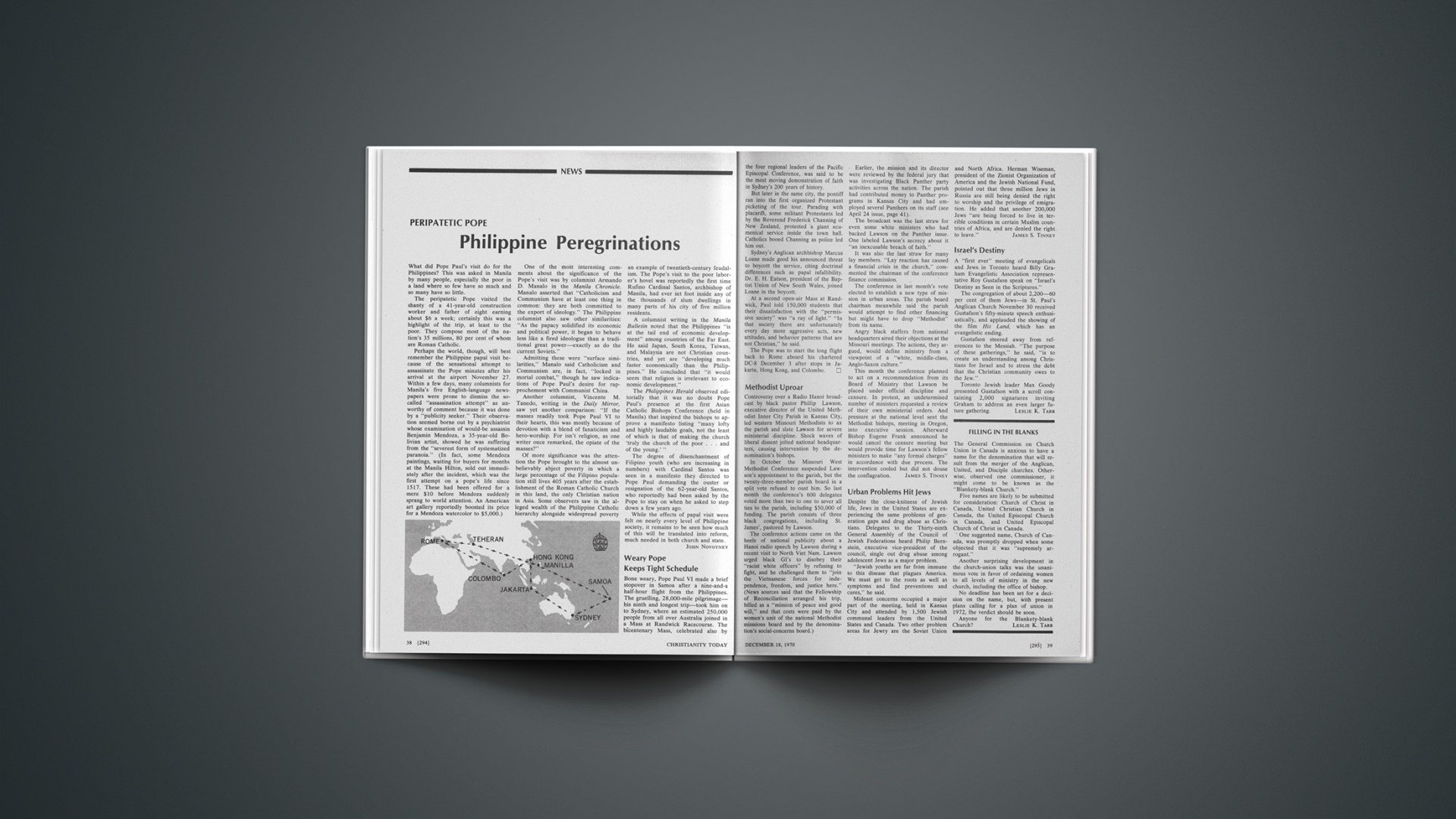
What did Pope Paul’s visit do for the Philippines? This was asked in Manila by many people, especially the poor in a land where so few have so much and so many have so little.

The peripatetic Pope visited the shanty of a 41-year-old construction worker and father of eight earning about $6 a week; certainly this was a highlight of the trip, at least to the poor. They compose most of the nation’s 35 millions, 80 per cent of whom are Roman Catholic.

Perhaps the world, though, will best remember the Philippine papal visit because of the sensational attempt to assassinate the Pope minutes after his arrival at the airport November 27. Within a few days, many columnists for Manila’s five English-language newspapers were prone to dismiss the so-called “assassination attempt” as unworthy of comment because it was done by a “publicity seeker.” Their observation seemed borne out by a psychiatrist whose examination of would-be assassin Benjamin Mendoza, a 35-year-old Bolivian artist, showed he was suffering from the “severest form of systematized paranoia.” (In fact, some Mendoza paintings, waiting for buyers for months at the Manila Hilton, sold out immediately after the incident, which was the first attempt on a pope’s life since 1517. These had been offered for a mere $10 before Mendoza suddenly sprang to world attention. An American art gallery reportedly boosted its price for a Mendoza watercolor to $5,000.)

One of the most interesting comments about the significance of the Pope’s visit was by columnist Armando D. Manalo in the Manila Chronicle. Manalo asserted that “Catholicism and Communism have at least one thing in common: they are both committed to the export of ideology.” The Philippine columnist also saw other similarities: “As the papacy solidified its economic and political power, it began to behave less like a fired ideologue than a traditional great power—exactly as do the current Soviets.”

Admitting these were “surface similarities,” Manalo said Catholicism and Communism are, in fact, “locked in mortal combat,” though he saw indications of Pope Paul’s desire for rapprochement with Communist China.

Another columnist, Vincente M. Tanedo, writing in the Daily Mirror, saw yet another comparison: “If the masses readily took Pope Paul VI to their hearts, this was mostly because of devotion with a blend of fanaticism and hero-worship. For isn’t religion, as one writer once remarked, the opiate of the masses?”

Of more significance was the attention the Pope brought to the almost unbelievably abject poverty in which a large percentage of the Filipino population still lives 405 years after the establishment of the Roman Catholic Church in this land, the only Christian nation in Asia. Some observers saw in the alleged wealth of the Philippine Catholic hierarchy alongside widespread poverty an example of twentieth-century feudalism. The Pope’s visit to the poor laborer’s hovel was reportedly the first time Rufino Cardinal Santos, archbishop of Manila, had ever set foot inside any of the thousands of slum dwellings in many parts of his city of five million residents.

A columnist writing in the Manila Bulletin noted that the Philippines “is at the tail end of economic development” among countries of the Far East. He said Japan, South Korea, Taiwan, and Malaysia are not Christian countries, and yet are “developing much faster economically than the Philippines.” He concluded that “it would seem that religion is irrelevant to economic development.”

The Philippines Herald observed editorially that it was no doubt Pope Paul’s presence at the first Asian Catholic Bishops Conference (held in Manila) that inspired the bishops to approve a manifesto listing “many lofty and highly laudable goals, not the least of which is that of making the church ‘truly the church of the poor … and of the young.’ ”

The degree of disenchantment of Filipino youth (who are increasing in numbers) with Cardinal Santos was seen in a manifesto they directed to Pope Paul demanding the ouster or resignation of the 62-year-old Santos, who reportedly had been asked by the Pope to stay on when he asked to step down a few years ago.

While the effects of papal visit were felt on nearly every level of Philippine society, it remains to be seen how much of this will be translated into reform, much needed in both church and state.

Weary Pope Keeps Tight Schedule

Bone weary, Pope Paul VI made a brief stopover in Samoa after a nine-and-a half-hour flight from the Philippines. The gruelling, 28,000-mile pilgrimage—his ninth and longest trip—took him on to Sydney, where an estimated 250,000 people from all over Australia joined in a Mass at Randwick Racecourse. The bicentenary Mass, celebrated also by the four regional leaders of the Pacific Episcopal Conference, was said to be the most moving demonstration of faith in Sydney’s 200 years of history.

But later in the same city, the pontiff ran into the first organized Protestant picketing of the tour. Parading with placards, some militant Protestants led by the Reverend Frederick Channing of New Zealand, protested a giant ecumenical service inside the town hall. Catholics booed Channing as police led him out.

Sydney’s Anglican archbishop Marcus Loane made good his announced threat to boycott the service, citing doctrinal differences such as papal infallibility. Dr. E. H. Eatson, president of the Baptist Union of New South Wales, joined Loane in the boycott.

At a second open-air Mass at Randwick, Paul told 150,000 students that their dissatisfaction with the “permissive society” was “a ray of light.” “In that society there are unfortunately every day more aggressive acts, new attitudes, and behavior patterns that are not Christian,” he said.

The Pope was to start the long flight back to Rome aboard his chartered DC-8 December 3 after stops in Jakarta, Hong Kong, and Colombo.

Methodist Uproar

Controversy over a Radio Hanoi broadcast by black pastor Phillip Lawson, executive director of the United Methodist Inner City Parish in Kansas City, led western Missouri Methodists to ax the parish and slate Lawson for severe ministerial discipline. Shock waves of liberal dissent jolted national headquarters, causing intervention by the denomination’s bishops.

In October the Missouri West Methodist Conference suspended Lawson’s appointment to the parish, but the twenty-three-member parish board in a split vote refused to oust him. So last month the conference’s 600 delegates voted more than two to one to sever all ties to the parish, including $50,000 of funding. The parish consists of three black congregations, including St. James’, pastored by Lawson.

The conference actions came on the heels of national publicity about a Hanoi radio speech by Lawson during a recent visit to North Viet Nam. Lawson urged black GI’s to disobey their “racist white officers” by refusing to fight, and he challenged them to “join the Vietnamese forces for independence, freedom, and justice here.” (News sources said that the Fellowship of Reconciliation arranged his trip, billed as a “mission of peace and good will,” and that costs were paid by the women’s unit of the national Methodist misssions board and by the denomination’s social-concerns board.)

Earlier, the mission and its director were reviewed by the federal jury that was investigating Black Panther party activities across the nation. The parish had contributed money to Panther programs in Kansas City and had employed several Panthers on its staff (see April 24 issue, page 41).

The broadcast was the last straw for even some white ministers who had backed Lawson on the Panther issue. One labeled Lawson’s secrecy about it “an inexcusable breach of faith.”

It was also the last straw for many lay members. “Lay reaction has caused a financial crisis in the church,” commented the chairman of the conference finance commission.

The conference in last month’s vote elected to establish a new type of mission in urban areas. The parish board chairman meanwhile said the parish would attempt to find other financing but might have to drop “Methodist” from its name.

Angry black staffers from national headquarters aired their objections at the Missouri meetings. The actions, they argued, would define ministry from a viewpoint of a “white, middle-class, Anglo-Saxon culture.”

This month the conference planned to act on a recommendation from its Board of Ministry that Lawson be placed under official discipline and censure. In protest, an undetermined number of ministers requested a review of their own ministerial orders. And pressure at the national level sent the Methodist bishops, meeting in Oregon, into executive session. Afterward Bishop Eugene Frank announced he would cancel the censure meeting but would provide time for Lawson’s fellow ministers to make “any formal charges” in accordance with due process. The intervention cooled but did not douse the conflagration.

JAMES S. TINNEY

Urban Problems Hit Jews

Despite the close-knitness of Jewish life, Jews in the United States are experiencing the same problems of generation gaps and drug abuse as Christians. Delegates to the Thirty-ninth General Assembly of the Council of Jewish Federations heard Philip Bernstein, executive vice-president of the council, single out drug abuse among adolescent Jews as a major problem.

“Jewish youths are far from immune to this disease that plagues America. We must get to the roots as well as symptoms and find preventions and cures,” he said.

Mideast concerns occupied a major part of the meeting, held in Kansas City and attended by 1,500 Jewish communal leaders from the United States and Canada. Two other problem areas for Jewry are the Soviet Union and North Africa. Herman Wiseman, president of the Zionist Organization of America and the Jewish National Fund, pointed out that three million Jews in Russia are still being denied the right to worship and the privilege of emigration. He added that another 200,000 Jews “are being forced to live in terrible conditions in certain Muslim countries of Africa, and are denied the right to leave.”

JAMES S. TINNEY

Israel’S Destiny

A “first ever” meeting of evangelicals and Jews in Toronto heard Billy Graham Evangelistic Association representative Roy Gustafson speak on “Israel’s Destiny as Seen in the Scriptures.”

The congregation of about 2,200–60 per cent of them Jews—in St. Paul’s Anglican Church November 30 received Gustafson’s fifty-minute speech enthusiastically, and applauded the showing of the film His Land, which has an evangelistic ending.

Gustafson steered away from references to the Messiah. “The purpose of these gatherings,” he said, “is to create an understanding among Christians for Israel and to stress the debt that the Christian community owes to the Jew.”

Toronto Jewish leader Max Goody presented Gustafson with a scroll containing 2,000 signatures inviting Graham to address an even larger future gathering.

LESLIE K. TARR

Filling In The Blanks

The General Commission on Church Union in Canada is anxious to have a name for the denomination that will result from the merger of the Anglican, United, and Disciple churches. Otherwise, observed one commissioner, it might come to be known as the “Blankety-blank Church.”

Five names are likely to be submitted for consideration: Church of Christ in Canada, United Christian Church in Canada, the United Episcopal Church in Canada, and United Episcopal Church of Christ in Canada.

One suggested name, Church of Canada, was promptly dropped when some objected that it was “supremely arrogant.”

Another surprising development in the church-union talks was the unanimous vote in favor of ordaining women to all levels of ministry in the new church, including the office of bishop.

No deadline has been set for a decision on the name, but, with present plans calling for a plan of union in 1972, the verdict should be soon.

Anyone for the Blankety-blank Church?

LESLIE K. TARR

Book Briefs: December 18, 1970

Time For (Social) Action

Between Two Worlds: A Congressman’s Choice, by John B. Anderson (Zondervan, 1970, 163 pp., $3.95), and Congress and Conscience, edited by John B. Anderson (Lippincott, 1970, 192pp., $4.95), are reviewed by Wesley G. Pippert, United Press International, Washington, D.C.

In writing recently about America’s right-wing tradition, George Thayer pointed out that the characteristics of an extremist of the 1830s are not significantly different from those of a 1970 extremist. “Both,” he said, “tend to be fundamentalist in their religion [italics added], anti-elitist, moralistic, xenophobic, secure in the knowledge that Right is on their side, prone to a conspiracy theory of history, impatient with democratic procedures, and hostile to cleavage, ambivalence, and the clash of ideas.”

And so it is: in the eyes of many people, fundamentalists are right-wingers and vice versa. Altogether too often their view is accurate.

The danger in this view is subtle. It suggests that persons may be fundamentalist merely because they have a conservative streak running through their total approach to living that extends to their religious convictions. It also suggests that if a person is liberal and activist in his orientation to social issues, somehow his profession of fundamentalism is suspect.

There are signs, however, that evangelicals have begun to awaken to the excruciating needs of their neighborhood—not the world, for evangelicals have always embraced a world-view—but their neighborhoods. One of the most important of these is Representative John B. Anderson of Illinois, the National Association of Evangelicals’ Outstanding Layman of the Year in 1964 and, as chairman of the House GOP Conference, the third-ranking Republican in the House of Representatives.

Anderson is acknowledged among many persons in Washington to be one of the most intelligent members of the House and among its most gifted orators. It shows in his two books. Between Two Worlds, particularly, is a superb piece of work—laced with Scripture, and showing an enormous sensitivity to the needs of the minorities, the underprivileged, the alienated. In Worlds Anderson details—and dovetails—his commitment to Christ and his views about the pressing issues of the day. And he comes to grips with the imperative: that the person who has experienced personal salvation must be concerned with the broader problems of a nation and a world that Anderson sees in an increasingly pessimistic way.

Anderson starts out by telling of his conversion experience at the age of nine—“I have never been ashamed to recount that experience,” he writes—and he ends both books by talking about social ethics. From his boyhood in the Swedish Free Church in Rockford, Illinois, he recalls sermons against “modernism” as the great archenemy of the Church of Jesus Christ. Then he writes:

We can see in retrospect that many of the great problems which plague us today were already in evidence then, but our entire attention was diverted to battling those whom some fundamentalists believed were simply advance men for the anti-Christ because of the false doctrine which they espoused. We were reminded that even as Paul had to cleanse the church at Corinth of those who sought to promulgate error in their explanation of the Resurrection, and to warn the church at Colossae against Gnosticism, fundamentalists had to defend historic Christianity against the siege guns of “Modernism.” We were at that time so concerned with the preservation of the distinctive doctrines of our faith, that we failed to devise ways in which to exercise these doctrines in the modern world.

The way Anderson voted his first few years in Congress suited his conservative constituency perfectly. He voted against welfare programs and assistance to the cities. The Americans for Constitutional Action measured his conservatism with an 88 per cent rating. But slowly, things began to change his outlook—a Ford grant to visit Harlem, Watts, the Hough ghetto of Cleveland; the insights that come from reading one or two books a night; and perhaps most important, the radical changes the Holy Spirit can perform through the Scriptures. And when the open-housing bill—one of the most important pieces of civil-rights legislation of the 1960s—came to a head in Congress at the time of the assassination of Martin Luther King, Jr., Anderson more than any other congressman provided the leadership and key votes for its passage.

Later he told a reporter:

The decision was very prayerfully made. A verse kept coming to me—a passage from 2 Corinthians 5 in the Phillips translation: “For if a man is in Christ he becomes a new person altogether.… All this is God’s doing for he has reconciled us to himself through Jesus Christ and he has made us agents of reconciliation. God was in Christ personally reconciling the world to himself … and has commissioned us with the message of reconciliation.” With the growing realization of the need for reconciliation between black and white in this country, I saw ever more clearly the need for Christians particularly to be agents of this reconciliation.

Anderson feels that the division between blacks and whites in this country is greater now than when the Kerner Commission report was published. He writes:

Christians once again have a special responsibility to lead in this effort. It is tragic but true that many of us are as guilty of the sin of racism as the most hardened unbelievers. Do we believe that all men are creatures of one blood? Do we accept the divine injunction of our Lord, that the second great commandment is “love thy neighbor as thyself”? Or do we in the next breath pray, “But Lord, let not my neighbor be black”? We sing that “Jesus loves the little children, red and yellow, black and white.” But do we somehow feel differently about the children once they have grown up?

We give generously to missionaries so they can take the Gospel to black Africa. But that is not the limit of our responsibility. We have to minister to the Afro-American in our midst. We cannot thrust that responsibility to the outer, remote circumference or our own personal experience. We cannot tell the missionary to go out and love the black man, the yellow man, the brown man of Africa and Asia, and then refuse ourselves to be put down next to our black neighbor and show the same love.

“Poverty and hunger,” Anderson says, “are not problems that we can shun if we would truly serve our Lord and our fellow-man.” He goes on to quote the starkly clear words of Christ in Matthew 25 in this regard.

Anderson says a new and vital evangelical social ethic must include (a) an integrated ethical system that “reunites personal responsibility with social responsibility, and yet remains true to the demands of the Gospel,” (b) a more positive outlook toward government, recognizing “that government is one of the fundamental orders of creation, and therefore deserves our respect as Christians every bit as much as marriage and the family, and (c) a more realistic view of politics that sees it as no more corrupt or corrupting than many other professions.

Congress and Conscience is a series of essays by congressmen about specific subjects. Among them is one on hunger in America by Senator George S. McGovern of South Dakota, who readily concedes that much of his sense of service came from his being reared in a deeply religious home with a Wesleyan Methodist minister father. Other contributors include Representatives Jim Wright of Texas, Charles E. Bennett of Florida, and Albert H. Quie of Minnesota, and Senator Barry M. Goldwater of Arizona.

Senator Mark O. Hatfield of Oregon wrote the foreward to Worlds. In it, he offered what may be a good summary of the book: “Some preach the gospel of social concern, others preach the Gospel of personal salvation. John Anderson’s words and life demonstrate clearly to those of us who will listen that Jesus Christ has the power and desire to redeem the whole man, that indeed the love of God must involve every aspect of our being.”

When Apologetics Hinders

Belief in God, by George I. Mavrodes (Random House, 1970, 117 pp., $1.95), and Introduction to the Philosophy of Religion, by James F. Ross (Macmillan, 1969, 185 pp., $1.95), are reviewed by Ronald H. Nash, head, Department of Philosophy and Religion, Western Kentucky University, Bowling Green.

It would appear that reports of the demise of natural theology at the hands of David Hume and Immanuel Kant were premature. In two excellent little books, two highly competent American philosophers show there is still some life in the old girl. And yet the two take radically different approaches to the subject. Since Ross, head of the philosophy department at the University of Pennsylvania, is a Thomist, his positions are sometimes predictable. But not always. His book is a kind of Thomistic guide to where things now stand with respect to proofs for God’s existence, faith and reason, the problem of evil. I have my disagreements with Ross, to be sure, but in this age of radical theology, these differences don’t seem as important as they did a few years ago. Of special interest is Ross’s conclusion that all the recent debate over the meaningfulness of religious discourse and its relation to empirical verification has had largely negative results. He believes “that a new approach to the problem of religious discourse must be undertaken by way of a more careful application of the theory of knowledge to the beliefs of religious persons.” This, in part, is one of the tasks Mavrodes undertakes.

Mavrodes, an evangelical Protestant who teaches philosophy at the University of Michigan, has given us one of the most important studies in the philosophy of religion to be written in recent years. His work could justifiably have been subtitled “A Prolegomena to Any Future Philosophy of Religion.” His book suggests that many arguments in the philosophy of religion are fruitless because the protagonists have failed even to comprehend, let alone to agree on, more fundamental issues of the debate. How much value can there be to discussions about the knowledge of God, belief in God, and proofs for God until we know what it means to know, believe, and prove?

Consider for example the innocent-seeming question, “How do you know God exists?” This question can have different meanings that call for quite different answers. One meaning, which Mavrodes calls the biographical question, “is not about the content of the belief (it is evident that the friend believes) nor about the content of the belief (both agree that it is true), but about the reason for the belief in this particular case.” In another meaning of the question (called by Mavrodes, “The Challenge”), “How do you know God exists?” is not a genuine question at all. It is a throwing down of the gauntlet that says, in effect, “Convince me that God exists if you can.” The response to this kind of challenge must be evaluated in terms of its truth or falsity as well as its success in convincing the questioner.

Mavrodes goes on to examine the nature of proof with special attention to proofs for God’s existence. He thinks entirely too much significance has been attached to the notion of proving something. It is nonsense to hold that one cannot know something unless or until he has proven it. One can know many things without proving them. Mavrodes even shows how one can prove something without knowing it. And even if one has good reasons, should he therefore hesitate to believe simply because others are unwilling or unable to accept his arguments? “It would seem foolish,” Mavrodes argues, “for anyone else to construe another’s ignorance as a limit upon his own intellectual life.”

Arguments are not a necessary condition for knowledge. On the contrary, we must already have some knowledge in order for an argument to help us. Since there must be other ways of acquiring knowledge than through proofs, the question of proof is not crucial for theology. Some theological knowledge can be derived from direct experience (which includes revelation).

Should it prove impossible to prove the existence of God, nothing particularly significant follows. Mavrodes questions whether, given his analysis of proof, it is even worthwhile to prove God’s existence. He provides a logical technique that will permit any fifth grader to prove not only God’s existence but any true proposition. But what purpose would such a proof serve? Since such arguments do little more than satisfy the formal requirements of logic and truth, their only value is the entertainment they provide. It may be fun to spin out such arguments, but success or failure in this endeavor is hardly cause for great elation or disappointment.

Why do some arguments work and others fail? The success of a particular argument may be quite independent of the argument’s soundness. “Since a solution must satisfy two different sorts of requirements, those of psychological effectiveness in altering beliefs and those of epistemic propriety involving truth and logic, it may be open to criticism along either of these lines.”

Because of the more fundamental character of his argument, Mavrodes shows that many of the questions Ross attempts to answer need no reply. Take for example, the oft-given challenge that theologians do not know the origin, cause, purpose, or justification of evil. Ross attempts to find answers to these problems. Mavrodes simply notes that from the inability of theologians to answer these questions, “nothing of interest follows about evil itself nor about its cause, justification, or purpose.… What does follow, of course, are propositions about theologians … for example, that theologians do not know everything about their own specialty.”

Why is the problem of evil such a tough nut to crack? Mavrodes notes several reasons. For one thing, many philosophers of religion get sidetracked into dealing with questions about the origin or purpose of evil that, though they may be interesting, have no theological consequences. Furthermore, “the problem” of evil turns out to be not just one problem but a complex of many problems. And as should be obvious, the problem of evil is a person-oriented problem. “It is very unlikely that there is one solution that will be convincing to all. For people are too diverse in their evaluation of explanations, their ability to follow analysis, and in the sort of proofs which convince them. There may be many satisfactory solutions (for different people); it is not likely that any solution is the solution (for everyone). If any one solution works in a substantial number of cases, it is as good as can reasonably be expected; that it does not convince everyone is a minor defect indeed.”

Arguments and proofs are tools. As such, they are useful or useless only as means to something more important. Mavrodes deplores the tendency to look on proofs of God’s existence as a kind of intellectual exercise or game. It is foolish to quibble over epistemological tools (proofs) and ignore the more fundamental question of God. A good workman should, of course, pay attention to his tools. But he should not put them ahead of the work for which the tools exist. “In the end we must stop examining and discussing epistemic activities and we must begin to use them and to engage in them.” If all our reasoning and experience is ever to lead us to the truth, it will do so “only if we finally turn our faces outward, away from the reasoning and the experience itself, and toward the truth that we seek to grasp.” After all, what shall it profit a man if he prove the existence of God and lose his own soul?

Soapy Suspense

Oh! Sex Education!, by Mary Breasted (Praeger, 1970, 337 pp., $7.95), is reviewed by Lewis Penhall Bird, eastern regional director, Christian Medical Society, Havertown, Pennsylvania.

Already widely known as the home of Disneyland and the California Angels, Anaheim gained additional attention in the fall of 1968 when the family-life and sex-education programs in the Anaheim Union High School District came under bitter attack. Right-wing opponents, led by four parents (one man and three women) and two Anaheim newsmen, managed to halt the program by electing two anti-sex-education candidates to the school board. Two-thirds of this book chronicles the Anaheim episode as a microcosm of the nationwide furor, while the last third places the issue of sex education in the public schools in its larger context.

Mary Breasted, who was commissioned by the publisher to investigate this emotional controversy, is a graduate of the Columbia University Graduate School of Journalism and has been a regular writer for the Village Voice. Her book reads like a combined soap opera and detective story. Using school-board transcripts plus recorded living-room interviews, she leads the reader through the labyrinth of charges and counter-charges, allegations and assumptions. Her documentary pursuit of the truth—from myth to fact—will be helpful for any educator embroiled in a similar controversy. Evangelical Christians will despair at much of the methodology and the theology of some of the conservative Christian “Anti’s.”

In what was considered two years ago to be the number-one sex education program in the United States, some 35,000 students from Anaheim’s junior and senior high schools were offered a course lasting 4½ weeks. The junior-high students covered physical changes during puberty while the older students discussed the facts of reproduction, pregnancy, birth, and family problems. Prior to the controversy, 90 per cent of the adults in the school district had indicated their approval of such a course. Only 1 per cent of the students brought parental notes to be excused. Yet once the Anaheim Anti’s began their opposition, they were able to turn the tide by electing two of their own when only 14 per cent of the eligible voters turned out for the school-board election. The program is presently tabled, awaiting further revision.

The final third of the book has interviews with Dr. Gordon V. Drake of Christian Crusade and Dr. Mary S. Calderone of SIECUS (the Sex Information and Education Council of the United States) as well as an analysis of various political and urban responses to sex education in the public schools. Interestingly, Miss Breasted felt drawn to Drake’s ready friendliness and “twinkly eyes” (though “he was a man who saw no harm in bending the truth or even altering it for his special purposes”). Mary Calderone, on the other hand, while making “a great deal more sense,” comes across as arrogant and austere. For the author, their essential difference was not that they departed from conventional morality (they didn’t) but rather that Drake used a traditional polemic laced with Bircher overkill while Dr. Calderone sought more polished and scientific arguments to argue for chastity and fidelity. Miss Breasted found that the debate seemed a bit antiquated, particularly in the face of other moral issues confronting youth (“they have other things to worry about, like the draft and the people who are ruining our water and our air”).

Of value to anyone involved with family-life education will be the careful documentation of sex-education myths, the sociological data on controlled studies of problems in this area, the analysis of basic pro and con arguments, and the biographical information on national figures involved in the controversy. (Probably a hasty publication deadline prevented a more careful preparation of the index; discussions on the effectiveness of sex-education programs, family goals, illegitimacy, venereal disease, pornography, and nudity escaped listing, as did several prominent names.) For documentation, analysis, and solid data, the book is most useful. Church educators neglect it at their peril, particularly if the problem of sex education touches their parish.

A Detailed Canvas

Worship and Theology in England, Volume I, From Cranmer to Hooker 1534–1603, by Horton Davies (Princeton, 1970, 482 pp., $15), is reviewed by G. W. Bromiley, professor of church history, Fuller Theological Seminary, Pasadena, California.

The present work is the fourth in a notable series by Horton Davies on English worship and theology from the Reformation to the present day. The three volumes already available deal with the last three centuries, and the final one will be devoted to the seventeenth century.

The new volume is a comprehensive survey in which much attention is paid to theology, as is only proper. Roman Catholic, Puritan, and Separatist forms and styles of worship are presented as well as Anglican. Special chapters deal with such matters as art, architecture, and music. Preaching is not neglected, and there is an interesting concluding comparison of Roman Catholic, Anglican, and Puritan spirituality.

Although Davies paints a big canvas, he also has an eye for detail. The work is grounded in careful research, so that the conclusions follow from a mass of useful, interesting, and sometimes amusing information. The excellent bibliography, supported by full and well arranged indexes, gives a clue to the painstaking effort that has gone into the making of the book.

The author has also done well in giving a readable presentation. His style is scholarly, yet forceful. He has a gift for effective phrases. Light relief, as noted, comes from within the material itself. If there are lapses, and one or two favorite words are overworked, still the book in general stands in happy contrast to many modern writings with their poor grammar, ill-digested jargon, and general imprecision.

In view of the general excellence of the work, criticism might seem a little churlish, yet there are matters both general and detailed that invite comment. The theology, for instance, is very restricted, since only eucharistic theology is presented with any adequacy. But even liturgically other doctrines, such as election, baptism, or post-baptismal sin, have at least an equal claim to attention. In this respect promise outruns performance.

Furthermore, while one allows that the centuries cannot be artificially divided, Davies hastens on at points rather too quickly from the sixteenth to the seventeenth. This is very apparent in the comparison of Anglican and Puritan that begins on page 75: it is very well done, but hardly applies to most of even the Elizabethan age, when many Anglicans were Puritans and vice versa.

The treatment of Anglican worship is also disappointing. Quantitatively, what the author calls its “lion’s share” is only sixty pages compared to thirty-eight for the Roman Catholics and sixty-four for Puritans and Separatists together. Qualitatively it is no more than adequate, and Davies’s own background is a little over-obvious in his comparative evaluations. Incidentally, the Anglican chapter rehashes a good deal of what had been done already under eucharistic theology, and if other repetitions were eliminated some eighty pages (and three dollars?) might have been trimmed.

If space allowed, many detailed points might be questioned. The handling of Zwingli smacks of the second-hand, and the Kidd-Dix-Richardson group offers poor guidance rather too naïvely followed. The avowal that only two historians known to the author have seen in Cranmer high Calvin rather than low Zwingli is an odd one in the light of the references as well as the omissions in the bibliography. The statement that Cranmer desired a weekly eucharist and Zwingli settled for a quarterly is a muddled one, for it could just as well be reversed: Zwingli desired a weekly eucharist and Cranmer settled for a quarterly. The stress on nominalism is too heavy, especially as Davies faults Hooper (twice) for playing on the question at what word transubstantiation takes place (a nominalist problem). A dubious date is given for Ridley’s change in eucharistic thinking, and a slip has also crept into the dating of his treatise (p. 103, n. 107).

Nevertheless, these are minor blemishes on what is on balance a magnificent study. Whether for the wealth of information or the essential soundness of judgment, all who have an interest in the theme and period can certainly read the work with both pleasure and profit. The concluding volume in a very worthwhile series will be awaited with genuine anticipation.

Newly Published

Out of Concern for the Church, by John A. Olthuis et al. (Wedge, 1970, 125 pp., paperback, $2.50). Five young Calvinists call for a reformation of the Church that will make it much more influential in shaping the world. But rather than secularize the Church, they aim to make the world sacred, at least for the Christian. Disturbing, provocative, and, especially on specific proposals, perplexing. Are Christian political parties, newspapers, and labor unions the best way to achieve these goals? Is evangelism as important in their world view as it was in Paul’s?

Contemporary Old Testament Theologians, edited by Robert B. Laurin (Judson, 1970, 223 pp., $8.95). Each of seven Baptist seminary teachers has written on a scholar, such as Eichrodt, von Rad, Vriezen, and Jacob. Very good.

Student Power in World Evangelism, by David M. Howard (Inter-Varsity, 1970, 129 pp., paperback, $1.25). A lucid examination of the three perspectives of missions—biblical, historical, contemporary. The author shows that young people have always been and need to be intimately involved in global evangelism. If not, such efforts are doomed.

Please Help Me! Please Love Me!, by Walter Trobisch (Inter-Varsity, 1970, 64 pp., paperback, $.95). With sensitivity and understanding, the author helps his African correspondent recognize contraception as legitimate and not unbiblical. Excellent.

One Way to Change the World, by Leighton Ford (Harper & Row, 1970, 119 pp., $3.95). Essays stressing the need for Christian revolution.

The Second Letter of Paul to the Corinthians, edited by Everett Ferguson (Sweet, 1970, 192 pp.). Latest addition to the “Living Word Commentary,” written by members of Churches of Christ.

The Theology of Post-Reformation Lutheranism: A Study of Theological Prolegomena, by Robert D. Preus (Concordia, 1970, 462 pp., $12.50). This major, scholarly, sympathetic study of seventeenth-century orthodox Lutherans—who have usually been passionately censored, to put it mildly—deserves careful reading by all serious students of the history of Protestantism.

The Creation of Life: A Cybernetic Approach to Evolution, by A. E. Wilder Smith (Shaw, 1970, 269 pp., $5.95). A University of Illinois pharmacology professor offers a substantial and very technical critique of certain aspects of biological theory.

Adult Education in the Church, edited by Roy B. Zuck and Gene A. Getz (Moody, 1970, 383 pp., $5.95). Twenty-eight contributors on such topics as “The Nature and Needs of Young Adults,” “Adults in Service Projects,” “Assisting Parents with Sex Education,” and “The Learning Process for Adults.” Very helpful.

Righteous Empire: The Protestant Experience in America, by Martin E. Marty (Dial, 1970, 295 pp., $8.95). Stresses trends rather than denominational details and interaction with culture as a whole rather than specifically religious concerns. Well written and factually accurate. Marty’s viewpoint, worth considering, will for some readers prove unsettling.

American and Catholic, by Robert Leckie (Doubleday, 1970, 388 pp., $7.95). A dramatic, personal narrative of the contributions Catholics have made to America since the days of the conquistadors.

Your Religion: Neurotic or Healthy?, by George Christian Anderson (Doubleday, 1970, 191 pp., $5.95). Those who read this to find out, won’t.

Was Jesus Married?, by William E. Phipps (Harper & Row, 1970, 239 pp., $5.95). Answering yes, the author presents a clearly argued but unconvincing case.

Christian Answers to Teenage Sex Questions, by S. Spencer and N. Brown (Hallus, 1970, 198 pp., $4.95). Effective reasoning on a touchy subject.

Encounter with Israel: A Challenge to Conscience (Association, 1970, 304 pp., $7.95). Another of the many recent books on Israel. This one is distinctive for its scope, objectivity, and unusual format.

In Defense of Martin Luther, by John Warwick Montgomery (Northwestern, 1970, 175 pp., $5). Seven periodical articles on Luther’s views on such topics as hermeneutics, science, and missions are here collected in revised form.

A New Song, by Pat Boone (Creation House, 1970, 192 pp., $4.95). Hollywood actor-singer Pat Boone tells of his conversion to Christ, subsequent backsliding, and recent return to the church (complete with charismatic experience). His story-telling is pleasingly bereft of the usual cliches, yet one is left with the unmistakable impression that he is indeed born again. Worth reading.

What Is Human?, by T. M. Kitwood (Inter-Varsity, 1970, 142 pp., paperback, $1.50). A book for non-Christians compares the humanist and existentialist views of man with that of divine revelation.

Put Your Arms Around the City, by James W. Angell (Revell, 1970, 188 pp., $4.95). Jesus wept over Jerusalem, longing to gather its inhabitants to him. This author asks the Church to do the same with America’s cities.

Wandering Wheels, by Jack Houston (Baker, 1970, 173 pp., $3.95). The story of the Christian cyclists who saw conversions occur from ocean to ocean as they wheeled.

Some of the above books will later be reviewed at greater length.

In The Journals

Students of biblical archaeology will welcome the appearance of two fine pieces that seek to reopen the fundamental question of the locations of Bethel and its neighbor, Ai. On the correct identification of Bethel hinge the location of many other southern Palestinian sites and some of the more disputed matters of Old Testament chronology. The Summer, 1970, issue of The Seminary Review (Box 8, Cincinnati, Ohio 45204) is devoted to “Biblical and Archaeological Data on Ai Reappraised” by W. Winter, a professor at Cincinnati Bible Seminary. He concludes that el Tell must continue to be considered as the most likely site of biblical Ai. The opposite view is advanced by David Livingston in Westminster Theological Journal, November, 1970, pp. 20–44 (single copy $2.50; Chestnut Hill, Philadelphia, Pa. 19118). He seeks to demonstrate that both Bethel and Ai have long been mislocated.

COCU Alternatives

EDITORIALS

At a time when the COCU Plan of Union is struggling to win acceptance, two recent events together suggest an alternative that may be attractive to some who are involved in COCU as well as to some who are not. The first is the canonization of forty English and Welsh Roman Catholics by Pope Paul, the second the call by some Catholic scholars for Rome to recognize the validity of the Lutheran ministry and the real presence of Christ in the Lutheran administration of Holy Communion. Evangelicals need to understand the directions the various strands of ecumenicity are taking, and to be aware of the possible implications for the non-aligned denominations and for para-ecclesiastical groups, such as independent Christian colleges, seminaries, and mission boards.

On October 25 Pope Paul made a double-barreled pronouncement before 10,000 British Roman Catholics. He canonized forty martyrs who died because they refused to submit to Anglicanism four centuries ago; in effect the Pope recognized the piety and sacrifice of the Catholic martyrs without denying the legitimacy of the English church Reformation. At the same time he shrewdly acknowledged that the Anglican church is a true church, and that it has “legitimate prestige.” He seemed to be suggesting that its bishops could continue to function as leaders of the established church even without organizational reunion with Rome. The “patrimony of piety and usage” would continue; this suggests that Anglicans would be able to retain their existing prayer book and their married clergy. Most important of all, the Pope called the Anglican church Rome’s “ever beloved sister,” as if to admit mistakes on both sides but to assure Anglicans that they are considered never to have left the family.

The canonization of additional British martyrs was immediately taken as an insult by many British non-Roman Catholics, but it might also be considered a sop to British Catholics already upset by the abandonment of Latin, the simplification of the Mass, and the evangelical tone of many recent changes. Now they were being asked to accept the Anglican church as a sister church with a genuine liturgy and with genuine bishops and priests.

The Pope’s announcement indicates the Vatican’s new prescription for progress in church-union negotiations. Many Protestants envision the union of similar groups of Protestants into bigger and bigger administrative units, which conceivably might in time unite with Rome in one monolithic church. Now the suggestion is that the Anglican churches remain unchanged in the same dioceses with Roman Catholic churches, ministering side by side. This pattern already exists in the Middle East, where Uniat churches such as the Maronites, Antiochene Syrians, Alexandrine Copts, and various Byzantine groups retain their language, rites, and canon law under their own bishops in full communion with the Church of Rome.

Not long after the canonization proceedings, top-ranking American Roman Catholic scholars called on the church to do for the Lutherans what Pope Paul had already done for the Anglicans. Since 1965, Catholic and Lutheran theologians, representing the Bishops’ Committee for Ecumenical and Interreligious Affairs and the U. S. National Committee of the Lutheran World Federation, have engaged in serious dialogue, and they have just released one document about the “Eucharist and Ministry.” The upshot of this dialogue is the Catholic scholars’ call for Rome to further unity and heal the Reformation division by recognizing the validity of Lutheran clerical orders and the sanctity of their eucharistic rites. What does all this mean?

If the Pope’s opinions about Anglicans and the American Catholic theologians’ suggestion about Lutherans are promoted, church-union negotiations will be a whole new ball game. Instead of a search for tidy organizational unity, the move would be toward mutual recognition of vast theological and practical differences in a family of churches in which the Pope is recognized as the symbolic head. What would this do to COCU?

Of late the Episcopal Church appears to be leaning more toward Rome than toward COCU. And although no Lutheran group is involved in the COCU negotiations, still the movement of nine million Lutherans toward Rome and the Anglican churches would be significant for COCU. This plus the increasing disinclination of the Episcopal Church for COCU could have a marked influence on the Methodist bodies that make up the largest segment of the COCU merger movement. The Methodists are far closer to the Anglican-Episcopal groups out of which they have sprung historically than to Presbyterians and Congregationalists. As the Roman Catholic-Anglican-Lutheran axis gains strength, it is not unreasonable to suppose that Methodists might gravitate in that direction. If this were to happen it would leave COCU far behind this other strand of ecumenical activity.

For Episcopalians, Lutherans, and Methodists to move Romeward would be far easier than for Presbyterians and Congregationalists to do so. The price Presbyterians and Congregationalists would have to pay in the sacrifice of their historical distinctives would be prohibitive. They would have to accept principles of liturgy, ecclesiology, and theology from which they dissented when they left Rome at the time of the Reformation.

The strange twist of our day, and a brutal fact that cannot be overlooked in any discussion of ecumenicity, is the radical departure from former norms by many within Protestant denominations as well as many in the Roman Catholic Church. Indeed, there is a remarkable convergence of views among theological secularists, both Catholic and Protestant, that leaves us with the unexpected consequence that evangelical Protestants, despite their objections to the stance of the Roman Catholic Church of Reformation days, are closer to the Church of that era than to liberal Protestants or Catholics of today.

COCU has some interesting days ahead of it and can hardly be considered a fait accompli. In this very fluid situation, evangelicals must decide what their strategy shall be, and this is true of evangelicals who are outside both strands of the ecumenical thrust as well as of those whose churches are involved in these movements but who prefer an ecumenical alternative in some other direction than Rome or COCU.

Youth On The March

The thought of thousands of students from all across the country descending upon a medium-size Midwestern city for a convention in this post-Woodstock age might be expected to give nightmares to law-enforcement officials. But this isn’t likely to happen in Urbana, Illinois, and its twin, Champaign, this December 27–31. For the great majority of these students will be Christians coming to discuss “World Evangelism: Why? How? Who?” at the Ninth Triennial Inter-Varsity Missionary Convention, one of the great Christian phenomena of our time.

These young people are, for the most part, as keen on non-conformity to the dominant currents in society as the “radical” students are. But the big difference is that Urbana-bound youth seek to be conformed to Christ, and to follow his words and those of his apostles. Their ways, like Christ’s, are non-violent. They won’t be giving much trouble to peace officers. But in a different way, many a young person who comes will have been a heartbreak to his parents. The possibility that a son or daughter might be considering missionary service abroad is enough to make many materialistically minded, security-conscious parents wish their child was given to some more “respectable” deviation, something he might outgrow.

Many trends in society at large, for better or for worse, have had their impetus from the youth culture. Christians of all ages should pray that the Spirit of God will operate in a mighty way at Urbana to stir up these young people to lead a renewed Christian assault upon the forces of unbelief and false belief that are so rampant across our country and planet.

Young people have been adept, often to the embarrassment of their elders, at calling attention to some of the major problems of society. (They have also added to the problems through such misdeeds as drug abuse and crime.) Christian youth frequently share the concerns of their generation for social justice and also voice their complaint about the domestication of the Church.

Urbana will be the largest among a number of opportunities during this Christmas time for Christian youth to be invigorated by fellowship and challenged to face a world that is coming apart at the seams. For all such efforts Christians young and old need to unite in prayer, in financial support, and in renewed dedication to the tasks God has entrusted to us. God has usually chosen young people as the leaders in breakthroughs for the Gospel. It may be in his purpose to do this again in our time.

Reaction To Reaction

The moderator of the General Assembly of the Presbyterian Church U. S. is reacting with what some in his denomination feel is unjustified vigor in denouncing groups that have emerged to defend the historic theology and polity of that church, which they feel has been increasingly affected by radical innovations.

Speaking to a joint meeting of the Christian-education boards of his denomination and the United Presbyterian Church, Dr. William A. Benfield, Jr., urged that these two groups take steps toward a merger, even though their churches have not voted to merge. In his address he strongly criticized what he described as “pressure groups” in his church formed to protect and promote what they believe to be the true nature and mission of the church. He went on to say that if he had the power he would abolish Concerned Presbyterians (an organization of laymen), Presbyterian Churchmen United (made up chiefly of ministers), the Covenant Fellowship of Presbyterians (a growing group of ministers and laymen trying desperately to save their denomination), and the Presbyterian Evangelistic Fellowship (whose staff consists of about a dozen men who primarily give their time to holding evangelistic meetings, though they are increasingly interested in evangelical world missions).

The moderator made no mention of other “pressure groups,” those that are working, without known organizational names, to further the liberal trend in his church. These groups are deeply involved in ecclesiastical power politics and have been for years.

The vigorous denunciation of conservatives by the moderator is something new in Presbyterian U. S. history. It appears to have the effect of drawing to the conservative cause some men who till now have remained more or less neutral.

Perhaps Benfield is angered and somewhat frightened by two particular matters. First, eleven presbyteries have served notice on the General Assembly that there is a limit in compromise beyond which they will not go. And at a recent meeting of the Nashville Presbytery, a small group of conservative leaders, both clergy and laymen, canvassed the situation within the presbytery (which has long been dominated by the more liberal element) and came up with its own slate of nominees. All were elected—thereby completely changing the control of that presbytery. These developments may make the moderator feel he must strike back with vigor.

Conservatives within the Presbyterian Church U. S. are far better organized and more articulate than those in some of the other major denominations. Liberals who have dominated the machinery of that church in recent years may have reason to fear a reversal of control. Fortunately for the conservatives, the moderator has neither the power nor the authority invested in the Pope, for example.

Benfield is chairman of the committee that drafted COCU’s Plan of Union. His present attitude is not likely to increase enthusiasm for COCU among Reformed groups.

Old Stoneface

One of the classic advertisements of modern times shows an elderly man glowering out of an executive’s chair. The text of the “Old Stoneface” ad quotes him as saying:

“I don’t know who you are. I don’t know what your company stands for. I don’t know your company’s customers. I don’t know your company’s record. I don’t know your company’s reputation. Now—what was it you wanted to sell me?”

Persuasion is usually built upon a base of confidence, and to develop a feeling of trust may take some time and effort expended in a variety of directions. Never before has this been more applicable to the Christian faith. People are bombarded with so many messages and deceptions are so rife that we should not be surprised when Christian witness is greeted by suspicion.

Once in a while, a single brief message can break through and overcome years of alienation from the Christian faith; but this does not happen often. Evangelism more than ever needs the support of a favorable climate, and every Christian has a stake in helping to develop that climate.

Christmas Wisdom

God promised Noah no more killing rains, but the people at Neiman-Marcus are taking no chances. If the rains should come in 1974, those who this year order an ark, complete with animals, will be luxuriously prepared (the Dallas department store asks you to allow four years for delivery). This is only one of the many outlandish presents on sale in this extended Christmas shopping season. For the more sports-minded, Abercrombie and Fitch boasts a $5,560 shotgun among its wares. Even the recession does not seem to slow down the desire for present-giving. Shoppers’ imaginations swell under the Christmas glitter. Tinsel, aluminum trees—silver, gold, or pink—and the many faces of St. Nick mark the season.

In the rush and bustle to get and give, the words of Solomon remind us of a desire worthy to be pursued: “Happy is the man who finds wisdom, and the man who gets understanding, for the gain from it is better than gain from silver and its profit better than gold. She is more precious than jewels, and nothing you desire can compare with her” (Prov. 3:13–15).

What Of Martyrdom?

On Christmas Day 800 years ago, the archbishop of Canterbury, known as Thomas, excommunicated those bishops who during his exile in France had participated in the investiture of the heir apparent, son of King Henry II. Four days later Thomas a Becket was murdered at Canterbury. Three years later he was canonized.

Many men have speculated on the character of Thomas, a man full of contradictions. To move from advocate of secular power over clerical power when chancellor to advocate of supreme clerical power when archbishop was a drastic shift. But in this his love of power is seen, and his actions in his struggles with Henry over the Constitutions (sixteen clauses attempting to define custom with regard to ultimate governmental authority) show little humility. Yet in his subsequent exile he practiced great asceticism in a Benedictine abbey in France. According to tradition, he wore a hair shirt at all times.

In an attempt to explore the motives of this man, T. S. Eliot in his play Murder in the Cathedral raises a more fundamental point. Becket says in his last sermon: “A martyrdom is never the design of man; for the true martyr is he who has become the instrument of God, who has lost his will in the will of God, not lost it but found it, for he has found freedom in submission to God.” Martyrdom begins long before death, and this attitude should be common to all Christians, for it is the paradox of the Christian life expressed by Christ: “He who finds his life will lose it, and he who loses his life for my sake will find it.”

Holding The Line On ‘Parochaid’

After many years of controversy, the question of public support of parochial education is nearing a showdown. Until the last few weeks there seemed to be a marked trend toward relaxation of traditional bars against tax money for sectarian schools. However, recent court decisions in Louisiana, Rhode Island, and Connecticut and the results of parochaid referenda in Michigan and Nebraska may indicate an abrupt reversal. Cases now before the U. S. Supreme Court, the first of their kind, are being looked upon for a basic settlement of the issue.

Some major realignments are taking place in popular attitudes toward public funding of religious education. The turmoil in the Roman Catholic Church has caused many Catholic parents to wonder whether it’s so important to send their children to parochial schools after all. Jews and Protestants, on the other hand, are quite enthusiastically setting up new schools. As a result, there has been some significant shifting of thinking on the part of all three groups on whether the government should aid parochial schools.

A number of politicians, sensing the emotional impact on paying parents, have been outspokenly in favor of parochaid, particularly in areas where parochial-school enrollment runs high. If a politician is against such aid, he is more likely to remain silent than to make it an issue.

There is little doubt that the crunch is indeed on the parochial school. But the temporary gains that may be realized through gaining aid will be more than offset by concessions that are made. Some Catholics realize this as well as Protestants. The more money is taken, the more liberty is sacrificed.

The question rotates on where to draw the line on support. We hope the Supreme Court will firmly hold the present line. Perhaps it could take a cue from the Greeks, who held that the basic elements are earth, air, fire, and water. Few would deny that the government should provide protection and/or assurance of these. But to go much beyond this is to plunder the public purse for sectarian purposes.

A Pope Under Pressure

Pope Paul recently undertook an extended world tour designed to encourage the faithful, strengthen the weak, and present to the world the image of a man deeply perturbed by and involved in its problems and needs. The tour was marred by an assassination attempt that fortunately failed. Of great importance was the Pope’s edict, proclaimed just before his departure, that cardinals eighty years of age or over shall have no part or vote in the selection of his successor. Since the edict will also divorce the octogenarians from the Curia, it is likely to produce some significant changes in that body.

Recurring reports that the Pope is ailing physically and his own expectation that archbishops and cardinals will resign their posts voluntarily at seventy-five have opened the door wide to the speculation that he himself will step down at that age, two years from now.

While the Pope was absent from Rome, the Italian government legalized divorce, despite years of intensive opposition by the church. The action breaches the Lateran accord, which has been in existence for decades, and reflects the declinining prestige and power of the papacy at a time when it is beset by internal convulsion and unprecedented dissent.

In a few years at most the Roman Catholic Church will have to choose a successor to Paul, and if Mr. Witte’s observations in this issue (page 12) are correct, evangelicals have more of a stake in the outcome than ever before. Back in the days when Roman Catholics seemed to be all alike, it made little difference who was elected pope. Not any more!

Theology And Therapy

For all the priority assigned to social concerns by today’s institutionalized church, it seems strange that some rather obvious ways of ministering to people’s needs are suffering neglect. One great avenue of service about which major denominations and church councils seem increasingly apathetic is that of hospital chaplain.

The hospital-chaplaincy movement had its start in the twenties and thirties and underwent a boom after World War II. In the last five years, however, it has leveled off, even though hospital administrators are recognizing that the chaplain can be an important member of the rehabilitation team and that spiritual counseling can help the healing process.

The Association for Clinical Pastoral Education and the American Association of Pastoral Counselors, both with headquarters offices in New York, work to promote the chaplaincy (not only for hospitals but also for prisons and other institutions) as a career field. They also try to integrate the findings of behavioral sciences into parish counseling programs and even into the local-church preaching ministry. The ACPE currently accredits some 260 clinical pastoral education centers.

Ministering to people in crisis is demanding work. Many pastors realize that in many situations they are not equipped to deal with the problems and also lack sufficient time. The development of pastoral counseling as a career specialty should be encouraged at every level, and evangelicals ought to be leading the way.

The Missing Link

Biologists have long been searching for the “missing link,” that form of life which will enable them to “prove” what now is only a theory: that man has evolved from lower forms of life. At this Christmas season we should remember that for many generations there was a missing link of another kind, one that has now been found, so that we have no knowledge gap concerning man’s long pilgrimage from his beginning to his ultimate destiny.

Jesus Christ is that missing link. He is the God-man who is able to bring man to God and God to man, for he is both God and man. The sweetest story ever told is contained in the message the angel Gabriel brought to a young Jewish maiden who lived in the despised town of Nazareth in Galilee. God in his sovereignty had chosen her as the one in whose womb the Son of God should be conceived. Glorious were the promises Gabriel made to Mary: He shall be the Son of the Most High; he shall sit on the throne of his father David; he shall reign over the house of Jacob forever; his kingdom shall have no end. Startled and perplexed, Mary asked the inevitable question: “How shall this be, seeing I know not a man?” The mystery is unveiled: “The Holy Spirit will come upon you, and the power of the Most High shall overshadow you; therefore the child to be born of you will be called holy, the Son of God.” The God-man is born in the virgin’s womb, conceived by the Holy Spirit!

The biologist’s missing link has never been found, if it ever existed. God’s missing link exists but will not be found—until men “go even unto Bethlehem, and see this thing which is come to pass.” For there God makes the unknown known and mends the broken chain of life with the link that is missing no more.

The Challenge of the Ministry

In a year-end review of one’s ministry, it is not hard to feel discouraged at the results. When this happens, it is good to be able to know with Paul that this ministry is “not of men, neither by man, but by Jesus Christ, and God the Father, who raised him from the dead” (Gal. 1:1).

But to tell the truth, I have not always lived on this high plain of confidence. I haven’t doubted that I too was “called to reveal Christ,” but I have occasionally surrendered to self-pity. I have lived through gray days of despair when earthy questions demanded an answer: “Am I the only one who cares whether this church grows?” “Why don’t these Sunday sermon critics get off my back and do something themselves?” “Why should I work longer hours and get less pay than a garbage collector?”

And what rescued me from this frightening surf of self-pity? It was the knowledge that I was a servant of God, not of my own choosing but of his. I could not escape Jesus’ words, “Ye have not chosen me, but I have chosen you, and ordained you, that ye should go and bring forth fruit, and that your fruit should remain” (John 15:16). A thousand times as I have recognized my own failures, disobedience, and fruitlessness, I would have given up had I not known that “he which hath begun a good work in you will perform it until the day of Jesus Christ” (Phil. 1:6).

If being in “full-time service” is your own choice and not God’s choice for you, you have already blown it. Paul became a great preacher, but it wasn’t his choosing. He was moving north, and Jesus had to knock him down and turn him around. That experience temporarily blinded Paul, but he got the message and asked the right question—“Lord, what do you want me to do?”

Later, in writing to the Christians of Galatia, the Apostle said: “When it pleased God … to reveal his Son in me, that I might preach him among the heathen, immediately I conferred not with flesh and blood” (Gal. 1:15, 16). After he had seen Christ, he says, he knew beyond the shadow of a doubt that he was called to reveal Christ. And he clearly understood that to reveal Christ he had to preach the Gospel. This was God’s thing, God’s choosing. So Paul continues, “I conferred not with flesh and blood.”

One might think that with God as his employer Paul would have no problems. But not everyone took kindly to his preaching. Because he preached the Gospel, he had enemies. Men used every method they could hatch to stop him. They falsely accused him, stoned him, imprisoned him, constantly plotted his death. Yet he took literally Christ’s words, “Love your enemies, bless them that curse you, do good to them that hate you, and pray for them which despitefully use you, and persecute you” (Matt. 5:44). Where did Paul get this impressive courage of continuance? From the fact that he knew he was a minister “not of men, neither by man, but by Jesus Christ.”

If you are a minister, God expects you to wear at least two hats. You are a soldier sliding on your belly into enemy territory, cutting the barbed wires of superstition to set the captives of Satan free. And then you are a shepherd, feeding and protecting the ones you helped free.

The calling of a soldier is not easy, but in my experience being a shepherd is even more exacting and fatiguing. God’s sheep are often anxious to go their own way and frequently get lost. Many of them are pretty earthly minded, very concerned about moving on to greener pastures. The only time they bleat for the shepherd is when they are in trouble. They will really try your patience. They will drain your well dry, and you will find it necessary to go often to the fountain of living water for strength and refreshment.

One other thing about sheep—they are the most helpless, defenseless creatures on earth. A jack rabbit can outrun them, a white rat can outbite them, and a young fawn can outkick them. And God’s sheep do have enemies—the Bible says that Satan goes around like a “roaring lion seeking whom he may devour.”

That roaring lion, “the god of this world,” has maimed and killed innumerable sheep and crippled many shepherds. So don’t forget that you have a most formidable enemy. And don’t expect him to fight fair. He often fakes Christians out by appearing as an “angel of light.”

In this guise he might use the saccharine-suggestion method. Sweet thoughts horn in on you as if by radar—suggestions like, “Man, you were great today. Your preaching was right on target, your exposition of the Scriptures both warm and penetrating.” Or, “Those deacons were pretty stupid, but you showed a deep spiritual maturity by not losing your cool at that meeting.”

Or he might use the audible-pat-on-the-back method. It goes something like this: “Pastor, that was such a great sermon. You were better than Billy Graham, and you are such a dear.” “The pride of life” is the name of the weapon Satan is using.

When I entered the ministry I was strongly conscious of my weakness, and I relied on God’s strength. Soon I was learning lessons that made me a better shepherd. But my antagonist used even this spiritual growth to try to destroy me. He whispered that since God used Sunday’s sermon to move the emotions of men, I could always count on that sermon to make a good impression. As I discovered new methods of work, he suggested that I could trust my own abilities and count on my own reason and logic to build Christ’s Church and care for his flock. How effectively Proverbs 3:5 speaks to such a temptation: “Trust in the Lord with all thine heart; and lean not unto thine own understanding.”

As a shepherd you will be called upon to visit your flock, to feed them, to listen to their complaints, to carry their burdens, and to counsel them. This is a rewarding but sometimes dangerous part of a shepherd’s work. A few weeks ago I wept with a minister who came to confess that he had gone to counsel a woman, was tempted, and yielded. Satan sprung on him the trap called “the lust of the flesh.” As we talked, I thought how easily this can happen to a minister. But there are some defensive moves. Remember that you are vulnerable and never allow yourself to be maneuvered into a compromising situation. Run from youthful lusts. Try to take someone with you when you visit or counsel if that seems advisable.

Christ demands of you a love for him that is unrivaled by any other love, a loyalty to him that is uncompromising, a willingness for unceasing cross-bearing, and a surrender to his Lordship that is unqualified.

Years ago in a little room in Los Angeles I listed those heavy demands and then right beside them placed only a sketchy record of what God has done for me. “God made Christ who did not know sin to be sin for me so as to make me God’s righteousness in him.” I was suddenly overwhelmed by all Christ had done for me. His demands became so right, so reasonable, and so small when I compared them with the price he paid for me that I dropped on my knees and promised to follow him.

Following has cost what Jesus said it would. But if once again I could be young and stand at that crossroad of serving self or serving Christ, I would without hesitation choose to serve Christ in the ministry, and thank him every day for the privilege of doing so.—DR. DICK HILLIS, general director, Overseas Crusades, Palo Alto, California.

More than Holly—Holiness

Those who look past the tinsel, glitter, and commercialism of Christmas to find its spiritual meaning recognize in Christ’s coming the supremeness of God’s love for this world. But there is far more involved than God’s love, and we should search for all the implications if we are to understand not only the meaning of Christmas but also the Gospel of Jesus Christ, of which it is a part.

In the incarnation, birth, life, death, and resurrection of God’s Son, we see the holiness of God. Humanity stumbles over this attribute of God, which so completely separates him from sin and the sinner. We equate God with our concept of goodness, but we falter before the perfection that is a part of his absolute holiness.

We can but dimly grasp the meaning of holiness. It is the antithesis of sinfulness, and its very nature demands absolute separation from that which is evil. God is holy, and because man is sinful he can never stand in God’s presence without first becoming righteous in his sight. Because of God’s holiness, sinful man would be destroyed should he enter the unveiled presence of God.

The psalmist wrote, referring to all mankind: “All have fallen away; they are all alike depraved; there is none that does good, no, not one” (Psa. 53:3). The question then was how, in view of God’s utter holiness, man might be made fit for his presence. And in the answer we have the Christmas story.

The holiness of God demands a renewed people if they are to come into his presence, and our Lord made it clear that this requires a spiritual rebirth so that men might become “new creatures” in and through his Son.

There must be a supernatural work of God’s Spirit in the lives of individuals, transforming them and transferring their citizenship from an earthly to an heavenly one. Oh, I know the scorn heaped on Christians who, while they try to be good citizens of this world, still maintain that their real citizenship is in heaven and that it is for that country that they long. But being criticized is a part of the Christian’s life.

Instructed Christians also know that this transferral of citizenship is not of themselves but is a supernatural work in their lives, the result of Christ’s ministry in their hearts.

The holiness of God also demanded an intermediary between man and God, One who could break down the wall that sin had, erected, and the First Christmas brought that Mediator into the world. As the Apostle Paul wrote, “There is one God, and there is one mediator between God and men, the man Christ Jesus” (1 Tim. 2:5).

The Mediator had to be sinless, and he had to be man as well as God. God’s Son was the perfect emissary from God to make possible man’s redemption and transformation into a being who could stand unafraid in God’s holy presence.

The heart of Christmas lies, not in Bethlehem’s manger, but in Calvary’s cross and the empty tomb, for only through the death and resurrection of Christ can man become holy in God’s sight. We stress the love of God at Christmas, and rightly so; but the depth of that love is understood only in the light of Christ’s atonement for our sins—for man’s hope lies solely in the interposition of the Son of God on his behalf. “For our sake he made him to be sin who knew no sin, so that in him we might become the righteousness of God” (2 Cor. 5:21). And in this we have the Christmas story. Christmas must be viewed within the context of Christ’s place in eternity, his incarnation and birth, his life, death, and resurrection, and the certainty of his coming again.

The relation of Bethlehem to Calvary cannot be severed. For all mankind, separated from God by sin, Christ became the perfect intermediary—perfect man and perfect God. He was tempted “in every respect … as we are, yet without sinning” (Heb. 4:15).

At a point in the drama of human existence there appeared One who is superhuman, to do a superhuman work so that all who believe in him “should not perish but have eternal life” (John 3:16).

God’s holiness and man’s sinfulness made Christmas, the cross, and the empty tomb an absolute necessity, not from man’s standpoint but from God’s. Because of Christ’s atoning work, the Apostle Paul could affirm for the comfort of all who believe: “There is therefore now no condemnation for those who are in Christ Jesus. For the law of the Spirit of life in Christ Jesus has set me free from the law of sin and death. For God has done what the law, weakened by the flesh, could not do; sending his own Son in the likeness of sinful flesh and for sin, he condemned sin in the flesh, in order that the just requirement of the law might be fulfilled in us, who walk not according to the flesh but according to the Spirit” (Rom. 8:1–4).

The holiness of God, which made necessary the coming of his Son into the world on that first Christmas, demands holy lives of those who have been brought by him at such tremendous cost. We are admonished, “I appeal to you therefore, brethren, by the mercies of God, to present your bodies as a living sacrifice, holy and acceptable to God, which is your spiritual worship. Do not be conformed to this world but be transformed by the renewal of your mind, that you may prove what is the will of God, what is good and acceptable and perfect” (Rom. 12:1, 2).

Having been redeemed by the Christ of Christmas, Calvary, and the empty tomb, are we living holy lives? Are we obeying the injunction to “do all things without grumbling and questioning, that you may be blameless and innocent, children of God without blemish in the midst of a crooked and perverse generation, among whom you shine as lights in the world, holding fast the word of life” (Phl. 2:14–16)?

In a very real sense Christmas is the celebration of the way in which a holy God made provision to make us holy: “And you, who were once estranged and hostile in mind, doing evil deeds, he has now reconciled in his body of flesh by his death in order to present you holy and blameless and irreproachable before him, provided that you continue in the faith” (Col. 1:21–23).

Christmas means the holiness of God made available to sinful men. “Consecrate yourselves therefore, and be holy; for I am the LORD your God” (Lev. 20:7).

Eutychus and His Kin: December 18, 1970

DEAR EUTYCHUS V:

My Gaelic kin have a unique way of saying goodbye. “Wouldn’t it be the fine thing for us,” they cry, “if it was coming you were instead of going!” Pondering my own farewell to this column, I had to concede that J. Caesar’s mot was juster for the occasion: “This parting was well made.”

When in 1968 the editor offered me this sill, my reaction was icy. Naturally of slothful disposition, I was not eager to yoke myself to an inexorable deadline. My forerunners were giants in the land and doughty dispensers of pawky profundities. I was an alien (not even a resident one) whose grasp of the American scene was patchy and confused, and whose speech and spelling would surely betray him.

The editor persisted. We were in Singapore, and I am not clear to this day whether his prayers had anything to do with it, but I picked up some fell Oriental scourge. Suspiciously he had the right pills on hand. I regained health. He acquired a Eutychus. Readers of this journal, most of whom had never done me any harm, were lumbered with two years of low farce. I am grateful for their forbearance when I got mumpish and muttersome, or descended to amiable idiocies because I had to catch the mail and was utterly devoid of inspiration.

For you, my successor, as I vacate my precarious perch, I have real good wishes, deep sympathy, and an obsessive curiosity about what sort of a hold the editor has over you. I apologize if my display has encouraged the irrefutable argument that no one could possibly do worse, for the whole operation is an invitation to hara-kiri. The monster grows, and you ruefully recall the little girl who, scolded for rudeness, boasted: “Well, Satan may have told me to scratch, but spitting was my own idea.” Emboldened by anonymity, you set about the establishment, the DAR, the Flat Earthers, and the occasional erring archimandrite, with never a Faustian or eschatological thought. (I had the added advantage of being 3,000 miles beyond contradiction.) Having in the process disrupted your own household and worked your brain to the bone (which striking figure I owe to J. Durante), you finally hear your name trumpeted to a hostile world. You have a fleeting vision of the three other Eutychuses-emeritii, with us to this day and behind their electrified fences flourishing as the green bay tree, but it comforts you little. You’ve always known yourself to be a bit of a charlatan, but never more than then.

But keep your equilibrium, not least in words. There are now four of us who know what you are going through.

Yours solicitously,

THE NEED TO SPEAK

I have just read your excellent editorial “Another Look at Abstinence” (Nov. 6) and wish to thank you for the courage and insight expressed.

It may be that we who are abstainers are at least partly responsible for the “conspiracy of silence” about alcohol. We are haunted still by tragic, sad, and faulty images as a “hang-over” from prohibition. More than that, we have made it difficult for people to turn down a drink. To do so has implied that since we do not drink, we are better than those who do. We have legalistically insisted on dividing people into the “wets and drys,” the “drinkers and non-drinkers,” the “bad and the good.” I wonder if the Church of Jesus Christ is willing yet to look at the difference between being “an abstainer” and being “anti-drinker.” The first is a valid position; the second is not. The first can be perpetuated; the second is difficult to sell to anyone.

Abstinence can be sold—but not in a judgmental context! It can be sold as a part of a radiant, relaxed, happy commitment to Jesus Christ.

Oregon Council on Alcohol Problems

Portland

The editorial on abstinence was factual, well written, and pertinent in both timeliness and focus.

The facts you cited to give some measure of the enormity of the alcohol problem are certainly not disputed by any responsible source today. In fact, you have understated the situation as regards the tragic traffic toll taken by drinking drivers. Most recent estimates show more than 30,000 traffic deaths due to accidents involving drinking drivers last year, and almost 60 per cent of fatal traffic accidents did involve drinking. Alcoholism is increasing even as efforts to handle it through rehabilitation are stepped up.

Public Relations Manager

Preferred Risk Mutual Insurance Co.

West Des Moines, Iowa

I was quite dumbfounded.… Because of the normally high quality of your articles, I was a little dismayed to find that the editorial staff took this sub-Christian position—this legalistic position—on the perennial issue of alcoholic beverages.

I believe that … abstinence totally violates the spirit of the New Testament.… Jesus not only made wine, but he drank it, and please don’t strain a gnat by using that “they lived in a different culture” cop-out!… I don’t advocate a wholesale turning to alcohol in the name of liberty or anything else. I would discourage such a thing.… The Gospel of Jesus Christ is the power of God unto salvation. It is a Gospel of the glorious liberty of God’s children, not of a legalistic advocacy of abstinence.

Marlton, N.Y.

Hurrah for your editorial! It was both gratifying and encouraging to us to find that there are still those in positions of influence who take a definite stand on the use of alcohol and who have the courage to write about this serious social problem.

It does not accomplish much to antagonize people with an overly emotional approach or to make claims which cannot be supported. Although we already agree with your opinion, we were impressed anew with the reasons you give for complete abstinence from the use of alcoholic beverages and feel that they are overwhelmingly convincing.

Merrimack, N.H.

A GRATEFUL CHURCH

Thank you for the excellent article by Eva Chybova Bock, “The Legacy of John Amos Comenius” (Nov. 6). This is an excellently written article that is historical in its facts and shows a sensitivity to the Christianity of Bishop Comenius. We, of the Moravian Church, are grateful to have the life of this great bishop and educator as a part of the historical tradition of our church.

Editor

The Moravian

Bethlehem, Pa.

AN ISSUE OF CONTRADITIONS

I was interested in noting that Howard Snyder’s article, “The Fellowship of the Holy Spirit,” and Harold Kuhn’s article, “Sensitivity Training: Touch and Grow?” appeared in the same issue (Nov. 6). But while Mr. Snyder builds a case for power inhertent in the small-group fellowship and its positive potential for Christian living, Mr. Kuhn tends to put a very negative label on the small group engaged in personal encounter.

It is not clear whether Mr. Kuhn is raising serious questions about the bioenergetic method and the use of nudity therapy, or whether he is panning the whole sensitivity or personal encounter approach. Both of these methods are rather specific and do not characterize the whole of the intensive small-group experience movement.

For participants, the goals of sensitivity training might be summarized as follows: increased self-knowledge and self-insight; understanding conditions which inhibit or facilitate group functioning; understanding interpersonal operations in groups; and development of skills for diagnosing individual, group, and organizational behavior. Increased understanding and growth toward any of these goals would certainly help persons function more effectively in any small group. Unless we study the potential in the sensitivity group carefully, we may get all hung up on the sensational and bizarre aspects and fail to recognize a powerful potential for developing the small-group fellowship at a deeper level of communion which Mr. Snyder suggests ought to become basic structure within the Church.

Our Savior Lutheran Church

West Lafayette, Ind.

Thank you for introducing the subject of sensitivity training as a matter for thought.… I am of the conviction that sensitivity training is a viable option both in evangelism and in Christian education.… Like speech, it is a tool. Don’t knock the tool just because of the way some use it. Why not ask someone who represents NTL to write—someone who has had more experience with sensitivity training than merely reading about it?

First Baptist Church

Transfer, Pa.

ZAP—with one journalistic swipe Harold Kuhn has blue-penciled out the entire sensitivity-training movement. And as one who has benefited greatly from a venture into “group,” I must protest against the almost categorical lumping of all such techniques together. Granted Mr. Kuhn’s critique is aimed at the more spectacular and controversial type of group (and is from a Christian standpoint good advice, I think), I question the implication, drawn from the closing paragraph, that the Christian should avoid all such training.…

As the author is certainly aware, there are many other types of group, led by responsible therapists, by born-again Christian psychologists, and by Christian laymen, that certainly do not fit the picture he portrays. I have the feeling that Mr. Kuhn, given more time and space, would agree that the entire sensitivity-training field is not to be suspect, that valuable insights can be gained in some groups, and that some of the experiences gained in such groups would be of great benefit to the Church.

Ontario, Calif.

AND MISSIONS, TOO

Many thanks for Mr. Kucharsky’s fine article, “American Ecumenism at the Crossroads” (Nov. 20). What he is writing is not cheerful news, but I am sure it is correct.

We here at the School of Missions are continually realizing that the brand of world missions envisaged by the ecumenical movement is a far cry from the evangelization of the world. It is much closer to Hocking’s idea about the reconception of religions.

The evangelical wing of the Church—so far—has not believed the radical departure which is being put into practice. Most ministers and most missionaries of the older missionary societies are inclined to think that the changes being proposed in no way involve abandonment of the Great Commission. Christianity Today must help make clear that missions stand at a real crossroad.

Dean, School of World Mission

Fuller Theological Seminary

Pasadena, Calif.

A WOMAN’S ROLE

Thank God for new insights he gives! Rolf E. Aaseng’s article, “Male and Female Created He Them (Nov. 20),” was interesting in its presentation of new thoughts on the importance of men’s and women’s roles in society. It brought to me new understanding of the Christian viewpoint and what my role should be as a Christian woman—a complementary one rather than an entity in itself. We need each other as well as Christ to live complete lives.

Wheaton, Ill.

MORE THAN BLACK

I want to thank you for giving the kind of publicity you did leading up to our Congress on Evangelism. On behalf of all of those who attended the Congress on Evangelism, thank you.

I would like to refer to an article in your October 9 issue entitled, “Many Whites Attend Black Congress.” I do not recall, nor has any information ever gone out from this office, that we set out to have a “Black Congress on Evangelism.” I am proud of many things, but I am not proud of the present separatist movement.

Those of us who met in New York City and subsequently in Washington, D.C., set out to sponsor a Congress on Evangelism that we felt would meet our particular needs, but at no time did we discuss or even suggest that it would be restricted to Negroes.

I think this point is very important, because your readers, particularly white evangelicals, should understand that for the most part the Negro church is not a part of, nor does it wish to be psychologically included in the so-called black separatist movement.

Mt. Zion Missionary Baptist Church

Los Angeles, Calif.

Apple PodcastsDown ArrowDown ArrowDown Arrowarrow_left_altLeft ArrowLeft ArrowRight ArrowRight ArrowRight Arrowarrow_up_altUp ArrowUp ArrowAvailable at Amazoncaret-downCloseCloseEmailEmailExpandExpandExternalExternalFacebookfacebook-squareGiftGiftGooglegoogleGoogle KeephamburgerInstagraminstagram-squareLinkLinklinkedin-squareListenListenListenChristianity TodayCT Creative Studio Logologo_orgMegaphoneMenuMenupausePinterestPlayPlayPocketPodcastRSSRSSSaveSaveSaveSearchSearchsearchSpotifyStitcherTelegramTable of ContentsTable of Contentstwitter-squareWhatsAppXYouTubeYouTube