Part 2: The Old Testament as a Whole

Old Testament Introduction Biblical introduction is concerned with matters of authorship, sources, the provenance of each book or part of a book, forms and transmission of data, as well as other historical and critical subjects related to the scholarly study of the books of the Bible. We are fortunate in now having three major works in English written from a conservative evangelical viewpoint, and every student should have at least one of them in his personal library. From the standpoint both of scope and of contemporaneity, R. K. Harrison’s Introduction to the Old Testament (Eerdmans, 1969) is to be recommended. Much more than simply an introduction, the volume includes articles on criticism, archaeology, chronology, text and canon, history, religion, and theology, and a helpful section on the non-canonical apocryphal books (a feature missing in the British edition by IVF), as well as a treatment of each book in the order of the Hebrew Bible. The definitive footnoting represents a phenomenal amount of research, making Harrison’s book an invaluable tool for further investigation.

Considerably less extensive, but adequate for most purposes, are the treatments by G. L. Archer, A Survey of Old Testament Introduction (Moody, 1964), and E. J. Young, Introduction to the Old Testament (Eerdmans, 1949). Young, although a bit outdated in terms of current biblical criticism, treats most questions with clarity and sufficient scholarly interaction to satisfy the need for a short, relatively inexpensive book. Archer devotes a bit more space to questions normally connected with defense of Old Testament reliability (e.g., science and Scripture, and chronology of the Kings) but, along with Young and Harrison, has given a valid critique of the older Graf-Wellhausen school of liberal introduction.

The leading non-evangelical introduction is that of O. Eissfeldt, The Old Testaments: An Introduction (Blackwell, 1965), translated by P. Ackroyd from the third German edition. Eissfeldt has given over 150 pages to an analysis of literary forms, an indication of the importance of form criticism in current Old Testament study. Unfortunately, none of the conservative introductions mentioned above adequately interacts with Eissfeldt and others in this regard. The frequent claim that the conservatives are out of date in their criticisms of the JEDP source scheme is, however, disproved by Eissfeldt’s adherence, together with that of most other liberal and neo-orthodox scholars, to JEDP plus one or two other putative sources.

At a more popular level, the thinking of the post-Wellhausen schools of criticism can be found either in N. K. Gottwald’s A Light to the Nations (Harper & Row, 1959) or in B. W. Anderson’s Understanding the Old Testament (Prentice-Hall, 1957). For the last of the older, traditionally “liberal” opinions, one may consult R. H. Pfeiffer’s scholarly Introduction to the Old Testament (Harper, 1941); for the results of the influential “Scandinavian School,” emphasizing the importance of oral tradition, the student is referred to the standard but expensive work by A. Bentzen, Introduction to the Old Testament (two volumes, second English edition, Copenhagen: Gad, 1952). Finally, a convenient summary of critical scholarly work as of 1950 is to be found in the Old Testament and Modern Study, edited by H. H. Rowley (Clarendon, 1951), a collection of essays by members of the largely British Society for Old Testament Study.

WORD STUDIES The student, with or without Hebrew, will want to take advantage of the best word studies available. In a popular format, Edgar Jones’s small paperback The Greatest Old Testament Words (SCM Press, 1964) is almost too brief but may be used with profit if checked with a good concordance. Considerably more developed, but equally theological in scope (and now generally out of date), is the Theological Word Book of the Bible, edited by Alan Richardson (Macmillan, 1953). Both these volumes are written for the English reader and put all foreign words in transliteration. The English translations of a French Protestant work, published under the title Vocabulary of the Bible, edited by J. J. Von Allmen (Lutterworth, 1958), and a similar work by Roman Catholic scholars, Dictionary of Biblical Theology edited by X. Leon-DuFour (G. Chapman, 1967), will be found to be, in general, more helpful.

Equally useful for the student limited to English are the various word studies available in good Bible dictionaries, a source often overlooked but unmatched for accessibility. But, without a doubt, the real prize for the student who can read Greek and Hebrew is found in the Old Testament sections of the theological word studies edited by G. Kittel and G. Friedrich, Theological Dictionary of the New Testament (seven volumes, English translation by G. W. Bromiley, Eerdmans, 1964–). Despite the necessity of beginning with New Testament words and working backwards, and despite the great variation in quality from essay to essay, the wealth of material is such that he who ignores it does so to his own detriment. It is to be hoped that some future day will see the production of a similar effort devoted to Hebrew words in their own right.

CHRISTMAS: EVE AND MORN

The snow that falls this Christmas Eve

I hope may last the night;

The graves of those for whom I grieve

Need its enfolding white.

Tomorrow, Lord, on Christmas Day

Grant for my grief thy balms

Into my soul’s sad disarray

Breathe Thy commanding calm.

O Joy of Christ, on Christmas Day

Ring in my heart a chime;

Louder than grief, Lord, let it play

Healing the hurts of time.

As Christmas dawns, the snow lies deep;

It fell through all the night.

The graves of those for whom I weep

Shine in celestial light!

O Living Christ, this radiant mom

Be strong in me, I pray

Stronger than death! For thou art born

To wipe all tears away.

In all who mourn, this Christmastide,

Fulfill thy promise true:

“Through change and sorrow I abide;

Lo, I make all things new.”

PAUL GERRARD JACKSON

HEBREW BIBLE Basic to any serious study of the Bible is the text itself, or the version chosen as representative of the original text. For students of Hebrew there are now alternatives to the old Biblia Hebraica, edited by R. Kittel. Presently available is the Old Testament in Hebrew (British and Foreign Bible Society, 1958), edited by N. H. Snaith. More significantly, under the editorial hands of K. Elliger and W. Rudolph the fascicles of the new Biblia Hebraica Stuttgartensia (Bibelanstalt, Stuttgart, 1968–) are appearing slowly but steadily, providing hope for a complete critical edition in the coming years. For regular Hebrew reading, however, we recommend purchase of some smaller edition that can easily be tucked in a suitcase or held in the hand (e.g. the Koren edition from Jerusalem).

Use of the critical apparatus of both Hebrew and Greek Bibles will be greatly aided by employment of a good introduction to each. For the older Kittel Bible, E. Wurthwein’s The Text of the Old Testament (Blackwell, 1957) is not only compact but indispensable, though the beginning student will find the small volume by D. R. Ap-Thomas, A Primer of Old Testament Text Criticism (1947), more readable. The Old Testament Text and Versions (University of Wales Press, 1951), by B. J. Roberts, covers a broader field than Würthwein and is a worthy companion volume.

HEBREW GRAMMAR Basic to any thorough study is a mastery of the Hebrew Bible. Beginners will find R. K. Harrison’s Teach Yourself Hebrew (Hodder and Stoughton, 1955) useful, especially if no teacher is available. Further help may be gleaned from A. B. Davidson and J. Mauchline, An Introductory Hebrew Grammar (T. and T. Clark, twenty-sixth edition, 1966); tapes for use concurrently are available from the Clark company (38 George St., Edinburgh, Scotland). The standard reference grammar in English is still A. E. Cowley’s translation and revision of E. Kautzsch’s twenty-eighth German edition of Gesenius’ Hebrew Grammar (Oxford, second edition, 1910). For historical grammar the older and incomplete Historische Grammatik der hebraischen Sprache des Alten Testaments, by H. Bauer and P. Leander (Halle: Niemeyer, 1922), may be consulted with profit. An expensive and somewhat loose collection of invaluable articles from a contemporary master may be found in A. Sperber’s A Historical Grammar of Biblical Hebrew (Brill, 1966).

Finally, the serious student should have several books on syntax (i.e., the relation of words to one another). Inexpensive and greatly varying outlines may be had from the pens of A. B. Davidson (T. and T. Clark, 1901), J. W. Watts (Eerdmans, 1964), and R. J. Williams (University of Toronto, 1967). The former is a bit dated, and the nomenclature and layout of the latter make it difficult to use. The work by Watts, though preoccupied with a particular theory (Driver’s on conjunctive waws), is clearly set forth and easy to use.

HEBREW VOCABULARY The treasures to be gleaned from effective word studies are among the richest within the Bible student’s reach. To exploit this wealth fully one must own a good Hebrew lexicon. Of course, if only a simple definition is required, a tool like the new Concise Hebrew Lexicon, by W. L. Holladay (Brill, 1970), or the Langenscheidt pocket dictionary of biblical Hebrew, is sufficient; but if the word is to be traced in its various shades and usages, something more definitive is required. That “something” is probably still best found in the old Hebrew and English Lexicon of the Old Testament, edited by F. Brown, S. R. Driver, and C. A. Briggs (Oxford, 1952), which doubles in most cases as a concordance. More recent work is represented in L. Koehler and W. Baumgartner’s Lexicon in Veteris Testimenti libros (Brill, 1953 with supplement 1958), in which the translations are given in both good German and bad English. Unlike the BDB volume, KB arranges words by alphabet rather than by root, a factor that might be worthwhile to the student who has forgotten how weak verbs really work.

For concordances to the Old Testament in Hebrew and Greek, see the earlier article in this series (November 6 issue).

GREEK OLD TESTAMENT A convenient and popular edition of the Septuagint (LXX) may be had in A. Rahlfs’s beautifully laid out Septuaginta (two volumes, Bibelanstalt, Stuttgart, 1949). The test is based on a reconstruction of the three great uncial manuscripts (Vaticanus, Sinaiticus, and Alexandrinus); therefore, careful use should be made of the textual apparatus in order to ascertain which manuscript of the LXX is being followed at any given time. H. B. Swete’s Introduction to the Old Testament in Greek (revised edition of 1914 reprint by Ktav, 1968) is very comprehensive, and S. Jellicoe’s recent monograph, The Septuagint and Modern Study (Oxford, 1968), brings Swete up to date. For a more elementary treatment, consult R. R. Ottley, A Handbook to the Septuagint (Methuen, 1920).

The serious Old Testament scholar will need to be at home in the Greek translation of the Old Testament. In this regard he will find A Grammar of the Old Testament in Greek (Volume 1, Cambridge University, 1909) by H. St. J. Thackeray an extremely helpful tool. The proposed volume on syntax was never published; however, the material on orthography, phonology, and morphology is excellent.

Lexical help for the Septuagint is not always available through New Testament lexica, but satisfaction will usually be gained by use of Liddell and Scott’s A Greek-English Lexicon (two volumes, Oxford, 1925–1940). Although this is primarily a classical dictionary, it often includes LXX usages. A lexicon to the LXX is being prepared by an international team of scholars, but completion will take many years.

OTHER LANGUAGES The serious Old Testament Scholar should also be familiar with the Ugaritic materials that have come to light during the present century. These are easily available to the pastor or student who reads Hebrew if he uses C. H. Gordon’s Ugaritic Textbook (Pontifical Biblical Institute, 1965), a model of clarity and organization. For Aramaic grammar, F. Rosenthal’s A Grammar of Biblical Aramaic provides the student with a good beginning point, though the more advanced student will want to make use of the Grammatik des Biblisch-Aramaischen (Halle: Niemeyer, 1927), by H. Bauer and P. Leander. For Akkadian (a term used to designate both Assyrian and Babylonian) there is presently no grammar in English, but the small Grammatik des Akkadischen by A. Ungnad and revised by L. Matous will be found helpful as a start. Arabic is a further cognate language of Hebrew, and for this the standard reference work continues to be the third edition of W. Wright’s A Grammar of the Arabic Language (Cambridge, 1896–98), a set the beginner will find impossible until he has mastered the elements of the language with the help of a volume like that of J. A. Haywood and H. M. Nahmad, A New Arabic Grammar (Harvard, 1962). Finally, there is Egyptian, and here nothing compares to the great volume produced by A. Gardiner, Egyptian Grammar (third edition, Oxford, 1957).

For Semitic cognate languages, there is also much lexical help available, though sometimes in expensive and highly technical form. The third volume of Gordon’s Ugaritic textbook is a glossary, with all words in transliteration and arranged in order of the Hebrew alphabet. Biblical Aramaic meanings will be found in the above-mentioned work by Rosenthal, but these are also available in supplements to the Hebrew lexica noted above. If one is close to a major Oriental library collection, definitive Akkadian lexical materials are now available in the multi-volume Chicago Assyrian Dictionary, steadily appearing under the editorial hand of A. L. Oppenheim (University of Chicago, 1956–). Among the various Arabic lexicons available, the best short treatment is still J. G. Hava’s Al-Faraid (Beirut: Catholic Press, 1964). The translation by J. M. Cowan of H. Wehr’s Dictionary of Modern Written Arabic (Cornell University, 1961) makes a real advance in clarity, but it does not cover classical forms in the manner of Hava.

A helpful corrective to any tendencies the student or scholar may have toward overworking the results of comparative linguistic study will be found in J. Barr’s latest volume, Comparative Philology and the Text of the Old Testament (Clarendon, 1968). Although Professor Barr does not sufficiently indicate the courses of action to be recommended, he does sound a necessary note of caution in a situation where the student with just a smattering of Semitic knowledge may easily be misled.

JOURNALS A valuable but often overlooked resource for any student near a major library is found in periodical articles. In addition to periodicals of general interest, mentioned in the earlier article in this series, there are important specialized journals in which the latest Old Testament and archaeological materials will be found. Perhaps the best technical Old Testament journal is the Zeitschrift für die alttestamentliche Wissenschaft, normally published semiannually, with articles in German, English, and French. A quarterly journal representing international scholarship is Vetus Testamentum, published in the Netherlands but with articles in the same three languages. For the latest archaeological results (in English), the Biblical Archaeologist and its slightly more technical sister publication, the Bulletin of the American Schools of Oriental Research, are available at nominal cost and would be a worthwhile investment for anyone wishing to keep abreast of the field. Doubleday Anchor Books has issued three paperback anthologies entitled the Biblical Archaeologist Reader I, II, III with the best of the articles from BA.

Also in English, and representing the best of Israel’s increasingly important archaeological contribution, is the Israel Exploration Journal. A similar journal representing British findings is the Palestine Exploration Quarterly. Two American journals devoted to the ancient Near East in a broader sense are the Journal of Near Eastern Studies, published by the University of Chicago, and the Journal of the American Oriental Society, a quarterly representing the best of that society’s research. One note in passing: if one will take the time required to look over the periodical list in his local or seminary library, and familiarize himself with the Reader’s Guide and the Subject Index to Periodicals (British) or the Index to Religious Periodical Literature, he will find that “keeping up,” even if only in one particular field, is not so impossible as it seemed. This is especially important in archaeology, a field where many a pastor and teacher blithely quotes outdated information, often to the discredit of his message.

SERIES A series may be catalogued in the periodical section of a library but is actually a collection of monographs or articles published annually or occasionally. Among the most important series for Old Testament students is the Hebrew Union College Annual, containing, in addition to biblical material, much Judaica and archaeological research. Readers should also be aware of the Studies in Biblical Theology, Old Testament Series, published in America by Allenson, a collection of moderately priced monographs without equal as reflectors of current scholarly concern.

Dr. Armerding teaches Old Testament at Regent College. Future installments of this series, which began in the November 6 issue, will treat various portions of the Bible.
‘Consciousness III’: Greening or Withering?

The volume The Greening of America by Yale’s Charles A. Reich is keeping the avant-garde busy these days. The flurry of reviews and comments upon the work suggest that our age of confusion is desperately seeking a clue to the meaning of the times, and a possible indication of better political and social weather ahead. This work proposes a philosophy of culture resting upon the analysis of the public mind, with its components from the past and its present shifts.

In a schema reminiscent of Auguste Comte’s nineteenth-century programming of human history into three “stages,” Professor Reich suggests that in an analysis of the historic “consciousness” of America can be found a current category for projecting our future. Basically, he tries to envision a tomorrow that will emerge from the “pop” awareness of our alienated and anguished youth.

The program of the work runs as follows: America’s dream was the result of what is called Consciousness I, seen by the author as being, at best, a small-town, laissez-faire mood, dominated by a work ethic, and marked by the virtues of industry and thrift. He cannot, of course, refrain from identifying it with Puritanism and with the era of the robber barons.

The second stage, shaped by Consciousness II, is identified with the traditional liberal and reformist attitude toward problems. This is seen as something of a blend of the social gospel and the New Deal. It is portrayed as being, at best, revisionist; it is the mood that proposes structural or institutional reforms and solutions. However noble its aims may be, Reich sees its frame of reference to be the organization and the machine.

Consciousness III is the type of human awareness emerging from the hip-culture. Its hallmarks are “the drug scene,” rock music, love buttons, and bell-bottom trousers. It protests—well, nearly everything, but of course insists upon skiing at St. Moritz and surfing at Santa Barbara. In contrast to the “devotees” of Consciousness I, who were willing to defer present advantage and immediate pleasure in the interest of future goals, the “new people” demand pleasure now. In place of the work ethic, they demand a stop to the work-oriented society, and will refuse to do what they consider to be meaningless and “irrelevant” work.

Opposing the domination of the Consciousness II mentality and the society it has shaped, the Con III people inveigh against and reject “the machine” (while of course reserving the right to use machines for their own pleasure). Against a society with time clocks and assembly lines, they demand the right of each to “do his own thing.”

Consciousness III will, it is said, shape a new society in which pot and LSD are free, hip life-styles are dominant, and love reigns supreme—except perhaps when its representatives find it “their thing” to “go trashing,” i.e., systematically stoning plate-glass windows. Youth of this frame of mind are not only making a new way for man, the author says; their way is the only way.

How society is to be organized and managed after Consciousness III becomes the dominant mood is not specified. Evidently all that is needed is that the “new people” shape society in the psychological and behavioral sense. Fundamental economic changes will then come by the peaceful method in which one day, all the Con III people will simply fail to report for work. Then the managerial and technical groups who now manage the machines will scurry away, and a totally new order will emerge.

What shall the Christian think of all this? It goes without saying that such a schema has no place for a sovereign Lord of History, who will one day announce “Closing Time” on all human enterprises. Nor does it have any place for the ordinary restraints upon human instinct that are minimal for a decent and ordered society.

Reich is virtually silent about the large numbers of American youth who are moral and industrious and imbued with seriousness of purpose, and who practice a work ethic and reject many or most of the trappings of the Con III people. This is a serious limitation of the work.

More serious still, the entire proposal seems to be loaded with a romantic view of human nature and human society. The Con III person is held to have an inside track upon truth—a “new knowledge” that is hidden from the “Puritan” or the “Reformer.” Evidently he has discovered the clue to the real course of what is “natural.” (One wonders whether the amplified and raucous blaring of rock music is any more “natural” than the sound of an SST.)

Not only so, but the Con III people have had their consciousness expanded by mind-distorting drugs, says Reich, so that their perspective upon “reality” exceeds that of Con I or Con II people. This statement, made by a man in his early forties, seems to reflect a form of youth worship that overlooks the rather evident fact that the drug scene frequently produces persons who are actually senile at twenty-one or twenty-five.

Those who remember the Hitlerian times are frightened at the retreat into the irrational, this talk of a kind of heightened awareness within a mass consciousness. No doubt the Hitler youth also felt a sense of wonder, and viewed the “triumphs” of Nazi mysticism with a breathless, “Oh, wow!” This sort of a mystique of the collective self, designed to destroy the “corporate state” and to produce upon demand a community in which performing the complex tasks of running a sophisticated economy in a fantastically complicated world is sheer joy, is scarcely believable. To suppose that a condition can be reached in which all who perform such work find it to their taste—this is almost too much. After all, the Con III person will still need food: can every operation of producing, processing, and marketing food become so joyous that each who chooses to do this can celebrate “doing his own thing”?

Deeper still, it seems that Reich forgets that alienated youth are geared into the “consumer-oriented” economy. They do not propose to give up their Hondas. Not only so, but youthful alienation does not seem likely to yield to any such easy solution as Professor Reich suggests. The Street People whom the writer sees daily in Harvard Square appear lonely, bewildered, and sad. To conceive of them as blossoming suddenly into the architects of a lovely technology to which their “heightened consciousness” can relate with joy seems like taking Alice in Wonderland seriously.

That the Con III people will develop into a gentle folk, totally tolerant of one another, seems a rather remote possibility, especially when one recalls that some of them at this present moment actually ritualize violence. It is not easy to see how such action, even upon the part of a fraction of them, can do otherwise than invite strong public reaction. One wonders how such behavior can alter the whole order so profoundly that a change of political structure will occur merely as “a final act.”

True, Con III persons will, it is said, never engage in a revolution against people—only against machines. But even campus violence has shown the impossibility of this. To hold that violence against property is a mere trifle in comparison with the ills of our society is folly. To speak thus is to show a loss of respect for law, whether that law protect property or life, that will lead to a Hobbesian “state of nature” in which every man is a wolf to his neighbor. Peace and love, anyone?

Is Consciousness III really a pure state of mind? Or is the mentality of every person an amalgam of what has gone before him, including the Fall of man? And can such a consciousness be improved by an LSD trip? May it not rather be that that segment of the alienated who, having been pampered at home, find life in actual society unbearable and thus take refuge in mind-distorting drugs, will form a back-eddy in American life, expensive to society and a burden to themselves? This may be a providential way of setting to one side those who would otherwise make of our republic a sort of socio-economic vegetable, easy prey to any predator.

Even Herbert Marcuse, who for some years now has been trying to create a “new proletariat” out of alienated youth, is critical of Reich’s volume. In his editorial in the New York Times (Nov. 6), Marcuse accuses Reich of being soft and impractical. One can only try to imagine Marcuse’s real objection at this point.

But he does raise good questions, such as, “Nobody in control of the armed forces, the police, the National Guard?” Evidently he sees that no such generation as that of Con III could manage a revolution. What is more probable is that such a turned-on generation would issue in a social flabbiness in which people would go on sublimating their problems through drugs so as to live with alienation and frustration. To the Christian, the typical Con III appears to accept voluntarily a status of something less than a person

Harold B. Kuhn is professor of the philosophy of religion at Theological Seminary in Wilmore, Kentucky. He received the Ph.D. from Harvard University and has done post-doctoral work there.

Can Catholics Learn Anything from Evangelical Protestants?

To answer this question I must draw from my own personal experience with evangelical Protestants. Before we go one step further, though, I want to clarify something. “Evangelical Protestants” is not a proper name. I prefer to use “evangelical Christians,” or just “evangelicals,” because I am talking about people who are first and foremost followers of Christ, not protestors, and as a result of their discipleship, are of necessity evangelical.

Now to continue: what about my experience with evangelicals? It has shown me that Catholics have much to learn from and about evangelicals. First of all, evangelicals do not have to be Protestant to be evangelical. Secondly, evangelicals, though derived from many different Protestant denominations traditionally, are bound together by Scripture. Thirdly, evangelicals are extremely missionary-oriented by nature and have a high percentage of actual missionaries in their ranks. Fourthly, evangelicals are separated by spirit from other facets of Protestantism more so than from Catholicism. Fifthly, evangelicals are much less aware of their affinity to Catholicism than they could be because of a traditional yet understandable enmity and fear. Sixthly, evangelicals, though bound to their own peculiar traditions, have a simplicity of faith and practice which has much to say for itself. There are many other facets which I could enumerate, but for now let us look at those I have mentioned.

The Meaning Of “Evangelical”

I am an evangelical, yet I am a Catholic by denomination. To most of us the concept of a Catholic’s being an evangelical is new. Why, evangelicals are fundamentalists, Bible Christians, and consequently out of step with modern time! Is this really the true picture? Let me speak from experience.

I first came in contact with evangelicals in the summer of 1966 when I was attending the Summer Institute of Linguistics at the University of Oklahoma. The Summer Institute of Linguistics is the academic arm of Wycliffe Bible Translators, a vibrant Bible translation group doing work the world over. The tone of this summer and the following summer, as the linguistic course is of two summers’ duration, was one of concentrated study, community life, and a dominant religious atmosphere. It was here that I learned about the real, vital faith of Christians of many Protestant denominations—the type of faith that answers the why and wherefore of lives. It was here that I found avenues for the expression of the faith I had and wanted to increase. It was not difficult to take the step into evangelical life, because I found that my Catholic beliefs were identical in the basic, meaningful context which centered around Christ alone. I found the strangeness of this new religious “culture” unnerving at first; but with the help of my wife, who had been a member of Wycliffe Bible Translators and who belongs denominationally to the Salvation Army, and the tremendous love of the Christians whom I encountered, it was no time before I considered myself an evangelical.

Over the last three and a half years I have come to know Christians of every conceivable denomination: Presbyterian, Lutheran, Mennonite, Baptist, Salvation Army, Wesleyan, Plymouth Brethren, and many more. Yet it did not really matter for the most part that their denominations differed because all had the Bible to bind them together. Some quibbled over the interpretation of certain texts since there exist theological differences even among evangelicals. (There is a long-standing theological debate between Arminians and Calvinists.) Yet for the majority it was the overall spirit of the Scriptures which was the fuel for their Christian lives.

The spirit, Christ’s Spirit set down in human writing, has led many evangelicals to the mission field—at home and overseas. It is that same spirit which has led me and my wife to do Bible translation for an Indian tribe in Colombia. Once I overcame my worldly prejudices and sophisticated doubts about the validity of faith, once I was able to accept divine communication as a fact without becoming anti-intellectual, once I was caught up in the vortex of God’s Spirit, I had to give my life in some area—there were many—of missionary service. For me it is the simplest beauty of faith in the Lord’s all-seeing love that has led me to Colombia. For many evangelical friends it is the same, and for thousands of evangelicals whom I do not know, I am convinced that the same motivation prevails.

So Close, Yet So Far

Yet there are some facets of Protestantism that are not evangelical. I have found that I, as a Catholic, am much closer to evangelical Christianity than to so-called “liberal Protestantism.” Liberal Protestantism has many stimulating impulses, but by and large they are the impulses of men of reason more than the impulses of men of faith. I am the first to admit that evangelicals have a tendency to be anti-faith. Evangelicals, likewise, have tended to suspect Catholics of this latter tendency, the tendency to place human speculation above divine revelation. Historically there is good reason for this suspicion since the Reformation was certainly, in part, a reaction to the theologizing and sometimes confusing efforts of many churchmen. The problem is that this suspicion still lingers even today when many of the historical reasons have disappeared. (I say many but not all. The area of Marian veneration is the number-one point of dispute that evangelicals have with Catholicism. If Catholics were willing to forget their “deification” of Mary, understanding would come a long way. I have found myself agreeing with many evangelical arguments against the Catholic Mariological stand [especially as it is manifested in Latin America] for the simple reason that it often has no scriptural basis. Terms like “mediatrix of all graces” and “co-redemptrix” certainly strike a sour note in the light of First Timothy’s clear reference to Christ’s being the only mediator between God and man [1 Tim. 2:5].) Evangelicals must be aware of the fact that the Church is becoming fully alive to the Word of God. In my opinion Christian brotherliness and willingness to share mutual faith on the part of Catholic laymen is the solution to the problem.

Nevertheless, evangelicals are beginning to see the desire of Catholics to test the basic Christianity of all their beliefs through Scripture. They are beginning to suspect something about Catholicism that they never thought possible. The suspicion is phrased something like this: “Perhaps the Lord is raising up the Catholic Church as a force in world evangelism.” Perhaps we as Catholics do not appreciate this apparently condescending statement, but it means that understanding has come a long way. On the other hand, evangelicals increasingly criticize liberal Protestantism, which constantly wanders farther and farther away from Scripture into the maze of human theorizing. As more and more personal theologies arise among liberal Protestants, more and more Scripture theologians enter the Catholic picture. It certainly is a strange case of evolution. The fear and misunderstanding of Catholics is disappearing because Catholics have chosen to become more open or rather because the Spirit of Truth is more active than ever among Catholics. The mutual religious misunderstandings which I and my wife revealed to each other utterly amazed us—something which only convinces me more of the need for openness.

Yet, evangelicals have a right to complain too. They have been misunderstood by Catholics for the same reason Catholics have been misjudged by them. Contrary to some people’s opinion, evangelical Christianity has had its traditions and peculiar practices. Perhaps they are not as developed, either historically or artistically, as Catholic ones, but they have existed. And being different they have been misunderstood. Strict and unquestioning adherence to the literal meaning of the Bible is the most important characteristic of fundamentalism. But I have known many evangelicals whose approach to the Word is anything but simplistic—faithful, yes, but also exegetical and scholarly. But the Bible has more than textbook appeal to evangelicals; it is the Book of Life in all its vitality.

A Simple Outlook: Preach The Gospel

Evangelicals are not greatly involved in the missionary field of social betterment, but invariably their missionary endeavors enter this area out of sheer necessity. While preaching the Gospel or translating the Bible, there is no escaping the necessity of first helping in a physical way those to whom the message is preached. While it may seem to many Catholics a fruitless task to be so “fanatical” about spreading the written word, I have found more than adequate justification for pursuing this basic course in Christianization. To preach the Word we cannot ignore it in any part. We accomplish only part of the task by simply acting out Christian love—important as that is—and not imparting its inspired and inspiring content. A basic work like translating the Bible for small or large indigenous tribes throughout the world seems inscrutable only if we do not take seriously the command to preach the Good News to all corners of the world. I hope to find more and more Catholic laymen becoming aware of this essential element of evangelization as the Bible becomes more widely read and studied.

I must say here that I have found evangelical missionizing to be surprisingly (to Catholics) anthropologically based. There is little of the odious proselytizing for which missionaries in general are known. The approach of evangelization is by and large respectful of the culture and in fact aids in the development of the people into a mature cultural unit. There is good reason for this professional approach toward culture for a fair percentage of Protestant missionaries have had anthropological or linguistic training if not both.

Needless to say, evangelicals are not all foreign missionaries. But the missionary spirit at home is just as vital. It is not just a matter of active projects (though these are numerous among church groups) but of constant witnessing. The church member, from the youngest to the oldest, is charged with the mission to preach Christ in season and out of season. The people are not seminary-trained, but no matter. The message is simple and lends itself to many ways of imparting it. Nothing has irked me more concerning large Catholic parishes and some ecclesiastical structures in the United States and Latin America than the legalistic and almost morbid sense of church membership which encourages passivism and mediocrity if not unconcern and aversion toward the evangelical commission.

What Can We Learn?

I believe that we Catholics can find in fundamental Christianity a purity and freshness that many of us have lost perhaps because we are victims of the Church’s long and tumultuous theological and political history but also perhaps because we have lost sight of the narrow, yet deep, way of faith in Christ. At any rate I have learned that there is only one truth that can motivate man simply through life: Christ. Before we can consider ourselves Christians we must have believed in Christ and accepted all the consequences of a radically altered life. Without this first basic commitment, growth in Christ through any church structure is impossible.

Paul W. Witte, a Catholic, and his wife, a Salvationist, are living among the Andoque Indians of Colombia in preparation for translating the Bible into the Andoques’ language. This article first appeared in the November, 1970, issue of “Catholic World” and is used here by permission.

What Do Evangelicals Believe about the Bible? Second of Two Parts

We have seen that the evangelical view of the Bible has two great presuppositions, revelation and inspiration. It also has two important implications.

Implication One: Authority

The view that in Scripture God has revealed himself as the Redeemer of his people and that the Bible writers were inspired by the Holy Spirit means first of all that the Bible has no less than divine authority. These are big words, divine and authority, yet we cannot say less. Here again we notice a great difference with the other two views of Scripture. In liberal theology, both in its older and in its newer form, there is no place for such a conception of authority. Liberal theologians are willing to ascribe some authority to the Bible, but it is always rather limited. John Macquarrie, for instance, says there are three authorities: Scripture, tradition, and reason. He is willing to call Scripture the “basic authority,” but the other two authorities must always be taken into account as well. First, Scripture must be interpreted in accordance with the mind of the whole community, both as extended in space and as stretched through time. Secondly, reason and conscience (i.e., practical or moral reason) must also have their critical authority alongside Scripture and tradition, for only so can the ancient teaching be renewed, reinterpreted, and made relevant to new conditions.

In neo-orthodox theology Scripture has a more central place, but here too there are severe limitations. Karl Barth, for instance, distinguishes between Deus dixit (God has said) and Paulus dixit (Paul has said). The two expressions are not on a par, says Barth. What Paul says is by itself no more than a human witness. God may use it, and then it becomes “God says,” but by themselves Paul’s words are just human words.

Evangelicals find such a distinction unacceptable for the simple reason that they cannot find it in the Bible itself. Again we refer to the attitude toward the Old Testament of Christ himself and his apostles. There is no indication of any dualism in the sense of Barth’s Deus dixit and Paulus dixit. Still less is there any indication of the liberal view. Whenever the Old Testament is quoted, it is quoted as having divine authority. When Christ in the temptation in the wilderness is attacked by the devil, his only reply is: “It is written.…” When the devil, very cleverly, also begins to quote Scripture (Psalm 91), Christ does not start an argument about the devil’s wrong exegesis of the psalm; he simply quotes another word from the Old Testament that authoritatively decides the whole argument: “Again it is written, ‘You shall not tempt the Lord your God’ ” (Matt. 4:7; cf. Luke 4:12).

Naturally we have to guard against misconceptions. While it is quite correct to speak of divine authority, it is also necessary to qualify the term. What is the nature of this authority? The only correct answer is that it is revelational or revelatory authority. This is the reason why every discussion of the doctrine of Scripture must start with a discussion of the concept of revelation. As we have seen, in its essence revelation is always God’s self-revelation, and redemptive revelation is his self-revelation in Jesus Christ. Consequently, the authority of Scripture is essentially a revelational authority.

It would be quite incorrect to introduce other concepts of authority—to ascribe scientific authority to Scripture, for example. Some conservative Christians are inclined to do this. With us they believe that the Bible is the Word of God and that in this book God himself speaks to us. But then they go on and find all kinds of scientific statements in the Bible. Usually they will admit that the Bible is not primarily a book of science, but they also maintain that it nevertheless contains scores of modern scientific truths. They believe that there are many references that reveal a modern perspective, to the point that this perspective would seem inexplicable apart from divine revelation.

Such an approach to Scripture, however well meant, is wrong. Here the authority of Scripture is divorced from the nature, scope, and purpose of Scripture. Scripture was never meant to give us scientific data. Admittedly, at times it touches upon matters related to the realm of science, and when this happens we believe that what the Bible says on these matters is entirely trustworthy. For instance, when the Bible teaches that the whole human race derives from one single pair of people, Adam and Eve, we accept this as a truthful statement about the origin of the human race.

We also believe that Scripture has much to say about the presuppositions of all sciences. Yet we may never lose sight of the fact that the aim of Scripture is to call us to faith in God and his salvation in Jesus Christ through the power of the Holy Spirit. This is very clear from the closing statement of John 20: “Now Jesus did many other signs in the presence of his disciples, which are not written in this book; but these are written that you may believe that Jesus is the Christ, the Son of God, and that believing you may have life in his name.” The same is said in Second Timothy 3:15–17: “The sacred writings are able to instruct you for salvation through faith in Jesus Christ. All Scripture is inspired and is profitable for teaching, for reproof, for correction, and for training in righteousness, that the man of God may be complete, equipped for every good work.”

Implication Two: Infallibility

The second important implication of the fact that the Bible is the Word of God is its infallibility. This is a natural consequence and corollary of the evangelical view of Scripture. In fact, it has always been the teaching of the Church. The church fathers believed it, as did the theologians of the Middle Ages, the Reformers, and the post-Reformation theologians, and all evangelicals up to this very day have believed it. It is also the official view of the Roman Catholic Church. Vatican II stated emphatically: “Since, therefore, all that the inspired authors, or sacred writers affirm, should be regarded as affirmed by the Holy Spirit, we must consequently acknowledge that the books of Scripture firmly, faithfully and without error, teach that truth which God, for the sake of our salvation, wished to see confided to the sacred Scriptures” (On Divine Revelation). Evangelicals agree with this. They too believe that “the books of Scripture firmly, faithfully, and without error teach that truth which God, for the sake of our salvation, wished to see confided to the sacred Scripture.”

At this point too evangelicals differ from—yes, stand over against—both the neo-orthodox and the neo-liberal theologians, who agree that the Bible is fallible and contains errors. On this score Barth and Bultmann, for instance, agree. Of course, in their actual use of the Bible they are quite different. Barth is very moderate in his criticism. In all the volumes of his Church Dogmatics there are very few instances in which he openly criticizes Scripture. Bultmann, on the other hand, is very radical. He believes that both Old and New Testaments are full of mythology, based on an antiquated picture of the world. Yet in principle both agree: The Bible is fallible and contains errors, not only in fact but also in theology.

Evangelicals cannot possibly accept this. If the Bible is really and truly the Word of God, then, of course, it is infallible. God’s Word is “truth.” But while saying this we must at the same time guard against misconceptions. We should not come to the Bible with preconceived ideas of infallibility; we should listen to the Bible itself. Not we but the Bible itself determines the nature of this infallibility. Again we should bear in mind that the Bible claims to be revelation, God’s self-revelation in Jesus Christ. This means that its infallibility essentially is a revelational infallibility. That is, in this book God reveals himself as he really is. We never need to fear that God or his message of salvation will be different from what we read in this book. As we read in Psalm 12, “the promises of the Lord are promises that are pure, silver refined in a furnace on the ground, purified seven times.”

Does this mean that in all other respects the Bible is not infallible? That would be a wrong conclusion. Cardinal Augustin Bea, one of the main authors of Vatican II’s Constitution on Divine Revelation, wrote an important commentary on this document in which he rightly says that we may not set a limit to the inerrancy of the Bible. We may not say that “only” the things that directly concern our salvation are without error, but that in other details there may be errors. He declares that the inerrancy “applies to all that the inspired writers, and therefore all that the Holy Spirit by this means, affirms” (The Word of God and Mankind).

We agree. The Bible as the Word of God is infallible in all that it asserts. But then we immediately add that such a statement has to be seen within the context of the actual process of revelation. According to Scripture itself, revelation is always a matter of condescension on God’s side. We see that very clearly in the Incarnation, which is the center and at the same time the pattern of all revelation. When God’s Son comes into the world, he becomes flesh, that is, he takes upon himself our weak human nature. This is true of all revelation: it is always God’s condescension to our level.

Following the example of the church fathers, Calvin used to speak of God’s “accommodation” in his revelation. In his revelation God used men belonging to a certain period of history to speak to the people of that period. He used their forms of thought, their ways of expressing themselves, the whole cultural pattern of that time. Hence the Bible is a Semitic book through and through. On every page it shows its Semitic origin and background, culture and outlook, and in our interpretation of Scripture we must continuously take this into account. But this does not in any way detract from the infallibility or trustworthiness of the Bible. On whatever subject the Bible speaks, it speaks truthfully and therefore can be trusted.

The same is true of the fact that in many ways the books show their genuinely human authorship. Since the rise of critical scholarship we have increasingly become aware of this; the various critical methods have shown it conclusively. As evangelicals we have no difficulty in acknowledging this (cf. Second Peter 1:21—“men spoke from God”). Nor do we have any reason not to use these critical methods for ourselves. This is true of all the well-known critical methods: textual criticism, literary criticism, form criticism, and, the most recent of them all, redaction criticism. There are elements of truth in them all, and as evangelicals we may make use of them.

At the same time we must also say that we cannot use them in the same way as the critical scholars. They use these methods with some basic presuppositions that are usually unacceptable to us. Modern form criticism of the Gospels, for instance, proceeds on the following assumptions: first, that in the so-called twilight period of oral tradition (c. 30–60 A.D.), the gospel stories and sayings circulated as separate units in the various Christian communities; second, that in this period these units were gradually altered and embellished under the influence of the beliefs held in the various Christian communities, and that the task of the form critic is to find the original unit. The result of this scheme is that the New Testament is submitted to the subjective judgment of the theologian, and finally the message becomes quite different from what the Gospels themselves say.

This whole procedure is unacceptable to us. Here the scientific method is used not to obtain a better understanding of the message but to alter the message according to the opinions and tastes of the theologians concerned. The only legitimate use of all critical methods is one that leads us to a better understanding of God’s Word. Ultimately this is the whole aim of all theological work: that we may hear the Lord speak to us and to the Church of our day.

The Work Of The Holy Spirit

This leads to our last point. Understanding the Bible as the Word of God, hearing the living voice of God in it, is first of all a matter of the Holy Spirit. This is another very important aspect of the evangelical witness to the Bible as the Word of God: The Bible as the Word of God may never be separated from the Holy Spirit. The Holy Spirit not only was the divine author of Scripture, by moving the men of old, a few thousand years ago; he still is the author of Scripture today. It is only through the work of the Spirit that we can understand Scripture.

First, the Spirit causes us to recognize Scripture as God’s Word. Calvin strongly emphasized this in his doctrine of the testimony of the Holy Spirit. Over against the Church of Rome of his day, which said that we need the authority of the church in order to accept the Bible as the Word of God, Calvin maintained that this certainty derives from the testimony of the Spirit in our hearts. The Spirit himself convinces us that here God speaks to us.

Secondly, not only the recognition of the Bible as the Word of God but also the understanding of what the Bible says is the work of the Spirit. The illumination of the Spirit opens the secrets of the text to our minds and hearts.

Thirdly, the Spirit leads us to obedience to the Word. The truth of Scripture is not just an intellectual truth; it is a truth that must be believed and done. In First John 1:6 we read that we must “do the truth.” Second John 3 speaks of “following the truth.”

Word and Spirit can never be separated. The Word without the Spirit means intellectualism and orthodoxism. The Spirit without the Word means subjectivism and mysticism. Only when the two go together will there be a real knowledge of God. As Calvin wrote:

By a kind of mutual bond the Lord has joined together the certainty of his Word and of his Spirit, so that the perfect religion of the Word may abide in our minds, when the Spirit who causes us to contemplate God’s face, shines; and that we in turn may embrace the Spirit with no fear of being deceived when we recognize Him in his own image, namely, in the Word [Institutes, I, ix, 3].

In other words, it is God’s work from the beginning to the end. God himself takes possession of us by his Word and Spirit, and when this happens, we simply cannot escape from him. Our rebellious hearts have to submit themselves. Our arrogant minds have to give in to the divine truth. We no longer seek to do our own selfish will but we ask: Lord, what do you want us to do?

And then the miracle happens. The Lord speaks to us through his Word. In this word, written by men, we hear his voice. Then, indeed, it is fully and truly God’s Word for us, and we say with Psalm 119: “How sweet are thy words to my taste, sweeter than honey to my mouth!”

Klaas Runia is vice-principal and professor of systematic theology at the Reformed Theological College, Geelong, Victoria, Australia. He holds the degrees of B.D., M. Th., and Th.D. from the Free University, Amsterdam. Among his books is “Karl Barth’s Doctrine of Holy Scripture.”

Preaching amid Smog

Pollution is news. For at least ten days last summer the great cities of the Atlantic seaboard suffered from unusually stagnant winds and humid heat in the high nineties. Millions of smog-choked city-dwellers began to feel, as Time stated it, “like canaries in coal mines—obliged to perish in order to warn others of potential disaster.”

As the filthy air hung like a curtain along the entire Atlantic coast, from Boston south to Atlanta, other cities throughout the world were facing similar calamities. In Tokyo, a long rainy season was broken by a surge of windless warm weather that made the poisoned air more deadly. A photochemical miasma called “white smog” rested over the city, and in five choking days more than 8,000 people were treated for smarting eyes and sore throats. Australia was in the news as well. Sydney residents were outraged by a smell like that of rotten eggs, which turned out to be a gigantic belch of hydrogen sulfide. In Toronto, where I am writing, the pollution index climbed so high on certain days that all factories were ordered to stop emitting smoke or exhaust of any kind. On a clear day, we can see City Hall ten miles away from home. For fourteen days we saw no trace of City Hall.

The problem is global. In Saigon, the ubiquitous military vehicles are emitting gas that is turning the once leafy shade trees of French-built boulevards to something like skeletons. The pines on the Appian Way out of Rome are in a similar plight. Sweden and Norway were recently coated with “black snow.” In Germany, the stone sculptures of Cologne Cathedral are slowly rotting away.

I recall preaching in Glasgow during one of its famous November fogs affectionately known as “pea-soupers” and not being able to see the back rows of the church. And that recollection, along with the recent realization that world pollution has become an instrument of death, has made me think of the problems the evangelical preacher faces today in trying to proclaim the Word of the Gospel. In many ways, for him it is like preaching in smog.

First, we preach today in the midst of an omnipresent permissiveness. This has settled on young and old alike. Commandments that once were thought a matter of life or death are now on a take-it-or-leave-it basis. The old landmarks that clearly marked out the pilgrim way have become obliterated or sanded over. Carte blanche and laissez faire have been substituted for categorical imperatives of Christian belief. Morality has in multitudes of cases become an item of expediency, not of personal creed. It is considered right for parents to be indulgent, complacent, eager to please; and the result is a coddled and spoiled generation of young people, ready to frown at the least evidence of an ethical standard that says “Thou shalt not.”

A few weeks ago I was surprised by a question from a young man at the close of the morning service. “Can you show me from the Bible any definite reason why I should not sleep with the girl I hope to marry less than a year from now?” For me it wasn’t difficult to do this. But he could not be persuaded. I sent his question to a friend in Europe and asked for comment. He replied: “This is a spirit that has become quite world-wide. I find it on every campus, and members of the evangelical organizations on campus share quite fully in this kind of conduct.”

All this creates smog. Spiritual vision is beclouded. As in Santiago, the capital of Chile, a pall of smoke from incinerators, cars, and industries often obscures the snowy peaks of the towering peaks of the towering Andes, so does this kind of moral permissiveness blot out the vision of “the Holy One, who inhabits eternity.”

A second pollutant is an underlying spirit of syncretism. Modern man tends to unify differences when he thinks theoretically about religion. His preference is for inclusivism rather than polarization, and he shies away from “intolerance” like a frightened horse.

But Christianity is nothing if not intolerant. As James Denney says: “That alone is the Gospel which is an intolerant Gospel.” Denney is now out of date in many religious circles. I have found it common for groups of young people to ask me why we lay such stress on the absolute uniqueness of the Christian faith. “Isn’t this the kind of thing that turns people off?” they ask. When I say that there is no rival to Jesus Christ, immediately the names of other great religious leaders are raised in protest. What about Socrates? What about Buddha? And (most frequently of all) what about Mahatma Gandhi?

A little bit of this and a little bit of that, and don’t exclude any real seeker after truth from your pantheon—this is the prevailing attitude in our syncretistic age. And with listeners who follow this kind of reasoning, one finds himself battling on a dozen fronts at once. As a result, the essential supremacy of Christianity, the basic glory of the sovereignty of Jesus Christ, is lost. Dark clouds hover over the horizons of thought, and it is increasingly difficult to convince people that there is only “one Way,” only “one Truth,” and only “one Life.” Like Isaiah we say: “If one look unto the land, behold darkness and sorrow, and the light is darkened in the heavens thereof” (5:30).

There is a third painful source of spiritual darkness—a lack of expectant faith. Perhaps one of the saddest experiences of a preacher’s life is to preach in a church where the Christians have ceased to expect God to work. The “God is dead” philosophy that had its little dance in theological clubs soon passed; but in the case of the Christians of whom I write, God might as well be no more. They simply have stopped believing that God is “the same yesterday, today, and forever.”

This is very tragic—and very common. Many men and women who would never dream of staying away from church on any Sunday nonetheless by their conduct and life give no evidence of an expectancy that God could break through today and change everything. The result is deadening. There is no hope, no vital faith, no upsurging confidence, no joyous anticipation. Instead of being confident—“always confident,” in the words of Paul—and instead of being sanguine, buoyed up, expectant, and believing, they sit in their pews as though the judgment day had come. They lack assurance, they don’t have the faith of the anguished father at the foot of the Mount of Transfiguration: “Lord, I believe; help thou mine unbelief.” They worship as if they were at a funeral. They stand to sing but there is no song in their hearts. They close their eyes for prayer; but they do not know the prayer of faith.

It is hard to preach with such a coldness in the air. Dr. Alexander Whyte once asked Arthur Gossip where he had preached the previous Sunday, and when a church was named, he asked, “How did you find it?” “Very cold,” was Gossip’s reply. “Have you ever preached there, Dr. Whyte?” “Preached there? Yes! Twenty years ago—and I haven’t got the cold out of my bones yet.” How many of our churches today are benumbed by this frigid air of unexpectant worship!

There is more. I have found after preaching in many different parts of the world, to all kinds of congregations, through scores of interpreters, that one of the greatest causes of spiritual obscurity is plain ignorance of the Bible. No longer can we make references to the Bible and expect our people to recognize them. They simply don’t know the Bible. Things were very different a hundred years ago. Then the Bible was taught and known, the catechism was drilled into malleable young minds, and though they may not have understood this teaching at the time, eventually it became living bread from heaven to them. The ignorance of the Bible is nothing short of appalling in our times. Try it and see. Take a group of young people and ask them to find the Gospel of St. Matthew in the Bible. You will see many looking for the index.

This is a sorry state. The preacher almost never dares to presume a knowledge of Scripture on the part of the worshippers before him. The TV guide is much better known than the Sermon on the Mount. As a result of this ignorance of the divine Word, there is lack of the spirit of prayer. These two go hand in hand; if one is lacking, so is the other. The preacher who stands to speak forth the truth of God must be sure that he personally is saturated with the Word of God. Nothing else will counteract this deadly miasma of biblical ignorance and spiritual illiteracy. He who preaches must be “rooted and grounded in the truth” if he is to see the truth dispel the mists of darkness and sin.

Other pollutants that contribute to smog-filled churches could be cited. But the ultimate cause is this: ignorance of the presence and power of the Holy Spirit. I suppose it would not be exaggerating to say that in hosts of churches, the absence of the Holy Spirit would make no difference whatsoever. Seldom is the blessed Person of the Spirit mentioned. A word in passing when the benediction is said may be the only mention of the Spirit in the entire worship hour.

But he alone can clear the darkness and bring light. “He will lead you into all truth.” He alone can dispel the murkiness and mistiness from our eyes and make us see aright. “God, who commanded the light to shine out of darkness, hath shined in our hearts, to give the light of the knowledge of the glory of God in the face of Jesus Christ.” This is the wonderful ministry of the Holy Spirit—“He shall glorify me”; “he shall take of the things of Christ and reveal them unto you.”

Our need is for the Pentecostal power. On the Day of Pentecost there “came a rushing as of a mighty wind, and it filled the place where they sat.” Finally last summer we watched Toronto’s smog disappear across the lake as fresh winds from the North in gathering force blew away the darkness, the murk, and gloom. So it is when the Spirit comes. He clears away the pollutants that fill the Church, and the Word begins to “have free course and is glorified.” He lifts the depressions from our souls and we see “the bright and morning Star.” He commands that “his Word shall not return void … but prosper to fulfill the will of him that sent it.”

The way to preach amid smog, then, is to preach in the power of the Spirit. It is to this end that God makes “his ministers a flame of fire.” They transfigure every service in which they preach. The drowsy are roused from their lethargy. Souls are quickened into newness of life. The vision of God is granted anew, and a great hunger and thirst after righteousness is born. Let this be the quest of every true preacher in the seventies. The day of preaching is not done. God’s methods do not change. Preaching is miracle. When we really preach faithfully, with humility, and empowered by the Holy Spirit, something always happens. And that something is always to the glory of God.

William Fitch is minister of Knox Presbyterian Church in Toronto. He has the Ph.D. from the University of Glasgow and is the author of several books.

Cover Story

Simeon and the Child Jesus

“Then took he him up in his arms, and blessed God, and said, Lord, now lettest thou thy servant depart in peace …” (Luke 2:28, 29). In this beautiful scene, the aged Simeon takes the Baby Jesus up in his arms and expresses his delight and joy to God in a brief prayer. We often picture Jesus taking little children in his arms, and we sing, “I would like to have been with him then …,” but this thought of another receiving Jesus into his arms is much less familiar to us.

The event occurred when Joseph and Mary brought the Child to the Temple to present him to the Lord, according to the law of Moses. The holy family had made its little pilgrimage from Bethlehem to Jerusalem, a distance of about five miles, to accomplish what was called the purification of Mary. This required the presentation of a lamb, or for those who were poor, of two pigeons. In addition, a gift of five shekels to the Temple was required as an acknowledgment of God’s claim over the firstborn male of the household; the child was thus redeemed from sacred duties to enter the secular life.

Out of their poverty, Joseph and Mary presented a pair of turtledoves and the price of redemption. No doubt they related to the officiating priest some of the things that had happened in connection with the birth of the Child, and Simeon, an old man who was awaiting the advent of the Messiah, overheard them. He then took the six-weeks-old baby in his arms. The picture presents the contrast of age and of youth, of one nearing the end of the journey of life and one at the beginning. The whole of the strange thing called life lies between the extremes in that picture. When that Child came into the world, he brought nothing but a soul. When that old man went out of the world he took nothing but a soul. How did he meet the test of life?

Reading this narrative, we sense that it was perfectly proper for this old man to take the Baby Jesus in his arms because of what he was and who he was. Simeon was described as “devout and just” and was a part of the remnant of God’s people. For these people, whether in Jerusalem or in other cities of the Holy Land, the sacrificial system of the Old Testament and the spiritual teachings of the prophets were adequate preparation for the coming of Christ. In these Old Testament types and experiences, they saw Christ. The redemptive offerings, the Day of Atonement, the Passover, all spoke to them of the coming Christ. The doctors of the Law may have been dead spiritually, but these remnant people, who saw the reality contained in the Law and the Prophets, were alive to what God was doing. Their hearts were right with God. They were devout in their worship and righteous in their dealings with their fellow men.

When Scripture uses blameless or just to describe a man like Zacharias or Simeon, the word means more than just conformity to the Law, to all the commandments and ordinances; it implies the spiritual perception of the purpose of God in the Law and the Prophets.

Simeon believed in the imminence of the Messianic age. “He waited for the consolation of Israel,” the Messiah, the Lord’s Christ. Simeon had long searched the Scriptures and prayed and waited for the coming of the Messiah in fulfillment of prophecy. As a crowning reward of his life, God showed him that he should not die until the Christ came.

To look for the Messianic Age is a consolation to all believers in every critical time. That hope motivated the righteous in Simeon’s day to hold on to the things of God despite the terrible events happening round about them. The violations of the Law of God, the iniquity, immorality, and injustice of their day, only deepened their desire for the fulfillment of prophecies concerning the advent of the Messiah. The flame of hope must have been fanned by the report spread abroad by the shepherds of the events at Bethlehem just forty days before.

A similar hope is beating in many hearts today, even while the darkness deepens in political, educational, moral, and spiritual things. A remnant of God’s people are looking for another prophetic fulfillment—the advent of the Messiah in glory, attended by his angels, to establish justice and peace on earth. As in Simeon’s day, the message needed is, “Comfort ye, comfort ye my people.”

“The Holy Ghost was upon Simeon.” This describes a special experience of anointing known to a noble company of God’s people in all ages. The Spirit rested upon Moses, and his face shone like that of an angel. The Spirit rested upon Samson, and he did marvelous exploits. The Spirit came upon the disciples at Pentecost, and they enjoyed power. For the Holy Spirit to rest upon a man is the highest experience God has for him.

The Spirit gave Simeon divine revelation—“it was revealed unto him by the Holy Ghost, that he should not see death, before he had seen the Lord’s Christ.” The word translated “revealed” is actually “a divine response.” In the active tense the word means “to transact business,” “to make an answer to those who seek advice.” The use of the word in the passive bespeaks revelation made by God in response to the seeking of man. It shows that Simeon had received a gracious dealing from God in response to his own searching for divine guidance. Under the impulse of the Spirit, he had come to the Temple and was performing his devotions when Jesus arrived. When he heard the account given by Mary and Joseph to the priest, he interrupted the process of dedication by taking the Child in his arms and making a great spiritual prophecy under the inspiration of the Holy Spirit.

Simeon declared, “Mine eyes have seen thy salvation.” The Child is here equated with God’s salvation. The neuter gender is used for the word salvation. Thus, Simeon was speaking not of the Saviour but of the apparatus fitted to bring salvation. This apparatus was prepared by God for the salvation of all people. A little Child who was conceived by the Holy Ghost and born of a virgin was to be the means of the deliverance of God’s people. That Child, by the combining in him of a divine nature and a human nature through a virgin birth, was the prepared apparatus to work out salvation for the world.

Simeon described the Child as “a light to lighten the Gentiles.” The “Gentiles” refers to the nations other than Israel. The Child was to be the shining light that would dawn in human hearts over the whole of the earth. That light was symbolized by the Star of Bethlehem, which shone in the dark night when the Prince of Life came into a world torn by avarice, hatred, and war. The darkness of nineteen centuries has not been able to overcome that light, nor can the darkness of evil forces today extinguish the light of hope, faith, and love kindled by the coming of Jesus Christ.

Simeon declared the Child to be “the glory of thy people Israel.” That an Israelite should first mention Christ as the means of enlightening the heathen and then emphasize the glory of Israel was an unusual order in pre-Christian times and thinking. Simeon must have understood that Israel’s conversion would be realized only after the enlightenment of the heathen and the calling out of the Church. He saw that the fall of Israel would be the riches of the Gentiles and that Israel’s restoration will be comparable to a resurrection from the dead for the whole of humanity.

As Joseph and Mary marveled at the things spoken of their Child by Simeon, they were blessed by him, and heard God’s purpose for the Child. Simeon addressed Mary with the words, “This child is set for the fall and rising again of many in Israel.” This was an application of the prophecy of Isaiah that the Christ was to be a rock of offense, causing the fall of many in Israel (Isa. 8:14).

Two kinds of persons were involved; first there were those who would apprehend Christ as the Rock and find in him a spiritual sanctuary; second, those who would reject him and find him a stumbling stone and a rock of offense (cf. Acts 4:11; 1 Pet. 2:7, 8). The very order of Simeon’s prophecy foretold that Israel would believe in this Child.

Then Simeon announced that the Child was “for a sign which shall be spoken against … that the thoughts of many hearts may be revealed.” This also was a quotation from Isaiah (7:14). Never has there been a sign more “spoken against” than that of the Virgin Birth and its attestation to the deity of Jesus Christ, namely, that he is God with us, or Emmanuel. It was attacked by Porphyry and Celsus and other ancients, and many unbelievers center their attacks upon it today. It is sign that reveals the attitude of human hearts. Let a man be confronted with Christ as a supernatural person, one born without a human father, brought into the world through the womb of a virgin, as the apparatus of redemption, and he will reveal his own heart’s condition by his attitude toward this supernatural Christ. He will either accept him or reject him. Christ is the touchstone of human hearts.

Simeon suggested to Mary, “A sword shall pierce through thy own soul also.” He did not leave the parents upon the mount of elevation but included a drop of bitterness through the prophecy that this helpless Baby was to be the suffering and dying Messiah. As a sword would pierce his heart, so figuratively a sword of suffering would pierce Mary’s heart. Here Simeon looked across three decades to a picture of a Man hanging on a cross, dying for the sins of his people, and suffering the penalty of the Law, thus emptying death of its sting and the Law of its curse. He also saw Mary standing by that cross, pierced in heart at the suffering of her child.

When Simeon saw the Lord’s Christ, he took him up in his arms and blessed God, saying, “Lord, now lettest thou thy servant depart in peace, according to thy word.” This taking Jesus into his arms was an act of the will by Simeon. The Spirit had prepared him to meet Jesus at the correct moment and had providentially brought them together. There are critical moments in life when everything depends upon immediate submission to the impulse of the Spirit. Thus Jesus was driven by the Spirit into the wilderness, to be tempted of the devil. Thus Simeon was driven under the impulse of the Spirit into the Temple, and when he was confronted with the Christ Child, it was necessary to receive him into his arms, not doubting because of the poverty, the humility, or the insignificance of this family. This was Simeon’s one opportunity to see the Lord’s Christ. When the divine illumination concerning Christ comes to us, we too must act immediately in submission and receive the Christ.

Simeon accepted the Baby Jesus as the Christ of God. There is a remarkable identity in the Greek between this phrase and Peter’s confession, “Thou art the Christ of God.” Simeon identified this baby with the pre-existent Lord of Glory, with the Christ of prophecy, the Incarnate God, the Saviour who was to work out the deliverance of the nations. What an act of faith that was! We know far more of Jesus through the New Testament revelation than Simeon ever could have known from the Old Testament prophecy, but do we embrace him in the arms of faith as the Lord’s Christ as Simeon did? If we do, we will rejoice as did Simeon on that occasion.

The nunc dimittis of Simeon emphasizes the end of a long vigil of waiting. “Lord, now lettest thou thy servant depart in peace.” Blessedness and peace were his portion. Simeon represented himself as a sentinel whom his master had placed in an elevated position and charged to look for the appearance of the Star. Now he sees his long-desired Star. He proclaims its rising, and he asks to be relieved from the post he has occupied so long. At the opening of Aeschylus’s Agamemnon, a sentinel, set to watch for the appearing of fire that was to announce the taking of Troy, beholds at last the signal so impatiently expected, and he sings at once, both of the victory of Greece and of his own release. Thus Simeon describes himself as free, released from the heavy burden of life.

Harold John Ockenga is president of Gordon College and Gordon-Conwell Theological Seminary (Wenham, Massachusetts), positions he assumed after serving as pastor of Park Street Church in Boston for over thirty years. He holds the Th.B (Westminster Seminary) and Ph.D. (University of Pittsburgh).

Editor’s Note from December 18, 1970

The special color cover on this issue comes to our readers with our hearty greetings for a merry Christmas and a happy new year.

At this Christmas season, the season of hope, many people are asking, Is there some new message that will save the world? Yes, there is an ever new though old message. God has spoken, and his Son was made flesh—for us; a cross was borne—for us; a tomb was emptied—for us. To a world that lies torn and wounded, to people who are perplexed and in despair, we say: Christianity has not failed; it has never really been tried. At this season of the year—and at every other—it is the special business of Christians to present this old message in new ways to those who have nothing to lose but their sins.

A newcomer to our editorial roster is Edward Plowman, pastor of a San Francisco church for a decade, who has been associated with us for several years as a correspondent and also a summer replacement. He earned the B.A. at Wheaton College and the Th.M. from Dallas. Ed and his wife have four children, including a set of twins. As assistant editor he will work on both the editorial and the news side of the magazine. We welcome him warmly to our midst.

Theology

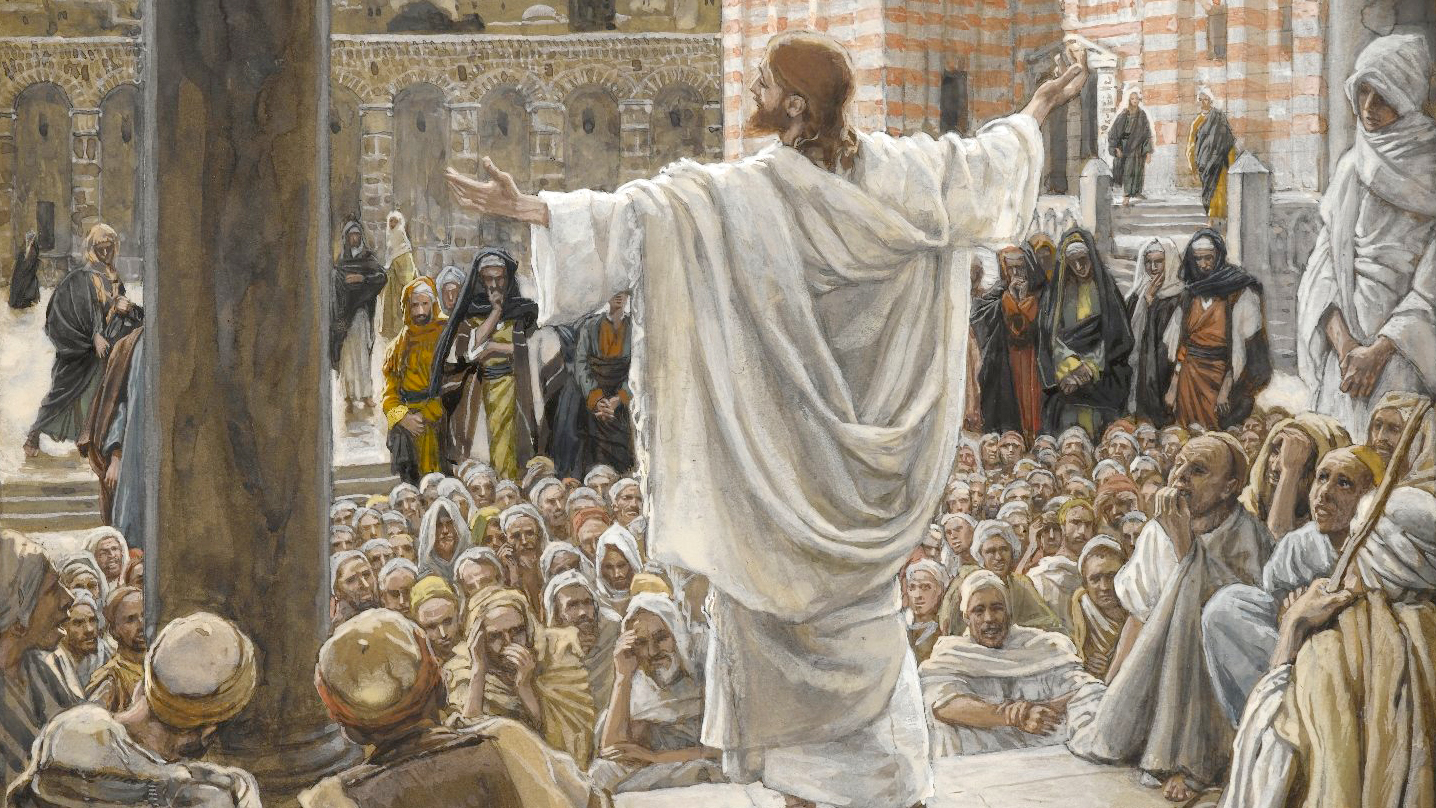
No Disappointment in Jesus?

A case for letdowns.

James Tissot / Brooklyn Museum

A woman who had come to my house for lunch one summer day went away with the determination to read some of my books. She started, unfortunately, with a novel (the only novel I’ve written), and later wrote me a very nice note thanking me for the lunch and saying she had read the book but would like to have more “added on” to it. She thought it should end, she said, with a “deeper understanding, and no disappointment in Jesus.”

I know exactly how she feels. A lot of us would like to have “more added on.” We would love to be able to rise up in the congregation of the righteous and say, “I have never known any disappointment in Jesus.”

The trouble is that to make the book true to life, and I have found that life takes me up a lot of blind alleys and into dark places and trackless jungles where what I would like to have added on just doesn't get added on, and the explanations I am dying to find never appear.

And what’s more, I find things this way not only in my own experience of life but also in the descriptions of it recorded in the Bible, which is exactly true to life. We have all heard it argued that where sin is depicted in the Bible, it is clearly labeled and punishment follows. I swallowed this for years, but one day I decided to check on the statement and found it was not true. There are some horrible deeds recorded in the Old Testament that people apparently got away with (the story of the Levite’s concubine in Judges 19 is one example). There are countless incidents of lying, cheating, and selfish scheming. There are failures, defeats, collapsed hopes, deaths—and many stories end far from satisfactorily. Nothing is “added on.”

Well, but the New Testament is added on. It throws a great flood of light on the Old Testament and describes the hope of the world, redemption by Christ and all that that means. But even in the New Testament, in the life of Jesus himself, who came to show in the flesh what God is like, there are occasions where people were disappointed. They were, as a matter of fact, specifically disappointed in Jesus.

The wise men who came to find the newborn king were nonplused to arrive at the king’s palace and learn it was not there that the birth had taken place. It must have been embarrassing for them, and confusing, and disappointing.

When he was twelve years old Jesus hurt his mother by going off on his own without telling her. After several days’ travel and agonizing worry they found him, and he had an explanation ready, but Mary could not stifle a rebuke. “Why have you treated us so?” It was a human mother’s reaction. How could she possibly have understood him?

I have often pictured things that must have happened when Jesus was a carpenter’s apprentice. A man leaves a wooden saddle for repair and finds the shop empty when he calls for it. Jesus has again gone about his Father’s business. I can easily imagine Joseph’s distress when his timing did not match that of Jesus.

The Gospels tell of times when the disciples looked everywhere for Jesus, needing him desperately, and could not find Him. Crowds tagged after him, mobbed him, pled and wheedled until he had not the time even to eat. He must have disappointed and infuriated some of them.

It is a simple matter for us now to look back at the Scriptures' record and see that no one ought to have been disappointed. But the truth is that many were-because they were human.

What did the friends of John the Baptist think when they told Jesus of John's imprisonment and imminent danger of execution, and Jesus did nothing at all about it except to send a strange message? He did not so much as go to visit John in prison, let alone have him released. The word he sent must have seemed cryptic at best, if not a mockery in such circumstances: “Blessed is he, whosoever shall not be offended in me.” But the Son of God knew that John could be trusted with that message, and trusted, further, to die what looks like a senseless death—a silly dancing girl and her scheming, wicked mother managed the whole thing.

To disappoint is to fail to satisfy hopes or expectations. We are human, and therefore ignorant, blind, selfish. How shall we help feeling let down when God does not act according to our hopes? Many men in Scripture were disappointed, and cried out their complaints against God—Job, for one, in almost unbearably vivid language; and the psalmist, who again and again asked, “How long, O Lord” “Hath God forgotten to be gracious?”

What a relief it is to me to find these human cries in the inspired book! I know that I am not alone in my disappointments. I have not been left in some howling wilderness while all who really love God steadily ascend the gleaming heights far beyond my vision. Jonah felt the weeds wrap about his head. Peter began to sink. Job felt he had been abandoned in a place of dragons, and said so—he asked his friends, those “comforters” who knew the answers to Job’s problems, “Will you speak falsely for God?”

So, to be quite candid, I cannot claim never to have been disappointed. If I could, I would be omniscient, or at least a prophet, for things would turn out precisely as hoped and expected.

The kind woman who wrote the letter wanted me as an author to be omnipotent and fix everything. Why couldn’t I have added on enough to make it come out right? Because I didn’t know enough. My heroine didn't know enough, and in this I was trying to be true to life. It’s in life, in the real world, down here where things do and do not pan out, that the just are supposed to live by faith. When we are honestly disappointed in the way the God we trusted has handled things, when what has happened was not at all what we wanted—then statements like “Not my will but thine be done” have powerful meaning. What a sinewy kind of trust old John the Baptist had as he lay in chains—captive, doomed, lonely, blessed, and not offended.

Elisabeth Elliot is the author of seven books, including Through Gates of Splendor, The Savage My Kinsman, and No Graven Image. She holds the A. B. from Wheaton College and was formerly a missionary.

The Optimist

Professor G. J. V. Nossal, professor of medical biology at the University of Melbourne, posed the following question during the 1970 Melbourne Oration and Lecture Series: “In view of the massive problems of over-population, the threat of nuclear disaster, the continuance of racial misunderstanding, and the progressive deterioration of the environment, can anyone but a mindless fool be optimistic about man’s future?”

A good question. It is becoming increasingly obvious that man is doomed unless he solves some of his problems. He teeters on the brink of a nuclear precipice, holding in his hands the means of wiping out all human life. And through his pollution of the atmosphere and the waters he may kill himself off anyway, without waiting for a nuclear war.

Closely examined, most of man’s problems reduce to himself, and his insatiable desire to have more of the good things of life seems to be at their root. He pollutes his environment, for example, not because he likes to see it all messed up, but because it increases his business profits or in some way makes life easier for him.

If man can be reformed, of course, everything may change. That is why Professor Nossal, despite the gloomy picture he painted, is not in the least pessimistic. He thinks men will get better. Indeed, he cites Dr. J. Bronowski of the Salk Institute for the view that science has already made a start toward improvement: “Bronowski goes on to claim that the great ethical force of science has been the dissemination of the idea that truth is a thing which will, in some way, help us all.”

Nossal gives his own view in these words: “Science has shown that cheats do not prosper. There is only one way of achieving fame in science, and that is by adopting the most rigid, uncompromising and objective honesty in the gathering and reporting of one’s results.

No one gains credit from an unrepeatable experiment. Thus reverence for truth is one of the few universal attributes of research men. Science has shown that truth works, honesty works. I fancy this has percolated widely into our social system.”

At this point many people would ask, Has it? In the first place, it is not at all obvious that any respect for truth and honesty in the modern community is a byproduct of scientific research. After all, “honesty is the best policy” is a proverb with a respectable antiquity. The scientific reverence for truth, which is undoubted, may have helped some people see this. But it is surely going too far when scientists claim the credit for discovering it.

Then, in the second place, it is more than dubious whether the thought that truth and honesty work has percolated very widely into our social system. People today are not noticeably more honest than their ancestors (witness the wide incidence of shoplifting). Nor are they more truthful, as many an advertising campaign makes clear. In the academic community it seems generally agreed that student cheating at exams is not diminishing.

In the third place, as long as we are on the level of “cheats do not prosper,” or “honesty is the best policy” we have not really arrived at truth or honesty. It is of the essence of real honesty that the way of truth is to be followed, whether it is good policy or not.

The fact is that truth and honesty were recognized by our forebears as Christian virtues. And they not only recognized them but also made a determined attempt to put them into practice! The respect for truth and honesty that we see now is no more than the carrying on of part of the tradition we have received.

The modern trend away from the faith of our fathers has caused an erosion of the values for which those fathers stood. This is apparently not only in the case of truth and honesty but with a host of other virtues as well. We are living on the spiritual capital of our fathers, as has often been pointed out.

Science can tell us how to make an airplane. But it is not science that determines whether we will use it to bring medical help to people in remote places or to drop bombs on our enemies. Science can tell us how to harness nuclear energy. But it is not science that determines whether we will use this tremendous power for the causes of peace or for those of war. Science may tell us how we can stop environmental pollution, but it is not science that determines whether we will resolutely take the necessary steps.

Over against the optimism that may be felt by some scientific men we must set a Christian pessimism. Those whose faith is grounded in the Bible have always recognized that there is such a thing as original sin, use what terminology you will. The trouble is not with the world in which we find ourselves, and not with science and technology, which give us the power to unlock such tremendous resources. The trouble is in the heart of man.

That is why the Christian faith has always demanded much more than a minor moral reform. It looks for a radical renewal of the whole man, so radical indeed that it can be described in terms of a new birth, of death to an old way of life and a resurrection to a new one. It is a putting off of the old man and a putting on the new, a conversion that alters the whole bent of the life.

In the face of a scientific optimism that puts its trust in unregenerate man’s quest for scientific information, the Christian resolutely says, “This is not enough. A scientific devil is no real improvement on an unscientific one! If this is the best that science can say, then we are indeed shut up to pessimism.”

But the Christian cannot simply be written off as a pessimist. In the face of that naïve optimism which ignores the way man is made and assumes he can be taught to put some other interest before himself, he remains skeptical. But Christianity centers on a cross. There the Son of God laid down his perfect life to put away men’s sins. And there a new power entered the human race.

“I can do all things through Christ who strengthens me” wrote Paul (Phil. 4:13). Right now, in the latter third of the twentieth century, men are proving the truth of the words.

The Christian is a realist. He does not trust man’s unaided strength. But he is also an optimist, one whose optimism is grounded not on what man can do but on what God can.

‘Gays’ Go Radical

San Francisco’s 90,000-strong homosexual community has exploded in a new militancy to make society recognize that “gay is good.” A recent three-day seminar for ministers, counselors, and social workers sponsored by the Council on Religion and the Homosexual in “the gay jewel of the Western Hemisphere” stressed the need for people to consider the homosexual life style equally as acceptable as the heterosexual one.

Spokesmen from radical gay organizations (Gay Liberation Front, Gay Women’s Liberation) and liberal ones (Society for Individual Rights, Daughters of Bilitis) were united in their rejection of views that homosexuality is unnatural, immoral, sick, or socially objectionable. Rather, they considered the gay life as a completely normal and satisfying option for sexual fulfillment.

The seminar stressed that an increasing number of homosexuals are weary of “closet queen” existence—concealing their homosexuality behind a “straight life” facade—and are determined to resist social ostracism, employment discrimination, and legal harassment.

Gay seminarian Nick Benton of Berkeley’s Pacific School of Religion told conferees that “Christianity has been one of the main causes of homosexual repression.” He said gay students in seminaries related to the Graduate Theological Union were planning to request publicly that their schools make clear their position on homosexual relationships and ordination.

Former Episcopalian James Foster, political-action chairman of the Society for Individual Rights, stated: “I am not convinced that there is validity to the Judaeo-Christian ethic of sexuality.” He commended the Reverend Troy Perry of the homosexual Metropolitan Community Church “for getting gay people together” (see Sept. 11 issue, page 48).

Daughters of Bilitis president Ruth Sudul, a pretty, 21-year-old Seventh-day Adventist, saw no conflict between her lesbian life and biblical teachings on sex. Paul’s statements against homosexuality in Romans, she said, “referred to promiscuity and lust, not homosexuality per se. A lasting homosexual relationship is not a sin, but sex for the sake of sex is wrong.”

Militant Homosexuals

The Gay Liberation Front caused a furor among 600 Episcopal delegates to the Diocese of Michigan’s annual convention when two Gay Lib members spit out Communion wine near the altar. Others hugged and kissed in the pews and aisles at St. Paul’s Cathedral, according to Hiley Ward, religion editor of the Detroit Free Press.

The diocesan convention was later adjourned early when twenty Gay Libbers marched to the podium carrying signs and shouting slogans. The disruption took place when a Gay Lib leader was not allowed to speak in favor of a resolution encouraging Episcopal churches to lend their facilities to homosexuals.

A Gay Lib member yelled to departing delegates: “What are you going to do when you have a Christian son or daughter that’s a homosexual? Are you going to disown them, too?”

Several days later in Washington, D. C., about thirty-five militant homosexuals held hands, hugged, kissed, and shouted obscenities as they disrupted a conference on theology and homosexuality at Catholic University.

The D. C. chapter of the Gay Lib did its thing after conference chairman Dr. John Cavanagh began a treatise on homosexuality as a cause of marital discord. While his companions embraced on stage, a fuzzy-haired spokesman read from a pink mimeographed sheet: “As members of the Gay Liberation Front, we deny your right to conduct this seminar.”

The spokesman (none of the dissidents revealed his or her name) demanded that conference members stop examining homosexuality and begin practicing it instead. The demonstrators paraded a pink flag around the room several times before leaving.

Seminar members gained a glimpse of gay life through a multi-media, three-screen presentation of explicit films of heterosexual, male homosexual, and lesbian couples copulating simultaneously to rock music. The group also visited a “SIR” Halloween Ball, and gay bars where fifty elaborately coifed and garbed queens in drag swished on stage to entertain dancing male couples. The largest charge came from “The Hollywood Canteen,” a bevy of campy queens decked out as the Andrews Sisters, Betty Grable, Anna Mae Wong, Shirley Temple, June Allyson, Jane Froman, and Kate Smith.

Methodist minister Dr. John Moore, campus pastor at the University of California at Davis, emphasized in the final session the need for homosexuals to enter depth relationships. He added that he had observed greater stability in some homosexual marriages than in heterosexual ones.

The seminar ended with a prediction by Sally Gearhart, a former Lutheran college instructor, that the homosexual movement is likely to turn more radical. Throughout the conference, speakers made no concessions to the view that God’s plan for human sexual fulfillment is found only in a heterosexual relationship.

A San Francisco graffiti writer knew better. He wrote: “If God had wanted homosexuals, he would have created Adam and Freddy.”

Presbyterian Lay Group Opposes Cocu

The board of directors of the Presbyterian Lay Committee unanimously approved a resolution recently opposing the Consultation on Church Union Plan of Union. (An influential group of Southern Presbyterians also has issued a statement opposing inclusion of its denomination in COCU—see November 6 issue, page 59.)

The Presbyterian Lay Committee stresses biblical authority and discourages social-action-type pronouncements by the national church. Here is the complete COCU text:

WHEREAS the Consultation on Church Union (COCU) has drafted a Plan for the uniting of nine churches (denominations) which draft has been “commended to the churches for study and response,” and

WHEREAS the Board of Directors of the Presbyterian Lay Committee has carefully studied and discussed the said draft and respectfully responds thereto as follows:

A. The Board considers the following provisions of the Plan to be unacceptable:

—provisions which deprive members of a congregation of their present right to select a minister for that congregation and which substitute therefor the nomination of ministers by bishops and district and parish committees and their election by the parish—not by the congregation.

—provisions which deprive members of a congregation of their present right to elect their own officers and which eliminate the offices of elders and trustees of individual congregations.

—provisions which deprive members of a congregation of their present right to determine the general programs of their congregation and the use to which funds contributed by them shall be devoted and which substitute therefor the determination of such matters by parishes.

—provisions which require all church property—including houses of worship, manses, endowment funds and other congregational assets—to be transferred from congregational ownership to parish ownership.

—provisions which permit parishes to determine whether the Word of God shall continue to be preached in any given church edifice and whether that edifice shall be disposed of or used for wholly different purposes.

—provisions which eliminate congregations as basic units and which substitute therefor parishes as basic units.

—many other provisions which discard our present form of democratic government and substitute therefor the episcopal form headed by bishops and councils with local congregations having no existence except as these bishops and councils, separated and isolated from members of congregations, may determine from time to time.

B. The Board finds no substantial benefits but many grave dangers inherent in the “super-church” concept as set forth in the Plan.

NOW, THEREFORE, the Board of Directors of the Presbyterian Lay Committee, after careful study and discussion, hereby records its opposition to the proposed Plan of Union and urges like-minded Presbyterians, after their own careful study, to register their opposition thereto with their pastors, sessions, presbyteries, and synods and with such other study groups as are open to them, and to urge other like-minded Presbyterians to do likewise.

Tale Of Two Schools: Playing With Moral Fire?

Students at church-related colleges are apparently faring less well on the campus-control issue than their counterparts at the big secular schools. The 1,700 students at Carson-Newman College (Southern Baptist) in Jefferson City, Tennessee, must dance to the tune of the constituency, ruled purse-jingling Tennessee Baptist Convention delegates last month. And, despite demonstrations and a fire at St. Bonaventure University (Roman Catholic) in Olean, New York, President Reginald A. Redlon clung to his decision: the 2,000 boys and girls will not be allowed to visit each other’s rooms.

Carson-Newman trustees earlier this year bowed to student pressure and lifted a 119-year campus ban on dancing, taboo in most Baptist circles. In protest, one hundred of the Tennessee Baptist Convention’s 1,700 churches halted their giving to the TBC, which subsidizes Carson-Newman by $406,000 annually. Pressed by the constituency, TBC leaders instructed the trustees to restore the dance ban. The trustees countered with a plea that the TBC study social needs on campus. Off-campus facilities and events in the town were few, they explained, and limited funds permitted only a monthly concert on campus.

Meanwhile, several dances were held, but attendance was poor.

Later, the matter spilled onto the floor of the annual TBC meeting in Jackson. Some speakers charged that dancing is sinful and leads to immorality. Others pleaded for confidence in the students and trustees. “It’s better to be at a chaperoned dance than off in a parked car somewhere without supervision.” declared a mother of two collegians. Unswayed, the 1,200 delegates voted two to one to skip any fact-finding studies and to direct the trustees to stop the dances.

Student officers promptly scheduled an off-campus dance and forecast the biggest turnout ever. Demonstrations, though, are out (to spare the sympathetic faculty and administration further anguish), and campus dancing is now officially a “dead issue,” stated student president Robert Mayfield. But pressure for “other reforms”—including a liberalized dress code—will continue. “The real issue to us is freedom of choice,” he said. “What hurts most is the narrow-mindedness of the majority, who refused to consider our needs or even to listen to us.”

Other students feel they were merely victims caught in a squeeze over who controls the college—TBC church members or the trustees. As if to make a point, TBC officials reinstituted “orientation” sessions for new trustees.

At St. Bonaventure, President Redlon is in complete charge of the situation for now, reportedly with solid backing from parents and alumni. About one-third of his students staged “visit-in” demonstrations after he refused to grant dormitory inter-visitation freedom. When he threatened to shut down the school, students backed off to await a ruling by trustees. A blaze, suspectedly arson, destroyed campus property valued at $100,000 and Redlon announced he would provide “additional security in the dorm areas.”

A bomb threat interrupted the meeting of trustees, who decided to call in outside help to mediate the dispute. Willoughby Abner, director of the National Center for Dispute Settlements (a Ford Foundation project in Washington, D. C.), would listen to both sides and make nonbinding recommendations, the trustees said.

Redlon is unlikely to change his mind. He sees a “theological dimension” to inter-visitation related to the Fall of Man. Explained he: “No young person can live hourly in a situation which may be conducive to selfishness and which discourages discipline—without paying a great price.”

EDWARD PLOWMAN and

ROSEMARY STEPHENS

Panorama

Enthusiasm for the nine-way Consultation on Church Union merger has waned in the 500,000-member Christian Methodist Episcopal Church. Its bishops last month pressed union with the two other black Methodist COCU partners (the AME and AMEZ) and said “there is little sentiment in our denomination to unite with a white church that would cause [us] to be a small minority.” Meanwhile, COCU extended by six months to June 1, 1972, the period for study and criticism of its plan of union.

Plans for a third round of theological conversations between Lutheran and Eastern Orthodox churchmen fizzled last month because the Orthodox group preferred talks with other communions.

Bob Jones University has been rapped by the Federal Communications Commission for not complying with equal-employment provisions in the operation of its radio station WMUU in Greenville, South Carolina.

Evangelist Leighton Ford’s Jackson, Tennessee, eight-day crusade drew 30,100 people; 364 registered decisions for Christ.

Young adults (18 to 25) think about sex twice as often as they do about religion, but middle-aged and older adults think about religion at least twice as often as sex, according to a survey of 3,416 persons made by a Louisville psychologist.

“The Worshipbook,” produced for the Cumberland, Southern, and United Presbyterian churches last month, uses nothing but contemporary language in its services and prayers; a later version—due in about two years—will include hymns.

MGM Records has barred lyrics about drugs and won’t record rock groups that use hard narcotics.

Deaths

HAROLD M. DUDLEY, 74, founder of Religious Heritage of America in 1957; in Washington, D. C.

FREDERIC C. KREISS, 64, pastor and president of the Free Lutheran Church of France and Belgium; in Strasbourg, France, of a heart attack.

ARTHUR S. MAXWELL, 74, noted Seventh-day Adventist author-editor; in Mountain View, California.

Minister-editor Dr. W. S. Whitcombe of Toronto has been named president of the Fellowship of Evangelical Baptist Churches in Canada.

Dr. Frank E. Johnston, associate general-secretary of the American Baptist Convention, has been named interim head of the denomination, beginning January 1, until a successor to Dr. Edwin H. Tuller, who resigned, is appointed.

Catholic theologian-professor Bernard Lonergan, a Jesuit, will be a guest professor of Catholic theology at Harvard Divinity School for the 1971–72 term.

The Reverend Chang Duk Yun has been elected bishop of the 82,000-member autonomous Methodist Church of Korea.

Bishop Elias Muawad of Sleppo, Syria, has been elected the 163rd patriarch of the Greek Orthodox Church of Antioch and the Entire East; he will reign as Patriarch Elias IV.

Los Angeles structural engineer Roy G. Johnston was named chairman of the Westmont (Santa Barbara, California) College trustees.

World Scene

Although the Evangelical Church of the Lutheran Confession in Brazil withdrew from the fifth assembly of the Lutheran World Federation because the assembly last June was shifted from Brazil to Evian, France, the Brazil church voted recently to remain in the LWF.

The last holdout against the ordination of women in German Protestantism fell last month when the Lutheran Church in Bavaria approved the practice.

Sale of the United Church of Canada’s 140-year-old Ryerson Press to McGraw-Hill of Canada, subsidiary of the giant U. S. firm, raised a howl from Canadians opposed to U. S. control. Ryerson lost $500,000 in the past three years.

The long-standing debate over the boundaries of ancient Jerusalem may be settled with the discovery, just west of the Temple Mount, of a city-wall foundation dating to the seventh century B.C. The wall proves that Israelite Jerusalem had moved westward to the present-day Jewish Quarter prior to the Babylonian Exile (586 B.C.), according to Naham Avigad, head of the exploring archaeological team.

After reaffirming its belief in the doctrines of the Resurrection and life after death, the General Assembly of the Presbyterian Church of New Zealand withdrew a motion to oust the head of its seminary in Dunedin, who reportedly denies both doctrines.

Four defendants, including a former cabinet minister in the Irish government, have been cleared of charges in the attempted illegal import of arms and ammunition for the use of Catholics in Northern Ireland, thus ending one of the country’s most sensational trials.

The Anglican Church in the Province of South Africa voted 140 to 6 to stay in the World Council of Churches but criticized the council’s grants to guerrilla liberation groups and held up its annual donation pending explanation from the WCC (see November 20 issue, page 44).

The new moderator of the Dutch Reformed Church, the most powerful denomination in South Africa, bluntly defended his church’s interpretation of the Bible that apartheid is right and “all other theologians in the world” are wrong. Dr. J. D. Vorster—brother of Prime Minister B. J. Vorster—said his church would sever ties with all others rather than change its views on race.

Pakistan’s Anglicans, Methodists, and Presbyterians united in one church last month. The 200,000-member denomination issued no statement of faith; a confession and liturgy will evolve.

Apple PodcastsDown ArrowDown ArrowDown Arrowarrow_left_altLeft ArrowLeft ArrowRight ArrowRight ArrowRight Arrowarrow_up_altUp ArrowUp ArrowAvailable at Amazoncaret-downCloseCloseEmailEmailExpandExpandExternalExternalFacebookfacebook-squareGiftGiftGooglegoogleGoogle KeephamburgerInstagraminstagram-squareLinkLinklinkedin-squareListenListenListenChristianity TodayCT Creative Studio Logologo_orgMegaphoneMenuMenupausePinterestPlayPlayPocketPodcastRSSRSSSaveSaveSaveSearchSearchsearchSpotifyStitcherTelegramTable of ContentsTable of Contentstwitter-squareWhatsAppXYouTubeYouTube