Pentecostals Celebrate Their World Flame

“Jesus Christ was the first Pentecostal preacher,” 5,000 delegates from forty-four countries were told at the ninth World Pentecostal Conference, “and this revival is the last united effort of God to win the world.” In hearty endorsement of that statement, 12,000 persons attending the night services in Dallas last month stood and shouted “Gloria a Dios!” three times in succession.

The delegates represented 20 million tongues-speaking believers throughout the world, and perhaps 35 million adherents, a figure validated by Walter J. Hollenweger, World Council of Churches staff member and student of Pentecostal history. And there is no sign of lessening zeal—at least, not in countries outside the United States. The world conference theme exemplified this thought: “The Spreading Flame of Pentecost.”

Reports from various countries reflected the spreading fire. Jose Silva, superintendent of the International Church of the Foursquare Gospel in Panama, said Pentecostals are growing at a rate more than three times that of world population increases. Paul Yonggi Cho of the Korea Assemblies of God told of three million converts in his country, more than one million of whom speak in tongues.

Delegates also were told that 15 per cent of the population of Chile has had the Pentecostal experience. The largest local church in the world, 60,000 active members, is in Santiago, and is affiliated with the Pentecostal Holiness Church in the United States. Paulo Macalao of Brazil reported more than three million Pentecostals in his country—80 per cent of all Protestants there.

Even places behind the Iron Curtain are feeling the charismatic impact. The president of the Pentecostal Church of Rumania reported 100,000 members, including many young people.

A highlight of the conference was the presentation of four Russian delegates. “We are here representing 500,000 Christians in Russia, the majority of whom are Pentecostals, united in the All Union Council of Evangelical Christian Baptists,” said G. Bulgakov, head of the Baptist Union in Gorki.

While Bulgakov addressed the conference, the Reverend and Mrs. Michael Wurmbrand appeared in the choir section and unfurled a banner that read: “Russia’s jails are full of Christians. Help them.” Mrs. Wurmbrand began shouting to the delegates, asking them not to recognize the Russian representatives. “They are dupes of the Communist party,” she yelled. The conference reached near-panic as conference officials ran up the stairs and wrestled with the Wurmbrands, who were forcefully removed. They are related to Richard Wurmbrand, who spent fourteen years in a Communist prison.

Percy S. Brewster, a minister in the Elim Pentecostal Churches of Britain and chairman of the 1970 Advisory Committee, was elected the new secretary of the World Pentecostal Conference. He will also edit the new World Pentecostal quarterly magazine, to begin in 1971.

Strengthening of the world organization was a result, some observers felt, of increasing cooperation among the various Pentecostal segments. For the first time, officials invited organizations ministering to charismatic groups within the traditional denominations to display literature and other materials. At least half a dozen responded.

Even actor Pat Boone, relating his recent Pentecostal baptism, was there, autographing copies of his book A New Song. And a Catholic theologian solicited interest in an ecumenical-studies program.

“We’ve reached the point where, as a movement, we should demonstrate a much greater cooperative spirit,” said Klaude Kendrick, Assemblies of God scholar who is now on the faculty of Texas Wesleyan. “I’m not recommending that we join the ecumenical movement, but there can be a common understanding, purpose, and thrust among us.”

Social involvement was not a major issue at the conference, partly because charismatic religion has always flourished among the poor and the blacks. But no mention was made of the fact that the black, U. S.-based Church of God in Christ had, in effect, snubbed the conference and was holding its own national convocation in Memphis at the same time (see story following). Nevertheless, American blacks were well represented at the world conference, and several major speakers were ministers of the Church of God in Christ.

Announced at the conference were a Pentecostal Evangelism Conference to be held next year in Des Moines, Iowa, and the new Society for Pentecostal Scholars. More than one hundred charter members, all of whom have graduate degrees, subscribed to the society’s purposes.

The tenth World Pentecostal Conference will be held in Seoul, Korea, in 1973. Assemblies of God general superintendent Thomas Zimmerman will be the chairman.

Black Pentecostals Convene

While the Pentecostal World Conference met in Dallas, the second-largest Pentecostal denomination, a black group, the Church of God in Christ, held its annual convocation in Memphis, Tennessee.

Ten thousand delegates attended the sessions, mainly inspirational services. During the first three days most delegates fasted; services were conducted twenty-four hours a day non-stop from November 3 to 11.

Delegates were told that the church was making progress at home while overseas missions were in need of greater support. The denomination supports only nineteen missionaries—in Africa, the Caribbean Islands, Mexico, and England. Membership in the Memphis-based body is 419,000 in 4,150 churches.

JAMES S. TINNEY

The Church Statistics Picture

Many churches are feeling a financial pinch these days, but overall giving to religious causes seems to be holding up reasonably well. One key index to church revenue, the annual tally compiled by the National Council of Churches, shows that cash contributions to Protestant communions in the United States in fiscal 1969 just about kept pace with those of the previous year. A broader calculation made each year by the American Association of Fund Raising Counsel reveals that giving to religious causes rose 5.7 per cent during fiscal 1969 to a record total of nearly $8 billion.

In other phases of church statistics, a downtrend is very noticeable. Church membership is no longer keeping pace with the population growth in the United States, and church attendance is dropping off. Construction of new churches is also on the decline.

Latest figures compiled by the National Council show benevolence giving making up an increasing percentage of total giving (now about 21.16 per cent in comparison to 17.8 per cent ten years ago). Among denominations supplying figures, the Seventh-day Adventist Church has the highest per-capita donation rate—$350.96. The Southern Baptist Convention’s $73.33 is the lowest.

A National Council survey of about 5,000 ministers in twenty Protestant denominations showed their average income to be $8,037, including housing and utility allowances. One in six had a second job.

In Pursuit Of Happiness

Campus Crusade for Christ is on somebody’s list at Esquire. The magazine’s December issue itemizes “190 things to avoid” in the pursuit of happiness. Campus Crusade heads the “ten movements to have no part of” (the U. S. Communist Party is tenth). This, explained editor Tom Ferrell, is because “it is a fundamentalist organization and fundamentalists are unhappy.” He admitted he had met only one Crusade member, and him briefly.

Ferrell’s unhappiness over “sitting through something that lasts all day without understanding a word of it” earned for the Oberammergau Passion Play in Germany a top rating among “tourist attractions to not go to.” And, freshly distressed by reading The Sacred Mushroom and the Cross, he labeled as dangerous “any religious opinion based on the results of modern scholarship.” Everybody after the fourth century is confused, he thinks.

In a turn-about article in the same issue, however, entertainer Tiny Tim tells Esquire readers that happiness comes only through faith in Christ and adherence to the Scriptures. “Unless you have spiritual contentment,” warns Tim, “earthly success means nothing.”

EDWARD PLOWMAN

Prayer Ban Broadened

The ban on public-school devotional exercises has been extended to prohibit the reading of prayers, even when student attendance is voluntary and the reading is not during regular school hours. Last month the Supreme Court of New Jersey upheld an order requiring Netcong High School to suspend the daily prayers because they had the sanction of the local school and therefore “the support of the government.”

The case may be appealed to the U. S. Supreme Court.

Anglicans Get New Synod

In its most radical change since Henry VIII rejected papal supremacy, the Church of England got a new form of government when Queen Elizabeth inaugurated the General Synod in Westminster Abbey last month. Intended to give greater responsibility to the laity, the 537-strong body comprises the diocesan bishops and elected representatives, both clerical and lay (among the latter there are more than fifty women).

“A truer style of Christian association than we had had before,” said Dr. Eric Abbott, dean of Westminster. In a remarkably refreshing sermon he warned that the synod “must not be the Church Assembly all over again. Woe betide us if this synod does not insist that the first things of the Gospel come first.”

All the top people reappeared that afternoon in Church House for the first business session. Introduced by synod chairman Dr. Michael Ramsey, the 44-year-old Elizabeth made a kinder reference than Dean Abbott had to the former dispensation. It was, she said, “a great act of faith on the part of the Convocations … and the Church Assembly … to pool their powers so as to give the new synod … full responsibility.”

Those who had endured the morning’s marathon with all its pomp and circumstance welcomed the brevity of the speeches that followed. “We do not suffer from the delusion that a reorganization of our church government … will itself bring in the Kingdom of God,” said Donald Coggan, who as archbishop of York is the country’s second-ranking churchman. From the Kirk’s General Assembly, Moderator Hugh Douglas engagingly congratulated the Kirk’s southern sister in approximating at last to the presbyterian model. John Cardinal Heenan caused an anxious moment by saying that of course there was “only one Church,” but his reference may have been to the ecumenical movement. Greek Orthodoxy’s Athenagoras, quaintly styled archbishop of Thyatira and Great Britain (the latter term omitted by the archbishop of Canterbury in introducing him), neatly upstaged the others by being the only speaker to acknowledge the presence of Prime Minister Edward Heath.

An early topic for the synod was the question of admitting to Communion members of other churches. That morning non-Anglicans had been permitted to share in the elements, unlike the Coronation Service seventeen years ago in the same place when the archbishop of Canterbury, Lord Fisher, had pointedly excluded the moderator from the Church of Scotland, who had been a participant in the coronation ceremony.

Fisher’s successor, Ramsey, told the synod that the church had been legally advised that “only persons who are confirmed or ready and desirous of being confirmed can be admitted”—because that was what the Prayer Book said. He added that this was not the position in practice (a view with which some present disagreed). Anglo-Catholics and evangelicals then spoke their customary pieces on this perennial piece of confusion, the establishment showed its customary caginess, and all seemed relieved that they were called not to decide but merely to take soundings for future legislation.

Elected as chairman of the new synod’s House of Laity was Professor Norman Anderson, 62, a prominent evangelical who is dean of the faculty of laws at London University.

J. D. DOUGLAS

‘Superstar’: Haunting Questions

Never before have young people been so turned off by the organized, orthodox Church. Yet never before have they been so obsessed with Jesus. And they show it in their music.

In Jesus Christ Superstar, released by Decca last month, the animosity toward established religion for its alleged hypocrisy and the “Jesusmania” of this generation swing loud and long. Written by two young Britishers, composer Andrew Lloyd Webber and librettist Tim Rice, the rock opera is eighty-seven minutes of a hard, electronic examination of the Passion of Christ. Using eleven singers, three choirs, an eighty-five-piece orchestra, and a Moog Synthesizer, Webber dramatically melds the music to Rice’s words. Many Christians have ignored this generation’s questions about Jesus. For those who will listen, Superstar tells what young people are saying.

Rice and Webber rely basically on Scripture. But reflecting the twentieth century’s fascination with the anti-hero, they treat Judas sympathetically, as only a pawn of destiny. Judas sings the title song, and his questions are contemporary. Is Christ the Son of God, or is he merely a prophet-man, no greater than Buddha or Mohammed? This generation longs for the answers.

Christ’s flesh-and-blood lack of divinity is underscored by the implied relationship between Jesus and Mary Magdalene. In one blues number, she wails her fear of and desire for Jesus. “He’s a man he’s just a man” she moans, “and I’ve had so many men before.”

The scene in Gethsemane is a combination of vacillation and egocentricity. Jesus was “inspired,” but now just “tired.” He accuses God of being “far too keen on where and how and not so hot on why,” and he flaunts the kind of death he will die, even though he sees no reason for it.

Most of the melodies have few of the sinister overtones one might expect: Caiaphas, the only basso, is the exception. He is cold, calculating, pushy: he sings “this Jesus must die.”

The spirit of restlessness and yearning is enhanced by the synthesis of solo and chorus. The litany of the chorus is intermingled with the solos until the two become inseparable.

The question of Jesus’ identity is raised repeatedly in both words and music; no one seems to know who he is, but everyone seems to care. The repetitious questioning has two focal points: the scoffing, cynical words of Herod, and Judas’s words in the title song, “Superstar.” Herod, in a rollicking ragtime number, calls for Christ to prove his divinity. Herod wants miracles. He offers Christ freedom if he’ll only walk across Herod’s swimming pool. Yet in Herod’s cynicism there is a need to believe Jesus’ claims. When Christ doesn’t answer, Herod cries “fraud.” But Jesus’, silence dents Herod’s callousness. The last heard of Herod in the opera is his scream: “Get out of my life!”

In “Superstar” the chorus repeatedly asks, “Who are you? What have you sacrificed?” But Christ is already on the Cross, and there is no answer. The wordless finale, entitled “John Nineteen Forty-One,” leaves Christ in the grave. No faith and no victory emerge from this weary music, but the relentless quest remains, haunting and hollow.

Here is a work that sets the standards for full-length rock—and an idiom for reaching this generation. Perhaps some Christian composer will take the cue and produce a rock opera about Christ that ends not with hollow questions but with triumphant answers.

CHERYL A. FORBES

Looking Ahead In Anger

The chairman of the committee that drafted the COCU Plan of Union is outspokenly pessimistic about its chances for approval. Dr. William A. Benfield, Jr., says, “There is strong opposition … in every participating church.” In a speech in Louisville last month, Benfield also painted a gloomy picture for his own denomination, the Presbyterian Church in the U. S. He said that “a split is inevitable. There is no hope of reconciliation.”

Benfield, a theological liberal who is currently moderator of the Southern Presbyterian General Assembly, charged angrily that organized groups of theologically conservative clergy and laymen are “tearing our church apart.”
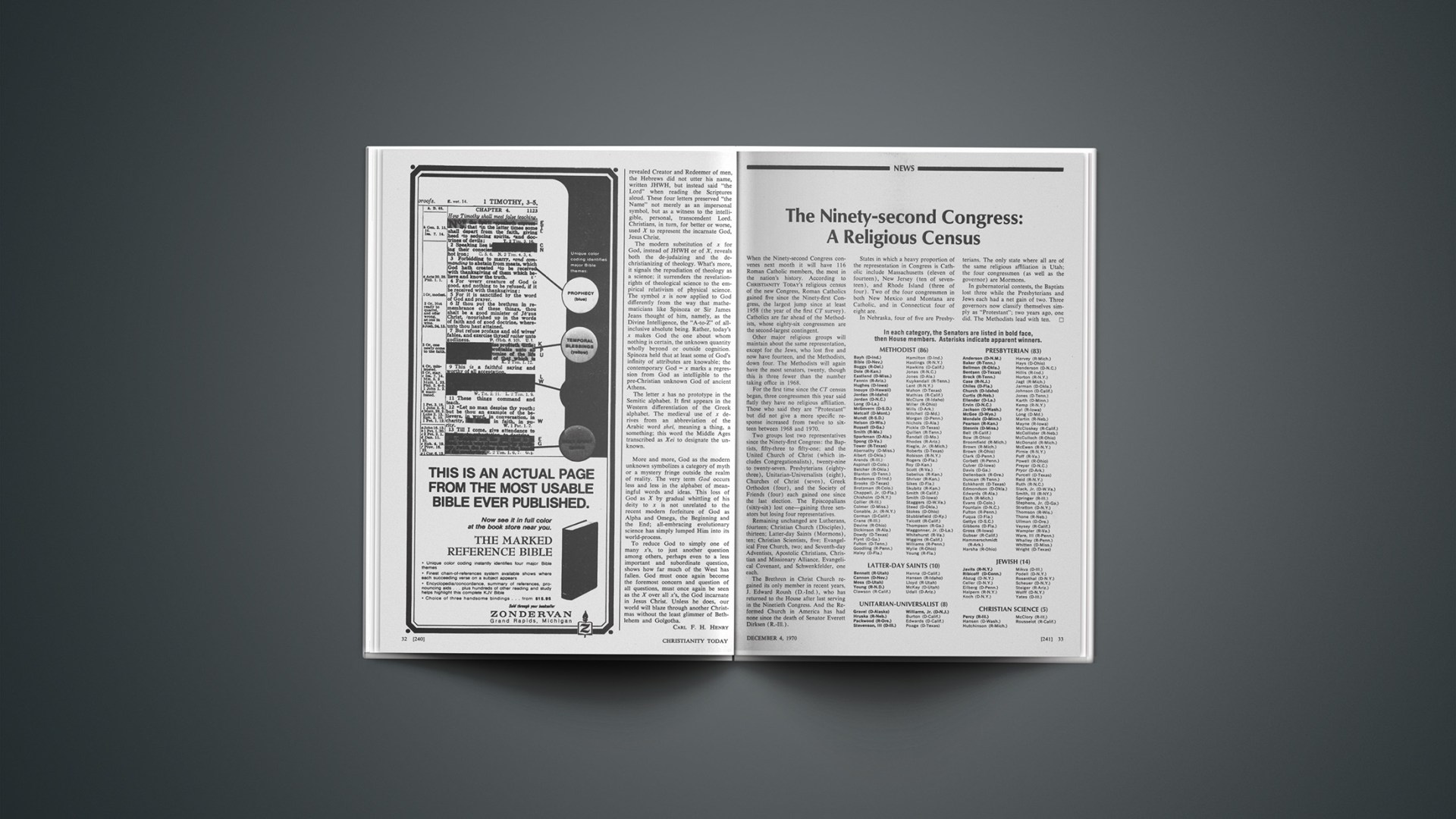
The Ninety-Second Congress: A Religious Census

NEWS

When the Ninety-second Congress convenes next month it will have 116 Roman Catholic members, the most in the nation’s history. According to CHRISTIANITY TODAY’S religious census of the new Congress, Roman Catholics gained five since the Ninety-first Congress, the largest jump since at least 1958 (the year of the first CT survey). Catholics are far ahead of the Methodists, whose eighty-six congressmen are the second-largest contingent.

Other major religious groups will maintain about the same representation, except for the Jews, who lost five and now have fourteen, and the Methodists, down four. The Methodists will again have the most senators, twenty, though this is three fewer than the number taking office in 1968.

For the first time since the CT census began, three congressmen this year said flatly they have no religious affiliation. Those who said they are “Protestant” but did not give a more specific response increased from twelve to sixteen between 1968 and 1970.

Two groups lost two representatives since the Ninety-first Congress: the Baptists, fifty-three to fifty-one; and the United Church of Christ (which includes Congregationalists), twenty-nine to twenty-seven. Presbyterians (eighty-three), Unitarian-Universalists (eight), Churches of Christ (seven), Greek Orthodox (four), and the Society of Friends (four) each gained one since the last election. The Episcopalians (sixty-six) lost one—gaining three senators but losing four representatives.

Remaining unchanged are Lutherans, fourteen; Christian Church (Disciples), thirteen; Latter-day Saints (Mormons), ten; Christian Scientists, five; Evangelical Free Church, two; and Seventh-day Adventists, Apostolic Christians, Christian and Missionary Alliance, Evangelical Covenant, and Schwenkfelder, one each.

The Brethren in Christ Church regained its only member in recent years, J. Edward Roush (D.-Ind.), who has returned to the House after last serving in the Ninetieth Congress. And the Reformed Church in America has had none since the death of Senator Everett Dirksen (R.-Ill.).

States in which a heavy proportion of the representation in Congress is Catholic include Massachusetts (eleven of fourteen), New Jersey (ten of seventeen), and Rhode Island (three of four). Two of the four congressmen in both New Mexico and Montana are Catholic, and in Connecticut four of eight are.

In Nebraska, four of five are Presbyterians. The only state where all are of the same religious affiliation is Utah; the four congressmen (as well as the governor) are Mormons.

In gubernatorial contests, the Baptists lost three while the Presbyterians and Jews each had a net gain of two. Three governors now classify themselves simply as “Protestant”; two years ago, one did. The Methodists lead with ten.

Women In Congress

There will be more Roman Catholic congresswomen in the Ninety-second Congress than women from any other religious faith, according to the new religious census made by CHRISTIANITY TODAY. Female members of the House will include four Catholics, two United Church of Christ, two who responded “Protestant,” and one each from the Methodists, Christian Church (Disciples), Christian Scientists, and Jews.

The one woman senator, Margaret Chase Smith (R.-Me.), is a Methodist.

Clergy Score Poorly In Great Election Game

The box score in the Great Election Game stands: clergy, 2; laymen, 12. More clergymen than ever before in America sought congressional seats, but they fared poorly at the hands of the electorate.

One, however, became the first Roman Catholic priest to be elected a voting member1The Reverend Gabriel Richard, a priest, was elected a non-votinpr member of Congress for one term in 1823 when Michigan was a territory. of Congress. The Reverend Robert F. Drinan, a Jesuit, won his race in Massachusetts with a bare plurality of the votes, receiving 62,091 to 59,925 for his Republican opponent, State Representative John A. S. McGlennon, while 45,460 votes went to Congressman Philip J. Philbin, who was defeated by Drinan in the Democratic primary and then ran as an independent.

In Rhode Island, Senator John O. Pastore (D.) easily defeated the Reverend John J. McLaughlin, S. J., 224,903 to 104,917. Since in both the Third Congressional District of Massachusetts and in the state of Rhode Island about two-thirds of the voters are Catholic, it appeared that a majority of Catholics had voted against the priests.

In Connecticut, United Church of Christ minister Joseph Duffey, who won the Democratic nomination to the U. S. Senate, lost to Representative Lowell Weicker, the Republican candidate, by 443,008 votes to 360,094. Senator Thomas J. Dodd, running as an independent, received 260,264 votes. Democratic gubernatorial nominee Representative Emilio Q. Daddario, who also lost, received 132,000 votes more than Duffey. The minister’s position as national president of the liberal Americans for Democratic Action was a major issue in the race.

A Catholic priest, the Reverend Robert Cornell, a Norbertine and Wisconsin Democrat, ran against another Catholic member of Congress—veteran Representative John W. Byrnes. Cornell lost by 10,000 votes.

Other clergy losers included United Methodist George McClain, running as a Liberal party candidate in Staten Island, New York, against Democratic incumbent Representative John Murphy; Episcopal priest Jay Wilkinson (son of the athletic great and former White House aide Bud Wilkinson), who was the Republican nominee in Oklahoma’s Fourth District; Richard Fullerton, a Nazarene evangelist bearing the GOP banner in Georgia’s Seventh District; Church of Christ minister Fred Casimir, nominated by California Republicans in the Thirty-first District; and Assembly of God pastor H. D. Shuemaker, a Republican running in Florida’s First District.

The Reverend Andrew Young of the Southern Christian Leadership Conference, who was a close associate of the late Dr. Martin Luther King, Jr., was the only black clergyman nominated for Congress. A United Church of Christ minister, Young was defeated in Georgia’s Fifth District.

Only one clergyman of the present Congress was reelected: the Reverend John H. Buchanan, Jr., a Southern Baptist first elected from Alabama as a Republican in 1964 when Senator Barry Goldwater carried that area of the South, has now been reelected to his fourth term in the House.

In Wisconsin, the Reverend Henry C. Schadeberg, who was pastor of Plymouth Congregational Church in Burlington, Wisconsin, when he entered politics in 1962, lost his seat for the second time. He was defeated in the 1964 Lyndon Johnson landslide, but regained his seat in 1966 and had held it for two more terms.

The political saga of the Reverend Adam Clayton Powell, pastor of Harlem’s Abyssinian Baptist Church, came to an end after twenty-six years when Charles Rangel, the state legislator who defeated him in the Democratic primary, was elected to his seat. The ailing Powell, reported suffering from malignancy of the lymph glands, was ruled off the ballot as an independent candidate.

Priest-lawyer John Danforth of Missouri almost pulled a political upset. An ordained Episcopal minister, Danforth—the first Republican candidate in twenty years to win statewide office when he was elected as Missouri’s attorney general—came within 37,000 votes of defeating veteran Senator W. Stuart Symington (D.). Danforth is an heir to the Ralston Purina fortune (his family are donors of well-heeled Danforth Foundation). He is believed to have a bright political future.

Among prominent laymen elected to Congress is attorney William J. Keating, a Republican of Cincinnati, and the younger (43) brother of Charles Keating, nationally known Catholic layman and attorney who heads Citizens for Decent Literature and as a member of the President’s Commission on Pornography submitted a blistering minority report. William Keating was elected to replace Representative Robert Taft, Jr. (R.), who won election to the Senate.

John H. Kemp, who as a pro football player for the Buffalo Bills (making $50,000 a year as quarterback) and other teams was active in the Fellowship of Christian Athletes, won the Republican House race from Buffalo.

Lamar Baker, an active Churches of Christ layman and a graduate of Harding College in Searcy, Arkansas, was elected by Republicans to fill the seat vacated by Representative William Brock, who won a seat in the Senate.

In the statehouses, new Democratic governors Reubin Askew of Florida and John West of South Carolina are both staunch Presbyterians. Askew, an elder, is a nonsmoking teetotaler who once said attending church was his favorite hobby. Republican Governor Linwood Holton (not elected this year) of Virginia is a Sunday-school-teaching Presbyterian elder.

The new governor of New Mexico, Democrat Bruce King, also teaches Sunday-school classes, and Democrat Jimmy Carter, Georgia’s choice for governor, is a Southern Baptist deacon.

The Trouble With Timothy

Classis Chicago North, an area ruling body of the Christian Reformed Church, rejected last month a 1970 national CRC directive to label a local church-school board’s policy of racial exclusion as “disobedience to Christ.”

The classis decided instead to write a pastoral letter to “implore” the board to stop excluding black children from Timothy Christian Grade School in Cicero, an all-white Chicago suburb.

Classis delegates did, however, acknowledge their “guilt and sorrow” for failure to conform to 1968 and 1969 declarations about Timothy.

Earlier, board members had said they were “unable, not unwilling.” to admit blacks because of intense racial hostility in Cicero. Both children and property would be in jeopardy, they maintained. Indeed, irate citizens stormed into a board meeting two years ago and made that point indelibly clear.

Timothy is three miles from Lawndale Christian Reformed Church, a CRC mission church with a black congregation. For five years Lawndale’s parents have tried to enroll their children at Timothy, but have had to settle for a twenty-five-mile bus trip to another CRC school in Des Plaines. And Timothy’s board members have balked at exhortations by CRC leaders to take a stand of courage in Cicero.

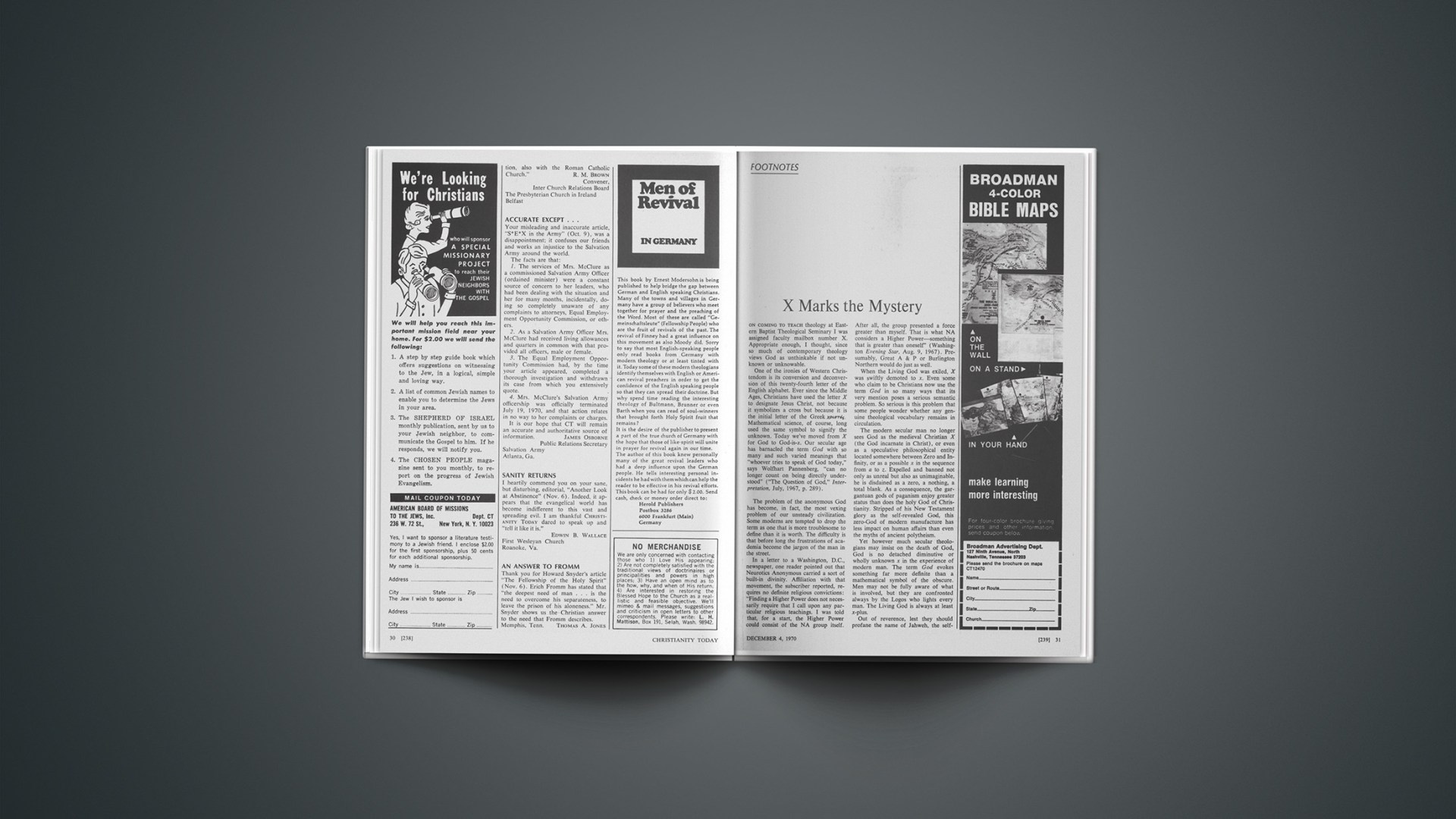
X Marks the Mystery

On coming to teach theology at Eastern Baptist Theological Seminary I was assigned faculty mailbox number X. Appropriate enough, I thought, since so much of contemporary theology views God as unthinkable if not unknown or unknowable.

One of the ironies of Western Christendom is its conversion and deconversion of this twenty-fourth letter of the English alphabet. Ever since the Middle Ages, Christians have used the letter X to designate Jesus Christ, not because it symbolizes a cross but because it is the initial letter of the Greek χριστός. Mathematical science, of course, long used the same symbol to signify the unknown. Today we’ve moved from X for God to God-is-x. Our secular age has barnacled the term God with so many and such varied meanings that “whoever tries to speak of God today,” says Wolfhart Pannenberg, “can no longer count on being directly understood” (“The Question of God,” Interpretation, July, 1967, p. 289).

The problem of the anonymous God has become, in fact, the most vexing problem of our unsteady civilization. Some moderns are tempted to drop the term as one that is more troublesome to define than it is worth. The difficulty is that before long the frustrations of academia become the jargon of the man in the street.

In a letter to a Washington, D.C., newspaper, one reader pointed out that Neurotics Anonymous carried a sort of built-in divinity. Affiliation with that movement, the subscriber reported, requires no definite religious convictions: “Finding a Higher Power does not necessarily require that I call upon any particular religious teachings. I was told that, for a start, the Higher Power could consist of the NA group itself.

After all, the group presented a force greater than myself. That is what NA considers a Higher Power—something that is greater than oneself’ (Washington Evening Star, Aug. 9, 1967). Presumably, Great A & P or Burlington Northern would do just as well.

When the Living God was exiled, X was swiftly demoted to x. Even some who claim to be Christians now use the term God in so many ways that its very mention poses a serious semantic problem. So serious is this problem that some people wonder whether any genuine theological vocabulary remains in circulation.

The modern secular man no longer sees God as the medieval Christian X (the God incarnate in Christ), or even as a speculative philosophical entity located somewhere between Zero and Infinity, or as a possible x in the sequence from a to z. Expelled and banned not only as unreal but also as unimaginable, he is disdained as a zero, a nothing, a total blank. As a consequence, the gargantuan gods of paganism enjoy greater status than does the holy God of Christianity. Stripped of his New Testament glory as the self-revealed God, this zero-God of modern manufacture has less impact on human affairs than even the myths of ancient polytheism.

Yet however much secular theologians may insist on the death of God, God is no detached diminutive or wholly unknown x in the experience of modern man. The term God evokes something far more definite than a mathematical symbol of the obscure. Men may not be fully aware of what is involved, but they are confronted always by the Logos who lights every man. The Living God is always at least x-plus.

Out of reverence, lest they should profane the name of Jahweh, the self-revealed Creator and Redeemer of men, the Hebrews did not utter his name, written JHWH, but instead said “the Lord” when reading the Scriptures aloud. These four letters preserved “the Name” not merely as an impersonal symbol, but as a witness to the intelligible, personal, transcendent Lord. Christians, in turn, for better or worse, used X to represent the incarnate God, Jesus Christ.

The modern substitution of x for God, instead of JHWH or of X, reveals both the de-judaizing and the dechristianizing of theology. What’s more, it signals the repudiation of theology as a science; it surrenders the revelation-rights of theological science to the empirical relativism of physical science. The symbol x is now applied to God differently from the way that mathematicians like Spinoza or Sir James Jeans thought of him, namely, as the Divine Intelligence, the “A-to-Z” of all-inclusive absolute being. Rather, today’s x makes God the one about whom nothing is certain, the unknown quantity wholly beyond or outside cognition. Spinoza held that at least some of God’s infinity of attributes are knowable; the contemporary God = x marks a regression from God as intelligible to the pre-Christian unknown God of ancient Athens.

The letter x has no prototype in the Semitic alphabet. It first appears in the Western differentiation of the Greek alphabet. The medieval use of x derives from an abbreviation of the Arabic word shei, meaning a thing, a something; this word the Middle Ages transcribed as Xei to designate the unknown.

More and more, God as the modern unknown symbolizes a category of myth or a mystery fringe outside the realm of reality. The very term God occurs less and less in the alphabet of meaningful words and ideas. This loss of God as X by gradual whittling of his deity to x is not unrelated to the recent modern forfeiture of God as Alpha and Omega, the Beginning and the End; all-embracing evolutionary science has simply lumped Him into its world-process.

To reduce God to simply one of many x’s, to just another question among others, perhaps even to a less important and subordinate question, shows how far much of the West has fallen. God must once again become the foremost concern and question of all questions, must once again be seen as the X over all x’s, the God incarnate in Jesus Christ. Unless he does, our world will blaze through another Christmas without the least glimmer of Bethlehem and Golgotha.

Eutychus and His Kin: December 4, 1970

NOT SUCH POLES APART

In seminary I once took a course under a professor who would present facts but seldom venture an opinion. A fellow student given to mimicry was wont to cheer flagging spirits with sotto voce mutterings of “Black and white, God and the devil, the same thing? Many scholars would disagree with you, but there might be something in what you say.…”

Among the dissentients would be Cardinal Wyszynski of Poland. There the two-year peace lull between church and state has been shattered by a press attack accusing the cardinal of “disgraceful activity” in trying to introduce “a policy of dividing people into believers and non-believers.” While putting not my trust in prelates and their powers of judgment, I think this one is on to something crucial, and the Communists are completely justified in expressing apprehension.

But look at how Ecumenical Press Service treats the refusal of Archbishop Loane to worship with Pope Paul at this month’s ecumenical service in Sydney, Australia. Five lines are given to Dr. Loane’s statement, six to the background, and nineteen to critics, including a partisan comment from Geneva, disguised as fact. “Shortsighted,” they say of Dr. Loane’s position, “based on a misunderstanding of ecumenism … not representative of the world-wide Anglican Communion … more an expression of bygone days.” EPS is silent about support for the archbishop.

Shortsighted? Yes, inasmuch as Dr. Loane has probably scuppered his chances of being elected to the vacant office of primate of Australia. Based on a misunderstanding of ecumenism? Maybe the archbishop understands “ecumenism” too well. Not representative of Anglicanism? This is, alas, almost certainly true, but what does it prove? An expression of bygone days? Perhaps, but why interpret this as a criticism?

Dr. Loane has said that the dogmas of the Roman Catholic Church are “radically inconsistent with and alien to the New Testament.” He would, however, be totally in agreement with Cardinal Wyszynski’s stance that there is a great gulf fixed between believers and non-believers. It is surprising that, like the Communists, a WCC publication should reflect active dislike of doctrines emanating in Scriptures “of bygone days.” When an aggressive ecumenicity teams up with the intolerance of liberalism, the prospect is frightening indeed. The late Professor Ian Henderson prophesied that the Coming Great Church would be a persecuting one. I’m beginning to see what he meant.

HITTING THE PEAKS

My special thanks to News Editor Russell Chandler for the very well-done article on “The Mennonites” (Sept. 11). It included a sweep of 450 years of history, touching the mountain tops of important points in the life and teaching of the Mennonite Church.…

I do appreciate the good work being done in the Christian world by CHRISTIANITY TODAY. I find the magazine one that I renew from year to year when I have allowed some others to expire.

Ghana Mennonite Church

West Africa

NO NEED FOR VALOR

I am afraid that you are crediting those of us in Christian churches in Rhodesia (“World Scene,” Sept. 11) with a valor which we do not possess or, at least, do not need to possess!

Knowing the position of Christian churches in Rhodesia from personal experience, I am afraid that the statement, “Christian Churches in Rhodesia are risking their existence to defy the new apartheid law enacted by Smith,” is very wide of the mark. As the minister of internal affairs recently said, “Those who preach the gospel and good will to men have nothing to fear in Rhodesia.”

It would appear that you are receiving news from Rhodesia from somewhat biased sources.

Salisbury, Rhodesia

WIDE-EYED APPROVAL

I wish especially to commend Dr. Lindsell for the two articles on “COCU: A Critique” (Oct. 9 and 23). I find myself in complete accord with his whole presentation.… Surely this will open the eyes of many of the promulgators of this (to me) highly questionable ecumenical scheme.…

CHRISTIANITY TODAY is printing much valuable material—much that I wish could appear in many secular publications.

Dixon, Mo.

The article by Dr. Lindsell is the very best, most informative, and revealing that I have found explaining the plans and the proposed theological trickeries of the “new church”.… I thank you for a good job well done.

Paradise, Calif.

• We have received several requests for reprints of “COCU: A Critique.” We do not plan to publish reprints of the article, but those wishing to make private copies of it may do so.—ED.

RESISTING THE DRAMA

I have just read “Psychosocial Origins of Stability in the Christian Faith” (Sept. 25). Dr. Clouse, I am afraid, completely misrepresents Christian education in order to dramatize her point that children must be given opposing viewpoints by their parents, which they counteract (or help the child counteract), thus producing resistance to attacks on their belief. The entire assumption is that Christian school education is so inadequate that intellectual questions and skepticism concerning Christian truths are never presented.…

A person cannot be described as educated if he has not faced the intellectual issues which oppose and challenge any philosophy. Parents are often ill equipped to introduce such objections because of their own limitations, and churches can do so only on a small scale. It is Christian schools that present the Christian philosophy of education that are able to introduce the countervailing views which must be honestly faced and considered. It is the Christian mathematics professor or science and psychology professors that understand best the weaknesses in their Christian perspective, and hence can raise the most difficult problems, and tender the soundest solutions.

I wholeheartedly concur in the proposal of Dr. Clouse, but I sharply resist her comments on Christian education and suggest instead that such schools are the classroom for the “inoculation” of opposing views.

Attorney at Law

Willow Grove, Pa.

QUOTE VS. QUOTE

In the news report “New Reformed Covenant” (Sept. 25), your reporter states that the World Alliance of Reformed Churches condemned “all churches such as … the Presbyterian bodies in Ireland, guilty of supporting injustices committed against their neighbors, and of failing to minister to individuals and peoples who find themselves in conflict with society.” This is a completely inaccurate statement. In actual fact the council referred to “the urgent tasks of our members, the Presbyterian Church in Ireland and the Congregational Union of Ireland, to continue and strengthen their work for reform and better relations in the community, to resist all those groups which spread communal prejudice, and to speak frankly and fairly the Gospel of reconciliation; and to do all this work in the sphere of ecumenical co-operation, also with the Roman Catholic Church.”

Convener,

Inter Church Relations Board

The Presbyterian Church in Ireland

Belfast

ACCURATE EXCEPT …

Your misleading and inaccurate article, “S*E*X in the Army” (Oct. 9), was a disappointment; it confuses our friends and works an injustice to the Salvation Army around the world.

The facts are that:

1. The services of Mrs. McClure as a commissioned Salvation Army Officer (ordained minister) were a constant source of concern to her leaders, who had been dealing with the situation and her for many months, incidentally, doing so completely unaware of any complaints to attorneys, Equal Employment Opportunity Commission, or others.

2. As a Salvation Army Officer Mrs. McClure had received living allowances and quarters in common with that provided all officers, male or female.

3. The Equal Employment Opportunity Commission had, by the time your article appeared, completed a thorough investigation and withdrawn its case from which you extensively quote.

4. Mrs. McClure’s Salvation Army officership was officially terminated July 19, 1970, and that action relates in no way to her complaints or charges.

It is our hope that CT will remain an accurate and authoritative source of information.

Public Relations Secretary

Salvation Army

Atlanta, Ga.

SANITY RETURNS

I heartily commend you on your sane, but disturbing, editorial, “Another Look at Abstinence” (Nov. 6). Indeed, it appears that the evangelical world has become indifferent to this vast and spreading evil. I am thankful CHRISTIANITY TODAY dared to speak up and “tell it like it is.”

First Wesleyan Church

Roanoke, Va.

AN ANSWER TO FROMM

Thank you for Howard Snyder’s article “The Fellowship of the Holy Spirit” (Nov. 6). Erich Fromm has stated that “the deepest need of man … is the need to overcome his separateness, to leave the prison of his aloneness.” Mr. Snyder shows us the Christian answer to the need that Fromm describes. Memphis, Tenn.

Soup, Soap, and Salvation

EDITORIALS

A Salvation Army lassie stood in the cold before an open pot ringing her bell. Passersby moved along briskly, heedless of the plaintive note of the bell. Only ten shopping days before Christmas. There was much shopping still to be done, and never enough money to buy all that was wanted. Occasionally someone would drop a nickel in the pot, a dime, a quarter, a dollar. What for? Soup, soap, and salvation!

The world is full of empty bellies bloated with wind and carried about on spindly legs, of emaciated human beings with listless eyes and hopeless faces staring out at nothing, their hands extended in despair to a world that does not pause to care. There never has been enough soup for all. Will there ever be—at this or any other Christmastime? Hard comes the Word of compassion: “Inasmuch as ye did it unto the least of these … ye did it unto me.” Not to all, for that is not possible. None of us has enough for that. Not all that you have. God doesn’t ask that. But enough of it, until it hurts, until it is a true sacrifice to the Son who gave not some but his all.

There are squalid, rat-infested hovels along ribboned streets of concrete and asphalt; cities within cities, boxlike dwellings piled one atop another; dirt and disease; leaking roofs, falling plaster; filthy alleys piled with rubbish. Like lepers, multiplied thousands of unclean people wait to die. Some have no leaky roofs for they have no homes; many scratch their scabs or whisk away flies from open sores, while others look out on a world they cannot see, blinded beggars with matted hair and filth-encrusted bodies. Too little soap and never enough hot water. Have you no soap to spare? No water to bring? Hard comes the Word of healing: “Inasmuch as ye did it unto the least of these … ye did it unto me” this Christmas. Not all your soap, but some. Not all the hot water, but surely that which you don’t need. A cleaner earth, a healthier people—this Christmastime.

Hopeless faces, rich and poor; some in hovels, others in mansions; some walking in shoes with paper for soles, others in shoes of alligator skins; some hungry and chewing a crust of bread, others leaving half a steak on a gold-flowered plate; some well showered, powdered, and perfumed, others dirty and foul-smelling. But all dead, lifeless because godless. Soup and soap are not enough; the one cannot satisfy the hunger of the soul, the other cannot cleanse from sin’s defilement. What can meet these needs?

At Christmastime God came in the form of a child, cradled in a stable because there was no room in the inn. The gates of Paradise swung open, and to the mansions and hovels, to the tenements and split-levels, come the glad tidings: The Bread of life is here—eat and hunger no more! The Water of life has come—wash and be clean forever! And hard comes the Word of salvation: “Inasmuch as ye did it unto the least of these … ye did it unto me.”

O Jesus, precious Sun of gladness,

Fill thou my soul with light, I pray!

Dispel the gloomy night of sadness,

And teach thou me this Christmas Day

How I a child of light may be,

Aglow with light that comes from thee.

Tolstoy: A Measurer Of Man

December 4 marks the centenary of the publication of Leo Tolstoy’s mammoth novel War and Peace. Seven years of intensive labor went into this novel, and more than any of his other writings—even Anna Karenina—War and Peace unremittingly explores the mysteries of the human spirit.

The title itself conveys the juxtaposition of love and hate, a reality faced by all men. The surface plot, alternating between peace and war, sweeps across the restlessness of man’s spirit. The novel opens in peace-time and records the everyday events of Russian life in the early 1800s, but war soon grips the nation. A few years later peace returns only to be dissolved once again in war. In the detailed story of Tolstoy’s central characters—Natasha, Prince Andrey Bolkonsky, and Pierre Bezukhov—this same restlessness can be seen and felt. Tolstoy has done more than capture the Russian attitudes of the day (the book is filled with descriptions preceded by “Russian”). The hungerings and questions of all men are recorded here. Prince Andrey, as he stares at the sky, remarks “How calm and peaceful, how majestic.… Everything is vain, everything is false.…” This and many other passages show the paradox of living in turmoil while recognizing the grandness of life itself. There is much in Tolstoy reminiscent of the Book of Ecclesiastes.

As Christians we should honor God’s gift of genius to Tolstoy and accept the truths he expresses. With the power of a great novelist, Tolstoy reminds us of the words in Psalm 8:3, 4: “When I look up at thy heavens, the work of thy fingers, what is man that thou shouldst remember him, mortal man that thou shouldst care for him?” (NEB). After reading War and Peace we better understand man made “little less than a god.”

Compassion For Pakistan

The neediest place on earth is easy to identify this Christmas. The cyclone and tidal wave that hit East Pakistan left not only countless dead but also untold thousands who may wish they had perished. Their suffering is a challenge to men of good will everywhere. What a year it would be if funds intended for office parties and toys (adult “toys” included) were diverted to relief aid. The Pakistanis don’t celebrate Christmas, but if Christians really rose to the occasion to alleviate the hunger and disease, the result might be a holiday the whole world would remember.

Is There A Priest In The House?

Yes, and a Jesuit at that. Robert F. Drinan, a Democrat from Massachusetts, joins a re-elected Southern Baptist minister, a Republican from Alabama (see News, page 35). Protestant ministers have long served in the House. Adam Clayton Powell even continued as pastor part-time of a large Baptist church during his long tenure. Since Catholics are becoming more and more like Protestants, it is not surprising that so many of their clergy sought election. And it is a mark of the Catholic voters’ independence of clerical control that most priests lost even when their districts (and in the case of one, his whole state—Rhode Island) were largely Catholic.

The Congress ideally should be composed of men and women from all walks of life. While congressmen and senators primarily represent their districts and states, secondarily they serve to reflect the diverse constituencies that cross geographical borders. For a priest to take a seat in Congress is no more anomalous than for a physician or actor or farmer to do so. Of course, he cannot continue to function primarily as a full-time religious worker any more than a doctor in Congress could have much of a private practice. And any influence he can have in shaping legislation should be based on grounds of national rather than sectarian interest. Catholic laymen in state as well as the national legislatures have amply demonstrated their interest in aid to parochial schools and opposition to abortion. It is hard to imagine that priests could do any more to advance their cause.

Another reason for some priests and preachers to aim for political office is that government is the God-ordained way for achieving many of the things—such as peace in Viet Nam—they have worked for in the ministry. As we have often had occasion to say, we believe the Scriptures teach that the Church collectively is to be greatly restricted, but the role of the individual layman or clergyman is much broader, and can include active participation in partisan politics as a legitimate vocation.

The Monday-Night Revolution

Pro football in the United States is seldom considered an institution that fosters moral and spiritual renewal. Indeed, its most noticeable effect upon Christendom is to reduce church attendance. This season, however, not all the pro games are being played on Sunday. One contest each week is delayed until Monday night, then televised across the continent, and according to Sports Illustrated the impact has been revolutionary.

The seamier side of American culture seems to have been hit the hardest. Movie houses featuring nudies are said to be hurting terribly, and some theater owners are reportedly thinking of closing down for the night. Too many people prefer the football game.

There are also some things to be discovered from the fact that all it takes is a good game to attract people back to television. Television is a medium that has yet to find its best niche. Christians ought to be the pioneers in that search—for their own reasons.

‘La France: C’Est Moi!’

The man who rescued his country from war and revolution and who said, “I am France,” died in isolation, having been turned out of office, as Churchill was, by the people he wanted to serve. Charles De Gaulle’s career was a bittersweet one marked by varying political fortunes. He was undoubtedly the greatest Frenchman of the twentieth century, a remarkably astute leader who exhibited an almost uncanny prescience about many things. He was a nationalist who sought to recover the glory, the power, and the prestige that once had marked his native land and to some extent he succeeded.

But De Gaulle’s greatest dream, that of making France what it had been in earlier centuries, the top-ranking European power, was not fulfilled. He failed at this, not because he lacked the aspiration or dedication, nor because he was short on gifts of greatness, but because it was an impossible task for him or for any other man. The hinge of fate had left France in a position from which it could not in the foreseeable future dominate the European landscape again. The primacy had passed to others. God sets up and puts down nations according to his own timetable, not that of men or of nations.

De Gaulle lived and died in the Roman Catholic Church. He was a man of conviction who held tenaciously to the high principles that motivated him, one who did not hesitate to challenge Roosevelt, Churchill, and Stalin as the occasion required. We only wish he had led France into moral as well as political and economic renewal.

V.D. Distress Signal

Venereal disease in the United States is at the “pandemic” stage. This is the message the American Social Health Association flashed to the public at its annual session in New York last month, and since pandemic refers to “an epidemic of unusual extent and severity … over a wide geographical area and affecting an exceptionally high proportion of the population,” the message should be considered a distress signal.

Right now some 14 million Americans have either syphilis or gonorrhea, and nobody can accurately estimate how many others have had these diseases and been cured by penicillin. Medical experts say gonorrhea germs have developed a resistance to penicillin. If allowed to go untreated, both syphilis and gonorrhea leave their victims marked for life. Sterility, blindness of offspring, paresis of the brain, and other conditions accompany venereal infections.

The ASHA called on President Nixon to appoint a commission to study the problem of venereal disease. This is hardly the answer. One gets awfully tired of study commissions that spend a lot of time and money but have little appreciable affect on the problem. It requires no panel of experts and no extensive study to determine that venereal diseases are spread by sex outside marriage. Sexual laxity, a byproduct of the erosion of morality and a companion of a general attitude of permissiveness flowing from a decline of true religion, is the root cause.

The cure is as simple as the disease is widespread. Sexual intercourse belongs to marriage and marriage alone. When sex is kept within its proper limits, venereal disease can be stopped dead. Even those who do not adhere to the express commandments of Scripture can hardly deny that a case for chastity can be made from these medical statistics that reflect one of nature’s inviolable laws: we reap as we sow.

Gay Demands

Homosexuals have become more and more demanding of late (see News, page 40) and now seem to want more freedom under the law and in social convention than heterosexuals have. Those who are heterosexual, if they follow the Word of God, wait until they are married to have sexual relations. Then they have relations only with their spouses. If a husband and wife through chronic illness, physical injury, prolonged absence, psychological difficulties, or any other condition is unable to fulfill the sexual side of marriage, heterosexuals do not go out loudly demanding the right to take an additional spouse or two or to commit adultery. They do not argue that since their nature is heterosexual they have every right to transgress the marriage laws of God and their country. Homosexuals should practice the kind of voluntary restraint that has long been practiced by those who are unmarried or who are unable to enjoy sex with their marriage partners. The same God who has proved himself able to help the voluntarily and involuntarily celibate heterosexual is able and willing to keep the would-be homosexual from sexual practices outside the bounds of marriage to someone of the opposite sex.

Winter Serenity

The chill of early December days heralds the cold deeps of winter, and we know we are, as Emily Dickinson said, only “a little this side of the snow,” that token of purity that covers sleeping branches and blades of brown grass with a newness befitting the season of Christ’s birth. Agelessly recurring yet ever wondrously new, the whiteness calms the spirit with a sense of peace unbroken by human intrusion. Such serenity encourages contemplation, while the unmarred expanse of white reminds Christians of the sinless Christ, the author of peace that the world does not know. Even when the snow swirls tempestuously, as our lives sometimes do, the chaos always ends in that perfect spread of white. As we look forward to this year’s celebration of Christmas, the chaos all around should seem less devastating to those who see the snow subdued to serenity.

Integration And Official Accountability

Ever since 1954 the District of Columbia school system has been officially integrated. Well before the Supreme Court decision of that year outlawed segregation the number of white children in the city schools was decreasing. Even if the dual system had been preserved there would still have been a continued decrease in the size of the white student population. But undoubtedly the exodus would not have been as rapid. Now the D.C. school system on the elementary level is 95 per cent black. One might be tempted to say that nothing has been gained by official integration if de facto segregation comes about anyway. What good is legal integration if it only causes whites to flee the city? What good is it to bus students in an effort to achieve integration if it only causes whites to withdraw from the public schools?

Before arguing that official integration hasn’t worked in the District of Columbia one must recognize that blacks are certainly no worse off in a unitary school system than they were in the former dual one. More important they are considerably better off, because the government has at long last recognized that skin color is not a legal basis for separating its citizens. The obligation of the government is to do right even when its people do wrong. Ultimately governors are accountable for their actions to God, whose servants they are (Rom. 13:4). God has made it clear beyond any shadow of doubt that discrimination against people because of the color of their skin, or any other factors of inheritance, is utterly abhorrent to him. Authorities are to operate under the rule of unbiased law. Those who do wrong are to be punished; those who do right are to be approved (Rom. 13:3). Personalities, prejudices, and public pressures must not be allowed to sway them from the right course.

There are indeed limitations on the government’s ability to promote integration even as there is little it can do to promote good will within a single family. But at least it can, by due process, dismantle the built-in legal bias present since the nation’s founding that has required separate treatment of black and white citizens. For continuing to do this even in the face of great opposition, the authorities are to be commended.

Will The Real Accc Please Stand Up?

Two groups now claim to be the American Council of Christian Churches. The one with headquarters in Valley Forge, Pennsylvania, is an association of ten denominations, of which the General Association of Regular Baptist Churches is by far the largest. Its president, now in his third term, is a Presbyterian pastor, J. Philip Clark.

The other group is presided over by Carl McIntire, and while it claims to include all fourteen denominations that until recently were in the Valley Forge group, it has so far demonstrated the allegiance of only the five whose delegates elected Dr. McIntire last month. The best known of these denominations is McIntire’s own Bible Presbyterian Church. This ACCC has set up headquarters in Manhattan (where the Valley Forge council was until a couple of years ago) and through the Christian Beacon is widely heralding its case for being the true ACCC and its version of what happened at the recent annual meeting in Pasadena when the council divided (see November 20 issue, page 44). McIntire managed to have the bank account of the Valley Forge group frozen, and the courts will have to decide who is entitled to it and to the property there.

No one who is involved in the matter should form a decision without reading material from both sides. Those who have only the Beacon’s account should write the ACCC at Valley Forge, Pennsylvania 19481 to receive its side.

We will be very surprised if the courts rule in favor of McIntire. For one who contends so strongly for law and order, he certainly appeared to act in a most un-parliamentary and disorderly way. It was as if at a church service someone suddenly called for a business session and proceeded to have himself elected chairman and to replace the existing leadership—and this when a business session was scheduled for later the same day. McIntire will probably continue as president of an ACCC regardless of what the courts say. He has thousands of followers in hundreds of congregations. But it is of more than passing interest that over the years many of those who have been his close associates, as distinct from people who follow him from afar, have broken with him.

The views of CHRISTIANITY TODAY are not well represented by either side in this controversy. But we are concerned lest the name of Christ be made a target for ridicule. We only wish that those who continue to support Dr. McIntire knew some of the things about him and the way he conducts his activities that have become known to some who once marched close by his side. They might then find less reason to be enthusiastic about him and about the way he conducts his ministry.

Showing Compassion

Symbolically we use a word referring to the bowels to represent courage or fortitude. But in New Testament usage the bowels more closely approximate what we mean by the heart. Bowels often mean affection, though not in the male-female “sweetheart” sense, as when Paul tells the Philippians that he longs greatly after them “in the bowels of Jesus Christ” (Phil. 1:8), or when he tells Philemon that the “bowels of the saints are refreshed by thee” (Philem. 7). At other times, the bowels are viewed as the seat of compassion, as when John speaks of closing one’s bowels against a needy brother (1 John 3:17). Indeed, the verb that means “stirring the bowels” is interpretively translated as “being compassionate.” In the same sense we speak of our “heart going out” to someone in need; or, if we feel someone is too easily duped by the apparently needy, we call him a “bleeding heart.”

Significantly “bowels of mercies,” that is, compassion, is the first of the “things that are above” that Paul tells us to seek (Col. 3:1, 12). From compassion flows kindness, lowliness, meekness, patience, forbearance, and forgiveness. These virtues are various expressions of “love, which binds everything in perfect harmony” (v. 14).

What is compassion? What is it that we are to seek and to put on? To find out, we can look at some gospel accounts of compassion. On one occasion Jesus compared the crowds to “sheep without a shepherd” (Luke 9:36); his compassionate response motivated him to request prayer that laborers be sent among them to carry the Gospel. Too often when we think of crowds, unled or misled, our attitude is more one of indifference or anger. We need compassion to see them as Christ did.

On another occasion, Jesus disregarded his desire for solitude to minister to the crowds that pursued him. We too can expect such changes in our personal plans when compassion grips us. Another time Jesus’ compassion on a hungry multitude led him to feed them miraculously (Matt. 15:32). He did something specific and practical to meet their needs. Compassion is not only a feeling—it includes the action of hearts (or the Greeks’ bowels) moved by the needs of others. Do we place the same value on compassion that the Apostle Paul did, or have we become hardhearted?

Prayer Is Practical

Just after I began writing this I stopped for a minute and called my local telephone operator to ask for the Oakland, California, overseas operator. The Oakland operator was on the line immediately, and in reply to my inquiry she said the circuits to Korea were open. I then placed a call to my daughter in Taejon. In a few minutes I heard the Seoul operator talking to the Taejon operator, and then the words, “She is on the line,” followed by the familiar sound of my daughter’s voice.

This call involved a wire connection to the local operator, a radio telephonic connection with Oakland, a satellite transmission to Seoul, and then wires to Taejon. The result: clear, unfading communication with a dear one ten thousand miles away.

If man in his ingenuity can invent and perfect this means of talking almost anywhere in the world, how much easier for us to communicate with God and have him communicate with us!

Prayer is just as real as any possible communication with others in this world and of infinitely greater worth. The failure of so many Christians to appreciate the privilege and effectiveness of prayer can only stem from ignorance of this blessing that God has made available to us.

Only too often prayer is a matter of rote, the “saying” of a formalized set of words and nothing more. Or, it may be a frantic S O S in time of trouble.

Prayer is like a beautiful gem with many facets through which the love, grace, and mercy of God shine. The marvelous blessings that stem from sincere prayers must be experienced to be valued.

Basic to prevailing prayer is the necessity for being “on praying ground,” a somewhat old-fashioned term for what is nonetheless a valid requirement. This means there must be no sin unconfessed, no known sin unforsaken, no known wrong to others for which restitution has not been made, no instance of refusing to forgive someone who may have sinned against us. Perhaps the only other effectual prayer is the so-called sinner’s prayer: “God be merciful to me a sinner!”

Doubtless all of us need to learn in a more realistic way that prayer is a two-way matter, that even as we pray to God we hear him speaking to us. Often we are so busy talking to God that we fail to listen for his word to us. That prayer is, in part, waiting before the Lord for the teaching and leading of his Spirit is a lesson we must learn.

While prayer includes bringing our petitions to God, it is much more than that. It must also include thanksgiving, worship, and praise. The psalmist says, “Sing praises to the LORD, O you his saints, and give thanks to his holy name” (Ps. 30:4), and “he who brings thanksgiving as his sacrifice honors me; to him who orders his way aright I will show the salvation of God!” (Ps. 50:23). An example of worship is found in the Lord’s Prayer, “Hallowed be thy name,” and in these words we are reminded of the holiness of the one to whom we pray. We can come with boldness to the throne of grace because we come in the name of God’s Son, not our own. It is a privilege to be exercised with confidence but not to be regarded lightly.

We pray with confidence, not only because of the name of Christ but because the One to whom we pray is all-loving, all-knowing, all-wise, and all-powerful. What comfort to know these things about him and to know his answers will be based on infinite love, knowledge, wisdom, and power!

Reasons for praying can and should be spiritual, but they are also intensely practical because they involve the day-to-day experience of life, not only our own but that of others as well.

Nothing is more real than the need for guidance. Many times each day we are confronted with situations that require decisions and action. We cannot see the future, nor can we know the often intricate implications of present problems. Where can we go for wisdom and guidance if not to the Lord? That many people in our day are turning for guidance to palm-readers, astrologers, and a host of other spurious and dangerous sources shows the need of the human heart for wisdom and help.

Basic to an effective prayer life is the cultivation of a continued awareness of God—of his presence, love, wisdom, power, and goodness. He is not someone far off but is close by our side, fully aware of us and our needs, temptations, and frailty.

When the Apostle Paul wrote that we should “pray without ceasing” (1 Thess. 5:17), he was speaking of a number of aspects of the prayer life—our awareness of God as well as our obedience to and fellowship with him. Our spirits must be kept tuned to his spiritual wave length so that when he speaks we hear immediately and obey him, and so that when we pray we are aware of our immediate access to his holy presence.

In prayer we can and should claim those promises of God that apply to our particular case. (For instance, when we need guidance, we can claim such verses as Proverbs 3:5, 6 and James 1:5.) We will find that for every contingency of life, God has made provision for his children.

That we do not pray alone should be a source of unending comfort; we are told that our Saviour prays for us (Rom. 8:34) and that the Holy Spirit also prays for us and interprets our prayers in terms of the Spirit (Rom. 8:26, 27). Not only should this be a constant incentive to prayer; it also assures us of help at God’s end of the line.

I recently had an illustration of the need to keep alert the “listening ear.” A young man whom I did not know had been jailed on charges that could have brought a prison term. During my morning devotions, there came to me the clear conviction that I should visit him in jail. I did this the same day, and I saw clearly that his was a mental rather than a criminal case. The following day, appearing at the preliminary hearing and then in a series of complicated meetings with the authorities, I was able to secure his release and his return to his home in a distant state in the custody of his wife.

The next morning (again during devotions) I counted twenty-two steps in this case in which God had led, not only for me but for each of the others involved. This did not just “happen.” God did it.

That our prayers are often answered before they are uttered is another witness to the nature and power of God. “Before they call I will answer, while they are yet speaking I will hear” (Isa. 65:24).

It has frequently been by experience to hear of some situation that demanded earnest prayer. At such times there have come to mind the Apostle Paul’s words, “Have no anxiety about anything, but in everything by prayer and supplication with thanksgiving let your requests be known to God. And the peace of God, which passes all understanding, will keep your hearts and your minds in Christ Jesus (Phil. 4:6). To thank God for answered prayers before we have seen the answer is pleasing to him and brings unspeakable peace to our hearts.

Book Briefs: December 4, 1970

Theologian—Christian—Contemporary

Dietrich Bonhoeffer, by Eberhard Bethge (Harper & Row, 1970, 867 pp., $17.95), is reviewed by Kenneth Hamilton, professor of systematic theology, The University of Winnipeg, Winnipeg, Manitoba, Canada.

That overworked phrase “definitive biography” would not be out of place if applied to Bethge’s monumental life of Bonhoeffer, issued in German in 1967 and now available in English translation. The book is definitive, not only because of its length and the thoroughness of its documentation, but also because of the qualifications of its author. From 1935, when he was chosen to be leader of the House of Brethren within the seminary at Finkenwalde, Bethge was Bonhoeffer’s most trusted confidant. His marriage in 1943 to Bonhoeffer’s niece brought him into his friend’s family. He was the recipient of the prison letters that, after he published them, soon made Bonhoeffer’s name world-famous. In addition to editing Bonhoeffer’s previously unpublished writings, for twenty years he has gathered and sifted material to make his biography a fitting memorial to the great man and great Christian he loved so well. The best account of Bonhoeffer’s life previously available in English, Mary Bosanquet’s The Life and Death of Dietrich Bonhoeffer (London, 1968), owes much to the recollections of Bonhoeffer’s twin sister Sabine. Yet Mary Bosanquet acknowledges her principal debt in writing her book to have been Bethge, both because of his meticulous researches and because of his power of reflecting the spirit of the one who was his teacher and his friend.

The English translation is shorter than the original by nearly two hundred pages. Also, it has been shorn of more than fifty pages of appendices—mostly reconstructions of Bonhoeffer’s Berlin lectures during 1931–33. The abridgement has been deftly done, and the text reads smoothly. The illustrating photographs, rearranged, are larger and clearer than in the German edition. Long though the book is, few readers are likely to wish it shorter, or to find many pages that do not hold their close attention.

The fascination lies in the wide panorama Bethge presents. In the foreground is the man who lived so fully and so adventurously until his execution at the hands of the Gestapo at the age of thirty-nine. In the background are the world events from pre-1914 to the last weeks of the Second World War. The two are melded by Bonhoeffer’s involvement in his times: first as the German intellectual acquainting himself with the cultural patterns of Europe and America, then as the churchman and patriot actively engaged in the struggle of the Confessing Church and in the resistance movement against Hitler. This record is all the more compelling because it shows us what life in Hitler’s Germany meant, not simply for one man but for a whole family—and, indeed, for a whole segment of the German nation that saw the Fatherland as an integral part of Western civilization. At the same time, Bethge does not let us forget that his subject is more than a record of outward happenings and of forces at work in recent history. He keeps to the fore the continuity of the inward development of the life he is delineating, the life of a rare person who gave his mind to theology and his total loyalty to the life of faith within the Church of Jesus Christ.

The British edition carries Bethge’s original subtitle: “Theologian—Christian—Contemporary.” The American edition has substituted for this the subtitle “Man of Vision—Man of Courage.” The change is doubly unfortunate. In the first place, it perpetuates a dubious tradition. Bethge notes how, when in 1928 Barth’s The Word of God and the Word of Man was first published in America, the publishers “insisted that the word ‘theology’ must on no account appear in the title.” Bonhoeffer himself had harsh words to say about American resistance to the concept of theology. Thus passing over Bonhoeffer’s stance as a theologian and a Christian is inept; while highlighting the general qualities of vision and courage may well reinforce the notion—mistaken but nonetheless still current—that he finally identified Christian faith with liberal humanism. In the second place, the change of subtitle obscures a theme that Bethge has made indispensable to his entire narrative.

Bethge writes: “Theologian—Christian—Contemporary; those three, which seem at first sight to be a matter of course, do not often go together in history. Each of the two steps that Bonhoeffer took from one to the other changed the dimensions of his career.” He explains how Bonhoeffer was first a theologian, and only afterwards came to confess a fully personal Christian faith. Then his wartime experience of resisting Hitler’s tyranny on the political level (as a double agent) made him face the final implications of being a “contemporary” Christian. These successive breakthroughs, however, were cumulative. They were not experienced as alternatives. When the theologian became a committed Christian believer, his theological vocation was not abandoned but intensified; and when the disciple of Jesus Christ faced the challenge of the contemporary world, his Christian devotion was not lessened but rather took on a heightened significance.

Here Bethge’s presentation of the “nonreligious interpretation” sketched out by Bonhoeffer in his prison letters is put in perspective. He early calls attention to the way in which the ideas in the letters were exploited and distorted when they first broke into the public consciousness. He stresses that Bonhoeffer’s “secular Christianity” cannot be made into an apologetic, as many have tried to do. And he points out that the “nonreligious interpretation” is closely tied to its counterpart, the “arcane discipline” of the Christian worshiper. He writes (p. 785):

This means that he has no intention of simply including the religionless world within the Church or making the Church and the world the same thing.… The self-sacrifice of the Church in his non-religious interpretation, which Bonhoeffer was thinking, both for it and for himself, is not, then, to be at all associated with the loss of its identity. It is precisely this that is to be re-won.

In other words, the Contemporary does not loosen his hold upon the exclusive identity of Christian faith in order to meet the world on its own terms. Instead, it is as Christian and as Theologian that he has to wrestle with the form of contemporary witness to the Eternal and the Living Christ Jesus, so that the Church shall not cease to be His Church, proclaiming His message of salvation through the Cross.

The jacket of this book carries the legend, “The picture of Bonhoeffer is now complete.” So far as the external events of his life are concerned, this may be substantially true. But Bethge would be the last person to claim—or to hope—that the last word has been said about his real subject, namely, the Bonhoeffer who was theologian, Christian, and contemporary. Just as Bonhoeffer’s sacrificial life was not lived for its own sake but dedicated to God in Christ, so his mind reaches out to us, bidding us take up in our own day the task of faithful witness and loving service in the Church on behalf of a world that can find itself only in recognizing its Lord and receiving his forgiving grace.

Prophet’S Paradoxes

The Meaning of the City, by Jacques Ellul (Eerdmans, 1970, 209 pp., $5.95), is reviewed by David L. McKenna, president, Seattle Pacific College, Seattle, Washington.

The theological stage is set for a Karl Barth of the 1970s. Jacques Ellul may be the man. After the tragi-comic scenes that called for Christianity to come to terms with the secular city and the atheistic world, Ellul has stepped onto center stage with a theology of confrontation that pits biblical truth against the evolutionary developments of the modern world.

Ellul brings to his task his credentials as a professor of the history and sociology of institutions in the University of Bordeaux Faculty of Law. Introducing Jacques Ellul, edited by James U. Holloway (Eerdmans, 1970, $2.45), gives insights into his thought. As a social analyst, he is best known for his book The Technological Society, in which he ascribes the problems of contemporary society to the domination of technical processes over nature until the technique has become an end in itself. Ellul’s major purpose, however, is “to provide Christians with the means of thinking out for themselves the meaning of their involvement in the modern world.” Therefore, in approaching the saturated subject of the urban crisis, he begins with the Word rather than the world. In this brilliant, haunting study of The Meaning of the City, Ellul can be read as a fundamentalist, a Marxian, a Calvinist, a Barthian, a jurist, a sociologist, and an evangelical. It may be the contradictory elements in these varying viewpoints that give his work the ring of prophecy and the sound of paradox.

The Meaning of the City must be read as a “composition in counterpoint” against the idea that Christians find meaning in the secular city and hope in urban reform. In his closely reasoned biblical study, Ellul begins with Cain, who built the first city as a substitute for Eden and as a symbol of separation from God. Nimrod, the builder, extended the evil power of the city when he made it an agent of war. Babel was an illustration of man’s confusion when a city was used to say, “I killed God.” The curse culminates, then, in Babylon as the epitome of man’s counter-creation when it takes on the full identity and responsibility of collective evil by capturing the children of God.

The biblical history of the city slowly begins to turn when the kings of Israel build cities themselves. The curse becomes neutralized, and the prophets even speak words of hope. Nineveh, for instance, represents a city in the balance between condemnation and transformation. The balance tips when God adopts the city of Jerusalem as the center for his people. But the curse remains until Jesus Christ takes away the sacredness of the city as he becomes the Temple and as he separates man from the curse of the city, making him free.

The biblical future is now in a city, but not one of man’s making. The New Jerusalem will show how God uses the work of man to reveal himself. The curse will be lifted, the walls razed, the separation ceased, the confusion cleared, and the common sanctified. After judgment on the city, the ultimate purposes of God will be revealed.

Ellul is more prophet than redeemer. While giving his biblical history of the city, he speaks of Christians’ praying for the city, working for its good as bearers of the Word, and avoiding the power of its situational sin. But, in general, Christians are called upon to wait for events that are out of their hands.

Perhaps it is the prophetic nature of Ellul’s writing that prompted Stringfellow to say the book is “too biblical for most Christians.” At times, Ellul wrings out the meaning of revelation until his exposition becomes oppressive. At other times, he makes logical jumps from paradox to paradox without feeling the need for resolution. For example, the city is both the place of God’s curse and man’s refinement in civilization. By personifying the city, Ellul develops a form of cultural determinism, but he still calls for individual freedom. He speaks of urban ills as examples of collective sin but gives no hope for urban reform by Christian action. Paradox may be the privilege of prophets, but it is difficult to accept Ellul’s prophetic authority when he labels counter-arguments as ridiculous or assigns his unresolved questions to the mysteries of God’s election. This problem takes on larger proportions after one reads The Technological Society. There are times when it appears as if Ellul has substituted the “city” for “technology” in order to superimpose his own sociological analysis of contemporary society upon biblical revelation.

The frustrations of reading The Meaning of the City do not cancel out the major value of Ellul’s work. He has dared to take on a task that evangelical Christians have avoided. With the Bible as his primary source, he has tried to relate revelation to the issues of an urbanized society. The fact that he begins with the Word of God means that he must be read. That he will disturb every reader—evangelicals and liberals, theologians and sociologists, politicians and urban planners—only adds to his credibility. Ellul may be the prophet who will shake us wide awake with the realization—in fact as well as theory—that man’s design is not God’s plan. He will be stoned, but he cannot be ignored.

Newly Published

Paul Tillich’s Dialectical Humanism: Unmasking the God Above God, by Leonard F. Wheat (Johns Hopkins, 1970, 287 pp., $9). An economist with an avocational interest in religion claims that Tillich was an atheist whose “thought is as much as anything a matter of giving new substance to formulations and concepts taken from Hegel,” and, to a lesser extent, Marx.

Theology Through Film, by Neil P. Hurley (Harper & Row, 1970, 212 pp., $5.95). Explains man’s search for understanding and faith through the movie medium. Films, the author contends, reflect in each era that generation’s hungerings.

The Christian Woman in the Working World, by Martha Nelson (Broadman, 1970, 141 pp., $3.50). This is not a book advocating the rights of women; it simply assumes them. The question is, How are Christian women to conduct themselves? The answer: Like Christians.

A Shorter Life of Christ, by Donald Guthrie (Zondervan, 1970, 186 pp., paperback, $2.45). Written by an eminent New Testament scholar, this account is a helpful addition to the literature about Christ. It should be especially useful in introducing Jesus (and the background of the gospel narratives) to those whose knowledge is limited.

Voices of the New Feminism, edited by Mary Lou Thompson (Beacon, 1970, 246 pp., $5.95). An interesting, persuasive collection of essays by some of the leading advocates of this movement.

The Free Church and Seductive Culture, by Calvin Redekop (Herald, 1970, 189 pp., paperback, $2.95). A Mennonite sociologist critically studies religion generally and his own particular heritage with the confidence that Anabaptist principles are destined to become more widespread among Christians.

Media in Value Education: A Critical Guide, by Jeffrey Schrank (Argus Communications, 1970, 168 pp., paperback, $4.95), and Audiovisual Facilities and Equipment for Churchmen, edited by B. F. Jackson, Jr. (Abingdon, 1970, 313 pp., $7.50). The first deals with the use of films, records, and tapes in both secular and religious education, cataloguing many of them; the other discusses the equipment of communication—projectors, stereos, tape recorders, as well as telephone communications. They will be helpful to anyone interested in educational tools.

Towards a Theology of Development, compiled by Gerhard Bauer (The Ecumenical Centre, Geneva, 1970, 201 pp., paperback, $2.50). An annotated bibliography of more than 2,000 items in nearly seventy categories to aid theologians reflecting “on the nature, processes and purposes of economic and social development.”

The Revival in Indonesia, by Kurt Koch (Evangelization Publishers, 1970, 310 pp., paperback, $2.95). A highly personal and gripping account by a German who has traveled widely in Indonesia recently.

Reformation Views of Church History, by Glanmor Williams (John Knox, 1970, 85 pp., paperback, $1.95). Primarily on William Tyndale, John Bale, and John Foxe.

Where Are We Headed?: A Christian Perspective on Evolution, by Jan Lever (Eerdmans, 1970, 59 pp., paperback, $1.65). Nine radio talks by the professor of zoology at Free University, Amsterdam. He sees “evolution” as the creative process used by God.

The Power of Pure Stewardship, by Carl W. Berner, Sr. (Concordia, 1970, 125 pp., paperback). An unusual approach to the question of tithing that deplores many money-raising schemes as being on the ethical borderline.

Deadline for Survival: A Survey of Moral Issues in Science and Medicine, by Kenneth W. Mann (Seabury, 1970, 147 pp., paperback, $2.95). The ethics of modern science and technology in relation to progress are discussed in a rather pessimistic vein. The 1967 General Convention of the Episcopal Church fostered the ideas of the book.

Proclamation and Presence: Old Testament Essays in Honor of Gwynne Henton Davies, edited by John I. Durham and J. Roy Porter (John Knox, 1970, 315 pp., $9.95). Includes “What Do We Know About Moses?,” “Elijah at Horeb,” “Psalm 23 and the Household of Faith.”

World Mission and World Communism, edited by Gerhard Hoffmann and Wilhelm Wille (John Knox, 1970, 142 pp., paperback, $2.45). Seven addresses given during 1966–67 at the Hamburg Academy of Missions make it clear “that Communism has still an enormous power of attraction for the people” of the Third World.

Dare to Discipline, by James Dobson (Tyndale House, 1970, 228 pp., $3.95). An important, well-conceived book on the place and importance of discipline, countering both permissiveness and excesses of discipline of some parents.

Church Publicity, by William M. Lessel (Thomas Nelson, 1970, 221 pp., $4.95). A complete discussion of the basic (mechanical) principles of advertising, layout, and printing; valuable for church use.

Whose Land Is Palestine?, by Frank H. Epp (Eerdmans, 1970, 283 pp., $6.95). After discussing the subject from the historical viewpoint, the author concludes that the answer to the title question is, “Everybody’s.”

Some of the above books will later be reviewed at greater length.

In The Journals

“The Epistles of John.” The Fall, 1970, issues of the following journals are devoted almost entirely to this subject and are available for $1.50 each: Southwestern Journal of Theology (Fleming Library, Fort Worth, Tex. 76122), and Review and Expositor (2825 Lexington Rd., Louisville, Ky. 40206).

The entire September, 1970, issue of the Journal of the American Scientific Affiliation contains articles with conflicting views on the evolution controversy (324½ S. 2nd St., Mankato, Minn. 56001; single copy $1.25).

“Concerns for the 1970’s: A Conservative, Evangelical Assessment,” by F. Franklyn Wise, Religious Education, September–October, 1970, pp. 402–8 (545 West 111th St., New York, N.Y. 10025; single copy $2). By a professor at Olivet Nazarene; based on a speech to a section of the National Council of Churches. In the same issue, Charles W. King writes on “Motivations for Teaching in Bible Colleges” (pp. 431–35).

The October, 1970, issue of Concordia Theological Monthly is devoted to biblical archaeology and includes major survey articles on the influence of archaeological evidence on the reconstruction of religion in Israel as well as “The Meaning of Archaeology for the Exegetical Task” and “Archaeology and Preaching” (3558 S. Jefferson Ave., St. Louis, Mo. 63118; annual subscription $3.50). Available from the same address is the Lutheran Scholar. Most of its October, 1970, issue consists of a symposium by eleven men, several of them in Congress, on the topic “Violence in Contemporary Political Life.”

Three noteworthy articles in the October, 1970, issue of the Evangelical Quarterly are “Social Involvement in the Apostolic Church,” “Some Recent Literature on Missionary Studies,” and “Desiderius Erasmus: Some Recent Studies” (3 Mount Radford Crescent, Exeter, Devon., England; single copy $.75).

Revolution for Heaven’s Sake

Charles Malik of Lebanon, the distinguished Christian statesman and former president of the United Nations General Assembly, has said, “The West is afraid of being revolutionary.” Is he correct? If so, then we are traitors to our Christian heritage. History’s greatest revolution began, not under a red star in Petrograd in 1917, but under the star of Bethlehem 2,000 years ago in the cradle where God invaded history.

Men begin revolutions with riots and gunfire. God began his revolution by singling out Mary, a simple, country girl, and by telling her that the Holy Spirit would cause the very Son of God to be born in her! Mary consented, and the revolution began. That’s how God always starts his revolutions: by quietly invading ordinary lives that are open to him.

When Mary felt the new life stirring in her womb, she knew instinctively that a new world was also stirring. She’d gone to visit her cousin Elizabeth, and as she entered the house Elizabeth cried out, “Blessed are you among women, and blessed is the fruit of your womb! Why is this granted me, that the mother of my Lord should come to me?” (Luke 1:42, 43). Mary replied in those famous words that we have come to know as the Magnificat, “My soul magnifies the Lord, and my spirit rejoices in God my Saviour, for he has regarded the low estate of his handmaiden. For behold, henceforth all generations will call me blessed; for he who is mighty has done great things for me, and holy is his name!” (Luke 1:46–49).

The Magnificat has rightly been called the most revolutionary document in history. In a flight of prophetic and poetic inspiration, Mary went on to speak that day of a many-sided, multifaceted change that God would bring to the world through the baby in her womb. This was the beginning of a spiritual revolution: “he has scattered the proud in the imagination of their hearts”; of a social revolution: “he has put down the mighty from their thrones, and exalted those of low degree”; of an economic revolution: “he has filled the hungry with good things and the rich he has sent empty away.” In Jesus Christ God began the great reversal. Human categories were turned upside down, and the proud and the humble, the mighty and the weak, the rich and the poor, switched places.

The picture of Jesus as a revolutionary is foreign to most of us. From Sunday school we still retain the mental image of a Jesus who was preoccupied with lambs—“gentle Jesus, meek and mild”—and so he was. Yet Jesus Christ was also the greatest revolutionary who ever lived. He said, “I came to cast fire on the earth.” He came preaching about a revolution that he called the Kingdom of God. He gathered around him twelve men, and through these men he changed history.

The revolutionary program of Jesus Christ began as a spiritual revolution. “He has scattered the proud in the imagination of their hearts.” Our greatest need is for an inner revolution that can transform men’s hearts. As Winston Churchill noted when he received the Nobel Prize, “we have learned to control everything except man.” Can man’s egocentric pride be changed? One dark night a member of the Jewish establishment came to see Jesus. This man was a concerned leader of society. Like many political and intellectual leaders of today as well as a host of average men, he wanted to know how to solve the human dilemma. What would Jesus suggest? Before he could actually bring himself to ask his question, however, Jesus interrupted with, “Unless a man is born all over again, he cannot see or enter into the kingdom of God.” Without a fresh start, Jesus was saying, you can’t even grasp the nature of the problem and the kind of revolution we need. This prescription for a new world began with a new birth!

No educated person today can fail to be impressed with the staggering achievements of man. But at the same time no thinking person can look at the world without being depressed by man’s failure to solve his deepest problems.

What’s wrong with the world when on the same day our newspapers carried front-page stories of man’s first flight into space and of the trial of a man in Israel for his part in the murder of six million Jews?

What’s wrong with the world when promises are not enough and we must have contracts; when doors are not enough and we need locks; when laws are not enough and we need police to enforce them?

What’s wrong with the world when science, which has solved so many problems, seeks at the same time a way to cure cancer and a way to destroy the world?

What’s wrong with the world when education has dispelled so much ignorance and raised the literacy rate, yet the worst wars in history have been fought by the most literate nations? Justice Robert Jackson once pointed out, “It is one of the paradoxes of our time that modern society needs to fear … only the educated man.”

What’s wrong with the world when government and labor and business produce an affluent society but cannot cope with the spiraling rates of crime, suicide, drug addiction, and moral breakdown?

Eleanor Roosevelt told of a visit she once had with Marshall Tito of Yugoslavia. She asked the Communist leader if they had yet achieved his idea of Communism in his country. He laughed, she said, and replied in effect, “No, we have no Communism here. They don’t have Communism in the Soviet Union. In fact, there will never be Communism any place in the world until you can somehow eradicate selfishness from men.”

Moral aspirins and political pills cannot solve our problem. What we need is radical surgery for cancer of the soul. The philosopher may describe our problem as irrational thought. The psychologist may call it emotional behavior. The sociologist may dismiss it as a “cultural lag.” But Jesus diagnosed our problems as a sickness of the soul, a spiritual heart disease that the Bible labels sin. The real problems, he said, are those that come from the inside.

This may seem crude and oversimplified. However, Jesus wasn’t naïve enough to suggest that if only everybody had some pious little experience all our problems would disappear. Obviously, if everyone in the world were converted to Christ overnight, we’d still face staggering problems. There would still be hungry people to feed, illiterate people to reach, and urban masses to transport. Conversion of the human spirit is not the detailed answer to all our problems, but it does provide a platform from which we can begin to tackle those problems. For the basic conflict is the greed, pride, and self-centeredness of the human heart.

As a wise man observed long ago, the man who goes out to change the world must be an optimist, but the man who goes out to change the world without some way of changing human nature is an absolute lunatic!

O. Henry once told the story of a country boy who went off to the big city. He fell in with a bad crowd, forgot the ideals he’d been brought up to honor, and ended up a pickpocket. One day on the street he saw a girl he had known back home. In her face he could still see the purity and radiant freshness of youth. Suddenly a sense of revulsion filled him. Disgust with what he had become overcame him. He felt his cheeks flush hot with shame and, leaning up against a lamppost, he said, “I wish I could die.”

That, essentially, is what happened to the first Christians. When they met Jesus and saw what he was, they faced up to themselves. They felt ashamed and sick of themselves. They wished they could die—and they did die, to their old selves. But they also underwent a resurrection—to a new life in Christ!

Peter and John and Andrew and the others found that a new dimension had invaded their lives in Christ. Eternity had come into time. God had stepped into history in the person of Jesus. “He that has seen me has seen the Father,” said Jesus, and they knew that they were seeing the expression of God in human form.

But this spiritual revolution was more than God invading history and living among men; it was God invading personality and living in men. When Jesus told his disciples he was going to die and leave them, they were desolate. How could they go on without the leader they depended on? But Jesus made a fantastic promise, “I will not leave you desolate; I will come to you … and I will pray the Father, and he will give you another Counselor, to be with you forever, even the Spirit of truth” (John 14:18, 16, 17).

This promise was fulfilled—with power—at Pentecost. One hundred and twenty followers of Jesus gathered in an upper room on their knees. They had good reason to kneel, for these were the men and women who ran when Jesus was arrested, denied him when he was tried, hid themselves when he was executed, and locked themselves in a room when he was buried. Yet these were the men and women that Jesus was now ordering into an enemy-occupied world to represent him. No wonder they were praying!

A mysterious power came upon these people—like a sweeping desert wind, like a consuming forest fire—as the Spirit that Jesus promised gripped them like high-voltage power. No longer was God “out there” or “up there.” He was present, immediate, real! The evidence was in their lives. Men who had been cowards now “proclaimed the Word of God with boldness” (Acts 4:31). Men who had been obsessed with their weakness now “with great power … gave their testimony to the resurrection of the Lord Jesus” (Acts 4:33). They became more conscious of the supernatural world, the spiritual warfare between powers of good and evil. As Paul put it, “our fight is not against any physical enemy; it is against organizations and powers that are spiritual. We are up against the unseen power that controls this dark world and spiritual agents from the very headquarters of evil” (Eph. 6:12, Phillips). But they also knew there was supernatural power on their side. The evil spiritual forces were not able to resist the commands of the apostles, who spoke in Jesus’ name. These men discovered new spiritual capacities. The spirit of love and selflessness that had been in Jesus now dwelt in them. New compassion for others sprang up in them. When there was a famine in Jerusalem, Christians far away in Ephesus sent aid. Like Jesus they were enabled to forgive and love their enemies. Stephen, the first martyr, cried out as they stoned him, “Lord, do not hold this sin against them,” just as Jesus on the Cross had prayed, “Father, forgive them.”

Indeed, a revolution had happened. An old regime had been overthrown in their lives and a new regime had taken over. Christ had overthrown the old forces of sin and evil and had taken over the master control center of their lives.

This sending of the Holy Spirit upon men and women is at the heart of the revolutionary power of Christian faith. These men were not simply trying to imitate Jesus. Rather, Jesus Christ was living in them. Instead of one Jesus Christ walking around Jerusalem there were now—and I say it reverently—one hundred and twenty Jesus Christs there. As Martin Luther described it, they were “little Christs,” men in whom Jesus Christ was continuing to live his life. They had undergone a fantastic spiritual transformation that revolutionized every aspect of their lives—the moral, the social, the economic. Jesus Christ touched them with his power and they, in turn, touched their world with power. They became revolutionaries Christian style. They touched hypocrisy and turned it into reality. They touched immorality and turned it into purity. They touched slavery and turned it into liberty. They touched cruelty and turned it into charity. They touched snobbery and turned it into equality.

One of the best definitions I ever heard of revolution goes like this: “To take an existing situation which has proved to be unworkable, archaic, impractical, out of date, and to destroy that situation, tear it down, and replace it with a system that works.”

Now, according to the Bible’s diagnosis, there is something unworkable, archaic, and impractical about human nature. It will not work. It cannot do what God wants.

Sin ought to be spelled s-I-n, “the big I.” This is what lies at the root of our problems. So Jesus came to earth to take upon himself this ego-centered, independent, God-denying nature that man has. On the Cross he died, bearing in himself this sin. And he came to replace our nature, which will not work, with his nature, one that will!

To today’s world longing for positive revolution, Jesus Christ offers a strategy for change that really works. First, we must be convinced of the reality of the God apart from whom no change is possible. He is the author of human history, the ground of human worth. Apart from him, life is a meaningless gamble, and any effort to change things for the better is absurd! Second, we must be changed. The Christian recipe for changing the world involves changing men. Each man must face the fact that he is part of the world’s problem, recognize the sin and self-centeredness in his own life, receive the power of the Living Christ who died to make us whole, and reorient his life toward the future under God’s control. It’s hypocritical nonsense to talk about changing the world when we are unwilling to let God change us. Third, we need to be together. A log on the fireplace by itself will soon go out, but placed with others it keeps glowing. So an essential part of Jesus’ strategy is to bring his people together in a renewing fellowship. Fourth, we must be moving in action for Christ. Changed men, not in isolation but involved in the real world, can make a genuine difference.

Our world is going to have a revolution. Have no doubt about it. The question is which revolution: the revolution of hate and violence or Christ’s revolution of love and spiritual power.

The same choice arose in Jesus’ day. During his lifetime there was injustice. The Jewish people were being exploited by the Romans who occupied their country. A Roman soldier could walk up to a Jew and say, “Carry my bag for a mile,” and the Jew had no avenue of protest.

In the countryside and the hills of Judea there arose bands of guerrilla revolutionaries. Like the militant revolutionaries of today, they began to preach revolutionary doctrine to the people. “There is only one way to deal with these Roman pigs. Burn them out! Kill them!” There were riots, demonstrations, and protests. There were a few abortive attempts to overthrow the government. There was bloodshed and violence.

It was just at that time that Jesus Christ came with another revolution. He had no sword. He came preaching about the Kingdom of God. He came demonstrating love. He came to walk side by side with the sinners and the ordinary people of his day. He gave them a glimpse of another kind of world.

To the militants of his day Jesus would have said, “You are right. Society is corrupt. It’s no good. But after you get through burning everything down, what are you going to replace the system with? I have come to create a whole new system. If you will open yourself to me I will put my life into you. And you will walk around as a representative of the Kingdom of God here on earth, with God himself living in you.”

The time came when Barabbas was caught and arrested. So was Jesus. And Pilate, the Roman governor, found himself with two revolutionaries on his hands. At the Passover time he brought them out to the crowd and said, “It’s a custom to release one prisoner to you at the time of the festival. Now who do you want me to release—Barabbas or Jesus? And the people answered, “Give us Barabbas.” Then Pilate said, “What shall I then do with Jesus which is called Christ?” And they all said, “Let him be crucified.”

Nineteen long centuries have passed. But basically the issue remains the same. Which revolutionary shall we choose—Barabbas or Jesus Christ?

Leighton Ford is associate evangelist and vice-president of the Billy Graham Evangelistic Association. He is a graduate of Wheaton College and Columbia Seminary. This essay is from his most recent book, “One Way to Change the World” (Harper & Row; © 1970 by Leighton Ford).

The Irrationality of Modern Thought

Modern man could not tolerate being shut up finally into the mere stuff of machinery. And so modern man has become a mystic.

Rousseau and Kant both lead in this direction, but I will start a bit later in history. Kierkegaard is the key. Some may feel that I attribute to Kierkegaard the attributes peculiar to his followers and not to him, and surely that is a point that could be argued. But whether Kierkegaard or Kierkegaardianism gave birth to it—I think it was Kierkegaard—we now have a divided universe, something man has not faced in past history. Before this, philosophers and thinkers were always striving for a unified field concept, a concept that would include all of life and all of knowledge.

Modern man, however, has accepted a total dichotomy. Beginning with rationalism, you come only to pessimism. Man equals the machine. Man is dead. So Kierkegaard and those who followed him put forth the concept of the non-rational and the hope of an optimism in the area of non-rationality. Faith and optimism, they said, are always a leap. Neither has anything to do with reason.

This new way of looking at knowledge is, I feel, at the heart of the difference between the generations. A middle-class adult, even a teacher who has taught these things but in an abstract way, cannot understand unless he has been down wrestling with those who have themselves wrestled in a consistent way with these matters. In this now accepted dichotomy, there is no exchange at all between reason, which leads to pessimism, and anything which leads to optimism. Any optimism concerning God or beauty, any concept of the significance of man or of moral motions, always has to be in the area of non-reason. This is the situation, therefore, at the heart of the generation gap: Modern man has come to the place where he has given up his rationality in order to hold on to his rationalism.

So modern man, then, holds on to his rationalism (that man should understand the world by starting totally from himself), even though it has led him to give up hope for a unified field of knowledge and to give up confidence in rationality, which all men in the past rightly fought for, because God has made man in his own image and a part of this image is reason.

Therefore, modern man is a mystic, but his mysticism is quite different from that of, say, the Roman Catholic mystic of the past. Modern man is a mystic in the sense of his leaping “upstairs”—as I have used this language in Escape from Reason and The God Who Is There. He seeks optimism on the basis of non-reason. He does not know why he must leap, yet he feels forced to make the leap against his reason.

Christians know why the non-Christian must leap. He must leap because he has been made in the image of God. No matter how far he is separated from God by false intellectual systems and by his guilt and his sin, he has not become non-man. He is still made in the image of God even though he is a rebel and separated from God.

Modern man finds he must leap into the irrational even though he does not know why he must leap. Holding to the uniformity of natural causes in a closed system, he is left with only the impersonal plus time plus chance. This does not explain man’s aspirations, and so, feeling really damned, caught in his own kind of hell, he leaps upstairs.

The Common Man As Mystic

This leap began in philosophy, moved into the arts with the post-impressionists, into music after Debussy, into other cultural areas (in the English-speaking world) with T. S. Eliot, and finally into theology with Karl Barth. It is the total irrational leap. It spread in various ways: first through the intellectuals, to the educated people; then it swept around the middle class, and it has also influenced the masses through the common media. Toss open Time or Newsweek, the British newspapers, L’Express or Der Spiegel on the Continent, and one sees the message carried down to the common man.

But the movies scream it louder than all. There are two kinds of films—those that merely entertain and those that are the good ones. The good films are the awful ones, because they teach that there is no truth, no meaning, no absolutes, that it is not only that we have not found truth and meaning but that they do not exist.

The student and the common man may not be able to analyze it, but day after day, day after day, they are being battered by this concept. We have now had a generation or two of it, and we must not be blind to the fact that it is getting across.

In contrast, this way of thinking has not had nearly as much influence on the middle class. They keep thinking in the old way as a memory of the time before the Christian base was lost in this post-Christian world. However, the majority in the middle class have no real basis whatsoever for their values since they have given up the Christian viewpoint. They just function on the “memory.” This is why so many young people feel that the middle class is ugly. These people are plastic, ugly and plastic, because they try to tell others what to do on the basis of their own values, but with no ground for those values. They have no base and they have no categories.

Take, for example, the faculty members who cheer when the student revolt strikes against the administration and who immediately begin to howl when the students start to burn up faculty manuscripts. They have no categories to say this is right and that is wrong. Such people still hang on to their old values by memory, but they have no base for them at all.

Not long ago John Gardner, head of the Urban Coalition, spoke in Washington to a group of student leaders. His topic was restoring values in our culture. When he finished, there was a dead silence. Then finally one man from Harvard stood up and in a moment of complete brilliance asked, “Sir, upon what base do you build your values?” I have never felt more sorry for anybody in my life. Gardner simply looked down and said, “I do not know.” Here was a man crying to the young people for a return to values, but he offered nothing to build on; a man who was trying to tell his hearers not to take off for Morocco and yet gave no reason why they should not. Functioning only on a dim memory, these are the parents who have turned off their children when their children ask why and how. When their children cry out, “Yours is a plastic culture,” they are silent. We have the response so beautifully stated in the Beatles’ Sergeant Pepper, “She is leaving home—we gave her everything money could buy.” This is the only answer such parents can give.

They are upset because their own or other children take drugs. They are bothered about what they read in the newspapers concerning the way the country and the culture are going. When they read there is a pornographic play in New York, such as Oh! Calcutta!, they are distressed—though if they were to go to New York, and their friends were not around, they might go to see it just because it is a dirty play. Nevertheless, they would have a vague unhappiness about it, feel threatened by all of it, and yet have no base upon which to found their judgments.

And tragically, such people are on every side. They constitute the largest body in our culture—northern Europe, Britain, America, and other countries as well. They are a majority—the “Silent Majority”—but they are weak as water. They are people who like the old ways because they are pleasant memories, because they give what to them is a comfortable way to live. But they have no basis for their values.

Education, for example, is accepted and pressed upon their children as the only thinkable thing to do. Success is starting the child at the earliest possible age and then, within the fewest possible years, his obtaining a master’s or a Ph.D. degree. Yet if the child screams, Why?, the only answers are, first, because it gives social status, and then because statistics show that if you have a university or college education, you will make $10–15,000 more a year. There is no base for real values or even the why of a real education.

Huxley And The Drug Culture

It would likewise be possible to study the irrational leap toward non-rational values in existentialism, looking at the French, German, and Swiss philosophers Jean Paul Sartre, Martin Heidegger, and Karl Jaspers. The early Wittgenstein, too, is central. But here I will limit myself to just one more aspect before discussing the student rebellion in more detail.

That aspect is best seen in Aldous Huxley. You cannot understand the student generation without understanding him. Huxley is the father of the modern cult of drug-taking. Huxley did not suggest drugs as an escape. Rather, he said, because reason is not going to take us anywhere, one could give healthy people drugs and help them have some kind of experience which one could hope would be optimistic.

Huxley never gave up on this. In the last chapter of The Humanist Frame, which was edited by his brother Julian, it is clear that Aldous held this position to the end. He also made his wife promise that when he was dying she would give him LSD so he would die in the midst of a trip. This is the drug world. I have spoken with hundreds of people on drugs, but I have never met a really serious drug-taker (of course, this is not every little girl who begins to smoke grass simply because everybody around is smoking it) who did not understand that he was following Huxley’s concept of the upper-story leap, the upper-story hope.

Modern Theology And God-Words

Modern theology has not helped us. From Karl Barth on it is an upper-story phenomenon. Faith is a totally upstairs leap. The difficulty with modern theology is that it is no different from taking drugs. It is one trip or another. You may try LSD, you can try the modern theology. It makes no difference—both are trips, separated from all reason.

What we are left with is God-words. Students coming out of all kinds of backgrounds are saying, “I’m sick of God-words.” And I must respond, “So am I.” These theologians cut themselves off from any concept of propositional, verbalized revelation in the Bible. They are left upstairs with only connotation words and no content. For them, any concept of a personal God is dead, and any content about God is dead. They are cut off from any categories of absolute right and wrong, and thus they are left with totally situational ethics. That is all. As you listen to him, the modern theologian is only saying what the surrounding consensus is saying, but in theological terms. There is no help here.

John Cage And Hissing One’S Self

The irony of such a situation is played up by an event that happened to John Cage, the modern composer who writes music from a theory of chance, random selection. Leonard Bernstein once offered him the New York Philharmonic Orchestra. Cage directed some of his own chance music, and when it was over and he was starting to take his bows, he thought he heard steam escaping from the steam pipes. Then he realized that the musicians were hissing. As John Cage explains it, it must have been a traumatic experience. But I have often thought about what I would like to have said to the musicians there that night. I am sure that if one had had an hour with those musicians, he would have found that most of them really believed philosophically exactly what John Cage believes—that the universe begins with the impersonal plus time plus chance. Why were they hissing, then? They were hissing because they did not like the results of their own teaching when they heard it in the medium to which they were sensitive. They were hissing themselves.

A great number of parents and professors are hissing themselves. They do not like what students do. They do not like what that whole generation is doing. But what they do not face is what the musicians did not face—that basically they believe the same things and they are dishonest, or at least not consistent, in not doing what their children do. Their sons and daughters have simply taken what they have taught and carried it to its logical conclusion.

Malcolm Muggeridge has written much that is worthwhile, but to me the most striking thing he ever wrote was the article in the New Statesman (March 11, 1966) that showed he had changed his direction from the New Guardian Leftism to the new Malcolm Muggeridge. He called it “The Great Liberal Death-Wish.” He simply admitted that he had realized that the goal toward which he had been optimistically moving was not going to be realized. The liberalism in which he had his hopes had cut away all the groundwork and left no categories with which to judge. Muggeridge still feels this strongly: Liberalism has committed suicide because it has cut away its foundation. So the faculty scream with glee when students storm the administrative offices but squeal once they turn against the faculty. They have cut away their own foundations, and they have no categories with which to say what is right and what is wrong, no way to stop the flood they have loosed.

This is a complete contrast to that upon which government was built in the United States. We had freedom and form, form and freedom. Almost all human discussion can turn upon this frame—form and freedom, in the arts, in government, in society. Of course, we have had in the United States in the past a far from perfect situation and much for which we must say we are sorry. Yet the northern European Reformation culture has had a form and a freedom that no culture in the world has ever had before—unless it was a few small Greek city-states for a few years, and there is a question in my mind concerning that. But the northern European countries built on the Reformation had form and freedom, and there are specific Anglo-Saxon varieties of this: Samuel Rutherford, for example, the great leader of the second Reformation in Scotland and his book, Rex Lex. Law is king.

How could law—rather than arbitrary judgments of individuals or an elite—be king? Simply because God has spoken; there was a base upon which to build law. Law is to be seen not as floating on a sociological set of statistics but as resting on a solid foundation. This notion came into the United States constitution largely through Locke. Locke secularized this base, though even he cheated sometimes and quoted from the Gospels. The American constitution rested on Rex Lex, toned down through Locke, through such men as Jefferson, and directly through the great Witherspoon.

There is a huge painting by Paul Robert, a Swiss artist from a great family of artists, who painted in the Supreme Court Building in Switzerland just before 1900 Through Hugh Alexander he had become a Christian, and then he began to express his Christianity in his art. When he was asked to paint this tremendous mural on the stairway leading up to the Supreme Court offices, he expressed in painting what Samuel Rutherford placed in magnificent words. The title of the painting is Justice Instructing the Judges. In the foreground are all forms of litigation—the wife against the husband, the architect against the builder. Above them stand the Swiss judges with their little white dickeys. How are these people with their little white dickeys going to judge the litigation? A whole sociological theory is opened to question here. Robert’s answer is this: Justice, no longer blindfolded with her sword vertical, as is common, is unblindfolded with her sword pointing downward to a book on which is written “The Word of God.” Here is Rex Lex, because justice is not merely statistical averages. Here is something to build on.

Compare this with Wittgenstein’s and Bergman’s understanding of the problem of silence. In Robert’s scheme we are no longer like the fish in the room; no longer do we face cosmic alienation; no longer is there a lack of categories to explain why some things are right and some things are wrong; there is no reason why we cannot build without alienation. For there is revelation from outside man—propositional, verbalized revelation. It is not the Christians who have to leap. It is humanistic man who must leap into a mysticism with nothing there.

It is a matter of presuppositions. Many people catch the presuppositions as some children catch childhood diseases. They have no idea where they come from. But that is not the way the thinker chooses his presuppositions. His presuppositions are selected on the basis of which presuppositions fit what is; that is, what presuppositions give solid answers concerning what is. It is only the Christian presuppositions which explain what is—in regard to the universe and in regard to man.

Jesus’ Answer To Camus

Consider further Camus in The Plague. Nothing is better for understanding modern man’s dilemma. Modern man asks, “Where does justice come from? How can I move?” Camus says, “You can’t. You’re really damned.” The more you feel the tension of injustices, the more your damnation as modern man and the modern rationalist increases. In The Plague, which is Camus’s center piece, as the rats bring the disease into Oran, Jean Tarrou is faced with a dilemma. He may choose to join with the doctors and fight the plague, in which case he will be humanitarian, but he will be fighting God, in Camus’s construction. Or he can join with the priest and refuse to fight the plague, and he will be non-humanitarian. Poor Camus died with this dilemma upon him. He never solved it.

In contrast, of course, you have the magnificent account in the Bible. Jesus Christ, who is God and claims to be God in the full Trinitarian sense, stands in front of the tomb of Lazarus. As he stands in front of the tomb, he is angry. The Greek makes that plain. As Jesus stands there in his anger, we may notice something. The Christ who claims to be God can be angry at the result of the Fall and the abnormal event which he now faces without being angry at himself.

It is titanic. Suddenly I can fight injustice knowing I am not fighting what is good. It is not true that what is, is right. I can fight injustice knowing there is a reason to fight injustice. Because God does not love everything, because he has a character, I can fight injustice without fighting God.

What a contrast this is to Antonioni’s Blow-up! This movie is probably the most skillful of all the philosophic films. Two things are shown in Blow-up: first, murder without guilt (in other words, no moral categories), and second, love without meaning (no human categories).

But the modern mind goes further. It understands that if you abandon these categories, you also abandon the distinction between reality and fantasy—even if you are not on a drug trip. Juliet of the Spirits, The Hour of theWolf, Bel de Jour—all these films are saying the same thing. These are not extreme statements, not just theoretical theses. It is obvious that the thinking process is boiling over into practical results. I am intrigued by the fact that more and more young people come to me and say, “I can no longer be sure of what is real.” It is modern man’s dilemma.

Here, then, is the context in which the student revolt can be understood. This is how we came to be where we are. Society has reaped the rewards of its escape from reason. From modern science to modern, modern science, from man made in the image of God to man the machine, from freedom within form to determinism and autonomous freedom, from harmony with God to cosmic alienation, from reason to drugs and the new mysticism, from a biblically based theology to God-words—this is the flow of the stream of nationalistic history. Out of this stream comes the student revolution.

Francis A. Schaeffer is the founder of L’Abri Fellowship in Switzerland. This article comes from the first section of “The Church at the End of the Twentieth Century” (Inter-Varsity Press; © 1970 by Francis A. Schaeffer). In the book this section serves as a backdrop for an analysis of the international student revolution and other pressures faced by the Church today. The rest of the book deals with the Church as it looks forward to the raising of the New Left Elite and the new Establishment Elite: while true Christians might occasionally find themselves co-belligerents with one of the other, Schaeffer says, they must not be allies of either. The book deals with the practical aspects of the Lordship of Christ in regard to modern sociological problems.

Beethoven: A Bicentennial Tribute

December 16 marks the bicentennial of a composer who stands at the summit of musical greatness. On that day in 1770 Ludwig van Beethoven was born in Bonn, Germany. This son of an obscure court musician became an artist whose influence and ability to express in music the whole range of the human spirit have rightly been compared with Shakespeare’s in literature.

Of all the great composers none has had closer study than Beethoven, and of none do we have fuller information. His upbringing was sketchy; his education, except in music, was meager—a deprivation he suffered from all his life. At the end of his twenty-first year he settled in Vienna, where he remained until his death on March 26, 1827. The intervening years were filled with inward struggle and unremitting work out of which came some of the supreme masterpieces in all music.

Life was difficult for Beethoven. His contemporaries knew his worth, and by middle age his reputation was international. But his was a fiercely independent nature, fully conscious of his genius. Socially he was awkward, inept, and sometimes rude. He was often irascible and in his business dealings at times unreliable, while in personal relationships he could be unpredictable. Yet behind his thorny exterior were noble simplicity of character and lofty idealism. He loved nature and delighted to walk in the woods and fields, jotting down themes in his sketchbooks, of which more than 5,000 pages survive. For the use and development of his genius he had a lifelong sense of responsibility to God.

The tragedy of Beethoven’s life was an inner one. It centered in his deafness and in problems with his nephew. This boy whom he lovingly tried to raise as a son proved unworthy. Nor was the uncle, so different from such an ordinary youth, capable of understanding him.

The greater trial of loss of hearing began as early as 1798 (the year before the composition of the First Symphony), when Beethoven was twenty-eight, and it progressed relentlessly to the practically total obliteration of his hearing that shadowed his later years.

What this affliction meant we see from the “Heiligenstadt Testament,” a kind of self-revelatory “will” addressed by the composer to his brothers in 1802 but not found till after his death nearly twenty-five years later. In it he explains: “Ah how could I possibly admit an infirmity in the one sense which should have been more perfect in men than in others, a sense which I once possessed in highest perfection … O I cannot do it, therefore forgive me when you see me draw back when I would gladly mingle with you … if I approach near to people a hot terror seizes upon me, a fear that I may be subjected to the danger of letting my condition be observed.” He went on to tell how, when a companion heard in the distance a flute he could not hear or a shepherd’s voice he was unconscious of, he was driven to the verge of suicide. “Only art …” he cried, “withheld me, ah it seemed impossible to leave the world until I had produced all that I felt called upon to produce … Divine One thou lookest into my inmost soul, thou knowest it, thou knowest that love of man and desire to good live therein.”

It was Aristotle who said that “musical compositions are, in their very nature, representations of states of character.” So this “testament” with its pathetic outcry is reflected throughout Beethoven’s work as in the Appassionata Sonata or the first movement of the Fifth Symphony. Yet deafness did not master Beethoven. Out of his struggle with it came not only some of the most exuberantly joyous music ever written but also works of the serenity and supernal beauty that are unique marks of his genius. Thus the greater slow movements—for example those of the third, fifth, and ninth symphonies, of the Violin Concerto, of the last string quartets, and certain of the greater piano sonatas—these contain some of the most consoling of all music. And there are places in his work, like the Arietta and Variations of the final piano sonata, where his music soars to the gates of heaven.

Beethoven had learned, according to J. W. N. Sullivan in his study of the composer’s spiritual development, to accept suffering “as one of the great structural lines of human life,” and so he came to “that unearthly state where the struggle ends and pain dissolves away.” As for his religion, he was baptized a Roman Catholic but had very little contact with the church throughout his life. On his deathbed he gladly received the sacrament. His notebooks and other writings, while not reflecting orthodox Christian doctrine, unmistakably reveal the central place his faith in God held in his life. Because he translated his Job-like experience into tone, musical literature has no more profound statement of the problem of suffering and its resolution than his. This is one reason why his great works are so universal. Geoffrey Bull, the English missionary who endured the torture of Chinese Communist brainwashing, tells in his book When Iron Gates Yield how one day in Chungking, after his captors had taken away his Bible and he was facing death, the Emperor Concerto refreshed him as he heard the whole of it coming over a radio somewhere outside his prison room. Even there, Beethoven was speaking.

With all its sublimity, Beethoven’s music is very human. He can celebrate the beauties of nature and, more than any other of the great masters, laugh with the gigantic, down-to-earth humor of his great scherzos or with the more delicate wit of some of the rondos or bagatelles., To a very high degree he exemplifies that indispensable element of great art—its incarnational relationship to our common humanity. And in his music a powerful mind is at work. For it is the combination of intellect and emotion that gives Beethoven his compelling force.

Some good music makes agreeable “background” listening. Not so with a large part of Beethoven’s work. Its logic is so inexorable, its structure so strong, that it commands the attention of the musical hearer. Those who have been hearing and playing him for a lifetime (as I have been doing for close to sixty years) know the lasting quality of Beethoven’s greater compositions, with some of which music has yet to catch up. As Igor Stravinsky, the distinguished modern Russian composer, says of the C-sharp Minor String Quartet, “everything in this masterpiece is perfect, inevitable, inalterable. It is beyond the impudence of praise.…” Indeed, Beethoven’s influence on certain leading contemporary composers is profound.

Now some may say, “This is all very well for musicians. But what has it to do with us in a troubled age when so many are in spiritual and physical need?” This, of course, is a modern form of the old question of Tertullian, “What indeed has Athens to do with Jerusalem?”—a question that in some minds today still challenges the propriety of Christian involvement with culture. We may discern in Beethoven several answers to it.

For one thing, the life and work of this man stand as a signal example of God’s sovereignty. All men’s talents and gifts—for preaching or teaching the Word, for business or government, for science or art, for all the manifold aspects of human life—come from God. In his sovereignty he graciously gives gifts as he wills—the more ordinary talents to many and supreme genius to a very few like a Beethoven and a Bach, a Michelangelo and a Rembrandt, a Dante and a Shakespeare, a Pascal and a Newton. God makes no mistakes in exercising his common grace for our edification and enjoyment. He is the God of truth, and when, as with Beethoven and others like him, the genius he gives is used with utmost integrity, we do God no honor if we look down upon its products or take no interest in them. Great and noble art is not a frill, a spiritual irrelevancy. Properly used it is a God-given means of refreshment and enrichment. It is as much a manifestation of God’s wisdom and greatness as the majesty of the mountains, the vastness of the seas, or the glory of the heavens.

Consider next the providential aspect of Beethoven’s life. “God,” as Emile Cailliet says, “is the great Doer of the unexpected.” As unexpected as lightning yet guided infallibly by the all-wise God is the entrance of genius into the stream of history. So with Beethoven. It was providential for music that this man appeared when he did. He was, as H. E. Krehbiel, one of the leading American critics, wrote, “a gigantic reservoir into which a hundred proud streams poured their waters; he is a mighty lake out of which a thousand streams have flowed through all the territories which the musical art has peopled, and from which torrents are still pouring to irrigate lands that are still terrae incognitae.”

It was also providential that deafness overtook Beethoven. The history of music has no more moving scene than the one in Vienna at the first performance of the Ninth Symphony in 1824. Beethoven stood in the center of the orchestra, ostensibly conducting. The members of the orchestra and choir had been told to watch him but not to follow his beating time. An ovation came after the scherzo. Yet the composer just stood there, quietly turning the leaves of his score. A singer plucked his sleeve and pointed to the wildly applauding crowd. No wonder there were few dry eyes in the audience.

Why did this have to happen to such a great artist? Why was he brought to such a pass that in his later years his only communication with others was through their writing in his conversation books? The answer is that, apart from the strange providence of his deafness, he might never have composed music like the Ninth Symphony, the last piano sonata and last quartets, and the Missa Solemnis. Also the great works of his “middle” period reflect his tragic problem. As Alexander Wheelock Thayer, the author of the standard biography, put it, “who can say that the world has not been a gainer by a misfortune which stirred the profoundest depths of his being and compelled the concentration of all his powers into one direction?”

Hearing is essential to performing and conducting music but not to composing it. Beethoven, who had great gifts as a virtuoso and conductor, might have gone on to a brilliant public career at the cost of some real loss of productivity. But the tragedy of deafness turned his genius inward with glorious results for music. “At its greatest,” wrote Neville Cardus in the Manchester Guardian Weekly, “music, more than any other of the arts, has gone beyond the phenomenal to the noumenal universe.… It is a paradox—the less the musical imagination is obsessed literally by the promptings of the outer ear, the clearer becomes the significance contained within the notes. Beethoven deaf got as close to the Thing-in-Itself, to the revelatory point where notation ends and spiritual exploration begins, as mortal agency so far has been able to arrive.”

But Beethoven would never have done what Cardus is speaking of had it not been for his unswerving dedication to his work. He never made his difficult temperament an excuse for not working. In a time when integrity is in short supply, even more than Milton in his blindness Beethoven stands as a supreme example of artistic integrity. His sketchbooks show how very hard he worked at revising and developing his themes and shaping the logic of his compositions. In 1815 he wrote in one of his notebooks: “If possible develop ear instruments, then travel! This you owe to yourself, to men, and to Him, the Almighty: only in this way may you develop once more all that has remained latent within you.” And in 1818, about the time he began work on the Missa Solemnis, which he considered his greatest composition, he exclaimed, “Once again sacrifice all the trivialities of social life to your art! O God over all!” Such integrity in the use of genius to the glory of its great Giver deserves renewed recognition in this bicentennial year.

Why is Beethoven still, two hundred years after his birth, the most played of all the master composers? Those who know his music do not need to be told why. Those who are acquainted with little more of it than the three imperious eighth notes and the half note that open the Fifth Symphony may find the reason by listening to Beethoven.

Here, then, is a challenge for the reader who is uninterested in classical music. Take time from some of the television trivialities at which most people today look, and hear some Beethoven records or tapes—one of the symphonies, the Emperor Concerto, the Violin Concerto, or other of the well-known works. Better yet, hear Beethoven “live” at a concert. Or again, turn off the “background music” on your stereo and give your whole attention to Beethoven. As Donald Francis Tovey, the great British musicologist, said, “his music is edifying … a supremely masterly and hopeful criticism of life.” And as you listen, and keep on listening, thank God for this man whose music speaks so eloquently of struggle with affliction, of the joy and humor of life, of sorrow and consolation, and serenity that surmounts suffering.

Frank E. Gaebelein is headmaster emeritus of the Stony Brook School and former co-editor of Christianity today. His avocation is music (he is a pianist). He is currently engaged in preaching, lecturing, and writing.

Apple PodcastsDown ArrowDown ArrowDown Arrowarrow_left_altLeft ArrowLeft ArrowRight ArrowRight ArrowRight Arrowarrow_up_altUp ArrowUp ArrowAvailable at Amazoncaret-downCloseCloseEmailEmailExpandExpandExternalExternalFacebookfacebook-squareGiftGiftGooglegoogleGoogle KeephamburgerInstagraminstagram-squareLinkLinklinkedin-squareListenListenListenChristianity TodayCT Creative Studio Logologo_orgMegaphoneMenuMenupausePinterestPlayPlayPocketPodcastRSSRSSSaveSaveSaveSearchSearchsearchSpotifyStitcherTelegramTable of ContentsTable of Contentstwitter-squareWhatsAppXYouTubeYouTube