Eutychus and His Kin: November 20, 1970

WHERE CAB-DRIVERS ARE KIND

Fiji became independent last month, and local churchmen received a congratulatory letter from the general secretary of the WCC. A routine chummy gesture, but a heart-sinker, for the aforementioned g.s. (“the big fellow who sits on the second floor of his Geneva headquarters and tells us what is good and what is bad”) went on to read the newly free a lecture on the sin of racism. “Societies which are racist,” he declared. “are clearly to be opposed.”

I find this unsatisfactory, as I do many of the asinine utterances that go out on behalf of all of us in WCC member churches. Are the Fijians the proper recipients of this? And why now? What is intended by that somewhat menacing “clearly to be opposed”? To those who say it’s all talk, the WCC can point proudly to how mere words have been superseded by imaginative action in the financial grants for Southern African guerrilla movements. And are we not hourly expecting the intrepid conciliarists, no respectors of persons, to propose similar succor to persecuted minorities in the U. S. S. R.?

Fijians have come a long way from the Cannibal Islands label and are very much aware of their domestic problems. As the encouraging hosts to that splendid ecumenical experiment at Pacific Theological College, they would be forgiven for considering impertinent an exhortation from Geneva that tells them: “The urgent need is for a new kind of ‘raceful’ society in which people of all colors and culture can build together a common future and make their diversity a creative force.”

My own acquaintance with the islands began when I flew into Suva on a Saturday afternoon to find I could not change money at the airport. An Indian clerk from whom I sought directions paid the taxi fare to my hotel, and only reluctantly identified himself so that I could repay him later.

This altruism, however, was nothing compared with the impact of a Fiji Times editorial. “At a Suva meeting on Sunday,” it said, “members of the Fiji Taxi Union produced some pretty good arguments in opposition to the suggestion that taxis in Fiji should be fitted with fare meters.… The principal argument advanced was that passengers sometimes could not afford the prescribed fare, and the kind-hearted owners accepted less.”

I don’t know how this would go down in New York, but a community capable of breeding that kind of thinking might teach America—and even the WCC—a thing or two about living together.

MORE THAN EGGHEADS

Just great! This is the only way I can describe the article by C. George Fry, “John Calvin: Theologian and Evangelist” (Oct. 23). It’s about time that somebody realized that true Calvinism does not consist of a group of eggheads sitting around in armchairs meditating about the semantics of theology. This article should be read and inwardly digested by all who profess to adhere to Calvinism.

Paradise Hills Orthodox Presbyterian Church

San Diego, Calif.

How can you print an article on John Calvin and never mention what he did to Michael Servetus?

We should thank God that modern evangelicals … are well aware of the corruption that follows when the Church grasps secular power.

Hightstown, N. J.

I must say that CHRISTIANITY TODAY is always a delight to the soul. Each issue brings joy to the spirit. The article on Calvin was a Godsend and I trust it will have a wide reading. I also enjoy the articles by Russell Chandler.

Park United Methodist Church

Coshocton, Ohio

CONFUSING RELATIONS

Isn’t the caption to the October 9 “What If …” cartoon incorrect? Mordecai was Esther’s cousin, not her uncle.

Sussex, N. J.

• Right!—ED.

POWERFUL PRINT

Wow! The article “Not by White Might Nor by Black Power,” by William H. Hodges (Oct. 9), is one of the greatest ever. I was blessed, challenged, and enlightened by it.

First Church of God

Goshen, Ind.

A QUESTION OF ACTION

“COCU: A Critique” (Oct. 9 and 23) reminds me of a current cigarette commercial in reverse. You are so concerned that everybody “says it right.” The larger problem today is whether we can begin to “make it right.” It is true that evangelicals (your word) will not be satisfied with COCU’s language as expressive of their rational beliefs about their faith. I doubt any language is available that we could agree on, even among evangelicals in this area. But you mention that COCU will trouble evangelicals’ conscience. How does conscience feel about the terribly strained and hostile feelings dividing Christendom.… How does conscience feel about the Church’s lack of influence on so many matters that ultimately result in crime, hostility and moral bankruptcy—a lack of influence primarily caused because Christians cannot work together for common goals? Are you sure our Lord, facing the problems we do today, would say, “Only when your theology is unanimously expressed and agreed upon should you associate together and share my work together”?… We need all the strength of unity we can muster to be barely adequate in the work of the Kingdom. We can no longer afford the luxury of putting off that unity until we all “say it right.”

Chaplain (Major) U. S. Army

Fort Bliss, Tex.

Your critique of COCU contains the usual misconception of the faith of the Episcopal Church. The surprising thing is that Dr. Lindsell, of all scholars, stated rather blithely, “The Episcopal Church has its Thirty-nine Articles.” In his study of history, he should have learned that the Articles of Religion was a compromise with the Protestants, and while technically a part of the Book of Common Prayer, is seldom used in teaching the faith of the Church.

Coffeyville, Kans.

After 350 years, Baptists are finally making their point about the uses and misuses of creeds and confessions. However, while this American Baptist cheers, Harold Lindsell “stomps and boos.” Lindsell views with alarm the plan by which the Church of Christ Uniting will use all of the principal Christian confessions and creeds, “for the guidance of the members of the church … persuasively and not coercively” (from page 27 of The Plan of Union).… He hints darkly that Southern Baptists and perhaps other denominations not at present in the union (American Baptists?) will feel that such a stance on the use of creeds will be an “affront” to them.

I contend quite the contrary. If the editor will check the book Baptist Confessions of Faith, by W. L. Lumpkin (Judson Press, 1959), he will note that most consistently Baptist bodies have felt that man-made creeds and statements of faith are to be used to teach and not to coerce the conscience of any believer or local group of believers.…

Baptists may have objections to COCU, but the suggested use of creeds in the new church is surely not one of them.

First Baptist Church

Indianapolis, Indiana
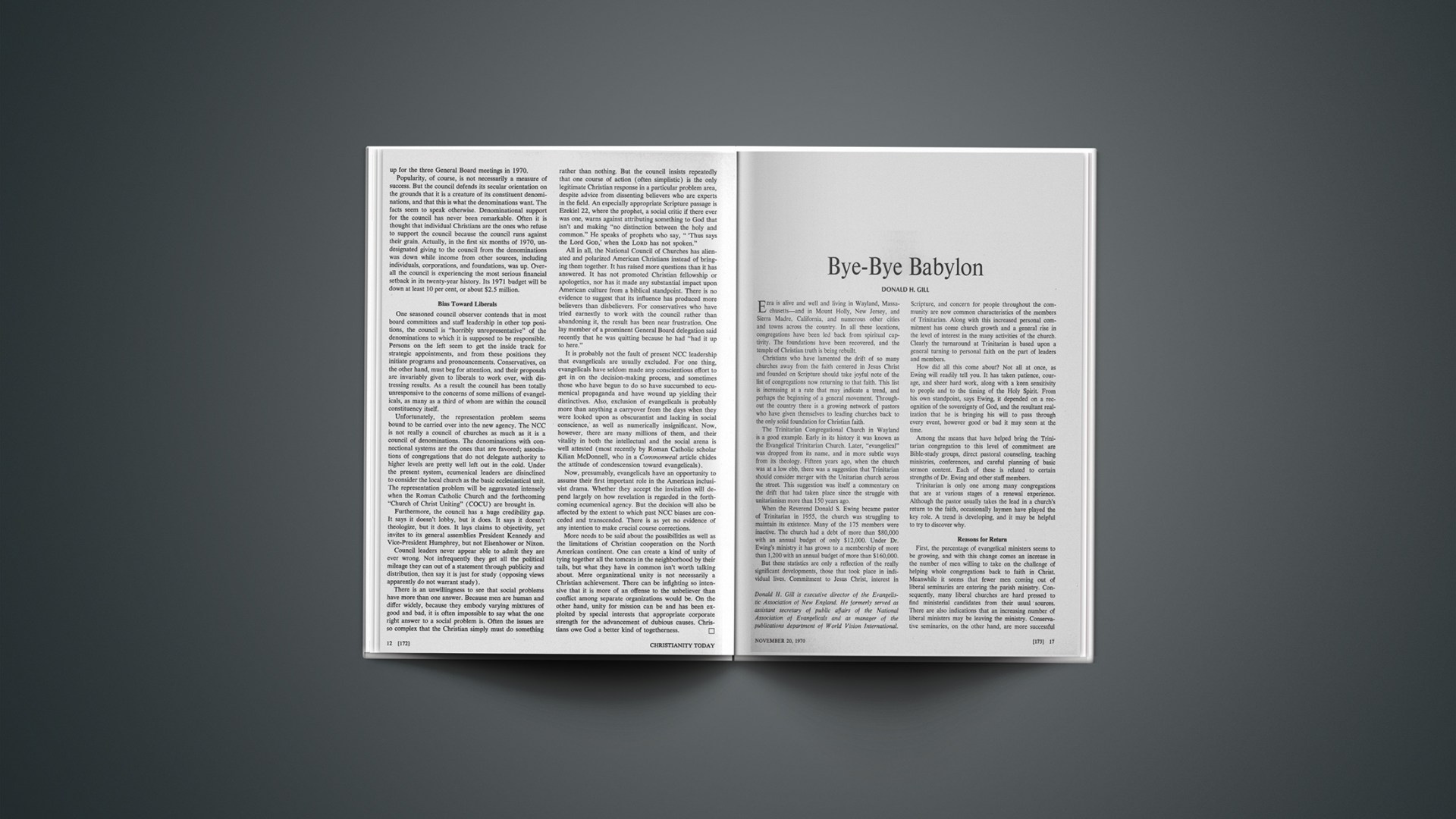
Bye-Bye Babylon

Ezra is alive and well and living in Wayland, Massachusetts—and in Mount Holly, New Jersey, and Sierra Madre, California, and numerous other cities and towns across the country. In all these locations, congregations have been led back from spiritual captivity. The foundations have been recovered, and the temple of Christian truth is being rebuilt.

Christians who have lamented the drift of so many churches away from the faith centered in Jesus Christ and founded on Scripture should take joyful note of the list of congregations now returning to that faith. This list is increasing at a rate that may indicate a trend, and perhaps the beginning of a general movement. Throughout the country there is a growing network of pastors who have given themselves to leading churches back to the only solid foundation for Christian faith.

The Trinitarian Congregational Church in Wayland is a good example. Early in its history it was known as the Evangelical Trinitarian Church. Later, “evangelical” was dropped from its name, and in more subtle ways from its theology. Fifteen years ago, when the church was at a low ebb, there was a suggestion that Trinitarian should consider merger with the Unitarian church across the street. This suggestion was itself a commentary on the drift that had taken place since the struggle with unitarianism more than 150 years ago.

When the Reverend Donald S. Ewing became pastor of Trinitarian in 1955, the church was struggling to maintain its existence. Many of the 175 members were inactive. The church had a debt of more than $80,000 with an annual budget of only $12,000. Under Dr. Ewing’s ministry it has grown to a membership of more than 1,200 with an annual budget of more than $160,000.

But these statistics are only a reflection of the really significant developments, those that took place in individual lives. Commitment to Jesus Christ, interest in Scripture, and concern for people throughout the community are now common characteristics of the members of Trinitarian. Along with this increased personal commitment has come church growth and a general rise in the level of interest in the many activities of the church. Clearly the turnaround at Trinitarian is based upon a general turning to personal faith on the part of leaders and members.

How did all this come about? Not all at once, as Ewing will readily tell you. It has taken patience, courage, and sheer hard work, along with a keen sensitivity to people and to the timing of the Holy Spirit. From his own standpoint, says Ewing, it depended on a recognition of the sovereignty of God, and the resultant realization that he is bringing his will to pass through every event, however good or bad it may seem at the time.

Among the means that have helped bring the Trinitarian congregation to this level of commitment are Bible-study groups, direct pastoral counseling, teaching ministries, conferences, and careful planning of basic sermon content. Each of these is related to certain strengths of Dr. Ewing and other staff members.

Trinitarian is only one among many congregations that are at various stages of a renewal experience. Although the pastor usually takes the lead in a church’s return to the faith, occasionally laymen have played the key role. A trend is developing, and it may be helpful to try to discover why.

Reasons For Return

First, the percentage of evangelical ministers seems to be growing, and with this change comes an increase in the number of men willing to take on the challenge of helping whole congregations back to faith in Christ. Meanwhile it seems that fewer men coming out of liberal seminaries are entering the parish ministry. Consequently, many liberal churches are hard pressed to find ministerial candidates from their usual sources. There are also indications that an increasing number of liberal ministers may be leaving the ministry. Conservative seminaries, on the other hand, are more successful in the proportion of graduates who choose to serve in parish ministries. Gordon-Conwell Seminary estimates that although only about 40 per cent of its incoming freshmen anticipate a parish ministry, by graduation time the percentage has risen to about 70. In large measure this reflects the concern of evangelical faculties to prepare men to lead the local congregation and to help meet the spiritual needs of the community.

Another factor is that evangelical churches are likely to be the growing churches. In Sierra Madre, California, a congregation affiliated with the United Church of Christ was without a pastor three years ago. The pulpit committee began to examine the growth records of churches in surrounding communities. Although some of the church leaders were unitarian, they soon became convinced that evangelical churches showed a better growth rate. Accordingly, they asked an evangelical minister in a nearby community to recommend candidates. Soon after that they called the Reverend Richard Anderson, and the congregation was soon satisfied that it had moved in the right direction. Formerly it had 60 to 90 people attending on a Sunday morning; now the average has risen to 250, and the church holds two morning services.

In the past two years the membership at Sierra Madre Congregational Church has risen from about 300 to 360, even though the names of many inactive members were cleared from the rolls. But here again the figures are only a reflection of the more significant developments in personal lives. Scores of people, both young and adult, have experienced conversion in remarkably different ways. It is not uncommon for people to arrive at the pastor’s office saying, “Something has happened to me.” Then they fill in the details of how the truth of God in Jesus Christ has suddenly struck them as being real. Some have made their commitment to Christ while walking along the street, others in the middle of the Sunday-morning service long before the conclusion of the message, others in response to an invitation at youth services, others in their own homes.

Still another reason for this sort of movement today is the simple fact that most liberally oriented churches have within them at least a few members who long for, and perhaps pray for, a return to faith founded upon Jesus Christ. Many laymen are vaguely dissatisfied with theologies not grounded in Scripture or centered in the person of Jesus Christ. After the first sermon that Richard Anderson preached in Sierra Madre, an elderly man met him at the door to shake his hand. With tears welling up in his eyes the man said: “Nineteen years of prayer have been answered here today.” Many faithful, quiet prayers through the years may now be ready to bear fruit in churches across the country.

Perhaps the most significant reason for the trend is the simple fact that more people have faith that it can happen. They see that it is happening. They see congregations developing a strong commitment to Jesus Christ and taking a firm stand for the authority of the Word of God. Many ministers and church leaders, especially younger men, believe that this is the strategy of the Holy Spirit for these times.

Evangelicals have often found it easier to decry the movement away from “the faith once for all delivered to the saints” than to build roads back to that faith. Now it seems that this is changing.

Requisites For Return

What qualifications are needed by those who desire to lead congregations back to basic Christian faith? The following list emerged from discussions with ministers involved in this pattern of church development.

1. Know where to stand. Without a firm biblical faith, one cannot expect to help others recover that faith. “Other foundation can no man lay than that is laid, which is Jesus Christ” (1 Cor. 3:11). This needs emphasis. The popular tendency to degrade theology makes no sense, especially for men who hope to lead others to Christian faith. Many of the congregations most in need of renewal are practically without a theology; a solid base of belief is precisely what they need. But this faith must be demonstrated in a living relationship to Jesus Christ, not just intoned in a creed.

In Mount Holly, New Jersey, where the Reverend Robert Rovell became pastor of the Presbyterian church six years ago, the parishioners were struck both by his high regard for Scripture and by his life style, which was deeply rooted in his biblical convictions. As a result of his ministry, profound changes have taken place in many lives. Here too increased involvement in the life of the church resulted. Attendance now runs 400 to 500 on a typical Sunday morning, and the church budget has risen from around $50,000 to $104,000. But that congregation would very likely still be a “sleepy liberal” group, as one of the members put it, if it were not for the strong biblical faith of its pastor.

2. Know where you are going. Clear goals are essential. If leaders do not have a definite idea of what should be happening at each stage of development, they are likely to be overwhelmed by the status quo. Planning is a particularly important part of the task of the pastor who is involved in a turnaround situation. If disciplined planning and the ability to execute plans are not among his strengths, these elements must be supplied by leaders of the congregation, for progress will prove difficult or impossible without them. The most promising situation is one in which both the pastor and lay leaders have ability in goal-oriented planning.

The goals should encompass both the spiritual gains to be expected and the other elements of church life, such as facilities, budgeting, and program development.

3. Know how to work with people. Building confidence and positive attitudes is another essential part of the task. This requires a sensitivity to people and good judgment. As one pastor put it, “Today the undershepherd must be able to follow the flock one step ahead of them.” This kind of leadership is needed in many churches.

Timothy was given this advice: “The servant of the Lord must not strive; but be gentle unto all men, apt to teach, patient; in meekness instructing those that oppose themselves; if God peradventure will give them repentance to the acknowledging of the truth” (2 Tim. 2:24, 25).

This includes the sort of judgment that refuses to be drawn into minor issues. One pastor went to a church that was in the habit of raising part of its budget through a church fair. Although he was not really in favor of the practice, he did not consider it as something worth fighting about. And so he rolled up his sleeves, took over the candy booth, and sold more than anyone else. A year or two later, when the church budget was no longer dependent on the fair, he proposed another plan, and the congregation gladly joined in.

AGAINST DARK ANGELS

Man-made is refuge; creaturely is light.

Against dark angels build your sheltering wall

between the unknown and night—against the Night

and close your door securely against call.

Let parallax of stars repeat their song

in measured beat and chartered scale,

nor ask what lost immensities may throng

beyond; the whippoorwill but once need wail.

And if some stranger angel beat the air,

one dusk, to alien music, nighting the skies

blind-hushed before his shattering tonics there

like blood-wild singing armor, and heart cries—

caught up in leaps of warring turn and sound—

deliverance to inhuman ecstasy,

why risk, poor wingless flesh, his Other ground?

By what star fly to peril, risen, free?

HOWARD G. HANSON

“The real issue is Jesus Christ,” says the Rev. Christopher Lyons, who over the past thirteen years led his congregation in Peabody, Massachusetts, from an average Sunday-morning attendance of about 30 to an average of 475. Lyons made it a point to steer clear of lesser issues.

The basis of church membership is likely to be one of the stickier problems. In churches with little or no theological concern, anyone can get in. This may not be the ideal, but according to most of the men who have served under these conditions, a change cannot be expected within the first month or even the first year. The pastor most likely to succeed is the one who can keep his eye on the ultimate goal, and who can work with his peope to bring about a genuine change, not just a submission to his way of doing it.

4. Know when to make a move. Timing is essential to tact and to tactics. Men who have served successfully in turnaround situations single out patience as one of the most important prerequisites. To make certain changes too early may be to jeopardize the whole cause, but to lag too far behind might be equally dangerous.

Choosing the situation within which to work, and when to leave, is another function of proper timing. Some men find they can succeed in leading the congregation only a few steps in the right direction. These men may leave discouraged, but the next pastor may complete the turnaround. Some groups are at a stage where they can be led quickly to new ground, while others are in a deep rut. Paul sensed this when he said: “And I, brethren, could not speak unto you as unto spiritual but as unto carnal, even as unto babes in Christ. I have fed you with milk, and not with meat: for hitherto ye were not able to bear it, neither yet now are ye able” (1 Cor. 3:1, 2). Within the congregation, some people may be ready to be led, while others need to have their confidence built up before they can accept suggestions.

5. Know the source of power. Experienced ministers say that nobody has the wisdom and personal traits that can assure a turnaround. The real power is in the Gospel and in the Holy Spirit’s application of the Word to the real needs of men and women. The process of change should never be a case of playing the pastor’s beliefs and opinions against those of the congregation. Rather, it must become a common search for the best means of bringing the greatest possible number of men into relationship with God in Jesus Christ.

Paul recognized this when he expressed the hope “that your faith should not stand in the wisdom of men, but in the power of God” (1 Cor. 2:5). If the congregation has its faith founded only on the convictions of the pastor, it stands on very uncertain ground; but if it has a faith rooted in the Word of God, it will not easily be shaken.

Given these indications that many churches are ready to step to firmer ground, the believing Christian community must not fail to seize the opportunity. Thus the challenge comes to prepare more men to become Ezra’s modern counterparts.

Donald H. Gill is executive director of the Evangelistic Association of New England. He formerly served as assistant secretary of public affairs of the National Association of Evangelicals and as manager of the publications department of World Vision International.

American Ecumenism at the Crossroads

In an old hotel in Oxford, England, four churchmen sat at a table one evening, sipping tea and discussing the essence of divine revelation. Among them were William Temple and John R. Mott, both of whom profoundly understood and influenced modern Christendom. Mott is said to have suggested that they had touched upon the crucial problem besetting all ecumenical gatherings. As they talked into the night, they agreed “that the nature of the Christian revelation was the one rock on which the ecumenical movement stood always in danger of foundering.”

That incident in 1937 is recalled by David P. Gaines, the most exhaustive chronicler of the ecumenical movement, as he identifies revelation as the source of the churches’ “deepest difference.”

“Would Christians ever learn that they could be ‘together in one accord’?” he asks. “Not until they approached one another in a true knowledge of the nature of the Christian revelation.”

Though seldom formally confronted, the problem mars the ecumenical vision today more than ever, and it heads a long list of reasons why the National Council of Churches of Christ in the U. S. A., the most ambitious experiment in inclusivism in American church history, has been foundering.

The current plight of the twenty-year-old NCC is worth examining by every concerned pastor and layman, whether or not he belongs to a constituent communion. For in the factors that led to the council’s predicament lie crucial lessons for all believers. As Christians realize increasingly that they cannot go it alone, that they must depend upon one another, indeed that they must work together if they are to obey the heavenly vision, the sorry condition of the conciliar movement in America must be brought into sharper focus. The motives of those most deeply involved need not be impugned, but the NCC’s basic faults have been ignored far too long.

Examination is also a service to the conciliar movement itself, because the architects of the proposed new conciliarism seem unable or unwilling to come to grips with the real issues. They have tended to shrug off evangelical anxieties as special-interest, right-wing polemic undeserving of serious consideration. Ecumenists sometimes say that to understand the council is to love it, that most anxieties are attributable to mere lack of information. To follow its doings and to comprehend its workings, however, is to see how far short of authentic ecumenicity it has fallen. Its neglect of evangelicals and others shows it has never really been ecumenical.

The NCC’s first and continuing slogan is, nobly enough, “this nation under God,” and its announced goal has been “more fully to manifest unity in Jesus Christ as Divine Lord and Savior.” Why, then, has it failed to achieve and promote true unity? How did it get off course? What has hindered it from gaining more respect from evangelicals?

Ncc Failures

Public acknowledgment that the NCC was in deep trouble came a year ago in Detroit at the council’s eighth General Assembly. Dr. R. H. Edwin Espy, general secretary of the NCC, spoke in his official report of “an intensified polarization among Christians” and a “shaking of the foundations” in ecumenical structures. He recited a long list of NCC successes but also recounted its failures with unprecedented candor. “The National Council is about where its member churches are on evangelism, which is in a state of confusion,” he said. “In the field of theology, despite good work … there has been little overall cohesive impact. We have not made a decisive contribution or tackled the problem head-on.” He cited also a “yawning gap between the National Council and the people of the Churches,” and conceded that “any effort to grapple with the underlying questions of the National Council’s role is fraught with doctrinal difficulties and political dangers.”

Espy’s conclusion was that conciliar Christianity “can rise to the challenge of the great issues which now grip our society and the great potentialities which now well up in our churches only by unfurling rather than trimming sail, by going forward rather than drifting backward.” He suggested that the National Council be reorganized and enlarged and that its ministries be so worked out that church and non-church groups could unite behind and support any of the council’s programs that interested them. Those interested in social action, for example, could tie in at that point with no obligation to work at something else such as evangelism.

The assembly weighed Espy’s idea against a wild and revolutionary backdrop. All week long the meeting was subjected to disruptions and take-overs. Radicals went from one tirade to another. Council sessions came close to anarchy and sheer pandemonium. For nineteen years the NCC had catered to the left—only to have a new left spew venom on it.

Three Central Concerns

Implementation of the restructuring idea fell to the NCC’s 250-member General Board, which meets three times a year and is made up of representatives of all thirty-three constituent denominations. The board appointed a fifteen-member task force to study the options open to the council. In its initial report (presented at the board’s June 20–21 meeting) the task force drew attention to three central concerns about which churchmen differ sharply: unity, action-oriented engagement, and renewal.

Two extreme positions on unity were cited: some feel there must be organizational unity by those who can agree on what the mission of the Church is, “at the expense of driving other member churches out of the unity”; others feel the churches should do together whatever there is a willingness to do but not do together “those things which will drive churches out of the unity.” Between these stood perplexed and more moderate or mediating churches and churchmen.

In presenting the second major concern, action-oriented engagement, the task force pointed out that “whether the churches … ought to be engaging in social action programs designed to produce change in the social and political structures of our common life” is one of the most controversial issues in the churches today. “The urgency American society is under at the present time to achieve justice for its minority groups, especially the black community, has its manifestation in the life of the church in a demanding conviction that the church makes social justice its over-arching priority, at the expense of almost anything else.”

About the third major concern, church renewal, the report said strong convictions exist “that the churches should confine or concentrate their resources and their work to … programs designed to result in the renewal of the church’s own internal life.… Evangelism, stewardship, Christian education, liturgical renewal and missionary outreach have been some of the traditional programs which have been central when church renewal has been given priority. Now social justice must be recognized as another means to the accomplishment of renewal, and some would say it is the indispensable if not the only means.”

The task force further stated that the NCC as a conciliar structure has four principal functions: (1) forum function (exploring subjects and promoting dialogue); (2) advocacy function (taking stands and following through on matters of social concern about which even Christians disagree); (3) facilitator function (gathering, storing, and distributing information); (4) program operation function (centralizing in the NCC “the management of joint program operations”).

The task force then presented four plans for restructuring the NCC and specified in some detail what a successor ecumenical organization might look like, how it would function, and what its concerns would be.

Option C (number 3) can be disposed of quite quickly. This plan would provide for The Churches United for Justice, a “radical departure from the NCC as it is presently constituted.” The primary concern of the organization would be social justice, “affirming a responsibility for all facets of human existence.” The plan would limit membership to “denominations who believe one of the primary thrusts of Christianity lies in the social sphere. It also requires its member churches to relinquish control over the use of their monetary gifts (all gifts must be made undesignated).” This option can hardly be taken seriously. It would encourage a thoroughgoing secularization of the churches and the end, ultimately, of any genuine spiritual ministry that envisages salvation now and in the world to come.

Under Option D (number 4) there would be A National Council of Churches with a Strong Centralized General Board. This would provide for development of an ecclesiastical machine with enormous power to determine what it should do and then do it. “This option places a high premium on undesignated giving to the General Board.” In effect it would create a super group not really answerable to the member churches, though they would foot the bills. The report did say that “funding remains a big problem for any NCC structure based upon a strong General Board.” This option has in it the seeds of autocracy and dictatorship and runs counter to democratic principles, under which the people have the right to know how their money is being spent as well as the right to “throw the rascals out.”

The Mildest Plan

Option B (number 2) proposed A National Conference of Churches designed to carry forward “the basic purpose set forth in the present preamble to the Constitution of NCCCUSA.” Conference membership would be limited to church communions, and Roman Catholic, Lutheran, and other ecumenically minded churches would be encouraged to join. But all member churches would be able to “refrain from supporting and participating in some of the organization’s program agencies or other activities.” The plan would encourage voting participation in program agencies (but not in conference-wide matters) by Canadian and U. S. non-member churches and para-ecclesiastical bodies (e.g., the American Bible Society and the National Committee of Black Churchmen). Assuming the continued fragmentation of the churches and the continuing financial problems of an overall organization, this option supposes that authority, power, and funding would be decentralized. In general it might increase the number of member churches. It would diminish the role of the General Board. But it would be little more than a face-lifting job; the new body would be essentially the old NCC with a new name, free perhaps of some of the stigma now attached to the council.

Option A (number 1) would be A Comprehensive Multiform Conciliar Complex to Facilitate Ecumenical Witness and Action by All U. S. Churches and Para-Ecclesiastical Bodies. The NCC and the U. S. Conference of Catholic Bishops would jointly offer this option to all U. S. communions and to religious organizations such as the American Bible Society and the YWCA. These communions and groups would be eligible for membership in any or all parts of the complex “provided they participate in and support the General Assembly and its staff, called the General Secretariat.” Participation in the General Ecumenical Assembly “will carry with it a commitment to accept and pay the pro rata apportioned costs and expenses of the General Assembly and the General Secretariat.” This would be aimed at solving the funding problem. There would be “five self-governing, self-sustaining ecumenical agencies” and a “larger number of self-governing, self-sustaining consortia, each specifically linked to one or more of the ecumenical agencies.” The purpose would be “to further the unity, mission and renewal of the churches in the United States.”

Option A has the appearance of a catch-all to gather in as many denominations and religious groups as possible. It might solve the recurring financial problems. And it would give members the privilege of choosing which of the various ecumenical agencies they wanted to support.

The Next Step

Now the task force says that the outline of options has served its purpose and that work must begin on an actual model. Polls and discussions (very limited in scope) showed that options A and B were the most popular, so whatever new organization emerges will presumably be a blend of these but will include some of the assumptions in option C also. Option D apparently did not engender much enthusiasm.

At the most recent meeting of the General Board, the task force tried to break loose from the concept of keeping unity and mission in tension, each as a primary objective. The task-force report drafted at that meeting declared: “The data convinces us that the churches have established the fact that mission has an indisputable basic claim upon our common life and that at the very least mission is first among equals and therefore must be given the primary position.” Objections to this position were raised from the floor, most notably by Dr. Eugene Smith, North America secretary for the World Council of Churches, who succeeded in getting the statement deleted. It had been included in a paragraph entitled “The Primacy of Mission” that was subsequently replaced by a paragraph of in-group jargon called “The Claim of Mission”; the new paragraph in effect continues the concept of keeping the two objectives in tension.

Several other principles got by the board without change, but with the understanding that they represented only “the first in what must become a series of navigational assessments.…” A decentralized agency is envisaged, with limited coordinating authority. Ultimate voting power is to be restricted to delegates from denominations; religious organizations will participate on a limited basis. Flexibility is recognized as essential, so much so that the agency’s program is seen as “chiefly, if not exclusively, catalytic and experimental in nature. Adequate provision for the spinning off of continuing programs should be made. Flexibility both in patterns of operation and areas of concern would be essential.”

The task force has worked hard and exhibited some commendable insights. Significantly, however, it has seen its mandate from the board as merely sensing what “stakeholders” in a future ecumenical agency will want, rather than trying to determine what would be best for them to have. This is a serious impediment, inasmuch as the only “stakeholders” who can be identified with any certainty are churchmen of the present NCC constituency. Informal meetings are being conducted with chief officers of some non-NCC communions, but these have not progressed far enough to provide any guidance for the task force. The result is that the task force has failed to identify the basic problems of the NCC as seen from the outside, and has ended up working on a new model that bears a striking resemblance to the old. Looking over their reports, one gets the impression that they tried to get around the weaknesses in the present organization rather than correct them. They have offered alternatives rather than solutions, have in part bowed to expedience rather than experience, and have tended to emphasize the economical over the ecumenical.

What are the basic defects of the National Council? Where has it gone off course?

As David Gaines has observed, revelation is the substantive underlying issue. The inclusivist apologetic continues to appeal to Scripture as if the propositional view of revelation were still the prevailing norm. Much of what passes for Christian thinking today, however, rejects that view, and conciliar ecumenism has made no official distinctions at this point. The ecumenical umbrella is available not only to those who hold that revelation consists of truths that can be expressed in statements, but also to those who subscribe to the heilsgeschichtlich view, wherein revelation has its locus not in verbalization but merely in events perceived as divine acts.

But what can be known of God’s will if the orthodox view of Scripture is rejected? Who is to say which acts are divine? Indeed, the whole rationale for the ecumenical movement, historically grounded in Jesus’ prayer “that they all may be one … that the world may believe” (John 17:21), is surrendered when propositional revelation is denied. A non-propositional view of Scripture yields a subjective authority only and a temptation to resort to the Bible only when convenient. Firm conclusions cannot be drawn about Jesus himself, his death and resurrection, his Saviourhood, his Lordship; much less can ethical guidelines relating to the complex questions of our day be deduced. Unless there is agreement on the nature of revelation, Christians cannot talk about the same Christ, and any so-called unity is unreal. Espy in his Detroit proposal laid great stress on Christian obedience, saying that “to be ecumenical in churchmanship is to be obedient to the Lord Jesus Christ.” But how can we obey someone of whom we have no objective knowledge?

A Secular Outlook

Not surprisingly, without the moorings of a solid commitment to biblical revelation the NCC has drifted far off course. By definition it identifies itself as a council of churches, but the vision of the spiritual nature and mission of the Church often seems to have been lost. The council has given itself over almost exclusively to a secularly oriented social dimension of life at the expense of some crucial New Testament themes, such as the kerygma. Amos and James are emphasized at the expense of Moses and Paul. Humanity is thought of exclusively as a group, and the approach to virtually every issue is sociologically impersonal.

At some points, the unity factor is appropriated in behalf of partisan politics, while at others togetherness is regarded as an end in itself. Dr. John A. Mackay, who was one of the leading figures in the ecumenical movement, has written sadly that “now unity is not for mission. Unity is for unity.” He warns that “when unity is equated with institutional oneness and episcopal control, and when both of these are regarded as indispensable for real unity, let this not be forgotten: The most unified ecclesiastical structure in Christian history was the hispanic Catholic church, which was also the most spiritually sterile and the most disastrously fanatical.”

In its operating principles, the National Council plainly excludes the recognition of regeneration as the necessary building block for the reconstruction of society. It implicitly disregards the biblical truth that righteous persons are product of the transforming power of the Spirit of God, made possible by Christ’s atonement. To put it simply, the council expects good deeds from bad men. It does not explain how sinful man can gain a new moral capacity. Individual evil simply is not reckoned with.

The council’s approach is that when environment is improved, people will behave better. This is not articulated explicitly, but the assumption is evident in the council’s whole mood. There is virtually no concern for the problems of individuals, no talk ever of the consequences of personal transgressions, no reliance on prayer or meditation.

Ultimate power, as council leaders see it, lies in the political and economic sphere. And the council’s program and pronouncements invariably lean toward the left, because state control is seen as a panacea. Paul’s preaching at Ephesus motivated men to forsake the purchase of silver for Diana, thus putting the whole market in jeopardy. If current conciliar strategy had been followed, the Ephesian Christians would have passed a resolution calling upon the government to prohibit the sale of silver.

It is no wonder, then, that the council regularly provides a platform for alien gospels. There is constant criticism of the American right but never any warnings about the dangers of a leftward drift. There is also a perpetual thirst for novelty; council leaders take their cues from newspaper headlines, concentrating on a few issues and neglecting most others (little or no study has been devoted to the problems of pollution, traffic safety, drug abuse, pornography, medical ethics, and organized crime).

The NCC’s practice of selectivity in social issues has achieved near notoriety. Repression is denounced in South Africa but not in the Soviet Union. Policemen are denounced for using violence against rioters, but the rioters themselves are excused as having been provoked. Politicians who champion causes the council favors are regarded as courageous heroes; those who take issue are ridiculed and regarded as puppets of special interests. Recently the mood and tone of council reports has been decidedly on the side of radical dissenters, with a call for a minimum of restraint.

Rarely are both sides of an issue presented fairly before the council. Usually soft spots on the left are glossed over, while the right is regarded as repressive, exploitive, and prejudiced. Typical was the council’s public support of the boycott of table grapes—it adopted this position without hearing any arguments from the growers’ side. More than a year after the vote, a grower chided the General Assembly and pleaded his cause, but to no avail. Looking at the New York skyline, one can almost imagine the Interchurch Center tower leaning leftward Pisa-like.

One would expect that with all its social involvement, the council would be considered a paragon of Christian relevance. But a poll taken for the council last year showed that 40 per cent of American adults have never even heard of it. Of those who said they knew of the council, only 55 per cent indicated a generally favorable attitude toward it. Twenty-two per cent of those aware of the council’s existence said they disapproved of it, and the rest had no opinion.

Even young people, who are regarded as having more concern than the older generation with the issues closest to the council’s heart, have had very little to do with the council. The dissolution last year of the University Christian Movement marked the severance of the council’s last official tie with youth organizations. Despite a crash program to involve young people in council affairs, including a shift to weekend board meetings as a special accommodation, only a handful of youth have shown up for the three General Board meetings in 1970.

Popularity, of course, is not necessarily a measure of success. But the council defends its secular orientation on the grounds that it is a creature of its constituent denominations, and that this is what the denominations want. The facts seem to speak otherwise. Denominational support for the council has never been remarkable. Often it is thought that individual Christians are the ones who refuse to support the council because the council runs against their grain. Actually, in the first six months of 1970, undesignated giving to the council from the denominations was down while income from other sources, including individuals, corporations, and foundations, was up. Overall the council is experiencing the most serious financial setback in its twenty-year history. Its 1971 budget will be down at least 10 per cent, or about $2.5 million.

Bias Toward Liberals

One seasoned council observer contends that in most board committees and staff leadership in other top positions, the council is “horribly unrepresentative” of the denominations to which it is supposed to be responsible. Persons on the left seem to get the inside track for strategic appointments, and from these positions they initiate programs and pronouncements. Conservatives, on the other hand, must beg for attention, and their proposals are invariably given to liberals to work over, with distressing results. As a result the council has been totally unresponsive to the concerns of some millions of evangelicals, as many as a third of whom are within the council constituency itself.

Unfortunately, the representation problem seems bound to be carried over into the new agency. The NCC is not really a council of churches as much as it is a council of denominations. The denominations with connectional systems are the ones that are favored; associations of congregations that do not delegate authority to higher levels are pretty well left out in the cold. Under the present system, ecumenical leaders are disinclined to consider the local church as the basic ecclesiastical unit. The representation problem will be aggravated intensely when the Roman Catholic Church and the forthcoming “Church of Christ Uniting” (COCU) are brought in.

Furthermore, the council has a huge credibility gap. It says it doesn’t lobby, but it does. It says it doesn’t theologize, but it does. It lays claims to objectivity, yet invites to its general assemblies President Kennedy and Vice-President Humphrey, but not Eisenhower or Nixon.

Council leaders never appear able to admit they are ever wrong. Not infrequently they get all the political mileage they can out of a statement through publicity and distribution, then say it is just for study (opposing views apparently do not warrant study).

There is an unwillingness to see that social problems have more than one answer. Because men are human and differ widely, because they embody varying mixtures of good and bad, it is often impossible to say what the one right answer to a social problem is. Often the issues are so complex that the Christian simply must do something rather than nothing. But the council insists repeatedly that one course of action (often simplistic) is the only legitimate Christian response in a particular problem area, despite advice from dissenting believers who are experts in the field. An especially appropriate Scripture passage is Ezekiel 22, where the prophet, a social critic if there ever was one, warns against attributing something to God that isn’t and making “no distinction between the holy and common.” He speaks of prophets who say, “ ‘Thus says the Lord GOD,’ when the LORD has not spoken.”

All in all, the National Council of Churches has alienated and polarized American Christians instead of bringing them together. It has raised more questions than it has answered. It has not promoted Christian fellowship or apologetics, nor has it made any substantial impact upon American culture from a biblical standpoint. There is no evidence to suggest that its influence has produced more believers than disbelievers. For conservatives who have tried earnestly to work with the council rather than abandoning it, the result has been near frustration. One lay member of a prominent General Board delegation said recently that he was quitting because he had “had it up to here.”

It is probably not the fault of present NCC leadership that evangelicals are usually excluded. For one thing, evangelicals have seldom made any conscientious effort to get in on the decision-making process, and sometimes those who have begun to do so have succumbed to ecumenical propaganda and have wound up yielding their distinctives. Also, exclusion of evangelicals is probably more than anything a carryover from the days when they were looked upon as obscurantist and lacking in social conscience, as well as numerically insignificant. Now, however, there are many millions of them, and their vitality in both the intellectual and the social arena is well attested (most recently by Roman Catholic scholar Kilian McDonnell, who in a Commonweal article chides the attitude of condescension toward evangelicals).

Now, presumably, evangelicals have an opportunity to assume their first important role in the American inclusivist drama. Whether they accept the invitation will depend largely on how revelation is regarded in the forthcoming ecumenical agency. But the decision will also be affected by the extent to which past NCC biases are conceded and transcended. There is as yet no evidence of any intention to make crucial course corrections.

More needs to be said about the possibilities as well as the limitations of Christian cooperation on the North American continent. One can create a kind of unity of tying together all the tomcats in the neighborhood by their tails, but what they have in common isn’t worth talking about. Mere organizational unity is not necessarily a Christian achievement. There can be infighting so intensive that it is more of an offense to the unbeliever than conflict among separate organizations would be. On the other hand, unity for mission can be and has been exploited by special interests that appropriate corporate strength for the advancement of dubious causes. Christians owe God a better kind of togetherness.

Male and Female Created He Them

The battle between the sexes, a guerrilla skirmish for years, may be escalating into a full-scale war, to judge from its frequency of appearance in the newspaper. The theme runs from the front-page crusades of the militant feminists to the second-page, second-section conflicts of Dear Abby’s followers. (It also made the pages of the Bible, where the author of Proverbs states his preference for life in the desert or in a corner of the attic to life with a contentious woman.) There is, for example, the coed fighting masculine barriers to her employment as a bartender. Sharing the news columns with her is the man taking legal action because he was turned down as a women’s hairdresser. Sports-page readers have had a ringside seat for the spectacle of junior-sized misses battling to become jockeys. Even the comic pages are not exempt as Margaret despairs over Dennis, Lucy gets the brush-off from Schroeder, and Li’l Abner and Daisy Mae get their roles reversed.

All this suggests that James Thurber may have been calling attention to a basic problem of our existence in his cartoon treatment of the battle between the sexes.

The Church usually deals with male-female conflicts in the context of marriage and the relationship between husband and wife, and certainly this is an area that sorely needs its healing ministry. But marital conflicts may be a symptom of a more basic human problem that happens to show up most clearly under the magnifying glass of a marriage relationship. The Church should speak to its entire membership, not just the married, on the matter of male and female relationships.

To get some clues to how the sexes should relate to each other, let’s go back to the beginning. The creation account states, “God created man in his own image, in the image of God he created him; male and female he created them” (Gen. 1:27). This seems to say that the image of God, in which mankind was created, is a double image: it includes both male and female. Biblical references to God as a man are apparently an accommodation to the limitations of human language. What God is encompasses both sexes, and since we have never seen such a being we have no adequate way of describing him.

The Genesis account clearly shows that none of us, male or female, is complete in himself—and this was true even before sin spoiled things. We need the opposite sex to help us form an image, faint though it may be, of God.

This notion is supported by God’s comment in creating Eve: “It is not good that man should be alone. I will make him a helper fit for him” (Gen. 2:18). We have accepted the archaic terms “helpmate” and even “helpmeet” from earlier translations without giving much thought to their original meaning, and so may miss some of the significance of this passage. It emphasizes the incompleteness of the man God had created, even though his creation was “good.”

Sexual union between male and female is one means of attaining a part of the completeness that was intended. But it is not the only way. God’s will does not make second-class citizens out of any group. Although marriage is intended to bring particular blessings, there is certainly no suggestion that the unmarried are excluded from God’s blessings.

Male and female need each other, even apart from sexual union. Men or women who have spent some time in a single-sex environment—the armed forces, for example—are well aware that this is not ideal.

The fulfillment of God’s intention in creation depends on significant contributions from both male and female. What happened to this intention? Sin happened, as it so often does. Even among the chosen people, women were not considered equal contributors to the wholeness of God’s image. Their rights were not as important as those of men; for example, they normally did not hold property. In general, instead of being free to make their contribution to the purposes of God, women were regarded as passive recipients of the leftovers of God’s largess.

To say that Jesus came to take away sin is to say a good deal more than most of us have in mind when we make that statement. Jesus not only takes away the guilt and punishment of our individual and collective sins, great as that truth is; he comes also to set right all those things that sin has upset, to bring about the completeness God had in mind in creation. And among the benefits he brings is a restoration of the equality of the sexes. He gives to women their intended place in God’s order—full partners in reflecting the image of God.

Paul summarizes this when he tells the Galatians, “There is neither Jew nor Greek, neither male nor female, for you are all one in Christ Jesus” (Gal. 3:28). This unity, brought about by the full participation of both men and women, is God’s intention.

What about passages that speak of the man as the head and the woman as subject to him? Before we build an entire style of life on these verses we should consider what the Bible as a whole has to say on this subject, not overlooking passages (as in Proverbs) that exalt womanhood, or the examples of women such as Deborah who played prominent roles among God’s people. The Apostle Paul—whose statements about the place of women in the church are well known—seemed entirely at ease when Lydia took over leadership in the first congregation in Europe.

When Paul told wives to be subject to their husbands, he also told the husbands to love their wives. And if a man loves a woman, he is in a very real sense willing to be subject to her. Paul makes this point clear by reminding us that Christ loved the Church so much that he gave himself up for her. Jesus calls us to the same kind of self-sacrificing service as the mark of our love.

When biblical writers assign to women a subservient position, they are not talking about equality or status or prestige, for after all, “the last shall be first.” It might be helpful to think of such designations as a description of function or responsibilities.

To say that the sexes are equal is not to say that they are the same. Vive la difference! Many, both male and female, seem to have a hangup at this point and become overly aggressive or defensive on the matter of women’s rights. But we don’t have to be alike to be equal.

We may reasonably infer that each sex supplies something to help complete the oneness of which Paul spoke. The man or the woman does not necessarily contribute the same ingredient to each combination. Nor is the proportion supplied by the one sex the same in every circumstance. But both, whatever the nature and amount of their contribution, are necessary to wholeness.

Part of what we are is what others make us. Marriage, because of its constant intimacy, provides the greatest opportunity for this completing relationship. But all of us are influenced and brought somewhat nearer to reflecting God’s image—or farther from it—by those around us. And our personality suffers if some of this influence is not exercised by those of the opposite sex.

Paul stresses this interdependence when he writes to the Corinthians, “In the Lord, woman is not independent of man, nor man of woman; for as woman was made from man, so man is now born of woman” (1 Cor. 11:11). God’s creatures are interdependent. Men and women must each contribute to the reflection of God’s image if the wholeness he intended in creation is to be achieved.

Rolf E. Aaseng is associate editor of the “Lutheran Standard” (the American Lutheran Church). He has the B.Th. from New York Seminary and has written “Anyone Can Teach (They Said)” and “The Sacred Sixty-Six.”

Cover Story

What’s so Great about Heaven?

It was a favorite saying of a literary critic I once knew that Shelley and Milton, despite the vast differences between them as writers, shared equally an imaginative inability to think of anything interesting to do in heaven. The same deficiency has been pointed out about utopian novels, and is summed up in the sophisticated colloquialism that all the interesting people will be in hell.

Actually, with regard to Milton the critic’s assertion is a canard (or half of one), for no other writer has so overwhelmingly depicted the undesirability of hell as a place of residence. And he shows this not in Dante’s rather easy way of imagining endless physical torments but—more horrifyingly—by showing its unspeakable boredom. Whether he communicates equally well the joys of heaven is a question each reader must answer for himself, basing his judgment not mainly on Paradise Lost but on Paradise Regained, which few people read. As for Shelley, he made many things beautiful, but he had a hard time making anything interesting.

The opinion that the Christian heaven will be a pretty dull place is so widely diffused that one may pick almost at random for evidence. Item: “If an eternity of unrelieved cultural refinement [as envisioned in the Greek view of the Elysian fields] looks like a rather dreary prospect, it is probably less dreary than enjoying an eternal sabbath or singing endless hosannas” (Renaissance and Revolution, by Joseph A. Mazzeo). Clearly the New Yorker-ish picture of harp-strumming, bald-headed ex-businessmen with wings, sitting on clouds, has deeply permeated the folk-consciousness.

My chief purpose here, however, is not to deplore the imaginative anemia of famous writers who have tried futilely to animate paradise, nor to review the popular secular belief (whether sincere or wishful) that heaven would not be much fun anyway. Rather, it is twofold: to suggest a certain irrationality in the prevailing popular view; and to see whether Scripture, while silent on details, does not in fact provide at least a basis for determining what kind of activities will give dynamic joy in heaven. As to the details, we are, of course, told that they are both incommunicable and forbidden (1 Cor. 2:9 and 2 Cor. 12:4), so there is no use exercising our minds over them. We were not consulted when the delights of this earth, or when we, were created, and we were not called in to give advice on the “things which God hath prepared for them that love him.” (Past tense, note—he has already prepared them.)

As to the irrationality of the popular view of the dullness of heaven, it is instructive to ask what fruits of evil, as we see them displayed before us rather vividly every day, will be so missed in heaven as to generate there unassuageable nostalgia and unhappiness. Tending the sick, fighting wars, enduring mental confusion and physical pain, poverty and starvation, the ultimate hopelessness of death—are these and hundreds of other conditions produced by sin so dear to us that we cannot bear to think of living without them?

On the other hand, what kinds of activities that give true joy are incompatible with the Christian view of paradise? Surely not fellowship, unstinted intellectual activity, aesthetic creativity, sensuous beauty, exploration, literature, music, art, love—or anything else we truly cherish and enjoy. Someone has defined art as anything we would like to do if we did not have to do something else, like invent pesticides and dig graves. All man’s natural impulses, as they were implanted by God in our great progenitor, Adam, were good. Depravity has thwarted them, and mingled with them, as tares with the wheat, inclinations that promise good but, being tasted, bring ennui and death. “In the very temple of delight/Veiled Melancholy has her sovran shrine.” Even the deepest pleasures of this life are inescapably mingled with sadness, for we cannot, without sorrow, “love that well which we must leave ere long.” But even this sad pleasure will be impossible in a region where true love cannot enter, and where self-love, which fallen man in this life has perversely substituted for the only true object of love, God, will corrupt into self-loathing and produce unmitigated corporate and mutual hatred. Rationally considered, and on the basis of this one consideration alone (discounting, if one chooses, all other possibilities of discomfort and misery), the company of hell seems unlikely to be particularly scintillating, joyous, or endearing.

But let us leave Dante’s “natural dungeon where ill-footing was, and scant supply of light,” and fix our gaze, as blind Milton did in imagination, where “Now at last the sacred influence/Of light appears, and from the walls of Heav’n/Shoots far into the bosom of dim Night/A glimmering dawn.” A glimmer of dawn is all we can discern, for we have yet no daylight revelation of details. But we have knowledge, through promise, of certain basic conditions, principles, and qualities of that which God has prepared for those who love him. Among them: a purity of light; a restored and perfected environment; release, intensification, and refinement of intellectual activity and sensuous experience; restored balance between the body, soul, and spirit that make up our triune being; incalculably varied companionship; limitlessness of the horizons of personal fulfillment; a pervading knowledge of the perpetuity of bliss; the presence of God himself (beyond imagining)—the list tumbles out, and each reader of Scripture will conceive that the most important feature of all has been omitted from any list, save his own.

But is it possible to be any more specific, at least with regard to the kinds of activities that will animate heaven? I think it clearly is, even if, for present purposes, we limit ourselves to only one line of thought; namely, the fact that the best way to determine action (function) is to determine identity. It is a commonplace these days to point out that man does not know “what to do with himself” unless he knows who he is. To the existentialist, we must create our own identity. To most others, we must discover it. In either case, it is agreed that man, by nature, is dynamic. Being and doing are inseparable. If I know what and who I am, I know how to use me. And I must be used, I must act, in order fully to be. Even at the level of superficial sensuous (bodily) existence, experiments show that a person deprived for an extended period of time of the input of his senses (by being embedded in a state of senselessness, without motion, sight, sound, taste, or touch) quickly suffers serious psychological difficulties. Every capacity implanted in us contains its own imperative to be used. (Among its other undesirable features, hell may well be a condition of being without doing, of existence without function, of consciousness without meaning—and a pervading awareness of its perpetuity.)

Turning to Scripture for light, we find it permeated by the revelation that man has a threefold identity-function: as king, as priest, and as prophet. We see it first and dramatically revealed as Adam assumed sovereignty over his assigned realm, this earth; as he knew the words of God and the things pertaining to him (which is, of course, the central nature of “prophecy,” not chiefly to foretell the future); and as he directed for Eve and himself homage and worship toward their Creator, his priestly function. By treason he lost his great warrants, for himself and for his race; but they will be restored, marvelously transfigured and enlarged, under the Lordship of the Second Adam, who won them back both as Son of God and Son of Man, and who will invest his own with them. In its presentation of human history between the Fall and the Incarnation, how replete is Scripture with examples, plain teachings, pictures, symbols, and exhortations concerning man in his true identity—king, priest, and prophet. As embodied in even the greatest exemplars, however—in Moses, in David, in Elijah, in Aaron, and all the others—how marred is the original intention.

It is aslant to my chief purpose to say so, but I think that Scripture tells us that the truth underlying the triple role of man runs deeper in the universe than man and his nature. Consider what we are told about that terrible, ancient, and once-glorious being whose name we do not know but whom we call Satan, the Adversary. He was created to great glory, to the sound of music, perfect in his ways, and made king of a great empire, title to which (though perhaps in reduced dimensions) he still holds, for Jesus himself refers to him as Prince of This World. And an even greater realm is indicated in another title he still holds, Prince of the Powers of the Air, ruler of that wickedness in high places, those principalities and powers, against which, Paul tells us, is our spiritual warfare. That he was also prophet is indicated by the assertion that he was full of wisdom (Ezek. 28:12); and that he was priest, leading his empire in the worship and adoration of God, is implicit (if the term be well studied) in his mysterious identification as the “covering cherub.” Displaced, because of his rebellion, as prophet (for the father of lies will no longer speak truth about God) and as priest (for his worship, through pride, is of himself, not of God), he yet retains his fearful regal sway over the world system and over the “powers that are on high,” still enjoying access to the presence of God, where day and night he brings railing accusations against those who have dared cast off his rule and acknowledge another, even Jesus, as Lord and King. Already is this One, a greater than Moses, our prophet, for he alone perfectly revealed the will and the nature of his Father; and already our priest, ever our mediator and advocate before the Throne; and already our King, though his visible kingdom awaits his return in power and glory.

But back to my topic, which is the relevance of the revealed threefold identity-function of man as that revelation hints at certain kinds of activity in the kingdom of heaven. I pass over the kingship that is promised the redeemed, though there is much that could be said; and over the role of prophet, a function embracing the full dimension of intellectual activity (for to study anything is to study God); and comment briefly on only the priestly role, for that perhaps reveals less readily than the other two the joy implied in its exercise.

I suggest no less than that man’s total aesthetic, creative, artistic dimension may be intended to find its joyous release and practice within man’s role as priest, as he offers to God, in gratitude and love and worship, every shape and form of beauty he is capable of conceiving. No imaginable activity could be more wonderful, for even in this life the creation of beauty—whether it be of gardens, or music, or art, or literature, or whatever else gratifies and fulfills that mysterious sense called the aesthetic—gives man his deepest fulfillment and satisfaction. Beauty never sates. Its horizons are limitless. A fit inhabitant of eternity. During the history of man since the fall, on this sin-shrouded planet, consider how much of the world’s beauty has been called forth by man’s yearning to worship God by directing his creative genius to God in praise and thanksgiving. Among pagans, the religious instinct has been the chief instigator of aesthetic creativity, and some have even suggested (Robert Graves is one, in his quirky but brilliant book The White Goddess) that all poetry is, knowingly or unknowingly, a form of worship of the deity. Even at the purely human level, no impulse of artistic creativity has been more powerful or more pervasive than the artist’s desire to please, celebrate, and (if profanely) worship the object of his love with the works of his hands, shaped by beauty.

Multiply the worth of the person adored by infinity, as God is infinitely to be adored; release the aesthetic impulse from confusion, the clogs of dull senses, and the erosion of age and disease; place both in an environment of eternity—and one may perhaps capture some sense of what the priestly role will forever mean in the kingdom of heaven. (And in hell? No thing and no one to be loved, and hence no impulse or desire for aesthetic creativity; no knowledge of the meaning of the word beauty, or even if there be such a thing. And as for the singing of “endless hosannas” so feared by some, let there be no concern. The glorious priestly music of Bach, Beethoven, Mozart, Mendelssohn, Verdi, and others in their thousands will never once disrupt the gloomy silence, or the noisy din, of the dolorous regions, nor any melody of man or bird mar an eternity of self-loathing.)

In this life the priestly role necessarily and crucially worships God through tears, telling us of the alienation of sin, of repentance, and of sacrifice. But those shadows will vanish, leaving only the light of praise and adoration. “Ye are … a royal priesthood,” writes Peter. And to what end? “… that ye should show forth the praises of him who hath called you out of darkness into his marvelous light” (1 Pet. 2:9). God has provided that our highest duty and service should also be our greatest joy. “And there shall be no more curse: but the throne of God and of the Lamb shall be in it; and his servants shall serve him: and they shall see his face … and they shall reign for ever and ever” (Rev. 22:3–5).

Calvin D. Linton is professor of English literature and dean of Columbian College, The George Washington University, Washington, D.C. He holds the A.B. from George Washington and the A.M. and Ph.D. from Johns Hopkins.

Editor’s Note from November 20, 1970

As I write this, the candidates for public office are making their last frantic appeals to the public for votes. Like many others I am always dismayed by the quantity of rhetoric that flows from political lips, and even more so by its quality. Truth always seems to suffer at election time, and men who otherwise exhibit rationality and morality in good measure seem to lose substantial quantities of both until the election seizure is over. Yet somehow the nation manages to survive these biennial extravaganzas. Normality returns, and the party in control of the government turns out to be neither as good as it promised nor as bad as its opponents claimed it would be.

Calvin Linton returns to our pages with a delightful essay on the nature of work in heaven. Rolf Aaseng drives home the truth that neither sex is complete without the other; the two are complementary, not competitive. Donald Gill, speaking for one school of thought, tackles the problem of how churches that have lost their evangelical distinctives can be brought back to life and vitality. I commend to our readers also the essay by associate editor David E. Kucharsky, who has followed the National Council of Churches carefully and has attended most of its major meetings for a number of years. He knows whereof he speaks.

To all, a happy Thanksgiving.

Sensitivity Training: Touch and Grow?

The proliferation of groups devoted to sensitivity training is bringing the movement increasingly into the public eye. Some of the procedures involved are of such a nature as to call the entire bioenergetic method into question on ethical grounds, and we may expect an increasing amount of criticism of it. The Christian ought to familiarize himself with the issues involved, if only to understand the objections being raised.

The term sensitivity training covers a wide range of laboratory approaches to group therapy, some of them very far-out. The objective is to make people over on the basis of what is loosely called personal encounter. Involved are group dynamics, relations training, and various forms of experimental communication. Practitioners of sensitivity training accept many of the insights and procedures of more conventional group therapy, and add techniques of their own.

Much has been written in the sensational press concerning the way-out activities of such groups as the Esalen Institute at Big Sur, California, which not only has traveled across the land but is now operating abroad. The publicity has centered about the erotic forms that the sessions assume. This element may sometimes have been exaggerated, though such excesses are to be expected, given the background of some of those involved.

There is a place for evangelicals to take a look at sensitivity training and try to evaluate its fundamental techniques in terms of the Christian understanding of things. Something of the history of the movement may be helpful.

Twenty-three years ago Leland Bradford, Ronald Lippitt, and Kenneth Benne established the National Training Laboratories Institute for Applied Behavioral Science in Bethel, Maine. This institution, known as NTL, set the pattern for training groups (T-groups) that met under very informal conditions and for limited periods of time, guided by a trainer. The emphasis was upon emotional impact and exaggerated behavior, designed to assist participants in meeting the anxiety-arousing aspects of their environment.

Contemporary sensitivity training differs from the older T-group method in several respects. Its groups tend, ostensibly at least, to place less emphasis upon the role of the leader and more upon the encounter between or among participants. (The language, at least, is derived from the theory of Carl Rogers.) The newer forms emphasize “marathon laboratories” designed to break down inhibitions and reserve.

The training marathons use extreme informality and intensity of personal encounter in order to dissipate tensions and consequent aggression. There is a stress upon the non-uniqueness of personal problems—nothing is held to be private or idiosyncratic. The acceptance of any form of behavior, however erratic, is encouraged.

There is a great deal of stress upon emotional expression, particularly of aggression. Participants are encouraged to share their reactions to one another, however ruthless and negative they may be. The assumption is that expressing dislike, vindictiveness, or anger will serve to eliminate these feelings. One wonders what wounds may be inflicted in the process, and what latent feelings may surface later as a result of such therapy.

Large use is made of non-verbal techniques in the bioenergetic workshops. Forms of behavior that many regard as infantile are encouraged. Kicking and screaming, even tantrums, are considered therapeutic in that they help to give release to the authoritarian father figure that is held to create most of our hang-ups.

The rationale behind the non-verbal forms of therapy is that the body is the essential person. As one of the popularizes of the movement says, “You don’t have a body—you are a body.” This is strangely reminiscent of the materialism of Ludwig Feuerbach, and certainly embodies the romantic assumption that most of us are corrupted by our familial and societal environment.

In the bioenergetic workshops much emphasis is placed upon the group as constituting a miniature world. Now, since in real life aggressiveness, hostility, and neuroses are supposedly derived from groups, it is assumed that the therapeutic group will enable the participating person to get rid of these unlovely forms of mind and behavior. Aggressive behavior within the safety of the group, it is believed, will drain the poison from the neurotic mind.

It is assumed that the human person (i.e., the body) has an innate capability of shaping the personality into normal form. The problem is, it seems, to cause the body to stop saying, “No, No, No” as a result of its earlier repressions. It is at this point that the Esalen Institute has developed the motif of touching. Assuming that most adults grew up with too little of fondling (how have the neo-Freudians and Dr. Spock failed us here?) and too much of restraint, these practitioners feel that interpersonal physical intimacy, in varying degrees, will relax the body and release psychic anxieties.

Many have criticized the use of nudity-therapy in sensitivity training groups. This use is justified on several grounds: it is held that in nudity there is complete honesty; in nudity there is total acceptance; in nudity, artificialities are stripped away; and in nudity, status symbols are rejected. (One European critic has remarked, in response to the last claim, that wearing sweatshirts might serve the same purpose.)

It must be said that responsible therapists, especially those of NTL, feel that the technique of nudity has no value as a means to healing. Far from erasing the old life, it only serves to destroy the normal personal reserve that undergirds the individual’s self-respect.

Sensitivity training, as popularly practiced, is thus to be criticized on the following grounds: first, it is totally earth-bound and concerned exclusively with the here-and-now; second, it incorporates the worst features of romanticism, with its rejection of parental and societal values; and third, it incorporates the error that human nature can heal its own maladies. It assumes that all the disturbed need is an opening of the doors to the inner self. But what value can come from stripping bare an ego that is without dimensions if no new dimensions are added and no creative substitute is offered for the bleak wasteland that is the soulscape of men and women without God?

Billy Graham and ‘Civil Religion’

Evangelist Billy Graham fears that through its moral decadence the West is playing into Communist hands. He sees no let-up in the evil drift and feels it is being exploited by Communist leaders bent on world domination. Moreover, he thinks Communist ideology is becoming increasingly attractive to modern man as a way out of anarchy and poverty.

“We’ve lived too long in affluence,” Graham said in a long telephone interview with CHRISTIANITY TODAY on the eve of his fifty-second birthday this week. And we have used our affluence to turn away from God instead of turning toward him. We haven’t helped the poorer countries.”

He said he hopes to introduce a new urgency into his warnings of impending judgment, warnings that have characterized his world-renowned ministry for more than a generation but are conveniently overlooked by critics who have recently been labeling him an apostle of so-called civil religion.

“We can’t get away with the things we’ve being doing,” the evangelist declared from his home in Black Mountain, North Carolina. “Unless we have revival and repentance in North America and Western Europe, we will experience God’s wrath.”

The evangelist said he would come down hard on this theme in his remaining public appearances this year. After a five-day crusade1The meetings will be videotaped and subsequently telecast all across North America, probably the first week in December. in the 70,000-seat Tiger Stadium of Louisiana State University in Baton Rouge, Graham planned to fly to Portugal for his first preaching service ever in that country. He is scheduled to address a ministers’ meeting in Lisbon early in November.

In the interview, Graham suggested that clergymen running for political office are the ones who are promoting civil religion. Charges that the evangelist is an acceding chaplain to the establishment grow out of his long-time friendship with President Nixon. A short speech by Nixon at Graham’s crusade in Knoxville last spring and Graham’s participation in Honor America Day gave new impetus to the accusations.

A Newsweek cover story said of the July 4 event: “After 30 years of public preaching, Billy Graham had finally found his proper pulpit—and his proper theme.” The story said that Graham’s God resembles more and more the god of “civil religion—a deity which, in His American form, says sociologist Robert Bellah, is ‘much more related to order, law and right than to salvation and love.’ ” Bellah, taking his cue from Rousseau, wrote an article entitled “Civil Religion in America” that appeared in the Winter 1967 issue of Daedalus, the journal of the American Academy of Arts and Sciences. He began by attaching considerable import to the three references to God in President Kennedy’s inaugural address.

Perhaps the most serious indictment in the civil-religion theory is that chaplains to the establishment preach only those things that tend to support the status quo. White House services are often cited as examples. Graham counters: “If I told them in public what I tell them in private, they would never listen to me again—in public or in private.” He feels he has a continuing ministry with political leaders and the opportunity of exerting a moral influence upon them. The irony, says the evangelist, is that many who criticize his associations with political leaders also fault him for not getting involved enough politically.

While Graham is in Europe this month, he will participate in a special service at London’s Royal Albert Hall commemorating the 350th anniversary of the sailing of the Pilgrims and in a breakfast meeting with 300 members of Parliament. Among other dignitaries he is scheduled to see are Prince Rainier and Princess Grace, with whom he is to lunch in Monte Carlo.

After returning to the United States Graham will take part in a ceremony at Plymouth, Massachusetts, marking the 350th anniversary of the landing of the Pilgrims.

Graham said he feels there are basically only two great world views, the Christian and the Communist. Christians, he declared, have failed to live up to their ethic, with its demands and disciplines. “We have flooded our churches with unconverted people,” he asserted.

The Communists, on the other hand, have been more faithful to their ideals, he feels, and have maintained a small nucleus of avid devotees who exploit every opportunity. “Right now they are encouraging our moral corruption,” Graham said, citing Lenin’s prophecy that the Communists would not have to attack the United States but that “it will fall like an overripe fruit into our hands.”

Graham states, however, that he is optimistic and has great hopes for the coming generation (he is writing a book for young people, to be published by Zondervan, and an article on women’s liberation that will appear in the Ladies’ Home Journal). He also sees the Key 73 national evangelistic thrust as a “marvelous concept.” “I hope all of us can get together on it. Our own organization will do all it can.”

In another interview reported in Religious News Service last month, Graham said that if the U. S. Supreme Court rules federal aid to parochial schools constitutional, “I think the Southern Baptist Convention and other Protestant denominations should give serious consideration to setting up a massive school system like the Catholics and Lutherans have.”

He stressed that “aided” church-related schools should be fully integrated. At the same time he said he is opposed to crosstown “busing” and supports the neighborhood school concept.

Graham was critical of both the report of the Commission on Obscenity and Pornography and the report of the Commission on Campus Unrest. The latter, he said, “fails to adequately distinguish between dissent and violence. I believe in dissent, but I don’t believe in violence.”

Breaking Ranks

The Salvation Army, which used to march through the streets of London “Bound for the Land of the Pure and the Holy,” may be headed for a crisis in its earthly homeland. Major Fred Brown, 47, officer in charge of prestigious Regent Hall, one of the army’s most active citadels, was suspended for refusing to submit his book, Secular Evangelism, for approval to H.Q. A major controversy ensued.

Brown, a lively, friendly man who was formerly a professional footballer and is highly regarded for his work among London’s hippies and drug-takers, confirms that there was nothing unacceptable in the book itself; he was objecting to what he regards as an outdated rule. Some of his fellow officers, one the son of a former general, have also defied the censorship procedure by writing letters to newspapers in Brown’s defense. A petition with thousands of names has been submitted to army authorities, but they are standing firm.

On suspension six months ago, Brown was removed to distant Cornwall on basic pay of about $130 a month, but with nothing to do. So he wrote another book, Faith Without Religion. Notice was then served on him and his wife to vacate their quarters last month, at which time he was officially dismissed. “There abideth faith, hope, and charity,” as he himself said on another occasion, “and the greatest of these is the status quo.”

J. D. DOUGLAS

Invasion Aftermath

Reports from Hungary say that two Western vice-presidents of the pro-Communist Christian Peace Conference have been dismissed as a result of disagreements in the organization over the Soviet-led invasion of Czechoslovakia.

The two ousted officers are Professor George Casalis of Paris and Dr. Heinz Kloppenburg of Bremen. They were replaced by the Reverend Heinrich Hellstern, a Swiss, and the Reverend Herbert Mochalski, a West German.

The dismissals were reported by the World Council of Churches’ Ecumenical Press Service in Geneva. EPS said that the action, taken during a meeting of the conference’s “working party” committee, signified a deadlock in the conference since the Czech invasion took place in August of 1968. In the aftermath of that event Dr. Josef Hromadka resigned as president of the Christian Peace Conference and Dr. Jaroslav Ondra was dismissed as general secretary. Hromádka strongly protested the invasion.

In February of this year Kloppenburg and Casalis were two of nine signatories to a letter saying they would not participate in the working party committee and the international secretariat “for the time being” because of the “externally forced resignation of the general secretary” and efforts to ignore the leadership crisis instead of clearing up the differences in fraternal discussion.

Voices From The Middle

An influential group of Southern Presbyterians issued a definitive ten-point “Statement of Position” this month. The document of the “Covenant Fellowship of Presbyterians” opposes inclusion of the denomination in COCU, but expresses readiness to consider mergers among Presbyterian and Reformed communions. Here is the complete text:

1. We reaffirm the validity of the Westminster Confession of Faith and the Catechisms as the doctrinal standards of the Presbyterian Church in the United States. We recognize the necessity for updating and modifying these standards that they may be more intelligible to the modern mind and more thoroughly consonant with the Word of God.

2. We stand for the principle of the parity of Ruling and Teaching Elders in all courts of the Church. We are for revisions in the Book of Church Order which seek to restore a proper balance.

3. We are for the retention of the present Book of Church Order provisions which place local church property control in the particular congregation.

4. We are for the unity of the Church, and strongly oppose any efforts or movements toward fragmentation within the Presbyterian Church in the United States.

5. We are convinced that while the present effort of the Church to serve people in need through the Black Presbyterian Leadership Caucus deserves our full support, it does not exhaust the costly involvement which is required of the Church to express adequately the fruit of the Gospel.

6. While recognizing the validity of the witness of other Christian communions, we believe there is a need for a distinctive Presbyterian-Reformed contribution to the life of the Body of Christ and to the world. We therefore are opposed to the inclusion of the Presbyterian Church in the United States in the proposed Church of Christ Uniting.

7. We stand ready to consider union with other Presbyterian and Reformed bodies, on the merits of the plan of union proposed, provided such a plan of union is founded on Reformed faith and order, and places congregational property under control of the particular congregation.

8. We believe that in the interest of good order and sound discipline, the boards and agencies of our General Assembly should not become involved in structural mergers with the boards and agencies of other denominations prior to union approved by our denomination as a whole.

9. We believe the present effort to restructure the boards and agencies of the General Assembly should be delayed until the matter of union with the United Presbyterian Church is settled.

10. We believe than any restructuring of the Synods by the General Assembly should be delayed until the matter of union with the United Presbyterian Church is settled.

Personalia

The Reverend Robert G. Stephanopoulos was appointed director of the Department of Interchurch Relations for the Greek Orthodox Church in North and South America. He succeeds Arthur Dore, who has served in the office since 1966 and is becoming executive assistant to Archbishop Jakovos.

Robert E. Frykenberg, chairman of the Indian studies department of the University of Wisconsin, was named president of the Conference on Faith and History.

The Reverend James R. Gailey has been elected general secretary of the United Presbyterian Board of Christian Education. Gailey, who has served on the board’s staff for more than two decades, will succeed the Reverend William A. Morrison, who resigned.

F. F. Bruce, noted evangelical scholar in Manchester, England, was guest of honor last month at a dinner on the occasion of his sixtieth birthday. In the presence of distinguished scholars from Britain, Canada, and the United States, the Scots-born professor was presented with a festschrift to which an international team, including two Roman Catholics, had contributed.

Daniel Poysti of the Pocket Testament League has been holding evangelistic campaigns and distributing copies of the Gospel of John in Yugoslavia, Czechoslovakia, and Romania. Copies of the Gospel also are said to be entering the Soviet Union through a “Love Letter” campaign sponsored by PTL.

A Muslim leader in Lebanon says he will run for the presidency of the republic, thus defying an accepted tradition that the president should be a Christian while the premier is a Muslim. The six-year term of President Charles Helou, a Maronite Christian, will end next September.

Religion In Transit

An official of the National Council of Churches voiced support of the report of the Commission on Obscenity and Pornography. The endorsement was reported in a news release distributed by the NCC Department of Information. It said that the Rev. William H. Genne, NCC director of family-life ministries, specifically underlined the call for more and better sex education.

Michigan may become the first state in the nation to certify teachers of academic courses about religion. The state education department has now established guidelines for certifying teachers with a minor in religion for secondary schools. Calvin College was the first to request approval of such a minor. It is now awaiting an examination to judge whether it measures up to the guidelines.

A “Cinema Institute” is being established in Chester Springs, Pennsylvania, near Philadelphia, to enable Christians to broaden their understanding and sharpen their skills in films and television. Four-week courses will be offered, beginning in January and June of 1971.

Drugs in Decline?

A former disciple of Timothy Leary says that “the scene” is beginning to get “disenchanted” with drugs and that the “new scene is to be straight.”

Allen Y. Cohen told a Catholic student audience in Dubuque, Iowa, last month that ten years of research prove it is “impossible to misuse any drug and get away with it. There’s no way you can last—the drug abuser either quits, dies, or loses his mind.” But he added that the message is not getting through to junior-high-school students. “That’s the problem.”

Cohen is now an assistant professor of psychology and dean of men at the experimental John F. Kennedy University near Berkeley, California. In an address at Loras College he traced his life for four years as a “psychedelic utopian,” living with Leary first in Mexico and then on a large estate in New York.

He said “everybody figured that LSD was going to change the world,” but it didn’t. Nor did it provide a solution for those seeking higher forms of spiritual motivation, he said.

Cohen declared he had concluded that drugs are totally useless for spiritual advancement. He added that he believes there is the possibility of achieving real higher consciousness without chemicals. “There are ways to discover the fountain of inner happiness. But the use of drugs is not one of them.”

One of several incidents that fed Cohen’s doubts about drugs involved a friend who after “turning on” with pure LSD ended up in a mental hospital after trying to set fire to his wife and child.

“It just kind of struck me,” he said, “that if these guys were the saints of the Western world, we were in for big trouble.”

After “dropping” LSD about thirty times, he said, he realized that “no matter how good the experiences were, we always came down and nothing really changed inside. We thought they did, but people were acting pretty much the same way they always acted.”

Cohen attributed the “explosion” of experimental drug use by young people in the mid-sixties to a “powerful, brainwashing effect on our culture,” namely, “the use of chemicals for ‘instant relief of anything.”

But drugs are not the real problem, he contended. “Life is the problem. Drug use is just a symptom of what is going on in our time.” He warned adults to get to the heart of the issue.

“If you give young people something better than drugs, they’re going to stop drugs,” he stated. “Sooner or later every individual realizes that drugs are not good sense.”

Cohen added that the “challenge of the age” is to provide young people with alternative opportunities to develop themselves on the physical, sensory, emotional, intro-personal, creative, aesthetic, intellectual, social, political, and spiritual levels—by non-chemical means.

Logos Afloat

No one at Operation Mobilization is questioning the power of prayer to move a mountain. The evangelistic organization’s “mountain” is a Danish ship, Umanak, named for a mountain in Greenland. This month, the 2,390-ton ocean-going vessel will move to India; next May it will travel to Thailand for six more months.

Purchase of the ship fulfills long-time dreams and needs of OM. Previously, the vehicles essential to the group’s literature distribution and evangelistic crusades in India had to be driven overland from Europe, an expensive operation in time alone. Further, India’s six-month residency restriction for cars required the vehicles’ evacuation twice a year. Now they can be transported, repaired, and stored—nearly fifty at a time—on board the ship.

The 21-year-old ship cost OM $168,000—“no more than a good-sized church in the United States or Great Britain,” according to OM head George Verwer, Jr. A similar vessel, new, would cost about $5 million. Two other bids were higher than that of Operation Mobilization.

Before the ship, renamed Logos, can sail to India, however, it needs some repairs, and some Dutch Christians have provided a dry dock in Rotterdam where work is proceeding on the damaged propeller shaft and other problems. None of the 150 international crew members, including Norwegian Captain Bjorn Kristiansen, has a fixed salary. Each is considered a missionary, raising his own support.

In addition to garaging cars, Logos will store tracts and Scripture portions and even house a small printing press. But it will not neglect evangelism; sealed plastic bags containing tracts will be dropped along the mainland and on islands. The ship will also provide a place for housing missionaries, training new workers, and conducting Bible conferences for natives. In case of emergency, the ship could become a relief vessel, supplying food, medicine, clothing, and tents to disaster areas.

By broadening activities to include all areas of human need, Operation Mobilization leaders hope to convince unfriendly governments that Logos is more than a base from which to disseminate propaganda. “Some ships such as gambling ships give themselves 100 per cent to the works of darkness,” notes Verwer. “Why not a ship given 100 per cent to the works of righteousness?”

THOMAS COSMADES

A Damper On Violence

Events in Northern Ireland were quieter this past summer than was generally expected. A wet season may have helped to lower the political temperature. After heavy floods inundated houses in some of Belfast’s trouble spots, Catholic and Protestant neighbors found themselves helping one another clear up, with troops assisting. One thankful resident remarked, “It has taken an act of God to get us together again.”

An article in a religious journal drew attention to the disclosure in a Belfast paper in May, 1966, of the details of a plan by the outlawed, anti-Protestant Irish Republican Army to create extensive disorder in the north. These plans included: indoctrinating students and organizing them to act as pickets in strikes and demonstrations; organizing protests on housing and in other ways capitalizing upon grievances; promoting sectarianism and strife.

Military intelligence in Northern Ireland was reported to have knowledge of more than a hundred militant left-wingers from European countries who had visited that part of the Emerald Isle which still gives allegiance to the British crown. Many of these militants belonged to Maoist and anarchist underground movements, and some are known to have taken part in riots in European countries. A Catholic bishop some time ago warned his subjects against strangers who came to foment disorder.

S. W. MURRAY

‘Talks Right, and Walks Left’: The Episcopal Church Convention

NEWS

The Reverend Jerome F. Politzer, rector of St. John’s Episcopal Chapel, Del Monte, California, andCHRISTIANITY TODAYnews editor Russell Chandler attended the sixty-third General Convention of the Episcopal Church in Houston, October 11–22. Here is their report:

Episcopalians watched the erosion of their church.

Or they saw new relevance—daring concepts of stewardship, mission, and social justice for the oppressed and dispossessed in action.

Which happened depends on the interpretation of events at General Convention—and how the church responds. Some of the more important actions:

Minority-group funding—The General Convention’s Special Program (GCSP), which gives church money without strings to empowerment organizations—many militant and a few violent—was continued and expanded with significant new guidelines on violence and veto power.

Women—Women deputies were seated for the first time in the 181-year history of the 3.5-million-member church, but women were refused eligibility for ordination as priests or bishops by a narrow vote swayed by clerical deputies.

Missions—Overseas missionaries were reported down 100 since 1966 to 164; further cutbacks in personnel and dollars are anticipated.

Centralization—More power was concentrated in headquarters staff, standardization proposed for seminary exams and clergy deployment.

Executive Council—A conservative drive eliminated a specific provision for women, youth, and racial minority persons on the denomination’s most important board. The council was reduced from fifty-one to forty-one members.

Consultation on Church Union—Lethargic approval for a two-year study “without implying approval of the plan in its present form” rolled through both houses with minimal debate (none at all by the deputies), but it appeared Episcopalians are leaning Romewards rather than “homewards” toward COCU, the ambitious union plan for nine major American Protestant bodies.

National Budget—Falling income since 1967 reached crisis proportions this year; diocesan pledges lagged $3.5 million behind the $14.7 million quota. Delegates struggled with a suggested $11.8 million basic budget as the convention reached its final hours.

Long before delegates took their seats in the heavily guarded1The security budget was boosted from $3,000 to $50,000 as the convention neared, an arrangements spokesman said privately. In part because of a threat on Presiding Bishop John E. Hines’s life (two months before), and fears of possible disruption by outside extremists and by militants close to Episcopal-funded groups, plainclothesmen augmented pistol-carrying police, and Hines was assigned a bodyguard. As the convention drew to a close, there had been no incidents. House of Bishops and the House of Deputies (the two units of the church’s bicameral governing body), but far the most pressing thing on their minds was the state of the highly controversial GCSP. Grants totaling nearly $5 millon have been given to poor and minority groups since the Seattle convention authorized the GCSP in 1967. The Episcopal Church has stepped ahead of all other denominations in risking this kind of project for minority groups.

A few grants have sparked fire for violence associated with the funded groups. Examples: $40,000 to the New Mexico-based Alianza (leader Reies Tijerina is doing time for assaulting two forest rangers); $25,000 awarded two days before the Houston Convention to the Black Awareness Coordinating Committee in Denmark, South Carolina (its leaders were convicted of entering Episcopal-related Voorhees College in the same town at gunpoint).

Houston was showdown time for the GCSP. Blacks rallying behind Negro Leon Modeste, $23,200-a-year head of GCSP, were determined to make sure of its expansion and a continuation of the “no strings” policy that can keep Episcopal brass from knowing even the names of the real leaders of a funded organization.

The Reverend Fred Williams, suave leader of the Union of Black Clergy and Laity (UBCL), spearheaded two brief walkouts during preliminary GCSP skirmishes, charging “bias” in a panel set up to discuss all sides of the GCSP. Not all black delegates went along with Williams. The UBCL said the panel was rigged and racist, but the real bone of contention was the scheduled appearance of an NAACP leader. Williams and others saw a plot to pit blacks against one another, since radical blacks consider the NAACP an “Uncle Tom outfit.”

Modeste, Williams, and company shouldn’t have feared NAACP deputy John Morsell, an Episcopal layman. He said a study of GCSP grants had surprised him; in most cases they were conventional.

But Morsell’s incisive speech contained a few zingers for those who cared to listen. There is no such thing as a church grant without strings, Morsell said, elaborating: “It’s the church’s money. The recipients will one day be back for more, and they will then be expected to demonstrate they should be given more.” He also said turning money over to minority groups without restraint was “a denial of black manhood.… Only children are dealt with on the theory that they are not responsible or accountable for their actions.”

A compromise resolution package put GCSP on the map for three more years. Local bishops won a veto power over grants in their diocese (it can be overruled by a majority of Executive Council members), but routine passage will be by a screening committee loaded with ethnic minority persons and some non-Episcopal non-Christians.

Bishops have thirty days to veto a local grant and now must see full reports beforehand.

Delegates disagreed about whether tricky new wording on violence will make it easier or harder for violent groups to get Episcopal money. Old language, which ruled out second-hand or “pipe-line” grants (see September 26, 1969 issue, page 42) has now been replaced with a guideline barring money to groups and their workers if either “advocate the use of physical violence as a means of carrying out the program of the organization.” And grants would be cut off if the group or its officers “shall be finally convicted of a crime which involves physical violence” while the organization’s work is being carried out.

The “joker in the deck,” according to one bishop, is the “final conviction” phrase, since most observers feel that means “after all legal appeals are exhausted”—often a matter of years. Also, it appears that groups such as the Black Economic Development Conference could now get funded, since—while advocating violence as an option to overthrow the government—the BEDC doesn’t use violence to conduct its programs or to print its materials calling for possible violence.

“We fund groups, not individuals, anyway,” commented Modeste, “and even though individuals in a group might be violent, we’ve always been able to prove that the group as a whole isn’t violent.”

The net effect is to make it easier to isolate and identify violators of the violence criteria, but to narrow the definition of who or what activities may be ruled violent. Presumably the Weathermen, whose violence is integral to their program, wouldn’t qualify for a GCSP grant. Whether a Black Panther breakfast program for children could is less clear.

Women were both talked about and—for the first time—talking and voting in the House of Deputies. Thirty women delegates were seated immediately as the conclusion of action started at Seattle. Special delegates—youth, blacks, and others—with voice but no vote were also allowed at non-legislative workshops, hearings, and assemblies. An expected hassle over seating them faded to a murmur. A handful of Submarine Church youth surfaced for a while but split with the convention early to “free Angela,” saying: “You are dancing death dances in clerical robes while we are at war.”

The sixty-third General Convention decided it wasn’t the time to ordain women as priests and bishops, but if the lay delegates had had their way, the resolution would have passed. The lay delegation voted in favor (49¼–41¾), but the clerical delegations voted against (38¼ to 52¾), thus killing the measure for three years. The proposal was to interpret he and man in pertinent church documents generically to mean both sexes, thus avoiding constitution changes.

Adverse effects the measure might cause among Orthodox and Roman Catholic communions helped torpedo it; doubtless it will rise again.

The Episcopal Church’s involvement in overseas missions can be described in one word: retrenchment. Besides the 100 overseas appointees recalled since 1966, headquarters office staff has been cut in half, according to a report given by Mrs. Harold C. Kelleran, chairman of the Overseas Review Committee.

Financial squeezes at home have sometimes accelerated the church’s efforts to develop independent indigenous churches on the mission field (four Japanese clergymen can be hired for the cost of one American priest), Mrs. Kelleran said. And she pointed to a concept of mission that may soon become standard for liberal churchwork overseas (as well as at home): social activism.

The House of Bishops’ decision to elect a bishop for Ecuador could be either a stray evangelistic opportunity or an importation of a North American cultural pattern having little present relevance.

Concern for evangelism was almost nonexistent at the Houston convention. The only official presentation was Project Test Pattern, the church’s multi-media experiment in parish renewal.

A few voices were heard crying in the wilderness of ethical humanism and political activism. The suffragan bishop of the Philippines told a meeting of the Eighth Province that greater evangelistic effort was needed to help people “climb the mountain of Calvary.” And a group of seminarians issued a statement claiming “the Gospel of Jesus Christ can never be subordinated to political and social activism.”

For those seeking involvement and relevance and the assuagement of guilt through good works, the sixty-third General Convention was an exercise in fulfillment. Bishop Hines—who himself proposed “a responsible review” of his performance as presiding bishop—has the good will and backing of the large majority of both lay and clerical members of his church.

The inclusion of minority members at all levels of decision-making and participation plus real compassion for the needs of the poor were the brightest spots on a gray horizon. But the glorious Gospel of Christ and his power are gradually fading into the background as the Episcopal Church, in the words of one of its clergyman at Houston, “talks right, and walks left.”

Methodists Aid Draft Opponent

The United Methodist Board of Christian Social Concerns voted last month to accept a theology student’s draft card. A spokesman said the board would forward it to the youth’s Selective Service board “as a symbol of his resistance to the draft.”

Following the vote, taken after an hour’s debate, Federal Circuit Judge Robert Mann of Tampa, Florida, announced he was resigning from the board because he “could not be associated with the violation of law” that he said the action would entail. Others said they did not think the law was being violated. Mann had been a member of the board for ten years.

The board, in its annual meeting held in Washington, D. C., acted to “receive and transmit to Selective Service boards, letters, with supportive data” from members of the denomination who want their individual protest to be accompanied by an “official statement such as support of conscientious objectors or of those who engage in non-violent resistance to the draft.”

The spokesman for the board said the vote was 25 to 9, with one abstaining. He added that the board had specified that its action would not commit it to endorse positions taken by those who oppose the draft, and stressed that it regarded itself as acting and speaking only on its own behalf and not for the denomination.

The card in question belongs to Horace R. (Jay) Jones II of Tulsa, Oklahoma. Jones, 24, is a candidate for a master of theology degree at the University of Chicago, but is not in school this semester. He is currently not subject to the draft because he has a theological student exemption.

Jones first attempted to get church action last April from the United Methodist General Conference, but a legislative committee succeeded in sidelining his request by a narrow vote. Then he took the card to the United Methodist Council on Youth Ministry, which urged the Board of Christian Social Concerns to accept this and the card of “any man who decides that he in good conscience cannot voluntarily relate in any way to the Selective Service system.”

Jones was quoted as saying that his decision was based largely on his church training.

Mcintire Shuns Prophecy

Claiming last month’s March for Victory a “glorious success,” an event “used of God far beyond our fondest dreams,” fundamentalist Carl McIntire is promising another on May 8. It will be the climax of a march-of-the-month plan that will include rallies in San Clemente on January 30, and Key Biscayne on February 27.

“We believe President Nixon is either walking down a blind alley or over a precipice,” said the indomitable Bible Presbyterian preacher. “Therefore, we are going to confront him with an increasing cry for victory every month of the year.”

In addition to the events at Nixon’s homes away from Washington, McIntire announced:

• National Victory Sunday on November 22. The thirty-fourth Bible Presbyterian General Synod that met following the October march suggested the project in an effort to put the word victory back in the vocabulary.

• A Christmas emphasis on peace by victory, presenting Christ as the Prince of Peace. Christmas cards showing George Washington crossing the Delaware have been designed.

• Simultaneous marches in the capitals of all fifty states on March 19.

The May 8 culmination march will be different from previous Washington rallies, McIntire declared. He refused this time to estimate the number of supporters who will march with him. Mrs. McIntire, he told newsmen, would be there, but he was not promising the presence of anyone else, so that the emphasis could be on victory.

Jews First American Settlers?

Columbus Day observances were scarcely over when Dr. Cyrus H. Gordon presented new evidence about who really discovered America. The Brandeis University professor of Mediterranean studies suggested last month that Jews reached America 1,000 years before Columbus.

The evidence for Gordon’s claim is an inscription found in a burial mound at Bat Creek, Tennessee, in 1885. It went untranslated for nearly a century because a photograph of the stone, published by the Smithsonian Institution in Washington, D. C., which sponsored the expedition and now houses the stone, was printed upside down.

Gordon’s study of the inscription convinced him that its five letters, translated “Belonging to Judah,” are the forms used on Hebrew coins about 100 A.D. “The inscription attests to a migration of Jews,” he told a meeting of the North Shore Archeological Society of Long Island, “probably to escape the long hand of Rome after the disastrous Jewish defeats in 70 and 135 A.D.”

The renowned archaeologist emphasized that the “circumstances of the discovery rule out any chance of fraud or forgery.” This stone, he declared, is the one thing in Hebrew characters found in America by bona fide archaeologists sponsored by a reputable organization.

It is not, however, the only Roman relic to appear in Tennessee: farmers have occasionally uncovered Roman coins dating from 132–135 A.D. And a group of people known as Melungeons, still living on Newman’s Ridge in eastern Tennessee, maintain a persistent tradition that their ancestors arrived on Phoenician ships centuries before Columbus. They are not Indians, Negroes, or Anglo-Saxons, Gordon notes; rather, they are Caucasians of Mediterranean descent.

JANET ROHLER GREISCH

Evangelicals And The American Revolution

In a stereotype-shattering discussion of evangelical participation in the American Revolution, Geneva College professor Howard Mattson-Bozé argued that evangelicals played a far more significant role than historical consensus recognizes. He told a meeting of the Conference on Faith and History in Dallas last month that evangelicals contributed to the American revolution a radical, democratic political and social ethic that was drawn from the Scriptures and the experiences of the Great Awakening.

“Their influence was more in giving strong emotional support than in providing an intellectual raison d’être.” Thus, by failing to “infuse society with their conception of the revolution, they left its interpretation to the secularists.”

Comparing the historical status of the evangelical to that of the Negro, Mattson-Bozé noted that “secular history, like white history, is the reflection of the dominant group and a distortion of the truth, and therefore is unsatisfactory.”

Another historical scholar, Congregationalist Cecil B. Currey, said that the Quakers tried to maintain their traditional pacifist stance during the American revolution but that in the process they lost both their evangelical theology and their political power.

“Other evangelicals,” Currey said, “saw their survival as a group in the aligning of their aims with those of the area in which they dwelt and were as a result able to enter wholeheartedly into the patriotic movement.” The Quakers would not do this, and “patriots mistook Quaker dedication to their ideals as antipathy to the American cause.”

The high point of the meeting of the evangelical historians was a spirited panel discussion on the revolutionary mood today. Reformed scholar C. T. McIntire, noting that many evangelicals associate the American way of life with Christianity while many in the ecumenical movement identify with the revolutionary left, called for a biblically oriented “third direction.” He said this “Christian way of life” would permit Christians to confront both the American civic, secular religion and the neo-Marxist cultural faith. McIntire, son of the controversial radio preacher, pointed to “Honor America Day” as the most recent instance of evangelical identification with the American civic religion.

Dr. W. Stanford Reid, noted Canadian scholar, cautioned the group that the solution to man’s problems is not revolution. “The stress in the New Testament is always on regeneration rather than revolution, and in a sense this is much more radical because regeneration means changing a man’s nature, not just his situation.”

Nevertheless, he urged evangelicals not to ignore social problems, and he criticized prevailing attitudes regarding involvement in the world. “I don’t believe the Christian should be or even think of himself as a conservative. He should welcome change as long as it is in the direction of equity and justice.”

Noting that more churches are controlled by forces opposed to change, Reid asserted: “Perhaps what you have to do is start a revolution in the Church itself. The reason for the development of the so-called underground churches today is that dyed-in-the-wool Tories are sitting on top of things in the individual congregations.”

“The desire of people to get out from underneath them is simply a repetition of what happened at the time of the Reformation.”

RICHARD V. PIERARD

Business Evangelism

Across the river, as one leader put it, are scores of “unconvinced” businessmen, and the Christian Businessmen’s Committee International, says publications director Phil Landrum, is determined to build a bridge to those “men on mahogany row.” At last month’s annual convention in St. Louis, CBMCI chairman Paul H. Johnson revealed a ten-year plan for spanning that river.

The doctrinal and social structure of CBMCI remains unchanged by the goals; “satisfied customers” will continue to testify about their Christian experiences at luncheon and dinner meetings. But Christians in local committees will be discouraged from attending without a non-Christian guest. Leaders expect this “Fifty-Fifty Plan” to contribute to another of the ten-year goals: a 10 per cent membership growth per year to a total in 1980 of 26,000.

The number of local committees will get a boost from two other plans: Project’70, which hopes by 1980 to see committees in all American cities with a population above 25,000, and PRICAP, which gives priority to establishing CBMC groups in the capitals of states, provinces, and foreign countries. Increased emphasis on the “I” in CBMCI was immediately apparent in the appointment of Englishman Ted Hubbard to the executive committee and the decision to hold the May, 1971, board meeting in London.

“These goals are to serve as guidelines for the organization,” Johnson told the 850 delegates at the thirty-third annual convention. They will be evaluated and perhaps modified every six months, Landrum added, emphasizing their elasticity. The ten-year plan, he said, was an example of how Christian businessmen can put their knowledge to use for evangelistic ends.

Turning Over Old Leaves

“In 1898, when I was ten years old, my parents subscribed for The Youth’s Instructor for me, and I read it clear down to its last issue—and wept at its funeral. Then I turned to greet with open arms and welcoming smiles its youthful successor. I truly love it.”—Letter to the editor, Insight, October 6, 1970.

Not all Seventh-day Adventists on the far side of thirty have responded so warmly to the denomination’s new youth weekly, Insight. Church officials at last month’s Autumn Council criticized the pocket-sized journal’s “way-out art”—presumably the combinations of camera and canvas that create the magazine’s effective but non-representational illustrations.

But young people apparently took to Insight immediately. Although its 118-year-old predecessor, The Youth’s Instructor, lay untouched in student lounges, college administrators report that copies of Insight vanish rapidly. Editor Don Yost, who is completing work for a doctorate in journalism from Syracuse University, and his under-thirty associates have succeeded with young people by filling Insight’s first six months with articles about ecology, peace, and the generation gap. The stamp of the denomination appears in concern for healthful living and the second coming of Christ as well as in news about SDA young people and a daily study guide for the week’s Sabbath-school lesson.

This fall there’s a new look to another magazine for young people. Most of the names are the same, but the slick paper and larger size are firsts with what the October editorial calls “The New Improved His.” For its thirtieth birthday, Inter-Varsity’s campus magazine got a new art editor, Mickey Moore, who contributed to its “bolder, more active, immediate, and flexible” image.

Other changes appear in the writing style, which is to be “less complicated and academic.… We’ve tried to eliminate the dullness that can easily intrude into a theologically-based magazine,” and in the promise of additional articles geared specifically for underclassmen and new Christians.

Some of His’s faithful readers may wonder if reaching thirty has been detrimental to the magazine, but editor Paul Fromer expresses only optimism for the new look.

Champion Convert

Brooks Robinson, highly revered third baseman of the world champion Baltimore Orioles, became a convert to Roman Catholicism shortly before this year’s World Series.

Robinson, who was voted the most valuable player in the series, had been a Lutheran.

His instruction in the Catholic faith was given by the Reverend Martin A. Schwalenberg of the St. Charles Borromeo parish in Baltimore. The priest is a longtime friend of the baseball player and his parents. Robinson is from Little Rock, Arkansas but now lives in Baltimore and is the darling of the city’s sports fans.

A totally new journalistic effort also appeared in October—an eight-page tabloid called American Report. Published by—though purportedly “not a house organ of”—the National Committtee of Clergy and Laymen Concerned, the weekly promises “to bring significant and frequently neglected news and viewpoints on social change, particularly as it affects the religious community of North America.” The first two issues include articles on racism in Mississippi, the presence of U.S. reconnaissance teams in China, and the GM strike, as well as the antiwar reports predictable from the successor of Clergy and Laymen Concerned about Viet Nam.

The paper incorporates “First Source,” a one-time publication of the National Council of Churches Communication Center. “Its aim,” declares the first supplement, “is to offer first-hand, first-person perspective … direct from those who battle the anti-personal in church and society.”

JANET ROHLER GREISCH

Strife In Catholic Education

The U. S. Catholic school system can be destroyed “from within” by the very persons who teach in and administer it, according to a veteran Catholic educator.

Monsignor George A. Kelly said the entire discussion on state aid to parochial schools may soon become irrelevant “if some priests, some brothers, and some sisters have their way” and continue to pull out of Catholic education. His address was given before a group of bankers in New York City.

Acknowledging that “religious communities are in turmoil,” the priest said that unless Catholic teaching orders “put their houses in order, it is possible … that the vast educational work of the Church will … disintegrate by attrition.”

Monsignor Kelly, former New York archdiocesan secretary of education who now holds a chair in contemporary Catholic problems at St. John’s University, Jamaica, New York, called on the Catholic laity to commit themselves to continuing Catholic education and encouraging the teaching nuns, priests, and brothers.

“In the long run,” he said, “doing this may be more important than fighting for state aid.…”

On Togetherness

A black Baptist pastor has called for a “ceasefire” between evangelicals and social activists in the church.

Speaking at the 163rd annual meeting of the New York Baptist Convention, the Reverend Granville A. Seward said: “Let us have a ceasefire between these two camps. Both are wrong. Both are inadequate. We need the wholeness of both working together.”

The Newark, New Jersey, minister said neither the approach of spreading the Gospel and saving souls nor the stressing of the social gospel was adequate by itself. Both approaches are needed, he insisted. “We must be both evangelists and social activists.”

Apple PodcastsDown ArrowDown ArrowDown Arrowarrow_left_altLeft ArrowLeft ArrowRight ArrowRight ArrowRight Arrowarrow_up_altUp ArrowUp ArrowAvailable at Amazoncaret-downCloseCloseEmailEmailExpandExpandExternalExternalFacebookfacebook-squareGiftGiftGooglegoogleGoogle KeephamburgerInstagraminstagram-squareLinkLinklinkedin-squareListenListenListenChristianity TodayCT Creative Studio Logologo_orgMegaphoneMenuMenupausePinterestPlayPlayPocketPodcastRSSRSSSaveSaveSaveSearchSearchsearchSpotifyStitcherTelegramTable of ContentsTable of Contentstwitter-squareWhatsAppXYouTubeYouTube