Editor’s Note from November 6, 1970

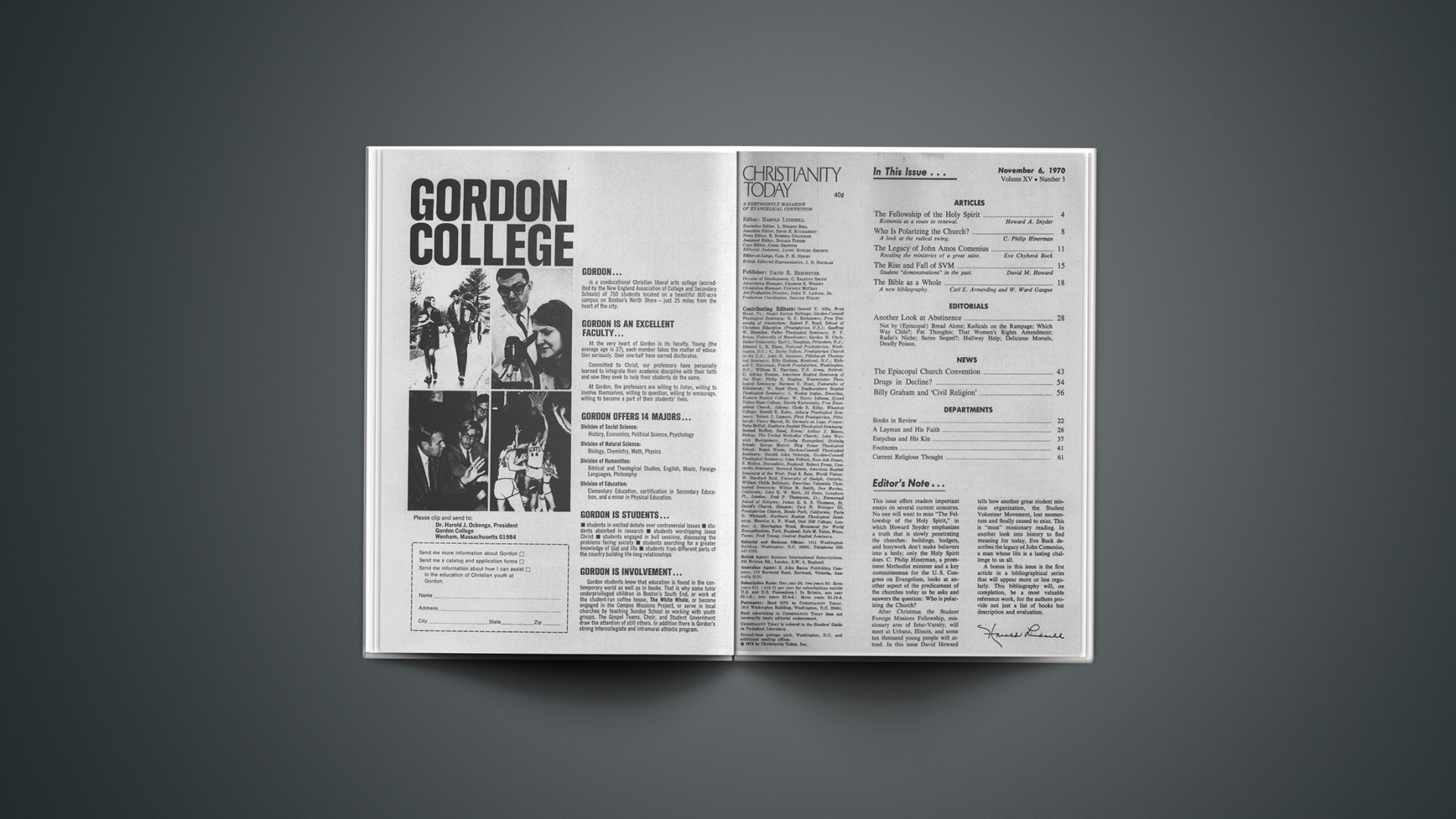
This issue offers readers important essays on several current concerns. No one will want to miss “The Fellowship of the Holy Spirit,” in which Howard Snyder emphasizes a truth that is slowly penetrating the churches: buildings, budgets, and busywork don’t make believers into a body; only the Holy Spirit does. C. Philip Hinerman, a prominent Methodist minister and a key committeeman for the U. S. Congress on Evangelism, looks at another aspect of the predicament of the churches today as he asks and answers the question: Who is polarizing the Church?

After Christmas the Student Foreign Missions Fellowship, missionary arm of Inter-Varsity, will meet at Urbana, Illinois, and some ten thousand young people will attend. In this issue David Howard tells how another great student mission organization, the Student Volunteer Movement, lost momentum and finally ceased to exist. This is “must” missionary reading. In another look into history to find meaning for today, Eve Bock describes the legacy of John Comenius, a man whose life is a lasting challenge to us all.

A bonus in this issue is the first article in a bibliographical series that will appear more or less regularly. This bibliography will, on completion, be a most valuable reference work, for the authors provide not just a list of books but description and evaluation.
Patton

This essay comes as an unexpected interruption in my two-part analysis of the theological implications of the current Paris theater. Why the interruption? Simply because this new film is of far-reaching consequence. The New York Times critic—hardly addicted to excessive laudation—regarded it as the classic American war film. President Nixon, who presumably finds his entertainment time at a premium, saw it twice—despite its extraordinary length (about three hours). There is little doubt that Patton will stand as one of the truly great American motion pictures.

On the face of it, the subject matter would not seem to lend itself to such possibilities. I can remember, though I was a child during the Second World War, the reputation General Patton acquired—that of a foul-mouthed, ruthlessly efficient, professional militarist, a twentieth-century Sherman. How could the career of such a man attain the status of a major film event? The answer is twofold: first, Patton’s life can be viewed (and is brilliantly so treated in the film) as a classical tragedy; second, Patton is an archetype of the American character in confrontation with the modern world.

Aristotle, in his Art of Poetry, set forth the fundamental criterion of the tragic art form: the plot, its most vital element, must arouse, through its construction and unity, the twin emotions of pity and fear, and lead to their purgation. How is this achieved? In the drama of the Golden Age (Sophocles offering perhaps the best example), the hero’s fall is the result of a combination of personal characteristics and external circumstances, the effects of which are clear to the audience though only dimly if at all evident to the hero himself. The hero—a man “like ourselves” (homoios), yet of such nobility as to attract our admiration—possesses a hamartia, a “tragic flaw,” which brings about his ruin. This flaw relates, as the great Aristotelian scholar S. H. Butcher put it, to “the necessary blindness and infirmity of human nature”; and it frequently connects with “fate”—with the destiny decreed for the hero by the gods whose laws he may well have trampled underfoot.

Yet, at the same time, the classical tragedy presents the hero, not as an automaton, but as a creature of like passions with us, whose volitional decisions are genuine, and who lives out the mystery of free will and destiny in his own person. Seeing his fall, we experience pity for him and fear for ourselves, and ultimately a catharsis—a purgation of these emotions, since the dénouement occurs as we knew it must.

Patton, as played with consummate artistry by George C. Scott, stands as a modern tragic hero, not unlike an Oedipus or a Macbeth. The comparison is rendered particularly easy because of the historic Patton’s remarkable classical scholarship (he steeped himself in the accounts of all classical battles related to those he himself engaged in—reading Caesar’s Commentaries as another military man would read detective stories).

Patton’s worst enemy was himself. Brilliant as a tactician, he could not help blasting the sloppy generalship of others. Perfectionistic and cruelly hard on himself, he was incapable of tolerating error and weakness in others (e.g., the famous incident of his striking a soldier whose nerves gave out in a key battle of great ferocity). Instinctively right in judging situations and people, he spoke his mind and was cut to pieces by the press and ultimately removed from his command of the Third Army because of the politically ruinous character of his statements (he was convinced that the Russians would create impossible problems after the war and he wanted to put them in their place during it). His strengths were at the same time his weaknesses, and they ultimately brought him down. Like de Gaulle (a not dissimilar personality), he developed a messianic complex, and though he was doubtless right that he was playing a not insignificant role in the cosmic plan, his accomplishments were minimized and in part vitiated by his own inability to control his ego. The termination of the film with Plutarchian lines describing the rapid passing of military glory could not have been better chosen.

The pity and fear elicited by Patton should arise from even more profound considerations, however—at least for Americans. Patton is archetypical of that peculiar combination of good and evil that represents the American character. (Thus the film will offer equal opportunity for rightist America-firsters to praise Patton, and for leftist America-lasters to denounce him; and both evaluations will be equally superficial.)

On the plus side, Patton is the frontiersman who singlemindedly conquered the wilderness (note his fetish: ivory-handled sidearms), built the strongest nation on earth virtually from scratch, won all its wars, first reached the moon, and has for some time been engaged in the aggressive promotion of industry, commerce, and the American way of life in every comer of the globe. On the minus side, Patton is the lover of success and conquest above all other values (“God, how I love it!” he cries on the battlefield), one who can pray for and even kiss the individual soldier who is wounded, but who can be almost utterly indifferent to the fate of thousands (his use of his troops inevitably brings to mind America’s treatment of Indians and blacks—coupled with a touching love for dogs and individual children); the chauvinist (his constant references to “killing Germans and Japs” parallel traditional American superiority feelings and the tendency to isolationistically dehumanize other peoples); and, finally and most reprehensibly, the prophet of national religion who sees God as necessarily “on our side” and his own endeavors as hardly less than expressions of the divine will.

In Patton we have a mirror of America, an amazing mixture of the religious and the profane (“Do you read that Bible at your bedside, General?” asks a chaplain. “Every goddamn day” comes the reply). But volatile inconsistency of this kind could not survive the complexities of the modern world—even under conditions “ideal” for such a personality: the goal-directed, depersonalized conditions of total war. Thus the inevitable tragic fall.

Patton appropriately thought of himself as a Roman general reincarnated, and preachers commonly remind us of the example of Rome’s destruction—arising as much from within as from without. Purgation of pity and fear at such a spectacle requires more, however, than Aristotle thought. The spectacle itself is not enough. The moral cancer of egocentrism must be cut out by the Divine Physician. Varying the imagery, we must behold another tragedy—that which our egotism brought about at Golgotha—and allow the One who was indeed “like us in all points, yet without sin” to make us new creatures through his victory over tragedy.

Breaking the Sound Barrier

Music blares as folk and gospel songs are performed in concert by a swinging mod-style band of ten. The audience claps along and finally breaks into signing.

It’s not a misprint: the deaf audience is feeling the rhythm and mood of the music through two young ministers who are interpreting it into the language of signs. As the deaf catch the “words,” they begin signing along on songs such as “He’s Got the Whole World in His Hands” or “I’m in Love with My God.”

For the young deaf students it is the first time they have ever attended a youth concert and had the kind of emotional, musical experience that a hearing person can have. Responsible for this breakthrough in communication are the Reverend Daniel Pokorney and Father Rudolf Gawlik, Lutheran and Roman Catholic chaplains at the world’s only liberal-arts college for the deaf, Gallaudet College in Washington, D.C.

Athough the deaf can read words of songs or hymns and together rhythmically sign the words, they never in that way approach the feeling and impact possible in a concert designed for them. Pokorney and Gawlik composed verses to songs that preserve the original rhythm and feeling by using a combination of sign language, pantomime, and gestures. The result is expressive, gentle lyrics that somewhat resemble those used by Hawaiian hula dancers.

The concert, first performed last December at Gallaudet, was enthusiastically received, and the troupe is still on a series of tours. A new show, “Sacred and Secular Music,” is in the works.

The rock-gospel concert has made unique progress, but its popularity reflects the huge problems still facing the deaf today. In many respects these persons form a subculture isolated from the mainstream of American life; this often excludes them from church activities and from hearing the Gospel.

Deaf persons in the United States number more than 250,000 according to estimates, yet the numbers of ministers to them is markedly small. Groups with comparatively large ministries include the Assemblies of God, the Southern Baptist Convention, the Lutheran Church-Missouri Synod, the Episcopal Church, and the Roman Catholic Church. There are perhaps 200 part- and full-time ministers and lay missionaries to the deaf—or one for every 1300 (a ratio that doesn’t do the job in the hearing world, much less in the deaf). Many denominations leave the problem of the deaf to local or regional levels, where it may be met haphazardly or even ignored.

“So then faith comes by hearing,” wrote the Apostle Paul, and to this day the presentation of the Gospel is largely dependent on verbal communication. This creates a real barrier for those who cannot hear.

“It was working with the deaf that made me aware of how tied to language our religion is,” recalls Gawlik. “First you translate the words into more real words, but then you’re still stuck with words.”

Ministers to the deaf now use many means of communication besides language: slides and pictures, gestures and facial expressions, pantomime, and dramatization of the gospel stories. “To me this is ideal. The Gospel shouldn’t be simply verbal but should speak to the whole person,” declares Gawlik, noting that many innovations developed for the deaf have come to be used in teaching hearing people also.

Pokorney, Gawlik, and the other five Gallaudet chaplains stress that communicating the Christian faith to the deaf involves more than translating the spoken language into signs or written material. The common idea, “If they cannot hear, let them read,” is much like Marie Antoinette’s “Let them eat cake.” Much of the syntax and shading of meaning is conveyed by voice cues, outside the range of the quickest hands. The sentence structure of written language retains much of the complexity of spoken language—entirely unknown in the simple sentences of signing. Thus learning to read is like learning a foreign language. For similar reasons, this language deficiency is often coupled with a very limited vocabulary, though not among Gallaudet students.

The average deaf person of 20 has achievement scores at or below the eighth-grade level, and less than a fourth-grade reading comprehension, according to Dr. Ray L. Jones, specialist in education for the deaf. This means that effective outreach to the deaf involves more than translating sermons or providing reading material. The message must be tailored to their special needs.

If educational handicaps present an obstacle to the missionary to the deaf, social handicaps add problems just as great, in the view of the Gallaudet chaplains. Unlike a person with other handicaps, a deaf person can handle the functional aspects of life well: he can use public transportation, go shopping, and hold a job. But the riches of friendship and family life, the sharing of joys and sorrows, are only for those who can speak and hear—or for those few deaf surrounded by others who know sign language. The church as a community for fellowship is denied to the deaf; church-centered activities are all for hearing people.

In some urban areas across the country, this is solved by accepting the necessity of a subculture and forming a deaf congregation with sermons, hymns, and activities in signing. Other churches make an effort to recognize and provide acceptance for the deaf in their community, even though communication remains at a low level.

Most of the ministry to the deaf is carried on by ministers or laymen trained in the language of signs who devote all or part of their time to this work, covering a large metropolitan area or several states. Thus the deaf become minister-oriented instead of church-oriented. Ministries dependent on this kind of a one-to-one relationship cannot be effective with deaf persons scattered throughout sparsely populated rural or small-town areas. The mass media, revolutionizing many forms of communication, are virtually useless in carrying the Gospel to the deaf.

How can the deaf be reached? Should every clergyman know signs and care for the deaf in his community? Should the ministry be left to traveling ministers responsible for large areas?

The Gallaudet chaplains see traveling teams of missionaries as a partial answer. The rock-gospel troupe will continue to present concerts. In another type of team work, experts in deaf ministry would travel around training lay groups to establish the personal contacts necessary for outreach to the deaf. Another group with specialized skills would gather isolated deaf persons for the cursillo, a short, high-powered retreat that provides an experience in Christian Community through art, signing, and body expressions. An experimental cursillo for deaf last summer proved unusually effective.

Can the Gospel break the sound barrier? To find the answer, Christians must first become painfully aware of the need—instead of turning a deaf ear.

Through The Loophole

For the first time West Germany churches, both Protestant and Catholic, are losing members—fast. Until recently, members withdrew from church life but not from the church roll; congregations could still claim a huge membership though services were poorly attended. And all “paper” members were taxed through government channels, making the German church one of the wealthiest on the Continent.

A Tiger For Christ

The man who led the Japanese attack on Pearl Harbor December 7, 1941, plans to use a new motion picture about it as a means of witnessing for Jesus Christ. Mitsuo Fuchida, the lieutenant commander who flew the lead plane in the 384-craft raid, is now a Presbyterian lay preacher. He will hold evangelistic services in Japanese cities where the film Tora! Tora! Tora! is shown, the onetime rice farmer said in New York last month when the film was premiered.

After World War II, Fuchida was called to consult with occupation authorities in Toyko. There he received a Christian tract from a member of the Pocket Testament League; he later secured a Bible and was converted to Christianity.

Fuchida (his son, a Baptist, lives in New Jersey, and his daughter is an Assemblies of God member in San Francisco) said he is counting on natural curiosity about a historical figure to draw people so he can witness to the Gospel. He praised the movie as historically accurate. The title (in English: Tiger! Tiger! Tiger!) comes from the code message Fuchida radioed after the surprise attack.

But last year the new German government added to the income tax a new, temporary tax of 10 per cent. Some enterprising person discovered he could save himself the new tax by officially breaking with the church—which asked the same amount—and resignations, especially from industrial centers, began to pour in to church officials.

In Aachen, for example, about fifteen people quit the church daily during the last few months; in the heart of the Ruhr area, the exodus was twice that of last year.

JAN J. VAN CAPELLEVEEN

Mrs. Birch’S $200 Million: Getting It All Together

After three years of bitter court fights, Mrs. Pearl Choate Birch, a 200-pound ex-convict, won out over a number of religious organizations last month in a battle for control of her late husband’s $200 million estate.

Temple Baptist Church of Los Angeles, the American Bible Society, the American Tract Society, the American Baptist Home Mission Society, and the Ministers and Missionaries Benefit Board were among groups claiming that 95-year-old California oilman A. Otis Birch was mentally incompetent when he changed his will to name her sole beneficiary.

Civil District Judge J. Roll Fair dismissed the case and paved the way for Mrs. Birch to gain access to the estate within thirty days, thus finally ruling out any claim to the fortune by the charities under Birch’s earlier will. A probate judge upheld the second will after hearing a California psychiatrist testify Birch was mentally competent when he wrote it.

“It was a long fight, but I knew I would win someday,” Mrs. Birch declared at the hearing in Dallas, Texas. “I’m thinking now that I might give those Baptists some of what they’ve been giving me for the last three years.”

The controversy dates back to 1966, when Mrs. Birch was accused of kidnapping the elderly oilman and forcing him to marry her. Then Birch’s private nurse, she left California with him in October of that year and announced they had married in Altus, Oklahoma, a short time later.

A Texas grand jury refused to indict Mrs. Birch after her deaf and crippled husband testified on her behalf before them. The couple then moved to Dallas and lived in a seventy-foot trailer until Birch died in March, 1967. The court fight began when Mrs. Birch attempted to gain approval of a new, hand-written will prepared by her late husband.

As the original benefactors, five religious organizations brought forth lengthy testimony on Mrs. Birch’s prior six marriages, her conviction for murder in 1947, and the events that led to her becoming Birch’s private nurse. They claimed she coerced Birch and his former wife, who died in 1966, to hire her, fully intending to get control of the Californian’s fortune.

MARQUITA MOSS

Anglicanizing The Canonization Breach

A potentially explosive situation over the canonizing of forty English and Welsh martyrs by Pope Paul October 25 has been defused. Anglican leaders in Britain had expressed fear that the ceremony would create ill will and wound Catholic-Anglican dialogue. And the archbishop of Canterbury, Dr. Michael Ramsey, had spoken against the saint-making.

Dr. Harry Smythe of the Anglican center in Rome and representatives of other Britain-based churches were to attend the ceremony in St. Peter’s Basilica, however. And Ramsey, with the two other British archbishops, had later said that “we Christians should not look back too much on the conflicts of the sixteenth century.”

All Other Ground …

Stress on anything other than soul-winning seems to be sinking sand for Sunday-school programming in Michigan, according to a survey made by the religion editor of the Detroit News. Churches catering to social action, the survey showed, are losing both members and youngsters. But conservative denominations featuring “traditional” curricula report soaring enrollments.

“Our job is to preach the Bible,” declares Clate Raymond, head of the Michigan Sunday School Association (MSSA). The conservative organization reports an average enrollment growth of 3.2 per cent annually. Raymond claims the MSSA is the fastest-growing association of its type in the world. “I’m interested in poverty and social reform—but not in the church,” he said. “The vacuum that must be filled is spiritual.”

Temple Baptist Church, on Detroit’s far west side, has one of the nation’s ten largest Sunday schools. The pastor, the Reverend G. Beauchamp Vick, teaches the week’s Bible lesson (no other literature is used) to his teachers during a weekday session, and they present it to the 3,400 students on Sunday. Meanwhile, the Episcopal Diocese of Michigan reported a drop of almost one-third in church-school pupils.

The Catholics to be canonized were executed during persecutions from 1535 to 1681. Nearly all could have been spared had they accepted the Anglican Communion service in place of the Roman Mass. A British flavor will be evident during the canonization: music by the English composer Byrd, and Anglican hymns.

Symbolic gifts of two loaves of bread, two candles weighing sixty pounds each, a small barrel of water and one of wine will be offered to the Pope after the proclamation of sainthood as a sign of thanks.

J. D. DOUGLAS

Dollars For Disasters

Canadian evangelicals are launching a new, international ministry of compassion in the form of a special fund to be known as Share, Canada!

The fund, which took two years to organize formally, recently got its official charter from the Canadian government. It will work through existing missions and specialize in quick assistance for disaster victims.

A spokesman said Share, Canada! will make it possible for food, clothing, medical supplies, emergency equipment, tools, and temporary shelters to be moved within hours to wherever they are needed.

The founding committee was initiated by the Christian and Missionary Alliance in Canada, which is currently providing administrative facilities and staff. The overseers of the fund say they will seek to keep organization and red tape to a minimum.

Personalia

Dr. James W. Angell, pastor of Claremont Presbyterian Church in California, is the $10,000 grand-prize winner in Fleming Revell’s Centennial Contest for the “most significant … work of inspirational nonfiction.” Angell’s book, published this month, is Put Your Arms Around the City.

Jim Nabors, star of the “Jim Nabors Hour” TV variety show, has been named national Christmas chairman for the Salvation Army this year.

The white pastor of St. Stephen’s Episcopal Church in St. Louis tied up a religious service in conjunction with the city’s first Fall Festival last month when he chained himself to the pulpit of Christ Church Cathedral to protest racism. The Reverend William L. Matheus, a member of the militant civil-rights group called Action, said he was protesting “the hypocrisy of Christian reconciliation.”

About 4,600 persons attended the final rally in Erie, Pennsylvania, last month of a ten-day series led by evangelist Leighton Ford; 774 went forward as inquirers during the meetings.

Scottish Baptist Union general secretary Andrew D. MacRae has been named president of the European Baptist Federation Council for the next two years.

Mrs. Rosa Page Welch of Chicago, a noted Negro gospel singer and member of the Christian Church (Disciples), is now serving on the General Board of the 190,000-member Church of the Brethren—the first non-Brother (or is it non-Sister) to serve on the board.

Grady C. Cothen, president of Oklahoma Baptist University for the past four years, is now president of New Orleans Baptist Seminary.

President Richard Nixon is honorary chairman of National Bible Week, November 22–29.

New York Mayor John V. Lindsay will receive the 1970 Family of Man Gold Medallion Award of the New York City Council of Churches October 26 for his work to solve inner-city problems.

Dr. Eugene R. Bertermann has resigned, effective January 1, as executive director of the Lutheran Laymen’s League to seek “a position less demanding administratively.”

Consultation on Church Union chairman George Beazley, Jr., on ultimate Church union: “It won’t happen in our lifetime. But the goal is to have all Christians in one church—Roman Catholics, Eastern Orthodox, Pentecostals—all Christians.”

Anglican archbishop Marcus Loane of Sydney, and E. H. Watson, president of the Baptist Union of New South Wales, announced they will boycott the ecumenical service for Christian unity planned during Pope Paul’s visit to Australia in December. The decision, based on theological differences with Catholicism, stirred immediate controversy.

Religion In Transit

Higher Education—a Christian Perspective, a new journal that will appear this fall, will be edited by Biola College dean of students Craig E. Seaton in La Mirada, California.

Two U. S. bishops and 3,000 Roman Catholic parish priests (about one in thirteen in the nation) signed a statement opposing the Viet Nam war during a three-month campaign ended last month. The results were announced at a Capitol Hill press conference in Washington, D. C.

To Russia With Love, a film produced by Underground Evangelism to show its work distributing Bibles in Iron Curtain countries, will be premiered across the nation this fall.

A major research project—aimed at helping parish pastors improve their ministry—is under way to determine the attitudes and life styles of Lutherans in the United States.

Salvation Army crews were on twenty-four-hour duty in southern California last month serving refreshments to firemen, evacuees, and police during the state’s worst series of fire disasters.

Oregon officials, saying that Portland had the “highest risk of violence in the nation” last summer during the American Legion convention (violent youth protests were feared), credited a coalition of young clergymen for keeping the lid on.

Lutheran Church in America parishes will take a trip into the occult world this month when a new parish-education course, dealing with such phenomena as black masses, fortune-telling, demonology, and tarots, will be released.

A $150,000 “media learning center,” combining into one service the facilities of traditional library and audiovisual programs, was completed on the campus of Azusa Pacific College in California last month.

About half of the forty-man Miami Dolphins football squad now take part in interdenominational chapel services arranged by tackle Norman Evans, a Baptist. Members say their “personal relationships with God” are in some measure responsible for the team’s new hustle that has made the National Football League take notice.

The president of the Greek Orthodox Clergy Association of Detroit wants an interreligious Miss America of Religion Pageant based on spiritual values. “It’s about time we paid attention to … internal beauty,” declared Father Demetrios Kavadas.

The fate of controversy-pocked First Presbyterian Church of Iowa City appeared uncertain again as the congregation of the 1,000-member church voted 143 to 94 to sell the church building last month. Bitterness flared in 1966 when the congregation voted to raze the 112-year-old structure and Iowa University English professor Joseph Baker led a movement to spare it because of its architectural heritage. He was briefly excommunicated for his trouble (see March 1, 1968, issue, page 50).

There were 3,900 church fires throughout the United States last year, an increase of 100 from 1968; the average loss was $4,900, and the value of church property damaged or destroyed reached $19 million.

Boston’s new Roman Catholic archbishop, Humberto S. Medeiros, transferred ten acres of land in Texas this month to the United Farm Workers Organizing Committee to build a Rio Grande Valley union center.

World Scene

Senator Frank Church (D.-Idaho) says his Senate Inter-American Affairs Subcommittee will “thoroughly investigate” charges of political repression and torture in Brazil; hearings are expected early next year.

Scottish Roman Catholics may now attend services of other denominations for “reasonable causes” (examples are blood relationships or friendships with persons of non-Catholic churches). But inter-Communion is forbidden.

More than 1,000 “house Mass groups” are operating among Roman Catholics in England, according to several reports. The home groups are said to be particularly welcomed by young married women “living lives of sheer boredom imprisoned within the walls of their own homes.”

The 84-year-old British Weekly has been bought by the company that owns the Church of England Newspaper, whose chairman is industrialist Sir Alfred Owen.

Hundreds of architecturally notable Anglican churches in Britain are apt to be closed, demolished, or sold to secular agencies because they are “redundant,” the Victorian Society said in its annual report.

Boasting a record enrollment this year, Philippine Bible College (Churches of Christ) in Baguio City includes this provision in an honor code signed by all students: “I will not permit a circumstance to arise that causes me to be alone with a member of the opposite sex, unless given specific permission by my parents.… A violation of this regulation will result in immediate dismissal.”

Men who enroll in the Ontario, Canada, (Anglican) Diocese of Huron as worker-deacons can serve in a parish and still retain their secular employment. The special order is described as a “supplementary ministry.”

Three of the four Lutheran churches in Germany that have split from the national Lutheran church have decided to become one. The Old Lutheran Church, the Independent Evangelical Lutheran Church, and the Evangelical Lutheran Free Church together have 65,000 members. Nominally, there are 27 million in the national church. The newly formed denomination will call itself the Lutheran Church in Germany.

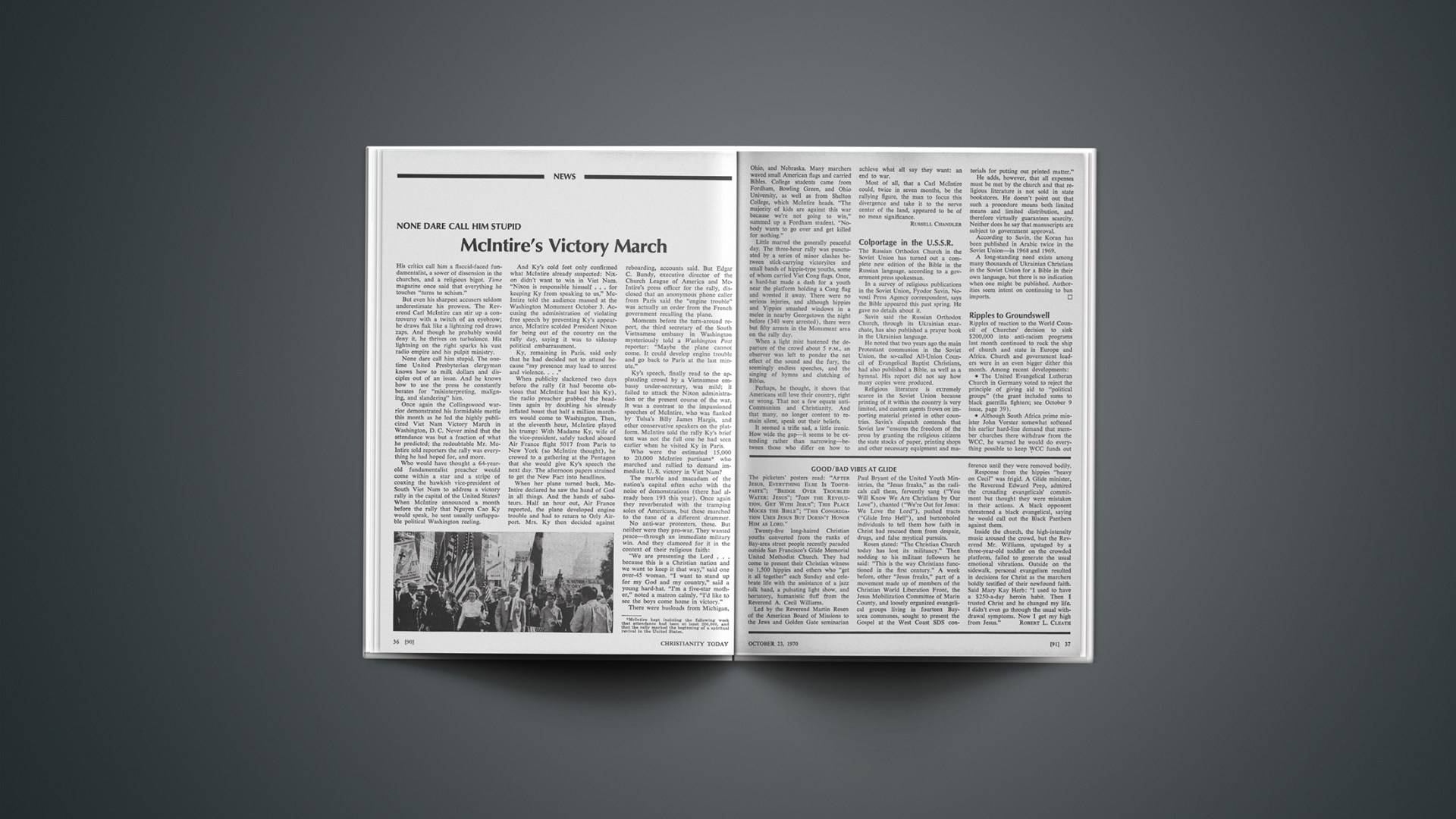
None Dare Call Him Stupid: Mcintire’s Victory March

NEWS

His critics call him a flaccid-faced fundamentalist, a sower of dissension in the churches, and a religious bigot. Time magazine once said that everything he touches “turns to schism.”

But even his sharpest accusers seldom underestimate his prowess. The Reverend Carl McIntire can stir up a controversy with a twitch of an eyebrow; he draws flak like a lightning rod draws zaps. And though he probably would deny it, he thrives on turbulence. His lightning on the right sparks his vast radio empire and his pulpit ministry.

None dare call him stupid. The onetime United Presbyterian clergyman knows how to milk dollars and disciples out of an issue. And he knows how to use the press he constantly berates for “misinterpreting, maligning, and slandering” him.

Once again the Collingswood warrior demonstrated his formidable mettle this month as he led the highly publicized Viet Nam Victory March in Washington, D. C. Never mind that the attendance was but a fraction of what he predicted; the redoubtable Mr. McIntire told reporters the rally was everything he had hoped for, and more.

Who would have thought a 64-year-old fundamentalist preacher would come within a star and a stripe of coaxing the hawkish vice-president of South Viet Nam to address a victory rally in the capital of the United States? When McIntire announced a month before the rally that Nguyen Cao Ky would speak, he sent usually unflappable political Washington reeling.

And Ky’s cold feet only confirmed what McIntire already suspected: Nixon didn’t want to win in Viet Nam. “Nixon is responsible himself … for keeping Ky from speaking to us,” McIntire told the audience massed at the Washington Monument October 3. Accusing the administration of violating free speech by preventing Ky’s appearance, McIntire scolded President Nixon for being out of the country on the rally day, saying it was to sidestep political embarrassment.

Ky, remaining in Paris, said only that he had decided not to attend because “my presence may lead to unrest and violence.…”

When publicity slackened two days before the rally (it had become obvious that McIntire had lost his Ky), the radio preacher grabbed the headlines again by doubling his already inflated boast that half a million marchers would come to Washington. Then, at the eleventh hour, McIntire played his trump: With Madame Ky, wife of the vice-president, safely tucked aboard Air France flight 5017 from Paris to New York (so McIntire thought), he crowed to a gathering at the Pentagon that she would give Ky’s speech the next day. The afternoon papers strained to get the New Fact into headlines.

When her plane turned back, McIntire declared he saw the hand of God in all things. And the hands of saboteurs. Half an hour out, Air France reported, the plane developed engine trouble and had to return to Orly Airport. Mrs. Ky then decided against reboarding, accounts said. But Edgar C. Bundy, executive director of the Church League of America and McIntire’s press officer for the rally, disclosed that an anonymous phone caller from Paris said the “engine trouble” was actually an order from the French government recalling the plane.

Moments before the turn-around report, the third secretary of the South Vietnamese embassy in Washington mysteriously told a Washington Post reporter: “Maybe the plane cannot come. It could develop engine trouble and go back to Paris at the last minute.”

Ky’s speech, finally read to the applauding crowd by a Vietnamese embassy under-secretary, was mild; it failed to attack the Nixon administration or the present course of the war. It was a contrast to the impassioned speeches of McIntire, who was flanked by Tulsa’s Billy James Hargis, and other conservative speakers on the platform. McIntire told the rally Ky’s brief text was not the full one he had seen earlier when he visited Ky in Paris.

Who were the estimated 15,000 to 20,000 McIntire partisans1McIntire kept insisting the following week that attendance had been at least 200,000, and that the rally marked the beginning of a spiritual revival in the United States. who marched and rallied to demand immediate U. S. victory in Viet Nam?

The marble and macadam of the nation’s capital often echo with the noise of demonstrations (there had already been 193 this year). Once again they reverberated with the tramping soles of Americans, but these marched to the tune of a different drummer.

No anti-war protesters, these. But neither were they pro-war. They wanted peace—through an immediate military win. And they clamored for it in the context of their religious faith:

“We are presenting the Lord … because this is a Christian nation and we want to keep it that way,” said one over-45 woman. “I want to stand up for my God and my country,” said a young hard-hat. “I’m a five-star mother,” noted a matron calmly. “I’d like to see the boys come home in victory.”

There were busloads from Michigan, Ohio, and Nebraska. Many marchers waved small American flags and carried Bibles. College students came from Fordham, Bowling Green, and Ohio University, as well as from Shelton College, which McIntire heads. “The majority of kids are against this war because we’re not going to win,” summed up a Fordham student. “Nobody wants to go over and get killed for nothing.”

Little marred the generally peaceful day. The three-hour rally was punctuated by a series of minor clashes between stick-carrying victoryites and small bands of hippie-type youths, some of whom carried Viet Cong flags. Once, a hard-hat made a dash for a youth near the platform holding a Cong flag and wrested it away. There were no serious injuries, and although hippies and Yippies smashed windows in a melee in nearby Georgetown the night before (340 were arrested), there were but fifty arrests in the Monument area on the rally day.

When a light mist hastened the departure of the crowd about 5 P.M., an observer was left to ponder the net effect of the sound and the fury, the seemingly endless speeches, and the singing of hymns and clutching of Bibles.

Perhaps, he thought, it shows that Americans still love their country, right or wrong. That not a few equate anti-Communism and Christianity. And that many, no longer content to remain silent, speak out their beliefs.

It seemed a trifle sad, a little ironic. How wide the gap—it seems to be extending rather than narrowing—between those who differ on how to achieve what all say they want: an end to war.

Most of all, that a Carl McIntire could, twice in seven months, be the rallying figure, the man to focus this divergence and take it to the nerve center of the land, appeared to be of no mean significance.

Good/Bad Vibes At Glide

The picketers’ posters read: “AFTER JESUS, EVERYTHING ELSE IS TOOTHPASTE”; “BRIDGE OVER TROUBLED WATER: JESUS”; “JOIN THE REVOLUTION, GET WITH JESUS”; THIS PLACE MOCKS THE BIBLE”; “THIS CONGREGATION USES JESUS BUT DOESN’T HONOR HIM AS LORD.”

Twenty-five long-haired Christian youths converted from the ranks of Bay-area street people recently paraded outside San Francisco’s Glide Memorial United Methodist Church. They had come to present their Christian witness to 1,500 hippies and others who “get it all together” each Sunday and celebrate life with the assistance of a jazz folk band, a pulsating light show, and hortatory, humanistic fluff from the Reverend A. Cecil Williams.

Led by the Reverend Martin Rosen of the American Board of Missions to the Jews and Golden Gate seminarian Paul Bryant of the United Youth Ministries, the “Jesus freaks,” as the radicals call them, fervently sang (“You Will Know We Are Christians by Our Love”), chanted (“We’re Out for Jesus: We Love the Lord”), pushed tracts (“Glide Into Hell”), and buttonholed individuals to tell them how faith in Christ had rescued them from despair, drugs, and false mystical pursuits.

Rosen stated: “The Christian Church today has lost its militancy.” Then nodding to his militant followers he said: “This is the way Christians functioned in the first century.” A week before, other “Jesus freaks,” part of a movement made up of members of the Christian World Liberation Front, the Jesus Mobilization Committee of Marin County, and loosely organized evangelical groups living in fourteen Bay-area communes, sought to present the Gospel at the West Coast SDS conference until they were removed bodily.

Response from the hippies “heavy on Cecil” was frigid. A Glide minister, the Reverend Edward Peep, admired the crusading evangelicals’ commitment but thought they were mistaken in their actions. A black opponent threatened a black evangelical, saying he would call out the Black Panthers against them.

Inside the church, the high-intensity music aroused the crowd, but the Reverend Mr. Williams, upstaged by a three-year-old toddler on the crowded platform, failed to generate the usual emotional vibrations. Outside on the sidewalk, personal evangelism resulted in decisions for Christ as the marchers boldly testified of their newfound faith. Said Mary Kay Herb: “I used to have a $250-a-day heroin habit. Then I trusted Christ and he changed my life. I didn’t even go through the usual withdrawal symptoms. Now I get my high from Jesus.”

ROBERT L. CLEATH

Colportage In The U.S.S.R.

The Russian Orthodox Church in the Soviet Union has turned out a complete new edition of the Bible in the Russian language, according to a government press spokesman.

In a survey of religious publications in the Soviet Union, Fyodor Savin, Novosti Press Agency correspondent, says the Bible appeared this past spring. He gave no details about it.

Savin said the Russian Orthodox Church, through its Ukrainian exarchate, has also published a prayer book in the Ukrainian language.

He noted that two years ago the main Protestant communion in the Soviet Union, the so-called All-Union Council of Evangelical Baptist Christians, had also published a Bible, as well as a hymnal. His report did not say how many copies were produced.

Religious literature is extremely scarce in the Soviet Union because printing of it within the country is very limited, and custom agents frown on importing material printed in other countries. Savin’s dispatch contends that Soviet law “ensures the freedom of the press by granting the religious citizens the state stocks of paper, printing shops and other necessary equipment and materials for putting out printed matter.”

He adds, however, that all expenses must be met by the church and that religious literature is not sold in state bookstores. He doesn’t point out that such a procedure means both limited means and limited distribution, and therefore virtually guarantees scarcity. Neither does he say that manuscripts are subject to government approval.

According to Savin, the Koran has been published in Arabic twice in the Soviet Union—in 1968 and 1969.

A long-standing need exists among many thousands of Ukrainian Christians in the Soviet Union for a Bible in their own language, but there is no indication when one might be published. Authorities seem intent on continuing to ban imports.

Ripples To Groundswell

Ripples of reaction to the World Council of Churches’ decision to sink $200,000 into anti-racism programs last month continued to rock the ship of church and state in Europe and Africa. Church and government leaders were in an even bigger dither this month. Among recent developments:

• The United Evangelical Lutheran Church in Germany voted to reject the principle of giving aid to “political groups” (the grant included sums to black guerrilla fighters; see October 9 issue, page 39).

• Although South Africa prime minister John Vorster somewhat softened his earlier hard-line demand that member churches there withdraw from the WCC, he warned he would do everything possible to keep WCC funds out of South Africa, and South African funds from reaching the WCC.

• Vorster deported two Anglican priests for issuing a pamphlet commenting on the WCC anti-racism grant. The ouster touched off perhaps an even greater rift between the churches and the government than his call for WCC-member churches to withdraw.

Art-Gallery ‘Revival’ Has Drawing Power

The normally subdued atmosphere of the prestigious Corcoran Gallery in Washington, D. C., is being shattered this month by the sight and stereophonic sounds of Appalachian revival meetings. The sounds come from a six-hour tape, recorded during revival meetings in the mountains of eastern Tennessee. The sight is provided by Eleanor Creekmore Dickinson’s excellent line drawings, made at the same meetings.

The whole project, simply titled “Revival,” was conceived by Mrs. Dickinson as a way of preserving a record of phenomena that “may become extinct, as they are now becoming remote.”

To house the display, Corcoran officials furnished a gallery room like a tent meeting, complete with flat-bottom, wooden folding chairs, paperback hymnals, funeral-home fans, and a pulpit (with its King James Bible fixed open to the Song of Solomon, for some obscure reason).

Visitors to the sight-and-sound display are given a glossary to help them understand the pictures. The glossary may itself be a commentary not only on the “remoteness” of Appalachian revival meetings but also on the remoteness of the New Testament to modern Americans. Someone felt it necessary to define such terms as “repentance,” “speaking in tongues,” and “foot-washing.”

Mrs. Dickinson, an Appalachia native, shows consummate draftsmanship in depicting the solid citizens of that region. Her bony-faced women, paunchy men, and barefoot children are the same ones every traveler through the area has seen a hundred times.

The drawings and recordings come to the museum with both the approval and the prayers of the participants. Some of the congregations prayed over the tapes that they might be used in bringing about the salvation of many gallery-goers.

“ ‘Revival’ is straight,” says the artist in her bulletin note, “—no satire, no propaganda.” The art’s very objectivity is its greatest problem. A little exaggeration or caricature might have rendered the drawings somewhat less static and helped them communicate more of the fervor heard in the recordings. As it is, the scenes are largely of mountain folk who might just as well be sitting on their porches listening to neighborhood gossip.

The music comes across surprisingly well. Perhaps today’s wide variety of musical styles creates an openness for this folk style of hymnastic. A fairly high degree of sophistication is apparent in the choice of instruments—ranging from oboes to guitars.

All in all, the exhibition is an arresting attempt to capture the spirit of Southern mountain American Christianity. It reminds the viewer how culturally conditioned Christian worship is. For those of Southern extraction, it may evoke more nostalgia than repentance.

JOHN V. LAWING, JR.

Management Savvy For Black Evangelicals

A strong sense of black identity prevailed as fifty black leaders gathered in Tarrytown, New York, late last month to learn modern management principles, despite the fact that their teachers were three white men: Ted W. Engstrom and Edward R. Dayton of World Vision, and R. Alec Mackenzie of the Institute for Leadership. They presented a successful governmental and industrial program: PERT (Program Evaluation Review Techniques), and the delegates—most professing an ignorance of the subject—loved it.

PERT stresses goals, planning, gathering of resources, execution of plans, and utilization of results. Conference participants were enthusiastic.

Dayton, who has presented PERT to many secular businesses, called these blacks “the most open and responsive audience I have had” because they “recognize willingly their need.”

Throughout the three days, speakers repeatedly stressed the distinctive blackness of black evangelicals. Dr. Roderic Loney, associate executive director of Youth Development, drew amens and whistles when he said: “Within our evangelical community there is a tremendous amount of preservation of the status quo.… We must be aware that we are black men first, even in the church, where we are supposed to be judged by something else.”

Bill Pannell, vice-president of Tom Skinner Associates, made it clear that black evangelicals will have to be accepted on their own terms: “Anything coming from the white religious and cultural milieu must be questioned or assumed to be irrelevant to black culture.… If it cannot be demonstrated that Jesus Christ identifies with oppressed peoples, he is of no contemporary significance.” And he added: “Stay away from those white evangelical bookstores.”

World Vision and Tom Skinner Associates are planning similar conferences for the West and Midwest.

ROBERT E. FRIEDRICH, JR.

No Unity On Mission

Should the mission of the Church be the primary motivation for the ecumenical movement? Ecumenical leaders seem unsure.

Mission versus unity was the pivotal issue in a major power play that started last month at the General Board meeting of the National Council of Churches in Phoenix, Arizona (see October 9 issue, page 38). A special task-force report there indicated that “at the very least mission is first among equals and therefore must be given the primary position.”

But a revised task-force report ten days later, released for study by denominational units and “other interested groups,” replaced the paragraph on “The Primacy of Mission” with one called “The Claim of Mission.” The substitute text follows:

“Our Lord prayed that his disciples be one in order that the world might believe. We are obligated to seek unity as a furtherance of Christian mission. In a national ecumenical agency, structure must be subordinate always to mission in at least two ways: (1) the structure must be shaped for the purpose of engaging wherever possible the whole agency in mission; (2) where unanimous action is not possible, it must facilitate action by those churches who intend at that point to act together. This two-fold claim of unity and mission on the life and purpose of an ecumenical agency must be responded to in a way which will set mission free while seeking for the manifestation of our oneness in Christ.”

Graham Declines

Several groups have recently attracted wide news attention by linking Billy Graham’s name to their causes. The evangelist won’t be speaking, however, at two essentially non-religious rallies, one in Toronto, Canada, the other at Lake Tahoe, California.

Hundreds of Toronto-area Jews and a group of Protestant ministers and laymen invited the evangelist to hold a pro-Israel rally in Maple Leaf Gardens at an early but unannounced date. Evangelicals who signed the invitation included Dr. William Fitch of Knox Presbyterian Church, the Reverend Joseph Muchan of Wychwood Presbyterian Church, the Reverend Gordon Hauser of the Latin American Mission, and the Reverend Isaac Thiessen of the Mennonite Brethren Church.

The Jewish sponsors categorically asserted there would be no evangelistic thrust to the proposed rally.

The other invitation came from the Lake Tahoe Land Reserve, fighting commercial interests that threaten to pollute the beautiful mile-high lake. A “save the lake” crusade rally is planned.

Graham told CHRISTIANITY TODAY that even if he were disposed to attend such functions, his present schedule would not permit it.

Tuller: Paris Pastorate

Dr. Edwin H. Tuller will become an American Baptist in Paris come January 1. The chief administrative officer of the 1.5-million-member American Baptist Convention since 1959 announced this month that he is resigning as the denomination’s general secretary to become minister of the American Church in Paris, France.

Tuller, 57, whose term of office with the ABC would have expired in May, 1971, said of the move: “Paris is an international city where a Christian ministry has the possibility of being … a world ministry.”

The American Church is interdenominational and ministers to some 350 families representing students, artists, the diplomatic corps, and tourists. It is the first and oldest American church to be established on foreign soil.

In 1966 Tuller, who has held administrative posts in the ABC for twenty-six years, was elected a vice-president of the National Council of Churches for three years. He currently serves on its General Board and the Central Committee of the World Council.

Focus for Pastoral Counseling

In his book The Crisis in Psychiatry and Religion, O. Hobart Mowrer sharply rebukes evangelical Christianity for abdicating its authority in the field of mental health. Dr. Mowrer, a clinical psychologist at the University of Illinois and a former president of the American Psychological Association, charges further that the pastoral counseling movement has assimilated psychoanalytic theory despite its empirically proven impotence.

In postulating a need to integrate psychology and religion, Mowrer calls for a new concept of psychotherapy that is based on sin guilt, confession, and expiation. This major new approach, known as “integrity therapy,” views mental health in terms of personal moral or immoral behavior. John W. Drakeford has gathered the distinctives of integrity therapy under a series of postulates:

1. Integrity therapy rejects all deterministic theories which make man a victim of heredity, environment, or any other force. Every individual is answerable for himself, and exercises his responsibility in making his personal decisions.

2. Each person has a conscience which gives rise to guilt. This condition is not a sickness but a result of his wrongdoing and irresponsibility.

3. The typical self-defeating reaction to personal wrongdoing is concealment. In this secrecy, guilt throws up symptoms of varying degrees of severity, from vague discomfort to complete immobilization.

4. As secrecy brought on his trouble and separated him from his fellows, so openness with “significant others” is the individual’s first step on the road back to normality.

5. The process of socialization involves a group which could be called a microcosm or small world exercising both a corrective and supportive function for the growing individual.

6. Openness by itself is not enough and the individual is under an obligation to undertake some activity of restitution appropriate to his acknowledged failure in life.

7. The only way to continue as a truly authentic person is not only to remain open and make restitution but also to feel a responsibility to carry the message of integrity therapy to other needy people [Integrity Therapy, Broadman, 1967, p. 154].

In the fall of 1969, an attempt was made to investigate the validity of Mowrer’s claim that pastoral counselors conceive of mental health in secular terms and thus base their counseling on secular principles, primarily Freudian. Houston area clergy were asked to respond to forty statements (Pastoral Counselor Evaluation Inventory) having to do with integrity therapy. The sample consisted of 105 clergymen from the Protestant (Southern Baptist, Methodist, Assembly of God, Episcopal, and Pentecostal Church of God), Roman Catholic, and Jewish faiths, out of an area total of 391 clergymen.

A statistical description of each subject’s positions was determined (1) by scaling his responses from one (strongly agree) to four (strongly disagree) and (2) by dividing his total score by forty (the number of items on the inventory). This quotient was called the “mean item score.” A score of less than 2.5 indicated a preference for Mowrer’s position, and more than 2.5, a preference for the Freudian position.

In general the study showed that the clergymen had only a slight preference for counseling principles based on integrity therapy. Favoring Mowrer’s position most were clergymen from the more theologically conservative denominations—Assemblies of God, Pentecostal Church of God, and Southern Baptist. Disagreeing with Mowrer most (and thus tending to favor psychoanalytic theory) were Roman Catholic clergy. The Episcopal, Methodist, and Jewish clergy were neutral.

The most significant support for Mowrer’s hypothesis came from the information gathered by a questionnaire attached to the Pastoral Counselor Evaluation Inventory. Clergymen in more than half the groups within the sample thought of mental health in Freudian terms—the ability to love and work. Six of the seven groups viewed the purpose of effective counseling as development of insight, which according to Mowrer is definitely Freudian. (Insight in itself does not necessarily lead to behavioral change.)

Mowrer’s charge that clergymen are abrogating their responsibility to help emotionally disturbed people seemed supported. A surprising degree of reticence and perceived inadequacy was reflected by the finding that five out of seven believed that others (such as psychologists and psychiatrists) were better qualified than ministers to assist emotionally disturbed persons.

Evangelical pastoral and professional counselors may have second thoughts about their lack of competence when they are exposed to the thinking of certain experts within the professions of psychiatry and psychology. For example, a growing number of eminent social scientists (among them G. W. Allport, P. Bailey, J. S. Bockoven, S. De Grazia, H. Fingarette, W. Glasser, G. A. Kelly, and N. S. Lehrman) have expressed disenchantment with Freudian principles and are emphasizing the relation of moral behavior to mental health. In a speech entitled “Are Psychoanalysis and Religious Counseling Compatible?” psychologist Lee R. Steiner stated:

It is my impression from twenty years of study of where people take their troubles and why they seek out the sources they do, that the ministry makes a tremendous mistake when it swaps what it has for psychoanalytic dressing. Through the ages ministry has been the force that has at least attempted to keep morality alive. It would be a pity if, in one of the eras of greatest moral crisis, the clergy should suddenly abandon its strength for something that has no validity, no roots, and no value. It is my impression that they would do far better to cling to what they have. Judaism has endured for almost 4,000 years, Christianity for almost 2,000. Where will psychoanalysis be even twenty-five years from now?… I predict it will take its place along with phrenology and mesmerism [in O. H. Mowrer, The Crisis in Psychiatry and Religion, Princeton, 1961, p. 69].

Mowrer’s emphasis on the role of guilt in interpersonal relationships finds general agreement among leading pastoral and religious counselors (see D. Belgum, Where Religion and Psychology Meet; J. S. Bonnell, Do You Want to Be Healed?; H. H. Haas, Pastoral Counseling for People in Distress; P. Tournier, Guilt and Grace; L. Weatherhead, Psychology, Religion, and Healing; C. Wise, Mental Health and the Bible). However, his stress on confession as the means of expiating the guilt has generated a great deal of controversy. Mowrer has argued that confessing one’s sins to God is not enough and decries this “cheap grace” concept. Strong evangelical voices have challenged this view (see H. W. Darling, Man in Triumph, and D. F. Tweedie, The Christian and the Couch). They point out that confessing one’s sins to God and receiving divine forgiveness is not “cheap”; it costs the person his very self, for it requires full self-surrender.

The most powerful therapeutic idea in the world is the realization of God’s forgiveness. Many biblical promises underscore the reality of forgiveness of sin: it will be remembered no more (Jer. 31:34); it is removed from the sinner “as far as the east is from the west” (Ps. 103:12); “if we confess our sins he is faithful and just to forgive us our sins and to cleanse us from all unrighteousness” (1 John 1:9).

A frequently cited study (G. Gurin et al., Americans View Their Mental Health, Basic Books, 1962) revealed that when troubled people seek professional help, they choose clergymen more often than members of any other professional group. A firm commitment to the scriptural view of the nature of man and of Christ, the living Great Physician, will enable clergymen to minister authoritatively to the “walking wounded” who come under their influence. To enhance the effectiveness of this vital ministry we would do well to:

1. Integrate the theory and techniques of integrity therapy into the curricula of pastoral-training programs in order to provide greater balance.

2. Encourage ministers to take additional training in counseling, and to make use of recommended books and periodicals.

3. Encourage research on the relation between moral behavior and mental disorder.

4. Work for more cooperation and development of a multidisciplinary approach among the professions of medicine, psychiatry, psychology, and theology.—LOUIS O. CALDWELL, chairman, Division of General Education, Southern Bible College, Houston, Texas.

Eutychus and His Kin: October 23, 1970

THE EYE OF A CAMEL

Ten years ago the then archbishop of Canterbury pulled off an ecumenical coup. Acclaimed with astonishing unanimity even by the religious competitors of Jerusalem, he repaired to Istanbul and Rome to be welcomed literally with open arms by the ecumenical patriarch and Pope John.

On his return to London, Dr. Fisher faced a press conference at the airport. “What is the most vivid memory of your tour?” asked a newsman. Replied the primate thoughtfully: “Of a camel which looked at me with most ineffable scorn.” Sic transit gloria mundi!

Eight years earlier (I am reminded by John Purcell’s Fisher of Lambeth) the archbishop had made in Boston another noteworthy statement. Preaching a sermon that was broadcast across the nation, he warned Americans: “If our civilization fails, it will fail because of an atheism no less real because it has not been deliberately chosen, but is the casual result of ordinary people letting their absorption with the cares and riches and bustle of this world shut their eyes to God.…”

He’s right in a way, but to pan common folk exclusively is to confirm that the above-mentioned camel maybe knew a thing or two after all. Here was a neat reversal of that charge of obsession with its vast wealth so often leveled against the English church commissioners.

All this came to mind last week as I was reading an irascible outburst in the Vatican’s daily newspaper, L’Osservatore Romano. Nettled by some comments in a money-conscious Swiss journal, the authorities huffily stated that Vatican capital is “not even one-hundredth” part of the $12.7 billion suggested. That should fix those who with childlike otherworldliness think you can run a church on Hail Marys.

Fisher’s successor at Canterbury, Michael Ramsey, is now quoted as saying that young people were turning to the more contemplative Eastern religions because the Christian Church concentrated overmuch on practical activity. Funny he should make that point. Last year I was in Tashkent, capital of Soviet Uzbekistan. After noticing all the different races thronging the market there, another visitor asked: “Don’t you have any race problem?” Said the ubiquitous Intourist guide: “Religion is our real problem.” Then she added: “We don’t worry about the Christians; they’re more interested in progress than religion.”

C. S. Lewis in his preface to Screwtape warns against believing everything the devil says is true even from his own angle, but still.…

DAY WITH AN ISSUE

I have spent much of this day reading your September 25 issue, and I cannot suitably express the encouragement and joy I found in “Awakening Ahead?” … Then among your challenges is “Now’s the Time to Give.” My own position is that any alliance with Satan or those who may be unwittingly his partners is to be avoided. For that reason … I refrain from giving … through my church.

Mineral, Va.

WHEN THE BANNER COUNTS

You have failed to notice the difference in the alliance planned for October 3 (“McIntire’s Unholy Alliance,” Sept. 25) and that which Dr. Graham has associated himself with. For the October 3 rally, citizens everywhere were called together under the program of restoring biblical morality, Bible reading in the public schools, in support of good government and an honorable peace in Viet Nam. The banners under which these masses of people were gathered were established by Dr. McIntire.… Those of differing theological persuasion were called under the auspices of Dr. McIntire, and hence it was they who were compromising with him and not vice versa.

This is far different from Dr. Graham’s participation in the “Honor America” celebration which was promoted by nothing less than the sign of the anti-Christ and marijuana leaves. It should be noted that Dr. Graham joined forces with those who advocate civil disobedience, a dishonorable surrender in Viet Nam, a submission to the enemy of the cross—the Communist party—and a breakdown of morality. In the face of all of this, he played a neutral part, neither condemning nor openly condoning. In this wise he compromised his evangelical position with those present in this effort.

Myerstown, Pa.

RIGHT BLEND

May I congratulate you on “The Crisis of the Church” (Sept. 11). Thanks! Scholarly but inspiring, often a difficult combination.

Milbridge, Me.

This blight upon the churches resulting from a rejection of fundamental truths and doctrines of the Bible appears to emanate from an intellectual and ecclesiastical hierarchy who are the controlling and manipulating power in the National Council of Churches. They have driven the Holy Spirit from the pulpit. They are leading the local churches down a blind alley. They have a form of godliness, but reality isn’t there.

No wonder there is a consistent decline in church membership and church attendance, and, very importantly, a drying up of financial help from an apathetic people who feel that the Church is not worth supporting.

Houston, Tex.

PRAYER AND THE PRESIDENT

I commend your suggestion about the President declaring a Day of Prayer (“A Petition for the President,” Sept. 11).

I would commend, also, your recommendation that the people declare a Day of Prayer for the President. I suggest that this, in fact, would be a worthy substitute for a preceding editorial, “Letting the President Drown,” which served only to perpetrate the myth of the President’s “untouchableness.” This is merely a liberal canard issuing from liberal petulance, and unworthy of your imitation.

The attorney general’s remark that he did not think it proper to interrupt the President … was merely of reasonable propriety. (Correction was made almost immediately.) What the media made of it is on their own conscience. Shame on you for trying to make principle out of such pettiness! But such does serve all the more to point up the President’s need for prayers of the righteous.

Los Angeles, Calif.

I was shocked to see your petition to the President. The very idea of linking Christianity with a national political move in America fills me with repugnance. The idea of Christians calling their own kind to give thanks to God is a far better alternative.…

There is enough hypocrisy in America without having the President call a pagan (i.e., unbelieving) people to mock true petition and prayer. Clergy should not declare national policy, nor should the President declare “religious holidays.”

BRUCE CHARLES MEYER

Carleton, Mich.

NOD OVER NORTHERN IRELAND

For once Eutychus has nodded. His ready acceptance of the holier-than-thou statement of an English correspondent (Sept. 11) that “the atheists are in no way connected with the latest example of Christian savagery and blood-letting” in Northern Ireland shows an unjustifiable faith in human nature.

It is significant that … British military intelligence reported that during the summer over a hundred militant left-wingers from various parts of Europe had visited Northern Ireland. Many belong to Maoist, Trotskyite, or anarchist underground movements and had taken part in riots at various places in Europe. In one confrontation with the police in Derry, only a small proportion of the rioters were local people.

As for church affiliation of those concerned in the riots, it is significant that one Belfast minister discovered that of a group of injured men who had given his name as their minister for the purpose of hospital visitation, not a single one was a church attender.

Eutychus should know by this time that the “new left” prominent in fomenting disorder and riot in the United States, Ireland, and other lands cannot put all the blame either on the Christian Church or the Establishment.

Belfast, Northern Ireland

FOR BEST-DRESSED CHRISTIANS

As a Mennonite who has love for the whole truth as it is in Christ Jesus, I am much concerned over the apostasy among the Mennonites. In “The Mennonites: Pioneer Nonconformists” (Sept. 11), I agree with Mr. Brunk that mere outward appearance cannot revitalize the church. However, to say that modest apparel does not belong to non-conformity in dress and does not belong to Christian living is contrary to Scripture. The way too many of the Mennonites and other professing Christians dress is loving the world, for it is none other than the lust of the eye and belongs to the pride of life, which will perish with the world.

Hillsboro, Kan.

FUSSING WITH GARBAGE

Thanks to God for Dr. Bell’s anger and forthright fussing about the ridiculous way some of our church leaders are writing about situation ethics (A Layman and His Faith, Sept. 11).… I’m fed up with this garbage!

Sylvan Grove, Kan.

HAPPY BAPTIST

I was pleased to read “World Baptists: Touring Tokyo” (Aug. 21). As a Baptist I feel that there should be more such objective reports on our work, which it seems to me has been shifted from the evangelistic and teaching ministry to humanistic, ecumenical, and social [concerns].

We who stayed at home and had no chance to be delegates, and had not the privilege to see Expo 70, liked the report, and as an editor of a Baptist magazine in Yugoslavia, I have rewritten it for our people. Let them know the truth.

Zagreb, Yugoslavia

NACC SUPPLEMENT

Having attended the North American Christian Convention in St. Louis July 7–10, I read with interest your report, “NACC: ‘Involved’ ” (News, July 31). What a pity that your reporter missed the keynote address by the president of the convention, Dr. William S. Boice. This was a high point of the entire convention.… Standing firm on the evangelical premise that the Bible is the Word of God and Christ is the Son of God, Dr. Boice led all of us to a deeper commitment to the cause of Christ.…

It is also regrettable that your reporter did not meet Norm Hovda of “Drugstop” in Phoenix, Arizona—a young man with a tremendous message for youth and the older generation. I am sorry he failed to note the growth of the NACC; registration this year exceeded 40,000. While the Disciples of Christ are losing members (and whole congregations) due to their increasing liberalism, our “independent” churches are planting new congregations of free believers in Christ at an encouraging rate, and the ranks of our missionaries are increasing in the same way.

As for “tackling the problems of the black American,” the continuation committee of the convention chose William Ellis of Orlando, Florida, as a member of the committee to plan for the NACC ’71 in Dallas, Texas. Bill Ellis, a third generation Restoration minister to the black American, has established two Negro congregations in Orlando, and is a leader in the New Testament churches in Florida.

Valparaiso, Fla.

Refugees!

If you are a Christian you are a refugee from a dying world order. So we are told by the writer of the epistle of the Hebrews. The Apostle Paul speaks of Christ as “entering the world to rescue sinners,” and Peter speaks of us as “strangers and temporary residents” (Heb. 6:18; 1 Tim. 1:15; 1 Pet. 2:11, Phillips).

We are refugees because our hope is not in anything this world has to offer. We are refugees because we have escaped from the wrath to come into the peace and hope to be found in Christ Jesus and nowhere else. We are refugees because this world order stands under the judgment of God for its sins and for its rejection of his Son.

We are in this world but not of it, seeing beyond the horizon of the present life to a city God has prepared for those who believe. Our citizenship is in heaven, and our fellowship is with those of like faith.

It is desperately important that we recognize our position as refugees. A refugee is fleeing from danger, but he also has a place to go. The danger is God’s impending judgment on a world that has willfully rejected him. The danger from which we have fled is God’s holy wrath against sin and sinners. The refuge that is ours is the safety of the loving mercy and forgiveness of the Son of God, who came into this world for the specific purpose that man “should not perish but have eternal life” (John 3:16).

Across the visible church, there is heard the call to “identify” with the world. “Identification” in the sense of a saved sinner’s pleading with lost sinners is desperately needed. But identification with the ways of the world is deadly. A physician does not willfully contract the diseases of those he is called to treat. Rather, he seeks to deliver his patients from their sickness.

The Apostle Paul appeals to us: “Do not be conformed to this world,” because such identification is a conformity with death and judgment. That for which he pleads is that we might be “transformed by the renewal of [our minds],” that we may “prove what is the will of God, what is good and acceptable and perfect” (Rom. 12:2).

The witness of the Church is being compromised by those who call for the merging of the Church and the world into a common calling and work. The Church is in the world, not to become a part of it, but to invite men to live new lives in Christ Jesus, separated to him and from the evils of this world.

There is no greater evidence of the fallacy of the leadership of some in the Church than the changed emphases that rise to the surface like impurities in a boiling cauldron. The Gospel is an appeal for man to be reconciled to God, and we Christians are ministers of that reconciliation; but the plea of many church programs is that man be reconciled to man, with little attention being given to his basic alienation from God.

All through church circles one hears the argument that the Church’s immediate concern is with human hunger. The Christian’s duty to help all in need cannot be denied. But the Church’s primary task is to proclaim the Bread of Life, who came to satisfy the soul. Our Lord’s warning that man does not live by bread alone is going unheeded.

One of the latest fads in the Church has to do with environmental pollution. Of course we Christians should be concerned about the condition, preservation, and restoration of our natural resources so that there may be pure air to breathe, pure water to drink, and wholesome surroundings in which to live. But for the Church to make pollution of the environment a major concern is to deny the Lord who came to deliver man from the pollution of sin in his heart.

All around us we are confronted by things that pollute the mind and spirit—lewdness in dress, pictures and books that pander to lust, the portrayal of perversions as something to be laughed at and accepted, more and more the ways of Sodom. Yet while the Church decries the pollution of our secular environment, it has little to say about the pollution of the human spirit!

God sent his Son to deliver us from the guilt and punishment that sin entails. It is this that is the Gospel, that Christ died for our sins according to the Scriptures (1 Cor. 15:3)—not that in loving compassion he left his home in glory to tell us not to throw tin cans by our highways or to pollute our air with carbon and sulfur gases. If the carelessness, callousness, and stupidity that have led to the pollution of our air and water should be matters for deep concern and action—and they are!—surely those things that are polluting and damaging the soul should be of greater concern!

Much that passes for “Christianity” today is pure humanism. There is deep concern about the things of time but little about those that have to do with eternity. The basic implications of the Gospel are being shelved in favor of what seems designed for man’s welfare, here and now. In other words, we have lost, or never had, that God-given perspective of which the Apostle Paul writes: “We look not to the things that are seen but to the things that are unseen; for the things that are seen are transient, but the things that are unseen are eternal” (2 Cor. 4:18).

God gives us the opportunity to look beyond this dying world order. He has prepared a city for his own, and he has given man the privilege of spiritual sight and insight. But man can choose blindness if he so desires—and many do. He can set his affections on the things of this earth and perish with them, or he can set his hopes on the things above with the assurance that what now is known by faith will someday become a glorious reality.

We are living in days that test us all. Perhaps never before has sin been so flagrant and so bold. In this fact lie both a warning and a hope: while abounding iniquity is causing the love of many to grow cold, there is the hope of a blessed eternity for those who endure to the end.

Our confidence is not in what man can do but in the Creator of man: “Lord thou hast been our dwelling place in all generations. Before the mountains were brought forth, or ever thou hadst formed the earth and the world, from everlasting to everlasting thou art God” (Ps. 90:1, 2). Beginning with a heart filled with love for God, we validate that love by love for our fellow man—the greatest single evidence of that love being to point man to God, our Saviour.

Man is living in a dying world, and lest he also perish with it in the coming judgment, he must know the One who bore that judgment for him. Refugees? Yes, because of God’s love and mercy we have taken refuge in the One who came to seek and to save the lost.

Does this lessen our concern for those about us? God forbid! Our love for Christ must be reflected in a love for those who do not know him. This is practical where we can supply material needs. It is spiritual as we tell of the great rescue expedition of the ages—God’s Son coming into the world to save sinners.

EDITORIALS

The harvest season, when the bountiful earth gives man food for his body, brings us each year to the day on which we commemorate the Reformation, which gave man an abundant harvest for his soul. Among the sweetest fruits of the Reformation is the concept of Christian freedom. As articulated by Luther and Calvin and the other Reformers, this freedom meant that men could be released from the chain of legalism, from their bondage to the artificial laws of men. But the word freedom never stood alone; it was always given the designation Christian. That is what makes the difference between the freedom joyfully proclaimed then and the freedom many men are seeking today.

Modern man has a lively interest in freedom—indeed, he is preoccupied with it. In building his structure of freedom, he has made for himself a new prison whose gates open to receive additional guests but never to release old victims. This prison is a bondage to death based on freedom divorced from Christian truth, a freedom that, supported by spurious logic and false premises, deteriorates into license. Jean Cardinal Daniélou, leading French Catholic theologian, says that atheism “maintains that we are now mature enough to live autonomously, that now the destiny of man will depend only on ourselves.… This is also the position of Sartre, for whom freedom is at every moment the absolute beginning: there is nothing before me, my freedom is origin, creation, prime cause; everything is possible for me and everything depends absolutely and only on me.”

Modern man wants to be free from what he feels are the shackles of his past, from the customs and the mythos of his forefathers, and from the God of traditional Christian faith—a God who, he says, has been tamed and institutionalized, imprisoned in church buildings, immobilized on altars where candles flicker as a symbol of his death. Man suffers from claustrophobia and desperately wants to prove he is free. He will be bound by no law save the law that he is not bound. He insists that he is autonomous, the master of his own fate and the captain of his soul. Hemmed in on every side, he lashes out wildly and blindly. In his passion for demonstrating his freedom, he sets fire to his dwelling place and blasts the chains that bind him to custom and to law.

Today’s “free” man is a humanist in whose scheme of things there is no place for a God who demands obedience and whose laws restrict his freedom. He turns nihilist because he senses—all too rightly—that Western culture is built upon a foundation that must be destroyed if he is to be free. In his struggle he senses intuitively what his real problem is: he must choose God and law, or man and freedom.

But the crucial point missed by modern man is that he never can be free in the way that he hopes for. He does not perceive that when he has destroyed the Judeo-Christian foundation he has opened himself to another form of bondage, one that guarantees to him not the glorious freedom he longs for but the darkness of eternal night. The dead man is indeed free. He has no battles to fight, no rules to obey, no decisions to make. But this is the freedom of death, and death is the greatest bondage of all.

Man is rooted and grounded in God. When he kills God, as the humanist must, he kills himself. When he destroys law, he produces chaos. And he can escape neither God nor law. When he slays law, he becomes a law unto himself, and he soon discovers that the clash of his freedom with that of other men limits both his freedom and theirs.

Writ large in the universe is a truth that modern man must grasp. This truth is etched on tables of stone given to Moses on Mount Sinai; it is engraved on every page of Holy Scripture; it cries out in the person of the incarnate God, Jesus Christ, whose lifeblood poured from gaping wounds as he hung on a crossbar lifted for men to see on Golgotha’s brow. The truth of all truths is this: there is no real freedom save that which we find in God. And this freedom comes to man when he freely surrenders his freedom and gladly embraces the hegemony of God, into whose hands he commits himself forever.

Christian freedom produces its own fruit, for freedom is not an end in itself. The Christian is free to love and free to believe God, to trust his revelation. Calvin said that Christian freedom “must be subordinated to love, so in turn ought love itself to abide under purity of faith.” Believers are free, said Calvin, free “from the power of all men” but never from the power, the love, and the law of God. Bound by these, they are free men who use their power for God’s glory and men’s good, who live by the law of love for the healing of mankind, and who obey God’s commandments so that justice and equity may prevail.

No Room In The Church

The all white First Baptist Church of Birmingham, Alabama, recently rejected a Negro woman and her daughter for membership. It is important to note, however, that more than half of those present voted to admit them. The rejection came over a technicality: a two-thirds affirmative vote was required because the action of the membership committee was being questioned. After the rejection, the pastor of the church and the youth director submitted their resignations.

It is ironic that though Southern Baptist missionaries are sent to Africa to save the souls of the blacks, when their souls are saved these believers could not then come to America and expect to gain membership in this particular Southern Baptist church. One can only feel deep regret that the Gospel has not sufficiently affected the minds and hearts of the minority responsible for the decision. Regeneration, which is supposed to be followed by growth in grace, has not cut deep enough when those who profess to have experienced the new birth are incapable of overcoming their racial biases. Surely if there is room for Mrs. Bryant and her daughter in heaven, there should be room for them in the membership of First Baptist of Birmingham as well.

Nixon And The Logjam

We applaud President Nixon’s call for a ceasefire in Viet Nam and his suggestion that the whole Indochina conflict be resolved through a peace conference involving Laos and Cambodia as well as North and South Viet Nam. He rightly asserted that the South Vietnamese should determine their own destiny by ballots, not by bullets. And the United States would be morally bound to abide by whatever decision was arrived at even if it meant the dismantling of the present regime in South Viet Nam and its replacement by other duly elected leaders.

Mr. Nixon’s speech disturbed us at two points. We wish he had mentioned the eight-point offer of the Viet Cong, for what he proposed had all the appearances of a counter offer. Moreover, his own proposal appears to have been based on his belief that we now hold the upper hand militarily and can make some concessions. If having temporary military advantage is to be the basis on which each side makes peace proposals, then the logjam will never be broken until one side or the other is willing to yield when it doesn’t have that advantage. In any event the road to peace is still likely to be long, arduous, and clouded.

Platform For Permissiveness

The Report of the Commission on Obscenity and Pornography is a national disgrace.

What the commission has distilled from two years of study amounts to an apologetic for permissiveness. Its majority report does not even lay a claim to impartiality. Data that reinforce obviously predetermined conclusions are set forth as the most reliable available. Data that run counter are discounted. The results are incredible.

Surely sex has been one of the most discussed topics in our time. A bibliography covering all that has been written about sex would be virtually impossible to compile. Yet the commission decided at the outset of its work that there was an “insufficiency of existing factual evidence as a basis for recommendations”! So it embarked on “a program of research designed to provide empirical information relevant to its tasks.” Two million dollars in public funds were expended.

Exclusive reliance upon so-called objective evidence, which to most of the commission members seems to be equivalent to sense data alone, is a precarious course in itself, especially in a study inextricably related to social and religious values. But even if the commission did confine itself honestly to this kind of information, how was it able to state that “empirical research designed to clarify the question has found no [italics added] evidence to date that exposure to explicit sexual materials plays a significant role in the causation of delinquent or criminal behavior among youth or adults?” The sheer naïveté of the statement is appalling. Thousands of social workers, clergymen, and policemen could refute it.

A more accurate conclusion to be drawn from the empirical research cited might be that it was designed not to “clarify the question” but to support a point of view. The very process of buying the services of individuals and subjecting them to tests of sexual arousal has a built-in bias: what person who regards sex as a private matter would ever agree to such a “scientific” procedure? What the commission got from these and other studies were sets of opinions, but these are paraded as fact.

In its primary recommendation, that “federal, state, and local legislation should not seek to interfere with the right of adults who wish to do so read, obtain, or view explicit sexual materials,” the commission takes a long step backward. Because its members say they could find no causal relationship between exposure to erotica and criminal behavior, they assume that there is none, and that therefore laws restricting pornography should be repealed.

The bias of the report weakens its potential. What it suggests is that what one reads or views has no appreciable effect on his behavior. And this is saying, in effect, that the millions who have read Karl Marx’s Das Kapital or Harriet Beecher Stowe’s Uncle Tom’s Cabin have not been affected by them or that no effect can be demonstrated or that their influence has been negligible. Or that a nation’s possession of information on how to manufacture a nuclear bomb would have no influence on its foreign policy. Such a conclusion runs counter to that of historians generally and contradicts the canons of common sense.

The commission members who persevered to register dissent should be congratulated. The rebuttal of one, Charles H. Keating Jr., is particularly noteworthy:

To say that pornography has no effect is patently ridiculous. I submit that if pornography does not affect a person—that person has a probem.…

The fact is that in a society such as modern Copenhagen where pre-marital sex and illegitimacy bear no social stigma; where hardcore pornography is sold at every corner kiosk and at the “porno” or “sex shops” that dot the city; where live sex shows are legally conducted and exploited in the daily newspapers; where prostitutes block the sidewalks and wave from apartment windows; in such a society I am amazed that any sex crimes are reported. Yet the Chief of Police of Copenhagen, Closter Christionsen, in an interview in January, 1970, with Ray Gauer, National Director of Citizens for Decent Literature, pointed out that violent sex crimes of forcible rape and assault had not decreased in that city since legalization of obscenity. The only reason for a 31 per cent statistical decrease in sex crimes is the fact that what was previously considered crime is either now ignored or legal.

Denmark is currently experiencing the worst epidemic of venereal disease among young people of any nation in the world.

Episcopalians And Cocu

As we pointed out in Part I of the essay whose concluding half appears in this issue, the sticky matter of the historic episcopate is central to the vigorous debate over the proposed Church of Christ Uniting. The Plan of Union accepts the historic episcopate, and this can only mean the eclipse of presbyterian and congregational church forms. What is of considerable interest now is that a sizable number of Episcopalians are equally convinced that COCU endangers the historic episcopate.

In the August 16 issue of the Living Church magazine, an independent publication standing in the Orthodox Anglican tradition, the Reverend Robert John Stewart says:

The Anglican clergyman, in addition to his other ministerial responsibilities, which he holds more or less in common with Protestant clergymen, ministers in a way the Protestant clergymen do not; he ministers through a specifically priestly act the offering of a sacrifice at Holy Communion.… So while our brother COCU members have, I believe, equally valid ordination as ministers, they do not have ordination to that area of the ministry which is the priesthood.

He is convinced that for the Episcopal Church, joining the uniting church would mean moving away from the Catholic Church.

More heat was added when Dr. William A. Norgren, head of the Department of Faith and Order of the National Council of Churches, preached a sermon in which he characterized the American Church Union’s evaluation of the COCU plan as “paranoid.” The executive director of the American Church Union, the Reverend Canon Albert J. duBois, replied that what the union (an organization espousing an Anglo-Catholic viewpoint) stands for is not simply a minority view. He cited recent polls showing that 26.7 per cent of the Episcopal clergy are willing to serve in a COCU parish, whereas 64 per cent “expressed the desire to continue as Episcopalians in some new form of autonomous Anglican provinces. Even a passing acquaintance with what has been going on [in] the Dioceses of the Episcopal Church in recent months would show many of these in their Conventions, rejecting COCU outright.”

We respect the views of those in the American Church Union, though our concern over COCU has a different focus from theirs. We believe that there can be some workable form of cooperation among the churches, some visible expression of spiritual unity based upon common adherence to the saving Gospel of Christ, but we are less and less convinced that COCU fills the bill.

Hair

The twentieth century has finally found a symbol that means something to everyone: long hair on men. The older “straight” generation sees it as symbolic of drug addiction, Communist sympathies, revolt against authority, and general moral decadence. (And that’s a lot for a young man to carry around on the top of his head.) For the young, hair seems to represent love, the peace movement, and youth.

The hirsute rebellion has rescued from obscurity Paul’s terse comment: “Does not nature itself teach you that for a man to wear long hair is degrading to him …?” (1 Cor. 11:14). However, the Apostle does not elaborate on what this natural evidence is. Apparently “nature itself” is to be understood as “contemporary custom.” Since no one today pretends to understand the precise associations of long hair in the Corinthian setting, it is difficult, probably impossible, to extract a timeless principle relating directly to hair.

Those who advance this text will do well to keep in mind a much clearer admonition from Paul: “Who are you to pass judgment on the servant of another? It is before his own master that he stands or falls” (Rom. 14:4).

One symbolic element may have been overlooked by those who decry long hair. It’s a lot less political than the popularly assumed motives. To put it simply: Girls like it, and as long as they do, boys are going to have it. It was ever thus.

A Season Of Life And Death

There is no shadowed valley, no whimper, as the earth’s northern half leans toward death this fall. The retreating sun offers neither repentance for the scorching heat just past nor apology for the cold to come. Rather it goes haughtily, flashing gold and russet leaves at the birds in battle formation and the brisk wind’s icy darts chasing it south of the equator. It goes majestically, touching its lustrous scepter to autumn’s abundance, grandly declaring that bare limbs and brown meadows are not tombstones to decay but seeds of new life.

“The hour that gives us life begins to take it away,” Seneca wrote, and only the advance of God’s Son can reverse the trend. “He who hears my word and believes him who sent me,” Jesus said, “has passed from death to life.”

Gamal Abdel Nasser

The name of the game is change, and it came to the Middle East swiftly after the death of Gamal Abdel Nasser on September 28. Who will become the dominant figure in the Arab world is left in doubt. History, not columnists and pundits, will someday more objectively appraise Nasser’s character and his role as the Arabs’ most charismatic figure since Saladin. But no one can deny that his passing has left a yawning gap that will be filled by somebody or something, and that who or what it is may well make the difference between peace and war not only for the Jews and Arabs but also for the great powers and the world.

It would be foolish to suppose that leaders of the Soviet Union will stand by and watch their investment in Egypt diminish or that they will permit any new Egyptian leader to remain in power very long if he is not favorably disposed toward Soviet strategy. The presence of Premier Kosygin at the funeral signified Egypt’s importance in the Soviet scheme of things, and statements by party leader Brezhnev warning the United States on its Mideast role served to alert everyone that there will be no retreat from present Soviet positions.

One thing is perfectly clear and should be red-penciled in all diplomatic handbooks: Soviet leaders will cheat at the drop of a hat and can be expected to break agreements whenever and wherever it serves their purposes to do so. Their pledges and their signatures mean nothing if not backed up by empirical evidence that these commitments are being honored—by careful and repeated inspections and any other checks that can be devised. No one can intelligently do business with the Soviet Union on any other basis.

The New American Bible

A new translation of the Bible by Roman Catholic scholars has just been published under the imprimatur of Patrick Cardinal O’Boyle, archbishop of Washington, D. C. The New American Bible, which has been a quarter of a century in the making and was known until recently as the Confraternity version, reflects the best in scholarship from among the American Catholic men of letters. It makes the Douay version, the standard Catholic Bible for centuries, seem out of date if not obsolete.

As translations go, this is a fine piece of scholarship. It is probably exegetically better than the New English Bible though it fails to attain the level of beauty either of that translation or of the King James. Its critics will be quick to point out possible defects such as the use of expiation instead of propitiation and a rendering of Romans 9:5 that leaves open the question whether Christ is here named by Paul as God. But the real weakness of this new Bible does not lie in the translated text itself. It is the annotations that are disappointing.

In introducing the various books of the Bible, the editors chose to follow the dominant higher critical view and have used the Graf-Wellhausen documentary hypothesis of the Pentateuch almost in its entirety. Moses is not the author of the Pentateuch, Deuteronomy is a seventh-century B.C. product, Daniel was written in the second century B.C., there are two Isaiahs, Peter was not the author of Second Peter, Paul may not have written Ephesians, and John may not be the author of the Fourth Gospel.

The footnotes are distinctly traditional Roman Catholic. The perpetual virginity of Mary is maintained, and conflicting notes confuse the question of the relation between faith and works in salvation. The editors firmly support the virgin birth, the miraculous, and the physical resurrection of Christ from the dead. Their assertion that the Old Testament writers taught a three-storied view of the universe is unconvincing.

Catholic readers may be somewhat perplexed by the mixture of modern critical views that seem to deny tradition, with ancient church teachings based on tradition without concrete historical evidence. However, Roman Catholics should be encouraged to use this translation. The Holy Spirit uses the Word of God to bring salvation, and this can be accomplished without serious handicap by the new text.

Following Jesus Anywhere?

Paul often reminds the believer, “You have died, and your life is hid with Christ in God.” Just what does this mean in practice? Our Lord gave us some indication in his response to a would-be disciple as recorded in Luke 9:57 and 58 and Matthew 8:18–20. This man proclaimed that he would follow Jesus anywhere. But was he aware of what discipleship to Christ could mean? Was he willing to cut himself off from any claim to physical comfort, to “die to” the natural human desires for home and security? Jesus explained to the man that he himself had no shelter of his own, though foxes and birds do. We are not told whether the man was willing to follow Jesus on these terms. Are we?

Today most followers of Jesus have places to lay their heads. But they should realize that they have no right to this, no claim upon God that he make it possible for them to have a regular dwelling place. In many parts of the world today, as in ages past, Christians are called upon to imitate their Lord and give up their homes. The question that applies to us all is this: Would we sacrifice comfort and become homeless if loyalty to Christ required it? With such an attitude, even if it is never tested, we can keep in proper perspective the physical blessings God bestows upon us.

Book Briefs: October 23, 1970

To Deepen Understanding

Concepts of God in Africa, by John S. Mbiti (Praeger, 1970, 348 pp., $9), and Religions of Africa, by Noel Q. King (Harper and Row, 1970, 116 pp., $4.50), are reviewed by Odhiambo W. Okite, journalist, Nairobi, Kenya.

African traditional religions have become the subject of intense, excited discussion among scholars and churchmen both in Africa and outside. But there is still quite a diversity of opinion as to what these religions really are, and what usefulness they have at a time when Africa is secularizing and modernizing at a breakneck speed.

Some scholars still see them as primitive, animistic religions, the very childhood of man’s religious instincts. Others regard them as the intricate thought and life patterns that made it possible for the African to laugh and dance in one of nature’s most oppressive corners of the earth. Some churchmen look upon these religions as abominations to the Christian mind and spirit, the powers of evil and darkness from which Christ has come to save Africa. Others call them the preparatio evangelica, the primal vision, the presence of God in pre-Christian Africa.

The discussion is being carried out at various levels. At the most elementary, it is bringing to the surface certain myths, proverbs, and legends that are helping to explain some Christian concepts and practices in a language Africans easily understand.

At another level it is revealing the basic points of conflict between Christianity and traditional concepts and practices. Such conflicts have hitherto been neglected, with the result that Christianity found it difficult to claim the whole man in Africa; African Christians found it far too easy to revert to traditional ways at times of crisis, when the Christianity of Western missionaries failed to explain their problems. It is hoped that these studies in traditional religions will make it possible for African Christians to place Christ in every aspect of their lives.

At the academic level the studies are yielding invaluable information on the rich religio-cultural heritage, from which national and church leaders of Africa can draw as they seek to africanize the institutions and structures of the churches and the nations. This africanization is necessary if Africans are to be made to feel at home in their churches and their nations.

Dr. Mbiti, who is professor of philosophy and religious studies at Makerere University, is certainly the leader of the academic school. The school is very young indeed, especially in its new form. It still uses Western terminology, and Dr. Mbiti’s Concepts of God in Africa reads like a massive research project of St. Anselm’s, intended to prove that even for Africa, God is “that than which nothing greater can be conceived.”

In his far better work, African Traditional Religions and Philosophy, Professor Mbiti brought up some original and exciting ideas, such as the African concept of time and the African value system. In Concepts of God, he succeeds magnificently in translating a mass of anthropological information on 300 African tribes into theological terms. A poet of considerable accomplishment, Professor Mbiti has created an absorbing picture of the traditional African mind. It is entertaining, enjoyable reading, composed with the Western man in mind.

If Dr. Mbiti’s book gives only a panoramic view of African religions, Professor King’s Religions of Africa gives the closeups; and if Mbiti writes with the carefree attitude of a man who knows he belongs to Africa and can’t go wrong in attempting to interpret the African mind, Professor King writes with the caution of a detached scholar whose duty is only to report what he has seen or has been told. To a casual African reader, his book would be too detailed, except for those rare and surprising portions when he ventures to compare the African to the Western man, when the Western man inevitably turns out to be a freak, “helpless either to live or explain himself without equipment.”

The central weakness of Professor King’s book is its total lack of theology. His “religions” don’t even remotely point toward God. His “religious people” are basically sinless. In his “inconclusive conclusion”—as he entitles his last chapter—he talks of a religion that is “harmonious, whole and integrated; it lacks unresolved conflicts; it expresses a life which has balance, meaning, and roundness”—which all sounds quite funny to an African ear!

However, Professor King’s deep love for the people he studied is apparent, and his sincerity is moving. He creates an image for the African that is different—to say the least—from what Americans are used to. His vivid, compelling style of writing, his capacity for giving concrete shapes to abstract notions, and his apparent acquaintance with various disciplines have combined to create a book that will help to erase many centuries of misunderstanding.

East, West, And ‘Openness’

Encounter with World Religions, by Robert D. Young (Westminster, 1970, 223 pp., $7.50), is reviewed by Frederick R. Struckmeyer, associate professor of philosophy, West Chester State College, West Chester, Pennsylvania.

This book, a United Presbyterian minister’s reworked doctoral dissertation, sets itself the thesis that “the only way to do justice to both a uniqueness that can breed intolerance and a universalism that can degenerate into relativism is by reconsidering some form of logos Christology.” The author tries to show that “theological exclusivism”—the view that so emphasizes Jesus Christ as the “only way” to salvation that it rules out in advance the possibility of finding truth (and perhaps even an “unconscious” knowledge of Christ) in other religions—will not withstand criticism. He examines and rejects Hendrik Kraemer’s “exclusivist” approach, and feels that Tillich’s philosophical theology provides a more viable way of preparing for the inevitable “religious encounter” between West and East.

The author is not completely smitten by Tillich: while attracted to Tillich’s explication of religious experience and his reminders of what Young calls the “depths of God,” he realizes that Tillich’s Christology, among other things, is deficient. Despite these concessions, however, it would seem that H. D. Lewis is nearer the truth when he suggests, in his Study of Religions (written with Robert Lawson Slater), that Tillichian theology in fact constitutes no viable basis for interfaith dialogue—at least not from the orthodox Christian perspective, and possibly from no theistic perspective whatsoever (though Lewis, unlike some other critics, does not actually accuse Tillich of atheism).

Encounter with World Religions is a commendable, if only partially successful, attempt to show that conversion, the traditional goal of the missionary, is an objective that is “consistent with theological openness.” We may disagree with the author about the degree of openness that is desirable, while agreeing with his view that some earlier Christian attitudes toward non-Christian religions have been excessively judgmental.

To Become A Classic

The Book of Isaiah, Volume 2, by Edward J. Young (Eerdmans, 1969, 604 pp., $7.95), is reviewed by Meredith G. Kline, professor of Old Testament, Gordon-Conwell Theological Seminary, Hamilton, Massachusetts.

Since Young’s three-volume work on Isaiah launches “The New International Commentary on the Old Testament” and volume 1 (1965) was not reviewed in these pages, an introduction to the series is in order. In general conception and format it follows its New Testament counterpart. The aim is interpretation that wholeheartedly acknowledges the divine authority of Scripture and fully appropriates the contributions of scholarship, ancient and most recent. One notable difference in the Old Testament series is that the English text presented is the author’s own translation rather than the American Standard Version.

Dr. Young was general editor of the Old Testament series until his death in 1968. Young saw only the first of the projected thirty-two Old Testament volumes. His editing responsibilities have now been assumed by R. K. Harrison.

It was given to Dr. Young, however, to finish in manuscript his own commentary on Isaiah, a lifetime work to which he devoted the main thrust of his massive biblical scholarship. Worlds removed from the tone of critical arrogance that blights so much literature on the Word of God, Young’s commentary breathes a spirit of humble adoration of the Holy One of Israel.

Volume 2 covers chapters 19–39. In the introduction in volume 1, Young indicated that the defense of the unity of all sixty-six chapters as the work of Isaiah, son of Amoz, would await the completion of the commentary, but his concern with the lines of continuity between chapters 1–39 and 40–66 comes to expression repeatedly in volumes 1 and 2.

Although untranslated quotations from a prodigious range of foreign literature are sprinkled about generously, the otherwise extremely simple style of the verse-by-verse exposition makes easy going for all. Questions of text and grammar are relegated to footnotes, along with the use of Hebrew type, and other technical matters are treated in special notes and appendixes (which in volume 2 constitute a tenth of the whole). The quite literal translation should succeed in putting those unacquainted with Hebrew in closer touch with the force of the original.

Strengths and weaknesses of the work are related. Solid, reliable, thorough in its soundly Reformed exegesis, the exposition lacks imagination and excitement. The reader, well satisfied with the careful investigation of inner-verse elements, is not carried along on the crest of the movement of the longer passage. But whatever its shortcomings, its strengths are such that Young on Isaiah may well prove to be the outstanding conservative Old Testament commentary of this century.

Satisfying Answers

Creative Bible Teaching, by Lawrence O. Richards (Moody, 1970, 288 pp., $4.95), and Leadership for Church Education, by Kenneth O. Gangel (Moody, 1970, 392 pp., $5.95), are reviewed by Lois LeBar, chairman, Department of Graduate Christian Education, Wheaton College, Wheaton, Illinois.

Educational leadership and effective Bible teaching have long been major problems of the local church. These books present satisfying answers to many questions that churches are struggling with. Both volumes have a dual purpose: guidance for lay workers as well as for students in academic courses.

Creative Bible Teaching has both a bibliography and an appendix that suggests ways to develop the content into curriculum units. Each chapter concludes with a research-and-assignment section for the student and exploration or experimentation for the lay teacher. Gangel’s book offers a bibliography for further reading with each chapter.

Both authors hold a high view of Scripture, integrate scriptural principles and practical know-how, and feature the essential work of the Holy Spirit in the educational process. The two books contrast in tone and temper, however. Gangel uses a conventional “these-are-the-facts” style, Richards a conversational “let’s-get-going” style. Gangel has collected an extensive storehouse of information and quotations from many sources, giving a comprehensive survey on the subject. Richards shows how to gain insight into Bible teaching that will change lives.

Gangel conducted a survey of the needs of church leadership and reports the findings of studies in business management. He lays the foundations for educational programming in the church by describing the nature of the church and outlining a biblical philosophy of education and a balanced program. Church leaders will gain new vision from his sections on educational administration, the nature of leadership, responsibilities of leaders, and human relations. The leader is seen as administrator, organizer, board chairman, and counselor. Topics seldom treated in other evangelical sources—the contemporary sociological context of leadership, the process of decision-making, the process of change, communication with people—are found here.

His key section on leadership training programs might well have been expanded. Instructors of training classes need as much guidance as do their trainees.

Richards begins by asking his readers, “How is it that a book, given by God to transform, seems so unproductive when taught in the very churches where it is most honored and best known?” In section one he looks at the theology of Bible teaching—the “contemporary encounter” view contrasted with an evangelical position that teaches the Bible but goes beyond information. In section two he develops an approach to Bible teaching consistent with the purpose of revelation, the how as well as the why of teaching that leads to spiritual growth. Creative teaching is defined as that which “consciously and effectively focuses on activities which raise the student’s level of learning.” The productive pattern is found in Colossians 1:9b–11 and is worked out in terms of aim, student goal, Bible content, personal implications, and active response. Not only are the principles described in relation to life situations, but section three illustrates these principles concretely on all levels (preschool, nursery, kindergarten, children of middle years, youth, and adults). Several possible approaches to each lesson are given to help teachers help students become aware of personal need for the truth and to develop skill in planning learning activities. This book practices its principles!

Newly Published

Pot and Those Other Things, by John Huffman, Jr. (Creation House, 1970, $3.95). Fourteen sermons by the young pastor of the Key Biscayne (Florida) Presbyterian Church demonstrate that the old doctrines can be presented in modern idiom, more or less.

The Turn Right, by John Charles Cooper (Westminster, 1970, 190 pp., paperback, $2.65), and The Unequal Yoke, by Richard V. Pierard (Lippincott, 1970, $5.95). Cooper, a radical theologian, deplores the recent drift by Americans of various religious persuasions to the moderate and extreme right-wing political views. Pierard, an evangelical, regrets the identification of many of his brethren with political ultra-conservatism and offers biblical reasons why this should not be so.

Promises to Peter: Building a Bridge from Parent to Child, by Charlie W. Shedd (Word, 1970, 147 pp., $3.95). Entertaining to read, with many sensible suggestions. Those who liked Shedd’s Letters to Karen and Letters to Philip will also like this one.

Revolt Against the Faithful: A Biblical Case for Inspiration as Encounter, by Robert S. Alley (Lippincott, 1970, 192 pp., $4.95). A Southern Baptist blasts many weaker (from his viewpoint) brethren. But apparently he feels his case is so weak that he must misrepresent that which he opposes. Alley’s idea of God is so small that the only way He could have guided the writing of the Bible was to dictate it. But who is saying that it doesn’t matter that it was Paul who wrote Romans, since a teenage pagan secretary could have done it just the same? Alley attributes inconsistency or dishonesty to those who believe God inspired the Bible but don’t believe that the disciples really were salt! On the other hand, he himself believes that Jesus was resurrected even though his body is in some grave.

The Early Christians, by Eberhard Arnold (Plough, 1970, 469 pp., $10). Excerpts (originally published in German in 1926) from a wide variety of sub-apostolic writings intended to illustrate early Christian life. The compiler founded the non-denominational commune that publishes the work.

The Mission of the Church and the Propagation of the Faith, edited by G. J. Cuming (Cambridge, 1970, 170 pp., $9.50). Ten papers, mostly by Britishers, on specific topics in the expansion of Christianity from the ninth to nineteenth centuries, plus a magnificent paper by Stephen Neill on writing missions history.

The Trial of Jesus, edited by Ernst Bammel (Allenson, 1970, 177 pp., paperback, $5.45). Essays by Cambridge scholars in which each gives a critical account of several aspects of Christ’s arrest and subsequent crucifixion.

When the Minister Is a Woman, by Elsie Gibson (Holt, Rinehart and Winston, 1970, 174 pp., $4.95). Beginning with a short history of women in the Church (from the New Testament on), the author discusses—without the rancor of many Women’s Liberation advocates—the problems facing ordained women. There is heavy reliance on anecdotes of many female ministers.

A Source Book of the Bible for Teachers, edited by Robert C. Walton (Nelson, 1970, 394 pp., $7.95). Twenty-three Britishers follow the main stream of contemporary academic Bible study in preparing a guide for teachers of children and youth. Unsatisfactory for those who believe that, for example, Isaac was the son of Abraham, or that Jesus returned bodily from the tomb.

Baptism in the Holy Spirit, by James D. G. Dunn (Allenson, 1970, 248 pp., paperback, $5.75). This young theologian, who studied at Clare College, Cambridge, presents a revision of his Ph.D. thesis. In it he examines the three major approaches to baptism of the Holy Spirit—Catholic, Protestant, and Pentecostal—with a view to discovering the “rightness” or “wrongness” of the latter’s teaching. He praises Pentecostalists for their attempt to restore a New Testament emphasis but finds fault with them for separating “Spirit-baptism” from “conversion-initiation” (the Catholic error), and for separating “faith” from “water-baptism” (the Protestant error).

The Bible, Natural Science, and Evolution, by Russell W. Maatman (Reformed Fellowship, 1970, 165 pp., paperback, $3.50). The author discusses evolutionary theories in relation to the Bible and calmly but firmly disapproves of them.

“For All the Crying Children …,” by Lloyd Armour (Broadman, 1970, 143 pp., $3.95). For those who really want to do something about today’s problems (but say “I’m only one person”), this book tells what can be done—and what is being done.

Choice Points: Essays on the Emotional Problems of Living with People, by John C. Glidewell (MIT, 1970, 144 pp., $5.95). Essays analyzing crucial decisions that shape a person’s emotional and spiritual life, illustrated through the author’s own experiences. No solutions are offered to the problems; “to resolve them is too much for me,” the author says.

Ethics and the New Medicine, by Harmon L. Smith (Abingdon, 1970, 174 pp., paperback, $2.95). A broad discussion of the morality of abortion, contraception, and organ transplantation. The ethics referred to are not as much Christian as Western.

The Church as Moral Decision-Maker, by James M. Gustafson (Pilgrim, 1970, 163 pp., $5.95). Collects nine previously published essays by one of the foremost Christian ethicists. The book “seeks not to give the answer to pressing moral questions, but rather … to suggest ways in which answers can be responsibly found.”

Facing Today’s Problems, edited by Henry Jacobsen (Scripture Press, 1970, 192 pp., paperback, $1.25). The editor states that this book does not purport to contain “answers”: it is merely a discussion-stimulator. However, most of the chapters do contain specific solutions, too often simplistic.

Some of the above books will later be reviewed at greater length.

Churches and the Viet Nam Issue

Between now and November voters will be subjected to all the wizardry that political strategists can muster to bring about a favorable vote. Millions of dollars will be spent on the various methods employed.

In a democratic society we have come to expect this sort of thing. But political parties and candidates are not alone in trying to affect elections or influence public opinion on political issues.

Churches, as well, are involved in politics. Churches not only speak out on politics in the form of official pronouncements; they also engage directly in political action, some even maintain lobbies to exert pressure on legislation.

Moreover, “liberal” and “conservative” churches do not differ on this. “Liberal” churches are likely to take stands on such matters as American policy in Viet Nam, anti-poverty programs and civil rights legislation, whereas “conservative” churches show more interest in how or whether the theory of evolution should be taught in the public schools, the maintenance of “law and order,” and the preservation of laws against abortion. Nevertheless, both religious groups take stands on political issues and try to affect public policy.

This raises a serious question. Should churches be doing this sort of thing? Ought churches to advocate political programs—of the left or of the right—or to engage in political action? More generally, is it justifiable to act politically in the name of religion or under the auspices of a church? I think it is not.

Having been the chairman of a church social action committee, my view on this was that the church should be active politically. For, so I reasoned at the time, shouldn’t religion be relevant to every part of human life? Isn’t God as much concerned with politics as with Sunday morning worship? Isn’t it obvious, then, that the church should engage in political action?

Having had time to think through the matter, however, I have run into a counterargument and, as a result, have been forced to change my mind. The problem is not that God is unconcerned about politics. Rather, the problem is that we, as fallible human beings, cannot claim justifiably to have God’s support for our fallible political judgments and actions.

It may well be true that “God is on our side,” but we have no right to make the claim, either explicitly or implicitly, that we have his support. We should not use God, or the church, to sanctify our political views, programs and strategies. To speak out or to act in the name of religion, or by means of the institutional church, is to use God as an instrument for political causes upon which we fallible human beings have decided. And this, I now hold, should not be done.

Consider just one typical case, Viet Nam policy. A major religious denomination recently adopted the following resolution:

“Because of our continuing concern, be it resolved that the Seventh General Synod of the United Church of Christ urge the President of the United States of America to declare an early cease-fire in Vietnam and to accelerate withdrawal of United States troops from Vietnam.”

Now, as it happens, I think of myself as a liberal Protestant and, in addition, I am in substantial agreement with this policy recommendation, as I am with many others made by liberal churches. The question is, am I justified in making this recommendation in the name of religion, or under the auspices of my church?

To establish that this recommendation on Viet Nam policy is religious, what must I say? It seems to me that I must demonstrate somehow that the recommendation follows from some religious affirmation, for example, that it is the application of a religious moral principle or, possibly, that it reports God’s will. It cannot be merely my own decision, nor can it be a judgment determined on grounds other than religious. How can I show, then, that my recommendation on Viet Nam, or on any other political issue, is religious?

One approach might be to argue that this recommendation simply applies, in a concrete way, the Christian moral principle that I ought to love my neighbor, since love calls for peace, not war. But even if this moral principle is acceptable—which is by no means obvious, for the reason that the meaning of “love” is unclear—can I draw the conclusion that the President should declare a cease-fire and accelerate the withdrawal of troops?

I can draw this conclusion only if it is also the case that this policy will in fact serve to promote peace. If a cease-fire and an accelerated troop withdrawal would serve instead to encourage aggression, in Viet Nam and elsewhere, then the result probably would be more war and not peace. What would happen as a consequence of this policy is a question of empirical fact, not of moral principle or religious belief.

Someone else could, in good conscience, and with the same moral principle or religious affirmation in mind, commend not a cease-fire or troop withdrawal but, on the contrary, an increased military effort on the part of the United States in Viet Nam. My own recommendation does not qualify as a simple application of the religious principle that I ought to love my neighbor, nor does it follow even from the statement that I ought to seek peace.

Everything depends, finally, upon the facts of the case. My judgment as to what are the facts, or what would actually happen, is not a matter of religious affirmation; it is a matter of empirical observation and social scientific prediction. If someone else can, in good conscience, disagree with me, how can I offer my recommendation in the name of religion? I have no right to do so.

If I proceed to do it anyway, I am clearly using religion as a support for judgments I make on nonreligious grounds. I am using God, or religion, or the church, as a tool to promote my own highly fallible conclusions about the war.

This argument, namely, that the recommendation for a cease-fire and a more rapid withdrawal of troops from Viet Nam cannot be inferred—from the principle of Christian love—or even from the more concrete rule that we ought to seek peace—seems to me to be sufficient by itself to rule out the possibility of asserting the policy recommendation in the name of religion. But perhaps there is a way to overcome this objection.

It can be avoided, for example, if I can say not only that God wills love but that he also wills specifically that the United States should initiate a cease-fire and withdraw its troops more rapidly from Viet Nam. For if I know God’s specific views on foreign policy, then I do not need to rely upon my own judgments about the consequences of adopting this policy. If I know that this is what God wills, I need no other information; I know what I ought to do. In this case, the judgment is God’s, not mine.

But how could I know what God wills? Indeed, how do I know even that he wills that I love my neighbor? Apparently the answer I must give is that knowledge of this sort is given by revelation. I know that God wills love because it is a part of the Christian message, or I know that God wills American withdrawal from Viet Nam because he has revealed this information to me directly in some way.

The problem here is whether the truth-value of a belief—any belief, including beliefs about God’s will—can be verified by an appeal to revelation. Is it defensible for me to hold that my belief about God’s will on the Viet Nam issue is true simply because this information is revealed to me? Or because it is part of the content of the Christian message? If I can make this claim about my beliefs, then why cannot someone else make a similar claim about his beliefs?

If I say that God has revealed his will to me as favoring withdrawal from Viet Nam and if someone else makes the opposite claim, which of us has the truth? Which statement about God’s will is correct? For me to say that my belief is a revealed truth does not help at all, for that assertion is precisely what is being disputed.

Since both of us are claiming the authority of revelation, and since our beliefs are in conflict with one another, revelation does not settle the issue. To settle the issue, then, I must give reasons why my revelation is true and his false. But if I do that, I am not appealing to revelation at all; instead, I am judging on rational grounds what is to be regarded as revelatory. That is to say, I am appealing ultimately not to divine revelation but to human reason. I am giving some human, and thus fallible, reason for believing something.

Now, what does this discussion of revelation mean with reference to the resolution on Viet Nam? It means that I cannot establish that this recommendation reports God’s will. It may, or it may not; I have no way of knowing. No matter what I say, my statement is a human statement, not a revealed truth.

There seems, therefore, to be no way of avoiding the difficulty; no matter how hard I try, I can do nothing other than to make my political decisions and to support my political opinions as a finite and fallible human being. No matter how much I might like to do so, I cannot reasonably claim that my views on politics, including foreign policy, are supported or endorsed by God.

Perhaps God is on my side, but it is clearly wrong for me to say, or even to suggest, that he is. There can be little doubt that religion can be a powerful political instrument; no one wants to be against the church! But I think it is wrong to make use of this instrument. For I cannot establish the claim that my political beliefs, or my recommendations, are endorsed by God. Can anyone?

This leaves me in a troubling situation. Is there any role at all for the church to play? I think there is, and it is an important one.

If religious people are concerned about morality, then the church can and should be a place for people to gather to consider and discuss political issues from the moral point of view. It can and should be, that is, a center of informed opinion on the moral aspects of politics.

It is appropriate for religious people to assess political life in the light of moral principles; it is only inappropriate for them to use their church, or religion generally, to sanction a particular point of view.

Clark Kucheman is associate professor of Christian ethics at Claremont Men’s College and Claremont Graduate School. He received the Ph.D. from the University of Chicago. In 1955–57 he served as a lieutenant in the U. S. Air Force. This article first appeared in the “Los Angeles Times” (June 14, 1970) and is used by permission.

COCU: A Critique: Second of Two Parts

We have examined the Confession of the Church of Christ Uniting and have found it vague and inadequate at best. It is a sad example of the trend toward doctrinal imprecision and latitudinarianism, written in such a way that one can read into it what he wants to find there. Similarly, the ecclesiology of the new church is laid out in a way designed to impress each member body that it has lost nothing and that the new form is a blend of all the good points of the uniting churches. The effort is less than convincing, although it may have been thought essential to COCU’s success.

The nine churches now engaged in the merger proceedings are undergirded by three general ecclesiological traditions: congregationalism, presbyterianism, and the episcopacy. The majority of the participating churches and by far the largest numerical bloc in the proceedings fall within the tradition of episcopacy. (Only one of them, however, claims a share in the historical episcopacy of the Catholic and Orthodox churches.)

In congregationalism, the local church is fully autonomous, and each congregation is fully and truly not simply a congregation but a church, with all the marks and attributes of a church. All decisions are made by the congregation in democratic fashion. The local church has the right to call a minister, elect and dismiss its officers, ordain men to the gospel ministry, and exercise discipline. No one stands above the local church; its decisions are final and not subject to appeal to any person, synod, assembly, or other body.

In presbyterian polity, the church, which may number many congregations, is governed by representatives who legislate for the membership. The church has a general assembly, synods, and presbyteries. The presbytery has immediate jurisdiction over all the churches within it. It ordains ministers and deposes them. It must approve the establishment and dissolution of ministerial relationships; if a congregation wishes to call a minister and the presbytery does not agree to the call, the congregation cannot install that man. The actions of each church are subject to the approval of the presbytery, and, on appeal, the synod, and finally, the general assembly. Members are voted in and out of the congregation by the ruling elders, not by direct vote of the congregation as in congregationalism.

In the episcopacy, the bishop is at the center of the stage. He has charge over all the churches in his diocese and is responsible for ordaining men to the ministry and for settling and removing clergy. A Methodist bishop, for example, determines what minister goes to what church. The bishop also assigns the churches quotas of money to be raised. No one can be ordained to the ministry without the laying on of the hands of a bishop, and bishops consecrate other bishops. The Episcopal Church goes beyond the Methodists in its claim to an unbroken continuity of the office of bishop from the days of the apostles. Traditionally (although there were some exceptions) no man, however called and ordained, was thought a true minister of the Gospel if the hands of a bishop had not been laid on him. Therefore no Congregational or Presbyterian clergyman, for example, used to be considered as holding “holy orders,” nor could he rightly, in this view, dispense the sacraments.

Since denominations from these distinct ecclesiological traditions will be brought together in the new church, the pressing questions are: Which tradition will be dominant? And will any of the traditions lose much? Despite minor concessions to other polities the new church will be episcopal and in the historic episcopacy at that. Of that there is no doubt. Never have the Protestant churches of the Reformation (the Anglican church has not ordinarily considered itself a true Reformation body, and neither have many of the Baptists) claimed “visible historic continuity with the church of all ages, before and after the Reformation” (p. 49 of the Plan of Union; subsequent page numbers will refer to this document also). This is precisely what the new church will do. The plan affirms plainly that “the bishops together personify the continuity of the Church’s trusteeship of tradition and pastoral oversight” (p. 49).

It is important to note that in the historic episcopate, where there is no bishop there is no church. Nor can there be ministerial succession without a bishop. Provision is made that in the new church, all ordination candidates will have hands laid on them by deacons and presbyters as well as a bishop. But this slight concession cannot hide the fact that the validity of holy orders depends on the laying on of the hands of a bishop.

This point must be stressed and its implications made plain. The Oxford Dictionary of the Christian Church says:

Traditional theology also holds that the Sacrament of Orders can be validly conferred only by a duly consecrated Bishop, acting as the minister of Christ and the successor of the Apostles. The episcopate is thus held to create a historical link between the Church of Apostolic times and that of today and is both the means and assurance of the continuity of office and of the transmission of grace; and on these grounds the episcopate is held to be of the esse of the Church [p. 989, italics added].

In the Act Uniting the Ministries, a part of the formal inauguration of the new church, it is so worked out that ministers who have not previously had the hands of a bishop laid on their heads will now experience this. The service of inauguration provides that hands—including those of a bishop as well as those of deacons and presbyters—must be laid on participating ministers “until all in the circle have laid hands on all others and all have had the hands of all others laid on them” (p. 89, italics added). If the historic episcopate, which the new church will accept, includes (as it does by traditional definition) the view that ordination or holy orders “can be validly conferred only by a duly consecrated Bishop,” then it follows that those ministers who before entering the new church did not have the hands of a bishop laid on them did not really have valid ordinations. Even if the inauguration service did not provide for the laying on of hands, all new candidates after the official launching of the church would be required to have a bishop’s hands laid on their heads, and in not more than one generation the church would then be episcopal.

For those who believe in the tradition of the historic episcopate, much will be gained, nothing lost. For those who believe in other polities, the Union will mean that they lose their unique identities. And it goes further than that. The terms of the agreement make it necessary for those who do not presently stand in the tradition of the historic episcopate to commit themselves to it. Some will find they can do this readily. But for others, such as those who remain convinced Disciples or Presbyterians, the problem may be traumatic. They will be asked to assent to what they do not believe. This can make false witnesses out of them. But as we saw when we examined the theological basis of the union, acts of divisiveness, even for conscience sake will not be allowed.

Had provision been made for churches and ministers to remain outside the union and still retain possession of their church property, there could be continuing churches composed of those who wished to remain true to their heritage. But there is no such provision. Instead, churches and ministers will be permitted to leave the Church of Christ Uniting not more than one year after the formation of the permanent district organization. What this will mean, of course, is that some churches and ministers will have to unite, for the sake of expediency, in a church from which they expect to withdraw in a few years; to take part in a union to which they are opposed in principle; to assent for a time to propositions they do not believe. There have been some objections expressed to the provision of any “escape clause” at all, but it still is a part of the uniting document. Its inclusion will probably avoid the rash of litigation that might otherwise rise out of the merger arrangements.

How firmly committed the new church will be to the historic episcopate may be seen from its statement on future relationships to church bodies not included in this union. Its goal is one visible church. It “shall seek communion and union with other churches in the United States and elsewhere in the world, including other uniting churches” (p. 73). The further qualification that “the united church will not regard the absence of episcopal ordination as a de facto barrier to communion and fellowship” has been deleted from the latest document. But in the future, when any minister is accepted for service in the Church of Christ Uniting, he must “be received in a rite comparable to the rite of unification of the ministry” (p. 74). Thus the basis for the ministry is that of the historic episcopate, no matter how cleverly this is concealed.

With the episcopate as a foundation, the church will not find it hard to move toward union with the various Anglican bodies around the world. Nor should it have great difficulty working for reunion with Rome, which is always ready and eager to receive the “separated brethren” back into the fold. The episcopate in the new church will be a genuine barrier, however, to those who stand firm in the Presbyterian, Baptist, or continuing Congregational tradition. So long as Presbyterians and Baptists resist the idea of the historic episcopate, there will be little likelihood of their union with the Church of Christ Uniting.

Perhaps the most devastating changes to be wrought by the new church are those having to do with the structure of local congregations. What is involved is not simply an overhaul of old procedures but a revolutionary shakeup. No doubt most churches could stand a vigorous jolt; their programs are often ineffective and obviously need reworking. Sunday-school programs and particularly Sunday-school literature in some of the uniting denominations are so theologically liberal that for them almost any change would be an improvement. But what the restructuring will radically alter is the external form of church life.

At the heart of the new church will be the parish plan, said to be a “distinctive and fundamental focus of this Plan of Union”—“the competitive drive at present for every existing congregation, no matter how limited the resources, to attempt a full program of worship, education at every level, fellowship, and action will be minimized in this new framework” (p. 56). The full ministry will be in the hands of the parish, which will include a number of churches. “In order to insure racial and socio-economic wholeness, the parish may include congregations of uniting churches that are some distance apart” (p. 57), while churches next door to each other will not necessarily be part of the same parish.

“The parish program shall be the program of the church at the local level.… The parish program may be conducted in several different places as may be most expedient.… It will not be necessary that all elements of the program be carried out at each place” (p. 90). In other words, the worship services of the parish (comprising a number of local congregations) might be limited to one of the former church sanctuaries. Another might be used exclusively for community programs. Still another might be used only for educational purposes.

Some parts of the parish program have been designed to solve two particularly pressing problems. One is the problem of integration. Perhaps 20 per cent of the membership of the new church will be black. In most churches today, de facto segregation continues, often because of housing or geographical distribution. The parish plan can break this pattern by combining white churches and black churches in the same parish. This may mean, of course, that a parish will include churches from different geographical areas, and that three or four white or three or four black churches very close to one another might be assigned to different parishes that would include churches some distance away. This part of the plan will enrage any who entertain racist views, but it is an appropriate manifestation of the biblical truth that in Christ there is no east or west, no white or black. Yet it does mean that the neighborhood church within easy walking distance of children whose parents will not bother to transport them by automobiles will cease to be.

The second pressing problem is the need to break up denominational patterns. A parish will contain an assortment of churches, formerly of different denominations, which will be wedded together in the parish form and thus lose their original identity. If this were not done and if local congregations were permitted to continue as they are, then the union would be connectional and fraternal rather than integrative.

Can the parish plan succeed? Will the people cooperate? Will they be willing to put the welfare of the new church ahead of personal convenience and desires? Will they be able to rise above a feeling that they are being arbitrarily maneuvered? Will the parish plan create problems worse than those that presently exist? Only time will answer these questions. It takes no great insight, however, to discern that the period of transition will be arduous, the loss of active members great, the disaffection deep and in some cases, perhaps, insuperable. The uniting churches will have to face some grim days in the future.

The fate of congregations that might desire to withdraw from the united church and retain their property and identity is left in gravest doubt. In the March, 1970, meeting, the Plan of Union presented to the delegates included the statement, “At any time within one year after the Service of Inauguration, any local congregation may determine to withdraw from the united church by a majority vote of its communicant members. If such action is voted, the congregation may retain the church property used by it at the time of the Service of Inauguration” (italics added). This has now been altered radically and reads: “At any time within one year after the formation of the permanent district organization, any local congregation may determine to withdraw from the united church by a majority vote of its communicant members” (p. 81, italics added). But COCU officials estimate that it will take at least five years after the Service of Inauguration for the permanent district organization to be formed. Does this imply that it may take ten years or longer? What is clear is that no congregation will be able to vote itself out of the united church until it has been in at least five years and probably more. During that time the parish plan will alter the local situation so significantly that for any congregation to retain its identity will be virtually impossible. Thus the one-year escape clause is a cruel farce and in reality fulfills the desires of those who were opposed to the inclusion of any withdrawal provision at all. If enough local congregations realize the full import of this change, the framers of COCU may discover they have a full-scale revolt on their hands. And they deserve it.

Reactions to COCU among ministers and laymen vary widely. Some are convinced that no price is too high to pay for visible unity and are willing to set aside doctrinal and ecclesiological concerns. Some are sure that the Church of Christ Uniting is the Spirit’s dream, that the reality of a visibly undivided church is the Holy Grail, worth whatever sacrifice it requires. On the other hand, strong lay and clerical movements have arisen whose purpose is to defeat the plan. There are ministers whose convictions will not allow them to permit the hands of a bishop to be laid on them as a validation of their ordination. And many ministers and laymen are convinced that the merger will further dilute the expression of evangelical views and further diminish the evangelistic outreach of the churches. They point to studies that show that membership, missionary manpower and income, and spiritual vitality seem to diminish after church mergers.

Furthermore, some see in COCU leaders the desire to produce a single church with a large membership that will be politically powerful. They feel that the intention in part is to politicize the church further and use it as a lobby to change economic and social structures. In the Roman Catholic Church, these critics say, the Protestant establishment sees a convincing example of how a monolithic body can exert influence, and the COCU plan is designed to produce a similarly effective Protestant structure.

Now that the Plan of Union is to be studied in the local churches, it will be interesting to see whether that which has been devised at the top can win acceptance at the grass-roots level, among people whose religious convictions and “lifestyles” are strikingly varied. If it does, and the union takes place, what ought evangelicals do? We will consider this important question in a subsequent article.

ONE JOY

One toy, one joy, we received as children,

a pebble among the bikes and skis,

Parchesi, Authors, Erector sets,

a sort of marble but flatter, smaller,

hard with conviction, pale as the eyes

of whitefish, live as a cat’s.

Some of us lost it, pawned it, sold

it for next to nothing, watched it fall

through subway gratings with easy grace.

But those lucky enough to hold

onto it learned that it was a pearl

we’d been given, and one of great price.

FRANCIS MAGUIRE

Apple PodcastsDown ArrowDown ArrowDown Arrowarrow_left_altLeft ArrowLeft ArrowRight ArrowRight ArrowRight Arrowarrow_up_altUp ArrowUp ArrowAvailable at Amazoncaret-downCloseCloseEmailEmailExpandExpandExternalExternalFacebookfacebook-squareGiftGiftGooglegoogleGoogle KeephamburgerInstagraminstagram-squareLinkLinklinkedin-squareListenListenListenChristianity TodayCT Creative Studio Logologo_orgMegaphoneMenuMenupausePinterestPlayPlayPocketPodcastRSSRSSSaveSaveSaveSearchSearchsearchSpotifyStitcherTelegramTable of ContentsTable of Contentstwitter-squareWhatsAppXYouTubeYouTube