New Reformed Covenant

A new 55-million-strong church family, the World Alliance of Reformed Churches (Presbyterian and Congregational), has pledged “full support to Christians throughout the world who labor at reconciling Christians of conflicting convictions, for instance as regards the social implications of the ministry of reconciliation, racial relations, alignment with national policies and development.”

In a strongly worded statement issued at the end of the ten-day uniting assembly, which met in Nairobi, Kenya, last month, the new ecumenical church called on its member churches “to root out racism, with its insidious substitution of color for the God of the Covenant sealed in Jesus.”

The statement condemned the Dutch Reformed churches of South Africa for giving the South African government the impression that the Church supports racial segregation and white supremacy, and the other churches in South African for their lukewarm opposition to apparent oppression and injustice.

It also condemned: the churches of the United States for failing to overcome cultural and social patterns that promote social segregation within the Church and allow injustices within the broader society; the churches of the rich nations for their complicity in structures of the international order that have led to the exploitation of the poor countries; and all churches, such as the Roman Catholic churches in Portuguese territories in Africa and the Presbyterian bodies in Ireland, guilty of supporting injustices committed against their neighbors, and of failing to minister to individuals and peoples who find themselves in conflict with society.

This new, outraged church came into being on August 20 when two confessional bodies, the International Congregational Council (ICC) and the World Alliance of Reformed Churches (WARC), “died … to rise again as one,” after ten years of negotiations and growing together.

In two brief, separate assemblies at Taifa Hall of the University of Nairobi, the two bodies watched each other vote themselves out of existence. All 700 delegates, representing 127 churches in 75 countries, then came together and voted unanimously on a formal Act of Union.

This formal session, which included the addresses of the heads of the two organizations, Dr. Wilhelm Niesel, president of the alliance, and Dr. Ashby E. Bladen, moderator of the ICC, lasted only about an hour. Then came what to Kenyan observers was the highlight of the conference: a long, colorful procession of these men and women, old and young, from every continent, race, and political camp, along the beautiful University Way to St. Andrew’s Church, where in a service of Word and Sacrament the union was consecrated.

“We, the representatives of Reformed, Presbyterian and Congregational Churches in all the corners of the earth,” the delegates declared at St. Andrew’s, “holding the word of God given in the Bible to be the ultimate authority in matters of faith and life, acknowledging Jesus Christ as head of the Church and rejoicing in our fellowship with the whole Church, covenant together to seek in all things the mind of Christ, to make common witness to his Gospel, to serve his purpose in all the world, and, in order to be better equipped for the tasks he lays upon us, to form this day the new World Alliance of Reformed Churches. Lord, keep us faithful to yourself and to our fellow-men.”

In his sermon Dr. Eugene Carson Blake, general secretary of the World Council of Churches, said he was glad “that the setting of this new covenant is in Africa where we may hope that these once daughter churches of our missions, now sister churches in the alliance, may increasingly give to our fellowship forms of joyful celebration which we reformed of the Atlantic community have somewhere lost in the several centuries of our separate history.”

This spirit of joyful celebration had all but disappeared by the afternoon, when the delegates reassembled at Taifa Hall to start debate on the new organization’s stand on specific world problems, and to determine its course of action for the years to come.

Professor Jurgen Moltmann of Tübingen University in Germany jumped into the very heart of the controversy when in his keynote address to the first plenary session he called on the church to announce “publicly and clearly” its attitude toward apartheid and other institutions that divide the world today. Professor Moltmann was speaking on the assembly’s general theme: “God reconciles and makes free.”

In his audience were twenty-six delegates from South Africa, white and black, representing well over a million communicants of the family of Dutch Reformed churches, some of which are “hard-line” supporters of apartheid. Also present in Nairobi was the leader of the banned Pan-African Congress of South Africa, who challenged the presence in Nairobi of the South African delegates. “The Dutch Reformed Church,” he said in one of his many press statements, “is the corner stone and the main pillar of South Africa’s apartheid policy, which has produced a spate of oppressive laws, political hangings, trials, banishment, and life imprisonment among members of the African majority of South Africa.”

The main business of the assembly was conducted in four study sections. One section, introduced by Professor Hendrik Berkhof of Leyden University, Holland, discussed reconciliation as the key to creation, and the failure of the Reformed churches to keep personal and cosmic elements of the faith together. Berkhof wrote the sectional study paper: “Reconciliation and Creation: The Freedom of God’s World.”

The section that dominated the assembly was one that discussed a paper entitled “Reconciliation and Society: The Freedom of a Just Order,” prepared by Professor Charles West of Princeton Seminary. It dealt with the assembly’s most explosive issues. Among them: Can a Christian ever use or condone violence to change an evil society or defend a just one? Should a Christian advocate first of all individual liberties or social justice when the two conflict?

Statements issued by the study sections and approved by the general assembly will be distributed to the 55 million followers of the church. The recommendations establish the new church as a “world-conscious” and deeply “world-concerned” organization.

At the last press conference the newly elected president of the alliance, William P. Thompson of the United States, announced an unprecedented consultation in South Africa in which each member church of the alliance in that country will present its views on apartheid. He expressed appreciation for the open-mindedness with which the South African delegates had discussed the problems of their country.

In one of the most dramatic confrontations at the conference, an African churchman from South Africa made a slashing attack on apartheid after another African churchman had said: “I am not being oppressed in South Africa. I do whatever I like. I am a free man.” In reply the Reverend G. T. Vika said: “When my friend tells you we are not oppressed and that he is free, I must tell you that that is lies.”

In the end, however, all the delegates from Africa, including South African whites, issued a joint statement in which they declared their support for the struggle of the people of southern Africa who are denied certain basic human rights. But, as Christians, they said, they will continue to regard their struggle as a fight between wrong and right, justice and injustice, and not as one between black and white.

The North American Area delegation also issued a statement. Rejecting the belief that social separation of the races by national law is compatible with the demands of Christian love, the delegation pledged “renewed action for the reformation of our own life in this area of our witness as a church. Acknowledging the equality and unity of all mankind in Christ, we believe that de jure or de facto support of institutional racism by the church is a heresy which denies our unity, our worship of a common Lord, and our witness in a divided world.”

ODHIAMBO W. OKITE

Asa: ‘Rational Faith’

In an age of flight from both barren rationalism and “outdated” religion, where does a Christian scientist stand?

On firm ground, according to Dr. Richard H. Bube, professor of materials science at Stanford University: “Those who turn to an irrational or non-rational approach miss the idea that science hasn’t really made the Christian basis of life unacceptable … and that, in fact, this is the only basis for what they are seeking.”

Speaking at the twenty-fifth annual four-day convention of the American Scientific Affiliation last month in St. Paul, Bube urged the 100 members attending to present to the world a “rational faith.” He distinguished rational action as “on the basis of all the evidence”; nonrational, “without regard for evidence”; irrational, “in spite of evidence”; and rationalistic, “as though scientific evidence were the only evidence.” A rational faith is one based on all the evidence, according to Bube.

The evangelically oriented ASA seeks to promote Christian truth, particularly in the context of scientific evidence. Two major activities of members are witnessing to scientific colleagues and speaking to evangelical church groups on the value of relating science to faith.

Bube is also editor of the quarterly, forty-page Journal of the American Scientific Affiliation, which presents science and Christianity in a vigorous and illuminating relationship. Its goal is to educate the public, especially Christians who fear or reject science. Original articles and reprints on scientific and social issues from other journals are used to give a healthy background for a “rational faith.”

Founded twenty-nine years ago, the ASA has doubled its membership in the past ten years to 2,000, with a growth rate of about fifty members a month. Members write and speak on an individual basis, as well as jointly producing books on the relation of Christianity and science, especially evolution.

Religion In Transit

A new corporation established in Illinois is described as the first predominantly black-owned publishing company designed to produce interdenominational Sunday-school literature. The Reverend Melvin E. Banks, formerly of Scripture Press, is the president.

In Knoxville, Tennessee, two young men were sentenced to twenty days in the workhouse for shouting obscenities during a Billy Graham rally in which President Nixon spoke last May.

A new plane purchased by the Sudan Interior Mission was lost while being ferried across the Atlantic to Nigeria. The Piper Comanche 260 apparently went down somewhere between Boston and Gander, Newfoundland. It was being flown by a commercial ferry pilot.

Northwestern College of Minneapolis is the latest among a number of evangelical schools to purchase educational properties from Roman Catholics. An 89-acre campus with four buildings is being acquired from the Archdiocese of St. Paul-Minneapolis for $2,575,000.

The United Steelworkers Union has reached an agreement with a factory in Sugarcreek, Ohio, that will permit young men from the local Amish community to work in the plant without becoming members of the union. They will contribute the equivalent of union dues to charitable projects.

The Lord’s Day Alliance is moving out of New York’s Interchurch Center to Atlanta. The 82-year-old organization will occupy a four-room suite in Atlanta’s Methodist Center.

The government of Kenya, East Africa, has approved the purchase of a thirty-acre campsite outside Nairobi by Word of Life Fellowship.

The American Bible Society will distribute Scriptures in New York City, formerly the exclusive territory of the New York Bible Society, by mutual arrangement.

Any Roman Catholic in the Archdiocese of Los Angeles who takes part in an abortion will be automatically excommunicated, decreed Archbishop Timothy J. Manning.

Americans United for Separation of Church and State changed its mind and sued the Internal Revenue Service in an attempt to recover its tax-exempt status.

International Students Incorporated has made its Assisting Indigenous Developments Division a separate corporation, headed by ISI founding-president Robert Finley. The new organization is called Christian Aid Mission.

Construction on the $5.5 million Special Events Center at Oral Roberts University is underway; the facility, which will seat 10,252, is expected to be the largest of its kind in Tulsa.

The Federal Communications Commission refused to renew the license of radio station KAYE in Puyallup, Washington. The Anti-Defamation League, among other groups, charged that the station “consistently broadcast antiblack, anti-Semitic, racially and religiously inflammatory matters.…

Deaths

OLIVER GREEN-WILKINSON, 57, Anglican archbishop of Central Africa; in Lusaka, Zambia, from injuries suffered in a highway accident.

RALPH W. SOCKMAN, 80, distinguished radio preacher and pastor emeritus of Park Avenue’s Christ Church, Methodist; in New York City.

IVAN Q. SPENCER, 81, founder and past president of Elim Bible Institute, in Rochester, New York.

They Say

A news release announcing the forthcoming marriage of Bob Turnbull, chaplain of Waikiki Beach, to Orange Bowl Princess Julie James ended with these words: “This is the first (and last) marriage for both!”

Personalia

The board chairman of Union Theological Seminary, New York, was named undersecretary of state by President Nixon. He is John N. Irwin II, an attorney who is also president of the executive committee of Princeton University.

Richard Cardinal Cushing resigned this month as Roman Catholic archbishop of Boston and was succeeded by the Most Reverend Humberto S. Medeiros. The 75-year-old Cushing said he was “too weak and too old to carry on.” Medeiros, 54, is a native of the Azores who has been a champion of the poor while serving as bishop in Brownsville, Texas.

Dr. H. Leo Eddleman is joining the staff of the Southern Baptist Sunday School Board in the newly created position of “doctrinal reader.” Eddleman, known as a theological conservative, is a former president of the Southern Baptists’ seminary in New Orleans. The board’s publishing arm has been under fire for concessions to liberal scholars.

The United Methodist Board of Missions in New York reported that the Reverend Emilio Castro had been detained for six days by police in Uruguay. Reports received by the board said that the president of the 2,700-member Methodist Church of Uruguay had been arrested for allegedly trying to act as a mediator in the kidnaping of a U. S. agricultural advisor and a Brazilian diplomat.

Kenneth Shoemaker, a vice-president of the H. J. Heinz Corporation, was appointed director of foundation relations for Wycliffe Bible Translators. He has served on a White House task force on rural America.

Anglican Bishop Chiu Ban It of Singapore has been named acting chairman of the East Asia Christian Conference, filling the vacancy left by the death of Dr. D. T. Niles … Anglican Bishop Ian Shevill of Australia has been named executive secretary of the venerable United Society for the Propogation of the Gospel.

Bishop Alejandro Ruiz was elected to an unprecedented third term as leader of the 32,935-member Methodist Church of Mexico.

Wallace Henley, a Southern Baptist clergyman who has been religion editor of the “Birmingham News,” was appointed top press aide to the new Cabinet Committee on Education, organized by President Nixon to smooth out desegregation problems in the Deep South.

The new president of the Latin American Biblical Seminary in San Jose, Costa Rica, is the Reverend Ruben Lores. The Cuban-born Lores has been assistant general director of Latin America Mission, which operates the seminary, and director of the mission’s evangelism-in-depth program.

Sweden has its first female vicar. She is Dr. Margit Sahlin, 56, an ordained woman who was appointed to a parish in Stockholm. The state church now has about sixty women clergy.

J. Clyde Cox was appointed territorial commander of the Salvation Army’s eleven-state Central Territory, and Paul J. Carlson was named to head the eleven-state Eastern Territory.

Rising Brazilian theologian Rubem Alves, 36, will become associate professor of Christian ethics at Union Seminary in New York, beginning January, 1971.
Evangelism in Canada: Will Saints Go Marching Out?

The “bare pit” was a large room off the lobby in Ottawa’s elegant old Chateau Laurier Hotel. Several dozen young people sat around the carpeted floor sharing their concerns. While they talked, an Edwardian-coated youth quietly mounted a stepladder on the stage and began beckoning to a fellow player who had sprawled out on the floor below. The ladder-climber kept motioning to his prostrate friend but made it clear that he was not about to get off the ladder to help him up. In a sequel to the act he came down and embraced passers-by.

The pantomime reflected the underlying challenge posed by last month’s five-day Canadian Congress on Evangelism, of which it was a part: the responsibility of evangelicals to get closer to the people they are trying to reach. Evangelist Leighton Ford put it another way: “I sometimes think the Church resembles nothing more than a holy huddle.… Those who are on the field seem to spend most of their time in the huddle. Some seem to have forgotten the plays and the aim of the game. Some like the coziness and safety—did you ever hear of anybody getting hurt in a huddle? Some have been knocked down so often that the spirit seems to have been knocked out of them. So we spend all our time planning strategy, analyzing the enemy, and sometimes criticizing our own team members.”

Ford urged churchmen to move out of the huddle and get into the fray. He suggested that Christians might well develop a new theme song: “When the Saints Go Marching Out.”

The Rev. Robert Roxburgh, a Baptist from Calgary, said many churches discuss what they call “outreach” but what they really mean is “in-drag.” Authentic fishers of men, he declared, “do not fish in a nice stained-glass aquarium to which have been invited prospect fish to be caught by the big fisherman properly attired, but rather they fish where the fish are—in the fast-flowing streams and muddy pools of life.”

The Anglican archbishop of York, Dr. F. D. Coggan, asserted in a keynote address that fulfilling the command to make disciples is a prerequisite to church renewal. “Obey,” he said, “and you will be renewed. It is as simple as that.… I had rather, ten thousand times rather, incur the divine rebuke for error in method, or even in doctrine, in a task done in obedience to his command, than I would hear him say, ‘I told you to go and you never went.’ When we obey the command and unitedly go out on evangelistic work, I believe we shall find that it will be with us as with the lepers: ‘As they went, they were cleansed.’ As we go, we shall find renewal.”

Though it had shaky moments, the Ottawa congress emerged as a signal triumph for the biblical cause. It may well have ushered in a new era of cooperation among Canadian evangelicals. The more than 600 delegates represented some three dozen denominations, including all the major Protestant communions and many traditionally separatist groups taking their first ecumenical venture (and laying a lot on the line for their trouble). The impact of the meeting can be expected to be felt throughout the North American Christian community.

In delegate discussions, which were numerous, the nature of Christian social responsibility was the most debated subject. One student who claimed an evangelical background had started it off by asking, “Does Christianity really change things?” About 20 to 25 per cent of the delegates were young people, a higher proportion than at any previous congress on evangelism, and the diversity of their views showed clearly that today’s youth do not speak with one voice, not even in the evangelical sphere.

Both the congress leaders and the featured speakers resisted attempts to make the conclave a sounding board for mere humanitarianism. Coggan remarked that “not least among many of the young, there is a deep concern for social justice, a deep hatred of war and poverty, of Rachmanism and of color prejudice, which puts many professing Christians to shame.” He argued, however, that although “every Christian must be a humanitarian, deeply concerned for the temporal welfare of his fellows all over the world … he is far more than that. He is an apostle with a Gospel which concerns the whole man, here and hereafter.”

Coggan, a delegate to the World Council of Churches assembly in Uppsala in 1968, suggested that perhaps that meeting gave “the impression that in fact social concern was in itself the Gospel. We said much about compassion for those deprived of justice and equality because of race or color, but all too little about those deprived of the knowledge of God’s love and so condemned to live in superstition and fear. We manifested a sense of urgency about the righting of the evils of poverty and so on, but all too little urgency to preach the Gospel where hitherto it has never been heard. We heard much of the Christian as a servant of men; did we hear enough about him as the servant of God and derivatively, for His sake and for the sake of His Gospel and its proclamation, the servant of men in need of God?”

Dr. Carl F. H. Henry stated that “nothing is more foundationally important for the world and for the Church in the twentieth century than a recovery of truth. Truth-famine is the ultimate and worst of all famines. Unless modern culture recovers the truth of truth and the truth of God, civilization is doomed to oblivion and the spirit of man to nihilism.”

Delegates were treated to a masterly critique of the new theology by Dr. Kenneth Hamilton, though not all of them appreciated it. Hamilton, who teaches at the University of Winnepeg, said that “the old, pietistic theology was accused of neglecting life here and now, while offering pie in the sky when you die. The new secularist theology promises that pie will arrive for another generation after we are dead.” The theology of revolution, he declared, “finds room for Jesus to the degree that he can be interpreted as an agent of social change and an anti-establishment figure.” Hamilton quoted Gerald Sykes as commenting in The Cool Millennium that “the churches are trying to make up for their intellectual and moral bankruptcy by taking up popular social causes” (though he later said that this did not necessarily reflect accurately his own view).

The most provocative personality at the congress was Frank H. Epp, a Mennonite who wrote a workshop paper against war. Epp charged that “where once evangelism was an instrument of dynamic renewal in society, it now quite often serves the function of preserving the status quo.” He said his pacifist views have led him to the growing conviction that “a Buddhist who carries a cross is closer to Christ than a Christian who carries a gun.”

“Perhaps the most misunderstood biblical vision,” Epp said, “is that called the kingdom, the concept which Jesus chose to describe the totality of the new man, the new order, and the new age.” He accused some Christians of inventing “a false doctrine of separations so that they could conveniently bypass the kingdoms of economics and politics in their proclamation. Those who built bypass highways for the kingdom may not have known—at least they didn’t admit it—but they soon lost the kingdom blueprint itself. The kingdom just doesn’t appear apart from people and outside of society. And the more they lost it, the more they identified with the prevailing religious and political tribalisms of the day. Thus, in 1970 the kingdom was reduced to an unfinished American dream, as in the 1930s it became little more than a German Reich.”

Epp divided his time between the Canadian Congress on Evangelism and a meeting of world federalists. He tried unsuccessfully to arrange a joint session.

Plenary sessions of the congress were held in Ottawa’s new $46,000,000 National Arts Center, across the street from the Parliament buildings where the national motto, taken from Psalm 72:8, is carved in stone: “He shall have dominion from sea to sea.” It was to this end that the congress delegates had gathered. Some observers feel that there is even more ecclesiastical polarization in Canada than the United States, and that therefore the mere assembly of such a cross section of the Church was no small accomplishment. Advance preparations had been seriously impaired by a lingering mail strike. A sizeable corps of secular newsmen covered the congress, though some reporters’ focus upon undercurrents disappointed many Canadian evangelicals.

The congress nonetheless sounded a new call. Coggan reminded the delegates that it’s often a pillow that keeps the word of God from coming through and that an alarm clock can be an important Christian instrument. The meeting in Ottawa served to alert the Church in Canada and elsewhere to its great task. Henry summed up the appeal:

“Upon us as believers the divinity of the Gospel-truth, the demonstration of the Gospel-truth, and the destination of the Gospel-truth places the burden, the opportunity, and the privilege and entrustment of facing the world with the Word. Let us do so in a way that makes decision for Christ not an unintelligible noise or an easy evasion but a welcome option and unparallelled opportunity.”

DAVID KUCHARSKY

Updating A Creed

The British Evangelical Alliance has a new “basis of faith.” The document, drafted by a working committee over a period of years and endorsed in principle by the alliance leadership in January, was formally adopted after consultation with the alliance’s associate members.

In publishing the text, the alliance said it has “not moved an inch” from its traditional evangelical statement. Seasoned evangelical observers noted, however, that it is not as tight a statement theologically as the statement of the World Evangelical Alliance, of which the British group is a member.

Agnostic Meets Missionary

Is the modern missionary still “a joke, a cooking-pot character”? The London-based Church Missionary Society recently encouraged a young agnostic couple to quiz its executives, and then arranged for them to visit Christian work in Uganda, Kenya and Tanzania. For four weeks Richard and Helen Exley lived with missionaries and investigated their diverse projects. The CMS committed itself in advance to sponsor publication of their findings, “warts and all.” After forty-six hours of tape, four reams of paper, and eighty-seven missionaries, they produced their report (In Search of a Missionary, London: Highway Press, 5s.). The Exleys, both of whom are deeply involved in secular aid work, present their experiences and comments with uninhibited candor. They found themselves shocked by missionaries who swore and wives who “seemed less than perfect or less than loving”; were impressed by meaningful humanitarian schemes and by bachelor workers who managed on less than $100 a year; reflected bewilderment that those who so highly praised African culture should send their children home to be educated; were moved by the pilot who coupled prayers in the cockpit before takeoff with expertise and concern for passenger safety and comfort; noted that some missionaries “try so hard they almost become unlovely in trying”; felt the “sudden freezing” in certain Christian circles that labeled them as outside the household of faith.

At the end of their forty-page report, the Exleys said they “were not—to some people’s surprise—converted,” but admitted “with a profound sense of thankfulness that we were able to explore one of the richest, most interesting fields of human endeavor.”

J. D. DOUGLAS

School Tally

Enrollment totals in private (largely church-related) elementary schools will show a decrease this fall, the U. S. Office of Education predicts.

When figures are compiled, enrollment in public elementary schools will for the first time in nearly three decades remain about the same, a total of 32,600,000, the government estimates, while children enrolled in nonpublic elementary schools will drop by about 100,000 to 4,200,000.

Enrollment in nonpublic high schools will remain about the same, 1,400,000, while public high schools are expected to enroll 13,400,000, an increase of 400,000 over last year.

In the college field, a record enrollment of 7,600,000 is expected, a gain of 300,000 over 1969. State universities and other public colleges will enroll 5,600,000, a gain of 200,000, while private colleges, including those that are church-supported, will enroll 2,000,000, an increase of 100.000.

Bidding Troops To Stay

South Korean Protestants held a prayer meeting in Seoul last month in behalf of a continuance of U. S. troop strength in their country (see photo below). At the meeting in Chongkyo Methodist Church they also adopted messages addressed to President Nixon and to American churches in which they pleaded against any reduction of U. S. military manpower in Korea. They fear Communist aggression if the balance of power is altered. Posun Yun, former president of Korea, was among the participants in the meeting.

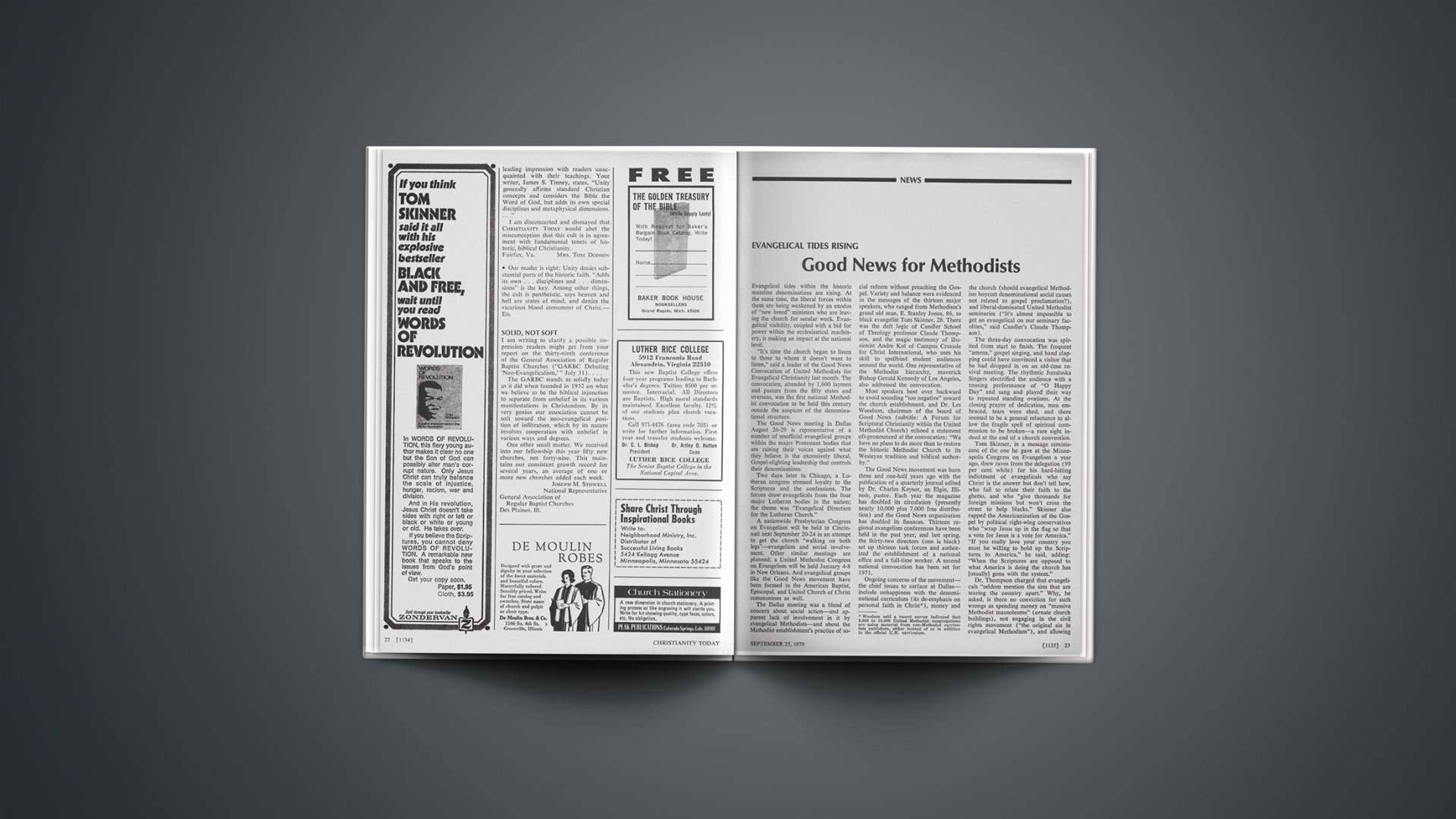
Evangelical Tides Rising: Good News for Methodists

Evangelical tides within the historic mainline denominations are rising. At the same time, the liberal forces within them are being weakened by an exodus of “new breed” ministers who are leaving the church for secular work. Evangelical visibility, coupled with a bid for power within the ecclesiastical machinery, is making an impact at the national level.

“It’s time the church began to listen to those to whom it doesn’t want to listen,” said a leader of the Good News Convocation of United Methodists for Evangelical Christianity last month. The convocation, attended by 1,600 laymen and pastors from the fifty states and overseas, was the first national Methodist convocation to be held this century outside the auspices of the denominational structure.

The Good News meeting in Dallas August 26–29 is representative of a number of unofficial evangelical groups within the major Protestant bodies that are raising their voices against what they believe is the excessively liberal, Gospel-slighting leadership that controls their denominations.

Two days later in Chicago, a Lutheran congress stressed loyalty to the Scriptures and the confessions. The forum drew evangelicals from the four major Lutheran bodies in the nation; the theme was “Evangelical Direction for the Lutheran Church.”

A nationwide Presbyterian Congress on Evangelism will be held in Cincinnati next September 20–24 in an attempt to get the church “walking on both legs”—evangelism and social involvement. Other similar meetings are planned; a United Methodist Congress on Evangelism will be held January 4–8 in New Orleans. And evangelical groups like the Good News movement have been formed in the American Baptist, Episcopal, and United Church of Christ communions as well.

The Dallas meeting was a blend of concern about social action—and apparent lack of involvement in it by evangelical Methodists—and about the Methodist establishment’s practice of social reform without preaching the Gospel. Variety and balance were evidenced in the messages of the thirteen major speakers, who ranged from Methodism’s grand old man, E. Stanley Jones, 86, to black evangelist Tom Skinner, 28. There was the deft logic of Candler School of Theology professor Claude Thompson, and the magic testimony of illusionist Andre Kol of Campus Crusade for Christ International, who uses his skill to spellbind student audiences around the world. One representative of the Methodist hierarchy, maverick Bishop Gerald Kennedy of Los Angeles, also addressed the convocation.

Most speakers bent over backward to avoid sounding “too negative” toward the church establishment, and Dr. Les Woodson, chairman of the board of Good News (subtitle: A Forum for Scriptural Christianity within the United Methodist Church) echoed a statement oft-pronounced at the convocation: “We have no plans to do more than to restore the historic Methodist Church to its Wesleyan tradition and biblical authority.”

The Good News movement was born three and one-half years ago with the publication of a quarterly journal edited by Dr. Charles Keysor, an Elgin, Illinois, pastor. Each year the magazine has doubled its circulation (presently nearly 10,000 plus 7,000 free distribution) and the Good News organization has doubled its finances. Thirteen regional evangelism conferences have been held in the past year, and last spring, the thirty-two directors (one is black) set up thirteen task forces and authorized the establishment of a national office and a full-time worker. A second national convocation has been set for 1971.

Ongoing concerns of the movement—the chief issues to surface at Dallas—include unhappiness with the denominational curriculum (its de-emphasis on personal faith in Christ1Woodson said a recent survey indicated that 8,000 to 10,000 United Methodist congregations are using material from non-Methodist curriculum publishers, either instead of or in addition to the official U.M. curriculum.), money and the church (should evangelical Methodists boycott denominational social causes not related to gospel proclamation?), and liberal-dominated United Methodist seminaries (“It’s almost impossible to get an evangelical on our seminary faculties,” said Candler’s Claude Thompson).

The three-day convocation was spirited from start to finish. The frequent “amens,” gospel singing, and hand clapping could have convinced a visitor that he had dropped in on an old-time revival meeting. The rhythmic Junaluska Singers electrified the audience with a rousing performance of “O Happy Day” and sang and played their way to repeated standing ovations. At the closing prayer of dedication, men embraced, tears were shed, and there seemed to be a general reluctance to allow the fragile spell of spiritual communion to be broken—a rare sight indeed at the end of a church convention.

Tom Skinner, in a message reminiscent of the one he gave at the Minneapolis Congress on Evangelism a year ago, drew raves from the delegation (99 per cent white) for his hard-hitting indictment of evangelicals who say Christ is the answer but don’t tell how, who fail to relate their faith to the ghetto, and who “give thousands for foreign missions but won’t cross the street to help blacks.” Skinner also rapped the Americanization of the Gospel by political right-wing conservatives who “wrap Jesus up in the flag so that a vote for Jesus is a vote for America.” “If you really love your country you must be willing to hold up the Scriptures to America,” he said, adding: “When the Scriptures are opposed to what America is doing the church has [usually] gone with the system.”

Dr. Thompson charged that evangelicals “seldom mention the sins that are tearing the country apart.” Why, he asked, is there no conviction for such wrongs as spending money on “massive Methodist mausoleums” (ornate church buildings), not engaging in the civil rights movement (“the original sin in evangelical Methodism”), and allowing rat-hole slum dwellings (some of the landlords are active churchmen).

Other evangelically oriented groups in major denominations are strongly challenging the contention of liberal churchmen that historic Christianity emphasizing a living, personal Saviour is an ecclesiastical backwash.

The American Baptist Fellowship was organized during the denomination’s annual meeting last spring to provide a voice for evangelical pastors and to heal wounds within the ABC. The United Presbyterian Church has two groups: Presbyterians United for Biblical Concerns, for pastors and laymen, and the Presbyterian Lay Committee, which stresses lay participation in decision-making at all levels in the church. The Southern Presbyterian group, Concerned Presbyterians, is for laymen.

Lutherans Alert, a group of American Lutheran Church and Lutheran Church in America pastors and laymen; is seeking a possible federation of “evangelical, conservative, confessional Lutherans,” a move supported by the independent, very conservative Lutheran publication, the Christian News.

Within the Episcopal Church, the American Church Union and the Foundation for Christian Theology both expect to make their conservative influence felt at the denomination’s triennium in Houston next month. There are other evangelical groups in the Anglican and other communions (see story adjoining).

“We are just starting to be aware of the possibilities” for evangelical ecumenism, says Good News editor Charles Keysor. “Why I don’t even know how many evangelicals there are in the Methodist Church. We’re like guys drilling for oil—we keep sinking the bit and it keeps going down.”

RUSSELL CHANDLER

Evangelical Consolidation In Canadian Denominations

Evangelicals are banding together in Canada’s major denominations to form groupings that give visible (and sometimes irritating) expressions to their position. The Canadian Anglican Evangelical Fellowship, the United Church Renewal Fellowship, and the Baptist Revival Fellowship exist respectively in the Anglican Church of Canada, the United Church of Canada, and the Baptist Convention of Ontario and Quebec.

The three groups have in common an adherence to their particular denominational doctrinal position and a desire for a return to historical evangelical moorings. Each provides a rallying point for evangelicals, who sometimes feel out in the cold.

The Canadian Anglican Evangelical Fellowship is part of the international Evangelical Fellowship of the Anglican Communion, whose president is Archbishop Marcus Loane and whose secretary is Dr. John Stott. The EFAC includes twenty-two national Anglican bodies around the world.

Despite obstacles, the United Church Renewal Fellowship now claims 600 members; about sixty are ministers. Executive member Dr. Robert Rumball of Toronto’s Evangelical Church of the Deaf reports a sizable group of sympathizers not yet openly aligned with the fellowship.

The newest evangelical “underground,” the Baptist Revival Fellowship, includes pastors and laymen in the Baptist Convention of Ontario and Quebec. Organized this year, the fellowship already claims 100 ministers and a large body of laymen. According to its president, the Reverend Raymond Le-Drew of the First Baptist Church in Orilla, Ontario, the Baptist Revival Fellowship exists “to give visibility and expression to the evangelical position which gave birth to the whole Baptist witness in Canada.”

Observers wonder if these separate evangelical groupings will display enough unity to maintain effective liaison through an interdenominational evangelical alignment such as the Evangelical Fellowship of Canada. Many are already active in the EFC; others hesitate.

LESLIE K. TARR

From Jonah To Jeremiah

Strange things are happening under the name of evangelism these days. Two of the most dramatic are Jonah and the Whale on a Florida beach, and Jeremiah, complete with sackcloth and prophecy of doom in California.

Though both involve costumed drama, present the Gospel, and win many converts (especially youth), they are separated by much more than the North American continent. Their strategies are opposite: one uses a soft sell appealing to those still under the “Prince of this world”; the other sets a collision course aimed to jolt the worldly into listening.

Over 50,000 tourists have watched Jonah, a happy-go-lucky, guitar-strumming teenager, receive a telephone call from the Lord to go to New York (Nineveh) to witness to the hippies. His antics trying to run away from God lead to a jolly climax that turns serious when the audience is invited to run toward God instead of away.

Evangelism is no laughing matter, however, for the “Children of God” headquartered on Skid Row in Los Angeles. Dressed in red sackcloth, yokes around their necks and ashes on their foreheads, they stand in silent formation at such events as the trial of the Chicago Seven, a campus gathering for radical Jerry Rubin, and antiwar rallies. The signs and scrolls they display warn readers to repent: the Judgment Day is at hand.

Both approaches are effective. Jonah’s troupe expected 1,000 decisions before the end of the summer-long performances in Panama City. The comic religious musical was written by the Reverend Bob Curlee of Ensley Baptist Church in Birmingham.

The “Children of God” have grown from a handful five years ago to 125 in Los Angeles and 200 more at the clan’s ranch near Fort Worth, Texas. At both places they live in communes patterned after those of early Christians. Members are required to give up all possessions and to memorize at least two Bible verses daily; they don’t smoke, drink, or use drugs. With long hair and casual clothes, they are especially effective with young people who have left the “system.”

Jonah and Jeremiah are just two vanguards of the rapidly moving front line of evangelism (see June 19 issue, page 36). Others are appearing across the nation, such as in El Paso, Texas, where 600 young people made commitments to Christ in one night of old-fashioned revival—helped along by the hard-rock sound of long-haired Christian musicians.

Converting Tent-Trailers Into Missionaries

Paul, the tent maker of Tarsus, would feel at home with the modern-day tent makers of Bethany Fellowship in Bloomington, Minnesota. For they, like Paul, work at their trade and live communally for one purpose: to support missions.

Since its founding in 1945, the fellowship has grown to seventy members and has prospered in business and missions. The tents form the “cadillac of the fold-down trailer” with sales, now in twenty-seven states, increasing 20 per cent each year. Meanwhile, 129 missionaries have been placed in twenty-five countries, and another 130 are in training.

The tent making began in 1958 when a young staff member worked day and night to perfect the first “traveling tepee.” In the next three years sales of the camper trailer with tentlike canvas walls doubled and tripled. Bethany was first with the fiberglass top and foldover kitchen, and in 1968 came out with a high-rise kitchen that cranks out. “We can’t afford one unhappy customer, for it is a reflection upon a work of God,” says Maurice Johnson, business manager and vice-president.

Community has grown with industry, as members imitate the early Christians of Acts 2:44 who “had all things in common.” These modern believers live in family units in apartment-style buildings, keeping personal belongings such as furniture but eating meals together and worshiping together twice weekly. They dress in simple, modern clothing and do not smoke, drink, or attend movies.2A nursery is provided but is not compulsory; many mothers combine child care with their particular work responsibility. Older children attend local public schools, and all members take an interest in community affairs.

Twenty-five years ago, five families meeting for prayer and Bible study felt called to missions. As Johnson, a member of the original group, tells it: “We thought if we only had one house, there would be more time to prepare ourselves.”

After much prayer, they sold their homes and bought one large house in Minneapolis. At first the men worked at outside jobs and turned in their wages. As the fellowship’s industry grew, they gave up other jobs.

Although they all planned to go to the foreign field, none of the original group went. “In 1945 we had the audacity,” recalls Johnson, “to ask God for 100 young people and the funds to send them to the mission field.” Twenty-two years later, the 100th young man, a son of one of the original members, was commissioned.

When others joined the group, the house became too small. In 1948, they moved to fifty-seven acres in Bloomington. A missionary training and Bible institute was begun; it now employs sixteen members as teachers. Nearly all the children of Bethany staff members are now on the mission field.

Before 1958, the fellowship manufactured toys. Today there are four main products: the trailer, a print shop and publishing house, electronic equipment, and a lefse grill. The lefse grill, a heavy aluminum appliance that gets 100 degrees hotter than other electric grills, was developed by an elderly Norwegian inventor. It looks like an upside-down dishpan. “We thought only Norwegians would buy it,” says Johnson. Yet with little or no advertising, sales have run close to 10,000 a year.

Bethany also manufactures loud speakers and is perhaps the largest supplier of public address systems to missionaries; 700 are sold annually.

Students share the work program, knowing it will someday support them on the field.

There have been difficulties. In 1953 the Minnesota shop burned. “We didn’t think of quitting,” says Johnson. “We were in business twelve days later.” Another fire destroyed the grill department. In 1969 a tornado destroyed four cabins the fellowship used for vacationing and killed four members. The 13-year-old son of the Reverend H. J. Brokke, dean of the school, was among them.

The Bethany story is one of hard work and faith; it is not just a social experiment. The members are committed to the belief that “there is nothing worth living for if you can’t live for the Gospel.”

MARIAN PARRISH

Episode In Birmingham

In all its ninety-eight-year history, First Baptist Church in downtown Birmingham, Alabama, has never had a black member. And if about half its 1,800 white members have their way, that policy will not change. The other half, including the pastor, Dr. J. Herbert Gilmore, favor integration.

The division became acute last July when a black woman, Mrs. Winifred Bryant, and her eleven-year-old daughter Twila Fortune were presented to the congregation for membership. They had become acquainted with the church two blocks from their home through the church’s tutoring program, where Twila had been converted.

On July 5, at what is usually a routine meeting to vote on membership candidates, Gilmore, as moderator, declared the congregation’s voice vote a majority in favor of accepting Mrs. Bryant, Twila, and four white candidates. But opponents objected, and under the church’s by-laws their objections had to be considered by the pastor and deacons. In a closed three-and-a-half-hour meeting, a substantial majority of the deacons, according to Gilmore, declared the objections invalid and unscriptural. Back to a congregational vote went the six membership requests, this time needing approval of two-thirds of the congregation. Several heated congregational meetings later, the six still had been neither accepted nor rejected.

Early this month, twenty-three votes defeated a resolution calling for membership consideration only on the basis of Christian commitment, without reference to race. The status of the would-be members was left in limbo.

Churches Face Postage Increases

Churches and charitable institutions face the virtual certainty of substantial and continued postage rate increases under the new “postal reform” law passed by Congress and signed by President Nixon, even though they and their publications will continue to enjoy a favored status in the new U. S. Postal Service.

In the closing hours of congressional work on the reform bill, a House provision that would have enabled churches and other non-profit institutions to continue to enjoy the present subsidized mail rate was stricken from the bill. In its place, conferees established a preferential rate that within ten years must reflect the actual costs to the post office of handling this mail.

Eternity editor Russell Hitt, “postal lobbyist” for the Evangelical Press Association, said that congressmen had seriously considered wiping out the preferential rate altogether.

Realizing that this would result in a very substantial increase in present mailing rates, the conferees at the very last moment added the clause that provides that the increases shall be spread “so far as practicable in equal annual increments” over a ten-year period.

At present, churches and charitable institutions mail printed matter at the rate of 1.6 cents per piece in third class, and for even less in second-class mail.

These rates are now to be increased to a point that reflects “cost of handling.” This has been defined as the additional cost to the Postal Service exclusive of its investment in buildings and motor equipment. The reasoning is that the latter would be required anyway to move first-class mail. Thus, only labor and additional transportation costs will be counted. This has been estimated at 52 per cent of the total amount required to operate the Postal Service.

Even though the law does not spell it out specifically, postal rate experts here expect a straight 50 per cent reduction from the first-class rate to be applied to non-profit mail users.

GLENN D. EVERETT

The Evangelical Secret?

A noted Roman Catholic scholar, in a major critique of evangelical Protestantism, suggests that its current success “has something to do with the centrality of the doctrine of the Holy Spirit to the evangelical ethos.” Father Kilian McDonnell, O. S. B., warns against an “overblown” doctrine of the Holy Spirit, but asserts that “apart from the power of the Holy Spirit a doctrinally correct Gospel will not, cannot, transform.” McDonnell’s 4,000-word article appears in the August 21 issue of Commonweal.

Eutychus and His Kin: September 25, 1970

Reassessing Reticence

The biography of Jos Wedgwood, The Last of the Radicals, tells of a questionnaire he sent to a long list of influential people. One thing he asked was: “To what cause do you attribute your failure?” The book reports that only Lord Beaverbrook denied he had failed.

Long ago as a college freshman headed for the ministry I found myself on a social occasion seated next to a psychiatrist in government service. He showed interest in my plans, while himself disclaiming any Christian profession. Suddenly he asked, “What would you say is the best, and what is the worst, qualification for your job?” Now, normally I am an indifferent disburser of Instant Wisdom, but not on that occasion. “A sense of humor and a lack of reticence,” I said promptly. The reply impressed us both. It impresses me still, despite rueful survey of the intervening years. On humor I might just get by, though my friends might hotly challenge the assumption. On reticence, however, there is no doubt, but a damaging indictment.

It is scant comfort that many another in the ministerial and in other walks can attribute failure to the same deficiency (Lord Beaverbrook, of course, excepted), even if some have not yet tumbled to it. Advancing years seem to help: on her fifty-fifth birthday Simone de Beauvoir reminisced: “I have written certain books, and not written others.” E. M. Forster, probably the greatest of modern British novelists, who died recently at ninety-five, was a master of reticence who had not written anything major for many years previously. “His reputation,” it was said, “goes up with every book he doesn’t write.”

This may bring welcome solace to those who for years have lived uneasily because they had never got down to that classic within them just waiting to be penned, but it won’t do much for the pastor whose ministry is built around the resolve that he will never through silence be the devil’s advocate. I was mulling over that dubious philosophy last week when I came across an utterance of Benjamin Franklin. In consenting to the Constitution in 1787, that indomitable fighter for the rights of the individual said: “The opinions I have had of its errors I sacrifice to the public good. I have never whispered a syllable of them abroad.” An indignant counter motion would have come from a lesser man, but Ben was witty and wise enough to have made a good pastor. Come to think of it, his expertise with lightning would have been an invaluable pulpit asset, too.

EUTYCHUS IV

Twixt Pit And Excess

As a theological student … I disagree with many articles, but others are stimulating. Most of your articles are more fitting for a theological journal, instead of a periodical appealing to clergy and laity alike. However, “Incarnational Evangelism” (Aug. 21) blended theological acuity with lay application in a most thrilling way.

Mr. Haughton (who, I was pleased to notice, is a pastor and not a seminary professor) is to be highly commended on a fine piece of expository work related to an ever-present question, “How do we communicate the Gospel?” He avoids the excesses of “isolationism” practiced by many conservatives today. Yet he avoids the pit of “compromise in evangelism” into which many evangelicals have wandered.

WILLIAM VARNER

Elkins Park, Pa.

Poetic Gibberish?

That “poem” (“Fall and Then …,” Aug. 21)—would you mind translating it into Americanese so we can understand it?

Robert Frost was once asked by a student if he would tell what a certain poem of his meant; to which he replied, “Do you want me to say it in poorer English?”

But then, even some of Shakespeare’s stuff is in Gibberish, too.

A. V. OLEEN

Yonkers, N. Y.

What’s In A Name?

While I agree that the term conservative evangelicals is redundant to those of us that profess to be evangelicals according to the definition you gave from Webster’s International (“Evangelicals Without Adjectives,” Aug. 21), I do not agree that we should discontinue use of the term at once.

For one thing, the very fact that this term was begun by those within the conciliar movement shows that from their point of view they thought it was necessary to give further identification. It would seem that some who would not place themselves as conservative evangelicals would still classify themselves as “evangelicals.”

Webster’s Seventh New Collegiate Dictionary gives five definitions for the word evangelical, the third of which corresponds with the definition you gave from Webster’s International. The second definition is “protestant,” and we know that many people in Latin America, Europe, and other places of the world use the term evangelical with this meaning …

Another reason we should not throw out the term “conservative evangelicals” too quickly is because of the use and misuse of the term new evangelical or neo-evangelical. While others use adjectives like this to confuse the term evangelical, I think we still need to continue to clarify the position of most evangelicals by the adjective conservative.

EDWIN L. FRIZEN, JR.

Executive Secretary

Interdenominational Foreign Mission Association

Ridgefield Park, N. J.

Unbinding The Tie

“Strange Company” (News, Aug. 21) contains erroneous information.…

T. Sherron Jackson did not “formally” or in any other way organize the North American Baptist Association. If you are familiar with Baptist polity, you should know that we are of all people in the world democratic in our form of government. It is true that there were leaders; however, the Reverend T. Sherron Jackson was not one of them. He has neither held office nor preached an annual sermon in the association. The Baptist Foundation of America is in no way connected with the Baptist Missionary Association of America. It has never been a part of our association, either officially or unofficially.

CRAIG BRANHAM

General Secretary

Baptist Missionary Association of America

Little Rock, Ark.

• We erred. Jackson, ordained in the former North American Baptist Association, is listed on the ministerial roll of its successor, the Baptist Missionary Association of America. He founded the Third Baptist Church in Little Rock, not the association.—ED.

Jones Power

Your news report “Free Will Baptists: Fending Off the Jonesites” (Aug. 21) is a misrepresentation of the true facts. The leaders of the denomination were charged not with liberalism or heresy … [but] with softness toward new evangelicalism. This latest dress of biblical Christianity prefers positivism without negativism, infiltration to separation, so-called science to revelation, pragmatism to separation, so-called love to biblical principles, results to apostolic injunctions, part of the Gospel to all of the Gospel, dialogue to confrontation, appeasement to repudiation, and contempt to love for the fundamentalist.

Dr. Stanley Mooneyham was invited to speak at the convention this summer. This invitation, however, was withdrawn because of a resolution by the North Carolina Association of Free Will Baptists and a packet circulated by students at Bob Jones University.

BOBBY GLENN SMITH

Greenville, S. C.

When Adding Subtracts

I believe that your news item on the Unity church (Aug. 21) leaves a misleading impression with readers unacquainted with their teachings. Your writer, James S. Tinney, states, “Unity generally affirms standard Christian concepts and considers the Bible the Word of God, but adds its own special disciplines and metaphysical dimensions.…”

I am disconcerted and dismayed that Christianity Today would abet the misconception that this cult is in agreement with fundamental tenets of historic, biblical Christianity.

MRS. TOM DODSON

Fairfax, Va.

• Our reader is right: Unity denies substantial parts of the historic faith. “Adds its own … disciplines and … dimensions” is the key. Among other things, the cult is pantheistic, says heaven and hell are states of mind, and denies the vicarious blood atonement of Christ.—ED.

Solid, Not Soft

I am writing to clarify a possible impression readers might get from your report on the thirty-ninth conference of the General Association of Regular Baptist Churches (“GARBC Debating ‘Neo-Evangelicalism,’ ” July 31).…

The GARBC stands as solidly today as it did when founded in 1932 on what we believe to be the biblical injunction to separate from unbelief in its various manifestations in Christendom. By its very genius our association cannot be soft toward the neo-evangelical position of infiltration, which by its nature involves cooperation with unbelief in various ways and degrees.

One other small matter. We received into our fellowship this year fifty new churches, not forty-nine. This maintains our consistent growth record for several years, an average of one or more new churches added each week.

JOSEPH M. STOWELL

National Representative

General Association of Regular Baptist Churches

Des Plaines, Ill.

Awakening Ahead?

And it shall come to pass afterward, that I will pour out my spirit on all flesh; your sons and your daughters shall prophesy, your old men shall dream dreams, and your young men shall see visions (Joel 2:28).

We cannot say for sure whether the “end times” have begun. But whether they have or not is immaterial to the Christian, who is called by God to be faithful, and whose distinctive life style is to be lived out in every age. Many believers are now living victoriously for Christ, and the fruits of their labors suggest that we may be on the verge of a great spiritual awakening in America and around the world. This possibility must be considered despite the claim of some that we live in a post-Christian era, despite the tumult and uproar that could lead us to conclude that the barbarians are coming. What gives us reason to hope for an awakening in the seventies?

We are encouraged by the many congresses on evangelism that have been and will be held. Since 1966, when the World Congress on Evangelism was held in Berlin, congresses have convened around the world. Africa, Latin America, Asia, the United States, and Canada have had them. An all-Europe congress will take place in Amsterdam a year from now.

Billy Graham’s mass meetings and radio and TV outreach are bearing a rich harvest as are the ministries of a number of other evangelists. Millions of people have responded to the Gospel and millions of believers have committed themselves to the task of world evangelism. Besides Dr. Graham’s radio ministry we have that of the “Lutheran Hour,” the “Bible Study Hour,” the “Joyful Sound,” the “Radio Bible Class,” plus the programs sponsored by the Christian Reformed Church, the Mennonites, the Assemblies of God, and the Free Methodist Church, and many others, including the new radio outreach of United Presbyterians under the auspices of the Presbyterian Lay Committee.

Another sign of an approaching awakening can be seen in special ministries that God has blessed significantly. Youth for Christ has come of age and is getting results in a variety of outreaches. Young Life, year in and year out, sees thousands of high schoolers come to Christ and commit themselves to Christian service. The Inter-Varsity Christian Fellowship has helped to revolutionize the disturbed college campuses; between seven and ten thousand collegians will assemble at Urbana, Illinois, after Christmas for a missionary conference to consider again the command of Christ to evangelize the world. Campus Crusade for Christ, with 2,200 staff members, is working in the college and high-school worlds here in America and increasingly around the globe. Campus Crusaders confidently expect 100,000 delegates to come to Dallas for their Explo’ 72, and from this they hope to enlist 10,000 men and women for God’s Great Commission Army.

A third sign that presages an awakening is Key ’73, an inter- and intra-denominational effort begun a short time ago in the Key Bridge meetings. Several dozen denominations are committing themselves to cover America with the Gospel in 1973 in an effort to bring millions to a saving knowledge of Christ.

A fourth sign of awakening is what is happening in local churches around the country. Hundreds of congregations have experienced renewal. At the same time these churches have been winning the lost for Christ and have been bringing into their fellowship hundreds each year who never were members before. One church in California recently baptized 253 converts. A church in Fort Lauderdale, Florida, has added hundreds of converts in the past few years. The Roman Catholic Church has been stirred also. Many of its people have shown a great interest in studying the Bible, and literally thousands of them have come to a true knowledge of God and are sharing their faith with others in the church. The renewal in the churches has included a new interest in the person and work of the Holy Spirit. Tens of thousands are now living and witnessing in the power of the Holy Spirit and are seeing men and women come to Christ as a consequence of their Spirit-filled witness. Bible classes meet weekly in thousands of homes, and intercessory prayer is mounting as multiplied numbers of God’s people plead for revival.

A fifth indication of spiritual stirring has been revival on the Christian college campuses. Begun this year at Asbury, it has spread from school to school, state to state, and across oceans. Moreover, enrollment in evangelical schools is at an all-time high.

Still another development that inspires hope is the emergence of evangelical fellowships in a number of large denominations (see News, p. 23). These are bringing together like-minded Christians, both clerical and lay, in the interests of biblical orthodoxy. They are encouraging churchmen concerned over the liberal drift not to cop out but to stay in their churches, and to try not only to preserve accumulated resources for authentic Christianity but also to retrieve sectors of the institutional church that have fallen prey to humanistic error.

Other ministries and movements could be mentioned, but time and space would not allow for listing all of them even if we knew them. God alone knows the full scope of what is happening. What we can be sure of is that something is happening, and that it is broader and deeper than we sometimes see.

The whole world has a stake in this, because true revival is not simply a matter of more people attending fancier churches. If the next great awakening has an effect like those of the past, it will profoundly influence all of society. Lives will be changed, wrongs redressed, motives elevated, and compassion extended. Justice and equality of opportunity will be advanced, and we will be that much closer to a genuinely free society. In short, the globe will be more inhabitable.

Murdering Hostages

A few weeks ago Dan A. Mitrione, an AID employee, was murdered by Uruguayan leftist terrorists who had kidnapped him and demanded in return for his release the liberation of some 150 prisoners. Mitrione’s only offense was his American citizenship—the fact that led his captors to believe that choosing him for their victim would guarantee that their outrageous demands would be met. When they were not, the kidnappers shot him. Mitrione left a widow and a large family; they deserve the compassionate sympathy and the prayers of us all.

Still unanswered, however, is the question of how to deal with this nasty and recurring type of crime. The Foreign Service Journal has suggested that governments refuse to submit to ransom demands either for money or for the release of prisoners. Capitulation to the demands of terrorists will simply increase the number of incidents. Contrariwise, once terrorists learn their capture of hostages is nonproductive, they will give up the tactic.

This kind of policy means that Americans in Latin America must be willing to risk their lives, if necessary. Missionaries’ exposure to martyrdom over the centuries hasn’t kept valiant soldiers of the cross from filling in the ranks decimated by disease and premature death by murder. Civilians engaged in foreign service in this age can learn a lot from missionaries.

‘Having A Wonderful Time …’

This summer we got remarkably few postcards from vacationers, and none of the ones that did come pined, “Wish you were here.” What to make of this, we’re not quite certain. It may be that those who got away were having too good a time to miss us, but we prefer to think there is some other explanation. Perhaps the venerable device for convenient communication was just too old to make it. After all, the English postcard celebrates its centennial next month. It has had a useful life, and if it totters a bit with age, who can blame it?

Or maybe people are using postcards less in an effort to enjoy privacy more. It was part of George Jean Nathan’s American Credo in the twenties “that the postmasters in small towns read all the postcards.” Now that intrusions into what people once considered private matters are becoming commonplace, maybe Americans have conspired to make at least some news personal. If so, we’re inclined to cheer a bit in anticipation of possible new vitality for evangelism. While the combination of human curiosity and public postcards may sometimes be useful for communicating Christianity, it can never stamp out a personal witness to “things into which [even] angels long to look.”

Tortoises For Truth

“I only took the regular course,” the Mock Turtle told Alice in Wonderland. It included “Reeling and Writhing, of course, to begin with, and then the different branches of Arithmetic—Ambition, Distraction, Uglification, and Derision.”

Maybe no one read Lewis Carroll to contemporary students when they were youngsters, so they grew up expecting more than “Distraction” from their “regular course” of education. Yet they learned something well: though completely turned off by “the different branches of Arithmetic,” they reel and writhe at the injustices of an imperfect world.

That lesson they have had to teach their teachers. But unlike the psalmist who had “more understanding than all my teachers [because] thy testimonies are my meditation,” most students of the seventies have found their inspiration anywhere but in Scripture. Still, truth is truth, and they might be surprised to discover that many of their concerns—love, peace, fairness, and justice—are biblical. Wise Christian teachers and students will take that knowledge to those reelers and writhers back in school this month. Even tortoises can be winners.

In Pursuit Of Peace

Much of the world was gratified when the Arab-Israeli ceasefire took effect. Many hoped it would lead to a permanently peaceful settlement of a complex and deplorable situation that could touch off World War III. The ceasefire was based on the principle, assented to by the various parties, that no change would take place in the military situation that would disadvantage either Egypt or Israel.

Subsequently it became quite clear that Egypt, presumably with the help of the Soviet Union, had installed more missiles in the Suez Canal region after the ceasefire took effect. This violation of the ceasefire agreement constituted a military threat and created a substantial change in the balance of military power. The Israelis had every reason to be alarmed, and the United States’ failure to demand immediately a return to the status quo ante gave them further cause for fear. Worst of all, the violation was a breach of faith that seemed to show that Egypt and the Soviet Union cannot be trusted to keep their word.

The situation in the Middle East deteriorated still further in a rash of airliner hijackings and Israel’s break-off of peace talks. Some dared to hope that a visit to the United States by Golda Meir would help to shape a better strategy for peace.

In the end, however, all agreements between men and nations have little validity if they are not made with integrity and if there is cause to suspect that they will be breached. The experience of those who have done business with the Soviet Union indicates that this nation operates on a purely pragmatic basis, keeping its agreements only as long as they serve its purposes. In the philosophy of Communism the end justifies the means. The Egyptians seem to have learned this lesson well from their sponsors, and so it appears likely that the Israelis will still have to maintain a substantial war machine even if a peace treaty is signed, against the possibility that the Soviets and the Egyptians might annihilate them if they leave themselves vulnerable.

Any lasting peace agreement will have to be guaranteed by power structures. Unfortunately, the United Nations seems unable to perform this role. Therefore Israel has only the United States to look to for adequate support and defense, and it is highly unlikely that the Israeli government will agree to any settlement that does not carry with it the assurance of U. S. help and protection. Even Senator Fulbright, an ardent Viet Nam dissident, has recognized this; he has called for a treaty arrangement that could lead to U. S. involvement in the Near East beyond anything we have done in Viet Nam. If the United States does make such a commitment, and it appears inevitable, we should remember that it may someday require the use of our manpower and vast resources. If the United States were to decide against such a commitment, Israel would be doomed, for the combined power of the Soviets and Egypt would bring them military victory.

Mcintire’S Unholy Alliance

Carl McIntire, organizing another pro-war rally for October 3, billed South Viet Nam vice-president Nguyen Cao Ky as the main speaker. No one can overlook the implications of this move, coming as it does at election time, and Ky’s involvement clearly has explosive possibilities. Moreover, McIntire has seized the initiative from the National Council of Churches and has upstaged them at their own game on the Washington scene, though his stance is opposite to theirs.

McIntire’s October 3 effort must leave thoughtful Christians a bit dazed. This is the man who consistently labels Billy Graham and other leading evangelicals “compromisers” because they work with evangelicals in denominations that McIntire calls apostate. Yet here is McIntire bringing together masses of people who share his war views but who could not possibly be in agreement with his theology. Is it not “compromise” for him to hold hands with those who are hostile to the Gospel or indifferent to it?

The most appalling aspect of this political venture, however, is that McIntire seeks to cloak it with the blanket of the Gospel. As a citizen, McIntire certainly has every right to hold a rally. But to identify such an unholy alliance with the cause of Christ, to seek to commit churches to it, and to give the impression that it has the support of deity is carrying things much too far.

We are not approving or disapproving his stand on the war itself. This is not the issue. We are saying that he does the Church a terrible disservice when he tries to tie it to a political goal.

Now’S The Time To Give

Call it what you will: recession, economic downturn, mini-depression, anti-inflationary drive, or temporary adjustment. Whatever it is, it is here, and giving to Christian causes has slowed down. Churches and particularly Christian institutions have serious financial problems at a moment when opportunities are numerous, expansion is called for, and inflation still takes a heavy toll. It is certainly the wrong time for Christians to retrench in their giving and to allow economic uncertainty to hinder the expression of their faith.

Scripture everywhere encourages believers to give and to do so liberally. While we would not advocate the tithe as a legal requirement, yet it seems to be an appropriate response for those who have experienced the grace of God in Jesus Christ. A tithing people of God will provide adequate finances for the support of every Christian endeavor. Paul lays down the spiritual principle that “he who sows sparingly will also reap sparingly, and he who sows bountifully will also reap bountifully.” Those who give cheerfully (“hilariously”) will find that “God is able to provide you with every blessing in abundance, so that you may always have enough of everything and may provide in abundance for every good work.” Paul also says, “You will be enriched in every way for great generosity” and “under the test of service, you will glorify God by your obedience” (2 Cor. 9:6–15).

Fear and a lack of faith in God keep many of his children from tithing. Their failure to give adequately keeps them in bondage, stifles their better impulses, hinders spiritual growth, and prevents them from reaping the great blessings God promises to those who sow bountifully in faith, looking for a rich harvest.

Many Christians have little because they give little. They are afraid to risk what they have by accepting God’s challenge. God says, “Put me to the test—bring in the tithes, and see “if I will not open the doors of heaven for you and pour down for you an overflowing blessing” (Mal. 3:10).

Christian missions, churches, Christian colleges, and other Christian enterprises need money. They need it now! Why not put God to the test today?

Face the Alternative

There is only one place in all the world where the past, present, and future are combined in one record—the past in authentic history, instructions for consistent living in the present, and clear statements about the future, the end of the age and beyond. All these are found in the Bible.

When our Lord spoke of his return, he compared Noah’s day with world conditions that will exist when he suddenly appears in the clouds of heaven. And the Bible does not leave us in ignorance as to what those conditions will be: “The LORD saw that the wickedness of man was great in the earth, and that every imagination of the thoughts of his heart was only evil continually.… The earth was corrupt in God’s sight, and the earth was filled with violence” (Gen. 6:5, 11).

He also tells us of the general secularization of that day: “For as in the days before the flood they were eating and drinking, marrying and giving in marriage, until the day when Noah entered the ark, and they did not know until the flood came and swept them all away, so will be the coming of the Son of man” (Matt. 24:38, 39).

The trouble with the people of Noah’s day was a preoccupation with this world—“the lust of the flesh and the lust of the eyes and the pride of life” (1 John 2:16a). How similar to the day in which we live! Our Lord also foretold about the end-age that “many false prophets will arise and lead many astray. And because wickedness is multiplied, most men’s love will grow cold” (Matt. 24:11, 12).

In all of this Jesus was preparing mankind for certain judgment. This is no longer a popular subject. On every hand we hear a “gospel” that proclaims “ ‘peace, peace,’ when there is no peace” (Jer. 6:14b). But if the Bible teaches anything it teaches, along with the love and compassion of God, the certain judgment of God on sin and unrepentant sinners. The Gospel is the message of the One who came into this world to take that judgment for us. It is also the message of the dénouement of history, when this world and all in it shall be destroyed by fire.

God’s loving mercy is shown by the fact that he always warns of impending judgment. He also always gives the reason for judgment, for he wants men to be saved, and he has provided the way of escape.

Perhaps the chief reason so many in the Church reject the certainty of coming judgment is their low estimate of the nature of sin and its consequences. But nowhere is God’s love more clearly seen than in his judgment on sin. The nature of sin requires judgment by a holy God. But God demonstrated his great love by sending his own Son to take the punishment in our stead.

I am well aware that many theologians reject this explanation of the Cross. I realize also that the Bible unquestionably teaches this truth, and I prefer to stick with the Bible’s explanation of God’s love and compassion, his holiness, and his judgment on sin. The Gospel of man’s redemption must be preached against the backdrop of God’s holiness and the certainty of judgment.

The nature of the world’s destruction is clearly foretold: “The world that then existed [Noah’s time] was deluged with water and perished. But by the same word the heavens and earth that now exist have been stored up for fire, being kept until the day of judgment and destruction of ungodly men” (2 Pet. 3:7). The Holy Spirit, speaking through Peter, goes on to tell us the manner of that destruction: “The day of the LORD will come like a thief, and then the heavens will pass away with a loud noise, and the elements will be dissolved with fire, and the earth and the works that are upon it will be burned up” (2 Pet. 3:10).

That Peter’s description of the final destruction of the world by fire fits in closely with what we now know of the effects of atomic fission is perhaps far more than a coincidence. I believe the Holy Spirit was foretelling the manner of the judgment, out of which there is to come “new heavens and a new earth.”

Peter’s admonition to the early Christians certainly applies to us today: “Since all these things are thus to be dissolved, what sort of persons ought you to be in lives of holiness and godliness, waiting for and earnestly desiring the coming of the day of God, because of which the heavens will be kindled and dissolved, and the elements will melt with fire! But according to his promise we wait for new heavens and a new earth in which righteousness dwells” (2 Pet. 3:11–13).

Is Peter telling Christians to sit down and wait with folded arms until the Lord comes? Certainly not. He warns of future judgment so that we may keep this world and the one to come in proper perspective: “You therefore, beloved, knowing this beforehand, beware lest you be carried away with the error of lawless men and lose your own stability” (2 Pet. 3:17).

We are living in a day when lawlessness is found on every hand, when violence covers the earth, when iniquity abounds. Let us beware lest we become cold in our love for the One who came into the world to deliver us from its certain judgment.

The Apostle Paul speaks of the same day in words that should sober all who read. He describes it as the day “when the Lord Jesus is revealed from heaven with his mighty angels in flaming fire, inflicting vengeance upon those who do not know God and upon those who do not obey the gospel of our Lord Jesus. They shall suffer the punishment of eternal destruction and exclusion from the presence of the Lord and from the glory of his might” (2 Thess. 1:7b–9).

Who will suffer? The willfully ignorant (read Romans 1:19, 20) and the willfully disobedient. The writer of the Epistle to the Hebrews puts the question clearly: “Therefore we must pay the closer attention to what we have heard, lest we drift away from it. For if the message declared by angels was valid and every transgression or disobedience received a just retribution, how shall we escape if we neglect such a great salvation? It was declared at first by the Lord, and it was attested to us by those who heard him” (Heb. 2:1–3).

I want to bear this personal testimony: There is no fear of the future in my own heart because I believe that Jesus bore my punishment and that as a result I am a free man. With that freedom I wish to live day by day with love in my heart for him, and for my fellow man. I want to be the best neighbor possible. I want to glorify God in thought, word, and deed, because, like the Apostle Paul, I believe “everything laid down by the law or written in the prophets, having a hope in God … that there will be a resurrection of both the just and the unjust.”

Before us all there are two alternatives: God’s salvation in Christ, or God’s judgment.

L. NELSON BELL

Psychosocial Origins of Stability in the Christian Faith

A young Christian couple bring their little child to the church to be baptized or dedicated to the Lord and in so doing give public testimony that they desire to rear him in the nurture and admonition of the Lord. To some parents it may be only an expected ceremony, but to many it is a promise to bring up the child in the Christian faith, to teach the Scriptures to him, and if possible to lead him to accept Christ as Saviour.

What guarantee do these parents have that this child, dedicated and reared in the faith, will adhere to this faith? Is this only a hope? Can parents be assured that their expectations will be honored by Him who knows the thoughts and intents of the heart? What about young people who have turned away from the faith but as small children were sincerely dedicated by God-fearing parents? What went wrong? Were the parents at fault? Can we say only that each person must make his own decision for or against the claims of Christ?

Christian parents have long struggled with this problem. In early childhood, faith seems natural and assured. Because of the child’s dependence on the parents, he comes to identify with them and to imitate their actions, attitudes, and beliefs. He tries to be like his parents because this makes him feel more grown up, and growing up is something he wants very much to do. Moreover, since parents represent the social group in which the child is raised, by identifying with the parents he learns to accept the demands of society, and these demands are incorporated into his personality structure. This has sometimes been called the internalization of the superego by Freudian psychologists, or the development of a conscience by social-learning theorists. A child learns a great deal by observation and identification, by copying parental behavior and incorporating parental values.

This means that parents who believe in Jesus Christ and in the Scriptures and who communicate this by their actions and speech will almost invariably have the satisfaction of seeing within the young child similar actions and speech, and they may even have the joy of leading the child to faith in Christ. Their promise to God made at the dedication of their infant seems to be coming to fruition. In their joy, they may renew their commitment to encourage the child to continue in the faith.

However, as the child approaches adolescence, the parents may develop an uncomfortable feeling, realizing that their influence is decreasing while the influence of the child’s peers is increasing. In addition, teachers and other adults who may not share the Christian views of the parents influence the behavior and values of the child. The parents feel they must intervene before it is too late. But what are they to do? Careful scrutiny of the child’s friends and regulation of his time and activities becomes increasingly difficult. Insistence on obedience is the parents’ prerogative, but if they lose rapport with the child, the loss may bring an end to the former identification process.

Is the answer, then, to hope and pray that God will take care of the problem in his own way? Some may feel this is the way of faith, but most of us are unwilling to adopt this approach exclusively. We feel strongly that our children are a charge to keep and that we must plan carefully how to help them “keep the faith.”

One alternative is to guard the child from an early age against all environmental situations that will tend to lead him from the truth. In this method, the child must be surrounded by adults and children who share the parents’ religious views. This means that the social life of the child is kept within the church or church-related groups. He may go to meetings and parties sponsored by the church or held in the homes of fellow believers. If this pattern is continued over many years, the young person will feel at ease with believers but will be so uncomfortable with non-believers that he will be quick to return to the fellowship of those of “like precious faith.”

This approach requires that the child attend a parochial or church-related school, where teachers reinforce the religious views of the parents and the problem of competing authorities does not arise. There is little reason under these circumstances for the child to question the truths of Scripture. Those who care for him physically and emotionally and those who teach him all hold to similar religious convictions. All information he acquires adds to his faith. Truth is built upon truth, year after year, until, it is hoped, the whole structure stands firm and solid and the parent feels confident that the child has been well grounded in the faith.

One obvious weakness of this approach is that the social life within the church may be quite inadequate. The fundamentalist groups, which are often the most concerned with rearing the child to adopt the convictions of the parents, tend to question the time and expense involved in providing social activities. And so the social life of young people becomes based on numerous religious meetings occasionally followed by a social hour. Another possible problem is that a satisfactory parochial school may be unavailable, or perhaps the parents cannot afford to send the child to one. The parents may also feel it is not best for the child to attend such a school; yet they are eager to see him remain in the faith.

Other weaknesses include a sort of anti-intellectualism that pervades some religious groups. The findings of science are ridiculed because they are based on empirical research rather than on Scripture. Or conformity may mean not learning to appreciate much of the beauty that surrounds us in such forms as art or music and may even lead to a condemnation of that beauty as “worldly.” Also, the Christian young person isolated from the world or reality has no opportunity for evaluating his position as a Christian within the total world picture, and for this reason it is not unusual to see him develop a number of mental mechanisms to compensate for this deficit. Those commonly seen include separating incompatible attitudes by logic-tight compartments, withdrawing into passivity, and increasing feelings of worth by conformity to the religious group. At the same time, feelings of persecution are not uncommon.

But even if these weaknesses are not present and even if the parents succeed in keeping the child in Christian schools throughout his elementary, secondary, and college years, they cannot maintain this protective environment indefinitely. The time will come when the young person must compare new ideas with old. As he does so, he will realize that some of the things he was taught are inconsistent and illogical. Confusion may result, as he experiences genuine intellectual doubts compounded by emotional overtones stemming from his identification with his Christian parents and friends. The hoped-for result is that he will retain the basic tenets of Christian belief even though the way he works this out in his own life may differ from that of his parents. Some, however, find it difficult to sort out the kernel of truth from the husk surrounding it, and they throw out the whole thing. They may turn their backs on Christianity and raise their own children quite apart from the church.

Is there a better way for Christian parents to accomplish the goal of keeping the child in the faith? An answer may be found in the work of certain social psychologists on the effects of one-sided versus two-sided communications as these relate to attitude stability and attitude change. (An example of this type of research is seen in A.A. Lumsdaine and I. L. Janis, “Resistance to ‘counterpropaganda’ produced by one-sided and two-sided ‘propaganda’ presentations,” Public Opinion Quarterly, 1953–54„ 17, pp. 311–18.)

The method calls for giving small doses of an opposing viewpoint and then helping the receiver counteract this view. This has sometimes been referred to as “inoculation”: if arguments against a belief are presented in weakened form, resistance will be built to future attacks of that belief. Two essential aspects of this process are first that the child be aware that his beliefs may be subject to attack and second that he be given the opportunity to develop defenses against the attack. A child raised in an environment in which he has not had the opportunity to build up these defenses may succumb when placed in a situation in which the “disease” thrives. (The works of the following psychologists show the vulnerability of those who have not been exposed to counterarguments: W. J. McGuire, “Persistence of the resistance to persuasion induced by various types of prior belief defenses.” Journal of Abnormal and Social Psychology, 1962, 64, pp. 241–48; W. J. McGuire and D. Papageorgis, “The relative efficacy of various types of prior belief-defense in producing immunity against persuasion,” Journal of Abnormal and Social Psychology, 1961, 62, pp. 327–37.)

This means that the Christian parent must be willing to talk with the child about those who do not hold to Christian doctrine and convictions and give him reasons why many people in the world are not believers. These reasons must accord with what the child will find for himself as he meets an increasing number of unbelievers and realizes that many of them are socially and morally responsible people. The presentation of opposing arguments in a context that rejects them, such as the home or the church, weakens the future effectiveness of these arguments. It also gives the child practice in weighing the issues so that he is in a position to do this more effectively in the years to come.

Every attitude or belief has affective (emotions), cognitive (knowledge), and behavioral (conduct) components. Building resistance to attitude change must take into account all three: feeling and emotions about the belief, thoughts and knowledge about the belief, and conduct (including will to behave) toward that belief. The Christian parent should try to keep all these in perspective. Children who have identified strongly with their parents will have adopted the feelings and emotions of their parents. For these parents to keep a close relationship with the child as long as possible will augment this affective component. Cognitive elements of the belief may be enhanced, as has already been mentioned, by imparting knowledge about spiritual truths in a Christian environment and by giving the child active practice in adding to his knowledge as he reacts to small doses of opposing views. This combination of the affective and the cognitive will predispose him to guard his attitudes against dissonant attitudes and beliefs.

This will not, of course, guarantee a lifetime of Christian behavior or commitment to Christ, but the expectation of continuous belief will far surpass that for children who have not had the opportunity to build up both the affective and the cognitive components of belief. The behavioral component includes the will as well as predisposition, and each young person must make his own final decision for or against the religious views of his parents. But as it is difficult for those who have not been brought up in the faith to accept Christ because neither the affective nor the cognitive aspects of their lives predispose them to believe, it should be just as difficult for children raised in Christian homes not to believe in the great doctrines of the faith.

The Christian parent will pray and commit his child to the Lord and trust in the saving power of Christ. He will rear the child in a home where the truths of Scripture are taught and where he in turn serves as a model of Christian living. He will add to this a recognition of opposing views that are held by intellectually honest non-believers and present them in such a way that the child has practice in refuting these views. In this way we can have greater assurance that although “the secret things belong unto the Lord our God … those things which are revealed belong unto us and to our children for ever …” (Deut. 29:29).

The Word and the Videotape

“The Word and the Videotape”—with such a provocative title I could discuss Christ and technology or Billy Graham’s television evangelism. But the real subtitle for this talk should be something like “The Christian’s Relationship to the Spirit of the Age,” and more particularly, our relationship to the spirit of this age.

It has been said that the Greek concept of history was cyclical, while the Jewish concept was linear, but this is an oversimplification. The Jews did recognize the presence of historical cycles—we perhaps should say “epicycles”—within the line of history that leads toward the Day of the Lord and the vindication of the righteous. Human society swings as a pendulum from romanticism to classicism to romanticism, from prudery to promiscuity to prudery, from skepticism to mysticism to skepticism, from spirit to matter to spirit. Each age recognizes the excesses of its predecessor, vows to compensate for those excesses, and heads deliriously for the other extreme, certain of finding Eden, Utopia, and a pot of gold upon its arrival. Where is the community of faith in all this cycling and swinging? More often than would have been expected, it has been a breath of fresh air from the depths of Christianity that set the pendulum swinging, but once the swing got up momentum, it was Christianity too that put up the greatest resistance to the pull of the opposite extreme toward which the culture was racing.

For example, the Italian Renaissance is often blamed for or credited with the French Enlightenment of the eighteenth century, which made atheism popular. It was the Renaissance, we are told, that changed man’s focus from the God-centeredness of the medieval period to the man-centeredness that ushered in the Enlightenment. Yet it was the Reformation, not the Renaissance, that posed the biggest threat to the medieval authority system; the Renaissance was carried on reasonably comfortably within the context of the Roman Catholic Church. But the Reformation questioned the authority of the institutional church and gave a high place to the individual conscience and reason in interpreting Scripture and determining the proper Christian ethics. This recovered understanding of the individual’s dignity and responsibility before God came as a breath of fresh air, but it began a swing of thought and culture that ended at the extreme of a belief in complete human autonomy in the absence of God. The individual conscience before Godbecame simply the individual conscience and autonomous reason with Voltaire. And Christianity found itself resisting the momentum of a swing that Christianity had begun.

The reason is that in the eyes of the Christian any extreme is too simple a solution for the problems that have always faced man—problems of identity, society, ethics, suffering, death, love. A solution to the racial problem or the cessation of war in Viet Nam, while such problems must be major concerns, is not the solution to man’s predicament. Things just are not that simple. The Christian sees this not through superior intellectual powers but simply because he has been given a plumbline that runs down through history, a standard established by God, revealed to man, and lived out in the context of human society by God himself, Jesus Christ. The plumbline is not lukewarm compromise or an Aristotelian “Golden Mean.” Rather, as G. K. Chesterton observed, we see Christianity precariously harnessing opposing passions together, both at full strength. In the life of the Church it is balance, not mere moderation, that is the key.

Of course this is a good deal more complicated than simply running with the Spirit of the Age as the pendulum swings from extreme to extreme. But if the Christian’s approach to society is the right one, we should probably expect it to be a bit complicated if we recognize the complexity of the problem. It is like C. S. Lewis’s comparison of the fields of religion and physics. Lewis says:

The old atomic theory is in physics what Pantheism is in religion—the normal, instinctive guess of the human mind, not utterly wrong, but needing correction. Christian theology, and quantum physics, are both, by comparison with the first guess, hard, complex, dry, and repellent.… Christianity faced with popular “religion” is continuously troublesome. To the large well-meant statements of “religion” it finds itself forced to reply again and again, “Well, not quite like that,” or, “I should hardly put it that way.” This troublesomeness does not of course prove it to be true; but if it were true it would be found to have this troublesomeness. The real musician is similarly troublesome to a man who wishes to indulge in untaught “musical appreciation”; the real historian is similarly a nuisance when we want to romance about “the old days” or “the ancient Greeks and Romans.” The ascertained nature of any real thing is always at first a nuisance to our natural fantasies—a wretched pedantic, logic-chopping intruder upon a conversation which was getting on famously without it [Miracles].

And so it has been a part of the Church’s mission to its society, to the culture, to the “Spirits of the Ages” in which it has lived, that it call the culture back from the extremes and try to hold it to the center plumbline. The Church’s success at this has varied down through the centuries. There have been times like our time when, as Yeats said, “the center cannot hold,” when the Church seems unable to restrain a culture gone mad with change. At times the Church loved the comfort and security of the old extreme too much to spur the swing back to the timeless standard. At times it came close, at least temporarily, to fulfilling that part of its ministry—as, for instance, in the Christian culture that grew up in Puritan New England. (It is one of those quirks of popular mythology that we are taught to despise the Puritans largely on the basis of Nathaniel Hawthorne’s biased view of them. Hawthorne notwithstanding, the Puritans probably had the greatest positive influence on the formation of American education, government, and family.)

But regardless of its influence or lack of influence in a society, the Church must hold firm to the center, calling the society back from the extremes to the only answer to man’s personal and societal predicament. And for us and our age, at least part of what that means is that we must be people of the word in the midst of a culture of the videotape. The videotape represents a swing of the pendulum not totally wrong but (as Lewis says) needing qualification. Two aspects of this swing that should especially concern Christian education and educated Christians may be stated as two doctrines of our generation:

Doctrine One: Personal sensory and emotional experience, the irrational and the subconscious in man, all have more to do with the meaning of life for man than does rational thought and communication or historical public knowledge. The world is in the mind.

Doctrine Two: The answer to man’s problem must come through change, the future, and the new; the past and the traditional are of no use in the twentieth-century situation.

Doctrine One, that “the world is in the mind,” is no new idea; two centuries ago William Blake was preaching it, and he was not the first. But the videotape and its father the television have infused this element of subjectivity and mysticism into our culture with new force. In The Medium Is the Massage Marshall McLuhan and Quentin Fiore comment:

In television, images are projected at you. You are the screen. The images wrap around you. You are the vanishing point. This creates a sort of inwardness, a sort of reverse perspective which has much in common with Oriental art.

Ours is a brand-new world of allatonceness. “Time” has ceased, “space” has vanished. We now live in a global village … a simultaneous happening. We are back in acoustic space, horizonless and boundless. We have begun to structure the primordial feeling, the tribal emotions from which a few centuries of literacy divorced us.

Electric circuitry is Orientalizing the West. The contained, the distinct, the separate—our Western legacy—are being replaced by the flowing, the unified, the fused.

T. S. Eliot has awakened us to the fact that somewhere in our not too distant past (he blames Milton) our emotional life and sensibility became divorced from our intellectual life and sensibility. Feeling got divorced from thought. The marriage was in good shape at the time of Shakespeare and Donne. By the time of Pope and Swift, the intellect had gained the upper hand; Wordsworth in English literature and Rousseau in philosophy led the successful revolt of emotion against intellect at the turn of the nineteenth century. Today, if McLuhan is right, we have an even more radical revolt of emotion against intellect, of non-reason against reason, of the mystical against the historical and the public, than that Romantic revolution. Now, this is not all bad, of course; but the revolt is so extreme this time that there is a danger that the primitive will engulf the literate, and that the word will be discarded as a useful means of communication. Many of us have seen from our own experience that the television child may grow up antiliterate, rebelling against the rigor involved in reading and thinking. He wants to experience, to feel, and to act, but not to think. Plodding, methodical thought is on the ropes.

The Church has not remained unaffected by this neo-Romantic, even neo-primitive revolution. In theology we see the emphasis on the Scriptures as a setting for divine-human encounter rather than a propositional revelation of truth about God and man. This began as a neo-orthodox reaction against nineteenth-century rationalistic higher criticism, but it is now part of the neo-evangelical reaction against fundamentalism’s concern for doctrinal orthodoxy. The focal concerns of today’s evangelical academia are not the virgin birth of Christ, the inspiration of the Scriptures, or the nature of the atonement; rather, in evangelical colleges and seminaries the stress is placed on community, love, concern, Christian brotherhood, and social involvement. None of this is bad; it is, in fact, one of those moves back toward the plumbline. But we are betraying our society if we allow it to rush headlong into the subjective, the mystical—as McLuhan says, “the flowing, the unified, the fused”—without a word of warning. The problem is not so simple that psychological experience, or even undefined “love,” will solve it. So we must be people of the word—not simply the Word of God, but the word as a valid communication of thought. We must be people of the word calling our videotape society back to the public, historical standard of God in Christ.

What does it mean to be people of the word? In education it means that education is more than an experience, that a novel (for instance) can be rewarding intellectually whether or not it “turns us on” emotionally. That class hours at the secular university should be more than polemics for Marxism or women’s liberation or peace or even ecological balance and love of nature. And that class hours in the Christian college should be more than devotionals with the material as our jumping-off point. It means that in our involvement with the issues of our time, study and thought must precede action; that we must respond to Viet Nam on the basis of what we know, not on the basis of our feelings about war or death.

In our Christian life it means we have a responsibility to know theology, to read theology, and to read Scripture for information about God as well as encounter with him. It means a commitment to study the whole counsel of God, all that Scripture teaches, Old and New Testaments, and not simply to read and reread the Gospel of John. It means too that our community must be rooted in plain, prosaic truth capable of being stated in straight linear thought. That we must back our symbols and slogans—“loving Jesus,” “born again,” “God is love”—with pedantic, logic-chopping doctrine. For we have no community if we are all using these symbols to mean different things. And we have no Christian community unless our definitions and doctrines are rooted in biblical theology. This is not to disparage Christian mysticism or our neo-evangelical versions of it; but it is to say that in an age of mysticism such as ours, the Church must insist that the only true mysticism has its roots down in the mud of history. Against the Oriental monism represented by the videotape, we must stand for the word, not only the Word of God but also the word of man, defining and giving substance to the Church as a Christian community.

Our responsibility to be people of the word in a society of the videotape has implications as well for twentieth-century doctrine number two: the new is the good, and change must be the savior. For the videotape is just one technological expression of a society enamored with the new and the young, brightness and ingenuity, the latest developments, up-to-the-minute news, revolutionary discoveries in laundry detergent, late model cars, mod fashions, grand openings, teen-age rock idols—in short, contemporaneity. Children rule families and students rule universities, all with the nostalgic blessing of broadminded parents and administrators; Tom Jones restores to his often predominantly matronly audience the illusion of youth it needs to feel “with it.” The word relevance is so shopworn that the meaning is almost wrung out of it; but one thing it must mean for our society is “the quality of pertaining to that which happened not earlier than yesterday, and preferably today or tomorrow.” The aged are not honored for their wisdom; they are despised or at best pitied for their old-fashioned, traditional ideas. Somewhere we have gotten the idea that the new equals the good and that change always means progress. How could we be so simple? Change can mean progress, to be sure; and much that is “traditional” needs change. But the Christian knows that change in and of itself is no savior and the new is no god. And that the lasting is as relevant to us as the latest transience—more relevant, in fact, since that which is ever true about man and his world will retain its relevance after even American technology has passed away.

Those of us who are out to set education straight would do well to remember this. Henry Steele Commager in a recent article in the Saturday Review entitled “Has the Small College a Future?” issues a warning against an over-involvement by the academic community in the issues of the day. Commager says, in part:

Just as colleges should resist the demand for more courses, they should resist the demand for “relevance,” as undergraduates commonly understand that term. Almost the whole of our society and economy—and, alas, much of our educational enterprises—is engaged in a kind of conspiracy to persuade the young that nothing is really relevant unless it happened yesterday, and unless it can be reported in the newspaper and filmed by television. It is the business of these and other media to be relevant; it is not the business of the college or university to be relevant. The academy has other relevancies. It must be relevant to the past and to the future, to our own society and to very different societies. It must be as relevant to art and music and philosophy as it is to urban problems or race relations, confident that neither urban problems nor race relations can be understood except through philosophy and history [Saturday Review, February 21, 1970].

Part of our calling as people of the word in this society is to keep our culture in dialogue with its past, to prevent it from closing itself off from the truth and depth of our Western heritage, and particularly our Christian heritage. It is through the word written that we can have dialogue with men of other centuries; and this sort of dialogue gives a depth of perspective that, together with the guidance of God’s Spirit, can protect us from getting tossed about by every wind of doctrine that our generation embraces. But to have this preservative effect in our society we must ourselves know those men who have gone before us in the faith.

In this area we evangelicals have been guilty of a subtle sort of Sadduceeism regarding our Christian tradition. The Sadducees, as you will remember, accepted only the Pentateuch as fully canonical, denying that the records of Israel’s historians and poets and prophets were fully inspired. And we have closed the canon with the Apocalypse of John, rightly enough, considering the warning at the close of that book and the early Church’s decision. But we have likewise closed ourselves off from the eighteen centuries of Christian history that lie between that time and ours. We know John 3:16, the names of the twelve apostles, and the history of the New Testament Church. But have we met Athanasius or Augustine or Aquinas? Do we know The Imitation of Christ? Have we read what the Reformation was about from the pens of Luther and Calvin and Zwingli? Do we know the early Christian humanists, More and Erasmus? Have we communed with the great Christian poets, Dante and Spenser and Donne and Milton and a fine Puritan poet in our own country, Edward Taylor? Have we lived with Pascal’s Thoughts? Have we worshipped with the Book of Common Prayer? Are we aware that Jonathan Edwards wrote something besides “Sinners in the Hands of an Angry God”?

Now, I am not suggesting that we add all this to the canon of Scripture. What I am saying is this: To be a Christian without Dante and Spenser and Milton is almost like being a Jew without the Psalms; to be a Christian without Augustine and Aquinas and Calvin is almost like being a Jew without Isaiah and Jeremiah. By means of the word we have a community that transcends an age to unite all ages. It is a community that can cope with the videotape while holding on to the word, a community that grounds the mystical in the historical and judges private experience on the basis of the public Word of revelation. One of our Christian brothers from the past, John Donne, dean of St. Paul’s in London during the reign of James I, has described our Christian community in this way:

The Church is Catholic, universal; so are all her actions: all that she does belongs to all. When she baptizes a child, that action concerns me, for that child is thereby connected to that Head which is my Head too, and engraffed into that Body whereof I am a member. And when she buries a man, that action concerns me: all mankind is of one Author, and is one volume; when one man dies, one chapter is not torn out of the book, but translated into a better language; and every chapter must be so translated. God employs several translators: some pieces are translated by age, some by sickness, some by war, some by justice; but God’s hand is in every translation, and his hand shall bind up all our scattered leaves again, for that library where every book shall lie open to one another [Meditation 17].

Love Power

It is difficult in times like these to believe that the love of God is the greatest power in the universe. Jesus experienced the world’s evil at its worst. The torture of the nails on the cross represented the most cruel physical evil, the anger and abuse of his enemies and the treason of his friends the worst mental evil. Jesus might have turned against his enemies and damned this world. If he had, there would have been no Christianity.

Instead he prayed in words too deep for tears, “Father forgive them, for they know not what they do.” Baring himself to the sharp fangs of anger, hatred, and cruelty, he implied, “You can do anything to me, but you cannot make me stop loving you.”

That was the real defeat of the men who crucified Jesus. After they had done their worst, they could not conquer his spirit of love and make him like themselves. That is what makes Christianity deathless and dauntless. And that must be our response. It is our only way out.

The cross was reserved for the worst criminals. It was considered so despicable that it was not mentioned in polite society any more than we would discuss the gallows or the electric chair at a dinner party today. As his loving heart dripped drop by drop upon that criminal cross, the cross was transformed into the most glorious symbol we know. His creative and sacrificial love is so great that if he were put to death today, that love could transform the gallows or electric chair into the loveliest symbol of our faith. Jesus’ love remains to conquer all the hatred and malice in the world. Are we willing to ally ourselves with a love like that?—Dr. WILLIAM R. BARNHART, minister emeritus, Circular Congregational Church, Charleston, South Carolina.

Change and Decay: Roman Style

Contemporary Catholics have succeeded in hatching the egg that the Second Vatican Council laid. Five years ago the council committed the church to a theological reformatio. It was hoped that a new structure would arise within which Catholics would find a fresh awareness of the Christian reality. Since then, theological reconstruction has been undertaken with enthusiasm. Many of the old ideas have been discarded, and new ideas have been assimilated into the growing body of the New Catholicism. In the process, the stereotype of Catholic theology held by many evangelicals has been rendered obsolete and irrelevant. A reassessment of the relation between evangelical Protestantism and the New Catholicism is urgently needed.

The rapidity with which the new Catholic theology has evolved can be easily gauged at two particular points.

First, the New Catholicism is attempting to defy its traditional past by uniting a Catholic particularism to a universal religious vision, and the means it has chosen for doing this is religious experience.

In traditional Catholic thought, the church was said to contain and circumscribe God’s Truth. To be separated from the church meant being separated from the Truth; to be joined to the church resulted in being joined to Christ. Christ’s presence was to be found within the confines of the church and not outside it. This conception has now been consigned to the graveyard of heresy.

In place of the rejected conception, the New Catholicism has suggested an interpretation of human religion that in effect takes the form of concentric circles. At the hub of human life, around which the circles are arranged, is Christ. The first circle to be drawn around Christ, in which his existence is most intensely exemplified, is the Catholic Church. In this new conception, though, the Catholic Church does not wholly enclose the Christian reality. Circles further from the center are also pervaded by Christ’s presence, though the intensity of this presence shades off in direct proportion to the distance from the center. These other circles include firstly non-Catholic Christians, then non-Catholic religions, and finally those who have no explicit knowledge of God’s existence. However, even atheists, whom the church has traditionally regarded as being positively moronic if not desperately wicked, can find the same salvation that Catholics enjoy. Moreover, they do not need to rescind their atheism in favor of an explicit theism for this to take place; had this been the council’s teaching, “these texts on atheism would simply state the truism that an atheist can be saved when and in so far as he ceases to be an atheist” (Karl Rahner, “The Teaching of the Second Vatican Council on Atheism,” Concilium, [March, 1967], p. 7). The clear implication of this view is that there is a divine substratum beneath human life to which all religions, in varying degrees, are pointers. In all men, then, “Christ is (anonymously) at work, and … in them the church, extra quam nulla salus, is transcending her own visible limits” (Christopher Butler, The Theology of Vatican II, 1967, p. 126).

It is interesting to observe that precisely this type of theology was proposed by the Catholic modernists at the turn of this century and was rudely rejected by the hierarchy. The leaders of the movement were excommunicated for their troubles. George Tyrrell, for example, in a paper entitled “Beati Excommunicate” (Petre Papers, British Museum, MSS 52369), put forward a proposal that anticipated the theology of the Second Vatican Council by half a century:

In these days the thoughtful Catholic no longer regards his church as a sharp-edged sphere of light walled around with abrupt and impenetrable darkness, but rather as a centre and focus from which the light of religion, spread over all ages and nations, shades away indefinitely and is mingled in varying degrees with that darkness that can never wholly conquer it. He cannot stand so far from the focus as not to share some measure of its influence, however qualified. In a word, he cannot suffer complete, inward, spiritual excommunication [from Christ].

The consequences of the new mentality are twofold. First, the old idea that the church machinery is necessary for salvation has been discarded. Since sincere religious experience is Christic in its orientation and, in itself, ecclesial in its tendency, the former importance of outward relation to the church has been replaced by the current concern with subjective good intention.

Secondly, the traditional power and authority of the Pope appear more and more dubious. As the emphasis has shifted away from the visible church structure to the content of internal religious experience, the People have supplanted the Pope in importance and are assuming many of his prerogatives.

The current tensions between the Pope and his People have their formal origin in the documents issued by Vatican II. In regard to the formation of Catholic doctrine, for example, the council put forth, alongside the traditional concept of papal infallibility, a parallel and independent infallibility said to be in the possession of the whole People (Con. LG, 25, 49). The second infallibility, if it does not work in tandem with the first, at least successfully neutralizes it. Consequently, the Pope has become unable to enforce any teaching in the church that the People are unwilling to accept. The debacle over birth control and the recent confrontation between the bishops and Pope Paul in Rome witness to this disastrous tension within the church.

This dramatic and unexpected reformation of Catholic ecclesiology has cut right across the lines of the traditional polemic against Rome. Evangelicals have always insisted that the visible church structure is not the divinely interposed means of salvation. The only intermediary between God and man is Christ Jesus, and the church should not allow itself to usurp his role. Luther made this point in his Babylonian Captivity of the Church, and, ironically enough, progressive Catholics are now only too anxious to concede this. What traditional Catholicism once denied, the New Catholicism is now endorsing.

The inversion of values and transformation of position also pertains to the incipient universalism manifest in New Catholic thought. The former insistence that salvation could be found only in Rome, always repugnant to evangelical Protestantism, now appears to be repugnant to the New Catholicism. On the other hand, the tenets of universalism implicit in the stance of the New Catholicism are profoundly antithetical to biblical theology. Traditional Catholics and evangelical Protestants are equally disturbed by the drift of the new teaching, though for very different reasons. Whatever gains there have been in terms of recovering the apostolic theology appear to have been matched by important losses. While it is charitable to applaud the former, it is wise to point up the latter.

The second major area where the thrust of the New Catholicism is transcending the categories of the evangelical polemic is revelation. The new concern with internal experience at the expense of the external structure, with the experiential at the cost of the historical, has been duplicated at this point.

Progressive theologians are intent on discrediting and lampooning the Scholastic doctrine of revelation, which, it should be noted, has been endorsed by two ecumenical councils and innumerable papal utterances. According to the debunkers of traditional theology, God has usually been depicted as an erudite Greek philosopher whose purpose, in giving man revelation, was to enlighten his mind with a string of choice but abstract propositions. But can God’s truth be contained in verbal propositions? Following some of the hints dropped in the conciliar documents, a majority of Catholic theologians now think not. The traditional notion is therefore being counterbalanced and neutralized by the more radical conception of revelation as experience.

According to the former notion, revelation in its external form has been given and is complete. According to the latter idea, revelation for each man is neither a fixed nor a completed reality (cf. Con. DV, 2, 8). God’s revelation is inextricably intertwined with his saving life, and until one has God’s life one cannot know his revelation. The divine disclosure is not “given” until it is received in the counter-awareness of man’s response. The disclosure is made, not in Scripture or tradition, but in man’s experience of God. Consequently, Scripture and tradition are really outward codifications, the explanations after the fact. Since the primary datum of revelation is experience, and Scripture and tradition are the derivative descriptions of the phenomena, they suffer from all relativity and deficiency to which human thought is prone.

This drift in Catholic thought explains the alacrity with which biblical scholars are abandoning biblical inerrancy. Hans Küng, for example, in his book The Church, has followed Käsemann in seeing in the New Testament a multitude of conflicting traditions that make a mockery of its supposed unity. Karl Rahner, in his Questiones Disputates: Inspiration in the Bible, has sought to show how unnecessary it is to define biblical infallibility in terms of the verbal form. The reference point of infallibility is not the text but rather the moment of personal encounter between God and man. In other words, the Bible is not infallible, but religious experience is. John McKenzie’s Myths and Realities is simply one of many examples in which the destructive consequences of this view have been worked out.

It is important to observe that this view of revelation is different from what was formerly held. Whereas the Bible used to be more shackled to and obscured by tradition, now it is shackled to and obscured by religious experience. The internum verbum provides the content of revelation rather than the externum verbum. Scripture is only free to speak in so far as its message coincides with that brought by the inner light. The inner light rather than Scripture is ultimately authoritative.

The New Catholicism, therefore, has opened up a chasm between itself and evangelicalism as wide as that which formerly yawned between Rome and Protestantism. Authority, evangelicals and Catholics used to agree, must be couched in absolute terms. Evangelicals still believe this; New Catholics do not. Evangelicals and Catholics used to believe that religious experience takes place within a rational structure. Evangelicals still believe this; New Catholics do not. In the New Catholicism, the Bible and the Pope have both been subjugated to the vagaries of a blurred and shifting experience. The former landmarks in Catholic thought, which were at least certain, external, and objective, have been replaced by flimsy signposts that are at best uncertain, usually errant, and always internal and subjective.

The thrust, then, of the New Catholicism is in three main directions. First, religious experience is dissolving the church structure. Secondly, religious experience is undermining the authenticity of the biblical records. Thirdly, religious experience is providing the means whereby the human race is (unknowingly) being incorporated into the church of Rome. This thrust represents a dramatic triumph of the subjective over the objective, of the inward over the outward, of the experiential over the historical. The inversion of values implicit in these changes has rendered the old evangelical polemic anachronistic; continued reassertion of that polemic shows ignorance of the current situation.

Evangelicals must develop a new relationship to Catholicism, one that will take account of these changes. These changes in the Catholic Church have been accomplished so rapidly that they may well be harbingers of an imminent destruction. The five years through which the church has just lived may one day appear as the Indian summer that preceded a winter of wreckage. When the storms finally break and the old moorings snap, evangelicals will want to show Christ’s compassion to those who have been abandoned and battered. To do this they must have a new apologetic.

Post- and Pre-Christianity

It is a commonplace among many people, including theologians, that we are in the “post-Christian age.” But this maxim, quite apart from the strange fact that many of the theologians who mouth it seem to like it, is not true. As one of the Asian delegates remarked at the World Congress on Evangelism in Berlin (1966), for most of the world’s population this is still the pre-Christian era. This is obviously the situation of the hundreds of millions of people in Asia and Africa who have had no contact with the Christian faith, as well as of many in Communist nations where, despite official freedom of religion, “proselytizing” is so rigorously restrained that a large percentage of the population has never been confronted with a Christian witness in a recognizable form. As a result, while one must admit that a large portion of the world is and has always been non-Christian, it is incorrect to use the expression “post-Christian era” of our world as a whole.

But is it any more correct to call even the nominally Protestant and Roman Catholic countries of the free world “post-Christian”? On a recent train trip from Bern to Goschenen I had an encounter with a young Swiss, Roman Catholic, confirmed, the product of compulsory religious instruction in the schools; his answers to the questions I asked him are unfortunately probably typical of most of the nominal Christians in the big, often state-supported churches of the Western world. He claimed to be a Christian but could not tell me what made a person a Christian, other than “believing in God.” When I asked him the essential difference between Judaism and Christianity, he was at a loss. When asked what he would say to an Indian who expressed a desire to become a Christian, he replied, “I wouldn’t think that a proper Indian would want to become a Christian.”

“But suppose such an improper Indian were to ask you that very question?”

“I would take him to the village priest.”

Under further prodding (“But suppose you were isolated with this man, say at sea in a lifeboat …”), he said that he would encourage him to read the Bible, “especially the parts which tell about Christ.” What those parts are, however, he could not say.

My interlocutor was a frank, alert, apparently intelligent fellow in his early twenties. Perhaps the most striking thing about the conversation was that he did not seem to feel any embarrassment about knowing so little about those things to which he formally professed allegiance. Unfortunately, such a situation is all too typical of so-called Christians in the West. It is a major reason for the tremendous disillusionment which often befalls Christians from non-Christian nations when they come to “Christian Europe” or America to study or work. Is it proper to call such people, and the mass-culture they constitute, “post-Christian”? Surely not, if by that expression we mean to suggest that they once were Christians and have abandoned or forgotten what the Christian faith is all about.

Are there then any post-Christians at all? There are of course some people who have deliberately given up the Christian faith they once professed, and such are indeed “post-Christians.” One might speak of certain theologians as “post-Christians,” perhaps, not because there is much reason to think that many of them ever were believing biblical Christians, but because by their labors they have succeeded in obscuring the figure of Jesus Christ and in removing him far from the gaze of those who seek him, and as a result they would make of biblical Christianity an option available only in the past. In this sense, then, they would be “post-Christian,” in that they relegate biblical faith to a past to which we can never return, but not that they ever really had it themselves.

The “Post-Christian” Syndrome

The phenomenon of “post-Christianity,” if we may use this expression, is a widespread one and is related to the slogans concerning “the world come of age” (Bonhoeffer) and “the secular city” (Cox). It is not quite clear to what we owe this sort of thing. In the case of Bonhoeffer, it is not surprising that he, a prisoner of Hitler in a nation and a world gone mad, should suffer from the feeling that God was powerless, but it is hard to see how he was able to convince himself that man had come of age. Commenting on this, Jacques Ellul writes,

It is evident that the men of Germany, who in general were following their genial leader, writhing, shrieking at the Munich rally, were conducting themselves as conscious and rational adults. And it is precisely they who were thoroughly liberated from the tutelage of God, perfectly cured of obsolete beliefs … [Exégèse des nouveaux lieux communs (Paris: Calmann-Lévy, 1966), p. 82].

This is not of course to carp at Bonhoeffer, writing from the place of his incarceration, but at the gullibility of so much of the modern theological world in accepting at face value a pronouncement which, in the circumstances under which it was made, is the contrary of true.

It is not necessary to turn back to the Nazi Germany of 1944 to find a singular disparity between the claims that are made for man’s intellectual and moral maturity and his behavior in fact. In the Soviet Union, such claims are put forward with regularity, at least for “socialist man.” But it was Soviet socialist man who ruthlessly crushed the attempt of Czechoslovakian Communists (not reactionaries) to create a “socialism with a human face,” and it is Soviet socialist man who continues to repress every motion of intellectual freedom in the U. S. S. R. In the American plutotechnocracy, Democratic and Republican leaders alike boast of the almost-if-not-quite-realized triumph of reason, technology, and good will; but it is American society where racial hatred not merely festers but is cultivated, where a significant minority of the young and not-so-young have given themselves over to a “counter-culture,” and where the whole population has enriched itself, consciously or not, at the cost of years of wanton suffering and slaughter among a small people of Southeast Asia. (The present writer, like most evangelical Christians, is not a pacifist as such, nor opposed to the principle of U. S. intervention in Viet Nam. When such an intervention is carried out in such a way that it only destroys the people it is intended to protect, and that physically, morally, and economically, when it appears nevertheless to be about to end with the subjugation of that “protected” people, and when at the same time the U.S. economy has gone from triumph to triumph, it certainly seems that the suffering and slaughter have been wanton.)

Against this background, then, we must say that the world is not “post-Christian,” if by that expression we understand that it was ever Christian. Equally, we can say that man has in no wise “come of age,” unless by that we simply mean, to cite Ellul, “purely and simply, that modern man just no longer believes in God” (Exégèse, p. 79). The fact that a number of theologians, from World Council of Churches counselors through Harvard professors, seem to feel that this is a positive part of God’s plan for the realization of his kingdom, is simply an additional piece of evidence against the intellectual maturity of modern man.

Where does this fascination with “post-Christianity,” with “the world come of age,” come from? Ellul speaks of “the conforming of the church to the modern world” and Jacques Maritain of “the adoration of the world by the church.”

Anglican theologian Eric Mascall speaks of a “failure of nerve” on the part of Christians, Roman Catholic author Arnold Lunn more simply of “cowardice,” and Harry Blamires of the complete absence of a Christian mind. In any case, all are agreed that in large measure the Church and its institutions, and not least its faculties of theological instruction, are failing, and in many cases even surrendering, in their central task, which Ellul puts in this way,

It is necessary to mix with the world, but rigorously to refuse to lose oneself in it, and to preserve the specificity and the uniqueness of the truth revealed in Christ and of the new life which we receive from Him. It is our task to bring the savor of the salvation, of the truth, of the liberty, of the love which is in Christ, and never to allow oneself to be won over by the lostness of the world with its power, its splendor, its efficiency! [Fausse présence au monde moderne (Paris: Les Bergers et les mages, 1963), p. 42].

The Anti-Christian Mind

As Harry Blamires has argued in The Christian Mind, there is virtually no trace of a Christian mind in theological education, or of any effort to present specifically Christian answers to either contemporary or eternal questions. The situation is such that one can speak of an anti-Christian mentality which has infected most of the institutions of the Church, so that—again to cite Ellul—“everything which drags the Christian faith through the mud and which tends to suppress the church is received with joy” [Fausse presence, p. 35].

Innumerable examples come to mind of how “church spokesmen” come forward to defend blasphemy, pornography, miscellaneous crimes, and even anti-church activities on the part of government. How seldom will a theological professor take the part of a simple preacher, evangelist, or layman who through an excess of zeal gets into trouble with the press—it is much more common to use the press to heap abuse on such a person. When prominent British critic and TV personality Malcolm Muggeridge became a Christian and wrote a book describing his spiritual pilgrimage, theology professor Harvey Cox wrote a review calling it “ill-tempered and cranky … lacking in love, short on hope, and almost completely devoid of charity” (Saturday Review, Aug. 30, 1969). We read that there shall be joy in heaven over one sinner who repents (Luke 15:7), but apparently none among fashionable theologians. This would surely not surprise Mr. Muggeridge, whose book shows that he knows the score on most of the luminaries of the contemporary theological world. Unfortunately, the spectacle Cox presents, that of a theologian who is annoyed when a prominent unbeliever comes to confess Christ, is all too typical of theology as it is taught at prominent universities and seminaries.

Post-Christian Or Apostate?

The Church of Christ, in the outgoing third of the twentieth century, has arrived at a situation in which the majority of candidates for the ministry are being trained at institutions and by individuals who represent at least the “post-Christian” mentality, in the sense that they have definitely closed the door on any kind of straightforward biblical faith as far as they themselves are concerned, and would like to do it for others. In many places a certain aura—perhaps one should say pretense—of objective scholarship surrounds this post-Christian position, but often enough modern theologians see no need to preserve even a semblance of courtesy towards those whose theology is more conservative.

It will undoubtedly seem extreme to suggest such a sweeping indictment of the system and institutions for teaching theology as they currently exist today. It would be wrong to give the impression that there are not a number of forthright and godly believers scattered through the university theological faculties. Many of those who today are evangelical believers, the present writer among them, might not be so had it not been for the presence of one or two unashamed witnesses for Christ at the theological faculties where they studied. Nevertheless, it is becoming increasingly evident that most theological faculties and a very substantial number of so-called theologians are a public mockery of the faith which they ostensibly teach. There may have been a time when it was necessary to protect professors of theology against inquisitorial tendencies on the part of the churches, but the situation has now become so ridiculous that Jews and even atheists have taken to warning the Church about it. No doubt what annoyed Harvey Cox most about Muggeridge’s book is that Muggeridge is well known as a sharp and clear thinker, and certainly started out with no parti pris in favor of orthodox Christianity (in fact, Jesus Rediscovered is a long way from theological orthodoxy, as Muggeridge himself says). If the editor of Themelios (the International Fellowship of Evangelical Students’ magazine for theological students) writes criticizing the credibility of a good number of theological pundits of our day, it can be passed off as prejudice, but when an editor of Punch does so, the situation is becoming serious.

The situation is serious, as Maritain and Ellul, among many others, make abundantly clear. It is becoming progressively harder to use relatively innocuous terms like liberal, radical, or even post-Christian to describe theology and theologians today. When Ellul speaks of “conforming to the world” and Maritain of “kneeling down to the world,” it is clear that this represents more than mere academic freedom or radicalism: its proper name is apostasy. Perhaps nothing is gained by the introduction of such a sharp, albeit accurate, term: perhaps it would be better to carry on the whole discussion in an atmosphere of academic courtesy, never removing one’s white gloves. But the courtesies are being discarded by another party, by the frustrated students of theology in several countries who, tiring of the endless games of “atheistic theology” (as Klaus Bockmühl calls it), are demanding the substitution of Marx for Luther.

The conclusion of the whole matter, then, is that something is radically wrong with the structure and the practice of theological teaching throughout much of the Christian world. It may be that in a world where so few know Christ, it is precisely the theological institutions that are most deeply and hopelessly post-Christian.

MORNING PRAYERS

i

Christ! the sun has exploded—imploded,

Green has recovered its heraldric sway,

The chaos of dreams and dragons and death slips away.

God’s alive in the mystery and order of light.

ii

“Come Holy Spirit.” But He’s already come.

Before the mountains were brought forth,

Before I struggled awake to this Monday,

He’s been up and at work in this world.

“Let there be light”; let there be trees;

Let there be coffee; Christ live in me.

iii

I slipper shuffle from wish-fulfillment dreams

to wish-fulfillment prayers: “Almighty God give grace.”

The barely asleep of my dreams and the barely awake of my prayers

are the truth-telling moments: “Creator come.”

iv

Out of darkness, light; out of blackness, birds;

Out of chaos, Christ. Speak God again

A Genesis word to my chaos and darkness.

Bring Adam to life from this rumpled bed.

EUGENE H. PETERSON

Apple PodcastsDown ArrowDown ArrowDown Arrowarrow_left_altLeft ArrowLeft ArrowRight ArrowRight ArrowRight Arrowarrow_up_altUp ArrowUp ArrowAvailable at Amazoncaret-downCloseCloseEmailEmailExpandExpandExternalExternalFacebookfacebook-squareGiftGiftGooglegoogleGoogle KeephamburgerInstagraminstagram-squareLinkLinklinkedin-squareListenListenListenChristianity TodayCT Creative Studio Logologo_orgMegaphoneMenuMenupausePinterestPlayPlayPocketPodcastRSSRSSSaveSaveSaveSearchSearchsearchSpotifyStitcherTelegramTable of ContentsTable of Contentstwitter-squareWhatsAppXYouTubeYouTube