Academic Freedom in Evangelical Perspective

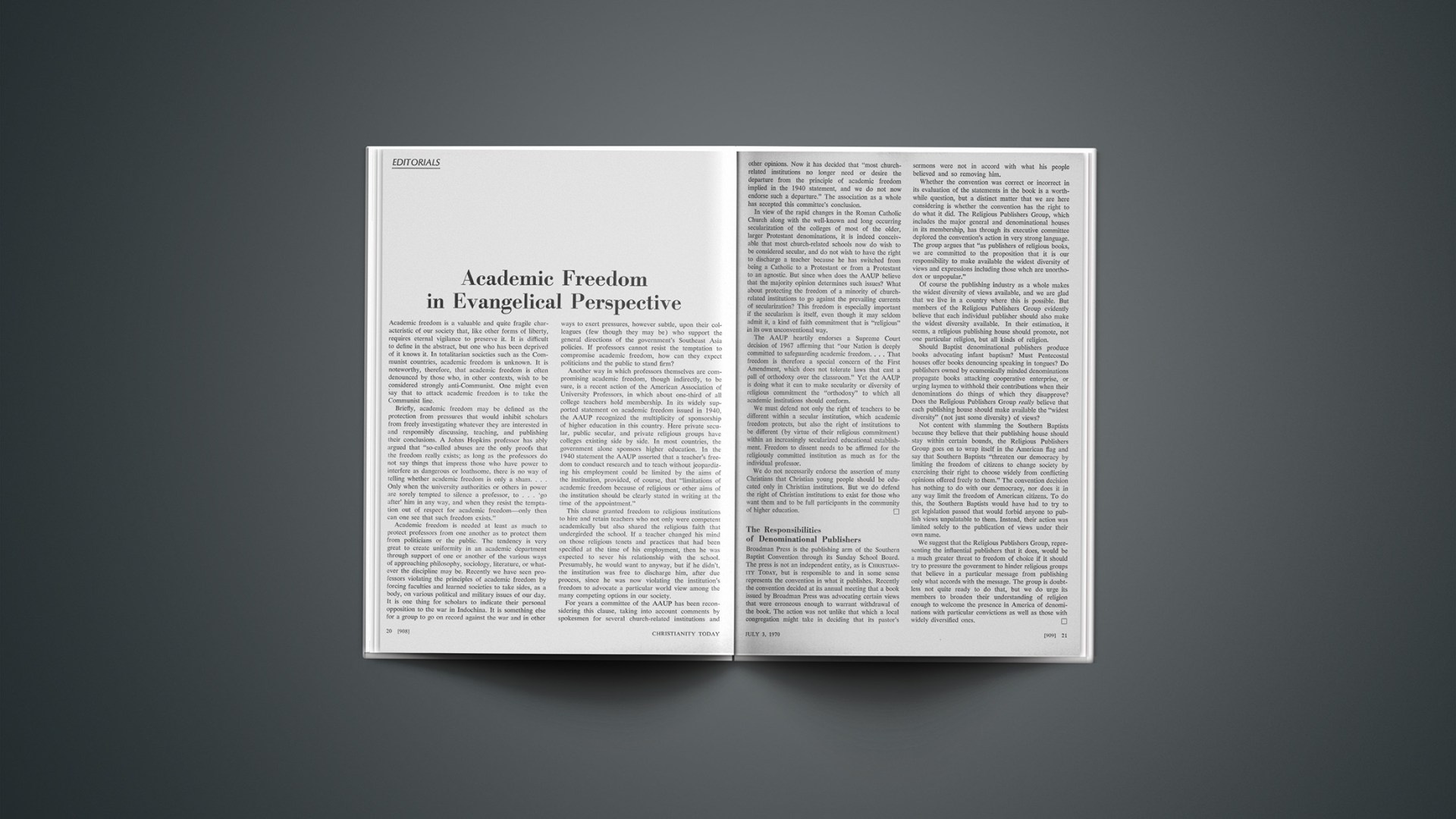
Academic freedom is a valuable and quite fragile characteristic of our society that, like other forms of liberty, requires eternal vigilance to preserve it. It is difficult to define in the abstract, but one who has been deprived of it knows it. In totalitarian societies such as the Communist countries, academic freedom is unknown. It is noteworthy, therefore, that academic freedom is often denounced by those who, in other contexts, wish to be considered strongly anti-Communist. One might even say that to attack academic freedom is to take the Communist line.

Briefly, academic freedom may be defined as the protection from pressures that would inhibit scholars from freely investigating whatever they are interested in and responsibly discussing, teaching, and publishing their conclusions. A Johns Hopkins professor has ably argued that “so-called abuses are the only proofs that the freedom really exists; as long as the professors do not say things that impress those who have power to interfere as dangerous or loathsome, there is no way of telling whether academic freedom is only a sham.… Only when the university authorities or others in power are sorely tempted to silence a professor, to … ‘go after’ him in any way, and when they resist the temptation out of respect for academic freedom—only then can one see that such freedom exists.”

Academic freedom is needed at least as much to protect professors from one another as to protect them from politicians or the public. The tendency is very great to create uniformity in an academic department through support of one or another of the various ways of approaching philosophy, sociology, literature, or whatever the discipline may be. Recently we have seen professors violating the principles of academic freedom by forcing faculties and learned societies to take sides, as a body, on various political and military issues of our day. It is one thing for scholars to indicate their personal opposition to the war in Indochina. It is something else for a group to go on record against the war and in other ways to exert pressures, however subtle, upon their colleagues (few though they may be) who support the general directions of the government’s Southeast Asia policies. If professors cannot resist the temptation to compromise academic freedom, how can they expect politicians and the public to stand firm?

Another way in which professors themselves are compromising academic freedom, though indirectly, to be sure, is a recent action of the American Association of University Professors, in which about one-third of all college teachers hold membership. In its widely supported statement on academic freedom issued in 1940, the AAUP recognized the multiplicity of sponsorship of higher education in this country. Here private secular, public secular, and private religious groups have colleges existing side by side. In most countries, the government alone sponsors higher education. In the 1940 statement the AAUP asserted that a teacher’s freedom to conduct research and to teach without jeopardizing his employment could be limited by the aims of the institution, provided, of course, that “limitations of academic freedom because of religious or other aims of the institution should be clearly stated in writing at the time of the appointment.”

This clause granted freedom to religious institutions to hire and retain teachers who not only were competent academically but also shared the religious faith that undergirded the school. If a teacher changed his mind on those religious tenets and practices that had been specified at the time of his employment, then he was expected to sever his relationship with the school. Presumably, he would want to anyway, but if he didn’t, the institution was free to discharge him, after due process, since he was now violating the institution’s freedom to advocate a particular world view among the many competing options in our society.

For years a committee of the AAUP has been reconsidering this clause, taking into account comments by spokesmen for several church-related institutions and other opinions. Now it has decided that “most church-related institutions no longer need or desire the departure from the principle of academic freedom implied in the 1940 statement, and we do not now endorse such a departure.” The association as a whole has accepted this committee’s conclusion.

In view of the rapid changes in the Roman Catholic Church along with the well-known and long occurring secularization of the colleges of most of the older, larger Protestant denominations, it is indeed conceivable that most church-related schools now do wish to be considered secular, and do not wish to have the right to discharge a teacher because he has switched from being a Catholic to a Protestant or from a Protestant to an agnostic. But since when does the AAUP believe that the majority opinion determines such issues? What about protecting the freedom of a minority of church-related institutions to go against the prevailing currents of secularization? This freedom is especially important if the secularism is itself, even though it may seldom admit it, a kind of faith commitment that is “religious” in its own unconventional way.

The AAUP heartily endorses a Supreme Court decision of 1967 affirming that “our Nation is deeply committed to safeguarding academic freedom.… That freedom is therefore a special concern of the First Amendment, which does not tolerate laws that cast a pall of orthodoxy over the classroom.” Yet the AAUP is doing what it can to make secularity or diversity of religious commitment the “orthodoxy” to which all academic institutions should conform.

We must defend not only the right of teachers to be different within a secular institution, which academic freedom protects, but also the right of institutions to be different (by virtue of their religious commitment) within an increasingly secularized educational establishment. Freedom to dissent needs to be affirmed for the religiously committed institution as much as for the individual professor.

We do not necessarily endorse the assertion of many Christians that Christian young people should be educated only in Christian institutions. But we do defend the right of Christian institutions to exist for those who want them and to be full participants in the community of higher education.

The Responsibilities Of Denominational Publishers

Broadman Press is the publishing arm of the Southern Baptist Convention through its Sunday School Board. The press is not an independent entity, as is CHRISTIANITY TODAY, but is responsible to and in some sense represents the convention in what it publishes. Recently the convention decided at its annual meeting that a book issued by Broadman Press was advocating certain views that were erroneous enough to warrant withdrawal of the book. The action was not unlike that which a local congregation might take in deciding that its pastor’s sermons were not in accord with what his people believed and so removing him.

Whether the convention was correct or incorrect in its evaluation of the statements in the book is a worthwhile question, but a distinct matter that we are here considering is whether the convention has the right to do what it did. The Religious Publishers Group, which includes the major general and denominational houses in its membership, has through its executive committee deplored the convention’s action in very strong language. The group argues that “as publishers of religious books, we are committed to the proposition that it is our responsibility to make available the widest diversity of views and expressions including those whch are unorthodox or unpopular.”

Of course the publishing industry as a whole makes the widest diversity of views available, and we are glad that we live in a country where this is possible. But members of the Religious Publishers Group evidently believe that each individual publisher should also make the widest diversity available. In their estimation, it seems, a religious publishing house should promote, not one particular religion, but all kinds of religion.

Should Baptist denominational publishers produce books advocating infant baptism? Must Pentecostal houses offer books denouncing speaking in tongues? Do publishers owned by ecumenically minded denominations propagate books attacking cooperative enterprise, or urging laymen to withhold their contributions when their denominations do things of which they disapprove? Does the Religious Publishers Group really believe that each publishing house should make available the “widest diversity” (not just some diversity) of views?

Not content with slamming the Southern Baptists because they believe that their publishing house should stay within certain bounds, the Religious Publishers Group goes on to wrap itself in the American flag and say that Southern Baptists “threaten our democracy by limiting the freedom of citizens to change society by exercising their right to choose widely from conflicting opinions offered freely to them.” The convention decision has nothing to do with our democracy, nor does it in any way limit the freedom of American citizens. To do this, the Southern Baptists would have had to try to get legislation passed that would forbid anyone to publish views unpalatable to them. Instead, their action was limited solely to the publication of views under their own name.

We suggest that the Religious Publishers Group, representing the influential publishers that it does, would be a much greater threat to freedom of choice if it should try to pressure the government to hinder religious groups that believe in a particular message from publishing only what accords with the message. The group is doubtless not quite ready to do that, but we do urge its members to broaden their understanding of religion enough to welcome the presence in America of denominations with particular convictions as well as those with widely diversified ones.

Sweet Genes

Contrary to Mother Goose, genes—not sugar or snails—determine the characteristics of little girls and little boys, and of their parents as well. Now science has a newborn ability to make genes and, theoretically, to determine those characteristics.

Dr. Har Gobind Khorana, the University of Wisconsin chemist who succeeded in synthesizing the gene, recognizes that ahead of that infant ability lie both salutary and sinister possibilities. Manmade genes may cure or prevent genetic diseases like diabetes and viral diseases like cancer, and many forms of mental retardation, but “in the long distance future,” he believes, they may also provide the means for “genetic planning of individuals, tailoring people to fit patterns.”

The potentially dangerous maturity of genetic research is only the latest topic in a long ethical discussion (see April 10 issue, page 50). Like other scientific achievements, it requires ethical reflection not only among scientists and doctors but also among writers and speakers tempted to over-sensationalize successes and among politicians tempted to tyrannize nations through legal guidelines they establish. And perhaps Christians who have long shunned science should stop trembling at the prospects and become well enough informed to join the discussion—or even become scientists. Christians can offer a unique contribution to what future little girls and little boys are made of.

Frank C. Laubach

“The ability to read is the key to the doors of the world, and through them, to a world of understanding, instead of fear, hate, and superstition,” Frank C. Laubach once said. Last month, the man who handed that key to millions of illiterates died at the age of eighty-five in Syracuse, New York.

Frank Laubach’s fight against illiteracy began with his missionary zeal for the savage Moros, Muslim tribesmen on Mindanao Island in the Philippines. By learning their dialect, reducing it to writing, and teaching the Moros to read, the Congregational minister succeeded in breaking through their hostility and winning their attention to the Gospel. Falling financial support during the depression threatened to end the popular literacy classes—until a Moro sultan warned that everyone who knew how to read had to teach someone else or face death. “Teach or be killed” was not an appealing slogan to Laubach, but the concept of “Each One Teach One” was. By that means, Laubach’s methods have reached perhaps 100 million people around the world.

Laubach never considered his work finished, though he traveled to some 100 countries to develop, in more than 300 languages and dialects, word-syllable charts that are still being used by scores of secular as well as religious organizations. “I haven’t even kept up with the birth rate,” he lamented, “and besides, about 20 million or more who’ve learned to read have lapsed back into illiteracy for lack of reading materials.”

Frank Laubach’s goal was to dispel illiteracy so that the light of the Gospel could illuminate hearts. His literacy campaign proved to be a key not only “to the doors of the world” for illiterates but also to the doors of hearts for the Christian message. The key is still in those doors.

Henry Cabot Lodge Goes To The Vatican

The principle of separation of church and state has served our country well, and we fail to see that principle upheld in President Nixon’s appointment of Henry Cabot Lodge as personal representative to the Vatican.

There is nothing Mr. Lodge can do in an official capacity that could not be done in an unofficial way. This decision grants to the State of Vatican City a quasi-ambassador, a defacto ambassadorship. It offends millions of Americans who have strongly opposed an official or quasi-official representative to the papal see. Many Roman Catholics, including former president John F. Kennedy, have concurred that any such appointment would be contrary to historic practice and tradition and would only serve to divide the citizenry. Moreover, ambassadors are not appointed to churches, and the State of Vatican City with 108.7 acres of land and little more than a thousand inhabitants can hardly be used to justify a claim to statehood and sovereignty.

If the World Council of Churches sets up a hundred-acre sovereignty in Bossey, Switzerland, will the President make a similar appointment?

Mr. Nixon has been ill advised in taking this step, and any ostensible or temporary gain will be more than offset by the disappointment and antagonism the appointment will engender. It is an action that will help neither the United States of America nor the Roman Catholic Church, and he ought to reverse it quickly.

Who Cries For These?

One of the most tragic but least known aspects of the war in Viet Nam is the suffering inflicted upon Christian workers there.

On March 8 of this year, one of the country’s leading Protestant pastors was murdered. He had preached in his own church in the Central Highlands that Sunday morning and was on his way to another service when he was overtaken by five armed men clad in black Viet Cong garb. He was killed on the spot, leaving his pregnant wife and eight children.

Three weeks later, in an attack on a military school at Dalat, seventeen chaplains were killed, including three young Protestants. One of the Protestant chaplains also left eight children and his wife. Another left a wife, a daughter, and a month-old son. The third was survived by three children—his wife and an unborn child had been killed by a rocket a year before.

Prolonged anguish has been the lot of the families of men and women held captive by the Viet Cong and the North Vietnamese. Three American missionaries were seized at a leprosarium near Ban Me Thuot on May 30, 1962 (before the American military buildup began). One of the three was a young man who does not believe in war; he worked at the leprosarium as an alternative to military service. Two other missionaries were taken prisoner in 1968. Communist authorities have ignored repeated requests made through neutral countries and international organizations for information about the captives. More than eight years have gone by without so much as a word of acknowledgment that the missionaries are still alive.

If such cruelties are committed in the face of American military might, what can be expected when forces of restraint are withdrawn and the brutal aggressors are left to their own devices? To compound our distress we have but to think of world opinion with its seemingly increasing insensitivity toward this kind of evil—unless it is perpetrated by “American imperialists.”

Seasonal Catechism

Johnny may not get his usual summer vacation from public school next year. Some 600 school districts around the country are said to be considering year-round classes.

Parents may panic at this news. So may pastors, when they think about the future of Vacation Bible School programs under the revised calendar. Millions of children are reached with the Gospel through VBS each year who otherwise would never be evangelized.

Actually, however, the extended school year may provide new opportunities for alert churches. All school districts must make provisions for vacation time, and many probably will do this by scheduling three or four breaks during the year, each of one or two weeks’ duration. Some may shorten school days. Christian-education directors in local churches need to gear up for this possibility by exploring new church-oriented educational experiences for children on short-term bases. These could add up to better access to the minds of children than the churches now have.

Ballplayers As Communicators

Boys will be boys, Jim Bouton seems to be saying, even when they become professional baseball players. In his new book, Ball Four, the Houston Astros pitcher discloses that a number of our major-league heroes are something less than saints off the field. If the book serves to embarrass at least some of them out of their bent for mischief, it will have performed a service to baseball. The trouble is that the reader gets the feeling Bouton isn’t knocking it, just exposing it.

A much sounder antidote for evil is offered on a regular basis by relief pitcher Lindy McDaniel of the New York Yankees, whose earned-run average has been the best in the American League this year (1.14 after thirty-nine innings). This devout Christian writes a monthly paper called Pitching for the Master. His home congregation, a Church of Christ in Baytown, Texas, sends it free of charge to about 4,500 persons, including all major-league baseball players. Its evangelistic impact reaches far and wide and stands as a tribute to McDaniel’s Christian initiative.

Did You Call Me A Liar?

Nobody likes to be called a liar. And it is especially risky to call a man a liar when he’s talking about his religious beliefs. After all, how can anyone know what is in the heart of another man? Yet John in his first epistle four times refers to certain kinds of professing Christians as “liars” (he uses the word twice and twice it is clearly implied). Although he avoids pinning this label on anyone in particular, in effect he is saying to every Christian, “If the shoe fits, wear it.”

The first liar is the man who says he has fellowship with God but continues to “walk in darkness” (1:6). The Gnostics in John’s day claimed that their spiritual knowledge of God had no bearing upon their behavior. John says to them and to us that no matter how vehemently a man may profess to be in a right relationship with God, his words are a lie if his life does not reflect the light of God’s moral character.

The second liar is the man who claims to “have no sin” (v. 8—that is, denies his own state of depravity and seeks to escape the moral responsibility for his acts) or who says he “has not sinned” (v.10—that is, denies committing sinful acts). The Christian tries to avoid sin, but when he does sin he becomes a “stranger to the truth” (NEB) if he denies that he has sinned or refuses to take responsibility for it. It is foolish for the follower of Christ to become a living lie, pretending to be something he is not. He must call sin by its name and confess it for what it is; then he will experience the blessing of God’s forgiveness (1:9).

The third liar is the man who says “I know God” but refuses to keep his commandments (2:4). Here John moves from the more general “walking in the light,” which includes more than obedience to certain precepts, to the specific responsibility to obey the commandments God has given. Obedience to God’s moral law is not optional; the professing Christian who lives in an attitude of continuing and deliberate violation of God’s moral commands is lying when he says “I know God.”

The fourth liar is the man who says “I am in the light” but does not show love for his brother in Christ. This man is not in the light at all; he is “still in complete darkness” (2:9, Phillips). Having spoken of the necessity of obeying God’s commandments, John now focuses on the greatest commandment of all—and perhaps the one most often overlooked by many evangelicals. A man’s doctrine may be pure and he may consistently avoid conduct he feels to be “evil.” But if he does not show toward his Christian brother the active, self-giving kind of love that finds its source in Jesus Christ, he remains in darkness despite his pious words and acts.

John, did you call me a liar?

As for You

The apostle Paul outlined for Timothy some traits that would characterize men “in the last days” and warned that, because of such men, those days would be a time of stress and peril. Men would be “lovers of self, lovers of money, proud, arrogant, abusive, disobedient to their parents, ungrateful, unholy, inhuman, implacable, slanderers, profligates, fierce, haters of good, treacherous, reckless, swollen with conceit, lovers of pleasure rather than lovers of God, holding the form of religion but denying the power of it” (2 Tim. 3:1–5).

No one can say whether we are living in the last days or not. But this we know: Paul’s description is a graphic picture of men who are making the headlines today.

In light of conditions that existed when Paul wrote to Timothy—conditions that, though they repeat themselves in every generation, seem unusually prevalent today—it is interesting and instructive to see what Paul’s advice to Timothy was. He did not tell Timothy to go and hide. Nor did he tell him to become “involved” with these people. First of all Paul said, “Avoid such people.” This was not to be a sanctimonious separation from needy sinners but a recognition of the fact that there are men who are totally dedicated to evil and that reaching them with the Gospel is a matter of sticking to one’s calling and to the source of one’s message.

Paul told Timothy the going would be rough, involving persecution for Christ’s sake: “Indeed all who desire to live a godly life in Christ Jesus will be persecuted” (v. 12).

He told him things would get worse: “Evil men and impostors will go on from bad to worse, deceivers and deceived” (v. 13).

Then, despite the catalogue of evil and the men who devote themselves to its accomplishment, despite the fact that this meant persecution, and despite the fact that things were going to get worse, not better, Paul told Timothy not to be discouraged. Prefacing his counsel with the words “But as for you …,” he reminded Timothy that he had been called to preach and teach the Gospel and had been trained in the Scriptures. The situation was bad, but Timothy had in his hands the one and only solution, and it was his job to proclaim that his own salvation and that of all men, including those perpetrators of evil about whom Paul had warned him, rested solely in the Christ revealed in the Scriptures.

Centuries before, when David was confronted by the seeming triumph of the wicked, he wrote, by the Holy Spirit, Psalm 37. (Let me suggest that you read this psalm in conjunction with Second Timothy 3.) Although evil men seemed to be triumphing, David wrote: “Fret not yourself because of the wicked.” “Trust in the Lord and do good.” “Take delight in the Lord.” “Commit your way to the Lord, trust in him, and he will act.” “Be still before the Lord, and wait patiently for him.” “Refrain from anger, and forsake wrath!” “Depart from evil and do good.” “Wait for the Lord, and keep to his way.”

The overwhelming impression is one of confidence in the omniscience, omnipotence, and sovereignty of God. Nothing can do as much to enable us to see the world of our own time in its proper perspective. The evil all about us has not taken God by surprise, nor can it thwart his holy purposes and ultimate judgment.

What then? Paul’s “But as for you …” applies to us today. As for you and me who name the name of Christ, there is a work to do, a witness to be borne, and an infallible source of reference from which we are to take our directions.

“As for you, continue in what you have learned and have firmly believed” (2 Tim. 3:14). There is much experimenting today. There are those who have never believed in the whole Gospel of Jesus Christ or, having once believed, have now departed from it, and as a consequence we find much experimentation in areas where men have no right to experiment. I am not talking about new methods of presenting the Gospel nor of “new forms of worship,” though one must be sure these are firmly rooted in the Gospel itself. The “experimenting” to which so many of us object is actually a tampering with the message (“that Christ died for our sins in accordance with the scriptures, that he was buried, that he was raised on the third day in accordance with the scriptures”—1 Cor. 15:3, 4). It is not “experimenting” when the nature of sin is denied, or when Christ’s atonement for sin on the cross is blurred, or when the fact of his resurrection from the dead is explained away. This is surely not “experimenting” but rank denial.

Paul said to Timothy, “You stick to the Gospel which you have been taught and which you believe.” Then he went on to tell this young man, physically weak and beset by fears, “You have a job to do; it is to preach the Christ found in the Scriptures. Furthermore, all Scripture is inspired by God, and because it is, you stick with it regardless of those who appear to be religious but deny its power, despite the smart ones who, in their earthly wisdom, are constantly learning something new but never coming to a knowledge of the truth.”

Paul had unassailable reasons for his instructions to Timothy. He knew that evil men were like a ship without rudder, compass, or chart. Paul knew that men need teaching, reproof, correction, and instruction in righteousness, and that all these are to be found in the Word of God. He also knew that through this grounding in the Scriptures “men of God become complete, equipped for every good work” (v. 17).

In our day we ignore this counsel at our own peril. If we follow it, God will use us for his glory and for the advancement of his Kingdom.

We are inclined at times to think that our age of space achievement and scientific advance is so far removed from the realities of the first century that we have entirely new problems today, but they are basically the same old problems that have plagued man from the beginning of time. They arise, as Jesus said, from inside the human heart, from which proceed “evil thoughts, murder, adultery, fornication, theft, false witness, slander. These are what defile a man” (Matt. 15:19, 20a).

The dismal picture of unregenerate man painted by Paul remains an accurate description in each succeeding generation. And the results of man’s degradation have never been more in evidence than today. For the individual Christian we hear these words, “And as for you”: Preach the word, and live according to that word. Remember the source and power of the preached word. Reject the arm of flesh and trust in the power of the Holy Spirit, and in prayer!

Individual Christians and the Church must recapture the passion and vision of those who went out against the odds of the first century. They must gather anew a band of men and women who believe in the transcendent power of the crucified and risen Saviour and who take as their chart and compass his Word, being assured in their hearts that he who has promised is able to perform what he promised.

“As for you,” Paul would say today, believe, obey, and leave the rest in God’s hands!

L. NELSON BELL

Eutychus and His Kin: July 3, 1970

What Makes You Say That?

G. K. Chesterton liked to tell how one of his grandfather’s friends used to go for walks on Sunday carrying a prayer book, without the slightest intention of going to church. He calmly defended the practice by saying with uplifted hand: “I do it, Chessie, as an example to others.” Some of us refrain from doing things pour décourager les autres, or so as not to offend the weaker brethren (perhaps an indication that we don’t want to do them all that badly).

The Chestertonian anecdote came to mind recently when a lady in the next county had an interesting experience. While in her local town one day she thought she recognized a man who was carrying a banner with the words, “REPENT, FOR THE END IS NIGH.” On her way home she was finally able to identify him as the one who some weeks before had taken her cottage on a seven-year lease.

That man may have been the soul of sincerity, but in any case such vague and laconic warnings tend to stir risible reaction in me. This particular inscription for some reason brings recollection of a vivid passage in The Wind in the Willows, a piece of spiritual uplift I read periodically for my soul’s good. “The Badger strode heavily into the room, and stood looking at the two animals with an expression full of seriousness.… ‘The hour has come!’ said the Badger at last with great solemnity. ‘What hour?’ asked the Rat uneasily, glancing at the clock on the mantelpiece.”

Strangely enough, more precision on the subject has come from a source not normally given to sounding strong eschatological notes. A WCC committee report at Uppsala stated: “More and more scientists … are warning that technology’s second revolution may turn out to be its last, that human life as we know it may very soon become impossible, and that homo sapiens may be rushing headlong to its own extinction.” Quoting the above, a recent release from Ecumenical Press Service adds the comment: “Suddenly, the New Testament’s warnings about the end of the world being at hand sound incredibly relevant.”

For those who think there is never anything new out of Geneva, this is worth a ponder or two, particularly when it is remembered that “incredible” means surpassing belief. Just as incredible is the surprise expressed that the New Testament might be on to something after all (we are grateful to the scientists for putting the idea into their heads). Nonetheless, the very lack of sophistication in that utterance suggests that someone in Geneva has the root of the matter in him.

EUTYCHUS IV

Speaking For Youth

David R. Knighton’s “A Student’s Open Letter to God” (June 5) is magnificent!! He has put into words what scores of disenchanted young people feel today. Our young people want to get involved, but for reasons he states, they really can’t in the Church the way it is. Paul’s prayer for the church in Colossæ ought to be our prayer for the Church today: “We are asking God that you may see things as it were from His point of view by being given spiritual insight and understanding” (Col. 1:9, Phillips).

MERLIN EGLAND

Youth Director

Evangelical Free Church

Felton, Calif.

Seeds Of Activism

David Bryant’s analysis (June 5) of the conditions leading to the slaying of the Kent-4 has not penetrated deeply enough into present realities.… It is true that permissiveness in the home is a determining factor in preparing students to be activists in politics on and off campus.… It is true that many activists are motivated by a shallow humanism, shallow because it is not predicated upon the God of Scripture. But even that shallow humanism is more sensitive and compassionate than that of Christians who do not demand a frontal attack upon the immorality of our government and society.… And as to the work of Satan—it is not clear who was on his side in the Kent situation. But the senselessness of the deaths gives a rather strong hint that the diabolical forces at work were those which have created a social climate in which young guardsmen can get the idea that an indiscriminate fusillade into a group of students will receive approval.

Finally, it is true that in the wind of the Spirit we have a force that the campus needs. But it, alone, is not enough, and praying for students away at school is not enough support for those of us who spend our lives on campus. You see, the whirlwind we are reaping came from sowing the wind of a violence-prone and racist history, of law and order without justice, of selfish economic acquisitiveness.

PAUL D. STEEVES

Lawrence, Kan.

Embryo Welfare

Dr. John Warwick Montgomery’s “capsule scriptural survey” on abortion quoted in your recent editorial “The War on the Womb” (June 5) not only includes a questionable inductive definition of the Greek term brephos but conveniently ignores Exodus 21:22, 23, which shows that God’s law is primarily concerned with the welfare of pregnant women rather than embryos, the latter being treated in the same manner as property.

DOUGLAS K. STUART

Associate College Minister

Park Street Church

Boston, Mass.

As the mother of seven children, four of whom are adopted, I am made to reflect that all of them were at one time “nonviable fetuses.” I admit this is hard to believe when I view (and cope with) their energy and zest for life.…

The question keeps reverberating in my mind. If the over-population prophets of doom are successful in their campaign to influence couples to limit the number of natural-born children and adopt, who is going to produce these adoptable babies? After all, we are legalizing abortion so that unwed mothers can be spared the pain of pregnancy.…

I like mothering. In fact, I deem it the most fascinating as well as the most contributive of careers. Isn’t it a shame that motherhood is being phased out?

LAYNE BALDRIDGE

Lubbock, Tex.

Splashback

CHRISTIANITY TODAY is an appreciated and significant source and interpreter of events, activities, and movements related to the Christian enterprise in our day. Usually it can be trusted to report with dignity and respect, and to stand on issues with forthrightness and fairness.

But when Mr. James Adams, reporting on the controversy on baptism in the American Baptist Convention (June 5), refers to it as a “water fight,” he has stooped to a smart-aleck vocabulary that is better left to Time and Newsweek.

BURRIS BUTLER

Vice President and Publisher

Standard Publishing

Cincinnati, Ohio

A Heartful Hit

My thanks to Sherwood E. Wirt for “Moving Upon the Mass Media” (May 22). He said a heartful …

The slant of the average religious publication seems to be, “God’s in his heaven, all’s right with the world,” and we know that’s only a half-truth. Or, “Pie in the sky in the sweet bye and bye,” when many of our youth and adults live in the immediacy of the moment. Such writing can produce a type of cut-rate Christianity and a search for bargain-basement salvation. They just don’t exist. Mr. Wirt scores a direct hit on that type of journalism.

JAMES JACKSON

Hilton Head Island, S. C.

“Moving Upon the Mass Media” is overfull of lofty but blind idealism.…

Much communications research indicates that the mass media have little effect on most readers and hearers. What we need, therefore, is not blind idealism but a realistic strategy based on a hard examination of the facts. No advertiser sinks time and money into the media without first examining what effect his effort will have. Nor should we. The printed page is not magic.

MARK W. OLSON

St. Paul, Minn.

This provocative article must have caused thousands to think and think again. It seems as if with prophetic accuracy Editor Wirt has touched a chord that should resound today: “There is no limit to the outreach, influence, or effectiveness of the Christion journalist.…” And would not Christ, if he were here today, have sent his messengers along the same highways thronged with the masses of humanity?

H. L. RASMUSSEN

College Place, Wash.

Best of all, Wirt issued a ringing challenge to all those in the Church to rise and shine.

DONALD F. HAYNES

Glendale, Calif.

May it move the media and have mass exposure.

DON CARPENTER

Trinity Church

Frankfort, Ind.

Answers For Students

My thanks to Barry M. Kelley for his timely answers for the poor, disillusioned Jesus-creators who seem to abound in my generation. Young people who serve the Lord Jesus Christ need these kinds of answers to pass along as words in season to some of the sincere young “individuals” we meet.

CATHY SCHISLER

Long Beach, Calif.

How did that piece get past the editor’s scissors?…

Mr. Kelley seems not to be aware that the civil institutions, political structures, and social customs were identical with religious institutions, religious structures, and religious customs in Jesus’ day and that the Bible knows nothing of a separation of life into “secular” and “sacred” categories.

If Jesus kept the law to the letter, then Mr. Kelley needs to explain why he got into so much trouble over not keeping it.…

Jesus a conformist? Wow!

It is interesting that the apostles who spread the Gospel without instigating marches or fomenting strife should have been the ones of whom it was said, “They that have turned the world upside down, have come hither also.”

When Christian individuality doesn’t work to destroy such American institutions as “racism,” then it is time to find a more authentically biblical motif.

JAMES B. GODWIN

Aldersgate United Methodist Church Durham, N. C.

I must take exception to Barry M. Kelley’s article as too one-sided in its appraisal of Jesus in his own culture. The question as to whether Jesus wore his hair long as a symbolic gesture of non-conformity is a moot one, especially since we have no earthly idea as to whether Jesus’ hair was long or not. But it is surely obvious that Jesus performed certain acts which were at variance with the customs and laws of his locale, and that these were remembered by the early Church as at least non-conformist in nature. Among the examples could be cited Jesus’ table-fellowship with tax-collectors and sinners, his non-conformist way of observing the Sabbath, and his disruptive activity in the Temple. Nor is it beside the point to remember that Rome chose to execute him.

The problem is that when revolutionary movements succeed, the heirs of that movement in later generations can no longer recognize the revolutionary character of the original actions. In this case, Christians—very understandably—agree with the rightness of the actions of Jesus. Christians support (theoretically, at least) eating with tax-collectors and sinners, doing good works on the Sabbath, and chasing money-changers out of the Temple. But in Jesus’ day these acts were clearly non-conformist if not also disruptive in character. And prior to the Emperor Constantine, the opponents of the Christian movement were quick to recognize this.

ROY BOWEN WARD

Editor

Mission

Oxford, Ohio

Christ was definitely a revolutionary. But could you imagine him leading a protest march against Rome’s invasion of Britain, or even her occupation of Palestine?… Christ’s kingdom “is not of this world”.…

And personally, I seriously question the quoted statement of Joe Namath that Jesus “wore long hair and a beard.” The beard, probably; the long hair very doubtful. “Doth not even nature itself teach you, that, if a man have long hair, it is a shame unto him?” (1 Cor. 11:14). Paul and Jesus were contemporary. If the above statement was true in Paul’s day, I seriously doubt that Jesus wore his hair long, notwithstanding the fact that many artists (who never saw Jesus) so depict him.

HAROLD FOX

Malta, Mont.

Fire Power For Israel

I am a little alarmed at your editorial “Cambodia and Israel” (May 22). It is not clear whether you are advocating U. S. intervention in Cambodia, Israel, or both.

What is clear is that you are worried about the fate of Israel if we don’t help them militarily.…

From the divine viewpoint, however, I think we have little to worry about. It seems clear from prophecy (Ezekiel 38 and 39, for instance) that any military power attempting to overcome Israel is in for it from God.…

World powers beware! To pick a fight with Israel is to pick a fight with God, and his firepower is awesome.

LEW FLAGG

Chicago, Ill.

One can understand a position that rejects all modern wars as immoral. One can also understand those who believe that Communism must be resisted—terrible as the cost may prove to be. Neither of these groups, however, seems to represent the thinking of those who help form public opinion. It should be apparent that those voices generally referred to as liberal have done more than any other group in this nation during the last few years to sabotage this nation’s efforts to fight Communism in the Far East. It is difficult to escape the conclusion that this group, traditionally blind in the left eye, sees Communism as a danger only where Israel is involved. Soon, I rather expect, they will have American youth blithely sporting both peace symbols and Moshe Dayan eye patches.…

We do not serve our country when we close our eyes to this strange species that can transmute from dove into hawk as it suits them.

WALTER WITTEMANN

Carmel, N. Y.

I was deeply disturbed by the last paragraph and in particular the last sentence.… Did Mr. Nixon address himself to … God or did he not? Can we judge?

AGNES C. VANDER HART

Pella, Iowa

Living Encouragement

I was greatly encouraged by the report “Evangelical Students: Alive and Well” (May 22). The statement of faith adopted by the Evangelical Student Congress is inspiring. These students commit themselves unequivocally to Jesus Christ and his Word; they recognize the Scriptures as “the unique divinely inspired and authoritative revelation of God to man”; and then they see that this means Christians must be “responsible for a Christ-centered, social, and totally integrated application of the Gospel of Christ.” This is an encouragement to an organization such as the Christian Labour Association of Canada.

WM. PETER DALE

Representative

Christian Labour Association of Canada

Rexdale, Ont.

Ages Replaced

Please be advised that “United Church Observer: No Trees for Forrest” (News, May 22) inaccurately reports that Dr. Arnold Ages is a member of the Classics Department of Waterloo Lutheran University.

Dr. Ages is not at present, nor has he been in the past ten years, a member of the faculty of Waterloo Lutheran University.

H. K. BRADEN

Director of Placement

Waterloo Lutheran University

Waterloo, Ont.

He is rather the professor of classics at Waterloo University. I have no excuse in making that error, and can only blame it on a defective typewriter! Terribly sorry about it. LESLIE K. TARR Central Baptist Seminary Toronto, Ont.

Immersing Episcopalians

My good Baptist heart was warmed to hear of the installation of an immersion tank at Holy Cross Episcopal Church in Castaner, Puerto Rico (World Scene, May 22). The claim that this is a first must, however, be disallowed in favor of the Anglican Cathedral in Melbourne, Australia. I can still vividly recall the enthusiasm with which I was shown this spacious marble pool set in the floor when I admitted being a Baptist. At this time (1966), the baptistry had already long been a fixture; its installation being ascribed to “a former bishop who strongly believed in immersion.”

ROBERT V. ANDERSON

Washington, D. C.

In Rappahannock County, Virginia, we attended a convocation meeting at the Plains. A pool had been installed there in Grace Church before 1922.…

There is also a pool in St. Andrews, Richmond, Virginia, that is used frequently.

(The Rev.) FRANK COX

Ocean City, N. J.

One was installed in 1905 (made of marble) in the Collegiate Church of St. George the Martyr in Jerusalem, Israel.

ALAN A. SNOW

Beverly Hills, Calif.

The Crucial Issue in Bible Translation

Why the flurry of Bible translation in recent years? As Amos said long ago, “Does a lion roar in the forest when there is no prey for him?” Gradually the Christian public became aware of a cause-and-effect relation: The Bible just wasn’t being read, and one of the main reasons for this neglect was that to hosts of readers it failed to communicate. Its vocabulary was a mixture of archaisms and what many thought of as jargon. Its syntax was poor, judged by modern standards. Many of its figures of speech were lost on the modern reader. Its idioms were those of a past age. It did not attract. Much of it was not understood.

So the crusade started, and the Revised Standard Version appeared. Unprecedented sales promotion helped to make it a publishing success from the start. It met some of the problems, at least partially. But it was still the King James Version in modern dress. Like the King James, it remained within the stylistic tradition of the 1534 Tyndale New Testament. It was, as it professed to be, only a revision. Its score on communication was up 10 per cent, 20 per cent, or more above the King James, but the score was still far too low.

Evangelicals criticized the RSV on other grounds but failed to mention the communication problem. The observation on this point made by William A. Smalley in the October, 1965, issue of the Bible Translator probably came as a surprise to those who read it, but the sample evidence he cited was convincing. Smalley quoted Second Corinthians 6:11–13 as found in the RSV, the Authorized Version (King James), the New English Bible, and the Phillips translation, and then said about the first two: “It seems incredible that anyone would want to return to these versions after using Phillips and the NEB, except for those who know the language of the AV better than they know the contemporary language around them.”

Smalley was right. The RSV was not a translation to end all translations. It was only a beginning. Phillips, the New English Bible, the revised Scofield Bible, the New American Standard New Testament, the Beck and Williams translations, the Today’s English Version, Taylor’s Bible paraphrases, and the forthcoming The Holy Bible: A Contemporary Translation (ACT) have all been efforts to fill the need for a Scripture translation that communicates.

Christians are going to have to make up their minds. Most of them were reared on Scripture as expressed in Tyndale or modified Tyndale language. They memorized verses from the Authorized Version. Four centuries of religious and theological literature employed AV words and phrases, as did four centuries of English hymnody. Christians used Tyndale modes of expression when they prayed. Their Bible concordances and dictionaries reflected the same tradition. Large numbers are still well satisfied with the familiar vocabulary and style of expression. So why should they switch to a modern version of the Bible?

What the choice boils down to is whether to hold on to something that gives personal satisfaction or to look outside self to the need of the Church and the world. The Christian who is willing to adopt this broader perspective soon sees just where the issue lies.

An increasingly great proportion of our population is made up of youth. And youth’s rebellion against “the establishment” extends to the Bible in archaic language. Many children from evangelical homes share this attitude. It may not show up until the child is away at school or out on his own, but when it does appear, it is often accompanied by a repudiation of almost everything the Church stands for. How the hearts of Christian parents bleed when they see this happen.

It would be unfair to charge this unfortunate situation solely to the use of a Bible in outmoded language, but it would also be unrealistic to affirm that the use of such a Bible is unrelated to the conclusion on the part of our youth that Christianity is irrelevant in our day.

A recent experiment in a suburban high school near Boston showed that almost no one in the group tested read the Bible regularly, though some attended church faithfully each week. When these students were asked to read portions of the new ACT version (not yet published), these were some of the responses recorded:

“This is not as hard to read as the Bible.”

“I thought this new translation was very good. I understand all of it. I find it much more interesting and faster than the regular Bible. More on my level of understanding.”

“I think that this is very good and I like it. It is easy to understand, yet it doesn’t seem childish. I think that many others older and younger will enjoy this. It keeps you in a steady pace instead of always stopping to figure out.”

“I think this is much easier to read and understand. You get a lot more out of it than you get out of the Bible.”

It is almost a foregone conclusion that unless Christian families and churches use the Scriptures in modern English form, more and more of our young people are going to be strangers to the Gospel. This just must not happen! And if the mature Christian is at all concerned, he will get his head out of the sand, face the issue, and decide to do everything he can to encourage the children and young people in our churches to read God’s Word, understand it, like it, and come to know Jesus Christ as Lord and Saviour through its message.

Furthermore, the Christian is under orders from his Lord to evangelize beyond the borders of the Church, and here the problem becomes even more acute. Here the claim of lack of relevance is an open one. The unchurched are “turned off” when they hear what they regard as jargon. They want nothing to do with religious documents that are obviously archaic.

A missionary in the Philippines recently wrote: “It bothers me when I realize how many Filipinos buy the KJV. It is a problem enough for them to be learning common English and then to have to wade through three-century-old English! However, they buy the KJV because there are so many different sizes and bindings to choose from and some are quite cheap.” They need the advice that Billy Graham and other discerning evangelists give to converts: “Get a copy of the New Testament in modern English.”

If we hope to introduce men to the Gospel through the printed page of Scripture, we must be sure that page is written in the language men speak and understand, the language of our day. The translation we use must of course be faithful to the original and have other values, such as good style; yet these values are not enough if it does not also have that of being clearly understandable. The question is not “What do I prefer?” but “How can we reach people for Christ?”

If you care about the youth of the Church and men who are unchurched and strangers to the way of salvation, you will cast your vote for a translation that will communicate. Your decision will help to determine how the Church of Jesus Christ fares in the critical days ahead.

Two Hundred Years of Australia

In April, 1770, Captain James Cook in his ship Endeavour made the first known sighting by a European of the eastern coast of Australia. In August, after sailing northward up the coast, he hoisted the English colors on Possession Island and formally took possession of the entire land, naming it New South Wales.

The continent was not completely unknown before that date. Dutch sailors and others had sighted parts of the coastline and even made landings. But for the most part they had seen the barren and inhospitable northwest. On the east coast Cook found a new and different land.

Little was done about his discovery immediately. But after the British had their misunderstanding with the American colonists, things began to happen in the south. The British had been in the habit of shipping their convicts to America, and when this convenient solution to their penal problem was no longer open to them, the gentlemen of England bethought themselves of the great southern continent. And so when the first fleet sailed for Australia, it was not carrying a group of idealists filled with the spirit of free enterprise and anxious to establish a new nation. Instead it was filled with a collection of convicts, together with their guards and the paraphernalia of government.

One wit has said that Australia’s first settlers were selected by the finest judges in England. His remark reminds us of their legal standing as convicts, but we should remember that this does not mean they were all desperate criminals, or even men of low moral standards. Those were the days when a hungry man who stole a loaf of bread might get seven years in jail. Many of the convicts were hardened criminals, but many others were not.

At the very least, however, they were all in some sense rebels against authority. They had refused to accept the standards laid down for them by English society. And as a group they could not be expected to be profoundly religious. Religion was part of the code of a society that they had rejected. Undoubtedly some among them had a very real religious faith. But most had little time for religion. When they had served their sentence and were released, they were not likely to build up a strong church life in the free community they formed.

Soon, however, free settlers arrived in Australia, and before very long they far outnumbered the convicts. Many of them were churchmen, and they strengthened the religious forces of the new land, though not necessarily in the old ways. The reason they had left their motherland was that they were not content with the old ways. They wanted to make a new start in new surroundings, and so they helped to develop independence of outlook.

Right from the beginning religious observances were carried out in the colony. The first fleet had a chaplain among its passengers, and when it arrived safely after the long voyage he preached the first sermon in Australia from the text, “What shall I render unto the Lord for all his benefits toward me?” But the Reverend Richard Johnson did not receive much support. The instructions given to the governor by the British government included this: “And it is further our Royal Will and Pleasure that you do by all proper methods enforce a due observance of religion and good order among the inhabitants of the new settlement, and that you do take such steps for the due celebration of public worship as circumstances will permit.” But the effectiveness of such a directive depends, of course, on the man charged with enforcing it, and Governor Phillip does not seem to have been greatly interested in religion.

Some of the other early officials were men of real piety, however, and from them came the suggestion that one-seventh of the land of the colony be given to the Church of England. This, it was pointed out, would provide a magnificent endowment that would not only pay the stipends of the clergy but also enable the church to set up a system of schools on the best British model. The proposal was aimed at establishing the Church of England and securing a church-oriented system of education.

Understandably, the considerable number of Roman Catholics in the colony were less than enthusiastic about the proposal. The growing number of Presbyterians were also opposed, and a curious alliance between Rome and Geneva effectively ended the project.

This and other disputes left a legacy of bitterness. When an educational system was finally set up, there seemed to be no way of reconciling denominational differences, and so the system had to be largely secular. This was so in both schools and universities. To this day theology cannot be taught in the University of Melbourne, and, while the statutes of other universities are not quite so stringent, the situation does not differ greatly anywhere in Australia. Since theology has not been taught in Australian universities, there have been comparatively low standards of theological learning. Attempts have been made in the theological colleges (the Australian equivalents of the American seminaries) to keep up standards. But usually these colleges have been poor, and their teachers have had so many duties that they have not produced much significant theological writing.

Education has always been a state and not a federal responsibility, and the attitude toward religious teaching in schools varies from state to state. In some there has been no religious teaching at all. In others, some religion has been taught, often by the use of volunteer teachers from the denominations, or pupils have been allowed to read passages from the Bible without comment. On the whole, religion has not loomed large in Australian education.

There is a myth that Australians are an out-door people, athletic and vigorous, and that they derive these qualities at least in part from living far from the debilitating influence of the cities. In reality, Australians are largely city-dwellers. More than half of the population lives in the capital cities. Yet the myth persists. It is partly responsible for shaping an attitude toward life that makes for a love of sports and other pleasures but not for profound religious feeling.

But it would be wrong to leave a picture of unrelieved religious gloom. Even if there is less vital faith than church members would like, there is also much for which they are thankful. Church life has in fact been quite healthy, though many Australians remain outside the orbit of the churches. Australia has never experienced a real religious revival, but it has had its moments. A number of the world’s great evangelists have visited the country with fruitful consequences. Billy Graham’s crusades have been well attended and have had striking spiritual results. The largest audience ever to gather at the Melbourne Cricket Ground came not to a sporting event but to the final meeting in Graham’s 1959 crusade.

A great majority of Australians claim some church connection. The last census shows the Church of England as the largest denomination, with 33.5 per cent of the population. Next is the Roman Catholic Church, with 26.2 per cent, followed by the Methodist Church (9.7 per cent), the Presbyterian (9 per cent), the Orthodox (2.2 per cent), the Lutheran (1.5 per cent), and the Baptist (1.4 per cent). Slightly more than one-tenth of the people gave no reply to the question about their religious denomination. Since the census, the most significant changes are probably a slight drop in the percentage of Anglicans and a rise in that of Roman Catholics (helped by immigration, especially from southern Europe).

The churches are active throughout the country. They have been conspicuous in the missionary enterprise, and there is a greater number of Australians on the mission fields of the world than the population of the land would lead one to expect.

As the nation celebrates the year of its two-hundredth anniversary, there are signs that life within the church is far from static. There is a keen interest in evangelism, evidenced by attendance at the Graham crusades and by the presence of Australians at evangelism congresses held overseas. At the same time many oppose the old-style evangelism, preferring to concentrate on teaching and on living the faith in the life of the community.

The ecumenical movement claims the attention of many, and the next few years may see a merger of the Presbyterian, Methodist, and Congregational churches. There is a good deal of cooperation among the denomination that sometimes extends to the sharing of worship. The Roman Catholics are engaged in conversations with the Australian Council of Churches, and the resulting working party has issued some noteworthy statements on areas of agreement.

Probably never before have so many Christian youth organizations flourished in Australia. Some concentrate on building up the faith of believers, but many are concerned with evangelistic outreach. Bible institutes and colleges have large enrollments.

With 3,000 square miles of territory and only 12 million people, Australia is by far the world’s least densely populated continent. It is highly likely that continuing population problems will cause India, Southeast Asia, and Indonesia to look in the direction of this still largely underdeveloped and attractive land. At the moment the future of Australia is securely tied to the Western world, but the Asian influence will no doubt be felt increasingly. In the face of such possibilities, if Australian church life at the moment is not so vigorous as churchmen would like, at least things are being done. There is a readiness to experiment, and many are interested. Australian Christians face the future with hope and some enthusiasm.

Christian Sensitivity

Understanding others is everyone’s business. The parent wants to understand his child; the teacher, his students; the doctor, his patients; the pastor, his congregation; the lawyer, his clients; the executive, his employees; the politician, his constituents; the novelist, his characters; the husband, his wife.

Our ancestors saw few people and had simpler problems in their human relationships. We, by contrast, are becoming part of a complex world-society of billions. More and more, we spend our days with others and must face the problems created by being with others.

The idea of sensitivity can help Christians understand their obligations to the living God and to their fellow men. Christians have a responsibility to be sensitive, to try to perceive and respond to a variety of stimuli. They should be sensitive to people, to human need, to sin, and to the divine will. These are stimuli that demand a Christian response.

First, Christians need to be sensitive to people, and this requires high motivation to understand others and an openness to new experiences with them. Christ commanded that his followers love their neighbors, and understanding is a big part of living. A teen-ager may respond to a quarrel with his parents by saying: “They don’t love me.” He feels unloved because he feels misunderstood. Parents may feel their children do not love them if the children fail to understand the importance of what the parents are trying to communicate to them.

To be sensitive to people, we must be open to experiences with people. Much of our failure to understand our children, our spouses, or our colleagues comes from a failure to be open. Sometimes we are not open because we simply are not physically available. Many parents fail to understand their children simply because they are never around. They are not at home enough to talk with, play with, and in other ways experience life with their children.

Many marriages fall apart because of the unavailability of the one partner to the other. Understanding demands communication. The best kind of communication comes when one can experience the total presence of another person. Anyone who has been through courtship knows that eye-to-eye communication does much more than letters or telephone calls to deepen a relationship.

Physical availability is important if we are to understand people. But it does not ensure understanding. We must also be psychologically open and willing to give full attention to the other person. To decide to “be available” but then to tune the other person out by watching television or reading the newspaper or in some other way obstructing the channels of communication will accomplish little. Our listening must be sincere if it is to lead us into new depths of understanding another person. We must be willing to hear what he says, though we may find it unpleasant and disturbing.

Second, Christians need to be sensitive to human need, not only the needs they see around them but the great problems and needs of the family of man. Overpopulation, widespread hunger, the plight of war victims—problems like these require social and often political solutions.

It is all too easy to be callous toward these great needs. Most of us have enough problems of our own—we don’t feel we need a few more. Yet our Christian responsibility involves the whole human race. The whole world belongs to its Creator. As his servants, we must feel the world family to be an important part of our concern.

Once we have become aware of human need, then we must be prepared to give of ourselves. For some of us this will mean entering a vocation that ministers to the needs of people. Others will have to give money sacrificially. Others will need to become involved politically—writing letters to congressmen, working in a political party, even running for political office.

Third, Christians need to be sensitive to sin. Closely related to the matter of human need is the matter of social sin. Many Christians refuse to take seriously the matter of social injustice. Yet the Bible gives many examples of prophets who spoke out in the name of the living God against this kind of injustice. Problems of injustice abound in our nation. We only need eyes to see and ears to hear.

Once we have seen social evils, we must be willing to speak out. This is not easy. To take a stand for social justice in our society is often risky business. Many ministers in both the North and the South have been driven from their pulpits for speaking out on the race issue. Still biblical faith calls us to be aware of social evil and to speak out in the name of a righteous and holy God.

Besides being sensitive to social sin, we must also be sensitive to personal sin. Some people who are quite aware of social injustice seem incapable of putting their own morality in order. We must be willing to hear the feedback that comes from our own conscience and from others about our own problems, our own personal habits and attitudes that in no way glorify God. Once we have heard this, then we must be prepared to change. This calls for old-fashioned confession and repentance. In this way we can become better servants of the living God.

Fourth, Christians need to be sensitive to the divine will. The Christian needs to ask: What is God’s will for my life? What is God’s will for me this year? What is God’s will for me right now?

How can we find out what God’s will is? Let me set down six practices I have found helpful. We can know God’s will through (1) careful study of the Holy Scriptures; (2) regular prayer in which we earnestly seek to know his will; (3) conversation with fellow Christians; (4) knowing ourselves as best we can; (5) doing that little bit that we know to be his will (when we do, more will be revealed to us); (6) learning from our mistakes.

Once we feel we know God’s will, then it is important to act with courage when the time is right. This is particularly important in our attempts to win people to the Christian faith. We may sense that the time is right to speak to a person about the Saviour but then back off because we lack courage. Or we may know we should speak to someone and have the courage to do it, but be unable to tell when the time is ripe for doing it. It is important to sense God’s timing. We must hear his voice and then act with courage at the right moment.

Jesus Christ was a man who was sensitive to the divine will, to sin, to human need, and to people. This sensitivity was vividly demonstrated in his meeting of the Samaritan woman at the well, his feeding of the five thousand, his purging of the Temple, his going to his death on the cross. And his plea to his people is, “Follow me.”

The Theater of Deceit

In the highly commercial world of entertainment, publicists long ago recognized the value of appealing to the voyeurism of the masses. The shill artist working the girlie show at a county fair leers at the country boy and promises more of the same—and better!—inside. The Times Square marquee froths in frenzies of comparison: “Female Animal begins where Fanny Hill left off!” Advertisements turn the theater pages of the sedate New York Times—“All the news that’s fit to print”—into a succession of titillating appeals:

An erotic odyssey … through the perverse … the phallic … the mystic and the sadistic …

Without a Stitch is a Danish sex-education film which bars no holds!

Special! Direct from Europe: The newest film from Denmark where prurient interest is legal!

A far-out collage … a catatonic young man, a bizarre madhouse, a weird doctor, a gun-fetishist teacher and wife, black humor, adultery, pregnancy, abortion, death.

These panderings appeal to the basest nature in man, whose preoccupation with the grotesque and distorted subjects of his society has always found its adequate expression. The barbarism of the Circus Maximus and the Colosseum, the tours of Bedlam, the brothel spectacles in the Tenderloin, the propositions in the Free Press and the East Village Other—these are the natural results of that unrepressed bestiality of which St. Paul speaks at the outset of his letter to the Romans.

Thus, because they have not seen fit to acknowledge God, he has given them up to their own depraved reason. This leads them to break all rules of conduct. They are filled with every kind of injustice, mischief, rapacity, and malice; they are one mass of envy, murder, rivalry, treachery, and malevolence; whisperers and scandal-mongerers, hateful to God, insolent, arrogant, and boastful; they invent new kinds of mischief, they show no loyalty to parents, no conscience, no fidelity to their plighted word; they are without natural affection and without pity. They know well enough the just decree of God, that those who behave like this deserve to die, and yet they do it; not only so, they actually applaud such practices (Rom. 1:28–32, NEB).

Hamlet said that the purpose of drama is “to hold as twere the mirror up to nature.” If so, we must assume that the image of our society that we find in our plays and motion pictures is as William Barrett has described it:

There is a painful irony in the new image of man that is emerging, however fragmentarily, from the art of our time. An observer from another planet might well be struck by the disparity between the enormous power which our age has concentrated in its external life and the inner poverty which our age seeks to expose to view. This is, after all, the age that has discovered and harnessed atomic energy, that has made airplanes that fly faster than the sun, and that will, in a few years (perhaps in a few months), have atomic-powered planes which can fly through outer space and not need to return to mother earth for weeks. What cannot man do! He has greater power now than Prometheus or Icarus or any of those daring mythical heroes who were later to succumb to the disaster of pride. But if an observer from Mars were to turn his attention from these external appurtenances of power to the shape of man as revealed in our novels, plays, painting, and sculpture, he would find there a creature full of holes and gaps, faceless, riddled with doubts and negations, starkly finite (Irrational Man).

Yet this is not the message we receive from most social commentators. We hear instead of the glory of our new freedoms and the grandeur of our passage into the Age of Aquarius.

The evangelical Christian, thus comforted, may feel confused, even trapped. He knows that he is in this world yet not of this world. It is not his purpose to be “with it,” turned on to the rhythms of each different drummer. Still, it is his purpose to serve, and he hopes to find an appropriate means of service. As he participates in the cultural life around him—attending to his interests in education, in science, in the arts—he knows he can there learn something of value to the service he brings. But all too often the evangelical is victimized by naivete. He is told—and he believes—that sinful man’s imagination is saying what it is not capable of saying. Then comes the uneasiness. “Perhaps,” he says, “in the narrowness of my vision, I have missed a glimpse of transcendence.”

Evangelical Christianity is suffering from an overdose of sudden sophistication. Freed from the enshackling interdictions of the fundamentalist taboos—“Thou shalt not attend the theater, motion pictures, ballet, or opera”—many evangelicals feel at liberty to attend a Broadway show or the local moviehouse. But much of what they find offered as art, by today’s relativist standards, many persons would recognize as undisguised smut.

The first reaction is often one of immediate offense—not at the lewdness so much as at its pretentious posturing as art. The sense of having been cheated is never pleasant; one feels the bristling that tells him he has once again been bilked. Then, it seems, the rationalizations begin, the attempts at justifying the experience in the name of narrowing the cultural gap between generations or, worse, consecrating the experience in the name of redemptive theology. Before the drive home has been completed, the Christ-symbolism has been all worked out; the religious significance of every disagreeable scene has been authenticated. The pragmatic evangelical has salvaged his evening and placated his conscience.

It should be clear that some contemporary plays and films do indeed attempt to render a religious experience. Although I cannot claim to understand their intentions, it seems to me that Peter Fonda and Dennis Hopper were attempting to show in some measure the validity of the Christian claim in their movie Easy Rider. Several scenes speak to the point. Early in the cross-country trek, the two cyclists stop for a meal at a rancher’s home. The blessing before the meal leads to a comment about the serenity of the rancher’s life. Later, at the hippie commune, the family gathers to ask God’s blessing on the seed just planted. The 360°-panning camera scrutinizes each face and fails to identify a disbeliever in the group. In the New Orleans episode, the LSD-induced hallucinations are uniformly terrifying and unfulfilling. They are also rooted in Christian relationships and their demonic antitheses. The rosary, the statutes of saints and angels in a graveyard, the prostitution of agape into eros, are strikingly portrayed in a montage of scenes that brings the viewer to the rim of Dante’s Second Circle.

But Easy Rider does not pretend to go beyond this. There is no sloppy, sentimentalized attempt to transform either principal into a Christ-figure. Their deaths are representative not of soteriology but of aimless bigotry. After their wretched experience at Mardi Gras, one says to the other, “We blew it,” and the viewer knows what he means. In these respects Easy Rider is exceptional in the clarity and simplicity of its religious implications and their Christian applications.

Most contemporary films and dramas are more ambiguous. Out of this ambiguity there often develops, among both the professional critics and the coffee-cup amateurs, a critical opinion composed of aesthetic nonsense and theological rubbish. Such criticism is dishonest to sound aesthetics and to sound doctrine. One is not surprised to find the spiritually blind leading the blind. What is truly disappointing is to find ministers and theologians and other persons of putative insight cowering before the public’s insatiate lust, shrugging off their responsibilities as prophets to join the vanguard of the profane.

Every obscenity trial lately seems to produce more clergymen as witnesses for the play or movie than can be found to testify against it. The champions of this revival of Dionysiac Christianity seem centered on the south side of Washington Square Park in New York’s Greenwich Village. There one can attend LeRoi Jones’s newest diatribe, Slave Ship, housed at the Washington Square United Methodist Church. Just to the east stands the Adoniram Judson Memorial Church, a long-time base for experimental drama, including nude dancing in front of the altar. Passers-by will scarcely notice the cornerstone of the church—a fountain, its metal cover splattered with city filth, and on its faces in faded carving these words: “Let him that is athirst come and drink of the water of life freely.”

Yet in today’s inverted economy, the thirsting masses cannot be sure that the Water of Life will be offered from some pulpits. Instead they may be served the bitter waters of anarchy and upheaval or else the elixirs and aphrodisiacs of our amoral art. To quench their thirst they may need to turn to the rock musicians, who sing “Jesus is just all right with me” but never tell why. And if some honest seeker were to ask for the answers to life’s most pressing questions, he might well find himself directed to the Biltmore Theater and Hair.

According to a recent issue of New York magazine, scalpers can still get $50 for a pair of good tickets to the long-running Broadway show Hair. Weekend seats are sold out more than eight months in advance. Billed as “The American Tribal-Love Rock Musical,” Hair is a prototype of the emerging theater, a theater that represents itself as being anarchistic and improvisational. In fact, however, Hair is carefully structured, if not indeed contrived. Its gestures are studied, its music is commercial, its lyrics combine modish audacity with cliches and bromides reminiscent of Nellie Forbush and Lieutenant Joe Cable. Its non-book, aptly termed as such by the authors, consists of the attempts of Berger, Woof, Hud, Shelia, and the rest of the self-styled tribe to keep Claude from the draft. This is the production of which Clive Barnes, the Times critic, has written, “If you have just one show to see, make it Hair!

And what is Hair? It is a dramatized concert rather than a play; the performers are singers, not actors. Its best moment is the famous nude scene that closes the first act with Claude’s singing,

Where do I go?

And will I ever discover why I must live and die?

The nudity, for all its sensationalism, contributes to the song’s sense of futility and essential aloneness. It comes as one of the most restrained moments in the play; it may, in fact, be the most chaste as well. For Hair, if the truth be told, is an interminable dirty joke—not funny, not ribald, not bawdy as is much of the great comedy of literature, but dirty, in the crude fashion of the junior-high locker room or the lavatory in the bus depot. The effect produced, in spite of lighting stunts and choreographic gymnastics, is one of boredom—simple boredom.

The song “Sodomy” places Hair in its philosophical milieu. After enumerating several varieties of sexual activity, the singer concludes that “masturbation can be fun.” This declaration typifies the level of serious thought arrived at in the play. It points unmistakably to the early-adolescent mentality in its preoccupation with pubic hair and other aspects of the human body. Hence the repeated gesturing, the imitations of intercourse, the self-conscious auto-eroticism, are manifestly isolated, alienated, cut off from any possible experience of joy—just as masturbation must be. The closing song, “Let the Sunshine In,” is undoubtedly one of the most ironic and anti-climactic finales in the history of musical drama.

Yet Hair professes to speak the truth. “Discover America—See Hair,” its posters read. New productions have recently opened in Toronto and Tokyo, and everywhere the critics echo each other, while the bemused public nods compliantly.

The Christian must leave Hair, and many another current show, knowing he has been lied to—lied to by performers whose production maintains that chaos is freedom (while repeating the same lines, the same blocking, night after night) and that discord is harmony (while singing and playing rhyming words set to conventional chord structures, song after song). Lied to by critics, not one of whom dares to declare his weariness with attempts at “truth” through this or that perversion of love; not one with fortitude enough to say that violence is ugly, that hyper-sexuality is also common in dog-packs chasing a bitch in heat, that psychosis or neurosis is no longer a novelty disease to be exposed to public ridicule, and that the shocking language has all been said before, by Marine drill instructors and by little boys trying to sound tough.

The Christian will also know that he has been lied to by some preachers desperate to appear informed; by theologians eager to appear hip; by youngsters of easily impressionable enthusiasm; by persons pathetically afraid of not being “with it.”

Worst of all, such a Christian may well feel he has lied to himself in expecting more than a sick and dying world can offer of itself. When he comes to this realization, he will read with caution and with apprehension the final verse of Romans chapter one. And perhaps, in the future, he will refuse to be intimidated by those false and shallow evaluations that dignify disorder and attempt to sanctify a screech in the night.

HYMN TO GOD ON MY WAY TO HIM

I sing of rumored splendor hiding as

it were across a dried and fissured fiood

of grayness. Dead it seems. My search

like climbing some black, shaken

hill and slipping, lurching

on a viscous something most like blood

that trickles down its side.

Until that awful, death dark

moment when one step returns in

finding nothing where it should have marked

a way; but nothing there except a wide

uncharted gap of emptiness. There I fall

and drop disgusted (no, much more—

done) down and breathe, I think, my last.

Finished, flickering, almost out—but then before

the final rattle something still and small.

All dead but new-found ears that hear;

no life but past-blind eyes that seel

It’s true—the rumors live again.

I’m hugged and laughed with, told with awful

tenderness that he has long been

on his way to me.

MARK NOLL

The Grim Alternatives in Christian Higher Education

There is a Maginot Line mentality among evangelicals that shows up in many particulars. While we valiantly hold the line on some item, the panzer divisions of evil sweep right around our defenses and conquer the rear. One of these areas is federal aid to higher education.

As a youth I was thoroughly indoctrinated in the orthodox position on separation of church and state. I could also recite the evils of “Romanism” and the evidence for political machination. Much of the evidence was stale, though, and certainly it did not take into account the ways in which American Catholicism is now adapting to the American scene and to the democratic or pluralistic way of life.

What the orthodox Protestant position on separation of church and state, no matter how noble its theory, really seemed to mean, as I now look back upon it, was, “Don’t let the Catholics get anything.” Therefore our strategy and our activity were aroused wherever we could smell a possibility of tax support for any Catholic project—we were automatically against it. Our efforts were not necessarily wrong; but while we were trying to hold that bastion, the real and much greater enemy swept around us and conquered.

To put it baldly: While we were saving ourselves from the Catholics we sold out to secularism! We kept the Catholics from getting tax dollars and at the same time allowed those dollars to be used to subsidize irreligion, atheism, godlessness, humanism, naturalism, mechanism, and other idolatrous anti-Christian creeds. One reason why this happened was that in the heyday of liberalism, evangelicals, under the banner of evangelism, became anti-intellectual. The result of anti-intellectualism was the naïve assumption that secularized education was merely a neutral lack. We fooled ourselves into thinking that secular education was harmless as long as we could keep the Catholics, or some other denomination, from using it to teach their particular views. We still live in this naïve view, as is proved by the vast number of evangelicals who send their youth to secular universities and colleges, supposing that, aside from Bible and religion courses, subjects have the same content and are taught in the same way in both secular and Christian schools.

Let there be no mistake about it. There is a very real difference between the secular and the truly Christian institution. The difference is found in the classroom. It makes a difference whether the whole range of arts and sciences is seen within the framework of a Christian world view. In the specific disciplines the difference is probably least in mathematics (which Brunner said was least disturbed by the Fall). But in some of the more sensitive areas it is almost a life-and-death matter.

In science, for instance, when theories of origins are under consideration, it makes an enormous difference whether the door is left open for creation or whether it is arbitrarily and blindly ruled out. In sociology and psychology, it makes all the difference in the world what basic view of man is adopted. Is he a cog in the relentlessly turning wheels, just a part of a machine? Or is he free? Is there anything more to man than his observable behavior? Are norms for his conduct to be determined by statistical averages that show what most men are doing? Or could there be a revealed standard? Is man the hopeless, meaningless, idiotic, and pathetic creature reflected in the art, music, and literature of our day? Or, on the other hand, is he still the thing of glorious beauty and value about which the humanists talk? Is our view of man to be idealistic or pessimistic? The Christian, of course, is a realist. He knows both the sublimity and the wretchedness of man—his wisdom and his foolishness. But he sees him as redeemable. That is the third dimension. It is hope.

These considerations are not just theoretical. We must face the facts. If we evangelicals are to have youth prepared to live in a society in which Christians are increasingly a minority and are surrounded with increasing paganism, they must, in addition to a personal experience of Christ, which is basic, have an intellectual understanding of their faith and its relation to the arts and sciences. The personal experience of Christ may be maintained by students in a secular university. But many who do so permit a dichotomy in their lives. Their personal faith is one thing, their intellectual life another. This is not good enough for leadership in the days ahead. Because an intellectual understanding of the relation of the liberal arts to the Christian faith is not given in the secular university, keeping the evangelical colleges alive and relevant is a life-and-death matter.

By relevant is meant, of course, that these colleges must be as strong in their attitude of open inquiry as in their commitment to Christ. The two things must be self-consciously kept in balance. There are church colleges whose inquiry is so open and broad that it precludes any commitment. There are others whose Christian commitment is so dogmatic that it precludes any real openness of inquiry. The relevant Christian college has to keep these in real balance and not allow either one to transcend the other.

In the forties, undergraduates were about evenly distributed between private and tax-supported colleges. Today the trend away from private and toward public higher education has become a tidal wave.

There are, perhaps, three special reasons for this tide. First is the simple matter of costs. Tuition in private colleges has gone so high that multitudes of students do not even consider these schools. A student can save at least half by going to a state instead of a private institution. Secondly, there is the assistance given by planners. There are many, both in the Office of Education in Washington and outside, who see no future for the private college. These persons openly desire a national system of education in which the standardization of education would come, not from the innovative experimentation and excellence of private institutions, as in the past, but from the planners in Washington. One can sympathize with their desire to bring the schools of impoverished states up to standard, but the loss of private education would be horrendous. The third reason for the growing tide toward tax-supported institutions is their greater permissiveness about student conduct, something that appeals to growing numbers of youth.

The major educational associations of our day have joined the prestigious American Council on Education in asserting that the problems of all institutions of higher education are now so great that they can be solved only with massive federal aid. Present aid directed to special projects is inadequate, they say, and must be supplemented by direct block grants to the institutions.

In my judgment, this kind of aid is inevitable. But when it comes, will it also be available to private institutions? The tax-supported institutions will oppose this, for they want it all for themselves, and most of them would be glad to see the demise of private education in the interest of a nationally (or state) controlled system. There is also the question of constitutionality. It is difficult to predict what the Supreme Court will do. Many church colleges, including Catholic institutions, are cutting their official ties with churches by setting up independent boards of trustees in the hope that this will let them under the line. Still, it is possible that the court will take a new line, as it has on other issues, like school buses.

If that should happen and grants become available to church colleges, evangelicals may have to rethink their position. They may have to wrestle with the question whether it is better to have tax dollars support religious colleges—Jewish or Mormon or Catholic or Protestant—for their respective constituencies, than to have a tax-supported system that is exclusively secular and godless.

Some will insist that there is a third alternative: keeping private schools alive through private funds. There was a day when this argument was realistic. It is no longer. Educational costs have advanced in such astronomical ways that, for a few already wealthy institutions, small church colleges have about as much likelihood of financing their future out of their present resources as private industry has of managing the space-exploration program without the government.

There is a better way of solving the problem, but it is much less likely to be adopted nationally, though we might make the effort. It is through tuition-equalization grants to the student. This grant would help pay the difference between costs at a tax-supported institution and costs at a private college. Several states already have such provisions. If this kind of aid could be made available on a national basis and in amounts large enough to allow institutions to charge the real cost of education in tuition fees, the problem of the private college might be solved. Still another method is to allow parents to claim tuition that they have paid for their children as an income-tax credit.

President Upton of Beloit College has proposed an extension of this idea, making it the basis of all tax support of higher education. He suggests that the tax-supported institutions arrive at a cost-per-student figure, which would then be the standard tuition fee. All state and federal aid to education would be paid, not as grants to institutions, but as grants to bona fide students to cover this standard tuition charge. The student could use the grant in the school of his choice. This would get around the church-state issue, really cover the cost of education, preserve the right of the student to choose his type of education, and preserve the life of the private college if it was good enough to attract students. This plan seems by far the best to me, but I suffer from no illusions about its acceptability to tax-supported institutions.

Any plan by which the grants are made to the students has the advantage of helping to restore the student’s right to choose the kind of education he feels to be suitable for him. We have become very sensitive to this right in the case of those who have suffered from racial or economic discrimination. When will we become sensitive to the discrimination against religion in education that is part of the present injustice? It has been assumed that basic education should be made available to all with tax monies and that religious education was a luxury open to those who could afford it. But what about the students who believe no education is basic that leaves God and religion out? Their fundamental right is being sabotaged with our tax dollars. We are subsidizing irreligion. Government, in effect, is saying to students, “Come now, leave God out of your education and we will pay most of the bill.” To some of us this is tantamount to subsidizing inadequate, not to say bad, education.

In a pluralistic society, should Washington planners have the right to say what education shall be subsidized? If the rich man’s son is subsidized in a secular college, should not the religious student have a right to an equal subsidy in the college of his choice? I think there is a fundamental bit of human right involved here, and we have been silent about this injustice much too long.

Evangelicals must wise up to the danger of secularized education and the necessity of keeping Christian colleges alive and vigorous. To do so, we must take a searching look at the legitimate ways in which tax money may be used to help. Either we must agree on a program and fight for it, or we must face the alternatives. They are just two. One is to let Christian colleges die and secularism triumph. The other is to undertake the private financing of Christian colleges, and this would call for the kind of zeal that hitherto we have shown only for evangelism and missions.

Editor’s Note from June 19, 1970

Our readers will be especially pleased with the publication of the Frankfurt Declaration, which was brought to our attention by Donald McGavran of the School of World Mission at Fuller Seminary. Dr. McGavran wrote an introduction to the document for us. He was one of the most vocal critics of the Section II (“Renewal in Mission”) draft of the Uppsala assembly of the World Council of Churches (see August 16, 1968, issue, pages 4–7) and helped to bring about important changes in the final document.

W. Stanford Reid distinguishes between a true and a false humanism, relating the latter to current patterns of thought advocated by Sartre and Freudians. Clark Pinnock’s essay will cheer those who long ago concluded that dialectical theology ends up in pure subjectivism. He calls for a return to evangelical theology as the only viable alternative. Klaas Runia refutes the notion that Christians ought to be other-worldly and thus not interested in culture. He appeals for solid and persistent efforts by evangelicals to bring culture more in line with the Word of God.

Readers will look forward to seeing the films of Billy Graham’s Knoxville crusade, which has just ended. The films will be telecast this summer.

Kudos to J. Howard Pew, eighty-eight-year-old-member of our board, who received the William Penn Award in Philadelphia a few weeks ago. Mr. Pew was cited for his “monumental contribution to the well-being of this region.”

Getting a Fresh Start

A couple of years ago I was having lunch in Quincy House at Harvard and there fell into conversation with a young man from What Cheer, Iowa. He was doing some teaching at Harvard and was serving as a counselor and advisor of undergraduates, and he was doing very well in both assignments. Since then he has been given a post in an outstanding college on the West Coast. This young man not only had started out in a small town—what more can be said of What Cheer, Iowa?—but had graduated from a small church-related college of somewhat Dutch background.

We talked about his preparation for a successful career in the Harvard Graduate School. “Tell me,” I said, “do you find much difference between the students here at Harvard and those who went to your own college? And what about preparation in a small college for a large university?”

“I think there are always a few geniuses floating around the university somewhere,” he replied. “Take a Leonard Bernstein, for example—we always have some of them in production. But as far as the cross section is concerned, I think the best students at Harvard are matched by the best students at the small college, the only difference being that at Harvard there are more of them. So the best students are about the same, but the average of the student body at Harvard is higher. As for professors, there are always some very good ones in small colleges, and you always have access to the best ones there, something that isn’t always true in the large schools.”

The church-related colleges are now, as always, skidding along on the edge of financial disaster. Many people are ready to wrap them up and forget about them, feeling they have served their time and are no longer capable of competing with the heavily endowed Harvards or the universities that wallow in the affluence of state support. What has dropped out of the discussion, however, is a lack of confidence—confidence in what church-related colleges are accomplishing in the total educational scheme, confidence in what they could accomplish if they would concentrate again on what they ought to be and what they ought to do. I am convinced that if this confidence were regained, proper financial support would follow.

There were reasons why church-related colleges were started in the first place, reasons why they took on a certain climate and atmosphere of life, why they have constantly fed graduate schools (not to mention the schools and the churches) with great distinction, and why millions and millions of dollars have been poured into them across the years. Enough people have believed in them to support them with students and money, and results have been gratifying. Do they now need a fresh start? I should like to make a few suggestions.

First, most colleges will have to retreat before they can go forward. As C. S. Lewis once suggested, it doesn’t matter how fast we are moving if we are on the wrong road; the only way to go forward is to go back to the place where we got off the road.

Most church colleges ought to reduce the number of their students so as to improve quality both in academics and in moral suasion. Colleges have been building dormitories and using government money, and so they have to keep the dormitories filled with warm bodies. As a result, despite loud affirmations to the contrary, they have lowered their admission standards in every direction. If they cannot maintain quality, they have no reason for continuing their existence. They have nothing better to offer than state universities. Colleges are not reform schools, or special recess centers for the mentally deficient. To cut back on a student body is a very, very expensive operation, but unless this price is paid we can just forget any worthwhile contribution from the small, liberal-arts, church-related college.

Second, some faculty members ought to be unloaded. (This means big trouble, as anyone who has ever tried to unload a college professor knows.) The ones who should go are those who in general do not agree with the purposes of the college, and who by affirmation and innuendo cut the college down in the classroom. By the manner of their own lives they are audio-visual aids for a great many things the college doesn’t stand for.

Third, to get anything like the above accomplished requires a special kind of board. Board members must be willing to stand the heat, in these days when a great many newsmen are making a living from the troubles of college campuses. The heat will come from some disgruntled parents, too, and there may even be a lawsuit or two, not to mention a little picketing.

Fourth, the president of the college must be given full power to act as the chief executive officer of the board. The function of a board is to ask questions like these of the president: What are you doing? Why are you doing it? How is it working? Have you examined other options? If the president is ineffective, he should be unloaded. If he is effective, he should be supported to the hilt against all comers. When the board no longer supports him completely, the president should resign.

It doesn’t do in college circles anymore to separate responsibility and power in the man who is supposed to be in charge. Judging by the number of colleges looking for presidents right now, it is no great thing to be a college president. And those who want colleges had better begin thinking seriously about what it takes to create an educational system and keep it useful.

As for the students, I guess the time has come for the majority of them to quit taking the guff from the minority. The ability to be loud, rough, and argumentative does not always line up with where the truth is. College students need to realize that college is an opportunity that they are welcome to pay for and use but not welcome to destroy for others. Most college students already look on college as an opportunity. They are being robbed by their peers.

As I suggested earlier, all this is very, very expensive. But the road we are on now is leading to disaster. This is manifest to us all. Some board and some president pretty soon now will have to find the fortitude to lose money, suffer misunderstanding, look bad—in short, bear a cross. If the church college goes down the drain, I have a feeling that a great many other things we can’t afford to lose will go down the same drain. We can no longer serve God and mammon.

ADDISON H. LEITCH

Apple PodcastsDown ArrowDown ArrowDown Arrowarrow_left_altLeft ArrowLeft ArrowRight ArrowRight ArrowRight Arrowarrow_up_altUp ArrowUp ArrowAvailable at Amazoncaret-downCloseCloseEmailEmailExpandExpandExternalExternalFacebookfacebook-squareGiftGiftGooglegoogleGoogle KeephamburgerInstagraminstagram-squareLinkLinklinkedin-squareListenListenListenChristianity TodayCT Creative Studio Logologo_orgMegaphoneMenuMenupausePinterestPlayPlayPocketPodcastRSSRSSSaveSaveSaveSearchSearchsearchSpotifyStitcherTelegramTable of ContentsTable of Contentstwitter-squareWhatsAppXYouTubeYouTube