West Coast Youth: Spiritual Revolution

Some call it an “underground” movement. Others describe it as the closest thing to New Testament Christianity this country has ever seen. But those involved—thousands of bearded, long-haired, rather unkempt former hippies—term it a “spiritual revolution.”

“These kids still look like hippies,” says the just-over-thirty youth minister of Hollywood (California) Presbyterian Church, Don Williams. “But the change on the inside is miraculous!”

“This ‘revolution’ is taking place almost completely outside the organized church,” Williams adds. “Christian kids today are out talking about Christ on the streets, in churches, at the beach.” He parallels the rise of Christianity with the fall of hippiedom: young people are disillusioned, he believes, when the hippies’ solutions don’t work, and they turn to Christ for workable answers.

Although their appearance raises eyebrows at many churches, some churches not only accept these young people but go out looking for them as well. One such church, First Baptist of Beverly Hills, brings Sunset Strip hippies in for Friday-night rock concerts and sends its pastor, Barry Wood, out to witness and counsel on the strip. Another is Calvary Chapel in Costa Mesa, California. This independent church has a thousand members, half of them teen-agers who, three times a week, pack the auditorium for youth services that often last past midnight.

Two years ago Calvary Chapel’s minister, Chuck Smith, realized that “kids who had been on drugs were looking for a way back.” “They had accepted Christ,” he says, “but there was no place to go.” The result was a Christian commune—the first of hundreds now dotting the West Coast—“closely related to the early Christian practice of believers’ living together and sharing what they have.” New residents in the communes begin with a two-week “free ride” in order to orient themselves to a new way of life. Then they must decide whether to get a job to help support the commune or to enter a witnessing ministry. A married couple usually is in charge of each house.

It’s not a bad way to live, claims a long-haired, bearded runaway from Boston. “I really dig commune living,” Jeff says. “Hippie communes fall apart because each person is doing his ‘own thing.’ But a Christian commune grows and thrives because we’re all bound together by Jesus.”

To reach yet another segment of the youth culture is the aim of Christ’s Patrol. From headquarters in an abandoned movie theater in Rosemead, California, members go out on the streets, to the beaches, and to local hangouts in order to meet bikers and members of outlaw motorcycle gangs on their own grounds.

“We feel like nobody really cares about the bikers,” says president Phil Smith, “but we love them.” “Blade,” as his friends call him, adds: “Bikers passed the church by because they couldn’t see anything real. But as violent as they were for the devil, they become violent with love through Christ and for him.”

Smith is a licensed minister who began to witness to bikers on the streets of England several years ago. He then carried the work around the United States. Since this ministry began five years ago in Cleveland, chapters have sprung up in twenty-one U. S. cities.

These independent ministries in the Los Angeles area are linked by the Hollywood Free Paper, founded six months ago and edited by Duane Pederson, 31. Every two weeks, 75,000 copies hit campuses, streets, beaches, and parks with an evangelistic message. For the churches, the paper provides information about what other Christians are doing. Farther north, in the San Francisco area, Right On serves a similar function.

If this evangelistic youth movement is “underground,” it is because no one can accurately estimate its effect; new converts and organizations appear daily. If it is a “revolution,” it is because of changes in the lives of young people. As one of them exclaimed: “Man, I was on drugs for two years! It was a nowhere trip. Then I met a guy in the park who told me about Jesus Christ and the permanent high he offered me. I accepted Christ that day, and I haven’t been the same since.”

Adds Williams about these revolutionized young people: “ ‘Clairol Christianity’—only God knowing for sure if you’re a Christian—is a thing of the past.”

RITA KLEIN

A ‘Satellite’ Abandoned

The Christian and Missionary Alliance, which planned to establish a “satellite seminary” adjacent to Trinity Evangelical Divinity School in suburban Chicago, will have to seek an alternative. The whole deal is off. CMA officials had been planning the cooperative venture with Trinity, operated by the Evangelical Free Church, for three years.

The Free Church Board of Education had adopted a resolution expressing itself as feeling favorable toward the proposal, and proceeding on that action the CMA purchased twenty acres of land for erection of buildings adjacent to the Trinity campus. CMA officials disclosed, however, that earlier this year they were notified that the Free Church Board of Education had decided to terminate the negotiations. Free Church spokesmen cited additional costs and administrative burdens and “internal problems” as key factors in their decision.

The news stunned the more than 1,000 delegates attending the seventy-third annual General Council of the CMA in Toronto last month. The CMA does not have a seminary of its own at the present time, and had counted on affiliation with Trinity.

Observers also had viewed the proposal as a healthful reversal of the trend toward educational fragmentation that has long characterized the U. S. evangelical scene.

Under the affiliation plan, CMA students would have taken some classes at Trinity and some at the newly established satellite campus under CMA professors.

Many in the CMA feel they are losing promising young men to other denominations because they have no seminary of their own. Prior to the Trinity negotiations, the CMA had for a time recognized the Graduate School of Theology at Wheaton College for its prospective ministers, and a special curriculum had been arranged for CMA students who matriculated there. The CMA terminated that arrangement several years ago.

Pregnancies By Permission

A Church of England clergyman has suggested that married couples be licensed by the state to have children according to the level of their intelligence. Said the Reverend Stanley Owen, rector of Elmdon-with-Bickenhill: “It may sound drastic, but the position is such that if drastic measures are not taken, the result will be absolute murder.” In Owen’s view a normal couple should be licensed to have two children, a couple graded as inferior should be limited to one, and an exceptional couple could have three or four. Such rigid state birth control would prevent starvation in the year 2,000, he says.

J. D. DOUGLAS

Manila Crusade: Bold New Program

A bold cooperative program of evangelism that will involve the entire Philippine Christian church during the next five years was unanimously approved last month. Planners of this aggressive thrust are dedicated Filipino churchmen who compose a national group called the National Fellowship for Philippine Evangelism (NAFE).

This group sponsored the eight-day All Philippines Congress on Evangelism May 12–20 atop the hills of Cainta, Rizal, on the outskirts of Manila. More than 300 delegates and observers from some fifty-six denominations and Christian organizations of the country attended. Most of the NAFE members were participants at the Asia-South Pacific Congress on Evangelism held in Singapore in 1968; the rest attended the Berlin World Congress on Evangelism in 1966.

The Philippine congress served as a launching pad for the new evangelistic program and will be followed by a year of regional seminars on evangelism throughout the Philippines. These will be followed, in turn, by a two-year Evangelism-in-Depth program. The ultimate goal of the congress is to set up at least 10,000 evangelistic Bible study groups all over the country; these are expected to be the outgrowth of a national evangelistic crusade in Manila to be held after the in-depth program.

The venture, first of its kind in the Philippines, is considered to be the most carefully planned follow-up to any evangelism congress held in Asia.

During the year of preparation for the Philippine congress there were strong doubts among conservative evangelicals about the participation of churches from the conciliar and ecumenical groups. But these feelings dissipated under the ministry of Dr. Leon Morris of Australia, the main Bible-hour speaker. Conservative and liberal Philippine church leaders studied the Bible together for eight days under his leadership.

Issues on theology were for the first time brought into the open by the young and brilliant theologian from India, Dr. Saphir Philip Athyal. The dean of the Union Biblical Seminary in Yeotmal, Maharashtra, was given a standing ovation for his lectures on the theological dilutions that hinder evangelism. It may be too soon to conclude that the sharp theological cleavage between conservatives and liberals was finally healed, but at least the major differences were made clear.

The congress declaration, presented to the delegates in the final-day plenary session, was hailed as a document for the Philippine church now and in the years to come. Major points in the four-page declaration include a clear statement on evangelism as the primary task of the Church, a categorical definition of the evangel, an endorsement of the centrality of the Word of God, a comprehensive statement on social concern, and a bold declaration on national leadership. After about an hour of deliberation, the congress unanimously approved the declaration and read it in unison. Thunderous applause followed.

The delegates minced no words in confessing that they had come short of the Great Commission, that they had not given primacy to evangelism in their respective churches, and that they had not been responsive and alert to the challenge of evangelism at a time when the country is ready to respond. They admitted “we have pursued a divisive and fragmentary witness when we should have shown a more cooperative and corporate program of evangelism.”

A high point was the paragraph on national leadership: “We hereby declare … our responsibility to reach our own people with the message of Christ. We do not assert this as a right as if the task of the Church is the sole prerogative of the Filipino. We simply and boldly accept the challenge … because we are convinced that the time has come when we as nationals must lead our own people in the task which God has given to the Church in this our land.”

A note of gratitude to foreign missionaries read: “We will always be grateful to missionaries from other lands who have served in our country, and will continue to welcome them as fellow laborers in God’s vineyard.”

What seemed the capstone of the congress declaration was the full endorsement of the program proposed by the NAFE. The Philippine church now looks forward to five years of a corporate and cooperative program of evangelism; its representatives at the congress seemed convinced the effort could well be the most significant chapter in the church’s history.

NENE RAMIENTOS

Catholic Decline

For the first time this century, the Roman Catholic population of the United States decreased last year. As of January 1, there were 47,872,089 U. S. Catholics, down 1,149 from the previous year. Other decreases were in the number of converts, priests and seminarians, and Catholic school students. The number of bishops was up, as were over-all resident parishes, and marriages.

Personalia

Johnson C. Smith University, a small, predominantly black, Presbyterian-related college in Charlotte, North Carolina, will have a white, Roman Catholic dean of freshman studies next fall. Chancellor Leo McLaughlin of Fordham University will help devise an experimental curriculum there.

The newest member of the nude musical Oh! Calcutta is the daughter of Episcopal Bishop Robert W. Hatch of western Massachusetts. Dancing nude doesn’t bother 22-year-old Louise: “It’s very free and very nice. I just feel sorry for people who get uptight about it.”

Composer-arranger Duke Ellington received the honorary Doctor of Humane Letters degree at Christian Theological Seminary in Indianapolis, Indiana, this month for his contributions to sacred music.

To preserve “the good Christian people of Georgia,” Governor Lester Maddox threatened to sue two newspapers whose editorial writers, he says, are “lying devils and dirty dogs.” The only publication containing truth these days, says the governor (who may in turn be sued by the papers), is the Bible.

New president of the Japan Evangelical Missionary Association, representing more than 835 missionaries, is Donald E. Hoke, president of Tokyo Christian College.

In Syracuse, New York, a member of the Christian and Missionary Alliance Church won $100,000 in his suit against the Hartford Steam Boiler Inspection and Insurance Company. Norman R. Davis accused the firm of discrimination when it fired him for sharing his religious convictions with fellow employees.

“Art of Living,” the weekly radio series begun in 1936 by Norman Vincent Peale, will have as speakers this summer Dr. Charles L. Copenhaver, minister of the Reformed Church of Bronxville, New York, and Keith Miller, its first layman, the Episcopalian who wrote Taste of New Wine.

United Methodist Francis L. Garrett will become Navy chief of chaplains next month, succeeding Chaplain James W. Kelly. Garrett, who will gain the rank of rear admiral with the post, won the Legion of Merit award for “exceptionally meritorious service” in Viet Nam.

President C. A. Kirkendoll of Lane College in Jackson, Tennessee, has been elected one of nine bishops of the 400,000-member Christian Methodist Episcopal Church.

Simpson Bible College will have a new president next month: Mark W. Lee, a Christian and Missionary Alliance minister … The dean of faculty of Westmont College for fifteen years, Frank L. Hieronymus, has resigned, tentatively to return to his former post of professor of history … A former Harvard professor will be Mennonite Goshen (Indiana) College’s tenth president. Dr. J. Lawrence Burkholder will assume the post in July, 1971.

Paul B. Henry, son of the founding editor of CHRISTIANITY TODAY, received his Ph.D. in political science at Duke University this month and will teach at Calvin College, Grand Rapids, Michigan, in the fall.

Union Seminary in New York, an interdenominational Protestant school, and Woodstock College, the oldest Jesuit seminary in America, jointly appointed Father Raymond E. Brown a professor. Brown will assume the position, perhaps the first of its kind in the United States, in July, 1971.

They Say

Dr. Bob Jones, president of Bob Jones University, regarding the four students killed at Kent State University by National Guardsmen: “Those young people got exactly what they were entitled to. I’m all for the police shooting to kill when anyone is in mob violence attempting to destroy property and attack law enforcement officers. More power to them.”

Religion In Transit

Having won dancing privileges, coeds at Carson-Newman College in Jefferson City, Tennessee, asked permission to wear slacks. Their request denied, they inched up their skirts daily till officials relented. Now they’re dancing in slacks at the Baptist school.

Theological, linguistic, and musical comments were recently published in a “companion” to the 1964 edition of the United Methodist Hymnal. The ecumenical encyclopedia, which covers every period of church history and every form of hymn, was in preparation for eight years.

Eight weeks on the best-seller list (prepared by the New York Times Book Review) and selection by the Book-of-the-Month Club were some of the credits of the New English Bible two months after its publication.

The Massachusetts Supreme Judicial Court ruled unconstitutional a proposal to pay teachers of secular subjects in parochial schools with state funds.

Baptized membership in the American Lutheran Church declined during 1969 for the first time in its ten-year history.

Deaths

PAUL W. LAPP, 39, professor of Old Testament and archaeology at Pittsburgh Seminary; former director of the American School for Oriental Research in Jerusalem; drowned near the island of Cyprus.

CLARENCE S. RODDY, 72, professor of homiletics and practical theology at Fuller Theological Seminary for more than fifteen years; in Silverton, Oregon.

World Scene

“How much does a missionary cost? We want to buy one.” The question came from Congolese Christians who have not had missionary leadership since the nation won its independence. Doors are wide open, according to Berean Mission.

Haitian Christians reaped a two-to-one harvest from a three-day Lay Institute conducted last month by Campus Crusade for Christ International. Five hundred Haitians, armed with French versions of the Four Spiritual Laws, counted a thousand conversions.

A candidate for baptism into the sect of Jehovah’s Witnesses nearly landed instead in the stomach of a twelve-foot crocodile. Two hundred other candidates for immersion in a river near Lusaka, Zambia, released the crocodile’s captive—and then released the crocodile. “It is a creature of God,” said the local leader.

Divorced New Zealand Anglicans may now remarry in the church if they regret the failure of their first marriage and approach the second with “an avowed intention to abide by the lifelong intent” of their vows.

Baptized Christians compose about four-fifths of 1 per cent of Japan’s population, according to the Japan Christian Yearbook. The 803,615 Japanese Christians include members of Catholic, Orthodox, and Protestant groups.

Forty-one Congolese churches, formerly that country’s Protestant Council, recently united to form Church of Christ in the Congo.

Billy Graham in ‘Big Orange Country’

East Tennesseans are proud to tell you that they live in “Big Orange Country,” so named in honor of the orange-and-white-clad athletic teams of the University of Tennessee. Folks in this part of the country take their football seriously, and on many an autumn Saturday afternoon they have packed out Knoxville’s Neyland Stadium to pay homage to the usually victorious “Big Orange” football team.

Recently on ten successive days (May 22–31) East Tennesseans poured into the stadium for a different kind of worship. The cries of “Go Big Orange” were replaced by the singing of hymns, and the action on the artificial turf of the football field came when Dr. Billy Graham invited “hundreds of you to get up out of your seats and come” to the platform to indicate a decision for Jesus Christ. Hundreds did—a total of 12,303 during the Billy Graham East Tennessee Crusade.

Although Knoxville is not a large city (about 180,000 in the greater metropolitan area), 552,000 turned out for the ten meetings. Some crusade planners were surprised and delighted at the response: people came from throughout Tennessee as well as several nearby states.

Knoxville warmly welcomed the crusade team and special guest Ethel Waters; there was the kind of cooperation and participation one might expect from people who live in the “Bible Belt” and the “Volunteer State.” Churches and pastors gave strong support; 5,000 prayer groups were formed; one of the largest choirs (5,500) ever assembled sang; area media gave thorough coverage; and city officials warmly endorsed the effort (each night Mayor Leonard Rogers took his place on the field with other counselors to talk to persons coming forward). Opposition was negligible. One independent Baptist church did manage to schedule services at the same hour as each crusade meeting.

The two largest crowds of the crusade turned out to greet two special visitors. On the first Sunday afternoon, 62,000 persons welcomed singing star Johnny Cash, who told reporters that appearing with Billy Graham was “the pinnacle of my career.” He said he became a Christian at age 12 but was singing more religious songs on his TV program lately because “I’ve come to appreciate the true values of life just recently.” Cash paused between songs (they included “The Old Account Was Settled Long Ago,” “What Is Truth?” and “Were You There?”) to warn young people against drugs. “Take it from a man who’s been there,” he said, “it ain’t worth it.”

The informal atmosphere surrounding the Cash appearance gave way to tension and tight security as the other special guest arrived a few days later. At the invitation of Graham. President Richard Nixon stopped off at Knoxville on his way to the California White House. Before Nixon and his entourage of White House press corps, Tennessee congressmen, and other government officials arrived at the stadium, a rather bizarre battle of slogans and songs broke out between three to four hundred anti-Nixon and anti-war demonstrators, most of them University of Tennessee students, and the rest of the record crowd of more than 70,000 (approximately 25,000 others had been turned away).

When protesters, carrying signs reading “Thou shalt not kill,” shouted anti-war slogans, others in the crowd drowned them out with patriotic songs. Most of the crowd broke into applause when a few of the demonstrators were removed by police. The conflict continued through Graham’s words of welcome and President Nixon’s speech.

Nixon, who later met with the president of the University of Tennessee Student Government Association aboard “Air Force One,” spoke about the problems of youth. “I believe in young America and I think that they have something to say,” the President affirmed. In his introduction of Nixon, Graham said that all the recent presidents had made unpopular decisions because they felt that they were doing so “in the best interest of the country.” He stated that Nixon was President of all the people and as such “deserves the sympathy, understanding and prayers of all the American people.”

Many of the protesters left when Graham began to preach. In later interviews some of them indicated they felt things had at times gone beyond what they had intended (especially when obscenities were shouted during a prayer for God’s blessing on the President). Others stated that plans for a further demonstration (including some sort of activity during the invitation) had been abandoned. Some students distributed mimeographed leaflets before the service expressing their resentment of what they believed to be a politically motivated invasion of their campus and the crusade. In a later press conference, Graham emphasized that Nixon’s visit wasn’t political. He said he had invited Nixon to speak to the young people during a special youth-night service.

Night after night Graham stressed the themes that have characterized his ministry. He clearly presented submission to Jesus Christ as the answer to the needs of both the individual and society and as the only way of approach to God. Showing a keen awareness of the strong religious orientation of his audience, the evangelist repeatedly pointed out the vast difference between church membership or religion in general and a personal commitment to Jesus Christ.

During the crusade the Billy Graham Evangelistic Association sponsored a School of Evangelism that brought together more than 900 pastors and seminarians to study methods of evangelism.

Graham said his only regret about the crusade was that he had been unable to accept many invitations to speak to various groups. He did find time to go to Oak Ridge to address a gathering of 200 to 300 scientists (he spoke of the problems that science has not solved) and to meet with officials of the Oak Ridge laboratories, who briefed him on current research in the peaceful uses of atomic energy.

Come fall, Tennessee football fans will again crowd into Neyland Stadium to cheer their “Volunteers” to victory. And no doubt many of them will remember the victories won in the lives of thousands of people during the East Tennessee Crusade.

RICHARD L. LOVE

Key ’73: New Resources For Evangelism

Some fifty church leaders christened a promising new effort in evangelism “Key ’73.” The biblically oriented, interdenominational thrust has its sights set on 1973 as a special year of evangelistic emphasis throughout the continent.

A corporation is being formed, a secretariat is being established, and a national coordinator is being sought to implement agreements reached in St. Louis last month at the latest in a series of meetings of top churchmen.

Key ’73 aims to let each participating group (church, denomination, or organization) work out its own evangelistic program, but will seek to develop resources, share information, and undergird the effort with national advertising. There are to be separate “task forces” for congregations, public proclamation, small groups, the media, literature and the arts, and creative evangelism.

So far, the loosely knit Central Committee of Key ’73 has officials from thirty-four Protestant denominations, seven independent evangelical organizations, and three evangelistic associations. Included are large denominations (United Methodists, the three largest Lutheran communions in America, American and Southern Baptists, Disciples of Christ, Christian Churches and Churches of Christ) as well as smaller groups ranging from Pentecostal and Holiness to Mennonite and Friends. This is the first time such a wide spectrum of American Protestantism has agreed to cooperate in an evangelistic effort on a national scale.

A fifteen-member executive committee headed by Dr. Theodore A. Raedeke of the Lutheran Church-Missouri Synod is leading Key ’73 preparations. Office space being leased in St. Louis will be ready for occupancy by September 1.

Key ’73 grew out of a series of informal meetings among evangelical churchmen. The initial stimulus was an editorial in the June 9, 1967, issue of CHRISTIANITY TODAY entitled, “Somehow, Let’s Get Together.” Evangelism was given priority at an early stage of the discussions and has dominated all the proceedings.

Raedeke has been primarily responsible for the organizational development of Key ’73 while the Reverend Joe Hale of Nashville has prepared an ideological platform. Hale is a convert of a Billy Graham crusade who serves on the United Methodist Board of Evangelism.

The first stated objective of Key ’73 is “to confront every person in North America more fully and more forcefully with the Gospel of Jesus Christ.”

DAVID KUCHARSKY

‘Cross And The Switchblade’ Suffers Schizophrenia

It’s an evangelical natural: a full-length feature film based on David Wilkerson’s best-seller, The Cross and the Switchblade. The story of his work among teen-age gangs in the fifties is well known in church circles. Now the film version, with the teen-age idol of the fifties, Pat Boone, in the leading role, will be released this summer to local theaters (see October 10, 1969, issue, page 52).

A lot of money and work went into its production, and The Cross and the Switchblade could have been a great film. Unfortunately it suffers from being two films, one good and one bad.

The good film incorporates the acting and dialogue of Puerto Rican and black youth in New York City’s ghettos. The actors portray believable characters. They have believable lines, and though young, show themselves masters of their craft. Their story captures the rhythmic accents of inner-city culture. Their violent life style is immediate, now, real in 1970.

The bad film depicts adult interaction with the seething reality of ghetto life. The police come across as buffoons, running around like Keystone Cops. Boone’s Wilkerson walks his way through slum neighborhoods like a white knight with a razor haircut. His lines are simplistic: magic words attracting throngs of eager teen-agers, his acting only sporadically believable.

The bad film is tragic, for the essence of Wilkerson’s story is that God is alive and working in the inner city. Transformations from violent unbelief to humble, open belief should have come through as real, credible, and attractive. Some viewers—those who believe that “magic words” communicate a message—may miss this note of un-believability. For the most part, the film will probably not communicate the reality of God’s love to today’s movie audiences who happen to be young, hip, and, at least, honest about their unbelief.

JOHN EVENSON

Chaos At The Kirk: Pills, But No Miracles?

Uproar in the public gallery, distinguished foreign guests insulted, proceedings disrupted, three arrests, the prime minister confronted by jeering pickets, and a national newspaper accused of “biased, unfair, lying comment.” Any enterprising humanist might thus have made capital out of scenes at last month’s Church of Scotland General Assembly in Edinburgh, and added that if the protagonists were as Christian as they claimed to be, they didn’t love one another very much after all.

Last year a band of militant Protestants, taking their cue from Ian Paisley, who had crossed the sea from Ulster, succeeded in getting the opening session suspended when they cried outrage at the kirk’s reception of a Roman Catholic priest-guest. This year the target was three churchmen from the Greek Orthodox communion: the patriarch of Alexandria, Nikolaos VI; Archbishop Methodios of Axum (Ethiopia); and Archbishop Athenagoras of Thyateira and Great Britain.

When the newly appointed moderator, Dr. Hugh O. Douglas, began to welcome them, eight protesters in the gallery held up cards spelling out “No POPERY.” Douglas suspended the session in the ensuing outcry and with his guests left the chamber to fifteen minutes of confusion. Led by Paisley’s Scottish colleague, bearded pastor Jack Glass, the Bible-brandishing protesters shouted texts, slogans, and abuse, and before they left showered leaflets on the heads of commissioners.

The Ethiopian Methodios graciously waved aside official apologies. “There are foolish people everywhere,” he said.

Criticism just as deeply felt was expressed in the scheduled program when the assembly discussed the Moral Welfare Committee’s report. This “reluctantly concluded” that in certain circumstances contraceptive pills ought not to be denied to unmarried women. Pre-assembly publicity had brought accusation from a newspaper (edited by a prominent evangelical) that “those permissive churchmen” would want next to abolish marriage. “Utter rubbish!” snorted the Reverend John Peat, committee convener, claiming that his report contained one of the most penetrating, positive, and powerful defenses of marriage ever penned.

Some were not convinced. “Feelings of deep distress, shock, and even outrage have been stirred by what the committee has said,” declared the Reverend James Philip of Holyrood Abbey church. A blistering attack came from the Free Kirk Assembly, which was meeting fifty yards away from the national church’s (with whom it has no fraternal exchanges). The pill decision, said the Reverend Hector Cameron, convener of the morals committee, would bring “considerable peace to many a licentious heart” and provide “a proliferating stimulus to the type of calloused womanhood which figured so prominently with the collapse of many great civilizations that went before us.” People would be thrilled to get the impression that the church nowadays was not too hard on a fellow’s or a girl’s little weaknesses, he added.

Another feature of the assembly this year was the first-ever appearance of a woman as Lord High Commissioner—the queen’s representative. In her address Miss Margaret Herbison, formerly minister of social security in the Wilson government, contrasted the “searing poverty” in developing countries with the vast expense of putting men on the moon.

The assembly also: turned down a proposal to replace the King James Version by the New English Bible, but commended the latter for use in public worship; approved a permanent invitation to the Roman Catholic Church to send a representative to the assembly; and received a report showing a decrease in membership over the year of 23,499. (Over the past ten years the kirk has lost 128,000 members.)

The latter point may have been in the mind of the Reverend Murdo Murray when he gave his moderatorial address at the closing of the Free Kirk Assembly. Many ministers in Scotland, said Murray, are total strangers to the Gospel. “It is sad to think of Scotland’s churchgoing people being fed with teaching of men who have openly declared that they do not believe in miracles.”

J. D. DOUGLAS

New Religious Landmarks

Have a yen for vacation travel and a bent for viewing historical landmarks? This summer, enterprising vacationers can tour twenty-two churches and religious buildings in the United States that have just been designated as National Historic Landmarks by Secretary of the Interior Walter J. Hickel.

Each building designated, on recommendation of the Advisory Board on National Parks, Historic Sites, Buildings, and Monuments, will be eligible for a bronze marker and inclusion in the National Park Service’s list of historic landmarks. Many of the structures are still in daily use; they will remain under private ownership. Caretakers are pledged to preserve the buildings’ original architecture and to make them available to visitors.

The new additions to the list of National Landmarks are:

FROM THE RUSSIAN COLONIAL PERIOD—Russian Orthodox Mission Church, Kanai, east shore of Cook Inlet, near Anchorage, Alaska. The Russian Orthodox Church within Fort Ross State Monument, California (erected in 1828). A rare example of a log church constructed on the “vessel” design.

FROM THE FRENCH COLONIAL PERIOD—Church of the Holy Family, Cahokia, Illinois (1786). An unusual example of upright log construction.

FROM THE ENGLISH COLONIAL PERIOD—Christ Church (Episcopal), Alexandria, Virginia (1767). The parish church of George Washington, who was a regular communicant and whose pew, along with that occupied by Robert E. Lee, is preserved. Bruton Parish Church (Episcopal), Williamsburg, Virginia (1712). Restored and preserved by Colonial Williamsburg. Single Brothers’ House, Winston-Salem, North Carolina (1768). The earliest major building preserved in the Moravian community of Old Salem. Christ Church (Episcopal), Philadelphia (1727–44; steeple added in 1754). Attended by many of the republic’s early leaders; an outstanding example of Georgian architectural dress. Pompon Hill Chapel, St. James’ Church (Goose Creek), St. James’ Church (Santee River), St. Stephen’s Church, all in the vicinity of Charleston, South Carolina (eighteenth century). Well preserved Episcopal churches, described as “superb examples” of the design and architecture of the time. Yocomico Episcopal Church, Westmoreland County, Virginia (1706). “An early, rare, and excellent example of the small, traditional country church that includes elements of both medieval and Georgian architecture.”

FROM THE SPANISH COLONIAL PERIOD—Cathedral of St. Augustine, St. Augustine, Florida (1797; restored after a fire in 1887). Considered to be the finest parish church surviving from Spanish Florida. St. Catherine’s Island, ten miles off the Georgia coast in Liberty County. One of the most important Spanish mission centers in the southeastern United States from 1586 to 1684; later became the home of Button Gwinnett, a signer of the Declaration of Independence. El Santuaria de Chimeyo, San Estvavel del Ray Mission Church, San Francisco de Assisi Mission Church of Taos, and San Jose de Gracia Church of Taos County, all in New Mexico (late 1700s). Mission Concepcion, San Antonio, Texas (founded in 1716; restored in 1887). One of the oldest buildings in Texas; in regular use as a Catholic parish church since its restoration.

FROM THE MEXICAN PERIOD—Three California missions: La Purisima Mission (Santa Barbara County), San Diego Mission Church (San Diego), and San Luis Rey Mission Church (Oceanside, San Diego County).

GLENN EVERETT

Muzzling Atheists

“Universities today are teaching atheism,” said opera singer Jerome Hines. Because “by every standard atheism is a religion,” he continued, the teaching of atheism should be prohibited on the campuses of universities and colleges receiving federal funds.

Hines announced that he hopes to find a suitable case next fall to institute a legal suit. “Injunctions will be entered.… It could be an anthropology professor, perhaps a psychology professor.” His remarks came unexpectedly during a brief announcement time at the end of a New York meeting of the Fellowship of Christians in the Arts, Media, and Entertainment May 24. There was no discussion.

The singer amplified his comments to a reporter later, saying that he is now enlisting support for his plan. He said he expects to meet with the same group in September to discuss strategy for the suit.

When informed of Hines’s announced intention, Dr. C. Stanley Lowell, associate director of Americans United for Separation of Church and State, agreed that Hines had a “point in theory.… If you can attack one [teaching religion], you can attack the other” [teaching atheism]. But in Lowell’s view, it would be hard to pinpoint “overt, open teaching” of atheism for a clear-cut case, and Hines’s chances of winning such a suit would be slim.

In the celebrated Madalyn Murray O’Hair case, the U. S. Supreme Court ruled that a required devotional ritual in public grade schools was unconstitutional. Hines’s issue, on the other hand, strikes at the tradition of academic freedom for all points of view (including Christian), and the protection in the Bill of Rights articles on freedom of expression.

Expressing alarm over Hines’s announcement, several leading evangelicals contended that a legal precedent limiting freedom of expression in the classroom would harm Christian witness there, and that even filing such a suit would identify evangelicalism with repression and obscurantism. Some others, however, said that if the suit is filed and loses, the ensuing climate might allow greater freedom for evangelicals who now feel restricted in teaching from their religious commitment.

Summer Service

Scores of students have put down pens (and perhaps protests) for a summer of missionary service. Nearly 800 Southern Baptist young people will serve around the world, sixty-nine of them in twenty-three foreign countries, including South Viet Nam. Eleven Barrington (Rhode Island) College students will go to seven countries.

Their ministries will vary. Some skilled in foreign languages will do personal evangelism; others will work in hospitals and gospel broadcasting, take inventories, or apply their brawn to cleaning and building chores.

Dropping the Traditional

Time was when general assemblies of the Presbyterian Church were addressed solely by august elders who had earned their right to be heard. No longer. At last month’s 182nd General Assembly of the United Presbyterian Church in Chicago, everyone seemed to be speaking, and the traditional form of address to delegates (“fathers and brethren”) was dropped as being singularly absurd.

The new openness allowed for a wide diversity of speakers. Secretary of Housing and Urban Development George Romney defended government policies on Southeast Asia. Presbyterian elder and Secretary of Defense Melvin Laird spoke at an early-morning breakfast sponsored by the conservative Presbyterians United for Biblical Concerns.

These were highlights. But a full assessment would also include numerous youth advisory delegates (granted power to speak but not vote), the girl who did a two-step on the way to the podium to speak for women’s rights, and the spokesmen for the hippie-type Submarine Church of the West who addressed the assembly in language so vile that it made dozens of commissioners furious and caused some to weep.

Measured by the vehemence of the debate, the most controversial business of the assembly was the report on “Sexuality and the Human. Community,” prepared by a subcommittee of the Council on Church and Society. The report, accepted for study and “appropriate action” by congregations, was already a storm center before the Chicago meeting. It denies that the Bible can provide “systematic ethical guidelines for our time” and substitutes for it the approaches of situation ethics and psychology as the means for dealing with most sexual practices and norms.

The document, among other things, calls laws making homosexual acts a felony “morally unsupportable,” favors making contraceptive devices generally available, and urges that all laws against abortion be immediately dropped. The report also seems to open the door to intercourse by some couples before marriage. Although it denies giving “either tacit or explicit approval to premarital sexual intercourse,” it nevertheless says that if such couples have “taken a responsible decision to engage in premarital intercourse, the church should not convey to them the impression that their decision is in conflict with their status as members of the body of Christ.”

Defenders of the report lauded it as “a milestone in church-centered research into the subject of human sexuality.” Critics said it was in obvious opposition to clear biblical principles, “the way of hell rather than the way of heaven,” and divisive. Final vote on the document, implying a desire to study its findings but not necessarily approval of them, was 485 for and 259 against.1Some commissioners regarded as ironic the added request that the Department of Church and Society “provide further biblical rationale” for the report when it is distributed to the churches.

The significance of the vote was seen most clearly in preceding action that by a similiar majority rejected minority reports reaffirming the covenantal relationship of marriage, approving sexual union only within the bounds of marriage, and acknowledging the Bible’s condemnation of homosexuality, fornication, and sexual perversions.

After the report had been received, an attachment expressing conservative views was also passed by the smallest vote margin in the week-long assembly. By only nine votes (356–347) the assembly reaffirmed its “adherence to the moral law of God as revealed in the Old and New Testaments” and acknowledged that lust, adultery, prostitution, fornication, and the practice of homosexuality are sin.

In additional action based on the study document but implying full endorsement of the assembly, the commissioners declared that artificial or induced termination of pregnancy is “a personal matter between the patient and her physician,” urged establishment of “medically sound, easily available, and low cost abortion services,” and called for elimination of laws governing the private sexual behavior of consenting adults.

In contrast to the paper on sexuality, a carefully written biblical study preceded the conclusions of the widely praised report “Work of the Holy Spirit.” The document, which deals with charismatic gifts such as tongues, healings, and exorcisms, argues that “the practice of glossolalia should be neither despised nor forbidden” but on the other hand “should not be emphasized nor made normative for the Christian experience.” The report, two years in the making, appeared to be received without dissent.

The report also reminded the ecumenical church that the new Pentecostalism may have a valid contribution to make. It told those who have had Pentecostal experiences: “Keep your neo-Pentecostal experiences in perspective. No doubt it has caused you to feel that you are a better Christian. Remember that this does not mean that you are better than other Christians, but that you are, perhaps, a better Christian than you were before.”

The assembly also responded favorably to three reports that will substantially affect the church in years to come. By adopting recommendations of the two-year-old special Committee on the Laity, commissioners endorsed in principle the equal representation of women and under-thirty adults on all church boards and sessions, and the election of elders based “on their ministry to the world, rather than solely on the basis of their service to the institutional church.”

A related report rejected the idea of a special call to a separate clerical ministry in favor of “one call of God to all the people of the earth.” Chief feature of this report: provision for the participation of laymen in the celebration of the sacraments, possible ordination of ministers in secular occupations, and an easing of the ways men may leave the ministry.

The third report, on the plan of union drafted by the Consultation on Church Union (COCU), called for its reception and transmission to the churches for study. The report was approved by voice vote, despite the most significant dissent to date by any participating COCU body.

The Reverend Leon F. Wardell from the Presbytery of Donegal, Pennsylvania, objected, saying the plan reduces lay participation in the church in clear opposition to other action by the General Assembly. According to Wardell, this can be seen in the introduction of the office of bishops coupled with the elimination of the office of elder.

Earlier in the gathering, delegates approved a report calling for a “non-punitive” approach to the use of drugs. In its original form, the paper called for a moratorium on all criminal penalties for marijuana-users until the effects of continued usage have been clearly established as dangerous. But objections by several lawyers—supported by youth delegates—led to amendments advocating that offenses be considered misdemeanors instead.

The 182nd General Assembly also:

• Approved a plan admitting baptized children to the Lord’s Supper, now to be approved by presbyteries.

• Concurred with several presbyteries in a desire to form a churchwide plan of evangelism to stem shrinking rolls (see story following).

• Urged formation of “violence review boards” in cities, but not exclusively “police community review boards” as originally requested.

• Concurred in the requested rewording of the fourth objective of the Presbyterian Lay Committee to read: “… to encourage official church bodies to seek and express the mind of God as revealed in Scripture on individual and corporate moral and spiritual matters. We therefore urge that official church bodies refrain from issuing pronouncements or taking action unless the authority to speak and act is clearly biblical, the competence of the church body has been established, and all viewpoints thoroughly considered.”

• Declared its “opposition to the continuation of military combat of the armed forces of the United States of America in southeast Asia” and called for “termination” of the war in light of the lack of declaration of war by Congress. The action came at the end of the assembly after commissioners had heard Eugene Carson Blake denounce the Indochina conflict as “morally wrong” and had heard George Romney defend it. Romney had flown to Chicago as President Nixon’s representative after commissioners had requested that the President appear personally to defend his policy. Nixon appeared instead that week at the Billy Graham crusade in Knoxville, Tennessee.

JAMES M. BOICE

Pastor Laws Heads Upusa

The old adage “a successful pastor makes the best moderator” seemed to guide again last month as commissioners to the 182nd General Assembly of the United Presbyterian Church elected the Reverend William R. Laws, Jr., to head the 3.2 million-member denomination. Laws, 53, succeeds Dr. George E. Sweazey, pastor of the Webster Groves Presbyterian Church in St. Louis.

North Carolina-born pastor of the First Presbyterian Church of Columbus, Indiana, Laws holds degrees from Davidson College and Louisville Presbyterian Seminary. He has been serving on the General Assembly General Council, including chairmanship of the council’s Committee on Long Range Planning, and has been moderator of both the Presbytery of Indianapolis and the Synod of Indiana.

At a press conference, Laws said he hopes COCU, the plan to unite nine Protestant denominations including the United Presbyterians, will succeed.

The new moderator also spoke on the accelerating annual drop in church membership (for the third straight year), attributing it to increasing population mobility, a “disengagement” of members because of changing worship forms, and some dissatisfaction with the activities of pastors—particularly in the social-action arena.

His remarks on membership were based on recent denominational statistics showing a drop of nearly 57,000 members in one year. Church-school enrollment declined by more than 102,000. On the positive side, overall giving to the church rose by about $3.3 million, while pledges to the denomination’s highly successful $50 Million Fund now total nearly $72 million.

Southern Baptist Recall: Broadman Too Broad

Messengers to the 125th anniversary sessions of the Southern Baptist Convention meeting in Denver, Colorado, this month called on their Sunday School Board to recall volume one (Genesis and Exodus) of the “Broad-man Bible Commentary” because it “is out of harmony with the beliefs of the vast majority of Southern Baptist pastors and people.”

In the unprecedented action the messengers made it clear they were in no mood to tolerate any deviation from the traditional Southern Baptist affirmation of the infallibility and authority of Scripture. The same motion requested that the volume be rewritten “with due consideration of the conservative viewpoint.” One messenger seemed to capture the feeling of the convention when he said that making room for liberals and conservatives within the denomination was just “too much room.”

Until the vote on the Broadman Commentary, which came midway through the convention, the sessions had been characterized by restraint and moderation. In the opening session, W. A. Criswell, completing his second and last term as president of the 11.5 million-member denomination, called on fellow messengers to hold fast to the common bonds of mission commitment, doctrinal conviction, and cooperative effort.

The new SBC president is Carl E. Bates, 56, pastor of the First Baptist Church of Charlotte, North Carolina. He set a moderate tone in his first press conference as president. Carefully avoiding any statement that would fan the fires of disharmony, he voiced his personal hope for the coming year that Southern Baptists would tone down attention to extreme positions within the denomination.

In the annual convention sermon, Grady C. Cothen, president of Oklahoma Baptist University, pled with Southern Baptists to tone down criticism of one another and to practice more restraint and Christian love.

Prior to the consideration of the Broadman Commentary issue, critics of the Southern Baptist Christian Life Commission failed to eliminate or withhold budgeted funds from the denomination’s social-action agency. Action against the commission grew out of the seminar on morality it sponsored recently in Atlanta, Georgia. Speakers at the seminar included Anson Mount of Playboy magazine and Joseph Fletcher (see April 10 issue, page 45). Messengers approved a record budget for 1971 of $29,146,883, including the $200,000 allocated for the Christian Life Commission.

One of the afternoon sessions was interrupted by a visit from fifteen black youths, representing the Afro-American Student Union, who challenged white Southern Baptists to “live up to the precepts of Jesus Christ” in their attitudes toward blacks. Granted permission to address the convention, the spokesman for the group, made up of students from Metropolitan State College in Denver, led in a prayer for “bigoted Southern Baptists.” He emphasized that the union didn’t want money. One student told a reporter the group had come in love and peace as Christians.

RICHARD L. LOVE

The Minister’s Workshop: Building Children’s Belief

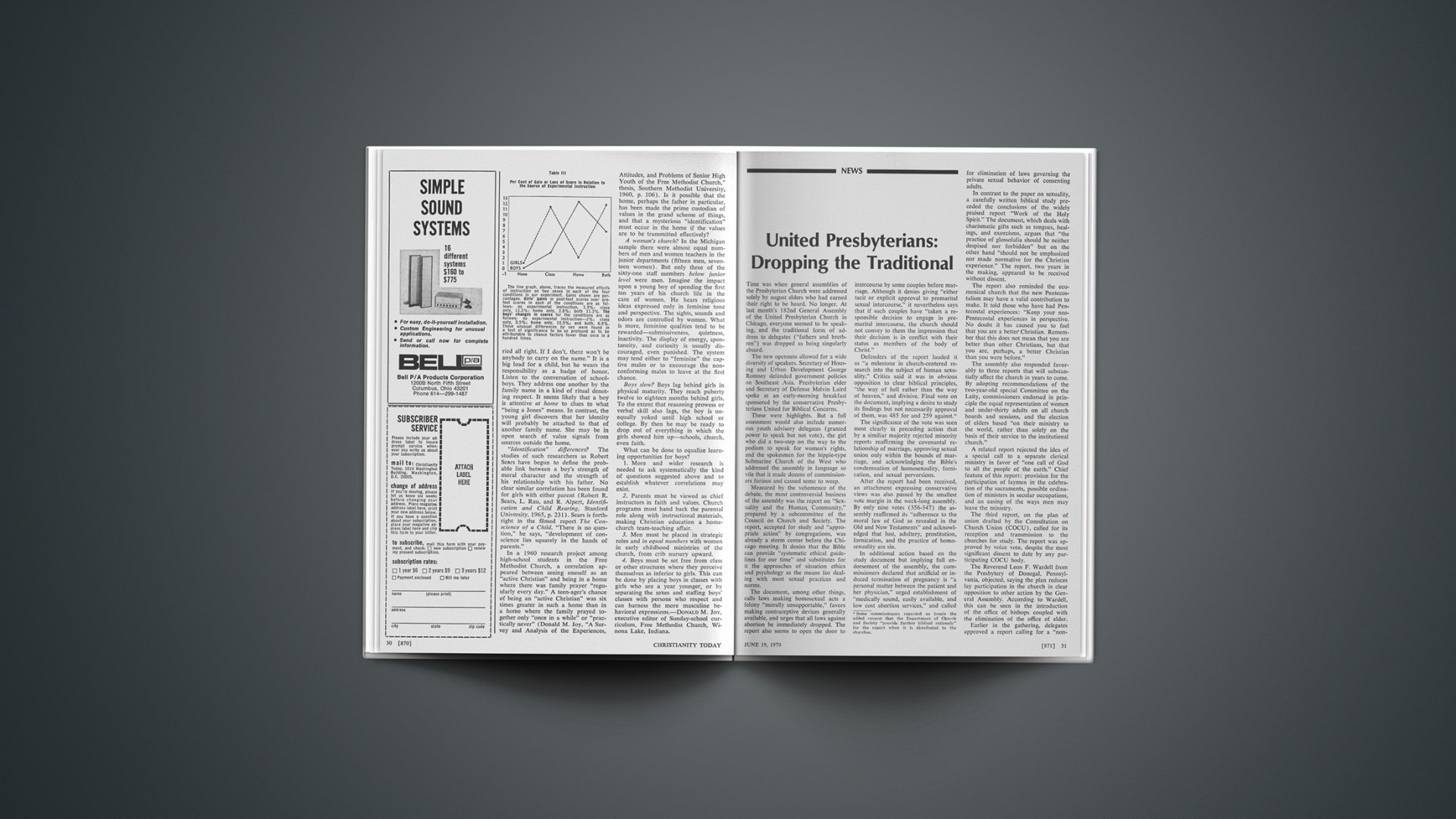
Do children really learn in Sunday school? Would they learn better if parents helped at home? And do boys and girls respond similarly to these learning opportunities?

The junior departments (grades four to six) of six randomly selected Free Methodist Sunday schools in Michigan were reorganized for an experiment. The juniors were divided into four groups. Group one, the control group, received no relevant instruction; group two received class instruction; group three, home instruction; group four, instruction both in class and at home. There were 239 children involved. (The research is fully described in Donald M. Joy, “The Effects of Value-Oriented Instruction in the Church and in the Home,” thesis, Indiana University, 1969).

The children were randomly assigned to the four experimental groups after being tested in concept and value expressions related to “what is Christian about Christians.” The instruction explored that concept, and afterward the children were tested again, but not for factual recall.

It was at once evident that class instruction can produce significant effects and that home instruction does almost as well. The two in combination showed up even better. Table II pictures the gain in concept score for each of the four conditions.

The two sexes were assigned randomly to all four groups to balance any differences attributable to sex. But since there were 148 girls and only 91 boys, random assignment could not overcome this 38 per cent to 62 per cent sex imbalance. If boys in general responded differently from girls, the boys’ pattern would be diluted or lost by the larger number of girls. Table III shows that when the findings were separated by sex, the patterns were found to be not only different but reverse.

The full implications of these findings are by no means clear. What is evident, however, is that if these congregations and similar ones wish to communicate beliefs to children, they must find ways of using both church and home instruction. If the boys are to be drawn to Christ and the Church, they obviously must have heavy assistance at home during the junior years.

Let us assume that the male-female imbalance, the boys’ poor showing in class, and the boys’ high gains at home are all somehow related. What are possible clues to understanding these findings?

Patriarchal cultural effects? From early childhood, males in our society are made aware that they will perpetuate the family name. “I don’t much like girls,” one ten-year-old is reported to have said, “but I guess I’ll get married all right. If I don’t, there won’t be anybody to carry on the name.” It is a big load for a child, but he wears the responsibility as a badge of honor. Listen to the conversation of schoolboys. They address one another by the family name in a kind of ritual denoting respect. It seems likely that a boy is attentive at home to clues to what “being a Jones” means. In contrast, the young girl discovers that her identity will probably be attached to that of another family name. She may be in open search of value signals from sources outside the home.

“Identification” differences? The studies of such researchers as Robert Sears have begun to define the probable link between a boy’s strength of moral character and the strength of his relationship with his father. No clear similar correlation has been found for girls with either parent (Robert R. Sears, L. Rau, and R. Alpert, Identification and Child Rearing, Stanford University, 1965, p. 231). Sears is forthright in the filmed report The Conscience of a Child. “There is no question,” he says, “development of conscience lies squarely in the hands of parents.”

In a 1960 research project among high-school students in the Free Methodist Church, a correlation appeared between seeing oneself as an “active Christian” and being in a home where there was family prayer “regularly every day.” A teen-ager’s chance of being an “active Christian” was six times greater in such a home than in a home where the family prayed together only “once in a while” or “practically never” (Donald M. Joy, “A Survey and Analysis of the Experiences, Attitudes, and Problems of Senior High Youth of the Free Methodist Church,” thesis, Southern Methodist University, 1960, p. 106). Is it possible that the home, perhaps the father in particular, has been made the prime custodian of values in the grand scheme of things, and that a mysterious “identification” must occur in the home if the values are to be transmitted effectively?

A woman’s church? In the Michigan sample there were almost equal numbers of men and women teachers in the junior departments (fifteen men, seventeen women). But only three of the sixty-one staff members below junior level were men. Imagine the impact upon a young boy of spending the first ten years of his church life in the care of women. He hears religious ideas expressed only in feminine tone and perspective. The sights, sounds and odors are controlled by women. What is more, feminine qualities tend to be rewarded—submissiveness, quietness, inactivity. The display of energy, spontaneity, and curiosity is usually discouraged, even punished. The system may tend either to “feminize” the captive males or to encourage the non-conforming males to leave at the first chance.

Boys slow? Boys lag behind girls in physical maturity. They reach puberty twelve to eighteen months behind girls. To the extent that reasoning prowess or verbal skill also lags, the boy is unequally yoked until high school or college. By then he may be ready to drop out of everything in which the girls showed him up—schools, church, even faith.

What can be done to equalize learning opportunities for boys?

1. More and wider research is needed to ask systematically the kind of questions suggested above and to establish whatever correlations may exist.

2. Parents must be viewed as chief instructors in faith and values. Church programs must hand back the parental role along with instructional materials, making Christian education a home-church team-teaching affair.

3. Men must be placed in strategic roles and in equal numbers with women in early childhood ministries of the church, from crib nursery upward.

4. Boys must be set free from class or other structures where they perceive themselves as inferior to girls. This can be done by placing boys in classes with girls who are a year younger, or by separating the sexes and staffing boys’ classes with persons who respect and can harness the more masculine behavioral expressions.—DONALD M. JOY, executive editor of Sunday-school curriculum, Free Methodist Church, Winona Lake, Indiana.

Book Briefs: June 19, 1970

Contemporary Christianity

The New Man for Our Time, by Elton Trueblood (Harper & Row, 1970, 126 pp., $2.95), is reviewed by Samuel J. Mikolaski, minister, Braemar Baptist Church, Edmonton, Canada.

This is an essay for our time. Dr. Trueblood is well known as a lecturer and author who for many years was professor of philosophy at Earlham College. In the beginning pages, one might be tempted to sigh that here is yet another tract—anachronistic among the concerns of our times—on disunity among Christians. But the author quickly dispels this impression. The polarization is between social activism and religious pietism. This he sees as an extension of the dichotomy between faith and works, but with a difference: the contemporary social activist too often irrationally jettisons belief and sidesteps his own moral failures, while the pietist, with personal salvation as his primary interest, is insensitive to the suffering world (one wonders whether stating this last generalization isn’t rather like flogging a dead horse).

Professor Trueblood’s book is directed first to those of our time who have no faith but sense the need of faith; second, to the discouraged Christian worker who is on the lookout for a contemporary strategy. The substance of the Gospel must be welded to the reality of our lives, he argues. Necessities for modern man’s life are compassion, reverence, and intellectual integrity. The combination will produce the whole man, which is the new man needed in our time, he says.

Wholeness centers in the spiritual dimension of life. The author seeks historical support from devout men of the past, notably Woolman, the eighteenth-century Quaker. The combination of prayer, an acute social consciousness, and a clear mentality in one whose faith and love are pledged to Christ the Lord create the acute sensitivity to human suffering for which Trueblood pleads.

Important values emerge as the author gathers strength of argument. The positive elements he presents stand out because the vacuum created by their contemporary loss is so apparent. The cultivation of reverence points up the necessity of voluntary discipline and the value of silence—listening to God—in prayer. At the heart of devotional classics is the reality of the divine-human encounter, says Trueblood. Excellence comes at the price of inner control and rules to live by. Valid Christian social concern arises where there is freedom to think (even to doubt), inner moral integrity, a fundamentally religious approach to life, and the capacity for light-hearted self-criticism. Social action does not exclude evangelism for today, but neither does it swallow up evangelism.

In the absence of objective moral values, the rights of others quickly get trampled on, Trueblood argues. Perhaps the contemporary confessional vacuum has made us ready for belief. He stresses the need for rigorous theology that articulates not opinion on peripheral questions but the truth about the personal God revealed in Jesus Christ. Perhaps, concludes Trueblood, modern man is ready to see that this mysterious world makes more sense through a thoroughgoing supernaturalism than in any other way.

A Changing Church

The Reform of the Church, by Donald G. Bloesch (Eerdmans, 1970, 199 pp., $4.95), is reviewed by John H. Gerstner, professor of church history, Pittsburgh Theological Seminary, Pittsburgh, Pennsylvania.

This arresting book most certainly fulfills the promise of its title. In a dozen areas including preaching, sacraments, charismatic gifts, and social relevance, Dr. Bloesch shows the changes occurring in the Church and those that should occur. His sources are as wide-ranging as his subjects. We find men of past and present, secularists, Romanists, and fundamentalists, quoted interestingly and pertinently. This little book could almost serve as a brief contemporary history of the Church. The erudition is impressive, though the book reads so racily one might not notice the vast learning involved. The author seems equally comfortable with Pope John, Billy Graham, and Karl Barth. This book is alive.

It is in the last chapter—“Christian Unity”—that the climax is reached. If the Church is to be reformed, after Bloesch’s thinking, this ideally must take place in union, not in separation, and he draws a large picture that comprehends Roman Catholicism, Eastern Orthodoxy, Protestantism (including the “third force”), and Judaism. “Convergence,” not “conversion,” is the formula. This may sound like ecumania, but Bloesch is realistic and doctrinally serious throughout. He wants to avoid sacrificing principle to peace.

Despite this enlightened earnestness, our author does miss the point of, for example, the Spurgeon statement he quotes: “It will not do for us to be all united together by yielding to one another’s mistakes.” Bloesch misses this, I think, because he wrongly supposes that the Reformation was in error as well as Roman Catholicism and specifically that the Protestant doctrine needs the Roman supplement and vice versa. This is a fatal error. We cannot have a twentieth-century reformation of the Church by assuming the sixteenth-century reformation was a mistake or even a half mistake (Pelikan’s “tragedy” as well as “necessity”).

Digest Of Archaeological Finds

The Archaeology of the New Testament, by Edward M. Blaiklock (Zondervan, 1970, 192 pp., $4.95), is reviewed by Merrill C. Tenney, dean, graduate school, Wheaton College, Wheaton, Illinois.

In a compact volume of fewer than two hundred pages Dr. Blaiklock has produced an eminently readable summary of the major contributions made by recent archaeology to the study of the New Testament. The literary and architectural witnesses to the culture and history of the early Christian era are presented with deftness and eloquence. The book is designed to be a usable digest of significant discoveries that affect the interpretation of the New Testament rather than a discussion of technical problems. It is consequently popular rather than encyclopedic in its scope.

Numerous quotations from ancient documents that illustrate the everyday life of the first century or are relevant to specific episodes of biblical history are provided, and photographs of sites and artifacts illuminate the discussion in the text. The apologetic value of archaeological evidence is not neglected, but the presentation is descriptive rather than argumentative.

Particularly effective is Blaiklock’s terse but comprehensive sketch of Pilate, reconstructed from the literary and archaeological data available concerning him. It stimulates the imagination and provides the background for a better understanding of the Roman procurator who played such an important part in the death of Jesus.

For any reader who is not familiar with archaeology, this book will be a pleasant introduction to the subject, and the Bible teacher or preacher will find here new illustrative material.

The Best Of C. S. Lewis

A Mind Awake: An Anthology of C. S. Lewis, edited by Clyde S. Kilby (Harcourt, Brace, and World, 1969, 252 pp., $5.75), is reviewed by Glenn E. Sadler, assistant professor of English, Westmont College, Santa Barbara, California.

Indisputably C. S. Lewis is recognized as one of the foremost spokesmen for evangelical Christianity. This in itself justifies and makes difficult any attempt to anthologize his writings. Professor Clyde Kilby accomplishes the task with grace, however, in A Mind Awake.

This anthology can be read profitably both by admirers of Lewis and by those who don’t know him. It offers a pleasant and thought-provoking review of Lewis’s apologetic thinking; it can serve also as moving devotional reading; and some will find it a lively sermonic source.

To compile a representative anthology—particularly of a favorite writer—is a prickly exercise. Textual and topical weeds sprout freely. One wonders, for instance, if “Fallen Man” would not be a better choice than “Sex” for Lewis’s remark, from “A Preface to ‘Paradise Lost,’ ” that the effects of the Fall on Adam were more intellectual whereas on Eve they were mainly emotional. And there is the pitfall of appropriateness. This anthology is for the most part carefully cultivated in this regard. In my opinion its topical divisions are more representative than those in Lewis’s own anthology of George MacDonald, which suffers at times from topical glitter that obscures meaning. Kilby’s divisions fall naturally and inclusively into place; for example, chapter 6, “The Christian Commitment,” is a rich devotional assortment, and chapter 10, “The Post-Christian World,” reverberates with modernity.

Kilby’s anthology repeatedly teases its reader into returning to original sources, which is finally the chief purpose of any anthology. It is indeed an alert collection.

Survey Of Major Thinkers

Philosophy and the Christian Faith, by Colin Brown (Inter-Varsity, 1969, 319 pp., $2.50), is reviewed by David H. Freeman, chairman, Department of Philosophy, University of Rhode Island, Kingston.

This concise study of major thinkers and of schools of thought from the medieval period to the present day concentrates on the central issue of the relation between philosophy and the historic Christian faith. Besides giving an excellent survey of the intellectual history of the past thousand years, Colin Brown points out the tentative and provisional character of philosophical insights and warns against the dangers of allying the Christian faith too closely with any philosophical system.

Philosophy is to be valued as a stimulus to Christian thinkers to rethink their position. However, the Christian need not capitulate to the fashionable ideas of the moment and seek to reinterpret Christianity accordingly. Nor is he to regard a particular philosophical system as the yardstick for measuring the truths of the Christian faith. Each new trend ought, rather, to be evaluated in the light of one’s own Christian experience and faith.

Philosophy helps us to see where we are and evaluate contemporary movements. It enables us to view Christianity in perspective without regarding it as a religious form of Platonism, idealism, existentialism, or any other ism.

The Christian faith does not require a natural theology to support it. Rationalistic arguments in support of the existence of God are to be rejected as fallacious. Natural theology has opened the door to much speculation that has obscured the message of the Gospel. Men do have an awareness of God as One to whom we are ultimately responsible. This provides a point of contact for the Christian message.

A philosophy of the Christian religion ought to be concerned with what is involved in faith, with revelation and Christian language, with the relations between the natural and the supernatural, as found in the Christian religion. The Christian motto ought to be that of Anselm of Canterbury, “I believe so that I may understand.” It is not a question of proving first and then believing; rather, the act of believing enables us to understand.

Brown’s book provides a remarkable survey of the past thousand years of intellectual history, though his dismissal of natural theology is a bit too easy. The book calls attention to some of the major problems confronting the Christian who wants to understand the intellectual trends of the time. It should be a part of every intelligent Christian’s library.

Against One-Sided Extremism

In Search of Balance, by Virginia Mollenkott (Word, 1969, 151 pp., $3.95), is reviewed by Millard J. Erickson, associate professor of theology, Bethel Theological Seminary, St. Paul, Minnesota.

When the Christian turns to the Bible for guidance, he finds himself confused. What is given is not a neat set of unambiguous rules but rather: “Paradoxes. Polarities of truth. Absurd contradictions, both of them somehow true at the same time. The Bible is full of them—but then, so is life.” Perhaps, Dr. Mollenkott suggests, what is needed is an acceptance of the polarities of truth, in which one strikes a balance between opposed concepts.

She applies this principle in several areas. A prominent one is the tension between God’s power (he does it all) and the Christian’s effort. Because there are texts that urge the believer to abandon his own understanding and trust God, and others that counsel the employment of one’s intelligence and testing, a balance must be struck. As a semi-situationist, the author has as her maxim: follow the established moral rule unless there is clear reason for not doing so. When she does break such a rule, however, it will be with a sense of doing the lesser of two evils—not, as for Joseph Fletcher, of doing a positive good.

The meat of the discussion is contained in the first four chapters. The book is brief and clearly written and can be read in a fairly short time. Its major value is in warning against a one-sided extremism (on either side), which is too common among Christians. The author also points out directly and indirectly the importance of thorough exegesis of Scripture. The contradictions she finds are often not between two texts of Scripture but between two extreme interpretations of them.

This leads to one of the shortcomings of the book: the proof texts are sometimes inadequately examined. For example, Dr. Mollenkott finds a paradox between Paul’s exhortation, “Bear ye one another’s burdens” (Gal. 6:1), and his statement, “Every man shall bear his own burden” (Gal. 6:5), without observing that two different words for “burden” are involved. Nor is the relation between the Bible and experience spelled out.

Further, there is inadequate definition and analysis of some key terms. The author does not really define paradox but at times equates it with contradiction. She suggests there must be a balance between altruism and egoism; in the case of a fire in a building filled with altruists, she says, no one would go first and all would perish. But is this what a true altruist would do, or would he decide to go out the door, not for his sake but for the sake of others? Perhaps a seeming exception to a prima facie duty does not negate the rule but, as Paul Ramsey suggests, indicates that the rule is more complex than originally thought.

Although there is room for some improvements in the book, its lesson is a timely reminder.

Book Briefs

Treasury of Courage and Confidence, edited by Norman Vincent Peale (Doubleday, 1970, 309 pp., $5.95). Prose selections, poetry, and quotations from a variety of sources.

This Morning with God, Volume 2, edited by Carol Adeney (Inter-Varsity, 1970, 130 pp., paperback, $1.50). This daily devotional guide makes use of well-worded questions to lead the reader into his own study of each day’s passage.

Tim Whosoever, by Jerome Hines (Revell, 1970, 149 pp., $3.95). The Metropolitan Opera’s celebrated basso offers four one-act plays which present a Christian message.

The Book of Joel, by Mariano Di Gangi (Baker, 1970, 78 pp., paperback, $1.95). This volume and The Books of Ruth and Esther by C. Reuben Anderson are additions to the “Shield Bible Study Series.”

Pope John XXIII: Letters to His Family (McGraw-Hill, 1969, 833 pp., $15). The 727 letters included in this volume were written over a period of sixty years and provide an interesting character study of the pontiff.

Church Growth and the Word of God, by Alan R. Tippett (Eerdmans, 1970, 82 pp., paperback, $1.95). Spells out the biblical basis for the concept of church growth advocated by the School of World Mission and Institute of Church Growth at Fuller Seminary.

Children and Conversion, edited by Clifford Ingle (Broadman, 1970, 160 pp., $4.50). A study of biblical, theological, and practical considerations that must be taken into account by those who seek to lead children to make a commitment to Christ.

On Religion, by Friedrich Schleiermacher (John Knox, 1969, 383 pp., $11.95). This new translation includes an introduction and critical notes by the translator, Terrence N. Tice.

First Timothy—James, by Leon Morris (Eerdmans, 1970, 91 pp., paperback, $1.25). A helpful commentary from the pen of an outstanding New Testament scholar.

Man Becoming, by Gregory Baum (Herder and Herder, 1970, 285 pp., $6.95). A well-known Catholic theologian reinterprets the doctrine of God along the lines of secular theology.

The Story of the Christian Church in India and Pakistan, by Stephen Neill (Eerdmans, 1970, 183 pp., paperback, $3.95). Studies the history and impact of the Church on the subcontinent of India.

Handbook of Denominations in the United States, by Frank S. Mead (Abingdon, 1970, 265 pp., $3.95). This is the fifth revision, updating a standard work first issued in 1951. It is currently the best of its kind, but don’t expect completeness, and disregard the classifications.

Christian Counter-Attack, by Arnold Lunn and Garth Lean (Arlington House, 1969, 176 pp., $5). Written jointly by a Roman Catholic and a Protestant, this volume underscores the areas of agreement between conservatives of the two faiths.

Resurrection and the New Testament, by C. F. Evans (Allenson, 1970, 190 pp., paperback, $4.65). A scholarly study of the New Testament concept of resurrection.

Pastoral Care Come of Age, by William E. Hulme (Abingdon, 1970, 175 pp., $4.50). A survey of the present state and future possibilities of the ministry of pastoral counseling.

The Churches and the Nations, by O. Frederick Nolde (Fortress, 1970, 184 pp., $7.50). A WCC leader suggests ways in which the Church should affect international affairs.

Tables of Stone for Modern Living, by Randal Earl Denny (Beacon Hill, 1970, 120 pp., paperback, $1.50). Applies the precepts of the Ten Commandments to the world of the seventies.

Ministers’ Research Service, edited by William F. Kerr (Tyndale House, 1970, 854 pp., $9.95). Provides material—exposition, illustrations, and outlines—for fifty-two sermons.

The Epistles of John, by Donald W. Burdick (Moody, 1970, 127 pp., paperback, $.95). Another in the “Everyman’s Bible Commentary” series.

Temple Beyond Time: The Story of the Site of Solomon’s Temple, by Mina C. Klein and H. Arthur Klein (Van Nostrand Reinhold, 1970, 191 pp., $6.95). A survey of the history and present status of this well-known biblical site.

Deuteronomy: A Favored Book of Jesus, by Bernard N. Schneider (Baker, 1970, 163 pp., paperback, $2.95). This devotional commentary emphasizes Deuteronomy’s message of God’s love for his people.

Lift-off!, by James C. Hefley (Zondervan, 1970, 159 pp., $3.95). Men involved in the space program—astronauts, scientists, engineers, and others—speak of their faith in Christ.

Church Business Methods, by Edgar Walz (Concordia, 1970, 85 pp., paperback, $2.50). Pastors and church leaders may find this handbook quite useful.

America on Its Knees?

Nations rise and fall. The list of those whose stars flashed across the skies only to disappear into obscurity is long: names like Babylon, Assyria, Greece, Medo-Persia, Egypt, and Rome evoke textbook memories of virile peoples whom we now encounter only as archaeologists continue to uncover remains of their cultures.

Among perceptive observers of the American scene, more and more the question is asked: Will we soon need a new Gibbon to write The Decline and Fall of the United States of America? Signs of decay are not hard to find. The showy facade of affluence, technological advance, great knowledge, military might, and a high standard of living cannot hide the internal rot. The words of the Apostle John seem apt for this hour: “You say, I am rich, I have prospered, and I need nothing; not knowing that you are wretched, pitiable, poor, blind, and naked” (Rev. 3:17).

No one of America’s ills is in itself sufficient reason to predict the death of the patient. The frightening thing is the combination of ailments coupled with the patient’s disregard for his symptoms, and his unwillingness to seek a true cure. Is this not a way of committing suicide?

We are engaged in a war that has terribly divided our people, brought near anarchy to some college campuses, and elicited a flood of obscenities, half-truths, name-calling, and irresponsible rhetoric. Emotion and fear and weakness, rather than reason and courage and strength, now seem to characterize our people. The social fabric is wearing thin and the holes are visible to all. Drug addiction, alcoholism, discrimination, crime, pornography, political corruption, racism, and sexual license are found on every hand.

We cannot claim that we are guiltless or that a few isolated people and groups are responsible for the plight of the nation. A few unprincipled people motivated solely by the desire for money may control the drug traffic, but this does not excuse the millions who buy their wares. IAm Curious (Yellow) may be a product of Sweden, where license and immorality prevail, but it could not succeed at the box office if millions of Americans did not plunk down their money to view it. Playboy magazine with its sophisticated pornography would have to cease publication if it weren’t for the millions of subscribers who like what it prints and are willing to pay for the privilege of becoming voyeurs. The slaughter on our highways caused by alcohol would not take place if multiplied millions of Americans did not tip the bottle. Illegal abortionists could not stay in business if their services were not sought by unwed mothers and by wives who do not wish to be encumbered by another mouth to feed and more diapers to wash. Race riots and the shooting of people in the back as they flee from the guns of soldiers and policemen could not happen if men loved their neighbors. Inflation would not be a pressing problem if men were unselfish and if they sought not their own gain but the welfare of others. Our land would not be raped, the rivers polluted, the birds decimated, and the atmosphere filled with smoke if men did not do these things knowingly and by choice.

But these problems of drugs and alcohol and pornography, of dishonesty and injustice and indifference, are only symptoms. The underlying cause is that we have turned away from God and his law. We have broken God’s commandments. The retiring moderator of the United Presbyterian General Assembly recently remarked that a seminary president had told him “theology today is in a shambles.” So it is, and so it must be, when men have turned from the revelation of God in Scripture. They have found a false freedom in deliverance from God’s absolute. They have enthroned man in the place of God.

Dr. Carl F. H. Henry, editor-at-large of CHRISTIANITY TODAY, told the delegates attending the sixty-third annual meeting of the American Baptist Convention:

Philosophers in ancient Greece and Rome wrote at length about a just and peaceful society, yet their great empires collapsed for lack of will to do the right and confusion over the right thing to do. God’s commandments still offer the profoundest wisdom that Christian churchmen can bring to the modern political world, and the Gospel of Christ still proffers the most potent dynamic for actualizing these commandments in daily life. No new society can be successfully grafted on a race of unregenerates, and no civilization that spurns moral imperatives will long endure.

Does all this mean there is no hope? Is there no way out, no road back? Are the processes of history inexorable so that America has no future? If so, then all we can do is wring our hands, wait for the cataclysm, and perish in the ruins of a once great culture. But there is hope. There is a way out. It is possible only if America goes to its knees, not in a posture of defeat brought on by judgment, but in repentance brought about by the deep conviction that God can and will do something for a nation in distress.

History provides examples of this. Professor Kenneth Scott Latourette in his History of Christianity points to eighteenth-century Britain as a place of “widespread vulgarity, drunkenness, obscenity, and calloused cruelty” as well as “a large degree of religious illiteracy and scepticism.” The nation was being forced to its knees; it seemed unable to stay on its feet. Strangely, this marked decline of Britain occurred not long after one of the greatest spiritual advances in its history. In 1647 the Westminster Confession of Faith had been adopted. Later embraced by the Congregationalists in their Savoy Confession and the Baptists in their London Confession, it provided powerful motivation for spiritual vitality and awakening. Yet within fifty years after its adoption Britain had sunk into a deep moral and spiritual lethargy. But along came John Wesley and George Whitefield and the Evangelical Awakening. The Church was revived, and thousands were drawn into its fellowship by the new birth.

What happened in Britain can happen in America. But we cannot bring it about by putting evangelism first. Revival must come, and this has to do with the people of God, not with unbelievers. There can be no revival unless there is repentance, and there can be no repentance until the people of God get down on their knees.

How do we repent? First there must be a change of mind, a fundamental reorientation in our thinking, a one-hundred-and-eighty-degree swing. Second, there must be godly sorrow for sin. We are guilty and we are responsible. Tears must flow, hearts must be broken, spirits must be brought low. Business as usual must cease as we devote time to bringing our souls into conformity to the will of God. Third, our wills and dispositions must be involved. This includes confessing our sin, turning away from our wicked ways, and turning to God for pardon, cleansing, and restoration. When the people of God are revived, when they are right with God, then evangelism will be effective and multiplied thousands of people will come to Jesus Christ for their salvation.

If God’s people in America do not get down on their knees in repentance, then the nation is likely to be forced to its knees in judgment and dissolution by God. The people of God are called to be the salt of the earth and the light of the world. What the nation needs above all else is this salt and light.

On our knees in repentance or on our knees under God’s judgment—which will it be?

Made In Germany

The Frankfurt Declaration (page 3) may be one of the most important documents ever published by CHRISTIANITY TODAY. For a hundred years, Germany has been the world’s leading exporter of liberal, higher critical views of Scripture and chief contributor to theological heresy. The Frankfurt Declaration, written by well-known scholars connected with significant German universities, runs counter to this current and shows unequivocally that historic orthodoxy is by no means dead even in Germany. The declaration challenges the assumptions undergirding the Uppsala Assembly of the World Council of Churches and seeks to point to the right direction for the mission of the Church. While we may have a few minor reservations about it, this statement is fresh, timely, and worthy of discussion and acceptance. We hope that thousands of Christians around the world—lay people as well as scholars and mission leaders—will add their names to the ever enlarging list of those who approve what these German missiologists have said.

Sexuality And The United Presbyterians

For some time the United Presbyterian Church has been inching away from acceptance of the Bible as the only rule of faith and practice. Now the General Assembly has widened the gap, not by inches but by feet. We had hoped the commissioners would reject the recommendations of the committee report on “Sexuality and the Human Community” (see “Moment of Decision,” June 5 issue, page 26). But they did not. They received the report for study, thus leaving the way open for its ultimate acceptance, rejection, or burial.

Hopes for faithful adherence to biblical norms were further dampened by the assembly’s vote on an amendment: “We reaffirm our adherence to the moral law of God as revealed in the Old and New Testament that adultery, prostitution, and homosexuality is sin.…” It was accepted by only a nine-vote majority, 356 to 347. Apparently almost half of the commissioners do not agree that adultery, prostitution, and homosexuality are sinful. Had five more of them voted negatively, the amendment would have been lost. It is not unreasonable to suppose that next time around the advocates of the new morality will be victorious.

The real shocker is the statement by the committee that they could “find no systematic ethical guidance for our time from a method of Biblical interpretation which relies solely on the laws or stories of the Bible.” To support a view that puts a disclaimer on the teachings of Scripture is one thing. To say that Scripture does not teach these things is another. How anyone could argue that Scripture is silent about adultery, homosexuality, and prostitution, or that it leaves room for approving them, escapes us.

We seem to be living in days when green is blue and yellow is red and wrong is right. We can hardly feel cheerful about the trend in the United Presbyterian Church.

Oberammergau: Telling It Straight

The Oberammergau Passion Play opened in Bavaria last month amid a cacophony of criticism from Jews, Protestants, and Catholics. Among the critics were six renowned American biblical scholars who contend that the decennial drama is hostile to Judaism and blatantly falsifies the biblical account of Christ’s trial and crucifixion. Harold O. J. Brown examines these charges on page 24.

We agree with three of the critics’ conclusions: (1) Jewish-Christian relations are extremely touchy in this ecumenical era; (2) anti-Semitism by Christians violates the spirit of the Gospel; and (3) to the extent that the play deviates from Scripture, it should be revised and rid of anti-Semitic rhetoric.

But blame for the Crucifixion does not fall strictly on Jews of biblical or contemporary times. All men have sinned and fallen short of God’s commands; therefore all are guilty of betraying Christ. We all had a part in hammering the nails.

It’s not surprising that the Passion drama offends some in 1970 even as it did in the first century. The Christian Century recently editorialized regretfully that Christians and Jews “did not work together more effectively to help the scene at Oberammergau become what it ought to be: a benediction to all men of faith instead of an affront to their common humanity.” We say that authentic presentation of Christ crucified is necessarily a stumbling-block to Jews, and foolishness to Gentiles. But it is that proclamation of the Cross that is the wisdom of God to those who heed the divine call. Let the Passion Play tell it like it is, for a neutralized Gospel loses the power of God and becomes only the empty foolishness of men.

The Christian Stake In Dollar Power

Charles Wilson’s remark that what’s good for General Motors is good for the country has come back to haunt that great industrial giant. GM’s annual meeting this year had to deal with an organized effort to make the company more responsive to public interest. The effort, known as Campaign GM, has something to be said for it. The idea of stockholders, the owners of the company, having a real say in company policy is legitimate and desirable. To the extent that they have failed to make their convictions known in the past, they have been delinquent.

What is questionable is the so-called church support Campaign GM drew. United Presbyterian agencies count a total of 114,000 GM shares, and the church’s General Assembly directed that the votes of those shares be cast for two proposals advanced by Campaign GM. Other blocks of stock lined up for the proposals were owned by the United Methodist Board of Missions and the National Council of Churches. Overall these votes counted for little, but one might well wonder about the economic clout that may be available when the Church of Christ Uniting pools the holdings of its predecessor denominations.

Dr. H. Leroy Brininger of the National Council of Churches said that “great corporations make decisions that affect everyone in our society, yet few people have an effective voice in shaping those decisions. It is not clear that even the stockholders have such a voice.” That is true, but ironically the same thing can be said of the lay people in the mainline denominations that make up the NCC. How many of the churchgoers whose gifts were used to buy the stock were consulted prior to the vote?

The use of church-owned stock, not subject to income and capital-gains taxes, to promote a particular strategy in corporate affairs is questionable. (M. A. Larson and C. S. Lowell, in a recent book, demonstrate the potential church economic power.) It tends to cloak that strategy with the mantle of being the Christian option. There may actually be sub-Christian motivations behind the strategy, and then such bloc voting will do little more than alienate people.

If the Church put more emphasis on its biblically endowed teaching function and less upon its humanistically based power factor, the cause of Christ might be advanced a great deal more. Most American stockholders, corporation executives, and union leaders are church members in good standing. Let the churches make them aware of their biblical responsibilities, and urge them to put these principles into practice in the vocational sector. This is the way the Church has always exerted its greatest influence.

America’s Young People

No one can deny that many young Americans exhibit clear signs of alienation from Middle and Old America. To intensify this alienation, to write all youth off as irresponsible, to judge them as though the fault is theirs alone—these are not signs of a thoughtful maturity. But as yet there are few indications that their elders feel they are in any large measure responsible for what has happened. This is tragic. The younger members of our society have put their fingers on what may be the sorest and most vulnerable spot in the value system of their elders: the desire for affluence and a deep-seated materialism. In the present flux, many youth have turned away from material values, and in so doing some of them have also turned away from the churches that represent the same worldliness.

There are some healthy signs to be found within the boundaries of student unrest and disaffection. A significant number of young people are saying, whether they realize the full implications of what they say or not, that there are some absolutes. When they cry out for justice, call for the end of war and the beginning of peace, and label American participation in Southeast Asia immoral, they are doing the cause of evangelical Christianity a service. Like their elders, they are ambivalent and inconsistent at times. They may not always be right in their understanding of situations, and some of their judgments are disputable; but their insistence that there are moral values should not be overlooked. We have long asserted that there has been an erosion of moral values in American life. The students are saying that this is true. And they are in fact declaring their own desire for a return to some moral standards. Maybe these young people are begging their elders to adopt and practice a system of ethics that is consistent and not self-contradictory.

Evangelical conscience professes to be subject to truth wherever it may be found and bows its head to Scripture. Perhaps what students are saying may lead the older generation to repent of its shortcomings and to find grace to admit failures openly. Then all of us, young and old alike, would be in a position to point the way to a new life more closely identifiable with that of Jesus Christ—a life based on the law of God and the Sermon on the Mount; a life in which we become again the true pilgrim people of God.

Wanted: Donors For Christian Colleges

Christian colleges are experiencing financial stringency. They, as well as private secular institutions (including giants like Harvard, Yale, and Princeton), have been beset by constantly accelerating costs, the persistent inroads of inflation, declining government aid, and, more recently, increasing skepticism on the part of donors who are unhappy with student unrest and radicalism.

Christian colleges for the most part have not made headlines. Their students have not revolted, they have not seized or burned buildings, they do not have SDS chapters. Unfortunately, however, donors who are disenchanted with college radicalism do not always make this distinction. At a time when Christian colleges are desperately needed, it is likely that some will have to close their doors or at least operate on a shoestring basis until the public regains its confidence in higher educational institutions.

Even Christian colleges solidly committed to biblical revelation are going through times of severe testing. They are having to take a hard, fresh look at parietal rules, educational processes, racism, social action, and traditional fundamentalist taboos. Not all they have endorsed in bygone years can be supported biblically; yet when even minor changes are made, they sometimes pay a heavy price in the loss of support. Idealistic students tend to feel that even in marginal matters, honesty requires immediate change, and that the attitude toward supporters of the college must be: let the chips fall where they may. This shortsightedness not only embarrasses administrations; it also produces unbalanced budgets.

If Christians cop out on their support of Christian colleges and the colleges find they must close their doors, then higher education will be left in the hands of secularists. This is too high a price for Christians to pay, no matter how great their pique over what they feel is atrocious behavior either by determined minorities in secular schools that are out to destroy the government or by Christian students who in their zeal for justice, honesty, and personal integrity sometimes say and do things that their elders cannot accept. We need to get solidly behind our Christian schools, supporting them with our money as well as with our prayers. If they are to survive and do a creditable job spiritually and academically, they need our help.

Does Rejection Mean Failure?

Christians sometimes feel they have failed because of the negative response to the message entrusted to them. They need to remind themselves of the experience of Christ in his home town, Nazareth (see Luke 4; Matthew 13, and Mark 6). The Nazarenes were impressed by Jesus’ teaching and by his reputation for doing mighty works. But because they saw him as a man just like themselves, they were not able to grant the truthfulness of his proclamation. Their conception of God was such that they could not imagine his using ordinary means and a seemingly ordinary man to be his spokesman. When Jesus compared their rejection of him to the negative response of their ancestors to the ministries of Elijah and Elisha, they got so angry that they tried to kill him.

To this day, one of the biggest hindrances to the acceptance of the Gospel is that men do not believe such an important message would be entrusted to ordinary people like Christians. They reject the idea that God has something to tell them using frail mortals as his spokesmen. Rather than consider the truthfulness of what is said, they consider the ordinariness of the one saying it, and they apparently find it too great a humiliation to accept truth from an equal or a subordinate. How tragic!

Yet we must not give way to despair simply because so many reject the message. We ought to live lives that are consistent with our high calling, but at the same time remember that Christ’s sinless life was not sufficient to authenticate his testimony to his neighbors. And we also need to remember that even in Nazareth there were some who believed. Witnessing is not judged a success or a failure by God on the basis of how many, if any, respond. Rather, God wants us to be faithful in proclaiming the truth, and not to give up, not to grow silent, just because people don’t respond. Our Lord himself persisted in faithful witness despite repeated rejection even by those who had long known him. We are to do likewise.

Oberammergau: Is It Anti-Semitic?

Amidst a flurry of charges of anti-Semitism from Jewish, Roman Catholic, and other quarters, the traditional decennial Oberammergau Passion Play opened in the small Bavarian town on May 18. A special performance for the diplomatic corps and the press was held May 16, and despite remonstrances by the American Jewish Congress and the Anti-Defamation League, it was inaugurated by Julius Cardinal Döpfner, archbishop of München-Freising, at a special early Mass that morning.

There is ample evidence of the public’s interest in the 1970 performances, for 1,500,000 applications have been received for the 520,000 tickets available this season, and only a few returned tickets are still available on a day-to-day basis. The play, performed once a decade since 1634 (with some fluctuation in the date because of wars), is the biggest thing in the life of the countryside for miles around, and even across the border in Austria, people are aware of the protests and generally puzzled and resentful of them. To what extent are the charges of anti-Semitism justified?

To protest to Christians that the Oberammergau Passion Play is anti-Semitic is first and positively to admit that the New Testament itself is not anti-Semitic. (It is of course sometimes charged that the New Testament and Christianity are fundamentally anti-Semitic, usually by people who either misunderstand them or deliberately misrepresent them for polemical purposes.) Otherwise anti-Semitism would be proper for Christians, and the charge against the play would not make sense. As it is, the accusation is that the Passion Play deviates from Scripture and from historical truth in order to exaggerate the Jewishness of Jesus’ admittedly Jewish opponents and to fasten the blame for his death on the Jews as a race or a religious community. Therefore we should ask where and how the Passion Play differs from the scriptural accounts of the Lord’s Passion.

Apart from some trivial features inherited from Roman Catholic iconography and from sentimental popular piety—such as the extreme youthfulness of Mary and the emotional pathos of the Lord’s leave-taking at Bethany, as well as an all too obvious designation of Judas as the betrayer at the Last Supper—the Passion Play differs from the Gospels in two important respects: (1) It expands and emphasizes the role of the Sanhedrin, led by Annas and Caiaphas, and presents them as vindictive, malevolent, arrogant, and supremely self-righteous. The plotting of the priests really provides the bulk of the play’s dramatic tension: one could almost call it the Passion of the Sanhedrin. (2) The money-changers and traders expelled by Jesus in the cleansing of the Temple are given a major part as henchmen of the priests and as their eager agents for stirring up the Jerusalem mob against Jesus. For this, of course, there is no warrant in Scripture.

Here two observations are in place: (1) It rings true, psychologically and dramatically, that the company of priests and lawyers should have needed to work itself into a frenzy of rage in order to be capable of bringing about the cruel death of Jesus. Further, it is not at all unlikely that precisely those who had a financial interest in the religious status quo, namely the temple merchants and money-changers, should have been eager to stir up trouble among the crowd. This is certainly typical human behavior, and there is a Gentile parallel in the riot caused by Demetrius and his silversmiths at Ephesus (Acts 19:23–41). (2) It does not seem to be the play’s intention to present this malevolent conspiracy as specifically Jewish in nature.

It is at this point that Jewish sensitivities are most likely to be wounded, for Annas and Caiaphas and the other conspirators make frequent appeals to the crowd as “sturdy Israelites” to defend Moses and his Law. But in what other terms could they have appealed? Throughout the play, particularly in the famous “Living Pictures” (posed still scenes accompanied by choral singing), events from the Old Testament are shown as types and prophecies of Christ, and in the final climactic resurrection tableau, he is saluted as the Lion of Judah. If we are to take the references to “sturdy Israelites,” to Moses and the Law, as anti-Semitic, we should also take the vehement passionate appeals to “our holy tradition,” “our religion,” and “our faith” as anti-Catholic and even anti-Christian.

The present text of the play may owe something to the influence of the Enlightenment and rationalism, but surely that is neither its intention nor the impression it makes on the typical spectator. The very fact that the priests and their henchmen have to mount an energetic campaign to bring the Jerusalem mob to demand the release of Barabbas and the crucifixion of Jesus—also a psychologically and dramatically creditable touch—seems to exonerate the Jewish people from any collective guilt.

Pontius Pilate, in the play as in the Gospels, remains an enigmatic figure. On the one hand he seems to reflect the spirit of the Enlightenment, with his haughty pagan contempt for the Jews and their religious zeal and his concern for abstract justice. On the other hand, his ultimate capitulation before mob pressure betrays him—like so many governors of his day and ours—as a man of expediency rather than principle. His culpability is submerged in the mob’s triumphant frenzy, but nevertheless it is clear that Roman justice, like Jewish, has failed.

For this viewer, at any rate, the 1970 Passion Play is remarkable not for its deviations from the gospel facts but for its clear presentation of them. Occasionally there are flaws of inaccuracy, sentimentality, and unfortunate turns of phrase. Still, when one recalls that this play originated in the Middle Ages, was established under the influence of the Counter-Reformation and the baroque style, and has passed through such movements as the Enlightenment, romanticism, modern theology, Nazism, and existentialism, one is amazed that it should nevertheless give so simple and undistorted a presentation of the Passion history. And the fact that the play is performed by the populace of a small mountain town (those who take part must have been born in Oberammergau or have lived there for twenty years) makes it all the more remarkable. To charge the Bavarian Passion Play with anti-Semitism seems excessively sensitive or deliberately perverse.

If the malevolence of the priests is emphasized, they are stigmatized far more as representatives of human self-righteousness and established privilege than as Jews or representatives of Judaism as such. The opposition of the merchants and money-changers to Jesus will strike the modern viewer as an attack on the financial establishment rather than on the Jews. In short, we have here the presentation of human, rather than racial or religious, alienation and tragedy: “He came unto his own, and his own received him not.”—HAROLD O. J. BROWN, theological secretary, International Fellowship of Evangelical Students, Lausanne, Switzerland.

Time for Action!

Do you know what is being discussed in some areas today under the guise of “Christian education”? Have you any idea of the things being promoted by some of the leaders in the area of Christian education? Are you willing to face up to the fact that some of the official literature of major denominations has taken the logical step that follows a rejection of the Bible and its teachings: condoning, even advocating, immorality?

I am not referring to some church publication that is describing the loss of moral and spiritual convictions today, and offering a remedy. I am writing about church publications that contain articles and editorials calculated to destroy moral restraints and to encourage pagan sexual behavior.

Church and Society for March–April, 1970, carries a major article in which these suggestions are offered:

“[Because of the problem of losing Social Security benefits by remarriage] could not the church encourage lonely retired persons to live together or work out whatever other relationship that would provide loving companionship and sexual enjoyment?”

Again: “The church should ‘point the way with compassion and wisdom to a way of life’ that enables those who are single to express their sexuality and to establish deep and sustaining relationships with men who may or may not be married; to begin to experiment with ways in which particular members of a congregation may become an extended family—or at least take on the characteristics and functions of an extended family. Such relationships between single women and married men might or might not involve coitus. The church should also show its openness to the new forms of association.… Too long have we absolutized physical fidelity as the central point of the monogamous ideal.”

And these suggestions are baptized with this blasphemous conclusion: “To put aside fear and hypocrisy, to live as new creatures in Christ, would that the church might set forth and act out what it means to live by grace and New Testament radicalness.”

But what does the New Testament teach about this? “Immorality and all impurity or covetousness must not even be named among you. Let there be no filthiness, nor silly talk, nor levity, which are not fitting; but instead let there be thanksgiving. Be sure of this, that no immoral or impure man, or one who is covetous (that is, an idolator), has any inheritance in the kingdom of Christ and of God. Let no one deceive you with empty words, for it is because of these things that the wrath of God comes upon the sons of disobedience” (Eph. 5:3–6).

Colloquy, a magazine published for use by three major denominations as an aid to “Education in Church and Society,” now seems dedicated to the breaking down of biblical moral standards. Among a number of almost unbelievable articles and editorials in the March, 1970, issue, there is a “guest editorial” by a teacher in the Philadelphia school system. This teacher tells of “Jamie,” a girl who had been taught by her parents the rightness of chastity and the wrongness of premarital sex. Under the influence of movies she saw and books she read, she found that “what her parents told her didn’t make sense.” She thought she was “in love” with a boy and decided to go all the way with him, and she found it was a “beautiful thing”—“what her parents told her wasn’t true at all.” Then a friend introduced Jamie to marijuana and she “turned on.” The author of this editorial ends with these words: “So now, whenever I see Jamie, all I can say to her is, ‘I know what’s happening inside you, and we both know it is a good thing. So just don’t lose your cool.’ ”

In an article in this same issue we read: “At the Woodstock Rock Festival there was a great deal of nudity. It was accepted as quite natural. No one was shocked and no one was arrested for indecent exposure. Why can’t this be a general practice in the world? Why should my possible desire to walk around in the streets nude concern those who are clothed? I have yet to discover what is so shameful about the human body.”

The May issue of Colloquy further shows the obsession with sex and the permissive attitude that is contributing to the downfall of many young people. In this issue the associate editor writes about some of the objectionable movies. Taking as the heading for his editorial Woody Allen’s reply to the question, “Do you think sex is dirty?”—“It is if you’re doing it right”—he writes as follows about IAm Curious (Yellow): “The overreaction to the film reveals, in a kind of cracked mirror, what we see. We are about the age of five or six when we used to play Doctor and Nurse. What is so threatening about our genitals that more or less grown people try to prevent their being seen on a movie screen?”

Again, a young mother writes: “The petting process lets kids break that big complex bag called SEX up into a lot of little pieces so that they can be worked through one small step at a time. Who wouldn’t be shaken up and traumatized if he/she had to undergo total sexual initiation all at once? That kind of trauma used to be the ‘Christian Way’: absolute innocence before marriage and the bridal bed. Embarrassing jokes still abound—as well as injured psyches. A better way is how the kids do it now. Start young and gradually work through the various stages from handholding to kissing to touching to deep petting and finally intercourse. I hope my kids learn about sexual intimacy in this gradual way.”

In these magazines, official church publications, there is first a rejection of the God-given standards about sex clearly taught in the Scriptures and confirmed by our Lord himself. Following this rejection there comes the inevitable floundering in the opinions of men, and conclusions that do violence to almost every Christian concept of decency.

This is nowhere more evident than in the report on church and society presented to the general assembly of one of the major denominations. Among a number of deviations from accepted Christian standards is this statement: “We recognize that there may be exceptional circumstances where extramarital sexual activity may not be contrary to the interests of a faithful concern for the well-being of the marriage partner as might be the case when one partner suffers permanent mental or physical incapacity.”

When official church publications accept and publish articles advocating sex outside marriage, what is there left for the Church to concede to the world? Will we come to church-supervised brothels?

Why, oh why, should writers in these church publications be permitted to pollute the very areas where they should be leading into paths of righteouness? Confronted by sex obsession, they too have become obsessed, and they are guilty of betraying our Lord and his Church. If their solutions are valid, then oil is the “solution” to a raging fire.

L. NELSON BELL

Eutychus and His Kin: June 19, 1970

Truth And Consequences

In her devastatingly truthful book Advice from a Failure, Jo Coudert quotes a psychologist’s remark that anyone who distorts no more than 90 per cent of the time is doing very well indeed. Naturally I greeted this with the right mixture of incredulity and detachment.

Then I rediscovered an old news clipping in which a foreign journalist recorded some impressions of the 1968 Republican convention. (The same scribe now declares obscurely that it prepared him for the present administration.) One sentence stands out in his description of the quick-changing alignments inseparable from such jamborees. Here it is: “Solemn oaths of deathless allegiance can be refuted swiftly, and the alien who jibes at it is found deficient in (I jotted down this remarkable phrase at the time) ‘a reasonable tolerance of honest lying.’ ” So, who wants his son to enter politics anyway?

More was to follow. Twice this week reports have come of yet another Middle East border raid in which each side claims to have inflicted heavy losses on the other, contrasted with its own negligible casualties. Since neither of the protagonists this time was sneaky enough to bring back a ton of concrete evidence in confirmation of a successful sortie, it seems reasonable to conclude that some reasonable lying is going on.

Well, everybody knows that in the war stakes, truth is a non-starter. It is a patriotic duty to mislead the enemy, and not to tell all to your own people either. So the honest youngster seeking a career, even if he doesn’t mind killing, must turn sorrowfully away from the armed services. The diplomatic corps likewise is out; no one has ever seriously challenged Sir Henry Wotton’s 366-year-old statement that “an ambassador is an honest man sent to lie abroad for the good of his country.” When you think that for similar reasons the CIA too is ruled out, the youthful job-seeker can be seen to be up against it.

The field narrows still more when you consider the number of professions in which a reasonable tolerance of honest lying would be a distinct advantage. The following list is not exhaustive: salesmen, personal secretaries, entertainers of all sorts, morticians, photographers, society hostesses, accountants, college presidents, fishermen, captains of cruise ships, professional gamblers, press agents, and pastors of large congregations with the customary quota of the quixotic and neurotic.

Pilate might have been on to a more meaningful question than we thought. Maybe Mrs. Coudert’s psychologist friend was right after all. And maybe a fallen world like this couldn’t take more than 10 per cent truth anyway.

EUTYCHUS IV

Truth, Beauty, And ‘Bravo!’

I cannot thank you enough for Dr. Wirt’s excellent article, “Moving Upon the Mass Media” (May 22). I began college as a journalism major, but I became discouraged as I took note of the direction the media were taking. I was also naïvely taken in by some Christians’ suggestions that I ought to forsake a career in journalism in order to do God’s work! I have since wandered aimlessly through three years of college, but I believe Dr. Wirt has once again shown me God’s calling.

GARY HILBERG

Whittier, Calif.

Well-written words are music to the ear. Congratulations to Sherwood Wirt, whose article stands with the best writing I have seen. It moves, it challenges, it comes to grips with 1970. And with his formula of blending the Renaissance Man with the Reformation Man, he creates a man for all times.

My students use the word beautiful when something really scores. “Moving Upon the Mass Media” was beautiful.

ROBERT L. WENDT

Chairman

Dept. of Economics-Sociology

Salem College

Winston-Salem, N. C.

To Dr. Wirt, bravo! Continue to scorch the typewriter ribbons with insight and wisdom.

OSCAR DAVIDSON

Somerset, Ky.

The Abortion Debate

Dr. R. F. R. Gardner’s article (May 22) detailing Britain’s mistake in legalizing abortion was a timely one. His position that the “Christian doctor must take refuge in the knowledge that he is seeking to do God’s will” in practicing abortions is difficult to understand, however. “The Teaching of the Twelve Apostles,” sometimes called the “Didache,” expressly forbids abortions. This short manual of moral instruction and church order, which was in use by the early Church in the first century, states this commandment as follows: “… Thou shalt not murder a child by abortion nor kill them when born.”

CHARLES F. DELOACH

York, S. C.

It is my conclusion that the Bible says nothing about the problems of contraception and abortion. Yet the cultures around Israel were fully aware of effective abortive means. Full treatises were written on the topic. Since the biblical writers could not have been unaware of the practice of abortion among the surrounding nations, their silence would seem to suggest that they did not consider abortion wrong. If this be the case, our concern for biblical fidelity should lead us to support liberalized abortion laws. It took the evangelical church many years before contraception was accepted, even though Scripture says nothing about contraception; is abortion going to come in the back door through our silent acquiescence as contraception did, or are we going to develop a positive approach that will meet the issue head on?

C. E. CERLING, JR.

Iowa City, Iowa

As a new father I say … nuts to the negative-sounding pro-abortionists!

(The Rev.) GRAHAM A. D. SCOTT

Strasbourg-Neudorf, France

Our British medical qualifications are, I realize, strange to American readers, but in order to keep the record straight, I wonder if you could note that my medical qualifications were obtained from the appropriate Royal Colleges, not the universities as stated in your identification.

R. F. R. GARDNER

Sunderland, County Durham, England

Scholarly Evangelism

My highest compliments to you and your magazine for bringing to us the very timely and important essay by Donald G. Miller, “Toward a Theology of Evangelism” (May 22). I know of no more important issue in the Church today, and this essay was written with the high scholarship we have come to expect from Dr. Miller.

ALLEN WARD BEACH

The Seventh Presbyterian Church

Cincinnati, Ohio

I like the article—it holds much to ponder.… I am, however, a bit fearful of the comparison (or seemingly so) of Adolf Hitler with Wallace.…

Perhaps Wallace has his faults—sad to say, I have some and share with every son of Adam the old nature. But neither Wallace nor any of his followers, to my knowledge, has burned a draft card, burned or destroyed the American flag, burned a college, or destroyed an ROTC building. He and his kind have no guns or missiles pointed at our nation’s capital and are not organizing to overthrow our present form of government. Nor taking training in Cuba.

I am fearful that all men who work against Communism and revolution are being tagged a “Hitler”—and this may discourage many a good citizen to stand Barry M. Kelley would do well to reread the Gospels, this time without inserting all of his biases into them.

It seems to me that what the Church today does not need is the bland kind of Christianity Mr. Kelley promotes in his article.…

To use a term from those who “wear long hair as a symbol of non-conformity,” Mr. Kelley’s “inner happiness regardless of his environment” is a cop-out if I ever heard of one.

Let’s not throw in the towel yet.

(The Rev.) HAROLD W. RAST

Editor of Youth Materials

Board of Parish Education

The Lutheran Church-Missouri Synod

St. Louis, Mo.

A Topless Church?

I note with interest two editorials in the May 8, 1970, issue: “Skirting An Issue” and “Worldliness According to James.” I agree that character is a matter of the inside, not the outside; however, the Bible does have some revealing things to say about modesty of dress as an expression of modesty of heart. If the Church continues to ignore the essential correlation between inward root and outward fruit, the shocking dilemma in which we shall find ourselves when Christian women start coming to church topless will leave little to the imagination.

J. W. JEPSON

Pleasant Valley Community Church

Grants Pass, Ore.

Of Clarity And Combinations

The report by Dan Orme on the seventh annual convention of the National Negro Evangelical Association (April 24) did cover the major facets of the convention, but the interpretation given … needs some clarification.

First of all, the establishment of black identity has from the first been a major focus of the association.… It would be more correct to say that at the 1970 convention it occupied center stage.…

So far as counter-emphasis on “militancy” is concerned, especially if it is viewed with reference to “moderate,” under the umbrella concept of the NNEA there is room for both. Black evangelicals, in common with black people all over America, must rely more and more on a survival kit that includes diverse tools. We therefore stress the idea of differing viewpoints, since reality is like that.… Our stated goal is to articulate a position to which all persons seeking truth can relate.…

A “decline in fellowship” is simply not the case.… When the NNEA originated, we as a group represented many backgrounds and felt the loneliness all blacks experience in a white world despite the rhetoric expressed to the contrary. We sought fellowship and a means of mutual refreshing.…

The NNEA recognized and articulated the fact of polarization long before many others, Christian and otherwise, and of necessity must be able to recognize it within its own ranks. We recognize it, face it, and determine to resolve it. We are not a closed fellowship.… Though black, we are not antiwhite.

As for the assessment of Mr. Salley … he related, in his own way, as must all of us, to facts that are the same whether one is conservative or liberal, moderate or militant. His use of the term brother as applied to Stokely Carmichael, Rap Brown, Malcolm X, or “the honorable Elijah Muhammad” merely reflects common usage of virtually all blacks who regularly refer to each other as “brother” or “sister.”

Although it is not necessary to agree with Mr. Carmichael or Malcolm X in either their soteriology or eschatology, it is necessary to relate to much of their critical assessment of much of current American social relations, especially the racial and political. For they have brought out into the open for all to see much that is rotten in American social reality. Truth is truth no matter who says it.…

Finally, regarding the resolutions adopted by the convention, we believe in the main we are right on target. What happens to a black brother in Mississippi is most relevant to the black brother in Los Angeles or Detroit, Chicago or New York, or Podunk, Iowa. John Perkins is a Christian, and is known to be so. But he is also the victim of an oppressive system that threatens all blacks.… Our response was a feeble attempt to support a brother in need.… And we acted strictly within the American system.…

In common with the overwhelming majority of blacks from all across the country (over 95 per cent of the black voting public), our attitude towards Mr. Nixon is “wait and see.” For neither Mr. Nixon nor Mr. Agnew has ever distinguished himself by going out of his way to benefit either the poor or the black.…

That an organization such as ours should be conservative in theology and “radical” in social thought and policy might be, and probably is, wondered at by Christians who are conservative in both. But there is nothing that says that it is impossible. When people are survival oriented, as American blacks are, many combinations are possible.

WILLIAM H. BENTLEY

President

National Negro Evangelical Ass’n.

New York, N. Y.

Evangelical Responsibility in a Secularized World

Evangelicals have failed to articulate, except in broad generalities, the positive requirements of a Christian civilization. Here, perhaps, lies our greatest failure. So often we have concentrated one-sidedly on purely spiritual activities and have left social problems, politics, education, and other important areas to their own fate. In other words, we have neglected the broader aspects of the Christian message. Undoubtedly this is one of the major reasons, if not the main reason, why evangelicals count for little in modern society. Often we think only in terms of personal witness, of winning individual persons for Christ, and neglect the many burning social problems of our time and the broad and difficult questions of culture in general.

Fortunately there are positive signs of change. Evangelicals in the United States show a growing awareness that they must tackle these problems. In recent years several leading evangelicals have written books on social ethical problems. I am thinking of such works as Aspects of Christian Social Ethics, by Carl F. H. Henry, and Inasmuch: Christian Social Responsibility in Twentieth Century America, by David O. Moberg. In England, too, there is an increasing interest in these matters among evangelicals, as seen in such books as The Christian in Industrial Society and the Christian Citizen, by H. F. R. Catherwood. Billy Graham has also increasingly emphasized the social responsibilities of Christians. As early as 1953 he wrote: “Jesus taught us that we are to take regeneration in one hand and a cup of cold water in the other. Christians, above all others, should be concerned with social problems and social injustices” (Peace with God, p. 190). In 1964 he wrote: “I lay a great deal of emphasis on the social applications of the Gospel. For a Christian to ignore the social problems around him is a tragedy” (quoted in Moberg, op.cit., p. 16).

Very significant is the fact that the recent U. S. Congress on Evangelism, held at Minneapolis, strongly emphasized this aspect. Time magazine’s report on the congress carried the heading: “Evangelicals Moving Again.” It records that Leighton Ford in particular stressed this point, attacking evangelical apathy (if not active opposition) toward social action in the United States. “Christians have a stake in preserving historic truth,” he said, “but since sin infects every man and institution, we need a holy discontent with the status quo. The Gospel calls for constant change. We cannot identify our Gospel with the past.” He also said: “There are too many churches with impeccable credentials for orthodox theology.… They are ‘sound’—but they are sound asleep.”

Such clear and challenging statements are welcome. It is more than time that evangelicals wake up to this broader task. Some may object and ask: “Is it really necessary today? There is already so much social-gospel preaching going on. Many leaders, especially ecumenical leaders, seem to equate Christianity with such things as world relief, hunger campaigns, help for Biafra, and anti-Viet Nam demonstrations. Must we as evangelicals really go in the same direction?”

The answer to these questions is twofold. On the one hand we must say no. We should never equate the Gospel with a social gospel—only. To do so is to rob the Christian Gospel of its central message. Christianity then becomes a Christian form of humanism, or perhaps even more accurately stated, humanism overlaid with a thin veneer of Christianity. And yet we must also answer these questions with yes. We must tackle these social problems, because they are related to the Christian Gospel. True, the Christian Gospel is deeply interested in individuals. Often our Lord dealt with individuals, such as Nicodemus, the woman at the well, the man born blind, Peter, Thomas. But the Gospel is also much wider. It also deals with the community. The Great Commission tells us: Go and make disciples of—yes, of what?—of all nations. Not just individuals only, but nations!

What then must we do?

The first thing is to develop a comprehensive Christian life and world view. Such a view is implied in and given with the Gospel itself, for according to Scripture, Jesus Christ is not only our Saviour but also our King. Everything, literally everything, must be put under his authority. In this respect too he is the second Adam.

The first Adam was God’s vice-regent on earth. In Genesis 1:26 we read that man was created in the image of God. But this statement is immediately followed by the words: “And God blessed them and God said to them: ‘Be fruitful and multiply, and fill the earth and subdue it; and have dominion over the fish of the sea and over the birds of the air and over every living thing that moves upon the earth.’ ” Here we have what has often been called the cultural mandate for man: he is to subdue the earth and to have dominion over all that lives.

Because of the Fall, man is no longer able to do this, at least not perfectly. He himself has lost his freedom and has become a slave—of sin. Yet his kingship is not completely taken away from him. Through God’s common grace he is still able to have dominion in many ways.

Think of the technological developments and advances of our day. Think of the amazing feat of the moon landings: after a flight of so many hundreds of thousands of miles through space, the astronauts land only a few yards away from the spot previously selected for the landing—and are only a little over a minute behind schedule! And yet man’s kingship is vitiated by sin in many ways. Our present world is also full of evidences of this. Again and again man uses the very same technological progress for self-destruction and the destruction of others. The war in Viet Nam and in many other places of this small globe is a constant reminder that in many respects man is a caricature of a king.

Only in the second Adam is kingship really and fully restored. He himself said before the ascension: “All authority in heaven and on earth has been given to me” (Matt. 28:18). In First Corinthians 15 Paul writes: “God has put all things in subjection under his feet.” These words are a quotation from Psalm 8, the well-known creation psalm, which speaks of man’s greatness and his smallness. The psalm is an echo of paradise and a promise of the new earth. It also maintains the reality of man’s broken greatness today. Above all it is a promise of the world to come, as the author of the Epistle of the Hebrews interprets it (Heb. 2:5). Then he adds: we do not yet see it. It is still a promise. But—“we see Jesus, who for a little while was made lower than the angels, crowned with glory and honor …” (2:9). The psalm therefore is more than a promise; it is a reality that has been fulfilled in Jesus Christ, the second Adam.

All who belong to him should openly recognize and confess this kingship of their Saviour, who is also the Lord. They should realize that they have a worldwide task. Evangelicals usually do see this on the mission field. They not only preach the Gospel by word-proclamation but also build schools and hospitals, help the people in agriculture and technology, and so on. All these matters are seen as part of the preaching of the Gospel. But in their own environment evangelicals often seem to ignore these implications of the Gospel.

One of the main reasons for this neglect, I think, is that as evangelicals we have not developed a comprehensive Christian life and world view, a comprehensive Christian philosophy. Fortunately more and more evangelicals are beginning to see this task. I am thinking of the work of such men as Francis Schaeffer. Schaeffer is doing this mainly for students and other young people, and indeed, they need it badly. Carl F. H. Henry wrote in this journal: “The important issue for the future of Christianity is not how many graybeards we hold in the ranks but how well we communicate Christianity to the oncoming generation. The critical concern is the truth and power of evangelical Christianity … to captivate and enlist the youth” (CHRISTIANITY TODAY, Sept. 9, 1968, p. 14).

From all sides young people are offered philosophies that embrace the totality of life. There is, for instance, existentialism, with its largely negative approach and yet very enticing call: build your own future by realizing your own freedom. There is Communism with its utopia of a secular and social millennium in which all people will be equal. Both systems offer a complete, all-embracing life and world view. What do we offer? Certainly, we offer the Gospel of salvation, and this is the most important thing for every sinner. But how is he going to live with this Gospel in our modern world? What does this Gospel mean for the broader issues of life?

Again we need to refer to the Great Commission, in which Jesus says of nations, “Go and make disciples of them.” This is followed by two clauses, each beginning with a participle and each indicating a specific aspect of discipleship. The first is: “baptizing them in the name of the Father and of the Son and of the Holy Spirit”; this refers to the proclamation of the “pure Gospel,” the message of salvation. The second is: “teaching them to observe all that I have commanded you”; this refers to the second aspect, the life of obedience. But it should not be narrowed down to a reference to personal sanctification only. It means nothing less than a total life and world view with all its implied commitments.

A few years ago W. Stanford Reid pointed out that the main characteristic of our time seems to be the predominance of a nominalistic existentialism that leads to cultural despair and disintegration. He further stated that in this respect we have returned to the situation of the late fifteenth century, the century before the Reformation, when the medieval world view was breaking down. But then he continues:

What the modern world needs … is not merely evangelistic preaching, but the setting forth of a full-orbed world and life view that gives twentieth century life and cultural activity meaning. The so-called hippies, finding that existence according to modern thought has no meaning or purpose, have risen in revolt and wish to separate themselves from contemporary society. [The only proper answer is] to present a relevant cultural alternative to contemporary irrationalism [International Reformed Bulletin, Oct., 1967, p. 10].

The social and political sphere demands our attention. Unfortunately we must immediately admit that it is one of our weakest spots. Sometimes we say with a certain feeling of pride: “Look how much we have done in this field in the past.” Undoubtedly this is true. Even Time began its article on the U. S. Congress on Evangelism with the words:

Until the end of the nineteenth century evangelistic Christianity nearly always meant a heroic dedication both to spreading the Gospel and to helping one’s fellow man. In England, philanthropist William Wilberforce typified that spirit, when after his conversion, he led the fight for abolition of slavery throughout the British empire.

Time could have mentioned many other names (such as Elizabeth Fry and John Howard, Lord Shaftesbury, and George Müller) and many other issues (such as the fight against child labor, the establishment of schools and hospitals, work for the deaf and the dumb and for prisoners).

All this is very true, but it does not excuse us today. And it is very unfortunate indeed that Time had to continue its article with this statement:

Only as the nineteenth century waned did the shock of the newly secular world and a creeping pessimism about man cause evangelical churches to retreat into a kind of isolationism, stressing other-world concerns and a preoccupation with individual conversion.

Why is there such a pessimistic vein in many sectors of evangelical Christianity? Is it because most of us are a-millenarians or pre-millenarians? Is it because we expect the world to grow worse and believe we can do very little about it, apart from praying for the return of our Lord?

Such a pessimism is really unfounded. Although it is true that we shall not build the Kingdom of God in this world, that this is the privilege of Christ himself, yet we must never forget that (a) Jesus Christ is now already the King of the world and (b) the social task and responsibility of the Christian is implied in the Gospel itself. We all know what the New Testament teaches on this score. There is our Lord’s own ministry. He not only preached the Gospel but also alleviated the physical needs of the people. He even changed water into wine at a wedding! His teaching contains such parables as that of the Great Judgment, with the well-known words, “I was hungry and you gave me food, I was thirsty and you gave me drink, I was a stranger and you welcomed me, I was naked and you clothed me, I was sick and you visited me, I was in prison and you came to me,” and that of the Good Samaritan, who not only had compassion on the man fallen among robbers, binding up his wounds and pouring on oil and wine, but also brought him to the inn and even paid two denarii for his future well-being. There is the message of James 2:14–17 and of First John 3:14–18. If we are really open to the Gospel and its implications, we shall have to learn again to concentrate on the social issues of our day.

I also believe we should not be afraid of cooperating with others, even those who would not fully or would not at all share our presuppositions. Let us indeed try, for instance, through legislation, to improve social evils and to reform society. Of course, we all agree that reform is not the last word. Our main aim will aways be the regeneration of people themselves, but regeneration does not exclude reform. Rather, it should lead to it.

The same applies to the political sphere. This too is an area we have almost completely neglected. How many evangelicals hold positions of leadership in our political parties? How many of them are in legislative bodies, on the state and on the national level? This too was different in the past. Christians like Wilberforce were members of Parliament and fought the battle for social justice on that level.

But even apart from this practical side, it is getting time that we develop a Christian political ethos. As evangelicals we have the duty to examine the political issues of our day in the light of Scripture—not only such typically evangelical concerns as whether or not liquor will be sold on Sunday, but the basic issues of political life such as: What is the task of the state? What should be our Christian attitude toward the welfare state? What should we think of such matters as state aid to independent schools? Must we support the state in every war or are there limits of support?

Structures are so rapidly changing in our day that it is impossible to fall back on older positions or even to think that our solution of today will be sufficient for the situation of tomorrow. It is not good to be a laudator temporis acti, to sing a song of praise for the past as if there were the golden age, nor is it good to be a defender of the status quo, trying to maintain the present situation at all costs. The river of history flows on, in our day going through many strong rapids. Evangelicals should try to be “with it,” if they are to be obedient to their Lord, who is the Master of history.

Naturally this does not mean we should become “horizontalists.” The so-called social gospel is nothing else but a Christian form of secularism, which ultimately will be fruitless because it does not bring real—that is, spiritual—renewal. But evangelicals should not be pure “verticalists” either. Ultimately this is fruitless too, because it is individualistic and loses sight of the fact that “the earth is the Lord’s and the fullness thereof, the world and those who dwell therein” (Ps. 24:1). Verticalism means that we try to catch a few isolated fishes out of the pond of sin, but do nothing to clean up the pond itself.

The full-orbed Gospel is always a combination of the vertical and the horizontal. The vertical is number one and the horizontal is number two, but at the same time the two are inseparably related (cf. Matt. 25:31 ff. and 1 John 4). The Gospel is a Gospel of transformation, first of individual people, and then, through these renewed individuals, of society itself.

There is no reason for pessimism. In his book Abundant Living, E. Stanley Jones wrote:

The early Christians did not say in dismay: “Look what the world has come to,” but in delight, “Look what has come to the world.” They saw not merely the ruin, but the resources for the reconstruction of that ruin. They saw not merely that sin did abound, but that grace did much more abound. On that assurance the pivot of history swung from blank despair, loss of moral nerve, and fatalism, to faith and confidence that at last sin had met its match, that something new had come into the world, that not only here and there, but on a wide scale, men could attain to that hitherto impossible thing—goodness [1942, p. 183].

This is a wonderful picture of the early Church, accurate and true to life. But the reality upon which it is based not only is true of the early Church but applies equally to our day. For this confidence is grounded in nothing else than the promise of our Saviour and Lord: “Lo, I am with you always, to the close of the age” (Matt. 28:20). We are not alone. Jesus Christ is with us, today, in this world.

The Great Commission is still the great task for the Church of today. The task may overwhelm us by its sheer magnitude, but we should never forget that the Great Commission is set between two mighty statements. It is preceded by the royal declaration: “All authority in heaven and on earth has been given to me.” And it is followed by the royal promise: “Lo, I am with you always, to the close of the age.”

SLAVES IN EGYPT

Whatever the talk of the day around

Egypt, Hebrews talked “rain.” Bathed in dust,

constant under the constant sun, they discussed

what racial roots remembered of rain-fed ground.

Here, water was the Nile; here, river found

the land on the backs of slaves; here, backs must

bend, but the mind’s ear could listen for a gust

of wind, carrying rain. A lovely sound.

These slaves the Hebrew people long had been,

found, in their talk of rain, a formula

for hope. So they talked the perpendicular

rain, the round rain, the rain-drop like a star,

and drenched in dreams of rain, they were free men,

in that green world where rain brings harvest in.

PEARL LUNT ROBINSON

Christianity: The True Humanism

Some years ago the French existentialist philosopher Jean Paul Sartre wrote an essay to prove that his philosophy is the only true humanism. It is the one interpretation of man, he claimed, that gives the individual his full freedom, for “there is no human nature, since there is no God to conceive it. Not only is man what he conceives himself to be, but he is also only what he wills himself to be after his thrust toward existence.… Man is nothing else but what he makes himself” (Existentialism). Such thinking, new and radical when he wrote these words, has in our day become quite common. The autonomy of man and his self-creating power and ability are both fundamental principles of the contemporary point of view; even a good many Christians are prepared to adopt them, with some modifications.

The term humanism goes back to the fourteenth century, when it was used to describe the thinking of persons interested in the study of Greek and Latin classics. Since these ancient writings did not deal with theological or supernatural matters, they received the title of litterae humaniores, human letters, and those who studied and expounded them came to be known as humanists, since they dealt with writings about man, by man, and for man.

The humanists thought the classical authors had reached almost the top rung of human achievement in the literary and intellectual fields. Consequently Homer, Plato, Pythagoras, Virgil, Cicero, and others became their models for writing and for thinking. Moreover, since these writers had achieved this eminence without knowing anything of the Christian God, the humanists felt that men who would use their innate abilities could reach the same heights in every field of human endeavor. Even their study of Augustine and the other early church fathers did not materially modify their views.

One of the clearest expositions of this humanist point of view was set forth by Pico della Mirandola in the late fifteenth century in his “Oration on the Glory of Man.” In this manifesto he declared that man, by the proper use of his reason, could rise to be almost divine. The application of this philosophy to politics was made by Niccolo Machiavelli when in The Prince he laid down guidelines to show how a ruler could become absolute through a completely amoral, wholly rational approach to government. He had only to use his reason without any ethical restraints to be able to control his subjects. Others such as Bruni, Castiglione, Cellini, and Aretino wrote in the same vein. Then at the beginning of the seventeenth century Renaissance humanism was given philosophical form by René Descartes, with his insistence upon the autonomy and ultimate authority of man’s reason. His view of man and his capabilities underlay the rationalism of the eighteenth century, exemplified in Voltaire, David Hume, Immanuel Kant, and ultimately the French Revolution.

In the nineteenth century, the humanistic trend became materialistic in the writings of Auguste Comte, Karl Marx, and Friedrich Nietzsche. To them, man is simply a part of nature governed by economic desires or a lust for power that his reason enables him to fulfill. This type of thinking received support in the field of biology by the work and writings of Charles Darwin, T. H. Huxley, and others who favored views of purely materialistic biological evolution. Sigmund Freud in his psychiatric doctrines accepted the implications of biological evolution for the understanding of man’s psychic nature, with sex as the mainspring of its positive drives. The end of the line seems to have been reached with Sartre’s statement that “man makes himself. He is not ready made at the start. In choosing his ethics, he makes himself.…”

In all the thinking since the days of the Renaissance, the humanist has claimed, and still asserts, that his views alone truly recognize the proper place of man in reality and provide adequate scope for man’s potentialities. The autonomy of man in both his willing and his knowing is stressed. What man wants is and should be determined only by himself. What he knows, he must find out for himself and must interpret as he thinks best, for he has the creative ability to understand the facts of existence and put them together in their proper relationships. For this reason man is under obligation to no one except himself. God, if he exists (and some deny that he does), forms part of the process of history and so has no ultimate authority. Every man should seek to “do his own thing,” without interfering with others, but at the same time seek to help humanity as a whole. Man is the sovereign lord of his own fate.

The fundamental character of this humanism is its atheism. The humanist may, of course, deny that he is an atheist, but in actual practice God is simply left out of his picture. Usually the humanist ignores the idea of any supernatural existence or being, going his own way according to his own particular determination. If he does think about God at all, he adopts the position that he is either irrelevant or dead. As the French scientist LaPlace said when Napoleon asked why he had ignored the deity in his scientific theories: “I have no need for such an hypothesis.” Others such as Jean Paul Sartre, Bertrand Russell, and many of lesser fame simply deny God’s existence. Some do it with regret because man has then no hope, but they call upon man to recognize the resulting “anguish” or “despair” as the keynote of his life.

Without God, the humanist has to turn to other sources to understand his own origins and purpose. Where did he come from and why does he exist? The only answer left is that of materialism. Although the humanist cannot explain man’s great accomplishments in art, music, literature, philosophy, and even religion on this basis, he still prefers to make the leap of faith to insensate matter as the source of human existence, rather than to divine wisdom and purpose. By a purely irrational evolution man has risen from a chance chemical compound to become a rational, sentient being who can comprehend his own hopelessness. This faith is the source of the humanist’s claims to self-determination.

In all of this, however, the humanist must acknowledge that in fact he is but an animal. No longer is it “Jennie O’Grady and the colonel’s lady” who are sisters under the skin; the humanist and the mosquito are now in that position. It is simply a case of every man for himself. True, Sartre says, “When we say that a man is responsible for himself, we do not only mean that he is responsible for his own individuality, but that he is responsible for all men.” But from what does this responsibility arise? Since man is nothing more than the product of random forces, why should he have any sense of responsibility? Machiavelli and Nietzsche showed much more logic in their thinking when they talked in terms of “the will to power.” So did Freud when he concluded that, like the animals, man is really motivated by the desire to satisfy his sex drives. Consequently not human rationality but simply blind forces dominate man. This point of view is well reflected in modern literary works such as Truman Capote’s In Cold Blood, Philip Roth’s Portnoy’s Complaint, or Carlos Baker’s life of Hemingway. Conceivably, then, war, genocide, persecution, sexual perversion, and the like could be considered normal and acceptable forms of conduct.

What has happened is that humanism has destroyed itself. Although it began in the fifteenth century by stressing man’s uniqueness and talking of the possibility of his becoming almost divine, it has now come to deny all such aspirations. Man is no longer something set apart. He is only a species of animal, and although he still likes to call himself homo sapiens, this means nothing. Rather he is “the Naked Ape.” Now that he is tied with unbreakable bonds to the lower orders of physical existence, his uniqueness has disappeared. He has dehumanized himself. From this outlook stem many of our present problems.

In contrast to such false humanism, Christianity stands as the religion that gives man his rightful place in the universe. Instead of teaching that man is merely an improved animal, it speaks of him as just a little lower than the angels (Psalm 8). It does not look to the classics of pagan Greece and Rome for verification of its point of view, nor does it believe that man’s humanity consists in his autonomy and independence. On the contrary, the Christian’s understanding of man derives from what he believes to be divine revelation.

In Christian thought, man holds a very special position in the universe, for he was originally created in the image of God. Although his body may be related in some ways to those of the vertebrate animals, his spirit is the result of the special creative inworking of the Spirit of God. God breathed into man and man became a living soul (Gen. 1:26). Man is the product not of blind, irrational physical forces but of divine planning and purpose. Furthermore, man received a special commission from his Maker to fill the earth, to subdue it, and to rule over it. This mandate to develop a culture was given to no other creature.

Despite his high position, however, man, who had the freedom of choice between the service of God and the service of himself, wished to be autonomous. He desired a humanism that denied his divine origin and set his own glorification as his goal. This was rebellion. Man turned his back on his Creator to worship the creature, to accept a lie as the truth (Rom. 1:19 ff.). The outcome was disaster, for the Creator let him go his own way to worship himself, with the consequence that man repeatedly finds that there is, in Sartre’s words, “no exit,” because he has lost his true bearings in life. Despite his ethical perversion he still remains man, but with the divine image sadly tattered, torn, and at times almost invisible.

His continuance as man, on the other hand, does not result from his own ability, nor even his desire for self-preservation. As modern atheistic thinkers such as Freud and Sartre frequently point out, man has a tendency toward self-destruction. The only thing that prevents him from going this far is that God in his grace restrains him. God so mitigates the effects of man’s sin both individually and socially that man continues as man. In spite of himself he carries out the original cultural commission, though in so doing he soils everything he touches.

God restrains this perversity for “the elect’s sake,” so that they will come to him through his provided way of redemption in Jesus Christ. These he will restore to their original position as his creatures, made in his image with true knowledge, righteousness, and holiness. For this reason the Christian does not look to man to pull himself up out of the mire but looks to God, who in his saving grace will make man like his son, Jesus Christ (cf. John 10:27 ff.; Heb. 2:9 ff.; 1 John 3:2).

Christianity sees man as unique in the whole of temporal creation, and believes that although he is now under the curse of his own false humanism, he is yet redeemable. Over and over again this has come through very clearly in the history of the Church. One only has to think of Christians’ work in social reform (the abolition of the slave trade and slavery itself, factory reform, the improvement of the position of women and children in society) to realize that down through the past two thousand years, Christians have given leadership in the effort to overcome the effects of sin and its degradation in society. But at the same time they have also insisted that ultimately the individual himself must be brought back into his proper relationship to the sovereign God. For this reason social action and evangelism have gone hand in hand, since only by the grace of God can man be restored to his true human position.

Only Christianity gives man his true place in the scheme of things. It sees him as unique in nature, in responsibility, and in purpose. His work is to lead creation in the praise, understanding, and manifestation of the glory of God. And he alone can do this. The professed “humanist” sees man merely as an animal who in some mysterious way has climbed a little higher than his fellows. The whole significance of Christ’s redeeming work is thus lost to the humanist.

Christians can see the illogicality and folly of so-called humanist thinking. At the same time, they see man as redeemed by the grace of God, brought into the fellowship of his household of faith, and made “heirs of God and joint heirs with Christ.” This is the restoration of humanity to man, true humanism in its fullest sense.

Apple PodcastsDown ArrowDown ArrowDown Arrowarrow_left_altLeft ArrowLeft ArrowRight ArrowRight ArrowRight Arrowarrow_up_altUp ArrowUp ArrowAvailable at Amazoncaret-downCloseCloseEmailEmailExpandExpandExternalExternalFacebookfacebook-squareGiftGiftGooglegoogleGoogle KeephamburgerInstagraminstagram-squareLinkLinklinkedin-squareListenListenListenChristianity TodayCT Creative Studio Logologo_orgMegaphoneMenuMenupausePinterestPlayPlayPocketPodcastRSSRSSSaveSaveSaveSearchSearchsearchSpotifyStitcherTelegramTable of ContentsTable of Contentstwitter-squareWhatsAppXYouTubeYouTube