Revival of Rhetoric?: Christian Communications

A prominent Chicago minister dropped into the offices of Associated Church Press the other day. He told Alfred Klausler, ACP executive secretary, that his church board had voted to discontinue 350 subscriptions to the denominational paper. The usual reason given for such cancellations is disagreement with editorial policy. In this case, Klausler relates, “the members said they got their religious news via the Chicago dailies, Time, Newsweek, and U.S. News much faster and more thoroughly, and, possibly, reliably.”

“If this is true in Chicago, what about other urban centers?” Klausler asks.1Regular readers of Christianity Today would be inclined to disagree. They get at least 5,000 words of interdenominational news coverage in each fortnightly issue. The magazine dispatches staff members or correspondents to more religious events in the United States and overseas than any other publication, religious or secular.

Whatever the merits of the complaints, the effects are being felt. Klausler reports that “both Catholic and Protestant religious press face circulation problems.” Indications are that religious journals may be in for a period of consolidation. Several major mergers have already been announced this year. The American Baptist News Service ceased publication April 1, except for news to the public media.

This week in Chicago, several hundred experts in religious communications are meeting to assess the impact of changing human attitudes. The event, the Religious Communications Congress, has as its theme “New Dimensions in a Secular Age.” Sponsors include more than forty organizations, among them the ACP, the Synagogue Council of America, the National Council of Churches, the Evangelical Press Association (EPA), and the National Religious Broadcasters.

Sensitivity toward the need for broad adjustments is seen also in the formation several weeks ago of the Christian Communications Council. This group represents a desire for new coordination by some leading evangelical organizations including EPA, the Interdenominational Foreign Mission Association, the Christian Booksellers Association, and the Evangelical Foreign Missions Association. James L. Johnson of Evangelical Literature Overseas was elected interim executive secretary.

Among new hopes for Christian communicators is one still in a very theoretical stage: the revival of rhetoric as a major discipline. Rhetoricians are getting a new lease on life these days through new courses being offered on campuses and through books and articles. They are drawing support from linguists and philosophers, too. For the latter, the study of rhetoric represents a major step beyond linguistic analysis, the focus of recent decades.

DAVID E. KUCHARSKY

Austerity At New York: Degree Dropping

It looks as if both an old tradition and a new educational experiment are over for New York Theological Seminary (formerly the Biblical Seminary). The school announced it will cease granting B.D. and M.R.E. degrees after May of 1971.

The trustees voted March 12 not to renew faculty contracts for the next academic year, but they will explore ways to continue existing S.T.M. and lay-education programs. This decision came only one year after the school started an experimental “student centered” B.D. curriculum.

The problem is money: over the last four years the school has sold all its property in New York’s fashionable “Turtle Day” section except the main building. But the cost of maintaining the B.D. program has outpaced revenue.

Dr. George Webber, an urban-ministries specialist, is expected to remain president of the school. Webber hopes the graduate institute offering degrees in pastoral counseling and urban ministries can continue. These programs have been heavily subscribed by metropolitan ministers and pay their own way.

Meanwhile, it was rumored there would soon be a change at another New York seminary. The Right Reverend J. Brooke Mosley, deputy for overseas relations of the Episcopal Church, was expected to resign to become Union’s president.

JOHN EVENSON

Biafra Postscript

The last Roman Catholic missionaries serving in the former Biafra region left Nigeria last month. Unlike earlier groups deported (see March 13 issue, page 51), the final thirty-four were not charged with “illegal entry” into the country.

Assemblies of God missionaries are also gone from the Biafra region. During the civil war, notes General Superintendent Thomas F. Zimmerman, national members of the church not only held services but also established sixty new churches.

Now that rehabilitation has begun in Nigeria, the American Bible Society is working to restore Bibles lost and destroyed during the conflict. Last year the Bible Society of Nigeria distributed almost a million Bibles; this year, the society estimates it will need twelve to fifteen tons of Scriptures.

Dr. Akanu Ibiam, a former governor of Biafra and onetime medical missionary there, sees religious conflict in the civil war: most Biafrans are Christian; most other Nigerians are Muslim.

Religion In Transit

A group called Clergymen and Laymen for Justice, Order, and Peace was organized in Princeton, New Jersey, last month, headed by retired Navy and Columbia University chaplain Robert G. Andrus. He says that more than 100 ministers have signed his “pro-Nixon” statement and that the group intends to change the current public image of the Church as “being predominantly in support of the irresponsible moratorium approach to peace.”

“Z,” the French-made motion picture of political upheaval in Greece in 1963, has been picked as the outstanding movie of the year by national Protestant and Catholic film agencies.

According to a study by the Lutheran Church in America’s Commission on Evangelism, man’s current emphasis on materialism was rated the number-one reason for the decline in the denomination’s membership growth.

The United Methodist Church has asked that 25 per cent of the denomination’s expenditures for world service go to the black community for economic development and education.

The Southern Baptist Home Board has authorized the creation of a million-dollar loan fund for Negro and other ethnic Baptist groups.

The trustees of Southwestern Baptist Seminary—after a four-hour discussion—voted to delay construction of a proposed $125,000 home in Fort Worth for its president.

The American Council of Christian Churches’ Executive Committee went on record last month as being “unalterably opposed to the liberalization of present abortions laws … in the United States.”

Los Angeles’s radio station KRKD, established by evangelist Aimee Semple McPherson, has been sold for $4,525,000 to a private broadcasting firm by the International Church of the Foursquare Gospel.

Riverside Church in New York City—where James Forman gained national attention with his Black Manifesto demands for reparations—has responded by setting up a $450,000 fund to help the disadvantaged. The action, however, met none of Forman’s demands.

A New Jersey Superior Court judge ruled that the Netcong school board must cease the daily classroom reading of prayers from the Congressional Record because the practice is “unconstitutional” and “an evasion of the values of our American heritage.”

Directors of Union Theological Seminary last month rejected a student-faculty assembly request that the school put up $400,000 from its $27 million endowment to help bail twelve Black Panthers out of jail in New York.

This spring Asbury College students not only thought about evangelism—they took it on vacation with them. A thousand collegians from Wilmore, Kentucky, divided into teams to testify about their revival experience (see February 27 and March 13 issues) in the U. S. and Canada, in Kenya, Africa, and in Colombia, South America.

Child Evangelism Fellowship will begin a national television ministry this fall.

The General Commission on Chaplains and Armed Forces Personnel has asked the nation’s military academies to end mandatory chapel service requirements.

A newly developed text for Holy Communion has been approved by the Inter-Lutheran Commission on Worship and is set for publication this summer.

An Alabama farm owned by Black Muslims plagued by the deaths of at least thirty poisoned cattle will be sold “to the Ku Klux Klan or anybody who wants it,” its manager declared last month after a series of harassments.

Charix, a popular and controversial teenage coffeehouse in Portland, Oregon, operated in the First Unitarian Church, voluntarily shut down last month. Police claimed it had become a haven for drug addicts, criminals, prostitutes, and other “undesirables.”

A taxpayers’ suit challenging federal construction grants to four Connecticut colleges with ties to the Roman Catholic Church was dismissed last month by a New Haven federal court.

Wheaton (Illinois) Academy (now called Wheaton Christian High School) severed ties with Wheaton College this month … Beginning next fall a major in religion will be offered by Wheaton College’s Bible department.

Westmont: Burning Heroism

Fast work by nearly 400 Westmont College students saved virtually all valuable records, books, and furniture during a morning blaze that gutted the school’s $750,000 administration building. Santa Barbara, California, officials say faulty wiring ignited last month’s fire.

Although ceilings collapsed during rescue operations, there were no injuries. Firemen, praising the heroism of students, bitterly contrasted the scene two weeks earlier when rioting University of California arsonists burned a bank building and drove firemen away.

“You kids deserve free tuition for this,” the fire chief declared to a drenched, weeping Westmont coed. “No, sir,” she replied, “we just love Westmont.” Then she returned to study for quarterly finals.

EDWARD E. PLOWMAN

Personalia

Episcopal Bishop Gerald Burrill of Chicago, 63, announced that he will retire October 1, 1971, after heading the diocese for seventeen years.

Rabbi David Neiman, an associate professor in Boston College’s theology department, will become the first Jew to teach at the 416-year-old Pontifical Gregorian University in Rome next spring.

Geography professor Dr. Melvin G. Marcus of the University of Michigan will be the chief scientist of a team (SEARCH) making an expedition next summer to see if the remains of Noah’s Ark are buried under tons of rock and ice on Mount Ararat.

Dr. Samuel H. Sutherland, associated with Biola for thirty-four years and now president of Biola Schools and Colleges, will retire next August.

Next November Dr. Daniel F. Martensen will become editor of the Lutheran Quarterly, published by twelve Lutheran seminaries of the Lutheran Church in America and the American Lutheran Church.

Mrs. John C. Bennett, wife of the president of Union Seminary in New York, was among 182 persons arrested while trying to block the entrances of four draft boards in lower Manhattan last month during a loosely coordinated national protest against the war.

The new director of the Selective Service System is a United Methodist layman. Californian Curtis W. Tarr, 45, and his wife helped start a new church in Chico fifteen years ago, and he was a lay leader of the denomination’s Shasta District of the California-Nevada Conference.

Ulster militant minister Ian Paisley announced that collections in his Martyrs’ Memorial Church in Belfast totaled $183,000 during 1969. (The highest income for a Church of Scotland congregation was $60,000 for St. George’s West in Edinburgh.)

The National Council of Churches has named Randolph Nugent, a black minister who is an executive in the United Methodist Church, as NCC Associate general secretary for overseas ministry.

Evangelist-lecturer Dr. J. Edwin Orrreceived a doctor of theology degree from Serampore University, founded by William Carey in 1818. Orr said he is “the only living recipient of a doctorate earned in this historic institution” in India.

Eugene A. Dean of Austin, Texas, has been elected executive director of Presbyterian Survey, the official Southern Presbyterian magazine.

Grady Parrott, for twenty-one years the president of Missionary Aviation Fellowship, retired this month; replacing him is Charles J. Mellis.

Colman McCarthy of the Washington Post and Dan Thrapp of the Los Angeles Times were named co-winners of the Faith and Freedom Award in Journalism last month.

Sister Eleanor Niedwick, 25, doesn’t wear a habit, and she keeps her badge and her gun in her purse. She is a plainclothes officer in Washington, D. C.’s police-community relations division who rides a scout car and lives in the Daughters of Wisdom convent.

Former Roman Catholic Bishop Dr. James P. Shannon has resigned from his post as vice-president of St. John’s College in Santa Fe, New Mexico, in order to prepare for a career in law, according to the Minneapolis Star.

Dr. William M. Wiebenga, 32, a Calvin College (Christian Reformed Church) graduate who holds a Ph.D. in philosophy from Yale, was named dean of the College of Arts and Sciences at Methodist-related American University.

World Scene

The civil-rights movement that has headed the political protest of the past two years in Northern Ireland shows signs of a split. Some prominent members have resigned, alleging that it is being taken over by extreme left-wing and revolutionary elements.

The just-published New English Bible is a runaway best seller, with 20,000 copies a week printed last month; orders were running at 10,000 a day.

Vatican City has experienced its first labor strike: employees at the Vatican museums refused to open the doors. They want—you guessed it—more pay, Italian Radio reported.

The names of women employees in the Vatican secretariat of state have been published for the first time in the Holy See’s annual yearbook. Women have been employed in various Vatican offices for a long time, spokesmen conceded; at present sixty-six are on the Vatican payroll.

The first Mormon stake (official district) in Asia was established in Japan last month, sixty-nine years after the church’s first missionary arrived there.

A delegation of the World Council of Churches’ Commission on Faith and Order shared with Orthodox churchmen the 1,100th anniversary of Orthodoxy in Bulgaria last month.

Men in Action, affiliated with the West Indies Mission, is planning an emphasis called “Christ for All” in Haiti’s southern peninsula. It is hoped 2,000 prayer cells can be organized.

A World Council of Churches evangelism official spent three weeks in the United States last month establishing contact with black Pentecostals. “They combine Pentecostal spirituality with political and social awareness,” said Dr. Walter J. Hollenweger.

Britain’s chief rabbi, Dr. Immanuel Jakobovits, has urged a strict moratorium on further “test-tube baby” experiments until complex moral issues have been examined. “To reduce human generation to such stud farming methods would be a debasement of human life,” he said.

Trans World Radio, the largest religious broadcasting network in the world, was honored on its fifth anniversary of operation in the Caribbean by commemorative stamps issued by the Netherlands Antilles government.

One million dollars in money and materials is the goal of the World Relief Committee of the Christian Reformed Church this year; expenditures in Korea will exceed $400,000.

The World Council of Churches has appealed for $4 million to assist churches in the Nigeria Christian Council in relief and rehabilitation programs.

The United Methodists and United Presbyterians contributed more than half of the $652,747 given by U.S. denominations to the 1969 general budget of the World Council of Churches.

The Office of Worldwide Evangelism-in-Depth (Latin America Mission) is publishing a paper called In-Depth Evangelism Around the World.

Blessed John Ogilvie will become Scotland’s first saint since 1256, according to Father Pedro Arrupe, general of the Society of Jesus.

Ottawa Oscillations

The Canadian Congress on Evangelism is apt to be a non-evangelical happening, charge several of its critics. Most of the static revolves around the way the congress leaders have handled invitations to participants.

Two Toronto ministers, Dr. William Fitch of Knox Presbyterian Church and Dr. Paul Smith of the Peoples Church, believe the congress, to be held in Ottawa this August, has erred in asking Protestant denominations to designate their own delegates.

The crux of the criticism seems to be that such a procedure will weight the congress in favor of non-evangelicals. Smith has charged that the Ottawa gathering, like the Minneapolis congress (in his estimate), will be “90 per cent social gospel.”

Congress invitations chairman Kenn Opperman, a Toronto Christian and Missionary Alliance pastor and evangelical leader, staunchly defends the Canadian Congress procedure, which, he says, has been misunderstood or misrepresented.

Opperman maintains that the congress is a study gathering and not a deliberative legislative body. The desire, he states, is to penetrate all areas of Canadian life, and the organizers want the full spectrum represented. One third of the delegates, for instance, are to be under thirty, another third under fifty.

He further points out that the basic organizational committees are composed of men whose evangelical sympathies and position are well known and respected in Canada. The co-chairmen are Canon Leslie Hunt (of Wycliffe College, an evangelical Anglican training school in Toronto), and Wilbur Sutherland, Canadian secretary of Inter-Varsity Christian Fellowship. The program chairman is Dr. Mariano DiGangi, North American director of the Bible and Medical Missionary Fellowship. Executive secretary is the Reverend Marney Patterson, Anglican evangelist. Opperman heads the invitation committee.

All program participants are to indicate sympathy with the statement of the World Congress on Evangelism, held in Berlin in 1966. Denominational appointees attending, however, need not, but will be aware of the evangelical thrust of the gathering.

Spokesmen say that the Canadian Congress, one of a series of national congresses on evangelism inspired by the World Congress, adopted its invitation procedures in order to secure a broad national participation. Organizers are persuaded that the Berlin statement, the solidly evangelical planning committee, and the evangelical speakers will clearly indicate the direction of the congress.1The Canadian Congress invitation procedures appear to differ from those used for the U. S. Congress on Evangelism in Minneapolis. Victor Nelson, executive director of the Minneapolis congress, said first approaches were made to the denominational secretaries of evangelism, who were asked to name a stated number of delegates to be invited. Four months prior to the congress, its organizers opened the doors to others not appointed by the denominations.

Several denominations, some for technical and some for doctrinal reasons, will not participate officially in the Ottawa congress. Included are four Baptist bodies, the Associated Gospel Churches, and the Lutheran Church of America. Several of these, however, will send observers or delegates sympathetic with congress aims.

With the congress five months away, its organizers report a groundswell of support among Canada’s million evangelicals, who are found in both the mainline and the newer denominations.

LESLIE K. TARR

Black Concerns In The White House

“Amen,” and “Yes, Lord,” responded members of a ten-man group of black Baptist ministers as evangelist Billy Graham preached to a White House congregation in the East Room March 15. Graham, who also spoke at the first service in the Executive Mansion on January 26, 1969, preached this time on Psalm 23. “A revival can begin in your hearts today,” he told President and Mrs. Nixon and a selected audience of 350, including Vice-President Spiro Agnew and Chief Justice Warren Burger.

Graham was instrumental in arranging the appearance of the black ministers at the service. Later that day, he and the ministers met with the President for about three hours. The group, called the Committee of Concerned Ministers for Evangelism, is chaired by Dr. E. V. Hill of Los Angeles. Hill told Religious News Service correspondent John Novotney afterwards that the conversations with Nixon were “concerned primarily about the spiritual life and needs of our people.” Crime, housing, job opportunities, and poverty were also discussed.

“It’s a compliment to the President that he would take this much time to listen to a group of local pastors,” Hill was quoted as saying. Graham previously had met with the clergymen about evangelism programs.

All ten serve churches affiliated with one of three bodies: Progressive National Baptist Convention; National Baptists, U. S. A., Inc., and the National Baptist Convention of America. Besides Hill, the committee members are Roy A. Allen, Detroit; Isaac Green, Pittsburgh; Richard A. Hildebrand, Brooklyn; Oddie Hoover, Cleveland; S. M. Lockridge, San Diego; M. L. Scott, Los Angeles; John W. Williams, Kansas City; O. B. Williams, Portland, Oregon; and M. L. Wilson, New York.

Political Fever: See Clergy Run

Political fever is striking clergymen in unprecedented numbers this year. By late March, at least five ministers or priests were engaged in campaigns for the U. S. Congress, and three clergy members of the House of Representatives were expected to seek re-election this fall.

The new clerical contenders in primary races—all Democrats—are Joseph R. Lucas, a Roman Catholic professor at Youngstown (Ohio) State University, who is running against five Democratic primary candidates; Joseph Duffey of Hartford, Connecticut, a United Church of Christ minister who is running against Senator Thomas Dodd; and three men whose candidacy has already been mentioned in CHRISTIANITY TODAY.

They are Lutheran pastor Richard J. Neuhaus of Brooklyn and Dean Robert F. Drinan, a Catholic priest at Boston College (see February 27 issue, page 41); and the Reverend Andrew Young, an Atlanta Baptist (see March 27 issue, page 37).

House members expected to seek re-election are Adam Clayton Powell (D.-N. Y.), a National Baptist; John H. Buchanan (R.-Ala.), a Southern Baptist; and Henry C. Schedeberg (R.-Wis.), a former Congregationalist pastor.

The greatest number of clergymen ever to be in Congress at one time was four in 1960. If elected, Drinan and Lucas would be the first full-fledged congressmen from the Catholic priesthood. The bids of the two priests for nomination caused Father Daniel Lyons, editor of the conservative Catholic weekly, Twin Circle, to warn editorially that the action will “set a bad precedent” and “stir up hostility” against the Catholic Church.

Protestant ministers have been relatively few, although fairly constant, in the ranks of both congressional branches. A Lutheran pastor, Frederick A. C. Muhlenberg of Pennsylvania, was the first speaker of the House.2United Church of Christ pastor Channing E. Phillips of Washington, D.C., who in 1968 was the first black man ever to be nominated for the Presidency at a National Democratic Convention (he now is national Democratic committeeman from the District of Columbia), resigned as copastor of Lincoln Temple last month. Phillips alluded to tensions with the congregation over social issues. He denied that he was leaving to become more involved in politics.

Victories for the current clerical candidates for Congress could influence that body toward the left: all fit the liberal category, and all advocate a quick end to the Viet Nam war. Poverty, race, and civil rights are key planks in the platform of each.

Why the upswing in clergymen running for political office? Observations made by Dr. Albert C. Outler, a Southern Methodist University professor of theology, could provide one answer. He is quoted in a recent issue of U. S. News and World Report:

“The 1960s saw the passing of the ‘parson,’ a term which once meant that he was the person, the central figure, in the community. Discovery that this definition no longer applies, that your authority brings you into conflict and resistance, has brought a problem of morale within the clergy.

“That is why you find clergymen seeking alternative roles as prophets, political leaders, reformers, and revivalists. They no longer are confident that doing a good job in the leadership of the congregation affects the course of revolutionary history.”

Ethiopian Church: Obstacle To Progress

At pan-African or international conferences, the Ethiopian Orthodox (Coptic) Church strikes a progressive, at times radical, pose. But at home it stands squarely in the way of national progress. Ethiopia’s aging emperor Haile Selassie has long been interested in modernization. But the political situation prevents such plans from being successful.

For example, in 1967 a land-reform measure, calling for a tax on gross income derived from the harvest, became law. It was, in effect, an income tax, not a land or property tax. But the Coptic Church, which owns a large amount of land, refused to pay the new tax. In the wholly Coptic region of Gojam Province, the tax law triggered a rebellion. Many soldiers and farmers were killed, and the government had to back down.

Since nearly half of the population of Ethiopia is Coptic Christian, the church has great economic and political influence. In addition, it is really a government in its own right. It is allowed to collect its own taxes, to rent land, and to organize and operate school systems.

Coptic Church leaders are tied to centuries-old customs rather than to innovations necessary for the future. Thus the government finds itself powerless to force the church to abide by state laws or to enforce measures the church opposes.

ODHIAMBO W. OKITE

Ellington: ‘Praise God And Dance!’

While five soloists from the Duke Ellington band danced in the aisles of the National Presbyterian Church in Washington, D. C., last month, a largely black-tie audience of 1,000 clapped hands to the tune of $12,000 at a musical fund-raiser.

“Praise God and dance!” exhorted mellow jazz musician Ellington, and the last section of his Sacred Concert No. 2 began. Band members clapped, thrusting their hands heavenward toward the ceiling high above the arrow-like ribs of the sanctuary. Soon clumps of clappers in the audience joined in, timidly at first, then raising their hands straight up in a fervor of rhythm.

Tickets cost $25; $50 included the concert plus a champagne reception at the Belgian Embassy afterwards.

The concert was performed under the patronage of Mrs. Richard Nixon and Mrs. Dwight D. Eisenhower to benefit the Eisenhower Memorial Arts Fund, a project of the United Presbyterian Church’s World Arts Foundation. Chairman Kenneth G. Neigh presented a check for $12,000 to Dr. Lowell R. Ditzen, director of the National Presbyterian Center, to launch the fund.

The new National Church and Center will be formally dedicated May 10. In preparation for the event, a former religious news editor of the Washington Evening Star, Caspar Nannes, has written a book describing the history of the famous church since the 1790s.

Meanwhile, the church’s St. Paul window was dedicated to the late Frank Paul Morris, a theology professor at Asbury Seminary in Wilmore, Kentucky, under whom National Presbyterian Church pastor Edward L. R. Elson studied in the 1920s.

Fighting Behind Che

In a book just published by the Africa Evangelical Office in Nairobi, a leading French evangelical and missionary statesman has concluded that the All Africa Conference of Churches (AACC) poses a real danger to Africa’s evangelical churches.

Despite many positive aspects, writes Pastor Jacques Blocher in Observations on Abidjan1969, “I left the AACC … profoundly saddened by many things I have seen and heard.” Blocher was a visitor to the AACC General Assembly in Abidjan, Ivory Coast, last September.

Blocher asserts the conference was top heavy with consultants; only 142 of 481 persons attending were actually delegates, he maintains. And he scores the political, revolutionary tone of papers presented at the conference: “To evangelize today is to act so that the war in Viet Nam, the apartheid in South Africa, the horrors of exploiting capitalism, cease. To preach the Gospel means to fight behind Che Guevara.”

Blocher also criticized the apparent close connection between the AACC and the World Council of Churches: “The AACC is the means by which the ecumenical movement hopes to operate in Africa.”

“Abidjan,” writes the French pastor, “did not leave a great deal of time for African Christians to express themselves, but rather it made known to them the theories developed by Protestant intellectuals of Europe and America.”

ODHIAMBO W. OKITE

Genetic Engineering

“When I share the platform with a theologian,” said the scientist, “I rarely find myself the conservative.” But conservative he was, claimed molecular biologist French Anderson, when he and Joseph Fletcher (author of Situation Ethics) met early in March to discuss genetic engineering.

Anderson spoke first, explaining with plastic models and analogies how scientists translate the language of genes in order to change human genetic material. This ability brings some good news and some bad news, Anderson admitted. The good news is the possibility of controlling genetic defects, cancer, viral diseases, and even aging. The bad news is the “frightening power” to control the human race by manipulating certain genes.

The question, he said, is who should decide what genes to manipulate. Anderson’s optimistic answer: informed society acting as a sort of committee-of-the-whole.

The theologian sitting on his right wondered aloud about society’s ability to comprehend such complex matters fully enough to act for the greatest good of the greatest number of people. His idea of how to achieve that great good put Fletcher on Anderson’s ideological left.

The moral choices that bring great social good can be made on the basis of principles or by a utilitarian, pragmatic determination of the consequences, explained Fletcher, opting for the latter. Whatever—including intervention in natural genetic processes—produces good consequences is morally permissible. “Should we,” he asked pointedly, “follow the principles of our non-technical past, or should we work pragmatically in the present?” Those principles—contained in the “archaic Bible and outmoded tradition”—are no longer helpful because the modern situation is different. Thus, he illustrated, “the command to ‘be fruitful and multiply’ is not only irrelevant—it is downright dangerous and destructive.”

There is no question, then, Fletcher declared, whether man should by genetic engineering “play God.” “The God we are playing is the old God of the gaps [in our knowledge], mighty because man was weak and frightened by what he couldn’t control. That God, hypothecated in ignorance, is quite dead.”

In response, self-styled conservative Anderson asked, “Who else is [making this technical progress] if not God? It’s either God or the devil.” Deciding what is good for society is a subjective matter, the scientist noted: “A blond, blue-eyed baby may be good—unless you’re Negro.”

With a final warning from Anderson about centralizing the power to make such decisions, the moderator invited questions from the audience. The response made it clear the discussion was taking place in Washington, D. C. Military (“what if China can do genetic engineering?”) and political (“how can society be informed—you should see the letters from our constituents”) questions bounced off the beams in the east transept of the National Cathedral.

After nearly two hours, the audience had laughed and gasped at Fletcher’s biting sarcasm, but seemed reluctant to relinquish life principles; they had gaped at Anderson’s plastic molecules, but seemed disinclined to share his social optimism. The final forum in the “Issues of the 70s” program sponsored by the National Cathedral and the National Presbyterian Center raised sensational questions and offered few incisive answers.

JANET ROHLER

Amen, Father

A Roman Catholic priest led a revival meeting in a Southern Baptist church in Birmingham, Alabama, last month. Some said the event was precedent-setting.

Franciscan Duane Stenzel of Louisville preached during the revival series in Vestavia Hills Baptist Church and led renewal discussions with the congregation. He is noted for a movement he leads called “cursillo.” During a cursillo, thirty-five to forty persons gather for a forty-eight-hour period to study the Bible, pray, and share personal experiences of Christ.

Explaining why the church asked the priest to speak, the Reverend Otis Brooks of the Vestavia Hills Church said: “There is a new stirring of life in the Roman Catholic Church. If there is a genuine revival in the Roman church, all Christians should rejoice, because the hope of winning the world to Christ is that much closer.”

WALLACE HENLEY

Selling COCU to 24 Million

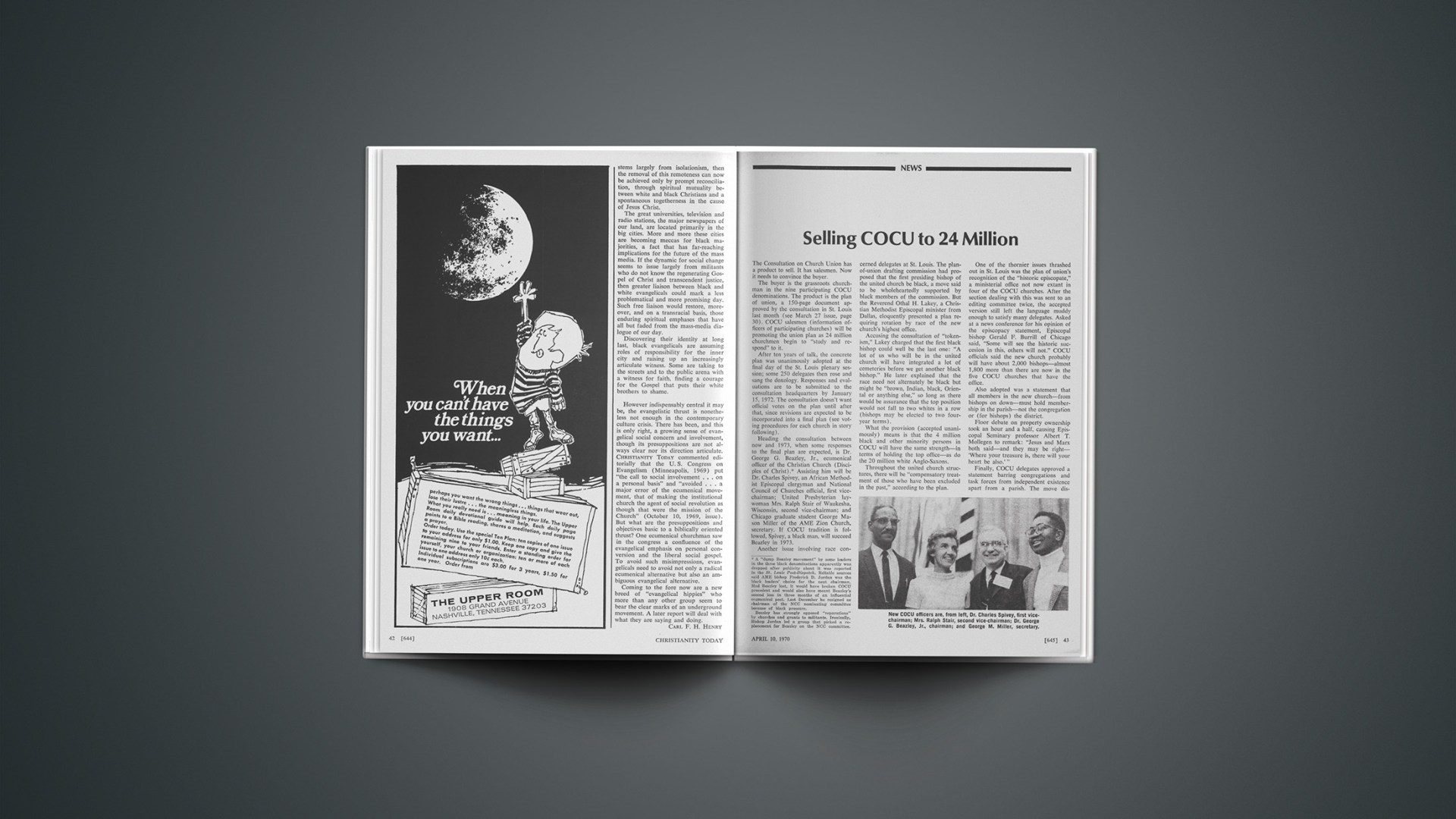
The Consultation on Church Union has a product to sell. It has salesmen. Now it needs to convince the buyer.

The buyer is the grassroots churchman in the nine participating COCU denominations. The product is the plan of union, a 150-page document approved by the consultation in St. Louis last month (see March 27 issue, page 30). COCU salesmen (information officers of participating churches) will be promoting the union plan as 24 million churchmen begin to “study and respond” to it.

After ten years of talk, the concrete plan was unanimously adopted at the final day of the St. Louis plenary session; some 250 delegates then rose and sang the doxology. Responses and evaluations are to be submitted to the consultation headquarters by January 15, 1972. The consultation doesn’t want official votes on the plan until after that, since revisions are expected to be incorporated into a final plan (see voting procedures for each church in story following).

Heading the consultation between now and 1973, when some responses to the final plan are expected, is Dr. George G. Beazley, Jr., ecumenical officer of the Christian Church (Disciples of Christ).1A “dump Beazley movement” by some leaders in the three black denominations apparently was dropped after publicity about it was reported in the St. Louis Post-Dispatch. Reliable sources said AME bishop Frederick D. Jordan was the black leaders’ choice for the next chairman. Had Beazley lost, it would have broken COCU precedent and would also have meant Beazley’s second loss in three months of an influential ecumenical post. Last December he resigned as chairman of the NCC nominating committee because of black pressure. Assisting him will be Dr. Charles Spivey, an African Methodist Episcopal clergyman and National Council of Churches official, first vice-chairman; United Presbyterian laywoman Mrs. Ralph Stair of Waukesha, Wisconsin, second vice-chairman; and Chicago graduate student George Mason Miller of the AME Zion Church, secretary. If COCU tradition is followed, Spivey, a black man, will succeed Beazley in 1973.

Another issue involving race concerned delegates at St. Louis. The plan-of-union drafting commission had proposed that the first presiding bishop of the united church be black, a move said to be wholeheartedly supported by black members of the commission. But the Reverend Othal H. Lakey, a Christian Methodist Episcopal minister from Dallas, eloquently presented a plan requiring rotation by race of the new church’s highest office.

Accusing the consultation of “tokenism,” Lakey charged that the first black bishop could well be the last one: “A lot of us who will be in the united church will have integrated a lot of cemeteries before we get another black bishop.” He later explained that the race need not alternately be black but might be “brown, Indian, black, Oriental or anything else,” so long as there would be assurance that the top position would not fall to two whites in a row (bishops may be elected to two four-year terms).

What the provision (accepted unanimously) means is that the 4 million black and other minority persons in COCU will have the same strength—in terms of holding the top office—as do the 20 million white Anglo-Saxons.

Throughout the united church structures, there will be “compensatory treatment of those who have been excluded in the past,” according to the plan.

One of the thornier issues thrashed out in St. Louis was the plan of union’s recognition of the “historic episcopate,” a ministerial office not now extant in four of the COCU churches. After the section dealing with this was sent to an editing committee twice, the accepted version still left the language muddy enough to satisfy many delegates. Asked at a news conference for his opinion of the episcopacy statement, Episcopal bishop Gerald F. Burrill of Chicago said, “Some will see the historic succesion in this, others will not.” COCU officials said the new church probably will have about 2,000 bishops—almost 1,800 more than there are now in the five COCU churches that have the office.

Also adopted was a statement that all members in the new church—from bishops on down—must hold membership in the parish—not the congregation or (for bishops) the district.

Floor debate on property ownership took an hour and a half, causing Episcopal Seminary professor Albert T. Mollegen to remark: “Jesus and Marx both said—and they may be right—‘Where your treasure is, there will your heart be also.’ ”

Finally, COCU delegates approved a statement barring congregations and task forces from independent existence apart from a parish. The move disappointed some whose churches hold to congregational polity, especially since an amendment that would have allowed individual congregations to retain title to present property was turned down. But the consultation softened this stance by approving a motion by United Presbyterian stated clerk William Thompson that “present forms of holding property will be maintained during the transition period.” In some ways, this favors churches that vest property in the denomination. The “phase-in” time is expected to last several years.

Ordination standards for presbyters (ministers) in the new church were strengthened by an amendment made by United Presbyterian pastor Cary N. Weisiger of Menlo Park, California. A question on the Scriptures to be asked of candidates now says the “Scriptures of the Old and New Testaments convey the Word of God and are the unique and authoritative standards of the church’s life …” (Weisiger inserted “unique and authoritative”.)

Episcopal ecumenical officer Peter Day wanted the word “are” substituted for the word “convey” in the above wording, thus suggesting that God can reveal propositional truth. His motion lost by a fairly decisive margin.

COCU general secretary Paul A. Crow, Jr., summed up some future sticky wickets for COCU partners. He stressed that COCU enthusiasts envision not a merger of existing churches but a new church with a different life and mission.

“Fundamentally,” he said, “the issue is whether this unfamiliar form of a church has validity.”

RUSSELL CHANDLER

Embracing Cocu

There may be a huge huge-in and when the proposed Church of Christ Uniting gets its ministers together. It’s all right for official guests attending the ministries of the Consultation on Church Union embrace the COCU ministers after the service.

The COCU plenary session in St. Louis last month voted that duly elected representatives (clergy and lay) invited to the service (assuming two are more COCU denominations approve the proposed plan of union) may give each of the COCU ministers “the right hand of fellowship or an embrace and a quiet word of gretting.”

The plan doesn’t say whether the COCU ministers may hug back, or whether they may embrace each other.

Commenting on the addition of the words “or an embrace”—not a part of the original plan of union—Dr. David Colwell of Seattle, a former COCU chairman, said: “We need to loosen up a bit, like the blacks.…”

The earlier description of the consecration service called for “delegated ordained ministers from churches other than the uniting church … to share in this silent laying on of hands. Bishops in the historic episcopate and ministers from non-episcopal churches shall be invited.” The laying on of hands around a large circular table is to be done in silence.

Nuts And Bolts Of Union Vote

What procedures would be necessary in each of the nine denominations participating in the Consultation on Church Union for that church to become a part of the proposed Church of Christ Uniting?

CHRISTIANITY TODAY asked that question of top officials of the nine churches. Any final voting is at least two years away, and denominational officials were not certain in all cases of exact procedures or constitutional requirements. Considered opinions of those surveyed are as follows:

African Methodist Episcopal, African Methodist Episcopal Zion, and Christian Methodist Episcopal Churches—These black denominations, all in the Methodist family, have similar requirements. In each case, the quadrennial General Conference must vote, followed by a vote of the church’s annual conferences. The COCU plan of union (revised) could be submitted to the General Conference of the AME Church no earlier than 1972. If approved there by a two-thirds majority, the annual conferences would then be required to approve the plan by the same majority at their next regular sessions. A final decision could be made by late 1973 or early 1974.

The same procedure applies for the AMEZ Church. (Bishop William J. Walls of Chicago and Professor John Satterwhite of Washington, D. C., both delegates at the St. Louis COCU, may have misunderstood a reporter’s question. But both repeatedly said that the decision for the AMEZ Church would be made at the congregational level and that they expected that COCU would set up a universal procedure under which all nine denominations would individually vote whether to join the united church.) The next AMEZ General Conference will be in May, 1972.

If the CME General Conference (probably 1974) approves the final plan of union by a simple majority, then the annual conferences would vote on the plan at their next meetings. It was not immediately clear whether a two-thirds or three-quarters vote would be needed at that level.

United Methodist Church—The General Conference, meeting in St. Louis this month, is expected to receive and adopt for study the plan of union in its present form. General Conference approval of the final plan could come (a two-thirds majority is believed to be required) in 1972. But the annual conferences would be asked to study the plan, and their voting might not be completed until 1976. Two-thirds of the aggregate vote within the total constituency of the annual conferences would be needed to commit the United Methodist Church to the COCU merger.

Christian Church (Disciples of Christ)—Since the Disciples only organized as a denomination (rather than a brotherhood) in 1968, there is no precedent for a vote of this nature. General Assembly approval presumably could not come before 1973. Officials speculate that the thirty-nine regions of the church will probably then vote, as they did in the restructure issue (this required a two-thirds majority). The Disciples’ General Assembly in Louisville in 1971 probably will be asked to set up procedures for the COCU vote.

Episcopal Church—Approval by two consecutive General Conventions is necessary; the earliest of these could be in 1973. The following regular General Convention is set for 1976; a Special General Convention might be called earlier. “Widespread consultation,” and perhaps straw voting by dioceses, will occur between national meetings, an official said. Two-thirds of the House of Bishops and two-thirds of the House of Delegates must approve the plan at each convention. Voting in the House of Delegates will be by orders (lay and clerical votes are counted separately).

United Church of Christ—The General Synod could approve the revised union plan at the 1973 meeting. Then each conference must vote, followed by a vote by each congregation according to its own bylaws. Ultimate decision, then, after approval at the synod and conference level, still belongs to each congregation (some congregations may choose to abide by the vote of the conference to which they belong, however).2According to the present plan of union draft, any local congregation may withdraw from the united church within one year of the formation of the united church’s district council. A majority vote of the local congregation’s communicant members is sufficient; the local church may retain its property. A floor attempt at last month’s COCU plenary session to limit withdrawal to congregations “which had this right in the church law or polity of the uniting church of which it was a part prior to union” failed. It will require a minimum of one and one-half years after the synod votes before congregational voting can be completed.

United Presbyterian Church in the U. S. A., and Presbyterian Church, U. S.—General voting procedures are essentially the same. At the UPUSA General Assembly in Chicago next month, the plan of union doubtless will be referred to a committee set up to interpret and study it and send it to congregations for study. Approval of the revised plan could come as early as the 1972 General Assembly. After that, two-thirds of the presbyteries must approve, and final ratification by another General Assembly (1975 at the soonest) must follow. Only a simple majority vote at the General Assembly level is needed.

The Southern Presbyterian Church procedure differs only in that three-quarters of the presbyteries must approve the plan, rather than two-thirds. If, as some COCU enthusiasts hope, the two Presbyterian bodies unite prior to adoption of the COCU plan, the two-thirds—rather than the three-quarters—vote presumably could apply.

Union (joint) presbyteries between the two bodies (several now exist or are planned in Missouri and elsewhere) could complicate the voting. Delegates in a union presbytery might vote twice, once for the United Presbyterian Church, and again for the Southern Presbyterian Church.

King’S Dream Recaptured

“I wonder why we didn’t listen closer to Dr. King back then?” a white woman mused, obviously moved by King: A Filmed Record … Montgomery to Memphis. “I wonder if it’s too late to find the dream.”

Her reaction was shared by others who viewed the documentary of thirteen years in the life of civil-rights leader Dr. Martin Luther King, Jr. Nearly a million people attended the one-night stand in 1,000 theaters across the country, raising close to $5 million for a special memorial fund.

King the preacher of non-violence, who loved his enemies and sought dignity for his race, dominated the nearly three-hour epic. The film included shots of King in jail in Birmingham in April, 1963, while on the soundtrack he read his now classic “Letter from the Birmingham Jail.” That response to eight clergymen who considered King’s Birmingham demonstrations “unwise and untimely” pointed to the civil disobedience of Shadrach, Meshach, and Abednego and to the “extremism” of Jesus.

Also in the film were excerpts from many of King’s sermons, including one on Viet Nam he preached in New York’s Riverside Church in 1967.

Transition between segments of the film was provided by actors who read poetry and commented on events. One was Charlton Heston, who read from the Old Testament.

King won nearly universal critical acclaim: it was honest, admitting failure as well as success, but not sentimental. The clergyman’s widow said she was pleased with the production.

Although several theaters in New York and Washington, D. C., reported bomb threats, no violence erupted. That the film did not touch off a wave of violence, as King’s death did in 1968, was attributed by a black Washington columnist to its underlying sense of triumph and the inspiration it gave to take up Martin Luther King’s peaceful dream once again.

Morality Gap Shootout

The good guys and the bad guys met at Morality Gap March 16–18 and ideologically shot it out before nearly 400 Southern Baptist ministers and laymen.

The occasion was the annual seminar sponsored by the Christian Life Commission of the Southern Baptist Convention, and the place was the American Motor Hotel in Atlanta.

The meet pitted Playboy magazine public affairs director Anson Mount against Southwestern Baptist Seminary professor William Pinson. Joseph Fletcher, chief guru of situation ethics, hassled with Henlee Barnette, a professor at Louisville’s Southern Baptist Seminary.

“Others may go hopping down the bunny trail but I’ll follow Him who said, ‘I am the way, the truth and the life,’ ” said Pinson, replying to Mount.

There had been enough emphasis, said Mount, on the “terrifying possibilities of sex,” and Playboy’s mission was to move away from that.3Mounting a defense for Playboy’s rising popularity, Mount said its huge circulation made it easy to understand why he had received a letter from Billy James Hargis, the Tulsa evangelist, saying he would be willing to be interviewed by Playboy magazine. Hargis was one of the most vocal opponents of the Atlanta morality seminar.

Fletcher, the Episcopal Seminary professor whose book, Situation Ethics, became the philosophical basis for the new morality in the minds of many, let it be known that the Christian commitment, in his view, might call for all kinds of behavior.

Noting that Jesus broke laws, Fletcher said: “I am prepared to argue that the Christian obligation calls for lies and adultery and fornication and theft and promise-breaking and killing sometimes, depending on the situation.”

The only laws Jesus broke were ceremonial laws, countered Barnette, and “nowhere did Jesus abrogate the moral law.” Fletcher’s system, he said, “is not loving enough, not situation-oriented enough, and not theological enough.”

Another Southern Baptist Seminary professor, Frank Stagg, in an address on morality and militarism, charged that the United States is the most militaristic country in the world.

“The alleged massacre of My Lai, if true, was no accident,” said Stagg. “Whatever the dimension of personal guilt, the system itself produces what is alleged to have occurred at My Lai. For it we are all guilty.”

Following the speech, Owen Cooper, a Yazoo City, Mississippi, layman, told Stagg he had done “as good a job of overkill as you accused the military of in Viet Nam.”

Sex education also entered the Morality Gap fray. However, there wasn’t enough disagreement for a debate between David Mace, former head of the Sex Information and Education Council in the United States, and James Dunn of the Texas Baptist Christian Life Commission.

“The Christian view of sex is a hodgepodge of superstition and prejudice that answers to no set of coherent ethical principles,” said Mace.

Dunn blasted Southern Baptist leadership for not doing more about sex education in the churches. “Ten negative letters constitute an avalanche in Nashville,” he said.

The Atlanta meeting stirred controversy across the Southern Baptist Convention, primarily over the presence of Mount, Fletcher, and Mace. There was also unhappiness in some circles because Negro legislator Julian Bond of Georgia, a black-power advocate, was a speaker.

Participants enthusiastically endorsed a resolution praising the meeting, hoping it would at least muffle anger that could explode when the Southern Baptist Convention meets in Denver this June.

WALLACE HENLEY

The Evangelical Underground

Now and then I have suggested 1975 as an approximate turning point in the near-term destinies of evangelical Christianity.

Several developments indicate, however, that historic Christianity need not be relegated, after all, to an impending Dead Sea Caves survival of an isolated minority remnant. I would quickly add, at the same time, that the penultimate future of the evangelical thrust is far from settled. Decisions still pending—or being avoided—may very largely influence the immediate fortunes of biblical Christianity.

Distressing factors are obvious enough. The growing secularization of modern life, the bold godlessness rampant today, not to mention the aggressive atheism of our campuses—these supply religious background perspective for the seventies. When coupled with the inevitable population expansion and the declining interest in church attendance, especially among young people, such factors should quickly temper evangelical enthusiasm about religious prospects. The fact is that evangelical forces, inside or outside the conciliar framework, are much too unrelated and scattered to register an effective national and cultural impact.

The growing disenchantment with organized ecumenical Christianity, moreover, has had consequences for related evangelical churches, particularly those that fall short of clearly and boldly articulating biblical distinctives. To be sure, many independent churches have remained aloof from the struggles vexing conciliar ecumenism, and others have become embroiled only at a polemical distance. But conciliar ecumenism is not the only enterprise now faced with living on capital reserves. To avoid the same fate, some highly independent groups are being driven to deep budget-slashing. In not a few years many of the evangelical colleges may also be in dire financial straits; some have been surviving for years on accumulating bank loans.

In England, where church attendance has ebbed, and where ecumenical churchgoers themselves repudiated Anglican-Methodist merger proposals, the church in the home—and mainly in evangelical homes—has already emerged as a noteworthy evangelistic force. If in the notion of an “underground” church one includes movements neither originated, promoted, nor supported officially by conciliar ecumenism, then such house-church efforts and other activities—not least of them the Graham evangelistic crusades—reflect a dimension of New Testament concern rather foreign to twentieth-century conciliar ecumenism. It is true, of course, that evangelically oriented individuals in the conciliar orbit have given sympathetic support and ecumenical agencies have publicly endorsed and even encouraged such efforts if they avoid free-wheeling independence.

There is reason to hope that an evangelistic breakthrough might come nationwide to America in 1973. Already thirty denominations are committed to the bold Key Bridge proposals for transdenominational, simultaneous and/or cooperative evangelism in every community in the land; ten others are tentatively interested while awaiting official approval in upcoming national assemblies or conventions. If one counts Canadian churches also, the number of involved groups may be fifty or more. As recently as five years ago, some participating denominations—among them Southern Baptists, Missouri Synod Lutherans, and Assemblies of God—were not even on speaking terms about such possibilities of cooperative evangelism. Evangelical clergy and lay leaders in each city would determine what programs were best suited to their communities for presenting the claims of Christ. The aggressive leadership of CHRISTIANITY TODAY, the Graham organization’s promotional energies, coupled with those of Southern Baptists and the Lutheran Laymen’s League, among others, could ensure effective planning.

This development provides dramatic opportunities for inner-city cooperation among evangelicals of different races. Significant in our time has been the growing insistence of black evangelical leaders that black-power militants have less following in the black community than they claim, and, in fact, do not authentically reflect its convictions. If the predicament of the evangelical churches on the socio-cultural margin stems largely from isolationism, then the removal of this remoteness can now be achieved only by prompt reconciliation, through spiritual mutuality between white and black Christians and a spontaneous togetherness in the cause of Jesus Christ.

The great universities, television and radio stations, the major newspapers of our land, are located primarily in the big cities. More and more these cities are becoming meccas for black majorities, a fact that has far-reaching implications for the future of the mass media. If the dynamic for social change seems to issue largely from militants who do not know the regenerating Gospel of Christ and transcendent justice, then greater liaison between black and white evangelicals could mark a less problematical and more promising day. Such free liaison would restore, moreover, and on a transracial basis, those enduring spiritual emphases that have all but faded from the mass-media dialogue of our day.

Discovering their identity at long last, black evangelicals are assuming roles of responsibility for the inner city and raising up an increasingly articulate witness. Some are taking to the streets and to the public arena with a witness for faith, finding a courage for the Gospel that puts their white brothers to shame.

However indispensably central it may be, the evangelistic thrust is nonetheless not enough in the contemporary culture crisis. There has been, and this is only right, a growing sense of evangelical social concern and involvement, though its presuppositions are not always clear nor its direction articulate. CHRISTIANITY TODAY commented editorially that the U. S. Congress on Evangelism (Minneapolis, 1969) put “the call to social involvement … on a personal basis” and “avoided … a major error of the ecumenical movement, that of making the institutional church the agent of social revolution as though that were the mission of the Church” (October 10, 1969, issue). But what are the presuppositions and objectives basic to a biblically oriented thrust? One ecumenical churchman saw in the congress a confluence of the evangelical emphasis on personal conversion and the liberal social gospel. To avoid such misimpressions, evangelicals need to avoid not only a radical ecumenical alternative but also an ambiguous evangelical alternative.

Coming to the fore now are a new breed of “evangelical hippies” who more than any other group seem to bear the clear marks of an underground movement. A later report will deal with what they are saying and doing.

CARL F. H. HENRY

Pride

Pride is a fearful thing. It is the great destroyer—of souls, of careers, of spiritual usefulness. Pride sets man against God and God against man. It is a form of folly into which, but for the grace of God, any of us may fall.

Pride is impiety at its worst, taking to self glory that belongs to God. Twice God, speaking through the Prophet Isaiah, says: “My glory I will not give to another” (Isa. 42:8; 48:11), and in both the Old and the New Testament we read of God’s hatred of human pride.

Pride reveals a ridiculous failure to evaluate one’s self and one’s accomplishments properly. Satan encourages man to be proud. Strutting across the pages of history, finite man sees himself as the author and finisher of his accomplishments and the master of his fate.

But standing in the shadows is God, the One from whom all things come, to whom all men are responsible, and in whom the power of ultimate destiny resides.

The Apostle John includes the “pride of life” as one of the deadly attributes of this world that will pass away. It was this worldly wisdom for which Eve reached, and it is this that has been the downfall of millions to this day.

How vulnerable we all are to conceit! Pride in personal appearance, accomplishments, ability, money, intellect, power—this develops easily in our hearts. We are even tempted to be proud of our humility.

But what does God say? “Thus says the LORD: ‘Let not the wise man glory in his wisdom, let not the mighty man glory in his might, let not the rich man glory in his riches; but let him who glories glory in this, that he understands and knows me, that I am the LORD who practices kindness, justice, and righteousness in the earth; for in these things I delight, says the LORD’ ” (Jer. 9:23, 24).

Pride has many aspects: haughtiness, which is sophisticated pride; conceit, which is self-congratulation; arrogance, which is pride demanding the recognition and approval of others. Boasting is the trumpet of the proud, which they use to sound forth their own praises.

Many years ago I heard Dr. R. A. Torrey give an address entitled “Seven Reasons Why God Used D. L. Moody,” and one of the reasons he gave was Moody’s humility. Dr. Torrey went on to say that he had known many promising young ministers whom, as time went on, God had had to lay aside as useful servants because they had become proud of themselves and their ministry. What a victory for Satan!

There is no greater evidence of man’s pride today than that many now set aside God’s holy laws as “irrelevant” for our times. In situation ethics and the new morality, man is saying that he is the master of his own life and actions, that God’s righteous demands are no longer valid in the realm of human conduct. To such reasoning one can hear God’s mocking laughter. “He who sits in the heavens laughs; the LORD has them in derision” (Ps. 2:4).

The Bible makes it abundantly clear that pride is a monstrous evil. In the catalogue of evil things that proceed from the unregenerate human heart, we find pride listed with such things as fornication, theft, murder, adultery, coveting, wickedness, deceit, licentiousness, envy, slander, and foolishness (Mark 7:21). This being the case, how earnestly we should seek God’s help to flee from pride!

Pride is utterly unbecoming in a Christian. Everything, even our faith, is a gift of God. As the Apostle Paul says, “Then what becomes of our boasting? It is excluded. On what principle? On the principle of works? No, but on the principle of faith. For we hold that a man is justified by faith apart from works of the law” (Rom. 3:27, 28). And again Paul says, “I have applied all this to myself and Apollos for your benefit, brethren, that you may learn by us to live according to scripture, that none of you may be puffed up in favor of one against another. For who sees anything different in you? What have you that you did not receive? If then you received it, why do you boast as if it were not a gift?” (1 Cor. 4:6, 7).

Some years ago while I was learning to fly I became lost again and again over the mountains of western North Carolina. I lost my perspective, and as I examined the terrain around me, nothing looked familiar. Pride does the same thing for our spiritual perspective. We do not see ourselves, life, other people, and God as we should see them. Self becomes inflated and all else distorted. But when we see ourselves and all else in the light of God and his truth, the bubble of self-esteem is pricked and humility replaces pride.

Pride of intellect has been the downfall of many. Some years ago the president of a then strongly conservative theological seminary remarked to a friend: “When I see promising graduates go on to take advanced degrees I have come to tremble for them, for many in the process of their doctoral studies lose their simple faith in the gospel.” He had himself been a Rhodes scholar and holds the highest degrees attainable. But he recognized the danger of anything that may destroy faith.

The Apostle Paul, the brilliant witness to God’s revealed truth, warned his spiritual son, Timothy, of the danger of a false intellectualism: “O Timothy, guard most carefully your divine commission. Avoid the Godless mixture of contradictory notions which is falsely known as knowledge—some have followed it and lost their faith” (1 Tim. 6:20, 21, Phillips). How clearly this speaks to us today!

The fearful judgment of God on the arrogant should warn us of the magnitude of the sin of pride. “For the LORD of hosts has a day against all that is proud and lofty, against all that is lifted up and high; … and the haughtiness of man shall be humbled, and the pride of men shall be brought low; and the LORD alone will be exalted in that day” (Isa. 2:12, 17).

The opposite of pride is humility, which is an evaluation of self in the light of God’s grace and mercy. Jesus, confronted by disciples vying for personal position, called a little child and put him in their midst, using him as a text and an example. “Whoever humbles himself like this child, he is greatest in the kingdom of heaven” (Matt. 18:4). There he saw simple trust and unaffected meekness. That is what he wants to see in all of us.

When David humbled himself before God, he became a man after God’s own heart. When the Apostle Paul spoke of himself as the “chief of sinners,” the “least of the apostles,” he showed that he was exercising sober judgment on himself.

The greatest saint is only a sinner saved by grace. Pride and boasting have no rightful place in the life of any Christian. Can we learn this lesson?

L. NELSON BELL

Ideas

Humanism and the Churches

God may not be dead, but his visible Church is in the doldrums. This few people would care to deny. The cause and cure of the malady is another matter. Many factors contribute to the sickness of the Church, some of them obvious, others beyond our notice. It seems clear, however, that humanism is a key to understanding the problem. Whether humanism in the Church is a major cause of its present distress or is a result of the inroads of unbelief, it demands the attention of those who are concerned with spiritual renewal and the cure of the Church.

At the heart of humanism is the notion that anthropology (the study of man) must replace theology (the study of God). God has been removed from the center of life; he is no longer truly worshipped; and man has assumed his place. Webster’s International Dictionary defines humanism as “a contemporary cult or belief calling itself religious but substituting faith in man for faith in God.” It quotes C. F. Potter, who said: “Humanism is faith in the supreme value and self-perfectibility of human personality.” And it also quotes Walter Lippmann: “To replace the conception of man as the subject of a heavenly king … humanism takes as its dominant pattern the progress of the individual from helpless infancy to self-governing maturity.”

That humanism has invaded the Church and plays a dominant role in determining its mission can easily be seen. The recently elected moderator of the New York Presbytery of the United Presbyterian Church, the Reverend James D. Watson, was reported by the New York Times as saying that he calls himself “a Christian-humanist” with “more concern about man than about God.” “I see the ministry in terms of social action,” he said, “and not in terms of preaching or the rest of the nonsense we went through years ago.”

When Time magazine spoke about the return of God to the center of the stage, the Reverend A. E. Potts of Knoxville, Tennessee, wrote the editor: “I must disagree wholeheartedly with your thesis that God is coming back to life, but I would definitely agree that man is rediscovering his own humanity. For most of the people with whom I work, and for myself, God is an obsolete piece of baggage belonging to man’s past. But our humanity most certainly is not.”

The National Catholic News Service released a report about the mission of the U. S. Catholic Relief Services in Cochin, India. Charges had been made that relief to India’s poor was a ploy intended to dispose them toward acceptance of Roman Catholicism, toward conversion. The priest replied: “No. No. We have nothing to do with conversion. Our work is completely secular. There is nothing spiritual in it.”

Back in 1933 a “Humanist Manifesto” was drawn up and signed by thirty-four men, twelve of whom were prominent ministers. The manifesto said among other things that “the universe [is] self-existing and not created”; “man is a part of nature and … has emerged as the result of a continuous process”; “man’s religious culture and civilization … are the product of a gradual development due to his interaction with his natural environment and with his social heritage”; “religion must formulate its hopes and plans in the light of the scientific spirit and method”; “the time has passed for theism, deism, modernism, and the several varieties of ‘new thought’ ”; in place of the old attitudes involved in worship and prayer, the humanist finds his religious emotions expressed in a heightened sense of personal life and in a cooperative effort to promote social well-being.” “A socialized and cooperative economic order must be established,” the manifesto declared, “to the end that the equitable distribution of the means of life be possible. The goal of humanism is a free and universal society in which people voluntarily and intelligently cooperate for the common good. Humanists demand a shared life in a shared world.”

The result of the infiltration of the Church by humanism is that the Church has turned from preaching the Gospel of the reconciliation of man to God through the atonement of Jesus Christ to a man-centered program of secular involvement. The implication seems to be that faith in man is to be preferred to faith in God.

The turning from God to man is not just an American phenomenon. It can be found in churches around the world, especially in Europe, where Christianity is suffering a marked and alarming decline. In Germany, where the theological climate—in particular, the higher criticism of the Scriptures—has fostered the growth of humanism, church attendance has sunk to an all-time low. It is estimated that not more than 1 per cent of the people attend any church on a Sunday morning, while the morality of the people continues to decline and profligacy grows by leaps and bounds. The situation in Sweden, England, and Denmark, not to mention France, is hardly any better.

In the United States, the Unitarians represent the farthest turn to the left in religious life. For many of them, theism has been supplanted by a radicalism that negates biblical revelation, defies the law of love, and opts for violence as well as a system of non-biblical ethics. Following the release of attorney William Kunstler and the Chicago Seven from jail, it was a Unitarian church in California that opened its doors to enable Kunstler and others to continue their assaults on American democracy. Certainly no other church group has been more openly identified with left-wing causes, or more committed to action programs that are designed less to correct known abuses than to pull down structures—without presenting defensible alternatives.

The Unitarian Universalist Association has now opened a joint Washington Office for Social Concern in league with the American Humanist Association and the American Ethical Union. This is a cooperative effort “to apply the insights of humanistic ethics and liberal religion to major problems facing American society in the seventies.” Members of the Humanist Association and the Ethical Union believe considerably less than even some Unitarians. But a sizable number of men connected with mainline denominations hold views hardly distinguishable from those championed in these three groups. The presence of such men is a major cause of the sickness of the Church today—and this is so in Catholic and Orthodox as well as Protestant circles. They seem aptly described by Paul: “these men also oppose the truth”; “they are men of corupt mind and counterfeit faith” who “holding a form of religion [deny] the power of it.”

If the Church is to experience renewal, something must be done to check the forces of unbelief rampant within it. The Church must rediscover and reaffirm what God intended it to be. The continuing drift toward humanism points to the distinct possibility that apostasy may not be far away.

Accountability

Elsewhere in this issue we publish an article on accountability (see page 14) that makes a point much needed in our time of social turmoil. However, even among those who agree on the importance of the principle of personal responsibility there will be disagreement on its specific applications. One who believes in accountability may, for example, still find good reasons for switching auto insurance to a “no-fault” scheme. The present system leaves the victim hoping that if someone else is accountable, that person is adequately covered by a responsible insurance company. Again, advocates of prison reform do not have to abandon the notion of punishment in order to urge that greater efforts be made to train the prisoner to take an honest place in society. What the article does underline is that if we advocate changes in social policy we must not do so because of the witting or unwitting acceptance of unscriptural principles. To hold men accountable for what they do is a much greater recognition of the God-given dignity of their humanity than to act as if no one were to blame for his faults.

Ecologism: A New Paganism?

On April 22 America will have its first national environmental teach-in. Pollution will be protested; population growth will be deplored; politicians will pillory and be pilloried; and privileged industries will be pommeled. In the midst of it all, informative presentations will be made.

We like clean air, water, streets, and spaces as much as the next person (see the lead editorial in our February 27 issue). But we don’t propose to worship nature, any more than we take part in the worship of science, which is called scientism. Unfortunately, at least a few persons appear to have gone beyond legitimate concern for our environment to pervert the science of ecology into what might be called ecologism. These people are uninhibited in their opposition to orthodox Christianity (as well as to such derivatives as humanism and Communism), and to replace it they urge what is essentially old-fashioned paganism.

The Environmental Handbook, specially published for the teach-in by Friends of the Earth, a leading activist anti-pollution organization, was quickly sold out in its first edition. In it Keith Murray of the Berkeley Ecology Center says:

It seems evident that there are throughout the world certain social and religious forces which have worked through history toward an ecologically and culturally enlightened state of affairs. Let these be encouraged: Gnostics, hip Marxists, Teilhard de Chardin Catholics, Druids, Taoists, Biologists, Zens, Shamans, Bushmen, American Indians, Polynesians, Anarchists, Alchemists … the list is long. All primitive cultures, all communal and ashram movements [p.331].

Because of the need to limit population growth, Murray urges us to “Explore other social structures and marriage forms, such as group marriage and polyandrous marriage, which provide family life but may produce less children” (p. 324).

Another eco-activist, Keith Lampe, manages in two pages to urge the elimination of nationalism, capitalism, socialism, Communism, humanism, faith in technology, as well as Judaism and Christianity.

The first major article in the teach-in text is by Lynn White, Jr., a history professor at UCLA. He deplores the “victory of Christianity over paganism,” condemns it for being “the most anthropocentric religion the world has seen,” and is incensed that “by destroying pagan animism, Christianity made it possible to exploit nature in a mood of indifference to the feelings of natural objects.” White argues that “more science and more technology are not going to get us out of the present ecologic crisis until we find a new religion, or rethink our old one.” He concludes that “orthodox Christian arrogance” is the culprit and that “since the roots of our trouble are so largely religious, the remedy must also be essentially religious, whether we call it that or not.”

Most of the handbook deals with specific wrongs that Christians can oppose within their own framework of belief. But it seems apparent that they should guard against identifying themselves too closely with persons and ideologies that are hostile to divine revelation. We too want to clean up pollution in nature, but not by polluting men’s souls with a revived paganism.

Dietrich Bonhoeffer

This month marks the twenty-fifth anniversary of the death of Dietrich Bonhoeffer. On April 9, 1945, Admiral Canaris, General Oster, and Sack, the judge advocate general, along with Bonhoeffer, were led naked to the gibbet in the garden of Flossenbürg and hanged. Along with many others these four had been swept up by the SS and were destroyed for their part in the assassination plot against Hitler, who committed suicide three weeks later.

Bonhoeffer was just thirty-nine. That this young theologian and churchman should have been in deadly serious operations with generals and admirals tells us something of the measure of the man; it should give us some clue also to the agony of his ethical decisions. He was a pacifist by conviction, and he loved his fatherland intensely; yet he involved himself in an assassination plot, a murder, the downfall of his country, and all in what he felt was obedience to God. One cannot treat such a man lightly; he cannot be dismissed by superficial theological labels.

Bonhoeffer became a hero to hundreds of theological students; he affected them in their training and continues to affect them now. His writings, notably The Cost of Discipleship, Life Together, and Letters from Prison, became required reading for anyone who wished for theological relevance, and his famous expressions like “man come of age” and “religionless Christianity” and Christ “the man for others” became part of the vocabulary of those who had a yen for theological sophistication. With such concepts as these he set the tone for much of the theology of the left and the radical left, but to emphasize this alone is to impair understanding of his total contribution.

Bonhoeffer was a “loner” and is hard to classify. Although we do not endorse a number of his views, to label him and dismiss him is to contribute to nothing but one’s own impoverishment. His background and training were, of course, liberal in the frightening critical German sense, but it could not have been otherwise in the universities of his time. Harnack, Seeberg, Heim, and Holl were among his teachers, but he was one of the earliest enthusiasts for Karl Barth, who was considered then on the Continent (and is even more now) a most conservative theologian. He was also existentialist (“In ethical decision we are led into the deepest loneliness”; “What God’s will is, the occasion will tell you”)—how could it have been otherwise for a Christian in an assassination plot?

More needs to be said, however. Bonhoeffer was a biblical expository preacher from the whole of Scripture. He practiced the strictest of Christian discipline in devotions and daily life. He understood “life together” and the cost of repentance and of forgiving love in the Christian community. And his obedience to the will of God extended unto death. “Love your neighbor more than your timid conscience,” he said. He can say to his critics, “Show me your scars.”

Compassion For Catholics

Things used to be relatively easy for the average Roman Catholic parishioner. His thinking was done for him. All he needed to do was to submit intellectually, and follow prescribed procedures when he erred.

Not so these days. The Catholic layman is now caught in the crossfire of a great theological and ecclesiastical debate. The Pope says one thing, while others in the hierarchy say something else. What is the layman to believe? Whom is he to listen to?

No doubt many a Catholic feels at loose ends, confused and bewildered. Protestants who are sure of their own theological ground need as never before to pay heed to the perplexities faced by their Catholic friends. It is an opportune time for sheer Christian compassion.

Evangelicals also have a responsibility to point Catholics to the unchanging Scriptures that speak to the problems they face. However, this must never be done in a patronizing way, or in a vindictive spirit. Especially to those Catholics who exhibit an openness of mind, the Protestant response should be patient and loving.

Evangelical ministers need to make special efforts to communicate with Catholic clergy. Perhaps priests are even more unsettled than the laity, since religion dominates their lives. Evangelicals have found that there can be stability in the midst of organizational chaos, when faith is anchored on Christ and his Word rather than human institutions.

Exodus From The Pastorate

Why do ministers leave the pastorate? The United Church of Christ recently released the results of a study designed to answer that question. The report, Ex-Pastors: Why Men Leave the Parish Ministry (Pilgrim), is based on a survey of 276 active UCC pastors and 241 former pastors no longer employed by the church.

So far, relatively few ministers have left. The UCC study found that only about 1 per cent of its clergymen have taken the step. Reports on other denominations show varying percentages (some figures represent men leaving the ministry altogether; some indicate only a move out of the pastorate): 20 per cent in the Unitarian Universalist Church, an estimated 3 to 6 per cent in some Baptist groups, and only sixty withdrawals among the 13,000 United Presbyterian ministers.

The UCC survey discovered the alarming fact that although the exodus does not yet involve a large segment of the clergy, those who have remained have much the same attitudes as those who left. Many pastors are sticking it out under the same frustrations and restrictions that have caused others to leave, and it is reasonable to assume that a number of them may be thinking about leaving too.

The reasons given for leaving vary widely, ranging from frustration with the Church to personal problems and better job opportunities. Although most ministers are grossly underpaid (by comparison with other professional occupations), salary was not a major factor in the decisions to leave. And very few attribute their move to a loss of personal faith. In fact, of those who left the pastorate only 13 per cent were willing to describe their change as “leaving the ministry.” And some say their faith was renewed after they left their churches.

The reasons the former ministers gave for leaving fall into three main categories: (1) conflicts with the congregation (such as unwarranted criticism, too high an expectation for minister and family in their personal lives, apathy and lack of cooperation on the part of church leaders); (2) distortion of the role of pastor (too much time spent in administration and in smoothing the easily ruffled feathers of church members, too little time for study and fruitful personal contact); (3) personal problems (such as a sense of personal and professional inadequacy, insufficient training, and family problems).

No doubt there are some men in the pastorate who do not belong there. And certainly any pastor who departs from the Bible as the basis for his life and ministry does not merit the support and encouragement of his people. However, the fact remains that a number of ministers have left the pastorate—and others are contemplating leaving—because their churches have let them down. Ministers are human, and they need the help not only of God but also of their people. Too often the promise made at the time of installation to support, encourage, pray for, and work with the minister has long since been forgotten.

We find it much easier to criticize a minister than to pray for him. And it is easier, when criticism is called for, to speak to someone else rather than to the minister himself. It is more convenient to hire someone to do the work of the church than to take our place on a team involved in the work with him. It is simpler to demand that the minister and his family perfectly exemplify Christian behavior than to concern ourselves with our own failures. And it is less complicated to keep a minister’s salary the same or begrudgingly throw a token raise his way than to seek realistically to assess and meet his material needs.

Churches that take the easy way won’t produce much fruit for God—and will probably help to produce many more ex-pastors. Your pastor is not perfect; he’ll be the first to admit that. He does not belong on a pedestal and does not want to be placed there. Because he too is a man he needs your prayers, your encouragement, your patience, your constructive criticism, your involvement. In short, he needs your love.

Undoubtedly God has other fields of service for some pastors. And some are unable or unwilling to fulfill the role of pastor and to minister the Word of God to the people. These men should leave the pastorate. But it is disturbing when a man who feels called of God to serve his Church is forced to give up under the weight of frustration and disillusionment brought on by those who have promised to stand with him.

How Do We Know Him?

John the Baptist, the forerunner of Jesus, was given the privilege of announcing to all that Jesus was the true Messiah. But how did he know this? He admitted, “I myself did not know him.” How then did he discover who the true Messiah was?

God revealed the method. “He on whom you see the Spirit descend and remain, this is he who baptizes with the Holy Spirit” (John 1:33). John’s witness is clear: “I saw the Spirit descend as a dove from heaven, and it remained on him”; therefore “I have seen and have borne witness that this is the Son of God.”

What about us today? How can we know that Jesus is the Messiah? Jesus is not here; we cannot see the Holy Spirit light on his head as a dove. How can we be sure about him and about our salvation? The Apostle John supplies the answer later in the Fourth Gospel: “These are written that you may believe that Jesus is the Christ, the Son of God, and that believing you may have life in his name” (John 20:31).

The inescapable fact is that the ultimate and only source of knowledge that leads to salvation is Scripture. The New Testament alone provides us with the facts about Jesus the Messiah. Many writers followed in the footsteps of the apostles and left for the Church a great deposit of knowledge. But all this harks back to the Bible, which we call the Word of God.

We think of the Bible as a single book, and it is. But it is a book of many books, and in it we have the written testimony of many people, all to the same effect: Jesus is the Lamb of God that takes away the sin of the world. It is not enough to say that we neglect the Bible at our peril. We neglect it at the cost of our souls and our eternal salvation. It and it alone is the indispensable source of religious knowledge. Without it we perish. With it, when we have believing faith, we come to know Jesus, the Messiah, whom to know aright is life eternal.

Book Briefs: April 10, 1970

Today’s Evangelical Students

Christian Collegians and Foreign Missions, by Paul F. Barkman, Edward R. Dayton, and Edward L. Gruman (Missions Advanced Research and Communication Center [Monrovia, California], 1969, 424 pp., $15), is reviewed by Donald Tinder, assistant editor,CHRISTIANITY TODAY.

Will evangelicals “keep the faith” when the present generation of college students become the leaders? Does attending a secular college lead to departure from orthodoxy? Is foreign missionary service still a live option for college students? If you are interested in answers to these and many related questions, this book is essential reading.

Almost 4,000 of the 9,000 persons who attended the Missionary Convention sponsored by Inter-Varsity Christian Fellowship in 1967 at Urbana, Illinois, took the trouble to fill out properly a lengthy questionnaire. The answers were computerized and analyzed and are splendidly presented in this book. The right-hand pages usually have two clear charts, each illustrating a one-or two-line statement. The left-hand pages elaborate.

An initial chapter introduces us to the delegates, their backgrounds, views, and goals. Then successive chapters focus on the ones from among the delegates who are (1) missionary candidates, (2) already missionaries, (3) seminarians, (4) new Christians, (5) non-Christians, and (6) Christians since early childhood. Next we see the differences that age and sex make. We look at a few of the questions in depth to see what the delegates are like according to such concepts of religious psychology as punitiveness and intrinsic religion. Finally, two chapters focus on the specifically theological questions and on the more “fundamentalist” respondents.

The cost of the book will keep it out of most individual libraries, but any evangelical school or mission board will need it. Dr. Barkman is a qualified social scientist, and the book meets the exacting standards for statistical evaluation. Yet at the same time the material is presented in such a way that the ordinary reader gets the point. One wonders why more statistical reports aren’t done this way.

We may hope that the next “Urbana,” to be held this December 27–31, will have a similar study made of its delegates. A breakdown by college major and precision regarding denomination would be useful. Also, the subcategory “fundamentalist” within the framework of orthodoxy is a little arbitrary, in my view. I think it better to leave that much maligned term to historical writing and find some other word for contemporary usage.

By the way, if you are worried about the future of the faith in the hands of educated youth, this book will reassure you that the Holy Spirit is still alive and active, raising a new crop of disciples of Jesus Christ.

Fruit Of A Disciplined Mind

Studies in the Fourth Gospel, by Leon Morris (Eerdmans, 1969, 374 pp., $8.95), is reviewed by Robert Mounce, professor of religious studies, Western Kentucky University, Bowling Green, Kentucky.

Leon Morris, principal of Ridley College, Melbourne, has established himself as one of the outstanding conservative New Testament scholars of our day. Studies in the Fourth Gospel, his eighteenth book, is a careful, thorough and balanced study of a number of technical questions that arose during his writing of a commentary on John. To work one’s way through these essays with care is to follow the disciplined mind of a serious scholar whose goal is a critical understanding of the text. One finds no fanciful conjectures or brilliant “reinterpretations” here, but rather the hard spade-work and cautious appraisal out of which lasting results are formed.

Dr. Morris finds that while John is in essential agreement with the Synoptics he writes his Gospel quite independently of the others, and he holds that John is to be taken seriously as a reliable historical source. There is good evidence that underlying the Fourth Gospel is the testimony of an eyewitness. In a detailed discussion of authorship Morris concludes that the simplest solution is that John the apostle is responsible for the Gospel. (Recent work on the date of writing is now more favorable to this traditional opinion.) An interesting chapter on variation as a feature of the Johannine style draws attention to the importance of this phenomenon in interpreting certain passages (such as 3:5 and 21:15 ff.). And finally, Morris contends that Qumran, far from being the cradle of Christianity, has underscored the uniqueness of the Christian faith; it may even have brought scholarship back from its “Hellenistic dispersion” to the land of Palestine as the place of origin.

My advice: buy it and read it!

Mixes Fact And Fancy

The Earthly Jerusalem, by Norman Kotker (Scribner’s, 1969, 307 pp., $7.95), is reviewed by J. Julius Scott, Jr., professor of Bible, Belhaven College, Jackson, Mississippi.

Rabbinic tradition affirmed that Jerusalem is “The Center of the Universe.” It held that the city was located on the axis of the earth and was the geographical fountainhead from which flowed God’s creative work. Although its cosmological centrality is open to debate, Jerusalem is unquestionably the spiritual capital of three faiths and at least two national groups.

Whatever the sentimental or sacred position ascribed to it, Jerusalem, like any other earthly city, has a cultural, social, political, and physical history. Beginning with the arrival of the early Canaanite settlers in the third millennium B.C., Norman Kotker here traces the story of Jerusalem to the present. He notes the changes brought as a succession of different inhabitants, religions, and cultures occupied the site. Often it seems that the book is obsessed with the violent, tragic, and brutal elements of the story of Jerusalem. But, as the author notes, the history of Jerusalem is marked with bloodshed and “has resembled hell—or at least modern man’s idea of hell—more than it has resembled heaven.”

Kotker is neither a historian nor a student of religions but a professional writer. While this enables him to view his subject with a certain detachment and objectivity, it leaves him lacking certain skills and insights that would have made for a better book. Much research and study went into his preparation of this volume, and the author quotes from a variety of sources. But his failure to evaluate the worth of the material he cites leads him to combine fact and fancy. And since he also neglects to identify the sources of his material, including direct quotations, the reader cannot make his own evaluation.

When historical reconstruction requires philosophical or theological interpretation, Kotker shows no awareness of conflicting views. In handling the Old Testament material he is influenced by nineteenth-century biblical criticism. His explanation of the development of the Hebrew religion is naturalistic and claims more influence by contemporary paganism upon the biblical faith than this reviewer believes is warranted by the facts. In portraying the events and stages through which Jerusalem has passed, Kotker often compresses long periods of time or expands single instances. As a result the reader gets an uneven, hopscotch view of the city’s history.

The author faithfully reports the conquest of Jerusalem in the Roman wars of the first and second centuries A.D. Almost cynically he describes the sometimes ludicrous search for relics and “holy sites” in the following years. But he fails to note that the complete destruction of the city by the Romans makes the positive identification of most of the places in Jerusalem noted in the biblical narratives virtually impossible.

Of special interest and value is the summary of the history of Jerusalem during the Crusades. Kotker’s portrayal of the plight of Jews in the land they call their own from the Hadrianic destruction until the present provides a useful background for understanding the attitudes of modern Israelites. The final chapter, in which he attempts to describe the physical structure and mood of modern Jerusalem, is probably the best written and most valuable part of the book.

The Earthly Jerusalem is well conceived and attractively printed (but overpriced). Its inaccuracies and historical generalizations, however, make it of little benefit to the layman. And its lack of documentation and of the exercise of critical skills renders it of negligible value to the student or scholar.

Seeking To Be The Church

Struggle for Integrity, by Walker L. Knight (Word, 1969, 182 pp., $4.95), is reviewed by E. Milford Howell, secretary of missions and stewardship, Baptist Convention of Maryland, Lutherville.

Inner-city churches by the thousands are struggling for their very existence. So are many suburban churches located in declining and changing neighborhoods faced with integration. Many churches are just rocking along watching membership decline, depending on present members to travel several and sometimes scores of miles each Sunday so they can maintain at least a semblance of worship and ministry. Very few of these churches have found a way to reach the people living nearby. Faced with these problems, many a church has sold its property and moved.

One exception is Oakhurst Baptist Church in Decatur, Georgia, and in this book Walter Knight dramatically tells the impressive story of this church’s struggle to be “the Church” in a changing neighborhood. Knight was for a number of years the editor of Home Missions, a Southern Baptist monthly journal. For more than a decade he was a member of Oakhurst Church. In describing the church’s “struggle for integrity,” he seeks a balance between the racial issues involved and the many other dimensions of the struggle and leads readers to know the struggle was basically theological.

As we follow the story of Oakhurst, we are led to ponder the true mission of the Church. Knight shows us a congregation that found itself struggling to pay for its building in a declining community while it ignored community needs. In time the members decided to sell some of their new buildings in order to minister to the needs of the community in the name of Christ. After months of wrestling with the idea, most of the members were not unduly disturbed to see attendance in Sunday school, worship services, and other activities decline, and finances diminish; they felt this was part of fulfilling what they had come to believe to be the mission of their particular church.

Not all will agree with the definition Knight gives of the Church. Yet more will today than would have five years ago. Unless hundreds of other inner-city and suburban churches are willing to give careful heed to the implications of this book, they may be seeing their closing years or months.

Plain Talk About Satan

Your Adversary the Devil, by J. Dwight Pentecost (Zondervan, 1969, 191 pp., $4.95), is reviewed by Wick Broomall, retired Presbyterian minister, Atlanta, Georgia.

No one can say that there are too many books about Satan. Competent books on this subject are not plentiful. In Your Adversary the Devil, J. Dwight Pentecost, professor of Bible exposition at Dallas Theological Seminary, gives us a very useful survey of information on Satan.

Each of the twenty chapters begins with a passage of Scripture. The first two chapters deal with “The Fall of Satan” (interpreting Ezekiel 28:11–26) and “The Sin of Satan” (interpreting Isaiah 14:12–17), and the last with “Satan’s Destiny” (a study of Revelation 20:1–10). Among other subjects are “The Hierarchy of Satan,” “How Satan Operates,” “Christ’s Conquest of Satan,” and “The Believer’s Authority over Satan.”

Pentecost considers Satan a defeated being: “When Christ went to the cross, He entered into combat with Satan and, by defeating Satan through the resurrection, He authenticated His authority.” In fact, “God, by receiving Him up into glory, demonstrated that He was enthroning Jesus Christ in the place of authority.” There is only a short step from this statement to the position that Christ, having conquered Satan by His death and resurrection, is now the King of glory at the right hand of God seated on the predicted throne of David (Luke 1:32, 33; Acts 2:30, 31). But Pentecost, the author of Things to Come and Prophecy for Today (two classic works on dispensationalism), does not, I regret to say, take this short step.

Do not look in this book for detailed scholarship. There are no scholarly footnotes, no references to other books, no index. But these deficiencies, if such they be, will make this book more appealing to those who want to know in simple language what the Bible teaches about Satan.

The Church And Mass Media

Television-Radio-Film for Churchmen, by Peter A. H. Meggs, Everett C. Parker, and John M. Culkin, S. J., edited by B. F. Jackson, Jr. (Abingdon, 1969, 317 pp., $6.50), is reviewed by Gwyn Walters, professor of ministry, Gordon-Conwell Theological Seminary, Wenham, Massachusetts.

The members of the triumvirate presiding over the arena of modern communication—television, radio, and film—emerge in this volume as foreboding and forbidding as well as full of glorious potential for churchmen. Use of the term churchmen rather than Church personalizes the issue of the relation of Christians to mass media. Each churchman may ask whether he is a gladiator or someone cast to the lions of the consumer public.

The authors raise significant questions about the use the Church must make of these three media. They point out that these are relatively new gifts that God’s people can use to influence the culture even as the culture through them influences the Church. They urge us to examine more deeply the relation of man to his culture and to arrive at a theological anchorage. Are the media products or instruments of social change? Are the boundaries of God’s kingdom coextensive with those of society? Is the mission of the media to “tell it like it is”? Should churchmen use them at all for duplicating the traditional church operations, or should they be wholly innovative? How can they meet the listeners’ demand for service as well as indoctrination? Is not communication the fundamental religious act? How can churchmen use the media to “inseminate the expectancies and guiding images through which people will handle life” and “make religious motivation and faith the pulse of civilization and the seedbed out of which the cultural renewal and redemption will grow”?

The authors describe the problems of the religious broadcasting “Sunday morning ghetto” and suggest ways of persuading networks to change their policies. They challenge churchmen to enhance religious programming and offer several concrete suggestions about programs that might “vivify … revelation, stab awake, scandalize, upset and redirect lives.…”

Some readers will question the theology implicit in some of the statements and proposals in the book and conclude that for the authors Christ is more a “place to be” (as with some of the radical theologians) than a “place to stand.” The danger may be too much present to water down the unique objectivity of the revelation in Christ and to “eisegete” him into unlikely situations. The detailed study of films in the third part of the book might appear to be vitiated by this approach. Notwithstanding the integral relation between ethics and religion and the need to tackle moral issues, the graphic presentation of the latter through the media is not synonymous with Christian interpretation of them, though Christians may use them for discussion. Anything whatsoever is potential for Christian discussion by churchmen, but such a program is not necessarily Christian or religious.

In discussing his particular category (television, radio, or film), each of the writers tends to make excursions into the larger matter of media in general. A longer introductory chapter on general matters and a more exclusive treatment of the three media individually would be preferable. As it stands, however, this is a valuable volume that may well serve to stimulate more evangelicals to explore the particular genius of the various media and with this knowledge to produce programs that are robustly Christian.

Book Briefs

Ex-Pastors, by Gerald J. Jud. Edgar W. Mills, Jr., and Genevieve Walters Burch. (Pilgrim, 1970, 191 pp., paperback, $3.45). Results of a two-year study of the lives of 241 United Church of Christ clergymen who have dropped out of the ministry.

A Handful of Dominoes, by James L. Johnson (J. B. Lippincott, 1970, 222 pp., $4.95). The Berlin Wall is the setting for the third “Code Name Sebastian” adventure novel.

Obadiah: A Critical and Exegetical Commentary, by John D. W. Watts (Eerdmans, 1969, 78 pp., $3.50). Features a short history of Edom and a study of the theology of Obadiah.

Creative Churchmanship, by Donald Bartow (World, 1969, 200 pp., $4.95). Specific suggestions for a more effective pastoral ministry and for a revitalization of the Church’s program through the effective use of volunteer help.

The Strategic Grasp of the Bible, by J. Sidlow Baxter (Zondervan, 1970, 405 pp., $6.95). Examines the structural design of the Bible and suggests a basic approach to the study of Scripture.

The Early Church Speaks to Us, by H. S. Vigeveno (Regal, 1970, 166 pp., paperback, $.95). This study of passages from Acts and the New Testament letters seeks to discover what made the early Church so successful.

Charity And Its Fruits, by Jonathan Edwards, edited by Tryon Edwards (Banner of Truth Trust, 1969, 368 pp., $4). Reprint of a classic exposition of First Corinthians 13.

Guilt: Where Religion and Psychology Meet, by David Belgum (Augsburg, 1970, 149 pp., paperback, $2.95). Studies the practice of several denominations in the field of pastoral care and asserts that where sin and guilt are the source of trouble, religion and psychology meet.

Last Words of Saints and Sinners, by Herbert Lockyer (Kregel, 1969, 240 pp., $4.95). This enlightening collection of “last words” covers the years of recorded history and includes the dying words of both Christians and non-Christians from all walks of life.

The Black Vanguard, by Robert H. Brisbane (Judson, 1970, 285 pp., $6,95). A history of the Negro social revolution from 1900 to 1960.

Communion Meditations and Prayers, by J. Harold Gwynne (Zondervan, 1969, 103 pp., $2.95). Suggestions for those who conduct communion services.

Thinkables, by James C. Hefley (Revell, 1970. 158 pp., $3.95). Provocative, practical meditations that speak to everyday problems of living.

Trumpets in the Morning, by Harper Shannon (Broadman, 1969, 156 pp., $3.50). A pastor tells why he feels that “the gospel ministry is the most thrilling and dynamic experience a person can have on this earth.”

New Life in the Parish, by Kenneth C. Senft (Augsburg, 1970, 90 pp., paperback, $2.50). Cites the need for renewal of local congregations and offers suggestions for achieving it.

It Was Good Enough for Father, by Ruth Wilkerson Harris (Revell, 1969, 128 pp., $3.50). The story of David Wilkerson’s family from great-grandfather to the present generation.

The Art of Understanding Your Mate, by Cecil G. Osborne (Zondervan, 1970, 192 pp., $4.95). Assumes that all married couples are to some extent incompatible because men and women are basically incompatible and offers practical suggestions toward a better understanding between husband and wife.

Eutychus and His Kin: April 10, 1970

Anything But A Bore

Handel got a devious boost in my newspaper last week with the front-page headline: “TWO MUSICIANS CHEWED AS CHOIR SANG MESSIAH.” It sounded like the sort of thoroughgoing villainy that makes the day for editors who know what pulls in the customers. Contemptuously dismissing the offending ones’ puerile plea that they were busy manufacturing saliva for their next instrumental onslaught, any discerning preacher will see in the whole sorry business the makings of a semon on this bedeviled world and its wrong priorities. Messrs. Elijah, the Pharisees, Eutychus the Elder (Dr. Clowney will not misunderstand), sundry Roman emperors, and O. Henry could be cited in confirmation of the human plight. Mind you, I doubt whether the choir in question was entirely, to coin a phrase, on the side of the angels. It should stimulate thought that their performance evoked an ennuyé reaction. Maybe they weren’t very good at their job, or repetition had dulled appreciation. Maybe the accused were chewing and listening.

In my very first summer pastorate, one of my warmest supporters was a farmer who invariably sat in the second front pew, and just as invariably survived the sermon in a state of soulclogging oblivion.

Admittedly James (“always full of difficulties when he looks deceptively simple”) exhorts to swift hearing, slow speaking, but I imagine he was urging thoughtful preparation rather than coy diffidence. This, come to think of it, is a point that might profitably be taken by all whose oratory is reminiscent of W. G. McAdoo’s allusion to “an army of pompous phrases moving over the landscape in search of an idea.”

Confronted by such, I know that I ought to make an effort to be a good listener, but that in itself is a criticism, for “good listening” in some sense implies defective talking, and lays the onus on those who mount platforms and pulpits to think before they thunder.

A similar responsibility devolves upon scribes, which thought struck me recently when I read that Witold Gombrowicz had died. This writer who reportedly was in the running for a Nobel Prize in literature said once: “I am a humanist … joker … acrobat … provocateur. My works do handstands to please. I am circus, lyricism, poetry, horror, fights and games … But if there is a writer who writes in terror of boring the reader, I am he!” For this single utterance (I’ve made myself vulnerable) he should have got that Nobel Prize.

EUTYCHUS IV

Life In Acts

I rejoice to see the space given in the March 13 issue to the current moving of the Holy Spirit on college campuses (“Asbury Revival Blazes Cross-Country Trail”).… Here at Greenville College we continue to say with recurrent awe that we feel ourselves to be living in the Book of Acts, in a way that none of us can exactly parallel within our collective recollection.

ELVA MCALLASTER

Greenville College

Greenville, Ill.

Many of us seminarians were disappointed with the reference made to Northern Baptist Seminary. We felt that, in the context of the article, you intimated that our school was swept up in a revival.… The fact is that such a phenomenon did not occur. Several students were genuinely inspired and encouraged by the visit of our two Asbury friends, and on the whole, our campus accepted them warmly with a real affirmation of the authenticity of their own experience. However, widescale revival did not “break out.”

We also regret the implication that because of the Asbury visit, we “got turned on to community needs, particularly those of drug addicts.” Since the middle of January there has been a renewed spirit of enthusiasm on our campus, shared by a large group of seminarians. Out of a sense of awareness as to the impact that true Christianity (that in which we serve Christ in the world as he has served us) should be having today, a good number of students transformed their concerns into action. One such area is our involvement in a “Drug-Counseling Program,” set up a month before the Asbury visit on February 23.

BOB LAURENT

Oak Brook, Ill.

Perhaps Malone College students weren’t touched by the spark that kindled fires elsewhere, but something unique did happen. A group of men called the California Team led the campus to search the Scriptures for Christian living on God’s terms.… A large number of new commitments to Christ were made. And many of them aren’t “Wesleyan-oriented.”

MRS. ROBYNE BRYANT

Kent, Ohio

Short Reality

“The Jewish Conception of The Messiah” (Mar. 13) was one of the most informative and realistic approaches to spiritual reality I’ve read in many a day. Too bad it wasn’t longer and more detailed.

LESTER H. MATTISON

Selah, Wash.

Balancing Science

I read with interest the article “Christian Roots of Science” by Joseph L. Spradley (Mar. 13). It was enlightening, but I believe it was out of balance. The greatest concern today is not with the advance of science and technology, but with its proper restraints and controls. Unrestrained exploitation of the world by science and technology threatens to destroy the environment, and hence to destroy life on this planet. To this problem he only devoted one paragraph.

Some people have blamed the Judeo-Christian heritage for this disrespect of nature. After all, the Bible says that man is to subdue the earth and have dominion over it. This would imply to many that the earth is an enemy that must be conquered and spoiled.…

It is time for us to emphasize the biblical foundations for sound conservation policies. Our natural resources are a great blessing—they are also necessary for our very survival.

WAYNE COSBY

Joseph, Ore.

The Plan Of The Aces

Thank you for devoting several pages to the Middle East (Feb. 27). The several articles were written, as far as I can tell, soberly and accurately. This is fortunate since many evangelicals root for Moshe Dayan, amen every economic advance of Golda Meir’s administration, and bless God when Israel conquers Arab lands.…

Israeli foreign and domestic policy is not the same as God’s plan of the ages. His plan is to bring men not to Jerusalem but to Christ.

ROBERT L. ALDEN

Asst. Prof. of Old Testament

Conservative Baptist Theological Seminary

Denver, Colo.

Cartoons And Dignity

I can’t resist a word on recent cartoons. The pollution one (Feb. 27) was great, but the book-issue one (Feb. 13) was superb. It cut so many ways and really dignified the term cartoon.

MIRIAM HENDRIX

St. Louis, Mo.

Out Of The Clouds

God’s blessings upon L. Nelson Bell and his column. “Another Gospel” (Feb. 27) seemed to me like a voice crying in the wilderness. While so many theological and philosophical “eagles” sail around in their ethereal realms, far above my head, Dr. Bell is consistently down to earth and to the (very pertinent) point.

WAYNE C. YODER

Mountain Home, Ark.

L. Nelson Bell brought out a most timely application of the Pauline expression, “another gospel.” Few realize the grave danger the evangelical church faces in becoming one with the world and thus severing in the process its attachment to the crucified Lord of glory. Heretofore I had more or less applied this anathema to the various cults, but the point emphasized was well taken. Perhaps the word “separation” may sound too strong to some, and I noticed the word was not used. Yet when properly understood it has a dual concept: from the world and unto Christ.

F. CHESTER CHAPMAN, JR.

St. Paul’s Congregational Church

Pine Island, N. Y.

I have just read two juxtaposed articles: “Another Gospel” and “A Cordial Welcome—If You’re White” (Feb. 27). I would hazard a guess that the congregations at First Presbyterian, Sumter, and Tattnall Square Baptist, Macon, receive precisely the original, genuine Gospel which Dr. Bell deems so necessary—and which I wholeheartedly believe. If he’s interested in the reason that so many activist Christians are turned off by so much orthodox preaching and teaching, he’ll find the answer in the behavior of the genuine, orthodox Christians in Sumter and Macon and churches all over the South (where I was born and reared)—and, no doubt, other parts of the country also. Dr. Bell can wish for and call for the good ole days when “man’s inhumanity to man” was largely ignored as a part of the gospel message, but those days are gone forever. The “gospel” Christians … should have been concerned for people—body, mind, and soul, now as well as hereafter. They blew it!

In this day when the Church is bemoaning the disinterest of its youth, it seems incredible that any church would turn college students away … whether they came to worship or just to see if they would be admitted. Whatever happened to “Bring them in, bring them in …”?

EUGENIA B. WATKINS

Bloomington, Ill.

Dr. Bell has put his finger on the greatest single issue, in my judgment, facing the churches today, that is, the matter of the mission of the Church. It involves the definition of what the biblical “gospel” is, and divides itself into three options: (1) personal gospel, (2) social gospel, (3) personal/social gospel. I hold without wavering that the New Testament knows only (1). This is also the position of the ACCC. The NCC, WCC, COCU, socialists, communists, humanists, secularists, atheists, agnostics, and many others hold to (2). I am very sorry to see that a vocal group of leaders of the NAE, and from time to time writers for CHRISTIANITY TODAY, and speakers at the U.S. Congress on Evangelism (including Dr. Bell’s own son-in-law) are espousing (3) or are going along with those who hold to (3). This is, I feel, indeed “another gospel” (Gal. 1:6–9), just as (2) is.…

I hope you sound this note again, and often, and that many will both hear and heed and be converted from their anti-biblical position on this matter.

D. A. WAITE

Director

Radio and Audio-Film Commission

American Council of Christian Churches

Valley Forge, Pa.

Polish Additions

I would like to make note of an important omission in “Poland’s Protestants” (News, Jan. 30): the very significant contribution of the Assemblies of God, which would be second in size only to the Evangelical Church … among Poland’s Protestants. This growing Pentecostal fellowship of complete New Testament Christianity encompasses 10,500 actual Christian believers, who worship in 185 churches and missions, served by 155 ministers.

(The Rev.) LARRY SOUTHWICK

Director

New Life International

Whittier. Calif.

The report did not mention the activities of the Polish Evangelical Baptist Church, which has a membership of over 3,000 adults, a Bible school (seminary), and an old people’s home in Narewka, Poland. They also publish a monthly magazine entitled “Slowo Prawdy” (Word of Truth).

Another movement calls itself Evangelical Christians, consisting of the so-called Plymouth Brethren, in which are now also affiliated the Pentecostals and similar movements. Their total number is over 4,000, and they publish a monthly magazine entitled Chrzescijanin (The Christian).

RACHMIEL FRYDLAND

Chattanooga, Tenn.

Catching The Spirit

Your reporter at Mission 70 (News, Jan. 30) … failed to catch the spirit of the gathering. Anyone who really understood it would hardly have spent almost one-third of his column on the opening speech to the neglect of the other speakers. If he had really bothered to look for information he could not have written “nine Michigan blacks … were refused housing by an Atlanta church.”

The reporter was on the brink of describing those at Mission 70 as a group of rebellious youth demanding change now. How could he fail to hear their spirited hymn of dedication: “Here is my life … serving my fellow man, doing the will of God …”?

OSCAR S. BROOKS

Professor of Religion

William Jewell College

Liberty, Mo.

The Demise of Accountability

Once upon a time, before the advent of behavioral scientists and social reformers, the doctrine of accountability had few challengers. A person was held responsible for his behavior. Those who failed to meet society’s standards of conduct were expected to suffer prescribed consequences. Those whose level of performance at work or school or elsewhere was adjudged superior had a right to anticipate recognition; those who were inferior had no cause for complaint if they were penalized accordingly.

The gap between the real and the ideal existed here as elsewhere in the machinery of society. Some persons were held more rigorously accountable than others. But the principle itself was not called into question.

The sweeping application of the doctrine of accountability left many innocent victims in its wake. And so social reformers began pressing for limitations on its applicability. The populace of tender age early escaped some accountability; so did those of conspicuously little intellect, and those considered lacking in sanity.

As the influence of the social sciences became more pronounced, the areas of non-accountability were extended. More sectors of life were involved; more categories of people were held to be exempt from responsibility for their actions. The behavioral sciences, stressing the manner in which human behavior is the consequence of the interplay of hereditary and environmental influences, seemed to many to make notions of free will obsolete. Why should persons who are molded by factors over which they have no control suffer for not meeting society’s standards?

In the newer conception of penology, the purpose of sentencing a convicted person was held to be not punishment but reform. The deviant needed treatment of those tendencies that an unkind fate had bestowed upon him. Arbitrary assignments of length of sentence naturally made little sense; as in a hospital, one should be released when cured. The indeterminate sentence met this need.

The myth that penal institutions reform, however, became a difficult one to nurture in the face of countless studies showing lofty rates of recidivism. Being confined with an assortment of law-violators is hardly the sort of experience that would turn one aside from his errant ways. So, since punishment was not the aim, there seemed little point in continuing the incarceration system. An expanded use of probation became one part of the effort to reconcile lingering notions of the need for accountability with the conclusive evidence that imprisonment rarely reforms.

Broader courtroom interpretations of insanity have also served to reduce the likelihood that offenders will be held accountable for their conduct. In 1966, for example, a United States court of appeals ordered federal judges in New York, Connecticut, and Vermont to use the American Law Institute’s new insanity test. It holds that “a person is not responsible for criminal conduct if at the time of such conduct, as a result of mental disease or defect, he lacks substantial capacity either to appreciate the wrongfulness of his conduct or to conform his conduct to the requirements of law.” One of the first beneficiaries was a New York City lawyer whose psychiatrist testified that he was “suffering from a psychotic reactive depression” when he reported only $9,000 of his $43,000 income on his tax return.

Early in 1966 two federal courts decided that police must stop arresting drunks who are alcoholics, since chronic alcoholism is a disease. Being drunk in public, it was reasoned, is something over which the alcoholic has no control; therefore arrest is unconstitutional under the Eighth Amendment’s prohibition against “cruel and unusual punishments.” Further application of that logic, it would seem, would also absolve drunken drivers from responsibility for their actions.

The continuing push to minimize accountability in American life emanates in large measure from those who not unflatteringly regard themselves as liberal humanitarians. Rioters from the ghetto who indiscriminately destroy property of friend and foe alike are excused on the grounds that they have legitimate grievances. Collegiate vandals are similarly condoned as they brazenly violate long-established codes of civilized conduct. Seemingly anyone who feels that “the establishment” is not responding appropriately or rapidly enough to his demands has a blanket authorization from progressive thinkers to ignore the law of the land.

Among the juvenile set, sophisticated young lawbreakers have mastered the appropriate techniques for avoiding accountability. They provide interviewers not only with the sought-after personal data but also with conventional sociological interpretations to account for their misbehavior. Parental neglect may be itemized in meticulous detail for the sympathetic listener; or the tale may be one of how worldly-wise companions used various techniques of enticement to lure the naïve narrator into evil ways. A popular theme for the minority delinquent is that his wrongdoing is a response to humiliating racial rebuffs.

It is abundantly clear, however, that immunity from accountability is still extended selectively. The student who misbehaves or fails to learn is, in the modern perspective, a victim rather than a perpetrator of evil; not so his teacher, or his parents, or principal, or whoever the culprits are. If the latter functionaries had the will, they could alter the situations that are responsible for student failure. In their case old-fashioned sanctions such as dismissal or demotion or transfer are deemed appropriate.

In like manner the victims of prejudice and discrimination have their misdeeds helpfully excused; those harboring prejudice, on the other hand, are regarded as having deliberately chosen the ways of evil. The latter are not exempt from castigation and possible prosecution simply because their biases were transmitted by parents or peers when they were too young to resist. Laws, it is presumed, can effectively control the behavior of bigots, though they cannot be expected to cause the victims of bigotry to respect the rights of others.

Melvin Tumin offers a conventional attack on the doctrine of accountability, as it has been used in the classroom, in an article entitled “Pass What? Fail What?” (NJEA Review, October, 1968):

Subjects or experiences or materials aren’t to be passed or failed. They are to be experienced, felt, sensed, and reacted to, assuming they are worthwhile in the first place. We pay tax money to provide education for all children for twelve or thirteen years. Our obligation, clearly then, is to provide as much chance for development as we can in these twelve or thirteen years. Whatever is achieved is achieved.… Clearly these terms [passing and failing] have relevance only to the impact of the educational process and its agents. They pass or fail; not the children.

While in the Tumin scheme of things our children are to be absolved from responsibility for meeting any performance criteria, it is clear that teachers are not. At some point in life one is expected to transfer from a world in which good and poor performances are regarded as equally meritorious to one in which a person is held strictly accountable for his competence.

Critics like Tumin never explain when or how the transition is to occur. Should passing and failing notions be eliminated from the college scene, as well as the years of compulsory education? One wonders whether Tumin’s graduate students at Princeton, where he is professor of sociology and anthropology, are assured that subjects are not to be passed or failed but merely “experienced, felt, sensed, and reacted to.”

If it is inhumane to hold children accountable for the quality of work they do in school, it would seem even more so to catapult them suddenly from a world in which the quality of work done is regarded as inconsequential to one in which advancement, prestige, and recognition are heavily dependent upon one’s performance. As conditions now stand, any children who attend schools where Tumin’s non-competitive, non-evaluative philosophy prevails are destined to run head on into some solidly pass-or-fail entrance tests if they seek to enter a “selective” university such as Princeton. And the occupational realm in an industrial society is clearly one in which “doing one’s best” is not a useful defense against charges of incompetence.

Ruth Benedict has pointed out how cultural discontinuities have served to create problems for a person in American society as he moves from one age category to the next. For example, the young boy is trained to be submissive to his parents; as an adult he is expected to overcome the effects of the early conditioning and become independent and self-sufficient. If the desires of those educational reformers who seek to absolve school children from any accountability for the quality of their work are realized, the greatest discontinuity of all will come into being. The transition from the sheltered world of the classroom, where judgments aren’t made, to the occupational world, where they are constantly made, should generate great trauma.

Inhospitable though the economic realm has been to notions of non-accountability, the sense of obligation in our kind of society to provide some sort of basic sustenance for all lessens the sensitivity of the least rewarded segments of our working force to job demands. Dismissal from poorly paid jobs offering no intrinsic satisfactions and no future is not much of a threat when welfare benefits offering comparable income are available. New York City provides an illustration: more than 900,000 are supported by public welfare while job vacancies exist at the minimum-wage level. A much greater reduction in vocational accountability at the lower-income levels can be anticipated if one of the guaranteed-income schemes becomes a reality.

The American Insurance Association, representing 168 insurance companies, has proposed that the present system of liability insurance be abandoned. In its place a “no-fault” procedure would be inaugurated. The automobile owner’s insurance company would be responsible for paying all economic losses and medical expenses sustained by its policyholders, regardless of who was at fault in the accident. The driver whose recklessness has been responsible for a crash would thus be assured the same compensation for damages as his innocent victims. Should this plan be accepted, driver accountability would join the other vanishing forms.

Religion is perhaps the realm where one would least expect to find accountability diminishing. The modern message from the pulpit, however, finds little place for exposition of the consequences of sin. As early as the 1920s the Lynds discovered that hellfire and damnation were disappearing as topics of sermons in the churches of Middletown. The advent of the new theologies has demolished for large sections of organized religion what survived of the old beliefs concerning man’s accountability to God.

Those segments of our population who were nurtured in a milieu of accountability are included to experience a great sense of malaise at its disappearance. The nation seems awry without the familiar scheme of rewards and punishments that have come to be regarded as the essence of justice. Certainly a portion of the support given Governor George Wallace in his presidential campaign stemmed from the disgruntlement of those who feel threatened by the demise of accountability.

The data from cultural anthropology suggest that the carrot and the stick have always been regarded as societal essentials. They have been used, more or less predictably, to encourage desired behavior and to discourage the disapproved. In contemporary America we are testing how far a society can move in the direction of abolishing accountability and still remain economically and socially viable.

Evangelicals and the Black Revolution

We are in the midst of a revolution, and the black brothers on the street are not playing when they say that unless they get justice they will burn the system. Now the question is, Where does the Church stand in the midst of that revolution? What is the message of evangelism? What is the message of the Church? What do we have to say to 25 million people who feel shut out of American society?

Let’s begin by considering what the role of the Church is. First, in this hour of revolution it is the role of the Church to reflect the life of Jesus.

The New Testament Church also grew up in a time of revolution. It grew up in a time when the Romans were exploiting the Jews, and when the seeds of revolution were being sown by Jewish nationals who were saying that there was only one way to get that Roman honky off your back and that was to burn him out. In the midst of this there arose this radical group of disciples who had been with Jesus for 3 ½ years, who had walked with him and seen him live his life in total dependency upon his Father, had seen him crucified, resurrected, and ascended to his Father. Filled with his life they went out and impressed people that they had been with Jesus.

My black brothers in Harlem and Watts are not so sure that the Church in the twentieth century has been with Jesus. They’re not convinced that we present Jesus Christ or that we are the vehicles through which he has chosen to reflect himself.

But it is the purpose of God in this hour of revolution to take you and me as the Church and make us the vehicles through which he expresses himself. It is therefore the responsibility of the Church to be able to say to a revolution that we’re not here necessarily to take sides; we’re merely here in the midst of this revolution to say to you what the principles of the Kingdom of God are. The early disciples simply went out and said, “Yes, there’s a revolution. Yes, some of it is right. The Jewish radicals are right about what they say to the Roman Empire, but what are they going to replace the Roman Empire with?” They came forth saying that the Roman Empire and the Jewish radicals had no real answers. They said that real revolution lies in allowing the common clay of your humanity to be saturated with the deity of Christ, in going out in open display as a living testimony that it is possible for the invisible God to make himself visible in a man.

Romans 8:28 tells us that everything in our lives works together for good. Romans 8:29 tells us that we are to be conformed to the image of God’s Son, in order that he might be the first-born among many brethren. In other words, it is the intention of the living Christ to saturate us with himself and then to put us out in open display in an explosive world—not to take a political position to the right, the left, or what have you, but simply to declare that we are the vehicles through which Christ chooses to express himself and that in this hour of revolution we come to proclaim the principles of the Kingdom of God.

In the middle of this revolution the Church will have to go to a crippled people, a people who are crippled economically, socially, politically, and psychologically, a people who have been robbed of the opportunity that you’ve had for so many centuries to hear of the unsearchable riches of Jesus. You yourselves will have to go to the Cross to repent of your negligence and then, being filled with the Holy Spirit, go to a black population that is burdened down and cry out to them in the name of Jesus, because you are available to him: Rise up and walk.

The next role of the Church is to live oblivious to public opinion. People who are filled with the Holy Spirit, who really want to do the job of evangelism, are people who are oblivious to public opinion. They take their orders from God, and when they know what God wants, they go ahead.

One of the great problems we face in race relations in America is this: Great numbers of us as Christians, though we know where we ought to stand, know we should speak, know what we ought to say, and know we ought to preach against racism as sin against God, still have refused to do so. Our excuse is that it is not popular—think of what our neighbors would say, what the parishioners would say. I’ve had many pastors tell me, “Tom, I know I ought to take a stand in my church, but my board of trustees would vote me out next week.” I’ve had many church leaders tell me they would be glad to take a stand but their financial support would be cut off if they did. Others say, “Tom, I know I ought to stand in my neighborhood but my neighbors would turn against me.” Young people are saying the same thing.

What is the answer to the race question in the Church? The answer, my friend, is to be filled with the Holy Spirit, because when we are filled with the Holy Spirit we see ourselves as one in Christ. The multitude of those who believe are of one heart and one soul. We need genuine fellowship. Now don’t get me wrong. By fellowship I do not mean retiring to the basement of a church for a “time of fellowship,” namely Christian booze and cookies, tea and coffee. I don’t mean that. By fellowship I mean situations where we pour ourselves into each other, where we share with each other in an equal relationship.

Large numbers of us as black Christians have discovered that in the minds of some of our brethren “fellowship” usually means a paternal relationship; if we act as they expect us to act, and if we say what they want us to say, and if we believe what they want us to believe, then we can have fellowship. My friend, that is not fellowship; that is psychological slavery. What we need is fellowship, the kind of fellowship that says “I respond to you as my brother,” and, “I am prepared to lay down my life for you.”

This was the kind of relationship the disciples had. There is no possible way for us to penetrate the black communities and the black ghettoes of America until we can again begin to announce through a demonstration of love and responsibility and fellowship that the body of Jesus Christ is one. Those of us who preach from the streets of the black communities are increasingly embarrassed by questions about why churches are segregated in America. Why is it that we preach the same Gospel but there are certain churches we can’t fellowship in? Why is it that we preach the same Gospel but there are certain pulpits we are not welcomed in? Why is it that we preach the same Gospel but there are certain Christian institutions in this society that actually have written in their constitutions that no black person can attend those schools? We are continually embarrassed by the lack of genuine fellowship on the part of those who name the name of Jesus—lack of the fellowship that would mean that if you attended my church and you were slighted that morning or were not allowed to enter, that church, my church, would not hear from me tomorrow or next week; they would hear from me that morning in that service, because my brother had been turned away.

If the revolution develops to the point where you happened to be present in my community when a volatile situation develops and there is a call by the black radicals to eliminate all white people present in that community, and you and I are together, the kind of fellowship I am speaking about says that I will take upon myself the responsibility of standing between you as my brother and the radicals as the foe because you are my brother in Christ. Never mind your political point of view or your social position. My Master, my Christ demands if I’m available to him that I be willing to lay down my life for you. But the issue is this: Will you reciprocate?

When I move to your community and buy a home and I’m given a rough time, will you take a stand? If my daughter falls in love with your son and they decide to be married, will you allow them to marry in peace? Will you reciprocate by accepting me as a brother? This is what black Christian brethren are crying out for, a genuine relationship.

But what does Jesus Christ have to say to the revolution? I suggest to you that if Jesus Christ is going to penetrate this revolution, and if he is going to be exalted as the risen Christ and draw men to himself, then we must be careful as to the kind of Christ we possess. One of the things that turned me off about the Christian Church was that the image they gave me of Jesus was that he was a softy, a nice little patsy. In the pictures I saw of him he came out with nice smooth hands as if they’d just been washed in Dove. I got the impression that Jesus was some sort of soft, effeminate man, and I said, “I can’t respond to him. He looks as if we could beat him up on any street corner at any hour.”

Then I discovered that the Christ who leaps out of the pages of the New Testament was no softy. He was a very gutsy, contemporary man with hair on his chest and dirt under his fingernails. He could look the establishment in the face when he knew they were wrong and say, “You generation of vipers, you hypocrites, you filthy separatists. You’re like dead men’s bones.” But that same Christ could be moved with compassion to weep over a city. That same Christ was radical enough to go where the house of his Father was being desecrated, and wrap cords around his hands, and knock over the money-counters and drive the money-changers out, and with a holy fervor stand there and say, “My Father’s house shall be a house of prayer.”

The same Christ could look at an adulteress and tell her to sin no more. That Christ is the Christ who must be the common clay of our humanity. We must be willing to make ourselves available to him. We must not present Christ as the maintainer of the status quo. Jesus Christ is not the head of the Pentagon. He is not the president of the New York Stock Exchange. He is not the defender of the capitalist system—he is not capitalist any more than he’s communist; he is no more Republican than he’s Democrat; he’s no more militaristic than pacifist, no more leftist than rightist or conservative. He is the Lord from heaven. He must be worshipped as Lord and preached as Lord, and we must respond to him as Lord.

The time of Jesus Christ had much in common with ours. There was a revolution going on. The Romans had exploited the Jews, and there rose in the hills of Jerusalem a young radical by the name of Barabbas. Barabbas looked out among his people and he said, “Brothers, there is only one way to get that Roman honky off our back and that is to burn him out.” And Barabbas gathered around him a group of radicals who began to throw fire bombs and Molotov cocktails into those nice Roman suburban homes and burned them down. Barabbas was arrested as an insurrectionist.

But in those same hills was another radical, another revolutionary. His name was Jesus. He had no guns, no ammunition, no tanks. He knew nothing about guerrilla warfare. But he came preaching a thing called the Kingdom of God, and in essence Jesus would have agreed with Barabbas. He would have said, “Barabbas, you are right. The Roman system stinks. It’s racist, it’s prejudiced, it’s bigoted, it’s militaristic, it’s materialistic, it’s polytheistic, it’s godless. You’re right, Barabbas, the system is no good. But, Barabbas, what are you going to change it with? When you burn it down, what are you going to replace it with? Don’t you understand, Barabbas, that you’re going to replace that stinking Roman system with your own messed-up kind of system and that there is no difference between a corrupt white man and a corrupt black man? I have come, therefore, to create a new kingdom. I’ve come to start a new race and, it’s going to be built upon me, Barabbas. It’s going to be built upon the fact that I’m the Christ, the Son of the living God. It’s going to be built upon me as the second man, as the leader of a new creation.”

Jesus went around preaching that, and before long lame people started walking and blind people started seeing. A tax-collector left his job and went after him. A fisherman dropped his net. A doctor went after him to pay his allegiance, and great throngs of people came from miles to behold the man who was decreed to be the Christ.

But they had to arrest him, too. And they arrested him for insurrection. So then Pilate had two radicals on his hands. Around festivity time Pilate stood up and said, “Look, I’ve got two revolutionaries and I have the disposition at this time to let one go. Whom should I release unto you? Should I let this man here go, Barabbas, the insurrectionist, the anarchist, the murderer? Or should I release unto you this man Jesus? I don’t find anything wrong with him. I’ve examined him. You’ve accused him of committing blasphemy, but I find nothing wrong with him. Whom should I release to you?” And with one voice they cried out, “Give us Barabbas! Give us Barabbas! We will not have this man Jesus to rule over us.”

Why in the world did they want Barabbas? Why would they want him released? He was the insurrectionist, the anarchist. It’s very simple. If you let Barabbas go and Barabbas goes in the hills and gets some more guerrillas and starts some more warfare, you can always put down his riot. All you have to do is to call in the federal troops or the National Guard and put some helmets on the police and they can put down Barabbas’s conflict. They can bring it in to him. They can just roll the tanks into the middle of the city and can bring it into those rebels. But how do you stop a man who’s got no guns, no ammunition, no guerrillas? How do you stop a man who just tells a blind man to see and he sees? How do you stop a man who tells a dead man “Come out of the grave!” and he lives? How do you stop a man who takes a few loaves and a few fishes and feeds 5,000 people? How do you stop a man who’s got no army but has thousands of people going after him? So they said, “We’ve got to crucify him.”

Don’t you understand, my friend, that every time you turn your television on and see a riot and shake your head and say, “Those dirty no-good people; why don’t they learn to have respect for law and order?” and then you turn your television off—don’t you understand that when you do this you have said, “Give us Barabbas?” Every time your community starts changing to another color and you pack up and move out and then sell your building to a liberal church even though all the time you’ve been preaching against them—when you give the church away to liberals to get away from black people you have said, “Give us Barabbas.” Every time you say, “We refuse to support black men of God who are communicating the Gospel to their people,” you are saying, “Give us Barabbas.” And every time you refuse to join hands with those of us who as black Christians love the Saviour and genuinely want fellowship, you are saying, “Give us Barabbas.”

And so they nailed that radical Jesus to a cross, little realizing that they were playing into the hands of God. The Bible says that when he was nailed to that cross, my sin was nailed there with him. He shed his blood on that cross to forgive us of every sin and then rose again from the dead to live again. They thought they had gotten rid of him. They nailed him and they buried him and they washed their hands and said, “That’s one radical off our hands.” And then three days later Jesus Christ pulled one of the greatest political coups of all time. He got up out of the grave. The Bible calls that risen Christ “the second man,” the leader of a new creation.

It was that Christ that I heard about one night while I was mapping out strategy for a gang fight on the streets of Harlem. I was a gang leader with twenty-two notches on the handle of my knife, which meant that my blade had gone into the bodies of twenty-two different people. But I responded to that Christ. I gave him my life, and ever since that moment he has saturated my humanity with his life so that I no longer have an identity crisis. I know who I am. I’m God’s son, a member of the royal family of God, which puts me in the best family stock there is in all the world. The Word of God tells me I’m a joint heir with Jesus Christ, which means that I’m connected to him to inherit everything that God has, and I’m seated together with Jesus Christ in heavenly places, which puts me in the highest social level in all the world.

I did not always think of Christ as that. When I was first confronted with Christ, I said he was nothing. When I was told about him I examined who he was and I said he was nothing. I heard that he was just a simple carpenter who sawed wood and planed and sanded it out and built cabinets and installed doors in people’s houses and I felt that he was nothing. He had no status. He was nobody real, nothing.

I was told that he had never been to any institution of learning and had no degrees behind his name. I said he was nothing. I wrote him off as the bastard child of some woman who sacked out in the hayloft with another man and tried to blame it on God, and I said he was nothing. When they told me about Christ I wrote him off as a white man’s God who could do nothing for me—until one night I met him. I encountered him. He revolutionized my life, and now I’m not a spokesman or a representative for the black community; rather, I’m a representative of the Kingdom of God who happens to be black.

There are 25 million people out there waiting to decide what we’re going to do, waiting to decide whether the Gospel of Jesus Christ is really for all people, waiting to decide whether you are prepared and I am prepared to enter into genuine fellowship so that if the revolution ever comes to the place where we have to lay down our lives for each other we will be willing to do it. There are people who are crying out for us to prove that it is possible for the common clay of a man’s humanity to be saturated with the life of Christ and for us to prove that the invisible God can make himself visible in a man.

I pray that we will not fail in this hour of crisis.

Apple PodcastsDown ArrowDown ArrowDown Arrowarrow_left_altLeft ArrowLeft ArrowRight ArrowRight ArrowRight Arrowarrow_up_altUp ArrowUp ArrowAvailable at Amazoncaret-downCloseCloseEmailEmailExpandExpandExternalExternalFacebookfacebook-squareGiftGiftGooglegoogleGoogle KeephamburgerInstagraminstagram-squareLinkLinklinkedin-squareListenListenListenChristianity TodayCT Creative Studio Logologo_orgMegaphoneMenuMenupausePinterestPlayPlayPocketPodcastRSSRSSSaveSaveSaveSearchSearchsearchSpotifyStitcherTelegramTable of ContentsTable of Contentstwitter-squareWhatsAppXYouTubeYouTube