Book Briefs: December 19, 1969

Revival Of Hegelianism

Religion, Revolution and the Future, by Jürgen Moltmann (Scribner, 1969, 220 pp., $5.95), is reviewed by David P. Scaer, associate professor of systematic theology, Concordia Theological Seminary, Springfield, Illinois.

Two years ago I was among those who enthusiastically greeted Moltmann’s Theology of Hope in America. For years Continental theology had so bombarded our shores with existential theology that Moltmann’s “future” was refreshment and relief from the boredom of the “here and now” theologians, who had little use of a real past or a significant future. His Theology of Hope showed that the existential categories were too small for a God who was part of Israel’s past and who promised great things for the future. The exodus, the messianic hopes of Israel, the symbol of the resurrection, and the eschatological hopes for Christ’s return were the pivotal points for a theology whose real existence was anchored neither in the past nor in the present but in the future. The future was hailed as the key to understanding reality.

What at first seemed to be a firm biblical emphasis supported by elaborate exegesis in Theology of Hope turns out to be at second glance in these collected essays a revival of Hegelianism in unabashedly and, regretfully, deceptively biblical language. In the last century the Tübingen theology used the thesis-synthesis-antithesis syndrome of Hegel to discover the differences between Matthew, Paul, and Luke. Now Moltmann has revived Hegel’s totally optimistic faith in the future as the standard by which Christianity is to be understood and guided. For Moltmann, time directs a God and affects him. He does not stand outside time. In this system God is not fully God because he has a future that is filled with possibilities. Whatever has possibilities is not perfectly what it should be. Therefore God cannot fully be God. Even God is subjected to a Hegelian-like process of groping toward the future.

If God is limited by the future, man is given limitless possibilities by the future. Man does not passively wait for the final consummation of all things; by participating actively in society he can hurry the coming of the end. Christian theology is described as “historical initiative” and “performative language,” since the words spoken by the Church do not reflect the past as much as they change the future. The Church’s message is prophetic and its task messianic because its possibilities for the future demand that it change the present. There is in fact no present reality of God, since God is present only to the extent that his future grasps us.

Politics play a major role in the eschatological task of the Church. Here is an effective arena for making real changes for the future. All negative elements in society, such as hunger, poverty, and racism, provide the starting point for the Church’s activity. In correcting these maladjustments the Church surges ahead into the future. Revolution even with force is a legitimate means of correction and of plunging toward the eschaton. Reconciliation is provided by the freedom of Christ. No theological-philosophical radiologist is necessary to see Hegel’s three-headed skeleton lurking behind this ghost. The specimen is related more to Marxism regardless of the facial similarities to Christianity.

Moltmann’s theological program does provide a system for a restless generation for whom the state rather than the church provides a key to the future. However, belief in this program demands a naïve, unwarranted, and untested faith in man and his future that completely avoids the ideas of the fall and original sin. The older existential theology at least gave God the credit for breaking into history rather than instructing man to take history and destiny into his own hands to direct it. What first appears to be infectious, intoxicated, and hope-filled optimism is sheer pessimism. The traditional Christian hope with a definite plan for the future and for the final time was well mapped out by a God who controlled time for his purposes. Substituted for this is a future with incalculable possibilities and probabilities, none of which are absolutely certain, even from God’s point of view. Marcellus’s old heresy that after Christ had finished his work he would lose or surrender his divine prerogatives curiously appears on page 213. The last time this particular aberration was seen alive was in A.D. 381, when the Council of Constantinople condemned it with the words, “Whose kingdom shall have no end.” Even then they knew that both God and Christ were superior and not subject to time.

‘Minor’ Reformers Introduced

Patterns of Reformation, by Gordon Rupp (Fortress, 1969, 425 pp., $9.50), is reviewed by Geoffrey Bromiley, professor of church history and historical theology, Fuller Theological Seminary, Pasadena, California.

Gordon Rupp, now professor of ecclesiastical history at Cambridge University, has an established reputation as a Reformation scholar. This new and substantial volume is thus assured of a welcome from both specialists and general readers in the field.

Indeed, it is doubly welcome, for Dr. Rupp breaks what will be new ground for many. Under his general title he presents four of the less well-known characters who played important roles in the early days; the scholar reformer Oecolampadius of Basel, the Puritan reformer Karlstadt, the rebel reformer Müntzer, and the layman reformer Vadianus of St. Gall.

The first and last of the studies are not much more than sketches, though as such they still serve a useful introductory purpose. The other two have almost the stature of independent monographs, and in view of contemporary interest in the so-called radical reformation their importance is readily apparent.

As regards Karlstadt, Rupp is concerned to show that he was more than the ecclesiastical clown he might seem to be. He especially stresses his contribution to Anabaptism and his foreshadowing of aspects of Puritanism. Müntzer, of course, can never be dissociated from the Peasants’ War. Yet Rupp shows that he too was more than a windy demagogue. Rescuing him from Marxist clutches, he stresses his theological stature and brings to light his liturgical gifts. In the appendix there is a valuable bonus in the form of a translation of the sermon “On the Mystery of Baptism,” which, though written by Hans Huth, derives from the Müntzer circle, especially with its teaching on “the gospel of [not to] all creatures.” Although Rupp naturally appreciates the distinction between pacific and apocalyptic radicalism, he is not persuaded by the theory that there was little or no contact between Müntzer and later Anabaptism.

The book as a whole has many valuable features. Introducing the minor characters, it sets the greater ones in perspective. It also gives us the wider background in which Rupp’s investigations have made him so much at home. Here is the new, crowded, bustling, exciting, yet also difficult and contentious world of the break-up of the old order and the emerging of the modern ecclesiastical scene. It is the world of learning as well as preaching. The reformers are not innovators; they go back beyond the schoolmen to the Bible and the fathers—those fathers whom Oecolampadius was laboriously translating with Erasmus and others. It is the world of the university, yet also of the towns and the burdened peasantry. The very nature of the presentation adds variety and fullness to the picture.

Now are we merely left with impressions. Hard work lies behind the essays. Rupp himself apologizes for the extensive quotations, but these give the work substance and authority. It is the kind of authority that is content with provisional judgment where no more is possible, or with the suggestion that there is need of closer investigation and more definitive presentation. For all the scholarship, however, the book is still marked by the liveliness of style that has always made the author very readable. It does not always come off: “that rose-red city half as old as Europe”! Yet many times it does: Farel was an “interminable jumping cracker … in an aura of theological sparks and smoke”; Miintzer is thought of as a “Saxon Guy Fawkes”; Kessler “failed B.A.” yet is also described as a “sanctified Pepys.” Phrases like this carry the student along, enabling him to read with pleasure as well as profit.

Straight Talk To The Church

Don’t Sleep Through the Revolution, by Paul S. Rees (Word, 1969, 130 pp., $2.95), is reviewed by Don W. Hillis, associate director, The Evangelical Alliance Mission, Wheaton, Illinois.

The editors of this book have made a valiant attempt to give continuity to a selection of Dr. Paul S. Rees’s editorials in World Vision magazine. Despite the rather artificial outline into which the chapters are forced, the message comes through strong.

As a veteran of much foreign travel and much contact with church leaders around the world, Rees is in an enviable position to observe the missionary program. This book reflects his sincere desire to evaluate the successes and failures of the Church in world evangelism.

In my copy of Don’t Sleep Through the Revolution, almost every chapter has underlined statements. Here is a sampling:

If you are centrally sound in your message and motive, you can afford to be unorthodox in your methodology.

[Obedience] is open-eyed commitment to that matchless person, Jesus Christ, who rescues history from fate and subdues it to the purpose of God and the people of God.

The church is not a settlement, but a pilgrimage, not an estate, but an embassy, not a mansion, but a mission.

If we believe in an incarnational theology, then let us practice an incarnational psychology: going where people are, getting next to them, identifying with them, giving them confidence at some level or other of their legitimate interest.

Although the author’s pen is sharp, he does not use it to stab the reader in the back. An underlying compassion for God’s people pulsates through all he writes. Even his pointed comments on the failures of missionaries, of nationals, and of the Church in general seem to be accompanied by a prayer for improvement.

All who have a serious interest in carrying out the Great Commission (and who shouldn’t?) will do themselves a favor by reading this book. Perhaps mission executives should be the first to take it in hand.

The Prophets As Living Men

The Prophets of Israel, By H. L. Ellison (Eerdmans, 1969, 176, pp., $4.50), is reviewed by J. Barton Payne, professor of Old Testament, Graduate School of Theology, Wheaton College, Wheaton, Illinois.

The Prophets of Israel concerns “Israel” in its most restricted sense, namely, Ephraim, as opposed to Judah. Ellison here expands portions of his earlier survey work on the prophets, Men Spake from God, but in an uneven sort of way. He intended originally to write only on Amos and Hosea—especially, one would gather, on Hosea: its paragraph-by-paragraph translation and commentary occupies two-fifths of the volume. Amos fills another fifth, but in narrative style, with italicized biblical phrases. Jonah rates only six pages; and the rest of the book studies Ephraim’s occasional prophets, following the division of the kingdom in 930 B.C., the careers of Elijah and Elisha, and the references made by southern prophets (such as Jeremiah) to Israel after its fall in 722.

The author’s goal is to help the modern student “appreciate the prophets as living men”; hence his numerous practical applications—on Amos 2:12, for example: “Even today we are sadly familiar with the preacher who preaches the whole Bible most faithfully but yet so that none of his hearers are ever shaken out of their sins.… “You mustn’t say that kind of thing here, or you will not be invited again”.… There are many ways of saying to the prophet Prophesy not.” Ellison touches on such subjects as pacifism and socialism and Winston Churchill’s pro-Russian speeches. Occasionally his phraseology lapses into banality (as in “how to guzzle and booze”) or irreverence (“to try and bamboozle God”).

As in his previous publications, Ellison is erratic both in biblical criticism and in theology. His defenses for Second Kings 1 and 2:22–25 and for Amos 5:25 are admirable, and his opposition to the idea of contradictions within progressive revelation is forceful. He maintains the historicity of Jonah and the biblical miracles; but he denies the validity of First Kings 20:35–43 and dismissed the prediction of Josiah in 13:2 as an ex post facto “editorial addition.” He tends to dogmatize on theories (e.g., on Ephraim vs. Judah), to read too much between the lines (e.g., on Rehoboam’s taxes), and to fall into far-fetched conclusions (e.g., associating Judah-Simeon’s departure from Israel in Judges 1 with the sin of Achan). Despite his cautions against theories of later textual interpolations, he finds a number of these himself, and too much of his commentary on Hosea involves critical emendations.

Ellison’s basic contention that we must study Hosea in the light of Elijah is sound, and the illustrations arising from his Jewish background are eyeopening. But as a reliable guide to the prophets of Israel—well, be careful!

Luther And ‘Sola Scriptura’

Captive to the Word, by A. Skevington Wood (Eerdmans, 1969, 192 pp., $4.50), is reviewed by William Childs Robinson, emeritus professor of ecclesiastical history, Columbia Theological Seminary, Decatur, Georgia.

This is the best exposition of what sola scriptura meant to Luther that we have found. It shows how completely the Reformer sought to be the pupil of God’s Word and Spirit, rather than to treat either as his pupil. For him the question was not what Luther did—rather, “the Word did it all”.

All knowledge of God is dependent upon his own gracious self-disclosure and so is determined by the divine sovereignty. Thus the Church cannot achieve a kind of mastery over God by manipulating the means of revelation. Antichrist may exalt himself “above all that is God as preached and worshiped,” but above God in his own majesty and nature nothing can be exalted.

Luther accepted the Bible as the Word of God, and taught plenary and verbal inspiration, Yet “he did not equate the Word of God with the Bible.” The Word of God is not static but active. “The Word is God speaking. It is God confronting man in personal encounter.” “The Word” is used by Luther sometimes of the Bible, at other times of Christ, who is the core of Scripture, and sometimes with reference to the content or act of preaching. Ultimately, then, there is only one Word of God, which comes in different forms. Christ is the treasure found in Scripture, the central point of the circle.

For Luther, justification by faith did not occur in a vacuum. It had its source and center in Christ, who is the believer’s righteousness. “For God does not want to save us by our own but by an extraneous righteousness which does not originate in ourselves but comes to us from beyond ourselves, which does not arise on earth but comes from heaven.” Thus the center of gravity in Luther’s thought was transferred from subject to object, from man to God, so that Soli Deo Gloria was his motto before it was Calvin’s. And the whole relation between God and man rests on a divine basis, not a human one.

Luther recognized in man no justifiable self-regard. God’s Word causes us to see our sin. It is God’s free personal action—his grace—that saves us. The law says: “Pay what you owe”; the Gospel says, “Your sins be forgiven you.” Here the centrality of Christ becomes apparent. The law made its full demand on the Son of God as he endured the cross for us and thus opened the way to our forgiveness. Hence, in a blessed exchange, our sins are no longer ours but Christ’s; and Christ’s righteousness is no longer his but ours. Though greatly helped by Augustine, at the crucial point of justification Luther departed from the Latin father and remained strictly biblical. Thus he insists vigorously on imputation, which for him was just another name for forgiveness.

“The place of faith is recognized without jeopardizing the sovereignty of grace.” Faith is confidence in God, the unlimited willingness to give God all the glory of saving the sinner.

Book Briefs

Always a Winner, by Don Shinnick (Zondervan, 1969, 217 pp., $3.95). The story of the outstanding linebacker of the Baltimore Colts, a dedicated follower of Jesus Christ.

The Fourth R, by Claire Cox (Hawthorn, 1969, 179 pp., $4.95). Seeks to clarify the Supreme Court decision regarding religion in the public schools and shows how the Bible and religion can legitimately be taught in the light of these decisions.

The Case for Biblical Christianity, by E. J. Carnell (Eerdmans, 1969, 186 pp., paperback, $3.50). This stimulating collection of essays by one of evangelical Christianity’s leading apologists covers a wide variety of topics.

Facing the Issues, by William J. Krutza and Phillip Di Cicco (Baker, 1969, 119 pp., paperback, $1.25). Designed to lead Christians into serious discussion of a variety of issues confronting contemporary society.

Psychiatry, the Clergy and Pastoral Counseling, edited by Dana L. Farnsworth and Francis J. Braceland (Liturgical Press, 1969, 356 pp., $6.50). This book attempts to provide in a nontechnical way insights into problems clergymen are likely to meet in their counseling responsibilities. The chapters are adapted from lectures given at the annual seminar of the psychiatric-pastoral workshops conducted at the Institute for Mental Health at St. John’s Abbey.

Revivals in the Midst of the Years, by Benjamin Rice Lacy, Jr. (Royal, 1969, 193 pp., $3.95). Republication of an earlier work that surveys some of the more notable revivals through the history of the Church.

The Modern Schism, by Martin E. Marty (Harper & Row, 1969, 191 pp., $5.95). Explores the development of secularism in Europe, Britain, and America. Includes an extensive bibliographical essay.

No Man Ever Spoke as This Man, by Anthony M. Coniaris (Light and Life, 1969, 130 pp., paperback, $2.95). A devotional study of the “I Am’s” of Jesus.

Preaching to Modern Man, by Frank Pack and Prentice Meador, Jr. (Biblical Research, 1969, 173 pp., $3.95). Two Church of Christ scholars survey the problems and opportunities confronting today’s preacher.

To Build a Church, by John E. Morse (Holt, Rinehart and Winston, 1969, 171 pp., $5.95). Helpful suggestions about what to do and what not to do in planning for a new church building.

The Question of God, by Heinz Zahrnt (Harcourt, Brace and World, 1969, 398 pp., $8.75). A panoramic view of the twentieth-century Protestant theological scene, with emphasis upon several theologians such as Barth, Bultmann, Brunner, Bonhoeffer, Thielicke, and Tillich.

African Religions and Philosophy, by John S. Mbiti (Praeger, 1969, 290 pp., $8). This enlightening study of religion in Africa will be of particular interest to students of African history and culture.

Holy Places, by Christopher Hollis and Ronald Brownrigg (Praeger, 1969, 223 pp., $9.95). Describes in text, photographs, maps, and charts the Jewish, Christian, and Muslim monuments in the Holy Land.

The Bright Future of Sunday School, by Elmer L. Towns (Free Church, 1969, 171 pp., paperback, $2.50). Offers suggestions to help make the Sunday school an effective agent of Christian education and evangelism in the days ahead.

Salvation’s Alternative

One of the most difficult things for some to see is that without God’s love, mercy, and forgiveness there is inevitably his judgment.

In our day the concept of the love of God is extended to the point where love is confused with permissiveness and indifference, and because of this confusion the significance of the Cross is completely misunderstood.

I do not believe the Gospel can be adequately preached without its alternative, the judgment of God on sin and unredeemed sinners. Nor do I believe the Cross can be understood apart from the nature and consequences of sin.

We are often confronted today with a gospel of man’s devising. This situation was predicted by General William Booth at the turn of this century: “The chief danger of the Twentieth Century will be: Religion without the Holy Spirit, Christianity without Christ, Forgiveness without Repentance, Salvation without Regeneration, Politics without God and Heaven without Hell.” How true this is of much that now passes for “Christianity.”

How little emphasis we see on the Holy Spirit these days. We think we can get along without the One who has been sent into the world to endow Christians with the power that alone can enable them to live as Christians should.

There is no Christ other than the one revealed in the Scriptures—the eternal Son of God, born of a virgin, truly man and truly God. One who performed miracles to prove his deity and who preached and taught as no one else has ever done. One who died on the Cross for our sins and in our place, and whose blood became the world’s great detergent, cleansing the filthy stains of sin. One who arose from the dead, also “in accordance with the Scriptures,” and who is certainly coming again to ring down the curtain of human history and to “judge the world in righteousness.” Any other “Christ” is not the Christ of the Bible and of history but a figment of unbelieving minds and disobedient hearts.

We hear much today about “reconciliation,” but often the biblical concept is distorted to mean forgiveness without repentance, a sentimental “accepting of the persons.” Unless there is laid the foundation of a sinner’s reconciliation with God through the Lord Jesus Christ, there can be no genuine and lasting reconciliation with our fellow men. “Repentance” is almost a dirty word in many theological circles, for the traditional view is predicted on the innate sinfulness of man, and many now reject that concept.

Furthermore, neo-universalism proclaims “salvation” without regeneration. Our Lord’s statement of the imperative, “You must be born again,” is rejected out of hand—and why not? If man is not a lost sinner he needs not regeneration but reformation—a new environment instead of a new heart.

With the neo-universalism of our day there has come a question as to the reality of heaven and a certainty that there is no hell. Only recently I was told by a young man in one of our seminaries of a fellow student who had entered the seminary with a vital Christian faith only to lose it while he was there. After he was called home to his father’s death bed he admitted, “I had no word of assurance for him about the future life.”

Again and again I have heard it said that fear has no valid place in the proclamation of the Gospel of God’s love. I could not more heartily dissent. Our Lord made it abundantly clear that the alternative to salvation is “perishing,” and he did not leave its meaning to speculation.

God judges men and nations, and judgment is suited to their opportunities and privileges. He judged Israel and Judah, his own chosen people, because of their disobedience to his clearly stated commands, compromise with godless paganism, insensitivity to warnings repeated again and again by his prophets, and rejection of God’s standards in favor of those of the people around them.

What about us? What about America? True, we are dealing with the God who is infinite in his love. But he is also a “consuming fire” for those who are guilty of rejecting him and accepting other gods and other religions.

America, called a “pluralistic society,” now finds itself the victim of godless minorities. Many people no longer have any convictions at all. They shift to and fro on the currents of human opinion, heedless of the fact that it is not man but God to whom they are ultimately accountable.

As we face a situation in many ways comparable to the time just prior to God’s judgment on Israel and Judah, we should read Jeremiah’s words and apply them to America today: “My people have committed two evils: they have forsaken me, the fountain of living waters, and hewed out cisterns for themselves, broken cisterns, that can hold no water” (2:13). “Your wickedness will chasten you, and your apostasy will reprove you. Know and see that it is evil and bitter for you to forsake the LORD your God; the fear of me is not in you, says the Lord of hosts” (2:19). “Circumcise yourselves to the LORD, remove the foreskin of your hearts, O men of Judah and inhabitants of Jerusalem; lest my wrath go forth like a fire, and burn with none to quench it, because of the evil of your doings” (4:4). “To whom shall I speak and give warning, that they may hear? Behold, their ears are closed, they cannot listen; behold, the word of the LORD is to them an object of scorn, they take no pleasure in it. Therefore I am full of the wrath of the LORD; I am weary of holding it in” (6:10, 11a).

Why is there so little preaching on judgment today? Because man’s concept of wrath is so distorted by sin that he cannot understand the wrath of a holy and righteous God. Furthermore, man wants the approbation of others, and it is not “popular” to expose the nerve of sin and its consequences.

But can the Gospel be preached in any other way? We see the wrath of God at Calvary, not against his Son but against the sin Christ was bearing in his own body. And the wrath that eventuates for those who reject the offer made to “whosoever will” is as inevitable as the night that follows the day.

Paul’s exclamation of agony—“Wretched man that I am! Who will deliver me from this body of death?”—is followed immediately by an outburst of praise, “Thanks be to God through Jesus Christ our Lord!” (Rom. 7:24, 25a).

For those who are in Christ Jesus, there is no judgment, no condemnation. For those who reject him, judgment is certain!

L. NELSON BELL

Seedtime in the Church: The Nursery

TO THE WORLD OUTSIDE the Church, early childhood has become a prominent area of attention. As one writer has said:

We are seeing a groundswell of opinion which says that to be effective any program must begin with young children—younger than we thought. Sociologists, economists, political leaders, community leaders, and labor and business leaders are now joining the educators and other social scientists in this new trend. The focal point has moved steadily downward—from adolescence to childhood and now to early childhood, which extends from primary grades down through kindergarten to children of three and four [Rose Mukerji, “Roots in Early Childhood, for Continuous Learning,” Young Children, September, 1965].

Several years ago Head Start programs were set up to help the underprivileged child before he reaches school age. But even three years of age was found not to be early enough; deprivation had begun in very early childhood. Hence in 1967 President Johnson set up a “Task Force on Early Childhood Education” to show what could be done in prevention for infants and toddlers.

So while the public has come to recognize the need for reaching children early but has difficulty finding a way to do so, the Church has the child from the very beginning easily accessible to its influence and care. The contrast has to be completed by the admission that the Church typically is unaware of, and unresponsive to, this unusual advantage it possessess. The witness to this is the kind of teaching it provides. The problem is not that the teachers lack zeal or Christian love but that most churches seem to take the opposite view from that of the church that hired a professional for the nursery class “because it is so important.”

In a few churches, teaching in the nursery class is largely babysitting. But most evangelical churches err in the other direction. From their program one might imagine that unless preschoolers are given the great truths of the faith, memorize the leading salvation verses, and hear a multitude of Bible stories, it may be forever too late! These churches appear to be feverishly absolving themselves of any charge of wasted time.

Yet the time is wasted after all. Worse yet, the teaching is frequently harmful. Since young children are not operating in neutral gear, whatever is done has some effect on them. Babysitting may at least give children pleasant associations with churchgoing. But forced feeding of spiritual food years beyond their digestive ability is dangerous. Many children have become bored with words far beyond their understanding and have early learned to turn off and tune out Christian teaching. They may thus form a habit that will endure and in future years bring grief and frustration to some earnest man of God pouring out his heart in the pulpit to an unresponsive congregation of people churched from childhood. Yes, churched, and completely passive, requiring a spiritual earthquake to jar them.

To set up a memorization program for children two and three years of age that includes the Lord’s Prayer and the Twenty-third Psalm demonstrates one of two things: either the leaders do not know the level of understanding of the child, or they think that if they hasten to give him these treasures, even though he cannot understand them, he will later have the Word when he needs it. In rare cases the child may retain the words, if sufficiently overlearned, until the time when he can grasp the meaning. However, educational psychology has shown that meaningless material is forgotten quickly, that what is learned has to be used to be retained. Such teaching therefore usually is a waste of energy. If it takes the place of spiritual truth the child could grasp and make part of his living, it is depriving him of normal spiritual growth. If it makes the child proud, or uses him as an object to feed the pride of parents or teachers, it is unchristian.

Much help is available for church leaders who are eager to make the early years count for the Lord. They can give attention to the preparation of their teachers, to the curriculum used, and to the environment they provide. But preceding these concerns, probably, should come the education of the whole church. Many a nursery teacher’s morale is low because the church thinks her work of little value. Parents often feel free to bring the children late, pick them up early, walk into the nursery class oblivious to the effect on easily distracted children, or stay to chat with other adults as though nothing of importance were occurring.

If a church were to take seriously the potential it has in its grasp, it could help teachers of small children attain a higher level of preparation. With so many local junior colleges and teachers’ colleges, with such an increase in “continuing education” evening courses for adults, many preschool teachers could prepare through a professional course. Would the church be prepared to pay for the tuition and books?

Another answer is for a church to take pains to see that the nursery teacher, especially if there is only one, is sent to conventions where preschool workshops are held. The teacher might also consult a local professionally trained nursery school or kindergarten teacher.

As for curricula, Christian emphases at the nursery level are adequately presented by the evangelical publishers of Sunday-school materials. Publishers, aware of the inadequate background of lay teachers, write to help them grasp the principles upon which they should proceed, as well as to suggest definite activities and materials. But visits to randomly selected evangelical churches will quickly reveal that nursery teachers are not following the materials the church has secured for them, perhaps because an uninformed zeal to “teach the Word” overcomes them.

Although a teacher can carry on a good nursery class in a pew, if necessary, any church that has a vision of the potential of this spiritual seedtime will take thought as to the environment in which small children develop their early spiritual feelings and concepts. To group twos with fives is to combine an unmanageably wide scope of maturation levels; inevitably some children will be pushed, some crippled in growth. The room the children use will not be a dreary, drafty kitchen but the sunniest, most attractive place possible, with space to move. Every effort will be made both to safeguard physical health and to nurture spiritual growth at the child’s own pace, using experiences he can appreciate and words that can be made meaningful.

Such nurture is not an easy task. Spiritual growth deals with intangibles and is slow to show outwardly in a young child. Attitudes that are being built are often difficult to pinpoint in behavior. But it was God who established this pattern of growth. Adults responsible for the care of children must have faith in a nurturing process that is grounded in sound understanding of the way God made children. The harvest will come in due time.—MARY LE BAR, professor of Christian education, Wheaton College, Wheaton, Illinois.

Eutychus and His Kin: December 19, 1969

All The Best From Hugh

My personal invitation to join the Playboy Club has arrived earlier this winter. I see too they now have my home address. On the whole I’m glad about that. Hitherto my annual communication was mailed to the office of a certain evangelical society—where, I thought, such signs of my more arcane pursuits were regarded with admirable detachment.

Compiled with love for me to read with care, the assorted Playboy literature is always revealing. Take this seasonal suggestion about an infallible way to ensure that “this Christmas you’ll be three times as happy” (happy as what?), and can “treat yourself and your friends to the best Christmas present of all.”

You want to know how? Seeking soul, seek no longer. Happiness is not, as you might expect, the angelic song, and the eternal love of God become man for us. No, no. The wise of old who gave gold, frankincense, and myrrh are yesterday men, superseded, best forgotten. Autre temps, autre moeurs. In front of what the brochure modestly calls “the discerning man” is dangled a new “Triple Gift” to make Christmas memorable.

By joining the Playboy Club, a D.M. (me, for instance) will fill “days and nights with pleasure for years to come.” But still there’s more to follow. On Christmas Day I can “command the attention of a host of beautiful Bunnies,” sample other chancy diversions, and be showered with free booze to induce the Christmas spirit. Membership—and here the dazzling prose takes on a vaguely pious tone—is the “coveted symbol of the good life.” There you are, Socrates! As the song more or less says, “If anyone knows a thing or two, it’s Hugh, it’s Hugh, it’s Hugh.”

It seems churlish, even downright undiscerning, to dissociate myself from this Triple Gaffe (no, Gift), and to deplore its taste, technique, and timing. At this of all seasons the allusion to “fast rising new stars” is at best wretchedly inept, though doubtless its commercial possibilities will not escape notice when the playboys open a branch in Bethlehem.

Those in quest of the coveted symbol of the good life might be disappointed in the aforementioned triple gifts (Hugh, hedonism, houris?). They could benefit more from a literary gem contained in The Wallet of Kau Lung. A discerning man after his fashion, Ernest Bramah Smith (he’d have hit his century this year), declared that it was “a mark of insincerity of purpose to spend one’s time in looking for the sacred Emperor in the low-class tea-shops.”

Happy Christmas, dear longsuffering readers! May we discern the best Christmas present of all.

EUTYCHUS IV

A Quarter Disturbed

I appreciated your provocative little article on the very timely and practical subject of gluttony (“ ’Tis the Season to Be Gluttonous,” Nov. 21). It greatly disturbed me, especially the 25 per cent of me that shouldn’t be there.

If its purpose was to give a spiritual motivation for dieting, it accomplished its purpose.

KURT REDSCHLAG

Temple Baptist Church

Swan River, Manitoba

Catholic Distinctions

I have just finished reading Professor Degnan’s article “The Nonsense of Liberal Catholics” (Nov. 21). It provides a very interesting report of his observations, but I should like to point out several errors.

First, all Catholics do not belong to the Roman church. A writer should always make plain his reference to Roman Catholics when he is writing concerning that branch of the One, Holy, Catholic, and Apostolic Church. We Anglo-Catholics consider ourselves just as Catholic as any communicant of the Roman church.

I believe that in referring to the Eucharist, Professor Degnan should have distinguished between the Catholic doctrine of the Real Presence and the Roman doctrine of transubstantiation.

The comments on the subject of “reality” in the article were as vague as the objects of his criticism, paving the way for considerable doubt as to Professor Degnan’s acquaintance with the theological dogma concerning grace and the reality of God.…

Furthermore, the article is definitely in error in intimating that all Episcopalians are Protestants, for it is in this church that the largest number of Anglo-Catholics labor in America.

But I do agree with Professor Degnan that we need a “rigorous respect for the integrity of language and logic,” and beg more of the same in the pages of your magazine.

LARRY CROTHERS

Holy Trinity Church

Jackson, Miss.

Judging Policy

In the November 21 issue I see some contradiction in your statement on “The President’s Viet Nam Policy” and your statements on “Man’s Judgment.” You say that Mr. Nixon alone can make American policy decisions and that he alone will have to bear the blame for failure. And in the editorial on judgment, you state that men make errors and often draw faulty conclusions. You even say that the U. S. Supreme Court has nine judges—I assume because there is some validity in gathered opinion.

I feel that Americans have the responsibility to speak out on the important issues of the day, and to make known their positions to the elected officials of the land. Surely a representative democracy must listen to the people between election years. And I must add that the real question is not who will eventually take the blame—for it is the American people of today and of the future who will have to live or die with the result. In questions of war and death, time is extremely critical; we cannot wait three more years to correct a presidential error.

Americans who disagree must no longer remain silent. As honest Christians are we to pray for peace and then to make no effort to realize that peace on earth?

STEPHEN T. DECKARD

Hopewell, N. J.

Doing Montgomery Justice

With all due respect to the reviewer, I believe that the treatment of Where Is History Going? by John Warwick Montgomery (Nov. 21) failed to do justice to the true significance of this book. One enormous aspect of the human predicament today is “the lack of absolute perspective on the part of finite man.” The sublime beauty of the Gospel lies in its historically structured form, which Montgomery critically defends and philosophically grounds in a brilliant manner. The existential, faith-in-faith solutions of fideistic and neoorthodox positions carry no apologetic weight and misrepresent the objective veracity of divine revelation in history. In my view, Montgomery’s groundbreaking essays here represent the most promising attempt in recent times to place faith and knowledge in a constructive relationship, comparable to Pannenberg’s program in detail of scholarship, but far surpassing it in scriptural faithfulness. No thoughtful evangelical should deny himself the stimulation and sheer excitement of this book.

CLARK H. PINNOCK

Trinity Evangelical Divinity School

Deerfield, Ill.

Lutheran Bogeymen

I see that in a desperate effort to explain away the vote in favor of fellowship with the American Lutheran Church on the part of the Lutheran Church-Missouri Synod, old John “Warfare” Montgomery has trotted out the standard reactionary line (Current Religious Thought, Nov. 7). Your readers must be grateful, I am sure, to know that the delegates at the convention were lulled into voting for something they really didn’t believe in by a cleverly devised program of brainwashing. Just a paragraph earlier, Montgomery snidely admonishes both right and left in the LCMS for finding bogeymen under their beds. I suggest that Montgomery is operating with one of the biggest from anyone’s dormitory.

At the end, however, readers of CHRISTIANITY TODAY (which ought to be ashamed for allowing such trash to be printed in a journal devoted to the Gospel) can see Montgomery for what he is: a would-be Torquemada standing in the wings waiting for the chance to celebrate the new Missouri of his vision with an auto-de-fe. But wouldn’t it be surprising if he just happened to be elected president of Concordia Theological Seminary, Springfield, Illinois? Then we would all learn the bogeymen are for real, to our sorrow.

RICHARD E. KOENIG

Immanuel Lutheran Church

Amherst, Mass.

Dehumanity Of Man

I have been helped by many articles in CHRISTIANITY TODAY. But the issue of November 7 has a lead editorial that saddens me. The theme is the dehumanization of man in our time and the illustrations are reports of events from Russia, Eastern Europe, and China.

I believe there is a third illustration. It is the despoliation of life and property by the United States of America in Viet Nam. There is no assessment of the destruction in North Viet Nam as yet, but it is common knowledge that in addition to the widespread destruction in cities, 80 per cent of the villages in the two northern provinces of South Viet Nam have been systematically destroyed by bombing and napalm. Several months ago it was reported that already more bombs have been dropped on that little country than were dropped on Europe in the Second World War. Articles on the rules of warfare (anyone who runs is a VC) in such respected magazines as the New Yorker must sicken any Christian.

An editorial in a Christian magazine on dehumanization that can avoid mention of Viet Nam and end up in such a smug Agnew-like way, shows an insensitivity and myopia greater than that of Dean Rusk.

HARRY VER STRATE

The Reformed Church

Metuchen, N. J.

Understanding Sin

Praise God for the Layman and His Faith article (Nov. 7). We need more of this type.… Christian and non-Christian alike need to have a biblical understanding of the heinousness of sin. If God put his own Son to death because of his hate of sin, can we be any less set against sin?

Many times I wonder at the lack of concern to understand such words as confession, repentance, judgment, and salvation. They have become foreign even to Christians. Pray God will use articles such as “For Sinners Only” to awaken us to such matters.

DAVID F. GORDON

National City, Calif.

Orchestra’S Sour Note

Unless I am mistaken, I believe Marquita Moss in “Churches of Christ: Orchestrating Unity” (News, Nov. 7) sought to point out that instrumental Christian Churches/Churches of Christ had recently broken off from the Christian Churches (Disciples of Christ). This is certainly not true. Although many congregations that had been affiliated with the Disciples of Christ movement withdrew over Restructure and became independent congregations, the instrumental group of Christian Churches/Churches of Christ have always been independent of any hierarchy or denominational organization, and have always been autonomous in every respect. I hope this clarifies a misunderstanding that others may have also received from reading this article.

ED BURNS

Arnold Avenue Church of Christ

Prestonsburg, Ky.

Tears And Gushing Smiles

I could hardly express my appreciation for the over-all general quality of the magazine. Besides the pertinence of the leading articles, the editorials are forthright, timely, comprehensively accurate, and to the point.

Among the analytical and appropriate articles is that of John R. W. Stott, “When Should a Christian Weep?” (Nov. 7).

As an introduction to his theme, Mr. Stott rebukes the mistaken notion that Christians should be noted for their gushing smiles. He exposes a more realistic picture of the Christian’s lot as entailing both happiness and sorrow.

Nothing is more cheerful and spontaneous than the spiritual radiance of a glad heart, however, some of the strained smiles and gushing friendliness exhibited by people while in or about the churches renders an earnest Christian suspicious of motives.

DONALD O. CASSIDY

Premium, Ky.

John R. W. Stott writes a most thought-stimulating article—as always.

One statement leaves me cold however. Was Christ’s weeping at the graveside of Lazarus due to bereavement? After all, Christ was the only one who knew that Lazarus was about to “come forth.” I had always thought that his sorrow at the grave related to the unbelief around him, not to the death of Lazarus.

W. WINGER

Brethren in Christ Church

Carlisle, Pa.

Preacher in the Mud: Rapping for Christ

One boy was dead. He ran screaming into the path of a truck while on a bad “trip” with LSD. Two dozen teen-agers were in the hospital suffering from overdoses of “acid.” Another 118 were arrested either for selling or possessing narcotics or for illegal use of alcohol.

Those statistics were part of the aftermath of a West Palm Beach, Florida, Thanksgiving weekend rock festival so bitterly opposed in the community that arson is suspected in the burning of festival promoter Dave Rupp’s hot-rod shop.

The festival was plagued by a first-day rain that turned the grounds of Rupp’s auto racetrack into a quagmire, cold nights, strikes by the helicopter pilots ferrying performers to the site, and financial problems. It also had a few instances of nudity, a number of couples copulating, and the usual obscenities from performers like Janis Joplin.

But there was an unusual note to the three-day festival that attracted 40,000 young people ostensibly to hear such rock groups as the Rolling Stones, the Jefferson Airplane, and the Pacific Gas & Electric Company. Another attraction was the Reverend Arthur O. Blessitt, a tall, long-haired minister wearing a mod vest and muddy boots.

It was the first rock festival to put a preacher on its program; Blessitt was free to speak whenever he wanted to. He did so three times the first day, and on Sunday morning he held a worship service from the “liberated” stage. Here he told the dirty, bearded, oddly dressed youths sitting and lying in the mud, “You may look more like those who heard the Sermon on the Mount than any group of people since that day.” Then, using the hip language of his audience, he preached on the Beatitudes.

For four hours after Blessitt spoke, teen-agers crowded into the “gospel tent” set up by the Reverend Fenton Moorehead, “minister to the generation gap” at West Palm Beach’s First Baptist Church. “They poured their hearts out,” he reported.

Typical was the case of a weeping girl who told him; “Last night I made some mistakes. Because of the service this morning, I know it. I’m here to make it right with God.”

Moorehead estimated at least 300 teen-agers made decisions for Christ through the work of about 200 college students of all denominations from all over the country. They attended an orientation class, and used the gospel tent as headquarters for witnessing, passing out tracts, and distributing 10,000 “psychedelic” New Testaments.

They gave away fifty dozen hardboiled eggs and more than 3,000 sandwiches (each with a tract inside the wrapper) when kids were begging for food. This not only helped attract the young people but “showed that this is a ministering of caring, and not just of the open mouth,” observed Moorehead.

“Thank God we fought for the right to come here,” declared Jess Moody, pastor of the First Baptist Church of West Palm Beach (he arranged for Blessitt to be on the program). “I don’t blame the people who don’t like the festival. I don’t like it either. I don’t like the drugs or the anti-police attitude. But Christ would be here.”

Blessitt was introduced to the crowd, which police called “remarkably peaceful,” by Glenn Schwartz, lead guitarist with the Pacific Gas & Electric Company. On the first night Schwartz “rapped” with the real and “plastic” hippies. He told them how he once had a hang-up on drugs. “It seemed all right to me for awhile,” confessed the 29-year-old native of Cleveland, “until I no longer was in control. Then I was afraid.”

Schwartz told the crowd, which included thousands of 13-to-16-year-olds, about “the revolution that took place in me when I was saved through Jesus Christ. I accepted Jesus through a real need.”

That “revolution” took place a year and a half ago in “His Place,” a Christian coffeehouse on Sunset Strip in Hollywood, California, run by Southern Baptist Blessitt.

Among those who made “commitments to Christ” was the manager of the Chambers Brothers, who made his decision on stage as Blessitt talked with him.

One girl already bedded down in her tent heard Blessitt talking over the loudspeaker at three o’clock Saturday morning. She went to the gospel tent, waited for an hour and a half to talk to him, and then turned over her botched-up life to Christ. By noon she had joined the college kids witnessing and handing out New Testaments.

One of the most active workers was Sharon Alsup, a pretty, dark-haired freshman at Palm Beach Atlantic College. “I’ve been witnessing since I was 14,” she said, “but I never experienced anything like this.”

She had been singing at a revival meeting when she heard about the rock festival. She began praying about it, and the church took up a collection. It came to exactly $20, the festival admission price.

Sharon found “some pretty far out kids here,” and she was “slapped down” by some who “were really harsh with me.” But she described some rewarding experiences, like one with a Negro boy who was “really mixed up and pretty suicidal.” She recounted how “we rapped and prayed for two hours, and he left here with Jesus in his heart.”

The man at the concession stand next to the gospel tent was unhappy that Sharon and the others had come. “I dislike it very strongly,” said Jess Goldstone, who was selling leather goods and head shop items like scented candles, cigarette papers, and water pipes. (The papers and pipes are used for smoking marijuana and other drugs.)

“The credo of this generation is for everyone to do his own thing,” Goldstone huffed. “Then this group comes along and foists its proselytizing on them to force them into a mold. I didn’t come here to get converted.”

ADON TAFT

Bogotá: Latin Liaison

Evangelical Protestants in Latin America have long had too many differences and not enough leadership. But the first Latin American Congress on Evangelism (CLADE), held November 21–30 in Bogotá, Columbia, made significant steps toward developing cooperative leadership. CLADE brought together 760 independent and denominational leaders from twenty-four countries; most of the delegates were Latins working among Spanish-and Portuguesespeaking people in the Western Hemisphere.

Events at Bogotá’s International Fairgrounds were not without some hitches; the congress was nearly half over before workmen erected the sign announcing its name. But that was minor. What was significant about the congress was its result: a well-designed plan for evangelism that had both structure and content.

Dr. Carlos Lastra, former minister of exterior relations in Puerto Rico and now a university professor there, described a seven-point program that could be implemented by any of the more than seventy groups represented. Lastra, who was congress co-president with Dr. Clyde Taylor of the National Association of Evangelicals, proposed sophisticated use of mass media, increased responsibility for young people, reappraisal of local church structure and approach, evangelistic programs to appeal both to intellectuals and to the poor, greater emphasis on training lay people and on the Church’s social responsibility, and closer cooperation among evangelical groups in technical and educational efforts.

The need for technical leadership in communications—and particularly in television—is urgent, Lastra said. Although satellite communication in Latin America is close to reality, evangelicals there are ill equipped to develop its potential. He suggested creation of institutes to train Latins in production and programming. He also suggested creation of a “think” magazine to discuss land and food distribution, education, birth control, and other social problems.

No vote was scheduled during the congress to implement Lastra’s suggestions. Rather, regional conferences are expected to meet during the next six years and then to gather in 1976 for evaluation of the proposal. Immediate reaction to the emphasis on social concern was favorable.

Latin evangelicals, while appreciating the Reformation roots of their faith, recognize that some Protestants brought with them to Latin America unnecessary antipathy for the Roman Catholic Church. The Reverend Ruben Lores, assistant director of Latin America Mission, said those missionaries often attributed to Catholics sole responsibility for problems that actually were and are more complex. Some missionaries, noted Dr. Samuel Escobar, taught Latins not to sing native folk songs and then imported North American folk songs.

Rather than dwelling on anti-U. S. themes, however, the congress was devoted mostly to self-examination. Escobar noted that the “questions of the second generation have taken us by surprise. Youth are going to others with questions for which we have no answers.” He said that the Church has developed a machinery that has become more important than the interest of mankind. In order to further its organization, he said, church officials have “flirted with right-wing oligarchs who have promised certain advantages. The sounds of infantile anti-Communism have permitted us to be manipulated.”

In one of his three addresses, Lores examined the Pentecostal movement, which claims nearly two-thirds of Latin Protestants. Although he avoided direct discussion of glossolalia, he praised the spontaneity of groups only vaguely tied to denominations and noted also that the movement has spread to non-Pentecostal denominations and even into the Roman Catholic Church. More than one-third of the congress delegates came from Pentecostal organizations.

If interchange and inspiration were among its major purposes, CLADE was successful. A Parade of Nations down Bogotá’s Seventh Avenue began and finished in the rain but attracted more than 9,000 persons, who heard evangelist Santiago Garabaya preach. At the close, more than 300 persons, some of whom stood in the shelter of the massive 150-year-old Catholic church nearby, raised handkerchiefs to indicate recognition of their spiritual needs.

ELDEN RAWLINGS

NCC Chief Proposes ‘General Ecumenical Council’

Frolicking youths and indignant black militants did their best to steal his thunder, but Dr. R. H. Edwin Espy managed nevertheless to win serious consideration for a major new plan to bring American Christians together. The proposal would replace the National Council of Churches with a “General Ecumenical Council” embracing Roman Catholics and other Christians currently outside the conciliar orbit.

Espy, general secretary of the NCC, outlined the plan in a fifty-page report to the council’s triennial General Assembly in Detroit this month. He suggested that “the most comprehensive organ” of the new council might be “a Consultative Assembly in which all Christian communions and agencies could regularly gather to share their views on major issues in the life of the church and nation, speaking to their own faithful with a common voice whenever agreement is given to them.”

Espy predicted at a news conference that the new structure might be realized in five to ten years. Assembly delegates began implementation with a resolution which called for a national consultation.

The assembly was plagued by demonstrators. The first outburst came during a prayer at the opening worship service when an impudent band of hippie types rose from their seats and shouted their way out of the arena. The scene was typical of a number that followed during the next four days. The campaign was ostensibly serious—church renewal with special attention to social responsibility—but the youthful participants conveyed an impression of merrymaking.

The all-white youth group, which referred to itself as “Jonathan’s Wake” (after Jonathan Edwards), was led by the Reverend Stephen Rose, a United Presbyterian. Elliott Wright of Religious News Service reported the feeling of some observers that “there was a greater degree of attention to the ‘Wake’ than it deserved in terms of numbers. Others expressed the sentiment that the dissidents were taking the National Council more seriously than it takes itself.”

Espy’s report rejected the demands of groups such as the “Wake” by declaring that the NCC “is not an acronym for any special interest or tendency.… It is not a National Council on Christ and Culture, or a National Council of Caucasian Christians, or a National Council for Colored Control, or even a National Council of Concerned Christians. It is more basic and representative, a National Council of the Churches of Christ.”

Espy specifically dissociated himself from attempts to emphasize “radical church action to promote the basic reorganization of the social order, with special reference to the empowerment of racial and ethnic minorities. As this applies to the National Council, some would funnel all the energies of the Council into the crucial struggle for racial and economic justice.” He countered that view by contending that “the National Council of Churches cannot be fully ecumenical if it becomes subservient to one special group or viewpoint, no matter how urgent and just its cause.”

“The decade ahead,” he said, “demands of American Christians not a diminished interdenominational agency or one more private fellowship of the specially concerned but something like a General Ecumenical Council in the United States, a portent of that Universal Ecumenical Council which was the vision of the Uppsala Assembly of the World Council of Churches last year.”

As Espy sees it, the Consultative Assembly of the new American council might have two manifestations: “one an official legislative body or parliament, the other a gathering of the people of the church on the order of the Kirchentag in Germany.”

Two objectives would be achieved in the new structure, Espy asserted. “It would witness in maximum ways to the wholeness of the Church of Christ in the United States and it would enable those that are prepared to do so to move forward in social action, liturgical experimentation or anything else within broad policy guidelines without being held back by those that are disinterested, unable, or even opposed to a particular course of action.”

“It is obvious that such a pattern abandons the attempt that has caused so much frustration in our present National Council of Churches structure, namely to subordinate every aspect of divisional and departmental program to priorities established for them by a General Board constituted by proportional representation from the official member communions.”

The NCC General Secretary, an American Baptist layman with a doctorate from Yale, referred to another report presented to the assembly on “Mission in the Seventies.” That report urged the council to focus upon three main activities—being a forum for the churches’ problems and grievances, coordinating information and planning, and serving people’s needs directly on an experimental or emergency basis—plus a limited number of general or special ministries.

“Reordering of the National Council should be undertaken in full lucidity concerning our actual ecumenical situation,” Espy said. “The thirty-three communions that now comprise the Council membership gladly recognize the faith and churchmanship of the great Christion traditions not among their number, and are especially aware of the conservative evangelicals, the Pentecostalists, the Southern Baptists, the nonmember Lutherans, and the Roman Catholics. There have been many indications that at least some of these groups are also ready to recognize the faith and churchmanship of the member communions of the Council.”

The plan was also described as encouraging “the participation of independent movements and agencies directly or indirectly related to the churches which have the capacity to contribute to the unity, mission and renewal of the church. One thinks of such groups as the American Association of Theological Schools, the Protestant and Catholic College Councils, the Young Men’s and Young Women’s Christian Associations, the American Bible Society, the National Committee of Black Churchmen, the Southern Christian Leadership Conference, the National Catholic Conference for Interracial Justice, ecumenical institutes, urban renewal projects, experimental ministries, the American Friends Service Committee, Greek Orthodox Youth of America, organizations of conservative evangelicals, laity programs, and other instruments of Christian mission. They could become a part of the ecumenical whole while retaining their identity and power of self-determination. The structural forms and operational guidelines to make possible the contribution of such forces by the people of the church would have to be designed with a creative blend of organizational realism and program freedom.”

Espy went on to speculate in a way that will cheer ecumenists while alarming evangelicals. “Even as a United Europe may eventually grow out of the functional integration of iron, steel, agriculture and markets, so the shape of a United Church in the United States might gradually arise out of serious, continuous joint-action-for-mission, nurtured in the atmosphere of a General Ecumenical Council. Such a United Church would be solidly founded on the experience of an ecumenical movement of united mission by the whole church to the whole society.”

Espy’s choice of the European Common Market for an analogy unwittingly reinforces the views of some evangelicals (e.g., dispensationalists) who believe the Book of Revelation teaches that world history will climax in the creation of one great united but apostate church in conjunction with a union of nations in Europe as a “revived Roman Empire.”

To date, the National Council has been incurring the disfavor of evangelicals primarily because it sees the Christian mission in terms of social action rather than evangelism. In his report, Espy openly admitted that a problem exists. “Both substantively and programmatically,” he said “the National Council is about where its member churches are on evangelism, which is in a state of confusion. The Council has done much, as it has in the fields of Christian education, stewardship, church renewal and others, to provide a forum and serve as facilitator for creative dialogue. But the role of both thought and action in most of these areas needs strengthening.”

DAVID KUCHARSKY

Christianity Still On The Move

Gloomy predictions about Christianity on the wane are authoritatively challenged in scholarly new studies. They show that the percentage of Christians in the world is still increasing.

Biggest eye-opener is a report on Africa by Dr. David B. Barrett, who serves with an ecumenical research unit in Nairobi, Kenya, and who is currently a visiting professor at Columbia University. He predicts that within ten years there will be as many Christians as Muslims in Africa and that in twenty years Christians will be a majority.

On the world scale Barrett sees that by the year 2000 Christians will constitute 31.2 per cent of the population, as compared with 28.7 in 1900.

An outline of Barrett’s analysis was presented to the National Council of Churches’ General Board on November 29 by Theodore Tucker, executive director of the NCC’s Africa department. An article by Barrett, entitled “A.D. 2000: 350,000,000 Christians in Africa,” will appear in the January issue of the International Review of Missions. An expanded version will be available in pamphlet form from the World Council of Churches.

Tucker quotes a Glasgow University scholar’s finding that the growth of Islam in Africa has been slowing down with the coming of political independence. Barrett himself is said to draw upon assorted data, including government statistics that consistently reflect higher Christian populations than the churches themselves claim.

The rate of Christian growth in Africa is calculated at 5.2 per cent, and Tucker notes that “one-third of the membership of the churches today are first-generation Christians.” In black Africa the conversion increase is put at around 3.5 per cent “due to the labors of a vast army of catechists, evangelists and laymen.”

This statistical evidence of Christian growth contrasts sharply with previous pessimism that the population explosion was causing a diminishing Christian world community. However, the analysis shows that by the year 2000 the center of gravity of the Christian world will have shifted markedly southwards. Barrett’s report says:

“Whereas during the twentieth century the Western (or Older) Churches will have doubled in size from 392,000,000 in the year 1900 to around 800,000,000 in 2000, what we may call the Third World (or Younger) Churches will have multiplied seventeen times, from 67,000,000 in 1900 to over 1,000,000,000 in 2000—larger in size than the churches in the developed world.

“This trend, which is seen most dramatically in Africa, has far-reaching significance for Christianity throughout the world. Not only is Christianity becoming the religion of a great part of black Africa … but also Christianity, which has been for long a religion of predominantly white races, will have started to have more colored than white members.…

“The numerical surge in the Third World Churches is not a massive expansion of a merely nominal Christianity. In Africa there is a church made up largely of converts, with characteristic commitment and zeal. The rapidly growing Pentecostal churches of Latin America show the same vitality, and so do other new religious groups, whose size is approaching 50,000,000 adherents.”

Disputed Choices

For the first time in the nineteen-year history of the National Council of Churches, a nominating committee’s slate was challenged this month. The contest developed when the National Committee of Black Churchmen announced it would propose candidates of its own for the offices of president and general secretary of the NCC.

The nominating committee submitted the names of Dr. Cynthia Wedel for president and Dr. R. H. Edwin Espy, the incumbent, for general secretary. The NCBC countered with the Rev. Albert B. Cleage, Jr., pastor of Detroit’s recently renamed Shrine of the Black Madonna, a congregation of the United Church of Christ, and the Rev. Leon Watts, a minister of the African Methodist Episcopal Church. Both have been leading advocates of “black theology.”

The election was held by secret ballot on the last day of the NCC’s triennial assembly in Detroit. Mrs. Wedel defeated Cleage by a vote of 387 to 93, and Espy was re-elected over Watts by 382–100.

There was little open campaigning but a great deal of behind-the-stage maneuvering. The biggest point of contention was whether to place an asterisk beside the names of the nominating committee’s choices on the ballot. Assembly delegates finally approved inclusion of the asterisk by a vote of 243–234.

The asterisk was believed to have had a measure of influence among delegates in the case of the eighteen NCC vice-presidents. There were additional nominations from the floor for most of the vice-presidential positions.

The black militants may have damaged their own cause a bit when they took over the chair following an authorized presentation long enough to “adopt” a resolution committing the National Council to refrain from resorting to civil authorities to settle ecclesiastical disputes. The resolution (most delegates abstained) apparently was aimed at discouraging the council from seeking injunctions as owners of the Interchurch Center did when James Forman staged a sit-in there last summer. Forman was one of the speakers during the black militants’ presentation.

Another showdown at the assembly brought the National Council of Churches within a gnat’s whisker of openly defying the draft law. A resolution to accept custody of the draft card of a twenty-year-old Michigan college student who opposes the Viet Nam war gained about a 55 per cent vote—but not the necessary two-thirds.

Defeat of the controversial motion, following more than four hours of debate, came after NCC legal counsel advised that endorsement of it could be interpreted as “conspiracy to thwart the selective service system.” The student, who had urged the NCC to “accept and hold in trust” his draft card, was James D. Rubins of Hope College. He was a Reformed Church in America alternate youth delegate.

Following defeat of the resolution, Berkeley (California) Free Church cleric Dick York rushed to the speakers’ platform shouting, “The blood of the Vietnamese is on your hands and is dripping from the minutes of this meeting.” He then spashed red paint on the papers of NCC officials.

Later, a resolution declaring NCC “spiritual, moral, and financial support” of Rubins was adopted.

Delegates called for a full international investigation of reports of the massacre of civilians by U. S. troops in Viet Nam. The assembly noted that “as citizens of the United States and as Christians we confess and lament our involvement in these atrocities.”

A resolution on the violation of human rights in eastern Europe, which mildly rebuked the Soviet Union for occupying Czechoslovakia and other countries “against the will of their peoples,” was shunted to committee for reworking. Several delegates said its message would be “hypocritical” in light of the council’s refusal to accept Rubins’s draft card. But no one explained just why this would be hypocritical.

Leaders of the Canadian Council of Churches and the NCC disclosed new liaison activities to help an estimated 60,000 U. S. draft-resisters in Canada. The churchmen also appealed for funds to aid the deserters and resisters.

Southern Baptist Tunes: The Fall Conventions

There was SMOGG in Georgia, hot water in Kansas, and clear reports in Texas. But the themes were strikingly similar in the twenty-nine Southern Baptist state conventions that met in late October and early November.

Federal grants to Baptist colleges and universities provided one variation on the financial theme. Texas Baptists, who own and operate ten schools, refused to allow government loans for campus construction. “To marry the institutional church to the institutional government—before Jesus Christ comes again—is prostitution,” thundered Baptist lay preacher Howard E. Butt, Jr.

In Georgia, Baptists deferred the question (by a twenty-vote margin) to committee study until next year. Trustees of Mercer University in Macon had prompted the action with their application for three federal grants for building projects. Though they were stoutly opposed by a group calling itself Save Mercer—Oppose Government Grants (SMOGG), discussion was courteous and restrained.

Southern Baptist Convention president W. A. Criswell termed denial of federal aid plus inadequate support from Baptists “ecclesiastical, denominational hypocrisy” because “we say and do not.” Baptists, he predicted, would gradually “turn our schools loose.” Florida Baptists nearly did—for only five votes kept Stetson University’s allocation in the convention’s 1970 budget.

Elsewhere, the financial theme had medical overtones. In Arizona, Baptists authorized by eight votes the sale of three hospitals and the land planned for a fourth. Nearly half the proceeds will go to support Grand Canyon College in Phoenix, which is suffering financial pangs. In Louisiana, control of Baton Rouge General Hospital went to an interdenominational board that will raise money outside Baptist sources.

State financial pinches may be felt in the SBC Cooperative Program; several conventions found it necessary to reduce their 1970 gifts to SBC. But probably no state was in hotter financial water than Kansas, which had to take major steps to cool its $1.6 million debt.

Doctrinal dialogues over “alien immersion” and liberalism occupied a number of conventions. Both Arkansas and California Baptists appointed committees to study convention policies on accepting messengers (delegates) to annual meetings from churches that accept as members persons immersed by non-Baptist churches.

Four conventions reaffirmed their support of the 1963 “Statement of Baptist Faith and Message.”

JANET ROHLER

Ideas

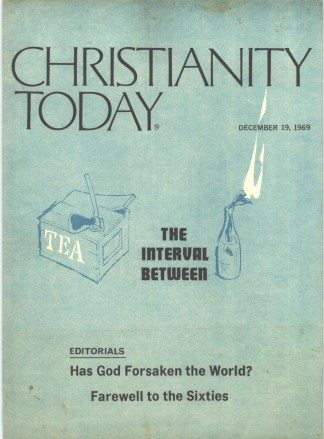
Has God Forsaken the World?

God is strangely silent today—or so it appears to many people. Frequently men ask whether God can still be found and where he is. How are we to understand this seeming silence and answer these pressing questions at the Christmas season—a time when men momentarily turn their attention to Bethlehem, the manger, the Wise Men, and God’s great gift to men?

Between the Old and the New Testaments stands a period of time often called the four hundred silent years. It is a classic example of the apparent silence of God. During this period there were no writing prophets. Judah had indeed become the dry ground out of which Messiah was prophesied to come. The sceptre seemingly had departed from the house of David, and the glory of Solomon’s kingdom had faded.

During these silent centuries there was no new revelation from God. Some of the people of Israel had quietly laid aside their belief in a coming Messiah. Time and the failure of Messiah to appear raised persistent doubts that caused them to tune out from prophetic hopes and live only for the present. There were others whose hopes were not dimmed. Even they, however, no doubt were puzzled and asked themselves hard questions: Why doesn’t God do something? How long will it be before God breaks his silence and acts in history to fulfill his promise?

What we know, and what they should have known, is that God’s ways are not our ways and his thoughts are higher than our thoughts. He was waiting for the fullness of time to come. And when it came, he acted. He came visibly to men.

The Incarnation was like a flash of lightning in a midnight sky. In a darkened age there appeared the bright light of God’s new act. But even then his act had more darkness than light in it for many people. Most of those who looked for Messiah’s coming waited for a king born in a royal palace—with, so to speak, a golden spoon in his mouth. But God’s lightning flash revealed only a baby born in Bethlehem’s inn, the son of a peasant woman whose husband was merely a carpenter.

Yet the glory of what God had done could not be obscured by the lowliness of Messiah’s birth. It was grasped and propagated forever by the writer of the Hebrews: “In many and various ways God spoke of old to our fathers by the prophets; but in these last days he has spoken to us by a son.” God has spoken! He has sent his Son! He is not silent. And the shepherds hear the angel choir: “Glory to God in the highest, and on earth peace among men with whom he is pleased.”

Two thousand years have passed since God spoke to men through the coming of Jesus Christ. A cross and a resurrection have intervened. A few disciples were baptized by the Spirit and sent out to turn the world upside down for Jesus the Christ. His Gospel has spread from shore to shore until virtually every land and nation of the world has witnessed the establishment of his Church and the salvation of those who have embraced him. The records of God’s new act in Jesus Christ have been imperishably set down in the New Testament, which far surpasses all other books ever written in the number of copies printed and distributed.

The tide of the Gospel reached its fullest heights in the beginning of this century. Now as we go into the seventies the tide is running out, slowly and inexorably. The élan is evaporating, the passion is diminishing. Sloth and doubt take a heavy toll. For many, the effulgent glory of the God whose lightning crossed the darkened sky two thousand years ago has faded. Darkness has begun to descend upon the earth, and the voice of God seems silent, his Spirit’s restraining power lifted. Men grope in the darkness, reaching out to touch the hand that doesn’t seem to be there, straining to hear the voice that doesn’t seem to speak.

Have we who are Christians not yet learned that even when God appears to be silent he is speaking? Do we not know that in his silence he speaks thunderously? Is he not showing us for a time what life is like when he does not speak? Would he not remind us of the time when his own Son stood exposed to the merciless wrath of divine justice and suffered alone as the face of his Father was turned from him and the silence of God pronounced judgment upon sin? Is he not saying to sinful men that there is a final silence, a silence they will experience when he is totally withdrawn from them forever? Hell itself is neither more nor less than the absolute withdrawnness of God from men. Life without God is hell.

In Scripture there are few words more pathetic than those spoken of Samson, “And he did not know that the Lord had left him.” The presence of God was withdrawn and so great was Samson’s backslidden condition that he did not even know that God was gone, until he woke from his sleep expecting to use his strength, only to discover his loss, experience the pain of God’s withdrawnness, and later to search desperately for the return of the One who was missing. Is it not so that many of those who truly name the name of God somehow feel the loss of his presence in our dark and troubled age? Is there no answer to their quest?

We may be living in the closing days of this age. Perhaps the present silence and apparent invisibility of God is the prelude to a lightning bolt that once more will flash across the leaden sky. Maybe that time will soon come when he who shook the earth once will shake it again. “He has promised, ‘Yet once more I will shake not only the earth but also the heaven.’ ” We Christians look back rightly to that once-for-all event that took place at Calvary. This was the purpose for which the Son of Man came—to seek and to save. But this same Son of Man has a still unfulfilled purpose, and it is toward this that we should lift up our eyes this Christmas season. This one who came the first time in humiliation is coming again in glory. The sky once more will be split by the lightning: “For as the light comes from the east and shines as far as the west, so will be the coming of the son of man” (Matt. 24:27).God’s silence will not continue forever. Although he will never speak again through more Scripture, he will speak and act visibly and powerfully in history. This time the Son of his love will come in flaming fire, taking vengeance on those who do not accept the Gospel. But he will also gather to himself his saints, who wait in this silence for the unveiling of the Lord of hosts. Maranatha. Even so, come quickly, Lord Jesus.

Three American Illusions

Norman Cousins said recently in an editorial in the Saturday Review that there are no insoluble problems on earth. Dr. Henry Pitney Van Dusen, president emeritus of Union Theological seminary in New York, took issue with him. “I know no one,” he said, “who faces the facts and has taken accurate measure of the manifold symptoms of profound, perhaps mortal, sicknesses in American society and still clings to such illusions.”

The American people have been sold a number of illusions that have no biblical foundation. I want to mention three of them. You might not agree with me, and that’s your privilege. I once heard Walter Reuther speak in Toronto just after he had called a strike of the United Auto Workers throughout Canada. He was addressing the Empire Club, and the leaders of the industry were there. What a cold reception he got! But he laid it on the line, even going so far as to name the salaries of some of the men who were sitting in front of him. I don’t think a man in the room agreed with him, but when he was finished, they gave him a standing ovation—because he had the guts and the courage to tell it like it was.

The first illusion I find prevalent in America today is that permanent peace is a reality apart from the intervention of God.

A few weeks ago it was my privilege to see Mrs. Golda Meier during her trip to the United States. While I was waiting to be taken to her room, one of her aides told me that a man in New York had said to her: “Madam Prime Minister, why don’t you Jews and Arabs sit down and settle your problems like Christians?” And I said: “Like in northern Ireland.”

Jesus predicted many centuries ago that we would have wars and rumors of wars to the end of time. Now why did he say that? Not because he approved of war. He said it because he knew human nature, knew its lust and its greed and its hate. Without God’s help man is not capable of solving the war problem.

Where does war come from? James the apostle tells us. “From whence come wars and fightings among you?” he asks. “Come they not hence, even of your lusts that war in your members?” In other words, we have something down inside us that is at war. As long as that spiritual war goes on in individual hearts all over the world, all other kinds of war remain possible. I read in a magazine the other day that forty-six wars are now going on. Right now. This includes such conflicts as the guerrilla activity in Venezuela, the fighting in the mountains of Colombia, and the many tribal wars in Africa. Forty-six wars—in a time of relative peace.

Does this mean that there is never going to be real peace? No. The Bible says there is going to be peace. The human race is not headed for destruction: we’re not going to destroy ourselves. The Bible teaches that God is going to intervene in the affairs of men and that we are going to know permanent world peace. The human race is headed toward utopia. Micah the prophet said, “He shall judge among many people, and rebuke strong nations afar off; and they shall beat their swords into plowshares, and their spears into pruninghooks: nation shall not lift up a sword against nation, neither shall they learn war any more.”

There is indeed a day of peace coming, but God is going to bring it, and it is going to be on his terms. The Jew looks for the Messiah, and the Christian looks for the Messiah also. The difference is that the Christian says that Jesus is the Messiah. But there is going to be a Messiah. There is going to be a person who can bring about peace in our world.

However, we don’t have to wait till that day comes to have peace in our own hearts. “My peace I leave with you,” says Jesus. “I can give you a supernatural peace and security, a supernatural love and joy that you’ve never known, if you put your confidence and your faith and trust in me.”

The second illusion that I think millions of Americans hold is that economic utopia is the answer to man’s deepest needs. Advertising has sold us a bill of goods and created an expectation gap. We’re told that if we use a certain kind of deodorant or a certain type of soap, we’ll find happiness and peace and serenity and security. Well, suppose that all of us could have everything we wanted. Suppose there were two swimming pools in every home, three cars in every garage, a dozen chickens in every pot. Would that give us happiness and peace? No. Jesus said, “A man’s life consisteth not in the abundance of the things which he possesseth.” He also said: “Man shall not live by bread alone.” Man has much deeper needs. Loneliness, emptiness, alienation, guilt, the fear of death—these are his real problems.

Anna Freud, the daughter of Sigmund Freud, was asked why students riot and demonstrate. She replied: “The real reason is that fundamentally students are empty and alienated and theirs is a burning quest for reality.” I spend a lot of time at colleges and universities, and I can tell you that one of the gut issues today on campus is the search for reality: “Where did I come from? Why am I here? Where am I going?” Modern education is not answering these questions that burn in the hearts of millions of students in America and throughout the world. A friend of mine who is a film star has a son attending Berkeley. This boy came to his father recently and said, “Dad, I’m dropping out; I’m going to become a hippie.” The father said, “Why?” And the son said, “Well, Dad, I hate you.” The father was of course shaken by that. “Why do you hate me?” he asked. His son said, “All right, Dad, I’ll tell you. You’ve made it too easy for me. I’ve had everything and you didn’t give me anything to believe in. And I hate you for it.”

We’ve given them the idea that material wealth is the answer—the higher the standard of living, the greater our happiness and peace. But our young people are rejecting that concept. They are lashing out and saying, “We don’t want it. We’re going to burn it down.” German students rioting in Berlin last year said that they were rioting against socialist materialism. A materialism without a faith.

The third illusion I see prevalent in America today is the assumption that democracy can survive without a religious faith. The direction in which we are now going—toward total secularism and total materialism—will lead ultimately to suppression and dictatorship. When honesty, integrity, and morality go, democracy is in jeopardy. Marcus Aurelius once said: “When a people lose confidence in themselves, the society crumbles.” We in America have become so self-critical that we are in danger of losing confidence in ourselves as a people.

Something very dangerous is happening: a vacuum is developing in philosophical America. It has many parallels to the situation in Germany in the late twenties and early thirties—many differences also, but many parallels. When a religious vacuum developed in Germany, Nazism moved in. Martin Gross, writing recently in the Miami Herald, says there is a new American religion. Some of its young practitioners ape the Jesus-look, he said. They make liturgical chants against war, racism, and poverty; they use marijuana as a religious opiate. “What of democracy’s future in such a false religious environment?” asks Gross. The spirit of this new religion is anti-democratic, he says, for it supposes that truth is magically revealed only to an elite following. It claims to know better than the people—a spiritual lie that imprisons man. America broke that lie when it created a republic and a democracy with its base in religion, says Gross. To yield now to an ancient falsehood with a fashionable new religion would be pure folly.

What we need most in America today is a revitalization of Judeo-Christianity. We must have a renewal of faith in God, faith in one another, faith in America, faith in everything our country is supposed to stand for. Without that renewal, Without a revitalization of the Church, the educational system, the government structure, and the mass media, our survival as a free democracy is, it seems to me, improbable.

This renewal can begin right here in my heart and in yours, if we will rededicate our lives to the God of our fathers. Not only would such a rededication transform our personal lives and our personal relationships; it would also enable us to make the greatest contribution possible to the nation that we love and to the world in which we live.

This is taken from an address by Billy Graham to the National Press Club in Washington, D.C., November 19.

OUR WINTER IS A FOGGY DRIVE

Look right, look left, right, left; grope now

for lines instead of spaces. By

the edges we must navigate

this foggy trip. Motor, tires,

wipers, clock, a litany would

orchestrate: peace, peace, peace, peace.

This peace: perspiring palms, tense jaws,

tired eyes—and my right foot

aching to accelerate.

Within our shrouded world machined

counsels of perfection drone,

why be late, faster, faster!

False prophets, who, in shrinking pockets

of refracted white, hum tunes,

beat time, I abominate!

Both destiny and joy of going

call for radiant light. Fogged worlds

must surely hate each other, dreading

to approach, to meet, and safely pass.

Whose red lights beckon me ahead,

I haven’t time to contemplate,

in fear the lines may break

before the fog, that someone’s will

may overstate his sight.

O God, let vision exceed power,

horizoned with sun, trees, stars, people;

bring us home to celebrate.

ARTHUR O. ROBERTS

Parent Teachers

Adults are often inclined to brush children aside, to be annoyed by their antics and bothered by their intrusions. In dealing with children we may sometimes find ourselves agreeing in spirit with the four-year-old who asked, “Why would a loving God make big brothers?” We may at times lose sight of the biblical teaching that children are gifts of God with unbounded promise. They are “a heritage from the Lord” (Ps. 127:3).

The importance of children in the sight of God is demonstrated by Christ’s attitude toward them. His love for children sometimes irritated his disciples. When they wanted to push the little ones aside and send them away, Jesus said, “Suffer the little children to come unto me, and forbid them not: for of such is the kingdom of God” (Mark 10:14). When the disciples asked, “Who is the greatest in the kingdom of heaven?” he replied, “Unless you turn and become like children, you will never enter the kingdom of heaven” (Matt. 18:3). And when Christ gave warning about the quality of his disciples’ witness, he went on to say, “See that you do not despise one of these little ones” (Matt. 18:10).

Throughout the biblical revelation we find that when God made his covenants with men he included their children. The basic formula was, “I will establish my covenant between me and you and your descendants after you throughout their generations for an everlasting covenant, to be God to you and to your descendants after you” (Gen. 17:7). On the Day of Pentecost Peter was led by the Spirit to declare, in response to the anxious inquiries of his hearers, “Repent, and be baptized.… For the promise is to you and to your children …” (Acts 2:38, 39). The importance of children is implied also in Paul’s words to the Corinthians, “The unbelieving husband is consecrated through his wife, and the unbelieving wife is consecrated through her husband. Otherwise, your children would be unclean, but as it is they are holy” (1 Cor. 7:14).

Children are artless and trusting, open and uninhibited, humble and dependent, loyal and loving—a kind of visual aid to remind us all what we once were and what we ought to be. They are God’s creation, gifts of his love, living souls with amazing potential, and they are tremendously important to God and his kingdom.

Children are easily influenced, and so Christ made a point of warning the disciples of the great responsibilities their presence brings. The credulity of children was forcefully shown to me at our dinner table one day. Something had been said that caused us all to laugh. Our boy, then five, had recently been to see the Walt Disney film Mary Poppins, and he began to tell me how when Mary and the children visited Uncle Albert they all got to laughing so hard they were lifted right up to the ceiling and floated on the air. Lest he expect me to rise to such heights I hastened to explain that that was only a story. His reply was quick: “Aw, Dad, stop teasing me. I saw it!”

More than once I have heard adults complain about the moral and spiritual degeneracy of young people when the example they themselves had set through the years was far from ideal. As John Locke wrote many years ago, “Parents wonder why the streams are bitter, when they themselves have poisoned the fountain.”

So Jesus says, “Whoever causes one of these little ones who believe in me to sin, it would be better for him to have a great millstone fastened around his neck and to be drowned in the depth of the sea” (Matt. 18:6). To cause another to sin is one of the greatest sins we can commit, for while we may receive pardon for our misdeeds, our penitence cannot avail for another. And if leading another to sin ranks among the foremost sins, surely destroying youthful innocence is the most sinister sin. Christ went on to say, “Woe unto the world because of offences! for it must needs be that offences come; but woe to that man by whom the offence cometh!”

Sin is not only doing evil; it is also the neglect of doing right. We fail in our duty to our children when we do not set a clear example of right-doing. A leader in the church may influence others to sin by being a practical atheist, one who, though he may make a loud profession of faith in church, fails to live that faith at home, in the community, and in business. We may cause others—including our children—to stumble by failing to stand for righteousness when a stand is called for, or by talking of our love for the lost while we minister only to “our kind,” or by preaching salvation while denying the necessities of life to needy men. We are too apt to be like “Peanuts” characters Charlie Brown and Linus, who see their pet beagle shivering in the snow and decide they ought to do something. So they go and pat Snoopy’s head, saying, “Be of good cheer. Yes, be of good cheer.” If we talk of love and salvation but remain unconcerned about people, we are bound to become stumbling blocks.

William Barclay tells of an old man who, as he lay near death, was obviously troubled. When asked what was disturbing him he replied, “One day when I was young I was playing with some other boys at a crossroad. We reversed a sign post so that its arms were pointing in the wrong direction, and I’ve never ceased to wonder how many people were sent in the wrong direction by what we did.” Although the old man may have been inordinately sensitive about a boyish prank, we would do well to match his sensitivity when we reflect on the directions in which our lives point our children.

How can we bring children to God? How may we best help to shape their lives according to God’s will?

The first step is to have a genuine concern for them. It is an appalling fact that many parents do not really know their children, and that many adults would rather criticize young people than help them. One has only to try to find teachers for the Sunday school or sponsors for the youth group to realize the unconcern of many adults. To be sure, there may be good reasons why some refuse such tasks; but often there are not. Still, being a teacher or sponsor is not really the answer. One might fill both these positions and still not be really concerned about children. Christ indicated the characteristics of true concern when he described the shepherd who knows his sheep intimately and would leave the ninety-nine to seek the one who is missing. Are we perhaps more likely to say, “Well, let him go—he never was really one of us anyway”? One who has real concern for another knows and loves him and sees his potential. He patiently and persistently seeks his welfare and will not give up on him.

A second part of the shaping process is intruction. In both church and home we must seek to instruct our children in the faith “precept upon precept, precept upon precept, line upon line, line upon line, here a little, there a little” (Isa. 28:10). This is a demanding project that calls for determination, dedication, and imagination. Although it isn’t easy for busy parents to find time to provide this instruction, they must make time. We must teach our children the will and Word of God. We must show them the way of salvation and bring them to Christ. The psalmist sums it up: “He … appointed a law … which he commanded our fathers to teach to their children; that the next generation might know them, the children yet unborn, and arise and tell them to their children, so that they should set their hope in God” (Ps. 78:5–7).

Dedication is essential, since, as we have already noted, children learn much by example. Young lives are shaped by the combination of words and deeds. If our deeds do not match our words, the words lose their power. If “children are a heritage from the Lord,” then it is the responsibility of every Christian parent to point them to the way of God by their own dedication to him.

An imaginative approach to the child, with sensitivity to his needs and the changes that take place as he grows, is very important also. Parents should make use of some of the numerous books dealing with the emotional development of children at various ages. They should take into account the individuality of each child. Sensitive parents are well aware of the personality differences that exist among children in the same family.

Closely related to instruction is discipline. Paul wrote to the Ephesians, “Fathers, do not provoke your children to anger, but bring them up in the discipline and instruction of the Lord” (Eph. 6:4). Solomon advises us, “Discipline your son while there is hope” (Prov. 19:18), and “A child left to himself brings shame to his mother” (Prov. 29:15). Love and discipline go together. Godlike love demands discipline. In the Book of Hebrews we are told, “The Lord disciplines him whom he loves.… For the moment all discipline seems painful rather than pleasant; later it yields the peaceful fruit of righteousness to those who have been trained by it” (Heb. 12:6, 11).

Discipline should be loving. The child should be shown that even this is a sign of love and concern for him. Children want to feel that parents are stronger than they are, yet loving and kind. We must do our best never to discipline in anger but, “keeping our cool,” to exercise discipline as a facet of love. We must never allow discipline to degenerate into a personal contest with the adult winning by reason of superior strength. To do this is to sow seeds for later rebellion.

Children should know why they are being disciplined. We must be clear in defining boundaries and expectations for them. Having done that, we can discuss the wrong done and help the child to see why a particular restriction was set in the first place.

Children learn that if they put their hands in a fire, they get burned. Just so, they should learn that wrongdoing has undesirable consequences. If we are consistent in our discipline and if the penalty is appropriate to the misdeed, the child’s sense of justice will work on our side.

If we find ourselves reluctant to teach and discipline our children, one reason may be uneasiness about our own example. We know that if we are to train our children in the way they should go, we must go that way ourselves. If we are to discipline our children to do right, we must also discipline ourselves to do right.

After the Second World War, the people of one German city began to rebuild their church. A fine statue of Christ with outstretched arms had stood in front of the church before the bombs fell. After a painstaking search through the rubble, the workmen were able to reconstruct all of the statue but its hands. Then they had an idea. At the base of the statue they placed a sign: “Christ has no hands but yours.” God is sovereign and can always carry out his perfect will; yet he does choose to work through men. We cannot thwart his will, but we can help to fulfill it. One way in which believers are called to be his hands is in touching and shaping the lives of children. How are we, as parents and as teachers, fulfilling this calling?

Charles N. Pickell is pastor of the Wallace Memorial United Presbyterian Church, Hyattsville, Maryland. He holds teh B.D. from Western Theological Seminary (Pittsburgh) and the Th.M. from Pittsburgh-Xenia Seminary; he has also stdied at Harvard and at Andover Newton.

Apple PodcastsDown ArrowDown ArrowDown Arrowarrow_left_altLeft ArrowLeft ArrowRight ArrowRight ArrowRight Arrowarrow_up_altUp ArrowUp ArrowAvailable at Amazoncaret-downCloseCloseEmailEmailExpandExpandExternalExternalFacebookfacebook-squareGiftGiftGooglegoogleGoogle KeephamburgerInstagraminstagram-squareLinkLinklinkedin-squareListenListenListenChristianity TodayCT Creative Studio Logologo_orgMegaphoneMenuMenupausePinterestPlayPlayPocketPodcastRSSRSSSaveSaveSaveSearchSearchsearchSpotifyStitcherTelegramTable of ContentsTable of Contentstwitter-squareWhatsAppXYouTubeYouTube