The Nonsense of Liberal Catholics

At a Catholic university recently I listened to a discussion between a liberal Catholic theologian and an atheist. “Tell me,” said the atheist, “what is a Catholic? What must one believe if he is to consider himself a good Catholic? Must he believe in heaven and hell and in the immortality of the soul? In papal infallibility? Must he believe that premarital sex and artificial birth control and remarriage after divorce are all morally wrong, seriously sinful?”

“Most of that is mere legalism, mere negativism,” the liberal Catholic theologian quickly responded.

“Well,” the atheist persisted, “if people needn’t believe any of these things to consider themselves good Catholics, what must they believe? What isn’t mere legalism? Just what do you people mean when you say you are in the church? What does being a Catholic really mean?”

The theologian clearly did not like this line of thought. Such questions are considered “unecumenical” and “divisive” by the contemporary Catholic liberal. They stress “differences rather than similarities” and belong to the old, the “closed,” the “defensive,” and “medieval” church, to the world of “mere apologetics.” They are “irrelevant” to the new, the “open and authentic” church; and it is considered bad form to raise such questions these days. Nevertheless, after careful thought the liberal theologian attempted an answer: “Being a Catholic means awareness of community—awareness of human unity related to Christ.”

Bemused, the atheist replied: “That’s interesting, because by your definition I am a Catholic.” And, of course, he was right; by the liberal’s “definition” practically anyone qualifies as a Catholic.

I cite this theologian’s remarks because they typify what, in honesty, I can only call the nonsense flourishing in liberal Catholic circles today (a nonsense particularly repugnant to me because my sympathies have always been far more with the liberal than with the conservative wing of the church). And one need not attend theological seminars or lectures or read esoteric theological journals to discover this sort of thing in all its plentitude, for it has become a favorite subject of the popular press. Consider, for instance, the following answers to the question, “What is a Catholic?”—answers given by prominent liberal Catholic theologians, the Rev. Robert Adolfs and the Rev. Leo Alting Von Geusau, and prominently displayed, not in Cross Currents, but in Look magazine (January, 1968). Being a Catholic, says Father Adolfs, is “the experience of human unity related in one way or another toward the person of Jesus of Nazareth.” Father Von Geusau says that “belonging [to the Catholic Church] is not determined by sociological or sacramental criteria but by one’s awareness of community” (my italics). By such answers, by such “definitions,” Baptists and Methodists and Quakers, Hindus and Buddhists and Jews, Holy Rollers and Satanists and members of the YMCA and of the Ku Klux Klan are all Catholics. This kind of writing is typical of many liberal Catholic thinkers today. Read any of a number of prominent liberal Catholic theologians, philosophers, and journalists—among them, Leslie Dewart, Father Gregory Baum, Michael Novak, Daniel Callahan—or any of a number of the various popular liberal Catholic publications, such as Commonweal or the National Catholic Reporter, and you will find example after example of the same kind of thing.

And when today’s liberals aren’t producing the terribly vague—indeed, quite meaningless—assertations mentioned above, they seem to be engaged in saying things that are either clear but wrong, or vague and wrong. For example, consider the following statements—also in Look—by prominent liberal Catholic theologians, clerics, and laymen: (1) It is meaningless to talk about heaven and hell, since we can know nothing about the hereafter; (2) of course remarriage after divorce is permissible for Catholics; (3) Catholics not only may practice artificial birth control but have a moral duty to do so (because of the population problem); (4) papal infallibility is not a valid dogma but only a medieval, outmoded notion; (5) premarital sex (either heterosexual or homosexual) is not sinful if it is “humanly integrated” or “directed toward a total human relationship.”

Now anyone—Catholic or non-Catholic—knowing anything about Catholic moral teaching should recognize that for persons to hold these beliefs and still regard themselves as good Catholics is wrongheadedness of the most obvious kind. And anyone who respects the integrity of language should be able to see the vagueness of such statements as number five. Phrases like “humanly integrated” and “directed toward a total human relationship” are as meaningless as the following definition of God given by the well-known Catholic theologian Leslie Dewart: “that which lies in the openness of the transcendence which we grasp in consciousness as constituting the spiritual substance of man.”

The prevalence of this sort of thing is in large part, I think, what has motivated Pope Paul to reaffirm strongly and clearly in recent months many of the church’s basic teachings, not only on birth control but on such teachings as Christ’s divinity and the immortality of the Soul. What the Pope seems to realize is that while de-emphasizing the differences between Catholics and non-Catholics (the major goal of the “ecumenical,” the “relevant,” the “liberal” church) is thoroughly laudable, denying these differences, as do many liberals today (by, for example, defining a Catholic as anyone with “an awareness of community”), is nonsense; for when these differences are denied, definition becomes impossible, and the identity of the church is destroyed. No matter how much we may favor the liberal’s goals of “ecumenism” and “relevance” (and I strongly sympathize with both), and no matter how unsympathetic we may be to particular pronouncements of the Pope (such as the birth-control statement), I think it only fair that we recognize what seems to me to be the Pope’s general concern with liberals and liberal reforms. He is obviously concerned that, in the name of “ecumenism” and “relevance,” the church may become little more than an organization of social workers. And obviously he realizes that when questions like “What is a Catholic? Why be a Catholic?” are considered irrelevant, immature, inauthentic; when concern over eternal life, over heaven and hell, is thought to be, in Leslie Dewart’s words, “mere childishness”; when, in short, the Catholic Church becomes nothing more than an international (and probably not very efficient) welfare agency, then people of common sense are going to demand in quite justified disgust: Who needs Catholicism? Why don’t we simply beef up UNESCO?

Increasingly, Catholic liberals of the sort I’ve been discussing are coming under attack, not by church conservatives, but by liberals who have left the Catholic Church. If, these former Catholics contend, today’s Catholic liberals were really intellectually honest and morally courageous, they would state their heresies clearly instead of obscurely, and, much more important, would have the courage to follow their heresies to their logical end—that is, to leave the Catholic Church. An example is an exchange between David Perkins, a former Catholic, and the editors of the National Catholic Reporter (August 14, 1968), the most widely circulated of the American liberal Catholic publications.

Responding to the confused thinking of the many liberal Catholics, including the NCR editors, who have denied the morally binding nature of the Pope’s encyclical on birth control and other key Catholic teachings, Mr. Perkins reminds the liberals that the Catholic Church is (1) authoritarian and (2) voluntary. “Rational men and women,” he says, “do not remain in an authoritarian structure when they no longer accept the authority.” He points out that, beyond the bad reasons of “ceremony and nostalgia,” liberals like the NCR editors have no reasons for staying in the church. The editors’ answer to his question, “Why do you stay in the Church?,” is typical of the sort of thing I’ve been talking about.

Although Perkins makes it absolutely clear that, as an intellectually honest man, he has left the church because he no longer believes in essential church teachings, the editors begin by saying that Perkins’s trouble is that he insists on regarding the church as “an institution rather than a movement.” In other words, if he would only think of the church as a “movement,” incredible teachings would somehow become credible. Then—though Perkins makes it clear that he has left the church, that, indeed, he is hostile to the church, whether it be thought of as institution or movement—the editors go on to declare that Perkins stands “to our left performing for us the same useful service Rap Brown performed for Martin Luther King, Jr.” Obviously, it would make more sense to say that Perkins stands to the NCR, not as Rap Brown stood to Martin King, but as Rap Brown stands to Jim Eastland. But the editors, I fear, don’t do a very good job of making sense. Consider the remainder of their answer:

You stay because of the Eucharist, because of its connection with the Last Supper, because of the connection with men you think it gives. You stay to be taught; the magisterium can be misused, unused, or abused, but it has things to say. You stay because of people like Martin Luther King (Baptist), Martin Marty (Lutheran), William Coffin (Episcopal), Dorothy Day and the Fathers Berrigan, who supply something not so often found in the secular saints. You stay because outside the community you probably won’t pay much attention to Christ—and even though you know the structure of the community sometimes denies him.

One stays in the church “because of the Eucharist, because of its connection with the Last Supper, because of the connection with men” one thinks it gives. What does this mean? What do the editors mean by “Eucharist”? Do they mean the traditional Real Presence, the presence that distinguishes the Catholic Eucharist from the Eucharists of other groups? If this is what they mean (and as a regular reader of the NCR, I’m sure it is not), why don’t they say so? The truth, I fear, is that the editors, like so many Catholic liberals today, while they regularly use the term, can provide no sensible definition of it. (Asked what he meant by “Eucharist,” the liberal Catholic theologian I mentioned at the beginning, a priest sympathetic with the Delano, California, grapestrikers, replied: “Having dinner with Cesar Chavez and the grapepickers at the Filipino mess hall in Delano.”) For the clear (if, from the point of view of most non-Catholics, incredible) traditional meaning of the Eucharist, today’s liberal Catholics have substituted what amounts to little more than a pretentious vagary. Father Adolfs calls the Eucharist a “coming together to pray and break bread.” But who needs the Catholic Church to do this? One can “pray and break bread” in any number of organizations or institutions or, for that matter, in any number of “movements.” What the NCR editors mean by the term “connection,” and why one can only think—that is, why a Catholic can’t, assured by doctrine, know—that the Eucharist can give him this “connection,” are other questions they leave unanswered.

One stays in the Church, the editors next tell us, “to be taught” (taught what?); “the magisterium can be misused, unused, or abused, but it has things to say.” That the magisterium has “things to say” seems rather obvious. The question that should be answered is What things? And, more important in answering Perkins’s question, Must Catholics believe these things if they wish to call themselves legitimate Catholics?

The editors next tell us that one stays in the church because of “people like William Coffin (Episcopal), Martin Luther King (Baptist), Martin Marty (Lutheran), Dorothy Day and the Fathers Berrigan, who supply something not so often found in the secular saints.” I find the logic of this hard to follow. Why should a Catholic stay in the Catholic Church because he admires any of the well-known Protestants the editors mention? Wouldn’t it make more sense for such a Catholic to become an Episcopalian or a Baptist or a Lutheran? Who, one wonders, are the “secular saints”? What is the “something” the secular saints, whoever they may be, cannot supply, at least “not so often” as can these persons whom the editors apparently regard as “religious saints”?

Next, we are told that one stays in the church because “outside the community you probably won’t pay much attention to Christ—and even though you know the structure of the community sometimes denies him.” What do they mean by “paying attention to Christ?” And why must one stay in the Catholic Church to do this? Many scholars dedicated to proving Christ a charlatan have spent their lives “paying attention to Christ”; Ernest Renan undoubtedly paid more attention to him than most Catholics ever have or ever will.

Wrapping up their answer, the editors conclude:

There are other reasons for staying including inertia and the nostalgia [my italics] Mr. Perkins mentions. For some people who would rather fight than switch, the reason may be that the Church supplies an effective filter against too harsh realities. The good reasons and the bad reasons aren’t coercive. Thank God you no longer feel obliged to prove your case.…

What this implies is that there are no good reasons for staying in the Catholic Church. Yet the intention of this full-page editorial essay was to answer the question, “Why stay in the church?” I find this all rather confusing, and in charity toward the editors I would like to write it off as mere clumsiness. But the editors apparently regard lack of clarity as a virtue. At one point, in fact, they actually condemn Perkins for being “too utterly clear.” “One’s idea of the Church,” they admonish him, “ought to be fuzzy at the moment, not for the sake of fuzziness but to be true to the reality. To what reality? That is another of the many questions the editors apparently feel no obligation to answer.

After reading this editorial, one might suspect that perhaps truth itself is one of those “too harsh realities” the editors claim the church protects Catholics from. For refusal to face the truth, the desire (conscious or unconscious) to conceal the truth (not only from others, but often from ourselves) rather than to reveal it, is, in George Orwell’s words, “the great enemy of clear language.”

I refuse to believe, however, as Mr. Perkins believes, that the rhetoric of liberal Catholics reveals wide scale, willful intellectual dishonesty and moral cowardice; and in dwelling on that rhetoric I have not intended a broadside attack on either the National Catholic Reporter or the institution of liberal Catholicism. I have long admired and championed many of the NCR causes, and, as I said previously, my sympathies have always been far more with the liberal than with the conservative wing of the church. Many of the liberals Perkins attacks, liberals who stay in the church for no good reason, do so, I am sure, because they wish to use the weight and moral authority, the tradition of the Church, to achieve good ends in civil rights and similar causes—to achieve, for instance, fair wages for the grapestrikers by reminding grapeowners (many of whom are Catholic) that the encyclicals bind them to paying a just wage. (The problem with these liberals is that they invoke and abide by only the encyclicals they agree with, thus making a farce of the “authority” they claim the grapeowners must abide by.) And though I cannot intellectually sympathize with these liberals, I certainly think their intentions are good. I also share their openness to dissent, to the idea of an open church, to dialogue with non-Catholics; but I wonder how we can have either real dissent or real dialogue unless we first have a rigorous respect for the integrity of language and logic, unless we recognize that clear definitions and distinctions are as indispensable to genuine dissent and dialogue as is recognition of the principle of contradiction. And I firmly believe that, while the tone and some of the conclusions of some critics of liberal Catholicism may be rabid, there is certainly much truth in what they are saying.

What they are saying, at its most charitable and valuable, seems to be something like this: Perhaps it is time for Catholic liberal intellectuals to quit dismissing the rational discussion of religious matters as “mere apologetics.” Perhaps, indeed, it is time for these liberals to present a new apologetic in place of the old one they have so thoroughly abandoned. Perhaps it is time for them to stop declaring smugly that Catholics need “no longer prove their case,” and to start, if not proving, at least clearly presenting that case. Behind the harsh voice of these critics there seems a much gentler voice; and what, finally, that voice seems to be saying to the Catholic liberals is simply this: You have demonstrated your ability to love God with your hearts; is it not time to demonstrate your ability to love him with your minds as well?

James P. Degnan is associate professor of English literature at the University of Santa Clara, California. He also teaches advanced writing courses there. His writing has appeared in such periodicals as “Commonweal,” the Atlantic Monthly,” and the “Virginia Quarterly Review.”
Poverty: The Psychological Effects

No matter how one defines poverty, it is a reality. Among its more serious results is the demoralization that so often accompanies its extreme forms. In an area where the writer lived the most palpable fact of everyday life is poverty—poverty of spirit, poverty of heart, poverty of intellect, poverty of property. Yet the disturbing fact is that the concomitant demoralization need not be. Among many elements of the poverty-stricken white population this demoralization exists only because it is tolerated; no real attempt is made to shake its victims loose from a kind of self-discrimination. If this self-discrimination is shown to them, they may “come to themselves” and seek the kind of help that will assist them to return to their Father’s house.

In his book, Night Comes to the Cumberland, Harry Caudill describes this pathetic feature of people ruined by the exploitative ravages of the coal and timber interests. The Cumberland people developed, so to speak, a rationale for their demoralized condition. They took great pride in not being proud. This loss of pride in self is an all but universal fact of disheartened living.

The “I don’t give a damn what anyone thinks about me” shows up in some grown men who will not mow the lawn or paint the house. They will not even care for their own children. They appear on the streets with hair uncombed and faces unshaved, their language full of profanity. Such a way of life is all too often practiced because family, friends, and neighbors “understand” and condone it.

Often it is said that passivity and apathy are outstanding attributes of the poor and discouraged. But only rarely have I found this to be true among poverty-stricken white citizens. On the contrary, violent anger is more common. Many are up in arms against practically every institution, practice, and belief that our society considers a blessing. The sad thing is that the persons and institutions so violently hated have done nothing to deserve this hostility. They are rejected by the demoralized without ever having had a chance to help those who need their services most.

If we ask why this should be, the answer is that the poor who have lost heart are the victims of their own worst selves, prisoners trapped in jailhouses of their own making. They tend to talk to themselves, making verbal war against persons and institutions that have no inkling that they are the objects of such futile scapegoating. This is one of the characteristics of many victims of poverty; they reject out-of-hand the institutions, ideas, and people who would be the most help in their lives.

This rejection includes the repudiation of traditional, historic Christianity for some form of private “religion.” There is, to be sure, much legitimate criticism of ways in which the churches try to reach these people. Sometimes we fail to use the right means. Yet most of the disheartened poor among the white members of our population are not at all discriminated against. Attempts are made to attract and evangelize them. But still the Church is rejected.

I have yet to meet one of the discouraged poor among the white population who, along with every member of his family, would not have been enormously helped by faithful membership in the Church. The Gospel is capable of bringing light and life into the lives of men. The Church does have the answer and also many lesser answers to human problems. Yet many of the poor and demoralized reject the Gospel because they do not want it. Admittedly some practices of the Church must be changed; some forms of witness and outreach are irrelevant and even anachronistic. But the Church as a worshiping, witnessing community gathered in a particular place for renewal and service will be with us for a long time to come. And in this form it is a help and blessing to all who are willing to submit to the disciplined service of the Lord of the Church. But among the poor and disheartened a kind of “religious atheism” seems to be keeping them from a knowledge of God in Christ. Under the influence of this “religious atheism” they often reject the Church in favor of their own idea of God. This idea calls them into ugly, empty store buildings where highly emotional services are held. The Church may be denounced as “Babylon” and its ministers as “ambassadors of the devil.”

It may well be that the government has some lessons to learn from the experiences of the Church with the demoralized poor. Among these lessons are the following:

  1. The discouraged poor have developed a low threshold of understanding and tolerance. They are quick to denounce and to form negative opinions. Whoever works with them in personal relationships must be patient and understanding.
  2. They tend to have the “all or nothing” or “complete surrender” mentality. The result is a breakdown in communication that should be anticipated and prepared for.
  3. Administrators of the anti-poverty program should realize that the poor and disheartened sometimes do not want things to be better for their children. In fact, they all too often fear, suspect, and resent the natural ambitions of their own children. And there may be times when what disturbs them most may be success and ambition of their children. Thus tact and persuasiveness in holding out a better way of life is needed. Only when the demoralized poor begin to care enough to want the very best for themselves, their children, and the community will they really be helped.

—The Rev. PAUL DOUGLAS, minister, First Congregational Church (United Church of Christ), Rootstown, Ohio.

The Heritage of Plymouth

At a modest but significant ceremony on July 12, 1897, the Church of England formally returned to the Commonwealth of Massachusetts the original manuscript of Governor William Bradford’s The History of the Plymouth Plantation, the irreplaceable first-hand chronicle of the early years of the Pilgrims at Plymouth Colony. Delivering the acceptance oration for the State of Massachusetts at the Commemoration, the late Governor Wolcott floridly stated concerning the small Mayflower congregation: “They established what they planned. To them a mighty Nation owes its debt. In the varied tapestry which pictures our National life, the richest spots are those where gleam the golden threads set in the web by that little band.”

As we stand at the eve of another Thanksgiving, that traditional day of showing special gratitude to God, a festival day that the Pilgrims instituted, we ask: What is the true legacy of the Plymouth settlement to our nation? What was the symbolic flame they kindled that still sparks our imagination?

At first appraisal, it would seem that the Pilgrim Fathers have enjoyed the esteem of later Americans out of all proportion to the importance of their colony in the seventeenth century. Plymouth was to know none of the economic affluence of Virginia; in population and political power it would be far overshadowed by Massachusetts Bay; internationally it was always eclipsed by strategically important Quebec, Louisburg, Boston, or New Amsterdam. Yet its contribution to the American ideal cannot be denied, an inspiration based on principle and faith rather than power and wealth.

First, in drawing up the Mayflower Compact, the Pilgrim Fathers demonstrated a clear desire to live under the rule of law, by self-government, under the authority of God and the Crown. Here in Plymouth, as in the founding of the Virginia representative assembly in 1619, was a startling indication of concern for self-government and the right of free men to compact together in governmental union. Here was one of the first girders placed in the superstructure of what would eventually develop into American constitutional democracy.

A second reason why these relatively poor and obscure colonists have been elevated to the level of statesmen is the audacity of their venture. They ardently believed, quietly dared, and calmly endured for the sake of the faith and principles that brought them to the New World. Despite man’s inherent limitations, they felt they could build for their children and their children’s children a better, more fulfilling society away from Europe. They were not doctrinaire utopians or starry-eyed idealists. When, for example, the communal scheme of working together collectively for one company storehouse proved impractical, they quickly shifted to privately owned and independently farmed plots. They recognized human frailties. Adherents of the reformed faith, they were cognizant of man’s sinfulness. Yet, in the light of this belief, and with confidence in God’s redemptive power, they set forth in action as well as in words a stout-hearted courage and a persistent faith. These qualities carried them through persecutions in England, economic hardships in Holland, privation and danger, even death, in the American wilderness. As one of their number, aware of the hazards that ultimately would kill half the colonists during their first year in America, wrote: “It is not with us as with other men, whom small things can discourage or small discontentments cause to wish themselves at home again [in England].” Because these Pilgrims felt that their work was God’s work and that he was with them, they displayed a humility of temper, a tenacity of spirit, and an integrity of faith that can only inspire us.

—THOMAS A. ASKEW, professor of social science, National College of Education, Evanston, Illinois.

Ideas

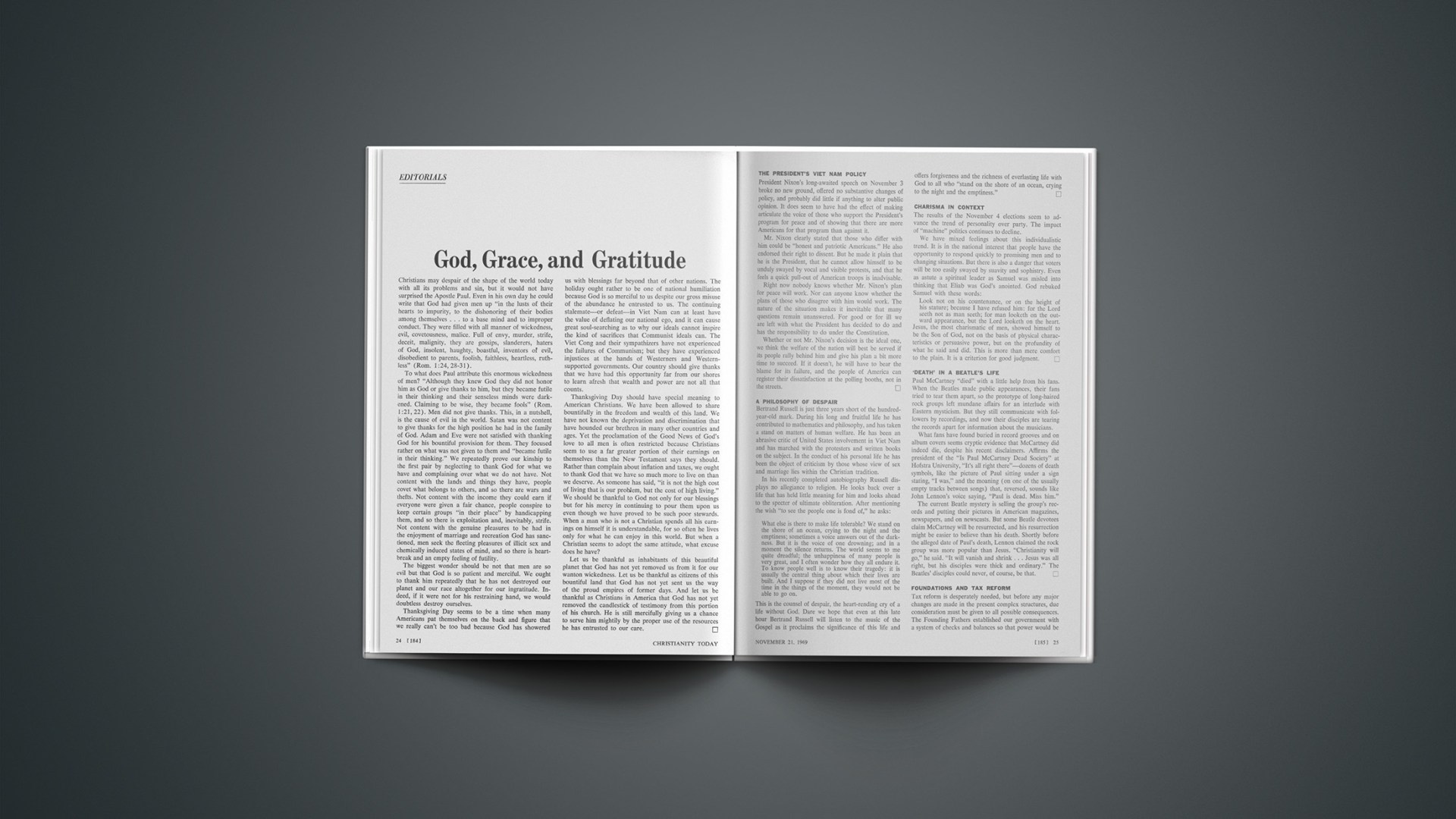
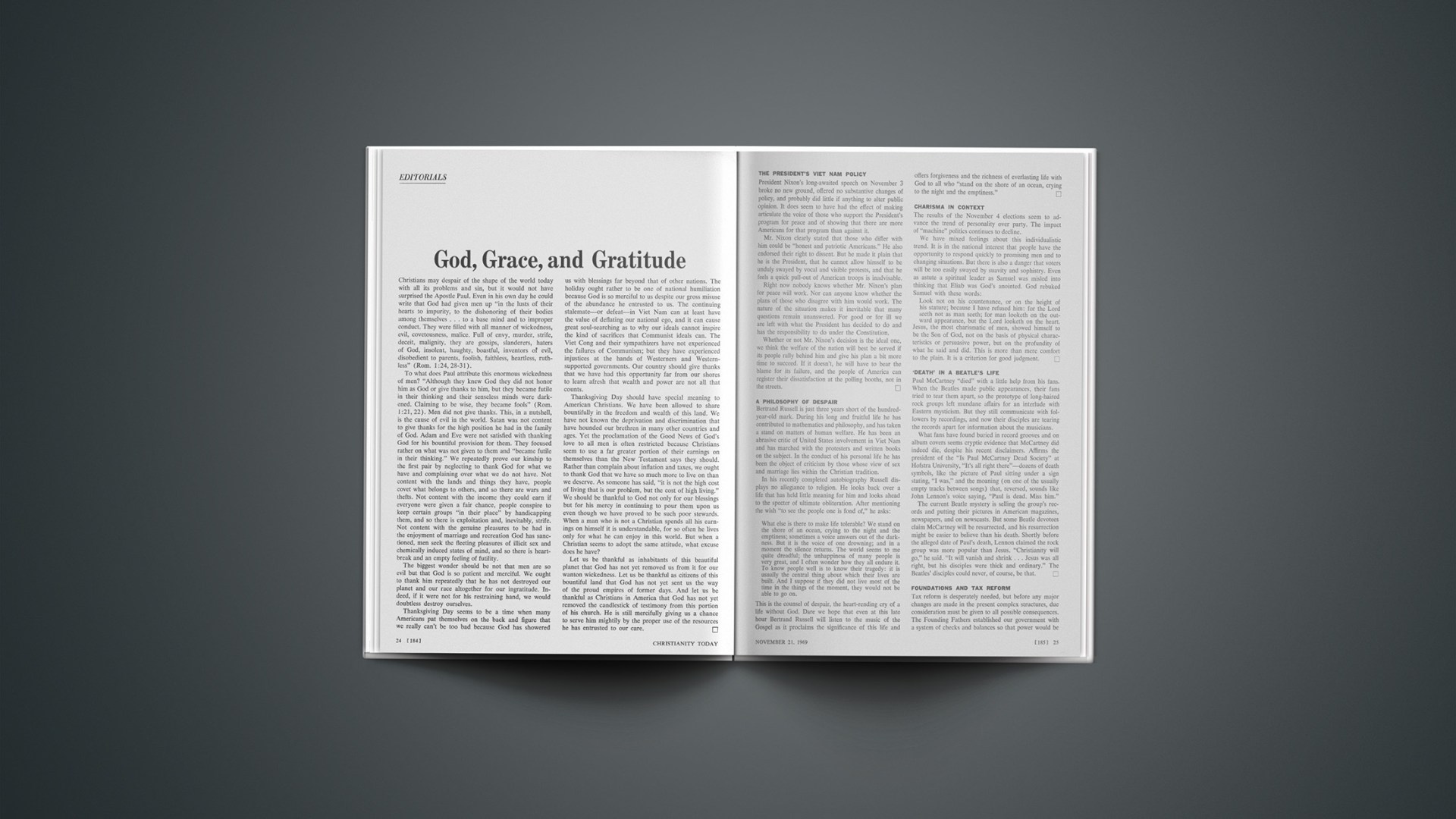
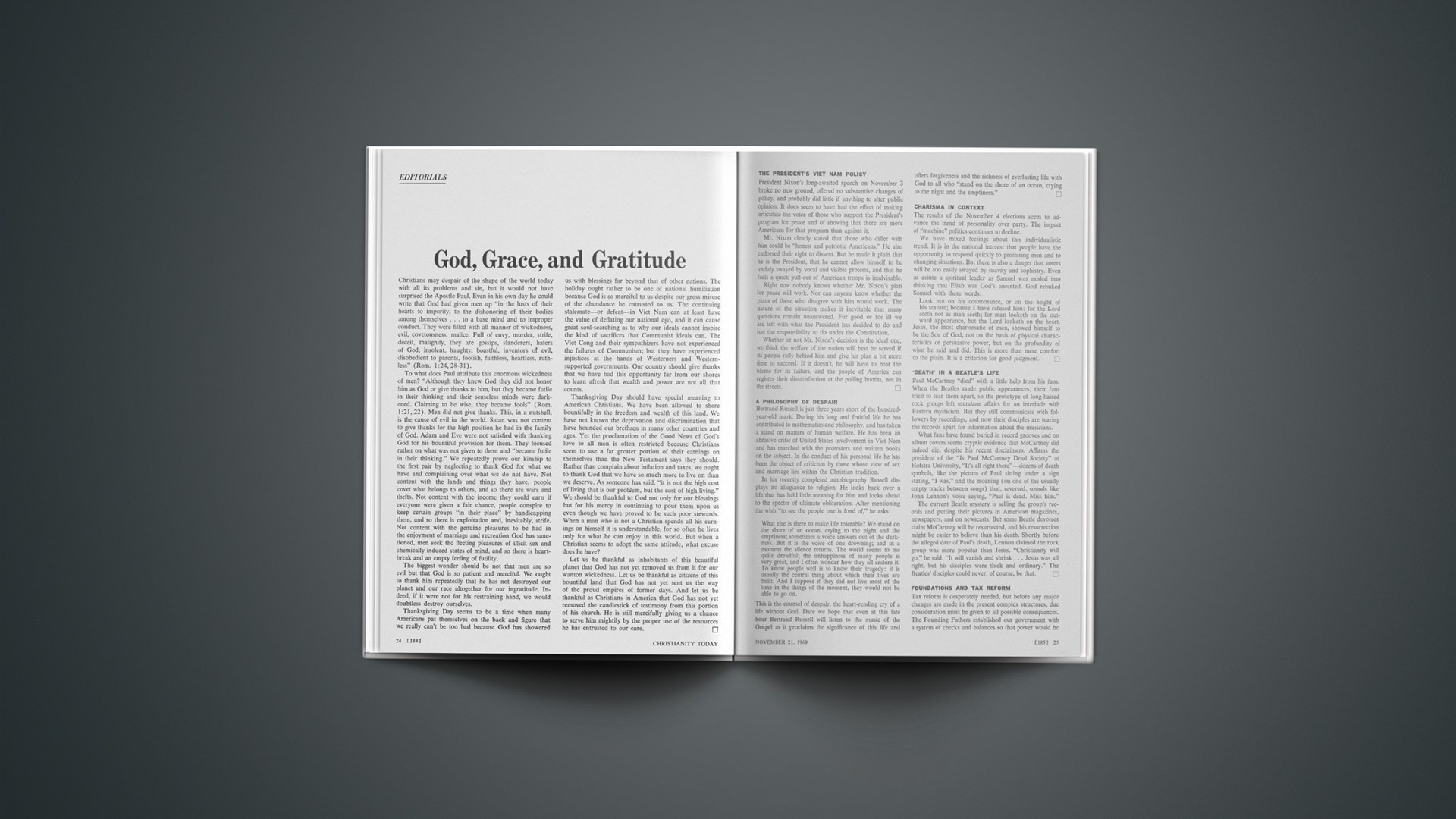
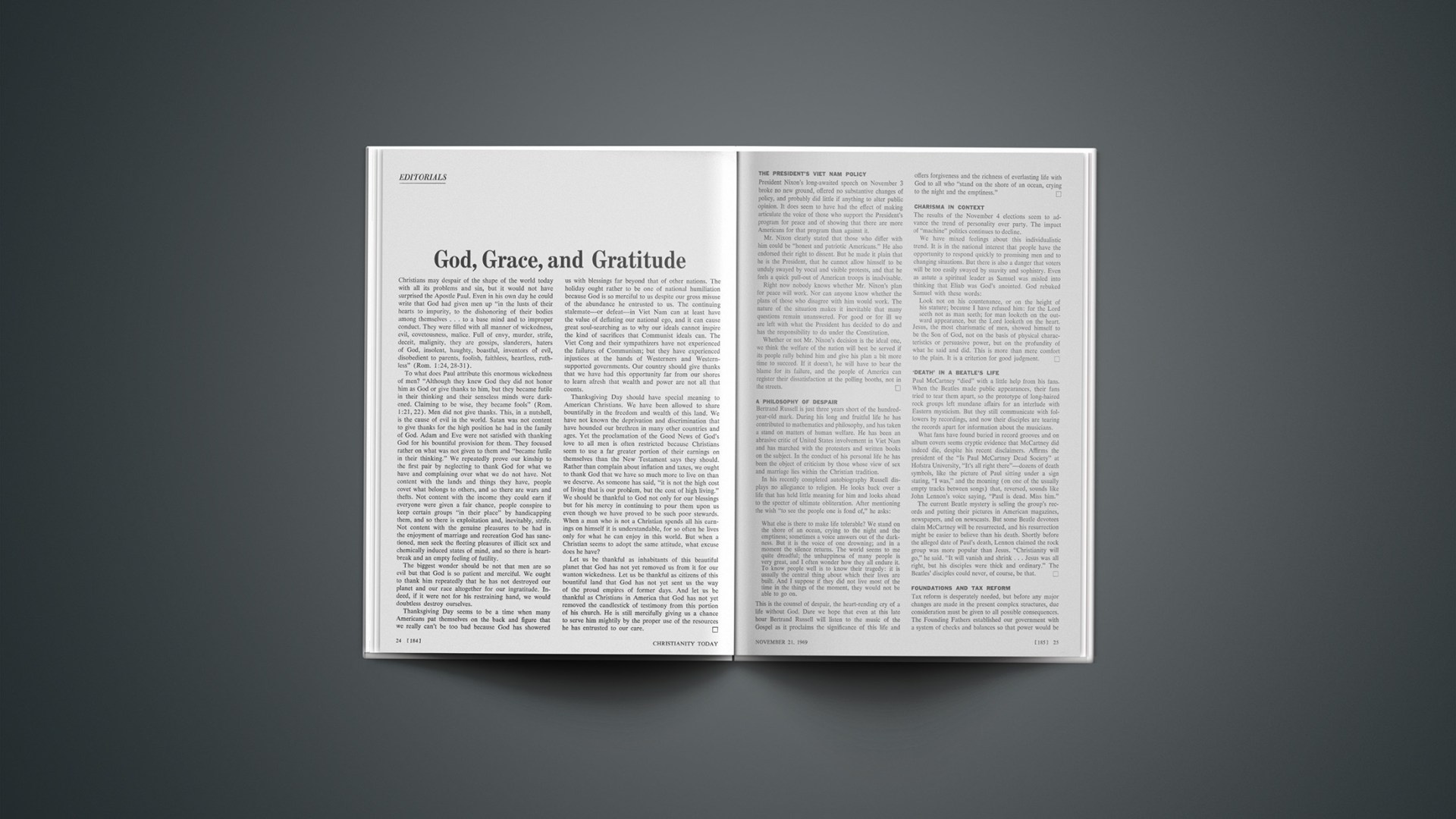
The President’s Viet Nam Policy

President Nixon’s long-awaited speech on November 3 broke no new ground, offered no substantive changes of policy, and probably did little if anything to alter public opinion. It does seem to have had the effect of making articulate the voice of those who support the President’s program for peace and of showing that there are more Americans for that program than against it.

Mr. Nixon clearly stated that those who differ with him could be “honest and patriotic Americans.” He also endorsed their right to dissent. But he made it plain that he is the President, that he cannot allow himself to be unduly swayed by vocal and visible protests, and that he feels a quick pull-out of American troops is inadvisable.

Right now nobody knows whether Mr. Nixon’s plan for peace will work. Nor can anyone know whether the plans of those who disagree with him would work. The nature of the situation makes it inevitable that many questions remain unanswered. For good or for ill we are left with what the President has decided to do and has the responsibility to do under the Constitution.

Whether or not Mr. Nixon’s decision is the ideal one, we think the welfare of the nation will best be served if its people rally behind him and give his plan a bit more time to succeed. If it doesn’t, he will have to bear the blame for its failure, and the people of America can register their dissatisfaction at the polling booths, not in the streets.

Ideas

A Philosophy of Despair

Bertrand Russell is just three years short of the hundred-year-old mark. During his long and fruitful life he has contributed to mathematics and philosophy, and has taken a stand on matters of human welfare. He has been an abrasive critic of United States involvement in Viet Nam and has marched with the protesters and written books on the subject. In the conduct of his personal life he has been the object of criticism by those whose view of sex and marriage lies within the Christian tradition.

In his recently completed autobiography Russell displays no allegiance to religion. He looks back over a life that has held little meaning for him and looks ahead to the specter of ultimate obliteration. After mentioning the wish “to see the people one is fond of,” he asks:

What else is there to make life tolerable? We stand on the shore of an ocean, crying to the night and the emptiness; sometimes a voice answers out of the darkness. But it is the voice of one drowning; and in a moment the silence returns. The world seems to me quite dreadful; the unhappiness of many people is very great, and I often wonder how they all endure it. To know people well is to know their tragedy: it is usually the central thing about which their lives are built. And I suppose if they did not live most of the time in the things of the moment, they would not be able to go on.

This is the counsel of despair, the heart-rending cry of a life without God. Dare we hope that even at this late hour Bertrand Russell will listen to the music of the Gospel as it proclaims the significance of this life and offers forgiveness and the richness of everlasting life with God to all who “stand on the shore of an ocean, crying to the night and the emptiness.”

Ideas

Charisma in Context

The results of the November 4 elections seem to advance the trend of personality over party. The impact of “machine” politics continues to decline.

We have mixed feelings about this individualistic trend. It is in the national interest that people have the opportunity to respond quickly to promising men and to changing situations. But there is also a danger that voters will be too easily swayed by suavity and sophistry. Even as astute a spiritual leader as Samuel was misled into thinking that Eliab was God’s anointed. God rebuked Samuel with these words:

Look not on his countenance, or on the height of his stature; because I have refused him: for the Lord seeth not as man seeth; for man looketh on the outward appearance, but the Lord looketh on the heart.

Jesus, the most charismatic of men, showed himself to be the Son of God, not on the basis of physical characteristics or persuasive power, but on the profundity of what he said and did. This is more than mere comfort to the plain. It is a criterion for good judgment.

Ideas

‘Death’ In a Beatle’s Life

Paul McCartney “died” with a little help from his fans. When the Beatles made public appearances, their fans tried to tear them apart, so the prototype of long-haired rock groups left mundane affairs for an interlude with Eastern mysticism. But they still communicate with followers by recordings, and now their disciples are tearing the records apart for information about the musicians.

What fans have found buried in record grooves and on album covers seems cryptic evidence that McCartney did indeed die, despite his recent disclaimers. Affirms the president of the “Is Paul McCartney Dead Society” at Hofstra University, “It’s all right there”—dozens of death symbols, like the picture of Paul sitting under a sign stating, “I was,” and the moaning (on one of the usually empty tracks between songs) that, reversed, sounds like John Lennon’s voice saying, “Paul is dead. Miss him.”

The current Beatle mystery is selling the group’s records and putting their pictures in American magazines, newspapers, and on newscasts. But some Beatle devotees claim McCartney will be resurrected, and his resurrection might be easier to believe than his death. Shortly before the alleged date of Paul’s death, Lennon claimed the rock group was more popular than Jesus. “Christianity will go,” he said. “It will vanish and shrink … Jesus was all right, but his disciples were thick and ordinary.” The Beatles’ disciples could never, of course, be that.

Ideas

Foundations and Tax Reform

Tax reform is desperately needed, but before any major changes are made in the present complex structures, due consideration must be given to all possible consequences. The Founding Fathers established our government with a system of checks and balances so that power would be diffused rather than concentrated. Over the decades new institutions have arisen, usually of necessity, which serve as checks on one another.

More and more spending is coming under the aegis of the government, often because of default in the private sector. The value of foundations is that they are a source of income outside the government for many activities that do not obtain support from private investors.

No one approves of every activity of every foundation, and certainly foundations that are set up primarily to evade taxes and provide other personal benefits for those who establish and run them should not enjoy special privileges. However, restrictions upon the freedom of foundations to perpetuate themselves and distribute their funds as they see fit, within certain limits, can only have the effect of further centralizing power in the government and curtailing one of the checks and balances our system has evolved. It is impossible to keep political considerations out of government administration of funds. Foundations, however, are able to support politically and socially unpopular ventures.

We much prefer the risks of allowing activities of which we disapprove to receive foundation support to the dangers of tending to make the government the sole significant benefactor from which support can be obtained. Abuses by some foundations do not warrant restrictive legislation against them all. Instead we should encourage and strengthen these institutions that help to maintain decentralization of power in the face of trends to concentrate it.

Ideas

The Role of Lebanese Christians

Let it be said to the credit of the Christians in Lebanon that they have played a strategic role in keeping Middle East tensions from erupting into world war. The delicate political balance of Christians and Muslims in Lebanon has enabled that small but affluent nation to act as an effective buffer (see News, page 43). Conditions that threaten Lebanon’s integrity automatically raise the specter of worldwide holocaust.

So it was last month when the autumn chill descended upon the foothills of Mount Hermon and the Arab commandos who had been living in relative isolation began to move into inhabited villages. The government of Lebanon rightly saw this development as hazardous, since it made the villages vulnerable to attack from Israel. A bloody confrontation ensued.

The decisiveness of the Lebanese military is to be commended. Their curtailment of the commando activity regrettably caused casualties. But there is reason to hope it averted a far more serious struggle.

Ideas

Justice and the Chicago Eight

Courtroom decorum broke down sensationally last month in the trial of the Chicago Eight. Bobby G. Seale, one of those charged with conspiracy to incite a riot during last year’s Democratic National Convention, refused to sit quietly, and his repeated outbursts led Judge Julius J. Hoffman to have the Black Panther leader bound and gagged. Seale was subsequently found in contempt of court and sentenced to four years in prison.

Such a courtroom situation is hardly conducive to the achievement of justice. By deliberately provoking authorities, the defendants undoubtedly hope to gain more visibility for their revolutionary ideology. What they accomplish is perhaps to make more understandable the amount of force exercised by the Chicago police at the 1968 convention.

Such chaotic courtroom conditions demand a tough-skinned judge with special discernment. Judge Hoffman might have saved himself some grief had he recessed the trial earlier to allow Seale to bring in the attorney he wanted. It seemed a bit naïve of the judge to request assurances from the defendants that they not “vilify” him on television.

Apple PodcastsDown ArrowDown ArrowDown Arrowarrow_left_altLeft ArrowLeft ArrowRight ArrowRight ArrowRight Arrowarrow_up_altUp ArrowUp ArrowAvailable at Amazoncaret-downCloseCloseEmailEmailExpandExpandExternalExternalFacebookfacebook-squareGiftGiftGooglegoogleGoogle KeephamburgerInstagraminstagram-squareLinkLinklinkedin-squareListenListenListenChristianity TodayCT Creative Studio Logologo_orgMegaphoneMenuMenupausePinterestPlayPlayPocketPodcastRSSRSSSaveSaveSaveSearchSearchsearchSpotifyStitcherTelegramTable of ContentsTable of Contentstwitter-squareWhatsAppXYouTubeYouTube