Ideas

Prayer for Peace

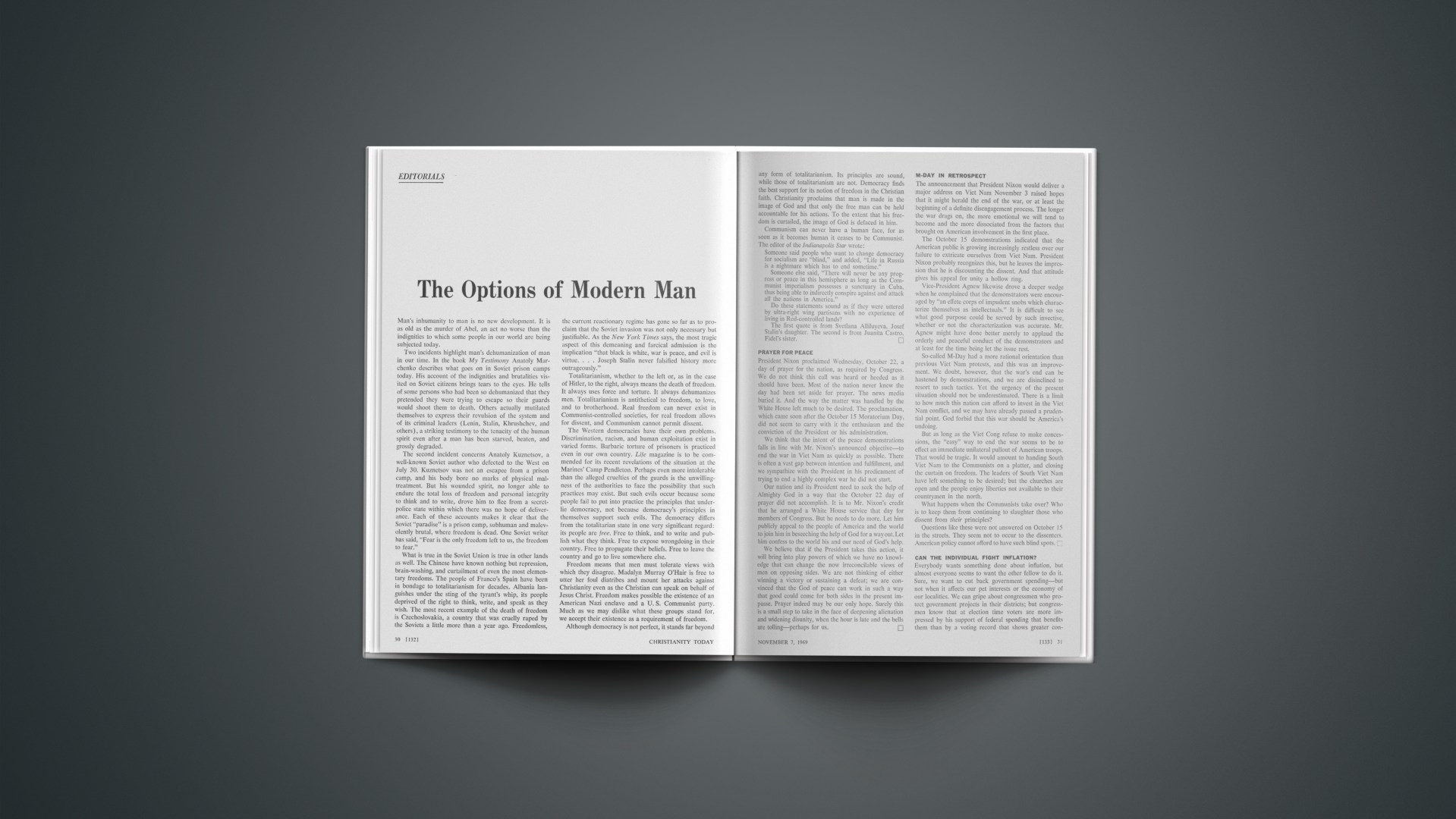
President Nixon proclaimed Wednesday, October 22, a day of prayer for the nation, as required by Congress. We do not think this call was heard or heeded as it should have been. Most of the nation never knew the day had been set aside for prayer. The news media buried it. And the way the matter was handled by the White House left much to be desired. The proclamation, which came soon after the October 15 Moratorium Day, did not seem to carry with it the enthusiasm and the conviction of the President or his administration.

We think that the intent of the peace demonstrations falls in line with Mr. Nixon’s announced objective—to end the war in Viet Nam as quickly as possible. There is often a vast gap between intention and fulfillment, and we sympathize with the President in his predicament of trying to end a highly complex war he did not start.

Our nation and its President need to seek the help of Almighty God in a way that the October 22 day of prayer did not accomplish. It is to Mr. Nixon’s credit that he arranged a White House service that day for members of Congress. But he needs to do more. Let him publicly appeal to the people of America and the world to join him in beseeching the help of God for a way out. Let him confess to the world his and our need of God’s help.

We believe that if the President takes this action, it will bring into play powers of which we have no knowledge that can change the now irreconcilable views of men on opposing sides. We are not thinking of either winning a victory or sustaining a defeat; we are convinced that the God of peace can work in such a way that good could come for both sides in the present impasse. Prayer indeed may be our only hope. Surely this is a small step to take in the face of deepening alienation and widening disunity, when the hour is late and the bells are tolling—perhaps for us.
Ideas

M-Day in Retrospect

The announcement that President Nixon would deliver a major address on Viet Nam November 3 raised hopes that it might herald the end of the war, or at least the beginning of a definite disengagement process. The longer the war drags on, the more emotional we will tend to become and the more dissociated from the factors that brought on American involvement in the first place.

The October 15 demonstrations indicated that the American public is growing increasingly restless over our failure to extricate ourselves from Viet Nam. President Nixon probably recognizes this, but he leaves the impression that he is discounting the dissent. And that attitude gives his appeal for unity a hollow ring.

Vice-President Agnew likewise drove a deeper wedge when he complained that the demonstrators were encouraged by “an effete corps of impudent snobs which characterize themselves as intellectuals.” It is difficult to see what good purpose could be served by such invective, whether or not the characterization was accurate. Mr. Agnew might have done better merely to applaud the orderly and peaceful conduct of the demonstrators and at least for the time being let the issue rest.

So-called M-Day had a more rational orientation than previous Viet Nam protests, and this was an improvement. We doubt, however, that the war’s end can be hastened by demonstrations, and we are disinclined to resort to such tactics. Yet the urgency of the present situation should not be underestimated. There is a limit to how much this nation can afford to invest in the Viet Nam conflict, and we may have already passed a prudential point. God forbid that this war should be America’s undoing.

But as long as the Viet Cong refuse to make concessions, the “easy” way to end the war seems to be to effect an immediate unilateral pullout of American troops. That would be tragic. It would amount to handing South Viet Nam to the Communists on a platter, and closing the curtain on freedom. The leaders of South Viet Nam have left something to be desired; but the churches are open and the people enjoy liberties not available to their countrymen in the north.

What happens when the Communists take over? Who is to keep them from continuing to slaughter those who dissent from their principles?

Questions like these were not answered on October 15 in the streets. They seem not to occur to the dissenters. American policy cannot afford to have such blind spots.

Ideas

Can the Individual Fight Inflation

Everybody wants something done about inflation, but almost everyone seems to want the other fellow to do it. Sure, we want to cut back government spending—but not when it affects our pet interests or the economy of our localities. We can gripe about congressmen who protect government projects in their districts; but congressmen know that at election time voters are more impressed by his support of federal spending that benefits them than by a voting record that shows greater concern for inflation or the national interest. Sure, we want taxes kept at a high enough level to let the government pay its own way. But don’t change the law on tax breaks that we personally or organizationally enjoy.

Congressmen vote for some tax breaks because the beneficiaries contribute to their campaigns at election time. The ordinary guy complains that Congress doesn’t look out for him. But then how much do ordinary guys bother to contribute to costly election campaigns? A lot of little gifts can add up to more than a few large gifts. Perhaps there are not more consumer-oriented congressmen simply because consumer-oriented candidates can’t afford to buy enough publicity to be elected.

We complain about costly wage settlements for the other fellow, and we also complain when we don’t get the wage or salary increases we think we have coming. How about examining our attitudes toward inflation and asking ourselves what sacrifice we, personally, are making to control it? If we are in a labor union, are we making it clear to our leaders that we will not vote against them in the next election just because they exercised restraint in seeking higher wages? And will we try to convince our fellow union members that in the long run this will be better for us all? If we are part of management, will we do what we can to hold down price increases even if profit margins go down, because our suffering will be far greater if inflation goes wild? And all of us are consumers. Will we try to take our business to those firms whose labor and management seek to do something about inflation? Or will we reinforce irresponsibility by buying the products or services of companies that promote inflation?

Christians of all people are those who take the long view. In an economy where men are promoting inflation by being concerned only for present benefits, Christians should be taking the lead, in the small ways that are open to us all, to encourage others not to live just for the present but to think of the future consequences.

How Did the Mets Do It?

Three times this year, an underdog New York team went into a major sports classic against a highly touted Baltimore club, and each time they came out on top. The Jets manhandled the Colts in the pro football Super Bowl. The Knicks humiliated the Bullets in the pro basketball playoffs. And in another surprise, the Mets trounced the Orioles in the baseball World Series.

So extraordinary was this latter feat that numerous observers have been attributing it to divine intervention. Met pitcher Tom Seaver speculated that God might have an apartment in New York. “Indeed,” Religious News Service reported, “deity has gotten a much better play in the sports section in recent weeks than in the Saturday church page. ‘God is alive and living in Shea Stadium’ got to be a cliché.” A clever RNS reporter said God could be a candidate for the comeback-of-the-year award.

To be sure, this is irreverent humor. But considering all the things organized religion is getting blamed for these days, we’ll not complain.

Ideas

A Push for Bishop-Power

On October 31, 1517, Martin Luther, using the news medium available to him, expressed some of his reservations about church doctrine and government by posting ninety-five theses on the church door in Wittenberg. Little did he realize that his theses, intended for academic debate, would spark a reformation that would change the course of history.

Luther’s protest seems relatively mild when compared with that being voiced by an impressive number of Catholic clergy and laity some 452 years later. The Synod of Bishops, which recently convened in Vatican City at the call of Pope Paul VI, reflected something of the current upheaval within the church. The more than 140 prelates in attendance debated one of the distinctive doctrines of Roman Catholicism—the Pope’s supreme authority in the church. “Progressives,” including such outstanding churchmen as Leo Josef Cardinal Suenens of Belgium, Bernard Jan Cardinal Alfrink of Holland, and Julius Cardinal Doepfner of Germany, called for a move away from absolute control by the Pope toward a larger role for bishops in church government. A surprisingly large number of those who spoke pushed for a wider implementation of the principle of “collegiality” (shared authority) laid down by Vatican II.

The views of those who favor a strict papal authority were expressed by Jean Cardinal Danielou of the Roman Curia, who argued that more than ever before the church needs a firm and sole authority to face up to the decline of faith, spiritual life, and morals in the Western world. But a clear majority of the gathering favored a move in the direction of greater “bishop-power.”

The current unrest in the church was expressed even more dramatically by the European Priests’ Assembly (see News, page 46), which met in Rome at the same time as the Synod of Bishops. Some two hundred priests from eleven countries who gathered for this assembly—dubbed the “Counter-Synod”—were forced to meet at the seminary of the Protestant Waldensian Church when all other doors were closed to them. The group, which met to express solidarity with bishops committed to radical reform, sought but did not get a “dialogue” with the Pope.

Some observers have begun to speak of a new reformation comparable to that of Luther’s day. There is no doubt that change is in the wind, but the current reformation is vastly different from that of the sixteenth century. Present-day reformers would replace the absolute authority of the Pope with an authority shared by the Pope and the college of bishops, and perhaps even priests. The early reformers sought to replace papal authority with the supreme and absolute authority of Scripture. The need for reform in the Church—both Protestant and Catholic—is obvious. But reformation that does not begin by leading the Church to submission to the absolute authority of Scripture offers little cause for rejoicing.

Ideas

Living Down Prohibition

The American public has shown proper concern over the increasing use of addictive narcotics. National policy now reflects a sensitivity, too, toward the hazards of tobacco. Little is said, however, about the enormous consumption of alcohol and the resulting effect in traffic accidents, personal health, family life, and economic waste.

Attention is currently focused upon the wide use of marijuana, particularly among the young. It is probably true that penalties against users and peddlers of dope have not corresponded with the dangers inherent in the various drugs; federal law sets the sentence at two to ten years with a fine of $20,000 for narcotics and marijuana, yet LSD possession is treated as a misdemeanor with a $1,000 fine and a sentence up to one year. But the Nixon administration’s proposal to ease penalties on users can hardly be expected to discourage consumption.

It is interesting that the federal government can and does deal decisively with potentially harmful substances such as cyclamates. And recalling the thalidomide tragedy in other countries, we can be thankful. But on alcohol we continue to drag our feet and give indirect comfort to young marijuana users who can point to hypocritical standards.

This neglect is partly the residue of the reaction that set in following Prohibition, and partly the result of the dwindling influence of the anti-liquor lobby. But America cannot afford to keep its eyes closed to the alcohol problem much longer. If modest, reasonable steps are not soon taken to regulate the flow, we will face a sudden, new awareness of the dangers and the temptation again to over-react.

Legislation is now pending in Congress requiring beverages that are more than 24 per cent alcohol by volume to carry a warning that they are hazardous to health and may be habit-forming. It deserves priority consideration.

Ideas

Celibacy: A Christian Option

Many Roman Catholics are re-examining their traditional views on celibacy. Protestants need to do so as well, if we are to deal fairly with the views of the Apostle Paul expressed in First Corinthians 7. Paul does not condemn marriage. He clearly rebukes those who are married yet refrain from normal marital relationships, perhaps because of a false application of Christian holiness (vv. 3–5). Nevertheless, Paul indicates that God may indeed call some men and women to remain unmarried, if they can do so without constantly wishing that they were married (vv. 7–9, 27, 38, 40).

At times Christianity has seemed to regard marriage as an inferior state, and false asceticism has been glorified. But is it right to go to the other extreme? How often are young people, especially young men, encouraged from the pulpit and in the classroom to consider seriously whether God is calling them to remain unmarried? To be sure, teen-age marriages are not encouraged, but attractive single Christians in their twenties usually are assumed to be “looking,” are introduced aggressively to potential mates, and are suspected if they seem uninterested.

Paul’s argument for celibacy is that it leaves more time to devote specifically to “the affairs of the Lord” as distinct from matters in which non-Christians are also engaged (vv. 32–35). It is not difficult to think of situations where being unmarried would offer an advantage for Christian ministry. For example, most Christians over the past few decades have given little consideration to living as self-supporting missionaries in ghettos where biblical Christianity is little known. The excuse for this neglect is often concern for health, safety, and education of families. Not only pioneering works in the far corners of the earth but pioneering works closer to home can use the services of those who are unmarried. Have we done justice to the plea that Paul makes for seriously considering celibacy as God’s will for some—perhaps for many—Christians? Or is First Corinthians 7 one more example of a passage overlooked by those of us who claim to follow the Scriptures?

Agenda Anxiety: Corralling Relevance

“We kept speaking over and over again of the necessity for finding ways to identify with genuine human needs,” summarized moderator Dr. Arthur R. McKay at a conference last month on “The Relevancy of Organized Religion.” The list of delegates read like a Who’s Who in Religion; they had gathered to prepare an agenda for the future of their specialty.

One of the six blacks among the forty-eight delegates had linked religion’s relevance to “genuine human needs.” “Organized religion has been extremely relevant to me personally,” said the Rev. Andrew J. Young, executive vice-president of the Southern Christian Leadership Conference. But he went on to question the relevancy of the conference and others like it. Its cost, ($75,000 to $100,000), he said, would provide the basis for food and housing for an entire Southern county.

One of the three youth delegates to the Hudson, Wisconsin, conference had linked relevancy to the needs of his generation. “Who are you,” asked Union Seminary (New York) student Mark Hanson, “to draw up an agenda for us who have to live in the future?” Echoed Rabbi Marc Tannenbaum: “Youth have simply turned us off.” National Council of Churches president Arthur Flemming suggested involving 18–25-year—olds in religion by having them compose at least one-third of church and synagogue boards.

“We have been reiterating that the Church has ‘too much harness and not enough horse,’ ” continued the summary by McKay, president of McCormick Seminary. What he meant by “horse” was clearly something besides doctrinal orthodoxy. “Theological defenses are no longer definitive,” Rabbi Jacob P. Rudin, president of the Synagogue Council of America, had said. “There is a common religious agenda now and a growing recognition that salvation is corporate.”

The differences in religion, the conference seemed to say, emerge more in culture, history, and life styles than in beliefs. “I’m not afraid of a plurality of truths,” said Yale Divinity School dean Colin W. Williams. “This doesn’t mean that I don’t make distinctions but only that I hold it open that what is true for the Buddhist in his situation may be as valid for him as mine is for me.”

For relevancy in such a situation, concluded McKay, “we need corporate structures stripped down to their bare essentials.” After three days of discussion, those essentials were still out of sight. So was an agenda for the future of organized religion.

Roman Catholic pastor Vincent A. Yzermans, resigned editor of Our Sunday Visitor and one of the delegates, dolefully concluded: “The attempt was regarded by most participants, including this writer, as courageous and heroic—but a glorious failure.”

One minor problem: Nobody had specifically defined “relevancy.” So departing delegates asked the sponsoring George D. Dayton Foundation to fund a committee to continue looking for organized religion’s elusive agenda.

A Global Goal

Baptists will get together to evangelize the world in 1974 if a proposal to the Baptist World Alliance is approved at its congress next July. The Rev. Rubens Lopes suggested the plan, which has been endorsed by the executive committee of the alliance.

“We are living in an hour in which the world can be moved only by the power of impact,” said Lopes. “Together we can accomplish much more than we can separately.”

Lopes, the pastor of Vila Marina Baptist Church in Sao Paulo, Brazil, also knows something of large-scale evangelistic campaigns. He is president of the Crusade of the Americas, the effort of 23 million Baptists to evangelize the Western Hemisphere.

Salvation: Hard-Shell Paganism in Pseudo-Religious Garb

Three months after the Billy Graham crusade, New York City was being offered a new “Salvation” at the Jan Hus Theater. This Salvation is a rock musical, written by two hippie types named Peter Link and C. C. Courtney.

As with other contemporary no-plot musicals, Salvation has the current audio and visual emphases on sex and drugs. But the play’s authors decided the best way to package this youth philosophy is through a parody of the Church—from the rock-bound Baptists to the ecumenical movement. It is interesting that these youthful playwrights,Courtney, a “hard-shelled” Baptist prodigy, was at 13 a child preacher. At 18, while in college, he began questioning his beliefs, soon turned agnostic, and became an itinerant disc jockey. At 25, he can still quote the Scriptures, but the actor in him has overtaken the preacher. and their large audiences, still think enough of the Church to bandy it about. Unfortunately, the blatant stereotypes of the all-too-human clergyman and the myriad “shalt-nots” of historic legalism are the straw Christianity Salvation seeks to knock down.

In its place, Salvation offers constant sex to the point of nausea, a bit of drugs, anti-everything sentiment, astrology, and whatever else happens to pass for a god these days.

Salvation is an entertaining way to make a lot of bread—if one’s god happens to be Mammon.

JOHN EVENSON

Apple PodcastsDown ArrowDown ArrowDown Arrowarrow_left_altLeft ArrowLeft ArrowRight ArrowRight ArrowRight Arrowarrow_up_altUp ArrowUp ArrowAvailable at Amazoncaret-downCloseCloseEmailEmailExpandExpandExternalExternalFacebookfacebook-squareGiftGiftGooglegoogleGoogle KeephamburgerInstagraminstagram-squareLinkLinklinkedin-squareListenListenListenChristianity TodayCT Creative Studio Logologo_orgMegaphoneMenuMenupausePinterestPlayPlayPocketPodcastRSSRSSSaveSaveSaveSearchSearchsearchSpotifyStitcherTelegramTable of ContentsTable of Contentstwitter-squareWhatsAppXYouTubeYouTube