A Natural Step

When Lutherans speak of ecumenism, they usually are referring to further cooperation with other Lutherans. On October 8, in Clark, New Jersey, the 20,000-member Synod of Evangelical Lutheran Churches voted to become an integral part of the 2.8-million-member Lutheran Church-Missouri Synod. The merger will take place after congregational ratification and an eight-year trial period during which the SELC will be a non-geographic district of the synod.

The merger is a logical one, for this group of Lutherans with Slovak roots has had altar and pulpit fellowship with the Missouri Synod since 1908. SELC pastors have been educated at Missouri Synod seminaries where the SELC has funded chairs in the Slovak language and liturgy. The theological traditions of the two churches are almost identical.

The SELC also elected its first American-born president, a 47-year old minister, Milan A. Ontko, who will continue as leader of the new Missouri Synod district. Ontko and outgoing president Dr. John Kovak championed the merger and other intra-Lutheran proposals, including a declaration of altar and pulpit fellowship with the American Lutheran Church.

In a continuing spirit of Lutheran ecumenism, the SELC voted to enter fellowship discussions with the church of its forefathers, the Lutheran Church in Czechoslovakia, and with the largest Lutheran body in the United States, the 3.2-million-member Lutheran Church in America.

The only other body of Slovak Lutherans in the United States is the Zion Synod of the LCA. During the thirties, when both Zion and the SELC were more Slovak than American, a merger was discussed. Although there was agreement on theological grounds, differences of polity prevented merger. Now, thirty years later, the SELC is an American church—and merger with the English-speaking Missouri Synod is a natural step.
JOHN EVENSON

Churches of Christ: Orchestrating Unity

Two Churches of Christ groups are looking for ways to make sweet music together. But disagreement on whether the Bible sanctions the use of instrumental music in worship services thus far has muted harmony between the 2.3 million member Churches of Christ (non-instrumental), and the approximately one million members of the Undenominational Fellowship of Christian Churches and Churches of Christ (instrumental).

Thirty leaders—fifteen from each communion—met in September in St. Louis, following unity talks held in June in Memphis and other cities.

The Memphis and St. Louis meetings were prompted by an editorial by Reuel Lemmons in Firm Foundation, a doctrinal journal read widely among members of the non-instrumental Churches of Christ. Discussion participants, however, represented a wide spectrum of views.

J. W. Roberts, professor of Bible at Abilene Christian College (Churches of Christ), called the meetings “fruitful” because the two groups discovered they have much in common, including, among other things, agreement on the plan of salvation, evangelism methods, most doctrinal questions, independent organization of congregations, and worship (except music). The biggest difference was over the use of instruments.

Roberts emphasized that neither side discussed concessions, but tentative plans were made for another meeting in Los Angeles, and the possibility of exchanging lecturers was presented.

Since both groups follow congregationalism, unity moves must be carried out by local churches. In Amarillo, Texas, for example, eight meetings have been held by the two communions, and the Amarillo churches could unite even if leaders elsewhere reject the idea. But any decision by the thirty leaders—who include influential writers, professors, and evangelists from the two groups—would carry much weight at the congregational level.

Unity discussions began after a decision in 1968 by the Christian Church (Disciples of Christ) to restructure itself into a denomination. When individual congregations were given an opportunity to choose membership in the denomination, about 7,000 congregations with a membership of more than one million severed all ties and formed the Undenominational Fellowship.

MARQUITA MOSS

Oink!

Cartoonist Al Capp (a Jew) recently was put on the griddle by the president of the Union of American Hebrew Congregations for “dreadful bad taste.” Capp’s “Li’l Abner” series featured a “Boar Mitzvah.”

In the cartoon, Salomey the pig must be quartered at home to protect it from Porknoy the Complainer, who escaped the zoo before being “Boar Mitzvahed.” In the series, playful little boars are sent to Boarkley, California, which specializes in “eddicatin’ swine.”

Rabbi Maurice N. Eisendrath, leader of Reform Judaism, larded his criticism with the observation that the use of the pig “adds insult to injury since a pig in Orthodox Judaism is a forbidden food.”

Suprise Post

Canadian Prime Minister Pierre Elliot Trudeau caught the country by surprise with his announcement on October 15 of the appointment of Dr. John Robbins as the first Canadian ambassador to the Vatican. Robbins, 66, former president of Brandon University, Manitoba, said he has no formal church connection but admires Bahai and Unitarianism.

“I’m not a Catholic, certainly,” he said, “and I’m not sure that I’m a Protestant.” Robbins said his assignment will place him in “one of the great centers of power and influence—comparable to Washington, Moscow, or Peking.…”

Nine months earlier Trudeau had visited Rome and, on his return, cautiously announced he was considering the Vatican diplomatic link. Reaction was prompt and overwhelmingly against the move. Parliament reported a deluge of mail in opposition, and it was generally assumed there would be no action.

In addition to the grass-roots protest, there was a rare unanimity in the official statements of all non-Catholic denominations, both liberal and conservative. Even Catholic politicians, like Windsor Liberal Mark McGuigan, expressed skepticism.

When he announced the appointment, Trudeau described the Vatican as “the cheapest listening post in the world,” and cited growing Vatican involvement in international affairs as a prime reason for the move.

Protestants have doubted the value of the Vatican as a listening post, however, noting that Canada already has diplomatic representation in Geneva, where the Communist bloc also is represented. Canada is the sixty-ninth nation to recognize the Vatican.

LESLIE K. TARR

Canadians Plan National Evangelism Congress

Now it’s Canada’s turn. Representatives from fourteen Protestant denominations there are planning to hold a Canadian Congress on Evangelism in Ottawa next summer. The five-day meeting will be another in a series of national and regional evangelism congresses spawned by the Berlin congress in 1966.

The Canadian Congress on Evangelism will meet in Ottawa’s new National Arts Center August 24–28 to “pool ideas, information, and methods in a study of the mission and message of the Church in the twentieth century.” Some 800 delegates are expected.

Sponsoring denominations include the Anglican Church and the United Church, Canada’s two largest non-Catholic communions. Principal Leslie Hunt, an Anglican from Wycliffe College, Toronto, is chairman of the planning committee.

The theme speakers for the congress will be the Archbishop of York, the Rt. Rev. Donald Coggan; Dr. Carl F. H. Henry, CHRISTIANITY TODAY editor-at-large currently teaching at Eastern Baptist Theological Seminary; Dr. Kenneth Hamilton, a theologian; evangelists Leighton Ford and Fernand St. Louis.

A news release announcing the congress said that delegates would “seriously examine the responsibility of the Church in proclaiming the Gospel as it relates to major social and economic issues, world missions, youth, cultural pluralism, and the new Roman Catholicism.”

H. Wilbur Sutherland, head of the Inter-Varsity Christian Fellowship of Canada, is serving as chairman of the executive committee for the congress. The Rev. Marney Patterson, an Anglican evangelist, is executive secretary. There are also four vice-chairmen, one each from western, central, eastern, and French Canada. Simultaneous translations of the congress proceedings will be carried in French and English.

Here is a complete list of the sponsoring denominationsThere are also six associate sponsors: Canadian Bible Society, Inter-Varsity Christian Fellowship, The Scott Mission Inc., Scripture Union, Christian Women’s Clubs of Canada, and Shantymen’s Christian Association.: Anglican Church in Canada, Plymouth Brethren, Baptist Federation of Canada, Christian and Missionary Alliance, Christian Reformed Church, Church of the Nazarine, Free Methodist, General Conference of Mennonites in Canada, Conference of the Mennonite Brethren Churches of North America, Pentecostal Assemblies of Canada, Presbyterian Church in Canada, Salvation Army, the Missionary Church, and the United Church of Canada.

Editor’s Note from November 07, 1969

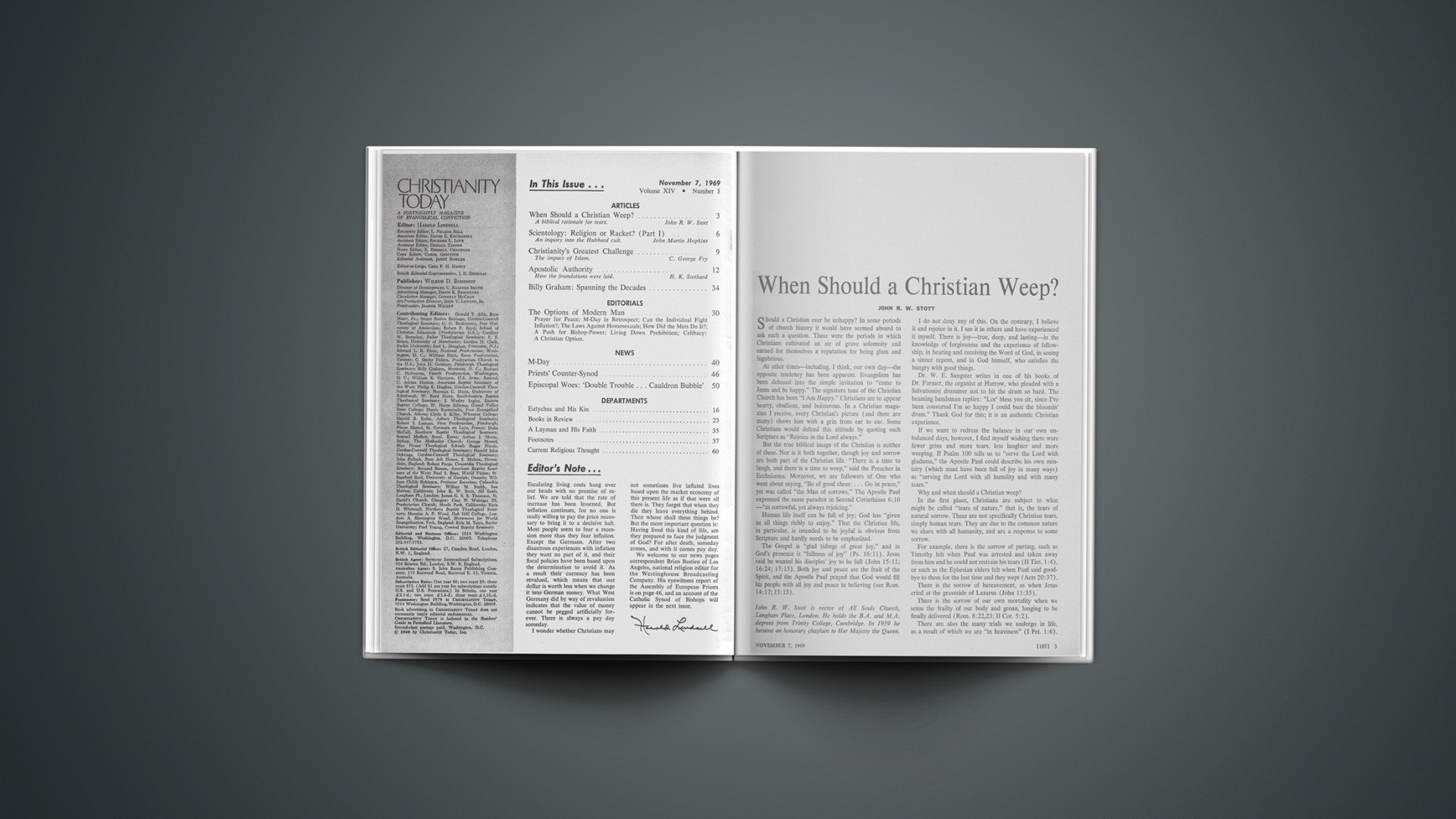
Escalating living costs hang over our heads with no promise of relief. We are told that the rate of increase has been lessened. But inflation continues, for no one is really willing to pay the price necessary to bring it to a decisive halt. Most people seem to fear a recession more than they fear inflation. Except the Germans. After two disastrous experiences with inflation they want no part of it, and their fiscal policies have been based upon the determination to avoid it. As a result their currency has been revalued, which means that our dollar is worth less when we change it into German money. What West Germany did by way of revaluation indicates that the value of money cannot be pegged artificially forever. There is always a pay day someday.

I wonder whether Christians may not sometimes live inflated lives based upon the market economy of this present life as if that were all there is. They forget that when they die they leave everything behind. Then whose shall these things be? But the more important question is: Having lived this kind of life, are they prepared to face the judgment of God? For after death, someday comes, and with it comes pay day.

We welcome to our news pages correspondent Brian Bastien of Los Angeles, national religion editor for the Westinghouse Broadcasting Company. His eyewitness report of the Assembly of European Priests is on page 46, and an account of the Catholic Synod of Bishops will appear in the next issue.

Missouri Turns a Corner

The crucial Denver convention of the Lutheran Church-Missouri Synod has come and gone, leaving mystified observers shaking their heads in bewilderment here and abroad. Hardly had the convention begun when Dr. J. A. O. Preus, the conservative president of the synod’s Springfield seminary, replaced (almost on the first ballot) the mediating-to-liberal incumbent synodical president Oliver Harms. A few days later, the same convention voted its approval of pulpit-and-altar fellowship with the American Lutheran Church—a move consistently opposed by Preus and other synod conservatives because of the ALC’s latitudinarianism on the doctrine of biblical inerrancy, its fellowship with the liberal Lutheran Church in America, and its membership in the unionistic Lutheran World Federation and World Council of Churches.

Having witnessed at close range the kaleidoscopic shifts in the French political climate, I was perhaps better prepared for these apparently inexplicable results than would otherwise have been the case. In France one learns that inconsistency in surface behavior can often be explained consistently if one strikes deeper.

The election of Dr. Preus cannot be attributed—as sour-grapes liberal inside and outside the synod are claiming—to “underground,” “anti-harmonistic,” “reactionary” forces that endeavored to gain control of the synod for their “nefarious right-wing purposes.” Certainly efforts were made to convince delegates to vote a particular way. But this activity was carried on by both sides, as it inevitably is in any democracy. The election itself was entirely aboveboard, and the delegates were free to make their own decisions, which they did.

The post-convention complaints of the losing side merely illustrate an immature liberal syndrome: the attribution of conservative success to “hidden right-wing forces” (cf. Stringfellow and Towne’s The Bishop Pike Affair, which argued in all seriousness that attempts in the Episcopal Church to discipline the bishop for his doctrinal deviations were the product of reactionary elements endeavoring to undermine our democratic society!). Both the far left and the far right continually find bogeymen under their beds (whether “underground anti-democratic forces” or “the international Communist conspiracy”). Preus was elected simply because the Missouri Synod had had enough of leadership that was characterized by an enormous credibility gap and that, step by step, was leading Missouri to compromise its historic doctrinal heritage.

But why, then, the positive vote on the ALC fellowship issue? Unlike the presidential vote (which the incumbent administration could not very well influence before the convention without betraying its fear that its time was running out), the ALC proposal had been advocated in all official church publications for months. And at the convention itself, the pressure actually increased in intensity: delegates found it extremely difficult to resist the repetitious refrain that to oppose the fellowship resolution would be to oppose Christ’s own prayer for unity in the church. After Preus’s election, some liberals actually went so far as to tell undecided conservatives: “Now that God has given us a firmly conservative leadership again, we have nothing to fear in entering into fellowship with a less conservative body”!

Considering the quantity, intensity, and emotional overtones of the pro-ALC propaganda, it is quite remarkable that the delegates passed the fellowship motion only by a narrow margin. That says something about the theological acumen of Missouri’s grass roots; in most large denominations such a vote would have been 98 per cent for fellowship, and the other 2 per cent would have been burned in effigy on the one inviolable heresy charge in the twentieth-century church: anti-ecumenicity.

As a whole, Denver was indeed a conservative, not a liberal, victory. Had the seemingly paradoxical vote been reversed—against ALC fellowship but for the continuation of the Harms regime—the cause of confessional Lutheranism would have been lost in the Missouri Synod. For the liberal propaganda emanating from St. Louis would have continued unabated, and, in the absence of a comparable official avenue for presentation of the other side, the ALC fellowship proposal would have inevitably passed at a future convention anyway. Moreover, the steady shift in the direction of a liberal ministerium would have persisted, for nothing would have been done to correct the present latitudinarian atmosphere at such synodical schools as Concordia Seminary, St. Louis, and Concordia Teachers College, River Forest.

As things stand now, there is every hope of a new day in the Missouri Synod. Because of the Germanically authoritarian aura of prestige surrounding the synod’s presidential office, Preus is in an ideal position to reverse the trends of the last two decades. But this will come about only if two measures are rigorously carried out—uninhibited by fear or the confusion of Law and Gospel that is continually pressed on Missouri’s conservatives in the name of brotherly sentimentality.

First, the President must courageously rid the synod, and particularly its teaching offices, of those persons who by their public teachings have advocated views of Scripture disharmonious with the Church’s express belief that the Bible is God’s inerrant Word (“everything should be subordinated” to Scripture—Formula of Concord, S. D., Summary, para. 9). Martin Scharlemann of the Concordia, St. Louis, faculty has recently stated that in a meeting with liberally oriented district presidents, Preus “specifically promised that no heads will roll.” Certainly no vendetta must occur, but unless the heads of a number of liberals are rolled out of Missouri into churches where their owners can maintain their un-Lutheran views with integrity, Missouri will continue to deteriorate. Scriptural defection is a cancer that has destroyed too many denominations for anyone to think naively that it can be treated by a remedy less acute than surgery.

Secondly (and this may irritate the extreme right as much as measure number one infuriates the liberals), the educational system of the synod must be revamped from bottom to top. No longer can the Church be satisfied with lock-step, Germanic indoctrination, whether orthodox or heterodox, or with a slavish adherence to bureaucracy. Missouri’s people, from parochial school to seminary, need to learn to think—to discover the “reason for the faith that is within them,” so that in contact with the complex ideologies and heresies of our day they will display an active, informed, relevant, socially sensitive, truly biblical faith. Only by such thoroughgoing reeducation will Missouri come into the kind of ecumenical alignments it really needs—with other Bible-believing churches who share Luther’s evangelical conviction that “there’s none other God” than Christ Jesus and that “he holds the field for ever.”

JOHN WARWICK MONTGOMERY

News Briefs from November 7, 1969

Episcopal Woes: ‘Double Trouble… Cauldron Bubble’

From the four points of the compass, controversy—some bitter—was abrewing for the Episcopal Church as the ghost of the Special General Convention at South Bend last September continued to haunt national leaders of the church just before Halloween.

At South Bend itself, bubbling dissent over black economic development funding boiled up into a full-scale federal grand jury investigation. In St. Louis, a conservative group of Episcopalians accused the national leadership of deceit, hypocrisy, and the diversion of church funds from “the true mission and vocation of the church.”

Elsewhere, efforts of the church’s bishops to soothe disgruntled givers (see October 10 issue, page 50) appeared to have been only temporary: dissatisfaction with the church’s indirect allocation of $200,000 to the Black Economic Development Conference mounted. In Philadelphia, moderates and conservatives seemed to wrest a compromise from strongly activist Bishop Robert L. DeWitt and his followers when the diocesan convention watered down a move to raise $5 million for self-determination projects for the black community. Opponents of the measure feared the money would go to the BEDC, the James Forman manifesto-inspired agency that has asked billions in reparations from white churches.

Meanwhile, the national church approved grants for a separatist black University in North Carolina (see story following).

Presiding Bishop John E. Hines was among top denominational leaders subpoenaed to appear at the hearings in South Bend. Newsmen who covered the August 30-September 5 convention were also called to testify before a grand jury panel. All witnesses refused to comment on the investigation, but Religious News Service said the probe reportedly was launched by the Federal Bureau of Investigation.

At a two-day meeting in St. Louis attended by thirty-five Episcopal churchmen from fifteen states, the Foundation for Christian Theology released a document called “Christian Affirmation: A Response to the Crisis in the Episcopal Church.”

CHRISTIANITY TODAY’S St. Louis correspondent, Charles Bunce, interviewed Hines shortly after the FCT meeting.1Hines was in St. Louis to give the keynote speech at the 130th annual convention of the Diocese of Mossouri on the fifth anniversary of his election as presiding bishop, also in St. Louis. The bishop told Bunce that black militants have influenced the church but that it has “not sold out to anyone theologically, sociologically, or politically.”

The FCT statement asked Episcopalians to cooperate in a “massive but orderly diversion of funds in accordance with responsible guidelines.… Should the Episcopal Church continue its present trend in offering support to seditious and revolutionary groups whose purposes are unrelated to the Gospel, we would feel conscience-bound to call upon all Episcopalians to make their opposition known.…”

The foundation publishes the Christian Challenge, a magazine whose circulation has zoomed from 26,000 to 45,000 in the past two months.

Replying to the FCT charges (the group asked Hines to resign at the Special General Convention), the Presiding Bishop asserted: “Rightists in the life of the church get unusual coverage because they take the ‘anti’ position.… The Foundation for Christian Theology is a tiny group … fundamentalistic, pro-segregation, extremely conservative, and not willing to face the twentieth century and its demands on the church.”

While the Pennsylvania Diocese approved a special, extra-diocesan campaign to raise a “substantial amount” for black community causes, the BEDC was not named as recipient, and no group advocating violence can qualify. Eleven of thirteen black Episcopal clergy in the diocese immediately lashed out at the decision, saying they wouldn’t participate in any program with strings attached to funding.

Segregating Grants

The Episcopal Church seems to have a penchant for approving money for controversial black causes this year. Already reeling from a backlash caused by a drive to raise $200,000 for indirect funding of the Black Manifesto-spawned Black Economic Development Conference (see September 26 issue, page 42), denominational leaders surely will get angry letters reacting to this latest sally:

Bishop Thomas A. Fraser of the Diocese of North Carolina announced last month that grants of $45,000 had been approved by the national church for the black separatist Malcolm X Liberation University in Durham.

He said the money will come from the $9 million Urban Crisis Program Fund adopted at the 1967 General Convention in Seattle.

Malcolm X University—named for the assassinated Black Muslim leader—was started on a part-time basis last spring after Negro students at Duke University seized the administration building to dramatize their demands for a black-studies program. A clash between police and students followed.

Black activist Howard Fuller, a board member of the Interreligious Foundation for Community Development accused of stirring up campus riots and bombings in North Carolina last spring (see August 1 issue, page 33), is head of the liberation school.

The Associated Press reported that Fuller said the curriculum of Malcolm X University will be based on the idea of nation-building, with a goal of training Negro Americans to set up an independent nation in Africa.

The grants drew immediate fire from North Carolina NAACP president Kelly Alexander, who denounced them “as expressing to the world that the church approves segregation in education.”

Historians Debate God-And-Country Theme

“There is no political ideology for Christians,” University of Wisconsin professor Robert E. Frykenberg warned a gathering of evangelical historians last month. “God has given us no other guide than his Spirit. The Bible is silent. We must depend upon historical example and precedent. There is no overarching theory that determines the Christian’s relationship with society and the state.”

Frykenberg, born in India of Baptist missionary parents, is the author of three books on Indian history and an active Inter-Varsity Christian Fellowship leader. Speaking on “The Christian and the State,” he pointed out that the Christian is a citizen of two worlds and thus is in constant tension with the political system. The believer has often undermined his position in society by a lack of rationality, ethical consistency, and humility, he declared.

“Political behavior demands more than pure doctrine,” he said, adding that there has been little political thinking among evangelicals in the last hundred years. “We enjoy the system we have inherited, but we have not adopted any approaches to make it continue to work.”

The meeting, sponsored by the Conference on Faith and History and held at Concordia Teachers College in River Forest, Illinois, centered on the topic: “Themes of God and Country in Western History.”

At a session on Protestant responses to the Hitler regime, Lutheran historian Donald Wall and North American Baptist sociologist David Priestley demonstrated the impotence of their respective German denominational counterparts in the face of totalitarian dictatorship. Responding to a comment that the capitulation of German Lutheranism was due to the corrosive effect of liberal theology, Priestley pointed out that the doctrinally orthodox Baptists also had put up little resistance to Hitler and that many actually welcomed the regime.

In a spirited discussion of “How Christian Were the Founding Fathers?” panel participants concluded that the principal figures of the American Revolution and the Constitutional Convention were not Christian in the evangelical sense of the term. Methodist W. Richard Stephens contended, however, that though they may not have professed personal faith in Christ, their ethical motivation and life style was Christian.

Bob Jones University professor Edward Panosian argued that it was necessary to look at the basic ideals of the early colonists. In his opinion, many Christian principles were operative even if the founding fathers weren’t orthodox Christians.

John Warwick Montgomery of Trinity Evangelical Divinity School pointed out that America was not a purely Christian nation in the sense of Israel of the Old Testament: “There never has and there never will be a Christian state.”

The Conference on Faith and History has more than two hundred members in colleges, universities, and seminaries in the United States and Canada. Its goals are to encourage evangelical historians to explore the relation of their faith to historical studies, to provide a forum for discussion, and to foster research.

President of the group is John W. Snyder, a noted scholar in ancient history, who is president of Westmont College in Santa Barbara, California.

RICHARD V. PIERARD

Moscow ‘No-No’

Moscow officials firmly refused to grant visiting privileges to a delegation of the Lutheran World Federation that wanted to contact the one million Lutherans in Siberia. Nor would they allow the LWF party to visit the 30,000 Lutherans in Lithuania, the 300,000 in Estonia, or those in Kazakhstan.

Assistant general secretary Carl Mau and research assistant Bela Harmati of the LWF attended the ordination of Jan Matulis, the new archbishop of Letland. But they got no farther. Moscow officials, denying visas for the other countries, said they wouldn’t be able to meet Estonia archbishop Alfred Tooming anyway, since he is reported to be dangerously ill.

In recent months informed sources have said Lutherans in almost all the former Baltic states are being severely persecuted by the Communists.

Through recent correspondence to the Russia Institute of Munich, it was learned for the first time that about one million Lutherans live in the hinterland Siberian regions of Omsk, Nowosibirsk, and Alma Ata. Services there are held in private homes, without pastors. In some places, prayer meetings are held every night.

JAN VAN CAPELLEVEEN

Standing For Something

The National Association of Evangelicals is calling upon American Christians to sign a “Christian Declaration” as a pledge to put their faith into more demonstrative action. General director Clyde W. Taylor, who was honored last month for twenty-five years of service to the NAE, said the effort is an attempt to roll back the current tide of evil. Here is the full text of the statement:

Because Christian principles have played a major role in the founding of this nation and in the life and progress of our society, and

Because there has been such a neglect of moral and spiritual values in our nation that we now have largely a secular society, and

Because we have too often failed both God and man in our Christian commitment, and

Because we face a new decade with pressing national and international problems which cannot be solved apart from moral and spiritual considerations, and

Because God has promised to bless the nation that honors Him: “Blessed is the nation whose God is the Lord” (Psalm 33:12),

I hereby declare my commitment to the nationwide effort to call men to God and to the moral and spiritual values in the Bible. To this end, I will …

… support the ministry and outreach of my local church,

… share my faith in Jesus Christ as Lord and Savior on a person-to-person basis,

… demonstrate love, concern and neighborliness toward all races of men without partiality and without prejudice, especially to the poor, the oppressed and the disadvantaged,

… participate in public affairs by voting my convictions and seizing every opportunity to uphold the cause of righteousness, and

… pray for the nation and spiritual renewal in the land.

Are Red Rites Wrong?

Young people of Roman Catholic churches in East Germany won’t be excluded from communion from now on if they participate in the formerly prohibited counterfeit confirmation called Jugendweihe. Catholic bishops there decided to follow the example of Protestant pastors who discovered a decade ago that the Red rite is an “inescapable evil.”

Most young people don’t forsake the Jugendweihe because doing so bars them from being accepted by high schools and universities.

The rites were instituted in 1955 to break the power of the churches; the Communists turned the churches’ confirmation into a Red feast. Both Protestant and Catholic churches confirmed young people at age 14.

After months of indoctrination, the youngsters must vow to “preserve the revolutionary heritage of our people” and “deepen the firm friendship with brother countries.” They also pledge to “fight for the great cause of Socialism.”

At first, all East Germany churches refused to accept into membership young people who attended the Red classes. In 1955 only 20 per cent of the youth were lured into the Jugendweihe. But after Communists announced that only those who had given their pledge could follow higher education, the number rose dramatically. By 1958, Protestant churches had modified their position so that young people in the Jugendweihe could be confirmed after “a year of contrition.”

At present some 90 per cent of the young people take part in the Jugendweihe, this year at least 230,000. Most Protestant pastors now admit youth into church membership at age 17 after extended training.

The Catholic bishops say they will tolerate the Jugendweihe because “the young people don’t experience it as a conscious act against the Christian faith.” The real pressure, however, seems to be that the churches’ hard line drove away the young people.

JAN VAN CAPELLEVEEN

Whose Church Of God?

Reports from Jerusalem repeatedly have referred to Denis Michael Rohan, the Australian who has admitted that he set fire to the Al Aqsa Mosque, as a member of the Church of God. This is ambiguous at best.

Many congregations with wide variations in doctrine and practice call themselves simply Church of God. Most of them, however, are in some general association. For example, in Britain, most Churches of God are a part of a small offshoot of the Plymouth Brethren. In America, three Pentecostal bodies with a common origin use the name. Their general headquarters are in Chattanooga and Cleveland, Tennessee, and Huntsville, Alabama (the last group recently moved from Queens, New York).

Two essentially Wesleyan Churches of God, once related, have headquarters in Harrisburg, Pennsylvania, and Anderson, Indiana. A non-Trinitarian Church of God has its headquarters in Oregon, Illinois. Two groups that are more orthodox observe Saturday instead of Sunday and are centered in Salem, West Virginia, and Denver.

Rohan’s associations were with still another Church of God, a group with headquarters in Pasadena, California. It was founded by Herbert W. Armstrong and expanded worldwide by a radio program, “The World Tomorrow.” Spokesmen for Armstrong’s group indicated that Rohan’s connections with the group were quite tenuous. Armstrongism itself is considered to be a Christian heresy.

Union Dues And Don’ts

The closed shop may soon become a major religious issue in Canada. In Burlington, Ontario, three steelworkers lost their jobs after their plant was unionized and they refused on Christian grounds to pay dues. Twenty similar cases reportedly are pending.

In Vancouver, British Columbia, a diesel mechanic was fired when he balked at membership in the International Association of Machinists because of its official posture on the “class struggle.” He filed suit contending that the requirement violated his religious freedom. The case is expected to be appealed to the Supreme Court of Canada.

Keeping close tabs on these showdowns and encouraging Christians to fight the closed-shop principle are the Committee for Justice and Liberty and the Christian Labor Association, headed by Gerald Vandezande. These groups draw most of their support from the Christian Reformed Church.

The men fired in Burlington said that as Christians they could not contribute money to what they consider a humanistic and socialistic organization. Their employer, the Butler Manufacturing Company, had initially negotiated a contract with the United Steelworkers of America that gave the men the right to remain out of the union by agreeing to pay the equivalent of union dues to the Salvation Army. A subsequent contract did away with this arrangement, and union officials refused even to consider a proposal from the men wherein they would pay the equivalent of double their union dues to the Salvation Army.

Religion In Transit

Roy Wilkins, head of the National Association for the Advancement of Colored People, has urged the nation’s religious leaders not to agree to black demands for reparations but to support instead massive public funding of “competent” Negro organizations like the NAACP.

The 26-year-old son of the Rev. Frank H. Woyke, associate secretary of the World Baptist Alliance in Washington, D.C., was arrested on charges of murdering his mother and 80-year-old grandmother in an Oak Park, Illinois, hotel room. The elder Woyke was asleep in another room at the time. Police said the two women had been beaten to death and that young Woyke, found nude and incoherent, appeared to be in a “religious frenzy.”

A statement issued by Lutheran Church-Missouri Synod president Jacob A. O. Preus, five vice-presidents, and thirty-seven synodical district presidents condemned the weekly independent publication Christian News. “We … unanimously repudiate this publication and caution against lending credence and support to it,” the letter said of the very conservative paper.

Two-thirds of the 1,200 non-commercial coffeehouses in the United States serving teen-agers and college students are operated by religious groups, and half of these are ecumenically sponsored, said the Coffee Information Service.

American Baptists Churches of Iowa and Minnesota plan to merge their state associations January 1.

“Night Call,” the nation’s best-known call-in radio program, went off the air October 10, a victim of exhausted funds, despite last-minute appeals for more money for the United Methodistproduced series. The program had won five national awards and consistent critical acclaim from the press.

The Christian Church (Disciples) and the African Methodist Episcopal Church (AME) have joined in a $9.5 million low-rent housing project in three Southern states.

The late Francis Cardinal Spellman’s $500,000 coin collection was sold to a New York dealer; proceeds will be used by the Catholic Church to educate deprived young people.

The New York Bible Society is sponsoring an ecumenical effort to produce a monumental new version, The Holy Bible—A Contemporary Translation.

The First Christian Church of Louisville has withdrawn permission for anti-war, anti-draft spokesman Dr. Benjamin Spock to speak there next month.

Dimensions in Courage, a film that commemorates the 125th anniversary of the Southern Baptist Convention, will be premiered at rallies in 100 cities this month and next.… An infant organization called the Institute of Contemporary Thought, Morton Grove, Illinois, has completed a color film-lecture by church historian Dr. John Warwick Montgomery entitled ChristianityFact or Fiction?

Campus Crusade for Christ International has broken into the book-publishing field with a paperback written by founder-president William Bright: Revolution Now. Next title will be How to Love by Faith.

All Shook Up

When northern California police arrested Chesta Arthur Mills, Jr., on charges of malicious mischief, he warned them: “I am to be addressed as Lord Chesta, for I am the second son of God and Lord over all churches.”

The prisoner also said he would destroy the Santa Rosa jail, where he was incarcerated, in an earthquake at 10:01 P.M. At 9:58 P.M. an earthquake, centered five miles north of the jail, rumbled through the area..

“Lord Chesta, I’m on your side, brother,” one inmate shouted as howls swept the jail. Although the jail (and the inmates) shook, the building wasn’t destroyed.

Personalia

TV proselytizer Fulton J. Sheen, Roman Catholic Bishop of Rochester, New York, resigned last month on a note of frustration and disappointment for himself and his flock. The silver-haired Sheen, 74, said that he would return to New York City for TV work and that “I am not retiring, I am regenerating.” The Vatican announced his successor immediately: Monsignor Joseph L. Hogan, a Rochester pastor. Sheen was appointed titular archbishop of Newport, England, an obscure archdiocese on the Isle of Wight.

The world’s longest-surviving heart transplant patient, the Rev. Charles Damien Boulogne, 57, died suddenly in Paris October 17. The Roman Catholic Dominican priest lived seventeen months and five days with the heart of a former French customs officer and had led an almost normal life.

Commissioner Arnold Brown, 55, a Salvation Army officer for thirty-four years, has been named chief of staff, the organization’s second-highest international office.

Dr. Joseph Szczepkowski, 79, the “patriarch” of Polish Methodism (superintendent of the church and principal of the 5,000-student Methodist-sponsored English-language college in Warsaw), retired at the annual meeting of the Poland Conference.

Congressman Richard L. Roudebush (R.-Ind.) says he will put a child’s prayer in the Congressional Record every day so schools can circumvent the U.S. Supreme Court prohibitions.

The United Methodist Board of Christian Social Concerns has asked the U. S. Senate not to confirm the nomination of Judge Clement F. Haynsworth to the Supreme Court.

Erwin D. Canham, editor-in-chief of the Christian Science Monitor, said in his paper that he was “not in politics and I have no expectation of getting in.” Canham had been mentioned as a possible Republican candidate to oppose Senator Edward M. Kennedy of Massachusetts next year.

Succeeding Louie D. Newton of Atlanta as president of Americans United for Separation of Church and State is Jimmy R. Allen, pastor of First Baptist Church in San Antonio.

Harry Bollback, a veteran missionary to Brazil, has been named co-director of Word of Life, the organization whose founder-director is Jack Wyrtzen. Bollback will help start 100 overseas youth camps.

Pope Paul VI last month accepted the resignation of Archbishop Thomas J. Toolen, 83, as bishop of Mobile-Birmingham, Alabama, divided the diocese in two, and named bishops to each.

Deaths

HENRY GLENN DAVIS, 61, founder and academic dean of Louisville Bible College, minister, and former Army chaplain; in Louisville, Kentucky.

BARNABAS NAGY, 60, leading Hungarian theologian, professor, and research specialist of the General Synod of the Reformed Church; in Budapest.

HAROLD HENRY ROWLEY, 79, British Baptist Hebrew and Old Testament scholar, one-time professor, officer of the Baptist Union of Great Britain and Ireland, and of the Baptist Missionary Society; in Cheltenham, England.

World Scene

A recent nationwide survey among university students in Brazil revealed that 69 per cent believe “humanity is turning more and more away from the ideas of Christ.” Three out of five students questioned said they were less religious than their parents.

Roger Boe of Elbow Lake, Minnesota, a U.S. First Infantry Division trooper, was on patrol in South Viet Nam when enemy soldiers ambushed his unit. Boe noticed smoke curling from his pocket, where a Cong bullet had gone through his wallet and lodged in his Bible, just short of a loaded ammunition clip. A good thick Bible is good for the flesh as well as the soul, Boe decided.

A new school for Lao children has opened in Vientiane, Laos, under the sponsorship of the Evangelical Church of Laos. It is the first such venture for the group.

A crowd of 5,500 attended the final rally in the London Gardens during a two-week Leighton Ford crusade in London, Ontario, last month.

The unresolved issue of whether a Protestant church should register with the government caused a furor during the centennial assembly of the Spanish Baptist Union in Madrid. Although a 1967 law extended legal recognition to non-Catholic churches in Spain for the first time, it required them to register.

A Presbyterian minister was killed and two other clergymen attacked in Kenya for opposing the tribal oath of the Kikuyu people, according to the World Council of Churches. The outbreak is the first since the Mau Mau uprisings of the 1950s.

Using four powerful Christian radio stations, the American Bible Society is now broadcasting daily Scripture readings, at dictation speed, in the two main Chinese languages (Mandarin and Cantonese) to Red China.

A plan, five years in the making, for a united church in New Zealand involves Anglican, Presbyterian, Methodist, and Congregational Churches, and the Churches of Christ.

In a precedent-setting move, the United Church of Canada, Anglican, and Presbyterian churches of Toronto have jointly erected a building to be used by all three for worship services.

Priests’ Counter-Synod

Although it was a hopeless confusion of languages and ambitions from the start, the meeting of Europe’s reformist Roman Catholic priests held at the same time as the official Synod of Bishops in Rome last month was a real slap in the face of the Vatican and the Pope. (A report on the synod will appear in the November 21 issue.) Nothing like the meeting of the European Assembly of Priests had ever happened in the history of the Roman church. But the opportunity for the emergence of a loyal but effective opposition was lost, primarily because of the differing local conditions of the national priests’ delegations, and at least in part because of the poor organization of the priests themselves.

The week-long meeting of the rebel priests, who disclaim such descriptions as “rebel” or “dissident,” ran concurrently with the first week of the Synod of Bishops at the Vatican, and was the target for ugly pro-Vatican reaction.

The meetings opened on Waldensian (Protestant) Church property, where a group of young Italians calling themselves Traditional Catholics were arrested for throwing a smoke bomb and breaking windows at the church bookstore. As the week progressed, a counter group of “rebels” announced itself. A coalition of various rigidly conservative groups, it took the name Una Voche (One Voice), and its only purpose was to issue denunciations of activities of the priests’ assembly.

Some Una Voche leaders are so conservative in their defense of the Roman church that they are remembered for calling Pope Paul a liberal and accusing him of heresy. The press was not allowed to cover the sessions of Una Voche, and the one newsman who managed to sneak in (he was later thrown out) remarked: “It stinks of the Inquisition in there.”

As the meeting of the rebel priests progressed, it became increasingly clear that they wouldn’t be able to form a working international organization—mainly because of their lack of unity. They represented France, Belgium, Holland, Germany, Italy, Portugal, and three delegations from Spain. Those from the more progressive countries of Holland, Belgium, and Germany wanted to get on with action programs within the church, but others from Spain and Portugal were afraid of that.

In addition, the rebels wanted to avoid any bad publicity while in Rome. If they were to be attacked verbally or physically, they wanted to remain passive and forgiving. Their main reason for this was their desperate hope to win the favor of the huge community of priests in Europe. Sixty per cent of all Catholic priests are in Europe, and the rebels felt their main purpose in the meeting was to speak to those thousands of European priests and to demonstrate the need for church reform.

While it will take time to assess the success of the rebels in reaching Europe’s priests, one tangible asset from their meetings is the construction and approval of a document of beliefs that reads as though it might have been written by Luther, Zwingli, or Hus. It is, by any standard of judgment, a reformation document.

The statement calls for: A Catholic Church free of the total authority of the Pope, decisions made on the local level by laymen as well as by clergy, and the opportunity for personal guidance of the faithful by the Spirit of God rather than by the direction of a priest as he sees the will of God. Systematic in its approach to reform for every major area of the church, it lays the foundation for a pattern of worship and life that could be truly universal.

But the position paper does more than talk about the role of the church and the clergy; it also reveals the political interest of its writers. It insists on church involvement in certain non-spiritual matters. These include current favorites such as the population explosion and the emerging countries. More interesting is the part that lists such dangers as: “economies based solely on the profit motive … culture tied to commercial interest … world armament policy … social discriminations … the incapacity of the present international political system to insure effective peace.”

At least half the paper is purely political. After calling for total reformation of the Roman Church, it lays the political base for a one-world culture.

Many of the young dissident priests at the Rome meeting insisted that the combination of a single world church and a single world government is the only temporal salvation for man. Their opinions are shared by John Cardinal Wright of Pittsburgh, who is now a member of the Roman Curia. A champion of the conservative and traditional in church matters, Wright readily admits he is a leftist politically, and longs for the coming of a world government with a universal church to go along with it.

The political aspect of the rebels’ cause gives them the most hope for the future. They desperately need the support of Europe’s priests, and some high-level support from within the church. Common political ground may provide this link.

BRIAN BASTIEN

M-Day

The St. Joseph Family Almanac Calendar’s forecast for October 15 was “unsettled,” and as the Viet Nam Moratorium Day approached, people worried that it would be just that. They gritted their teeth in anticipation of war in the streets when M-Day’s planners proposed an unsettling of business-as-usual in order to think and talk about peace.

Events in Chicago the week before hadn’t helped settle fears. There, the most radical members of the radical Students for a Democratic Society—who had camped at Garrett Theological Seminary and four United Methodist churches in suburban Evanston—battled police in order “to bring the war home.”1“We looked the other way,” said Garrett dean Taylor McConnell, while students arranged for thirty SDS Weathermen to stay in the seminary dormitory. In the four churches, between 200 and 350 more found sanctuary. “The SDS simply used liberal clergy to accomplish their own purposes,” said the University of Chicago’s Methodist chaplain Philip M. Dripps. Faced with parishioners’ disgust and charges of naïveté, the four clerics conceded: “We acted out of our understanding of the nature of the Church, not our understanding of the SDS.” Meanwhile a city attorney, Richard Elrod, lay paralyzed from the neck down, victim of a Weatherman beating.

But Moratorium Day events almost without exception were calm; what was perhaps the country’s largest peace demonstration may have been its least violent and most patriotic. When construction workers protesting a rally at the Treasury Building in New York’s Wall Street area hoisted an American flag, a rally speaker responded, “Hoist it high, for that is the flag we all love.” At the West Point Military Academy, Vassar coeds sat on the lawn and sang “America the Beautiful.”

Religion blended with patriotism for many on M-Day. In New York City, 5,000 gathered at Trinity Episcopal Church for a sermon by Baptist clergyman Bill Moyers, former aide to President Johnson, and concluded the noon service by singing “America the Beautiful.” At a midtown Manhattan park, a crowd estimated at between 40,000 and 125,000 came to hear William Sloane Coffin, Jr., Yale University’s pacifist Protestant chaplain, and stayed to sing the national anthem. And an interreligious service on Fifth Avenue outside St. Patrick’s Cathedral ended with the crowd lifting candles while they, too, sang “America the Beautiful.”

In Washington, D. C., seventeen of seventy-nine events were specifically religious. They included special masses at Catholic and Georgetown Universities and at Trinity College, hourly prayers for peace at the Episcopal Cathedral, and the call by three clergymen for increased visitation of the Viet Nam wounded in hospitals. In a joint statement Protestant theologian Robert McAfee Brown, Notre Dame president Father Theodore Hesburgh, and Rabbi Maurice Eisendrath, president of the Union of American Hebrew Congregations, declared such a ministry is a step on the path toward peace.

In the capital and elsewhere across the country, church bells tolled—in order, said one Moratorium official, to “point to the atmosphere of dignity and solemnity of the occasion”—and church doors were open for prayer, special services, and teach-ins.

Religious convictions also prompted demonstrations of dissent from the Moratorium. American Council of Christian Churches executive John E. Millheim wrote President Nixon: “We … have resolved to back our courageous servicemen fighting in Viet Nam.… May we assure you of our prayers during this critical and crucial time in the history of the world. May God grant you wisdom and strength and may He be your present help in trouble.”

In front of the White House on Moratorium Day, President Carl McIntire of fundamentalist Shelton College led a student delegation carrying “It’s Not Too Late to Win” signs and chanting, “We Want Victory.”

But many more students supported the Moratorium’s pleas for peace; in fact, students had precipitated the Day.

A few young people contributed to the occasional lapses of orderliness: three teen-agers who tried to break through a White House gate were held back by police, and a couple of students at a Brooklyn, New York, college exchanged blows. Saddest event of the day was probably the double suicide of two New Jersey high-school students in an anti-war protest.

Moratorium Day on some campuses stirred little (at the University of California at Berkeley, surprisingly) or no (at Washington Bible College in the capital’s suburbs) notice. At many more campuses, however, including a number related to church groups, students arranged special observances:

  • At Bethel College in North Newton, Kansas, a historic Mennonite bell was taken from its place in a museum to the steps of the college administration building. There it tolled every four seconds for more than forty-two hours in memory of the 38,000 Americans killed in Viet Nam.
  • Students at Wesleyan-run Houghton College in Houghton, New York, started early in the day to read the names of those killed in Viet Nam. Their chapel service focused on peace, and they heard a peace poem written by an English professor.
  • Southern Presbyterian Davidson College in North Carolina suspended classes for the day so students and faculty members could discuss the war.
  • A discussion at Eastern Baptist Seminary in Philadelphia between a professor supporting the Moratorium and a student—a former military officer—opposing it lasted most of the day.
  • Twelve students at Concordia Senior College, a Lutheran Church-Missouri Synod seminary in Fort Wayne, Indiana, took advantage of the occasion to compose a “Christian Manifesto” declaring that the war “more disheartening and far more costly than all the wars of history … is … Satan’s war on men’s lives and his zeal for possessing men’s souls.”
  • At the University of Illinois in Urbana, graduate students, members of the Inter-Varsity chapter at the campus where the organization has held its missionary conferences, sponsored an hour of prayer for peace in Viet Nam and operated a book table outside the student union offering evangelical books and Scripture portions.

Moratorium Day was not at the core a religious event. Yet because religion is deeply entwined in the American Way of Life, the demonstrators—on both sides—employed elements of religious liturgy and symbolism: prayers, confession of sin, hymns, crosses, and even the shofar—the ram’s horn Jews blow at the beginning of each new year.

Roman Catholic theologian Michael Novak finds “two different ways of conceiving of America” prevalent in the country today. He sees the middle class beginning to value love and peace, while the lower middle class clings to the virtues of law and order. “What one side sees as the betrayal of American values,” he says, “the other sees as patriotism.”

The October 15 confrontation of those differing value systems has left many wondering at the peacefulness of it all. Credit for the non-violence is difficult to assign; groups behind Moratorium Day—including many religious ones—have participated in less placid protests. The test of pacific demonstrations may be the longer Moratorium that is expected to concentrate in Washington and San Francisco this month. St. Joseph forecasts “clearing” and “fair” for November 14 and 15.

JANET ROHLER

Apple PodcastsDown ArrowDown ArrowDown Arrowarrow_left_altLeft ArrowLeft ArrowRight ArrowRight ArrowRight Arrowarrow_up_altUp ArrowUp ArrowAvailable at Amazoncaret-downCloseCloseEmailEmailExpandExpandExternalExternalFacebookfacebook-squareGiftGiftGooglegoogleGoogle KeephamburgerInstagraminstagram-squareLinkLinklinkedin-squareListenListenListenChristianity TodayCT Creative Studio Logologo_orgMegaphoneMenuMenupausePinterestPlayPlayPocketPodcastRSSRSSSaveSaveSaveSearchSearchsearchSpotifyStitcherTelegramTable of ContentsTable of Contentstwitter-squareWhatsAppXYouTubeYouTube