Black Concern in the Baptist General Conference

The Baptist General Conference’s ninetieth annual meeting, recently held in Estes Park, Colorado, reflected the denomination’s rapidly increasing size and social consciousness. Delegates represented 634 churches and approximately 100,000 members. Annual statistics revealed a healthy 8.6 per cent increase in stewardship and a corresponding jump in membership. Nineteen churches joined the conference, a higher than average accretion.

The conference’s racial complexion displayed change as it took in one all-black church and added some Negroes to older congregations. Following an address by black evangelist Tom Skinner, delegates almost unanimously allocated $225,000 for a three year “spiritual ministry” in minority communities. Retiring general secretary Lloyd Dahlquist described this as “evangelistic work in ghetto areas of our communities with black people of the same mind as we are.” Efforts will start in Chicago and spread to New York and Los Angeles.

In other significant actions the Baptist General Conference:

  • Elected Warren Magnuson of St. Paul, Minnesota, general secretary, replacing Dahlquist, a veteran of ten years.
  • Approved a record budget of $2,432,405.
  • Reelected Dr. Carl Lundquist to his fourth five-year term as president of conservative Bethel College and Seminary in St. Paul.

Lundquist, in his traditional annual report, broke from routine and urged the denomination to regard the “student revolt movement” as “her greatest opportunity.” He claimed that most youth are “reformers,” not “destroyers,” and are only crying “in anguish over the infringement of individual liberty everywhere” and “the open festering sores of humanity,” such as Biafra, napalm in Viet Nam, and profiteering in the ghetto. Lundquist pleaded, “We should listen to our youth,” but admitted, “America may not be willing to … respond thoughtfully to her young.”

Missouri Synod Extends a Hand

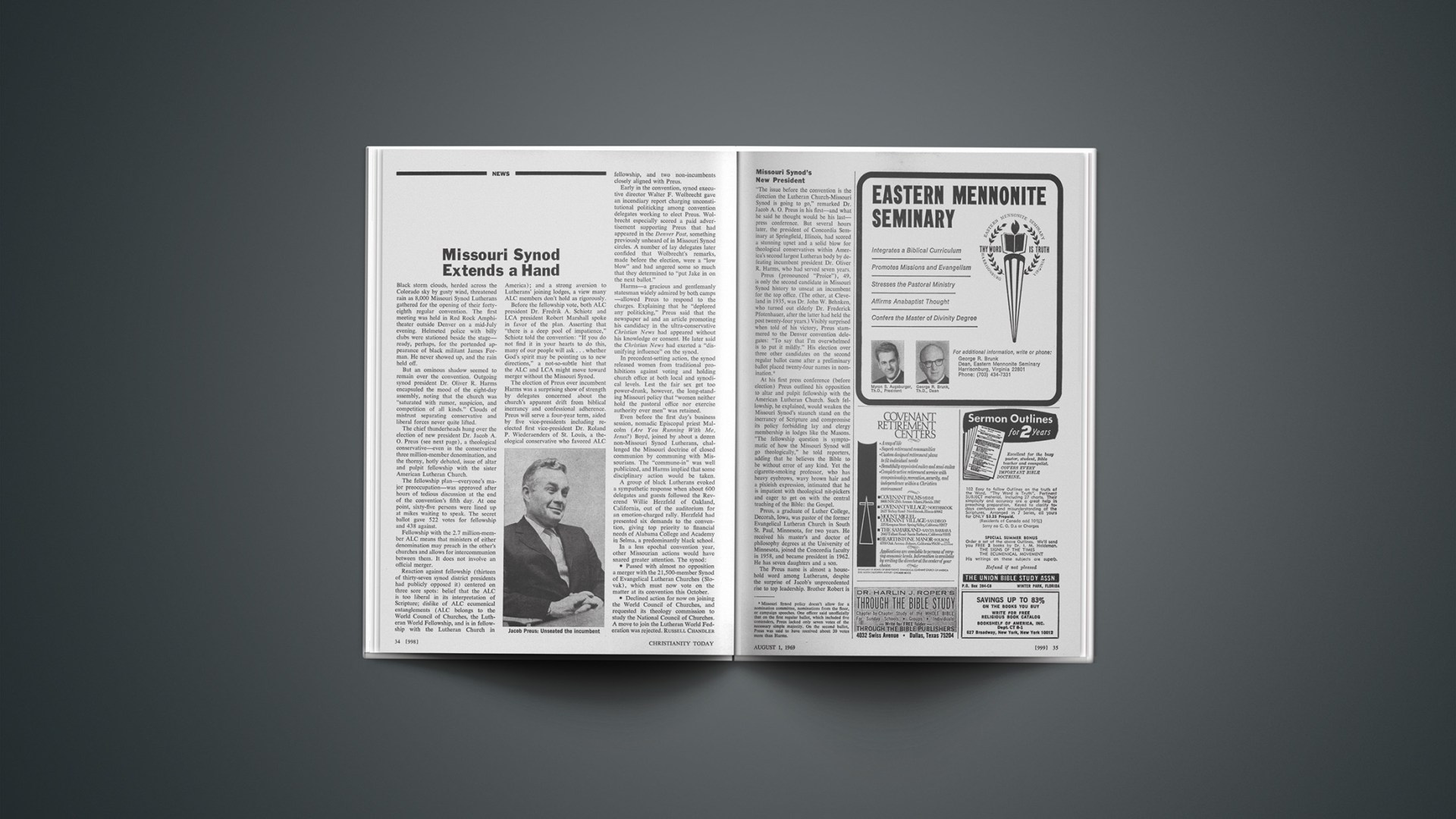
Black storm clouds, herded across the Colorado sky by gusty wind, threatened rain as 8,000 Missouri Synod Lutherans gathered for the opening of their forty-eighth regular convention. The first meeting was held in Red Rock Amphitheater outside Denver on a mid-July evening. Helmeted police with billy clubs were stationed beside the stage—ready, perhaps, for the portended appearance of black militant James Forman. He never showed up, and the rain held off.

But an ominous shadow seemed to remain over the convention. Outgoing synod president Dr. Oliver R. Harms encapsuled the mood of the eight-day assembly, noting that the church was “saturated with rumor, suspicion, and competition of all kinds.” Clouds of mistrust separating conservative and liberal forces never quite lifted.

The chief thunderheads hung over the election of new president Dr. Jacob A. O. Preus (see next page), a theological conservative—even in the conservative three million-member denomination, and the thorny, hotly debated, issue of altar and pulpit fellowship with the sister American Lutheran Church.

The fellowship plan—everyone’s major preoccupation—was approved after hours of tedious discussion at the end of the convention’s fifth day. At one point, sixty-five persons were lined up at mikes waiting to speak. The secret ballot gave 522 votes for fellowship and 438 against.

Fellowship with the 2.7 million-member ALC means that ministers of either denomination may preach in the other’s churches and allows for intercommunion between them. It does not involve an official merger.

Reaction against fellowship (thirteen of thirty-seven synod district presidents had publicly opposed it) centered on three sore spots: belief that the ALC is too liberal in its interpretation of Scripture; dislike of ALC ecumenical entanglements (ALC belongs to the World Council of Churches, the Lutheran World Fellowship, and is in fellowship with the Lutheran Church in America); and a strong aversion to Lutherans’ joining lodges, a view many ALC members don’t hold as rigorously.

Before the fellowship vote, both ALC president Dr. Fredrik A. Schiotz and LCA president Robert Marshall spoke in favor of the plan. Asserting that “there is a deep pool of impatience,” Schiotz told the convention: “If you do not find it in your hearts to do this, many of our people will ask … whether God’s spirit may be pointing us to new directions,” a not-so-subtle hint that the ALC and LCA might move toward merger without the Missouri Synod.

The election of Preus over incumbent Harms was a surprising show of strength by delegates concerned about the church’s apparent drift from biblical inerrancy and confessional adherence. Preus will serve a four-year term, aided by five vice-presidents including re-elected first vice-president Dr. Roland P. Wiederaenders of St. Louis, a theological conservative who favored ALC fellowship, and two non-incumbents closely aligned with Preus.

Early in the convention, synod executive director Walter F. Wolbrecht gave an incendiary report charging unconstitutional politicking among convention delegates working to elect Preus. Wolbrecht especially scored a paid advertisement supporting Preus that had appeared in the Denver Post, something previously unheard of in Missouri Synod circles. A number of lay delegates later confided that Wolbrecht’s remarks, made before the election, were a “low blow” and had angered some so much that they determined to “put Jake in on the next ballot.”

Harms—a gracious and gentlemanly statesman widely admired by both camps—allowed Preus to respond to the charges. Explaining that he “deplored any politicking,” Preus said that the newspaper ad and an article promoting his candidacy in the ultra-conservative Christian News had appeared without his knowledge or consent. He later said the Christian News had exerted a “dis-unifying influence” on the synod.

In precedent-setting action, the synod released women from traditional prohibitions against voting and holding church office at both local and synodical levels. Lest the fair sex get too power-drunk, however, the long-standing Missouri policy that “women neither hold the pastoral office nor exercise authority over men” was retained.

Even before the first day’s business session, nomadic Episcopal priest Malcolm (Are You Running With Me, Jesus?) Boyd, joined by about a dozen non-Missouri Synod Lutherans, challenged the Missouri doctrine of closed communion by communing with Missourians. The “commune-in” was well publicized, and Harms implied that some disciplinary action would be taken.

A group of black Lutherans evoked a sympathetic response when about 600 delegates and guests followed the Reverend Willie Herzfeld of Oakland, California, out of the auditorium for an emotion-charged rally. Herzfeld had presented six demands to the convention, giving top priority to financial needs of Alabama College and Academy in Selma, a predominantly black school.

In a less epochal convention year, other Missourian actions would have snared greater attention. The synod:

  • Passed with almost no opposition a merger with the 21,500-member Synod of Evangelical Lutheran Churches (Slovak), which must now vote on the matter at its convention this October.
  • Declined action for now on joining the World Council of Churches, and requested its theology commission to study the National Council of Churches. A move to join the Lutheran World Federation was rejected.

Missouri Synod’s New President

“The issue before the convention is the direction the Lutheran Church-Missouri Synod is going to go,” remarked Dr. Jacob A. O. Preus in his first—and what he said he thought would be his last—press conference. But several hours later, the president of Concordia Seminary at Springfield, Illinois, had scored a stunning upset and a solid blow for theological conservatives within America’s second largest Lutheran body by defeating incumbent president Dr. Oliver R. Harms, who had served seven years.

Preus (pronounced “Proice”), 49, is only the second candidate in Missouri Synod history to unseat an incumbent for the top office. (The other, at Cleveland in 1935, was Dr. John W. Behnken, who turned out elderly Dr. Frederick Pfotenhauer, after the latter had held the post twenty-four years.) Visibly surprised when told of his victory, Preus stammered to the Denver convention delegates: “To say that I’m overwhelmed is to put it mildly.” His election over three other candidates on the second regular ballot came after a preliminary ballot placed twenty-four names in nomination.1Missouri Synod policy doesn’t allow for a nomination committee, nominations from the floor, or campaign speeches. One officer said unofficially that on the first regular ballot, which included five contenders, Preus lacked only seven votes of the necessary simple majority. On the second ballot, Preus was said to have received about 20 votes more than Harms.

At his first press conference (before election) Preus outlined his opposition to altar and pulpit fellowship with the American Lutheran Church. Such fellowship, he explained, would weaken the Missouri Synod’s staunch stand on the inerrancy of Scripture and compromise its policy forbidding lay and clergy membership in lodges like the Masons. “The fellowship question is symptomatic of how the Missouri Synod will go theologically,” he told reporters, adding that he believes the Bible to be without error of any kind. Yet the cigarette-smoking professor, who has heavy eyebrows, wavy brown hair and a pixieish expression, intimated that he is impatient with theological nit-pickers and eager to get on with the central teaching of the Bible: the Gospel.

Preus, a graduate of Luther College, Decorah, Iowa, was pastor of the former Evangelical Lutheran Church in South St. Paul, Minnesota, for two years. He received his master’s and doctor of philosophy degrees at the University of Minnesota, joined the Concordia faculty in 1958, and became president in 1962. He has seven daughters and a son.

The Preus name is almost a household word among Lutherans, despite the surprise of Jacob’s unprecedented rise to top leadership. Brother Robert is professor of systematics at the sister Concordia Seminary in St. Louis and an attacker of liberal trends in the ALC. Cousin David of Minneapolis is ALC vice-president. Political savvy should come naturally to Jacob Aall Ottesen Preus; his father was Republican governor of Minnesota.

Searching the Reins

On arriving at lucerne, Switzerland, in May, 1964, for a few days of relaxation after the completion of my Strasbourg doctor-of-theology dissertation, and with the fond hope of gaining a second wind before the oral soutenance, I suffered a severe attack of kidney stones and spent my vacation with extreme pain, nausea, and opiates at the Kantonspital. Fortunately the trouble passed without the need for surgery. Naturally, Luther’s frequent references in his correspondence to his attacks of “the stone” (whether gall or kidney) were consoling to one of his theological descendants; but the whole experience left me and my family thoroughly shaken. The existential impact of Masefield’s half-humorous couplet in The Everlasting Mercy struck home: “We’re neither saints nor Philip Sidneys/ But mortal men with mortal kidneys.”

Surprising as it may be to most readers, renal malfunction accounts for a very high proportion of deaths in developed countries today. The U. S. Public Health Service lists it as fourth in order of medical causes of death. According to National Kidney Foundation statistics, some 100,000 kidney deaths occur in the United States each year. At least 8–10,000 of these could certainly be delayed if the victims received kidney transplants or were put on dialysis (treatment by means of an artificial, mechanical kidney functioning outside the body).

Though less dramatic and less fraught with emotional overtones than heart transplant, kidney donation and the ethical problems connected with it clearly deserve serious attention. For this reason the last few months have witnessed a series of meetings of an “Ad Hoc Task Group on Religious Practices” under the sponsorship of the National Kidney Foundation and chaired by Dr. William L. Nute, Jr., the director of the Christian Medical Council of the National Council of Churches. Members of the committee have included, in addition to the undersigned, Ralph Potter, professor of social ethics at the Harvard Divinity School; Joseph Fletcher (author of Situation Ethics); the Rev. Leon Mertensotto of Notre Dame; Dr. Stephen Weseley of the Renal Laboratory, Grasslands Hospital; Blair Sadler, legal specialist at the National Institutes of Health’s Institute of Arthritis and Metabolic Diseases; and several social workers and medical administrators.

At what point do theological and ethical considerations enter into the kidney transplant picture? At any number of crucial points, e.g.: In the case of a potential cadaver donor, when is he to be regarded as beyond hope—or truly dead—so that the interests of the recipient outweigh his own? In the absence of sufficient facilities for dialysis and kidney transplantation, how is selection to be made among kidney sufferers with equal medical needs? Who should make the selection that often determines life or death?

For some of these questions, reasonably effective answers have already been developed, as, for example, the “consultative team” approach to decision-making, ably and scripturally defended by analytical philosopher-theologian Ian Ramsey (“The Theology of the Consultative Group,” in the World Council of Churches’ Health-Medical-Theological Perspectives). But many other questions have not been answered, and the Task Group has come to the conclusion that response to them actually depends on a more fundamental religio-moral issue: the desperate need for more kidney donors and for more general acceptance of the whole idea of donor nephrectomy.

In the absence of a kidney to be transplanted, dialysis can be used. But though availability of equipment can be increased, large problems remain. Dialysis requires a general readjustment of the user’s entire life (he must be attached to the artificial kidney for several hours two or three times a week), and the cost is deadly ($10–14,000 per year for hospital treatment; $3–4,000 per year when the machine is in one’s own home). To date, young children have not fared well on dialysis, because of problems in growth and development. The answer is more living and cadaver kidney donation, and if such donations were provided as they ought to be, much of the agonizing recipient-selection problem would disappear. Moreover, the very concern displayed by the donating public would be sure to encourage the greater allocation of private and governmental funds to this area of research and treatment, and would encourage more physicians to specialize in renal disorders.

Why are so few donor nephrectomies performed? In part the reason has been legal, since the Anglo-American common-law heritage has left a thicket of confusion in the area. But now, largely through the brilliant work of the brothers Sadler, a “Uniform Anatomical Gift Act” is in existence which, adopted as it almost certainly will be throughout the United States, will facilitate cadaver donation of organs (see JAMA, Dec. 9, 1968; Georgetown Law School, October, 1968).

Now the issue is one of motivation—motivation to donate kidneys both after death and during life. And motivation, here as elsewhere, depends squarely on one’s theology. Evangelical Christians have the strongest possible reasons for performing a service not only with their bodies after death but also through living donation of one of their paired kidneys. At the very center of the biblical message is the doctrine of substitution: Christ gave himself totally and unreservedly in our place and for our sins. The moral consequence is inescapable, whether expressed by a St. John (“we love because he first loved us”), a Luther (“give yourself as a Christ to your neighbor”), or a Charles Williams (“your life and death are with your neighbor”).

Of course, we theoretically reduce our chances of future survival by giving one of our kidneys (while the recipient who is our blood relative has a statistical 61–90 per cent chance of transplant success); but what about the 100 per cent de facto survival granted me by Christ through his act of substitution? And consider that one of the most basic analogies of salvation itself is the Pauline theme of the “grafting in of the Gentiles” (Rom. 11:17–24); as those grafted into Christ through no merit of our own, we have little to say against, and everything to say for, human grafting in behalf of others.

Where cadaver transplants are concerned, the foregoing arguments apply with even greater force, and the resurrection of the body offers no deterrent (Scripture speaks of the seedlike resurrection of a body which even in life is continually being replaced, not of particular organs in the body at the time of physical death—First Corinthians 15:35 ff.; Second Corinthians 4:16).

Evangelical Christians should thus contemplate with utmost seriousness the wider implications of Preisker’s judgment (Kittel, TWNT, art. “Nephros”): “The total claim which God makes on the community finds expression in the … saying that He tries the reins and the heart.”

British Unity Plan Fails

In a cliff-hanging finale after more than six years of discussion, the Church of England last month rejected the plan of unity with the Methodist Church. Voting in the joint Convocations of Canterbury and York gave the scheme a 263 to 116 majority vote, but this was 6 per cent short of the 75 per cent needed for approval.

Announcement of this result by the Archbishop of Canterbury brought cries of “Shame” from members and from the public gallery. Among the minority were the Bishops of Ripon and Peterborough, who had long opposed the project, and they were joined by the Bishops of Leicester, Carlisle, and (a minor surprise) Sheffield.

While the Anglicans were meeting at Westminster, a parallel vote was being taken simultaneously in Birmingham by the Methodist Conference. Here the situation was reversed, for they voted 524 to 153 in favor, topping the required figure by 2.4 per cent.

Formally proposing the resolution at Westminster was the Bishop of Ely, the Right Rev. Edward Roberts. If the scheme is rejected, he warned, “I doubt if it will be possible to preserve much order or to abide by any regulation in matters to do with intercommunion and church discipline, or to contain exasperation and disillusionment of a large number of the younger clergy and laity of the Church of England.” Dr. Roberts went on to describe the controversial service of reconciliation as the best method of dealing with the situation (see “Being Ambiguous on Purpose,” Current Religious Thought, July 19, 1968, issue). “It will pass into the history of our church as a document,” he declared, “perhaps not unlike the 39 Articles: a useful museum piece that has served a valuable purpose in a given situation, and is then stored away in the pages of history.”

While this latter utterance was not likely to commend itself to evangelicals, it was Dr. John Moorman, Bishop of Ripon, who spearheaded the opposition. “I can say with certainty,” said the prominent high churchman, “that none of us who will vote against the motion today is lacking in faith or in a desire for Christian unity.” Acceptance of the present scheme must nevertheless have “a very divisive effect upon the church and give rise to much unhappiness.” Many clergy might feel that they could not continue their ministry in a church thus united.

Both archbishops, and the influential Bishops of London and Bristol, spoke out in support of the proposals, and the outcome must be regarded as a considerable rebuff to them.

Proposing the motion at the Methodist Conference, Dr. Harold Roberts said that rejection would have “a calamitous effect on those who are concerned about this union in different parts of the world.” But Dr. Leslie Newman, a Methodist evangelical leader, disagreed. “There are bigger and better roads,” he insisted; “roads free from danger and difficulties. Division is no way to unity.”

Despite the now-or-never note sounded by majority speakers in both churches, the Archbishop of Canterbury and Dr. Roberts later aired the possibility of bringing up the issue again in the very near future. Said Dr. Ramsey at a press conference in answer to a question: “I am not resigning. I am rather amused at the suggestion.”

His predecessor as primate, now Lord Fisher of Lambeth, commented that this had been no defeat for unity of spirit, but rather for “a faulty scheme of union.” Added the 82-year-old archbishop, who now ministers in a country parish: “It is impossible to talk about unity without talking also about truth and righteousness.”

Editor’s Note from August 01, 1969

The Russians launched an unmanned spacecraft designed to reach the moon ahead of the American astronauts. The competition between Soviets and Americans in the space race has been going on for years. Apart from questions of national pride, the psychological advantages of space superiority by way of prestige in international relations, and the possible misuse of this new knowledge for military purposes, the competition is healthy. If United States-Soviet relations could be maintained on a sensible basis of trying to outdo each other peacefully in sports, science, and improvement of social and economic conditions, this would be all to the good. Each nation would have its ups and downs, its victories and defeats. And they could be taken in stride with sportsmanlike conduct.

This vision of the ideal is obviously utopian—for the same reason that all human idealisms cannot be perfectly realized: sin. It is clear that resolving the sin problem may not result in the solution of all human problems. But it is clearer still that the failure to eliminate the sin problem perpetuates and worsens human problems. That’s why Christians continue to insist that sin ultimately is at the heart of all of our problems—for the Soviets as well as for Americans and all others. The Christian message proclaims that Christ has solved the sin problem—if only men will avail themselves of what has already been done.

The Lunar Landing

On Sunday, July 20, 1969, man first set foot in the heavens. Buoyed by the prayers, hopes, and determination of millions around the world, two American astronauts with Christian upbringing landed safely on the moon’s Sea of Tranquility.

It was possibly the most prayed-for event in human history, and the intercession continued as the astronauts headed back to earth.

From a Christian perspective, the absence of explicitly spiritual acknowledgements disappointed many. The late President Kennedy had publicly asked God’s blessing on the American effort to reach the moon. God did bless the venture, but there was no immediate recognition of that fact or any utterance of thanksgiving for it, either from the astronauts on the moon or from President Nixon in his earth-to-moon telephone call.

Neil Armstrong, the civilian commander of the Apollo 11 flight, said on becoming the first human being in recorded history to walk on the moon, “That’s one small step for man, one giant leap for mankind.” The humanistic overtones of the statement will be debated in ecclesiastical and theological circles for many years.

Armstrong grew up in an Ohio Evangelical Reformed church which is now part of the United Church of Christ. But he has shunned churches in his adult life. Prior to leaving for the moon, however, he told a television audience that he was thankful for all the prayers in behalf of the mission. His gratitude was later seconded by his mother, whose reaction to the manned lunar landing was a hearty “Praise God from whom all blessings flow.”

Edwin Aldrin, the second lunar pedestrian, showed that he takes his faith seriously. He carried along in the Columbia-Eagle spacecraft a morsel of communion bread which he ate while on the moon. Aldrin is an active United Presbyterian churchman whose fellow parishioners were taking communion the same day. He radioed a request to “every person listening in … to contemplate the events of the past few hours and to give thanks in his or her own way.”

Some Christians hoped that the pair’s activities on the moon would include something of special religious significance that was not readily apparent but would be divulged later.

Landing on a Sunday helped give something of a religious tone to the occasion. Among special observances was a White House service in which Apollo 8 commander Frank Borman read the first ten verses of Genesis as he had while orbiting the moon last Christmas Eve. Thousands of ministers built sermons around the moon theme. Many put touches of humor in their topic announcements with titles like “God and Green Cheese” and “A Funny Thing Happened to Me on the Way to Heaven.”

Pope Paul VI guaranteed that Holy Scripture would go to the moon with man’s first visit there when he quoted Psalm 8 as part of a recorded message to be left on the lunar surface. The pontiff’s message was one of a number from world leaders that were carried to the moon by the Apollo 11 astronauts. The official message from the United States was on a plaque attached to the descent stage of the lunar module. It reads: “Here men from the planet Earth / First set foot upon the moon. / July 1969 A.D. / We came in peace for all mankind.” The plaque was signed by Nixon and the Apollo 11 astronauts.

Nixon, in proclaiming a national holiday in honor of the event, had predicted that the first footfall on the moon would be a “moment of transcendent drama” for millions of people. He was proved right as people around the world hailed the event. The Soviet Union also won a measure of praise by landing its Luna 15 spacecraft on the moon the next day.

Much of what opposition was expressed came from ecclesiastical circles. The most common argument: Expenditures for space effort should be channeled instead into improving the lot of the underprivileged. Marshall McLuhan tried to squelch that argument by pointing out that the $24 billion spent to put man on the moon is the same amount spent by Americans on alcoholic beverages every year.

The manned lunar landing already has begun to open up discussion of the ideological implications of space exploration. Particularly significant is the fact that the moon landing came at a time when the Church is in considerable ferment. Religion Editor Edward B. Fiske of The New York Times said the event will probably intensify unrest. He contended that it can be expected “to accelerate the trend already under way among theologians toward increased respect for man’s capabilities in relation to God. It could also contribute to the undermining of traditional authority and increase the receptivity of the man in the pew to doctrinal change.”

Religion Editor Dan L. Thrapp of The Los Angeles Times sees a profound theological re-orientation as a result of Apollo 11. “While not overturning a single ‘ultimate truth’ contained in Scripture, the development still will prove numerous theologians false,” he said. Thrapp expects that discovery of life on some extraterrestrial body will cause “modification in the way man comprehends the man-God relationship.”

Billy Graham told a This Week interviewer that he believes “there are hints in the Bible of life on other planets.” But few other Christian leaders have spoken out on the subject.

Whether or not an “astro-theology” is developed that compels men to consider authentic Christianity more seriously depends largely upon the Church’s willingness to foster Scripturally oriented interdisciplinary study. Hopefully, a vanguard of thinking evangelicals interested in the space program will get the jump on theological and philosophical speculators. The main issue is whether man through the marvels of technology is perfectable, or through the miracle of Christ’s atonement is redeemable.

Confronting Other Religions

Conversation is more and more replacing conversion as a Christian missionary objective.

Good reason doubtless exists for dialogue between Christianity and the non-Christian religions. Wide areas of concern attach to man’s universal humanity, and not solely to his religious views. There ought to be some possibility of cooperation among major religions in matters of social justice, relief of human suffering and need, and even the moderation of international conflict. In a world in which Communism and secularism undermine the inherited faiths by their assault on supernaturalism, the great theistic religions might well stress the importance of objective justice, eternal truth, and supernatural reality.

One must confess, however, the chilling effect of events in the Middle East upon proposals for any limited tactical cooperation of theistic religions. For all their predominantly theistic heritage, Arabs and Jews seem unable to make headway on the issues of peace and the relief of human misery.

Interreligious dialogue is important for the reciprocal understanding of positions and motivations. Certain types of missionary propaganda eagerly distort the differences between various religions; in such circumstances, theological precision can only serve the cause of truth.

One issue of central missionary importance is whether the Christian vanguard seeks destruction of the non-Christian religions. Christendom now takes in 30 per cent of the global population. Unless there is a formidable age of missionary expansion, it will claim only 25 per cent by the year 2000. Is evangelical Christianity called to denigrate the existing religious alternatives that supply for vast multitudes of people a glimmer of personal meaning and a measure of cultural cohesion?

At the Asia—South Pacific Congress on Evangelism (Singapore, 1968), Asian Christians, who now number only 3 per cent of the vast population of that continent, voiced their determination not to abandon Asia to a non-Christian future. But without a declaration of Christian goals and strategy in the world of non-Christian religions, interest in conversion is open to much misunderstanding and misrepresentation. Are evangelicals committed to the destruction of non-Christian religions? If they do not make their position clear, they will needlessly inherit ill will in non-Christian lands, simply from the growing ecumenical disposition to emphasize that non-Christian religions have positive value, and that ecumenical Christianity wishes to cooperate with them for common ends, even to promote them as culturally necessary and desirable.

There can be little doubt that the recent influence of Karl Barth and Hendrik Kraemer upon ecumenical missionary thought is waning. A shift from antithesis to synthesis is detectable in the relating of Christianity and non-biblical religion. One hears, for example, that New Testament Logos-doctrine encourages one to find valid truth in the non-biblical religious systems; that founders of all the great world religions are to be viewed as having been in active communion with the Living God; or that, since within the providence of God the nonbiblical religions have been preserved through long centuries, they must be interpreted within a working of the Holy Spirit that looks anticipatively to Jesus Christ (for all their emphasis on works-salvation) and hence as reflections of God’s common grace. Universalism—the expectation of final salvation for all men irrespective of their beliefs about God and their decision for or against Christ in this life—eliminates the need to call for conversion. That some great world religions have after many centuries incorporated certain Christian ideals is held to justify a patient attitude of ideological cooperation rather than competition for the souls of men.

All this sounds rather strange to evangelicals, who—though they do not deny the universal revelation of God, or a providential divine purpose in history, nor doubt that the Logos lights every man—cannot detach Christianity from the New Testament truth that men come to the Father only by Jesus Christ and that “no other name” is given whereby men must be saved. But it sounds equally strange to spokesmen for non-Christian religions, who are not convinced that Christianity is to be welcomed as an ideological partner and reinforcer of their own inherited religious values.

When a Roman Catholic churchman in predominantly Buddhist Ceylon proclaimed that Buddha “was surely in communion with God,” the reaction of Buddhist spokesmen was hardly conciliatory. Ceylonese Buddhists view Rome’s recent mea culpa attitude as primarily strategic (an offer of friendship to non-Catholics when the church is weak, intolerance when it is powerful). Even the effort to find so-called quasi-Christian values in Buddhism was scotched as a subtle move to attract Buddhists to Christianity. After all, the Buddha did not believe that ultimate reality is personal, and Buddhism therefore has an atheistic or antitheistic foundation.

Ecumenists fail to make some important distinctions when they promote a “brotherhood of religious co-existence” as the alternative to future religious wars and call for Christian cooperation with non-Christian religions as systems incorporating spiritual truth and values that help to stabilize personal life and preserve culture.

For one thing, the Apostle Paul emphasizes that God wills the state, or civil government, as an instrument to preserve justice and order in a fallen society. The alternative to social anarchy is just government, not the non-Christian religions.

For another, the Apostle also has some very precise things to say about non-Christian religions, and these references ought once more to become required reading.

To destroy existing religions without replacing them with the truth of revelation could accelerate social anarchy. But it should be abundantly clear that evangelical Christianity has quite another task in the world. It is committed solely to the faithful and winsome proclamation of the truth of the Gospel. In a sense, it is not even committed to conversion as an indispensable goal. The effective use of gospel proclamation in the persuasion and conversion of sinners is the work of the Holy Spirit. And it is to Jesus Christ that the Gospel and the Spirit witness. Christianity thinks of ethical values not as abstract ideals but in terms of intelligible divine revelation and incarnation in the single historical figure of Jesus of Nazareth.

The time has come for a major missionary conference of evangelical leaders on missionary concerns relating to the non-biblical religions. Were such a conference ventured under the sponsorship of a respected agency like World Vision, perhaps under the auspices of World Vision magazine, it could do immeasurable good in articulating solid evangelical perspectives in a constructive way. The only adequate alternative to dialogue that deletes the evangelical view is dialogue that expounds it. The late twentieth century is no time to shirk that dialogue.

The Cheated Generation

Our children too shall serve Him, for they shall hear from us about the wonders of the LORD.” (Psalm 22:30, “Living Psalms”).

We are inclined to be dismayed as we see the activites and hear the vulgar and obscene language of many of the young activists of today. And well we may, for within the ranks of some of the radical organizations on college and university campuses (and now infiltrating into our high schools) there are those who are determined to destroy the social order that has nurtured them.

Dissent can be wholesome and constructive, but in the student world today there is a hard-core group, well organized and well financed, that has as its goal anarchy, which, if unchecked, will destroy the nation from within.

These young people are a part of the cheated generation, a generation that knows not the Lord or the wonders of his redeeming love. Adrift on the sea of life with nothing to guide them, they are a menace to themselves and to the social order of which they are a part. Many of them see the imperfections of the twentieth-century way of life and, with idealistic zeal, are determined to bring about change, but are unwittingly the tools of godless and dangerous men.

How has this generation been cheated, and by whom? Sad to say, much of the responsibility belongs to parents—in homes where God and his Christ are not honored or obeyed, where there has been no example of righteous faith or action, where permissiveness has replaced discipline, where the Christian Sabbath has been turned into a holiday geared to the body rather than the spirit.

Parents who have neglected to give God and his Word their place as the foundation for faith and practice, who have instilled in their children a desire for the things of the world at the expense of those things that last for eternity—these parents have cheated their children.

Guilty? Yes, many of the parents who read this will know they are guilty of cheating their children out of the most precious things this life has to offer.

The Church must share the blame for depriving young people of their birthright.

Any church that leads young people into paths of social action without laying the foundation in their hearts of a clear-cut surrender to Jesus Christ as Saviour and Lord has cheated them.

Any church where the emphasis is on the secular, at the expense of the spiritual, has cheated its young people.

Church teachers who have led young people to look on the Word of God as “outdated,” “full of errors,” “irrelevant,” or in any way a human or dispensable book, have cheated them.

The church in which Christ is not central and where no effort is made to bring young people to a clear decision to accept him as Saviour and make him the Lord of their daily lives has miserably failed to give them the very thing for which the Church exists.

Young people from such churches have received, at best, a form of “bootstrap religion.” Or, as the Apostle Paul puts it, they may be “holding the form of religion but denying the power of it” (2 Tim. 3:5).

In today’s apparent conspiracy against the younger generation, the schools have lent the full force of their influence. Insisting that they have no obligation to teach religion, many schools countenance the teaching of irreligion. In rejecting any objective witness for Christianity they may even go so far as to ridicule belief in God and his Word.

Furthermore, most schools find themselves under the tyrany of a minority. In view of our Judeo-Christian heritage, why should not young people hear the Ten Commandments read each day? This statement of God’s moral law is common to Jews, Roman Catholics, and Protestants, and it is desperately needed in our day. Why should a tiny minority cheat the majority by objecting to this positive approach to religious truth? Any objection could easily be met by simply excusing those children whose parents did not wish them to hear. As it is, a tiny minority is being permitted to rob the others of something that could make a solid contribution to their personal lives and the society of which they are a part.

Young people are being robbed by a generation of adults that countenances lasciviousness, adultery, deviation, and every form of sexual sin in the name of “freedom” and “art.” The products of perverted and evil men are available for adolescents to peruse and purchase. The panderers of filth are unhindered in their unholy designs on the minds and hearts of the young. The open sewer of pornographic filth has flooded our land, with great harm to our youth.

It is a tragic fact that parents, churches, schools, and even the government itself all seem paralyzed with the numbness that comes from compromise with evil.

How can this be changed? What will restore to young people the opportunities now being denied them?

In our dismay over the attitudes and actions common among young people today, we need to search our own hearts and homes. Can anything less than a return to God on the part of parents bring about a change in the situation? Young people need convictions to live by, and the foundation of these convictions is laid early in life.

Schools need to be changed. Where they are now a battleground, often ready to destroy the faith of those who come under their influence, they should become training grounds where young people come face to face with the fact that this is God’s world, not man’s, and that there is a higher Authority before whom all men will be judged.

The permissiveness of home and school must give place to the discipline that is an integral part of effective training. What good is genius without control of self? What good is knowledge without the wisdom to use that knowledge rightly? What good is government if everyone does what is right in his own eyes (Judg. 17:6)?

One of the glories of the Gospel of Jesus Christ is the revelation of God’s grace. None of us has received what he deserved. The love and mercy of God is not reserved for the saint but is freely available to the sinner.

The cheating of youth must be stopped, and it can be stopped—by persons who have come into a right relationship with God through his Son and who then “tell it like it is” to their children.

Eutychus and His Kin: August 1, 1969

Scorning The Base Degrees

Some years ago one of our weeklies featured a striking cartoon. Two passengers were shown leaning over the rail of an ocean liner as it passed within a short distance of a tub containing a butcher, a baker, and a candlestick maker. Puffing thoughtfully on his pipe, one of the men was saying to the other, whose face registered blank incredulity, “Now, there’s a sight you seldom see.”

A capricious memory recalled the words to me at an evangelical conference when a discerning pastor criticized the sloppy grammar of one of the proposed findings. D. L. Moody’s views on grammar are well known, but he would probably have agreed with Herbert Spencer who pointed the value of education in the formation of character. Moody was far from indicating that illiteracy ought to be sought after or that education should be despised.

Letters and comments received from time to time, however, suggest that one astounding fallacy encountered in evangelical circles holds that a pastor with a liberal arts training is thereby suspect, while a Ph.D. is indicative of a basic character flaw. This view is based on the text, “God was never particular about giving his favorite children a good education”—a word somehow omitted when they came to put the Bible together.

Once I listened to a fine sermon marred by the false choice par excellence. “Who are we to believe,” cried the young minister, “the Word of God, or the man with letters after his name?” That was the only time in my life that I have remonstrated with a preacher about something said from the pulpit. He was a little bewildered and shortly departed for the mission field with no visible sign of repentance. Maybe I put it badly, suggesting that the unlettered preacher is no more and no less the recipient of special grace than the graduate who rises above the crippling disability of his magna cum laude.

May it be accounted to me for righteousness that I did not add something I hold profoundly: that the absence of degrees often means the presence of dogmatism in a more than usually virulent form. Goethe in his day came up against something similar in pietistic brethren. “Terrible bores,” he called them, “… exclusively people of moderate understanding, to whom their religious sensibility brought the first thinking they ever did. Now they think that what they know is all knowledge, because they know nothing else.” They say that he who speaks the truth should have one foot in the stirrup. That Goethe should have survived till he was well into his eighties speaks volumes for his agility.

Influential Infiltration

In your article, “Education at the Crossroads” (July 4), you have provided food for thought for all seriously concerned persons who have in fact, or potentially, any opportunity to influence either … teachers or students.…

Your realistic statements concerning the impossibility of returning to the previous status quo and the underlining of the fact that “law and order” is “only ameliorative, not curative” with the words “removal of the present symptoms … will produce no permanent cure” should be repeated, broadcast, televised, and headlined. And then, having digested that sound analysis, your counsel to “infiltrate” academia with sound, witnessing Christians should be heeded on a massive scale.

First Congregational Church

Marseilles, Ill.

It is dismaying to witness the unenlightened and belligerent response of a presumably moderate Christian periodical to the problem of student disorder. Mr. Lindsell’s thesis seems to be that student unrest is the immediate result of the loss of a “theocentric life-and-world view” and that a return to the halcyon days of a uniformity of opinions would effectively end the problem.… But it is fallacious to view the problem in simple cause-and-effect terms. The restructuring of ideals in educational institutions which you imply took place quite recently ought more properly to be traced back to the Reformation, where the rejection of papal authority betrayed forever the hopes of a uniformity of opinions among Christian believers and laid the groundwork for the modern liberal education.

But it needs more than the addition of a historical perspective to amend the errors.… Most appalling about your program for reformation is your determination to root out those “atheists, agnostics, theists,” et al. who dangerously “sow confusion among the students who have come to learn.” No doubt the key to the revitalization of our colleges lies in the imposing on them of the benevolent regimes of Dr. Hayakawa or the several Bob Joneses, who could at their earliest conveniences arrange for the burning of a few injudicious books.… Obviously, some elements in the student rebellion are intemperate. But dissent in a free society is the surest sign of that society’s basic health and is worthy to be commended.

Madison, Wis.

Thank you, Dr. Harold Lindsell, for your very good, honest, and correct article. You know what’s going on, which, I’m sorry to say, so many Christians and Americans do not know. I wish your article could be made available in reprints … Perhaps also you might delve a little deeper in the subject of the Communist threat to our Christian faith and liberty.

Philpot, Ky.

I just wanted to commend you on a well balanced article on the current crisis in higher education.… There was only one point in your article I thought somewhat unfair. During the crisis [at Harvard] there were two clear caucuses in the faculty. Rosovsky, Galbraith, Bruner, and Barrington Moore served as the focus of the liberal caucus. Oscar Handlin, more than any other, represented the conservative caucus. There was a larger body of faculty not clearly identified with either caucus, though the liberals were clearly dominant and won most points that were debated. Whether or not Galbraith and Rosovsky decided to leave after the events of the crisis is a debatable issue.… There are many professors in the liberal caucus whose stature outside the university is not as widely known as Rosovsky or Galbraith who are staying and fighting for reform. Nor do I think the conservatives at Harvard (turning Mr. Capp’s line of reasoning around) should be viewed with approbation because a number are leaving next year.…

All in all, though, I thought your article sounded the basic notes behind the SDS “rite of spring.” I only hope in future years Christian alternatives to the sin-pregnant system of our society will increase in clarity lest we also fall at the very point the radicals have difficulty: offering a viable alternative to replace what needs to be destroyed in our current culture.

Cambridge, Mass.

Explaining Temptation

Among the good articles in your July 4th issue I would like to single out “Does God Lead Us into Temptation.” What the author says in explanation of the second-last petition of the Lord’s Prayer is thought-provoking.… We Lutherans have almost to a man learned Luther’s explanation which could be used to summarize the article:

God tempts no one to sin, but we ask in this prayer that God would watch over us and keep us, so that the devil, the world, and our sinful self may not deceive us and draw us into false belief, despair, and other great and shameful sins. And we pray that even though we are so tempted, we may still win the final victory.

Olive Branch Lutheran Church

Okawville, Ill.

No Other Nation

The refreshing editorial “Is Patriotism Dead?” (July 4) could be the resurrection.… I have heard many Christians say, “I can not say as Stephen Decatur, ‘Our country, right or wrong.’ ” However, I can truthfully say, “My country right or wrong.” God commanded us to pray for our leaders. Today we need to pray for our leaders and nation thanking God when it is right, and praying that God will help us to get right when we are wrong.

Furthermore, even with all its faults there is no other nation I would choose.

Castleberry Baptist Church

Castleberry, Ala.

Idealism is a necessary virtue if we are to be men of vision, men with a future. But an idealism that depends upon veiling reality is a tyrant of oppression. I believe that the patriotism that you proffer verges on such an idealism. I challenge you to show biblical sanctions for your contentions.

I find no flag-waving in Paul. He accepted his Roman citizenship as his responsibility and privilege because he was born with it. So should Americans.… This does not include a personification of one’s country into a beloved fatherland! America is not some great hypostatic unity. The love of Christ is reserved for persons, not for a rhetorical Camelot of our imagination.…

Let’s face it. We are turning more and more to the emptiness of surface rhetoric to hide the ugliness of our true nature: our militarism, our materialism, our self-centered individualism, our self-righteous class consciousness, our smug self-satisfaction, our ticky-tacky comfortability.… This is not a time to advise “pride in country.” … There is a time to speak and a time to keep silent. Ours is a time of action in which verbal flag-waving is an evasion of responsibility.

Wheaton, Ill.

Concern And Companionship

Your editorial, “Church and the Single Person” (June 20) was one of the very few such items I have seen in evangelical periodicals of a national circulation.… Concern for college students and college-age non-college individuals rates dozens of articles and editorials. But, as you point out, post-college-age adults between, say, twenty-one and thirty-five are seldom taken seriously.…

A pleasant exception to this trend is First Presbyterian Church of Fresno, California—the Koinonians.… [In that group] more than one confused individual has “found himself” and has discovered his place in God’s world.… Thanks for the editorial. Why not give us a full-blown article or a series?

Urbana, Ill.

Ideas

Does the Gospel Make Sense?

“Faith is believing something you know isn’t true.” Unfortunately this ludicrous definition of faith, attributed to a young lad in a Sunday school class, reflects the attitude of some Christians in rejecting the importance of a rational basis for the Christian faith. Becoming a Christian is more than intellectual comprehension of certain truths, and it does not require a thorough understanding of the whole of Christian doctrine. But it is important for a Christian to understand and communicate that reason is not antagonistic but complementary to his faith.

Where did the Sunday school student pick up this absurd idea that a believer must bid farewell to his God-given faculties of reason? Some who deny the place of reason in the Christian faith do so on the basis of a misunderstanding of what Paul said in First Corinthians 1 when he talked about the “foolishness” of the Gospel and said that he preached “not in wisdom of words.” Others have taken Paul’s warning in Colossians 2:8 (“Beware lest any man spoil you through philosophy and vain deceit, after the tradition of men, after the rudiments of the world, and not after Christ”) to mean that the Christian is to eschew the use of reason.

There is no doubt that human reason, operating apart from divine revelation, has consistently led man into error and away from God. This does not mean that reason is in itself evil, and Paul does not imply that it is. Paul’s reference to the preaching of the Gospel in First Corinthians 1 must be understood in the light of what he meant by the Gospel. The apostolic Gospel was basically a recitation of the saving events which took place in the life, death, and resurrection of Jesus Christ. It was the message that “Christ died for our sins according to the Scriptures; and that he was buried, and that he rose again the third day according to the Scriptures” (1 Cor. 15:3). And it is precisely in these historical facts that we find the intellectual foundation to the Christian faith. Therefore, to speak of a Gospel which is divorced from a solid, reasonable foundation in history is absurd.

In his preaching of this message, Paul did not clutter the clear presentation of the Gospel with his own attempts at philosophical persuasion (“in wisdom of words”); his confidence was in the power of God inherent in the Gospel (cf. Rom. 1:16). But even a cursory reading of the Pauline epistles reveals that the author was a man of sound reasoning. His faith was not an irrational leap in the dark but was based on a firm conviction which grew out of his encounter with the risen Christ on the Damascus road. At that time he became convinced that Jesus of Nazareth who had been crucified and buried had indeed been raised from the dead. Upon being persuaded of the truth and relevance of the resurrection he came to faith. Nothing less could have transformed him from an avowed enemy of Christ into a committed servant of Christ. The resurrection became the heart of the Gospel which Paul preached and the foundation of his faith.

When Paul speaks of the “foolishness” of the Gospel, he is not implying that the Gospel makes no sense. Rather he speaks of the attitude that he found among those who rejected the Gospel he preached and he appropriates their terminology in rebuttal. Gentiles thought it folly to accept as a leader and saviour one who could not save himself from death by crucifixion. And Jews thought it blasphemy to speak of a Messiah who was put to death in a way which left him accursed in the eyes of the Jewish law. Paul explains this apparent contradiction very logically in Galatians 3:13 where he points out that Christ was made a curse for us in order to redeem us from the curse of the law.

It is no wonder that the Gospel was regarded as foolishness by those who chose to reject Paul’s preaching of a risen Christ. Paul himself agrees that apart from the resurrection of Jesus Christ “our preaching is in vain and your faith is in vain” (1 Cor. 15:14). Paul’s whole case “for Christianity was based upon the resurrection; without the certainty of this historical fact there was no basis for his faith.

In the light of these observations it becomes apparent that in First Corinthians 1 Paul is not minimizing the importance of a rational foundation for Christianity. His purpose is to expose the impotence of wisdom and understanding that do not come from God and that reject the truth that God has revealed. This truth which seems so foolish in the eyes of men who will not receive it is actually the power and wisdom of God. This “foolishness” of God accomplishes what the wisdom of men cannot bring about: it brings salvation to lost men.

In the Colossians passage Paul warns the reader not to be led away from the truth by the persuasive presentation of any form of human philosophy. Understood in the light of the admonition preceding it, this verse obviously does not mean Christians are to shun a rational understanding of the Christian faith. Paul admonishes the Colossians that their faith should be firmly rooted in the teaching he has passed on to them. Absence of a solid foundation in Christian teaching often opens the way for the invasion of false teaching. The more confident we are of the intellectual basis for our faith, the better able we are to confront the false teachers who would lead us away from the truth. Faith built upon a shaky foundation is easily destroyed.

As in so many areas of Christian living, balance is vital in the relation between faith and reason. The Church’s mission is not to offer intellectual proof but to proclaim the good news. Rationalism that exalts human reason above divine revelation has no place in Christian teaching. Men cannot reach God through reason apart from revelation. There are areas of revealed truth which the finite mind may have to grasp by faith (perhaps what defies human reason more than anything else is the fact of God’s love for us). Only the supernatural working of the Holy Spirit can break down the resistance of the human will to the authority of God, a resistance which sometimes persists even in the face of ample intellectual evidence.

At the same time, reason is important in the life and ministry of the Christian. Our faith is not an uncertain leap in the dark but a firm commitment based on solid evidence (why should a man believe in Christ rather than in Buddha?). We can deal with the honest doubts of those to whom we witness. Jesus was willing to dispel Thomas’s doubts by showing him the wounds in his body, and Paul did not turn his back on the intellectual problems of those gathered on Mars Hill.

Disparagement of reason is antithetical to Christianity and leads to the kind of intellectual poison which the Sunday School boy had obviously been administered. Though human reason was affected by the fall, man is still able to know reality in terms of logically organized general propositions. And surely the Holy Spirit will illumine the mind of the believer so that he can grasp the truth revealed in Scripture. Too often the negation of reason grows out of intellectual laziness rather than an accurate exegesis of biblical teaching.

Only as we allow reason its proper place in our Christian faith will we be able to “love the Lord thy God with all thy … mind” and be prepared to “give an answer to every man that asketh you a reason of the hope that is in you.”

Apple PodcastsDown ArrowDown ArrowDown Arrowarrow_left_altLeft ArrowLeft ArrowRight ArrowRight ArrowRight Arrowarrow_up_altUp ArrowUp ArrowAvailable at Amazoncaret-downCloseCloseEmailEmailExpandExpandExternalExternalFacebookfacebook-squareGiftGiftGooglegoogleGoogle KeephamburgerInstagraminstagram-squareLinkLinklinkedin-squareListenListenListenChristianity TodayCT Creative Studio Logologo_orgMegaphoneMenuMenupausePinterestPlayPlayPocketPodcastRSSRSSSaveSaveSaveSearchSearchsearchSpotifyStitcherTelegramTable of ContentsTable of Contentstwitter-squareWhatsAppXYouTubeYouTube