Black Threats Move United Church of Christ

He looked like Michelangelo’s Moses standing there—bearded, shoulders tossed back, chest thrown out, fiery eyes threatening judgment on his audience of one thousand. But there were differences. The crusader here was black, his “religious” role less clear, his words forming demands rather than laws.

His name: James Forman, militant proponent of a “Black Manifesto” that has thrown America’s major Protestant denominations into turmoil since early May. His message: that the two-million-member United Church of Christ, meeting in Boston for its Seventh General Synod, should pay $140 million in “reparations” to underwrite such projects as black printing presses, a black university, black radio-TV networks, and a Southern land bank for cooperative farms.

Forman cast a beam or shadow (depending on one’s point of view) over nearly every session of the eight-day synod. Militant Albert Cleage, pastor of Detroit’s UCC Shrine of the Black Madonna, said blacks in the church support Forman’s goals.

“We’re all sinners and as sinners we’re talking about power,” Cleage said. “Nor am I being judgmental. If I had the power, I’d be dead set on keeping it, too. I understand this, but I don’t like it, because I’m powerless. In terms of self-interest you’d better make some changes, because a powerless people is a dangerous people.”

Apparently the predominantly white conference feared just that at first. For the most tense racial debate of the entire synod broke out on opening day, after several of the thirty-six black delegates had asked that the name of the UCC’s Board of World Ministries be removed from a court’s restraining order barring Forman from the Interchurch Center in New York. When the synod appeared ready to delay a response, more than 100 activists marched onto the platform, demanding immediate action.

The session recessed in pandemonium, then reassembled two hours later and agreed, narrowly, to the black demand. Black victories proved easier after that—though not in direct response to Forman himself.

The major one came five days later, with the decision to make the Committee for Racial Justice into a permanent commission and to guarantee blacks control of it. Delegates also voted it a minimum budget of about $1.5 million during the next three years.

Basic significance of this act, according to black-caucus chairman Edwin R. Edmonds, was to give the church’s 66,000 blacks a power base. “It’s a chance to deal with the needs peculiar to us,” he said. “We have unequivocally asserted that every group should have the right to determine its own destiny.”

The synod also urged the church boards to invest in black businesses, and voted to withdraw investments from firms doing business with the South African government and to study the feasibility of establishing a black university, of funding black publishing firms, and of setting up a Southern land bank.

Cleage, who had earlier told delegates, “I don’t really expect to get too much out of you,” said he was pleased and surprised by synod acts. He evoked laughter with an admission: “I honestly think you did more with Forman than black UCC congregations would have.”

Black victories did not extend, however, to the election of a successor to retiring president Ben Herbster. The black caucus (called UCC Ministers for Racial and Social Justice) put up a strong candidate, the Reverend Arthur Gray of Chicago. So did the United Churchmen for Change, a youth-oriented group that supported the Rev. Paul Gibbons, 36, of Cornell University.

Despite widespread prediction of a Gray victory, the nominating committee’s official choice—Dr. Robert V. Moss, 47, president of Lancaster Seminary, defeated Gray by nearly 200 votes, with Gibbons a distant third.

Few expected Moss to bring much change to the liberal denomination’s accelerating involvement in social action and ecumenism. During a vigorous campaign, he proposed:

• That the church “move ahead of society” in seeking the “equality of the races” as “the most pressing ethical, religious, and financial problem of our time.” Despite conflicting statements on how the church should react to Forman, he called the militant a prophet and said “several of his ideas” had merit.

• That on at least one Sunday a year UCC congregations replace holy communion with “some step toward reconciliation between blacks and whites.” He called this idea “Eucharistic fasting.”

• That ecumenism be pushed more at the local level, where “churches might get together more swiftly than on the national level.”

Non-black minority groups did not fare so well in the synod power struggle. Delegates from the Southwest lost an effort to include all “non-whites” on the racial justice commission, promoting a Colorado delegate to predict: “The browns will be here in force next synod.”

And the synod’s nine teenage delegates lost soundly in their drive to place Brian Wallwork, 18, of Massachusetts, on the executive council. Despite promises of greater youth representation at future gatherings, most of the nine grumbled loudly about paternalism and unresponsiveness.

The youths did, however, give the convention a zesty taste of the “now generation” that frequently left delegates abuzz. Flashbulbs popped, for example, when a mini-skirted girl walked to the platform to second Gibbon’s nomination; a Massachusetts group employed modern dance and satire in an eloquent plea for social activism; seminarians put out an irreverent daily called Balaam’s Ass; rock singers, presenting the story of UCC homeland ministries, left delegates clapping and shouting like worshipers at an old-time camp meeting.

Youth also showed enthusiasm over the synod’s major social pronouncements: approval of President Nixon’s attempts to end the Vietnamese war, support of draft-resisters, demands for selective-service reform, and, above all, a precedent-setting proposal that the United States give amnesty and pardon to persons jailed or “led by their conscience into exile” during the Viet Nam war.

On scattered occasions, delegates questioned what they saw as a greater emphasis on social than spiritual concern. “I’m for the social actions,” said a delegate on the final evening, “but I hope we haven’t forgotten that there’s also a spiritual gap. Are we aware that last year we lost 20,000 members—and 10,000 the year before?”

His motion that a committee study the decline and look into the evangelism methods used in the New Testament and by “other communions” passed narrowly.

Free Methodist Vitality

Just twenty-six years ago the Free Methodists decided individual churches could begin using pianos or organs (not both!) in worship services. Today—as indicated by their recent quinquennial general conference at Winona Lake, Indiana—they have become the fastest growing, perhaps the most adaptive, of the Wesleyan-Arminian (“holiness”) denominations.

During the past five years worldwide membership grew, at about 3 per cent a year, to nearly 125,000. The growth, said Bishop Myron F. Boyd, stems from “twenty-five years of breaking barriers of legalism until we have finally begun doing a real redemptive task.”

Some of the conference’s most soul-searching attempts at adaptation came in the area of social concern. Taking a new, if somewhat halting, step, delegates confessed church-wide “guilt” for a failure to “adequately lift the burdens of the disadvantaged,” then established a commission to spur local congregations into greater inter-racial, cross-cultural involvement throughout the next five years.

Said Bishop Paul N. Ellis of the move: “This general conference has demonstrated awareness of the social issues of our world to a degree unprecedented in the past thirty years.” He praised delegates for evidencing “sensitivity and repentance for sins of omission in relation to the demands of love’s law.”

Adaptation also prompted a cautious though positive step toward merger with another “holiness” group, the 85,000-member Wesleyan Church. Despite a slight lessening of strong “merger-now” winds that seemed to sweep both churches a year ago, the conference acted to continue conversations and to take concrete steps toward merger—without making a final commitment.

Reason for the new caution: many Wesleyans feel seriously bogged down in the problems of working out their own 1968 merger (Wesleyan Methodist-Pilgrim Holiness), while Free Methodists appear hesitant to jeopardize the fruits of a recent administrative reorganization, which they think has helped spark their new growth.

In other actions, the conference:

• Elected South Michigan conference superintendent W. Dale Cryderman as bishop in place of retiring Bishop Walter S. Kendall.

• Gave special attention to a mushrooming missions program. Overseas membership grew 15 per cent in the last two years and now makes up almost 45 per cent of the church.

• Approved a “strategy commission” report aimed at making the church more human and less institutional, “more concerned with dynamics than with mechanics.”

• Elected a Japanese, the Rev. Take-saburo Uzaki, vice-president of the Free Methodist World Fellowship. Ellis was elected president.

The Free Methodist Church of North America grew out of a movement in the Methodist Episcopal Church more than a century ago. The movement had its roots in western New York State.

JAMES HUFFMAN

Evangelism In The Arpc

Meeting in the aftermath of presbytery rejection of a proposed new constitution, the General Synod of the Associate Reformed Presbyterian Church adopted a one-year moratorium on constitutional amendments and endorsed a three-year emphasis on evangelism. The court met at Bonclarken, its conference center in the North Carolina mountains.

Included among the changes in the rejected document was the ordination of women as ministers, elders, and deacons.

The 1970–72 emphasis on evangelism was enthusiastically endorsed after the synod heard from some of its leaders who participated in clinics at Fort Lauderdale’s Coral Ridge Presbyterian Church, fastest-growing congregation of a sister denomination, the Presbyterian Church in the U.S. The Florida church’s principles of lay witness will be stressed in the ARPC program.

Erskine Seminary at Due West, South Carolina, was asked by the synod to include training in the Coral Ridge type of evangelism in the schedules of its rising seniors. A proposal to move the seminary from its present campus to an unspecified urban setting was defeated, but the court approved the possibility of some urban studies for the students.

On another front, the synod made it clear that it believes “ecumenical” can mean relations with conservative as well as liberal brethren. It voted down the recommendation of its ecumenical-relations committee that it quit the Reformed Ecumenical Synod. It also opened the way for fraternal relations with these bodies: the Orthodox Presbyterian Church, the Christian Reformed Church, the Reformed Presbyterian Church of North America, and the Reformed Presbyterian Church, Evangelical Synod. The ARPC is also a member of the World Alliance of Reformed Churches and has fraternal relations with the other alliance members in the United States.

A litany emphasizing social concerns was rejected by the court, as was a recommendation calling for creation of a new social-action committee.

ARTHUR H. MATTHEWS

Here is a roundup of reports from church conventions in North America with highlights of developments from each:

Two small denominations with Scottish Presbyterian roots were merged last month. One of the parties to the union, the Reformed Presbyterian Church of North America, dates back to the Covenanters in Reformation times. The other, the Associate Presbyterian Church of North America, grew out of the 1733 Secession Movement in the Church of Scotland. They came together at a joint meeting on the campus of Geneva College, Beaver Falls, Pennsylvania.

Delegates to the eighty-fourth annual meeting of the Evangelical Covenant Church voted to seek to raise $335,000 in reparations to black Americans. A resolution adopted at the meeting in Chicago said that while the church was not in sympathy with either the spirit or the language of the Black Manifesto, the “covenant has a responsibility before God and all men to help lift the burden of indignity imposed on the black communities.”

“Revolutionary Christianity” was the theme of the annual assembly of the 50,640-member Baptist Convention of Ontario and Quebec—but little was revolutionary about it. A motion that would have permitted the convention to apply for membership in the World Council of Churches was rejected. The meeting was held in Leamington, Ontario. Dr. Stuart Barber, a Dundas, Ontario, surgeon, was elected convention president.

A youth burned what he said was his 1-A draft classification card last month at the annual conference of the Church of the Brethren, held in Louisville, Kentucky. The act took place during a discussion of whether the historic peace denomination should give draft-resisters the same support it gives to conscientious objectors. The 1,037 delegates also talked at length about black reparations and voted to start a fund for “all disadvantaged minorities.”

A missionary report presented to the eighty-fifth general conference of the Evangelical Free Church told of spiritual revival in the northwest corner of the Republic of Congo. The report stated that more than 6,000 Congolese were received into the church as members in the past year. The phenomenon was said to be a continuation of the spiritual awakening that has been felt in that part of the Congo since 1960. A home-front report given at the conference showed the Evangelical Free Church as now having 533 congregations with a membership total of 59,014.
Editor’s Note from July 18, 1969

It was a great experience to sit in Madison Square Garden last month and watch the Billy Graham crusade meetings. For the two nights I attended, the Garden was packed solid and overflow audiences of five thousand or more watched by closed-circuit television in other parts of the building.

I was struck by the number of blacks who attended and who participated in the meetings. Simon Estes has one of the most magnificent voices I have heard in a long time. I can still feel the goose pimples that rose as I heard him sing. But more striking than everything else was the audience response to Mr. Graham’s invitation to receive Jesus Christ. They came and they kept coming—hundreds of them every night. They were wooed and won, not by the voice or the charisma of the speaker, but by the Holy Spirit, working through a chosen vessel.

We live in an age of unrest and irreligion. But in this dark picture there are bright spots, and we must not overlook them. God is at work in many places around the world, and people are being converted. Although revival and awakening on a large scale have not yet come, there is the sound of the wind in the mulberry trees in many places. We should continue to pray for the larger outpouring of God’s Spirit.

The Apollo 11 Astronauts: Recognition of Religion

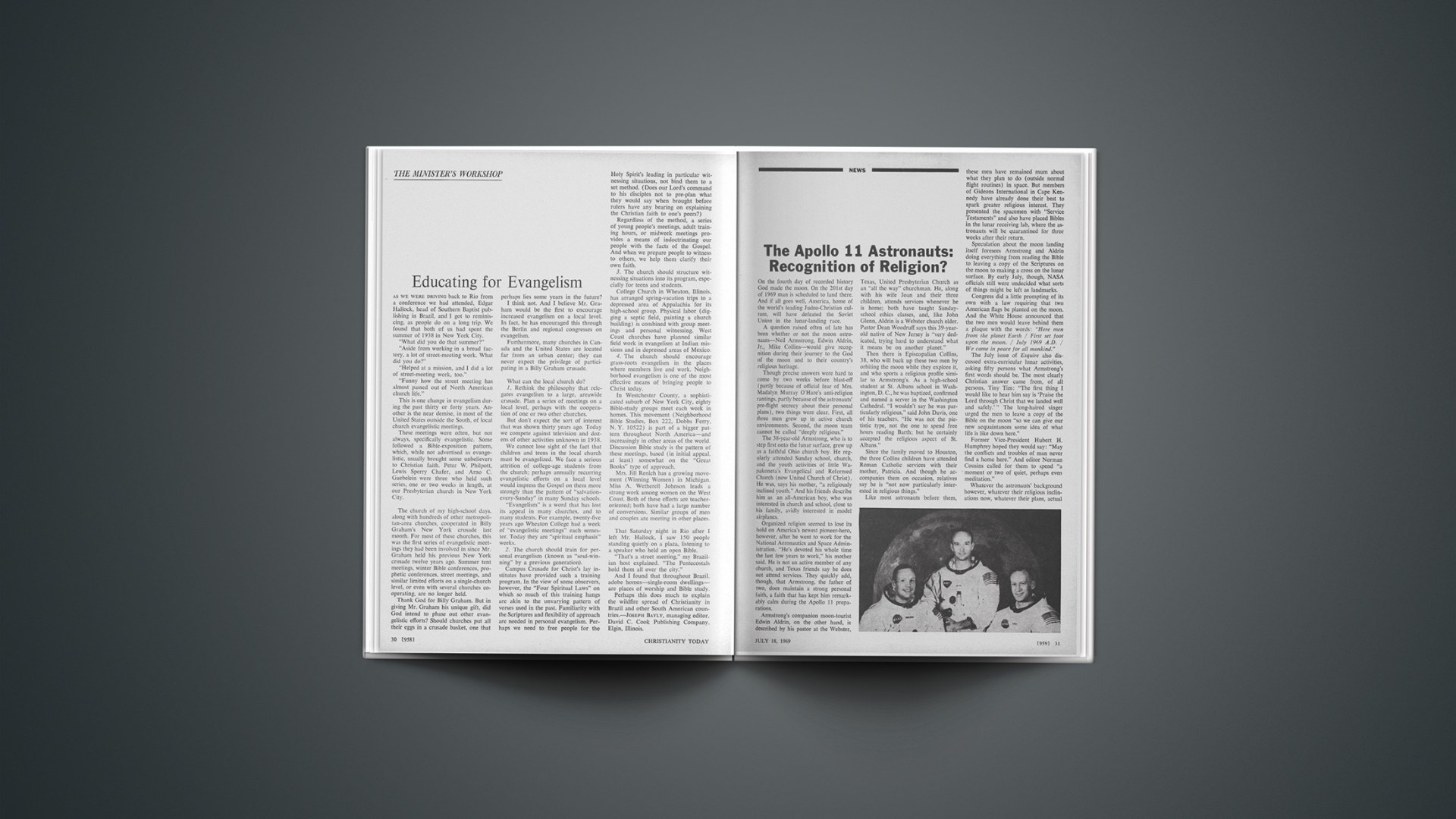
On the fourth day of recorded history God made the moon. On the 201st day of 1969 man is scheduled to land there. And if all goes well, America, home of the world’s leading Judeo-Christian culture, will have defeated the Soviet Union in the lunar-landing race.

A question raised often of late has been whether or not the moon astronauts—Neil Armstrong, Edwin Aldrin, Jr., Mike Collins—would give recognition during their journey to the God of the moon and to their country’s religious heritage.

Though precise answers were hard to come by two weeks before blast-off (partly because of official fear of Mrs. Madalyn Murray O’Hare’s anti-religion rantings, partly because of the astronauts’ pre-flight secrecy about their personal plans), two things were clear. First, all three men grew up in active church environments. Second, the moon team cannot be called “deeply religious.”

The 38-year-old Armstrong, who is to step first onto the lunar surface, grew up as a faithful Ohio church boy. He regularly attended Sunday school, church, and the youth activities of little Wapakoneta’s Evangelical and Reformed Church (now United Church of Christ). He was, says his mother, “a religiously inclined youth.” And his friends describe him as an all-American boy, who was interested in church and school, close to his family, avidly interested in model airplanes.

Organized religion seemed to lose its hold on America’s newest pioneer-hero, however, after he went to work for the National Aeronautics and Space Administration. “He’s devoted his whole time the last few years to work,” his mother said. He is not an active member of any church, and Texas friends say he does not attend services. They quickly add, though, that Armstrong, the father of two, does maintain a strong personal faith, a faith that has kept him remarkably calm during the Apollo 11 preparations.

Armstrong’s companion moon-tourist Edwin Aldrin, on the other hand, is described by his pastor at the Webster, Texas, United Presbyterian Church as an “all the way” churchman. He, along with his wife Joan and their three children, attends services whenever he is home; both have taught Sunday-school ethics classes, and, like John Glenn, Aldrin is a Webster church elder. Pastor Dean Woodruff says this 39-year-old native of New Jersey is “very dedicated, trying hard to understand what it means be on another planet.”

Then there is Episcopalian Collins, 38, who will back up these two men by orbiting the moon while they explore it, and who sports a religious profile similar to Armstrong’s. As a high-school student at St. Albans school in Washington, D. C., he was baptized, confirmed and named a server in the Washington Cathedral. “I wouldn’t say he was particularly religious,” said John Davis, one of his teachers. “He was not the pietistic type, not the one to spend free hours reading Barth; but he certainly accepted the religious aspect of St. Albans.”

Since the family moved to Houston, the three Collins children have attended Roman Catholic services with their mother, Patricia. And though he accompanies them on occasion, relatives say he is “not now particularly interested in religious things.”

Like most astronauts before them, these men have remained mum about what they plan to do (outside normal flight routines) in space. But members of Gideons International in Cape Kennedy have already done their best to spark greater religious interest. They presented the spacemen with “Service Testaments” and also have placed Bibles in the lunar receiving lab, where the astronauts will be quarantined for three weeks after their return.

Speculation about the moon landing itself foresees Armstrong and Aldrin doing everything from reading the Bible to leaving a copy of the Scriptures on the moon to making a cross on the lunar surface. By early July, though, NASA officials still were undecided what sorts of things might be left as landmarks.

Congress did a little prompting of its own with a law requiring that two American flags be planted on the moon. And the White House announced that the two men would leave behind them a plaque with the words: “Here men from the planet Earth / First set foot upon the moon. / July 1969 A.D. / We came in peace for all mankind.”

The July issue of Esquire also discussed extra-curricular lunar activities, asking fifty persons what Armstrong’s first words should be. The most clearly Christian answer came from, of all persons, Tiny Tim: “The first thing I would like to hear him say is ‘Praise the Lord through Christ that we landed well and safely.’ ” The long-haired singer urged the men to leave a copy of the Bible on the moon “so we can give our new acquaintances some idea of what life is like down here.”

Former Vice-President Hubert H. Humphrey hoped they would say: “May the conflicts and troubles of man never find a home here.” And editor Norman Cousins called for them to spend “a moment or two of quiet, perhaps even meditation.”

Whatever the astronauts’ background however, whatever their religious inclinations now, whatever their plans, actual contact with the silver sliver in the sky will probably bring them face to face with questions of ultimate truth. “That’s why you really can’t tell what their faith is like,” said Davis. “If I were going to the moon, I’d want a little bit more than the memories of high-school religion.”

Educating for Evangelism

As we were driving back to Rio from a conference we had attended, Edgar Hallock, head of Southern Baptist publishing in Brazil, and I got to reminiscing, as people do on a long trip. We found that both of us had spent the summer of 1938 in New York City.

“What did you do that summer?”

“Aside from working in a bread factory, a lot of street-meeting work. What did you do?”

“Helped at a mission, and I did a lot of street-meeting work, too.”

“Funny how the street meeting has almost passed out of North American church life.”

This is one change in evangelism during the past thirty or forty years. Another is the near demise, in most of the United States outside the South, of local church evangelistic meetings.

These meetings were often, but not always, specifically evangelistic. Some followed a Bible-exposition pattern, which, while not advertised as evangelistic, usually brought some unbelievers to Christian faith. Peter W. Philpott, Lewis Sperry Chafer, and Arno C. Gaebelein were three who held such series, one or two weeks in length, at our Presbyterian church in New York City.

The church of my high-school days, along with hundreds of other metropolitan-area churches, cooperated in Billy Graham’s New York crusade last month. For most of these churches, this was the first series of evangelistic meetings they had been involved in since Mr. Graham held his previous New York crusade twelve years ago. Summer tent meetings, winter Bible conferences, prophetic conferences, street meetings, and similar limited efforts on a single-church level, or even with several churches cooperating, are no longer held.

Thank God for Billy Graham. But in giving Mr. Graham his unique gift, did God intend to phase out other evangelistic efforts? Should churches put all their eggs in a crusade basket, one that perhaps lies some years in the future?

I think not. And I believe Mr. Graham would be the first to encourage increased evangelism on a local level. In fact, he has encouraged this through the Berlin and regional congresses on evangelism.

Furthermore, many churches in Canada and the United States are located far from an urban center; they can never expect the privilege of participating in a Billy Graham crusade.

What can the local church do?

1. Rethink the philosophy that relegates evangelism to a large, areawide crusade. Plan a series of meetings on a local level, perhaps with the cooperation of one or two other churches.

But don’t expect the sort of interest that was shown thirty years ago. Today we compete against television and dozens of other activities unknown in 1938.

We cannot lose sight of the fact that children and teens in the local church must be evangelized. We face a serious attrition of college-age students from the church; perhaps annually recurring evangelistic efforts on a local level would impress the Gospel on them more strongly than the pattern of “salvation-every-Sunday” in many Sunday schools.

“Evangelism” is a word that has lost its appeal in many churches, and to many students. For example, twenty-five years ago Wheaton College had a week of “evangelistic meetings” each semester. Today they are “spiritual emphasis” weeks.

2. The church should train for personal evangelism (known as “soul-winning” by a previous generation).

Campus Crusade for Christ’s lay institutes have provided such a training program. In the view of some observers, however, the “Four Spiritual Laws” on which so much of this training hangs are akin to the unvarying pattern of verses used in the past. Familiarity with the Scriptures and flexibility of approach are needed in personal evangelism. Perhaps we need to free people for the Holy Spirit’s leading in particular witnessing situations, not bind them to a set method. (Does our Lord’s command to his disciples not to pre-plan what they would say when brought before rulers have any bearing on explaining the Christian faith to one’s peers?)

Regardless of the method, a series of young people’s meetings, adult training hours, or midweek meetings provides a means of indoctrinating our people with the facts of the Gospel. And when we prepare people to witness to others, we help them clarify their own faith.

3. The church should structure witnessing situations into its program, especially for teens and students.

College Church in Wheaton, Illinois, has arranged spring-vacation trips to a depressed area of Appalachia for its high-school group. Physical labor (digging a septic field, painting a church building) is combined with group meetings and personal witnessing. West Coast churches have planned similar field work in evangelism at Indian missions and in depressed areas of Mexico.

4. The church should encourage grass-roots evangelism in the places where members live and work. Neighborhood evangelism is one of the most effective means of bringing people to Christ today.

In Westchester County, a sophisticated suburb of New York City, eighty Bible-study groups meet each week in homes. This movement (Neighborhood Bible Studies, Box 222, Dobbs Ferry, N. Y. 10522) is part of a bigger pattern throughout North America—and increasingly in other areas of the world. Discussion Bible study is the pattern of these meetings, based (in initial appeal, at least) somewhat on the “Great Books” type of approach.

Mrs. Jill Renich has a growing movement (Winning Women) in Michigan. Miss A. Wetherell Johnson leads a strong work among women on the West Coast. Both of these efforts are teacher-oriented; both have had a large number of conversions. Similar groups of men and couples are meeting in other places.

That Saturday night in Rio after I left Mr. Hallock, I saw 150 people standing quietly on a plaza, listening to a speaker who held an open Bible.

“That’s a street meeting,” my Brazilian host explained. “The Pentecostals hold them all over the city.”

And I found that throughout Brazil, adobe homes—single-room dwellings—are places of worship and Bible study.

Perhaps this does much to explain the wildfire spread of Christianity in Brazil and other South American countries.—JOSEPH BAYLY, managing editor, David C. Cook Publishing Company, Elgin, Illinois.

Book Briefs: July 18, 1969

Viet Nam Martyrs

By Life or by Death, by James C. Hefley (Zondervan, 1969, 208 pp., $4.95) is reviewed by Wesley G. Pippert, overnight news editor, Washington Bureau, United Press International, Washington, D.C.

Religious free-lancer James Hefley’s By Life or by Death is a study of the evangelical missionary effort in Viet Nam, especially during the 1960s, when ten missionaries have been martyred and five others captured by the Viet Cong.

Two conclusions leap out of Hefley’s chronological narrative. The first is that the Christian and Missionary Alliance has done a singular work in Viet Nam. For almost half a century—going back to 1911, when R. A. Jaffray arrived there—the Alliance, a small, evangelical group with 68,000 U. S. members, most of them working people, was the only Protestant denomination to send missionaries to French Indo-China, out of which Viet Nam was carved in 1954. When war came once again to Viet Nam in the 1960s, the Alliance kept a full corps of missionaries there.

Since 1966 an ecumenical effort called the Viet Nam Christian Service (VNCS) has sent more than 100 American doctors, nurses, social workers, farm specialists, and child-care workers to Viet Nam. But at any one time there have been nearly as many Alliance missionaries there as all other evangelical and ecumenical personnel combined. The other denominations have been Johnnies-come-lately in Viet Nam; the Alliance has carried the burden of these war-weary people almost single-handedly.

The second conclusion in Hefley’s book is a political one. For the most part he avoids political issues of the war, but since he focuses on this decade, the villain who emerges is clearly the Communist. It is easy—but not very elucidating—for the conservative to heap all the blame for the war and the atrocities committed against the missionaries in Viet Nam upon the Communists. Yet they are merely the latest in a long series of obstacles to the gospel message in Viet Nam. And one must weigh the extent of the provocation against the Communists that resulted in the atrocities. Viewing the whole of the missionary effort in Southeast Asia, it was the so-called Christian nation of France that placed the most repressive restriction on the gospel message—not the forces of nationalism or Communism.

During the early years, the French showed “bitter antagonism” toward the Alliance and the native church the missionaries helped establish, the Evangelical Church. After World War II, the French as well as the Viet Minh (early name for the Viet Cong) harassed and killed Vietnamese evangelical pastors and laymen.

Surprisingly, for the most part the Communists left the Alliance missionaries alone. T. Grady Mangham, Alliance missionary in Viet Nam for 20 years and field chairman during most of the 1960s, says he had only one outright confrontation with the Viet Cong during the whole period. By the same token, the Alliance missionaries stayed neutral.

But the Vietnamese Christians, despite their protestations to the contrary, were vehemently anti-Communist. The head of their church, Doan Van Mieng, once said: “As far as the Christians are concerned, they can belong to any political party they want.” But then he added that he had not met one believer who was opposed to the Americans’ intervention in Viet Nam. On another occasion an Alliance official was gathered with leaders of a Vietnamese congregation. The official urged the Vietnamese to say what they thought about U. S. involvement. One replied: “The only way to take care of this situation is to fight to win. South Vietnam should invade North Vietnam and destroy communism here and there.”

Obviously these strident views were known to the Communists. And when the Tet offensive came in February a year ago, North Vietnamese Regulars killed American missionaries Leon and Carolyn Griswold, Edward and Ruth Thompson, Ruth Wilting, and Robert Ziemer, and captured Betty Olsen and Hank Blood. (Archie Mitchell, Dr. Ardel Vietti, and Daniel Gerber were captured in 1962.) The Communists also killed three native pastors and ninety-four church members and destroyed or damaged twenty-five parson ages, twenty-six churches, seven missionary homes, and a clinic.

(In a late report the State Department still carries the five captured missionaries on its list as missing without information. It cannot confirm whether they are alive or not.)

The moral, perhaps, is: Keep politics out of religion, whether it’s in the United States or in Viet Nam.

Vivid Picture Of Moody

Dwight L. Moody: American Evangelist, by James F. Findlay (University of Chicago, 1969, 440 pp., $10), is reviewed by Richard L. Troutman, professor of history, Houghton College, Houghton, New York.

In recent years historians of nineteenth-century America have given more attention to evangelical orthodoxy as a major clue to understanding our culture of a century ago. No longer is there a preoccupation with liberal Protestant groups in the late nineteenth and early twentieth centuries. This volume represents that widening of interest to include the entire Protestant movement.

Much about this scholarly work by James F. Findlay is commendable. The De Pauw University history professor attempts to place Moody within the broader historical developments of the nineteenth century, both secular and religious, and to show how these affected his life and career. As a result, the reader gains some valuable insights into the problems faced by evangelicals in an increasingly urbanized and industrial society. Considerable attention is given to the early years of the YMCA, the Student Volunteer Movement, the Mt. Hermon School for Boys, and Moody Bible Institute, all of which were greatly influenced by Moody.

Findlay draws a wonderfully vivid picture of Moody the man—his impetuous nature, his sensitivity to criticism, his carefulness in matters of money, his reluctance to be in the spotlight, his tender affection for his family, his fondness for playing practical jokes, and his openmindedness. Yet one becomes increasingly aware that the author interprets virtually every aspect of Moody’s life in naturalistic terms. For example, in assessing Moody’s success in the English revival of 1873–75, Findlay mentions such factors as Ira Sankey’s music, the appeal of Moody’s Yankee background, his ability as a story-teller, and his appeal to the traditional and familiar in the religious realm during a time of “turmoil and stress” within English evangelicalism.

Admittedly, the historian cannot document such a phenomenon as the outpouring of God’s Spirit in revival; but in speculation about the causes of a spiritual awakening, does not this possibility suggest itself? Only late in the book does the author suggest that Moody was “unusual in that his earthiness and commonness were lifted up and transformed in some way by a power or powers beyond himself.… The source of Moody’s power [was] the apparent reality of his personal faith in Christ.” As far as this reviewer can determine, there is no other reference in the book to a supernatural power at work in Moody’s life.

It is unfortunate that on occasion Findlay judges the motives of Moody. He finds it difficult to understand why the evangelist with his optimistic temperament and deep love of the things of this world could be attracted to such a “pessimistic, world-denying” doctrine as premillennialism. He suggests that Moody used premillennialism “as another weapon of evangelism,” as a means of getting sinners to “contemplate more important matters of the spirit.” Moody is accused of using this doctrine “for his own purposes.”

Evangelicals will find it difficult to agree with many of Findlay’s interpretations of his subject’s life and work. Still, his work remains the best Moody biography to appear.

From A Catholic Perspective

The Oxford Conspirators, by Marvin R. O’Connell (Macmillan, 1969, 468 pp., $9.95), is reviewed by Geoffrey W. Bromiley, professor of church history and historical theology, Fuller Theological Seminary, Pasadena, California.

The title of this book will perhaps raise expectations that are not quite realized. As the subtitle tells us, it is in fact an account of the Oxford Movement from 1833 to 1845. Marvin O’Connell is a Roman Catholic historian who has already dipped into English church history in the age of the Counter-Reformation.

The present study makes particularly good use of first-hand materials. Once launched on the main story, which tends to become that of Newman, the author presents a narrative that is both detailed and entertaining. Even if nothing of great significance is newly brought to light, a fresh and authoritative account of so important a movement is welcome.

One may ask, however, whether O’Connell gives a right impression by concentrating attention so strongly on Newman, or indeed by confining the study to the period 1833–45. The distinction of Newman is undeniable. Nevertheless the movement was bigger than a single representative. The defections to Rome, especially that of Newman, caused much disarray; but it might well be argued, not merely that the movement survived, but that its main influence was still to come when Newman left it.

Nor is this just a matter of historical perspective. A distinct impression is left that because the “middle way” proved a dead end for Newman it is a dead end in itself. Thus, perhaps unconsciously, the author allows the centrality of Newman to give a polemical slant to the whole presentation. Had the history of the Oxford Movement been related more specifically to Keble or Pusey, the Newman part might well have seemed to be just an episode in an ongoing movement and the defection to Rome the real dead end. This is not to say the “middle way” is right. It is to say that the way needs to be judged on other grounds. It is also to say that historical presentation can very easily become subtle propaganda that is all the more subtle if inadvertent.

The introduction on background conditions is fairly adequate considering the space available and the complexity of the material. Yet detailed analysis discloses not a few errors and many dubious judgments. A more modest and better documented account would have been more solid, if less lively. As to the sorry state of things just before and in 1833, of course, there is no question.

The book is well and clearly written, and the notes and index are full and useful. In fact, as a Roman Catholic assessment, on a scholarly level, it is a contribution that certainly deserves consideration, not least for the contrast it offers to an Anglo-Catholic or evangelical understanding.

Studies Ethical Questions

All to the Good: A Guide to Christian Ethics, by Robert B. McLaren and Homer D. McLaren (World, 1969, 203 pp., $5.95), is reviewed by John M. Bald, associate professor of Christian ethics, Pittsburgh Theological Seminary, Pittsburgh, Pennsylvania.

In view of the generation gap, a perennial condition that is unusually acute in its contemporary forms, collaboration between a father and son on a literary project is unusual. Here the family team is even more notable in that the authors follow different professions: the father is an attorney-at-law with some forty-five years of experience in teaching and practicing, and the son is an ordained minister currently teaching philosophy in one college and serving as director of the chapel in another.

As the subtitle indicates, the book is offered as a study guide. Dr. D. Elton Trueblood, who writes the foreword, observes that it is written from the stance of commitment to the Christian faith and is addressed to persons who desire guidance in their struggle with contemporary ethical questions.

The McLarens keep their limited purpose in view and resist the temptation to provide exhaustive discussions along the way; at the same time they are able to draw attention to much of the literature in the field of Christian ethics. Beginning with a discussion of the inseparable relation between ethics and religion, they go on to present that relationship as seen in the Christian religion in particular.

A second chapter lists with brief comment various historical and contemporary approaches to ethics within the Christian tradition. The authors adopt no one school of thought as their own, though the following description of the contemporary situation may suggest where their sympathies lie:

Nineteenth- and twentieth-century biblical studies revealed new insights into the thinking of first-century Christianity, and these discoveries in the light of the social, political, economic, and scientific upheavals of our own generation have forced Christian ethicists to rethink many of the “assured truths” of earlier traditions. No longer drawing solely upon biblical doctrines, but utilizing as well the knowledge derived from cultural sources, contemporary theologians and religious philosophers are struggling with such new concepts as situational and contextual ethics, to discover how best to make effective Christ’s mandate to live creatively in love with all men [p. 51].

In the next chapter, “The Christian Man,” the authors are more specific in defining Christian ethics in terms of a relationship between persons and Jesus Christ: “Christianity is essentially a matter of becoming one with Christ. As his ethics cannot be understood apart from his Person, so the ethics of any individual cannot be described as Christian ethics except as they are the expression of a life which is atone with Christ.” The discussion moves logically and helpfully from the Christian man to the Christian family and to the Christian fellowship (distinguished from institutionalism), and then to various areas in which the Christian as citizen is concerned—the state, the law, and culture. In all these areas the authors bring up perplexing moral problems of our time for discussion.

The topical arrangement, the chapter summaries, the very readable style, the avoidance of overly technical discussions—these help to make the McLarens’ book a helpful guide. One wishes some bibliographies had been appended to the summaries to help readers make use of the wide range of sources referred to in the text. Also, a more specific dialogue between father and son as lawyer and theologian would have been welcome. But perhaps that would have required another kind of book. We can hope that this team will undertake such a work in the future.

A Cry In The Dark

The Religious Experience of Mankind, by Ninian Smart (Scribner, 1969, 576 pp., $10), is reviewed by Francis Steele, home secretary, North Africa Mission, Upper Darby, Pennsylvania.

“Throughout history … religion has been a vital and pervasive feature of human life,” the author states in his opening sentence. “The history of religions must be more than a chronicling of events: it must be an attempt to enter into the meaning of those events,” he adds a little later on. He qualifies this by saying that he intends “to describe, rather than to pass judgment on, the phenomena of religion.” But that in itself is no small task. Professor Smart has made a valiant effort, and within the framework of his generally evolutionary presuppositions he has done a commendable job.

However, the question with which he closes the book sounds like a pitiful cry in the dark. Speaking of the experiences man has had of religion and his attempts through religion to “see beyond his senses,” Smart asks concerning the “attitudes to the universe about him” that man has worked out by religion, “Is it just imagination, or is it a holy power that has enabled him to do so?” So much for a self-revealing God.

On the whole the book is a carefully worked survey, in brief, of the major religions of world history. In this eminently readable account the author attempts to portray the unique characteristics of the various religions by succinct summaries, often supplemented by quotations from their literature. Frequent paragraph headings in each chapter help the reader to follow the author’s plan of development and also to refer back to previous sections. In short, the organization of the book makes it particularly useful as a textbook.

There is a fivefold division of the subject: primitive religions, religions of India, religions of the Far East, religions of the Near East, and contemporary religious experience. Although it was perhaps necessary to make a choice of the religious systems to be discussed, it is hard to understand why the author decided to omit the entire Western hemisphere in a book on the “religious experience of mankind.” Indeed, there is virtually no mention of the pre-Christian religions of Europe or Africa either, except for a few inconsequential references in the short chapter on primitive religions. Perhaps the criterion for inclusion was that the religion have some connection with the development of the “three great Semitic faiths” or else be a dominant force in the world today. But the question still remains.

For the conservative Christian, the sections on Christianity are, understandably, the least satisfactory. Although Smart begins his study of Christianity with the assertion, “The experience of the Resurrection was the focal point in Christianity for the followers of Jesus,” he soon says that “scholars are by no means sure that an accurate account of the historical Jesus can be built up,” and that “the question of whether this was a physical resurrection of Jesus … is a matter of faith and judgment. For our purposes … it is enough to note that the disciples … were convinced by these events of the continued power of Jesus and his triumph over a tragic death.” This hardly squares with orthodox theology. Obviously, such a viewpoint will produce many conclusions that are glaringly opposed to historic orthodoxy and thus limit the usefulness of the book for conservative Christians.

As Professor Smart looks into his crystal ball for portents of the future he comes up with some startling speculations. Regarding atheistic humanism he says, “Marxism itself might be led to accept the worth of religious experience.” As for Christianity, “the strength of the faith partly lies (in its ability to be) sharply critical of its presuppositions.” That is to say, cut loose from the control of divine revelation, Christianity has a promising future. And together with Buddhism, according to the author, it may well become one of the two great religions of the world.

This book, when read critically, can be a useful tool in the teaching of the history of religions. But as a picture of the pure stream of God’s self-revelation flowing through the turgid sea of human theological speculation, it is hopelessly out of focus.

But Who Is Listening?

The Bible Speaks Again, A Guide from Holland, commissioned by the Netherlands Reformed Church (Augsburg, 1969, 224 pp. $3.95), is reviewed by Norman Shepherd, associate professor of systematic theology, Westminster Theological Seminary, Philadelphia, Pennsylvania.

There is no radical break between the naive religious faith of the simple believer and the pursuit of scientific theology. A break occurs when the believer is uninterested in deepening his understanding of revealed truth, and when the theologian fails to relate the fruit of his study to the wider needs of the congregation.

In an attempt to bridge the artificial gap, the Netherlands Reformed (Hervormd) Church commissioned the publication of a volume dealing with the history, “secret,” and authority of the Bible. American readers will find it easier to understand the book if they realize that within the Netherlands Reformed Church, with its mainstream neo-orthodox and liberal orientation, there is a sizable orthodox wing maintaining a classic Reformed position and an experiential emphasis. The book may then be broadly understood as an appeal to the orthodox wing (and implicitly to the traditionally more conservative Reformed [Gereformeerd] Churches) to appropriate the fruit of contemporary critical and theological scholarship so that a united approach can be made to modern man, whether he be humanist, Roman Catholic, or Jew. Despite the fatherly and sometimes condescending tone, there is shown here a deeper appreciation of classic Reformed theology than we find in E. A. Dowey’s propaganda piece, A Commentary on the Confession of 1967.

The purpose of the opening survey of historical perspectives on the Bible is to show that the modern approach to biblical scholarship is in continuity with the past and has no intention of sacrificing what is of value. On this basis a plea is made for openness and humility in the theological conversation regarding the place of the Bible. The discussion partners should listen to, rather than shoot at, one another.

The trouble is that the conclusion of the conversation is decided before it gets under way, namely, the total capitulation of the orthodox wing. The results of modern critical research in the Bible are adopted as the necessary presupposition of further conversation, and the doctrinal formulas are then allowed to have relevance only in the “I-Thou” dimension of personal encounter. Nowhere is this more apparent than in the treatment of the return of our Lord and the final judgment when these events are interpreted as the continually receding goals toward which human history is eternally striving.

With all due respect to sincerity of intention, we must ask whether the Netherlands Reformed Church is listening to the Bible speak again, or practicing ventriloquism.

Book Briefs

Will the Real Phony Please Stand Up, by Ethel Barrett (Regal, 1969, 214 pp., paperback, $.95). An intensely practical (and penetrating) study of the Book of James written in typical Ethel Barrett style.

Exposition of Isaiah, Volume I, by H. C. Leupold (Baker, 1969, 598 pp., $7.95). A practical commentary that rejects the Deutero-Isaiah theory and emphasizes the abiding values of this prophetic work.

An Exposition of the Gospel of John, by Herschel H. Hobbs (Baker, 1969, 297 pp., $6.95). Written to help those faced with the responsibility of sermon preparation.

Happy Hang Up!, by Bill McKee (Tyndale, 1969, 63 pp., paperback, $1). Young people will like this one. It speaks to their problems in their language.

Studies in the Prophecy of Jeremiah, by G. Campbell Morgan (Revell, 1969, 288 pp., $4.95). Those acquainted with the work of G. Campbell Morgan will be delighted to know that this reprint is available.

The Greatness of Christ, by John H. Paterson (Inter-Varsity, 1969, 121 pp., paperback, $1.50). First American edition of an English work in which a layman sees the heart of the whole Christian message in the greatness of Jesus Christ, demonstrated by his unique achievement in dealing with the awful problem of man’s sin.

John Calvin, by Williston Walker (Schocken, 1969, 456 pp., paperback, $2.95). Reprint of a standard work on the great reformer.

Living Wisely, by J. Allen Blair (Loizeaux, 1969, 381 pp., $4.50). A devotional study of First Corinthians.

A Guide to the Prophets, by Stephen Winward (Knox, 1969, 255 pp., $5). In matters of introduction many higher-critical views are accepted, but the main concern of this volume is to study the teaching of the prophets with special emphasis on the application of their message to our contemporary situation.

The Quiet Rebels, by Margaret H. Bacon (Basic Books, 1969, 229 pp., $5.95). A Quaker tells the story of the Society of Friends and its contribution to American history from 1656 until the present.

Controversy in the Twenties, edited by Willard B. Gatewood, Jr. (Vanderbilt, 1969, 459 pp., $10). An anthology of sixty-eight selections from a variety of sources dealing with the modernist-fundamentalist conflict within American Protestantism during the 1920s.

The Protestant Reformation, by Hans J. Hillerbrand (Walker, 1968, 290 pp., $8.50). A representative sampling of the literature of the Protestant Reformation, with an introduction to each document and comments by the editor.

The Systematic Thought of Washington Gladden, by Richard Knudten (Humanities Press, 1969, 301 pp., $6.50). A study of the life and thought of the father of the social-gospel movement in late nineteenth-and early twentieth-century Protestantism.

A History of Anglican Liturgy, by G. J. Cuming (St. Martin’s, 1969, 450 pp., $12.50). A comprehensive history of the Book of Common Prayer that discusses the various revisions in chronological order.

A Funny Thing Happened on the Way to Heaven, by Gary Freeman (Harper & Row, 1969, 126 pp., $3.95). A satirical account of the life of a preacher in the “True Church” from his enrollment in a Sunday school for tots through seminary days, church problems, and a stay in an asylum.

Man, Have I Got Problems, by David Wilkerson (Revell, 1969, 128 pp., $2.95). The widely known director of Teen Challenge in New York offers practical counsel for the many kinds of problems people face today.

Sons of Tiv, by Eugene Rubingh (Baker, 1969, 263 pp., $5.95). An analysis of the birth and development of the rapidly growing Christian Church among the Tiv tribe in central Nigeria.

Cromwell, edited by Maurice Ashley (Prentice-Hall, 1969, 177 pp., $4.95). A survey of the life of one of England’s most controversial leaders, based on Cromwell’s own writings and the views of his contemporaries.

The East Burlap Parables, by Richard N. Rinker (University of Nebraska, 1969, 169 pp., $3.95). This collection of satirical episodes describing life in an imaginary church offers a penetrating commentary on life in the institutional church.

What Is Religion?, by Paul Tillich (Harper & Row, 1969, 191 pp., $5.95). Three early essays that serve as an introduction to Tillich’s later thought.

God Is No Island, by Oswald Hoffman (Concordia, 1969, 111 pp., $2.75). The popular “Lutheran Hour” speaker applies the Gospel to complex problems of contemporary society.

Media for Christian Formation, edited by William A. Dalglish (Pflaum, 1969, 393 pp., $7.50). A resource book that lists and evaluates a variety of audiovisual materials available in the field of religion. Helpful if used with discernment.

God’s Everlasting ‘Yes,’ by Ilion T. Jones (Word, 1969, 138 pp., $3.95). Sermons by a former homiletics professor show how to structure a sermon that develops a truth taught in specific portions of Scripture in a way that will speak to the needs of ordinary people.

Jewish Christianity, by Hans-Joachim Schoeps (Fortress, 1969, 163 pp., $3.50). A thorough study of the Ebionites that sees them as direct successors of the original disciples and as resolute opponents of Gnosticism.

Ideas

The Urgency of Population Control

The much talked about population explosion is a more serious threat than most people think. The United States and the rest of the world are facing a cataclysm, the like of which mankind has never known. No nation can pass over the problem lightly. Its effects will be felt even in those lands where population remains stable or declines slightly.

In the United States much thought is being given to the matter of national priorities. On one side of the seesaw is the costly war in Viet Nam; on the other are the poor and the underprivileged, whose needs call for the expenditure of billions of dollars. But even when the day comes that the money now being spent in Viet Nam can be spent at home, efforts to solve the problem of the poor are doomed to defeat if our population increases by 100 million within the next thirty-five years, as it will if it continues to rise at the present rate of only 1 per cent annually.

The bigger picture is far worse. The annual global rate of population increase is slightly less than 2 per cent. This means that the world population will double in less than forty years. The small country of Costa Rica now has six births to every death. If the current rate of growth continues, its present 1.7 million population will be almost 75 million in a hundred years.

Population growth figures tell a story that leaves little room for optimism. In some nations the food supply has increased through technological advances. But this advantage will soon be wiped out by the presence of more mouths to feed, with many more on the way. In other nations the population increase has outpaced food production, so that these nations are worse off today than they were thirty years ago.

Some people have laid the blame at the door of the Roman Catholic Church, which has consistently opposed birth-control measures that would lead to population control. This tidy explanation is wide of the mark. The Population Reference Bureau has published statistics that show that the birth rate in European Catholic countries is not significantly higher than that in non-Catholic countries. The argument that the Catholic Church controls reproduction in European countries is a myth. However, it is true that Latin America, which is considered Roman Catholic (though it is not, except in name and by the claims of the church), has a population increase of more than 3 per cent a year. This means that these countries will double their numbers in less than thirty years. Why are the birth rates in Latin America so high?

The statistics tell us that where birth rates are high, literacy is low and the countries are underdeveloped. Where the birth rates are low, the literacy rate is high and the countries are highly developed. In other words, where ignorance and technological backwardness exist, the birth rate is high. So the world population is increasing most in those places where an increase is bound to produce the most hardship. Statistics also tell us that unless population growth is curbed, helping the underdeveloped countries materially will produce no enduring solution. Indeed, the developed countries can probably do no more for their underdeveloped neighbors than maintain the status quo—if that.

Whatever aid programs are adopted must include population control. If this essential element is missing there can be no lasting solution. Christians cannot opt for population control by abortion. We certainly can work for the prevention of conception. Since we know the gains in literacy and economic development serve to reduce the birth rate, it is important to set up crash programs with these goals in the underdeveloped countries as quickly as possible. Time will not wait for this task to be done at a leisurely pace. And it is the business of Christians to sense the signs of the time and involve themselves in seeking to correct a tragic situation.

What we have said about the rest of the world must be said about the United States as well. If our population continues to increase so that we have 100 million more mouths to feed in the year 2000 (we are expected to have a population of 240 million by 1980), it will be virtually impossible to maintain our current level of life. The general lot of our citizens, instead of improving, will get worse. With 100 million more people we will have more and larger cities with urban blight; we will have millions more automobiles, and roads so choked with traffic we will hardly be able to move; we will have the same supply of air, rivers, and natural resources, but they will be further corrupted and deteriorated. We are on the threshold of disaster.

God has given man a mandate to exercise control over nature. But man is not using that mandate properly. Christians especially have a great responsibility to work to prevent overpopulation. Before long there will be standing room only in our world unless something is done—now!

Man On The Moon

Tides rise and fall with it. Moonflowers open to it. Dogs bay at it. Lovers stroll under it. And now American astronauts, in mankind’s most daring adventure, are ready to set foot on it.

If Neil Armstrong and Edwin Aldrin are finally able to descend their lunar module’s nine-rung ladder to the surface of the moon, the achievement should be welcomed by Christians as a blessing and an opportunity. Let believers breathe prayers of thanksgiving that God has enabled man so to coordinate his energies as to make possible this dramatic new exploration of divine handiwork. It is nothing short of a God-given miracle that assigns man the intelligence and will to make half-million-mile round trips to the moon.

Perhaps Apollo 11 will awaken Christians to begin to discover the spiritual opportunities opened up by space travel. We are already late. This is a main concern of space scientist Rodney W. Johnson, who calls for inter-disciplinary consultations on the meaning, possibilities, and problems of our “escape” from the earth (see the interview beginning on page 3). Vocational pietism is not enough. Especially in this crucial area, Christians have a responsibility to relate their faith to their work at a deeper level.

Philosophers, theologians, and Bible scholars have been strangely silent on the implications of space travel. They have felt there is not much to go on. But the time is here when we must search more deeply and determine to put the Christian faith on record with a thoughtful and creative attitude toward space exploits. To talk about the moon and planets symbolically and figuratively will not be enough. If Christians do not speak to the issues substantively, the world will take its cues from alien ideologies.

The intellectual risks of space travel are as acute as the physical hazards. But they need not scare us. Indeed, they ought to prod us to search more diligently for an authoritative rationale.

One fear is that the awesome wonders of space will encourage pantheism. Could we get so caught up admiring creation that nature itself becomes our object of worship rather than the God who is responsible for it? A man beholding the natural beauty of a woman can to some extent regard her as a creature of God deserving of admiration, and he can even be thankful for God’s gift of sex. But at some point this appreciation deteriorates into lust.

Another danger is that space travel will enhance the appeal of the subtle cult of scientism. Let no one minimize the technological sophistication necessary to put a man on the moon. This achievement is a resounding tribute both to individual ingenuity and to teamwork. What we must guard against is letting these tremendous scientific and technological breakthroughs become ends in themselves. Let us remember that what brings us progress can often be easily perverted into bringing us misery. A good example is the development of nuclear energy—it can be our fuel today and our devastation tomorrow.

There is also legitimate apprehension that the space program will be too militarily oriented. There have been good reasons for involving the armed forces in the space program to such a high degree. For one thing, the space venture requires a high degree of discipline, and the military is one of the few areas of human life where discipline is still a paramount consideration. But it will probably be better for the country and for the world if the role of the military in space decreases. Military men ought not to be disqualified from becoming astronauts, but civilians ought to be given greater opportunities for taking part. And women ought soon to be given the chance as well.

Perhaps the most regrettable part of our space program so far—and the most subtle danger—is the public indifference to it. We seem to have become blasé. Excitement over a space shot is quickly forgotten, and it is doubtful whether today NASA’s Frank Borman is better known than baseball’s Frank Howard. Perhaps the reason is our declining national pride. Or perhaps we don’t see anything in it for us. Either way it is an unhealthy sign.

Let us hope and pray for a successful lunar landing. May it help to dispel our gloom, and glorify our God. One reason why God made the moon was that it would be a “sign” (Gen. 1:14), a manifestation of himself. In other words, the moon is there in part to attest to God’s greatness, both to believers and to unbelievers. It bears testimony to the fact of a supreme intelligence behind all things that exist. It speaks eloquently of both the magnitude and the magnificence of the God who put it there.

Sensitivity Toward Suicide

Suicide is the escape route from earth taken by more than half a million people each year, according to the World Health Organization. Some societies used to glorify suicide, at least under certain circumstances. By contrast, Christians have traditionally considered suicide as one of the gravest of sins, and with good reason. When suicide is the result of deliberate and responsible choice, it is the physical counterpart to spiritual rebellion against God. It is a dramatic testimony of one’s rejection of the role assigned by God.

We cannot assume, however, that all suicides are the immediate product of responsible choice. Illnesses that affect the mind can be just as real as those that affect the body, and mental illness can lead to suicide. Christians are not exempt from sickness, physical or mental. But responsible stewardship requires that we take due precaution to maintain not only physical health but mental health as well.

There is no better way for the Christian to treat the minor disturbances to his emotional well-being than to follow the advice of the Apostle Paul: “Have no anxiety about anything, but in everything by prayer and supplication with thanksgiving let your requests be made known to God. And the peace of God, which passes all understanding, will keep your hearts and your minds in Christ Jesus” (Phil. 4:6, 7). By failing to heed this instruction, many Christians have let anxieties overwhelm them so much that mental unbalance—sometimes culminating in suicide—has resulted. Suicide occurs often among persons living under pressure—external or self-imposed. Only by relieving the pressure as it occurs—through prayer—can we claim the promise of God’s peace.

As Christians we need to increase our sensitivity, not only to our own unacknowledged anxieties, but also to the possible presence around us of some who are on the usually long road that ends in self-destruction. Those who have barely begun to travel this road can be helped to see the importance of not letting anxieties build up. Those whose condition is much further advanced need help from someone experienced in dealing with potential suicides. The well-meaning words of someone who is rejoicing in life can only add to the depression of one in deep despair. Moreover, qualified help is needed for advanced cases because of the real possibility of a physical basis for the mental anxiety, such as brain tumors or chemical unbalance. Pastoral sensitivity to the needs of the relatives and close friends of one who has committed suicide is called for also. Often those who were close to a suicide feel not only the shame of their loved one’s deed but also personal guilt at not having done more to keep his life from seeming unbearable. Suicide is often the result of neglect of the command of God to bring our troubles to him; but God also assures us that he will forgive all the sins of those who have placed their trust in Christ.

Churches, Taxes, And Politics

Should churches be taxed? This sensitive issue is the center of an increasing number of hot debates and thoughtful discussions—both inside and outside the Church. The importance of the question is evidenced in the Supreme Court’s recent decision to hear a case challenging the constitutionality of tax-exempt status for churches.

A slightly new twist entered the discussion in a recent bill introduced in the Pennsylvania state legislature. The bill calls for an elimination of the traditional tax exemption on land owned by religious organizations (buildings on the land would not be taxed).

Of special interest in this case are the reasons given in support of this bill by one of its sponsors. Representative Marvin Miller, a Republican, indicated that the tax bind at home and the changing role of the Church in society were major factors leading him to favor the plan. Miller said, “Historically the church has taken care of the old, the infirmed, and the poor. But now it has shed that responsibility to a great extent and lobbies for society and for government to maintain these roles.”

The legislator has voiced in a slightly different way a question many have been asking about the contemporary Church. Has it forgotten the purpose for which it exists and has it distorted the ministry given it by Christ himself? For churches to support the community voluntarily out of a sense of responsibility and fairness (as some churches do) is fine. And for the Church to carry out its ministry to society in other tangible ways is imperative. But something has gone wrong if the Church’s political orientation has become so dominant that it can legitimately be used as a ground for denying tax-exempt status.

Leisure For Lazy Days

Don’t read this if you are loafing on a beach with an empty mind and idle hands. If you picked this up in order to appear percipient or to while away some time, you’d better turn the page. You won’t want to be reminded that “An idle brain is the devil’s workshop,” or that “He hath no leisure who useth it not” (George Herbert), or that “He is never less at leisure than when at leisure” (Cicero). You won’t like our thesis that leisure should be active, not passive.

The word itself means freedom from daily employment—not idleness. Leisure is free time that mechanization and labor-saving devices have produced—the time left after you’ve spent forty hours of the week working and twice as many more on life’s necessities, such as eating and sleeping. It’s the time that affluence spends on travel (tourists spend $40 billion a year in this country), color television, and weekend flying or skiing.

If you’ve read this far, you probably profess a lack of leisure. But no doubt you have some free time to spend usefully—and inexpensively. Housewives can oil their rusty typing and shorthand and help out in the church office. Men with extensive record collections (that they play on the stereos they built in their spare time) could establish music libraries for the church choir. Those who haunt bookstores would be the very ones to renovate church libraries. Artists could put a new face on church bulletins or advertisements or newsletters. And then ministers will have free time to take elderly church members for a drive in the country, or tutor underprivileged children, or relieve the parents of handicapped children for a few hours, or serve (cheerfully) on a PTA committee.

To those who are still with us we offer another leisure-time activity for this summer’s lazy days. Along with reading those books you’ve been saving all winter, why not choose some subjects for contemplation. But beware; if active leisure requires effort, contemplative leisure requires more. To think through a topic demands concentration and courage to go beyond the usual set of answers—and questions. This summer your fancy may turn to thoughts of the universe and man in it, of social problems and the Christian’s responsibility to them—even to thoughts of leisure and its implications for the Church. Or you might think about a flower:

… If I could understand

What you are, root and all, and all in all,

I should know what God and man is.

How Safe Are We?

One discouraging part of building the Safeguard anti-ballistic-missile system is that it may not work. It could well turn out to be ineffective against nuclear attacks on the United States. Some feel this is reason enough to forget about the whole ABM project.

Realistically speaking, however, the chief advantage of the ABM is not whether it will actually prevent enemy warheads from landing on our cities. And that being the case, we wish we could divert the ABM appropriations to more productive social ends. But this is not an alternative that is open to us unilaterally as long as the nation is threatened militarily.

Strange as it may seem, we need the Safeguard for diplomatic and political reasons more than for actual military use. Its potential is what counts. Its existence does not mean it would be employed, but it would give this country considerable leverage in the continuing East-West ideological confrontation. If we understand the other side with any degree of accuracy, they can be expected to hear quite clearly the message implicit in a decision to build the ABM. The same holds true in the question whether we should start producing the so-called MIRV—multiple independently targeted re-entry vehicles.

What this country also needs to begin thinking about more seriously is how to deal with insurgency. Communists have an extremely potent weapon in guerrilla warfare carried on by a small infiltrating minority. It is a weapon they are more likely to use than nuclear warheads. It could happen here. Indeed, some feel it is already happening.

These are things that Christians wish were otherwise. But such is the battle between good and evil. Never are all the good and all the evil on opposite sides, but Scripture tells us that as long as both factors are present, conflict is inevitable. And given these circumstances, we are obliged to choose reluctantly.

Exposing A False Antithesis

The mission of the Church is a subject that has led to endless hours of discussion and has brought forth countless pages of printed material in recent years. But in spite of all the verbiage, there has been very little communication.

This was brought to our attention once again by a new book entitled The Schizophrenic Church, by Robert Lee and Russell Galloway (Westminster). A major theme of the book is what the authors call the agelong clash between two perspectives on the mission of the Church: “Is the church to comfort or to challenge, to be a conserving agent of stability or an initiator of change?” Such a simplistic analysis sets up a false antithesis and creates serious barriers to communication between those of varying viewpoints within the body of Christ.

In defining the mission of the Church, conservatives often assume that those who work toward social change must be liberals and therefore not concerned about the eternal souls of men. On the other hand, the liberal assumes that the person who places strong emphasis upon the salvation of the soul is virtually unconcerned for the needs of the whole man. Although some people are indeed guilty of these charges, usually such accusations only muddy the water.

We are not dealing here with an either/or matter; we are not required to line up either on the side of the soul or on the side of the body. True evangelism must involve the whole man. It is impossible to be genuinely concerned for a man’s soul and unconcerned about his physical needs. On the other hand, true concern for the needs of the whole man and for the problems of society must show itself in a burden for the salvation and transformation of the individual as he comes into personal contact with the living Christ.

If we are to deal constructively with the issues that divide the Church, we must do away with simplistic analyses (how many times have we heard of the two groups within the Church—those who resist any change and defend the status quo, and those who are willing to follow the Holy Spirit out into new pathways of service!) and face the deeper theological issues that are involved.

For example, we must face the fact that there are those who do not believe men will be eternally lost if they do not enter into a personal relationship with Jesus Christ in this life. Salvation is thought of exclusively in terms of self-realization and relationships with fellow men in this life. Some see no need for a personal commitment to Jesus Christ as the one who paid the penalty for the sin of the individual by his substitutionary death on the cross. Some feel that the death of Christ on the cross provides salvation for all men quite apart from a response of faith; the mission of the Church therefore is to share with men the “Gospel,” i.e. the good news that they have been saved. The real work of the Church in the view of many modern theologians has nothing to do with the salvation of the soul of the individual. It is to change the structures of society through political, economic, or social pressure.

We believe that the Church is both to comfort and to challenge, that it is both a conserving agent of stability and an initiator of change. We cannot accept a division of the spiritual and material in the Church’s ministry. But we do part company with much modern theology on these deeper issues.

Men apart from Christ are lost. Though we must minister to physical needs and must work for changes in the social order, the mission of the Church is first and foremost a spiritual mission. Jesus himself was the example par excellence of ministry to the whole man. He never turned his back on physical need. But he emphasized that he had bread to offer that was far more important than that which he distributed to the five thousand. He offered living water that would spring up into everlasting life. Spiritual sight was more important than the healing of blinded eyes. In pointing to his ministry as the fulfillment of the Messianic promises, Jesus refers to his ministry to the poor—not that their status in life has been elevated but that the Gospel has been preached to them. Spiritual poverty is the worst kind of poverty. The man who is truly rich is the man who is in Christ, no matter what his station in life might be.

If in our contact with the world we should elevate the material and social status of men without leading them to a personal knowledge of Christ as Saviour, we have given them nothing and have completely failed in our mission. Indeed, we will most effectively meet the needs of our society by laboring for the transformation of men as they come to know Jesus Christ. We do not deal with an anonymous Christ who comes to men in the changing patterns of society but with Jesus of Nazareth, who died and rose again and who calls men to repent and to enter into a personal relationship with himself.

In our day we are confronted with new problems and new opportunities, and we must use every new method and technique and form available in meeting these problems and taking advantage of these opportunities. But in all this neither the message nor the mission of the Church has changed. Jesus said, “Go and preach the Gospel.”

Dead Faith And Hunger

Eleven middle- and upper-income families got up from their dinner tables hungry one Sunday in June, but not because they were on strict diets, or bankrupt, or fasting. Their stomachs, according to nine-year-old Eleanor Mondale, were “half empty and half full” because they were eating on welfare budgets that allot each person twenty-three cents per meal for food. For their $1.15 Sunday dinner, Minnesota Senator Walter F. Mondale and his wife and three children ate peanut butter and jelly on one slice of bread and drank powdered milk. California Representative Paul McClosky and his family substituted molasses for sugar and ate a mini-meal with second helpings served “the day after tomorrow.”

Not surprisingly, Mrs. Mondale expressed concern for her family’s health and frustration at bypassing the appealing packages on well-stocked supermarket shelves. Early in their experiment, she had to tape her cupboards closed to keep the family from raiding them. Eleanor Mondale and her brothers longed for hot dogs; even peanut butter and jelly had begun to lose their appeal.

For the Mondales and the McCloskys and the other families, the meager meals of grits, rice, or spaghetti were tolerable because they knew that after seven days they would untape their cupboards and stock up on their favorite foods. This Sunday they will not leave the dinner table hungry. But millions of other people will.

Eleven families now understand something about how an empty stomach feels and have dramatized for well-fed, rarely hungry Americans the mind-boggling estate of poverty. Yet for all the sympathies it aroused, the National Welfare Rights Committee experiment did not alleviate hunger. Perhaps it jogged compassion. Perhaps it will activate Christian faith. “Suppose there are brothers or sisters who need clothes and don’t have enough to eat. What good is there in saying to them, ‘God bless you! Keep warm and eat well!’—if you don’t give them the necessities of life? This is how it is with faith: if it is alone and has no actions with it, then it is dead.”

Judgment At The Lord’S Table

God has given the Lord’s Supper to his Church as an ordinance or sacrament in which the death of Jesus Christ is remembered. This memorial feast is to be celebrated until Christ’s return. Christians differ as to the meaning of this ordinance, and the precise relation of the physical Jesus to the bread and wine remains a central problem in the ecumenical quest for external unity. But whatever the differences, this paschal feast continues to be celebrated by God’s people Sunday after Sunday, and they are blessed as they come in repentance and faith.

The Apostle Paul introduces a note that most of us overlook in connection with the Supper. To the Corinthian church he said: “Anyone who eats and drinks without discerning the body eats and drinks judgment upon himself.” This is quite clear. It is possible for men to partake of the elements of the supper without any real appreciation of the meaning. Unbelievers do this. But Paul here seems to be speaking to believers. And the judgment he mentions is not eternal death. Rather, he says that the failure of some Christians to discern in the Supper what God intended has brought weakness, illness, and even death.

If it is true that unworthy participation in the Lord’s Supper may bring in its wake weakness, illness, or death, can we not also say that proper participation will bring strength, health, and life? Surely in these days when men are bedeviled by problems of the world that appear insoluble, they have need of help. A news item from West Germany stated that one out of every five students is overtaken by inability to concentrate, has groundless fears, experiences great sexual tensions, and needs medical or psychiatric help. Ought this be the experience of the Christian?

The Lord’s Supper has both a vertical and a horizontal aspect: We come to stand alone before God, but we come to stand side by side with our fellow believers as a corporate body of saints. It is not only an experience of worship and cleansing. It is also an experience in which there is imparted to us a power we need, insight into the meaning of life, and a real sense of the presence of God Almighty. We come tired but we leave refreshed; we come as sinful sons of God but we leave cleansed; we come without power but we leave with the dew of heaven on our heads; we come empty but we leave filled. If we leave as we came we have not discerned his body, and we can go out worse than when we came in. But this need not be so. And we should be determined that it will not be so. We want the Communion cup to be a cup of blessing.

Mysteries

The mystery novel has always been a popular form of literature and continues so today. The writer contrives a plot designed to keep the reader in suspense throughout the book, usually with a conclusion that is unexpected and intriguing.

Available to man is the world’s greatest book of mysteries, the Bible. In Deuteronomy 29:29 we read “The secret things belong to the LORD our God; but the things that are revealed belong to us and to our children for ever, that we may do all the words of this law.” The mysteries revealed to mankind in the Scriptures remain an insoluble puzzle to all who look elsewhere for the answers.

Speaking with divine compulsion the Prophet Amos said: “Surely the Lord GOD does nothing without revealing his secret to his servants the prophets” (Amos 3:7). To those willing to hear and obey, God discloses things that otherwise remain a mystery.

Philosophers and scientists continue to wrestle with such mysteries as the origin of the universe and man, the reality of God and the nature of his being, the fact of sin, good and evil, and the destiny of man. But apart from scriptural revelation men find themselves caught up in a maze of vain speculations, philosophical and scientific.

In Scripture, “mystery” is really a New Testament word, for in the person and work of Christ the mysteries of the ages find their conclusion. He permeates the Old Testament while he stands revealed in the New. To his disciples the risen Lord said, “ ‘Everything written about me in the law of Moses and the prophets and the psalms must be fulfilled.’ Then he opened their minds to understand the scriptures” (Luke 24:44b, 45).

What an incentive this offers the Christian to “search the scriptures”! While there are many mysteries that have puzzled men down the centuries, those we need to know about are explained in the Bible so that we can understand something of the splendor and holiness of God as well as his love and mercy, and in it all find rest and peace in the perfection of his planning.

From antiquity men have searched for the key to the origin of the universe and man. Refusing God’s revelation, many have been led into wild speculations calling for a credulity greater than that which they deplore in the Christian. What was perhaps one of the greatest thrills in centuries came when three men, possessing immense scientific know-how, read from God’s Word as they emerged from the far side of the moon: “In the beginning God.…” Millions around the world heard these majestic words—the simple explanation of what otherwise remains a mystery.

The chaos and anarchy on college and university campuses today stems from a concept of education that has ruled God out of his universe and elevated the speculations and philosophies of man above the divine revelation given us in the Bible. In fact, because there is little fear of God among either teachers or students our whole educational system is permeated with foolishness. The One who was “in the beginning” is stretching out his hand in judgment because of this rejection of himself.

I have before me a letter from a student in one of America’s greatest universities. He is confused, rebellious, and defiant of the “Establishment” and all that it represents to his mind.

He and I have one common meeting point: we agree that the world is in a mess, that things which seemed stable in the past are now crumbling before our eyes. But how can one reason with a person whose mind seems closed to spiritual mysteries?

Admitting the existing chaos it is not difficult to admit also that man is the cause of the world’s troubles. On every hand we see the effect of sin in the human heart. This is no mystery but a self-evident fact. The mystery lies in the love of God, which has solved the sin problem for all who are willing to have it solved. There is the further mystery of the hardness of man’s heart in rejecting God’s proffered redemption.

In Second Corinthians 4:3, 4 man’s rejection of God is explained: “Even if our gospel is veiled, it is veiled only to those who are perishing. In their case the god of this world has blinded the minds of the unbelievers, to keep them from seeing the light of the gospel of the glory of Christ, who is the likeness of God.” So, even as the cause of this rejection is indicated, another mystery is brought to light, the mystery of “the god of this world.”

But the Scriptures do not leave this mystery unsolved. The revelation of Satan’s personality and work is as clear as words can make it. The workings of evil and the unrelenting goadings of the devil are shown from one end of the Bible to the other so that no one should be surprised at what he reads in his daily newspaper. Perhaps the greatest mystery of all is that so many people ignore or neglect the divine explanation of the mysteries we see all about us.

What is God like? His holiness, wisdom, power, and love are demonstrated on every hand, but not until we recognize him in the person of his Son can we understand the depth and breadth of this mystery. “For in him the whole fulness of deity dwells bodily” (Col. 2:9). From beginning to end the Bible reveals the mystery of God’s love and redemption in the work and person of the Lord Jesus Christ.

The university student just referred to prefaces his explanation of his philosophy of life by saying, “Although I don’t acknowledge the divinity of Jesus, I do admire, as do nearly all my contemporaries, his teachings and philosophy.” Seeking a solution to the mysteries of life, he rejects the key to the whole matter—God’s intervention in this world in the person of his Son, and his continuing presence in the person of his Spirit. Aside from God’s solution there is no solution. Without the revelation of his redemptive work on the Cross, the mystery remains a mystery and the outlook for time and eternity is black.

The mysteries of death and eternity weigh down on the unenlightened mind, but it is not God’s will that this be so. A corner of the veil has been lifted, for in the risen Christ, the power of death and fear of eternity are no more. While there is much we do not know, and while the image of the future is seen imperfectly, its mystery is resolved through the God of the future.

Paul says, “Lo! I tell you a mystery. We shall not all sleep, but we shall all be changed, in a moment, in the twinkling of an eye, at the last trumpet. For the trumpet will sound, and the dead will be raised imperishable, and we shall be changed.… Then shall come to pass the saying that is written: ‘Death is swallowed up in victory’.… But thanks be to God, who gives us the victory through our Lord Jesus Christ” (1 Cor. 15:51–54, 57).

This is a great mystery. But ours is a great Saviour!

Eutychus and His Kin: July 18, 1969

Beyond Gnosticism To God

The other week I read a quaint little communique that the publishers of a projected multi-volume religious encyclopedia had sent out to authors and editors. “It appears to us impossible,” said the circular, “to accomplish the articles on God in the short time we have before us.” Anyone who detected eschatological overtones or pious humility in that utterance would have been brought rudely to earth when the statement continued: “Therefore, Volume III will probably end with the article Gnosticism.”

I got to mulling that over. It could suggest that too many people get bogged down in Gnosticism and never get to God at all. Following the customary trend, these encyclopedic people have got their priorities wrong: A fair number of heresies get discussed first simply because we are the slaves of an arbitrary alphabetical system. Thus in a project of this sort we get more than we want to know about such things as Arians, Bogomils, Chiliasts, Docetists, Eutychianists, and Flagellants. (Eutychus, incidentally, is included, but being a good guy he gets very short shrift.)

This reluctance to get to God might be considered characteristic of an age for which nothing is heretical. What, it might be asked, would the WCC’s Faith and Order Department consider to be heresy today? When did one of the WCC’s American member churches last decide something on solidly biblical and theological grounds?

Some time ago I cut out from a religious journal some remarks attributed to Dr. Eugene Carson Blake at a COCU discussion in Chicago. “I am trying to keep theology out of this,” he reportedly said. “I am not going to take time to use Scriptures to base this, because time is running out.… We are not interested in what the Nicean Fathers said, but in the positive aspect of the Creed.”

I don’t profess to understand what that last sentence means, just as I do not know for whom Dr. Blake was speaking when he referred to “we.” But he was right in one thing, however inadvertently. Time is running out (did you notice that the encyclopedia’s publisher expressed a similar thought?). The early Christian creeds were formulated in the face of Gnostic teachings. The wheel has now gone full circle; modern and ever more arrogant variations of Gnosticism are with us again. It is time to get on from Gnosticism to God, to bring theology back into Christian deliberation, to use Scripture as the basis simply because time is running out.

Ministerial Marriages

I want to congratulate you on the June 20 issue of CHRISTIANITY TODAY.… It is one of the finest I have read of your excellent conservative magazine. Especially good was the lead article entitled “The Minister and His Wife” by Ralph M. Smucker. Materials like this would make a valuable contribution to theological seminaries in the practical theology or counseling classes. Bible conferences should find an article like this very helpful in ministers and ministers’ wives discussion groups. Never have I read so much fine thought compressed into so brief an article. Let us hear more from Mr. Smucker.

Pageland Presbyterian Church

Pageland, S. C.

I am curious about the size and selection of the sample used by Ralph M. Smucker in his analysis of the minister and his wife. The single profile of the wife who may be housebound, insecure, suspicious, unhappy, frustrated, demanding, intellectually inferior to her spouse, and unsure of her theological, oratorical, and social abilities could scarcely emerge from a random sample. (See Wallace Denton, The Role of the Minister’s Wife, Philadelphia: The Westminster Press, 1962).

Had the article been entitled “Some Possible Problems of the Minister and His Wife” and had the discussion contained a qualifying paragraph, then I would not have wondered why Mr. Smucker never described some of my best friends.

MRS. CAROLYN KEEFE

Acting Chairman,

Department of Speech

Rutgers, The State University

Camden, N. J.

Christ In Community

All of your articles of this issue (June 20) are interesting.… It is good to have a fresh viewpoint and challenge from Asian young leaders as Chua Wee Hian. He has said what many a Chinese youth would say.

The article by Joseph A. Hill, “The Presence of Christ: A Contemporary View,” is a brilliant critique of Ritschl’s Christology.… However, after all that analysis and comparison with other radical theologians, one would have liked to hear what he, as an evangelical or Reformed theologian, has to say.… Virtually he said it only in two sentences: “Reformed theology, following Calvin’s lead, speaks of a spiritual presence of Christ mediated by the Spirit, who bears witness to Christ through the Word and Sacraments” in the introduction, and “… for he [Christ] is present not in spirit … but in the Spirit, who presents Christ to us in Word and deed,” as the concluding sentence.… That is not enough!… What about the presence of Christ in the believers through the indwelling of the Holy Spirit? The presence of Christ felt in the community of believers in fellowship? Ritschl is right in his critique that the Western Church, even today, has been concerned too much with the historical Jesus and the “historically risen Christ,” as fundamentals of “historic Christianity,” instead of focusing attention on the present living Christ and his relation to the Church.… It is time that we, the evangelicals and the Reformed, seek to close the temporal Christological gap.

Philadelphia, Pa.

How To Handle Temptation

When I read your June 20 editorial on temptation, I was reminded of an incident recently when my wife asked a junior class, “How do we handle temptation?”

One little junior boy with an intuitively wry sense of humor replied, “very carefully.”

Station Manager

Radio Station WDAC

Lancaster, Pa.

Wifely Obedience

“Love, Honor, and Obey” (June 6) by Andre S. Bustanoby was excellent.…

To the non-Christian community, submission is a hateful thing equated with weakness or fear and is, therefore, thought to be degrading.… Far too many Christian men and women allow this type of thinking to permeate their relations in marriage. And yet, for men and women who are Christians to submit one to another where Scripture has decreed it, agreeing together that the man is the head in all things, because of the love of Christ in them, is indeed the dearest earthly gift two people can possess.…

To any who may think this type of relationship a sort of foolish dream I would testify that it is indeed practicable, as I have been joyfully married to a Christian for eighteen years and know that it works.

Birmingham, Ala.

This belongs in something called “Christianity Yesterday” … St. Paul … exhorts “women in the church to learn in all silence with subjection.” Why? Because man was created first. This is hardly an answer. One is tempted to think perhaps Adam was a disappointment, so God tried again. This is every bit as creditable as blaming women for inventing sin, as the article implies.…

But most astounding of all is the question whether a woman will “insist on maintaining a separate independent identity by remaining single, or … find her fulfillment … by becoming one flesh with a man.…” It is not an either/or question.… The man has presumably found something in the woman’s identity which caused him to love her; otherwise, any obedient female would be suitable for him. Why, then, would he want his wife to lose this attraction?… A man secure and mature will not fear a wife who is a partner; he might even enjoy the stimulation of her real companionship. If there is no love and honor … blind obedience won’t help.

MRS. E. ALBRECHT

Chesley, Ont.

It was interesting to contrast two articles in the June 6 issue: Andre S. Bustanoby takes a literalistic approach to Scripture in his “Love, Honor, and Obey,” while Walter C. Hobbs argues the opposite perspective in his “The Contemporary Church: Instrument or Idol?” In fact, one of the specific examples used by Hobbs concerned the relationship of husbands and wives, and stood in bold contrast to Bustanoby’s whole approach.

The “one flesh” concept invoked by Bustanoby, derived from Genesis, is appropriate to marriage as an “order of creation,” universally applicable and basic to all human relationships. It is hardly a distinctively New Testament concept, and does not touch upon the sacramental aspects distinctive of a Christian marriage—i.e. a Christ-centered and mediated relationship.

Nor is Bustanoby’s treatment adequately biblical. Even in Genesis, it is quite clear that Adam was in need of a helper and was just as dependent upon Eve as she on him. And treating of Christian marriage, St. Paul in First Corinthians 11 (in a context as “extreme” as any, yet not used at all by Bustanoby) writes “Nevertheless, in the Lord woman is not independent of man nor man of woman” (1 Cor. 11:11, italics added).

Wesley Methodist Church

Worcester, Mass.

Ninth On The List

Missing from the list in “Campus Tensions and Evangelical Response” (June 6) of eight general guidelines to enable evangelical schools to fulfill more effectively their responsibility to this generation of students and to the Kingdom of God is a ninth, to wit, raise up an intelligent evangelical apologetic which will enable our students to know (a) what they believe, and (b) why. It is the failure, by and large, of our contemporary evangelical churches to do just this in their teaching and preaching which is causing our evangelical schools to reap a harvest of students who are “carried about with divers and strange doctrines” (Heb. 13:9). After thirty years in the Presbyterian pastorate and two years as Taylor University pastor, I pray daily that God will forgive me for the pulpit games I played in the name of preaching.

University Pastor

Taylor University

Upland, Ind.

Dismal Good News

Your dismal report on the floundering American Association of Evangelical Students (AAES), “A Setback for Evangelical Students” (News, June 6), was really good news. With a little luck the AAES may soon disappear altogether.…

As the 1967–68 student-body president of Seattle Pacific College, I had the privilege of representing my school at the Pacific Student Presidents Association convention in Salt Lake City. We felt it was more expedient to have a Christian impact at a conference of West Coast student leaders than it was to fly east and share precious Bible verses with other Christians in the AAES who just talk about how to share Christ.…

My suggestion is that the AAES disband and encourage evangelical colleges to expand their student budgets to include trips outside the cozy walls of Christendom. At SPC we called it on-the-job training. And it does get results. At the Salt Lake City convention, I joined efforts with several other Christian-college student leaders (particularly the Westmont College prexy) and successfully lobbied for holding the next convention at Disneyland instead of Las Vegas!

Deerfield, Ill.

Beyond The ‘Barb’

I was delighted to see that my informal article on seminary reading is being given “national coverage,” at least in part (News, Panorama, June 6).

I am somewhat less happy that I was slightly misquoted: what I actually said about the Berkeley Barb was that “it is almost impossible to keep copies in the library.” Contrary to the implication of your excerpt, we have only one subscription, copies of which do, indeed, tend to wander off. More important, I think, is the fact that you took a statement, meant as an “eye-catcher,” out of its context, which goes on to give the reasons that the Barb and similar papers are read. In addition, the bulk of my article goes into some detail about the more serious reading of seminary students. I think the impression left by your article deserves some correction.

(The Rev.) DAVID E. GREEN

Librarian

San Francisco Theological Seminary

San Anselmo, Calif.

Apple PodcastsDown ArrowDown ArrowDown Arrowarrow_left_altLeft ArrowLeft ArrowRight ArrowRight ArrowRight Arrowarrow_up_altUp ArrowUp ArrowAvailable at Amazoncaret-downCloseCloseEmailEmailExpandExpandExternalExternalFacebookfacebook-squareGiftGiftGooglegoogleGoogle KeephamburgerInstagraminstagram-squareLinkLinklinkedin-squareListenListenListenChristianity TodayCT Creative Studio Logologo_orgMegaphoneMenuMenupausePinterestPlayPlayPocketPodcastRSSRSSSaveSaveSaveSearchSearchsearchSpotifyStitcherTelegramTable of ContentsTable of Contentstwitter-squareWhatsAppXYouTubeYouTube