Wisdom versus Knowledge

When the ordinary, Bible-believing Christian hears the radically unorthodox pronouncements of some clergymen, he is perplexed. He finds it hard to understand how men whose ordination vows bind them to defending the faith have embarked upon a course of attacking it, and he is saddened and amazed. “Why do these men say these things? he asks. “What can they be thinking of? What they say flatly contradicts the teaching of Christ and the Bible.”

But he may also have the disturbing feeling that perhaps he is wrong in his own thinking. He reasons: “These men are well educated; they must know what they are talking about. Have we been wrong all these years? Are we really justified in taking the Bible as it is, and believing its promises as though they were addressed to us today and not just to people of many centuries ago?”

And then reflection and prayer convince him that he is not wrong. For he has learned to live by the Bible, seeking guidance in times of crisis, finding consolation in sorrow, molding his whole life on its teachings. Moreover, he has found that its promises are true. Scores of times he has “stepped out” on them and found them trustworthy. Never once has God’s truth failed. One or two answers to prayer might be taken as mere coincidence; but when answers have come repeatedly through the years, he knows that more than mere chance is involved, that God lives and keeps watch over his own.

I myself have argued like this, and one day I found what seemed to me to be the answer to the attitude of these reckless iconoclasts: They may have knowledge, but they lack wisdom. Paul put the distinction like this:

We do, of course, speak “wisdom” among those who are spiritually mature, but it is not what is called wisdom by this world, nor by the powers-that-be, who soon will be only the powers that have been. The wisdom we speak of is that mysterious secret wisdom of God which he planned before the Creation for our glory today. None of the powers of this world have known this wisdom—if they had they would never have crucified the Lord of glory! [1 Cor. 2:6–8, Phillips; italics added].

This is related to the thought Paul expresses a few verses later. The “natural man” cannot receive the things of the Spirit; they are foolishness to him, or, as Phillips renders it, “they just don’t make sense to him.” Today miracles just don’t make sense to many intellectuals. Therefore, miracles must go. Moreover, it is preposterous to suppose that the great Creator would condescend to be bothered with our trivialities. Therefore prayer is useless. Several years ago a prominent Toronto theologian poured scorn on the South African government’s Day of Prayer, called to intercede for the breaking of a drought that had lasted five years in some places. Praying for rain was “dragging religion down to the lowest levels of degradation and superstition,” he said.

To imply that some exponents of the “new theology” have not experienced the radical change of heart insisted on by Jesus and the apostles is hard-hitting criticism. Yet it may well be valid. Others, however, seem honestly to be trying to adapt the Gospel to present conditions. They argue that their sophisticated congregations will sneer at the old-fashioned Gospel, so why not bring it up—or down—to their level? Why not agree that most of the supernaturalism in the Bible was a product of the thinking of that age, and that it is to be interpreted symbolically, according to the reader’s own reason?

Thus they make assertions like this: “The Ten Commandments are outmoded. The Nativity stories are only beautiful legends and the idea of the Virgin Birth simply expresses a desire to put Mary on a pedestal. As for the divinity of Christ, it is just the outgrowth of the accumulated reverence for a wonderful man.” But the irony is that, after such advocates of radical theology have carefully cut and tailored their message according to what they feel the modern mind requires, what they offer is not found acceptable by their audience. Perhaps the new theologians have been mistaken. Perhaps people do want something supernatural, something related to that mysterious part of human life for which there is no scientific explanation.

As for the relaxed moral standards now advocated by many in the church, it may be that some clergymen have been infected by the laxity of the current cultural climate. Lacking the strength to live up to Christ’s high standards, and to resist the insidious immorality all around them, they say that the idea of absolute moral standards is obsolete, and that the individual must determine for himself the right action in any situation, according to the circumstances of the case. As one professor of ethics, speaking at a conference of ministers and psychologists, put it, the Church ought to abandon its stern, austere morality and allow its members to “write their own rules,” to which it should give its blessing.

The ordinary, Bible-believing Christian stand appalled at the prospect of a world that has discarded the tried and tested standards of living plainly set forth by Christ and by the biblical writers. With the clarity of vision that comes only from a heart and mind regenerated by God and illumined by the Holy Spirit, he sees that self-indulgence inevitably ends in disillusionment; that man-made commandments have no divine authority; and that the only hope for the world is a return to God and the Bible. And he believes with all his heart in the words of Jude (1:3, 4, Phillips): “I feel compelled to make my letter to you an earnest appeal to put up a real fight for the faith which has been once for all committed to those who belong to Christ.”—HERBERT P. WOOD, retired Salvation Army officer, Toronto, Ontario.
A Cult of Iconoclasm: New Menace to the West

The West (so-called Christendom) is confronted with a new menace, a sort of psychedelic mysticism, and is being haunted by the spirit of Zen, a cult of iconoclasm. There is a tendency toward an anti-puritanical hedonism and a detached existence that has resulted in mental troubles, various forms of violence, including campus riots, and other signs of psycho-social deterioration. All this is a serious symptom of the spiritual decline of the West.

With the rise of existentialism and the impact of Zen on the West, there has emerged a mood known as the “new humanism” with emphasis on personal freedom and human autonomy. Proponents of the new humanism assert that modern man has come of age and can now manage very well without God. Some even blasphemously pronounce that God is dead. Such a stance is not really new; it has a counterpart in the radical school of Zen, founded more than a thousand years ago by Lin-chi (d. 867), who advocated: “If you want to grasp the correct view of Dharma … smash whatever you come across.… Smash the Buddha, Patriarchs and Arhats, if you come across them. Smash your parents and all your relations.” Then, we are told, one will really be “emancipated.” The emancipation of man demands the abolition of all authority and even the death of God.

But, in fact, the dignity of man is related intrinsically to the existence of God. To use Dostoevsky’s words: “If God does not exist, then I am God.” In place of the God-man appears the man-god, the strong personality who stands beyond morality, to whom everything is permitted, who feels he can break laws as he wills. Thus the humanity of man disappears. So, as Konstantin Mochulsky points out, it was one of Dostoevsky’s greatest discoveries that “the nature of man is correlated to the nature of God; if there is no God, there is also no man.” Instead, there is a “new demonic being.”

In China, a special name, “Mo-Wong” (“demon-King”), has been ascribed to the Zen-Masters, who have absolute faith in their own inner being and therefore want to live from within, unbound by rules or any kind of external authority. Now we find in the West their spiritual grandchildren, the hippies. The hippies are victims of a particularly destructive philosophy. They believe that the human being has marvelous resources within himself that can be released and made available to him; all he needs to do is to submit to certain kinds of stimulus and let his psychic equilibrium be disoriented by chemical agencies (such as LSD) that give him the sensation of experiencing tremendous things. There is an absolute freedom in the hippies’ way of life. And in the self-destructiveness with which this freedom often expresses itself, there is selfishness, callousness, irresponsibility, and indifference to the feelings of others.

Furthermore, there is a complete rejection of or indifference to the political system, and a nihilistic desire for destruction of all existing social and political forms. This is the product of postwar disillusionment and restlessness. The hippies have raised their voices against virtually every aspect of society: parents, politics, marriage, the family, the savings bank, organized religion, higher education. They find society too hideous to contemplate, and so they withdraw from it. They are antisocial to the point of being neurotic. Such an attitude is spiritual suicide. To look upon life as utterly meaningless is equivalent to repudiating God and resigning oneself to an everlasting emptiness. Culture, morality, and faith alike perish in the blackness of this chaos.

We in no wise wish to defend the present humanist system and culture. We are not unaware of the danger of today’s sensate culture, which is in process of disintegration. We also realize that, as Elton Trueblood has written, “we live in a ‘cut flower’ civilization” that may be radiant, fragrant, and lovely now but will soon wither and die, because it has been severed from its root. We further acknowledge that any system that is alienated from the truth of God has no absolute value and is doomed to failure. As Pitirim Sorokin pointed out in The Crisis of Our Age, “the history of human progress is a history of incurable stupidity. In the course of human history, several thousands of revolutions have been launched with a view to establish a paradise on earth. Practically none of them has ever achieved its purpose.” Man in his finitude and sinful nature can never build an ideal society. Without the Kingdom of God, we are doomed to weary and torturous pilgrimages from calamity to calamity, from crisis to crisis.

However, though Christian believers too stand against the humanist culture, their position is intrinsically different from that of the hippies. In the first place, of course, it starts from belief in God, while the hippies are non-theistic and are “against the Lord and against his anointed.” In the second place, the hippies offer views that are negative and even destructive. They provide no positive answer and therefore offer no hope; they simply protest. But no one can save the culture by mere negative attack or denial. Why is human culture sick? Why is modern civilization breaking down? We must search for the root cause of human disease. The chief cause of the failure of humanist culture lies in its alienation from Christian faith and its negligence in things spiritual. The whole movement of the hippies, whether in the modern existentialistic form of the West or in the Oriental garb of Zen, represents only a reaction in the trend of human thought. It is essentially a negative protest by human nature against the objective order, against the established system, and against shallow rationalism. And it is a movement only inward, not upward toward the “things above.” Its kernel is the deification of the historical function of human nature, but it still remains ensnared (not emancipated) in the very pit of traditional humanism. What mankind really needs is regeneration by the grace of God, not self-deification by the efforts of man.

The new humanism with its emphasis on total freedom and its false notion that modern man has come of age and can now manage very well without God differs from the old one, not for the better, but for the worse. It will inevitably turn out to be more disastrous. Yet it is nothing more than a way of defeating its own purpose, and as a result it will lead to its own destruction. For when man rebelled against the Most High God and cut himself off from His life and love and fellowship, then he separated himself from “the fountain of living waters,” which is the source of all blessings. The glory of God departed. Then man no longer walked in the light but sat in darkness and in the shadow of death. Modern man is now confronted with the menace of a new Dark Age; he is marching toward nihilistic destruction. The whole culture speaks of the loss of the human and the death of hope. In order to escape the demon of despair, modern man seeks in vain to transcend nihilism by a mystical leap of faith rooted in nothing. Drug-induced mysticism through the use of LSD is the most eloquent testimony that modern man has come to the dead end of his hope for finding a rational answer to his existence, and has no way out of his predicament whatsoever—unless he completely forsakes the false creed of human autonomy (i.e., the spirit of Zen, the cult of iconoclasm) and comes back to God, looking unto Jesus Christ who is the Light of the world, the hope of glory, and the only Saviour and emancipator of mankind.

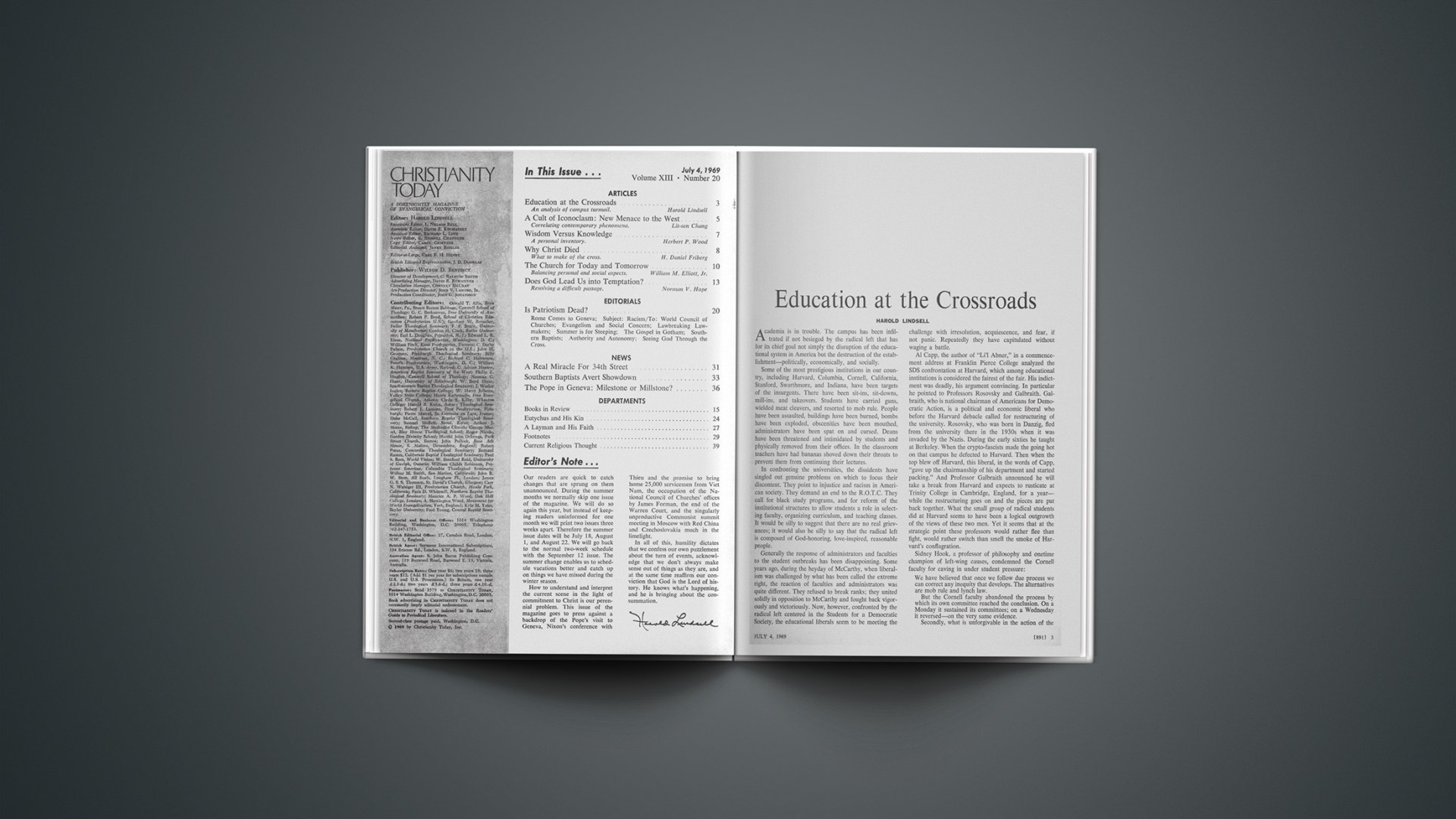
Education at the Crossroads

Academia is in trouble. The campus has been infiltrated if not besieged by the radical left that has for its chief goal not simply the disruption of the educational system in America but the destruction of the establishment—politically, economically, and socially.

Some of the most prestigious institutions in our country, including Harvard, Columbia, Cornell, California, Stanford, Swarthmore, and Indiana, have been targets of the insurgents. There have been sit-ins, sit-downs, mill-ins, and takeovers. Students have carried guns, wielded meat cleavers, and resorted to mob rule. People have been assaulted, buildings have been burned, bombs have been exploded, obscenities have been mouthed, administrators have been spat on and cursed. Deans have been threatened and intimidated by students and physically removed from their offices. In the classroom teachers have had bananas shoved down their throats to prevent them from continuing their lectures.

In confronting the universities, the dissidents have singled out genuine problems on which to focus their discontent. They point to injustice and racism in American society. They demand an end to the R.O.T.C. They call for black study programs, and for reform of the institutional structures to allow students a role in selecting faculty, organizing curriculum, and teaching classes. It would be silly to suggest that there are no real grievances; it would also be silly to say that the radical left is composed of God-honoring, love-inspired, reasonable people.

Generally the response of administrators and faculties to the student outbreaks has been disappointing. Some years ago, during the heyday of McCarthy, when liberalism was challenged by what has been called the extreme right, the reaction of faculties and administrators was quite different. They refused to break ranks; they united solidly in opposition to McCarthy and fought back vigorously and victoriously. Now, however, confronted by the radical left centered in the Students for a Democratic Society, the educational liberals seem to be meeting the challenge with irresolution, acquiescence, and fear, if not panic. Repeatedly they have capitulated without waging a battle.

Al Capp, the author of “Li’l Abner,” in a commencement address at Franklin Pierce College analyzed the SDS confrontation at Harvard, which among educational institutions is considered the fairest of the fair. His indictment was deadly, his argument convincing. In particular he pointed to Professors Rosovsky and Galbraith. Galbraith, who is national chairman of Americans for Democratic Action, is a political and economic liberal who before the Harvard debacle called for restructuring of the university. Rosovsky, who was born in Danzig, fled from the university there in the 1930s when it was invaded by the Nazis. During the early sixties he taught at Berkeley. When the crypto-fascists made the going hot on that campus he defected to Harvard. Then when the top blew off Harvard, this liberal, in the words of Capp, “gave up the chairmanship of his department and started packing.” And Professor Galbraith announced he will take a break from Harvard and expects to rusticate at Trinity College in Cambridge, England, for a year—while the restructuring goes on and the pieces are put back together. What the small group of radical students did at Harvard seems to have been a logical outgrowth of the views of these two men. Yet it seems that at the strategic point these professors would rather flee than fight, would rather switch than smell the smoke of Harvard’s conflagration.

Sidney Hook, a professor of philosophy and onetime champion of left-wing causes, condemned the Cornell faculty for caving in under student pressure:

We have believed that once we follow due process we can correct any inequity that develops. The alternatives are mob rule and lynch law.

But the Cornell faculty abandoned the process by which its own committee reached the conclusion. On a Monday it sustained its committees; on a Wednesday it reversed—on the very same evidence.

Secondly, what is unforgivable in the action of the Cornell faculty is the reason it reversed itself—and yielded to force. It acted in panic, out of sheer fear of the consequence of adhering to its own principles [U. S. News and World Report, May 19, 1969].

As we examine the causes for campus conflict today we cannot deny that there is a substantial gap in American life between what is and what ought to be. Our nation suffers from unresolved tensions and hatred and strife, from the compromise of civil rights, from inequalities in employment and educational opportunities. Millions of us are deeply troubled and perplexed by the United States’ involvement in the war in Viet Nam. War itself remains a compelling moral question; many ask earnestly whether it ever is legitimate, and if so, what distinguishes a just war from an unjust one. We are uneasy about pockets of poverty in the midst of great affluence and confess that this is a disgrace to us all. We are disheartened over the unethical conduct of some prominent in business and politics, and even in the Supreme Court of our land. But all these problems are only symptoms of our disease.

Underlying the immediate causes of campus agitation is the basic question: What is our life-and-world view? Does life have meaning and significance? What should our value system be? On what foundation does it rest, and what sanctions should support it? These questions are really one question, a spiritual question. And because it is spiritual it cannot be asked by science or answered by unaided human reason.

This spiritual crisis that lies at the heart of campus ferment has to do with the loss of authority, of a fixed point of reference from which men can get their bearings. The campus is the place where this problem cannot be dodged, where the struggle is never-ending, where the battle is won or lost. Education involves a search for truth and the development of guiding principles. Today academia is in trouble because it has lost the spiritual foundations that once undergirded it; no longer is it controlled by a consistent, integrated, comprehensive world-and-life view.

In early America, education was inextricably linked to Reformation orthodoxy. Its world view was grounded in Scripture. Nearly all our institutions of higher learning were once connected with the churches and drew their distinctiveness and their vitality from the Christian faith. But through the years constant and often unresisted erosion has worn away these foundations of belief. The extent of this erosion is suggested by an incident at Harvard. Herbert Bloch, professor of Greek and Latin, offered a resolution to the faculty to unite around the university’s symbol Veritas (truth). He drew a clear distinction between truth and the lie. The Alumni Bulletin reported that the “motion was passed by a voice vote, but not unanimously.” Here was a faculty that could not agree that it existed to pursue and perpetuate truth. Some members, it seems, wished to vote for the lie!

No longer can it be said that schools like Harvard, Yale, Princeton, and Columbia are committed to the distinctive life-and-world view that undergirded them at the time of their founding. Practically all the church-related institutions have become thoroughly secularized and have enlarged their ideological base. Students are presented with a wide range of ideologies cafeteria style; to accept one is to reject and deny the others. Atheists, agnostics, theists, humanists, Marxists, existential nihilists, naturalists, and pragmatists vie for the minds of students. As a result, secular education has no single unifying principle on which to stand. This not only leads to conflict among those whose ideologies are antithetical but also sows confusion among the students who have come to learn. At best the resultant ideological stance will be sub-Christian, at worst anti-Christian. Moreover, academic liberty has been advanced to a point where all too frequently it becomes license. Under the guise of freedom the viewpoints and the sanctions formerly normative in our national life have been effectively undermined.

The erosion that has taken place in institutions of Christian origin is not the whole story, however. Nineteenth-century America witnessed the rise of state education. Land-grant colleges sprang up all over the country, and some are now numbered among our great universities. Because of constitutional limitations these schools were secular from their beginnings. However, some of the great educators in these institutions were Christians. Even those who were not often held to the Christian ethic. For almost a hundred years state institutions as well as private ones, even though they had no formal commitment to orthodox Christianity, nevertheless operated in a context of adherence to ethical values and moral sanctions that had their roots in the Christian faith.

Today American education has lost its historic Christian foundation, and both secular and formerly Christian institutions have surrendered the ethical and moral sanctions that sprang from it. The Christian world-and-life view has been abandoned. The result is the wild scramble we see on every hand. Nobody is sure of anything; everything is in a state of flux. Idealists whose thought life is rooted in intuition and subjectivism are found on every campus. Left-wing radicals, disgusted and disillusioned by the apparent inconsistencies of current culture, want to destroy the system that nurtured them even though they offer no viable alternatives to replace what they wish to destroy.

Some suggest that the youth of America will be satisfied when the war in Viet Nam is ended, when racism has been abolished, when inequality has been stamped out, and when poverty has been eliminated. This is, of course, unrealistic. History teaches us that when one problem is solved, other problems—either new or previously unnoticed—appear to take its place. Removal of the present symptoms, welcome as it will be, will produce no permanent cure.

The attack by the radical left has induced a reaction from the radical right. This reaction seems to be gaining momentum and could bring about at least a temporary end to the worst offenses of the radical left. But a turn to the radical right is no solution either. It is simply a reverse form of totalitarianism and another dead-end street. A decisive response to the radical left through the rational use of law and order is an immediate necessity. But it can be only ameliorative, not curative.

Nor is a return to the previous status quo the answer. If it were possible to go back to the situation that existed several decades ago, we would only be going back to what led to our current problems.

The essential ingredient missing in education today is a theocentric life-and-world view. If educators do not sense that God and his revelation must be brought into the educational processes and that all learning finds its integration and unity within this theistic focus, then the disease that has overtaken education will not be cured.

Yet for secular education to introduce theistic priorities into the heart of its institutional life is probably more than we can expect. It would involve an admission of error and shortsightedness, a turning to God and to the Scriptures by thousands of educators. Perhaps the institutions can be delivered from their sickness only if there is a large-scale spiritual awakening such as England experienced in the days of the Wesleys and Whitefield.

But while we pray and work for this, let us also try to increase the influence of the Christian institutions of higher learning we now have. Let us promote and encourage and strengthen them more than ever before. Let us urge their faculties to forge an apologetic literature that will demonstrate compellingly the validity of orthodox Christianity. Let us use these Christian institutions as seed beds from which a host of trained young people can go out into secular institutions. Let Christians infiltrate secular schools even as proponents of secular ideologies infiltrated many onetime Christian institutions. Let us also use every medium available—including television and radio as well as the printed page—to reach the educational world with the Christian message. And let us recognize that the one sure method of securing the objectives we have in mind is to persuade men to commit themselves to Jesus Christ for regeneration, and to the Word of God as the true source and the final authority for life.

God’s Holy Spirit waits in every age to manifest his power, which transcends every human device, every program, every desire. Let us pray not only that we may be filled with that Spirit but that the Spirit may be shed abroad in the hearts of men everywhere for conversion, for commitment, and for the grace to bring God and revelation into the center of all learning and every institution.

Editor’s Note from June 20, 1969

June is always an extra-busy season for an editor, and it generally includes, as it does this year, baccalaureate and commencement addresses. Graduations remind us, amid the clamor of pressing problems, that life goes on. Babies are born, young people complete their education, marriages are contracted, jobs are filled, and the cycle of life repeats itself. And it will do so until time ends.

The Christian, a magazine in England, has ceased publication, and CHRISTIANITY TODAY will take over many of the unexpired subscriptions. We welcome these British readers to the family and trust they will find helpful material in our pages.

We are pleased to announce the coming of Donald George Tinder to our editorial staff at the beginning of July. Mr. Tinder is completing his work for the doctorate at Yale, where he has served as a teaching assistant in the college and the divinity school. He has an M.A. and a M.Phil. from Yale as well as a B.A.; in addition he holds a B.D. from Fuller Theological Seminary. His wife, the former Edith Johnson, has a Wheaton B.A. and a Yale Divinity School M.A. in religion.

Mr. Tinder was born in Florida, an only child; his parents live in Miami. He brings to our magazine family the richness of his Brethren background, a deep commitment to Jesus Christ, and a writing skill already demonstrated by published material.

Providence? Or Age of Aquarius?

Few contemporary paradoxes are more poignant than that of a generation that regards itself as most sophisticated in other areas and yet involves itself to the tune of millions of dollars in the occult. The proliferation of mystic systems in an era of electronic circuitry, and the fascination astrology holds for the avant-garde, causes one to look for deeper reasons for this curious contradiction in modern life.

Since the announcement that the cast of the rock musical Hair included an astrologer, it seems to have become a status symbol for rock troupes to have an astrologer-psychic in their retinue. More significant, Hair features a song hailing the advent of the Aquarian Age. It seems that this craze may supplant Scientology in its fascination for the psychic community. Certainly it reflects emerging frames of mind.

Let no one think that to its cult the motif of the Aquarian Age is merely whimsical or eccentric. There is solid evidence that many among the architects of our pop culture take with extreme seriousness the division of history into segments ruled over by zodiacal signs. The philosophy of history projected here is about as follows: The 2,000-year period ending with the opening of the Christian era was the Age of Aries, symbolized by a ram, thought to suggest God the Creator. The following 2,000 years, symbolized by the fish and called the Age of Pisces, are considered a sorrowful age, represented by the death of Christ and marked by dissolution, water (tears) being its solvent.

Now, so the theory goes, we are at the dawning of the Age of Aquarius, which has been variously estimated to have begun in 1904 or 1933 or more recently. The Aquarian Age has air as its symbol, and is held to be a sort of new spiritual beginning, marked by promise of universal brotherhood, wide learning, and the shedding of hurtful inhibitions.

The forces behind this revolutionary life style of the mind are varied and complex. Some of them are without doubt psychological, others cultural; but there are evidences of deeper and more basic spiritual causes. It is to these that the Christian Church needs to give attention, to see whether there are indicated areas of spiritual or theological lack.

It seems clear that some significant part of the current “cultic occultism” stems from a growing distrust of the rational in our time. Thus, we are seeing here a part of a larger revolt against reason that surfaces also in the rigid and unstructured demands of “far out” groups upon various units of the Establishment.

Perhaps also the resort to astrology is a rationalization of a revolt against the inflexibilities of a mechanistic age, as objectivized by the computer and other depersonalized forms in technology. Someone may respond here that little is to be gained by exchanging one determinism for another. But it must be remembered that today’s astrology is not regarded as a rigid form of celestial determinism.

A comparison of today’s horoscopes with those of, say, the medieval period reveals that the contemporary form of astrology is in general genial and bland. Gone are the warnings and strictures imposed by the medieval star-gazers upon those who failed to respond to their signs. Today’s predicted Age of Aquarius is hopeful. The older restrictions and galling rigidities of the Age of Pisces, being at length the victims of the inexorable process of dissolving-dissolved emotion, are now lost in cultural-historical chaos. This leaves the field wide open for a promised golden era, in which newer integrative forces will lead to cooperation, brotherhood, and pushed-out horizons.

It is this mentality that also rationalizes the revolt of the avant-garde against such stabilities as marriage, structured societies, and cultural norms. Certainly if man is held in the grip of newly operative celestial powers, he cannot be blamed if he responds to the impulses of a new era. And certainly the proffered hope of a new age of enlarged dimensions for the human spirit, and a new freedom for man to be human, appeals to those of humanistic orientation.

Whatever the motivation for the newer astrological interest, it is evident that the movement is already the victim of exploiters who have moved in for the financial kill. No one can know with accuracy how many persons derive their livelihood from the arts of the occult. Time for March 21, 1969, estimates that there are some 10,000 full-time astrologers in the United States, and 175,000 practicing the art part-time. Over 1,200 of the nation’s daily papers carry horoscopes. Rock music groups grind out albums dealing with astrology, while paperback writers seek to capitalize upon the public interest in the subject.

More revealing still, courses in astrology and witchcraft are offered, not only in offbeat Mid-Peninsula Free University and Heliotrope Free University, both in California, but also in sedate state universities. Such studies can, it may realistically be feared, “reach dangerously into the mind,” and may even produce public psychosis. While some may enroll in such courses for reasons of social pressure or status seeking, many others of those deeply involved in these psychic forms are operating with deep seriousness. This is especially true of those who avoid the redundant forms of popular horoscopes and move into the area of computerized “readings” based upon the hour (or even the minute) of the client’s birth.

To return to the question raised at the beginning of this article: For what Christian understanding is the newer occultism a substitute, or to what biblical insight is it a surrogate? It occurs at once that astrology, and particularly the newer cultic form with its Aquarian Age, is seeking for a philosophy of history. May it not be that whenever one rejects a rational and structured frame for history, he inevitably turns to a non-reflective one?

Again, may it be that when the mind turns its back upon the prophetic understanding of history, in which God is Lord of history, of life, and of death, then it is shut up to philosophies of history that proceed from the creature? And if scientific interpretations of history (such as that of Marx) fail man, may he not turn to the irrational and the cultic? And is it not but a step from the cyclical view of history to that of the astrologer?

We venture that the loss of the providential view of history, which in its biblical sense is linear and eschatological, lies at the root of modern man’s confusion, a confusion that seems to border on the absurd in the new cult of the Aquarian Age. Perhaps the Church needs to be challenged by this bizarre form to a renewal of its stress upon the role of the Living God in the affairs of men.

HAROLD B. KUHN

The Church’s Summer Witness

Many christian educators are enthusiastic about summer opportunities for church education. According to Wayne Buchanan, executive director of the National Sunday School Association, “summer is one of the brightest prospects we have for Christian education. Children and youth have more time than during the school year. Their availability for longer and more frequent periods of time in church educational activities greatly enhances the potential of their Christian learning experiences.”

“Innovative” is the adjective that best describes many church programs in the summer months. Among the areas of experimentation are vacation Bible school, service projects for youth, camping, and evangelistic efforts.

Some churches hold vacation Bible school in the evenings, others have it in the mornings and afternoons, and still others have morning sessions for children and evening sessions for youth and adults. In many churches, evening programs for young people include recreation, Bible study, films, discussions, and refreshments—often under a name other than “vacation Bible school.” Mothers’ classes with special appeal to non-Christians have been an effective evangelistic tool in VBS. Some schools have been conducted much like a daycamping program, with daily field trips to points of interest, along with Bible study and crafts.

Another novel and fruitful idea is having the school in neighborhood backyards. Last summer, workers from the Racine, Wisconsin, Bible Church held VBS in twenty-one backyards throughout the city. Attendance soared from the traditional 300 in the former at-church VBS to 840, most of whom were unchurched. Harvey Martin, director of Christian education, reported 125 conversions compared with 12 the previous year.

The traditional two-week VBS is giving way to one-week schools, according to a recent nationwide survey (reported in the Research Report on Vacation Bible School Trends, Scripture Press Foundation, 1969). In this study, 48.0 per cent of the 5,076 schools in 1966 lasted ten days and 40.9 per cent lasted five. But in 1968 the five-day school led the ten-day by more than 11 per cent (49.7 per cent compared with 38.1 per cent). The percentage of schools of other lengths (such as six days, eight days, or one day a week for ten weeks) increased slightly from 10.3 in 1966 to 13.9 in 1968.

These experiments have led to an overall increase in VBS attendance, according to the Scripture Press Foundation study. However, many summer educational activities are suffering from a shortage of workers, and in most churches summer brings a decrease in Sunday-school attendance and a disbanding of children’s church. This is caused in part by the longer vacations and longer weekends now available to many American workers. Also, increased affluence has enabled many Americans to purchase cottages for weekend and summer use. The problem is heightened by the popularity of community summer programs (such as sports, scouting, camping) and increased summer-school offerings.

But these difficulties may be a blessing in disguise. Robert Marquardt, a Christian-education executive of the Christian and Missionary Alliance, believes they are forcing churches to break the “edifice complex” and to find ways to reach out from the church building to the lost during the summer.

Summertime provides special opportunities for young people to participate in service projects. More and more churches are encouraging their youth to conduct children’s Bible clubs and vacation Bible schools in rural communities, the inner city, and other out-of-the-way areas. Other young people are holding gospel services and distributing literature, and witnessing in convalescent homes, jails, hospitals, trailer parks, and migrant workers’ camps. Many local churches and several denominations have developed programs for sending their young people to visit foreign and home mission fields such as Mexico, Puerto Rico, Appalachia, Alaska, and Indian reservations in Arizona.

In many larger churches church-sponsored social gatherings for teen-agers are more frequent during June, July, and August, and regular weekly youth meetings often give way to more informal after-church singspirations on Sunday evenings, many of them held in homes.

Realizing that people welcome the refreshing and relaxing outdoor atmosphere of camps, many denominations and individual churches have developed extensive camping programs. The work of Christian Camping International has done much to stimulate interest in church-related camping. Many Christian educators think that camping is one of the best things evangelicals are doing in Christian education. Speaking of the camping ministry of the Evangelical Free Church of America, Kenneth Meyer, Christian-education executive of that denomination, observes, “It is just amazing to note what churches will commit themselves to financially and in labor in order to build a camping program for their district or region.”

Camps are said by one camp expert to be “one of the best places for winning people to Christ and helping them grow spiritually,” and are the scene of many life-changing spiritual decisions by children, youth, and adults. In 1967 the Baptist General Conference of America, for example, reported that 863 conversions and 1,736 other spiritual decisions were made at their camps.

Another exciting trend is day camping—camping from approximately 9:30 to 3:30 on one or more days each week for several weeks. Trips to nearby farms, parks, beaches, museums, and other spots of interest, combined with sports, nature hikes, Bible studies, and crafts, have high appeal to young people in the primary through junior-high age levels. Many churches are discovering that day camping is an excellent means of reaching unchurched children and youth in the community for Christ.

Some summer evangelistic efforts have been unusually successful. Chicago’s Bellevue Baptist Church showed gospel films in its parking lot on Wednesday evenings after prayer meeting, and other churches have shown them on Sunday evenings. “Films have been shown at shopping-center parking lots, at fairs, and in homes to invited guests,” reports the Rev. Lawrence Swanson, Baptist General Conference Sunday-school secretary. Some families have shown films in their front yards—an excellent way for them to take the Gospel right to their own neighborhood.

With the use of these and many other innovative ideas, summer is becoming one of the most fruitful seasons of the year for church education. Increasing numbers of churches are finding that “he that gathereth in the summer is a wise son” (Prov. 10:5)—Dr. ROY B. ZUCK, executive director, Scripture Press Foundation, Glen Ellyn, Illinois.

Graham in the Garden: New Challenges in New York

Another Billy Graham Crusade … so professional … so polished … so much like Madison Avenue.… At least that’s the way it should look to the 200,000 persons expected to attend his current crusade in New York’s Madison Square Garden, June 13–22.

Beneath the surface and behind the Garden’s show window, however, Graham team workers have spent twenty months scurrying about, raising money, soliciting personnel, driving business bargains, writing news releases, organizing prayer groups, and training counselors—in a frenzy that bespeaks continual inventory time.

Witness, for example, crusade director Bill Brown’s New York offices two weeks before opening night: A half-empty cup of cold coffee on a sloppy desk. Overflowing wire baskets. Empty boxes in one corner. Filled boxes in another. A worn map of the city on one wall. A score of letters, awaiting signatures, in disarray on a folding chair. A dirty, threadbare couch where visitors wait for interviews. And witness the sidewalks at rush hour, twenty-seven stories below. All this points up the spirit of hurry, confusion, yet definite destination, that has caught up the Graham team this spring.

Why all the commotion? For a partial answer, look at the more typical facets of crusade preparation: Organizing prayer groups, training counselors, raising money …

The money matter, supervised by a local committee that invited Graham to New York four years ago, called for meeting most of the $825,000 budget by June 13—a goal that by late May local crusade chairman Elmer Engstrom felt fairly confident about reaching.

The prayer backing was handled by organization of more than 40,000 area churchmen into some 5,000 prayer groups; each began weekly meetings early in May.

Preparation of counselors has been the most extensive of any crusade. Since last fall, Graham’s associates have taught nearly 6,000 persons how to counsel with the men and women who respond to the evangelist’s invitations. Significantly, about 10 per cent of the counselors are persons who first accepted Christ in Graham’s 1957 New York campaign, while more than 1,000 persons have made “decisions” (many for conversion) during the training sessions themselves.

A second cause of the frantic activity lies in the unique problems posed by this particular crusade. The most obvious is New York City itself—its immensity, its immorality, its seething qualities. Billy, after a recent walk down Times Square with his son, told staff members he was “absolutely overwhelmed” with the openness and depth of the sin he saw.

There also is the problem of church apathy. Despite the hectic pace at crusade headquarters, several members expressed concern that local churches may not be working as hard for the success of this crusade as they did in 1957, even though more than 1,000 of them have indicated support.

“I sometimes wonder if some churches are becoming blasé about evangelism,” said Brown. “Most of them don’t set everything aside for the crusade anymore. They seem to take for granted that Billy Graham will bring automatic revival. But we know, of course, that he won’t.” Added an associate: “Strange, but in some ways it’s harder than ever before. I wonder if it’s a trend of the times. Evangelicals seem to be even more of a minority here than in the past.”

Added to these difficulties is the pervasive problem of race. Though the crusade committee includes blacks and Spanish-Americans, efforts to enlist broad support from non-white communities have been frustrating. More immediately worrisome were constant rumors that militant blacks might attempt to disrupt or hinder at least one of the services.

“We know nothing concrete, and have no plans to cope with such problems,” said Brown. But one of his colleagues noted: “Many black people have said they can’t see us getting through the crusade without trouble. All we can do is commit the problem to God.”

A third cause of the bustle is that new techniques have been devised to meet New York’s unique problems. “This city seems like a restless bull,” says team member Gil Stricklin, “almost as if possessed by demons. We have to try everything we can.”

Thus the decision to set up a gigantic coffeehouse. In Manhattan Center, near the Garden, tables are being provided each night for some 1,500 youths expected after the service for an informal hour or two of youth-oriented music (folk rock, hard rock, and “Jesus songs”)—and talk. “It’s a brand new approach,” says the Rev. Forrest Layman, the man behind the coffeehouse. “We want to reach youth in their media, and music is their life. It will be an experiment … a soft-sell approach … the most exciting departure for me in ten years of crusades.”

Thus, also, the decision to set up a crusade TV network, sending each of the rallies into a potential of 30 million Eastern homes each night.

And thus the return to a kind of daytime “soap box” evangelism. Each day, vans will move into areas like Central Park, the shipping docks, and Times Square, with associate evangelists aboard to preach to open-air crowds. This approach may take some adjusting by more traditional preachers, Brown admits. “But people who have done this sort of thing say you can pull 1,500 listeners just like that. It’s exciting.”

Despite the intense activity, team members are not starry-eyed while discussing their hopes. Graham himself has said the man on the street would probably not notice great changes in the city. “The important thing,” said Engstrom, “is that we confront a substantial number of people with the call of Christ. Maybe those who respond will have a leavening effect on the city.”

… Like the Puerto Rican child confronted by a layman on his way to a crusade committee meeting. Noticing the lad scribbling on a subway poster, the man walked over intending to scold him—only to find the boy writing the words, “Jesus saves.”

“Do you know what that means?” he asked. The youngster replied: “Sure do! The preacher Billy Graham came to San Juan in 1967 when I still lived there—and I became a Christian.”

Korean Congress: ‘Christ For 30 Million’

Korea’s two million Protestants followed up the Berlin and Singapore Congresses on Evangelism with one of their own. A four-day Korean Congress last month drew more than 1,000 Christian leaders from all denominations to lay plans for national evangelism.

Then, putting their plans into action, they climaxed the congress with a five-day United Evangelism Crusade that on its first night alone packed Seoul Stadium with more than 40,000 Koreans to listen to a Chinese evangelist from Hong Kong, the Rev. Timothy Dzao. Though Asia-planned and Asia-directed, the congress did not exclude the West. Other speakers included Dr. Kermit Long, former evangelism secretary of the United Methodist Church in the United States. Daily Bible conferences in the municipal stadium added depth to the rallies.

Planning for the congress was directed by three prominent Korean Christian leaders: Dr. Simeon Kang, pastor of Saemoonan Presbyterian Church, the oldest Korean Protestant Church: Dr. Helen Kim, president emeritus of Ewha Women’s University (Methodist), the largest women’s college in the world; and Dr. Kyung-Chik Han, pastor of what may well be Asia’s largest single Christian congregation—the 9,000-member Yungnak Presbyterian Church of Seoul.

Both the congress and the rallies were challenging reminders to Korea’s Christians that although their church is the largest organized religion in Korea—now outnumbering both Buddhists and Confucianists—there are nevertheless more non-Christians in Korea today than when Protestant work began eighty-five years ago. Ninety to 93 per cent of Korea’s expanding population still does not acknowledge Christ as Lord.

The congress chose as its motto: “Let us put Christ in the heart of every one of our 30 million Koreans” (in South Korea).

SAMUEL H. MOFFETT

Religion In Transit

Twelve of the “Milwaukee 14”—including six clergymen—were found guilty of theft, burglary, and arson in the burning of draft records last summer.… Two days earlier last month, a group known as the “Chicago 15,” including two Catholic priests and a seminarian, were arrested on similar charges.

A Bronx district attorney is investigating the reported referral by New York clergymen of pregnant girls to illegally operating abortionists, four of whom were recently arrested in a raid on a lavish Bronx apartment. Twenty-one prominent clerics of New York two years ago formed the Clergymen’s Consultation on Abortion, but its spokesman won’t admit it’s illegal, the New York Times said.

Commencement at United Presbyterian Macalester College in St. Paul, Minnesota, took on an avant-garde look this year, with students planning the exercises. The 420 graduates wore no caps or gowns, one of them refused her diploma, and a speakerless program included slides of atrocities in Viet Nam and Biafra. Loud protest music drew boos from many adults.

Already, reparations demands presented in different church groups total more than $1 billion, plus another $1.5 billion for black colleges, far more than the original $500 million asked in militant James Forman’s “Black Manifesto” (see June 6 issue, page 42). Demands made this month included $100 million asked of metropolitan Boston’s churches and synagogues, particularly the Christian Science “mother” church. Rejecting Forman’s demands were the Executive Council of the Episcopal Church and the General Board of the Christian Church (Disciples).

Personalia

Westmont College (Santa Barbara, California) will have a new president July 1: Dr. John William Snyder, 45, acting chancellor of Indiana University.

Now engaged is Ruth Bell Graham, 19, youngest daughter of evangelist and Mrs. Billy Graham. Her fiancé, Ted Dienert, 24, of Rydal, Pennsylvania, attended Taylor University in Indiana and works in Philadelphia. Miss Graham is a sophomore at Gordon College. No wedding date was set.

Convicted draft-subversion conspirator William Sloane Coffin, Yale chaplain, will marry Mrs. Harriet H. Gibney of Boston, former wife of an encyclopedia-company executive, this summer. The controversial United Presbyterian clergyman was divorced last year.

Although trustees did not act on his resignation, Stetson University president Paul F. Geren said he plans to leave the Baptist-associated school by fall (see June 6 issue, page 46). The faculty voted 93–0 “no confidence” in Geren’s administrative leadership.

Dr. John H. Tietjen, 40, public-relations secretary of the Lutheran Council in the U. S. A., has accepted the presidency of Concordia Seminary, St. Louis.

A United Presbyterian will be in charge of the world’s most powerful court if President Nixon’s choice for the next Chief Justice of the United States is confirmed. Warren Earl Burger and his wife belong to National Presbyterian Church, where Dr. Edward L. R. Elson (the late President Dwight D. Eisenhower’s pastor and chaplain of the U. S. Senate) is senior minister. The nominee was raised a Methodist, attended House of Hope Presbyterian Church in St. Paul. Burger’s churchgoing is spotty, but intimates consider him “a witnessing and working Christian.”

Terence Cardinal Cooke of New York became the sixth clergyman—and the first Roman Catholic—to preach to the President at last month’s White House church service.

DEATHS

ROBERT G. LETOURNEAU, 80, pioneer developer of earth-moving machinery, college founder, and internationally known church layman; in Longview, Texas.

TRUMAN B. DOUGLASS, 67, vice-president of the National Council of Churches and head of the United Church of Christ’s Board for Homeland Ministries; in New York.

World Parish

In a stately mansion by the River Seine northwest of Paris, the four-year-old French Evangelical Theological Seminary closed the current academic year with thirty-four students from eleven countries. The seminary—said to be the only “thoroughly evangelical” graduate theological school for 210 million people where French is officially spoken—started with five students.

To the beat of African tom-toms booming through St. Peter’s Basilica, Pope Paul VI and twenty-four newly ordained priests from different countries concelebrated a Pentecost mass.

Evangelical leaders of Argentina have founded the Evangelical Theological Society. Its creed is like that of Inter-Varsity Christian Fellowship. Latin America IVCF director Dr. Rene Padilla is president of the new group.

Conversions to the Christian faith have reached “staggering proportions” in some parts of India, a militant Hindu leader reported at an all-India Hindu conclave. A massive drive was planned to win back the converts.

Racism and Revolt

Racial militants won a major hearing from the World Council of Churches last month. They persuaded the thirty-eight churchmen attending a WCC consultation on racism to recommend that member churches encourage “reparations” and “all else failing … support resistance movements, including revolutions.”

The five-day consultation, held in London, had been called in an effort to update the World Council’s race policies. World Council spokesmen issued the usual disclaimers, saying that the consultation spoke only for itself and that the recommendations were merely for the consideration of the Central Committee, which meets in August.

Meanwhile, black-power radicals reveled in the publicity the World Council managed to attract for them. A number were outspokenly critical of the white Christian community as a whole, causing the meeting to have more than its share of tense moments.

Following a closed plenary session, U. S. Senator George McGovern, who chaired the consultation, told reporters what had been decided. The adopted statement suggested seven steps (see text following). Besides endorsing revolutions and reparations, the consultation sought to have the World Council and its member churches begin applying economic sanctions “against corporations and institutions which practice blatant racism.”

McGovern, a Methodist layman, had no qualms about the statement. “I am not a pacifist,” he said. “I participated in World War II as a combat pilot and I endorse the concept as stated in the recommendation.”

The Rev. Channing Phillips of Washington, D. C., a United Church of Christ pastor, was one of several blacks at the consultation who exchanged strong words with the Archbishop of Canterbury, Dr. Michael Ramsey. The titular head of the world Anglican community had provoked ire by refusing to allow a question to be directed to a speaker representing the British government.

Phillips, a delegate to last summer’s Democratic National Convention and the first black ever nominated for the U. S. Presidency, referred to Ramsey’s approach as “platitudinous drivel.” Ramsey later apologized to the consultation, after the would-be questioner, a Guyanese, told him: “The trouble with you bloody English is you always do things your own way.” McGovern said the incident had resulted from a misunderstanding.

The London meeting was disrupted at one point à la James Forman when five of his American supporters seized the floor to present demands for something like $144 million reparations from the wealth of the churches. WCC General Secretary Eugene Carson Blake later said he wondered whether they might also be willing to assume the churches’ debts.

Here is the complete text of the consultation’s statement on racism:

The World Council of Churches’ Consultation on Racism, meeting from the 19th to 24th May in London, was a result of a recommendation by the Fourth Assembly of the World Council in Uppsala, Sweden, last July. The Consultation clearly revealed that the Church and the world are filled with the insidious and blatant institutional racism that is producing increased polarization and threatening an escalation of the struggle for power between white and coloured races into violent conflict. More than once the Consultation itself was exposed to the pervasiveness of stereotypes, paternalism and, in the final result, attitudes of racial superiority that have developed over centuries. And the churches reflect the world.

The identification of the churches with the status quo means today, as before, that it has remained, in effect, part of the racial problem and not a means of eliminating it.

If the churches are to have any relevance in these critical times, it is imperative that they no longer concentrate their attention on the individual actions of individual Christians who are fighting racism. To the majority of Christians, the Church is a community, a group—perhaps even a movement—and it is therefore necessary that issues of racism be addressed by a group. Individual commitment is commendable—but not enough.

The patterns of racism have a universality that is frightening. UNESCO has found out even where there were laws to discourage racism the concentration of power, wealth and status in the hands of one racial group are working in favour of de facto discrimination. The situation is tragio when racism is manifested by well-intentioned, but uncritical persons and dangerous when it is practized by institutions.

It has become clear in the week’s study and dialogue that racism is in large part an outgrowth of the struggle for power that afflicts all men. Racist ideologies and propaganda are developed and disseminated as tools in economic, political and military struggles for power. Once developed they have a life of their own, finding a place in the traditions and culture of a people, unless stringent and continuous effort is made to exorcize them. The problem has been well documented in the UNESCO Report.

A second fact that has become clear is that the Church is not using the weapons it possesses to eradicate racism itself—even within its own institution. But the Church is charged with a ministry of reconciliation. And if it is to take that ministry seriously, then it must attack racism significantly—at its origins, as well as in its symptoms. Therefore, the Church must be willing to be not only an institution of love, but also an institution of action, making inputs into societies to help effect a new balance of power that render racism impotent. The Church must come to realize that in our institutionalized world, the closest approximation to love possible, is justice.

To that end, the Consultation calls upon the World Council of Churches to take the following steps:

(1) that the World Council of Churches and its member churches begin applying economic sanctions against corporations and institutions which practice blatant racism;

(2) that the World Council of Churches and its member churches use every means available to influence governments in following a similar practice of economic sanctions to promote justice;

(3) that the World Council of Churches and its member churches do support and encourage the principle of “reparations” to exploited peoples and countries (recognizing the churches’ own involvement in such exploitation and hence, reparation) to the end of producing a more favourable balance of economic power throughout the world;

(4) that the World Council of Churches should establish a unit with adequate resources to deal with the eradication of racism;

(5) to circulate among member churches the UNESCO Report as background material to enable Christians to understand why the Church and church-related institutions must enter into the struggle against racism in areas of power;

(6) that the World Council of Churches, through the initiative of its reorganized Commission of the Churches on International Affairs, serves as the co-ordinating centre for the implementation of multiple strategies for the struggle against racism in Southern Africa by the churches;

(7) that all else failing, the Church and churches support resistance movements, including revolutions, which are aimed at the elimination of political or economic tyranny which makes racism possible.

Colorful Convention Capers: ‘A Man Named Paisley’

“I’m looking for a man called Paisley,” said the policeman, as he apologetically entered the press room during the Church of Scotland General Assembly sessions in Edinburgh last month. That supporters of the militant Protestant leader were in town had become evident the previous evening when round and round went a little car with the now familiar slogan: “Jesus saves, Rome enslaves.” This was supplemented with banners next day that did not wish the Pope well. The immediate target was sitting inside the Assembly Hall with visitors from other churches as each was welcomed by name.

Things were moving doucely along till the announcement: “From the Roman Catholic Church.…” Bedlam broke loose in the public gallery as about fifty Protestants expressed their dissent in fifty different ways. There were extraordinary scenes as the menacing fist-waving coterie shouted abusive comments at the first official Roman Catholic visitor to the assembly since the Reformation.

Sir Bernard Ferguson, former governor-general of New Zealand, could be seen making his way to speak comfortable words to Father John Dalrymple. Sir Bernard was later to address the assembly as “Ladies and gentlemen—and vipers,” the latter culled from one of the more biblical epithets hurled at Father Dalrymple. Meanwhile, the moderator had suspended the sitting and left the chair while the demonstrators were persuaded to leave peacefully. Since Ian Paisley and a colleague had been permitted to hand a petition to the moderator earlier, and had professed themselves “satisfied” with this arrangement, the uproar was regarded by many as demonstrating the folly of doing a deal with the protesters.

A deal had been done because the Queen had made history by coming herself to a regular assembly meeting—the first time the sovereign had done so since the 1603 Union of the Crowns (normally she sends a representative). The business committee had wanted to avoid anything that would embarrass Her Majesty, who as it happened had left the assembly two hours before trouble started.

In addressing the 1,360 fathers and brethren, with Prince Philip on one side and the Secretary of State for Scotland on the other, the Queen had renewed her annual pledge “to preserve and uphold the rights and privileges of the Church of Scotland.” During the eight days’ business that followed, the Queen paid a number of visits to the assembly, the business of which proceeded normally in her presence, as befits a land jealous of the rights of a kirk which owns no head but Jesus Christ.

Another moment of history took place when Her Majesty, head of the Church of England, took communion in the High Kirk of St. Giles’—and in doing so received the cup from a woman elder (there were five such in the assembly this year). The latter fact did not meet with the approval of the controversial minister of St. Giles’, Dr. Harry Whitley, whose eighty-eight-man kirk session lacks female representation.

In its report to the assembly, the Panel on Doctrine took the first cautious steps toward disposing of the Westminster Confession, convinced that “the whole conception of a subordinate standard is one which the church may now feel it wise to abandon” as an anachronism. The confession was regarded by the panel as one of a number of post-Reformation statements “which led the men who drafted them to be dogmatic about mysteries which are beyond the comprehension of finite and sinful creatures.” The assembly agreed that the panel should take preliminary soundings from presbyteries before it reports again on the subject next year.

The assembly condemned the use of all forms of chemical and biological warfare but declined to make similar condemnation of all weapons of war. Similarly, it would not “deplore the action of the United States in using such weapons in Viet Nam.” The assembly also resolved to ask the government to cease the supply of arms to Nigeria.

A Gaelic scholar, Dr. T. M. Murchison, 61, was elected moderator in succession to Dr. J. B. Longmuir. In his closing address, Murchison said: “To be a church to match this hour we must be convinced of the relevance and adequacy of the Good News we profess … ‘To whom can we go but unto Thee?’ said Peter long ago.” Nobody, concluded the moderator, had ever satisfactorily answered Peter’s question.

Meanwhile, two dissident sources had directed rumblings toward the assembly. Dr. Whitley said that if the assembly did not check its ecumenical enthusiasts, the kirk would become “an unhappy province of the Anglican Communion” or be confronted with another secession. The Roman Catholic Church is quietly waiting to exploit the dismemberment of the Kirk, and the creation of a Roman Catholic cardinal in Scotland (the first since the Reformation) and the arrival of a relic of St. Andrew in Edinburgh “may be more than straws in the wind,” warned this present-day occupant of John Knox’s pulpit.

A mile away in St. George’s West church hall, a group of theological college lecturers and students had formed what they called a “Dissembly.” They felt the General Assembly was not representative of the people of Scotland, and they wanted to free the Gospel from pious religiosity and conventional morality.

J. D. DOUGLAS

Bishop Bucks Encyclical

A Roman Catholic bishop has joined the ranks of those unable to accept the official church teaching forbidding artificial contraception. The Most Rev. James P. Shannon, one of the nation’s best-known liberal prelates, is the highest official of the U. S. hierarchy to dissent publicly from the controversial birth-control encyclical, Humanae Vitae, issued last July by Pope Paul VI.

Minneapolis Star religion editor Willmar Thorkelson, in a copyrighted article, said Shannon submitted his resignation as auxiliary bishop of St. Paul-Minneapolis after an exchange of correspondence with the pontiff that began last September and “weeks of anguish, days of prayer, and hours of fear.” Shannon refused a papal proposal that would have banished him to an overseas assignment without status.

Meanwhile, the Vatican spiked persistent rumors circulating particularly in Spain, Italy, and France that the Pope would soon amend the encyclical.

Religious Press: What Price Prophecy?

While they were being urged at some of the official sessions to become more “prophetic,” religious editors at the Associated Church Press/Catholic Press Association convention were wondering how to cope with the results of previous prophetic advice. The story many editors were quietly telling was one of declining circulation and falling advertising revenue. Alfred P. Klausler, executive secretary of the ACP, reported a decline over the past year of 1,401,490 in the group’s total circulation, dropping it to 21.6 million. Commenting on the troubles experienced by some of the member publications, Klausler said, “It is always something of a paradox that subscribers to church journals will tolerate and renew subscriptions to secular publications which irritate them but will not by the same token exercise the same toleration in their church journal. There must be greater religious maturity on the part of church people.”

Little that could be called real ecumenism was achieved by this first joint meeting of the two associations. Each side seemed to be operating on its own frequency. The problem was accentuated because many of the Catholic editors represented local diocesan papers published under hierarchical supervision while most Protestant editors represented publications with less geographical limitation and less immediate control. Catholic editors seemed most fearful of hierarchical oppression, while Protestant editors—especially those from denominational journals—were concerned about lay backlash.

One evidence of lay dissatisfaction is the appearance of conservative dissenting journals within the United Methodist, Episcopal, and Presbyterian folds. At least one, the Presbyterian Journal, has apparently prospered at the expense of the more liberal denominational magazine, Presbyterian Survey. In the past five years the Journal has gained about 22,000 subscribers while the Survey lost more than 50,000.

The Atlanta meeting produced no surprises. Race is still “the issue” in the minds of the religious editors of America, an almost exclusively white group. Meeting in the home town of Martin Luther King, Jr., delegates obviously felt his shadow over their meetings.

The widow of the slain civil-rights leader, Coretta King, who was one of the featured speakers, told the convention the Church is in danger of becoming “a moribund guardian to its ritual as it declines into irrelevance.” She characterized the reparations called for in the “Black Manifesto” as “meaningful symbolism,” adding that the churches should do something more significant by using the influence of their 80 million members to back legislation in Congress.

“If programs which would end poverty and abolish discrimination were enacted, all society would benefit and all society would pay the cost rather than one part of it,” she said.

In commenting on student unrest, Mrs. King said: “The young people most hostile to the Church are by no means morally degenerate.… Their appeal for racial and economic justice, for peace and for humanism, is the essence of morality.”

W. C. Fields, president of the ACP, and Monsignor Terrence P. McMahon, president of the CPA, had earlier joined in placing a wreath on Dr. King’s grave.

The hit of the three-day program was Dr. Albert Outler of the Perkins School of Theology at Southern Methodist University. In his quip-laden address (Pope John XXIII became Johnny Unite-Us), Dr. Outler pointed out that the locus of authority for Protestants had once been Scripture, “but we’re not working that side of the street anymore. We’ve left that to the Catholics.” He concluded that there is indeed a crisis of authority and that authority must now be found in a convergence of un-self-righteous love and critical insight in an atmosphere of freedom—persuasive insights rather than force.

Clarence Jordan, founder of the Koinonia Farm (an integrated cooperative community near Americus, Georgia) and author of the Cotton Patch Version of Paul’s Epistles, told the 400 editors: “Churches should stop accepting tax exemption on their property.” Until they do, they should pay an equivalent amount into a “fund for humanity,” he said, explaining: “We ought to spend at least as much to put a roof over the heads of our brothers whom we have seen, as to put a roof over the head of God whom we have not seen.”

ACP awards of general excellence went to the Canadian Churchman of Toronto, official monthly of the Anglican Church of Canada; Youth, a joint publication of the United Church of Christ, the Episcopal Church, Church of the Brethren, and the Anglican Church of Canada; Colloquy, Christian-education magazine of the United Church of Christ and the United Presbyterian Church; Presbyterian Survey, official publication of the Presbyterian Church U. S.; United Church Herald, United Church of Christ monthly; These Times, Seventh-day Adventist monthly; and the Christian Century.

The top magazine winners of the twenty awards presented by the Catholic Press Association were the St. Anthony Messenger, a Franciscan monthly, and Thought magazine, a quarterly published by Fordham University. Top awards for Catholic newspapers went to the Long Island Catholic, Rockville Centre, New York, and the now defunct Oklahoma Courier, Oklahoma City.

Newly elected officers of the ACP are Kenneth Wilson, editor of the Christian Herald, president; Ben R. Hartley, editor of the Presbyterian Survey, first vice-president; DeCourcy H. Rayner, editor of the Presbyterian Record, Toronto, second vice-president.

Joseph A. Gelin, managing editor of the Catholic Universe Bulletin, Cleveland, was named president of the CPA.

PERIODICAL CHANGES AND MOTIVE’S FOUR-LETTER HANGUP

“Clearly obscene,” said the publisher of motive magazine, referring to language in the intended May issue of the controversial student-oriented publication. And Dr. Myron F. Wicke, secretary of the United Methodist Division of Higher Education, “postponed” the issue, asserting, “There is enough obscenity in the world without our adding to it.”

Motive, launched in 1941 by the Methodist Student Movement, has been published by the Methodist board for the now defunct University Christian Movement at a cost of $40,000 to $63,000 a year. The faltering campus monthly has been on the ragged edge for some time (see CHRISTIANITY TODAY, October 25, 1968, page 43).

A special issue for March–April on the “liberation of women” also sparked fire for its liberal sprinkling of four-letter words. The “postponed” issue was edited by B. J. Stiles, now a staffer of the Robert F. Kennedy Memorial Foundation in Washington, D. C.

Three other senior editorial staffers have either quit or given notice. A committee to study the future of the magazine named a non-Methodist, Robert Maurer, as editor-designate, subject to final approval late this month. United Church of Christ member Maurer, a Union Theological Seminary grad of 1968, chaired the youth delegation at last summer’s World Council of Churches’ Uppsala assembly.

Meanwhile, Good News: A Forum for Scriptural Christianity within the Methodist Church, announced formation of a board of thirty directors for the new and growing publication, edited by Charles W. Keysor in Elgin, Illinois.

Emerging from a board meeting in Tulsa are Good News evangelical renewal groups across the denomination, and a projected nation-wide Dallas convocation for Methodist evangelicals in the fall of 1970.

The magazine (circulation 9,000) espouses “deep commitment to our Wesleyan heritage of scriptural Christianity,” Keysor says.

After a long (110-year) and illustrious career, The Christian and Christianity Today, British newsweekly of evangelical thought and action, ceased publication this month because of slipping circulation (see Editor’s Note, page 2).

Another magazine being phased out is the forty-year-old Pulpit, a companion periodical of the Christian Century. Replacing Pulpit this fall will be a new journal, Christian Ministry, to be edited by Robert Graham Kemper, a Montclair, New Jersey, United Church of Christ clergyman. The change reflects the swing in ecumenical circles away from the centrality of preaching to the action context of current ministry.

Regular participation will include the National Council of Churches, the newly formed Academy of Parish Clergy (see June 6 issue, page 47), and seminaries. “We are affirming the recovery, for the contemporary church, of one of the richest treasures of the Christian heritage,” said Century spokesmen in announcing the conversion of the Pulpit. “We are affirming ministry.”

Circulation (264,000 peak in 1965, 200,000 now), and financial ($30,000 increase in underwriting during the same period) problems have dogged the Presbyterian Survey, official magazine of the Presbyterian Church, U. S. The monthly’s board of directors was to act June 12 on a proposal to change its frequency and format.

Essentially, the magazine would be changed from a forty-eight-page feature slick to a more news-oriented sixteen-page biweekly. The Survey might also get its name changed in the overhaul.

Another magazine undergoing major visual face-lifting is His, monthly student publication of Inter-Varsity Christian Fellowship.

Plumbing The Educators

Until H. Norman Wright surveyed 270 Christian-education directors recently, almost no statistical information about them and their work was available.

The assistant professor of religious education at Talbot Theological Seminary found:

• More than 60 per cent have seminary or other graduate training, and churches increasingly look for this.

• Their training was weakest in counseling, group dynamics, organization, and administration.

• Smaller churches often employ youth directors.

• Churches rarely provide comprehensive job descriptions for new staff.

• Salaries still lag behind those of secular jobs requiring comparable education; and women’s salaries average nearly $1,650 less than men’s.

• Inadequate knowledge of the opportunities and unrealistic salaries account for the low number of recruits.

• Bible schools and Christian colleges, plus individual pastors, are most likely to influence young people toward Christian education careers.

Soft Answers At Lookout Mountain

An unexpectedly large number of commissioners to the 147th synod filled the scenic, mountain-top campus of Covenant College, Lookout Mountain, Tennessee, for the annual meeting of the Reformed Presbyterian Church Evangelical Synod last month.

“Soft answers” characterized most denominational deliberations. A middle course was steered on whether Freemasons may be church officers, on the place of dispensationalism in the church, on possible union with the Orthodox Presbyterian Church, and on Covenant College’s acceptance of federal funds for buildings.

The church refused to establish additional requirements for local church officers, though it restated its strong disapproval of the Freemasons and other secret societies as “organized pagan religions.” A request from the Southern Presbytery to declare dispensationalist doctrine “antithetical to the system of the Westminster Confession” and to disqualify dispensationalists from holding office was referred to a study committee.

While there was considerable discussion of federal aid to Covenant College, the overture to forbid Covenant from seeking federal aid lost by a substantial margin. The school recently received $1.7 in government money for three new buildings, and such aid is essential for more contemplated expansion.

Perhaps the most significant issue was ecumenicity; it certainly was the one that most seriously divided the commissioners. Since the Reformed and Evangelical Presbyterian Churches merged four years ago, there has been considerable pressure for the RPCES to join with the Orthodox Presbyterian Church, a group similar in theology and outlook.

Three of the twelve presbyteries overtured synod to resist the merger but the effort was substantially voted down. The disclaimer of Fraternal Relations Committee chairman Robert Rayburn that the committee was “railroading” a merger with the Orthodox Church was refreshing in light of highhanded tactics of some large-denomination hierarchy in forcing ecumenical interests. Rayburn said the committee saw its duties as merely implementing the wishes of synod.

A “Basis of Union” with the OPC was sent to presbyteries and local churches for study during the coming year. The committee plans to ask next year’s synod, as well as the OPC General Assembly, to approve a preliminary plan of union.

Many RPCES’s consider the Orthodox Presbyterian Church to be somewhat worldly in its attitude toward Christian liberty and hyper-Calvinistic toward evangelism. As is typical of most proposed merger discussions, reports indicated a number of RPCES congregations will withdraw if the union goes through.

RPCES minister and mission executive Arthur Glasser urged the synod to fulfill both its cultural and evangelistic mandates in an age when, he said, ecumenical churches are fulfilling only the cultural mandate and the evangelicals tend to fulfill only the evangelistic one.

Genial Wilbur B. Wallis, New Testament professor at Covenant Seminary in St. Louis, was elected moderator of this year’s synod.

Gordon And Conwell Announce Betrothal

Two of America’s leading interdenominational theological schools will join forces this fall to form what the new president predicts will be “one of the outstanding divinity schools in the world.” Gordon Divinity School of Wenham, Massachusetts, and Conwell School of Theology, Philadelphia, will merge to form the Gordon-Conwell Divinity School. Dr. Harold J. Ockenga, now head of Gordon, will be president, while Dr. Stuart Barton Babbage of Conwell will be vice-president.

A new 800-acre campus on Boston’s north shore is expected to house a student body of 750 within a few years, while a new Conwell property in Philadelphia will serve as the school’s urban-training center.

Asked why the schools were merging, Gordon Vice-president Daniel Weiss answered with his own question: “Why maintain two separate schools, so similar in nature and yet so close to each other geographically? By combining our total resources, we should both be able to do what we have wanted.” Namely: develop an urban-studies center, establish (eventually) an institute for advanced theological studies, and bring together an outstanding faculty.

Conwell, technically just nine years old, sports a long, rather proud history as successor of the Temple University School of Theology—founded by Russell H. Conwell of “Acres of Diamonds” fame. Conwell gained stature through Dr. Billy Graham, who initially was asked to appoint its entire board (he is now a board member at both schools), and through its heavy emphasis on urban-ministries training. One-third of Conwell’s fifty-five students are black.

Gordon, much larger, dates back nearly eighty years. Once a division of Gordon College, it now has 255 students and twenty-six faculty members.

The new school will be evangelical theologically, with faculty representing the Anglican, Baptist, Congregational, Episcopal, and Presbyterian churches.

Many merger details are yet to be worked out. School officials have not decided just how the Philadelphia property will be used, nor has the governing structure been finally developed. And housing must be arranged for all students at Gordon this fall, since buildings on the new campus have not yet been started.

Despite these problems, Weiss is optimistic: “When you’re on your way to being something new, there are a lot of ambiguities on the way. But we think we have something pretty exciting going.”

BIBLE-READERS’ BEAGLE: ANOTHER GO-ROUND

Neither the Bible nor Snoopy, the ubiquitous pooch of cartoon fame, is a stranger to the space circuit. They made the scene again last month in the epic Apollo 10 lunar landing rehearsal.

Astronaut commander Tom Stafford followed the lead of the Christmas Eve moon-circling Apollo 8 crew by including Bible reading (his favorite passages: Psalms 8; 122; 148, and Isaiah 2:4, KJV). But instead of reading it live from out there, Stafford had the Scripture intoned from the pulpit of his church down here (Seabrook Methodist, near Houston) by the lunar module project manager, Brigadier General Carrol H. Bolender.

“We’re kinda out of town for church today,” Stafford told astronaut Joe Engle at the spacecraft center offhandedly, “so I just copied down a couple of things I thought might be appropriate for him to read.”

But the three space-going churchgoers (Eugene A. Cernan is Catholic, John W. Young attends St. Christopher’s Episcopal Church in League City, Texas) spiked any notions of a world-wide TV audience watching their spaceploits that the three are all that heavenly minded. Besides some incredible grammar, the astronauts’ language was spiced with earthy terms and several obscenities.

“Blasphemous!” exclaimed Dr. Larry W. Poland of Miami Bible College in telegrams fired off to President Nixon and the space agency. “A disgrace to the nation.” Poland asked Nixon to hold up all decorations honoring the astronauts until they made public apology for the offending expletives.

As for that rambunctious beagle. Snoopy, he became a masco(nau)t two years ago when officials of the National Aeronautics and Space Administration started a safety and moralebuilding campaign and chose him as its symbol. The Stafford crew used “Snoopy” and “Charlie Brown” as code names for the lunar and command modules, but the comic strip’s creator, Charles Schulz (a Church of God member), had already had Snoopy make his own moon journey last year, beating “the Americans, the Russians, and that stupid cat next door.”

Another Texas Methodist, Robert L. Short (catapulted to fame and fortune through his The Gospel According to Peanuts and The Parables of Peanuts), sees “theological implications” in practically every frame of the Peanuts strip and considers Snoopy “a little Christ.” After Stafford and Cernan crawled back into the command module and sealed the hatch, “Snoopy” was jettisoned and blasted into orbit around the sun. What Short will make of that absolutely boggles the imagination.

Church Income: A Taxing Business

Growing demand for taxes upon unrelated business income of churches showed up in a progress report issued last month by the influential House Ways and Means Committee. The congressional tax-law drafters said they had tentatively agreed to impose levies upon churches and other groups that operate businesses having nothing to do with their exempt purpose. However, income derived from dividends, interest, rents, and royalties would still be tax free.

The committee’s agreement on exemption curtailment reflects increasing sentiment for its inclusion in the tax-reform bill the legislators currently are drafting. The National Council of Churches and the U.S. Roman Catholic bishops have urged an end to church tax exemptions on unrelated business income (see May 23 issue, page 31).

Committee chairman Wilbur D. Mills has voiced hopes that new tax measures could be enacted by the House by early August. But Senate passage might not come until late fall or early 1970.

Among the committee’s tentative decisions was one to close the so-called Clay-Brown loophole wherein a church can borrow money to buy a business, then pay back the money from tax-exempt profits. The change would discourage such transactions by removing the incentive of tax exemption on the profits.

The committee also announced tentative agreement on some changes in income-tax deductions for charitable contributions. The general limit would be raised from 30 to 50 per cent. However, the base to which this percentage would be applied (adjusted gross income) would be reduced by any non-business interest deductions claimed in excess of $5,000.

The unlimited charitable-contribution deduction would be phased out by 1975. Under the present provision, if a person’s contributions plus income-tax payments equal 90 per cent or more of taxable income in eight of the ten preceding years, he is able to deduct contributions in full.

Taking Core Of Its Own

The Congress of Racial Equality (CORE) may have found a new way to get around restrictive local zoning laws: establish a church.

That, at least, is the way the Long Island chapter of CORE responded recently when zoning officials in Roosevelt, New York, refused to approve an application for a youth center and black library, which they feared might draw disrupters. “Our only alternative,” said local CORE chairman Lamar Cox, “was to set it up as a church.”

And so they bought a Christian Science edifice, named it the Shrine of the Black Madonna, and hired 24-year-old Baptist minister Frank Robinson as pastor. Some 100 persons turned out for an opening service that included African chants and steel drums.

Asked how an organization so often critical of Christianity justified establishing its own church, Cox replied: “There’s nothing wrong with Christianity; white men just don’t follow it.” He said national CORE officials were “enthusiastic” about the move—perhaps as a technique to be copied elsewhere.

Book Briefs: June 20, 1969

Clergy Vs. Laity?

The Gathering Storm in the Churches, by Jeffrey K. Hadden (Doubleday, 1969, 257 pp., $5.95), is reviewed by Addison H. Leitch, professor of theology, Gordon Divinity School, Wenham, Massachusetts.

What is in the realm of general awareness for most is given point and support by this serious and sympathetic study by Dr. Jeffrey K. Hadden, professor of sociology at Case Western Reserve University in Cleveland. With great concern and yet with disciplined detachment he has attempted an analysis of what is happening as the clergy drift away from the laity, the clergy drift away from one another, and the laity drift away from the Church, or at least from commitment and involvement. The threat, as he sees it, is of a “gathering storm” that may well bring destruction to the Church not too many years hence.

One may approach the book in either of two ways: as a general reader or as a scholar who is able to handle the deeper sociological issues involved and to accept the implements and date of the trained sociologist. Hadden enlists the support of both types by an early recognition of the limitations of his study and of the possibilities and impossibilities in sociological findings, a constant and careful concern for what he aims to do and what he finds, and a clear understanding of what constitutes scientific fact, speculation, or inference. Despite his very evident enthusiasm for his subject he does not mislead; he does not try to say more than the evidence permits. And along the way are fed in topics of great interest, as for example the shift of more radical thinkers away from the pulpits of the local parishes to the non-parish duties of boards and agencies—and control centers!—of every denomination.

For the general reader the value of the book is found in the introductions and summaries, what in another type of book would be thought of as the narrative element. Great understanding is evident in chapter 1 (and the questions there raised are kept in view throughout), where he deals with three crises: meaning and purpose, belief, and authority, any one of which would be enough to account for the “gathering storm.” Then at the end of the book a chapter entitled “Collision with Reality” is in itself an excellent essay offering some suggestions for a solution. It is in this last chapter also that one gets closest to the mind and heart of the author.

Those engaged in other disciplines on university campuses still wonder about the aspirations of psychology and sociology to become sciences. The question is, of course, Why should they want to be? Since they treat the subject of man, are they not limiting the whole idea of man by treating him in such a fashion that his doings can be reduced to charts, statistics, and numbers? (It was refreshing to note that a recent article in Time gave white rats their comeuppance as clues to human beings.) So the question with this book and books like it: Just what do we know when the figures are all in? The questions asked are very penetrating, but whether the answers tell us anything is the bigger question. One gets the impression of general trends—but one had that impression before he saw the statistics. And if a Martin Luther or a John Wesley should turn up in the minority percentages, then where are we?

Christian Or Not?

Post-Christianity in Africa, by G. C. Oosthuizen (Eerdmans, 1968, 271 pp., $7.95), is reviewed by Donald McGavran, dean. School of Missions, Fuller Theological Seminary, Pasadena, California.

As the Gospel has spread through sub-Saharan Africa, six thousand denominations have arisen. Several kinds may be distinguished: (a) those greatly assisted by the founding missions and patterned after them, (b) those not assisted from abroad and shaped by the Bible understood as the only rule of faith and practice, and (c) those not assisted from abroad and shaped by former religions, idiosyncrasies of their leaders, and snippets from the Bible. The great question is, How many of the six thousand denominations are (a) and (b) and how many are (c)? How many are churches and how many nativistic movements?

Oosthuizen writes after extensive study. He has read widely in the voluminous literature on the subject. He brings to his task anthropological insight and a good understanding of traditional African religion. He deals with all parts of sub-Saharan Africa and even goes back to the ancient Africa of Tertullian and Donatus.

His merit is that he applies theological criteria as he distinguishes between churches and syncretistic movements. One does well to read him before deciding how to consider these denominations variously called independent churches, indigenous churches, separatist sects, heresies, new religions, and African enthusiasms. He presents a much more critical view than Barrett’s Schism and Renewal. Of particular value is his insistence that to be truly Christian a denomination must elevate the authority of the Word over that of the Spirit.

Oosthuizen’s weakness is that, despite repeated affirmations that African churches be African, he measures them on a European scale. He depends heavily on theology formulated by Europeans—Bultmann, Kraemer, Barth, Tillich, Margull, Troeltsch, and others. The shadow of the state churches of Europe lies over his mind. He takes current Geneva formulations very seriously and judges African denominations according to them. He flatly applies Western theological definitions of a high order to movements struggling toward Christian faith and sternly rules them “no church.”

Instead of believing that, as animism dies out and light from the many Christian churches of the world increases, African denominations now murkily “Christian” will become more and more biblical, he labels them new religions of the post-Christian era. (Note the heavy European pessimism in the very title of the book.) To him, they are not Christian churches in process of formation but worse than heresies departing from the faith.

As nations are brought to faith and obedience (Rom. 1:5, NEB) and Asians, Africans, and Latin Americans come to understand Christ through their rich and divergent cultural heritages, many forms of church and formulations of doctrine are certain to arise. Which are plainly and which vaguely Christian, which are plainly and which vaguely pagan, is a debate that will agitate the churches for many decades. Oosthuizen is rightly applying his theology to the problem. Each Christian should do the same. This book should be assiduously read by all dedicated to the great discipling of the nations that will occupy the decades immediately ahead.

Valuable Ministerial Tool

The Minister’s Desk Book, by Lowell R. Ditzen (Parker, 1969, 351 pp., $7.95), is reviewed by Ralph G. Turnbull, pastor, First Presbyterian Church, Seattle, Washington.

As a pastor of long experience I came to this book with some reservations, wondering what new things could be said in a work of this kind. I was surprised to find myself reading sections through to the end for the stimulus and thrust they contained. The author, Lowell Ditzen, writes from a rich pastoral background and is well informed of what others have done in this field.

Leadership today forces a minister to equip himself for a variety of services, such as counseling and visitation, hospital work, social service, finance and administration, education, and often the building of new facilities. He cannot be a specialist in all these spheres—the like has not been born—but he should be familiar with general requirements so he can guide and appoint others in the work of the church.

In this well-organized and outlined volume, just about every role of the pastor is thoroughly discussed. There is wise counsel about his association with officers, boards, and staff. Fellowship and joy in working together are the key to achievement.

Especially valuable are the chapters on new building projects and finance—both the annual budget and fund-raising for special needs. From my viewing point near the end of a large building project (sanctuary, chapel, and education building), Ditzen’s views on these matters seemed down to earth, experienced, and balanced. Public worship is given fine treatment also, with attention to music and choirs, publicity, and the standards for church members. Here is the goal and the spirit of this handbook: it ends where the pastor begins, with the care and nurture of people. Evangelism and outreach are matched by Christian nurture and pastoral oversight.

This book can be a good investment, for its regular use will return dividends in improved relations, better cooperation, and more dedicated service in the life and work of the congregation.

Insight Into The Prophets

An Introduction to the Old Testament Prophets by Hobart E. Freeman (Moody, 1969, 384 pp. $6.95), is reviewed by J. Barton Payne, professor of Old Testament, Wheaton Graduate School of Theology, Wheaton, Illinois.

This introduction to the prophets is well written, neatly documented (but not cluttered) with those sources one most needs to know about, and consistently sound in Bible-believing scholarship.

In Part I, Freeman describes the prophetic movement. He sees prophetism as founded upon Deuteronomy 18; he recognizes a threefold prophetic function: ethical, predictive, and doctrinal; and his sections on ecstasy and the false prophets are particularly perceptive. His excursus on philosophy and science as “a sinner’s search for God” is hardly complimentary; and he wobbles over whether or not Daniel “belongs … as found in the LXX … among the prophets.”

Part II consists of a special introduction to the sixteen biblical prophets, arranged in (Freeman’s) chronological order; it is strange that he does not mention Second Chronicles 28:16–18 and the 735 date for Obadiah, preferred by Davis, Raven, and Young. He effectively summarizes each book’s date, authorship, and contents, and also its historical background and interpretation. Freeman is abreast of critical problems, e.g., watersheds like Isaiah 7:14, the authenticity of Habakkuk 3, and the identity of Daniel’s four empires. One misses mention of Jeremiah’s Scythian problem and the relation of Amos 9 to Acts 15. One may also wonder about “the futility of attempting to recover an acrostic poem” in Nahum 1, the ranking of Zephaniah as “apocalyptic,” the interpretation of Haggai’s “desire of all nations” as meaning the Messiah, and the assertion of double fulfillment for Malachi’s predicted Elijah; but these in themselves indicate Freeman’s comprehensive grasp of crucial issues.

Some evangelicals may find too many references to a millennium. Certain pre-mils, in fact, would hesitate over finding Antichrist in Daniel 8, and would wonder whether millennialism really has much to do with Daniel, outside of 2:44b and 7:12, 27. But though Freeman entertains dispensational tendencies, his stance also suggests his own surname; e.g., an openness to question an atoning millennial altar, and to question the assertion that “the Old Testament kingdom prophecies never speak of the blessings of the present age of the gospel.”

All in all, the author and Moody Press are to be complimented on an excellent production.

Studies Eucharistic Liturgy

Eucharist, by Louis Bouyer (University of Notre Dame, 1968, 484 pp., $14), is reviewed by Robert H. Gundry, chairman, Division of Biblical Studies and Philosophy, Westmont College, Santa Barbara, California.

This large and expensive book is devoted to the development of Christian Eucharistic liturgy from ancient times to the present. Interaction with opposing scholarly views plays a large part in the discussion. Although one may disagree, he has to admire the verve with which the author consigns to his “own private little hell” those liturgists who are “merely scholars, not to say common pedants or commonplace hobbyists,” and “liturgical archeologists” who “soil the whole tablecloth with their grimy hands” because “they undoubtedly came to the Lamb’s banquet without much of an appetite”!

Bouyer traces the beginnings back to the berakoth in the Old Testament and in the pre-Christian liturgy of the synagogue. Consisting of praises to God in the form “Blessed [be Yahweh] …,” the berakoth proclaimed his mighty deeds and expressed human gratitude. But these proclamations were more than mere recollections; they had the character of objective re-presentations to God of his past actions in order to guarantee the continuance of his salvific activity. Compare the vitality of the prophetic word to effect its own fulfillment. Then, with an appeal to J. Jeremias’s view (generally rejected) that “Do this in remembrance of me” means “Do this so that God will remember me when he brings the Messianic kingdom,” Bouyer concludes that the Lord’s Supper possessed in similarly objective reality. As Gentile Christians failed to understand the Semitic notion of memorial objectivity, it became necessary to stress the sacrificial character of the Eucharist.

The rest of the book consists of a form-critical exercise in the evolution of Eucharistic liturgy. With varying degrees of convincingness, Bouyer stresses the Christianization of Jewish models. His chief criteria for evaluating the liturgies that evolved are correspondence to early liturgical forms and fidelity to the doctrine of real presence or objective reality. Thus Cranmer, to say nothing of Zwingli et al., fares none too well.

Despite a pervading tone of anti-Protestantism (“The misfortunes of the Protestant Reformation on this point as on many others …”), Bouyer magnanimously gives his nihil obstat to the Eucharistic liturgies of Taizé, the Church of South India, and the American Lutheran Church: “If the Christian communities that use these formulas are to take their original place one day within Catholic unity, we see no reason that would prevent them from continuing their use.” Indeed, liturgical renewal is seen as a means for reuniting the Church, Eastern as well as Protestant, under the Roman umbrella.

Bouyer’s control of the literature on his subject is impressive. Though weak in philosophico-theological aspects of the Eucharistic debate, the book is a mine of information on the liturgy as such. Not the least virtue are extensive quotations of the historic liturgies in English translation. The book should prove exciting to those who are liturgically minded, tedious to those who are not.

Establishing Communication

The Family in Dialogue, by A. Donald Bell (Zondervan, 1968, 168 pp., $3.95), is reviewed by Leonard O. McDowell, pastor, Weeden Heights United Methodist Church, Florence, Alabama.

After twenty-one years of experience in the field of marriage and family counseling, Dr. Bell says, “I still find communication the basic problem.” For example, when a marriage breaks down because of unfaithfulness it is not just the unfaithfulness that is the problem, he says, it is the lack of communication in trying to work out difficult situations. Bell cites Dr. Viktor Frankl, who says our basic sin today is “God-shyness.” We are afraid to talk about spiritual things, even within family relationships.

The author believes that dialogue can help bring solutions in the major problem areas of poor preparation for marriage, lack of goals, and missing spiritual emphases. Family experiences that show how the dialogical approach can be used are presented in developmental order: friendship, courtship, romance, engagement, marriage, the child, the teen-ager, the family as a group, and the adult as he matures. To complete the picture there is some discussion of the single adult. In all these settings Bell emphasizes the need for dialogue between family members, as well as conversation between home and church.

The minister and Christian-education worker will find in the appendix many practical helps for developing a local church ministry to families. Among these are outlines of special family programs and suggestions for incorporating good principles of Christian family living into the regular curriculum.

Book Briefs

The Centrality of Preaching in the Total Task of the Ministry, by John Killinger (Word, 1969, 123 pp., $3.95). Affirms the centrality of preaching in the minister’s task and explores its relation to the other activities of a minister and his church.

God’s World Through Young Eyes, by Roy G. Gesch (Concordia, 1969, 160 pp., $3.95). Devotions for nine-to-thirteen-year-olds.

Faith and Understanding, by Rudolf Bultmann (Harper & Row, 1969, 348 pp., $7.50). English translation of a work that has already made an impact upon the theological world.

Up From Grief, by B. Kreis and A. Pattie (Seabury, 1969, 146 pp., $3.95). Explores the phenomenon of grief resulting from the death of a loved one, and suggests ways of dealing with one’s own grief or the grief of others.

Contemporary Catholicism in the United States, edited by Philip Gleason (Notre Dame, 1969, 385 pp., $10). Essays describing and evaluating American Catholicism in a period of upheaval and transition.

The Catholic Case for Contraception, edited by Daniel Callahan (Macmillan, 1969, 240 pp., paperback, $1.45). Articles and documents by prominent Catholic theologians and laymen affirm the right of Catholic couples to make a conscientious decision in favor of using contraceptives.

Discovery in Film, by Robert Heyer and Anthony Meyer (Paulist, 1969, 219 pp., paperback, $4.50). This addition to the “Discovery” series examines human needs and values as expressed in contemporary short, non-feature films that are available for purchase or rental.

Goforth of China, by Rosalind Goforth (Dimension Books, 1937, 364 pp., paperback, $1.75). A reprint of the 1937 biography of this spiritual giant.

Pot Is Rot, by Jean C. Vermes (Association, 1969, 127 pp., paperback, $1.75). In a style designed to speak to youth this book offers factual data revealing the psychological, moral, and physical dangers of smoking, drinking, drug addiction, and promiscuous sex relations.

The Church Business Meeting, by R. Dale Merrill (Judson, 1968, 126 pp., paperback, $1.95). A guide to parliamentary procedure in the church.

Eastern Orthodox World Directory, edited by Joe Kuzmission (Branden, 1969, 305 pp., $25). Includes in one volume statistics covering all branches of the Eastern Orthodox movement.

Brain, Mind and Computers, by Stanley L. Jaki (Herder and Herder, 1969, 266 pp., $7.50). A thoroughly documented rebuttal of contemporary claims regarding the existence or possibility of man-made minds.

Contraception: Authority and Dissent, edited by Charles E. Curran (Herder and Herder, 1969, 237 pp., $5.95). Takes the position that Catholics can be loyal church members and still dissent from the papal encyclical that views artificial contraception as illicit.

The Problem of Eschatology, edited by Edward Schillebeeckx and Boniface Willems (Paulist, 1969, 167 pp., $4.50). Catholic theologians investigate the doctrine of eschatology.

New Ways in Theology, by J. Sperna Weiland (Newman, 1968, 222 pp. $5.95). A useful introduction to contemporary theological discussion.

Kindlings, by Ian Macpherson (Revell, 1969, 159 pp., $3.95). A collection of more than one hundred useful “sermonstarters.

Apple PodcastsDown ArrowDown ArrowDown Arrowarrow_left_altLeft ArrowLeft ArrowRight ArrowRight ArrowRight Arrowarrow_up_altUp ArrowUp ArrowAvailable at Amazoncaret-downCloseCloseEmailEmailExpandExpandExternalExternalFacebookfacebook-squareGiftGiftGooglegoogleGoogle KeephamburgerInstagraminstagram-squareLinkLinklinkedin-squareListenListenListenChristianity TodayCT Creative Studio Logologo_orgMegaphoneMenuMenupausePinterestPlayPlayPocketPodcastRSSRSSSaveSaveSaveSearchSearchsearchSpotifyStitcherTelegramTable of ContentsTable of Contentstwitter-squareWhatsAppXYouTubeYouTube