The Locked-in Generation

The youth of Red China outnumber the total population of the United States and Canada. They have a god who promises them freedom if they will follow him and destroy all other gods. This contemporary poem which they have put to music reveals how completely they believe and obey him:

We worship no god, nor temples build,

Chairman Mao’s love is greater manifold.

Gods we destroy, and temples tear down,

Better than gods we worship the One Man.

Mountains may shake, earth may quake and we are not afraid.

But we dare not forget what the Chairman said.

This is more than a form of personality cultism, in which the Communists excel. It is idolatry—replacing the Creator with a creature. It is worshiping a man-god rather than the God-man.

For centuries the majority of the people of China have been Buddhists. But today millions have replaced the worship of Buddha with the worship of Mao Tse-tung. This is true even in Tibet, which less than twenty years ago was one of the strongest Buddhist countries in the world. Buddhist idols have been replaced by Chairman Mao’s portraits. Quotations from Chairman Mao hang from every wall. The Dalai Lama or Buddhist god-king of Tibet has been supplanted by the Communist man-god.

Under Mao’s all-seeing eye, peasants run a miserable school system with a curriculum primarily made up of a study of the thoughts of Mao. Students who have grown sick of the “little red book” dare not discard it. It is the padlock that chains them to their Chairman, and it must be carried everywhere.

School opens and closes with the reading of the thoughts of Mao; thus members of the “locked-in” generation report to their Chairman at the beginning and end of each day. Mandatory meetings to read, memorize, and discuss Mao’s thoughts are held every Monday, Wednesday, and Friday. To ensure that the student reflects only upon Mao’s thoughts, most of the old Chinese cultural and traditional works have been destroyed.

Overwhelming egotism is an essential part of a man who dares as much as Mao Tse-tung. He thinks of himself as a Communist messiah and promises his followers a utopia, a kind of present heaven on earth. He chains his people to himself by telling them that truth is what he makes it. This farmer turned god has exalted himself above all others. In no other state in history has a mythmaker so efficiently controlled a brain-washing apparatus directed at such an enormous locked-in audience.

This strange Communist messiah who mouths the anti-religious dogma of atheistic materialism nevertheless insists that faith is more important than reason. He assures and reassures his hypnotized followers that his doctrines are correct, not because they are based on reason, but because he cannot err. If one’s reasoning fails to converge with Mao’s word, it is reason that errs.

This man-god of China is at best a transistory creature. Recently Chairman Mao has given more power on the political stage to his wife. For nearly twenty years this curiously obscure figure remained in the background. Today Chiang-Ching, as she prefers to be called, has dared to step into the eye of Communist China’s political storm, and as one of her husband’s principal troubleshooters she wields great power. She is now the chief interpreter of her husband’s thoughts and is therefore the patron saint of China’s literature and art. As an adviser to the Cultural Revolution Committee, she has also gained a voice in military affairs. Her sudden rise to power is more than a matter of personal ambition and female vanity. The aging Chairman realizes that he is growing frail and has few leaders he can trust and so he has thrust his fourth wife to the forefront. It is altogether possible that Chiang-Ching with her increasingly loud voice in the affairs of state may fulfill the Chinese proverb, “When the hen crows at dawn, the nation is in peril.”

What is more certain is that Chairman Mao’s months of tyranny and terror are drawing to a close. His breath is in God’s hands, and by God’s permission alone he lives. One is reminded that two thousand years ago King Herod basked in a glaring light of idolatrous glory similar to that which Mao enjoys. Herod sat on his throne in royal apparel and rehearsed in brilliant oratory all he had done for the crowd: “And the people gave a shout, saying, It is the voice of a god, and not of a man. And immediately the angel of the Lord smote him, because he gave not God the glory: and he was eaten of worms, and gave up the ghost” (Acts 12:22, 23).

Down through history the kings and the Caesars, the Nebuchadnezzars and the Herods, the Hitlers and the Maos, have played the dangerous game of being God, and in the end they all have lost. As for the people whom these powerful figures manipulate, they are a fickle crowd. Herod’s grandstand cheered him only because they wanted his financial nourishment. The very crowd that welcomed Jesus into Jerusalem with the song, “Blessed be the King that cometh in the name of the Lord,” later mocked him and cried: “Away with this man, and release unto us Barabbas!”

Chairman Mao knows the fickleness of human nature, of course, and he has used it well to his own ends. For years he built into the people of Red China a confidence in his close friend and associate Liu Hsiao-Chi, and he urged the nation to elect his friend their president. The Red Chinese responded to the order of their man-god with the patriotic cry, “Comrade Liu for president! Comrade Liu for president!”

But the day came when President Liu’s popularity became a threat to Chairman Mao. The Chairman had only to make use of his power of manipulation and the fickleness of the multitude: soon the chant of the people changed to, “Down with the traitor Liu! Down with the traitor Liu!” President Liu toppled from his pedestal of glory to a place of disgrace. Where is he today? At best held in house confinement, at worst in prison or dead.

As one sees the spiritual darkness of this great nation, an inward cry keeps pounding on the heart. “Why this locked-in generation, Lord? Why can’t we get in or they get out? Why?”

Is it because we his children have been disobedient when we should have been obedient? Self-centered when we should have been world-centered? Silent when we should have been outspoken? Divided and denominationalized when we should have been united and Christ-centered? Were we indifferent and aloof when we should have been compassionate and loving? Did we, the Church, fail? If so, is our failure a factor in China’s present darkness?

We know that God is longsuffering with the folly and arrogance of men. We also know that his judgment must fall upon those who deify themselves. But can we take comfort in Chairman Mao’s inevitable death or downfall? Can we call ourselves Christians and rest while China’s millions continue without the Gospel? Are all the keys in the hands of Chairman Mao? Or do nations or individuals hold keys that might help open bolted doors?

What about the millions of Chinese who do not live in Red China? Chinese people have the instinct of the homing pigeon. They have a desire to return to their land to die. Is this perhaps a key? If so, all possible must be done to reach the millions of Chinese living in the United States, Singapore, Hong Kong, and elsewhere with the message of salvation. Furthermore, we must help them see their responsibility to carry the message of Life to Red China when her god is dead.

And how about the key of prayer? If Biblical history proves anything, it proves that God is sovereign and that in answer to prayer he freely moves the hearts of kings and changes the history of nations. With strengthened faith one recalls the prison experience of the old fisherman Peter. King Herod laid violent hands upon Peter and cast him into prison. To make certain that his prisoner would not escape, he had him placed in the inner prison with sixteen soldiers to guard him. Understanding the seriousness of the king’s command the guards chained two of their squadron to him so that day and night he was held by unbreakable lock and chain.

The dramatic story of his escape is told with great simplicity. Luke is anxious for us to learn that what is impossible with man is child’s play to God. Further, he does not want us to miss the lesson of the importance of prayer in the release of this locked-in one. The apostle records, “Prayer was made without ceasing of the church unto God” (Acts 12:5). It is a mystery but also a fact that an all-night prayer meeting in Mary’s home (Acts 12:12) directly affected God’s action in frustrating the desires of a wicked king and setting Peter free.

Is it not time for Christians to stop accepting China as a hopelessly closed land of godlessness and slavery? Is it not time we began exercising the privilege and authority of prayer for the breaking of moral and ideological chains that have kept an entire generation locked in? Could it be that God is waiting for his household to act—in the most powerful way his children can act? Is the most populous nation in the world a matter of little prayer concern to us? Or will it be said of us, “Prayer was made without ceasing … for China”?
Perspective on Palestine

The Middle East may explode at any time. Nearly every day brings mounting tensions that are felt from the border guardhouse in the Holy Land to the White House in Washington.

Perspective is “the interrelation in which parts of a subject are viewed.” This is what we need to gain as we view the many-faceted Palestine problem. Consider some obvious aspects of the problem. For one thing, Scripture reveals that God has a definite purpose for his people Israel that he will surely bring to pass. For another, more than a million Arab refugees (some of them third generation) now live in camps in exceedingly wretched conditions. Add the question of who is to blame, the problem of perpetual border incidents, the reprisal raids, the “fact-finding missions,” and the apparent inability of the United Nations to achieve anything concrete in this area, and you have complexity compounded. Another aspect is the choosing of sides by missionaries and Christian leaders who let their pro-Arab or pro-Israel feelings be known. After a recent border incident one Protestant missionary who worked in Arab lands asked for suspension of all aid to Israel, while another Christian leader who works in Israel openly justified and defended that nation’s actions.

The way out of the maze is to focus on people. A concern for people, more than for politics or even prophecy, brings the Palestine problem into proper perspective for the Christian. To be sure, there is a divine purpose for Israel that the Lord of history is accomplishing through these current events. It was first announced in the covenant God made with Abraham, in which he promised, among other things, a certain clearly defined territory to Abraham’s physical seed, Israel. “Unto thy seed have I given this land, from the river of Egypt to the great river, the river Euphrates” (Gen. 15:18). It is interesting to note that the report of a recent mission to the Middle East called attention more than once to the fear by Arab nations that Israel’s empire must eventually stretch from the Euphrates to the Nile.

Is this promise to Abraham relevant to the contemporary situation? Premillennialists (of which I am one) are quick to say yes. They point out that something must be done with that promise and that there are only four options: Either it has been canceled, or it was fulfilled sometime in the past (as in the days of Solomon, for instance), or it has been transferred to the Church and will not be literally fulfilled, or it will yet be fulfilled. They feel that the last of these is the correct understanding of the promise and that the Jewish people will possess that promised land completely some day. Therefore, any movement toward that end is of great significance to the premillennialist. The Six Day War in June, 1967, in which Israel tripled its land area, appeared to be another step toward the eventual occupation of the total area from the Euphrates to the River of Egypt. And every such gain is generally viewed with rejoicing, for the furthering of God’s purpose for Israel seems to indicate that the coming of the Lord draws near.

But the matter is not so simple as that. Certain other facts must not be overlooked. We must remember, for instance, no matter where our sympathies lie, that in these modern wars no side is entirely blameless. And while the efforts of a political state may ultimately be used by God in the mysterious accomplishing of his purpose, his use of the wrath of men does not excuse that wrath or make right the wrongs that the state may commit. In other words, we must not assume that the end justifies the means.

An analogy may help. The crucifixion of our Lord is central to our Christian faith. Without that event Christianity is meaningless. Furthermore, the slaying of the Lamb was planned before the foundation of the world. But does that mean that those who crucified the Lord are without blame because they apparently did the will of God? The Bible forbids such a monstrous conclusion, yet it allows the matter to stand unresolved. Herod, Pilate, Gentiles, and Jews are held responsible for doing “whatsoever thy hand and thy council foreordained to come to pass” (Acts 4:28). Likewise, the State of Israel is not relieved of its obligation to act responsibly in the community of nations even though the secret purpose of God may be brought to fruition through its actions. Any premillennialist’s rejoicing over the apparent nearness of the Lord’s return will have to be coupled with sadness over current events.

But there is another important dimension to this politico-eschatological perspective on Palestine: a spiritual one. The return of the Jews to Palestine is clearly taught in the Bible, and many Israelites feel they are now fulfilling these prophecies. To the Christian, this seems to be a sign of the imminent return of Christ. But no Christian can afford to forget that what we are seeing is a political and/or racial and/or religious phenomenon, not a spiritual one. When the State of Israel was born in 1948, there were about 650,000 Jews in Palestine; today there are approximately two and a half million. But almost all of them are unregenerated. Many are going back to the land with deep religious fervor, but they are going back in unbelief, and this spiritual darkness of the people ought to be of primary concern to the Christian. Even their own sense of fulfilling a biblical destiny must never obscure the fact that without Christ they are lost. A focus on the people will help the Christian keep his political and prophetic viewpoint in perspective.

The Christian’s primary concern must always be for people and their needs. Does the plight of the refugees find any sympathetic response in his heart? Does his concern for their physical needs (probably as desperate as those of any people in the world) issue in any concrete action? Even more important, does he ever give a thought or prayer for their spiritual needs?

What of the believers in these lands? Many Arab Christians have been uprooted once or even twice from their homes with considerable material loss. Does our concern go beyond “be warmed and filled” (Jas. 1:16)? Suppose you were a believer who had lived for nineteen years in Samaria under the government of Jordan and then suddenly you found your rulers were Israelis. Imagine reading Romans 13 one day under one government, and the next morning under a new government that only yesterday was an enemy power. Or think of the Israeli Christians who formed such a small minority in a Jewish state and who do not enjoy full freedom to propagate their faith. Our brothers on both sides of the borders trying to bear testimony to Christ have problems whose magnitude we can hardly imagine.

Or consider the situation of the Christian missionary. Being caught up in the political feeling of the people to whom he ministers, working under various handicaps, always conscious of the investment he has in schools, hospitals, churches, and people—these pressures on him are intensified by the ever-changing political scene. Evangelizing Jews is not without its restrictions, and preaching to Arabs often meets with anti-Western feeling. How do you teach converts to be good citizens of heaven and earth in the midst of these complex political and racial problems? The only answer is for the missionary to keep his eyes on the field, not the states into which it is divided, and on people, not the politics in which they are involved.

But what does the future hold? Many believe the Bible clearly predicts “wars and rumors of wars” until the climactic campaign of Armageddon. Some battles will take place in Israel (Ezek. 38:18); one will bring Egypt to defeat (Dan. 11:42); and ultimately the armies of all the earth will be swept toward Armageddon (Rev. 19:19). Finally the Prince of Peace will come and “smite the nations, and he shall rule them with a rod of iron” (Rev. 19:15). Then, and only then, will the enmity between Jew and Arab come to an end. Both will turn and worship the true God, and the Lord will be able to say, “Blessed be Egypt my people, and Assyria the work of my hands, and Israel mine inheritance” (Isa. 19:24). In the light of the contemporary situation, this sounds almost unbelievable; but He whose right it is to rule and reign will bring it to pass.

What does the present require? Important as the knowledge of the future is, we do not live in the future. Yet knowledge of the future does affect our life in the present. All Christians, regardless of their eschatological beliefs, should realize that our present responsibility concerns people and their needs. The people of Palestine have many needs, but the one that is common to almost all of them is to know the forgiveness of sins through faith in the Son of God.

Is there any bridge between the knowledge of the future purposes of God and the present problems of today? The Apostle Paul answers our question at the conclusion of a major eschatological discussion, and it is simply this: “Therefore [because you do know something about God’s plan for the future], my beloved brethren, be ye steadfast, unmoveable, always abounding in the work of the Lord, forasmuch as ye know that your labor is not in vain in the Lord” (1 Cor. 15:58). This leads to a proper perspective on Palestine.

The Appeal to Conscience

Appeals to conscience are common in our time. Some persons resist induction into the army because they claim that such service violates their conscience. Many others engage in protest movements in the name of conscience. Students demand changes in the structure of universities; they, too, claim to act in the name of conscience. Nearly every day, it seems, newspapers record the advent of some new movement conceived in the name of conscience. Appeals to conscience on such diverse matters can be perplexing, particularly since both sides of many issues today are defended in this way.

One reason for the confusion evident in the understanding of conscience is the Christian community’s failure to set forth any firm idea of what conscience is and how it functions. This failure is most regrettable, since conscience has been an important part of the Christian concept of man from the time of St. Paul. The word conscience appears more than thirty times in the New Testament. In the seventeenth century, a great age of Christians, theology focused on the place and use of conscience in the life of the Christian.

For the Christian, a definition of conscience must begin with the Bible. Most authorities agree that the Old Testament contains neither the word nor a concept of individual conscience though one may speak of the idea of a corporate conscience. This seems to fit with the fact that religion in the Old Testament emphasizes corporate and external responsibilities, while in the New the emphasis is on individual responsibility.

When the New Testament writers spoke of conscience they seemed to assume that their audience had some understanding of the idea. Modern scholars have shown that the concept of conscience was part of Hellenistic anthropology for centuries before the time of St. Paul. Viewing Paul’s use of conscience in conjunction with that of his contemporaries indicates that he qualified it in such a way as to create a distinctive concept.

From the time of Paul, therefore, two views of conscience have grown side by side in Western culture. In both, conscience is an inner voice that judges the moral acts of the person. For a typical non-Christian, such as Paul’s contemporary Seneca, conscience was a holy spirit within man that pronounced a final judgment at the end of each day on that day’s actions. If the accused rectified the wrong, his conscience was clear, and he would begin the next day with a clean slate. For Paul, on the other hand, the judgments of conscience each day were not final. He was willing to follow his conscience, knowing that he had brought it into captivity to the will of Christ. But he also knew that in the final judgment of Christ all a man’s actions would be considered. Paul’s view differed from the Hellenistic view, then, in that he saw the judgment as authoritative but not final. A more important difference was that in Paul’s view conscience was not part of self—“it bears witness with me”—nor was it God. For Paul, conscience stood apart from the self in the normal sense, though it was part of the integrated creature, that is, man. The point he made was that conscience is not subject to the willing self in the day-to-day operation of life.

Although every man has a conscience, not all consciences are educated in the same way. Each man’s conscience will judge and condemn, but the critical factor is the standard by which it makes its judgment. Without pressing the idea, one might say that virtually all men by conscience judge murder to be wrong, according to the law of God in nature that all men may know. It might be argued, further, that nature and reason are the only standards of authority by which conscience must be educated. That is precisely the position of the Hellenistic tradition. Yet though society may be the embodiment of natural light and reason, that does not change the fact that in such a view Divine Revelation is absent.

Conscience will be educated in some way, and it is in light of this that Paul comments on conscience, setting the record in order for the Christian. A passage in First Corinthians 8, Paul’s discussion of the use of meat offered to idols, illustrates the point well. Some believers had claimed they could eat such meat in good conscience. Paul agreed, but further argued that the Christian had also to consider the effect of his action on the conscience of a weaker brother. His conclusion was that even though one could eat the meat in good conscience, he had also to educate his conscience to the needs of a brother. In short, he applied the rule of love and charity: one could not discharge his responsibility without following the summary of the law. For Paul, the authoritative standard for conscience was not reason, or reason alone; rather, it was the will of Christ. In the final judgment those who know Christ cannot say that deeds were done in good conscience if that conscience did not conform to the will of Christ, made known to man through the Scriptures.

Linking conscience to Christ’s law of love may seem odd to many in our day, but that relation was understood clearly by Christians in other times. At no period of Christian history were men as sensitive to this as in seventeenth-century England. That was the age of great divines, of the Westminster Assembly and the Puritans. It was not by chance that Westminster was the first Reformation synod to include a chapter on conscience in its confessional statement. The divines understood the significance of conscience in the life of the Christian. Bibliographies of seventeenth-century literature document the frequency with which people wrote and preached and debated problems of conscience. Indeed, it is not too much to say that during most of the seventeenth century English theology was a theology of conscience.

Often today the well-known phrase from the Westminster Catechism, “The chief end of man is to glorify God, and to enjoy him forever,” is considered representative of late Reformation theology. Surely that statement is a compact summary of the relationship man ought to have with God, but its real significance remains hidden if one does not ask how the Westminster authors felt man was to glorify God. Glorifying God meant living a life of faithful service, and faithful service was not the product of some hit-and-miss system. Conscience was the means by which the Christian knew whether he was following the will of Christ as he tried to be a faithful servant. It was a special faculty placed in man by God for the purpose of judging moral actions.

The authors of the Westminster Standards and their contemporaries did not leave the definition and education of conscience to chance. Conscience, they said, operated in a rational way and could be examined with confidence that the result would be clearly understood. Its operation involved a major premise, a minor one, and a conclusion. The major premise stated the general moral principle, while the minor one reflected a particular practical experience. The conclusion that followed embodied the judgment of conscience. Although conscience through memory might know some general moral injunction—such as, murder is sin—it needed to be instructed in all matters moral. Seventeenth-century religious writers believed that all important moral truths could be gleaned from the Bible, and that it was their duty to set these down systematically for study and instruction. The result was that many men wrote manuals to be used in the education of conscience.

Unfortunately, these manuals have a bad reputation today. That is not the fault of the manuals, however; the problem is that they have become confused with Roman Catholic manuals on conscience from the same period. There is a great difference between the Roman Catholic works and the Protestant ones. In Roman theology, conscience is an inner voice but is subject to the priest in the confessional. Protestants, insisting on the priesthood of all believers, have always taught that conscience is subject only to God and his will as made known in the Scriptures.

English manuals on conscience are great pieces of literature and deserve wider circulation in our time. In them problems of conscience were organized into three general categories: problems of the self and God, of self and neighbor, and of self as self. Each of these had many subdivisions, and together they covered all conceivable areas. In some cases of conscience, a writer could demonstrate proper action or judgment in a few lines because the command of God in the Scriptures was evident. Most problems, however, had no such clear answers, and here the writers show great moral and spiritual insight.

Persons seriously interested in formulating a Christian view of conscience today should begin with the teachings of Paul and the experience of seventeenth-century English Christians. From Paul it is evident that the Christian must distinguish between a biblical view of conscience and a non-biblical view, such as that of Seneca. The essence of this difference is that the Christian must try to bring his conscience into captivity to the will of Christ. Following Paul, seventeenth-century English Christians developed a full-blown theology of conscience. Although not all that they had to say is relevant today, much of it is instructive. Protestants today who stress self-examination but do not provide themselves with the tools for such an examination might well learn from their seventeenth-century counterparts. Without the tools that earlier Christians had, people are left to their own devices, or lack of them. The result has been that people have only a “feeling” of right and wrong; the element of knowledge is missing.

The restitution of a doctrine of conscience today could begin with the borrowing of two insights from earlier Christian experience. First, the operation of conscience is a process, and this process involves knowledge and judgment. Recognition of this would allow persons to examine and educate their consciences. It would, moreover, provide a basis for individual Christians to help one another resolve problems of conscience. Second, it would be very helpful to arrange systematically the host of problems that impinge on conscience in our day. Whether the system used in the seventeenth-century manuals or some variation of it should be adopted is an open question, but the value of having a systematic arrangement cannot be doubted. Much of the confusion over the use of conscience today occurs because people have no way to judge the magnitude of the issue claimed in the name of conscience. An orderly arrangement would help. It would not, of course, spare anyone the agony and responsibility of conscientious decisions; but it would allow a person to understand better the priority and gravity of specific matters of conscience.

A neglected truth in our time is one stated with confidence by the divines in Westminster, that “God alone is lord of the conscience.” Appeals to conscience and debates about it would be more profitable if Christians today would say this as confidently.

Christian Answers to Immaturity

“Immaturity stands out as ‘Number One’ troublemaker in bringing about mental, emotional and social ills.” This is the conclusion reached in an important study made nearly twenty years ago. A personality disorder with such far-reaching effects demands close examination, and any system that holds out hope of preventing or alleviating so mischievous a condition also deserves a hearing.

When we think of immaturity we think of children. They are deficient in knowledge and in judgment. They are easily frightened and may respond with emotion to a very slight stimulus. We do not blame children for being immature; we recognize this as a stage of development. Trouble-making immaturity is that found in older persons who in some respect have not given up childish behavior.

Immaturity is basically a defect of development. Personality undergoes growth, just as muscles and bones do. Immaturity of personality may be compared to the deformity that results from childhood paralysis. When a group of muscles is paralyzed, a limb may fail to grow as the rest of the body grows, resulting in deformity or disproportion. When some aspect of personality fails to undergo normal development, the defect that results may hinder interpersonal relationships as muscular atrophy hampers body movements. If such a defect persists into adult life, it is classified in psychiatry as a personality disorder.

To find the causes of immaturity, therefore, we must examine the developmental period. The long period in human life between birth and adulthood is the time when gradual transition from babyhood to full-grown responsibility should be accomplished. To understand immaturity, we need to know what occurs to hinder this transition. By starting with some common forms of adult immaturity and tracing them backward, we find there are three common causes: the overgrowth of some particular trait in early childhood, a stunting of early development, or the imitation of a faulty personality pattern seen in others.

Causes Of Immaturity

Insecurity is an important cause of the defective development that produces immaturity. Many studies have shown that the child senses at a very early age whether his environment is secure and consistent or harsh and unpredictable. Every child is presumed to experience some degree of anxiety as a part of the developmental process. Since anxiety is ordinarily neutralized or held within manageable limits by the love and protection given in the home; maternal closeness and tenderness are extremely important. If the child’s anxiety is excessive, as may occur when he encounters competition for the mother’s love, or when he perceives inconsistency or some degree of hostility in the mother’s care, then parental affection may be inadequate. And so the child seeks some other way of neutralizing his anxiety. He may withdraw into himself, or he may actively seek the support of other persons. Either of these strategies may become a dominant pattern, resulting in exaggerated seclusiveness, aggressiveness, or dependency. The disorders of personality have been classified and named according to the most prominent characteristic.

A second cause of warped personality is constant exposure to faulty example in persons With whom the child is closely associated. By the process known as identification, children and young people tend to adopt the characteristics—good or bad—of other persons who are in some way important to them. In a home where parents or siblings continually react with sullen, obstructive behavior, or with hostility and violence, these reactions are likely to become a part of the personality of the growing child who is constantly exposed to them. By identifying himself with the persons around him, he may develop similar patterns and traits.

Personality disorder in the making may also be seen when a parent who has a deep-seated, selfish need to keep a child close fosters immaturity by usurping the child’s autonomy. A father may make all the decisions, or a mother may be over-protective in not permitting the child adequate freedom of movement or choice. If children have not had the opportunity to develop self-reliance, they often come to adult life as extremely dependent persons.

Forms Of Immaturity

Dependency is probably the commonest form of immaturity. The child must have other persons care for him because he is helpless. As he learns muscular control and coordination, he is expected to do things for himself. Gradually he becomes independent and no longer needs the assistance of others. When he is small, his parents select his food and his clothes, direct the use of his time. As he grows he is taught how to choose for himself and to make his own decisions. But some people come to adult life with no experience in making their own choices.

Dependency is especially common in adolescence, where transition from the weakness of childhood into the autonomy of adulthood normally occurs. The young person may find it hard to accept responsibility for the choices that confront him, and may need to lean upon parents or other persons in decision-making. He may be unwilling to go away from home, or reluctant to leave college when his education is complete. Sometimes extreme dependency is the result of a long childhood illness or some other early need for parental closeness; but more often, parents have not encouraged development of the self-confidence that underlies initiative.

One of the most objectionable forms of immaturity is aggressiveness. Normally, aggressive behavior is tempered in the process of growth, so that anti-social impulses are modified or checked. As the child develops, anger, violence, and tantrums should give way to discussion, logic, and compromise as ways of meeting childhood frustration. If the growing person carries aggressive behavior into adult life, he may be punished by society or suffer retaliation by other hostile persons. He may become a bully, a tyrant, or a criminal.

Aggressiveness may also be expressed by obstructive maneuvers. Such behavior, known to the psychiatrist as passive aggressiveness, is seen on a corporate scale in the ranks of labor when a factory is “struck.” The strike is passive, since it consists of work stoppage, but it is nevertheless an aggressive act. In adults, sulkiness, obstinate non-cooperation, or prolonged inactivity may signify a passive aggressive tendency carried over from childhood. The immature adult, as well as the child, may pout and may refuse to speak or act. Passive aggressive behavior makes many marital problems and is often manifested by refusal to talk, sexual withholding, or other forms of non-cooperation. The college student may retaliate passively against parental domination and may sabotage an academic program by “goofing off” and failing courses.

Another common type of immaturity is narcissism, named after the mythical youth who fell in love with his own reflection. For a time the growing child is the center of attention, either because he needs care or because he is cute. He may find this attention pleasurable and devise ways to attract and hold the notice of others. The approval and the admiration of other people may become so important to him that he constantly seeks to be the focus of attention, even when he reaches adulthood. The child of actor parents may become a precocious performer and grow up craving applause as a part of his everyday life. In normal development a need to be the center of attention becomes socialized and balanced by consideration for others. When that does not occur, the result is the form of immaturity known as narcissism.

The child who has been overindulged and under-disciplined often becomes narcissistic, expecting to have what he wants when he wants it, without deferring to others or exerting self-discipline. Egocentricity in adult life may show itself in an excessive hunger for the praise and approbation of others. Such a person may become a politician, an actor, or an athlete, or may find some other occupation that satisfies his narcissistic craving. Another may have such an inordinate appetite for self-gratification that he rides over the rights of others and satisfies his desires in anti-social ways.

Psychiatry has followed the pattern of clinical medicine in assigning diagnostic names to these defects of personality, but the disorders themselves are as old as mankind. Man’s struggle with his internal stresses and distortions has always been a concern of religion. The Bible contains many examples of personality disorder among its character portraits, and prescribes remedies for their correction.

The idea that emotional problems may be found among Christians is disturbing to many people; they would like to believe that regeneration not only changes the direction of life but transforms personality. There is a sense in which this is true of Christian commitment, since Christ, rather than self, becomes the focus of devotion and loyalty. But recentering is only the beginning; the slow and often painful reordering of life remains to be accomplished.

William James illustrates the point graphically in his discussion of habit. He refers to the drunken Rip Van Winkle in Jefferson’s play who says, “I won’t count it this time.” Comments James, “Well, he may not count it, and a kind heaven may not count it, but it is being counted nonetheless. Down among his nerve cells and fibers the molecules are counting it, registering and storing it up.” Divine forgiveness extends to the whole of life, and resolves the guilt of sin, but the memory of wrongdoing endures because it has been written into the nervous system. Just as memory remains, so patterns of dependency, of aggressiveness, of egocentric gratification, are deeply rooted in personality as continuing tendencies. “The molecules” may continue to clamor for sensual gratification and indulgence. Impulses and habits that have been established by years of repetition must be replaced by new patterns of conduct, often in direct opposition to the old.

Often personality disorders are recognized by almost everyone except the person concerned. If these defects are obvious to others, why are they not apparent to the person himself? The answer is that we avoid the discomfort of such self-knowledge by deceiving ourselves in various ways. Neurosis, another kind of emotional disorder, is often found in company with immaturity and may contribute to its stubborn persistence. It is the nature of neurosis to distort reality and to deceive its victims. Neurotic self-deception uses many devices and subterfuges to resist change and to maintain the gratifying habit patterns of childhood. We may misrepresent our weaknesses as strengths, we may mislocate them by attributing them to other people, or we may deny outright that they exist. We seek to avoid confrontation with our own defects by fabricating plausible arguments for what we want to believe. Since every person is eager to disbelieve his own faults, self-insight is not easy to achieve.

A Specialist May Be Needed

One of the important functions of psychiatry is to help the neurotic person penetrate the defensive screen of his own self-deception and renounce the devices that enable him to obscure or deny his own responsibility. The person who suffers from neurosis or immaturity may need the assistance of the specialist in emotional disorders to help him achieve insight, just as he would need an orthopedist if he had a fracture.

But long before psychiatry devised its methods of penetrating neurotic self-deception, the worship-forms of the temple and the church were helping man confront and acknowledge his dishonest stratagems. The psalmist sought to be kept from open sins, but, knowing the universal predilection toward self-deception, also prayed, “Who can understand his errors? Cleanse thou me from secret faults” (Ps. 19:12). The earnest worshiper has always recognized the need to penetrate the deceit of his own stubborn resistance and gain an undistorted view of himself. For centuries he has offered anew the prayer of David, “Search me, O God, and know my heart: try me, and know my thoughts: And see if there be any wicked way in me …” (Ps. 139:23, 24).

Insight is needed to penetrate the specious devices that protect the person against recognizing the distortion of his own personality. But insight alone is not enough. Anguish, despair, and guilt may result when a person recognizes the enormity of his own blindness and self-seeking. Isaiah in the temple perceived his wickedness and lamented, “I am undone” (Isa. 6:5).

Insight may bring some progress, but when the egocentric patterns of childhood extend into adult life, self-indulgence, impulsive behavior, and deeply rooted habits tend to persist. Self-gratification and pleasure-seeking must be subordinated to discipline. Awareness of others and a concern for their welfare must transcend the self-centered focus of earlier years. Impulse must be brought under reasoned control. Sustained effort is required to surmount the obstacles that block the path to maturity.

Insight may begin the movement toward maturity and effort may be a propelling force, but time is also required for growth toward the new ideal, as defective habits and reactions are supplanted by wholesome and constructive ones. The equilibrium that has become fixed at the level of self-love must be broken up and reestablished in a widening awareness. This is a painfully slow process.

Up to this point, psychiatry and theology, which are often at odds with one another, can agree on the elements required for movement out of immaturity: insight, effort, and process. But here psychiatry is likely to rest its case. The psychiatrist is often reluctant to encourage therapy beyond the attainment of insight, since therapeutic achievement in the treatment of personality disorders has its limitations.

From this point, theology and psychology go their separate ways. One psychology is pessimistic, and sees man moving inexorably with unconscious purpose toward his own self-destruction. Another is cheerfully optimistic, contending that man isn’t really bad, that he has a built-in forward-moving drive for enhancement and growth toward a “socialized maturity.” Christian theology acknowledges man’s predilection to evil but asserts a no-ceiling potential for growth by the operation of divine grace within personality.

Paul acknowledges the universal human predicament: “I can will what is right, but I cannot do it” (Rom. 7:18). But he did not stop there. As a participant in divine grace Paul adds a triumphant sequel: “I can do all things through Him who infuses strength into me” (Phil. 4:13, Barclay). The bestowal of grace—divine love in action—enables man to achieve what he cannot accomplish in his own strength.

Insight, effort, and process are not enough to overcome the egocentricity that frustrates man’s highest aspirations. Without the reinforcement of divine grace, striving for maturity becomes a bootstrap operation. Christian theology declares, to use the words of Stephen Neill, that “grace … is an indwelling power that recreates from within and that is illimitable in its power to refashion broken human nature after the likeness … of our Lord Jesus Christ.”

The biblical way to maturity asserts the primacy of enabling grace but recognizes human effort and sustained process as essential elements. Psychopathology, no less than organic disease, requires time for full mobilization of a man’s own restorative powers. It is he who must activate self-discipline, establish constructive habits, and carry out his own reeducation. It is he who must turn off sinful fantasy, remove himself from the way of physical temptation, and restrain himself from evil speaking.

Paul’s epistles are studded with such imperatives as, “Train yourself in godliness.… Practice these duties, devote yourself to them, so that all may see your progress” (1 Tim. 4:7, 15). “Paul would have said that a Christian is a man who strives, every day he lives, to make more and more real and actual and visible and convincing that which he is ideally and potentially by his union with Jesus Christ” (James S. Stewart, A Man in Christ, p. 199). Paul recognized, too, that maturity is an ultimate goal, one that is never fully realized in this life but that continually demands the Christian’s utmost exertion. “My one thought is,” he wrote, “by forgetting what lies behind me and straining to what lies before me, to press on to the goal for the prize of God’s high call in Christ Jesus” (Phil. 3:13, 14, Moffatt).

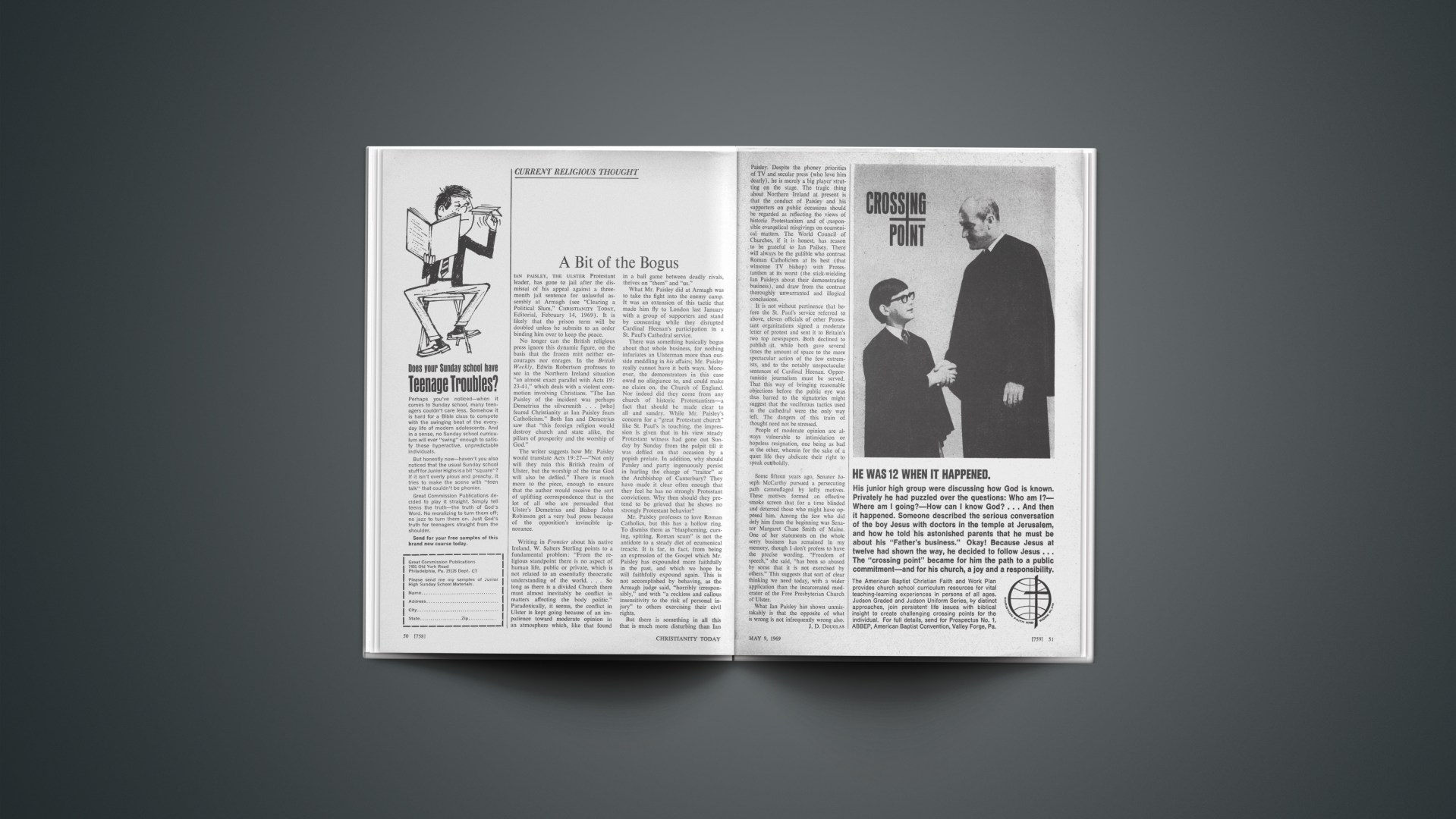
A Bit of the Bogus

Ian paisley, the ulster Protestant leader, has gone to jail after the dismissal of his appeal against a three-month jail sentence for unlawful assembly at Armagh (see “Clearing a Political Slum,” CHRISTIANITY TODAY, Editorial, February 14, 1969). It is likely that the prison term will be doubled unless he submits to an order binding him over to keep the peace.

No longer can the British religious press ignore this dynamic figure, on the basis that the frozen mitt neither encourages nor enrages. In the British Weekly, Edwin Robertson professes to see in the Northern Ireland situation “an almost exact parallel with Acts 19:23–41,” which deals with a violent commotion involving Christians. “The Ian Paisley of the incident was perhaps Demetrius the silversmith … [who] feared Christianity as Ian Paisley fears Catholicism.” Both Ian and Demetrius saw that “this foreign religion would destroy church and state alike, the pillars of prosperity and the worship of God.”

The writer suggests how Mr. Paisley would translate Acts 19:27—“Not only will they ruin this British realm of Ulster, but the worship of the true God will also be defiled.” There is much more to the piece, enough to ensure that the author would receive the sort of uplifting correspondence that is the lot of all who are persuaded that Ulster’s Demetrius and Bishop John Robinson get a very bad press because of the opposition’s invincible ignorance.

Writing in Frontier about his native Ireland, W. Salters Sterling points to a fundamental problem: “From the religious standpoint there is no aspect of human life, public or private, which is not related to an essentially theocratic understanding of the world.… So long as there is a divided Church there must almost inevitably be conflict in matters affecting the body politic.” Paradoxically, it seems, the conflict in Ulster is kept going because of an impatience toward moderate opinion in an atmosphere which, like that found in a ball game between deadly rivals, thrives on “them” and “us.”

What Mr. Paisley did at Armagh was to take the fight into the enemy camp. It was an extension of this tactic that made him fly to London last January with a group of supporters and stand by consenting while they disrupted Cardinal Heenan’s participation in a St. Paul’s Cathedral service.

There was something basically bogus about that whole business, for nothing infuriates an Ulsterman more than outside meddling in his affairs; Mr. Paisley really cannot have it both ways. Moreover, the demonstrators in this case owed no allegiance to, and could make no claim on, the Church of England. Nor indeed did they come from any church of historic Protestantism—a fact that should be made clear to all and sundry. While Mr. Paisley’s concern for a “great Protestant church” like St. Paul’s is touching, the impression is given that in his view steady Protestant witness had gone out Sunday by Sunday from the pulpit till it was defiled on that occasion by a popish prelate. In addition, why should Paisley and party ingenuously persist in hurling the charge of “traitor” at the Archbishop of Canterbury? They have made it clear often enough that they feel he has no strongly Protestant convictions. Why then should they pretend to be grieved that he shows no strongly Protestant behavior?

Mr. Paisley professes to love Roman Catholics, but this has a hollow ring. To dismiss them as “blaspheming, cursing, spitting, Roman scum” is not the antidote to a steady diet of ecumenical treacle. It is far, in fact, from being an expression of the Gospel which Mr. Paisley has expounded more faithfully in the past, and which we hope he will faithfully expound again. This is not accomplished by behaving, as the Armagh judge said, “horribly irresponsibly,” and with “a reckless and callous insensitivity to the risk of personal injury” to others exercising their civil rights.

But there is something in all this that is much more disturbing than Ian Paisley. Despite the phoney priorities of TV and secular press (who love him dearly), he is merely a big player strutting on the stage. The tragic thing about Northern Ireland at present is that the conduct of Paisley and his supporters on public occasions should be regarded as reflecting the views of historic Protestantism and of responsible evangelical misgivings on ecumenical matters. The World Council of Churches, if it is honest, has reason to be grateful to Ian Pailsey. There will always be the gullible who contrast Roman Catholicism at its best (that winsome TV bishop) with Protestantism at its worst (the stick-wielding Ian Paisleys about their demonstrating business), and draw from the contrast thoroughly unwarranted and illogical conclusions.

It is not without pertinence that before the St. Paul’s service referred to above, eleven officials of other Protestant organizations signed a moderate letter of protest and sent it to Britain’s two top newspapers. Both declined to publish it, while both gave several times the amount of space to the more spectacular action of the few extremists, and to the notably unspectacular sentences of Cardinal Heenan. Opportunistic journalism must be served. That this way of bringing reasonable objections before the public eye was thus barred to the signatories might suggest that the vociferous tactics used in the cathedral were the only way left. The dangers of this train of thought need not be stressed.

People of moderate opinion are always vulnerable to intimidation or hopeless resignation, one being as bad as the other, wherein for the sake of a quiet life they abdicate their right to speak out boldly.

Some fifteen years ago, Senator Joseph McCarthy pursued a persecuting path camouflaged by lofty motives. These motives formed an effective smoke screen that for a time blinded and deterred those who might have opposed him. Among the few who did defy him from the beginning was Senator Margaret Chase Smith of Maine. One of her statements on the whole sorry business has remained in my memory, though I don’t profess to have the precise wording. “Freedom of speech,” she said, “has been so abused by some that it is not exercised by others.” This suggests that sort of clear thinking we need today, with a wider application than the incarcerated moderator of the Free Presbyterian Church of Ulster.

What Ian Paisley has shown unmistakably is that the opposite of what is wrong is not infrequently wrong also.

J. D. DOUGLAS

Editor’s Note from May 09, 1969

An almost uninterrupted series of campus confrontations by New Left radicals has stretched on for more than a year. Our lead editorial this issue addresses itself to an important aspect of that problem. Even more important is a two-part essay by Harold Kuhn that deals with the whole question of academic freedom, a principle that lies at the heart of the university crisis. Readers will benefit from a careful scrutiny of these pieces.

In the larger perspective, the essay by Professor Reid speaks to the issues of dictatorship and amoral, humanistic democracy. He calls for a return to true democracy, which makes possible the freedoms Christians enjoy. The lead essay on the ascension of Jesus Christ comes at the appropriate time on the Christian calendar. But, as Professor Fry points out, Ascension Day is a “forgotten festival,” in many American churches. Virginia Mollenkott examines the conflict between Christianity and aesthetics and comes out solidly for a correlation between them.

Readers often ask how to determine the expiration date of their subscription by the address label. It’s simple. Look at the last three numbers on the label: 125 means the 25th issue of 1971; 010 means the 10th issue of 1970. In other words, the last two digits are the issue number and the third digit from the end is the year. Happy sleuthing!

NAE Hits Hard at Pornography

The National Association of Evangelicals, which reportedly experienced an awakening of its social conscience last year in Philadelphia, indicated in Cincinnati that perhaps only twelve months are needed to suppress any such stirrings of the inner man.

Most of the 1,200 delegates to the Cincinnati convention were over forty. They focused their Christian wrath on “The Moral Crisis in America” (read sex) but never said a mumbling word about racism in the Church, poverty, or alienation of youth, except in small meetings or corridor groups.

The backdrop of the stage in the Pavilion Caprice room of the Netherland Hilton, where the public meetings were held, consisted of a replica of a stained-glass window with the theme of the twenty-seventh annual convention, “A Vital Church—Concerned, Committed, Conquering,” in huge white letters on a dark blue curtain.

The backdrop was appropriate. The speakers seldom penetrated past the stained-glass window, and the delegates didn’t seem to object.

The only threat to the status quo was voiced offstage by the Rev. George W. Perry, president of the National Negro Evangelical Association (NNEA). “The race issue is at the core of every other domestic issue, and to be silent is passive,” he told this reporter. Why hadn’t he said that in his speech on the last day of the convention? “I didn’t have the time,” he said.

The articulate Negro minister did tell the delegates that it is difficult to understand race relations in an evangelical context. “In fact, we find the blacks don’t understand the word ‘evangelical,’ and frankly we doubt that some of you understand it either.” In the interview he said the NAE “is not geared to the needs of the black community—socially or spiritually. It will take black men to reach black men for Christ—both in the United States and overseas.” He did ask the NAE churches, however, to set aside a Sunday a year to take a special offering to support the NNEA’s programs.

(Perry also said his group is going to change its name to National Christian Coalition so its initials won’t be so similar to the NAE’s. When someone pointed out that the new initials would be those of the National Council of Churches, he said the NNEA might have to take a second look before becoming the NCC.)

The NAE resolution deploring the decline in morality made Sodom and Gommorrah look like bastions of Puritanism compared to America: “The cultural centers of many American cities are becoming cesspools of filth. Obscenity in its worst forms is sent through the mails with apparent impunity. Nudity has become open and flagrant on the motion picture screens of the land. At home sex vies with irreverence for domination of our television screens.”

The delegates also said they objected to public-school sex education courses offered without moral guidelines. Another resolution admittedly aimed at the U. S. Supreme Court urged Congress to limit the high court’s scope in setting aside or reversing state-court rulings in cases involving pornographic literature, on the basis that the lower courts are better judges of what constitutes community standards of decency than are the nine men in Washington.

Dr. Rufus Jones of Wheaton, past NAE president, agreed with the paper in principle but had some objections to its wording. “The answer to pornography is revival—not legislation,” he said. “There are those who would destroy our democracy and our judicial system, and I don’t want any part of it.” He then moved that an entire paragraph containing indirect reference to the Supreme Court be deleted. His motion was voted down and the resolution passed by an overwhelming majority.

A behind-the-scenes struggle was triggered by a resolution warning that federal control always accompanies federal funds and recommending that persons giving private gifts to schools get a tax break. The resolutions committee attempted to back off from the proposal and was not going to submit it. Dr. Clyde W. Taylor, the ubiquitous NAE general director who was author of the paper, cornered three members of the resolutions committee in the press room and convinced them they should put the resolution to a vote. It carried with only minor opposition—primarily from those whose denominations approve taking federal funds for their colleges, according to Taylor.

Commenting on the convention’s narrow scope of issues, Taylor stated: “We keep a close file of resolutions passed in previous years and don’t repeat them. Some years the conventions are pretty innocuous. Next year, we may have a knock-down fight over four or five issues.”

Taylor, who gets fidgety when called a lobbyist, made it clear that conservatives should sound their voices loud and clear in the halls of Congress. “Some of the sins of our nation apparently can only be remedied at the political and legislative level,” he said. Shades of the NCC—National Council of Churches, that is.

It would be unfair to say NAE members have no social concerns—it just happens that they exercise them more visibly in foreign countries. NAE’s international relief arm—World Relief Commission—has an impressive list of good works with its schools, hospitals, and food-distribution programs in Korea and Viet Nam. It was announced at the convention that the WRC would assume responsibility for administrating a 120-bed children’s hospital north of Da Nang. It was built by the U. S. Marines.

NAE conventions always attract top conservative biblical scholars and provide warm fellowship for those of like mind. Daily Bible studies conducted by the Rev. Stanley Mooneyham, newly elected president of World Vision, proved to be a spiritual oasis among the multitude of commission meetings, public meetings, private meetings, and dinner meetings. George M. Wilson, executive vice-president of the Billy Graham Evangelistic Association, was named “Layman of the Year.”

A Black Umbrella For Evangelicals

Young, revolutionary, nationalistic, are the words that describe the April 9–13 meeting of the National Negro Evangelical Association in Atlanta. Although attendance was abnormally small because of poor coordination on the national level and poor publicity on the local level, the mood was anything but one of defeat. Young people gathered from across the nation to give the convention an atmosphere of militant youthfulness. “Afro” hair cuts, and necklaces together with the African daishiki were in evidence on every hand.

The mood was set early as evangelist Tom Skinner propounded self-identity and black pride as a prerequisite to consecration. Jesus was a revolutionary and caused a revolution, said Skinner, and his disciples must do likewise. They must “dehonkify” their minds by throwing off the mentality of servitude and appreciate their own culture.

Missing were the pleas for integration one might have heard at such a meeting less than a decade ago. Now the cry is: black control of black institutions, cultural and social relevance, and racial pride.

It is to the credit of its early leaders that the NNEA, founded in 1963, recognized the need for an evangelical black bloc long before the black-power movement had gained any popular respect. Indeed, NNEA founders had to resist pressure from some who, in that day when integration was regarded as a supreme end, thought that such an organization was socially out of step and anachronistic.

While this year’s debates and discussions often seemed to reflect the secular black-power emphasis, there were significant differences. Speaker after speaker reaffirmed his lack of enmity toward the white community. Although the whites present were often expected to feel remorse for the guilt of their race, they were well received.

Often issues were muddled and embryonic. Youth proposed to take over all institutions for the evangelization and training of black people that are now being run by whites. In the much discussed issue of social involvement, it was generally agreed that black evangelicals are to be intensely involved in social welfare and crisis. Whether it be feeding the hungry or bringing pressure to bear on slum lords, social involvement was seen as the Church’s calling.

One distinction often distressingly blurred was that of the difference between action which is temporal in its effect and that which is eternal. An onlooker got the impression that there was no difference in some minds. However, an occasional speaker noted that the Gospel of personal salvation was the motivation of social involvement. Some spoke in favor of theological balance and the need for emphasis on the “whole counsel of God.”

Division was sometimes mentioned and often demonstrated. The “generation gap” was an ever-present reality. Some of the older generation seemed confused, some annoyed, and some frustrated. One prominent black leader listening to the eloquent presentation of a young militant could be heard responding, “Theories, theories, theories!” Yet while not all adults agreed with, or even understood, the vehement young radicals, most encouraged them. And no matter how much difference of opinion was manifested on specific issues, a warm spirit of community prevailed.

The what’s-in-a-name discussion continued throughout the convention. The term “Negro” was said to have a negative connotation of self-subjugation and inferiority, while the term “black” was filled with meanings of racial pride, self-confidence, and self-initiative. “Black is beautiful” turned out to be an important emphasis of the convention.

Strategy for the future was mapped out in semi-private meetings of the membership. Considerable organizational shuffling is designed to make operation move more smoothly. According to George Perry, president of the NNEA, the emphasis is to be on its role as “an umbrella underneath which evangelicals may find shelter,” and a fresh appeal to a broad spectrum of Christianity is planned. “Black evangelicals are going to have to join together if they are going to survive,” said Perry.

DAN ORME

Mormons: Visibly Staking A Witness

Early in June, U. S. housing and urban-development chief George Romney will be named “Churchman of the Year” by Religious Heritage of America. He will be the first of his faith to receive the award.

Few people in the political know in America would have trouble naming Romney’s faith; to a degree, his name and Mormonism have become fused in the popular mind. And few would question his receiving the award. Romney, for all his prestigious past and present, is a witnessing, tithing (he once sold a considerable portion of his stocks in American Motors when he headed it, to meet a tithing obligation) Mormon.

Back in 1887 fervor was running so high against Mormons for their polygamous espousals that Congress passed a law (later upheld by the Supreme Court) forbidding them the right to vote. Forty-three years earlier, Joseph Smith, their founder-prophet, was lynched in Nauvoo, Illinois, and the lynchers were aided and abetted by the military.

In those days the Latter-day Saints of Jesus Christ, as they called themselves, bent on “restoring the true Gospel” as it appears in the Bible with extraneous assists from the angel Moroni, numbered only in the tens of thousands. Figures released last month show worldwide LDS membership at 2.65 million, about two million of it in the United States.

Substantial growth is said to be taking place “back east,” as a Utahian or Arizonan would view it—the East that persecuted the “saints” so fiercely that they found the barren hills of the Great Salt Lake Valley a paradise by comparison. It was anything but that, of course. After losing many members in the arduous trek overland, the settlers fought locust plagues and drought, working to restore Deseret as a land of beauty and plenty much as zealously as they now evangelize—two by two—to restore the faith.

Visible evidence of Mormonism is springing up all over the East—both in Canada and in the United States. Two new “stake houses,” as the district centers are known, have been constructed in Washington’s suburbs. Now, thirty-eight stakes and twelve missions accommodate the 238,000 members in the East. A dozen to fifteen legislators return east each January to serve in Congress; this means that the Mormons, a disenfranchised cult only two generations ago, now have the highest ratio of legislators per thousand members of all major religious groups in the country.

Mormonism will soon gain increased visibility on the Washington horizon. In suburban Silver Spring, Maryland, on fifty-seven acres bought for nearly $900,000, a six-spired temple modeled after the inspiring Tabernacle in Salt Lake City will rise 120 feet into the air—the sixteenth temple to be raised throughout the world.

Miscellany

The Rev. Paul E. Toms was chosen to succeed Dr. Harold J. Ockenga as pastor of Park Street Church, Boston. Toms, a Fuller Theological Seminary graduate, did pastoral and evangelistic work in Hawaii and New Zealand before coming to Boston as an assistant to Ockenga.

Pope Paul VI will visit World Council of Churches headquarters during a trip in June to the International Labor Organization in Geneva.

John Wesley Lord of Washington, D.C., was elected president-designate of the United Methodist Council of Bishops.

Jan Cardinal Willebrands was named president of the Vatican Secretariat for Promoting Christian Unity. He has been serving as secretary, a post that now goes to Belgian-born Dominican Jerome Hamer, who is regarded as a conservative.

Forty-six Evangelical United Brethren churches that refused to merge with Methodists turned over $665,266 to redeem their properties. Six other congregations made separate settlements with the Methodists.

William Willoughby, Religious News Service correspondent, was named religious news editor of The Washington Evening Star.

Storefront Churches: Social Stabilizers

“They’re the most underrated group of men in a community,” Senator Harold Hughes said in an interview soon after he came to Washington this year. The former Iowa governor, a Democrat, was referring to Negro pastors. Hughes spoke out of his experience as a licensed Methodist lay preacher and as governor, which gave him the opportunity to study first-hand Negro living conditions in his state’s few sizable urban centers. “It was my sad duty to inform a convention of Negro ministers of the murder of Martin Luther King,” he said. “I was speaking before them when the news came.”

Evidence is impressive that what the senator said would be readily confirmed by responsible police officials around the nation. An analysis of ghetto nitty-gritty most likely will show that when the going gets roughest, the men and women preachers—especially those of the storefront variety—are the policeman’s best friends.

Storefront churches, often housed in a vacant theater or an abandoned store, are common in inner-city areas across the nation. Most are small, with twenty to 200 more or less regular attendants. But, spotted as they are where crime generates crime, their cumulative effect is a force any city would sorely miss if it were suddenly withdrawn.

In some cities, such as Washington, which now has a 70 per cent non-white population, black clergy groups organize along police precinct lines. By reckoning with their limitations, they are able to get practical results instead of being stalled on grandiose never-to-be-reached designs.

As Kenneth Dole, veteran religious news writer for the Washington Post, described the Second Precinct Clergymen’s Association, it has concerned itself “not with some particular project but with the general improvement of life where mean conditions offer the greatest opportunity for improvement.” The association includes 105 storefront and more imposing Negro churches.

Washington’s Second Precinct embraces a couple of square miles of America’s festering crime cancer. It takes men like the Rev. L. T. Rice, Corinth Baptist Church’s bulk of a man, to do the job others can’t do. Although much of his pastoral challenge is met on dark street corners, Rice says he’s never had a bad experience at night.

This well-educated pastor (B.A. from Lynchburg [Virginia] College, graduate work at Howard University) holds the respect of the community. There is no condescension in his approach to his street parishioners. Rice believes in using short words the people understand, and though mild-mannered and at times reticent, he can put things bluntly when that’s what is needed. Most whites seeking to minister where he does just wouldn’t get through.

Although Rice’s church is not of the storefront variety, he understands the plight of the part-time ministers, many of whom work as laborers or clerks by day. Only about 10 per cent, Rice feels, have other than the best of motives in carrying on such ministries. For the most part, there is little money to be gained. Rice, who has been pastor at Corinth Baptist for twenty-five years, started out in clerical work in government agencies forty years ago.

“I don’t find any trace of hatred toward whites within the storefront churches,” Rice asserted. “They feel we’ve all got to live together.”

Senator Hughes points out that whites often look down on Negro ministers because of their education lack. But up to a point, this lack proves to be an asset in their ministry, though Rice and many others wish there were a way to upgrade their training. White churches just don’t reach the needs of most blacks. In the major denominations, only about 2 per cent of their black constituents are in integrated churches. The rest are in all-black congregations of the denomination or in counterpart communions. If Negroes start coming into a neighborhood and its churches, the churches go black by default.

Even if whites showed a better attitude, however, the liturgy of most white churches would continue to hold little appeal for the black who is not bent on “whitening” his native cultural tendencies. A service where tambourines and music with “soul” are used gets across, whereas even the bouncy music heard in many fundamentalist white churches might not. Rice says that in the Second Precinct, 30 to 40 per cent of the storefront services are of the Pentecostal-Holiness format. Among American churchgoers as a whole, the figure is only 3 to 4 per cent.

Middle-class whites don’t speak the same language as ghetto Negroes, and a linguist has prepared a New Testament translation—soon to be published—in the ghetto street dialect. As Methodist theologian Dr. James H. Cone of Union Theological Seminary (New York) views it, the difference is more than syntactical. Whites concern themselves with situational ethics or the death of God or the meaning of life, but these are topics for the affluent society. “Whites may wonder how to find purpose in their lives,” Cone says, “but our purpose is forced on us and laid out for us.”

The philosophically more aware black either becomes a militant or else recognizes that blacks and whites are “in this thing together.” Some of the militants are working from within the churches, calling for black power within the structure, for recognition of Negro values, liturgy, and perspectives, and even for a “black theology.”

Most of the militants, however, are outside the churches. The Rev. Lawrence Smith of the 135-member Union Bethel Baptist Church in Chesapeake, Virginia, says that since World War II and the upsurge in the civil-rights movement, there has been a big falling away in church attendance among Negroes. Before the rights movement, Negro pastors were teaching their people that in this world they would have troubles and that they’d better adjust to them. But servicemen who had been around just didn’t buy that placid outlook. In time, rival groups began to arise and ask jeeringly, “What has the Church got to offer?”

Smith won’t discount the Church that lightly. “After all,” he said, “the Church has been the spearhead of all we have accumulated up until now. They’re saying our God is dead—that we killed him. In a way of speaking, they have something. Often, we have been talking one thing, doing another. It means we’ve got to keep going.”

Smith’s area has seen considerably more signs of black militancy than most other Southern urban centers. He says that to meet these ominous rumblings that threaten to alienate even more black parishioners, Negro churchmen must make the streets and alleys “our places of worship.” Too long we have been confining church work to the church,” he says. “The work we have to do is out in the field.”

The storefront churches do more for their own needy than the public suspects. Women tend to the needs of children with free-floating fathers. In this they are more tolerant than their white counterparts because they realize that’s the way things go in the ghetto. Although Negro believers might well concur with biblical standards on sex and divorce, Christian love will not let them turn aside the profligate person in need. Jesus didn’t scorn the prostitute, they point out.

Rice and the other members of the Second Precinct Association help when the landlord pinches too hard. They provide recreation programs and health aids, assist the police in crime prevention, and help down-and-outers get jobs or welfare help. When dealing with welfare recipients, Rice emphasizes the virtues of “starting small and growing big—there’s a lot more satisfaction in bringing home a pay envelope with money you’ve earned in it than staying on welfare.”

Despite their unpretentious, often tawdry look, the storefront churches are one of America’s best stabilizing forces. Ask the ghetto policeman.

Blacks May Boycott Methodist Publications

Pickets appeared last month at the Methodist Publishing House in Nashville and at several branches around the country, in a protest sponsored by Black Methodists for Church Renewal. The group wants the publishing house to join Project Equality, an interfaith effort promoting fair employment. Spokesmen said they may also boycott Methodist publications. Methodist officials have limited influence over the prosperous publishing house, which has been contributing about a million dollars a year toward clergy pensions.

Ulster: ‘The Gospel as a Club Raised’

Northern Ireland tottered nearer the brink of civil war last month. The uprising of April 19–20 followed a familiar pattern: a largely Catholic civil-rights demonstration in Londonderry, a counter-demonstration by followers of Ian Paisley resisting the one-man one-vote principle, and an inadequate police force caught in the middle. The situation was further aggravated by deep division in the ruling Parliamentary Unionist Party, the moral backing if not the physical presence of the outlawed Irish Republican Army, and the Communist penchant for fishing in troubled waters.

The relatively new factor in Ulster has been the emergence of a civil-rights movement of articulate militants representing the Catholic minority. This was climaxed in the astonishing election of Bernadette Devlin to the Parliament in London. She took her seat on her twenty-second birthday to become Britain’s youngest MP in 60 years, and within an hour she was on her feet delivering an electrifying speech. The five-foot miniskirted dynamo impartially lambasted Prime Minister Terence O’Neill and the Tories of Northern Ireland as well as Britain’s Harold Wilson and his socialist administration, Eire’s Prime Minister John Lynch, and the Paisleyites. She said she had been in Londonderry the previous weekend and had organized Catholic demonstrators after the news of her election. She said she wanted to insure that “they wasted not one solitary stone in anger.”

That evening in Belfast trouble erupted when Protestant thugs threatened to burn down three Catholic homes in a largely Protestant area. From prison Paisley reportedly instructed his men to take to the streets, and his wife led a demonstration of six thousand through Miss Devlin’s home town.

Miss Devlin was a psychology student at Queen’s University, Belfast, but dropped out to run for Commons. She said she represented oppressed Protestants and Catholics alike, although she herself is a Catholic. She has had to move from relative to relative as a precaution against night attacks by Protestant-extremists. The New York Times quoted her as saying that her courage “comes from my Christianity. I do it because I believe it is my Christian duty. If there were less bigoted religion in Ulster and more Christianity, there would be far less problems.”

CHRISTIANITY TODAY asked three well-known churchmen for comments on the situation. The Rev. A. J. Weir, clerk of the Presbyterian General Assembly, spoke of “immense hardening of attitudes,” and said too much publicity had been given to civil rights and not enough to responsible non-Paisley Protestants. The Catholic Bishop of Londonderry, Dr. Neil Farren, felt that the present serious situation has come about because young people are now “becoming aware of their rights and acting on them.” He mentioned that two-thirds of the Derry population is Catholic, “yet Protestants run the council.”

The Rev. Herbert Carson, Baptist minister in Bangor, attributed the trouble partly to Protestant acceptance of “the doctrine of equating the state and the Gospel. They feel they are fighting for both at the same time.” Carson said another reason was evangelical weakness toward condemning the ecumenical movement. Nevertheless he felt that Paisleyism was sadly misled. Carson saw the answer in preaching the Gospel to change people and concluded, “The great tragedy in Northern Ireland is that Catholics see the Gospel as a club raised.”

‘It Was Beautiful To Be In Nairobi …’

From a tiny office overlooking the beautiful and busy center of Kenya’s capital city Nairobi, which is rapidly becoming the crossroads for eastern Africa, a group of lay preachers and ministers have been conducting the largest and most extensive evangelistic mission ever attempted in an African city. The United Christian Mission to Nairobi began last October and expects to close its office this month. It was planned and executed by the united churches of the city in cooperation with African Enterprise, an interdenominational, interracial, and international team founded particularly to present Jesus Christ to the great urban areas of the continent.

“Only 6 per cent of the continent’s population live in its cities,” observes Michael Cassidy, the founder and leader of African Enterprise. “Yet this is the strategic 6 per cent of opinion-makers, whose spiritual and ideological commitments are shaping the destiny of the entire continent.” The purposes of the Nairobi mission were to win people to personal faith in Christ, to instruct them in Christian living, and to encourage them to see clearly their responsibility in the new nation of Kenya.

While the mission used the mass meetings as its main emotional focus, it adopted a multi-faceted thrust, geared to the multi-faceted community of Nairobi. It conducted home Bible studies and house-to-house visitations, a mission to the university and evangelistic meetings in the high schools, church-centered evangelistic meetings and training for laymen in personal evangelism, and television, film, and radio presentations of the Gospel.

The mission got under way at a time of great spiritual crisis. A crime wave was sweeping the city. People were becoming a bit restless about corruption and bribery in high places. Students at the nation’s single university had gotten on bad terms with the government and had been sent home for three weeks. Even traffic deaths were on the increase, culminating in the death of Kenya’s foreign minister a week before the start of the mission’s large rallies at the city square. For a city that was founded in part by missionaries, Nairobi’s spiritual life was at a very low ebb. But by the close of the mission it became clear that God had profoundly honored the faithful and outspoken manner with which his word had been proclaimed.

City ministers now report greatly increased church attendance, but they are happiest about the transformation within the churches. The ordinary Christian, on whom the major burden of the undertaking rested, has had the opportunity to test his capacity for personal evangelism. “I had never tried to preach before,” said a man who is chauffeur for an important government official. “But now I find that preaching is an exciting, vital part of a Christian’s life.” The mission also changed the outlook of the churches. “Without compromising the essence of the faith,” said a happy African minister who watched his congregation double in three months, “we are going to be more flexible and experimental in regard to forms of worship and evangelism. Literature, radio, and TV will feature prominently in our future planning and work.”

The mission has given the city a new conscience and a new mood. At the height of the mission, a “march of witness” was organized. It was a march with a difference. No cars were overturned, no embassies stoned, no documents or effigies burnt, no leaders denounced. Motorists politely pulled off the street to let marchers pass. It was beautiful to be in Nairobi on that day.

ODHIAMBO W. OKITE

New Scriptures For Soviets?

Wycliffe Bible Translators say they have won the consent of Soviet officials to begin linguistics work in the U.S.S.R. Wycliffe founder Cameron Townsend recently returned from the Soviet Union and reported that his organization will set up a new effort there through a Latin American liaison. It would be the first in a Communist land.

THREE JAILED CHURCHMEN FEARED DEAD IN UKRAINE

A pair of Ukrainian evangelical leaders and a Catholic bishop are reported to have died in Soviet prisons in recent months.

The two Protestants were identified as H. P. Wins and Joseph Bondarenko, who were prominent in a breakaway group and were presumably jailed for unauthorized religious activities. They died at the end of 1968, according to the Messenger of Truth, published by Ukrainian-American Baptists. Bondarenko reportedly was viewed by some as “the Ukrainian Billy Graham.”

Sources at the Vatican said that Bishop Basil Welychkowsky, who with a number of priests was arrested January 27 in the Western Ukrainian city of Lvov, died in a prison at Leopoli, also in the Ukraine. Welychkowsky had been consecrated secretly and is understood to have been part of a religious “underground.” It was reported that he had been apprehended while on his way to hear the confession of a sick person.

The Ukrainian Evangelical Alliance of North America says it has also received reports that on December 29 a court in Lvov handed out three-year prison terms to pastor Gregory Lukianchuk and brothers Basil Petlekha and Mykola Dacko. It was not clear what the charges were.

The prison deaths raised fears that Soviet authorities are cracking down hard on believers associated with groups not recognized by the government. Causes of the prison deaths were not immediately known, but observers fear that maltreatment may have well been involved. Dissident religious groups appear to be a growing problem for authorities in the Ukraine and other Soviet republics. There are signs that more and more converts are being won among young people. The Ukraine is the most Protestant of all the Slav countries.

Bishops Respond To Change: Is It Fast Enough?

The times, they are a-changin’ in the Roman Catholic Church, noted newly elevated Cardinal John F. Dearden of Detroit in a major speech to 216 brother bishops in Houston. “It is one of the basic realities of our time that in the church … if authority is to retain its credibility, it must function in a manner different than in the past,” said Dearden, president of the National Conference of Catholic Bishops. And the brethren all said “amen.”

But a suspicion lurking in many minds at the semi-annual meeting of the hierarchy last month was that the church isn’t moving fast enough. Mounting pressure for change was evident:

Candidates for the priesthood have declined more than one-fourth in number during the past three years; Catholic parochial schools face a financial and “confidence” crisis; the nation’s 167 Negro priests demanded (and got approval for) a separate national office for black Catholicism; and groups like the National Federation of Priests’ Councils (said to represent 38,000 of the country’s 60,000 priests) clamored for enforceable ways to settle the shrill crescendo of disputes between priests and their bishops—and got little satisfaction.

Mostly, the hierarchy reacted to problems predictably. Some long-range and somewhat sweeping changes are in the offing; traditionalist forces clearly won short-term victories.

With one hand, the prelates approved a national center to spark interest in religious vocations. With the other, they staunchly reaffirmed opposition to optional celibacy—despite a survey of ninety-five Roman seminaries in the United States that linked the celibacy issue to seminary dropouts and found that half the students frown on the no-marriage policy.

As one answer to the paucity of priests, the bishops stoked the fires of a new deacon-training program. These men—many will be only part-time church workers, and they may be married—will be able to do everything a priest can except hear confessions and say mass.

A long-term updating of seminary curricula was given impetus. Designed to give the priest-in-training a “vital integration of theological understanding and his life in Christ,” the new program will provide for theological centers in tandem with other disciplines, and for professional programs for the ministry distinct from those for teachers and theologians.

Chicago’s Catholic-education head Bishop William E. McManus, outlined the school crisis for newsmen poolside at Houston’s new Astroworld Motel. In his opinion, well-heeled Catholics could pay for their schools if they had a mind to. Instead, they’re plunking down money for trips to Europe, color TV, and other “necessities,” he said. Federal aid to education can help plug the gap, the amiable, leather-faced prelate added.

New Cardinal John J. Wright, acknowledged golden throat of the hierarchy—soon to be transferred to the Vatican Curia—related the church’s response to the urban crisis and scored social actioneers who neglect gospel preaching. “The church itself,” he averred, “is not a competitor with or substitute for the health and welfare departments.…”

The bishops also sent off to Rome for ratification a set of twenty-six new norms that would speed and ease marriage annulment procedures.

There were signs that the long and closely guarded church financial secrecy may be cracking under lay pressure.1Two Protestant groups that do not divulge financial data are the Christian Scientists and the Mormons. Cardinal Terence J. Cooke has headed a committee on “financial accountability” for at least six months, he revealed offhandedly, and some dioceses now publish financial statements. So far, the Cooke committee’s major work appears to be an “education program” stressing public benefits of church tax exemptions.

For the first time, outsiders could attend morning addresses to the bishops. But blue-uniformed security guards monitored doors to the Astroworld Sun Room, where closed business sessions were held, and combed the interior for bugs.” No policy change is in sight, Dearden said.

“Even our determination to move fast is thwarted by … circumstances that are complex,” he remarked in a summary of conference accomplishments.

RUSSELL CHANDLER

Georgia Court Again Backs Congregations

Georgia’s Supreme Court has laid the groundwork for still more church property litigation in its response to the U. S. Supreme Court decision in the landmark Savannah cases.

The Georgia justices decided unanimously that since the nation’s top tribunal threw out the doctrinal element of the state’s implied-trust theory, it left them no choice but to disregard the entire theory. Thus, the court ruled, the Presbyterian Church U. S. has no interest in the property of Hull Memorial and Eastern Heights Presbyterian churches. The decision concluded that the deeds clearly vest titles with the congregations. New appeals are planned.

Key sentence in the latest decision: “Since Georgia chose to adopt the implied trust theory with this element as a condition, this court must assume that it would not have adopted the theory without this mode of protecting the local churches.”

Both congregations left the church in April, 1966, charging that the General Assembly and some of its agencies had violated its constitution. A county-court jury agreed that there had been “substantial departure” from the church’s original tenets. In January, 1968, the Georgia Supreme Court upheld the county decision, ruling that the congregations had a right to take their property since the denomination had broken its trust.

Then the case was appealed to the U. S. Supreme Court, which ruled that the doctrinal dispute could not be decided by the civil judiciary. It ordered Georgia to decide the matter on the basis of neutral principles of law.

Officials of several denominations have kept a close eye on the litigation because of the possibility that it may set precedents affecting their churches.

ARTHUR H. MATTHEWS

GRAPE WORKERS’ ABOUT FACE

Cesar Chavez doesn’t want his grape workers to be covered by the National Labor Relations Act after all. The National Council of Churches and the U.S. Catholic bishops have been trying to help Chavez by urging legislation to bring his union under the NLRA. But Chavez told newsmen in April that 1947 and 1959 amendments to the Wagner Act of 1935 would impede his union and help the growers.

Presbytery Mergers Win Key Vote

Commissioners gathering in Mobile for the Presbyterian U. S. General Assembly found they had to face questions that most of them thought had been settled before they arrived.

Just nine days before the denomination’s top court convened, two presbyteries reversed their earlier votes on a proposed constitutional amendment allowing presbyteries to unite with counterparts in the United Presbyterian Church U. S. A. Until North Alabama and Mobile presbyteries switched their votes, the issue had been lost by a vote of 38 to 39. With the reversals, the tally stood at 40–37.

Opponents of the union-judicatory provisions immediately readied challenges, questioning procedures used to get the votes switched.

The amendment was one of two permitting closer relations with United Presbyterians that were voted on in the presbyteries during the past year. The other would have permitted synods of the two denominations to merge. It lost by a wider margin, however, so advocates of union judicatories pressed only for reversal of the presbytery provision.

Similar amendments have already been enacted in the United Presbyterian Church, but they are not effective until parallel action is taken in another denomination.

In the Presbyterian Church U. S. amendments to the constitution must be approved by the General Assembly, then by the presbyteries, and finally by another General Assembly. Consideration of these proposals has been confused by disagreement over the required majority in the second step. Proponents of union judicatories have contended that only a simple majority of the presbyteries must approve. Opponents of the amendments (including some leaders who favor merger of the two denominations but not “piecemeal” synod-by-synod or presbytery-by-presbytery merger) contend that a three-fourths majority is necessary. The disagreement stems from the fact that the constitution requires a greater majority for the approval of unions.

The procedural question ceased to be an issue when the proposal failed to gain a simple majority. But with the votes now switched, commissioners were faced with both questions again.

ARTHUR H. MATTHEWS

Christianity in England

The current religious situation in England is woefully uncertain. Obviously an academic year in Cambridge—with occasional visits to London, Oxford, Cardiff, and other centers—hardly qualifies one for pronouncing final judgments. And Cambridge weather, notoriously grey and bleak, may limit visibility. For all that, the university’s changing thought patterns remain creative, often brilliantly so at scientific frontiers. But however frequently one sees the term, there is no professional group of “Cambridge theologians,” nor is there a “Cambridge theology.” Cambridge has, rather, a changing constellation of academic stars whose views run the gamut from moderate evangelicalism to radical Bultmannianism.

A deliberate break with logical positivism, which Cambridge philosophers popularized three decades ago before Oxford’s addiction to it, is seen in the fact that the theory is seldom any longer expounded except in critical context. But positivist philosophy still has a purgative effect. However much the metaphysical “veto” may now be rescinded, the widespread aversion to metaphysical affirmation still remains; philosophers of religion tend not to cast their vote.

England today has no philosophical “schools” or “movements” as in the past. The philosophers and theologians (and there are few of the latter) are “waiting for Godot.” Perhaps some Continental scholar will emerge to shake neo-Protestant theology free of Kant’s baneful influence that extends from Ritschl through Barth to Bultmann. Few leaders seem convinced that process-theology presents either coherent philosophy or adequate Christianity.

Yet the Cambridge mood has some noteworthy features. For one thing, the historical resurrection of Jesus Christ from the dead is rather widely asserted. Professor G. W. H. Lampe speaks only of a “spiritual” resurrection to which he struggles to give objective and external basis, but Professor Donald MacKinnon contends for more. Professor C. F. D. Moule insists that the resurrection of Jesus Christ offers the only convincing explanation of the origin of the New Testament and of the Christian Church; he is prepared to believe—as are a growing number of German theologians today—the empty-tomb report.

There are other facets of the Cambridge scene. One is an almost unquestioned confidence in universal salvation, predicated on a commitment to ultimate divine love. This issues in flat repudiation of propitiatory atonement and in rejection of Jesus’ “hard sayings,” as well as of other New Testament passages indicating final judgment of the lost. Another facet is the absence of any articulate doctrine of divine revelation. While the dialectical-existential internalizing of divine disclosure is widely scorned (Professor D. E. Nineham’s Bultmannian commitment is the outstanding exception), even those who consider revelation a mental concept seem never to clarify just what universally valid truth it conveys. In short, revelation is sketched so largely in terms of personal-inferential factors that its propositional content is extremely nebulous. Any authoritarian view of Scripture is dubbed passé.

On the evangelical side one must recognize the continuing vitality of the Christian Union (in both Cambridge and Oxford), the impressive number of evangelical faculty members in fields other than divinity and philosophy, the growing significance of Tyndale House as an evangelical research center, the gratifying number of evangelical churches in Cambridge, and the evident vitality of dedicated laymen.

Humanly speaking the ecclesiastical outlook in England is not promising. While this may be the great generation of ecumenical advance and of hierarchical mergers, people’s interest in the churches as such continues to wane. Church attendance is low, on the average; in London, All Soul’s (Langham Place) is an exception in attracting a large Sunday-evening gathering. Many persons who surrendered Christian metaphysics and church identification but hoped to cling to the “moral example” of Jesus—encouraged by the “Gifford Lecture” type of public-school religious instruction—have now also switched to another moral code.

The ecumenical picture looks bleak. The Anglican-Methodist merger proposal has been forthrightly attacked by Anglican and Methodist evangelical dissentients as built on ambiguity. Claims that Methodism would inject an evangelical ingredient seem to overlook English Methodism’s long remove from its heritage. Moreover, if the merger succeeds, it is likely to create a new protesting denomination as a byproduct.

Nor is evangelical Christianity in an enviable position. Face to face with an unparalleled opportunity of leadership, it is hurtling, nonetheless, toward division. Outnumbered and outmaneuvered when evangelist Billy Graham came to London for his 1954 crusade, evangelicals united, whatever their ecumenical alignment or non-alignment, and found new strength in evangelistic cooperation. The Evangelical Alliance gathered momentum, and The Christian and Christianity Today widened evangelical support. But within half a generation two factors seem to have polarized evangelicals into divergent groups. The first was the appeal Dr. Martyn Lloyd-Jones made to English evangelicals to “come out” of the ecumenical polyglot. The other was the Keele Congress, at which 1,000 evangelical Anglicans reaffirmed their evangelical faith and resolved to maintain their witness within the conciliar movement.

Convinced that the historic denominations have drifted beyond recovery, the anti-ecumenical British Evangelical Council is committed long range to an evangelical alternative. Most of its 500 clergy sympathizers are independent, often in small mission-type churches. This group is forging its own new link alongside the Evangelical Alliance.

Anglican evangelicals, numbering some 2,000, many of them younger men, are by far the most significant body of evangelical clergy in England. Their theological colleges have large enrollments. And over the past decade their strength has grown so markedly that the archbishop’s commissions can no longer overlook them. They have made inroads even into liberal pulpits, and one of their number, David Sheppard, has recently been named successor to the controversial Suffragan Bishop of Woolwich. But their primary denominational strategy siphons them away from the Evangelical Alliance.

A further polarization stems from the reemergence of Reformed theology in the last twenty years. Some contributing factors here have been Dr. Lloyd-Jones’s preaching, the annual Puritan Conference, Banner of Truth republications, and the writings of Dr. James Packer, now warden of Latimer House, Oxford. Reformed Anglicans are disposed to remain in their church unless the doctrinal stance of the Thirty-Nine Articles is altered. But some Anglican evangelicals prefer a less schematic Christianity with larger emphasis on evangelism.

It is increasingly apparent that the cause of the Gospel is at stake in England. But evangelical Christians seem still to lack the proper multi-sided conference table for discussing peace negotiations.

CARL F. H. HENRY

Apple PodcastsDown ArrowDown ArrowDown Arrowarrow_left_altLeft ArrowLeft ArrowRight ArrowRight ArrowRight Arrowarrow_up_altUp ArrowUp ArrowAvailable at Amazoncaret-downCloseCloseEmailEmailExpandExpandExternalExternalFacebookfacebook-squareGiftGiftGooglegoogleGoogle KeephamburgerInstagraminstagram-squareLinkLinklinkedin-squareListenListenListenChristianity TodayCT Creative Studio Logologo_orgMegaphoneMenuMenupausePinterestPlayPlayPocketPodcastRSSRSSSaveSaveSaveSearchSearchsearchSpotifyStitcherTelegramTable of ContentsTable of Contentstwitter-squareWhatsAppXYouTubeYouTube