On Drawing Lines

Fortunately I picked up an expression from the Spaniards recently: “I am very sorry, but to cry I cannot.” For the first time in my life this gives me a kind of middle ground for sadness between endurance and grief, and it serves beautifully as I try to absorb Jackie Kennedy, Onassis, Cardinal Cushing, and the Roman Catholic Church.

All kinds of people are passing judgment on Jackie and Onassis, and I don’t care to join the troops. I try to keep reminding myself that nobody really knows enough to pass a judgment on anyone else, especially if he tries to get into the realm of motives. If we know ourselves, we know that we operate constantly from mixed motives; and yet we constantly tend to judge somebody else’s motive sharply and harshly.

Loneliness is a disease for which there are no very good cures and in which time stretches out and life seems to be lived on dead center. In Jackie’s case it was a loneliness subjected constantly to the public gaze. Maybe she now wants to get away from it all. How better than to come under the shadow of one who has the money and therefore the power to protect her? But this is only one man’s guess, and we shall “leave her to God.”

Cardinal Cushing is something else again. He is a man of great heart and broad sympathies. As someone so wisely put it, “Young men know all the rules; old men know all the exceptions.” I think I am old enough to sympathize with the Cardinal. A man does not wear his red hat all the time, and I am sure that in his long interviews with Jackie he was more concerned with his sympathies than with legalism. James Harper once said, on the subject of universalism, something to the effect that “one could entertain a pious hope that all men will be saved.” We all have our “pious hopes,” and it is desperately easy in a sad situation to swing over on the side of a kind of universal redemption for everybody. No one who has listened to some other man’s outcry can find it easy to hold the line on his legalism.

Such things being so, there is still a problem. Society has never figured out what to do about the hangman or the policeman or the judge. All these men are necessarily used by society to do what society requires, and they are in the official position of letting the law take its course and insisting that law does take its course even when their heart is against their head. No man is qualified for public office, especially public office that requires harsh action, unless he sees his duty to the law instead of to his sympathies. It can be argued that the law is not what it should be; but he represents the law just the same, and he either does his job in that position or he moves out. This accounts, I am sure, for Cushing’s statements regarding his early resignation. He cannot stand to the law of his church because he cannot see the law active in at least one case that has come under his pastoral care.

This still leaves the problem of what to do about structure. No life and no organization can hold together without discipline and at least some sort of framework. It was this discipline and this framework that Cushing was called on to represent. If a Cardinal can slip his moorings, what can a weaker man—a parish priest, for example—do? Is there a Roman Catholic Church that has definition, and, if not, is there a “thing” that can be defined or described as the Roman Catholic Church? The Roman church could hardly have endured as it has without a sacrificial loyalty to the definitions and maintenance of its form.

Meanwhile there is a complex and matrix of rules and regulations; even in our society of fluid standards, to allow the position to become indistinguishable is to destroy the structure. The Roman Catholic Church being what it is now, no Cardinal by virtue of his office has any freedom at all in some matters.

It is easy, of course, for a Protestant to point the finger at the Roman church. I don’t care to discuss that matter here and now. Rather I should like to take the finger we point at Rome and point it at ourselves. I have argued for a long time that there is a cast of mind that constantly allows for slippage when issues before us begin to sound a little harsh as applied with discipline and finality. This problem in Protestantism can begin in all kinds of places. One can think of the old disciplines inside the official bounds of the church by which serious-minded men by virtue of their office said that some people could stay in the church and that others were excommunicated. The temptation of session members was to say, “Who are we to pass judgment on our fellow men?” The answer, of course, is that no one has a right to pass judgment on his fellow man, especially in terms of excommunication, if he thinks about himself as only a man; but as an official of the Church he still faces the requirements of his office. He is not passing a judgment on the law. He is really deciding that the law should take its course. If he feels like a hangman when he is doing this, he reminds himself that it is no place for feelings.

In the larger sweep of things, Protestants are casting about in all directions to determine what the structure of the Church is and where they will to hold the line. General attempts in most denominations to recast their confessions and statements of faith simply illustrate the uneasiness generally felt over trying to bring to bear on others what the Church says it is and what the Church requires. I argued one time with another man about what constitutes the essence of Protestantism. “Surely,” I said, “there must be some way of saying that this man is a Presbyterian and that this man is not—even by his own choice if not by our requirements.” My friend argued that the important thing was that we are not supposed to be Presbyterians but Christians. To this I can only answer that the attitude of mind that refuses to draw lines around a denomination will eventually refuse to draw lines around a whole religion. The ecumenical movement is illustrative of this constant chipping away of differences for the sake of a larger wholeness. I simply want to point out that unless lines are drawn somewhere they will not be drawn anywhere, and that it is always painful to take a stand on matters, wherever you take your stand. I am sure it would have hurt Cardinal Cushing grievously to take a stand for Rome against Jackie. Would he argue from this that there is no place for a Roman Catholic or a Presbyterian or even a theist to take a stand with the recognition that the stand, whatever it is, will require hard discipline and will certainly look harsh to those who would try to blur the lines?

So it goes. You can call a man lost when he doesn’t know where he is. Just where are we in defining the Church?

ADDISON H. LEITCH
100 Artists in Search of a Bonfire

One hundred Christian artists took to the desert last month to discuss how they might achieve greater integrity in their art and use it for more effective Christian witness, as the Fellowship of Christians in the Arts, Media, and Entertainment held its first national conference in the lush oasis of Palm Springs, California.

Conference chairman Irvin “Shorty” Yeaworth, Jr., of Valley Forge Films called the new attempt at communication among Christian artists “an idea come of age.” Producers, directors, writers, broadcasters, musicians, artists, performers, and mass-media specialists from across the nation grappled with the problems and possibilities of the arts from a Christian perspective. Their discussions gave promise of a great stride forward in the quality and effectiveness of the arts in pursuit of Christian goals.

A seminar on motion pictures, chaired by actor-producer Don Murray (The Hoodlum Priest), stressed the need for honesty in art. He stated, “Christian art often fails not because it is offensive but because it is boring. It is boring when it is dishonest. Our films can be as exciting positively as erotic films are negatively.”

Participants recognized two problems inherent in making Christian films for the commercial market: people’s hostility toward the person of Jesus Christ, “who cuts through make believe,” and the necessity that such films make money. Discussants stressed that Christian film-makers must “resist using the financial yardstick as a measure of success” and depend on the Holy Spirit to use their efforts to achieve God’s purposes.

Ray Robinson, associate director of Baltimore’s Peabody Conservatory, led a discussion on new forms of expression that included the presentation of “The Day of Resurrection,” a new work by California composer Fred Prentice. Incorporating alealoristic (“chance”) music—a combination of crowd noise, bells, brass instruments, and choir—the enthusiastically received composition exemplified a modern style in which the conductor-performer becomes a creator by the way he combines the diverse elements.

Robinson called for the fellowship “to criticize, tear apart, and build up the works that are performed by us and then go back to Baltimore, Pasadena, or wherever and do our thing as creators—as Christian artists.”

Ted Nichols, music director for Hanna-Barbera films (“The Flintstones”) and California State College at Los Angeles, challenged conferees to uphold the highest standards in their arts: “Instead of giving the image that a Christian has to be a fuddy-duddy, why can’t we be the best? We’ve got the best help in the world, so why not be the best? Some of us are good at reaching the old saints, some the new saints, some the young saints. Let’s reach the ones we think we should reach.”

Attention was focused on the “communications revolution” as journalist-missionary George Patterson of Hong Kong reported on new developments in satellite communication that soon will make possible transmission of signals “to any home in any country from any home in any other country.” He told of an extensive training program already under way in Hong Kong that is preparing Christians for future service in international broadcasting. He urged Christians to seize new opportunities provided by the communications revolution, stressing that “if we are to have an impact on our times, it must be on the basis of a spiritual revolution. We must act as if God lived and let him speak through us.”

Fellowship President Jerome Hines, Metropolitan Opera basso who is now appearing in the Lincoln Center production of La Boheme, was unable to attend. Instead, he addressed the conference by telephone from backstage at the Met. Conferees later viewed an excerpt from his highly acclaimed Christian opera, I Am the Way (see January 5 issue, page 41), which played to a packed house at Lincoln Center last Palm Sunday.

The production’s director, Derek de Cambra, told how his own Christian conversion took place during an earlier presentation of the opera, when he sang the role of Andrew in the Last Supper scene. After the chalice was passed to him, he found himself somehow unable to raise it to his lips, so gripped was he by the message of the Gospel. Then Hines, playing the role of Christ, perceived his difficulty and departed from the script to say, “Drink, my son.” De Cambra drank, and at that moment experienced “a dying to self and a rising to new life.”

De Cambra told the fellowship: “Religious drama is not intended that you might amuse yourself with it and kindle a blaze which should only serve to attract and dazzle the eyes of man. Religious drama is intended to be the means of leading both performers and spectator to the Father of All Light.” Of talent, he said, “Great powers and natural gifts do not bring privileges to their possessors so much as they bring duties. The talents granted to a single individual do not benefit himself alone but are gifts to the world; everyone shares them, for everyone suffers or benefits by his actions.”

Other conference highlights included a preview of Tail of the Cock, a film by Murray that received mixed reactions; a warm personal greeting from Dale Evans Rogers; an open-air worship service in the desert; and distribution of the first issue of Expression, the fellowship’s slick and provocative semi-annual journal, ably edited by Yeaworth. Among contributors are Melvin Lorentzen of Wheaton College and Bedford Center, John McCandlish Phillips of the New York Times, Asia expert Patterson, writer Elisabeth Elliot, RCA record producer Jim Fogleson, and Joseph V. Noble of the Metropolitan Museum of Art.

“Christians in the arts,” said Yeaworth, “are like logs burning off in a swamp. It’s time we got together and had a bonfire.”

Miscellany

The U. S. Tax Court ruled a Roman Catholic couple could not deduct tuition payments to a parochial school as a charitable “contribution.”

A Minneapolis Tribune poll of college students found these percentages of regular church attendance: among freshmen, 46; sophomores, 41; juniors, 32; seniors, 29; graduate students, 25.

West Coast mediums and spiritualists report tremendous interest in the wake of Bishop Pike’s televised séance. Evangelicals are planning to distribute Scripture portions to every home in the Dominican Republic and Puerto Rico.

Inflation has hit even the Communisthunting Church League of America. Starting January 1, only $25-a-year supporters can get information from League files on individuals and organizations.

Morality

New York Mayor John Lindsay ordered special police surveillance of churches and synagogues after the eleventh in a series of desecrations of Jewish schools and synagogues in recent weeks. Lindsay said investigation indicates no one racial or religious group is responsible for the incidents, despite lingering animosities from the school strike.

The U. S. Court of Appeals in New York voted 2–1 to overrule a jury and permit distribution of a Swedish film, I Am CuriousYellow. The decision admits the film has more explicit and “unusual” sexual content than any movie previously permitted.

An American Civil Liberties Union chapter, urging liberalized laws in New Jersey, said women have a “civil right” to end unwanted pregnancies by abortion.

Two women convicted of prostitution several times in St. Louis filed a suit claiming city laws are unconstitutional and limit their rights to “free travel and association.”

The Swedish government’s campaign to cut drinking of hard liquor reduced liquor sales 4 per cent and public drunkenness 7 per cent, with a sharp rise in beer and wine consumption. A parliamentary committee has recommended an end to all liquor advertising.

The International Narcotics Control Board said in Geneva that use of sedatives and such drugs as LSD has reached “epidemic proportions,” particularly in the United States, Sweden, Britain, and Holland, and urged a draft treaty on controls.

The Pearl Buck Foundation estimates that U. S. servicemen in Thailand have fathered more than 2,000 illegitimate children in the past four years.

DEATHS

Q. BERNICE MATTHEWS, 41, teacher at a Sudan Interior Mission women’s college in Omu Am, Nigeria; killed instantly with two students when a water heater exploded.

Pilot MAX MEYER and MRS. HARRISON GOODALL, Christian Church missionaries, and MRS. MARY HOYT, Catholic missionary nurse; in the crash of a plane missing since October 13, in dense rainforest 130 miles east of Mbandaka, the Congo.

MARY BORDEN, popular British novelist whose Mary of Nazareth and The King of the Jews gave a man’s-eye view of New Testament stories.

NOBLE C. POWELL, 77, Episcopal bishop of Maryland for two decades; in Baltimore.

RUTH DADO, 21, accidentally shot to death by her Baptist father who was aiming at her Roman Catholic fiancé, during a quarrel over which church would perform the marriage; in San Jose, California.

Personalia

Herbert G. Klein, California editor named director of communications for the Nixon administration, is an elder (currently inactive) in La Jolla Presbyterian Church, whose minister is well-known evangelical Louis Evans, Jr.

Julie Nixon and David Eisenhower plan to be married by the Rev. Norman Vincent Peale December 22 at Marble Collegiate Church, New York. Evangelist Billy Graham could not accept an invitation to participate because he will be ministering to troops in Viet Nam over Christmas.

Minnesota Governor Harold LeVander named Methodist minister Emery Barrette, a council of churches juvenile-court chaplain, as executive director of the Governor’s Crime Commission. Republican Barrette failed to unseat Congressman Joseph Karth in last month’s election. Lutheran pastor J. Millard Ahlstrom will be a crime-prevention aide.

Governor Lester Maddox named Southern Baptist home-missions staffer T. Edwin Carter and other Baptist ministers last spring to a prison-reform commission, then called him a liar when Carter and company attacked operations at a Georgia public-works camp.

Episcopal priest Earl Neil, Jr., of St. Augustine’s Episcopal Church, Oakland, California, is on the national advisory cabinet of the Black Panthers and says the militant group’s membership is growing rapidly.

The Rev. David Poling attacked use of his late father Daniel Poling’s name in a newspaper ad by the Clergymen’s Committee on China, and called it a “calculated smear” against the National and World Council of Churches.

Father James Groppi, Catholic civil-rights leader in Milwaukee, cut ties with the NAACP but denied he had been spurned because he is white.

United Church of Christ layman Philip Stull, 23, was reduced to the lowest rank and sentenced to two months of hard labor by a court martial at Minot Air Force Base, North Dakota, because he insisted on wearing a small gold cross on his uniform.

Catholic priest and orphanage director Robert Nikliborc, who led a double life as an electronics executive, was sentenced to two years in prison for not filing two income-tax returns.

Anglican Bishop Robert Mize, Jr., evicted from South Africa last summer, has been reassigned to western Rhodesia. New Zealand’s Anglican Bishop John Holland will take over the 11,500,-000-square-mile Diocese of Polynesia early next year.

Dean Jesse Trotter of Virginia Theological Seminary (Episcopal) has resigned his post to teach at the school.

Church Panorama

The American Church Union’s monthly is asking Episcopal Church officials to guarantee property and pension safeguards if the denomination splits over the Consultation on Church Union. The Living Church, meanwhile, says “drastically shrunken” pledge income is reported in many areas.

Latter-Day Saints plan to build a lavish temple, their first in the eastern United States, on a fifty-seven-acre site in Maryland near Washington, D. C. The church has nine of the ceremonial centers in western states, and four overseas. Washington’s best-known Mormon, J. Willard Marriott, said presidential inaugural plans will inclue a concert by the Mormon Tabernacle Choir.

The Lutheran Church-Missouri Synod plans to raise $1 million in a national drive to provide better housing for the poor. United Church of Christ congregations in Rhode Island rejected membership in Project Equality, preferring to emphasize job training.

Bankers Research reports that C. Edward Johnson of the Minneapolis Council of Churches thinks church loans—sometimes bad business in recessions—may be in danger despite projected future prosperity because of population mobility and young adult indifference.

New York City’s Protestant Council will be renamed “The Council of Churches of the City of New York” on January 1, opening the door for Catholic membership. Louisville area clergy from eighteen denominations formed an Evangelical Fellowship distinguished from the “liberal” Christianity seen in the local council of churches.

Membership of the United Church of Canada’s 152 congregations in the Toronto area has dropped 5 per cent, to 92,500, since 1963. In about the same period, Sunday-school enrollment dropped one-third, and area population increased 16.7 per cent.

A front-page editorial in the Vatican daily rebuked the lay-run U.S. weekly National Catholic Reporter for trying to “derail” traditional doctrine.

When the Assemblies of God enters French Guiana next year it will have works in all Latin American lands. The denomination hopes to get one million correspondence students of the Bible around the world by 1971.

Editor’s Note from December 20, 1968

Thanksgiving yields to Christmas, and this season of the year brings to mind the events that speak of God’s plan of salvation for men. Once again we return to the cradle at Bethlehem that held, in human form, the incarnate God who was made flesh and dwelt among us. Then we go to Calvary’s cross, where the Son of God offered himself as an atonement for man’s sin and opened the gates of Paradise to all men. His sacrificial death was crowned by his resurrection, which demonstrated his victory over hell, and his ascension which proclaimed to all that his sacrifice was acceptable to the Father. This is the story of Christmas, but it is not all of it.

We wait for the consummation. God has not finished his work. His Son will come again from heaven in power and great glory. Sin will be abolished, wrong will be righted, the earth will be renewed, and men will live in peace with each other. The sword will become a plowshare and the spear a pruning hook, and men will learn war no more.

Every Christmas men pause from their pursuit of wealth and fame, from their ploys for power, and from their senseless killing of one another, to pay tribute to the babe of Bethlehem. And knowingly or unknowingly they bear testimony to the hope of all men for a golden age of peace when Christ returns. Merry Christmas!

Arab Refugees Dread White Christmas

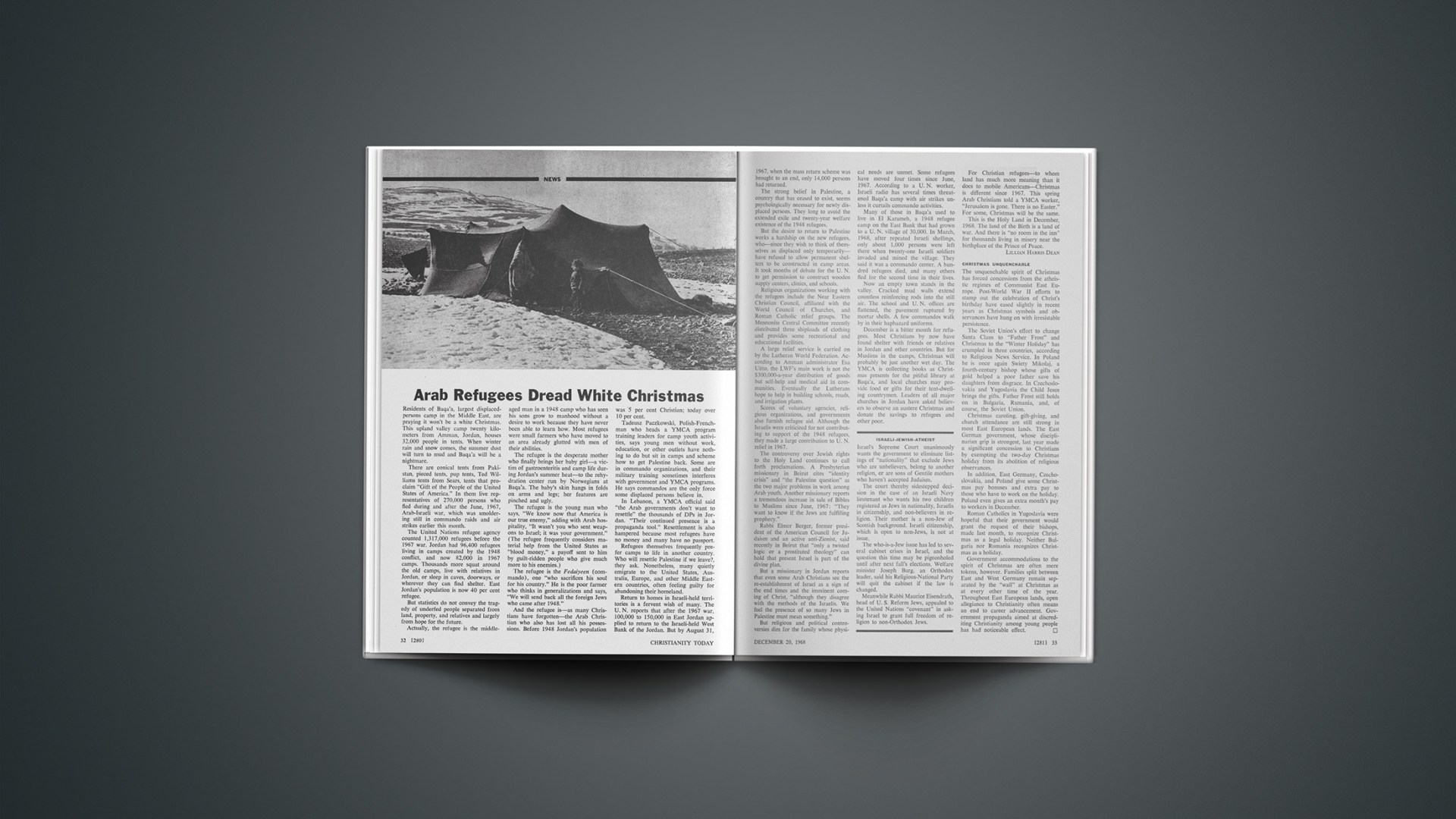
Residents of Baqa’a, largest displaced-persons camp in the Middle East, are praying it won’t be a white Christmas. This upland valley camp twenty kilometers from Amman, Jordan, houses 32,000 people in tents. When winter rain and snow comes, the summer dust will turn to mud and Baqa’a will be a nightmare.

There are conical tents from Pakistan, pieced tents, pup tents, Ted Williams tents from Sears, tents that proclaim “Gift of the People of the United States of America.” In them live representatives of 270,000 persons who fled during and after the June, 1967, Arab-Israeli war, which was smoldering still in commando raids and air strikes earlier this month.

The United Nations refugee agency counted 1,317,000 refugees before the 1967 war. Jordan had 96,400 refugees living in camps created by the 1948 conflict, and now 82,000 in 1967 camps. Thousands more squat around the old camps, live with relatives in Jordan, or sleep in caves, doorways, or wherever they can find shelter. East Jordan’s population is now 40 per cent refugee.

But statistics do not convey the tragedy of underfed people separated from land, property, and relatives and largely from hope for the future.

Actually, the refugee is the middle-aged man in a 1948 camp who has seen his sons grow to manhood without a desire to work because they have never been able to learn how. Most refugees were small farmers who have moved to an area already glutted with men of their abilities.

The refugee is the desperate mother who finally brings her baby girl—a victim of gastroenteritis and camp life during Jordan’s summer heat—to the rehydration center run by Norwegians at Baqa’a. The baby’s skin hangs in folds on arms and legs; her features are pinched and ugly.

The refugee is the young man who says, “We know now that America is our true enemy,” adding with Arab hospitality, “It wasn’t you who sent weapons to Israel; it was your government.” (The refugee frequently considers material help from the United States as “blood money,” a payoff sent to him by guilt-ridden people who give much more to his enemies.)

The refugee is the Fedaiyeen (commando), one “who sacrifices his soul for his country.” He is the poor farmer who thinks in generalizations and says, “We will send back all the foreign Jews who came after 1948.”

And the refugee is—as many Christians have forgotten—the Arab Christian who also has lost all his possessions. Before 1948 Jordan’s population was 5 per cent Christian; today over 10 per cent.

Tadeusz Paczkowski, Polish-Frenchman who heads a YMCA program training leaders for camp youth activities, says young men without work, education, or other outlets have nothing to do but sit in camps and scheme how to get Palestine back. Some are in commando organizations, and their military training sometimes interferes with government and YMCA programs. He says commandos are the only force some displaced persons believe in.

In Lebanon, a YMCA official said “the Arab governments don’t want to resettle” the thousands of DPs in Jordan. “Their continued presence is a propaganda tool.” Resettlement is also hampered because most refugees have no money and many have no passport.

Refugees themselves frequently prefer camps to life in another country. Who will resettle Palestine if we leave?, they ask. Nonetheless, many quietly emigrate to the United States, Australia, Europe, and other Middle Eastern countries, often feeling guilty for abandoning their homeland.

Return to homes in Israeli-held territories is a fervent wish of many. The U. N. reports that after the 1967 war, 100,000 to 150,000 in East Jordan applied to return to the Israeli-held West Bank of the Jordan. But by August 31, 1967, when the mass return scheme was brought to an end, only 14,000 persons had returned.

The strong belief in Palestine, a country that has ceased to exist, seems psychologically necessary for newly displaced persons. They long to avoid the extended exile and twenty-year welfare existence of the 1948 refugees.

But the desire to return to Palestine works a hardship on the new refugees, who—since they wish to think of themselves as displaced only temporarily—have refused to allow permanent shelters to be constructed in camp areas. It took months of debate for the U. N. to get permission to construct wooden supply centers, clinics, and schools.

Religious organizations working with the refugees include the Near Eastern Christian Council, affiliated with the World Council of Churches, and Roman Catholic relief groups. The Mennonite Central Committee recently distributed three shiploads of clothing and provides some recreational and educational facilities.

A large relief service is carried on by the Lutheran World Federation. According to Amman administrator Esa Uitto, the LWF’s main work is not the $300,000-a-year distribution of goods but self-help and medical aid in communities. Eventually the Lutherans hope to help in building schools, roads, and irrigation plants.

Scores of voluntary agencies, religious organizations, and governments also furnish refugee aid. Although the Israelis were criticized for not contributing to support of the 1948 refugees, they made a large contribution to U. N. relief in 1967.

The controversy over Jewish rights to the Holy Land continues to call forth proclamations. A Presbyterian missionary in Beirut cites “identity crisis” and “the Palestine question” as the two major problems in work among Arab youth. Another missionary reports a tremendous increase in sale of Bibles to Muslims since June, 1967: “They want to know if the Jews are fulfilling prophecy.”

Rabbi Elmer Berger, former president of the American Council for Judaism and an active anti-Zionist, said recently in Beirut that “only a twisted logic or a prostituted theology” can hold that present Israel is part of the divine plan.

But a missionary in Jordan reports that even some Arab Christians see the re-establishment of Israel as a sign of the end times and the imminent coming of Christ, “although they disagree with the methods of the Israelis. We feel the presence of so many Jews in Palestine must mean something.”

But religious and political controversies dim for the family whose physical needs are unmet. Some refugees have moved four times since June, According to a U. N. worker, Israeli radio has several times threatened Baqa’a camp with air strikes unless it curtails commando activities.

Many of those in Baqa’a used to live in El Karameh, a 1948 refugee camp on the East Bank that had grown to a U. N. village of 30,000. In March, after repeated Israeli shellings, only about 1,000 persons were left there when twenty-one Israeli soldiers invaded and mined the village. They said it was a commando center. A hundred refugees died, and many others fled for the second time in their lives.

Now an empty town stands in the valley. Cracked mud walls extend countless reinforcing rods into the still air. The school and U. N. offices are flattened, the pavement ruptured by mortar shells. A few commandos walk by in their haphazard uniforms.

December is a bitter month for refugees. Most Christians by now have found shelter with friends or relatives in Jordan and other countries. But for Muslims in the camps, Christmas will probably be just another wet day. The YMCA is collecting books as Christmas presents for the pitiful library at Baqa’a, and local churches may provide food or gifts for their tent-dwelling countrymen. Leaders of all major churches in Jordan have asked believers to observe an austere Christmas and donate the savings to refugees and other poor.

For Christian refugees—to whom land has much more meaning than it does to mobile Americans—Christmas is different since 1967. This spring Arab Christians told a YMCA worker, “Jerusalem is gone. There is no Easter.” For some, Christmas will be the same.

This is the Holy Land in December, 1968. The land of the Birth is a land of war. And there is “no room in the inn” for thousands living in misery near the birthplace of the Prince of Peace.

ISRAELI-JEWISH-ATHEIST

Israel’s Supreme Court unanimously wants the government to eliminate listings of “nationality” that exclude Jews who are unbelievers, belong to another religion, or are sons of Gentile mothers who haven’t accepted Judaism.

The court thereby sidestepped decision in the case of an Israeli Navy lieutenant who wants his two children registered as Jews in nationality, Israelis in citizenship, and non-believers in religion. Their mother is a non-Jew of Scottish background. Israeli citizenship, which is open to non-Jews, is not at issue.

The who-is-a-Jew issue has led to several cabinet crises in Israel, and the question this time may be pigeonholed until after next fall’s elections. Welfare minister Joseph Burg, an Orthodox leader, said his Religious-National Party will quit the cabinet if the law is changed.

Meanwhile Rabbi Maurice Eisendrath, head of U. S. Reform Jews, appealed to the United Nations “covenant” in asking Israel to grant full freedom of religion to non-Orthodox Jews.

Christmas Unquenchable

The unquenchable spirit of Christmas has forced concessions from the atheistic regimes of Communist East Europe. Post-World War II efforts to stamp out the celebration of Christ’s birthday have eased slightly in recent years as Christmas symbols and observances have hung on with irresistable persistence.

The Soviet Union’s effort to change Santa Claus to “Father Frost” and Christmas to the “Winter Holiday” has crumpled in three countries, according to Religious News Service. In Poland he is once again Swiety Mikolaj, a fourth-century bishop whose gifts of gold helped a poor father save his daughters from disgrace. In Czechoslovakia and Yugoslavia the Child Jesus brings the gifts. Father Frost still holds on in Bulgaria, Rumania, and, of course, the Soviet Union.

Christmas caroling, gift-giving, and church attendance are still strong in most East European lands. The East German government, whose disciplinarian grip is strongest, last year made a significant concession to Christians by exempting the two-day Christmas holiday from its abolition of religious observances.

In addition, East Germany, Czechoslovakia, and Poland give some Christmas pay bonuses and extra pay to those who have to work on the holiday. Poland even gives an extra month’s pay to workers in December.

Roman Catholics in Yugoslavia were hopeful that their government would grant the request of their bishops, made last month, to recognize Christmas as a legal holiday. Neither Bulgaria nor Rumania recognizes Christmas as a holiday.

Government accommodations to the spirit of Christmas are often mere tokens, however. Families split between East and West Germany remain separated by the “wall” at Christmas as at every other time of the year. Throughout East European lands, open allegiance to Christianity often means an end to career advancement. Government propaganda aimed at discrediting Christianity among young people has had noticeable effect.

Open Letter to the Apollo 8 Spacemen

DEAR ASTRONAUTS BORMAN, LOVELL, AND ANDERS:

Your Christmas trip to the moon needs an evangelical booster. Before you blast off, tack this note next to your fuel gauges as a reminder of the energetic prayer support you’ll get from Christians around the world.

Not that all churchmen are behind you. Today’s physics and metaphysics stand far enough apart that many wonder whether this trip is really necessary, or right. Despite all the contemporary clamor for Christian relevance, few of the Church’s intelligentsia have ventured any serious study of the moral ramifications of space travel. Ignorance breeds suspicion, and we have it in both pulpit and pew in a dimension that crosses theological lines.

The critics ask whether humanity can justify enormous space expenditures while so many earthbound dwellers suffer from the lack of basic necessities. They cite the risk of cosmic contamination, and the international tensions that go along with the space race. They lament the military overtones. And they wonder what there is to gain besides a Pandora’s box of new problems if life is found on some extraterrestrial body.

Some Christian leaders have very deep reservations about the whole space program. They question man’s motive in this endeavor. Some say it grows out of national pride. Others have attributed it to pure selfishness.

One of our leading religious editors, Dr. Sherwood E. Wirt of Decision magazine, author of a recent book on Christian social ethics, is very blunt. He accepts our “toying with the moon” but considers interplanetary travel “a waste of time and contrary to the will of God.” “It would be criminal to go to another planet,” he says. “People aren’t made for that. God wants us to live here on earth until he gives us another body.”

From a Christian perspective, no one has written more extensively about space travel than the late C. S. Lewis. When queried on specifics, however, Lewis would only say that he dreaded contact with other inhabited planets. He once told Dr. Wirt in an interview, “We would only transport to them all of our sin and our acquisitiveness, and establish a new colonialism.”

This will strike you astronauts as a bit much. Be assured that dissent is not the whole of Christian thought on the matter. There are those who believe the Bible to be God’s Word to man and who find space travel readily compatible with this revelation. The biblical view does not insist upon divine grace that is earthbound.

As a matter of fact, the biblical writers invite man to study the wonders in the skies as tributes to God’s handiwork.1If you take a Bible along, you might try these daily readings: December 21—Genesis 1; December 22—Psalm 8; December 23—Psalm 19; December 24—Psalm 139; December 25—Luke I and 2; December 26—Hebrews 1 and 2; December 27—Revelation 21 and 22. And the Apostle Paul declares under inspiration that “God chose to reconcile the whole universe to himself, making peace through the shedding of his blood upon the cross—to reconcile all things, whether on earth or in heaven, through [Christ] alone” (Col. 1:20, NEB).

The noted English Bible scholar F. F. Bruce says that “the more that men discover about the universe of God, the more cause they have for admiring his wisdom and power.” An American Christian philosopher, Gordon H. Clark, states, “God’s first command to Adam contained the injunction to subdue nature. Shooting the moon, therefore, is a divinely appointed task. Unfortunately, however, the ungodly are generally reputed to have obeyed this commandment more successfully than devout Christians have.”

This is not to minimize the problems connected with your venture into space or to try to squelch legitimate anxiety. Most of the questions, however, revolve around what might ensue but doesn’t necessarily have to. We don’t abolish automobiles because they contribute to death and delinquency.

The high cost of the space program gives cause for pause when one thinks of the hungry millions. Ultimately, however, space exploration is in their best interests, too. In the meantime, we can dispense with a number of luxuries if we want to tighten our belts conscientiously in behalf of the have-nots.

The really big question is whether man must go to other planets eventually to survive! We may not face that necessity in our lifetime, but one need not ponder long to realize that some future generation must. And if that is the case, and we presume that God wants man to exist in his present state, at least for a time, should we not act responsibly now on behalf of human beings not yet born?

Congressman George P. Miller, chairman of the House Space Committee, has said, “The basic unarguable fact is that we are irrevocably committed to exploring space and to sending men out into the stark and hostile vacuum of space for one reason only. That reason is survival, the survival of ourselves and our children as free people.”

He might have added that it is only a question of time until the earth runs out of resources. Twenty, fifty, a hundred years? Maybe more. But also only a question of time until space travel becomes an operational necessity.

One alternative for the Christian would seem to be merely to trust that God will somehow intervene and provide all that we need right here on earth. If we take that attitude, however, we ought also to renounce all purchases of insurance and all canning of fruits and vegetables and freezing of meats. Trust God? Of course. But God has given man the ability as well as the responsibility to look out for himself, to take measures in line with the realities of nature.

That brings up the whole question of the purpose of creation. Were the heavens designed by God merely to serve as nocturnal decorations for earth-dwellers? Or could they have been put there specifically for man’s eventual use?

This still leaves the decision whether to try for space now or later. The answer is again that it is only a matter of time until we will have outgrown or used up our world, and God alone knows how long it will take us to make a transition from a dependence solely upon earthly resources to the use of what is in space. Development of interplanetary supply routes may take centuries. Who is to say that it is too early to start? We may already be too late.

To come back to the Church’s special stake in space, we can at least say that in the past God has used the heavens as an instrument to bridge the gap between men and himself (e.g., the Star of Bethlehem). Surely we can pray, “Lord, do it again.” Perhaps one great Christian task is to interpret your findings in space in a biblical perspective; there is good reason to believe this would serve an evangelistic purpose. Dr. Bernard Ramm, a leading Christian thinker, has suggested the possibility of collecting enough data to win a verdict for creation from even the most skeptical scientists. “Perhaps the day will come,” said Ramm, “when we have enough evidence from physics, astronomy, and astrophysics to get such a verdict from the scientists.”

All of which is to say that some of us are for you. Bon voyage.

In the name of the One who traveled farthest,

Book Briefs: December 20, 1968

Old Testament Capsules

Archaeology and the Ancient Testament, by James L. Kelso (Zondervan, 1968, 214 pp., $4.95), is reviewed by Gleason L. Archer, professor of Old Testament, Trinity Evangelical Divinity School, Deerfield, Illinois.

The subtitle for this interesting little work by one of America’s foremost archaeologists is, “The Christian’s God of the Old Testament vs. Canaanite Religion.” Dr. Kelso’s extensive experience in Palestinian archaeology and in the Old Testament department at Pittsburgh-Xenia Theological Seminary would lead the reader to expect an emphasis upon areas of Old Testament study that have been illumined by excavation. But this is not his intention in this volume, which he says is written especially for laymen. The aim here is to capsulize the essential message of each of the Old Testament books (except Jonah and Amos, which Kelso dealt with in an earlier work). His usual method is to bring out a few highlights of the book under discussion, illustrated with a few significant quotations.

Two emphases appear in these brief analyses: (a) the polar contrast between the divinely revealed faith of Israel and the humanly invented religions of her pagan neighbors (this rules out the possibility of borrowing or mechanistic evolution in the development of Hebrew religion); and (b) the preparation for the New Testament Gospel contained in the successive revelations of the Hebrew Scriptures (this gives continuity and organic unity to the two Testaments). The material is presented in a vivid, personal way, with a careful effort to make the ancient authors and heroes seem relevant to our lives today.

There is a bit of unevenness of treatment. Lamentations and Obadiah are granted only a single paragraph each, and Zephaniah rates only two, largely quotations. Some of the interpretations are, to say the least, questionable. For example: the Egyptians had no tradition of the Flood (notwithstanding Plato’s report of the Egyptian account in Timaeus); Jacob used Mendelian techniques in influencing the birth of ringstraked sheep but employed peeled rods as a bluff to “mislead competitors”; Rameses the Great is the Pharaoh of the Exodus (there is no discussion of the difficulties this creates with 1 Kings 6:1; Judges 11:26, and Acts 13:19, 20, all of which indicate a fifteenth-century date for the Exodus, rather than 1290 B.C.

At times the author draws rather dubious inferences from silence. For example, since there is no explicit reference in Ugaritic literature to the application of the blood of a sacrifice to the altar, he confidently asserts that this “did not occur in Canaanite sacrifices.” And he says: “No music was used in Israelite services until David introduced it,” a fact of which we have no certain knowledge. He seems to imply brutality on the part of the Levite “who butchers his concubine and parcels her out to the twelve tribes”; what he fails to mention is that the concubine had been brutally murdered by others, and that the Levite dismembered her corpse as a forceful appeal for vengeance against her murderers. Surely the interpretation of David’s census of Israel as “an attempt to destroy the tribal system and make the federal state everything” calls for a little more supporting argument than merely a footnote reference to an earlier work. Highly debatable also is the assertion that Psalm 29 “is actually a converted Canaanite poem where Yahweh justly replaces Baal as God of the natural world”; this should have been carefully supported. Quite astonishing is the information that Daniel was thrown into Nebuchadnezzar’s fiery furnace along with his three friends; this is hard to reconcile with the King’s amazement at seeing a fourth figure walking about in the furnace with Shadrach, Meshach, and Abednego.

Kelso sedulously avoids discussion of higher critical problems. He assumes the Mosaic authorship of the Pentateuch and the unity of Isaiah without the slightest indication that these are treated as moot points in the Sunday-school curriculum of his own denomination. On Solomon’s authorship of Ecclesiastes and Canticles he has nothing whatever to say, and he makes no attempt to put them into a historical setting of any kind. He interprets the apparently cynical or anti-religious sentiments of Ecclesiastes as contributed by some skeptical member of an assumed discussion panel, rather than as the pronouncements of the authoritative chairman, who leads the discussion to the orthodox conclusion of 12:13. Without mentioning any other theory as possible, the author assumes that Joel is a fifth-century prophet, even though he presupposes a ninth-century set of adversaries menacing Judah (Phoenicians, Philistines, Egyptians, and Edomites) and makes no mention of Assyrians, Chaldeans, or Persians. Likewise questionable is the interpretation of Yahweh as a Creator God (“the One who causes to be what comes into existence”), even though Elohim is the term constantly used of God in creation contexts.

In a few places, insights from archaeology are used with telling effect, as in the quotation of Albright’s vivid assertion that the bloody brutality of the Canaanite goddess Anath shows the extreme degeneracy of the culture that Israel overthrew. Kelso points out that infant sacrifice was practiced in Carthage (a Phoenician colony) until its final destruction by Rome in the second century B.C. He makes effective use of an anecdote of his experiences in Palestinian excavation in the opening paragraphs of his chapter on Job, which is perhaps the finest part of the book, with its profound analysis of the difficult final section that records God’s direct confrontation of Job.

Kelso’s special strength in this work lies in drawing practical applications from the Hebrew Scriptures, such as this: “New Testament service, just as Old Testament service, still demands 100 percent allegiance to God, at least one-seventh of our time for His worship, and more than one-tenth of our income devoted to His service.” And: “The ‘simple ones’ of Proverbs are the ‘teen-agers’ of every generation. They are the people who think that good and bad can be learned only in the school of experience. They are totally unaware that Christ knows infinitely more about sin than anyone who has ever experimented with it.” Thus the author of this book, for all his technical training and his decades as a classroom professor, turns out to be an earnest pastor at heart, deeply concerned to convince those whom he teaches not to substitute intellectual comprehension for heartfelt obedience and the practice of the holy life.

A Shaky Bridge

The Dialogue Between Theology and Psychology, edited by Peter Homans (University of Chicago, 1968, 295 pp., $7.95), is reviewed by Orville S. Walters, professor of health science and lecturer in psychiatry, University of Illinois, Urbana.

Can psychodynamic theory as elaborated by the personality sciences help to clarify the nature of faith? This symposium, originating in a 1966 centennial conference at the University of Chicago Divinity School, offers an answer. Most of the eleven authors studied with Seward Hiltner, to whom the volume is dedicated. As the introduction forecasts, the contributors all reflect in some degree the Chicago school’s position on the psychology of religion and theological liberalism.

The tone of the symposium is set in the editor’s essay, “Toward a Psychology of Religion: Via Freud and Tillich.” Homans notes the demise of the traditional psychology of religion, attributing its decline to the rise of psychoanalysis and Watsonian behaviorism, which removed the conversion experience from the domain of psychology. At the same time, theology rejected religious experience in favor of an existential approach. The resultant splitting of the psychology of religion into theology and psychology produced the pastoral-psychology movement, which is deeply committed to a psychoanalytic orientation. Pastoral psychology has substituted psychotherapy for the conversion experience. Still an applied discipline, it lacks adequate theological integration, recalling the similar plight of the religious-education movement.

Homans proposes to transcend the traditional view of theological anthropology, that there is a realm of reality beyond the processes open to psychological categories and methods. Seeking to formulate a dynamic psychology of the self that will include the subject matter of theology, he points to the propriate striving of Allport, the self-actualization of Maslow, the fully functioning person of Carl Rogers, and the identity formation of Erikson, as lying within the proper territory of theology. He finds in the use of the superego concept by both Freud and Tillich a common element that he believes is amenable both to psychological analysis and religious interpretation.

The dynamic root of sin in the human personality is the subject of an essay by Fred Berthold, who believes that Protestant discussions of sin have refused to face the question of why man turns pridefully away from God. He finds an answer in the psychoanalytic concept of narcissism, which is traced to the “primal anxiety” of the nursing period. The child responds to his awareness of helplessness and maternal dependency with anxiety and aggression, and seeks to turn away from the mother in independence and mastery. The feelings of guilt and unworthiness that follow evoke inordinate self-love to compensate. The basic sin of narcissism is therefore a response to one’s feeling of smallness and unworthiness. Berthold does not clarify the source of the child’s aggression.

For several of the essayists, Erik Erikson’s concept of ego-identity becomes the medium of synthesis between theology and psychology. Psychotherapy concerns itself with insight into identity, and theology concerns itself with revelation. Since both processes lead to transfiguring knowledge, concludes Charles Stinnette, they represent not human achievement and divine gift but one process of knowing. “Christ enters man’s biographical history as the ultimate answer to man’s quest for identity and meaning.” For Leland Elhard, faith and identity coincide. “Both point to the self-in-God, where one is fully God’s self and fully one’s own self at the same time.”

The chapter by Leroy Aden on pastoral counseling stands out because of its simple thesis and its lack of ambiguity. Pastoral psychology has been more concerned with a psychological than with a theological perspective. A psychological framework such as the Freudian or the Rogerian has displaced the counselor’s own faith. Since Christian faith is the dominant concern in the pastor’s profession, it should be the distinctive mark of pastoral counseling. The client’s basic struggle is with finitude, alienation, and guilt. These must be met “in the light of the revelation which is disclosed and embodied in Jesus Christ.”

The essayists make a strenuous effort to bring theology and psychology into some kind of synthesis. They succeed in placing the two disciplines near each other and throwing across a bridge built of myth, symbol, and elements of personality theory. But the bridge is hardly solid enough for traffic and is not likely to satisfy either side. Indeed, no synthesis is likely to succeed so long as psychology insists upon being rigidly empirical and so long as the Cross remains a scandal.

Should We Guarantee Income?

Guaranteed Annual Income—The Moral Issue, by Philip Wogaman (Abingdon, 1968, 158 pp., $3.50), is reviewed by Edmund A. Opitz, staff member, The Foundation for Economic Education, Irvington-on-Hudson, New York.

An individual may be impoverished as the result of an unfortunate chain of circumstances, but if a society is poor the reason is low productivity. The general level of material well-being of a people can be raised only by increased production, which calls for working harder, using natural resources more wisely, and having more and better tools. These limitations and requirements are marks of our creaturehood, and so we rebel against them.

There’s no room for magic at this level—at the level where goods come into existence only as the axioms of economics are obeyed. But at the next level—at the point where produced wealth is taken for granted and the economic problem is viewed simply as a reshuffle and a new deal—fantasy has a field day. Schemes for the redistribution of income and property are much more exciting than plans to increase production, and, because they need not be pinned down to any verifiable reality, there are many more of them. A number of these redistributionist schemes are described in Mr. Wogaman’s book, together with the rationale which makes them attractive to a minority of Americans.

Wogaman cites a poll that shows 60 per cent of the people opposed to a guaranteed income, with another 12 per cent undecided. He admits that there is a moral case against redistribution, but thinks it is weak. Those who believe that a man should not receive an income from the government, apart from services rendered, are bemused by the “Protestant ethic” (italicized in the book). That is to say, they believe in work as a virtue as well as a necessity, and they practice thrift. Furthermore, they string along with the old-fashioned American disposition toward individualism and personal liberty; and they believe that an injustice is done to the man who is deprived of his property for another’s assumed benefit. The case against the guaranteed annual income is much broader than this, but these in themselves are strong arguments—far more cogent, in my view, than the reasons Wogaman marshalls to support his contentions.

The Christian does have a binding obligation to respond sensitively to the needs of his neighbor, and this includes sharing his material possessions when required, as an act of love. But this does not mean society should be organized for the political redistribution of the existing stock of goods. The two situations are not congruent. The love commandment, translated into political terms, is the rule of law. In a society of equal justice under the law, men are free, and each man may pursue his own goals. Such a society is far from perfect; but we were never promised the Kingdom on earth. As a matter of record, societies that have tried to approximate the ideal of freedom under law are uniformly more productive than those that turn their backs on this ideal. These latter may promise a guaranteed income, but they do not produce the goods; only free societies do that.

Telling It Like It Is

Black and Free, by Tom Skinner (Zondervan, 1968, 154 pp., $2.95), is reviewed by John E. Steeg, Jr., general missioner, Episcopal Diocese of Indianapolis, Indiana.

Vividly, honestly, without compromise, evangelist Tom Skinner tells it like it is. Black and Free is a prophetic call to the body of Christ. As Mr. Skinner sees it, evangelical Christians’ indifference to the plight of the black man is bringing on a catastrophe.

Skinner’s estimate of the current scene is devastatingly accurate. He lays bare the total hypocrisy of the racism that exists in many who claim Christ as their personal Saviour. Through the eyes of this black brother in Christ we see the shame of “trial by color.”

After developing his case with commendable spiritual honesty, Skinner appears to advocate “hit-and-run evangelism” as a simplistic answer to the problems. There can certainly be no quarrel with his emphasis on the Gospel as the cure for racism. However, pharisaism is no more acceptable in 1968 than it was in our Lord’s lifetime. Without Christ-centered concern for the welfare of the total man, a cold understanding of John 3:16 and Romans 3:23 makes a mockery of God’s love.

A “for real” Saviour who was wounded for our transgressions and who poured out his life for the least, a compassionate Christ, truly God and truly man—this Christ rings true to the perceptive black man fed up with pie-in-the-sky churchianity and a middle-class white Jesus. I wish Mr. Skinner had said this as forthrightly as he said many other things. Nevertheless, his book is one that should be read by every serious Christian.

Book Briefs

The New Testament Era, by Bo Reicke (Fortress, 1968, 349 pp., $5.75). An internationally known New Testament scholar and historian presents a concise history of the period from the Jewish exile (500 B.C.) to the completion of the writing of the New Testament (A.D. 100).

Ferdinand Christian BaurOn the Writing of Church History, edited by Peter C. Hodgson (Oxford, 1968, 380 pp., $8). An English translation of two earlier works by the founder of the Tübingen school.

Peril by Choice, by James C. Hefley (Zondervan, 1968, 226 pp., $4.95). The story of Wycliffe Bible translators John and Elaine Beekman as they translated the New Testament into the language of the Chol Indians, a primitive tribe living in the remote Mexican state of Chiapas.

The Missionary Between the Times, by R. Pierce Beaver (Doubleday, 1968, 197 pp., $5.95). A helpful study of the role of the missionary in a rapidly changing world with suggestions for developing more effective means of carrying out the Great Commission.

A City Set on a Hill, by Theodore A. Aaberg (Evangelical Lutheran Synod, 1968, 299 pp., $5.95). An up-to-date history of the fifty-year-old Evangelical Lutheran Synod.

Radical Christianity and Its Sources, by John Charles Cooper (Westminster, 1968, 171 pp., $5.95). The author of The Roots of the Radical Theology offers a less technical work in which he criticizes the Present-day Church and calls for a new reformation stressing the activism of involvement in political, social, and international activities.

When Death Takes a Father, by Gladys Kooiman (Baker, 1968, 171 pp., $3.95). A young widow and mother of eight children shares her deepest feelings—from heartache to triumph—after the death of her husband. Particularly helpful for those who have undergone a similar experience.

Land of Christ, by André Parrot (Fortress, 1968, 166 pp., $5.95). A renowned archaeologist offers a tour of the Holy Land with photographs, biblical texts, description, and archaeological and historical notes that bring the setting of the Gospels to life.

Paperbacks

The Mysticism of Paul the Apostle, by Albert Schweitzer (Seabury, 1968, 411 pp., $2.95). Schweitzer’s monumental work on Paul, first published in 1931.

Introductory Studies in Contemporary Theology, by Robert L. Reymond (Presbyterian and Reformed, 1968, $2.95). The theological systems of Mascall, Wieman, Brunner, Barth, Bultmann, and Tillich evaluated from a biblically oriented frame of reference.

Does Inspiration Demand Inerrancy?, by Stewart Custer (Craig, 1968, 120 pp., $3.50). A defense of biblical inerrancy, defined as “that characteristic of Scripture which renders it without mistake and therefore infallible, not just in religious matters, but also in matters of historic and scientific fact.”

Christ and the Jews, by Cornelius Van Til (Presbyterian and Reformed, 1968, 99 pp., $1.95). A thoughtful comparison of Jewish and Christian thought clarifying the fact that response to the person of Christ is the irreconcilable issue that separates Judaism and Christianity.

Dialogue in Medicine and Theology, edited by Dale White, 1968, 176 pp., $1.95). Papers presented at a Convocation in Medicine and Theology at Mayo Clinic in 1967. A provocative give-and-take discussion in an area of great importance.

Tinder in Tabasco, by Charles Bennett (Eerdmans, 1968, 213 pp., $2.95). A well-documented account of the growth and problems of the Church in the Mexican province of Tabasco. Especially helpful in showing how a church becomes static.

Ideas

Preaching: The Folly of God

Preachers have always moved men. Teachers instruct them, but preachers send them into action. A preacher, John Wesley, helped change England’s history; and that same nation was stirred toward the abolition of slavery by the evangelistic fervor of Wilberforce. Karl Marx instructed followers regarding communism; but Lenin, the preacher, fired them into a mission. Mein Kampf caught a people’s attention; but the “preaching” of Hitler turned Germany into a dynamic evil force.

Jesus’ understanding of what moves men may have led him to make preaching a central part of the Christian faith. He himself delivered the most celebrated sermon of all time. Luke reports, “He went throughout every city and village, preaching” (Luke 8:1). No sooner had he ordained the Twelve than they “went through the towns, preaching” (Luke 9:6). After the Resurrection Jesus announced that the Gospel “should be preached in his name among all nations” (Luke 24:47).

The Church’s first experience after the coming of the Holy Spirit at Pentecost was hearing a sermon. The early Christians moved out on their mission, going “everywhere preaching the Word” (Acts 8:4). At times, in fact, it appeared that the Church was made up almost entirely of preachers.

The motivation for so much preaching is explained to Cornelius by Peter: “He [Jesus] commanded us to preach” (Acts 10:42). The preachers were under high orders. They understood the reason for their assignment: “God decided to save those who believe, by means of the ‘foolish’ message we preach” (1 Cor. 1:21, Good News for Modern Man). “How can they believe,” Paul asks, “if they have not heard the message? And how can they hear, if the message is not preached? And how can the message be preached, if the messengers are not sent out?” (Rom. 10:14, 15, Good News for Modern Man). Marshall McLuhan maintains that the medium is the message; the New Testament emphasizes that the Message is the medium through which men find redemption.

Today’s contention that nobody listens to sermons any more is no excuse for ignoring Christ’s command to declare the Gospel. More than a “turned-off” audience was required to make those first Christians turn off their message! Surrendering preaching in favor of something else evidently never occurred to them. Their Master had forewarned them not to expect phenomenal success: “They will follow your teaching as little as they have followed mine” (John 15:20, NEB). “Relevant” was not one of their words; the Gospel was never to be tailored to satisfy human philosophy or theology. Jesus had said those on the narrow way would be thin-ranked while the wide way was thronged; but those who came in on his terms would live forever.

“Sermons are often dull,” said a clergyman, “but can you expect a run-of-the-mill pastor to be a giant? After the gifted TV personalities, the pulpiteer appears unattractive.” Most sermons will not be masterpieces. But were all the first Christians powerful personalities? Paul was criticized for his personal speaking appearance. His confrontation with the Athenian philosophers was scarcely a big victory. “However, some men joined him, and became believers” (Acts 17:33, NEB).

Even exciting sermons may add up to nothing. After an impressive spiritual experience one clergyman said, “I preached twenty years and converted nobody. But after preaching the Word a year I counted several who confessed Christ under my ministry.” Preachers should ask themselves this important question: “What do I preach, and by what power?” The New Testament tells us what the first Christians preached. (Certainly they never preached some of the things preached today.) They preached Christ, the Word, the Cross, the Resurrection, repentance, righteousness, and judgment. Their Gospel was both a diagnosis of, and a remedy for, sin. Their aim was not so much relevance as redemption for mankind. Their sermons were launched from the Word and rocketed by the Spirit.

Paul knew authentic preaching. Whether he preached twenty minutes or two hours he does not say; but he tells us what he did not do—“I declared the attested truth of God without display of fine words or wisdom.… The word I spoke, the gospel I proclaimed, did not sway you with subtle arguments; it carried conviction by spiritual power, so that your faith might be built not upon human wisdom but upon the power of God” (1 Cor. 2:1–5, NEB). The man who could write masterpieces that millions would memorize found a force more effective than great literature for charging men with truth.

We must know the impossibility of driving the Christian message into the mystery-world of man’s spirit without the dynamic of the divine Spirit. “We brought the Good News to you,” Paul reminded the Thessalonians, “not with words only, but also with power and the Holy Spirit, and with complete conviction of its truth” (1 Thess. 1:5, Good News for Modern Man). Apart from the Word and the Spirit, this “complete conviction” is the preacher’s finest asset. Can we move others with texts from a Book we scarcely believe? Can we win them if we address them with less enthusiasm than a TV commercialist offering a bug-killer?

Accurate preaching is making God real to people, whatever the content or size of the sermon. Such preaching can never be outdated. Certainly some persons will find all sermons dull; some feel bored listening to a powerful symphony. “The preaching of the cross is to them that perish foolishness” (1 Cor. 1:18). Preaching is not, and never will be, for everybody. “He that has ears to hear, let him hear,” Jesus kept saying. For those who are spiritually incapable of hearing the truth, the sermon is, of course, dispensable. But the order still stands from him who promised hell’s gates would not hold out against his Church—“As you go, preach!”

Paul explains man’s rejection of true preaching: “The preaching of the cross is, I know, nonsense to those who are involved in this dying world.” However, a trumpet follows: “But to us who are being saved from that death it is nothing less than the power of God” (1 Cor. 1:18, Phillips). Every genuine preacher should recognize that it is no small matter to offer life to dying men—whether they receive it or not; to be chosen for this privilege is to be given an office honored of angels. If preaching the Cross is folly, it is the folly of God. It is also the power of God unto salvation.

Biafra: The Fratricidal Conflict

With Viet Nam constantly before the eyes of the world, Biafra has been lost to sight for many. When history records its verdict, however, it will reveal that death has claimed more victims in Biafra than in Viet Nam, and that the big nations of the world have done there what they have criticized the United States for doing in Southeast Asia.

The Soviet Union, France and Britain have supplied the sinews of war, directly or indirectly, to the combatants. Were it not for the constant flow of materiel from these powers in Europe to the embattled black men in Africa, the senseless slaughter of tens of thousands could hardly continue. Neither Nigeria nor Biafra will be the winner in this fratricidal conflict. Good men everywhere should call on the great nations to stop the shipments of arms; if this did not bring peace, it would at least lessen the tempo of the fighting.

The United Nations was brought into being to try to prevent such catastrophes and to provide for the just settlement of disputes after they have flared into open warfare. But its dismal peacemaking record both in disputes involving the great powers and in conflicts among smaller nations yields little hope that it will be able to do much in this tragic situation either. Maybe world indignation and pressure will do what the United Nations seems unable to do.

We do not know for certain which of the warring parties is in the right; it may be that neither side has a clear-cut case and that both are to blame. But we do know that no useful purpose is served by a continuation of this slaughter. What is also clear is that every Christian should do what he can to help the suffering victims, particularly the children, by sending food and supplies in the name of Christ, who came to bring peace, not war, and wholeness, not partisan conflicts.

Pay Day For Managed Money

Scripture says that the love of money is the root of all evil. And it may be added that money itself, particularly of the paper variety that has no intrinsic value, is the root of many economic problems in today’s disordered world. The latest in the series of monetary crises has overtaken the French franc. Among those who take a dim view of the mighty and haughty De Gaulle, there has been rejoicing that at last he is getting back in kind what he has given out for some years. But this satisfaction is dimmed by the fact that all the Western nations are equally involved in the monetary fiasco, and the U. S. dollar may face the same assault that the British pound and the French franc have recently experienced.

It is easy to blame the speculators for the crisis, but this charge is too facile and overlooks the truth that there would be no market for the speculators if there were no trouble with the money. Speculators do not produce the crisis; they only take economic advantage of a currency that is in trouble.

Managed money, like a managed economy, defies the notion of a free market and requires controls that lead to more controls and finally to economic dictatorship by the few. One financial expert pinpointed the problem when he said: “It should be clear by now that the fixed-rate system [i.e., managed money] itself can be accompanied by upset, chaos and near-disaster.” Eminent economists like Milton Friedman have long advocated the abandonment of “fixed money” in favor of “floating” rates, which is simply another way of saying that “money rates should be allowed to find their own levels.” A free money market is anathema to social engineers and advocates of planned deficits to stimulate an economy. But more economists are gravitating to that old notion.

It is barely possible that the present money crisis and others that are sure to follow will drive home to all that maybe, after all, there are economic laws written in the “stuff of life” that men abridge, write off, or abuse at their peril. Just as there is a pay day someday for nations that practice deficit financing, no matter how long the delay may be, so there is a pay day for managed money that cannot be averted forever.

The Chicago Riot Report

You can blame much of the world’s tension on racial prejudices, and on the gap between the haves and the have-nots. But how do you account for the ugliness exhibited in Chicago during the week of the Democratic National Convention? The Rights in Conflict study shows that despite the extraordinary fact that no one was killed, this episode was one of the most sordid exchanges of hate and passion ever seen in America.

A number of questions are left unanswered. If the majority of the demonstrators were engaged in a peaceful mission, why didn’t they disengage and go home when it became obvious that a small but determined minority was intent on creating chaos and seeking police response? If the obscenities and actions of the minority were so gross that the report was limited to a few hundred copies when printed, would not a face-to-face confrontation with the police under these circumstances practically ensure over-reaction by some of the law-enforcement officers? But the biggest question of all is the Church’s role in the riots.

Churchmen must take seriously the report’s inclusion of “the changing emphasis of organized religion” as one of the national forces propelling public dissent. It was cited as having “impinged significantly upon convention week in Chicago.” Intent on changing social structures and advocating revolutionary means to do this, many leaders in the Church have perverted its mission. Instead of proclaiming Christ and persuading men, they seek to alter environment, and they regard the means as much less important than their end. Chicago’s imbroglio shows that neither force nor law can make men good; bad men will not produce a good society. But good men can bring about desirable social change and a better society. Let’s hope the Church learns the lesson that the Chicago riots make evident: man’s first need is the Gospel of Christ, and the Church’s first business is to preach that Gospel in power for peace—not to encourage revolution, force, obscenity, sexual disorder, and anarchy, which spell the end of society and public order.

Law, Order, And Holiday Misery

No religion has a higher respect for human life than Christianity. Yet in country after country where Christian principles prevail, hundreds of thousands of people die annually in so-called accidents—in the home, at the job, and on the highway. And too often these accidents are the results of neglect, carelessness, and irresponsible conduct on the part of otherwise good Christian people.

This is the month in which more accidents occur than in any other. The Christian community ought to demand strict enforcement of traffic laws, and adequate penalties for violators such as drunken drivers. But individual Christians also ought to examine their own behavior, determined to curb their laxity and bad habits so as not to contribute to holiday misery.

How we lament such tragedies as the one that took the lives of seventy-eight coal miners in West Virginia; and we react by demanding more adequate safety procedures and stricter adherence to existing standards. Yet many of us will hardly think twice before breaking a traffic law designed to protect us as well as others. People who say they believe strongly in law and order and are very conscientiously opposed to civil disobedience are often among those who deliberately and regularly exceed speed limits. Such inconsistency is bad Christianity and poor citizenship.

Nine Ways To Feel Grief

Spend a night in a police station.

Visit a family that has just lost a husband or son in Viet Nam.

Tour a home for unwed mothers.

Attend the Sunday-evening service of a storefront slum church.

Get with a surgeon as he discloses to relatives that the patient is a terminal case.

Drop in on a home for retarded children.

Sit in on a divorce-court hearing in which the battle centers on custody of the children.

Counsel a criminal who has been refused a final stay of execution.

Think of something to say to a person who says he wants to believe—and can’t.

‘Correcting’ The Dutch Catechism

The Vatican is taking steps to arrest the moral and theological drift in the Roman Catholic Church. One such counter-measure is the ten-point demand for changes in the New Dutch Catechism made by a cardinals’ commission appointed by Pope Paul VI. The cardinals call upon the Dutch to include flat affirmations of the church’s traditional teachings on such things as the perpetual virginity of Mary, papal infallibility, and transubstantiation.

The cardinals are discreet, avoiding use of the term “heresy” and praising certain aspects of the catechism, but nonetheless emphatic almost to the point of ultimatum. The question arises here as it does in the birth-control situation: Can Rome make the dogma stick, and what will it do to the faithful who refuse to be faithful?

Another significant reaction of the Vatican in recent days was its expression of support for a bishop’s rebuke of the liberal National Catholic Reporter. All in all, the Catholic dilemma is not unlike that of Protestants, who for years now have wondered what to do with those in their churches who no longer subscribe to central doctrines of the faith.

Balancing Church Power

Laymen are coming into their own these days. Or are they?

Most Protestant denominations now assign an adequate constitutional voice to the laity. They generally operate on democratic principles that insure that control lies ultimately with the people in the pews—if the people wish to exercise their franchise.

Unfortunately, however, denominations still are largely run by the clergy. Their direction is more often confirmed than determined by laymen. The people who foot the bills have little to say about how the money is used; yet few ever complain about their de facto disenfranchisement.

Lay involvement tends by circumstance to be limited to the local church situation. The layman is often prevented by his job from attending legislative meetings beyond the congregational level. And since there are so many more laymen than clergy, lay representation is spread thin and regularly rotated at the expense of continuity. As soon as the layman becomes oriented, it is time for him to be replaced.

So what happens when the newly appointed lay delegate shows up at a meeting? As the Presbyterian Layman puts it, he “is handed a stack of mimeographed matter about which he knows little or nothing. He hardly has a chance to read, study or discuss these numerous committee reports and recommendations before he is asked to vote on them. And, unless he has deep convictions on all the issues involved and uncommon courage, he wouldn’t think of standing up to voice his opinion on the floor of presbytery. What generally happens is that he looks to his minister for advice on which way to vote.”

But the problem is not merely circumstantial. Can any responsible study deny that there has been no little amount of ecclesiastical maneuvering to discourage appointment of rock-the-boat type laymen to important decision-making groups? One also might wonder how often there has been a gentlemen’s agreement between clergy and laity—“You stay out of my affairs and I’ll stay out of yours.” Any such deals are a disgrace to the Church.

Steps need to be taken by both professional and nonprofessional churchmen to bring about a better balance of power. History clearly shows that in all great advances of the Church clergy and laity have worked shoulder to shoulder. Laymen must be willing to assume more responsibility, and clergymen must take the risk of motivating laymen to play a more creative role.

Where Is Justice?

In Washington, D. C., a man found guilty of first-degree murder by four juries was set free with no bail, pending the outcome of the latest in a series of appeals. Three earlier convictions have been reversed, with new trials ordered. The man is under a sentence of life imprisonment but was released on his own recognizance. The Washington Post quoted law-enforcement officials as saying it was the first time within memory that anyone convicted of a capital offense had been set free on any kind of bond pending appeal.

Also in the nation’s capital, two youths who pleaded guilty to a $9,000 bank robbery escaped jail terms completely. A juvenile judge fined one of the youths $200 and put him on probation. He fined the other youth $100 and set him free.

The comment of a Washington banker is well taken. He noted that if court officials “are going to continue to pat themselves on the back for releasing these youths with small fines and then setting them loose to prey on the public, I think they are going to find themselves the recognized cause of many citizens arming themselves illegally and retaliating against these attacks by deadly force.”

Seeking Peace At Christmas

Peace—this lone word often appears on cards and in displays to convey the message of Christmas. But the note of Christmas peace will have a hollow ring for many this year. What does it mean to the G.I. in Viet Nam amidst the noise of machine guns and mortar? To the Negro in the ghetto filled with resentment toward those he considers to be his oppressors? To the teen-ager running away because he feels no one cares? Can even these find peace? Why do we talk about peace at Christmas, and how can it become more than an elusive dream?

When the angel chorus announced the birth of Jesus to shepherds nearly 2,000 years ago, they sang about peace on earth. The Jews had looked forward to the coming of Messiah, the Prince of Peace, who with his advent would bring an age of peace. Messiah has come. Where is the peace that he was to bring?

The peace Jesus Christ came to bring is first of all peace with God. By his sinless life as a man and through his sacrificial death on the cross, Jesus Christ has paid in full the penalty demanded as a result of man’s sin. Sin made God and man enemies, but when a man commits himself to Christ by faith, the guilt and condemnation caused by sin are taken away and there is peace between him and God (Rom. 5:1). This peace is not forced upon man, nor does it automatically apply to all; it must be received by an act of the will in which a man commits himself to Christ.

When one has made peace with God through Christ, he can know the peace of God in his daily life. A man who is willing to put his whole being at the disposal of Jesus Christ can find the peace of God that passes understanding and transcends circumstances, peace that will stand guard in his heart against the anxieties and frustrations that would intrude and disrupt (Phil. 4:7). This peace involves far more than just the absence of strife or conflict; it also includes the presence of all the positive blessings that a loving God offers his children.

Peace between man and man grows out of peace with God; individuals and races and nations will experience peace with one another only when they have made peace with God. When the angels spoke of peace on earth, they also spoke of glory to God in the highest. A world that refuses to glorify God by receiving his offer of peace through the blood of Christ will seek in vain to find peace in any other way.

It is no accident that Christmas and “peace” seem to go together. Because of what happened in Bethlehem, at Calvary, and at a garden tomb, men can know peace. Peace need not remain a meaningless ideal this Christmas. No matter what a man’s circumstances, he can find the peace God offers by giving himself to the Christ of Christmas, apart from whom there is no peace—with God, with oneself, or with others.

Eutychus and His Kin: December 20, 1968

Dear Friends And Foes Of Eutychus Iii:

My stint as your bumbling but persistent correspondent ends with this final column of 1968. Following my illustrious Eutychus predecessors, Edmund Clowney and Addison Leitch, I now shed the ill-fitting cloak of anonymity and pass my quill to another phantom writer. Like Eutychus of Troas, who fell asleep during a long-winded, post-midnight sermon by the Apostle Paul, fell to his death from a third-story perch, and then came back to life after Paul embraced him, my successor Eutychus IV and his kin of letter-writers will undoubtedly come to life with lively comments on current ideas.

Service as assistant editor of CHRISTIANITY TODAY under Carl Henry and Harold Lindsell, two of Christ’s most able servants and finest men, has been a great experience. But my path this year has led back to the college classroom as a member of the speech faculty at California State Polytechnic College in San Luis Obispo. Classroom teaching offers what I like—direct give-and-take with sharp, uninhibited students—whereas the role of an editorial desk jockey provides very limited feedback. Busy readers rarely “talk back” when a writer has struck a responsive chord, provoked a flush of anger, produced a bored ho-hum, or perhaps evoked a chuckle or two. Furthermore, the college campus provides one of the most fertile fields for Christian witness, and I’m glad to be back.

I’ll miss the kicks gained from covering the religious kooks for this column. I have at times found a certain satisfaction in spraying a bit of journalistic gas on the sacrosanct or ridiculous termites infesting parts of the religious woods. But I’m sure the California campus rumpus with Black Panthers Cleaver, Murray, et al challenging Reagan, Rafferty, and the Regents will forestall academic stupor.

My Eutychus III experience has made me realize that evangelicals are not as square as often depicted. We seem to be improving in our ability to laugh at our foibles. I have found, too, that satire is an effective means of deflating phony liberalism and getting under the skin of its reputedly broad-minded, but all too often narrow-minded, advocates. I hope the next Eutychus will sharpen my dull quill and use it deftly to satirize all religious figures who deserve it.

My thanks to you all for putting up with me. Remember to keep those cards and letters comin’ in!

Cheerfully and appreciatively,

Communicating Now

I believe that we can meet George Patterson’s dazzling challenge about gospel transmission during the “Communications Revolution” (Nov. 22); within twenty years (a conservative estimate) we can raise the millions of dollars required, build and equip all the suggested communications centers, and ready the gospel satellites for blast off.

But I also believe another communications operation can begin tomorrow: (1) Scattered throughout the world, 5,000 Christians commit themselves to win at least one person to Christ every year; (2) each new convert, personally nurtured, commits himself likewise.

Within ten years the circle of 5,000 would increase to five million! In the twenty-first year we could call off the gospel satellite countdown.…

The point: Can we be dazzled as well by the challenge (and potential) of personal communication? (I am not suggesting a boycott of mass-media means.) The problem: Where is our commitment, what are our priorities?

Park Presidio Baptist Church

San Francisco, Calif.

George Patterson, by launching off on the way-out subject of communication satellites, threw an exciting challenge to Christians. In my doctoral dissertation under way concerning the use of communication satellites for education, I have found our materialistic society unable to come to grips with the implementation of satellites for domestic or educational use in the United States.… Perhaps Christians interested in mass communications can agree more quickly on a program of action and get on with what I believe to be the most important use of satellites, namely, proclaiming the Gospel of Christ!

Knoxville, Tenn.

Death And The Church

Thanks for the good article, “Are Funerals Dying Out?” (Nov. 22). I find myself more and more in favor of holding the committal service before the funeral service in the church. The cemetery is a place of death, separation, and sorrow, and no words there are able to overcome these associations.…

Moving from the cemetery to the church is moving from the place of death to the house of the Resurrection. After the ordeal of the grave is past, the mourner may be more open to the hope, peace, and joy, the comfort and the love offered by the congregation and the building itself as well as the service of worship. Having the church service last would also eliminate questions of the open casket … the banks of flowers, and painful processions.

Maysville Presbyterian Church

Buckingham, Va.

Why should anyone (except a mortician) complain if Christians are moving toward “simpler, less expensive funerals”?…

Nothing in the Bible even suggests the necessity of having a funeral “service,” much less that this is a function of the Church.…

From a Christian point of view, what is the purpose of viewing elaborately preserved bodies in expensive coffins? Even the traditional flowers are in some cases being replaced by a more meaningful remembrance: a contribution to a favorite charity of the deceased given in his memory. This serves the living as well as the dead.

MRS. KOULA B. HAZELL

Durant, Okla.

A.C.C.C. Response

In your November 22 news article entitled “Rift In McIntire’s Movement,” I feel that you have misrepresented my position in several areas.

First of all, I am not an “anti-McIntire leader.” I regret that Dr. McIntire has misunderstood our motives and has chosen to air administrative differences before the public. It is methods like these that I am hostile to and which, I would hope, those presently in the ACCC and those considering this fellowship would seek to avoid.

Since your article deals with Dr. McIntire’s attack on the ACCC in a general way and the Beacon reports it in a biased way, may I suggest that those desiring an official statement from the officers of the ACCC can obtain it upon request from our office, The American Council of Christian Churches, 15 Park Row, New York, N. Y. 10038.

General Secretary

The American Council of Christian Churches

New York, N.Y.

Truth And Deception

Having read with interest “Man’s Search for Truth,” by Leland Ryken (Nov. 22), I want to make a few comments.

The Bible speaks of those who will not receive a love for the Truth (I believe it means the whole Truth), giving them up to their own delusions so they will even believe a lie. One translation says he will send them strong delusions so they will even believe a lie. Those ministers who are not declaring the whole counsel of God explaining the Scriptures through the power of the mind rather than by the Holy Spirit thereby deceiving many simple souls, will once stand before God in the day of judgment.…

Another great deception is the sin of failing to teach self-denial and the bearing of the cross. Jesus says he that does not take up his cross is not worthy of him. God is going to hold all ministers of the Gospel accountable to believe, practice, and teach the whole counsel of God as it is in Christ Jesus.

Hillsboro, Kan.

Integral Christianity

Thank you for the fine article on missions by Dr. John M. L. Young (Nov. 22). It is the best article I have seen in your magazine. The Christian community needs more such thinking in order to see the integral character of life when viewed from a Christian perspective.

Philadelphia, Pa.

On The Election

In your editorial about Nixon (Nov. 22) you said some good things, but perhaps we can add other thoughts. Mr. Nixon did win by a majority vote. If Wallace had not run, Nixon would have won overwhelmingly. The Nixon vote plus the Wallace vote shows that the conservatives far outnumber the liberals in this country. There is no need for a coalition government. We ought to rejoice and be exceedingly glad.… God has vindicated Mr. Nixon, and he who laughs last laughs best. It was not for nothing that I fasted and agonized in prayer until victory had been assured.… We had a victory dinner at our house. Yes, all things work together for good to them that love God and do his will. Our ecstatic exuberance over this colossal defeat of left-wing politics should know no bounds. With God’s help we can work for, and be assured of, not only four, but eight years of the fresh air of freedom. Thanks for the good things you mentioned about Nixon.

Trinity Methodist Church

Ashland, Ky.

Controlling Birth

Your November 8 issue on the subjects of sex, birth control, abortion, and the like is excellent and worth the price of renewal.

Zion Lutheran Church

Houston, Tex.

I consider such plebeian, flesh-featured, and sex-oriented subjects are wholly alien to a periodical supposedly dedicated to evangelical emphasis and to the exaltation of the Word of God and testimony of Jesus Christ. Such articles serve no fundamental purpose no matter by whom they are authored.

Philadelphia, Pa.

Why was the question of God determining and limiting the number of children in a given family of believers not mentioned even once in the articles on contraception and abortion?

Is the answer, in fact, that we cannot trust that he has that much interest and care for us? He can redeem and nurture our eternal soul, but would not truly make his power effective in deciding if our sex life should bring forth offspring.

I am personally convinced that the question of bearing and rearing children has always been, and is still, the direct gift and prerogative of God, not of man.

Tigard, Ore.

It is one thing to write an article concerning this subject, but to place the title in big black letters [on the cover] does not allow one to place it on the arm of one’s chair.…

I shall certainly take mine to a sheltered place for keeping. It is knowledge that all should have.

MRS. IVAN L. LEECH

Modesto, Calif.

Dr. Waltke reaches a conclusion on God’s attitude toward sterilization based on Deuteronomy 23:1; however, he might wish to alter his conclusion in later publications if he considers Acts 8:38 and Isaiah 56:3–5.

At least one should point out that salvation is offered to sterilized persons.

North Augusta, S. C.

In “The Relation of the Soul to the Fetus,” Paul K. Jewett swatted at the ball many times, but the best he hit was a foul tip.…

God made man in his own image.… According to Genesis 2:7, God breathed into man “the breath of life.” This same verse reads on that upon this act of God man became “a living soul”.…

God gave man his soul once, for all. When a child is conceived, along with the elements which will bring the formation of a body is his soul from God’s original act. The soul never dies. As life is passed in procreation, so is the soul.

Philadelphia, Pa.

Dr. Walters’s article “Contraceptives and the Single Person” is a good piece of work, and I think he has addressed himself constructively to an important issue.

Dept, of Church History

Asbury Theological Seminary

Wilmore, Ky.

I was shocked at the permissive attitude toward abortion expressed in “A Protestant Affirmation on the Control of Human Reproduction.” I cannot agree that “the risk of severe defect in the child should constitute a fetal indication for abortion.”

What gives us the right to say that the thalidomide babies, for instance, should not have been born? I’m sure that many of them, when fitted with artificial limbs, will be able to live useful lives.

Maplewood, Mo.

Counseling Convictions

Much of the sickness of our modern world lies hidden until it explodes in emotional disorder. The minister-counselor must be prepared for distressing encounters that tax all his wisdom, patience, and prayer. Often he must work with medical resources in search of healing.

A young married man made an urgent phone call to me one Monday evening. He was highly intelligent and good-looking. He loved his wife and two children. He was in his last year of work for a Ph.D. and hoped to become an educational administrator.

He was suffering from attacks of panic at night, guilt over obscene thoughts, and fear of losing his eyesight. He had been reared in a very strict sect that emphasized eternal punishment, and he had the highest Christian ideals. He believed that a spot he had on one retina could be healed in only one way—by instantaneous divine touch.

I was relieved to learn that the young man was receiving psychiatric help at the campus health center. I arranged to meet with him for regular counseling sessions. During the eight months these went on, I tried to help him lay hold of salvation by grace through faith. Although reared in a “free grace” tradition, he was really under the burden of condemnation. I prescribed many passages of New Testament reading, and we discussed these repeatedly.

We had conversations about handling bad thoughts and about trusting God through the eye doctor to preserve his sight. He told me about the therapy at the student health center, which was an effort to reach his emotions through muscle tension and relaxation.

After several months, he no longer had attacks of panic. He smiled more easily and became more optimistic. He began to feel he could cope with final exams and the professional responsibilities that lay ahead. He seemed to acquire confidence that God had accepted him through Christ, that he did not struggle alone, and that his eyes were going to be all right. Our last session was one of thankfulness and quiet commitment in prayer.

There are times in counseling when no special wisdom is needed to recognize the cause of disorder. The baffling part is what to do about it. This is particularly true in cases of unhappy family relationships.

A housewife came to my office from time to time over a period of three years in despair over her husband. She was a very sensitive person, eager for a spiritual emphasis in her home and Christian training for the children. Her husband, a rough, outdoors type, had very little concern for religion in the home. He occasionally attended church as a concession to his wife but refused to have anything to do with marital counseling.

One day the wife appeared at the church without an appointment. She sprawled in a chair in deep exhaustion. She had no strength left and had difficulty concentrating on a conversation, and she plainly needed medical attention. Her husband, a professional man, was reluctant to admit that she needed help. But he did agree that she needed a change. Finally she arranged a trip and in a distant city entered a hospital.

After a few weeks she returned home, somewhat rested and stronger. She tried again to achieve some compatibility in the home. This attempt failed. Before long, she had to go to a hospital for shock therapy. Now through a formal separation she has some degree of peace. The children are divided between her and her husband.

The distressing question keeps recurring: Could there have been a better way? A faithful group is praying for a better solution to the family’s problem. God is the God of patient process, and there is always the hope of intervention that will succeed where man has failed.

Sometimes people have curious disorders that defy understanding. One is a strange drive toward failure.

An excited young man called one evening. He said he had been smoking marijuana daily but was scared and had resolved to kick the habit. For several months we had fortnightly sessions. He came from a church-related home and was attending college in our area. He had been withdrawing from people and could not concentrate upon his studies.

I stressed the possibility of a whole new direction for his life. He seemed pathetically eager to experience a personal relationship with Christ. As the weeks went by he expressed amazement at the way the Bible was speaking to his needs. He broke completely with smoking “numbers,” as he called them. His grades improved markedly. He made the college baseball team and seemed to have new purpose and confidence. He established a warmer relationship with his parents by mail.

He was unable, however, to find a Christian friend for regular prayer fellowship and discipline. What he told me about his inability to find supportive fellowship pointed to a tendency to be a loner and to get discouraged. After a time he began to miss appointments. I conferred with a friend in the college administration and with the help of the baseball coach we tried to develop a pattern of support and responsibility that would motivate him to succeed. His father came to see him several times and showed love and patience.

But despite all this effort, the young man was unable to hold on to a positive attitude. He felt he could not graduate, and he dropped one or two courses so that in the end he did not graduate. At no time did he show hostility toward any of us. He was compliant but dreamy and indecisive.

He is now living at home in another state, taking some college work and receiving professional counseling. He seems to have a strange will to fail, along with an inability to sustain effort, though in both studies and athletic work he has shown considerable ability. Yet he retains a certain idealism and wants to be in service-oriented work.

These examples reveal some of my basic convictions in counseling: (1) Conflicts and anxieties must be brought to the surface and faced squarely; (2) everyone needs a clearly defined relationship of trust with the Lord Jesus Christ; (3) the Spirit of power, love, and self-control is always the ultimate resource in therapy; (4) the patient needs the ability to use prayer and the Scriptures, always with reference to the supportive community of faith; (5) all available human therapeutic resources should be used; (6) pressure should be eased as much as possible during the early time of recovery; (7) some people have to live with a very limited ability to take strain; (8) the Christian counselor looks beyond the first months and even years of healing effort to Him who “is able to do far more abundantly than all that we ask or think.”—The Rev. CARY N. WEISIGER III, minister, Menlo Park Presbyterian Church, Menlo Park, California.

Go Away!

This article, which first appeared in the December 7, 1962, issue, is published again by request:

The evening shadows lengthened into night as a group of neighborhood children played together on the lawn. Bushes here and there made perfect hiding places, and the shrill voices of boys and girls gave evidence of carefree childhood, unaffected by responsibilities and unaware of a restless world about them.

An old man walked by and stopped to watch the children at play. A little boy was hiding behind some shrubbery close by the fence, and to him the old man said, “Sonny, my car broke down and I had to leave it at the garage down the street. Can you tell me where there is a place where I can spend the night?”

The boy turned and looked at the shadowy figure outside and replied, “Naw, I can’t. Run along. I’m busy.”

A crowd of teen-agers were out together. First a movie, then a stop for a Coke and dancing to a jukebox.

Crowding into their cars to continue the party in the basement recreation room of Dick’s home, they hurried by a boy walking manfully down the street with the aid of leg braces and two crutches. They all knew him, but his handicap kept him from joining in their fun. Only in his studies did he excel all the rest of them.

After the cars had started one boy remarked, “We should have asked Mark to ride. It must be pretty tough carrying yourself down the street with nothing much but your shoulder muscles.” “Aw, he’s all right. He’s used to it, and besides we haven’t got room in the car,” was the reply.

Across the town, students in the state university were busy preparing for exams. Many were affluent by the standards of the rest of the world; many were content with just getting by; all were enmeshed in the grind to cram enough information to graduate, in the hope of getting a good job one day.

There came a knock at the door of a room where two boys were slouched deep in chairs reading, and together they called, “Come in.” The door opened and a quiet fellow neither knew very well, though they knew some of the fellows spoke of him as a “holy Joe,” walked in. “I just wanted to invite you fellows to come over to the ‘Y’ tomorrow night to hear Dr. Ivan Cushman. He’s one of the world’s leading archaeologists, and he takes the Bible and makes it come alive in his lectures.”

“Who wants to hear an old gravedigger anyway?” asked Jim, with little politeness to their visitor. “And who wants to hear anybody stupid enough to believe the Bible?” Chuck chimed in. “Besides, we’ve got an astrophysics test day after tomorrow, and that’s all that counts. Toddle on and get some weaker minds to go with you.”

A beautiful woman, wife of a prosperous executive, was arranging the flowers in her home for guests who were coming for dinner—one couple particularly important because his influence could mean a large government contract for her husband’s firm.

The maid announced the guests, and in a few minutes gay laughter filled the air as cocktails were served and men and women mingled in the relaxed anticipation of good food and exciting companionship.

During the beautifully prepared and served dinner, a maid came to the hostess, leaned low, and whispered something in her ear. A shadow of annoyance crossed her face as she replied, “Tell them to ask someone else. This is no time to interrupt me. They should know that we have guests for dinner.”

The evening passed with laughter (some jokes few would have repeated in a mixed group a few years before), and with a friendly hand of bridge followed by final drinks before the friends left.

As they were preparing to retire, the executive asked, “Jane, what was the maid whispering to you about during dinner?” His wife replied petulantly, “Oh, those Smiths down the road had a sick baby they wanted to take to the hospital. It was too far for a taxi and the buses only run every hour. They asked if someone here could drive them in one of our cars. They should have seen that we were entertaining guests.”

A week passed. The midnight broadcast was about to begin, and across the city radios were turned on. Into homes and bars, cars and nightclubs, mansions and slums, there came these words of the first Advent: “And she brought forth her firstborn son, and wrapped him in swaddling clothes, and laid him in a manger; because there was no room for them in the inn.”

A little boy in troubled sleep thought of an old man he had rudely told to “run along” because he was busy playing.

Some teen-agers who only a few minutes before had been gaily dancing to loud music suddenly remembered Mark shuffling down the street on his crutches and wished they had made room for him in their cars.

Two university students home for Christmas vacation paused to wonder whether they should have been too busy even to listen to a famous man who believed God and the Bible.

The executive looked at his wife, and she returned the uneasy stare. Had their guests been so important that they could not have spared a little time to help some poor neighbors, desperate because of a sick child?

“No room in the inn.” These haunting words carried their meaning to many people in many places.

No room for Christ? No time for him! No concern for things of the spirit! No love and compassion for needy people right at their side!

The broadcast concluded with these words: “How like the people of Bethlehem are many of us tonight! No room for the Christ child! But he is no longer a child. He grew to manhood and died on a cross for the sins of the world, and he arose from the dead—and he is coming again. He speaks to us: ‘Verily I say unto you, Inasmuch as ye did it not to one of the least of these, ye did it not to me.’ ”

In the dim recesses of many minds there came back these words: “Behold, I stand at the door and knock: if any man hear my voice, and open the door, I will come in to him, and will sup with him, and he with me.”

L. NELSON BELL

Apple PodcastsDown ArrowDown ArrowDown Arrowarrow_left_altLeft ArrowLeft ArrowRight ArrowRight ArrowRight Arrowarrow_up_altUp ArrowUp ArrowAvailable at Amazoncaret-downCloseCloseEmailEmailExpandExpandExternalExternalFacebookfacebook-squareGiftGiftGooglegoogleGoogle KeephamburgerInstagraminstagram-squareLinkLinklinkedin-squareListenListenListenChristianity TodayCT Creative Studio Logologo_orgMegaphoneMenuMenupausePinterestPlayPlayPocketPodcastRSSRSSSaveSaveSaveSearchSearchsearchSpotifyStitcherTelegramTable of ContentsTable of Contentstwitter-squareWhatsAppXYouTubeYouTube