Homer, Dante, and All That

An article on the reading of literature by Christians A (that is, the reading by Christians of literature) is odd in that there are certainly no reasons for reading literature peculiar to a Christian’s case. Furthermore, the thing that Christians see to be supremely important about life does not attach itself to culture.

If there are reasons why any human being ought to trouble himself with literature (and by literature I mean humane letters—serious poetry, drama, fiction, essay—and not philosophy, panegyric, tracts, journalism, and rubbish), they apply neither more nor less to a Christian than to anyone else. A Christian is, first of all, a human being. This sounds like heterodoxy at first, perhaps, in that we incline to feel that the call of God to us is away from human existence to a spiritual realm where we will be free of these old evil selves. But that is exactly the point: redemption is the redemption of human nature. It is not God’s will to make us seraphim, or rainbows, or titans. It is men he seeks. Human beings. Beings who will exhibit what he had in mind to begin with—this particular kind of creature, neither angelic nor animal, this excellent thing whose glory would be to choose to love him, and to serve him under the special mode of flesh and blood. Indeed, his supreme unveiling of himself was under that mode. And there is to be no shuffling off of these dragging bodies in the end. The biblical description of the Last Things is of a resurrection—a reunion of flesh and spirit (form and content) from that grotesquery we call death, that obscene disjuncture of flesh and spirit that spoils God’s creature man, and into whose bailiwick the Son of Man ventured, and whose spoliation he spoiled. So that a Christian is wrong to suppose that grace calls him away from human existence. It is precisely to authentic human existence (the kind announced and embodied in Jesus Christ) that he is called, so that he may embody for men and angels the special glory of his species. He is called away from evil, not human existence. It is evil—disobedience, pride, greed, gluttony, perfidy, cynicism, cowardice, niggardliness, and so on—that wrecks human nature, and God calls men to return to the glory first seen in one Adam, then lost, then restored by another Adam.

A Christian, then, is a human being, subject to all the laws (physical, political, moral, psychological) of that species, so that what is good for any man (vitamins, protection, fidelity, calmness) is good for him. The reading of serious literature is good for a man; hence it is good for a Christian.

This raises the other point mentioned in the opening paragraph—that the thing Christians see to be supremely important about life does not attach itself to culture (I mean culture in the humanistic, not the anthropological, sense—a man’s intellectual cultivation, not his tribe). That is, a Christian sees the great and only issue in human life, to be man’s movement toward the perfection of love—what St. Paul called being sanctified, or transformed into the image of Christ. This is the only thing that really matters finally, so that a Christian sees every single thing in life—success, pain, fame, loss, education—as secondary to that. Why, then, it will be asked, are you talking as though literature were something important for a Christian? We’ve got our hands full with this business of sanctification and serving the Lord. We’ve no time for cultchah. We’re people of one Book, and it’s a book that contains all we need to know about life. Don’t siphon us off to primrose byways of poetry and novels. Nobody ever needed that sort of thing to make him holy. You’re not suggesting, are you, that an educated man has a better chance to be holy than an uneducated man? Whom did Jesus call? The philosophers? You have a rather sticky wicket to defend.

It is sticky indeed. These objections are convincing, and there is truth in them—namely, that it is, in the end, irrelevant whether a man is a scholar or a sailor. The City of God will be populated by men who, whatever else they happened to be doing on earth, learned the way of caritas. The credentials asked at the gate will not be books written, kingdoms conquered, or research accomplished. They will be obedience, purity, humility, faith, love. The shepherd, the duke, the housemaid, the tycoon, and the professor will stand, unshod, side by side, clad either in soiled rags or in the one garment of righteousness.

Why then, an article in CHRISTIANITY TODAY crying up the merits of literature? Haven’t you just destroyed your own case? Isn’t it, in fact, irrelevant and maybe even dangerous?

No connection, it seems to me, can be established between culture and holiness. The following comments do not tend toward that idea. Certain rewards come to the man who will read serious literature. If those rewards commend themselves to the Christian’s imagination, good. They are certainly no less applicable to him than to any other man, and they may, like any other equipment (muscle, money, brains), be brought to the service of either altar, God’s or Satan’s.

In the first place we need to be clear about the nature of literature. Literature addresses the imagination, which is the faculty in us that enables us to organize the random tumble of experience into some sort of form and hence to manage it and savor it. Imagination is the source of all ritual. We shake hands, or set the table for breakfast, or lower our voices in a museum, or stand up for a woman: these are ritual formalizings of experience. Imagination is the image-making capacity in us, so that we speak of feeling like a wrung-out dishrag, or of a man’s brow as looking like a thundercloud, or of the Kingdom of Heaven as being like a man planting seeds. And imagination is what makes art possible, because art is the transfiguration of the abstracts of experience (perception, emotion, ideas, and so on) into special forms (marble, melody, words), the idea being, not only that it is legitimate to handle human experience in this way, but, oddly, that in this way something emerges about human experience that is hidden from all the discursive analysis in the world.

There is a sense in which the imagination works in an opposite direction from the analytic faculty in us: it tends always toward concretion (the image), while analysis tends toward abstraction (the dismantling of the thing in question—blood, granite, neurosis). A Christian, of course, would see this tendency as enormously appropriate in a universe whose tendency is also toward concretion. The original creative energy, the Word, uttered itself in rock and soil and water, not in equations. And again, the ultimate utterance of that Word was in the shape of a man. Even the book given by that Word was not mainly expository and analytic but narrative and poetic and parabolic. Indeed, one suspects that the whole post-Baconian methodology (the sort of thing that leads us to think we are saying something more true about the solar system when we speak of gravity and centrifugal force than when we speak of Atlas holding the earth on his shoulders) may be leading us, ironically, away from the way things are. For its tendency is toward depersonalization and abstraction, whereas the Christian understands the original creative energy as moving always toward personhood and concretion.

In any case, literature addresses this imagination in us. It hails us with vivid cases in point of otherwise blurred and cluttered experience. Homer’s heroic handling of jealousy, rage, bravery, cynicism, love, and endurance in the figures of Achilles, Agamemnon, Hector, Paris, Ulysses; Dante’s cosmic geography of hell, purgatory, and paradise—what modern categories would reduce to abstractions like alienation, discipline, bliss; Shakespeare’s probing of overweening pride in Macbeth, or of jealousy in Othello; Milton’s shaping of the human experience of evil and loss into the Paradise Lost. These are familiar to us. We read them in school. And perhaps we remember a stirring in us, or a brief glimpse of something that arrested us, or even a tidal wave of new awareness of what was at stake in human existence.

The world is full of such works of the imagination, all of them trying to see and utter and shape the human experience. There is Boethius’s lovely De Consolatione, in which philosophy as a lady visits the discouraged man in his prison (Boethius was, in fact, thrown into prison). There are the dark and simple and noble Anglo-Saxon poems, from the huge Beowulf to the winsome Dream of the Rood (spoken by the Cross about its own experience of Christ’s crucifixion), to the sad Deor’s Lament (about the passing of everything dear), to the fragmentary Battle of Maldon. The Middle Ages are full of magnificent dreams and allegories, giving us powerful images of beauty and sin: The Pearl, about a man who lost his little girl and found her in paradise; The Vision of William Concerning Piers Plowman, one of the most overpowering allegorical descriptions of society, evil, virtue, and nearly everything else, written in the fourteenth century about that century but true in every point about our own. The sixteenth century produced the greatest drama our language knows (Shakespeare and his contemporaries), as well as unsurpassed lyric beauty in the work of Spenser, Sidney, and again Shakespeare. For someone who is looking for specifically Christian experience in his literature, the seventeenth century is the pot of gold. Virtually every major poet was Christian, and made it his entire poetic business to shape his religious experience into verse: Donne, Herbert, Crashaw, Vaughan, and of course Milton. There were some naughty “cavalier poets” whose amorous verse is really very good, too.

The list could go on, of course, but it would be just that—a list—and would do little good. The point is that our language is full of works of the imagination, each of them uttering something of the human experience of life, each of them throwing some light onto experience, each giving some shape to it all. And for the man who will give himself to the austere luxury of reading it, there is that high guerdon of art, the heightening of consciousness.

By participating in the noble fictions of the human imagination, we enlarge our capacity to apprehend experience. There comes a sense both of the oneness of human experience and of its individuality. The figures of myth and fiction—Ulysses, Beowulf, Roland, Don Quixote—are not cards in a computer, but their experience is a paradigm of all human experience. As a man becomes familiar with the follies, sins, and troubles of the great characters in fiction and drama—Tom Jones, Henry V, Jane Austen’s Emma, George Eliot’s Dorothea, Hardy’s Tess, James’s Isabel, Tolstoy’s Anna—he realizes that here are profound probings by noble minds of the ambiguities of human experience, and his own appreciation of these ambiguities is sharpened.

Along with this heightened consciousness of human experience there comes an awareness of what was at stake in redemption. Minds that have been schooled in humane letters have been those that have often spoken eloquently to us of God: St. Paul, Sir Thomas More, Erasmus, Melanchthon, Pascal, Newman, Mauriac, T. S. Eliot, J. R. R. Tolkien, C. S. Lewis. There is in them none of the stridence or flatulence that often marks the biblical exposition of men who have brought only their own myopia to the Word of God. (The point here is not that the Holy Ghost does not at his pleasure pick out someone whom scholars would call an ignoramus and through his mouth bring to nothing the wisdom of men. He does. But his freedom to do this has led altogether too many ignoramuses to assume that divine mantle and bleat their foolishness abroad in the name of the Lord; it will not do.)

The reading of serious literature, then, may increase our sense of participating in the human thing. It may enrich our sympathies, sharpen our focus, broaden our awareness, mellow our minds, and ennoble our vision. And it may energize that faculty in us by which we apprehend the world as image (which it is), the imagination.
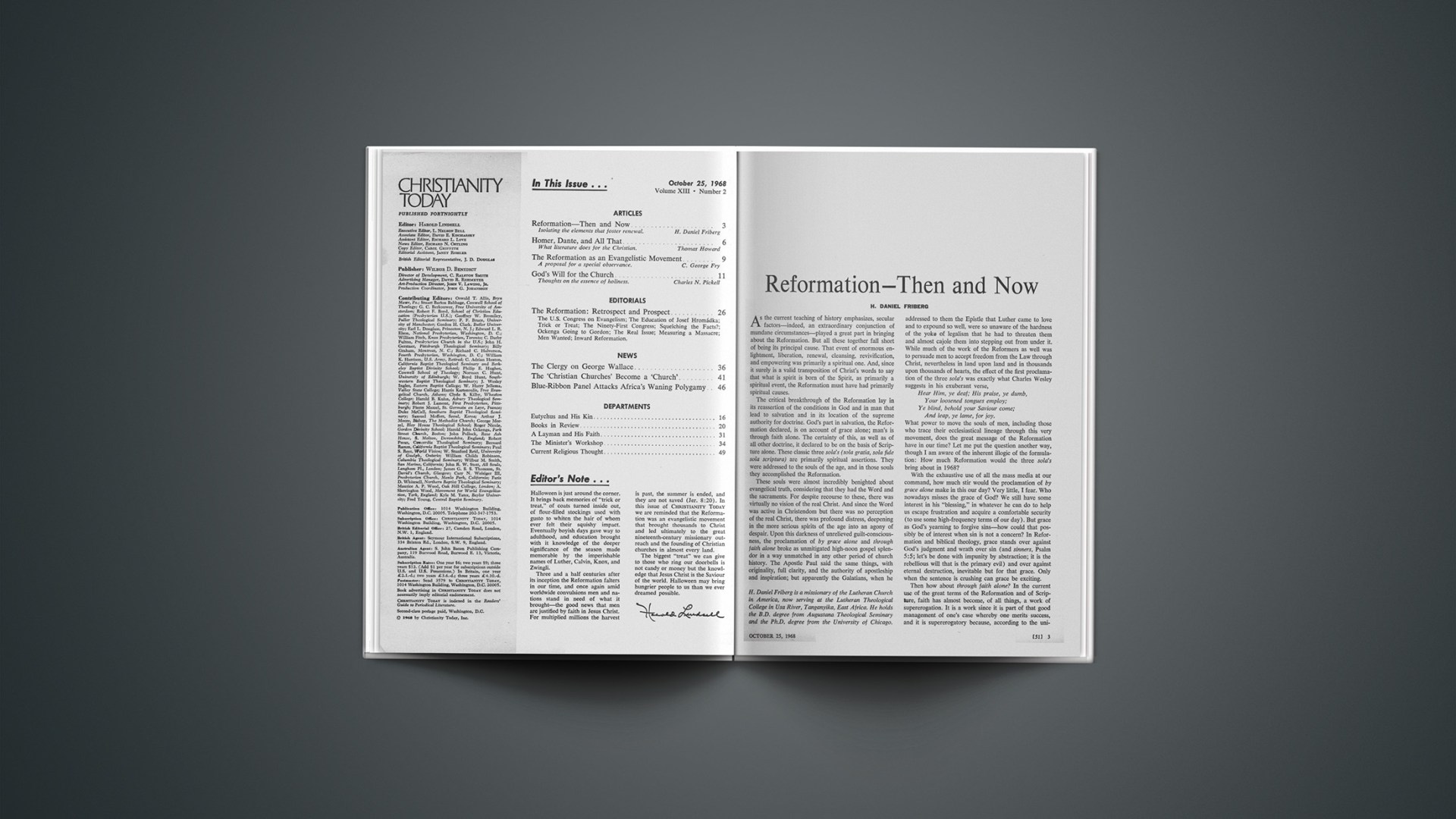
Reformation—Then and Now

As the current teaching of history emphasizes, secular factors—indeed, an extraordinary conjunction of mundane circumstances—played a great part in bringing about the Reformation. But all these together fall short of being its principal cause. That event of enormous enlightment, liberation, renewal, cleansing, revivification, and empowering was primarily a spiritual one. And, since it surely is a valid transposition of Christ’s words to say that what is spirit is born of the Spirit, as primarily a spiritual event, the Reformation must have had primarily spiritual causes.

The critical breakthrough of the Reformation lay in its reassertion of the conditions in God and in man that lead to salvation and in its location of the supreme authority for doctrine. God’s part in salvation, the Reformation declared, is on account of grace alone; man’s is through faith alone. The certainty of this, as well as of all other doctrine, it declared to be on the basis of Scripture alone. These classic three sola’s (sola gratia, sola fide sola scriptura) are primarily spiritual assertions. They were addressed to the souls of the age, and in those souls they accomplished the Reformation.

These souls were almost incredibly benighted about evangelical truth, considering that they had the Word and the sacraments. For despite recourse to these, there was virtually no vision of the real Christ. And since the Word was active in Christendom but there was no perception of the real Christ, there was profound distress, deepening in the more serious spirits of the age into an agony of despair. Upon this darkness of unrelieved guilt-consciousness, the proclamation of by grace alone and through faith alone broke as unmitigated high-noon gospel splendor in a way unmatched in any other period of church history. The Apostle Paul said the same things, with originality, full clarity, and the authority of apostleship and inspiration; but apparently the Galatians, when he addressed to them the Epistle that Luther came to love and to expound so well, were so unaware of the hardness of the yoke of legalism that he had to threaten them and almost cajole them into stepping out from under it. While much of the work of the Reformers as well was to persuade men to accept freedom from the Law through Christ, nevertheless in land upon land and in thousands upon thousands of hearts, the effect of the first proclamation of the three sola’s was exactly what Charles Wesley suggests in his exuberant verse,

Hear Him, ye deaf; His praise, ye dumb,

Your loosened tongues employ;

Ye blind, behold your Saviour come;

And leap, ye lame, for joy.

What power to move the souls of men, including those who trace their ecclesiastical lineage through this very movement, does the great message of the Reformation have in our time? Let me put the question another way, though I am aware of the inherent illogic of the formulation: How much Reformation would the three sola’s bring about in 1968?

With the exhaustive use of all the mass media at our command, how much stir would the proclamation of by grace alone make in this our day? Very little, I fear. Who nowadays misses the grace of God? We still have some interest in his “blessing,” in whatever he can do to help us escape frustration and acquire a comfortable security (to use some high-frequency terms of our day). But grace as God’s yearning to forgive sins—how could that possibly be of interest when sin is not a concern? In Reformation and biblical theology, grace stands over against God’s judgment and wrath over sin (and sinners, Psalm 5:5; let’s be done with impunity by abstraction; it is the rebellious will that is the primary evil) and over against eternal destruction, inevitable but for that grace. Only when the sentence is crushing can grace be exciting.

Then how about through faith alone? In the current use of the great terms of the Reformation and of Scripture, faith has almost become, of all things, a work of supererogation. It is a work since it is part of that good management of one’s case whereby one merits success, and it is supererogatory because, according to the universalism of the times, practically all things will in the end work out to the good of absolutely everybody, faith or no faith. But though damnation is out of the question, faith as a dogged confidence in God’s over-arching benevolence, and the basic humanitarianism of the universe is awfully useful in helping one to come calmly and nobly through the rough spots.

In Reformation and biblical theology, salvation on account of grace and salvation through faith imply each other. God’s grace is boundless, and through his giving up of his Son to a God-atoning death on the cross he offers free salvation to all men; but this grace does not effect its end without an appropriate response in man. That response is faith. When the Reformers and Scripture say through faith alone, they say “On pain of death and damnation don’t mix the merit of works with your faith.” But they also say, “On pain of death and damnation, don’t leave out the faith! However beaten and robbed the devil may leave you, don’t let him snatch from you the confidence in God’s promise whereby you lay hold upon forgiveness, the imputation of Christ’s righteousness, and full acceptance with the Father! If you draw back, his soul will take no pleasure in you!”

Obviously in any other intention there can be no urgency about getting men to believe, no jealous concern lest, after the acquisition of all the accouterments of Christian virtue, service, and worship, there might still be secretly “an evil heart of unbelief.” “O Galatians, I am afraid of you (lest you trust in the merit of observing a divine ordinance)!” How incomprehensible is this fear to our age! In any other context than the apostolic, by faith alone becomes just another partisan idiosyncrasy by which Christendom is plagued and bored, another of the cantankerous shibboleths that impede the easy run of ecumenism.

If, because of biblical disorientation and the universalism of the age, by grace alone strikes our times as an outcry of an excess of both enthusiasm and modesty, and if by faith alone seems an esoteric specialty of denominational exclusivism, then to assert the third sola, according to Scripture alone, must be like rolling out the equipage of Charles V. Nor is that all. If the other sola’s seem to be of very obscure relevance, this one must seem preposterously inhibiting, and a return to superstition and magic.

A striking indication of the radical shift in religious thought that has occurred since the Reformation is the change in meaning of the phrase according to Scripture alone. Curiously, for the Reformers and for their age, as indeed for virtually the whole of Christendom until a century ago, the phrase could mean no absolute elevation of the Scriptures, for by their universal acceptance as the true and infallible Word of God, they were incapable of further elevation. The phrase denoted rather, in keeping with the proper meaning of the words, the ascription of supreme authority to Scripture exclusively, and that by denigration of all other authority, most immediately that of the doctors and councils of the Church quoted in opposition to the evangelical truth. For this third sola, though logically prior to that of grace and that of faith—since questions of individual doctrines must be settled by the answer to the question of authority for all doctrine—was in point of adoption actually subsequent to the other two. To be sure, as always it was the entrance of the Word that gave light, and the Word that gave light in Luther’s case was particularly that of Habakkuk cited by Paul in Romans 1:17. But the Reformers were as yet unaware of the weight or wideness of divergence of the Church’s interpreting tradition from the evangelical truth. When confronted by this in the course of the debate, notably at Leipzig, Luther, pushed to the edge, took the incredibly courageous leap and came out unequivocally for the scriptural sola.

In our times Scripture and tradition have met together again, only this time they meet not on the level proper to Scripture but on the level proper to tradition, the latter rightly regarded as the fallible human thing that it is. In this situation, the Reformation and scriptural canon, according to the Scriptures alone, can no longer mean the denigration of anything—everything has already been denigrated except men’s thought about God and his Word! What it must now mean is the elevation of Scripture to the position of supreme authority proper to it alone as the true and infallible Word of God.

What a task that is! Luther’s denial of the right of tradition to override the plain and evangelical sense of Scripture and so to appear virtually superior to the very Word of God, his insistence that even the doctors and councils of the Church bow to Scripture—this was an act of gigantic courage, fortitude, and faithfulness. Now how equally great must be the courage and commitment of those who would stand against the glacier-like pressures of our age and contend for an end to that denigration of Scripture which is palpably the key to the uncontemporaneity of Reformation in the Church?

Consider also the degree of revolution that must take place in the modern mind if by grace alone and through faith alone are to be avidly seized again by a whole generation of men as the key to life in God. However dark the pre-Reformation night, what a magnificent capacity for Reformation the times possessed, as the event itself proves. This capacity was derived from a greatly biblical (albeit unevangelical) orientation of the mind, an orientation clearly derived from an extensive hearing of the Scriptures, not as fallible human testimony to God’s revelatory acts, but as God’s very words, written by men under his error-eliminating guidance. Having heard God speak his Law, they were terrified. When in the Reformation God spoke to them of salvation by grace alone and through faith alone, they believed and lived. The irrelevance of the Gospel to the modern mind is evidence of the absence of the preparatory action of the Word in modern hearts.

In deploring this absence of Scripture action upon the hearts of modern men, one must think of how little of God’s Word modern men ever hear, particularly as God’s Word. Nowadays one can travel a whole year visiting the churches and scarcely hear a single word about the sinfulness of sin as rebellion against a God that exacts absolute holiness, or the unforgivableness of unending unrepentance, or atonement by the God-propitiating death of the only-begotten Son. Even when we get orotund, celebrating the “mighty acts of God,” we are awfully weak on specifics. Did Noah ever live? Were the waters of the Red Sea ever separated miraculously? Did a look at the brazen serpent heal anything somatic? No, or we can’t be certain, but God surely acted mightily! We speak a lot about the cross. What did Christ do on the cross? Essentially, but on a grand scale, what you do when you get down into the ghetto. What’s that? You bear a burden. What burden? The burden of inability to live a full humanity. Was it also a substitutionary bearing of the guilt of the whole world, and so the ground for God’s being both just and the justifier of the ungodly man who turns to him in faith? That’s no longer meaningful! Did Christ rise from the dead? He rose again in the realms of faith, but not necessarily in the realm in which he was crucified. A camera might have caught his corpse lying in the tomb on Easter Day, but he rose for you if you believe the Easter story! But don’t you by making the truth of the Gospel dependent on faith invert the Gospel and common-sense order of valid faith—that it comes by hearing true news of great acts? What of it, for this is the new understanding of the Gospel!

We have a long way to go to catch up with pre-Reformation Europe. How lucky Luther was. He fought his battles before the days of trench warfare, when positions were clear and comprehensible.

We may not be inordinately hard on preachers. They reflect their theological training. The bulk of academic theology these days denies that Scripture is in any supernatural sense the Word of God. God could not speak anything unreservedly true through fallible men; or if he could, we cannot know when he succeeded. Pity the limp product of this eisagogical brainwashing and mourn the homiletics it entails! The graduate emerges less inclined and less equipped to say “Thus saith the Lord” than when he was enrolled. Having exchanged the truths of the Bible for the enfeebling and detheologizing theologies of the day, what does he have to say in the pulpits of God? What wonder that the public cannot without much biblical groundwork take in the significance of such words as “grace,” “faith,” and “salvation” in the radically biblical conception?

Again, what a long way we have to go even to acquire a capacity for Reformation!

If, then, our preaching must be biblical, where shall we begin?

Since the age is unresponsive to the pre-eminently evangelical note of the Reformation, it must be readied for the Gospel. The biblical prescription for such preparation is Law. “Through the law comes knowledge of sin” (Rom. 3:20). “If it had not been for the law, I should not have known sin” (Rom. 7:7). To preach the Law biblically is, among other things, to represent it as spiritual and unrelenting, as Jesus does in the Sermon on the Mount. I have wondered why Northern and Western ecclesiastics happily involved in one way or another in the conversion of Africa do not get up on a chair in Stockholm, New York, or Chicago and denounce the pagan morals of the times. Certainly it takes no unusual acuteness to relate the sixth, the fourth, the seventh, indeed any of the Commandments, including the first, to our society. We know our society; don’t we know the Word? When sin is known for what it is, the issue of salvation or damnation becomes a burning reality, and the Gospel will get a hearing.

Now obviously one’s acceptance of the truths of the Bible is conditioned by one’s estimate of the nature of the Bible. There is therefore an unprecedented scope and need in our day for a vigorous and scholarly apologetic for Scripture. But one’s acceptance of the truths of Scripture is not absolutely conditioned by one’s prior estimate of the nature of Scripture. Scripture has an extraordinary power of self-authentication, and its authority is wonderfully self-assertive. Here in East Africa hunters don’t consult the lion and buffalo to know their estimate of the guns they carry. They just shoot, and they get their game. The Law faithfully proclaimed as God’s Word exerts an unlimited power to break the pride of man and to put him in that distress in which the Gospel becomes the sweetest news in the universe.

In all this, we on the mission fields of the world have, despite the weaknesses of our work, a distinct advantage. On the whole our national preachers believe that what the Bible says is true. This is reflected in their preaching. I have seen national preachers in central China lead scores of their hearers to mourn over their sins, many of them with tears. Now in Tanzania I witness preaching of the same order. In a recent preaching crusade in the Arusha football stadium I heard speaker after speaker—Ugandans, Kenyans, and Tanzanians—preach with fascinating freshness and power, out of the Word and Word-related experience. Assuredly, some of them have great forensic powers. But to a man they accepted the whole of the Bible at face value as unequivocally the Word of God. And the movement in which they are involved is powerful to bring conviction of sin and to effect glorious deliverance by the message of by grace alone and through faith alone.

The spirit of the Reformation is not absent from our planet. Oh, that the wind of 1517 might blow with power in 1968!

There’s No Business Like Soul Business

What do Jim and Tammy and John Paul II have in common? Actually, very little. But the Pope, the Bakkers, and for that matter Jerry Falwell, Jimmy Swaggart, and other prime-time preachers, have been an integral part of the collective American conscience for much of this year—for good and ill.

Of course, the events bringing this select group to our attention are as different as the theologies they espouse. The televangelists bristled at hints of moral and ethical hypocrisy while the Pope basked in the glow of an admiring public.

But they are all vocal proponents of Christianity—a fairly conservative Christianity at that. And curiously, in a society thought to be highly secular, religious faith (and the inability of some to practice the faith they profess) gave “Nightline” its highest ratings and Time magazine no fewer than five cover stories. At this pace, the religion beat may become the most coveted assignment in media circles.

This is almost incredible, when one considers the scarcity of hard news in either the PTL scandal or the Pope’s visit. Were he not a popular preacher, Jim Bakker’s story would have had a hard time making even the supermarket tabloids. And the Pope’s popularity comes not so much from what he did on his visit but from who he is: the head of the largest Christian body in the world.

To be sure, it is always more pleasant to read headlines praising a church leader than to suffer through an embarrassing exposé of dishonesty and fraud. Yet both the Pope and Jim Bakker got what they deserved from the media, and the American people got what they deserved: an honest look at religious events.

That is as it should be, and the networks must admit it did not hurt them one whit to dabble in sectarian, supernatural, traditional religion. To the contrary, coverage of the Pope and the televangelists make good journalistic sense.

While the “news hook” for these stories is obvious—scandals and visiting dignitaries always make headlines—the press may have rediscovered a sometimes not-so-obvious fact about religion in America: It is vitally important to a lot of people. Pollster George Gallup, Jr., says 90 percent of Americans believe in a higher being, and the Yearbook of American and Canadian Churches, 1987, reports 42 percent of Americans regularly attend a church, synagogue, or other religious service. While mere interest in religion is not the same thing as a life-changing commitment to Christ, matters of faith really do matter to most Americans.

All of which leads us to ask our colleagues in the secular media to loosen up a bit and make religion a larger part of their agendas. We do not expect them to become flacks for the faith. In fact, we welcome them to expose our scandals.

The public’s right to know how religion helps shape culture is as important as the news media’s responsibility to report it.

By Lyn Cryderman.

Editor’s Note from October 11, 1968

The summer has ended, and autumn and harvest time are upon us. But there is no end to the troubles that are plaguing our national life. Anyone who thought the confrontation of the radical left with the Chicago police signaled the last outbreak and a return to normalcy was wrong. Since then the smoldering student feud at Columbia erupted again. New York City schools were kept from opening by a teachers’ strike. Cardinal O’Boyle of Washington cracked the knuckles of priests whose ideas of liberty of conscience conflicted with the Pope’s encyclical on birth control. The Senate voted a gun-control bill that didn’t control guns. And the aspirants for the presidency stalked up and down the land trying to whip up enthusiasm among apathetic citizens whose minds, for the most part, were already made up.

The bright spot was the wealth of news for the journalists. Their big problem was choosing what stories they should highlight. Among newsworthy items to which the press gave little attention was Billy Graham’s Pittsburgh campaign and his nationwide telecast of earlier San Antonio meetings. Yet the thousands of decisions registered at the ball park and in letters that flowed from every state in the union may have been the biggest news of all.

We suggest that readers take a hard look at the last editorial, “The Christian and the World.”

Freedom and Order

Like timing in athletics, so perspective in life is the clue to good performance. And one is about as difficult to get as the other. It is not hard to remember how one resented the “old folks” who were always so sure that things were never so good as they were in the good old days. But now that I am joining the ranks of the old folks I am reaching the same kind of conclusion. Then of course, I am nagged with the question of how good things really used to be.

All this is brought on by student riots in the streets of Paris and Berkeley, labor upheavals in all parts of the globe, emerging nations struggling for recognition while they cut one another’s throats, and the general feeling that in this election year it is pretty hard to believe that there is any man around big enough to grasp the problems, let alone solve them.

There still remains, however, this question of perspective. It seems to me that I have often read of riots during the American Revolution, not to mention downright treason. There were draft riots during the American Civil War, and I suppose they would have burned a few draft cards if they had had any. No good government has ever come into being without a tremendous loss of life and property. Certainly a little perspective wouldn’t hurt.

But we are not helping ourselves very much if we rest content with the assertion that things are not as bad as they used to be, or at least are no worse. It seems to me that unless society is better than it was a century ago, unless young people are not only healthier but more stable than their parents, we are not getting anywhere.

The center of our problem seems to lie somewhere in the area of law and order versus freedom, or, in more extreme language, stability versus anarchy. I wish we could develop a new awareness, especially on the college level, of how tricky the business of order and government is, how much effort has gone into the so-called establishment, and how easy it is to tear things apart before we know exactly how they ought to be put together. The hardest thing about a revolution is getting it stopped. And, there are always a lot of nice people around the edges who get hurt.

This whole matter is of pressing importance to a democracy like our own, dedicated to law and order and created by revolution. It is true that we are also dedicated to freedom, but the founding fathers were smart enough to talk about “freedom under law.” Jefferson knew very well that all political philosophers from Aristotle on considered democracy the most dangerous form of government because an uninformed and irresponsible electorate, becoming increasingly careless about its citizenship, becomes increasingly unstable. Anarchy follows, which gives immediate opportunity to the strong man, the tyrant, or the dictator. Democracy is always an unstable mixture that may stay as it is or explode into something else. Jefferson knew that there had to be education for citizenship.

One would think that college and university students would understand these things. The basic failure is that with all their learning they have not been educated for citizenship. A course or two called “Problems of Democracy” hardly does it. By the time they are ready to graduate from college, about the only experience they have had in responsible democratic action is in student government or fraternity politics, usually under the protective covering of an administration that allows them to play at government but not really practice it.

What is really more serious is the lack of any understanding of political theory. Philosophy generally has fallen on bad days. Most students encounter it as only a very short required course. Some of the erudite seemingly spend a great deal of time in philosophy, but they tend to veer off into the minutiae of analysis or word studies, thus missing the great deeps. What a pity that all our students cannot learn in political philosophy how very, very difficult it was in past times to organize and set in motion any kind of government that paid any attention at all to human rights. What a pity that all students don’t see what a beautiful and delicate apparatus they are tampering with. What a pity that they fail to see the necessity of order for the very operation of their freedoms. There simply is no freedom apart from order, as any airline pilot, for example, would be quick to point out.

In the tradition that runs from Hobbes, Locke, Rousseau, and the writers of our own American basic documents, it is interesting, indeed exciting, to see how this idea developed. Hobbes was a complete materialist who saw every little bit of stuff bumping against the other bits of stuff. (He was not far from atomic theory.) Therefore it was not hard for him to say that human beings are also bits of stuff who keep knocking against one another. The more crowded they get, the worse they bump. If any one person is to be free, some kind of control has to be brought down on the mass to give him his area of operation.

The simplest solution is this: every person in a group must give up some of his individual rights—i.e., to move as far as he wants in any direction—in order for there to be any rights or freedom left over at all. The good society is possible, therefore, when an agreement is reached in which some kind of government looks after the whole mass in order to protect some, not all, individual freedoms.

Ten men on a basketball court may decide to play with five men on each side. Order already. Then they must agree to stay within the boundary lines. They must decide how much a basket counts. They just can’t make up the rules as they go along. More seriously, however, the ten men are forced to do one of two things. Either they get a referee who will exercise control “by the consent of the governed,” or each man must set within himself some kind of self-governance. When this whole problem moves from a basketball floor into a society, we have our answer: either we have a government “by the consent of the governed” or we have a society made up of individuals with their own inner self-governance.

The Bible, the Church, and the Reformers were all of a mind that men are not quite ready for that inner self-governance. Laws are made for the lawless, and on this side of glory most of us are selfish enough somewhere to be lawless. Why do college students suddenly believe that they have reached the “maturity” never yet obtained anywhere by any human being, educated or not, by which they may have freedom without order? It is so naïve a belief that one wonders how those who hold it can think they are sophisticated.

ADDISON H. LEITCH

The Grape Debate

By refusing to eat California grapes, National Council of Churches leaders hope to help the state’s allegedly exploited farm workers. A resolution adopted by the NCC General Board last month tacitly accuses California grape-growers of willfully perpetuating the farm workers’ plight. In protest, the churchmen vow not to buy or use California table grapes.

Dubious strategy? The grape issue divided the board sharply. It produced the juiciest debate of a two-day meeting in Houston, and some amusing moments. Someone wanted to know how much of the forbidden fruit the council had previously budgeted.

“We can be laughed out of court,” said the Rev. Alford Carleton of the United Church of Christ. “Terribly symbolic,” countered another board member. Somewhere in between was the Rev. R. H. Edwin Espy, NCC general secretary, who questioned the efficacy of a reference-committee version of the resolution, terming the banning of grapes within the NCC “a very narrow application.” A farmer from New Mexico who is a member of the Episcopal delegation to the board complained that the growers had not been given equal time to present their case.

The reference committee’s recommendation was a resolution “that the General Board as a matter of Christian conscience and witness directs the administration of the National Council of Churches to refrain from the purchase or use of California table grapes.…” No one seemed to be quite sure exactly who constituted the NCC administration. So the resolution was amended. The final vote on the two-page document was 74 for, 23 against, and one abstention. For passage, 66 votes were needed (two-thirds of those present). The amended resolution reads:

“That the National Council of Churches, including its several units, refrain from the purchase or use of California table grapes until such time as union recognition and assurance of good faith collective bargaining are granted by the California growers.”

By limiting the ban to “table grapes” the NCC excludes those growers and pickers involved in the culture and harvest of grapes for wine, juice, canning, and raisins. These sectors of the industry are apparently thought to have achieved an adequate level of social justice. Together they market more than 3,000,000 tons of California grapes each year.

The grape ban was the first implementation of a controversial new NCC methodology. A day earlier, after some two years of study, the board officially adopted a major policy statement that endorses the principle of economic boycott as a legitimate church instrument for effecting social change.

The NCC has been warned that it could run afoul of federal anti-trust laws and risk being sued by spurned businesses. But the language of the 400-word resolution has been carefully screened by New York lawyers to minimize the danger of litigation. The thrust is to encourage business with firms with wholesome policies rather than to call for withholding of patronage from undesirable dealers.

The policy statement marks a key step, because until now the NCC has relied primarily upon the political dynamic to bring about social progress. Political activity will continue, however, and doubtless will be stepped up. One report said church leaders are seriously considering establishment of a new interdenominational agency in Washington that would register officially as a church lobby. A number of denominations and church-related agencies now have offices in Washington, but their political activities are limited because they fear loss of tax exemption. The report of the proposed new lobby prompted NCC President Arthur S. Flemming to remark, “It’s worth looking into.”

The economic clout, meanwhile, can be expected to add support to the political efforts. In a positive way, the NCC is also investing small sums in various enterprises located in ghettos and economically depressed rural areas.

Selection of the grape industry for the first boycott will probably be a disputed decision for some time. The industry is one whose output cannot be easily regulated. Grapes continue to grow whether or not there is consumer demand; thus any measurable boycott will inevitably result not only in loss of employment and income but also in fruit decay and consequent waste. Moreover, because grapes are not an essential commodity, wage increases granted to the workers are not passed on to the consumer nearly as easily as they are in other industries.

How the NCC might enforce its grape edict was left hanging. Presumably, even secretaries at New York’s Interchurch Center will not be allowed to put California grapes in their lunch bags. Procedures for determining the origin of the fruit were not spelled out. Neither were disciplinary measures for infractions.

The grape debate took so long that the board barely found time to consider the moral issues in the Soviet-led invasion of Czechoslovakia. After an impassioned “warning to the free world” by Czech-born Blahoslav Hruby, an NCC employee, the board passed a resolution condemning the Soviet military intervention. The same resolution, however, called for efforts “to increase trade” with the U. S. S. R. The strategy directly contradicts the approach in the grape matter, which seeks to penalize those held to be responsible for social injustice by withholding trade.

As usual, only half the board’s 250 members were on hand for the meeting. And by the time they got around to a proposed resolution on justice, law, order, and freedom, they had lost a quorum. Flemming declared a seven-minute recess during which enough proxies were registered to make the last vote count. Without mentioning Chicago, the resolution charged that “some police seem on occasion to be out of control. There are instances where the police have provoked and even initiated violence, venting their fury on blacks, hippies, students, newsmen, passive bystanders, or unresisting arrestees.” Other policemen were commended for “heroic service to the public.”

Major policy statements also were adopted condemning capital punishment and calling for reduction in national defense spending. Neither aroused any substantial opposition, but a minor floor fight developed over the pro-Arab report of an NCC deputation to the Middle East. The NCC staff was described as “split right down the middle on this issue.”

The lack of a quorum at the last session marked the second time in eighteen months that an NCC General Board meeting has ended on the perimeter of legality. This may suggest growing indifference toward NCC even on the part of its constituency. Financial support from denominations is as hard to get as ever. The council had asked its thirty-four member denominations for $300,000 for a summer “Crisis in the Nation” priority program. Fifteen—among them the one to which the program’s coordinator belongs—gave nothing. The NCC’s 1969 budget is being trimmed, another hint that the organization may be experiencing crisis fatigue.

Interchurch Circuit

Consultation on Church Union executive Paul Crow, Jr., who is setting up an office in Princeton, New Jersey, said the real opponents of the giant merger proposal may be not conservatives but radicals who think the Church is not on the frontier.

Southern Baptist Convention President W. A. Criswell said his group is deeply concerned about Christian unity but is unlikely to become involved in the National Council of Churches or the Consultation on Church Union because of their liberal-leaning leadership.

The first statewide Catholic-Protestant council is expected to form in Texas by January from a union of the Council of Churches and the state Catholic conference. Several denominations have yet to vote on the proposal.

Mutual recognition of clergy has been asked of their groups by the stated clerks of the United, Southern, Cumberland, and Associate Reformed Presbyterian Churches and the Reformed Church in America.

Church Panorama

The Fresno (California) Council of Churches, facing a $6,000 deficit on a $20,000 budget, dismissed its only two staff members. Economic and other pressures have followed council support of the area grape-pickers’ strike.

Answering protests from a Southern Baptist Convention official, heads of the three TV networks promised they will try to cut down excessive violence in this year’s programs. Denominational executives recently spent six hours discussing progress members are making in race relations and in implementing a landmark “Crisis in Our Nation” Statement the convention adopted in June.

The Evangelical Committee for Urban Ministries in Boston, with local church support, is giving scholarships to nine Negroes to attend four New England evangelical colleges. Buffalo concrete manufacturer Frederick Reinhold is giving Houghton College (Wesleyan Methodist) $250,000 to endow scholarships for poor minority students.

Approach, which served as the weekly newspaper of the National Council of Churches’ urban-crisis program, reverts to United Presbyterian sponsorship this month. Another ecumenical venture. Edge, youth monthly put out by the three major Lutheran bodies, goes out of business October 10.

Starting salary for Lutheran Church in America missionaries was raised from $5,040 to $5,460—not counting housing or special allowances.

Personalia

By late September police in Granada Hills, California, had no clues after a month-long investigation of the disappearance from Hillcrest Christian Church of 20-year-old Dixie Arensen. bride of two months of its pastor, Jonathan Arensen. Mrs. Arensen was editor of the Westmont College paper last year. Her father, a missionary in Kenya who flew home to aid the search, said, “I’ll bet 100,000 people are praying.”

Los Angeles Methodist Bishop Gerald Kennedy, 60, plans to become senior minister of Pasadena’s First Church while holding his bishopric—a first in the denomination’s history. He is a noted preacher.

Episcopal Bishop Joseph Minnis of Colorado—recently beaten and robbed of $2,770 in cash and jewelry in a Denver parking lot—suffered at the hands of fellow bishops September 24. A panel tried him on misconduct charges, stripped him of church authority, and banished him from the state. Minnis, reportedly hospitalized, did not testify.

The Rev. A. D. King, brother of the late Rev. Martin Luther King, Jr., is moving from Louisville to his brother’s Atlanta pulpit.

Disciples of Christ elder Marvin Osborn, former development director of Washington University, was named interim president of St. Xavier College, a Roman Catholic girls’ school in Chicago.

Attorney Robert G. Mayfield, for sixteen years executive of the Methodist lay-activities board, will direct a $5 million development campaign for Asbury Theological Seminary in Kentucky.

United Methodist appointments: Tracey K. Jones, Jr., as general secretary of the missions board; President J. Lem Stokes III of Pfeiffer College, North Carolina, to run the special $20 million race-poverty “reconciliation” program; Iowa Bishop James S. Thomas to head a commission to write a new social-issues credo.

The Rev. W. Ernest Jackson, deputy executive of the Anglican Communion, will head the newly merged missionssocial service agency of the Anglican Church of Canada.

Gerhardt W. Hyatt has been named top chaplain of the U. S. Command in Viet Nam, and Henry C. Wolk, Jr., head chaplain at the U. S. Air Force Academy. Both are colonels and Missouri Synod Lutherans.

The Southern Baptist home-missions board is sponsoring the Rev. H. Wesley Wiley, a Negro, to help Washington, D. C., Baptists plot general strategy for ministering to the city.

Dr. Robert F. Crawford, science-math chairman at Biola College in California, was named college dean. He was formerly research-development manager of U. S. Borax.

Governor Winthrop Rockefeller named the Rev. Clyde Hart, Arkansas Baptist race-relations director, to head the state anti-poverty program.

United States Episcopal Presiding Bishop John E. Hines revealed that the recent meeting of the world’s Anglican bishops considered a statement that Anglicans might accept the Pope’s “primacy of love” in a reunited Church. The phrase was dropped, though a statement recognized the “historic reality” of the papacy.

Miscellany

The FBI reports crimes of violence rose 21 per cent during January–June, 1968, compared to the same period in 1967, and crimes against property rose 20 per cent.

A General Electric study shows the typical non-white American father with three children must spend $5,500 a year for basic housing, while a comparable white family pays $4,200. The difference is the restricted housing market for Negroes.

Wise County, Virginia, officials charged four members of a snake-handling cult with manslaughter after a member died of a rattlesnake bite in a service.

A bipartisan Ontario legislative committee recommends that churches pay taxes on 20 per cent of the assessed value of their property after taxes are gradually increased over ten years.

First replies to a poll show 850 of 1,200 evangelical Church of England clergymen oppose current proposals for union with England’s Methodists.

A new edition of the Revised Standard Version of the Bible is in the works, with a target date of 1977. The project is under direction of a committee of the NCC’s Division of Christian Education. Professor Herbert G. May is chairman.

DEATHS

J. B. LAWRENCE, 97, who became executive of the Southern Baptist Home Mission Board after a 1929 scandal, erased a $2.5 million debt, and led the board for twenty-five years; in Atlanta.

THOMAS C. RIGIA, 56, shot to death near the entrance of St. Dimitri Rumanian Orthodox Church, Bridgeport, Connecticut, after an argument with a Democratic leader over renting the church hall to the Republicans.

You Have Been Elected …

Congratulations. The American Academy of Clergymen, a “Mount Everest for those who seek the highest pinnacle of excellence in their pastorial [sic] work,” has elected you a Fellow. “Many are nominated but few are chosen and given the horror of using the Academy Seal,” says the four-page brochure.

Oh, yes. Life dues are $90 for the first year.

One of the startled Fellows, former American Baptist Convention President Clarerice W. Cranford of Washington, D. C., said “it sounded just a little bit like a racket. I didn’t think it was sufficiently established—on the up and up.”

Academy Founder-President William A. Dyson, Sr., turns out to be a 33-year-old, lively, articulate former pastor of several small churches. He now works as a waterfront superintendent in Norfolk, Virginia, tb provide a better life for his family. In his dark but clean living room, Dyson, with one or another of his six children on his knee, talked eagerly of his hopes for the academy. But his face fell in “dismay” that only two dozen of the 100 prominent clergymen tapped as fellows by his “board” has accepted.

Despite the brochure’s apparent status appeal, Dyson revealed resentment against the church establishment: “The more degrees some pastors get, the less they seem to want fellowship. Statusseekers do not want to join our organization.” The academy doesn’t necessarily want Ph.D.s or Th.D.s, but pastors “who are truly concerned about their laymen.”

Until this summer Dyson’s academy had about 125 members, “mainly acquaintances I and others have made through the years.” Most, like Dyson, are Negroes, and he says the idea is to promote inter-racial fellowship and raise standards.

Laughing ruefully, Dyson said “if the brochure was misleading it was all my fault. It was an amateur effort.” Pressed with questions about the academy he exclaimed, “I feel like John the Baptist in the wilderness when the committee of priests came out to ask him, ‘Who are you and what are you doing?’ ” “You could ruin a life’s work,” he added.

Dyson said he and the four other academy founders (names not revealed) filed a notarized statement with Virginia last year as a “learned association,” but officials said they could find no such charter.

He said he studied the equivalent of three years at the University of Bordeaux while in the military in France, then got an M.A. from Christ Institute, Philadelphia, in 1963. State and federal officials, however, said no school of that name is accredited to give degrees.

Dyson was ordained first in a small Baptist group and then in the Christian Methodist Episcopal Church. Later he went Baptist again. He says “a pastor doesn’t seem to count unless he has a huge church and lots of degrees.

“A preacher should be such a strong carrier of Christianity that like a germ it can’t help but infect you.… When a man realizes that there is no other way but Christ, he’s home.”

Dyson declined to provide a list of academy members or financial details. But he released samples of sermon materials he said are mailed monthly to members in return for their $90. A quarterly journal is supposed to start this month.

BARBARA H. KUEHN

The Bad-Risk Churches

Some churches active in anti-draft efforts have become hot potatoes for insurance companies. The possibility of arson or bombing makes them too great a risk for coverage, the companies think.

Two Unitarian churches suddenly lost more than $1.5 million in fire coverage after they served as “sanctuaries” for draft-protestors.

Arlington Street Church in Boston still can’t get new insurance for its huge $1,400,000 property. American Employers Insurance, its protector for more than sixty years, lowered the boom right after the church became the first to open its doors to draft-protestors.

The Church of the Mediator in Providence, Rhode Island, managed to get $256,000 in coverage from the Hartford Group after Westchester Fire backed out, but only after five other firms refused to touch it, according to the church’s insurance agent. The pastor, the Rev. Albert Q. Perry, called the cancellation “a direct reprisal” for its anti-war and civil-rights activities.

Both companies said they would reconsider cancellation if the churches promised to stop serving as sanctuaries, but the churches refused, according to Perry and Arlington’s Rev. Jack Mendelsohn.

First Unitarian Church, South Bend, Indiana, lost all its insurance in August after arsonists destroyed half the building. The Rev. Joseph Schneiders’s flamboyant political activities there caused loss of half the members last year after an effort to oust him failed.

By contrast, the more traditional First Church of Boston (Unitarian) has had no trouble retaining its coverage though its facilities were gutted by a fire of unknown origin last March. “We have made an effort to stay outl of way-out things,” said its pastor, the Rev. Rhys Williams. “We are concerned about community issues, but we try to make a religious witness.”

No insurance problems have hit St. Andrew’s Presbyterian Church, Marin City, California, where nine AWOL servicemen who chained themselves to clergymen were arrested this summer. The church is covered by a group policy that includes a large number of Presbyterian churches.

In New York City, the Greenwich Village Peace Center has been unable to get liability insurance requested by the Washington Square United Methodist Church, which houses it. The church, another “sanctuary,” has retained its insurance without any difficulty.

Peace Center insurance broker Robert Boyar said liability-insurance firms view any community-action agency with “great trepidation” because liability suits after “a melee or riot could be heavy beyond anything imagined.” Peace Center board chairman John Daar said the companies won’t “touch radical groups with a ten-foot poleespecially since Chicago.”

BARBARA H. KUEHN

A BLOW AT APARTHEID

The South Mrican Council of Churches issued the strongest religious attack yet against the nation’s racial separation policies. The 2,500-word document was signed by representatives of Anglican, Presbyterian, Lutheran, Methodist, and Baptist churches, plus non-official signers from two Dutch Reformed bodies and the Roman Catholic Church.

The churchmen argue that apartheid is “a demonstration of unbelief in the power of the Gospel,” which shows that “God’s grace has overcome our hostilities.” Apartheid “rejects as undesirable the reconciliation which God gives us through His Son. It reinforces distinctions which the Holy Spirit calls on God’s people to overcome. It calls good ‘evil’ ”.…

“Christians betray their calling if they give highest loyalty, which is due to God alone, to one group or tradition, especially where that group demands self-expression at the expense of other groups. Christ is inevitably a threat to much that is called ‘the South Mrican way of life.’ ”

The churchmen asked all Christians to ponder whether their first loyalty is to an ethnic group, a political idea, or Christ. It noted “increasing rigidity” in apartheid, which many see as “a necessary and permanent expression of the will of God.”

Red China Woos Embittered Christian Tribes

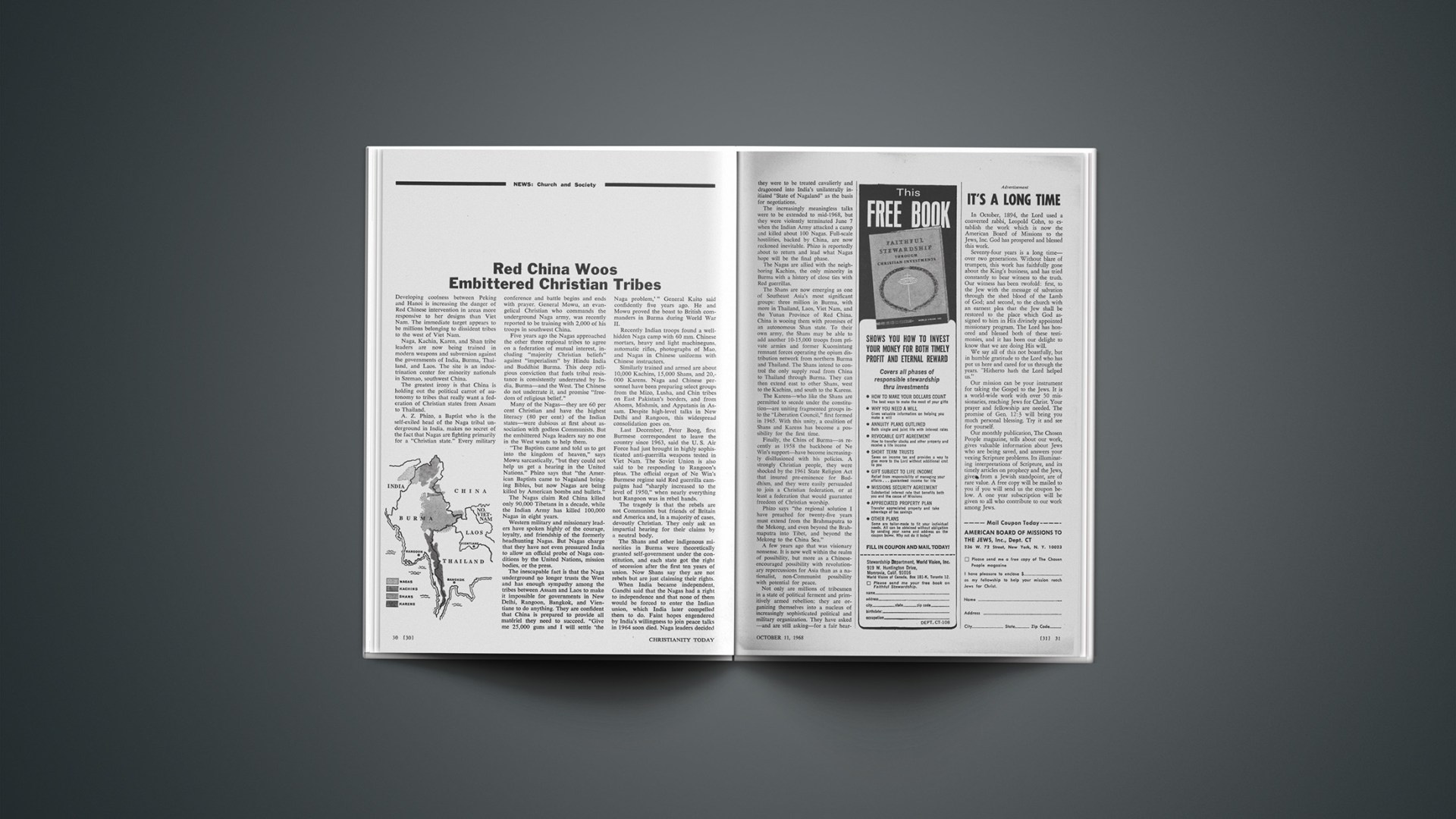
Developing coolness between Peking and Hanoi is increasing the danger of Red Chinese intervention in areas more responsive to her designs than Viet Nam. The immediate target appears to be millions belonging to dissident tribes to the west of Viet Nam.

Naga, Kachin, Karen, and Shan tribe leaders are now being trained in modern weapons and subversion against the governments of India, Burma, Thailand, and Laos. The site is an indoctrination center for minority nationals in Szemao, southwest China.

The greatest irony is that China is holding out the political carrot of autonomy to tribes that really want a federation of Christian states from Assam to Thailand.

A. Z. Phizo, a Baptist who is the self-exiled head of the Naga tribal underground in India, makes no secret of the fact that Nagas are fighting primarily for a “Christian state.” Every military conference and battle begins and ends with prayer. General Mowu, an evangelical Christian who commands the underground Naga army, was recently reported to be training with 2,000 of his troops in southwest China.

Five years ago the Nagas approached the other three regional tribes to agree on a federation of mutual interest, including “majority Christian beliefs” against “imperialism” by Hindu India and Buddhist Burma. This deep religious conviction that fuels tribal resistance is consistently underrated by India, Burma—and the West. The Chinese do not underrate it, and promise “freedom of religious belief.”

Many of the Nagas—they are 60 per cent Christian and have the highest literacy (80 per cent) of the Indian states—were dubious at first about association with godless Communists. But the embittered Naga leaders say no one in the West wants to help them.

“The Baptists came and told us to get into the kingdom of heaven,” says Mowu sarcastically, “but they could not help us get a hearing in the United Nations.” Phizo says that “the American Baptists came to Nagaland bringing Bibles, but now Nagas are being killed by American bombs and bullets.”

The Nagas claim Red China killed only 90,000 Tibetans in a decade, while the Indian Army has killed 100,000 Nagas in eight years.

Western military and missionary leaders have spoken highly of the courage, loyalty, and friendship of the formerly headhunting Nagas. But Nagas charge that they have not even pressured India to allow an official probe of Naga conditions by the United Nations, mission bodies, or the press.

The inescapable fact is that the Naga underground no longer trusts the West and has enough sympathy among the tribes between Assam and Laos to make it impossible for governments in New Delhi, Rangoon, Bangkok, and Vientiane to do anything. They are confident that China is prepared to provide all matériel they need to succeed. “Give me 25,000 guns and I will settle ‘the Naga problem,’ ” General Kaito said confidently five years ago. He and Mowu proved the boast to British commanders in Burma during World War II.

Recently Indian troops found a wellhidden Naga camp with 60 mm. Chinese mortars, heavy and light machineguns, automatic rifles, photographs of Mao, and Nagas in Chinese uniforms with Chinese instructors.

Similarly trained and armed are about 10,000 Kachins, 15,000 Shans, and 20,000 Karens. Naga and Chinese personnel have been preparing select groups from the Mizo, Lusha, and Chin tribes on East Pakistan’s borders, and from Ahoms, Mishmis, and Appatanis in Assam. Despite high-level talks in New Delhi and Rangoon, this widespread consolidation goes on.

Last December, Peter Boog, first Burmese correspondent to leave the country since 1963, said the U. S. Air Force had just brought in highly sophisticated anti-guerrilla weapons tested in Viet Nam. The Soviet Union is also said to be responding to Rangoon’s pleas. The official organ of Ne Win’s Burmese regime said Red guerrilla campaigns had “sharply increased to the level of 1950,” when nearly everything but Rangoon was in rebel hands.

The tragedy is that the rebels are not Communists but friends of Britain and America and, in a majority of cases, devoutly Christian. They only ask an impartial hearing for their claims by a neutral body.

The Shans and other indigenous minorities in Burma were theoretically granted self-government under the constitution, and each state got the right of secession after the first ten years of union. Now Shans say they are not rebels but are just claiming their rights.

When India became independent, Gandhi said that the Nagas had a right to independence and that none of them would be forced to enter the Indian union, which India later compelled them to do. Faint hopes engendered by India’s willingness to join peace talks in 1964 soon died. Naga leaders decided they were to be treated cavalierly and dragooned into India’s unilaterally initiated “State of Nagaland” as the basis for negotiations.

The increasingly meaningless talks were to be extended to mid-1968, but they were violently terminated June 7 when the Indian Army attacked a camp and killed about 100 Nagas. Full-scale hostilities, backed by China, are now reckoned inevitable. Phizo is reportedly about to return and lead what Nagas hope will be the final phase.

The Nagas are allied with the neighboring Kachins, the only minority in Burma with a history of close ties with Red guerrillas.

The Shans are now emerging as one of Southeast Asia’s most significant groups: three million in Burma, with more in Thailand, Laos, Viet Nam, and the Yunan Province of Red China. China is wooing them with promises of an autonomous Shan state. To their own army, the Shans may be able to add another 10–15,000 troops from private armies and former Kuomintang remnant forces operating the opium distribution network from northern Burma and Thailand. The Shans intend to control the only supply road from China to Thailand through Burma. They can then extend east to other Shans, west to the Kachins, and south to the Karens.

The Karens—who like the Shans are permitted to secede under the constitution—are uniting fragmented groups into the “Liberation Council,” first formed in 1965. With this unity, a coalition of Shans and Karens has become a possibility for the first time.

Finally, the Chins of Burma—as recently as 1958 the backbone of Ne Win’s support—have become increasingly disillusioned with his policies. A strongly Christian people, they were shocked by the 1961 State Religion Act that insured pre-eminence for Buddhism, and they were easily persuaded to join a Christian federation, or at least a federation that would guarantee freedom of Christian worship.

Phizo says “the regional solution I have preached for twenty-five years must extend from the Brahmaputra to the Mekong, and even beyond the Brahmaputra into Tibet, and beyond the Mekong to the China Sea.”

A few years ago that was visionary nonsense. It is now well within the realm of possibility, but more as a Chinese-encouraged possibility with revolutionary repercussions for Asia than as a nationalist, non-Communist possibility with potential for peace.

Not only are millions of tribesmen in a state of political ferment and primitively armed rebellion; they are organizing themselves into a nucleus of increasingly sophisticated political and military organization. They have asked—and are still asking—for a fair hearing and just decisions. But the time for these is rapidly ending. And the time for the tribes to be an embittered pro-Communist threat to Southeast Asia is very near.

Nigeria: What After War?

War is the highest form of struggle for resolving contradictions

This is the first pearl of wisdom in Mao Tse-tung’s famous Red Book of sayings, which can be picked up cheap at any bookstall in Nigeria. But not many Nigerians today subscribe to this view of war. They have tried it for over a year and it hasn’t resolved anything.

The tragedy of the civil war is not only the lives lost but also the fact that most of the Ibos in breakaway Biafra were trained in mission schools, while 80 per cent of the federal soldiers are at least nominal Christians. There has been talk that it is a religious war with Muslims trying to wipe out Christians, but a visit to Nigeria soon shows there is no evidence for this.

The truth is even harder to take: a packed Sunday-morning congregation in Enugu of soldiers with rifles in one hand and Bibles in the other. These were men with a simple faith in Christ, attending worship in the Hausa language and ready to aim those guns at men of like faith. Occasionally a soldier has refused to pull the trigger when faced with an Ibo he went to school with.

The task facing Nigeria when the war ends is frightening, and the need for help from governments and the Church will increase greatly. First there is resettlement of Ibos, whose homes all over Nigeria are occupied by others. A reporter can’t escape a sense of guilt when he spends the night in a home that an Ibo family fled recently.

There is firm belief that Ibos will be welcomed back, but the warmth of welcome will vary in different parts of the country. Governor A. P. Diete-Spiff, 26, of Rivers State, whose family has suffered at the hands of the Ibos, estimates 100,000 of the region’s people were forcibly taken into Biafra by the Ibos. “If the Ibos try guerrilla tactics, we will learn to become cannibals. The Ibos will be welcomed back. But we know their tricks now, and they will not return to be masters,” he vows.

Ibos fear that when they return home they will be second-class citizens. They have always been keen and successful businessmen, leading the nation’s trade and controlling its markets—now taken over by other Nigerians.

Resettlement of Ibos will be a long process during which Nigerians must win their confidence. Homes must be refurnished, crops planted, businesses set up. Other nations must be prepared to do more than just supervise the ending of the war.

One issue has been whether it is better to prolong peace talks while masses die from starvation, or to encourage General Yakubu Gowon’s federal forces to stop holding back and achieve a quick military victory so needed aid can be brought to Biafrans. Trapped in last month’s cruel political-military stalemate, an estimated 6,000 Biafrans were starving to death each day.

A message to Nigerian Christian leaders from the World Council of Churches urged them to press peace negotiators in Addis Ababa to put relief supplies first on the agenda—before the possibility of a ceasefire. Many questioned the wisdom of this, since only after a ceasefire would there be hope of getting in enough supplies to meet needs.

In an interview, the 33-year-old Gowon, head of state as well as military chief, described his decision for an all-out drive to win the war and said he had ordered food stockpiles taken into each area as the troops advance. In the discussion Gowon outlined his faith in Christ and his sense of dependence upon Christ in every decision he makes. He prays for guidance daily.

J. ERIC MAYER

More Czech Reaction

As the situation in Czechoslovakia following Soviet occupation remained fluid, reports of Iron Curtain church reaction continued to filter to the West.

After the Warsaw Pact troops invaded, forty pastors of the Evangelical Church of Czech Brethren called it “brute force” and vowed “passive resistance against falsehood and injustice.… We must not be governed by the idea of our own safety or conformist resignation.… Christ was always on the side of the oppressed, the betrayed, the deceived, and the defenseless.”

The same week the Ecumenical Council of the nation and its Roman Catholics issued a softer “message” urging prayers and moderation in the tense situation. Loyalty to the continuing regime of Alexander Dubcek was vowed, since “in a democratic socialist society, much of the Christian program of the Gospel of Jesus Christ is being realized.”

Early last month the Ecumenical Council summoned two dozen Protestant, Catholic, and Orthodox leaders to issue a statement of gratitude to Czech government leaders for their handling of the situation. It praised them for saving Czech honor and lives by “gradually consolidating the situation.”

One of the most poignant documents came from the pen of Lenin Peace Prize winner Josef Hromádka, theologian and Christian Peace Conference leader. He noted his long efforts for friendship with the Soviet Union and development of international socialism and expressed “disappointment, regret, and shame” at the Soviet “occupation.” He said he feared the Czechs’ “love will be changed into hatred and that our closest friends will appear to us as enemies,” and said only a quick troop withdrawal could salvage the situation.

Patriarch Alexei of the Russian Orthodox Church dismissed Hromádka’s protest and that of officials of the World Council of Churches. He said the sending of troops was not an occupation but a result of the Soviet treaties of “cooperation and friendship” with Czechoslovakia. In fact, the patriarch argued that the Soviet troop action “saved the world from a serious conflict and prevented bloodshed.”

In neighboring Hungary, the Lutheran weekly said that Western visitors had “provoked the current situation” in Czechoslovakia and that the troublemakers were in no position to “raise questions.” A more sympathetic statement was printed in the journal of the Reformed Church of Hungary.

In Rumania, where the Communist government criticized the invasion, a statement from leaders of all Christian groups was read from all pulpits last month urging Rumanian unity and demanding for Czechoslovakia “the sacred right to free development and independence.” The Evangelical Church of Berlin-Brandenburg in East Germany sent the Czech churches a message of mourning over the use of military force, despite reported Red regime pressure to keep silent.

Olympics: Over Sacred Site

If the student rebellion hasn’t closed everything down by then, the nineteenth Olympic Games will open October 12 near Mexico City. The Olympic Village has been built over the site of Cuicuilco, a sacred pagan ceremonial center that was buried by a volcano 2,000 years ago. But in 1968 a variety of Christian activities are planned.

Campus Crusade for Christ has teamed up with the ecumenical Centro Audio Visual Educativo to produce a series of daily five-minute radio programs featuring well-known Christian athletes. The programs are scheduled on 100 Latin American stations, forty Spanish-language stations in the United States, the Armed Forces Radio Network, and evangelical stations. Crusade’s Latin evangelism center at Chula Vista—forty minutes from the Olympic site—will house many Olympic officials and dignitaries.

Evangelical churches in Mexico City have planned a city-wide Evangelism-in-Depth campaign during the Olympics. Among those helping it will be two dozen U. S. Free Methodists, whose men’s fellowship arranged a $450-per-person Olympics caravan from Arizona to Mexico City.

Formal religious festivities were to include a big “Service for Peace” in the Stadium, sponsored by the city’s Protestants, Catholics, and Orthodox. Local clergy will also offer multilingual services in a non-denominational chapel at Olympic Village with a seating capacity of 450. The modernistic church is the first major inter-Christian structure ever built in Mexico. Pope Paul planned to send a number of works for an Olympic culture exhibit, plus a message to the participating athletes.

Contraception And Damnation

Like a feisty fire-and-brimstone preacher, Patrick Cardinal O’Boyle is telling Roman Catholics they might be damned if they use artificial means of birth control.

The Washington, D. C., prelate’s warning in a pastoral letter spurred more than 200 worshipers to walk out of Sunday Masses. They were also protesting his disciplinary action against thirteen of forty-four parish priests who publicly disagree with his strict enforcement of the Pope’s contraception ban.

The adamant cardinal took a clear slap at Catholic liberals who uphold married couples’ right to freedom of conscience on the issue. His proof text was Deuteronomy 29:19, 20:

“… If after hearing these sanctions a man should bless himself in his heart and say, ‘I will follow the dictates of my own heart …,’ the Lord will not pardon him. The wrath and the jealousy of the Lord will blaze against such a man, every curse written in this book will fall on him and the Lord will blot out his name from under Heaven.”

“My dear friends in Christ,” the cardinal continued, “can you understand that I am impelled to act because I cannot stand by and let you be misled by an idea of freedom of conscience that could bring down on you so horrible a curse?”

Like a torch, the warning exposed with glaring light the growing gap between conservatives and liberals in the Roman church. It also seemed to lessen the possibility that compromise could smooth over this issue, which some see as the greatest challenge to Catholic authority since the Reformation.

Lest anyone be confused, O’Boyle added that no one can be a “faithful Catholic” and keep on using contraceptives, nor should a user take communion.

This stand is in direct contrast to positions taken about the same time by English and Austrian bishops. The English defended the right of individual conscience, while the Austrians went a step further and declared that Catholics did not have to confess their use of contraceptives or stop taking communion because of it.

In his pastoral letter O’Boyle took such bishops to task. He accused dissident priests and “even a few of my brother bishops in other lands” of seeming to adhere to the “new morality.” “According to this moral theory,” he said, “objective standards always may be subordinated to the individual’s decisions about his own unique situation.”

Opposing priests reacted strongly to that label. They said the cardinal badly “misstated” their position and added that no responsible theologian supports this theory.

O’Boyle then added insult to injury by rejecting—without even seeing—a new demand that he submit to arbitration his dispute with the forty-four dissident clerics in his diocese.

The National Federation of Priests’ Councils, which made the request, accused the cardinal of dealing with it “in bad faith.” The federation met in a two-day emergency session over the birth-control crisis, at the request of the Association of Washington Priests. The association, headed by the Rev. John E. Corrigan, Catholic University moral theologian, has led national opposition to strict interpretation of the Pope’s ban.

O’Boyle repeated his position that “because this is a doctrinal matter, it is not subject to arbitration or mediation.” But federation officials said they mainly wanted “due process” for the two priests whom O’Boyle suspended and the eleven others who received lesser penalties.

They hoped the dispute would go to the Committee on Abitration and Mediation of the National Conference of Catholics, chaired by the liberal Lawrence Cardinal Shehan of Baltimore. Shehan served on the Pope’s birth-control commission, which in its majority report advocated relaxation of the church’s ban on contraception.

A new tidbit about the commission: The fourteen bishops who were members voted nine to three, with two abstentions, that contraception is not necessarily sinful, according to the National Catholic Reporter. Until now, only the votes of the participating theologians were known. They reached the same conclusion by a fifteen-to-four vote. Names of the nine bishops were not known.

The Kansas City-based Reporter, which last year scored the coup of publishing the full theological report to the Pope in favor of a new doctrine of contraception, printed last month the text of the bishops’ statement. Its tone is pastoral, and its rhetoric not as commanding as that of the theologians. But the bishops’ refusal to go along with previous teachings on birth control indicates that there may be some ferment among the hierarchy as well as among the clergy and laity.

The bishops’ document to the Pope said:

“So the means chosen should be suitable for exercising a healthy and responsible parenthood, in the light of certain guiding principles: besides being effective, they should have regard for the health of the parents and their eventual offspring; they should not violate respect for the personal dignity of either husband or wife, who must never be treated as objects—this applies to women, who are still kept in a state unworthy of them in many countries, as much as to men; they should pay attention to any possible psychic consequences they might entail, depending on the person and circumstances; and finally they should not hinder the power of expression of an increasingly close union between two persons.…”

The national association won its first major strategic advance September 25 when 148 members of the Boston association urged O’Boyle to withdraw sanctions against the offending priests. The Bostonians also urged the bishops of the United States “and other brethren in Christ to express their concern to the Archbishop of Washington.”

Birth control got little mention at a meeting of diocesan priests called by O’Boyle the day of the Boston statement, but a full-dress meeting of the Washington priests’ Senate this week is expected to produce more commentary. In addition, the semi-annual meeting of the nation’s bishops is scheduled for Washington later this fall.

Along with the continuing birth control ferment, there are rumblings of further Catholic doctrinal discipline. Reports from the Vatican say an investigation is in process of the work of landmark Dutch liberal theologian Edward Schillebeeckx. Schillebeeckx was one of the major framers of the controversial “Dutch Catechism,” and a 1961 Dutch bishops’ manifesto which was banned in Italian bookstores. He was prominent at Vatican II.

Vatican sources denied to United Press International a liberal charge that a heresy trial was in preparation. Other reports held that eminent German theologian Father Karl Rahner had been selected to defend Schillebeeckx and would visit Rome on the matter sometime this month.

Flamboyant Twins Indicted

The flamboyant twin-brother pastors of the First Baptist Church of Fort Worth, Texas, the Rev. Homer and the Rev. Omer Ritchie, were among thirteen men indicted by a federal grand jury last month on charges of swindling twenty-one churches from Texas to New York of about $5 million. Arraignment is expected next month, with a Dallas trial in January.

Among those accused of fraud were prominent Churches of Christ contractor Glenn Paden, Sr., a former state securities executive, and a former state representative.

The Ritchie twins, who gained unanimous consent from their 5,000-member downtown church to remain in the pulpit, are charged with making a secret agreement to receive a percentage of room rental from a corporation that planned to build a motel on land that belongs to the First Baptist Church.

Assistant U. S. Attorney Robert Travis of Fort Worth said the churchmen also made an agreement with two other defendants to induce Mid-City Baptist Church in New Orleans to turn over about $4 million in bonds and cash in return for a new church building, which was never built. For their part, the Ritchies were said to have received $48,000.

Fourteen of the swindled churches were Churches of Christ, three Baptist, three Christian Science, and one Assemblies of God.

The Ritchies denied the charges and said they were “ridiculous, without basis.” “Omer and I are completely innocent; the facts have been twisted out of context,” Homer Ritchie told his congregation. The church responded with a resolution of love and devotion, full support and assistance, and earnest prayer. At Homer’s request, the church prayed for Travis and the federal grand jury that indicted the preachers.

This was not the first time First Baptist has been involved in a scandal. The Ritchies were preceded by the renowned J. Frank Norris, who was acquitted on a charge of murdering a wealthy Fort Worth lumberman and later on a charge of starting a fire in his church and perjuring an anonymous letter of threat against himself. Norris withdrew his church from the Southern Baptist Convention in 1952 and organized the Baptist World Fellowship Church in a dispute over teaching of evolution at Southern Baptist-related Baylor University.

Homer Ritchie caused a small uproar himself when he divorced his wife, remarried, and filed a legal petition against his ex-wife for not letting him visit his daughter. There was a commotion in 1963 and in 1964 over handling of church finances. Each time the scandal blew over.

Under Norris the church membership reached 8,000. Under the Ritchies, membership has declined to about 5,000, but the church property is worth about $3.5 million.

MARQUITA MOSS

‘Sacred Cows’ On Alcohol

The first U. S.- and Canada-wide poll done by Alcoholics Anonymous shows 41 per cent of those who join stop drinking at once and another 23 per cent stop within a year. The remarkable results from a survey of 11,355 members this summer were reported at an international alcoholism conference in Washington, D. C.

At the conference, Methodist Bishop James K. Mathews of Boston attacked “sacred cow” concepts on drinking that churches usually support, such as minimum-age laws. The role of the Church, he said, “is not so much to provide missing services in a community” such as pastoral counseling, but to encourage the society to undertake healing programs.

Iowa Governor Harold Hughes, now a Senate candidate, spoke to the meeting as an ex-alcoholic. The Methodist layman said that if the country can’t meet the alcohol problem, “we aren’t likely to meet the great problems of war and peace, mass poverty, racism, and the estrangement of youth …”

The Kid On His Knees

Nobody ever knocked out Kid Gavilan in 144 professional fights during a ring career that included three years (1951–54) as world welterweight champion. The boxer was knocked down only twice before he hung up his gloves ten years ago and retired to a small farm in his native Cuba.

Today, the once happy-go-lucky Kid is on his knees. He was dropped there by nine cruel blows from Fidel Castro’s Communist government. That position, however, is not a symbol of defeat for the 42-year-old Negro, who is partially blinded by cataracts. It represents a kind of victory to the Kid, who, as Gerardo Gonzales, arrived in Miami last month aboard one of the regular refugee flights from Cuba.

“I owe Him [God] everything,” declared the soft-spoken Kid, whose religious practices led the embarrassed Red regime to jail him nine times in nine years since he became one of Jehovah’s Witnesses. “I am on my knees to say thanks because I am in the United States and because my family is going to be together.” He plans to settle in New York where his third wife and three children are awaiting him.

“It is a crime to be religious in Cuba,” declared the still trim fighter, who was jailed for preaching on the streets. “They don’t want anybody talking to the people about religion or anything else except Communism, or you go to jail.”

“I have to work for Jehovah,” he went on. “I have to go any place where human beings are to tell them about Jehovah’s purpose. I have to tell them not to hate, but that people are to live together in love. I have to tell them that Jehovah is for everyone—not just the rich, and no matter what color they are.” “But you can’t say that in Cuba,” Gavilan added. “They call it political. The police started chasing me. They called me a Yankee CIA spy who was hiding behind religion.”

Gavilan, a former Catholic, said harassment and persecution of religious groups is not limited to Jehovah’s Witnesses. It applies to anyone who undertakes any public religious activity outside the routine indoor Sunday services. Pentecostals, two groups known as Gideons (not the famous Bible-placing organization), and the Trinitarians in particular have run into trouble for attempting street preaching, he said.

Even regular services at Catholic, Methodist and Baptist churches suffer, Gavilan noted. “They make the people be on jobs when it’s time for church services,” he reported.

The people of Cuba are suffering economically and also in health, said the champ, whose farm was nationalized. They have been living on Communist promises, “but nobody can give promises that equal God’s,” he said. Now that he does not have even his little farm left from the two million dollars he earned as a fighter, Kid Gavilan is not worried about getting along. “I just want to learn to live for the future Jehovah promises. Preaching, for me, now is the first thing in my life.”

ADON TAFT

It Didn’T Suit

It would have been a neat trick—but it didn’t work. A pastor hoped to “work for the reconciliation of men” by filing a suit to stop the bussing of Negro school children from Washington, D.C., to his Maryland suburb.

“But people didn’t understand,” said the Rev. Kenneth H. Okkerse, pastor of the Episcopal Church of the Redeemer, explaining why he withdrew as coplaintiff. “They thought I was doing just the opposite. They saw it as a divisive effort.”

Okkerse said he wanted to test the constitutionality of bussing and, through “dialogue” with citizens involved in the issue, to show that “the answer to unrest in our hearts is not social reform, but Christ. He is the only one who can unite men, as each comes to know him.”

“But I found that people couldn’t understand what I meant,” said the frustrated minister. “I’ve never been involved in anything political before, and I don’t understand the jargon.”

An evangelical who is prominent in the local charismatic movement, he said he felt he’d be “more effective in the discipline of the church than the courts.” But he emphasized that he had “no pressure” from anyone to get out of the suit.

Okkerse said he had “no objection” to inter-racial classrooms. But along with the constitutional question, he wondered whether bussing was the best way to solve educational problems.

A Man Called Peter Jr.

A man called Peter has done it again. Like a late-night movie rerun, the Rev. Peter Marshall Jr. has followed in his famous father’s footsteps by nearly getting fired from a church because of a booming ministry.

But by a vote of sixty-nine to sixty-two, members of the East Dennis Community Church on Cape Cod overrode efforts to oust the dynamic 28-year-old. The pastor’s opponents, mainly older New Englanders, complained, “We have a small country church here—and we want to keep it that way.” Since Marshall took the pulpit last December, average Sunday attendance has more than doubled. Many newcomers, especially in the summer, are youths.

All this sounds like the elder Marshall, who risked dismissal by jarring stand-patters in New York Avenue Presbyterian Church, Washington, D. C., and won fame as a preacher, author, and U. S. Senate chaplain. Ironically, a Washington area presbytery committee recently advised a congregation not to call Peter Jr., who was student president at Princeton Seminary, because he is too controversial.

The young Marshall says his parishioners’ gripes about crowds are symptomatic of a desire “to keep this church a nice little country club. This is obviously not what I want, or what I think the Lord wants.”

“I would run into this resistance wherever I am,” he added. “It happens wherever you preach the Gospel. But the basic unwillingness to change was made more difficult by the older age of many of our members. I can understand it—in comes a young guy preaching all this stuff about sin and love.”

Before the vote, he said attempts by some members to “control the ministry … make it impossible for me, or any other minister, to do any effective work.” But now he thinks things are “resolved pretty well.… No one is trying to derail the train.”

Relevant or Irrelevant?

Much is being said to the effect that the Church is no longer being relevant to the world in which we live. Only recently I heard a prominent entertainer say that the Church has no meaning to young people because it has no answers, either for their personal problems or for the problems of the world.

Where this is actually the case, may not the reason be that the modern Church is abandoning its God-ordained role in the world to become involved in areas to which it is not called and for which its leaders are not qualified?

The Church is truly relevant only when it faithfully witnesses to a message—a message from God to man; when it gives itself to the preaching, teaching, and living of Christ, the one and only Mediator between God and man; when its primary concern is to point men to God’s Son as Saviour from sin and Lord of life.

It becomes utterly irrelevant when it preaches a Christ who is not the Christ of the Bible but has been divested of his supernatural and miraculous nature; when its primary concern is with the condition of the Prodigal in the Far Country, trying to make him happy, comfortable, and prosperous rather than to bring him home to his Father; when its leadership has shifted from a spiritual task to one that is largely political, economic, and social.

The Church is rendered ineffectual and irrelevant when it cuts loose from the anchor of faith in the Holy Scriptures and substitutes for that faith an attitude of criticism of divine revelation, setting up its programs with little or no reference to the plain teachings of that revelation. This becomes an ever increasing problem as seminaries turn out more and more men who have no idea of preaching the Gospel but rather use their training and calling for secular ends.

What could work more against effective leadership than catering to the changing foibles of a “lost generation” instead of offering them a faith to follow, a living Christ to believe in?

I am convinced that the turmoil among young people today has come about largely because we elders have failed them and the Church has failed them. Our homes, churches, and schools are so materialistically oriented, our outlook so fixed on the immediate situation in the world, that young people are crying in vain for something to satisfy their spiritual hunger, though they are not sure what it is they want.

We have lost them in the home by failing to place Christ at the center of every phase of life, and in the Church by increasingly emphasizing this world and its problems without reference to the solutions found alone in Christ. Our schools have become entirely secular and, under the guise of a separation of education from all religious influences, have in fact become hotbeds of anti-God and anti-Christian teaching.

In shifting the emphasis from the central to peripheral and secondary matters, the Church seems to have forgotten that it is possible to gain the whole world and yet lose one’s soul. It has apparently forgotten that man does not live by bread alone, and that God has faithfully promised to supply every material need if we will put him first in our lives.

In its search for contemporary relevance, let the Church acknowledge that neither science nor human achievement in any realm has changed the nature of man one whit. The human heart is the same today as in the day of Noah, when “the earth was corrupt in God’s sight, and the earth was filled with violence” (Gen. 6:11), or the time when our Lord himself observed that “out of the heart come evil thoughts, murder, adultery, fornication, theft, false witness, slander. These are what defile a man” (Matt. 15:19, 20a).

The Church must face up to the question of sin in the human heart and God’s remedy for that sin; it must abandon the attempt to wash the outside of the cup with no thought of the rottenness inside.

Man and this world must be viewed in the light of eternity. In the words of the Apostle Paul, we must “look not to the things that are seen but to the things that are unseen; for the things that are seen are transient, but the things that are unseen are eternal” (2 Cor. 4:18).

To put it as clearly as possible: The Church is relevant when it recognizes its spiritual calling, message, and mission, and irrelevant when it attempts to become an agency for social reform.

To the immediate rejoinder that the Church belies its calling if it is not concerned about the plight of men enmeshed in poverty, blighted by discrimination, and suffering from the age-old problem of ‘man’s inhumanity to man, let me say that it is the Christian’s duty to be concerned about these things and to use every legitimate means to help. A Christian without compassion in his heart is unworthy of the name he bears. A Christian who does not translate compassion into works of mercy is like those who passed by on the other side in our Lord’s story of the Good Samaritan.

But Christians do not just happen. They are people who have come into a vital personal relationship with Jesus Christ. By accepting him as Saviour and making him Lord of life, they themselves become “salt” in a festering society and “light” in a darkened world. This is the Church’s primary task.

The social order will never be changed by pronouncements of church courts; nor should the Church, in the name of the Church, hope to change it merely through programs of reform.

It is impossible to effect any great or lasting change in society without first changing the hearts of those who compose it. And who but the Church has the necessary message of personal redemption? What other organization is called to summon men to be reconciled to God through faith in his Son and then to be reconciled one to another through the living presence of the Holy Spirit in their lives?

But one is forced to the reluctant conclusion that many who would speak for the Church no longer hold to those basic matters of the Christian faith that have made it separate and distinct from the world order. The transition from spiritual death to spiritual life, which our Lord called being born again, centers in and depends on faith in Jesus Christ as Son of God—crucified, buried, and risen from the dead.

Also involved is the question of conviction of sin, repentance for sin, and conversion. Why is so little said about repentance today, even though Jesus made it a prerequisite for salvation? In fact, why is so little being said about salvation? The only possible explanation is that many who are speaking for the Church no longer believe in the relevance of Jesus Christ for man’s predicament.

Where the Church is irrelevant to the world and its needs, the reason is that it must be it has lost its vision and its message.

L. NELSON BELL

Apple PodcastsDown ArrowDown ArrowDown Arrowarrow_left_altLeft ArrowLeft ArrowRight ArrowRight ArrowRight Arrowarrow_up_altUp ArrowUp ArrowAvailable at Amazoncaret-downCloseCloseEmailEmailExpandExpandExternalExternalFacebookfacebook-squareGiftGiftGooglegoogleGoogle KeephamburgerInstagraminstagram-squareLinkLinklinkedin-squareListenListenListenChristianity TodayCT Creative Studio Logologo_orgMegaphoneMenuMenupausePinterestPlayPlayPocketPodcastRSSRSSSaveSaveSaveSearchSearchsearchSpotifyStitcherTelegramTable of ContentsTable of Contentstwitter-squareWhatsAppXYouTubeYouTube