Pope Faces Birth Control Crisis

In a 7,500-word encyclical released July 29, Pope Paul VI flatly refused to temper the Roman Catholic teaching that “artificial” contraception is evil. The document, entitled Humanæ Vitæ, evoked a groundswell of dissent among the pontiff’s ecclesiastical subordinates. It was hard to tell which would prove to be more historic: the Pope’s reaffirmation of traditional Vatican views on birth control, or the crisis it seemed to be precipitating among the half billion members claimed by the Roman Catholic Church.

“God has wisely disposed natural laws and rhythms of fecundity which, of themselves, cause a separation in the succession of births,” said Pope Paul. “Nonetheless the church, calling men back to the observance of the norms of the natural law, as interpreted by her constant doctrine, teaches that each and every marriage act (“quilibet matrimonii usus”) must remain open to the transmission of life.”

The Pope had a good word for family planning but said that only the rhythm method is moral. The rhythm method is simply abstinence from sexual intercourse during the woman’s fertile period. Because it is not possible to determine with precision the time of the fertile period, the method is unreliable. The Pope echoed Pope Pius XII in asking that medical science provide “a sufficiently secure basis for a regulation of birth, founded on the observance of natural rhythms.”

The first major sign of defiance was a statement signed by more than a hundred American Catholic theologians. The statement is openly critical of the Pope and takes issue with the encyclical, citing numerous “defects.”

“Many positive values concerning marriage are expressed in Paul VI’s encyclical,” the statement says. “However, we take exception to the ecclesiology implied and the methodology used by Paul VI in the writing and promulgation of the document.”

Never before in modern times has there been such open resistance to a papal edict. The theologians appealed to the “common teaching” in the church that Catholics may dissent from authoritative, non-infallible teachings of the magisterium when sufficient reasons for so doing exist. They concluded that “spouses may responsibly decide according to their conscience that artificial contraception in some circumstances is permissible and indeed necessary to preserve and foster the values and sacredness of marriage.”

The encyclical was presented to newsmen at the Vatican by Monsignor Ferdinando Lambruschini, moral theologian at Lateran University. “From a theological viewpoint,” he said, “the document was not to be considered infallible, but an act of great courage in its condemnation of spreading artificial methods of birth control.” He was also quoted as saying that it was not “immutable” dogma.

Humanæ Vitæ rejected the findings of a majority of a special commission appointed by the Pope to study the morality of birth control. The Commission included a number of lay experts, but the Pope said that “the conclusions at which the commission arrived could not, nevertheless, be considered by us as definitive, nor dispense us from a personal examination of this serious question; and this also because, within the commission itself, no full concordance of judgments concerning the moral norms to be proposed had been reached, and above all because certain criteria of solutions had emerged which departed from the moral teaching on marriage proposed with constant firmness by the teaching authority of the church.”

A particularly vulnerable aspect of the encyclical’s argumentation is its labeling of the rhythm method as “natural” and all other methods as “artificial.” Many Catholic medical men believe the rhythm method to be more artificial than other means.

Dissenters appeal to Vatican II for an out, but the council adopted a statement that leaves little room for interpretation when it says, “Religious submission of will and of mind must be shown in a special way to the authentic teaching authority of the Roman Pontiff, even when he is not speaking ex cathedra.”

As popes have been doing for centuries, Paul VI relied heavily upon the natural-law theory. With this rationale he addressed himself not only to the Roman Catholic faithful but also to those outside the church.1See “How to Decide the Birth-Control Question” by John Warwick Montgomery, March 4, 1966, issue. Montgomery is among twenty-seven evangelical scholars who will discuss birth control and related issues August 28–31 at a symposium in Portsmouth, New Hampshire, sponsored by Christianity Today and Christian Medical Society. He spoke specifically to rulers: “Do not allow the morality of your peoples to be degraded; do not permit that by legal means practices contrary to the natural and divine law be introduced into that fundamental cell, the family.”

Pope Paul acknowledged the gravity of the demographic problem but added, “The only possible solution to this question is one which envisages the social and economic progress both of individuals and of the whole of human society, and which respects and promotes true human values.”

The Pope was very aware that Humanaæ Vitæ would not be well received. Two days after its disclosure he issued a special plea from his summer residence fifteen miles south of Rome. He expressed the hope that “Christian married couples will understand that its teaching is but the manifestation of the love of Christ for the church.”

“The knowledge of our grave responsibility caused us no small suffering,” he said. “We well knew of the heated discussions in the press. The anguish of those involved in the problem touched us also. We studied and read all we could. We consulted eminent persons. And we sought in prayer the aid of the Holy Spirit in interpreting the divine law.…”

It was a statement of pathos, almost of apology. Probably it has no counterpart in papal history.

Humanæ Vitæ not only condemned mechanical and chemical contraceptives but also repeated the church’s opposition to abortion and sterilization, “temporary or permanent.” Also reiterated is the Catholic teaching that medical intervention with an indirect contraceptive, sterilizing, or abortive effect is permissible for health reasons when this effect is secondary, not used as a means.

The gravity of the ecclesiastical crisis growing out of Humanæ Vitæ may not become apparent for a time. But already the church faces a serious situation over the celibacy rule as important priests regularly renounce the church. The latest to get married were Edward J. Sponga, 50, head of the 830 Jesuits in the Maryland Province; Joseph F. Mulligan, 48, director of higher studies for the Jesuit New York Province; and Joseph Lemercier, 55, of Mexico, disciplined by the Vatican last year for using unauthorized psychoanalysis.

What will be the effect upon humanity of the Pope’s decision? Theoretically, those who restrict their birth rate will ultimately be engulfed by those who do not. But surveys have shown that most Roman Catholics are ignoring their church’s ban on contraceptives. The resulting integrity gap may be a more serious threat to the church than open defiance or mass exodus.

SINCE ST. AUGUSTINE

Contraceptive medicines were known and used in biblical times, and were condemned on various grounds by the early Church Fathers. By the time of Saint Augustine’s Marriage and Concupiscence, the belief became explicit: Couples who “for the sake of lust” obstruct “procreation by an evil prayer or an evil deed” are not really married. Some, with “cruel lust,” even “procure poisons of sterility,” and if these don’t work they resort to abortion, the saint lamented.

The opinions of bishops and theologians first gained authority over an entire province of the Church in the sixth century when Bishop Caesarius of Gaul condemned birth-control “potions” and affirmed that procreation was the only lawful reason for sex. Gregory the Great, first of the strong medieval popes, not only repeated this idea in his Pastoral Rule but also said any pleasure in the act was unlawful.

By the high Middle Ages, Thomas Aquinas had worked Augustine’s ideas into his natural-law framework, but explicitly approved sex even if the couple was sterile—thus allowing an exception to procreation as the only motive.

In 1588, Pope Sixtus V issued the bull Effrænatam, which condemned those who “induce sterility in women, or impede by cursed medicines their conceiving or bearing.” He advocated punishments equal to those for homicide. But two and one-half years later his successor, Pope Gregory XIV, repealed penalties except for abortion of a forty-day-old fetus.

In the first papal encyclical on marriage after the papal-infallibility decree of 1870, Pope Leo XIII avoided mention of contraception. Meanwhile, belief and practice outside the Catholic world were shifting. In 1930, the bishops of the Anglican communion overturned their position of 1908 and 1920. Their statement permitted deliberate birth control “in those cases where there is … a clearly felt moral obligation to limit or avoid parenthood, and where there is a morally sound reason for avoiding complete abstinence.”

Half a year later Pope Pius XI issued his landmark encyclical Casti Connubii, with these key passages:

“Since the act of the spouses is by its own nature ordered to the generation of offspring, those who, exercising it, deliberately deprive it of its natural force and power, act against nature and effect what is base and intrinsically indecent.… Any use whatever of marriage, in the exercise of which the act by human effort is deprived of its natural power of procreating life, violates the law of God and nature …”

And by normal theological tests, it can be argued that this is an infallible decree, writes John T. Noonan, Jr., law professor at Notre Dame, in his monumental book Contraception. But the emphasis on “the exercise” of the marital act could leave room for chemical preventatives.

In his 1951 address to a convention of maternity nurses, Pope Pius XII approved deliberate use of the infertile period (the “rhythm method”) to avoid procreation for “medical, eugenic, economic, and social” motives.

World Council On Birth Control

Last month’s World Council of Churches assembly at Uppsala approved a document on “World Economic and Social Development” that included this statement on birth control, modified to mollify the Eastern Orthodox:

“The implications of the world’s unprecedented population explosion are far reaching with regard to long-range economic planning, the provision of food, employment, housing, education, and health services. Many churches are agreed that we need to promote family planning and birth control as a matter of urgency. An ever growing number of parents want to exercise their basic human right to plan their families. We recognize, however, that some churches may have moral objections to certain methods of population control.”

In 1962, Pope John XXIII created a small commission of advisers to study birth control. Two years later Pope Paul VI expanded the group to a major sixty-member body of experts. In 1966 the experts made their report. Last year, as Pope Paul VI struggled with his decision, Catholic papers printed pro and con texts from this secret commission and reported that a solid majority had urged change in the church position.

On July 29, 1968, Paul issued Humanæ Vitæ.

OUTSIDERS’ REACTIONS

Eugene Carson Blake, general secretary of the World Council of Churches: “It is disappointing that the initiative taken in 1964 to re-examine the traditional Roman Catholic position on family planning and birth control seems with the encyclical Humanæ Vitæ to have ended up approximately where it began, despite such a long and careful study.

“Some member churches of the World Council of Churches, particularly some of the Orthodox theologians, take a position very close to that expressed by Pope Paul. It is, however, a disappointment to many Christians in all the member churches of the World Council as well as to many Roman Catholics, that no early breakthrough to a solution to this problem can be envisioned.

“My personal reaction to the encyclical, at the first reading of the central parts, is that the distinction between artificial and natural means of birth control must be more thoroughly examined. It also appears that the Roman Catholic position as now stated depends too much upon an old conception of natural law to be persuasive to twentieth-century man.”

Arthur Michael Ramsey, Archbishop of Canterbury: “… The moral teaching given by the encyclical on the use of so-called artificial means of contraception is widely different from that of the Anglican Community.… The means adopted to limit the number of children in a family are a matter for the conscience of each husband and wife. The use of ‘artificial means’ of contraception is not excluded. The changes in human society and world population as well as development in the means available for contraception which have occurred since 1958 seem to me to reinforce rather than challenge the arguments employed and conclusions reached at the Lambeth Conference in 1958.”

Billy Graham, evangelist: “In general, I would disagree with it.… I believe in planned parenthood.” Graham spoke of seeing the effects of the “population explosion” in his worldwide travels.
Book Briefs: August 16, 1968

Literature That Lives On

A Reader’s Guide to Religious Literature, by Beatrice Batson (Moody, 1968, 114 pp., $3.95, paper $2.95), is reviewed by Thomas Howard, teacher of English, St. Bernard’s School, New York, New York.

“What actually makes a work live as literature is a vividness and depth of perception in presenting honestly and realistically the conflicts, dilemmas and experiences of life.” This statement from the preface of this book does two things: it gives us the criterion by which Dr. Batson chose works from the almost infinite number of “God-oriented” works in Western history since the first century, and it articulates for us the principle that is the watershed between worthy and mediocre literature, whether religious or non-religious.

What makes some pieces of writing last, and others molder? Why are some works worth keeping alive in a book like this? Talent, for one thing: the ability to say the thing well. It is the simplicity as much as any observable complexity that beguiles us about things well done and fools us into believing that we could do as well. We can all see that an excellent table is excellent, and, if it is not intricately carved or painted, we might think we could make one, too. It is the same with works of literature: if we take any given phrase apart, there is nothing particularly new or unknown to us in it. All the words are in our vocabulary. The author has not done anything that we could not have done, we think. But the rub comes when we try to equal his work. Talent is an elusive thing.

But prior to talent is the vision that sees things that are worth saying. It is this “vividness and depth of perception” of which Dr. Batson speaks. It is greatness of imagination, that is, the ability to see the antiphonal relationships that exist among all the data of experience (what T. S. Eliot called seeing the fear in a handful of dust), so that the plain stuff of daily life becomes a paradigm of the eternal.

This kind of talent and vision is exhibited in all worthy literature. The writer (the great writer, I mean) always addresses himself to what he sees to be the truth of the matter. And since the first century there have been many writers whose notion of the truth of the matter has been Christian, and who have addressed themselves to human experience in these terms. This book is a guide to the works of the greatest of these writers.

It is both a reference work and a book you can read through with pleasure. It is scholarly, thorough, and systematic, but not plodding. It is descriptive rather than critical; you may find out what a work is all about, but you are not told why the author gives it a place in the canon of good literature. The study is organized in the logical way, according to the periods generally used in the description of literature: the Middle Ages and the Renaissance, including Augustine, Dante, Kempis, early drama, and the mystics; the seventeenth century, with studies of Herbert, Vaughan, Crashaw, Browne, Bunyan, Taylor, and others, and extensive studies of John Donne and Milton; the eighteenth century, including Cowper and Law, as well as a number of American writers; the nineteenth century, with Newman, Hawthorne, Browning, Hopkins, and others. The twentieth century presents special problems to today’s critic and historian of literature, for he can never be sure which works will last. Dr. Batson has done the only thing possible, which is to include the writers whose works have so far seemed the most significant: Eliot, Mauriac, Auden. C. S. Lewis is there, too, a choice that seems obvious to Christians but that might be contested by critics who would not quarrel with the others (it is rather fashionable to tut-tut Professor Lewis).

Each chapter begins with a study of the historical and cultural context of the works included in that chapter. There are also biographical sketches of the authors. The work is fully documented in footnotes, and a helpful bibliography for further study is appended.

Dr. Batson has done a job that seems so obvious and so necessary that one wonders why it was not done before. But it was a happy delay that left the doing of it to Dr. Batson. Her trustworthy scholarship, her vigorous and economical way of summarizing, her sophisticated judgment in making the selection, and her understanding of both religious and literary canons have combined to make this an extraordinarily helpful book.

Special note to CHRISTIANITY TODAY readers: There is a great deal of discussion in the conservative Protestant wing of “Christian” literature, and a growing awareness of the cultural penury of our sort of religion. This might be an excellent book to recommend to people who wonder whether their understanding of the religion of Christ has perhaps inclined them to a less than fair appreciation of the humanistic tradition, but who boggle at the sheer unapproachability of the literary pile. If they are timorous about approaching, say, Dante, let them allow Dr. Batson to lead them, in the same way another Beatrice led Dante to realms he found intimidating.

God’S Envoy In Society

The Social Conscience of the Evangelical, by Sherwood Wirt (Harper & Row, 1967, 177 pp., $4.95), is reviewed by Robert Strain, assistant minister, Fourth Presbyterian Church, Bethesda, Maryland.

Sherwood Wirt, editor of Decision magazine, offers in this book an easy-to-read size-up of social issues to which evangelicals should address themselves. He shows how Christians have shaped Western society. Recognizing that for a hundred years evangelicals have tended to neglect the homeland in favor of foreign missions, Wirt searches for ways to activate evangelical social concern. In his search he gives due attention to precedents set by churchmen of the past.

Wirt realizes that today’s evangelical has a real hang-up about duty on the social scene. But why? Redemption, both temporal and eternal, emanates from Jesus Christ, and Christ’s representatives ought to be the ones supplying answers in our cultural crises. If evangelical Christians shaped society in generations gone by, why are they not doing so today? Faith and works must once again be found in the same package.

History shows extensive evangelical involvement in the social realm. Zwingli provided bread for the poor of Zürich. Wilberforce in the British Parliament helped rid his nation of slavery. John Eliot, New England schoolteacher and pastor, demonstrated the social side of the Gospel in his work with the Indians. Finney in Ohio hid the fugitive slaves who came through town. The same social concern characterized the lives of such men as Morrison of China, Livingstone of Africa, and Gilmour of Mongolia—as well as Moses, Amos, Hosea, Isaiah, Micah, Jeremiah, James, and John the Baptist. All these persons had two things in common: evangelistic fervor and an active social conscience. Today’s evangelicals must not surrender to religious liberals the “good works” dimension, which sprang from the message and impact of evangelical revival.

Wirt claims that the big reason for social rigor mortis in evangelicals of the 1960s is confusion. He writes:

To sum up, the evangelical emerges from his Rip Van Winkle sleep to find that the issues are already being defined for him. Even as he opens his Bible and draws on the Scriptural resources that are available, he is tossed on the horns of a dilemma. For if he chooses one position, he chances being branded as a Himmler-type reactionary; but if he chooses the opposite, he risks being herded with atheistic pinks and homosexuals. If he proposes to make the Bible his touchstone and guide, he is engulfed by a torrent of literature purporting to show that the Bible’s social teaching sanctions everything from state lotteries and genocide to ship-picketing, blood donations to the Viet Cong, and tossing Molotov cocktails at heads of state. If he withdraws to seek the witness of the Spirit and the whole counsel of God, he is cited as a quietist and obscurantist. Hyperactive churchmen hold him up as an example of irrelevance of faith to works.

Church and state power structures, poverty in the land, highway safety, capital punishment, abortion, euthanasia, unnatural sex, alcohol, and dope—these major problems that evangelical churches have not seen as their own press hard for solutions. The evangelical must decide whether he will act as God’s envoy or live in air-conditioned isolation.

Wirt’s evangelical is a healthy, well-balanced man. His only real problem is noble inertia. He is bewildered, and wonders where he can take hold at this late hour. Wirt reminds him that Jesus came not to split theological hairs but to minister to a world of need and to save men out of it for eternity. He writes: “Capture a man for Christ, and in the evangelical view as he grows in faith his usefulness increases. His integrity becomes established and he becomes a dependable center of influence for good.” The answer still is God’s reconciling love in Christ. This book seeks to move reconciled men to lives of action-packed love.

Here is great reading for the general Christian public, though a serious student of social issues may find it rather simple. Its social critique sometimes lacks sharp teeth, but it is nonetheless the best discussion of Christian action I have read. Many evangelicals will find that it accurately diagnoses their problem and points them to a responsible solution.

New Vistas Of Heaven

The Biblical Doctrine of Heaven, by Wilbur M. Smith (Moody, 1968, 317 pp., $4.95), is reviewed by Henry W. Coray, minister, Calvary Orthodox Presbyterian Church, Glenside, Pennsylvania.

Dr. Wilbur Smith, professor emeritus of Trinity Evangelical Divinity School, is a great bibliophile. In this extensive study of the doctrine of heaven, he includes quotations from some 160 authors. Almost every page flashes a jewel from one of the masters, such as Augustine, Baxter, John Brown, Calvin, Goodwin, Whately, and Whyte. Dr. Smith is at home with modern expositors as well. But as one would expect from a biblical theologian, the Scripture, from which he cites 850 pertinent passages, is the basis for this solid piece of scholarship.

Smith presents helpful treatments of such absorbing topics as “Heaven—the Abode of God,” “The Intermediate State,” “Occupations of the Redeemed in Heaven,” and “New Heavens and a New Earth.” While not exhaustive, the development of these subjects is not at all shallow. At the same time, Smith is healthily undogmatic on many texts where sound expositors show exegetical gaps and differences of conclusion.

Of interest to many will be his comments on the catastrophic purging of the new heavens and the new earth. Smith suggests that the language of Peter (2 Pet. 3:10) seems to coincide with the idea of the release of atomic energy by the fission of the nucleus:

Reading For Perspective

CHRISTIANITY TODAY’S REVIEW EDITORS CALL ATTENTION TO THESE NEW TITLES:

Grace Is Not a Blue-Eyed Blond, by R. Lofton Hudson (Word, $3.95). A lively and creative look at concepts that pertain to personal predicaments of people today: grace, sin, friendship, temptation, forgiveness, love, faith, guts.

Christianity and the World of Thought, edited by Hudson T. Armerding (Moody, $5.95). An evangelical “brain trust” brings biblical convictions and broad scholarship to bear on contemporary issues in sixteen areas of study.

A Leopard Tamed, by Eleanor Vandevort, with an introduction by Elisabeth Elliot (Harper & Row, $5.95). A Presbyterian missionary presents an honest account of thirteen years of service in the Sudan, highlighted by her friendship with Kuac, a small boy who became a minister.

What I am getting at is that when Peter said that at the end of this entire age there would be a great conflagration of the heavens and the earth, he expressed it in language that implied that the elementary particles of matter, which we call atoms, would be dissolved or released, or, as it were, their energies, hitherto imprisoned, set free; and that this would cause the fire [p. 229].

The Biblical Doctrine of Heaven will for many open new vistas on the life to come. And many will gain great comfort from what the author says about the state of loved ones who have preceded them to heaven. To Wilbur Smith we owe a great debt for making more vital and thrilling the glories awaiting us in heaven.

Fall-Outs And Push-Outs Speak Out

The Underground Church, edited by Malcolm Boyd (Sheed and Ward, 1968, 246 pp., $4.95), is reviewed by Don DeYoung, pastor, Elmendorf Reformed Church, New York City.

The seventeen persons who have contributed the eighteen chapters in this book have one thing in common: acute disappointment with the Church. The writers are from within the underground church. One should not, therefore, expect a critique or systematizing of this new form of religious demonstration.

So, instead of asking “what” is the underground church, we might better ask “who.” The representatives we meet here are a rather weird (I think they would be flattered rather than insulted by that adjective) assortment of what I would call high-church “fall-outs” and low-church “push-outs.” The predominant background is clearly Roman Catholic and Episcopal. God has not been revealed to them in what they see as aloof structures and cold formalism. The ritual seems to lack relevance to life. Furthermore, they see no real hope in the venture toward a compounded sterility through “institutional ecumenicity.” For them, the warm immanence and stimulating vitality of faith seems to have been vaporized on the high altar, and they are now looking for the touch of a hand and the assurance of a face in the liturgy of life itself.

The “push-outs” are those whose pain arises from the seeming indifference of the Church to race, peace, poverty, economics, and other social problems. The dominance of the status-quo hang-up within the wide range of churches (not excepting the evangelical) has pushed these people outside the narthex to places where they feel God is more involved. This experience is related in a compelling way to the black Christian. For me, the most helpful chapters were “Black Power vis-à-vis ‘The Kingdom of God’ ” by James E. P. Woodruff and “The Missionary and the Black Man” by Speed B. Leas. Whether fallen or pushed, these strangely varied people have found one another through informal meetings, “homemade” liturgies, home Bible study, and social struggle—and they are part of the underground church.

The pervasive tone is urgency. Time is running out for America and the church tied to the Establishment:

The Church Establishment is sometimes disturbed by the lack of patience among their more active elements. Sometimes the formal channels of protocol are not utilized nor the traditional diplomatic maneuvering exercised. The impatience is caused by the growing realization that time is not something that catches up with you eventually. The temporal and spatial compression mentioned previously obligates us to make the best possible use of the here and now. The respected formal systems of communication are in many cases archaic to present needs and will fall into disuse by those who feel the urgency of their existential situation [in chapter 16, “The Invisible Christian,” by Robert E. Grossman],

I recommend the book for its challenge, and for the understanding it will bring. It has, for the most part, passion. It is open toward the future, though that is limited to the future of time and space. Its stance will certainly not replace the more balanced one of the person who takes a stand on the transcendent relevance of the Gospel, but it should help to correct a myopia toward the immediate context in which God’s people are called to live and witness. To me, the reverse values represented in the book were engaging. For instance, “Faith becomes a way of living rather than a way of thinking.” Or the riddle: Q. When is a Christian most invisible? A. When he is witnessing to his Christian commitment. The status and power values that provide their own grotesque form of escalation within most churches and denominations are wonderfully undercut. I applaud.

The book will at times exercise your patience. For example, Episcopalian Paul Moore, Jr., writes:

I am not sure it can be truthfully and fully said, and yet the tendency of the freeing spirit is pushing us to that logical conclusion, namely, that the Church is coterminous with humanity itself, that no rigid line can be drawn between Christians and others.

Whenever two or three are gathered together in the name of love, Christ is present through the Spirit, though no one may call him by name.

May all of us live and grow within the eucharistic kingdom.

Yet, through the fog of this kind of theology, there are some unlikely messengers trying to bring some light to the collision course that we sense is threatening all the structures. Ecclesia est abscondita—the true Church is determined not by works but by faith—is the view of our Reformation tradition. The claim of this book is that the invisible Church is one that struggles with a performance of radical obedience and may be invisible by its works. This is something to struggle with indeed.

Wild Pitch!

The God Game, by Karl A. Olsson (World, 1968, 238 pp„ $5.95), is reviewed by Nelvin Vos, associate professor of English, Muhlenberg College, Allentown, Pennsylvania.

The novel comes on strong. David Horne, young cleric, in a fantasy of glory imagines himself as the heroic relief pitcher who strikes out the big hitter while the crowd shouts. He sees himself as “a baseball saviour,” for he is playing that devilish role, the “I” game, with the ego as center.

The name of the game is the God game. Karl Olsson, writer of both fiction and non-fiction and president of North Park College and Seminary, has chosen the contemporary concept of role-playing as the narrative framework for this novel. The problem for David Horne is one of love and loyalties. In what order of priority should he place the roles demanded of him? His wife needs him desperately, but only her running out jolts him; Becky Cushman, parishioner, wants him to help uncover the mystery of her husband’s suicide; he knows he is overly concerned about his own status; and, amid all this, he is aware of his calling as a servant of God. Eros, fraternitas, ego and agape—the conflicts among them are the strength of the novel. Horne’s predicament is universal, and the novelist has made it realistic.

But the trouble is that the novel attempts to play too many games, and the result is as distracting, but not as pleasant, as a four-ring circus. In the main ring is the story of David Horne. This action is well handled, though a bit too self-consciously at points: Horne “blushed boyishly. ‘What is it they call it, “a moment of truth”? Well, I’ve had it.’ ” His wife Sarah seems to be in an important ring at first, but she inexplicably disappears in the second half of the novel. The focus of the reader’s vision becomes exceedingly blurred in the story of Sam Cushman, whose suicide is the opening event of the novel. Cushman too is playing the God game, but here the novelist forces the role into almost parody: “The changer kept feeding in St. Matthew’s Passion while he was bleeding on the floor of the library”; the only note he left was typed in lower case, “it is finished”; a liberal minister refers to the death scene as “our friend’s Golgotha”; and a pious maid indicts the family by quoting: “He came to his own, and his own received him not.” The name of this game is Figure Out the Christ Figure. In the final ring is Becky Cushman, wealthy, wily widow, who persuades Horne to attempt to penetrate the mystery of her husband’s death.

The people he meets on his Conradian journey are fantastic, if not a defiance of Aristotelian probability: a folksy, golf-playing M.D. who seems intimately familiar with the letters St. Jerome wrote to women, a hard-driving executive who becomes violently drunk by guzzling Old Crow from a pure violet plastic glass, and a small-town Southern Baptist preacher who quotes Emerson, Graham Greene, and Swinburne while the Klan is threatening his home. And instead of the climactic revelation that the Baptist minister, as former chaplain to Cushman, is expected to convey, the focus is on a miscegenation affair that the minister himself had in his youth. Some readers are apt to get lost.

Perhaps the basic difficulty is that the novelist is playing too many styles in a single game. One style is melodrama: “ ‘Go on,’ he said with a tense smile. ‘Nothing will mean anything until I’ve heard the story.’ ” Another is satire, found particularly in the Waugh-Huxley-like tour of Cushman’s plastic factory, in which an inspector says: “Cleanliness is godliness at Dynaplast.” And, finally, in refreshing deviation from the old-fashioned religious novel, there is earthy, blunt realism: “You get the Hell out. Get your fat reverend butt out of here.…” The lack of tonal unity frequently flaws the narrative.

Mr. Olsson has the ear and the eye of a novelist: “Across the road were the tangerine battlements of a Howard Johnson’s”; the minister’s wife sputters that “ministers have got to be divinity. The most disagreeable candy I know is something called divinity—the sweet, smooth droppings of the dove of peace.” But what it seems necessary to add is that in the game called novel-writing, one mandate seems central: Control the ball!

Lost And Found

Where You Find God, by Walter Russell Bowie (Harper & Row, 1968, 116 pp., $3.95), is reviewed by Ronald B. Rice, chaplain, Whitworth College, Spokane, Washington.

In the aftermath of the “God is dead” movement, Bishop Robinson’s questioning of the traditional conceptions of God, Dietrich Bonhoeffer’s “religionless Christianity,” and Paul Tillich’s concept of God as the “Ground of Being,” amid increasing vagueness and ambiguity about the existence and nature of God, comes Dr. Bowie’s stimulating and helpful book. Writing for the layman and certainly for the pastor, Bowie grapples with the ways to find God in one’s own life. He attempts to speak in a new idiom to the man who has rejected the Church and a message he considers tradition bound, cliché ridden, and out of date. Where You Find God is a refreshing and commendable effort to couch a fairly traditional view of God and of Christ in terms that speak to modern secular man.

“Most people who have been brought up religiously are not going to swallow the raw assertion that ‘God is dead,’ ” Bowie observes. “But they do get vastly troubled when they try to find some answer to their wondering as to what he may be and where he may be found.… The person who has supposed that he already had a religious faith that was sufficient may discover that it was built on foundations which are sinking under him.” It is to this man that the book is directed.

“Human souls that have tasted life most fully will not be persuaded that a ‘secular meaning of the Gospel’ is enough: that we can get along without any transcendent Lord and work out our own salvation—or maybe find out that there is none,” the author concludes after a close and readable look at much of the contemporary debate about the nature and existence of God and the Incarnation.

Where You Find God finds God “In the Intensity of Life,” as “The Presence Back of History,” through the “Changing Thought and Unchanging Reality” of the Incarnation, and as “The Experienced Reality” in human life. In a brief look at the faith of Dag Hammarskjöld, Bowie concludes his book with a crucial observation about the life of faith in God: “The contemplative life and the active life belong together.”

Although some conservative readers will not like Bowie’s treatment of Old Testament passages, the Atonement, and some other points, the book as a whole is a valuable statement of faith in the God of Creation, the God of the Scriptures, and the Lord of History. It will be most helpful to the modern man previously described, or to the pastor who speaks to him.

Is Hargis’S Crusade Christian?

The American Far Right, by John H. Redekop, (Eerdmans, 1968, 232 pp., $4.50), is reviewed by William R. Harrison, lieutenant general (retired), United States Army, Largo, Florida.

John H. Redekop has given us a careful, objective, and well-documented analysis of the political far right as represented by the Rev. Billy James Hargis. It is recommended for anyone—particularly the Bible-believing Christian—who is concerned over political trends in the United States.

Redekop feels that Hargis is sincere and honest, and that his ideological position is a variant of the traditional conservatism held by many Americans since the founding of the nation. Hargis is not a racist, says the author, and advocates only peaceful and legal methods of political action.

According to Redekop’s fully documented findings, Hargis is a biblical fundamentalist, believing in the divine inspiration and authority of the Bible. He apparently believes that the country was founded by true Christians and has remained a Christian country ever since. In fact, he practically identifies Christianity with nationalistic Americanism, claiming that in a special sense the United States is God’s country, corresponding to ancient Israel. He is opposed to liberalism in both religion and social matters and leans toward a laissez-faire social system. He advocates no positive action by which the people as a whole, acting through their government, may try to alleviate the troubles of the poor and needy. He is governed by strong feelings of anti-Communism. Redekop writes, “Ultimately, Hargis’s anti-Communism is out of joint with the Christian faith of which it claims to be a part, for in its positive assertions, it is frequently an idolatrous faith in a man-made culture.” In all this, Hargis is firmly convinced that he is fighting God’s battle.

I too believe firmly in the plenary inspiration and authority of the Bible as the Word of God, to be believed and obeyed. My study and experience lead me to be against Communism and to consider the Soviet Union’s imperialism a dangerous threat to the security of the United States. But if the facts Redekop presents are correct, I cannot but feel that Hargis’s Christian Crusade is not at all consistent with the Bible, and that it identifies God with his own preferred national culture. He makes his fight against liberalism, socialism, and Communism a substitute for the Gospel of Christ in the same way that many religious liberals do with the social gospel.

By contrast, Christ’s kingdom in this present age is not of this world; neither is he redeeming the world. He came into the world, died for men’s sins, and rose again from the dead so that individual men through faith in him could be forgiven and reconciled to God. God is taking out of mankind a people for his name (Acts 15:14). As a warning of ultimate judgment, he has given men over to those personal moral evils that cause most of the social troubles in the world (Rom. 1:18–32). The liberals’ optimistic belief that they can cure the world’s ills is totally unjustified.

Nevertheless, every reasonable and legitimate effort to alleviate the problems of the poor, the needy, and the persecuted is fully in accord with Christ’s compassion. The primary mission of the individual Christian and the Church is to be a faithful witness to the world that Christ saves from sin. A person’s own life is the best testimony to the truth of his verbal witness, if he is obedient to the biblical injunction that he should love his neighbors and do good to all men. Doing good certainly may include corporate action by the citizens, that is, through government and other bodies, even though such action will not bring in the millennium. I cannot but feel that the Christian Crusade is not actually Christian, and that it may be as dangerous to the country as the radical left or Communism.

Book Briefs

Not Quite So Simple, by Senator Mark O. Hatfield (Harper & Row, 1968, 302 pp., $6.95). The popular senator from Oregon, an evangelical Christian, reviews his academic and government careers and sets forth his political views, particularly his dovish position on the Viet Nam war.

While Six Million Died, by Arthur D. Morse (Random House, 1968, 420 pp., $6.95). On the basis of extensive reresearch, Morse upbraids the United States government for its apathetic response to Hitler’s acts of genocide against the Jews.

Four Religions of Asia, by Herbert Stroup (Harper & Row, 1968, 212 pp., $6). A primer on Hinduism, Jainism, Buddhism, and Sikhism.

The Real and Only Life, by Nancy Peer-man (Word, 1968, 102 pp., $3.95). A housewife’s testimony of her Christian faith.

God’s Program of the Ages, by Frederick A. Tatford (Kregel, 1967, 160 pp., $3.50). A British scholar offers the dispensational viewpoint on prophecy—pre-tribulation rapture, pre-millennial.

Genesis, by Derek Kidner (Inter-Varsity, 1967, 224 pp., $3.95). A lucid evangelical commentary on Genesis that also provides materials of introduction and analysis and notes on special problems. From the “Tyndale Old Testament Commentaries.”

Illustrated History of the Reformation, edited by Oskar Thulin (Concordia, 1967, 328 pp., $10). A limited edition of a solid work in Reformation history that incorporates superb photographs and art work.

Operation Brother’s Brother, by Cyril E. Bryant (Lippincott, 1968, 206 pp., $4.95). The story of a dedicated servant of Christ, Dr. Robert A. Hingson, whose jet immunization gun has relieved the suffering of thousands throughout the world.

The Minister’s Workshop: Dealing with Illegitimacy

Illegitimate births are not a new problem, even in Christian circles. What is new is the size of the problem today. Approximately 300,000 children are born out of wedlock each year. In addition, many brides are pregnant at the time of marriage.

Without doubt the breakdown of family life, the tendency of some parents to push their children into adulthood at too early an age, and the so-called generation gap are part of the problem. Among other factors are the turn away from objective standards of morality, theories of progressive education that glorify self-expression, an undue emphasis on permissiveness with children, Freudian psychology, and the emphasis on sex in our culture, particularly in the fields of art, entertainment, and advertising.

No minister can assume that his congregation will be exempt from the problem. Sooner or later every pastor will be confronted by situations involving sex outside marriage, either by members of his church or by people in the community to which the church is called to witness. Most often those who come for help do so because the girl is pregnant. Sometimes they or their families will frankly admit the problem. Often, however, they will not mention it and will only ask for a hurried marriage. What should the pastor do?

Whether the couple confess their problem or try to hide it with a request for a quick marriage, the pastor must avoid moralizing or being judgmental. They have come to him for help, and he, in the name of Christ, has an opportunity to minister. Remembering the way Jesus dealt with adulterers and harlots, he must accept them no matter how much he may be repulsed by their sin. He must remember that though Jesus never minced words about the sins of the flesh, he was far more scathing in his dealings with the spiritually proud than he ever was with the morally bankrupt.

Situations like these offer the minister a great opportunity to convey Christ’s grace. Those who have sinned know it only too well. They come with feelings of shock and fear. Some will think they have committeed the unpardonable sin. Others may feel they simply cannot face life any more. Ideas of self-destruction and abortion have doubtless entered their minds.

The pastor’s primary role is to make known the love of God and help the couple find forgiveness and a sense of worth again. “The way of the transgressor is hard,” but the good pastor will help him find deliverance from his guilt and sin through the atoning work of Christ.

But the pastor must help with more than spiritual needs. He should be ready to help the couple decide what to do next. Should marriage be encouraged or discouraged? No one “has to get married,” as the common expression puts it, and sometimes marriage only complicates an already difficult situation.

In deciding whether marriage is advisable, the couple should consider, first, how they really feel toward each other, how long and how well they have known each other, and how ready they are for marriage. In no case should a marriage take place in the absence of love. To marry simply to give a child legitimacy may mean that he will be subjected to the damaging environment of an unhappy home, and perhaps a broken home. Someone has said that marriage is not so much a matter of finding the right person as of being the right person. One who engages in sexual activity to hurt someone else, or out of a sense of rebellion or insecurity, or for a lark, is hardly ready to settle down into a mature family life.

Another consideration is the attitude of parents. Serious thought should be given to any reasons for opposition by either set of parents. A union that alienates one or both families is subjected to a great strain beyond the ordinary problems of marriage.

Again, marriage may be inadvisable if the couple is financially unable to establish a home. Even where conditions seem nearly ideal, adjustment in marriage requires real effort. The added stress of an unwanted child and financial problems may make achievement of a good relationship nearly impossible.

If marriage does not seem advisable, two alternatives present themselves. One is that the mother keep her child, the other that the child be offered for adoption. Only rarely does the first work out satisfactorily. Usually if the couple do not marry, it is best for all concerned to offer the child for adoption. Reputable agencies such as Florence Crittenden Homes and Booth Memorial Hospitals, which are found in most large cities, as well as county and state agencies and church institutions provide channels through which children can be placed in stable and loving family situations.

The pastor should never make decisions for those who come to him with the problem of pregnancy outside marriage. His responsibility is to help them explore all aspects of their situation so that they can make a wise decision about their own future and that of the child, and to make known to them the love and forgiveness and renewal God offers to all who turn to him.—Dr. CHARLES N. PICKELL, Wallace Memorial United Presbyterian Church, Hyattsville, Maryland.

Ideas

The Guns of August

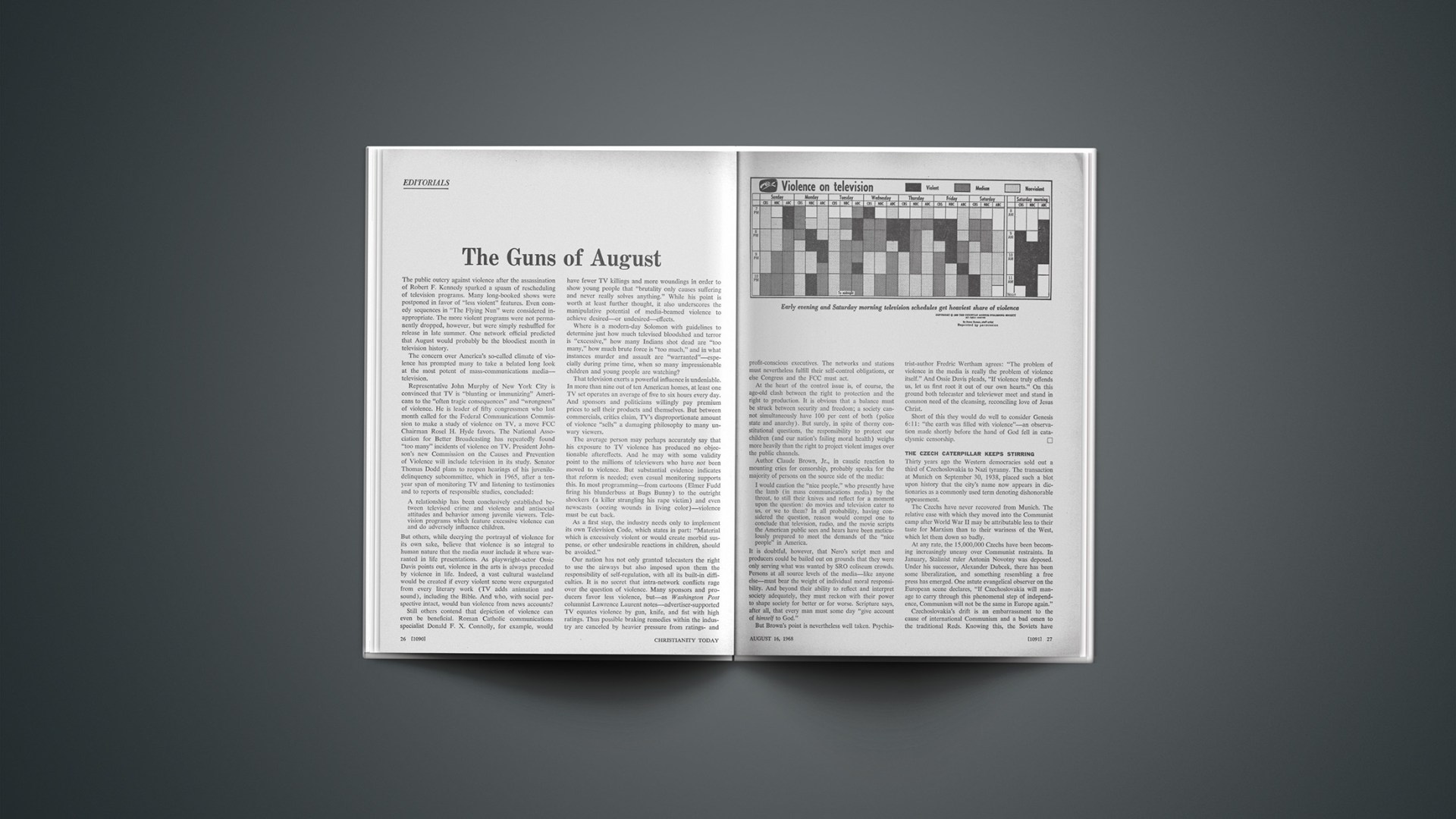
The public outcry against violence after the assassination of Robert F. Kennedy sparked a spasm of rescheduling of television programs. Many long-booked shows were postponed in favor of “less violent” features. Even comedy sequences in “The Flying Nun” were considered inappropriate. The more violent programs were not permanently dropped, however, but were simply reshuffled for release in late summer. One network official predicted that August would probably be the bloodiest month in television history.

The concern over America’s so-called climate of violence has prompted many to take a belated long look at the most potent of mass-communications media—television.

Representative John Murphy of New York City is convinced that TV is “blunting or immunizing” Americans to the “often tragic consequences” and “wrongness” of violence. He is leader of fifty congressmen who last month called for the Federal Communications Commission to make a study of violence on TV, a move FCC Chairman Rosel H. Hyde favors. The National Association for Better Broadcasting has repeatedly found “too many” incidents of violence on TV. President Johnson’s new Commission on the Causes and Prevention of Violence will include television in its study. Senator Thomas Dodd plans to reopen hearings of his juvenile-delinquency subcommittee, which in 1965, after a ten-year span of monitoring TV and listening to testimonies and to reports of responsible studies, concluded:

A relationship has been conclusively established between televised crime and violence and antisocial attitudes and behavior among juvenile viewers. Television programs which feature excessive violence can and do adversely influence children.

But others, while decrying the portrayal of violence for its own sake, believe that violence is so integral to human nature that the media must include it where warranted in life presentations. As playwright-actor Ossie Davis points out, violence in the arts is always preceded by violence in life. Indeed, a vast cultural wasteland would be created if every violent scene were expurgated from every literary work (TV adds animation and sound), including the Bible. And who, with social perspective intact, would ban violence from news accounts?

Still others contend that depiction of violence can even be beneficial. Roman Catholic communications specialist Donald F. X. Connolly, for example, would have fewer TV killings and more woundings in order to show young people that “brutality only causes suffering and never really solves anything.” While his point is worth at least further thought, it also underscores the manipulative potential of media-beamed violence to achieve desired—or undesired—effects.

Where is a modern-day Solomon with guidelines to determine just how much televised bloodshed and terror is “excessive,” how many Indians shot dead are “too many,” how much brute force is “too much,” and in what instances murder and assault are “warranted”—especially during prime time, when so many impressionable children and young people are watching?

That television exerts a powerful influence is undeniable. In more than nine out of ten American homes, at least one TV set operates an average of five to six hours every day. And sponsors and politicians willingly pay premium prices to sell their products and themselves. But between commercials, critics claim, TV’s disproportionate amount of violence “sells” a damaging philosophy to many unwary viewers.

The average person may perhaps accurately say that his exposure to TV violence has produced no objectionable aftereffects. And he may with some validity point to the millions of televiewers who have not been moved to violence. But substantial evidence indicates that reform is needed; even casual monitoring supports this. In most programming—from cartoons (Elmer Fudd firing his blunderbuss at Bugs Bunny) to the outright shockers (a killer strangling his rape victim) and even newscasts (oozing wounds in living color)—violence must be cut back.

As a first step, the industry needs only to implement its own Television Code, which states in part: “Material which is excessively violent or would create morbid suspense, or other undesirable reactions in children, should be avoided.”

Our nation has not only granted telecasters the right to use the airways but also imposed upon them the responsibility of self-regulation, with all its built-in difficulties. It is no secret that intra-network conflicts rage over the question of violence. Many sponsors and producers favor less violence, but—as Washington Post columnist Lawrence Laurent notes—advertiser-supported TV equates violence by gun, knife, and fist with high ratings. Thus possible braking remedies within the industry are canceled by heavier pressure from ratings-and profit-conscious executives. The networks and stations must nevertheless fulfill their self-control obligations, or else Congress and the FCC must act.

At the heart of the control issue is, of course, the age-old clash between the right to protection and the right to production. It is obvious that a balance must be struck between security and freedom; a society cannot simultaneously have 100 per cent of both (police state and anarchy). But surely, in spite of thorny constitutional questions, the responsibility to protect our children (and our nation’s failing moral health) weighs more heavily than the right to project violent images over the public channels.

Author Claude Brown, Jr., in caustic reaction to mounting cries for censorship, probably speaks for the majority of persons on the source side of the media:

I would caution the “nice people,” who presently have the lamb (in mass communications media) by the throat, to still their knives and reflect for a moment upon the question: do movies and television cater to us, or we to them? In all probability, having considered the question, reason would compel one to conclude that television, radio, and the movie scripts the American public sees and hears have been meticulously prepared to meet the demands of the “nice people” in America.

It is doubtful, however, that Nero’s script men and producers could be bailed out on grounds that they were only serving what was wanted by SRO coliseum crowds. Persons at all source levels of the media—like anyone else—must bear the weight of individual moral responsibility. And beyond their ability to reflect and interpret society adequately, they must reckon with their power to shape society for better or for worse. Scripture says, after all, that every man must some day “give account of himself to God.”

But Brown’s point is nevertheless well taken. Psychiatrist-author Fredric Wertham agrees: “The problem of violence in the media is really the problem of violence itself.” And Ossie Davis pleads, “If violence truly offends us, let us first root it out of our own hearts.” On this ground both telecaster and televiewer meet and stand in common need of the cleansing, reconciling love of Jesus Christ.

Short of this they would do well to consider Genesis 6:11: “the earth was filled with violence”—an observation made shortly before the hand of God fell in cataclysmic censorship.

THE CZECH CATERPILLAR KEEPS STIRRING

Thirty years ago the Western democracies sold out a third of Czechoslovakia to Nazi tyranny. The transaction at Munich on September 30, 1938, placed such a blot upon history that the city’s name now appears in dictionaries as a commonly used term denoting dishonorable appeasement.

The Czechs have never recovered from Munich. The relative ease with which they moved into the Communist camp after World War II may be attributable less to their taste for Marxism than to their wariness of the West, which let them down so badly.

At any rate, the 15,000,000 Czechs have been becoming increasingly uneasy over Communist restraints. In January, Stalinist ruler Antonin Novotny was deposed. Under his successor, Alexander Dubcek, there has been some liberalization, and something resembling a free press has emerged. One astute evangelical observer on the European scene declares, “If Czechoslovakia will manage to carry through this phenomenal step of independence, Communism will not be the same in Europe again.”

Czechoslovakia’s drift is an embarrassment to the cause of international Communism and a bad omen to the traditional Reds. Knowing this, the Soviets have tried to put on the squeeze by various methods. Yet the restlessness of the caterpillar-shaped land has continued.

Dubcek and the other leading figures in Czechoslovakia still are firm Communists. They vow not to yield on basic ideology. But this may not be the sort of movement in which a leader can set an arbitrary limit. One thing worrying the Russians is that change like this tends to be open-ended. Czechoslovakia might well keep right on stirring until it wriggles entirely free of the Communist cocoon.

For these and other reasons Soviet leaders brought intense pressure upon the Czechs, unilaterally at their meeting at Cierna, and multilaterally at Bratislava.

The problem is more than ideological for the Soviets. Loss of Czechoslovakia would crack the geographical buffer zone around the borders of the U. S. S. R. It would open a corridor from free Europe into the Ukraine, the most populous, the most restive, and the most nationalistic of the fourteen non-Russian “republics” in the Soviet Union.

What has liberalization done for the Christians of Czechoslovakia? Apparently not much, so far. Blahoslav Hruby, a Czech native and an expert on Slavic church affairs for the National Council of Churches, says many reports confirm that liberalization proceeds much more slowly in the churches than in the political life of Czechoslovakia. The voices for church freedom are finding outlets, not in the religious press, which seems still to be dominated by Stalinist-era clergy, but in cultural publications. One recent article in such a periodical declares:

The Church as a whole was in prison since 1950. This seal appears also on her press, which resembles letters from a jail, written with the awareness that they must pass through strict censorship. All that could be learned from the church magazines was the atmosphere of captivity and the censorship adaptation according to the opinion of either the church or secular censors. This situation continues to this day.

Another Czech periodical, also secular, recently published an open letter from a group of clergymen of the Evangelical Church of Czech Brethren (Presbyterian) to the new Minister of Culture. The minister was asked in quite strong terms to clarify his position on religious freedom. As Hruby notes, publication of this document prior to this year “would have been considered treason.”

The current Czech climate is embarrassing not only to politicians of the Communist establishment but also to Christian clergymen who have tried to accommodate themselves to the Marxist system. For a number of years there has been an organization of Protestant church leaders from Communist countries known as the Christian Peace Conference, and their headquarters has been in Prague. They have been little more than apologists for Communist policy and critics of the United States, particularly its involvement in Viet Nam. The new political climate may encourage them to change their tune a bit.

Even more interesting is the relative reticence of World Council of Churches leaders to speak about the Czech situation. Avant-garde ecumenists who take pride in being on the frontiers of social change are suddenly speechless. They have never addressed themselves as aggressively to oppression in Communist lands as to irregularities in the West, so a move toward democracy in a Communist country evokes little reaction. Indeed, it must come as a surprise to left-leaning churchmen that any people, having once tasted the glories of Marxist socialism, should want to move back to supposedly decrepit democratic processes.

One aspect of the Czech situation must raise the eyebrows of churchmen of contrasting ecclesiastical stripe. That is the way the new Czech climate has come about: not through revolution, in the usual sense, but through evolution. This might give pause to those who think that only the exercise of military force will reverse the tide of Communism. The Czech lesson may be that there is another way, a peaceful way. The fact that this may be a most significant reversal to the Communist cause, and a dramatic break in the worldwide balance of political power, lends support to the more peaceful approach.

Even while ecumenical leaders in Uppsala were debating the pros and cons of violent revolution as a means of bringing about social change, the Dubcek government was firmly but bloodlessly reasserting itself and standing up to the angry roars of the Russian bear. The Czechs knew they might yet be involved militarily but the measure of their progress on a purely diplomatic and political level was admirable.

It is appropriate that a movement for reform among the Communist-dominated peoples should begin in the ancient city of Prague. Here the courageous Bohemian John Huss preached religious reformation a century before Luther nailed his theses to the church door at Wittenberg. The church where Huss preached has been restored and now stands as a monument to that great Christian, who died at the stake for daring to challenge unbiblical practice. Its architectural simplicity is itself a symbol and a sermon, an implicit rebuke to the accretions and excesses of medieval culture. But more than that it speaks for spiritual freedom, and one can even speculate that its presence in the heart of the majestic Czechoslovakian capital contributed to the quest for release from the bonds of Moscow.

THE VATICAN ON BIRTH CONTROL

Pope Paul VI deserves to be admired for the courage and conviction of his encyclical Humanæ Vitæ. With so many Protestant and Roman Catholic leaders clamoring for accommodation to the whims of secular man, it is refreshing to see ecclesiastical authority take a stand for what is thought right rather than what is popular. The evangelical can but wish that the pontiff had reserved his valor for an authentically biblical commitment.

After years of deliberation, the Pope has chosen to reaffirm traditional Roman Catholic teaching on birth control. He concedes that conjugal love is noble, and that husband and wife do well to consider environment when planning children. But he specifies the unreliable rhythm method as the only moral contraceptive means. Its unreliability seems to be the element that makes it morally acceptable, for the Pope underscores the premise that “each and every marriage act must remain open to the transmission of life.”

The encyclical’s conclusion rests on a very simple though vulnerable argument. The argument is that sexual intercourse in marriage has both a unitive and procreative meaning and that these meanings are inseparable. The clear implication is that of all the contraceptive methods, only rhythm safeguards both these aspects.

The Achilles heel of the papal pronouncement is that it is alien to biblical revelation. Its roots are not in inspired Scripture but in the Roman Catholic philosophy of natural law. Throughout the document Pope Paul appeals openly and frequently to this natural-law rationale. It is the means by which the church lays claim not only on the Christian faithful but also upon the secular masses.

The Bible says clearly that marriage alone sanctifies sexual intercourse, which is the divinely given means for propagating the human race. But it does not teach—as the Pope does—that intercourse is justifiable only if conception may result. The Apostle Paul in First Corinthians 7:3 ff. legitimates sex in terms of interpersonal fulfillment. Protestants believe that conscience should be informed by Scripture and is answerable to God alone.

Scripture is silent on contraception. Sound exegesis of the often quoted Genesis 38 passage on Onan rules out divine condemnation of contraception per se. There is ample historical evidence that contraception dates back to biblical times. Since Scripture does not speak directly to the issue, evangelicals tend to conclude that birth-control methods that prevent conception (as distinguished from those that abort a fertilized egg) can be good or evil, depending upon the motives.

A special moral question arises in methods of contraception in which a fertilized egg may be destroyed, for that can be interpreted as termination of new life. This is not a problem with the popular estrogen-progesterone combination pill, which acts by suppressing ovulation and therefore precludes the meeting of sperm and egg. In the case of the loop, medical science does not agree on what happens, though the original theory that it produced an early abortion has been discounted.

Humanæ Vitæ (see also news story, p. 41) is characterized by forthright language and thus is in distinct contrast to Pope Paul’s six earlier encyclicals, which are punctuated by balancing arguments (e.g., “on the other hand”). Some had hoped that the Pope’s birth-control directive would leave the door somewhat open on methods, but it did not. Some tempering of impact lies in the fact that the Pope continues not to speak ex cathedra. However, the whole matter of infallibility is under a cloud of ambiguity (no explicitly ex cathedra document has been issued by the Vatican since 1950, when Pope Pius XII promulgated the highly dubious doctrine of the assumption of Mary). Although a Vatican spokesman said Humanæ Vitæ is not to be regarded as “immutable,” there seems to be little doubt that the Vatican considers it binding upon all Roman Catholics. And the encyclical itself notes that “faithful fulfillment” of what the church regards as the law of the Gospel and natural law are “equally necessary for salvation.”

The World Council And Secularism

The World Council of Churches has made headlines by endorsing the principle of selective objection to “particular” wars. The effect of that resolution is to put the sanction of organized Protestant Christianity behind the movement to permit individuals to select the wars they desire to participate in. The practical effect, for instance in this country, is to assist the campaign of which the Rev. William Sloane Coffin is the most conspicuous spokesman: to encourage the defiance of the laws of the United States which at this moment permit the government to conscript an army in order to implement its foreign policy.

The argument for civil disobedience is, in other words, greatly assisted. The dissenter will now take comfort in being able to say that, to be sure he is breaking the law as narrowly understood, but the law is an unjust law, vide the World Council of Churches.…

The moral problem posed by the World Council is, in the long run, even more disturbing than the political problem. The Council’s declaration has the effect of saying that wars are justified if they are wars of personal passion. That statement is profoundly anti-Christian and indeed recidivist, suggesting the spirit of the more fanatical Crusaders. The Christian doctrine as understood during the Enlightenment is that all wars should be painful and, in human terms, objectionable (love thine enemy). Wars are justified only under clinical circumstances, e.g. and primarily, in order to defend sacred things of great value, to use the phrase of Pius XII; to defend the homeland.

But who is to decide when those things of great value are threatened? The western practice is that such decisions are made by elected governments. Under the reasoning of the Council, what matters is the individual attitude towards a particular war. The individual becomes not merely the absolute moral arbiter on whether he is (as a pacifist) prepared to commit violence under any circumstance; but whether he is prepared to commit violence under this particular circumstance.

An extension of this view of the individual’s sovereignty is pretty frightening. The state is, in the general moral understanding, permitted under given circumstances (e.g. Eichman) to take a man’s life, say for the crime of genocide. But the individual is never permitted to do so. Why not?—if the individual is supreme. If a Christian is going to deny the role of the impartial mechanism of the state in making binding decisions involving the use of violence—whether war, or electrocution, or the use of tear gas—then what is to prevent the individual from asserting his own conscience at such moments when that conscience declares that he believes violence to be necessary?…

The World Council is continuing in the general march of organized Christianity towards a confused sort of secular idealism. The other two recommendations call for admitting Red China to the United Nations, concerning which problem the Council is as equipped to speak as Groucho Marx is to remove an infected appendix; and a call for the economic boycotting of racist nations, which is a splendid way to increase world misery.—WILLIAM F. BUCKLEY (reprinted by permission of the Washington Star Syndicate, Inc.).

Babel or Pentecost?

In seeking to be “relevant” to and “involved” with a confused generation, the Church is in danger of joining the forces of Babel. In that day men said, “Come, let us make …,” “Come, let us build …,” “Let us make a name for ourselves, lest we be scattered abroad upon the face of the whole earth” (Gen. 11:3, 4).

Feeling insecure, fearful of another flood, confident that they had within themselves the solution to their problems, the men of Babel started to make a “brave new world.” What was the result? Confusion!

God had given the people of that time a revelation of his love, power, and provision. He had promised that the world would never again be destroyed by a flood. But these men rejected his love, discounted his power, ignored his provision, and disbelieved his promise. And, as always, God had the last word. He brought their plans to nought, confused their tongues, and scattered them over the face of all the earth.

There is grave danger that the Church of our day may be accepting the philosophy of Babel. By failing to fulfill its God-given mission, it is adding to the confusion of the world.

How different was Babel from Pentecost. At Pentecost, a small group of ordinary men, united in faith, hope, and prayer and obedient to the Lord’s command to “wait for the promise of the Father,” were suddenly transformed into flaming evangels, filled with the Holy Spirit, bearing a burning message—God’s message—of redemption for a sinning world.

This event, which some saw as a confusion of tongues and others as an alcoholic binge, was actually God’s empowering of man to preach the Gospel in a needy but hostile world. These men went out, not to reform the world, but to lead individual souls to redemption through faith in Jesus Christ. There was no compromise in their preaching; they knew men were lost sinners who needed to repent and believe in Christ for salvation. At the center of their message was Christ, the incarnate Son of God, who died on the Cross for sinners. This Christ arose from the dead, and the disciples bore witness to his resurrection as something of which they were certain, because they had been with him after it happened.

They showed how the truths to which they bore witness, the Christ whom they preached, were a fulfillment of Old Testament prophecy, and they repeatedly testified to the accuracy and authority of the Scriptures.

These early witnesses preached that men needed to be saved from their sins. They called for repentance and offered forgiveness in the name of their risen Lord. Their preaching was filled with deep conviction because of their own experience with Jesus Christ. They called men to make a decision, and on one occasion three thousand souls responded. At other times only a few believed, always those ordained of God unto salvation.

Their offer was universal: “And it shall be that whoever calls on the name of the Lord shall be saved” (Acts 2:21). It was the offer of an exclusive Christ: “There is salvation in no one else.” It was a Gospel that divided men: some believed it, others rejected it.

These men were fully aware of the wickedness, the injustice, the evils of the social order in which they lived. They knew about the slavery, prostitution, oppression, dishonesty, and other signs of the depravity of man. And they did something about it! They knew that society would never be changed until men’s hearts were changed. They knew they had the only message that could bring about that change, the message of the new birth through faith in the Risen Lord. And they gave their hearts and even their lives to the proclamation of this supernatural message of a supernatural Christ who would change men in a supernatural way.

This was the result of Pentecost. Is the organized church today following the same road? Or is it following the course of Babel?

In our world, all the basest passions of mankind seem to be coming to the fore in an orgy of lewdness, lawlessness, and strife. Many are saying that our society is “sick.” But it is folly to emphasize the “corporate sins of society” without recognizing that it is the sins of individuals that find expression in society. From the desperately wicked hearts of men come “evil thoughts, murder, adultery, fornication, theft, false witness, slander” (Matt. 15:19). These are the things that defile a man, and they are the things that defile a society.

But what is the organized church doing about this desperate situation? Is it playing the part of the medical quack who offers various nostrums and panaceas, or the medical hack who tries to relieve symptoms without concern for the underlying disease, instead of offering a clear diagnosis and cure based on God’s word? Is it slighting Pentecost, with all its attendant power and blessing, in favor of Babel, with its confusion, frustration, and defeat?

I am greatly concerned about the Church. I am heartsick over a widespread shift in emphasis, a shift from proclamation of the Gospel of Jesus Christ as the one cure for sin to “involvement” in any and every activity designed for social change, with seemingly little concern for the basic change of heart that is the product of the Gospel.

Has the Church lost faith in the power of the Gospel? Does it think it can redeem society without touching the hearts of individuals? Does it think it can join forces with the world to build a city and make a name while it ignores the biblical truth that believers are strangers and exiles on the earth, looking to “the city which has foundations, whose builder and maker is God” (Heb. 11:10)?

A study of the convocations of most of the major denominations reveals that their main concerns are becoming secular and materialistic rather than spiritual. The Gospel is at best taken for granted and not emphasized, and at worst denied.

Can the situation be reversed? The answer is an emphatic yes. But to do so we must turn away from Babel, with its call to merely human achievement, and turn back to Pentecost, where the power of the God of eternity was manifested in the presence and person of his Spirit. This will happen when men bow their minds, wills, and hearts to him in humble faith and obedience. If they do this, the Church will be revived and will go out into this sinning, lost world with the one and only message that will work—that “Christ died for our sins in accordance with the scriptures, that he was buried, that he was raised on the third day in accordance with the scriptures” (1 Cor. 15:3, 4). This message, the Apostle Paul says, is of “first importance”!

Babel or Pentecost—which will the Church choose?

Eutychus and His Kin: August 16, 1968

Dear Ministerial Superstars and Lesser Lights:

As much as we love evangelical pastors, honesty compels us to admit that their roosts contain a certain number of cocksure bumblers who love to crow. Baptist minister Richard Milham holds a funhouse magnifying mirror up to this fowl breed in a new satirical work, Brother Fred Chicken, Superpastor (Broadman, $1.75). His book may ruffle the feathers of a few cocks of the walk, but it will delight all who have to laugh so they won’t cry over the foibles of some pastors.

Brother Fred Chicken (and it’s always Brother Fred) is long on palaver and short on sensitivity, square in his pietism but a corner-cutter in his personal ethics. When a young man seeks him out one night to learn how he can become a Christian, the Superpastor bombards him with a pamphlet against evolution but overlooks his real need. At a ministerial meeting the next day, Brother Chicken eagerly tries to tell of the midnight dialogue but is repeatedly thwarted. Finally, he closes in prayer: “Bless that young man that called me in the middle of the night and got me out of my warm bed. You know how I sought to.…”

Fred is a man with forceful convictions. He’s a master of dispensational charts for bold eschatological preaching; he campaigns vigorously against tobacco (until an acre of it is planted for him as a love gift); he strenuously opposes dancing at his church’s college. In his witness to a Jewish merchant, the Superpastor implores him to “cling to that cross—that same cross that you and your people murdered our Saviour on,” finally leaves him with the reminder not to forget “my preacher’s discount” on a pair of shoes, and then wonders, “Why is it so hard to reach some people with the good news about our riches in Jesus?” He is not averse to receiving kickbacks for funerals referred to a particular mortuary, customarily leaves a miserly tip accompanied by a tract entitled, “Here’s a Tip for You,” and uses a system of telephone signals to avoid long-distance charges.

Brother Chicken yearns to fly high in his denomination. He lands a large pastorate after a carefully planned service to impress the pulpit committee at which two young children, previously pressured by the Superpastor, respond to his baptism invitation. He thinks God one day will make him denominational president.

Milham’s amusing book lays only one egg. In his epilogue he feels constrained to warn readers that his book is satire and that thousands of ministers are not of the Brother Fred Chicken variety. If such an explicit explanation is really necessary, I fear there are more Brother Freds than we realize.

Your friendly chicken-plucker,

EUTYCHUS III

A DISTINGUISHED DOZEN YEARS

Dr. Carl F. H. Henry’s farewell note (Editor’s note, July 5) leads to comment upon the great contribution to religious journalism and Christian thought that he has made during his twelve years as editor of CHRISTIANITY TODAY. As one of his friends since the beginning of his career and as his coeditor from 1963 to 1966, I know something of the devotion to Christ with which he has used his brilliant ability, editorial skill, and exceptional knowledge of theology and related fields to further the cause of evangelical Christianity throughout the world. The position of CHRISTIANITY TODAY as one of the foremost religious journals of these times is a measure of Dr. Henry’s distinguished leadership. As he enters upon his year of study and reflection at Cambridge, he deserves the gratitude and prayerful good wishes not only of the evangelical community but also of other Christian men of good will everywhere.

FRANK E. GAEBELEIN

Arlington, Va.

I wish to congratulate Dr. Henry for producing consistently one of the most readable religious periodicals.…

I have recently assumed the job of religion editor here. Our paper is the largest daily in Alabama.

WALLACE HENLEY

The Birmingham News

Birmingham, Ala.

PANEL APPLAUSE

I appreciated … “Technology, Modern Man, and the Gospel” (July 5). I applaud Dr. Henry’s excellent biblical answers to what appears to be a very modern, universalistic theology.… If we can tell men today that they are forgiven through God’s act, without emphasizing their personal awareness of sin and the need for forgiveness, then there is no need for evangelism today.

BENNIE H. CLAYTON

First Southern Baptist Church

Willows, Calif.

On clinical grounds, I disagree with Harvey Cox that “the first news of the Gospel is not that you’re a sinner but that God has acted and forgiven you.” In the mental-hospital setting, we know that until a person fully accepts his illness and his helplessness in the face of it, there is no way to healing.…

And yet, I would argue against Dr. Henry’s view that the terms sin and sinner are meaningful in helping broken people today. The modern moralistic connotations make the words almost unusable.… Modern man is concerned primarily with the pain he himself is suffering.… Most people today go to God because they are desperate rather than because they feel guilt.… As long as the prodigal comes home, who cares what drives him?

EARL JABAY

Chaplain

New Jersey Neuro-Psychiatric Institute

Princeton, N. J.

COGENT BREVITY

To the “Plight of the Evangelicals” (July 5)—Amen! This is penetrating analysis; its brevity is defied by the depth and cogency of its message. Every point should be carried home to our hearts if we who rest our all in Christ are not to betray his cause at this turning point.

ROBERT M. METCALF, JR.

Memphis, Tenn.

I think that I can suggest at least two basic reasons for the “plight”.… We Mennonites find ourselves in a somewhat peculiar position. In doctrine we are generally with the evangelicals … [but] we are much more comfortable with more liberal groups in the areas of social action.… The tendency to identify America with Christianity … to many of us seems to border on idolatry.… To us the Church, the people of God, come from all nations, kindred, and tribes. The large part that hate … plays in fundamentalist messages and speeches … we cannot accept. We believe that the Bible teaches love for the brethren, for those in need, and for all men and even our enemies. We readily admit that we do not fully practice this, being human, but we certainly try not to make hate a part of our faith.

RALPH NOFZIGER

Archbold, Ohio

NOT SO RED, WHITE, AND BLUE

Please do not write any more editorials about Viet Nam until you have thoroughly investigated the sorry history of our involvement there.…

To say (“Spock, Coffin, and Viet Nam,” July 5) that we must remain to stand for “freedom” is to show ignorance of the peasant’s life under the aristocratic land-lord government that has been in power in the absence of the Viet Cong. The present Saigon government is not a study in moral, conscientious government.…

The picture in Viet Nam is not the simple portrait in red, white, and blue that the evangelical pulpit would like to paint.…

CHRISTIANITY TODAY is the greatest, until it wanders into unfamiliar territory.

LEWIS W. FLAGG III

Cambridge, Mass.

INCOME ATTENTION

“A Guaranteed Income” (A Layman and His Faith, July 5) deserves a lot of attention.… I see no essential injustice in a guaranteed income. There is intrinsic injustice in the old welfare idea.… Guaranteed care for the poor … is a part of the fundamental Hebrew-Christian Ethic.…

Sound ethics will put an economic base under a person because he is a person.… Sound ethics will also call for political integrity which does not use money to exploit the poor.…

The will to work definitely deserves serious consideration. Public support is not the Christian way of life.…

The New Testament pictures a labor pool (Matt. 28:1–16) where those who are willing to work stood all day waiting to be employed. “Why stand ye here idle?” was answered honestly: “No man hath hired me.” The man who says, “If any one will not work, let him not eat,” must have a job to offer. And the New Testament just income is full pay for the fellows who stood in the labor market all day indicating that they were willing to work all day if the employment service would provide the kind of work they could do.… The fact is, if we all knew how to live by every word … of God, these nagging problems would be well on their way to solution.

FRED RUDDER

Knoxville, Tenn.

I have recognized for some time that I am something of a … schizophrenic bird—a religious conservative and a political liberal.…

I just don’t think enough time went into research on the realities of the situation, the workings of various solutions.… The idea of churches and individual Christians meeting today’s social and economic problems on their own sounds great. But the record is one of dismal failure. Let’s put aside the notion that government is something strange and evil. It can be whatever we choose to make it. Let’s borrow a page from the strategy of our Communist foes and start boring from within.

HARRY M. DURNING, JR.

Editorial Writer

WBZ-TV 4

Boston, Mass.

DID NOT—WAS NOT

I covered the Ninety-fourth General Assembly of The Presbyterian Church in Canada.… It was with dismay that I read [your] erroneous report (July 5).

The assembly did not vote to modernize rules, simply to experiment with the form of the 1969 General Assembly.… Coles was not named to head a panel of three, in fact no panel or committee has been set up yet.

DECOURCY H. RAYNER

Editor

The Presbyterian Record

Don Mills, Ont.

FRY AND PRESBYTERY

The issue of the Rev. John R. Fry versus the McClellan Committee (“Gun Cache at First Church,” July 19) was supposedly resolved at the last meeting of Chicago Presbytery. Yet it is still very much a live issue.…

Presbytery rightly acted in support of Mr. Fry in the face of a committee whose proceedings under any normal laws of jurisprudence are extra-legal at best and gratingly abusive at worst. To any reasonable person, Presbyterians included, John Fry remains innocent until proven guilty.…

By the same logic, any reasonable person, Presbyterians included, cannot conclude the Senate committee, the Mayor of Chicago, the police force, and its individual members guilty as charged by Mr. Fry until similarly proven guilty.

What remains is the substantive issue of conflicting testimony.… Senator McClellan’s railings have no more right to shape the church than a group of ecclesiastics wearing “Fry’s My Guy” pins have the right to dictate federal legislative procedure.

What is needed, now that the dust has begun to settle, is for the Presbytery of Chicago to seek to determine, as the court of Jesus Christ which it is, the propriety of the Rev. Mr. Fry’s conduct as a member of that ecclesiastical body.… The emotional whitewash given at our last Presbytery meeting just will not do.

R. NORMAN HERBERT

First Presbyterian Church

Waukegan, Ill.

IT’S SENSIBLE

The little booklet “Heaven or Hell?” by Fred Carl Kuehner (June 21) is about the most sensible treatment on the subject I have seen in a long time.

WALDO H. TINDALL

Trail Community Church

Trail, Ore.

The title “Heaven or Hell?” leads one to believe there will be a real contest, but as it turns out, Hell won by a landslide. Kuehner hardly gives Heaven honorable mention! Is this good news?

BARRY H. DOWNING

Ass’t Minister

Northminster Presbyterian Church

Endwell, N.Y.

INFORMED BUT TOO FREE

Thanks for the fine articles by W. F. Albright and K. A. Kitchen (June 21). However, I feel that James L. Kelso used his well-informed imagination a bit too freely, and thus I must challenge certain assertions which he made without adducing any supporting evidence, either biblical or extrabiblical. For example, I cannot agree that Abraham was a “big business man … engaged in international commerce”.… According to Kitchen (Ancient Orient and Old Testament), Abraham and Isaac were “keepers of flocks and herds and occasionally grew crops of grain (Gen. 26:12; 37:7).… It is going far beyond the biblical evidence to turn Abraham into a full-time donkey caravaneer or a professional merchant”.…

I know of no convincing linguistic evidence to support the etymology of the word “Hebrew” as meaning “caravaneer”.… As long ago as 1961 … Albright promised a forthcoming paper on this problem in which he proposed to prove that the ancestral Hebrews were caravaneers. It should be interesting indeed to read this still future article by Albright, since he claims to have irrefutable evidence. But until it appears, I shall continue to regard Abraham as a wealthy semi-nomadic stockbreeder.

KENNETH L. BARKER

Assistant Professor in Old Testament and Archaeology

Trinity Evangelical Divinity School

Deerfield, Ill.

DOWNING’S UFOs

Albert L. Hedrich did your readers a disservice in his unfavorable treatment of Rev. Barry Downing’s book The Bible and Flying Saucers (June 21). The book may be criticized for lack of sufficient bibliography, for focusing on certain obscure aspects of biblical history that might be UFO-connected while ignoring more substantial items such as Ezekiel’s “flying wheels”.… It may also be criticized for digressing into some quasi-metaphysical speculations about “heaven” which can be more simply understood as God’s vast transgalactic civilization. [But] Rev. Downing’s book should receive wide support since he has made an initial attempt to break this subject into the religious community.… It certainly enhances the credibility of Scripture to realize that Jesus left this planet in a technologically advanced spaceship rather than in a “cloud.” This was the misperception of the people of the time. And only in our own “Space Age” can we conceptualize biblical events with more insight and understanding.

CHARLES D. WILLIS, M.D.

San Francisco, Calif.

The book may be “far out”, but … it certainly does not discredit the Bible; it only gives us a different viewpoint of some things. Whether God used an anti-G beam to hold back the Red Sea or did it some other way makes no difference to me. He did it.

MRS. ERIK KOREEN

St. Paul, Minn.

FUNDAMENTAL DISTORTIONS

May I enumerate the distortions in “Fighting Fundamentalists” (News, June 21): (1) The entire [Pillsbury College] faculty resigned at the close of the first year the school operated, 1957–58. (2) … Dr. Monroe Parker denies that he was forced out when he resigned three years ago. (3) … [Former president] Cedarholm did not double the enrollment.

RICHARD V. CLEARWATERS

Fourth Baptist Church

Minneapolis, Minn.

Science and Christianity

First of Two Parts

A few generations ago, when conversation lagged there were always topics like theology and philosophy to quicken the hour, for educated men felt an obligation to be interested, if not well informed, in these areas. Today it is science we like to be “up on.” First Cause, no; Space Age, yes. Moses is out, Freud is in. The mere fact that a subject can be at one time in and at another time out is mute testimony to change. Sometimes it reflects man’s fickleness, but often it mirrors his growing interest both in an ever-changing world and in the new structures required to understand it.

Behind this growth in our comprehension of the universe stand several competing concepts that are usually in some degree of tension. I say tension rather than duality or plurality, for these concepts do not all apply to the same level. Not all of them purport to give the same kind of description or view of the world. All of us feel this tension.

In Christianity and the Modern World View, H. A. Hodges writes:

We Christians of today are on both sides of the cleft. We are modern people, which means not merely that we live in this year and not five centuries ago, but also that we take an active part in the work and life of that society whose mind is dominated by scientific ideas and whose living conditions are determined by industry. But we are also Christians, members of an institution which stays in the organism of present-day society like a foreign body, inheriting a tradition whose relevance to life is less and less obvious, and talking among ourselves a language unintelligible to the non-Christians who surround us [SCM Press, 1949, p. 17].

I should like to ask three questions and make some suggestions in the three areas they lead us to. The questions are: What is science? Where are the frontiers of science and Christianity? What is the conflict?

What Is Science?

Science in its myriad parts is both conceptual and functional—conceptual in its effort to map the physical and natural world and more recently the psychological world; functional in its perennial enlistment to fight disease, lengthen life, and serve the public good, to say nothing of its capacity to intensify the war effort.

Science is a much misunderstood enterprise. Some say it has a methodology: it gathers data, sends up trial-ballon concepts called hypotheses, tests their validity, makes corrections, modifies the map of reality, makes further tests, and so on. But is this not the basic method of nearly every field of knowledge-seeking, including theology?

Even the gathering of facts is not so simple as it sounds. If you looked east on a clear morning, what would you see? A moving ball of fire rising above a fixed horizon? Look again. Wasn’t it rather a moving horizon dipping below the ball of fire? Which was it? Or were both in motion? Whatever your answer, a structure is implied, a perspective and its related understanding assumed. That is why Goethe said that we see what we know.

Generating hypotheses to fit data is both work and play; either way it is demanding. In physics, which holds a strategic place as a natural science and serves as model for most would-be sciences, the attempt to discover or invent hypotheses to explain data has been the most mind-wrenching experience of all. As Herbert Butterfield observes:

Change is brought about, not by new observations or additional evidence … but by transpositions that were taking place inside the minds of the scientists themselves.… Of all forms of mental activity, the most difficult to induce, even in the minds of the young who may be presumed not to have lost their flexibility, is the art of handling the same bundle of data as before, but placing them in a new system of relations with one another by giving them a different framework, all of which virtually means putting on a different kind of thinking-cap for the moment [The Origins of Modern Science, Bell, 1951, p. 1].

To speak of “the” scientific method in relation to all sciences is quite misleading, for such a method simply does not exist. Science has many methods, each characteristic of the particular science served. A distinguished physiologist once remarked, “It is astonishing how few people realize that the methods of science are in the main ad hoc in nature.”

But what, then, of the logical step-by-step development we learn from textbooks? Honest scientists will tell you that it is an ideal, an afterthought, a way of explaining your work to someone who hasn’t the time to hear about all your mistakes and false starts and zany hypotheses that ultimately (and usually painfully and slowly) became the “shavings from the carpenter’s bench.” The niceties of formal deductive logic are not nearly so important for natural science qua quest as are the freedom and power and fecundity of human imagination.

For this reason Alfred North Whitehead was very frank to characterize science as the outworking of a man’s hunch, of his hope, of his guess:

Science is an enterprise in which reason is based on a faith, rather than one which has faith based on reason.… It is essentially an antirationalist movement, based upon an instinctive conviction and a naïve faith.… This faith cannot be justified by an inductive generalization; … it is impervious to the demand for a consistent rationality [Science and the Modern World].

The colorful comment of the late Professor P. W. Bridgman of Harvard is often quoted:

The scientific method, as far as it is a method, is nothing more than doing one’s damnedest with one’s mind, no holds barred. What primarily distinguishes science from other intellectual enterprises in which the right answer has to be obtained is not method but the subject matter [The Logic of Modern Physics].

All this suggests, then, that scientific research is quite honestly not itself a science; rather, it is still an art. Indeed, science is much richer than most laymen dream and can be viewed from different angles: as a collected precipitate from the stirrings of past minds it is a body of organized knowledge; regarded as a mathematical skeleton (as in physics, notably), it is simply an array of equations; when seen as a formal a posteriori account, the stricter science (with mathematics as the prototype) exhibits a structure of axioms and theorems; seen as a growing edge of understanding, science is a disciplined insight; under the rubric of a bold intellectual adventure, it is experimental theorizing; under the figure of fidelity, it is a “second wife”; and seen as a particular way of life, it is indeed an exhilarating one.

Most scientists, it seems, consider their aim to be constructing at one level or another a world symbolic of the actual world, that is, a model of reality. The success of the model, as Mach observed, is its own justification. What better recommendation is there than the fact that “it works”? But the use of models also has inherent dangers. Nineteenth-century physicists fell into the trap of nearly completely identifying the current theory with their model for it. This led them to think that gases were “really” made up of minute billiard balls, that space was “really” filled with a perfectly elastic solid, rigid but penetrable. These dangers underscore the fact that to have a map of reality is not enough; we need also to know how to use the map. We have relief maps, road maps, contour maps of the same terrain, but each is used in a different way. And those little black circular blobs marking towns do not mean that towns are circular, or that they are black; nor is the State of Rhode Island all purple, as some maps show.

Where Are the Frontiers?

If these considerations point in any specific direction, it is, I believe, toward the fact that the frontier of science as a human effort is simply in the mind of man. This mind is still the most important element in all scientifically conducted research. It is there that facts are observed, hypotheses formed, critical judgments built up, revisions made, and so on.

Now, to the scientist who is also a Christian, it is of incalculable importance that what he seeks to map is God’s universe, for this means he is contributing to an understanding of the work of God’s hands. This difference will not necessarily make him a better or more thorough scientist, but it will qualify his attitude toward his work. In the nature of things and persons, the pristine joy of creating is beyond our power; but the exhilaration of being on the growing edge of deeper and deeper awareness of how it all is put together and how it actually functions is surely a joy, whether the poets celebrate it or not. In the words of George Macdonald, “human science is but the backward undoing of the tapestry-web of God’s science, works with its back to Him, and is always leaving Him—His intent, that is, His perfected work—behind it, always going farther and farther away from the point where His work culminates in revelation.” Note the connection between science and revelation via creation.

The scientist can hardly avoid placing himself somewhere in the scheme of things; to do this is a human thing and has nothing whatever to do with science. And where we place ourselves in our reading of life is crucial. We are all cut from the same bolt of cloth in our basic concerns; these are the classical, personal, perennial matters of security, freedom, order, and meaning. The answers we give to these questions involve our faith or lack of it, our concepts of history, of self, and of the future.

God is always a “problem” to a man, including an educated man, until He becomes the center of that man’s own little universe. Our egocentricity is our damnation; God’s egocentricity is our salvation. It was the same with Mitya in Dostoevsky’s story of the four Brothers Karamazov:

It’s God that’s worrying me. That’s the only thing that’s worrying me. What if He doesn’t exist? What if Rakitin’s right—that it’s an idea made up by men? Then if He doesn’t exist, man is the chief of the earth, of the universe. Magnificent! Only how is he going to be good without God? That’s the question. I always come back to that [Great Books of the Western World, p. 314].

Because science qualifies how we construe the world, and construction is both of mind and of heart, the mind of modern man—and particularly that of the educated, because it is more susceptible to science—is justifiably identified as the frontier of both science and Christianity.

What Is the Conflict?

Although the more acrimonious debate between science and traditional views of the Christian Church is past, the fires of controversy have left embers that are still warm. The tension of incompatible attitudes is still with us and will probably exist for a long time. No doubt new aspects of the conflict are yet to emerge. This surely testifies to the vitality of both sides in a world of men who are supposed to see things for themselves. Each with a growing edge of understanding tends to eye the other with conspicuous aloofness. But much of the time they ignore each other.

THE PROPHET’S CHILD

He dreamed his dreams—

Some were roaring nightmares;

He saw his visions

And tiptoed skyscraped heights;

His prophetic mouth has sprung

And closed with clacking teeth

And with thin, smacking lips.

A pop-eyed, naked nuisance!

Spirit dripping on this stone,

They charged, would not wear

Away its final, immutable presence.

But as they left, at their feet

Children sang and carved

Their dream-born castles

From the white, sea-washed sand.

WILLIAM J. SCHMIDT

The story of the conflict has been one of faults on both sides. On the whole, it has been an account of shrinking faith in the relevance of Christian faith. The Church bitterly opposed the Copernican idea of heliocentricity; yet how much grander is our concept of the universe as a result of it! It is a sad fact that scientists, even unbelieving scientists, are swifter to confess error in science once it is discovered than are the leaders of the Church. Would not confession by the Church of its ancient errors, even at this late date, be a wholesome act? Has the Church forgotten how to confess?

But there is yet another angle for viewing the scene, one that can be very revealing. Sometimes the distinction between science and religion is compared to that between a diagram and a picture—two different but complementary methods by which man grasps reality. Up to a point this is true.

The error, from the Christian point of view, that has colored many well-meaning scholarly attempts to treat the problem of theology and natural science is conceiving them to be on the same level. Novel though the thought might appear to some, truth is not all on one level. There is truth that is higher because it is more important and because it includes other truth and depends upon it for its validity. The difference lies in the matter of man’s involvement of himself in the viewing process. For this reason, the one-level treatment of theology and science is academically impossible. James Denney called attention to this involvement when he criticized Ritschl in 1895:

Christian theology is not a separate department of intelligence, having no connection with others; just because it is a doctrine of God, it must have a place and recognition for all those impressions and convictions about God which have exerted their power in man’s mind, even apart from the perfect historical revelation [Studies in Theology].

But what is the picture today? Half the human race is dominated by a philosophy that dogmatically asserts that science has superseded Christian theology and then sets out to prove to the world that Christian faith is obsolete.

It has been popular to think of the science-religion conflict as a running series of battles between particular dogmas of religion and particular discoveries of science. But this is a superficial approach, as W. T. Stace observes. The real trouble is deeper; it extends to the private laboratory of the heart and mind, where presuppositions are formulated. The antagonism, Stace says, “is rather that certain very general assumptions which are implicit in the scientific view of the world conflict with basic assumptions of the religious view—any religious view, not merely the Christian view—of the world” (Religion and the Modern Mind, Lippincott, 1952, p. 53).

It is in the heart that man first and most importantly either affirms or denies the existence of God. Here is the watershed of character. In his assumptions a man determines what he really is before God. For me, this is a basic biblical insight. My experience as a mathematician has only served to rub it in, as it were, because it is also a basic mathematical insight that the axioms of a system determine completely the structure reared upon them. The Apostle Paul makes this order clear when he first argues a correct doctrine of God and self and then sets down exhortations on conduct. The picture in the Book of James is that of a spring from which sweet or bitter waters flow.

If man does not recognize God as Creator and Lord of all life, and of his own in particular, then God forces him to take an idol as his “god.” If he will not believe the truth, there is nothing left but to accept a lie. There are many ways to tell a lie, but there is only one way to tell the truth. God implicitly gives the possible meanings of life when he puts man in the context of the rest of his earthly creation. We do not manufacture meanings for life: we choose from those available before we arrived on the scene. Thus when man realizes his alienation from God, he finds himself continually driven to seek provisional meanings from the broken cistern of his own existence in order to nullify the sense of guilt and to satisfy his deep yearning for meaning. His guilt and hostility will inevitably rise to the surface and work themselves out in his every pursuit. The testimony of conscience in time emerges to the surface like the periscope of a submarine, to be seen by all. Either we are living epistles for God and exhibit faith that others see, or else we reflect to the world an emptiness of soul and an absence of faith.

Both in college years and later, educated persons are influenced by the mainstreams of thought. Many continually make progress in a lively intellectual pilgrimage. We need to see how the educated often parry the thrust of the Gospel. Let us examine the structure of reasoning. If strong emphasis is given to the status of hypotheses and presuppositions, it is because they appear as both necessary and sufficient to carry out a line of reasoning.

The basic move in discursive thought is the syllogism, the logical move whose very simple form is: All A’s are B’s; all B’s are C’s; so all A’s are C’s. The conclusion follows from the two premises. Any logical argument is ideally a chain of reasoning involving such syllogistic links. Argument is logical to the degree that it shares this pattern. We are constantly making assumptions in all areas of life and under all sorts of conditions, because we cannot apprehend reality in any other way. In the sciences it is important to recognize our assumptions and often to call specific attention to them. Sometimes whole nations are in such basic agreement on a presupposition—for example, that war is terribly wrong—that it becomes an unconscious axiom, as prevalent as the air we breathe. Often in the history of ideas a whole culture has bought stock in some popular idea or concept that all or nearly all people accepted without question. A mind set, an automatic frame of reference, develops, to which other questions are referred for consideration.

Historians tell us that the modern mind, including the educated mind, is the product of seventeenth-century science. Herbert Butterfield sees the “scientific revolution” of that period as truly volcanic in its mental upheaval:

Since that revolution overturned the authority in science not only of the middle ages but of the ancient world—since it ended not only in the eclipse of scholastic philosophy but in the destruction of Aristotelian physics—it outshines everything since the rise of Christianity and reduces the Renaissance and Reformation to the rank of mere episodes, mere internal displacements, within the system of medieval Christendom. Since it changed the character of men’s habitual mental operations even in the conduct of the non-material sciences, while transforming the whole diagram of the physical universe and the very texture of human life itself, it looms so large as the real origin both of the modern world and of the modern mentality that our customary periodisation of European history has become an anachronism and an encumbrance [The Origins of Modern Science, Bell, 1951, p. viii].

One of my philosophy professors was fond of saying that it is the essence of thought to make distinctions. Doubtless this was a “pearl” he was handing down from his own schooling. But I’m not sure that philosophy always makes significant distinctions. If we play detective in trying to locate hidden as well as plain presuppositions, then we find that science makes three basic assumptions: (1) that the world is really there (seldom mentioned but a constant backdrop); (2) that logic applies to science’s description of the world (this cannot be proved a priori but is constantly and in different ways being verified); and (3) that some kind of causal laws apply to nature, though their precise nature is, at least for physics, the subject of hot debate.

In Miracles C. S. Lewis observed that “all possible knowledge … depends on the validity of reasoning.… Unless human reasoning is valid, no science can be true.… A theory which explained everything else in the universe but which made it impossible to believe that our thinking was valid … would have destroyed its own credentials.”

While some such basis is common to all scientists, it should be clear that a Christian view of things cannot stop with these three axioms. Indeed, there is nothing religious at all in this characterization of science. But the scientist who is also a Christian goes two steps further by saying that God exists and that Jesus Christ is an adequate revelation of him to man. On both points he is on firm biblical ground. The Bible assumes, without formal proof in any mathematical sense, that God exists. The evidence it offers is, for the believing, quite sufficient. Scripture is full of the evidence that God exists independently and underivedly and eternally. All time is “now” to him; all space is “here” to him; all men are “present” to him; all beings are “creature” to him.

Christian faith puts that described world into its own God-arranged setting. Science has absolutely nothing to do with the way faith regards the cosmos in relation to God. This is for the believer a matter of God’s revelation. The Christian cannot afford to let the scientist tell him the ultimate significance and meaning of the universe, any more than the scientist can let the Church dictate the experiments he will conduct and the investigations he will carry out. Our conviction as Christians is that the Bible’s view of the world, its view of men and things and of all the created order, is the most satisfying and the most consistent with all the facts.

Milton D. Hunnex is professor and head of the department of philosophy at Willamette University, Salem, Oregon. He received the B.A. and M.A. degrees from the University of Redlands and the Ph.D. in the Inter-collegiate Program in Graduate Studies, Claremont, California. He is author of “Philosophies and Philosophers.”

The Lord’s Day Is Not Passé

Seven years ago the United States Supreme Court handed down landmark decisions on four cases dealing with the legal regulation of Sunday. At issue was whether Sunday closing laws violated the United States Constitution. In the opinion of the court, the Sunday laws no longer had a religious significance. In fact, the only concern of the justices in this regard was whether the Sunday laws violated religious liberty. The majority view as expressed by Chief Justice Warren was that the present purpose and effect of the various Sunday laws was “to provide a uniform day of rest for all citizens”:

That this day is Sunday, a day of particular significance for the dominant Christian sects, does not bar the state from achieving its secular goals. To say that the states cannot prescribe Sunday as a day of rest for these purposes solely because centuries ago such laws had their genesis in religion would give a constitutional interpretation of hostility to the public welfare rather than one of mere separation of church and state.

This statement points up the difference between present and past practices. The Puritan heritage of many of the early colonists included a strong conviction about observance of the Lord’s Day. In 1595, the doctrine of Sabbatarianism was outlined by Nicholas Bownd in a work called The True Doctrine of the Sabbath. Although he recognized the distinction between the Jewish Sabbath and the Christian Lord’s Day, Bownd affirmed that the commandment to sanctify every seventh day was moral and perpetual in its significance. His work apparently had a great influence upon the Puritans of his time.

Another evidence of Puritan thought is seen in an action of the Synod of Dort, which in 1619 agreed upon the following:

(1) In the fourth commandment of the Law of God, there is something ceremonial, and something moral. (2) The resting upon the seventh day after creation, and the strict observation of it, which was particularly imposed upon the Jewish people, was a ceremonial part of that law. (3) But the moral part is, that a certain day be fixed and appropriated to the service of God, and as much rest as is necessary to that service and the holy meditation upon Him. (4) The Jewish Sabbath being abolished, Christians are obliged solemnly to keep holy the Lord’s Day. (5) This day has ever been observed by the ancient Catholic Church, from the time of the apostles. (6) This day ought to be appropriated to religion in such a manner as that we should abstain from all servile work at that time, excepting those of charity and necessity; as likewise in all such diversions that are contrary to religion.

A similar conviction was expressed in the Westminster Confession, drawn up in 1643 by a group of clergymen and laymen, the majority of whom were Presbyterian Puritans, and approved in 1647 by the general assembly of the Church of Scotland. Since the confession became the creed of Scottish and American Presbyterianism, this statement from it is significant:

As it is the law of nature, that, in general, a due proportion of time is set apart for the worship of God; so, in His Word, by a positive, moral and perpetual commandment, binding all men in all ages, He hath particularly appointed one day in seven for a Sabbath, to be kept Holy unto Him; which, from the beginning of the world to the resurrection of Christ, was the last day of the week; and from the resurrection of Christ was changed into the first day of the week, which in Scripture is called the Lord’s Day, and is to be continued to the end of the world as the Christian Sabbath.

This Sabbath is then kept holy unto the Lord, when men, after a due preparing of their hearts, and ordering of their common affairs before Him, do not only observe an holy rest all the day from their own works, words, and thoughts, about their worldly employment and recreation; but are also taken up the whole time in public and private exercises of His worship, and in the duties of necessity and mercy.

It was Puritans of this persuasion who brought with them to this country their conception of the Christian Sabbath and established its observance by law as part of the ideal of a Christian commonwealth. Yet as early as 1631 Roger Williams challenged this policy, arguing that it was inappropriate for the civil authority to enforce obedience to the fourth commandment.

Abandonment of the Puritan position on the observance of Sunday, however, did not come until after the wave of immigration from Europe to this country in the latter part of the nineteenth century. These new citizens brought with them the so-called Continental Sunday, characterized more by rest and recreation than by worship and Christian service. This practice was compatible with the growing secularization of Western culture during this era, and it provided the basis for the Supreme Court’s opinion that Sunday laws no longer applied to religious observance but had to do with the secular goals of the state.

The early Puritans insisted that every dimension of personal and social life was to be brought under the authority of the Word of God. The modern evangelical who accepts this principle is faced with a problem that is both cultural and theological. Today’s society, while it may give lip service to the idea of setting aside one day a week as a day of rest, is not in full agreement about what this means, and across the land contradictory practices prevail. In some areas businesses are closed while in others they remain open. Generally those who favor Sunday closing do so on pragmatic grounds: families are able to be together on one day of the week, or business competitors are better circumscribed by Sunday laws. The conscientious Christian must decide whether he should change employment if required to work on Sunday in a job not vital to community health or welfare, whether to refrain from recreation engaged in by the overwhelming majority of his contemporaries on that day, perhaps even whether to take his family out to Sunday dinner after church.

Since his decision should be based primarily on biblical rather than cultural or expedient grounds, he is also faced with the important question of just what the Word of God teaches about observance of the Lord’s Day. Historically, Christendom has not been united on this subject, and it still is not. Even the Reformers did not agree whether the Lord’s Day was to be observed on the basis of expediency or in accordance with the commandments of God. Luther’s sermon at the dedication of the Castle Church at Torgau on October 5, 1544, is often cited: “We Christians … have the liberty to turn Monday or some other day of the week into Sunday if the Sabbath or Sunday does not please us.” Yet it could well be that both the early Church and the Reformers felt such an obligation to distinguish between themselves and their Jewish or Roman Catholic antecedents that they tended to over-emphasize the distinction between the old order and the new and between law and grace.

Because this matter has been one of persistent controversy, the tendency has been to avoid the question whether Scripture speaks normatively to today’s Christian about observance of the Lord’s Day. But the question remains.

One common view among evangelicals is that the fourth commandment pertains strictly to the economy of law and thus has no place in the practice of the New Testament Church. Yet it is difficult to think that a set of commandments as basic as the Decalogue could be so fragmented. This is particularly true in light of the reason given for the observance of one day in seven, that is, that it recalls God’s rest after the completion of his creative work. Is it no longer necessary for the Church to mark the completion of God’s creative work in this way?

The conviction and practice of the New Testament Church are instructive at this point. The early Christians set apart the first day of the week to commemorate the resurrection of Christ. This great, central fact of our Christian faith was not divorced from the creative acts of God. The Apostle Paul asserted in the eighth chapter of Romans that a fallen creation waits for the redemption that is yet to be effected through the saving work of Christ. In observing the Lord’s Day, then, the Christian Church can be obedient to the foundational purpose of the fourth commandment in marking God’s rest from his initial creative acts and also be a witness to his re-creative activity, so to speak, through the resurrection ministry and ultimate triumph of the Son of God.

Observance of the Lord’s Day as, among other things, a witness to God’s creative and redemptive work is consistent with other observances having the same objective. For millions of Christians, baptism is a sign or seal of their identification with Jesus Christ in his sacrifical, redemptive ministry. Similarly, each time Christians celebrate the Lord’s supper they announce the Lord’s death until he comes again. In Ephesians, Christian marriage is described as a witness to the world of the union that exists between Christ and the Church. As baptism and the Lord’s supper affirm the relation of the believer to Jesus Christ as Saviour, so Christian marriage bears witness to the relationship of the Christian Church to Christ as head. And God has provided a similar type of witness to the world of his creative acts and the ultimate restoration of creation under his sovereignty—the Lord’s Day. By setting aside of one day for worship and service and release from the tasks that normally occupy them, today’s believers can witness to their contemporaries both of what God has done and of what, in Jesus Christ, he yet will do.

Obedience and witness, moreover, are not without recompense for the Christian. Admittedly there is self-fulfillment or self-realization in obedience to the Word of God and in bearing witness to an unbelieving world. Yet other benefits stem from a proper accommodation to the basic order of God’s universe. Christ said that the Sabbath was made for man rather than man for the Sabbath. Much has been said about what this statement implies, but it seems evident that the setting aside of one day in seven was meant to give man the physical and emotional renewal he greatly needs through rest from labor and in worship and praise. Perhaps the mental and emotional illness that plagues even the Christian community might be lessened if men deliberately set aside the pressures and tensions of demanding schedules and devoted one day in seven to meditation, worship, and fellowship. Like the other nine commandments, the fourth is designed to enable man to serve his Creator better.

Let Christians take seriously their responsibility to observe the Lord’s Day. But let their observance be the product, not of a sterile legalism, but of spiritual vitality. The secular world may not pay much attention to words, but it may well be summoned to give attention to the claims of Christ by the actions of his followers. Observance of the Lord’s Day is one of the most obvious of the Christian practices. Perhaps God will use it to gain the attention of our contemporaries and have them consider his sovereignty both in creation and in redemption through Jesus Christ.

Milton D. Hunnex is professor and head of the department of philosophy at Willamette University, Salem, Oregon. He received the B.A. and M.A. degrees from the University of Redlands and the Ph.D. in the Inter-collegiate Program in Graduate Studies, Claremont, California. He is author of “Philosophies and Philosophers.”

The Modern Debate around the Bible

Last Three Parts

In approaching the Bible, the conservative theologian begins with the self-testimony of Scripture. To find out what Scripture is, he sets himself to listen to what Scripture claims to be. In other words, the conservative theologian begins with an act of faith. This is often said to be reasoning in a logical circle, and we do not deny this. But we also maintain that it is inevitable. If the Bible is the Word of God, as it claims to be, then it is simply impossible to appeal to any other authority that stands above Scripture in order to obtain the right view of Scripture. If it is the Word of God, it is itself the highest authority; we can only submit to its claims.

No one in recent years has defended this more cogently than Karl Barth. Although we disagree with his doctrine of Scripture, we cannot but agree with the following statement, which describes his acceptance of this starting point:

The doctrine of Scripture in the Evangelical Church is that this logical circle is the circle of self-asserting, self-attesting truth, into which it is equally impossible to enter as it is to emerge from it. It is the circle of our freedom which as such is also the circle of our captivity [Church Dogmatics, I, 2, 535].

What Barth means is that one cannot, by reasoning, work oneself up to this starting point, nor can one, once captivated by the Holy Spirit, get away from this starting point. It is simply a matter of faith, of being convinced by the Holy Spirit. Barth explains it with the following example. If you ask a boy, “Why do you call this woman among all others your mother?,” his only answer is: “Because, of course, she is my mother.” That is the fact upon which he proceeds. In the same way, all our statements about the Bible proceed upon the fact that the Bible is the Word of God. Here God speaks to us.

This, of course, is decisive for one’s whole view of Scripture. One can only begin with listening to what the Bible says about itself.

The Self-Testimony of Scripture

There can be no doubt about this self-testimony of Scripture. Take, for example, the attitude of Jesus and his apostles toward the Old Testament. There is no shadow of a doubt that they accepted it reverently and obediently as the Word of God. There is no trace of the idea that it is only a human document of Israel’s spiritual experiences. No, here God himself speaks. In his discussion with the Pharisees, the appeal to the Old Testament is always final. After his resurrection, his disciples follow his example without any hesitancy. Their writings abound with quotations from the Old Testament, and they always appeal to it as the Word of God. At the same time they make a similar claim for their own preaching. The Apostle Paul, for example, writes to the congregation in Thessalonica: “We also thank God constantly for this, that when you received the word of God which you heard from us, you accepted it not as the word of men but as what it really is, the word of God, which is at work in you believers” (1 Thess. 2:13). The Apostle Peter places the epistles of Paul on the same level with the Scriptures of the Old Testament (2 Pet. 3:16).

It is evident that, according to the witness of Scripture itself, the Bible is the Word of God. It is not, as Barth and his followers suggest, only a human document that can become the Word of God, when and where it pleases God. There is identity, direct identity, between God’s Word and the Bible. Or to put it in another way: The Bible not only contains God’s revelation; it is God’s revelation to us.

God’s Self-Revelation in Christ

The words “in Christ” must immediately be added to the last statement. God’s revelation in the Scriptures is not just a revelation of all kinds of interesting facts about the world beyond this world and the life after death; it is primarily self-revelation of God in Jesus Christ. There is also information about other subjects—about heaven and hell, about this world and man in this world. Yet the real heart of the biblical revelation is that God makes himself known as the God who in his Son Jesus Christ saves this world from eternal destruction. All other information is subordinate to this central message. One could here apply Jesus’ own words from the Sermon on the Mount: “Seek first his kingdom and his righteousness, and all these things shall be yours as well” (Matt. 6:33).

There is therefore only one way to read the Bible properly: we have to read it as the kerygma, the proclamation of God’s salvation in Jesus Christ. This was the way Jesus himself read the Old Testament, as speaking of himself and thus pointing forward to the great redemption (Luke 24:25 ff.; John 5:39). In the same way the New Testament must be read as the revelation of God in Jesus Christ, but this time pointing backward, as it were, for now he has come, in the fullness of time (Gal. 4:4). William Tyndale expressed this purpose of the Bible well:

The Scripture is that wherewith God draweth us unto Him. The Scriptures sprang out of God, and flow unto Christ, and were given to lead us to Christ. Thou must therefore go along by the Scripture as by a line, until thou come at Christ, which is the way’s end and resting-place [Works (Parker Society ed., 1848), I,317].

Inspiration

But how can a book clearly written by men at the same time be the revelation of God? The Bible’s own answer is that it is not a purely human document. These men were inspired by the Holy Spirit. There is no need to elaborate on the testimony of the Bible on this point, but let us look at two key texts. In his second epistle, Peter says of the Old Testament prophets that their message did not come “by the impulse of man, but men moved by the Holy Spirit spoke from God” (1:21). In his second epistle to his spiritual son, Timothy, the Apostle Paul declares of the whole Old Testament: “All scripture is inspired by God and profitable for teaching, for reproof, for correction, and for training in righteousness, that the man of God may be complete, equipped for every good work” (3:16, 17).

We should note that Paul says pasa graphe, all Scripture, is inspired by God. No part is exempted. Everything in Scripture is inspired, that is, written under the guidance of the Holy Spirit. Reformed theology, in its classical expositors, expressed this by use of the term “verbal inspiration.” This term has often been misunderstood. Many think that to believe in verbal inspiration is to believe that the whole Bible was dictated by the Holy Spirit; one can read this again and again in the books of critical scholars. I can only say that this is a misrepresentation, and I do not mind adding that in the case of scholars it is a deliberate misrepresentation. For they really can and should know better. Have not conservative scholars repeatedly said that they do not hold a mechanical dictation view? As long ago as 1893 Warfield stated: “It ought to be unnecessary to protest against the habit of representing the advocates of ‘verbal inspiration’ as teaching that the mode of inspiration was by dictation.”

What do we mean by “verbal inspiration”? We mean that not only the thoughts but the words as well were written under the special guidance of the Holy Spirit. Speaking of the “words,” we do not mean the words in isolation. We definitely do not mean to say that the Holy Spirit, as it were, whispered into the ear of a prophet or an apostle, “Now you have to use the definite article,” or “Now you have to use the conjunction ‘and.’ ” Such a conception would indeed be “mechanical.” But this is definitely not the conservative position. When we say that the “words” were inspired by the Holy Spirit, we think of the words in their context: the single word within the context of the verse, the verse within the context of the passage, the passage within the context of the whole book. Because of this emphasis on the context, I personally prefer to speak of “plenary,” rather than “verbal,” inspiration. Yet I mean the same. I believe on the ground of the Bible’s own self-testimony that the whole Bible is inspired by the Holy Spirit. Everything in it is according to the will and intention of the Spirit. And this will and intention is: to reveal God’s love in Jesus Christ.

All this has very important and far-reaching implications for our doctrine of Scripture. The first is that Scripture has divine authority. This is a very big claim, but it cannot be avoided. If it is true that the Bible is God’s revelation to us, then we have to bow before its message in obedience. At the same time we must add immediately: The Bible has authority as revelation. In fact, this is the only authority it claims. It does not claim authority in astronomy, for example. As Calvin said, he who wants to learn astronomy should go somewhere else. The Bible is not a scientific textbook. This does not mean it has no significance for the sciences. On the contrary, it supplies the basic presuppositions for all sciences. But it does not deal with scientific problems as such.

The other major consequence is that the Bible is trustworthy and reliable, or, as the fathers used to say, infallible. Again we may not shrink back from this conclusion. It is a “good and necessary consequence,” to use the terminology of the Westminster Confession. But again we must immediately add: It is trustworthy and reliable as revelation. It is not correct to use these words in such a general sense as to imply that the Bible possesses a scientific standard of infallibility. Take, for instance, our modern standards of accuracy. These are foreign to the biblical writers. Often they give no more than approximations. Furthermore, they are very schematic in arranging their material. In his genealogy of Christ, Matthew uses the mnemonic device of three times fourteen generations and for that reason leaves out some of the names mentioned in the Old Testament. He and Luke give the temptations of the Lord in a different order. John places the cleansing of the temple at the beginning of his Gospel, while the other evangelists mention it as part of the final stage of Christ’s ministry. But all this in no way affects the trustworthiness of the Bible. We can really trust it in all that it wants to reveal.

This, in my opinion, is the only correct starting point for all our thinking and speaking about the Bible, for this is the way the Bible presents itself to us. Often this view is called “bibliolatry.” Again and again we hear people say: “You conservatives believe in a book. That is entirely wrong. You should believe in Christ.” My answer is that this is an absolutely false contrast. Of course, we do not believe in the Bible in the same way we believe in Christ himself. Our relationship to Christ is of a different nature; it is a personal relationship. But we also know that there is only one Christ, namely, the Christ who comes to us in the Bible! In other words, they belong inseparably together.

As conservatives we also recognize that God is not locked up in the Bible. We know that we do not “possess” God or his truth. He is and remains the free and sovereign One, also in his revelation. We know that the Bible does not convert a man; this is accomplished by the Holy Spirit, who brings the message of the Bible home to the man. But as conservatives we maintain that it is the message of the Bible that is brought home by the Holy Spirit. Again we say: The Holy Spirit and the Bible belong inseparably together.

God’s Word in the Words of Men

While fully maintaining the identity between the Bible and the Word of God, we do not deny, of course, that this Word of God comes to us through human words. Perhaps we may say that today we know this better than we ever did before. To a large extent, conservatives owe this clearer insight into the human aspect of the Bible to liberal scholars. For a time, in particular the century after the Reformation, the century of the so-called Lutheran and Reformed orthodoxy, conservatives almost seemed to forget this. Some of the orthodox fathers, though formally recognizing the human aspect of the Bible, defended such a rigid theory of inspiration that in actual fact the human aspect was almost completely ignored. We find this view even in one of the Reformed confessions of that century, the 1675 Helvetic Formula of Consensus. Here we read that “the Hebrew Original of the Old Testament, which we have received and to this day do retain as handed down by the Jewish Church … is, not only in its consonants, but in its vowels—either the vowel points themselves, or at least the power of the points—not only in its matter, but in its words, inspired of God.…” In certain respects, liberalism was an understandable reaction to this attitude.

It is very unfortunate that in reaction to the critical approach to Scripture some conservatives of our day again tend to ignore or to minimize the truly human aspect of the Bible. One finds this in particular in some “fundamentalist,” or ultra-conservative, circles. In these groups we find several mistaken notions about the Bible. Some, for example, identify the Word of God with the King James Version! Quite often one hears these people say: “Everything in the Bible is the Word of God and everything is equally the Word of God.” However well meant such a statement may be, it ignores the organic structure of the Bible. Not everything in the Bible is on the same level, nor is every verse equally central—that is, related to the center of all revelation, Jesus Christ.

Indeed, the Bible, the written Word of God, is at the same time a human book through and through. At this point there is a very close parallel between the doctrine of Christ and the doctrine of Scripture. We believe that the Son of God became incarnate. Being truly God, of the same substance with the Father, he really and truly became man. As the Apostle Paul says: “Though he was in the form of God, [he] did not count equality with God a thing to be grasped, but emptied himself, taking the form of a servant, being born in the likeness of men” (Phil. 2:6, 7). Nothing human was alien to him. He shared in all our weaknesses, even in our temptations. There was only one limit: he was sinless. In the same way God’s Word, as it was written down, entered into the “flesh” of human thoughts and words. Again we must say it is really and truly human, and nothing human is alien to it. But here, too, there is one limit: there is no error in it. It does reveal God and his plan of redemption to us, without any distortion or error.

Organic Inspiration

This truly human character of the Bible is also the reason why we reject every mechanical conception of inspiration. Such a conception would be wholly out of keeping with the incarnation, and with God’s ordinary dealings with man. The conservative view of inspiration is not mechanical but rather organic. We believe that the Holy Spirit took into his service men with all their various abilities. This explains the differences in style and language we find in the various books of the Bible. And it also explains the differences in approach. God’s revelation really went into the authors’ minds and hearts and lives and was reproduced with the “colors” of their individual experiences clearly visible in it. In fact, we cannot say beforehand how far the Holy Spirit went in his “accommodation” of the revelation to the level of his organs. We can find this out only by a careful study of Scripture. Calvin once said that in his revelation God acts like a nurse babbling to the baby.

When we study the Scriptures, we do find remarkable things. For instance, God made use of the ancient world picture of those days to express his thoughts to his people. We find this even in the second commandment of the Decalogue: “You shall not make yourself a graven image, or any likeness of anything that is in heaven above, or that is in the earth beneath, or that is in the water under the earth …” (Ex. 20:4, italics added). And we find “accommodation” also in the historical parts of the Bible. There are the many small differences among the three so-called Synoptic Gospels, and there are greater differences between these three Gospels, on the one hand, and the Gospel of John, on the other. There are two versions of the Lord’s Prayer, two of the Sermon on the Mount, and several of the institution of the Lord’s Supper. I do not believe we should try to harmonize them at all cost. They all bring the same message in their own ways, and our task is not to harmonize them but to find out what is the special emphasis of this or that writer.

Furthermore, the Bible writers were definitely children of their own time, and they show it everywhere in their writings. Paul, for example, is a real Jew and clearly shows his rabbinical education in his epistles. We detect it in such things as the way he builds up his argument, the way he argues with his opponents, and the way he quotes the Old Testament. In particular we see it also in his use of Jewish material from the intertestamental period, as when he mentions Jannes and Jambres as the two men who opposed Moses (2 Tim. 3:8), when he writes of the role of the angels in the lawgiving at Sinai (Gal. 3:19; cf. Acts 7:53), and when he speaks of the hierarchy of angels (cf. Eph. 1:21; Col. 2:10, 15).

The same is true of the Old Testament. In fact, we see it even more clearly there, because these books are still further removed from us in time and are even more typically Eastern in their whole structure. The way of writing history in those days was quite different from what we now are used to, and God used this as a medium for his revelation. God wanted to use people of that time in order to speak to people of that time, and this could be done only in a manner that was understandable for both writers and readers.

Problems

From all this foregoing we can draw only one conclusion. The Holy Spirit has used these men with all their peculiarities, both of style and of way of thinking, to reveal himself and his great plan of redemption to his people. I admit that this creates problems for us, some of which we are unable to solve. In some cases we have not studied hard enough, no doubt. But other problems may never be solved, because we do not have enough information for finding a solution.

The fact that there are problems, however, does not mean that our view of Scripture is not basically correct. In fact, in many Christian doctrines we have similar problems that are beyond solution. And in all cases the deepest reason is that we are dealing with the mysteries of God’s ways and works in this world. Here, too, we can point to the parallel with Christology. No one has ever been able to comprehend the mystery of the Incarnation. The Church has spoken of it in the famous dogma of the Council of Chalcedon (A.D. 451)—two natures, divine and human, united in one divine Person, without division and without admixture—but this dogma was not meant as a “solution” of the mystery. It was only an attempt to describe the mystery by indicating the boundaries beyond which no one is allowed to go. Those who have gone further and claimed to “solve” the mystery have usually lost sight of the mystery itself; all they had left was an empty shell. In the doctrine of Scripture, too, we shall never be able to solve all our problems. Here the mystery of God’s work in and through man will always remain his secret. Yet there can be no doubt that it is his work in and through man. The testimony of Scripture itself at this point is very clear. Every day Scripture proves itself to be the Word of God by its forceful speaking to us. And the fundamental message of Scripture is so clear that even a ten-year-old child can understand it.

Modern Man

The heart of man is full of wrong presuppositions and of rebellion against the God of the Bible, and so the Scriptures may seem quite foreign to him. To say it in Paul’s words: “The unspiritual [or natural] man does not receive the gifts of the Spirit of God, for they are folly to him, and he is not able to understand them because they are spiritually discerned” (1 Cor. 2:14). The great miracle is that this same Bible time and again breaks through the rebellion of the natural heart. For it is still the Word of God, which is “living and active, sharper than any two-edged sword, piercing to the division of soul and spirit, of joints and marrow, and discerning the thoughts and intentions of the heart” (Heb. 4:12).

Where does the Bible stand today? The only correct answer is: It stands where it has always stood. It is still the voice of God, which judges and condemns but also speaks of salvation and redemption. Even these words are misunderstood in our day. Many modern theologians use them to mean something quite different from the biblical meaning. For them, these words are another name for man’s new self-understanding. When they read the parable of the prodigal son, it means virtually that the prodigal arises to return to himself. But in the Bible salvation and redemption refer to what has been done for us in and through Jesus Christ, the only begotten Son of God, who “became man for us and for our salvation.”

Those last words are a quotation from the Nicene Creed. I believe with all my heart that this and the other ancient creeds are still fully true. Thanks be to God, they are true. For only then is there real redemption. I believe in the God revealed in the Bible. I believe in God the Father, who is my Creator and Preserver. I believe in Jesus Christ, his Son, who is my redeemer. I believe in the Holy Spirit, who is God with and in me and who shall bring me to the glory prepared for all God’s saints.

Why do I believe these things? For the simple reason stated in a children’s song: “The Bible tells me so!”

Milton D. Hunnex is professor and head of the department of philosophy at Willamette University, Salem, Oregon. He received the B.A. and M.A. degrees from the University of Redlands and the Ph.D. in the Inter-collegiate Program in Graduate Studies, Claremont, California. He is author of “Philosophies and Philosophers.”

Uppsala 1968

A Report on the Fourth Assembly of the World Council of Churches

Twenty years ago at Amsterdam the World Council of Churches was launched, using as its symbol a ship named Oikoumene sailing the ocean waves. During these first two decades of voyaging, the hull of the good ship Oikoumene has been expanded theologically to include additional Orthodox bodies and is being readied to take on the Roman Catholic Church. The ship’s chief officer, W. A. Visser ’t Hooft, has been succeeded by Eugene Carson Blake, former stated clerk of the United Presbyterian Church in the U. S. A. Death and retirement have edged out such notable crew members as John R. Mott, Bishop G. Bromley Oxnam, Henry Van Dusen, and John Mackay.

The passenger list has grown; more than 230 churches have boarded, and others are on the way. At Uppsala and the Fourth General Assembly, it was discovered that the Greek Orthodox Church (the Holy Synod of the Church of Greece) had jumped ship prior to docking and that the seventeen seats assigned to this church were empty for the time being. But despite this snub, the hope for the one church aboard the one ship is steadily increasing.

A ship must choose a port and map out a course to reach it. Here, perhaps, is the greatest problem facing the Oikoumene crew. Although the present course-setters monotonously assert that there has been no change, the ship’s initial course has been altered dramatically. Those who favor the new course seem to have the ship under firm control.

Evangelicals inside and outside the ecumenical movement must take a hard look at Oikoumene’s progress since it set out from Amsterdam. This is not easy, for the World Council of Churches has become a very complex organization, has extended its outreach deeply into politics, economics, and social affairs, and has committed the churches to programs and activities covering nearly every area of human life. God made the heavens and the earth in seven days and populated the earth with two people. The 702 official delegates at Uppsala were given the tough task of remaking and renewing the earth and its more than three billion people in less than three weeks. Mimeograph machines disgorged incredible piles of releases, and the task of collation and interpretation was enormous. Any survey in depth must await a careful study of the documents over a longer period of time.

Assembly Composition and Attitudes

At the Fourth Assembly there was The Establishment and there were the delegates. The latter were diverse and disorganized. They ranged from evangelical to liberal in theological persuasion, from supporters of evangelism to far-left social-auctioneers, from deeply committed pietists whose language was the language of Scripture to social engineers who spoke the secular lingo of the profane world. It would be difficult to doubt the sincerity and commitment of any, but impossible not to question the validity of many viewpoints and of their theological foundation. Courtesy and concern were the coin of the realm, both toward those who attended the conclave and toward the broken and bleeding world outside. The overarching topics of conversation were race, rich and poor nations, social justice, human rights, restructuring society and the churches, communications, and world community.

The Establishment was often invisible. But it exists, and it understands power structures and how they can be used to implement its ideology. It was this group that determined the agenda for the churches, even though it had, in its turn, let the world determine the agenda for The Establishment. General Secretary Blake, who in his report to the assembly spoke of “us who are official or establishment leaders,” told the delegates he hoped they would approve the revolutionary and risky proposals that would be presented to them.

A deep current of anti-Americanism ran beneath assembly deliberations. It seemed to be based on opposition to the war in Viet Nam and to America’s affluence as well as on a preference for socialism and communism over capitalism. Senator George McGovern, Democrat from South Dakota and a Methodist delegate to the Assembly, told the press: “I have been surprised by the self-righteous and intolerant expressions of opinion I have heard. The delegates from no nation come to this assembly with clean hands. If the United States is as blind and evil as some imply, then surely we are in need of the assembly’s compassion and prayers, and not intolerance.” In a clear reference to the United States, Archbishop Nikodim of Russia told one audience that the WCC should take “a more principled and resolute stand on the obviously intolerant violation of international peace and the sovereign right of people—victims of aggression.” But he had no word of sympathy for the people of East Germany, or Czechoslovakia, or Poland, or Finland. The feeling against America seemed to be an obsession. But attitudes toward Americans as individuals were friendly, and on the whole social intercourse was excellent.

The young people at Uppsala gave the Fourth Assembly its roughest and toughest criticism. Their paper Hot News might well have been named Hot Foot. Far to the left, the youth prodded and bullied their elders by voice but not by vote. They considered themselves the “conscience” of the assembly and were critical of the WCC power structure, of Secretary Blake, of assembly acceptance of anything that resembled conservative or traditional theology, and of the idea of winning men to Christ by preaching the Gospel. They said plainly enough that they had chosen to work through the Church because it was one of the few international institutions. Their statements and resolutions were, said one Swedish journalist, “as unrealistic as they are idealistic.”

Many assembly delegates strongly supported the biblical concept of personal salvation through faith in Christ and the need for the Church to take the Gospel to every creature. The assembly, in plenary sessions, sent back some of the section papers to force the inclusion of this emphasis. And they did so by substantial majorities. During the last week of meetings, the important differences between The Establishment and some of the delegates stood out clearly. To what extent the decisions of those who steer the ship between assemblies will reflect this dissent remains to be seen.

Problem of Communication

Uppsala exuded words. Of the making of documents, even prior to the assembly, there was no end. Delegates were supposed to have studied the preparatory documents before the meetings convened, but it is unlikely that many of them really understood what they found in those documents. Certainly the bulk of the people in the churches would not. What was (and is) needed desperately is a glossary offering clear, succinct definitions of terms that were thrown about recklessly. “Justice,” “the new humanity,” “sholem” “ontology,” “secularism” and “secularization,” “renewal,” “missio Dei,” “the humanum,” “reconciliation”—these and a hundred other terms haunted delegates and reporters alike.

Another great need is a simplifying of expression. Some of the pre-assembly material was written in language that defied understanding. “To change the metaphor from static to dynamic physics, we need to maintain a kinetic polarity between Creation and Redemption, ontology and teleology, as a living and dynamic basis for development”; “holding these three foci in dynamic polarity and unity provides an integration and wholeness of theological perspective”—formidable sentences like these stand in striking contrast to the simple parables of the Man of Galilee, to whom the multitudes flocked because they could understand him.

Emerging Viewpoints

No one speaker could be said to represent all churches, for assembly actions were referred back to the churches for their consideration. Yet the choice of speakers and writers was certainly a sign of the “official” attitude of the WCC.

Former General Secretary W. A. Visser ’t Hooft, a charismatic speaker who drew good applause and was elected honorary president, said in his address on “The Mandate of the Ecumenical Movement” that the movement “has entered into a period of reaping an astonishing rich harvest but that precisely at this moment the movement is more seriously called into question than ever before. And once again the basic issue is that of the relation between church and world.” Later he added, “it must become clear that church members who deny in fact their responsibility for the needy in any part of the world are just as much guilty of heresy as those who deny this or that article of the faith.” For this he was applauded vigorously.

The anxiety of The Establishment to justify the current WCC stance was further seen in Blake’s speech. “There is no time in such a report as this to defend the World Council of Churches from its many and varied critics,” he said. “It is best to let the critics demolish each other and proceed on the ecumenical way.” As the “most widely held criticism” he cited the charge that “the World Council of Churches is by its involvement in social, economic, and political questions leading the churches away from their central task of proclaiming the Gospel, worshiping God, and offering eternal salvation to a dying and sinful humanity.” In answer to this he said he wanted “to be sure this assembly understands” that involvement in social, economic, and political questions “has always been the proper business of the Church.” Blake also looked ahead to further criticism: “The stronger we become, the more criticism we may expect from Christian Churches outside our membership since many of them feel that our open membership policy is a standing criticism of their not being members. It will not do for us to become defensive about such criticisms.”

Blake’s affirmation that social, economic, and political activities have always been the business of the Church was reiterated in the WCC book Line and Plummet, which was distributed to every delegate and referred to again and again. The author, Richard Dickinson, said: “The development concept is fundamentally rationalist, based on an implicit faith in the capacity of reason to unravel the knots which snarl progress.… It implies faith in the physical sciences to help man master nature, faith in the social sciences to help man understand human relationships and to arrange them to promote human welfare, and faith in men to act morally and rationally to build a more just and rational society.” There are, he said, “Christians who believe that concern for development is itself a dangerous emphasis. History is passing away; societal process is ephemeral and unimportant; what really matters is individual men and their salvation, and the churches should not squander their energies on anything else. Charitable concerns have their valid place, but larger questions about the structure and direction of society are no concern of the churches. While this is a minority view, and while we cannot in any way subscribe to this argument, it is firmly held by some Christians.” Dickinson’s analysis of the “opposition viewpoint” was incorrect, but what did emerge clearly from his attack was the fact that he had no use for the idea of the primacy of the Gospel for “individual men and their salvation.”

Miss E. Adler from East Germany, a discussant of Visser’t Hooft’s paper, got close to the heart of the ecumenical dilemma when she said: “Of course the ecumenical movement cannot leave the churches out of account altogether.… Probably the ecumenical movement needs the churches, the churches which have no money. But does it not also need their support and approval? Usually money does not flow in unless this is the case. So the ecumenical movement becomes dependent upon traditional church institutions, whose very structure it wants to challenge.”

Actions of the Assembly

Prior to Uppsala six preliminary section drafts were prepared: (I) The Holy Spirit and the Catholicity of the Church, (II) Renewal in Mission, (III) World Economic and Social Development, (IV) Towards Justice and Peace in International Affairs, (V) The Worship of God in a Secular Age, (VI) Towards a New Style of Living. In general, the drafts grew out of the 1966 Geneva-based World Conference on Church and Society. That conclave leaned to the left, advocating extensive church involvement in social, economic and political affairs. The draft on Renewal in Mission, which followed the Geneva pattern, was hotly criticized before the assembly, and it was obvious from opening day that it would be a battleground.

Evangelicals worked for drastic revision of Renewal in Mission and got it. To no one’s surprise, vigorous debate greeted the new draft when it was presented to the assembly in plenary session. A WCC release said: “Fourteen speakers in a row discussed the missions report, several agreeing in general with the paper’s call for new approaches to a rapidly changing world but virtually all finding it lacking in sufficient reference to the basic Christian task of spreading the Gospel.” John R. W. Stott of London was widely applauded when he called for the inclusion of a statement about the two billion who have never heard the Gospel, and the assembly sent the draft back for further correction. The final statement said: “The Church in mission is for all people everywhere. It has an unchanging responsibility to make known the Gospel of the forgiveness of God in Christ to the hundreds of millions who have not heard it.…”

The youth at the assembly were unhappy about this final Section II draft, and they said so. Whether or not anyone else saw the issue, they did: the revision of the draft made it incompatible with the other section reports. Indeed, the affirmation that the basic Christian task is to proclaim the Gospel to all men ran counter to the program in general and to the speeches in particular, especially those of Visser’t Hooft and Blake. “Clearly, this is a point of real tension in the WCC. In Hot News the youth asked: “Why did so few delegates who do oppose these non-interpreted theological statements really speak up? Why did not the existing tensions within the assembly show themselves? Why did not anyone stress the need for vision and movement in theologizing? Why does anybody see the risk of hindering the movement towards political involvement, development, new style of living, etc., if this draft is not radically rewritten?”

The young people failed to see that a majority of the delegates were interested in the personal salvation of individual men. Whether the bureaucracy, the new presidium, and the new Central Committee got the message flashed by so many of the delegates remains to be seen.

Because of the differences among churches in the council, the report of Section I (The Holy Spirit and the Catholicity of the Church) was a rather thin one containing broad generalizations. It did embrace the idea of the historic episcopate. An apologetic footnote explained that the report was presented “as a basis and instrument for further discussion.… A variety of theological positions were expressed in honest and vigorous interchange, and the convergence of thought convinces us that further substantial progress can be made in the future.” To this no one could take exception.

Section III (World Economic and Social Development) (1) asserted opposition to the status quo, (2) endorsed social justice, (3) endorsed the Report of the World Conference on Church and Society (Geneva, 1966), (4) called rich nations to give at least 1 per cent of their gross national product to underdeveloped nations, (5) approved the idea that revolutionary change may take violent forms, (6) advocated lifting the economic blockade of Cuba, (7) recommended an international taxing system, (8) condemned racism, (9) endorsed family planning and birth control, (10) advocated volunteer service in development work as an alternative to compulsory military training, (11) urged that “in restructuring of the WCC a concerted approach to economic and social development be made a priority consideration,” (12) called for the nations to diminish expenditures on armaments and to put the savings in development, and (13) asked the churches to “make available for development aid such proportion of their regular income as would entail sacrifice” and to explore how “endowments and other church funds may be responsibly invested for development.”

Section IV (Towards Justice and Peace in International Affairs) (1) said “war as a method of settling disputes is incompatible with the teachings and example of our Lord Jesus Christ” (Amsterdam, 1948), (2) opposed nuclear war and weapons as well as the establishment of anti-ballistic missile systems, (3) advocated human rights, (4) condemned racism and called for the churches to “withdraw investments from institutions that perpetuate racism,” (5) called for help for refugees and displaced persons, (6) said “both churches and governments of developed countries must seek to end their economic dominance of the low-income societies” (italics added), (7) claimed “it is imperative” for the churches to “concern themselves with political parties, trade unions, and other groups influencing public opinion,” (8) supported an international development tax, (9) called upon Christians (without using the term “church” or “churches”) to “urge their governments to accept the rulings of the International Court of Justice without reservation,” and (10) urged support of the United Nations and inclusion of the People’s Republic of China in its membership.

Section V (The Worship of God in a Secular Age) (1) said that “since the Word of God is the basis of our worship, proclamation of the Word is essential.… The traditional sermon ought to be supplemented by new means of proclamation” (dialogue, drama, and the visual arts), (2) urged the churches to “consider seriously the desirability of adopting the early Christian tradition of celebrating the Eucharist every Sunday,” and (3) urged the Faith and Order Commission to undertake a study of the “symbols used in worship and in contemporary culture.” This latter recommendation was curious, for Faith and Order is part of the WCC structure, which the assembly controls in theory if not in practice. It might better have ordered this study instead of recommending it.

Section VI (Towards a New Style of Living) (1) affirmed that “young people have a right to participate in discussions in schools and universities as well as in political, business and family life” and proposed that “all ecumenical assemblies set an example by giving voting rights to a fair proportion of young participants,” (2) pointed out that the delegates at Uppsala “are middle class,” (3) called for the “transfer of wealth and knowledge by an international development tax [and] moratorium on church building programmes,” (4) said the WCC “should continue to rebuke member churches which tolerate racism, and make it clear that racist churches cannot be recognized as members in good standing of the council,” and (5) advocated sexual purity and asked that materials “elaborating the problems of polygamy, marriage and celibacy, birth control, divorce, abortion, and homosexuality be made available for responsible study and action.”

The assembly strongly supported further rapprochement with the Roman Catholic Church. Both the WCC and the Roman Catholic Church appear eager to bring about the organic union of all churches. But Pope Paul, on the eve of Uppsala, threw cold water in the faces of those who hope that Rome will modify its position about its own primacy. He proclaimed once again that reunion must take place under the headship of the pope even as he reaffirmed the church’s traditional theology. The assembly was equally forthright in its appeal to conservative evangelicals to find their places in the WCC structures. At the moment the WCC has its eyes on the Pentecostals, particularly in Latin America. At a meeting scheduled for 1969 it will once again try to get the ecumenical ship afloat there, under the leadership of Emilio Castro. Previous attempts have failed.

Money is the oil that keeps the ecumenical machinery running. The assembly adopted a budget, but this was relatively unimportant. What stands out is where the money comes from and what control is exercised by those who provide it. The 1967 financial report showed that the churches of the United States paid roughly two-thirds of the operating expenses, contributing nearly $600,000 toward a budget of almost $1 million. Five American churches contributed more than $450,000 of this $600,000. If and when COCU (the Consultation on Church Union) jells and union takes place, then one church will be contributing approximately half of the WCC’s operating budget. Financially, then, the WCC is an American enterprise. A sharp decrease in American financial support would cripple it. The abundance of American money raises the spectre of the North American colossus and the fear of American control. The Soviet churches contributed about $9,000, but at Uppsala they got their money’s worth in publicity, propaganda, and influence. The Methodist Church in Ceylon, which sent in $180, emerged with a presidency for one of its members, D. T. Niles (whose universalistic tendencies are well known).

Evangelical Appraisal

When the smoke at Uppsala has cleared and the trivia have been forgotten, the question that will remain as the main issue at the Fourth Assembly is, “What is the mission of the Church?” In and out of section meetings this issue appeared again and again. Visser’t Hooft stated it. Blake repeated it. Delegate after delegate made reference to it. Conservative evangelicals huddled in corners at coffee breaks to plan how to work their viewpoint into the official statements. One important delegate said: “In closing I feel bound to return to the main theological issue—the apparent opposition between the Gospel of personal conversion and the Gospel of social responsibility.” One was reminded of the liberal-fundamentalist controversy of fifty years ago. The terminology has changed, the personnel have changed, the setting is different. But the issue remains the same.

There are two opposing views. One tends toward the secular and would make the Church a pressure group of the world and in the world. It sees the Church as the agency of political, economic, and social change and has for its goal the betterment of men and society. Its driving force is benevolence. Its dynamic, in part, evolved from the historic Christian faith, and its apologetic is geared to the defense of social action as the real mission of the church.

The other view sees the mission of the Church as evangelizing the world, that is, preaching the Gospel of Christ to all men. It does not reject social concern, properly understood and used, but it refuses to be satisfied with what Donald McGavran of the Institute of Church Growth labeled “temporal palliatives instead of eternal remedies.” Those who hold this view think that for the Church to abandon its call to evangelize the world would be fatal. They believe that even if the Church succeeded in altering the social and political structures so as to put an end to social injustice, it would have missed all if those whose temporal lives had been improved were left to die in their sins. Evangelicals in and out of the WCC see eye to eye on this.

Evangelicals feel they cannot subscribe to the social-gospel viewpoint and must oppose it vigorously. This leads to another dilemma. When a church in its theological and functional forms departs from the biblical norms, should evangelicals leave it? Or should they remain, bearing their witness, and hoping for a return to biblical standards? Does the cyclical pattern of Israel’s history of apostasy and renewal offer any guidelines for those who wish to remain within such a church and be obedient to Jesus Christ? Evangelicals have not always answered this question the same way. Perhaps this is good, for it leaves the way clear for each man to decide for himself what he should do.

It is always a mistake for the Church to promise more than it can deliver. Somehow Uppsala did not seem to realize that we live in “this present evil world” and that Satan is the “prince of this world.” Even redeemed men are not perfected men. Men should not be led to think there will ever be a warless world or a race of men who are well fed, well educated, and undivided. This dream goes back to the days of Plato but has no support in Scripture. Marxism will ultimately perish precisely because it cannot deliver what it promises. Christ told his people that in the world they would have tribulation, and that there would be “wars and rumors of wars.” The optimism of the Christian springs from his hope, and his hope lies in the return to Jesus Christ, who will establish his kingdom and bring the peace and prosperity men yearn for.

The social engineers are wrong. But this should bring no comfort to evangelicals. Lip service to evangelism and missions is not enough. They must actually proclaim the Gospel to all men and do it now. The best answer to a wrong viewpoint is not caustic criticism. It is demonstration of the rightness of the true viewpoint. Let evangelicals manifest the power of the Holy Spirit in their lives, let them radiate a Christlikeness in all their relationships, and let those who have been converted through their preaching of the Gospel be the evidence to the world of the rightness of their cause.

On Violence

What does the World Council of Churches say about violence?

One document adopted by delegates to the WCC assembly in Uppsala last month reaffirms a pacifist declaration adopted at the council’s initial meeting in Amsterdam twenty years ago. That statement asserts, “War as a method of settling disputes is incompatible with the teachings and example of our Lord Jesus Christ.”

But in another report approved in substance at Uppsala and commended for study to the member churches, the council states that violent revolution is another matter and is “morally ambiguous.” This is what the report on “World Economic and Social Development” says:

“In countries where the ruling groups are oppressive or indifferent to the aspirations of the people, are often supported by foreign interests, and seek to resist all changes by the use of coercive or violent measures, the revolutionary change may take a violent form. Such changes are morally ambiguous.

“The churches have a special contribution towards the development of effective non-violent strategies of revolution and social change. Nevertheless, we are called to participate creatively in the building of political institutions to implement the social changes that are desperately needed.”

At the closing plenary session of the assembly, delegates adopted unanimously a statement that reverts to a peaceful tone. “We shall work for disarmament,” they vowed.

They also pledged to labor “for trade agreements fair to all” and said they were “ready to tax ourselves in furtherance of a system of world taxation.”

Milton D. Hunnex is professor and head of the department of philosophy at Willamette University, Salem, Oregon. He received the B.A. and M.A. degrees from the University of Redlands and the Ph.D. in the Inter-collegiate Program in Graduate Studies, Claremont, California. He is author of “Philosophies and Philosophers.”

Apple PodcastsDown ArrowDown ArrowDown Arrowarrow_left_altLeft ArrowLeft ArrowRight ArrowRight ArrowRight Arrowarrow_up_altUp ArrowUp ArrowAvailable at Amazoncaret-downCloseCloseEmailEmailExpandExpandExternalExternalFacebookfacebook-squareGiftGiftGooglegoogleGoogle KeephamburgerInstagraminstagram-squareLinkLinklinkedin-squareListenListenListenChristianity TodayCT Creative Studio Logologo_orgMegaphoneMenuMenupausePinterestPlayPlayPocketPodcastRSSRSSSaveSaveSaveSearchSearchsearchSpotifyStitcherTelegramTable of ContentsTable of Contentstwitter-squareWhatsAppXYouTubeYouTube