Eutychus and His Kin: April 12, 1968

Dear Religious Fun-Lovers:

Since it’s time for spring cleaning, I have been rummaging through my “church life” file with its various items on bats in the belfry, skeletons in the closet, and off-key behavior in the choir loft. I’ve again been reminded that man’s pursuit of religion leads not only to his highest accomplishments and lowest degradations but also to some of his most elegant moments of tomfoolery. For distinguished ecclesiastical service in the following unusual but true incidents, four men of the cloth merit special tribute:

• The Rev. Jerry Demetri, for ministerial perseverance. At a funeral service he conducted for a miniskirted seventeen-year-old, a liquor-quaffing crowd of teenagers jostled him, picked his pocket of $112, and wrecked several doors and windows. At graveside, Demetri no sooner had intoned “Dust to dust, ashes to ashes, bury the dead” than the mourners pushed him into the open grave.

• An Anglican priest of Lincoln Cathedral in England, for creative churchmanship. For years his choirboys had enlivened Sunday services by setting off stink bombs—glass phials of sulphurated hydrogen. The parson therefore went to the nearby joke shop that knowingly sold the stink bombs to the choirboys. Ordering a packet, he said to the store owner, “I suppose the inconvenience they cause is no concern of yours.” He then dropped a stink bomb, ground it under his heel, and exited to the smell of rotten eggs.

• The Rev. Christopher Candler, for steadfastness in the face of public pressure. Petitioned by citizens to remove a plaque on a new public restroom that says, “To the glory of God for the needs of man,” he courageously refused. Said he: “We should let everyone know that the Church provides for the needs of man at all levels—even in a practical way like this.”

• The Rev. Thomas Glynn, for bold commitment to church reform. In line with the Ukrainian Catholic Church’s change from the Julian calendar to the Gregorian, he recently conducted a Mass without the traditional Epiphany rituals on the old Feast day. This angered some of his parishioners. After the Mass, they stormed the rectory, beat up their religious leader, and doused the assistant pastor with a pitcher of unholy water. When the fracas ended, Glynn’s nose was broken but his honor was intact.

Who says religion isn’t fun?

EUTYCHUS III

Snickeringly,

SCIENCE AND THE HISTORICAL JESUS

As a student in physics, I appreciated very much the article, “The Appeal of Christianity to a Scientist,” by Dr. John A. McIntyre (March 15). In this science-and technology-oriented society of ours, too often the claims of biblical Christianity are dismissed by people without any serious thought and investigation. Even those who have no particular inclination toward or training in science sometimes have the wrong idea that biblical Christianity is shunted and scoffed at by all scientists. Thus an article like this can be very helpful to a Christian witnessing to his friends.

SAMUEL LING

Columbus, Ohio

Congratulations to John A. McIntyre for his positive and enlightening article.… Would to God its forthright message might be heralded across our nation, especially among the students of our many colleges and universities!

IDA GRAHAM

Hutchinson, Kan.

It occurred to me that John A. McIntyre’s article was in some way a most satisfactory answer to the central question raised in the first article, “New Vistas in Historical Jesus Research,” by James Montgomery Boice. McIntyre’s testimony: “… I sat down and read through the Gospel of John one night. I was compelled to believe that this man Jesus war what he said he was [italics mine],” is significant, indeed.

J. RAY SHADOWENS

Fairlawn Church of the Nazarene

Topeka, Kan.

The recent issue of CHRISTIANITY TODAY is one of the very best. I especially appreciated Dr. Boice’s article on the historical Jesus, which very much expresses my own position.

DONALD G. BLOESCH

Professor of Theology

Dubuque Theological Seminary

Dubuque, Iowa

OF VICTORY AND PEACE

I was impressed by Dr. Ockenga’s forthright article, “Report from Viet Nam” (March 15). I also share his feeling that we should go for a victory, and that the Kennedy brothers weaken our cause by their calls for negotiation. I have often thought Bobby ought to be awarded a medal of honor by the Viet Cong, for he certainly is their best friend.

C. MARVIN ANDERSEN

Associate Pastor

First Baptist Church

Hollywood, Calif.

I wonder what a non-Christian view of the Viet Nam problem would be, if Dr. Ockenga has the redemptive, Christian approach.

PAUL A. MILLER

Ohio Mennonite Youth Cabinet

Canton, Ohio

I was in Saigon visiting our staff at the same time Dr. Ockenga was. It is simply not true to report that “the whole Communist apparatus in the cities came out in the open and was destroyed.” Similar statements in the report make [one] suspect that Dr. Ockenga, like the governor of Michigan, is a victim of “brainwashing.”

WALDRON SCOTT

Pacific Areas Director

The Navigators

Colorado Springs, Colo.

Dr. Ockenga challenges us to “ask the ultimate questions and give courageous answers”.… I hope the following questions will be among those faced courageously and honestly:

1. Who should make the decision to “go for victory,” knowing that such a course “means chancing a bigger war and an encounter with Russia and China” and knowing that the annihilation of human life and culture are possible consequences?…

2. What kind of scale of values would lead us to conclude that admitting that we had “made a mistake” or a “Communist takeover” are of such weight that they would balance, in the scale, risking the annihilation of human life and culture as alternatives to them?

3. What kind of logic would lead us to conclude that “if we have any right to be here at all” (say, in terms of ten or twenty-five thousand military advisers), we need no further justification to escalate the war so as perhaps to destroy Viet Nam totally.…

4. If we as a nation were to decide “better dead than red” (so far as I know we have never faced that issue honestly for ourselves), are we so lacking in humility and compassion that we are willing to follow a course which could be making that decision for the rest of the world regardless of their desires?

5. How far must we go down the way of escalation to be convinced that it is a blind alley? When will we be willing to try the alternative, not mentioned by Dr. Ockenga, of de-escalation?

R. FENTON DUVALL

Professor of History

Whitworth College

Spokane, Wash.

As a responsible Christian journal, would it not be fair for you to print more of both sides on issues such as Viet Nam? Thus conservative Christians would not feel driven to go to more liberal journals to get the whole story.

EVERETT G. METZLER

Viet Nam Mennonite Mission

Saigon, Viet Nam

Most missionaries are courageous and sacrificial, but the writers of “Viet Nam: The Vulnerable Ones” and “Six Missionaries Martyred in Viet Nam” (March 1) assume too readily that if some are murdered they are automatically martyrs to the Christian cause.…

It should be well known to yourself that many … of the missionaries in Viet Nam have been closely identified and cooperative with military policy.

It is quite possible that many Vietnamese and Asians see such missionaries not so much as representatives of the cross-bearing Christ as of the gun-wielding American.…

Your recent issue gives the impression that you too have gotten your Americanism and Christianity mixed up in such a way that the former, and not the latter, reigns supreme.

FRANK H. EPP

Ottawa, Ont.

I regret that when CHRISTIANITY TODAY chose to carry the names of those organizations working in South Viet Nam it inadvertently omitted Bible Literature International. Working through the Christian and Missionary Alliance, Bible Literature International invests many thousands of dollars each year in the publication of Rang Dong magazine and other Christian literature. It is possible you were not aware of this.

Thank you for an excellent article.

J. M. FALKENBERG

President

Bible Literature International

Columbus, Ohio

LETTERS OF TONIC

It was good to see Christ in the Communist Prisons by Richard Wurmbrand commended and reviewed (March 15). But I hope your readers will not be deterred from reading The Wurmbrand Letters by the disparaging comments of the reviewer. Far from being a “publisher’s attempt to get more mileage out of the same story,” the Letters are noteworthy for keen logical power, moral passion, and tender affection. The compassion extends not only to suffering believers behind the Iron Curtain but to the Communist torturers, brutalized by a wicked ideology, and also to the weak, unprincipled church leaders to whom he writes.…

The book is a mental and spiritual tonic.

ISABEL M. DOUTY

East Lansing, Mich.

MOTIVES IN HARMONY

“The Political Priests,” by Anthony Le-jeune (March 1), though containing much that I agree with, includes one sentence that crops up all too often among evangelicals: “For the Church to identify itself with secular [i.e., social] causes … can have no compensating advantage unless, sooner or later, it actually brings irreligious people into the religious fold, persuading them to believe in God and to pursue the salvation of their own souls.”

As I understand our Lord, he could act upon two motivations operative simultaneously, and without conflict. Out of love, he could accept an individual for what he was, love him without condition, and help him socially—regardless whether the person accepted, rejected, or even heard the Gospel. And out of love, and side by side with this motivation, he would present his Gospel.

JOHN D. MASON

East Lansing, Mich.

THAT QUESTION OF CHANGE

A recent editorial (March 1), “Change in the Church,” talks about … a survey of three thousand Protestant ministers. I am one of those ministers (although not surveyed) in their twenties and thirties and I have seriously considered leaving the ministry—I do not feel that way now. I too voice a complaint of “irrelevant” in regard to the Church generally.…

I believe Jesus is divine but prefer to stress his humanity first because divinity can’t be understood without acceptance of humanity. I believe that salvation is the major task of the Church and the reason the Church is generally irrelevant is because it assumes that salvation is a private love affair with God—as I understand Jesus’ teachings this is impossible.… Never, since I can remember, has the Church needed to repent more—we are full of arrogance and pride and our sin is finding us out. We are trying to live in a new kind of world with antiquated program machinery.

WILLIAM HAUB

First Methodist Church

Washington, Mo.

I do not belong to the 40 per cent of the younger group who feel that the Church has a problem of “relevance.” I am firmly committed not to social objectives but to … preaching the Gospel of Jesus Christ.… It is true a change is needed in the Church—not the socially motivated change, but the change that will cause Mr. Average Churchgoer to be vitally concerned over the salvation of … his neighbor, [the man] with whom he works, even … the drunk on the corner.… It seems that men are crying for a change in the Church when men need to change themselves.

CARLTON D. HANSEN

Northside Church of the Nazarene

Terre Haute, Ind.

PATENT CONCERN

In … Dr. Gaebelein’s review of Who Shall Ascend (March 1) is … a reference to Evangelism-in-Depth. This term is a trademark of the Latin America Mission.…

I note that the title of CHRISTIANITY TODAY is registered as indicated by the designation ®.… You should accord to Evangelism-in-Depth the same treatment you accord your own magazine.

KEITH MISEGADES

Washington, D. C.

Our successful application for registration of the name “Evangelism-in-Depth” with the U. S. Patent Office was undertaken for the purpose of restricting its use by unauthorized groups and agencies … It is not our intention to seek that every mention of Evangelism-in-Depth in print bear indication of its legal registry. Our major concern is simply to protect the concept from unauthorized use which would dilute its significance.

W. DAYTON ROBERTS

Assoc. Gen. Dir.

Latin America Mission

Bogota, N. J.

HITTING THE WRONG NOTES

Since both data and inference in “Skeptics in Concert” (News, Feb. 16) are so flagrantly inaccurate, we desire to call them to your attention.

The Rev. Dr. Gerald Slusser is a clergyman of the United Church of Christ. It does not seem to us unreasonable to ask that the religious allegiance of persons whom you quote be accurately identified.

The joint exploration of the opportunities for religious instruction in the next fifteen years has nothing whatever to do with Professor Gerald Slusser himself, with Professor Slusser’s views of what “the majority of Christians” think, or with Professor Slusser’s own doctrinal position.

The quote from Dr. Slusser is far from an exact report of his address at Cleveland.

The Cleveland conference was not dealing with the three denominations’ long-range educational planning. In fact, the United Church of Christ and the United Presbyterians alone called the conference at which Dr. Slusser spoke.

You apparently have some information we don’t have. The exploration team has no preconceived notions of its outcomes. A “joint curriculum” may or may not be the outcome.

EDWARD A. POWERS

General Secretary

Division of Christian Education

United Church Board

for Homeland Mission

Philadelphia, Pa.

ROBERT C. MARTIN, JR.

Associate Director

Christian Education Dept.

Executive Council

of the Episcopal Church

New York, N. Y.

• Dr. Slusser, a member indeed of the United Church of Christ, is advising the United Presbyterian Church on lay education materials and was chosen to address the key UCC-UPC meeting. Thus his ideas—reported nationally by Religious News Service—seem relevant. Certainly curriculum is implied in the UPC’s official announcement at the same meeting of plans for “common Christian education programs” by “the national education agencies” of the UCC, UPC, and Episcopal Church.—ED.
Confusion in the Churches

We are confronted today by a strange spectacle: those who presume to provide spiritual leadership, those whom we might hope “the Holy Spirit has made overseers to feed the church of God,” appear to be more confused and uncertain than those whom they are to lead.

There remain, of course, many leaders who firmly distinguish right from wrong and separate truth from error. But the general confusion seems so deep and so widespread that laymen who are hungry at heart often cannot perceive which leaders are faithful to the truth. In their discouragement they try not to be greatly concerned; life already presents enough burdensome complexities. And as a consequence, men drift into agnosticism and indifference. Millions simply do not try to determine who is right and who is wrong; often they conclude that no one really knows.

Something is drastically wrong in the Church. We read of the “religious dilemma,” of the “paradox of the Church.” Men do not hesitate to assert that the institutional church is impotent, dead, or dying. How true it is that few churches show anything very desirable about the Christian life. “As an active and dedicated churchman,” writes Keith Miller, “I had seen from the inside that to call the Christ of the New Testament Lord of the average congregation’s contemporary activity in any true sense was preposterous.” He is honest and he is right.

As a lawyer with no theological training but with a good deal of earthly experience and some training in analyzing fields and reducing confusion to communicable basic issues, I think we ought first to isolate the problem. What is really wrong with the Church?

Many orthodox Christians will say that the main issue is whether or not the Bible is the Word of God. Certainly that is a basic question; however, I can show you countless congregations that will give a rousing yes but are nonetheless confused, spiteful, and spiritually paralyzed. Others may consider the real issue to be whether Jesus of Nazareth was truly God. Still others may point to the reality of the resurrection. But although all these matters are basic to the Christian faith, none is the really crucial question. And that is part of the problem. Billy Graham rightly says that the Church is answering questions nobody is asking. We seem to have forgotten that man’s subconscious cravings are basically selfish. They are not philosophical.

Nicodemus came to Jesus by night. He was confused, but Jesus went immediately to the heart of his problem and said in essence, “Sir, the entire basis of your life is wrong. Everything you have worked and slaved for all these years is worthless. Your pride in your intellectual attainments, position, and prestige, your fine ecclesiastical robes and your phony ecclesiastical righteousness, your worldly church system—all this is an abomination to God. You are absolutely on the wrong track. Unless a man is born again, unless he begins life as a new creation on an entirely different basis, he cannot see the Kingdom of God.” Nicodemus, who had invested so much in the system, could not grasp what Jesus was saying. Having not experienced rebirth, he could only ask, “How can these things be?”

The basic question, the one that human beings, because of their self-interest, want most to have answered but are unable to articulate, is simple: Does God really intervene to change men’s lives? Is Christian conversion a reality? Can something really happen to a man that transforms his life? That is the question the dying world would ask if it knew what to ask. And it is the question that all too often the Church is failing to answer.

If the answer is no, then, of course, there is no good news to tell, and there is no need for anyone to teach us to tell it.

Is rebirth a fact? Many of the clergy do not know. Several brilliant clergymen have told me that the term “born again” has no meaning for them. I believe them when they say that, and I admire their honesty. But they have no place in the ministry, not unless they really want, at least, to be born again and as little children receive Christ.

Some other clergymen are less forthright. They have their own private explanations for what Jesus meant, or they may even give lip service to the fact of regeneration. But they have never experienced rebirth, and they are apt to substitute a nasty little set of self-righteous rules. They condemn all who disagree with them, take great comfort in selfishly distorted applications of the doctrine of separateness, publish journals of hate in the name of Jesus, and, incredible though it may seem, pray for the downfall of some of his saints.

It would be well if godly clergymen could protect us from the vicious and the phony within their ranks, but the disease is out of control. It has been neglected too long. For years seminaries have been hiring professors and grinding out clergymen with great emphasis on scholarship but with little apparent regard for spiritual regeneration. Now many laymen long accustomed to trusting ordained clergy, and wanting to do so still, are bewildered and disillusioned.

Is there a remedy for this deplorable situation in the churches? If there is, it must come from a rediscovery by laymen of a full lay ministry and from the reactivation of the clergy in the role of “player-coach.” The answer does not lie with the clergy alone. It never has. The remedy lies with born-again laymen who grasp the questions men are asking and minister to them in their need. This means witnessing by word and life to the utter transformation God can bring to pass in the lives of men. Laymen have long neglected this ministry, but it is exactly the ministry Christ gave them. The role of the clergy is to teach the laymen how to do the job.

God is doing some marvelous things in the world today. Certainly his power has not diminished. The acts of the apostles are still going on. The unregenerate cannot see this, and the mass media rarely take note of such things. But miracles are taking place today in small groups of authentic Christians all across the country. Significantly, the most successful groups seem to be interdenominational. Their message is simple. They know God because he has transformed their lives. In their new lives they are learning to tell about the great things God has done for them. Their message is like that of the man who was born blind. When asked by his furious pastor, “What happened to you?”, he admitted that though he didn’t know much theology, he did know that he had been blind but now could see. These authentic Christians may not know a great deal of theology, but they know Jesus. They are not anti-church, yet they are often rejected by those in the institutional church who feel uncomfortable in the presence of Spirit-filled Christians. They appear to be a threat to unregenerate ministers, and for this reason their ministry is often lost to the institutional church.

It is through these people, however, that the institutional church has its great opportunity. God has raised up a great multitude of witnesses who serve as instruments of his redeeming love in the world, and for these witnesses the institutional church, despite its faults, still provides the greatest opportunity for reaching a perishing world. Will it make itself available? Or will it persist in refusing to let God’s people do his work?

As long as the institutional church retains its headless priesthood, the yearnings of the vast multitude that sit dying in the pews will not be answered. And unregenerate clergymen may well continue to ask with Nicodemus, “How can these things be?”

Milton D. Hunnex is professor and head of the department of philosophy at Willamette University, Salem, Oregon. He received the B.A. and M.A. degrees from the University of Redlands and the Ph.D. in the Inter-collegiate Program in Graduate Studies, Claremont, California. He is author of “Philosophies and Philosophers.”

The Tombstone that Trembled

The central mark of the Christian message, one that distinguishes it from nearly all the competitive religious claims in the world today, is its emphasis on the redemptive acts of God in history. The Gospel is unmistakably historical and incarnational. To the earliest disciples of Jesus, the bodily resurrection of their Lord was the decisive proof of his divinity and of the existence and power of his Father. The resurrection gave them both the core of their theology (Rom. 4:25) and the ground of certainty in their apologetic (Acts 17:31). To save man from both sin and uncertainty, God made a demonstration of his existence and character in the flesh and bone of history, in the empirical realm where men live and move. The “unknown God” is no longer unknown. He is risen!

The Apostle Paul boldly affirmed: “If Christ has not been raised, then our preaching is in vain and your faith is in vain.… Your faith is futile and you are still in your sins” (1 Cor. 15:14, 17). Paul did not hesitate to insist that faith and historical reality were quite inseparable; he even went so far as to rest faith upon facts. There is a place in time and space where the power of God has been unequivocally demonstrated, and where it can be discerned by the use of historical reasoning. The resurrection provides skeptical man with a verification procedure by which he may surmount the hurdle of conflicting religious claims and come face to face with the Lord Christ. The resurrection caused that mighty explosion which was the primitive Church and without which the first Christian community is beyond explanation. A historical datum like the resurrection must be approached as such, through use of the historical method. Genuinely historical materials can yield only probable, and not mathematical, certainty. But this is true of all study in legal and historical evidence, and it is no liability for an intelligent faith.

If proof of the resurrection can approach a high degree of probability, this is sufficient to encourage any honest seeker to examine the New Testament data for himself and to face the claims of Christ on his life. Therefore, such proof is far from insignificant. A superb example of its usefulness is found in experience of Frank Morrison, who tried to write a book against the resurrection but couldn’t:

It was not that the inspiration failed, or that the day of leisure never came. It was rather that when it did come the inspiration led in a new and unexpected direction. It was as though a man set out to cross a forest by a familiar and well-beaten track and came out suddenly where he did not expect to come out. The point of entry was the same; it was the point of emergence that was different [Who Moved the Stone? (Faber), p. 9].

The stubbornness of the facts prevented his writing of the book he had intended to write and necessitated his writing another, in which he adduced the evidence, as he, the lawyer, saw it, for the historicity of Christ’s resurrection. Without doubt, the factual side of the resurrection is not the only side. But for the non-Christian seeking answers to questions, it is the most important side; for if it is true, all other issues can be settled quickly.

The Easter faith is prime evidence that the current streams of existential theology are in opposition to biblical religion at this point. To suggest, as Rudolf Bultmann does, that the absence of verifiable historical foundations beneath the Gospel is the essence of the scandal of the Cross, is a magnificent distortion, in precise opposition to the apostolic witness itself. The evangelists were convinced of the factual integrity of their proclamation, and were prepared to ground the legitimacy of their appeal upon it.

Modern theology has had a failure of nerve, and evangelicals ought to have no part of it. It is no weakness to establish our apologetic where the apostles did, on the reality of the incarnation (John 1:14; 1 John 1:1–3) and particularly of the resurrection (1 Pet. 1:4). C. S. Lewis became a Christian when “God closed in.” The quest for God of Wolfhart Pannenberg, a theologian so important today in the debate over this very question, ended in faith in Christ through rational, historical reflection more than any other way. The beauty of the Christian message is its open-to-investigation form, which opens a door to the Gospel for any honest seeker. Easter faith requires sound historical underpinnings, and believers rejoice to know that these are solid. It is imperative for Christian and non-Christian alike to realize that the claims of the Gospel are rooted in objective evidences.

In considering the resurrection we are in the realm of history and are dealing with historical data, empirical in nature. Canon Westcott wrote: “Indeed, taking all the evidence together, it is not too much to say that there is no single historic incident better or more variously supported than the resurrection of Christ” (The Gospel of the Resurrection, p. 4). Happily, theology is again beginning to take seriously the fact that the Christian faith is inseparably tied to history (see Theology as History, edited by James M. Robinson and John B. Cobb, Jr., Harper & Row, 1967). Evangelical scholars have long been saying the same thing (see Daniel P. Fuller, Easter Faith and History, Eerdmans, 1965; John Warwick Montgomery, The Shape of the Past, Edwards Brothers, Inc., 1962, especially chapter five; and, most recently, Clark H. Pinnock, Set Forth Your Case, Craig, 1967, especially chapters seven to eleven).

In the accompanying discussion in this issue, Dr. Lawrence Burkholder balks at the use of historical reasoning in verifying the resurrection faith, and perhaps at the empty tomb itself. Both he and Dr. Harvey Cox seem to agree that the arguments of David Hume are valid against any such use of Christian evidences as Professor Anderson employs. But is not their confidence in the methodology of Hume quite mistaken and outdated? For some time now science has been content with the humble role of describing events for which testimony exists, and has disavowed the Humean inclination of authorizing what events may occur on the basis of a naturalistic a priori. Anyway, it is a rather well-known fact that, in his argument, Hume cheats. He answers the question of miracles negatively only on the basis of an assumed, unproven, and unprovable uniformity of natural causes in a closed system. The experience against miracles is uniform only if we know that all the reports about miracles are false, and this we do not know. No one has an infallible knowledge of “natural laws,” so that he can exclude from the outset the very possibility of unique events. Science can tell us what has happened, but it cannot tell us what may or may not happen. It observes events; it does not create them. The historian does not dictate what history can contain; he is open to whatever the witnesses report. An appeal to Hume bespeaks ignorance of historical method, and sadly so, because at this very point of a historical resurrection, the Gospel is abundantly clear. Pannenberg is quite correct in exorcising the ghost of Hume from this whole discussion.

The proper question to Cox and Burkholder is this: If you do not know the resurrection event through historical reasoning with genuine materials from the past, how do you know it? My immediate experience cannot determine what Caesar did in Gaul, Napoleon in Russia, or Alexander in Persia. The apostles claim that the resurrection is a historical event capable of critical examination. The resurrection fact calls for resurrection faith. The suggestion by Professor Cox that we start with the experience of Christ risen is a subtle appeal that may actually mask real agnosticism about the factuality of that event. The claim to valid knowledge about God based upon private experience is far shakier, far more open to equivocation, than the historical claim of Professor Anderson. For the very same naturalism that seeks to rob us of the supernatural significance of the resurrection is glad to relieve us of the supernatural significance of our experience of it, too! We are then left without either. If Christianity is to advance, naturalism must retreat, and the strongest asset on the side of the Christian message is precisely the bodily resurrection of Jesus Christ.

Professor Cox implies that the apostles could have entertained the idea of resurrection without thinking of an empty tomb. In the same manner, Paul Tillich insisted that the resurrection need be nothing more than the reawakening of new being in the minds of Jesus’ disciples after his death. Pannenberg is absolutely correct in giving an emphatic no to this faulty argument. An empty tomb is self-evident to the idea of resurrection. There is not a scrap of evidence to show that a Jew of the first century could have conceived of it differently. In alluding to the burial of Christ, Paul unmistakably makes reference to the empty tomb (1 Cor. 15:4). We are shut up to the fact that the explanation of the belief of the disciples, and of the survival and expansion of the Easter faith in the midst of enemies who, had they been able, would have disproved the resurrection claim, is given in the words of the angel: “He is not here; for he has risen as he said.”

The aspect of Pannenberg’s multi-faceted theology that excites the evangelical is that here at last a theological school is arising in Germany that is not stamped with the dialectical theology of the twenties. Finally it has become possible, in the mart of contemporary theology, to talk about one history, instead of two, and to locate God’s acts and words in that! Many more have suspected, but too few have dared to say it, that dialectical theology made faith virtually an unintelligible act for thinking men. It made the Holy Spirit a deus ex machina acting in a cognitive vacuum, or, as Pannenberg deftly put it, an asylum of ignorance. Now faith can again be viewed, as Warfield insisted a generation ago, as an intelligible decision based upon sufficient evidences deemed trustworthy by suitable criteria. Even Kendrick Grobel admits that Luke deliberately presents the resurrection as objectively factual and historical (Theology as History, p. 173). In his attempt to ground the event in history, Pannenberg is being faithful to the intent of the New Testament itself.

The appeal for an honest investigation of the facts is the one best calculated to induce the non-Christian to look into the question for himself. Evangelical theology offers modern men a verifiable truth claim, and not a highly subjective self-analysis that bears little relation to the religion of Jesus Christ it purports to represent. Here we agree with Pannenberg:

If historical study keeps itself free from the dogmatic postulate that all events are of the same kind, and at the same time remains critical toward its own procedure, there does not have to be any impossibility in principle in asserting the historicity of the resurrection of Jesus [Revelation as History, pp. 264 f.].

The one point in Pannenberg’s thesis that gives us pause is his belief in legendary elements in the resurrection narratives, in particular the account of Jesus’ eating after his resurrection. This is surely an unusual objection from one who so ably defends the factual character of the witness to the resurrection. For if, as Pannenberg admits, the New Testament testimony to the bodily resurrection is sound, what could be more natural than to discover in the accounts incidents that would have proved this very point to incredulous disciples like Peter and Thomas?

The New Testament writers took pains to distinguish between myth and fact in their accounts. Pannenberg’s ready admission of legendary elements in these narratives weakens his whole case; his audience is driven to wonder just how much falsification in the witness he can allow without destroying the fundamental argument. Paul’s saying that flesh and blood will not inherit the Kingdom of God cannot be used to refute both Luke and John in their vivid insistence on the reality of the bodily resurrection; as Professor Anderson observes, they wanted to show, not that the resurrected body was merely flesh and blood, but that the glorified, spiritual body was real. Certainly he needed no food, but for their sakes he ate it, to convince them he was no mere ghostly apparition but the risen Jesus Christ.

If the resurrection can be vindicated by historical reasoning, however, a heavy burden of responsibility rests upon pastors, teachers, and scholars to make such a demonstration for our time. For both biblical and strategic reasons, the cross and the resurrection belong at the center of our apologetic today. We live in a world that requires adequate evidence for belief, and this we are obliged to provide.

If acceptance of the historical data precedes faith, and is indispensable to it, then it is the duty of Christian thinkers to undertake immediately a more profound and systematic defense of its basis. Lessing’s ditch between fact and faith is not “ugly” to us as it was to him. But if through our negligence the gap is left unbridged, the next generation will find it as difficult to leap as he.

The certainty of the apostles was founded on their experiences in the factual realm. To them Jesus showed himself alive “by many infallible proofs” (Acts 1:3). The term Luke uses is tekmerion, which indicates a demonstrable proof. The disciples came to their Easter faith through inescapable empirical evidence available to them, and available to us through their written testimony. It is important for us, in an age that calls for evidence to sustain the Christian claim, to answer the call with appropriate historical considerations. For the resurrection stands within the realm of historical factuality, and constitutes excellent motivation for a person to trust Christ as Saviour. The Church has the obligation, within its Great Commission, to verify the central fact of its proclamation and faith for each generation.—CLARK H. PINNOCK, associate professor of theology, New Orleans Baptist Theological Seminary.

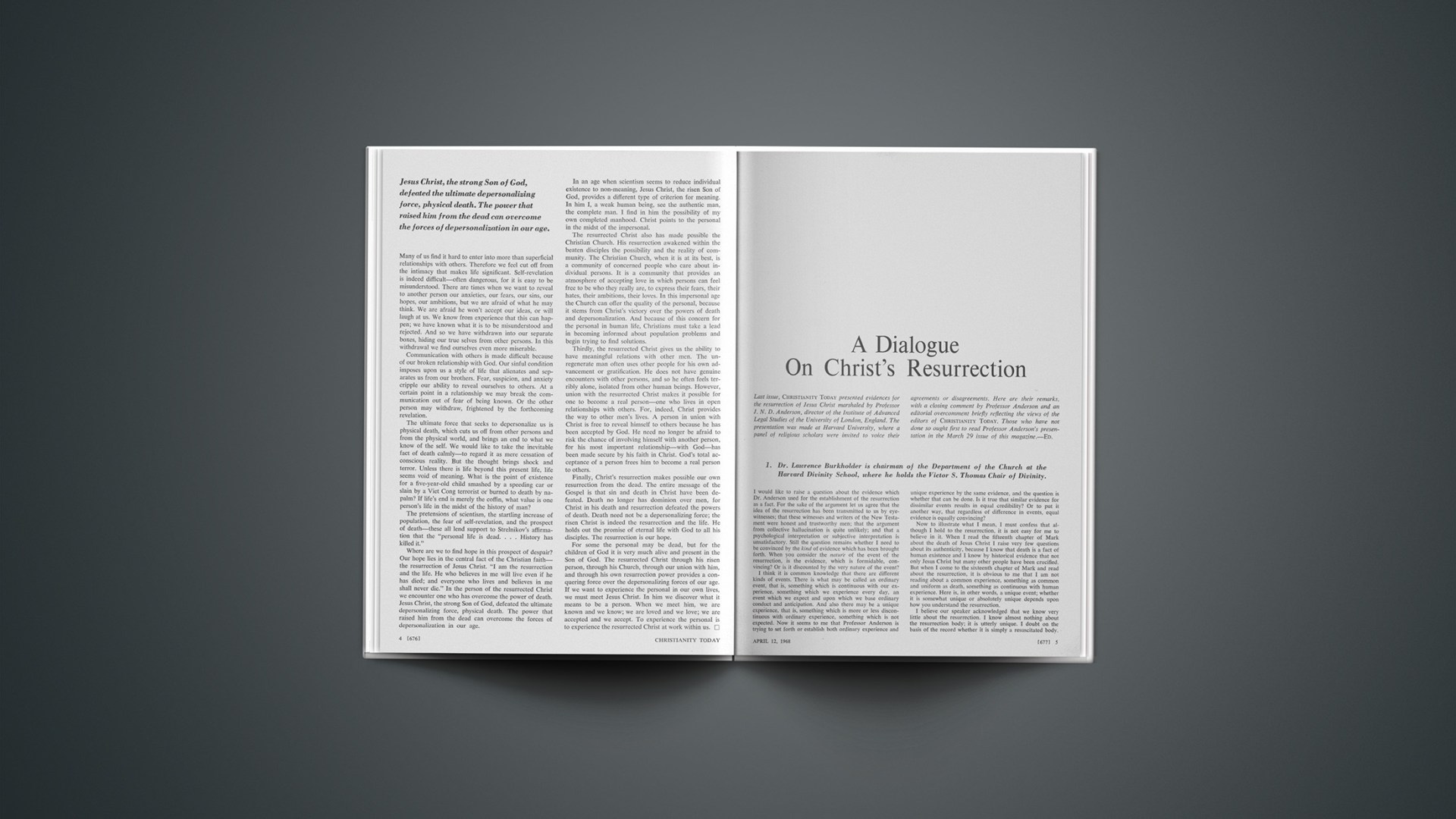
A Dialogue on Christ’s Resurrection

Last issue,CHRISTIANITY TODAYpresented evidences for the resurrection of Jesus Christ marshaled by Professor J. N. D. Anderson, director of the Institute of Advanced Legal Studies of the University of London, England. The presentation was made at Harvard University, where a panel of religious scholars were invited to voice their agreements or disagreements. Here are their remarks, with a closing comment by Professor Anderson and an editorial overcomment briefly reflecting the views of the editors ofCHRISTIANITY TODAY.Those who have not done so ought first to read Professor Anderson’s presentation in the March 29 issue of this magazine.—ED.

1. Dr. Lawrence Burkholder is chairman of the Department of the Church at the Harvard Divinity School, where he holds the Victor S. Thomas Chair of Divinity.

I would like to raise a question about the evidence which Dr. Anderson used for the establishment of the resurrection as a fact. For the sake of the argument let us agree that the idea of the resurrection has been transmitted to us by eyewitnesses; that these witnesses and writers of the New Testament were honest and trustworthy men; that the argument from collective hallucination is quite unlikely; and that a psychological interpretation or subjective interpretation is unsatisfactory. Still the question remains whether I need to be convinced by the kind of evidence which has been brought forth. When you consider the nature of the event of the resurrection, is the evidence, which is formidable, convincing? Or is it discounted by the very nature of the event?

I think it is common knowledge that there are different kinds of events. There is what may be called an ordinary event, that is, something which is continuous with our experience, something which we experience every day, an event which we expect and upon which we base ordinary conduct and anticipation. And also there may be a unique experience, that is, something which is more or less discontinuous with ordinary experience, something which is not expected. Now it seems to me that Professor Anderson is trying to set forth or establish both ordinary experience and unique experience by the same evidence, and the question is whether that can be done. Is it true that similar evidence for dissimilar events results in equal credibility? Or to put it another way, that regardless of difference in events, equal evidence is equally convincing?

Now to illustrate what I mean, I must confess that although I hold to the resurrection, it is not easy for me to believe in it. When I read the fifteenth chapter of Mark about the death of Jesus Christ I raise very few questions about its authenticity, because I know that death is a fact of human existence and I know by historical evidence that not only Jesus Christ but many other people have been crucified. But when I come to the sixteenth chapter of Mark and read about the resurrection, it is obvious to me that I am not reading about a common experience, something as common and uniform as death, something as continuous with human experience. Here is, in other words, a unique event; whether it is somewhat unique or absolutely unique depends upon how you understand the resurrection.

I believe our speaker acknowledged that we know very little about the resurrection. I know almost nothing about the resurrection body; it is utterly unique. I doubt on the basis of the record whether it is simply a resuscitated body. Rather, I would be inclined to accept the Apostle Paul’s view that it is a spiritual body as a result of a transformation. But what transformation really means I don’t understand; all I can say is that something is changed and changed drastically. I must confess that the resurrection is enigmatic to me. Now the question is, can I believe in something which is utterly unique, which is so different from ordinary experience? I can believe in the Battle of Waterloo; I can believe in the death of Caesar; I can believe a lot of other things on the basis of historical evidence. But can we use similar evidence to establish a unique event such as the resurrection?

I suppose what lies behind this question is really the argument which was set forth by Hume, that awful man, many years ago, which I have pondered and have been wrestling with all these years, and to which I haven’t really been able to reply satisfactorily. He says that no testimony is sufficient to establish a miracle unless it is of such a kind that its falsehood would be as miraculous as, or more miraculous than, the fact it endeavors to establish. What he is really saying is that belief is justified by probability, and that probability is based upon or synonymous with uniformity in nature. We are justified, in other words, in believing that which is uniform to our experience of nature; but when it comes to something which is so utterly unique, so discontinuous with ordinary human experience as a miracle—not only the miracle of the resurrection but any other miracle—we just have no right to accept it, to believe it. Another way of putting it is this: Which is more likely to have happened, that Jesus was raised from the dead or that the disciples just made a mistake? Which is more likely?

Now I think that in all candor and honesty, those of us who are Christians will have to admit that a lot of people are under the pressure of this argument, I myself am. It is another way of presenting what is sometimes referred to as the modern scientific attitude, based upon the uniformity of nature: miracles just don’t happen. I think it is only fair to say that a good many New Testament scholars do not go through all the exercise which we have had tonight because they don’t see that it is necessary. It just didn’t happen. It couldn’t have happened! And so therefore they are likely to take a mythical or psychological interpretation in view of the philosophical impossibility of an event of this kind.

I must confess that I have been influenced by this line of argument and I have wrestled with it for a long time. But another line of thinking is beginning to assert itself in my own experience, and that is the fact of uniqueness. Not so much the fact of uniqueness in nature, which I’m not even enough of a scientist to understand, though I hear that there is something like the indeterminate in nature. Rather I am referring to the uniqueness of historical events. Every historical event is to some extent or in some way unique. There are some historical events which are very unique, so much so that the first time we hear about it we are inclined, as good Humeans—as many of us are—not to believe it. But I must say that I’m beginning to feel the limitations of Hume. He seems to be imposing something on me which runs counter to a certain area of experience, that is, my experience with the unique. He is limiting the possibility of accepting what in later times and events I find to have been a fact. He is telling me I really can’t believe anything unless it corresponds to past experience. But I find myself increasingly refusing to predict the future. I find myself becoming much more modest when it comes to saying what is possible and what is not possible, what may happen in the future and what may not happen. And this same modesty is beginning to take the form of a reluctance on my part to say what could have happened in the past and what could not have happened. In other words, just as I have been forced at a certain stage of my thinking to come to terms with uniformity, with Hume, I am now becoming much more conscious of the unique in history. I am looking for some kind of a philosophical way by which to understand, to accept, and to believe the unique, particularly the historical unique.

Now, if I can think, then, that the resurrection not only was an event in nature but also pertains to the realm of history, and if I may at the same time conclude that the uniformity of nature is not absolute, and that the uniqueness of history including the resurrection is not absolutely unique—and if it were absolutely unique you couldn’t know anything about it at all—then it seems to me I have some right at least to be open to the possibility that something may have happened which by analogy we call the resurrection. So this leaves it a possibility. But I must confess that this is where I begin as a Christian and as a theologian. I find in this the possibility of thinking in terms of the resurrection and building up some kind of a theology in which the resurrection is very important. This is not the occasion to spell it out, but I feel I have the philosophical freedom to countenance the possibility of the resurrection and to build a theology and a faith in which it is a starting point.

2. Dr. Harvey Cox is associate professor of church and society, Harvard Divinity School; previously he was professor of theology and culture at Andover Newton, and chairman of the Boston chapter of the Americans for Democratic Action.

A person whose field it is to examine the credentials of the New Testament documents, their dating and their significance, might raise one or two questions about the presentation we heard. I think one might argue that it is possible, contrary to Dr. Anderson’s perspective, to separate the issue of the empty tomb from the issue of the reality of the resurrection. If one would examine each of the witnesses that he introduced early in his talk—Paul, Mark, and Luke—one would find that the latest of these witnesses, namely Luke, does mention the empty tomb. One would find that the early witness, Paul, does not mention it at all, and that there is some question in the mind of critical scholars whether Mark mentions it. The Gospel of Mark has two endings, one of which is later. The second ending does go into the empty-tomb story; the first does not. So that of these three witnesses there is at least some question. And I must indicate my difference of opinion with Dr. Anderson about why the Apostle Paul does not mention the empty tomb. I find it very unconvincing that he doesn’t mention it because it was simply common knowledge. I would believe rather that he doesn’t mention it because he didn’t know about it; that this was an interpretation of the resurrection which grew up much later and that at the time Paul wrote his epistles the stories about the empty tomb were not yet being circulated. Now there is no way to settle that dispute between Dr. Anderson and myself, and his opinion about why the Apostle Paul doesn’t mention it is probably as good as mine. I want to emphasize, however, that the reality of the resurrection, which I believe in, to me can be separated from the historical evidence about the empty tomb, which I find rather unconvincing at certain points.

You notice also that the heavy reliance that Dr. Anderson placed on the Gospel according to John later on in his talk. The description of the position of the grave clothes and the napkin and so on comes from a witness who is very, very late indeed; in fact, there are some scholars who believe that the Gospel of John was written in the second century A.D., a dozen decades after the events in question. Here we would have to raise the whole issue, I suppose, of hearsay evidence, about which a lawyer would know more than I do. In other words, the witnesses used here are of very mixed credibility, and while Dr. Anderson did establish the credentials of the first three witnesses early in his talk, he made no effort to establish the credentials of other witnesses he called upon later. As far as the empty-tomb stories are concerned, I would want to stick rather closely to the earliest testimonies, and here they simply are not mentioned.

The whole attempt to establish the reality of the resurrection in this way is a little disturbing to me. It smacks a bit of the uncanny, of the detective-novel approach to something which to me is neither establishable or destroyable on that basis. And, in fact, at the end of his talk Dr. Anderson himself said that the real evidence for the resurrection is somehow the experience of the person who meets or encounters the living God known through the revelation of Jesus Christ. I would want to say that in my own experience this is where I would begin to talk about the reality of the resurrection. I don’t think we’re talking here about a resuscitated corpse, and I’m glad that Dr. Anderson pointed out that this was a body described even in these sources as one that came through doors and had other characteristics not attributable to ordinary bodies. I do not believe we’re talking about an individual or social hallucination. Rather, I believe that the reality of the resurrection has to do with the beginning of a whole new era in human history and human experience, an era which is still open and has not yet finished.

All of us know that when we try to think about the resurrection of Jesus we often come to an impasse, and I would predict that at the end of this evening most of us will still probably be at that impasse. We also know that when we try to think about the very beginning of all things, the creation, or whatever it was, we come to the edge of our capacity to think or even to imagine; and when we try to think about the end of all things, after we’re gone and all that we know or can think about is gone, we also come to a kind of edge. I think what the Christian faith is saying is that this deep mystery which is at the beginning and at the end of all human existence is the mystery which was present in the life of Jesus of Nazareth, and that this mystery tells us that history is a place which is deeply mysterious, and yet that the mystery which surrounds all of us is a mystery which expresses itself through love and concern about man and about man’s place in this great mysterious cosmos.

It is not an accident and it is not unimportant that what we’re talking about at the center of the Christian Gospel is the life and death and resurrection of a man—not of an animal, not of a whole people, but of a particular human being whom Christians hold to be just as ordinary and just as human as you and I are. This signifies to me that the whole universe with the deep mystery in which it is imbedded focuses on and has something to do with the mystery of human existence itself. Jesus was an ordinary man, and to deny that is heresy; yet Jesus was the one in whom a whole new eon of human history began. And I do not believe that we can really understand or appreciate the meaning of the resurrection until we enter into this history ourselves. I don’t believe that we can simply be persuaded, even by as eloquent a presentation as we have heard this evening, of the reality of the resurrection unless we are willing ourselves to participate in that reality as it works itself out in the human history around us. And this means that to meet the same mysterious presence who was present in Christ and who was at the beginning and at the end is to know something about his life as well as his death and resurrection. To me it is very important that that life was spent identified with and in company with the poor, the rejected, the despised, the sick and the hurt people of his time I personally do not believe that we will have any personal experience of the deep mystery we’re discussing this evening until we are ready to identify our lives with these people in our time. Then and only then I think do we have the kind of experience on the basis of which we can talk about the reality of the resurrection.

I’m grateful, let me say again, for Dr. Anderson’s presentation. I found it about as persuasive as any presentation I have ever heard on the evidence of the resurrection. But I’ve read many books on one side and many on the other, and it rather seems to me at this point that arguments of this type about the resurrection are a little like arguments for the existence of God. They are very persuasive to people who already believe in God, but they rarely persuade anyone to believe in God who didn’t believe in him before reading the arguments. I think what we can say, and say for sure, is that for those who believe in the resurrection there is certainly no good historical evidence that it didn’t occur. But I believe that as those who are stuck forever, perhaps, or at least for our time, with the kind of Humean mark on our brow described by Professor Burkholder, we will have to live the rest of our lives both with the affirmation that in some way the Christ lives among us and with the gnawing doubt that this really isn’t possible. If we want to escape this kind of ambiguity, we are looking for a perfection which will not be available to us in this life. So I suppose my contribution would be the contribution of that young man in one of the Gospels who when he was confronted with Jesus said, “I believe, O Lord; help thou my unbelief!”

3. Dr. Wolfhart Pannenberg, professor of systematic theology at the University of Munich, Germany, studied under Barth and Jaspers, and has been concerned primarily with questions of the relation between faith and history. With a small group of dynamic theologians at Heidelberg, he has been forging a theology that considers its primary task the scrutiny of the historical data of the origins of Christianity.

I first have to admit that I find myself in basic agreement with the main points of what Dr. Anderson pointed out in his lecture. It’s not easy for theologians today to admit such a position. That may seem somewhat queer, but it is really the situation. One is much better received if he takes an extremely critical attitude toward the New Testament texts and toward Christian tradition. This is a psychological element in contemporary theological discussion. It is an extreme temptation for a theologian today to take an exaggeratedly critical position over against certain points in the history and the tradition of the Christian faith. If one does not do so, one is very easily identified with a group of fundamentalists and of uncritical thinkers, and nobody, I think—or at least not the majority of men in the academic community—would like to be identified with uncritical thinkers. Nevertheless, I admit that I agree with the basic points of Dr. Anderson’s presentation, though not wholly with the form of his argument, as will be shown by what I have to say.

I think the most sophisticated point a student has to learn at the university is that he has to be critical, but critical even over against the critics, you see. That must not mean that he has to return to a precritical attitude, but it’s a very difficult thing to be critical over against all sides.

Let me first number certain points of agreement. First, I agree with Dr. Anderson’s statement that the Easter story is of the utmost importance for the Christian faith. Paul says in First Corinthians 15 that the Christian proclamation would be empty if Jesus were not risen from the dead. That seems to be very obvious; yet there are many attempts to evade this point today. And these attempts have very obvious reasons—it does fit so badly, perhaps not so much into the twentieth-century scientific outlook, but into the traditional scientific outlook that developed from the seventeenth and eighteenth centuries. How could this event be possible at all? The argument of Hume is a very important example for this line of argument. So it is very understandable that theologians try to bracket the question of the resurrection of Jesus in understanding the reliability of the Christian faith. But intellectual honesty requires one to say that from the perspective of early Christianity, the question of the resurrection of Jesus is indeed the basic question of the Christian faith. It is hard to see what justification could be given for one to remain a Christian if he felt that the resurrection simply didn’t take place.

Further, I agree with Dr. Anderson that whether the resurrection of Jesus took place or not is a historical question, and the historical question at this point is inescapable. And so the question has to be decided on the level of historical argument. How hard this may be, and how dearly we would like to get to another level—especially to the level of personal experience, because this seems to be so much closer. Now, that personal experience has a share in the discussion of that question is undeniable, and in this point I can agree with Dr. Cox and in another sense with Dr. Burkholder. It is very important for the way historical questions are treated whether one agrees with Hume that, because of the uniformity of nature, such extremely unique events simply couldn’t take place, given any amount of evidence, or whether one has a general understanding of reality as marked by historical uniqueness, as we heard from Dr. Burkholder, or as marked by the character of the mysterious. The general attitude toward an understanding of reality is indeed very influential in assessing historical questions of all kinds, and so of course of this kind too. But this attitude toward reality does not settle the historical question. It is a presupposition, and one must try to keep the presupposition as open as possible, and not to make a dogmatic prejudgment. The question as such whether something happened or not at a given time some thousand years ago can be settled only by historical argument, even if we must admit that historical argumentation is often rather weak and can attain only some degree of probability.

Now to go into the particularities, I first agree that the appearances to the apostles are to be regarded as historical, and I think it is widely accepted among contemporary New Testament scholars that appearances to the disciples and Paul indeed took place. We are not dealing with later legend which would have no connection with the people to whom those experiences were attributed. But, of course, the real question is: In those appearances what happened to the disciples and to Paul? And this remains an open question, even if one admits that there were appearances.

The next point I must agree with concerns the tradition of the empty tomb. On this point, of course, prejudgments have been most influential even among theologians in the discussions of whether the tomb of Jesus was empty or not. And—not only because of those prejudgments, but because of the literary character of the key text, Mark 16—it is widely denied today among New Testament scholars that the story we read in Mark 16 of the finding of the empty tomb of Jesus is historical. It has widely been denied because the text is a Hellenistic text: not only is it written in Greek language, but a number of the conceptions in this text are of a Hellenistic character too. And that means that at least the final form of the tradition we have in Mark 16 was formulated a good while after those events that took place maybe in Palestine. So the whole Bultmannian school regards Mark 16, and all the accounts of the empty tomb that follow in the other Gospels, as later Hellenistic legends. I disagree with this, but thereby I disagree with the predominant judgment of contemporary exegetical research.

For my contrary understanding I have two main reasons. First, no early proclamation of the resurrection of Jesus in Jerusalem would be conceivable without safe evidence of the empty tomb on both sides, Christian and Jewish. The whole tradition, everything we know about the first situation of Christianity in Jerusalem, the place of Jesus’ death, would have to have been different had there been a disagreement among Christians and non-believers in the Jerusalem Jewry regarding the emptiness of the tomb. The resurrection of Jesus was imaginable in Jewish thought of that time only in a bodily form connected with the emptying of the tomb. The early proclamation of the resurrection of Jesus would hardly be conceivable if this proclamation could be countered, could be opposed, by showing the tomb of Jesus still untouched, or by arguing where the body was placed, or by arguing that nobody knew about the tomb of Jesus.

My second reason is that we know of no protest in the early Jewish polemics against the assertion of the empty tomb in the Christian proclamation. I think the Jewish anti-Christian polemics of early times had every reason to preserve information about the tomb of Jesus if this had been left intact. But the fact is that the Jewish anti-Christian polemics agree with the Christians that the tomb was empty; only the explanation of the emptiness is very different. I think this argument is very strong.

Now as a corollary I come to the silence of Paul. The silence of Paul concerning the empty tomb is really a very strong opposing argument, because Paul is the earliest witness we have in the New Testament. But one then has to show that in contemporary Jewish thought there existed a possible understanding of a resurrection without an emptying of the tomb, before one can interpret Paul as asserting belief in the resurrection but not implying self-evidently that the tomb was empty. And one also has to establish that Paul in his thought stood in relation to those Jewish circles that had a conception of the resurrection that does not require an empty tomb. But these two requirements have not been met. And as long as they are not, I think we will have to stay with the assumption that Paul, in speaking of the resurrection as a Jew of his time, implied that the tomb was empty. At this point I see no way out.

Now there are a number of points at which I disagree with Dr. Anderson, and about them I must be brief. First, I do not think that the evidence for the resurrection of Jesus primarily rests on the gospel accounts; I think it rests rather on First Corinthians 15—actually that was the first witness of Dr. Anderson, too, and this is valid concerning the appearances of Jesus. In the gospel texts we have to realize a heavy influence of apologetic motivation, and of at least legendary elements—not that whole stories in the Gospels are inventions, but that there are a good number of legendary elements, and those texts cannot be taken at face value. For example, there is an increasing emphasis—the later the text—on the bodily, almost miraculous character of the resurrected one. Luke speaks of Jesus preparing and eating fishes to demonstrate the bodily character of his appearance. This is completely against our first and oldest witness, namely Paul, who says that flesh and blood cannot inherit the kingdom of God because of the transformation that is involved in the resurrection, and who certainly understood the resurrection hope of the Christian as parallel to what he experienced as the reality of the resurrected Lord. And another legendary element: the disciples increasingly are connected with the tomb, while in the first account in Mark 16 the disciples are not connected with the tomb. The later the text, the more it tries to bring the disciples in greater relation to the tomb of Jesus. These are the main critical reservations I have about Dr. Anderson’s way of argumentation. Nevertheless I agree with his main points.

DR. ANDERSON’S RESPONSE

I am very grateful to the commentators for the kind things they said about my presentation. I don’t altogether agree with their attitude toward the evidence, even as they don’t altogether agree with mine. To begin with, I have a different view about the records. Take what Professor Cox said about the Gospel according to St. John. Since I am no theologian, I am being very bold, but I would say that the evidence that this was written by the end of the first century is extremely strong. I refer you to the writings of the late Archbishop William Temple; still more, perhaps, to the massive commentary of Professor Dodd, which shows—I should have thought conclusively, whatever one’s view may be on other points he makes—that a great deal at least of the Fourth Gospel goes back to a Palestinian source as early as the Synoptic sources. And as for the testimony of Peter, I rely in part on the commentary of Dean Selwyn.

With regard to Professor Pannenberg’s comment about the fish eaten by the risen Christ, I interpret that differently. I would say that this was not intended in any sense as a proof that he had an ordinary resuscitated human body. I don’t believe anything of the sort. I certainly do not believe that the transformed body of the risen Christ required food. I would suggest that he ate a piece of fish simply because the disciples might easily have concluded after his disappearance that they had seen a mere apparition, but to see before them the leftovers of the fish would be the most convincing proof that the experience was of an objective fact. I was grateful for Professor Pannenberg’s extremely interesting remarks about the empty tomb. This was probably because I don’t like to separate different parts of the evidence for the resurrection. If part can, perhaps, be explained on rationalistic grounds, this is unconvincing to the lawyer, at least unless that explanation fits all the evidence.

Professor Cox suggested that those who believe will, of course, go on believing, and that those who don’t believe will be left in a fog as they were before. That is not my experience. I have seen men and women who didn’t believe come to faith—many of them; I could introduce you to them tonight. I simply do not believe this gulf between belief and unbelief is impassable. Professor Cox suggested—though I think he misinterpreted me here—that I myself had said that personal experience was the basic proof. With respect I say that I didn’t. If the basic proof were personal experience, we might be deluded. I agree with Professor Pannenberg that the basic proof is historical. But I believe that the historical evidence is confirmed in the experience of believers. We have heard a good deal about a unique event, and certainly I believe it was a unique event; but I believe it concerned a unique person. I believe he was human indeed, but also divine.

May I end with one other point? In a certain university city in England one of the local clergy was in the habit of calling together, once a month, a discussion group of senior members of the university after evening service on Sunday, to talk in a completely uninhibited way about the pros and cons and the evidence for Christianity. Once when I happened to be in the city he asked me to go and talk to this group about the evidence for the resurrection; this would be followed by their usual kind of uninhibited discussion. In the course of this discussion, our host turned to a professor of philosophy who was not a Christian and said, “Well, Professor so-and-so, will you tell us quite frankly what you thought about Anderson’s treatment of the evidence for the resurrection?” He said, “Yes. When Anderson was dealing with the alternative views which have been put forward by one and another to try and explain away or give some rationalistic interpretation of the Easter story of the tomb and the resurrection appearances, I would agree with him that none of these is convincing, that none is persuasive. But all I can say is [and this comes back to Hume, I suppose] that if someone feels that he cannot believe in the resurrection, he will shrug his shoulders and say, ‘Well, I can’t square this with the evidence, but it cannot have happened like that.’ ” And I said to him, “Professor, may I paraphrase what you have just said? Surely what you have just said is this, that if a man or a woman doesn’t want to believe in the resurrection, and insists on some a priori ground that he cannot believe in the resurrection, then he won’t. I entirely agree with you. But it will not be because of the evidence; it will be in spite of the evidence. In other words, it won’t be on exclusively intellectual grounds; it will also represent, in some degree, a moral decision.” And he said, “I think that may be true.”

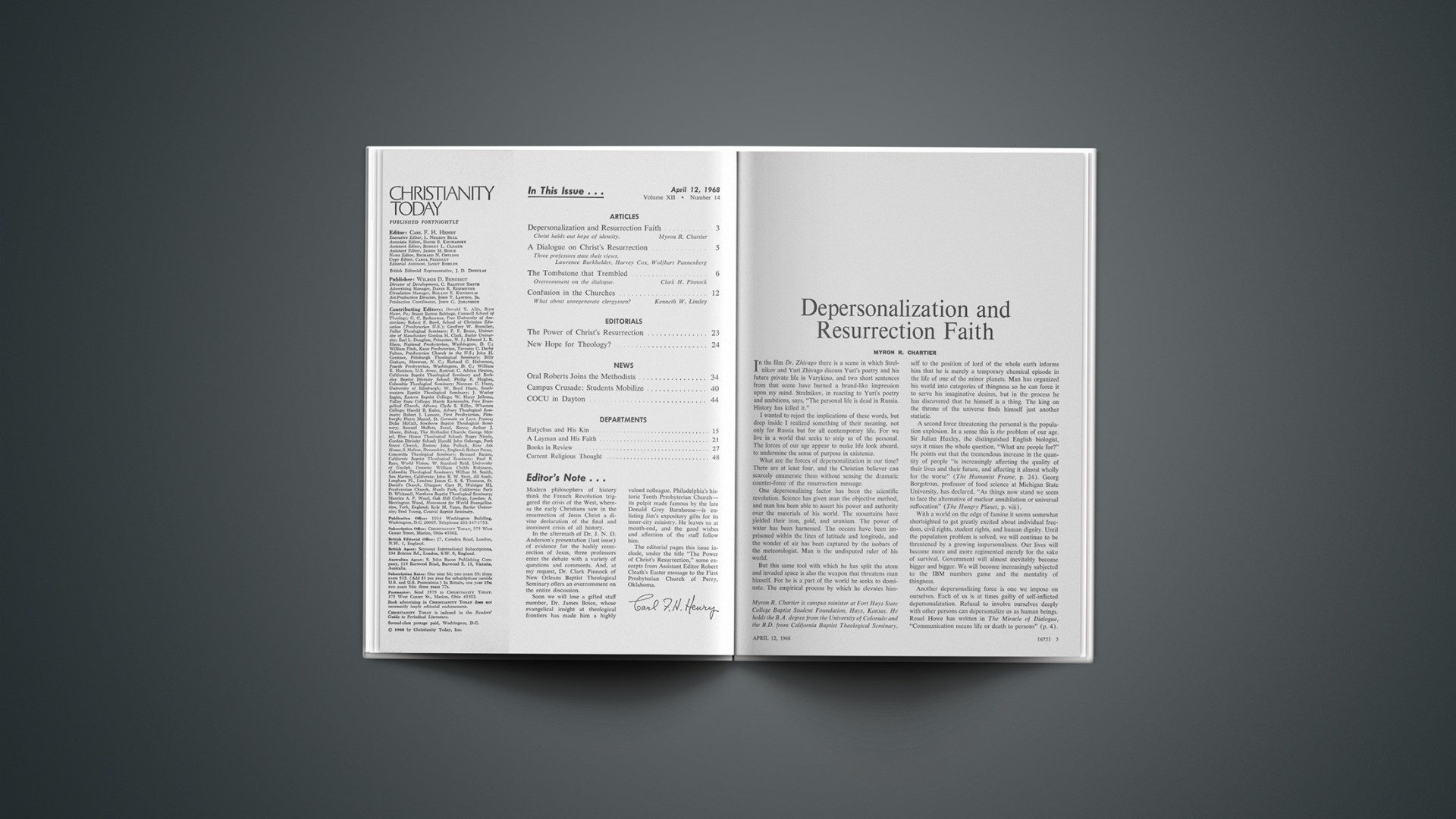
Depersonalization and Resurrection Faith

In the film Dr. Zhivago there is a scene in which Strelnikov and Yuri Zhivago discuss Yuri’s poetry and his future private life in Varykino, and two short sentences from that scene have burned a brand-like impression upon my mind. Strelnikov, in reacting to Yuri’s poetry and ambitions, says, “The personal life is dead in Russia. History has killed it.”

I wanted to reject the implications of these words, but deep inside I realized something of their meaning, not only for Russia but for all contemporary life. For we live in a world that seeks to strip us of the personal. The forces of our age appear to make life look absurd, to undermine the sense of purpose in existence.

What are the forces of depersonalization in our time? There are at least four, and the Christian believer can scarcely enumerate them without sensing the dramatic counter-force of the resurrection message.

One depersonalizing factor has been the scientific revolution. Science has given man the objective method, and man has been able to assert his power and authority over the materials of his world. The mountains have yielded their iron, gold, and uranium. The power of water has been harnessed. The oceans have been imprisoned within the lines of latitude and longitude, and the wonder of air has been captured by the isobars of the meteorologist. Man is the undisputed ruler of his world.

But this same tool with which he has split the atom and invaded space is also the weapon that threatens man himself. For he is a part of the world he seeks to dominate. The empirical process by which he elevates himself to the position of lord of the whole earth informs him that he is merely a temporary chemical episode in the life of one of the minor planets. Man has organized his world into categories of thingness so he can force it to serve his imaginative desires, but in the process he has discovered that he himself is a thing. The king on the throne of the universe finds himself just another statistic.

A second force threatening the personal is the population explosion. In a sense this is the problem of our age. Sir Julian Huxley, the distinguished English biologist, says it raises the whole question, “What are people for?” He points out that the tremendous increase in the quantity of people “is increasingly affecting the quality of their lives and their future, and affecting it almost wholly for the worse” (The Humanist Frame, p. 24). Georg Borgstrom, professor of food science at Michigan State University, has declared, “As things now stand we seem to face the alternative of nuclear annihilation or universal suffocation” (The Hungry Planet, p. viii).

With a world on the edge of famine it seems somewhat shortsighted to get greatly excited about individual freedom, civil rights, student rights, and human dignity. Until the population problem is solved, we will continue to be threatened by a growing impersonalness. Our lives will become more and more regimented merely for the sake of survival. Government will almost inevitably become bigger and bigger. We will become increasingly subjected to the IBM numbers game and the mentality of thingness.

Another depersonalizing force is one we impose on ourselves. Each of us is at times guilty of self-inflicted depersonalization. Refusal to involve ourselves deeply with other persons can depersonalize us as human beings. Reuel Howe has written in The Miracle of Dialogue, “Communication means life or death to persons” (p. 4). Many of us find it hard to enter into more than superficial relationships with others. Therefore we feel cut off from the intimacy that makes life significant. Self-revelation is indeed difficult—often dangerous, for it is easy to be misunderstood. There are times when we want to reveal to another person our anxieties, our fears, our sins, our hopes, our ambitions, but we are afraid of what he may think. We are afraid he won’t accept our ideas, or will laugh at us. We know from experience that this can happen; we have known what it is to be misunderstood and rejected. And so we have withdrawn into our separate boxes, hiding our true selves from other persons. In this withdrawal we find ourselves even more miserable.

Communication with others is made difficult because of our broken relationship with God. Our sinful condition imposes upon us a style of life that alienates and separates us from our brothers. Fear, suspicion, and anxiety cripple our ability to reveal ourselves to others. At a certain point in a relationship we may break the communication out of fear of being known. Or the other person may withdraw, frightened by the forthcoming revelation.

The ultimate force that seeks to depersonalize us is physical death, which cuts us off from other persons and from the physical world, and brings an end to what we know of the self. We would like to take the inevitable fact of death calmly—to regard it as mere cessation of conscious reality. But the thought brings shock and terror. Unless there is life beyond this present life, life seems void of meaning. What is the point of existence for a five-year-old child smashed by a speeding car or slain by a Viet Cong terrorist or burned to death by napalm? If life’s end is merely the coffin, what value is one person’s life in the midst of the history of man?

The pretensions of scientism, the startling increase of population, the fear of self-revelation, and the prospect of death—these all lend support to Strelnikov’s affirmation that the “personal life is dead.… History has killed it.”

Where are we to find hope in this prospect of despair? Our hope lies in the central fact of the Christian faith—the resurrection of Jesus Christ. “I am the resurrection and the life. He who believes in me will live even if he has died; and everyone who lives and believes in me shall never die.” In the person of the resurrected Christ we encounter one who has overcome the power of death. Jesus Christ, the strong Son of God, defeated the ultimate depersonalizing force, physical death. The power that raised him from the dead can overcome the forces of depersonalization in our age.

In an age when scientism seems to reduce individual existence to non-meaning, Jesus Christ, the risen Son of God, provides a different type of criterion for meaning. In him I, a weak human being, see the authentic man, the complete man. I find in him the possibility of my own completed manhood. Christ points to the personal in the midst of the impersonal.

The resurrected Christ also has made possible the Christian Church. His resurrection awakened within the beaten disciples the possibility and the reality of community. The Christian Church, when it is at its best, is a community of concerned people who care about individual persons. It is a community that provides an atmosphere of accepting love in which persons can feel free to be who they really are, to express their fears, their hates, their ambitions, their loves. In this impersonal age the Church can offer the quality of the personal, because it stems from Christ’s victory over the powers of death and depersonalization. And because of this concern for the personal in human life, Christians must take a lead in becoming informed about population problems and begin trying to find solutions.

Thirdly, the resurrected Christ gives us the ability to have meaningful relations with other men. The unregenerate man often uses other people for his own advancement or gratification. He does not have genuine encounters with other persons, and so he often feels terribly alone, isolated from other human beings. However, union with the resurrected Christ makes it possible for one to become a real person—one who lives in open relationships with others. For, indeed, Christ provides the way to other men’s lives. A person in union with Christ is free to reveal himself to others because he has been accepted by God. He need no longer be afraid to risk the chance of involving himself with another person, for his most important relationship—with God—has been made secure by his faith in Christ. God’s total acceptance of a person frees him to become a real person to others.

Finally, Christ’s resurrection makes possible our own resurrection from the dead. The entire message of the Gospel is that sin and death in Christ have been defeated. Death no longer has dominion over men, for Christ in his death and resurrection defeated the powers of death. Death need not be a depersonalizing force; the risen Christ is indeed the resurrection and the life. He holds out the promise of eternal life with God to all his disciples. The resurrection is our hope.

For some the personal may be dead, but for the children of God it is very much alive and present in the Son of God. The resurrected Christ through his risen person, through his Church, through our union with him, and through his own resurrection power provides a conquering force over the depersonalizing forces of our age. If we want to experience the personal in our own lives, we must meet Jesus Christ. In him we discover what it means to be a person. When we meet him, we are known and we know; we are loved and we love; we are accepted and we accept. To experience the personal is to experience the resurrected Christ at work within us.

Milton D. Hunnex is professor and head of the department of philosophy at Willamette University, Salem, Oregon. He received the B.A. and M.A. degrees from the University of Redlands and the Ph.D. in the Inter-collegiate Program in Graduate Studies, Claremont, California. He is author of “Philosophies and Philosophers.”

Editor’s Note …

Modern philosophers of history think the French Revolution triggered the crisis of the West, whereas the early Christians saw in the resurrection of Jesus Christ a divine declaration of the final and imminent crisis of all history.

In the aftermath of Dr. J. N. D. Anderson’s presentation (last issue) of evidence for the bodily resurrection of Jesus, three professors enter the debate with a variety of questions and comments. And, at my request, Dr. Clark Pinnock of New Orleans Baptist Theological Seminary offers an overcomment on the entire discussion.

Soon we will lose a gifted staff member, Dr. James Boice, whose evangelical insight at theological frontiers has made him a highly valued colleague. Philadelphia’s historic Tenth Presbyterian Church—its pulpit made famous by the late Donald Grey Barnhouse—is enlisting Jim’s expository gifts for its inner-city ministry. He leaves us at month-end, and the good wishes and affection of the staff follow him.

The editorial pages this issue include, under the title “The Power of Christ’s Resurrection,” some excerpts from Assistant Editor Robert Cleath’s Easter message to the First Presbyterian Church of Perry, Oklahoma.

Left-Bank Honesty?

“Theologically, the Church is in a mess.” The Rev. Leonard Evans of Toronto went on to say to those gathered for a prayer breakfast in Montreal that today’s existential theology confuses rather than enhances Christian proclamation.

At a laymen’s conference in Newfoundland last fall several men expressed the same view. The man in the pew is “genuinely confused” by what he hears from the pulpit these days, they said, “What should a man believe?”

Last week I listened to a Church of England clergyman who styled himself “avant-garde.” He was from the “Left Bank” of the Thames and was an avid follower of the Bishop of Woolwich. His remarks seem to reflect the “mess” and confusion of our times.

Confidently he exclaimed that “the Bible is rubbish” and “the institutional church is dead.” Clergymen in the Anglican church are frightened to leave the institution, he said, because they cannot compete in society for their livelihoods. He had not heard of the charismatic movement but was certain it must be either Pentecostal or Jehovah’s Witnessy. In any case, it surely wasn’t important and surely, like Billy Graham, was setting back God’s purpose by 100 years.

If the Bible is rubbish, the Church decadent, the clergy incompetent, the Holy Spirit non-existent, and the people unresponsive to the Christian message, what is left, I asked? “I am contemplating leaving the Church for secular work,” he replied. “I can be more Christian earning my living at a secular job than as a rector in a church.”

English theology has challenged the Church to be honest to God. Either Left-Bank honesty, London style, is right and everyone else is on a butterfly chase, or it is wrong and the apostolic faith stands. With scriptural authority in question, cut and thrust prevails. Every opinion-maker is right and the dissenters are wrong, and the noisy gong and clashing cymbals are all sounding simultaneously.

Certainly something is making the churchman edgy:

• Some denominations are in decline.

• Many churchmen are hunting for a new church home.

• Ministerial dropouts are at an all-time high.

• No one can satisfactorily define evangelism.

• Theological candidates are simply not coming forward.

Is English Left-Bank honesty accurately stating the case? Is it true that the Church can no longer meet the demands of the twentieth century? That the Church of today is an anachronism destined to oblivion?

Or is Left-Bank theology a way out for those who find the demands of the cross too heavy? Possibly it seems more respectable intellectually to debunk the sure foundation of the Cross than to admit that the price of being a Christian is too steep.

The patience of laymen has always astounded me. However, I sense that they are now becoming fed up with the way things are in the Church. And many ministers are joining the protest.

Has liberal theology provided mankind with the necessary equipment to do God’s purpose? Or has it merely succeeded in losing the Christian message? We will have to make up our minds about the Bible and the role of the Church in society. Either we have God’s message of reconciliation or we haven’t. Jesus Christ did not teach us confusion; he showed us the way and the truth. We must not forget this.

In my own denomination the spark of renewal is beginning to show itself. For the first time in the forty-three years of our church union, there is a vigorous movement afoot to protest a drift in the church to humanism and ultraliberal theology. This movement has been organized as the United Church Renewal Fellowship. Many in the church look upon the Renewal Fellowship as a kind of bubonic plague, and a step backward. But many others are hoping and praying that its emphasis will in time return the church to the fundamentals of the faith.

This should not be viewed as a split in the church. One characteristic of Canadians seems to be the ability to apply themselves to opposing points of view. Opposition in theology does not necessarily demand schism or breakdown in dialogue. There is no reason why vital and sharp points of view cannot make the whole church a more effective instrument of God.

The Renewal Fellowship appears to be the voice of the evangelicals in the church. It has spread from its starting place in the rural areas north of Toronto to Newfoundland on the Atlantic Ocean and to British Columbia on the Pacific coast.

A recent bulletin of the movement points to three facets of renewal:

First, we must be completely dedicated to Jesus Christ in glad sacrificial service.

Second, we must be faithful to the teaching of the New Testament.

Third, renewal to full Christian dedication and renewal to a consistent … Biblical theology could never take place unless Jesus Christ lives in the hearts of every member and adherent of our church.

The only lasting answer to the needs and problems of our world is a spiritual answer. The Church cannot serve Jesus Christ and meet the needs of man by turning itself into something secular. Certainly we may need to adapt the form of a church to meet the particular needs of its people; but we cannot do this by junking our spiritual and institutional foundations, or by declaring that all that is past is “rubbish.” As a bulletin from the United Church Renewal Fellowship put it: “We are renewed only by glad sacrificial service to Christ, by returning to sound Biblical doctrines, and by responding to the call of evangelism.”

The Church of Jesus Christ has at times throughout history found itself in doctrinal boxes. Church history is marked by struggles that led to new formulations such as the Nicene Creed, the Apostles’ Creed, the Helvetic Confessions, the Westminster Confession, and the Barmen Declaration. In each case the Church was struggling to clear the waters of theological debate, or to proclaim what the apostolic faith meant for those times.

I am quite certain that theologians and laymen were as confounded in those periods of struggle as they are today. But I do not recall that any of them claimed that God was dead. I do recall, however, that Voltaire predicted the demise of the Church by the end of the eighteenth century.

At the Easter season the events of the Cross are in sharp focus. A first look at the Cross points, of course, to the death of Christ. What a shattering experience this was for his disciples! How sorrowful and discouraged they must have been.

But God in his love and mercy raised Jesus from the dead. Renewal today may be measured against that which has already happened. Jesus is alive! And so is his Church.—The Rev. NEWTON C. STEACY, St. James United Church, Montreal, Canada.

Dave Brubeck Unveils Oratorio on Jesus

February 29 is something extra, something special, something that doesn’t come along every year. So is jazz pianist Dave Brubeck’s first major composition, which premiered on that date in Cincinnati. He completed the oratorio on the teachings of Jesus, Light in the Wilderness, in January. A month before, he had ended his jazz quartet’s sensational sixteen-year history.

Both Brubeck and Duke Ellington—perhaps America’s two greatest living jazz musicians—have recently invested much of their talent in expressing the beliefs of the Bible through music. (See story of Ellington’s sacred concerts in January 21, 1966, issue.)

Brubeck’s religious background is eclectic: “reared as a Presbyterian by a Christian Scientist mother who attended a Methodist church.” He has read the Bible “all the time” for many years, despite a “nomadic existence” in which he once crammed 250 one-night stands into 365 days. During tours he has developed friendships with a couple dozen clergymen and has read such theologians as Tillich and Schweitzer. He got theological advice on the oratorio from Vedanta, Unitarian, Episcopal, and Jesuit leaders.

Although Brubeck has dabbled in religious efforts and once did several TV shows for the National Council of Churches, the idea of doing a serious composition began two years ago. His nephew Philip, 17, suddenly died of a brain tumor. In his grief, Brubeck wrote a choral number of considerable beauty on the text “Let not your heart be troubled. Ye believe in God, believe also in me.” It was months before he would even send this personal memorial to his brother Howard.

“I just jumped into it,” he says, but he found he could express himself in choral writing and began developing the oratorio.

“The struggle between good and evil is apparent in all of us,” Brubeck said in an interview. The problem has been bugging him ever since World War II years, when he went as a callow youth from a California farm to the front lines in Europe. He was “bewildered” by bloodshed, hypocrisy, and—in particular—racial prejudice. “I came to the realization that things you accept from your youth as Christian ethics are gladly skirted by everyone.” Even the Church was at fault.

Now, by writing music, he hopes to do something to “save our country” through a moral revolution both of individuals and of social processes. Mindful of impending racial disaster he says, “We don’t have the time to play around.”

To highlight the good-versus-evil theme, he begins the oratorio with the baptism and temptation of Christ. His program notes imply a struggle between God and Satan over the soul of Jesus the man, in contrast with the traditional view of recognition of Jesus as the Son of God and the subsequent struggle between the Son and Satan.

Brubeck is “not really set” on his view of Jesus. “I would certainly say he is divine,” he says. But “man at his best is divine.” He has been affected by the views of higher critics on some questions of historicity of the gospel accounts.

But with the teachings of Jesus, “I’m right there with every word. I’ll go along with the teachings and the miracles.” How about the Resurrection? “Why not? He probably did more fantastic things that aren’t even mentioned in the Bible. Anything and everything is possible with Jesus.”

The bulk of the libretto is drawn verbatim from Jesus’ teachings recorded in the Bible. In one case, “For I was hungry and ye gave me food,” the moral teachings are intact but the significant context of God’s final judgment upon men is missing.

Whatever its theological underpinnings, the work offers Scripture in a well-conceived, refreshing setting. Unlike Ellington’s patchwork quilt, Brubeck has woven together an organic whole. The cerebral construction Brubeck used when jazz went to college and concert hall is here expanded to major (sixty-minute) proportions.

There are suprises (not so much in the use of jazz and other modern idioms, which have been used in religious music before, though usually less expertly). Examples: (1) The morose, dutiful feeling we sometimes take into the Beatitudes (“Blessed are the poor in spirit”) is shattered by Brubeck’s up-tempo 6/8 tune that stresses the “blessed” as it bounces along. The Cincinnati Enquirer reviewer thinks this “banal” section should be cut, but others will find it charming. (2) One expects the final section to pull out all the stops for a rhythmic, rejoicing romp, because of the pulsations built into Psalm 148 by the ancient Jews who worshiped the living God. But Brubeck’s interpretation is majestic.

Since everyone will be looking for jazz, it should be stated that this is not a jazz work. Brubeck was on hand at the premiere to provide some improvised interludes, but these are optional. The work survives without them; in fact, it probably is better without them.

The “love your enemies” theme produces the most dissonant, wild section of the piece. All sorts of musical eras are pulled in to show the universality of the idea. (But really, “Turkey in the Straw”?) The music seems strangely complex for such a simple idea and the crashing dissonance that closes the section is almost menacing. The suggestion is that “do good to those who hate you” goes more against the grain of man than anything else Jesus said.

Many sections are in the 5/4 meter Brubeck’s quartet popularized. None of the modern techniques, none of the sounds from the percussion bank, are used for their own sake; they are used to impel the listener on through the themes. As Jesus announces that “the kingdom of heaven is at hand,” the mode of big-band brass seems to blow the dust off the Bible on the bookshelf. The music recaptures the intense excitement the longing Jews must have felt when the words were first spoken.

The same feeling carries into the scriptural potpourri “Where Is God,” early in the second half of the oratorio. The chorus, more twentieth than first century, chants, “This is the generation of them that seek him: Where is God? Or is God dead? Who is man? And who is God?” Here as elsewhere, the baritone soloist sings only the words of Jesus: “I was with God before the foundation of this world.” Under Jesus’ spell the chorus decides, “This is the generation—our generation. Only the fool says in his heart: there is no God!” No vague humanism here, despite the emphasis on teachings!

Performance notes: The Cincinnati Symphony Orchestra and Miami University Singers under Erich Kunzel performed capably. Baritone William Justus was excellent. Fortunately, the huge Ecumenical Chorus drawn from seventy-three local churches and synagogues was mainly for window-dressing. A few sopranos scurried into their wooden seats after the concert had begun! The occasional cicada-like rasp of a movie camera was disturbing. The audience was the kind one would expect—older church-pillar types, arty youths who didn’t look like regular darkeners of church doors, a good sprinkling of nuns. The site was Cincinnati’s grand old Music Hall, with its coffered ceiling and wooden-slat floor.

With such a beginning, it is good news that Brubeck is already toying with two more “very important themes,” though he’s keeping them to himself at this point.

Meanwhile, he’s appearing at Northwestern University’s annual church-music conference next month. A second performance of Light in the Wilderness is scheduled for the July convention of the American Guild of Organists in Colorado. Late this year he plans to take the oratorio on a European tour.

Brubeck is also weighing two offers to be a part-time composer-in-residence of religious music. One is from a Jesuit college in Detroit, the other from Washington (D. C). Episcopal Cathedral.

CHURCH PANORAMA

The United Presbyterian education board received $1.9 million in the will of Mrs. Ida Belle Ringling, widow of a founder of Ringling Brothers Circus.

The Church Journal, published by the Latter-day Saints (Mormons), condemned sex education in schools and related wearing of miniskirts to sex crimes.

The Worldwide Radio Church of God (of Herbert Armstrong’s Anglo-Israel cult and “The World Tomorrow” broadcasts) and its Akron pastor were ordered by an Ohio jury to pay an electrician $30,000 damages for alienating his wife’s affection by telling her the marriage was adulterous because the husband had been divorced.

United Church of Christ agencies began a national program of counseling youths on the military draft and “the demands of their conscience.” Another UCC agency issued a series of five-minute radio programs featuring comments of congressmen on Viet Nam. The Vermont Council of Churches staff ended two years of draft counseling, under pressure, and left the matter up to local clergymen.

A team backed by Myers Park Methodist Church, Charlotte, is providing three weeks of free medical care in the Congo, Liberia, and Sierra Leone.

Lutheran World Federation agencies shipped 73 million pounds of food, clothing, and relief supplies worth nearly $14 million during 1967.

There are now 29,817,707 Baptists in the world, an increase of 2.6 million over the year before, the Baptist World Alliance announced. North America’s total is 26,412,866.

The Salvation Army is setting up a new program in Hong Kong to rehabilitate refugees from Viet Nam.

PERSONALIA

William Miller, Jr., 41, was elected president of the higher-education board of the Christian Churches (Disciples), becoming youngest head of a major agency in the denomination.

Wittenberg University President John Stauffer will be the first lay president of Juniata College, and the first selected from outside the Church of the Brethren. He is a Lutheran.

Gordon College announced March 14 that President James Forrester, currently on leave, has resigned as of August 31. He has been offered a post with a university, as yet unnamed.

The Rev. Floyd Honey, mission-service secretary for the World Council of Churches in New York, was appointed chief executive of the Canadian Council of Churches. A United Church of Canada member, he was a missionary in China until the Communist takeover.

A church court in Athens deposed former Greek Orthodox Primate Iakovos Vavanatsos for “losing his good reputation.” Charges were not made public.

Alan Paton, South African author and critic of apartheid, was choked into unconsciousness and robbed by two Africans this month.

Archbishop of York Donald Coggan said U. S. renunciation of such “obscene” weapons as napalm bombs might be a first step toward peace in Viet Nam.

Anglican Bishop John Phillips of Portsmouth, England, quit as local head of the Family Planning Association, charging that recent laws assume pregnancy and contraception are the only choices for young people, and neglect a third possibility: chastity.

The Rev. John Byrnell of Shaugh Prior, England, refused to help his wife with the dishes because it “isn’t a man’s job.” Wifey won by quoting Second Kings 21:13 (from the King James Version).

MISCELLANY

An American Civil Liberties Union report charges that half of sixty New Jersey towns receiving federal school aid showed favoritism to Catholic students. A federal official replied that lower family income was the reason.

Continuation of tax exemptions for the Vatican is threatening Italy’s shaky coalition government. The finance ministry said Vatican holdings in the Italian stock market are $158.4 million. Income tax on this would be about $1.9 million per year.

The Roman Catholic Church ended its historic ban on entering Masonic lodges, except for groups in Italy and France, according to unconfirmed news reports.

Church World Service is rushing blankets, clothing, and tents to 70,000 Arab refugees who fled camps in the Jordan valley during recent Israeli and Jordanian fighting. Jordan Christian leaders protested the Israeli shelling, in which seventeen persons were killed.

The West Indies Mission radio station in Haiti, which has just quadrupled its power, was praised by Haitian educator George Marc for providing agricultural, medical, literacy, and hurricane-warning information as well as evangelistic programs.

Seattle area churches provided $8,689 for overseas welfare last year by getting members to save and turn in unusual stamps from their daily mail.

Both Protestant and Catholic groups are fighting a proposal to repeal anti-gambling laws in the Philippines in favor of state-controlled gambling.

The International Fellowship of Evangelical Students reports Ethiopia has banned an active group of 500 students in Addis Ababa, along with all other university religious groups, under pressure from the official Coptic Church.

A meeting of 800 pastors, missionaries, and laymen this month in Guatemala laid plans for a drive to get 100,000 evangelicals to seek 100,000 converts.

Inter-Church Evangelism teams led by evangelist-educator Myron Augsburger held one-day seminars on the theology and practice of evangelism last month in Denver, Salt Lake City, and Miami.

Clergy and Laymen Concerned About Vietnam sent a mailing to 230,000 voters to swell the “peace vote” in this month’s New Hampshire primary.

The American Friends Service Committee is suspending its day-care and rehabilitation centers in Viet Nam because of war disruption.

The Orthodox Church of Greece declared it would boycott the July World Council of Churches assembly in Uppsala, Sweden, because of blatant intervention in Greek domestic affairs by the WCC and Sweden, the New York Times reports.

THEY SAY

“There must be a reasonable subordination of religious faith” in the military service.—Major Roy Smith, Air Force prosecutor, explaining sentencing of humanist Captain Dale Noyd to a year at hard labor for refusing to train pilots for Viet Nam on religious grounds.

Deaths

JOHN W. BEHNKEN, 83, former Houston pastor who was president of the Lutheran Church-Missouri Synod from 1935 to 1962; in Hollywood, Florida.

REUBEN K. YOUNGDAHL, 56, pastor of the 10,000-member Mount Olivet Church, Minneapolis, largest U. S. Lutheran congregation; of lung failure; in Hawaii near the end of a Far East tour.

CECIL ALDERSON, 67, Anglican bishop in Rhodesia who denounced the 1965 breakaway from Britain and said Christians might have the duty to disobey unlawful laws; in South Africa, of a heart attack.

PHAM VAN QUI, 28, Vietnamese Buddhist monk who burned himself to death as “a holocaust unto Buddha” for peace during a national day of prayer.

ALOYSIUS P. MCGONIGAL, 46, who extended chaplain duty in Viet Nam a year, then joined a front-line Marine battalion that needed a Catholic priest; in the battle of Hue.

Supreme Court Ponders School ‘Buck-Passing’

A classic game of buck-passing is being played by federal purveyors of education funds and state officials looking for the easy dollar to finance hard-hit school systems. While they play, “between them, the Constitution falls to the ground” and parochial schools pick up the forfeit.

This wry assessment of the fuss over church-state separation and the Elementary and Secondary Education Act of 1965 came from attorney Leo Pfeffer of New York, the nation’s leading circuit fighter on church-state issues. Pfeffer represented one of more than a half-dozen litigants in the crucial Flast v. Gardner case argued before the U. S. Supreme Court this month.

If individual taxpayers are not allowed to initiate lawsuits contesting the spending of their tax dollars for religiously oriented purposes, “is there remedy elsewhere?” Pfeffer asked.

Practically speaking, the answer is an obvious no. As Pfeffer put it, the states have “a stake in maintaining the status quo,” and one will look out over the horizon a long time before he sees states initiating action that might eventually cut off federal dollars. State education officials can afford to look the other way in acceding to demands for funds from Catholic and other parochial interests so long as this keeps down the squeaks in the machinery that brings in federal money.

Democratic Senator Sam Ervin of North Carolina, a frequent critic of the nation’s highest judicial body, said this time that “the Supreme Court is our only hope.” His appearance before the justices was seen to be in keeping with a now dormant tradition of the nineteenth century, when congressional figures argued regularly in the Supreme Court chamber.

Ervin has, without so much as one vote of opposition, taken a judicial-review bill through the U. S. Senate three times in the past two years. His bill asks that the courts be authorized to review not only the education act but half a dozen other laws of recent vintage that have circumvented church-state issues. But the judicial-review measure has never made it to the House floor.

United States Solicitor General Erwin Griswold, former dean of Harvard Law School, sought to counter the arguments of the church-state separationists. He said there needs to be “play in the joints” in applying constitutional provision against the establishment of religion to the need for good education for all. Griswold asked the court to withhold its hand in making a decision in the Flast case.

The National Council of Churches, which had supported enactment of the education act, also presented a brief, contending that application of the law has been too permissive. Under Titles I and II of the act, the federal education commissioner, who determines how the funds shall be distributed, has not made it any harder for extended parochial hands to get what they came for.

The outcome of the case will be the most significant church-state ruling since the celebrated school prayer cases. It could give encouragement to the strong Catholic education lobby, or it could prove to be the vehicle for testing the constitutionality of public support of church-related agencies. Actually, the court is deciding only whether it should lift a 1923 ban against taxpayer suits. To remove the curb would seem to require also some kind of control ruling to forestall the welter of potential cases on a myriad of subjects.

KEY BRIDGE III

Twenty-three churchmen exploring wider avenues of evangelical cooperation agreed to reinforce city-wide efforts for spiritual renewal in Newark, New Jersey, this summer. They urged and pledged support of the projected Newark crusade to be spearheaded by Negro evangelist Tom Skinner, and vowed to widen its potential impact with outside money and manpower.

Selection of Newark as an area for special attention was the first specific action of the churchmen’s group. It came during the third of the “Key Bridge Meetings,” which are aimed at bringing American theological conservatives in closer touch with one another.

The latest Key Bridge group, again meeting in Arlington, Virginia, March 9 and 10, also adopted a statement addressed to the earlier participants commenting on the possibility of a great national evangelistic thrust cresting in 1973.

The full text of the statement follows:

We have met to consider the possibility of a united evangelical outreach to the nation climaxing in the year 1973. We have listened to the voice of God, speaking to us through the Scriptures, illuminated by the urgency of the times in which we live. It is our conviction that the crisis of our times roots in a human problem, not confined to any one race, class, or culture; that if we seek the outpouring of God’s Spirit in our time, we must begin with full and open repentance within our own Christian communities.

1. We have not made clear the full implications of the love of God for all men.

2. We have been insensitive to the biblical concern for justice and mercy.

3. We have failed to present to many men the living reality of Jesus Christ, Saviour and Lord, as an alternative to the frustrations, despair, and spiritual death in which they exist.

4. The Church has not demonstrated before the world the oneness of the body of Christ across all boundaries of race and class.

5. Our personal contacts have often been limited to our own race and class, to the disregard of the body of Christ and the entire family of man.

We covenant ourselves to search our own hearts and lives to seek anew the meaning of the Lordship of Christ and what it means for us to be Christ’s servants to all men, and to take personal initiative in making friends across class and racial lines that we may more clearly discern the injustices of our time and the practical expression of the love of God for all men. We encourage all Christians everywhere to share in this initiative, and to seek to discover ways to give contemporary meaning to the full dimension of the Christian Gospel.

We will meet at a later time to seek to discern the leading of God’s Spirit.

Under The Southern Cross

This month and next, Australia hosts Billy Graham and his team in a series of evangelistic campaigns in major cities (see chart). The scope of the effort will be broadened by land-line relays from Brisbane and Sydney into outlying communities.

Graham was in Australia once before, in 1959, and attracted some of the largest crowds he has had anywhere. A great number of counselors for this year’s crusade are persons who were converted as a result of the 1959 meetings.

The latest campaign was to include services with Graham in Melbourne and in Auckland and Dunedin, New Zealand, but these were canceled when the evangelist was stricken with a lung ailment. He has recovered and is feeling fine.

Graham and his associates may arrange to go to Melbourne and New Zealand early in 1969.

RELIGION AT THE HEMISFAIR

Three religious groups will have exhibits at the Hemisfair, an international exposition that opens April 6 in San Antonio, Texas. Southern Baptists plan a pavilion—something of a first for America’s biggest denomination. Latter-day Saints will put on a show similar to their New York World’s Fair presentation. And an interdenominational group of evangelical laymen called Alive Inc. plans to show “Sermons from Science” movies. Also, Billy Graham will be speaking at Alamo Stadium June 13–16.

The Baptists will feature a ten-minute film presenting the viewpoint of an archeologist half a million years in the future trying to reconstruct twentieth-century civilization. It leads to man’s search for God, culminating in Jesus Christ and the biblical revelation. A “World Room” will picture Baptist ministries around the globe, and a third room will feature paintings of Baptist history. The exhibit will be located in the historic 101-year-old home of Sarah Eagar, first Anglo-American born in San Antonio.

The 5,000-square-foot Alive Inc. pavilion will seat 126 persons in the main auditorium. Two smaller theaters seating thirty-seven each will be used to show a second film for those interested in further discussion of the Christian message. As at Montreal’s Expo 67 (where the show will be repeated this summer), multilingual sound tracks will be used. Alive will also show seven Billy Graham films a day at the Little Church of La Villita near the downtown Hemisfair site.

A Mormon press release says the church exhibit will portray their belief in “the visit of the resurrected Christ to the Western Hemisphere, an act that ties South, Central, and North American Indians into the House of Israel.” Also shown are God’s “latter-day dealings” with Mormon prophet Joseph Smith. A short movie ends the presentation.

MAKING NOAH’S ARK CREDIBLE

The model of Noah’s Ark now on display in Solomon’s Palace in Jerusalem, seat of Israel’s Chief Rabbinate, is the culmination of fourteen years of work by Meir Ben Uri, 59, a leading Israeli religious artist and architect.

Ben Uri’s hobby is reconstructing Old Testament objects as they might have looked in fact—not fancy. He uses descriptions from the Bible, plus calculations from numerical values of the Hebrew words.

Earlier projects were the seven-branched candlestick and the Ark of the Covenant. Both holy objects, he scoffs, have been over-embellished by Byzantine influences.

Insisting that “every letter is correct and makes the Bible a holy source for research,” Ben Uri went to work on Genesis 6:14–16. He rid himself of current architectural ideas and projected his thoughts to an age along the Persian Gulf when bamboo and pitch served as construction materials.

“The ark couldn’t have been constructed as a tower, a house, or a temple,” he figured, but may have been similar in shape to the smaller ark used by Moses’ mother to conceal her son on the Nile.

In Ben Uri’s theory (see drawing) the ark rested on its side with “the door … set in the side thereof” during construction before the flood. Thus entering animals had to walk an incline of no more than thirty degrees. As the water rose, the ark righted itself and floated, raising the door well above the water. The entire top of the ark had continuous skylights for ventilation. Waste from the animals flowed down to the lowest point and provided ballast. With waste disposed of below, and light and air circulating to all levels, no sanitation problems developed.

He figures the ark weighed about 6,000 tons, with a load capacity of perhaps three times that weight—easily enough space for the animals, Noah’s family, and the food required.

Ben Uri uses a rhomboid design of two equal triangles joined along their bases. A rectangular shape would have required too many supports, allowing insufficient space for live cargo, he says, and would not have provided the buoyancy needed to float such a load.

The simple, functional design required little more than a number of equal-sized triangular templates fitted together, with the necessary internal wooden accommodations. He says that even if Noah was inexperienced he could easily have done such a building job.

Ben Uri, an energetic man who is one of the most respected members of his profession, is an Orthodox Jew living in the quiet religious suburb of Kiryat Samuel on Haifa Bay. His ideas crackle like sparks of electricity.

Qualified men could reconstruct Solomon’s Temple using his system of measurements, Ben Uri said, but he denies working on any such plans. He believes anything on the Temple must be done in relationship with the Tabernacle. “It is a matter of our destiny how our Temple will be built,” he adds. The rebuilt Temple will be reduced to “holy measurements,” he says, and will not be a Hollywood version or another Empire State Building. He dismisses Herod’s Temple as a sacrilege, built by a non-Jew and not according to divine specifications.

Ben Uri admits no more than that he is making a thorough study of the Tabernacle, for possible use if he someday undertakes a Temple design. He modestly claims he needs more study and preparation.

Asked to comment on rumors of an international movement to rebuild the Temple, Ben Uri agreed that some persons are interested but said they are not organized. He doubts whether many—if any—are qualified architects.

“It is not of the Lord. We have had no communication from the Lord and without this, all else is speculative.”

DWIGHT L. BAKER

CROSSING THE BAR

Britain’s new Immigration Act, passed March 1, is “a clear case of racial discrimination,” said a group of Anglican clergy headed by the Rev. R. Peter Johnston, chairman of the Islington Clerical Conference. A sign at a protest demonstration asked, “Is a British passport black or white?” But Home Secretary James Callaghan claimed the bill will help “achieve the ideal of a multiracial society” by limiting “colored” immigrants and thus limiting prejudice.

Presented as an economic necessity, the bill in effect severely restricts immigration of “colored” Asians who are British citizens living in Kenya. Britain has broken her promise to the descendants of the Indians and Pakistanis she brought to Kenya, charged Archbishop of Canterbury A. Michael Ramsey and Roman Catholic Cardinal John C. Heenan. When Kenya became independent in 1963, the Asians became citizens of Britain. Now they face job discrimination under Kenya’s Africanization policies.

The bill was “the last straw” for Bishop John (Honest to God) Robinson, who quit the Labor party and will join the Liberals.

CHICAGO: OPEN-HOUSING TRIALS

With a Senate-passed national open-housing bill before the House, the question of compulsory vs. voluntary approaches looms large. Perhaps no city represents voluntarism better than Chicago, where Martin Luther King and other churchmen hammered out an agreement in 1966.

There is so much talk about open housing in Chicago that one might assume there was a Negro family waiting to move into every block. But Negroes have to pay a steep financial and psychological price to move into an all-white neighborhood. Few have left their lower-class or middle-class ghettos.

The city human-relations commission says thirty-seven Negro families moved into white neighborhoods last year, three more so far in 1968. In the suburbs, eighty-seven Negro families rented or bought in white neighborhoods last year, making a total of 416 Negro move-ins since 1963. In suburb as well as city, the move-ins are concentrated in a handful of communities.

Among agencies encouraging fair-housing practices is the Leadership Council which developed out of the 1966 summit meeting between King and Mayor Richard Daley. There is no unified drive. Agencies advise interested Negro buyers about available housing, try to encourage white sellers to consider Negro buyers, and in some cases provide legal aid. “It’s all pretty much in the talk stage,” says one agency spokesman.

Among church groups making official appeals for fair-housing practices are the Roman Catholics, Presbyterians, Episcopalians, and United Church of Christ. But the practicing must be done locally. Many clergymen and laymen work on community fair-practice committees, usually without specific church backing. Examples: Missouri Synod Lutherans helped bring a Negro family into Deerfield, northern suburb that was the scene of nationally publicized segregationist activity a few years ago. And in Highland Park, a joint clergy letter was the key to passage of an open-housing ordinance last December.

The Chicago Conference on Religion and Race—coordinating agency for Protestant, Catholic, and Jewish groups—has filed a federal suit over a real-estate agreement in Hinsdale. The village and multiple-listing realtors say that home-sellers who are willing to consider Negro buyers must make a written stipulation in their sales contract. The suit charges that Hinsdale authorities thus consider racial discrimination the norm.

FRED PEARSON

CHURCH ATTENDANCE AND PREJUDICE

Church members who rarely attend worship tend to be high in prejudice, while those who attend frequently are low in prejudice, reports Research Director Merton Strommen of the Religious Education Association. Prejudice is so high among the nominal church members (whose commitment sociologist Strommen calls “religious tokenism”) that, on the average, people listed on church rolls have a higher degree of prejudice than non-members.

Strommen’s study reorients the rule of thumb in the Glock-Stark book, Christian Beliefs and Anti-Semitism, that “the more conservative the beliefs, the less humanitarian the outlook.” Strommen says prejudice actually relates to other factors: “The more educated the person, the more likely he is to question myths and stereotypes and to seek information that is accurate.”

He added, “Those whose understanding of the Christian faith is always black and white, doctrinaire and absolutist, tend also to be this way in their relationships with other people.” The strongest anti-Semitism appears among those who have the least contact with Jews and have no Jewish friends.

Strommen, who is a Lutheran, told members of the Minneapolis Ministerial Association that their congregations need information that will “counteract falsehoods and sensitize them to prejudice. They need teaching ministries which go beyond indoctrinating them in cognitive beliefs to showing them what the life in Christ means in everyday relationships.”

WILLMAR THORKELSON

PROTESTANT-CATHOLIC FILM HONORS

In the Heat of the Night, a commercial film about small-town Southern prejudice, and the documentary The Battle of Algiers won the second annual joint movie awards from the Roman Catholic and National Council of Churches film offices.

More controversial was the Catholics’ additional prize to Bonnie and Clyde, a film about a likable young bank-robbing, murdering couple, with graphic scenes of violence that shocked many critics. It was cited as the year’s best film for mature audiences. Other Catholic awards went to The Whisperers (educational values) and Elvira Madigan (foreign-language film).

The NCC also gave special awards to The War Game (for showing that in today’s world “the alternative to love could be total destruction”) and Up the Down Staircase (for showing burdens of teachers and students in urban ghettos). Last year’s joint Catholic-Protestant film award went to A Man for All Seasons, the story of Sir Thomas More, Roman Catholic intellectual who refused to sanction Henry VIII’s divorce and was beheaded.

POX ON PILL

After surveying the evidence, Child and Family magazine, edited by physicians, concludes in its current issue that the birth-control pill is “the most dangerous drug ever introduced for use by the healthy in respect to lethality and major complications.”

Many of the six million American women on the Pill, the report says, suffer such side effects as strokes, liver disease, migraine, depression, embolisms, and failing eyesight. It has been implicated in cases of sterility. Deaths attributed to its use exceed the death rate for polio during the years when it was considered a major health hazard.

Dr. Herbert Ratner, public-health director in Oak Park, Illinois, who recently became the magazine’s editor, is no champion of the Roman Catholic view of contraception. In fact, he charges that the net effect of the Pill has been that “the middle and upper classes of the United States were seduced away from well-established and safe means of birth control.”

Despite such data published within the medical profession, the Pill remains popular with patients, physicians, and drug companies. The magazine attributes this to scientific myths that dominate our culture, such as: Health can be bought. Children should be spaced several years apart. Overpopulation is the cause of social breakdown.

Although Child and Family has no religious affiliation, its board promotes a holistic concept of health that it believes agrees with historic Judaism and Christianity. Part of this is naturalism—in such areas as childbirth techniques and breast-feeding. Ratner seeks to defend “the stubborn social reality of the traditional concepts of human life” that stem from “the nature of things” and recur in many different cultures and eras. He adds that his scientific articles could “provide a lot of sermon material.”

FRED PEARSON

Half a Dozen Happenings

A reader of Billy Graham’s Peace with God sat down a few days ago to write the evangelist that she had “found the answer” in chapter nine. A Miami University student said his commitment had come as the result of listening to a radio broadcast. Another new believer, in a letter dated February 29, told of her experience and a subsequent desire to start a Bible class in her home.

In countless ways, men and women every day are finding new life in Christ. Some call it conversion, some regeneration, some commitment, some something else, and some don’t know what to call it. But the person who has it readily identifies it. And when it really happens, its all the same thing—the appropriation of God’s grace through saving faith in a way that imparts spiritual life.

Robert Harris is executive director of Choice ’68, an unofficial presidential primary among college students scheduled for April 24 and sponsored by Time magazine (he expects some 2,000000 votes to be cast on 1,200 campuses). Harris thought he had attained the ultimate when he was chosen student body president at Michigan State University in 1964. “I thought I was something special,” he says. “I got a Triumph convertible and went through the whole bit. Then there was nothing left.”

Out of his disillusionment with success, Harris attended a prayer breakfast sponsored by International Christian Leadership. Later he heard a Christian challenge from Mark Hatfield, then governor of Oregon, “and that probably decided it for me.” Harris made a commitment to Christ. Now 24, he looks ahead to a career in public service—undergirded with a Christian perspective.

Raymond Berry has been called pro football’s “living legend.” He’s retiring this year after more than a decade on the receiving end of passes thrown by the Baltimore Colts’ Johnny Unitas, surely one of the all-time greats of the gridiron. Despite poor eyesight and the need to wear a back brace, Berry makes seemingly impossible catches and holds the National Football League record for most pass receptions and most yards gained on pass receptions.

Berry came to the place of spiritual decision as the result of the counsel of a Christian teammate, Don Shinnick. Berry tells it this way:

“One evening we were talking about Christ and Don said, ‘Raymond, I don’t believe you have ever accepted Christ as your Saviour’ … I didn’t understand what he meant by ‘accept.’ I just assumed that believing Jesus was God’s Son made me a Christian. About a week later we talked about Christ again. I’m still not sure just why I prayed that night. Somehow I just felt that this was what God wanted me to do and at that stage in my life I wanted to do what He wanted. I asked Don to help me pray, then I told God I wanted to put my complete faith and trust in His Son as my Saviour. I asked Him to forgive my sins, and to help me understand what I was doing.”

Berry tells his story in Looking Ahead, a weekly of the David C. Cook Publishing Company. The changes were gradual after that prayer, but Berry now looks back upon it as the time of his salvation.

An impressive number of individuals have been touched by Graham’s ministry. For David Williams, a Florida motel operator, the “hour of decision” came in 1961 when he attended a Graham rally in Miami Beach. Williams, then 50 years old, said he had given his life to material things and had begun to realize the folly of it all. “I had started to try to improve myself by my own doing,” he says. “It didn’t do any good.” At the close of the service Graham invited those with spiritual needs to step forward. Williams was sitting in the back row. “It seemed like two hands pushed the back of my ribs,” he recalls. “The aisle seemed a mile long. But that experience changed everything.”

Varieties of religious experience abound. Occasionally a person’s spiritual victory will come in what seems to be an unprecedented way, and this may even cause the person to doubt its validity. But the Bible itself describes many ways in which human beings find faith; no two are just alike.

It was a quiet talk on the deity of Jesus Christ that persuaded George Bird to give his mind and heart to God. Dr. Bird was for seventeen years the graduate dean of the Syracuse University School of Journalism, and for most of his adult years his doubt of the deity of Christ was a major barrier to belief. A campus lecture by a clergyman cleared that up, and Bird afterward in a simple act of faith accepted Christ as Saviour. An important corollary factor was the faithful witness of evangelical students.

A much more unusual spiritual pilgrimage was that of Keith Miller, whose two recent autobiographical books, The Taste of New Wine and A Second Touch, have been the means of getting the message to hundreds of thousands. Miller was a rising oil executive in the Southwest when, beset by inner turmoil, he sought unsuccessfully to find fulfillment in life by enrolling in a seminary. He left after four terms, more disillusioned than ever, and took back his old job.

“One day it was so bad,” Miller recalls, “that I got in my company car and took off on a field trip alone. As I was driving through the tall pine woods country of East Texas I suddenly pulled up beside the road and stopped. I remember sitting there in complete despair.… I began to weep like a little boy, which I suddenly realized I was inside. I looked up toward the sky. There was nothing I wanted to do with my life. And I said, ‘God, if there’s anything you want in this stinking soul, take it.’ ”

An altogether different and much more complicated search—and perhaps the most newsworthy—has been that of Britain’s venerable Malcolm Muggeridge (see Eutychus, page 21). He is still on undetermined distance from orthodox Christianity, and the theological analyst might yet label him a syncretist and/or universalist. But Muggeridge has come a long way. His current reflections show remarkable Christian insight. He recently said in an interview in The Christian and Christianity Today of London:

“Since I was very young I have always thought that the world offered nothing. That no worldly solution would work. That no worldly Utopia would come to pass. But that, for the most part, induced in me a sort of satirical or anarchistic attitude of mind. It was only as I continued to think about the Christian message that I saw concretely that being born again was not merely seeing through this world, but also recognizing in Christ an alternative way of life.”

Muggeridge, 64, respected as one of the world’s foremost journalists and social critics, says Christianity “has crystallized much more clearly for me. I see that unless our civilization returns to where it began—which is with Christ—it will come to an end.”

“Man needs to be born again,” Muggeridge declares. “By that I mean he must understand what Christ stood for and follow His way of life. Not only His teaching but the very way he lived. Which includes, of course, the Cross. People try to leave the Cross out of the Gospel, but they can’t because it’s the heart of the whole thing.

The Choice

Harold Lindsell was best man at Carl F. H. Henry’s wedding, his classmate at Wheaton College, and his colleague at Northern Baptist and Fuller seminaries and CHRISTIANITY TODAY. NOW Lindsell has been chosen to succeed Henry as editor of the magazine, a post Henry has held since its 1956 founding.

Henry, who plans to begin a six-month study break in September, has been asked to become editor-at-large and write regularly for the magazine. In January he had announced he would return to full-time theological research.

Lindsell, 54-year-old Bible professor at Wheaton College, Illinois, is a tall, lean, energetic Southern Baptist. After high school in the Bronx, New York, he went into insurance and worked up from office boy to underwriter in four years, then went to Wheaton and graduated summa cum laude in three years.

He chose an academic career after being turned down by several mission boards because of allergies. He holds an M.A. from Berkeley and a Ph.D. from New York University, both in history, but through personal interest and effort he is also an expert in Bible and missions. Most of his dozen books are in these fields. He is editor of the Harper Study Bible and a contributor to Abingdon’s Protestant Cross-Currents in Mission, set for April release.

Before the seminary teaching, Lindsell spent two years on the faculty of Columbia (South Carolina) Bible College, where he married one of the students, the former Marion Bolinder. They have three daughters and one son.

After three years at Northern, Lindsell joined Henry and two others on the founding faculty of Fuller, where he taught for seventeen years, holding such posts as dean of the faculty, vice-president, and professor of missions. His travels all over the world have included visits to many of his 250 former students now serving on the mission field. Just before he comes to CHRISTIANITY TODAY, he is to lead a Holy Land tour that was postponed in 1967 because of the June war.

“We need to be remade. We need to be born again not of this world. For if we belong to this world we share all its hopes and desires, and these are disastrous.”

He adds: “We live in a world of scientific achievement and gross materialism, a world where men are told by those in authority that the purpose of living is to increase the gross national product,” while persuasion machinery says “the one satisfaction in life is to eat, drink, and to fornicate.”

As Muggeridge sees it, “the Christian message fails to have any meaning for the man in the street because he never has time to think about it.” So Muggeridge wants to use his remaining years to communicate the Gospel: “I really am not interested in anything any more except Christianity. I want to use what little influence I may have to speak the truth.”

FRIENDS ON BOTH SIDES

The outspoken president of the American Baptist Convention, Phoenix pastor L. Doward McBain, cast ecumenical nets toward both Roman Catholics and Southern Baptists recently. He chose the Nashville pulpit of Southern Baptist President H. Franklin Paschall to propose a union of all U. S. Baptists.

“Let’s unite. Let’s start it tonight,” rhymed the colorful Arizonian. “We’ve been apart too long—more than a century. We ought to be working together in one body.… The only time we Baptists seem to get together is over alcohol and Billy Graham.”

McBain used theology as a starting point with Roman Catholics in his Crusader column. Despite differences on the “how” and “why” of salvation, he said, Rome’s strong Christology “can only be good for contemporary Protestant theology, which frequently appears to be structureless and in need of recovering … classical Christianity.”

SPELLMAN’S SUCCESSOR

He was probably Cardinal Spellman’s choice as seventh archbishop of New York, but apparently only Pope Paul VI seriously considered the Most Rev. Terence James Cooke as most likely to succeed the “kind father” who had ordained and consecrated him.

Cooke, lifelong resident of New York, accepted responsibility for the nation’s wealthiest archdiocese “with the deepest feeling of humility.” At a press conference after the March 8 announcement of his appointment, the 47-year-old bishop styled himself a progressive who is “moving ahead,” and indicated his special interest in the anti-poverty program and civil rights. He declined to comment on abortion, birth control, divorce, and “such a complicated matter” as Viet Nam without studying the situations, seeking advice, and being “a very good listener.”

Those who know Cooke consider him warm, open, and diplomatic. His diplomacy won an immediate challenge, as a group of his priests issued a 2,500-word memo demanding, among other things, open financial records.

KANGAROO IN CANADA?

Mass resignations are expected from the 1,000-member, middle-class West Ellesmere United Church in suburban Toronto because the local presbytery refused to support the church’s call to the Rev. J. Berkley Reynolds, who has been serving as interim minister.

Presbytery officials cited division in the congregation as the reason for their action. “It’s a liberal congregation and he’s a fundamentalist,” explained presbytery Chairman Carman E. Armstrong.

The matter now goes before the Toronto Conference’s settlement committee, which is unlikely to meet until May 13. Settlement committee Chairman Norman Pick said that in his twenty-five years in the ministry he had never heard of a call refusal in the United Church of Canada.

Reynolds is a member of the United Church Renewal Fellowship, started eighteen months ago by clergy and laymen who said the denomination was losing members to fundamentalist groups because it was not providing a proper spiritual dimension. The fellowship has a mailing list of 1,000 across Canada, and this is expected to increase quickly from among the million-plus United Church membership. A denominational official not sympathetic to the group said a year ago that its activities could eventually lead to a split.

Reynolds, claiming unanimous support of the congregation’s pastoral committee and majority support of the congregation, called the presbytery meeting “a kangaroo court.” He said he was refused permission to speak to the meeting and was expelled before the vote (reported to have carried by a large majority).

The Rev. Harold Frid, chairman of the presbytery’s pastoral relations committee, said the congregation would have to call someone else. Armstrong said that only one-tenth of West Ellesmere’s membership was at the meeting that voted to call Reynolds, and the vote was 63 to 39. Presbytery stalled the call, held a congregational meeting attended by about 250 members, and passed out a questionnaire asking for opinions of Reynolds.

As for Reynolds’s future, Armstrong said, “He’ll be settled somewhere. Maybe in the north, if he wants it.” But Reynolds said, “No presbytery across Canada will touch me now. It virtually means that I am being forced to leave the United Church.” He considers it a test case on democracy and whether an evangelical has a place in the United Church.

William Kosawan, a founding layman of the fourteen-year-old congregation, was appalled by the presbytery decision. He said bitterly, “There should be freedom for every kind of expression in the United Church of Canada.”

Reynolds, 39, has been a clergyman for thirteen years and served one mission and two churches in his native Newfoundland. He holds the B.D. from the denomination’s Pine Hill seminary and the Th.M. from Fuller Theological Seminary. He spent Canada’s centennial year in Toronto as editorial representative for CHRISTIANITY TODAY. Since last fall he has been the contracted supply preacher at West Ellesmere, while working on a doctorate from Toronto’s ecumenical Graduate School of Theology.

AUBREY WICE

Outspoken Churchman Dies

The Rev. J. Ray Hord, 49, one of Canada’s most controversial church officials, died suddenly of a heart attack last month while waiting for a bus in Toronto.

Farm boy Hord hit the big time with his hardline pronouncements as head of the United Church of Canada’s Board of Evangelism and Social Service. He became the social conscience for liberal-minded members while incurring the ire of conservatives, who claimed evangelism was losing out to activism.

Hord supported U. S. draft-dodgers. Though a dove on Viet Nam, he was a hawk on inadequate housing and on restrictive divorce and abortion laws. He criticized the Canadian government for taking “blood money” from U. S. arms contracts, and called Prime Minister Lester Pearson “a puppydog on LBJ’s leash.” When church Moderator W. C. Lockhart apologized to Pearson and rebuked Hord, he repeated the remark a few days later.

Hord is survived by his wife and one daughter. His nine-year-old son drowned six years ago at a summer camp.

AUBREY WICE

Apple PodcastsDown ArrowDown ArrowDown Arrowarrow_left_altLeft ArrowLeft ArrowRight ArrowRight ArrowRight Arrowarrow_up_altUp ArrowUp ArrowAvailable at Amazoncaret-downCloseCloseEmailEmailExpandExpandExternalExternalFacebookfacebook-squareGiftGiftGooglegoogleGoogle KeephamburgerInstagraminstagram-squareLinkLinklinkedin-squareListenListenListenChristianity TodayCT Creative Studio Logologo_orgMegaphoneMenuMenupausePinterestPlayPlayPocketPodcastRSSRSSSaveSaveSaveSearchSearchsearchSpotifyStitcherTelegramTable of ContentsTable of Contentstwitter-squareWhatsAppXYouTubeYouTube