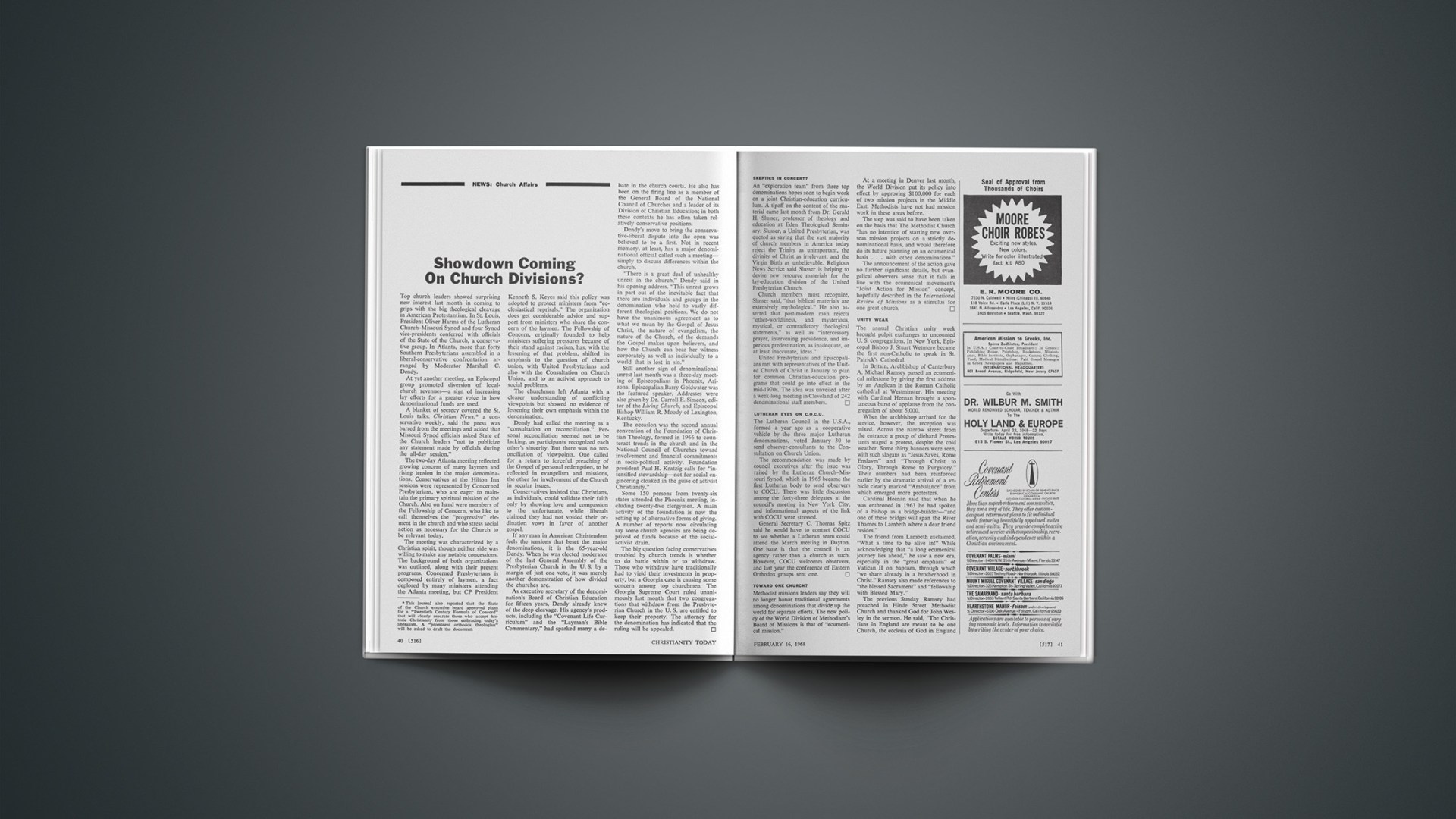
Showdown Coming on Church Divisions?

Top church leaders showed surprising new interest last month in coming to grips with the big theological cleavage in American Protestantism. In St. Louis, President Oliver Harms of the Lutheran Church-Missouri Synod and four Synod vice-presidents conferred with officials of the State of the Church, a conservative group. In Atlanta, more than forty Southern Presbyterians assembled in a liberal-conservative confrontation arranged by Moderator Marshall C. Dendy.

At yet another meeting, an Episcopal group promoted diversion of local-church revenues—a sign of increasing lay efforts for a greater voice in how denominational funds are used.

A blanket of secrecy covered the St. Louis talks. Christian News,1This journal also reported that the State of the Church executive board approved plans for a “Twentieth Century Formula of Concord” that will clearly seperate those who accept historic Christianity from those embracing today’s liberalism. A “prominent orthodox theologian” will be asked to draft the document. a conservative weekly, said the press was barred from the meetings and added that Missouri Synod officials asked State of the Church leaders “not to publicize any statement made by officials during the all-day session.”

The two-day Atlanta meeting reflected growing concern of many laymen and rising tension in the major denominations. Conservatives at the Hilton Inn sessions were represented by Concerned Presbyterians, who are eager to maintain the primary spiritual mission of the Church. Also on hand were members of the Fellowship of Concern, who like to call themselves the “progressive” element in the church and who stress social action as necessary for the Church to be relevant today.

The meeting was characterized by a Christian spirit, though neither side was willing to make any notable concessions. The background of both organizations was outlined, along with their present programs. Concerned Presbyterians is composed entirely of laymen, a fact deplored by many ministers attending the Atlanta meeting, but CP President Kenneth S. Keyes said this policy was adopted to protect ministers from “ecclesiastical reprisals.” The organization does get considerable advice and support from ministers who share the concern of the laymen. The Fellowship of Concern, originally founded to help ministers suffering pressures because of their stand against racism, has, with the lessening of that problem, shifted its emphasis to the question of church union, with United Presbyterians and also with the Consultation on Church Union, and to an activist approach to social problems.

The churchmen left Atlanta with a clearer understanding of conflicting viewpoints but showed no evidence of lessening their own emphasis within the denomination.

Dendy had called the meeting as a “consultation on reconciliation.” Personal reconciliation seemed not to be lacking, as participants recognized each other’s sincerity. But there was no reconciliation of viewpoints. One called for a return to forceful preaching of the Gospel of personal redemption, to be reflected in evangelism and missions, the other for involvement of the Church in secular issues.

Conservatives insisted that Christians, as individuals, could validate their faith only by showing love and compassion to the unfortunate, while liberals claimed they had not voided their ordination vows in favor of another gospel.

If any man in American Christendom feels the tensions that beset the major denominations, it is the 65-year-old Dendy. When he was elected moderator of the last General Assembly of the Presbyterian Church in the U. S. by a margin of just one vote, it was merely another demonstration of how divided the churches are.

As executive secretary of the denomination’s Board of Christian Education for fifteen years, Dendy already knew of the deep cleavage. His agency’s products, including the “Covenant Life Curriculum” and the “Layman’s Bible Commentary,” had sparked many a debate in the church courts. He also has been on the firing line as a member of the General Board of the National Council of Churches and a leader of its Division of Christian Education; in both these contexts he has often taken relatively conservative positions.

Dendy’s move to bring the conservative-liberal dispute into the open was believed to be a first. Not in recent memory, at least, has a major denominational official called such a meeting—simply to discuss differences within the church.

“There is a great deal of unhealthy unrest in the church,” Dendy said in his opening address. “This unrest grows in part out of the inevitable fact that there are individuals and groups in the denomination who hold to vastly different theological positions. We do not have the unanimous agreement as to what we mean by the Gospel of Jesus Christ, the nature of evangelism, the nature of the Church, of the demands the Gospel makes upon believers, and how the Church can bear her witness corporately as well as individually to a world that is lost in sin.”

Still another sign of denominational unrest last month was a three-day meeting of Episcopalians in Phoenix, Arizona. Episcopalian Barry Goldwater was the featured speaker. Addresses were also given by Dr. Carroll E. Simcox, editor of the Living Church, and Episcopal Bishop William R. Moody of Lexington, Kentucky.

The occasion was the second annual convention of the Foundation of Christian Theology, formed in 1966 to counteract trends in the church and in the National Council of Churches toward involvement and financial commitments in socio-political activity. Foundation president Paul H. Kratzig calls for “intensified stewardship—not for social engineering cloaked in the guise of activist Christianity.”

Some 150 persons from twenty-six states attended the Phoenix meeting, including twenty-five clergymen. A main activity of the foundation is now the setting up of alternative forms of giving. A number of reports now circulating say some church agencies are being deprived of funds because of the social-activist drain.

The big question facing conservatives troubled by church trends is whether to do battle within or to withdraw. Those who withdraw have traditionally had to yield their investments in property, but a Georgia case is causing some concern among top churchmen. The Georgia Supreme Court ruled unanimously last month that two congregations that withdrew from the Presbyterian Church in the U. S. are entitled to keep their property. The attorney for the denomination has indicated that the ruling will be appealed.

SKEPTICS IN CONCERT?

An “exploration team” from three top denominations hopes soon to begin work on a joint Christian-education curriculum. A tipoff on the content of the material came last month from Dr. Gerald H. Slusser, professor of theology and education at Eden Theological Seminary. Slusser, a United Presbyterian, was quoted as saying that the vast majority of church members in America today reject the Trinity as unimportant, the divinity of Christ as irrelevant, and the Virgin Birth as unbelievable. Religious News Service said Slusser is helping to devise new resource materials for the lay-education division of the United Presbyterian Church.

Church members must recognize, Slusser said, “that biblical materials are extensively mythological.” He also asserted that post-modern man rejects “other-worldliness, and mysterious, mystical, or contradictory theological statements,” as well as “intercessory prayer, intervening providence, and imperious predestination, as inadequate, or at least inaccurate, ideas.”

United Presbyterians and Episcopalians met with representatives of the United Church of Christ in January to plan for common Christian-education programs that could go into effect in the mid-1970s. The idea was unveiled after a week-long meeting in Cleveland of 242 denominational staff members.

LUTHERAN EYES ON C.O.C.U.

The Lutheran Council in the U.S.A., formed a year ago as a cooperative vehicle by the three major Lutheran denominations, voted January 30 to send observer-consultants to the Consultation on Church Union.

The recommendation was made by council executives after the issue was raised by the Lutheran Church-Missouri Synod, which in 1965 became the first Lutheran body to send observers to COCU. There was little discussion among the forty-three delegates at the council’s meeting in New York City, and informational aspects of the link with COCU were stressed.

General Secretary C. Thomas Spitz said he would have to contact COCU to see whether a Lutheran team could attend the March meeting in Dayton. One issue is that the council is an agency rather than a church as such. However, COCU welcomes observers, and last year the conference of Eastern Orthodox groups sent one.

TOWARD ONE CHURCH?

Methodist missions leaders say they will no longer honor traditional agreements among denominations that divide up the world for separate efforts. The new policy of the World Division of Methodism’s Board of Missions is that of “ecumenical mission.”

At a meeting in Denver last month, the World Division put its policy into effect by approving $100,000 for each of two mission projects in the Middle East. Methodists have not had mission work in these areas before.

The step was said to have been taken on the basis that The Methodist Church “has no intention of starting new overseas mission projects on a strictly denominational basis, and would therefore do its future planning on an ecumenical basis … with other denominations.”

The announcement of the action gave no further significant details, but evangelical observers sense that it falls in line with the ecumenical movement’s “Joint Action for Mission” concept, hopefully described in the International Review of Missions as a stimulus for one great church.

UNITY WEAK

The annual Christian unity week brought pulpit exchanges to uncounted U. S. congregations. In New York, Episcopal Bishop J. Stuart Wetmore became the first non-Catholic to speak in St. Patrick’s Cathedral.

In Britain, Archbishop of Canterbury A. Michael Ramsey passed an ecumenical milestone by giving the first address by an Anglican in the Roman Catholic cathedral at Westminster. His meeting with Cardinal Heenan brought a spontaneous burst of applause from the congregation of about 5,000.

When the archbishop arrived for the service, however, the reception was mixed. Across the narrow street from the entrance a group of diehard Protestants staged a protest, despite the cold weather. Some thirty banners were seen, with such slogans as “Jesus Saves, Rome Enslaves” and “Through Christ to Glory, Through Rome to Purgatory.” Their numbers had been reinforced earlier by the dramatic arrival of a vehicle clearly marked “Ambulance” from which emerged more protesters.

Cardinal Heenan said that when he was enthroned in 1963 he had spoken of a bishop as a bridge-builder—“and one of these bridges will span the River Thames to Lambeth where a dear friend resides.”

The friend from Lambeth exclaimed, “What a time to be alive in!” While acknowledging that “a long ecumenical journey lies ahead,” he saw a new era, especially in the “great emphasis” of Vatican II on baptism, through which “we share already in a brotherhood in Christ.” Ramsey also made references to “the blessed Sacrament” and “fellowship with Blessed Mary.”

The previous Sunday Ramsey had preached in Hinde Street Methodist Church and thanked God for John Wesley in the sermon. He said, “The Christians in England are meant to be one Church, the ecclesia of God in England in communion with the ecclesia of God in Uganda or Ceylon or New Zealand or where you will.” Some found it significant that he did not include South India, with which ecclesia no Anglicans are yet in communion.

The official press release said Ramsey then said the new united church “will be the Church of England in continuity with the Church of St. Augustine of Canterbury; it will be the Church into which John Wesley was born.” The words, staggering in their implication, were not uttered in the actual sermon. The church publicists offered what amounts to an admission that the archbishop had thought better of his original words and that a correction had been sent out.

Even more bedlam accompanied the appearance of Roman Catholic Archbishop James Scanlan at the Church of Scotland cathedral in Glasgow. As soon as he approached the lectern for a Scripture reading, demonstrators rose and started to shout things like, “You will go to Hell with the Pope.” Scuffles broke out between protesters and members of the congregation, the Scotsman reported, and the service was delayed for twenty minutes. There was even shouting during a prayer after the Scripture reading.

Afterwards, a minister from the Sovereign Grace Baptist Church in Glasgow identified himself as the protest leader and said: “I feel it was tremendously successful. We will keep up this sort of thing until the whole ecumenical movement is abandoned.”

RETREAT EAST OF SUEZ

The British government’s decision last month to withdraw all troops stationed east of Suez by 1971 is causing a revolution for Christian work among servicemen overseas. Societies are rethinking strategy, some are closing down foreign work completely, and some face considerable financial loss.

Besides this, it has never been so hard to find Christians willing to work overseas with servicemen, since the job would last only four years.

The head of the Soldiers’ and Airmen’s Scripture Readers Association, Lieutenant Colonel G. G. S. Clarke, said the work in Singapore will be closed, but he thinks there should be greater opportunity to reach the increasing number of servicemen in Britain.

He said the government move is a “great loss,” however, because “the soldier overseas is much easier to reach with the Gospel than the one at a home base. In Britain he is a soldier only from 8:30 A.M. to 5:30 P.M., and then he goes into town for the evening. But overseas you will always find men hanging around the barracks. We also find that a man is more ready to consider the facts of life when he is away from home.”

Clarke also noted the loss of mission opportunities among native peoples where troops are stationed. In Aden, for instance, an Arab employed to work in an Army canteen was converted to Christ and is now training in Lebanon, planning to return as a missionary to his people. Clarke’s mission has had to scrap plans for a new work in the Persian Gulf area.

Lieutenant Commander F. M. Savage of the Royal Sailors Rest said his group’s seventy-two-room hotel at the Singapore navy base will close. It was the agency’s first overseas effort when it was opened four and one-half years ago. The hotel is on land leased from the British Admirality and cannot be sold, so financial loss is expected. A previous government decision to close the Royal Air Force station in Ballykelly, Northern Ireland, will close the mission’s fifty-room hotel nearby.

James Campbell, veteran secretary of the Mission to Mediterranean Garrisons, said a new operation opened in Iran just a few weeks ago must now be closed by 1971. But he added philosophically, “Four years’ work is all that any missionary can be sure of in any area these days.” His agency has had to close twenty-eight centers for political reasons since World War II.

J. ERIC MAYER

A CLERGYMAN VINDICATED

In the tatty, faded, and ill-lit courtroom in Chatham, Ontario (population 30,000), the atmosphere was bleak, but for 50-year-old Russell D. Horsburgh it was the stage for a personal triumph on January 18.

He was cleared of criminal charges that he encouraged sexual acts among teen-agers at the city’s largest church, Park Street United. He had been charged and convicted in 1964. The clergyman served about one-third of his one-year prison term while a high-priced lawyer fought appeals in the courts.

At first unsuccessful, the lawyer eventually won a 4–3 decision for a new trial from the Supreme Court of Canada. The judge at the latest trial ruled there was insufficient evidence.

Horsburgh angrily quit the United Church, claiming it deserted him, though the denomination’s social-service board voted $5,000 toward his legal expenses. While out of jail the preacher lived a hand-to-mouth existence that included work as a parking-lot attendant.

Horsburgh, claiming his faith is now stronger than ever, has decided to work in Toronto among teens who have had brushes with the law—the same activity that led to the trouble in Chatham. This time he may follow advice he gave a year ago to other ministers who want to work with teen-agers in trouble: “Never work alone with them. It’s suicide.”

AUBREY WICE
Report from Korea: No Panic over ‘Pueblo’

Christians in South Korea—like most of the population—reacted with shock but no fear to two Communist-planned hammer blows last month. The first provocation was infiltration of thirty-one guerrillas bent on assassinating President Chung Hee Park. Two days later, North Korea seized the U. S. surveillance ship “Pueblo.”

The United States said the ship was cruising in international waters, and the world waited anxiously to see whether a second front would open in the Asian war.

In the guerrilla attack, nighttime gunfire and grenades broke the silence on the streets of South Korea’s capital, Seoul. The first hero of the incident was Police Chief Choi, a Roman Catholic, who halted the raiders a half-mile from the president’s house. As he gave a warning, he was shot fatally in the stomach. He was later given a huge Catholic funeral in the municipal auditorium with a public procession of government officials.

Police swarmed through the Mormon mission headquarters near the capitol in pursuit of the fleeing Communist commandos. Tension mounted as the Army joined the chase, and the watchman at the Presbyterian seminary on the outskirts of Seoul took the precaution of arming himself with a shotgun. Eventually five of the infiltrators were killed and one was taken alive.

The subsequent seizure of the “Pueblo” added to the shock, but there was no panic in Korea. The 750 Protestant missionaries prudently planned what to include in their sixty pounds of standard evacuation baggage—just in case—but continued their normal routine.

As public confidence and calm returned, the South Koreans asked, “Why is the world so surprised? We know the Communists; this is how they act.”

A surge of hope arose that the new incidents would break the paralyzing deadlock that has cut Korea in half for twenty-two years. Pulpit prayers on the day of the “Pueblo” capture and the following Sunday included pleas for reunification of the country and for freedom. But the pastors also agonized over a possible new war and the suffering it would bring, and hoped for peace with honor.

Objective considerations after the first blush of emotion in the crisis included pride in the South Korean response and confusion about what America would—or should—do.

The Communists seriously miscalculated their popular support in the South. They theorized that the common people would protect the lives of the infiltrators as the sea protects fish. But the facts are otherwise. Four impoverished wood-cutters risked their lives to give the first alarm that foiled the Communist maneuver.

The Communists theorize that the new, young generation will be pro-Communist, but thousands of high schoolers—including refugees from Soongsil High School, a Christian institution in North Korea—demonstrated against the North’s aggression.

The Communists also theorize that capitalist South Korea is an exploited, underdeveloped, unhappy land. But captured guerrillas were shocked by Seoul’s bright lights, quality suits, leather shoes, and smiling faces.

Korea’S Christians

South Korea has the strongest Protestant community among the Asian nations, with nearly half a million members. About 1.9 million in a population of 27 million have some church connection. There are eighteen theological schools. The Korean denominations have 3,200 ordained nationals, plus several thousand other staff workers. Some 750 missionaries from overseas work in the twenty-five churches and mission groups listed in the 1968 World Christian Handbook. The majority of Korea’s Protestants belong to the several Presbyterian groups.

The Roman Catholic community numbers 638,546, with 671 priests, more than half of them native Koreans.

The Catholics estimate 40,000 members in North Korea, but there are no definite figures available on Protestant strength under the Communist regime there.

Most South Koreans felt some retaliatory action was necessary to halt terrorism and piracy, but there was no unity of advice.

North Korea is training a thousand combat units for infiltration similar to that aimed at assassinating Park. These Communist troops are superbly trained from two years of walking with ten-pound weights on their legs, sleeping bare on cold concrete, and hiking with heavy loads over rugged terrain twenty-three miles per day. Many wondered if the free world has self-discipline to match.

There was no cry for withdrawal of South Korean troops fighting with the United States in Viet Nam. The Church is proud that the chief of Korea’s troops in Viet Nam is a Christian. There is no peace movement in the Korean church to parallel that in the United States. Pacifism is greeted with polite incredulity, or laughter, in a nation that daily faces the threat of Communist arms.

OTHER CHURCH REACTIONS

Worldwide church response to the Korean crisis (story above) was moderate in tone. The Vatican newspaper feared that the Asian war situation might be complicated “beyond all control.” The paper blamed neither side and called for peaceful settlement through “honorable negotiations.”

In New York, the chief executives of four Protestant denominations sent a message to President Johnson praising his “restraint and patience” in handling the “Pueblo” crisis and his referral of the situation to the United Nations. They said they “believe this great nation should not and need not be provoked into the hasty use of armed force in response to brazen and immoral aggression, short of war, by her enemies.”

The four, representing the Methodist Church, United Presbyterian Church, United Church of Christ, and Christian Churches, said they did not question the “wisdom” of “Pueblo”-type spy missions, since Americans “should expect and receive the protection of their government …”

Later, officials of the National Council of Churches and a dozen other Protestant, Jewish, and secular groups sent a telegram to the President saying his mobilization of Reserve troops “is an alarming reaction encouraging further escalation and war hysteria,” and saying Americans “deserve public disclosure of full information” on the “Pueblo” location off Korea. Similar wires went to all members of the Senate and some U. S. Representatives.

PRAYER IN THE WHITE HOUSE

A week after the “Pueblo” crisis began, President Johnson and other national leaders assembled for International Christian Leadership’s annual prayer breakfast. “Man was given by his Creator the saving strength of faith,” the President said. “This is a season when America needs to draw upon the strength of our many faiths.”

He said it was not his privilege to tell people what, when, or where to worship, but “in these long nights, your President prays.”

He then quoted FDR’s 1942 prayer, asking “the God of the free” to grant men “a common faith,” and added, “America never stands taller than when her people go to their knees.”

Main speaker at the breakfast was General Harold K. Johnson, U.S. Army Chief of Staff. He said the nation is “troubled and uneasy.” But “there is a solution to the problems of individuals … of nations … of our cities and our streets … of our young—turn to God!”

The general said that “in the eyes of God all of us are brothers. We dare not be indifferent to our brother’s needs.” Then referring to God’s prior love as explained in John 15—which had been read earlier by Vice President Hubert Humphrey—the general said, “We can never hope to match his matchless love, but we grow in grace and glory every time we try.”

Breakfast emcee Senator Frank Carlson, who is retiring this year after forty years of public service, had this advice: “Do not take the God of your fathers lightly, or allow him to be squeezed out of our lives by our own selfish attitudes.”

In the invocation, Massachusetts Governor John Volpe said, “Make us aware of how helpless we are … without the God of men and nations.” The closing prayer was by ex-Texas Governor Price Daniel, director of the Office of Emergency Planning.

Greetings from the Senate weekly prayer group were brought by Mississippi’s John Stennis. The House group was represented by Ben Reifel of South Dakota.

HOW ARE THINGS IN LAMBARENE?

Two and one-half years after Albert Schweitzer’s death, the hospital mission work in Lambaréné, Gabon, still goes on. It suddenly got some publicity during new director Dr. Walter Munz’s recent fund-raising tours in Britain and the United States.

“Without massive and rapid support,” London’s Sunday Times reported, the hospital “may soon close to become the dusty shrine to one man’s ego.” The paper said budget problems forced postponement of plans to purify the water supply and offer pre-natal care and vaccinations. The story of financial trouble was later called an exaggeration.

Schweitzer’s famous “reverence for life” extended to animals, including vermin; but under the regime of Munz, a 34-year-old Swiss bachelor, they are kept away from the wards. Bedbug-ridden grass mats have been replaced with plastic-covered foam mattresses; paraffin lamps have given way to fluorescent lights.

Last year the hospital conducted 1,200 major operations. Its 500 beds are always full, while the European-style government hospital nearby is half-empty.

British leprosy expert Stanley Brown has charged that the famous leper colony built with Schweitzer’s 1954 Nobel Peace Prize money is “a mere nesting place for burnt-out cases.” But he plans to survey the work on behalf of the British Leprosy Mission this year to improve preventive techniques.

The Times said that at the hospital “Schweitzer’s spirit lies perpetually in state.” In fact, rumors have it that some natives actually expect a second coming of the mustachioed doctor.

One Schweitzer tradition remains intact: relatives of the patients cook free food over individual pots.

THE PLOTTING PADRES

“We began teaching the Indians that no one will defend their rights if they do not defend them themselves,” said Maryknoll priest Thomas R. Melville. “If the government and oligarchy are using arms to maintain them in their position of misery, then they have the obligation to take up arms and defend their God-given right to be men.”

The 37-year-old Melville and his brother, 35, along with another Maryknoll priest and a nun, have publicly identified themselves with leftist guerrillas in Guatemala. In December, superiors ordered them to return to New York. When the Melville brothers did not do so, they were suspended. The other priest returned home and was reassigned to Hawaii.

Witness At The Winter Olympics

The tenth Winter Olympics, now under way in Grenoble, France, pay homage to the world’s fastest-growing sport: skiing. In a broader sense, many Olympic participants worship implicitly at the shrine of athletic prowess, recalling the early Greek games, when a priestess was on hand (the only woman present). The Greek events began only after sacrifices of grain, wine, and lambs had been offered to the god Zeus.

Nonetheless, the modern Olympics have seen pagan influences yield somewhat to Christian enterprise. During recent games, evangelistic teams have worked quietly among the Olympic participants. Several top winners have been young people of firm Christian conviction.

For the current winter games in Grenoble, local churches asked the Commonwealth and Continental Church Society in London to help to set up an international Christian witness. The Billy Graham Evangelistic Association in Europe gave prompt, enthusiastic support. At the 1966 World Congress on Evangelism in Berlin, a number of organizations got together on the project and eventually set up an agency called Action Chrétienne Olympique (Christian Olympic Action).

ACO recruited 180 Christian young people of various nationalities and gave them a correspondence course in lay evangelism. A Grenoble cinema was hired to show Billy Graham and Moody science films, and a lounge was rented to foster Christian friendships. Campus Crusade for Christ promised to send “The Forerunners” to communicate the Gospel in the folk-music idiom. ACO has also appointed official chaplains with entree to the Olympic Village to hold special services. Special literature has been prepared for distribution.

Ecumenical groups also are on hand in Grenoble with exhibitions and special events at two specially built centers. Among the speakers was Dr. W. A. Visser ’t Hooft, retired general secretary of the World Council of Churches.

The plot thickened still further when a Maryknoll spokesman confirmed reports that Thomas Melville had married the nun, Sister Marian Peter Bradford, 38; both were excommunicated.

At the end of January the Melville brothers were reported to be in Mexico near the border of Guatemala, where presumably they could perpetuate contacts with guerrilla forces. National Catholic Reporter, meanwhile, carried an article by Thomas Melville in which he made a detailed plea for downtrodden Guatemalans besides endorsing arms for the peasants. He denounced landowners and asserted that “misery is perhaps the biggest factor in preventing a true growth of Christianity in Latin America today.”

“I am a communist only if Christ was a communist,” Melville said. “I did what I did and will continue to do so because of the teachings of Christ and not because of Marx or Lenin.… When the fight breaks out more in the open, let the world know that we do it not for Russia, not for China, nor any other country, but for Guatemala. Our response to the present situation is not because we have read either Marx or Lenin, but because we have read the New Testament.”

DISTORTING THE POPE

The Vatican is concerned that Pope Paul, who sees wrong on both sides and is trying to be a neutral mediator on the Viet Nam war, is made by some to seem a foe of the U. S. policy. Religious News Service says “the pontiff is pictured as having already pronounced a moral judgment against the United States and to have called for unconditional cessation of bombing of North Viet Nam.”

An RNS dispatch from Rome noted that after the Pope expressed “keen and sorrowful apprehension” about the war in his talk with President Johnson, this was interpreted as a “moral rebuke.” RNS said the Pope rejects proposals for an unconditional bombing halt as a pre-condition to any negotiations, which puts him at odds with United Nations Secretary General U Thant.

RHODESIA: A WALL RISING?

Segregation in some parts of Southern Rhodesia is worse than in South Africa, Rhodesia’s Anglican Bishop K. J. F. Skelton said in a New York visit last month. He added that pressures are increasing on the Church, which tries to remain one institution where blacks and whites can sit down “together to speak the truth in love with one another.”

Skelton reported on new regulations he said have not been mentioned in the nation’s press: Mixed-blood persons can be evicted from their homes if 50 per cent of their neighbors request it. Some public parks are now designated for whites only. School sports matches that were once multi-racial have been segregated. Skelton also complained that Rhodesia is almost completely cut off from news of the outside world.

PLUS A HORSE FARM

A recent CBS-TV news clip showed Director Ralph Baney of the Holy Land Christian Approach Mission handing out Christmas food baskets to the poor in the Middle East, but the good image was short-lived. Days later the Internal Revenue Service ended a month-long investigation and announced that the mission’s tax-exempt status had been revoked, retroactive to four years ago. Baney, a 55-year-old Baptist minister, hopes for a hearing on his appeal to the district IRS office this month.

As to the reason, an IRS spokesman would refer only to the section of the tax code that says that a tax-exempt organization must operate exclusively for religious or charitable purpose and that no net earnings are to benefit any private individual.

If the ruling stands, the mission’s income ($1 million last year) will be taxed like that of a corporation, and contributors will no longer get tax credit.

The mission, which supports an orphanage and crippled children’s hospital in Bethlehem, is based at a $500,000 Kansas City building that also serves as Baney’s home. The building stands on a 236-acre farm where the mission raises and sells thoroughbred Tennessee walking horses. Baney says the horse farm is no different from the nearby Nazarene printing plant or Unity orchard operation.

ELDEN RAWLINGS

GEORGIA: FIRST AID

The Southern Baptist association in Atlanta reversed traditional policy in January and voted 487 to 370 to permit Atlanta Baptist College, being constructed for September opening, to apply for federal aid for buildings and equipment.

After the vote, the Rev. Dick H. Hall, Jr., former Georgia Baptist president, quit as development chief for the college. Hall, who has been an officer of Americans United for Separation of Church and State, said that “to be of further use to the college I would be compelled to compromise very deep convictions. This I cannot do.” Several pastors said their churches might quit the association in protest.

Prominent Atlanta pastor Monroe Swilley, college board chairman, praised the vote but said the trustees “are not anxious to run to the federal treasury. We will scrutinize every program carefully.”

The Georgia convention has refused to let Mercer University in Macon seek federal aid for the last two years.

Book Briefs: February 16, 1968

One To Disrupt The Status Quo

The Theology of Hope, by Jürgen Moltmann, translated by James W. Leitch, (Harper & Row, 1967, 342 pp., $8.50), is reviewed by David P. Scaer, assistant professor of systematic theology, Concordia Theological Seminary, Springfield, Illinois.

Only infrequently in a generation does a book appear that promises to disrupt the theological status quo and direct theology along a new course. In this case the “new” direction is a reaffirmation of the classical New Testament eschatological hope that the risen Christ will appear so that the dead may share in his resurrection. In these pages we find more than a simple biblicism. The author, professor of systematic theology at the University of Tübingen, was motivated to write by current theological thought that has reduced both history and eschatology to an eternal present. This idea, which is the mainspring of existential philosophy, is familiar to us through the works of Bultmann and to some extent Barth.

Far from being biblical, the depreciation of history, and also the future, with sole emphasis on the “now,” originates in the Hellenistic cyclical view of history and can be traced through Kant, Hegel, Kierkegaard, Heidegger, right into contemporary theology. It has also had a profound influence on the study of history, which has provided critical categories for studying the events of the New Testament and has laid down paths for plotting the future. This historical method, prominent in both this and the last centuries, follows the “whole” concept of the Greeks and does not allow for any new events that do not have parallels in earlier ones. Thus for Baur, miracles are a priori impossible and have no place in history. The existence principle of Heidegger, Bultmann’s mentor, is totally destructive of history, since the past functions primarily in understanding human existence.

With clear decisive strokes, Moltmann shows that for both Jews and Christians history is rooted in actual events and sets its sights on a real future in accordance with God’s promises. Christianity does not concentrate on the Hellenistic concept of God as an eternal presence but sees God going before his people, leading them to a goal. History is the framework for the promise that is the basis of hope. Hope is the other side of faith and more than anything else is the unique characteristic of Christianity. Although a cyclical view of history does not allow for a resurrection of Jesus, since it is not the repetition of a former event, Moltmann establishes it as the very basis of history. Past, present, and future are linked only when the crucified Jesus is identified with the risen Christ, who will complete all things with the final resurrection from the dead. Only a firm historical base surrounded by the promises of God secures a future marked by eschatological hope. This hope concerning God’s future in Christ lets the Christian live in a world full of possibilities. God’s future for the world can be found in his word but cannot be identified with it. This would be making the present eternal in the manner of Bultmann.

This work, a masterpiece both in theology and in language, has already become a milestone in European theology, providing a positive, corrective influence by showing that the Church’s real life lies not in the present but in the future, with the return of the resurrected Christ. Because of the past (the crucifixion and resurrection of Jesus), the present (the preaching of the Gospel) is fraught with hope for the future (the return of Christ). Only Christianity can read history and understand the present in the light of an event that still lies in the future. This is the message of hope.

Doom Of Death-Of-God Theology

The Death of God Debate, edited by Jackson Lee Ice and John J. Carey (Westminster, 1967, 267 pp., $2.65 paper), is reviewed by J. Murray Marshall, pastor, First Presbyterian Church, Flushing, New York.

It was in the fall of 1965 that the “death of God” controversy erupted in both the secular and the religious press. Through what is called “a happy editorial accident,” articles appeared in close sequence in the New York Times, the Christian Scholar, Time, the Christian Century, and the New Yorker making the phrase “death of God” common and hurling the names of William Hamilton, Thomas J. J. Altizer, Gabriel Vahanian, and Paul van Buren into the thick of learned and not-so-learned controversy.

How goes the stir today, more than two years later? Some claim to see sure symptoms of decline and death; perhaps the smaller number of articles appearing in 1967 compared to 1966 bears this out. Others, among them the editors of this book, are sure that the death-of-God theology “is here to stay, whether we like it or not.” Hamilton himself sees that radical theology could go in any one of three directions: to the left, beyond “Christian atheism” to a “candid atheism without any of the Christian claims”; to the right, to the “birth or resurrection of God”; or on to a radical consideration of other items on the theological docket—Christology, the doctrines of man, the Church and the sacraments.

Meanwhile, Ice and Carey, both associate professors of religion at Florida State University, have brought us up to date on the debate. Primarily the book is a compilation of previously published articles representing various responses from the theological community and the public at large. Among new materials are excerpts from personal correspondence with Altizer and Hamilton that show the variety and intensity of reactions triggered in the debate, and a chapter by Altizer on the significance of the new theology. Of special interest is a series of thirty-two questions to Hamilton and his concise answers, which open up the specifics at issue.

Certain impressions emerge. First this can hardly be called a movement, a word that implies a degree of unity about ideas and goals. Clearly, there is no unanimity among the principals, even on basic definitions. Second, radical theologians offer a studied disavowal of traditional theology, yet still claim a right to be called “Christian” and profess allegiance to Jesus. They are “still strangely tied to the Christian tradition”; Hamilton even says, “I am not yet ready to give up sola scriptura.” Here is a mystery of the new theology.

What shows up with ever increasing clarity is that the new radical theology is the tragic end result of the modern theological method, which has discarded as invalid a revealed theology. With no revealed theology, there is no real knowledge of God. Altizer says, “Perhaps the greatest obstacle thus far confronting the theologian has been the almost innate conviction that the subject of theology is given.… Underlying this loyalty [to theological tradition] is the conviction that the Christian faith stands or falls with the eternal existence and continuing activity of God.”

Precisely! Without this, theology is meaningless. And take away a revealed theology and there is no longer a means of knowing the eternal God. The radical theologians of the mid-sixties are begotten of theological and philosophical ancestors who undermined the traditional idea of a revealed theology. Man has presumed to establish himself first as judge of the Scriptures, and now as the judge of God himself! Without a revealed theology, the debate (and the despair) will go on, and on, and on.

Is Belief In God Rational?

God and Other Minds: A Study of the Rational Justification of Belief in God, by Alvin Plantinga (Cornell University Press, 1967, 277 pp., $8.50), is reviewed by William Young, associate professor of philosophy, University of Rhode Island, Kingston.

This closely reasoned work investigates the cosmological, ontological, and teleological arguments for the existence of God, then proceeds to consider the problem of evil, verificationism, the paradox of omnipotence, and an ontological disproof of God’s existence, then finally explores the analogies and connections of the question of the existence of God with that of other minds. The conclusion is that “belief in other minds and belief in God are in the same epistemological boat; hence if either is rational, so is the other.”

Only one form of cosmological argument is discussed, the argument from contingency as developed in Aquinas’s third way. After an elaborate examination of the assumptions involved, the author pronounces the argument inconclusive. One assumption he accepts is that “if there is no necessary being, then it is possible that no contingent being exists.” If he also grants the necessity that some being, necessary or contingent, exists—an assumption no less plausible than the other—then it clearly follows that a necessary being exists. This, to be sure, would be not a cosmological but rather an ontological proof, of a type not considered in the two chapters on the ontological argument. Plantinga examines common objections to the ontological argument and finds they do not provide a general refutation. The argument itself, however, is also judged unsuccessful in the form in which it is presented. The teleological proof has some force in providing evidence for the claim that the universe was designed, but it fails to establish the existence of a single designer and creator.

In answering the objection raised by the natural atheologian from the problem of evil, Plantinga endorses the freewill defense, a position that appears to have unacceptable consequences for a believer in God’s sovereign and efficacious grace. If God cannot determine free creatures to do only what is right, then he could not have preserved the elect angels in their original integrity, nor can he preserve believers infallibly in a state of grace without infringing on their freedom. But if the doctrines of grace are accepted, it becomes clear that there can be no a priori limitation on God’s power to determine rational creatures to do only what is right.

The issues involved in the discussion of the problem of other minds are too intricate to be dealt with here. I am not convinced that a strong enough case is made for the argument from analogy to warrant the construction of even so modest an apologetic proposal as is made in this book. Yet it must be stressed that the book is a model of philosophical argument. It will attract philosophically trained readers, who are the intended audience for this presentation of theism.

Reading For Perspective

CHRISTIANITY TODAY’S REVIEW EDITORS CALL ATTENTION TO THESE NEW TITLES:

Religion Across Cultures, by Eugene A. Nida (Harper & Row, $4.95). The American Bible Society’s noted linguist takes a fresh look at the psychological and dynamic factors related to effective communication in diverse cultures.

A Second Touch, by Keith Miller (Word, $3.50). Those who profited from Miller’s The Taste of New Wine will like its sequel: an extremely personal and disturbingly candid approach to honest and creative Christian living.

Baker’s Pictorial Introduction to the Bible, by William S. Deal (Baker, $7.95). This non-technical, high-school-level evangelical work will help students to understand the recipients, purpose, date, authorship, and important people and themes of every book of the Bible.

Wrong Assumptions On Vietnam

Vietnam: Crisis of Conscience, by Robert McAfee Brown, Abraham J. Heschel, and Michael Novak (Association, 1967, 127 pp., $.95 paper), and The Viet Nam War: Christian Perspectives, edited by Michael P. Hamilton (Eerdmans, 1967, 140 pp., $3.50 cloth, $1.65 paper), are reviewed by Edward L. R. Elson, minister, The National Presbyterian Church, Washington, D. C.; member of the team appointed by President Johnson to observe the elections in South Vietnam.

Vietnam: Crisis of Conscience contains position papers of the January 31-February 1, 1967, Washington conference sponsored by “Clergy and Laymen Concerned About Vietnam.” Essentially the book is an indictment of American guilt for the predicament of Vietnam and an urgent plea that the United States stop using force to carry out its political and social objectives there. The authors say the struggle is only a “civil war,” that what the United States government terms “Communist aggression” from the North is non-existent, and that the Vietcong have voluntary patriotic support (the United States government concludes there is no “voluntary popular support whatever”—only support derived from threat and terror). The serious concern in this book is focused on ending the fighting, not on how it is to be ended, or the post-bellum shape of things in the Pacific.

Michael Novak provides a historical synopsis and analysis based on the rejection of any idea of a world Communist threat to freedom or to the system of governments oriented toward United States leadership and strength. He says:

To attribute today to the various parties, regimes and factions that make up the world Communist movement any sort of a unified political personality … or single disciplined force … is to fly in the face of an overwhelming body of evidence, to move intellectually in the realm of patent absurdity, to deny by implication the relevance of external evidence to the considerations and decisions of foreign affairs.

Therefore, we are to consider “Communism and modified capitalism” as two rival strategies for dealing with this revolutionary age, where the real issues are hunger, poverty, economic and racial injustice.

Novak ignores the vast amount of information available to the United States government about the world Communist apparatus and its intentions in the Pacific. His presuppositions are at variance with the literature available from the State Department and the briefings held periodically by Foreign Service officers in Washington. The bibliography of this book is limited so that it only confirms the authors’ presuppositions; it conspicuously omits any reference to the factual publications of the United States government.

The authors of this book seem still to be living in the 1950s and over-reacting to McCarthyism. There remains yet, according to informed persons, a sane understanding of the present threat of Communism. True, the Communist thrust in the world is broken into nationalistic expressions and is less politically monolithic than it used to be. Yet whether monolithic or fragmented, the Communism emanating from both China and Russia clearly represents imperialistic perils as dangerous to a democratic society, as any that have appeared in recent history.

In his “Appeal to the Churches and Synagogues,” Robert McAfee Brown contends that both the individual Christian and the corporate church have the responsibility to be informed, to speak, and to act. “If ever there was ‘ecumenical’ issue, i.e., an issue affecting the whole of the oikoumene (the inhabited world), it is Vietnam. In the face of the immensity of that issue, individual speech alone is frivolous if not immoral.”

Brown properly suggests that Vietnam is a turning point in modern history, though many people will not agree with his idea of how history ought to turn at this point. He asserts that moral anguish arises out of the “immorality of the warfare”: (1) civilian casualties (though he does not point out that making soldiers look like civilians and shielding military units behind civilians is a tactic of the Vietcong), the kind of weapons, and the treatment of prisoners; (2) the inconsistency between our stated aims and their actual consequences; (3) the discrepancy between “what we are told by our Government and what we discover is actually taking place.”

The task of the Church, according to Brown, is to create a climate for a negotiated peace now rather than later and especially to encourage policy-makers not merely to give lip service to negotiation but to refashion policy. Brown does not seem to understand that, as Korea revealed, negotiation is for the Communists one of the methods of waging continued war and maneuvering for military advantage, while in our view negotiation is the method of establishing peaceful relations.

The second book, The Vietnam War: Christian Perspectives, contains sermons and addresses delivered in the Washington Episcopal Cathedral and two additional papers, one by Martin Luther King and the other by Eugene Carson Blake. A wide range of opinion, analysis, tourist observation, and sentimentalism, as well as hard substantive thinking, appears here. In my opinion, the statement by R. Paul Ramsey is the most tenable position in this composite volume.

These two books merit careful examination. Since each has several authors, the reader must for each paper assess the validity of the writer’s presuppositions before reaching his own conclusions.

A Freudian Breeze

The Church in the Way, by James E. Dittes (Scribner, 1967, 350 pp., $6.95), is reviewed by Stephen E. Smallman, pastor, McLean Presbyterian Church, McLean, Virginia.

There is a fresh breeze from New England. James E. Dittes, professor of psychology of religion at Yale Divinity School, is convinced of the validity and vitality of the institutional parish church. He has written this book to encourage established and prospective ministers faced with the frustrations of the parish ministry.

Answering the common criticisms that the Church is irrelevant, unreal, and preoccupied with administrative details to the detriment of its spiritual mission, Dittes finds a positive value in these seemingly negative aspects; he shows that the obstacles the Church faces may provide the occasion for a significant ministry. Rather than seek relevance by abandoning the Church as we now know it, we must learn that by participating in its struggle for meaning, we give guidance to a world that is struggling for meaning itself. Dittes emphasizes this thought in his first chapter, “The Relevance of Being Irrelevant.”

Parishioners’ “resistance” (in the Freudian sense of the term) should not frustrate the minister, the author says; on the contrary, he should take heart that his ministry is causing some reaction. Dittes recommends that the minister arm himself with insights provided by psychotherapy. To help him, Dittes has written what amounts to a textbook on resistance in psychotherapy, with illustrations from church life. He calls this an application of the psychology of religion to pastoral theology. This in itself is nothing new, but resistance has not been so carefully examined in this context before. In a day when the Church’s role is seen largely as sociological, the author feels a new word should be spoken for the psychological point of view.

But that is just the weakness of the book—the author sees the Church through the eyes of a Freudian psychologist rather than a theologian. Granted, he says that his purpose is to provide a psychological understanding of the Church’s role; but can there be any true understanding of that role without even a mention of the work of the Holy Spirit? Dittes also does not mention the mission of the Church: to preach the Gospel of God’s saving grace. It could be argued that he took these for granted; but it is more likely that he looked upon them as “religious symbols” of another age. Such symbols change in meaning and relevance, he says, but the modern minister should not abandon them since “they still betray the awesome and gripping power which religious symbols hold.” Resistance to such forms he calls “response to religiosity,” and he says this should be exploited for its psychotherapeutic value. Such a humanistic approach to the Church necessarily weakens any subsqeuent discussion.

Yet, bearing in mind this basic deficiency, the reader will find that The Church in the Way offers some valuable help for the parish ministry. No pastor should ignore the values of psychotherapy in his dealings with people, and this fresh treatment of the factor of resistance is welcome.

Sartre And The Absurd

Sartre: The Theology of the Absurd, by Régis Jolivet, translated from the French by Wesley C. Piersol (Newman Press, 1967, 111 pp., $3.50), is reviewed by James W. Sire, associate professor of English, Nebraska Wesleyan University, Lincoln.

Régis Jolivet, now honorary professor at the Catholic University of Lyons, has written over a dozen books on medieval philosophy and on extentialism. The present volume brings these two subjects together, for the analysis that Jolivet gives Sartre’s work is primarily informed by scholastic categories.

Although Jolivet examines Sartre’s ontology, atheism, ethics, and Marxism, his short book is not designed to be a rapid survey of Sartre’s thoughts. For, though he treats Sartre’s Marxism superficially, he focuses precisely on the ontology and atheism of Being and Nothingness. He likewise gives a skillful analysis of the problems inherent in Sartrian ethics. Jolivet is primarily concerned to illuminate (and to controvert) what he calls the “theology of the absurd.” Hence he examines Sartre’s arguments for the non-existence of God and the impossibility of creation, finding, in short, that Sartre is either inconsistent or begs the question. Concerning the paradox at the heart of Sartre’s system, Jolivet remarks:

If in effect, in the universal absurdity, no argument is ever valid, if we can always say what we wish, if the yes and the no are equally possible, equally gratuitous, equally absurd, then why is it that on every page of Being and Nothingness the problem of reason, the subtle and often profound investigation of explications and justification, is undertaken with such assurance and such vigor? [pp. 47, 48].

Unfortunately, W. C. Piersol’s English version of Jolivet’s work is seriously marred either by bad translation or by poor proofreading. Not only is the English rough and awkward; it is also inaccurate in important places. Where, for example, Jolivet has written, “Human-reality, as such, is therefore not explained by matter.…” (my translation, Piersol has, “Human-reality, as such, is explained by matter.…” Again, where Jolivet, in talking about Kant’s concept of being, has written “substance or noumenon” (my translation), Piersol’s version reads “substance of noumenon,’ thus totally confusing Kant’s idea.

It is easy to agree in general with Jolivet that there are serious inconsistencies in Sartre’s ontology and—more certainly—that Sartrian “theology” and ethics are incompatible with scholastic theology or Protestant thought. But unless one reads the French version, it is not so easy to be sure of the cogency of crucial aspects of Jolivet’s critique. The style of his English translator is not clear; the text of his publisher is not reliable. In any case, this work is not for the novice in philosophy.

The Continuing Morality Debate

Storm Over Ethics, by John C. Bennett et al. (United Church Press, 1967, 183 pp., $1.95), and The New Morality, edited by William Dunphy (Herder and Herder, 1967, 192 pp., $4.95), are reviewed by James A. Nelson, pastor, Trinity Baptist Church, Santa Barbara, California.

Each of these volumes takes part in the contemporary debate over situational ethics and in general is critical of this “new morality.”

Storm Over Ethics consists of papers by seven able and informed men who are at home in philosophy and theology and who present various points of disagreement with Joseph Fletcher’s Situation Ethics. Theologically, they are men of liberal stripe. In the last chapter of the book, Fletcher states his case and briefly attempts to refute his critics.

Fletcher’s antagonists consider such matters as the relation of situation ethics to previous ethical systems, the place of personal responsibility within the framework of freedom, and the true nature of agape love, which is the touchstone of situation ethics. At times they become completely practical as they point to human frailty in a torrid emotional situation.

The New Morality is a series of essays by faculty members of St. Michael’s College, University of Toronto. Their writing is lucid, their observations and applications keen; but since they write chiefly from the perspective of the Roman Catholic fathers and theologians, this volume is less useful for Protestants.

Both volumes seem to lack a firm, authoritative foundation. In presenting their case for an ethical system that has norms and absolute values, the writers neglect some of the most important matters. The right of the sovereign God to establish absolutes is hardly acknowledged. Nor is much said about his knowledge of what is best for the man he created. The place of the Bible as the revealed Word of God is rarely mentioned. One senses the influence of humanism throughout the two volumes, and at times there are hints of universalism. The writers, with the possible exception of some in The New Morality, generally bypass the authority of Jesus Christ and his clear moral statements. Perhaps, then, the greatest disappointment in these volumes comes not from what is said but from what is left unsaid.

However, one who stands in the stream of historic, evangelical Christianity would undoubtedly do well to be acquainted with the case against situation ethics advanced by men who stand on the banks of that stream.

Lights And Shadows

Letters to an American Lady, by C. S. Lewis, edited and with a preface by Clyde S. Kilby (Eerdmans, 1967, 121 pp., $3.95), is reviewed by Joan Kerns Ostling, writer-editor, United States Information Agency, Washington, D. C.

Shadows account for half the beauty in the world, C. S. Lewis wrote, and it is the shadows that characterize the correspondence in this book. The reader will find here neither the erudite debater nor the brilliant satirist; he will discover, instead, unwitting testimony for the patient faith and generous life of the private man who was this century’s most famous Christian apologist.

The letters, written between 1950 and 1963 to an American woman Lewis never met, contain evidence of the famous Lewis style and wit (“I’ve been made a Professor at Cambridge, which will mean less work and therefore of course … more pay.”); the familiar Lewis impatience with journalism, bureaucracy, snobbery, and superficiality; the sharp Lewis mind threading into theology (“It is the actual presence, not the sensation of the presence, of the Holy Ghost which begets Christ in us”) and human psychology (“I loathe ‘sensitive’ people who are ‘easily hurt’ by the way, don’t you? They are a social pest. Vanity is the real trouble”).

But as Clyde S. Kilby points out in the preface, the obvious thrust of the letters is spiritual encouragement and guidance. Here is the Lewis who, without publicity, gave away two-thirds of his income; the Lewis who considered it his Christian responsibility to answer every letter the dreaded and heavily burdened postman brought to his door; the Lewis who sympathized with others’ physical ailments while struggling with his own. Here also is the poignancy of Lewis’s raw grief at the loss of his beloved wife, Joy, and then his own victory at the end when he faced death as “waiting to come up a flower in the Gardener’s good time,” ready to leave the world of “drowsy half-waking” to “come up into the real world, the real waking.”

Lewis readers will treasure these letters for the glimpse they offer into the personal witness of the man. The original letters now form part of the Lewis collection at Wheaton College.

Paperbacks

Nairobi to Berkeley, edited by Paul S. Rees (Word Books, 1968, 176 pp., $.95). Essays by Christian writers assessing critical sectors of the broken world to which the Church must minister. Paul Rees leads off with an appeal for an awakened Christian conscience that accepts involvement and responsibility.

A Case for Virginity, by Gary Garrett (R.I.D., 1967, 108 pp.). Arguments for virginity from a non-religious perspective.

Christian Nurture, by Horace Bushnell (Yale, 1967, 351 pp., $2.45). A reprint of the 1888 book in which Bushnell advances the thesis “that the child is to grow up a Christian, and never know himself as being otherwise.”

Hath God Said?, by Uuras Saarnivaara (Osterhus, 1967, 293 pp., $3.50). Second-rate make-up but useful content dealing with problems of criticism and “difficult passages” in the Bible—from an evangelical perspective.

How to Be a Christian Without Being Religious, edited by Fritz Ridenour (Gospel Light, 1967, 162 pp., $.69). A lively rendition of the message of the Book of Romans for teen-agers; its communicable style and clever cartoons make it as up to date as the boog-a-loo.

St. Thomas More: Selected Letters, edited by Elizabeth Frances Rogers (Yale University, 1967, 276 pp., $1.95). Well-chosen letters give the reader a personal glimpse into the heart and mind of the “man for all seasons.”

Heredity: A Study in Science and the Bible, by William J. Tinkle (St. Thomas, 1967, 180 pp.). A Ph.D. discusses discoveries in genetics, takes issue with the theory of evolution, and relates his observations to the biblical view of man.

They Dared to Be Different, by Anna Talbott McPherson (Moody, 1967, 192 pp., $.59). Inspiring tales from the lives of eighteen great churchmen and women, including Moody, Spurgeon, Knox, Wesley, Mueller, and Crosby.

Sunday Night at the Movies, by G. William Jones (John Knox, 1967, 127 pp., $1.95). An eloquent plea for the use of selected films as contemporary parables by which viewers may be led into discussion of basic issues of life. Although such an approach may help to make people aware of their problems and needs, it will serve little purpose unless it culminates in the proclamation of the revealed Gospel of Christ.

The Minister’s Workshop: Helping the Homosexual

“You said I would be married someday and have a family of my own, but when you said it, I was very skeptical.” This was the comment of a young man who a few minutes earlier had entered my office holding his chubby two-year-old daughter and had proudly introduced me to his lovely wife.

I recalled a day four years before when this man, then a sophomore in college, had sat nervously in my office for the first time, talking about his guilt feelings, fears, and anxieties because of a homosexual encounter and a sexual fantasy life that was primarily homosexual. At that time he was greatly confused and worried that someone would find out about him. He believed that in some way his problem was the result of some misdeeds in his youth. Several comments he had heard from the pulpit had led him to think that this was God’s judgment on man’s sinful preoccupations. And so he had resolved to live with his dark secret and hope that no one would ever find out about the chaos within him. If ever he were to discuss his problem, he thought, it could not be with a fellow Christian, because somehow this all fell into the category “most sinful,” almost unspeakable. For some of his Christian friends, it appeared to be the ultimate form of human depravity.

This young man—let’s call him John—had generated enough courage to see me, a clinical psychologist and teacher in a Christian college, because he had read in a Christian periodical that homosexuals could be helped. During our initial interview he showed me a letter from a New York agency that had been overwhelmed with inquiries—in fact, was considering a mimeographed letter of response—because this article had mentioned it by name. The letter also expressed much understanding for him and his problem and suggested that he seek professional counsel near his home. This gave him enough courage to come to me.

The immediate, burning question that occupied John’s thoughts was: “Is there anything that can be done to help?” When I told him that there was, and that many persons had been able to resolve their problems to the point where they could live normal, heterosexual lives, an obvious sense of relief passed over him. He settled back in his chair, ready to begin what was to be an extended psychotherapeutic encounter lasting over a year.

John’s eagerness to change was, from a diagnostic point of view, a good indication of eventual success. His Christian world-life view heightened his sensitivity to the distortion in this way of life and kept him from passively accepting his “fate” and from becoming involved in one homosexual encounter after another. Without a strong, sustained motivation to change, the potential for help is poor.

My ability to empathize with this young man was based in part on my understanding of the causes of the problem and in part on the fact that we both were human. I could accept his humanness, recognizing that though his problems and mine were not the same, as human beings we both were searching for solutions to the problems of life. I had to empathize with the deep distress and guilt torturing him and to suffer with him as he disclosed his years of lonely struggle with his problem. Locking this secret inside a sensitive, developing adolescent had caused a myriad of frightening fantasies and constant self-renunciation.

In time we began to unravel and reweave the developmental fabric that had produced the problem. Most cases of homosexuality are the products of psychological developmental twists in which a child identifies with the parent of the opposite sex, causing confusion of sexual identity.

John told numerous stories about his mother and her continual efforts to alienate him from his father. She, not finding her husband the source of love and tenderness she had hoped for, found affection and vicarious satisfaction in her son. She frequently told him how earthy and cruel his father was and heaped praise on John for his interests in music, art, and domestic involvement. John also became an object to be used in the game of family politics. In the frequent arguments, he could be counted on to side with his mother against his father and younger brother.

In general, his mother’s world became his, and he had little support apart from her. When his sex drive began to develop, his role confusion became painfully obvious. Instead of normal heterosexual fantasies, his were about men and certain masculine objects.

As the therapy progressed, John began to see himself in relation to his mother and the unhappy marriage. He began to resist his mother’s control and to express some of the hostility he felt. And he began to talk to his father and realize that he wasn’t the “clod” his mother had pictured him to be. His father was pleased to have some contact with this son who had always been estranged from him.

One day John came to a session very excited and quickly told me about an incident that had occurred at the breakfast table. His mother and father were having an argument, and he for the first time supported his father. His mother, in the heat of battle, slapped him across the face. He recalled the experience with deep emotion and enthusiasm and said he felt the umbilical cord was broken. Although this was only one step in the tedious therapeutic encounter, it was a significant one.

The pastor usually does not have the training or time to be of therapeutic help to those suffering from sexual deviations. Still, he can be a source of understanding, both in the pulpit and in the study. He can be a good listener and can offer hope and support in the struggle for a sexual identity. The counselee needs to know that God understands all man’s human frailties and cares beyond measure. Often, guilt is an integral part of this neurosis, and the pastor should meet this with a spirit of understanding and forgiveness, symbolizing God’s grace on man’s behalf. One other task of the pastor is to direct the troubled person to a competent therapist. A professional psychiatrist, clinical psychologist, or social worker sensitive to the person’s Christian motivations should be a ready source of help.

—Dr. J. R. DOLBY, associate professor of psychology, Baylor University, Waco, Texas.

Ideas

Are Heart Transplants Moral?

The astonishing way in which teams of cardiac surgeons, cardiologists, anesthesiologists, and physiologists have coordinated their efforts to effect clinical heart transplants has won world attention. But almost overnight these transplants have become a subject of bristling controversy. While the only survivor of five transplant cases made good progress pending release from Groote Schuur Hospital in South Africa, debate mounted everywhere over the moral and legal implications of recent medical and technological advances.

What distinguishes heart transplants from previous homogenous transplants (including skin tissue, bone tissue, corneal tissue, and kidney transplants) is that the donor must always die before his organ can be attached to another body.

Legal questions are fully as knotty as the ethical. What, for example, are the legal proprieties if next of kin refuse to honor a deceased person’s assignment of an organ for medical purposes? What possibility exists of a black market in human hearts—might the mafia promise overnight delivery with anybody its prospective victim? What complications are posed for wills and insurance coverage if a prospective donor bequeaths his organs for transplant and invites premature death? And, since some doctors find the point of death not in heart arrest but in absence of brain function (which permits removal of organs for transplant before irreversible damage sets in), may some patients be illegally considered dead? Ought the legal determination of the moment of death to be left to the preference of the medics?

Ethical concerns are no less vexing and sometimes overlap the legal. Will it make a difference if a doctor is convinced that no providential brain restoration is ever possible? Have not some patients recovered after temporary cessation of brain function and led normal lives? Should surgeons be free to transplant human organs while the compatibility or incompatibility of body tissues is still unsure because of limited research? In view of high surgical costs, are the rich alone to benefit from clinical transplants while the poor are left to die? If one survivor is to be fashioned out of two who cannot survive independently, who dispenses the gift of life to whom? Suppose a terminal cancer victim offers to sell his heart, and the choice of recipient is to be made irrespective of purchasing power. Are specially talented persons to be preferred over Joe Ordinary? Who decides Who’s Who?

Senator Walter F. Mondale of Minnesota has pressed more than 100 doctors, theologians, philosophers, and law-school deans to face the legal and moral issues implicit not only in heart transplants but also in other recent achievements, such as an artificial virus by which scientists could eventually create and sustain laboratory life. It will probably be wiser for government to concentrate on legal concerns, without trying to legislate morality.

As long as physicians are devoted to preserving life and patients know all the facts, a given patient’s right to personal decision in good conscience ought to be fully considered. In any event, the surgeon is answerable to his professional peers for his best use of medical knowledge. To use human beings—even terminal patients with little hope of life—simply for experimental purposes would surely raise serious questions. But the voluntary risk or sacrifice in life in the high hope of benefiting others may be considered an act of courage and love. Trying to provide hope for normal life where it might otherwise remain undiscovered is no less venturesome on the operating table than in an astronaut’s space capsule whirling through the heavens. But surely, in respect to surgery, neither the patient nor the next of kin ought to be ignored in medical decisions that involve such high risks.

The argument that new discoveries specially benefit the wealthy does not carry much force. If no one could afford such operations, their larger possibilities would remain unknown; each additional case tends to lower the ultimate cost for everybody.

Brain transplanting would involve more problems than heart transplanting. According to Dr. Robert White, the famous experimentalist in animal-brain transplants, the brain of a child already contains all of what will be his or her essence as an individual—intelligence, the ability to associate ideas, personality. In view of this intimate connection between the brain and individual character, the question arises: Who survives in a brain transplant, the donor or the recipient? Insofar as psychic continuity exists, the ego remains answerable to the moral judgment of God. But since medical intervention may associate the same ego with successive bodies, what problems are posed for the biblical emphasis on bodily resurrection? It is noteworthy that virtually all body cells are said to undergo a complete change every seven years and that Christianity teaches not the absolute identity of the resurrection body with the present body but rather continuity (the Apostle Paul uses the analogy of seed and plant).

The widespread interest in clinical transplants shapes a special spiritual opportunity to confront modern man with the issues of life and death in a Christian context. What is it really to live? What accounts for the modern flight from death? Is this present lifespan really an end in itself, an absolute value divorceable from an afterlife? In view of death’s certainty, what gives life its meaning and significance?

Man’s worst ailment is one that modern theologians seem to recognize as infrequently as do philosophers, doctors, and lawyers. This is the illusion that what constitutes abundant life is temporal endurance or physical perpetuity rather than ethico-spiritual vitality. Human death is today increasingly viewed as a scientific casualty rather than as a creaturely inevitability and as a spiritual opportunity for those who have made the preparatory decisions. No doubt the root of this evasion of biblical emphases lies in a waning faith in personal immortality.

Some Ethical Concerns

COMMENT BY

Walter O. Spitzer, M.D.

General Director, Christian Medical Society

It is my opinion that homogenous transplants in themselves are not wrong whatever the organ or tissue concerned. This holds true even in cases where the donor of necessity must die so that the recipient may be treated. However, therapeutics that involves the necessity of the death of a person creates some questions that must be faced squarely by the medical profession, theological and biblical scholars, and the public:

1. Are our criteria of death and our diagnosis of death today medically sound, biblically tenable, and commonly agreed upon by the doctor, the lawmaker, the theologian, and the public? While I think the answer is yes, I feel that the new medical milestone we are witnessing requires that we review the subject in depth, because it is absolutely imperative that donors of indispensable organs be really dead beyond any shadow of doubt. Incidentally, there is no question in the minds of reasonable doctors anywhere in the world that the donors for recent procedures attempted were dead beyond reasonable doubt.

2. Is cardiac transplantation experimental or truly therapeutic? Statements by Shumway in Palo Alto suggest that in his thinking this type of surgery is still experimental. Barnard, on the other hand, considers his work nothing but therapeutic. Many of us in medicine ask ourselves whether sufficient basic research in immunology or body rejection of foreign matter has been done to warrant this magnitude of risk. No doubt the clinical course of the next few patients will answer this question in part. Should clinical data, as they unfold, suggest that more research in the basic sciences is warranted, I feel confident that the honesty and integrity of the surgical teams now engaged in this work is such that they will interrupt their clinical work until the additional scientific information they need is discovered. Were these teams ever shown to be unwilling to interrupt clinical work in the face of a clearly demonstrated need for further basic information, it seems that they would qualify for indictments on moral grounds and certainly on medical-ethical grounds.

3. Are the recipients being helped? In a sense, the selection of patients and the selection of modality of treatment is not unlike the process that takes place in all branches of therapeutics. First, the treatment ought not to be worse than the disease. Secondly, the treatment ought to be chosen with this expectation: barring unforeseen factors, the form of management will lengthen the life of the patient and improve his quality of life more than any other treatment could have achieved and more than what could have been expected without any treatment at all. In the case of recent patients whose clinical history became front-page news around the world, there seems no doubt that the prognosis for the length and quality of their lives was hopeless in the absence of the treatment they received. The evidence suggests that to date, all patients chosen to be recipients were good choices.

4. Who decides who shall live and who shall die? This is perhaps the most difficult question that has emerged since some of these newer, very complex procedures have been developed and perfected. Assuming that most basic science problems are resolved, assuming that the manner of selection of donors is done in a way that does not threaten the personal freedom of individuals who are donors or the wholesomeness of society, assuming that patients continue to be selected with the utmost care, as they have been in the past, the most difficult question will still go unresolved. It is quite conceivable that in a city the size of Capetown there might be 100 patients requiring heart transplants for every available donor. The moral, ethical, and theological implications related to the choice of the one who will live and the consequent de facto sentencing of 99 who could have lived but will die, stagger the mind.

Jesus Christ, who lived a life the world has never matched, died in his mid-thirties of a broken heart. Today men want a new heart in the mid-fifties; tomorrow—however spiritually vacant their existence may be—they may want one in the mid-eighties, for more of the same. But the human body is not fashioned to last forever—at least, not in its pre-resurrection form. Man’s “threescore years and ten” may be lengthened a decade or even two, but sooner or later not one but virtually all organs will falter and give out. Is it a service to give a thirty-year-old mind to a man with a sixty-year-old body, or a thirty-year-old body to a man with a sixty-year-old mind? Man’s hope that science may offer temporal immortality, by perpetual replacement of outworn organs, may in fact spring from a perverse rejection of his creaturehood and an aspiration to man-made eternity.

The haunting question, to be addressed to those whose present existence is really a living death, is: What do you want a new heart for?

How many heart afflictions and how many spiritual crises does modern man need before he hears and understands the Great Physician’s offer: “Cast away from you all the transgressions which you have committed against me, and get yourselves a new heart and a new spirit! Why will you die?” “A new heart I will give you, and a new spirit I will put within you and I will take out of your flesh the heart of stone and give you a heart of flesh. And I will put my spirit within you, and cause you to walk in my statutes and be careful to observe my ordinances” (Ezek. 18:31; 36:26 f.).

Americans are awakening to the realization that 1968 may bring the most severe racial crisis in the nation’s history. They no longer harbor the optimistic illusion that the violence of the past four summers is a transitory nightmare that will soon vanish in the sunlight of racial concord. In view of the volatile mood present in the Negro community, many are girding themselves for the worst year yet. A hundred or more cities are developing crash programs to head off or cope with any riots that may erupt this spring and summer. The Department of Justice is conducting four weeks of meetings for 122 mayors and police chiefs on how to nip a riot in the bud. But more important, the citizenry is increasingly coming to face the fact that the Negro Revolution will not end until sound and lasting solutions are found that will bring the burgeoning Negro population into the mainstream of American life.

The gravity of our current situation may be seen in plans under way in militant groups. Dr. Martin Luther King is presently organizing a mammoth “camp-in” protest for Washington, D. C., around April 1 with a built-in threat of possible civil disobedience. Stokely Carmichael, back from his “clenched fist” tour abroad, is using the “velvet glove” to rally a united front of civil-rights groups in order to press for immediate concessions; this could precipitate violent black-power flare-ups. Radical leaders of fused anti-war and civil-rights protest movements are claiming that some two hundred thousand demonstrators may be marshaled to disrupt the Democratic Convention in Chicago in August. Deep-seated discontent in countless Negro ghettos coupled with bitter backlash feelings, especially among many blue-collar whites, could with the least provocation this summer explode into street wars in scores of urban centers. The outlook for 1968 is grim.

The complexity of the racial problem—economically, socially, politically, culturally, and spiritually—makes any solution we might here briefly propose seem simplistic and naïve. Yet we believe there are certain factors that responsible Americans of all races—and especially all Christians—must personally recognize if we are to hammer out sound solutions that will bring racial harmony and a more equitable status for Negroes in America.

1. Legitimate grievances that underlie Negro discontent must be speedily remedied. Latent feelings of superiority and hostility toward Negroes have made many white people insensitive to the disadvantages stacked against the Negro in America. The Negro has arisen within a culture of servility that has not offered the motivation for self-betterment found in other minority groups. His color has closed off opportunities open to people of other races. Whites have held his cultural patterns in low esteem, thereby impeding his absorption into national life. His enforced separation from the American mainstream has compounded a continuing vicious cycle of widespread unemployment, low standard of living, unstable home life, inadequate motivation, educational underdevelopment, and further economic instability. Many determined and hard-working Negroes have overcome these disadvantages and arisen to middle-class status. Twenty-eight per cent of non-white families now earn more than $7,000 per year—twice the percentage in 1960. But the Negro community as a whole occupies a low position on our national totem pole.

Whether the bigotry of many in the white community or the apathy of many Negroes is mainly to blame for the Negro’s plight, Americans cannot close their eyes to the facts of our present situation. The rates of broken homes, crime, illegitimate births, and juvenile delinquency are significantly higher among Negroes than among whites. In our ten worst slums, one in three Negroes cannot find work or is not earning enough to subsist on. The national Negro unemployment figure now hovers just below 10 per cent. Observation of almost any Negro-populated area will convince anyone that ghetto housing is overcrowded and decidedly sub-par. Schools in these communities fall below standards in other areas, partly because many qualified teachers refuse to accept admittedly difficult assignments there. The Christian church in most Negro communities is a culture-bound, emotionally euphoric fellowship where little solid instruction in biblical truth is communicated.

As long as these distressing conditions exist on a large scale, the Negro revolt will continue to smolder and occasionally burst into riotous flames. It will do little good for whites to assume that militant black power fanatics are totally responsible for Negro unrest and concentrate only on stopping them rather than dealing constructively with the soil of discontent where seeds of violence have sprouted. Rather Americans must exercise wisdom and patience in devising practical programs to upgrade the economic, social, and educational resources of Negroes.

If government agencies are not to widen their already burdensome commitments, the private sector of the economy must increase its efforts to provide more jobs, develop vocational training, grant home loans, and give Negroes greater hope for success in American life. Public-spirited corporations might well follow the example of the Eastman Kodak Company of Rochester, New York, which has instituted a non-discriminatory program of basic education and job training to help many mired in the “failure syndrome” to qualify for employment. Since last fall 152 people have been involved in this successful effort. This type of program could spread if Christian church members in strategic business positions would spearhead its development in their local enterprises.

Further progress would be made if Christian ministers and laymen in white churches would develop closer personal ties with Negro churches to promote understanding, encourage mutual aid, and devise cooperative witness programs to bring the message of Christ effectively to the black community. The real needs that make the Negro cry out in anxiety, in resentment, in hatred, must be seen for what they are by white people and, in cooperation with Negro leaders, dealt with positively and swiftly. Sober analysis of conditions in society must be followed by creative, humane solutions.

2. All citizens must examine their attitudes toward other races and consciously attempt to rid themselves of racial bigotry. It is commonplace to say that every person knows in his heart that he has no valid basis for hating another man merely because his skin is a different color from his own. Yet all of us in differing degrees are guilty of harboring animosity toward people of other races. Prejudice gained from our backgrounds and from generalizations based on isolated experiences must be brought to light by all men—including the most devout Christians. Although many whites would refrain from calling a Negro a “jig” or many Negroes from calling a white person a “honky,” latent antipathies exist that must be rooted out.

Racial bigotry is a sin against God and man. All men are entitled to be considered of worth because God created man in his own image and placed so high a value on him that he sent his Son, Jesus Christ, to redeem him. Unless blacks and whites accord each other mutual respect, there can never be racial harmony in our nation. The hate that erupts in violence in the streets must be seen as evidence of the hate that exists in the privacy of the heart. If men will analyze their attitudes and recognize their own conscious or submerged racial prejudices, they then can begin to rid themselves of the bitter spring from which flows the pollution of social injustices and destructive action. God can remove hatred from a man’s heart. Those who call upon the God of love to obtain love for human beings created in God’s image will find a new power to love through Jesus Christ.

3. Negroes must decisively repudiate leaders who incite hatred and violence and instead work to better their status through democratic processes. Nothing can deter Negro advancement more than anarchy in the streets that leads to bloodshed and conflagration. America is in no mood to tolerate riots. This was aptly shown by the thunderous applause that greeted President Johnson’s statement in his recent State of the Union message that “the American people have had enough of rising crime and lawlessness in this country.” Negro intellectual Bayard Rustin correctly interpreted the reaction as an expression of opposition to ghetto rioting as well as to individual criminal acts. If the Negro community does not show the maturity to disavow the violent tactics of the Stokely Carmichaels, Rap Browns, and Ron Karengas—and possibly even the Martin Luther Kings, if they open the door to civil disobedience—it not only will antagonize many whites whose consciences have been pricked by the Negro’s plight but also will show it has not accepted the spirit of our society in which Negroes seek a greater role. The majority of Negro Americans, who are by no means “Uncle Toms,” oppose violence and believe in democracy fully as much as the majority of white Americans. These responsible Negroes must courageously oppose any “soul brothers” who impede Negro betterment through hatred and the use of force.

The victories of mayoral candidates Richard Hatcher in Gary, Indiana, and Carl Stokes in Cleveland, Ohio, are proof that black power at the ballot box can elect candidates preferred by the Negro community. The “Burn, Baby, Burn,” of violent black-power mongers must give way to the “Learn, Baby, Learn” and “Earn, Baby, Earn” of legitimate black power gained through political, economic, and personal means. Repudiation of radical movements in favor of democratic measures will do much to increase respect for Negroes among whites. Likewise, Negro respect for whites will be enhanced by their rejection of white backlash policies in favor of prudence and patience.

President Johnson has said that the challenges confronting Americans at home and abroad are a test of our national will. The racial crisis looming in 1968 is such a test. Are we as a people determined to work at solving the problems in our society that impede every man’s progress? Are we willing to sacrifice to help our fellow citizens who are unable to lift themselves by their own bootstraps? Are we willing to discard our prejudices and begin to love human beings of another color personally and earnestly? Do we have the will to maintain a continuing program to elevate deserving Negro citizens despite possible unruly outbursts by a radical minority within a minority race? Our attitudes and actions as a people in 1968 will reveal whether we have the heart and will to deal constructively with this critical problem. May God help us to do so.

ALL THE KING’S HORSES

North Korea’s seizure of the American spy ship “Pueblo” threatened to flare quickly into another major international crisis. The outcome seemed to hinge on whether the eighty-three crew members would be quickly released or exchanged rather than treated as war prisoners. Few Americans, assuredly, saw in the blatant piracy of the “Pueblo” a sufficient basis for renewing the Korean War, but Senator Mike Mansfield was almost alone in his incredible suggestion that the United States should avert war by falsely asserting, if necessary, that the “Pueblo” was in North Korean waters. South Korea was also agitated, and rightly so, by Communist disregard of her national borders and attempts to murder her political leaders.

The Korean incident disclosed anew some weaknesses of American foreign policy. For several decades the United States has declared itself the leading world power. Just what this means one is increasingly at a loss to know.

American policy undercut General MacArthur’s goal of decisive victory in Korea and settled for permanent division of that nation. American policy accommodated the Berlin wall and a divided city. American policy espoused not military victory but hesitant escalation against North Vietnamese aggression. Did indecisiveness also indirectly encourage the piracy of the “Pueblo” in international waters?

The basic question for Americans was not whether to respond to the “Pueblo” outrage by hijacking a North Korean vessel, blockading the port of Wonsan, seizing the “Pueblo” by force, destroying the ship and its surroundings, or retaliating in some other way at another time and place. The question was, rather, why no rescue effort had been prearranged for such an obviously hazardous mission. Why was no action taken during almost two hours of tension before the North Koreans boarded the “Pueblo”?

If an effective foreign policy is not indirectly to encourage injustice, it must provide effective restraint and swift reprisal. In the absence of this, we can see why America’s allies are increasingly uneasy over inhibited fulfillment of our treaty commitments. We can see also why American criticism mounts over conduct of the Viet Nam war.

But we wish the doves would stipulate precisely where if anywhere they would draw a line against Communist aggression and terror. Unless Americans are ready to accept takeovers by totalitarian Communism, military withdrawal is no option. Premier Kosygin of the U.S.S.R. frankly told the editors of Life magazine that North Viet Nam “is a country with whom we are fighting for the ideas and ideals of socialism and Communism.” But neither is military demolition the answer. The humanization of man remains the Church’s urgent world task.

Much of the surviving stability of the modern world vanished when the great colonial empires of Britain, Holland, and Belgium were undermined. American liberal intellectuals energetically exaggerated the vices of colonialism while ignoring its contribution in preserving order and respect of law, providing schools, hospitals, and highways, and opening remote lands to Western technology and world trade. Their one-sided emphasis on the ideal of national self-determination soon showed its weaknesses. Unpreparedness for self-government vexed many younger nations. Worse yet, Red China and some smaller Communist protégé nations considered themselves beyond the judgment of international law and world opinion. Such newly independent nations are disposed to disregard territorial rights and to engage in international thuggery.

In recent decades American diplomacy, after urging decolonization, has tried to advance world order on its own principles. But its policy of stalemating aggression rather than reversing it has hardly proved successful. Another generation may again consider a modified benevolent colonialism preferable to a devouring nonbenevolent noncolonialism, unless collective security—the U.N. included—shows itself more effective than it has been in Viet Nam and the Middle East.

The alternative to stalemating cannot, assuredly, be annihilation of an announced enemy by the irresponsible use of total power, nor an advance abandonment of conventional for nonconventional weapons. But some alternative there needs to be to restrain aggression swiftly and retaliate injustice. The United States seems not yet to have found it. Instead, U. S. policy seems determined not to offend an announced enemy, even at high cost to American lives and domestic stability. A just cause is worthy of more than a stalemate. No nation given over to injustice has ever been worse for defeat—modern Germany and Japan included. The United States ought to get with it, or to get out of it.

EARTHA KITT’S WHITE HOUSE SPECTACLE

Vocalist Eartha Kitt’s anti-war outburst was a deed that in dozens of countries could have landed her in prison. Her impudence at a White House luncheon did more than question the President’s judgment; by indirection she said that he does not have the country’s best interests at heart. A John Bircher who called a former president a Communist rightly lost the nation’s sympathies, and Miss Kitt’s remarks deserve no better response.

Miss Kitt is entitled to her opinion, even if it is wrong. What is regrettable is that she chose to give public visibility to that opinion by taking advantage of a privilege.

Regrettably, in equally bad taste, a Williamsburg clergyman took advantage of President Johnson’s attendance at a worship service to challenge publicly the President’s conduct of the war in Viet Nam.

What the pulpit blesses the public may soon practice—and in this case, for the worse. Rudeness of this kind is no methodology by which to advance social justice.

How We Fail

Living as a Christian involves a daily battle. At best, the work of sanctification is slow, and never perfected; but the more we grow in grace the more acutely aware we are of sinful failures.

Any military commander worthy of the name analyzes his victories and defeats. After a losing battle he seeks the cause and determines to remedy it before engaging the enemy again.

It is a somber fact that the good name of Christianity is repeatedly compromised by the behavior of Christians who live in the valley of spiritual defeat and have little in their lives to commend the Gospel they profess.

The Bible sets forth not only the causes of defeat but the remedy as well. Anyone willing to face up to the facts of the Christian life can learn in Scripture where and how the enemy works and why we suffer defeat when we should stand firm.

Satan attacks in many ways and at times when we are most vulnerable. Like the master adversary that he is, he works unceasingly to bring about our defeat.

How do we sin? It seems trite to say that we sin in thought, word, and deed but that is precisely right.

Because we can usually hide our thoughts from others, we can pose as saints while our thoughts flit hither and yon on the garbage described by our Lord: “Out of the heart come evil thoughts, murder, adultery, fornication, theft, false witness, slander. These are what defile a man” (Matt. 15:19, 20a).

The Prophet Isaiah pleads: “Let the wicked forsake his way, and the unrighteous man his thoughts; let him return to the LORD, that he may have mercy on him, and to our God, for he will abundantly pardon. For my thoughts are not your thoughts, neither are your ways my ways, says the LORD. For as the heavens are higher than the earth, so are my ways higher than your ways and my thoughts than your thoughts” (Isa. 55:7–9).

We see in the words of the Apostle Paul this same recognition of the need for a regeneration of our thoughts: “Do not be conformed to this world but be transformed by the renewal of your mind, that you may prove what is the will of God, what is good and acceptable and perfect” (Rom. 12:2). And, “Finally, brethren, whatever is true, whatever is honorable, whatever is just, whatever is pure, whatever is lovely, whatever is gracious, if there is any excellence, if there is anything worthy of praise, think about these things” (Phil. 4:8).

Let’s be honest. Who of us would be willing to have his secret thoughts disclosed to the world? But for the Christian there should be no reluctance. There is no step more important than determining that with God’s help we will shift our thoughts to those gracious and good things that the Apostle Paul speaks of.

Christians also frequently sin with their lips. Words are, of course, the expression of thoughts.

David recognized the danger of ill-advised words and prayed, “Set a guard over my mouth, O LORD, keep watch over the door of my lips!” (Ps. 141:3).

The Apostle James says “So the tongue is a little member and boasts of great things. How great a forest is set ablaze by a small fire! And the tongue is a fire. The tongue is an unrighteous world among our members, staining the whole body, setting on fire the cycle of nature, and set on fire by hell” (Jas. 3:5,6).

No Christian can seriously contemplate these warnings without realizing how grievously he can and does sin against God and his fellowmen by some of the things he says.

As Satan incites us to evil thoughts and then tempts us to speak in ways that belie our Christian profession, so also he never ceases in his attempts to lead us into evil actions. The deeds of the flesh are open for all to see: “immorality, impurity, licentiousness, idolatry, sorcery, enmity, strife, jealousy, anger, selfishness, dissention, party spirit, envy, drunkenness, carousing, and the like” (Gal. 5:19, 20, 21a). What a sorry catalogue of evil!

Does your behavior jibe with your profession as a Christian?

While one of the offices of the Bible is to show us our lives in the pure light of God’s holiness, it does not stop there. It also offers the remedy—making it clear that what God requires of man he will also supply to him. The way to victory for the Christian therefore is to appropriate divine resources.

Look to self for victory over the sins of thought, word, and deed and there is nothing but defeat. Look to the One who is the author and finisher of our faith and there is victory.

There are at least three steps to victory over these sins—sins we would like to gloss over or minimize—and they are wonderfully simple.

There must be faith. Out of that faith there will come spiritual perception. And then there must be obedience. Claiming all the faith in the world is not the answer, faith must be accompanied by obedience. It is at this point that most of us fail. Without obedience faith becomes an illusion.

The letters of the Apostle Paul reveal the weaknesses of the Christians of his day. Although they were redeemed by the blood of the Son of God and saved by faith in his name, they were nevertheless subject to the insidious and continuing attacks of Satan. Paul shows plainly that these attacks begin in the realm of thoughts and find expression in words and deeds.

Christianity is basically personal. It is a work of redemption in the heart of the sinner. The Church makes a great mistake when it tries to make non-Christians act like Christians. Its duty is to show non-Christians how to become Christians, and to teach Christians how to live as Christians should—“blameless and innocent, children of God without blemish in the midst of a crooked and perverse generation, among whom you shine as lights in the world, holding fast the word of life” (Phil. 2:15, 16a).

Such a life and witness is impossible until there is victory over our thoughts, words, and deeds, and this victory is derived from the indwelling Christ. “Whatever is born of God overcomes the world; and this is the victory that overcomes the world, our faith. Who is it that overcomes the world but he who believes that Jesus is the Son of God?” (1 John 5:4, 5).

It is high time that we Christians stop fooling ourselves. Living behind a pious façade may fool men, but God searches our hearts. Before him we all stand naked and exposed.

Pure, holy, and charitable thoughts, words of love and compassion, deeds of kindness and mercy—all come from the life surrendered to and filled by the Spirit of the living God.

There is no substitute for a life like this, nor is there any short cut to it.

Eutychus and His Kin: February 16, 1968

Dear Observers of the Diabolique:

The American religious bazaar is well stocked with the bizarre. A prime example is Anton LaVey and his Church of Satan. When I last wrote about him, I chuckled at his ridiculous rites and banal appeals to lust. But now my grin is gone as I note the many people taking his absurd hocus-pocus seriously. Lately he has received national TV exposure (indecent?) on “The Tonight Show” and Art Linkletter’s “The Lid’s Off.” As a result LaVey claims he was “deluged” with letters requesting information and even membership of his church. He’s now also proud to be listed in Concordia’s latest Religious Bodies in America.

Our man in San Francisco, the Rev. Edward Plowman, reports that LaVey recently conducted a military funeral with full Satanic honors for a young Oakland sailor killed in a Bay Area auto accident. Previously active in evangelical groups, the sailor and his wife, a former Jehovah’s Witness, joined the Satanic church after seeing the smooth-talking, black-horned LaVey on TV. The Navy man’s shocked parents and Baptist pastor in suburban Chicago couldn’t understand why he was attracted to Satanism. The father blamed it on his son’s widow. She said, “He felt deeply about this church. This is how he would have wanted his funeral. This is the only honest religion.”

Flanked by black candles and carnations and by black-robed acolytes, LaVey intoned over the casket, “Satan, Satan, brother Satan, fill his soul with fire; carry him on the Ebon River into the night. By all the powers of Satan and Hell, you will walk this earth to which I bind you forever and ever. And may this plot of ground lie all the way to Hell.” He also offered incantations in the “lost pre-biblical language of Enochian.” He concluded with the words, “Ham, Shem, Forash,” which he later said meant, “Okay, it is done.”

Afterward, at the Playboy Club, LaVey explained his view of death: “We believe it’s no fun to leave the party; it’s life we’re enthused about, not death. We don’t want to go into the Cosmos or Heaven. We want to be bound to earth.” The self-styled high priest of Satan sees life as “one great indulgence” and believes “man is an animal who must serve his own comforts.”

To serve the comforts of this naked ape, wouldest thou get thee behind me, Anton?

EUTYCHUS III

Ham, Shem, Forash

ONE IN THE LIST

The article “False Prophets in the Church” by Dr. Billy Graham (Jan. 19) is just one more in a long list of much-needed reading. It reminds me of what Paul wrote to the Corinthians: God is not the author of confusion. Yet these would continue to muddy the spiritual water and mislead many through confusion.

EDWARD C. GOULD

Director

Christ’s Way For Life

Greenwood, Fla.

I am sorry to find in your two lead articles by Dr. Graham and Dr. Huey evidence that even the most biblically grounded among us use God’s word to arrive at predetermined judgments. I hasten to add that I have little more sympathy for ecclesiastical rabble-rousers than these gentlemen, but the formula for proper Christian response to the events and signs of the times is not so simple as they draw them.

ROBERT N. YETTER

Westminster United Presbyterian Church

MifHintown, Pa.

Permit me first to make a declaration of long-standing esteem for Billy Graham. Having said that, however, I must respond with mixed emotions to his article.…

I could wish that the urgency of Christian responsibility in the face of unjust social conditions were stressed with a passion at least equal to that reflected in the frequent denunciations of the “social physicians.” But true to the usual form of most such postures, Mr. Graham has rightly denounced the false prophets, made an impassioned plea for the proclamation of the Gospel, and then vaguely and scantily dealt with personal Christian responsibility for correcting social evils as if it were a matter of only small consequence.

EDWARD L. FOGGS

Sherman Street Church of God

Anderson, Ind.

If the prophets of the Old Testament still speak God’s Word, then Dr. Graham’s argument is a half-truth, and an emotional reaction based on a semi-Marcionite version of Scripture.

HOWARD WALL

Buckingham, Va.

HALF-TRUTHS AND PROFIT

I was greatly amused at the way Dr. Hoekema categorically castigates the Mormons (“Ten Questions to Ask the Mormons,” Jan. 19).…

Much of the article was good, but for the most part it was quite unfair. Half-truths make convincing arguments except to those who know better. If your magazine is interested in asking those ten questions of the Mormons, why not give the Mormons a chance to answer?

VAL D. GREENWOOD

Rexburg, Idaho

I am a deaconess in the United Church of Christ (Congregational). I feel very strongly that we Christians can learn a great deal from the Mormons.… Let us be broad-minded enough to see that we can profit by the way of life of these wonderful Mormon people. After all, who can be sure of theology?

MRS. LESTER W. COOCH

Abington, Mass.

THANKS TO SCHOLARS

I was sitting down when I read Mr. Lowell Raymond’s recent article, “For an Effective Ministry” (Jan. 19), but it had an effect which left me standing and fuming.

I’m a seminary graduate. The place mat he referred to just might be my alma mater (California Theological Seminary, Covina, California). Even though I may not have published one of those “erudite editions,” I thank God there are dedicated scholars today who still find the necessary time and discipline to “preach the Gospel” through this medium. As a student, scholars gave me my theological foundation. Now, as a pastor, their books keep me current on many matters (including personal evangelism) and in a sense in “seminary” while pastoring.

SAM HOCHSTATTER

First Baptist Church

Phoenix, Ariz.

INTELLECTUALS OPTING OUT?

The review of Bishop Robinson’s Exploration into God (Jan. 19) prompts this letter.…

In all probability the answer to the question I shall pose is more than obvious. But as a “garden variety” parish minister who must present “plain Christianity to plain folks” (if I may paraphrase my denominational mentor John Wesley) and who has trouble spelling “existential,” never name understanding it and its employment by Bultmann, who just doesn’t quite tune in on Bonhoeffer’s “religionless Christianity,” and who feels that “ground of being” is a terribly unattractive description of the divine (take a breath now), I ask: Why are so many men endowed with intellectual equipment in goodly quantity engaged in rewriting Christianity rather than interpreting it? Why are so many preferring the course of changing the message to fit the desires of modern sophisticated minds (self assumed) rather than making clear to the modern mind what the basic Gospel is?

Is the answer that it is an exercise in opting out from under the judgment of a Gospel they cannot stand? Or is the matter more complex than that?

RICHARD NOBLE

First Methodist Church of Marinette

Marinette, Wis.

OBSTACLES IN ‘OBSTACLES’

As a Catholic who generally admires your magazine for its defense of traditional Christianity, I would like to make a few comments concerning “Obstacles to Belief Within the Church of Rome” (Jan. 5).

First of all, Mr. Fortier should recognize the fact that a great many converts to the Catholic Church consider that they were led there by “the liberating light of Truth,” and they have found precisely what they feel to be Christian liberty within the Church.

Further, Catholics certainly have “direct personal access to the merciful Saviour,” and they are quite accustomed to falling at Christ’s feet to confess their sinfulness. This is what they do in sacramental confession, and in their private prayers.…

I must explain, however, that when I use the word “Catholic,” I refer to the devout, believing Catholic, and not to the nominal Catholic who has adopted a secularistic view much like that of the liberal Protestants. The believing Catholic knows Christ died for him personally; he does accept Christ as his Saviour; and he looks forward to eternal life.

E. O. PERRET

Jeanerette, La.

Although Mr. Fortier exhibits a certain understanding of the Catholic personality, what I find disturbing is his suggestion that Catholics are not saved.…

Just because the Catholics have a special attachment to authoritarian church structures and to statues, rosary beads, holy water, and incense does not mean that Catholics necessarily reject Christ’s Saviourhood or are as yet unsaved—as Mr. Fortier seems to say.…

The greatest challenge to Protestant evangelicals today is, not the Roman Catholic Church, but the unbelieving “new breed” within the Protestant churches. Sooner or later, we are going to have to look at our believing brethren in the Church of Rome, not as enemies, but as friends and allies.

DALE VREE

Berkeley, Calif.

THE FORM OF LITURGY

Thank you for Dr. Bloesch’s article, “What’s Wrong with the Liturgical Movement?” (Jan. 5). I, too, am concerned about the “wrongs” of the current liturgical emphasis. I am sympathetic with much of what he wrote.

As a low churchman I fear ritualism and form for form’s sake. It is obvious to me that some who no longer hold to the truths of our historical Christian faith are anxious to cover their apostasy with a veneer of historical-traditional forms.

But I think that Dr. Bloesh … does not understand why we who face the altar in prayer do so.… A Lutheran pastor faces the altar when he prays because he speaks to God for his fellow Christians. When the pastor faces the congregation, he is speaking as God’s representative to his fellow Christians.

JAMES T. CUMMING

Missionary-at-large

Gloria Dei Lutheran Church

Potsdam, N. Y.

As an Episcopalian priest I found Donald G. Bloesch’s article both interesting and surprising. My surprise was to find the liturgical movement blamed for such things as elaborate ceremonial, Gothic architecture, more formal prayer, and unsingable hymns, because within the Roman Catholic, Episcopal, and Lutheran Churches it is just these things which the liturgical movement is seeking to discard.…

I suspect that non-liturgical churches identify liturgy with form, and think that by becoming more formal, they are participating in the liturgical movement. Nothing could be further from the truth. The basic concern of liturgy, which Roman Catholics, Episcopalians, and Lutherans are discovering, is with order; i.e., the setting forth of the essentials of worship in clear and logical sequence with opportunity for real congregational participation. This has led to the recovery of the ancient pattern of Christian worship which had long been obscured. Liturgy began with Jesus’ command to do as he did in (a) taking bread and a cup; (b) giving thanks; (c) breaking the bread; and (d) sharing the bread and cup. The liturgical movement seeks to provide an order where these steps are clearly followed, and where the language makes their meaning clear also. Early in the Church’s life, a Service of the Word was prefixed to the Lord’s Supper as a necessary preparation for the sacrament. This also had its logical sequence of Scripture reading, preaching, commitment-response, and prayers, which is by and large the sequence of evangelistic crusades. The liturgical movement has sought to restore the ministry of the Word to this pattern. The new Liturgy of the Lord’s Supper has Scripture, sermon, creed, and prayers. It is tragic indeed if Protestants in seeking to be liturgical see only the form, and miss the biblical pattern to which the form should bear witness.

W. FRANCIS B. MAGUIRE

The Church of the Good Shepherd

Bonita, Calif.

SPEAKING OF DIAMONDS

Amid all the stuff written on sex, “A Minister’s Wife Speaks Out …” (Jan. 5) stood out like a “diamond among rhinestones.”

WAYNE JOOSSE

Dir. of Guidance and Counseling

Huntington College

Huntington, Ind.

The one redeeming feature [of the January 5 issue] was that delightful, festive, gay, uproarious, and altogether judicious outburst of sensibility by that blessed minister’s wife Opal Lincoln Gee, who can tell the difference, through personal experience, between a diamond and just a rhinestone.

VICTOR F. SCALISE

Calvary Baptist Church

Lowell, Mass.

Emotional Conflicts of University Students

By 1968 about half the people in the United States will be under twenty-five. One-fourth of all psychiatric clinic patients are now adolescents. The National Institute of Mental Health has calculated that if the present rate of increase continues, the number of young people in mental hospitals will double in the next decade.

The diagnosis of emotional disorders in young people requires considerable discrimination. Adolescents often present a fluctuation of moods that may resemble incipient or active psychopathology. Anna Freud has warned against the tendency to identify common adolescent phenomena as forms of mental illness: “The adolescent manifestations came close to symptom formation of the neurotic, the psychotic or dyssocial order and verge almost imperceptibly into borderline states and initial, frustrated or full-fledged forms of almost all the mental illnesses.… Such fluctuations between extreme opposites would be deemed highly abnormal at any other time of life” [“Adolescence,” Psychoanalytic Study of the Child, XIII (International Universities Press, 1958), p. 275].

The evanescent mood swings of adolescence must be differentiated from the lingering, more sinister alterations of personality that may signify more serious disorder.

The concept of identity crisis elaborated by Erik Erikson has widely influenced adolescent psychology. He regards the search for identity as one in a series of developmental crises in the growing person. As one crisis is resolved, growth proceeds in healthy fashion to the next. The establishment of a sense of identity he calls “the great task of late adolescence.” As long as the establishment of identity is incomplete, identity-confusion is said to exist at a conscious level. Failure to resolve the quest for identity may lead to pathological disturbance at a deeper level; this Erikson calls identity-diffusion.

The philosophical assumptions of Erikson’s writings are important both to the adolescent who takes them as his vade mecum on the identity quest and to those who aspire to be helpers along the way. Erikson describes his theory of ego-identity as being “safely anchored in systematic clinical investigation and in psychoanalytic methodology,” adding, “We can use it as a platform for going in either direction when the need arises.” That psychoanalytic theory is based upon psychopathology—accepting “deviations as the measure of all things”—is a weakness Erikson well recognizes. The tie to psychoanalytic theory is a methodological option he has taken to provide a theoretical framework. But the salient aspects of the adolescent struggle were well known long before the advent of psychoanalysis and, as Erikson seems to say, are readily available to clinical investigation without it.

An authoritative study of personality development in college students has identified the four factors that most frequently cause conflict during adolescence (Report No. 32 of the Group for the Advancement of Psychiatry, 1955);

Dependence-independence. Erikson says that college education fosters “extended childishness” by encouraging dependency. He calls college a “psychosocial moratorium” that postpones adulthood and prolongs adolescence. Dependency may be manifested either by submissiveness and compliance, or by rebellious behavior brought on by the resentment of dependency. A young person’s need to show himself capable of independent decision and action may stimulate all kinds of defiance and insurgence.

Love and hostility. Home and family relationships during early years are believed to determine the adolescent’s capacity to give and accept love. The amount of resentment and hostility he experienced in childhood may determine how much of this he feels in adolescence.

Sexuality. Sexual feeling and drive are prominent in adolescence and are often poorly understood and restrained. Crumbling standards of morality, with confusion among adults as to what the standards ought to be, leave the adolescent puzzled at a time when he most needs help in controlling and directing his sexual urges.

Development of value standards. When a young person goes to college, he is likely to carry with him the value system he has acquired in home and church. As ideological ferment occurs, he will probably modify or discard these childhood values, especially when they are challenged by new ideas and authority figures. Science and philosophy are usually blamed for this shift in values, often correctly described as “loss of faith.”

Besides these four frequent causes of conflict there is a fifth, the choice of a vocation. Superimposed upon the patterns already imprinted in the home are external pressures that cause conflict in this choice. The complexity of today’s vocational possibilities, in contrast to the apprenticeship system of a generation or two ago, heightens the difficulty of selection.

The university student, standing at the threshold of young adulthood, embodies in some degree all these conflicts. They all are included in the broad concept of identity crisis.

Varieties of Adolescent Psychopathology

For some late adolescents this transition may produce anxiety or depression, perhaps with impairment of interpersonal relations. Persons displaying this group of symptoms are likely to be diagnosed as psychoneurotic. For others, the transition into adulthood may be delayed as they cling to childhood reaction patterns in adult situations. This group is likely to be classified as manifesting personality disorder. These two categories include the great bulk of psychiatric problems in the adolescent, according to an analysis of nearly 4,000 late adolescents who sought psychiatric help in the mental health service of a Midwestern university over an eight-year period. Nearly half of the students asked for psychiatric consultation on their own initiative; another third were referred by university physicians.

Psychosis, the most serious form of mental illness, in which there is some loss of contact with reality, was uncommon, making up only 6 per cent of the total. Psychophysiologic disorders, more popularly known as “psychosomatic,” were diagnosed in 7 per cent. A third category, transient situational disorder, accounted for an additional 18 per cent. This diagnosis is applied when the stress of external conditions produces maladjustive symptoms. Its use implies that the symptoms are expected to recede or disappear when the stress diminishes. These three less common conditions accounted for 31 per cent of the series. The remaining 69 per cent was divided almost equally between personality disorder and psychoneurosis.

Personality disorders, 35 per cent of the total, make up a broad category signifying immaturity in the life pattern. The distinguishing mark is some attitude or behavior inappropriate to adult life, traceable to faulty relationships during the development of the person. Anxiety or depression may be present as a by-product of the basic maladjustment.

Psychoneurotic disorders were second in frequency, making up 34 per cent of the total. The distinguishing mark in this category is the predominance of anxiety or of some equivalent of anxiety, such as conversion reaction, in which anxiety has been “converted” into a physical symptom. Anxiety is a kind of psychic alarm reaction that signals the presence of conflict or maladjustment in personality, the exact nature of which is concealed from the sufferer himself. The anxiety may be minor, or it may be strong enough to disturb interpersonal relations or impair productivity.

Discovering the cause of a psychiatric disorder may require persistent search, for the cause is sometimes unrecognized by the person himself. Therefore, the psychiatrist pursues exploratory inquiry from his earliest contact with the patient and records all data that may contribute to an understanding of the problem.

The process of understanding is made more difficult by the fact that the same symptom may have varying significance in different persons. Scholastic underachievement may express resentment toward a parent in one student and a sense of futility in another. Depression may signify either the loss of a loved object or a sense of guilt. The psychiatrist’s task is to discover for each patient the meaning of a particular symptom by studying it in its context and in its combinations.

When the broad category of personality disorder is subdivided, two variants are found to account for almost the entire group. These are the passive-aggressive type and the passive-dependent type, roughly equal in number.

Passive-aggressive personality is diagnosed when latent hostility or resentment is being expressed in passive ways, such as by obstructive neglect, idleness, procrastination, or pouting, rather than overtly. The term “personality” signifies that in the course of the individual’s life history this reaction pattern has become a habitual way of meeting everyday problems and relationships. Passive-dependent personality is diagnosed in persons who find it difficult to assume responsibility or to make decisions, preferring to lean upon or cling to other persons.

What findings led to the diagnosis of fixed immaturity in these students? Nearly half were in running conflict with their parents. Nearly half were in academic difficulty. Over half showed excessive dependency. These primary maladjustments were accompanied by anxiety or depression in a large proportion.

While aggressiveness and dependency are quite different in their external manifestations, the two conditions often have a common origin. The person who is dependent upon others usually resents his inability to stand alone, and his resentment is especially strong toward those who are responsible for his dependency. Hence, angry and aggressive feelings can often be traced to an underlying dependency. This may be caused by overprotection in the home, where parents fail to relinquish control to encourage the development of self-reliance and autonomy, or where a child is kept dependent to satisfy the emotional needs of a parent.

The dependent student may react to separation from home by frantic efforts to maintain the relationship, or he may establish new dependency relationships with the persons around him to take the place of the old. Much academic underachievement is the expression of resentment toward parents, and may result in sabotage of a given program when the student is dropped from the university. A student may work hard in a course he likes and “goof off” in others he is being pushed to take. The son of a physician, who was being prodded into following his father’s vocation, failed all his science courses but was superior in his chosen subjects, philosophy and French horn.

Leaving the parental roof has an emotional counterpart in graduation from college. The same inclination to cling and to postpone separation, the same lack of self-confidence for independent action, are seen every year in the clutch of anxiety symptoms known to university psychiatrists as “senior syndrome.”

Other immature personality types were found in smaller numbers, such as the socially withdrawn, the emotionally unstable, and the sociopath. However, the majority of the personality disorders making up 35 per cent of all patients were passive-aggressive and passive-dependent types, usually traceable to early defective relationships in the home.

Causes of Psychoneurosis

Of the 34 per cent of students who were diagnosed as psychoneurotic, a sampling showed more than two-thirds manifesting anxiety, the alarm reaction that signifies some inner conflict or maladjustment. What were the causes underlying the symptom? More than a third expressed conflict in values, lack of meaning, or concern over religion. A similar number expressed sexual guilt. These two underlying causes stand out as the basis for much of the neurotic anxiety: guilt and existential concern. Both are a notable expression of the broad conflict in values that is such an important part of the identity crisis.

Time magazine’s description of the current decade as “an era in which morals are widely held to be both private and relative … in which self-denial is increasingly seen as foolishness rather than virtue” (January 24, 1964) applies to many on the university campus. Students have insisted upon greater freedom of housing arrangements and night hours, and they have gained widespread modification of traditional rules. A recent examination of the problem comments: “Current experience on the campus … indicates that. sexual activity has become almost as common among girls as boys as postponement of sexual activity until marriage is less pronounced. This apparent shift in feminine attitudes is one of the clearly revolutionary elements in the current sexual ‘revolution’” [Report No. 60 of the Group for the Advancement of Psychiatry, 1965, p. 25].

The campus shift toward freer sexual indulgence reflects the moral laxity in society. If conscience is socially derived, the relaxing of social sanctions against premarital sexual freedom should relieve young people of their guilt. This survey shows, however, that many adolescent patients have some sense of guilt about sex. The prevalence of guilt in the midst of today’s widespread permissiveness argues anew for the biblical idea that every person has an innate sense of oughtness that will not be silenced. Anxiety and guilt signal emotional conflict. As Paul Meehl has put it, “The phenomenal experience and the associated behavior dispositions called ‘anxiety’ (of which guilt is a special sub-case) would not exist if man were in proper relationship to God” (What, Then, Is Man? [Concordia, 1958], p. 217).

The Christian concept of agape has been appropriated and perverted, not only to describe the work of the psychotherapist, but also to serve the new morality as a kind of ethical touchstone to supplant biblical standards of morality. Nevertheless, violation of conscience continues to exact its toll as guilt, anxiety, and emotional conflict follow illicit sex.

The idea that guilt is responsible for much neurotic anxiety is almost as old as the concept of neurosis itself. Stekel, one of Freud’s inner circle, described neurosis as “the disease of bad conscience.” Freud’s pupil, the Protestant clergyman Oskar Pfister, believed that all neuroses can be traced to moral conflict. Putnam, Freud’s influential advocate at Harvard, maintained that neurotic conflict is basically ethical in nature. More recently, Rudolf Allers wrote, “I pointed out as far back as 1929 that ‘at the bottom of every neurosis there is a metaphysical problem.’ ” The efficacy of religious faith in the resolution of guilt was obliquely acknowledged by Freud in 1909 when, in writing to Pfister, he recorded the observation that “religious piety stifles neurosis.”

Existential Concern

Students with emotional difficulty frequently show existential concern. Eleven in a sample of 100 were preoccupied with death. Others were deeply concerned over religion. The following comments quoted from student records are typical:

What is the purpose of existence?

What do I want out of life?

I have no long-range goals in life.

I am not doing anything worthwhile.

I am empty and rootless, without purpose.

I do not know what I am living for.

My religion has begun to seem meaningless.

I do not believe the dogma of my church.

I have given up my religious faith after a psychological discussion.

These existential concerns focus upon the most important aspect of the identity crisis: the would-be adult’s confrontation with the question of ultimate meaning. This question qualifies and transcends all lesser questions. Without some coherent world view into which all proximate issues can be fitted, the major source of anxiety remains.

B. Bettelheim well describes the quest: “They are in a great hurry to get started toward their goal; but this goal is elusive, and so they are people lost in their search, so lost that they no longer know which direction to take. Worse, they doubt that there is any direction. Therefore, their search for only an unknown goal becomes empty roaming. As long as they are on their way, they feel alive. If they stop, they fear to die. Therefore, any and all kinds of spurious activities will do, to keep from recognizing how lost they are” [Youth: Challenge and Charge, ed. by E. Erikson (Basic Books, 1961), p. 79].

What Philosophy of Life?

Religious faith has long provided such a basis for faith and commitment. The Judeo-Christian heritage has served as a foundation for what Parsons has described as “the conception of man’s role as an instrument of the divine will in building a kingdom of God on earth.… the building of the ‘good life,’ not only for the particular individual but also for all mankind” (ibid., p. 97).

Freud chose to adopt the position of Feuerbach—that is, that God is only the product of wishful thinking—and aligned himself with Comtean positivism. Erikson has followed closely. “Man’s creation of all-caring gods is not only an expression of his persisting infantile need for being taken care of, but also a projection onto a superhuman agency of an ego ideal” [Insight and Responsibility (Norton, 1964), p. 132].

Farther on, he agrees with the idea that “religion exploits, for the sake of its own political establishment, the most infantile strivings in man.” While he repeatedly affirms the importance for the adolescent of “the fervent quest for a sure meaning in individual life history and in collective history,” Erikson discredits religion and rejects its contribution to a coherent world view. Thus, even as he deplores the “acute lack in ideological nourishment during adolescence,” he pledges allegiance to naturalism and arbitrarily eliminates alternative philosophical options.

This is a too easy disposition of the mature record of human religious experience, and it suggests that naturalism itself may be one of the “rationalizations and repressions of changing civilizations” Erikson describes. As Pfister recognized in “Illusion of a Future,” the affirmation of faith in science may itself be underlaid by a process of wishful thinking.

The widespread repudiation of the transempirical in our time tends to produce an ideological vacuum. Many university students surrender faith in transcendental reality under the pressure of naturalistic or positivistic views. A few “cop out,” to abandon the conventions of society for the immediate gratifications of sensual experience, new as well as old. Adolescent rejection of conformity only produces a new variety of peer conformity.

Many students are seeking a cause that merits their commitment. The success of such projects as the Peace Corps points to the vast backlog of devotion and loyalty among young adults that awaits challenge. Today’s disparagement of Christian faith and commitment often shatters vocational purpose and alienates the loyalty of students.

Sir Walter Moberly indicts the university for betraying the student by failing to help him formulate a working philosophy of life: “Some sort of embryo of a working creed he must have; no one out of an asylum can live without it. But his version is uncritical and mainly unconscious, it is picked up at haphazard, and it is muddled and incoherent” [The Crisis in the University (Student Christian Movement Press, 1949), p. 61].

By leaving God out, Moberly says, we have taught with tremendous force that he does not count. Alexander makes a similar charge:”It is not only that extreme specialization threatens the cohesion of the university as a community of scholars, but it finds itself straightly charged with failing to provide those under its tutelage with the ingredients of valid decision, far less a coherent ‘philosophy of life’” [Faith and Learning (Association, 1960), p. 29].

These criticisms strike hard at two features of the contemporary university order: (1) the exaltation of a spurious objectivity, and (2) the tendency to eliminate religion as an optional curricular resource.

Speaking of the first, Moberly declares:”so-called academic objectivity is a fraud; and the fraud is none the less disastrous and reprehensible because its perpetrators are commonly also its victims and deceive themselves as successfully as they deceive others” [Moberly, op. cit., p. 59].

The psychiatrist as well as the professor respects neutrality. He knows that it is important to free his patients for autonomous choice while he is helping them recognize their own neurotic distortion and compulsion. Ideally, therefore, he tries to hold in check his own inclination to indoctrinate, whether he is on the side of Christianity or of atheism. What is ideal for the psychiatrist is no less ideal for the professor; the shelter of the classroom and the immunity of academic freedom ought not to be misappropriated to allow doctrinaire force-feeding. Yet, even when the psychiatrist and the professor punctiliously refrain from indoctrination, they still subtly convey their own life philosophies to those under their influence. They cannot be wholly neutral in these relations any more than in their own minute-to-minute life choices.

An empirically based psychiatry can help the student understand why he is anxious, but the philosophical context will inevitably be colored by the psychiatrist’s own world view. The professor can set in order and perspective the data of his discipline; in so doing, however, he reveals his own philosophy. The student’s mind cannot remain long in an “open” position, where ultimate decisions are indefinitely postponed in a posture of “objectivity.” Anxiety occurs not only when new value systems are offered in place of old but also during the time that choices are delayed. Ultimate questions of life philosophy are linked to urgent practical questions that demand answers.

As the efforts of the conscientious psychiatrist or professor to maintain a neutral stance are limited by the inevitable obtrusion of each one’s personal philosophy, so the university’s claim to neutrality is similarly qualified. The university is an assemblage of committed persons, each of whom has given homage to this or that metaphysical system. As each man’s neutrality is relative, so also is that of the university. Its professed openness in the quest for truth is qualified by the commitments of its constituent individuals, who have made affirmations of faith to a variety of gods.

The Church’s voice should be clearly heard in this cacophony of commitments. As Christian theology competes for a hearing in the ideological market place, it lacks the burgeoning prestige of science and may have shabby treatment at the professorial rostrum. Still, its doctrine of man has impressive maturity and far-reaching support. The system of values mediated by the Church not only illuminates the complex problems of man’s existence but also offers forgiveness for guilt and meaning for life. It is the antidote for much of man’s anxiety.

What’s Wrong with Campus Ministries?

For several generations evangelical Christians have attempted to penetrate the secular university with the Gospel of Jesus Christ. And with few exceptions the success of their efforts is diminishing.

Many of us remember with nostalgia the deep spiritual foundations of the earliest colleges. We proudly recall the nineteenth century’s determination to found hundreds of church-related colleges as the frontier moved west. We still are thrilled by the story of the unprecedented thrust for world evangelism made through the Student Volunteer Movement. Yet today, faced with the greatest student opportunity we have ever known, we discover that the combined efforts of conservatives and liberals, denominational and non-denominational groups, are losing effectiveness in the university world of students, teachers, and the increasingly important sectors of administration and research.

I believe that the underlying reason for this is the failure of campus religious groups to take either the whole university world or the whole of Christianity seriously. The size of modern universities, their complex structure, their involvement in industry and government, the great varieties of interest and academic levels—all this seems to be ignored in the programs and plans of the religious organizations. And we also seem incapable of presenting the Christian faith as a whole. Campus Crusade concentrates chiefly on evangelism, Wesley Foundations on social issues, Inter-Varsity on Christian maturity, and so on. No wonder the image of campus religion is one of confused irrelevance.

Not since the period around 1910 has an entire institution been the object of Christian witness. That was the heyday of the intercollegiate YMCA, and various denominational foundations were established then also. Unfortunately, the continuing result was not what was expected. Attention was turned away from the university as a whole to the life of the individual student organizations. The result was fragmentation of the witness of the Church and its outlook. The vision of the whole university has never been recovered.

As a result of this fragmentation, several major problems arose that are very evident today. First, denominational foundations normally speak only to students within their own orbit, and their constituency in proportion to the entire student body grows smaller each year. Each group looks after its own health. Now even student chaplains question the validity of this lesser objective. When these groups were founded, their intention was to supplement the great work being done by the student YMCA. Their turn to isolation robbed the Y of the cooperation it needed.

Fragmentation of the Christian witness has prompted the rise of various conceptions and methods of student work. The training of professional student workers and the development of programs on a national scale has institutionalized these ideas and techniques. If greater efficiency through increased specialization had resulted, the Christian witness would have moved forward. In actual practice, however, institutionalization has meant that each group tends to exclude students who do not share its major concerns. For example, unless a student is vitally interested in liturgy, he is a fish out of water in many Canterbury Clubs. If he is concerned with personal spiritual problems, he may find that his own denominational group’s absorption in social problems seems completely non-religious. Unless he enjoys inductive Bible study, he will probably find Inter-Varsity groups uninteresting. If he is not enthusiastic about personal work, he will avoid Campus Crusade.

A second problem concerns the Christian professional groups, for these suffer indirectly from the fragmentation of witness. Such groups as the Faculty Christian Fellowship, the American Scientific Affiliation, and the Evangelical Theological Society face issues in their various fields that are obviously related to the entire university world and to the entire Christian faith. They are not merely Inter-Varsity issues, or Wesley issues, or Westminster issues. Unfortunately, professional societies find it hard to channel their interest in students through any one organization, and their potential for contribution to student work is unrealized.

The same can be said about the potential of other parts of the Christian community for undergirding the witness. In general the churches are ignored, except as a source of financial support. Even within a denomination there is often friction between the campus work and nearby churches. I believe that most of us who are in student work are guilty of considerable pride in downgrading the work of the churches. And pastors know it. Objective consideration would show that the churches are in key positions for penetration of the university world.

We are guilty of the same attitude toward the Christian colleges. In evangelical circles, only Campus Crusade’s recruitment program has taken these colleges seriously, even though over half of the theologically conservative faculty members in secular universities come from Christian colleges.

Today it is agreed that on any campus all the organized student work is not adequate to do the job of communicating the Gospel to the university, and that it is becoming less and less adequate each year as the campus grows. We shall never know whether the single intercollegiate YMCA could have been the answer. But we can be sure that the indefinite multiplication of present forces holds dim promise of success.

A third difficulty on campus, and a blight on student initiative, is an unmistakable protectionism on the part of workers and faculty members. Each student worker is responsible for the “success” of the groups in his care, often in a context of competition with his colleagues. Naturally he must try to demonstrate or protect his own position. There is a certain efficiency in a closely directed group; but where spiritual maturity is at stake, such a commitment can be stunting. In the present student unrest, for student workers to assume a caretaker role is self-defeating. A comprehensive witness will not get far until the average Christian student (as well as faculty member and pastor) is equipped and trusted to do the job required of him.

A fourth problem is the tendency of younger movements to look upon the university as the enemy, with the faculty and administration the entrenched opposition. It seems to take several student generations before a student movement realizes that the university provides a remarkable framework for Christian witness and action, if one is prepared to play according to the rules.

Finally, high-school youth movements such as Young Life, Youth for Christ, Hi-BA, and church youth fellowships generally fail to feed graduating members into their counterparts in the universities. Many students go from these groups to the university without any serious intention of identifying themselves with any witness there. I suspect that one reason is the superior, critical attitude of many university workers toward their high-school and church colleagues.

Having started on the road of fragmentation, we can expect it to continue as long as great areas of the university are unreached by existing groups. The League of Evangelical Students came to fill a gap in 1924, Inter-Varsity in 1939, Campus Crusade in 1952, the Church of God (Missouri) in 1959, and the Conservative Baptists in 1963. We can expect the formation of other groups that will find ample scope for their work.

If the university world is to be reached with the Gospel of Jesus Christ, we must find a new method.

1. The new approach must take into account the complexity and the character of the new universities. Schools that fifteen years ago had 1,500 students now have 25,000 and more. Student passiveness has given way to a demand for responsibility.

2. The new approach must include an awareness that each student group has a distinctive contribution to make and that each must be helped to become more effective in sharing its particular strength. For instance, Inter-Varsity can help Campus Crusade with its Bible-study program, and Campus Crusade in turn has a contribution to make to Inter-Varsity.

3. Methods developed by various campus and non-campus groups must be applied to the problem of penetration. The new approach must take advantage of all available resources. Finance is only a small part. Total mobilization must involve pastors, church leaders, researchers, laymen, athletes, academic groups, doctors, and many others.

The first step in arriving at a new approach would involve work at the national level. Leaders of evangelical student movements and others who work with students must share with one another their spiritual burden for the work of God in the university. This group should include the leaders of Christian colleges, seminaries, denominational youth programs, and the Christian professional societies. If in God’s goodness there came out of such a gathering a mutual commitment to the task of university evangelism, leaders could make available the resources of their various organizations. They could work out ways to share facilities and training programs, exchange personnel, coordinate conferences, develop literature programs, combine efforts in such areas as evangelism, missionary emphasis, work projects, and overseas ministries. This group could set up a larger planning-advisory board that would include representatives of missionary boards, seminaries, Christian magazines and publishing houses, camps and conferences, home-mission projects, and so on.

The second step would be to establish a coordinating body for each major university. This group should consist of student representatives of campus groups, faculty members, pastors, laymen, graduates, student workers, and all other evangelicals able to help. For fifteen years an unofficial body like this has existed in Sydney, Australia, and also in Melbourne. No wonder membership in one student group there now tops seven hundred.

The next decade holds great possibilities for evangelical advance, and the alternative to this advance is frightening. In view of the world-wide influence of American universities, for us to shun our responsibility by merely continuing what we are now doing would be tragic. Perhaps God is trying to teach us the complexity of his university world and the fullness of his Gospel. Certainly he wants us to learn how to complement, rather than compete with, one another.

Presenting Christian Truth at University Level

Problems of witnessing to the saving power of Jesus Christ on the campus of a secular university are numerous enough and fierce enough to have made many a Christian, including myself, quail before them. Let me briefly present the five areas of difficulty I consider most important: technical problems; intellectualism; rebellion; the difficulties occasioned by a society whose value structure, like Mrs. MacGurdy’s hat, is noticeably slipping; and the problem of time. Later I will say something about the value of faith on a modern university campus, and what seem to me to be the strongest arguments for accepting the Gospel.

The technical problems vary from historical questions to socio-psychological efforts to explain away fives changed by Christ. I shall speak only of the historical problems here; my last points will include what I know by way of answer to sociologists and psychologists.

In considering the technical problems posed by history, some disagree with the assertion that we cannot prove that man’s earliest religion was monotheistic. Allowing for nearly anyone’s dating system—and I am happy to hear that Ussher is absent from the pages of Genesis in the new Scofield edition—man’s religious patterns were well established at least thousands of years before the appearance of our earliest literary hints of what he was actually thinking about. Through that vast period, which most recent studies expand to millions of years, what record we have begins with propliopithecus and the problems of fossil hominids. Fossil water and pollen analysis catalogue the progress and recession of oscillating glaciers. During the last glacial stages, now in the Mesolithic period, Gravettian decorations give way to the ghostly mysteries of Magdalenian cave-art. The Neolithic village revolution itself offers many problems, for by the seventh millennium B.C. it had produced towns, fortifications, elaborate burial ritual, apparent cultic paraphernalia such as Jericho’s plastered skulls and the horned chambers of Alaca Hüyük—all possibly 4,000 years before the development of writing. And from the literary sources (now at least 4,300 years old) that finally did appear to show what man was thinking about, we learn that by then he was thinking of many gods.

The scale of arguments about primitive monotheism is easy to load, harder to balance. When we consider that the classical Sumerian pantheon lists nearly 5,000 deities in a descending order beginning with Anu, we can argue, if not prove, that Anu was first and goes back to earliest recollected time. And so on one side of the scale we can place this fact of an ascending order of Sumerian deities culminating with Anu. When we read of the war of the gods against Ti’amat in Enuma Elish and note that the protagonists were a younger generation of gods, we can add Anu’s recessive characteristics to the scale. The logic of Mrs. Frankfort’s personified environmental factors in the book Before Philosophy offers an attractive explanation of multiplying deities, and we can throw that in, too. Personification thus rationalizes the notion of proliferating gods as a cultural index beginning from unity, so we can include that. As a climax we can add Paul’s scorching account of this process in Romans 1.

But the scale has another pan as well, and in it must go animal dances, fertility figurines, mammoth-hunting H. neanderthalensis, and the whole series of Neolithic cultural assemblages already mentioned. Honesty requires that on this side of the scale we also include the problems of demonstrating a personal God, in any case. The weights of these arguments vary with the inquirer. Faith alone will tip the scales, however resoundingly.

If monotheism as man’s first religious form is difficult, chronological problems with the Old Testament also present a barrier. It is not as popular now as once it was to speak of the documents of the Pentateuch. I have heard a noted Hebrew scholar refer to the whole business as “alphabet soup”! But his reasons for doing so were ominous, for he sees Genesis and the Law as the end of a long and fully established mythic and legal system in North Syria, fully capable of supplying one person, Moses, with the precedents he needed for most of the Pentateuch. We escape one problem to land in another.

To move on: to see that a prophet was moved by the Spirit to write of an event before it transpired requires the eye of faith; the eye of scientific historical scrutiny, blind to faith by definition, sees no such thing. Warned away from the documentary analysis of the Pentateuch by most recent scholarship, it still must arrange ideas in an assumed epistemological order. It thus serves up scrambled Judges, Isaiah on the half-shell, and skewered Daniel. And so are they taught on campus after campus in courses in Near Eastern history.

Besides the problems with primitive monotheism and Old Testament dating, there is the problem of the resurrection of Christ.

F. F. Bruce in The New Testament Documents: Are They Reliable? effectively discusses the evidence. By all canons of historical judgment save one, we are more sure—and have greater testimony to it by a factor of several hundred—that Christ rose from his grave than we are that Caesar conquered Gaul or even knew that it was divided into three parts. The one argument that gives Caesar the edge because it dominates scientific history is that, until someone does it under laboratory conditions, the dead do not rise. The world must contend with the “resurrection faith”—a point to which we shall return—but Christians must contend the resurrection fact; their witness depends upon it. The point here is the difficulty of proving it as fact.

The problem of the resurrection leads directly to my second area, the matter of intellectualism, the notion that man can better the human condition (to use a greatly overworked phrase) by taking thought. So taught Plato and Aristotle, followed by Cynics, Cicero, Stoics, and others who managed to reach the ultimate in turgidity in the pages of Plotinus. But this was the part of ancient thought Petrarch and others resurrected in developing the humanism of the Renaissance. Man himself, humanists said, rewards study as he is. The assertion quickly led to humanly defined goals, standards, and means of attainment. After humanism, the Philosophes, the Enlightenment, the Age of Expansion, another of Progress, and still other ages of global war, man now stands with head bloody but unbowed, the master of his fate and the captain of his soul. Vituperative asides to the effect that he stands unbowed but on crumbling feet of clay may be personally satisfying and even true, but they fail to negotiate the impasse between the Gospel and all that modern education represents.

Higher education primarily stresses freedom of thought on any subject, the duty of analyzing all experience, and self-reliance in vocational super-training. Its instructors are men and women who, by and large, have tried very hard to solve the problems of their fields. They have had to hack their way with pen or typewriter through the tall grass of departmental and professional intrigue, knowing that to falter means banishment—before tenure to the bush leagues, and after tenure to the genteel poverty of isolation.

This is intellectualism armed to the teeth, its practitioners self-made men, its greatest fear lack of self-confidence. It would be hard to suggest a more obvious conflict with the Gospel. Scripture says Christ came to heal the sick; the committed faculty member claims above all that he is well. Christ said that he who would be greatest among us should serve all; the intellectual serves, if at all, because he is superior. But the greatest offense is the assertion that these efforts to which our colleagues now, and our best students in the future, devote their lives are to God filthy rags—and even that only when they purport to have moral implications, which they rarely do.

Salt—a freighted word in this context, neatly stressed by our Lord—salt is rubbed into that wound by an insult so supreme only God could have devised it. My sin is so great that his Son resigned his position in glory to come to be abused for his acts of infinite grace, to teach what can be learned only in submission; to drip blood and water into the bright dust of an ugly Judaean hill, and to hang there bleeding and slowly asphyxiate because of my rebellion. And so I’ll never forget the price. I am constantly reminded that it is the Cross of Christ that is my only glory, not a Ph.D., not history, not books, not administration. The Gospel is an offense.

Another problem is rebellion. This word is one of those most used on campus these days. Rebellion has touched the lives of many a student from what we probably had better call a Christian background. Trained on someone else’s faith to a religion of behavior, these young people are not so dull that they cannot see pale, pursed lips and braided hair sitting beside a nodding head and glazed, drooping eyes. They do not fail to draw comparisons with the gossip, the reviled “brethren,” and the unfeeling grunts about how different things were when father was a boy. The results, I weary to say, frequent my office. They also are ripe for propagandizing. God is dead, only Watts, Selma, and Viet Nam are real, they hear; and these rebels fall for slogans not as true and twice as cheap as what an Arab malcontent would stoop to throw as he incited yet another escapade into Israel to embarrass King Hussein.

And they sometimes actively join that greater number in rebellion against a society whose value system seems to grow less relevant and comprehensible with each day. The affluent materialist rushes out to buy a car, a camera, a boat, another car, a swimming pool, an airplane, a Cook’s Tour, another car, a bigger house—and each in turn fades from mind as its novelty wears away. His longhaired teen-age son slouches in the living room, the only one in the family who is deaf to the blaring of the Monkees, and almost alone in his acute irritation at the crashing silence when they’ve been turned off. Longhair looks at his camera-draped father inspecting his latest acquisition while erupting cigar smoke, and wonders what it all adds up to.

Those of us who are parents are occasionally brought up short by the realization that we teach our children what we believe more than what we say. Tax-evasion, hostilities, unconcern, come through louder than pronouncements about making something of yourself. Longhair, told to get ahead but shown inconsistencies, has some understandable difficulties differentiating between admissible tax-evasion and inadmissible sex, liquor, and vandalism.

Nor does the rest of the world offer much help. Poverty amid affluence, conflicting accounts of Viet Nam, the credibility gap, racial riots right at the time of enlightened federal legislation—these do not offer a social value structure of unalloyed clarity. Comfort and conflict, without personal experience of the hard knocks the world offers those who are alone in it, provide poor defense against slogans and the appearance of commitment to a cause. And to bring the problem close enough to discomfit us, I could mention the young and extremely successful businessman I know in Indianapolis who two years ago decided that if making money was all life had to offer, he’d sell out. And he would have, except for the influence of a friend who showed him how to channel his success into avenues of Christian service. Another case is the young Inter-Varsity student on the Indiana University campus who is so enamored with the notion of government-imposed, socialistic solutions to the problem of poverty that she seems to be forgetting the importance of changed life to changed lives.

This world, so devoid of appealing values in the eyes of the younger generation, is also without its own self-evident order. The conflict of chaos and order has demonstrably occupied man since the beginning of writing. Sumerian myth, explaining the disruption of storms and politics when both were supposed to be secured by appropriate attention to the proper gods, came to view the natural world plus the affairs of men as being in the hands of a divine cosmos. Gods could argue, come into conflict, and best each other in a system that had no reference to lowly and subservient man. Thus the best of prayers and sacrifices could still result in conquest, disruption, and decay. So used, the internecine quarrels of the divine cosmos could justify, if not explain, the arbitrary intrusion of chaos into a world of order sought but not realized. The same search for order, with gods excised, motivated the pre-Socratics in their search for a mechanistic order of natural events. And so it has dominated philosophers since Thales began the search for his “First Principle.” The effort is still with us as our science seeks to determine whether the world is simply 200+ sub-atomic particles and all their possible combinations, or man’s intellectually imposed structure of institutions and classifications, or a combination of these. And our philosophers ask, What, of all this, is real? These questions are still being asked, as they always were, in the presence of nature’s cruelty and of man’s inhumanity. The world remains order and miasma, a swamp in which one must find a path, or anesthesia, or escape.

Permanent order cannot be found; it must be imposed. The imposition of order demands some kind of value system, and today’s campus youth are poorly equipped in this area. Slipping to a common denominator of experience in search of order without values, many of our young people are descending to the neo-cannibalism of the so-called other culture, abetted by Burroughs’s bible, Naked Lunch.

The situation is not improved, from our standpoint, by the fact that religion is one of the items from which these youngsters are rebelling, without being able to detect a difference between religion and the Gospel.

The last of the difficulties I must mention is qualitatively different from all the others. It operates among Christian young people contemplating a path of service, as well as among those seeking a realistic solution to the quandary of purpose. This enemy is time.

Of all psychedelic and narcotic drugs and all the other reasons for not coming to grips with the reality of the moment, time is the most insidious. Next year I shall get on top of myself and really pitch in with my witness, says the Christian. Someday I’ll consider responsibility as well as rebellion, says someone else. Both allow themselves continually and almost imperceptibly to go on exercising the muscles of delay, failure, avoidance of issues. And all the while the slogans, the half-truths, the “rudiments of this world” in Paul’s phrase, do their work. Witness is blunted, concern is tempered, confrontation with the demands of the Lordship of Christ for Christians, and with Christ himself for listening but unaccepting inquirers, is set aside. If I were required to state the single greatest obstacle to Christian witness on the campus, I should hazard the suggestion that it is the enervation of delay on the part of the 70 per cent who ought to know but fail to speak of their Lord and his demands. If all the 300 who come to Indiana University certified one way or another as Christians would stand up and be counted instead of the mere eighty or so who do, the impact of the Gospel on this campus of over 25,000 students would be multiplied. A decision put off can never be made at a later time as the same decision, for it will occur in different circumstances and be made by a different person. One of my greatest difficulties is in getting Christian young people to see that the time is now. Now is the day of salvation, and more.

Lest I present too grim a picture—for it is not grim but joyful to work with students who really want to understand—let me not end with problems of historical proof, personal offense, rebellion, disordered values, and the narcosis of time—particularly since there is in the matter of values a key that I, at least, have occasionally found effective.

The point is that no amount of study and attempt to understand the world of physics, biology, or society will reveal any natural order of affairs. Mathematics and philosophy have alike been charmed by the order of logic. Many have been impressed by the sophistication of engineering design that holds those 200+ atomic particles in their various known combinations. However, static design is one thing; ultimate fact and an order in action are something else—perhaps they do not exist, beyond relativism. Certainly they have not been demonstrated in human affairs. If they had been, philosophy would have been curtailed, sociology completely mechanized, and departments of religion exterminated.

Since order has not been demonstrated, the student, confronted with slippery questions of values coupled with an exponentially growing index of knowledge, and unable to discover a rationale, must ultimately impose his own rationale, his own order. To do so is an act of faith, for it asserts that in the face of disorder there is reason in ultimate ends. Whether human perfectability, ultimate social reform, Marxism, Zen Buddhism, or a firm determination to realize one’s own fulfillment—whatever the means—is the issue, the vehicle is faith that a certain volitional pattern is feasible. The result is a rationale imposed by a faith. It is as clearly present with the atheist as with the theist. I have occasionally been successfully tempted to assert that rationale, withdrawal, or mental disorientation are man’s only choices.

Within this broad view of faith, however, many alternatives exist. Of all these alternatives, the best in my view is historic Christianity with its insistence upon the fact of sin, which usually, if not always, is demonstrable. Christianity has a clear statement of human need that is abetted by the hollow searching of our charges, as noted long ago by Augustine. It has a drastic solution for a desperate problem at Calvary, and above all—or, more carefully, on top of all these other things—it has a challenge to serve others indiscriminately and without cause other than the love of Christ. Presenting the Gospel as one alternative in a world whose lack of structure demands faith of some sort has often seemed to me to be a way to start Christian witness. As an alternative, it seems to make sense to all who are not specifically and willfully set upon one of the other alternatives. This last problem aside, it appears relatively easy to make a case for the Gospel as the superior alternative, and I have found it effective both in group presentation and in personal counseling situations.

This may get youngsters listening; the remaining question concerns the viability of the Gospel. The only way to prove Christ is to meet him. Regeneration depends upon the Spirit of God doing his work in the heart of the sincere seeker. This demands a miracle, and I would not wish to minimize the way this fact burdens Christian witness. We must tell our audiences that God will meet them. The first requirement for doing so is that we believe such a modern miracle will occur and bring with it the assurances our arguments cannot prove. Beyond that central fact and largely subsequent to it are the aids to assurance that can come from a number of things. The experience of personal change is one. The historically demonstrable changes brought about by the Gospel in the fives of believers is another. Here, once possessing Christianity is separated from professing Christendom, the resurrection faith that transformed the Roman Empire, reformed the medieval church, informed the Wesley Revival, and conforms the fines of modern mass evangelism can stand out in bold relief. Its results can be tested against the fruits of atheism in murder and bloodshed in the Congo, Viet Nam, China, Stalinist Russia, and so on. The comparison, to the believer, is devasting.

Finally, and most personally, I find the greatest sustaining proof of the Gospel in the pages of Scripture. The clear majesty of Romans and the incisive demands of its final chapters, the insights from Mars Hill, the wisdom of the gospel parables, to mention but a few portions, reinforce again and again, and stronger and stronger, the absolute assertion that God is the divine Inspirer of Scripture and that the absolute fact of existence is “Christ in me, the hope of glory.”

Apple PodcastsDown ArrowDown ArrowDown Arrowarrow_left_altLeft ArrowLeft ArrowRight ArrowRight ArrowRight Arrowarrow_up_altUp ArrowUp ArrowAvailable at Amazoncaret-downCloseCloseEmailEmailExpandExpandExternalExternalFacebookfacebook-squareGiftGiftGooglegoogleGoogle KeephamburgerInstagraminstagram-squareLinkLinklinkedin-squareListenListenListenChristianity TodayCT Creative Studio Logologo_orgMegaphoneMenuMenupausePinterestPlayPlayPocketPodcastRSSRSSSaveSaveSaveSearchSearchsearchSpotifyStitcherTelegramTable of ContentsTable of Contentstwitter-squareWhatsAppXYouTubeYouTube