Editor’s Note …

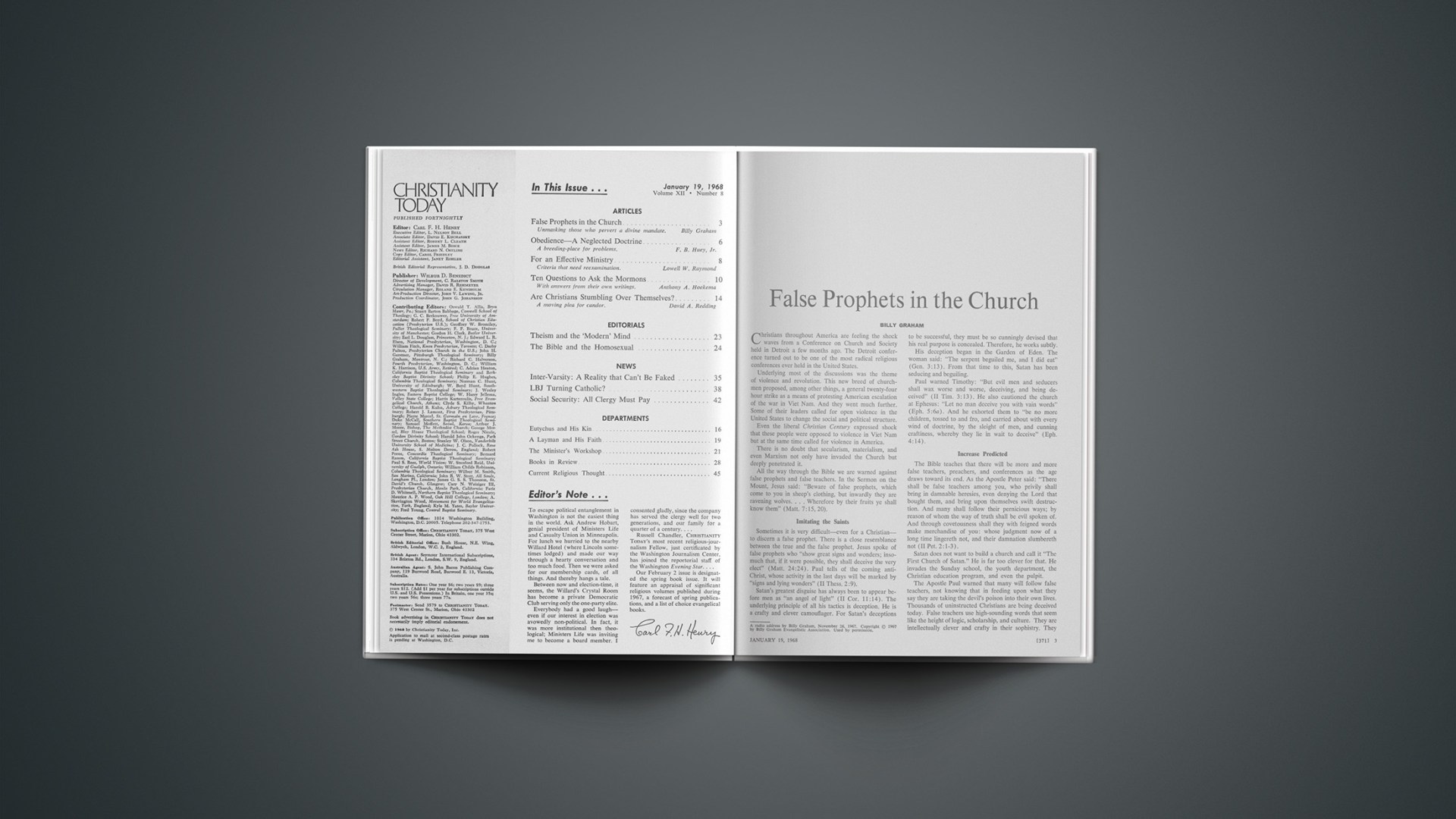
To escape political entanglement in Washington is not the easiest thing in the world. Ask Andrew Hobart, genial president of Ministers Life and Casualty Union in Minneapolis. For lunch we hurried to the nearby Willard Hotel (where Lincoln sometimes lodged) and made our way through a hearty conversation and too much food. Then we were asked for our membership cards, of all things. And thereby hangs a tale.

Between now and election-time, it seems, the Willard’s Crystal Room has become a private Democratic Club serving only the one-party elite.

Everybody had a good laugh—even if our interest in election was avowedly non-political. In fact, it was more institutional then theological; Ministers Life was inviting me to become a board member. I consented gladly, since the company has served the clergy well for two generations, and our family for a quarter of a century.…

Russell Chandler, CHRISTIANITY TODAY’S most recent religious-journalism Fellow, just certificated by the Washington Journalism Center, has joined the reportorial staff of the Washington Evening Star.…

Our February 2 issue is designated the spring book issue. It will feature an appraisal of significant religious volumes published during 1967, a forecast of spring publications, and a list of choice evangelical books.

Theories Are Not Theologies

Let me repeat. Theories about religion are not theologies. Theorizing about religion is not doing theology. Religious theorizers are not theologians.

This is my theme. A negative one. Rather abstract, and not self-evident at all. Is it worth bringing up, let alone arguing?

Thomas Aquinas once said that wise people do not worry much about names. By that standard, there is a lot of unwisdom around. Both Madison Avenue and Hollywood would have to go out of business if it ever got around that names don’t matter. But, if names in themselves are unimportant, meanings are not. Aquinas himself spent a great part of his life explaining the meanings of words and distinguishing carefully between one term and another. Words used in such a way that they confuse rather than enlighten become agents of untruth.

One can manipulate words in order to confuse, as did the politician who said of his opponent, “It is a widely known fact, and has never been denied by him, that before his marriage he constantly practiced bachelorhood.” Propaganda agencies in the modern world have multiplied the unscrupulous manipulation of words for the purpose of manipulating people until the Big Lie has become almost an accepted commonplace of contemporary life.

In his horrific novel of a future controlled by a few huge totalitarian empires, George Orwell envisages a time when all language will be rigidly directed toward making people incapable of distinguishing between truth and lies their rulers want them to believe. Continual exposure to the slogans “War Is Peace,” “Slavery Is Freedom,” “Hatred Is Love” is the lot of the citizens described in 1984, and Orwell says that the language they are being taught to adopt is called “doublespeak.”

Doublespeak, however, can actually make its way into our midst without being deliberately promoted by anyone. In the exchange of ideas through words, a kind of Gresham’s law operates; the bad tends to drive out the good. And this brings me back to my theme.

Theories about religion are not theologies. Theology, as the name suggests, is the science of theos, or God. Yet only recently we were being told that the latest thing on the market was an atheistic theology, a theology of the death of God. It was a little confusing. But most people thought, no doubt, after the initial surprise, “Well, there are some people who are always arguing about religion. There are professional people who are paid to do just that in our universities and colleges and seminaries. When they tell us something about God, that’s called theology. So when what they tell us about God is that he isn’t around any more, I suppose that’s theology too. God or no God, it’s all in the same area, anyway. And they ought to know, those theologians, as they call themselves.”

And so Doublespeak gains a little more territory.

If we turn to the history of theology and find how it became a recognized subject for study and debate in our Western culture, noticing the place it occupied in the university from the time the university first made its appearance, we will find that “theology” meant Christian theology, a study of God not limited—that is, not excluding any question that might be raised concerning God—yet focused. It was definitely focused on the study of God as he had revealed himself, and as Christian faith confessed him.

True, a branch of theology was natural theology, a study in which the truths of revelation were not to enter directly. But natural theology was still kept within the wider subject of Christian theology as one part of it, and a subordinate part. It was supposed to show God—not any deity but the God and Father of our Lord Jesus Christ—to the extent that he had revealed himself indirectly in the world and the mind of man, apart from his direct revelation of himself through his Word.

If anyone wants to be pedantic, he can interject here that, since we are going back into history to find out what the word “theology” means, we ought to go back to the philosopher Aristotle, who used the word to describe one division of his philosophy (the highest one, actually). Well, certainly, Christian theology came along a long time after Aristotle, if it is antiquity that counts.

But my point is that the history that is our history, and that is Christian history, cannot be rubbed out. Theology, for the great architects of the Western world, for Augustine, for Aquinas, for Luther and Calvin, meant Christian theology. If we change the meaning of the word now—and we can, of course, if it is worth doing—we should make quite clear what is going on.

Now, I am not suggesting that Christianity alone has a theology. To speak of Hindu theology, or of the theology of Islam, is a perfectly ordinary and unconfusing way of talking. What I am saying is that to speak about God in the context of a particular faith with its own characteristic beliefs is one thing. And to speak about God in general, feeling that one is free to draw from the traditions of every faith or of none, is something quite different. To use the word “theology” to describe both ways of speaking is to invite confusion—it is a kind of doublespeak.

If anyone feels he must announce to the world that he is sure the Christian God is dead; or if he wants to tell us that God is really the process of world history or the point to which that process is proceeding; or if he thinks that those people who used to worship the God revealed in Jesus Christ should turn away from all worship and work for the common good of mankind, and that in so doing they will really be doing all that worshiping the Christian God has ever meant—if anyone feels called upon to say any of these things or to make other similar claims, then he is telling us what religion means for him. He is not being a theologian; he is theorizing about the nature of religion. This is a perfectly legitimate undertaking, of course, but it should go under a label that is less misleading. If someone insists that this type of religious speculation must be called “theology,” then we would have to say that forthwith we must stop referring to the long line of thinkers from Justin Martyr to Karl Barth (and others both earlier and later) as theologians, because they were doing something quite different.

Perhaps this issue is worth bringing up, after all. Christian theologians, who believe that God is the God of truth, cannot wish to encourage the confusion promoted by doublespeak. And I imagine theorists of religion should be equally concerned.

—KENNETH HAMILTON, Department of Theology, The University of Winnipeg, Canada.

A King in the Capital

As deep winter settled over Washington, D. C., last month, gardeners—hoping for a riot of color when flowers bloom next spring—were planting seeds.

Meanwhile, down in Atlanta, Georgia, Dr. Martin Luther King, Jr., was sowing seeds for a massive camp-in at the nation’s capital this April. But it’s anybody’s guess just what will sprout.

Billing the drive as “a poor people’s campaign for jobs and income,” the Nobel Peace Prize-winning civil-rights leader says he will recruit 3,000 persons from ten major Northern cities and five Southern rural areas and bring them to the capital. “Militant non-violent action” will be exerted, say King spokesmen, to focus national attention on the problems of the poor and powerless and, it is hoped, to wring major financial appropriations from Congress in order to “stem the tide of despair in the ghettos.”

Washingtonians are worried. The religious community is divided. Negro clergymen in the District don’t know which way to jump; the solid support generated for King and his Southern Christian Leadership Conference during the August 28, 1963, civil-rights demonstration in Washington is lacking now.

With the “tent-ins and sit-downs” less than four months away, most ministers were taking a wait-and-see attitude, and neither the National Council of Churches’ Department of Social Justice nor the Council of Churches of Greater Washington had adopted a position for or against King.

Maybe that’s the way King wants it, because his critics say his following is dwindling and his influence—especially in the black community—ebbing.

Although King and his aides would not disclose particulars of the camp-in strategy, they declare the intended disruption may include blocking the entrances to government buildings, shutting down public transportation, and civil disobedience. Recruits are being trained “for jail if necessary,” a spokesman said.

King swears there will be nothing “damaging to property or persons.” But one activist white bishop, who upon occasion has supported a more radical rights position than King’s, fears the protest could get out of hand if King’s efforts are “perverted into an angry thing.”

Interestingly, some District Negro clergymen think King has gone too far. Dr. E. C. Smith, a director of the Progressive National Baptist Convention, who previously has supported King and marched in Selma, says the intended Washington protest is “not at all a good tactic.… I will not participate. The vote is the answer.”

King’s demands reportedly will include consideration of family allowances, guaranteed income and a negative income tax, more postal jobs, and employment of slum residents to rehabilitate their own neighborhoods.

Another PNBC District ghetto minister, John Bussey, is against civil disobedience and says most conservative ministers in the convention “are of the same opinion.” But he—like most clergymen interviewed—is reserving final judgment until King elucidates exact plans.

New Washington City Council vice-chairman Walter Fauntroy, a PNBC pastor and former King aide, is all for the April onslaught: “The issues he [King] raises are vital to the survival of this country.” Nor does he see any conflict between his position on the council—dedicated to law and order—and civil disobedience. “No one who follows King will take part in violent disorder,” he reasons. “If the situation requires I demonstrate, I may do it.”

Fauntroy, who has connections at the White House, on Capitol Hill, and in the ghetto, thinks that if officialdom heeds King, a repeat of the last two summers of violence may be avoided in most cities.

Because Fauntroy wears so many hats, King has chosen the Rev. Bernard Lafayette, Jr., a founder of the Student Nonviolent Coordinating Committee, to steer the Washington campaign.

Some radical church leaders think that King’s aggressive non-violence is “almost dead” and that nothing short of revolution will rally the Negro. Yet Lincoln Temple’s Channing Phillips, who had Stokely Carmichael speak in his church last spring, still backs King.

And Episcopal Suffragan Bishop Paul Moore of the Diocese of Washington told a suburban congregation across the Potomac River that the “country may be facing a choice between non-violence which might get across, or more Rap Browns, Stokely Carmichaels, Detroits and Newarks.” The question, he said, is not “do we want Dr. King or don’t we?,” but “do we want King or Brown?”

“Riot can be a form of communication,” maintains the National Council of Churches’ Charles Spivey. He said the NCC’s general policy is “to come down solidly on issues which contribute to accelerating change positively and favorably.” But he hastily added that the Department of Social Justice had taken no position on King’s drive yet and would not endorse violence.

Then again, Spivey suggested that violence may sometimes be the “only recourse.” Bishop Moore put it: “King has spent as much time as anyone with Congress and nothing has happened.… So what can he do?”

A few churchmen wonder out loud whether King’s capital-crippling campaign will get off the ground. “After all, Carmichael said he was going to ‘raze the city,’ but he didn’t set foot here,” reflected Washington’s NCC lobbyist James Hamilton. Then Carmichael said he’ll move to Washington. The campaign could make or break King as a civil-rights figure.

But the major concerns seem to center on (1) Can King keep it cool? and (2) Will Congress listen?

An explosive incident in the tense confrontation could set off violence in this city of 800,000 persons, 63 per cent of whom are Negro, far beyond King’s control. “You can’t line up the tanks around the ghetto forever,” one worried churchman said nervously.

There also is gnawing anxiety among some who concur with King’s goals but not necessarily with his methods that Congress will respond to a camp-in by tightening—not loosening—its purse strings for urban renewal. Moore says it would take “six or seven billion dollars of federal money a month to really get at the problem” in the nation’s cities.

Sinking vast sums of public money into jobs and income for the disadvantaged doubtless will not be a panacea for all urban ills, comments a conservative who thinks King’s reasoning is “simplistic.” Now and again a minister, like the National Presbyterian Center’s Executive Director Lowell Russell Ditzen, speaks about the need for a “vertical relationship to Christ” and regeneration as well as social action.

An Episcopal layman responded to Moore’s talk by chiding King for “practicing cruel deception” with Negroes. King never says “control your family size” or “go to work so you can afford better housing,” he charged.

When spring flowers push through the sod next year, Congress will decide whether Martin Luther King has a capital idea or a boondoggle. In the meantime, the religious community must make up its mind whether it will risk reaping whatever crops up in Washington.

PERSONALIA

Monet’s “La Terrasse à Sainte Adresse,” one of the finest impressionist paintings ever put on auction, was sold for $1,411,200 last month in London by the Rev. Theodore Pitcairn of Bryn Athyn, Pennsylvania. The retired Swedenborgian pastor, son of the founder of Pittsburgh Plate Glass Company, bought the painting for $11,000 in 1926. Proceeds will go mainly to a charitable foundation he established.

Paul-Emile Cardinal Leger, former Roman Catholic archbishop of Montreal, left for Dakar, Senegal, December 11, to begin mission work among French—speaking African lepers.

The White House East Room is “the poor man’s wedding chapel,” said President Johnson on the eve of daughter Lynda Bird’s marriage last month. “You can have a wedding here in the house and no one thinks its cheap.” Actually, he jested, “we decided to have the wedding here because of one of my most recent experiences in church”—a reference to the Williamsburg sermon against his Viet Nam policies.

Father Bernard F. Law, editor and publicist for the Mississippi diocese, will be executive director of the Catholic bishops’ ecumenical committee, succeeding Monsignor William Baum.

The Roman Catholic Liturgical Conference chose as executive director James Colaianni, former managing editor of the freewheeling monthly Ramparts. In one piece, Colaianni described church missions as “probably one of the greatest charity frauds of all time.”

Donald Bolles, former public-relations director of the National Council of Churches, took a similar post with the American Lutheran Church’s projected international university in the Bahamas.

The Rev. W. H. Hecht, Lutheran student pastor at the University of Oklahoma, was named executive director for Missouri’s Republican Party.

Christian Century Editor Kyle Haselden underwent a brain operation last month and was confined indefinitely to a Chicago area hospital.

Deaths

RICHARD R. WRIGHT, JR., 89, oldest bishop of the African Methodist Episcopal Church; editor and historian; former president of Wilberforce University; one of the first U. S. Negroes to earn an honorary doctorate (University of Pennsylvania, 1911); in Philadelphia.

THOMAS H. SPURGEON, grandson of Charles Haddon Spurgeon who was principal of Irish Baptist College for four decades; in Dublin, after a long illness.

HENRY H. SAVAGE, 80, Conservative Baptist pastor in Pontiac, Michigan, and director of Maranatha Bible Conference; of cancer.

Wheaton College President Hudson Armerding was named by Governor Kerner to lead the committee on acquiring a 6,800-acre site in Weston, Illinois, for the world’s largest atom-smasher.

C. Dorr Demaray, 66, will resign as president of Seattle Pacific College (Free Methodist) on June 30.

New president of Miami Bible College is Larry Poland, former assistant to the president of Indiana’s Grace College.

PROTESTANT PANORAMA

“The nation’s oldest foreign missionary board is being forced to curtail its program because of a lack of funds,” reports Everett C. Parker of the United Church of Christ, in the Christian Century. The 1968 budget is down $177,000, and the UCC agency will have to draw more than $1 million this year from endowment funds.

Drake University’s Divinity School, a Disciples of Christ seminary that has become ecumenical in recent years, will disband this summer. The seventeen students who will not have graduated by then must transfer.

A federal appeals court in New Orleans upheld a ruling from Mobile, Alabama, against constitutionality of a state law permitting congregations to hold church property when a majority of 65 per cent votes to pull out of the parent denomination. The suit involved Trinity Methodist Church in Mobile.

MISCELLANY

The first recorded case of a deformed baby of a woman who took LSD during pregnancy is reported in a British medical journal published in Boston. Dr. Hans Zellweger and his associates say the baby, born in Iowa last summer, had a severely deformed right leg. The 19-year-old mother had taken the “mind-expanding” drug four times during her pregnancy.

Lester Breslow, head of California’s public-health department, says that though people don’t die of divorce, it raises the death rate through such side effects as suicide, emotional illness, and alcoholism. Divorced men and women in every age group die at a faster rate than married persons, he told the Los Angeles Times.

A promise of a probe of the Presbyterian-aided anti-poverty agency, Child Development Group of Mississippi, removed a roadblock to adjournment of Congress last month. Also on the shelf at the deadline was the Senate bid for judicial review of aid to religious groups.

The Little Rock, Arkansas, Conference on Religion and Race called in a policy statement for “a new orthodoxy of human equality,” with “the same involvement of Negro Americans and of white Americans in every human endeavor.”

After a meeting at Greenville College, evangelicals who have met informally at American Historical Association conventions decided to form a new group, the Conference on Faith and History, to help integrate their faith and scholarship.

When the National Council of Churches closed its Hollywood film-broadcasting office, Methodist Bishop Gerald Kennedy proposed a new agency to advise producers on Protestant reaction to films.

Four of the fifty Southern Baptist Brotherhood Commission staffers meeting in a Memphis motel subdued and disarmed a gunman who tried to shoot his former wife and himself.

Cuban President Fidel Castro attended a reception for the Vatican representative in Havana, perhaps indicating a softer government line toward churches.

The number-two man on the Vatican’s Christian unity secretariat traveled to Moscow to meet Russian Orthodox leaders. His team included Monsignor George Higgins of the U. S. Catholic Conference.

An Arab underground group threatened foreigners that their safety could not be guaranteed during visits to Christmas shrines now under Israeli control.

The Baptist hospital in Gaza, its staff depleted after the Arab-Israeli war, issued an emergency appeal for nurses.

Nigeria’s interchurch “New Life for All” evangelism program is being considered by Christians in Kenya, Uganda, Tanzania, Zambia, Rhodesia, Mali, Upper Volta, Ivory Coast, and Ghana.

At the first major evangelistic crusade since 1928 in Kuala Lumpur, Malaysia, attendance reached 30,000, and about 500 persons made public Christian commitments. Obstacles the crusade faced included heavy downpours, tension over demonstrations in nearby cities and currency devaluation, and bad acoustics at the stadium. The Asian Evangelists Commission team represented six Asian nations.

The latest compilation in Germany shows 2,812 priests and ministers were imprisoned at Dachau during World War II, 1,856 of them from Poland. Among the prisoners, 1,106 Roman Catholic priests died in the camp.

The Church of God, edited by “World King” Bishop Homer A. Tomlinson, has set October, 1975, as the time for Christians “to be ready for the Second Coming.”

Jerome Hines Premieres His Evangelical Opera

This review is by Ray E. Robinson, acting director, Conservatory of Music, Peabody Institute, Baltimore:

An event of religious as well as musical significance took place in Indianapolis December 14 as Jerome Hines’s opera on the life of Christ, I Am the Way, received its first full-scale performance, at beautiful Clowes Hall. The biblical drama was part of the regular subscription series of the Indianapolis Symphony Orchestra, under the direction of Izler Solomon. Hines himself sang the role of Christ.

The choice of site was fortunate. Clowes Hall is ideally suited, both acoustically and aesthetically, for opera on a grand scale. The orchestra added that final touch of professional quality so necessary for a satisfying musical experience. And a near-capacity audience—largest Thursday-night turnout of the season—viewed the production.

In composing a religious drama, Hines revived a tradition that dates back to the Greeks. Biblical drama, common in the Middle Ages, apparently began with performances of parts of the liturgy in a dramatic setting; the priests actually represented the characters rather than merely narrating the events. This approach was first applied to the Resurrection story, later to the Nativity, then to other scenes.

During the Renaissance, an antipathy developed between the Church and the theater, and composers turned to secular dramatic works. Since then, except for the cantata, oratorio, and passion, the field of religious dramatic music has been left to such vaguely religious works as Parsifal and Amahl and the Night Visitors.

Although Hines’s musical idiom might be considered somewhat outdated and commercially spectacular, the impact of his opera upon the listener is unquestionable. This is more than a religious drama with an historical setting; it is an inspirational biblical drama with a strong, evangelical message, offered in a spirit of deep reverence. The listener is left with a greater understanding of the purpose of Christ’s ministry on earth.

It is not, however, a “singer’s opera” in which the dramatic element is subservient to the singer’s personality and virtuosity. Its success depends on many factors, of which music is only one. The listener cannot approach it merely as a spectator. He must participate in the aesthetic experience in much the same manner as he would identify with a work of Lully, Rameau, or Wagner.

Hines sketched the plot and characterization in broad outline, rather than in detail, around a series of episodes from the life of Christ. The plot is simple, the events few. Continuity is found, not in the music, as with the Wagnerian leitmotiv, but in the Christian message.

The three-act opera, not yet in final form, has eight scenes: “Behold, God Is My Salvation,” for chorus alone; “John the Baptist,” a new scene added for this performance; “The Woman at the Well”; “Eliakim and the Magdalene”; “At Bethany”; “The Resurrection of Lazarus”; “The Betrayal”; and “The Last Supper.” Eventually the composer hopes to cover all phases of Christ’s life and ministry.

The libretto, written by Hines, is based primarily on the Gospel of John, though some scriptural sketches are from the other Gospels and the Old Testament. Hines took poetic license to introduce humor into the biblical account, especially in the dialogue between the disciples. Scriptural passages are the texts for several arias, among them “The Lord Is My Shepherd” and “The Lord’s Prayer.”

For the most part, the text is faithful to scripture. In only two scenes is there anything questionable: that in which Judas discusses his political affiliation with the movement to establish Jesus’ immediate kingdom on earth, and the Last Supper scene in which Jesus washes the disciples’ feet before partaking of the elements.

The music is conceived on a grand, nineteenth-century scale. At times one is reminded of Parsifal, at other times of a religious film spectacular. The compositional idiom is quasi-modal, with a decided tendency toward major-key tonal centers. Ralph Herman’s orchestration is sometimes brilliant, especially at scene changes and transitional passages. At no time were the voices of either the soloists or the chorus covered by the orchestra—a remarkable feat, since the entire orchestra was used.

Hines’s own rich, full-bodied voice, deep conviction, and rugged eloquence made him commanding—at times electrifying—in the role of Christ. He was beyond question the dominant figure on stage, though the supporting cast of singers was fully professional. Lucia Evangelista (Mrs. Jerome Hines) sang impressively as both Mary, the mother of Jesus, and Martha. Equally competent were Antonio Scotti as Judas, Richard Parke as John, Pablo Elvira as John the Baptist, Calvin Marsh as Peter, and Ted Harris as Eliakim the High Priest.

The opera was produced in cooperation with Christian Arts, Inc.; the American Bible Society; and the Lilly Endowment, which provided generous financial help. Another presentation is scheduled for Palm Sunday at New York’s Lincoln Center.

GRANDMA’S GROOVE

It was Sunday afternoon in the Half Note, a small club in New York City’s West Village. The band barely fit on a platform stretched over the bar. The day was dull and rainy, and only the dim lights on music stands interrupted the darkness. A tall, stocky, bearded young man climbed up in front of the musicians and gave an emotive down-beat, and the Manhattan Brass Choir burst through the gloom with Grandma’s favorite hymn tunes done up in the glorious jazz of the sixties.

This December appearance of the brass choir gave New York jazz buffs a chance to hear one of the most musically competent religious ensembles that exists today. The group is the child of its soft-spoken conductor, Mark Freeh. He sees it as a natural step in the growth of modern religious music. His musical roots are the Salvation Army’s brass-band program, and his earliest religious training came from his father, a Nazarene clergyman.

Freeh holds that most churches are not progressive enough musically. “The modern man listens to modern music all day long—on TV commercials, on the radio, in movie scores,” he says. He thinks man needs to have religious music speak to him in the same idiom. “We do not go far out,” says Freeh, “but we present music as it is today, by arrangers who are doing today’s television commercials and Broadway scores.”

Freeh likes the gospel tunes of the past. “They are good tunes. They are, if you will, the popular tunes of the Church, even though they are not usually looked at from that perspective.”

The ensemble plays numbers like “In the Sweet By and By” and “Beneath the Cross of Jesus” in arrangements reminiscent of the original intent of the music, but at the same time pleasing to the modern ear. In other selections, taste makes waste.

The choir’s new record album, “Praise to the Living God,” was described by Saturday Review as “startling, without mock piety.” The joy the choir radiates contrasts sharply with the gloom that permeates today’s talk about the death of the Church. “We are not ashamed of the fact that we play only religious music,” says Freeh. “Music that is done well never gets put down.”

The choir, using standard jazz band instrumentation with French horns subbing for saxes, is made up of professional musicians. Says Freeh, “It is only with professionals that we can achieve this degree of musical competence.” Some are regular studio players in New York, others are music teachers, and others are members of the Salvation Army’s New York staff band. All volunteer their services for rehearsal time and some church dates but must receive union scale for recordings and concert performances.

Freeh is organizing college concerts for the spring that will illustrate the history of sacred brass music. Also this year, the group will be heard with Duke Ellington at Carnegie Hall. As Nat Hentoff, New York jazz critic, has said, “Certainly in these arrangements with this choir … the venerable pop tunes of the Church are being reborn and the groove is now.”

JOHN EVENSON

Passing The Pierce Torch

A doctor may well diagnose Bob Pierce’s ailment as a broken heart. For two decades Pierce has criss—crossed the world in behalf of suffering humanity. And always in his suitcase there has been a tattered Bible with these words on the flyleaf:

“Let my heart be broken with the things that break the heart of God.”

Now the strain of setting up orphanages and hospitals, of speeding relief goods to war-ravaged and disaster areas, of organizing pastors’ conferences for discouraged nationals, and of preaching countless evangelistic sermons, has become too much. Pierce, 52, announced last month that, for reasons of health, he has resigned as president of World Vision, Inc., the organization he founded and built into a leading missionary force with an annual budget of more than $6 million.

“Throughout the past four or five years,” he says, “I have had a diminishing amount of time for ministry in the United States. Because of this, and my concern over an apparent decreasing interest here in the total mission of the Church throughout the world, I plan within the bounds of my health to devote a major part of my time to speaking in churches, missionary conventions, colleges, seminaries, and universities in North America.”

More than anyone else since World War II, stocky Robert Willard Pierce has awakened in North American evangelicals a sense of Christian social responsibility. Hundreds of thousands of believers have sent in ten dollars a month to support in Korea or Viet Nam an orphan fathered by an immoral and irresponsible American soldier. The money has come from a well-distributed base of Protestantism, from Presbyterians to Pentecostals—ecumenical in the best sense of the term.

There is great power in Pierce’s compassionate pleas—few can listen without digging into their wallets. But this approach has been a major breakthrough in sophisticated promotion, too. Dramatic films, well-designed advertising, touring orphan choirs, and promises of hand-written letters from orphans have made a big difference. Here and there evangelicals have grumbled over Pierce’s projection of his own personal image. But few realize that he bears the responsibility as well as the glory, and that the material reward is minimal. On the other hand, he has paid the price of being away from his wife and three daughters most of the time.

Pierce was born in Fort Dodge, Iowa, the son of a carpenter who ministered first as a Methodist and then in the Church of the Nazarene. Pierce went to Pasadena College and was ordained in 1942 in the First Baptist Church of Wilmington, California.

After the war he traveled to mainland China in evangelistic work and soon was burdened by the great needs of the Orient. His interest in children began when an infant was thrust into his hands by a distraught missionary who already had too many to care for. He became a correspondent, but soon realized he had to be a participant rather than just a chronicler. Today World Vision cares for more than 23,600 orphaned and needy children in nineteen countries. In addition, it has offered a myriad of services to evangelical causes, ranging from a subsidy to Evangelical Press Association to financial help for the Evangelical Foreign Mission Association purchasing agency, which offers consumer goods at discount prices.

Pierce will be succeeded, at least temporarily, by Richard C. Halverson, minister of Fourth Presbyterian Church, Bethesda, Maryland. Halverson, long a World Vision board member and friend of Pierce, has been named acting president.

ONE MAN’S ‘SPECTRUM’

Bob Jones, William Hamilton, Bishop Pike, John Montgomery, and Carl Henry on the same platform? Sure enough.

The “platform” is a 102-page book, Spectrum of Protestant Beliefs, in which each of the five churchmen speaks about a variety of theological and social issues ranging from the Virgin Birth to Viet Nam. The Rev. Robert Campbell, a Roman Catholic priest, edited the book for Milwaukee’s Bruce Company.

“Most Catholics are quite unaware that the significant divisions in Protestantism no longer are along denominational lines, but rather depend on the orientation of the individual in the liberal-conservative spectrum,” Campbell notes. “The average Protestant layman seems not much better informed.”

Jones represents the fundamentalist band of the Protestant spectrum, Hamilton the death-of-God movement, Pike the liberals, Montgomery the confessional position, and Henry the “new” evangelicals.

Campbell said he did not include so-called developmental theology, identified with Martin Marty, Robert McAfee Brown, and Jaroslav Pelikan, because it is “not typical of a large identifiable segment of popular Protestant beliefs and attitudes.”

Jones is straightforward and quotes Scripture extensively. Henry gives the best philosophical rationale for a biblical perspective, and Montgomery proves to be both incisive and entertaining (“Someone has defined sin as the thing that causes us to look up our own name in the telephone directory as soon as it is delivered”). The three agree on the inerrancy of Scripture.

Pike’s opinions are typified by his reply to the question, “What must a man do to be saved?”

Says the controversial Episcopal churchman: “Man is in the process of being saved, that is being made whole, through responding positively to encounters, through not clutching at the idols, and being open to change.”

The one who gains the dubious distinction of having uttered the most intense invective is Hamilton:

“The doctrine of inspiration seems to me to be a dishonest attempt to live the Christian life without risk, and really, a very demonic attempt as well.”

EVANGELIST SIDELINED

Billy Graham has been fighting bugs of one kind or another for much of the last two years. Last month the evangelist’s doctor ordered him to cancel all public appearances for four months because of his slow recovery from pneumonia.

The major canceled engagement is the series of March and April meetings in New Zealand and Australia. Planners are hopeful Graham can handle the closing meetings the last week of April at the Sydney Showgrounds. The other city committees must decide between going ahead as planned with a Graham associate, or having Graham himself come in 1969 or 1970. Graham is still planning on three American crusades later in 1968.

After he was hospitalized during a team meeting November 26, Graham went to Jamaica for rest and treatment. He returned to his North Carolina home in time for Christmas.

FALLOUT ON THE RIGHT

The American Council of Christian Churches meeting in Santa Monica, California, bristled with the usual complaints about other conservative Protestants such as the Southern Baptist Convention, the Conservative Baptist Association, the Baptist General Conference, and “new evangelicals” generally.

But now the list includes Billy James Hargis, who’s a right-wing broadcaster just like ACCC founder Carl McIntire. A unanimous ACCC resolution attacks Hargis’s drive to get radio listeners to join his temple in Tulsa. Says the ACCC, “Such a ‘paper’ church is both unscriptural and subversive of the separated churches.…”

Triumph or Terror in Man-Made ‘Life’?

While most Americans frantically pursued the good things of life in the weeks preceding Christmas, scientists and doctors made headlines by preserving life and unlocking its most elusive secrets.

In South Africa’s Groote Schuur Hospital, where a surgical team headed by Dr. Christian N. Barnard had been anticipating the breakthrough for weeks, surgeons performed the first transplant of a human heart in history. In an operation lasting nearly five hours, the heart of Miss Denise Darvall, an accident victim, was implanted in the chest of grocer Louis Washkansky, 55-year-old victim of progressive heart failure. But eighteen days later Washkansky died, and a study of the causes was begun.

In Brooklyn’s Maimonides Medical Center a similar operation was performed three days later on a 19-day-old boy, who died inexplicably after only 6½ hours. As an interesting sidelight to the story, journalists learned that the donor of the heart, an arencephalic child who lived only a few days, was the grandchild of Carl McIntire, well-known radio preacher. (McIntire commented perceptively on the theological implications of the transplant: “The fundamental Christian glories in all modern scientific advances,” for these unfold “the design and the wisdom of the Creator.”)

Exciting as these developments were, the best was yet to come. The same week brought news that scientists in Palo Alto, California, had manufactured from inert laboratory chemicals the active, inner core of a virus. Since the virus material DNA (deoxyribonucleic acid) was able to perform as a virus—reproducing itself by invading living cells and altering their normal functions to produce viruses—scientists rightly hailed the experiment as the creation of a “primitive form of life.”

By implementing the natural ring-shaped DNA molecule as a template, or pattern, on which to build their molecule, researchers headed by Stanford professor Dr. Arthur Kornberg first formed a complementary chain of natural material; this they joined into a ring by adding a polynucleotid enzyme. The new strand was now identical with the molecule that would have been produced naturally in an infected cell, except at one point. Kornberg had substituted a heavier chemical, bromouracil, for the thymine that would have been formed in nature. The alteration made no difference biologically, but it altered the weight. Hence, the natural DNA could be separated from the man-made substance by means of a centrifuge.

At this point the scientists paused to test the properties of the man-made viruses by injecting them into cultures of living cells. The new rings reproduced themselves by giving rise to viruses just like the natural virus.

So far the experiment had produced synthetic rings that were complementary to, but not identical with, the natural DNA material. Kornberg now repeated the process using the artificial DNA as his template. The final experiment produced a new set of artificial rings, this time identical in every detail with the DNA rings that occur in nature. These rings also proved infectious and gave rise to viruses indistinguishable from the natural virus Phi X 174. The total experiment meant that man had used inert chemicals to fashion the fundamental stuff of life.

In the wake of the achievement some qualifications seemed called for, and Kornberg was among the first to give them. Shortly after news of the experiment had been released to the world, he expressed reservations about saying that he and his team have created “life” in a test tube. So did his assistant Dr. Mehran Goulian: “Different people mean different things by life; if you grant a virus is alive or that naked DNA is alive, then this was a creation of life.” He was alluding to the fact that though viruses are able to multiply, they do so only by infecting living cells whose reproductive capacities they divert for their own ends.

Birth-Control Pangs

While scientists around the world were investigating the frontiers of life last month (story above), the Roman Catholic Church was limping behind on birth control—though not without progress. In Rome, two groups urged modifications of the church’s traditional postures prohibiting any but natural means of contraception. Vatican sources reported the recommendation as the substance of a report to the Pope by the new commission of “super periti.” An independent group of forty Italian bishops voiced a similar recommendation.

Meanwhile, in Milwaukee, Professor John T. Noonan, a consultant to Pope Paul’s original commission, revealed his belief that a change in Roman Catholic rules is imminent. Taken with the other announcements, Noonan’s remarks increased speculation that the Pope would soon speak to the problem.

It is also a question whether scientists have created life or merely copied a normal reproductive process. The Stanford experiment was certainly not a creation of life ex nihilo, the way in which the subject was debated a century ago by Pasteur, Pouchet, and Huxley. Nor was it conducted entirely independently of life, for natural DNA was used as the template upon which the synthetic material was fashioned. At the same time the Stanford achievement was, if not the actual manufacture of life, at least the most significant step to date.

For scientists themselves, the greatest excitement comes from the medical rather than the metaphysical implications of Kornberg’s experiment. But metaphysics is important nonetheless. If one virus can be duplicated, so can others. And if the DNA molecule can be modified at will, genes can presumably be modified also. Thus the Stanford experiment foreshadows, on the one hand, a gradual victory over genetic diseases as well as control of certain kinds of cancer. On the other hand, it also points to the possibility of manipulation of the birth processes for totalitarian ends.

As recently as 1933, Anglican theologian E. W. Barnes contended that “the mystery of life is unsolved and probably unsolvable.” Today physical solutions to the problems of life are just around the corner. But the ethical problems live on. Without ethical controls, manipulation of heart transplants could verge on homicide. And the creation of test-tube life will yield results for evil as well as good. The use of such achievements will depend very little on the scientists and doctors. It will depend on churchmen, politicians, and other national leaders, as well as on the moral tone and ethical commitments of mankind.

EYES ON GREECE

Young King Constantine’s flight to Rome after his unsuccessful bid to oust the ruling junta in Greece left hanging the role of the monarch as “protector” of Orthodoxy there. Archbishop Ieronymos pled for national unity after swearing in the junta’s stand-in for the king.

Observers watched for effects upon religious freedom. Something of a crackdown on non-Orthodox activity came after the junta’s April take-over but many restrictions were later eased.

The Rev. Spiros Zodhiates, president of the American Mission to Greeks, has been a staunch defender of the new government. He says that “all religious groups, including the minorities, enjoy as much freedom today as they ever did, if not more.”

Zodhiates notes that there are “some isolated exceptions” but blames them on previous governments.

From Thessalonica, Religious News Service reported in December that two Jehovah’s Witness women were arrested for trying to prevent the Greek Orthodox baptism of a child of one of the women. In Tripolis, a Seventh-day Adventist was said to have appealed a four-month prison sentence on charges that he was proselytizing in the town square.

PACEM TERRIS VIET NAM

Assailing draft evaders who use pacifism as a mask for cowardice, Pope Paul VI called on “all men of good will” to celebrate a worldwide Day of Peace January 1 and every New Year’s Day thereafter. World Council of Churches leaders in Geneva responded by stressing man’s right to freedom of conscience: “… men of conscience differ as to the rightness of methods to be followed and the obligations they should accept.”

Neither statement mentioned Viet Nam. But preoccupation with that perplexing problem was clearly implied. Lack of consensus in the world religious community is driving wedges:

One hundred and one American missionaries in the Philippines signed a resolution supporting U. S. policy in Viet Nam and criticizing twenty-three dovish colleagues who had urged the United States to cease hostilities. Another 100 missionaries were non-committal. The hawkish group—mostly from evangelical faith missions—expressed impatience with the United States for not escalating bombings of North Viet Nam. The dovish missionaries are largely in ecumenical and conciliar groups.

Meanwhile, in the States, Union Theological Seminary in New York squared off against Selective Service Director Lewis B. Hershey’s hardline policy on draft-law violators and draft protest-leading clergymen. In an unprecedented move, the Union faculty rapped Hershey for using the draft “as a punitive measure against students exercising … freedoms of speech and assembly.”

As of last month, at least five clergymen had been reclassified 1-A delinquent because they turned in their draft cards. Some thirty Boston-area students were believed to have been reclassified after participating in a church antidraft demonstration. Hershey promised more draft-obstruction prosecutions, already at an all-time high of 1,306 in the past year.

In other Viet Nam flak, New Zealand and Japan Baptists, the International Council of Pax Christi (a Roman Catholic student movement), the American Friends Service Committee, U. S. Catholic magazine, Seminarians for Peace in ’68, an informal Lutheran Laity Conference in Chicago, and Harvard Divinity School student leaders all attacked U. S. policy or called for an immediate end to the war.

But New Jersey Episcopal leaders and Washington, D. C., Baptists (American and Southern) voiced strong support for the Johnson Viet Nam policy.

The Seminarians for Peace group, which has attracted students from thirty schools, wants to elect a U. S. president who “offers a constructive and humane solution to the conflict in Viet Nam.” An advisory council includes Yale Divinity School Professor Emeritus Kenneth Scott Latourette and Democratic Senator Eugene McCarthy of Minnesota, a Roman Catholic presidential hopeful.

AID TO HANOI

The World Council of Churches and Caritas, the international Roman Catholic relief agency, plan to send $85,000 in medical equipment to the Red Cross in North Viet Nam, according to the Catholic Peace Fellowship. Caritas stresses that it sends only equipment, not money, because it has no supervision over its use in the North.

The CPF has been campaigning to get Catholics to aid war victims in the North by giving to Caritas, rather than Catholic Relief Services, the agency of the U. S. hierarchy. After a report in Ave Maria that official church aid was going to Hanoi, Bishop Edward Swanstrom said that no direct aid has been sent but that the bishops’ relief money goes to the Pope, who may have channeled it to Caritas.

Catholic liberals have also attacked the bishops’ aid to members of the South Vietnamese army and their families. Swanstrom has replied that this is not aid to the American war effort but aid to needy persons.

Previous reports that Caritas would build a $1.5 million hospital in North Viet Nam were incorrect, though the agency’s aid to various hospitals there may eventually total $400,000.

MULTI-COLORED POWER

A paramount question before whites and blacks today is whether to press for integration or to develop separate, segregated power structures. In Charlotte, North Carolina, an interracial group of fifteen ministers last month mounted a campaign to increase the state’s Negro political power through the Carolina Ford Fellowship in Action. Spokesmen vowed CFFA would pressure mayors and the governor to hire Negroes and said it would boycott firms that won’t cooperate.

Meanwhile, in Detroit, former Black Muslim Albert B. Cleage, Jr.—unsuccessful gubernatorial candidate against George Romney in 1963 and pastor of Central United Church of Christ—proclaimed Negroes “will go it alone.”

Cleage took Negro parents to task for “failing black children” during a recent racial incident in Detroit. “You should have been down there breaking windows,” he scolded.

Joining Cleage’s church last month was Episcopal urban-work director Nathan Wright of the Diocese of Newark, New Jersey. Wright, who will retain Episcopal membership, organized the first National Black Power Conference last summer (see August 18, 1967, issue, page 43).

Expressing a moderate position, seventy-five American Baptists of both races met in Green Lake, Wisconsin, last month to “hammer out a strategy for … a color-blind society.” Mt. Zion Baptist Church pastor Samuel McKinney of Seattle urged white churches to “join in affirming the legitimacy of the black power movement.” In another form of black power, conference Chairman James Holloway later became the first Negro president of the Greater Minneapolis Council of Churches.

Many conscientious white churchmen who have attempted to work with Negroes are stunned now to find their efforts rejected. Another Green Lake speaker, Milwaukee NAACP President Walter B. Hoard, outlined new tactics for the youth commandos in Milwaukee’s downtown business district during Christmas week.

Speaking of the commandos and their marches to dramatize Father James Groppi’s drive for open housing, Hoard said “a lot of people apparently are afraid of them. We hope to take advantage of that.” The marches were expected to discourage downtown shopping. Negroes and their white supporters were urged not to buy Christmas gifts from stores owned by white persons (few are not).

Although the Milwaukee city council last month voted a limited open-housing ordinance identical to Wisconsin’s law, Groppi termed the action “tokenism” and “crumbs.” The militant white priest said demonstrations—which had been held for 107 consecutive days by the time the measure passed—will continue.

The only Negro alderman, Mrs. Vel Phillips, voted against it and rebuked the council: “Thanks for nothing—you are very much too late with very much too little.”

EPISCOPAL YESES AND NOS

The Episcopal Church Executive Council wants the National Council of Churches to forget a proposed policy statement urging consumer boycotts against businesses that practice racial discrimination, and to favor instead “constructive” programs to use church money to aid equal opportunity.

An official said four-fifths of the $2 million Episcopal urban crisis fund will go “directly into the hands of the poor.” Some $8,000 of it was given to Washington, D. C., activist Julius Hobson to help pay legal costs in his successful suit to end de facto school segregation and the “track system.” But the local bishop and others protested to headquarters because city Episcopalians weren’t consulted about the grant.

CRIME UP

Everything is rising these days: miniskirts, death, and taxes. And a lot of the death is homicide, according to last month’s Uniform Crime Report issued by the FBI.

Hemlines and taxes can only go so far, but crime seems to lack a limit. Among the most startling statistics for the first nine months of 1967 is a 27 per cent increase in robbery over the parallel period of last year, and a 16 per cent increase in murder. Overall, crime increased 16 per cent. Bank robbery increased at a rate four times the general average.

Some of the gains are explained by population increase, but only a small proportion. Since 1960, U. S. crime has soared nearly nine times as fast as population, with no sign of a downward trend.

SEMINARY UPSWING

Protestant seminary enrollment, on the slide since the late 1950s, shows a marked upswing this year. The 142 members of the American Association of Theological Schools report an increase of 927 students over 1966–67, for a total of 24, 817. In the face of the overall increase of nearly 4 per cent, enrollment at seminaries of three major denominations declined: Anglican Church of Canada, United Church of Canada, and Lutheran Church in America. Harvard was the only major independent seminary with a decrease.

The AATS said there is a continuing decrease this year in the percentage of students in the basic B.D. program for the regular ministry, coupled with a marked 10 per cent increase in students at the master’s and doctor’s levels.

Book Briefs: January 5, 1968

Listening For Divine Revelation

Handbook to the Old Testament, by Claus Westermann, translated by-Robert H. Boyd (Augsburg, 1967, 285 pp., $5.95), Introducing the Old Testament by L. A. T. Van Dooren, translated by G. P. Campbell (Zondervan, 1967, 192 pp., $4.95), and Introduction to the Bible, by Pierre Grelot (Herder and Herder, 1967, 448 pp., $7.50), are reviewed by Clyde T. Francisco, John R. Sampey Professor of Old Testament Interpretation, The Southern Baptist Theological Seminary, Louisville, Kentucky.

These three works from the European Continent present an intriguing picture of the unity and divisions of modern Christianity. They portray the viewpoints of an eminent Protestant scholar, an entrenched fundamentalist, and an eloquent Roman Catholic. There is agreement among the three that God speaks to man in the Bible, and with equal commitment to the word of God they listen for divine revelation.

However, they find this in quite diverse ways. Van Dooren finds the final authority of God in every word, even asserting, with some hesitation, that since the genealogies of Genesis depict twenty-three centuries, from the creation of man until the death of Joseph, the believer is bound to the same conclusion. Both Westermann and Grelot assume the critical position that the Old Testament accounts are based on traditions handed down for centuries and must be sifted for authenticity. The word of God in such passages is the truth taught by the biblical writers in their use of these ancient materials. To Westermann, the guide through the maze is science, reason, and faith. Grelot agrees, so long as the guide stays within the limits prescribed by the Church: “To read the Bible in and with the Church is the only sure method.”

The approaches of the three writers are obviously influenced by the audiences they are addressing. Van Dooren speaks to a pietistic group largely unacquainted with critical work and concerned primarily with devotional response to the Bible. Westermann appeals to a university audience acquainted with the scientific approach to life but largely ignorant of the Bible. Grelot writes for Catholics who respect the Bible as the infallible word of God but who have little knowledge of critical research and need to see it in the context of their faith.

All three interpreters succeed in their efforts to find a word of God. Indeed, it is the same word that they ultimately find! Van Dooren concludes in his study of Malachi:

It is significant to observe that the first book of the Old Testament closes with a reference to a coffin and the last book of the Old Testament closes with reference to the curse—both the curse and the coffin coming as the direct result of the sin of man. Throughout the Old Testament there is the story of man’s sin and failure, but ever there is the promise of the coming of the Second Man, the last Adam, the Lord from heaven, who came to give life and life more abundantly, so that there might be no more death and no more curse.

Westermann, using critical tools and a different vocabulary, eventually comes to a similar observation:

In the midst of this human race God initiates a way by means of Abraham and this way is supposed to become a blessing someday for everyone. Here the first fundamental correspondence between the Old Testament and the New Testament appears. Even as God became flesh for everyone’s salvation in the one man, Jesus of Nazareth, so he here calls forth this one family out of the nations in order to bless by it all families of the earth. The blessing beginning here points beyond the entire history of this family that became a nation even to the words of the New Testament, telling of the time of fulfillment. The opening part of Gen. 12 directs one to John 3:16: “For God so loved the world that he gave his only son.”

Father Grelot will say:

From one end to the other, the Bible is the witness of the acts of God in human history, that is, revelation, with its century by century progress; the preparation of Israel for the Gospel, throughout the vagaries of its destiny; the coming to earth of the Son of God, who completed revelation and saved men by his redemptive sacrifice.

Regrettably these men who so closely agree in their reverence for Scripture and in their ultimate conclusions are led by their methodological differences to disdain one another’s camps. Grelot says of those with Van Dooren’s position:

On the other hand, certain spirits, frightened by the Modernist danger or disturbed in their intellectual ruts, confused the dogmatic tradition of the Church with the conservative positions of yesteryear’s exegetes and clung without profit or serious argument to their obsolete and scientifically valueless solutions.

The British writer replies that scholars who hold critical views like those of the other two authors, who date a book in a way different from the generally accepted tradition, “claim by profession to be preachers of the word” but are using a method that “springs from Satan.”

To the credit of Westermann, he does not engage in such skirmishes. He makes no reference at all to the fundamentalist position. But what is more disturbing than to be ignored?

Ramsey On Ethics

Deeds and Rules in Christian Ethics, by Paul Ramsey (Scribner’s, 1967, 245 pp., $5.95), is reviewed by John M. Bald, associate professor of Christian ethics, Pittsburgh Theological Seminary, Pittsburgh, Pennsylvania.

Professor Paul Ramsey is a most able and stimulating protagonist of his point of view, and this book will enable readers to assess his contribution to the ongoing ethical debate. It is basically a republication of an essay that appeared in the Scottish Journal of Theology, No. 11; to this he has added three chapters: “Two Concepts of General Rules in Christian Ethics,” “The Case of Joseph Fletcher and Joseph Fletcher’s Cases,” and “A Letter to John of Patmos from a Prophet of the ‘New Morality.’ ” Ramsey introduces his discussion by adopting as a heuristic device terms William K. Frankena used to describe two ways in which the Christian ethic, defined as normative love or pure agape, expresses itself in practice. The terms are act-agapism and rule-agapism. In act-agapism the Christian ascertains as best he can the facts of the situation confronting him and then acts in the way that will be most expressive of Christian love. He does not refer to rules for action; he simply acts in love. In rule-agapism the Christian decides what he is to do by referring to rules that have been discovered to embody Christian love in certain circumstances.

Ramsey holds that the pure act-agapism that has become the vogue among theologians and Christian ethicists is not a viable approach to Christian ethics. Love and rules of action are not necessarily antithetical, he says:

Theologians are simply deceiving themselves and playing tricks with their readers when they pit the freedom and ultimacy of agape … against rules, without asking whether agape can and may or must work through rules and embody itself in certan principles which are regulative, or the guides of practice [p. 5].

At the same time Ramsey does not himself advocate rule-agapism as an alternative. What he says is simply that regulation of moral conduct by reference to love-embodying rules is a valid form of Christian life under the norm of agape, and that we must acknowledge this as a necessary aspect of Christian ethics without denying that in some situations act-agapism is appropriate. This is his general argument as he examines various ethical approaches based on some form of act-agapism—those of Bishop Robinson, Paul Lehmann, and Joseph Fletcher, in particular. He shows that none of them can avoid coming to a point at which there is a crucial need for rules to determine what moral action is expressive of love.

This brief notice cannot begin to describe the fullness of the argument and the penetrating criticism with which it abounds. It is well worth the careful study it demands.

In The Heat Of The Day

Run While the Sun Is Hot, by W. Harold Fuller (Sudan Interior Mission, 1967, 256 pp., $3.95), is reviewed by O. Wilson Okite, East African Institute of Social and Cultural Affairs, Nairobi, Kenya.

In the United States one says, “Make hay while the sun shines.” In Ethiopia one quotes an Amharic proverb, “Run while the sun is hot.” With this proverb Ethiopians counsel travelers to get moving along the trail while the sun is high; otherwise darkness will overtake them. And with this proverb W. Harold Fuller counsels the Church to say with Christ, “I must work while it is day; the night comes when no man can work.”

Run While the Sun Is Hot is part of the magnificent story of Christ’s continuing conquest of Africa. It is an account of the Sudan Interior Mission and its local churches—in Ghana after the fall of Nkrumah, in a Nigeria that is falling apart, in the torrid Islamic Republic of Sudan, in the Coptic Empire of Ethiopia, in Liberia, Upper Volta, Niger, Aden, and Somalia.

Fuller writes out of a rich experience and contact with Africa. He edited African Challenge, the continent’s widest selling Christian magazine, from 1952 to 1965, the period during which Africa made its decisive step into the mainstream of world history. Currently he edits Africa Now, house organ of the Sudan Interior Mission.

He traveled by mule, jet, horse, motorcycle, two-cylinder French Citroen, dugout canoe, camel, six-cylinder German Mercedes Benz; he was careful to ask for “gas” in Liberia, for “essence” in Ivory Coast, for “petrol” in Ghana, for “benzine” in Ethiopia, for “ghaz” in Sudan. He ate camel-burger and drank hot coffee trimmed with rancid butter and salt. He attended overcrowded churches, accompanied lone evangelists, listened to heart-rending stories of the persecution of Christians.

He saw Africa—its lush tropical forests, its endless deserts, its majestic mountains. He saw Africans—hot with tensions, changes, shortages, revolutions. He saw Communist literature on street corners, fetishes around the neck of a dying grandfather, a thirteen-year-old girl in childbirth, Muslims in robes and beads. He saw modern Africa with its contemporary architecture, sophisticated leaders, and well-planned, teeming cities.

Fuller presents his 12,000 miles of amazing diversity simply and sincerely. To an African reader, the book is not only challenging but surprisingly informative. To the American or European, it should be both enlightening and thrilling.

The Sudan Interior Mission is running while the sun is hot. And it realizes that the African sun is not only hot but also high. The Africa of our day presents immense and rapidly disappearing opportunities. Fuller makes it unmistakably clear that if ever Christianity is to seize the offensive in Africa, this is the time.

But that is as far as he goes. He leaves many of the burning questions only superficially discussed. What is the role of the “foreign” missionary in an independent Africa? Where is the line between “modernization” (sometimes called “Westernization”) and the normal spiritual development of a believer, the process one might call “Christianization”? What is to be the relation between the newly independent churches and home churches? What should the home churches understand about the “Africanization” of the African churches? What are the guidelines for leadership training in the new churches? How are individual believers to relate to the revolutionary changes occurring in their countries? What steps should evangelical leaders take to ensure the continuing centrality and lordship of Jesus Christ in the developing institutions?

But Fuller did not set out specifically to answer these questions. And from his illuminating report, one may gather data to begin formulating broad guidelines for the missionary enterprise in Africa. His account is penetrating and intelligent, the product of a heart full of love. It opens up a new style of “missionary talk” about Africa. May others follow!

Reading For Perspective

CHRISTIANITY TODAY’S REVIEW EDITORS CALL ATTENTION TO THESE NEW TITLES:

A Question of Conscience, by Charles Davis (Harper & Row, $6.95). A brilliant English priest-theologian sensitively but forthrightly gives his personal, theological, and ecclesiastical reasons for leaving Roman Catholicism.

The Wycliffe Historical Geography of Bible Lands, by Charles F. Pfeiffer and Howard F. Vos (Moody, $8.95). An informative text, excellent photographs, and useful maps highlight this reference work on ten Bible lands.

Set Forth Your Case, by Clark H. Pinnock (Craig, $1.50). These studies in Christian apologetics offer solid evidence for the integrity of the historic biblical Gospel and show it to be rationally compelling and vastly superior to existential aberrations in contemporary theology.

The Empty Preacher?

The Empty Pulpit, by Clyde Reid (Harper & Row, 1967, 122 pp., $3.50), is reviewed by Harry E. Farra, assistant professor of speech, Geneva College, Beaver Falls, Pennsylvania.

Reid immediately clarifies the idea behind his strangely titled volume: “The emptiness of which I speak is an absence of meaning, a lack of relevance, a failure in communication.” The Empty Pulpit traces the decline of preaching to two factors: (1) a change in the authority structure of the pastoral image, and (2) a change in the communicative structure, from the “monological illusion” of authoritarian speaking to a “dialogical” (two-way) involvement of audience and speaker. Reid charges that traditional preaching does not communicate, has been overemphasized, and does not lead to change in persons.

The significance of Reid’s book is its application of modern communication theory to the preaching situation. The Church’s appropriation of the more important aspects of the communication revolution is long overdue; which of its tasks would not be made easier by good communication? Reid’s communication concepts are based on theory well supported by experimentation and research, and his evidence comes from the standard volumes of theorists such as Berlo, Barnouw, and McLuhan. He describes in detail sermon substitutes and supplements that have been tried with varying degrees of success, such as small-group study, retreats, and sermon seminars.

The limitation of Reid’s book is his underlying assumption that a change in the communicative structure of the Church will produce “relevance.” He is dubious about preaching because not all men are skilled in preaching. But the other communicative approaches demand as much skill, if not more. “Dialogical” skills are much harder to control because they involve a greater number of people. Use of this method requires the training of laymen in these skills. Even then success is not guaranteed, for training does not insure talent. Where we had “monological” failures, we might now have “dialogical” failures.

Those who are convinced that traditional preaching is no longer serviceable will find much in Reid’s book to guide their reforms. Those who are not will nevertheless find a challenge to rethink the nature of preaching.

Categorically Sinful

A Catalogue of Sins, by William F. May (Holt, Rinehart and Winston, 1967, 209 pp. $4.95), is reviewed by Mark W. Lee, professor of speech and drama, Whitworth College, Spokane, Washington.

William F. May here examines Christian conscience. His examination is divided into four parts: the sins of man with his world, the sins of man with his neighbor, the strategy and atmosphere of sin, and the destiny of sin.

The result is readable, scholarly, orderly. He gives helpful summaries of main points and keeps his definitions clear. Generally, the writing style is interesting and forceful. About sin he says: “Like a Guerilla army, it can never be seen in its entirety.” “Sin is not one of the provisions of God, like stars, trees, and mother’s milk.” At times his attempt to maintain an economy of style succeeds too well; one wishes for further elaboration of some passages. His adoption of certain key phrases associated with modern theologians—“this worldly asceticism” (Weber), “Nonbeing” (Tillich), and “I and Thou” (Buber)—seems somewhat Unnecessary.

Often, though not always, May’s ideas are stated clearly and succinctly, so that the reader grasps them immediately. An example is the discussion of avarice. Traditionally, the miser sits behind a locked door greedily counting his possessions. But in our prosperous society, avarice may reveal itself in “conspicuous consumption”:

We have moved from a society of locks and thick-walled castles, vaults, and secret treasures, to a society of the open door, neon lights, and the picture window, with grain spilling out of silos, cars pouring out of factories, and paper glutting garbage cans. This is a society that no longer hoards—it burns up money, alcohol, raw materials, and natural resources, and it produces everywhere a stepped-up tempo. Instead of keys, we have keyed-up nerves. Too much drink, too much conversation in overcrowded rooms, a calendar jammed with obligations, phones ringing, overheated homes. The American experience of avarice is not like the anal experience of the recent European past, for which gold and dung, the images of inert weight, are appropriate. We should speak of avarice now rather as a veritable firestorm of activity, generated by the flickering, formless desires, and fears that leave a person burnt out and exhausted at the age of fifty.

In a word, May’s analysis is relevant. His criticism of Christianity is fair and incisive. Although his analysis of lust is non-judgmental (as is his overall approach to sin—apparently he leaves judgment to God), it is nonetheless a challenge to the easy sexual ethics and practices of our day.

A Critique Of Conzelmann

St. Luke: Theologian of Redemptive History, by Helmut Flender (Fortress, 1967, 167 pp., $4.95), is reviewed by Ralph P. Martin, lecturer in New Testament studies, University of Manchester, England.

In 1960 Ernst Käsemann had reason to comment that the problem of Luke’s writings in the New Testament had suddenly become a burning issue, and in the following year C. K. Barrett echoed this judgment by remarking that “the focus of New Testament studies is now moving to the Lucan writings.” Both these assessments were largely occasioned by the appearance of H. Conzelmann’s highly original work, The Theology of St. Luke (E.T. 1960). This volume heralded a new era in the study of the gospel writers, whom the then prevalent form criticism had largely dismissed as collectors and editors of an evolving church tradition. Conzelmann, on the contrary, gave gospel study a new twist by taking seriously the claim that each evangelist (Luke in particular) was both a historian and theologian in his own right and that by his method of selecting and arranging his material he was the author of a distinctive contribution to early Christianity. This is the claim of Redaktionsgeschichte, and it has captured the attention of much Continental scholarship.

It is against this background that Flender’s new treatment of Luke’s theology must be viewed. Indeed, without this warning much of it will appear enigmatic to the uninitiated! But once inside the magic circle of the pundits, readers will appreciate this fresh examination of Luke’s Gospel and Acts, and some will welcome his critique of Conzelmann’s position. Flender argues that a neat threefold scheme of Luke’s history embracing the time of Israel, the time of Jesus’ ministry, and the time of the Church is too speculative, and that Luke keeps past and present in dialectical tension. Indeed, a dialectical relation runs through his philosophy of salvation history binding together earth and heaven, the human Jesus and the exalted Lord, Israel and the Church, the Resurrection as an event in history and an existential encounter.

The book sparkles with insights and flashes of illumination; and even where the author compels us to part company with him, he never fails to stimulate.

Erosion In Lutheran Theology

Crisis in Lutheran Theology, Volume I, by John Warwick Montgomery (Baker, 1967, 133 pp., paper $1.50), is reviewed by Iver Olson, professor, Association Lutheran Seminary, Minneapolis, Minnesota.

This is the first of two volumes on the current state of Lutheran theology. Each volume has two parts, the first addressed to the theologically sophisticated and the second to lay readers. Volume I consists of five articles that previously appeared in religious journals. As a result, unity suffers somewhat; articles range from discussions of inspiration and hermeneutics to the author’s defense of his own views against criticism.

Montgomery points out that there has been an erosion in Lutheran theology in general, but he centers his attention on the erosion seen in American Lutheranism during the past decade. The heart of the problem is the doctrine of biblical inspiration. The question concerns, not so much the fact of inspiration, but the extent of it. Scripture is still held to be authoritative in spiritual matters, but is held to be considerably less than authoritative in details; here one must consider it at best as a witness to inspiration.

Montgomery acts as spokesman for the view that inspiration and inerrancy cannot be separated. If one cannot trust the Scriptures in small matters, what reason is there to trust it in the weightier matters of religion? He points out that archaeological discoveries in recent years have tended to undergird rather than undermine the inerrancy view. Furthermore, the parading of errors found in Scripture—a pastime of existentialist critics—reveals only examples of nineteenth-century criticism that have been adequately explained and answered many times. If Scripture is not inerrant, it is qualitatively no different from any other good religious book.

The author emphasizes that modern Lutheran hermeneutics is a far cry from Luther’s. The Reformer found objective truth in God’s Word; from this truth he was led to discover a Saviour. His modern counterparts are confronted by a Person; objective observations about him are of negligible importance. At best the propositions made about and by him are a witness to the truth, rather than the truth itself. Montgomery’s view is that without the objective truth there can be no real confrontation; the person by whom one is confronted in such instances is but a Christ of one’s own making.

The second part of the book is a discussion of the presence and expressions of this new orientation in the Missouri Synod.

I myself think that the crisis in Lutheran theology exists mainly among tenured theologians at the seminaries. Having once taken a stance, they cannot be converted and save face at the same time. What the next generation of theologians will bring out of their briefcases remains to be seen, but it probably will not be the same as what is delivered from the lecterns today.

Playing God

Christ the Representative: An Essay in Theology after the “Death of God,” by Dorothee Soelle (Fortress, 1967, 154 pp., $3.95), is reviewed by Owen Onsum, minister, the Union Congregational Church, Shafter, California.

“Who am I? Am I replaceable? Unique? Representable?” In the opening chapters of her book, Dorothee Soelle attempts to answer these questions as she deals with the subject of personal identity. Technology answers that man is just a cog in a machine and is therefore replaceable. Yet science and machines enable men to do things once attributed to divine power. From this jumping-off point, the author goes on to show that the individual is not replaceable but is representable.

In the second section she discusses “Representation in the History of Theology.” The Egyptians, for example, placed little models of wood, stone, or clay in the tombs of their dead. These ushabti were believed to have the power to help the dead with their duties and problems in the abode of the dead. The basis of this belief was the idea that every living thing was represented by its image; whatever happened to a man’s image happened to the man himself.

Then the author moves on to the Old Testament and finds a parallel belief in Leviticus 16:20, 21:

Even the Old Testament, which elsewhere demagicized and de-mythicized so many elements common to all religious history, does not rise above this level, if we leave out of account the approaches to personal representation in Jeremiah, Hosea, and Second Isaiah. For example, the concept of the scapegoat does not go beyond the circle of imitative magic. Sin is presented as something physical. The priest identifies the sin of the people with the goat by laying his hands on its head and confessing over it all the sins of the people.… The goat … is driven into the desert.…

The important thing is not who removes the sin. What matters is that it disappears from the human sphere. In other religions, the remover can be a human being, another kind of animal, or very often some object, a stick or stone, which can be loaded with the sin and slung away.

In the third section Miss Soelle presents “Christ the Representative,” with the subtitle, “Sketch of a Post-Theistic Theology.” Christ is the “true teacher” because he identifies with us. Yet although he represents us, he does not replace us. He is provisional; his representation of us will continue until we can fulfill our own role. Christ also represents God, who “has changed”:

The progressive awakening of the consciousness has excluded [the possibility] of attaining certainty about God. In whatever way we may interpret the objectifications of God in the past—miracles, providential dispositions, channels of continuing revelation—such objectifications have been carried away by the flood of advancing critical consciousness. We are no longer under any necessity to attribute these objectifications to God.…

In this changed world, God needs actors to take his part. So long as the curtain has not rung down and the play still goes on, God’s role cannot be left unfilled. God’s leading player is Christ. Christ takes the part of God in this world, plays this role which without him would remain unfilled.

This is incarnation: Christ playing God in this world. And what he does, we can do also. We can “play the role of God in conditions of helplessness,” “claim God for each other.”

Christ’s representation of us is provisional; it is to last until we can play our own role. And even Christ’s representation of God is incomplete, for there is more of God yet to come. Likewise, our play-acting is provisional. Nevertheless, the important thing is that identification with God, in which Christ was the pioneer, is possible. “We, too, can now play God for one another.”

Another Look At Anselm

The Many-Faced Argument, edited by John Hick and Arthur C. McGill (Macmillan, 1967, 373 pp., cloth, $8.95, paper, $2.95), is reviewed by Gordon H. Clark, professor of philosophy, Butler University, Indianapolis, Indiana.

This high-priced book is better studied than reviewed, for it is a survey of recent historical studies in Anselm and of recent original forms of the ontological argument.

Part One, after reproducing the Proslogion, Gaunilo’s On Behalf of the Fool, and Anselm’s Reply (the latter two so arranged that each unit of the Reply immediately follows the pertinent passage of Gaunilo), consists mainly of reprints of articles by Beckaert, Barth, Hayen, and Stolz. Preceding these reprints editor McGill has a long survey of the opposing views.

In general, these views reject the traditional interpretation of Anselm, which Kant popularized by his refutation. McGill asserts that neither Kant nor Thomas Aquinas had ever read Anselm. Kant’s refutation is so obvious and devastating that a man of Anselm’s ability would never have made the blunder Kant exposes. Therefore new interpretations of Anselm are necessary.

The new interpretations vary: one makes Anselm a rationalist, another a fideist, and a third a mystic. Anselm is also pictured as a realist, as a Cartesian, as an analyst of the concept of possibility, as the user of a “reflexive” rather than a “representative” idea of God, as one utterly dependent on revelation, or as some combination of these. Editor McGill points out the textual difficulties these views must face, but he does not pursue any constructive solution very far.

Part Two takes up the use made of the ontological motif by a few modern philosophers. Here the chief figures are Ryle, Forest, Malcolm, and Hartshorne. In addition to reprints of articles by these (and also by Russell and Shaffer), editor Hick provides an elementary preface for readers “who are not already familiar with the philosophical issues,” and a concluding critique. The critique contains a very keen discussion of the difference between logical necessity and factual necessity, a distinction allegedly overlooked by Hartshorne and Malcolm. Its excellence causes us to regret that Hick wrote only sixteen pages.

A selected bibliography covers fourteen pages, and a good fifty philosophers are referred to in the book. A solid volume for study.

Book Briefs

The Dictionary of Religious Terms, by Donald T. Kauffman (Revell, 1967, 445 pp., $8.95). Definitions of 11,000 religious names, facts, symbols, and abbreviations.

Know Why You Believe, by Paul E. Little (Scripture Press, 1967, 96 pp., $1.25). Little wades into key issues of Christianity—existence of God, deity of Christ, the Resurrection, reliability of the Bible, possibility of miracles, relation of science and Scripture, the problem of evil—and offers satisfying, biblically sound answers.

The Economic Life of the Ancient World, by Jean-Philippe Levy (University of Chicago, 1967, 147 pp., $5). A French scholar examines economic development in Egypt, Phoenicia, Mesopotamia, Greece, and Rome from pre-Alexandrian times to the fall of Rome.

The Thousand Years in Both Testaments, by Nathaniel West (Kregel, 1967, 493 pp., $4.95). The Tabernacle, by Henry W. Soltau (Kregel, 1965, 474 pp., $4.95). Reissues of important nineteenth-century books.

Trustees and Higher Education, by H. Leo Eddleman (Christ for the World Publishers, 1967, 91 pp., $2). A seminary president advises trustees of academic institutions of their relation and responsibilities to the institutions they serve and the administrators they appoint.

Please Give a Devotion—For All Occasions, by Amy Bolding (Baker, 1967, 121 pp., $2.50). Continuing her series, this minister’s wife offers warm devotionals that incorporate many poems and homey anecdotes.

A Drink At Joel’s Place, by Jess Moody (Word, 1967, 125 pp., $3.50). With aphorisms and one-sentence paragraphs, a popular Florida pastor challenges Christians to live authentically and witness boldly. “The gut issue,” says Moody, “is, what will the church do to keep John, Mary, Billy, and Susie Doe lashed to the cross and made into happy servants of the Lord Christ.”

Social Scientific Studies of Religion: A Bibliography, by Morris I. Berkowitz and J. Edmund Johnson (University of Pittsburgh Press, 1967, 258 pp., $7.95). A useful tool for scholars.

The Voluntary Church, edited by Milton B. Powell (Macmillan, 1967, 197 pp., $5.95). The observations of European visitors on American religious diversity and voluntary support, 1740–1860, provide insights into the national character. Includes writings by G. Whitefield, A. de Tocqueville, P. Schaff, fifteen others.

Jesus in Our Time, by James McLeman (Lippincott, 1967, 158 pp., $3.95). McLeman reflects the nonsense of much current theology that one can deny the virgin birth, miracles, and bodily resurrection and yet through faith and selective biblical historical data have a valid conception of Jesus Christ.

The Joy of Salvation

Many years ago, just as I was about to board a train, two men hurried up. One was holding his arm at a peculiar angle and grimacing with pain. The diagnosis was obvious, and a hurried manipulation reduced a dislocated shoulder. The immediate relief from pain that spread across the man’s face was ample reward for a budding young practitioner.

Not long after a young boy was brought into my office, breathing with extreme difficulty. His cold sweat, pale face, and deep distress were signs of a severe asthmatic attack. I will never forget the expression of wonder that crossed his face after an injection of adrenalin brought a cessation of his symptoms.

Almost all of us have experienced the relief that comes when a severe toothache or some other acute pain ends, RELIEF we would gladly spell with capital letters.

But there is a greater relief and joy, spiritual in nature and more far-reaching than any relief from physical ills. It is the joy of salvation.

The average Christian shows little of this joy in his life. He is so burdened, confused, compromised, and unaware of his blessings that he lives in a state of spiritual frustration and defeat.

At the heart of the problem lies a failure to grasp either the enormity of sin or the wonder of God’s mercy and forgiveness. Once a woman of the streets came to the place where Jesus was being entertained, bringing with her a flask of precious ointment. This she poured on our Lord’s feet. Her tears of gratitude were evidence of her love as she wiped his feet with her hair and kissed them.

We do not know when she had come under the influence of the Saviour, but she obviously had been forgiven and had had her life changed. Now she came to honor the one who had redeemed her from the guilt and penalty of sin.

This was a splendid opportunity for the Pharisees to criticize Jesus, and they eagerly took advantage of it. Our Lord’s reply to these hypocrites ended with these words: “Her sins, which are many, are forgiven, for she loved much; but he who is forgiven little, loves little” (Luke 7:47, RSV).

So then, a basic part of the joy of salvation is a sense of the seriousness of that from which we have been saved. There is much talk today about a “guilt complex”—always with the implication that it is an evil that must be driven out. But until man has a genuine guilt complex in the presence of God, who is altogether holy, he is in desperate straits. If sin is so serious that the Son of God had to come into the world to pay its penalty, then we need to face up to the sinfulness of our hearts and turn to him, asking forgiveness and cleansing.

Millions will attest to the joy of salvation. Only a few days ago I read of a woman who had destroyed what is the most precious of all human relationships and plunged herself and her family into a hell on earth. In the depths of despair—actually on the verge of taking her own life—she cried out, “O God!” Instantly God heard and answered. Her confession of sin and complete surrender to Jesus Christ made her a new creature in him, and her story was one of unbounded joy and praise.

Why do so few of us reflect any joy at being Christians? Unquestionably, many who go by that name have never confessed or repented of sin and therefore experience no joy of salvation.

There is a sigh of relief and a song of joy in David’s psalm that begins: “Blessed is he whose transgression is forgiven, whose sin is covered. Blessed is the man to whom the LORD imputes no iniquity, and in whose spirit there is no deceit” (Ps. 32:1, 2, RSV). He speaks of the man whose sin has been completely exposed and forgiven; of the misery of those who try to hide their sins, rather than confess them; and then of the relief that comes with confession. The relief and the rewards God gives are expressed in terms of protection, a hiding place, preservation, and deliverance. In addition, instruction, teaching, and counsel are always available from the one who always watches over his own.

The psalm ends with this contrast: “Many are the pangs of the wicked; but steadfast love surrounds him who trusts in the LORD. Be glad in the LORD, and rejoice, O righteous, and shout for joy, all you upright in heart!”

David in Psalm 51 again speaks of confessed and forgiven sin as the basis of the joy of salvation. In our sophisticated age, many who bear the name of Christ have never honestly confronted their own sinfulness in the light of God’s holiness. Sin is not a popular subject. Many are inclined to bypass the clear teaching of the Bible on its nature, effect, and cure.

During my forty years in the practice of medicine and surgery, I occasionally had to deal with people who would not accept the diagnosis of cancer or some other potentially fatal disease. Inevitably there came a day when they were forced to do so—only then it was too late for cure.

The joy of salvation should be the experience of every Christian. This is not a selfish joy, as some seem to think; it is a happiness that is at the very heart of the Christian experience.

There is something contagious about such joy. It makes love for others come much easier. It is reflected in our attitude toward everyday life, whether things seem to go well or not. Such joy is not dependent on the circumstances of the moment; it has its source in a right relationship with God.

The joy of salvation is an awareness of things made right, of spiritual renewal and the removal of those things that separate us from God. It is not imaginary but as real as the ground we stand on.

Perhaps one of the crowning blessings of this joy is a sense of the greatness of God’s grace and mercy. We do not deserve it but receive it solely on the merit of Christ. Human pride is buried under the wonder of undeserved grace, and our thoughts are turned away from self to our Redeemer.

I want to close with a very personal question. Do you have the joy of God’s salvation in your heart? And if so, is it reflected on your face?

If not, give God a chance. Level with him and let him level with you. Ask him to show you your heart as he sees it. Ask him to give you the courage and grace to face up to the sins in your own life. Perhaps they are hidden; or perhaps they are glaring sins, known not only to you but also to others.

Failure to confess sin is comparable to putting a poultice on a cancer. You may deceive yourself and others for a short time, but a day of reckoning will come.

The Scriptures promise that “if we confess our sins, he is faithful and just, and will forgive our sins and cleanse us from all unrighteousness.” And out of this cleansing comes the joy of salvation, peace of soul and spirit, and a love for God and our fellow men that can be had in no other way.

Ideas

Neurosis in the Church

The true Gospel—and purity—bring, not malady, but health and life

Psychic illness attacks so many clergymen and church workers these days that it seems almost an occupational hazard. To make matters worse, some psychiatrists point an accusing finger at the Christian community for attitudes that they say bring about mental sickness. One, Germany’s Eberhard Schaetzing, has even coined an adjective for supposedly church-induced neuroses: “ecclesiogenic.”

Ecclesiogenic (i.e., caused by the Church) would be a misnomer if it meant the illness were directly traceable to authentic Christian doctrine. But as used by Klaus Thomas, a Lutheran whose work on the problem is best known, it generally describes a state of mental conflict caused by “taboo-izing” education in which sexual areas of life are banned from open discussion and sexual desire is considered something immoral or forbidden, or even a cause for punishment.

“After twenty-five years of pastoral and psychiatric practice, I cannot have any doubt about the overwhelming harmonizing, health-restoring, and transforming power of the Bible’s message and of a genuine Christian faith,” Thomas says. But there is another side: “Whenever and wherever natural human feelings and wishes, especially in the field of sexuality and eroticism, are declared to be basically sinful, unendurable burdens are put upon the shoulders of man. Whenever healthy sexuality is repressed and denied instead of being recognized and either practiced or joyfully and voluntarily renounced, perversions and compulsions, anxiety and scrupulosity, even ultimate despair and suicide, are the frequent consequences.”

True, the problem of repression is far less obvious today than that of libertinism. In years gone by, many parents held close rein upon their children in regulating fraternizing between the sexes. Today, cars, TV, telephones, relative affluence, and widespread rebellion make strict parental supervision the exception.

Yet Thomas claims after studying 7,000 patients at his Suicide Prevention Center in Berlin that pagan views of hostility to the body—dating back to ancient Persian Manichaeism and Greek neo-Platonism—have corrupted the approach of many Christians. He says “ecclesiogenic” factors are important in many cases of neurosis, frigidity and resultant marital problems, promiscuity, use of obscene literature, homosexuality and other perversions, and suicidal tendencies. He describes the typical case:

The parents were especially pious. The atmosphere at home showed characteristics of honest, and yet not genuine, Christian faith. The upbringing was strict, frequently cruel. All sexual questions were so “taboo-ized” that the children grew up in ignorance. The whole area of sex was covered with and even identified with the state of sin.… The result of such an upbringing is not a Christian character but a pseudo-Christian neurosis.

Thomas’s controversial work includes many statistics. He estimates that the danger of suicide in “ecclesiogenic” cases is double that in other mental illness, and that 38 per cent of 2,000 neurotics he studied were “ecclesiogenically ill.” In criticism of the German’s method, University of Illinois psychiatrist Orville Walters points out that the causes of neuroses are complex, and that Thomas’s use of the “ecclesiogenic” diagnosis departs from accepted psychiatric procedure, in which categories are based on symptoms, such as phobic or depressive. He says Thomas’s figure of 38 per cent for a diagnosis he is particularly interested in raises the question of bias. Walters also warns against the post hoc propter hoc fallacy: “The fact that religion and neurosis are found in association does not establish a causal relationship. Since neurosis and psychosis may distort all of one’s relationships, the presence of defective religious concepts may be consequence rather than cause.”

Perhaps Thomas’s high percentages indicate the particular group which sought out his church suicide clinic. Perhaps an analysis of Germany is not very applicable to other countries (though he bases his case on personal observation in many other nations also). Perhaps his methodology in a pioneering field is open to serious doubt. But despite the controversy, many psychiatrists and clergymen believe Thomas raises important questions for the Church.

Walters argues that “guilt and shame have become associated with sexuality, not because of repression by the Church, but because excessive sexuality has been a frequent resort to avoid the responsibility of freedom, just as drunkenness is. This misuse of freedom to alleviate anxiety leads man into guilt, which only intensifies his anxiety.”

Despite their disagreements, Thomas and Walters both believe the Bible teaches a positive, yet disciplined view of sexuality. The solution to an alleged “ecclesiogenic” illness is more Christianity, not less. Thomas believes “man must discover where and how the infallible Word of God has been twisted. The true Gospel does not bring neurosis, but health and life.” And he cautions that “knowledge about ‘ecclesiogenic’ neurosis should not lead to the error that a libertinistic education could be the aim or alternative,” since “superficial promiscuity and unhealthy lack of controls” are just as dangerous.

Besides discussing psychiatric methods of treatment, Thomas offers suggestions on how the Church can help prevent such illness: prayer, emphasis on the healing ministry, counseling and therapy centers, re-examination of educational materials, and development of a “Christian doctrine of eroticism.” He points out that the Song of Solomon alone contains “nearly all the advice in erotic questions which we found relevant” in treating thousands of neurotics.

As Thomas suggests, the healthy solution is the proper understanding of the biblical concept of purity, which does not forbid sex but prescribes the right context for it. We need to be very sure that we are leading our children to develop this healthy, biblical view of sex. And we need also to become effective Good Samaritans with genuine compassion for our mentally ill neighbors. A truly Christian Church knows only one human personality—that created “very good” by God and ultimately redeemed by Christ for life and joy—and it proclaims the Lord Jesus Christ, who is the fullness of life and who says, “Because I live, you shall live also.”

The most inconspicuous bloc on the North American religious scene is that group best known as “The Evangelicals.” With a strength estimated at between 40,000,000 and 45,000,000, they constitute the overlooked majority in Protestantism in this part of the world.

Theologically, evangelicals are descendants of the New Testament, of the Protestant Reformation, and in many respects of the fundamentalists, who were so vociferous in the earlier part of the century. They are the people of “the Bible Belt,” which is ideological rather than geographical, though they have long been shedding the cultural accretions of the fundamentalist mentality. They are found in all major Protestant denominations and in most of the smaller ones. They carry the burden of evangelism and missions around the world, but their growing emphasis on higher education and scholarship should equally impress the outsider.

Evangel,n., the Christian Gospel; the good news of God’s redemption of men through the vicarious death and bodily resurrection of Jesus Christ, according to the Bible.

Evangelical,adj., referring to the body of Christian teaching that defines the Gospel or centers in it; n., one who personally accepts the Gospel as authoritatively stated in the Bible.

Evangelism,n., the proclamation of the Gospel.

Why, then, with all their numerical strength and traditional momentum, are evangelicals so weak collectively? Why are they, as a group, so seldom heard from?

A major reason for their lack of visibility is their fragmentation. They are united in faith but divided in action. They agree on the central message of the Bible, but they disagree over methods. They have been individualists in an age that demands coordination.

The year 1967 saw the beginning of an effort that might change the picture. After issuing an editorial appeal for a more tangible unity among evangelicals, CHRISTIANITY TODAY received an unusual amount of favorable response. Meanwhile, quite coincidentally, a move was afoot among Southern Baptists to widen evangelistic horizons in their convention, the largest Protestant denomination in the United States and one that has traditionally been aloof from other churches.

These developments meshed in a meeting of forty churchmen from a broad spectrum of Protestantism at the Marriott Key Bridge Motor Hotel, Arlington, Virginia, September 28–30. They came together in response to a joint call from Editor Carl F. H. Henry of CHRISTIANITY TODAY and Evangelist Billy Graham, who gave impetus to the 1966 World Congress on Evangelism.

The Key Bridge decision was to name a committee to study the possibility of a nationwide, interdenominational evangelistic crusade cresting in 1973. The appointed committee assembled in a second Key Bridge conference December 2 and 3 and agreed that such a crusade was feasible, given favorable conditions. From these discussions came the idea of a non-organizational “evangelical Christian coalition” to advance cooperative efforts and to seek to understand what it means to be evangelical and relevant in the contemporary situation. A suggestion was made for the appointment of blue-ribbon Christian task forces to tackle some of the great spiritual, theological, and ethical issues of our day. A third Key Bridge meeting is planned for March of this year.

CHRISTIANITY TODAY takes sharp issue with the announced intent of avant-garde theologians to desacralize the Church. But mere dissent is not enough. The Church of the future will demand theological integrity, and its development must begin with believers’ working together today. The year 1968 should be one in which evangelicals try harder for the coordination that has so long eluded them and that they so desperately need.

Protestant social ethics has sunk to a low point of responsible ecumenical involvement. The 1966 Geneva and 1967 Detroit conferences on church and society tainted the conciliar movement’s call for social activity with a stigma of incompetence and irresponsibility by abandoning both a biblical basis and an intelligible rationale for Christian duty in the public realm. Controlling principles of Christian engagement were pushed aside as irrelevant to an activistic age, and as needlessly time-consuming in an era of crisis.

Social-activist spokesmen within the World Council and National Council of Churches promoted a theology of social revolution in Geneva and in Detroit. But whereas Geneva majored in political particularities, Detroit concentrated on strategies for revolutionary social change.

After three generations in which American neo-Protestantism has advertised itself as “Christianity with a social conscience,” liberal social critics are deplorably confused and give contradictory readings of the contemporary crisis. No consensus on social concerns any longer exists in ecumenical Protestantism. Denominational spokesmen simply bluff the public when, in endorsing legislative specifics and advocating military tactics, they append the names of their churches and claim to represent their constituencies. And few follow any consistent course. Some activists urged a multilateral U. N. solution for Viet Nam, then espoused unilateral solution of the Israeli-Arab conflict.

When religious spokesmen profess to extrapolate from theological principles such as “God would have us one” a Christian necessity for U. N. support or for U. S. withdrawal from Viet Nam, they simply mislead the churches and add to the world’s confusion. To relate endorsement of legislative specifics and of supportive strategies to the Incarnation or to the Cross without showing how such conclusions are logically derived from Christian affirmations is to reduce theological formulas to pious mumbo-jumbo that merely gives a sacred aura to partisan goals.

Neo-Protestantism now has neither a stable theology nor a predictable social ethic. Impatient with self-criticism of basic presuppositions, liberal activism is in flight from a scripturally controlled social ethic. To gain its goals it merely escalates its commitment to legislative specifics and to strategic thrust, even to the point of violence.

How Christians are to engage responsibly in social concerns has become one of the burning questions of our day. Evangelical Christians are increasingly aware that simply to react against sub-Christian and non-Christian social planners is not enough; desperately needed is a social vision grounded in the biblical revelation of God’s commandments and Christ’s Gospel.

More and more churchgoers are asking, What does it really mean to speak and act in the social arena in a theologically responsible way? What virtue, what value, have immense ecclesiastical conferences that promote on a giant scale a role that many local churches think is illegitimate? What ecclesiastical worth is there in a comprehensive commitment to specifics and strategies that many churchgoers regard as not inherent in a conscientious commitment to Christ, and as outside the jurisdictional competence of the Church?

The institutional church’s direct involvement in politico-economic matters has given the whole problem an odious overcast. The ecumenical drift toward political Christianity has altered much of the Protestant witness at the international, national, and local levels. Historically, the vocational distinctive of the Christian clergy was located in the proclamation of an authentic Word of God; today it is more and more associated with some supposed professional capacity for political decisionmaking. But when ministers forfeit leadership in their traditional realm of competence—the exposition of the revelation of God—and transfer a religious fervor to political relativities instead, they breed wide doubts that the Church has any absolute sureties—in distinction from personal opinions—at all.

Many social activists among the clergy now insist that the Church has no spiritual and moral absolutes, and therefore the question of a specifically Christian warrant for the organized church’s political engagement seems to them artificial. They contend that persons are first of all human beings, not Christians (which nobody will deny), and that humility requires forsaking absolutist pretensions for experimental approaches. They ought not, they say, to be charged with leasing a special political pipeline to heaven because of their Christian advocacy of specifics, since they disown an unqualified and unconditional Word of God. All theological and political statements are said to be alike ambiguous; no clear-cut, self-evident moral issues are conceded. Authority, it is said, therefore rests in “love” and requires “action in love.”

But such professed ignorance of divine truth, personal uncertainty about the will of God, and lack of a rationale of grace supplies no basis whatever for revolutionary fervor in promoting politico-economic-military specifics in the name either of Christ or of sound reason. As private citizens Christians are continually called upon to act courageously on their uncertainties, seeking in good conscience to translate the will of God into particular political options. But the Church has no reason or right to dignify specifics as a divine demand. Sensitive Christians do not want their personal decisions and conscientious conclusions in the political realm to be either endorsed or determined by any corporate body acting in Christ’s name.

There is a proper role for the Church in public life and an urgent task for Christians in the political arena. But a principiai distinction must be made between what the Church as an organized body may seek in the world through political mechanisms and what it is free to seek through persuasion and evangelism; between what the institutional church should say and what it should not say in addressing the state; and between what is proper and necessary for Christians as individuals and what is proper and necessary for the organized church.

What the Church says to the world ought not, of course, to be as open-ended as a David Susskind dialogue. But one need not on that account concede that the teaching function of Christian ministers includes, let alone centers in, the advocacy of politico-economic particulars. Many vocal churchmen who lack an articulate rationale for social involvement nonetheless assert vehemently that the urgency of the present crisis demands that “something drastic” be said and done. But for the very reason that the culture-crisis is so fierce there are some things responsible churchmen ought not to say and do.

What the Church is called upon to do is to proclaim and articulate the scriptural criteria of justice, and thus to shape a political ethos and cultural milieu that seeks structures of justice compatible with the will of God. In this way the Church can motivate both Christians and non-Christians, through persuasion and example, in their support of just structures, and stimulate criticism and indignation over whatever contravenes the revealed standards by which God will judge men and nations. The Church is not to wield the sword by imposing and enforcing political structures, nor is it to seek sectarian objectives by political means.

The critical question is, What is the Church’s warrant for what it is to do in the public order? This question of divine authority and mandate runs deeper than the question of technical competency; in fact, even if all vocal ecclesiastical leaders wholly agreed on political specifics (which they do not) and had common convictions and theological unanimity (which they do not), the basic concern would remain:

What is the Word of God to which the corporate church is bound?

For the modern world and for the twentieth-century Church it would be great gain if the keepers of the keys would once again focus the concerns of Church and society upon the revelation of God, the scripturally revealed commands, and the Gospel of Christ.

THE MIRACLE OF A NEW HEART

From the southern tip of Africa came news that broke on front pages around the world: a team of surgeons had given a new heart, and an extension of life, to a dying patient. It was another brilliant achievement of modern medicine, even though the patient later died.

How remarkable it is that while the hope of new life proferred by modern medicine makes front-page news everywhere, God’s standing offer of a new heart and new life in Christ is usually banished to Billy Graham’s column on page nineteen or to the religion page.

Somehow evangelical Christianity must capture for the good news of God’s redemptive grace the world-wide interest routinely commanded by the wonders of medical science.

Not long after the first human heart transplant occurred in Cape Town, Associated Press carried a bulletin from London that said the hearts of chimpanzees may soon be transplanted into humans. Dr. William Cleland, one of Britain’s leading heart surgeons, reported that some animal parts, such as the valves of pigs and calves, are already used in surgery, and that soon whole organs may be transplanted.

It would be ironical indeed if twentieth-century man, offered a new heart by the Lord of Glory, should find the means to extend his years with the heart of a chimpanzee while rejecting the life of the world to come.

HUMAN TRAGEDY AT YEAR-END

Tragic events at the year’s end shocked and saddened the nation and underlined the transitoriness of earthly existence.

An angry sea claimed the life of Australian Prime Minister Harold Holt, a staunch leader of the free world and friend of the United States. Approximately eighty people died when a suspension bridge between Ohio and West Virginia collapsed under the strain of rush-hour traffic. At least eight perished when an Air Force jet fighter-bomber plunged into a residential area of Tucson, Arizona. Alabama tornadoes and Arizona blizzards brought death to an as yet undetermined number. In rural Virginia two little boys, four and five, were killed by a pack of German shepherd dogs.

The Viet Nam war fatality list continued to rise as intense fighting and bombing raged along jungle trails and in urban centers. But there was little evidence that the world’s most powerful nation, unable to wrest a victory over North Vietnamese expansiveness, was any nearer a recognition that peace is a gift of God and not a product of military might alone.

To grief-stricken survivors, we offer our profound sympathy. These tragedies dramatize how slender is the thread on which life hangs, and how precious God’s grace. The uncertainty and brevity of earthly life should lead all men to grasp firmly the eternal life offered in Jesus Christ. And it should motivate all Christians to invest their days wisely. Death stalks every man, but those who trust the living Christ need not cower before it. Because of his resurrection they can with John Donne say triumphantly, “Death, thou shalt die!”

Eutychus and His Kin: January 5, 1968

Dear Patrons of the Sinema:

If you have been listening to our theological pundits, you must know that modern man has now passed through ontological adolescence and entered secular maturity. Thus the “now” Christian minister must make special efforts to relate his sermons to man’s secular life. One effective way he can show his awareness of our uptight world is to filch his sermon titles from movie marquees. By matching a biblical text with a magic title from the silver screen, a pastor can show he is a bona fide member of the “new breed” and also produce a cinesermonic spectacle guaranteed to draw SRO crowds. Check these titles and texts:

Up the Down Staircase—Jacob’s dream of the ladder with angels ascending and descending on it (Gen. 28:12).

A Funny Thing Happened on the Way to the Forum—Paul’s snakebite en route to Rome (Acts 28:1–6, 15).

What’s New, Pussycat?—Daniel in the lion’s den (Dan. 6:16–24).

Fantastic Voyage—Jonah’s submarine whale cruise (Jonah 1:17–2:10).

Gone with the Wind—The Church’s ecstatic experience on the Day of Pentecost (Acts 2:1–13).

The Dirty Dozen—The apostles before their conversions (Mark 1:16–20, etc.).

You Only Live Twice—Jesus’ conversation with Nicodemus (John 3:1–12).

Room at the Top—Moses in the cleft of the rock on Sinai (Exod. 33:22).

Separate Tables—The money-changers in the Temple (John 2:14, 15).

How to Succeed in Business Without Really Trying—Joseph’s rise to prominence in Egypt (Gen. 41).

Waterhole #3—Isaac’s well-digging at Rehoboth (Gen. 26:17–22).

Two for the Road—Paul and Silas’s split from Barnabas and Mark on a missionary journey (Acts 15:36–41).

Reflections in a Golden Eye—Israel’s worship of the molten calf (Exod. 32:4–6).

For that service when you want to survey the entire Bible, why not promote a double feature: A Man and A Woman and Blow Up! A word of caution: Remember to mention which of your cinesermons are suitable for mature audiences only.

See you Sunday Night at the Sermon,

EUTYCHUS III

OF EAST AND WEST

Thanks for the article by George N. Patterson, “Christ and the Asian Mind” (Dec. 8). It’s about time a respectable evangelical periodical … should touch on this major theme.… Mr. Patterson has done well by pointing out some of the main issues. However, there lacks necessary challenge for Western missionaries to alter their old colonial ways.…

Missionaries (evangelical) continue to deliver the Christian message within the package of Western culture. They do not seek to discriminate the truly biblical from the Western historical. Many of them lack historical perspectives of their own form of Christianity. They do not express serious desire to understand Asian culture, but continue to view Asian culture through Western cultural perspectives; they even sometimes force the converts to do the same.…

It is not untrue that many Asian believers suffer what we may call “cultural non-identity” or “cultural confusion.” Colonialism when practiced within the Christian missions can find no biblical justifications.… As the promise of Abraham is for all nations, and Jesus’ promise is for all the nations, and believers are being gathered from all nations, true biblical Christianity knows no difference set by nationality or race.…

Conversion is, of course, the primary goal of missions, but the converted one must challenge every area of his life … and so challenge his culture.… It is in this context of continuous challenge of the Christian faith within the Asian culture that Asian theology must and will develop. It is my prayer that the resultant theology so developed may be more biblical than has been developed in the Western history—and this will be so if both Western missionaries and Asian Christians will constantly take the Bible as the source, the content, the method, and the criterion, of theology.

JONATHAN CHAO

Chinese Fellowship for Christian Studies

Philadelphia, Pa.

WHY OBSERVE CHRISTMAS?

In reference to “Christmas 1967” (Dec. 8), could it be that the very abuses of Christmas grow out of the observance of “Christmas” itself? All these points on the incarnation which you make so ably are capable of being taught and appreciated without the help of a manmade festival. Otherwise, why did not God tell us to observe this special day as a religious commemoration?…

WM. J. MINICK, JR.

Evangelist

Church of Christ

Altoona, Wis.

SPEAKING UP IN THE WORLD

Thank you very much for that fine article … by Harold B. Kuhn, “The Old ‘New Worldliness’ ” (Current Religious Thought, Dec. 8).… How important it is that evangelical Christianity speak up in these times of conformity and ecumenism. God help us to remain “in the world” but not “of the world.” People are looking to the church to offer help and guidance in these times of “situation” everything. Let us continue to offer God through Jesus Christ as a redemptive, loving Saviour who offers grace and judgment, which are both necessary. As Mr. Kuhn suggests, we do not need to continue to “secularize the Church,” but we must continue to give a “new affirmation of Christian supernaturalism.”

CLARENCE B. PHAIRAS

First Church of God

Sturgis, Mich.

TOWARD MEANINGFUL WORSHIP

“A Hard Look at American Worship” (Dec. 8) is interesting and thought provoking. However, I can hardly think of the Lord’s Day assembly as “work done in God’s service.” To me it is a time of preparation and inspiration to work in his service.…

Thank you especially for the last three paragraphs with their emphasis on the restoration of a meaningful observance of the Lord’s Supper to its New Testament place whenever the Church assembles, and on baptism as a vital part of the believer’s response to the Gospel. We have a short communion meditation each Sunday preceding the participation in the Lord’s Supper, thus bringing home anew some aspect of that service, and effectively preventing it from becoming a meaningless ritual.

HAROLD FOX

Malta, Mont.

One of my ministerial friends recently said to me of CHRISTIANITY TODAY, “Here is a magazine that is discussing the right questions, though not always the right answers.”

May I say of … “A Hard Look at American Worship” that you are indeed discussing the right question, and I believe the editorial is suggesting ways toward the right answers.

WILLIAM ELLIS HARRIS

The Christian Churches

Langdon and Turon, Kan.

ACCREDITORS DISCREDITED

Words can hardly express my alarm and disappointment over the manner in which you have written up your news article on accreditation (“Accredit Disunion,” Dec. 8).… Such violation of good taste and the utter disregard of the confidential nature of certain of the matters in question can create nothing but contempt for your news reporting and for your magazine as a whole. I am sure this will be the reaction of hundreds of our evangelical school administrators upon reading your article.

In our telephone conversation I pled with you not to create disunity and make odious comparisons, nor to make assertions regarding the general field of accreditation without an adequate knowledge of historical developments and present trends in the field of both professional and general accreditation. What I pled with you not to do you have done in a most reprehensible way. The very caption of your article immediately demonstrates this. It appears that you are determined to create disunity among evangelicals rather then promote it.…

Rather then stressing the positive aspects of the Bible-college movement and the good strides that AABC has made toward recognition in recent years (that is, recognition by outside agencies), you have made the whole matter look ridiculous and have made pronouncements which betray your vast ignorance of the accreditation of higher education.

JOHN MOSTERT

Executive Director

Accrediting Association of Bible Colleges

Wheaton, Ill.

MISPLACED EMPHASIS

I was more than a little disappointed with the news report of my encounter with Bishop James A. Pike at the McMaster University Teach-In in November (Dec. 8).…

It is too bad your reporter concentrated almost solely on “relationships” (between speaker and speaker and between speaker and audience) and gave readers so little actual information on the issues discussed.…

Moreover, it is simply not trae that the audience was “neutral at the beginning of the weekend” and “obviously was turned off by Montgomery’s handling of the confrontation” with Pike. Charles Wilkinson, religion editor of the Hamilton Spectator, who wrote detailed, superlative analyses of the Teach-In, … accurately stated in his article of November 20: “The audience seemed to be fairly equally divided, by its applause, in its support of each speaker.”

Your readers may be interested in a letter I received a few days after my session with Pike from the editor of the Anglican Digest: “Thank you for taking that sorry man to task for his heresy. God bless you for it. I must confess some embarrassment in the matter, though: it is a shame that Pike’s fellow bishops were without the brains or backbone to have done the same a long time ago. I feel sure that all Christian Churches are in your debt.… I was amused when Pike claimed that your attack on his (and it is his) theology was a personal thing. He argues exactly like Reynard the Fox!”

JOHN WARWICK MONTGOMERY

Trinity Evangelical Divinity School

Deerfield, Ill.

AVALANCHE OF FEELINGS

The December 8 issue carries an article, a news report, and a Christmas wish that result in an avalanche of thoughts and feelings.

The article by Philip Edgcumbe Hughes on “The Council and Mary” is tempered, well documented, and enlightening. It supports what many others have written along the same line. It also reflects what many of us find common in the thinking of the average Roman Catholics.

It is this issue and some other basic ones which cause many of us to wonder about Billy Graham’s citation at the hands of Belmont Abbey.… Quotes “in context,” which I have read in papers in this area or heard reported by a reasonable friend who attended the convocation, reveal that Billy Graham preached his usual gospel message; but his fine outline was vitiated by his qualifying remarks—by what he added.…

The Christmas wishes of Eutchus III may be funny to some, but some of them savor more of black jacks than baloney.

ROBERT H. COX

Hebron Presbyterian Chapel

Winston-Salem, N.C.

THEIR FAIR SHARE

Your editorial “New York’s Good Example” (Nov. 24) and earlier remarks are unfortunately unsympathetic with the dilemma faced by a multitude of conscientious parents. I refer to those who view secularism itself as a religion. Their tax dollar spent on education is tantamount to an overt support of religion, in their view of things.…

These people are to be commended for acting with restraint by upholding the biblical admonitions regarding respect for civil authority. They seek not an abolition of secular education but a fair share of the funds to which they contribute. Unfortunately for many, the support of public education and their own private school tuition results in double taxation.

ROGER W. TURNAU

Ass’t Dean of Men

Purdue University

Lafayette, Ind.

MORAL REFRESHMENT

After reading so much on the subject of Christian morals today that ascribes to the philosophy of Heraclitus (“only the changing is real”), it was most refreshing to find the biblical approach in Merville Vincent’s article, “The Unique Validity of Bible Ethics” (Nov. 24).…

How sad a situation when, in the name of Christ, those in his Church try to satisfy particular preconceived notions of God by advocating exclusive allegiance to either law or liberty. Never were they meant to be pitted against each other.… I enjoy the Lord’s Day in the balance of receiving it as a gift from the Creator, made for me (and not me for it), while the Creator is also the Lord of the Sabbath, his will being the absolute and his day a gift to receive with responsibility. If I don’t know his Lordship, I may substitute tor it some Sabbath rules, or I may replace his will with my own.

Dr. Vincent’s clear presentation of biblical ethics can only be lived under the Lordship of Jesus Christ, who is the Life and Truth of Scripture.

SIDNEY S. MACAULEY

West Hopewell Presbyterian Church

Hopewell, Va.

Dr. Vincent has revealed the real secret of a joyous experience in Christian living. What a happy and different world this would be if all would sincerely seek to live in harmony with biblical ethics, that have as their basis the Ten Commandments and the Golden Rule.

H. M. WALTON, M.D.

Loma Linda, Calif.

THANKS AND NO THANKS

Once again I have been edified, informed, and challenged by using CHRISTIANITY TODAY. I especially appreciated the editorial review of the Conference on Church and Society in Detroit (“Too Bad About Detroit” and “The Violent New Breed,” Nov. 24) featuring the New Left with socio-ethical pronouncements and pressures. I matched this with J. Edgar Hoover’s article of August 18 concerning the New Left and its gospel of nihilism. I marvel at how often your periodical addresses itself to current issues with insight and fidelity to the Gospel.

GEORGE A. TURNER

Professor of Biblical Literature

Asbury Theological Seminary

Wilmore, Ky.

There’s only one word for this (cover, Nov. 24)—despicable—or if you can’t understand that language—Go to hell!

ALAN J. KRAUSS

Program Counselor

The Louisville Conference Council of The Methodist Church

Louisville, Ky.

MAKING A TOUGH TASK TOUGHER

With all due respect to missions to Jews, it is a matter of grave concern to Christians and evangelical missionaries in the Middle East to see such advertisements as that … by the American Board of Missions to Jews (Oct. 13).

To begin with, the “David and Goliath” parallel is the most improper use of Scripture to support a particular bias.…

But perhaps what concerns us more is the possible damage that this kind of an ad can do to the work of evangelism in Arab countries. Such ads alienate relationships between Christians of the East and the West, and give our Muslim neighbors further fuel to stoke their fiery verbal attacks.… Evangelism is nigh unto impossible in such a climate.

NATE MIRZA

Beirut, Lebanon

Dimensions of the Catholic Personality: Obstacles to Belief within the Church of Rome

The Roman Catholic is the product of a highly complex religious system that seeks to control his thought-life as carefully as it controls his conduct. The care is beneficent—from the Catholic perspective. And it answers deep religious needs. Unfortunately, it is often acutely binding for the individual Catholic. And this should be recognized by those who desire to lead him into the full freedom of the Gospel.

I

Although the Catholic Church’s tyrannical domination of its constituency is being challenged more and more, very few would argue that it has been thrown off to any significant degree or that it will be in the near future. Some new freedom has emerged from the Second Vatican Council pronouncements, but the church continues to keep tight reins upon the faithful. Champ at the bit though they may, liberals will remain harnessed to the unchangeable doctrines and basic disciplines of the Roman Catholic Church, unless they bolt away in wild pursuit of unbounded theological freedom.

The soul-life of Roman Catholics is regulated by many dos and don’ts. That most of them are docile to this spiritual confinement speaks on the one hand of the great success of this religious system and, on the other, of the strong need of the Catholic mind to be guided in the pursuit of salvation.

The real “power of the keys” lies in the system. “It is we alone,” the Roman Catholic pontiff and his colleagues could say, “who must show you the way to salvation. God has so decreed it, through Jesus Christ our mystical Head. We have received from him the exclusive right to be your guide and mentor into the Kingdom. And since salvation is never assured until the very end of your life, you must labor for it under our benevolent hand, follow our counsels without question, and remain within the protective pale of true doctrine and holy life until we commend your soul to the merciful Saviour.” To this the Roman Catholic priest and layman alike answer: “Amen!”

This does not mean that the devout Roman Catholic is a religious ignoramus. Certainly not. Some of the greatest minds of Western civilization have been or became Roman Catholics without surrendering their intellectual, artistic, or technical standards and abilities. Indeed, some of them were outstanding in their chosen fields of endeavor precisely because they were profound Roman Catholics; the fetters that bound their spirits to a precise system of spiritual dogma and discipline seemed to free their minds to explore the avenues of self-expression that made them great. And this still holds true today.

Religious man craves definite boundaries within which to believe and operate. He wants to be told what is true and what is false. He needs a sense of security about the spiritual life, whether he lives it fully or in part. He yearns for a cushion of veracity in a world of misrepresentation. He requires a magisterium, be it a pope or a book, to place him squarely before his God.

The unique religious inspiration of the Roman Catholic Church was to seize upon this need and organize itself so that it could offer a packaged system to the man who wanted to bridge the chasm between the infinite God and his own finitude, between a holy God and his own sinfulness.

The Roman Catholic feels comfortable within the marvelous intellectual system, the beauty, and the ritualistic magnificence of the church; but it tends to close in upon his mind and spirit and become a prison. Probably only the former Catholic can be fully aware of how restrictive the system’s authority can be, how pervasive its brainwashing.

Unfortunately, there is not an informed and consistent evangelical outreach challenging the Roman Catholic to step out into the liberating light of Truth. Possibly the reason is a curiously mistaken notion that the Roman Catholic relishes his bonds and loves his sepulchral darkness. True, the average Roman Catholic needs to be guided, encouraged, and enlightened—but isn’t this precisely what the evangelical Christian can promise him in Jesus Christ and his Gospel? Substituting divine authority for manmade authority is the first step in the stirring transition from darkness to light.

If the evangelical Christian could only sense the true value of soul-freedom under Jesus Christ’s unique headship and transmit this to the burdened Roman Catholic, the Catholic would gladly reach for Christian liberty. If only the evangelical Christian, knowing somewhat what priestly soul-tyranny means and how it operates, would offer the Roman Catholic liberation from ecclesiastical intercession through direct, personal access to the merciful Saviour, many a Catholic would willingly fall at Christ’s feet and confess his sinfulness.

II

The Roman Catholic is constantly dazzled from all sides by emotional stimuli that lead him to ever more glowing religious experiences until senses and faith become inextricably mixed. This accounts for the numerous superstitions that the Church deplores but that have become quasi-dogmas to the faithful. Although the Church withholds its blessing from these pious excesses, this neutrality is constructed as tacit approval. And open condemnation merely drives them underground, where they are relished the more because forbidden. In short, the Roman Catholic, perhaps more than other religious persons, feels what he believes and believes what he feels.

It is not strange that the Church would want the faithful to touch and smell and see and taste and hear how marvelous is the Lord our God. To this end it uses an unexcelled pedagogy in which time-tested formulas transform the commonplace elements of bread, water, salt, oil, wine, and incense into meaningful religious symbols of what is really happening in the soul. The faithful cannot but marvel that everything God has made speaks of him, and they praise the Church for having enriched their lives by consecrating the ordinary things of life to his service.

This is the greatest single achievement of the Roman Catholic Church—its consummate understanding of the religious being, who is never stone or plaster but flesh and bones, mind and soul, senses and emotions. Having comprehended this better than any other religious organization ever has, the Roman church has been able to stimulate the flagging spirit and exhilarate the committed soul.

Does this mean that the Roman Catholic relies so upon sensual and emotional stimuli to enter into the presence of the Almighty that he cannot be conditioned to meet God in spirit and in truth? Not at all. However, the transition from vacillating pietism and devotionalism to authentic surrender to the solid but unadorned Rock of our salvation is difficult. And here is where the evangelical Christian will have to be most careful to approach his Roman Catholic brother in understanding and love.

A Minister’S Wife Speaks Out About Sex

Advocates of sexual freedom, she says, “can’t tell diamonds from rhinestones”

I’m for marriage! I’ve read many prophecies that our social mores will change and have pondered the intensifying propaganda for so-called sexual freedom. Yet I’m still for marriage. I’m for the freedom of marriage. The prospect of having a dozen different love affairs during my life appalls me with its restrictions—and I say this after being married to the same man for nearly twenty-two years.

We may as well start with sex. Give me the liberty of the marriage bed. Give me the freedom of a sexual relationship with one lifetime partner. Give me the complete abandon of the physical and spiritual oneness found only in married love.

In marriage there is freedom from fear. How I’d hate to be hemmed in by the fears I know I’d feel in a transitory relationship. Improvements in birth-control methods have taken away much of the fear of conception. Still, thousands of illegitimate babies are born every year. Even in marriage the possible consequence of the mating act can at times inhibit a woman’s response to it. Outside marriage, where these fears are multiplied many times, what freedom could a woman enjoy?

There is also freedom from comparison. I am not troubled by a gnawing fear that I might not be living up to a former partner’s performance. There is a satisfying security in the knowledge that I did not lure my husband from the embrace of another woman and, because he too wholeheartedly believes in marriage, that no other woman can alienate him from me because her body is more seductive.

There is freedom to grow old within the comfort of my husband’s love. I don’t think I could bear the agony of being discarded when my physical capacities in this realm, as in others, lose the vigor of youth.

Marriage has made me a mother four times. I would hate to be an unmarried mother, and not only because it is still frowned upon by society. What glorious freedom there is in being able to share the joy of a baby’s birth and growth with a husband, who usually feels the same pride and elation in this greatest of all joint enterprises. How fenced in I would have felt had I been required to act modestly with everybody!

There are countless memories of shared joys and sorrows in a good marriage. I’d hate being cheated of these. There have been hundreds of shared small triumphs, and of private jokes that are funny only to us. It takes a while for a man and a woman to build up this kind of easy mental intimacy.

I am not bored but rather comforted by my knowledge of how my husband will react to almost any situation. I don’t have to be tormented with self-doubts when he is quieter than usual; years of living with him have taught me that he is worried about something, not disenchanted with me. I wasn’t always sure those first few years.

In marriage I find freedom to grow as a whole person. I don’t think this would be possible for me with any relationship less intimate and binding. Because I don’t have to be constantly concerned with my seduction rating, I have energies with which to pursue my interests and nurture whatever talents I have. No doubt this makes me more interesting to my husband. It certainly fulfills a deep need in me.

I think marriage also enriches my social life. I have more and better friends among both sexes than I could have as a single person. I consider many men my good friends. We have delightful conversations. I don’t have to worry about impressing them, and they don’t have to be wary of me.

I suppose monogamy is one kind of freedom and the “new morality” is another, and I grant that the price of marital freedom is high. One has to give up a great deal of selfishness in order to achieve peace and happiness with another person. I would not say that my husband and I were each the one perfect choice for the other. At times, we’ve felt madly incompatible! Yet the territorial rights and freedom of marriage have given us space to grow not only as separate beings but in an ever-deepening oneness that has brought us much happiness.

It has given life to four other happy human beings, too. I can’t see how “free love” could ever produce this kind of happiness for people. No doubt, it satisfies physical passion. Yet I wonder how much tenderness you would find in a man unwilling to give his name to and sacrifice himself for his possible unborn child? How much real love is there in a woman concerned only with herself, her sex partner, and the thrill of the moment?

With America’s emphasis on sex, it isn’t any wonder that even very young people come to believe that sexual gratification is the “pearl of great price,” worth the exchange of all other treasures. Unfortunately, by the time many of them find out that other treasures are highly valuable also, it is too late. They have thrown them away on somebody who doesn’t know diamonds from rhinestones.

I believe that the God who made us gave us marriage because he knew it would bring us the highest happiness. Some call this naïveté. Others consider it romanticism. To them I can only offer my own experience in reply: Marriage has brought great happiness to me.—OPAL LINCOLN GEE, Springfield, Missouri.

Even though statues, rosary beads, holy water, and incense must be laid aside if the Roman Catholic is to enter into an undefiled relationship with the One true God, should not be asked to give up these trappings of his faith all at once and thus be left to operate in an emotional vacuum. Too often the zealous evangelical repulses the Roman Catholic from the start with a negative witness and a dull, stark, religious solemnity.

Enthusiasm is what melts the human will to the state of submission. And if the Roman Catholic can be made to channel his substantial emotional energies into a single ardent impulse of love for Jesus Christ (whom he already recognizes as true God and true Man, revealed in the Book that he too accepts as inspired), conversion is at hand. What the evangelical Christian fails to realize is that the Roman Catholic is not only willing but often ready to trade what he considers precious—Mary, the sacraments, the Mass, scapulars, votive lights—for the greatest prize of all: assurance of salvation through faith in Christ. Instead of doubting that the many errors and excesses found in Roman Catholic doctrine and life can ever be overcome, the evangelical Christian must realize that the Catholic indulges in these because he is looking for salvation, not because he is rejecting it.

On the whole, the evangelical churches have made only isolated attempts to reach the Roman Catholic in understanding and love. This is a great pity, for this brother whose love already centers in Christ is remarkably closer to the new birth than the Jew, the Muslim, or many unbelieving Protestants. All he needs is to be shown that Christ died for him personally and that he can be saved now, if only he accepts him as personal Saviour and is willing to submit to renewal in Jesus Christ his Lord.

To my mind, this is the greatest challenge to the evangelical churches today.

Milton D. Hunnex is professor and head of the department of philosophy at Willamette University, Salem, Oregon. He received the B.A. and M.A. degrees from the University of Redlands and the Ph.D. in the Inter-collegiate Program in Graduate Studies, Claremont, California. He is author of “Philosophies and Philosophers.”

Apple PodcastsDown ArrowDown ArrowDown Arrowarrow_left_altLeft ArrowLeft ArrowRight ArrowRight ArrowRight Arrowarrow_up_altUp ArrowUp ArrowAvailable at Amazoncaret-downCloseCloseEmailEmailExpandExpandExternalExternalFacebookfacebook-squareGiftGiftGooglegoogleGoogle KeephamburgerInstagraminstagram-squareLinkLinklinkedin-squareListenListenListenChristianity TodayCT Creative Studio Logologo_orgMegaphoneMenuMenupausePinterestPlayPlayPocketPodcastRSSRSSSaveSaveSaveSearchSearchsearchSpotifyStitcherTelegramTable of ContentsTable of Contentstwitter-squareWhatsAppXYouTubeYouTube