Book Briefs: June 9, 1967

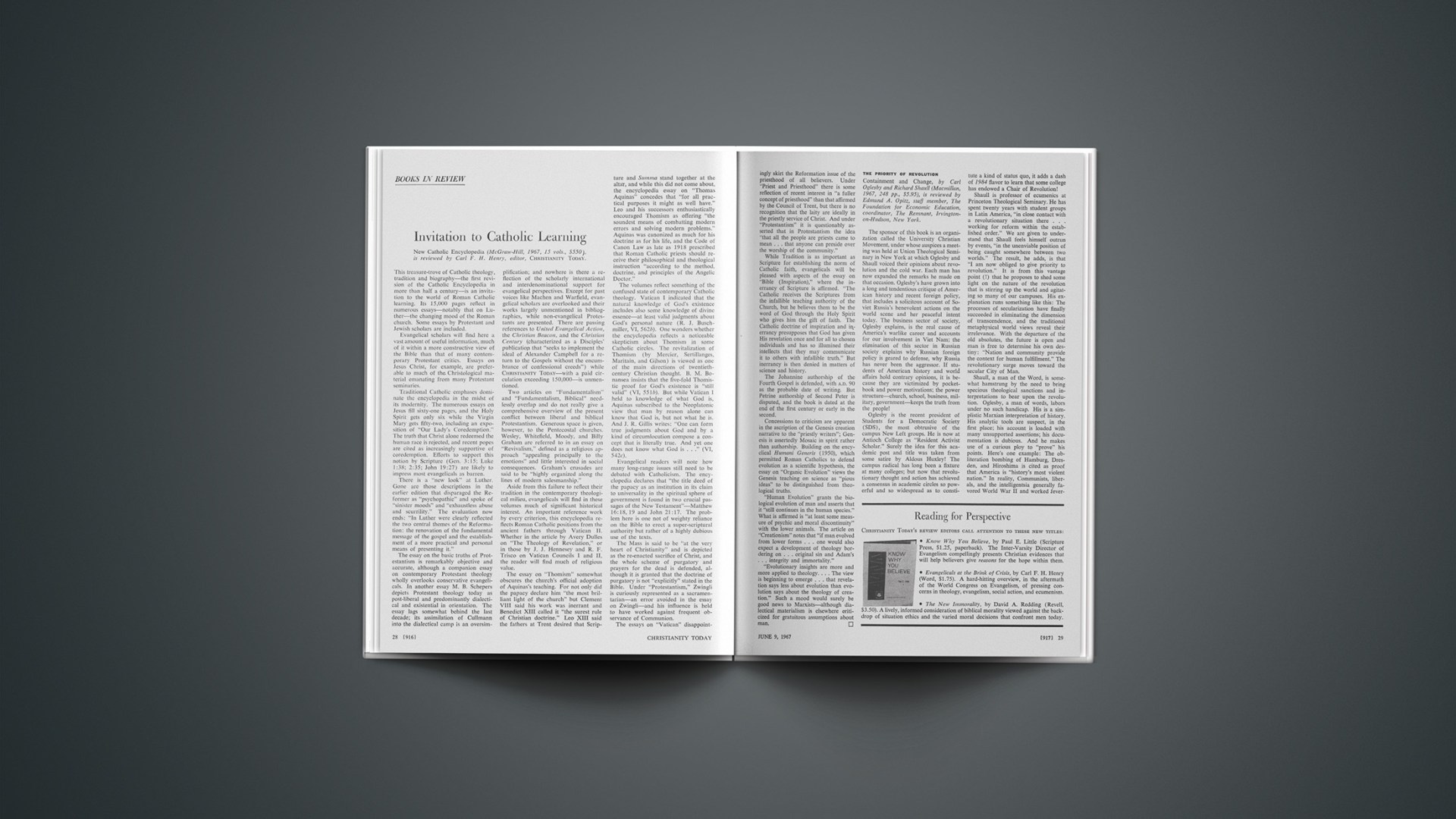
Invitation To Catholic Learning

New Catholic Encyclopedia (McGraw-Hill, 1967, 15 vols., $550), is reviewed by Carl F. H. Henry, editor, Christianity Today.

This treasure-trove of Catholic theology, tradition and biography—the first revision of the Catholic Encyclopedia in more than half a century—is an invitation to the world of Roman Catholic learning. Its 15,000 pages reflect in numerous essays—notably that on Luther—the changing mood of the Roman church. Some essays by Protestant and Jewish scholars are included.

Evangelical scholars will find here a vast amount of useful information, much of it within a more constructive view of the Bible than that of many contemporary Protestant critics. Essays on Jesus Christ, for example, are preferable to much of the. Christological material emanating from many Protestant seminaries.

Traditional Catholic emphases dominate the encyclopedia in the midst of its modernity. The numerous essays on Jesus fill sixty-one pages, and the Holy Spirit gets only six while the Virgin Mary gets fifty-two, including an exposition of “Our Lady’s Coredemption.” The truth that Christ alone redeemed the human race is rejected, and recent popes are cited as increasingly supportive of coredemption. Efforts to support this notion by Scripture (Gen. 3:15; Luke 1:38; 2:35; John 19:27) are likely to impress most evangelicals as barren.

There is a “new look” at Luther. Gone are those descriptions in the earlier edition that disparaged the Reformer as “psychopathic” and spoke of “sinister moods” and “exhaustless abuse and scurrility.” The evaluation now ends: “In Luther were clearly reflected the two central themes of the Reformation: the renovation of the fundamental message of the gospel and the establishment of a more practical and personal means of presenting it.”

The essay on the basic truths of Protestantism is remarkably objective and accurate, although a companion essay on contemporary Protestant theology wholly overlooks conservative evangelicals. In another essay M. B. Schepers depicts Protestant theology today as post-liberal and predominantly dialectical and existential in orientation. The essay lags somewhat behind the last decade; its assimilation of Cullmann into the dialectical camp is an oversimplification; and nowhere is there a reflection of the scholarly international and interdenominational support for evangelical perspectives. Except for past voices like Machen and Warfield, evangelical scholars are overlooked and their works largely unmentioned in bibliographies, while non-evangelical Protestants are presented. There are passing references to United Evangelical Action, the Christian Beacon, and the Christian Century (characterized as a Disciples’ publication that “seeks to implement the ideal of Alexander Campbell for a return to the Gospels without the encumbrance of confessional creeds”) while CHRISTIANITY TODAY—with a paid circulation exceeding 150,000—is unmentioned.

Two articles on “Fundamentalism” and “Fundamentalism, Biblical” needlessly overlap and do not really give a comprehensive overview of the present conflict between liberal and biblical Protestantism. Generous space is given, however, to the Pentecostal churches. Wesley, Whitefield, Moody, and Billy Graham are referred to in an essay on “Revivalism,” defined as a religious approach “appealing principally to the emotions” and little interested in social consequences. Graham’s crusades are said to be “highly organized along the lines of modern salesmanship.”

Aside from this failure to reflect their tradition in the contemporary theological milieu, evangelicals will find in these volumes much of significant historical interest. An important reference work by every criterion, this encyclopedia reflects Roman Catholic positions from the ancient fathers through Vatican II. Whether in the article by Avery Dulles on “The Theology of Revelation,” or in those by J. J. Hennesey and R. F. Trisco on Vatican Councils I and II, the reader will find much of religious value.

The essay on “Thomism” somewhat obscures the church’s official adoption of Aquinas’s teaching. For not only did the papacy declare him “the most brilliant light of the church” but Clement VIII said his work was inerrant and Benedict XIII called it “the surest rule of Christian doctrine.” Leo XIII said the fathers at Trent desired that Scripture and Summa stand together at the altar, and while this did not come about, the encyclopedia essay on “Thomas Aquinas” concedes that “for all practical purposes it might as well have.” Leo and his successors enthusiastically encouraged Thomism as offering “the soundest means of combatting modern errors and solving modern problems.” Aquinas was canonized as much for his doctrine as for his life, and the Code of Canon Law as late as 1918 prescribed that Roman Catholic priests should receive their philosophical and theological instruction “according to the method, doctrine, and principles of the Angelic Doctor.”

The volumes reflect something of the confused state of contemporary Catholic theology. Vatican I indicated that the natural knowledge of God’s existence includes also some knowledge of divine essence—at least valid judgments about God’s personal nature (R. J. Busch-miller, VI, 562b). One wonders whether the encyclopedia reflects a noticeable skepticism about Thomism in some Catholic circles. The revitalization of Thomism (by Mercier, Sertillanges, Maritain, and Gilson) is viewed as one of the main directions of twentieth-century Christian thought. B. M. Bonansea insists that the five-fold Thomistic proof for God’s existence is “still valid” (VI, 551b). But while Vatican I held to knowledge of what God is, Aquinas subscribed to the Neoplatonic view that man by reason alone can know that God is, but not what he is. And J. R. Gillis writes: “One can form true judgments about God and by a kind of circumlocution compose a concept that is literally true. And yet one does not know what God is …” (VI, 542c).

Evangelical readers will note how many long-range issues still need to be debated with Catholicism. The encyclopedia declares that “the title deed of the papacy as an institution in its claim to universality in the spiritual sphere of government is found in two crucial passages of the New Testament”—Matthew 16:18, 19 and John 21:17. The problem here is one not of weighty reliance on the Bible to erect a super-scriptural authority but rather of a highly dubious use of the texts.

The Mass is said to be “at the very heart of Christianity” and is depicted as the re-enacted sacrifice of Christ, and the whole scheme of purgatory and prayers for the dead is defended, although it is granted that the doctrine of purgatory is not “explicitly” stated in the Bible. Under “Protestantism,” Zwingli is curiously represented as a sacramentarian—an error avoided in the essay on Zwingli—and his influence is held to have worked against frequent observance of Communion.

The essays on “Vatican” disappointingly skirt the Reformation issue of the priesthood of all believers. Under “Priest and Priesthood” there is some reflection of recent interest in “a fuller concept of priesthood” than that affirmed by the Council of Trent, but there is no recognition that the laity are ideally in the priestly service of Christ. And under “Protestantism” it is questionably asserted that in Protestantism the idea “that all the people are priests came to mean … that anyone can preside over the worship of the community.”

While Tradition is as important as Scripture for establishing the norm of Catholic faith, evangelicals will be pleased with aspects of the essay on “Bible (Inspiration),” where the inerrancy of Scripture is affirmed. “The Catholic receives the Scriptures from the infallible teaching authority of the Church, but he believes them to be the word of God through the Holy Spirit who gives him the gift of faith. The Catholic doctrine of inspiration and inerrancy presupposes that God has given His revelation once and for all to chosen individuals and has so illumined their intellects that they may communicate it to others with infallible truth.” But inerrancy is then denied in matters of science and history.

The Johannine authorship of the Fourth Gospel is defended, with A.D. 90 as the probable date of writing. But Petrine authorship of Second Peter is disputed, and the book is dated at the end of the first century or early in the second.

Concessions to criticism are apparent in the ascription of the Genesis creation narrative to the “priestly writers”; Genesis is assertedly Mosaic in spirit rather than authorship. Building on the encyclical Humani Generis (1950), which permitted Roman Catholics to defend evolution as a scientific hypothesis, the essay on “Organic Evolution” views the Genesis teaching on science as “pious ideas” to be distinguished from theological truths.

“Human Evolution” grants the biological evolution of man and asserts that it “still continues in the human species.” What is affirmed is “at least some measure of psychic and moral discontinuity” with the lower animals. The article on “Creationism” notes that “if man evolved from lower forms … one would also expect a development of theology bordering on … original sin and Adam’s … integrity and immortality.”

“Evolutionary insights are more and more applied to theology.… The view is beginning to emerge … that revelation says less about evolution than evolution says about the theology of creation.” Such a mood would surely be good news to Marxists—although dialectical materialism is elsewhere criticized for gratuitous assumptions about man.

Reading for Perspective

CHRISTIANITY TODAY’S REVIEW EDITORS CALL ATTENTION TO THESE NEW TITLES

Know Why You Believe, by Paul E. Little (Scripture Press, $1.25, paperback). The Inter-Varsity Director of Evangelism compellingly presents Christian evidences that will help believers give reasons for the hope within them.

Evangelicals at the Brink of Crisis, by Carl F. H. Henry (Word, $1.75). A hard-hitting overview, in the aftermath of the World Congress on Evangelism, of pressing concerns in theology, evangelism, social action, and ecumenism.

The New Immorality, by David A. Redding (Revell, $3.50). A lively, informed consideration of biblical morality viewed against the backdrop of situation ethics and the varied moral decisions that confront men today.

The Priority Of Revolution

Containment and Change, by Carl Oglesby and Richard Shaull (Macmillan, 1967, 248 pp., $5.95), is reviewed by Edmund A. Opitz, staff member, The Foundation for Economic Education, coordinator, The Remnant, Irvington-on-Hudson, New York.

The sponsor of this book is an organization called the University Christian Movement, under whose auspices a meeting was held at Union Theological Seminary in New York at which Oglesby and Shaull voiced their opinions about revolution and the cold war. Each man has now expanded the remarks he made on that occasion. Oglesby’s have grown into a long and tendentious critique of American history and recent foreign policy, that includes a solicitous account of Soviet Russia’s benevolent actions on the world scene and her peaceful intent today. The business sector of society, Oglesby explains, is the real cause of America’s warlike career and accounts for our involvement in Viet Nam; the elimination of this sector in Russian society explains why Russian foreign policy is geared to defense, why Russia has never been the aggressor. If students of American history and world affairs hold contrary opinions, it is because they are victimized by pocket-book and power motivations; the power structure—church, school, business, military, government—keeps the truth from the people!

Oglesby is the recent president of Students for a Democratic Society (SDS), the most obtrusive of the campus New Left groups. He is now at Antioch College as “Resident Activist Scholar.” Surely the idea for this academic post and title was taken from some satire by Aldous Huxley! The campus radical has long been a fixture at many colleges; but now that revolutionary thought and action has achieved a consensus in academic circles so powerful and so widespread as to constitute a kind of status quo, it adds a dash of 1984 flavor to learn that some college has endowed a Chair of Revolution!

Shaull is professor of ecumenics at Princeton Theological Seminary. He has spent twenty years with student groups in Latin America, “in close contact with a revolutionary situation there … working for reform within the established order.” We are given to understand that Shaull feels himself outrun by events, “in the unenviable position of being caught somewhere between two worlds.” The result, he adds, is that “I am now obliged to give priority to revolution.” It is from this vantage point (!) that he proposes to shed some light on the nature of the revolution that is stirring up the world and agitating so many of our campuses. His explanation runs something like this: The processes of secularization have finally succeeded in eliminating the dimension of transcendence, and the traditional metaphysical world views reveal their irrelevance. With the departure of the old absolutes, the future is open and man is free to determine his own destiny: “Nation and community provide the context for human fulfillment.” The revolutionary surge moves toward the secular City of Man.

Shaull, a man of the Word, is somewhat hamstrung by the need to bring specious theological sanctions and interpretations to bear upon the revolution. Oglesby, a man of words, labors under no such handicap. His is a simplistic Marxian interpretation of history. His analytic tools are suspect, in the first place; his account is loaded with many unsupported assertions; his documentation is dubious. And he makes use of a curious ploy to “prove” his points. Here’s one example: The obliteration bombing of Hamburg, Dresden, and Hiroshima is cited as proof that America is “history’s most violent nation.” In reality, Communists, liberals, and the intelligentsia generally favored World War II and worked feverishly to get a reluctant America involved in the fighting. Once we were in, these same people nagged the Allies into fighting a ferocious war, over the protest of many Americans, and prolonged the war by demanding unconditional surrender. The left applauded the conduct of the war, except when its ferocity slackened. And now comes an intellectual heir of these Communist and liberal propagandists to charge the rest of us with the sins committed under the sponsorship of his leftist like-numbers of twenty-five years ago!

Similarly with the imbroglio in Viet Nam. The Viet Nam affair is a mixed-up mess, all right; but it is exactly the kind of foreign entanglement that we can expect to be precipitated at regular intervals by the insane foreign policy adopted a quarter of a century ago. The left loves everything about that foreign policy except its consequences; or, more precisely, they dislike its consequences in Southeast Asia, but they want to retain the policy and point the muzzle at Rhodesia and South Africa.

We know what the road to war looks like, and we know that the first steps along that road may seem innocent enough. If churchmen are to speak a healing word to the nations, they must learn to recognize those first steps for what they are. They won’t learn that in this book. But they will learn here something of what they are up against.

Are They Fundamentalists?

Fundamentalism and the Missouri Synod, by Milton L. Rudnick (Concordia, 1966, 152 pp., $5.95), is reviewed by Robert Preus, professor of systematic theology, Concordia Seminary, St. Louis, Missouri.

It is a pretty well established fact today that the term “fundamentalist” is pejorative. It is often used to describe a wooden, insensitive, obscurantist way of reading the sacred Scriptures, a reading that ignores history and the human side of Scripture. But sometimes anyone who believes and teaches the divine origin, authority, and inerrancy of Scripture is labeled a fundamentalist, and thus a cruel caricature results. The Reformation and post-Reformation doctrine of Scripture is branded fundamentalism by such theologians as Emil Brunner and Regin Prenter.

Not unexpectedly, therefore, a church body like the Lutheran Church-Missouri Synod that has sought to remain faithful to the sola scriptura of the Reformation is often portrayed as fundamentalist, as having come under the “baleful” influence of the fundamentalist movement.

Dr. Milton Rudnick believed there was some truth in this charge and decided to investigate. After a thorough study of the beginnings and development of both the fundamentalist movement and the Missouri Synod, he arrived at a negative conclusion. Fundamentalism and the Missouri Synod had no influence on each other. Their dissimilarities were many and serious, and their similarities grew out of their common Reformation heritage.

In the first half of the study, Rudnick wisely tries to get at just what fundamentalism is and who the fundamentalists were. He shows that many conservative scholars like Machen, Allis, Van Til, and Robert Dick Wilson were not fundamentalists at all, even though they spoke out during much of the fundamentalist-modernist controversy; they were, like their precursors, orthodox Calvinists. The author also makes it clear that millennialism was an important and exclusivistic tenet of the fundamentalists. Although he dwells on the negative attitude of many fundamentalists and their bitter invective against modernism and liberalism, on the whole he is quite sympathetic to their theology and concerns.

Turning next to the Lutheran Church—Missouri Synod and its historical development, Rudnick shows that it would have been impossible for this church body to be influenced theologically by the fundamentalists. For the most part it was a German-speaking church, oriented toward the theological situation in Germany and reacting against the liberalism there, to a great extent unacquainted with and even uninterested in American theological trends. In its theology it closely followed Luther, the Luther confessions, and the sixteenth-and seventeenth-century Lutheran theologians.

There is no evidence that the Missouri Synod theologians used fundamentalist sources; at least they almost never quoted from them. Their doctrine of Scripture agrees precisely with that of the old Lutheran dogmaticians. They were indeed aware of what many fundamentalists (at this point Rudnick calls Machen a fundamentalist) were writing against liberalism; but they were at the same time wary of the movement and frankly critical on many issues, e.g. unionism, the Reformed orientation, premillennialism, and even the preoccupation with anti-evolution legislation (a dangerous mingling of church and state). The Missouri Synod sat out the fundamentalist-modernist battle not only because it was untouched by liberalism but also because of its strong Lutheran confessionalism. Fundamentalism was not strict enough for the Missourians, who insisted on agreement on every article of faith before they could make common cause with other Christians.

I might make a couple of mild strictures. First, the statement that “a key characteristic of [Lutheran] Orthodoxy was its high estimate of human reason in preparing for and receiving God’s revelation” (p. 71), is too strong. Lutheran orthodoxy had the most negative estimate of the powers of reason of all the confessional groupings of the Reformation era (Calvinism, Romanism, Socinianism) and was aware of this. Second, the implication that Walter A. Maier held back in some of his radio preaching lest he lose financial support from many fundamentalists is, I believe, not quite fair. After all, regulations ruling all radio preaching precluded the possibility of certain direct polemics, polemics that Maier did not refrain from when he was off the air.

Ordinarily there seems to be little value in a book that proves a negative thesis (like showing that there is no relationship between the Southern Baptists and the Russian Nikonites); but this one is welcome, for it dispels a myth that was growing in popularity. It also opens up other questions that might well be investigated. Were other Lutherans in this country influenced by fundamentalism? Did neo-orthodoxy effectively defeat liberalism after the fundamentalists had failed to do so (as the author suggests, p. 64)? Offhand, I would answer the first question yes and the second no; but a thorough study of such pertinent questions might be very helpful.

The Minister And Espionage

Code Name Sebastian, by James L. Johnson (Lippincott, 1967, 270 pp., $4.50), is reviewed by Clifford Edwards, associate professor of English, Fort Hays Kansas State College, Hays, Kansas.

In Code Name Sebastian, Johnson has accomplished the remarkable feat of bringing together somewhat successfully a suspenseful tale of international espionage with its inevitable subterfuge, danger, and violence; the story of the terrible ordeal of eight survivors of an airplane crash as they desperately cling to life on the cruel and pitiless Negev desert; and the story of a spiritually exhausted minister suffering from theological fatigue and the flabby muscles of an untried faith, who seeks spiritual renewal and a sense of commitment.

The center of consciousness is Sebastian, a sensitive, reflective minister unexpectedly thrust into the thankless role of leadership by an Israeli secret agent. With the exception of the protagonist, whose doubts, fears, anxieties, and frustrations are understandable and real, the characterization is weak, chiefly because each character is a foil made to represent various personality traits and attitudes—such as the skeptical empirical intellect or the Nietzschean man of powerful will—in conflict with Sebastian’s orthodox Christian conversations. Furthermore, the plot unfortunately often borders on contrivance and cannot avoid certain spy-story clichés.

The novel has much to recommend it, however. The desert wilderness with its echoes of Israel’s spiritual history and the crucial need for living water provide an apt metaphorical background for Sebastian’s trial of faith, as he staggers under the cross of unrequited personal sacrifices and compassion, and as he refuses to surrender to despair and to the voice of the Tempter. Most importantly, the ordeal enlarges his awareness of the need to share humanity’s suffering in order to minister to its needs. Although the novel has certain unexpected reversals, there are no sensational miracles, no last-minute conversions or serious concessions to sentimentalism.

Despite the well-timed criticism of the Church’s failure to penetrate the world with Christian compassion, the conclusion is disturbingly ambivalent: Sebastian’s new sense of spiritual commitment and involvement appears to owe as much to the rhetoric of Bonhoeffer’s indictment of cloistered Christianity as it does to a revitalizing encounter with the Holy Spirit in the Negev experience. Still, the novel effectively challenges the kind of piety that delicately segregates itself from the ugly reality of a godless world, and it does this in the framework of a unique and suspenseful narrative.

The New Party Line

The Converted Church: From Escape to Engagement, by Paul L. Stagg (Judson, 1967, 160 pp., $2.75, paperback), is reviewed by Harold Lindsell, associate editor,CHRISTIANITY TODAY.

From the well of modernity this author has drawn a small cup of water that he pours on the fires of the “old evangelism,” hoping to extinguish it and then ignite his own “new evangelism.” He is administrative associate of the Division of Evangelism, American Baptist Home Mission Societies, and his leader, Jitsuo Morikawa, has written the preface.

As one would expect, the book follows the Morikawa party line. It is incipiently universalistic, and the author emphasizes social action as constitutive of the Gospel. The work is a curious medley of elements put together in such a way that the unsuspecting reader might think Stagg was presenting a case for orthodoxy. For example, he says that “the gospel (evangel) is God’s good news to men, his deed in his Word, Jesus Christ, by whom salvation was wrought for the world.” But then when he tells about working to desegregate housing, he says: “I told these people simply that the phony wall dividing the races had been broken down.… For me, I said quite plainly, this is the gospel, good news to all who are excluded, news that they are accepted.”

Stagg comes down hard against pietism as he approvingly tells of a churchgoer who said he could not understand or appreciate statements “such as ‘the Bible as the infallibly inspired word of God,’ ‘the blood of the Lamb,’ and so forth.…” The same churchgoer said that when “the discussion was about Christian responsibility in such areas as industry, public school, health, or leisure [it] had great meaning.…” This Stagg cordially accepts.

He also applauds Franklin H. Littell’s statement in From Church State to Pluralism that Dwight L. Moody’s kind of revivalism, which avoided “all references to social issues, was a betrayal of the great tradition of revivalism and mass evangelism.” Students of church history will question Littell’s observation. Few, however, will be able to question the fact that Stagg’s “new evangelism” bears no resemblance to the “great tradition of revivalism and mass evangelism”—but for wholly different reasons.

Stagg discerns the presence of God “in the Freedom Movement for racial justice; in the antipoverty crusade of the nation; in the Peace Corps working among underdeveloped nations; in the new openness between men of all sorts, Christian and Jew, white and black, outsider and insider.” This is not the ‘Word of God as it is attested to in the Bible,” according to Stagg. It is “the Word of God … spoken through the world.”

He has an insight that enables him to see how in specific historical events the “Word of God” is proclaimed—not verbalized, but acted out. He mentions the march to Selma, for example, and says that “the march over the Pettus Bridge … has some resemblance to the Exodus.… The word of God was proclaimed in a new way, in a way which made decision inescapable.” All this is but a continuation of the battle over proclamation versus service, with service elevated to the status of proclamation and the Gospel itself depreciated.

This volume is to provide the undergirding for the evangelistic outreach of the American Baptist Convention in the days ahead. I for one will watch with fascinated interest to see the results. If his guidelines work, it will be the first time; what he suggests has been tried unsuccessfully before. If the guidelines do not work—and I predict they won’t—then perhaps the current “new evangelism” will have run its course. Then the Church will be left to pick up the pieces and undo the damage.

Book Briefs

“The Cambridge Bible Commentary on the New English Bible”: The Letter of Paul to the Galatians, by William Neil; The Letter of Paul to the Romans, by Ernest Best; and The Letters of Peter and Jude, by A. R. C. Leaney (Cambridge; 1967; 96, 184, and 144 pp.; $3.50 each; also paper, $1.65 each). Three stimulating additions to an excellent commentary series.

Shot to Hell, by Keith Bill (Revell, 1966, 93 pp., $2.50). The story of a Christian mission to dope addicts in London. Published in London under the title The Needle, the Pill, and the Saviour. Maybe the title writer is on the stuff.

Söderblom: Ecumenical Pioneer, by Charles J. Curtis (Augsburg, 1967, 149 pp., $4.50). A Lutheran pastor writes a sympathetic biography of the Swedish archbishop who helped lay the foundations of the World Council of Churches.

Forgive Them, by J. E. Church (Moody, 1967, 126 pp., $2.95). The gripping story of an African preacher who suffered martyrdom in 1964.

Current Philosophical Essays, compiled and edited by Frederick C. Dommeyer (Charles C. Thomas, 1966, 262 pp., $8.75). Students and associates honor Professor Curt John Ducasse with essays that tackle such problems as the commitments and function of philosophy, mind-body relation, verifiability, God and evil, and free will, the creativity of God and order.

The New Apocalypse: The Radical Christian Vision of William Blake, by Thomas J. J. Altizer (Michigan State University, 1967, 226 pp., $8.50). The foremost death-of-God theologian attempts to show how Blake’s “radical and prophetic reaction to a non-redemptive God of power and judgment” led him to a vision of the omnipresence of Jesus’ passion.

Paperbacks

Biblical Studies Today: A Guide to Current Issues and Trends, by Edgar Krentz (Concordia, 1966, 80 pp., $1.75). A layman’s guide that identifies current trends in biblical studies: source and form criticism, the new quest for the historical Jesus, hermeneutical problems.

The Orthodox Pastor, by John Shahov-skoy (St. Vladimir’s Seminary, 1966, 117 pp., $2.50). A treatise on the role and responsibilities of the Eastern Orthodox pastor that could be read with profit by Western Protestant ministers.

The Testing of God’s Son, by Birger Gerhardsson (C. W. K. Gleerup [Lund, Sweden], 1966, 83 pp., 12 Sw. Cr.). A study of Matthew 4:1–11 (the temptation narrative) that claims it is highly stylized early Christian midrash.

The Other Comforter: Practical Studies on the Holy Spirit, by Theodore H. Epp (Back to the Bible, 1966, 264 pp., $1.95). The director of the “Back to the Bible” broadcast offers helpful, scriptural teaching on the Holy Spirit.

Faith and the Physical World: A Comprehensive View, by David L. Dye (Eerdmans, 1966, 214 pp., $2.95). Seeks to show how a Christian world view may be developed and applied to the physical universe as well as to theological considerations. A helpful annotated reading list is included.
Ideas

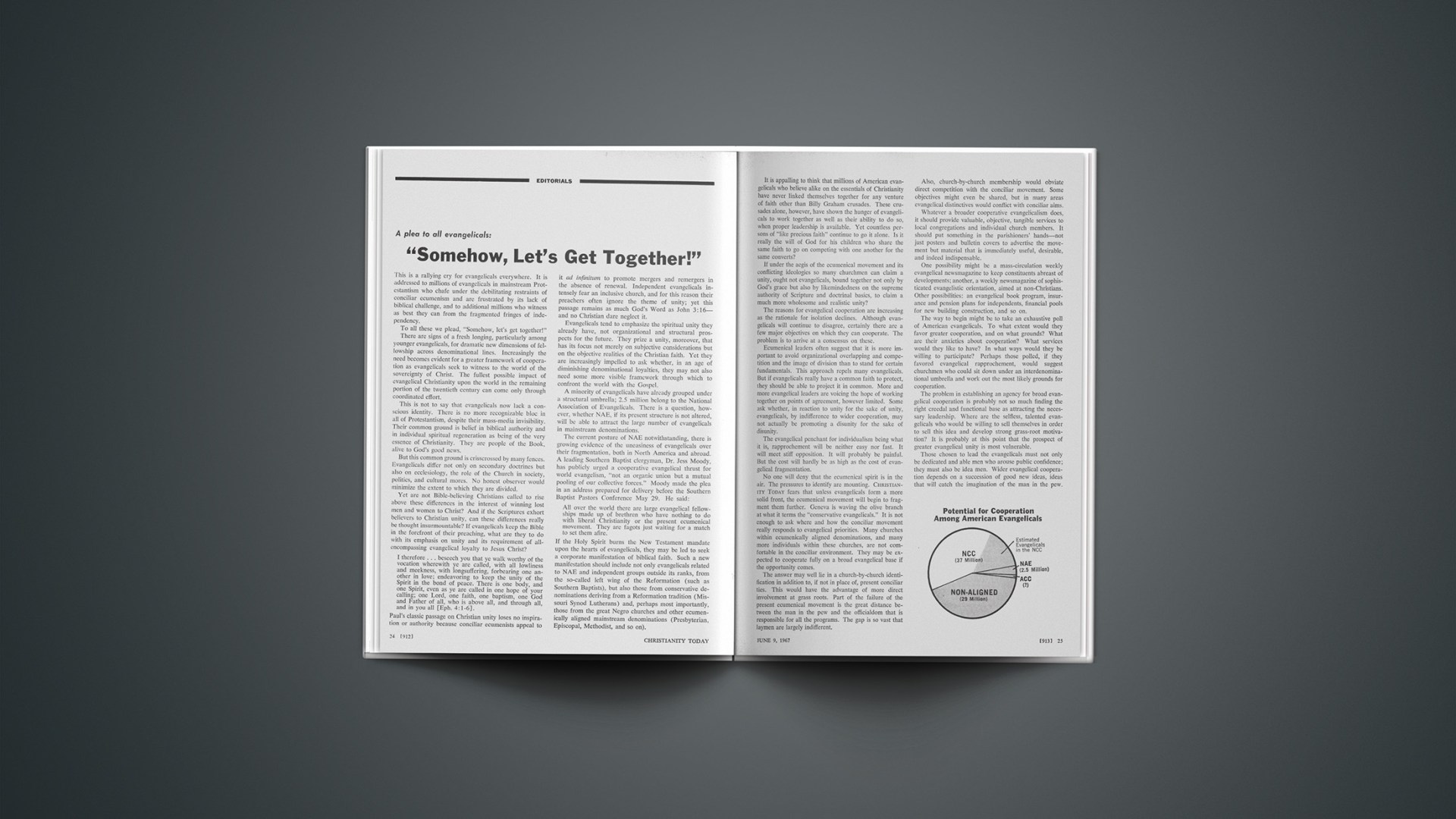
“Somehow, Let’s Get Together!”

A plea to all evangelicals.

This is a rallying cry for evangelicals everywhere. It is addressed to millions of evangelicals in mainstream Protestantism who chafe under the debilitating restraints of conciliar ecumenism and are frustrated by its lack of biblical challenge, and to additional millions who witness as best they can from the fragmented fringes of independency.

To all these we plead, “Somehow, let’s get together!”

There are signs of a fresh longing, particularly among younger evangelicals, for dramatic new dimensions of fellowship across denominational lines. Increasingly the need becomes evident for a greater framework of cooperation as evangelicals seek to witness to the world of the sovereignty of Christ. The fullest possible impact of evangelical Christianity upon the world in the remaining portion of the twentieth century can come only through coordinated effort.

This is not to say that evangelicals now lack a conscious identity. There is no more recognizable bloc in all of Protestantism, despite their mass-media invisibility. Their common ground is belief in biblical authority and in individual spiritual regeneration as being of the very essence of Christianity. They are people of the Book, alive to God’s good news.

But this common ground is crisscrossed by many fences. Evangelicals differ not only on secondary doctrines but also on ecclesiology, the role of the Church in society, politics, and cultural mores. No honest observer would minimize the extent to which they are divided.

Yet are not Bible-believing Christians called to rise above these differences in the interest of winning lost men and women to Christ? And if the Scriptures exhort believers to Christian unity, can these differences really be thought insurmountable? If evangelicals keep the Bible in the forefront of their preaching, what are they to do with its emphasis on unity and its requirement of all-encompassing evangelical loyalty to Jesus Christ?

I therefore … beseech you that ye walk worthy of the vocation wherewith ye are called, with all lowliness and meekness, with longsuffering, forbearing one another in love; endeavoring to keep the unity of the Spirit in the bond of peace. There is one body, and one Spirit, even as ye are called in one hope of your calling; one Lord, one faith, one baptism, one God and Father of all, who is above all, and through all, and in you all [Eph. 4:1–6].

Paul’s classic passage on Christian unity loses no inspiration or authority because conciliar ecumenists appeal to it ad infinitum to promote mergers and remergers in the absence of renewal. Independent evangelicals intensely fear an inclusive church, and for this reason their preachers often ignore the theme of unity; yet this passage remains as much God’s Word as John 3:16—and no Christian dare neglect it.

Evangelicals tend to emphasize the spiritual unity they already have, not organizational and structural prospects for the future. They prize a unity, moreover, that has its focus not merely on subjective considerations but on the objective realities of the Christian faith. Yet they are increasingly impelled to ask whether, in an age of diminishing denominational loyalties, they may not also need some more visible framework through which to confront the world with the Gospel.

A minority of evangelicals have already grouped under a structural umbrella; 2.5 million belong to the National Association of Evangelicals. There is a question, however, whether NAE, if its present structure is not altered, will be able to attract the large number of evangelicals in mainstream denominations.

The current posture of NAE notwithstanding, there is growing evidence of the uneasiness of evangelicals over their fragmentation, both in North America and abroad. A leading Southern Baptist clergyman, Dr. Jess Moody, has publicly urged a cooperative evangelical thrust for world evangelism, “not an organic union but a mutual pooling of our collective forces.” Moody made the plea in an address prepared for delivery before the Southern Baptist Pastors Conference May 29. He said:

All over the world there are large evangelical fellowships made up of brethren who have nothing to do with liberal Christianity or the present ecumenical movement. They are fagots just waiting for a match to set them afire.

If the Holy Spirit burns the New Testament mandate upon the hearts of evangelicals, they may be led to seek a corporate manifestation of biblical faith. Such a new manifestation should include not only evangelicals related to NAE and independent groups outside its ranks, from the so-called left wing of the Reformation (such as Southern Baptists), but also those from conservative denominations deriving from a Reformation tradition (Missouri Synod Lutherans) and, perhaps most importantly, those from the great Negro churches and other ecumenically aligned mainstream denominations (Presbyterian, Episcopal, Methodist, and so on).

It is appalling to think that millions of American evangelicals who believe alike on the essentials of Christianity have never linked themselves together for any venture of faith other than Billy Graham crusades. These crusades alone, however, have shown the hunger of evangelicals to work together as well as their ability to do so, when proper leadership is available. Yet countless persons of “like precious faith” continue to go it alone. Is it really the will of God for his children who share the same faith to go on competing with one another for the same converts?

If under the aegis of the ecumenical movement and its conflicting ideologies so many churchmen can claim a unity, ought not evangelicals, bound together not only by God’s grace but also by likemindedness on the supreme authority of Scripture and doctrinal basics, to claim a much more wholesome and realistic unity?

The reasons for evangelical cooperation are increasing as the rationale for isolation declines. Although evangelicals will continue to disagree, certainly there are a few major objectives on which they can cooperate. The problem is to arrive at a consensus on these.

Ecumenical leaders often suggest that it is more important to avoid organizational overlapping and competition and the image of division than to stand for certain fundamentals. This approach repels many evangelicals. But if evangelicals really have a common faith to protect, they should be able to project it in common. More and more evangelical leaders are voicing the hope of working together on points of agreement, however limited. Some ask whether, in reaction to unity for the sake of unity, evangelicals, by indifference to wider cooperation, may not actually be promoting a disunity for the sake of disunity.

The evangelical penchant for individualism being what it is, rapprochement will be neither easy nor fast. It will meet stiff opposition. It will probably be painful. But the cost will hardly be as high as the cost of evangelical fragmentation.

No one will deny that the ecumenical spirit is in the air. The pressures to identify are mounting. CHRISTIANITY TODAY fears that unless evangelicals form a more solid front, the ecumenical movement will begin to fragment them further. Geneva is waving the olive branch at what it terms the “conservative evangelicals.” It is not enough to ask where and how the conciliar movement really responds to evangelical priorities. Many churches within ecumenically aligned denominations, and many more individuals within these churches, are not comfortable in the conciliar environment. They may be expected to cooperate fully on a broad evangelical base if the opportunity comes.

The answer may well lie in a church-by-church identification in addition to, if not in place of, present conciliar ties. This would have the advantage of more direct involvement at grass roots. Part of the failure of the present ecumenical movement is the great distance between the man in the pew and the officialdom that is responsible for all the programs. The gap is so vast that laymen are largely indifferent.

Also, church-by-church membership would obviate direct competition with the conciliar movement. Some objectives might even be shared, but in many areas evangelical distinctives would conflict with conciliar aims.

Whatever a broader cooperative evangelicalism does, it should provide valuable, objective, tangible services to local congregations and individual church members. It should put something in the parishioners’ hands—not just posters and bulletin covers to advertise the movement but material that is immediately useful, desirable, and indeed indispensable.

One possibility might be a mass-circulation weekly evangelical newsmagazine to keep constituents abreast of developments; another, a weekly newsmagazine of sophisticated evangelistic orientation, aimed at non-Christians. Other possibilities: an evangelical book program, insurance and pension plans for independents, financial pools for new building construction, and so on.

The way to begin might be to take an exhaustive poll of American evangelicals. To what extent would they favor greater cooperation, and on what grounds? What are their anxieties about cooperation? What services would they like to have? In what ways would they be willing to participate? Perhaps those polled, if they favored evangelical rapprochement, would suggest churchmen who could sit down under an interdenominational umbrella and work out the most likely grounds for cooperation.

The problem in establishing an agency for broad evangelical cooperation is probably not so much finding the right creedal and functional base as attracting the necessary leadership. Where are the selfless, talented evangelicals who would be willing to sell themselves in order to sell this idea and develop strong grass-root motivation? It is probably at this point that the prospect of greater evangelical unity is most vulnerable.

Those chosen to lead the evangelicals must not only be dedicated and able men who arouse public confidence; they must also be idea men. Wider evangelical cooperation depends on a succession of good new ideas, ideas that will catch the imagination of the man in the pew. Anything less will be subject to dismissal as a reactionary movement.

Evangelicals have a lot going for them. Theirs is more than a church; it is Christianity with a cause. Evangelicals have a wide area of agreement on doctrinal essentials. They are the most active and aggressive of all Protestants. They have the highest per-capita giving. They turn out the most ministers and missionaries. They are the most faithful in prayer, in Bible study, and in witnessing to their faith.

Why ought not they also to be able to point to a tangible fellowship? Is it not time for evangelicals to stand up and be counted together for things that matter most, for a commitment to fulfill more perfectly Christ’s will “that they may be one, even as we are one”?

We urge laymen and clergy alike to speak up in their churches and to pray that God will see fit to call out initiators. We invite evangelical leaders to begin immediate discussion of the merits and methods of establishing wide cooperation. We hope that many evangelical editors will react to this editorial in their own pages. We trust that officials of all Christian organizations and mission boards will communicate with their constituencies and draw out opinions. And we solicit comment and criticism in the hope that responsible discussion will lead to action.

Some activist churchmen presume to equate left-wing political movements with God’s action in history

The steady stream of pontifical pronouncements on political, social, and economic matters from church officialdom gives the typical American the impression that the Christian Church assumes a position immediately adjacent to that of the left-wing Americans for Democratic Action. Liberal churchmen dedicated to the transformation of men through the restructuring of social institutions have effectively projected this image by numerous public demonstrations, frequent testimony at governmental hearings, and extensive use of the mass media.

But do these men really speak for the Church? A growing number of Christians do not think so. Recognizing the right of clergymen to hold and express personally their own political convictions, many church members nonetheless resent the audacious presumption of ecclesiastical activists who unhesitatingly equate their left-wing social and political movements with the action of God in history. They further criticize these spokesmen, who often are limited in socio-economic understanding, for their adamant refusal to consider seriously the idea that conservative positions may reflect equally well, if not better, the biblical perspective on complex issues of the world today.

The zeal with which liberal churchmen pursue social action—giving it a higher priority in their ministries than winning men to Christ through gospel preaching—may be traced to the current liberal theological tendency to regard contemporary evangelism as essentially political in nature. To achieve their objective of helping men to be “truly human,” they have committed themselves to massive action programs to reshape society. The policies that have emerged in such programs resemble those of socialist-tinged revolutionaries: castigation of the free-enterprise system, opposition to America’s anti-Communist policy in Viet Nam, support of disruptive civil-rights protesters, endorsement of libertarian sexual practices, and efforts to equalize men economically regardless of personal productivity. Church members have a valid basis for objecting to the fact that their religious leaders promote these views as if they represented a Christian consensus or were grounded in the truth of revelation.

The Church should not suppose that any human politico-socio-economic philosophy or program in itself embodies the Christian position. The complexity of issues in contemporary life supports the idea that differing viewpoints on these matters should be freely expressed within the Christian community. But none should be sanctioned, either by official action or by carefully planned propaganda techniques, as representative of the entire church, especially when the hierarchical spokesmen make no conscientious attempt to ascertain the mind of the laity.

The World Council of Churches has been criticized frequently and justly for usurping the authority to promote certain political, social, and economic policies in the name of the Church. WCC spokesmen usually answer that these policy statements speak to and not for the Church. The study booklet for the Fourth WCC Assembly in Uppsala admits, however, that the WCC Commission of the Church on International Affairs has consciously functioned as an instrument of political propaganda. The booklet states:

In the United Nations, in other diplomatic conferences, and in councils of governments, the Commission seeks to make known and win acceptance for views predominantly held within the World Council of Churches, relating to such matters as the cessation of nuclear weapons testing, disarmament, race relations, religious liberty, national independence, development and refugee needs, as well as currently critical issues such as Vietnam and Rhodesia.

Needless to say, the WCC has invariably endorsed left-wing policies.

Since the liberal stance of clerical activists is becoming popularly accepted as that of the whole Church, church members who oppose this political posture must let their Christian voices be heard. The pulpit should not become a political sounding board nor the congregational meeting a public political forum. But individual Christians involved in public affairs, particularly those in policy-making jobs, must speak out boldly, relating their views to Christian conscience. The world must be made to realize that the Christian community as such is vitally concerned that God’s will be done in public matters.

A graphic example of an individual Christian’s expressing a socio-economic opinion contrary to that of his denominational leaders was seen in the speech delivered by Clifford Anderson, a United Church of Christ layman from Glen Ridge, New Jersey, at the recent Kodak-FIGHT showdown in Flemington, New Jersey. After a complete personal investigation of the racial-economic issues in the controversy, Anderson dissented vigorously to the anti-Kodak position presented by United Church of Christ executive Howard E. Spragg. In his informed presentation supporting Kodak, he disspelled the notion that the church hierarchy spoke for the entire denomination. And, in our opinion, his view was far more Christian and sound.

The Church must always concentrate on proclaiming the good news of personal salvation in Christ. But through its individual members it must also bring the truth of Christ to bear in the social, economic, and political realms. Millions of Christians occupy strategic positions in government, business, labor, education, the professions, the arts, and other important fields where Christian social concerns need to be expressed. Let these people as well as the clergy utter their Christian convictions and thereby help to improve our nation and world. The eager ecclesiastical advocates of a single left-wing politico-socio-economic line must not be allowed, through the default of a silent laity, exclusive claim to the Church’s prestige to promote their social doctrines. Often their views must be opposed as decidedly anti-Christian. All Christians must assume their responsibility to support by voice and action those causes that are in keeping with the Gospel.

How is the voice of the Church heard? Surely it is not restricted to the declarations of a particular coterie of clerical activists. Rather, every Christian as a believer-priest has the obligation to make himself heard. Let him do so, enlightened by biblical teaching, armed with the facts, humble in attitude, and courageous in conviction. The man of faith who by word and deed discharges his Christian responsibilities in all realms of life will be used by Jesus Christ as he speaks his word of love and judgment to the world.

Mariolatry: No Bar To Unity?

Renewed emphasis on devotion to the Virgin Mary by Pope Paul VI as he commemorated the fiftieth anniversary of the reported visions at Fatima shows that the “infallible” leader of the Roman Catholic Church has no intention of abandoning this unbiblical doctrine in order to promote unity within Christendom. Obviously disturbed by the Pandora’s box of liberal teaching opened by Vatican II, the Pope sternly warned against “replacing the theology of the true and great fathers of the Church with new and peculiar ideologies.” He urged the faithful to renew their personal consecration to the “immaculate heart of Mary,” “demonstrating toward the Virgin Mother of God a more ardent piety and a more steadfast trust.” Rightly decrying other false teachings, he ironically went far beyond Vatican II in reaffirming the Marian heresy.

The Pope’s enthusiastic endorsement of Marian dogma, traditionally offensive to Protestants, seems no longer to be a barrier to Protestant-Catholic dialogue and cooperation. Five days later representatives of the World Council of Churches and a group of Roman Catholic leaders meeting at Ariccia, Italy, issued a communique recommending “that the WCC and the Catholic Church pursue a policy of more dynamic collaboration.” The study group, whose joint chairmen were WCC General Secretary Eugene Carson Blake and Bishop Jan Willebrands, secretary of the Vatican Secretariat for Promoting Christian Unity, gave special attention to “the particular obligation of cooperation in the field of service activities, economic justice and development, international affairs and peace.”

In the steadily growing rapprochement of the WCC and the Roman Catholic Church, the two gigantic international religious bodies are forging chains of cooperation primarily on the notion that the efforts of men will bring in the Kingdom of God. The WCC stresses human political action rather than proclamation of the Gospel, and the Roman Catholic Church relies upon manmade traditions and institutions rather than the New Testament principle of the Bible alone. Although their emphases are different, both rest on the fallible wisdom of man rather than the infallible wisdom and revealed truth of God. In view of the Pope’s recent reaffirmation of devotion to Mary and the WCC’s stepped-up program of politico-socio-economic action, Bible-believing Christians have good reason to be concerned about this “dynamic collaboration” that could all too easily lead to one great world church of man.

Post Mortem: Confession Of ’67

For 238 years the United Presbyterian Church has been guided and governed by the Westminster Confession of Faith and Catechism. Recently, after several turbulent years of debate, the General Assembly in anticlimactic fashion ratified the “Book of Confessions.” The Westminster Confession has now lost its unique and normative postion as guardian of the church’s theology.

The inclusion of the “Confession of 1967” in the “Book of Confessions” and the change of the subscription formula will benefit those clergymen who solemnly vowed adherence to the Westminster standards despite significant mental reservation. In these days of “confusion theology” many churchmen find it easy to swallow a mixture of conflicting viewpoints without getting indigestion.

We predict that the adoption of the new confession will sap the church’s spiritual vitality in the future. But we sincerely pray this prediction will prove wrong.

Very Personal

Many of us are convinced that it is impossible to reform the social order apart from personal redemption of individuals. We will be wise if we carry the same line of reasoning into our concept of the work of the Holy Spirit in individuals and in the Church.

We are inclined to think of his work in general and impersonal terms. We pray for an “outpouring of the Holy Spirit,” as if he worked in some nebulous way apart from the lives of people. True, he may use things and events for his glory and the advancement of God’s Kingdom; but he possesses and fills people and works through them.

The very heart of the Christian faith is man’s personal relationship with God. Man stands before God as an individual, and as an individual he is redeemed. The work of the Holy Spirit is personal. It is he who effects the new birth, who brings spiritual life from spiritual death. It is he who comes into the hearts and lives, wooing, speaking of the things of Christ, and instructing in spiritual truth.

When the Holy Spirit came at Pentecost, there were supernatural manifestations that immediately became personalized. The “tongues of fire,” we are told, were “distributed and resting on each one of them. And they were all filled with the Holy Spirit …” (Acts 2:3, 4, RSV). And because this experience was personalized, these unlearned Galileans went out transformed.

The phrase “a Spirit-filled Church” can be misleading. It is the persons making up the Church who must be filled with the Spirit, and we cannot avoid this necessity by thinking or hoping that God works in some other way.

There is no doctrine more neglected than that of the Holy Spirit. Much is said about God the Father, and about his Son, the Lord Jesus Christ, and of course none of us can fully understand or exhaust these subjects. But about the Holy Spirit there is abysmal ignorance and often a strange indifference. Yet it is he by whom alone we can believe in Christ and be prepared to witness for him. It is through the Holy Spirit that the Bible becomes an open book. The Holy Spirit is not an accessory to Christian faith and work; he is a necessity.

Most churches are today confronted with a depressing fact: the spiritual birthrate increasingly lags behind the biological. In desperation we turn to new programs and new methods. Some even attempt to jettison basic parts of the Christian faith in favor of ideas more acceptable to the unregenerate. How foolish can we get?

If there is to be a change—and there can be—we must search our own hearts for the cause of the trouble. Is there concrete evidence of the presence and power of the Holy Spirit in us? There can be no improvement in the general situation in the Church until there is a change in the lives of individual Christians, in the pulpit as well as in the pew. An answer to the problem is a personal one; it affects you and me.

Confronted as we are with spiritual deadness in the Church, let us honestly admit that this deadness lies within us as individuals. The Church’s state is an elongated shadow of the state of its members. And the great omission in its members’ lives is the failure to recognize the absolute necessity of a personal experience with the Holy Spirit—an experience that transforms and quickens, not the organization, but the people who make up that organization.

We thrill at the story of Pentecost and perhaps are inclined to look on it merely as a phenomenon in history. But the coming of the Holy Spirit in mighty power in the lives of Christians should be a continuing experience within the Church.

The significance of the manifestation at Pentecost was not that rude fishermen were suddenly able to speak in other languages. Rather, it was that they were transformed into something they had not been previously. Only a few days before they had been scattered, and one of their number had denied his Lord before a mere servant maid. Then, when filled with the Spirit, this same man stood fearlessly before the Sanhedrin, who had condemned Christ, and boldly denounced them for their sin while pleading with them to repent. Even these enemies of our Lord recognized that the disciples had been with Jesus and, at this time, dismissed them with nothing more than a threat.

Obviously, the Holy Spirit changes the person in whom he lives. It is by his presence that men become “new creatures” in Christ. But how often do we see any vital change today? The lack of evidence of transformed lives rests as a dead weight on the Church and discredits the validity of the Christian faith in the eyes of an unbelieving world.

The change that takes place is a tremendous one. The fruits of the indwelling Spirit, enumerated by Paul in Galatians 5:22, 23, are the result of a supernatural work, contrary to man’s natural behavior. Do we by our own lives show these fruits to others? Do we have a consciousness of love, joy, and peace within?

These are questions we need to answer in all honesty. In the answer, either spiritual health or sickness—even to death—is indicated.

Our Lord described the work of the Spirit to Nicodemus as something to be felt. We cannot see the wind, but we feel its effect. So it is with the Spirit of God. There must be an effect of his presence in our lives, felt by us and seen by others.

This change and empowering is a constant work of the Holy Spirit, renewed day by day in the hearts and lives of those who turn to him. It is through such persons that the Christian witness is made effective.

Recently I heard a successful young minister speak about “communicating” the Gospel. He wisely observed, “I cannot communicate the Gospel, nor can any one else. It is the Holy Spirit alone who makes the Gospel intelligible to people.”

Perhaps many of our failures stem from misapprehensions about this vital matter. We are prone to depend on personality, education, organizational structure, and programs as the primary means of leading people to believe. Important and useful as all of these may be, they are useless unless surrendered to the leading and power of the Holy Spirit. God has used some very unlikely people and methods, while some grandiose, expensive, and sophisticated methods have failed miserably. The word of the Lord to Zerubbabel holds good today: “Not by might, nor by power, but by my Spirit, says the Lord of hosts” (Zech. 4:6).

The Holy Spirit is no longer the dominant reality in many churches because he is no longer the dominant reality in the members’ own personal lives. This is a serious spiritual situation, the cause of weakness and ineffectiveness.

Things do not have to continue as they are, however. There can be a tremendous change, a new surge of power and understanding, a new sense of urgency for a world that has gone far down the road to destruction.

This change must take place in a person’s heart and mind, and it is possible only by the in-filling of the Holy Spirit. God has promised to give his Spirit to those who ask him. His presence will open up an entirely new concept of what it means to be a Christian. We, and the Church, can then become filled with life and power—God living in us.

It will make all the difference!

Eutychus and His Kin: June 9, 1967

Dear Members Of The Old Breed:

Bearded Harvey Cox waxes enthusiastic in Harvard Today about the “New Breed” of churchmen who, he claims, have changed the cartoon stereotype of an American clergyman from a pompous bore to an active proponent of social change.

Reluctant though I am to differ with such a widely heralded pop prophet, I must say that the New Breed is about as new as a retreaded tire. Scrape off the outer layers of soft, synthetic theology imbedded with steely bits of revolutionary fervor and you find the weakened old casing of a fuzzy-headed social gospeler. I hate to think of the blow-out that will result for the church and the nation if their movement increases its momentum and heats up under increased pressure.

For the past five years New Breed tactics have been a limp imitation of those of the New Left. After the avant-garde glamorized coffeehouses, New Breed churchmen created their own brand of coffeehouses. They even found their own poetry-spouting Lawrence Ferlinghetti in the person of the stool-sitting, jazz-accompanied reciter of hip prayers, Father Malcolm Boyd. As Johnnies-come-lately to the civil-rights and anti-Viet Nam policy protests, they soon became master practitioners of the march. And now, following the Greenwich Village—Haight Ashbury-Dupont Circle syndrome, they have developed their own “Happenings.”

New Breed churchmen at St. Stephen and the Incarnation Episcopal Church in Washington staged a four-day Happening last month. The first two evenings people saw and discussed the films Sundays and Cybele and The Red Balloon. On Saturday afternoon, gaily dressed moderns assembled for a “Be-In” to “celebrate life.” As the hi-fi reverberated with the Supremes’ rendition of “The Happening,” the mods painted cardboard boxes fuschia, orange, chartreuse, and periwinkle and decorated them with such stale slogans as “Make Love, Not War,” “Draft Beer,” “Keep the Faith,” and “War Is Ugly.” The whole affair ended Sunday with a colorful march around the block at which time message-laden balloons were sent aloft. Aside from providing a jolly good time for all, I’m not sure what the event accomplished. But it did show how hard the New Breed will work to emulate the pace-setting hippies.

A week later, the New Breed at Washington’s National Cathedral topped even St. Stephen’s. They staged a rock and roll festival with nineteen—count ’em—nineteen ear-shattering bands. Mini-skirted teeny boppers danced before the altar. The recessional was “Mr. Tambourine Man.”

At the rate the New Breed is going, it shouldn’t be long until they bring on the go-go girls. Ho hum.

Bored by the New Breed, EUTYCHUS III

Protestant Church Schools

It was encouraging to see in your pages a direct affirmation of the viability and vigor of both the idea and practice of the Protestant day school (“Will Protestant Church Schools Become a Third Force?,” May 12). Writers Buchanan and Brown are indeed right that “there is no indication that the movement will be short-lived or inconsequential. On the contrary, we see it as a growing movement.”

We represent a Protestant day school system which is not mentioned in the article but which, like Lutheran and Adventist schools, has been around for some time. It has been in existence for over seventy-five years and presently enrolls over 62,000 students in 282 schools. These are concentrated largely in the Northern and Midwestern states, but the system does embrace schools from coast to coast.

These schools are parental rather than parochial: they are operated by groups of parents, largely of Reformed and Calvinistic persuasion, and are served by the National Union of Christian Schools (865 Twenty-eighth St., S.E., Grand Rapids, Michigan 49508). A growing number of teaching materials and publications are produced for the use of those who wish to make the Christian day school “become a powerful [third] force in the American educational picture.”

DONALD OPPEWAL

Chairman, Public Opinion Comm.

National Union of Christian Schools

Grand Rapids, Mich.

As I read the article, one question kept nagging me. Could one of the subtleties underlying this movement be another attempt on the part of white Protestants to avoid confrontation with the reality and necessity of racial inclusiveness in the public schools? If this be so, the church school is an immorality the Church cannot espouse.

L. CARROLL YINGLING, JR.

Saint Mark’s Church

Baltimore, Md.

I wonder what would happen to many of these private schools if a Negro child, qualified and money in hand, showed up asking for the blessings of a Christian education.

WILLIAM H. ANDERSON, JR.

Virginia Union University

Richmond, Va.

It would be interesting to know the source of the statistics. The Board of Parish Education for the Lutheran Church—Missouri Synod provides a very reliable set each year. For the school year 1966–67 they list 4,300 Protestant-schools with 477,000 pupils. (The article claims 5,700 schools.) They also report over 13,000 Catholic schools. (The article reports 10,000.) If the Protestant-school enrollment continues to grow at 4 per cent per year and the Catholic schools lose enrollment at 1 per cent per year, in ten years we will have Protestant enrollment of 750,000 compared to Catholic enrollment of 5,000,000. How can it be said, “If these trends continue, Protestant schools will match Roman Catholic schools in ten years”?…

A second concern arises from the fact that three-fourths of the quotations used are made by Christian school men in the deep South. The growth of Christian schools is a national phenomenon, not just a regional reaction. The NACS has member schools in thirty-eight states. This geographical distribution should be emphasized.…

We regret that the article made no mention of the proposal that freedom in American education would be very effectively served by some form of tax credit for parents sending children to private schools. This proposal, which is resisted strenuously by treasury and administration officials, would provide parents who relieve the public-school rolls of the expense of educating their children with an income-tax credit for each child each year that these children were enrolled in private schools. Thus we would maximize parental freedom and minimize governmental bookkeeping (as well as regulation).

The forces opposed to Protestant schools as a “third force” in the American educational picture are powerful. The humanistic loyalties of American educators; the secular impact of unprecedented government expenditures; and the widespread assumption by denominational leaders and local pastors that Christian America does not need private Christian schools are all well-entrenched obstacles.

JOHN F. BLANCHARD, JR.

Executive Director

National Association of Christian Schools

Wheaton, Ill.

The Suspicious Specialist

I found the article “Is a Read Sermon a Dead Sermon?” to be of special interest … because of its authorship. I find it somewhat surprising that you would turn to a historian for practical advice on sermon delivery. On the other hand, my surprise should be tempered by my observation of current attitudes and practices prevalent in many seminary circles today. Normally, the various disciplines listed in seminary curricula are represented by academic specialists trained for their particular department. Thus, ideally, a Ph.D. degree in Old Testament studies would be a proper credential for teaching Old Testament, and a man who has specialized in language studies would be considered first for a language department.

The system appears to break down when it comes to speech training, however, and a brief survey of homiletics departments would seem to confirm the fact that the Church still looks with suspicion upon the specialist in speech and fears his sophistic influence upon young preachers. Some seminaries have “progressed” to the point where they allow a speech specialist to share in homiletical training, but he is mainly confined to advice and criticism related to sermon delivery. Homiletics appears to be of such a sacred nature that it can be entrusted to anyone save the rhetorician. Just where preaching differs in principle from any other kind of oral communication is a vague question which escapes logical consideration. While the content of preaching is sacred and the source of its effectiveness lies in the power of the Holy Spirit, the concepts used in communicating the Gospel of Jesus Christ are the very same as those used in other fields.

LORIN H. SODERWALL

Chairman, Speech Department

Azusa Pacific College

Azusa, Calif.

Dandelion-Digging

Wherever I reside, it seems that two things are unavoidable: dandelions in the lawn and CHRISTIANITY TODAY in the mailbox.

Perhaps your publication is well named, for it reflects the reactionary conservative, malinformed, backwardyearning spirit that is easy to find among Christians today.…

If I get the dandelions out of my lawn will you get CHRISTIANITY TODAY out of my mailbox?

EDWARD B. GREVATT

Emanuel United Church of Christ

Rochester, N. Y.

Saved By Suppression?

I am sorry that you are going to kill the discussion on baptism (“The Conflict Over Baptism,” April 14). It promised to be lively. The two essays were certainly not adequate, and the letters you published were insipid.

Of course since the Baptists are stuck with the idea that baptize means to sink the ship they stand upon a flimsy argument. I suppose you do have to cater to them.…

You can save the Baptists from the embarrassment of seeing their position destroyed if you wish. But you will do it not on the basis of the facts and reason and Scripture, but only by the suppression of the truth.

I trust that you will get enough mail on this subject to lead you to open the magazine to an open exchange of views, rather than the present “O, so gentle Evangelical” touch.

JAMES MILLER

Montclair Community Church

Denver, Colo.

It Hits A Basic Error

Thanks to Dr. Mikolaski for “Ecumenism and the Gift of the Spirit” (April 28). It strikes at a basic error to which the Church of Christ must give earnest heed. In this altogether too short examination, it is refreshing to read an argument that is biblically documented. There can be no doubt that the relationship between personal saving faith in Christ and the receiving of the Holy Spirit is scripturally undeniable. The Holy Spirit is certainly not hierarchically transmitted.

We welcome this brief, well-reasoned, scripturally orientated presentation. Give us more of them!

STUART E. MURRAY

Principal

United Baptist Bible Training School

Moncton, New Brunswick

I looked forward to reading [it] because ecumenism, as I have known it, is praying, working, talking together with men of all Christian faiths.

Since the Holy Spirit is poured forth upon all, it seemed to me that the title was indicative of a significant piece. I was stunned, however, by what the author called his main point, namely, “Whether bestowal of the Spirit can be confined to the action of episcopally sanctioned persons.” What Christian of sound mind could ever believe that the action of the Holy Spirit could even be confined to the action of episcopally sanctioned persons”? Surely not the Catholic Church, as is inferred. In its theology of the Holy Spirit, it teaches that, while the Spirit is particularly active in prayer, the reading of the Scriptures, and in any sacramental encounter with Christ, He sanctifies a person in every one of his conscious moments when there is faith and love.

MORTON A. HILL, S. J.

Church of St. Ignatius Loyola

New York, N. Y.

I consider myself open-minded and willing to listen to all views.… Having been a student of Dr. Mikolaski … I know his basic theological orientation; therefore I am not surprised at his unsympathetic attitude toward the Consultation on Church Union.… I do believe that he should better inform himself concerning COCU before he starts criticizing. In the first place, the only church in the group he called “successionist” that is involved in COCU is the Episcopal Church, and he failed to call it by name but referred to its counterpart, the Anglican church. With a minimum of reading, Dr. Mikolaski would find that one of the underlying assumptions of all the churches that are involved in COCU is that there is a chance that they may be wrong in some of their dogmatic beliefs. It is true that in a united church some of the members and maybe even some of the clergy may have the idea that the Spirit is given through the church, but that will not be made a test of fellowship. What church can claim that all its members believe the same thing concerning every doctrine?… It takes very little effort and no Christianity to criticize, but it takes real effort and real Christianity to swallow your prejudices and cooperate with your brothers in Christ.

RILEY W. SANSON, JR.

United Church of Christ

Lyons, Tex.

The author failed to avoid many of the pitfalls he accuses others of having fallen into. For instance, in opposing his own evangelical position to the “Catholics and Orthodox,” in each instance he blurs the pneumatology of the two church bodies, as if they were not distinct, even contrasting entities.…

It is the inadequacy of both Roman Catholic and Protestant ecclesiology that both need an external authority outside of the Holy Spirit at work in the Church as an ultimate appeal and criterion for truth, whether that authority be pope or Scripture. It is not Scripture that the Orthodox contrast to church tradition, obviously; rather, it is to a naïve assumption that Scripture will be interpreted uniformly outside of the Church, which is at the same time the place where the Holy Spirit abides. Witness the scattered “churches” of Western Protestantism, professing a unity in Scripture.

There can be no “private judgment” so naively proposed by the author, because it is precisely the witness of the Spirit that disallows it. The leader of the church assembly speaks with authority only when he expresses the truth of the faith in accord with the Gospels, and with the tradition as always witnessed by the Church; if that leader has a “private judgment” to contrast to the divine truth of the Church, it is the duty of the body of the Church, or any single member of that group, to expose such error, and that error will be manifest by the Holy Spirit that lives and dwells in the Church.

VLADIMIR BERZONSKY

Parma, Ohio

Who Or What Was Meant?

Your editorial on “The Spirit of Pentecost” (April 14) was well written. However, your remarks on subjectivity and excessive enthusiasm as characteristic of many Pentecostal-like movements, without your really calling names and making it clear just what you were trying to say, make it impossible to know who or what you meant by subjectivity or excessive enthusiasm.…

I am of the personal opinion that the Pentecostal-like movements are living closer to the Pentecostal Spirit of Acts 2 than the rest of the church world. Their services are open for examination by all, and I believe you will see as a result of this Pentecostal experience working in the lives of believers … Dynamic Vitality, Divine Illumination, Renewal, and Divine Liberation. However, it will never come about without Divine Subjectivity.

C. L. HARBIN

Church of God

Huntsville, Ala.

More I.A.C.S.

We would like to have you channel the enclosed dollar for the proposed Institute of Advanced Christian Studies, and it is our prayer that this may soon be a reality. In this day in which secularism is advancing on every hand, there is a pressing need for more institutions where Christianity is emphasized on the highest intellectual level for the glory of God.

VERNON G. BIGELOW, JR.

Things to Come Mission

Ozamis City, Philippines

Be Occupied with Preaching!

The most important moments of our era occur when God’s Word is proclaimed

Preaching has always been the minister’s greatest opportunity and responsibility. History shows that preaching is a barometer of the life of the Church. When the preaching has been dynamic, the Church has been strong; when it has been insipid, the Church has been weak. P. T. Forsyth wrote in Positive Preaching and the Modern Mind, “It is, perhaps, an overbold beginning, but I will venture to say that with its preaching Christianity stands or falls.” And Emil Brunner, in one of the most audacious claims made in our nuclear space age, said that “where there is true preaching, where, in the obedience of faith, the Word is proclaimed, there, in spite of all appearances to the contrary, the most important thing that ever happens upon this earth takes place” (Revelation and Reason).

Both in the world and in the Church today, much preaching is considered trivial and irrelevant. The basic cause for this tragic condition must be our lack of a vital theology of preaching. Strong and effective preachers in every age have believed greatly in preaching. If the minister gives the gavel of primacy to any other hand in the senate of his interests—counseling, liturgy, visitation, group therapy, administration—his preaching will inevitably decline in power and relevance.

Thus one of the most pressing needs in the Church today is to formulate a theology of preaching. Helmut Thielicke’s plea is that “everything depends upon our gaining some standards for that which is ‘Theme Number One’ of the church—our preaching” (Encounter with Spurgeon). What might some of these standards be?

Protestants stand in the heritage of the Bible, and any theology of preaching must be anchored there. In the New Testament, seven Greek words, each translated “preaching,” share a truth that must enter into a vital theology of preaching.

1. Euaggelizō originally meant to bring or announce good news. Later it came to mean the good news itself, or the good news preached, as in the description of the work of Philip in Samaria: “But when they believed Philip as he preached good news about the kingdom of God and the name of Jesus Christ, they were baptized, both men and women” (Acts 8:12, RSV). A theology of preaching must capture the concept that preaching is the act of announcing the good news of Jesus Christ and his Kingdom.

2. Kataggellō is translated “preach” in the King James Version and “proclaim” in the Revised Standard Version. It is a heightened form of a simple verb that means to announce. Kataggellō means to tell thoroughly and to proclaim with authority, as one does who is commissioned to spread official news among other persons. The word is used in the vivid portrayal of the arrest of Peter and John in the temple after they had healed the lame man: “… the Sadducees came upon them, being grieved that they taught the people, and preached through Jesus the resurrection from the dead” (Acts 4:1, 2, KJV). This “proclaiming with authority” implies that preaching has an authority behind it greater than the force of a man. Martin Luther, feeling the pulse of the Reformation to be preaching, declared, “In a word, if one would praise God to the uttermost, one must praise His Word and the preaching of it; for it is God’s Word, and the preaching of it is His.” And Karl Barth wrote: “Real proclamation as this new event, in which the event of human language about God is not set aside, but rather exalted, is the Word of God preached.… The Word of God preached now means … man’s language about God, in which and through which God Himself speaks about Himself” (The Doctrine of the Word of God). A powerful theology of preaching must see preaching as a proclamation of the Word of God with authority—nothing less than the authority of God himself.

3. Kērussō is to cry to proclaim as a herald. The kēruka is the herald. In the Homeric age, the herald partook of the character of an ambassador. He summoned the assembly and kept order in it, and had charge of arrangements at sacrifices and festivals. The office of heralds was sacred and their persons inviolable; therefore they were employed to bear messages between enemies. In later times, their position as messengers between nations at war was emphasized. Thus kērussō means to proclaim peace to warring peoples as the herald sent by God; as Paul declared, “… but we preach Christ crucified.… Christ the power of God and the wisdom of God” (1 Cor. 1:23, 24, RSV). Preaching thought of as the proclamation of a herald implies a call and commissioning to preach. Karl Barth’s powerful words in God in Action are, “This is that ‘other’ factor which makes one a minister of the Word, in contrast with all other ever-so-respectable examples of mankind … Jesus Christ as the Savior of sinners, as the Lord of the Church, as eternal Son of God in the midst of our temporal existence—He it is who calls, and the wisdom of God” (1 Cor. 1:23, 24, RSV). No one and nothing else.” A vital theology of preaching must include the concept of the herald of God declaring the truth of the One who has called him.

4. Laleō means to talk, discourse, or assert something. It is used in contrast with or as a breaking of silence, voluntary or imposed. It was reported of Jesus that when “many were gathered together, so that there was no longer room for them, not even about the door, he was preaching the word to them” (Mark 2:2, RSV). Preaching is more than dialogue gone mad; it is a spontaneous assertion.

5. Parrēsiazomai strictly means to use boldness, to speak openly and fearlessly, to be utterly free in one’s speech. It was thus that Barnabas described Paul before the Jerusalem leaders, “how at Damascus he had preached boldly in the name of Jesus” (Acts 9:27, RSV). It is in this sense that Bishop Gerald Kennedy describes preaching: “Headline stuff blaring forth the news about a Man, a Life, a Way, an Answer.… Preaching is not going from door to door to sell a book on home remedies, but standing on a street corner shouting ‘Extra!’ ” (God’s Good News).

6. Plēroō means to fill or made full, and was Paul’s description of his preaching before the Romans when he reported, “… so that from Jerusalem and as far round as Illyricum I have fully preached the gospel of Christ” (Rom. 15:19, RSV). Apparently, Paul took it as his God-given task to fill the Roman world to overflowing, to fill it up and over the rim, with the Good News concerning Jesus Christ.

7. Parakaleō is translated “exhort” in the King James Version but “preach” in the Revised Standard Version’s interpretation of Paul’s injunction to Timothy: “Till I come, attend to the public reading of scripture, to preaching, to teaching” (1 Tim. 4:13). Parakaleō is a compound of para, to the side of, and kaleō, to call or summon. It means to call to one’s side to help. Preaching in this sense is preaching the Word in exhortation and with encouragement, not just so it can be studied and understood but as a challenge to action.

A theology of preaching, if it is going to be true to the New Testament, must include the basic ingredients suggested by all these words. There must be a note of “good news” that is “proclaimed with authority” by a “herald sent by God” who “asserts something” “openly, fearlessly,” and “fully” in order to “strengthen, challenge, and exhort” others to Jesus Christ. Such a theology will tap the deep wells of faith for the drought of our twentieth-century preaching, will convict us in our lethargy, and will challenge us to action.

The Greek mathematician Archimedes, in the third century B.C., made a statement that has been quoted many times: “Give me a lever long enough, and a fulcrum strong enough, and single-handed I can move the world.” Joseph Conrad, however, answered him by saying, “Don’t talk to me of your Archimedes’ lever.… Give me the right word and the right accent and I will move the world.” The “right word” needed by American churches today is “preaching,” preaching based on the “right accent” of a dynamic theology of preaching. With it, we can still move the world for Jesus Christ.

When Silas and Timothy arrived in Corinth, after traveling from Macedonia, the stirring account is that when they found Paul, he was “occupied with preaching” (Acts 18:5). This is the call to American pastors in this day of crisis and need: Be “occupied with preaching”!

Wife Charts A Sermon

That “a preacher’s most severe critic is his wife” is no empty truism; she has listened to enough sermons to be a master of constructive criticism.

Recently my wife “doodled” a road map of my sermon while I was preaching. After dinner she presented me with the facts: every detour I had taken, every curve and bump. Here are the labels she used:

Your Trip This Morning

Start. Introduction. You began too slowly, seemed uncertain which road to take.

Detour. Left the subject completely!

Bumpy Road. Had difficulty in expressing yourself.

Long Straight Stretch. Needless exposition; this section was monotonous, a few miles too long.

Back Track. You repeated yourself.

Too Many Curves. In trying to explain your point, you wound around too many Bible characters.

Breathtaking Scenery. Climax of the sermon. Most scenic part, but you covered it so fast we missed much of the beauty.

Destination. Conclusion. Like a frantic search for a motel. You finally found it and tumbled into bed completely exhausted. What a trip!—Jerry W. Hopkins, assistant to the president, John Brown University.

What We Can Learn from the Pentecostal Churches

Does modern Christianity derail the Holy Spirit?

In a review of David J. du Plessis’ book The Spirit Bade Me Go, published in 1964, Bishop Lesslie Newbigin acknowledged that “the Pentecostal churches are almost certainly the fastest growing Christian communities in the world.” Today this is even more apparent. In America, Pentecostals appeal to an ever widening spectrum of the nation’s citizens. And in many countries abroad their growth in numbers and in influence is phenomenal. Why do they grow? Are their distinctive views on the nature of the Christian life truly Christian? What do they have to teach the churches? And what does their witness mean for Christian proclamation?

A major part of the reason for such rapid growth is the faithfulness and effectiveness of the personal witness given by the rank and file of the Pentecostal churches. Other churches have learned in recent years to place great emphasis on the responsibility of the layman to witness for Christ, but one might hazard a guess that the proportion of their members actually attempting to do this and the results they are able to achieve can hardly be compared with what is seen in the Pentecostal churches. Why are Pentecostalists eager and diligent in this work when so many others are not? The answer surely lies in the fact that they witness to what is real in their experience, to what they know is the most important thing in the world for themselves and for everybody else. Their witness is not simply a matter of duty or of belief. The constraint comes from within them, from something that has happened to them and that they know they must share.

By their own confesssion, that something is the presence of the Holy Spirit. They do not deny the work of the Holy Spirit in inspiring Scripture objectively, nor do they denigrate the value of an objective atonement and objective revelation. But they speak of something more, a subjective quality that has entered into their conscious experience. They claim to have experienced the Holy Spirit in an endowment of spiritual power—power to speak in “tongues,” to witness, to prophesy, to heal the sick, and so on—power that they perceive in themselves and that other people perceive in them also.

In other words, Pentecostals appear to witness diligently because they have something exciting and precious to witness about. And they witness effectively because that something lends penetration and authenticity to what they say.

Ii

The very success of the Pentecostalists’ mission and the distinctly Christian character of their claims compel the rest of Christendom to ask whether the experience that lies behind the great expansion of the Pentecostal churches is to be regarded as standard for all Christians, whether it is something that is peculiar to certain types of people, or whether, indeed, as some suggest, it is really a distortion that is rooted in purely psychological or emotional factors and does not belong to a sane, balanced Christian way of life.

The only way to answer that question is to return to the New Testament. And to do that is to take the Pentecostal view much more seriously than many are perhaps inclined to do.

One of the most distinctive things about the activity of the Holy Spirit in the New Testament is that he manifests himself in the realm of human experience. He is, indeed, God entering into personal lives in such a way that men become aware of him, of what his coming means to them. This awareness is not totally unlike their awareness of other, ordinary factors that enter into conscious experience. God’s coming is something of which one is aware, as surely as he is aware of other things—the results of an injection, the effect of good news, the lifting of worry. This is perhaps the point of greatest significance in this whole matter.

One of the key words that begins to lay bare the outlines of the New Testament picture is that spoken by Peter on the day of Pentecost. When the people who heard him preach and were disturbed by his message about Christ asked what they should do, Peter replied, “Repent, and be baptized every one of you in the name of Jesus Christ for the remission of sins, and ye shall receive the gift of the Holy Ghost” (Acts 2:38). They were to do two things: “Repent,” which in that context simply meant turning back to God and giving his Son, the exalted Lord, his due place in their lives, and “be baptized,” which carried as its central meaning the acceptance of God’s forgiveness of their sins through Jesus Christ. If they did these two things, God would do something for them. He would bestow on them the same gift that they had already seen bestowed on the apostles, the same remarkable spiritual power that had transformed them.

Moreover, this gift was for all who would believe. “The promise is unto you, and to your children, and to all that are afar off, even as many as the Lord our God shall call” (Acts 2:39).

Now it is obvious that a remarkable change did come to those people who believed and were baptized on the day of Pentecost and thereafter. In the closing verses of Acts 2, Luke pictures a joyful people closely knit together, gladly sharing their possessions with one another, praising God, having “favor with all the people,” and making such an impression on the city of Jerusalem that their numbers increased daily. This was not their normal state. It was a mark of the change that had taken place in them, a change of which, without doubt, they were deeply conscious.

Similar results followed Philip’s preaching in Samaria (Acts 8). The change wrought by this gift was so marked and so apparent to onlookers that Simon the Sorcerer wanted to be able to wield this influence himself. It was not hidden and secret. It was open and obvious, a vivid part of the ordinary Christian’s experience.

So also with the group that heard Peter preach in Cornelius’s house (Acts 10; 11). The Holy Spirit was given to them without doubt and was given in such a way that the people themselves knew it. Peter and the others could see it also.

The evidence of the New Testament Epistles is no less significant. Paul’s words to the church in Corinth about the diverse gifts of the Spirit (1 Cor. 12; 14) certainly refer to something that was a well-known element in the life and experience of the congregation. To speak about God’s having given “the earnest of the Spirit in our hearts” (2 Cor. 1:22) could have had no meaning if the Spirit was not something they could discern and be aware of as part of their conscious experience. The Apostle’s references to the Spirit in the eighth chapter of Romans suggest the same truth. And the first Epistle of John argues, “Hereby we know that he abideth in us, by the Spirit which he hath given us” (3:24b).

These references indicate that the promise Peter cited on the day of Pentecost was amply fulfilled in the experience of the New Testament Church. The gift of the Holy Spirit was not confined to the apostles, nor to a special few, nor to the day on which he was first manifested in this new form. A personal awareness of the presence of the Holy Spirit was a normal part of the experience of being reconciled to God. It was God’s response to all who turned to Christ in repentance and faith. It was God’s confirmation that they were accepted by him and had entered into the new life of his Kingdom. Moreover, it was a confirmation only because it was something they experienced. They did not just assume that something new had happened to them. They knew it had, for the evidence of it was plainly seen by themselves and others.

Iii

Both the teaching and the experience of the New Testament Church make it plain that there were certain marks of the Spirit’s presence that were common to all who believed, and there were other marks that were peculiar to individuals and were greatly varied.

This appears to be the distinction made by Paul when he speaks of the “fruit of the Spirit” (Gal. 5:22, 23) and the “gifts and the Spirit” (1 Cor. 12). Fruit is that which grows naturally and inevitably on a particular tree. And wherever that tree grows, it produces the same fruit. The Apostle teaches, therefore, that whenever the Holy Spirit enters into a man and dwells there, invariably his presence will be revealed by certain results. These are: “love, joy, peace, longsuffering, gentleness, goodness, faith, meekness, temperance.”

These are not hidden qualities. Their presence in a man’s life is known to him and to others as well. Who does not know when love wells up in his heart? Who is not aware of joy when it comes to him? Who is not conscious of peace when it steals into his soul? And who can have these qualities without their being sensed by other people?

So the universal mark of the coming of the Holy Spirit is the gift of such inward qualities as these, qualities that reveal themselves in the experience of those who receive them, and that arc evident to those who look on. This fruit is evidence of the Holy Spirit, a manifestation of spiritual power.

The gifts of the Spirit that Paul refers to in his letters to the Corinthians, and elsewhere, seem to stand in contrast to the “fruit” of the spirit. The fruit is singular; the gifts arc plural. The fruit of the Spirit relates to quality of character and spirit; the gifts have to do with men’s ability to serve the Kingdom of God among men. The fruit is common to all who receive the Spirit; the gifts are apportioned as he chooses. One man has the gift of inspired speech, another of healing, another of faith, another of administration, another of ecstatic experience.

Thus, in addition to the universal marks of the presence of the Holy Spirit in man’s lives, there are other marks that differ from person to person, so that the presence or absence of any one of them cannot be applied as a test of whether the Spirit has entered a man or not.

The significant point is that the power to serve the Kingdom of God effectively, in one way or another, either by the living of the Christian life, or by specific ecclesiastical or missionary activity, is to be expected as a consequence of the Spirit’s coming.

We are not reconciled to God merely for the sake of our own salvation. God’s will is that we should share in the work of his Kingdom on the earth. And when we are reconciled to him, the power of God to do his work is part of the gift that he bestows upon us. “Ye shall receive power, after that the Holy Ghost is come upon you: and ye shall be witness unto me.…” (Acts 1:8).

In this sense, the gifts of the Spirit should be set alongside the fruit of the Spirit as one of the sure marks of the Holy Spirit’s presence in our life. We should find ourselves able to do things for the Kingdom of God that previously were beyond us. They may seem very small and unspectacular, or they may be enough to astonish ourselves and others. They will be capable of being interpreted in quite other ways. But we will know within ourselves that they are not simply our doing. They will have been accomplished through our efforts, but their effectiveness will be due to the touch of the Spirit of God upon us. We will not know the full range of what is accomplished. We will see only a little here and there. But it will be sufficient to confirm within us the awareness of God’s presence and God’s power.

Iv

Two practical things seem to spring out of all this. First, if the Holy Spirit is to be real in the experience of the Church and its members, all followers of Christ need to be given explicit instruction about his place in their lives. Jesus made sure that his disciples understood what to expect. He encouraged them to look for something special to happen. Those in the early Church laid special stress on the matter. And there seems to be a clear connection between the vividness of their experience and the thoroughness of their understanding.

No one would dream of suggesting that the Holy Spirit is not present in the life of the Church today, or in the experience of multitudes of its members. But it can hardly be denied that many are unaware of this because they have never been told the truth about it. They are unable to recognize what it is that has happened to them, or the greatness of what could happen to them if they only knew more if what it signified.

The second conclusion springs out of this: namely, that in the presentation of the Gospel to men in the work of evangelism, the promise of this gift of God should have its proper place alongside the call to repentance and faith in Christ. Peter’s reply to the people on the Day of Pentecost (Acts 2:38) would seem to supply the proper pattern of the evangelistic message, a pattern that, in the main non-Pentecostal churches at least, is often followed only in part.

If this is a true interpretation of the matter, then it is important to tell the inquirer not only what he must do but also what God will do to him and for him in response. Somewhere here lies the key that opens the door for the believing and obedient one and admits him into the joy and power of Christ’s Kingdom. And, if the Pentecostal churches’ experience is any guide, somewhere here also lies the key by which the rest of the Church may discover that effective and dynamic witness which makes our Pentecostal brethren so significant for our times.

Faulting the Bible Critics

On some points the united authority of all the biblical critics counts for nothing

The undermining of the old orthodoxy has been mainly the work of divines engaged in New Testament criticism. The authority of experts in that discipline is the authority in deference to whom we are asked to give up a huge mass of beliefs shared in common by the early Church, the Fathers, the Middle Ages, the Reformers, and even the nineteenth century. I want to explain what it is that makes me skeptical about this authority. Ignorantly skeptical, as you will all too easily see. But the skepticism is the father of the ignorance. It is hard to persevere in a close study when you can work up no prima facie confidence in your teachers.

First then, whatever these men may be as biblical critics, I distrust them as critics. They seem to me to lack literary judgment, to be imperceptive about the very quality of the texts they are reading. It sounds a strange charge to bring against men who have been steeped in those books all their lives. But that might be just the trouble. A man who has spent his youth and manhood in the minute study of New Testament texts and of other people’s studies of them, whose literary experiences of those texts lacks any standard of comparison such as can only grow from a wide and deep and genial experience of literature in general, is, I should think, very likely to miss the obvious things about them. If he tells me that something in a Gospel is legend or romance, I want to know how many legends and romances he has read, how well his palate is trained in detecting them by the flavor; not how many years he has spent on that Gospel. But I had better turn to examples.

In what is already a very old commentary I read the Fourth Gospel is regarded by one school as a “spiritual romance,” “a poem not a history”.… [But] turn to John. Read the dialogues: that with the Samaritan woman at the well, or that which follows the healing of the man born blind. Look at its pictures: Jesus (if I may use the word) doodling with his finger in the dust; the unforgettable ēn dè núz (xiii, 30). I have been reading poems, romances, vision-literature, legends, myths all my life. I know what they are like. I know that not one of them is like this. Of this text there are only two possible views. Either this is reportage … or else, some unknown writer in the second century, without known predecessors or successors, suddenly anticipated the whole technique of modern, novelistic, realistic narrative. If it is untrue, it must be narrative of that kind. The reader who doesn’t see this has simply not learned to read.…

Here, from Bultmann’s Theology of the New Testament (p. 30) is another: “Observe in what unassimilated fashion the prediction of the parousia (Mk. 8:38) follows upon the prediction of the passion (8:31).” What can he mean? Unassimilated? Bultmann believes that predictions of the parousia are older than those of the passion. He therefore wants to believe—and no doubt does believe—that when they occur in the same passage some discrepancy or “unassimilation” must be perceptible between them. But surely he foists this on the text with shocking lack of perception. Peter has confessed Jesus to be the Anointed One. That flash of glory is hardly over before the dark prophecy begins—that the Son of Man must suffer and die. Then this contrast is repeated. Peter, raised for a moment by his confession, makes his false step; the crushing rebuff “Get thee behind me” follows. Then, across that momentary ruin which Peter (as so often) becomes, the voice of the Master, turning to the crowd, generalizes the moral. All his followers must take up the cross. This avoidance of suffering, this self-preservation, is not what life is really about. You must stand to your tackling. If you disown Christ here and now, he will disown you later. Logically, emotionally, imaginatively, the sequence is perfect. Only a Bultmann could think otherwise.

Finally, from the same Bultmann: “The personality of Jesus has no importance for the kerygma either of Paul or of John.… Indeed the tradition of the earliest Church did not even unconsciously preserve a picture of his personality. Every attempt to reconstruct one remains a play of subjective imagination.”

So there is no personality of Our Lord presented in the New Testament. Through what strange process has this learned German gone in order to make himself blind to what all men except him see? What evidence have we that he would recognize a personality if it were there? For it is Bultmann contra mundum. If anything whatever is common to all believers, and even to many unbelievers, it is the sense that in the Gospels they have met a personality. There are characters whom we know to be historical but of whom we do not feel that we have any personal knowledge—knowledge by acquaintance; such are Alexander, Attila, or William of Orange. There are others who make no claim to historical reality but whom, none the less, we know as we know real people: Falstaff, Uncle Toby, Mr. Pickwick. But there are only three characters who, claiming the first sort of reality, also actually have the second. And surely everyone knows who they are: Plato’s Socrates, the Jesus of the Gospels, and Boswell’s Johnson. Our acquaintance with them shows itself in a dozen ways. When we look into the Apocryphal gospels, we find ourselves constantly saying of this or that logion, “No. It’s a fine saying, but not his. That wasn’t how he talked.”—just as we do with all pseudo-John-soniana.… So strong is the flavor of the personality [of the Jesus of the Gospels] that, even while he says things which, on any other assumption than that of Divine Incarnation in the fullest sense, would be appallingly arrogant, yet we—and many unbelievers too—accept him at his own valuation when he says “I am meek and lowly of heart.” Even those passages in the New Testament which superficially, and in intention, are most concerned with the Divine, and least with the Human Nature, bring us face to face with the personality. I am not sure that they don’t do this more than any others. “We beheld his glory, the glory as of the only begotten of the Father, full of graciousness and reality … which we have looked upon and our hands have handled.” What is gained by trying to evade or dissipate this shattering immediacy of personal contact by talk about “that significance which the early church found that it was impelled to attribute to the Master”? This hits us in the face. Not what they were impelled to do but what impelled them. I begin to fear that by personality Dr. Bultmann means what I should call impersonality: what you’d get in … an obituary or a Victorian Life and Letters of Yeshua Bar-Yosef in three volumes with photographs.

That then is my first bleat. These men ask me to believe they can read between the lines of the old texts; the evidence is their obvious inability to read (in any sense worth discussing) the lines themselves. They claim to see fern-seed and can’t see an elephant ten yards away in broad daylight.

Now for my second bleat. All theology of the liberal type involves at some point—and often involves throughout—the claim that the real behavior and purpose and teaching of Christ came very rapidly to be misunderstood and misrepresented by his followers, and has been recovered or exhumed only by modern scholars. Now long before I became interested in theology I had met this kind of theory elsewhere. The tradition of Jowett still dominated the study of ancient philosophy when I was reading Greats. One was brought up to believe that the real meaning of Plato had been misunderstood by Aristotle and wildly travestied by the neo-Platonists, only to be recovered by the moderns. When recovered, it turned out (most fortunately) that Plato had really all along been an English Hegelian, rather like T. H. Green. I have met it a third time in my own professional studies; every week a clever undergraduate, every quarter a dull American don, discovers for the first time what some Shakesperian play really meant. But in this third instance I am a privileged person. The revolution in thought and sentiment which has occurred in my own lifetime is so great that I belong, mentally, to Shakespeare’s world far more than to that of these recent interpreters. I see—I feel it in my bones—I know beyond argument—that most of their interpretations are merely impossible; they involve a way of looking at things which was not known in 1914, much less in the Jacobean period. This daily confirms my suspicion of the same approach to Plato or the New Testament. The idea that any man or writer should be opaque to those who lived in the same culture, spoke the same language, shared the same habitual imagery and unconscious assumptions, and yet be transparent to those who have none of these advantages, is in my opinion preposterous. There is an a priori improbability in it which almost no argument and no evidence could counterbalance.

Thirdly, I find in these theologians a constant use of the principle that the miraculous does not occur. Thus any statement put into Our Lord’s mouth by the old texts, which, if he had really made it, would constitute a prediction of the future, is taken to have been put in after the occurrence which it seemed to predict. This is very sensible if we start by knowing that inspired prediction can never occur. Similarly in general, the rejection as unhistorical of all passages which narrate miracles is sensible if we start by knowing that the miraculous in general never occurs. Now I do not here want to discuss whether the miraculous is possible. I only want to point out that this is a purely philosophical question. Scholars, as scholars, speak on it with no more authority than anyone else. The canon “If miraculous, unhistorical” is one they bring to their study of the texts, not one they have learned from it. If one is speaking of authority, the united authority of all the biblical critics in the world counts here for nothing. On this they speak simply as men; men obviously influenced by, and perhaps insufficiently critical of, the spirit of the age they grew up in.

But my fourth bleat—which is also my loudest and longest—is still to come.

All this sort of criticism attempts to reconstruct the genesis of the texts it studies; what vanished documents each author used, when and where he wrote, with what purposes, under what influences—the whole Sitz im Leben of the text. This is done with immense erudition and great ingenuity. And at first sight it is very convincing. I think I should be convinced by it myself, but that I carry about with me a charm—the herb moly—against it. You must excuse me if I now speak for a while of myself. The value of what I say depends on its being first-hand evidence.

What forearms me against all these Reconstructions is the fact that I have seen it all from the other end of the stick. I have watched reviewers reconstructing the genesis of my own books in just this way.

Until you come to be reviewer yourself you would never believe how little of an ordinary review is taken up by criticism in the strict sense: by evaluation, praise, or censure, of the book actually written. Most of it is taken up with imaginary histories of the process by which you wrote it. The very terms which the reviewers use in praising or dispraising often imply such a history. They praise a passage as “spontaneous” and censure another as “labored”; that is, they think they know that you wrote the one currente calamo and the other invita Minerva.

What the value of such reconstructions is I learned very early in my career. I had published a book of essays; and the one into which I had put most of my heart, the one I really cared about and in which I discharged a keen enthusiasm, was on William Morris. And in almost the first review I was told that this was obviously the only one in the book in which I had felt no interest. Now don’t mistake. The critic was, I now believe, quite right in thinking it the worst essay in the book; at least everyone agreed with him. Where he was totally wrong was in his imaginary history of the causes which produced its dullness.

Well, this made me prick up my ears. Since then I have watched with some care similar imaginary histories both of my own books and of books by friends whose real history I knew. Reviewers, both friendly and hostile, will dash you off such histories with great confidence; will tell you what public events had directed the author’s mind to this or that, what other authors had influenced him, what his over-all intention was, what sort of audience he principally addressed, why—and when—he did everything.

Now I must first record my impression; then, distinct from it, what I can say with certainty. My impression is that in the whole of my experience not one of these guesses has on any one point been right; that the method shows a record of 100 per cent failure. You would expect that by mere chance they would hit as often as they miss. But it is my impression that they do no such thing. I can’t remember a single hit. But as I have not kept a careful record my mere impression may be mistaken. What I think I can say with certainty is that they are usually wrong.…

Now this surely ought to give us pause. The reconstruction of the history of a text, when the text is ancient, sounds very convincing. But one is after all sailing by dead reckoning; the results cannot be checked by fact. In order to decide how reliable the method is, what more could you ask for than to be shown an instance where the same method is at work and we have facts to check it by? Well, that is what I have done. And we find, that when this check is available, the results are either always, or else nearly always, wrong. The “assured results of modern scholarship,” as to the way in which an old book was written, are “assured,” we may conclude, only because the men who knew the facts are dead and can’t blow the gaff. The huge essays in my own field which reconstruct the history of Piers Plowman or The Faerie Queene are most unlikely to be anything but sheer illusions.

Am I then venturing to compare every whipster who writes a review in a modern weekly with these great scholars who have devoted their whole lives to the detailed study of the New Testament? If the former are always wrong, does it follow that the latter must fare no better?

There are two answers to this. First, while I respect the learning of the great biblical critics, I am not yet persuaded that their judgement is equally to be respected. But, secondly, consider with what overwhelming advantages the mere reviewers start. They reconstruct the history of a book written by someone whose mothertongue is the same as theirs; a contemporary, educated like themselves, living in something like the same mental and spiritual climate. They have everything to help them. The superiority in judgement and diligence which you are going to attribute to the biblical critics will have to be almost superhuman if it is to offset the fact that they are everywhere faced with customs, language, race-characteristics, class-characteristics, a religious background, habits of composition, and basic assumptions, which no scholarship will ever enable any man now alive to know as surely and intimately and instinctively as the reviewer can know mine. And for the very same reason, remember, the biblical critics, whatever reconstructions they devise, can never be crudely proved wrong. St. Mark is dead. When they meet St. Peter there will be more pressing matters to discuss.

You may say, of course, that such reviewers are foolish in so far as they guess how a sort of book they never wrote themselves was written by another. They assume that you wrote a story as they would try to write a story; the fact that they would so try, explains why they have not produced any stories. But are the biblical critics in this way much better off? Dr. Bultmann never wrote a gospel. Has the experience of his learned, specialized, and no doubt meritorious, life really given him any power of seeing into the minds of those long dead men who were caught up into what, on any view, must be regarded as the central religious experience of the whole human race? It is no incivility to say—he himself would admit—that he must in every way be divided from the evangelists by far more formidable barriers—spiritual as well as intellectual—than any that could exist between my reviewers and me.

What I’ve Learned in Counseling

… A Person Facing Serious Surgery

Surgery is usually a mysterious and frightening experience. I listen first to the advice of doctors on how much or how little one should talk with the patient about the seriousness of his condition. I have found it increasingly possible, however, to offer assurance—even in cases of serious malignancy—about the genius of medical science and its progress with miracle drugs, surgery, and treatment. One is never casual or callous. But usually one can remind a person that, humanly speaking, he is in good hands.

Prayers that add to or create an atmosphere of uncertainty, or prayers uttered with a tone of “last rites,” are unpardonable. Prayers may be honest without being either light-hearted or presumptuous about an outcome. It is good to listen to the patient. What he has to say to you is more important than what you have to say to him. When a minister speaks, and also when he is silent, he should be suggesting that we are always in the hands of Eternal Goodness, and therefore are beyond any ultimate harm. And the minister should remember that the patient’s family must be his concern also and will probably benefit from the same approach to their needs—GEORGE DAVIS, National City Christian Church, Washington, D. C.

… Parents Of A Retarded Child

I never knew the disappointment, heartbreak, rebellion, sacrifice, and sometimes triumphant spirit that characterize the parents of a retarded child until after May 5, 1952, the day when I learned I was the father of a mongoloid baby boy.

There are many people and institutions to which to turn for guidance: specialists, clinics, children’s homes, and a vast amount of literature. But the supreme problem is, “How do I look upon this child, my child? Is God involved, or did the mathematics of the birth rate of retarded children just catch up with me?” At this point the Bible is particularly relevant. When Moses protested to God that he was not eloquent, his protest brought forth this reply: “Who hath made man’s mouth? Or who maketh the dumb, or deaf, or the seeing, or the blind? Have not I the Lord?” (Exod. 4:11). The parent will either hate this kind of a God or come, perhaps slowly, to trust completely his wisdom and love. Job, having lost all but a critical wife, could finally say, “What? Shall we receive good at the hand of God, and shall we not receive evil?” (Job 2:10).

In counseling sessions often fraught with emotional overtones, ministers are called upon as never before to be articulate and helpful in dealing with troubled lives.

Just how does the skillful pastor go about offering encouragement when hope is dim, or confronting the consequences of sin in love?

Ten Protestant pastors here dip into their own experiences to show how they have handled difficult counseling situations and what they have learned from them.

SoonCHRISTIANITY TODAYwill begin a series by evangelical clergymen on “The Minister as Counselor.” These articles will appear in “the Minister’s Workshop,” a monthly feature currently devoted to effective preaching.—ED.

The biggest lesson I learned is that by following this pathway of acceptance and balanced understanding, Christian parents arrive at the place of being able to believe that “all things work together for good to them that love God, to them who are the called according to his purpose” (Rom. 8:28). As I have believed God, I have experienced this progression of thought myself and have seen God lead hundreds of other parents of retarded children to this understanding and acceptance of their children.—ROBERT J. LAMONT, First Presbyterian Church, Pittsburgh, Pennsylvania.

… An Unhappy Marriage Partner

Think first of a model family. Now watch deterioration. Bob doubts, abandons religion and home. Betty is shaken, but with the help of many Christian friends is not shattered. I spent days searching for Bob. When finally I found him, he talked in abstractions, dodging references to family responsibility. Later he left town with a married secretary. Despair almost overwhelmed Betty, but because of an unwavering faith in God and a deep love for Bob, she took drastic action. She traveled 1,000 miles, found them and talked things out. Reconciliation for both couples resulted. Forgiveness was complete. Confession included a new determination to restore broken lives. Christ and his Church became the center of life.

Not all cases end “happily ever after,” but when counseling others, I remember that there is rarely a hopeless case. I remember Betty’s love and forgiveness and the time she spent in working out a solution. Encouraging her, reviving her self-confidence, stabilizing her faith, was my small part. I recall this case and take heart when I am with others in need. Asking God’s help, I try harder to counsel wisely. Since Betty and Bob made it, so can others—ROGER MILLS, Belair Church of Christ, Bowie, Maryland.

… A Dying Person

To stand beside a deathbed is an experience no minister asks for. But it comes uninvited. And it does something to a man.

On the hospital bed lay a man dying of cancer—suffering agony, gasping for his last breath, clinging to the brittle thread of life. Death seemed to be waiting in the wings while on the stage this poor sufferer pleaded for an end to his agony.

What can a minister say or do in such an hour? Complain to God for permitting such a death to a fine Christian? Unthinkable! To do so would only intensify the suffering of the wife and family.

This is what I did. First I whispered in the man’s ear my joy that he had settled all spiritual matters before this battlefield of agony came upon him. Now he didn’t have to fight on two fronts at the same time, the physical and the spiritual. Then I repeated softly and slowly the Twenty-third Psalm. “Yea, though I walk through the valley of the shadow of death, I will fear no evil: for thou art with me.… Surely goodness and mercy shall follow me” (and I tried to underline each of these next words by slow and precise diction) “all—the—days—of—my—life—and—I—will—dwell—in—the—house—of—the—LORD—for—ever.”

He squeezed my hand tighter. Words would not come. In a short while he struggled his last and went to be with his Lord.

I went away slowly. My faith was enriched. And this man’s faith was strengthened in his dying moment by a word from God.—NORMAN R. OKE, First Church of the Nazarene, Washington, D. C.

… A Member Arrested By Police

A church member arrested by police? Yes, it sometimes happens.

The member may phone you in desperation, saying he must see you now. You drop everything and go to the police office. The man tells you he’s being held on a morals charge. This is not the first arrest; it’s an old problem. Despairingly he says there is no one but his pastor to whom he can turn.

What have I learned—and done—in situations like this?

Jesus was a friend to sinners. He has been my friend, and now I must help this man, without condemning him or condoning his sin.

I have learned:

1. To put the man immediately in contact with a sound legal adviser.

2. Not to accept the man’s initial statements at face value—the whole truth may be painful and very embarrassing.

3. To contact the arresting officer and ask how I can help. Often he can give good insight and sound advice.

4. To realize that the real difficulty is more than the arrest and probable trial. The man has a deeper problem that he cannot evade. The police and the judge will make him face this basic problem; if they don’t, the pastor must.

5. To help the man see there’s hope in the power and compassion of Jesus Christ. Many times I have read First Corinthians 6:9–11 to a man who thought there was no hope for him.

6. To strengthen the man by follow-up counseling and mutual friendship in Christ (Gal. 6:1, 2).—

RAYMOND C. ORTLUND,

Lake Avenue Congregational Church,

Pasadena, California.

… A Homosexual

“No, that’s not what I was talking about! You’re the one that keeps bringing that up all the time!”

Although it happened twenty years ago, I’ve not been able to forget it. Few counseling sessions are still so vivid to me. It was my first “case.” A call for help had come to the university counseling service. The caller said he could meet a staff member downtown, and the leader of our practicum in psychotherapy turned over name, place, and time to me. For a year I’d served as a vocational counselor. I’d had the theory. I’d practiced role-playing in therapeutic counseling under the critical eye of instructor and fellow students. Now I was on my own.

A handsome, soft-spoken young man approached and identified himself. He was personable and dressed in quiet good taste, and I wondered what could have prompted him to call for help. He looked as though he had everything going for him.

“You called the university about a counselor?”

A long pause. He started to speak several times, stopped, sized me up, then suddenly blurted out, “Yes, I’m homosexual.”

My stomach knotted. Nobody brought up this one in practicum, I thought. How on earth do I handle it?

All the O.K. words came to mind: acceptance, permissiveness, non-judgmental, reflection of feeling. I proceeded with the techniques I’d learned. He spoke of his life pattern in a homosexual community and his distinct uneasiness outside it. His fear was that he would be identified as a homosexual and be the target of any number of untoward consequences. He feared his voice or his mannerisms or something about him would betray him to a hostile society. The fear of being found out had become obsessive, keeping him anxious to the point of distraction.

I was obsessed, too. All I could think was, Of course he wants to repudiate this kind of life. Naturally he should get out of that homosexual community so he could work more productively at sexual reorientation. This is what I thought I heard him saying. What snapped me back to reality was the tart retort with which this account begins.

What had happened? Only that I had violated practically every important principle of good counseling. What I did in that session has appeared increasingly wrong to me with the experience of the years. In capsule form, these are some things I’ve learned as over the years I’ve pondered that disastrous session:

1. I was not relating to him with warmth and concern as one needy, fallible human being to another. Instead, in a doctrinaire way I was playing the role of ideal client-centered counselor. Whatever else may be a part of good counseling, genuineness and a sense of fellow feeling are a sine qua non.

2. I was tuned in improperly. Instead of really listening to him, I heard him only through my own sense of how he ought to feel and what he ought to want. This could only come through to him as my rejection of him. He could only feel that I had judged him and had no interest in helping him deal with the problem as he saw it. I did not meet him with sympathetic concern at the point where he was. In spite of myself, I had a fundamental disrespect for his person.

3. I did not know enough about his most troubling symptom. I did not understand, for example, the homosexual’s tendency to over-identify himself with his sexual orientation to a point where he can scarcely think about himself apart from this problem. Neither did I understand the sense of otherness that haunts the homosexual so that he feels he has no place either in church or in society.

4. I failed to distinguish the person from his symptom. That is, I repeated his own error.

These are some things I learned through a humbling effort at counseling with a homosexually oriented person many years ago. My mistakes were basic ones. And I’ve since learned that to slip back into these errors comes easily. That a few people have been helped in spite of my propensity for such destructive attitudes testifies abundantly to the power of God’s grace.—LARS I. GRANBERG, president, Northwestern College, Orange City, Iowa.

… A Prospective Bride And Groom

A bride- and groom-to-be are people who have already made up their minds. This acknowledgment has helped me improve my perspective toward the rigorous ritual of premarital counseling, often consented to as part of the “price to be paid.” Even though I insist on counseling prior to marriage, I am mildly cynical about the effect (other than the relief I feel at having maintained a standard that is expected of trained clergymen these days).

Perhaps this is a defense for my officiating record of marital mortality, which is close to 50 per cent. But so many couples come to me with minds made up, their questions confined to matters like “How much does it cost?,” that I often feel my services are regarded as part of a packaged plan, along with pictures, flowers, and dresses. Worse, for many my services seem to be thought only a prelude to the main event—the reception!

My lesson is not all negative. Even though the mindset of the prospective bride and groom does not allow for much insight, reflection, and even planning apart from “details,” there is an opportunity to begin a process of continuing help. In conversations before the marriage one can witness to the biblical expectation for marriage. Goal-setting, this might be called. I have found many couples unable to point to a happy marriage! I give personal testimony to what Christ has done for my home and the happiness I find there. Then, having walked with them through the days of hectic distraction, I find I have earned the right to stay in the picture, and later some better opportunities for counsel are available. Counseling bride and groom makes the best sense when it is part of a process that begins before they decide to become bride and groom and certainly continues after, when they are husband and wife, father and mother.—DON DE YOUNG, Elmendorf Reformed Church, East Harlem, New York City.

… A Bereaved Person

It happened to me, not to someone else. Though I had counseled others in bereavement, I could do so only by faith plus hearsay. I had been less than three years old when my father and sister died. Then thirty-eight years later, my mother died, and for the first time I really knew what bereavement was. For over twenty years as a pastor I had prescribed for others. Now would the physician find that the prescription really worked?

In my heart I said the things that I had said to others hundreds of times. She was seventy years old and had lived a full, rich life. As a Christian, nevermore would she feel the sting of death. She had been released from a frail body and in the Lord was more alive than she had ever been before. My own Christian faith told me that I would see her again in the resurrection.

Then I saw her body in the casket. The mortician’s art could not hide the fact of death. Though my faith held for the future, what about now? What or who would fill the emptiness? The sense of loss had hit me dead center.

Awaiting the minister’s words at the funeral, I felt that my chest would explode with the pressure of grief. And then the minister began to read.

“Fear not: for I have redeemed thee, I have called thee by my name; thou art mine. When thou passest through the waters, I will be with thee; and through the rivers, they shall not overflow thee: when thou walkest through the fire, thou shalt not be burned; neither shall the flame kindle upon thee. For I am the Lord thy God. the Holy One of Israel, thy Saviour.…” (Isa. 43:1–3).

A peace beyond understanding overshadowed and indwelt me. I then knew the comfort of God’s Word and of his abiding presence in sorrow. Never since have I read the Bible to bereaved persons simply as a ministry to be rendered. It is now an experience to be shared.—HERSCHEL H. HOBBS, First Baptist Church, Oklahoma City, Oklahoma.

… A Terminally Ill Person

The first time I came to know Harry was when he was in the hospital for exploratory surgery. He was not unduly apprehensive, but he had a normal concern. Harry was not very active in church.

The morning before surgery we had prayer, and Harry was calm as he was wheeled away. But the diagnosis was terminal cancer. Harry seemed to know this, even before the doctor asked me to join him in honestly sharing with Harry the truth about his condition. The doctor was not optimistic, but he held out a ray of hope, not ruling out the healing power of God to work a miracle.

Harry did not want to die, but he arranged his business affairs. As we prayed together in the weeks ahead, I saw him grow into a deeper trust and faith in God.

Yet he was to die. The evening of his death, I stood at his bedside with the sacrament. Communion meant much to him. As I lifted his weak and weary head to place the bread in his mouth, tears came down my cheeks. Harry saw them, raised up with strength not his own, and said: “O, pastor, don’t do that! It’s all right, I’m fine! Don’t cry!”

In two hours, Harry was dead. I had seen God bring healing and peace in death. He had helped me to be able to say: “It is not bad to die, when you die as Harry died.”—IRA GALLAWAY, Walnut Hill Methodist Church, Dallas, Texas.

… A Pastor Who Has Lost His Church

An unofficial function that devolves upon people engaged in theological education, especially if they have also had long pastoral experience, is counseling ministers who have lost their churches. Over the years I have learned one big lesson from this counseling and several lesser ones. The great lesson is that Christ is the King of the Church. Whatever man, minister or layman, may intend, God can turn it to good.

Beyond this lesson (which can be learned from Scripture itself), I have learned that when a minister loses his church, it is not always his fault. Aside from cases of incompetence and a few instances of moral failure, I have discovered an alarmingly great number of ministers who have been penalized, not because they were politically or socially controversial, but because they preached the Word of God. I think there is more of this than is generally realized, much more than congregations or denominational officials admit.

Some of these tragedies are related to the fact that there is no spiritually sensitive system of clergy placement in Protestantism as a whole. The methods of the world have infiltrated God’s Church. Nevertheless, not infrequently a minister loses one church in order to be released for an unexpectedly larger usefulness to Christ.

I have learned from these counseling situations that there are two things that the clergy should remember: (1) When a minister finds himself in a church where he is needed and where the relationship is on the whole congenial, let him beware of that subtle worldliness which tempts him to seek for himself supposedly “greater fields of service”; (2) Each minister should take pains to maintain continuing contacts with the seminary of which he is a graduate.—GEORGE MORREL, rector of St. Simon’s Parish, San Fernando, California, and adjunct professor of theology, Bloy House Theological School, Pasadena.

… An Unwed Mother

Carol’s husband had died a tragic death, and her grief had been severe. At the time her ability to catch hold of spiritual insights into life and death had seemed doubtful. Her relationship to God and his Church was vague.

Ten months later she came to me for help. As she sat in my office, she shifted nervously in her chair and took a long draw on a cigarette. Then suddenly she blurted out that she was pregnant.

Her feelings were pretty standard: embarrassment about the exposure of her secret love life; scorn over the unfairness of being left alone so young with three active children; self-pity over the loss of her husband; guilt over the several affairs she had had as she tried to quench her need for love and companionship; and bitterness that sexual intercourse produces children.

Through the weeks that I counseled her, her concern wavered back and forth between her theological and psychological needs. For the most part, her view of life was superficial. This superficial approach revealed itself in shallowness and self-deception. And when the superficial problems were solved, Carol was inclined to slide back into the old patterns of life.

Then she discovered some of the deeper issues of faith. Her discovery lead her to Christ and the miracle of his redemptive love. Although her restoration was slow, I had the privilege one day of seeing a deep spiritual radiance on her face. We had just concluded a prayer, and she had lingered in His presence. She had discovered the divine mystery and the absolute purity of His strength.

This whole experience brought home to me several principles of counseling. The cardinal rule is listen, listen, listen. I’ve learned that most people already have the answers; they merely need support and encouragement to put their plans into operation. Second, I learned that Carol’s fears could break out into the open only when she discovered that I was not sitting in self-righteous judgment of her acts. Only as I empathized with her in each part of her trouble would she uncover the emotional garbage that caused her deep anxiety and guilt. Third, I learned not to overplay the role of counselor. It takes considerable effort to hold back one’s inclination to offer a packaged solution. Fourth, this experience made me aware that every person can have that radiant moment when God’s love flows in. This warms the heart and transforms the life.—NEWTON C. STEACY, St. James United Church, Montreal, Quebec.

Editor’s Note from June 09, 1967

If the more than 10,000 Americans killed in the Viet Nam conflict could speak, would they not urge free men not to undersell their resistance to totalitarian tyranny? Surely they would say that as servicemen they had stoutly championed the right to dissent as part of the right to liberty. But would they not consider it a stain on their flag and a reproach to moral courage when dissenters create sympathy for the aggressor and portray the most benevolent land in modern history in the role of villain? Is anyone who implies that Communism is benevolent a trustworthy spokesman? And ought not flag-tramplers and draft-card-burners to be given an opportunity to reapply for citizenship?

The Viet Nam conflict is woefully complex. The liberals who rightly insist that the United States ought not to be going it alone should be equally vocal in lamenting that the United Nations (“the world’s best hope for peace”!) seems increasingly ready to run away from trouble, as, for example, in U Thant’s withdrawal of U. N. troops from the Israeli-Egyptian border.

No Christian dare advocate the use of unlimited power, since force ought always to be employed in the service of justice. But from the Berlin Wall to the Viet Nam demilitarized zone, American leaders may yet learn that, when flagrant injustice has been committed, its consequences should be reversed as swiftly and as powerfully as is necessary to keep aggressors from milking a propaganda advantage as well as a military advantage out of their barbarism.

Vidler at Strasbourg

The manifesto of contemporary radical theology in England is not so much the Bishop of Wolwich’s Honest to God (which is regarded as painfully superficial even by the theological community that shares its views) but the volume Soundings: Essays concerning Christian Understanding, edited by A. R. Vidler. It was almost inevitable that when Pike took his recent “sabbatical” for theological study in England, he spent it at Cambridge in close touch with Vidler (cf. my analyses of Pike’s theology in the Sunday School Times, April 30 and May 7, 1966). There is little doubt that Dr. Vidler has succeeded admirably in his cherished purpose of serving as a midwife to the radical theology of the day.

It was therefore with considerable interest that I, together with the students now participating in Trinity Evangelical Divinity School’s annual European Program at the Faculté de Théologie Protestante of the University of Strasbourg, attended Dr. Vidler’s recent presentation on “Church and Society in England, 1900–1950.” The lecture-and-discussion session took place on April 14 under the sponsorship of the University’s Centre de Recherches d’Histoire des Religions. The fifty or so students and professors who turned out for the two-hour session found Dr. Vidler a paradoxically engaging fellow: with white eyebrows, mustache, and goatee, he looked from the neck up like a sophisticated Santa Claus; with white tie and black shirt, he looked from the neck down like a sophisticated Chicago gangster. Perceptive listeners to his talk found the same odd combination of the positive and the negative in his remarks.

Vidler’s lecture was frankly autobiographical. Born in a thirteenth-century house in Rye, Sussex, at the turn of the century, Vidler recalled Henry James’s home in one direction and slums in the other. For the socially conservative church of the day, poverty was simply taken for granted as a concomitant of the natural order: it could and should be mitigated through charity, but to attempt to root it out by way of radical social programs went beyond the vision of clergy and laity. At preparatory school in 1910, Vidler encountered only one professed political liberal out of 100 boys (quite naturally, the boys followed their fathers’ viewpoints). Vidler became “quite religious” in these vital pre-university years—“too religious” he now thinks; never did he consider that his Anglican high-churchmanship had anything to do with politics or society.

In 1919, Vidler entered Cambridge, and while he was an undergraduate his eyes were opened to many of England’s great social and political needs. Under the influence of S. C. Carpenter (a theologian and Christian socialist of the Gore and Lux Mundi school) and Muggeridge pere and fils, he became a convinced socialist. On graduation in 1921, he went to Wells, Somerset, for theological training; but finding it hopelessly conservative (paralleling Anthony Trollope’s Barchester), he soon withdrew and obtained a “title” to a mining parish in Newcastle-on-Tyne. There 10,000 people lived in miserable slums, and the rector was a political conservative who worked there only from a sense of duty. Vidler, however, was soon involved in political activity; sometimes after the Sunday evening service he would dash off to a Labor Party meeting to speak (and now he recalls the latter meetings as often more exhilarating than the former).

Later Vidler moved to a Birmingham parish, was temporarily drawn into Eric Gill’s orbit (society should return to handicraft; the invention of the internal combustion engine was an incalculable tragedy), but soon had his views tempered by the writings of Reinhold Niebuhr. Chiefly owing to Niebuhr, Vidler gave up “all naïve, Sermon-on-the-Mount idealism.” Now he saw that one could not appeal to man’s “better nature” to achieve social goals but that the will-to-power, especially in collective activity, necessitates action in terms of the lesser of evils. Politics is the art of the possible, and appeals should be made not to principles but to the exigencies of the concrete situation.

Eventually, Vidler came to entertain thoughts of a “social faith” for all of Great Britain. Naturally this faith could not be distinctively Christian, since only a small number of citizens are committed to Christianity; perhaps it could take the shape of a neo-Utilitarianism. Discussions along this line went on in a private group called “The Moot,” whose leading figure was sociologist Karl Mannheim, and which included T. S. Eliot, Walter Moberly, Dr. John Baillie, and other notables of varying persuasions. Though it ceased to exist after Mannheim’s death in 1947, this group prefigured, as Vidler sees it, the concerns of such contemporary organizations as the Evangelical Academies in Germany and—most particularly—the Ecumenical Institute in Switzerland.

In the most penetrating critique of Vidler’s Soundings to date—E. L. Mascall’s Up and Down in Adria (Faith Press, 7 Tufton St., London SW 1)—the author writes: “My first criticism … is that, taking it in its overall character, it has misunderstood the function of the Christian theologian vis-à-vis the contemporary world.” This criticism precisely applies to Dr. Vidler’s Strasbourg lecture, for he unabashedly set aside Christ’s Great Commission in favor of a program of generalized, secularized social amelioration. One fully empathizes with Vidler’s disgust for the socially indifferent church-life of his youth; but how much greater a tragedy it is that he has aided and abetted a pendulum-swing in the opposite direction that leaves man with no clear hope for the next world and no solid grounding for his social action in the present.

The discussion period following the lecture underscored the impotence of Dr. Vidler’s approach. Questioned on his assertion in Soundings that “there is still in the tolerant, pluralist, democratic kind of society which we now have and want to maintain and strengthen—value and validity in the idea of a national church,” Vidler reaffirmed his belief that a reconstituted form of established church—oriented not to “evangelism and piety” but to “the whole life of the nation”—could “witness to a transcendent Authority over the state.”

Two of my Trinity students raised serious objection to such a program on the ground that a church drawn into the communal, secular orbit of the state is in the worst possible position to speak prophetically to the state—as the Church of England so well illustrates. Moreover, by cutting himself off from the moorings of scriptural revelation, Vidler eliminates the very possibility of establishing any clear view of the transcendent God and any definite expression of his will for man socially and ethically. Thus social action becomes a chameleonic reflection of the secular situation itself, and the church is powerless to deal with those totalitarian threats to man’s very existence that appear on every hand with increasing intensity in the modern world.

Why is Dr. Vidler always the midwife and never the mother? Is it because to bring forth genuine theological life, one needs seed—the seed of the Word of God? That seed is sure to produce fruit both in temporal society and in the eternal Kingdom: some thirtyfold, some sixtyfold, some an hundredfold.

Apple PodcastsDown ArrowDown ArrowDown Arrowarrow_left_altLeft ArrowLeft ArrowRight ArrowRight ArrowRight Arrowarrow_up_altUp ArrowUp ArrowAvailable at Amazoncaret-downCloseCloseEmailEmailExpandExpandExternalExternalFacebookfacebook-squareGiftGiftGooglegoogleGoogle KeephamburgerInstagraminstagram-squareLinkLinklinkedin-squareListenListenListenChristianity TodayCT Creative Studio Logologo_orgMegaphoneMenuMenupausePinterestPlayPlayPocketPodcastRSSRSSSaveSaveSaveSearchSearchsearchSpotifyStitcherTelegramTable of ContentsTable of Contentstwitter-squareWhatsAppXYouTubeYouTube