Catholics Battle GOP on School Aid

When Congress passed the Elementary and Secondary Education Act of 1965, the fight to get federal money for children in private schools was won. But this year that bill faces its first full congressional review, and congressmen expect a whole new fight. The big question now is how the government can best distribute that aid.

For some leaders in religious education, the question holds more than passing interest. The Roman Catholic hierarchy, along with the influential interfaith parents’ lobby, Citizens for Educational Freedom, is lining up opposition to a Republican measure that would place control of much of the bill’s $3 billion in the hands of state educational officials, instead of Washington.

Under a bill sponsored by Rep. Albert H. Quie (R.-Minn.), a large part of the aid would be given to the states in the form of “block grants” to be distributed as the states wish. Under the administration’s proposal, funds flow directly from Washington to local school districts.

For religious educators, the important question raised by the Quie bill is this: Under which plan will private-school children get the most? As one congressional aide put it: “It’s a matter of who do you trust—the state government or Washington?” Apparently, the private schools trust Washington more than they trust the states.

The threat of state control is clear to Msgr. James C. Donohue, who is leading the fight against the Quie bill for the U. S. Catholic Conference. Said he: “If it is passed, we believe that private-school participation in the federal school-aid program would become all but non-existent.”

The reason for Catholic suspicion of state educational officials, according to Donohue, is that “for the past fifteen or twenty years their association has passed resolutions opposing any kind of participation by private schools.”

Citizens for Educational Freedom, whose 150,000 membership includes parents from all three major faiths, many with children in church schools, has charged that the Quie bill would deny to private-school children some services that would be open to public-school children. “If a bill is going to aid school children,” says Jeremiah D. Buckley, CEF’s executive director, “it should help them all equally.”

A silent partner in opposition to the Quie bill is the National Council of Churches. The NCC’s disapproval is based on the belief that some areas of the Quie bill go too far and that its approval might open a whole new debate on the church-state issue in aid to education. After a week’s study, however, the NCC said it will not publicly fight the bill because it has found that the congressmen it believed it could influence were already against the bill.

The opposition, particularly from Catholics, has caused Republicans to seek accommodation. Since its appearance late last month, the bill has been rewritten at least four times.

To take off the pressure on another front, two Catholic Republican congressmen (Scherle from Iowa and Erlenborn from Illinois) sent letters to the head of every parochial school system rebutting their church’s position and asking support for the bill.

In a statement on his own, Quie promised his bill will “continue every form of assistance now available to private-school pupils and teachers.”

Outwardly, Republicans are interested in the bill because it places control in the hands of the states. Privately, however, some congressmen admit that in addition a victory for the Quie bill would connect the party to an important piece of education legislation while at the same time providing a rebuff to the Great Society.

Democrats emphasize that Quie would reduce by as much as 30 per cent the money for educationally deprived children. Also, directing the money through the states would take away from the bill’s ability to spot and help individual problems at the grass-roots level.

How the vote will go is still unclear. Both parties backed away from a showdown at month’s end. The letter-writing campaigns flooding some congressional offices, particularly from heavily Catholic areas, seems to be changing few minds. Of the twenty-two congressmen, for example, who are both Republican and Roman Catholic, only two have said they will break with their party to oppose the bill.

Protestant Panorama

The “restructure” proposal toward more centralization in the Christian Churches (Disciples of Christ) has run into enough criticism that the final vote, scheduled for this fall, is likely to be held off until the 1968 convention. Restructure is necessary for ultimate Disciples entry into organic union with other denominations.

The North Carolina Lutheran Synod asked that pastors be given a week’s leave of absence each year for “scholarly studies.” Congregations and church synod agencies were requested to arrange for the furloughs. Actual implementation was left up to local church leaders.

The Southern Baptist Convention Foreign Mission Board has appointed its first Negro career missionary in eighty-four years: Miss Sue Thompson of Missouri, who will work in Nigeria. The SBC has previously sent some Negroes on short-term assignments.

Episcopal Bishop Robert F. Gibson, Jr., told the Consultation on Church Union that similar broad church mergers are under way in twenty-five other nations and that, comparatively speaking, the Americans “are quite far behind in the process.” He was reporting on an April meeting of union leaders sponsored by the World Council of Churches.

Miscellany

A windstorm peeled back the roof of a new warehouse belonging to the Baker Book House religious publishing firm in Grand Rapids, Michigan. A number of books were reported damaged by water. No one was injured.

An international art talent contest among orphans and needy children between the ages of six and eighteen will be sponsored by World Vision. The children will use whatever media is available, from oils to charcoal.

Orissa State in India will pay $15,000 for rebuilding of four churches in Berhampur damaged in a riot last fall.

Ethiopian and Coptic Orthodox pilgrims clashed briefly in Jerusalem during an Orthodox Holy Saturday procession April 29. The violence, according to reports, was the result of a long-standing dispute between the two churches over ownership of a monastery. Coptic Orthodox Archbishop Basilius was slightly injured.

The Supreme Court voted 7 to 2 to kill three obscenity convictions on the sale of “girlie” magazines and paperbacks. The court said that the cases did not involve the “pandering” aspects that led it to convict Ralph Ginzburg (see April 15, 1966, issue, page 44), and that prosecutors made no appeals for protection of “juveniles.”

Personalia

The first woman moderator of a presbytery in the Presbyterian Church in the U. S. is Dr. Janie McGaughey of Atlanta. She was elected head of the local presbytery by a voice vote. Dr. McGaughey is a ruling elder at Druid Hills Presbyterian Church in Atlanta.

Dr. James Ralph Scales was chosen president of Wake Forest College (Baptist), succeeding Dr. Harold W. Tribble, who is retiring. Dr. Scales formerly headed Oklahoma Baptist University and more recently has been a dean at Oklahoma State University.

The Rev. Carlyle Marney resigned as pastor of the 11,000-member Myers Park Baptist Church, Charlotte, North Carolina, to become director of Interpreter’s House, an ecumenical center at Lake Junaluska, North Carolina.

Benjamin F. Payton, first Negro to head the religion and race department of the National Council of Churches, will become president of Benedict College in Columbia, South Carolina, in July. The first of this year, NCC amalgamated its seven social-justice agencies under Payton’s direction. Benedict, which has 1,100 students, is a Negro college related to four Baptist conventions.

Colin W. Williams, associate secretary of the National Council of Churches’ Division of Christian Life and Mission, will become director of the Doctor of Ministry program at the University of Chicago Divinity School this fall. He succeeds the late Robert W. Spike in that post. Williams, a 45-year-old Australian Methodist who has nettled conservatives in the NCC fold with his new-evangelism ideas, says his departure does not indicate a redirection of the NCC program.

The Rev. Charles L. Warren was appointed executive director of the Council of Churches of Greater Washington, D. C. Warren is presently a district superintendent in the New York Conference of The Methodist Church. He is the first Negro to hold the influential ecclesiastical post in Washington.

Monsignor William W. Baum, quiet, friendly ecumenical officer for U. S. Roman Catholics, becomes chancellor of the Kansas City diocese in July. In little more than two years in the pioneering post he has traveled 150,000 miles and attended a broad range of Protestant meetings.

Dr. Fred E. Young was appointed dean of Central Baptist Theological Seminary, Kansas City, Kansas. Young, professor of Old Testament since 1955, has been acting dean since January 1.

The Rev. Ralph C. Chandler was elected secretary for international affairs in the United Presbyterian Office of Church and Society.

Allan M. Parrent, former U. S. foreign service officer, was named director of program in the Washington, D. C., office of the National Council of Churches’ Department of International Affairs.

Anniversaries

The Presbyterian Journal marked its twenty-fifth anniversary with a special issue dated May 3. The magazine, founded by Dr. L. Nelson Bell as a monthly, now appears as a weekly with a circulation larger than that of any other independent Presbyterian or Reformed publication in the world.

Air Force Chief of Staff General J. P. McConnell threw a quiet over the fiftieth anniversary dinner of the General Commission on Chaplains by telling chaplains that “they need to spend less time in their offices and more time down with the boys.” McConnell, a Protestant, said “Catholic chaplains are best. I don’t know why, but they are.”

Groups in more than two dozen cities gathered for simple meals last month to observe the fiftieth anniversary of the American Friends Service Committee. Justin Kaplan, winner of the 1967 Pulitzer prize for biography, announced he would donate his $500 prize to the Quaker organization as an expression of his dissent from U. S. policy toward Viet Nam.

Deaths

PETRUS OLOF BERSELL, 84, retired president of the Augustana Lutheran Church; in Minneapolis.

ROBERT NATHANIAL MONTGOMERY, 66, president emeritus of Muskingum College and last moderator of the United Presbyterian Church of North America; in New York.
Christians and Communists: The Vague Encounter

For more than two years, Christian clergymen have been meeting with disciples of Communism in a vague sort of dialogue in various places across Europe. The talks have blown hot and cold and until recently were little publicized. But they will probably attract a surge of new interest now that the Soviet Union has awarded Martin Niemöller, a president of the World Council of Churches, the Lenin Peace Prize.

Chief initiator of the talks has been a Roman Catholic organization, the International Paulist Society, which started in West Germany.

Until this spring, significantly, all the talks have been held in non-Communist countries. The first one in a Communist land was held last month in Marienbad, Czechoslovakia, and Religious News Service reported that it ended on a discordant note.

Father Erich Kellner, founder and president of the Paulist group, was asked by a foreign journalist to send a telegram to the Czech government asking details about three Catholic bishops reportedly held in jail. Kellner replied that the question was out of order, holding it was a matter for the proper ecclesiastical authorities to take up with the Czech government. In any event, he added, he had no personal evidence that the bishops had been, or still were, imprisoned by the Communist state.

Kellner then asked a representative of the Czech Academy of Sciences, Mrs. Olga Kadiecowa, who was serving as translator, if she had any knowledge of the bishops in question. She rebuked him sharply by saying: “This matter is a strictly political one, and of no concern to the church. This is another example of church interference in politics.”

During the entire conference, RNS said, the official Czech government newspaper failed to take any note of the dialogue in Marienbad.

In one of the final lectures in the session, attended by more than 260 scholars, scientists, theologians, and Marxist ideologists from many countries in Western and Eastern Europe, Professor Johannes Metz of Münster, Germany, called on Christians to “break from the chains of tradition.” He said “Christianity today is no longer merely a question of personal salvation. It has broadened to include the social and economic progress of peoples.”

A Marxist philosopher, Dr. Michael Prucha of the University of Prague, said that “the task of Marxists is to make Christians aware that religion, by emphasizing the supernatural, enchains mankind.”

More such “dialogues” are on the way. In England, Communist party officials are to hold talks with Christian representatives at York next month. Another Christian-Marxist consultation has been scheduled for London for October.

The meetings in England have been encouraged by the British Communist Party’s theoretical journal, Marxism Today, which has carried regular articles by Christians and Marxists.

The Communists’ chief promoter of dialogue with Christians has been a Frenchman, Roger Garaudy. His book From Anathema to Dialogue was issued by Herder and Herder last year and probably was the first volume ever written by a Communist and published by a Roman Catholic publisher. Last year Garaudy toured the United States to promote his views (see January 6 issue, page 26). Temple University has reportedly offered him a visiting professorship next year.

Garaudy has improved significantly upon the old Marxist cliché that “religion is the opiate of the people” by saying that “religion is becoming the yeast of the people.” He has admitted in a public forum, however, that no true dialogue can take place between the Marxist, who believes Christianity is a man-made projection, and the biblical Christian, whose view of life rests on God’s revelation and miraculous saving acts in history.

Upheaval In Greece

The military junta that took control of Greece in April moved this month to revamp the Greek Orthodox Church. The primate of the church, 86-year-old Archbishop Chrysostomos was dismissed, along with the twelve archbishops who have executive powers.

Replacements were to be chosen by the government, not the church, unless King Constantine intervened.

Interior Minister Stylianos Patakos explained the military’s displeasure: “There were very many things wrong in the church. They were all fighting with each other.”

A church dispute with the previous democratic government over appointment of bishops had only recently been resolved. The Greek government traditionally has considerable power in church affairs.

An N.C.C. For Free Thinkers?

The Unitarian Universalist Association this month ordered a one-year study of the possibility of closer ties with other religious liberals, perhaps through a National Council of Free Religious Societies comparable to the National Council of Churches. The UUA is not a member of the NCC, which requires belief in the divinity of Jesus.

A recent poll of UUA attitudes showed members feel the most affinity with Quakers, Ethical Culturists, Reform Jews, and Congregationalists within the United Church of Christ.

The UUA will also study a controversial proposal to merge its seminaries. The current separation appeals to the diversity-minded free-thinkers, but Chicago’s Meadville (the only one with full accreditation) has only twenty-three students, and Berkeley’s Starr King has eighteen. The Unitarian-leaning seminary at Tufts University has thirty-seven students.

Optimism Over Cuba

The Rev. and Mrs. Clifton Fite returned to Waynesboro, Georgia, believing the Cuban government will “deal kindly” with requests to release their missionary son David from prison.

The elder Fite also reports that another jailed Southern Baptist missionary, 63-year-old Herbert Caudill—who is David Fite’s father-in-law—is regaining sight rapidly after an eye operation by an American doctor, who was flown in.

The Fites had tried to see their son since he was imprisoned two years ago on charges of currency-exchange violations. They finally succeeded, through the Cuban ambassador in Mexico. Officials “listened with reverence and responded with courtesy” during the fifty-one-day stay in Cuba, Fite reported.

Paisley In Canada

Carrying his anti-ecumenical crusade to Canada, Northern Ireland’s Ian Paisley this month urged 2,000 persons, mostly elderly, at the meeting of the small Canadian Council of Evangelical Protestant Churches to boycott the World Council of Churches. He was accompanied by Carl McIntire and General Edwin Walker and confronted by two dozen protesters.

High-Rise Social Action

As a man who finagled an interview with Pope Paul last year, the Rev. Kenn W. Opperman shows a knack for surmounting red tape. The 41-year-old Toronto pastor, a former missionary to Peru and a staunch evangelical, is now putting his leadership gifts to a much more daring test. At a cost of more than $20,000,000, Opperman wants to establish the world’s biggest evangelistic and social service center in downtown Toronto. It would be built around an office-apartment complex with three buildings—one rising twenty-seven stories.

“Evangelicals,” says Opperman, “often give the impression of being interested only in the soul of man. We need to give attention to the whole man, spiritually, physically, intellectually, and socially.”

To this end, plans for the new center include facilities for 775 senior citizens, a geriatric center, low-rent apartments, shops, a nursery school, classrooms for adult education programs, a public library, a gymnasium, and Toronto’s biggest indoor swimming pool, as well as three chapels, a 350-seat theater to show Moody-type films, and a Christian bookstore. All facilities are to be open to the public with no sectarian restrictions, but the intention is to “create the kind of atmosphere which will make people want to inquire about Christ.”

Opperman says the Canadian centennial-year project has the unanimous support of his 412-member congregation, the Avenue Road Church of the Christian and Missionary Alliance, which has already invested $20,000 to pay management consultant and architectural fees. The first big hitch is whether city fathers will grant forty acres of surplus property for the site. To encourage favorable consideration, the church has engaged the services of Canada’s former finance minister, Donald Fleming.

The church will need to raise six million dollars and will depend on federal, provincial, and municipal grants for the rest of the required initial outlay. Once the center gets going, it’s expected to pay its own way, with much of the revenue coming from offices leased.

Opperman was born in Saskatchewan of American parents and trained at Canadian Bible College, Regina, operated by the Alliance. In the Avenue Road pulpit he is successor to former evangelist Charles Templeton and the late A. W. Tozer. One of Opperman’s first activities at the church was to oversee development of an evangelistic coffeehouse in a beatnik neighborhood.

Opperman made local headlines by divulging the outcome of his papal encounter. He asked the pontiff whether he believed in the necessity of personal conversion (“Absolutely”) and whether he himself had experienced it. Paul recalled two experiences for Opperman but was not so positive in response to a third question about personal destiny. “I deserve to go to hell,” Opperman quoted the Pope as saying. “I hope to go to purgatory.”

Opperman says he got an invitation to return and hopes to see the Pope again in September.

Evangelism In Sand And Snow

Because the Christianity of so many of us is not a robust and rugged thing, we lose many opportunities for evangelism. For example, 22 per cent of the five million British tourists who go abroad this summer will go to the Costa Brava, Spain. There are no churches, the beaches are too crowded to build a sand pulpit, and the Spanish authorities have laws about holding meetings in the open air. Is our Christianity robust and flexible enough to do something there?

The Commonwealth and Continental Church Society is continuing its mission to the sun-worshippers in Spain this summer after the success of last September. The Society has had an established work with Barcelona’s English and American community, and in September the present chaplain, the Rev. Brian Moore, was able to obtain permission from the Roman Catholic bishop of Gerona to hold Sunday services in the hotels of certain resorts (Callela, Blanes, Loret de Mar, and San Feliu) and to publicize these activities. In order to make this a team enterprise, a villa was rented to house the team members, who had the task of trying to make their friendships count for God. British people are easy to contact and talk to on holiday. They have time, they are relaxed, and many appreciate the opportunity—often the first they have ever had—to talk personally to someone about Jesus Christ.

The real problem is finding people who can talk about the faith in a natural way; who give the impression that they are living on top of the pile of life’s problems rather than under them; who can say, without embarrassment or a holier-than-thou attitude, that they would prefer Coca Cola when the person with whom they are discussing Christ offers them a gin and tonic or a cigar.

Flexibility counts. For example, it was great to have a small music group of Christian fellows who could see an evangelistic opportunity in this invitation: “We want your group to join us on a cruise for about 140 teen-agers. You’ll each be given a free bottle of champagne and then we’ll finish up on a secluded beach with girls guaranteed.” It was certainly already an opportunity for the devil; it would be an opportunity for God only if these Christian fellows moved in.

This summer the society will again be organizing training sessions for those who wish to join the teams in August and September.

From February 5 to 18, 1968, Grenoble in the south of France will be host to the tenth Winter Olympic Games and to three-quarters of a million guests. Plans are now well under way among the Commonwealth and Continental Church Society, the Église Réformée, the Fellowship of Christian Athletes, the Navigators, World Wide Pictures, and the local committee of churches to set up the first International Christian Witness Team. Ten main teams will be recruited from various countries to create what the French are calling “a Christian Olympic presence.” Their main task will be to contact people of their own language and publicize the many Christian activities. These will include the showing of the Billy Graham films in four languages, sing songs, and discussions—all in all a unique international Christian aprés-ski atmosphere.

PETER GOODWIN HUDSON

Missionaries Face Ouster

“The Africanization of cadres in the Catholic and Protestant Churches in Guinea must be completed by the first of June,” thundered President Sekou Toure in a May Day harangue. In Marxist terms, it appeared to mean that all foreign missionaries may be deported. African Christians fear Toure’s denunciation of “apprentice spies” may apply to them as well as to the missionaries and be an advance warning of repression by the Communist-leaning regime.

Touré, president of the nation of 3.5 million since it won independence from France, expelled a French-born Roman Catholic bishop in 1961 when he balked at nationalization of church schools.

Tensions In Jewry

The largest Reform Jewish congregation in the world has withdrawn its membership from the oldest organization of synagogues in America in a dispute over Viet Nam.

The congregation, New York City’s 3,200-family Temple Emanu-El, voted to leave the Union of American Hebrew Congregations because of criticism of U. S. policy by Union President Rabbi Maurice N. Eisendrath.

Congregation President Alfred R. Bachrach charged in his statements Eisendrath had assumed the role of spokesman for the entire Reform movement and that “such a position is unauthorized and impossible.”

In defense, UAHC’s board chairman, Irwin Fane, said Eisendrath spoke only for himself, then added: “But does a large and important reform synagogue withdraw into isolation every time a Jewish leader says something with which they disagree?”

In another Jewish split, two Orthodox organizations have withdrawn from an interfaith conference on “The Role of the Religious Conscience” for fear of connection with the “ecumenical movement.”

The groups, the Union of Orthodox Jewish Congregations (Orthodoxy’s national body) and the 900-member Rabbinical Council of America, were to participate this month in the conference, sponsored jointly by the National Council of Churches, the U. S. Catholic Conference, and the Synagogue Council.

Explaining the move, Rabbinical Council President Pesach Z. Levovitz said: “The Jews, as a distinctive faith community, have no part in such ecumenism.”

Even though Christian operations in Israel are minimal, a move for stricter limitations is growing. The Interior Committee of the Knesset (parliament) is investigating mission activities amid charges that missionaries are taking advantage of Israel’s economic recession to tempt people in need with promises of help.

The Ministry for Religious Affairs estimates that 1,200–1,400 Jewish children attend Christian schools, while Christian educators say the figure is half that.

In Haifa, the Beit-El Children’s Home, a Christian institution that accepts Jewish children, lost its first appeal of government refusal of a license unless it accepts only Christian children. Some Christians fear this is part of a new strategy to close all missionary institutions by legal means. Groups that run boarding schools that accept Jewish and Muslim students include Baptists, the Church of Scotland, Anglicans, and Pentecostalists. A public council has been formed in Haifa to combat “missionary” activities.

A study of conversions ordered by Prime Minister Levi Eshkol showed that since 1950, only eleven Jewish children became Christians, while 200 Jews in all became either Christian or Muslim. In the same period, 407 Christians, Muslims, or others converted to Judaism.

DWIGHT L. BAKER

From Oberammergau To Britain

Oberammergau, Austria, is famous for its Passion play. Now a condensed version of this play that has been called “one of the glories of Europe’s spiritual and artistic heritage” has been presented to audiences in several British cities.

Semi-professional and amateur actors compose the cast of one hundred, twenty-eight of them Germans or Austrians who have appeared in the Oberammergau or Thiersee productions. Christ is portrayed, appropriately enough, by a carpenter, Matthias Kaindl; Mary, the mother of Jesus, by Marion Schwombeck, an unmarried actress (it is a rule of the play that the actress portraying Mary must not be wed); and Judas by an abstract sculptor.

One of the big problems with a touring company that performs in different countries is, obviously, the language. In this country it was decided to make an English recording, with English actors saying the words the performers were to mime. The actors chosen included well-known stage and television personalities Tony Britton (as Christ) and Alfred Burke (as Judas).

But it is this idea that prevents the production from becoming the outstanding success it deserves to be. At times, overloud music makes it impossible to follow the words. But more upsetting is the sight of an actor mouthing words that only too obviously come from somewhere far removed from him. Not only that—few members of the cast have managed to perfect this admittedly difficult task of mouthing recorded words.

Yet one still can say, as a considerable compliment to the performance, that this glaring defect does not detract excessively from the beautiful and moving production.

For two hours we are taken through episodes in the life of Christ. The language used is a mixture of the King James Version and modern English. Whether this is ideal or not, the gospel message is presented forcefully in a way that modern man can comprehend. (Perhaps this points to the need for more Christian drama.) And Christ, portrayed as loving and gentle but not weak, inspires men to become his disciples.

Certain moments of the production are particularly memorable, most of them in the latter part. During the Last Supper and Christ’s prayers in the Garden of Gethsemane, there is conveyed to us something of the awful agony he endured, and of the desolation and fear the disciples felt as they realized that their Master would soon be leaving them. In the Garden, a somewhat hoarse-voiced devil, accompanied by the clash of cymbals, tempts Jesus to deviate from his chosen path. Darkness envelops the Savior. As the devil is defeated, light radiates round the victorious Christ.

The trials before Caiphas and Pilate are imaginatively performed. So, too, the crucifixion. After Christ’s scourging (blows and cries in total darkness), he carries his cross down the aisles and through the audience, attended by dozens of Roman soldiers and a jeering mob.

When the nails are driven through his hands and feet, the hammering is done naturalistically to the taped sound of blows. Yet there is no sign of pain, not even a slight movement, from Jesus. Surely there should have been some response to the pain.

Christ speaks his words from the cross. Then darkness falls. The body is taken gently from the cross, which is bathed in light as the final words of Jesus on earth are spoken: “And, lo, I am with you always, even unto the end of the world.”

DAVID COOMES

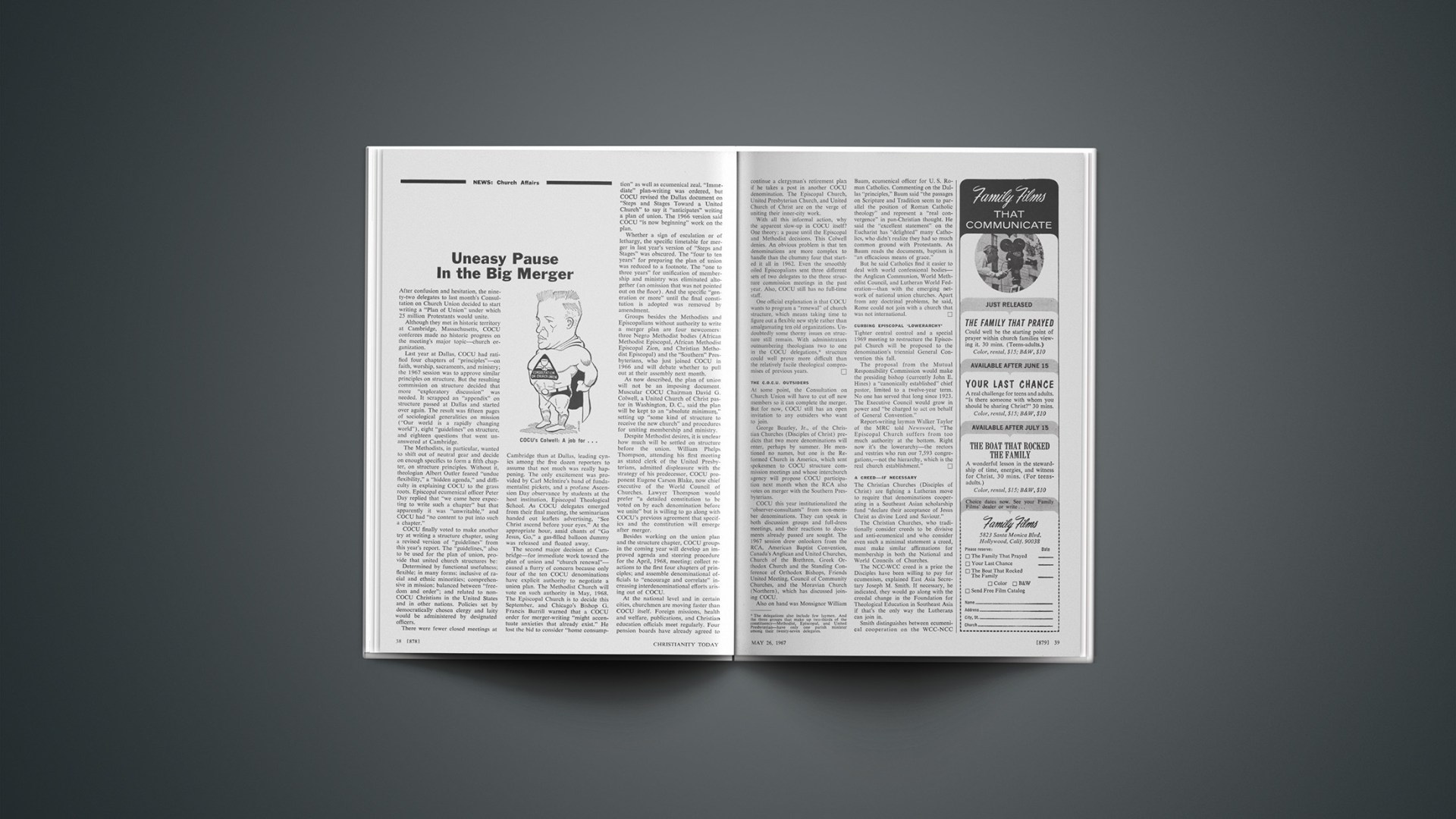
Uneasy Pause in the Big Merger

After confusion and hesitation, the ninety-two delegates to last month’s Consultation on Church Union decided to start writing a “Plan of Union” under which 25 million Protestants would unite.

Although they met in historic territory at Cambridge, Massachusetts, COCU conferees made no historic progress on the meeting’s major topic—church organization.

Last year at Dallas, COCU had ratified four chapters of “principles”—on faith, worship, sacraments, and ministry; the 1967 session was to approve similar principles on structure. But the resulting commission on structure decided that more “exploratory discussion” was needed. It scrapped an “appendix” on structure passed at Dallas and started over again. The result was fifteen pages of sociological generalities on mission (“Our world is a rapidly changing world”), eight “guidelines” on structure, and eighteen questions that went unanswered at Cambridge.

The Methodists, in particular, wanted to shift out of neutral gear and decide on enough specifics to form a fifth chapter, on structure principles. Without it, theologian Albert Outler feared “undue flexibility,” a “hidden agenda,” and difficulty in explaining COCU to the grass roots. Episcopal ecumenical officer Peter Day replied that “we came here expecting to write such a chapter” but that apparently it was “unwritable,” and COCU had “no content to put into such a chapter.”

COCU finally voted to make another try at writing a structure chapter, using a revised version of “guidelines” from this year’s report. The “guidelines,” also to be used for the plan of union, provide that united church structures be:

Determined by functional usefulness; flexible; in many forms; inclusive of racial and ethnic minorities; comprehensive in mission; balanced between “freedom and order”; and related to non-COCU Christians in the United States and in other nations. Policies set by democratically chosen clergy and laity would be administered by designated officers.

There were fewer closed meetings at Cambridge than at Dallas, leading cynics among the five dozen reporters to assume that not much was really happening. The only excitement was provided by Carl McIntire’s band of fundamentalist pickets, and a profane Ascension Day observance by students at the host institution, Episcopal Theological School. As COCU delegates emerged from their final meeting, the seminarians handed out leaflets advertising, “See Christ ascend before your eyes.” At the appropriate hour, amid chants of “Go Jesus, Go,” a gas-filled balloon dummy was released and floated away.

The second major decision at Cambridge—for immediate work toward the plan of union and “church renewal”—caused a flurry of concern because only four of the ten COCU denominations have explicit authority to negotiate a union plan. The Methodist Church will vote on such authority in May, 1968. The Episcopal Church is to decide this September, and Chicago’s Bishop G. Francis Burrill warned that a COCU order for merger-writing “might accentuate anxieties that already exist.” He lost the bid to consider “home consumption” as well as ecumenical zeal. “Immediate” plan-writing was ordered, but COCU revised the Dallas document on “Steps and Stages Toward a United Church” to say it “anticipates” writing a plan of union. The 1966 version said COCU “is now beginning” work on the plan.

Whether a sign of escalation or of lethargy, the specific timetable for merger in last year’s version of “Steps and Stages” was obscured. The “four to ten years” for preparing the plan of union was reduced to a footnote. The “one to three years” for unification of membership and ministry was eliminated altogether (an omission that was not pointed out on the floor). And the specific “generation or more” until the final constitution is adopted was removed by amendment.

Groups besides the Methodists and Episcopalians without authority to write a merger plan are four newcomers: three Negro Methodist bodies (African Methodist Episcopal, African Methodist Episcopal Zion, and Christian Methodist Episcopal) and the “Southern” Presbyterians, who just joined COCU in 1966 and will debate whether to pull out at their assembly next month.

As now described, the plan of union will not be an imposing document. Muscular COCU Chairman David G. Colwell, a United Church of Christ pastor in Washington, D. C., said the plan will be kept to an “absolute minimum,” setting up “some kind of structure to receive the new church” and procedures for uniting membership and ministry.

Despite Methodist desires, it is unclear how much will be settled on structure before the union. William Phelps Thompson, attending his first meeting as stated clerk of the United Presbyterians, admitted displeasure with the strategy of his predecessor, COCU proponent Eugene Carson Blake, now chief executive of the World Council of Churches. Lawyer Thompson would prefer “a detailed constitution to be voted on by each denomination before we unite” but is willing to go along with COCU’s previous agreement that specifics and the constitution will emerge after merger.

Besides working on the union plan and the structure chapter, COCU groups in the coming year will develop an improved agenda and steering procedure for the April, 1968, meeting; collect reactions to the first four chapters of principles; and assemble denominational officials to “encourage and correlate” increasing interdenominational efforts arising out of COCU.

At the national level and in certain cities, churchmen are moving faster than COCU itself. Foreign missions, health and welfare, publications, and Christian education officials meet regularly. Four pension boards have already agreed to continue a clergyman’s retirement plan if he takes a post in another COCU denomination. The Episcopal Church, United Presbyterian Church, and United Church of Christ are on the verge of uniting their inner-city work.

With all this informal action, why the apparent slow-up in COCU itself? One theory: a pause until the Episcopal and Methodist decisions. This Colwell denies. An obvious problem is that ten denominations are more complex to handle than the chummy four that started it all in 1962. Even the smoothly oiled Episcopalians sent three different sets of two delegates to the three structure commission meetings in the past year. Also, COCU still has no full-time staff.

One official explanation is that COCU wants to program a “renewal” of church structure, which means taking time to figure out a flexible new style rather than amalgamating ten old organizations. Undoubtedly some thorny issues on structure still remain. With administrators outnumbering theologians two to one in the COCU delegations,1The delegations also include few laymen. And the three groups that make up two-thirds of the constituency—Methodist, Episcopal, and United Presbyterian—have only one parish minister among their twenty-seven delegates. structure could well prove more difficult than the relatively facile theological compromises of previous years.

The C.O.C.U. Outsiders

At some point, the Consultation on Church Union will have to cut off new members so it can complete the merger. But for now, COCU still has an open invitation to any outsiders who want to join.

George Beazley, Jr., of the Christian Churches (Disciples of Christ) predicts that two more denominations will enter, perhaps by summer. He mentioned no names, but one is the Reformed Church in America, which sent spokesmen to COCU structure commission meetings and whose interchurch agency will propose COCU participation next month when the RCA also votes on merger with the Southern Presbyterians.

COCU this year institutionalized the “observer-consultants” from non-member denominations. They can speak in both discussion groups and full-dress meetings, and their reactions to documents already passed are sought. The 1967 session drew onlookers from the RCA, American Baptist Convention, Canada’s Anglican and United Churches, Church of the Brethren, Greek Orthodox Church and the Standing Conference of Orthodox Bishops, Friends United Meeting, Council of Community Churches, and the Moravian Church (Northern), which has discussed joining COCU.

Also on hand was Monsignor William Baum, ecumenical officer for U. S. Roman Catholics. Commenting on the Dallas “principles,” Baum said “the passages on Scripture and Tradition seem to parallel the position of Roman Catholic theology” and represent a “real convergence” in pan-Christian thought. He said the “excellent statement” on the Eucharist has “delighted” many Catholics, who didn’t realize they had so much common ground with Protestants. As Baum reads the documents, baptism is “an efficacious means of grace.”

But he said Catholics find it easier to deal with world confessional bodies—the Anglican Communion, World Methodist Council, and Lutheran World Federation—than with the emerging network of national union churches. Apart from any doctrinal problems, he said, Rome could not join with a church that was not international.

Curbing Episcopal ‘Lowerarchy’

Tighter central control and a special 1969 meeting to restructure the Episcopal Church will be proposed to the denomination’s triennial General Convention this fall.

The proposal from the Mutual Responsibility Commission would make the presiding bishop (currently John E. Hines) a “canonically established” chief pastor, limited to a twelve-year term. No one has served that long since 1923. The Executive Council would grow in power and “be charged to act on behalf of General Convention.”

Report-writing layman Walker Taylor of the MRC told Newsweek, “The Episcopal Church suffers from too much authority at the bottom. Right now it’s the lowerarchy—the rectors and vestries who run our 7,593 congregations,—not the hierarchy, which is the real church establishment.”

A Creed—If Necessary

The Christian Churches (Disciples of Christ) are fighting a Lutheran move to require that denominations cooperating in a Southeast Asian scholarship fund “declare their acceptance of Jesus Christ as divine Lord and Saviour.”

The Christian Churches, who traditionally consider creeds to be divisive and anti-ecumenical and who consider even such a minimal statement a creed, must make similar affirmations for membership in both the National and World Councils of Churches.

The NCC-WCC creed is a price the Disciples have been willing to pay for ecumenism, explained East Asia Secretary Joseph M. Smith. If necessary, he indicated, they would go along with the creedal change in the Foundation for Theological Education in Southeast Asia if that’s the only way the Lutherans can join in.

Smith distinguishes between ecumenical cooperation on the WCC-NCC model and creeds for the Church as such. Thus, Disciples have lobbied against specific belief demands in the Consultation on Church Union, with some success. Recognition of creeds is all right, in Smith’s opinion, but not requirement of them.

He sees some softening of the Disciples’ anti-creed stand because in other denominations, creeds are “no longer used in the literalistic, absolutist way, or as a test. They are used confessionally—the way in which at this time we express our common faith.”

Tongues At Notre Dame

The charismatic movement within the Roman Catholic Church has spread to Notre Dame University. The prayer meetings, including healing services and speaking in tongues, were revealed last month in two campus journals, Scholastic and Observer, and given broader exposure by National Catholic Reporter.

The movement came to South Bend from Duquesne University, Pittsburgh, and one recent weekend of prayer meetings at Notre Dame drew forty students from Michigan State University. Three bishops reportedly know about the movement and have no objections.

Father Jerome Wilson, Notre Dame’s vice-president for business affairs, has attended the past five sessions but has not spoken in tongues himself or been able to interpret those who did. Apparent leader of the local movement is Kevin Ranaghan, a graduate student in theology who teaches at nearby St. Mary’s women’s college. Sources said Father Edward O’Connor, a theology teacher, is active in the group, and other priests and teachers have attended.

Says Wilson, “Through the laying on of hands, the Holy Spirit seems to manifest itself with love. And some of the boys seem to have had a genuine gift of tongues.”

Wilson said the meetings have been criticized as too emotional and too traditionalist because they inspire “greater love for the Mass, the Blessed Sacrament, the Rosary—everything that was so much a part of the Church before things started to change.”

Canadian Merger: Rocky Voyage

When the joint union commission of Canada’s Anglican and United churches held its first meeting recently, a “smooth, pleasant, unrushed voyage” toward merger was predicted, even though it may take twenty years to reach the distant shore.

That long voyage, however, may prove to be anything but smooth and pleasant. This month, Canadian Churchman, the Anglican paper, regretted that the commission delegation includes “no member who can be considered an authentic representative of those Anglicans who generally fear and oppose” union. The editorial coincided with the announcement that Churchman Editor A. Gordon Baker will resign and return to the parish ministry.

The United Church Observer, recognizing the absence of loyal opposition, took an iconoclastic view of the unity session: “A discouraging word was not heard, and the skies remained uncloudy all day.” Only those afflicted with ecumenical blindness could fail to see the problems ahead.

Lacking an outlet within the union commission, Anglican opponents are forming such groups as “The Council for the Defense of the Faith.” This ad hoc group from five Ontario dioceses is headed by D. C. Masters, history professor at the University of Guelph, and C. J. de Catanzaro, former professor of Hebrew at Trinity College, Toronto.

The council says that the “Principles of Union” passed by both denominations as the basis for merger are “theologically insufficient, particularly in that they do not commit the proposed ‘new embodiment’ to the faith of the creeds and the councils as binding and authoritative for all its members.”

A declaration sent out for signatures to all clergy and lay members of the Anglican Church will be forwarded to church authorities. The document expresses concern over the increasing apathy toward doctrine, discipline, and worship as spelled out in the Prayer Book; man-centered worship; and attacks on basic doctrines by church officials. The declaration also renounces the “new theology” and the “new morality” as heretical. It holds to the inspiration of Scripture; the creeds as binding on clergy and laity; the Thirty-Nine Articles of Religion; and a threefold apostolic ministry of bishops, priests, and deacons, with emphasis on the priesthood of the laity.

Two strong elements within the Anglican Church are now coming into open opposition. One is the Anglo-Catholics, who feel closer to Rome with its emphasis on the creeds, sacraments, and apostolic succession and want no part of the radical humanistic theology surfacing in the United Church. The second group, the evangelical Anglicans, are drawn into the fray for different reasons. They are on the increase within their denomination, but they feel that a giant merger would substantially muffle their voice and thwart their plans for evangelism.

The Pope And Portugal

No political motive should be attached to Pope Paul’s going to the Fatima shrine, according to Msgr. Fausto Vallainc, Vatican press officer. Newsmen asked Vallainc on the eve of the pontiff’s departure for Portugal whether the trip might have adverse effects in Africa (Portugal is the only European nation that still maintains extensive colonies in Africa). The press officer said newspaper reports that saw in the trip any purpose beyond the promotion of peace were “distorting” the Pope’s intentions. He denied that the journey is intended to indicate approval of any political regime or to pacify persons who are discontented with Paul’s recent encyclical on economic and social concerns.

The Canadian Anglican Evangelical Fellowship, formed in 1961, now has nearly 400 members and is headed by Archdeacon Desmond Hunt of Kingston, Ontario. Hunt says that evangelicals are always ready to go into union on the basis of cooperation but that “we are worried about with whom we are uniting. Union with the Presbyterians would be easier.”

In Western Canada, Rev. M. A. E. Hardman, of Winnipeg, editor of the Communicator, a journal dedicated to scuttling union, says the “Principles of Union” are impossible. Hardman thinks that “union with the Roman Catholics would be much easier.”

No organized opposition is evidenced within the United Church, but there are rumblings. Former Moderator James R. Mutchmor objects strongly to episcopal government, and he is supported by others who would like to see a federation of churches. Many liberals in the United Church want a modified form of the episcopate that would give bishops less authority. They do not want to be tied to the creeds or to the Prayer Book, which dominates worship in the Anglican Church.

Evangelicals in the United Church have a closer relation with the Anglican evangelicals than with the liberals in their own church and are now organizing on a basis like that of the Anglican Fellowship. The United Church Renewal Fellowship will probably not oppose union with the Anglicans. Many feel that union would impede radical theology and strengthen their own foundations of biblical authority. One fear exists: that the final draft on union may place a heavy accent on liturgies and the traditional episcopacy, which would bring both churches closer to Rome. Principal Leslie Hunt of Wycliffe College, chairman of the evangelism committee of the Canadian Council of Churches, feels that a purge is coming in both churches in the wake of radical theology and that evangelicals will have to stand firm and identify themselves. On union, Hunt said that “theologically, there is nothing much to come and go on today because in the United Church it seems that you are at liberty to believe anything.”

The U.S. Consultation on Church Union (see page 38) looks longingly at the Canadian churches, whose entry would strengthen and internationalize their merger effort. But the Canadians’ own two-way troubles are likely to prevent further ecumenical adventures.

J. BERKLEY REYNOLDS

West Indies: Ecumenical Seminary

After three strikes by construction workers, the ten-denomination United Theological College of the West Indies finally dedicated a $620,000 headquarters last month. The seven-acre campus in Kingston, Jamaica, overlooks a river and is adjacent to the large University of the West Indies.

In the dedicatory sermon, Overseas Secretary E. H. Johnson of the Canadian Presbyterians said, “I cannot think of any group that brings together as wide a range of denominations and regional backgrounds.”

Seminary President Wilfred Scopes, who served thirty-five years in India with the London Missionary Society, says the ecumenical movement has “bypassed” the West Indies but has been speeded up by political independence in the islands. He hopes his school will further the process.

The seminary is an amalgamation of Jamaica’s St. Peter’s Theological College (Anglican), Calabar Theological College (Baptist), and Union Theological Seminary (itself a merger from seven denominations). In close cooperation is Codrington College on Barbados, which maintains quaint traditions and excellent academic standards.

The United Theological College has twelve teachers and fifty-eight students (including twenty-one Methodists and fourteen Baptists). The theological stance is quite inclusive. Although the cooperating groups reserve the right to teach denominational distinctives, only Baptists and Anglicans are holding additional classes, and very few of them.

Scopes holds that “it is important to see salvation in three ways”: personal conversion to Christ, conversion to the Church, and witness to the world. Overemphasis on any one creates “a distorted and unbalanced Gospel,” he says.

Evangelical leaders do not appear to be warming up to the idea of the new seminary. One commented, “All the churches will never be united. If the formal churches join, then I foresee that some of the other churches may get together as a counter-move, and some others may even become more exclusive than before.”

Another evangelical said the denominations are not usually interested in mass evangelism. But efforts in that direction by such North American visitors as Leighton Ford and Tom Skinner have done much to spur broad cooperation among grass-roots churches that maintain separatist attitudes.

BILLY HALL

Book Briefs: May 26, 1967

A New Man-Centered Era?

The God Question and Modern Man, by Hans Urs von Balthasar, translated by Hilda Graef (Seabury, 1967, 155 pp., $1.95, paper), and America and the Future of Theology, edited by William A. Beardsley (Westminster, 1967, 206 pp., $2.25, paper), are reviewed by Milton D. Hunnex, professor of philosophy, Williamette University, Salem, Oregon.

If what these two books say is true, theology either has no future or will flower as the form of the new man-centered era into which we are emerging. The authors of both books take as a fact the passing of what von Balthasar speaks of as the cosmological era wherein men experienced nature as a “sheltering whole” in which “God’s nearness had been felt … in the whole visible cosmos which on its borders merged almost without break into the invisible sphere of the divine. This is no longer so either emotionally or intellectually.”

Von Balthasar believes that the “frightening silence” of God is forcing men into a more adequate understanding of his transcendence. Whereas before men saw themselves as mirrors of the cosmos, now they see the cosmos as extensions of themselves and their own responsibility. Indeed, it is one’s openness to both his own and God’s transcendence that makes him a spirit.

Man’s coming of age has given rise to “a growing vagueness and transcendence of the concept of God [that] may be but a symptom indicating that this concept itself is growing among men.” “God, man, and the world must lose something of their intelligibility,” von Balthasar writes, but “man is not less religious.”

Like Altizer, von Balthasar is optimistic about the disappearance of the old familiar God. But whereas Altizer sees God’s disappearance as a new epiphany of the Word, Balthasar reads the same evidence to mean the emergence of a deeper understanding of God. This deeper understanding is the understanding that emerges from the love of a “brother with a love that comes from a higher source” than one’s own finite capacity to love. Hence “it is impossible to leave out the social aspect from the most intimate religious decision of the individual.”

Von Balthasar tries to find the triumph of a transcendent God in the current secular consciousness. His problem is that he wants to preserve a transcendent God and a transcending man in spite of secularization. His effort is profoundly irenic, but it is hardly capable of stemming the tide of secular indifference to a transcendent God reflected by some of the writers of the Beardsley volume.

This other book comprises a series of conference papers presented at Emory University in November, 1965. Professor Altizer’s essay heads the list. For him theology must be entirely reconstructed in order to become relevant. He reiterates his familiar conviction that “only the death of God can make possible the advent of a new Humanity.” Interestingly, he says that “America is symbolically and perhaps literally the place” in which this must take place. His apocalyptic exuberance evokes a rebuke from Rabbi Rubenstein, who wisely notes that anguish and despair is the outcome of the death of God. Rubenstein hopes, however, that “America can accept the death of God,” but counsels that “if you become post-Christian, choose pagan hopelessness rather than [Altizer’s] false illusions of apocalyptic hope.”

There is some real merit in the essays dealing with religious language; but there are also some technical inadequacies. Bishop Johnson properly cautions that when the Christian apologist tries to translate Christian terms into non-Christian terms “he does not translate; he loses the Christian faith … [and] may end up substituting an alien system for the gospel.” Ferré also warns against the “reckless” use of linguistic philosophy by theologians like van Buren, whose use of it “is almost unrecognizably different from the use made of it by the linguistic philosophers he purports to be following.”

The book deals with a wide range of topics and proposals, but the balance in points of view leaves something to be desired. If it does identify the future of theology in America, then it can only be said that the gap between what biblical Christians think Christianity is and what theologians or professors of religion are trying to make it into will become even wider than it is today.

Confronting Non-Christian Religions

The Church Between Temple and Mosque, by J. H. Bavinck (Eerdmans, 1966, 206 pp., paper, $2.65), is reviewed by Anthony A. Hoekema, professor of systematic theology, Calvin Theological Seminary, Grand Rapids, Michigan.

The subtitle expresses the purpose of this book: “A Study of the Relationship Between the Christian Faith and Other Religions.” In view of the current resurgence of Islam, Hinduism, and Buddhism, this is a timely study.

Professor Bavinck, who had occupied the chair of missions at the Free University of Amsterdam for more than twenty-five years at the time of his death in 1965, faces the issue squarely. While granting that the Christian faith has certain things in common with the great world religions, he insists on its uniqueness.

How, then, must the Church confront the non-Christian religions? Is dialogue possible? Yes, since these religions all deal with certain basic questions every man must face, whoever he may be. To understand a world religion, we must know what answer it gives to these five questions: (1) How am I related to the cosmos? (2) What is my relation to the religious norm that is supposed to regulate my behavior? (3) How am I related to the tension that exists in my life between those areas in which I am passive and those areas in which I am active—am I simply a piece of wood drifting downstream, or do I have a real personal responsibility? (4) From what do I need to be redeemed, and how am I redeemed? (5) How must I think about the Supreme Power behind the universe, and how am I related to him, her, or it?

In Part I Bavinck describes, with many fascinating details, how the great world religions answer these questions. And in Part II he goes on to show how the Christian religion answers them. It becomes quite clear that, since the Christian answer is based on God’s Word as revealed in Scripture, it is the final answer. But when one sees the Christian answer against the background of the non-Christian religions, one sees it in a new light. For example, after pointing out that the non-Christian religions vacillate between thinking of God as a person and thinking of him as an impersonal force, Bavinck shows that, though the Bible calls God personal and reveals him as addressing us in personal encounter, the term person is not really an adequate but only an analogous designation for God. God’s personality far transcends human personality.

Bavinck also discusses the implications of Romans 1 for our evaluation of the non-Christian religions. Although man can know God apart from the Bible, he suppresses this knowledge. The non-Christian refashioning of God in his own image must be seen as the cropping up of this suppressed truth about God in new forms. When the missionary speaks to a Buddhist or Hindu, therefore, God is not addressing this man for the first time. Rather, the God who has previously revealed his everlasting power and divinity to this man (Rom. 1:20) is now addressing him in a new way, through the words of the missionary. There is, therefore, always a point of contact.

The Church, situated as it is between temple and mosque, must witness to God’s truth courageously and humbly—courageously, because it will encounter much opposition; humbly, because it must confess its own sins. It can witness without pride to non-Christians only when it realizes that it, too, has often been guilty of repressing God’s truth.

This book is a must for every evangelical missionary. In fact, any Christian, with or without theological training, can read it with profit. Not only does it help one understand the non-Christian religions; it also throws surprising new light on the uniqueness of Christianity.

Love + Liberty – Law=?

Moral Responsibility: Situation Ethics at Work, by Joseph Fletcher (Westminster, 1967, 256 pp., $1.95, paperback), is reviewed by Arthur F. Holmes, director of philosophy, Wheaton College, Wheaton, Illinois.

This book gathers together a number of essays, mostly written for specific occasions and published from 1959 on, with a final summary chapter on the notion of moral responsibility. The essays tend therefore to be somewhat repetitive and in large part to duplicate what Fletcher said in Situation Ethics (1966) and Morals and Medicine (1954).

Reading for Perspective

CHRISTIANITY TODAY’S REVIEW EDITORS CALL ATTENTION TO THESE NEW TITLES:

Evangelicals at the Brink of Crisis, by Carl F. H. Henry (Word, $1.75). A hard-hitting overview, in the aftermath of the World Congress on Evangelism, of pressing concerns in theology, evangelism, social action, and ecumenism.

One Race, One Gospel, One Task, Volume I, edited by Carl F. H. Henry and W. Stanley Mooneyham (World Wide, $4.95). Major addresses, Bible studies, and reports from the World Congress on Evangelism communicate the spiritual vitality and urgent message of the meetings.

The New Immorality, by David A. Redding (Revell, $3.50). A lively consideration of biblical morality viewed against the backdrop of situation ethics and the varied moral decisions that confront men today.

Certain familiar themes come through clearly: (1) We need a morality that mediates between legalism and antinomianism (whether that of the atheistic existentialist or the Christian extemporizer). (2) This new morality must be relativistic, for there is no prior standard of judgment, no eternal biblical law. (3) The only moral law is that of love between persons. To these familiar themes we may now make two additions: (4) Love and justice are neither antithetical, nor disjunctive, nor mutually complementary; they are one and the same thing. (5) Love implies responsibility, the key to which is the idea of response to others, to persons in situations.

With theme (1) we can heartily concur. It is demanded both by a biblical ethic and by the changes in traditional morality brought about by modern technology and by our depersonalized society. And it should hardly need saying that situation ethics (or the new morality) and Playboy antinomianism are radically different viewpoints. Our complaint is rather that themes (2) through (5) present a misconceived middle ground: love is defined in terms of personalistic existentialism rather than with reference to moral law, as in the New Testament (for instance, John 15:9–14; Rom. 13:8–10). Fletcher accordingly fails to see that the biblical alternative to legalism (law without love or liberty) is not situationism (love and liberty without law) but a biblical personalism that unites love with law as well as with liberty, giving content to love and guarantees to liberty. Without such content and guarantees, Fletcher is right in saying that love is relativistic and the meaning of responsibility is confined to the particular moral situation.

Eight of the fourteen chapters are situation-oriented: four on sex, one on euthanasia, three on the morality of business, wealth, and stewardship. It is not enough to pass these chapters up as vitiated by the moral theory in use. The evangelical must bring his own ethic to bear on the same agonizing problems; it may turn out that situational considerations weigh more heavily than the legalists among us would like to admit. If moral decision includes prudential judgments at all, so that not everything is black or white, Fletcher may have something valuable to teach us.

A Newsman’S View Of The Bible

Your Bible, by Louis Cassels (Doubleday, 1967, 267 pp., $4.95), is reviewed by John H. Kromminga, president, Calvin Theological Seminary, Grand Rapids, Michigan.

Louis Cassels is widely known as a newspaper writer on religion. This book is written against the background of a thorough acquaintance with the Bible and a love for it that is frankly expressed and clearly evident. It is intended as a Bible-reading aid “for people who want to get acquainted with the Bible and who are starting from scratch.” The objective is certainly worthwhile, and good elements are plentiful. The basic reading plan appears sound. The frank admiration of the literary and dramatic features of the Bible comes as a fresh breeze. Supercilious Bible critics are stoutly opposed, and the reality of the Resurrection is as stoutly defended.

But for all its good points, the book has one outstanding weakness, which appears early and never quite disappears. The underlying view of Scripture is much too low. Admittedly, one would have to present a simplified version of the theological questions surrounding the Scriptures in a book such as this; but this particular simplified version comes out at the wrong place. In warning the reader against the extremes of literalism, the author comes up with a description of a literalist that is inaccurate and inadequate. At times the literalist looks like someone whom most conservatives themselves would repudiate. At other times, he looks like anyone who really believes God spoke.

Only a few of the instances of this pervasive weakness need be cited. Cassels says that Jesus was not a biblical literalist, because he did not hesitate to attach greater value to some portions of the Old Testament than to others. But who today would disagree? Again, he suggests that the reader may find it helpful to attribute to John any statement in the Fourth Gospel that seems to be attributed to Jesus but that sounds arrogant, harsh, or judgmental. This is do-it-yourself criticism of the first order. The general approach to the Old Testament may be attractive to those who are “starting from scratch,” but it is not calculated to introduce anyone to the progress of revelation in God’s dealings with his people.

Many more items could be mentioned. For instance, Cassels seems to give more credence to the legend that the Queen of Sheba had a son by Solomon than to the story of Solomon’s dream. But why belabor the point? In spite of a fine objective, a good popular style, and adequate literary craftsmanship, the author has succeeded only in introducing an outstanding book. Left in the shadows is the Word of the living God, who spoke by the prophets in the old times and in the latter days by his Son.

Luther Speaks Today

The Theology of Martin Luther, by Paul Althaus, translated by Robert C. Schultz (Fortress, 1966, 464 pp., $8), is reviewed by Ralph A. Bohlmann, assistant professor of systematic theology, Concordia Seminary, St. Louis, Missouri.

Together with its companion volume on Luther’s ethics (now being translated), this lucid study by the venerable Luther scholar of Erlangen is unquestionably the best comprehensive survey of Luther’s basic theology now available. It reflects more than forty years of research, yet is written primarily for the non-specialist, and it will be a standard work for pastors, students, and interested laymen for years to come. The translation and format of this first English edition are superb.

Althaus presents Luther’s thought on twenty-eight topics, beginning with the authority of Scripture and ending with eschatology. Since he intends to let Luther speak for himself, his own analysis of Luther’s thought is augmented in both notes and text by copious citation of Luther’s writings (all citations have been translated and cross-referenced with available English translations). Accordingly, he does not as a general rule discuss secondary treatments of Luther’s theology nor trace its historical development.

To analyze the theology of Luther in this way is to run the risk of subjectivity in selection and interpretation. Althaus seeks to overcome this by presenting Luther’s thought, then criticizing it where he feels he must (for example, aspects of Luther’s treatment of the hidden God, Christology, and the Lord’s Supper). Yet many of his interpretations (and criticisms) of Luther are questionable, among them the assertions that Luther regarded the descent to hell as an aspect of Christ’s humiliation and that Luther taught double pre-destination. His treatment of Luther’s doctrine of Holy Scripture, one of the weakest parts of the book, tells us more about Althaus than about Luther. The two-page analysis of Luther’s views of the Trinity is clearly inadequate. On the other hand, Althaus’s exposition of Luther’s thought on faith, the work of Christ, church, ministry, and the sacraments is particularly well done.

Althaus rightly challenges some recent Luther interpretations. He finds that Luther affirms God’s general, but non-salvational, natural self-revelation (vs. Barthians). In his view of the Atonement, Luther decisively follows the “Latin” line (vs. Aulén), though he frequently uses “classical” concepts. For Luther, God’s justification of the sinner is based on Christ’s work of reconciliation, not on man’s future ethical righteousness (vs. Holl). Although he doesn’t use the terminology, Luther clearly teaches the “third use” of the Law as a guide for Christian living (vs. Elert and others).

In spite of its flaws, this volume shows how Luther’s central concern with the Gospel permeates every aspect of his theology. This is its great strength. Althaus helps Luther speak as relevantly today as he did 450 years ago.

The Key To Anabaptism

Anabaptist Baptism, by Rollin Stely Armour (Herald, 1966, 214 pp., $6.75), is reviewed by William Nigel Kerr, professor of church history, Gordon Divinity School, Wenham, Massachusetts.

Scholars of Anabaptistica have consistently bypassed the doctrine and practice of the ordinance of baptism in their search for the essense of the movement. Now Rollin S. Armour, professor of religion at Stetson University, provides an in-depth treatment of this significant doctrine in its historical setting.

Methodologically the study is representative. Armour enters the complex, interlocking segments of Anabaptism through selected persons. The variety and yet unity of the Anabaptist thinking on baptism is examined in the words and letters of Balthasar Hübmaier, a former priest and theologian trained by Johann Eck of Ingolstadt; Hans Hut, bookbinder and chiliast turned mystic; Melchior Hoffmann, furrier by trade and prophet involved with millenarian expectations; and Pilgram Marpeck, entrepreneur, inventor, and lay theologian. Thomas Münzer and Hans Denck are dealt with in chapter 2 as preparation for Hans Hut’s baptismal theology, chapter 3. The author avoids indulging in the fascinating biographies of these persons and gives only the data that pertains to doctrinal matters.

One is tempted to ask why he treats these figures and not others who occupy a more central position in the Anabaptist movement. John S. Oyer raises this question in his preface to the book but concludes, “Armour fits each man’s thought into the larger Anabaptist picture so persuasively that the necessity for their inclusion is beyond question.” This is so; but others—or perhaps the author himself—will want to interpret Grebel’s letter to Münzer of 1527, the 1524 “Protest of the Zürich Council,” the “Schleitheim Confession” of 1527 (Article I), Menno Simons’s Works (II, 201 ff.), and Riedemann’s Rechenschaft of 1524 against this background.

Armour holds that the “key to Anabaptism” is the doctrine of regeneration and that this is best understood in its seeming external simplicity and best interpreted latitudinally in the ordinance of baptism. He writes, “Every facet of their life and faith from conversion to resurrection and from Christian life to eschatology was bound together in a unity that could be encompassed metaphorically under the rubric of ‘baptism.’ ”

To the simple “biblical Anabaptist,” the ordinance meant a pledge to discipleship in the light of the Cross of Christ. It was the commencement of “cross-bearing” carried out as instructed in a martyr-theology. Among the theorists, outside Hübmaier, one finds a strange weaving of biblical themes, medieval mystical practice, and Joachim-like eschatology into a pattern in which baptism is the dominant motif. It is even presumptuous, perhaps, to speak here of a system of doctrine, for the sources are not organized into a system. Yet certain ideas recur with frequency and force, and it is these that Armour gathers and presents in a comprehensive and manageable form. The church historian is deeply indebted to this author for his careful labors.

The book is multiply indexed and has a useful bibliography. Its pleasant style bears a compactness of thesis form that will commend the work to the scholarly community. It is the Brewer Prize Essay of the American Society of Church History and is published as #1 in “Studies in Anabaptist and Mennonite History.”

Supersynthesis Of An Evangelist

King Windom, by John Farris (Trident, 1967, 635 pp., $6.95), is reviewed by Ella Erway, assistant professor of drama and speech, Ithaca College, Ithaca, New York.

Is the evangelist charlatan or saint? Novels depicting evangelists have generally made their central character, like Sinclair Lewis’s Elmer Gantry, a salesman of religion. John Farris’s King Windom is the latest work of fiction dealing with the career of an evangelist. Windom is a carnival barker, spiritualist medium, master of publicity, subject of medical analysis, and recipient of the vision of God. While Sinclair Lewis created a forceful and believable Elmer Gantry as the caricature of the con man, Farris makes Windom a supersynthesis of evangelists but does not succeed in bringing his character into focus.

Farris delights in relating incidents rather than exploring the personality of King Windom in the setting of Southern revival psychology. A novel may communicate theme through plot or setting, but the fascination of evangelism is the preacher himself. King Windom is a superman who never sleeps. He speaks with instinctive oratory and communicates with God on a mystic level. The advances of women and prospects of wealth do not deter him from his vision. In his tall, rugged appearance he is a composite of contemporary evangelists. The reader may be caught in the fast pace of events but gains no insight. The distortion of Windom destroys the illusion of reality.

The author has successful moments as the novel’s suspense builds. He does not fear to have his hero touch whiskey, though it may offend the church librarian. The illusion of sensual scenes is achieved without explicit detail, and good does not conquer all evil. The parallels between the carnival and tent meeting are reflected in the small Southern town’s reaction to them. One character depicts the horror of religious calling distorted to theft, murder, and sadism. The evangelist charters a train that becomes a symbolic and mythical message of the Gospel—a splendid fictional example of Marshall McLuhan’s theories of communication. Unfortunately, these assets are obscured by lack of unity in the central character.

The skill of the writer is uneven. Scenes in Southern towns are solid wood and stone, but the “Gospel train” is a movie set. The portrayals of thinly disguised contemporary evangelists are amateurish. Transitions between incidents are awkward. The style is fluent but lacks condensation. Minor characters become more alive than King Windom.

Farris has a sympathetic tone for the evangelist but asks questions without providing answers. The mysticism of King Windom lacks meaning. A clear focus could have made him the medium of a message.

A Serviceable Old Testament Survey

An Historical Survey of the Old Testament, by Eugene H. Merrill (Craig, 1966, 343 pp., $4.50, paperback), is reviewed by Gleason L. Archer, chairman, Division of Old Testament, Trinity Evangelical Divinity School, Deerfield, Illinois.

After earning three degrees from Bob Jones University, the author of this manual of Old Testament history went on to do graduate work at Michigan State, Columbia University, and New York University. That his commitment to the historic Christian faith and the reliability of Holy Scripture has remained firm is obvious in his treatment of liberal views on the higher criticism of the Old Testament. He shows a real command of the literature in the field, abundantly citing both conservative and liberal authors in his footnotes. Yet the main purpose of this work is to summarize the historical narratives of the entire Old Testament, including the biographies of the patriarchs in Genesis as well as the adventures of prophets like Elijah and Elisha in First and Second Kings. In general Merrill adheres very closely to the biblical account, though he tends to abridge and summarize in the later stages of Israelite history, especially during the Divided Monarchy. Most of the book, then, is a faithful retelling of the biblical narratives.

From time to time Merrill introduces illuminating information from recent archaeological discovery. And occasionally he discusses the competing views of rationalistic scholars, without ever making concessions that discredit biblical veracity. Thus he comes out very clearly for the 1445 B.C. date for the Exodus, on the basis of First Kings 6:1 and Judges 11:26; he even maintains Solomonic authorship of Ecclesiastes as a live option.

Only in the matter of the chronology of Ahaz and Hezekiah does the author depart from a strict adherence to the biblical data; even though Second Kings 18:9, 10 states that the siege of Samaria began in the fourth year of Hezekiah and was completed in his sixth year (722 B.C.), Merrill delays the start of Hezekiah’s reign until 715. This in turn leads him to adopt the theory of a second invasion of Judah by Sennacherib and a termination of Hezekiah’s reign in 686 with the unlikely consequence that his degenerate, renegade son Manasseh, despite his idolatrous tendencies, shared the throne with Hezekiah for ten years.

On the whole, Merrill adheres quite strictly to the mainstream of conservative opinion in matters of chronology and authorship. His discussion of prophetism and of the various writing prophets is good, in view of the limitations of space. In dealing with the five poetical books, he pays particular attention to Job and the Song of Solomon. He summarizes the contents and message of all thirty-nine books of the Hebrew Scriptures, even including the intricacies of the sacrificial system and the Tabernacle of the Mosaic Law.

If I were asked to make suggestions for a second edition of this book, I would encourage the author to go over his text again very carefully to eliminate minor inaccuracies (such as the statement on page 102 that Hatshepsut herself married her stepson, Thutmose III; actually it was her daughter who married him), typographical errors, and colloquialisms. Some statements are obviously the result of inadvertence, such as the report that Pharaoh’s baker was “decapitated and hanged” (p. 90) in accordance with Joseph’s dream. The interpretation of Joseph’s motivation in delaying his self-disclosure to his brethren (p. 91) seems to overlook Joseph’s apparent desire to awaken in them a sincere repentance for their past sin before he as their longlost brother, welcomed them. But apart from such minor matters as these, we have here a very serviceable text for use in college or Bible institute courses in biblical literature.

Book Briefs

A History of the Geneva Bible, Volume I: The Quarrel, by Lewis Lupton (Fauconberg Press, 1966, 120 pp., one guinea). Students of church history will value this little volume both for its intimate rehearsal of religious disputations in Britain, 1554–1560, and its Old English style of art work.

Church, State and the American Indians, by R. Pierce Beaver (Concordia, 1966, 230 pp., $6.75). Two and a half centuries of missionary efforts to make Indians into Christian, “white” Americans and rid them of their “Indianness.”

An Invitation to Hope, by Pope John XXIII, translated and arranged by John Gregory Clancy (Simon and Schuster, 1967, 143 pp., $3.95). The kindness and humility of the ecumenical pope shine forth in this “spiritual autobiography.”

The Child’s Story Bible, by Catherine F. Vos, revised by Marianne Catherine Vos Radius (Eerdmans, 1966, 436 pp., $6.50). The daughter of the author has spruced up the language and content of this old favorite for the child of today. Scores of new and appealing pictures.

Paperbacks

Marburg Revisited: A Reexamination of Lutheran and Reformed Traditions, edited by Paul C. Empie and James I. McCord (Augsburg, 1967, 193 pp., $1.75). Papers from the consultation of Lutheran and Presbyterian Reformed theologians that assert that no theological barriers remain to prevent pulpit and altar fellowship between the two traditions.

New Testament Word Lists, compiled and edited by Clinton D. Morrison and David H. Barnes (Eerdmans, 1966, 125 pp., $2.95). New Testament Greek–English word lists arranged in order by book and chapter to facilitate rapid reading of the Greek text.

The Crucified Answer, by Olov Hartman, translated by Gene L. Lund (Fortress, 1967, 201 pp., $1.95). Twenty-seven meditations by the talented Swede better known for his plays and novels.

The Minister’s Workshop: How to Light up a Sermon

A good illustration can drive away the shadows that may obscure a truth

Someone has said that “a sermon without illustrations is like a house without windows.” And that in itself is a good illustration, for the word illustrate is taken from the Latin word illustrare, which means “to light up,” just as a window lights up a house.

The first recorded word of God was, “Let there be light.” The first step in the transformation of chaos into cosmos was the shedding of light. Just so, the wise preacher will give first concern to shedding light on his subject matter by the use of illustrations. The good illustration becomes a shaft of light, giving clarity and force to the message. The preacher can repeat a sermon within a year without the congregation’s detecting it if he uses all new illustrations, for it is the stories used to illustrate truth that the congregation remembers.

An ever-pressing problem for the minister is to have new and apt illustrations for his sermons each Sunday. This is even more important than choosing the theme for the message, for without proper illustration the theme will be neither understood nor remembered.

No one source will supply all the illustrations needed. True, many books of illustrations are available, and they often prove helpful. But secondhand illustrations are never so effective as those that come out of the minister’s own experience and observation.

It is not only the dramatic or unusual experiences that are useful as sermon illustrations. Take for example this experience of my own. When I went away to college, I was given an allowance with which I had to meet my necessary and incidental expenses. Like all boys of college age I was playing Romeo a bit, and when a birthday or Christmas came around, I would buy a present for the current Juliet. Then I went to seminary and met the girl who is now my wife. When the first occasion for gift-giving came, I found myself approaching the situation in a new way. Always before I had met all my necessary expenses and then bought a gift with what was left over. But now I found myself trying to find out what would please her most and buying it without regard to cost. Then I got along on what was left. What made the difference was that I had found the girl I really loved. When we really love God, we try to find what will please him most, and we give it to him and find our supreme joy in doing it.

If we have eyes to see and hearts to feel, we all can see in our own experiences illustrations that will light up deep spiritual truths. A close and penetrating observation of nature can perhaps be the greatest source of illustrations. Surely Jesus turned to natural things for most of his parables. He used salt, light, water, wind and clouds and the flashing lightning, flowers and trees, birds and fish, fruit, and the growing grain to illustrate spiritual truth. Nature is a storehouse of spiritual symbols.

I grew up in the hills of West Virginia, and I well remember the red oak trees that so often grew out on the rocky points. In the fall, when the other trees shed their leaves, the leaves of the oaks would merely turn brown and remain on the trees. The forces of nature would combine during the winter months to try to make the leaves fall, but to no avail. However, with the coming of the warm days of spring, these leaves would loosen, and begin to flutter down to the ground. What the wind, snow, and rain had been unable to do was accomplished by the rising of the sap in those red oak trees. So the Spirit of God can accomplish in our lives what all other powers fail to do. “Not by might, nor by power, but by my spirit, saith the LORD of hosts” (Zech. 4:6b).

The third main source of illustrations for the preacher is his reading. He can find illustrations in everything he reads, from the Bible to the daily paper. Biography is perhaps one of the most fertile fields.

One can, of course, read too much and think too little. However, excessive reading is not a fault that many American pastors have time to acquire. The counsel of Alexander Whyte, the noted Scottish preacher—“Sell your shirt and buy books”—is still good counsel.

Wide reading in search of illustrations will be of little lasting good if the minister does not develop a method of cataloguing and filing his illustrations. A cross-reference file by subject and by text is very helpful.

Perhaps even surpassing the art of finding illustrations is the art of using them. They must never be sprinkled on the sermon like colored candies on a birthday cake. They must enter the sermon naturally and gracefully, rather than being dragged in or added on.

There is a pitfall that the preacher needs to guard against in using illustrations. Because he is continually reading and studying religious writings, he may be inclined to assume that his hearers too are conversant with the Bible and Christian literature. He may say: “You remember Jephthah’s foolish vow to the Lord.” But if over half of his listeners don’t even know who Jephthah is, let alone what the nature and consequences of his vow to the Lord were, the point of a good illustration will be lost.

He should also remember that the authority of a quotation is lost if he does not identify the person quoted. It is hard to realize that we are preaching to a generation for which the names Dwight L. Moody and Charles Haddon Spurgeon have little significance.

We are becoming more and more conscious of our problems in communicating the Gospel to modern man. Well-chosen illustrations can do much to break through these communication barriers.

—DR. M. JACKSON WHITE,

First Baptist Church of Clarendon, Arlington, Virginia.

Then and Now

Comparisons can be invidious. They can also be instructive and profitable. For instance, a comparison of the physician Luke with the physicians of today reveals the tremendous strides made in medicine during the past 2,000 years.

This is no reflection on Luke. I am sure that a man who was such a careful historian was equally conscientious in the practice of his profession. His character was unblemished, and his dedicated personality led the Apostle Paul to speak of him as “Luke the beloved physician.”

But since Luke’s time and particularly in the last few decades, the practice of medicine and surgery has been revolutionized. What is commonplace today would have been unbelievable even a few years ago.

Visiting in one of our great medical centers, I watched a friend, a much younger surgeon, perform what is now a routine operation in many hospitals. He removed most of the abdominal aorta (for a large aneurysm) and the two large arteries leading down through the pelvis, replacing them with a plastic counterpart in and through which a new aorta and branches would develop. The care, precision, and lack of haste of the surgeon and his three assistants bore testimony to their training and skill. And, best of all, the patient made a brilliant recovery.

In another area, that of open-heart surgery, progress is so rapid that the possibility of complete heart replacements is actually being discussed.

As for the new medicines, it is said that 90 per cent of the prescriptions now written by physicians are for medicines not in use even ten years ago.

It is obvious that while the character of Luke the physician has not been improved upon, the practice of medicine and surgery has advanced fantastically. Bodily ailments continue as in Luke’s day, but the means of relief are immeasurably improved.

What about the preaching of Peter and Paul? How does it compare with preaching today? Luke’s profession sought to heal sickness of the body. Peter and Paul preached to bring healing to the souls of men.

While the practice of medicine has advanced since Luke’s day to unthought-of heights, much of present-day preaching has regressed. This is not meant to be a universal judgment, of course. Yet the facts cannot be ignored.

The preaching of Peter and Paul was based on an accurate spiritual diagnosis and the offer of a sure cure. Much preaching today evades the basic sickness of the soul and prescribes nostrums no more effective than the incantations of a witch doctor.

Those early apostles confronted their hearers with the fact of sin, its enormity, its wages, and its cure. They preached sin, judgment, repentance, and forgiveness through the atoning work and shed blood of Calvary, and they got results.

They made use of the power available in their time and equally so today—the power of the Holy Spirit, the power of the Scriptures, and the power of prayer. How much preaching today is dependent on the power of the Holy Spirit to make it effective, the power of the Scriptures as the Sword of the Spirit, and the power generated by prayer before the proclamation of the Gospel?

An analysis of Peter’s sermons, confirmed in Paul’s preaching and writings, can be exceedingly profitable for us today.

For one thing, the enormity of the crucifixion was stressed: evil men killed the Son of God even as they asked life for a murderer instead. The good and righteous One was rejected in favor of a common criminal.

The vindication of Jesus Christ and his work, by the resurrection, was an ever-recurring theme. Without the resurrection there would have been no preaching, no salvation, no hope, and no Church.

In early preaching, mercy and warning were combined. The Jews had crucified the Lord of Glory in ignorance, but they were now no longer ignorant. The truth eliminated any vestige of excuse and brought responsibility. To hear the Gospel was and is a great privilege, but it always carries with it a terrible responsibility.

Repentance was also a main theme of their preaching. The knowledge of the guilt of sin demanded repentance for that sin. Not only was one’s mind to be changed; there also had to be a change in life itself.

This repentance invariably had certain consequences. The sins of the past were wiped out, much as one might wipe away writing on papyrus. And with remission of sins the entire future was affected. Instead of despair, there was hope; instead of weakness and futility, God-given power to overcome; instead of endless striving, rest and peace.

It is noteworthy that these early preachers believed in the sure return of Christ. The promise of Acts 1:8 would certainly be fulfilled. They knew history was going somewhere, moving with a sure tread. They knew that the God of time and eternity would ring down the curtain of history when he so willed.

These early preachers of the Word believed unswervingly that all that had happened to Christ had been foretold by the prophets. Instructed by the Lord himself, they now knew that the teachings of Moses, the prophets, and the psalms pointed primarily to Jesus Christ.

How much preaching on sin and repentance do we hear today? How really smart is a “sophistication” that denies or evades the reality of sin, with its sure judgment, and substitutes a different “gospel”?

I am convinced that if the chaos that exists in modern theological education existed instead in medical education, the health of the world would be imperiled.

Modern physicians are being trained in the basic sciences and taught how to make use of the latest advances in every field of medicine and surgery.

Modern preachers (with many wonderful exceptions) are being trained away from the simplicity of the Gospel, while the “basic science” of their calling—a heart and head knowledge of the Bible—is woefully neglected. Tragically, many come to regard Scripture as a “bent sword” and turn from it to fields of secondary importance, such as restructuring the social order. Meanwhile the souls of men continue their death march to a Christless eternity.

Many rightly are critical of a cult that denies the reality of sickness and pain. But many modern preachers evade the reality of sin and judgment to come. Concern for the ills of society should be so real that the one solution—the redemption of the individual—should be paramount. Washing the outside of the cup, or making the Prodigal comfortable, happy, and prosperous in the Far Country, is a poor substitute for preaching the new birth.

This is being written in love because of the high esteem in which I hold the Christian ministry. But if a physician is held responsible for malpractice by his fellow physicians, why should a lesser standard prevail for ministers—to whom the eternal destiny of souls is committed?

No one would wish to return to the type of medicine practiced in Luke’s time. But we do need to recapture the content and relevance of the preaching of the early disciples.

Ideas

Will Uppsala Trigger a Radical Shift for Protestantism?

Socio-economic considerations dominate plans for 1968 WCC Assembly

The first full-fledged conference of the World Council of Churches since Vatican II will be held in Uppsala, Sweden, July 4–20, 1968. Planners are hoping that this Fourth Assembly of the WCC will break on world Protestantism with the same explosive impact that Vatican II has had on Roman Catholicism. Eight hundred certified delegates from the 223 member churches and five hundred consultants and observers from the five continents will convene under the theme “All Things New.” If council leaders have their way, Protestantism may be in for a shift in direction more radical than any since the Reformation.

Informed evangelicals are greatly concerned over recent pronouncements and policies issuing from the top echelons of the ecumenical movement. In their efforts to make “all things new,” ecumenical leaders have promoted new theology, new methodology, and new objectives for the Christian Church—all in all a radically new emphasis that could move the institutional church away from its primary, Christ-commanded task of preaching the biblical Gospel that men of all nations and races might become disciples of Jesus Christ. If recent WCC conferences and announced plans for the Fourth Assembly accurately anticipate emphases at Uppsala, we can look for an intensified attempt to remake the institutional church so that it finally emerges in the image of our contemporary world. It will lose its identity as a Christ-centered spiritual fellowship and become instead a man-centered religio-politico-economic institution. Despite the trappings of religiosity, it will relinquish all spiritual power. In the guise of advancing the Kingdom of God, it will hasten a one-world kingdom of man. Bearing a message of universal salvation, it will delude men into neglecting their need for a personal commitment to Jesus Christ. In its concern for the immediate improvement of man’s economic status, it will lose sight of its eternal message.

The 1966 Geneva Conference on Church and Society clearly shows the WCC’s overriding preoccupation with economic affairs. Its final conclusion stated:

We recommend:

1. that the World Council of Churches take immediate and effective steps toward (a) providing an ecumenical forum for continuing conversation on international economic issues; (b) expressing the concern of the churches for international economic justice; (c) helping churches in the affluent societies to quicken the conscience of their nations to increase their efforts for international aid up to a target of at least 2 per cent of the gross national product and to improve the existing trade systems and capital investments so they are more conducive to economic growth and justice in developing nations; (d) helping churches in the developing countries to encourage the growth of the viable economic structures required for rapid economic growth; and (e) making common cause with other international bodies in developing more just international economic structures and relationships.

2. that the World Council of Churches develop a systematic detailed analysis of the various attempts to live the life of the Church in the public arena.

A follow-up conference will be held this October in Detroit to further the doctrines of social revolution asserted at Geneva.

In the aftermath of the evangelical-sponsored World Congress on Evangelism in Berlin, last month’s United States conference for the WCC at Buck Hill Falls, Pennsylvania, included on its agenda, along with the topic of international economic justice, a consideration of Christian conversion. The presentations were dismal, and delegate response was apathetic. With the exception of a biblically sound Lutheran viewpoint on conversion presented by a representative from a non-WCC church, speakers presented a collage of ambiguities that utterly failed to assert with clarity and precision the biblical teaching of the individual’s need to be born again through personal faith in Jesus Christ, the crucified and risen Lord. Instead, the conference’s dominant view on conversion tended toward the description given by the WCC’s Division of World Mission and Evangelism: “Conversion … is a turning around in order to participate by faith in a new reality which is the future of the whole creation. It is not, in the first place, either saving one’s own soul or joining a society.” Secondarily, the Uppsala study booklet paraphrases, it is both these things, but “fundamentally conversion means commitment in penitence and faith to what God Himself is doing in human history.” In plain language, this means that the WCC considers conversion not personal commitment to Christ but involvement in socio-political events conceived as God’s present acts in history. Evangelism in this context becomes politics.

Speaking on the issues before Uppsala, the Rev. Philip Potter, a WCC associate secretary, recently said that the Fourth Assembly would consider the need for restructure of the World Council, for new procedures in economic, social, and political affairs, for new forms of worship in a secular age, and for a new way of living for Christians today. The Uppsala study booklet specifies six conference sections tentatively entitled: I. The Churches’ Unity in a Shrinking World; II. The Church Mission; III. The Church’s Role in Social and Economic Development; IV. The Churches’ Role in International Affairs; V. The Worship of God in a Secular Age; and VI. Toward a New Style of Living. These sections will discuss not only socio-economic matters but also the advisability of closer ties with Rome, changing forms in the Church, new liturgical practices, and the relevance of the new situational morality. We may expect leaders to push the positions of the new theology on these matters.

The Uppsala conference may be the scene of the first satellite-beamed telecast capable of being viewed simultaneously everywhere on earth. Its humanistically oriented pronouncements will undoubtedly have great appeal for millions of people. Evangelicals must applaud cooperative efforts among churches and must act to help suffering humanity. But these concerns must not blind them to the biblically ambiguous, irrational, or untenable theology that underlies many WCC policies. They must also not overlook the WCC’s false understanding of the primary mission of the Church or its highly questionably sociopolitical objectives. Evangelicals inside and outside the council must evaluate the WCC program with discernment and caution. Those inside should courageously affirm the eternal verities of the Gospel and oppose efforts to dilute or distort them. Those outside should forego any thought of joining WCC ranks until the council unequivocally commits itself to biblical theology and objectives.

The Uppsala conference may well be a means of moving the Protestant churches away from their true responsibilities to Christ and the world and toward greater apostasy and inevitable judgment. But, by the grace of God and the faithful testimony of evangelicals in its midst, it could result in the renewal of the Church for its mission of world evangelism. We must prayerfully wait and see.

Laymen and clergy are linking hands across denominational lines

The evangelical front now emerging in Canada is more noticeable than any since the Second World War, or maybe since the turn of the century. This evangelical renaissance is evidenced chiefly among the established denominations. Laymen rather than clergy are taking the more active role, and because of this lay leadership the resurgence has become transdenominational. A unity of fellowship and mission is being cultivated among Christian believers; this is unlike the current trend of ecumenism, which seems mainly to superimpose a common organizational structure upon disparate denominations.

Traditionally in Canada the term “evangelical” connoted Salvation Army, Baptist, Pentecostal, or some other evangelistic group. This is no longer true, even though some avant-garde evangelicals among the independents view with suspicion those in the mainstream denominations who lay claim to the title.

While the evangelical churches continue a strong witness, the impact of the Gospel on the total population of Canada will be hindered unless the major denominations earnestly come to grips with Christ’s commission. Some significant signs now point to this as a possibility.

The Anglican Church, noted chiefly for an emphasis on the liturgical and sacramental nature of the Church, is giving leadership. The Canadian Anglican Evangelical Fellowship, founded in 1961, has more than 300 members—clergy and some laity. An aim of the CAEF, which accepts the Thirty-Nine Articles of Religion as a general exposition of the Reformed faith, is “to bear witness with courage and charity to the great biblical and Reformation principles, so that the evangelical voice is heard and commended, and an increasing evangelical contribution is made throughout the Anglican Church of Canada.” A young Anglican priest resigned from his parish in January to do full-time crusade evangelism. The Rev. Marney Patterson is on official leave of absence from the Diocese of Toronto, having received the blessing of Bishop George B. Snell. His work is also commended by the Board of Evangelism of the General Synod of the Anglican Church in Canada.

Complementing this evangelical movement in the Anglican Church is Wycliffe College in Toronto, which has maintained a theologically conservative position. The AATS accrediting agency reported that of all theological schools in Canada, Wycliffe showed the largest student increase for 1966–67.

To strengthen its ties with the Anglican Church in preparation for merger, the United Church of Canada has been giving worship services a greater emphasis on the liturgical and the sacramental, while at the same time being influenced by a liberal-oriented theology. But a reaction has already set in. Concerned ministers and laymen within the United Church have banded together to form United Church Renewal Fellowship groups, which are anti-liberal in theology and anti-high church in worship. Two fellowships involving more than a hundred people have been organized in the Toronto area, and planners visualize chapters from Vancouver to Newfoundland. Aims of the UCRF are: (1) to encourage evangelicals within the church to form a united front, (2) to produce conservative publications, (3) to enlist for the ministry men who have evangelical concerns, and (4) to place evangelicals in strategic church positions.

The morale of the UCRF is sustained by signs of disenchantment with the radical liberal theology in the church. A year ago, for the first time in the history of the United Church, a theological college took public issue with a moderator. Principal Earl Lautenschlager of Emmanuel College supported his students when, in an open letter, they charged the Rt. Rev. Ernest M. Howse with nothing short of heresy in his denial of the deity and the physical resurrection of Christ. Dr. Lautenschlager proclaimed his own personal credo, which included belief in the biblical miracles, the reality of the devil, and the virgin birth, bodily resurrection, and tangible second coming of Christ.

Another sign of comfort for evangelicals in the United Church was the defense by Dr. Ralph C. Chalmers, systematic theology professor at Pine Hill Divinity Hall, of evangelist Billy Graham against Chaplain Ben Smillie’s scathing attack in the United Church Observer. Chalmers was the general chairman for Graham’s crusade in Halifax in 1963. Even though the Board of Evangelism and Social Service of the United Church is virtually opposed to the Graham and Leighton Ford type of evangelistic crusades, the presbyteries and ministerial associations often vote full support, and United Church ministers play leading roles. Statistics show that many enquirers who come forward in the crusades belong to the United Church of Canada.

Graham begins a week-long crusade in Winnipeg May 28 and will conduct an evangelistic rally at the Canadian National Exhibition in Toronto September 3. His associate, Leighton Ford, will lead a crusade for Canada’s Niagara Peninsula September 10–24.

On the eve of his installation as moderator of the United Church, the Rt. Rev. Wilfred C. Lockhart affirmed to the press his personal belief in the virgin birth and physical resurrection of Christ. It was significant for evangelicals that in his first year as moderator, he invited Mr. Wilbur Sutherland, general secretary of Inter-Varsity Christian Fellowship, to give the Religion and Life lectures at United College in Winnipeg, where he is principal. In the same college stands Professor Kenneth Hamilton, who has emerged as an ardent critic of Tillich and the God-is-dead theologians. Although he classes himself as an evangelical-liberal, he admits that he is becoming “more conservative.”

The Evangelical Fellowship of Canada, somewhat a replica of the National Association of Evangelicals, was formed two years ago to unite evangelicals of every denomination for a dynamic thrust. Although membership in the EFC moved at a snail’s pace for the first two years, since the beginning of 1967 the total climbed from 150 to over 600. The excellent response to the recent EFC-sponsored tour throughout Canada by Editor Carl F. H. Henry of CHRISTIANITY TODAY is some indication for the need of a rallying point for evangelicals. In Vancouver, Calgary, Regina, Winnipeg, and Montreal he was greeted by large audiences of laymen, clergy, and students. Christian Lay Outreach has emerged in Vancouver as a committee of evangelical laymen giving visibility to the Gospel during Canada’s centennial year, and on the occasion of Dr. Henry’s visit it gathered 500 church workers for instructive theological dialogue in the ballroom of the Vancouver Hotel.

As a result of the Berlin World Congress on Evangelism, the Canadian delegation set wheels in motion that will lead to the first Canadian Congress on Evangelism at Ottawa in 1969. Such a gathering is expected to result in a brigade of stalwart evangelicals who will speak loudly and clearly the biblical imperatives of the Great Commission. The influence that the Billy Graham and Leighton Ford crusades have had in this new day of evangelism in Canada cannot be easily measured. There is no doubt that they have helped to hasten this new day, particularly in the area of cooperative evangelism. Four crusade teams are now operating across the nation—Ken Campbell, Meryle Dolan, Barry Moore, and Marney Patterson. This gives Canada more organized evangelism than it has ever had before.

The fact that evangelicals are no longer ignored by the news media suggests that they are thought to have something worthwhile to contribute. Daily newspapers and television stations are giving more coverage to religion, and a generous portion of this coverage goes to the evangelical cause. Many evangelicals feel that a new day has dawned for spiritual opportunity in Canada, and that in order to make the most of it, they must cease majoring on minor issues. They also feel that they must be willing to cross denominational lines and join forces to proclaim the good news of redemption, in obedience to the Great Commission.

The Threat Of Pleasure

Television newsman Sander Vanocur posed an incisive question during an hour-long NBC documentary this month on North America’s preoccupation with pleasure: How can we allow “freedom” of self-gratification, yet retain the cohesion necessary for an orderly society?

To dramatize the question, the telecast put together discreetly filmed scenes of topless waitresses, motorcycle gangs, LSD addicts, and London swingers. An effort was made to tie up the whole package with an all-too-brief discussion by William F. Buckley, Jr., Harvey Cox, Hugh Hefner, and Vanocur. They had time to do little more than agree that pleasure is running wild.

But are these way-out fads, deplorable as they may be, really the most immediate threat to the Church? Many pastors are much more worried about the proliferation of everyday indulgences that are infinitely closer to most of us: simple and, in themselves, harmless diversions—like weekend activities that sap the strength of churches when they need it most. More and more believers are taking a prolonged vacation from responsibility.

Evangelicals are paying for their failure to develop a theology of leisure. Christians in the West cannot afford sustained pleasure-seeking while multitudes of struggling and suffering people in the world are strangers to Christ. These masses may well rise to judge our indifference.

The Church is doing little to prepare for a society in which—if a four-day work week emerges—the masses will live for a Friday-through-Sunday holiday. Instead, more and more churchgoers seem to be waiting for that day themselves.

No Threat To Secularism

Many university campuses offer little religious education in the classroom. What is the situation outside the classroom? At the University of Michigan, an issue of the U-M Daily early this semester advertised six weekly classes at Hillel in Jewish thought and history and seven study courses at the Roman Catholic center, including fundamental Christian doctrines and the New Testament message.

And the Protestants? The Quakers were promoting their own polity and social concern. Presbyterians offered lectures by India’s M. M. Thomas, chairman of last summer’s World Council of Churches Conference on Church and Society. His topics: Viet Nam, Communism, social revolution, and India’s political outlook. Only Thomas’s speech to an ecumenical group had a religious theme.

Protestants seem generally to be trying to beat the secular classroom at its own game, and against very bad odds. Why not imitate the Catholics instead, and offer academic-level lectures on the unique heritage the collegian cannot get in class?

The Nonsensical Touch

Higgledy-piggledy

Church ecumeniacs

Give to their work a non-Sensical touch.

Save for production of

Broad ambiguities,

Talk-a-thon conferences

Never do much.

Ambiguous terminology has protected the advancing crest of the ecumenical movement, and the linguistic tide shows few signs of receding. “Ecumenism” itself is a case in point; few people know how to pronounce it, let alone what it means. It now sometimes stands for “the unity for which Christ prayed,” sometimes for the “organic union of the churches,” and at other times merely for “all things good”—as opposed to conservative or evangelical concerns. Dialogue, renewal, encounter, and koinonia are the good guys, who wear the white hats; all things old are bad, and the newest notions are hip.

Now readers point out that the initials “COCU,” which stand for the influential Consultation on Church Union, provide a warning. In French, a cocu is a gullible husband deceived by his unfaithful wife. Of course, this is not evidence of ecclesiastical gullibility or ecumenical deception. But if ecumenical vocabulary—and theology—were less ambiguous, there would be far less cause to think so.

Down, Jesus, Down

Many seminaries today harbor private doubts about Bible beliefs, even outright rejection, in line with the unbelief of radical ecumenical theologians. But public caricature of Christian doctrine is something else, and it crowned the close of COCU sessions in Cambridge. Delegates were met by an Ascension Day mockery led by students from the Episcopal Theological School. They chanted “Up, Jesus, Up!,” distributed fliers inviting COCU members to “See Christ Ascend Before Your Eyes,” and then released helium-filled balloons bearing a paper figure. Since COCU is doctrinally inarticulate, the demonstration had a tinge of irony as well as blasphemy.

The Criminal Code: Reform Or Retreat?

Under the goal of criminal-code “reform,” a task force of the President’s crime commission recommends liberalization of laws against drunkenness, gambling, bad checks, sexual misbehavior, abortion, and vagrancy.

The presupposition seems to be that if a law is broken often enough it ought to be repealed.

The task force’s report commendably points out that “criminal law is not the sole or even the primary method relied upon by society to motivate compliance with its rules,” that “civil liability, administrative regulations, licensing, and noncriminal penalties carry the brunt in many important fields,” and that “internal moral compunctions and family, group, and community pressures are some of the obvious informal sanctions that often are more effective than the prohibitions of the criminal law.”

However, this troubling implication runs throughout the report, that statutes widely flouted have no place in the criminal code. This, we feel, is a dangerous assumption. If it is influential in the reappraisal of their criminal codes reportedly being made by thirty states, it ought to be viewed with alarm.

Among the crime commission’s nineteen members, nineteen consultants, and thirty-two advisers, there is not a single clergyman, a fact that may account somewhat for the lack of a more significant respect for moral standards in the findings of the commission.

Eutychus and His Kin: May 26, 1967

Dear Bargain-Hunters:

I hate to be a killjoy, but I have disappointing news for many of you who are ordained ministers. Remember those long years and huge sums you spent preparing for your ordination? Well, you could have avoided such expenditures by joining the ministerial ranks of the Calvary Grace Christian Churches of Faith, Inc. For a mere $35 and a 70 per cent score on a 100-question, fifteen-minute examination, you could have been licensed and received an official certificate of ordination.

I learned of this appealing offer by responding to a want ad in the sexsational National Enquirer, “world’s liveliest newspaper.” The Rev. Dr. Herman Keck, Ir., International General Superintendent of CGCC of FIne, assures applicants that as ordained ministers they will not be tied to any creed, for “in our church you are responsible only to God”; each pastor is “free, independent, absolute.” CGCC of FIne seems ideal for contemporary clerics who chafe under old creeds and want to plot their own confessional contours.

The ordination exam, however, might bamboozle many recent seminary graduates. Included are such questions as: True-False: The two major divisions of the Bible are the Old and New Testaments. Multiple Choice: The name of Cain’s mother was (a. Mary, b. Martha, c. Eve). Completion: A great Jewish leader named came back to talk to Jesus at night. If you fail the test the first time, take heart. You can have a second go at it free of charge.

Along with his ordination materials, the Reverend Doctor from the Florida Gold Coast sent a form telling me how to bequeath my earthly possessions to his corporation. He also requested a “Curse or Blessing: Try Me Now” offering. He wrote, “The Lord just whispered to my heart and told me to tell you to try Him with an offering of $12. One dollar for each month of the New Year … for each of the twelve disciples.”

Since I hardly want to be cursed and am confident I can pass the CGCC of FIne ordination exam at least the second time around, maybe I’d better hustle up $47 to pay the tab. Did I say $47? I meant $50. Keck wants another $3 to pay for his two mailings. But I don’t mind. Where else can you be both blessed and ordained these days for fifty pieces of silver?

Parsimoniously yours, EUTYCHUS III

Dialogue On C.O.C.U.

The essay “ ‘I Believe in COCU’?” is excellent. It articulates the issues much more concretely than “Dangers of a Giant Church” (April 14), because it deals with specific problems posed by the text of the Principles of Church Union in relation to biblical revelation. It is genuine theological reflection, not a mere raising of suspicions about peripheral (even if real) concerns.

ARDEN SNYDER

Director of Christian Education

Calvary Presbyterian Church

South Pasadena, Calif.

[It] raises some basic issues. One of the troubles in current theological discussion is that folks capitalize on the multi-meanings of words either by design or default. For example, it is not clear that Boice and COCU are using the word “symbol”—a notoriously slippery term—the same way at the same time. When it pertains to creeds, “symbol” has a technical meaning which I’m sure Boice knows, but he lets it slip around to his own benefit. The first definition of “symbol” in the Oxford Universal Dictionary on Historical Principles is: “A formal authoritative statement of the religious belief of the Christian Church, or of a particular church or sect; a creed or confession of faith, spec, the Apostles’ Creed.”

In this sense, which is certainly one of the senses in the COCU statement, symbol is just another word for creed or “a formal authoritative statement of the religious belief.…”

M. LAWRENCE SNOW

Editor

Work-Worship

Greenwich, Conn.

I would like to commend James Boice for his fair and penetrating critique of the COCU discussions. As one who seeks a united church that is fully anchored in the biblical revelation, I am disturbed that evangelical principles that were embodied in the first version of the text of the COCU document have been deleted. My hope is that the proponents of COCU will move towards a new confessional statement that will be authentically catholic as well as profoundly evangelical and that will stand in contradiction to the relativistic and hedonistic spirit of our age. Those who are involved in the COCU discussions would do well to ponder the questions Boice has raised.

DONALD G. BLOESCH

Professor of Theology

Dubuque Theological Seminary

Dubuque, Iowa

Many thanks for the fine analysis of COCU. If this monstrosity should succeed in swallowing up the Church in its manifold manifestations—God forbid!—many church people would be unchurched, having no place to go. This would include many Episcopalians, including most of the clergy. I personally could have nothing to do with it.

As an illustration of the silliness of some of its effects, here is a close approximation of the account of a meeting of women of various church persuasions here in Louisville, under the inspiration of COCU. As reported, they said in effect: “We had such a pleasant time and got along so well together, we concluded COCU must be God’s will!”

CHARLES E. CRAIK, JR.

Retired Episcopal Priest

Louisville, Ky.

Abc: De-E?

Let me commend you on your editorial, “Will American Baptists De-escalate or Advance Evangelism?” (April 14). I know personally the three denominational men you mention there, and the article expresses well my own concern. While I am not a fundamentalist, I am concerned about what appears to be the entire evangelistic emphasis in social action.

CLEO Y. BOYD

First Baptist Church

Ann Arbor, Mich.

I am convinced that you are fighting straw men in many places in the editorial.

You are probably aware that a number of pastors (American Baptist) in New Jersey, seventy out of 170 who were invited to do so, have signed a statement of protest similar to that in your editorial. I trust that you will permit me to state very frankly my own position with regard to the American Baptist Convention’s Department of Evangelism and Dr. Jitsuo Morikawa, its leader.

I can do no better than to quote from the editorial which will appear in the May issue of the New Jersey Baptist Bulletin:

“In my personal opinion Dr. Jitsuo Morikawa is God’s man for this hour in his present position. The emphasis of evangelism today must be directed both toward winning men and women to personal commitment to Jesus Christ and toward influencing the tremendous social structures of our time—mass communications, labor, management, education, city hall, wall street, etc., etc., etc.—on behalf of our Christ and His Church. In this latter ministry our own creative, intelligent, prophetic and wonderfully Christian Dr. Morikawa is leading out both for ourselves and other Christian groups.…”

JOSEPH H. HEARTBERG

Executive Secretary

New Jersey Baptist Convention

East Orange, N. J.

Fourth-Degree Offense

Alas, you have awarded me a degree to which I am not entitled (April 28, p. 7). I suppose my friends at CHRISTIANITY TODAY, knowing that I have been a doctoral candidate at Union Seminary and seeing the term “Dr.” now appended to my name, concluded that I finally had earned the degree. Unfortunately this is not the case. I did receive a D.D. from Wheaton College last summer, but I have had to stop completely all doctoral study at Union, New York, because of the pressure of my administrative responsibilities here.

I am told that in Germany it is a prison offense to claim a degree you haven’t earned. I wonder what the American penal code says.

EDMUND P. CLOWNEY

President

Westminster Theological Seminary

Philadelphia, Pa.

Scofield Ii Revisited

Thank you for an excellent review of the revised Scofield Reference Bible (April 14). I have used it with appreciation for many years and now rejoice that it has been improved. I would rejoice more, however, if, retaining its dispensational approach to Scripture, the editorial committee had given it a more scriptural footing.

I have examined some twenty arguments for the pre-tribulation rapture without finding a single Scripture to give it support; nor have I found a jot or tittle remotely suggesting that the tribulation will be the time of God’s wrath.

JESSE TATE

Boyce, Va.

In my opinion you have used certain derogatory verbiage with regard to the King James Version. Perhaps I am in the minority (I know that I am when I talk to other Bible students) when I say that for me there is nothing more beautiful than the King James Version and I do not think that one has to be a great Bible student to understand it.

WESLEY A. STRICKLAND

Stony Brook, N. Y.

Why call the newest revision Scofield II after stating that there was a revision in 1917?

Why take a swipe at using AKJ version (text)? Some feel that this is one of the chief attractions of the Scofield Bible.

PAUL E. SHOOP, SR.

Bloomsburg, Pa.

I read your review with amazement. How in the world can anyone change a word in it unless Dr. Scofield was here to agree?

ROWENA M. HALL

Scarsdale, N. Y.

Books That Smell

Bacon said, “Some books are to be tasted, others to be swallowed, and some few to be chewed and digested.” Were he an editor today, making some much needed regulatory discriminations, he would have to contrive a new category for the low end of his continuum. For example, “Most books can be smelled.…”

WAYNE JOOSSE

Department of Psychology

Sterling College

Sterling, Kans.

Best And Worst Films

I have read with eager interest and agreement your editorial, “Religious Films at Best and Worst” (April 28).… Your critique of Hawaii agreed with my opinion of [the] condensed section [I read] of James A. Michener’s prolific novel. I also believe Albertine Loomis’s “four basic historical distortions in the film” are in agreement with this written account. These outweigh the sections where I agreed with Michener, i.e., where American foreign missionaries made their mistakes. I speak as a son of a medical missionary.…

MARSHALL W. SMITH

Clerk of Session

Reformed Presbyterian Church

San Diego, Calif.

It is true that there were some historical distortions in this film; but this film also brought out many of the typical mistakes which the missionaries have committed in the past and even now. As Bible-quoting missionaries, many were not really interested in the native people as individuals, nor did they appreciate the native culture and aspirations in the countries which they were sent to. They were more interested in the “wonderful” missionary letters with pictures and numbers of converts to be sent home. And they preached a system of legalism and highly Westernized Christianity, oftentimes giving the impression of Western imperialism. As for an example, in August, 1868, four gunboats were sent to Yangchow in China in order to give protection to Hudson Taylor. As a Chinese Christian, I appreciate what the missionaries have done in spreading the Gospel into our land. Only by Christian grace can I forgive some of the grave mistakes which the missionaries made in foreign lands.

STEPHEN LIANG

Wheaton, Ill.

The one-sided review of the movie Hawaii disturbs me greatly. For me, I regard it as one of the best sermons I have “heard” in years. I do not wish to defend the picture as an accurate portrayal of history, nor do I wish to maintain that the drama is friendly to the evangelical Christian cause; it is certainly most antagonistic and perhaps even damaging. Yet there is a message in this picture which is painfully true. I refer to the attitude, not uncommon among professing Christians, that the soul and body are almost separate units and that it is possible to minister to the one without taking account of the other. There are too many Christians ready to preach and witness to the soul without any apparent concern for the needs of the body, without any genuine desire to help the whole individual. What this picture has done, if it has done nothing else, is to make this point abundantly and embarrassingly clear.

CALVIN D. FREEMAN

The Cleveland State University

Cleveland, Ohio

The Waning Death-of-God Tumult

The death-of-God stir has passed like an overnight storm, and certain signs suggest that it may soon be forgotten. For one thing, book sales of God-is-dead writings are falling off, and publishers are looking for some new religious development. Those who are informed that God is dead apparently do not wish to linger long beside the corpse.

In Canada and the United States, Editor Carl F. H. Henry of CHRISTIANITY TODAY has addressed campus and ministerial meetings on “The Resurrection of Theism After the Death of God.” Articles in theological journals and recently published paperbacks indicate that a new probing of the reality and nature of God may very well emerge as the central religious concern of the decade 1965–1975.

The pulpit, as we know, often lags behind frontier theological concerns. At the fiftieth anniversary service for the General Commission on Chaplains and Armed Forces recently held in Washington Cathedral, Bishop Dwight E. Loder, Methodist Bishop of Detroit, devoted much of his preaching time to the death-of-God dialogue. But listeners perked up their ears when he stated that “the real tragedy of our times is not that some are saying ‘God is dead,’ but that there is so little evidence among Christians that God is alive.

Perhaps the last large-scale interest in the death-of-God flurry occurred recently on the University of Chicago campus. There more than 2,000 persons—mostly from off-campus—heard Thomas J. J. Altizer and John Warwick Montgomery state the secular and the evangelical view in prepared papers and then answer questions from the floor. As a kind of final rite for the death-of-God theology, CHRISTIANITY TODAY publishes the following excerpts from this long Chicago discussion.—ED.

Montgomery: You seem to feel that a blind leap of faith involves two alternatives—either the traditional Christian position or the completely kenotic and hidden Christ who is manifest in some sense in the present situation. I’m sure you realize that this is not simply a matter of two alternatives. A blind leap can be made in an infinite number of directions. Now at a university such as this, there are many uncommitted students who are searching for a way out of the difficulties of our time. What they want to know is: Why should the leap be made in the direction you suggest, particularly since you give no criteria whatever for the notion of a word somehow hidden in the present situation. Why a leap in that direction, rather that a leap in the direction of Meher Baba’s Sufism, in the direction of the Marxist ideology, in the direction of traditional Christianity, or any number of other options that could be mentioned?

Altizer: Let me clarify a point here. I certainly do not intend to suggest that my own way is the only way. Far from it. That would be a horrible situation.

Montgomery: Why is it a possibility at all in the present situation?

Altizer: I think it’s a possibility insofar as it attempts to understand Christ as being present in such a way in our world as to fulfill his original movement into flesh.

Montgomery: May I interrupt you at this point? Why can you speak in any sense about a Christ when you have cut yourself off from a historical Jesus? You have already pointed out in many connections that the Christ as he appears now has no necessary connection at any point with the Christ of history. Under those circumstances, how do you have any right to use the six-letter word Christ? With what reference are you employing this word?

Altizer: There’s a misunderstanding on your part here, I think. What I assert is that the person of Jesus of Nazareth has disappeared from history. His Word is in part present to us, and we can in part truly know his Word.

Montgomery: On what basis do you make that statement?

Altizer: Simply on the basis that it is possible critically, I believe, to ascertain something of the meaning of the original message of Jesus. I think that we cannot possibly recover the full meaning of it, but I think it is possible to recover essential dimensions of it. For example, it seems to me to be quite clear that he was an apocalyptic preacher, that he proclaimed an apocalyptic word. This can be known, and indeed, I think, has to be an essential ground of any contemporary Christian theological quest.

Montgomery: Why is his apocalyptic emphasis not an imposition on his teachings by the early Church as you would regard other aspects of his teaching?

Altizer: There’s a very good reason for this, using here the basic embodying principle, that in his word which can be ascertained as being most offensive to the early Church, to the Church which canonized the New Testament, and which nevertheless remains in the New Testament, we can have good reason for regarding it as being authentic. There are lots of technical problems here, of course, but I simply accept what it seems to me to be the general result of modern New Testament scholarship which identifies the original message of Jesus as being apocalyptic.

Montgomery: There was probably nothing more offensive in the teachings of Jesus than his affirmation to be God incarnate, to be God in the flesh.

Altizer: I don’t think there’s any possibility that Jesus taught that he was God in flesh.

Montgomery: But the point is that you just said the more offensive the teaching, the more likelihood it was the original teaching.

Altizer: Offensive to the Hellenistic church. That was the ground of thinking of the Hellenistic church.

Montgomery: Is that right? What about his resurrection from the dead? There was nothing that irritated the Hellenistic world more.

Altizer: The Hellenistic church. It was the Church that canonized the New Testament, not the Hellenistic world.

Montgomery: You don’t feel it bothered the Hellenistic church in the slightest that Jesus’ claims were the fulfillment of the Jewish Messianic claims of God incarnate?

Altizer: First of all, there never were any Jewish Messianic claims that there would be an incarnation of God. That’s not Messianic. The Messiah in Jewish tradition was a human figure, not a divine figure.

Montgomery: You don’t feel it was the least bit disturbing to the Hellenistic church that Jesus claimed to be God incarnate, that he died for the sins of the world?

Altizer: These are the theological foundations of the Hellenistic church. Of course they’re primary.

Montgomery: All right. How do you distinguish the Hellenistic church from the Jewish church?

Altizer: One of the major distinctions is that the original primitive Church was an apocalyptic Jewish sect.

Montgomery: But you see, you’re begging the question. How do we determine what was the original and primitive proclamation?

Altizer: You didn’t ask that question.

Montgomery: I’m asking it now, because obviously it’s integral to your argument.

Altizer: Let me just put it this way. Do you doubt that Jesus was an apocalyptic teacher?

Montgomery: Not in the slightest.

Altizer: Well, then, 1 don’t see the thrust of your question.

Montgomery: The point is that you are selecting from his teachings this particular aspect of them, this apocalypticism, and you’re arguing that it is primary because that would have been offensive to a particular group within the early Church. Now, as a matter of fact, practically everything Jesus said was offensive to somebody in the early Church, and this is no criterion at all for selectivity. The thing is that you are arriving at the New Testament with certain presuppositions as to what can be removed here and absentized. Apocalypticism happens to be one of these things.

Altizer: We have to remember this that there is no possibility of reconciling everything in the New Testament. There’s too much that is self-contradictory. So no one could say that he accepts the full authority of the New Testament. No one could say that he accepts everything that the New Testament says about Jesus or about Christ without embracing some real kind of schizophrenic madness.

Montgomery: All right, let me give you an example of schizophrenic madness. At DePauw University you made the statement that the ascent into heaven is heretical but that the descent into hell is a magnificent presentation of the early, basic Christian proclamation. Now, unless I’m mistaken, textual scholars have had far more difficulty with the descent into hell in terms of its Petrine statement (1 Pet. 3:18 ff.) than they have ever had with the ascent into heaven. The ascent into heaven is presented, for example, at the end of Matthew and at the beginning of the Book of Acts. Now on what New Testament basis can you possibly say that the descent into hell is orthodox while the ascent into heaven is heretical? This shows perfectly well that you’re operating with extrinsic criteria. You’re using the Bible as nothing but an opportunity for proof-texting, the worst kind of “fundamentalistic” proof-texting.

Altizer: I offer no proof-text for the descent into hell. As a matter of fact, that’s a strange thing to accuse me of. I’m not aware that I’ve ever used a proof-text.

Montgomery: What I’m trying to find out is why you feel that the ascent into heaven is heterodox, while the descent into hell is orthodox.

Altizer: I think that we have a primary problem in ascertaining the basic, fundamental, primary meaning of the Christian faith. I do so on the basis of the understanding of the incarnation: on the basis and understanding that God in Christ has become flesh, that God has become manifest in time and in space, that this is a final and complete movement of God into the world. Now to believe in the ascension is to believe that God has annulled and reversed this process, to continue to cling to a pre-incarnate form of the Word, therein refusing the reality of the incarnation. Therefore, I regard it as a false form of faith, or a bad form of faith. Whereas to believe in the descent into hell is to believe that Christ himself continues after the crucifixion to move into the depths of life and body and world. And that seems to me to be perfectly consistent with the fundamental understanding of the incarnation.

Montgomery: Yes, but what ground do you have for saying anything about the incarnation? You already said that the notion of Christ presenting himself as God in flesh was not in the least offensive to the Hellenistic community, which you feel created this situation, the New Testament situation. Under those circumstances, you’ve cut yourself off from making any statements about the incarnation. All you’re able to talk about apparently is Jesus’ apocalypticism, which was terribly offensive to the Hellenistic church. You see, you’re importing an understanding of incarnation into the situation from outside.

Altizer: We understand the incarnation primarily not on the basis of deductions from the New Testament but rather on the basis of an encounter with and understanding of the Word which is present in our midst in our flesh.

Montgomery: There’s an article by Kai Nielsen that was reprinted in New Theology No. 1 entitled “Can Faith Validate God Talk?” The essence of this article is that anybody who speaks about an encounter with something has a responsibility to make sure that he is encountering something other than his own innards. Why is this an encounter with a Word? It seems to me it is an encounter with Altizer.

Altizer: The decisive question here is. Can such an encounter be spoken of in such a way as to embody life and light?

Montgomery: All right, why is it life and light?

Altizer: Call it what you will, redemption or …

Montgomery: But the question is not how it appears to you or how it appears to me, but how we can settle a question like this. This is obviously of tremendous importance, because people are looking for some kind of religious answers in the situation that you’ve described as a very, very difficult one. Now you go around talking about your encounters with a fully kenotic Word. Why should anybody listen?

Altizer: There’s no reason why they should listen to me, of course. But they do have a primary obligation to listen to anything that can bring meaning to life. Now one thing they can’t do—they can’t find any objective, rational, scientific means of validating a Word of life. That is hopeless and demonic, I believe.

Montgomery: In that case, why are you bothering to write?

Altizer: Let’s not identify all writing with objective rational analysis. If we were to do that, there would be no theology whatsoever.

Montgomery: All right. Then you’re thinking in terms of theology as a kind of poetic expression of your own approach to the universe. Is that right? This is autobiography essentially.

Altizer: It’s autobiography in the sense that it is an attempt to witness to a reality dawning in humanity at this time.

Questions From The Floor

1. Question to Altizer: What is the manifestation today of the energy that entered the world by virtue of God’s death in Christ?

Altizer: Now this is the fundamental question with which we’re dealing, of course. In a very real sense, this is a question which cannot be answered objectively. This is a question which each man is called to answer for himself. Each man has to ask himself wherein he truly finds a release of energy, wherein he truly finds love and joy. Now I do think that what we do have, I would not say objectively but symbolically is a fundamental pattern within the tradition of the Christian faith. And for me, as I said before, the pattern is the incarnation. Insofar as I believe that the incarnation is a continuous forward movement in history, I believe that we can look to the world, the flesh, the body energy as being most fundamentally the source of life for us; that living in the time in which we do, namely, in the time of the death of God, everything which appears in our transcendent horizon, or everything which is associated with mystery or the beyond, can only be a source of death, can only be a source of alienation and repression. We are called instead to a movement of Christ in the world, actually and immediately present to us, who releases us here and now, not in some afterworld, for a fullness of life which we can only know insofar as interiorly and actually we become open to energy wherever it will appear, wherever it may appear. We have no clear guidelines to such a source of light. I would only say that we have a symbolic guideline insofar as we can know that God is no longer manifest as God, that the Word is no longer manifest in the form of pure or transcendent spirit, but instead is released in the world as a source of life and energy here and now immediately and actually to us.

Montgomery: If I stick my finger in a light socket I get plenty of energy. The question is, How do I know when it is divine, spiritual energy, and when this is simply a device for self-shocking? It seems to me you’ve simply got to answer this question. You can’t allow the thing to float off into the realm of mystical incarnational teaching when you don’t even have a basis for that. When you say that you can get some kind of symbolic indication, you ought to know that unless you have an identifiable reference, there is no sense in even talking about symbolism. If A is the symbol of B, and B is the symbol of C, and C is the symbol of A, you don’t know nothin’ but nothin’ about any of ’em.

Altizer: Yes, I think that’s the position of the orthodox Christian today.

Montgomery: It’s also the position of the orthodox Christianity of the first century that declared that on the basis of the de facto resurrection of Jesus Christ from the dead you’ve got a basis for affirming that Jesus Christ is the same yesterday, today, and forever. I’m still calling for a resurrection on your part, or a deferral to the one who did rise from the dead.

Altizer: I really don’t know how to reply to that, except that I can’t conceivably imagine how such a question could ever be asked by a Christian.

Montgomery: It seems to me Thomas asked it.

Altizer: Yes, I think he’s your model here.

Montgomery: And most good exegetes of the Gospel of John point out that it is at that point that the Gospel of John reaches its climax—in Thomas’s affirmation “my Lord and my God.” The Gospel of John begins with the incarnation that the Word became flesh, and finally we have that affirmation at the climactic point. Immediately following this we have the statement made that these things are written that you might have life through believing in the name of Christ. It seems to me that you’ve got to ask yourself whether you’re going to bring your theology into line with the primitive theology of the Christian faith, or whether you’re going to continue to create a religion on the basis of your own inner experience.

Altizer: Well, there’s no question about that. It’s the latter. But here I would say that my own inner experience is not simply my own, of course: it’s whatever participation may be open to me of the body of Christ which is present today.

Montgomery: This reminds me of Harvey Cox at the seventh annual meeting of the American Society of Christian Ethics in Evanston a year and a half ago. There Cox presented a paper on the secular city revisited. In the course of this he said, God is where the action is. There was somebody with some sense in the audience who said, “Wait a minute. How do you know when it’s God’s action and when it’s the Devil’s action?” Cox gave a long answer, and the essence of this was: participating in the confessing community. Very similar to what you’ve just said. To this the questioner said, “Carl McIntire’s church or your church?” Carl McIntire, for the benefit of some of the people here, is a right-wing reactionary if there ever was one, politically and in every other way. And his general approach was about as different from that of Professor Cox as you could imagine. This just shows how frequently theologians today beg the question. If you talk about participation in the community, then the question obviously is, “What community?” because many communities declare that they are the body of Christ. Edgar Sheffield Brightman said that in a universe in which both Christian Science and Catholicism are true, you’ve got a madhouse. Questions of this kind have got to be settled. You can’t leave them in vague terms like this. You’re just playing with words.

Altizer: I’m afraid there aren’t any easy answers, Mr. Montgomery.

Montgomery: You don’t present any answers. I’ll accept any old answer.

Altizer: I’d be unchristian if I presented an answer that would satisfy you.

Montgomery: That’s interesting, because that’s about the criticism that the early Christians received. They went around and they actually proclaimed something, that God had come into the world in Jesus, that he had died for people’s sins and risen again for their justification. And Paul cites the people who saw the resurrected Christ. There were 500 still alive, he said, the implication being that if you don’t believe it, go and ask one of them. The early Christians were so blamed definite that they turned the world upside down. And theologians, I’m afraid, such as yourself, are so indefinite that they’re leaving the world in just as much of a mess as they find it.

2. Question to Montgomery: How do we have the knowledge of persons? In what sense can we know a historical figure who has died in space and time, such as Jesus or Caesar?

Montgomery: This is a very good question. The answer is we come to know a historical figure personally as we come to know that historical figure objectively. Not the other way around. Anybody who tries to set personal knowledge over against objective knowledge is doomed to solipsism. This is evident within the New Testament itself. For example, when John the Baptist was finding difficulty in retaining his commitment to Christ, being in the hoosegow, he sent his disciples to Jesus and said, “Are you the one who was supposed to come or shall we look for another?” Jesus said, “Go back and tell John the things which you have heard and seen, that the dead are raised, that the blind receive their sight, that the Gospel is preached,” etc. The point is that in order for John’s personal commitment to remain as it ought to be, it was necessary for that personal commitment to be grounded referentially. The great mistake of historiographers, such as Dilthey, is that they attempt to impart some kind of knowledge by participation which does not take seriously the objectivity of the historical facts. If you want to find out about Jesus personally, the way to do it is to go to the primary historical records. Don’t go to Altizer’s books. Don’t go to Montgomery’s books. Go to the books that were written by people who had personal and direct contact with Christ. That’s the way to find out what the Christian faith is all about, and to find out what that magnificent personal encounter with Christ can mean.

Altizer: Fantastic!

Montgomery: According to the primary documents—which I think have got to take a little precedence over your judgments of them nineteen centuries later—in the beginning of the Book of Acts we have the assertion that Jesus ascended into heaven and said, “In the same manner in which you see me go into heaven so I will come again from heaven.” The writer of the Book of Acts is certainly the writer of the Gospel according to St. Luke, the third Gospel, and therefore we are in the midst of the primary documents of the Christian faith. Now what’s the trouble with the document at that point?

Altizer: There are innumerable problems here, of course, which I don’t quite see how we can discuss. Frankly, this is a strange kind of discussion for me. I’m just not accustomed to people who take such things as being the teachings of Jesus. This is all new to me.

Montgomery: I can only conclude that nineteen and a half centuries of church history are totally new to you, which is a strange thing for a theologian to say. What I’m presenting is not Montgomeryism. This happens to be the teaching of the ecumenical creeds maintained by all orthodox Christians—Eastern Orthodox, Roman Catholic, and Protestant. The position maintained by the Reformers, reiterated by Wesley, and on to the present. You’re the one presenting the most bizarre and aberrational form of religion imaginable—and you have the gall to cloak it with the name of the Christian faith.

Defense of WCC on Church and Society

The executive secretary of the WCC in the United States considers Alice Widener’s critique a distortion

Each person I know who attended the Conference on Church and Society in Geneva in August, 1966, and who has read Alice Widener’s report on it (CHRISTIANITY TODAY, February 17, 1967) has expressed shock at the distortions that report contains. A Federal Reserve Bank officer wrote that the article “makes me wonder if the Conference is the same one I attended.”

A question inevitably arises, therefore, as to how you can know whom to believe. Is there a way readers of CHRISTIANITY TODAY can decide for themselves whether the criticisms voiced in the Widener analysis were fair? The one dependable way is to read the conference report. (Official Report: World Conference on Church and Society is available from the World Council of Churches, 475 Riverside Drive, Room 439, New York, N. Y., 10027; $1.50 per copy.)

Let me here cite just one illustration of extreme distortion. Unfortunately, other distortions are as extreme. (An analysis of eighteen misrepresentations in the Widener report is available on request.) As a matter of fact, this distortion is so fantastic that it would be funny, were it not that some have apparently been frightened by it. Miss Widener writes:

Obviously believing that a desired end justifies any means, the Conference report proposes: “the deliberate transfer of non-capital and non-technical intensive industries to countries with insufficient capital but abundant man power, and the acceptance of the problems involved in the fundamental restructuring of economies in the developed countries which that entails.

Now turn to page 85 of the official report and look at the context of the sentences she quotes. To understand that context, it will be helpful to know something about procedures at such world conferences. Persons come from many parts of the world, with widely differing opinions. To report such a conference accurately it is necessary to have some record of this range of opinions. It is also necessary to distinguish clearly ideas presented by individuals from conclusions reached by a conference. So the report of a discussion in a section may be “received” by the entire conference with no implication of evaluation or approval of each item in it. Evaluation and approval are involved only in reports that are adopted.

The sentences Miss Widener quotes occur in a group of suggestions that are introduced by the covering phrase, “The situation might be improved by.…” Readers will note that this record of discussion was “received” by the conference. It was not adopted. What was adopted was the body of recommendations listed on pages 90 to 93 of the conference report. There such “transfer of industries” is not even mentioned.

Yet, quite ignoring this context, the Widener report goes on to imply that the World Council recommends that the United States get out of textile manufacturing! Miss Widener even goes on to ask,

How many millions of people would be dislocated, ruined, enslaved, tortured and murdered under a World Council of Churches plan to restructure the world economy and to redistribute wealth among nations by arbitrarily allocating the right to engage in this or that kind of industrial manufacture?

The World Council of Churches has no such plan. Its 223 member churches have never authorized it to draw up such a plan, and it is unthinkable that they would.

The extreme exaggerations in Miss Widener’s reporting, when she writes of a WCC “plan to restructure the world economy and to redistribute wealth among nations by arbitrarily allocating the right to engage in this or that kind of industrial manufacture,” provoke the following comments:

1. Does the official report indicate anywhere that the WCC has adopted such a plan? No! The Geneva conference was authorized only to prepare material for evaluation by member churches and by the council. It was not authorized to speak for them and did not.

2. Did this conference itself adopt such a plan? No! (Note the recommendations on pages 90–93.)

3. Did the section where this discussion took place recommend such a transfer? No!

4. Did the opinion voiced in the discussion section urge such a transfer? No! The record lists it only as one item that “might help” the situation. Moreover, a footnote to this part of the report states, “The Conference recognizes that these are highly complex questions on which further detailed study is needed” (p. 80).

The process followed by the WCC in calling the Geneva Conference is responsible and sound: (1) authorization by the Central Committee; (2) financing through designated funds; (3) authorizing the conference to speak only for itself, submitting its materials to the churches and the Council for evaluation; (4) publication of the working papers well in advance of the conference (the four volumes were published in the United States by the Association Press); (5) provision of appropriate time after the conference to allow study, evaluation, and report by member churches; (6) action by the WCC at the Assembly in 1968, when full delegations from member churches will be present.

Membership of the conference included a wide spectrum of opinion on both theological and economic matters. Miss Widener quite ignores the fact that attendance included: a member of the U. S. Congress; the former vice-chairman of the World Bank; a Federal Reserve Bank officer; the former director of the U. S. Information Agency; officers of several of this nation’s large business corporations; officials in the European Common Market; Conservative members of Parliament from Great Britain and the Netherlands; the director general of the United Nations Conference on Trade and Development.

Some readers, of course, will wonder why the Church should ever be concerned about economic questions at all. Why should the Church get into areas of thought where it can be subject to distorted and malicious attack? The other side of that issue is, Has the Church a right to close its eyes on massive human suffering? Such suffering exists today in dimensions too difficult for us to understand. Moreover, it is on the increase. One-half billion persons suffer crippling hunger today. A billion more are undernourished. India, Iran, Indonesia, Pakistan, Turkey, and perhaps China already face the prospect of becoming areas of chronic famine. In Africa, Latin America, and the Far East (excluding China), per-capita food production is below the pre-war level. In most of these countries, housing lags vastly behind need, with half to two-thirds of the existing housing substandard. The population of Latin America between 1960 and 1965 increased 11 per cent, food production only 6 per cent. Meanwhile, in the prosperous United States six million families live on less than $40 a week.

What is the Church of Jesus Christ to do in the face of these facts? He died and rose from the dead for all men. Can the Church, which is his Body, be indifferent to such suffering?

To call for justice for the poor is a Christian task. The Church dare not avoid its obligation to lift before mankind the moral and spiritual issues operative in the political and economic forces that help produce and perpetuate poverty.

The prophet Amos lived at a time of great suffering. He was not content to sit in Tekoa and lament. He was not satisfied to wait until greater suffering occurred and then organize a program for the distribution of old clothes or baskets of food. He strode into the temple and called uncompromisingly for the establishment of justice among people.

One of the tasks of the Church is always to make clear to its people and the world the meaning of justice. Since the day when Micah thundered at those who “covet fields and seize them, and houses and take them away,” and Amos pronounced judgment upon “you who trample upon the needy and bring the poor of the land to an end,” it has not been possible to isolate the question of justice from that of economics. To deal with such questions under the probing light of Christian conviction is always to invite controversy and attack. Nevertheless, the Church cannot turn back from the call of justice.

The World Conference on Church and Society in Geneva was a responsible attempt of Christians—from many countries, many churches, and many cultures—to lift before the churches, the World Council of Churches, and the world the moral and spiritual issues we face in seeking today to alleviate human suffering. This attempt was set within the larger framework of an effort to assess in Christian terms the revolutionary changes of our time and the response the Church should make to them. The report of that conference deserves independent, thoughtful study. I welcome that report as a Christian response to the call of Amos, “Hate evil and love good, and establish justice.” I welcome that report as a sign that Christians today take seriously these searching questions of Scripture: “What does it profit, my brethren, if a man says he has faith but has not works? Can his faith save him? If a brother or sister is ill-clad and in lack of daily food, and one of you says to them, ‘Go in peace, be warmed and filled,’ without giving them the things needed for the body, what does it profit? So faith by itself, if it has no works, is dead” (James 2:14–17).

Editor’S Comments: The Wcc And Socialism

Dr. Smith’s complaint that Alice Widener’s critique of the Geneva Conference on Church and Society was distortive of ecumenical aims raises some fundamental questions about the World Council of Churches’ involvement in political and economic activities.

It is ecumenically popular to justify propagandistic consultations by a covering appeal to the Christian Church’s responsibility in the area of social justice. But the fact is that ecumenical consultations today tend to reflect and to repeat the specifically slanted politico-economic ideology of the influential churchmen who approve these gatherings.

Without any reservation it can be said that, for a conference on church and society, the WCC could have assembled scholarly churchmen who were as highly respected in the world of liberal learning as those who met at Geneva but whose views were very different from those promoted there. Ecumenical spokesmen and meetings repeatedly throw their weight behind a controversial ideological slant that does not fairly reflect the divergence in their constituencies. Thus they dignify and propagandize their biased commitments in the name of the ecumenical church’s prophetic responsibility to justice.

Here we only wish to comment on the ecumenical legitimacy or illegitimacy of the Geneva Conference.

The procedure for convening the conference was: (1) authorization to proceed by the WCC Central Committee; (2) authorization of financing through designated funds; (3) authorization of the conference to speak for itself and to submit its materials to the churches and the WCC for evaluation; (4) authorization of publication of working papers ahead of the conference; (5) participation by persons from around the world “with widely differing opinions”; (6) distinguishing ideas presented by individuals from conclusions reached; (7) “receiving” reports without evaluation or approval; (8) “adoption” of reports when evaluation and approval were implied; (9) provision of time after the conference to allow study, evaluation, and reports by member churches; (10) action on the statements by the WCC at the 1968 Assembly, when full delegations will be present.

From this procedure it is obvious that the WCC Central Committee alone made the Geneva Conference possible on the very basis on which it was actually conducted. Its “widely differing opinions” reduced to a conspicuous promotion of a socialist ideology and of revolutionary means of achieving it.

If, as Dr. Smith insists, the World Council of Churches has no “plan to restructure the world economy and to redistribute wealth among nations …,” it should be called upon to evidence its good faith and to correct the ideological imbalance of Geneva by sponsoring a second conference on church and society whose participants would be equally learned and devout churchmen holding views diametrically opposed to many of the positions reflected by the Geneva Conference, where contrary views were minimized, if not distorted.

American Christians will now be eager to see what representation is given to non-socialist views in the U. S. Conference on Church and Society, to be sponsored by the National Council of Churches October 22 to 26, 1967.

While technically the WCC disavows responsibility for the “conclusions” of such conferences as Geneva, in the public mind all the prestige and power of the ecumenical movement is transferred to the highly publicized views that are presented. Not even the world press makes a careful distinction. In fact, the world press covers such conferences on the assumption that they have ecumenical significance and influence; otherwise they would scarcely be worth extensive time and space. An examination of reports of the Geneva sessions by special correspondents as well as by AP, UPI, and Reuters shows that the term “Conference” and “World Council” or “Council” were used interchangeably. The New York Times headlined its report on one day, “Churchmen Urge ‘Radical’ Action,” and on the following day, “Shift in Church Council.”

Once the press has given world visibility to slanted politico-economic positions in association with a WCC-related conference, it is of little practical consequence that WCC leaders emphasize to pockets of protest that nothing officially commits the World Council.

CHRISTIANITY TODAY therefore suggests that the World Council of Churches, as an evidence of its professed objectivity and impartiality in this area, sponsor a second Geneva Conference with a wholly different spectrum of ecumenical participants. The case against Marxism can be effectively stated by churchmen of various theological persuasions. Let them be men of prominence—men like Dr. Charles Malik (Orthodox), former chairman of the United Nations General Assembly; Dr. Eric Voegelin (Roman Catholic), formerly of the University of Munich, now lecturing in the United States; Dr. Benjamin Rogge (Episcopal), distinguished professor, Wabash College, Indiana; Dr. Gottfried Deitze (Lutheran), professor of political science at Johns Hopkins University—and a hundred others of all denominational and theological traditions who would challenge the perspectives given visibility at the Geneva Conference and point the Christian Church in sounder directions. It is not simply a disgruntled evangelical minority outside the ecumenical mainstream that the Geneva emphases offend; the elevation of socialism to an ecclesiastical credo is offensive to a vast multitude of Christians.

We are not here urging the WCC to “get into politics on the right” rather than “on the left.” We are simply saying that the weight of ecumenism is repeatedly cast behind partisan political and economic positions, whereas any honorable dialogue demands visibility for the alternatives. It would be better, to be sure, if the World Council would get out of politics and back to the Gospel. A truly prophetic mission will find its texts not in Marx but in the Bible.—ED.

Apple PodcastsDown ArrowDown ArrowDown Arrowarrow_left_altLeft ArrowLeft ArrowRight ArrowRight ArrowRight Arrowarrow_up_altUp ArrowUp ArrowAvailable at Amazoncaret-downCloseCloseEmailEmailExpandExpandExternalExternalFacebookfacebook-squareGiftGiftGooglegoogleGoogle KeephamburgerInstagraminstagram-squareLinkLinklinkedin-squareListenListenListenChristianity TodayCT Creative Studio Logologo_orgMegaphoneMenuMenupausePinterestPlayPlayPocketPodcastRSSRSSSaveSaveSaveSearchSearchsearchSpotifyStitcherTelegramTable of ContentsTable of Contentstwitter-squareWhatsAppXYouTubeYouTube