The Church Must First Repent

In evangelical circles today the word “evangelism” is on everyone’s lips. It is the theme of conventions, conferences, symposiums, panel discussions, books, articles, and sermons. Experts and specialists brief us on new and better ways to reach twentieth-century man.

All agree that evangelism is the main business of the Church. It has often been pointed out that to say the Church should major on evangelism is like saying railroads should major on transportation. Thank God for every evangelist, for the crowds that turn out to hear the Gospel, for every soul won. There is always a backwash of blessing to the Church from even a limited evangelism.

But the top item on the agenda today must be renewal within the Church itself. We are trying hard to evangelize with an unawakened and undedicated church. We stretch our tent pegs far out, but the center pole is unsteady. Where is the prophet among the priests who will call the Church to repentance? In the message of Christ to the churches in Revelation, there is the repeated command, “Repent.” That word remains in force, and repentance will be our duty until he presents to himself “a glorious church, not having spot, or wrinkle, or any such thing.”

To repent means more than merely to change one’s opinion. Repentance means a change of one’s whole inner attitude and involves confession of sin, renunciation and restitution, separation from the world, submission to the Lordship of Christ, and the filling of the Spirit. These in turn produce witnessing, faithfulness in all forms of stewardship, godly living in home and business and society.

For years I have gone up and down the country calling churches to repentance. Sometimes the work is discouraging, and I am tempted to ask, “What’s the use?” Sometimes it seems as if most church members couldn’t care less about getting right with God and men. But I stay with this ministry because as goes the local church, so goes the whole program of God.

Some urge us to bypass the Church and get on with evangelism through other means. The Church is too slow, they say, and out of step with the times.

Outwardly splendid as of old;

Inwardly sparkless, void and cold,

Her force and fire all spent and gone,

Like the dead moon she still lives on.

But our Lord’s last message to the Church was to seven local fellowships, and it sets a pattern for all subsequent time. Although other organizations and movements may supplement the work of the local church, they can never take its place. God uses the irregular, but only to feed back into the regular.

Others are saying that we should not call attention to the faults of the Church but rather should emphasize the righteousness of Christ. Certainly we are to put on the Lord Jesus Christ; he is our righteousness. But that righteousness should be in us as well as upon us. Our Lord commended the faithful few in Sardis who had not defiled their garments. Certainly we should magnify the grace of God; but grace teaches us that, denying ungodliness and worldly lusts, we should live sober, righteous, and godly lives. Certainly we should rejoice in the promises of God; but, having these promises, we should cleanse ourselves from all filthiness of the flesh and spirit, perfecting holiness in the fear of God. Certainly the Lord knows those who are his; but they are exhorted to depart from iniquity.

Little effort is being made to call the churches to repentance, and the reason is not hard to find. People like to go to great religious gatherings where they can lose themselves in the crowd and take no offense at plain preaching. But let a minister stand in a local church where everyone knows everyone else and call deacons, choir members, and Sunday school teachers to repentance and he will need to remember the words of Joseph Parker: “The man who preaches repentance sets himself against his age and will be mercilessly battered by the age whose moral tone he challenges. There is but one end for such a man, ‘off with his head!’ You had better not preach repentance until you have pledged your head to heaven.”

To call the Church to repentance might mean disturbing some prominent members and large contributors who use the church as a status symbol and are not even remotely interested in dedicated living. Some excuse their refusal to touch the status quo by saying, “Things could be worse.” But things could also be much better.

Some say that the Church will not repent and so we might as well go ahead and do the best we can with things as they are. It may be that Laodicea will not repent and that our Lord will spew institutional Christianity out of his mouth. But until he does, his word to Laodicea is, “Be zealous therefore, and repent.” We must call the Church to repentance. The first three chapters of Revelation set before us a clinic where churches need to go for periodic check-ups.

And we must begin at Jerusalem. A woman who had entered politics and was running for office rushed in one day to say to her husband, “We’re going to sweep the state!” “Good,” he replied, “Why don’t you start in the living room?” We should sweep the world with the Gospel, but we need to start where we live.

Spiritual renewal, like judgment, must begin at the house of God. Why are we so slow to admit this, so reluctant to do anything about it? Repentance and revival within the Church must precede effective evangelism.
A Critique of the ‘Political Gospel’

When evangelism becomes politics, it is no longer Christ’s Gospel

First in a Series on the Church in Politics

In short, evangelism, in its varied dimensions, is politics.” That blunt statement by George W. Webber in The Congregation in Mission (Abingdon, 1964, p. 67) puts in a nutshell the new form of the social gospel. Gibson Winter says it this way: “The public spheres of social, economic, educational and political life will have to provide the main fields of ministry for the servant Church in coming decades …” (The New Creation as Metropolis, Macmillan, 1963, p. 58).

For a long time church leaders have talked about politics; now they mean to do something about it. Some of them are leaving the pulpit for jobs in government. Such a shift makes the headlines when a clergyman leaves a Capitol Hill pulpit for the Peace Corps. More often the “pastoral dropouts” are seminary students who turn to more direct forms of social action than the ministry seems to provide.

Other churchmen, however, want to gear the Church itself to political functions. They are the advocates of a new secular shape for the Church. They see no future in the traditional suburban congregation, rooted in a rural past. Local action cells, neighborhood associations, international commissions—these offer more promising forms for the evangelism of politics.

A plausible case for action-centered political secularism follows this line of argument: The issues of our time are social: war, racial tension, poverty, famine. If the Church ignores such problems to cultivate personal positive thinking, it will be worse than irrelevant. Social reform is accomplished by political power; the Church cannot redeem society without reaching for power. Let the Church go where the action is. The world is in revolution, and the future will be forged from within the revolution by those who have joined it.

The rise of the political gospel demands of evangelicals more of a response than simply a repeating of the phrase “separation of church and state.” What is the biblical theology that underlies a Christian view of church and state?

Some students have concluded that the New Testament says very little about the state and that even that little is contradictory. There is Jesus’ famous saying about paying taxes to Caesar (Matt. 22:21); Paul is even more positive, commanding obedience to the state for the sake of conscience (Rom. 13:1–7). On the other hand, Peter declared while under arrest that we must obey God rather than men (Acts 5:29), and in the Book of Revelation the state appears as a devouring beast in the service of the devil (chap. 13). Some writers have shown that these views do not really stand in contradiction, but it is usually assumed that the New Testament material is sparse.

Actually the material is abundant; the central message of the Gospel requires a particular view of the state. But we must ask our question in New Testament terms: not, What about the state? but, What about the kingdom? We cannot relate church and state without first understanding the kingdom.

Political action in the name of God was a seething issue in the Palestine of Christ’s ministry. Hot memories of the Maccabean revolt stirred fanatical rebels to plot against Gentile oppression. From the Dead Sea caves we have recovered the War Scroll of the Qumran community with its chart of organization for theocratic war; from the same area we have letters from Bar Kochba, the revolutionary whose uprising brought the final destruction of the Jewish nation by the Roman armies.

Into this same wilderness of the Dead Sea community came John the Baptist, preaching the Kingdom of God. Among the crowds that rallied to him were many freedom-fighters—Zealots, they were called. When John pointed to Christ as the One who was to come, many of these patriots followed Jesus. At least one of Christ’s disciples was a Zealot; we can sense strong political overtones in the excitement that surrounded Christ’s ministry. Picture, for example, the mass gathering in the wilderness near Lake Galilee where thousands of people were banded into companies, seated on the grass, and fed by a miracle. Many a revolt had been organized in the desert; King Herod, “that fox,” had just murdered John the Baptist; the people were ready to march on Jerusalem. They sought to make Jesus king by force.

When Christ was crucified by the Romans, the charge placarded on the cross was the title “King of the Jews.” Jesus was executed for alleged revolt against Caesar.

Yet the Kingdom of Jesus’ preaching was not what the Zealots expected. Viewed as organized political action, Jesus’ ministry was a total failure. He refused to be made a king; he chose a collaborator, a hated tax-collector, to be a disciple along with the Zealot; disillusioned crowds streamed away from him; one of his own followers betrayed him with a bitter kiss; when he died as a criminal, the royal title above him drew the laughter of the Jews and the contempt of the Romans.

What was the message of the Kingdom that seemed to baffle Jesus’ followers and infuriate his enemies? We have the nub of the issue in an agonized question sent by John the Baptist to Jesus from prison: “Art thou he that cometh, or look we for another?” (Luke 7:19, ASV). The question reveals that John’s expectation of the coming Kingdom was centered in the coming King.” He that cometh” reflects the phrasing of Psalm 118:26: “Blessed be he that cometh in the name of the Lord.” (See also Luke 19:38.) Indeed, John looked for a Messiah who not only came in the name of the Lord but also was identified with the Lord. John’s task was to prepare in the desert a highway for the coming Lord (Isa. 40:3; Mai. 3:1–3; Luke 3:4; John 1:30). He testified that the coming one would cleanse his people, baptizing with the Spirit and fire (Matt. 3:11, 12). The coming One was Lord, Judge, Deliverer, and would bring the axe and fire of judgment against every tree of wickedness and set the oppressed free.

John had preached urgent repentance before the coming Lord. But when Christ appeared, John faced new problems: Jesus insisted on being baptized by John, an action identifying him with the people rather than judging them. A dove descended from heaven upon him, but no fire. John continued to fast with his disciples, waiting for the fire, the axe of judgment. Jesus meanwhile led his disciples to a wedding feast. Then, as John continued his preaching of repentance, he was thrown in prison by Herod. In jail John heard of Jesus’ miracles. Wonderful signs they were, evidences of the power of the Kingdom. But they were miracles of blessing, not judgment. How could there be signs of the new age without the judgment that was to usher it in?

Jesus’ answer to John gives the key to understanding the Kingdom. John’s disciples see and hear of the signs of Christ’s power: he delivers men from sickness, casts out evil spirits, cleanses lepers, causes the blind to see, raises the dead, and preaches the Gospel to the poor. His word to John is to tell him what they have seen and heard and add, “Blessed is he, whosoever shall find no occasion of stumbling in me” (Luke 7:23, ASV).

Since John already knew of Christ’s miracles, how does reporting them answer his question? First, because the miracles show that the power of the Kingdom is at work. Christ has the authority to remove evil and deliver the captives of Satan. His power includes the conquest of death. Second, because the signs are signs of promise. They are gospel miracles, reflecting and fulfilling the promise of the prophets (Isa. 35:5–8; 61:1). The healing Lord (Ex. 15:26) is among his people, removing the evidence of the curse with signs of blessing. The good news of God’s great day of jubilee is being preached to the poor and the captive (Luke 4:18, 19). What is given in sign is present in the Lord who gives the sign. John must therefore trust in him, and not stumble on the stone God has set in place (Isa. 8:14; 28:13, 16).

Here is the mystery of the Kingdom. It has come in power, for Christ has come; where the King is, there the Kingdom is manifested. When he stands among men, then the Kingdom is among them (Luke 17:21). But his manifestation of the Kingdom is in mercy, not wrath; grace, not judgment. Is this a scandal, an offense, that Christ should preach release to the captive while John remains in prison awaiting beheading at Herod’s whim? No, because Christ has come first not to smite but to be smitten, not to execute wrath but to endure it. To John as to the apostles is given the privilege of fellowship in Christ’s sufferings together with the promise of joy in his Kingdom.

Christ as the One who was to come actualizes the Kingdom, reveals its true nature, and establishes its program. The Old Testament prepares for all these functions as it predicts the sufferings of Christ and the glories that should follow (Luke 24:26, 27; Acts 17:23).

No Zealot captain could fulfill the kingdom promises of the Old Testament. Much more than a Maccabean kingdom is foretold by the prophets. The ideal of a kingdom at peace had been realized at Solomon’s dedication of the temple, but in the centuries of sin and judgment that followed a greater triumph of God’s salvation had been predicted. From destruction and exile God would not only preserve a remnant but also renew the people of God; the dead bones in the valley must live and be given the Spirit of God, with hearts of flesh, not stone. The nations, used as instruments of judgment upon Israel, will themselves be judged and come to share in the glories of the people of God.

So great are the promised mercies that only God himself can bring them: he must come to gather the scattered flock (Ezek. 34:12; Isa. 40:10, 11). Yet not only will the Lord come; the Servant will also come. The Messiah is promised both as Lord, bearing the Divine Name (Isa. 9:6), and as Servant, bearing the name of Israel (Isa. 42:1; 43:1). The motif of suffering and renewal will come to fulfillment in the personal Servant of the Lord who bears the sin of many and is given for a covenant of the people and a light of the Gentiles (Isa. 42:6).

From his birth in a stable to his death on the cross, Christ actualizes the kingdom promises in suffering; from his resurrection to the day of his appearing he actualizes the same Kingdom in glory.

The mystery that staggered John the Baptist is woven throughout the whole revelation of the Kingdom and the King. Angels announce the birth of the Messiah, but they come to shepherds and send them to seek a cattle manger. Wise men from the Gentiles bring the wealth of nations in tribute to the king of the Jews, but only divine intervention prevents their worship from marking Christ for the sword of Herod. In Egypt, God’s Son is preserved again, but the Innocents are slaughtered in Bethlehem.

Christ’s ministry begins the gathering process; his disciples help him as “fishers of men” (Matt. 4:19). He calls the lost sheep of the house of Israel and promises to the “little flock,” the remnant of the last days, the Father’s gift of the Kingdom (Luke 12:32). But the Kingdom Christ describes is shaped in the pattern of his own ministry as the Suffering Servant. When the disciples ask about sharing his throne of glory, he asks about sharing his cup of suffering (Matt. 20:22).

He comes as Lord, but he imposes his yoke as the one who is meek and lowly of heart (Matt. 11:29). He does not strive or cry aloud, and he teaches his disciples to turn the other cheek in the ministry of suffering. He came to minister, and his disciples are not to rule like princes of the Gentiles but to serve as their humble Lord does (Matt. 20:25–28).

Power he has: over the wind and the sea, sickness and death, demons and Satan. His disciples too are given authority over the hosts of darkness, but they are sent as sheep in the midst of wolves (Matt. 10:19)—the one act of judgment they may perform against a town that will not receive them is to shake the dust off their feet in silent witness to God (Matt. 10:14).

One great truth brings harmony to the contrasting elements in the revelation of the Kingdom; it is this: the Kingdom of the Saviour is the Kingdom of God. Because the Kingdom is of God and not of Israel, of heaven and not of earth, the who, the how, and the when of the Kingdom are divine. Since the Kingdom centers on God, it is not an impersonal structure of power but the presence of God in power. The Kingdom is Christ. God’s righteousness, not man’s, is the requirement of the Kingdom, and God’s righteousness in Christ is the gift of the Kingdom. The sons of the Kingdom are Christ’s little flock, those gathered with him to the kingdom feast (Luke 12:32; 13:25, 26). They are born from above, born of the Spirit (John 3:5).

The how of the Kingdom is of God, too. Not man’s strength but God’s, not man’s wisdom but God’s, brings the kingdom in. To this lesson the whole Old Testament moves—“not by might, nor by power, but by my Spirit, saith the Lord of hosts” (Zech. 4:6). God’s ways are not man’s ways; the way of the Kingdom is the way of the King who comes, meek and lowly, to die. Not all the political power on earth can bring in God’s Kingdom. Not twelve legions of angels, not even sheer omnipotence, can do it. Only the personal, living God of grace can do it, in his own way.

The when of the Kingdom is part of the how. God’s salvation is programmed. Christ’s ministry moves from sufferings to glory, from earth to heaven. John the Baptist could not understand the delay of judgment. But for God, justice delayed is not justice denied. Because Christ comes to bear the judgment, the delay reveals God’s long-suffering grace. The feast is ready but the house is not full; it is grace that holds open the doors while the Servant gathers from the highways and hedges the poor, the maimed, the halt, and the blind (Luke 14:15–24). Yet when judgment comes, it will be no less divine. The Son of Man will come again in the glory of the Father, with the holy angels (Matt. 10:15; 16:27; 21:33–46; 24:3, 30, 42), and all men will appear before the judgment seat of Christ (2 Cor. 5:10). The harvest is delayed for the sake of the wheat, but the tares will be burned in fire (Matt. 13:30, 42). The suffering sons of the Kingdom are not to judge but to leave judgment to God (Matt. 7:1). In “the Day,” the Judge of all the earth will do right (2 Tim. 4:1; Gen. 18:25).

PRAYER FOR A HEARTS SPRING

O see how wild the west wind blows my love

to numbness in the cold, bold blast of Spring

And feeling ceases, clutching in the dark

for remnants of an old, worn tattered thing.

For faith is drowned so soon in sparkling wines

and piety in every singing bed

and gaunt grace haunts the empty temple halls

and mocking guilt sits lightly on her head.

Ah, Christ! how dead Thy hurts in this my heart!

Though each red blunt-tipped nail does rip and tear

and all Thy wounds run wormwood, gall, and yet

no fiery paraclete my soul does sear.

O grip my heart, Iron Clasper, wring it out!

Unravel Thou this anaesthetic night;

slice, jagged down the temple tapestries

and pain me, dazzle, stab with blades of Light!

JOANNE RHUDY HARRISON

To resist God’s plan for his kingdom is to declare for Satan in the spiritual warfare of the ages. When Simon Peter draws the sword in Gethsemane to defend Christ, he is minding the things of men, not the things of God (Matt. 26:52; 16:23). The blow at the head of Malchus is a blow against the kingdom will of God. Satan had promised Christ all the kingdoms of the world if he would receive them by obedience to him rather than by obedience to the Father’s will. Satan offered the way of power: stones into bread, flight-testing the Messianic call, joining the rebellion by signing up with Satan (Matt. 4:1–11). Jesus renounced the worldly form of the kingdom in the wilderness, at Caesarea Philippi, in Gethsemane, on Calvary. He took his cross instead and commanded every disciple to do the same. To seek to bring in the Kingdom by the use of worldly power is to deny the cross of the King and the heavenliness of the Kingdom. The choice is not between individual salvation and social salvation; it is between the revealed will of God and the presumption of man.

It is often assumed that because evangelicals do not advocate a social gospel, they do not have a Gospel for society but only for individuals. Not so. The Kingdom of heaven gathers men and appears among them. But it does so as the Kingdom of heaven, not as a kingdom of this world. Jesus told the unbelieving leaders of the theocratic nation that the Kingdom of God would be taken away from them and given to another nation that would bring forth the fruits of the Kingdom (Matt. 21:43). This other “nation” is not a kingdom with political boundaries and a standing army. It is rather the new form of the people of God brought about by the principles of the Kingdom, a form that is social—joining men as disciples of the King, the flock of the Shepherd—but that is precisely not political, not a kingdom of this world.

Christ himself gave the new form to the Kingdom when he established the New Testament Church (Matt. 16:18, 19). Like the assembly of Israel at Sinai and the feast-day assemblies at Jerusalem, the Church is the assembly of the people of God, those brought together by the call of God to stand in his presence.

To the confessing Peter, the spokesman for the apostles (Matt. 16:18, 19), and to all the apostles (Matt. 18:18), Christ gives the keys of the Kingdom, with authority to bind and loose in his name. This kingdom authority has heavenly sanction: it will be worse, in the day of judgment, for those who reject the word of the apostles than for Sodom and Gomorrah (Matt. 10:15). Yet the authority is limited to Christ’s Word and Christ’s name. It is a declaration of two or three witnesses assembled in Christ’s name, who invoke Christ’s presence (Matt. 18:18–20). Of course, not every word spoken in Christ’s name will be acknowledged in the day of judgment (Matt. 7:22, 23). But the spiritual discipline of the Word of Christ, faithfully exercised, expresses on earth in urgent warning the very verdict of heaven.

Yet it does not execute this verdict. The extreme of discipline in the new form of the people of God is to declare a man to be as a Gentile and a publican. This stands in strong contrast to the “cutting off” of an apostate member of the Old Testament congregation by stoning. The reason for the difference, surprisingly, is not a weakening but a strengthening of the theocratic motif. Before the King and Judge came, the reality of the judgment was physically anticipated. When Christ came, however, both the reality of the day of judgment and the delay of the day of judgment were revealed. The actuality, the realism, of the Kingdom put all judgment directly into the hands of God. Christ is not made a judge or divider under the temporal regime of the old theocracy (Luke 12:14), because the Father has directly committed all judgment into the hands of Christ as his Son (John 5:26, 27). The Son now has all authority in heaven and earth and uses that authority to fulfill the Father’s will for the Kingdom. Christ may smite a blaspheming Herod (Acts 12:23) or bring temporal chastisement on his Church (1 Cor. 11:30), but he gives to no man the sword of his lips.

Paul declares that the weapons of his warfare are not temporal but spiritual (2 Cor. 10:4). To the man who knows the Kingdom, this is not weakness but strength. It means that the battle is joined against the citadel of the real enemy, the spiritual powers of darkness.

Christ rules the world before the day of judgment, but he does not give that rule to his disciples on earth. He has appointed that those who suffer with him now will one day reign with him. The saints will judge even the angels in the future, but they judge only themselves now (1 Cor. 5:12; 6:1–3). They are not called to rule or judge any but those who name Christ’s name. When Christ comes again, the Church triumphant, not the Church militant, will judge the world.

The apparent tensions of what the New Testament says about the state can be resolved by understanding what is taught about the Kingdom and the Church.

The state cannot now be a direct expression of the Kingdom, because the program of the Kingdom withholds the sword of judgment. The only judgment that can be pronounced in Christ’s name is spiritual.

What then about the structures of worldly power? Are they the forms of Satan’s kingdom in opposition to the Kingdom of Christ?

No, such a conclusion would not agree with what the Bible teaches about the Kingdom of God. The Old Testament theology of the dispersed remnant among the nations does contrast the Kingdom of God with the idolatrous kingdoms of men (Dan. 2:44). Yet it also shows God’s continuing rule over all kings and kingdoms (Dan. 6:26) and the blessings that are given to and through these power structures of men. The saints become a light and a salt to strengthen wise administration and justice in heathen empires. Heathen kings, in turn, are used to make provisions for justice in which the people of God may prosper and be restored (Isa. 45:1, 13).

The coming of God’s Kingdom in Christ makes specific God’s rule over the nations. Jesus Christ is King of kings and Lord of lords. His authority as the ascended King is over every earthly kingdom.

His rule over the nations, however, is not the same as his rule over the Church. All things are put in subjection to him; he is the head over all things for his Church, which is his body (Eph. 1:22, 23). Only the Church is the body of Christ. (The figure of headship as Paul uses it is independent of the body figure.) The corporate description of growth into one new man in Christ (Eph. 4:12–16) can apply only to the Church. It takes place through the gifts of ministry given by Christ to his Church.

Those who rule in the state may be called “ministers of God” (Rom. 13:4), for their rule is within the appointment of God in his ordaining of human government. Christ’s exalted rule subjects these “ministers of God” to him. They serve the purpose of Christ in maintaining a world where judgment is deferred. But while their rule is subjected to Christ’s control, it is not exercised in Christ’s name. The structure of the state is not part of the new order to come.

Christ therefore could command rendering to Caesar that which was Caesar’s as well as to God that which is God’s. Of course, all things are God’s; but Christ’s answer is not ironical. The power given to Pilate or Caesar is from above (John 19:11). Until Christ comes again it will continue to be exercised. Christ’s authority over all rule does not guarantee freedom from persecution to the Church. The Church is called to suffer, and the state does forsake its divinely appointed function and become a threat to the good rather than to the evil. The state is nevertheless to be obeyed unless its commands require disobedience to the revealed will of God.

The Christian understanding of the state only makes sense after a Christian understanding of the Kingdom and the Church. If the how and the when of the Kingdom are forgotten, another view of the state will arise—to the loss of Christian liberty. Men who do not look for the second coming of Christ will not understand the patience and meekness of the present kingdom. Even if they think of themselves as servants of Christ, they will try to make him king by force. But Christ’s Kingdom is not of this world, and his officers cannot fight to bring it in (John 18:36). Christ’s Kingdom is present as Christ is present, in the gifts of the Holy Spirit; Christ’s Kingdom will come as Christ will come, in power and glory. Life in the state—indeed, in all the world—is permeated by the leaven of the Kingdom; but no political ruler has the right to raise the banner of Christ’s name over his armies. Neither has the Church the right to reorganize itself in the secular pattern of this-wordly power. The Church cannot redeem society by political action; when evangelism becomes politics, it is no longer the Gospel of Christ’s Kingdom.

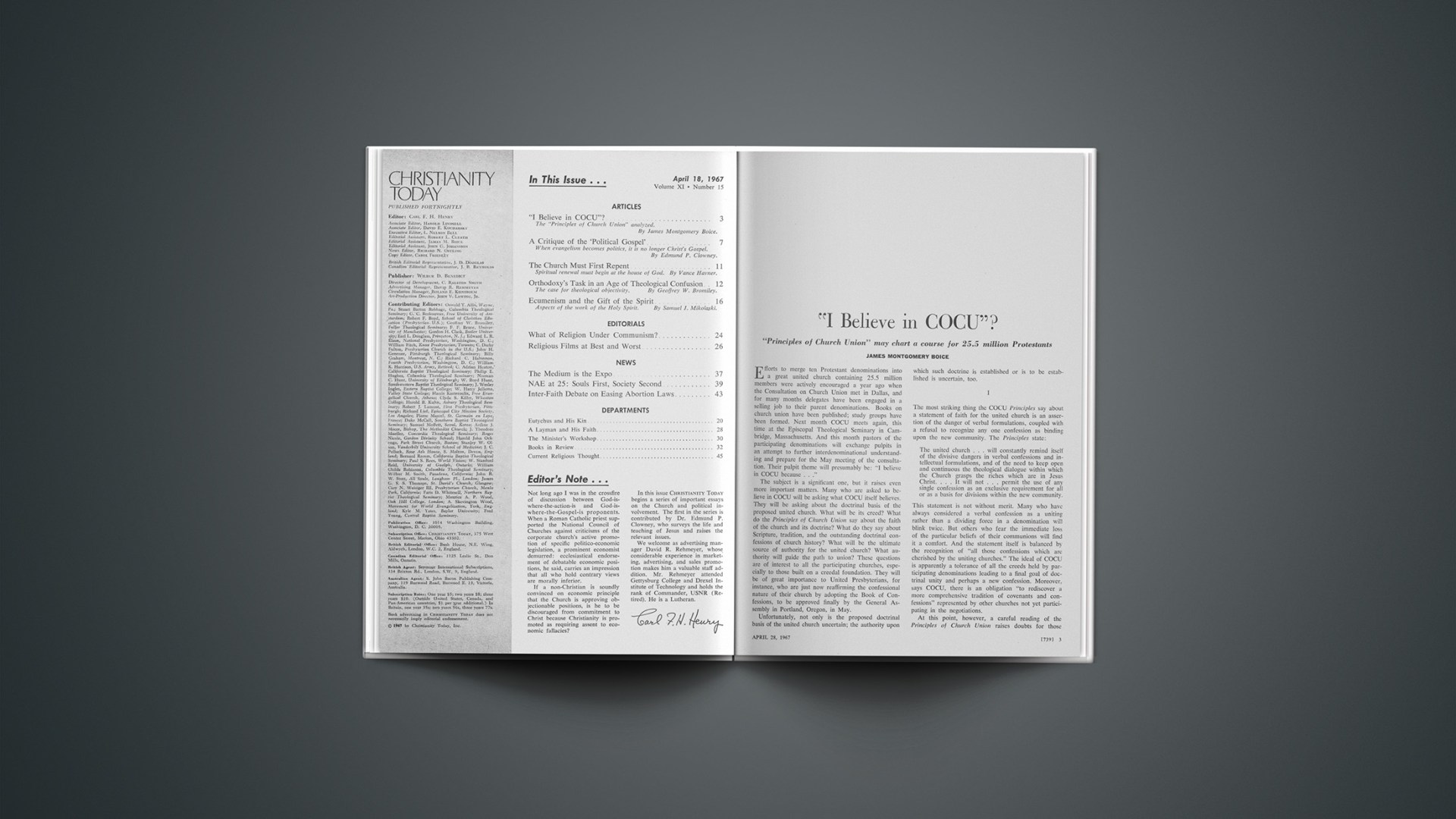
“I Believe in COCU”?

“Principles of Church Union” may chart a course for 25.5 million Protestants

Efforts to merge ten Protestant denominations into a great united church containing 25.5 million members were actively encouraged a year ago when the Consultation on Church Union met in Dallas, and for many months delegates have been engaged in a selling job to their parent denominations. Books on church union have been published; study groups have been formed. Next month COCU meets again, this time at the Episcopal Theological Seminary in Cambridge, Massachusetts. And this month pastors of the participating denominations will exchange pulpits in an attempt to further interdenominational understanding and prepare for the May meeting of the consultation. Their pulpit theme will presumably be: “I believe in COCU because …”

The subject is a significant one, but it raises even more important matters. Many who are asked to believe in COCU will be asking what COCU itself believes. They will be asking about the doctrinal basis of the proposed united church. What will be its creed? What do the Principles of Church Union say about the faith of the church and its doctrine? What do they say about Scripture, tradition, and the outstanding doctrinal confessions of church history? What will be the ultimate source of authority for the united church? What authority will guide the path to union? These questions are of interest to all the participating churches, especially to those built on a creedal foundation. They will be of great importance to United Presbyterians, for instance, who are just now reaffirming the confessional nature of their church by adopting the Book of Confessions, to be approved finally by the General Assembly in Portland, Oregon, in May.

Unfortunately, not only is the proposed doctrinal basis of the united church uncertain; the authority upon which such doctrine is established or is to be established is uncertain, too.

I

The most striking thing the COCU Principles say about a statement of faith for the united church is an assertion of the danger of verbal formulations, coupled with a refusal to recognize any one confession as binding upon the new community. The Principles state:

The united church … will constantly remind itself of the divisive dangers in verbal confessions and intellectual formulations, and of the need to keep open and continuous the theological dialogue within which the Church grasps the riches which are in Jesus Christ.… It will not … permit the use of any single confession as an exclusive requirement for all or as a basis for divisions within the new community.

This statement is not without merit. Many who have always considered a verbal confession as a uniting rather than a dividing force in a denomination will blink twice. But others who fear the immediate loss of the particular beliefs of their communions will find it a comfort. And the statement itself is balanced by the recognition of “all those confessions which are cherished by the uniting churches.” The ideal of COCU is apparently a tolerance of all the creeds held by participating denominations leading to a final goal of doctrinal unity and perhaps a new confession. Moreover, says COCU, there is an obligation” to rediscover a more comprehensive tradition of covenants and confessions” represented by other churches not yet participating in the negotiations.

At this point, however, a careful reading of the Principles of Church Union raises doubts for those concerned with doctrine. In the first place, with the exception of the Apostles’ Creed and the Nicene Creed, none of the confessions acknowledged in such general terms is fisted. Does the “recognition” of all confessions cherished by the uniting churches mean a recognition of all the confessions embodied in the United Presbyterians’ Book of Confessions, including the Barmen Declaration and the controversial Confession of 1967? Does it mean “recognition” of the Thirty-Nine Articles, which are normative for the Church of England but are only accepted with modifications as a general statement of doctrine by the Protestant Episcopal Church in the United States? Does it mean “recognition” of the theologically undistinguished creed of the United Church of Christ? Does it mean “recognition” of the Methodist Articles of Religion? And what do the Principles mean by “recognition”? Unless the churches are given some idea of an answer to these questions, they may well be on the path of those who sing in Paint Your Wagon: “Where am I going? I don’t know. When will I get there? I don’t care. All I know is I am on my way.”

Secondly, many will be justly questioning COCU’s reference even to the Apostles’ Creed and the Nicene Creed. As outstanding embodiments of Christian faith these two confessions could have great normative value for a church that took them seriously. But even this possibility for a doctrinal basis is weakened by the decision of COCU to acknowledge them as nothing more than symbols. The Principles of Church Union commend the Nicene Creed largely to the church’s theologians, as a “guardian of the truth of the Gospel,” and recommend that the Apostles’ Creed be used by the united church “as a corporate act of praise and allegiance which binds it to the apostolic gospel and to the faith of the one Church in all centuries and continents.” Nothing in the COCU documents even suggests that actual belief in any of the statements of these two creeds will be required of anyone.

This qualified allegiance to the creeds is already causing trouble for Episcopalians. The Rev. Carroll E. Simcox, editor of the Living Church, comments that “this language is troubling in its vagueness.” And a lead article of the American Church News, monthly newspaper of the 11,000 member, Anglo-Catholic American Church Union, points to the difference between COCU’s reference to the creeds as ancient symbols and the language of the creeds themselves, which begin with the categorical statement, “I believe …” Says the American Church News, “This is quite different from merely using it as a corporate symbol binding us to some sort of connection with the Church throughout the ages. The Apostles’ Creed does indeed state the essentials of the Faith of the Church, but more than this, it states what each and every individual in the Church must believe if he is to be a Christian.”

The same paper also notes that “in the absence of a definite standard of beliefs for teaching, it is not likely that the new COCU Church could have much Evangelistic force in its effort to reach out for conversions.”

Finally, the effort of the consultation to find a doctrinal basis for the united church in the creeds is also weakened by statements that set the liturgies of the Church and its mission alongside verbal confessions as equally valid means by which the church may confess its faith. These emphases are valuable to the extent that they fink worship to belief and view Christian conduct as the proper manifestation of the Gospel in the life of the believer. But they are inadequate in their failure to make God’s truth, embodied in Scripture and reflected in the creeds, the measure of ethical action and of the church’s worship. What is to correct the church’s fife and liturgy when these practices go astray, as they have repeatedly done in the past? What will be the measure of man’s conduct? On what basis will the church teach Christian morals? Neglecting to acknowledge a scriptural or a doctrinal standard at this point is to cast the faith, worship, and practice of the church into the churning sea of subjectivity and to abandon the truth claims of the Christian faith and its moral imperatives to the sinful, inconsistent, and historically conditioned whims of men.

The value of creeds must not be overstated. They themselves are not truth, nor are they infallible. They have often been amended for the better, as in the addition of articles on the Holy Spirit and the Gospel to the Westminster Confession in 1903. But they are a great source of strength for a church that seriously holds them. In the interpretative statement about its confession, the United Church of Christ affirms, “A belief that is unsaid is incomplete, and a belief that is well said becomes a power for life and action” (We Believe, p. 15).

A church that acknowledges all creeds but subscribes to none, that alludes to its faith but neglects to define it, does not inspire confidence. Nor can it expect enthusiasm from the thousands who devoutly confess each Sunday morning, “I believe in God the Father Almighty, Maker of heaven and earth; And in Jesus Christ his only Son our Lord.…”

Ii

It must be acknowledged at this point, however, that although the weaknesses of the Principles of Church Union will dismay many churches whose nature is confessional, there is no reason to think that COCU’s posture on the creeds will necessarily be unacceptable to non-confessional denominations. Many would consider it wrong not to say impossible, to force a doctrinal statement on these churches. And those within them might well consider their understanding of the faith protected by having no confession of faith at all. For these churches, as indeed for all the churches participating in the consultation, there is final appeal to Scripture. Unfortunately, at this point also the COCU Principles must be judged inadequate.

At one point the union document states in very generous terms: “The united church acknowledges that the Holy Scriptures of the Old and New Testaments have a unique authority. They witness to God’s revelation, fulfilled in Jesus Christ, and to man’s response to God’s revelation.” And it adds a little later, “The Scriptures are the norm of the church’s life, including worship and witness and teaching and mission.” These statements apparently make the Scriptures “a unique authority” in the church and acknowledge them as the ultimate norm of all the church’s actions.

It is all the more startling, therefore, to read in the paragraph immediately following that the united church also recognizes a “historic Christian Tradition,” a tradition that in some measure “antedated the formation of the New Testament canon.” Not only these statements but also the alterations in this part of the document between the original version of the Principles, presented for action at Dallas, and the version now circulated in book form, warn the reader that the Scriptures according to COCU are neither unique nor as normative as the paragraphs that mention them imply.

Nothing is more eloquent on this point than a comparison of the first version with the final text of the COCU document. The version of the Principles originally presented at Dallas read quite laudably:

The final test of any statement of Christian belief must be its faithfulness to the Scriptures and the living Lord to whom the Scriptures bear witness. We accept the unfailing standard of catholic faith, that no form or confession or belief may be required of anyone, nor regarded as necessary to salvation, which does not clearly spring from God’s revelation in the Scriptures or which cannot be tested by them.

In the final, approved edition, this openly Protestant and boldly Reformation statement has been completely removed, and statements have been added that could delight only the bishops who attended the Council of Trent. In place of the preceding affirmations, the Principles of Church Union now state:

The united church recognizes that there is a historic Christian Tradition. Each of the churches in the Consultation inevitably appeals to that Tradition in matters of faith and practice. By Tradition we understand the whole life of the Church ever guided and nourished by the Holy Spirit, and expressed in its worship, witness, way of life, and its order. As such, Tradition includes both the act of delivery by which the good news is made known and transmitted from one generation to another as well as the teaching and practice handed on from one generation to another (cf. Luke 1:1–3).

In such a sense, the Christian Tradition antedated the formation of the New Testament canon. The New Testament canon appears not as separate from or opposed to the Christian Tradition but rather as an expression of it. Certainly it is the case that in the Church, Scripture and Tradition are found together.

What do these statements mean if they do not mean that tradition and Scripture stand together on equal footing within the church and together are the source of its authority? And what is this but Tridentine theology? In a day when even some Roman Catholic theologians (G. Sohngen, Y. Congar, R. J. Geiselmann, H. Kling) argue that Trent never intended to make tradition equal to Scripture and seek a new priority for Scripture within the Roman church, it would be ironic indeed if COCU itself returned to 1545, abandoned the sola scriptura of the Reformation, and aligned itself with the conservatives within the Roman fold.

It is also noteworthy that the Principles do not recognize the historical argument popularized by Cullmann: that recognition of the canon by the Church in the second century, far from establishing the equality or priority of the tradition, was actually “an act of humility” by which the Church acknowledged the errors of its traditions and bound itself to the apostolic witness recorded in the Scriptures of the New Testament forever. Cullmann’s interpretation of this action is strikingly vindicated by a comparison of the doctrinally weak and moralistically oriented writings of the Apostolic Fathers, who wrote before the canon was formed, with the doctrinally sound and theologically astute writings of the later theologians from the time of Tertullian, who wrote after the canon was established and in conscious dependence on it.

Some will say, in objection to this argument, that the Principles of Church Union do not actually endorse an equality of Scripture with tradition but only acknowledge pragmatically that tradition has always been involved in the Church’s understanding of its faith. This fact is true, of course. And for this reason none of the participating churches has ever given absolute authority to its creeds. All recognize the absolute authority of Scripture. But this COCU does not recognize. That is the point. The Principles of Church Union do not support their positions with reference to the Scriptures. And the deliberations resulting in the documents of union as they now stand actually represent a rejection of the absolute authority of Scripture for a hazy view that links Scripture and tradition together in the subjective flux of history.

This understanding of COCU’s stance receives further confirmation from the way in which the COCU documents explicitly speak of the relations between Scripture and tradition. The Principles state:

(1) Scripture is itself included in the Tradition. The reading of and listening to the Scriptures in worship and the authority of the Scriptures over the teaching of the Church are essential in the life of the Church.

(2) The Scriptures are interpreted in the light of the Tradition. The Church does not set itself above the Scriptures; but the Church reads and listens to the Scriptures as a community of faith. (3) The Scriptures are the supreme guardian and expression of the Tradition. This is what the Church intends by its acknowledgment of a canon of Scriptures.

These statements are all vague. At best the second is a mere statement of fact. And the third is untrue. But the really deplorable thing is that the “relations” omit the one relation that alone could place the others in a legitimate perspective. What about the great Reformation belief that the Scriptures correct the tradition, that they are the standard by which the Church itself and all its practices and beliefs are judged? Without an acknowledgment of sola scriptura, there is no such thing as an ecclesia semper reformanda. The consultation wants a church that is “truly catholic, truly evangelical, and truly reformed.” But there is only a drifting church “ever learning, and never able to come to a knowledge of the truth.” Such a church will not even be able to appeal to the authority of Christ, for Christ himself acknowledged the Scriptures and repeatedly directed the disciples to them as the source where they could learn of him.

The organization recommended to the denominations by COCU is a church without a navel; there is no evidence of an umbilical cord to the past. It professes a reception of the creeds but weakens its profession by failing to list them, by terming the Apostles’ Creed and Nicene Creed symbols, and by setting the creeds alongside the church’s liturgy and mission as equally valid expressions of its faith. It professes a unique and normative Scripture but weakens this profession by an unqualified acknowledgment of the church’s tradition. This is a church with no standards and no absolutes, a church with no basis to form, evaluate, or correct its life and worship. If this is true, then to say “I believe in COCU because …” is only to say “I believe in what COCU believes.” And this is to say merely that “I believe in COCU! “Such a statement is idolatrous. It is evident that a church like this would be at the whim of whoever happens to be in charge of its structures.

Iii

The inevitable result of COCU’s stance in regard to the creeds and Scripture is already visible in the Principles of Church Union in a sad neglect of basic doctrines. There is a sense in which a number of doctrinal phrases run like leitmotivs through the document. The Principles speak of “God as Father, “Christ as “Lord and Savior,” “crucified and risen, the living Lord and Head of the Church,” and so on. But there is never an attempt to define these phrases, and they are never developed in detail. It does not take a committed skeptic to wonder whether, in the absence of fuller definition, these phrases are any more than ecumenical clichés.

Moreover, statements of belief that might be thought basic to any Protestant church do not occur in the COCU Principles. There is very little about the nature and work of Christ. It is significant here that even the minimal “Basis” of the World Council of Churches, which speaks of “Jesus Christ as God and Savior,” was removed from the original, Dallas version of the Principles, and all references to Christ’s work are placed under the discussion of the sacraments, notably the Eucharist, not in the section dealing with “The Faith of the Church.” It is a high point of the COCU Principles, however, that at this point Christ is referred to “as the Crucified who died for our sins and who rose again for our justification, as the once-for-all sacrifice for the sins of the world who gives himself to the faithful.”

There is no explicit statement of justification by grace through faith alone, no definition of grace or faith or justification, no reference to heaven or hell, rewards or judgment. The Trinitarian formula of the WCC “Basis”—“to the glory of one God, Father, Son and Holy Spirit”—found in the original version of the Principles has also been removed. In the light of these deficiencies, many will feel that if the efforts expended over six years in arriving at a proposed organization of the united church (sacraments, liturgy, and bishops) had been expended on matters vital to the church’s doctrinal confession, a far more mature and commendable confession of faith would have emerged than the mere sprinklings that appear in the final document.

Fortunately, the union of the churches on the principles of the consultation is not yet final, nor will it be for some time to come. There is still time for the drafting of a courageous Christian confession. Christians have always been ready to confess the principles embodied in the Gospel, and there is no reason to believe that the community of believers who thus confess their faith will ever perish from the earth. But if the great denominations, even with their reunion and reorganization, neglect the Gospel, they will be able to expect nothing less than that the faith of believers will express itself elsewhere—in small denominations, if necessary, and in nonaligned groups of believers. The shifting of the faith into new directions has happened before. Judaism was bypassed with the advent of Christianity. The Roman church was outflanked at the time of the Reformation. The rationalistic church of the nineteenth century was embarrassed by the great revival movements. It can happen again.

On the other hand, there is no reason why the great denominations, even a great united church, could not emerge with a new allegiance to the everlasting faith. Belief in COCU could become belief in the God of Jesus Christ, a God who is holy, just, omnipotent, and loving and who through the vicarious atonement of his Son and the continuing work of his Holy Spirit in the world and in the Church is yet at work among us.

Editor’s Note from April 28, 1967

Not long ago I was in the crossfire of discussion between God-is-where-the-action-is and God-is-where-the-Gospel-is proponents. When a Roman Catholic priest supported the National Council of Churches against criticisms of the corporate church’s active promotion of specific politico-economic legislation, a prominent economist demurred: ecclesiastical endorsement of debatable economic positions, he said, carries an impression that all who hold contrary views are morally inferior.

If a non-Christian is soundly convinced on economic principle that the Church is approving objectionable positions, is he to be discouraged from commitment to Christ because Christianity is promoted as requiring assent to economic fallacies?

In this issue CHRISTIANITY TODAY begins a series of important essays on the Church and political involvement. The first in the series is contributed by Dr. Edmund P. Clowney, who surveys the life and teaching of Jesus and raises the relevant issues.

We welcome as advertising manager David R. Rehmeyer, whose considerable experience in marketing, advertising, and sales promotion makes him a valuable staff addition. Mr. Rehmeyer attended Gettysburg College and Drexel Institute of Technology and holds the rank of Commander, USNR (Retired). He is a Lutheran.

Assault on Belief

Current religious thought in canada is “beyond belief.” That is to say, the thought receiving the greatest attention today maintains that belief is a thing of the past if it requires anything like definite conviction.

The two most discussed current religious books both claim that people can no longer accept the idea of a personal God.

One of these, A Church Without God, is by an Anglican priest who pleads for the Church to free itself from commitment to this impossible concept of God in the interest of becoming a healthier and freer community. The Rev. Ernest Harrison thinks that traditional belief in God has been the source of both oppression and repression, and that the sooner Christians free themselves from it, the better life will be for them.

He does not recommend that the Church impose his own brand of atheism on all its members, though, because that would simply create a negative kind of dogmatism, and he is even more opposed to that than he is to belief in God. His great hope for the Church is that it become pluralistic, just like the rest of society, so that churchmen can be free to believe or disbelieve as they choose. One of his major arguments against traditional theism is that it has encouraged an absolutistic attitude in many churchmen, leading them to denounce anyone who disagreed with them.

As remarkable as this clerical opinion has been the reaction of much of the church to it. Harrison, at one time a church headquarters official, now a college lecturer in literature, has continued preaching on Sundays in a Toronto church. After the publication of his book, however, the Bishop of Toronto informed him that he would no longer be permitted to perform this ministry. Letters-to-the-editor columns in both secular and sacred papers have included an interesting number of protests by people who see this episcopal action as a threat to freedom and an infringement on the legitimate rights of a person to think what he likes.

The other book in question is different because it is a scholarly work and will be appreciated by only a small circle. But within that circle, it is arousing a remarkable reaction.

Leslie Dewart’s The Future of Belief has been written to provide a surer basis for believing in God, but not before it has done a thorough job of trying to remove what has been part of the basis for belief in God in the past. Dewart, a Roman Catholic philosopher, says his church’s doctrine of God has not been a wholly Christian one. It was so greatly influenced by Greek philosophical ideas, he says, that in some ways it is more Greek than Christian.

But wait! Dewart is not objecting to a consequent lack of biblical content in his church’s doctrine of God. What he does not like is that Roman theism is still tied to a philosophy that most people reject. And what he wants is for his church to substitute a more contemporary philosophy as a mold for its theism.

What would this involve? Nothing short of dropping belief in God as a personal being. Christians now conceive God that way, he says, not because the Gospel requires it, but because Greek philosophy imposed this concept on the Church Fathers. He assumes that neither Jews nor Christians thought of God as a personal being until the Greeks clued them in, and that Christians today are therefore at liberty to discard this outlook altogether. What Dewart wants Christians to substitute for this is a concept of God as a Presence that is to be found in every experience of life.

Although this book was intended to provide a philosophical basis for belief in God, it impresses some Roman Catholics as doing just the opposite, and it has been discussed more than any other book in Roman Catholic periodicals recently.

Although Dewart’s book is markedly different from Harrison’s, it is nonetheless an example of the way current religious thinkers in Canada are demanding an end to what has always been regarded as an axiom of Christianity—belief in God as a personal being.

This is a hard time for those who seek definition in theology, because the general attitude favors lack of precision. A recent ecumenical conference of theologians and pastors, for example, found hopeless the task of establishing a basis of authority on which the churches might arrive at some definite conclusions about the biblical and theological teaching on sexuality and family, life. Every attempt to assert a definite basis for morality according to the Bible, natural law, or anything else met with a passionate abhorrence of anything that sounded like a rule. The only rule some delegates were ready to accept was the rule that meetings had to adjourn promptly for meals!

Canadian churches thus face the danger of becoming vacuous in doctrine and antinomian in morals at a time when society needs the sustaining power of churches committed to a faith they can unashamedly offer mankind. In the interest of searching their souls, the churches may lose their heads.

It would be a great mistake, however, if in reaction to this the churches grasped an archconservatism in which a desire to examine would be suspect and freedom to criticize would be condemned. To defend the faith, it is not necessary to bum witches or books.

What is necessary is that words must have meaning and cannot just mean whatever the user wants them to mean—in spite of what Humpty Dumpty told Alice in Wonderland. Among the words that demand definition are “belief,” “Christian,” and the like. If a person must conclude he can no longer accept Christian belief, that is one thing. But there must be an end to the current notion that the disaffected individual is free to change the meaning of that Christian belief.

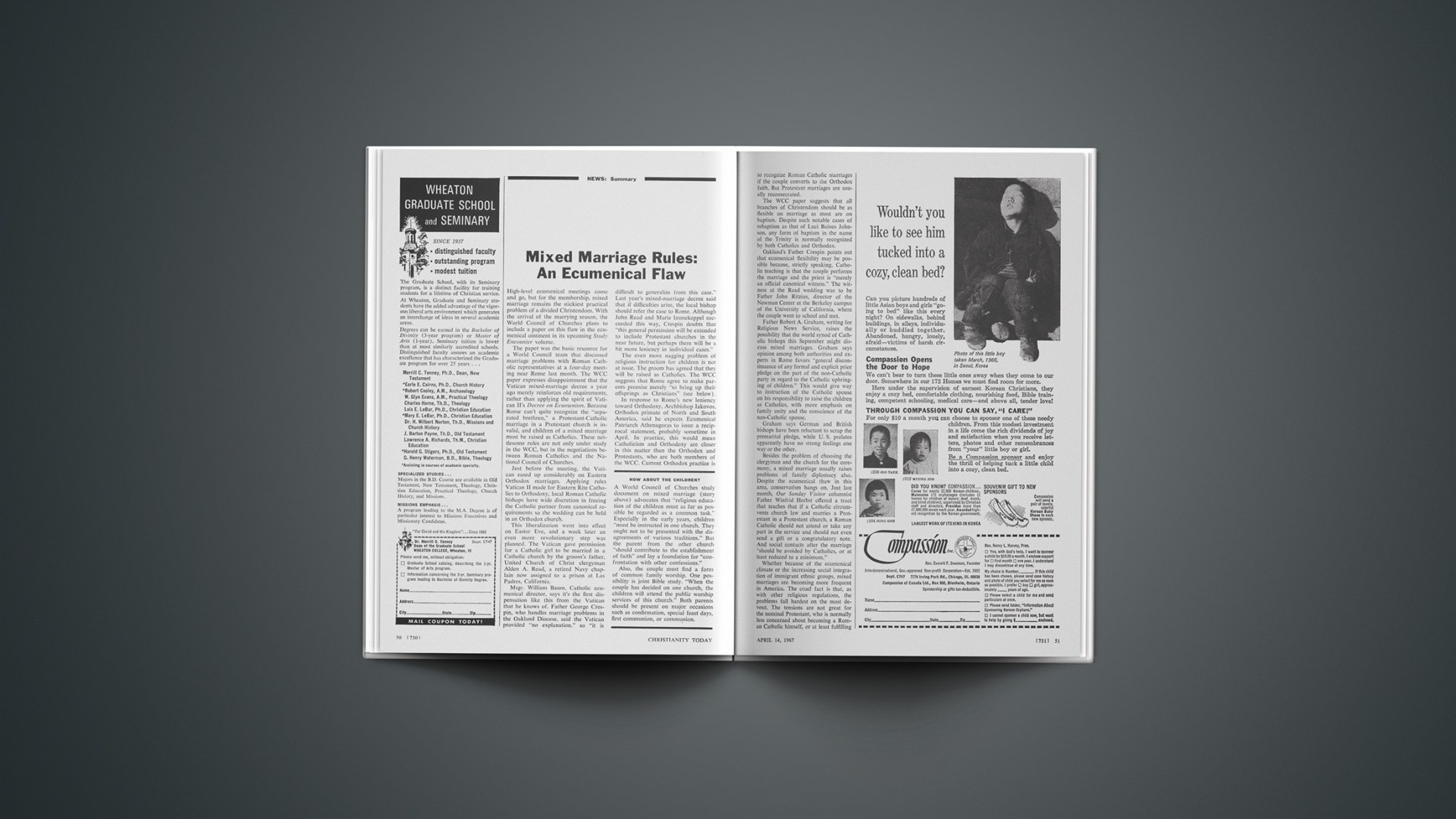
Mixed Marriage Rules: An Ecumenical Flaw

High-level ecumenical meetings come and go, but for the membership, mixed marriage remains the stickiest practical problem of a divided Christendom. With the arrival of the marrying season, the World Council of Churches plan to include a paper on this flaw in the ecumenical ointment in its upcoming Study Encounter volume.

The paper was the basic resource for a World Council team that discussed marriage problems with Roman Catholic representatives at a four-day meeting near Rome last month. The WCC paper expresses disappointment that the Vatican mixed-marriage decree a year ago merely reinforces old requirements, rather than applying the spirit of Vatican II’s Decree on Ecumenism. Because Rome can’t quite recognize the “separated brethren,” a Protestant-Catholic marriage in a Protestant church is invalid, and children of a mixed marriage must be raised as Catholics. These nettlesome rules are not only under study in the WCC, but in the negotiations between Roman Catholics and the National Council of Churches.

Just before the meeting, the Vatican eased up considerably on Eastern Orthodox marriages. Applying rules Vatican II made for Eastern Rite Catholics to Orthodoxy, local Roman Catholic bishops have wide discretion in freeing the Catholic partner from canonical requirements so the wedding can be held in an Orthodox church.

This liberalization went into effect on Easter Eve, and a week later an even more revolutionary step was planned. The Vatican gave permission for a Catholic girl to be married in a Catholic church by the groom’s father, United Church of Christ clergyman Alden A. Read, a retired Navy chaplain now assigned to a prison at Las Padres, California.

Msgr. William Baum, Catholic ecumenical director, says it’s the first dispensation like this from the Vatican that he knows of. Father George Crespin, who handles marriage problems in the Oakland Diocese, said the Vatican provided “no explanation,” so “it is difficult to generalize from this case.” Last year’s mixed-marriage decree said that if difficulties arise, the local bishop should refer the case to Rome. Although John Read and Marie Immekeppel succeeded this way, Crespin doubts that “this general permission will be extended to include Protestant churches in the near future, but perhaps there will be a bit more leniency in individual cases.”

The even more nagging problem of religious instruction for children is not at issue. The groom has agreed that they will be raised as Catholics. The WCC suggests that Rome agree to make parents promise merely “to bring up their offsprings as Christians” (see below).

In response to Rome’s new leniency toward Orthodoxy, Archbishop Iakovos, Orthodox primate of North and South America, said he expects Ecumenical Patriarch Athenagoras to issue a reciprocal statement, probably sometime in April. In practice, this would mean Catholicism and Orthodoxy are closer in this matter than the Orthodox and Protestants, who are both members of the WCC. Current Orthodox practice is to recognize Roman Catholic marriages if the couple converts to the Orthodox faith. But Protestant marriages are usually reconsecrated.

The WCC paper suggests that all branches of Christendom should be as flexible on marriage as most are on baptism. Despite such notable cases of rebaptism as that of Luci Baines Johnson, any form of baptism in the name of the Trinity is normally recognized by both Catholics and Orthodox.

Oakland’s Father Crespin points out that ecumenical flexibility may be possible because, strictly speaking, Catholic teaching is that the couple performs the marriage and the priest is “merely an official canonical witness.” The witness at the Read wedding was to be Father John Ritzius, director of the Newman Center at the Berkeley campus of the University of California, where the couple went to school and met.

Father Robert A. Graham, writing for Religious News Service, raises the possibility that the world synod of Catholic bishops this September might discuss mixed marriages. Graham says opinion among both authorities and experts in Rome favors “general discontinuance of any formal and explicit prior pledge on the part of the non-Catholic party in regard to the Catholic upbringing of children.” This would give way to instruction of the Catholic spouse on his responsibility to raise the children as Catholics, with more emphasis on family unity and the conscience of the non-Catholic spouse.

Graham says German and British bishops have been reluctant to scrap the premarital pledge, while U. S. prelates apparently have no strong feelings one way or the other.

Besides the problem of choosing the clergyman and the church for the ceremony, a mixed marriage usually raises problems of family diplomacy also. Despite the ecumenical thaw in this area, conservatism hangs on. Just last month, Our Sunday Visitor columnist Father Winfrid Herbst offered a tract that teaches that if a Catholic circumvents church law and marries a Protestant in a Protestant church, a Roman Catholic should not attend or take any part in the service and should not even send a gift or a congratulatory note. And social contacts after the marriage “should be avoided by Catholics, or at least reduced to a minimum.”

Whether because of the ecumenical climate or the increasing social integration of immigrant ethnic groups, mixed marriages are becoming more frequent in America. The cruel fact is that, as with other religious regulations, the problems fall hardest on the most devout. The tensions are not great for the nominal Protestant, who is normally less concerned about becoming a Roman Catholic himself, or at least fulfilling church requirements for the wedding and for the training of children. And the nominal Roman Catholic would be less worried about leaving the church, and its mixed marriage rules, behind.

How About The Children?

A World Council of Churches study document on mixed marriage (story above) advocates that “religious education of the children must as far as possible be regarded as a common task.” Especially in the early years, children “must be instructed in one church. They ought not to be presented with the disagreements of various traditions.” But the parent from the other church “should contribute to the establishment of faith” and lay a foundation for “confrontation with other confessions.”

Also, the couple must find a form of common family worship. One possibility is joint Bible study. “When the couple has decided on one church, the children will attend the public worship services of this church.” Both parents should be present on major occasions such as confirmation, special feast days, first communion, or communion.

Personalia

A Presbyterian educator in New Zealand fanned the flames of a theological controversy by last month publicly denying the immortality of the human soul. Principal Lloyd Geering had been under fire for denying the historicity of the resurrection stories (see March 31 issue, p. 42). His latest denial brought demands for his resignation.

Dr. Lloyd J. Averill, vice-president of Kalamazoo College, has been named president of the Council of Protestant Colleges and Universities, an organization of 239 church-related institutions. He succeeds Dr. James M. Godard, who resigned to direct an educational research project.

Dr. John W. Turnbull was named associate director of the Washington office of the National Council of Churches. Ordained in the Congregational ministry, Turnbull became an Episcopal clergyman in 1955. Until recently he taught Christian ethics at Episcopal Theological Seminary of the Southwest.

The theologian’s real value to God is determined by how he applies his doctrinal expertise to soul-winning. So says Dr. Andrew D. MacRae of Glasgow, general secretary of the Baptist Union of Scotland. He told Baptist Theological Seminary students in Rüschlikon, Switzerland, that “more has been owed to Christians by society for their evangelism than for any other area of Christian activity.”

Dr. A. J. Glaze was inaugurated president of the International Baptist Seminary in Buenos Aires, Argentina. Glaze, a native of Mississippi, holds the B.D. and Th.D. degrees from Southern Baptist Theological Seminary, Louisville.

Dr. C. Eric Lincoln was appointed professor of sociology of religion at Union Theological Seminary, New York. Lincoln, an ordained Methodist minister, is the first Negro to hold a full professorship at Union. He is author of the authoritative Black Muslims in America.

‘The Judas Tree’

Four pallbearers bore a black-draped bier to a huge, steeply raked white cross. Excruciating, dissonant music (eerie strings and sizzling cymbals) filled the air. “I’m scared, Daddy,” piped a four-year-old.

Thus began the American premiere of The Judas Tree during Holy Week at Washington, D. C., Cathedral (Episcopal). The stark, brutal drama was written by Thomas Blackburn with music by Peter Dickinson. It was first performed in Liverpool Cathedral, England, last year.

Dickinson’s startling musical score has the orchestra alternately in whispers and snarls, with abstract mood sounds from the strings, brass, percussion, piano, and organ. The narrator is a tenor soloist. A chorus, mostly homophonic, provides poetic counterpoint for the spoken roles of Judas Iscariot, Pontius Pilate, a Dominican monk, Simon Peter, and a Nazi commandant.

The drama’s theme is curious. Blackburn’s Judas is a necessary contributor to the ultimate good of the Crucifixion; therefore, his role in the passion should not be eternally damned. A monk provides the church’s rites for the dying to help Judas move from his 2,000 years of withdrawal-by-guilt into eternity—a merciful “birth unto death.”

Judas is made a symbol of universal evil through a replaying of the betrayal in a Nazi setting. The experience of crucifixion as the power of expiation within and for every man is shown as Judas’s “birth unto death” through identification with the Crucifixion. “It is finished!” cries Judas at the end, arms outstretched, while the organ thunders and a spotlight marks a huge crucifix over the crossing. The Judas Tree is a forceful drama with an impressive score. It is beautifully written and can be powerfully staged. Its theology gives pause.

JOAN KERNS

Miscellany

An interdenominational West African Congress on Evangelism is being called for July, 1968, to implement the findings of last year’s World Congress on Evangelism in Berlin and the Congress on the Church’s Worldwide Mission in Wheaton, Illinois. It will be sponsored jointly by the Nigerian Evangelical Fellowship and the African evangelism-indepth effort known as “New Life for All.”

The National Lutheran Campus Ministry is taking steps to end its financial support to chairs of religion at four tax-supported universities: Iowa, North Dakota, Kansas, and Montana. Chairs of religion at Texas and UCLA, currently supported by the Lutheran Church—Missouri Synod, also are expected to lose the aid.

Ministers and scholars of the Churches of Christ are preparing their first commentary on the New Testament. The first of the nineteen volumes of The Living Word Commentary will appear in the fall. Dr. Everett Ferguson, associate professor of Bible at Abilene Christian College, is the editor. The R. B. Sweet Company, of Austin, Texas, is the publisher.

Mother Madeleine, superior of two Benedictine nuns who teach in the public schools of Boerne, Texas, said they will not be back next year. With that word, a citizens’ group, formed to protest the presence of nuns in the schools wearing religious habits, announced it had disbanded. The disposition of a lawsuit filed by the group was not immediately clear.

The Rev. Clarence (Kelly) Walberg, Los Angeles area radio preacher, was given a three-year suspended sentence and a $1,000 fine for issuing promissory notes without a state permit. He had raised $500,000 to convert a seedy beachfront hotel into a youth evangelism center.

Metropolitan Nikodim, external affairs director for the Russian Orthodox Church, is visiting the United States this month as a guest of the Church of the Brethren. The Christian Churches (Disciples) have invited the Rev. Ilia Orlov of Moscow’s Baptist Church to visit next month.

Police in Durango, Mexico, charged two suspects with robbing and strangling Roman Catholic Bishop Jose de la Soledad Torres y Castaneda.

At this summer’s convention the Lutheran Church—Missouri Synod will again discuss whether to join the Lutheran World Federation. Memorials both for and against have come from local conferences. The Commission on Theology and Church Relations will announce its recommendation on the LWF question next month.

Deaths

ROBERT M. SKINNER, 64, vice-president of Princeton Theological Seminary; in Westfield, New Jersey.

HENRY H. BAGGER, 75, president emeritus of Philadelphia Lutheran Seminary; in Philadelphia.

HOWARD G. JOHNSHOY, 48, academic dean at Gustavus Adolphus College (Lutheran) in Minnesota; in a plane crash with seven other educators surveying South Viet Nam’s schools.

Canada Maps Divorce Reform

For the estimated 400,000 “common law” marriage partners in Canada, the nation’s 1967 centennial may be worth special celebration. Prime Minister Lester Pearson has promised parliamentary legislation this year for divorce reform and for changes in the criminal code that now outlaws birth control and abortion. Prompting revisions are about 600 petitions, largely from Canadian churches. In all the arguments there is not a single objection to widening grounds for divorce.

The existing divorce statute is built upon the “marital offense” concept. Adultery is the only grounds for divorce in all Canadian provinces except Nova Scotia, where charges of gross cruelty can also dissolve a marriage. Divorce hearings are conducted under the aegis of the provincial supreme courts, except in Quebec and Newfoundland, where divorces require federal parliamentary enactment.

To replace the “marital offense” rationale, divorce-reform advocates are campaigning for the “marriage breakdown” concept. Under this idea divorces are deemed advisable in cases where there are seemingly irreconcilable issues. The United Church of Canada advocates a waiting period of at least three years between the initial marriage collapse and the granting of divorce.

The new theory, which is supported by the Anglican Church of Canada, eliminates the listing of causes. The court granting a divorce must be convinced that there is no chance of reconciliation and that children will have adequate protection. Among groups advocating parliamentary divorce reform are the Seventh-day Adventists, the Canadian Bar Association, the Law Society of British Columbia, the Canadian Mental Health Association, the Canadian Congress of Women, the Canadian Committee for the Status of Women, the Canadian Jewish Congress, the Baptist Federation of Canada, and the Unitarian Church.

The Unitarians go along with a “marriage breakdown” concept, or advocate “divorce by consent.” The Roman Catholic Church, which regards marriage as a sacrament as well as a contract, has not yet expressed official opinion on the civil statutes. Before making any major divorce reform, Canada’s Liberal government will weigh very carefully the Catholic position. Any church that represents about half the population, as does the Roman Catholic Church of Canada, is bound to play a major role. The present government may feel that the liberalizing tendencies within the Roman Catholic Church will permit divorce reform in the government without costing votes in the next election.

To date, the evangelical churches in Canada have said nothing. Either they feel overpowered by the giant denominational hierarchies or else their own position on divorce lacks sufficient clarity. While the more liberal churches exert influence upon Parliament, the evangelicals tend to talk to themselves in their own little ghettos.

Soviet Baptists Urge Peace

Soviet Baptists are marking their centennial with a 438-word appeal for peace, sent to major religious leaders all over the world. They ask “earnest prayer for the end of war in Viet Nam in the near future.”

The statement comes from the All-Union Council of Evangelical Christians-Baptists—a body recognized by the Communist government—which celebrates its hundredth anniversary this year. The Baptists said Christians are partly to blame for past wars because they “gave the cause of the defense of world peace so little consideration.” They said Christians must work to “prevent a world war disaster with the use of the most terrible kind of weapons—nuclear weapons.”

Besides a search for “a durable peace and justice for all people and for each individual person,” the statement advocated Christian concern over racial inequality, social and economic injustice, disease, and illiteracy. It said the Church “was not anxious enough about all these problems” and “due to her isolation was indifferent …”

Mandatory Social Security?

Franklin Clark Fry, 66, making his first appearance before a congressional committee, last month urged automatic Social Security coverage for all clergymen unless they apply for exemption because of religious objections.

The president of the Lutheran Church in America said that under the current voluntary program, about three-fourths of the nation’s clergymen have sought coverage, but that this includes almost all older ministers and only 60 per cent of the younger ones. Thus “the proportion of ministers who are covered may well drop to only 50 per cent.”

A bill for universal coverage was introduced by Rep. George Rhodes of Pennsylvania, and copies were sent to pension agencies of all major Protestant groups. In supporting the bill, Fry said younger ministers are avoiding Social Security because of either a political dislike of the program, “a belief that a better-protection buy can be obtained elsewhere,” or “a desire to spend less money currently.”

In other hearings on upcoming Social Security legislation, spokesmen for the National Council of Churches, United Church of Christ, and Methodist Church favored a law requiring states to meet their own standards for welfare assistance by July, 1969. At present, only nineteen states meet their own minimums, according to NCC President Arthur Flemming. The UCC urged that the bill include a national minimum for welfare payments, noting that in Mississippi the state offers less than one-third the subsistence minimum under its own regulations.

What the Pope Says about Economics

Pope Paul VI pleads eloquently for the downtrodden masses in his fifth encyclical. The 20,000-word message entitled Populorum Progressio (On the Development of Peoples) calls upon “all men of good will” to give “a loving response of charity” to the cry of the hungry for help. It was dated Easter Sunday and issued two days later.

The pontiff shakes an accusing finger at prosperous lands and wealthy citizens. “The superfluous wealth of rich countries should be placed at the service of poor nations,” he says. He urges special compassion for those who are “struggling to free themselves from the yoke of hunger, misery, disease, and ignorance, who seek a larger share in the fruits of civilization and a more active realization of their human personality.”

The encyclical’s most provocative paragraph, however, is the one in which the Pope concedes that population growth is a problem. His reference to population control is ambiguous, though some headline writers inferred an easing of the Vatican’s strictures against contraceptives. This is what the Pope said:

“The size of the population increases more rapidly than available resources, and things are found to have reached apparently an impasse. From that moment the temptation is great to check the demographic increase by means of radical measures. It is certain that public authorities can intervene, within the limit of their competence, by favoring the availability of appropriate information and by adopting suitable measures, provided that these be in conformity with the moral law and that they respect the rightful freedom of married couples.”

The encyclical deals with numerous economic issues. Among other things, it:

♦ Insists that the right of private property is not “absolute and unconditional” and asserts that the common good may sometimes require “expropriation of property.”

♦ Condones revolution in extreme cases as a means to social justice.

♦ Criticizes the profit motive and competition as determinative factors in economic activity.

♦ Calls for reform in the system of pricing for agricultural products and raw materials that are the major resources of developing countries.

Populorum Progressio frequently appeals to the Vatican Council’s statement On the Church in the Modern World. It repeats a suggestion the Pope made while visiting Bombay that a “world fund” be established to alleviate misery, and that money now being used for arms be channeled into it.

“Too many are suffering,” the Pope declares, “and the distance is growing that separates the progress of some and the stagnation, not to say the regression, of others.”

He says that “urgent reforms should be undertaken without delay. It is for each one to take his share in them with generosity, particularly those whose education, position, and opportunities afford them wide scope for action.”

The pontiff contends that “both for nations and for individual men, avarice is the most evident form of moral underdevelopment.”

“If the world is made to furnish each individual with the means of livelihood and the instruments for his growth and progress, each man has therefore the right to find in the world what is necessary for himself,” the Pope says.

He suggests that “the new name for peace is development.”

The papal plea for the underprivileged comes at a time when Christian leaders generally are demonstrating new concern for the apparently growing imbalance between the “haves” and the “have-nots.” It recalls last summer’s Conference on Church and Society, conducted in Geneva by the World Council of Churches, in which many current economic practices came under fire.

The week before the encyclical came out, evangelist Billy Graham told reporters in Puerto Rico, “I am against any give-away program and against any program which causes people to depend on the government where they should depend on themselves. But I do favor much of the poverty program, and, in the light of our total budget, my criticism is that it is too small.”

Pope Paul’s indictment of the rich includes a demand for more taxes on the wealthy to meet the cost of aid programs for the poor. Perhaps the most disappointing aspect of the whole document was that it failed to give any indication that the Roman Catholic Church was willing to submit its own vast resources and income-producing ventures to taxation. Reports from Rome several weeks ago said a secret agreement had been reached between the Vatican and the Italian government exempting Roman Catholic enterprises from taxes.

The potential of Roman Catholic wealth is cited by Episcopal Bishop James Pike, whose choice of a medium (this month’s issue of Playboy) is questionable but whose arguments are eye-opening. He trains most of his guns on the Jesuits, who, he says, own controlling stock in the Bank of America, Phillips Petroleum Company, Creole Petroleum Company, and the Di Georgio Fruit Company. He says the Jesuits also are heavy investors in Republic Steel, National Steel, and four of the largest aircraft companies: Boeing, Lockheed, Curtiss-Wright, and Douglas. From these and other holdings, the Jesuits are said to realize a yearly income of at least $250 million, on which they pay no taxes at all.

If Pike’s report is exaggerated, as the Jesuits are likely to argue, the fault lies as much with the Catholic Church as with the controversial bishop. Unlike virtually all Protestant groups, Roman Catholics never issue public financial statements to indicate the extent of their earnings or holdings. Reports in British newspapers last year estimated Vatican securities alone are worth at least $5.6 billion dollars. Not long ago the Wall Street Journal said the Vatican had sold the U. S. Treasury $4.5 million worth of gold.

Southern Baptists And Society

At last year’s Southern Baptist Convention, social isolationism was so strong that delegates drowned an attempt to put contemporary problems on upcoming convention programs. A resolution supporting America’s Viet Nam policy was thrown out, on the grounds that the SBC can’t speak for its membership.

But at this spring’s convention in Miami Beach, the Christian Life Commission—the SBC version of a social-action avant-garde—plans to have Senator Mark O. Hatfield speak on war and peace as part of its report.

Hatfield is a theologically conservative Baptist, all right; but his criticisms of the Viet Nam war1Hatfield told Harvard Young Republicans last month that President Johnson is “falsely redesigning the war as a war of aggression.” Hatfield said it is basically a civil war, not a contest between democracy and Communism. are hardly in tune with the views of the SBC constituency, and raising such a topic at the national meeting is something of a milestone in itself.

But then, maybe the SBC isn’t the fossilized giant described by its liberal critics north of Mason-Dixon. The April edition of Home Missions offers ten guidelines for increasing the ecumenical contacts between Southern Baptists and Roman Catholics, advocating a middle ground between “wholesale condemnation” and “naïve optimism.” Then there was ex-SBC President Wayne Dehoney’s invitation to Roman Catholics to join the SBC-promoted Crusade of the Americas in 1969. Dehoney later explained that he wasn’t thinking of a formal tie-in but he hopes the Catholics will preach New Testament grace and stress evangelism at the same time the Baptists do.

Then last month came Ross Coggins, director of communications for the Christian Life Commission, urging that social action be an integral part of the crusade.

A Coggins speech contended that “total evangelism” will refuse “to allow irrelevant barriers like race, class, and nationality to close the doors of the church.” He declares that Southern Baptists should either generate support for President Johnson’s fair-housing law or come up with an alternate solution to “the awful problem created by segregated housing.” And he says Baptists could accomplish great good if the $670 million they contribute to their churches every year were totally cut off from businesses that discriminate.

The crusade’s focus is Latin America, with its extremes of wealth and poverty. Coggins says that without economic reform there, “violent upheaval, Marxist opportunism, and national disruption are inevitable.” Coggins also urges more Christian interest in fighting poverty in the United States.

The Coggins credo will be codified in a forthcoming book. This critique—by a loyal SBC staff member who accepts its conservative theology and is just as likely to attack the new morality as the old racism—will be difficult to ignore.

A similar book, recently published, falls into another category. Southern Churches in Crisis by Samuel S. Hill, Jr., a Southern Baptist who is chairman of the religion department at the University of North Carolina, expresses dissatisfaction with the status quo. But Hill’s distaste doesn’t end with social symptoms; it goes straight to the theological roots of the South.

Hill notes that when Southerners do get interested in social ethics, they pour their efforts into the problems of obscenity, gambling, and alcohol, while neglecting discrimination, poverty, and ignorance. Despite their biblicism, Hill charges, Southern Protestants are highly selective about which passages they use and thus distort the content of the Bible.

Lawsuit On ‘Larger Catechism’?

A legal snarl looms over efforts to change the confessional standards of the United Presbyterian Church. A leading Philadelphia law firm has produced a twelve-page brief challenging the proposed deletion of the Larger Catechism from the church constitution.

A package proposal due for final ratification vote at the United Presbyterian General Assembly in May provides for establishment of a Book of Confessions that includes the new Confession of 1967, the Westminster Confession, the Shorter Catechism, and six other creeds. The Larger Catechism, which until now has been one of the creedal standards of the church, would lose official standing.

The legal question is whether the power to alter and amend a constitution includes the authority to remove altogether an integral part of it. A paper distributed by the Fellowship of Concerned Presbyterians, U. S. A., contends:

“State and federal courts throughout the United States have almost invariably ruled that amending a document in a constitution, such as the Larger Catechism, implies the continued existence of the thing to be amended, and not its extinguishment, as is the case with the Larger Catechism.”

The Olympia Presbytery of Washington state, which approved the Confession of 1967 by a vote of 36 to 34, subsequently voted 26 to 22 to send an overture to the General Assembly requesting a study of the constitutionality of the confessional package in view of the deletion of the Larger Catechism. More than twenty-five other presbyteries are said to be considering similar overtures.

The new confessional package has been approved by more than the necessary two-thirds majority of the presbyteries. The final vote scheduled for the assembly in Portland next month must be a yes or no. No further amendments can be proposed. If the church has to get around the legal problem, it must adopt a new overture and then submit it to another vote of the presbyteries.

The Larger Catechism, which dates back more than three centuries, consists of 196 questions and answers that exhaustively cover the precepts of the Christian faith. It is replete with scriptural references. There is little in contemporary Christian literature to compare with it. It has fallen into disuse partly because of its archaic language.

The Shorter Catechism, which also dates back to the mid-seventeenth century, is basically a condensation of the Larger.

No civil action against the United Presbyterian Church has been threatened as yet. But there has been speculation among conservatives that churches wishing to withdraw from the denomination after adoption of the new confessional standards may have some legal grounds in the deletion of the Larger Catechism. The legal brief prepared by Pepper, Hamilton, and Scheetz cites numerous court decisions and asserts that “almost without exception” the courts “have treated a power to ‘amend’ as a power to modify, add to, or delete front an existing document, without abrogating the existence of that document thus amended.” It argues that “the courts have recognized that, of necessity, the concept of ‘amendment’ implies the continued existence of the thing to be amended.”

Cracking the Outer Shell

With Billy Graham’s Holy Week San Juan crusade, the Protestant church in Puerto Rico passed an important moment.

The cliché of Catholic domination came under strong challenge as the face of Latin American Protestantism began to emerge.

For eight days of meetings in San Juan and twelve “satellite” crusades held in major cities across the island during the preceding month, attendance reached just over 175,000. A total of 7,975 decisions were recorded.

All this took place on an island where less than 15 per cent of the 2.75 million population can be called Protestant. But more significant to the island’s religious life is the fact that even by Catholic estimates, no more than one-fifth of the baptized Catholics attend services regularly. And many Protestants claim that the real proportion is much lower.

“It is important to understand,” said Dr. Raymond Strong, president of Puerto Rico’s Evangelical Seminary, “that in Latin America, Catholicism is a minority movement. It’s a larger minority than Protestantism, but it is nevertheless a minority movement.”

The island’s religious majority—Catholics connected to the church by membership only—gets most of the attention. This group, perhaps 70 per cent of the population, is the church’s vulnerable outer shell. For the highly evangelistic Protestant church, this outer shell is the focus of much of its activity—and most of its success.

The crusade reflected the emphasis. Eighty per cent of the inquirers made “first time” decisions—double the normal Graham-team percentage.

The force of Protestant outreach is slowly being felt. Where the Catholic church once meant control, it now many times has to settle for only influence—and in some areas even this is diminishing. The shifting trends can most easily be seen in the political sphere. In Puerto Rico’s 1960 and 1964 gubernatorial elections, for example, church-backed candidates opposing birth control and favoring aid to private schools suffered significant defeats. A seven-year-old church-sponsored political party regularly gets less than 2 per cent of the vote.

Slowly, then, things are beginning to change in Puerto Rico and, to a lesser extent, throughout Latin America. On the island, Protestants have felt a sharp need for a symbol of the change. For many churchmen the Graham crusade provided the first important symbol.

If anything, the crowds would probably have been bigger had the crusade been held a different week. Many Protestants were forced to divide their support between the crusade and conflicting Holy Week meetings traditionally scheduled in the local churches.

The Rev. Rafael Boissen, president of Puerto Rico’s 300-church Evangelical Council (which endorsed the crusade) and a key member of the campaign’s executive committee, said that “it was a mistake to have the Billy Graham meetings at this time of year.” The view was supported by officers of most of the island’s major denominations. Even a Catholic priest in the office of the Archbishop of Puerto Rico agreed. “For attendance, Holy Week was the worst possible time in Puerto Rico for a Graham crusade.”

In a Latin American setting, Easter Week holds nearly as much cultural significance as religious. Nearly all Protestant churches schedule special meetings during the week, some every night. In Catholic churches, there is a service in every church every night from mid-week on.

The crusade was originally set for February, but was shifted when Graham’s schedule changed. Many of the churches opposed the switch because it would conflict with their own programs; but when faced with an Easter Week crusade or no crusade at all, most churches altered their plans so they could join the campaign. The local press, however, virtually ignored the crusade.

By the time the meetings began, there was a unity among the churches unusual even for a Graham crusade. Direct help came from about 500 churches—nearly half the Protestant churches on the island. Other churches too rural to participate indicated they would back the meetings with prayer.

The church support was particularly important in the twelve secondary campaigns. Graham-team associate evangelists and national preachers spoke to capacity crowds almost everywhere they went. When the meetings concluded, nearly 70,000 people had attended with 3,610 registering decisions.

The San Juan meetings that followed got off to a slow start. For two nights early in the week, the evangelist addressed crowds under 10,000—for the first time in a major campaign in nearly two years. But Wednesday was “youth night,” and the crusade attendance seemed to turn a corner. It began increasing and reached a peak of 17,500 in the 23,000-seat Bithorn Stadium on Good Friday.

The crusade was climaxed Easter morning with a 6 o’clock sunrise service, an event sponsored annually by the city’s Protestants. Despite the hour, the meeting drew 13,500 people—three times the normal turn-out. That brought the total attendance for the San Juan meetings to 105,700, with 4,355 recorded decisions for Christ.

San Juan (Spanish for Saint John), capital of Puerto Rico, is the oldest city under the U. S. flag. For the Graham team it meant not only opportunity but a bit of relaxation. Said the evangelist, “This is the most relaxed crusade I have ever had anywhere in the world.” Midway through the meetings, he jokingly inspected the faces of several staffers, declaring, “I want to see who has been working and who has been on the beach.”

The truth was that while they all worked, many got some time at the beach too. To conserve strength, Graham made no public appearances apart from the nightly services. His blood pressure was checked before and after each address.

WILLIAM FREELAND

Baptist Evangelism In Poland

European Baptist Press Service reported last month that evangelistic tracts are now being printed in Poland.

“The tracts apparently will be useful as Polish Baptists make ready for evangelistic campaigns,” EBPS said. “Every church has been assigned an evangelist and set a time for its participation.”

Thirty thousand tracts have been printed, the report said. Among the subjects are “Main Facts of Faith,” “Love,” and “Polish Brethren.” Polish Baptist Union President Aleksander Kircun was quoted as saying that the Brethren tract refers to a branch of Anabaptists highly respected in Polish history.

According to Kircun, the evangelists are being asked to hold special meetings for church officers, young people, and other specialized groups in addition to the general revival services. The auxiliary meetings will take place during the day and the main preaching services at night.

Kinshasa For Christ

Not since 1958, when Protestants celebrated the seventy-fifth anniversary of their missionary work in Congo, had the capital of Kinshasa seen a city-wide convocation of evangelicals.

Some 15,000 local church members and their families sang as they marched down Avenue Kasa Vubu, carrying banners and Bibles. The convocation was part of the “Christ For All” national campaign of evangelism, and it involved more than sixty-five churches and church-related organizations.

Nearly all the marchers wore colorful uniforms and waved flags and signs. Many hundreds of women bought new dresses for the occasion. Three bands provided the music for the procession to Reine Astrid Stadium.

In the stadium, many thousands watched as the marchers poured through two side gates and positioned themselves on the field. Among the dignitaries on hand was the minister of education for Congo.

The Rev. Howard Jones, an associate of Billy Graham who is a popular crusade evangelist among English-speaking Africans, preached. More than 600 persons recorded decisions for Christ.

Building upon a four-month literature-distribution program conducted in 1966 and upon tent rallies held in the latter half of the year, as well as upon the formation of hundreds of prayer cells, the parade and mass rally brought Christians to a new awareness of the potential of mass evangelism.

Compassion Gap in Viet Nam

It isn’t easy to bring Christian compassion to Viet Nam. The war—which causes most of the need for compassion—is not the only problem. A sad case in point is the six-month battle in which refugees in Bien Hoa, led by a Catholic priest, have stopped World Vision’s attempts to build an orphanage for 2,000 children on government-granted land. A violent scene at the site shortly before Easter was filmed for national broadcast in the United States by NBC television.

In the melee, World Vision staffer John Weliczko had his arm fractured. One member of the knife-wielding mob crowded World Vision President Bob Pierce against a wall and said, “If you come back I’ll kill you.” Two NBC cameras were smashed, and cameramen were roughed up.

Pierce says “our problem at Children’s City really is a big Vietnamese problem in microcosm”—how to “overcome the bitterness, tensions, and friction built up during thirty years of war.” He said his evangelical Protestant welfare group had never before had such trouble with Roman Catholics.

At latest count, more than 1.6 million are homeless in South Viet Nam. Despite great interest, Protestant aid efforts budgeted for all of 1967 pale before the cost of even a single B-52. World Vision plans to spend $750,000; Viet Nam Christian Service, $481,750; and the National Association of Evangelicals World Relief Commission, $38,000.

The victims of Viet Nam are so important in the policy debate that they often seem to be publicity pawns rather than human beings. Anti-war propaganda makes much of civilians killed by U. S. soldiers. On the other hand, U. S. officials pointed out the week before Easter that so far this year the Communist Viet Cong have murdered thirty-three village chiefs, thirty-one government aid workers, twenty-seven national policemen, and 376 other civilians.

Reliable information on U. S.-inflicted suffering is difficult to get. In the January Ladies’ Home Journal, Martha Gellhorn contended that “civilian casualties far outweigh military casualties.” In the same month’s Redbook, Dr. Richard E. Perry said that between 1962 and 1966 the United States lost 1,500 men in Viet Nam, while the civilian population often has “this many casualties in a single week.”

Both Gellhorn and Perry made much of the disfigurement of children by napalm burns. Despite this and other publicity, New York Times medical writer Howard Rusk reported last month he could not find a single case of napalm burning in twenty hospitals he surveyed.

Of all the efforts by American Christians to counteract the ravages of war, none has gotten more publicity recently than an attempt by a group of Quakers to get a boatful of medical supplies into North Viet Nam. During a stopover in Hong Kong in mid-March, boat captain Earle Reynolds, an anthropologist, said he and crew members have been threatened with up to ten years in prison and $10,000 in fines under America’s Trading with the Enemy Act. White House pickets protested this threat.

Barring use of force by the U. S. Seventh Fleet, Reynolds said he intended to deliver his eighty-two boxes full of medical kits, purchased for $10,000 by the ad hoc Quaker Action Group. Meanwhile, the U.S. Treasury Department put a ban on sending money to Canada for aid to North Viet Nam. Because of this, the Action Group’s bank assets have been frozen, setting the stage for an important civil-liberties lawsuit.

While Quakers aim to help both North and South, most of the Protestant aid in the South is administered by another peace group, the Mennonite Central Committee. It acts for Viet Nam Christian Service, an aid mission that also includes Church World Service, related to the National Council of Churches, and Lutheran World Relief.

The Mennonites began their work in Viet Nam in 1954, the same year the Geneva Conference set the terms for “temporary” partition of the nation and President Diem took over as ruler of the South. Enlarging with the war, Viet Nam Christian Service now includes sixty-four staffers from Western nations (fifty-five are Americans), and it hopes to make this eighty by the end of 1967. Projects include widespread distribution of U. S. surplus food, two medical clinics, six community-aid teams, and refugee aid.

An important Roman Catholic agency is Catholic Relief Services, which handles food for nearly one million people. Although most of this goes to dependents of Vietnamese soldiers, some refugees are aided also. Ten staffers from Western nations work with CRS.

The World Relief Commission of the National Association of Evangelicals is emphasizing self-help at its major new project, the Lay Leadership Training Center at Hue. Working with the National Evangelical Church of Viet Nam, which is affiliated with the Christian and Missionary Alliance, NAE plans to provide vocational and farm training and to help Vietnamese set up small industries. The program also includes literacy training and the distribution of clothing, medicine, and 1.7 million pounds of food this year. Similar education centers are planned in Da Nang and Khe Sanh.

Last month, when U. S. planes accidentally bombed out a village and killed more than 100 persons and injured 250, NAE responded to a U. S. Special Forces request and brought in six planeloads of food and clothing.

The direct relief activities of U. S. soldiers, usually administered by chaplains, are difficult to measure. At a recent Pentagon press conference, returning Navy chaplain Francis Garrett said soldiers hand out thousands of tons of food and clothing, as well as such things as building materials.

In late March, World Vision announced it would join the Evangelical Church in sponsoring child-care centers to accommodate 2,000 children. And despite the setback, Pierce said World Vision would continue its “desperately needed” Bien Hoa orphanage project, because of urgent appeals from “the South Vietnamese government, responsible citizens, and the Vietnamese military command.”

Sight-Saving In Cuba

Emory University eye specialist William Hagler, with State Department approval, made a secret trip to Cuba last month for surgery to save the sight of captive Baptist missionary Herbert Caudill.

Hagler said the retinal detachment apparently was successful. He had operated on Caudill in Atlanta in 1964 in an unsuccessful attempt to save the sight in his other eye.

Caudill, a 63-year-old Virginian and veteran missionary, directed Baptist work in Cuba until his arrest by the Castro government two years ago last week. His missionary son-in-law David Fite and forty Cuban pastors were arrested then also. Caudill and Fite were imprisoned on charges of illegal exchange of currency. Four months ago, Caudill got a conditional release from jail to seek eye treatment in Havana, and Fite recently was transferred to outdoor quarry work. Baptist Press reports that Fite’s parents left the United States for Cuba February 25 to visit their son and try to get him released. Hagler said the Fites have been treated politely and have seen both their son and Cuban officials. It was not known immediately when they would return to the U.S.

Canada: Evangelical Pallor

Last month’s second annual convention of the Evangelical Fellowship of Canada drew a sparse 150 registrants, mostly from the Toronto area. Indifference among evangelical ministers was blamed for the poor turnout. The organization’s recent drive to enlist 5,000 members brought in only 600 and put the EFC heavily into debt.

Under the presidency of neo-Pentecostal J. Harry Faught, the EFC aims at setting up branches in every Canadian province as part of a national evangelical thrust. Faught called on members to “confess our fragmentation; our suspicions of one another and our quarreling with one another.…”

The two-day meeting stressed the need not only for a united voice for evangelicals and cooperation in national and foreign evangelism but also for a fully accredited, interdenominational seminary of evangelical persuasion.

In a fiery speech, the Rev. Hugh MacDonald of Knox United Church, Regina, criticized the heretical liberalism permeating his own United Church of Canada. But he also rapped evangelicals—for crude presentation of the Gospel, nauseating radio programs, sickening music and revolting financial appeals, and for hinging salvation on some isolated dogma. “In our zeal for Christ, we must not be guilty along with the liberals of making the Gospel unintelligible,” he said.

J. BERKLEY REYNOLDS

Apple PodcastsDown ArrowDown ArrowDown Arrowarrow_left_altLeft ArrowLeft ArrowRight ArrowRight ArrowRight Arrowarrow_up_altUp ArrowUp ArrowAvailable at Amazoncaret-downCloseCloseEmailEmailExpandExpandExternalExternalFacebookfacebook-squareGiftGiftGooglegoogleGoogle KeephamburgerInstagraminstagram-squareLinkLinklinkedin-squareListenListenListenChristianity TodayCT Creative Studio Logologo_orgMegaphoneMenuMenupausePinterestPlayPlayPocketPodcastRSSRSSSaveSaveSaveSearchSearchsearchSpotifyStitcherTelegramTable of ContentsTable of Contentstwitter-squareWhatsAppXYouTubeYouTube