The Religious Issue—1968

In 1960, John F. Kennedy proved you don’t have to be Protestant to be President. Many said religious creed was irrelevant and mention of it was bigotry.

By 1964, Barry Goldwater had become a religious issue for many churchmen, particularly because of his laissezfaire stand on civil rights. Hardly anybody noticed that his running mate, William E. Miller, was Roman Catholic. Michigan’s Governor George Romney was so opposed to Goldwater’s racial policy that he never endorsed his party’s presidential candidate.

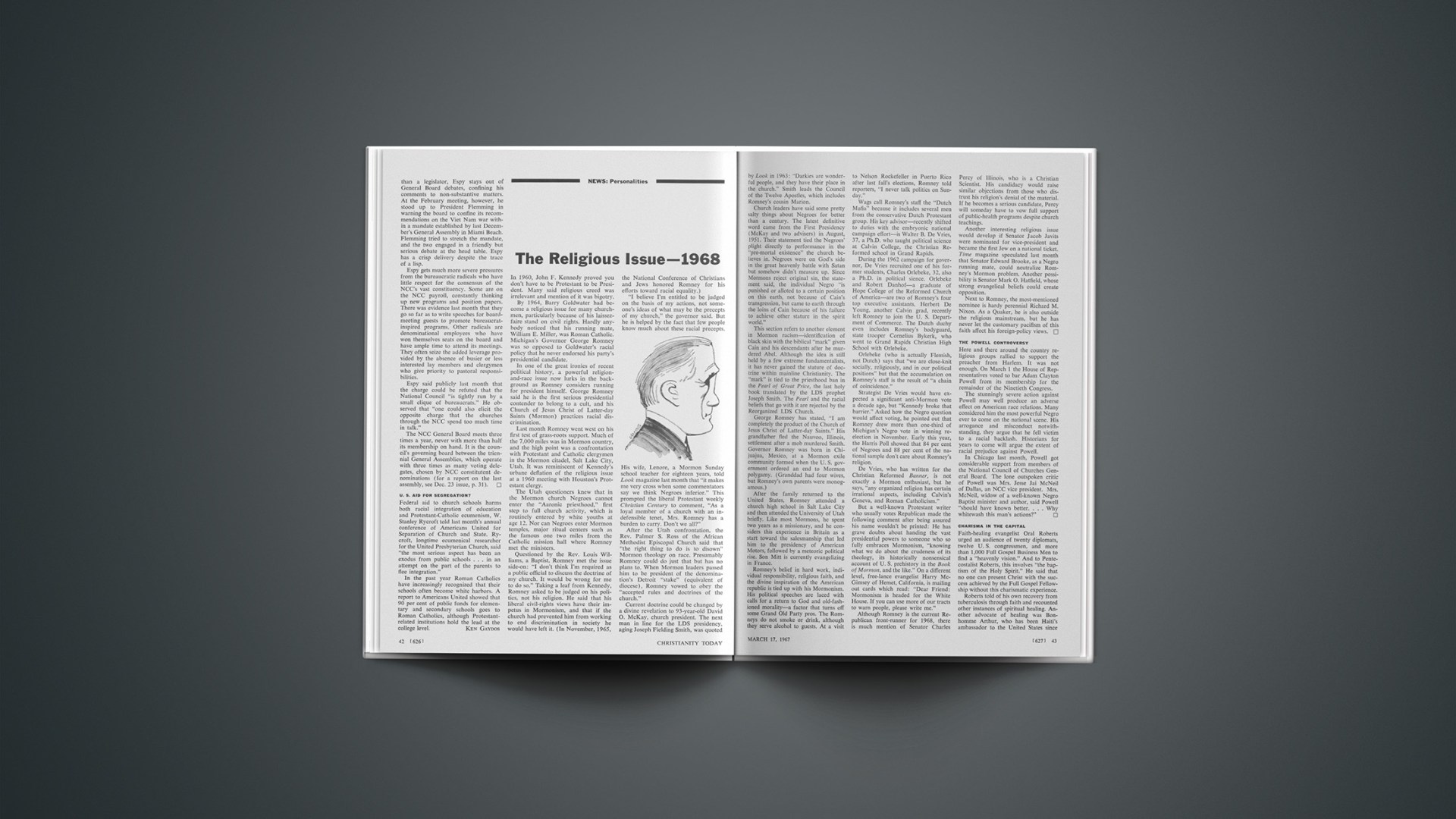
In one of the great ironies of recent political history, a powerful religion-and-race issue now lurks in the background as Romney considers running for president himself. George Romney said he is the first serious presidential contender to belong to a cult, and his Church of Jesus Christ of Latter-day Saints (Mormon) practices racial discrimination.

Last month Romney went west on his first test of grass-roots support. Much of the 7,000 miles was in Mormon country, and the high point was a confrontation with Protestant and Catholic clergymen in the Mormon citadel, Salt Lake City, Utah. It was reminiscent of Kennedy’s urbane deflation of the religious issue at a 1960 meeting with Houston’s Protestant clergy.

The Utah questioners knew that in the Mormon church Negroes cannot enter the “Aaronic priesthood,” first step to full church activity, which is routinely entered by white youths at age 12. Nor can Negroes enter Mormon temples, major ritual centers such as the famous one two miles from the Catholic mission hall where Romney met the ministers.

Questioned by the Rev. Louis Williams, a Baptist, Romney met the issue side-on: “I don’t think I’m required as a public official to discuss the doctrine of my church. It would be wrong for me to do so.” Taking a leaf from Kennedy, Romney asked to be judged on his politics, not his religion. He said that his liberal civil-rights views have their impetus in Mormonism, and that if the church had prevented him from working to end discrimination in society he would have left it. (In November, 1965, the National Conference of Christians and Jews honored Romney for his efforts toward racial equality.)

“I believe I’m entitled to be judged on the basis of my actions, not someone’s ideas of what may be the precepts of my church,” the governor said. But he is helped by the fact that few people know much about these racial precepts. His wife, Lenore, a Mormon Sunday school teacher for eighteen years, told Look magazine last month that “it makes me very cross when some commentators say we think Negroes inferior.” This prompted the liberal Protestant weekly Christian Century to comment, “As a loyal member of a church with an indefensible tenet, Mrs. Romney has a burden to carry. Don’t we all?”

After the Utah confrontation, the Rev. Palmer S. Ross of the African Methodist Episcopal Church said that “the right thing to do is to disown” Mormon theology on race. Presumably Romney could do just that but has no plans to. When Mormon leaders passed him to be president of the denomination’s Detroit “stake” (equivalent of diocese), Romney vowed to obey the “accepted rules and doctrines of the church.”

Current doctrine could be changed by a divine revelation to 93-year-old David O. McKay, church president. The next man in line for the LDS presidency, aging Joseph Fielding Smith, was quoted by Look in 1963: “Darkies are wonderful people, and they have their place in the church.” Smith leads the Council of the Twelve Apostles, which includes Romney’s cousin Marion.

Church leaders have said some pretty salty things about Negroes for better than a century. The latest definitive word came from the First Presidency (McKay and two advisers) in August, 1951. Their statement tied the Negroes’ plight directly to performance in the “pre-mortal existence” the church believes in. Negroes were on God’s side in the great heavenly battle with Satan but somehow didn’t measure up. Since Mormons reject original sin, the statement said, the individual Negro “is punished or alloted to a certain position on this earth, not because of Cain’s transgression, but came to earth through the loins of Cain because of his failure to achieve other stature in the spirit world.”

This section refers to another element in Mormon racism—identification of black skin with the biblical “mark” given Cain and his descendants after he murdered Abel. Although the idea is still held by a few extreme fundamentalists, it has never gained the stature of doctrine within mainline Christianity. The “mark” is tied to the priesthood ban in the Pearl of Great Price, the last holy book translated by the LDS prophet Joseph Smith. The Pearl and the racial beliefs that go with it are rejected by the Reorganized LDS Church.

George Romney has stated, “I am completely the product of the Church of Jesus Christ of Latter-day Saints.” His grandfather fled the Nauvoo, Illinois, settlement after a mob murdered Smith. Governor Romney was born in Chijuajua, Mexico, at a Mormon exile community formed when the U. S. government ordered an end to Mormon polygamy. (Granddad had four wives, but Romney’s own parents were monogamous.)

After the family returned to the United States, Romney attended a church high school in Salt Lake City and then attended the University of Utah briefly. Like most Mormons, he spent two years as a missionary, and he considers this experience in Britain as a start toward the salesmanship that led him to the presidency of American Motors, followed by a meteoric political rise. Son Mitt is currently evangelizing in France.

Romney’s belief in hard work, individual responsibility, religious faith, and the divine inspiration of the American republic is tied up with his Mormonism. His political speeches are laced with calls for a return to God and old-fashioned morality—a factor that turns off some Grand Old Party pros. The Romneys do not smoke or drink, although they serve alcohol to guests. At a visit to Nelson Rockefeller in Puerto Rico after last fall’s elections, Romney told reporters, “I never talk politics on Sunday.”

Wags call Romney’s staff the “Dutch Mafia” because it includes several men from the conservative Dutch Protestant group. His key advisor—recently shifted to duties with the embryonic national campaign effort—is Walter B. De Vries, 37, a Ph.D. who taught political science at Calvin College, the Christian Reformed school in Grand Rapids.

During the 1962 campaign for governor, De Vries recruited one of his former students, Charles Orlebeke, 32, also a Ph.D. in political sience. Orlebeke and Robert Danhof—a graduate of Hope College of the Reformed Church of America—are two of Romney’s four top executive assistants. Herbert De Young, another Calvin grad, recently left Romney to join the U. S. Department of Commerce. The Dutch duchy even includes Romney’s bodyguard, state trooper Cornelius Bykerk, who went to Grand Rapids Christian High School with Orlebeke.

Orlebeke (who is actually Flemish, not Dutch) says that “we are close-knit socially, religiously, and in our political positions” but that the accumulation on Romney’s staff is the result of “a chain of coincidence.”

Strategist De Vries would have expected a significant anti-Mormon vote a decade ago, but “Kennedy broke that barrier.” Asked how the Negro question would affect voting, he pointed out that Romney drew more than one-third of Michigan’s Negro vote in winning re-election in November. Early this year, the Harris Poll showed that 84 per cent of Negroes and 88 per cent of the national sample don’t care about Romney’s religion.

De Vries, who has written for the Christian Reformed Banner, is not exactly a Mormon enthusiast, but he says, “any organized religion has certain irrational aspects, including Calvin’s Geneva, and Roman Catholicism.”

But a well-known Protestant writer who usually votes Republican made the following comment after being assured his name wouldn’t be printed: He has grave doubts about handing the vast presidential powers to someone who so fully embraces Mormonism, “knowing what we do about the crudeness of its theology, its historically nonsensical account of U. S. prehistory in the Book of Mormon, and the like.” On a different level, free-lance evangelist Harry McGimsey of Hemet, California, is mailing out cards which read: “Dear Friend: Mormonism is headed for the White House. If you can use more of our tracts to warn people, please write me.”

Although Romney is the current Republican front-runner for 1968, there is much mention of Senator Charles Percy of Illinois, who is a Christian Scientist. His candidacy would raise similar objections from those who distrust his religion’s denial of the material. If he becomes a serious candidate, Percy will someday have to vow full support of public-health programs despite church teachings.

Another interesting religious issue would develop if Senator Jacob Javits were nominated for vice-president and became the first Jew on a national ticket. Time magazine speculated last month that Senator Edward Brooke, as a Negro running mate, could neutralize Romney’s Mormon problem. Another possibility is Senator Mark O. Hatfield, whose strong evangelical beliefs could create opposition.

Next to Romney, the most-mentioned nominee is hardy perennial Richard M. Nixon. As a Quaker, he is also outside the religious mainstream, but he has never let the customary pacifism of this faith affect his foreign-policy views.

The Powell Controversy

Here and there around the country religious groups rallied to support the preacher from Harlem. It was not enough. On March 1 the House of Representatives voted to bar Adam Clayton Powell from its membership for the remainder of the Ninetieth Congress.

The stunningly severe action against Powell may well produce an adverse effect on American race relations. Many considered him the most powerful Negro ever to come on the national scene. His arrogance and misconduct notwithstanding, they argue that he fell victim to a racial backlash. Historians for years to come will argue the extent of racial prejudice against Powell.

In Chicago last month, Powell got considerable support from members of the National Council of Churches General Board. The lone outspoken critic of Powell was Mrs. Jesse Jai McNeil of Dallas, an NCC vice president. Mrs. McNeil, widow of a well-known Negro Baptist minister and author, said Powell “should have known better.… Why whitewash this man’s actions?”

Charisma In The Capital

Faith-healing evangelist Oral Roberts urged an audience of twenty diplomats, twelve U. S. congressmen, and more than 1,000 Full Gospel Business Men to find a “heavenly vision.” And to Pentecostalist Roberts, this involves “the baptism of the Holy Spirit.” He said that no one can present Christ with the success achieved by the Full Gospel Fellowship without this charismatic experience.

Roberts told of his own recovery from tuberculosis through faith and recounted other instances of spiritual healing. Another advocate of healing was Bonhomme Arthur, who has been Haiti’s ambassador to the United States since December. Arthur is a Methodist lay preacher who had a vision of God and was convicted of his sins while in prison sentenced to death. He finally won his freedom and went on to become president of the Haitian Bible Society, a worker for Laubach Literacy, and a senator and public works minister.

Missal Mix-Up

A Roman Catholic missal—not a Bible—was inadvertently used by Lyndon Johnson when he was sworn in as President after the assassination of John F. Kennedy.

So said the Washington Post last month, corroborating a report in a forthcoming book, The Truth About the Assassination, by Newsweek correspondent Charles Roberts, who was aboard Air Force One at the time.

This new version contradicts the account of William Manchester in The Death of a President. Manchester said Kennedy’s personal Bible was used.

The Heresy Of Ernest Harrison

The Rev. Ernest Harrison, 49, who headed the board that produced the Anglican Church of Canada’s new curriculum last year, was removed from the staff of Toronto’s Holy Trinity Church last month in the outcry over his new book, A Church Without God.

Outdoing Altizer, Harrison disbelieves not only in a present and future God but even in a past one. “I claim to be a Christian and an Anglican; yet I can say in all seriousness, that there is no God,” wrote the Oxford-educated priest. Harrison now teaches English at the Ryerson Institute of Technology. When he was with the denomination’s religious education department, he persuaded Pierre Berton to write his controversial outsider’s view of the Church, called The Comfortable Pew.

Toronto’s Bishop George Snell has barred Harrison from priestly work, but he still holds a license to preach in Quebec. There will be no heresy action in Toronto.

Harrison says the Bible “is not the last word on anything.… There are contexts in which Lord of the Flies is a more useful, perhaps a deeper witness than that of Genesis; in which Death of a Salesman shows more insight than Jonah; in which Martin Luther King presents a more dramatic plea for the triumph of grace over law than the neurotic Paul.”

He speculates that Jesus probably got drunk, and experienced acute sexual excitement when the woman wiped his feet with her hair (Luke 7:37–39). On sex: “Conduct which is right between two married people does not necessarily become wrong because they are unmarried.” As for life after death, “for myself it is a doctrine that has no meaning.”

J. BERKLEY REYNOLDS
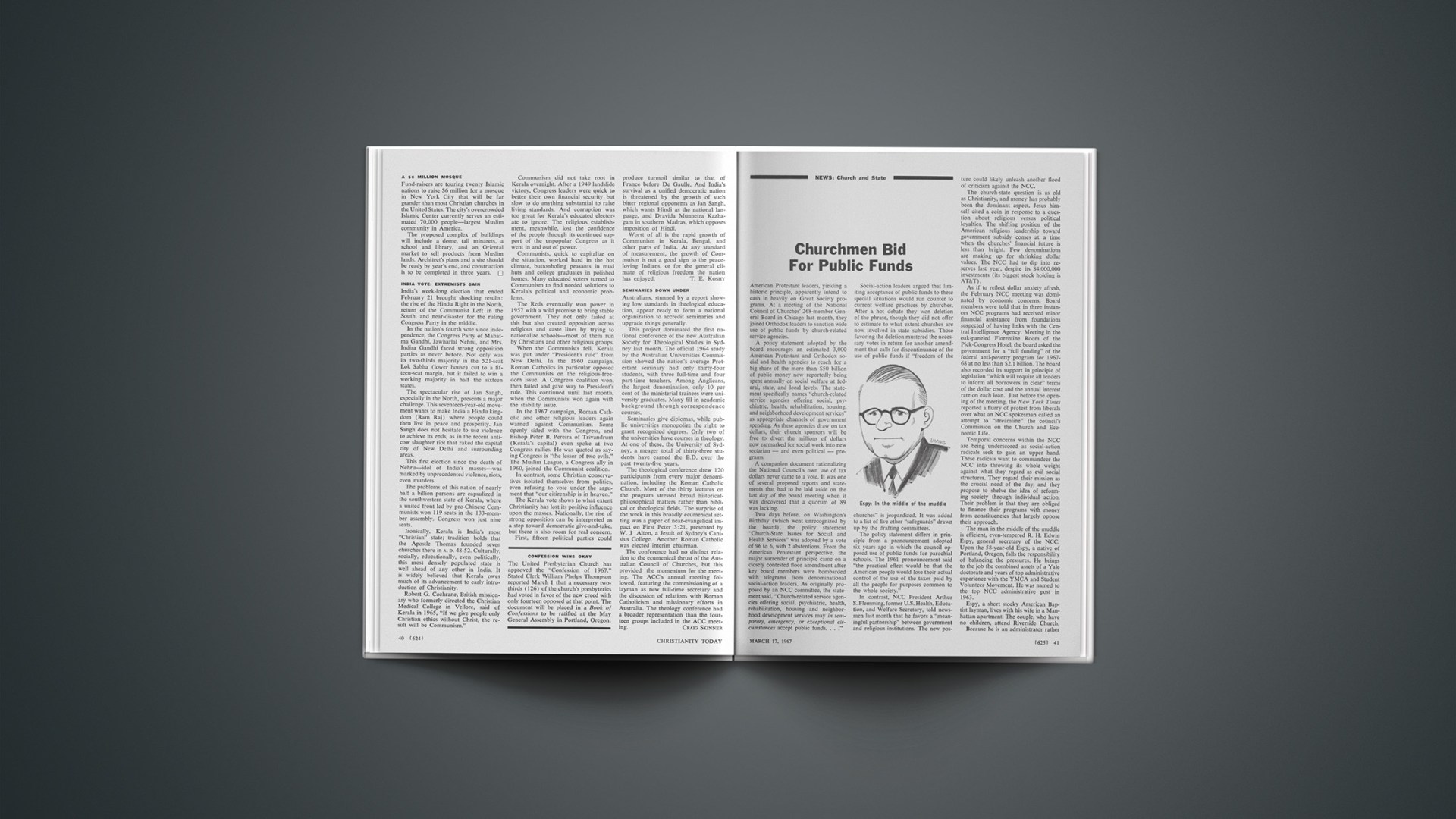
Churchmen Bid for Public Funds

American Protestant leaders, yielding a historic principle, apparently intend to cash in heavily on Great Society programs. At a meeting of the National Council of Churches’ 268-member General Board in Chicago last month, they joined Orthodox leaders to sanction wide use of public funds by church-related service agencies.

A policy statement adopted by the board encourages an estimated 3,000 American Protestant and Orthodox social and health agencies to reach for a big share of the more than $50 billion of public money now reportedly being spent annually on social welfare at federal, state, and local levels. The statement specifically names “church-related service agencies offering social, psychiatric, health, rehabilitation, housing, and neighborhood development services” as appropriate channels of government spending. As these agencies draw on tax dollars, their church sponsors will be free to divert the millions of dollars now earmarked for social work into new sectarian—and even political—programs.

A companion document rationalizing the National Council’s own use of tax dollars never came to a vote. It was one of several proposed reports and statements that had to be laid aside on the last day of the board meeting when it was discovered that a quorum of 89 was lacking.

Two days before, on Washington’s Birthday (which went unrecognized by the board), the policy statement “Church-State Issues for Social and Health Services” was adopted by a vote of 96 to 6, with 2 abstentions. From the American Protestant perspective, the major surrender of principle came on a closely contested floor amendment after key board members were bombarded with telegrams from denominational social-action leaders. As originally proposed by an NCC committee, the statement said, “Church-related service agencies offering social, psychiatric, health, rehabilitation, housing and neighborhood development services may in temporary, emergency, or exceptional circumstances accept public funds.…”

Social-action leaders argued that limiting acceptance of public funds to these special situations would run counter to current welfare practices by churches. After a hot debate they won deletion of the phrase, though they did not offer to estimate to what extent churches are now involved in state subsidies. Those favoring the deletion mustered the necessary votes in return for another amendment that calls for discontinuance of the use of public funds if “freedom of the churches” is jeopardized. It was added to a list of five other “safeguards” drawn up by the drafting committees.

The policy statement differs in principle from a pronouncement adopted six years ago in which the council opposed use of public funds for parochial schools. The 1961 pronouncement said “the practical effect would be that the American people would lose their actual control of the use of the taxes paid by all the people for purposes common to the whole society.”

In contrast, NCC President Arthur S. Flemming, former U.S. Health, Education, and Welfare Secretary, told newsmen last month that he favors a “meaningful partnership” between government and religious institutions. The new posture could likely unleash another flood of criticism against the NCC.

The church-state question is as old as Christianity, and money has probably been the dominant aspect. Jesus himself cited a coin in response to a question about religious versus political loyalties. The shifting position of the American religious leadership toward government subsidy comes at a time when the churches’ financial future is less than bright. Few denominations are making up for shrinking dollar values. The NCC had to dip into reserves last year, despite its $4,000,000 investments (its biggest stock holding is AT&T).

As if to reflect dollar anxiety afresh, the February NCC meeting was dominated by economic concerns. Board members were told that in three instances NCC programs had received minor financial assistance from foundations suspected of having links with the Central Intelligence Agency. Meeting in the oak-paneled Florentine Room of the Pick-Congress Hotel, the board asked the government for a “full funding” of the federal anti-poverty program for 1967–68 at no less than $2.1 billion. The board also recorded its support in principle of legislation “which will require all lenders to inform all borrowers in clear” terms of the dollar cost and the annual interest rate on each loan. Just before the opening of the meeting, the New York Times reported a flurry of protest from liberals over what an NCC spokesman called an attempt to “streamline” the council’s Commission on the Church and Economic Life.

Temporal concerns within the NCC are being underscored as social-action radicals seek to gain an upper hand. These radicals want to commandeer the NCC into throwing its whole weight against what they regard as evil social structures. They regard their mission as the crucial need of the day, and they propose to shelve the idea of reforming society through individual action. Their problem is that they are obliged to finance their programs with money from constituencies that largely oppose their approach.

The man in the middle of the muddle is efficient, even-tempered R. H. Edwin Espy, general secretary of the NCC. Upon the 58-year-old Espy, a native of Portland, Oregon, falls the responsibility of balancing the pressures. He brings to the job the combined assets of a Yale doctorate and years of top administrative experience with the YMCA and Student Volunteer Movement. He was named to the top NCC administrative post in 1963.

Espy, a short stocky American Baptist layman, lives with his wife in a Manhattan apartment. The couple, who have no children, attend Riverside Church.

Because he is an administrator rather than a legislator, Espy stays out of General Board debates, confining his comments to non-substantive matters. At the February meeting, however, he stood up to President Flemming in warning the board to confine its recommendations on the Viet Nam war within a mandate established by last December’s General Assembly in Miami Beach. Flemming tried to stretch the mandate, and the two engaged in a friendly but serious debate at the head table. Espy has a crisp delivery despite the trace of a lisp.

Espy gets much more severe pressures from the bureaucratic radicals who have little respect for the consensus of the NCC’s vast constituency. Some are on the NCC payroll, constantly thinking up new programs and position papers. There was evidence last month that they go so far as to write speeches for board-meeting guests to promote bureaucrat-inspired programs. Other radicals are denominational employees who have won themselves seats on the board and have ample time to attend its meetings. They often seize the added leverage provided by the absence of busier or less interested lay members and clergymen who give priority to pastoral responsibilities.

Espy said publicly last month that the charge could be refuted that the National Council “is tightly run by a small clique of bureaucrats.” He observed that “one could also elicit the opposite charge that the churches through the NCC spend too much time in talk.”

The NCC General Board meets three times a year, never with more than half its membership on hand. It is the council’s governing board between the triennial General Assemblies, which operate with three times as many voting delegates, chosen by NCC constitutent denominations (for a report on the last assembly, see Dec. 23 issue, p. 31).

U. S. Aid For Segregation?

Federal aid to church schools harms both racial integration of education and Protestant-Catholic ecumenism, W. Stanley Rycroft told last month’s annual conference of Americans United for Separation of Church and State. Rycroft, longtime ecumenical researcher for the United Presbyterian Church, said “the most serious aspect has been an exodus from public schools … in an attempt on the part of the parents to flee integration.”

In the past year Roman Catholics have increasingly recognized that their schools often become white harbors. A report to Americans United showed that 90 per cent of public funds for elementary and secondary schools goes to Roman Catholics, although Protestant-related institutions hold the lead at the college level.

KEN GAYDOS

The Passover Ploy

The Easter season puts the central historical claims of Christianity into the secular spotlight for a few fleeting moments each year. Opposition arguments haven’t changed much over the centuries, but this year they have an engaging new spokesman.

Hugh J. Schonfield, a Jewish historian from Britain, last month wrapped up a four-week, $10,000 tour to promote his version of the historical Jesus, found in his book The Passover Plot. His 275-page theory rated little attention from scholars in the field, but Schonfield has doubtless had an effect on people who have little technical knowledge of their own.

Aided by controversy, some bright advertisements (“Don’t give this book to anyone for Christmas”), and two month-long tours, Plot sales are nearing 100,000 during Lent, and the book will go into a paperback edition this spring. Schonfield proved an articulate proponent of his views on network TV; many thought he outflanked Christian opponents in broadcast debates.

Schonfield’s dozens of appearances in major cities were not without incident. His publisher, Bernard Geis Associates, reports Boston’s WBZ canceled an interview the day after Ash Wednesday as being inappropriate. Pressure from the Roman Catholic archdiocese led to a cancellation on New York’s WCBS. But publicist Letty Pogrebin, who considers Schonfield to be “like a little modern prophet,” reports one Catholic priest found himself in “95 per cent agreement” with the Briton. The Rev. Harold Blake Walker, a Presbyterian, wrote a friendly review for the Chicago Tribune.

Historians are not so enthused. One who has expressed his opinion is Edwin M. Yamauchi, a young history professor at Rutgers who earned a Ph.D. in Mediterranean studies from Brandeis University. Some of Yamauchi’s reasons for skepticism are summarized as follows:

The wildest, most publicized aspect of Plot is the theory that Jesus manipulated people and events to fulfill Old Testament prophecies of a messiah. Schonfield contends that Jesus confided in Joseph of Arimathea, Lazarus, a Judaean priest, and an anonymous “young man.” (For some reason, he excluded his closest disciples—Peter, James, and John.)

The conspirators were to give Jesus a drug so he could feign death on the cross, then recover and reveal himself as “resurrected” after three days. The drug was in the “vinegar” (cheap wine) given Jesus on the cross, Schonfield explains, while omitting that Jesus earlier had refused another pain-killer: wine mixed with gall or myrrh.

To prove that Joseph of Arimathea was in on the plot, Schonfield points out that he asked for the body (soma) of Jesus instead of the corpse (ptoma). But soma often means “corpse” in Greek, as in John 19:31; this meaning is universal in Homer’s writings.

Schonfield explains that the plot failed because Jesus received a spear wound on the cross and couldn’t be revived. The plotters then got rid of the body somewhere—thus the empty tomb—and Christians later added the story about guards at the tomb to make things plausible.

The major reason for belief in the resurrection, however, wasn’t the empty tomb but Jesus’ post-resurrection appearances to his disciples. Of the ten appearances generally listed by biblical scholars, Schonfield makes no mention at all of three and cites a fourth without comment. He dismisses the two appearances in Jerusalem as a Judean tradition picked up by Luke and John but neglects to mention the allusion to them in Mark.

The other four are explained away as mistaken identity, although he says each involved “a real living person.” Mary Magdalene saw a gardener. The “angel” at the empty tomb was just a “young man.” The disciples on the road to Emmaus also made a mistake, possibly involving the “young man.” This ubiquitous youth was also the person the disciples saw on the mountain in Galilee.

Schonfield neglects Saint Paul’s report that more than 500 persons saw the risen Jesus at once. Schonfield’s own Authentic New Testament translation includes this passage but, without support from any existing Greek manuscript, leaves out the statement that “the greater part” of those 500 were still alive when Paul wrote.

Yet Schonfield tries to maintain that neither Jesus nor his apostles were guilty of fraud. The apostles, he says, were confused by that mysterious “young man,” were transformed by the delusion, and then turned Jerusalem upside down with their preaching.

Aside from the “Passover plot” section, Schonfield makes standard arguments against such doctrines as the resurrection and Christ’s deity. His contention that pagan ideas seeped into the writings is aided by the late dates at which he says they were written. He puts John’s Gospel at A. D. 110–115, which does not consider the revised estimate that recent scholarship has impressed even on Bishop John Robinson. In a book last year, eminent scholar W. F. Albright said he prefers a date in the late seventies or early eighties for John.

Schonfield’s date for the Book of Acts is A. D. 98–117, on the disputable grounds that Luke depended on Josephus’ Antiquities; there are cogent reasons to date Acts earlier. One argument Schonfield uses for a late date of Luke’s Gospel is a resemblance between the Emmaus Road incident and a story in Apuleius’s The Golden Ass. But Schonfield dates Luke at about A. D. 100; Apuleius was not born until 124!

Assuming late writings and pagan corruptions of the stories about Jesus, Schonfield says the belief in the resurrection was patterned after worship of a dying-and-rising fertility god, such as Adonis or Attis. After thorough study, such scholars as Pierre Lambrechts question whether these legends even existed in pre-Christian times. In any event, if the legends existed, they typified the death and rebirth of vegetation, not of a historical person.

Belief in Jesus’ deity is linked to the deification of the Roman emperors. Technically, it was Augustus’ genius or double who was deified, and he himself was named a god only after he died. It was a madman—Gaius Caligula (A. D. 37–41)—who demanded worship of himself while he was still living. Many scholars believe the ruler cult was more an expression of political loyalty than of genuine piety.

Jesus, of course, was not a conqueror or emperor with vast powers. And those who first worshiped him were not Gentiles from this polytheistic Greek-Roman culture in which heroes readily became anthropomorphic gods. They were Jews from a monotheistic tradition.

The early apostles’ Old Testament background included foreshadowings of deity in prophecies about the Messiah, even though the Jews were not looking for a divine Messiah. Schonfield does not deal with such passages as Psalms 2:7; 45:6, and 110:1. He also eliminates troublesome material when he compares a Qumran hymn with Isaiah 9:6, 7, by omitting the key phrase “Mighty God, Everlasting Father, Prince of Peace.”

Schonfield similarly evades Paul’s statements on the deity of Jesus. He argues that Paul never spoke of Jesus as God and that followers “unacquainted” with Paul’s “esoteric Jewish background” made misinterpretations. Yet Philippians 2:6, for instance, is meaningless unless Paul assumed that Jesus was divine.

Then there are Jesus’ own statements. At the trial scene in Mark 14, the high priest asked Jesus whether he was the Messiah, and he replied ego eimi (“I am”). The Jewish scholar H. J. Schoeps writes that Jesus, in his use of the phrase, “implied that He predicated of Himself divine nature.” Schonfield figures that the priest then ripped his garments because Jesus had blasphemed Tiberius. But the rending of garments was a Jewish protest against a gidduf—blasphemy against God himself, an act worthy of death. If Jesus had merely claimed to be the Messiah, it is unlikely the Sanhedrin would have condemmed him to death. In the Jewish view, history would be the judge of messianic claims. In the next century, Rabbi Akiba proclaimed Bar Kokhba to be the Messiah, but rabbis who disagreed did not persecute either man.

Finally, Schonfield argues that the Jews would have stoned Jesus if he had blasphemed God by a claim to divinity. But he recognizes the historical fact that the Jews were prohibited from practicing capital punishment. On two occasions when the Jews stoned Stephen and James for blasphemy, they took advantage of the temporary absence of a Roman governor to take the law into their own hands.

The Quest For Verification

John W. Montgomery, in a debate with Thomas J. J. Altizer (see adjoining story), predicted that “the Delphic Oracle phase in modern theology is almost over.” Montgomery said that in Altizer “you may well be seeing its last, soon-to-be extinct representative.”

Altizer is the best-known spokesman for death-of-God theology.

Modern man, Montgomery said, “is sick to death of verbal panaceas—of autobiography masking as theology—of the naïve confusion of cultural trends with religious truth—of the theologian who hypnotizes himself by his own terminology and leaves no possible means of confirming what he says.”

A Debate On God

Produce God, dead or alive, said a writ of habeas corpus served on a poet and a theological lawyer. It was an audacious demand, but because both believe they know God’s whereabouts, they attempted last month to obey.

The poet was Dr. Thomas J. J. Altizer, associate professor of Bible and religion at Emory University. The lawyer was Dr. John Warwick Montgomery, professor and chairman of the division of church history and history of Christian thought at Trinity Evangelical Divinity School, Deerfield, Illinois.

The hearing was held in Rockefeller Memorial Chapel of the University of Chicago. It was one of numerous events being held to mark the Baptist-founded university’s seventy-fifth anniversary. More than 2,000 persons, a minority of them from the university’s quadrangles, heard the evidence.

As though to put things straight at last, and with a respectful tinge of melancholy, the young Southerner confessed firmly that God is dead. Moreover, he continued, the angel’s proclamation was false. Christ was crucified, but there was no resurrection.

God did incarnate himself in Christ, said Altizer more cheerfully, but when Jesus died God did not return to heaven. He remained in the world and is in it now. No longer transcendent, God has become totally immanent, totally flesh, totally world.

Replying, possibly, to those who have said that he is alone in most of his beliefs, Altizer spoke of the God-is-dead “movement” and said frequently, “We believe.…”

It is “our” belief, said Altizer, that “God died as a means of embodying himself redemptively in Christ.” Speaking in terms of a flux, he contended that Christ continually moves in the fullness of history and the present. Christ is a forward moving force, and redemption is a gradual process, Altizer declared.

Though he did not intend it to be, for he was speaking on behalf of a movement, his argument was intensely personal. And when questioned about it, Altizer admitted that among its elements were much that was “autobiographical.”

Montgomery, speaking at breakneck speed in an effort to get a fifty-minute argument into the half hour allotted to it, sharply attacked the personal aspects of Altizer’s theology as subjective factors completely beyond proof. “What modern man insists on above all is a verifiable base for his faith, so that he can bring some order out of the welter of religious claims,” he said.

In contrast to Altizer, who made virtually no references to the works of others, Montgomery nearly submerged his own words in citations from a startling variety of sources.

Yet, finally, after speaking of the awesome authority of the Bible and of its support of his contentions, after stating that the Bible was the ultimate, all-persuasive source, Montgomery said that it does not supply complete, unquestionable verification.

It was one of the rare moments of the hearing when poet and lawyer, each in his own fashion, agreed.

The program was conducted in cooperation with the university’s student government and was sponsored by the University of Chicago unit of Inter-Varsity Christian Fellowship.

RICHARD PHILBRICK

Cloak, Dagger, And Cross

Controversy over the Central Intelligence Agency’s secret funding of private organizations has expanded with the disclosure of possible links with at least eight religious groups, three of which are Protestant and four Roman Catholic.

The groups reported that they received funds from foundations that allegedly are CIA-connected after Ramparts, quasi-Catholic monthly published by laymen, disclosed the CIA’s indirect funding of such student groups as the National Student Association.

Foundation grants have become common income sources for non-profit organizations, and all eight groups admit the financial support. But they all deny that the money originally came from the CIA.

The National Council of Churches reported “minor” contributions from the Foundation for Youth and Student Affairs toward expenses for a conference of the NCC-related National Student Christian Federation and from the Baird Foundation for “direct relief” programs. National Council officials declared emphatically that the money was not used for CIA purposes, but they immediately dispatched letters of inquiry to the contributing foundations.

The Baird Foundation was also the source for funds supplied to the American Friends Service Committee over the past twenty years. The committee characterized the total as “far exceeding” a reported $50,000.

The Synod of Russian Orthodox Church Bishops Outside Russia said it received $38,000 from the same foundation.

The Young Women’s Christian Association, emphasizing it sought out the money, said it was given $3,500 by the Foundation for Youth and Student Affairs during the past ten years.

The same foundation said it supplied money to four Catholic groups, the Young Christian Movement and Pax Romana, both lay organizations, and the National Federation of Catholic College Students and the National Newman Student Federation, both Pax Romana student affiliates.

A $6 Million Mosque

Fund-raisers are touring twenty Islamic nations to raise $6 million for a mosque in New York City that will be far grander than most Christian churches in the United States. The city’s overcrowded Islamic Center currently serves an estimated 70,000 people—largest Muslim community in America.

The proposed complex of buildings will include a dome, tall minarets, a school and library, and an Oriental market to sell products from Muslim lands. Architect’s plans and a site should be ready by year’s end, and construction is to be completed in three years.

India Vote: Extremists Gain

India’s week-long election that ended February 21 brought shocking results: the rise of the Hindu Right in the North, return of the Communist Left in the South, and near-disaster for the ruling Congress Party in the middle.

In the nation’s fourth vote since independence, the Congress Party of Mahatma Gandhi, Jawharlal Nehru, and Mrs. Indira Gandhi faced strong opposition parties as never before. Not only was its two-thirds majority in the 521-seat Lok Sabha (lower house) cut to a fifteen-seat margin, but it failed to win a working majority in half the sixteen states.

The spectacular rise of Jan Sangh, especially in the North, presents a major challenge. This seventeen-year-old movement wants to make India a Hindu kingdom (Ram Raj) where people could then live in peace and prosperity. Jan Sangh does not hesitate to use violence to achieve its ends, as in the recent anti-cow slaughter riot that raked the capital city of New Delhi and surrounding areas.

This first election since the death of Nehru—idol of India’s masses—was marked by unprecedented violence, riots, even murders.

The problems of this nation of nearly half a billion persons are capsulized in the southwestern state of Kerala, where a united front led by pro-Chinese Communists won 119 seats in the 133-member assembly. Congress won just nine seats.

Ironically, Kerala is India’s most “Christian” state; tradition holds that the Apostle Thomas founded seven churches there in A. D. 48–52. Culturally, socially, educationally, even politically, this most densely populated state is well ahead of any other in India. It is widely believed that Kerala owes much of its advancement to early introduction of Christianity.

Robert G. Cochrane, British missionary who formerly directed the Christian Medical College in Vellore, said of Kerala in 1965, “If we give people only Christian ethics without Christ, the result will be Communism.”

Communism did not take root in Kerala overnight. After a 1949 landslide victory, Congress leaders were quick to better their own financial security but slow to do anything substantial to raise living standards. And corruption was too great for Kerala’s educated electorate to ignore. The religious establishment, meanwhile, lost the confidence of the people through its continued support of the unpopular Congress as it went in and out of power.

Communists, quick to capitalize on the situation, worked hard in the hot climate, buttonholing peasants in mud huts and college graduates in polished homes. Many educated voters turned to Communism to find needed solutions to Kerala’s political and economic problems.

The Reds eventually won power in 1957 with a wild promise to bring stable government. They not only failed at this but also created opposition across religious and caste lines by trying to nationalize schools—most of them run by Christians and other religious groups.

When the Communists fell, Kerala was put under “President’s rule” from New Delhi. In the 1960 campaign, Roman Catholics in particular opposed the Communists on the religious-freedom issue. A Congress coalition won, then failed and gave way to President’s rule. This continued until last month, when the Communists won again with the stability issue.

In the 1967 campaign, Roman Catholic and other religious leaders again warned against Communism. Some openly sided with the Congress, and Bishop Peter B. Pereira of Trivandrum (Kerala’s capital) even spoke at two Congress rallies. He was quoted as saying Congress is “the lesser of two evils.” The Muslim League, a Congress ally in 1960, joined the Communist coalition.

In contrast, some Christian conservatives isolated themselves from politics, even refusing to vote under the argument that “our citizenship is in heaven.”

The Kerala vote shows to what extent Christianity has lost its positive influence upon the masses. Nationally, the rise of strong opposition can be interpreted as a step toward democratic give-and-take, but there is also room for real concern.

First, fifteen political parties could produce turmoil similar to that of France before De Gaulle. And India’s survival as a unified democratic nation is threatened by the growth of such bitter regional opponents as Jan Sangh, which wants Hindi as the national language, and Dravida Munnetra Kazhagam in southern Madras, which opposes imposition of Hindi.

Worst of all is the rapid growth of Communism in Kerala, Bengal, and other parts of India. At any standard of measurement, the growth of Commuism is not a good sign to the peace-loving Indians, or for the general climate of religious freedom the nation has enjoyed.

T. E. KOSHY

Confession Wins Okay

The United Presbyterian Church has approved the “Confession of 1967.” Stated Clerk William Phelps Thompson reported March 1 that a necessary two-thirds (126) of the church’s presbyteries had voted in favor of the new creed with only fourteen opposed at that point. The document will be placed in a Book of Confessions to be ratified at the May General Assembly in Portland, Oregon.

Seminaries Down Under

Australians, stunned by a report showing low standards in theological education, appear ready to form a national organization to accredit seminaries and upgrade things generally.

This project dominated the first national conference of the new Australian Society for Theological Studies in Sydney last month. The official 1964 study by the Australian Universities Commission showed the nation’s average Protestant seminary had only thirty-four students, with three full-time and four part-time teachers. Among Anglicans, the largest denomination, only 10 per cent of the ministerial trainees were university graduates. Many fill in academic background through correspondence courses.

Seminaries give diplomas, while public universities monopolize the right to grant recognized degrees. Only two of the universities have courses in theology. At one of these, the University of Sydney, a meager total of thirty-three students have earned the B.D. over the past twenty-five years.

The theological conference drew 120 participants from every major denomination, including the Roman Catholic Church. Most of the thirty lectures on the program stressed broad historical-philosophical matters rather than biblical or theological fields. The surprise of the week in this broadly ecumenical setting was a paper of near-evangelical impact on First Peter 3:21, presented by W. J Alton, a Jesuit of Sydney’s Canisius College. Another Roman Catholic was elected interim chairman.

The conference had no distinct relation to the ecumenical thrust of the Australian Council of Churches, but this provided the momentum for the meeting. The ACC’s annual meeting followed, featuring the commissioning of a layman as new full-time secretary and the discussion of relations with Roman Catholicism and missionary efforts in Australia. The theology conference had a broader representation than the fourteen groups included in the ACC meeting.

CRAIG SKINNER

Book Briefs: March 17, 1967

Methodism’S Uncertain Trumpet

Christian Mission in Theological Perspective: An Inquiry by Methodists, edited by Gerald H. Anderson (Abingdon, 1967, 286 pp., $2.50), is reviewed by Horace L. Fenton, Jr., general director of the Latin America Mission, San José, Costa Rica.

Evangelical readers will rejoice in the concern within Methodism that has prompted this book. In his preface, Gerald Anderson reminds us that “despite the sacrificial effort and significant gains of the Christian mission throughout the centuries, there are still more non-Christians in the world today than on the day when Jesus was crucified. Two out of three people in the world today do not recognize Him as Lord, and as many as one billion people have never even heard the name of Jesus. Our conviction is that He alone can bring healing and wholeness to men and nations. To this end we dedicate our efforts and seek for a radical renewal of Christian mission in our time.” Encouraged by this statement, many will eagerly examine this symposium, prepared by leading theologians and missiologists of The Methodist Church.

And what a variety of suggestions—often contradictory to one another—for the “radical renewal” of the Christian mission will be found in these pages! That the parts of a symposium should be somewhat uneven in approach, style, and quality is not surprising: unevenness is almost inevitable in a collection of essays. But that the leaders of a great denomination should manifest so little agreement with one another over such basic elements as the authority of Scripture, the trustworthiness of Christ, and the mission of the Church is disappointing indeed. And the result is at best an uncertain sound, at worst utter confusion.

In the closing chapter of the book, S. Paul Schilling insists that the biblical writings are authoritative, that Jesus Christ is central to all our faith, that sinful man desperately needs a new life, and that this new life is provided for him in Christ, by grace through faith. But to other contributors to the book, one or more of these basic positions would be utterly unacceptable.

Is the Bible authoritative in all matters of faith? Everett Tilson, in his chapter on “God’s Word and the Christian Mission,” doesn’t seem to think so. He fears the possibility that the words of Scripture, unaltered and unalterable, may supplant the Word of God. He finds Paul mistaken in his understanding of God’s dealings with the Jews and calls this “the apostle’s ‘Back-to-the-Bible Hour’ scheme of missions,” concurring with Blauw’s claim that “Paul errs here theologically.” He further comments, “Quite apart from the apparent failure of his [Paul’s] message to get through to the author of Luke-Acts and Simon Peter, Paul, the convert from Judaism, stands as a monument to the failure of Paul as primitive Christianity’s board of missions schedule-maker.”

And what of the uniqueness of Christ, and of his saving work? Here is D. T. Niles insisting that “there is only one Saviour, Jesus Christ (1 Tim. 2:5), and all who are saved will be saved by Him.… There is no salvation except by Jesus Christ.” (To be sure, he sounds once again a note of uncertainty on the question of universalism.) And here is J. Robert Nelson standing valiantly against religious syncretism and identifying himself with what he calls “the bluntly intransigent declaration of the church’s conviction that the one, holy God has acted decisively and unrepeatedly in Jesus Christ for the salvation of all men. Its corollary is that religious systems or doctrines which deny the absoluteness and particularity of God’s act in Jesus Christ are not partners with Christianity in man’s search for God, but are obstacles and hindrances to be overcome.”

But over against these clear statements, we find A. Roy Eckard averring that anti-Semitism has its roots in the writings of John, Paul, and other writers of the New Testament, and condemning our efforts “to prove to ourselves or to someone that the New Testament is morally unassailable.” He goes on to say that “we Christians must somehow be delivered from our monstrous assumption … that the Jewish people in any age have been unfaithful to their calling, for having (allegedly) rejected Jesus as the Christ, and that, correspondingly, their only hope lies in conversion to the Christian faith.” Again, he refers to “the imperialistic compulsion to turn Jews into Christians.” He holds that the Jews do not need Christ, since they already live in the household of God; that their non-acceptance of Jesus as Messiah is an act not of disobedience but of obedience to God [!]; that therefore “for the Church to endeavor to ‘convert’ the Jewish people to Christianity is forbidden; it is a theological impossibility.”

There is much in the book to help us and to stab us awake. But this hodgepodge of opinions on “radical renewal” is more easily recognizable as radical than as a substantial contribution to the renewal of the Christian mission.

Literary Criticism By Christians

Ernest Hemingway, by Nathan A. Scott, Peter DeVries, by Roderick Jellema, and Edith Sitwell, by Ralph J. Mills, Jr. (Eerdmans, “Contemporary Writers in Christian Perspective” series, 1966, 46, 48, and 47 pp., $.85 each), are reviewed by Paul M. Bechtel, chairman, Division of English, Wheaton College, Wheaton, Illinois.

Thoughtful men have always taken literature seriously because at its best it leads to self-knowledge; it makes clear what it means to be a man. Literature is concerned with all the dimensions of man, downward and upward. Invaluable, too, is its reflection of the world—an image often more authentic in its wholeness than the sociologists’ statistics or the psychologists’ case study. It is a discipline with its own distinctives, unduplicable in any other intellectual enterprise.

Not all readers can hunt out for themselves, however, the central values of a serious work of fiction or a complex poem, nor can most busy moderns read as widely as they would like to. For these people, and the well-informed also, here is an admirable new series of paperbacks. It offers what evangelical readers have long needed: an interpretation and evaluation of significant modern writers from a Christian perspective. Issued earlier were three other of these forty-eight handbooks: studies of Charles Williams, Flannery O’Connor, and T. S. Eliot. The publishers say that new titles in this continuing series will appear at the rate of about six a year.

The purpose underlying these critical surveys, edited by Roderick Jellema of the University of Maryland, is “to provide … a better understanding of a given writer’s work as seen in Christian perspective.” Although the booklets are said to be specifically “oriented to literary criticism,” they include also a biographical sketch, a bibliography, and an overview of the author’s work.

Nathan Scott, with his usual penetrating judgments and felicity of language, is a helpful guide through Hemingway. There seems to me to be this limitation: in all three studies no one of the critics describes the Christian perspective that is the base of his judgments. It is assumed. What kind of theological vision allows a critic to say that below the surface of Hemingway’s fiction is the drama “of the soul’s search for God”? What sort of God? Hemingway was certainly no theist but an energetic humanist and zestful worldling. True, he has loyalties all can appropriate with benefit—a warm response to the good earth and joy in courage, for instance. But God is denied in Hemingway, not in open combat but by his absence, by being nada, the God-shaped blank. However, a journey through his pages offers an authentic mirror of the world mind—the mind to which Christians are pledged to bring the message of hope.

Roderick Jellema understandably regrets that Peter DeVries has not won the wide acclaim he deserves, especially by the serious critics. Although he is known chiefly for his brilliant wit and his devastating satire, DeVries has other assets. He was reared in the faith and knows how to expose, with jagged thrusts, the failures of the visible church. Unhappily, he cannot balance that talent with an affirmation of certainty about the living Christ. Jellema shows skillfully how for DeVries there is no accommodating ground between a radical, perfectionist Christian faith, which he demands, and the world of the contemporary sophisticate, whose follies he so mercilessly exposes.

Critical competence is demonstrated also in Ralph Mills’s study of Edith Sitwell, though for the general reader she is the least appealing of the three. In her later years Miss Sitwell became a Catholic convert and thereafter was much absorbed in verse bent on exposing life’s follies. But her commitment was to what Mills seems seriously to call “natural Christianity,” at best a rather vague and graceful deism.

This is an exciting series. If the same acumen shown here characterizes other studies, we shall be much indebted to the critics and the publisher.

Smashing A New Icon

No Other God, by Gabriel Vahanian (Braziller, 1966, 114 pp., $4; also paper, $1.50), is reviewed by David Allan Hubbard, president, Fuller Theological Seminary, Pasadena, California.

To those who have made the popular mistake of linking Gabriel Vahanian with the death-of-God theologians, this collection of essays on theology in a secular age will come as a surprise. He takes great pains to detach himself from Altizer, Hamilton, and Van Buren (without naming them) by making clear that what he deplored as a tragedy of the post-Christian era they have canonized into an absolute, an idol, a non-Christian religion. Labeling the death-of-God theology Cliristosophy, Vahanian lays bare its absurdity: “Without God no Jesus: this is the corollary of the New Testament’s without Jesus no God.”

Dietrich Bonhoeffer’s religionless Christianity gets its knocks as well. Says Vahanian acridly, Paul made himself all things to all men for the sake of God; Bonhoeffer wants to do this in spite of God.

As the title suggests, iconoclasm is a pillar in Vahanian’s system. Christians are not exempt from man’s proneness to idolatry, and Christianity, which conquered ancient paganism, has bred its own paganism. By fostering and surrendering to secularism, Christianity has forfeited its iconoclastic vocation. The Church has become an institution alongside other institutions and, therefore, has ceased to be the Church.

Vahanian’s longest and most provocative essay, “The Word of God and the Word of Man,” wrestles with the nature of words (icons but also iconoclastic), the authority of Scripture (“a phenomenon of faith”), and the similarity between the Word of God “contained” in the Bible and the Word of God that comes through other literary vehicles.

It is just here that the weaknesses of Vahanian’s approach become clear. Though he bases much of his thinking on the Scriptures, he has neither a consistent commitment to their authority nor a thoroughgoing hermeneutic for their interpretation. He rightly rejects the kind of syncretism that tries to wed biblical faith to some kind of philosophy; yet he offers no consistent methodology either in theology or exegesis as an alternative.

Vahanian’s aphoristic style often blurs his meaning. Important ideas are lost in the shuffle of disjointed affirmations. Theology, classically, has been based on a combination of historical-grammatical exegesis and careful reasoning. Though Vahanian has some nostalgia for this approach (witness his deep appreciation for Calvin), he has not yet brought himself to yield to it.

Reading for Perspective

CHRISTIANITY TODAY’S REVIEW EDITORS CALL ATTENTION TO THESE NEW TITLES:

A Christianity Today Reader, edited by Frank E. Gaebelein (Meredith, $7.95). An inviting sampler of choice articles, editorials, news stories, book reviews, and features published in CHRISTIANITY TODAY during the past decade.

Reformed Dogmatics, by Herman Hoeksema (Reformed Free Publishing, $14.95). A systematic treatment of biblical and Reformed theology, thirty years in preparation, that develops the traditional topics of theology, anthropology, Christology, soteriology, ecclesiology, and eschatology.

Ring of Truth: A Translator’s Testimony, by J. B. Phillips (Macmillan, $2.95). The renowned biblical translator relates discoveries of the deep truths of God that have gripped his life during his long years of study.

Psychology And The New Birth

The Person Reborn, by Paul Tournier, translated by Edwin Hudson (Harper & Row, 1966, 248 pp., $4.50), is reviewed by Frank Bateman Stanger, president, Asbury Theological Seminary, Wilmore, Kentucky.

A book as relevant and rewarding as this volume by Paul Tournier, the noted Swiss physician whose healing practice involves bodies, minds, and souls, cannot be reviewed adequately in a brief space. I will try, rather, to point out some of its significant insights.

The book has five sections. In Part I, “Technology and Faith,” Tournier reminds his readers that man has both a physical and a spiritual nature and pleads for the proper relation between science and faith, between psychoanalysis and soul-healing. Knowledge of one’s psychological state is indispensable to personal fulfillment in accordance with the plan of God. Thus the Christian use of psychology is possible.

Part II deals with “Moralism and Morality,” and there is a radical difference between them. It is motivation alone that determines a true morality. But morality is always related to the absolute standards of the Gospel of Jesus Christ. Tournier pleads for a realistic view of human existence. We can understand the immensity of God’s forgiveness only as we realize the impossibility of avoiding mistakes and failures. Nothing is good or bad in itself; the use made of it is what counts. God is able to produce good out of evil.

Thus far in the work Tournier has discussed the relationships between technology and faith, analytical psychology and soul-healing, immediate and transcendent causality, moralism and morality. In Part III (“Against the Spirit of Dogmatism”) he discusses the relation between tolerance and dogmatism. His plea is for a combination of orthodoxy and tolerance. (Do not be critical of his insistence upon tolerance until you have read this section of the book.) He insists upon the reconstruction of a life as a whole.

In Part III the author discusses the experience of conversion, which he describes as a complete “reversal of attitude.” His discussion of the sixfold evidence of conversion presents invaluable insights to the Christian. He reminds us that even though conversion begins with a decisive moment, it is fully realized only through a continuing examination of the conscience.

The three chapters of Part IV are headed “Faith.” Tournier gives a detailed discussion of the phenomenon of suggestion and its influence upon the health of the total personality. He presents an unusually vivid picture of the manner in which falsely interpreted suggestion can result in functional disorders. Such practical questions as these are discussed: What is the relation of suggestion to faith? How does Satan use suggestion in his warfare within the human mind and heart? Since suggestion is such a powerful factor, where do we find the truth? How can one be sure that any given thought, inspiration, or call really comes from God? How can a person receive guidance from God?

The closing section of the work, Part V, carries the challenging heading “The Spirit of Adventure.” Tournier says that seeking divine guidance in every circumstance of life is the great adventure of living with God. We must unload from our hearts all the dead weight accumuated there—the difficulties we have had, our disappointments, our failures, and our sin. Every person after an adequate experience of self-discovery must experience the healing of the grace of God. Then every Christian is to become engaged in the ministry of soul-healing. Such a ministry to others is a vital part of the universal priesthood of believers.

Tournier ends his book with a stirring appeal to his fellow medical scientists to restore the spiritual dimension of faith to the technology of healing.

This book is a revelation of the author’s versatility. His ministry is truly a multiphased one. He speaks as a medical scientist when he shows the relation of technology to faith and describes psychological phenomena such as repressed desires, motivation, and suggestion.

He is just as much a philosopher. He speaks of the reality of the spiritual world; urges a realistic view of life; distinguishes between moralism and morality; pleads for the restoration of the spiritual dimension to all of life.

And he also reveals his stature as a spiritual counselor. The reader sits at his feet to learn about conversion, faith, orthodoxy of spirit, the art of meditation, divine guidance, and a lay ministry of soul-healing.

Above all else, however, Tournier speaks as a Christian witness. He shares what he has experienced. All that he writes about—self-examination, confession, the grace of God, meditation, love and tolerance, the ministry of soul-healing, the dimension of faith in one’s professional activities—has first been confirmed in the laboratory of his own faith and life and vocation.

Such a volume as this could have been written only by a person of rich and mature experience. May I venture the opinion that it will be appreciated fully only by those who have tasted realistically of life’s experiences and assaults and demands.

This is a “must” book for the Christian who wants to understand himself more fully so that he can “grow in grace”; for the pastor who wants an effective ministry of counseling and healing; and for the scholar who desires to understand the relation between science and faith.

Do-It-Yourself Doctrine

Encountering Truth: A New Understanding of How Revelation as Encounter Yields Doctrine, by Harold E. Hatt (Abingdon, 1966, 208 pp., $4.50), is reviewed by Samuel J. Mikolaski, professor of theology, New Orleans Baptist Theological Seminary, New Orleans, Louisiana.

This book first furnishes an interaction between encounter theology (represented in the work of Martin Buber and Emil Brunner) and conservative theology (represented in what the author calls the fundamentalism of J. Gresham Machen and B. B. Warfield and the orthodoxy of Abraham Kuyper). Then Dr. Hatt, a professor in the Christian Church’s Graduate Seminary of Phillips University, Enid, Oklahoma, attempts a thesis of his own on how revelation as encounter yields doctrine.

But there is an imbalance. Three chapters are devoted to Buber and Brunner. Then the analysis of conservative theology follows under a specially formulated rubric into which the opinions of Machen, Warfield, and Kuyper are drawn. In my judgment no serious attempt is made to develop their views in depth, nor to take serious account of their numerous interpreters or of more recent conservative theological literature. Indeed, no such literature is mentioned in the index or table of contents. There occur only casual references to Merrill C. Tenney, Ned Stonehouse, Bernard Ramm (whose major work SpecialRevelation and the Word of God is missed), James Packer, G. C. Berkouwer, Gordon H. Clark, Carl F. H. Henry, and Paul Jewett. I feel that E. J. Carnell’s example (cited on pp. 196, 197) has not been properly grasped.

Furthermore, in my opinion the contributions of Machen, Warfield, and Kuyper are unrecognizable in Hatt’s hands. I have always felt a warm appreciation of these three Reformed theologians, and I have never believed, as this author does, that their views are predominantly abstract and propositional. Some fine theological insights and a genuine meeting of Jesus Christ in their faith and teaching have come to me from their works. I do not think they insist, in the way Hatt contends, that Christian knowledge must be necessarily in a certain doctrinal form for faith to happen; but on the other hand I fail to grasp what knowledge for faith is in “existential” form. I do not think Hatt has explained this, and neither do I think he can explain it on his premises. But that our relationship to God in Christ is personal in the teaching of these three theologians, in the terms of the Gospel, cannot be challenged. It may be of interest also to point out that a non-propositional theologian (for the doctrine of revelation) like the eminent Leonard Hodgson can still insist that the doctrine of the Trinity is revealed doctrine.

I am also dissatisfied with the treatment of Buber and Brunner. The positive elements of Brunner’s faith do not shine through. Nor does Hatt reflect the full range of Buber’s ideas. Professor H. D. Lewis has commented that there is an odd use of I-Thou in Buber regarding encounter with things, such as an I-Thou relation with a tree. Hatt concedes that these I-It elements do intrude into I-Thou relations. This is his way of saying that “knowledge about” is logically a part of “knowledge of” someone, including God.

Evangelical Christians will express thanks for this, but they will remind the author that they have known this all along. What Hatt fails to show are the relations between meaning and the use of language and between truth and the functions of language, for revelation.

What is more, neither by acknowledging “knowledge about” nor by attempting to vindicate encounter language has he told us specifically what the content of the revelation is. Of what are we speaking? Of God, Christ, love, salvation? And in what respects? The knowledge of God is conceded by many outside the Christian camp. But what of the Christian knowledge of God, i.e., the knowledge of the God and Father of our Lord Christ? How does this come?

The concession of “knowledge about” is tritely argued in a way unrelated to the prime theological ideas of the Christian Gospel. And the discussion is unrelated also to crucial recent philosophical and theological dialogue. Hatt has missed the large body of literature, especially British, on the nature and truth-function of language and the status of theological utterances. The work of Austin Farrer, I. M. Crombie, Leonard Hodgson, Basil Mitchell, H. D. Lewis, and Ian Ramsey, to mention but a few, is ignored. No progress in this direction can be made until it is seen that revelation has something to do with truth, and that truth has something to do with language.

For creative engagement of the problems, one must take seriously the historical character of revelation and the indispensable role of Holy Scripture as Scripture. An example of recent philosophical discussion that is not unrelated to theological questions is the point made by Alfred Stern that ideas often survive their creators, and that spiritual contents form objective totalities (Proceedings and addresses of the American Philosophical Association. 1965–66, p. 55). He goes on:

What happens in such cases is, of course, not a ghost-like survival of “spiritual realities”; the survival is simply due to the fact that the ideas concerned had been changed into the physical realities of written or spoken words, books, scientific formulas, musical scores, records, pictures, sculptures, or magnetophonic bands, or that they persist as psychic realities in the memories of people. If none of these physical and psychical realities are preserved, no idea can survive in history, for a purely spiritual survival, detached from any physical or psychic reality, is impossible.

This echoes, in principle, what evangelical Christians stand for when they insist that Christian experience attested to by the New Testament cannot be had without the truth from the New Testament that generates it. Christian theology must aim to furnish an exposition of Scripture as Holy Scripture. If that be bibliolatry, then let’s have more of it.

Help For Homosexuals

Toward a Christian Understanding of the Homosexual, by H. Kimball Jones (Association, 1966, 160 pp., $4.95), is reviewed by Frank C. Peters, associate professor of psychology, Waterloo Lutheran University, Waterloo, Ontario.

H. Kimball Jones has here met two needs. He has provided scientific data about a situation in which many citizens—among them many church people—find themselves. And he has given evidence to homosexuals that Christians do care for those whose sexual behavior lies outside the pattern set forth in Scriptures.

Jones accepts an operational definition of the homosexual that includes both motivation and behavior: “One who is motivated, in adult life, by a definite preferential erotic attraction to members of the same sex and who usually (but not necessarily) engaged in overt sexual relations with them.” He refutes the theory of bisexuality advanced by Richard von Krafft-Ebing in the late nineteenth century. This theory attempted to root the problem of homosexuality in biological factors. Since bisexual behavior is primarily a question of psychology, says Jones, the term “bisexuality” with its biological connotation should be dropped.

Only 4 per cent of the adult males can be classified as absolute inverts who are attracted exclusively to members of their own sex; therefore any attempt to make a typology of homosexuals is bound to result in some oversimplification. The author does give a useful descriptive analysis of homosexuals that should be read by everyone who deals with the public. He sees homosexuality best described as a continuum with absolute inversion on one end and complete heterosexuality on the other.

Jones discusses several myths about homosexuals in the light of surveys and other studies. The homosexual is not more effeminate than his heterosexual counterparts, nor is he more compulsive. He is not highly promiscuous. Another myth presents the homosexual as exceptionally artistic and creative. Jones gives evidence to the contrary but suggests that the artistic fields often allow for greater variations and liberty and therefore are a haven for homosexuals and neurotics.

The major cause of homosexuality is found not in constitutional factors but in an arrested or distorted psychosexual development that is the result of an abnormal relationship with either one or both parents. The author correctly limits this conclusion to those homosexuals who have sought help through therapy; the generalization to all homosexuals would be unwarranted.

The optimistic note that 80 per cent of male homosexuals can be helped by therapy and 50 per cent have been cured of all homosexual symptoms contradicts Freud’s pessimism, which was supported by his emphasis on the constitutional basis of homosexual behavior. It also sets the problem in proper focus. If a homosexual can be helped toward a heterosexual orientation, his personal motivation to change comes into light.

The reader will surely wonder whether Jones really gets to the heart of the matter. Is homosexuality to be condoned as an expression of man’s sexuality, though a somewhat aberrant expression?

The author reviews biblical and patristic literature and admits that “homosexuality is strongly condemned in both the Old and New Testaments as an aberration that is contrary to God’s purpose for human sexuality.” However, he underscores Helmut Thielicke’s plea for an understanding of the homosexual. The problem must be studied in depth, he says, and the Church should be willing to listen to what the homosexual has to say.

The rest of the book deals with “understanding,” as the title suggests. But “understanding” seems to imply more than a factual approach to the problem. I sensed that “understanding,” as Jones uses it, means condoning homosexual behavior.

The issue, as I see it, is to ascertain whether the biblical revelation sets forth heterosexuality in a prescribed form as the divine goal for which sexuality was given to man. Man’s sexuality is to serve two ultimate purposes: one is conceptional, procreating children, and the other relational, establishing the “one flesh” union in marriage. The Apostle Paul lists homosexual acts among the “works of the flesh” and therefore as outside the divine purpose. Homosexual acts are contrary to the will of God for human sexuality.

With this Jones seems to agree. He takes up the argument from the position that both the homosexual and the heterosexual are sinners before God. Since heterosexuality is never expressed in the “purest” form, that is, entirely without lust or selfishness, one has no right to criticize homosexuality. This is a rather familiar argument. It is as if we said that since all Christians gossip, and gossip is sin, we have no right to criticize someone who happens to drink himself and his family into misery.

I disagree with the author’s formulation of the problem: “In the first place it means that, given man’s sinful nature, the primary problem in sexual relationships is not sex within marriage versus sex outside of marriage, or sex within a heterosexual relationship versus sex within a homosexual relationship. The problem is rather sex as a depersonalized force versus sex as the fulfillment of human relationship.” Rather, as I see it, the problem for a Christian is to establish the will of God through God’s self-disclosure in revelation and to accept that revealed will as ultimate authority. It is one thing to fall short of perfectly accomplishing the will of God and therefore to stand under judgment as a sinner in need of grace; it is another thing to attempt to alter the will of God to suit man’s sinful desires.

The Church must seek to understand man’s sexuality, and it must seek to relate sympathetically and redemptively to those who are unable to establish satisfactory heterosexual relations. The homosexual and the heterosexual cannot be held completely responsible for their sexuality. However, both are held responsible to God for what they do with it. While the Church seeks to guide men toward accepting responsibility for sexuality under the law of God, it dare not attempt to change that law to accommodate people with problems.

Young Enough To Survive

The Restless Quest of Modern Man, by William Graham Cole (Oxford, 1966, 110 pp., $3.50), is reviewed by David A. Redding, writer in residence, Tarkio College, Tarkio, Missouri.

William Graham Cole replies to Christian crepe-hangers with words Mark Twain used when his name appeared in the obituary column by mistake: “Your announcement of my death is somewhat premature.” Twain’s death was only postponed, but Cole finds our most holy faith quite young enough to survive the death wishes of Paul Sartre and the chronic attack on insincerity.

Many go on and on about The Restless Quest of Modern Man, but Dr. Cole is arresting. He is no stranger to contemporary life and thought and speaks as one who understands the disenchantment with a lethargic Church. He does not speak judgmentally of juvenile agnosticism but listens appreciatively to the questions and behavior of the next generation, which tell about the emptiness of the previous one. He is secure enough to praise the contribution of psychoanalysis but handles it with humor. He is not afraid of the mysterious ambivalence of human life that escapes the fanatic, but he reminds every thinking man that he is “condemned to meaning.” No perverted scorn, no trite apology of God will do. “Neither Robert Browning nor Tennessee Williams can be ignored.”

Cole remembers Reinhold Niebuhr’s words: “The Church is like Noah’s ark: you couldn’t stand the stink inside if you didn’t know about the storm outside.”

Perhaps Cole’s answer is not quite so inclusive and articulate as his diagnosis of the illness of our times, but whose is? He confirms the faith in the face of the major complaints and the obstinate forcefulness our time has hung against it. And he does so without neurotic nervousness and in terms that might disarm and captivate any listening skeptic. He might even raise a dead member or two.

We are rather like the crew of a ship crippled by a hurricane, which drifted helplessly for days. The water supply ran out and the men were perishing of thirst. Finally another ship was sighted on the horizon, raising their hopes. As the vessel drew within hailing distance, they cried out from parched throats, “Water! Give us water!” The captain of the rescuing ship called back, “Lower your buckets and draw it in. You are in the mouth of the Amazon River!” The Church at least points to the existence of the redeeming waters all around us, and it needs the help of those who are eager to see the new community become a reality instead of only a hope. To join requires neither the surrender of the intellect nor the uncritical acceptance of an absurd creed. Christianity is not primarily a series of statements to which the mind is asked to give assent. It is an encounter with Ultimate Reality, symbolized by a man on a cross. It is a search, a walk, a dream, a hope.

Book Briefs

I Stand by the Door: The Life of Sam Shoemaker, by Helen Smith Shoemaker (Harper & Row, 1967, 222 pp., $4.95). Mrs. Sam Shoemaker vividly relates the life story of her husband, who in his Christ-centered ministry was parish priest, mass communicator, and initiator of Faith at Work, the Pittsburgh Experiment, and Alcoholics Anonymous.

The Problem of Historicity in the Church and Its Proclamation, by Gerhard Ebeling, translated by Grover Foley (Fortress, 1967, 120 pp., $3). A new English translation of a 1954 work in which Ebeling advances the erroneous concept that the Word of Scripture is not the Word of God until it is proclaimed and interpreted for man.

New Branches on the Vine: From Mission Field to Church in New Guinea, by Alfred Koschade (Augsburg, 1967, 175 pp., $4.50). A Lutheran professor, formerly a missionary to New Guinea, pleads for indigenous churches with indigenous theology in emerging nations.

I and He, by H. D. McDonald (Epworth, 1966, 127 pp., 16s.). The reality of man, God, and grace is considered in the light of philosophy, theology, and Scripture.

The Names and Titles of Jesus: Themes of Biblical Theology, by Leopold Sabourin, S. J. (Macmillan, 1967, 334 pp., $7.95). An excellent study of fifty personal, messianic, soteriological, and Christological names and titles applied to Jesus. By a Jesuit biblical theologian.

Rediscovering the Parables, by Joachim Jeremias (Scribners, 1967, 191 pp., $4.95). An abridged and revised version of Jeremias’s 1963 volume in which he stresses that the parables must be understood in terms of their original historical setting and the catechetical setting of the primitive church.

Hope Triumphant, by William K. Harrison (Moody, 1966, 153 pp., $2.95). General Harrison offers a Bible-studded case for the pre-tribulation rapture of the Church.

The Christian Fathers, by Maurice Wiles (Lippincott, 1966, 190 pp., $3.95). A compact introduction to the thought of the early Fathers organized around central Christian doctrines.

Guide to the Pilgrim Hymnal, by Albert C. Ronander and Ethel K. Porter (United Church Press, 1966, 456 pp., $8.50). The composers, sources, and background stories of hymns dear to many Christians.

Games Christians Play: An Irreverent Guide to Religion Without Tears, by Judi Culbertson and Patti Bard, drawings by Susan Perl (Harper & Row, 1967, 124 pp., $2.95). A funfilled examination of the gambits and gimmicks of skilled practitioners of ecclesiastical oneupmanship. Evangelicals (“sons of fundamentalists”) will especially appreciate the analysis of Christian jargon.

See Yourself in the Bible, by Walter Russell Bowie (Harper & Row, 1967, 176 pp., $4.50). Eighteen well-written vignettes of biblical people and events that provide light for contemporary living.

Building and Maintaining a Church Staff, by Leonard E. Wedel (Broadman, 1966, 158 pp., $3.50). Pastors burdened with administrative duties may find Wedel’s systematic approach a godsend.

The Quotable Billy Graham, compiled and edited by Cort R. Flint and the staff of Quote magazine (Droke House, 1966, 258 pp., $5.95). Graham’s aphorisms may not establish him as a literary light, but his simple and direct statements on hundreds of topics drive home powerful truths.

Paperbacks

Honesty and God, by John M. Morrison (St. Andrew Press, 1966, 174 pp., 7s. 6d.). A perceptive critique of Honest to God that calls attention to its vital omissions, its erroneous view of Christ, and the inadequacy of its relative standards of morality.

Free in Obedience: The Radical Christian Life, by William Stringfellow (Seabury, 1967, 128 pp., $1.45). The Episcopal lawyer continues his crusade to provoke the Church to action in the world. He particularly calls Christians to contend against demonic “principalities and powers,” which today are “ideologies, institutions, and images.”

The Inside Story, Luke, John, Acts, and Romans, translated by J. B. Phillips (American Bible Society, 1966, 307 pp., $.35). The American Bible Society’s slick edition of J. B. Phillips’s translation of four New Testament books. Priced at thirty-five cents for wide distribution.

Confronting the Cults, by Gordon R. Lewis (Presbyterian and Reformed, 1966, 198 pp., $2.95). An important book for evangelicals in view of the skyrocketing growth of cults. Aids one in understanding the aberrations of Jehovah’s Witnesses, Christian Science, Latter-day Saints, and three other movements, and in evangelizing people deceived by these cults.

The Confession of 1967: Its Theological Background and Ecumenical Significance, by Cornelius Van Til (Presbyterian and Reformed, 1967, 128 pp., $2.50). Van Til argues that the Barthian-based new confession is a distinct departure from biblical and Reformed theology.

The Mystery of Israel, by H. L. Ellison (Eerdmans, 1966, 96 pp., $1.25). An erudite exegesis of Romans 9–11. But if one is anticipating a rationally satisfying explanation of the doctrine of predestination, he is likely to find this treatise somewhat disappointing.

The Minister’s Workshop: The Joy of Preaching

‘Do I actually believe God will use this sermon to turn men to Christ?’ this preacher asks himself

Although the pastoral office has many facets and each enhances the brightness of the jewel, there is no facet more challenging, more demanding of thought and skill, than preaching. In a day when preaching is being downgraded and when ritual and counseling are in the spotlight, I still maintain that a church is strong and great to the degree to which its pulpit has a message for the times, given with all the authority of God’s Word.

So the question I try to ask myself each Sunday is this: “Do you actually believe, as you enter this pulpit, that God will use you and your sermon in this very hour to convict men and women and turn their faces toward Christ and toward heaven?” I do not consider this an attempt to be pious. It is a bit of self-examination that keeps me from a common pitfall of ministers: preaching without great expectancy.

Of course there are times when, though I think I am well prepared and though I make use of the various tricks and techniques of preaching, still the effort falls flatter than a flounder. But there are other times when my preparation has been shoddy, because of the stress of other duties, and yet the congregational response far exceeds the response to some of my more laborious efforts. However, it is dangerous to base a rule on this phenomenon. I have learned that there is really no substitute for thorough preparation.

I map out the sermons for the entire year, so that I can get a good view of where I am going, what I am covering and missing, and what I am overemphasizing. Sometimes this scheme is interrupted, of course, because of some special problem that needs to be faced. In general, though, I try to keep the sermons “nailed down” this way. It keeps me from that frustrating scramble of starting to write a sermon and, after several interruptions, being unable to decide what I really saw in that text in the first place. I have too often spent much of the week trying to decide what would be the most effective message, with a growing dissatisfaction with what I had already prepared. Committing myself to a certain theme or a series of sermons is a good and helpful discipline.

Like many other ministers, I carry a lot of books with me on vacations, books I have not been able to read through the year. Our summer home is on a lake in Canada, and while there I come in contact with books from Great Britain. British preachers say things in a charming manner that I find quite captivating. My habit in reading a book is to underline and make copious marginal notes and then identify the topics by marking them down in the blank pages at the back of the book. When I reexamine the book, I can quickly get at what I considered of value on the first reading.

Invariably, in a place where the pressures are few, seeds for sermons multiply. I am always on the lookout for brief series of sermons. I have found to my dismay that long series are wearisome to the flesh, and I mean the flesh of my audience. Any series in which the sermons do not stand as independent units loses the interest of all except the assistant pastor—who has to be there each Sunday anyway.

I have told myself that a minister should read at least one sermon every day, because this has been the habit of some of the truly great pulpiteers and perhaps some of this greatness might therefore appear behind my pulpit someday. I lay no claim to success in this undertaking, but I am sure of two things. I have learned the ways of many of the great masters and have profited from them, and I have learned the difference between a lecture aimed at the brain and a sermon aimed at the heart.

After I determine the topic and text, I analyze the topic and give it a structure that I think will have enough charm and simplicity to catch the imagination of the simplest person. I have often met people who say: “I heard you ten years ago, and I can still remember the outline”—when even I had long forgotten it. When I was writing a book on the life of Paul, I was advised to make it simple because the average intellectual age in the United States is about thirteen years. When a man like Churchill is able to do magic with words of one syllable, who am I to try to improve on this system.

Then I build on this basic structure by drawing on what I have experienced and what I have read and filed away in cabinets over the years. The great problem, I find, is to illustrate points effectively. I try to do this by calling on some story in the Scriptures, some incident in current news, or some personal experience.

No doubt there are tricks in every trade, and surely God can use some of these when they are employed to his glory. I use my most telling illustrations at the close, so that the message ends on a high note. A sermon should challenge the mind in the first two or three minutes; otherwise the attention is lost, and one might as well pronounce the benediction. But the final thrust of the message should be direct and personal, the kind of thing that produces that awed silence which is sometimes frightening.

After writing the sermon, I rewrite it in briefer form. I carry these notes around with me for a couple of days and in quiet moments preach the sermon to myself and to my patient wife (who, by the way, is my most humbling critic). Then, after underlining the major points in red, I take the notes into the pulpit and preach in the confidence that if I should stray from the point or fog up in presentation, I can instantly get back on the beam again with a quick glance at the red markings.

I am not bound by the notes and at times go off on excursions into virgin territory for which I have not made preparation. The humbling thing is that, according to the remarks after the service, many seem to enjoy the excursions more and remember them better than they do the planned message itself!

I thoroughly enjoy my half hour in the pulpit and find no greater thrill in life than to be on the giving end of a a message that is used of God to bring light and comfort and conviction. There are broken-hearted, tempted, and discouraged people in every congregation. There are self-satisfied intellectuals who worship only at the shrine of scholarship. All are in need of help. It is a high privilege to comfort those in sorrow and help to tone up the jaded faith of others. But to think that some may be persuaded to open their hearts to Christ, receive him as their Lord and Saviour, and enter into newness of life—this is the greatest joy of preaching.—Dr. CHARLES FERGUSON BALL, First Presbyterian Church, River Forest, Illinois.

Ideas

Issues Posed by a Common Bible

What about the Apocrypha? Special terms? Notes?

One of the most encouraging signs of renewal in Roman Catholicism has been the new devotion to biblical study. Indeed, at the academic and theological level this has been the basis of renewal. Fortunately, this new interest is not limited to scholars. The laity too is exhorted to read the Bible to a degree seldom if ever seen in Roman Catholic history. Evangelicals who believe in the power of Scripture have reason to hope that great good will result.

Since the vast majority of English-speaking Roman Catholics can read the Bible only in translation, the new attention to biblical study has raised again the question of biblical translation. Older Roman Catholic versions have been found to be very inadequate, and even more modern renderings such as that of Knox are generally inferior to Protestant versions. In view of the more relaxed atmosphere in Protestant-Roman Catholic relations, it is hardly surprising, not only that the Revised Standard Version (with some changes) has been recommended to Roman Catholics in some circles, but also that the project of a new translation for both Protestants and Catholics has found favor.

Much is to be said for a venture of this kind. To make the written Word available is a primary task of Christian ministry. To see that it is available in the purest form is vital. And it is equally necessary that translations be in the living, natural speech of the day. Protestants have long recognized that to meet these standards some pooling of resources is needed. Now that Roman Catholics have expressed readiness to participate and have made strides in linguistic, textual, and exegetical work that qualify them to make a worthwhile contribution, there is reason to suppose that a combined translation will achieve more for all readers than independent and competing versions.

Nevertheless, at the risk of appearing churlish, we suggest that answers are needed to some important questions if a united project of this kind is not to do harm as well as good. Perhaps the largest, if not the most difficult, problem is that of the canon. Roman Catholicism has unequivocally espoused the full authority of the Old Testament Apocrypha, as clearly shown by the list of canonical books at the Council of Trent, Session IV. The Reformation churches just as definitely deny these works the status of Scripture, while acknowledging their value as ecclesiastical writings: “We are taught to discern them [the canonical books previously listed] from other ecclesiastical books; which, howsoever they may be profitable, yet are they not such that any one article of faith may be builded upon them” (Gallican Confession, Art. 4). Is a common translation to include the Apocrypha or not?

Happily, this problem is not so intractable as it might appear. An arrangement is possible if the following points are plainly conceded. First, there is no reason why a new rendering of the Apocrypha should not be made if it is understood that this does not imply canonical status. Secondly, it should be settled in advance that if Roman Catholics wish to include the Apocrypha in the same volume, either these books must be in a section apart from the Old and New Testaments, as in some older King James editions, or there must be separate and clearly marked Protestant and Roman Catholic editions. Thirdly, Roman Catholics should be strongly urged to reconsider the distinction perceived even by the great Jerome himself between authoritatively canonical writings and venerable works that may be read for edification. Certainly there must be no question of the Protestant churches’ according—even tacitly or by implication—canonical status to works that have no intrinsic claim to it.

A second and perhaps even more difficult question concerns the rendering of terms that have historically acquired a special sense or significance. This matter caused great trouble at the time of the Reformation and even led to the burning of Protestant translations of the Bible as false and heretical. As late as 1824 we find the severest possible condemnation of the “mistranslation” of the “sacred books into the vulgar tongue of every nation” by the Bible societies, and this condemnation was repeated in 1844 and 1864. Words that gave particular offense were “repent” for “do penance,” “favor” for “grace,” “congregation” for “church,” and even “love” for “charity,” as we learn from Thomas More’s criticism of Tyndale on these points.

Now, it is true that in our own time the situation has changed for the better. Roman Catholics have at last come to acknowledge that “repent” is not such a dreadful error after all, and that “love” is probably better than “charity,” while Protestants, with centuries of Reformation theology behind them, are not so afraid of “grace” or “church” as the earlier Reformers were.

Nevertheless, three important points must surely be accepted before profitable work is possible. First, Roman Catholics have to be ready to move even further out of the shadow of the Vulgate, which lies more heavily on their work than on that of Protestants. Secondly, there is need of the assured freedom from ecclesiastical controls. Thirdly, an intrusion of Mariology must not be allowed to create artificial difficulties at such important points as the angelic salutation (Ave Maria!) or the reference to our Lord’s “brethren.”

Mention of ecclesiastical controls is an incidental reminder that, according to the Encyclical of 1844, vernacular versions are not supposed to be read by Roman Catholics unless approved by the papacy. As things are today, it is almost inconceivable that the papacy should attempt to assert a right of veto on a common translation such as that envisaged. To prevent misunderstanding, however, Protestants should make it plain at once that they do not concede such a right, and that they see no reason why the final result of the new effort should have to go out with papal approbation, especially in the form of an official imprimatur. A double edition might be necessary for this reason, too, if different conceptions of authorization are still maintained.

The final question relates to the use of notes or glosses in the rendering of Scripture. Almost all translators have found it advisable to have some notes, even if only to indicate important textual variants or to make geographical or monetary equations. Protestants as well as Roman Catholics have often introduced theological or ecclesiastical glosses as well, in defense of a given position or refutation of a feared error. Protestants, however, have increasingly come to see that, apart from a few technical aids, the Bible is better presented as it stands, since it has its own clarity and force and under the Spirit can be trusted to do its own work. This does not rule out the work of exposition. It simply means that the proper place of the comment should be in the commentary.

Roman Catholics, however, have insisted that translation should be read only if “edited with annotations drawn from the Holy Fathers of the Church or from learned Catholic men” (1844). Obviously, it is quite impossible for a translation to be produced in concert if notes are introduced that have more than technical significance. The question is, therefore, whether the new spirit in Roman Catholicism today is powerful enough to allow Roman Catholics as well as Protestants to produce a simple text wholly free from glosses. If so, this principle should be established at once, to forestall later misunderstanding. If not, the prospects for the common project can hardly be described as bright, unless recourse is again had to the compromise of a double edition.

These problems are not mentioned in order to sabotage the scheme; the suggestion of solutions ought to make this plain. What is desired, rather, is that the project be adopted with open eyes, that inherent difficulties be faced at the outset, and that clear principles of action be worked out and announced, lest an enterprise good in itself do harm rather than good. The present mood of Protestant-Roman Catholic relations is one of such openness and hopefulness that a Bible-oriented task might well work to the common advantage. Yet this mood might also minimize the sober realities of past divergence and present dangers. Concessions will be necessary, especially by what has been the more intransigent side. Is there a genuine readiness to pay this price?

Let us by all means have a text prepared by the main groups of English-speaking Christendom. But let it be the text of acknowledged Scripture, rendered with linguistic exactitude from the best available texts, not subject to any ecclesiastical control or veto, and free from explanatory gloss, so that he who runs may read, and the Word itself may have free course and be glorified.

The earth is peopled by more than a billion and a half human beings under twenty. Members of the “now” generation—analyzed and psychoanalyzed, used and abused, anxious and uncertain, often manipulated by those who control vast power structures—are the hope of the future or the legion of the damned, depending upon the direction they take, the ideologies they embrace, the values they cherish.

Modern young people tend to suspect their elders. They take little for granted and do not hesitate to challenge ideas accepted unquestioningly for decades. Quick to say what they think, they also quickly detect the phony and hypocritical.

In less time than we realize, this “now” generation will become the adult community. The younger generation has a new idealism. But for the person who is unreached by the Gospel before age twenty, the statistical chance of becoming a Christian is fractional. In a deadly sense it is now or never for the Church in its outreach to youth.

The Church then, had better “get with it,” for this harvest will not wait. How can we reach young people? In the last hundred years, scores of Christian organizations have come into being to minister to youth. Many specialize, ministering almost exclusively to children, high schoolers, or collegians. These groups along with regular church efforts have helped many thousands of our young people find Christ and a high purpose for life. But agencies like Youth for Christ, Young Life, Campus Crusade, Inter-Varsity Christian Fellowship, Child Evangelism, and scores of others will need to expand their activities. Significant as these efforts are, the problem must be faced in an even bolder way.

First, we must rehabilitate the Sunday school and make it an effective educational and evangelistic agency. Many denominations need to rewrite their curricula so that they will lead pupils to a decision for Christ and teach teachers to be soul-winners. This will help conserve young people now in the churches.

Second, every church should seek to add paid staff workers whose attention would be given outside the church confines to high school and college youth. Churches should encourage their high school and college teachers, moreover, to act as a bridge between the church community and youth leaders, supporting them in a campus outreach. Young people should be trained for personal evangelism among their friends. High-school and college students can use the “cell” principle advantageously. Small groups of active Christians, gathered in their institutions for fellowship and Bible study, can readily invite others. Christian homes should be opened to these cells, refreshments provided, and opportunities created for dialogue with youth workers and adults. As a further step, church buildings should be made available to provide social, recreational, and spiritual opportunities.

Third, every church should promote evangelistic efforts among children within the church. Grade-school children have the fewest outside agencies seeking to reach them with the Gospel. A ministry to children in the community could serve the children both of church members and of non-church members.

Fourth, in some cities radio and television programs directed to specific age groups may be fruitful. These should be prepared by those who speak the language of youth, understand their problems, and can offer counsel.

These projects will succeed only as adults put their shoulders to this task by freely offering their gifts, labors, and prayers. Today’s youth are tomorrow’s leaders, and they must be evangelized now.

New Circulation Policy

The Board of CHRISTIANITY TODAY recently voted to end free circulation. The long-standing practice of introducing clergymen to CHRISTIANITY TODAY through free sample subscriptions will be withdrawn.

One factor motivating this change is our intention to apply for the less costly second-class mailing privileges later this year. As of the February 17, 1967, issue, net paid subscribers totaled 147,021, which included more than 50,000 ministers.

This year, 87,000 ministers now receiving complimentary subscriptions will be notified of the new policy. These subscriptions will be terminated in two groups: the first group with the April 28, 1967, issue, and the second with the November 24, 1967, issue.

Last summer we converted our mailing list to ZIP code and at the same time switched list-fulfillment to a computer from the former metal-plate system. These changes and the plan to apply for a second-class mailing permit are intended to improve service to our growing list of paid subscribers.

Theological Education In Trouble

“Impressions of Trouble” is the title of the second chapter of Charles R. Feilding’s new book, Education for Ministry, which appeared in 1966 as the autumn issue of Theological Education, the journal of the American Association of Theological Schools. As a result of extended meetings with a number of American theological faculties, Dr. Feilding concludes that theological education as it is practiced today “does not prepare for ministry.” His judgment points to the wide gap between what the student learns at the seminary and what he actually finds useful in the parish.

Higher biblical criticism is mentioned by Feilding as one of the causes for this ever-widening gap between seminary and congregation. He writes:

Disproportionate attention to biblical origins remains bibliolatry even when it has been sophisticated by massive infusions of critical method and made as difficult as astrophysics by the introduction of more and more technical data. The student seems always to be moving backwards with his Bible to Palestine, Babylonia, Assyria, or ancient Corinth; but he will found no parish there. Knowing about the superiority of the religion of Israel old or new among the nations of yesterday is not a substitute for testing the faith of Israel in the cultures of today.

A student trained in the higher critical methods does not necessarily have even the foggiest notion of what the Bible really says and of how to use it, according to Feilding. Moreover, “despite the wealth of biblical courses, studies in seminary seldom lead ministers to establish the use of the Bible by the mature Christian in the parish.”

What the young minister learned in the scholarly world about the relation of the Bible to the universal Christian faith often offends deeply entrenched feelings in his congregation.… He may have been inspired in seminary by the model of Hebrew prophecy; but he did not learn the perils of its practice.

Determining the so-called origins of the Bible often has little value for the vital task of understanding and proclaiming it, and to many laymen at least many of these ideas stand in direct contradiction to traditional Christian views about the Scriptures.

Only when the Bible is recognized to be of divine origin, given through inspiration of the Holy Spirit, will it serve the needs of men and women in the churches. The biblical books themselves testify that they are of divine origin, and not of Babylonian, Persian, or Hellenistic derivation. They have their source in God. The gap between seminary and congregation will be erased only when clergy and laity again hear God speaking clearly from the Scriptures. If the voice of God continues to be muffled by the newer methods of biblical criticism, the present “impressions of trouble” may swell into a crisis.

Equality By Boycott

From its beginning the Church’s mission has been so to preach the Gospel that Jesus Christ will be exalted and the Holy Spirit will conform hearts and minds to Christ and to his teaching.

Now that social engineering is superseding persuasion as the primary interest of the churches, every day brings startling developments. A recent example is Project Equality, which originated with the Catholic Conference for Inter-racial Justice and is endorsed by social activists in major Protestant denominations and a number of Jewish groups. The project is enlisting local churches to question business leaders of a community about the racial balance among employees. Where imbalance exists, “moral suasion and economic power” will be used to force the desired racial balance. To put it boldly, the Church will through this project promote an economic boycott against businesses that do not bow to its sociological and ethical goals.

When the Church undertakes to force people into a desired (even a desirable) mold by picketing, demonstration, and boycott, it forsakes the spirit of Christ. Much as it may affirm that its position is “Christian,” this intimidation is clearly not Christian.

Moreover, until the Church rectifies its own imbalances, it cannot in good conscience boycott the business world. In cities where the population may now be 60 per cent Negro and 40 per cent white, some pastors who crusade for civil rights minister in churches where not 1 per cent of the members are Negro. Local business houses confronted with Project Equality may well remind the churches that “the time has come for judgment to begin with the household of God” (1 Pet. 4:17a).

Project Equality is no passing fad. Social-action committees of major denominations are now pressing for approval by various church boards, general assemblies, annual conferences, and other governing bodies. If the churches approve this drift to compulsion, they have taken a long step backward toward the outlook of the Inquisition.

Embarrassing ‘First’ For The Ncc

A National Council of Churches General Board meeting ground to an ignominious conclusion last month when, with several important items still pending, a quorum was lacking. This first for the NCC was precipitated by a 1966 rule change that requires the presence of one-third of the 268 board members to transact business.

Maybe the NCC needs such a jolt to dramatize the fact that its present course is repugnant to much of its constituency. The widespread indifference toward the NCC, except for expressions of protest, is a symptom of some basic problems. Among these are the council’s preoccupation with temporal concerns and the tendency of some of its bureaucrats to run roughshod over the convictions of millions of American Christians aligned with the NCC.

Indifference toward the NCC is not limited to theological and political conservatives. The Chicago board meeting was thoroughly covered by the religion editors of half a dozen top daily newspapers. But missing were editors of the vocal denominational journals, of Christianity and Crisis (the “bible” of the social-action radicals), and even of the ecumenical Christian Century, in whose backyard the meeting was held.

Our chief disappointment in the Chicago board meeting was its failure to implement the so-called evangelistic emphasis proclaimed at the NCC General Assembly in December. President Arthur S. Flemming, questioned about what he himself had said would be an emphasis, was unable to cite a single new evangelistic initiative.

The NCC’s intrusion into government affairs on an even broader scale is deeply lamentable. We are convinced that social-action radicals are able to call the NCC’s positions rather freely now, and that those who oppose them have little power.

In contrast to the way-out moves, NCC General Secretary R. H. Edwin Espy, no theological fundamentalist, displayed courage and won board applause for confronting Flemming’s argument for a liberal interpretation of the General Assembly’s mandate on Viet Nam. We commend and support Dr. Espy’s plea for keeping ecumenical engagement within the authorized bounds. Tribute is due also to Dr. Edwin H. Tuller, NCC first vice-president, who voted against a crucial amendment (see page 41) that nevertheless passed and that, we fear, opens wider floodgates for the Church’s use of tax dollars.

The Lucid Mr. Luce

It is ironic perhaps that in the week Henry R. Luce died, Time magazine devoted its cover story to Playboy Hugh Hefner while its competitor Newsweek featured the new communicator Marshall McLuhan.

Mr. Luce scrapped the widely observed code of “objectivity” in news reporting. He showed Americans that such a code protects superficiality and leaves too much of significance unsaid. Today’s most successful journalistic enterprises are those that exercise the most judgment, though they are often criticized for doing so.

Born in China in 1898, to Presbyterian missionaries, Mr. Luce often addressed religious groups, but was not known for piety. After divorce from his first wife, he married Clare Booth in 1935. His compartmentalization of religion and his occasional puffery of anti-Christian elements distressed many evangelicals. Yet he brought to new visibility many facets of Christian thought and action within the broader milieu, in this way surpassing many others who exert control over news dissemination. If one believes that Christianity can hold its own and even prosper best through the free exchange of ideas, perhaps Mr. Luce’s approach is, in a pluralistic society, adequate—especially if what is truly significant is not left unsaid.

What Henry Luce symbolizes for religious journalism is its neglected opportunity of creating engaging journals that, like Time, Fortune, and Life, would have wide appeal and influence in a mass-media age. The major innovator in twentieth-century journalism was used by his own church, not in this creative role, but as chairman of its $50 Million Fund

Amos Goes to Washington

Reflections on Amos 6 and 7, King James Version

1. Woe to them that are at ease in Washington and trust in bureaucracy and the power of the dollar, chiefs of this most powerful race, to whom the people of America look.

2. Pass over to London, and see; and from there go you to Moscow the great; then go down to Rome of the Italians: are you really better than these lands, as you so often boast?

3. You that put off the day of reckoning, being indifferent toward immorality, and lawlessness, and creeping anarchy (even some of your chief religious leaders seem to endorse sexual license, while some are heralding the death of God);

4. That lie upon mattresses, which to sleep on is like sleeping on a cloud, and grow over-fat on too much rich food while you loll in overstuffed chairs hearkening to trivia on TV;

5. That writhe like tormented savages to the weird sound of guitars played by long-haired murderers of music;

6. That drink wine and martinis, stingers and grasshoppers, that smoke longer and longer cigarettes (although the medics warn they may cause lung cancer), and are not grieved for the affliction of the young men in Viet Nam or for the youth heading for anarchy in the nation.

7. Therefore shall the prices of commodities rise higher and higher with encroaching inflation, and your banquets be taken away by reason of the population explosion and world famine.

8. The Lord has sworn by himself, “I abhor the pride of America; therefore will I deliver up the country with all its senators and congressmen and those who ride on political coattails.”

9. And it shall come to pass that if there remain ten men in one house, they shall all die; for the thermonuclear power of the foe is great, even as your own.

10. And if some survivor brings the bodies from the rubble for cremation, and cries, “Are there any left alive?” and one shall say, “No,” then shall he say, “Let us grieve silently; for we were forbidden to pray in the classroom, and now we may not mention God’s name.”

11. Behold, the Lord commands, and the White House shall be smitten, and the little houses shattered.

12. Shall Cadillacs race over boulders? or tractors plow in rock? For you have turned my Word into a myth, and the fruit of righteousness into “pot” and LSD.

13. You who rejoice in nothing, and say, “We defeated the Nazis by our own strength and will build the Great Society by our own ingenuity; by our technocratic know-how we will bring peace and plenty in the earth.”

14. “Behold, I will raise up against you nation after nation, O house of Washington,” says the Lord the God of hosts; “and they shall afflict you from the United Nations to Viet Nam.”

Amos 7:10, 12–17

10. Then Amaziah, the far-out liberal at Washington who had jettisoned the Apostles’ Creed, sent word to the President, saying, “Amos has conspired against you, for he is a dangerous right-winger and extremist, and the country is not able to bear his words.”

12. Also Amaziah said unto Amos, “O you dreamer! Be off to the Ozarks and eat cornbread there, and do your preaching there:

13. But preach no more in Washington, for it is the seat of the bureaucrats and the headquarters for the nation.”

14. Then answered Amos and said unto Amaziah, “I was not a preacher, not even a seminarian; nor was my father a preacher or a seminarian; but I was a sheep-herder and fruit-picker, without so much as membership in a union.

15. “And the Lord took me from the flock, and said, ‘Go and preach to my people America.’

16. “Now therefore hear the word of the Lord: You say, ‘Do not preach against America, and drop not your word against the house of Washington.’

17. “Therefore thus says the Lord: ‘Your wife shall become immoral in suburbia, and your sons and daughters shall be swallowed up in riots; you shall lose your common stock and your preferred holdings, and you shall die in a land polluted by Communism. And America shall fall captive to dark circumstances beyond her control.’ ”—LON WOODRUM.

Distinctives of the Christian Life

The world needs to see lives that have been transformed by Jesus Christ. This does not mean that true Christians are popular with the world. The Apostle Paul makes it plain that the opposite is true: “All who desire to live a godly life in Christ Jesus will be persecuted” (2 Tim. 3:12).

Paul also describes the kind of life the Christian should live in the environment the world provides: “that you may be blameless and innocent, children of God without blemish in the midst of a crooked and perverse generation, among whom you shine as lights in the world, holding fast the word of life” (Phil. 2:15, 16a).

How can we live such a life? How can the distinctives of Christian character be nurtured?

A Christian is one who has accepted Jesus Christ as Saviour and who should have made him Lord of life. But we all know from experience and from observation that there are vast differences among those who profess the name of Christ, even though the goal of all Christians should be to honor and glorify Christ in everything they do.

What explains these differences? What can we do to reflect in our outward life the fullness of the indwelling Saviour?

A true believer in Christ is indwelt and empowered by his Spirit. The Bible is explicit in telling us of the fruit of the Spirit: “love, joy, peace, patience, kindness, goodness, faithfulness, gentleness, and self-control.”

Let’s be honest and objective. As we search our own lives, can we say that we have the internal and external evidence of this fruit of the Holy Spirit? If not, let us see what the Bible teaches about the Holy Spirit and then seek his fullness and blessings in our hearts and lives.

Strong convictions are a part of Christian character. We must realize the difference, however, between legitimate convictions and personal prejudices. We must be sure that our convictions are based on an understanding of the Word of God rather than on our own or others’ opinions.

A Christian must have a very clear understanding of the nature and reality of sin. He must realize that basically sin is disobedience to the revealed will of God. In all of us there is the pull of the world, the flesh, and the Devil, encouraging us to think and do wrong things.

At all times Satan stands ready to entice us to evil, tempt us to do wrong, accuse us to God, and lead us astray. Paul speaks of him as “the unseen power that controls this dark world” and mentions also “spiritual agents from the very headquarters of evil” (Eph. 6:12, Phillips). To deny the reality of Satan is to court disaster. We are in the grimmest of warfares, with much at stake.

But the Christian has no right to be a pessimist. The One who has forgiven and cleansed us has made complete provision, not only for the sins of the past, but also for the living of each day in victory in him. He remembers that we are weak and sinful, and he always offers forgiveness with the promise of life in a new dimension. All we need do is claim these things he is so willing to give us.

In the heart of each Christian there should be a spiritual compass, an understanding of the difference between right and wrong. There should be a recognition of the validity of God’s moral law. Just as there are natural and physical laws that continue to be valid from one generation to another, so too there are unchanging moral and spiritual laws.

The Ten Commandments continue to be God’s revelation of these principles. No man has ever kept them perfectly, nor can any; and our salvation does not depend on their being kept. But through these messages given on Sinai we gain an understanding of man’s duty to God and to his fellow man. Christ summarized the Commandments in these words: “You shall love the Lord your God with all your heart, and with all your soul, and with all your mind. This is the great and first commandment. And a second is like it, You shall love your neighbor as yourself. On these two commandments depend all the law and the prophets” (Matt. 22:37–40).

If we recognize God’s right to set spiritual and moral standards and his gift of his Son through whom we can live by these standards, it follows that we should surrender our hearts, minds, and wills to him. It is a matter not only of faith but also of obedience, for faith without obedience is not true faith.

One element in the Christian character that stands out clearly to others is the unwillingness to compromise on a principle. The Prophet Isaiah lived in discouraging times when there was compromise with evil on every hand. In the midst of it all he remained true to God: “For the Lord GOD helps me; … therefore I have set my face like a flint, and I know that I shall not be put to shame; he who vindicates me is near” (Isa. 50:7, 8a).

Every Christian should, like Isaiah, live in close communion with and obedience to God. This is achieved by trusting God and using the means of grace he has given. Without prayer and faithful Bible study, no Christian can live as he should. Failure to be informed and instructed in the things revealed in God’s word leads to certain defeat.

Every Christian should live with confidence, hope, and assurance, not in himself but in the faithfulness and goodness of God. God does not expect anything of us for which he has not made provision. He knows we are weak, and so he has provided the strength. He knows we will be tempted, and he has provided the way of escape. He knows we are ignorant, and he has provided the necessary wisdom. He knows we are easily confused, and he has provided light to show the way in which we should walk.

To live as Christians should, we must live humbly, always remembering that but for the love, grace, and mercy of God we would be lost. There is no place for pride or self-satisfaction. Everything we have now and for eternity we have through the One who died in our place and for our sins, who took our punishment, and who makes us righteous in God’s sight.

The more clearly we realize that we, as Christians, have been freed from the sentence of death and are free to give praise to God, the more surely we will live as Christians should.

We have been redeemed because of his amazing grace; nothing less than undying love should be our response.

Eutychus and His Kin: March 17, 1967

Dear Forensic Friends:

A cosmological crisis is looming that has men and angels throughout the universe holding their breath. Flamboyant San Francisco attorney Vincent Hallinan has asked the California Supreme Court to rule officially that—now brace yourself—heaven, hell, and purgatory do not exist! Just when traditional religionists are becoming adjusted to the din of vociferous secularistic theologians’ objecting to the terms “up there” and “down there,” they now face the prospect that the California court may legally certify that the cosmos is strictly a one-story abode.

Hallinan’s request for the ruling comes in a case in which he contends that the Roman Catholic Church fraudulently influenced the late David F. Supple to bequeath $200,000 to the church in order to escape purgatory. Only a devil’s advocate like Vince (long known for his defense of Communists and sit-in rebels) would, in this day of aggiornamento, have the gall to battle mankind’s oldest institution and challenge beliefs about the very structure of the universe. The litigants and a great host of spirits, visible and invisible, anxiously await the word from Sacramento.

Consider the dilemma in which Hallinan has placed us evangelical Protestants. If the court affirms his claims, our cosmological blueprint will have to be junked along with that of the Holy See. The secularistic rascals will be thoroughly vindicated. If the court denies his contentions, we will face a legal decision that purgatory really exists. And we all know there’s no room in evangelical celestial charts for such a half-way house.

No matter how the California court rules, we must encourage the loser to appeal to the United States Supreme Court. Maybe, for heaven’s sake, that demigod Earl Warren can find a legal way to preserve paradise and the inferno.

With much jurisprudence, EUTYCHUS III

Birth Control

It was with considerable interest that we read the report (News, Feb. 17) on the morality of birth control. As you know, this is an issue about which our membership has been keenly interested over the years and which, in this age of oral contraceptives, has mounted increasing discussion, with particular concern for the single woman. This timely topic is commonly discussed along with various other problems on the control of life in many of our student and graduate chapters. Your comments were therefore appreciated, and the inclusion of some material from one of our recent Journals on the issue of birth control was of interest to us.

I am deeply appreciative of the good work you men are doing in providing an intelligent voice for evangelicalism in the contemporary world.

WALTER O. SPITZER

General Director

Christian Medical Society

Oak Park, Ill.

On page 43 is an allusion to the incorrect “fact” that J. S. Bach was a seventeenth child. Philipp Spitta’s biography of J. S. Bach shows that Johann Ambrosius Bach, Sebastian’s father, was wed in 1668. Subsequently eight children were born in 1669 (?), 1671, 1673, 1675, 1677, 1680, 1682, and 1685. This last date is the birthday of J. S. Bach. Sebastian was the eighth and last child. Ambrosius had no former wife, and his second wife, obtained after Sebastian’s birth, bore him no children.

I conclude that these “romanticists of fertility” have produced nine non-existent children.

JIM BOWMAN

San Carlos, Calif.

A Christian University

Your article, “The Need for a Christian University” (Feb. 17), was the very best I have read, suggesting such a school. You are not the first to suggest such a move, of course; the idea has been suggested by many.

Dr. Charles T. Ball, B.A., Th.M., D.D., professor of missions and comparative religions in the Southwestern Baptist Theological Seminary, and later the first president of the Eastern Baptist Theological Seminary, Philadelphia, went so far as to establish residence in Arlington, Virginia, and was able to purchase some property in Arlington with the very idea in mind of the establishment of a great Christian university in Arlington—and near Washington, D. C. His great plan and dream did not materialize because of several reasons. Number one, the promise he had of several million dollars did not come through as he thought, and number two, his death. I do believe that if Dr. Ball had lived for several years longer the great dream would have been a reality.

I believe that you and your friends and associates are on the right track.… As for money? Well, it would take a lot of it—millions, in fact. But once the Christian people of this country and the whole wide world were informed about this great idea, I believe that the money would come—from the great and the small, financially.

HENRY J. DAVIS

Clerk-Treasurer

Southside Baptist Association

Blackstone, Va.

Maybe in due time you will generate enough enthusiasm to get the project on the Christian university going. It is this kind of vision which we need.…

ROGER NICOLE

Gordon Divinity School

Wenham, Mass.

THE PUSH FOR A FIRST-RATE CHRISTIAN UNIVERSITY IS LONG OVERDUE. MUCH OF THE FUTURE OF EVANGELICALS IN AMERICA WILL BE DETERMINED BY OUR EFFORT TO SEEK THE WILL OF GOD IN FACING UP TO THE ENORMOUS TASK OF EVANGELICAL HIGHER EDUCATION. GOD HAS GIVEN TO THE INSTITUTION I SERVE A SPECIAL BURDEN FOR EVANGELICAL UNITY IN THE FIELD OF EDUCATION.…

ORAL ROBERTS

ORAL ROBERTS UNIVERSITY PRESIDENT

TULSA, OKLA.

If some ambitious evangelical could assemble the facts about our evangelical colleges, perhaps we would be pleasantly surprised at what we have already in the form of schools engaged in higher education.

ALEX REXION

St. Paul, Minn.

Is the Bob Jones University not a Christian university? Until such time as another university would be established, why could we not promote this school? Do you have any reason for not recommending Bob Jones University as a Christian university in existence at this time?

ED NELSON

South Sheridan Baptist

Denver, Colo.

I found three things which impressed me particularly:

1. Your faithful adherence to the sacred principles of fundamentalism. Faith in biblical supernaturalism is inspired. The blessed truths of the Virgin Birth, the sinlessness, the Resurrection, the Ascension, the priestly ministry, the Second Advent, and the eternal dominion of the “Son of Man” are thus confirmed.

2. You said: “A Christian university … would study history, not simply for a knowledge of events, but in quest of the revelation of God in history.” This, to say the least, is a grand and rare expression in favor of the true purpose to study history.

3. Metaphysics (p. 8), however, by the wrong use of it, could easily become (if it is not already) part of the soil from which the noxious plant of “spiritualism” is growing up. It is not always easy to distinguish between occultism and biblical supernaturalism, yet confusion here may be a fatal mistake.

LAURI ONJUKKA

“Voice of Prophecy”

Finnish Department

White City, Ore.

Thank you for another excellent issue. May I suggest that CHRISTIANITY TODAY produce an issue featuring education below the college level?

In terms of the potential for teaching the Bible properly at the elementary and high school level there is a virtual vacuum. There are signs of hope, however. Here in Indiana, a Biblical Literature Committee has been organized to write a new study guide for our high school Bible course. I teach the course occasionally. A similar committee is at work in Florida. And Penn State University is developing materials as part of a humanities course.… An issue of CHRISTIANITY TODAY emphasizing the positive and significant ways that Bible may be included in public education below the college level would be extremely helpful.

JAMES V. PANOCH

Executive Secretary

Religious Instruction Association, Inc.

Fort Wayne, Ind.

Just Friends

The favorable publicity is appreciated, but I wish to call your attention to an erroneous statement. In the news section on ecumenism, page 41, of the February 3 issue, Oklahoma City’s Council of Churches is credited with being one of the first to include Catholics. We have had a good relationship … but there is not yet a Roman Catholic parish in the membership of the Council of Churches here.

The same error has appeared once or twice in materials sent out from the National Council of Churches, which may have been the source of your information.

WILLIAM W. TRAVIS

Executive Director

Greater Oklahoma City Council of Churches

Oklahoma City, Okla.

Obviously Misleading?

I was shocked to discover that you would print so obviously misleading a piece as that from U.S.A. concerning the World Council of Churches’ Church and Society Conference of last summer (“The Gospel of Revolution,” by Alice Widener, Feb. 17). I am well aware, of course, that CHRISTIANITY TODAY’S approach to social issues is quite different from that of the World Council and that of its American denominations which are involved in the National Council of Churches, but I had always assumed that this was an honest disagreement of honorable men. Your use of this article raises some question in my mind about that.

ROBERT D. BULKLEY

Secretary

Office of Church and Society

The United Presbyterian Church in the U. S. A.

Board of Christian Education

Philadelphia, Pa.

• We are not aware that the World Council and National Council approach to social issues coincides with “that of its American denominations.” Denominational indignation is mounting over the “technical dodge” that states that study papers are not official, yet exploits their propaganda value.

Bishop J. Brooke Mosley, author of the study book designed to follow up the World Conference on Church and Society, writes: “The Geneva Conference on Church and Society of 1966 stands in succession to the Stockholm Conference on Christian Life and Work of 1925 and the Oxford Conference on Church, Community, and State of 1937, and also to the relevant sections of the Assemblies of the World Council of Churches, Amsterdam (1948), Evanston (1954), and New Delhi (1961).… It can help to define the goals and methods of Christian action and witness in a revolutionary world and it can speak to the churches and the World Council of Churches on this subject.” (Christians in the Technical and Social Revolutions of Our Time, Forward Movement Miniature, 1966, p. 9).—ED.

I could hardly believe what I read in the article. If this is the path that the World Council of Churches has chosen to follow, then God help us. Their proposals for social change would lead to anarchy, confusion, and misery.

DAVID R. CHRISTENSON

Ebenezer Lutheran Brethren

Minneapolis, Minn.

While Alice Widener has done a good job, there is one point that she has overlooked. It is impossible for one nation to buy more from other nations than she sells, as otherwise it will destroy her currency. There is only one way to develop the undeveloped nations, and that is to teach them the principles by which undeveloped nations in the past have become developed. It is a long, slow process, and one which requires many sacrifices. Labor-saving machines must be built, but before this can take place it is necessary for somebody to save up the money with which to build such machines.

In the Middle Ages, there was no progress because the canon laws which were imposed on the state by the Church made it impossible for the individual to develop labor-saving machines. Then came the Reformation. Under the Reformation men’s consciences were freed. The Reformers took the position that the Church must not bind men’s consciences. Then they defined conconscience as an attribute of the soul.

If conscience is an attribute of the soul, then neither the Church nor any other institution should interfere with it. And so, after the Reformation, in the Western Protestant world, men were enabled to exercise their initiative, ingenuity, resourcefulness, and inventiveness, and machines gradually came into use. Starvation, which had controlled the population during the Middle Ages, was now itself gradually brought under control. But this was a slow process, because before these machines were built the money had to be saved with which to construct them. It has taken well over 300 years for industry to become developed to produce a standard of living equal to that which obtains today.

In the last fifty years, the oil industry has so improved its efficiency of operations through technology that it is now turning out thirteen times as much gasoline per worker as it did in those earlier days. During this same period, wages have gone up 1,300 per cent. The result has been that the cost of gasoline and the price at which it is sold is substantially the same today as it was fifty years ago. Today the worker in the oil industry can buy with the money in his pay envelope thirteen times as much of the product which he produces as he could have bought fifty years ago. But some people claim that this is automation and that automation throws people out of work. The answer to that is that there are now fourteen times as many people working in the oil industry as there were fifty years ago. Had this technological improvement not been effected by the oil industry, the price of gasoline today would be well over $2 a gallon, and at such price there would be few cars on the road, and there wouldn’t be a great road industry, a great farm industry, or a great automobile industry.

For almost twenty years now I have devoted a considerable portion of my time to a study of and research into the history and tradition of Protestantism, and I have become convinced that all of the developments in business and industry and science are due to the principles and objectives laid down by our Reformation Fathers.

J. HOWARD PEW

Philadelphia, Pa.

I am heartily in accord with her conclusions as to the false, illogical, and terrifying tendencies and viewpoints of many of our Christian leaders today.

JOHN SHADE FRANKLIN

Chaplain (Major),

U.S. Army (Ret.)

Buzzards Bay, Mass.

In contrast to the careful, scholarly, even reverent manner in which most topics are handled—for example, the articles on Christian higher education in the same issue—this article by Alice Widener abounds with errors of fact and logic, distortions, misinterpretations, misquotations, innuendos, and half-truths. Its whole tone is more that of a polemical pamphlet than a much-needed carefully reasoned analysis of the message and formal documents of the 1966 Conference on Church and Society.…

The issue is not whether one approves of Communism or of the theology implicit in these documents. Probably most of us readers share with the author a deep mistrust of the theological underpinnings of these publications as well as a conviction that Communism and Christianity are irreconcilable. Most of us with formal training in the social sciences doubtless share her skepticism concerning the validity of some of the key recommendations of the conference also. The point is that the issues handled by the conference, such as economic development, comparative economic systems, the effects of international capital flows, and the like, are extremely complex.

THOMAS E. VAN DAHM

Chairman, Division of Business and Economics

Carthage College

Kenosha, Wis.

The Presbyterian Confession Of ’67

You are right (Letters, Feb. 17) in response to Charles R. Ehrhardt and Donald C. Irwin that “further C ’67 quotations do not refute the Lay Committee’s contentions.”

Dr. Ehrhardt favored me with a copy of his sermon, and I responded that he had not justified his criticism of the Lay Committee, nor answered their charges. Phoenix, Ariz.

LESTER E. KILPATRICK

It seems that the feeling of those who favor adoption of the Confession of 1967 can be summed up in the words of one of the “Committee of Fifteen” (the committee that revised the original document) in a recent sermon in which he rebutted the advertisement of the Presbyterian Lay Committee, Inc. His words, “I can live with this confession—however, I cannot sing the Doxology over it,” are indicative, I believe, of the general feeling of those who favor adoption.

I suppose I’m old fashioned, but if you cannot praise God for it, why have it?

H. H. HOWARD

Wexford, Pa.

Certainly the Confession of 1967 moves from a position of infallibility. It’s about time! Maybe the confession will free more Presbyterian clergy to proclaim an infallible Lord, rather than an infallible book. If so, there is much to be lost “by proceeding more slowly.”

STEPHEN L. MCKITTRICK

Sugar Valley–Salona Lutheran Parish

Loganton, Pa.

Your editorial, “Why Hurry a New Confession?” (Jan. 20), direly prophesies that adoption of the new confession will produce a schism in the church. A better view in my opinion is that the confession will heal an existing spiritual schism that plagues the United Presbyterian denomination.… It would seem that the new confession will bring the several confessions and the Scriptures into a proper relationship, and will make possible the full realization of the responsibility of individual conscience that is our heritage from the Reformation.… But as long as adherence to a single man-made creed is demanded, the spiritual schism of legalistic controversy and debate will continue.

ARCHIBALD W. MCMILLAN

Kettering, Ohio

I wrote a “letter to the editor” of the News-Sentinel here sustaining the right of the Presbyterian Lay Committee, Inc., to advertise and the right of the newspapers to carry the advertisement. I have long been interested in liberty generally, especially the “modern liberties” which are anathema to the popes, whatever may be the case with many Roman Catholics.

HOWARD C. SMITH

Fort Wayne, Ind.

Lsd Revisited

Your misleading news report, “Religion in a Test Tube” (Feb. 3), has been brought to my attention. I do not know whether your barbs are aimed chiefly at me, Andover Newton, or the Society for the Scientific Study of Religion: presumably all three.…

You state that of late I have been “more interested in LSD trips” than in the SSSR. This is a half-truth. The facts are these. As a psychologist of religion I owe it to my discipline to look into persistent reports that LSD triggers religious experience. Several years ago I took advantage of an opportunity to join certain academic friends to experiment on ourselves under medical supervision. This experience greatly stimulated my interest in knowing more, and since then I have had an opportunity to participate with other scientists in experimenting with human subjects under Public Health grants, my role being that of studying religious aspects of the work. I have known dangerous convicts to be rehabilitated, hopeless alcoholics to become dry, intellectuals to be released from the fear of death, and atheists to experience God! Therapeutic results pretty consistently appear to be better when the individual interprets his experience as religious.…

I suggest that you send your reporter to Spring Grove Hospital in Baltimore to observe LSD therapy being done there under the direction of Dr. Albert Kurland, Dr. Charles Savage, and Dr. Sanford M. Unger. Then he can decide for himself whether devils are cast out by means of God or Satan.

WALTER H. CLARK

Professor of the Psychology of Religion

Andover Newton Theological School

Newton Centre, Mass.

No Atheists

In your news report, “Draft the Clergy” (Feb. 3), you make the statement, “Until the U. S. Supreme Court ruled that an atheist could be draft-exempt as a conscientious objector under certain circumstances, the grounds were solely religious belief.” I assume that this statement refers to the action by the Supreme Court on March 8, 1965, in the cases of Daniel Seeger and two others.

Your statement is inaccurate at important points. First, none of the conscientious objectors involved in this decision were atheists. One, Daniel Seeger, was a professed agnostic. The other two claimed theistic beliefs. All claimed that their beliefs were religious. The Supreme Court stated: “We also pause to take note of what is involved in this litigation. No party claims to be an atheist or attacks the statute on this ground. The quesion is not, therefore, one between theistic and atheistic beliefs. We do not deal with or intimate any decision on that situation in this case.”

So the decision of the Supreme Court in these cases did not affect the requirement in the law for “religious belief,” though it did broaden the definition of what “religious” means.

J. HAROLD SHERK

Executive Secretary

National Service Board for Religious Objectors

Washington, D. C.

On The List?

I note in your February 3 issue (Current Religious Thought) that Addison H. Leitch has a few sophomoric remarks about what he calls the “popular press.”

Concerning the canceling of a filthy play on a college campus he says, “The whole affair was especially newsworthy because at least one group of college administrators reacted violently to what they thought was filth on the stage and were not afraid to say so, and were not afraid to endure the wrath of the drama department, the student body, and all those members of the popular press who enjoy so much anything off-color that happens on a college campus.”

May we ask him to supply us with a list of “all those members of the popular press who enjoy so much anything off-color that happens on a college campus?” I just want to see if my name is on it because I just recently wrote an article about Berkeley and mentioned a few off-color things that occur there. Come to think of it, I wonder if his name is on it, since the whole subject of his column was off-color things that happen on college campuses!

WESLEY HARTZELL

Chicago’s American

Chicago, Ill.

While he deals so deadly a blow at The Chairs and Who’s Afraid of Virginia Woolf? some of us would retort in an article entitled, “For the Sake of Christ,” doing much the same thing in regard to the Church.…

CARL L. AVERA

Palestine, Tex.

The Dead and the Undying

Everyone must die. Right men and wrong, affluent and penniless, powerful and powerless—all must die. Millions of funerals emphasize the truth of the statement: “It is appointed unto men once to die …” (Heb. 9:27).

The Lord of life himself confronted the final foe. Jesus knew cosmic powers. He could take a man from the tomb. He could cause a wave to lie down like a pet dog. Yet the Scriptures keep saying, “Christ died.”

We are wearied by men in our time who talk of God’s death. Still, God’s Son did die! He knew no sin. He wronged no man. He broke sin’s grip, healed the ill, forgave the penitent, fed the hungry, comforted the dispossessed and disinherited. Then he, who said that he “came forth from the Father,” faced death like a common man.

Everybody has to die. But most men die without purpose. Life forsakes them and they go, not of their own will. Jesus, however, had a purpose in dying. He did not come into the world simply to live; death was his mission.

Many men have died for noble causes: to save men from slavery, for example, or in some other way give them a better world. But Jesus died for a unique cause. Of the multitudes who have had important missions in life, only one could have performed the mission at Calvary. The unnumbered thousands who have died for noble causes never accomplished what this man accomplished.

The New Testament does not merely state that Christ died. It adds two other words that should move us to rejoicing: “Christ died for us.” No death penalty rested on him; he had violated no law. It was our penalty that he took. “… Christ died for the ungodly” (Rom. 5:6).

It may seem almost incongruous that he whose very name was Life, who came to give men not only life but life eternal, should have for his sign during two millennia the sign of death. We refer to him as the living Son of the living God; yet his emblem is an instrument of death, the cross. And countless crosses on countless churches silently announce what happened long ago on Calvary.

Romans has a line to wrench the heart: “… while we were yet sinners, Christ died for us” (Rom. 5:8). He did not wait for us to turn from our wrong ways before he faced the bleak hill of sacrifice. Before we thought of reforming, he marched to embrace the judgment meant for us. This is the thing the New Testament authors could never forget. They stood in awe before the mighty act on Golgotha. It haunted them, charging them to a devotion in duty seldom seen on earth.

As much as the primitive Church stressed the death of Christ, however, it stressed even more what happened after his dying. Even though he had been a willing sacrifice for mankind, death alone was not enough for man’s redemption. There had to be that other thing—the defeat of death through death by life. For life was the one thing that could vanquish death.

To the New Testament witnesses, Christ’s death and resurrection are two parts of one vast act. Over against the naked cross there stands the empty tomb.

Christ did indeed die. But death to those early believers was not the end of life. The grave was not a dead-end street for Christ; it would not be for them. It was a passage to everlasting aliveness. Death was the gateway to deathlessness. Christ confronted the age-old, tormenting, terrifying enemy of man and bore him off captive. This is what those first Christians kept singing down the Roman roads—“Christ died for us! Christ is risen for our justification!”

The death-of-God theologians are not altogether wrong. God did die at Calvary, for Christ is God—or else he is not Christ. But the error of these theologians is the failure to understand that Christ did not remain dead. “It could not be,” cried Peter, “that death should keep him in its grip” (Acts 2:24b, NEB). Jesus was destined to outwit the tomb. He was as seed sown in the dark earth that feels the call of the sun and shatters its sepulcre.

The tragedy is stark in the great chronicle: “Jesus was put “in a sepulchre which was hewn out of a rock.” Be sure of it, he was dead. The mighty heart was silenced. But had he been kept locked in the grave, Christianity would have been locked in with him. “If Christ was not raised, your faith has nothing in it and you are still in your old state of sin” (1 Cor. 15:17, NEB).

The terror of the tomb was shattered; there was a bright jangling somewhere in God’s skies, and a Voice came down on believers like golden thunder: “I am the living one; for I was dead and now am alive for evermore, and I hold the keys of death and Hades” (Rev. 1:18, NEB).

Christ was dead. For one awful, incomparable moment, the grave gripped life’s Lord; the ancient enemy shook his banners under hushed heavens. It was the End—the Beginning! It was an hour like no other since Creation fell from the Creator’s fingers. It was a time to be forever remembered—or forever forgotten. Everything depended on what happened to him who lay in the hollow rock.

But it happened as he had foretold. In his death-march he had never doubted his triumph over the tomb. Like a man speaking of a beautiful day, he had said quietly to his disciples, “I lay down my life to take it up again.… I have power to lay it down and also power to take it up again” (John 10:17b, 18, Moffatt). The tomb stood open-mouthed in astonishment as he walked out of it. “My Lord!” cried a doubting disciple; then, feeling the force of this cosmic phenomenon, he added: “… and my God!” Millions of men through thousands of years would look back to that great hour and declare in the words of the great creed: “I believe in the resurrection of the body.”

“Christ died” means more than a historic happening, for he died for our sins. “Christ is risen” means more than an event; it is a prophecy of our own undying. “Because I live, ye shall live also” (John 14:19100).

Go now, believer, to an unbelieving earth. Announce the good news proclaimed by the primitive disciples: speak the word heralded by Peter at Pentecost, “Death could not hold him” (Acts 2:25b, Moffatt); promise with Paul, “Confess with your mouth that ‘Jesus is Lord,’ believe in your heart that God raised him from the dead, and you will be saved” (Rom. 10:9, Moffatt). Go, saying, “If we be dead with Christ, we believe that we shall also live with him: knowing that Christ being raised from the dead dieth no more: death hath no more dominion over him” (Rom. 6:8, 9).

Go, GO!

An Open Letter To Jane Ordinary

DEAR JANE:

I’m writing to help you shake this feeling of uselessness that has overtaken you. Several times you have said that you don’t see how Christ can possibly use you—you’re nobody special.

The Church must bear part of the responsibility for making you feel as you do. I have in mind the success-story mentality of the Church. Our church periodicals tell the story of John J. Moneybags who uses his influential position to witness for Christ. At the church youth banquet we have a testimony from all-American football star Ox Kickoffski, who commands the respect of his teammates when he witnesses for Christ. We’ve led you to think that if you don’t have the leverage of stardom or a big position in the business world, you might as well keep your mouth shut—nobody cares what Christ has done for you.

We have forgotten an elementary fact about Christian witness, something that should encourage you: “God has chosen what the world calls foolish to shame the wise; He has chosen what the world calls weak to shame the strong. He has chosen things of little strength and small repute, yes, and even things which have no real existence to explode the pretensions of the things that are—that no man may boast in the presence of God” (1 Cor. 1:27–29, Phillips).

When Jesus Christ chose his disciples, he didn’t choose Olympic champs or Roman senators. He chose simple people like you. Some were fishermen; one was a political extremist. Another was a publican—a nobody in that society. But these men turned the Roman world upside down for Christ. How did they do it? Through their popularity? They had none. Their position? They had none. Their power was the power of Christ through the Holy Spirit.

Jane, don’t forget that we still need the ordinary in the hands of Christ to turn the world upside down.

Sincerely,

PASTOR BUSTANOBY

Andre Bustanoby is pastor of Arlington Memorial Church—Christian and Missionary Alliance, Arlington, Virginia.

Apple PodcastsDown ArrowDown ArrowDown Arrowarrow_left_altLeft ArrowLeft ArrowRight ArrowRight ArrowRight Arrowarrow_up_altUp ArrowUp ArrowAvailable at Amazoncaret-downCloseCloseEmailEmailExpandExpandExternalExternalFacebookfacebook-squareGiftGiftGooglegoogleGoogle KeephamburgerInstagraminstagram-squareLinkLinklinkedin-squareListenListenListenChristianity TodayCT Creative Studio Logologo_orgMegaphoneMenuMenupausePinterestPlayPlayPocketPodcastRSSRSSSaveSaveSaveSearchSearchsearchSpotifyStitcherTelegramTable of ContentsTable of Contentstwitter-squareWhatsAppXYouTubeYouTube