Editor’s Note from February 03, 1967

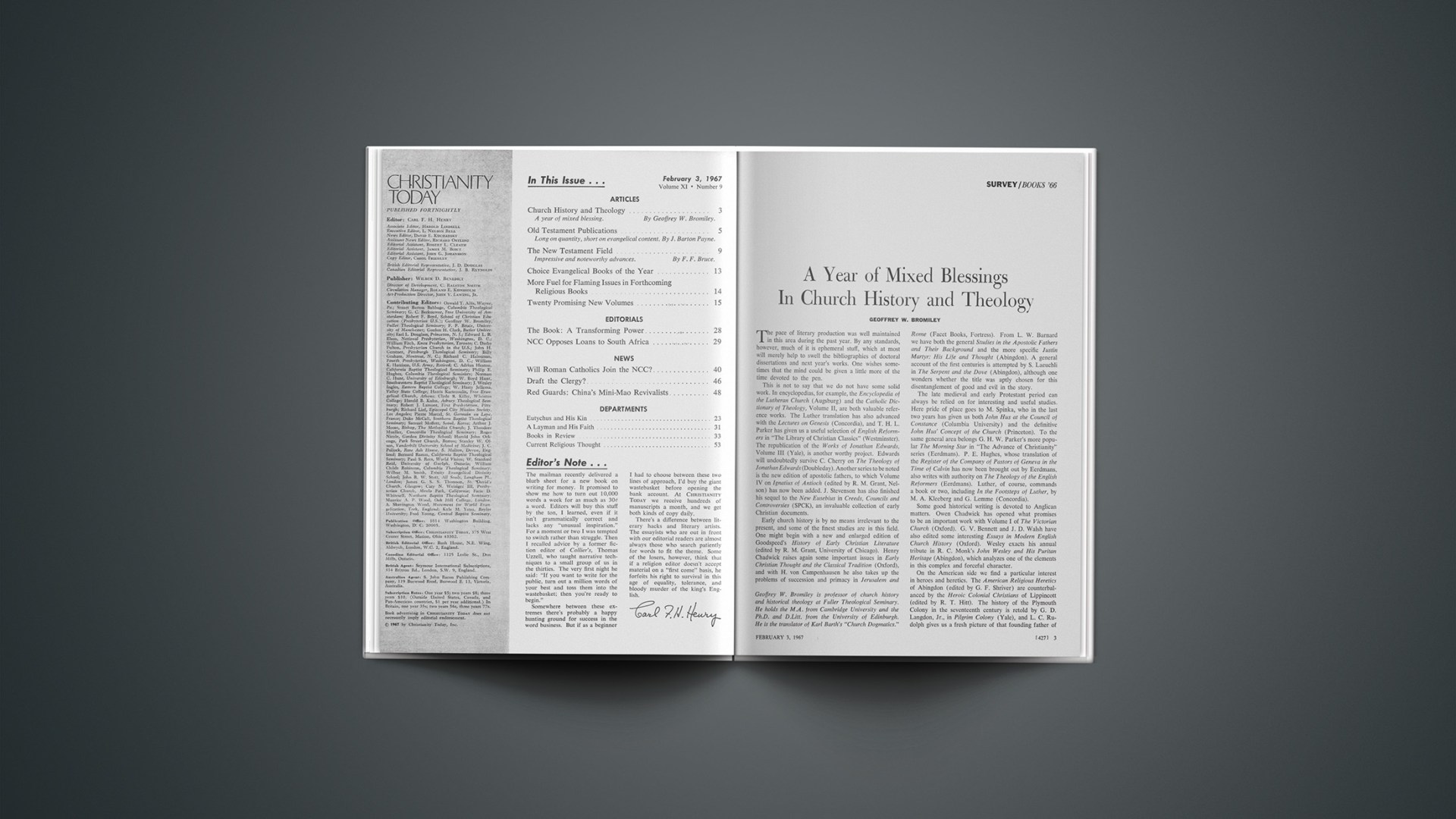
The mailman recently delivered a blurb sheet for a new book on writing for money. It promised to show me how to turn out 10,000 words a week for as much as 30¢ a word. Editors will buy this stuff by the ton, I learned, even if it isn’t grammatically correct and lacks any “unusual inspiration.” For a moment or two I was tempted to switch rather than struggle. Then I recalled advice by a former fiction editor of Collier’s, Thomas Uzzell, who taught narrative techniques to a small group of us in the thirties. The very first night he said: “If you want to write for the public, turn out a million words of your best and toss them into the wastebasket; then you’re ready to begin.”

Somewhere between these extremes there’s probably a happy hunting ground for success in the word business. But if as a beginner I had to choose between these two lines of approach, I’d buy the giant wastebasket before opening the bank account. At CHRISTIANITY TODAY we receive hundreds of manuscripts a month, and we get both kinds of copy daily.

There’s a difference between literary hacks and literary artists. The essayists who are out in front with our editorial readers are almost always those who search patiently for words to fit the theme. Some of the losers, however, think that if a religion editor doesn’t accept material on a “first come” basis, he forfeits his right to survival in this age of equality, tolerance, and bloody murder of the king’s English.
Character in the Classroom

“Our objective in the school should not be to stock the minds of our pupils but to strengthen them; we should be concerned not only with their intellectual development but with their attitudes, their values, their relationships one to another, their courage, their tolerance, their initiative, their imagination, above all their compassion.”

So spoke an English educator to the 1966 convention of the Canadian Education Association in Vancouver, reminding the delegates that character rather than knowledge should be the primary goal of the schools. Although this was not exactly a new idea, somehow it made a greater impression than any other in those address-filled three days during which the educators conferred on the future course Canadian schools should follow.

When the country’s leading economist appealed for an expanded program of technological education to meet growing industrial needs, he was asked for his opinion on this idea that character must be education’s first goal. The economist replied at once that he agreed; his point was only, he said, that technological education could be made a part of the kind of curriculum that had been advocated.

Indeed, delegates were so ready to agree with the visiting Yorkshireman’s point of view that no one seemed aware of the great problem involved: How can the schools develop character in a society that no longer has common beliefs and values on which character development can be based?

Canada is becoming this kind of society. Its schools are being asked to do more and more things for the personality of the student but with fewer and fewer resources. Advocates of everything from safe driving to sex education blandly urge that these things be added to the curriculum; but they fail to suggest what source the schools are to draw on for the values and goals they are to teach.

It was not always so. In the mid-nineteenth century, for example, when the educational system of the province of Ontario was devised, the teaching of Christian morality was made an explicit responsibility of the teacher. Canada, it should be remembered, has never had a constitutional separation of church and state; and in the dominantly Protestant and rural society of the time, Christian morality was almost universally accepted, if not so widely practiced. The biblical beliefs that provide the foundation for that morality were just as widely accepted, and they too were included in the school curriculum.

But the social situation is changing. The center of population and power in Canada is shifting from the countryside to the city and suburb, with all their pluralism and secularism. This change is bringing with it an alteration in the values that govern the way an increasing number of people live. Many of the absolutes of past times are gone or rapidly going. Church attendance, alcoholic beverages, sexual relations, and divorce—these are just some of the areas in which a significant number of people now have attitudes radically different from those that their grandparents had, and that some of their neighbors still have.

So the question arises: Just how are the schools to do the job so many think is their main job?

This question was not faced by the delegates to the Canadian Education Association, but it must be faced if the ideal of that convention is to be realized.

To answer it, educators will find it necessary to do more than plumb the depths of the obvious. They will have to discount, for example, the old assumption that if religious knowledge is imparted, moral character is bound to result. Long years of religious instruction in some of Canada’s provinces have shown there is no necessary correlation between religious knowledge and moral living.

On the other hand, they should reject the opposite belief of the humanist that morality should be taught without any religious reference. Educators should see that this approach demands as much commitment as an out-and-out Christian one and has no place in schools that claim they do not indoctrinate their students.

What educators may find worthwhile is a method of teaching moral values that avoids humanism and yet is appropriate to public education in today’s society. This approach would begin with the actual experiences of children and young people that show their need for moral values. It would then go on to show how that need can be met from various sources, one of them being the biblical tradition.

The problem of alienation, for example, is one that every human being suffers at almost every age. It clearly demands that the individual have beliefs and values that enable him to deal with it, and it is a problem to which the Bible speaks very clearly.

Admittedly, this approach is no panacea, and it is far less than the ideal that the Christian could wish for his schools. But it has great potential for helping the schools provide some of the inner resources their students need to receive from their education.

This method can enjoy maximum effectiveness, however, only if it is practiced by people committed in their own lives to the message they are trying to teach. This makes it all the more imperative that the churches consider the work of teaching as a lay ministry. If they do, they will make a much greater effort than many now do to help Christian teachers realize the great opportunity and responsibility they have.

By such means and through such people, there is hope that the schools can carry out the great obligation that today’s society seems determined to put upon them.

Reginald Stackhouse is professor of philosophy of religion at Wycliffe College (Anglican), University of Toronto. He holds the B.A. and M.A. degrees from the University of Toronto, the L.Th. and B.D. from Wycliffe College, and the Ph.D. from Yale University. He was ordained by the Anglican Church of Canada. This year is the Canadian centennial year, and CHRISTIANITY TODAY will devote its March 31 issue to that important dominion. During the year Professor Stackhouse will contribute two more reviews of Current Religious Thought, to the April 14 and July 7 issues. The regular contributors to the feature are Addison H. Leitch, distinguished professor of philosophy and religion at Tarkio College, Tarkio, Missouri; J. D. Douglas, editor of The Christian and Christianity Today and British editorial representative of CHRISTIANITY TODAY; John Warwick Montgomery, professor of church history at Trinity Evangelical Divinity School, Deerfield, Illinois; Harold B. Kuhn, professor of the philosophy of religion at Asbury Theological Seminary, Wilmore, Kentucky; and G. C. Berkouwer, professor of systematic theology at the Free University of Amsterdam, The Netherlands.

Waning Surpluses Curb Church Relief

Church relief efforts around the world are feeling the pinch of America’s dwindling food supply. For years religious groups have relied on government surplus food to carry out welfare programs overseas. Now most surpluses are disappearing, and church-related relief agencies are getting less than half their previous allotments. People overseas who had been getting food through churches are going hungry.

A spokesman for the Jewish relief agency in New York says the cutback has already caused “considerable suffering.” He reports “a very serious situation” in Morocco, Tunisia, Israel, and Yugoslavia. In Morocco alone, the Jewish agency has 10,000 children to feed.

A representative for Church World Service, relief arm of the National Council of Churches, calls the situation “absolutely tragic.” An official of Catholic Relief Services terms it “a revolting development,” partly because of its suddenness. The head of the World Relief Commission of the National Association of Evangelicals says shipments of food supplies are six months behind the previous flow.

The United States can produce much more food than present government controls allow, and church distribution programs overseas form only a small part of American foreign aid. Yet the current shortage is cited by food experts as a possible forerunner of what some call “the impending world famine.” U. S. reserves of feed grains are said to be below the prudent level of a three-month supply. Less than a year’s supply of wheat is reported, which means that a single big crop failure could bring hunger to millions.

One consoling factor for church relief agencies is that they had already begun phasing out direct food giveaways in favor of self-help programs. The 1966 revisions in Public Law 480—the basic enabling legislation for distribution of government surplus commodities through private agencies—were designed to encourage self-help.

The shrinking surplus spurs such programs. Instead of merely doling out food for immediate consumption, relief agencies now aim to provide raw materials from which the needy in other countries can look out for their own future. This means giving wheat seed as well as flour, chicks in addition to chickens, and sewing machines along with clothes, and also such things as fertilizer, irrigation equipment, and agricultural training.

Some experts think mass distribution of birth-control devices and information is the only ultimate solution, and they are trying to step up this aspect. But it is a morally sensitive point.

Hunger-plagued India is at the top of virtually everyone’s priority list. Yet there has been some doubt whether India is doing all she can to meet her food crisis domestically (see April 1, 1966 issue). For one thing, Hindus refuse to butcher their many “sacred” cows, which siphon off thousands of tons of scarce grain every year.

Another factor: a number of countries are in a position to help India but tend to let the United States carry much of the load of supplying grain. Thus, the United States held off announcing an allocation of 900,000 tons of wheat for India (and 500,000 for Pakistan) until the Soviet Union agreed to ship 200,000 tons immediately to drought-stricken areas. A U. S. official said these shipments, coupled with other supplies assured from Canada and Australia, “should prevent any starvation” into March. India is now entering its third year of food crisis, and some areas have been on the brink of famine, particularly during 1966.

Miscellany

Pope Paul VI has called the first meeting of the Synod of Bishops that is to assist him in governing the Roman Catholic Church. The meeting will open September 29 and continue a month or more. Last month, the Pope approved regulations for the synod, including his own primacy in calling meetings, setting the agenda, approving delegates, and deciding on its recommendations.

Pope Paul this month underscored two new documents from Vatican agencies outlawing the use of “jazz” and other experiments in the Mass.

The controversial Child Development Group of Mississippi, whose cause was championed by top U. S. churchmen, won a new lease on life with the promise of more money from the Office of Economic Opportunity. CDGM acceded to demands for administrative and program changes after being cut off from federal funds for a period of nearly three months.

Responding to reports on Bible shortages in Eastern Europe, the British and Foreign Bible Society reports that about 20,000 Bibles are shipped into Rumania each year and that 50,000 New Testaments went to Poland in October. Also, paper from the West is being used to print 13,000 New Testaments and 20,000 Bibles in Czechoslovakia, and 20,000 Bibles in Hungary. Information on distribution, however, is sketchy.

South African churchmen fear clergymen from other nations may face increasing difficulty in entering the country. The government is expected to tighten issuance of residence permits and make visas valid for only one year instead of three.

A symposium on the “new morality” highlighted the Evangelical Theological Society meeting at The King’s College, which drew 112 scholars from thirty states. The new ETS president is Stephen W. Paine, president of Houghton College.

Bellwether Litigation

A non-Presbyterian jury decided last month in favor of two Savannah Presbyterian congregations that seek to retain their properties after withdrawing from the Presbyterian Church in the United States. The Savannah Presbytery is appealing the decision, and the case is being watched closely by many congregations around the country that are alarmed at trends in their denominations.

The two Savannah churches, Eastern Heights and Hull Memorial, are pastored by two young men who gave up their denominational credentials when their congregations withdrew last April. They charged that there have been “substantial deviations” in the faith and order of the Southern Presbyterian Church. In particular, they protested the approval of ordination of women in the denomination, endorsement of civil disobedience, and involvement in political, civil, and economic affairs.

Two buses carrying Epiphany pilgrims plunged into a ravine south of Manila. Initial reports said at least 85 were killed, making it the worst road disaster on record.

Following up a racial pact formed by Martin Luther King last summer (Sept. 16, 1966, issue, page 44), Chicago’s Roman Catholics this month began a large-scale voluntary campaign for non-discrimination in housing, employment, and other areas. United Presbyterians and other Protestant groups are fielding similar programs.

All Protestant and Roman Catholic clergymen in Amesbury, Massachusetts, united to urge the school board to ban the holding of school activities, on Wednesday nights, to encourage attendance at religious programs.

International Students Inc. hopes this month to finish raising a $50,000 down-payment toward a new student service center and training base adjacent to State Department offices in Washington.

A prayer leaflet published jointly by the National Council of Churches and the Roman Catholic Graymoor Friars accompanies the campaign for the Week of Prayer for Christian Unity, January 18–25. The National Association of Evangelicals is offering free Bible materials for churches joining its World Day of Prayer on February 10.

Personalia

Michigan’s former governor G. Mennen (Soapy) Williams, 55, who just lost a Senate race, said he has thought “casually” of becoming a priest in the Episcopal Church, of which he is a lifelong member.

Following three politicians (Johnson, Eisenhower, Robert Kennedy), Billy Graham again came out fourth in the Gallup Poll’s annual list of the men in the world Americans admire most. Pope Paul ranks fifth again, but last year’s sixth-place personality, the Rev. Martin Luther King, Jr., did not make the list.

Robert G. Wesselmann, 38, former chancellor of the Roman Catholic Diocese of Belleville, Illinois, revealed he married Frances H. Burton, 36, a divorcee, on October 23. The couple will move to Kansas City.

A federal jury in Phoenix, Arizona, convicted Joseph D. Jeffers, 67, and his wife Connie, 27, with thirteen counts of mail fraud by his “Kingdom of Yahweh,” which was chartered in Texas as a non-profit religious organization. Complaints said the couple pocketed or spent at racetracks the money the cult’s believers paid to make connections with “spirit guides” and “guardian angels.”

A federal district judge in Maine dismissed a $25 million libel suit against the U. S. government by John T. Holman, 70, a former minister of the Advent Christian Church. He said Internal Revenue had defamed him by refusing to recognize his ordination.

Reginald H. Fuller, a native of England who is on the faculty of Seabury-Western Theological School (Episcopal) in Evanston, Illinois, has been named to the New Testament professorship at Union Theological Seminary, New York.

H. Elmer Bartsch, Missouri Synod Lutheran pastor, was appointed interim deputy chief of the Christian Pavilion for Montreal’s upcoming Expo ’67.

K. H. Dahlan, a leading Muslim in Indonesia, charged Communist China’s zealot Red Guards with mass murder of Muslims in the current cultural purge.

Stanley W. Olson, former dean of the Baylor University School of Medicine and contributing editor of CHRISTIANITY TODAY, this month became director of the new Midsouth Regional Medical Center in Nashville and a medical professor at Vanderbilt University.

Arland Christ-Janer, president of Cornell College in Iowa, has been named president of Boston University. Both schools are Methodist-related.

Former priest Anthony Girandola, who was excommunicated for marrying in 1965 (May 13, 1966, issue, page 50), said he was refused Roman Catholic burial for his stillborn daughter.

Dom Aurelio Maria Escarre, abbot of a Benedictine monastery in Spain, has resigned his post on orders from the Vatican, Reuters reports. An exile in Italy, he had been critical of oppression by Spain’s Franco government.

Deaths

WILLIAM L. NORTHRIDGE, 80, former principal of Edgehill Theological College, Belfast, and former president of the Methodist Church in Ireland; in Belfast, Northern Ireland.

HENRY WILLIAMSON, overseas secretary of the British Baptist Missionary Society and president of the Baptist Union of Great Britain and Ireland.

Key Theologian’s Exit Jars Roman Church

For Roman Catholics everywhere, the thundering departure of British theologian Charles Davis last month was one of the rudest shocks of the Vatican II era.

Geoffrey Moorhouse, Catholic writer for the Guardian, said it was as important as John Henry Newman’s conversion from Anglicanism to Rome a century ago, and perhaps even more important. Ann Kimmel wrote in America’s National Catholic Reporter, “British Catholics are shattered by the decision of their best known and most respected theologian to leave the Church. For many who lived for and worked toward the renewal of Catholicism in Britain, Father Charles Davis was their last hope.”

Davis, 43, decided to make the break on the Sunday three weeks before Christmas, while working on a paper for the next ecumenical meeting between Roman Catholics and Anglicans. In a subsequent press conference and article, he lambasted the Roman church, and in particular the papacy, more severely than most Protestants have during the ecumenical era.

The situation was complicated by Davis’ December 14 engagement to Miss Florence Henderson, 36, an American who is studying theology at Bristol University. But Davis said that if he had just wanted to get married, he would have left the priesthood and stayed in the church. It was reported that Miss Henderson plans to leave the church also.

Davis’ two main gripes were what he called Rome’s “concern for authority at the expense of truth” and “impersonal system that often crushes people.”

In an article for the London Observer, he said, “The more I have studied the Bible, the less likely the Roman claims have become.… There is simply no firm enough biblical basis on which to erect so massive a structure as the Roman Catholic claim requires … political and social factors of its historical development are much more to the point than any biblical data.”

On the doctrines of papal primacy and infallibility as set forth by Vatican I and repeated by Vatican II, Davis says they are more likely explained as not “the unfolding of a revealed dogma, but the misguided absolutizing of a transitory historical structure.”

“Morever,” he went on, “the two papal dogmas concerning Mary, the Immaculate Conception and the Assumption, have rendered the notion of development suspect.” The Marian dogmas are further discredited, he said, by “the new thinking on original sin, death, and Resurrection,” and Rome’s “institutional faith is, in truth, incompatible with biblical criticism and modern theology.”

John Courtney Murray, a key thinker among Catholic reformers, said Davis’ decision has “significance” only to Davis himself. But Davis, like Murray, was a theological expert at Vatican II, and his criticisms of the council’s work may be of particular importance.

Davis believes the council concentrated on “internal problems of the Church” rather than such central problems of humanity as race, the disparity between rich and poor nations, and birth control. On the latter, Davis virtually calls Pope Paul a liar for saying in October that the teaching of the church on contraception is not in doubt. And Vatican intransigence on the issue, to Davis, shows “bureaucratic insensitivity to people and their suffering.”

Davis said the third chapter of the council’s Constitution on the Church is “remote from the New Testament, dominated by an excessive stress on institutional arrangements of relative value, and spoilt even at that level by an obsessive concern to preserve Papal power intact. That world of juridical functions owes, I suggest, more to fossilized feudalism than to the Gospel message.”

He then asks, “When, in fact, has the Church ever entered into conflict with established authority to bear witness, even at the cost of its institutional position?”

Besides his work at Vatican II, Davis had since 1960 edited Clergy Review, an intellectual monthly for priests. In 1965 he became a theology professor at Heythrop College, the noted Jesuit center at Oxford.

Now that the break has been made, Davis says he feels “mentally and spiritually cleansed and free, with a peace and joy I have not known for years.” Besides marriage, his plans are indefinite. He said he is still a Christian but is not joining any other church. “No church seems to present to me the answer to my present problem,” he said. “I see Christians working together, expressing their Christian commitment.… But the actual churches do not seem to be relevant to this.”

‘Creative Misuse’ Of Bonhoeffer

The biographer of Dietrich Bonhoeffer says the martyred German theologian was a revolutionary Protestant thinker, but was not responsible for the death-of-God theology sometimes attributed to him.

According to Dr. Eberhard Bethge, most of the death-of-God theologians realize they are not heirs of Bonhoeffer, although some admit they make “creative misuse” of his theology.

It was to Bethge that Bonhoeffer wrote from prison the famous letters that are having an unusual influence upon Protestant thinking more than twenty years after he was executed by the Nazis for his part in a plot on Hitler. The biographer told an audience in St. Paul, Minnesota, last month that the rare combination of being a martyr, a great theologian with a great vision, and a precise writer made Bonhoeffer famous.

He is popular today both in this country and in Communist-controlled countries because he gives people “a kind of courage to try anew when present structures are breaking down,” Bethge said.

Bonhoeffer advocated a “religionless Christianity” and attacked the privileged structure of the churches. But according to Bethge, one sentence in Bonhoeffer’s writings, “Before God, we have to live today without God,” has been distorted by some theologians to say, “We have to live today without God.”

The original sentence is consciously paradoxical, Bethge explains. Bonhoeffer meant a particular human concept of God must disappear, not God. He believes Bonhoeffer’s thought has been “distorted” in popular discussions of death-of-God theology over the past year. Some modern theologians were “pushed forward by some of Bonhoeffer’s sentences, but then went their own way. I want to keep the heritage of Bonhoeffer,” he said.

In Europe, Bonhoeffer is seen as “another variation of Bultmann,” but Bethge believes the “anti-church atmosphere in colleges” has accounted for his image in the United States, where he is “taken too easily as anti-church.”

Bonhoeffer rejected the Church as “the guardian of man. Christ was not a guardian—he freed man, by joining humanity totally. The proof for this is the cross,” Bethge said.

The Bonhoeffer letters were “hidden” in Bethge’s desk and unknown to the world until he edited them and they were published in the early 1950s. Since then, there has been considerable interest in them, fed in part by other books, such as Honest to God by Bishop John Robinson of England. Bethge, who married a niece of Bonhoeffer, has completed a biography of Bonhoeffer that is to be published early this year in Germany and later in England and the United States.

Bethge said he is sometimes asked why he gives all his energy “to a man who has never matured.” Bonhoeffer died on April 9, 1945, at the age of 39 in a prison at Flossenburg, in northern Bavaria, a few days before American troops arrived there.

Bethge was himself arrested by the Nazis in 1944 and was the only one of five imprisoned members of his family to escape execution. He is now director of the Pastor’s Institute of the Church of the Rhineland in Westphalia, West Germany. He has been teaching at Chicago Theological Seminary and this year will be visiting professor at Union Theological Seminary, New York.

Signing And Resigning

Because the board of Mississippi College in Clinton voted to reject all federal aid, President R. A. McLemore announced at the last student chapel before Christmas vacation he would resign as of August 31.

At issue is the aid requirement that the college sign compliance with the 1964 Civil Rights Act. Although official application requirements make no mention of race, the college has always been all-white.

In November, the Mississippi Baptist Convention, which owns and operates the college, passed a resolution that said in part: “We suggest that our institutions not make applications for, or accept, federal money.”

William Carey College, a Baptist school in Hattiesburg, signed the civil-rights pledge and enrolled a few Negroes this year. But the president of Mississippi College’s board, millionaire poultryman B. C. Rogers, said his school will not sign as long as the state convention opposes federal aid.

McLemore, 63, admits he resigned to “dramatize” the problem and will reconsider if the board takes the steps he considers essential for the college’s future. He thinks the board will change its mind this year. If not, he’s already gotten five other job offers, although the lifelong Mississippian drawled, “I’m pretty well grounded in this ol’ state.” McLemore, who gets fringe benefits from the college as well as a $19,000 salary, draws outside income from several high school history texts he has written. He holds a Ph.D. in history from Vanderbilt.

Before passage of the civil-rights bill, the college had drawn $600,000 in federal student loans, which are now being repaid. If reinstated, the school would stand to get about $500,000 for loans in 1967–68. Race policies could cut off 300 students with G.I. Bill loans. McLemore would also like to permit federal money for faculty research, although he thinks construction needs can be met by private donors. He said 9 per cent of the college’s $2.4 million operating budget comes from churches. After the college board rejected federal aid, it switched $100,000 from operating funds to a student-loan fund and rejected McLemore’s plea to spend a similar amount to renovate buildings.

McLemore was raised a segregationist, and is no racial radical. But he favors a “gradual transition” and believes Negroes should attend his college if they meet academic requirements and can pay the fees, which are three times those at a nearby all-Negro state college. He would like to keep promising Negroes in Mississippi, rather than have them migrate to northern universities.

Population Outpaces Church Growth

Church growth is not quite keeping up with population growth, according to figures in the 1967 Yearbook of American Churches, published this month by the National Council of Churches.

The data covers mainly calendar 1965, or denominations’ fiscal years that ended in 1965. In this period 124,682,422 Americans belonged to some religious group, an increase of 1.4 million over the previous year. But in roughly the same period, the U. S. population grew by 2.5 million, to nearly 195 million. Church membership increased by 1.1 per cent, while the general population grew by 1.3 per cent.

The rankings of major religious groupings were similar to those in the previous count:

The ranking of the largest non-Catholic communions also contained few surprises. The biggest numerical gains were posted by two conservative congregational groups, the Southern Baptist Convention and the Churches of Christ (the latter’s figure, however, is a rough estimate at best). Large denominations losing membership over the year were, in order of losses: the American Baptist Convention, Church of Jesus Christ of Latter-day Saints, The American Lutheran Church, and the Christian Churches (Disciples of Christ).

More startling is the fact that three of the top fifteen groups have actually lost members since 1956, despite the huge population increase: the ABC, the Disciples, and the United Church of Christ.

In 1956, the National Baptist Convention of America reported the same figure it gives in the 1967 Yearbook, highlighting again the fact that the volume is no more reliable than the 251 denominations that supply the data. Another problem with figures is that Roman Catholics and other groups tally baptized infants, while the rest count only confirmed or adult members.

The Yearbook also reports a poll shows regular churchgoers have dropped slowly but steadily, from 47 per cent of the population in 1961 to 44 per cent in 1965.

Last month, the U. S. government added another Baptist school, Anderson College in South Carolina, to the list of those denied federal student-loan funds. Its board refused to sign the civil-rights form. At another Carolina school, independent Bob Jones University, officials last month asserted the segregated, fundamentalist school will not sign, is getting no U. S. aid now, and will seek none in the future.

Evangelical Methodist Forum

A journalist-turned-preacher plans to publish next week a pilot issue of a magazine to rally evangelicals in The Methodist Church. Editor Charles W. Keysor says in his opening editorial, “We have dared to dream that evangelical Methodists might be united in fellowship across the church.”

If support develops, Good News will come out quarterly, but Keysor has no plans yet for any organization. The magazine will be “strongly Methodist-centered,” not schismatic.

In the lead article of the first issue, Bishop Gerald Kennedy of Los Angeles, who favors an inclusive church, says it is “shocking” to see that “some of those who have been most outspoken in favor of the ecumenical movement seem to be most unsympathetic with anybody disagreeing with them in The Methodist Church.” He says Methodism “cannot afford to lose the evangelicals. It would be a sad day indeed if they should feel unwelcome and go somewhere else.”

Keysor, who is 42, earned a B.S. in journalism from Northwestern. He became a Chicago adman and first managing editor of Together, largest of Methodism’s seven national magazines. While he was managing editor of the David C. Cook Publishing Company, he says, he was converted to Christ and decided to enter Garrett Theological Seminary. He is now pastor of the 300-member Grace Methodist Church in Elgin, Illinois.

Keysor registered his complaints on behalf of the evangelical “silent minority” in Christian Advocate last summer and got about 100 letters of support. This was the stimulus for Good News. Keysor wrote that evangelicals are “not represented in the higher councils of the church” and that their traditionalist theology is “often abhorrent to Methodist officialdom.” As an index of conservative strength, he noted that 10,000 congregations shun denominational education material. Keysor said conservatives believe in the virgin birth, substitutionary atonement, Christ’s physical resurrection and coming return, and the inspiration of the “whole Bible.”

Besides the Kennedy piece and fourteen other articles, the forty-eight page first edition (2,000 copies will be printed free in offset by a layman) will include two new hymns and several book reviews.

Football: Faith And $400,000

The Heisman Trophy winner had just finished one of his “worst” games in three years as quarterback for the University of Florida Gators. He had completed only fourteen of thirty passes for 160 yards and had run another fifteen yards. And he hadn’t scored a point.

But Steve Spurrier had called enough right plays to upset favored Georgia Tech in the Orange Bowl, 27–12.

The outspoken son of a Presbyterian minister immediately began talking about demanding $400,000 or more to sign for the New York Giants professional football team. Such a contract figure would be the highest ever offered an athlete.

Just a few months ago, while watching his son hobble around the spring practice field at Gainesville, the Rev. J. Graham Spurrier commented: “He is coming upon a stage of life when money and the will of God will determine his future.”

The Rev. Mr. Spurrier moved his family from Johnson City, Tennessee, to High Springs, Florida, to be near Steve during his senior year on the gridiron, which brought him All-America recognition and the trophy designating him as the nation’s outstanding college football player.

“Steve has talent and ability that will bring him before the public eye,” his father had said. “I’ve told him he’s not to usurp that talent and take it for his own honors.”

Indications are that the 21-year-old blond athlete has heeded his father’s advice. Although he is not at all reticent about his accomplishments, Steve doesn’t let his fame change his personality. He’s still a team man, well-liked by other members of the squad, and likely to make funny quips about almost anything except the price he asks for playing pro ball and his personal faith.

Spurrier doesn’t talk much about his faith on a personal, individual level. But on Christmas night, as a Christmas present to his mother-in-law, Mrs. Nellie Starr, he took time out from the busy schedule of the Orange Bowl team to go to Fort Lauderdale’s First Presbyterian Church and speak to sixty junior and senior high school kids of the Westminster Fellowship.

He told them that accomplishments in life don’t “just happen” but come as the result of determination and concentration. He explained that while he was a three-letter man in high school, he was best at football so he decided to concentrate on that sport in college.

In fact, Spurrier said he feels that football is his calling and vocation, so “I must do the job the best that I can.” To that end, he said, “I don’t pray that I will make this touchdown or field goal—I don’t think that’s making the best use of my faith. I pray that I might have the strength to do and play the best I know how.”

Jerri, his bride of four months, adds: “I think Steve’s father also wants him to feel the religious attachment of playing for God.”

That feeling is heightened by Steve’s role in the Fellowship of Christian Athletes. He’s secretary of the Gainesville chapter, whose president is Bill Carr, the All-America center who snaps the ball to Steve. Carr is a preacher’s son also; his father is a Baptist minister in Pensacola.

Spurrier never has considered the ministry. “I don’t think he’s cut out for that kind of life,” observed Jerri. “He’s a very good speaker, but as a life work, that’s just not for him.”

Jerri, also a Presbyterian, said that their faith “is a big part of our lives” but that “it is for ourselves.” Still, they’re willing to share it in the way they feel Steve should—as a successful athlete giving his testimony whenever he can.

ADON TAFT

In Defense Of ‘Christian Homes’

Harold George Martin, president of the Quebec-based Christian Homes for Children, charges that an adverse report made by Canada’s Income Tax Appeal Board has been “taken out of context” (see Dec. 9, 1966, issue). Martin was recently denied an appeal by the board, which is claiming taxes on $350,402 on the basis of a report that accused him of “sumptuous living and sustained tax evasion.” Martin called this “misleading, slanderous, and irresponsible.” He said that the federal government was using the tax board as an instrument of punishment because of pressure by the Province of Quebec, which is predominantly French Roman Catholic.

As a result of a 1961 article entitled “How to Make a Million in the Charity Game,” Martin says he is suing Maclean’s magazine for $850,000.

To mark Canada’s centennial in 1967, Martin says he will “travel coast to coast … thundering the same Gospel.”

Soviet Chief To Visit Pope

President Nikolai Podgorny of the Soviet Union has scheduled a private audience January 29 with Pope Paul VI in Vatican City. The historic confrontation will be the first meeting between a pontiff and a Soviet head of state since the Russian Revolution.

Last April, Soviet Foreign Minister Andrei Gromyko talked for forty-five minutes with the Pope, with world peace as the announced topic. Just a year ago, Podgorny sent the Pope a New Year’s message that affirmed Soviet support for North Viet Nam’s terms for settling the Vietnamese war. These include withdrawal of all U. S. troops before negotiations can begin.

Graham Preaches Peace in Viet Nam

Billy Graham made his first trip to Viet Nam over Christmas, preaching to the drone of airplanes, presenting the Gospel to mud-soaked GIs fresh from battle, and taking a first-hand look at America’s most perplexing problem, the bloody undeclared war there.

It was a quick-paced visit that started at the Saigon airport December 19, when U. S. Commander William Westmoreland drove up to welcome Graham, whom he had invited to come. It ended the day after Christmas with the last of ten services, on the carrier “Kitty Hawk” in the North China Sea, and an encounter with Bob Hope.

In his opening press conference, Graham said he had come not only to survey Christian work and humanitarian efforts generally, and to preach the Christian message of peace, but to study the U. S. military commitment, which he is asked about everywhere he goes in the world.

Asked about the “morality” of the war, Graham deferred comment until the end of the trip. When it was over, he said he didn’t want to be an “eight-day wonder” in analyzing the complex issue. Was he a “dove” or a “hawk”? Graham preferred “lamb,” a biblical symbol.

Though far less militant and outspoken than Cardinal Spellman, who was on tour the same week (see following story), Graham’s lamb had asserted itself clearly. He said that Americans should back their President in his decision to make a stand in Viet Nam and that the “pacification” program, which attempts to win the loyalty of South Vietnamese villagers, is essential.

After returning to America, the evangelist said the “stakes are extremely high for the Western world” in Viet Nam. “I hope for peace, but I don’t see any early possibilities of peace.” Expansionist China and North Viet Nam want the resources of the South, he said. He doesn’t believe that U. S. bombing raids in the North have been aimed at civilians. But he thinks the bombing question might become academic, because of the increasing effectiveness of Communist anti-aircraft weapons.

Graham said the death of civilians from U. S. bombing is only part of the story: “The atrocities of the Viet Cong would equal anything in history.”

While in Viet Nam, Graham and his four-man team got as much of a red-carpet treatment as could be expected in a combat zone. But the evangelist sometimes slept on a sagging Army cot and ate from tables hastily knocked together from ammunition boxes. He traveled the length of the An Khe Valley in a “Caribou” aircraft designed to land troops and supplies for battle.

An Khe, with weather wavering from bright sun to pouring rain, was Graham’s locale on Christmas Eve and perhaps the high spot of the tour. The day’s first service was held next to a helicopter landing strip. A brass plate on a cement block near the makeshift stage noted that Martha Raye had been there two months before. After some jokes and carol-singing, Graham preached that any man can enjoy personal, inner peace, even in the midst of war, by putting his faith in Christ. As usual, he ended with a call for decisions, and several dozen lifted their hands in response.

That night, a shining star easily visible to Viet Cong in the surrounding jungles stood on the radar-rimmed hill above a candlelight service for the crack First Cavalry. Thousands of sky troopers plodded through mud and rain to spread their ponchos on the meeting ground. While guards watched for any Communist violations of the Christmas cease-fire, rifle-clutching troops sat through intermittent rain, listened to a specially organized chorus of troopers, and at one point held thousands of individual candles aloft as the searchlights were turned off. Graham again spoke on the peace theme, from Luke 2:14, and many hands were raised in response to his invitation.

As the troopers quietly left the service, many to attend Protestant and Roman Catholic communion services, a chaplain remarked, “This was the greatest Christmas I’ve ever celebrated.”

Through the night, mortars were fired and flares dropped over the camp at hour intervals, and there were continual reports of VC activity. The evangelist slept little and was jolted awake by the noise. Shortly after midnight a young soldier went berserk in front of the chapel. He shot and killed two comrades and wounded a third, who was inside the chapel.

In another Christmas Eve tragedy, a Flying Tiger plane crashed short of the runway at Da Nang, killing the four crew members and nearly 100 Vietnamese on the ground. Graham heard the news while en route to Da Nang on Christmas Day and decided to make one of his many hospital trips to visit the survivors.

An estimated 7,000 men attended the major service on Christmas Day in an amphitheater near the base. This and several other sermons were beamed afar by Armed Forces Radio.

After the shipboard service on the 26th, Graham flew to the coastal city of Quinhon at the invitation of Bob Hope, who was also on tour that week. Graham spent an hour in private with the famous comedian. He sat on the stage for Hope’s show, brought greetings, and led the audience in reciting John 3:16. Although obviously embarrassed by some of the seamier parts of the show, Graham later spoke highly of the singing of Anita Bryant, who has been outspoken in her Christian conviction.

Graham was often wet and weary but was always ready to speak a “hello” or a “God bless you” to as many soldiers as he could. The first major service was held at Tan Son Nhut airbase in Saigon, the world’s second-busiest airport. Giant jets often drowned out Graham’s voice. The next day at Long Binh, some thirty miles from Saigon, 6,000 troops sat in the hot sun to hear his message. Meanwhile, hundreds of special troops guarded a nearby ammunition dump, and helicopters scurried around the perimeter of the base like hens trying to protect baby chicks. Hundreds of troopers responded to Graham’s invitation.

Other major services were held at Cam Ranh Bay, home of the 12th Tactical Fighter Wing and a huge new port facility, and landing zones “Oasis” and “Hammond,” with the First Cavalry.

Graham and the team were obviously affected by their visit. Veteran gospel singer George Beverly Shea remarked, “They think it’s their pleasure to have us, but it’s been our pleasure to be with them.” Graham said that if the war continues, he will certainly go back for another preaching tour of Viet Nam.

The emphasis this time was on U. S. soldiers, but President Doan Van Mieng of the Evangelical Church (Christian and Missionary Alliance) urged Graham to return in the near future to minister to the Vietnamese. Besides holding services, Graham spoke at an International Christian Leadership breakfast and a luncheon for missionaries. He met many chaplains and had high praise for them. He also noted the tremendous humanitarian efforts in Viet Nam.

Doves, Hawks, And A Cardinal

Old cardinals don’t even fade away, it seems, and New York’s Francis Cardinal Spellman, 77, stirred up dust from Vatican City to Viet Nam last month. Like Greek Orthodox Primate Iakovos (see January 6 issue, page 39), Spellman voiced firm support of U. S. policies during a trip to the combat zone:

“This war in Viet Nam is, I believe, a war for civilization. Certainly it is not a war of our seeking. It is a war thrust upon us, and we cannot yield to tyranny.… We do hope and pray, through the valor, the dedication, the service of our men and women of our armed forces, we shall soon have the victory for which all of us in Viet Nam and all over the world are praying and hoping; for less than victory is inconceivable.”

These reported remarks during a Christmas Eve Mass for 5,000 troops at Cam Ranh Bay did not appear in the text released from the cardinal’s New York office. But he later stood by the hawk-like words attributed to him.

Response was swift and biting, not only from Communist capitals, but also from the Vatican, where a “high source” told Religious News Service that Spellman “did not speak for the Pope or the church. The Pope, who sees the conflict as an impartial observer, feels that a negotiated peace rather than a military victory by either side is the way to end the war.” Another unnamed Vatican aide told Newsweek that the Pope was upset by Spellman’s reported identification of U. S. troops as “soldiers of Christ.” “He cannot say that Christ is all on one side or the other. This is not a holy war.”

Anti-Spellman speculation was heightened by an editorial in the Vatican daily urging support for Pope Paul’s peace drive “without preference or reservation.” Yet another confidential source told United Press International that the editorial was not meant as a rebuke of Spellman.

On Formosa, the cardinal said he is obeying the Pope’s appeal to pray for peace. In Spellman’s terms, this means prayer “that light might come to the minds of the Communists, that some time they will be moved by pity, moved by compassion, and will come to the peace table so that all involved in this terrible and useless war will have peace again.”

If Spellman’s views were strong, so were those of the doves at the Catholic weekly Commonweal, published in New York: “The United States should get out of Viet Nam,” began its Christmas week editorial. “It should seek whatever safety it can for our allies; it should arrange whatever international face-saving is possible; and, even at the cost of a Communist victory, the United States should withdraw.” The article then went on to agonize over the ambiguities of the war, arguing more from pragmatism than from pacifism.

Among Protestant voices was that of Soviet Baptist executive Alexander Karev. In a Radio Moscow program beamed at the United States, he urged “an immediate cessation of U. S. A. bombing and the beginning of a clearly stated and swiftly phased withdrawal of all American troops and weapons.”

The World Council of Churches’ Christmas message urged “all parties” to seek negotiations, and General Secretary Eugene Carson Blake, an American, said in a CBS-TV interview that “the suspicion comes” that the United States isn’t trying as hard as it should to bring about peace talks. Leaders of the National Council of Churches sent telegrams to member denominations urging support for President Johnson’s call for United Nations help in settling the war.

Two For Fordham

After some communications snafus between New York and Toronto, Fordham University (Jesuit) this month handed Canadian communicologist Marshall McLuhan a $100,000 state-backed chair in humanities. McLuhan, a convert to Catholicism, has rippled academia with outlandish analyses of media.

Fordham also named Robert L. Wilken of Lutheran Theological Seminary (LCA), Gettysburg, Pennsylvania, to teach patristic theology. He is one of the first Protestants to win permanent appointment to a Catholic theological faculty. Fordham already pools faculty, credits, and library with Union Theological Seminary.

Union and Yale Divinity School are also negotiating for another Catholic neighbor. The Jesuits are giving “serious consideration” to moving their noted rural Maryland seminary, Wood-stock College, to an urban locale and establishing Protestant contacts.

Spare A Hallowed Landmark?

Presbyterian leaders in southwestern Pennsylvania meet this week to weigh the fate of historic Tent Church. A move is on to disband the fifty-six-member congregation founded during Revolutionary War days by merging it with several nearby Presbyterian churches. The building itself is in reasonably good repair and might be preserved as a historical site. Some are afraid, however, that it might merely be abandoned and left to rot away. A commission is being named by Redstone Presbytery to come up with merger plans on which the churches can agree.

“I guess they feel we’re just too small to bother with,” says Mrs. Gladys Hixon, clerk of session for Tent Church. “The coal mines have closed, and people have gone.”

Last fall the congregation voted by a narrow margin to explore merger. It acted after the presbytery had voted down a move to close the church.

Although the church pays its own bills and its dues to the presbytery, some contend that the attendance, which averages twenty-five or thirty each Sunday, is too small to warrant continuation of services. The Rev. W. H. Strohm, general presbyter, says the church is not progressing. The main problem seems to be that it cannot meet the minimum annual expense of $5,000 needed to maintain a regular minister. At present, the church is served by seminary students from Pittsburgh for a fee of $20 per sermon.

Thought by many to be the first rural sanctuary west of the Alleghenies, Tent Church was founded in 1773 or 1774 by a missionary from the East. A large tent of bear skin, made in Indian form, was provided for the minister; hence the name Tent Church.

The tent arrangement lasted for eighteen years. Not until 1792 was a 35-foot-square structure hewn from logs. Finally in 1832 a brick building 60 feet by 40 feet was erected at the same site, just west of what is now Uniontown, Pennsylvania.

Through the years the church has faced numerous threats to its existence. Because church trustees failed to obtain a lease for the land, it was sold at a sheriff’s sale and had to be repurchased. In 1878 a disastrous fire left only blackened walls standing, but within four months the church was rebuilt. In 1905 the church survived the explosion of a nearby powder mill.

In the latter years of the nineteenth century, the attic of the church reportedly served as a refuge for a notorious band of outlaws.

There is now a manse on the church property and a cemetery nearby. Trust funds provide for the care of the grounds.

B. J. CATON

Book Briefs: January 20, 1967

Freeway Through The Secular City

The Secular City Debate, edited by Daniel Callahan (Macmillan, 1966, 218 pp., $5.95), is reviewed by Don DeYoung, pastor, Elmendorf Reformed Church, New York, New York.

With the rumor out that Professor Cox is replacing Kahlil Gibran on campus, The Secular City Debate is a very helpful publication—at least for those who want to be “in” theologically, or knowledgeably “out” with secularolatry. As indicated by the word “debate,” the work is a compilation of various opinions that amplify, rebut, or affirm the arguments raised by Cox’s best-selling book, The Secular City. I counted about twenty-one contributions to the debate, ranging from the adoration of Paul Lehmann to the vitriolic denunciation of Steven S. Schwartzchild.

The book is divided into five parts: first, “What the Reviewers Said” (including the editorial “Supercity” from CHRISTIANITY TODAY, “Sons of God in the City,” by James Smylie in Presbyterian Outlook, and five others); second, “The Christianity and Crisis Debate” that appeared in the July 12 and 26, 1965, issues of that journal; third, “The Commonweal Debate,” including a contribution from the book’s editor, Daniel Callahan, who is associate editor of Commonweal; fourth, “Pressing the Inquiry Further,” with four articles written for this book; and fifth, “Harvey Cox Responds.” There is also an appendix entitled “Beyond Bonhoeffer” in which Cox suggests the continuing issues that attend the “future of religionless Christianity.”

Callahan describes his purpose in preparing this work as “modest”: “It aims neither to celebrate Cox’s book nor to provide a forum for those critical of the book. Instead, it is simply a collection of published reactions to the book, plus some essays written expressly for this book. As such, it is meant for those who might find it useful as a companion volume to Cox’s work, bringing together under one cover the responses of a diverse group of readers.” The title makes clear what Callahan freely admits, that the inspiration for the book was “the success and utility of David L. Edwards’ book, The Honest to God Debate.

Under this one cover are found the results of varied examinations, raising an avalanche of questions that tended to intimidate this reader. No fault of the book, but I found myself meeting authors, books, and some academic disciplines for the first time. The assumption behind the encounter was that “we had met before”; so, as I do in strange company, I timidly hung on, not letting on that I feared I was being discovered! The writers’ acumen was a real stimulant.

Bonhoeffer’s question on April 30, 1944, “How do we speak of God without religion?,” continues to bear some puzzling and tempting fruit. The branches are multiples of sociology, revolution, hermeneutics, soteriology, ecclesiology, philosophy, technology—ad infinitum. Dedicated to simplification, I still came out at the fork of epistemology: Will we know by reason or by revelation? It seems to me that the burden of this discussion followed the road of reason. This reinforced my conviction that the neglect of the God-man invites the elevation of the Man-god. From my location in East Harlem, New York City, the Secular City appears with more bloodless Zen-pale than robust Christian-hale.

What Would You Say?

If I Had Only One Sermon to Preach, edited by Ralph G. Turnbull (Baker, 1966, 151 pp., $2.95), is reviewed by Haddon W. Robinson, professor of homiletics, Dallas Theological Seminary, Dallas, Texas.

Reviewing a collection of sermons is like judging an international beauty contest: it is hard to decide what critical standards to apply. To quibble with individual sermons is to invite the criticism that, after all, no compilation can satisfy every reader at each turn of the page. Possibly the only measure to use is the editor’s statement of purpose.

The title suggests that each contributor was invited to reduce the essence of preaching into one sermon. Fifteen preachers from five countries representing thirteen different church groups tried their hand at it. One contributor, Henry Bast, offered next Sunday’s sermon, while another, Andrew Blackwood, Jr., offered the sermon his congregation had asked for most often.

Several men, more to the point, majored in the essentials of evangelical Christianity. Ralph Earle dealt with the nature of God and Ralph Turnbull with God’s majesty. Others, such as Julian McPheeters, Samuel Moffett, Harold Ockenga, and Edward Elson, proclaimed the death and resurrection of Jesus Christ. Two tackled sterner doctrines: Peter Eldersveld discussed divine election and Hamish McKenzie hell and heaven. Paul Rees stood a bit off center with a sermon on “The Business of Belonging.”

When you pay your money for this book you can have your choice of homiletical approach. For example, Conrad Lund and Robert Cunningham use texts as springboards to discuss joy and hope; Herschel Hobbs, in contrast, presented a sermon on the Incarnation that resembles a lesson in exegesis. In a different style, Ronald Ward submitted a drama in four acts.

Here, then, is a cafeteria of evangelical emphasis and homiletical method that has at least a morsel for every taste. It should also make the evangelical preacher thankful that his ministry is not limited to a single message.

Mobilization For Missions

The Church’s Worldwide Mission, edited by Harold Lindsell (Word, 1966, 289 pp., $3.95), is reviewed by James D. Belote, professor of missions, New Orleans Baptist Theological Seminary, New Orleans, Louisiana.

In April, 1966, the Congress on the Church’s Worldwide Mission was held at Wheaton College, co-sponsored by the Evangelical Foreign Missions Association and the Interdenominational Foreign Mission Association. There were 938 delegates from 71 countries, representing 150 mission boards and some 13,000 missionaries.

Delegates considered in depth the mission of the Church and discussed significant aspects of mission strategy and practice. At the close, a Declaration was adopted that summarized the findings of the congress. Dr. Lindsell’s book is a record of the proceedings and is a distinctive contribution to the missionary literature of the twentieth century.

The “Call to the Congress” (chapter one) confronts the reader with the seldom publicized fact that a vast amount of missionary work is being done by evangelical Christians who minister entirely outside the framework of the World Council of Churches (and its Commission on World Mission and Evangelism): “… IFMA-EFMA missionary strength alone is numerically greater than those societies represented in North America by the National Council of Churches … [and] represents the major North American missionary force today.”

Dr. Lindsell, an outstanding missions scholar, presents in chapter two an “Overview of the Congress.” This includes a background of the total world missionary situation and states the reasons why evangelicals felt it necessary to call this “summit conference.” The evangelization of the world is seen as the true biblical objective for this generation. The congress Declaration includes a covenant on the part of evangelicals to seek the mobilization of the Church to this end.

Other chapters present five Bible expositions and ten study papers dealing with the Church’s mission and related problems (syncretism, neo-universalism, proselytism, neo-Romanism, church growth, foreign missions, evangelical unity, method evaluation, social concern, and a hostile world). Also included are brief area reports from such places as Africa and Europe, descriptive material on EFMA and IFMA, information on program personalities, and a list of organizations at the congress.

Both the congress itself and this interpretative treatment by Dr. Lindsell support the proposition that “evangelical missionary endeavor has come of age in the 1960’s” (p. 7). No Christian minister or layman who has genuine concern for a chaotic world and for the carrying out of the Great Commission in our day can afford to be without this significant volume.

The First Great American Methodist

Francis Asbury, by L. C. Rudolph (Abingdon, 1966, 240 pp., $5), is reviewed by Frederick A. Norwood, professor of history of Christianity, Garrett Theological Seminary, Evanston, Illinois.

Students of Methodist history have been waiting for a long time for a good biography of the one man who on the American side personifies the development of the Wesleyan movement into a great church. They now have it. Although it suffers some notable limitations, it is well researched, well organized, well written. It is incomparably better than previous biographies, although that in itself is no compliment.

Asbury emerges as neither saint nor tyrant. The hagiolatry and mythology that have plagued most writing about this Methodist leader are blessedly absent, being replaced by a somewhat wry but good-humored admiration that in the end verges on awe. “No honest student of Asbury,” concludes the author, “can escape a kind of awe. One awful fact is his commission as he saw it; another is the way he never let it go.” Rudolph, whose stance is that of a friendly non-Methodist, had the advantage of working from a large body of recent scholarship, especially the new annotated edition of Asbury’s Journal and Letters and the History of American Methodism, both impressive three-volume sets. Combined with his own research of other original documentary sources, they constitute a solid foundation for his narrative and interpretation.

It is clear that, for all its merits, this book is not the desired definitive biography of Asbury. The narrative portion leading down to 1792 is appallingly inadequate, although high points are noted. This brevity has led to some inaccuracies. For example, we are led to believe that all the English preachers left in America returned to England during the Revolution, while in fact both Robert Williams and John King, who at first came on their own, remained and settled down to farm. Wesley did not exactly “carefully screen” out Calvinism from his abridgment of the thirty-nine Articles. Coke had more to do with the Chartered Fund than Asbury. “State” (implying static) is not the word for Wesley’s interpretation of sanctification. No serious attention is given to the barbarizing influence of the frontier on such Wesleyan doctrines as sanctification—an influence destructive of theology in general. The suggestion that Asbury contradicted Wesley on the matter of the “order” of bishop is not proved. In the discussion of the controversy with Calvinism, no mention is made, either for Asbury or Wesley, of the significant place of prevenient grace in Wesley’s theology.

But all these imperfections are not so much errors as inadequacies. Actual errors are very few. More important is the lack of systematic study of all the angles. One is disappointed in the inadequate treatment of Asbury’s travels, which were a dominant factor of his entire adult life. An exhaustive chronological and geographical analysis is not to be found in this book. Nor do we find a careful examination of Asbury’s life-long self-education through reading. Some books are mentioned, but none is analyzed in detail. Several of the major controversies and issues are only briefly noted. These lacks prevent the new biography from being considered definitive. Probably neither author nor publisher intended it to be so.

On a more modest ground, Rudolph’s effort is eminently successful. Asbury is rescued from his idolators and debunkers alike and presented to later twentieth-century Methodists in a believable and almost appealing form. And that, dear reader, is a major tour de force when you are dealing with a man who assumed it axiomatic that Methodism was the highest form of Christianity since the days of the apostles, and who could not understand why anyone should wish not to be a Methodist or not submit rejoicing to his unchallenged leadership.

Light On Judaism

Encyclopedia of the Jewish Religion, edited by R. J. Zwi Werblowsky and Geoffrey Wigoder (Holt, Rinehart and Winston, 1966, 415 pp., $18), is reviewed by Jakob Jocz, professor of systematic theology, Wycliffe College, Toronto, Ontario, Canada.

This work differs from similar encyclopedias in English in that it deals exclusively with subjects relating to the Jewish religion. Its purpose, as stated in the preface, is to provide “the interested layman with concise, accurate, and non-technical information on Jewish belief and practices, religious movements and doctrines, as well as the names and concepts that have played a role in Jewish religious history.” Of the twenty-two contributors, seventeen reside in Israel, four in the United States, and one in South Africa. This book is therefore largely an Israeli contribution to the popularization of materia Judaica.

This one-volume work is easy to handle and contains some beautiful illustrations. From a Christian perspective, the most pleasing feature is the irenic spirit in which some controversial subjects are handled.

Our Lord’s Hebrew name is given as Joshua. This is a distinct departure from the traditional Yeshu, which has calumnious overtones for the Jewish ear. In the past Jewish scholars tended to deny any conflict between Jesus and the Pharisees; this work allows for such a conflict, though it holds that the Gospels are given to exaggeration. It also admits that Jesus considered himself the Messiah, though he understood his messiahship in accordance with “sectarian rather than Pharisaic” eschatology.

It is freely acknowledged that Christianity is rooted in Jewish soil and that Jesus and his followers were Jews. As is customary, Paul and not Jesus is credited with the break away from the Synagogue. At the same time it is admitted that the “blessing” against heretics was inserted in the Amidah to rid the Synagogue of Jewish Christians.

The article on Jewish Christians distinguishes between Ebionites, who believed in the messiahship of Jesus but denied his divinity, and Nazarenes, who believed in his divinity and also held to the Law. In this connection brief mention is made of contemporary Hebrew Christianity and its effort to re-establish itself in Jewry. The Hebrew Christian Alliance, however, is not mentioned.

This volume offers a large variety of information in concise form and is clearly stated. Some subjects are purely academic, such as the meaning of Afam or the etymology of Sandak; but many subjects are of general interest, and not a few have contemporary relevance, such as the rabbinic teaching on artificial insemination and birth control.

This work will prove a valuable source of information not only to Jewish laymen but also to Christians who have Jewish neighbors and who wish to know more about Judaism.

Creative Counseling

Basic Types of Pastoral Counseling: New Resources for Ministering to the Troubled, by Howard J. Clinebell, Jr. (Abingdon, 1966, 318 pp., $6) is reviewed by Charles M. Bryan, minister, Beaver Ridge Methodist Church, Knoxville, Tennessee.

This latest book by Howard J. Clinebell, Jr., is an excellent guide to creative new methods of counseling. It will be especially helpful to those who were brought up on the non-directive method (“Rogers with a dash of Freud”).

Clinebell maintains that the client-centered approach that has dominated counseling for years is limiting to the busy pastor. The non-directive method, which is of great value with highly verbal and strongly motivated persons, is neither needed nor helpful in other counseling settings. There are short-term approaches that a pastoral counselor may use to advantage.

The “revised model” of counseling offered by Clinebell differs from the older model in methods, structure, and goals. The older model, which is seen as a formal, structured interview using the client-centered method, seeks to uncover unconscious motivation and the childhood roots of adult behavior. Its central goal is insight. Clinebell’s revised model emphasizes the use of supportive methods rather than uncovering methods; its goal is to modify and improve relationships, using the counselee’s positive personality resources. It seeks to confront as well as understand the realities of the situation and to deal with behavior as well as feelings and attitudes. It considers counseling within the context of continuing pastoral care.

Clinebell sees pastoral counseling standing at a crossroads of discovery, both in new methods and in new understanding. The newer types of counseling he discusses include informal and short-term counseling, role-relationship marriage counseling, family group therapy, group pastoral counseling, confrontational counseling, counseling of religious-existential problems, and depth pastoral counseling.

A helpful addition to the volume is a chapter on “The Layman’s Ministry of Pastoral Care and Counseling.” The use of small groups and of insights from Alcoholics Anonymous (“Twelve Steps”) offer a new resource in the Church’s ministry to the troubled. The wise use of laymen would enable the pastor to offer extended arms of care to those who need help.

Ministers are urged to increase their skills as pastoral counselors. Clinebell makes specific suggestions: the use of reality-practice sessions (helpful for both the seminarian and the parish minister), sensitivity training sessions, supervision of one’s counseling, clinical pastoral training, and personal psychotherapy.

The pastor is still the person most often consulted by those in trouble. His special status as a religious authority figure and a leader of the religious community opens many doors of opportunity. It is imperative that he become skilled in this important ministry. Basic Types is a helpful and comprehensive guide to all who wish to improve their pastoral counseling skills.

Reading for Perspective

CHRISTIANITY TODAY’S REVIEW EDITORS CALL ATTENTION TO THESE NEW TITLES:

Last Days on the Nile, by Malcolm Forsberg (Lippincott, $3.95). The story of the Sudan—crises in its national development, the heroic stand of “Chinese” Gordon at Khartoum, progress made by missionaries until their recent expulsion—by a missionary who spent thirty years there.

Men of Action in the Book of Acts, by Paul Rees (Revell, $2.95). Lively biographical sketches of six prominent New Testament leaders that provide solid biblical knowledge and inspire Christian commitment and action.

Philippian Studies, by J. A. Motyer (Inter-Varsity, $3.50). This valuable expository work shows the surpassing worth of knowing Jesus Christ as Lord. Useful as a preaching aid and for study by laymen.

A New Key To The Bible

Unger’s Bible Handbook, by Merrill F. Unger (Moody, 1966, 930 pp., $4.95), is reviewed by Merrill C. Tenney, dean of the Graduate School, Wheaton College, Wheaton, Illinois.

This small, concise, yet comprehensive volume contains more than nine hundred pages of closely packed information on the origin, content, history, chronology, archaeology, and interpretation of the Bible, plus a short summary of the history of the Christian Church. It is illustrated by twenty-five maps, forty-five charts, and sixty or more pictures. The materials are organized systematically, and the explanations are clear and meaningful.

Not only is each book of the Bible summarized and placed in its historical setting, but a general commentary is provided with a brief outline of its teaching and an interpretation of its meaning. Integration is not lost in a mass of detail, for the progress of revelation is plainly indicated as the books are explained in sequence. The index, though not exhaustive, is adequate.

Unger points out critical problems, although the limited scope of this work precludes detailed discussion or extended defense of the views he expresses. He explains the problem of the last twelve verses of Mark by asserting that Mark’s first edition omitted them and that later Mark added the conclusion. Just why the second edition was not used as the basis for manuscripts Aleph and B, if it was just as authentic as the first edition, he does not explain (p. 510). His hypothesis needs better substantiation.

Some of the typology seems overdrawn. Likening the burning bush that was not consumed by the flames to an enslaved Israel that was not annihilated by oppression may be an apt simile, but the burning bush is not necessarily a type. At a few points the interpretations in this Handbook exceed the statements of Scripture and appear somewhat fancified.

Unger’s theological viewpoint is unquestionably biblical and conservative; his eschatology is premillennial and dispensational.

Typographical errors are few, and the factual statements are generally accurate. As a whole, this handbook is a systematic and reliable key to the contents of the Bible. Its small size makes it easily portable, and it will provide a ready source of information for the elementary study of the Scriptures.

Book Briefs

The Jerusalem Bible, edited by Alexander Jones (Doubleday, 1966, 2053 pp., $16.95). Roman Catholic scholars have utilized the French Bible de Jerusalem and ancient Hebrew and Greek texts to produce a superb new version of the Bible that combines readability and literary style.

Victory through Surrender, by E. Stanley Jones (Abingdon, 1966, 128 pp., $2.75). The noted missionary spokesman and writer shows how self-surrender to Jesus Christ brings self-realization.

Older Than Eden: Great Homes of the Bible, by J. Charles McKirachan (Augsburg, 1966, 168 pp., $4.50). An examination of great homes of the Bible that may help readers to improve personal relations in their own homes.

The Great Sex Swindle, by John W. Drakeford (Broadman, 1966, 128 pp., $2.75). A sound analysis of the sexual revolution that punctures false notions about sex and defends biblical morality.

The Cambridge Bible Commentary on the New English Bible: New Testament Illustrations, compiled and introduced by Clifford M. Jones (Cambridge, 1966, 189 pp., $4.95; also paper, $2.45). Excellent photographs, maps, and diagrams that illuminate the New Testament.

Atonement and Psychotherapy, by Don S. Browning (Westminster, 1966, 288 pp., $6). Using psychotherapeutic analogies, Browning sets forth a view of the Atonement that parallels the Christus Victor concept of Irenaeus.

Alcohol—In and Out of the Church, by Wayne E. Oates (Broadman, 1966, 136 pp., $3.95). Oates advises Christians to help alcoholics by bringing them into their fellowship where the love of Jesus Christ can be realistically demonstrated.

The Anonymous Christian, by Anita Röper (Sheed and Ward, 1966, 179 pp., $4.50). Frau Röper advances the theological idea of Karl Rahner that a person may be a Christian even though he explicitly rejects Christianity.

Church-State Relations in Ecumenical Perspective, edited by Elwyn A. Smith (Duquesne University, 1966, 280 pp., $4.95). Catholic, Protestant, and Jewish leaders seek to understand and define the role of civil power.

Eucharist and Church Fellowship in the First Four Centuries, by Werner Elert, translated by N. E. Nagel (Concordia, 1966, 231 pp., $6.75). A German author considers how the Church met problems of internal division during its first four hundred years.

A Baptist Sourcebook: With Particular Reference to Southern Baptists, by Robert A. Baker (Broadman, 1966, 216 pp., $5.95). A collection of 241 documents, 1682–1966, important in the life of the Southern Baptists.

Your Christian Wedding, by Elizabeth Swadley (Broadman, 1966, 138 pp., $2.95). Helpful advice for the bride as her shining hour approaches; best kept away from the father-of-the-bride.

Ely, by Ely Green (Seabury, 1966, 236 pp., $4.95). An unlettered writer, half-Negro and half-white, tells of the confusion and conflict that marked his life-long search for identity.

The Pursuit of Happiness, by Spiros Zodhiates (Eerdmans, 1966, 671 pp., $5.95). Expositions of Matthew 5:1–11 and Luke 6:20–26 by an authority on the Greek New Testament.

Challenges and Renewals, by Jacques Maritain, edited by Joseph W. Evans and Leo R. Ward (University of Notre Dame, 1966, 389 pp., $7.50). Essays on the theory of knowledge, metaphysics, ethics, aesthetics, politics, and philosophy of history.

13th Apostle, by Richard A. Johns (Broadman, 1966, 176 pp., $3.50). A fictionalized autobiography of the Apostle Paul, written with simplicity and a sensitive understanding of events in the Book of Acts.

Flee the Captor, by Herbert Ford (Southern Publishing Association, 1966, 373 pp., $5.95). A vivid account of John Wiedner’s courageous efforts that brought hundreds of people to safety via the Dutch-Paris underground during World War II.

A Life of Luther: Told in Pictures and Narrative by the Reformer and His Contemporaries, compiled and edited by Oskar Thulin (Fortress, 1966, 210 pp., $9). A memorable biography of the Reformer told through more than 100 excellent pictures, well-chosen passages from his writings, and comments from his contemporaries.

Paperbacks

A World To Win: Secrets of New Testament Evangelism, by Nate Krupp (Bethany Fellowship, 1966, 94 pp., $1). An instructive book on personal evangelism based on New Testament principles.

Are You Nobody?, by Paul Tournier, et al. (John Knox, 1966, 77 pp., $1). Essays “designed to help us see man as man, as subject rather than object, as a being in his own right and by his God’s purpose and not a tool or a commodity.”

The Drama of Redemption, by Wayne E. Ward (Broadman, 1966, 128 pp., $1.50). “Designed especially for those who find the Bible a difficult, puzzling Book.” Presents an overview of the biblical theme—redemption.

100 Questions about God, by J. Edwin Orr (Regal Books, 1966, 216 pp., $.95). A skillful chaplain and a cosmopolitan group of university students candidly discuss the existence, nature, and works of God.

Creed and Drama, by W. Moelwyn Merchant (Fortress, 1966, 119 pp., $1.95). Discussion of representative drama, Christian or not, from the classical Greek Antigone to Arthur Miller’s Crucible, showing what these dramatists thought of man. Attacks amateurish “religious drama” of today.

Grace Under Pressure: The Way of Meekness in Ecumenical Relations, by Martin F. Franzmann and F. Dean Lueking (Concordia, 1966, 105 pp., $1.95). Franzmann writes that “grace under pressure,” or “ecumenical meekness” (as opposed to “denominational superiority”), is the biblical answer to church divisiveness. The practical application of this meekness is delineated by Lueking.

Studying the Book of Amos, by John D. W. Watts (Broadman, 1966, 93 pp., $1.50). Lectures by the president of Zürich’s Baptist Theological Seminary, collected in view of the 1967 study of Amos in Southern Baptist churches. Provides help in understanding Amos—his message, his faith, and application of his truths to today.

Power for Christian Living, by Ethel Jones Wilcox (Regal Books, 1966, 208 pp., $.95). An enthusiastic admonition to Christians to put to use the potential power God gives them by keeping in “unbroken fellowship” with Christ.

Youth Considers Personal Moods, by Reuel Howe (Nelson, 1966, 95 pp., $1.50). Moods, relationships, and responses in the life of the “emerging adult” strikingly discussed by an experienced counselor.

Even If I’m Bad: Sermons for Children, by Orin D. Thompson, illustrated by William R. Johnson (Augsburg, 1966, 80 pp., $1.75). Short sermons for children that appeal to young and old.

City of Wrong: A Friday of Jerusalem, by M. Kamel Hussein (Seabury, 1966, 225 pp., $1.95). A devout Muslim considers the Crucifixion and, rejecting Christ’s deity, concludes he was needlessly killed as human conscience failed.

Documents of Vatican II, general editor, Walter M. Abbott, S. J. (Association, Guild Press and American Press, 1966, 792 pp., $.95). The sixteen official texts promulgated by the Second Vatican Council.

Henrietta Mears and How She Did It, by Ethel May Baldwin and David V. Benson (Regal Books, 1966, 343 pp., $.95). Two close associates relate the adventures and ministry of this noted Christian youth worker who founded Gospel Light Publications. Includes four talks by Miss Mears.

Children in Search of Meaning, by Violet Madge (Morehouse-Barlow, 1966, 140 pp., $3.50). A scientific, yet readable analysis of the child’s search for answers to his questions about life, particularly religious. With appendices and bibliography.

Understanding the Sexual Response in Humans, by Allan Fromme (Pocket Books, 1966, 79 pp., $1). A critical reply to the bestseller, Human Sexual Response, by Masters and Johnson.

What the Bible Is All About, by Henrietta Mears (Regal Books, 1966, 675 pp., $2.95). A very readable, practical layman’s survey of the entire Bible. First published in 1953.

Tomorrow, Tomorrow, Tomorrow: Youth Serve in a Mental Hospital, by Elaine Sommers Rich (Herald, 1966, 91 pp., $2). A journal-type account of a Mennonite college girl’s summer work in a mental hospital.

What Can You Believe?, edited by David K. Alexander and C. W. Junker (Broadman, 1966, 119 pp., $1.75). A short course in Christian apologetics designed for the college student. Formerly published in the Baptist Student.

Ideas

America Faces Critical Decisions

Clergymen plummet in prestige in a climate of confusion

The new year will be a critical one for Americans. The Viet Nam war almost certainly will expand, given Hanoi’s unwillingness to negotiate. Nuclear-armed Red China mutters in threatening tones, while some nations seek its admission to the United Nations. American militarists must decide whether to “go” with a $15 billion anti-ballistic-missile defense system, while the Great Society program runs into mounting competition with expenditures for the Asian buildup.

Even those politicians who excused past race riots, as a justifiable expedient are not likely to make a large issue of civil rights, with a presidential election coming in 1968, and with public indignation over black-power demands increasing. Since political leaders are jockeying for strategic positions in the party conventions, any promised social millennium will now have to wait until the morning after the next presidential election.

Many people can recall no time in recent memory when the economic weather reports were as confusing and uncertain as they are now. The now-you-have-it, now-you-don’t climate of tax cuts and increases, the cost-of-living rise, and the steady shrinkage of the dollar are part of a discouraging fiscal pattern. Labor unions meanwhile ready demands for new contracts to carry forward 1966 wage increases, the largest in a decade. Yet few Americans seem indignant over the evils of inflation. And few seem aware that there is a limit to this world’s goods, and that not even an infinity of them can provide human well-being.

Does the United States, long a symbol of hope and progress in a distraught world, now increasingly appear a symbol of confusion and indecision? Has the competition for national office deteriorated to a tug-of-war between aspirants marked mainly by political ambition? Are Americans so obsessed with material things that what now matters most—to poor and rich alike—is simply to be “blessed” by more of this world’s “goods”? Are even the Christian churches, whose great contribution to the American vision in the past few can doubt, forfeiting an irrecoverable opportunity to renew the spiritual vision of the people?

Americans are troubled in conscience about racial tensions, the widening crime wave, the unpredictabilities of rampant government incursion into the voluntary sectors of society. There is an uneasy sense of the wrongness of things and uncertainty over how to right them. Surely Christianity has a dramatic word to say on the rightful priorities of a worthy civilization, including the elimination of pockets of poverty and racial discrimination and the promotion of public righteousness. But churchgoers complain that the ministers either are silent on the social implications of Christian commitment or sketch those implications in an essentially secular rather than authentically biblical way.

That religious activists are supplying more confusion than guidance in the present social crisis is increasingly evident to interpreters of the American scene. In remarks to the Eastern Division of the American Philosophical Association, of which he is co-president, Dr. Paul Weiss, Sterling professor of philosophy at Yale University, attributed the ineffectiveness of “religious activists” in public affairs to their confusion about the nature both of religion and of social and political processes. He mentioned as an example of this double confusion the attempt of church groups like the National Council of Churches to influence government policy on Viet Nam and civil rights. The religious activist, he added, “does not have a knowledge of man’s actual state, and is not trained in effective social action.… He has nothing by which he can distinguish himself from seasoned workers except an irrelevance and ineptitude which his charisma may enable him to hide for a while. A genuinely religious man sees others as having most meaning when in relation to God.…

Sometimes it seems that Christianity is no longer correlated with public issues through the bold pulpit proclamation of God’s commandments and the earnest pursuit of the will of God in modern life. Instead, it is invoked as a symbolic device serviceable to propaganda groups promoting secular objectives—socialism, pacifism, legislative proposals, and whatever else the top echelon advocates. The related exploitation of mass media gives the irreligious masses a gross misimpression of what the Christian religion is and what it demands. When these modern utopian schemes falter, the Church will inevitably inherit the resentment of the deluded multitudes.

While Christians were in the mood for Christmas caroling, a delegation at the hub of the Great Society marched on Sargent Shriver’s suburban home to sing anti-poverty carols as a protest against proposed budget cuts. The Action Coordinating Committee to End Segregation in the Suburbs (ACCESS) organized a series of Christmas Eve carol vigils using the theme “no room in the inn” to protest Washington-area apartment developments not yet integrated.

Racial demonstrators have long held conspicuous outdoor prayer meetings as part of their strategy of defiance and have gotten their mass-media reward; now the secular use of sacred forms to promote direct political ends has multiplied. Spokesmen for institutional Christianity are in no position to deplore a trend they themselves have encouraged. On Christmas Eve, newspapers carried the UPI report that the National Council of Churches was urging affiliated organizations to mobilize support for U. N. pressures for a cease-fire in Viet Nam. It was a Christmas Eve evangel barren enough to make the Bethlehem angels weep.

A recent scientific sampling by Lou Harris and Associates of the views of 2,000 Americans shows that clergymen are down in public esteem and confidence to a rating below that of doctors, bankers, scientists, military leaders, educators, corporation heads, psychiatrists, and even local retailers. Their rating of 45 per cent, in contrast to 74 per cent for doctors, 66 per cent for scientists, 62 per cent for educators, and 57 per cent for psychiatrists, as reported by Newsweek, suggests disturbing things about the direction in which Americans are turning for a solution to human problems. The clergy ran a scant 1 per cent ahead of congressmen and federal government leaders. If the main reason for ministers’ decline in popularity were their bold proclamation of the revelation of God—a proclamation that brought down the cutting edge of God’s Word and exposed man’s corruption and his need of divine rescue—that would perpetuate biblical loyalties. But the cadre of ecclesiastics who have emerged as sacred specialists in political, economic, and military strategy have unfortunately scarred the image of the clergy. By them Christianity is reduced to a pragmatic theology and an absolutist politics, and under their inspiration much of the institutional church’s main business is now simply secular. Can university students be wholly blamed for espousing situational ethics when churchmen shun the task of expounding the enduring principles of revealed morality, and repeatedly involve the churches on public issues simply on an ad hoc basis? When churchmen enthrone their own fallible opinions as the high will of God, they inevitably encourage public distrust and unbelief that the Church truly bears any sure Word of God.

So routine is ecclesiastical politicking that on a single day the Washington Post reported how a group of churchmen led by the Rev. Robert Johnson, former president of the Presbyterian Interracial Council, tried to block the appointment of Dr. Edward G. Latch as chaplain of the House of Representatives because of a previous misunderstanding about a substitute Negro soloist in his church, and the Evening Star reported that a group of Negro ministers called the Committee of 100 accused congressmen of playing with the fires of racial discontent in their effort to unseat Adam Clayton Powell.

During the Christmas season Dr. Eugene Carson Blake, general secretary of the World Council of Churches, imputed blame to the United States for not trying hard enough for peace talks in Viet Nam and implied that the war there turns on a desire by the United States to expand its objectives. He stated the moral issue in Viet Nam this way: “Is it right for us to use our overwhelming technological power to get our way in Southeast Asia?”

The day after Christmas, clergymen picketed the residence of Secretary of State Dean Rusk with placards bearing the legend, “Let’s Take a Risk for Peace,” in an application of action taken by the NCC triennial assembly in Miami Beach early in December. (Anybody who thinks that is successful Christian communication needs an elementary lesson in religious journalism.)

The same day, twelve nationally known clergymen, including Dr. George Docherty of New York Avenue Presbyterian Church in Washington, D. C., addressed a letter to President Johnson denouncing U. S. military forces for killing civilians in Hanoi, requesting a halt in bombing of North Viet Nam, and urging disengagement without additional commitments by the Viet Cong. There was not a word about the savage and inhumane Viet Cong attacks upon South Vietnamese people. Former President Eisenhower has emphasized the difficulty of avoiding every non-military target, and Dean Rusk has stressed, contrary to any implication of deliberate inhumanity, that American targets are only military and not civilian.

In a sharp word of rebuke for critical churchmen, the widely read columnist David Lawrence wrote: “To give aid and comfort to the enemy used to be called treason. Today it is described as righteous protest.… There are clergymen in America who evidently think that Communist commanders are humane, that their forces in Viet Nam didn’t violate the Christmas truce this year or last year and that they never kill any civilians in their raids, skirmishes and midnight assaults in South Viet Nam. This is an example of what has been called the ‘valor of ignorance.’ ”

America faces a year of critical decisions. If the churches hope for a continuing role as guardians of the consciences of men, their moment has come to speak with a clear word from God in an hour of great confusion.

A Theologian’S Verdict On His Church

The decision of Jesuit theologian Charles Davis to leave the Roman Catholic Church breaks with startling impact upon a religious world torn by theological tension and uncertainty. The Roman church, Davis says, has lost its concern for truth, subordinating truth to authority. And genuine regard for persons has been lessened by an excessive preoccupation with the papal system. Protestants will see in Davis’s move evidence of an increasing intellectual turmoil within the Roman church. They should also see it as a challenge for Protestantism to accompany its rightful interest in humanity with an equally sincere desire for Christian truth.

Presbyterians will serve the causes of unity, biblical truth, and theological depth by deliberate caution

For the United Presbyterian Church in the U. S. A., 1967 is a year of destiny. Its adoption or rejection of a new confession may well mark the most significant turning point in its history.

The church’s 188 presbyteries are now considering whether the Book of Confessions, highlighted by the controversial Confession of 1967, will replace the 300-year-old Westminster Confession as the constitutional doctrinal foundation. If two-thirds of the presbyteries ratify it and the General Assembly votes its approval next May, United Presbyterians will have a new confessional standard.

Although the proposed book includes seven historic Christian confessions, its final statement, the Confession of 1967, will, if adopted, undoubtedly serve as the dominant definition of the church’s beliefs. Hence, for the past two years discussion and controversy have focused on this contemporary confession, both in its original form (1965) and its revision (1966). The most recent concerted attempt to defeat the proposal was seen in a large advertisement placed in major newspapers by the Presbyterian Lay Committee, Inc. Contending that the last General Assembly did not offer adequate opportunity for effective criticism of the new confession, the lay group appealed directly to fellow Presbyterians to study the confession along with the Westminster Confession and urge ministers and elders in presbyteries to vote “No” on the measure “with the understanding that it will be returned to General Assembly for further study and review.”

The Lay Committee registered two major criticisms of the Confession of 1967: (1) it departs from the view that the Bible is the inspired and infallible word of God and (2) it calls for the institutional church’s involvement in political, social, and economic matters.

The committee contrasted the humanizing of the Bible in the Confession of 1967 with the high view of Scripture found in the Westminster Confession:

New confession: “The Scriptures, given under the guidance of the Holy Spirit, are nevertheless the words of men, conditioned by the language, thought forms, and literary fashions of the places and times in which they were written. They reflect views of life, history and the cosmos which were then current. The church, therefore, has an obligation to approach the Scriptures with literary and historical understanding” (Part I, Sec. C, No. 2)

Westminster: “The authority of the Holy Scripture, for which it ought to be believed and obeyed, dependeth not upon the testimony of any man or church, but wholly upon God (who is truth itself) the author thereof; and therefore it is to be received because it is the word of God” (Chap. I, No. 4).

They further cited passages in the new confession that would give denominational leaders carte blanche for engagement of the church as an official body in political, social, and economic controversies:

4a. “The church is called to bring all men to receive and uphold one another as persons in all relationships of life: in employment, housing, education, leisure, marriage, family, church, and the exercise of political rights. Therefore, the church labors for the abolition of all racial discrimination and ministers to those injured by it. Congregations, individuals, or groups of Christians who exclude, dominate, or patronize their fellow men, however subtly, resist the Spirit of God and bring contempt on the faith which they profess.”

4b. “… The church, in its own life, is called to practice the forgiveness of enemies and to commend to the nations as practical politics the search for cooperation and peace. This requires the pursuit of fresh and responsible relations across every line of conflict, even at risk to national security, to reduce areas of strife and to broaden international understanding.”

4c. “… a church that … evades responsibility in economic affairs … offers no acceptable worship to God” (Part II, Sec. A, No. 4).

While the 1966 revision of the new confession is, from an evangelical and reformed viewpoint, stronger than the original version, it nonetheless falls short of the work of the Westminster divines. Its ambiguity at crucial points will allow many ministers and ordinands whose theology may deviate from that of Westminster (which remains as a historic document in the Book of Confessions) to justify their positions as denominationally acceptable. It will also serve to push the church into greater activity as a political pressure group and thereby shift the direction of the mission of the church. Anyone acquainted with the man-centered theology that has swept through United Presbyterian seminaries in recent years can plainly see that the document subtly gives the go-ahead to the new theologians while decisively moving against evangelicals who hold to biblical infallibility and insist that the institutional church concentrate on biblical proclamation rather than direct political action.

The Presbyterian Church has long been the great bastion of Reformed theology—oriented to biblical revelation, systematic in theological formulations, and lucid in their exposition. Although the Confession of 1967 has many impressive passages, as a whole it is inferior to its predecessor in content, clarity, and long-range relevance and is unworthy of the reputation of Presbyterian theology. If the framers of the new confession would seriously consider the valid criticisms of such groups as the Presbyterian Lay Committee and take more time to formulate a statement that would remove the present doubt about and opposition to the new confession in the minds of many church members, the UPUSA Church might well produce a mighty Christian confession that would have both modern and timeless appeal.

Nothing can be lost by proceeding more slowly. But hurried attempts to push through a new confession still unfamiliar to a great host of laymen and unsatisfactory to a significant number of informed Presbyterians risk the possibility of creating a schism in the church and of clouding the revealed truth of God. At this time, further study of the new confession is called for in order that the United Presbyterian Church, as a truly united church, may go forward with an unmistakably clear, confessional proclamation of the Gospel.

Some Americans are having new doubts over the propriety of our military commitment in Viet Nam.

If, as Pope Paul implies, military victory would be immoral, and if the United States must content itself with a policy of containment while Hanoi maintains its refusal to negotiate, America’s commitment of troops may be increased by 100,000 in 1967—to over 400,000—and casualties almost certainly will rise. Why prolong a (supposedly just) war that it would be unjust to win?

Cardinal Spellman, on the other hand, has described the United States’ role in Viet Nam as a crusade for civilization and declared that “less than victory is inconceivable.” But UPI reports the comment of a high Vatican source that Spellman spoke not “for the Pope or the church” but as “chief military vicar of the U. S. armed forces,” and that Pope Paul “sees the conflict as an impartial observer.”

More than this, the neo-Protestant ecumenical establishment has thrown official weight against the bombing of North Viet Nam, has repeatedly promoted a unilateral cease-fire, and has struck hard against the government’s insistence that it is defending a legitimate South Vietnamese government against Communist aggression. Since these pacifist and neutralist views of WCC and NCC spokesmen simply reflect a long-formulated policy, they lack the surprise value of Vatican criticism of continuing U. S. engagement.

Evangelist Billy Graham, avoiding Spellman’s reported line that American soldiers are “soldiers of Christ,” threw his weight more cautiously behind the American military commitment (see News, page 36).

What has done more, we think, to unsettle American attitudes is the widening of the “credibility gap” by disclosure, after official government dismissal of the reports as unfounded, of the destruction of civilians by American bombings. General Eisenhower later pointed out that some damage to civilian property and life is inevitable when military installations are deliberately located in civilian areas. Government spokesmen would have been wise to follow this course of candor rather than encourage doubts about the trustworthiness of our leaders.

There can be little doubt both that the bombing only of military targets is the official U. S. objective and that the extent of civilian damage—however regrettable—is not to be compared with the deliberate and continuing Communist destruction of civilian life and property in South Viet Nam. But the “credibility gap” serves nonetheless to warn Americans against taking it for granted that, because our nation has long been motivated by high ideals, government leaders are always right in their official deeds and always trustworthy in their official statements.

The Church of Christ, as the gathered people of God, stands on the side of peace on earth, and historically it has required that the case for war be justified by moral principles. Medieval Christianity and Reformation Protestantism laid down quite specific criteria for the “just war.” To what extent, we may well ask, have evangelical Christians—convinced as they may be that the war in Viet Nam is just (because anti-Communist) or unjust (because anti-pacifist)—really familiarized themselves with, and weighed the issues against, such moral considerations?

Something significant has been happening in American religious life in our decade. Past generations of American Christians tended to tolerate the national self-image and were reluctant to speak words of judgment. Now the tide of criticism is rising, sometimes from quite diverse parts of the Church. If evangelical Christians deplore (rightly, we believe) the continuing intrusion of church officials into the public arena with approved or disapproved specifics of legislation or military strategy, and if they insist (also rightly, we believe) that the Church ought rather to proclaim the standards by which God will judge men and nations—if these things are so, do they not impose a special duty upon our churches?

Where and when do evangelical churches provide guidance that will help churchgoers make moral judgments? What light do they give to young men who face problems of military draft, and to office-holders who wish to vote in good conscience on public issues? Is there any evangelical process by which the man in office may receive scriptural guidance on the moral facets of public issues? Or must he be satisfied with evangelical counterstatements shaped only in reaction to neo-Protestant liberal misjudgments? True, the ecumenical preoccupation with political specifics results from neo-Protestant defection from the scriptural revelation; it replaces an authoritative Word of God by a consensus of an interlocking ecclesiastical directorate in secular matters. But how does the scriptural revelation provide guidance as an option available to devout evangelicals who are forced to yes-or-no decisions on pressing problems of the day?

The Bible nowhere encourages the notion that the United States is the crux of God’s purpose in history. The course of world history is downward, and for all its glorious heritage, the United States is not exempt from that decline. The Christian Church, which is the strategic minority movement in an alien environment, ought not to give a blank check to any government in the exercise of its power; rather, it ought to insist that the government to which it owes loyalties judge itself continually by criteria of justice. The course of human history is such that one might assume that wars are likely to be unjust, rather than just, and that Christian conscience, in respect to war, is called upon to justify involvement in terms of loyalty to Christ and the revealed will of God.

Most evangelical Christians reject the pacifist doctrine that war is always unjust. Do they unconsciously accept the notion that war is always just? How familiar are we with the traditionally formulated criteria of a just war,1To be just, a war must: (a) Have been declared by a legitimate authority, (b) Have a just and grave cause, proportioned to the evils it brings about, (c) Only be undertaken after all means of peaceful solution of the conflict have been exhausted without success, (d) Have serious chances of success. (e) Be carried out with a right intention.—J. H. Ryan and F. J. Boland, Catholic Principles of Politics (New York: Macmillan, 1943), pp. 254, 255. and do these justify American participation in Viet Nam on moral grounds? The New Testament enjoins Christians to live according to a “good conscience,” and a good conscience requires the guidance of the scriptural data and their legitimate application to everyday decisions. The “credibility gap” can serve a good purpose among evangelicals—if it leads them to deepen the moral earnestness with which they respond to twentieth-century imperatives. As they search the Scriptures, they will be reminded that peace is always God’s gift, and not simply man’s achievement; that repentance is overdue even from those of us who consider the Viet Nam commitment just. And they will be reminded also that the Christian believer ought not to derive his ethics from secular sources, but must continually justify his moral responses according to the high claim of God. A Christian community that forgets this sometimes awakens to discover that it has a Hitler on its hands, and that it is Hitler, not God, who then brings the Church to its knees.

Scientific Exploitation Of Nature

During year-end meetings of the American Association for the Advancement of Science, in Washington, D. C., a California historian suggested that Christianity is to blame for the modern scientific exploitation of nature. Zen Buddhists and beatniks may have a healthier attitude toward man and nature than those influenced by the inherited religious tradition, according to Lynn T. White, Jr., of the Center for Medieval and Renaissance Studies at UCLA. It is a basic Christian axiom, White said, that “nature has no reason for existence save to serve man.” To the supposedly Christian notion of “man’s monarchy over creation” he imputed blame for an environment that is polluted almost beyond redemption.

We suggest that Dr. White take another look at the biblical evidence to make sure that he is not simply transferring guilt from secular man, and the secular scientist in particular, to a misunderstood scriptural heritage. The Old Testament does not employ the idea of “nature” in the later sense of a self-contained system of things but rather views man and the world as directly created and preserved by God. It is just as false to say that modern scientists (even if formally Christian) derive from the Bible encouragement to exploit nature, as to say that Scripture sanctions pagan notions that natural objects are animated by a demonic life, or philosophical theories that nature is divine spirit.

While acknowledging that many Christians “do tend to be indifferent toward our natural resources,” Elving Anderson, professor of genetics at the University of Minnesota, commented that White’s “understanding of the biblical view of nature is quite superficial.” Furthermore, he said, White’s proposals “might lead to a sophisticated type of nature worship which could be quite detrimental to science.”

The secular attitude of many churchgoers toward nature does not in fact define the Christian view.

As recently as the November 25, 1966, issue, CHRISTIANITY TODAY began a Thanksgiving editorial on “How Not to Give Thanks” with the words: “By despoiling nature, which is a gift of God. By killing our wildlife and polluting our streams. By poisoning our air and burning our forests.… By contaminating our atmosphere with atomic waste materials and blanketing the earth with fallout.”

The biblical view is that man, the apex of God’s creation, is to exert dominion by conforming nature, in its service of mankind, to the moral and spiritual purposes of the Creator. Theological monotheism involves the assertion of God’s supremacy not only over the world but also over man—the modern scientist included. The decisive alternative to secular exploitation of nature for arbitrary and destructive ends is far less likely to be found in a benevolent scientific naturalism or agnosticism (the term “benevolent” is artificially appended) than in ethical theism. Wherever man’s likeness is discussed only in terms of anatomical similarities to lower animals, and the question of the image of God is evaded, the moral and spiritual issues on which the crisis of modern culture hangs will be bypassed.

The Minister’s Workshop: The Glory of Preaching

The man of God must preach with heart aflame and with love overflowing in every word

William Stubbs, Bishop of Oxford, once counseled a young curate who had asked for some advice about preaching, “Preach about God, and preach about twenty minutes.” With the first part of his counsel I fully agree, but I have grave reservations about the rest. Can one really begin in such a brief time to proclaim the immensities of revelation and the glories of Jesus Christ?

In the noble words of the Book of Common Prayer, the Christian minister “receives authority to read the Gospel in the Church of God and to preach the same.” Richard Baxter declared it was his constant purpose “to preach as a dying man to dying men”; this kind of burden must surely liberate a man from the tyranny of time. In preaching, God reveals himself in his Son to men. God is not haphazard or casual in his choice of messengers; and when the Lord God gives his Word, he surely intends that it will be fully declared.

When our Lord came into Galilee, he came preaching. Before he did miracles, he was a preacher. In this way he set his seal on this supreme office of the Church—the preaching of the good news of the kingdom of heaven. And when the Spirit came in power upon the disciples on the day of Pentecost, he made them preachers. Peter confronts the men of Jerusalem and preaches Christ. He does little more than quote Scripture and reason from it. Yet, as he preaches, a change takes place. As William Arthur describes it: “At length the whole multitude is moved to the depths of its corporate soul, and forgetful of everything but the overwhelming feeling of the moment, they exclaim, Men and brethren, what shall we do?” This is the power of preaching.

Some things have become very clear to me during my years in the ministry. I have learned that I myself am the sermon. Preaching is a conveyance of truth through personality. Therefore, everything in my experience has a part somewhere in any message I give. In this sense, some sermons take thirty years to prepare, some more! I have learned also that the longer I am privileged to continue in the ministry, the more thorough and exacting my preparations must be. And I have learned that there is no magnetism like that of the Bible. The reading and expounding of the Scriptures creates a magnetic field that apparently is irresistible.

I have learned, furthermore, that if the message is to be “with authority” it must be a “given” message. The truth must possess me wholly. The Bible must close in upon a certain passage until I know that this is indeed the verse or the page for a particular day. And I have learned that without prayer in the secret place, my words fall like dead leaves on frozen ground.

Preaching is teaching. Because of this I have been forced to preach through series of themes and subjects, some short, some long. Studies in Hebrews covered a whole winter. The problem of evil took at least two months. The Lord’s Prayer, the Sermon on the Mount, the distinctive Christian virtues—these and others have taken extended periods; and I think that some of the most significant advances we have made in our congregational life and witness have been contemporary with series of this kind.

At the same time, there has to be real flexibility; and it is here that the advantage of having two main preaching services every Sunday, morning and evening, is most apparent. A series can be taken systematically at either morning or evening worship, while the other service is made the occasion for a wider casting of the net. But the word must grip the preacher. Instead of wondering what to preach from on any particular occasion, wait till the word grips you like the handclasp of a friend.

One of my assistants once taught me a great lesson. We were discussing preaching, and I asked him what his final preparation was before leaving his study for the pulpit. “I go through my notes with a blue pencil,” he replied, “and score out the clever bits.”

It is very easy to draw attention to oneself in the pulpit. It is very easy to pull in the dexterous quotation from the poets or to show that we are right along with our generation by using some of the current slang. But as often as not these things fail to commend Jesus Christ. “My speech and my preaching was not with enticing words,” says Paul. The creative power of redemption comes through the preaching of the Gospel, but never because of the personality of the preacher. Anything that flatters the preacher is a condemnation of his preaching. If it is only because of my preaching that people desire to be better, they will never get near Christ.

As Oswald Chambers has said so tersely and wisely, “The real fasting of the preacher is not from food, but rather from eloquence, from impressiveness and exquisite diction, from everything that might hinder the Gospel being faithfully presented.” Thus Paul preached in Corinth. “In myself,” he says, “I was feeling far from strong; I was nervous and rather shaky. What I said and preached had none of the attractiveness of the clever mind.… For God’s purpose was that your faith should rest not upon man’s cleverness but upon the power of God” (1 Cor. 2:3–5, Phillips).

This may well be the hardest lesson most preachers have to learn. For a great part of the nineteenth and well on into the twentieth century, the Church of the Western world idolized preachers to a terrifying degree. And the result? God judged the Church and took away this candlestick. For he will not give his glory to another.

Yet we must avoid all sloppy or careless attitudes to the preparation of the message. There is a craftsmanship in preaching that fully repays the study we give to it. We dare not argue that because the message is all-important, we may ignore the form of its presentation. Granted that cleverness for the sake of cleverness must be ruthlessly shunned, we must nonetheless covet a careful technique, an articulate delivery, and a well-defined goal.

J. H. Jowett said that no man was really prepared to preach until he was able to summarize his message into one single, well-formulated sentence. This is wise counsel. I can make clear to my hearers only what is crystal clear to me. This I have learned by hard experience. The beginning and the ending of my message must be prepared down to the last detail. The outline must be clear, easily remembered, often repeated in the course of the sermon; and it must rise up from the context and text being studied. How else can I expect the people to grasp in one short hour what has taken me days to discover?

Illustrations? They can sometimes help; but often the illustrations stay in people’s minds while the basic thrust of the message is lost. The New Testament preachers quote the Scriptures a great deal, and they do not hesitate to introduce their own personal testimony. I find that the Scriptures are not only their own interpreter but also their own best illustrator; and I feel more and more that the best illustrations are biblical illustrations. There is no experience of life through which the prophets and the psalmists have not passed, and they have left for us the record of their feelings in words that cannot be bettered. To search for these events and occasions and experiences must be the unrelenting task of a preacher who is committed to expository preaching of the Scriptures.

My method of preparation is already clear in what has been said. The subject is chosen after much thought and prayer. I study the various translations of the Scriptures that are on my bookshelves—and we have over fifty translations in English—and I visit my special friends in their commentaries. Then the outline or skeleton of the message begins to form itself, and I get behind the typewriter and make very full and detailed notes. These notes will accompany me to the pulpit, and I write as I intend to speak. But always there are certain points at which I know there will be complete freedom from the manuscript, points where the congregation will demand a different phrasing, an altered emphasis, a freshness of thought. Extensive notes are essential to me in the pulpit; but I decline to come totally in subjection to them.

This raises the whole question of delivery. On this no man can legislate for another. The great Thomas Chalmers preached with a thick provincial accent, without any dramatic gesture, with his finger following the written lines as he read, and with scarcely a look upwards at the congregation. Yet the messages of that man of God went like fire through the land and multitudes hung breathlessly upon his words. One of the greatest revivals in the Western world was sparked by a man who was accustomed to hold the text of his message in one hand while in the other he held a lighted candle; thus he read, and under the dynamic power of Spirit-filled preaching multitudes were found in the valley of decision.

What matters about our delivery of the message is that our hearts be aflame and that we be God-possessed, our minds directed by the Holy Spirit, love overflowing in every word we utter. What matters also is that we be ourselves, and not imitators of any other. As J. S. Stewart has said: Be yourself—forget yourself.

I wish to add only one word, and it is this: After thirty years in the ordained ministry I can think of nothing I would want to do but the job I’m doing. I thank God every day for putting me into the ministry. And most of all I thank him that he has permitted me to share in the divine mystery of preaching the Word. There is nothing quite like it. I only wish I could have done it better.—The Rev. WILLIAM FITCH, Knox Presbyterian Church, Toronto, Canada.

Recharging the Batteries

There is a sure way for Christians to fail. Many take this way—and then wonder why their faith means so little and why they constantly feel a sense of frustration and failure. Remember, we are talking about Christians, not those who have never experienced the joy of sins forgiven through faith in Jesus Christ.

The sure way to fail is to neglect a daily devotional time, a period to enjoy the means of grace open and available to every one, to commune with God in prayer and read his Word.

The fact that we have read the Bible in the past is not enough. A technical knowledge of the contents of the Bible is not enough. And reading books about the Bible is not enough.

Nothing can take the place of reading and studying the Bible itself each day. Its depths are never exhausted. Every time we read we find something new, something that speaks to our souls and helps us in our daily experiences.

We all know that we eat every day to preserve life. It is equally true that unless we partake of spiritual food we starve spiritually.

The world is filled with starved Christians, and we may be among them. Certainly there are times when we feel out of contact with Christian reality, when frustrations, uncertainties, and powerlessness are as evident in our lives as in the lives of those who make no Christian profession. The underlying cause may well be the sin of willful starvation, failure to use the spiritual food God has given, without which no Christian can live as he should.

For many Christians the excuse is that they are “too busy.” It may even be that the time-consuming activities that engage them have to do with “the Lord’s work.”

Except for the tragedy involved, such an excuse would be laughable. If a Christian is too busy to give adequate time to personal devotions, he is indeed too busy. Whenever a Christian thinks he can do effective work without daily renewal in the things of the Spirit, he is denying his Lord by thinking that he himself is sufficient. When he permits anything to crowd out the time he should spend in communion with God and renewal through his Word, he has opened the door to spiritual disaster.

Christianity has to do primarily with a Person and our relationship to him. This relationship is kept alive, not by activity, but by first being still in his presence and then going out to be obedient to his will.

There are many aspects of a healthy devotional life, and we would be wise to consider some of them.

Our relationship to Jesus Christ must be a personal one, closer even than that enjoyed with our dearest loved ones. It is a relationship from which praise, worship, and thanksgiving well up as naturally as breathing itself.

It is a relationship of continuing fellowship, a companionship so real that nothing should come between us and the One we profess to love.

A faithful devotional life is not optional for the Christian. It is as essential to our spiritual life as air, water, and food are to physical life, and there is no substitute for it.

Some Christians make the grave mistake of supposing they can live indefinitely on an unusual spiritual experience of the past. Nothing can take the place of a day-to-day renewal in the things of the spirit.

Others assume that because they “believe the Bible from cover to cover,” they are absolved from the study by which alone the hidden treasures of the Scripture are found. Faith in the inerrancy, integrity, and authority of the Bible is a reason for digging deeply into its teachings, not for neglecting them.

Then there are people who, though they have a great deal of respect for the Bible, do not think that daily study of it is necessary. This is another sure way to miss the blessings God has in store for all who believe the Bible to be what it claims to be, the written Word of God.

But profitable daily devotions consist of more than just Bible study. Prayer is a vital component—talking to God and finding that he speaks back in his own way. Such prayer is never selfish but is concerned with the welfare of others and with seeking for them God’s guidance and blessing.

Our devotional life should be much like the recharging of batteries. We need a new surge of power, a new reserve to meet the situations of the day.

This devotional life is the only source of wisdom and power for living consistent lives, dedicated to glorifying the Lord. Faith and dedication need the daily impetus of living close to the Source of all power. The Holy Spirit takes the Word and explains it to us. He also interprets our prayers at the Throne of Grace. And the Holy Spirit alone empowers us to live worthy of the Name we profess.

Concern, compassion, and Christian love should suffuse the life of every believer. It is these things that make our profession credible to an unbelieving world. But such attitudes are not spontaneous; they come from the indwelling Christ. To neglect his Word and fail to talk to him and listen to him is a sure way to shrivel up in the area where faith should become “practical” to others.

Not long ago a Latin American evangelist, a man greatly used of the Lord, spoke to a hardened young woman about her soul. In anger she turned away, saying “I will have nothing to do with your Jesus. You cannot pray for me.” Distressed, this man stood in the aisle of the church with tears flowing down his cheeks. For some reason the young woman looked back. When she saw the tears, she returned and said, “You are the first person who has ever cared enough to weep for me. You can pray for me.” And before she left the church that evening, her face was glowing with a new-found faith in the Saviour.

Tears for others do not come spontaneously to those who have not prepared their hearts and minds by a deep devotional life.

Few will refuse to admit that something is seriously wrong with the Church. Both in pulpit and in pew there seems to be more concern with programs than with prayer, more emphasis on social improvements than on the personal relationship with the Lord who alone can change the hearts of men.

The remedy for the spiritual anemia that affects the church is found in one thing: time spent by individual members before God each day.

As a battery receives a new surge of power when recharged, so there flow into our lives new power and blessings as the Holy Spirit meets us in prayer and the study of God’s Word.

All this takes time. It takes discipline and self-examination. But it can completely transform the Christian, bringing renewed joy, guidance, and power.

Eutychus and His Kin: January 20, 1967

Dear Jazz Buffs:

Those of you who abhor the thought of an LSD trip as a route to spiritual reality but still like to be “sent” religiously should have attended a recent jazz vespers service at St. Peter’s Lutheran Church in Manhattan. As an upbeat example of sacral secularity, it was the swingin’est!

Direct from the hazy spotlight of the Half-Note Club came jazz vocalist Carmen McRae with the Norman Simmons Trio to make a joyful noise. And did she sing! Interspersing her songs between versicles, Bible readings, prayers, and a sermonette, the sultry songstress, her inch-long false eyelashes aflutter, gave out with melodies well suited to touch the religious depths of any new theologian.

Her performance (six popular numbers, one carol, all in jazz tempo) included Jule Styne’s hit song, “People.” I hadn’t been blessed in quite the same way since I heard Barbra Streisand sing this show-stopper in Funny Girl. Other high spots were “Make Someone Happy” and “My Ship.” But the climax came as Miss McRae applied her delicate vocal shadings to the title tune from Alfie, the latest five-star film tribute to adultery. Unfortunately, I was unable to follow the pastor’s suggestion that we attend Miss McRae’s closing at the Half-Note later that evening.

The service was conducted by genial John G. Gensel, the church’s pastor to the jazz community. His success in communicating with the hippies was evident when at the final bow Miss McRae paid him the ultimate accolade: “You’re somethin’ else.”

I wouldn’t mind being a pastor to jazz people. Trouble is, I’m not sure I could even reach Guy Lombardo. Maybe Lawrence Welk is more my type.

With syncopation, EUTYCHUS III

Reader Feedback

“Listen, Clergymen!” (Dec. 23) said the truth, but only half of it. Telling part of the truth is often worse than a lie!

The distinguished laymen who expressed their views in the article are obviously members of churches with ministers of more “liberal” persuasion. The article completely ignored the large number of small evangelical, “conservative,” and fundamentalist churches which are part of the Church as much as the other larger and more fashionable ones. These churches represent the other side of the coin, which is as sad as the first one because of lack of social concern and a failure to recognize the implications of the message of the Gospel in mid-twentieth century.…

If the Church is to fulfill her mission, i.e., evangelize all the nations and teach them to observe all that her Lord commanded her (Matt. 28:19, 20), she must first obey all that he commanded and preach the whole Gospel—all its aspects and implications.

S. D. DANIELOPOULOS

Dept. of Physics

North Carolina State University

Raleigh, N. C.

The sampling is too limited. You probably got the comments you were looking for.

WILLIAM HAUB

First Methodist

Washington, Mo.

I seem to sense a plea for a return to pure unadulterated New Testament Christianity. These men are trying to say the same thing that Christ prayed for in John 17.… Christianity can be united by a complete return to the pattern of Christianity as the New Testament writers knew it.

FRANK L. SELLERS

San Antonio, Tex.

It probably was not your intent to take an extreme position in the social gospel vs. spiritual Gospel issue. In times past you and your writers have espoused many causes which are more social than spiritual. You have lamented the loss of freedom for peoples in North Viet Nam and China, the hunger and ignorance in Asia and Africa, and other unfortunate situations, and have praised straight-thinking Christians who have tried to do something about them.

Yet the impression one receives from the lead article and some supporting material is that the Church should keep out of all work which is not strictly spiritual—spreading the Word.

Surely we know Christ wanted us to feed the hungry, clothe the naked, visit the sick, and comfort the brokenhearted, as well as search the Scriptures. Let it not be thought that CHRISTIANITY TODAY represents those who close their eyes to the world, speak and preach the Word to each other, and then do not practice what they preach.

RONALD J. P. PRIGGEE

Franklin Park, Ill.

If Christian social action calls for legislation in such areas as outlawing pornography or racial discrimination, we should realize its limitations. We cannot change human nature by laws, but we may try to change human behavior.

WILLIAM H. KOENIG

First Baptist Church

Mountain Home, Idaho

Waiting to hear the laymen speak, I heard only the echo of the voice of CHRISTIANITY TODAY, which is rapidly becoming Christianity Yesterday.

GUY H. MCIVER

First United Presbyterian

Crestline, Ohio

As one who observed the Church from the outside for fifteen years, and now for twenty on the inside, I feel I have some qualification to endorse what [a writer] in the December 23 issue summarized: “Laymen are also prodding the churches to decide whether they ought to recover the biblical exhortation to discipline members who fall away.”

Right here is where the great problem lies today. There is a lot of talk today about the Church being the Church in action, in this or that. But how can you expect the Church to be the Church, when it is not even a Church?! For more than a year now I have had a message started: “The World Out of the Church, and the Church in the World.”

EARL D. SWANSON

Fremont Covenant

Essex, Iowa

The only problem I have with the accumulation of wealth is that I have not been able to do it. Still, I seriously doubt that being “successful in the business world” in any way qualifies a man to be heard in the church.

FREDERICK C. PETRI

Philadelphia, Pa.

Where did you ever find those lay clowns you quoted in “Listen, Clergymen!”? What a neat way to contain Christianity in the glorious Neanderthal tradition. Their thoughts were certainly pre-Jesus and maybe even pre-God.

GERALD F. HARRIS

First Methodist

Auburn, N.Y.

Berkeley Baptist Replies

As president of the student body at Berkeley Baptist Divinity School, I feel compelled to respond to “Ferment at Berkeley’s Baptist Seminary” (News, Dec. 23).…

Mr. Plowman’s article implies that the students are puppets in the hands of the administration.… In an interview with Mr. Plowman I made it quite clear that the student involvement in the issues at BBDS is student-initiated and student-promoted.…

Next, I feel that I must correct a misquotation that Mr. Plowman attributes to me when he places these words in my mouth: “Most of us students are with Dr. Arnott on theology”.… [He] must be referring to the student statement issued in September to which 80 per cent of the student body affixed their signatures. This letter supports Dr. Arnott’s leadership of the school and is not designed to support any individual’s theological position.…

Mr. Plowman’s reference to a “student leader” who “lit a pipe at the communion table” is the third disturbing aspect of his article.… Although smoking is now allowed on campus, I have not found it an “utterly revolting” exploitation of freedom. As a participant in the communion service referred to, I know that no student leader lit his pipe at the communion table.

Those of us committed to the direction of the Divinity School are indignant about additional references in the article to “a wholesale abandonment of the Christian faith at the seminary” and “arrogance and condescension toward Jesus Christ” on the part of the 1965 senior class. These totally unfounded and personally damaging statements cause us grave concern. Our faculty and administration are totally committed to preparing men for Christian service in a complex world. Their commitment and concern for the student with a well-grounded theology and faith is unquestionable. The academic freedom that I experience is part of my Baptist tradition, and one of the many reasons I remain dedicated to BBDS.

BRUCE MORGAN

President

Associated Students

Berkeley Baptist Divinity School

Berkeley, Calif.

I have been an ordained ABC minister for many years, but the news in regard to Berkeley Baptist Divinity School didn’t surprise me, as I have watched the trend there for twenty or twenty-five years.

MERRILL C. SKAUG

Victor, Mont.

Matchsticks Over Niagara

Many thanks for John Gerstner’s “New Light on the Confession of 1967” (Dec. 9). As always, his remarks are perceptive and provocative. I agree with him in evaluating the crucial third vow (“under the continuing instruction and guidance of the confessions of this Church”) as ambiguous. It falls far short of meaningful subscription to whatever is catholic, evangelical, and reformed in the Book of Confessions.

I do feel, however, that Dr. Gerstner is building a bridge of matchsticks over Niagara when he suggests that real creedal subscription was implicit in the confessional proposal and that the 1966 General Assembly so understood that third vow. Whatever the animus imponendi of the last assembly, we must go by what is written in the document itself. Insurance companies do not pay claims on the basis of what even the most sincere salesman might have meant, but on what the policy actually says.

MARIANO DI GANGI

Tenth Presbyterian

Philadelphia, Pa.

Comparison of the thesis of Gerstner’s recent article on the Confession of 1967 with the thesis of his earlier article on the same subject (Dec 3, 1965) betrays a drastic and, to me, incomprehensible switch in position.… For some unclear reason the “new” Gerstner seems to feel now that the men whom once he suspicioned must be given every benefit of doubt and their ambiguous statements interpreted in the best possible light no matter how “vague” they may be.…

The leopard’s spots remain to be seen by any who will trouble to look.

FRANCIS R. STEELE

Home Secretary

North Africa Mission

Upper Darby, Pa.

Mr. Gerstner has devised a most ingenious sophistry for imagining that the UPUSA Church is about to be more evangelical and reformed than ever before. Not even the wildest optimist had expected the Book of Confessions to accomplish this.…

Not only am I surprised that a man of Mr. Gerstner’s ability would publish such theological doubletalk, but also that CHRISTIANITY TODAY would publish a statement so obviously calling evil good.

WALTER J. CHANTRY

Grace Baptist

Carlisle, Pa.

Dr. Gerstner promotes a false impression of the meaning of the sentence: “The new life takes shape in a community in which men know that God accepts them and loves them in spite of what they are.” He labels this alleged universalism as a “grievous heresy”.… He has violated the normal procedure of consulting the context in interpreting any piece of literature. His comments on this point are not “New Light on the Confession of 1967,” but prejudiced heat. His accusation of “grievous heresy” is a “grievous mistake.”

ARDEN L. SNYDER

Dir. of Christian Education

Calvary Presbyterian

South Pasadena, Calif.

In spite of efforts like Gerstner’s, the newer view will replace the older, so that not only will the neo-orthodox view become confessionally acceptable; it will also become the current view of our Church.

GEORGE C. FULLER

Sixth Avenue Presbyterian

Birmingham, Ala.

Freudian Foibles

Re: “Freudian Woodrow Wilson” (Dec. 23): Concise, clear, curtly controversial. Congratulations.

JULES H. MASSERMAN

Professor and Co-Chairman

Division of Psychiatry

Northwestern University

Chicago, Ill.

Right Wing Loudmouths

Your news story “NCC on the Beach: An Opening to the Right” (Dec. 23) did not resemble any truth, order, or decency. I would like to have you understand: We liberals, who believe in God, and walk closer to him than you right-wing loudmouths, have always been for evangelism. The word evangelismhas been so degraded by you boys that we are almost unable to define it well. Anything that resembles the use of this degraded term seems to be hidden, and you boys hid it, you hid it from God, because you were afraid we might get the seats of honor in heaven. I thought James and John found out about such honor seats.

BURR MORRIS

First Presbyterian

McCamey, Tex.

For The Record

I was quite distressed in reading “Half of a TV Debate” (News, Dec. 23) to find that Mr. Gaydos, doubtless given a false impression by Mr. Joe Pyne or one of his staff, has indicated that I had agreed to debate with Dr. McIntire and then withdrew ten days before the taping date.…

The actual fact is that I was never scheduled and hence did not withdraw. Mr. Pyne or his staff had made no contact with me at all in connection with Dr. McIntire’s appearance on November 30.… I would like the matter clear that I at no time had been approached as to this November 30 show.

JAMES A. PIKE

Santa Barbara, Calif.

Pop Music And Reality

Charles W. Keysor, in “What Is Pop Music Really Saying?” (Dec. 23), is surely correct in seeing much of the world of contemporary popular music as portraying a philosophy of life which can only be constitutive of a dreamland existence.” Anyone operating within the valuational framework of such a credo is bound to be frustrated by the real world.

But there is a noteworthy segment of popular music which makes a significant effort to face the absurdities and shallowness of the dreamlanders and to see for what they are the despair, futility, meaningless, and other incongruities of such a position. The early Bob Dylan did this reasonably well. Simon and Garfunkel are currently doing it much better.… It seems very likely to me that the most fruitful clues to “where the action really is—or should be—in our apologetics these days” are to be found in the type of songs currently written by Paul Simon rather than in the ancient froth of “I Believe.” I think Mr. Keysor would agree with this.

ALLEN HARDER

Bloomington, Ind.

I have nothing but contempt for a great deal of the so-called “music?” produced today. Whence came the “theological vacuum” which helped to produce it? Do some of the answers lie in the article, “Listen, Clergymen!”? Is the vacuum in the pulpit?

“But eventually the honeymoon ends.” Then, “Eros wears mighty thin at age fifty.” I am more in love with the wonderful woman I married thirty-four years ago than the day we wed. As for Eros, may I suggest a doctor versed in geriatrics. I’m fifty-seven! I don’t need one.

J. JACKSON

Charleston, W. Va.

So many of the popular songs of the day reflect the condition of man, such as “These Boots Are Made for Walking” and the eerie, haunting sound of “Sounds of Silence.”

Since so many of today’s youth live off the airwaves of today’s disc jockeys, maybe the Church ought to use this medium to communicate with the younger generation. Senator Dirksen may not be so far out in making a record album (that is now in the top ten).

DAVE FREES

Assoc. Pastor

St. Paul’s Evangelical United Brethren

Canton, Ohio

The Jew And The Gospel

“How to Approach the Jew with the Gospel,” by Jacob Gartenhaus (Dec. 9), is excellent. If such a paper was not presented on this vital subject at the Berlin congress, please see that such is read at the next one! Let me suggest that you devote an entire issue to this topic: it is evident that Dr. Gartenhaus’s article could profitably have been lengthened.

GEORGE S. LAUDERDALE

Atlanta, Ga.

It is surely ironic that the issue of your magazine which falls on the second day of the Jewish festival of Hanukkah (Dec. 9) should carry an article, “How to Approach the Jew with the Gospel.” While I am sure that the date of publication was not chosen deliberately, the juxtaposition of a festival commemorating an ancient, defeated attempt to obliterate Judaism through imperialist decrees and a mercenary army, and a contemporary effort to accomplish the same goal by pleading with Jews to “search the Scriptures,” is a fulsome commentary on the tragic aspects of the Jewish-Christian encounter.

I will not deal with the distortions and misrepresentations with which the article abounds. In this post-Auschwitz era, that there should still be those who hopefully look forward to the disappearance of Judaism and the Jewish people, is sad indeed.

RABBI SOLOMON S. BERNARDS

Director

Dept. of Interreligious Cooperation

Anti-Defamation League of B’nai B’rith

New York, N. Y.

Warmed-Over Sermon

My complaint is against your failure to give proper credit to a sermon. “The Dangerous Christ” (Dec. 9) is stated to have been contributed by … M. Jackson White, of Virginia. I have a 1948 publication of Paul Rees’ Things Unshakable,in which a sermon, “The World’s Danger,” appears to be almost word-for-word the same as White’s homily.… Thanks for publishing the sermon, however. I thought it was a good one when I first read it back in 1949, and I like it even better today, “warmed over” by a fellow Baptist.

BERNARD TRAVAILLE

First Baptist

La Crescenta, Calif.

I had the feeling I had read it before. A search through my library revealed that I had.

WALTER MUELLER

St. Mark’s Reformed Episcopal

Jenkintown, Pa.

I had no recollection at all of the source after eighteen years. After reading the letter I went back and found the book referred to and am sure that I got my outline from Dr. Rees.

It was about that time that I first heard Dr. Rees at Winona Lake and was so blessed by his preaching that I bought and read with profit a number of his books.

M. JACKSON WHITE

First Baptist Church of Clarendon

Arlington, Va.

“Is” Should Be “Was”

The word “is” should be “was” relating to Congressman Jerry Pettis as a vice-president of the Seventh-day Adventists’ Loma Linda University (“First Adventist in Congress,” Dec. 9).

HERBERT FORD

Public Information Officer

Pacific Union Conference of Seventh-day Adventists

Glendale, Calif.

You [say] that he is a pacifist.… Mr. Pettis is a Seventh-day Adventist, as you have mentioned, and Seventh-day Adventists are not, have never been, and probably never intend to be pacifists. We believe that we should serve our nation as Christians of all nations should. We believe that this is imposed upon us through God’s setting up of the nations as is clearly recorded in Romans 13:1–6. However, in serving our country we, of course, reserve the right as all Christians do to serve God first. In serving God we do not believe that we should take human life and, therefore, request to serve as noncombatants, that is, not bearing arms, which position is fundamentally different from that of the pacifist.

We leave into the hands of the government the decisions as to whether there shall be war or peace. We request at the same time that we should be enabled as a church to determine how we should serve our God.

CLARK SMITH

Director

National Service Organization of Seventh-day Adventists

Washington, D. C.

Apple PodcastsDown ArrowDown ArrowDown Arrowarrow_left_altLeft ArrowLeft ArrowRight ArrowRight ArrowRight Arrowarrow_up_altUp ArrowUp ArrowAvailable at Amazoncaret-downCloseCloseEmailEmailExpandExpandExternalExternalFacebookfacebook-squareGiftGiftGooglegoogleGoogle KeephamburgerInstagraminstagram-squareLinkLinklinkedin-squareListenListenListenChristianity TodayCT Creative Studio Logologo_orgMegaphoneMenuMenupausePinterestPlayPlayPocketPodcastRSSRSSSaveSaveSaveSearchSearchsearchSpotifyStitcherTelegramTable of ContentsTable of Contentstwitter-squareWhatsAppXYouTubeYouTube