Evangelical Principles and Practices

Second of Two Parts

In the first article, we saw that God—the sovereign Redeemer is the evangelical root principle, and that the first main emphasis is on God’s way of salvation for sinners: Christ the only Saviour, the centrality of the Atonement, justification by faith, regeneration by the Holy Spirit, and the witness of the Spirit to a believer’s regeneration and possession of eternal life.

The second main emphasis is the necessity of good works. Evangelicals expect to see a real difference in people’s lives consequent upon faith in Christ. They expect to see, however immaturely at first, the fruits of repentance, a hatred of sin, a love for God’s commandments, an appreciation of the means of grace, and a special love for fellow believers, and also the fruit of the Spirit: love, joy, peace, patience, kindness, goodness, fidelity, gentleness, and self-control. Although they believe with James that “all of us often go wrong,” they believe equally with James that “faith without works is dead.”

The more mature and earnest evangelicals seek to be guided by the high principles for Christian conduct found chiefly in the Epistles. They will ask many questions about those matters we all face that are neither right nor wrong in themselves: Can our participation be to the glory of God? Can we ask for God’s blessing in this thing? Is it worldly? Is our participation likely to be a stumbling block to weak Christians or to those outside? Is it a hindrance to us ourselves? Does it impair tenderness of conscience, obscure our sense of God, or take away a relish for spiritual things? Can we, as God’s stewards, spend money and time in that way? The giving of a minimum of a tenth of one’s income to Christian and charitable causes has, I think, long been practiced among and encouraged by the great majority of the leaders in evangelical Christianity and among great numbers also of the rank and file.

The fruit of the Gospel in social life is very strikingly illustrated in the transformation that came over life in England in the eighteenth and nineteenth centuries. Virtually every social benefit we now enjoy we owe, directly or indirectly, to the Gospel of justification by grace through faith, and it was those who took their stand on the truths outlined in these two articles who were very largely responsible for social reform.

At the beginning of the eighteenth century, workers were often no better off than slaves. Even little children were made to work long hours on farms and in factories and were sent up chimneys to sweep them. Sport often involved the torture of animals and birds. And it was the gin age. In 1688, when the population of England was five million, the consumption of gin was 12.5 million barrels. From 1684 to 1750 the amount of spirits distilled in England rose from a little over half a million gallons to 11 million. In 1750, out of 2,000 houses in St. Giles, Holborn, 506 were gin houses. Between 1730 and 1749, three out of four children died before their fifth birthday. The prison system was barbarous and nauseating, and there was no public conscience to support reform. Acts of Parliament were of little use, because they had little public support.

But the nation-wide preaching of justification by faith, atonement by the blood of Christ, regeneration by the Holy Spirit, and the witness of the Spirit in the heart of the believer transformed the lives of hundreds of thousands of persons and consequently of the country. The same is true of the nineteenth century. Elizabeth Fry and John Howard were the leading prison reformers, Lord Shaftesbury the great factory reformer. Numerous children’s homes were founded by such people as Dr. Barnado and George Muller, and non-alcoholic Sailors’ Homes by Agnes Weston. The Clapham Sect, which met under the evangelical teaching and ministry of the Rev. John Venn in Clapham, included William Wilber-force, the liberator of the slaves; Henry Thornton, banker, financier, and reformer, greatly respected in the House of Commons; Charles Grant, chairman of the East India Company; James Stephen, leading lawyer; Zachary Macaulay, governor of Sierra Leone; and Lord Teignmouth, governor general of India. Evangelicals founded the YMCA, the Salvation Army, and the Church of England Temperance Society, from which has come our probation-officer system. James Hardie, converted at one of evangelist D. L. Moody’s campaigns in Edinburgh, went to work among the working people of Scotland with evangelical fervor and founded the British Labour Party.

In the first half of the twentieth century, evangelical Christianity waned. Many of the reforming institutions, once so robustly evangelical, have now departed from the emphases of their founders; their origin is hardly recognizable. The state has rightly taken over much of the social responsibility. Attention has turned rather to the far greater needs of other countries, and the churches as a whole have become more involved.

Evangelicals are not prepared to speak of the “social gospel,” as there is only one Gospel. Social reform is not its essence but one of its fruits.

The third main emphasis of evangelicalism is the priesthood of the whole Church, the Body of Christ. In the New Testament, the word for priest (hiereus) is used in three senses only. It is used of Old Testament priests who offered sacrifices on altars in anticipation of Christ; of Christ himself; and, in the plural only, of all Christians. There is no scriptural basis for any existence within the Church of priests as a caste or priesthood as a special gift of the Spirit. All Christians have the privilege of bringing people to God in intercession and God to people in the Gospel. Any Christian may be God’s agent through whom the door of the kingdom of heaven is opened to unbelievers by the Gospel and may assure those who believe it of the remission of their sins.

The sacrifices offered to God by the Church, the whole body of believers, are spiritual offerings such as worship, praise, prayer, thanksgiving, kindly acts, generosity, and their bodies to be used for his glory. Such sacrifices have no atoning value whatever.

This is the only kind of Eucharistic sacrifice the evangelical can find in Scripture. Such spiritual sacrifices, moreover, may be offered at any time, quite apart from the Eucharist. The very phrase “Eucharistic sacrifice” is foreign to evangelical thinking. It was, I think, misleading when the phrase was used once by the Oxford Conference of Evangelical Clergy as the main title of the conference. In the final summary of the conference, the view expressed above was advocated. To the evangelical, the essential movement of the Holy Communion is not from the Church to God, as if the Church were making an offering to him, but from God to his Church.

In the Holy Communion God gives six things to the members of Christ’s body. God gives a visible sign of the Gospel (“You proclaim the death of the Lord,” says Paul). God gives a reminder of the Lord and his death (“Do this in remembrance of me”). God gives food for the soul, a participation in the benefits of Christ’s sacrifice. God gives a sign of the unity of all believers in Christ (one bread, one body). God gives a reminder of the Lord’s return (it is only “till he come”). God gives a means of grace by which he works in those who in this way proclaim Christ, recalling him to memory and feeding on him in their hearts. In the act of participation, the faithful are bearing witness to these gifts of God; and it is most appropriate, of course, that in response they should offer to God thanksgiving and the consecration of themselves.

As the whole Church is a priesthood, evangelicals are normally great believers in the liberty of the Spirit in extempore prayer, corporate as well as private. Most of them believe that though set prayers can be a great reality, they are not enough. Six times in the Acts of the Apostles, groups of Christians are described as praying together in unforeseen situations, implying a free, extempore praise and intercession. These things are written for our example and learning. Almost everywhere that evangelical Christianity has gone, this practice has been prominent, rather than the practice of liturgical intercessions and set daily services. Its influence and power are immeasurable.

If then priesthood is the privilege of all believers, what about the ministry? Evangelicals believe it is ordained by Christ, through his calling and the gifts of the Spirit, for the building up of the Body of Christ. It consists of pastors, shepherding the flock of God, providing pasture and protection; teachers, instructing the disciples; and overseers, exercising discipline and authority, refuting error, and protecting the flock from wolves, which sometimes appear even among the flock and in sheep’s clothing. To the evangelical, there is no theological reason why recognized laymen should not fully administer Holy Communion and pronounce absolution, as long as there is discipline and everything is done decently and in order, with no schismatic and rival tables of the Lord. Evangelicals in all the main Protestant denominations have been celebrating Holy Communion with one another at interdenominational activities ever since the Reformation.

Evangelicals all agree that the Church is the universal mystical body of all Christ’s believing and redeemed people, militant here on earth and triumphant in glory. They disagree as to Christ’s intention for the unity of his Church on earth. Some believe it should be organic and visible; others think the unity to be expected, in the circumstances of man’s imperfection and inclination toward corruption and apostasy, can be only a spiritual one, as at present. Probably all evangelicals would agree that a greater degree of true unity among the churches depends upon a movement of the Spirit of God resulting in a greater acceptance of the cardinal principles and practices summarized in this paper.

The last main emphasis of evangelical Christianity is the authority of Scripture through the Holy Spirit in the Church. It is by his Word and his Spirit working together that God brought the Church into existence, has perpetuated it ever since, and guarantees its completion. In the earliest days of the Church, this was accomplished chiefly through Spirit-led apostles of Christ and their close associates, who preached the Gospel, taught the faith, and composed written records. This Word of God is not dependent on, nor subordinate to, the sanction of the Church. The Church is dependent on it and under obligation to abide by it because it is God-given. The basis of selection by which the Church set its seal of recognition on the authoritative written records seems to have been the authority of the writers (apostles and their immediate associates); opinion in the Church (a general recognition, with no very serious disagreement); and internal evidence, the seal of the Holy Spirit through the actual content of the writings.

The evangelical believes that it is a mark of apostasy (i.e., abandonment of a faith or of principles once professed) to subtract from or add to the Word of God as contained in this Canon of Scripture. Once subtraction or addition is allowed, we are bound to fall into error. Christ had to face this apostasy in the Sadducees, who subtracted, for example, in denying the Resurrection; and in the Pharisees, who made the Word of God void by adding their tradition. In the new liberal theology of the last century or more, the evangelical sees a modern expression of the fatal error of the Sadducees; and in the Roman Catholic tradition, he sees a continuing and apparently irremediable expression of the error of the Pharisees. God is so great that there is earnest devotion to Christ to be found among both, for which the evangelical thanks God. But Christ’s attitude toward the Sadducees and Pharisees was one of such severe censure that most evangelicals cannot compromise with either without a sense of disloyalty to the Master.

Here lies the tension whenever evangelicals mix with others, many of whom they are bound to regard as apostate. They take their stand with Bishop Jewel when he said, “Show me something in the Bible I don’t teach and I will start teaching it; and something I do teach, which is not in the Bible, and I will cease”; and with Bishop Ryle when he said: “If the thing is not in the Bible, deducible from the Bible or in manifest harmony with the Bible, we should have none of it.”

The study of Scripture and of the lessons learned by people of God through the ages of church history is of immense value in the eyes of evangelicals, especially for the light it throws on the meaning and interpretation of the Bible. The principles that should govern interpretation are all summarized by one evangelical theologian, Alan M. Stibbs (vice-principal of Oak Hill College, London), in thirty-two points, of which I have selected eight as examples:

1. Discover the form of expression, e.g., whether literal or figurative, actual or metaphorical.

2. Beware equally of a limited literalism and of a fanciful or an evasive spiritualization.

3. Recognize the progress and unity of the Scriptural revelation as a whole, and the place and need of every part.

4. Use the Old Testament for the understanding of the New Testament and interpret the Old Testament in relation and subordination to the New Testament.

5. Compare Scripture with Scripture; and let Scripture check and confirm one’s interpretation of Scripture.

6. Aim to discover and to keep in harmony with the general consent or tenor of Holy Scripture.

7. Recognize that the Truth is many-sided.

8. Recognize the inevitable paradoxes of the truth about things infinite; and be prepared to accept both extremes [Understanding God’s Word].

While all evangelicals seek to submit themselves to the authority of Scripture and recognize the need of the Holy Spirit in interpretation, most would go further and say that Scripture, as originally given, is divinely inspired. This means, not that the writers received God’s message mechanically, nor that they could avoid the normal hard work involved, nor that they adopted a perfect literary style, nor that copyists, editors, and translators were preserved from error, but that God used holy men to express his own authorship. It is usually some time after coming to faith in Christ that the reader of the Bible recognizes this unique inspiration. There is strong internal evidence for it, especially the fact that Christ fully accepted the Old Testament and promised that his Spirit would guide the apostles into all truth, thereby foreshadowing the New Testament.

The inquiring reader of the Bible notes the frequent repetition of the phrase “God spoke” or its equivalent (700 times in the Pentateuch, 400 in the other 12 Old Testament historical books, 150 times in Isaiah). He finds that Paul and Peter have a doctrine of the inspiration of Scripture. Paul writes: “All scripture is inspired by God … that the man of God may be complete.…” Peter says: “… no prophecy of scripture … ever came by the impulse of man, but men moved by the Holy Spirit spoke from God.” There is also an astounding unity to be noted in the Bible, though it consists of seventy books (Psalms is five books in the Hebrew Bible) written over 1,600 years by about forty writers. The element of foretelling future events found in much Scripture is, moreover, plainly supernatural.

The believer also learns by experience that the Bible, welcomed in the heart, brings faith, peace, and triumph in his life; and neglected, means failure and sin. He finds promises that, trusted in, beget assurance; commands that, obeyed, produce the beauty of holiness; warnings that, heeded, save him from folly and sin; principles that, applied, give wisdom how to act; passages of praise and prayer that, appropriated, are a source of needed inspiration. The Bible becomes a means of vital communion with God, far more than a source of information.

This emphasis on the Bible—its authority, inspiration, and power in the life of the Christian—finds its expression in the Bible colleges and, at church level, in expository preaching, Bible schools and study groups, and daily Bible reading. Evangelical preaching tends to start with the Bible and end with application to the contemporary scene. The unfolding of the context, meaning, and application of Scripture takes time, so sermons tend to be longer than the average in the churches as a whole. An increasing number of evangelical preachers are taking their hearers right through a whole book of the Bible, expounding every clause in a series of sermons or studies. Many churches have a week-night Bible class in which there is further systematic exposition. By long tradition, daily systematic Bible reading is regarded by evangelicals as a vital basic practice for any Christian who wants to grow in grace.

Through the years evangelicals have contributed much to the outreach of the Church of Jesus Christ both in proclamation of the Gospel and in works of compassion that flow from a regenerating experience. The present strength of the movement assures us that evangelical principles and practices continue with unabated force, and we can hope that their influence will increase as the years go by.
Christians Can Learn from Communications Theorists

All over the country a quiet revolution is taking place in the how and why of communication. The impetus for this revolution goes back to the scores of communication theories advanced during the past two decades by social scientists and by experts in mass communication.

Because Christian witness aims to pass on to others what Christ has done and wants to do for the individual, Christians should know these modern theories well enough to be able to apply their principles.

“Ye are my witnesses,” said Jesus, and a large part of his commission might be rephrased, “Ye are my communicators.” Christians who mean business in witnessing will benefit greatly from understanding how men respond to communications from others. In some cases modern research serves only to reiterate ancient principles. But in other cases it has revealed new vistas of understanding that relate not only to written and spoken witness but also to personal spiritual growth.

Cognitive dissonance is the specialist’s term for the lack of harmony between what one knows is right and what he does or has done. While the Apostle Paul would have included this disparity within the doctrine of sin, his declaration that “what I would, that do I not; but what I hate, that do I” (Rom. 7:15b) relates also to communication. Humanly speaking, this dissonance can be reduced either by changing one’s actions or by changing one’s beliefs. A Christian communicator should realize that a person will be especially receptive to new information that helps reduce cognitive dissonance and will tend intuitively to reject information that is too dissonant with his established behavior.

Content analysis, another principle of communication, has long been used by biblical scholars as a tool in “exegesis.” It deals with the “objective, systematic, and quantitative description of the manifest content of communication.” The exegete attempts to extract from the Bible exactly what God means to tell us. Sound biblical interpretation aims to communicate what the author meant when he wrote or spoke. Content analysis can help to discover what that one authentic meaning is.

Another illustration is the encoding and decoding of messages. Our thoughts cannot be perceived by someone else. So we encode them into selected words to be communicated to a receiver. The receiver must decode the message and translate these words into ideas understandable to himself—that is, by trying to relate the words to his own vocabulary, concepts, and past experience, he arrives at an “understanding” of the communication.

Now, one hindrance to correct transfer of communication is the use of terms and phrases that the receiver does not know. There is nothing wrong with using such expressions as “being saved,” “surrendering your life to Christ,” “redemption,” “propitiation,” and “sanctification,” provided that they have been defined or are familiar to the hearer or reader. But to a person lacking background to which to relate these religious expressions, they become mere “noise” and as such actually interrupt true communication.

The noise theory defines noise as any “disturbance which does not represent a message from a specified source.” Thus anything that interferes with our communication with God or a fellow Christian may also be called “noise.” Guilt, fear, intruding regret, or preoccupation may become noise.

Besides lack of faith, which leads to fear or to wrongful preoccupation with secular affairs at times of prayer, there is also involuntary noise that may prevent rapport with God. A sick or weary person may find his communion with God disrupted by wandering thoughts, by his falling asleep on his knees, or by pain. An understanding of the causes of involuntary noise may persuade the Christian to change his prayer session to another time of day. It may also remove discouragement when he is unable to concentrate on long prayers during illness.

Ecology and the effects of mass communication are two communication concerns that should be studied together. Ecology deals with the relation between man and his total environment. Every missionary to primitive tribes knows that communication, to be effective, must be delivered in terms of the knowledge of the receiving group. The Christian’s study of his total environment will supply better ways to communicate inside and outside the circle of God’s people.

The effects theory refers to the changes brought about within a person by the external world. Television, radio, magazines, and newspapers condition the mind to accept certain values. An understanding of how this works will act as a safeguard, thus helping Christians to resist becoming conformed to this world.

Empathy is a significant part of communication theory. It holds special meaning for Christians in their concern for non-Christian friends. Communications researchers describe empathy as “the process through which one arrives at expectations and anticipations of the internal psychological states of others.” More simply, it is putting oneself in the place of others to establish rapport. Christian fellowship and the spontaneous warmth arising within the heart of the believer in Jesus Christ when he meets another of his redeemed “race” illustrate spiritual empathy.

Christ commands us to love even those who despise us and wish us evil. Thus empathy becomes a mode of spiritual communication and finds its place in Christian love. If we are to communicate with those we hope to reach for Christ, we must recognize that channels of empathy exist in common interests, common vocabulary, and common activity. In reaching his generation Paul became “all things to all men,” through both correct encoding and Christ-controlled empathy.

Feedback is another noteworthy theory. It is defined as “return from a communication receiver.” Any word, gesture, or expression from the receiver that indicates his response to information can be regarded as “feedback.” Ministers are familiar with the evidences; yawns, dwindling congregations, or enthusiastic singing may all be feedback. If the feedback is mostly negative, revisions are overdue.

The gatekeeper theory describes the flow of information from one who has the power to select what goes from him to those who will hear or read it. Every Christian must stand as a gatekeeper, regulating what his mind encodes into words for other people to decode. Of necessity, Christianity closes the gate to much communication. The Apostle Paul speaks of fleeing from “filthy communication.” Not only must the Christian “gatekeep” the content and amount of communication; he must also regulate the occasion of communication.

Kinesics is a fascinating theory because of its subtlety. It has to do with bodily movements that carry meaning. Effective communication often takes place without words, and the meaning of spoken messages is often reinforced, negated, changed, or reflected by bodily movements. It is an old saying that “actions speak louder than words.” A biblical anticipation is found in Proverbs 6:13, which speaks of the wicked man who “winketh with his eyes,” “teacheth with his fingers,” and “speaketh with his feet.”

However, there is another important area of kinesics. No one can deliver an effective oral message unless he really believes it. Insincerity will show on his face, in his lack of enthusiasm, or in some other way. Furthermore, lack of training in public speaking or fear of what the audience will think often hampers the Christian communicator’s kinesics. A knowledge of kinesics will aid effective public witnessing.

Manner of presentation in persuasion is another vital principle of communication. More opinions in an audience will be shifted if one states his exact point of view than if the audience is left to draw its own conclusions. Again, the subject matter will dictate whether an emotional as opposed to a factual argument is more effective.

This theory also deals with practical approaches to an audience or individuals. Some persons are best persuaded by a direct declaration that they need Christ, such as, “Have you accepted Christ? or “God promises eternal punishment to those who reject him.” Other people would be deeply offended by such an approach. They will consider accepting Christ only if concrete facts in support of the deity of Christ are presented. Although the Holy Spirit is the source of true faith and life, a knowledge of audiences and of preferable approaches is indispensable to effective communication.

The redundancy theory deals in part with the necessity of keeping on with communication when the first reception is slight or negative. Missionaries to Muslim lands, for example, use redundancy; they must give their message over and over. Awareness of the necessity to repeat a message can be a help and an encouragement to the communicator who is getting negative feedback.

The theory of the meaning of meaning in semantics is important, because it lies at the core of one problem that troubles liberal and conservative theologians. Sometimes we use the same theological words but with different meanings. When the evangelical speaks of “salvation,” for example, he means it in the sense of Ephesians 2:8, 9: “For by grace are ye saved through faith … it is the gift of God, not of works, lest any man should boast.” But to a person with a liberal theological background, the term “salvation” may refer to something men achieve by doing good works, or by working together with God to bring it about—not at all something that is a free gift from God.

Other examples of a prevalent type of misunderstanding of meaning are praying to an object such as a cross instead of to God and confusing true worship with outward form. Meanings reside only in the minds of people, not in words or other symbols.

The problem of semantic differences must be faced. Unless one’s background has been the same as that of the person to whom he wishes to communicate, the message may become garbled because of unintentional connotations.

A final theory, the two-step flow of information, is extremely important, because it deals with an area in which contemporary evangelical Christianity is weak—namely, the passage of information from person to person, as well as from mass media to the individual. This theory shows the importance of influencing opinion leaders if groups of people are to be reached for Christ. Since it is easier to reach those who are “non-intellectual” and so more easily persuaded, most Christian workers in the United States and abroad have congregated where the common man lives. Yet professional people also need a living faith in Jesus Christ.

The two-step flow of information should be utilized. Leaders pass their beliefs on to other leaders and to the masses of people. If the leaders can be reached, a whole people may be encouraged to accept Christ.

These theories and others like them hold new insights for all Christians who will study and apply them. Not only the intended meanings of the words used but also the meanings which the hearer’s experience gives to them are essential to communication. Attention to communication theory can be the basis of greater effectiveness in witnessing to the Gospel of Jesus Christ.

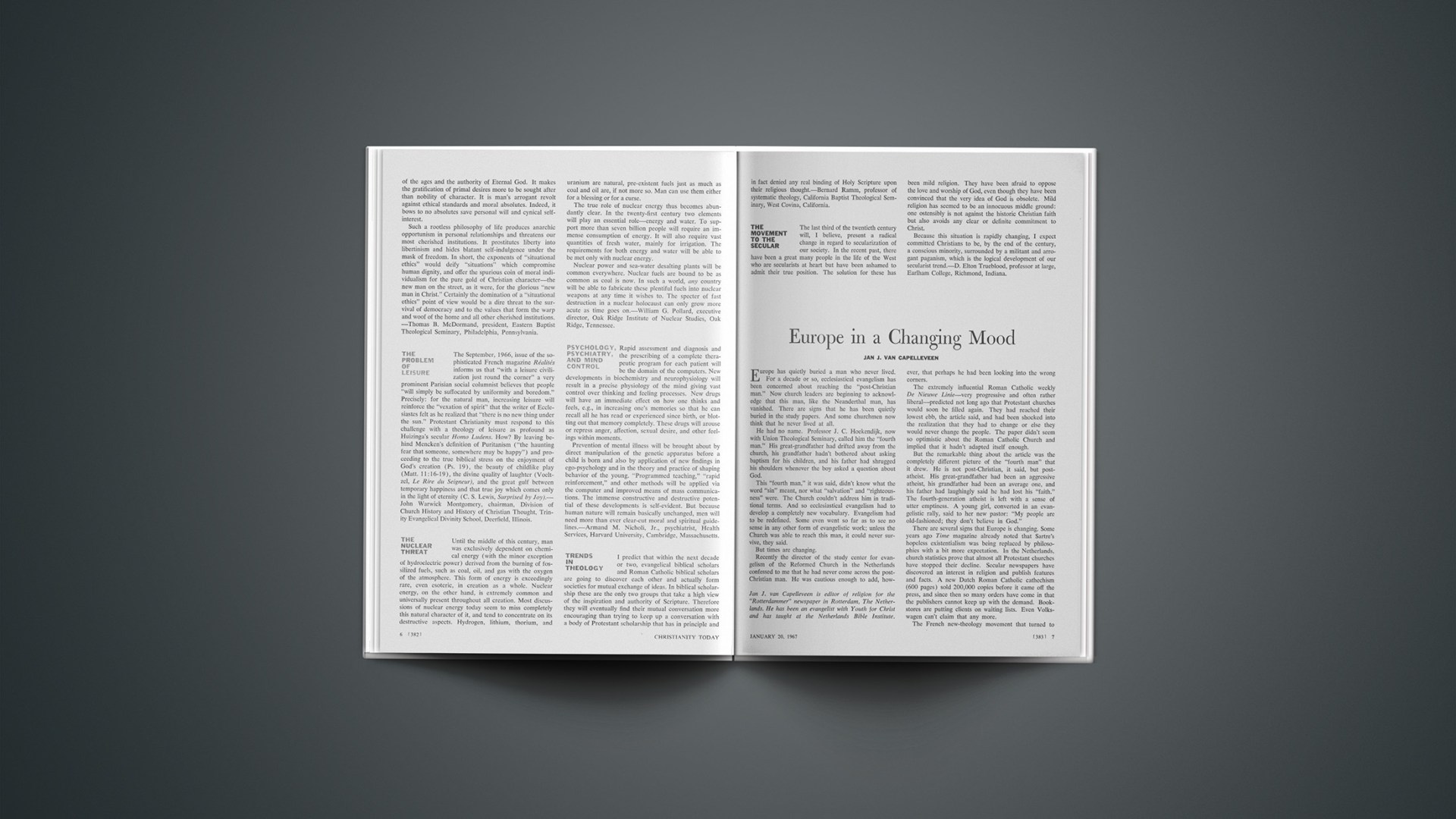
Europe in a Changing Mood

Europe has quietly buried a man who never lived. For a decade or so, ecclesiastical evangelism has been concerned about reaching the “post-Christian man.” Now church leaders are beginning to acknowledge that this man, like the Neanderthal man, has vanished. There are signs that he has been quietly buried in the study papers. And some churchmen now think that he never lived at all.

He had no name. Professor J. C. Hoekendijk, now with Union Theological Seminary, called him the “fourth man.” His great-grandfather had drifted away from the church, his grandfather hadn’t bothered about asking baptism for his children, and his father had shrugged his shoulders whenever the boy asked a question about God.

This “fourth man,” it was said, didn’t know what the word “sin” meant, nor what “salvation” and “righteousness” were. The Church couldn’t address him in traditional terms. And so ecclesiastical evangelism had to develop a completely new vocabulary. Evangelism had to be redefined. Some even went so far as to see no sense in any other form of evangelistic work; unless the Church was able to reach this man, it could never survive, they said.

But times are changing.

Recently the director of the study center for evangelism of the Reformed Church in the Netherlands confessed to me that he had never come across the post-Christian man. He was cautious enough to add, however, that perhaps he had been looking into the wrong corners.

The extremely influential Roman Catholic weekly De Nieuwe Linie—very progressive and often rather liberal—predicted not long ago that Protestant churches would soon be filled again. They had reached their lowest ebb, the article said, and had been shocked into the realization that they had to change or else they would never change the people. The paper didn’t seem so optimistic about the Roman Catholic Church and implied that it hadn’t adapted itself enough.

But the remarkable thing about the article was the completely different picture of the “fourth man” that it drew. He is not post-Christian, it said, but post-atheist. His great-grandfather had been an aggressive atheist, his grandfather had been an average one, and his father had laughingly said he had lost his “faith.” The fourth-generation atheist is left with a sense of utter emptiness. A young girl, converted in an evangelistic rally, said to her new pastor: “My people are old-fashioned; they don’t believe in God.”

There are several signs that Europe is changing. Some years ago Time magazine already noted that Sartre’s hopeless existentialism was being replaced by philosophies with a bit more expectation. In the Netherlands, church statistics prove that almost all Protestant churches have stopped their decline. Secular newspapers have discovered an interest in religion and publish features and facts. A new Dutch Roman Catholic cathechism (600 pages) sold 200,000 copies before it came off the press, and since then so many orders have come in that the publishers cannot keep up with the demand. Bookstores are putting clients on waiting lists. Even Volkswagen can’t claim that any more.

The French new-theology movement that turned to the Bible is making its influence felt in almost all Roman Catholic countries. And it is no longer just a feature of the priestly class; it is coming into fashion with the people of the pew.

When, after Billy Graham’s London crusade, converts were gathered into home Bible classes, this didn’t set a new trend; it only followed what was happening already. Scores of Bible classes are held in Dutch homes, and they often are composed of Protestants, Roman Catholics, and non-believers. One church member said to his pastor: “Please stay away. We can do better without you.”

The many reasons for this new phenomenon can be condensed into two major ones. The first is that the gains of materialism have proved that they do not satisfy. Immediately after the war, people clamored for material things. First it was food, then the refrigerator, afterwards television and the car; now it is the second house, a simple wooden shed on the shore or in a wooded area where wife and children can spend their increasing number of holidays. This post-war demand was natural. My wife had lived for half a year on tulip bulbs. And I can still taste the bitter sweetness of sugarbeets, which kept us alive during the last year of the war. Swedish bread, floating down on parachutes from the air during an immense rescue operation, looked heavenly to us. The first piece of chocolate an American soldier gave me turned into nectar in my mouth.

But man cannot live by bread alone forever. German doctors are said to have a pile of prescription notes on their desks with only three letters on them: F.D.H., meaning Fresse die Helfte (Eat half). The car we finally can afford has become a concern in the overcrowded narrow streets. A man said to me: “I live a fifteen-minute walk from my office; I have to park the car at a half hour’s distance.” Materialism is leaving a bitter taste in the mouth, a void in the heart, and a big bill on the desk—from the drugstore and doctor.

The second major reason for the change is entirely different. Science is undermining much of the philosophies and theologies of the past century. Dr. Hans Rohrbach said at the World Congress on Evangelism: “… for their own thinking still rests upon the scientific view of the world projected by classical physics in the nineteenth century, and they therefore believe they must reject all biblical statements that involve science.” But science has changed: “All categories of absoluteness or eternality are now stripped away from space, time, matter, and laws of nature. These were not really scientific facts, but were metaphysical interpretations which man superimposed upon the universe.”

Some years ago, at a discussion meeting during a conference of European churches in Denmark, a young atomic physicist said: “Bultmann has no answer for my problems, because he operates with a scientific view of the last century, which atomic science has disproved.” Dr. W. A. Visser ’t Hooft, then general secretary of the World Council of Churches, jumped up and said: “This we have to discuss. This is important.” During the discussion one of the Russian Orthodox priests said: “My friend is right. I have had contact with Russian physicists in high places, and they have confessed to me that Marxism lost its value to them for the very same reason. Science is an axe at the tree of Marxism.”

Atheism, materialism, Marxism—these have not been satisfying answers to the questions life asks. A well-known modern author, Harry Mulisch, who claims to be an atheist, said on a Dutch television program: “I must confess that I haven’t been able to think up one that really satisfies me.” A sense of emptiness fills the souls of many Europeans.

Some clamor for a new revolution. In Amsterdam young intellectual beatniks battle with the police. Young people in the political parties rebel against their leaders. Some put everything on the card of helping young nations, in the hope they will find Christ in the naked, the hungry, and the prisoners. Others expect everything from technology. But whether they take to the streets to march against apartheid and the war in Viet Nam, or pack their suitcases to serve in some faraway place, these young people are usually expressing their search for something to live for.

I have discovered a new longing for faith in the most unexpected people. But does this mean that Protestant churches can expect a return to the pews, as the Roman Catholic weekly prophesied?

To me the facts reveal that this is wishful thinking. True, the “fourth man” isn’t as far away from understanding the words of the Gospel as some had said. But he still looks upon the Church with the eyes of his great-grandfather. For him the Church very often is still the self-assured, old-fashioned, pompous, other-worldly, caste-minded institution his forefather left.

I see no signs yet of a mass return to the Church. But I do see great possibilities for Christians if they are willing to leave their self-chosen ghettos to go and live and work where the people are. If they do, the Church will change itself, and so the doorstep-fear of modern man may be overcome.

Sighting the Final Third of the Twentieth Century

The hinge of history is turning. A door is opening slowly, and we have the opportunity of peering through to catch glimpses of things to come. To the optimist the future is bright with promise. He foresees incalculable advances in human knowledge, the possible conquest of disease, the end of poverty, the growth of leisure, and material well-being for all mankind. To him the future is a challenge. He stands on the threshold of the last third of the century head high with hope.

The pessimist, on the other hand, fears the threat of uncontrolled population increase. He sees streets littered with the corpses of starvation victims. And he watches in horror a secularized world without the knowledge of God, as he waits for the four horses of the Apocalypse to ride the plain of Esdraelon. Each viewer has his own vision, each will experience his moment of truth. One is excited by the prospects, the other depressed. But even the depressed, if he is a Christian, is encouraged by the thought that though the world is in chaos, it will soon be reordered by the second coming of the Son of Man into history.

In an effort to find out what Christian leaders in America are thinking as they look through this partially opened door, CHRISTIANITY TODAY asked a number of them this question: “Looking ahead to A.D. 2000, what do you think is in store for mankind?” Each was given a special area to speak about in line with his interests and special competence. Here are the responses.

Medical Science And Human Life

Aldous Huxley and H. G. Wells have proved to be the most accurate forecasters of how science affects our way of life. We can anticipate more of what they predicted. The next moral problem to be faced in the affluent societies is the right to die. If it is right for my parents to decide to have me born, why is it not right for me to decide to die? The argument will center first on patients known to have incurable disease, will be extended to include those suffering from senility, and ultimately will include those merely anticipating life as an invalid or in a senile state.—John R. Brobeck, professor of physiology, School of Medicine, University of Pennsylvania.

The Church And The Nation

Crime, protected by the atheistic Supreme Court and the lower courts with their criminal sympathies; abolition of the death penalty; riots and looting; destruction of the economy by uncontrolled labor unions and an extravagant government; sex; drug addiction; alcoholism; secularism; Communism; no powerful preacher of the Gospel—of course, some faithful preachers, e.g., Martyn Lloyd-Jones, but none who can shake nations as Luther, Calvin, and Knox did: and the result will be the overthrow of the United States by A.D. 2000 (as predicted by Oswald Spengler), the great apostasy, and the Antichrist in priestly robes sitting in the temple of God with a hammer and sickle in his hand.—Gordon H. Clark, professor of philosophy, Butler University, Indianapolis, Indiana.

Mass Evangelism

Mass evangelism will play an increasingly vital role. Vocal opposition will probably increase, especially from groups who view evangelism essentially in terms of radical theology and social involvement. But there will also be increasing support from those who see that proclaiming the Gospel to a verdict is essential to biblical evangelism.

Campaigns will be more comprehensive and include witness not only by word but also by fellowship and service. Mass campaigns will more and more become catalysts rather than interludes. Preaching campaigns will be wedded to visitation and home Bible-study efforts.

As for social witness, Billy Graham’s integrated crusades have already been dramatic demonstrations of the Gospel’s relevance in the midst of racial tensions. Ways will be found to bear similar dramatic evangelical witness in the areas of war and poverty.

One great danger is that mass evangelism may be reduced to a technique to be refined. Some may claim that evangelistic effectiveness is due to superb organization, ignoring the spiritual dynamics, forgetting the sovereign power of God in calling evangelists, and forgetting also the power of prayer that has undergirded all great evangelistic movements.

Another danger is that mass evangelism could become extra-church—or anti-church.—Leighton Ford, evangelist, The Billy Graham Evangelistic Association.

American Education

The use of such aids as television, teaching machines, computers, and other devices not yet developed will doubtless increase markedly. This greater reliance upon technology will tend toward the dehumanization of education and its departure from its basic character as an art. Public education will reflect an even more secularized context than today. The common level of education will doubtless include college training for practically all youth of normal or even mediocre capacity. Yet rising costs will probably force a great expansion of government subsidy.

In line, however, with the present trend to independent education at all levels, an important increase in the number of independent schools and higher institutions may be expected. And here lies the greatest opportunity for Christian education, so long as it holds true to its convictions and maintains high standards.—Frank E. Gaebelein, headmaster emeritus, the Stony Brook School, Stony Brook, New York.

The Population Explosion

Take just one country—India. Unless the birth rate is drastically reduced, a population that has doubled since 1901 will double again—to one billion people—by 2000. In the next thirty years India’s exploding cities will have to absorb 140 million new immigrants. Throughout the non-Western world, where the Church is weakest and smallest, the multiplication of non-Christians will increase the fastest. By 2000 the world will have moved significantly toward total urbanization. Misery will have increased more than affluence, resentment more than understanding.

The Church will either repudiate its suburbanite captivity and define its priority as identifying with the suffering proletariat, or be swept aside as utterly irrelevant to the harsh realities of human existence. I am confident that the believing Church, under the Christ of the common man, will roll up its sleeves and get its hands dirty serving and witnessing in the hostility of a desperately pagan, one-city world. The Cross will be freely proclaimed, and gladly embraced for his sake.—Arthur Glasser, home director for the United States and Canada, Overseas Missionary Fellowship, Philadelphia, Pennsylvania.

Missions And The Church

If present currents continue without a great moving of the Holy Spirit in revival among the established denominations, the year 2000 will see most of these churches near the end of any vital missionary ministry. Their institutional life and philanthropy will have been dwarfed or totally subsumed in the activities of governments.

The increasingly high cost of property will make the mission “church” obsolete and impossible. This may force a return to the New Testament pattern of “the church in thy house,” the cell group at worship.

By that time the day of “missions by money” will be almost as passé as the medieval missions by arms. The Pentecostal groups will be at the apex of their influence. In many of the Roman Catholic lands, evangelical work of Pentecostal type will be huge in scope.

Renewal could conceivably come to the old-line denominations. But this turn seems, at the moment, unlikely.—Cal Guy, professor of missions, Southwestern Baptist Theological Seminary, Fort Worth, Texas.

War And Peace

The pressures of ever-increasing populations and of the expectations of the underprivileged peoples will place heavy strain on men’s ability and willingness to share the benefits of society so as to prevent famine, pestilence, and war. The development of new foods from such sources as the oceans and other scientific advances will no doubt increase the world’s productivity, but this will not be enough to assure peace.

These forces may erupt as issues in the struggle between Communism and democracy or in some now unpredictable way unrelated to the present world conflicts. Only if we can manage to restrain our population growth, only if we can help the underprivileged help themselves to achievement, only if we can learn the truth that all men are created by God and are therefore spiritual beings, only if we can experience a spiritual renaissance in which man sees his need for regeneration through Jesus Christ and not mere reformation through human agencies, can we justifiably hope that our plans for peace can be fulfilled.—Mark O. Hatfield, U. S. senator from Oregon.

Scientific Discoveries

Mankind is going to be affected by significant advances in three areas: (1) medicine, (2) communications, and (3) development of natural resources.

In medicine we will see a better understanding of the aging process; of the mind, memory, and consciousness; and of the relation between the physiological and psychological aspects of our nature. Man will arrest the aging process by discovering how life can be preserved indefinitely. Advances in the understanding of the mind will be made to the point where the very definitions of “memory” and “self-consciousness” will be examined.

Communications will advance to the point where great bodies of information stored in one location will be readily available to anyone. If extraterrestrial beings exist, communications will be established with them. Visual communication will be commonplace by the end of the century. It will replace the telephone to a great extent.

The expanding population is going to strain the world’s natural resources, and new products from oceanic exploration will be common. Control of the weather will make possible the utilization of areas of the earth’s surface that are unproductive.—Albert L. Hedrich, head of Communications Research Branch, Goddard Space Flight Center, Greenbelt, Maryland.

The Negro

Black and white racists and extremists will find their cause hopeless as the federal government strongly enforces laws to prevent and control outbreaks of racial violence. The majority of Americans will welcome opportunities of working together, using peaceful methods to end segregation and discrimination. Much will depend, however, on whether the Christian Church will completely rid itself of all racism and preach and practice the love of God.

In Africa there will be industrial and economic progress. The apartheid policies of South Africa, Southern Rhodesia, and Angola will face stiffer opposition from blacks and whites within the countries and from outside African nations. Africa will continue to present a tremendous spiritual challenge to the Christian Church and evangelical missions. The Communists will continue their efforts to win complete control, but the greatest deterrent to the Christian Church and mission will be the spread of Islam.—Howard O. Jones, evangelist, The Billy Graham Evangelistic Association.

Intra-Protestant Ecumenism

I am sure in my own mind that the year 2000 will see problems facing the Church that we cannot even imagine at this time. It will show that the ecumenical movement is forever valid, but it will cast certain doubts on mergers as a solution to the problems that plague the Christian Church. The organization of the Christian life of any period is of some significance, no doubt, but it is never the essential thing. The Christian spirit within the hearts of men is the reality. The vital relevance of Jesus Christ to man’s predicament is the final experience. The temptation is to believe that some shifting of the organization will release new power from the Holy Spirit, but this is not true.—Gerald Kennedy, bishop, The Methodist Church, the Los Angeles Area.

The God-Is-Dead Movement

In the final third of the twentieth century, the God-is-dead movement may take one or more these directions: It may have its day as a theological fad and see its literature gathering dust on the shelves. It may vanish from the theological scene as a serious competitor for the attention of the Church, having created a good deal of mischief, but having served at least as a solvent to public indifference to spiritual matters, and having lifted into prominence some neglected facets of Christian doctrine. It may conceivably harden into a theology, quite possibly emphasizing some form of esoteric or agnostic Christology. Or it may develop into an atheistic form of religion, possibly resembling Buddhism in some ways and thereby capitalizing upon the attraction Buddhism has for some intellectuals.—Harold B. Kuhn, professor of the philosophy of religion, Asbury Theological Seminary, Wilmore, Kentucky.

World Revolution And Communism

As we should know from First Corinthians 13:8–10 and as historians have long been aware, prophecies are notoriously fallible. To attempt a forecast for even the year 2000, now less than a generation away, is to risk disproof by the event. We Christians have been warned that at an hour that we know not the Son of Man comes. However, barring that consummation of the age, clearly the world revolution that is affecting all men and all phases of culture will still be mounting. It began at least six centuries ago with the Renaissance and has sprung from Western peoples, what we have been accustomed to call Christendom. It is accelerating and gives no indication of abating. Communism is a phase of that revolution. Although proliferating and giving no evidence of declining, it is not as unified as formerly. Presumably it will become increasingly diverse and less and less centralized either under Moscow or Peking.—Kenneth Scott Latourette, Sterling Professor of Missions and Oriental History, emeritus, Yale University, New Haven, Connecticut.

The Arts

For the modern literary artist, the central question is whether there is relevance between the interior and the exterior world. On one’s belief in this regard hang such questions as whether or not reason is “rational,” or whether meaning has any meaning, or whether subjective awareness relates to objective reality (if any). If the answers are all negative, as for many writers they are, we must plan to live with the anti-novel, the anti-poem, the theater of the absurd, and the universe of the absurd. Nothing may be communicated, for chaos cannot communicate with chaos. Life is a “happening,” without intent, without consequence, and without significance. This is difficult to write “about.” Unless political totalitarianism or social conformism dictates a message and a form, I see little reason to believe that the traditional grounds of literature will re-emerge in the predictable future.—Calvin D. Linton, professor of English literature and dean of arts and sciences, The George Washington University, Washington, D. C.

Situational Ethics

The vaunted “situational ethics” being championed in our age would assign to the present moment and the passing whim greater authority for the individual than the cumulative wisdom of the ages and the authority of Eternal God. It makes the gratification of primal desires more to be sought after than nobility of character. It is man’s arrogant revolt against ethical standards and moral absolutes. Indeed, it bows to no absolutes save personal will and cynical self-interest.

Such a rootless philosophy of life produces anarchic opportunism in personal relationships and threatens our most cherished institutions. It prostitutes liberty into libertinism and hides blatant self-indulgence under the mask of freedom. In short, the exponents of “situational ethics” would deify “situations” which compromise human dignity, and offer the spurious coin of moral individualism for the pure gold of Christian character—the new man on the street, as it were, for the glorious “new man in Christ.” Certainly the domination of a “situational ethics” point of view would be a dire threat to the survival of democracy and to the values that form the warp and woof of the home and all other cherished institutions.—Thomas B. McDormand, president, Eastern Baptist Theological Seminary, Philadelphia, Pennsylvania.

The Problem Of Leisure

The September, 1966, issue of the sophisticated French magazine Réaltiés informs us that “with a leisure civilization just round the corner a very prominent Parisian social columnist believes that people “will simply be suffocated by uniformity and boredom.” Precisely: for the natural man, increasing leisure will reinforce the “vexation of spirit” that the writer of Ecclesiastes felt as he realized that “there is no new thing under the sun.” Protestant Christianity must respond to this challenge with a theology of leisure as profound as Huizinga’s secular Homo Ludens. How? By leaving behind Mencken’s definition of Puritanism (“the haunting fear that someone, somewhere may be happy”) and proceeding to the true biblical stress on the enjoyment of God’s creation (Ps. 19), the beauty of childlike play (Matt. 11:16–19), the divine quality of laughter (Voeltzel, Le Rire du Seigneur), and the great gulf between temporary happiness and that true joy which comes only in the light of eternity (C. S. Lewis, Surprised by Joy).—John Warwick Montgomery, chairman, Division of Church History and History of Christian Thought, Trinity Evangelical Divinity School, Deerfield, Illinois.

The Nuclear Threat

Until the middle of this century, man exclusively dependent on chemical energy (with the minor exception of hydroelectric power) derived from the burning of fossilized fuels, such as coal, oil, and gas with the oxygen of the atmosphere. This form of energy is exceedingly rare, even esoteric, in creation as a whole. Nuclear energy, on the other hand, is extremely common and universally present throughout all creation. Most discussions of nuclear energy today seem to miss completely this natural character of it, and tend to concentrate on its destructive aspects. Hydrogen, lithium, thorium, and uranium are natural, pre-existent fuels just as much as coal and oil are, if not more so. Man can use them either for a blessing or for a curse.

The true role of nuclear energy thus becomes abundantly clear. In the twenty-first century two elements will play an essential role—energy and water. To support more than seven billion people will require an immense consumption of energy. It will also require vast quantities of fresh water, mainly for irrigation. The requirements for both energy and water will be able to be met only with nuclear energy.

Nuclear power and sea-water desalting plants will be common everywhere. Nuclear fuels are bound to be as common as coal is now. In such a world, any country will be able to fabricate these plentiful fuels into nuclear weapons at any time it wishes to. The specter of fast destruction in a nuclear holocaust can only grow more acute as time goes on.—William G. Pollard, executive director, Oak Ridge Institute of Nuclear Studies, Oak Ridge, Tennessee.

Psychology, Psychiatry, Mind Control

Rapid assessment and diagnosis and the prescribing of a complete therapeutic program for each patient will be the domain of the computers. New developments in biochemistry and neurophysiology will result in a precise physiology of the mind giving vast control over thinking and feeling processes. New drugs will have an immediate effect on how one thinks and feels, e.g., in increasing one’s memories so that he can recall all he has read or experienced since birth, or blotting out that memory completely. These drugs will arouse or repress anger, affection, sexual desire, and other feelings within moments.

Prevention of mental illness will be brought about by direct manipulation of the genetic apparatus before a child is born and also by application of new findings in ego-psychology and in the theory and practice of shaping behavior of the young. “Programmed teaching,” “rapid reinforcement,” and other methods will be applied via the computer and improved means of mass communications. The immense constructive and destructive potential of these developments is self-evident. But because human nature will remain basically unchanged, men will need more than ever clear-cut moral and spiritual guidelines.—Armand M. Nicholi, Jr., psychiatrist, Health Services, Harvard University, Cambridge, Massachusetts.

Trends In Theology

I predict that within the next decade or two, evangelical biblical scholars and Roman Catholic biblical scholars are going to discover each other and actually form societies for mutual exchange of ideas. In biblical scholarship these are the only two groups that take a high view of the inspiration and authority of Scripture. Therefore they will eventually find their mutual conversation more encouraging than trying to keep up a conversation with a body of Protestant scholarship that has in principle and in fact denied any real binding of Holy Scripture upon their religious thought.—Bernard Ramm, professor of systematic theology, California Baptist Theological Seminary, West Covina, California.

The Movement To The Secular

The last third of the twentieth century will, I believe, present a radical change in regard to secularization of our society. In the recent past, there have been a great many people in the life of the West who are secularists at heart but have been ashamed to admit their true position. The solution for these has been mild religion. They have been afraid to oppose the love and worship of God, even though they have been convinced that the very idea of God is obsolete. Mild religion has seemed to be an innocuous middle ground: one ostensibly is not against the historic Christian faith but also avoids any clear or definite commitment to Christ.

Because this situation is rapidly changing, I expect committed Christians to be, by the end of the century, a conscious minority, surrounded by a militant and arrogant paganism, which is the logical development of our secularist trend.—D. Elton Trueblood, professor at large, Earlham College, Richmond, Indiana.

Editor’s Note from January 20, 1967

Educational Communication Association (P.O. Box 114, Indianapolis) reports almost 150 advance requests for the filmed series “God and Man in the Twentieth Century,” now being released for church and institutional use. At month-end television showings will begin in many parts of the nation.

Under CHRISTIANITY TODAY’S religious news fellowship with the Washington Journalism Center, two men will be staff interns during the semester beginning February 1: William Freeland of Willow Grove, Pennsylvania, who holds the M.S. from Columbia University’s Graduate School of Journalism, and James L. Adams, a reporter on the Cincinnati Post and Times-Star, who holds the B.A. from Ohio State University. Mr. Freeland will be assigned to our daily news operation, and Mr. Adams will specialize in investigative projects. In addition, T. E. Koshy of Bombay, India, who also is interested in religious journalism, will consult our staff during his research work. Mr. Koshy, who holds B.A. and LL.B. degrees from Bombay University, is an M.A. candidate in religious journalism at Syracuse University.

Edward H. Pitts, first holder of the CHRISTIANITY TODAY fellowship, completes his assignments this month and then assumes the editorship of two journals in the Advent Christian Church. We have also appreciated our liaison this past semester with another Center scholar, O. Wilson Okite, who plans to be a journalist in his homeland of Kenya.

Applications for the Fall, 1967, semester award of $2,000 are being received from now through April 15 (Religious Journalism Fellowship, 1014 Washington Building, Washington, D. C. 20005).

Reviewing Revelation

The death not long ago of Emil Brunner and of Paul Althaus brought to mind the active parts these two theologians had played in the discussions about the revelation of God in the world around us. The long shadow of Karl Barth, who is now eighty years old, stretches out over those same discussions. For it was Barth who rose in protest against Althaus’s view that divine revelation came from creation as well as in Jesus Christ. It was Barth also who spoke his famous Nein back in 1934 against Emil Brunner’s theology of general revelation. As we recall this storm that so stirred the theological sea thirty years and more ago, and realize that two of the participants are now gone and the other is in the glory of his four score years, we would be wrong if we thought that the subject was not as relevant today as then.

The argument about general revelation is still carried on in a heat measured by its importance. Though Barth accepts the existence of a side stream alongside the mainstream of revelation (the side stream being the light that falls on creation from Christ), he is still critical of Article II of the Belgic Confession, which speaks of a knowledge of God that comes from the creation, providence, and government of the world. Barth sees here a shadow of natural theology like that which got a much clearer formulation by the first Vatican Council. God, said the council, can be clearly known through the natural light of reason from the things that are created.

Brunner, at the appearance of Volume IV/3/2 of Barth’s dogmatics, talked about the “new Barth.” For it seemed then as though Barth had swung around a bit in Brunner’s direction—or at least Brunner thought so. Barth did indeed speak in this volume about the true words and true light that existed outside the Church. He did not talk about an extra-biblical revelation, to be sure, but did stress that parables of the kingdom were manifest in the world and that the Church had to take them seriously: one may unexpectedly hear the word of the Good Shepherd in them.

This did not mean that Barth was restoring natural theology to a place of honor. It did mean that he had not forgotten Calvin’s word about the world as a theater of God’s glory. There is a certain “holiness” about the created world, in spite of the darkness of our sin-blinded eyes. Creation and redemption are not enemies. All truths and every light in the world are set there by God. But, splendid as they may be, they cannot take the edge off this truth—that Jesus Christ is the Revelation of God, the Way, the Truth, and the Life.

Barth was occupied with the same problem which kept Abraham Kuyper busy for so long, and from which came Kuyper’s monumental work on Common Grace. Here, he acknowledged that the Church was often disappointing and the world often looked good. Kuyper explained this by means of the goodness and power of the Holy Spirit, not the native goodness of men. The mercy of God was demonstrated, for Kuyper, in the positive virtues of the world. Kuyper resisted pietistic tendencies to avoid the world; he pointed to the world as the way in which men could walk, not in spite of, but because of, Christ.

Since Bonhoeffer, there has been a great deal of talk, not about the glory of God manifest in the theater of the world, but about the weakness of God. That is, the form of the Cross is the form divine revelation takes in the world today. One thinks of the Japanese theologian Kitamori and his work on The Theology of the Pain of God, recently translated into English after seeing several Japanese editions since its publication in 1945. This book, written out of the horror of the war, has impressed Westerners deeply. The cover shows the ruins of Hiroshima. Kitamori talks about the love of God as suffering love, in connection with John 3:16. “Without apprehension of this tragic love of God, all talk of the Word made flesh is empty formalism.” This is a far cry from a fairly simple assertion that the earth sings an anthem to the power and glory of God, an anthem all who have an ear for beauty can hear. We do not find much of Calvin’s “theater of the glory of God” in Kitamori.

We are reminded how strongly the modern feeling for life is tinged with the tragic and how this penetrates theology. Barth would probably not feel at home with Kitamori’s book. It warns us against cheap and simplistic notions of natural theology and the glory of God shining through creation and history. Paul talked about God’s eternal power and divinity manifest in creation (Romans 1), but he also talked about what men have done with it, how they have held the truth down in unrighteousness.

Now, we must also say that one may not talk as though the notion of general revelation is the same thing as a simple natural theology. Paul speaks in Acts 14 of the fact that God has not left us “without some clue to his nature, in the kindness he shows” (Acts 14:17, NEB). This is one of the amazing words of Scripture. The God whom Paul preached (and whom men did not recognize—Acts 17:23) is in love with life, human life, and is always busy making it better and happier. He “sends you rain from heaven and crops in their seasons, and gives you food and good cheer in plenty” (Acts 14:17). He gives men their places to live, so that they might “seek God, and, it might be, touch and find him” (Acts 17:27).

The distinction between special revelation and general revelation is much more than a theological nicety. True, theologians have played with the distinction as though it were an amusing abstraction. But it comes up again and again whenever men come firmly to grips with the terrible question of the presence of God and his revelation in the world. Behind this distinction lies the mystery of the ways of God with men, a mystery that cannot and does not depreciate the fact that Jesus is the Revelation of God. But it is a mystery that forces us to face up to the reality of God’s presence in the world of men and things, and face up to it in a way that honors the true revelation of God in Christ and is in turn illumined by it.

We do not have the natural discernment to recognize the power and the glory, the love and the mercy, in any clear and unambiguous way. How could we clearly distinguish the power and the love of God in all that happens? Sometimes it seems as though they contradict each other—in fact, as though the love and the power of God cancel each other out. Paul speaks of the God of Revelation in all the aspects of his word but admits that we see through a glass darkly.

Yet the riddles that remain for our minds are not tragic in the end. The wonderful part of the Gospel according to Paul is that these riddles do not silence the song of redemption. The song sounds through them. If we can accept this mystery, we will be careful in our talk about God, careful in our language about his revelation—be it the universal or the very special Revelation of God in Christ.

Churches Open Drive to Share U. S. Wealth

A church-sponsored drive to send abroad more American dollars opens this week in Washington. The United Church of Christ will spearhead the effort to tap existing missionary resources in a battle against world poverty.

“The gravest issue facing the world today is the widening gap between the rich and the poor nations,” says the Rev. L. Maynard Catchings, head of a new “office for international development” financed by the UCC’s Council of Christian Social Action. “This gap is especially intolerable to Christians whose faith compels a special concern for the poor. This gap is also intolerable because technology has made possible a world in which poverty can be eliminated.”

Catchings is setting up shop in Washington with a meager $30,000-a-year budget provided by the UCC. He has ambiguous ties with an “international development committee” formed in September with representatives of six other denominations: the American Baptist Convention, Christian Churches (Disciples of Christ), Church of the Brethren, Protestant Episcopal Church, The Methodist Church, and United Presbyterian Church in the U. S. A. Five of the seven communions are full-fledged members of the Consultation on Church Union; the Baptists and Brethren last year rejected anything more than observer status in COCU.

The program is the brainchild of Dr. Ray Gibbons, who feels that the Gospel commands the churches “to seek human welfare and world peace.” Gibbons, 63, has been promoting this view for years in the National Council of Churches, but the NCC has not mustered enough enthusiasm or resources to assign a full-time Washington specialist on international aid. The NCC will, however, provide office space for Catchings in the building it rents across the street from the U. S. Capitol.

Gibbons said the purpose of the new enterprise is (1) to educate church bodies about the problems of world trade, food and agriculture, population, community development, and foreign aid; (2) to interpret international development issues to churches; and (3) to engage churches in international development projects in Asia, Africa, and Latin America.

“Revolution is inevitable,” Gibbons declared, “but we can help to make revolution peaceful and creative. Americans are in the unusual position of having their own cake of affluence and being able to share that affluence with the less developed nations. Indeed, if we Americans do not share our technology and productivity wisely and speedily, we may lose them in wasteful wars.”

Gibbons contends that world-wide ecumenical relations of the churches, missionary programs, and relief work provide the churches with resources and communications that can be enlisted in an effective campaign against world poverty. Catchings adds that “the determination of Christians to assist the developing countries of Asia, Africa, and Latin America represents a new partnership of the historic social action forces and the world mission forces.”

Protestant Panorama

Between 20,000 and 30,000 Protestants demonstrated in Santiago, Chile, in favor of the church-state separation ordered by the 1925 constitution and against new policies for teaching Roman Catholicism in public schools.

This week a new congregation is forming in Macon, Georgia—dissidents who left Tatnall Square Baptist Church after its pastors were ousted for favoring racially integrated worship.

The Ukrainian-background Mennonite Brethren Church formed a world conference at its recent North American meeting (about one-fourth of the 85,000 members will be in the Soviet Union) but decided not to pursue merger talks with other Mennonite bodies. The denomination merged its welfare and missions boards because “proclamation and welfare ought to be integrated.” Though they warned that political involvement is not the Christian’s primary calling, delegates urged more involvement, particularly in local government.

Church of the Nazarene officials plan civil-court action this month, if necessary, to regain control of a Saxonburg, Pennsylvania, church. The church’s pastor, Earl Huston, Jr., was excommunicated recently for dissociating the congregation from the Nazarenes and for speaking in tongues, which is against the practice (though not the official doctrinal stand) of the denomination.

Miscellany

Father Gommar DePauw, leader of the Roman Catholic traditionalist movement, said the Vatican’s decision that he is still under the control of Baltimore’s Cardinal Shehan is “juridically improper, illegal, and morally unjust.”

A joint mass in the Netherlands recently symbolized unity moves between its Roman Catholics and the 10,000 Jansenist Old Catholics, whose split dates to a 1723 excommunication and led to splits from Rome in several other nations. In unofficial negotiations, Rome has dropped the historic requirement that Old Catholics reject certain Reformation-oriented documents. The Old Catholics have intercommunion with Anglicans and a growing link to Eastern Orthodoxy.

Methodists and Roman Catholics held their second official ecumenical encounter in Chicago the week before Christmas and talked about the nature of faith. In their third meeting, June 28–30, they will discuss the Holy Spirit. Bishop F. Gerald Ensley of Ohio heads the Methodist team; the Catholic leader is Mississippi Monsignor Joseph Brunini.

A survey in advance of the first consultation on theological education in Northeast Asia shows that there are sixty-two seminaries in Japan but that only six offer graduate-level courses, and thirty-seven have fewer than ten students.

Bishops of the Anglican Church of Ireland said in a pastoral letter that Roman Catholic changes on mixed-marriage regulations are only superficial.

Among members of the new West German Cabinet is Justice Minister Gustav Heinemann, former president of the council of the Evangelical Church (EKID). In line to succeed Vice Chancellor Willy Brandt as mayor of West Berlin is a former Protestant pastor, Heinrich Albertz.

While ethnic tensions continue on Cyprus, unofficial talks toward religious understanding have begun among Roman Catholics, Anglicans, Lutherans, Armenians, Maronites, and the Greek Orthodox, who are led by the island’s president, Archbishop Makarios.

Australia’s new Anglican primate, Philip Strong, formally asked Presbyterians, Methodists, and Congregationalists to admit the Anglicans to union talks already in progress. His move followed action by an autumn synod meeting. Observers think, however, that the other three groups may press their own merger and invite the Anglicans in later, Ecumenical Press Service reports.

The Anglican diocese of Accra, Ghana, has decided members may receive communion from any of the six other denominations participating in talks toward a merged national church. A similar merger involving four denominations is under discussion in Malawi.

Poland’s Roman Catholic Church reports that the government plans to close six seminaries because they refused to remove their rectors and admit government inspectors. It could be the worst church-state confrontation in Poland since 1956, when an accord was reached between the church and the Communist government.

Bishop Zoltan Kaldy, 45, of the Hungarian Lutheran Church (430,000 members) said a new code adopted at the recent synod meeting—first since the Communist take-over—“reflects the fact that the church has found its place and field of service in the country’s new social order.” He said church and state can at least work together for peace.

This month, Pennsylvania’s education department will try out its new elective high school course in religious literature in the city of State College, in cooperation with Pennsylvania State University. Readings from the Bible and other religious books will be put in historical, philosophical, and literary context. Teacher training for the special course is planned this summer.

Personalia

Senior Bishop Reuben H. Mueller of the Evangelical United Brethren Church, immediate past president of the National Council of Churches, will receive the prestigious Upper Room Citation, given annually to a world Christian leader by the Methodist-sponsored devotional magazine.

A new library building at North Ĉarolina’s Montreat-Anderson College, a Southern Presbyterian school connected with the denominational conference center, will be named for Dr. L. Nelson Bell, executive editor of CHRISTIANITY TODAY. Dr. Bell resides on the conference grounds just east of Asheville.

E. P. Y. Simpson, church history professor who submitted his resignation during current trouble at Berkeley Baptist Divinity School (Dec. 23, 1966, issue, page 35) will return to his native New Zealand this year to teach history at Massey University.

An unscientific survey by Youth (published for teens by the United Church of Christ, Episcopal Church, Anglican Church of Canada, and Church of the Brethren) showed the best-liked personalities as Martin Luther King, Mrs. Jacqueline Kennedy, Robert F. Kennedy, Billy Graham, U Thant, and Lyndon Johnson. But Johnson ranked even higher on the “disliked” list, along with such persons as Charles de Gaulle, George Wallace, Cassius Clay, Mao Tse-tung, and Elizabeth Taylor.

Mirroring the confusion on strategy in the civil-rights movement, the Rev. Dr. Martin Luther King, Jr., plans to take two months off from activism to visit the Bahamas and write a book, tentatively titled “Where Do We Go From Here?”

On February 1, Southern Baptist clergyman Bill D. Moyers, 32, leaves his post as President Johnson’s press secretary and general right-hand man to become publisher of Newsday, a Long Island, New York, newspaper.

National Presbyterian Center Director Lowell Ditzen was married to Mrs. Eleanor Davies Tydings, mother of U.S. Senator Joseph Tydings and widow of the late Senator Millard Tydings.

‘Tight Money’ Crimps Church Construction

The prospects are dim for construction of new churches during 1967. Church-builders, like home-builders, are caught in the squeeze between inflation in construction costs and the “tight money” market with its scarce loans and high interest rates.

The director of the National Council of Churches building commission, S. Turner Ritenour, says “almost every denomination” finds tight money has slowed its church construction program, although he and other spokesmen think other, non-economic forces such as denominational strategy or lay interest may be factors as well.

Figures now being compiled in denominational offices are almost certain to show a significant drop-off in church building during 1966. Some churches are putting building plans on ice, and fewer loan requests are coming to denominational headquarters. But other officials find “tight money” has sent churches rushing to national funds for help they would normally seek from local banks.

B. P. Murphy of The Methodist Church says that the increase in requests is “tremendous” but that virtually none of the Methodists’ $30 million revolving fund is available. And Richard Kent of the Episcopalians’ American Church Building Fund says, “We are just about at the bottom of the barrel.” He expects all his loan money (a mere $1.7 million, although the Episcopal Church Foundation makes some non-interest loans through bishops) will be “tied up until the middle of 1967.” The Southern Baptists’ Robert Kilgore says he has “little leeway” for loans.

Dale Lechleitner, home missions chief of The American Lutheran Church, reported three weeks ago that tight money has cut sharply the denomination’s program of building new churches. In 1965, sixty-five missions were established, but there were only thirty-eight in 1966. He fears the number will drop below twenty this year.

At least two major denominations, however, are sitting pretty during the current economic doldrums. Astute United Presbyterians floated a $20 million loan a year ago from New York Life Insurance Company at 51/8 per cent interest. If the 1966 loan-request rate holds up, this will tide the Presbyterians over the next two years, says D. Allan Locke, treasurer of the Board of National Missions.

The United Church of Christ is not hit by the current crisis because it needs no bank or insurance-company loans to buttress its $16 million revolving fund. John Morse, church building and finance chairman, says confidently, “We’ll get by all right,” although even with this handsome loan fund, the UCC has had its “share of troubles.”

For one thing, a large number of projects are costing from 20 to 50 per cent more than architects’ estimates a year ago. And a number of banks are reneging on tentative commitments to back congregational plans.

The jitters in the U. S. economy do not affect just big denominations. Even the 48,000-member Wesleyan Methodist Church—which regularly is at the top of the NCC’s listing of per capita giving in U.S. denominations—is feeling the squeeze. Church extension executive C. Wesley Lovin says many churches are delaying building plans because of high costs or lack of available money. At the same time, requests to the national loan fund, which totals $1.1 million, rose one-fourth during 1966. But the fund is geared to handle only the usual flow of business—two or three loans a month—and overflow appeals had to be turned down. Lovin expects 1967 will be worse.

This week, the Wesleyans hiked their interest charge on loans to 6½ per cent, reflecting the higher rates the denomination must pay its own creditors—those who invest in the church fund. The Methodist Church’s rate of 6 per cent is also rather high, reflecting the 5½ per cent interest it must pay to attract investors in today’s market. The Methodists hope they won’t have to borrow from banks, Murphy said.

The Southern Baptist Convention, which has about $20 million on loan to 1,000 congregations, shows the problem of denominations that must depend on bank or insurance loans. The home mission board last month removed the 6 per cent ceiling on what it charges churches for loans, and interest rates may now go as high as 7 per cent.

There is a considerable range in interest charged by denominations, based on such factors as need, strategic location, size, length of loan repayments, and whether the money is for a new congregation or an addition to a building. The United Church charges 4 per cent, with three-fifths of its loans going to new churches. United Presbyterians charge between 2 and 5½ per cent. The Episcopal range is 4½ to 5¼ per cent.

Even the higher church charges, however, are appealing in the current money market. Kent says some Episcopal parishes recently have paid 7 per cent or more to banks. Murphy says that some Methodist churches have been asked as much as 10 per cent in the South and that 7 to 8 per cent is “pretty much of a going rate on the West Coast.” And Morse says a UCC congregation in California is seriously considering a loan at 10 per cent.

Expo 67: Dual Approach

Between April and October of next year, some 12 million people are expected to converge on Montreal for the 600-million-dollar Canadian world’s fair known as “Expo ’67.” The Expo is located on two islands (one man-made) in the middle of the St. Lawrence Seaway.

Two pavilions have been built to give a Christian witness. Eight religious groups (Roman Catholic, United Church, Anglican, Presbyterian, Baptist, Lutheran, Greek Orthodox, and Ukrainian Orthodox) have cooperated in building the Christian Pavilion, and the project has been called Canada’s greatest ecumenical achievement. The Sermons from Science Pavilion (Moody), initiated by leading Canadian laymen, has been termed a display of “tragic disunity.” An editorial of the United Church Observer appealed to United Church congregations not to support this “rival pavilion.”

The Christian Pavilion will use photography, light, and sound to convey its message. A news release claims that “it is more likely that the visitor will have more questions upon leaving the Pavilion than when he entered”; “but hopefully,” the release adds, “he will also begin to realize that it is only ‘with Christ, and in Christ, and by Christ’ that life has any purpose.” Sermons from Science will confront visitors directly with the claims of Christ. Inquirers will hear evangelist Leighton Ford on a brief film prior to counseling.

J. BERKLEY REYNOLDS

Subtle Pressures Mounting on Cuban Churches

British Editorial Representative J. D. Douglas spent a week in Cuba during December getting a first-hand look at how churches fare under Castro. Here is his report:

Cuba marks the eighth anniversary of Fidel Castro’s revolution this week. So far is the regime from crumbling that to be anyone else’s man in Havana is to live dangerously indeed. Yet evidences of disillusion are there, too.

In the capital of the Communist island republic, the shops are brightly lit; but of the more essential goods, only sugar is on free sale. The showiest hotel in town cannot provide a cup of coffee some evenings. Strident music to encourage the workers blares from main-street loudspeakers. On December 7, however, it was replaced by quieter selections as Cuba remembered her national heroes, and all places of business and entertainment were closed.

Signs of the revolution are everywhere, from the placarded words of party sages to the gun-toting guards—some of them mere slips of girls—posted outside offices, apartment blocks, and public buildings and at strategic highway points. A Red Chinese exhibition seeks to attract the crowds. Tasteful art displays in the enormous foyer of the Havana Libre (nee Hilton) Hotel draw admiring throngs nightly.

The disillusion is reflected in the estimated 750,000 who have applied to leave the country despite certain forfeiture of nearly all their possessions. Long lines appear every day outside the immigration office.

More sinister signs of the revolution are seen in the regime’s attitude toward the Church. The harassment continues more subtly than in 1965, when fifty-three Baptists were arrested simultaneously. Thirty-four of them were brought to trial and sentenced for a variety of offenses, from espionage to “twisting biblical texts for the purpose of ideological diversionism.” To go about with Bible in hand is still an offense. Informers have infiltrated the churches—a fact not only admitted but boasted about by Dr. Falipe Carneado, director of the government’s department of religious matters. Churches cannot build. Theological students are whisked away to military service or to work camps. Unbelievers have been known to attend a church service, stand up at a given moment and sing the national anthem, then accuse those who do not join in of disrespect.

A common device is the street plan. Both ends of a street where a church is located are roped off; then, an hour before service time the street is designated a recreation area. Youths play ball or ride up and down on bicycles so that churchgoers are jostled and buffeted.

A few pastors have become firm Fidelistas trusted by the regime, and their sermons and other utterances are considered to be political propaganda rather than Christian messages. Visiting churchmen are usually taken in hand by such ministers, who give the visitors such a misleading impression that they go home honestly convinced there is no persecution of Christians in Cuba.

In the Americas access to Cuba is possible only from Mexico City. There, before flying out by Cubana, the traveler is photographed (“for the CIA files,” murmured a sardonic bystander), and as a symbol of Mexico’s disapproval a huge stamp is slammed on his passport: “Salió a Cuba.” This piece of democracy in reverse will make the holder persona non grata in any other Latin America country and stands in ironic contrast to Cuba’s deliberate failure to stamp one’s passport at all.

But behind the courtesy with which the tourist is met on arrival in Havana, the trappings of Communism are soon felt. The first is a compulsory change of all his money. For this purpose the peso is regarded as on a par with the U. S. dollar (the black-market rate is five to one). This rate operates also when the tourist leaves Cuba.

All in all, the picture is dark. One Cuban expressed it this way: “Our experiences are very sour. We breathe an atmosphere of insolence, tyranny, blasphemy, hypocrisy, lies, betrayal, and indignity. Our palm trees are so sad that they seem to be weeping, and our rivers are dry one moment and flooding at the other. This island is a huge prison with international jailers. We have returned to the time of the Vandals. The only thing we can do is raise our eyes to our blue skies, to the shining sun, to the twinkling stars, and to our God.”

At Havana Airport the departing traveler, to reach his plane, passes a big Pan American Airways section sign, its light lit, the counter beneath it swept and garnished. It is evidently a symbol open to different interpretations.

Cuban Church Conclave

Ecumenical Press Service of Geneva, the information arm of the World Council of Churches, reports that the Cuban Council of Evangelical Churches held its twenty-eighth General Assembly November 8–10. On hand were representatives of the twelve member denominations plus a few special guests. Addresses were given on the role of the laity by Mr. C. I. Itty, associate secretary of the WCC Department on the Laity, and on the witness of Christians in a socialist society by Professor Milan Opocensky of the Comenius theological faculty in Prague, Czechoslovakia. The Very Rev. Jose A. Gonzalez, dean of an Episcopal cathedral, was elected president of the council. Dr. Adolfo Ham was reelected to a two-year term as executive secretary.

EPS also reported that the governing board of the Cuban Council of Churches approved the opening of a study center with the Rev. Rafael Cepeda, a Presbyterian, as director. The center is to coordinate council research.

The Confined Baptists

Herbert Caudill, 63, Southern Baptist missionary released a few weeks ago from a Cuban prison, is in good spirits and enjoys good health except for an eye ailment. The malady had grown progressively worse, and Cuban authorities gave him liberty under certain restrictions so that he could obtain regular medical attention.

Though still under virtual house arrest, Caudill is permitted to have a few visitors. He is not allowed to preach or to give lectures at Havana Baptist Seminary, where he and his wife have an apartment.

Caudill’s son-in-law, David Fite, 33, is still in prison. The Swiss ambassador, guardian of American interests in Cuba, has been able to see Fite twice in nineteen months, and his family are allowed a monthly visit. Other foreign visitors would reportedly encounter “difficulties.” About thirty-five other Baptist pastors who are Cubans remain in prison also.

Soup With A Fork?

Due for publication early this year in Holland is a book of at least 200 pages on the authority of the Bible. It has the unanimous approval of the Synod of the Netherlands Reformed Church and is designed to be an aid to Bible reading and study. It marks the first time since the last world war that an old, established European church has come out strongly for the Bible as God’s Word.

The book says harsh things about the liberal biblical criticism of the nineteenth century and espouses in contrast a high esteem for the inherent authority of Scripture. But it bears down equally hard on the rationalism of eighteenth- and nineteenth-century orthodoxy. C. Frederikse, who wrote an original draft, claims that orthodoxy changed the great discovery of the Reformation. The book, revised by the synod prior to final approval, contends that Luther “again experienced the Bible as the book of the speaking God. In the days of the Reformation believers confessed their faith; later they believed their confessions.”

The title of the book translates as “Clear Wine.” It is taken from a Dutch expression that in this case suggests the idea of “honest to the Bible.”

The book’s flat assertion that the Bible is the Word of God takes issue with the well-known maxim of theologian Karl Barth that God’s Word is in the Bible. This is a significant development, for the national church of Holland was greatly influenced by Barth’s theology of neo-orthodoxy in the mid-thirties.

Bible criticism is not viewed as an unlawful form of Bible study, but serious dangers are acknowledged. The book claims there is “no reason to oppose the study of the Bible as a historic work or a literary document.” But Bible criticism is condemned where it mistakes personal views for scientific facts: “Often the Bible critics gave the impression they were eating soup with a fork.”

The book sees no hope in the prevalent word “existential.” It says, “This word may be a sign of good intentions, but there is the danger that the meeting in faith of Christ be diluted into some vague inner and religious experience.”

JAN J. VAN CAPELLEVEEN

Evangelical Editors Ex Animo

Magazine editors who want to belong to the Evangelical Press Association this year are required for the first time to sign a seven-point doctrinal statement with “ex animo acceptance,” that is, without mental reservations.

The statement is part of the association’s original charter, and EPA’s first president J. DeForest Murch recalls that the first members subscribed to it. But in the intervening years, as membership has tripled to more than 150 journals, the statement has been ignored.

The man who took it off the shelf was amiable Paul Fromer, editor of Inter-Varsity’s urbane campus monthly His, who is in line to be EPA’s next president. Young Fromer got EPA’s six-member board to require not only that new members sign, but also that old members sign it over again every year as a reminder of EPA standards.

Eternity’s Russell Hitt thinks the idea smacks of defensiveness. He doesn’t care if EPA “wants to check on my orthodoxy” but thinks the board was presumptuous in making the new requirement without discussing it at the annual convention.

M. A. Henderson of the Gideon scrawled “Amen!” below his signature, but half a dozen editors failed to return the signed statement, perhaps by mistake. (Fromer says they’ll have to sign to retain membership.) Fred Pearson of the Christian Medical Society Journal signed but made his own additions and corrections. He thinks the church, not EPA, should set doctrinal standards.

Murch said the statement was a word-for-word transcription of the doctrinal position of the National Association of Evangelicals. But a comparison with that document shows that somewhere along the line, the assertion of belief in Christ’s miracles and “vicarious and atoning death” has disappeared. “Completely inadvertent,” says current EPA President George Failing of The Wesleyan Methodist.

Other omissions shared by NAE and EPA are justification by faith alone, the sinfulness of all men, and God as the creator of the universe and of man. Pearson thinks modifiers are “mysterious” in the first point, on Scripture: “We believe the Bible to be the inspired, the only infallible, authoritative Word of God.”

Two Times At Once

After years without an interdenominational newsweekly, American Protestants now have two. Both come not from the big denominations or the National Council of Churches orbit but from evangelical independents.

The Sunday Times, which bowed December 3, is a successor to the venerable Sunday School Times. Its news is wrapped around the retained International Uniform Sunday School Lesson.

This week, the second one premieres—the Christian Times. Called a “Sunday School Paper for Adults,” it is a spinoff from Tyndale House of Wheaton, Illinois, publisher of Living Letters and other vernacular Bible translations and of the monthly Christian Reader.

Although the Christian Times uses a newsy front page to attract readers, little more than two of its eight, 8½-by-11-inch, slick pages are devoted to news. The rest goes to columns, interviews, sermonettes, and other relatively timeless features, plus one page apiece on daily devotions and Bible study. But the paper’s two-week gap from printer to consumer contrasts with the months-ahead timetable of its competitors.

Editor of the Christian Times, which has an initial print order of 28,000, is Don Crawford, 37, a University of Missouri journalism graduate who came to Tyndale from David C. Cook, a giant Sunday school house. The paper will be sold and mailed in bulk to individual churches. The first issue features a review of 1966 religious news and a timely column by Republican Congressman John B. Anderson of Illinois.

The Sunday Times is making an adventurous start toward something new in church journalism. With four times as much space as the other new weekly under its expanded tabloid size, it uses about five of its sixteen pulp pages for news and current features.

Editor of the Philadelphia-based newspaper is James Reapsome, 38, who is ordained by an independent congregation and was a reporter on two different dailies while working his way through college and seminary. He also served a stint as public relations director of Inter-Varsity Christian Fellowship.

Reapsome says the new format has doubled production costs, and Massachusetts industrialist John Bolten, Sr., who owns the paper, says 20,000 new subscribers are needed to “break even.” The paper’s current paid subscriptions total about 45,000. Bolten is well known as a generous benefactor of Christian organizations.

Despite Bolten’s conservative political views, Sunday Times commentators Donald Barnhouse (CBS-TV newsman in Philadelphia and son of the late Presbyterian preacher Donald Grey Barnhouse) and the anonymous “Urbanus” have already had some interesting, moderate things to say about U. S. policy on Red China and other current issues. Reapsome says that he has never discussed the paper’s politics with Bolten, and that the owner makes “no attempt to get any particular slant except the scriptural position.”

One hindrance for Reapsome and the other five full-time editors is a production schedule that blunts the element of timeliness—an essential for any newspaper. The last news material in an issue goes to the shop at 4:30 P.M. on Wednesdays, but the presses don’t roll until six days later.

Reapsome hopes to attract the “broadest interdenominational audience” he can, but the first issue’s editorial credo says the paper should be “a rallying point for evangelism, Bible conferences, and spiritual life teaching.” This emphasis on independent evangelical effort is reflected in news play.

Why haven’t big denominations or the NCC seized the newspaper idea? Reapsome thinks it’s because their publishers are “heavily academic, and not at the grass-roots level.” Also, he says, they are “wedded to the magazine concept,” while Roman Catholics and Jews have long capitalized on the natural appeal of a weekly newspaper.

Pastor Under Pressure

The Presbytery of Philadelphia held a special closed-door meeting in December to consider a dispute centered on the pastor of a prestigious congregation in Swarthmore, Pennsylvania. The pastor, Dr. D. Evor Roberts, has been under pressure to resign.

Out of the meeting came a statement commending both Roberts and the session of the Swarthmore church. It left to the pastor and the session the decision whether to “accept or to reject the advice” of a presbytery counseling subcommittee that earlier had suggested Roberts’ resignation.

The only issue made public in the dispute has been the pastor’s past involvement in civil-rights activities. But the presbytery noted that “there are long-standing and deep-seated issues involved in this situation which are broader than civil rights.”

The counseling subcommittee had been appointed by the chairman of the presbytery’s ministerial relations committee at the request of the session and the pastor. It held fifty-one meetings over a period of nine months before issuing a report. The report was said to have commended Roberts “in large measure” but to have advised that he seek another position.

Turks Jail Preaching Trio

Three Americans landed in a Turkish prison for distributing Christian literature and gospel records. The U. S. State Department identified them as George G. Jacquith of Nampa, Idaho, Gordon K. Magney of Arlington, Virginia, and Geoffery W. Cobb, of Lafayette Hill, Pennsylvania.

United States government representatives said the trio admitted that they had engaged in proselytizing activities, in violation of Turkish law. The three were also described as having refused to accept professional legal counsel. All serve under a small American mission board.

Magney was said to have been previously arrested on similar charges.

Abbreviated Defection

Harold M. Koch, 35, a former Chicago Roman Catholic priest who defected to the Soviet Union in September to protest U.S. Viet Nam policy, announced he was returning to America. In Sweden, he said the Reds finally “let me go” because he wants to see his father, who is seriously ill.

Pearl Harbor Revisited

Mitsuo Fuchida led the air armada that attacked Pearl Harbor on the morning of December 7, 1941. He fired the signal flare unleashing the armed might of the Japanese against the American military base in Hawaii. The raid killed 2,409 Americans and smashed eighteen warships and 300 aircraft.

Twenty-five years later, Fuchida was back in Hawaii—as a Christian evangelist. At a prayer breakfast in Honolulu sponsored by International Christian Leadership, he said:

“When I came to Hawaii twenty-five years ago, I was your enemy. Now I am your brother in Christ.”

Fuchida, now 64, told of his conversion as a result of reading the Scriptures and said he believes God spared his life so he could “witness to the Lord’s grace and forgiveness.”

In 1941 he was a commander in the Japanese navy and was in charge of the training for the Pearl Harbor operation. He piloted the lead plane that gave the signals for the attack.

After Pearl Harbor, Fuchida is said to have faced almost certain death in combat at least six times. Of the seventy officers who led the Pearl Harbor bombing, he is the only one still alive, according to a report by Baptist Press.

Fuchida appeared at the breakfast with evangelist Billy Graham, who was en route to Viet Nam to spend Christmas with troops.

On The Road To Saigon

Three top leaders of American Christendom, one from each branch, arranged their year’s-end schedules to make trips to visit soldiers in South Viet Nam.

It was the sixteenth consecutive Christmas with U. S. troops for Francis Cardinal Spellman, 77, who is the Military Vicar of Roman Catholics.

The most prominent Protestant traveler was evangelist Billy Graham, who planned to eat his Christmas dinner in the field. Before he left, Mennonites at the Goshen, Indiana, seminary urged him to “express the divine judgment upon all use of violence” and call soldiers “from the sin of killing,” lest his trip be interpreted as church endorsement of the U. S. war effort there.

But endorsement had already come, in mid-December, from the third traveler, Archbishop Iakovos, primate of Greek Orthodoxy: “In my opinion the United States is the only major power which still upholds and believes in the moral obligations which emanated from [the] international agreements on Viet Nam. This is why it is incomprehensible to call our involvement in the Viet Nam ‘civil war’ as lacking moral foundation. This is a civil war between Communism and democracy. This is the real issue of the fighting in Viet Nam.”

The bearded Iakovos’ reactions to a week in Viet Nam were particularly significant because he is one of the six presidents of the World Council of Churches, which has been skeptical of U. S. policy there. Another of the presidents, Germany’s Martin Niemöller, was to set out last week for Communist North Viet Nam to investigate relief needs.

Iakovos supported the National Council of Churches and Pope Paul in calling for an extended truce, rather than the brief holiday cease-fires both sides had agreed upon.

To the archbishop, Viet Nam is “entirely the same” as postwar Greece, where the United States helped fight off Communist infiltration.

In a Saigon press conference during his visit, Iakovos sounded a similar note, saying that his church basically opposes war but that this one is moral and necessary. He had high praise for U. S. servicemen and armed forces chaplains (only two of whom are Greek Orthodox).

Book Briefs: January 6, 1967

Fall Of The House Of Bultmann

Jesus of Nazareth: Saviour and Lord, edited by Carl F. H. Henry (Eerdmans, 1966, 277 pp., $5.95), is reviewed by Wayne E. Ward, professor of Christian theology, Southern Baptist Theological Seminary, Louisville, Kentucky.

In a series that has already established itself as the most significant voice of evangelical Christian scholarship comes this fifth volume on the burning issue of the “historical Jesus.” The first volume in the series, Contemporary Evangelical Thought, gave the name to the series; and succeeding volumes have dealt with revelation and the Bible, basic Christian doctrines, and the Christian faith versus modern theology.

Editor Carl F. H. Henry sets the stage for the whole volume by analyzing the breakdown of Karl Barth’s “dialectical theology,” which, for all its power in challenging the liberal theology of the early twentieth century, was itself undermined by the existential and anti-historical onslaught of Bultmann. Now, although many American scholars do not know it, Bultmannian theology has fallen into confusion and disarray. This disintegration of the “house of Bultmann” is carefuly documented by Henry and the other European and American scholars as they take up “the new quest for the historical Jesus” and analyze it.

This book is not a carping criticism of everything written by the form-critical scholars, nor is it a rehashing of the old liberal-fundamentalist controversy of a generation ago. It is an exciting and sympathetic study of the central issue of the Christian faith: “Do we meet the real historical Jesus of Nazareth in the pages of the New Testament, and is he one and the same with the Christ of faith whom we proclaim as Saviour and Lord?” No book has been published in English, German, or French that covers the whole debate on the “Jesus of history” and the “Christ of faith” more thoroughly than this one does. For an understanding of these issues raised by Bultmann and his followers, this is one of the best volumes available. And it cannot be said too clearly that this is no tirade against “critical scholarship.” It is both a sympathetic understanding and an incisive criticism of the New Testament theology of Bultmann that has dominated Europe for two decades and still reigns in many American theological schools.

As in any symposium, the articles are unequal in value and scholarly depth, but the entire volume is delightful reading. Henry’s editing has produced a remarkable unity out of contributions from scholars of more than a dozen denominations in England, Germany, Sweden, and the United States. In my opinion, the chapter by F. F. Bruce on “History and the Gospel” and the brilliant study of the resurrection of Jesus, “On the Third Day,” by Clark H. Pinnock, are worth the price of the book! No Christian can read these two magnificent witnesses to the “Word made flesh” without being moved in mind and in heart to confess again, “Jesus of Nazareth, my Saviour and Lord!”

Reading for Perspective

CHRISTIANITY TODAY’S REVIEW EDITORS CALL ATTENTION TO THESE NEW TITLES:

Men of Action in the Book of Acts, by Paul Rees (Revell, $2.95). Lively biographical sketches of six prominent New Testament leaders that provide solid biblical knowledge and inspire Christian commitment and action.

Pentecostalism, by John Thomas Nichol (Harper & Row, $5.95). A well-documented history of “the tongues movement” that sets forth its genesis, its distinctive character and competing camps, and its growth throughout the world.

Philippian Studies, by J. A. Motyer (Inter-Varsity, $3.50). This valuable expository work shows the surpassing worth of knowing Jesus Christ as Lord. Useful as a preaching aid and for study by laymen.

Toynbee And The Super-State

Change and Habit: The Challenge of Our Time, by Arnold J. Toynbee (Oxford, 1966, 240 pp., $5.50), is reviewed by Clifford M. Drury, professor emeritus of church history, San Francisco Theological Seminary, San Anselmo, California.

Even though Dr. Toynbee has been retired for over eleven years, he is still active, traveling around the world, lecturing, and writing. This book contains the main substance of two series of lectures—one at the University of Denver, Colorado, in 1964 and the other at New College, Sarasota, Florida, in 1965.

The first part of this volume moves rather slowly, but the reader is not far into the book before the theme grips his attention. Toynbee reasons that during the million years of man’s existence on earth, a spirit of divisiveness has ruled. This arose out of necessity, especially during the “food-gathering” age. Economic necessity, not instinct, has caused mankind to live in disunity. Even the dividing force of race-feeling, argues Toynbee, is not an instinct but a habit. His main thesis is that habits, even those that are accepted by large groups of people, can be changed.

Toynbee is concerned with the crisis that has been thrust upon the whole world by the discovery of atomic power. He mentions as other revolutionizing phenomena: the population explosion with an ever-increasing demand for food, urbanization, mechanization, affluence, and leisure. Mankind must come to terms with these forces, especially atomic power, or else they will perish.

Toynbee’s answer to the problems created by the Atomic Age is “political unification.” The only way to survive is to abandon the old habits of nationalism and be politically united in some super-state. This is possible, he argues, because habits even on a huge scale within society, can be changed.

Unfortunately, Toynbee gives little consideration to the role that Christianity might play in the creation of this world-state. In his closing paragraph he quotes with approval the first question and answer of the Westminster Shorter Catechism and concludes: “It is possible … that the human impulse to seek God may be ineradicable.” What a pity that this great authority was unable to continue from this point. We who hold and preach the power of the Gospel believe that Christ alone is the hope of the future. It has always been the proud boast of Christianity that Christ can change the habits not only of individuals but also of races.

A Gift Of Scholarship

The Greek New Testament, edited by Kurt Aland, Matthew Black, Bruce M. Metzger, and Allan Wikgren (American Bible Society, British and Foreign Bible Society, National Bible Society of Scotland, Netherlands Bible Society, and Württemberg Bible Society, 1966, 920 pp. plus introduction, $1.95 [plastic] and $4.40 [morocco]), is reviewed by Everett F. Harrison, professor of New Testament, Fuller Theological Seminary, Pasadena, California.

This latest in a long series of Greek New Testaments fully meets the expectations created by advance announcements and by the caliber of the scholars who directed the project. Conceived primarily as a tool for Bible translators, theological students, and pastors, it has fewer variant readings (averaging about one and a half to the page) than the widely used Nestle but much fuller evidence supporting those readings. Theological importance was the principal criterion used for including variants. Although the text does not differ substantially from Nestle, it was independently constructed in the light of the evidence. Several score of manuscripts were used that had never been used before in a similar work.

The text is printed in large, easily read type and is broken up into paragraphs with English headings. Besides the critical apparatus below the text, there is a section devoted to punctuation (since this often affects the interpretation of a passage) and another that contains Scripture references related to passages on the page. The most revolutionary feature is the weighting of the readings in the apparatus by use of the letters A, B, C, and D. A indicates a reading of virtual certainty, D one of considerable doubt, and B and C intermediate stages. Wherever feasible, Latin terms have been replaced by English. Everything possible has been done, it seems, to make this volume easy and pleasant to use. Its success was assured from the start.

A companion booklet of thirty pages, “An Introduction to the Bible Societies’ Greek New Testament,” was issued by the American Bible Society. This gives information about criteria used in evaluating variant readings and also indicates the part played by many persons in the production of this distinguished Greek New Testament. Another book is promised that will deal in detail with the method the committee followed in deciding on variant readings.

A Primer On Sex

A Christian View of Sex and Marriage, by Andrew R. Eickhoff (Free Press, 1966, 262 pp., $6.95), is reviewed by E. Mansell Pattison, instructor in psychiatry, University of Washington School of Medicine, Seattle.

This book is presented as an attempt to combine the most recent findings in sociology and psychology with the Judeo-Christian moral values as they relate to courtship, marriage, and the family.

The author, head of the Department of Religion at Bradley University, asserts that the social sciences hesitate to discuss universal norms and confuse mores and morals. He says that this directly contrasts with the ideal norms of Christianity, including Christian love as the basis of interpersonal relations and the special value and dignity of every man in the sight of God. These ideal norms, he says, are the only true guide to moral values and must be affirmed in the face of the relative values of social science.

Eickhoff then turns to marital topics. This discussion turns out to be an overly simplified, practical-counsel-to-the-young approach to marriage. It is sensible, humane, faithful to a broad Christian perspective, and scientifically acceptable. One could recommend the book as an acceptable primer for the general reader.

But the author laid claim to a much broader goal, one with potential scientific and theological significance. What does he achieve?

Recent findings in sociology and psychology are not found in the text. Nor do they appear in the bibliography, in which the author lists four books on psychology and three on sociology, all between ten and twenty-five years old! Consequently the author makes statements that do not accurately reflect current thought in social science. Anthropologists do not hold to a naïve cultural relativism, and sociologists are well aware of the differences between mores and morals. Many psychologists are greatly concerned about the loss of human values in a strictly scientific approach toward life. In fact, the problem of social and personal values is a central one in current social science.

Eickhoff does quote a few contemporary sources in theology. Curiously, however, he does not even mention the crucial issues posed by the situational ethicists. Traditional approaches to morality have been outmoded by the findings of sociology and psychology, but the author never shows how, where, or why. The situational ethicists are attempting to speak to this problem, even if unsatisfactorily. But the author does not tell us how a social-science view of man and his behavior can be related to the Christian perspective.

What of this book as a whole? We already have many marriage primers, even good ones, in a Christian perspective; we have more up-to-date texts for college courses in marriage and family; and we have more creative help for pastoral counseling on this topic.

We still lack adequate dialogue between social science and theology, except in psychology per se. In my experience, social scientists are more aware of the crucial issues than theologians are. This author, writing in a theological perspective, seems tragically unaware of where these issues lie.

Assault On A Fortress

Old and New in Interpretation: A Study of the Two Testaments, by James Barr (Harper & Row, 1966, 215 pp., $5.50), is reviewed by David P. Scaer, assistant professor of systematic theology, Concordia Seminary, Springfield, Illinois.

Dr. Barr of the University of Manchester has produced a scholarly work that questions some of the basic canons of higher critical “orthodoxy.” The main thrust is against Bultmann and company, who are called “purists” for their attempt to extract the kernel of truth from the shell of culture in their exegetical method. Examples of this dichotomous method are the separation of the Incarnation from Hebrew culture and of the kerygma from the Greek-thought forms. For Paul the real enemies were groups like the Judaizers and not the philosophies or thought-forms of the Greeks.

The chapter “Athens or Jerusalem? The Question of Distinctiveness” will disturb scholars who have long pontificated the infallible dogma that the Greek mind was “abstract, contemplative, static or harmonic, impersonal,” while the Hebrew mind was “active, concrete, dynamic, intensely personal, formed upon wholeness and not upon distinctions.” The distinctions between two cultures cannot be set forth in such a simple antithesis. It is interesting that the Greece of Homer was closer to Moses than to the post-Socratic philosophers, and that the modern insight of the “whole man” that we consider Hebraic in origin was for Calvin “Aristotelian.”

Barth is criticized for his “artificial distinctions” between Sage and Urgeschichte and between Geschichte and Historie. An end is called to treating Scripture as a special kind of a history because it has interpretation, since interpretation is the mark of every history. Barr also suggests that God’s acts should not be considered revelatory. He writes: “We may not say that the acts of God are really and strictly ‘revelatory’ except in the trivial sense in which any act done or anything said may be considered to ‘reveal’ something of the doer.” It is the speech of God accompanying the event that gives it any meaning, and this speech links one incident to another.

Perhaps the unkindest cut of all is Barr’s identification of the motives of the “purists”—i.e., Bultmann et al.—with those of the “fundamentalists,” because in both there is an unwillingness to let the Bible speak from the historical situation.

But Barr is inconsistent with his own plan. While taking Barth to task for his distinction between Geschichte and Historie, he applies the same distinction in criticizing the “ ‘fundamentalism’ of an African or an American Negro village church where Nimrod or Noah can be as real and obvious a historical figure as George Washington.”

Barr’s suggestions are revolutionary because they have loosened some foundation stones in what has appeared to be the impregnable fortress of modern exegetical interpretation. The big question now is just how influential this book will be.

Mormonism’S Warts And Bumps

The Mormon Establishment, by Wallace Turner (Houghton Mifflin, 1966, 343 pp., $6), is reviewed by Harold Lindsell, associate editor,CHRISTIANITY TODAY.

Devout adherents of the Church of Jesus Christ of Latter-day Saints (Mormons) not only will dislike this book; they will fulminate against it. While it does not really direct itself to the theological issues that mark off Mormonism as a cult (and thus basically non-Christian), it does prick the cult in those exposed areas and sensitive spots where the reflexive response will perhaps be greatest.

Turner sketches the background history of Mormonism and paints fair pictures of Joseph Smith and Brigham Young. Then he bears down hard on the warts and bumps that stick out all over this cult: the legalistically prescribed tithe; polygamy, which has never really been banished from the church and is shown to have originated more in the carnal proclivities of Joseph Smith than in the revelation of God; the anti-Negro doctrine, which forecloses the possibility that any Negro will attain any real place in the church or in the gloryland to come; the authoritarianism of certain leaders of the church; and the tightly knit organizational framework that leads to a closed Mormon society and a despotism over the individual that is wholly foreign both to the Gospel and to democracy.

In the author’s zeal to controvert the anti-Negro doctrine of the church, he seems to fall into the trap of using highly colored rhetoric and emotive language somewhat unsuited to scholarship. But he has produced a lively volume, thoroughly documented and well written. Anyone interested in viewing Mormonism from the sociological perspective will want to read it.

The Language Of Philosophers

Christian Ethics and Contemporary Philosophy, edited by Ian T. Ramsey (Macmillan, 1966, 399 pp., $7.95), is reviewed by William W. Bass, professor of philosophy and chairman, Division of Humanities, Biola College, La Mirada, California.

The articles assembled in this book move along a single front of theological concern—the application of analytical philosophy to theological ethics. They contain much valuable material. R. F. Holland insists that the whole philosophical tradition, including Plato, Kierkegaard, and Kant, has been woven of the thread of two worlds—the outer and inner, which turn out to be the timeless and the temporal. P. F. Strawson, with his customary ability to isolate crucial issues, adopts Braithwaite’s “stories,” transforms them into “pictures,” and finds the locus of morality in a social morality based on an overlapping of individual idealized pictures.

P. H. Nowell Smith also pierces into an area that is of lasting pertinence. Building upon Jean Piaget’s parallels between the development of an infant and the major areas of philosophy, Smith compares many of the practices and beliefs of the believer to those of early childhood. While the Christian may find these parallels irritating, some of them seem valid. Compulsive rule-observance and a concept of grace that eliminates any significance of human effort may indeed reflect more the childhood quest than the direct teachings of Scripture. But other aspects of the faith that Smith mentions, such as the concept of original sin (which closely approximates the “all flesh” of the Bible) and the emphasis on authority (which is integral to any concept of the Kingdom of God), have basic roots in other than childhood frustration.

Certain ideas in these essays may be of particular worth for evangelicals. Braithwaite’s classic article, “An Empiricist’s View of the Nature of Religious Belief,” is reproduced here. One of his central ideas is the equation of moral assertion with “intention.” A religious assertion becomes to him the expression of an intention based on a “story,” which may or may not be a matter of fact. Several evaluatory articles take him to task for failing to recognize that only stories that are believed to be based on fact have power to motivate.

Helen Oppenheimer’s article commends that of R. W. Hepburn, because he utilizes the “painter model” of the vision or picture that enables a person to make life’s pilgrimage successfully. The thinking of both writers in this matter is quite comparable to John Hutchison’s point of view as he justifies religious language on the basis of its structuring the believer’s way. How similar this type of idiom is to the biblical emphasis on the way, and to the Halachah of the rabbis. Hepburn distinguishes between story, which is factual, and “fable,” which contains more mythical elements. He holds that the Old and New Testament can be construed as the specification of the religious life through fable. They can satisfy many as a moral blueprint regardless of their failure to be factual. Jesus sought to fulfill the Old Testament fable. The evangelical is reminded that Hepburn has retained scarcely anything of the painter model (say as best portrayed in the Book of the Revelation) and is not particularly concerned to regain a significant model (a word often used throughout the book); but he is also reminded of the inherent limitations of analytical concentrations, which can scarcely rise above the world of words with which they begin.

The articles by the editor of the book, Ian T. Ramsey, are welcome relief at this point, since he insists that stories must have a “claim-acknowledging element” in order to be a basis for ethics. The moral claim must rise out of a prior claim (God) to which the moral judgment is a response. He also sees the need to rehabilitate some kind of concept of natural law to counter the current legal positivism. He suggests that Christian morality and natural law are supplementary but that the content and relationship cannot be described until key ideas from both realms are selected and matched.

But even these conservative and eager hopes—which serve as a suitable ending for the book despite their intrinsic impossibility today—are vitiated by a final salute to the problems of form criticism. These problems are thought to compound the difficulty of selecting the most important ideas of the Christian morality.

A significant article on situation ethics and the report of the 1958 Lambeth Conference, which deals with sex and the family, add to the value of this significant work but give little comfort to the biblically oriented Christian.

Apple PodcastsDown ArrowDown ArrowDown Arrowarrow_left_altLeft ArrowLeft ArrowRight ArrowRight ArrowRight Arrowarrow_up_altUp ArrowUp ArrowAvailable at Amazoncaret-downCloseCloseEmailEmailExpandExpandExternalExternalFacebookfacebook-squareGiftGiftGooglegoogleGoogle KeephamburgerInstagraminstagram-squareLinkLinklinkedin-squareListenListenListenChristianity TodayCT Creative Studio Logologo_orgMegaphoneMenuMenupausePinterestPlayPlayPocketPodcastRSSRSSSaveSaveSaveSearchSearchsearchSpotifyStitcherTelegramTable of ContentsTable of Contentstwitter-squareWhatsAppXYouTubeYouTube