Ideas

Will the NCC Discover Evangelism?

Ecumenical leaders face a new year of critical decisions

The National Council of Churches enters a new triennium with a new emphasis: evangelism. Official interest in evangelism blossomed during the NCC’s seventh General Assembly in Miami Beach. Protestant Christians from coast to coast now hope that the council will define evangelism. They rightly expect the council to state its evangelistic goals as clearly as it pinpoints the social policy and legislative programs that it continues to promote, to the dismay of many clergymen and lay leaders.

The concern for evangelism was long overdue; until now the NCC has condoned evangelism as an optional diversion from the ecumenical priority of social action and politico-economic pressures. In Miami Beach there was provided, at long last, an ecumenical platform for the evangelical view. Evangelist Billy Graham, in a luncheon address to the General Assembly, swiftly killed the liberal myth that links evangelical Christianity with social indifference; yet he insisted that true biblical social concern must be built upon authoritative proclamation and personal regeneration. Miami Beach was thus an improvement over New Delhi; there, when word was abroad that Graham was an unofficial observer, Kyle Haselden, later named editor of the “ecumenical weekly,” The Christian Century, blurted: “They’re not going to let him speak, are they?”

Some journalists and ecclesiastics hastily took Graham’s combination of personal regeneration and social compassion as a synthesis of ecumenical and evangelical evangelism. But NCC officials knew the difference. Colin Williams, associate secretary of the Division of Christian Life and Mission (his sixty-four-page pre-assembly study book had a favored 100,000-copy press run), urged radical revision of the traditional concept of evangelism and took issue with Graham. The Australian Methodist wants a new evangelism demanding repentance from “social sins”: New Testament evangelism that emphasizes personal conversion is no longer adequate.

“The right-wing alliance in this country with the old evangelism is well known,” charged Williams, who chose not to discuss the left-wing orientation of much that is dignified as new evangelism. He further blurred issues by insisting that the new evangelism “takes just as seriously as the old” the Christian call to a radical change of life and the need for preaching, but differs in “its insistence that evangelism must also take seriously the new situations in which men must be addressed.” Surely New Testament evangelism took seriously the special situation of its hearers; and, moreover, it was explicit about the indispensability of personal regeneration on the ground of Christ’s atoning death, and it was not at all inclined to substitute social activism for spiritual renewal.

Top-level NCC leaders, to whom division secretaries must answer, are striving to repair the movement’s shoddy public image. In this task they will gain the expert help of two professionals who were elected vice-presidents at large: Arthur Larson, former head of the United States Information Agency, and William B. Arthur, editor of Look magazine. The NCC’s continuing intrusion into the political arena, repeated endorsement of legislative bills, espousal of specific positions on military, economic, and social issues, and support of demonstrations to bring about political change, have alienated many dedicated laymen and clergymen. These persons view such activities as a violation of the authority and mandate of the Church and a public misrepresentation of their personal views as well. Official welcome on the ecumenical platform for champions of radical theologies, maverick moralities and secular versions of evangelism has stirred widespread criticism in hundreds of churches, all the more because historic Christian convictions in these areas are routinely ignored.

In some sections of the United States, resentment of National Council activities has deepened inside ecumenically affiliated churches to a point where laymen have banded together and pledged not to give funds to any cause that directly or indirectly supports the council. The council is beginning to feel the financial pinch.

The fact that National Council officials who wanted Graham to address the General Assembly apparently out-voted the devotees of a new evangelism is a sign of some responsiveness to the wide and deep indignation over the NCC stance. There has been a growing flirtation with evangelistic themes. Yet ecumenical pronouncements have tended to justify social engagement as an evangelistic activity, and traditional evangelism has often been criticized publicly while defended privately by NCC spokesmen. In 1966 there was an NCC-oriented colloquium on conversion, a subject now scheduled for further consideration by the WCC at its Fourth Assembly in Uppsala, Sweden, next year. Next June 11–16, at Notre Dame, the NCC Division of Christian Unity will hold a colloquium on evangelism in a pluralistic society. The continuing WCC-NCC “study” of the missionary structure of the congregation, moreover, is expected to make headlines one of these days.

The long-standing suppression of evangelical viewpoints within the National Council may be measured by the fact that in recent memory no major platform has been yielded to a prominent spokesman for this point of view. The appearance of Graham was important because his supporters represent the largest bloc of evangelical critics of ecumenical perspectives in and out of the conciliar movement. There are now reports that Graham will be next invited to address the Uppsala assembly of the World Council of Churches. Bishop Otto Dibelius of Berlin told delegates attending the World Congress on Evangelism that he had long ago urged the World Council of Churches, of which he is a former president, to anchor its spirit to evangelism, and to consider Graham as its exemplar in seeking to reach the masses for Christ.

But though Graham had ecumenical visibility in Miami Beach, and that is to be welcomed, it is clear that he was given only a hearing for, not an endorsement of, his views. Since the NCC’s Division of Christian Life and Mission is promoting an alternate type of evangelism—different not simply in method but in theological content as well—the champions of the new secular evangelism reacted to Graham’s participation as a threat to their security. Willis E. Elliott, of the United Church Board for Homeland Ministries, was scheduled for a sectional meeting at Miami and brought a stinging indictment of the World Congress on Evangelism. He described the “scribal mentality” of Billy Graham and of the editor of CHRISTIANITY TODAY as demonic.

Elliott, who says Truman B. Douglass of the United Church of Christ considers him theological spokesman for that two-million-member church, describes himself as “in doctrine … an orthodox believer; in attitudes, a liberal; in social, economic, and political matters, a radical.” But, he swiftly adds, he is “orthodox open!” To the National Council he misrepresented the World Congress as an affair of “verbalists … [meeting] independently of existing ecumenical fellowship,” dismissed its presentations as “piles of preachy scribal Bible expositions,” and deplored the magnificent congress Bible teaching of Anglican John R. W. Stott (honorary chaplain to the Queen of England) as being fully as dangerous as “the Red Chinese pollution.” Elliott warned that the NCC’s differences with this evangelical position “may seem small but the chasm is wide.” Then he hailed what he considered the chief ecumenical effect of the World Congress: to further dialogue between “Bible-defenders” and the rest of the Christian world.

Leaders of the National Council have offered an olive branch to evangelical Christians, but it remains to be seen whether the branch is grafted onto a wild tree. The decisive issue is whether the changing stance of the NCC involves a misuse of evangelism for broader conciliar goals, or an evangelical renovation of conciliar ecumenism.

The issue between evangelical Christians and committed ecumenists, is not that of evangelism versus social compassion. It lies rather in these considerations: (1) Evangelicals insist that authentic evangelism centers in the evangel (the good news of forgiveness of sins and personal regeneration on the ground of Christ’s atoning death and bodily resurrection). (2) Evangelicals insist that love becomes mere humanitarianism if social action leaves out the evangel and espouses material gain rather than moral and spiritual betterment. (3) Evangelicals continue to insist that social involvement is a Christian duty, but they repudiate the institutional church’s direct political pressures, endorsement of legislation, and advocacy of specific military positions; and they also repudiate ecumenical efforts to sell socialism as a Christian economic philosophy. (4) Evangelicals champion the authority of the Bible and are critical of pluralism in theology. (5) Evangelicals seek Christian unity but are lukewarm to the promotion of church mergers for the sake of organizational cohesion, rather than for the sake of theological unity and evangelistic momentum.

Conciliar ecumenism, on the other hand, has tolerated a variety of theologies, a variety of evangelisms, a variety of ecumenical dialogues. As Newsweek has noted, the National Council considers rapport with Roman Catholicism no less important than a bridge to evangelicals and evangelism.

What now concerns evangelicals, encouraged as they are that evangelical evangelism has gained at least a measure of platform visibility, is whether the evangel itself will be permitted to renew ecumenism, or whether ecumenism will continue to redefine the evangel.

“There is a real clash, not just a fake war,” emphasized Colin Williams in a news conference discussing key differences that exist in the NCC over evangelism.

The General Assembly meanwhile called for a halt in American bombing in North Viet Nam.

A French Communist theoretician welcomes the new theology for its rejection of absolute truth

The recent American speaking tour of the foremost French Communist theoretician, Roger Garaudy, signals a new effort by leading secularistic theologians to bring about a rapprochement between Christianity and Marxism. Under the sponsorship of his Roman Catholic publisher, Herder and Herder, and at the invitation of such theologians as Harvey Cox, John C. Bennett, and John Courtney Murray, Garaudy addressed audiences at Harvard, Columbia, Temple, St. Louis, and Fairfield Universities, Union Theological Seminary, and the Roman Catholic La Farge Institute. He advanced the thesis of his new book, From Anathema to Dialogue, that genuine intellectual cooperation—not merely an exchange of views—between Christians and Communists is necessary, desirable, and, on the basis of common humanistic concerns, possible at the present time.

Garaudy argued that in view of the thermonuclear threat, dialogue between the two major shaping forces in the world today is a necessity. He was optimistic about the possibility of substantive intellectual cooperation, since, he asserted, a “metamorphosis” has taken place both in Christian theology and in Communism, in which both have abandoned previous claims to “unique, definitive, and absolute truth.”

Showing a firm grasp of contemporary theology, the former senator and vice-president in the French National Assembly pointed out new teachings by theologians that are encouraging to Marxists. He showed particular appreciation for the writings of Rudolf Bultmann, John A. T. Robinson, and Pierre Teilhard de Chardin. He applauded the view of the demythologizers that the Christian message was originally presented “in the inadequate language of ideologies, myths, and philosophies of the ancient world” and should be given an existential interpretation acceptable to modern man. He attributed the supposed success of Honest to God to its stripping away of the mythical and Robinson’s emphasis on the need for a deeper immersion in existence: “No longer is the relationship between God and the world a relationship of alternatives: ‘either God or the world.’ Now it is a dialectical relationship: God in the world.” Garaudy commented that “seen in this perspective, transcendence is no longer an attribute of God but a dimension of our experience and our acts.” He further asserted that the thought of Teilhard de Chardin paves the way for Christian-Marxist dialogue. This was based on the Catholic theologian’s rejection of the historic fall of man and the traditional concept of original sin, his belief that man is saved through the extension of the evolutionary process taking place in the universe, and his emphasis on the value of work and human effort.

Viewing current theological trends optimistically, Garaudy sought to show that Communism is not really anti-religious. Communism’s “former” opposition to the Church, he said, was based on the Church’s support of counter-revolutionaries. But now Christianity and Communism can work together: “If each of us takes stock of what is basic in his convictions, he will discover, the one in his faith in God and the other in his faith in the task of man, a mutual willingness to stretch man’s creative energies to the maximum for the sake of realizing a total man, and he will become aware of the mutual enrichment which will flow from dialogue, cooperation, and rivalry between the Marxists’ Promethean humanism and Christian humanism.” But Garaudy gave no sign of re-examining the Marxist concept of atheism. Rather, he stated, “I think that Marxist atheism deprives man only of the illusion of certainty, and that the Marxist dialectic, when lived in its fullness, is ultimately richer in the infinite and more demanding still than the Christian transcendence.”

Can there be real dialogue between Christians and Marxists? If the Christian is willing to concede that his position has only a subjective basis, that man is not fallen, that salvation is an evolutionary process, that God has performed no miraculous events in history, and that man’s prime concern is to work to create a heaven on earth, he can indeed get along very well with the Marxist. The Marxist is correct in his recognition that the views advanced by secular theologians are not incompatible with his own humanistic outlook. But, as Garaudy admitted in a public forum, no true dialogue can take place between the Marxist, who believes Christianity is a man-made projection, and the biblical Christian, whose view of life rests on God’s revelation and miraculous saving acts in history. Theologians who naïvely believe that substantive dialogue with Communists is possible on a humanistic premise either are deluded or have surrendered their claim to be Christian theologians. They are men blinded by the “god of this world” who are sitting ducks for the deceptive and specious arguments of atheistic revolutionaries.

While it is folly to think that Christianity and Marxism can engage in profitable dialogue, it is crucial that Christians sincerely love Communists as individual men and make known to them the biblical Gospel that can revolutionize their lives and reconcile them to God. Real communication between the Christian and Marxist can take place—but only if the word of God is spoken in the conversation.

The Artistry Of Walt Disney

Walt Disney would not be pleased if the world were to mourn his death for long. For he devoted his entire life to bringing joy to the hearts and smiles to the faces of people of all ages in all parts of the earth.

His consummate artistry gave birth to the motion picture cartoon as a human institution and populated our cultural landscape with such unforgettable characters as Mickey Mouse, Pluto, Snow White, Dopey, Dumbo, and Donald Duck. Whether Disney sought to entertain through comic strips, animated cartoons, full-length motion pictures, nature films, television programs, or his monumental Disneyland, he constantly strived to combine excellence with mass appeal. He ably demonstrated that a film-maker could scale the Matterhorn of entertainment for the millions and yet maintain high moral standards in his productions. The songs he taught us—“Who’s Afraid of the Big, Bad Wolf,” “Whistle While You Work,” “Zippity Do Da,” “Supercalifragilisticexpialidocious,” and scores of others—brought a note of cheer to gloomy days. His creative genius, perceptive understanding, and warm spirit made him an exceptional man of his time.

The man who built Tomorrowland as a part of his magic kingdom has entered eternity. We pay tribute to Walt Disney for doing so much to brighten life today.

Baptist Indignation Mounts

If Southern Baptists were stunned by the refusal of American Baptist Convention leaders to participate in the 1969 hemisphere-wide evangelistic Crusade of the Americas, a growing number of American Baptist ministers are now expressing similar dismay.

Recent efforts to widen Baptist ecumenical relations have taken two paths. Evangelical Baptists have favored pan-Baptist cooperation, with evangelism as the most hopeful key. Advocates of the Consultation on Church Union seek larger Baptist involvement in organic merger, with eventual dissolution of Baptist seminaries and other institutions into the theologically inclusive ecumenical movement.

Following the advice of its staff aides in evangelism and programming, the ABC General Council recently spurned an invitation to join other Western Hemisphere Baptists in the 1969 crusade. The evangelistic project not only signaled a fresh openness by Southern Baptists to trans-denominational cooperation but also was the first joint effort approved by the new North American committee of the Baptist World Alliance.

Since American Baptist annual baptisms declined more than 30 per cent between 1955 and 1965, many ministers are dismayed. Dr. Lester J. Harnish, former president of the ABC, deplores “the miscarriage of evangelism in my denomination.” Carl W. Tiller, current president, still holds out the hope that there will be ABC cooperation in the 1969 crusade—if not nationally, at least on a state level.

But the temper of indignation is rising among many American Baptists. This week a Pomona, California, minister addressed an open letter to the ABC Crusader in which he bluntly condemned the General Council’s defection from a major evangelistic opportunity. Taking a cue from C. S. Lewis, the ABC-ordained Rev. Robert Wernersbach signed his letter WORMWOOD (the junior devil on earth popularized in The Screwtape Letters) and in choice paragraphs of satire voiced Satan’s delight over the present policy of his convention:

The recent decision of the General Council not to engage in the Crusade for Christ in the Americas has prompted us to prepare this letter which expresses our feelings.

We would like to commend the General Council for this wise move. There is no good theological reason why the American Baptist Convention should engage in such a crusade. Certainly the words of Christ in Matthew 28:18–20 have been badly interpreted through the years. They cannot mean that man is lost without Christ and that the Church should go throughout the world proclaiming salvation through Christ. This type of biblical hermeneutics went out with the flat-earth theory. Of course, there are still some mistaken individuals who accept the idea that man without Christ is going to hell (witness the recent World Congress on Evangelism held in Berlin), but it is refreshing to see the General Council is not taking this narrow road.

You must continue to allow your department of evangelism to convey the idea that all men are already saved and it is not necessary for us to waste so much good time on such a secondary program. You must push civil rights and all other social and political programs in the months and years ahead. The key issue at both Pittsburgh and Boston must be your entrance into the Consultation on Church Union. In short, you must push everything except these evangelistic crusades. After all, isn’t this why Christ came? Isn’t this the meaning of the Christ event? Let us as a convention not miss the real point of Christianity as the delegates to the conference on evangelism did in Berlin.

Crusade for Christ in the Americas. Who needs it? Certainly not our American Baptist Convention. Statistics only support our position. In 1955, you reported baptisms of 63,632 individuals, and in 1965, baptisms were down to 43,759. Excellent! This shows a good trend since everyone is already saved. We no longer need bother about baptism, or salvation, or the Church (except for organic union, of course), or Christ, or God. We can devote all our time to civil rights, COCU, Red China, and so on. Here is Christianity at its best.

In closing, keep up the good work. Try hard at Pittsburgh for COCU, and if you fail always remember these in Boston in 1968. Whatever you do, don’t get yourselves involved in a crusade—unless it is for civil rights! Good luck. We will look forward to seeing you some day.
Two Kingdoms

Within the secular world order there are two kingdoms, concurrent in their present operation but totally different in nature and destiny.

The secular world is neutral. Here men work, eat, and play. Here the necessary activities of existence take place. None can escape this realm.

But spiritual forces work within the secular world and are not neutral. These form two totally diverse kingdoms. Satan captains one and administers it by his agents; the Son of God captains the other and administers it by his Spirit.

Until a man recognizes this difference between these two kingdoms and allows Christ to take charge of his life, there is only chaos, not peace, for him. Men and nations search futilely for the solution to their problems, not admitting that the only solution is Christ. The confusion of today’s world is the confusion of persons who have never accepted the one solution of life (and death): Jesus Christ and his atoning and reconciling work on the Cross.

I recently read of a symposium involving students from three universities. The observations of these young people were pitiful. The only convictions they shared were negative: they were against their parents, against the idea of moral or spiritual disciplines, and against the Church as such. They appeared ignorant of the meaning of life and displayed an agnostic irreverence for God and all things sacred.

An extreme illustration? Hardly. This new generation reflects the hypocrisy, sinfulness, and ignorance of parents who too often have sought material success or pleasure as the ultimate in life and given little thought to their own relationship to God. No man can be neutral to truth; he either accepts it or opposes it.

The kingdoms of God and Satan are not imaginary. God has revealed what they are and also their end. Man must face up to the situation and find out just where he stands.

A simple illustration may help to clarify our thinking. Recently I was on a plane about to depart from a large national airport. While the stewardess was checking the passengers’ tickets, she discovered that one who was ticketed for Buffalo was seated there on that plane—headed for Atlanta. No amount of arguing could have changed the fact that the passenger intended to go one way but was really going in the opposite direction.

Every person in this world is a member of Satan’s kingdom until he becomes a member of God’s kingdom. Philosophical arguments cannot change the situation. But we can thank God who has shown the difference between them and made clear the fact that anyone willing to change need not remain in the domain of Satan.

Satan’s kingdom is counterfeit. It is part of the dying world order. He incites his victims to follow the dictates of natural desire. He knows that the wages paid by sin is death—spiritual death and eternal separation from God. That is Satan’s desire for every man.

God’s kingdom, which is spiritual, consists of those who have changed their citizenship through faith in Jesus Christ. Jesus said, “You must be born again,” and made it clear that rebirth is a work of God by which one is translated from the kingdom of death to the kingdom of life.

The two kingdoms will always differ. Satan’s kingdom is one of spiritual darkness, frustration, and hopelessness. God’s kingdom is one of light, joy, and hope. Although its citizens are not spared the vicissitudes of life, they have grace to rise above them.

The Apostle Paul speaks of the grace and peace that come from God the Father and the Lord Jesus Christ, “who gave himself for our sins to deliver us from the present evil age …” (Gal. 1:4, RSV).

Deliverance from Satan’s kingdom is made by Christ, and life in God’s eternal kingdom is lived with Christ. Without his atoning death and resurrection, there could be no change. Through them, the way to freedom is open to “whosoever will.”

Men are members of either one kingdom or the other and are destined to go either to heaven or to hell. Jesus used these terms, not to frighten people, but to impress upon them the consequence of this choice. Paul states it in these terms: “For many … live as enemies of the cross of Christ. Their end is destruction, their God is the belly, and they glory in their shame, with minds set on earthly things. But our commonwealth is in heaven, and from it we await a Saviour, the Lord Jesus Christ, who will change our lowly body to be like his glorious body, by the power which enables him even to subject all things to himself” (Phil. 3:18–21).

Indication of the diametrically opposed kingdoms is seen in life’s contrasts: in the opposites of good and evil, of right and wrong, of hope and hopelessness, of peace and turmoil, of joy and sorrow, of meaning and meaninglessness in life.

Transition from one kingdom to the other is at the very heart of the gospel message. This change is supernatural, a work of the Spirit of God. The rule of the one who is the epitome of evil and hatred is exchanged for that of the One who acts righteously and in love, and whose concern is for our eternal welfare.

One’s warfare does not end when he accepts Christ. In fact, up to that time things are often ominously quiet; but the moment one receives Christ as Saviour and Lord, the true war begins. This is war with the “unseen power that controls this dark world, and spiritual agents from the very headquarters of evil” (Eph. 6:12, Phillips). But the protective armor and the sword of the Spirit are given, and victory is assured.

To fail to recognize the existence of spiritual warfare, of the two kingdoms, is to play directly into the hands of the enemy. But to recognize the situation for what it really is and take a stand on the side of God and his kingdom assures one of ultimate victory.

We live in a supposedly enlightened age; but until we recognize the role of Satan, until we make a decision for Christ and accept God’s plan and will for us, we are living in spiritual darkness.

The evidence is everywhere for us to see. The reasons are clearly stated in the Word of God. The doctrines of man’s need and hope are all part of the gospel message. If we continue in ignorance or reject God’s plan for deliverance, we have no one to blame but ourselves.

Man’s conflict began when he disobeyed God. The final outcome of the conflict was determined at Calvary.

Of which kingdom are you a citizen?

Eutychus and His Kin: January 6, 1967

Dear Coffee-Sippers:

If you enjoy a hot spot of java on a nippy winter night and are also interested in the latest vogue in evangelism, you should drop in at an avant-garde, church-related coffeehouse. But if no such haven exists nearby, you can learn what’s perking at some of these places by reading The Coffee House Ministry, by NCC consultant John D. Perry, Jr.

Here’s Perry’s formula for becoming a coffeehouse entrepreneur. First, purify your theology of evangelism. Rid yourself of “Billygrahamism” (the superficial, theologically narrow, emotional approach) and church membershipism (which delivers bodies but not souls). Don’t get hung up on the problem: Did Jesus really rise from the dead? “Whatever ‘resurrection’ may mean empirically,” writes Perry, “is quite beside the point. Theologically it means Christ is the one who is ‘out in the field’ directing the church’s mission from the front line, as it were.” Perry’s theological brew has a peculiar aroma, as it were.

Next, remember that the coffeehouse must be religiously neutral: “Let us hope,” he cautions, “that the coffeehouse is not used merely as a ‘front’ to draw unsuspecting sinners in off the street to convert them (unwittingly) to our point of view. Regrettably, this is the conscious purpose of some coffeehouses presently in operation.” That is, make the mocha torrid, but don’t lose your evangelistic cool.

Perry suggests that house intellectual fare be varied: low-key lectures, poetry, music (classical and folk but seldom pop), drama, and graphic arts, followed by profound dialogue. He tops off his book with ten tempting coffee recipes, from instant to coffee alamode. Such knowledge was gathered during a cross-country coffeehouse study financed by a $5,000 grant to the NCC from the National Coffee Association. Honest to Sanka!

The book prompted me to visit his brand of coffeehouse in Gotham City. In a dank cellar I drained my tepid cup (at 50¢ per—enough to arouse a pagan response), heard a risqué folk song by a sockless intellectual, and endured an hour of small talk. What a grind.

I still believe that meeting people on the grounds of a coffeehouse has great evangelistic possibilities. But Perry’s Coffee House Ministry? It ain’t my cup o’ tea.

With sugar and cream, EUTYCHUS III

Ecumenicity At Berlin

The World Congress on Evangelism was a demonstration of truly biblical ecumenism. There are two kinds of ecumenism. One, which is often spurious, grows out of affiliation with the right organization(s). The other, which is satisfying and real and which was exemplified in Berlin, grows out of a common identification with and devotion to Jesus Christ our Lord and Saviour, as revealed in the Scriptures, the Holy Word of God.… Ecumenism was as much a part of the program as the various sessions themselves.

The experience of the congress was far greater than anything the advance publicity predicted.… I was thrilled and gratified at the privilege of being “among those present.”

WARREN FILKIN

Professor of Christian Education

Northern Baptist Theological Seminary

Oak Brook, Ill.

The World Congress on Evangelism in Berlin was the greatest ecumenical meeting of its kind this century, to my knowledge. Please let this be but a beginning which portends greater things to come.… This was an “ecumenical council” in which Southern Baptists were proud to be seen. The WCC in Amsterdam was one at which few appeared and probably still fewer would like to have been seen.

H. LEO EDDLEMAN

President

New Orleans Baptist Theological Seminary

New Orleans, La.

The congress was eminently worthwhile and was a very substantial blessing to me.

MEDFORD JONES

Professor of Church Ministries

Emmanuel School of Religion

Milligan College, Tenn.

The Congress will always live in my memory as one of the truly significant experiences of my life. Since my return home I have been amazed to see the extent of public interest in the meeting, and I continue to get invitations to report to various groups on what happened in Berlin.

C. DARBY FULTON

Nashville, Tenn.

The congress was a milestone! Only yesterday I received a letter from one of my friends in India, who tells about giving a report on the congress the first Sunday after his return. Describing the effect, he says, “Over thirty people responded to a call for rededication, and the congregation was unwilling to leave even at the close of the benediction.”

PAUL S. REES

Vice-President at Large

World Vision, Inc.

Monrovia, Calif.

Words are inadequate to express the inspiration and uplift the World Congress on Evangelism gave to me.… The messages were biblical in content, scholarly in their presentation, and evangelistic in their approach. The information received as well as the inspiration and fellowship which thrilled my heart will always be remembered.

GARTH L. PYBAS

Secretary, Evangelism Department and Brotherhood Department

Kansas Convention of Southern Baptists

Wichita, Kan.

Unbelievable Charade

John Gerstner performed an admirable service for the cause of Antichrist in his article New Light on the Confession of 1967 (Dec. 9). This beautifully sophisticated deception from the pen of a noted evangelical is perfectly calculated to obscure the basic issues at stake in the proposed adoption of the 1967 Confession. To pretend that the adoption of this document could in any conceivable fashion make the church adopting it “more catholic, evangelical, and reformed than ever before” is an unbelievable charade.

PAUL H. ALEXANDER

Reformed Presbyterian

Huntsville, Ala.

After reasoning his way out of the difficulty, Dr. Gerstner has concluded that whatever is done with the confession, the United Presbyterian Church will be “more catholic, evangelical, and reformed than ever before.” To paraphrase a shopworn saying, he will be delighted if they do and delighted if they don’t.… In some other circles this is what is known as “hedging your bets.”

I do want you to know how much I profit from your magazine. When it arrives at my home, most everything else takes second place. By the way, congratulations to the new Eutychus for a rousing beginning.

JAMES A. DAVEY

Assistant Minister

North Side Church Christian and Missionary Alliance

Pittsburgh, Pa.

More Light On The Middle East

Dwight L. Baker makes it a point to say in his article, “How A Whole Church Vanished” (Nov. 25), “Oversimplified explanations for the failure of Christianity under Islam abound. We must search for deeper internal causes.”

It is surprising therefore that he should make only an offhand reference to the Crusades, which historians generally regard as the deepest cause for the failure of Christianity to maintain a significant foothold in Arab-dominated lands. The effect of the Crusades on the compatibility of the Christian message to Islamic people was so disastrous that they were probably the single most important factor in Christianity’s subsequent inability to permeate the Islamic world. Again, in his paragraph on the church’s failure to become indigenous, the author hints at but fails to develop a second profound historic reason for the Gospel’s non-success in the Arabic world, summarized succinctly by Van Leeuwen:

Christian evangelism had to pay very dearly for its success in the Roman Empire; it meant the Church became heir to that radical antithesis between itself and the Persian Empire, which Greece bequeathed to Rome and to Byzantium; and thereby she spoiled her own chance of entering upon a victorious course in Asia, as she had done in the West [Christianity in World History, Edinburgh, 1964, p. 213].

So it was that Islam came to fill the gap left by the one-sided expansion of Christianity within the Hellenistic world on one hand and the weakness of Jewish Christianity on the other [p. 225].

L. ARDEN ALMQUIST

Executive Secretary

Dept. of World Missions

The Evangelical Covenant Church

Chicago, Ill.

Dr. Baker may be interested in reading an article of mine which appeared in Church History (Dec. 1960) entitled, “The Disappearance of Christianity from North Africa in the Wake of the Rise of Islam.” I feel that Dr. Baker has relied too heavily on cultural factors and too little on theological. Nonetheless, I have enjoyed reading his article.

CHARLES J. SPEEL II

Head, Department of Bible and Religion

Monmouth College

Monmouth, Ill.

His five reasons for the decline and fall of the Church in North Africa skirt the main cause. They conceal more than they reveal and lead readers astray. These five “reasons” emphasize current slogans in mission but do not uncover the basic causes of the vanishing.

DONALD MCGAVRAN

Dean, School of World Mission and Institute of Church Growth

Fuller Theological Seminary

Pasadena, Calif.

What The Doctor Ordered

I cannot resist telling you of the delight with which I have read the first two installments of Eutychus III. His tongue-in-cheek, witty, occasionally irreverent comments are good medicine which should help deflate our tendencies toward pomposity and self-importance.

I fancy that you may hear from some good folks who find Eutychus III a bit too much. So I just wanted you to know that one reader finds him just what the doctor ordered. Long may he occupy his window sill!

KARL E. KEEFER

Assoc. Prof. of Educational Psychology

University of Tennessee—Memphis State University Center for Advanced Graduate Study

Memphis, Tenn.

You have shown poor taste by your inclusion (Dec. 9) of the letter from Eutychus III addressed to Christmas shoppers. Your magazine is highly respected by many, but you have scarcely enhanced its stature by publishing this low cheap sarcasm. Indeed I would call such material sub-Christian, certainly not glorifying to the Lord, nor an exhibition of that love which we are commanded to show to other men, no matter how strongly we may disagree with them or they with us.

HENRY OWEN

Chicago, Ill.

The Congressman’S Choice

I was quite interested in the denominational affiliations of our congressmen (“The Ninetieth Congress: A Religious Census,” Dec. 9), especially your reference to the new congressman who “will miss Saturday roll calls.” Sabbath observers have faced this problem ever since the Seventh Day Baptist governor of Rhode Island, Samuel Ward, became a member of the First Continental Congress.

It is a shame that congressional sessions are still held on the Sabbath, forcing a congressman to make this difficult choice between religious conviction and patriotism.

JOHN A. CONROD

Salemville Seventh Day Baptist Church

New Enterprise, Pa.

It is a most enlightening statistical report. Among the “eye-openers” are these:

1. The general feeling among many people is that the Roman Catholic Church and the Democratic Party are closely allied, each abetting the other. Nine of the 10 Methodist governors are Democrats. Only 4 of the 9 Roman Catholic governors are Democrats.

2. The Roman Catholic leading total of 109 members in Congress is very misleading, unless one sees that of the 109 there are 96 members of the House and only 13 Senators. The Methodists have far more Senators (24). The Episcopalians have 15 Senators with only a total of 68 in Congress. The Baptists have 12 Senators with half the representation of the Roman Catholic Church.

3. The only Latter-Day Saint among the congressmen (9) and governors (2) east of the Mississippi River is George Romney.

DONALD C. LACY

Methodist Church

Hagerstown, Ind.

From The Campus

As Bible school students, we are vitally interested in what goes on in the religious world of today. We must keep informed on all movements and trends in our busy world.… Your magazine has made it possible for us to keep up to date.…

SADIE SCHILSTRA

Secretary

The Senior Class

Reformed Bible Institute

Grand Rapids, Mich.

Plowing Through

The poem “First Frost” (Nov. 25) by E. Margaret Clarkson was … good—and well worth the trouble of plowing through the rest of the “folly, foibles, and phonies” in this issue.

WILLIAM T. JOYNER

Swarthmore, Pa.

Cartoonry

Lawing’s cartoon in the November 25 issue is delightful. My sympathies are with the perplexed lion. Perhaps cartoonist Lawing will do one on “I’ve got a home in gloryland” and present a copy to every youth group’s song leader.

JOSEPH MCDONALD

West Chester, Pa.

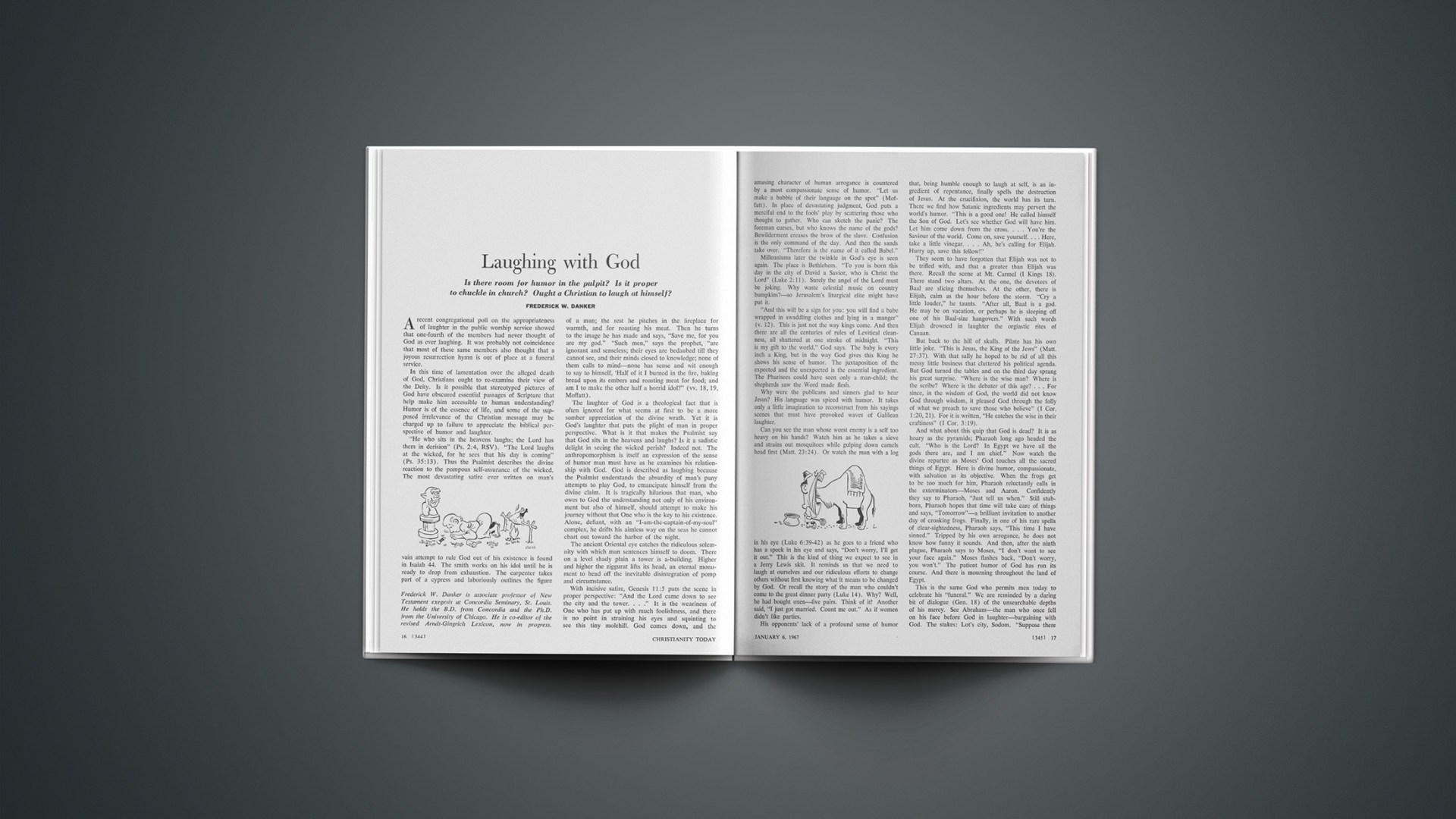
Laughing with God

Is there room for humor in the pulpit? Is it proper to chuckle in church? Ought a Christian to laugh at himself?

A recent congregational poll on the appropriateness of laughter in the public worship service showed that one-fourth of the members had never thought of God as ever laughing. It was probably not coincidence that most of these same members also thought that a joyous resurrection hymn is out of place at a funeral service.

In this time of lamentation over the alleged death of God, Christians ought to re-examine their view of the Deity. Is it possible that stereotyped pictures of God have obscured essential passages of Scripture that help make him accessible to human understanding? Humor is of the essence of life, and some of the supposed irrelevance of the Christian message may be charged up to failure to appreciate the biblical perspective of humor and laughter.

“He who sits in the heavens laughs; the Lord has them in derision” (Ps. 2:4, RSV). “The Lord laughs at the wicked, for he sees that his day is coming” (Ps. 35:13). Thus the Psalmist describes the divine reaction to the pompous self-assurance of the wicked. The most devastating satire ever written on man’s vain attempt to rule God out of his existence is found in Isaiah 44. The smith works on his idol until he is ready to drop from exhaustion. The carpenter takes part of a cypress and laboriously outlines the figure of a man; the rest he pitches in the fireplace for warmth, and for roasting his meat. Then he turns to the image he has made and says, “Save me, for you are my god.” “Such men,” says the prophet, “are ignorant and senseless; their eyes are bedaubed till they cannot see, and their minds closed to knowledge; none of them calls to mind—none has sense and wit enough to say to himself, ‘Half of it I burned in the fire, baking bread upon its embers and roasting meat for food; and am I to make the other half a horrid idol?” (vv. 18, 19, Moffatt).

The laughter of God is a theological fact that is often ignored for what seems at first to be a more somber appreciation of the divine wrath. Yet it is God’s laughter that puts the plight of man in proper perspective. What is it that makes the Psalmist say that God sits in the heavens and laughs? Is it a sadistic delight in seeing the wicked perish? Indeed not. The anthropomorphism is itself an expression of the sense of humor man must have as he examines his relationship with God. God is described as laughing because the Psalmist understands the absurdity of man’s puny attempts to play God, to emancipate himself from the divine claim. It is tragically hilarious that man, who owes to God the understanding not only of his environment but also of himself, should attempt to make his journey without that One who is the key to his existence. Alone, defiant, with an “I-am-the-captain-of-my-soul” complex, he drifts his aimless way on the seas he cannot chart out toward the harbor of the night.

The ancient Oriental eye catches the ridiculous solemnity with which man sentences himself to doom. There on a level shady plain a tower is a-building. Higher and higher the ziggurat lifts its head, an eternal monument to head off the inevitable disintegration of pomp and circumstance.

With incisive satire, Genesis 11:5 puts the scene in proper perspective: “And the Lord came down to see the city and the tower.…” It is the weariness of One who has put up with much foolishness, and there is no point in straining his eyes and squinting to see this tiny molehill. God conies down, and the amusing character of human arrogance is countered by a most compassionate sense of humor. “Let us make a babble of their language on the spot” (Moffatt). In place of devastating judgment, God puts a merciful end to the fools’ play by scattering those who thought to gather. Who can sketch the panic? The foreman curses, but who knows the name of the gods? Bewilderment creases the brow of the slave. Confusion is the only command of the day. And then the sands take over. “Therefore is the name of it called Babel.”

Millenniums later the twinkle in God’s eye is seen again. The place is Bethlehem. “To you is born this day in the city of David a Savior, who is Christ the Lord” (Luke 2:11). Surely the angel of the Lord must be joking. Why waste celestial music on country bumpkins?—so Jerusalem’s liturgical elite might have put it.

“And this will be a sign for you: you will find a babe wrapped in swaddling clothes and lying in a manger” (v. 12). This is just not the way kings come. And then there are all the centuries of rules of Levitical cleanness, all shattered at one stroke of midnight. “This is my gift to the world,” God says. The baby is every inch a King, but in the way God gives this King he shows his sense of humor. The juxtaposition of the expected and the unexpected is the essential ingredient. The Pharisees could have seen only a man-child; the shepherds saw the Word made flesh.

Why were the publicans and sinners glad to hear Jesus? His language was spiced with humor. It takes only a little imagination to reconstruct from his sayings scenes that must have provoked waves of Galilean laughter.

Can you see the man whose worst enemy is a self too heavy on his hands? Watch him as he takes a sieve and strains out mosquitoes while gulping down camels head first (Matt. 23:24). Or watch the man with a log in his eye (Luke 6:39–42) as he goes to a friend who has a speck in his eye and says, “Don’t worry, I’ll get it out.” This is the kind of thing we expect to see in a Jerry Lewis skit. It reminds us that we need to laugh at ourselves and our ridiculous efforts to change others without first knowing what it means to be changed by God. Or recall the story of the man who couldn’t come to the great dinner party (Luke 14). Why? Well, he had bought oxen—five pairs. Think of it! Another said, “I just got married. Count me out.” As if women didn’t like parties.

His opponents’ lack of a profound sense of humor that, being humble enough to laugh at self, is an ingredient of repentance, finally spells the destruction of Jesus. At the crucifixion, the world has its turn. There we find how Satanic ingredients may pervert the world’s humor. “This is a good one! He called himself the Son of God. Let’s see whether God will have him. Let him come down from the cross.… You’re the Saviour of the world. Come on, save yourself.… Here, take a little vinegar.… Ah, he’s calling for Elijah. Hurry up, save this fellow!”

They seem to have forgotten that Elijah was not to be trifled with, and that a greater than Elijah was there. Recall the scene at Mt. Carmel (1 Kings 18). There stand two altars. At the one, the devotees of Baal are slicing themselves. At the other, there is Elijah, calm as the hour before the storm. “Cry a little louder,” he taunts. “After all, Baal is a god. He may be on vacation, or perhaps he is sleeping off one of his Baal-size hangovers.” With such words Elijah drowned in laughter the orgiastic rites of Canaan.

But back to the hill of skulls. Pilate has his own little joke. “This is Jesus, the King of the Jews” (Matt. 27:37). With that sally he hoped to be rid of all this messy little business that cluttered his political agenda. But God turned the tables and on the third day sprang his great surprise. “Where is the wise man? Where is the scribe? Where is the debater of this age?… For since, in the wisdom of God, the world did not know God through wisdom, it pleased God through the folly of what we preach to save those who believe” (1 Cor. 1:20, 21). For it is written, “He catches the wise in their craftiness” (1 Cor. 3:19).

And what about this quip that God is dead? It is as hoary as the pyramids; Pharaoh long ago headed the cult. “Who is the Lord? In Egypt we have all the gods there are, and I am chief.” Now watch the divine repartee as Moses’ God touches all the sacred things of Egypt. Here is divine humor, compassionate, with salvation as its objective. When the frogs get to be too much for him, Pharaoh reluctantly calls in the exterminators—Moses and Aaron. Confidently they say to Pharaoh, “Just tell us when.” Still stubborn, Pharaoh hopes that time will take care of things and says, “Tomorrow”—a brilliant invitation to another day of croaking frogs. Finally, in one of his rare spells of clear-sightedness, Pharaoh says, “This time I have sinned.” Tripped by his own arrogance, he does not know how funny it sounds. And then, after the ninth plague, Pharaoh says to Moses, “I don’t want to see your face again.” Moses flashes back, “Don’t worry, you won’t.” The patient humor of God has run its course. And there is mourning throughout the land of Egypt.

This is the same God who permits men today to celebrate his “funeral.” We are reminded by a daring bit of dialogue (Gen. 18) of the unsearchable depths of his mercy. See Abraham—the man who once fell on his face before God in laughter—bargaining with God. The stakes: Lot’s city, Sodom. “Suppose there are fifty good people in the city. You won’t destroy it, will you? Not with your reputation for justice.”

“No, if I can find fifty, I won’t destroy it.”

“I am a nothing in your presence, Lord. But what if there should be five short?”

“I’ll save it for forty-five.”

“How about forty?”

“Find forty and the city is safe.”

“Don’t be angry, Lord, but what if there are only thirty? Will you save it for thirty?”

“Yes, if I can find thirty the city will survive.”

“Forgive me for presuming to speak to you, but perhaps there are only twenty. Will you save Sodom for twenty?”

“If there are twenty, I won’t destroy it.”

“Just once more, Lord, and then I’m through. What if there are only ten?”

“Give me ten, and the city is yours.”

This was an auction in reverse. Generations of hard bargainers—those buyers who say publicly that what they got is worth nothing and then go their way rejoicing (Prov. 20:14)—must have chuckled over Father Abraham’s getting the better of God in a bargain. Yet they knew the story did not end there. This same God meant business. And the dreadful destruction of Sodom and Gomorrah was a clear demonstration that God’s sense of humor is not to be trifled with.

God indeed is a party-loving God. He is like the shepherd who finds one lost sheep and then calls his friends and neighbors to help him rejoice. He is like the village woman who invites everyone about her to share the happiness of finding one little coin (Luke 15). Yet God looks out over the city and weeps. Both the joy and the sadness—this is the story of God’s encounter with man. But only those who laugh with God can truly laugh. Only this laughter is enduring, for it is the laughter of the living God.

David knew the joy of the Lord. According to Second Samuel 6:5, “David and all the house of Israel were making merry before the Lord with all their might, with songs and lyres and harps and tambourines and castanets and cymbals.” Where is the like in our public worship? Our services often resemble a funeral. David’s worship was more like a fiesta. And before the Ark of God at that! Holy awe and hilarity are not mutually exclusive. And those who clap their hands in rhythm, shout out the “Hallelujah” and the “Amen” with spontaneous joy, or at a funeral cry out, “She’s free!”—these know the laughter of the Lord.

Psalm 2:11 tells us to fear the Lord and rejoice. The Hebrew word used here means to “spring about with great joy.” St. Paul, so often interpreted as a man who found no fun in life, reminds his Christians time and again to rejoice. And we must not forget that it was he who encouraged them to show mercy and generosity with hilarity (2 Cor. 9:7; Rom. 12:8). Unfortunately, his word has been tamed down to “cheerfulness.” In writing to the Corinthians, he delights in telling of his visits to the best jails in the Roman Empire, and of his escapade at Damascus (2 Cor. 11:32, 33). Of all things: an apostle coming over the wall in a basket—and telling it in a canonical letter for all time to read. How unapostolic can you get! Imagine an important church official locked up in his headquarters after hours and coming down by rope out of a fifth-story window.

Paul’s humor had integrity. He could say, “This is how one should regard us, as servants of Christ and stewards of the mysteries of God” (1 Cor. 4:1). Smaller men later changed the script: “Let men look up to us as his official guardians of Truth and Sacrament.” To dissension-ridden Corinth, he writes these withering words: “There must be factions among you in order that those who are genuine among you may be recognized” (1 Cor. 11:19). Ego-diluting ink is on his pen: “You put up with fools so readily, you who know so much! You put up with a man who assumes control of your souls, with a man who spends your money, with a man who dupes you, with a man who gives himself airs, with a man who flies in your face. I am quite shamed to say I was not equal to that sort of thing!” (2 Cor. 11:19–21a, Moffatt). Only a man who loves as strongly as Paul did can write satire like that with the ring of one who cares. Only one who knows he is the least has a right, in order to reach out the hand that heals, to trim others down to size.

Is it proper to laugh in church? Some Christians may not think so. But the Incarnation means that the Lord Christ also embraced in his Person the very endowment of a sense of humor, and that through his Atonement he redeemed this essential ingredient of our emotional life. The clergyman must not rely on humor as a substitute for preaching that goes deep. On the other hand, no one should feel guilty if, in response to an anecdote that enlivens the divine-human encounter, he breaks out in laughter. Indeed, only one who is willing to laugh at himself, as he hears how ridiculous it is to stretch his head out of his neck to add a foot to his stature, is prepared for honest worship. Is there not in repentance the element of a good hearty laugh at these attempts to find in our own selves solutions to our guilt, anxieties, and problems?

Forgiveness—it is from a God who laughs, but with the joy of One who finds the precious thing he has lost. For the prodigal, God brings out the best robe and the ring and puts the calf saved for the occasion on the huge spit. Never mind the elder son who lacks a sense of humor. God will hold his party!

Evangelical Principles and Practices

First of Two Parts

I should rather any day be a godly Roman Catholic than an ungodly Protestant—or, for that matter, a godly anything than an ungodly evangelical. I do not believe, moreover, that evangelicals have anywhere near a monopoly on devotion of Christ, love for the Bible, or spirituality. Indeed, I thank God for all expressions of such works of his Holy Spirit, wherever they may be found.

Still, conservative evangelicals today are undeniably confronted with a major problem in their relations with others. I hope that if I can give a positive picture of evangelical principles and practices as I know them, the problem will become clear. Certain evangelical characteristics and emphases, certain cardinal theological principles, are very closely linked with one another and together make a whole. I recognize that other schools of thought within the churches hold some of these things equally dear. And I hope and believe that most non-evangelicals will find much in common here.

Is there one root principle from which all these principles arise? I believe there is. Says one writer:

The Evangelical Christian in all his outlook seeks to be God-centered. He takes his start, with the aid of Divine Revelation, from God’s Throne. His great energising principle is God—the Sovereign Redeemer! He looks to God alone for the saving act of redemption, to Him alone for the initiative in man’s reconciliation, and to Him alone he attributes glory.… In the matter of redemption, God must be placed as high and man as low as possible. Our Lord’s prerogatives are not to be shared. In the presence of God, man has no place but as a deeply humbled guest. The Evangelical’s message is nowhere discerned more clearly than in his favourite hymns. In none is the authentic note more clearly heard than in the well-known lines: “Other refuge have I none, hangs my helpless soul on thee.” Here speaks—and triumphantly speaks—the very soul of Evangelicalism! [“Via Evangelica,” by Peregrinus, in a supplement to the Inter-Varsity Fellowship Graduates’ News Letter, No. 4 (1942)].

With that, then, as the root principle, let us turn to the four main emphases of evangelical Christianity, the first of which is the longest and has five subheadings.

This first emphasis is God’s way of salvation for sinners. If the question is asked in an interview on the radio, “What is Christianity?,” the kind of answer one expects from so-called exponents of the faith is “Christianity is a way of life.” An evangelical, however, could not be content with that. His answer would more likely be, “Christianity is God’s way of salvation for sinners.”

1. Christ the only Saviour. The action of God in Jesus Christ is unique. No one can come to the Father except through him. “There is none other name under heaven given among men, whereby we must be saved.” Man is an enemy of God, Christ the only means of reconciliation. Man is guilty before God through sin; only Christ can cleanse him.

The evangelical emphasis on this point results in a godly jealousy for the name and glory and uniqueness of the Lord Jesus Christ. Some of the non-Christian religions no doubt contain some great truths. But it is not enough for those brought up in non-Christian religions to become sincere devotees of their religion. If an evangelical hears together the names “Buddha, Christ, Mohammed, Confucius,” he bristles with jealousy at the implications of such an alignment. The same sense of jealousy explains why I was grieved when, at a meeting of Christian ministers, Jewish leaders, and a Member of Parliament, one of the Jewish leaders referred to “the denominations,” thereby in one breath linking the Christian churches with the Jewish synagogues and implying that there was no fundamental difference between Moses and the Lord Jesus. But it is not enough for a Jew to be a devotee of the Old Testament law, the Jewish ceremonial, and tradition. The Jew, like every Gentile, needs God’s salvation through Jesus Christ.

When I speak of jealousy, I mean intolerance of any rival. Whether jealousy is a virtue or a vice depends on whether the rival is lawful or not. When a shopkeeper is jealous of a competitor, jealousy is a vice. When a wife is jealous of another woman for seeking her husband’s affection, jealousy is a virtue.

This belief in Christ as the only Saviour is bound to raise the problems, Why are so few saved, and how will God judge those who have never heard the Gospel? The evangelical Christian normally leaves these things to the infinite wisdom and love of God, who has not seen fit to give us the answer fully. “The secret things belong unto the LORD our God: but those things which are revealed belong unto us and to our children for ever, that we may do all the words of this law” (Deut. 29:29).

The strength of this belief and this jealousy largely explain evangelical zeal in personal witness and missionary endeavor, which has been such an outstanding feature of church history in the last 250 years.

2. The centrality of the Atonement. In all the work of Jesus Christ, his atoning sacrifice on the Cross is central to the evangelical. It was planned from the foundation of the world. The chief purpose of the Incarnation was that Christ should give his life a ransom for many. The chief value of the perfect life of Jesus was that, having lived it, he should voluntarily offer it to God as a sacrifice for the sins of the world. The Lord’s resurrection was God’s seal upon his atoning death and a prerequisite for his becoming an indwelling Saviour by giving his Spirit to the believer.

The atoning work of Christ on the Cross is all-sufficient for our salvation: nothing can be subtracted from it or added to it. In its legal aspect, nothing less would do, and nothing more is required, to bring the sinner to God. This was the outstanding emphasis in the evangelical revival of the eighteenth century. In hymns, in sermons, in worship, in writing, and in conversation, the theme of the precious blood of Christ was seldom missing. We might well ask ourselves what our reaction would be if, in passing a hall, we heard these words being sung inside:

Bearing shame and scoffing rude,

In my place condemned he stood;

Sealed my pardon with his blood.

Hallelujah! What a Saviour!

Such words would stir a response in the heart of any evangelical Christian.

3. Justification by faith, or justification by the grace of God in Christ through faith. The ground on which a sinner may become acceptable to God is the merit and work of Jesus Christ. Man neither can nor needs to contribute one iota to it. God’s pardon and acceptance of the sinner are utterly unearned and undeserved. If a man is to obtain God’s salvation at all, it must come to him as a free gift.

Consequently, the evangelical decries all man’s attempts to gain acceptance with God by something within himself—his character and his moral or religious works. Earnest endeavors to cultivate the virtues; regular churchgoing; Bible reading and prayers; baptism and confirmation; being a regular communicant or server at the Lord’s Table; all acts of penance; almsgiving; turning over a new leaf; singing “Abide with me”; a purely emotional or mental and physical response to an evangelist’s invitation to confess Christ openly; promising on your honor to do your best to do your duty to God—none of these contributes anything to justification in the sight of God. A man may do all these things—even be ordained into the ministry—and yet remain under the condemnation of God. A Christian is one who believes that Jesus Christ is God’s gracious provision for his eternal salvation, without which he must perish, and who has trusted Him as such. This giving up of trust in all else and casting oneself on the unmerited love and mercy of God offered in the Gospel constitutes the faith that justifies a sinner.

Nothing in my hand I bring,

Simply to thy cross I cling;

Naked, come to thee for dress,

Helpless, look to thee for grace;

Foul, I to the fountain fly;

Wash me, Saviour, or I die.

I do not believe that a man must understand these matters as fully as I have stated them before he can have God’s salvation. But the clearer his understanding of them the better, and it is our duty to teach them plainly.

If, moreover, a professing Christian is thinking of himself as probably good enough for heaven, or as not good enough for heaven, he is still blind to the Gospel. The doctrine of justification by grace through faith is a vital part of the glorious Christian Gospel—indeed, the heart of it. Even in the earliest decades of the Christian Church, there were Judaizing missionaries who taught another so-called Gospel. They did not explicitly deny faith in Christ; rather, they taught faith in Christ plus the works of the law as the ground of justification with God—faith in Christ plus moral and religious deeds. Paul’s attitude toward their doctrine is clear:

Though we, or an angel from heaven, preach any other gospel unto you than that which we have preached unto you, let him be accursed. As we said before, so say I now again, If any man preach any other gospel unto you than that ye have received, let him be accursed [Gal. 1:8, 9].

Anyone speaking half as strongly today would be regarded by many as intolerant and arrogant. But the evangelical would reply that this so-called arrogance is actually an earnest contending for the truth of the Gospel. As for the intolerance: in this context, intolerance is a virtue, just as jealousy may be a virtue. Because the Gospel is God’s revealed way of salvation for sinners, faithfulness to it involves a denial of all rivals.

CAPTIVE

In a dungeon place in me

is a thumbscrew of theology,

And it is difficult to speak

of something as a dull antique

That still wrings truth, in the old way,

out of cold, conniving clay.

GLORIA MAXSON

If it were Paul alone who had gone on record as preaching this Gospel, the evangelical would still be bound to accept it, because Paul was recognized as an inspired apostle. Actually, however, the next chapter of Galatians shows that Peter agreed with Paul, though Peter was slow in one instance to act on its implications. And if any further evidence is required to show that the other apostles agreed with Paul, it is provided in the Epistles of Peter and John, and in the account of the church council in Jerusalem given in the fifteenth chapter of Acts. With James in the chair, there was a long debate, after which Peter made the following defense of salvation by grace through faith:

“My friends,” he said, “in the early days, as you yourselves know, God made his choice among you and ordained that from my lips the Gentiles should hear and believe the message of the Gospel. And God, who can read men’s minds, showed his approval of them by giving the Holy Spirit to them, as he did to us. He made no difference between them and us; for he purified their hearts by faith. Then why do you now provoke God by laying on the shoulders of these converts a yoke which neither we nor our fathers were able to bear? No, we believe that it is by the grace of the Lord Jesus that we are saved, and so are they” [Acts 15:7–11].

Should anyone protest that we must get back to Christological theology for our authority, it would make no difference. The main theme of Christ’s teaching as recorded in John’s Gospel is salvation through faith in himself. “What shall we do, that we might work the works of God?” “This is the work of God, that ye believe on him whom he hath sent.”

4. Regeneration by the Holy Spirit. Evangelicals regard and teach the new birth as a personal, essential, miraculous, and mysterious experience. It is brought about not by any act of the human will, but by the Holy Spirit; the sinner can only look to God in faith to work it in him. By this miracle, the person receives eternal spiritual life, becomes a child of God, and partakes of the divine nature. By this miracle, the process of being made righteous begins, by which a believer may pass from spiritual infancy to childhood, young manhood, maturity, and, in the world to come, perfection. The means by which the Holy Spirit works the miracle in the human heart and mind is God’s word. The word must fall like good seed into good soil. The means of grace by which the Spirit maintains this process of sanctification are many: the word and sacrament, prayer, Christian fellowship, suffering, and a heavenly Father’s chastening.

Evangelicals differ on the connection between baptism and regeneration. Some think of baptism as the believer’s confession of faith in Christ; others, like myself, view it as God’s official sign and seal of regeneration, like the state’s official seal and recognition of a marriage in the signing of the register. Evangelicals would agree that it is possible to be regenerate without being baptized, and that, all too often, people are baptized without ever becoming regenerate, though either is anomalous. This leads us on to:

5. The witness of the Spirit to a believer’s regeneration and possession of eternal life. The First Epistle of John was written for a specific purpose: that believers might know they have eternal life. This is a further work of the indwelling Spirit, by which in various ways, suddenly or gradually, he witnesses in the heart to what he has done, thereby giving the believer the joy and peace and gratitude that come from the assurance of pardon, justification, and heaven. It is because the Holy Spirit teaches the believer to pin his faith in the merits of Christ alone, and not in anything in himself, that this assurance can exist without presumption.

Ideas that Shape the American Mind

In these candid comments on the American scene, Dr. D. Elton Trueblood, the distinguished Quaker philosopher, discusses the unconscious assumptions that now shape the American outlook and the new opportunity this offers for evangelical advance. This issue ofCHRISTIANITY TODAYalso carries an excerpt from his book “The Incendiary Fellowship.”

Dr. Trueblood is now in London for a year of research and writing, and the interview below was taped in Washington just before his departure. He served Earlham College for twenty years as head of its philosophy department and is now professor at large. For two years he was religious adviser to the Voice of America. He was interviewed by Editor Carl F. H. Henry.

Question. Dr. Trueblood, in 1944 inThe Predicament of Modern Manyou singled out two ideas ruling the American outlook that had undergone recent revision, the inevitability of progress and the essential goodness of man. Do you think either of these controlling ideas has regained some of its former influence on the American mind?

Answer. I would not say that neither of these tenets has come back precisely in its earlier form; but I do think that we now have unargued assumptions that have some affinity with these, and that we need to know what these new unargued assumptions of our time are.

Q. What would you single out as the reigning tenets of our time?

A. The first of these is the extreme belief that all our problems are new. I would call this, really, the disease of contemporaneity. Shall I give you an example? Last winter I was speaking to a group of pastors in a certain state, and I advised these men to study Augustine’s Confessions and the Imitation of Christ and Pascal’s Pensées, and John Woolman’s Journal. Right away one of the leading clergymen said, “Oh, those were all very well for another day. But so much has happened now that their appeal is utterly undermined. We are in a new world, and these books have nothing to say to our situation at this moment.”

Q. What does this point of view imply for tradition, and for the Judeo-Christian heritage? And what does it imply for the relevance of our own discoveries or commitments to the generation that comes after us?

A. It means that we cut ourselves off from the wisdom of the ages, including that of the Bible. It means that, if this is taken seriously, we are really an orphan generation—an orphan generation that takes itself far too seriously, that is too much impressed with changes that may be only superficial. And of course, if this is true of our generation, as your question indicates, there is no reason why it will not be true of another generation. Therefore, whatever we gain would naturally be rejected by our descendants. No civilization is possible this way. Contemporaneity when it is a disease is a very damaging disease, because it destroys the continuity of culture.

Q. Besides this passion for contemporaneity, do you discern some other ruling tenets of our time?

A. Yes. Associated with it is a really terrible conceit. I actually hear people say, “What could Abraham say to us? After all, he never went faster than a few miles per hour. And any of us can go 600 miles an hour if we want to now.” “What can Socrates say to us? He never saw a university with 30,000 students. He never saw a really big city. He didn’t see any advanced technology. Therefore obviously his answers are not answers that are relevant to our day.” This, if it applies anywhere, is bound to apply all across the board. And what I want to say to these men is this: they have not really considered carefully enough the nature of the human problem. I want to say to them that a man can hate his wife at 600 miles an hour just as much as at six miles an hour, and that the temptations to compromise with integrity are not really changed at all. Men have always had them; men will always have them. They are part of the predicament that man is man. And the notion that we are living in such a fresh time that wisdom has “come with us” whereas nobody ever had it before—this I find to be an absolutely intolerable conceit.

Q. Would it be fair to say that in place of the notion of the inevitability of progress the man of the 1960s is prone to substitute the notion that progress has now reached its peak or its near-peak?

A. Yes.

Q. And for the notion of the essential goodness of man he is prone to substitute the idea that no experience is superior to his?

A. I think that is very well said. You see, this modern heresy is stated for many people in Bonhoeffer’s terms, that “man has come of age.” Now, I have pondered that statement a long time, and I have heard a good many efforts to defend it. I want to say that, so far as I can see, it is absolutely errant nonsense. It would be far better to say that man is in the kindergarten. It would be more honest and it would be more humble. In fact, this tendency to erect every word of Bonhoeffer’s into a new orthodoxy seems to me to be one of the chief evidences of the faddish mentality. I do not believe that man has come of age. I recognize that there are a great many people who believe this, and I think that probably no threat shows both the superficiality and the wrongheadedness of modern man more than this one.

Q. You seem almost to suggest, Dr. Trueblood, that all our scientific advances and modern insights amount to a vast backdrop that spectacularly exhibits the fact that modern man has really fallen from the heights rather than risen to new glory.

A. Yes. The notion that human life is made good because of technology simply will not stand examination. Now, I am glad for technology. I’m glad that we have antibiotics; I hope that they will be available to as many people on earth as possible. I’m glad we have hybrid seed corn. I’m glad I can raise hybrid tomatoes in my garden. I am grateful for every one of these advances. But at the same time I want to warn people against the notion that these of themselves bring the good life. They simply do not.

Q. Do you see a third mass idea that tends to shape modern American life?

A. What is that?

Q. What about the notion that the essence of life is to be found in things—in the infinitude of things. Or possibly in an infinitude of sex. Do you think that these ideas tend to shape our culture?

A. They probably do, but in a special way. It is not merely the old paganism, nor merely the old materialism, which both sound a little bit out of date now. All this has a particular slant that is represented, let us say, by the computer. This is our new idolatry. And I would like to say that I think that these are very poor idols. I buy a great many books, and I find that the book companies that have instituted computers now are three times as slow in delivering books as they were when they had people. Only yesterday, Dr. Henry, I was at a New York airport trying to arrange to come down to see you. The computer kept sending back no answer, and the poor chap back at the desk finally had to call on some human being to find out whether the plane was going. They discovered that there had been an error in printing in the whole system, and that the flight they told me about didn’t even exist! Well, I believe it’s a good thing for us to find this out. You see, when you have false gods the thing to do is to find out that they are false. So the notion that just by having bigger cities and speedier planes and more expensive cosmetics we will therefore have a good world—this just won’t hold water.

Q. In these last twenty years, have you sensed any significant change in the American outlook on security and the attitude toward big government?

A. Oh, yes, I certainly have. Of course, I have had to interview a great many young men wanting to come to teach. And I’m a little bit shocked to find that the first question they often ask is “What is the retirement plan?” Now thirty-nine years ago, when I began teaching in North Carolina, this didn’t even enter my head. Little did I care, because I was perfectly sure that if one thing didn’t work out, another one would. And I had not supposed that it was up to other people to take care of me. I thought perhaps I’d better get to work. But today we find that security is a dominant idea, apparently in all classes of society.

Q. What of the attitude toward work?

A. At the same time we see this decay. We owe a great deal to the Protestant—or more specifically, the Puritan—ethic in this country, concerning the dignity of work, and the notion that each man has a holy calling and that his task is to render a good account before God of the powers that he has. I still think that this is the noblest conception of work that there is. And I think our whole civilization here in the West owes much more to this ideal than we know, or than we admit. But today I see this breaking down at many points. I know a great many people who don’t feel that they have any real responsibility in their work. The main thing is to put in the time; leave as soon as they can; get as long vacations as they can. Work is something in which they do not rejoice. It is something from which they would like to be emancipated.

Q. Can we gather together, perhaps into some single motif, these elements of the longing for security, the exaltation of material priorities, and the increasing emphasis on leisure and particularly on the life of sex? Can we correlate these into another unconscious force that gives form to the American view of life today?

A. Yes, I think that all of them can be united under the idea of an oversimple view of freedom. Freedom from worry, freedom from work, freedom from moral inhibitions. All of these are delusive. The more we think about it, the more we see that although freedom is a great thing, and we are right to mention it as a very important element in the Gospel, it is always wrongly seen when it is seen by itself. Absolute freedom is absolute nonsense because then there is no inner control. If freedom means the freedom to seduce the other man’s wife, if it means the freedom to steal if one thinks he can get away with it, the time will come when we will have no stable civilization. I’ve just been talking with some businessmen who tell me that the stealing by employees in department stores is now getting to be a serious problem. Have you heard that, Dr. Henry?

Q. Yes, shoplifting not only by customers but also by employees.

A. In fact it has gotten so bad that many prices go up because of this. You see, we as Christians ought to be hardheaded enough to see that many of the so-called economic troubles are really moral troubles. If the stealing increases, then the prices will have to go up for every one of us. I’ve just been in a town where they have to keep the high school students in the school all through the noon hour because they stole so much from the nearby stores during that hour.

Q. What has happened to religion, and particularly to the religion of the Bible, in American life today?

A. Well, for many people this is simply old hat. It has ceased to seem exciting. It is something that they think was relevant only years ago. It was all right for the little church in the wildwood, but has no significance for people in great modern cities. The majority simply think it obsolete. This bears on our earlier point about contemporaneity.

Q. Do you think that the trend is also encouraged by the readiness of men in public life to dismiss Christianity as a religion of personal piety only, without any significant implications for national or public life?

A. Precisely. You see, they are wholly willing to be tolerant of this kind of religion. I would call this “segregation religion.” If they can segregate it to one’s own personal wishes or even to one’s own personal prayers, nobody objects. Hitler didn’t object to that, you know. The Communists in Russia don’t object to this. They say, “This is fine if you want to do it; we want you to be free.” What is objected to is that kind of vital religion that affects the way men work and the way they govern and the way they teach and the way they learn and the way they make love and the way they keep up their families. Intolerance never arises until our religion is pervasive of the whole social order.

Q. Do recent rulings of the Supreme Court encourage this segregation of religion?

A. The attitude of the Supreme Court is very striking on this. I have read over and over the Supreme Court decision, based upon the cases in Pennsylvania and Maryland, on whether Bible reading and prayers are legal in the public schools. You will remember that the decision was that this is forbidden—at least this is the way the language seems to read. I admit it has a certain ambiguity. But the strange thing about this is the statement of the court that the state must be neutral in regard to the religious life, neither for nor against—tolerant, if it is kept in its place, within the church, say; but it mustn’t be in the schools. You see, Dr. Henry, that this is exactly what we mean by tolerance of segregated religion, and obviously I’m not talking about race at this moment. I think too often we have thought of segregation only in regard to race.

Q. Since you were religious adviser to the Voice of America in 1954 and 1955, let me take another tack. What emphases compatible with separation of church and state can properly be made to reflect the great realities of our religious heritage on the world scene?

A. The main thing is to tell the truth. And if you are going to tell the truth about America, you have to tell the truth about a man like William Penn, who set so much the tone of our lives when he called his commonwealth “an holy experiment” in government. We cannot explain why it is that we want liberty and justice for all, equality before the law, due process of law, the dignity of the individual, unless we explain the deep biblical roots from which these came. The fundamental ideas that we call the ideas of democracy today did not come from Greece, important as ancient Greece was. They came much more from the biblical heritage, and if we do not say this we are not getting the truth told.

Q. Are you wholly convinced as a professional philosopher that it is impossible to sustain these convictions on the basis merely of evolutionary naturalism?

A. I’m sure that it is not. I believe with all my heart in the organic metaphor, namely, that you cannot keep the flowers alive if they are separated from their sustaining roots. I said more than twenty years ago that our great danger is that of trying to establish a cut-flower civilization. I believe this now more than I did then, because the evidence has accumulated. Look, for example, at our immense growth in crime, when we have poured out billions for education and for the renewal of our great cities. In many places we are doing worse instead of better, and I think this is exactly what we can expect if we are not naïve. I believe that much of the danger of modern man lies in naïvely thinking that you can get something for nothing. I do not believe that you can.

Q. An associate professor in the humanities in Stanford University, where you yourself once taught, has written that the controlling philosophy of the American campus is naturalistic; that the most influential faculty members on our campuses are committed to the philosophy that nature is the ultimate real, and hence that man is essentially only an animal, that there is no immortality, that there are no enduring moral values or unchanging truths—that God is not. If this be so, is there within the American university milieu the intellectual resource for an effective confrontation of the Communist alternative?

A. There is, but it is not now united. Scattered around are men of great intellectual powers and very deep reverence. But they are very conscious of being out of the mainstream. And I can hardly think of anything more important than to help them to have a sense of buttressing one another. They are a minority, of course, but remember that Christianity was a minority in the ancient pagan world. This is the role that Christians can play and play very well. But they need to know what they are, and they need to be able to have the help of one another. This will not be done by voices crying in the wilderness.

Q. Recently there have been proposals for an Institute of Advanced Christian Studies that would bring together evangelical scholars so that they would be able to give time not only to completing their creative projects but also to an exchange of mind and heart and a sharing of mutual concerns and convictions about the contemporary scene. Do you feel that this proposal has anything to commend it?

A. I think it has a great deal to commend it. In fact, something like this will have to be done. We must interpret and speak to the intellectual life of modern man. Just giving nice little devotional talks won’t do the trick. For one thing, the opponents of Christianity don’t mind these nice little devotional talks. They write them off and are perfectly satisfied. What we need is somebody to challenge naturalism with all the toughness exhibited by the late Archbishop William Temple in Nature, Man and God. I think this can and must be done by men in our generation now, as it was by Temple a generation ago.

Q. Do you think that evangelical scholars have a remarkable opportunity now that the liberal and neo-orthodox wings of contemporary Protestantism have largely taken an anti-intellectual tack?

A. Yes. You see, both of them are clearly in decay, and the reign of neo-orthodoxy is over. We are now in a kind of intellectual vacuum in which somebody could fill the space if he would. It would probably have to be a group, a group who are strongly rational at the same time that they are deeply committed and unapologetic in their Christian commitment. Now I believe here is the new style of leadership that is just on the edge of coming to the front—and, oh, I want to see this in the coming days! I hope to live the last third of my life in the period in which this is emerging, and I shall do all I can to further its emergence.

Q. What about the role of religion and the teaching of religion on the state university campuses?

A. Here is where there is probably real hope. I believe in the small college, of course, as you know; this is why I left a very large university to go to a small college twenty years ago. And I’m glad I did. But I will have to admit that today some of the most vigorous Christian intellectualism is to be found on the state university campuses rather than in the old-line denominational colleges. Many of the old-line denominational colleges think of Christianity as old hat, so they revolt against it.

Q. And they tend to peddle the contrary ideas of the secular university climate against which the best advocates of historic Christian theism are able to hold the line on some state university campuses.

A. Now isn’t this a paradox? So that perhaps the great secular state university is coming to have people who are in revolt against it and the natural revolt would be that of those committed to Christianity.

Q. How acceptable do you think evangelical scholars will be in the religion departments of state universities? Do you think the pluralistic emphasis tends to discriminate, especially against anyone committed to an absolutist point of view?

A. It probably does. This is why my biggest hope lies in having such scholars stationed in a great variety of departments. I want to see them in biology, in psychology, and in philosophy. Professor Jellema’s great work at Indiana University is a marvelous example of how this is possible. I think he probably did ten times as much in philosophy as he could have done if he had been teaching religion, where all of these prejudices that you mention might have appeared.

Q. Do you think that America can fulfill its highest national destiny if its people are unfamiliar with, and do not care about, the great biblical teachings?

A. Oh, there is no chance whatever. For example, they cannot even understand the great issues, if this is the case. How in the world can a person really appreciate our best literature, including that of Shakespeare and Milton, if he does not know the biblical images? How in the world can we understand what is meant by the assertion that all men are created equal—which is what the Declaration of Independence says—unless we have some idea of the meaning of creation? So, the notion that we can cut ourselves off from all of this and do just as well—this is an example of the naïveté that I mentioned earlier. You see, the Christian today doesn’t have to be the representative of obscurantism. He is the representative of rationality. What he is objecting to is superficialism and mere emotionalism and naïveté. Isn’t it nice to have the tables turned this way?

Q. Despite rising church membership, competent studies show that the laity by and large have been increasingly critical of the institutional church. Do you think that the strong emphasis on political and social matters in preaching has been a cause of this?

A. No doubt it has been part of the cause. I believe that the period of rising memberships is all over, and it is perfectly clear that the period when it was easy to get good crowds in public worship is over. We are in a period in which committed Christians are clearly in a minority and will be more so. And I want to take this as our basis of hope and not of despair. I believe that what we will need is the kind of preaching in which people are not afraid of dealing with the fundamental issues of the human heart. If preaching is merely political, of course, it is very mixed up. Now, you know I am not saying that we must avoid the permeation of the world. I’m saying we must permeate the world, but we must permeate the world from a solid center.

Q. Are Sunday school materials also to blame for the prevalent unfamiliarity with the Bible?

A. I think they are. Now some effort is being made to change that in the various denominations. But I will admit that some of the Sunday school materials have been almost purely naturalistic, and mostly about flowers and birds.

Q. To what extent does the secularization of the public school contribute to the decline?

A. Oh, it contributes very greatly, because if people are convinced that the biblical heritage has nothing to do with the world of knowledge, of course they are not going to pay any attention to it. And everything we are doing makes it seem as though it doesn’t have anything to do with the world of knowledge.

Q. How much of the fault belongs to the American home, rather than external agencies?

A. A great deal. The Jews are right, of course, that the chief religious education ought to be in the home. The fact that our modern homes have capitulated is a very great basis of sorrow.

Q. In recent years working hours have diminished and leisure hours increased, and this tendency is being greatly accelerated by automation and cybernation. Do you think that as a result Americans are becoming a pleasure-seeking and fun-loving people? Are we Americans using leisure time responsibly?

The committed Christian is not now thrown to the lions, as were the Christians in Rome long ago, but there are nevertheless, subtle forms of contemporary persecution. A man who takes Christ seriously is often looked upon as a hopeless fossil and is considered an enthusiast or a fanatic. In short, he is an oddity. This is not because Christian values are entirely rejected in the contemporary world. Indeed, there are many evidences which show that several Christian values survive for a while after the abandonment of the faith from which they first emerged. A striking illustration of this is seen in the contemporary drive for social justice. Much of this effort clearly stems from Christian roots even though the connection with those roots has now been severed.

It would be foolish to deny that many of the characteristic men and women of our age are decent people. Though they would find it fairly laughable if they were accused of being unapologetic agents of Jesus Christ in the world, they are often fair, and they try to be just. Though we do have, in our time of unparalleled affluence, a striking rise in the crime rate, most of the people are not criminals. They give to the community chest; they maintain an uncostly membership in some church; they have some degree of fidelity to their marriage vows. Very few of these people would steal your purse if you made the mistake of leaving it behind and not many are extreme in cheating the government of its lawful revenue. The strange fact is that these people, who constitute the obvious majority, are almost universally opposed to the kind of Christianity represented by the New Testament. The claims are too strong; the price is too high; the fire of evangelism is too hot. The crucial fact is that all evangelism is faintly embarrassing. The spirit of the Book of Acts makes us uncomfortable. We are discomfited by the young Mormon missionaries who come to town and we find it necessary to minimize the effectiveness of Billy Graham. Though the New Testament describes a hot fire, we prefer the damp wick.

One possible response to the minority status of the Christians is for interpreters of the Gospel to try to make the Gospel conform to what the world already respects. Thus we are told very loudly that Christians must give up all of their ancient language, including the language used by Christ himself. The advice is that we must no longer speak of sin, though we can perhaps speak of maladjustment. We must not speak of truth, for that is too harsh. There are high officials in the churches who now express the view that the Christian message must be altered to make it acceptable to the men and women who, they affirm, live in a wholly new age.

The Human Situation

It is time to challenge the confident talk about the radical discontinuity between our generation and all the preceding ones. It is true, of course, that we move physically with greater speed, but this is only one phase of the total situation. A little thought should make us aware that a man can hate his wife just as much while traveling six hundred miles an hour as when traveling six. We have, indeed, some education, but only the very immature suppose that we are consequently wise. Furthermore, technical knowledge does not necessarily make men good or compassionate or loyal. It is time for someone to say clearly that the ultimate human situation has not changed at all. Undoubtedly, we shall place men on the moon, but only the naïve could suppose that such a feat would alter human motives. All thoughtful readers can be grateful to James Burnham for his contention in The Suicide of the West that, in the words of Billy Graham, highly educated people “have inward drives, greeds, compulsions, passions and a lust for power that are not eliminated by any known process of education” (World Aflame, Garden City, N. Y.: Doubleday & Co., Inc., 1965, p. xiv).

The truth is that modern man is overimpressed by his own achievements. To put a rocket into an orbit that is more than a hundred miles from the surface of the earth takes a great deal of joint thought and effort, but we tend to overstate the case. Though men who ride a few miles above the earth are called astronauts, this is clearly a misnomer. Men will not be astronauts until they ride among the stars, and it is important to remember that most of the stars are thousands of light-years away. The Russians are even more unrestrained in their overstatement, calling their men cosmonauts. Someone needs to say, “Little man, don’t take yourself quite so seriously.”

It is clear that if Christians are to bring the power of Jesus Christ to the world, they must make themselves understood, and this involves difficult intellectual labor, but this is not the same as making the lines fuzzy in order to make the Gospel acceptable. We are far more effective if we know that the Gospel will never be entirely acceptable, and that the Christian Movement will continue to be a minority movement. The Gospel must seek to penetrate the world and all of its parts, but it cannot do so unless there is a sense in which it is in contrast to the world. Herein lies the central paradox.

The denial of the paradox comes in many ways, the chief of which is the increasing tendency of the Church to be identical with the world. To many outsiders the Church appears to be a thriving business, the appearance of worldly success accentuated by our constant emphasis upon promotion. The pastor often becomes more a business executive than anything else, with the operation seeming to center on the mortgage or the budget. People who are urged to give to God are naturally disturbed when they find that they are chiefly giving to human salaries. Those who attend worship out of a deep sense of personal need are often disappointed when they note the importance of the announcements and realize the extent to which these are frankly promotional. Attendance is being whipped up for the next meeting or the next dinner.

The stranger who is visited by a representative of the Church frequently gets the impression that he is being viewed as a prospective customer, a potential addition to the numbers or the income, rather than a person who is approached for his own sake. Part of the shame of the contemporary Church is that it seems to be motivated by self-interest. We need to be reminded that the Church exists for men and not men for the Church.

Never Optional

One of the great theological gains of the twentieth century has been widespread recognition of the necessity of the Church in any vital Christianity.… The fellowship is intrinsic and is never optional, if the life of Christ is to make an impact on the world. But it is possible for the Church to exist, with a show of success, and still fail in its essential function. It is always failing when it becomes an institution which is bent on saving itself. It cannot save the world if it demonstrates an obsession with material things.

When the pastor is an entrepreneur and the Church is a business, the Christian community develops a majority consciousness and thereby ceases to be the saving salt. As Christ predicted, it is easy for the salt to be dissolved away. Without its salty character the Church is not good for anything, because it has lost its reason for being. To be distinctive it must recognize its minority status and accept the consequences of that recognition. What the world desperately needs is a redemptive fellowship centered in Jesus Christ, as an antidote to the evils of civilization. The problem is not that of organizing a congregation, which is easy, but rather that of seeing to it that salt does not lose its savor. The crucial question now, as in the beginning, is “How shall its saltness be restored?” (Luke 14:34).

A. Here you’ve got a great topic. Going into New York I noticed by the side of the road a great big board with the words, “Swing a fun loan!” Fun is now the center of everything. I see page after page in the newspapers advising of places where one can have more fun and pay nothing down. Well, this really is very convenient.

Q. Credit is legitimate and to a certain extent necessary within a capitalistic system, but do we not tend more and more to go into debt for recreation?

A. Oh, yes. Buy now, pay later. This is the whole message. So then, we are getting a group of people who are made frenetic by the fact that they have more bills at the end of the month than their salaries will cover. But then they have to borrow more in order to go out and have fun, so you see it just gets worse and worse. What a sad people it must be that must put this much emphasis on fun!

Q. Automation is creating unemployment and yet increasing the possibilities of leisure. What is the way out?

A. The way out is for those of us who care about culture to see these free hours as the hours in which we do the real human job. The time is coming when we won’t need very many hours to raise enough food for everybody or to make enough clothing for everybody. In this we stand in great contrast to our ancestors, who had to use all their hours to survive. But all this means that the real business of mankind can now be our business: truth, beauty, goodness. The alternative to unemployment is employment in a higher sense.

Q. The humanities and philosophy and literature have taken a back seat to science and technology. To a considerable extent, this result has been encouraged by government grants.

A. Yes. Now that also must change, because if you have technologists who don’t know what life is about, instead of making life better they may make it worse. Again, you see, it’s a kind of adolescent view of what the human situation is. The adolescent is always more concerned with gadgets than with anything else.

Q. The young people of today are in many ways a rebel generation. Is this a causeless rebellion? Is relativism its byword? Is cynicism increasing? And what can be done?

A. What I think is that young people simply have responded to propaganda—and part of the propaganda, including that of the advertisements, is that youth is a better thing than age. So they conclude that seventeen-year-olds naturally are wiser than their fathers and mothers. They really believe this, you understand. Now, they’ll get over it. The wonderful thing about cockiness is that it can be overcome by a little maturity.

Q. What do you think of the new pacifism—pick and choose your war?

A. Well, I think this is just plainly immoral. The Christian kind of pacifism, which is that of my Quaker tradition, is one of very great courage, in which one is convinced of what the will of Christ is for him. This is a very different thing from picking and choosing your war. Picking and choosing is like saying that all moral values are subjective, and that we may choose whatever we prefer. Well, I don’t believe that for a minute. I believe that the moral values are objective.

Q. What are the possibilities for world peace generally?

A. The possibilities now as always are dim. We will go through long turmoil before we have anything like a really established peace on earth. This is hard to accomplish, and anybody who has the simple answer is bound to be wrong.

Q. Is the conflict between races worsening on a world scale, or are you optimistic about the progress we have made?

A. Well, I would say every intelligent person has to combine some hope with some fears. I see places where we’re gaining, cases of real development of equality of opportunity. But on the world scale, I think the danger is immense.

Q. Theology seems to be fishing around for a pond in which it can catch a following. Where do you think theology will go in the next generation?

A. I think it will go in the direction of an unapologetic theistic realism. I think the day will come when the fellow who calls himself a Christian atheist will be regarded as a confused child, and we will almost forget that there ever were such people. It will seem so crazy! I believe in the truth, in short, and the real issues are too solemn to be faddish.

Q. Where do you think the Gospel of Christ most effectively cuts across modern man’s outlook?

A. Especially in this, that Christ says the wise householder brings forth things new and old. This is a strangely overlooked text. He combines humble respect for the ancient wisdom with the contemporary statement of the truth. Here is where Christ transcends both the obscurantist and the merely contemporary existentialist.

Q. You have traveled around the world a great deal, Dr. Trueblood. What virtues still characterize the American man and woman?

A. The chief virtue that I see is that, in spite of the moral rot, the majority of our wounds are still the wounds of fidelity. The majority of our people are honest, and have a sense of trying under God to do the task to which they are called. The leftover of the biblical view of man is really strong, and for this I am extremely grateful. I want to be sure that we do not become complacent and lose it. And I want to be sure that we keep renewing it, because it will not renew itself. So you see, my life is a life of both memory and hope. I thank God for the memories of the wise and good from whom we can learn. And I hope that we can apply this to our own present generation. I believe if enough of us think together, we can.

Q. On the university campuses many students seem to be ahead of their professors in a reaching for spiritual ideals and for religious reality. Is there any exhortation that you would present such young people in regard to their commitment to Christ and the opportunities for Christian penetration in the oncoming generation?

A. Yes. I think that the way they will “make a difference” is by binding themselves into small groups where they pray together and share together their way of penetrating the academic society around them. I believe that the strength will come in these small cells and that these can be established anywhere. I would like to get as many young people as possible to follow the practice of reading reverently, thoughtfully, humbly, and intellectually a passage of Scripture every day of their lives. I’d like to build up a hard core, a kind of Gideon’s band, of people who accept such a discipline, and I believe that they would “make a difference” wherever they are.

Q. If the young people in our universities were to commit themselves fully to Christ, how much of an impact do you think they could have in the molding of a new generation?

A. They could have an enormous effect, especially if at the same time they are among the most hardworking and able scholars—so that nobody can pooh-pooh them. Then they will make a real difference, because they will be respected.

Q. Your plans will now carry you to London for nine months. How will you invest your time there?

A. My major task in London is to write a book on Robert Barclay. I have had it in mind for a long time. Barclay has not been fully appreciated by subsequent generations. He was appointed the first governor of East Jersey because of his high moral standing. He wrote a book called An Apology for the True Christian Divinity Held by the Quakers (1608). This very able book gives as deep an insight into God and man and Christ as I know in all of our literature. What I want to do now is to make something as big and strong as this really available. I want many of our people to begin to realize that some of the very best things are not things that have come out during the current year, but things that have weathered the generations, and that people who lived in another stormy time have something to say to us in our stormy time. I want to tell as many people in our generation as I can that there is a sound center. Archimedes said you could lift anything if only you had a solid fulcrum. I will say frankly that I find this fulcrum in Jesus Christ. This is the center from which I start. I believe the One who said, “Come unto me.” I do not think that this is the least bit outdated or that it is any less relevant to our time than to other times.

Editor’s Note from January 06, 1967

A few days before this issue went to press, our editorial staff welcomed Dr. James M. Boice, whom the masthead now lists as editorial assistant. For two summers during his Princeton Seminary days, Jim served us as an efficient editorial aide. Then he went abroad for further studies. Now, with a Harvard B.A. in literature, a Princeton B.D., and a Basel D.Theol. (insigni cum laude), he is well equipped for an exciting career in the world of words and the Word. His doctoral dissertation, hopefully soon to be published, is on The Idea of Witness in the Fourth Gospel.

Readers of our fortnightly feature Current Religious Thought will soon discover a new participant: Dr. Reginald Stackhouse, professor of philosophy of religion at Wycliffe College (Anglican), Toronto, Canada. Since 1967 is the Canadian centennial year, CHRISTIANITY TODAY will devote its March 31 issue to that important dominion. And during the centennial year Professor Stackhouse will contribute to the January 20, April 14, and July 7 issues. Other writers of the highly readable reviews of Current Religious Thought are G. C. Berkouwer, J. D. Douglas (now editor of The Christian and Christianity Today as well as our British editorial representative), Harold B. Kuhn, Addison H. Leitch, and John W. Montgomery.

The Witness on Campus

These are times of searching for persons interested in relating Christianity to higher education. Those involved with secular institutions of learning are deeply concerned with projecting an authentic Christian presence into their academic sphere. Those with professional relationship to frankly evangelical institutions, on the other hand, are concerned with embodying in their curricula an adequate intellectual presentation.

Such movements as the World Student Christian Federation, the Inter-Varsity Fellowship, Campus Crusade, and the denominational foundations share the desire to penetrate the halls of secular learning with a Christian witness. They are eager to present to those learning the “knowledge of this world” the claims of Him in whom, they profoundly feel, “are hid all the treasures of wisdom and knowledge.” But they are keenly aware that the movements of campus revolt are no less inhospitable to historic Christian faith than to other forms of Establishment.

No person can hope to project the Christian witness on the secular campus if he does not have a thorough and (as far as possible) sympathetic understanding of the dynamics of radical student protest movements. The “new student left” comprises a minority of politically conscious persons, often from affluent homes, who seek to gain prestige by advocating what they believe to be the interests of the disadvantaged in their circles.

It must be said that some student leftists have a deep sense of integrity and a fine degree of social consciousness. Most of them fail to realize that the economic comforts they have known in their homes have come from The Establishment, whose benefits mean much to their parents and others who lived through the Great Depression. The revivalists of the campus left have little or no idea of the economic situation that prevailed in those days; and it is their lack of awareness of this that makes their behavior appear so unreasonable to their elders.

The Christian student or teacher concerned with the Christian witness needs to take a long look at the conditions against which the typical campus rebel protests. He will not always agree with the leftists’ case. He will recognize some of the brash attitudes and acts of the far-leftist as bids for attention or as part of a quest for an identity he lacks. He will also be aware of the very real nature of some of the frustrations that underlie the pejorative use of such words as “organization,” “bureaucracy,” and “power structure.”

Much of the success of the Christian’s efforts to penetrate the felt-alienation of his non-Christian associates will depend upon his ability to overcome, in his own personal bearing and in his presentation of his Lord, the resistance he will inevitably encounter in them. Any pose of formality, or of self-righteous withdrawal, will only remind the campus rebel of the worst traits of the “organization.”

The vexing question arises: Does effective Christian campus work depend primarily upon proclamation or upon dialogue? There is no standard answer. One cannot discount the value of careful, Spirit-directed witnessing; but in some situations careful and respectful discussion is clearly indicated. The Christian who takes seriously the task of campus evangelism must also reckon with the probability that the secular institution will be, at best, benevolently neutral toward his efforts, and at worst, indifferent or actually hostile.

Problems of a quite different type confront the educator in the institution whose position is frankly evangelical. While administrators of such schools cannot take the spiritual life of their students for granted, yet they do operate from a base of faith within faculty and student body. But if they can feel fairly certain about the authentic Christian presence, they must usually acknowledge difficulties in the matter of an adequate intellectual presentation.

Most of our evangelical colleges are middle-sized and must operate on budgets somewhat lower in terms of per-student costs than those of secular institutions. Competition for well-trained and professionally effective teachers is keen and promises to be increasingly so. Many schools must, for now at least, use many faculty members of below-professional rank—some of whom may be superior to their “ranking” colleagues in dedication and ingenuity. But the limitation in number of teachers will dictate a smaller spread of course offerings than is possible at the larger institution. With the so-called information explosion, it remains that there is a body of knowledge, the mastery of which must be regarded as minimal to the educated person. How can this be presented by the evangelical college with fewer resources than those of the secular universities?

During a leave-of-absence from my usual post for post-doctoral studies, I have had the privilege of serving as visiting professor of religion at Eastern Nazarene College in Wollaston, Massachusetts. The college has for three years presented a curriculum structured upon a vertical model, featuring six semesters of carefully articulated and integrated courses, so arranged as to present a coherent pattern of the cultural and intellectual heritage of the race. This Main Currents Sequence involves specialists in the several fields, working in an inter-disciplinary manner.

Academic contacts with upperclassmen suggest to this writer that as students progress toward their final year, they show a broader and better articulated grasp of the basic academic disciplines than is usual among their counterparts in similar institutions. Quite possibly some adaptation of curriculum to the achievement of this result would be beneficial for colleges of similar size and spiritual outlook.

Both of the forms of problem and challenge noted in this survey suggest the need for a revitalized approach to the educational pattern of our day. While attacking the problem from opposite ends of the scale, the witnessing Christian in academic circles and the witnessing Christian college engage a common front and share a common compelling task.

Jews at Christmas

Jew and Christian face each other at Christmas. The Christian recalls that his Saviour was born a Jew. The Jew, who has chosen across the centuries to live largely in Christian nations, often recalls the past sufferings that have been his lot as he sees symbols of Christianity glittering in annual array.

In cities where the two faiths confront each other, Christmas is a time for problems in public policy. Pittsburgh’s City Council ponders whether it should put a $4,500 Nativity scene in downtown Mellon Square. The Albuquerque, New Mexico, schools decide whether pupils should sing what the Civil Liberties Union complains “are very clearly Christian hymns.”

When Jewish youngsters shun roles in school Nativity playlets, they are sometimes considered uncivil. When they do take part, it is often in the bit parts, like one of the wise men—a role sometimes reserved for the local rabbi’s son.

In the context of church-state court rulings in recent years, the school plays and carol-singing raise the question to what degree public education should become a medium for mirroring sectarian beliefs. But Christmas is also a fact, cultural and otherwise, and is part of the American heritage. The Yuletide haggling is thus part of the broad debate over how public education should handle religion, which is one of the major cultural forces in American life.

To some Gentiles, this public side of Christmas is homage to the world’s Messiah. To others, it is a purely secular phenomenon. But to most Jews it is an irritant of minority sensitivities. The objections to public notice of Christmas are one result. Another is the fact that “Hanukkah is loved by the Jewish people in a measure out of all proportion to its position in the ceremonial round of the Jewish religious year.” The words are those of Rabbi Solomon Bernards of B’nai B’rith, in an Associated Church Press article.

Hanukkah marks the dedication of the Temple in 165 B.C., but to a great extent it symbolizes the nationalistic side of Judaism, for the Temple was saved by the exploits of the Maccabean warriors. Bernards says that if the Jews hadn’t fought the Syrians, “Judaism would have disappeared, and Christianity and Islam would not have come into being.”

Perhaps. But a Christian can forget this historic debt, and show the smug superiority of numbers as he looks at his Jewish neighbor’s awkwardly relabeled “Hanukkah bush.” And he may also be irritated by the fact that Jews can be very upset about a school Christmas concert while making full use of the same festival’s sales potential in their stores.

As a reminder that anti-Semitism is not a problem restricted to Christian countries, an ad hoc panel of U. S. religious and civic leaders this month said that since the officially atheistic Soviet Union is depriving its Jews of their “character, dignity, and future,” it should permit large-scale emigration of its Jewish citizens to Israel. And ninety of the 100 U. S. senators urged the Soviet to grant its Jews full rights.

While in Paris this month, Soviet Premier Alexei Kosygin said Russian Jews “can be reunited” with their relatives in other nations, while at the same time denying charges of anti-Semitism. Jewish leaders in the United States and Israel welcomed the possibility of emigration.

If petty tensions at Christmas 1966 sometimes counteract the ideal of “on earth peace, good will toward men,” the year just ending has done much to apply the idea to Jewish-Christian relations.

The American and British Roman Catholic hierarchies formed commissions to implement the Vatican Council decree which made clear that Jews have no more collective guilt for Christ’s death than mankind in general. Guidelines for U. S. interfaith relations were drafted by Monsignor John Oesterreicher, himself a convert from Judaism, who believes the council decree “will lead to a grace-filled coexistence.” Catholics in Belgium and Austria are checking references to Jews in religious textbooks, and Jewish relations led the agenda at last July’s German Catholic Day Congress at Bamberg.

Protestants joined with Catholics in a major August conference in Cambridge, England, attended by many leading Jews, which explored interfaith relations. Participants said anti-Semitism is on the rise in some parts of the world. At that meeting, it was revealed that the National Council of Churches in the U. S. A. has been holding unofficial, off-the-record monthly discussions with Jewish leaders for nearly two years. In America, interfaith conferences were held at Lutheran St. Olaf College and Harvard Divinity School.

At the Harvard session, Rabbi Marc Tanenbaum of the American Jewish Committee proposed an International Center for Advanced Studies in Jewish-Christian Relations. Tanenbaum admits “there has been a considerable amount of anxiety in the Jewish community” about theological dialogues with Christians.

Striking evidence of such anxiety came late last month at the meeting of the Union of Orthodox Jewish Congregations. The most conservative of Judaism’s three branches said Jews must reject “any endeavor to become engaged in dialogues concerning our faith and its theological foundations. We do not deem it proper or appropriate to discuss our eternal verities with members of other faiths, nor do we see such discussion as serving spiritual or social weal.”

Back To Bethlehem

The continuing agitation this month between Jewish Israel and Muslim Jordan casts a pall upon Christians celebrating one of their two great festivals. In a rare moment of cooperation, however, Israel and Jordan agreed to grant passes to about 5,000 Christian Arabs who live in Israel to spend thirty-six hours in the holy cities of Jerusalem and Bethlehem. Jordan this month symbolized the status of its Christians by ordering all private schools (most of which are Christian) to close on Friday—traditional Muslim day of rest—as well as Sunday.

Westerners among the more than 15,000 visitors to Jordan will find that there is literally no room at the inns of Bethlehem or Jerusalem unless bookings have been made months in advance—despite the fact that Christmas is celebrated three times. Protestants, Greek Catholics, and Roman Catholics mark the traditional December 25; the Greek Orthodox follow the January 7 of the Julian calendar; Armenians celebrate on January 19, Epiphany on the Julian calendar.

In Bethlehem’s brightly lit square at the Church of the Nativity—Christendom’s oldest church still in use—the pilgrim is greeted with popping flashbulbs, the low rumble of buses loaded with tourists, and bands playing carols under bobbing colored lights. If he resists the wiles of shopkeepers with their olive-wood camels, Crusader scarves, carved Dead Sea stones, and mother-of-pearl crèches, he may yet manage to salvage the Christmas spirit.

The worshipers come from all lands. There are shepherds and princes, the dark- and the light-skinned, their voices swelling in a babel of tongues but with one spirit. After an hour of chanting in the Nativity Church, the Patriarch of Jerusalem moves into the grotto where a golden star inlaid in a slab of pure white Italian marble marks what is thought to be the spot where Christ was born. The patriarch reads the Christmas story. Then for hours men, women, and children kneel in wonder and place their lips to the star. The heat from a thousand candles, incense pots, and human bodies is suffocating, but every face radiates adoration.

DWIGHT L. BAKER

The Orthodox Jews were but little warmer toward the Vatican’s decree, which was said to contain “a gratuitous undercurrent of absolution and a complete absence of any open and frank acknowledgment by the church of her historic guilt for the unspeakable atrocities committed by her adherents.…”

In other segments of Judaism more interested in dialogue and more optimistic about the Christians, the younger faith is often misunderstood. For instance, proclamation is one of its essential characteristics, and Christians are not supposed to discriminate against Jews by withholding the Gospel.

At the World Congress on Evangelism in Berlin, observer Rabbi Arthur Gilbert said “a significant dialogue can now begin between Jews and evangelical Christians,” but that the latter would have to recast their theology because “Christians need not convert us.” And at the St. Olaf’s consultation, Rabbi Myer Kripke of Omaha, Nebraska, said Christians should declare a moratorium on seeking to convert Jews. Two Roman Catholic-Jewish dialogues were held this month, and at one of them St. Louis Rabbi Joseph Rosenbloom said Christians need to “recognize the right of Jews to remain Jews.”

A halt in evangelism is as unlikely as judicial review of the trial of Jesus Christ, which has actually been discussed in Jerusalem. It was revealed this fall that Israel’s first Supreme Court Justice, Moshe Smoira, considered the possibility carefully after appeals from Christian theologians, but decided the matter was outside the court’s competence.

But unofficial retrials continue, and latter-day Israeli Justice Haim Cohn asserts that the trial was exclusively a Roman affair in which Jesus was executed for being a pretender to the kingship of the Jews. Cohn theorizes that the Jewish priests and scribes met at night with Jesus to implore him to save his life by denying his kingship.

This reconstruction of history is as imbalanced as the Middle Ages canards from Christians which gave Jews all the blame. The centuries of unchallenged anti-Semitism have left their mark within Christianity, and this history overshadows the search for the elusive meeting point between the two Semitic-based world faiths.

Personalia

After taking 23-year-old Kentuckian William Minor to the scene of the crime, Columbus, Ohio, police charged him with first-degree murder in the brutal bludgeoning of noted clergyman Robert W. Spike (Nov. 11 issue, page 57). Police said the two met while Minor was burglarizing the Ohio State University United Christian Center.

John Cogley reportedly will resign as New York Times religion editor for health reasons.

The Rev. Charles Blakney, 38-year-old United Church of Christ missionary, was fined $42 by a court in Southern Rhodesia for a sermon last summer deemed likely to expose police to “contempt, ridicule, or disesteem.”

The Rev. Stuart G. Turner, 41, hired at $9,000 a year to investigate prisoner complaints after a Maryland prison riot in July, was charged by a grand jury with taking $930 from two inmates in return for seeking paroles for them.

The Rev. Jose Chavez, Baptist pastor in San Antonio, Texas, was permanently crippled by a gunshot wound in the spine during a youth gang battle near his home.

V. Raymond Edman, 66, former president of Wheaton College, suffered a heart attack just before Thanksgiving and was expected to be in a St. Charles, Illinois, hospital most of this month.

President of the new Lutheran Council in the U. S. A., which opens its New York office January 1, is Malvin Lundeen, former full-time secretary of the Lutheran Church in America, who outlasted twelve other candidates at last month’s organizing convention. Missouri Synod’s C. Thomas Spitz, Jr., continues as general secretary.

President Oliver Harms of the Lutheran Church-Missouri Synod wired President Johnson to commend him for the holiday ceasefires in Viet Nam and urge him “to pursue permanent peace in this tortured land.”

President Johnson was elected an elder of First Christian Church (Disciples) of Johnson City, Texas, where he has belonged since 1923. The post purportedly will be an active one, not honorary.

One Roman Catholic priest preached at a Thanksgiving service in Dallas’s North-lake Baptist Church; another has been chosen social-service advisor at Meredith College, a North Carolina Baptist women’s school.

U. M. Dorairaj, a Hindustan Bible Institute missionary in Alwar, India, has been missing two months and is feared kidnapped by religious enemies.

A four-man committee is administering Abilene Christian College during the recuperation of President Don H. Morris, who had a stroke last month.

Dr. Elmer L. Severinghaus, long-time teacher at the University of Wisconsin Medical School, was elected president of the United Church of Christ’s Board for World Ministries.

J. Manning Potts, editor of the Upper Room—which has the largest paid circulation among devotional literature—will become executive director of the Methodist assembly center at Lake Junaluska, North Carolina, January 1.

Deaths

WALTER POPE BINNS, 71, Roanoke, Virginia, pastor who became a veteran leader of the Southern Baptist Executive Committee and president of William Jewell College; retired two months ago as chairman of the Baptist Joint Committee on Public Affairs; in Falls Church, Virginia, of a heart attack.

ANATOL KIRUKHANTSEV, 41, pastor of the Leningrad Baptist Church and one of the Soviet Union’s key Protestants: of a heart attack.

HUGH D. FARLEY, 52, executive director of Church World Service from 1961 to 1965; in Key Biscayne, Florida, of a heart attack while playing tennis with his wife.

President Arnold T. Olson of the Evangelical Free Church says the Roman Catholic move for a common Christian Bible could be used for “carrying out the Great Commission.” Noting evangelicals’ zeal in spreading the Bible, he said “our sincerity to this commitment will now be tested.”

Miscellany

Spain’s Roman Catholics formed councils for lower clergy and laymen seen as a liberalizing move, and bishops told voters to follow their consciences in voting this month on a constitution which widens rights of non-Catholics. The nation’s Supreme Court acquitted five Jehovah’s Witnesses fined for holding a Bible study.

At a week-long meeting in Chiang Mai, Thailand, leaders from twenty nations in the World Fellowship of Buddhists discussed international peace and a proposal that the organization’s constitution prohibit political involvement.

Southern Baptists are seeking 100 preachers for a simultaneous revival crusade in South Africa next September. A South African linguist for Wycliffe Bible Translators, Keith Forster, was denied a visa to work in Nigeria. In New York, the clergy-laden Committee of Conscience Against Apartheid said more than $23 million has been withdrawn from two banks to protest their loans to South Africa.

Three Soviet women, members of the conservative Baptist group that refuses to register with the government, were jailed for three years for holding secret religion classes. A new addition to the U. S. S. R. criminal code now makes even oral criticism of government policies on religion punishable by up to three years’ imprisonment.

In elections last month, Communists in Nazareth, Israel, lost control of the municipal council.

Vatican experts are studying the new Dutch Catechism after conservatives in the Netherlands bypassed their bishops and complained directly to the Holy See. Pope Paul this month issued a warning to the Dutch church.

A survey revealed at a Notre Dame University population conference showed that 53 per cent of Roman Catholic wives in the United States from age 18 to 39 use birth-control methods forbidden by their church. In 1960, only 38 per cent violated the teaching.

The Middle States Association has given St. John’s University, dissent-ridden Roman Catholic school in Brooklyn, one year to refurbish academic standards or face loss of accreditation.

In the United Nations debate before Red China was refused admission, Nationalist China’s Foreign Minister Wei Tao-ming denied that Pope Paul was urging a seat for Red China in his U. N. speech last year.

Mirroring the U. S. economy, the Southern Baptist Home Mission Board is allowing its church-loans division to charge more than 6 per cent interest for loans to finance new church construction.

Joseph D. Morse, 37-year-old odd-job janitor, was sentenced to life imprisonment for the murder of University of Colorado coed Elaura Jaquette (see August 19 issue, page 52).

U. S. Census Director A. Ross Eckler has decided that no question on religious preference will appear on the 1970 census.

Ferment at Berkeley’s Baptist Seminary

Current student disturbances at the University of California’s Berkeley campus seem commonplace, but more ominous ferment is under way on a small, eleven-building campus nearby.

Berkeley Baptist Divinity School has survived since 1871. One saddened official of its parent American Baptist Convention says, “I helped nurse that school through the Depression, but now, for the first time, I fear for its future.”

The controversy is hydra-headed, and involves liberal theological trends, personalities, and administrative dealings. Factionalism simmers in all strata—faculty, alumni, ABC officialdom, and the bill-paying constituency.

Despite grass-roots opposition, the BBDS administration won a victory of sorts in a showdown meeting with the Board of Trustees on November 18 and 19. Amid demands for dismissal of President Robert J. Arnott on the one hand, and threats of wholesale faculty and student walkouts on the other, trustees voted to maintain the status quo at least until June.

At that time, they will vote on a five-year development plan now being drawn up by a new committee, which will seek “principal alternatives” to the seminary’s current educational “mission,” program, finances, organization, and faculty. The board appealed to the seminary’s ABC backers for continued, “united” support.

Financial cutoffs by ABC churches have been considerable since May. This year BBDS leased out the two upper floors of its two-year-old academic building, and last year it sold a thirty-two-unit student apartment building.

When President Ralph Johnson quit under pressure in 1964, the board told replacement Arnott to boost academic quality and pursue other “progressive” policies. Veteran teachers were chagrined when new professors were hired with tenure and higher salaries. Some were also disturbed over the newcomers’ left-wing theology, a reflection of Arnott’s own position. Openly expressing disgust, comparative religions Professor Leonard Gittings quit last year and New Testament Professor Taylor C. Smith left this year.

Last month, E. P. Y. Simpson, professor of church history, also resigned, under pressure stemming from a fifteen-page document he wrote analyzing BBDS problems and criticizing the administration. It was intended for the eyes of certain board members, but a copy was leaked. Arnott’s camp published a fifty-four-page rebuttal and handed it out to the trustees at last month’s meeting. But Arnott declined to discuss the controversy with the press.

The most controversial newcomer among the permanent faculty of ten is Bernard Loomer, imported from the University of Chicago Divinity School in August, 1965. His theological naturalism is a focal point for the doctrinal part of the controversy. With Loomer came Arnott’s administrative whip, Arthur Foster, who was a classmate of Arnott at Ontario’s McMaster University.

The newest faculty acquisition, Norman K. Gottwald, kept the pot boiling in his installation speech this fall (“to be fully human” is to be “thus fully Christian.”) Gottwald acknowledged that theological “ferment and realignment that is cutting across existing denominational lines” is “one of the meanings of the unrest” at BBDS.

Another issue for some is campus freedom and the conduct of the hundred-plus students. They are now allowed to smoke on campus, but a few weeks ago Professor Robert Hannen decided freedom has its limits and posted a “No Smoking” sign in the library he runs. Another professor found the new freedom “utterly revolting” earlier this year when a student leader, just back from ABC orientation in Wisconsin, lit a pipe at the Communion table.

Other critics think the Baptist seminarians are immersed too deeply in the ecumenical waters of the Graduate Theological Union, a voluntary cooperative plan among nine Bay Area schools centered on Berkeley’s “Holy Hill.” The union includes not only three Roman Catholic institutions, but the Unitarians’ Starr King School. But BBDS’s official purpose remains to produce “leaders capable of bringing others into a saving knowledge of God in Christ.”

BBDS students have many of their classes on other campuses under the Graduate Theological Union’s pooling of faculty and curriculum. A semi-secret report last year used BBDS as an illustration in suggesting increased efficiency and economy by greater GTU involvement. To assuage suspicions, the BBDS board reaffirmed earlier instructions that Baptist-related courses be maintained on the BBDS campus.

All of these issues have produced a lot of agitation during 1966. Dismayed alumni—many of them liberals—have called for a return to the “mainstream.” From ABC headquarters, theological education chief Lynn Leavenworth implied that the school’s new look was too narrow to serve the denomination and that its ability to attract revenue and students was in jeopardy. Extraordinary alumni caucuses were held during the ABC’s national meeting last May, with Arnott on the receiving end of hostile questions. Tempers also flared during an all-day summer meeting of BBDS administrators with executives of the ABC’s northern California staff.

Despite the outcries, Arnott refused to swerve from his course and injected an issue of his own: academic freedom. In August, while heading a five-member fact-finding mission, Board Chairman Herman Childress discussed with Arnott what the advantages would be if he resigned before the trustees’ annual meeting in September.

Arnott served notice he would not resign and enlisted faculty and student support for the academic-freedom issue. Eight staffers and a majority of the students joined him in a petition upholding current policies. Large walkouts were threatened if the board were to fire anyone. Letters of support were solicited from across the nation.

Warned layman Childress, “If anyone is forced to resign it will mean the death of the school.” The board, he said, must “buy enough time to explore fully all possible avenues of settlement while keeping the school intact.” Faced with Arnott’s show of power in September, the trustees decided on further study, with “definitive action” in November.

The November results are considered by some as more “delaying” than “definitive.” Others see a clear-cut victory for Arnott and his friends. In reaction, a group of leading ABC laymen has been formed to press for “a complete theological overhaul.” Cecil Cooper, normally soft-spoken president of American Baptist Men of Northern California, said, “We represent the view of 99 per cent of the lay people of our churches and many of our pastors, in our call for correction of a bad situation.” Another leader of the group, former BBDS board member Everett Carlson, said that “this is one case where we simply cannot allow an organized minority to have its way. There is too much at stake.”

On December 6, after an evangelism conference, about half the ABC pastors in northern California met with leaders of the lay group. In a secret ballot, 81 voted for a “change of administration” at BBDS, with 18 against.

At the meeting, Gittings broke a year of silence with a harsh warning that “we are witnessing a wholesale abandonment of Christian faith” at the seminary. He said 1965 seniors showed “arrogance and condescension toward Jesus Christ.”

Over the long haul, the major issue is the school’s theological drift as it relates to educational preparation of men for ABC pulpits. Student President Bruce Morgan attested in an interview, “Most of us students are with Dr. Arnott on theology.” But another student body officer said, “I think that most of us are confused as to what to believe theologically. Each one must find his own way to faith. We want the freedom to do this.”

Apple PodcastsDown ArrowDown ArrowDown Arrowarrow_left_altLeft ArrowLeft ArrowRight ArrowRight ArrowRight Arrowarrow_up_altUp ArrowUp ArrowAvailable at Amazoncaret-downCloseCloseEmailEmailExpandExpandExternalExternalFacebookfacebook-squareGiftGiftGooglegoogleGoogle KeephamburgerInstagraminstagram-squareLinkLinklinkedin-squareListenListenListenChristianity TodayCT Creative Studio Logologo_orgMegaphoneMenuMenupausePinterestPlayPlayPocketPodcastRSSRSSSaveSaveSaveSearchSearchsearchSpotifyStitcherTelegramTable of ContentsTable of Contentstwitter-squareWhatsAppXYouTubeYouTube