The World Congress: Springboard for Evangelical Renewal

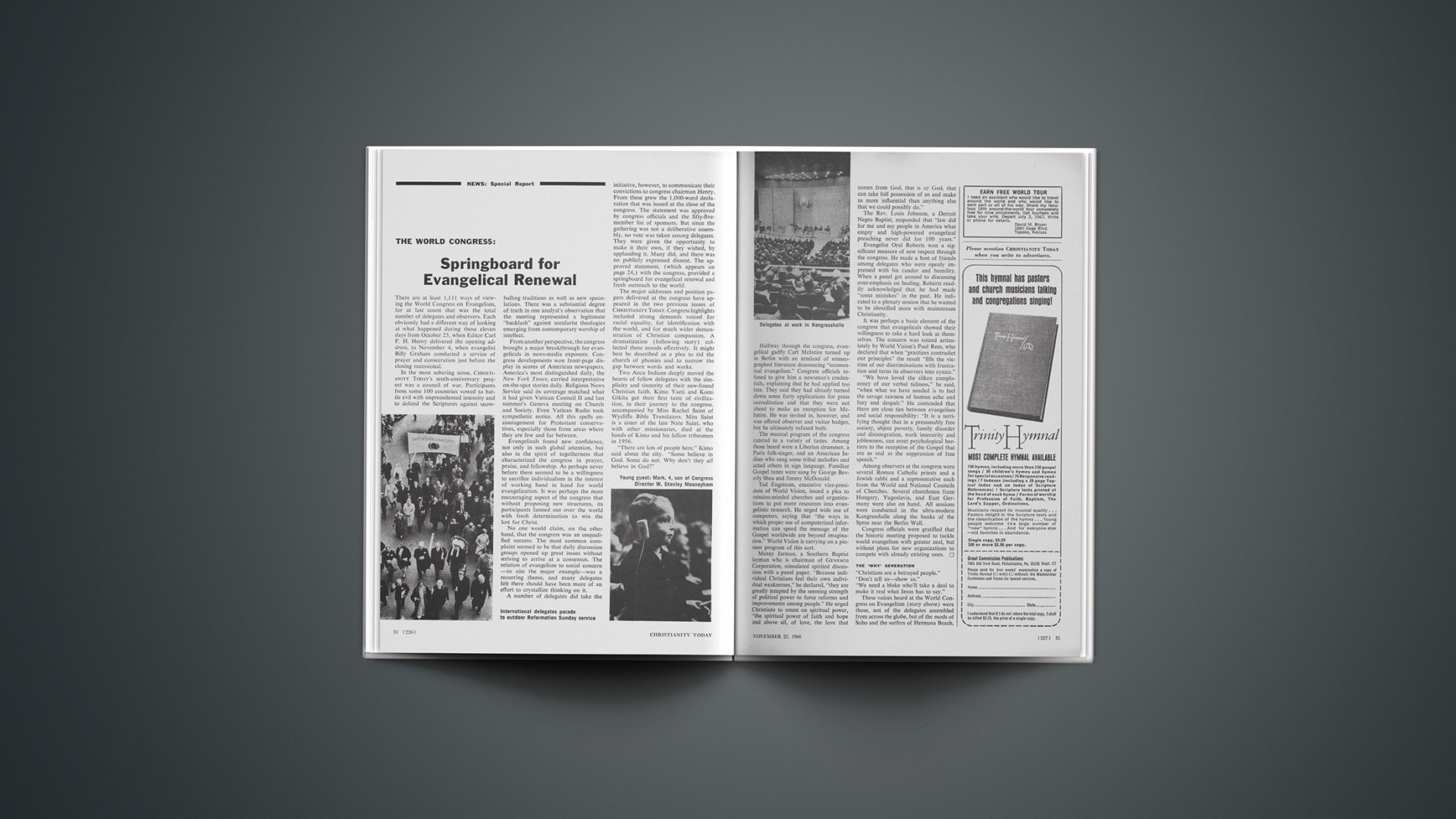
There are at least 1,111 ways of viewing the World Congress on Evangelism, for at last count that was the total number of delegates and observers. Each obviously had a different way of looking at what happened during those eleven days from October 25, when Editor Carl F. H. Henry delivered the opening address, to November 4, when evangelist Billy Graham conducted a service of prayer and consecration just before the closing recessional.

In the most sobering sense, CHRISTIANITY TODAY’S tenth-anniversary project was a council of war. Participants from some 100 countries vowed to battle evil with unprecedented intensity and to defend the Scriptures against snowballing traditions as well as new speculations. There was a substantial degree of truth in one analyst’s observation that the meeting represented a legitimate “backlash” against secularist theologies emerging from contemporary worship of intellect.

From another perspective, the congress brought a major breakthrough for evangelicals in news-media exposure. Congress developments won front-page display in scores of American newspapers. America’s most distinguished daily, the New York Times, carried interpretative on-the-spot stories daily. Religious News Service said its coverage matched what it had given Vatican Council II and last summer’s Geneva meeting on Church and Society. Even Vatican Radio took sympathetic notice. All this spells encouragement for Protestant conservatives, especially those from areas where they are few and far between.

Evangelicals found new confidence, not only in such global attention, but also in the spirit of togetherness that characterized the congress in prayer, praise, and fellowship. As perhaps never before there seemed to be a willingness to sacrifice individualism in the interest of working hand in hand for world evangelization. It was perhaps the most encouraging aspect of the congress that without proposing new structures, its participants fanned out over the world with fresh determination to win the lost for Christ.

No one would claim, on the other hand, that the congress was an unqualified success. The most common complaint seemed to be that daily discussion groups opened up great issues without striving to arrive at a consensus. The relation of evangelism to social concern—to cite the major example—was a recurring theme, and many delegates felt there should have been more of an effort to crystallize thinking on it.

A number of delegates did take the initiative, however, to communicate their convictions to congress chairman Henry. From these grew the 1,000-word declaration that was issued at the close of the congress. The statement was approved by congress officials and the fifty-five-member list of sponsors. But since the gathering was not a deliberative assembly, no vote was taken among delegates. They were given the opportunity to make it their own, if they wished, by applauding it. Many did, and there was no publicly expressed dissent. The approved statement, (which appears on page 24,) with the congress, provided a springboard for evangelical renewal and fresh outreach to the world.

The major addresses and position papers delivered at the congress have appeared in the two previous issues of CHRISTIANITY TODAY. Congress highlights included strong demands voiced for racial equality, for identification with the world, and for much wider demonstration of Christian compassion. A dramatization (following story) collected these moods effectively. It might best be described as a plea to rid the church of phonies and to narrow the gap between words and works.

Two Auca Indians deeply moved the hearts of fellow delegates with the simplicity and sincerity of their new-found Christian faith. Kimo Yaeti and Komi Gikita got their first taste of civilization, in their journey to the congress, accompanied by Miss Rachel Saint of Wycliffe Bible Translators. Miss Saint is a sister of the late Nate Saint, who with other missionaries, died at the hands of Kimo and his fellow tribesmen in 1956.

“There are lots of people here,” Kimo said about the city. “Some believe in God. Some do not. Why don’t they all believe in God?”

Halfway through the congress, evangelical gadfly Carl McIntire turned up in Berlin with an armload of mimeographed literature denouncing “ecumenical evangelism.” Congress officials refused to give him a newsman’s credentials, explaining that he had applied too late. They said they had already turned down some forty applications for press accreditation and that they were not about to make an exception for McIntire. He was invited in, however, and was offered observer and visitor badges, but he ultimately refused both.

The musical program of the congress catered to a variety of tastes. Among those heard were a Liberian drummer, a Paris folk-singer, and an American Indian who sang some tribal melodies and acted others in sign language. Familiar Gospel tunes were sung by George Beverly Shea and Jimmy McDonald.

Ted Engstrom, executive vice-president of World Vision, issued a plea to mission-minded churches and organizations to put more resources into evangelistic research. He urged wide use of computers, saying that “the ways in which proper use of computerized information can speed the message of the Gospel worldwide are beyond imagination.” World Vision is carrying on a pioneer program of this sort.

Maxey Jarman, a Southern Baptist layman who is chairman of GENESCO Corporation, stimulated spirited discussion with a panel paper. “Because individual Christians feel their own individual weaknesses,” he declared, “they are greatly tempted by the seeming strength of political power to force reforms and improvements among people.” He urged Christians to count on spiritual power, “the spiritual power of faith and hope and above all, of love, the love that comes from God, that is of God, that can take full possession of us and make us more influential than anything else that we could possibly do.”

The Rev. Louis Johnson, a Detroit Negro Baptist, responded that “law did for me and my people in America what empty and high-powered evangelical preaching never did for 100 years.”

Evangelist Oral Roberts won a significant measure of new respect through the congress. He made a host of friends among delegates who were openly impressed with his candor and humility. When a panel got around to discussing over-emphasis on healing, Roberts readily acknowledged that he had made “some mistakes” in the past. He indicated to a plenary session that he wanted to be identified more with mainstream Christianity.

It was perhaps a basic element of the congress that evangelicals showed their willingness to take a hard look at themselves. The concern was voiced articulately by World Vision’s Paul Rees, who declared that when “practices contradict our principles” the result “fills the victims of our discriminations with frustration and turns its observers into cynics.”

“We have loved the silken complacency of our verbal tidiness,” he said, “when what we have needed is to feel the savage rawness of human ache and fury and despair.” He contended that there are close ties between evangelism and social responsibility: “It is a terrifying thought that in a presumably free society, abject poverty, family disorder and disintegration, work insecurity and joblessness, can erect psychological barriers to the reception of the Gospel that are as real as the suppression of free speech.”

Among observers at the congress were several Roman Catholic priests and a Jewish rabbi and a representative each from the World and National Councils of Churches. Several churchmen from Hungary, Yugoslavia, and East Germany were also on hand. All sessions were conducted in the ultra-modern Kongresshalle along the banks of the Spree near the Berlin Wall.

Congress officials were gratified that the historic meeting proposed to tackle world evangelism with greater zeal, but without plans for new organizations to compete with already existing ones.

The ‘Why’ Generation

“Christians are a betrayed people.”

“Don’t tell us—show us.”

“We need a bloke who’ll take a deal to make it real what Jesus has to say.”

These voices heard at the World Congress on Evangelism (story above) were those, not of the delegates assembled from across the globe, but of the mods of Soho and the surfers of Hermosa Beach, of youth on the campuses of California and the streets of young Africa.

In an offbeat production, The Why Generation, congress staffers Ed Bailey and Jim Collier and a company of teen-age recruits dramatized unforgettably the shrinking influence of Christianity on today’s young people.

All the words spoken by a miniskirted blonde or a slim-jeaned hipster were culled from hundreds of actual letters and interviews. The epigrammatic commentary was woven together with a brash beatnik “Passion” in free verse about “Jerusalem Slim” and a tragicomic narrative poem about a teen-ager’s visit to a London church.

Some gripes: “Most Christians are sterile, hypocritical cowards.… We just won’t buy that white Anglo-Saxon God anymore.… It’s easier to identify with the Beatles than with God.… Christianity is too fantastic, too miraculous.…”

A melancholy theme song recurred throughout the production, reminding congress delegates of “All the Lonely People.” The concluding line was, “We’re lost, but few men care.”

A girl who has completed four years in a Christian college bemoaned her insecurity: “I should now be a stable, vital Christian,” she said, “but I’m not.… My faith was not my own.… I was acting from external pressures.” Poised and chic, she expressed her longing for reality in cultured tones. “About the worst sin in the book is not to be yourself. And many Christians are afraid to be themselves.”

In one of the final scenes, three ministers discussed their problems in getting through to the current generation. “If we don’t change,” one said, “we may soon find ourselves equipped to evangelize the world of twenty-five years ago.… Yet the very word ‘change’ seems to threaten us evangelicals.…”

“Christians are the ‘salt of the earth,’ ” he said, “but it is still stockpiled.” He bowed his head, and the spotlight dimmed.

“Meanwhile, the world gets hungrier.”

The light went out.

W. DAYTON ROBERTS

Sing A New Song, Tenderly

Jazz continually raises its rhythmic sound in New York City’s worship life these days. An October 23 instance was an ecumenical triple-header: the Lutheran Foundation for Religious Drama presenting a Roman Catholic jazz mass at the Broadway United Church of Christ.

A Pan-Christian Bible?

Boston’s Father Walter Abbott, 43, was scheduled to meet the American Bible Society’s Advisory Council last week in what the New York Times thinks might be “the most important, concrete Christian unity step” since Vatican II closed a year ago.

Abbott, a former associate editor of America, was named November 8 to direct the Vatican’s new drive for a series of common Bible translations, used by all Christians. Pope Paul VI made the move to implement the council’s call for “easy access to Sacred Scripture.” Roman bishops around the world are filling out questionnaires on problems in Bible translation and distribution, and are conferring with local Protestant Bible societies.

The work, Missa Hodierna, was written by schoolteacher-jazz pianist Eddie Bonnemere. He Latinized his fifty-six voice choir, ten-piece band complete with conga drum, and congregation in an engaging hour that ended with a triumphantly syncopated “Go, the Mass is ended: Thanks be to God.”

Bonnemere attributes the mortality rate of regular churchgoers to the lack of participation in services allowed the worshiper. A Roman Catholic, he says most Mass music spurs feelings of “instant strangulation.” His remedy is a “functional service,” combining Latin American rhythms, modern thematic lines, and a touch of Gregorian chant for historical continuity.

The Church was officially represented at this $3-a-seat service by the Rev. John Gensel, who is usually evident at such events and carries on a supportive and counseling ministry with jazz musicians and their families. His chaplaincy to the New York jazz scene is an outgrowth of his weekly jazz vespers at St. Peter’s Lutheran Church (LCA), where he is one of the pastors.

The St. Peter’s services allow the jazzmen to worship regularly in their vernacular, and open communication to them from the more traditional church. Gensel collaborates with trumpeter Joe Newman in O Sing to the Lord a New Song, which puts jazz behind and around spoken words of Scripture.

Gensel thinks jazz worship has “freshness.… It’s like when you are tired and you take a shower.” “The motive makes the difference,” he says; “the motive of love and grace of God makes the difference in the new song.”

But some credit for the difference must also go to Newman and the rhythm section. His group weaves an exotic sound of intense meaning with the words of the Testaments, coupling Psalm 137 with “Willow Weep for Me,”First Corinthians 13 with “Tenderly,” and portions of Solomon’s Song with “Stella by Starlight.” Despite the secular sounds, Newman says the work is “not to entertain, but … to worship.”

JOHN EVENSON

Church Giving: $3.3 Billion

Americans and Canadians gave a record $3.3 billion to their churches last year, says a November 11 report from the National Council of Churches. Per-member contributions rose an impressive $5.71 over 1964, and the average member gave 67 cents more to benevolences (home and foreign missions and overseas relief).

As usual, omissions and qualifications are important. Figures came from only eleven of the NCC’s thirty members, representing two-thirds of its constituency.

Denominations receiving more than $200 from each member were, in order: the Wesleyan Methodist, Evangelical Free, Brethren in Christ, Pilgrim Holiness, Orthodox Presbyterian, and Evangelical Covenant Churches. The highest-ranking large denomination was again the Presbyterian Church, U. S. (Southern), at $118.72.

American Baptists Say ‘No’

The American Baptist Convention’s General Council this month declined to join other Western Hemisphere Baptists in a united evangelistic “Crusade” in 1969. Instead, the ABC will concentrate on separate strategy with ABC-related churches in Latin America and on its new curriculum, also due in 1969.

The ABC thus spurned the first project of the new North American committee of the Baptist World Alliance. ABC President Carl Tiller pointed out that baptisms had dropped from 63,632 in 1955 to 43,759 in 1965, and gave hesitant support to the 1969 effort. But the council followed advice of staffers in the evangelism and program divisions.

Meanwhile, those in the ABC who favor unity with non-Baptists got some ammunition for next year’s Pittsburgh convention when northern California delegates failed to endorse the “Armstrong Amendment” that stressed “Baptist distinctives” in unity talks. And the New York State convention reaffirmed last year’s call for full participation in the Consultation on Church Union. Indiana’s convention, however, opposed COCU.

Greek Crisis Ends

The Greek parliament, ending a year-long crisis, approved nomination of fifteen Orthodox bishops and left the hierarchy to decide on controversial transfers of two bishops to richer dioceses. Though weaker than an earlier reform bill rejected by the hierarchy, the measure pays all Greek bishops a salary equal to that of senior judges, with side income from marriages and other services to be pooled and distributed to poorer clergymen and theology students. Also, bishops appointed in the future must retire at age 80.
Book Briefs: November 25, 1966

Has The Queen Abdicated?

New Directions in Theology Today, Volume I: Introduction, by William Hordern (general editor of the series), and Volume II: History and Hermeneutics, by Carl E. Braaten (Westminster, 1966, 170 and 205 pp., $1.95 each, paperback), are reviewed by Edward John Carnell, professor of ethics and philosophy of religion, Fuller Theological Seminary, Pasadena, California.

Volume I (seven volumes are to make up the series) is saturated with the conviction that it is high time to have edifying dialogue between theologians and the Church, and that the best way to come to the rescue is by disclosing what is new in contemporary theology. So Hordern brings forth a delightful cafeteria of theological alternatives. His sense of fairness leads him to include a chapter entitled “The New Face of Conservatism,” although I wonder whether he really grasps the true substance of conservatism.

In any case, Hordern writes with such an irenic spirit that he addresses both mind and heart, and thus forces serious readers to ask, “Just why is Christianity so fragmented?” and “What can we do to convert this fragmentation into a spiritual, intellectual, and ecclesiastical unity?”

An orthodox Christian, nonetheless, will feel a measure of frustration after reading this book, for no attempt is made to develop a rigorous criterion by which a selection between theological alternatives can be made. The Bible is quoted here and there. In fact, the book ends with a portion of Second Corinthians 4:2. But whether quotations from Scripture contain any more truth on divine authority than quotations from Plato is not resolved. This leads an orthodox Christian into deeper questions, for of what value is theological dialogue unless the agenda includes serious consideration of the right criterion for declaring theological system valid or invalid?

I would speak less than the truth if I were to conceal my feeling that this is a highly stimulating, well-written book. Still, I am sorry that the case for theological dialogue is built in part on the open admission of skepticism that theology is any longer “queen of the sciences.” Certainly we confront new complexities; certainly our file of theological knowledge contains more relative judgments than our fathers in the faith were prone to admit; but the fact remains that a theologian is entrusted with a queenly science. For nothing can fitly rank above the question, “What must I do to be saved?”

Volume II is an awesome piece of scholarship, even though it is written from a somewhat parochial Lutheran perspective and dwells mostly on the theological debate in contemporary Germany. The lion’s share of the discussion is given to Bultmann’s existential theology, while the greatest admiration is heaped on Pannenberg’s theology of universal history.

Two questions arise immediately. First, why are Barth and company brushed off in such a cursory way? Second, why does Bultmann steal the show, despite Braaten’s rejection of his theological position? Braaten (a conservative liberal, if that means anything) devotes a number of closing paragraphs to telling us, in a rather dogmatic way, why he believes that Bultmann has failed miserably in his attempt to perform a marriage ceremony between Christian existentialism and outright naturalism. Bultmann seems to throw out the good with the bad.

Since much of German thinking pays high regard to planned obsolescence (somewhat like the American automobile industry), Braaten may simply be reporting that the revelation theology of Barth has run its course and thus has lost its novelty, while Bultmann, who started out with Barth but later severed company, retains a sparkling novelty. In any case, I am left with the assumption that Bultmann forces Braaten to work for his faith, and this leaves Braaten in debt to Bultmann.

Although Pannenberg is one of the bright young stars in the contemporary theological constellation of Germany, Braaten by no means accepts all of his position. Indeed, he deals with some serious difficulties. Still, Pannenberg seems to command Braaten’s respect by viewing historical Christian events in such a way that they are actually not historical or Christian unless a believer responsibly acknowledges them as part of salvation-history. In this way the objective and the subjective are blended in such a way that the secularization of salvation-history and the envelopment of Christianity by some brand of mysticism are avoided. Moreover, Braaten is convinced that this blending of objective and subjective yields a fresh hermeneutics. Such hermeneutics takes in both the obligation to defend, as well as to know, historical Christian events, and the rules governing biblical exegesis. Pannenberg is forthright in his acceptance of Christ’s resurrection, even as he struggles hard and long to bring the Old and New Testaments into some kind of theological fellowship. These are excellent commitments, although I fail to see anything particularly “new” about them.

Reading for Perspective

CHRISTIANITY TODAY’S REVIEW EDITORS CALL ATTENTION TO THESE NEW TITLES:

The Christian Persuader, by Leighton Ford (Harper & Row, $3.95). A trenchant analysis of contemporary evangelism—the obstacles to be overcome, the strategies to be carried out, the biblical message to be proclaimed—by a man whose writing reveals his passion for Jesus Christ.

History of Evangelism, by Paulus Scharpff (Eerdmans, $5.75). Evangelism in Germany, Great Britain, and America viewed in their historical relationship by a German writer who urges mutual exchange of such knowledge by Christians.

Man: The Dwelling Place of God, by A. W. Tozer (Christian Publications, $3). Terse essays by the late Christian and Missionary Alliance editor that provide insight into the pitfalls and victories of the life of faith.

Braaten summarily dismisses orthodoxy on at least two charges: (a) that it hinders the work of the Spirit by identifying the Word of God with infallibly inspired words in the Bible; and (b) that it imposes the culturally conditioned world view of the Bible on people who happen to live in the twentieth century with its evolutionary and expanding universe. All honor to Braaten for making it clear why he sees no value in holding dialogue with orthodoxy. Ironically, however, his caricature of orthodoxy may convince many conservatives that there is no value in holding dialogue with Braaten.

In any event, this is such a technical work on such far-out theological systems that it is not likely to stimulate dialogue between busy theologians and busy laymen. Whether we like it or not, the fact remains that the average church member wouldn’t grasp the difference between Historie and Geschichte if they sat beside him in the television room for a week.

EDWARD JOHN CARNELL

Through Chaos And Terrorism

Congo Crisis, by Joseph T. Bayly (Zondervan, 1966, 224 pp., $3.95), is reviewed by C. Darby Fulton, retired executive secretary, Board of World Missions of the Presbyterian Church, U. S., Nashville, Tennessee.

This is a vivid story of what happened to a young American missionary couple and their children who arrived in the Congo in the spring of 1964 and were soon caught in the murderous cross fire of the rebellion that centered around the city of Stanleyville. The author, an experienced writer, has produced an animated recording of the harrowing experiences of Charles and Muriel Davis and the beleaguered company of missionaries and Congolese Christians. The reader will find heroes of all ages, both sexes, many nationalities, and the black as well as white skins.

Early in the story there is a brief but excellent summary of the developments leading to Congo independence in 1960 and an explanation of the violent and chaotic years that have followed. Bayly lays the chief blame for Congo’s deterioration on the pressures of world opinion that compelled Belgium to grant independence prematurely. “Belgium’s hand was forced, and the Free World suffered. The Congo itself suffered most.” Included in the record is a remarkably sympathetic interpretation of the tragic career and fate of Patrice Lumumba.

The heart of the book consists of firsthand accounts narrated by missionaries and other eye witnesses who lived through weeks of chaos and terrorism. The whole area around Stanleyville was at the mercy of roving bands of “Simbas,” intent on murder and destruction, guided by caprice, and inflamed by tribal rivalries, political dissension, and international intrigue. The story is one of husbands snatched away from their families, of wives and children hiding in the tropical forest like hunted animals, of narrow escapes from detection and death, of firing squads, of prayer and faith and dependence upon God, and of the final and sudden ordeal of martyrdom for some.

The author feels that the role of the missionary and of the Congolese Christian in this drama has been “magnificent,” characterized by courage and dignity. This should engender added respect for the whole enterprise.

The final chapter is an attempt to evaluate the Church and missions in the Congo. Specifically, it examines the events of the past few years to see what lessons are suggested for missions throughout the world. There are interesting and valuable insights here, not only for the foreign missionary but for all who are concerned about the Gospel’s encounter with the revolutionary forces of this generation. Emphasis is given to the “new partnership” between missionaries and the national church, as distinguished from the “paternalism” of former years. At this point the author does not entirely escape the easy fault of making comparisons at the expense of the past, describing as “new” some attitude or principle that has long been recognized. It is likely, however, that there will be general agreement with his basic summation in the closing paragraphs:

The Church is not a missionary carrying on his program with the help of nationals. Nor is it an organization with national leadership in which a missionary is accepted as helper. In America or the Congo, the Church is—according to the New Testament—a body, and Christ is the Head of the body. The life that surges through the body is not Congolese life, or American life; it is the life of Christ. Each part of the body exists for the Head, and for every other part.

C. DARBY FULTON

Face The Issues!

Dissenter in a Great Society: A Christian View of America in Crisis, by William Stringfellow (Holt, Rinehart and Winston, 1966, 164 pp., $4.95), is reviewed by Charles E. Hummel, president, Barrington College, Barrington, Rhode Island.

What do race riots in Watts and Rochester and demonstrations in Selma and Cicero portend for the American future? With prophetic urgency Stringfellow attacks Americans’ complacency about the social and economic structure that institutionalizes poverty.

Lawyer Stringfellow eloquently argues the case for the poor and oppressed. In the war on poverty, what is the nature of the enemy? A cogent analysis of the interrelations of poverty, property, and people disclose an ideological problem that has divided the country from the start: Should the rights of property or the rights of people constitute the basis of our society? The author shows how institutions of property are prevailing over the rights of human beings. While both rights are important, the tragedy of American society lies in its worship of property. What a man owns has become the yardstick of his worth.

Stringfellow incisively exposes the idolatry of money. “Money is not inherently evil, but it is fallen.” One society mistakenly equates value with money and so judges a man’s moral worth by the amount of money he possesses or controls. If we disavow this idea, to what extent do we not really believe that those without money are inferior? “Where money is an idol, to be poor is a sin.” Christ offers freedom from the idolatry of money.

Everyone in the United States is now involved in the war between the races. “The only issue that remains is how one is involved: obstinately, stupidly, irrationally—or with concern, intelligence or compassion.” But the civil-rights movement is not an end in itself; restoration to Negroes of their rights must pioneer a reconstruction needed by our entire society. For the Christian, integration is not enough, since it is not the moral equivalent of reconciliation in Christ. All men and things are reconciled only in the Body of Christ.

Pessimistic about lack of progress, Stringfellow sees a day of wrath approaching. He believes the “real recalcitrant in the American racial crisis is not the so-called die-hard segregationist or the pathological racist, but respectable, sane, sincere, benevolent, earnest people, church members and devout liberals.”

This book steps on many toes from the right to the left. Each reader must face the basic question: Will he look for excuses to discount its message? Or will he move past the offense to some of his pet positions and panaceas and get at the central disturbing questions? Stringfellow’s perception and passion commend this book for personal study and group discussion.

CHARLES E. HUMMEL

A Modest Commentary

Beacon Bible Commentary, Volume V: The Minor Prophets, by Oscar F. Reed, et al. (Beacon Hill, 1966, 453 pp., $5.95), is reviewed by Bruce K. Waltke, assistant professor of semitic languages and Old Testament exegesis, Dallas Theological Seminary, Dallas, Texas.

A sober evaluation of this commentary is given in the preface: “Beacon Bible Commentary is offered in ten volumes with becoming modesty. It does not supplement others. Neither does it purport to be exhaustive or final.… It is candidly admitted that this is a commentary written from the viewpoint of Wesleyan-Arminian theology. Nevertheless, it is hoped that it will have value to all who seek to know the truth as it is in Jesus.” The Church of the Nazarene is to be commended for offering this helpful, devotional commentary to all serious students of God’s Word.

The defensive aspects of Wesleyan-Arminian theology are not apparent in this volume and therefore will not limit its popularity in evangelical circles. The non-definitive character of that system of interpretation with regard to eschatology, however, will limit its value for those who hold to a dispensational, pre-millennial interpretation of Scripture. Although the contributors are generally vague about their eschatological convictions, their view seems to be that the kingdom of Christ was inaugurated with the death and resurrection of Jesus and will be consummated when Christ returns (see p. 399). Oracles of judgment are usually interpreted as having been fulfilled historically; oracles of blessing are usually interpreted as having been fulfilled in the return from the exile, in the Maccabean era, and in the Church but are sometimes more vaguely interpreted as yet to be fulfilled in the Messianic age.

Generally speaking, the work is non-critical and is based on the King James translation. Problems of literary criticism are dismissed (but see the discussion on the unity of Zechariah); problems of form criticism are not raised; and problems of the Hebrew text are rarely considered. For the most part, the authors comment only on the interpretative problems of the KJV.

As stated in the preface, the work is not exhaustive. On the one hand this approach is welcome, for often the contributors, avoiding pedantry, incisively interpret an obscure passage. On the other hand, the approach proves disconcerting when contributors treat other interpretations superficially or draw conclusions where the reader asks for more argumentation. For example, one contributor cavalierly states that Amos addressed his prophecy to both Israel and Judah, although the text itself does not clearly attest this fact. Again, the identification of the four horns in Zechariah’s vision with the kingdoms of Daniel’s vision is summarily rejected because the horns are said “to have (already) scattered Judah.” It is well known, however, that the perfect tense of the Hebrew verb denotes the aspect of the action more than the time of the action and can refer to the present and future as well as to the past. Although both of the above interpretations may be correct, the point is that the reader would have appreciated a stouter defense.

The contributors have extensively used earlier commentaries written in English and modern English translations but have neglected almost entirely pertinent articles in the learned journals. This neglect severely limits the value of the work. For example, our understanding of the prophetic message, especially Hosea’s, has been greatly enriched by the form-critical analysis of the rib motif in the Old Testament (cf. Herbert B. Huffmon, “The Covenant Lawsuit in the Prophets,” Journal of Biblical Literature, LXXVIII [1959], pp. 285–95). In addition, it is very hazardous to amend the Masoretic text, as the authors occasionally do, without a thorough acquaintance with the history of the texts of the Minor Prophets (cf. D. Barthélemy, Les devanciers d’Aquila: Première publication integrale du texte des fragments du dodécaprophéton, Brill, 1963).

Nevertheless, despite these limitations, this work will have value for all those engaged in the public presentation of God’s Word because of its practical expositions, homiletical suggestions, and pertinent quotations.

BRUCE K. WALTKE

Vatican Ii And Anti-Semitism

The Church and the Jewish People, by Augustin Cardinal Bea, S. J., translated by Philip Loretz, S. J. (Harper & Row, 1966, 172 pp., $4.50), is reviewed by Belden Menkus, editor, author, and management consultant, Bergenfield, New Jersey.

“Christ killer!”

The cry echoes with misery through two millennia of Jewish history. At best, it has been followed by a curse, a kick, or a blow. At worst, it has brought humiliation, torture, or death for Jews.

Far too often, this hatred has hidden behind the cross of Christ.

The Vatican Council, as one of its noblest objectives, sought to bring this distortion of all that is Christian out in the open. Result: A declaration by the council that pleased no one. Some felt it went too far, some that it did not go far enough.

What did happen? What does this statement really signify? Cardinal Bea, a prime mover in the council’s deliberations, was intimately involved with the discussion of anti-Semitism. Here, in an engagingly lucid style, he tells what the council did, analyzes what it said, and suggests how this statement might affect future relations between Christians and Jews.

Evangelicals may find this book a bit confusing. The Cardinal accepts the traditional “deicide” charge at face value—and this colors the rest of the book. Deicide has not been a significant factor in evangelical thought. And, as I have pointed out elsewhere, deicide is a contradiction in concepts. Man cannot kill God; and Jesus Christ was and is God. Even Cardinal Bea recognizes this problem in Catholic thought when he contends that “Jews should not be represented falsely as under a curse and rejected by God.” The duty of the Church, he continues, “is to preach that Christ voluntarily submitted to his death.”

This is a challenging and satisfying book. The Cardinal is an exegete of exceptional insights; I found myself wanting to read more of his writings and to know the man better.

This is a forthright book. Few in Catholic or Protestant circles have faced the Christian implications of anti-Semitism as clearly and directly as Cardinal Bea has here. “The bonds which bind us to the Jewish people are manifold … reaching to the very heart of our spiritual life.” Speaking of Christian and Jewish common contact in the Old Testament, he writes that “difficulties will arise in connection with the interpretation of certain passages … but there is no doubt that we can go the greater part of the way together.”

This is a disappointing book. The Cardinal fails to face past Catholic anti-Semitism and the council’s retreat from its original position on the Jews.

Yet, the book merits thoughtful study. And it demands a comparable confrontation of the problem by evangelicals.

BELDEN MENKUS

Book Briefs

More Hebrew Honey: A Simple and Deep Word Study of the Old Testament, Volume II, by Al Novak (Premier Printing Company, 1966, 144 pp., $4). Old Testament word studies sweet to the mind and heart.

Captured by Mystery: Devotional Readings, by Alvin N. Rogness (Augsburg, 1966, 147 pp., $3.50). Penetrating readings on life, love, gratitude, the church, and death, for daily consumption.

The Changing Church, by Bertrand van Bilsen (Duquesne University, 1966, 440 pp., $7.95). A synthesis of the current Roman Catholic reformation.

Children’s Art and the Christian Reader, by Edgar Boevé (National Union of Christian Schools, 1966, 200 pp., $5.95). A Christian approach to the development of children’s discernment and religious expression in art; well illustrated.

Woman Is the Glory of Man, by E. Daniel and B. Olivier, translated by M. Angeline Bouchard (Newman, 1966, 137 pp., $4.25). The mystery and uniqueness of woman seen from a Roman Catholic perspective.

Where Jesus Walks, by Ruth Youngdahl Nelson (Augsburg, 1966, 144 pp., $3.50). A devotional pilgrimage to places of spiritual enrichment and service.

Aw, Stop Worryin’, by Winston K. Pendleton (Bethany Press, 1966, 80 pp., $2.50). The Christian antidote to anxiety, discussed by the author of 2121 Funny Stories and How to Tell Them. His only worry seems to be our worrying.

Get Up and Go: Devotions for Teens, by Paul Martin (Beacon Hill, 1966, 96 pp., $1.50). Ninety pungent devotionals beamed directly at today’s teenagers.

Ideas

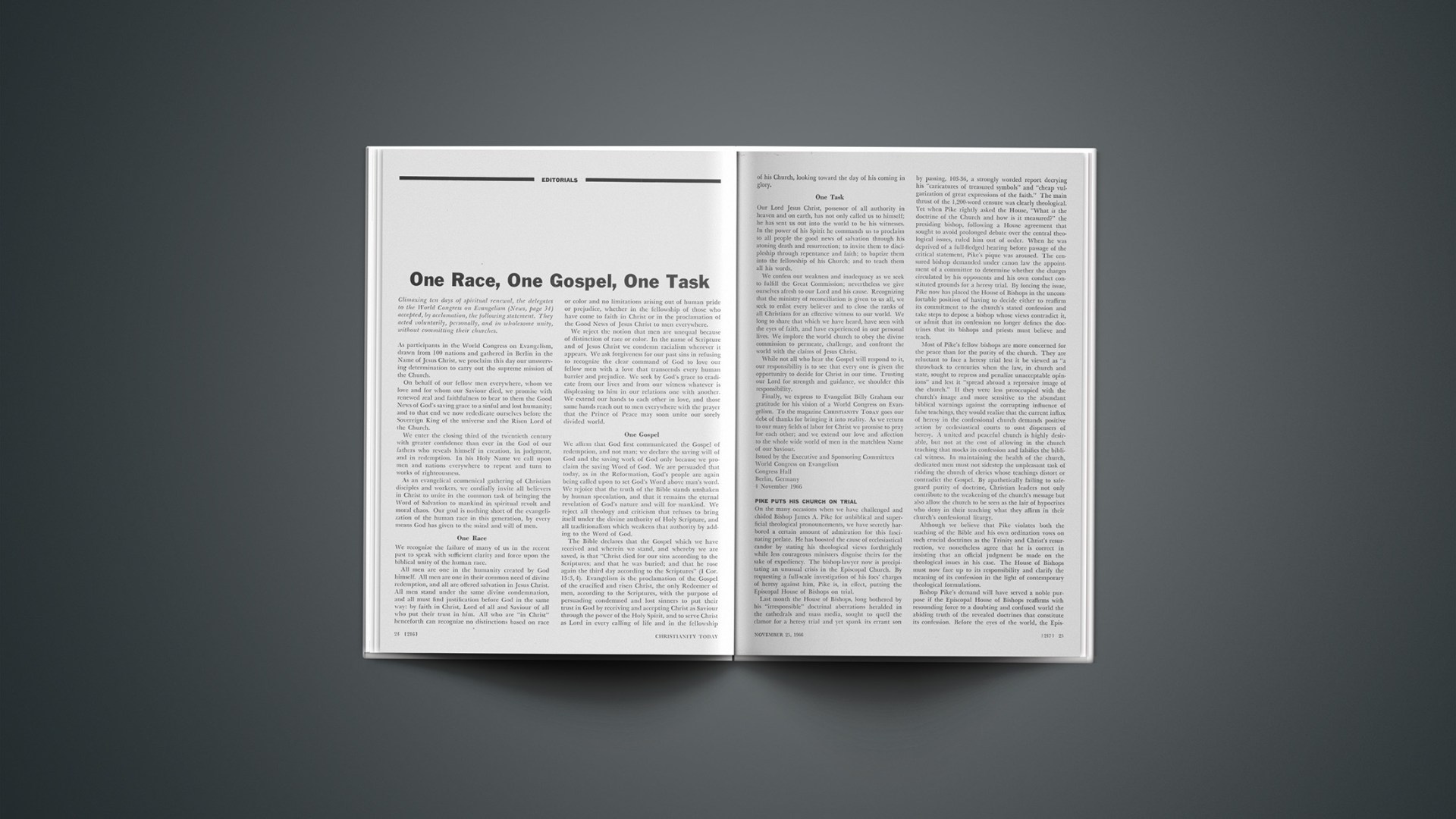
One Race, One Gospel, One Task

Climaxing ten days of spiritual renewal, the delegates to the World Congress on Evangelism (News, page 34) accepted, by acclamation, the following statement. They acted voluntarily, personally, and in wholesome unity, without committing their churches.

As participants in the World Congress on Evangelism, drawn from 100 nations and gathered in Berlin in the Name of Jesus Christ, we proclaim this day our unswerving determination to carry out the supreme mission of the Church.

On behalf of our fellow men everywhere, whom we love and for whom our Saviour died, we promise with renewed zeal and faithfulness to bear to them the Good News of God’s saving grace to a sinful and lost humanity; and to that end we now rededicate ourselves before the Sovereign King of the universe and the Risen Lord of the Church.

We enter the closing third of the twentieth century with greater confidence than ever in the God of our fathers who reveals himself in creation, in judgment, and in redemption. In his Holy Name we call upon men and nations everywhere to repent and turn to works of righteousness.

As an evangelical ecumenical gathering of Christian disciples and workers, we cordially invite all believers in Christ to unite in the common task of bringing the Word of Salvation to mankind in spiritual revolt and moral chaos. Our goal is nothing short of the evangelization of the human race in this generation, by every means God has given to the mind and will of men.

One Race

We recognize the failure of many of us in the recent past to speak with sufficient clarity and force upon the biblical unity of the human race.

All men are one in the humanity created by God himself. All men are one in their common need of divine redemption, and all are offered salvation in Jesus Christ. All men stand under the same divine condemnation, and all must find justification before God in the same way: by faith in Christ, Lord of all and Saviour of all who put their trust in him. All who are “in Christ” henceforth can recognize no distinctions based on race or color and no limitations arising out of human pride or prejudice, whether in the fellowship of those who have come to faith in Christ or in the proclamation of the Good News of Jesus Christ to men everywhere.

We reject the notion that men are unequal because of distinction of race or color. In the name of Scripture and of Jesus Christ we condemn racialism wherever it appears. We ask forgiveness for our past sins in refusing to recognize the clear command of God to love our fellow men with a love that transcends every human barrier and prejudice. We seek by God’s grace to eradicate from our lives and from our witness whatever is displeasing to him in our relations one with another. We extend our hands to each other in love, and those same hands reach out to men everywhere with the prayer that the Prince of Peace may soon unite our sorely divided world.

One Gospel

We affirm that God first communicated the Gospel of redemption, and not man; we declare the saving will of God and the saving work of God only because we proclaim the saving Word of God. We are persuaded that today, as in the Reformation, God’s people are again being called upon to set God’s Word above man’s word. We rejoice that the truth of the Bible stands unshaken by human speculation, and that it remains the eternal revelation of God’s nature and will for mankind. We reject all theology and criticism that refuses to bring itself under the divine authority of Holy Scripture, and all traditionalism which weakens that authority by adding to the Word of God.

The Bible declares that the Gospel which we have received and wherein we stand, and whereby we are saved, is that “Christ died for our sins according to the Scriptures; and that he was buried; and that he rose again the third day according to the Scriptures” (1 Cor. 15:3, 4). Evangelism is the proclamation of the Gospel of the crucified and risen Christ, the only Redeemer of men, according to the Scriptures, with the purpose of persuading condemned and lost sinners to put their trust in God by receiving and accepting Christ as Saviour through the power of the Holy Spirit, and to serve Christ as Lord in every calling of life and in the fellowship of his Church, looking toward the day of his coming in glory.

One Task

Our Lord Jesus Christ, possessor of all authority in heaven and on earth, has not only called us to himself; he has sent us out into the world to be his witnesses. In the power of his Spirit he commands us to proclaim to all people the good news of salvation through his atoning death and resurrection; to invite them to discipleship through repentance and faith; to baptize them into the fellowship of his Church; and to teach them all his words.

We confess our weakness and inadequacy as we seek to fulfill the Great Commission; nevertheless we give ourselves afresh to our Lord and his cause. Recognizing that the ministry of reconciliation is given to us all, we seek to enlist every believer and to close the ranks of all Christians for an effective witness to our world. We long to share that which we have heard, have seen with the eyes of faith, and have experienced in our personal lives. We implore the world church to obey the divine commission to permeate, challenge, and confront the world with the claims of Jesus Christ.

While not all who hear the Gospel will respond to it, our responsibility is to see that every one is given the opportunity to decide for Christ in our time. Trusting our Lord for strength and guidance, we shoulder this responsibility.

Finally, we express to Evangelist Billy Graham our gratitude for his vision of a World Congress on Evangelism. To the magazine CHRISTIANITY TODAY goes our debt of thanks for bringing it into reality. As we return to our many fields of labor for Christ we promise to pray for each other; and we extend our love and affection to the whole wide world of men in the matchless Name of our Saviour.

Issued by the Executive and Sponsoring Committees

World Congress on Evangelism

Congress Hall

Berlin, Germany

4 November 1966

Pike Puts His Church On Trial

On the many occasions when we have challenged and chided Bishop James A. Pike for unbiblical and superficial theological pronouncements, we have secretly harbored a certain amount of admiration for this fascinating prelate. He has boosted the cause of ecclesiastical candor by stating his theological views forthrightly while less courageous ministers disguise theirs for the sake of expediency. The bishop-lawyer now is precipitating an unusual crisis in the Episcopal Church. By requesting a full-scale investigation of his foes’ charges of heresy against him, Pike is, in effect, putting the Episcopal House of Bishops on trial.

Last month the House of Bishops, long bothered by his “irresponsible” doctrinal aberrations heralded in the cathedrals and mass media, sought to quell the clamor for a heresy trial and yet spank its errant son by passing, 103–36, a strongly worded report decrying his “caricatures of treasured symbols” and “cheap vulgarization of great expressions of the faith.” The main thrust of the 1,200-word censure was clearly theological. Yet when Pike rightly asked the House, “What is the doctrine of the Church and how is it measured?” the presiding bishop, following a House agreement that sought to avoid prolonged debate over the central theological issues, ruled him out of order. When he was deprived of a full-fledged hearing before passage of the critical statement, Pike’s pique was aroused. The censured bishop demanded under canon law the appointment of a committee to determine whether the charges circulated by his opponents and his own conduct constituted grounds for a heresy trial. By forcing the issue, Pike now has placed the House of Bishops in the uncomfortable position of having to decide either to reaffirm its commitment to the church’s stated confession and take steps to depose a bishop whose views contradict it, or admit that its confession no longer defines the doctrines that its bishops and priests must believe and teach.

Most of Pike’s fellow bishops are more concerned for the peace than for the purity of the church. They are reluctant to face a heresy trial lest it be viewed as “a throwback to centuries when the law, in church and state, sought to repress and penalize unacceptable opinions” and lest it “spread abroad a repressive image of the church.” If they were less preoccupied with the church’s image and more sensitive to the abundant biblical warnings against the corrupting influence of false teachings, they would realize that the current influx of heresy in the confessional church demands positive action by ecclesiastical courts to oust dispensers of heresy. A united and peaceful church is highly desirable, but not at the cost of allowing in the church teaching that mocks its confession and falsifies the biblical witness. In maintaining the health of the church, dedicated men must not sidestep the unpleasant task of ridding the church of clerics whose teachings distort or contradict the Gospel. By apathetically failing to safeguard purity of doctrine, Christian leaders not only contribute to the weakening of the church’s message but also allow the church to be seen as the lair of hypocrites who deny in their teaching what they affirm in their church’s confessional liturgy.

Although we believe that Pike violates both the teaching of the Bible and his own ordination vows on such crucial doctrines as the Trinity and Christ’s resurrection, we nonetheless agree that he is correct in insisting that an official judgment be made on the theological issues in his case. The House of Bishops must now face up to its responsibility and clarify the meaning of its confession in the light of contemporary theological formulations.

Bishop Pike’s demand will have served a noble purpose if the Episcopal House of Bishops reaffirms with resounding force to a doubting and confused world the abiding truth of the revealed doctrines that constitute its confession. Before the eyes of the world, the Episcopal House of Bishops is unofficially on trial fully as much as Bishop Pike may one day officially be. Whether men like it or not, the Pike controversy will continue to disturb the peace of the church. Let us hope that the House of Bishops’ pursuit of peace does not deter it from taking action that will result in the triumph of biblical truth over error and thereby advance the cause of Jesus Christ.

BY DESPOILING NATURE, WHICH IS A GIFT OF GOD.

By killing our wildlife and polluting our streams. By poisoning our air and burning our forests.

By littering our highways and disfiguring them with hideous signboards.

By contaminating our atmosphere with atomic waste materials and blanketing the earth with fallout.

BY REMAINING UNCONCERNED AS CITIES STAGNATE AND DECAY, AND DESPAIR OVERTAKES THEIR HAPLESS RESIDENTS.

By tolerating urban filth, disease, and crime.

By consigning people to ghettos from which there is no escape.

By failing to clean up the slums, lift the fallen, and minister to the disinherited.

By permitting cities to deteriorate into eyesores and smog belts.

BY FAILING TO SPEAK OUT AGAINST OBVIOUS INJUSTICES THAT TRAMPLE DOWN THE RIGHTS OF MEN AND DESTROY THE DIGNITY OF HUMAN BEINGS MADE IN THE IMAGE OF GOD.

By standing by silently as citizens are turned away from the polls because their skin is dark and wicked men beat school children with axe handles.

By remaining apathetic as vandals destroy property and scoff at law and order.

By failing to protect women from being robbed in our streets and raped in our parks.

By watching idly as printing presses disgorge books and magazines that cater to lust for profit.

BY ENTHRONING SELF, WORSHIPING THINGS, AND IDOLIZING AFFLUENCE.

By becoming victims of sloth and materialistic ease that soften our moral fiber.

By accepting relative ethical codes that negate the Ten Commandments.

By making peace with sexual license that smiles at fornication and makes light of adultery.

By making decisions on the basis of personal profit rather than the good of our fellow men.

BY CLINGING TO THINGS THAT ARE TEMPORAL AND FORSAKING THINGS THAT ARE ETERNAL.

By putting “In God We Trust” on our coins when we have no faith in God.

By buying more copies of the Bible than of any other book only to reject its teaching, deny its authority, and fail to read it.

By filling our churches at Christmas and Easter and leaving them half empty the rest of the year.

By merely giving thanks when we should also be confessing our sins, asking God for forgiveness, and serving mankind.

Giving Away What You Don’T Own

Some theological liberals give away what does not belong to them. No person or organization has the right to water down or set aside the eternal verities revealed in Holy Scripture. Churchmen who attempt to do this place a stumbling block in the path of the unwary and add more confusion to a very confused world.

The Ten Commandments still clearly affirm God’s holy laws. No man is saved by keeping them; only the One who kept them perfectly can save men. But the commandments are both a standard and a warning: the standard of a holy God and a warning of the consequences of willful disobedience.

We are now witnessing a treacherous and persistent assault on the Seventh Commandment—“Thou shalt not commit adultery.” This attack is made not only by persons outside the Church but also by some within it.

The recent report, “Sex and Morality,” written by a committee of the British Council of Churches and published by the Student Christian Movement Press, illustrates the widespread relaxed attitude toward adultery and fornication (see Nov. 11 issue, page 34, and this issue, page 46).

The “new morality” with its situational ethics is permeating our country, to the disgrace of the Church. Countless young people are enticed by its attempt to justify some sexual relations outside marriage as legitimate acts of true love.

The rise of homosexuality, the existence of it even in the Church, and the permissive attitude toward it in Church and society, are further cause for grave alarm.

On every hand God’s “You shall not” is being changed to “Perhaps you can.” How can anyone concerned with the unity of the Church be indifferent to matters having to do with the purity of the Church? How can God bless a corporate church so concerned for social justice but so permissive of moral deviations?

We hear much about how the Church will “stand under the judgment of God” if it does not engage in social action. But what about the sure condemnation of God that must fall on the Church if it tampers with his standards of moral purity?

Have we reached the depths of depravity described by Jeremiah: “Were they ashamed when they committed abomination? No, they were not at all ashamed; they did not know how to blush.” The passage continues with these ominous words: “Therefore they shall fall among the fallen; when I punish them, they shall be overthrown, says the Lord” (Jer. 8:12). Those who defy the commandments of God by “giving them away” and watering them down will not escape his judgment.

Election Afterthoughts

People were turned on by this month’s “off” year elections. The American voter had a mind of his own. He refused to mimic either prophecies from computers or urgings from big-name politicians. Two years after the Goldwater defeat, the nation moved to a closer approximation of two-party balance.

On the partisan level, Republicans have much to crow about. We are pleased with some of the much publicized new GOP faces, but not for partisan reasons. Republican gubernatorial victories in Maryland and Arkansas proved that one party’s dominance can be shattered if it nominates reactionary candidates who harp on a single issue to foment racial animosity. Georgia’s muddled gubernatorial race and the election of a shadow governess in Alabama provide less cause for cheer.

In the Senate races, some prophets thought prejudice might doom Edward Brooke of Massachusetts, a Republican among Democrats, an Episcopalian among Roman Catholics, and a Negro among whites. But the state made its attorney general the first Negro elected to the United States Senate by popular vote. Brooke automatically assumes a position of national Negro leadership, for which he is well prepared. As attorney general he enforced the law impartially, against Negroes when necessary, without currying favor with whites.

Across the continent, Oregon elected another new Republican senator. Besides a record of honest, conscientious public service, Mark O. Hatfield will bring to Washington the refreshing influence of a forthright stand for evangelical Christianity. He has a sensitive understanding of the complex relationships between religion and politics (see interview, June 21, 1963, issue, page 8). Hatfield claimed his win showed that people lack confidence in the national administration and “want stronger efforts to conclude the war in Viet Nam, but not peace at any price.”

At times the rancor and sniping of some races seemed to capture a hint of the terrors of those Asian jungles. But when the returns were in, many losers responded with warmth and good wishes for the winners. So do we. And to these wishes we add prayers for the politicians, old and new, who are left to face the tough questions of national interest when campaign buttons go from lapels to attics and swept-up confetti lies in empty hotel ballrooms.

The Pope Who Fails To Speak

Roman Catholics eagerly waiting for Pope Paul VI to relax the church’s stand on birth control have been keenly disappointed by his decision to leave the issue dangling. Despite the recommendations of Vatican Council II, the opinions of leading churchmen, and the population explosion, Paul refused for the time being to alter the church’s teaching. In an address to three hundred Italian gynecologists and obstetricians he said that he is unready to make any definitive declaration now because of the “enormous complexities” of the subject and the “grave implications” involved in a decision.

There is talk of forming a new papal commission to pursue the matter, since the Pope was evidently dissatisfied with the recommendations of his commission of experts that had just reported to him. Although their statement was not made public, we can only assume that they called for liberalization of birth-control practices. The Pope said that the report “raised as many new questions as [it] answered old ones.”

By his inaction the Pope has failed to meet the crisis directly and has chosen rather to perpetuate an antiquated and questionable teaching. His decision affects some six hundred million people whose relationships in every area of life are greatly influenced by the papal edicts. His teaching so binds their consciences that for them to prevent conception by any other means than abstinence or the rhythm method is sin. The marriage bed becomes a bed of sin when they come to it practicing contraception by artificial means.

The Pope’s failure to speak came at a time when the power of the church to control the faithful has been seriously diluted. Millions of Catholics practice forbidden forms of birth control and will continue to do so. It is seriously to be doubted whether the church has the right to ban the use of contraceptives irrespective of personal convictions and responsibility.

Anyway, the stance of the Pope right now is intolerable. He himself said: “We know that people are waiting for us to give a decisive pronouncement.…” Surely he owes it to his office and to his people to make such a statement soon.

The Minister’s Workshop: Listen before You Speak

The preacher must read and hear the Word till it engages him in conversation

“Every good sermon has been heard once before it is preached; it has been listened to by the preacher.”

I don’t know who said that; it may even be something I have phrased for myself out of my own experience. For I am profoundly convinced that it is true. Whatever method I have in preparing for the pulpit grows directly out of this principle.

The starting point is the Bible. I cannot conceive of a sermon without a text, whether it be only part of a verse or a larger section. The Word must be read and heard by the preacher. I am not ashamed to say that I usually read it out loud—and read it until I am stopped, questioned, cornered, by, as I believe, the Holy Spirit speaking out of Scripture.

Strange how it works. I am stopped by a phrase today that I slipped right past a month or a year ago without hearing a thing. Or sometimes I am stopped so often in a short space that I cover scarcely a chapter or two in several days. I am not conscious of anything I can do about this except to be still and listen.

Such listening, however, calls for a systematic plan of reading the Word. For a long time, because of the tradition in which I was raised, I found that plan in various lectionaries for the Christian year. I still would not despise that way and find myself using it from time to time. But more recently I have found it more profitable to follow the Reformed tradition of lectio continua, the systematic pursuit of a single book of the Bible. I do not wish to argue for any particular plan, however, but simply to plead that there should be one.

Beside my Bible is a notebook in which I jot down, as they come, the stopping places, the questions, the places where the Word of God has engaged me in some kind of conversation. The second part of my method involves following myself up, so to speak. First I have a look at the original of the verse or section that has begun to speak. My Greek is only tolerable, my Hebrew extremely lame; but even so, both are sufficient, with some generous help, to inform me whether what I thought I heard in English was really there in Hebrew or Greek. I have had to surrender enough good texts this way to know that it is a very necessary discipline!

Then come the commentaries. Shall I be badly misunderstood if I say that for me their chief function is to help me decide what not to preach? Well, that is usually what happens. For some reason that I do not try to explain, the study of the time, place, situation, and meaning of several verses causes me to lose interest in some while another begins to speak to me with increasing clarity and force.

Once that has happened, I file that word in the back of my mind and let it go to work on me. Hopefully it is there for as long as several weeks, and never for less than a week. I try to make it a constant companion and, as time goes on, connections begin showing up. An article or book that I read not too long before, an event in the daily press, a conversation with a parishioner or even with someone on the bus—these all begin to connect. Usually I try to jot the connection down. By the end of a week, my desk—to say nothing of the pockets of my jackets—is a mess of scraps of paper, backs of used envelopes, and whatnot, the raw material for the next step.

With me that next step usually takes place on a Saturday morning. I assemble all my raw material, try (sometimes in vain) to remember the jottings I forgot to make, and spend time looking at it all, thinking about it, thinking about the people to whom this Word is to be spoken. (I find preaching to a strange congregation an increasingly difficult experience, although I still do it).

At this point, I suppose I should say that I begin to write an outline. But I don’t. Sitting down at my 1932 Remington portable (my thinking process has somehow become bound up with it) I begin to take down what I hear. Sometimes this dictation process is simple and is finished within a few hours. At other times it is extremely difficult. Whole pages are torn up, or several beginnings are made, or, more often, at a certain point the process simply stops. Sometimes as much as several hours must elapse before it can be started again.

Indeed, I can record the frequent experience of having a sermon turn out to be so different from what I had envisioned when I began that I have had to rewrite the whole introduction, because it was obviously introducing the wrong sermon. There have been some Saturdays spent with nothing to show for them, but I think I should have to confess that they were usually times when I wanted to impose my idea on the clear message of the Word.

In twenty-one years (all of them in the same pulpit) I have written out every sermon in full. I usually read it before I retire on Saturday night; I always preach it aloud in my library on Sunday morning. By that time the manuscript means little or nothing. But I have tried the outline and ex tempore methods just enough to know that I am a wool-gatherer who needs the discipline of putting down to the end what he has heard if he is to repeat it faithfully to his people.

In twenty-one years I have repeated a sermon possibly five times. In each case the reason was my failure to be a faithful hearer of the Word. And in each case I was painfully aware that I was giving an address, not preaching a sermon.

A sermon to me is the Word of God addressed to a particular people at a particular time in a particular place. Even a week later in another congregation I find that it has lost some of its livingness. For that reason I never keep sermon manuscripts in an accessible place for more than six months. By that time they are almost worthless for me. It is not what the Spirit speaking out of Scripture said but what he is saying that gives preaching its power to raise men from the dead.

My method is suited to me; I expect no one else to follow it. But I do expect any man who is called to preach to believe that the word he has to speak cannot be his own.—The Rev. HOWARD G. HAGEMAN, North Reformed Dutch Church, Newark, New Jersey.

How Big Is God?

Those who have a low concept of God have rejected the multiplied revelations he has given of himself—in his works of creation and providence, in the person of his Son, in the presence of his Spirit, and in his written Word. He has not left himself without a witness, and the evidence demands that we worship and praise the One thus revealed.

God is infinite—without limits of any kind. Limited as we are by time, space, and circumstances, we find it difficult even to apprehend dimly the fact that for God there are no such limitations. As Solomon said, “heaven, even highest heaven, cannot contain him” (2 Chron. 2:6b, RSV). The psalmist affirms, “Great is the Lord, and abundant in power; his understanding is beyond measure” (Ps. 147:5).

God is omnipotent—all powerful, the master of every situation. Jesus said, “With God all things are possible” (Matt. 19:26b). Some day every Christian will hear the proclamation, “Hallelujah! the Lord God omnipotent reigneth” (Rev. 19:6b, KJV).

God is omniscient; he always knows all of the past, the present, and the future. Eternity lies before him like a vast panorama. Nothing is hidden from his knowledge.

God is omnipresent; there is no place where man can escape his presence. David expressed this in Psalm 139. Truly there is no place where man can hide. Outer space, the depths of the ocean, darkness—all are alike to him. “Even the darkness is not dark to thee, the night is bright as the day; for darkness is as light with thee” (Ps. 139:12).

God is sovereign. Even in the chaos of today’s world, he is working out his holy purposes; and they will certainly be fulfilled. Who is man to question the wisdom or sovereign power of God?

We learn something of the nature of God when we pray, “For thine is the kingdom, and the power, and the glory, for ever.” We affirm that his kingdom is eternal, that his power is infinite, and that his glory encompasses infinite love, holiness, justice, and mercy. And we affirm that these things are for ever.

God is all this and more. He is the Creator of all things seen and unseen, of the laws that govern the universe, of the perfections in evidence on every hand in nature.

What folly, then, for the creature to question or doubt the Creator! The Apostle Paul pointedly asks, “Who are you, a man, to answer back to God? Will what is molded say to its molder, ‘Why have you made me thus?’ ” (Rom. 9:20).

Nothing is more humbling than to contemplate the infinite power and wisdom evinced in God’s works of creation. “The heavens are telling the glory of God; and the firmament proclaims his handiwork” (Ps. 19:1). Only the spiritually blind can fail to see the greatness and the glory of God in his creation.

God is not only the Creator; he is also the Redeemer, returning to the world he made to redeem sinning man back to himself. Exercising his right of choice, man disobeyed God; and sin brought separation. But the love of God would not permit man to continue in a hopeless state. God came in the person of his Son so that once more man could choose and those who believed could be redeemed.

Not only did God create; not only does he redeem; he also preserves by his works of providence. The amazing fact that all things work out for the good of God’s children—any possible circumstance of life—is an evidence of his preserving and overruling power. How can we fail to worship such a God!

Yet, despite his majesty, power, and wisdom, God is the God of the individual. He is a personal God to all who receive him. To reject him means chaos in every aspect of life.

He is concerned with the great problems and minute details of our lives.

O, what peace we often forfeit,

O, what needless pain we bear,

All because we do not carry

Everything to God in prayer.

This is not the figment of a pious imagination; it is the statement of a deep and abiding truth.

The psalmist says, “When the cares of my heart are many, thy consolations cheer my soul” (Ps. 94:19). What a loss for those who do not know the privilege of trusting the heavenly Father who is concerned about our personal problems, the Saviour who understands our personal temptations and delivers from them, the Holy Spirit, who is a personal Comforter to those who turn to him! How truly David spoke when he said, “The Lord is my shepherd.” This was a personal relationship for life, for death, and for all eternity.

How big is God? He is the God of destiny. It is he who determines the outcome of history and who stands in the shadows keeping watch over his own.

Men and nations may parade grandly across the stage of history, but they do not determine the course of either life or death. The curtain of history will be drawn, not by man, but by God.

How big is God? Look about you and see the evidence of his wisdom and power. If a man claims to be an artist, one has the right to ask to see his pictures. If he says he is an architect, one wants to see something he has designed; if an athlete, to see his prowess; if an inventor, to see his product.

Look at the heavens, the moon and the stars. Look at the earth, all the marvels of God’s creative power. Look at his Son and Calvary. Look in his Word and all it reveals. Look into the innermost reaches of your troubled soul and hear him speak peace. You will get an inkling of how great he is.

How big is God? He can never be measured by earthly standards, but on every hand we see signs of his glory. God is a spirit, and we can grasp what this means only when we worship him in spirit and in truth. Although he is nearer than hands or feet, yet he encompasses all of time and eternity.

Staggering? Of course. But, oh, how comforting to those who know him!

God’s witness is universal, to be seen and known by all who will. It is continuing, from one generation to another. It is personal; he stands at the door of the human heart, knocking and seeking admittance.

Moses knew this when he said, “Lord, thou has been our dwelling place in all generations. Before the mountains were brought forth, or ever thou hadst formed the earth and the world, from everlasting to everlasting thou art God” (Ps. 90:1, 2).

Man may try to limit God by his own earthbound limitations. He may blaspheme God by saying he is dead. He may defy God by conspiring against him. But “he who sits in the heavens laughs; the Lord has them in derision” (Ps. 2:4). Some day all who have limited him or blasphemed or conspired against him will find to their eternal horror what a “fearful thing” it is “to fall into the hands of the living God,” “for our God is a consuming fire” (Heb. 10:31; 12:29).

God has set before us an array of witnesses, inanimate and animate, that combine to tell us as much as the human mind can grasp of infinity. Jesus tells us where faith enters the picture: “Unless you turn and become like children, you will never enter the kingdom of heaven” (Matt. 18:3).

Eutychus and His Kin: November 25, 1966

Hi-Ho Preacherinos And Church Pillars:

It isn’t every issue you have the dubious privilege of meeting a spankin’ new Eutychus. During the past decade only two other scribes have dared dip their quills in this particular pot of ink to have a-go-go at dialogue with you ecclesiastical cats. But it’s quite appropriate for Eutychus III to make his debut at this time. In this Thanksgiving week issue, CHRISTIANITY TODAY is only too happy to serve up a turkey.

Now, if I were Eutychus I, I’d take pride in being a great innovator. If I were Eutychus II, I’d try harder. But since I’m number three, I’ll probably fall asleep on my journalistic window sill, like the original Eutychus in Acts 20. It will be up to all of you to awaken me and keep me abreast of the absurd side of the religious scene where folly, foibles, and phonies are so frequently found. (The prior passage was planned for pulpiteers who use a preponderant part of their preaching preparation period pursuing proper and persuasive alliteration.)

But it’s easy to see that the religious fun house is going full blast. You may not be aware that Homer A. Tomlinson, Bishop of the 63-year-old Church of God and self-crowned King of the World, now rules over us all on the Throne of David. He recently appealed to the nations of the world to kick in 10 per cent of their annual income to his government or face curtailment of rainfall. King Homer is sending an envoy to Viet Nam with an olive branch from the Mount of Olives to enforce his edict that “wars will come to an end.”

On a more mundane level, we note with pleasure that Mrs. Joan Kruger of Detroit, Michigan, was awarded a beautiful red Scofield Bible for winning the recent “Pew-Packing Contest” at Detroit’s Chandler Park Drive Baptist Church. Picture in your sanctified imagination how it might have been: 137 happy Christians piled into one creaking pew with Mrs. Kruger aloft, waving her crimson morocco. Those college kids in telephone booths have nothing on her.

In our future fortnightly visits, you may be tempted at times to engage in a bit of Euty-cussing. But restrain yourself. Given time, you’ll learn to love me. Actually I’ve got a heart as big as all outdoors.

Thanksgivingly,

EUTYCHUS III

Up In Arms

Let me begin by stating very forthrightly that I am (and have been for the last five years) a paying member of the National Rifle Association; and I resent Mr. Moberg’s insinuations (review of The Right to Bear Anns, by Carl Bakal, Oct. 28) that the NRA is nothing but a group of “gun nuts” whose sole activities are “heading the pro-gun lobby in Washington.” …

Mr. Moberg accepts as true author Bakal’s assertion: “The lie that Hitler used firearms registration lists to disarm and conquer Europe and other lies are panned off as fact” … With my own ears I’ve heard people from Poland, France, the Ukraine, and other places say that Hitler did use firearms registration lists to disarm conquered peoples, prevent any large-scale guerrilla-type operations, and so forth; and also, for good measure, that the Soviet Union adopted and still uses that very same practice!

Again: Mr. Moberg states that Senator Dodd’s 1965 Firearms Bill “was greatly distorted in a letter sent by the NRA to all its members. Requests that a new mailing be sent to correct mistakes were unheeded, and distortions were repeated in subsequent publications of the firearms lobby”.… These charges simply are not true, and I have NRA material at hand to prove that statement.… If you can’t find any better material than such slander to publish, then kindly peddle your libel sheet to someone who is just as misinformed (and here I am being most charitable!) as Mr. Moberg. If this article/review is really representative of CHRISTIANITY TODAY in the twentieth century, we had all better pray for another Reformation. Immanuel Lutheran DAVID J. BEHLING Norton, Kan.

You could do us all a service if you would attempt what no one else has, to my knowledge. We need a confrontation of the two sides of this [gun control] argument in which each side deals with the real concerns of the other side instead of knocking down straw men. We also need to have some discussion in which each side assumes the basic integrity of at least most of the people on the opposite side. If one listens now to what each side says about the other, he must assume that Communists and fellow travelers are ranged against hoodlums, the insane, and the callous.

DANIEL C. REUTER

Malone, N. Y.

Faculty Reader Speaks Out

Your editorial, “Let Student Editors Speak Out” (Oct. 14 issue), will doubtless receive the approbation of disgruntled students who want a sounding board for their grievances, of some members of the administration and faculty who feel above criticism and would like to see their associates under fire, and of the vast majority of us who like to see a fight and enjoy the sensationalism of touching the untouchable.… But I question whether it is biblical. My Bible tells me that if I have a quarrel with anyone I should go to him directly and see if I cannot solve the problem personally. Your editorial seems to suggest that I should make my quarrel public.

In a Christian college where the administrators are Christian, and the students elect to attend it because of its emphasis on Christian behavior, surely your editorial sounds a discordant note.

G. ARTHUR KEOUGH

Assistant Professor

Department of Religion

Columbia Union College

Takoma Park, Md.

Your editorial “Let Student Editors Speak Out” (Oct. 14) has been an inspiration to many on our campus.… Many of your articles speak well of the conflict on today’s Christian college campuses. Thank you for letting us hear your voice.

ROBERT ZAWOYSKY

Mishawaka, Ind.

Scoop Of The Decade

The scoop of the decade is Sartre’s demise (“Dynamics of a Decade,” Oct. 14) in the grand company “… of a Generation of Giants”! When did Sartre join Camus in the non-existent existential netherland?

DALE SANDERS

Denver, Colo.

• We goofed.—ED.

Force, If Necessary

I was very glad to read your report of General Council of the United Church of Canada (News, Sept. 30). I think you brought out some of the major emphases very well.…

You indicate that we were in favor of the termination of the Ian Smith regime, “without use of force.” Actually the fifth section of the Rhodesian resolution placed General Council in favor of “the use of necessary police action” under the United Nations in order to oust the Smith regime. This would certainly involve the use of force.…

J. R. HORD

Secretary

Board of Evangelism and Social Service

The United Church of Canada

Toronto, Ont.

Fill In The Blank

Would you kindly elucidate on your positional statement, “A crude anti-Communist reaction survived in some segments of the Church and society, but other Christians were more concerned that the Communist Bloc remained the most challenging unevangelized area on earth” (Oct. 14, p. 58).…

It might have been more appropriate to predicate the expression with “An enlightened and realistic anti-Communist.… In fact, your own editorial on the NCC and Red China (p. 35) was indeed “an enlightened and realistic anti-Communist” editorial. Or do you consider your own position “crude”?

DAVID A. NOEBEL

Christian Crusade

Tulsa, Okla.

Problem Promulgation

We are enclosing two copies of the article “The Problem of the Underpaid Pastor,” printed in your September 30 issue and reprinted by us for use in a mailing to the churches of this presbytery, by your permission.

I find CHRISTIANITY TODAY to be very helpful and informative to me, and am an appreciative reader.

JAMES H. MONROE

Executive Secretary and Stated Clerk

Presbytery of Winston-Salem

Presbyterian Church in the U. S.

Winston-Salem, N. C.

Back On The Track

James Panoch’s discussion, “Is Prayer in Public Schools an Illegal Maneuver?,” (Sept. 30) is much appreciated. Technically, Senator Dirksen’s amendment is not needed, but the general impression has gone out that prayer has been banished from the schools. Across the country baccalaureate services have been discontinued, and the simplest attempts at Bible reading and prayer have been discouraged. The schools have been made safe for the atheist but not for the Christian. We need the Dirksen amendment or something else to get us back on the track again. We do not want an established religion, but we do want religion in all of American life.

BYRON S. LAMSON

Editor

The Free Methodist

Winona Lake, Ind.

Preaching In Dialogue

My class in “Contemporary American Preaching” is studying dialogue preaching. I would be happy to hear from any minister who has done some of it, and especially to receive copies of sermons.

WILLIAM D. THOMPSON

Assoc. Prof. of Homiletics and Speech

Eastern Baptist Theological Seminary

Philadelphia, Pa.

Written More Boldly

Thank you for your editorial comments on the political integrity of Charles Long-street Weltner (Oct. 28).…

An earlier statement, recorded for use in the church schools of five denominations, is now written more boldly because of Weltner’s act of conscience. He wrote: “I believe that the problem of doing what is right in the face of tradition, in the face of convention, in the face of what we fear others may say about us, is one of the great impediments to progress and true living Christianity that faces all Americans today, particularly to those of us who live in a troubled part of the world—south of the Mason-Dixon line.”

JOHN A. KIRSTEIN

Board of Christian Education

Presbyterian Church in the U. S.

Richmond, Va.

Understanding, Please

I live amongst the “troubled nation” you refer to in the editorial (“After Verwoerd—What?,” Sept. 30), about four miles from Sharpeville! I should know about all the “troubles” we go through, caused by “the snares of … apartheid.” May I refer you to the same issue and your own editorial on page 33, “Playing With Fire”? Such riots, burning and murder in the U. S.! I prefer to live four miles from Sharpeville.

You speak of Christians around the world setting an example to us. Then do it! Convince us that you really understand what is going on here and that you respect our strong Christian convictions that the policy of separate development is the only policy that will do justice in our situation to the demands of Scripture. When, on that basis, you raise a sound Christian concern, it will be respectfully and prayerfully received.

J. J. le ROUN

Dutch Reformed Church

Vanderbylpark, South Africa

More On Communication

My compliments to you on an interesting and provocative issue on this entire matter of Christian communications (Oct. 14). I think that such a treatment of this complex problem will help our clergy and lay people awake to the possibilities of religious journalism. Your continued membership in the Associated Church Press is a helpful factor in providing us with the proper orientation.

ALFRED P. KLAUSLER

Executive Secretary

Associated Church Press

Chicago, Ill.

Your recent issue emphasizing the continuing crisis in communication was sensible, sensitive, and indeed quite provocative.

CHARLES R. SUPIN

Vice Chairman

Department of Radio and Television

Protestant Council of the City of New York,

New York, N. Y.

Congratulations on your outstanding tenth-anniversary issue: “Crisis in Communication.” George W. Cornell’s article, “Religion’s New Entree to the City Room,” was especially perceptive.

RUSSELL CHANDLER

Religion Editor

The Modesto Bee

Modesto, Calif.

Weekday Bible Classes: A Way to Reach Women

I wish we had less about marshmallows and jello in church and more Bible study,” said a smart young suburban housewife. Her comment reflects a feeling many women have: in providing programs for them, their churches underestimate their intelligence. This is especially likely to happen in suburbia, where the educational level is often high.

As an effective means of reaching women for Christ, I recommend the serious Bible-study class. It has the appeal of the “soft sell” rather than the “hard sell.” It can reach those who would never set foot in an evangelistic meeting or other preaching service.

The idea of attending a weekday Bible study can be presented to women who are not church-goers as a form of adult education. Middle- and upper-middle-class housewives in the suburbs attend all kinds of classes. They study flower-arranging, fur-remodeling, Great Books, or Chinese cooking. Or they go back for a post-graduate course at the university. Women who have no intention of getting themselves into a Bible class can be persuaded by their neighbors that everybody should know what’s in the Bible—after all, it’s listed as one of the Great Books!

A minister can hardly add teaching a women’s Bible class to his many other duties; but he can inspire a capable woman to teach it. To reach college-educated, alert, well-read women, a teacher must be willing to make Bible-teaching a matter of lifetime dedication. Not that it is a great self-sacrifice to be one of these teachers; for the right person, teaching may be a welcome escape from other church duties.

I have taught Bible classes for over twenty years. At times I have wondered whether I was justified in spending so much time studying in preparation for teaching. When I talked to my pastor-husband about this, he would say, “Absolutely. There are few enough people in the world who like to study. You enjoy it, so go ahead.” And when I was tempted to shoot off in other directions, he would firmly set me back on what he considered the main track: “You’re not needed as a piano-player, and the organizations can get along without you. You’re needed as a Bible teacher.”

Tips For Success

There are four main guidelines, I think, for making these classes go:

1. Make every minute count. A woman from another church said to me, “Our assistant pastor has started a class also on Tuesday mornings, and I went a few times, but he doesn’t seem to realize how valuable our time is. It’s such a struggle to bundle up the children and get there that we want every minute to count.”

Start on time and end on time. It’s always a pull to get the class started, but it has to be done, on time. Equally important, especially for mothers of school children, is ending on time. We meet from 9:30 till 11:00 in the church for the Tuesday-morning class, with no hymn-singing and no social time—strictly business. The attendance is now running about 270, and more than twice that number are on the roll. New women are coming in constantly.

We follow a course that will take us through the entire Bible in eight years. This course involves about two hours of outside preparation, though some spend more time than that, some less. As teacher, I spend perhaps twelve hours in preparation, plus an hour of review before each of the three parallel weekly classes that I teach in the city and the suburbs. Their preparation and mine is all part of making every minute of class time count. If the class members are prepared, they come with questions in their minds, and much more can be packed into the teaching time.

Women can and will find time for home study; what they object to is having to come out of their homes for too many meetings. Our class has no social organization, no committee meetings.

2. Make it practical. Perhaps the common denominator of successful women’s Bible-class teachers is the ability to make the Bible practical. Classes should deal with the everyday problems of the home as they relate to the Scripture being studied—such things as how to give the headship of the family to the husband, and why it is necessary; how to stand up to the children; how to accept the monotony of housework.

I like a good ballast of background facts, too—historical, geographical, archaeological. The Bible comes alive when it seems anchored in time and space.

3. Keep the class informal and personal. The lesson should not become too much like a lecture or sermon. If the class starts small (and they usually do), it is quite easy to keep the informal atmosphere as the class grows. Two or three people with a knack for informality can keep the atmosphere from congealing; they can give others the courage to say what’s on their minds.

I like it when someone speaks up in the middle of class: “Margaret, where are we? I don’t know what you’re talking about.” Everybody laughs, and I have a chance to clarify my point.

Or when someone new says about such a chapter as Numbers 31, which tells of the Israelites’ killing the Midianites, “I just don’t like that chapter. And our minister says it’s only legend anyway.” Don’t swat down this person with a pat reply. Such a remark opens the way for an invaluable discussion, and if it is tactfully handled, the woman can be persuaded to keep on coming and postpone judgment until she has studied the Bible more.

4. Use fresh language. Presenting the age-old truths in fresh language is perhaps the most important factor in reaching people who are unacquainted with the Bible. Theological and doctrinal cliches so freely bandied about in evangelical circles are unintelligible to those outside. These clichés may be bricks in a great wall that separates the chance visitor to the class from the closed world of evangelical belief.

How much better is it to follow the example of the Bible by using new, fresh, vivid language and imagery. Think of the many different figures Christ used to invite people to himself: new birth, water, light, bread, the weary laborer, shepherd and sheep, the lost and found coin. Not one of these was hammered away on over and over again. We too can get across the idea that people need the complete life-change that Christ alone can give without saying “saved, lost,” “born again,” “sinner,” every time we get up to speak.

And think of the different elements of the Old Testament that can be tied up with New Testament passages and used to invite people to Christ, such as redemption of the Israelites out of Egypt, the Levitical offerings, the high priest, the cities of refuge.

People who would take violent exception to a pounding sermon on sin and salvation will study and discuss such terms for months when they crop up in the Bible lesson. As with any other method of evangelism, sometimes these persons find salvation, sometimes they don’t. Sometimes they come for months, finally feel they must decide, and then either come through with a wonderful change of life or else turn sadly away. But if they do turn away, isn’t it good that they have all those months of solid Bible study behind them? Who knows when the Holy Spirit might use what they have learned to work in their lives?

The teacher can also stimulate her use of fresh language by continually making bridges with the thought and the reading of the day. She must connect with the spirit of the day in order to make herself understood as she presents age-old truth. Sometimes, for example, a spiritual lesson can be put into psychological language and be much more readily understood. Sometimes comparisons and contrasts can be drawn from works of great authors, both those of the past and those of our day.

All this is what makes Bible-teaching so exciting. One’s interest in everything—reading, travel, art, the out-of-doors—is enlivened, because anything and everything might provide an illustration. Drawing from many sources is appreciated by these education-minded women.

A Class Cross Section

Many different kinds of women are attracted to a serious Bible-study class. In our class eighteen groups are represented, including Roman Catholic, Greek Orthodox, Christian Scientist, Plymouth Brethren, Bible churches, Episcopal, and Presbyterian, and there are nineteen persons who claim no church.

A beautician who had little connection with a church before closes up her shop every Tuesday morning and comes to Bible class. The mayor’s wife pushes aside her many responsibilities to come. A beautiful young housewife who recently earned an M.A. degree bundles up a couple of toddlers and comes. Several professional women drive across the city to get to the class.

“I like a class where Bible study is taken seriously,” they say. And, “It’s a challenge to have something to work on at home.”

A woman’s schedule is subject to interruptions, for a new baby, perhaps, or for sickness in the family. We tape-record the lessons for these people, and some of the tapes have found their way to Canada, Florida, and other states. Sometimes little groups of neighbors gather to listen to the tapes and keep up their lessons that way. Once a woman showed up at the closing luncheon of the year, when awards are made for completed work, with her notebook all in order. She had been at class only twice all year, because of a new baby, but she had kept up at home.

Teaching a Bible class is a great ministry for a minister’s wife—she can use her husband’s library—or for any woman who wants to build up a little library of her own and devote her spare time to studying out the riches of God’s Word.

The Joy of Memorizing Scripture

One evening a few years ago I returned home from summer vacation ahead of my wife and children. Unlocking the door, I flipped on a light switch—and nothing happened. “Strange,” I thought. “I must have forgotten to pay the bill.”

I found matches, lighted a candle, and went to the telephone to call the light company. As I reached out to pick up the receiver, I noticed that the upholstery of the chair in which I sat had been slashed. Startled, I looked toward the window and saw the draperies hanging in shreds.

Candle in hand, I moved from room to room. The farther I went, the worse it got. Great gashes in all the living room furniture. Curtains cut in half. Bedspreads, sheets, and mattresses slashed. My wife’s costume jewelry was cut, broken, and dumped into the middle of the floor. An entire rack of ties were cut in half. Suits, dresses, coats, and shirts were still neatly on hangers and seemed all right—until I lifted them out of the closets.

After notifying the police, I called my wife. She choked for a moment, then said: “Nothing else makes any difference, if you’re all right. I’m so glad you didn’t walk in on them.”

Detectives and photographers spent an hour going over evidence and concluded that we had been visited by juvenile vandals. “I hope you have the right kind of insurance,” the detective lieutenant said as he left.

“You’re well protected for fire and windstorm damage,” my insurance agent assured me. Then he cleared his throat a couple of times and said he guessed he had failed to give me one of the new all-risk policies. “Afraid you aren’t covered for burglary or vandalism,” he said. “I’m sorry.”

Alone in that ripped-up, slashed-up house, I went upstairs to go to bed. With my nerves screaming, I turned back the bedspread and sheet in which a huge X had been cut. As soon as I lay down, I felt the rough edges where the mattress had been slit.

I closed my eyes and, speaking each word aloud slowly, began repeating Scripture I had memorized: Psalm 1; Psalm 8; Psalm 23; First Corinthians 13; John 14; Psalm 46; Psalm 90; Psalm 91; Revelation 1; Psalm 121.… I had to go through my repertoire twice, maybe three times. But then I fell asleep and slept soundly till dawn.

This bizarre experience points to one of several delights that stem from memorizing and repeating Scripture passages. So exalted are these delights that they are “unspeakable”—incommunicable. But let me try to point out a few.

1. Memorizing Scripture makes sleeping pills superfluous. Medical magazines are crammed with advertisements for products that offer chemical solutions to life’s stresses. According to drug manufacturers, there are three forms of insomnia. Some people find it difficult or impossible to fall asleep. Others go to sleep easily but are awakened by the slightest noise and then lie tossing for hours. Still others sleep well for a few hours and then become fully alert, beginning to relax a bit only about the time they have to get up.

Whatever the variety, insomnia can be overcome by learning several sublime passages of Scripture and repeating them before tension and restlessness take over. Many persons who have tried this report that the period devoted to calling God’s great promises to mind grows shorter and shorter, so that with practice sleep comes soon under almost any conditions.

2. Shorter selections—as brief as a single verse or even a phrase—can be used as powerful weapons in the ceaseless battle against temptations from the outside and urgings from within. There is a splendid precedent for this: Jesus himself quoted Scripture in order to vanquish Satan.

Powerful psychological as well as spiritual forces are involved here. To focus my mind upon a verse so that I can retrieve it from the marvelously complex storage system of the brain, I must at least momentarily push everything else aside. I cannot succumb to impatience at a stalled car ahead of me in traffic and at the same time dwell intently upon the injunction, “Let us run with patience the race that is set before us” (Heb. 12:1b).

Take time to make a careful and honest appraisal of your military position in the spiritual struggle. Note those points at which your defenses are weak. You may be sure that the Evil One has already discovered these vulnerable points and is trying to make good use of them. You can strengthen your position by searching for Scripture passages that deal directly with these matters. Even a few memorized verses that direct your mind away from temptation and toward God can give you a strong defense.

3. One cannot spend time memorizing Scripture without gaining a whole set of fresh ideas. Any word or phrase is likely suddenly to “come to life” and give a new and thrilling insight. Although this is more vivid while one is in the process of learning a passage, it also takes place as long-familiar verses are repeated. Sometimes there is a totally unsought “revelation” from a single line. At other times an insight comes from an unexpected cohesion of elements from two or more memorized passages.

4. A “mind set” is slowly molded by Scripture that is memorized and often repeated. Anyone who devotes as much as fifteen minutes a day to this process for several years undergoes subtle changes. Most of them occur so gradually that he is hardly aware of them. Occasionally there is an exception, a forceful impact upon values, goals, and philosophy of life.

Romans 8 provides a good example of this effect. By the very act of committing Paul’s analysis of life and the universe to memory, and then repeating it often enough to keep it vividly in mind, one is forced to grapple with the issues of time and eternity, the world and judgment, life’s stresses, and the incredibly dramatic redemptive work of God through Christ. One may read Romans 8 over and over, preach many sermons on it, and yet fail to make its sublime ideas bone of his bones and flesh of his flesh. I think that in a strange and thrilling way, memorized material becomes part of a person in somewhat the same way that digested food does. And as one’s eating habits have a great effect upon his body, so mental-spiritual ingestion of Scripture cannot fail to be a major directive force in the unfolding of the total self.

5. An overpowering sense of radiant joy—delight unspeakable—sometimes floods one’s soul after he has devoted perhaps half an hour to repeating memorized Scripture, with full attention focused upon it. This effect is not automatic, and I doubt whether it can be cultivated. It comes unbidden. But in the rare times that it comes, one feels lifted into the suburbs of heaven.

Dare I say it?… I wonder whether perhaps more Kingdom work would be done if all churchmen (paid and volunteer) would divert half an hour a day away from activities that produce results on the statistical tables and zealously spend it memorizing and repeating Scripture.

Whether such a redirecting of time and energy (countless millions of hours a year, if practiced only by active churchmen in the United States) would have tangible effects upon the visible church, I do not know. But of this I am very sure: it would profoundly alter the life of every person who participated. If you would like to know whether this is true, there is only one way to find out. Try it!

Building on the Bible

A seminary president’s view of God’s infallible word

In this time of world-shaking revolution, all of us, despite the comparative peace in the United States, are like prisoners chained in a jail on the edge of a volcano. The volcano has begun to erupt; the door has been locked and the key thrown away. We cannot escape, and there is no place to hide.

Immunity against destructive violence cannot be obtained at any price. Governments are being blown to pieces. Cultures are shattering, and it will apparently take a long time to piece their fragments together in some new pattern. Nor can we buy immunity against disintegrating criticism. Traditional beliefs are being turned inside out. To mention one striking example, we now have atheists who insist they are Christians—provided, of course, that Christianity has been properly redefined. No wonder our Humpty-Dumpty epoch is full of noise and confusion. As the angel Gabriel exclaims in Marc Connelly’s Green Postures, “Everything nailed down is coming loose!”

And in this explosive era we are called to serve Jesus Christ! At times we may wish God had called us to serve his Son in some age long vanished, an age of security when things stayed nailed down. But here we are, twentieth-century Christians, and here we must serve Jesus Christ. What can we anchor ourselves to?

The Bible, the Word of God, gives us truth immutably, infallibly, inerrantly. It furnishes a firm basis for faith and hope, for theology and ministry, for life and for all eternity.

First let us consider what Jesus Christ said about the need for a firm foundation:

Whosoever cometh to me, and heareth my sayings, and doeth them, I will show you to whom he is like: He is like a man which built a house, and digged deep, and laid the foundation on a rock: and when the flood arose, the stream beat vehemently upon that house, and could not shake it; for it was founded upon a rock. But he that heareth, and doeth not, is like a man that without a foundation built a house upon the earth; against which the stream did beat vehemently, and immediately it fell; and the ruin of that house was great [Luke 6:47–49].

In and through the Bible God reveals the truth about himself, his Son, and us. In the Bible we have the foundation we need, because there we have the truth about Jesus Christ without any error.

Second, let us recall the high value Jesus Christ placed upon Scripture and his use of it as the errorless, changeless Word of God.

It is important to remember this, because there are some believers who do not share our conviction about the Bible. That they are fellow believers cannot be challenged, unless one wishes to denounce them as hypocrites. They avow passionate loyalty to every fundamental of Protestant orthodoxy—except the doctrine of biblical inerrancy. They hold that the foundation of our faith and hope must be not inscripturated truth but incarnate Truth. They tell us we are taking as our foundation for life and eternity a dead book rather than a living person. These fellow believers argue that evangelicals have long been guilty of a subtle bibliolatry. In a misguided zeal for Scripture, they say, we have fallen into the trap the Pharisees fell into; by forgetting that the book is merely an instrument, we have elevated it to a kind of idol.

But the criticism goes further. Sooner or later, our brethren predict, we are going to discover that the Bible is not inerrant. We are going to discover that, while the foundation of Scripture is dependable, it is not so exempt from cracks and fissures as we have naïvely fancied. And when we who are committed to inerrancy discover that Scripture is flawed—historically, scientifically, and actually—our faith in Jesus Christ may be undermined. This is liable to happen, we are told, because our faith in the Saviour has been built on faith in a book fancied to be infallible. Since for us Saviour and Scripture stand or fall together, what of our faith in Jesus Christ, once we are forced to abandon our indefensible view of Scripture?

This is the criticism leveled by some fellow believers—themselves avowedly evangelicals. What shall we say in reply? Must the traditional view of Scripture be abandoned? Must we agree that God’s truth comes to us only in personal form rather than in propositional form as well? Is faith in the incarnate Word, Jesus Christ, independent of faith in the inscripturated Word, the Bible? Can faith in Jesus Christ be retained only if our view of the Bible is modified?

For one thing, we ought to say this. No intelligent evangelical is guilty of bibliolatry. To be sure, he treats Holy Scripture with reverence and gratitude and submission. But he recognizes fully that the Bible is an instrument to use, not an idol to worship. It is an inspired instrument given us by God through history; it is the sword of the Spirit, fashioned from the steel of truth without any alloy of error. But it is an instrument, nevertheless—a created instrument, not an idol; a Christocentric instrument, yes, but in the end still an instrument.

Years ago Victor records were advertised by a picture of a dog listening intently to a phonograph; the accompanying slogan was, “His Master’s Voice!” That is the function of the Bible. It is indeed a record, a record of God’s mighty deeds in time and space, a record of God’s self-disclosure in Jesus Christ, a human record (not mechanically transcribed like the phonograph record) that is at the same time a divine revelation, a revelatory record through which the Creator speaks to the creature and speaks so plainly that the listening soul joyfully hears his Master’s voice.

A simple hymn sums up a vast amount of good theology:

Break thou the bread of life, dear Lord to me,

As thou didst break the loaves beside the sea;

Beyond the sacred page I seek thee, Lord;

My spirit pants for thee, O living Word.

Thou art the bread of life, O Lord, to me,

Thy holy Word the truth that saveth me;

Give me to eat and live with thee above;

Teach me to love thy truth, for thou art love.

O send thy Spirit, Lord, now unto me,

That he may touch mine eyes, and make me see;

Show me the truth concealed within thy Word,

And in thy Book revealed I see the Lord.

This is a discerning statement of the classic evangelical position on Holy Scripture. Is the sacred page an idolatrous end in itself? Certainly not. It is an instrument, a means to the end of knowing the living, incarnate Word:

Beyond the sacred page I seek thee, Lord;

My spirit pants for thee, O living Word.

It is an instrument, a means to the end of encountering Jesus Christ in all his redemptive fullness:

Show me the truth concealed within thy Word,

And in thy Book revealed I see the Lord.

That is the traditional position of evangelicalism. The Jesus we know honored and used God’s written Word as utterly reliable. No matter how critics dissect the Gospels and minimize their reliability, there is one fact they cannot expunge: Christ’s use, in his own unique vocation, of God’s written Word. Consider these propositions:

Jesus Christ knew the Scriptures.

Jesus Christ believed the Scriptures.

Jesus Christ studied the Scriptures.

Jesus Christ expounded the Scriptures.

Jesus Christ venerated the Scriptures.

Jesus Christ obeyed the Scriptures.

Jesus Christ fulfilled the Scriptures.

In short, Jesus Christ endorsed the Scriptures, dogmatically, without any qualification—as the authoritative, errorless Word of God.

Our Saviour carried on his ministry within the framework of a decadent Judaism. No wonder, then, that he criticized venerable institutions. Yet he never criticized the written Word. Although he contradicted accepted interpretations, he never contradicted Scripture itself. He opposed cherished beliefs, but he never opposed Scripture. He never belittled it or set it aside. On the contrary, he made the Bible, as he had it then in its Old Testament form, the very basis of all he said and did.

Jesus Christ said, “Till heaven and earth pass, one jot or one title shall in no wise pass from the law, till all be fulfilled” (Matt. 5:18). He said: “Ye do err, not knowing the scriptures, nor the power of God” (Matt. 22:29). He said, “… scripture cannot be broken” (John 10:35). He said, “Think not that I am come to destroy the law, or the prophets: I am not come to destroy, but to fulfill” (Matt. 5:17). He said, “Behold, we go up to Jerusalem, and all things that are written by the prophets concerning the Son of Man shall be accomplished” (Luke 18:31). He said, “Thinkest thou that I cannot now pray to my Father, and he shall presently give me more than twelve legions of angels? But how then shall the scriptures be fulfilled, that thus it must be?” (Matt. 26:53, 54). He said, “But all this was done, that the scriptures of the prophets might be fulfilled” (Matt. 26:56). He said, “Search the scriptures; for in them ye think ye have eternal life: and they are they which testify of me. And ye will not come to me, that ye might have life.… For had ye believed Moses, ye would have believed me: for he wrote of me. But if ye believe not his writings, how shall ye believe my words?” (John 5:39, 40, 46, 47).

In other words, Christ viewed his life and death and resurrection as one sustained act of obedience to God speaking in Scripture. He regarded his career from start to finish as a fulfillment of Scripture and hence an unqualified endorsement of Scripture. Moreover, the only Jesus we know is the Jesus of the Bible. And this Jesus consciously and conscientiously brought his whole career into precise alignment with Scripture. Thus the Jesus of the Bible by his own example bids us cherish the Word of God as our infallible rule of belief and behavior. He points us unwaveringly to the written Word as a firm foundation of our faith and hope. That is why we do not admit any dichotomy between the authority of the inscripturated Word and the authority of the incarnate Word. They presuppose each other. They demand each other. They sanction each other. The Bible binds us to Jesus, who as the incarnate Son is greater than the Bible; and Jesus binds us to the Bible.

In the third place, consider the lamentable consequences of setting aside God’s Word.

Some time ago, a letter appeared in Commonweal from Dr. Paul Meehl, a member of the Lutheran Church-Missouri Synod and professor of psychology at the University of Minnesota who a few years ago capitulated to Jesus Christ. The letter was a response to an article on authority by Robert McAfee Brown.

Every one of these central doctrines of historic Christianity is at times denied, more often by-passed, and most often “re-interpreted” by a sizeable proportion of Protestant clergy in every major Protestant denomination except the Fundamentalist wing which Dr. Brown typifies by “Southern Baptist,” and possibly the Christian Reformed. I can testify of my own knowledge, as the lawyers say, that there are Anglicans, Methodists, Presbyterians, Northern Baptists, Congregationalists, and now—alas—even Lutherans, both lay and clerical, who disbelieve one or more of these core Christian teachings. Over the last thirty years, I have myself conversed with clergymen in all these denominations who held—when pressed, and prevented from avoidant tactics and double-talk—views indistinguishable from Pantheism, Humanism, Arianism, Unitarianism, Buddhism, or plain Agnosticism.… Unless I am badly mistaken, it is an easily defensible generalization that whenever a Protestant body achieves sufficient scholarliness and intellectual honesty to abandon Fundamentalism, it next proceeds to undergo a steady erosion of Christian faith and practice.

Now, I take sharp issue with part of what Dr. Meehl says. One can be scholarly and honest and still hold fast to “fundamentalism,” if by that is meant passionate loyalty to all the fundamentals of the faith. But Dr. Meehl’s conclusion stands: Whenever Protestants abandon fundamentalism, the linchpin of which is an inerrant Bible, they are in danger of abandoning the distinctive elements of Christian faith and practice.

One comment must be added. Very fortunately, few of us carry through the logic of our positions with unrelenting thoroughness; and that explains why some continue to be Christians after they have abandoned faith in God’s Word as infallible. But, as history shows and as Dr. Meehl points out, when men abandon the traditional view of Scripture and attempt to build a theology on the foundation of their own reason, experience, or intuition, spiritual tragedy is liable to follow.

We must build our ministry on the Bible. We must preach God’s Word in the confidence that it is God’s Word and that, as we preach the written Word under the power of the Holy Spirit, it becomes the instrument for revealing the incarnate Word in all his redemptive fullness.

Found Too Late: The Word of God

A pilgrimage to faith in the integrity of Scripture

Enough things are lost in the average church to make some sort of lost-and-found department necessary, even if it is only a drawer in a desk somewhere. Church coatrooms often contain an interesting selection of old hats, overshoes, umbrellas, and gloves. Human memory being what it is, this is not surprising.

But what a shock it would be if the minister and his people gradually misplaced the Bibles until finally there were none left. In time, the memory of God’s word would grow dim, and no doubt some departure from the biblical norms would occur.

Apparently this very thing, this unspeakable and absurd thing, happened at the temple in Jerusalem during the latter years of the kings of Judah. Second Kings tells how the high priest “found the book of the law in the house of the Lord” (22:8, RSV). Righteous King Josiah, hearing the law read for the first time, tore his garments in horror at the thought of the wrath of God that must be directed against a people who so despised his words. Josiah did not try to shift all the blame to former generations, the ones who had let the Word of God slip away. He saw that the wrath of God was kindled against his generation, even though this wrath was rooted in the disobedience of their forefathers.

Chapter 23 then shows two things: the great idolatry and corruption that had followed the neglect and loss of God’s Word, and the vigorous reforms instituted by Judah’s horrified king. Vessels and priests had been consecrated to the service of Baal and other gods. Cult prostitutes had been plying their trade within the temple itself. The people had given their sons and daughters as burnt offerings to Molech. Josiah’s predecessors on the throne had dedicated horses and chariots to the worship of the sun. Even great Solomon had erected temples to heathen gods. Josiah rooted out all the worship of false gods, including the pretended altar to Yahweh that Jeroboam, son of Nebat, had erected at Bethel.

When this destruction of the worship of false gods was finished, there still remained the vast job of teaching the people about even such basic elements of the worship of the true God as the Passover. Josiah did all that could be done: “Before him there was no king like him, who turned to the Lord with all his heart and with all his soul and with all his might, according to all the laws of Moses …” (23:25). And his greatness included this, that he gave everyone a chance to share in the work of reform and return to the Word of God: “Then the king sent, and all the elders of Judah and Jerusalem were gathered to him. And the king went up to the house of the Lord, and with him all the men of Judah and all the inhabitants of Jerusalem, and the priests and the prophets, all the people, both small and great; and he read in their hearing all the words of the book of the covenant which had been found in the house of the Lord” (23:1, 2).

The people must have responded with great zeal, for the return to the ways of God was sweeping. Yet when all this thrilling story is finished, “still the Lord did not turn from the fierceness of his great wrath, by which his anger was kindled against Judah.… And the Lord said, ‘I will remove Judah out of my sight, as I have removed Israel, and I will cast off this city which I have chosen, Jerusalem, and the house of which I said, My name shall be there’ ” (23:26, 27). This was a case, not of “too little,” but rather of “too late”!

I believe that these things “happened to them as a warning but … were written down for our instruction, upon whom the end of the ages has come” (1 Cor. 10:11). If God’s chosen people, dwelling in the promised land, could lose the Word he had given them—and lose it right in his temple—then surely any Christian congregation or denomination can do the same.

And it seems to me that many are doing it. Not that we can now find prostitutes operating openly on church premises; we have not yet come that far. We seem to be on our way, though, for now within the church we hear about a “new morality” in which biblical standards are ignored or distorted. We do not yet hear of teachers of non-Christian religions being allowed to use the facilities of Christian churches; but whenever universalism raises its head within a church, whenever “Christians” claim that God is not so narrow-minded as to insist that men approach him only through Christ, whenever (and here almost every major denomination in America is indicted) a church shows by its allocation of manpower and money that it has relatively little interest in bringing the Gospel to the unevangelized—whenever these occur, the Church has taken another step toward acknowledging Muslim, Buddhist, Jew, Mormon, or Taoist as the spiritual brother of the Christian.

The whole issue hinges on our attitude toward the Bible. Dare we neglect, lose, or in any way mishandle the Word that God caused to be written? Is the Bible authoritative or not? If it is, is its authority limited or not? If limited, where are the bounds? What higher authority is the basis for the judgment that the authority of the Bible is limited?

More and more theologians of our day are saying that the Bible is both inspired and errant. Many of these theologians insist that the virgin birth, the physical resurrection, and other supernatural elements in the life of Jesus Christ are factual. They staunchly defend the deity of Christ, with all its implications for his personal authority. Yet they say that the proclamation of Christ needs no protective doctrine like biblical inerrancy. In this way they posit a strong dichotomy between the authority of the Bible and the Word made flesh.

I have listened to them and thought and prayed about their views. But somehow I keep remembering the days when I, a young man just out of high school, first learned why Christ was crucified. I learned it from the Bible. All of what I know about my Saviour I have learned from the Bible. I find there no hint that Christ was ever jealous of the attention men paid to Scripture. Rather, he made it plain that he accorded to Scripture the very highest authority, and he used the words of Scripture as the authoritative base of his own teaching.

From personal experience I well understand the theological attraction of an inspired yet errant Bible. Some years ago, while studying at a seminary in the Black Forest of Germany, I sat under two men who had taken their degrees under Karl Barth at the University of Basel. I had largely neglected Barth in my previous studies, and what a thrill it was to revel in the big, white volumes of his Die Kirchliche Dogmatik! In what he said about Christ, how Barth nourished my soul! But though he often spoke highly of the Bible, Barth convinced me that there were errors, inaccuracies, and contradictions in the text. For the first time in my Christian life, I was faced with having to decide which verses of the Bible were authoritative for me and which were not.

I clearly remember the morning when in my devotional time I read the first chapter of Hebrews, where the writer addresses to Jesus the verse from Psalm 45, “Thy throne, O God, is for ever and ever.…” The thought came to me: How do I know that we ought to call Jesus God? Wasn’t Hebrews written by an unknown author? And don’t many theologians doubt whether it should even be in the Bible?

With deep shock I suddenly realized that, because I had come to limit the authority of the Bible, I no longer had any way to decide which verses were true. I had begun by believing that some records in the books of Kings contradict the books of Chronicles. I had gone on to wonder whether the Red Sea actually parted during the Exodus. I had doubted that Jonah could have lived for three days inside a fish. Now I was doubting whether or not Jesus was God.

For three days I struggled as the Christian Church struggled when it had to choose between the teachings of Arius and Athanasius. Like the Church, I chose to hold to the faith in the full deity of Christ. And also like the Church, I made this decision because that is what the Bible teaches. Since that day, the matter has been settled for me: To stick with the Bible is to stick with Christ. An inspired but errant Bible cannot teach me anything for certain, even about Christ. It cannot provide what I need more than life itself—assurance that my sins are forgiven.

As I see the theological landscape, those who hold to a fully authoritative Scripture are in a dwindling minority. Not long ago a pastoral intern came for a year of supervised parish work in the church I was attending. He came, not directly from the seminary, but from post-graduate work in the philosophy department of a large Eastern university. The transition to the world of the pastor—sick calls, Sunday school, preaching, visitation, funerals—was no doubt difficult.

Not long after this vicar had arrived, he assumed the duty of Sunday school teacher-training. There came a Sunday when the lesson was based on the Book of Daniel. For about an hour, the vicar presented the Sunday school staff with the latest word on Daniel, which adds up to the “assured finding of modern scholarship” that there never was any Daniel. One of the teachers then went right to the heart of the matter by asking whether the vicar wanted him to tell his students that there was no Daniel. The answer, of course, was no. That bit of enlightenment could wait until the children were older. And yet Jesus spoke to adults about Daniel as if he were an historical person.

If a minister, whether he is a Basel theologian or a seminarian, assumes the right to judge certain parts of Scripture erroneous, every person in the world should have the same “right.” And when minister and people exercise that “right,” we will move on toward a reenactment of the apostasy spoken of in Second Kings. I worry that for us, as for Josiah’s people, it might be too late.

But in hopes that it is not too late, let’s imitate the faith of Josiah. If we evangelical Christians have a higher view of the Bible than some others, let our doctrine be demonstrated by the amount of time we spend studying the Bible. May our spiritual descendants not be able to say, “Great is the wrath of the Lord, because our fathers have not obeyed the words of this book.”

Apple PodcastsDown ArrowDown ArrowDown Arrowarrow_left_altLeft ArrowLeft ArrowRight ArrowRight ArrowRight Arrowarrow_up_altUp ArrowUp ArrowAvailable at Amazoncaret-downCloseCloseEmailEmailExpandExpandExternalExternalFacebookfacebook-squareGiftGiftGooglegoogleGoogle KeephamburgerInstagraminstagram-squareLinkLinklinkedin-squareListenListenListenChristianity TodayCT Creative Studio Logologo_orgMegaphoneMenuMenupausePinterestPlayPlayPocketPodcastRSSRSSSaveSaveSaveSearchSearchsearchSpotifyStitcherTelegramTable of ContentsTable of Contentstwitter-squareWhatsAppXYouTubeYouTube