The Assassination of Hendrik Verwoerd

Hendrik Frensch Verwoerd, prime minister of the Republic of South Africa, rose from his desk in Parliament September 6 at 2 p.m., as corridor bells announced the opening of another session. At that instant, a man wearing a parliamentary messenger’s uniform emerged from the crowd and suddenly began stabbing Verwoerd with a six-inch blade. Before legislators could drag the assailant away, wounds that would prove fatal within minutes had been inflicted.

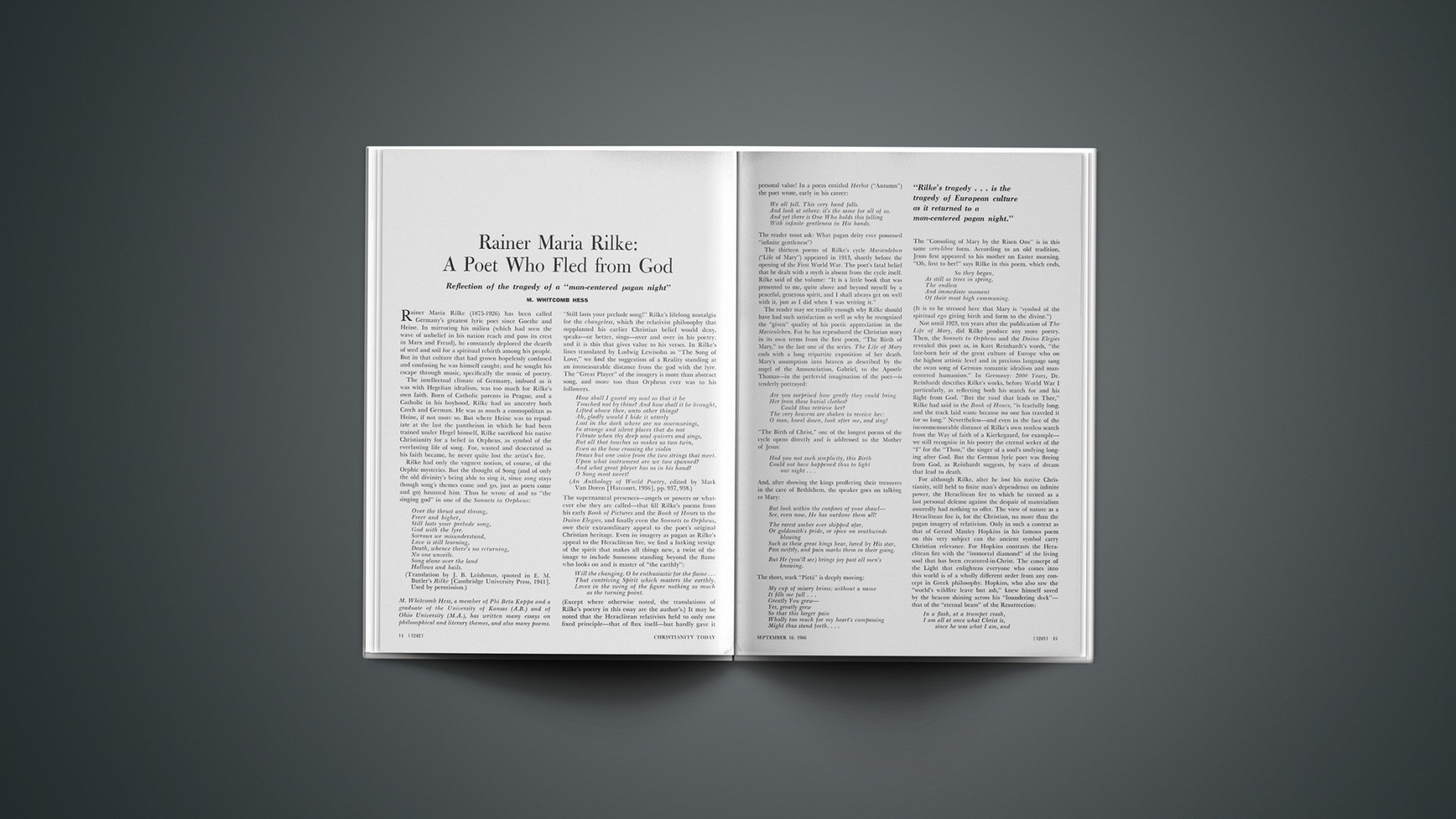
The immorality of Verwoerd’s death, most shocking assassination since that of President John F. Kennedy nearly three years ago, was almost overshadowed by the moral issue of racism which so characterized his life. Yet Dimitri Stafendis, the man accused as the assassin, was not part of South Africa’s oppressed black majority, but an immigrant of Greek descent from Portuguese Mozambique.

Early reports said Stafendis had complained that Verwoerd was doing too much for non-whites and not enough for “poor whites.” The 45-year-old bachelor was described as an avid Bible reader who repeatedly sought interpretation of divinely-sanctioned slayings in the Old Testament.

Verwoerd, who would have been 65 two days after the stabbing, was the son of a Dutch Reformed missionary who worshipped regularly at a Reformed church in Rondebosch, a suburb of the parliamentary city of Cape Town. He received significant support from the nine Reformed denominations, even though three of them belong to the World Council of Churches which has long opposed the apartheid (racial segregation) laws of the nation. His most visible antagonists were Anglicans and Roman Catholics.

The nation’s new leader will be chosen by Verwoerd’s Nationalist Party, which has a 3-to-1 majority in Parliament. A leading prospect was Justice Minister J. B. Vorster, 50, a man imprisoned for two years for pro-Nazi activities in World War II who implements the dizzying collection of segregation laws.

Verwoerd himself first achieved prominence as editor of Die Transvaler, organ of the then-minority Nationalists, as he backed Hitler to a degree and opposed South Africa’s participation in World War II.

The Nationalists assumed power in 1948, with Verwoerd as “minister of native affairs” and thus chief architect of apartheid.

The succeeding years made Verwoerd a symbol of political success through racism. His ideal was friendly but absolute separation of populations by race. The 12 million blacks would live on reservations that encompass 14 per cent of the nation’s land, while the 3.5 million whites held the rest. As part of this theory, he welcomed Chief Leabua Jonathan of Basutoland, all-black British protectorate within South Africa’s borders, four days before the assassination.

Under Verwoerd’s racial paternalism, millions were spent to make blacks stay apart. But economics tended to overcome this. Africa’s richest economy and need for low-priced labor caused thousands of blacks to pour into major cities.

Life for blacks under the policies Verwoerd created is hemmed in at all sides. Under the passbook system, a black needs various stamps to hold jobs, maintain residence, travel, or even live with his wife and children. Racial distinctions are based on as much geneology as can be mustered, plus superficial bases like kinkiness of hair or nose shape. Japanese (whose country is a major economic customer) are classed as “white” while East Indians are “Asians.” Stafendis might have heard that a Greek was recently refused entrance to the country because he had a deep sun tan.

In an August 26 cover story, Time characterized Verwoerd as “one of the ablest white leaders that Africa has ever produced. He has a photographic memory, an analytical mind and an endless capacity for work. He is a brilliant diplomat and an inventive politician.”

The full results of such abilities invested in the anachronistic cause of racial separation will only be known at the end of the current worldwide racial revolution.

Test For Voluntary Housing

Southerners returned to the U.S. Senate after Labor Day ready to filibuster the House-passed civil rights bill which includes federal compulsion for fair housing for Negroes.

For non-segregationists who have long given lip service to local, voluntary approaches to open housing, a key test begins this month in Chicago as churchmen, politicians, and businessmen implement a new racial accord.

The test is courtesy of Dr. Martin Luther King Jr., 37, the charismatic Baptist clergymen who got city leaders to join a ten-point racial program August 26 after threatening to lead a march into the hostile, all-white suburb of Cicero. Some more militant than King marched anyway September 4; the day was ugly, but not bloody.

“To King, it’s religion. To a lot of others in the movement, religion doesn’t mean a darn thing,” said a reporter who has covered the Nobel Prize winner in the South and Chicago. Some spout strategy, the observer said, “but you need religion to get them into the streets.” And King got the ghetto, even though some conservative Negro pastors sat on their hands.

Many credit religious leaders as being the third force which brought King’s coalition and the city establishment together. Since 1963, Protestants, Catholics, and Jews have cooperated in the Conference on Religion and Race, chaired by Episcopal Bishop James Montgomery. Prominent in the daily diplomacy last month was sunglasses-wearing Catholic Archbishop John Patrick Cody, who was tempered by years in the New Orleans maelstrom.

Under the accord, the Conference is now responsible for education and direct action on Negro housing. Specifically, it will set up housing centers by the end of this month where suburban realtors and homeowners can come into the ghettos and meet Negro customers. In a 2½-month pilot version this spring, only seven families were placed, but conference housing director Howard Smith, 36, a United Church of Christ minister, thinks even that is significant. The new centers, unlike the earlier versions, will have paid staff, not volunteers.

Graham Daughter Weds

Anne Morrow Graham became the bride of dentist Daniel Milton Lotz in an evening ceremony September 2 at Gaither Chapel of Montreat, North Carolina, College. The wedding was performed by the fathers of the bridal couple. Anne is the nineteen-year-old daughter of evangelist Billy Graham. Lotz’s father is a Baptist pastor on Long Island.

The bride wore a gown of candlelight peau de soie with a portrait neckline, long sleeves, and chapel train. Her full length mantilla was of Alencon lace. She carried a bouquet of white spray orchids and stephanotis.

The couple plans to live in Chapel Hill, North Carolina. Lotz, 29, is a six-foot-six-inch former basketball star at the University of North Carolina.

VIRGINIA SOMERVILLE

‘Minister Of Community Outreach’

A pair of Roman Catholic priests joined Protestant clergymen of five denominations to lay hands on American Baptist Ted Adams in Oakland, California, last month. Adams, 26, is a white member of the predominantly Negro Church of the Good Shepherd, affiliated with the American Baptist Convention. His first assignment will be as “minister of community outreach” for the new-this-year North Oakland Christian Parish.

The parish is an interdenominational, socially oriented effort operating out of a rented storefront. Its ministry is described as dealing in education of the poor, police-community relations, anti-poverty programs, welfare rights, minority employment, and low-income housing. Adams is given the role of “troubleshooter” in community social crises, as well as investigator of social complaints, group-action organizer, and ecumenical liaison man.

Parish spokesmen list among parish accomplishments so far the establishment of a “North Oakland Service Center” to draw federal funds through the anti-poverty program. The center’s announced aim is to look after fair city housing code enforcement and adjustment within parish boundaries.

EDWARD E. PLOWMAN

Is Cassius A Clergyman?

A New York lawyer who fought for hundreds of Jehovah’s Witnesses seeking draft deferments as conscientious objectors during World War II is now masterminding a similar legal battle in behalf of boxer Cassius Clay. While Clay was preparing to defend his heavyweight championship against Karl Mildenberger September 10 in Frankfurt, Germany, lawyer Hayden Covington announced a new strategy: Clay would ask to be excused from military service on grounds that he is a Black Muslim minister.

“This man has pursued the ministry of the Black Muslim faith since 1964,” said Covington.

He asserted that Clay, whose religious name is Muhammad Ali, was “appointed a field minister of the Muslim faith by Elijah Muhammad in 1964. He wasn’t ordained, as such, because that isn’t part of his faith.”

Clay has also sought deferment as a conscientious objector. But getting a deferment on those grounds would mean a two-year stint in service as a noncombatant or two years in civilian humanitarian employment. If Clay wins deferment as a clergyman he will be exempt from all obligations—and free to continue his lucrative boxing career uninterrupted.

Joseph Richard Sizoo

Joseph Richard Sizoo, one of America’s best-known clergymen and a highly acclaimed preacher, died last month at the age of 81.

Since 1952 Sizoo had occupied the chair of religion at George Washington University in Washington, D. C. He achieved prominence before that, first as pastor of New York Avenue Presbyterian Church in the capital, then of the Collegiate Reformed Church of St. Nicholas in New York City.

Sizoo was stricken with a heart attack in the vestry of Manhattan’s Brick Presbyterian Church moments after he had finished a guest sermon there on “How to Handle Doubt.” A doctor was summoned from the congregation, but the clergyman was pronounced dead on arrival at Doctors Hospital.

The Holland-born Sizoo also served for a time as president of New Brunswick (New Jersey) Theological Seminary and as a vice-president of the old Federal Council of Churches.

Other Deaths

ELMER T. CLARK, 79, World War I correspondent for the New York Herald Tribune who became 14-year editor of World Outlook and secretary of the World Methodist Council; credited with helping raise more than $100 million for Methodism; in Birmingham, Alabama, of a coronary attack.

LIONEL A. HUNT, 62, Canadian electrical engineer who led children’s evangelistic rallies part-time for 22 years, and full-time since 1956; in Toronto.

LEYMON W. KETCHAM, 51, director of development for Gordon College and Divinity School; in Boston, of cancer.


Book Briefs: September 16, 1966

The Church In American Society

Religion and Society in Tension, by Charles Y. Glock and Rodney Stark (Rand McNally, 1965, 316 pp. $6), is reviewed by $. Richey Kamm, professor of history and social science, Wheaton College, Wheaton, Illinois.

If a book can be both valuable and ambiguous, this volume is just that. It is valuable for its studied attempt to revive the scientific study of religion as a social phenomenon in American society. Viewed from this perspective, the early chapters dealing with conceptual problems in the social-science approach to religion as a social phenomenon are invaluable.

The ambiguities of the volume arise out of this studied attempt to follow a behavioral approach to scientific study. The use of the term “religion” suggests a concept of universal cognition. Actually, the authors indicate near the close of the volume that they have been concerned primarily with Christianity as practiced in America, an admission amply borne out by the data presented throughout the fifteen chapters of the study. The title is ambiguous in that it suggests a study of conflict between religion and social institutions. The entire thrust of the study is to show that, contrary to expectation, little tension exists between the organized church and American society.

The general reader will be most interested in Parts II, III, and IV, in which the authors seek to describe: 1) the role that the Church plays in American society and the internal tensions that characterize its institutional existence; 2) the role of the Church in social and political change in Western society; and 3) the tension between those committed to a religious framework of thought and those devoted to scientific inquiry in American communities.

Evangelical Protestants will not be surprised to learn that the major denominations are “undergoing a transformation of their theology towards an increasingly less orthodox and more secularized faith” (p. 84). Some evangelicals may be surprised to be informed that articulate groups of orthodox believers continue to remain in most of the major denominations. They will find their observations about the growing decline of Christian values in American culture increasingly confirmed by these studies. They will be forced to admit, however, that they share with their less orthodox brethren common problems concerning the role of the parish church and the work of its pastor.

The wide spectrum of theological belief now tolerated within most of the major denominations raises serious questions about the future of Protestant Christianity in America. The “New Denominationalism,” as the authors term it, fragments the very core of the Christian perspective. The pattern of belief is so diverse that to use the term “Protestant” as indicative of a unified religious viewpoint is to “spin statistical fiction.” The implications of such findings for the current ecumenical movement are intensely provocative.

The prophetic role of the Christian Church in society, conclude the authors, has largely given way to one of peacekeeping. This shift of institutional role from transforming agent to conserving institution has made it necessary for advocates of change to renounce church affiliation and to embrace one or more of the modern ideologies that seek to implement change. The evidence cited in this study in support of this generalization is the least acceptable of any given in support of pertinent findings. The strongest support for the contention that leadership in social reform has passed from the organized church is more clearly inferred from the concluding observation of chapter 14, which identifies the scientific scholar as the cultural hero—“the presiding genius of progress.”

Evangelical Protestants will be inclined to reject the general thesis laid down in this study; that religious experience is socially conditioned. They are too well schooled in the importance of historical forces and group tradition to accept the environmental explanation without qualification. Yet informed evangelicals will welcome the effort of Professors Glock and Stark to enlarge the theory of deprivation as the basis of religious group origins to include philosophical and doctrinal issues.

The concluding observation—that the growth of the scientific outlook, both natural and social, tends to restrict the role of organized religion—may be alarming at first reading. Religious leaders will do well, however, to recognize this state of mind in American society and plan their program of evangelization and church extension in the light of it. The authors of this study decline to be pessimistic about the future role of the Church. For, say they, if social science seems to narrow the role of free will in the life of a man or a woman, the very challenge that this presents to the Christian Church opens the way for a clearer understanding of the work of God in the life of men.

S. RICHEY KAMM

Catholic Scholarship’S New Look

Introduction to the New Testament, edited by A. Robert and A. Feuillet (Desclee, 1965, 912 pp., $15.75), is reviewed by Charles B. Cousar, professor of New Testament, Columbia Theological Seminary, Decatur, Georgia.

Protestants are naturally interested in the revival of biblical studies going on within the Roman Catholic Church, a revival that is an exciting feature of the “new look” of that communion. Are Catholic biblical scholars taking seriously the work of their Protestant counterparts? What relation do they have to the Pontifical Biblical Commission and its pronouncements? What do Protestants have to learn from them? Some answers are offered in this translation from the French of Introduction to the New Testament, which was edited by A. Robert and A. Feuillet and represents the best scholars of the French-speaking Catholic world (such as A. Tricot, X. Leon-Dufour, L. Cerfaux, J. Cambier, M. E. Boismard, and J. Bonsirven).

The book follows the usual format of New Testament introductions, with the added feature of a 150-page “conclusion,” which in effect turns out to be a rather full statement of New Testament theology (though the authors disclaim such a grand description). Each section of the book is preceded by a brief but helpful bibliography covering a wide area of concern, nationally, theologically, and ecclesiastically.

Leon-Dufour’s work on the Synoptic Gospels shows an amazing breadth and depth. A master at surveying varying positions, he deals appreciatively but discerningly with the work of the form critics and those seeking to solve the problem of literary dependence. He himself, however, offers a via media to the extremes of “everything is the effect of oral tradition” and “it is all the result of literary dependence.” He suggests that there was first a crystallized oral tradition that was systematized into written form as Aramaic Matthew. The authors of Greek Matthew (not a translation but an “adaptation of an Aramaic original”), Mark, and Luke had access to this source, which accounts for their similarities. Yet each also gleaned from oral traditions that had been modified in the various communities of origin, a fact accounting for the Gospels’ differences.

Such a position tends to downplay literary dependence and to emphasize the place of the community in transmitting and interpreting the data. Leon-Dufour has obviously learned his lesson well from the form critics. For him, however, the community turns out to be the holy Mother Church, which prevents any serious deformation of the original traditions.

Despite the clumsiness of the translation at times, the survey of the Graeco-Roman and Jewish worlds by A. Tricot, the study of Hebrews by J. Cambier, and the work on John by A. Feuillet and M. E. Boismard make this a book to stand beside Wiken-hauser’s as a major contribution to New Testament history and criticism.

CHARLES B. COUSAR

Jungle Church Planting

The Condor of the Jungle, by C. Peter Wagner and Joseph S. McCullough (Revell, 1966, 158 pp., $3.95), is reviewed by Donald McGavran, dean, School of World Mission, Fuller Theological Seminary, Pasadena, California.

This highly readable story tells of Walter Herron, an effective and colorful missionary who first went to Bolivia in 1933, lived a life packed with adventure, service, and achievement, was awarded “The Condor of the Andes” medal by the Government of Bolivia for his untiring humanitarian services, and in 1964 died in the line of duty. He worked in El Beni, the Amazon jungle that comprises the northeast quarter of Bolivia. Here this church planter and evangelist also established a leprosy colony and commended Christ to the leaders of the land.

The authors have written with enough detail to make their characters live. Circumstances of evangelical mission work in the frontier lands of Latin America, clashes of personality, and dangers of fire and wild beast, flood and fanaticism, are related vividly. Yet frustration, routine, and defeats provide the contrasting background needed to present a true picture.

Walter Herron, a dedicated Christian who trusted God, and loved the Word, wrote, “To reach these people of the Beni means suffering and sacrifice, but we who are soldiers of the King of Kings, must get to them with the Word of God.” He learned to see a fatherly providence in reversals and delays, tragedies and death. He won hundreds of souls to Christ and planted eight churches.

Herron was a pioneer and expert flyer whose planes added stature to his service. His courage and kindliness, his selflessness and good sense shine through the whole story. Here is a moving saga of missions. Read it with pleasure and give it to young men deciding how to invest their lives. It will kindle a responsive flame in many readers.

DONALD MCGAVRAN

Does Morality Require Autonomy?

A Defence of Theological Ethics, by G. F. Woods (Cambridge, 1966, 136 pp., $3.95), is reviewed by Gordon H. Clark, professor of philosophy, Butler University, Indianapolis, Indiana.

The author, professor of divinity at the University of London, addresses himself to a carefully restricted aim. Without going into metaphysics or theology, he considers only the moral challenge to Christianity. The challenge is that morality requires the autonomy of ethics, the autonomy of the moral agent, and is therefore inconsistent with the existence of God, or at least with the ideas of grace and immortality.

Toward the end of the book Mr. Woods makes the excellent point that secular ethics cannot explain the disappearance of autonomy in those cases where we know what we ought to do but have not the power to do it. Autonomy is also curtailed when we are unable to discover what we ought to do. These facts of experience are secularism’s great weakness.

Furthermore, the author defends ethics against the charge that the reward of a future life is immoral. Unfortunately, this section is a bit awkward, because Woods seems to agree with the secularists that morality must have no reward. He does a little better with the idea of grace as the creative, recreative, perfecting will of God.

By way of criticism: determination to keep the discussion within narrow limits allows the author to waste seventy-five pages warning us of the dangers of analogical language—a moral standard is neither a standing flagpole nor a literal yardstick. All this is as useless as it is obviously true. The same narrow limits prevent him from doing more than suggesting that theism is a more promising thesis than secularism. The main issues are not substantially considered.

GORDON H. CLARK

The Reality Of The Resurrection

Easter Faith and History, by Daniel P. Fuller (Eerdmans, 1965, 279 pp., $4.95), is reviewed by John H. Rodgers, Jr., assistant professor of systematic theology, Protestant Episcopal Theological Seminary in Virginia, Alexandria.

This book is difficult to review because of its comprehensiveness. First, there is an original study on the purpose of Luke in writing Acts. Since this book was also a doctoral dissertation in the field of New Testament, the reader can be assured that here he will find serious and significant New Testament exegesis (see chapter 7).

Second, Dr. Fuller presents a long section on the exegetical-dogmatic treatment of the role of historical evidence in theological argumentation as it has centered in the resurrection of Jesus. This covers the period from the Enlightenment to the most recent theological writings (see chapters 1–7) and shows an almost incredible amount of research by the author.

Third, there is the author’s overarching purpose, which is present in his critical and constructive remarks throughout the book and which comes to fulfillment and summary statement in the last chapter (8). The thesis of the book is that by starting with the historical evidence supplied by Luke in Acts, one can provide a logically compelling argument for the reality of the resurrection of Jesus by God the Father that only a fool or one in the grips of sinful blindness could refuse, and only at the price of irrationality. This is ultimately an apologetic concern.

Thus the author has put us in his debt in three areas: New Testament exegesis, theological methodology, and apologetics. I will attempt to make a few remarks about each of these areas.

First, in his exegetical work in Luke, the author contends that the five major emphases of Acts disclosed by both older and modern scholarship need to be related to one basic purpose in the mind of Luke, and that precisely here most recent interpretations of Luke fail, especially with regard to the purpose of chapters 20 to 28. The author believes that his interpretation of Luke explains his purpose better than any other yet advanced. What is this purpose? It is to give later Christians assurance of the resurrection of Jesus by showing that the Gentile mission as carried out by Paul, a Pharisee, and agreed to by Peter (both were good Jews) could not be explained by any other factor than the actual resurrection of Jesus and the presence in the Spirit of the Risen Lord. Thus the ongoing Gentile mission is the fulfillment of the resurrection and leads to “certainty” of Jesus’ resurrection. A careful reading of the prologue to Luke’s Gospel substantiates this in the mind of the author.

Whether or not the reader is convinced by all of Fuller’s position, he will have to admit that the author has shed great light on Luke’s use of the resurrection in Acts 20 to 28. I feel that Fuller’s position is somewhat restrictive and anachronistic. I wonder whether for Luke, who did not yet face Lessing’s “ugly ditch,” the certainty of which he spoke in the prologue did not refer to a firm, accurate account of the historical events of the ministry, life and death, resurrection, and ascension of Christ and to the events of God’s working in the early Church, more than to a proof of the resurrection. Did Luke even feel he needed to prove the resurrection of Jesus? Resurrection was not the problem then that it is in our naturalistic age. Also, I would like to see a fuller study of the Lukan use of the word “faith” to see whether it will bear the definition of resting in the rational evidences. A revised edition of this book might well include such a study.

Second, we can only be grateful to the author for his careful and well-presented survey of the theological, historical treatment of the resurrection of Jesus since the Enlightenment. This section alone is worth the price of the book.

However, I have two minor questions. First, why were the significant works of Adolph Schlatter, J. Gresham Machen, James Orr, and Walter Künneth omitted? If one is going to use historical investigation to justify the heavenly origin of Paul’s theology, who is more pertinent than Machen? And Orr’s study, The Resurrection of Jesus, is still of first importance, perhaps even more than ever now that naturalism is so strong.

My other question is whether the author is not too restrictive in his use of the phrase “no historical support.” Often the men considered allow historical evidence as part of the pattern of revelation, much like circumstantial evidence in a court of law. What the author should say to this is that they allow historical support but not compulsive proof. For example, two lawyers can argue from the same evidence in the light of different convictions or hypotheses about the guilt of the defendant. Each one seeks to “reveal” the truth.

Finally, while I agree with the author that the Christian reading of the biblical testimony to the resurrection of Jesus is literally true, I do not agree that faith rests solely upon empirical evidence. The empirical, historical data is part of a larger whole, of the Old and New Testament proclamation of the revelation of God that illuminates the evidence from a particular point of view. In my opinion, the historical evidence is a “sign” that points to and finds its true interpretation in Christian faith but does not rationally “compel” assent. Oliver Quick, in his book Doctrines of the Creed, has shown how a man can admit the adequacy of the historical evidence for the resurrection of Jesus and still not be a Christian nor even a theist.

I feel that Fuller moves toward this more broad epistemological basis for faith in God in Christ in the last part of chapter 7, when he discusses Barnabas. It was the changed life of Barnabas that gave credence to his Gospel. But this is no longer simple historical evidence. It implies some internal awareness on the part of those that saw Barnabas, and also a willingness not to let the disgraceful lives of some of those who professed faith in Christ destroy their faith in God’s revelation in Christ. (Please note that I have not attempted to reproduce the author’s arguments in these remarks.)

I consider this book a most significant study. It discloses the dogmatic air that so often accompanies a rejection of the resurrection of Jesus; it shows that much that claims to be new and advanced in contemporary theological skepticism is really “old hat,” repeated many times over; it shows that only a supernatural theism can do justice to the New Testament interpretation of the resurrection of Jesus; and it shows a new strand in the already strong historical evidence for the resurrection of Jesus.

Yes, the evidence can be denied, but only by a dogmatic presupposition that “It couldn’t have happened.” And if the resurrection is accepted and interpreted in the light of the Old and New Testament testimony, cannot any man in repentant faith claim the promise that He will come and dwell within as Lord and Saviour? In the light of the Christ who indwells in the Spirit, the evidences glow as tokens and signs of God’s love and care, given at a cost beyond measure.

To read this book is to be refreshed and provoked to deeper thoughts. I recommend it highly.

JOHN H. RODGERS, JR.

No Concentric Circles

Circles of Faith: A Preface to the Study of the World’s Religions, by David G. Bradley (Abingdon, 1966, 240 pp., $4.50), is reviewed by Leonard T. Wolcott, professor of missions, Scarritt College for Christian Workers, Nashville, Tennessee.

Are different religions merely different paths to the same ultimate truth? Can they be harmonized?

Many books on world religions are being published, and not a few of them are superficial “collections of ethnological curios.” Some lay a sentimental stress on apparent similarities in religions. In Circles of Faith Dr. David Bradley, professor of religion at Duke University, looks at the differences in world religions. Trained in biblical theology, Dr. Bradley ponders the basic concepts of his and other religions. Each religion has unique teachings whose uniqueness grows out of the presuppositions that are peculiar to each religion. “The basic axioms for each of these world views,” Bradley writes, “are irreconcilable with those of others.”

His thesis is that a person who tries to understand a religion other than his own tends to interpret it from his own “circle of faith,” to identify its concepts from the point of view of his own religion’s basic assumptions about God, man, the cosmos, salvation and so on. To correct this tendency, the author suggests that we attempt to understand the teachings of each religion in terms of that religion’s own “self-evident presuppositions.” In this “preface to the study of religion,” Bradley examines each major religion’s assumptions about God, salvation, ethics, and human destiny, as well as the “founders” and outreach of each religion. The “circles of faith” of different religions may partially overlap but they never coincide, since their centers differ widely. The larger overlappings are within the three groups: religions from biblical lands, religions of India, those native to China and Japan.

Such a brief study as this unavoidably oversimplifies its description of religious beliefs. This the author readily acknowledges. He does not examine the ramifications of basic religious ideas, nor the tendency among adherents of all religions to cling to primitive religious holdovers. He does not discuss the influence of modern secularism and syncretism on the circles of faith. Nor does he consider the possibility that many people’s basic religious assumptions may actually be closer to the normative circle of faith of some other religion than to the classic expressions of the religion with which the people are associated.

As a “preface to the study of religion,” however, the book is to be recommended as a companion to any textbook on world religions. It will serve as a useful corrective to the popular presentations of world religions as assorted pathways to one God. It will also stimulate a more careful evaluation by the reader of his own religious assumptions and of the true nature of each world religion.

Intercommunication with other religions can be found only, the author reminds us, as we honestly examine the deep differences that separate us from them and the presuppositions that make for these differences.

LEONARD T. WOLCOTT

The Pressures Of Confinement

Shantung Compound: The Story of Men and Women Under Pressure, by Langdon Gilkey (Harper & Row, 1966, 242 pp., $4.95) is reviewed by Ernest Gordon, dean of the chapel, Princeton University, Princeton, New Jersey.

In this book Langdon Gilkey, professor of theology at the University of Chicago Divinity School, tells of his experiences in a Japanese internment camp during World War II. For 2½ years he lived in this prison compound along with 2,000 others—men, women, and children. Compared with Japanese prisoner-of-war camps, this compound was almost ideal. The administration was relaxed; the guards were not brutal; the rations, though meager by American standards, were adequate by most others; housing was crowded but not impossible; and tortures, enforced slave labor, and segregation of the sexes were not practiced. In so many ways it could have been the scene of a developing Christian community.

What marked this compound society as different from that of Main Street, U. S. A.? It was the awareness of confinement. Men are all confined, controlled, and circumscribed, but they seldom realize it. The author, in a quiet, reflective way, sees this particular circumstance of confinement as a laboratory for the study of human behavior. During his confinement he was able to keep a journal out of which he has constructed this book.

The way of life of the 2,000 internees was the way of life of all men, give a little and take a little. They acted in ways that were not particularly bad, yet not particularly good. They did what men do daily in prosperous society and think nothing of. The difference was that there and then in the Shantung Compound the evil was more noticeably evil and the good more noticeably good. The psychological avenues of escape were more limited. The situation was more consciously constant, and the conditions of confinement more evident. The question was thus more obvious: “How do men live in their confinement, their prisonhouse of freedom?”

The young American teacher who had been nourished on a diet of nineteenth-century liberalism and academic abstractions soon lost his faith in man as a reasonable, rational, and nearly divine being. He had to live with people as they are, and not as they appear to be in the mind of a dreaming idealist. He found his colleagues to be full of contradictions. They chose to do what suited their self-interest; yet at the same time they went to great lengths to justify the rightness of their deeds. The believer and the unbeliever were equally guilty. “Me first, at all times, and at all costs” was the unspoken slogan that controlled the compound, causing jealousy, hatred, and division.

The reader may well find himself asking what he would have done had he been there. What would he have done, for example, if his country had sent a large consignment of food parcels for U. S. citizens? Would he have urged that they be shared with those of other nationalities, or insisted that they be kept by the U. S. citizens for purely legal and moral reasons?

Young Gilkey learned that men have an enormous capacity for doing the wrong things for what they presume to be the right reasons. They lack, however, the capacity to do what they know to be right. Of this discovery St. Paul had already written with searching insight in Romans 7:7–25.

The understanding of the true nature of men indicated the wisdom of the rule of law, for by this rule men were saved from themselves and their own demonic freedom. Law democratically conceived and executed seemed to suggest part of the answer to the human contradiction. By the democratic process, men are reminded that those they blame for society’s ill are their elected men, representing them for what they are, both good and evil.

The compound, despite its need of law, was not without the signs of grace, grace that came illogically through unlikely agents. Along with the mysterious working of grace was the working of Providence—God present in creative power at unexpected times in strange situations to redeem the moments of human folly.

Perhaps Professor Gilkey could have told us a little more of the sacraments of grace and the distinction between the believer’s and the unbeliever’s understanding of them, or of the ways in which the missionaries witnessed redemptively to the leadership of Jesus Christ, or of the new understanding of sin and grace granted by the Gospel that in turn demonstrated the relevance of the Gospel to the human circumstance. But at least he has told us enough to help us realize that the Church must always be reforming and always relevant. The arrant individualism of Protestantism may have contributed greatly to the rise of economic affluence in the good old U. S. A., but it was conspicuously ineffective in the Shantung Compound. The Roman Catholic missionaries had more to offer the inmates of the compound in the matter of how to live as sinful people with sinful people. The communal discipline of the monks and their understanding of the life in common had a distinctly more Christian ring.

Professor Gilkey’s book is yet another dealing realistically with the authentic human situation as it is experienced in a compound of confinement. Perhaps one of these days our theologians will take such literature seriously and consider the claim of the transcendent God, who enables the prisoners of life to transcend the limitations of their imprisoning environment.

ERNEST GORDON

Inside The Religious Press

Across the Editor’s Desk: The Story of the State Baptist Papers, by Erwin L. McDonald (Broadman, 1966, 128 pp., $1.50), is reviewed by David E. Mason, associate director, Laubach Literacy, Inc., Syracuse, New York.

Erwin L. McDonald, able editor of the Arkansas Baptist Newsmagazine, opens the door and admits the reader to the inner circle of those who know the ins and outs of the religious press. Intimately, informally, and with gentle humor, the editor chats frankly about the joys and frustrations of his ministry.

Although Across the Editor’s Desk is specifically the story of the Southern Baptist state papers and magazines, its contents can be applied to the religious press as a whole. Beginning with the answer to “What does an editor do, anyhow?” the author proceeds to discuss criticism, readers’ expectations, and the past and future of the press.

Since there is a dearth of books on the religious press, this little volume is particularly welcome. The world is becoming smaller. Everyone’s concerns reach far beyond his local community, and so the function of the press is constantly expanding. Reaching beyond the limits of a local pulpit, the printed word can inspire, inform, and persuade a constantly growing “congregation.” In this informative book the author takes a subject that ordinarily would have limited reader interest and presents it in an interesting and inspiring manner. It can help both minister and layman respect and appreciate the press.

McDonald speaks forthrightly on a number of significant issues—particularly in his chapter “In Glass Houses,” where he discusses the handling of controversy. His style is fresh, light, and fast-moving. He has done an excellent job of selecting brief and pointed anecdotes to liven the text. The pace of the book slackens only in the latter chapters when he quotes freely from other editors and somewhat dilutes the force of his own stream of thought.

Across the Editor’s Desk is one of a series of books in the Broadman Readers Plan—a “book-of-the-month” type of program initiated by Broadman Press two years ago.

DAVID E. MASON

An Act Of God

The Meaning of Salvation, by E. M. B. Green (Westminster, 1966, 256 pp., $4.50), is reviewed by E. Earle Ellis, guest professor of New Testament, New Brunswick Theological Seminary, New Brunswick, New Jersey.

With the general Christian public in mind, the author examines a number of terms used to express the biblical writers’ views of salvation. He devotes two chapters to the Old Testament, two to the first-century world, and six to the New Testament. The volume concludes with an application of the biblical data to three current issues: spiritual healing, universalism, and the perseverance of the saints.

Michael Green, tutor and registrar of the London College of Divinity, is not only a writer but quite clearly a preacher as well. His competent and lucid survey is not infrequently combined with edifying commentary designed to make the biblical message come alive in modern idiom and practical application. Although Calvinists will question some of the theological presuppositions (e.g., pp. 234 ff.), one can heartily agree with the major thrust of the book. Salvation is the act of God in the context of history, dependent on neither works nor cult. Thus, also, there is “no justification whatever for the disjunction between the physical and the spiritual … that has long typified the Church doctrine of salvation” (p. 120).

Yet it is just here that the reader wonders whether these insights are always properly applied. Two examples of this may suffice.

First, Green rightly avoids a radical dichotomy between prophetic and apocalyptic strains in the Jewish hope of salvation. Nevertheless, following the schema of T. C. Vriezen, he at times associates future eschatology with a transcendental goal, a “life beyond,” divorced from time and history (pp. 102, 182 ff.). This leads him to the conclusion that for Paul “nakedness” (2 Cor. 5:3) was a disembodied existence from which he shrank but was, at the same time, “far better” (Phil. 1:23).

A second example may be found in the engaging topic, salvation and healing. Green has some good cautions to raise about the practice of healing in the Church today. Certainly he is correct in opposing the unthinking and unbiblical view that abstinence from medicine is an evidence of faith (p. 223). Certainly, too, Christ gives one Christian to be a “sign of the Cross” in sickness even as he gives another to be a “sign of the Resurrection” in healing: no Christian can choose either sign as his right. However, the author’s theme would have been better served had he accentuated the positive, the meaning of the Holy Spirit’s healing activity, e.g., as “the proleptic deliverance of the body” (Cullmann).

Despite such questions, however, this well-documented volume will be an informative addition to the library of pastor or student.

E. EARLE ELLIS

Work Or Vocation?

Theology of Work, by Edwin G. Kaiser, C.PP.S. (Newman, 1966, 522 pp., $10.50), is reviewed by Sherwood E. Wirt, editor, ‘Decision,’ Minneapolis, Minnesota.

This careful piece of scholarship, written within the framework of the Roman Catholic Church, provides a solid groundwork for a study of man’s work. The author distinguishes between work and labor and presents generally a Catholic picture of work as a virtuous undertaking of man, ordained by God, for the blessing of the social order.

There are some well-documented discussions of slavery, ancient and modern. The slave-owners’ total subordination of human considerations to economic necessity is starkly brought out. There are also important treatments of the strike problem, of automation, and of featherbedding. No easy solutions are offered, but heavy emphasis is placed upon the teaching of the papal encyclicals.

As a son of the Reformation, I am amazed that such a thoroughgoing study of the nature of man’s work could so completely ignore the concept of vocation. I realize that the vocatio in classic Roman theology is limited to the “religious,” but surely in recent years there has been a loosening of this rigid application.

The Reformation took the concept of God’s call to a life mission out of the monastery and released it to provide joy in a man’s daily stint, because in that stint the worker is called to serve and glorify God. There are a good many theological questions connected with the linking of work with vocatio, and there is need for a fresh restatement of the problem. But as long as work and vocation are separated, our understanding as Christians of the nature of man’s work remains impoverished.

SHERWOOD E. WIRT

Book Briefs

Facts and Faith, Volume 1: Reason, Science and Faith, by J. D. Thomas (Biblical Research Press, 1965, 302 pp., $4.95). A popular presentation prepared particularly for students.

A Comparative Study of the Old Testament Text in the Dead Sea Scrolls and in the New Testament, by J. De Waard (E. J. Brill, 1965, 101 pp., 25 guilders, also Eerdmans, $10).

Preaching and Community, by Rudolf Bohren, translated by David E. Green (John Knox, 1965, 238 pp., $4.95). A stimulating and hard-hitting discussion of the nature and purpose of preaching.

God Beyond Doubt: An Essay in the Philosophy of Religion, by Geddes MacGregor (Lippincott, 1966, 240 pp., $3.95). An apologetic discussion of the reality of our experience of God; not always biblical but always provocative.

A Jew in Christian America, by Rabbi Arthur Gilbert (Sheed and Ward, 1966, 235 pp., $4.95). A warm, kindly, and eminently irenic discussion of Jewish and Christian beliefs and relationships.

A History of Christian Thought, Volume II, by Otto W. Heick (Fortress, 1966, 517 pp., $7.75). This extensive revision of J. L. Neve’s book will be of value to students of theology, especially Lutheran ones. Some readers will react to the “Christ died for all men reading of the Canons of Dort,” and T. F. Torrance will probably react to the book’s assertion that he died in 1913.

The Old Testament in Modern Research, by Herbert F. Hahn, with a Survey of Recent Literature, by Horace D. Hummel (Fortress, 1966, 332 pp., $2.75). An attempt to suggest the main trends of Old Testament research in order to show the effect of each approach upon the interpretation of Old Testament religious history.

A History of Early Christian Literature, by Edgar J. Goodspeed, revised and enlarged by Robert M. Grant (University of Chicago, 1966, 214 pp., $5.95). Recent discoveries and fresh studies of older works are used to advantage in this study of writings from the time of the New Testament through the early fourth-century Fathers.

Paperbacks

Composition and Corroboration in Classical and Biblical Studies, by Edwin Yamauchi (Presbyterian and Reformed, 1966, 38 pp., $.75). An expanded revision of a paper read at the twentieth Annual Convention of the American Scientific Affiliation.

Take Hold of God and Pull: Moments in a College Chapel, by Calvin Seerveld (Trinity Pennyasheet Press, 1966, 173 pp., $2.50). Fresh and colorful devotional essays.

The Christian Confrontation with Shinto Nationalism, by Kun Sam Lee (Presbyterian and Reformed, 1966, 270 pp., $3.75). An analysis of the history of Shintoism and its confrontation with Christianity.

Biblical Separation Defended: A Biblical Critique of Ten New Evangelical Arguments, by Gary C. Cohen (Presbyterian and Reformed, 1966, 83 pp., $1.50). A critique of “cooperative evangelism,” specifically as defended in Robert O. Ferm’s Cooperative Evangelism: Is Billy Graham Right or Wrong?

A Manual of Simple Burial (Third Edition), by Ernest Morgan (Celo Press, 1966, 64 pp., $1). A discussion of the needs and problems of families at the time of death.

Charles Williams: A Critical Essay, by Mary McDermott Shideler (Eerdmans, 1966, 48 pp., $.85). A competent author deals with the extraordinary Williams.

Herbert W. Armstrong and the Radio Church of God, by Walter R. Martin (Christian Research Press, 1966, 31 pp., $.60). A critique of the theology of H. W. Armstrong’s Anglo-Israelite theology and an exposé of its errors and heresies.

God’s Truth Made Simple, by Mrs. Paul Friederichsen (Moody, 1966, 256 pp., $.89). Just what the title claims.

Marriage and Family Among Negroes, by Jessie Bernard (Prentice-Hall, 1966, 160 pp., $1.95). A study of the Negro family that will help to correct some current and widespread misconceptions about Negro family life.

Christianity and African Education: The Papers of a Conference at the University of Chicago, edited by R. Pierce Beaver (Eerdmans, 1966, 233 pp., $2.65).

Reprints

Grace Abounding and The Pilgrim’s Progress, by John Bunyan (Oxford, 1966, 412 pp., $7). A fine scholarly edition of John Bunyan’s two greatest works with a brief but enlightening introduction. Especially helpful are its indexes to the contents of these two enduring Christian classics. Its publication this year, the tercentenary of the first edition of Grace Abounding, is appropriate.

Utterly Foolish!

A ship sets sail across the ocean. It carries neither pilot nor compass. What would you say of the owner and of the captain of the ship?

A plane starts a flight across the North Pole. There is no navigator on board and no way to chart the course. One would rightly question the sanity of the crew.

A man starts to drive across the United States. He does not provide himself with road maps, nor does he ask anyone what route to take. He would almost certainly take the wrong roads.

A man becomes acutely ill. Neither he nor his family will call the doctor, nor will he take any medicine. What would one think of such people?

A soldier goes into battle. He takes with him neither gun, nor ammunition, nor any kind of weapon with which to attack the enemy or defend himself. He would be a very foolish soldier.

A student enters a classrom to get ready for an examination. He puts cotton in his ears so that he cannot hear the teacher and closes his eyes so that he cannot read his books. He would well deserve a “dunce cap.”

A physician goes into surgery to operate on a patient but refuses to use the necessary instruments. Would you want him to operate on you?

A lawyer goes into court to defend a client, but he does not know the points of law involved, nor can he argue the case. What would people think of such an advocate?

The owner of a large store has no inventory of his stock, nor does he know the cost of the items on the shelves. Failure in business would inevitably be his lot.

A motorist driving at night refuses to turn on the lights. Can you figure him out?

A carpenter attempts to build a house, but he will not use a square, saw, hammer, or plane. What kind of a house can he build?

A house is wired for electricity, and all the fixtures are in place. But the owner refuses to turn the switches for either light or power. Only one deprived of his senses would act so foolishly.

A man is walking down a dark road at night. He does not know the road. He has in his hand a flashlight that he will not use. What would you think of such a person?

A bridge is washed out, and the highway patrol sets up warning lights and a barricade. A motorist refuses to stop and crashes to his death. Who was to blame?

One’s natural reaction to these imagined absurdities is: Only a fool would act like that.

The world is full of fools, men and women who are ignoring the only Book that contains the chart and compass for living and for dying.

The Bible above all else tells us of the Pilot of our souls, the Redeemer from sin, the One who is the Way, the Truth and the Life, the only Saviour of mankind.

This Book gives us a map of the past, the present, and the future. By it alone can history be understood, and today’s news explained, and tomorrow’s events evaluated.

Much is being said today about man’s moral and ethical responsibilities, but unless these are based on the teachings of God’s written Word they are futile. It is because men have left (or never known) true Christian ethics that they now talk of “situational ethics”—do what you consider right under the circumstances in which you find yourself.

We are engaged in a daily battle with Satan. Only in the Bible do we learn of his methods, his plans, his ultimate destiny, and the way to gain victory over him.

Books on psychology and on human personality and behavior are legion. But only in the Bible do we learn the underlying issues of life and how to meet them.

In our day, moral and spiritual values have lost their meaning for many. Our generation has largely cut loose from its moorings and does not know where it is going or what to do. The concepts that are based on the rightness or wrongness of behavior are largely lost and cannot be replaced by mere human philosophy.

In the Bible we find a clear statement of the values that are based on God’s holiness. There we find an anchor for the soul in terms the Spirit interprets. There we are confronted with the situations of everyday life and told how God would have his children act.

The Psalmist, extolling the blessings of God’s Word available to all who will believe and obey, says: “Thy word is a lamp to my feet and a light to my path” (Ps. 119:105). Has there ever been a time when men needed light for daily living more than today? To ignore this divinely given light is a crime against our own souls. In this same psalm we read a prayer that should be voiced constantly by every Christian: “Keep steady my steps according to thy promise, and let no iniquity get dominion over me” (v. 133).

The foolish persons described at the beginning of this article should make each of us consider his own attitude toward the Bible. If we are neglecting it, we are doing so to our eternal loss and our daily confusion. For without God and the revelation he has given us of how we should live and what we should do, we continue as blind fools, willfully rejecting the light. We may be advanced in every form of knowledge. We may master multitudinous scientific facts and be aware of the many ramifications of human wisdom. But only by the Bible do we find the searchlight of the Spirit revealing our own hearts and at the same time showing us the way in which we should walk.

In the Bible we learn how to be saved. Paul told Timothy that it was the Holy Scriptures that are able to make us wise unto salvation, for there we find the Christ. For each of us there must be a personal experience with the living Christ, but with that experience there must be an understanding of who he is, of his Person and Work. Others may expand and interpret the meaning to us; but in the Bible, by the Spirit, we meet him face to face.

We should be trained soldiers, knowing how to use the Sword of the Spirit; enlightened guides, able to teach others the unsearchable riches of the books. We should be wise with a wisdom from above, thereby distinguishing between the true and the false.

The satanic question, “Yea, hath God said?,” is still heard today. Those who are wise will let the Bible speak for itself.

Those who reject or neglect the Word are foolish indeed, for “the unfolding of thy words gives light; it imparts understanding to the simple” (Ps. 119; 130).

L. NELSON BELL

Red Guards Spur Attack on Christian Remnant in Communist China

The Christian witness in Asia remains a powerful force as Communism depends on violence for security

The emergence in Communist China of the youthful Red Guards as strong-arm promoters of an anti-Christian “cultural revolution” is an ominous sign reminiscent of the Nazi youth movement of the Hitler era. Targets include leaders of the Christian community whose presence in China antedates the Communist regime.

What this development clearly indicates is that Communist “tolerance” of Christianity must never be confused with “religious freedom”—despite propaganda assurances. Moreover, it exhibits to all the world that Communism cannot really make headway against Christianity in a free society but must rely on violence, repression, and suppression for the entrenchment of its ideas.

China is now in the throes of a major crisis after which she will never be the same again. If a more militant regime emerges, there will be increasing trouble in the border areas of Russia, India, Viet Nam, and Thailand, with the classic maneuver of using a supposed external threat in order to unite an increasingly restless people. If a less militant regime emerges, there will be dramatic changes in China’s attitude toward Russia, Southeast Asia, and the United States—after the Soviet example.

The pattern that has developed in Asia is of new nations, large and small, that are extremely sensitive, intensely nationalistic, very desirous of rapid economic development without external interference, highly suspicious of the West, and even more suspicious of a militant Chinese Communism. It is very unlikely that they will choose Communism (although it could be forced on some of them), but the majority will without doubt be nationalist-socialist in emphasis.

Where does the Church fit into all this? With the acceleration of political events, plus the intensifying of the militant forms of regional religions (Arya Samaj Hinduism in the increasingly popular Jan Sangh party in India; the popularity of the new politically participating Buddhists in Ceylon, Viet Nam, Thailand, and Burma; the spectacular rise and spread of the Soka Gakkai Buddhists in Japan; the politically powerful attraction of Islam unity in Pakistan, Indonesia, Malaysia, and the Philippines), there is no longer any doubt that missions as they have existed in Asia will be eliminated in the next ten to twenty years.

But it is also noteworthy that in Communist China, amid the most oppressive form of national-socialism, the Church not only has survived but is spreading—to the point of causing considerable concern to the Communist leaders. During the past two years newspapers and journals have carried widespread public debates on religion. In this highly regimented society, where the lives of the people are organized and scrutinized at every level, officials are still forced to admit that there are “underground home congregations,” “unpatriotic elements who hold religion above the state,” “counterrevolutionaries with reactionary religious beliefs” (a term usually applied to “fundamentalists”), and so on.

Despite fifteen years of suppression, persecution, discrimination, and ridicule; despite the regime’s complete control of all communications media, as well as its absolute powers in education and employment; despite the isolation of the churches from outside help—still the Church in China has continued to grow both in numbers and in influence. What has happened there could have a tremendous influence, not only in Asia but elsewhere, if the information were collected, sifted, and distributed. Some facets of this story will be told in George N. Patterson’s forthcoming volume on Christianity in Communist China.

Christian nationals of several Asian countries are realizing more and more that they should begin to prepare for personal witness for Christ without dependence on outside sources. This does not mean that they are becoming anti-Western (although there is more of this than missionaries and their churches in the West generally realize) or isolationist through fear of the possible consequences of association, such as happened in China. Rather, it means that national politics and circumstances are forcing them into “equality of co-existence” at all levels, including religion. The churches are realizing that they must support themselves as well as govern themselves.

The important contribution that the Church in the West can make to the Church in the East now and in the future lies, Mr. Patterson thinks, in communications—literature, radio, and possibly television (Japan is investing millions in the belief that mini-TV sets will be as popular as transistor radios in the next ten years)—rather than in the hospitals, schools, and churches of the past century.

In the special providence of God, evangelization seems to be taken care of by word of mouth, Scripture distribution, and radio broadcasts. What is desperately lacking (Catholics and Protestants agree on this) is teaching that nourishes the believers. Patterson’s recent research revealed that Jesuit and Franciscan fathers who collect and sift information from China acknowledge that broadcasts of the Voice of Manila (the Far East Broadcasting Company) into China are effectively sustaining faithful Catholic believers, as well as Protestants.

But the bulk of the best Christian writing and teaching in the West circulates only in the West, and there is nothing of any depth available in most of the East. And, except for some of the writings of Watchman Nee, the best of what has given such a distinctive character to Christian witness in the East, especially China, is not circulating in the West.

If there is to be a really constructive fellowship among the members of the Body of Christ in both East and West, with a two-way flow of benefit, then there will have to be a greater concentration on the development of communications.

‘Up With People’

Wearied by the brash utterances and unrestrained antics of Beatles, Vietniks, and black-power mongers, the spirit of many people was lifted and their confidence in today’s youth reaffirmed as one hundred clean-cut, enthusiastic college-age young people sang out for morality, freedom, and patriotism on the recent network telecast, “Up with People.” Rejected by CBS as ideological entertainment but accepted without prejudice by NBC, the Moral Re-Armament—produced “Sing-out” was as well received on television as it has been in community and campus presentations across the country. It utilized the current musical idiom of folksong harmony, guitars, and message lyrics to convey such convictions as:

Freedom isn’t free,

Freedom isn’t free.

You gotta pay a price,

You gotta sacrifice,

For your liberty.

and:

You can’t live crooked and think straight,

Whether you’re a worker or a Chief of State.

Clean up the nation before it’s too late,

’Cos you can’t live crooked and think straight.

These youths who, said host Pat Boone, “don’t make the papers—they make the country,” are typical of millions of young Americans determined to dedicate their lives to goals greater than immediate pleasure and material success. In the pursuit of purposeful and responsible lives, they desire to commit themselves to lofty ideals, as exemplified in the themes of the MRA sing-out troupe.

To the nation’s youth, the Church of Jesus Christ must realistically offer not just a code of ethics but the living Lord and Redeemer of mankind, who alone can bring meaning and wholeness to life and provide the power to live as free and moral men. As the “Up with People” record jacket relates, many young people “are detonating the myth of a soft self-indulgent and arrogant America, demonstrating an American enthusiastic in his sacrifice and sweat to help create a better world, ready at the drop of a hat, night or day, to stand up for what they believe in and to … sing out!”

Our youth are on the march as never before. Let us confront them with the Christ who alone can keep them singing—with or without guitars. And let our networks continue to give wings to their songs, not only as they lift their voices for liberty and noble ideals, but also as they sing of their faith in Almighty God.

A Worthy Proposal

In three summer issues of the Sunday School Times, Editor James Reapsome presented a proposal that might lead to major advances in the evangelical Sunday school. Taking as a parallel the recent Wheaton Congress on the Church’s Worldwide Mission, he called for a congress at which Sunday school leaders (publishers, professors of Christian education, denominational executives, pastors, and directors of Christian education) would face the desperate plight of the Sunday school.

This kind of gathering, says Reapsome, would deal with such matters as “finding living words for communication,” planning “educational programs for children that will take true account of family influence,” providing “education for adults as well as for children,” helping teachers to a sound knowledge of the faith, and aiding lay people “in corporate worship as well as in private devotional exercises.”

A conference like this ought to have the highest priority in evangelical strategy. While the National Sunday School Association has helped strengthen the Sunday school, this essential arm of the Church is still in deep trouble. For Protestantism by and large—and much of evangelicalism comes under this condemnation—the root of the trouble lies in a biblically illiterate laity. Adult Christian education through the local church must be expanded as rapidly as possible, if the Sunday school is to progress beyond its present pattern of too little instruction and much of that incompetent. Today public and independent education have risen to levels far higher than those of even twenty years ago. No longer will the hourly period for Sunday school instruction do. Bold, imaginative rethinking is needed.

At a time when major denominations are cooperating in Christian education, and an important study (The Church’s Educational Ministry: A Curriculum Plan) has been produced by the Cooperative Curriculum Project under the auspices of the National Council of Churches, evangelicals ought to work together to expand their horizons of Christian education.

The editor of the Sunday School Times has made a proposal that holds great promise for the evangelical Sunday school; we gladly support him.

Isolated From The Church?

One criticism of the missionary groups that met at Wheaton in the Congress on the Church’s Worldwide Mission was that they did not overcome their “isolation from the Church.” Many, particularly in ecumenical circles, are fond of this kind of accusation.

Admittedly, evangelicals, especially missionary-minded evangelicals, have sometimes made the mistake of not waiting for a denominational directive but of going out into new territory for no better reason than that there are heathen waiting to be evangelized and that official church agencies are not reaching them. This is not good enough for some ecclesiastical bureaucrats. Anyone attempting a task without denominational permission may run the risk of being rebuked.

All this provokes questions. How does a group of devoted church members, actively engaged in the Church’s primary task, become “isolated from the Church”? In such a context, what does “isolation from the Church” mean? Is it anything more than isolation from the ecclesiastical bureaucracy? It is time someone asked the ecumenical critics of evangelicals, “What is this ‘Church’ from which some evangelical missionaries are isolated?”

There is a great readiness to confuse the Church with institutional denominationalism. But the two are not the same. The New Testament knows nothing of institutional denominationalism. It indeed provides for the order of the visible church. It knows the people of God, the body of Christ, the bride of Christ, the household of God. It speaks of believers, of the elect, of those “in Christ,” and much more. It sees the Church as a band of redeemed and committed men and women in whom the Spirit of God dwells.

We are not, of course, advocating ecclesiastical anarchy. No one would claim that any individual Christian is at any time free to do anything he likes and to regard what he does as an official church activity. But we are concerned, and deeply concerned, at the prevailing tendency of some church leaders to disown everything that does not emanate from ecclesiastical officialdom. It is important to remember that the New Testament equates the Church with all the people of God.

The New Testament Church acted responsibly and in line with biblical church structures, avoiding the tendency to abuse legitimate authority by usurping prerogatives that belong to the Holy Spirit rather than to human officials. It was in obedience to the Holy Spirit that the “prophets and teachers” heeded the call to “Set apart for me Barnabas and Saul for the work to which I have called them.” At the first Church council in Acts 15 the decisions of the council were prefaced by the words: “It seemed good to the Holy Spirit and to us …” (Acts 15:28). Men become ecclesiastical bureaucrats when they arrogate to themselves power or authority to control men to whom the Holy Spirit may have been speaking in a different way.

From the Bible (or for that matter from ordinary common sense) it ought to be clear that the Church is people—not a bureaucracy, not clergy, not denominational leaders. It is the community of the redeemed. It is the family of God. Those who are so critical of some evangelical members of the body might profitably reflect that “the body does not consist of one member but of many.… The eye cannot say to the hand, ‘I have no need of you,’ nor again the head to the feet, ‘I have no need of you.’ ” (1 Cor. 12:14,21).

Let it be said with the utmost plainness that the humblest worshiper is just as much a member of the Church as is his pastor. Lay Christians who get together and decide, under the leadership of the Holy Spirit, to evangelize lost people about whom some denominations are doing nothing do not thereby excommunicate themselves. They remain in the body. They are church people, members of the household of God. To say that church people doing the Lord’s work in an independent mission, for example, are “isolated from the Church,” is a questionable judgment.

Southern Baptist Campus Evangelism

Southern Baptists are one of the fastest-growing denominations in the world. The secret of their expansion has been evangelism. Yet the cause of evangelism among Southern Baptists has lagged on the college and university campuses, their own included, with the result that church-related schools are graduating thousands of uncommitted students annually. This does not hold high promise in an age when young intellectuals soon become a formative influence.

It is often said that Texas culture is Baptist-tinted. The ten Baptist institutions of higher education in that state enroll 20,000 students. Southern Baptists engage fifty Baptist Student Union secretaries in Texas alone, and expend $1 million a year to support them in evangelistic endeavors. Last year they reported only 200 professions of faith. The inferences to be drawn from this are not entirely clear, but this meager number of commitments to Christ has become almost routine in BSU reports. Southern Baptists had better take a long, hard look at what this implies for the future.

A Nationwide Disaster: Alcoholism

“There’s little doubt that a disease so serious and widespread should constitute an emergency and—if fully comprehended—would be considered a nationwide disaster,” wrote Chuck Levy in the January, 1966, issue of California Monthly. This disease has six million Americans in its clutches, one-fifth of them women. One out of every twelve adult males who drink will be its victim. Alcoholism is a national catastrophe.

In the same article, Dr. Bernard L. Diamond, distinguished psychiatrist and professor of law and criminology on the University of California (Berkeley) campus, is quoted as saying that “we have an epidemic in our midst.… Most serious diseases have rates from one to ten or twenty per hundred thousand population.… Yet the public fails to become alarmed about alcoholism, an illness where the rates are literally thousands per hundred thousand population.”

A recent Gallup Poll states that 65 per cent of Americans over twenty-one use alcoholic beverages. The statistics in themselves tell a sad story but do not reveal the damage done to 25 million people indirectly affected by alcoholism; nor do they indicate alcohol’s destructive potential in work hampered or left undone.

Christians have long thought of alcoholism as a crime and a sin, not as a disease. What is becoming clearer is that alcoholism is a disease. And what must be shouted from the housetops is that people who do not drink do not become alcoholics. No one is an alcoholic before he takes his first drink. An ounce of prevention still is better than an ounce of alcohol.

Prohibition is not the answer. We tried that once and it failed. But we can do something about those who mix alcohol and driving; about the serving of alcohol to airplane passengers; about alcohol education; about radio, TV, and magazine advertising of liquor, wine, and beer.

Alcoholism is a national disaster. Although few of its victims are cured, we can do something to prevent others from contracting the disease.

The Policeman In Perspective

Police officers in this country deserve an encouraging word. They have been abused by criminals, vilified by demonstrators, undermined by politicians, rebuked by the courts, and all but ignored by the Church (when did you last hear a law-enforcement agent speak at a church gathering?).

This wave of abuse is taking its toll. Some policemen are resigning in disgust, and those remaining are losing some of the respect they once held in the eyes of the community.

Few citizens realize what demanding situations today’s policeman faces. He is exposed to unusual risks and subtle temptations. As the crime rate climbs, he is expected to do more and more, better and better. Seldom does he have more than a sampling of legal training; yet he must apply complex laws. A well-ordered society is at stake, but in most areas the policeman’s pay scale is hardly an incentive.

As so often happens, the misdeeds and indiscretions of a few have cast a pall over the entire profession. Those entrusted with law enforcement merit a better image. They deserve more support from clergy and lay people alike. A society tends to get only as much law enforcement as it really wants.

Needed: Communiques From The Front

Eternity may reveal that today’s most significant events are occurring, not in Rome or Geneva, nor even in Moscow or Washington, but in some remote jungle or plain where evangelical missionaries are sowing the gospel seed.

That being the case, it is regrettable that so few missionary exploits are communicated back to the home front on a candid and timely basis. A martyrdom or mass evacuation seems to be required before the work of a field is exposed to public view.

Surely one obstacle to more effective missionary communications is the missionary himself. He may count his time too precious to devote to feedback. He may not know how to single out those aspects of his work that interest people most. Or he may be plagued by a fear of news-media error or overexposure.

Whatever the reason, we in the publishing business know that there is a scarcity of competent reportage from the frontiers of evangelism. Although there is a lot of frothy, institutionally oriented promotion of overseas activity, “hard” missionary news is hard to come by.

Ideas

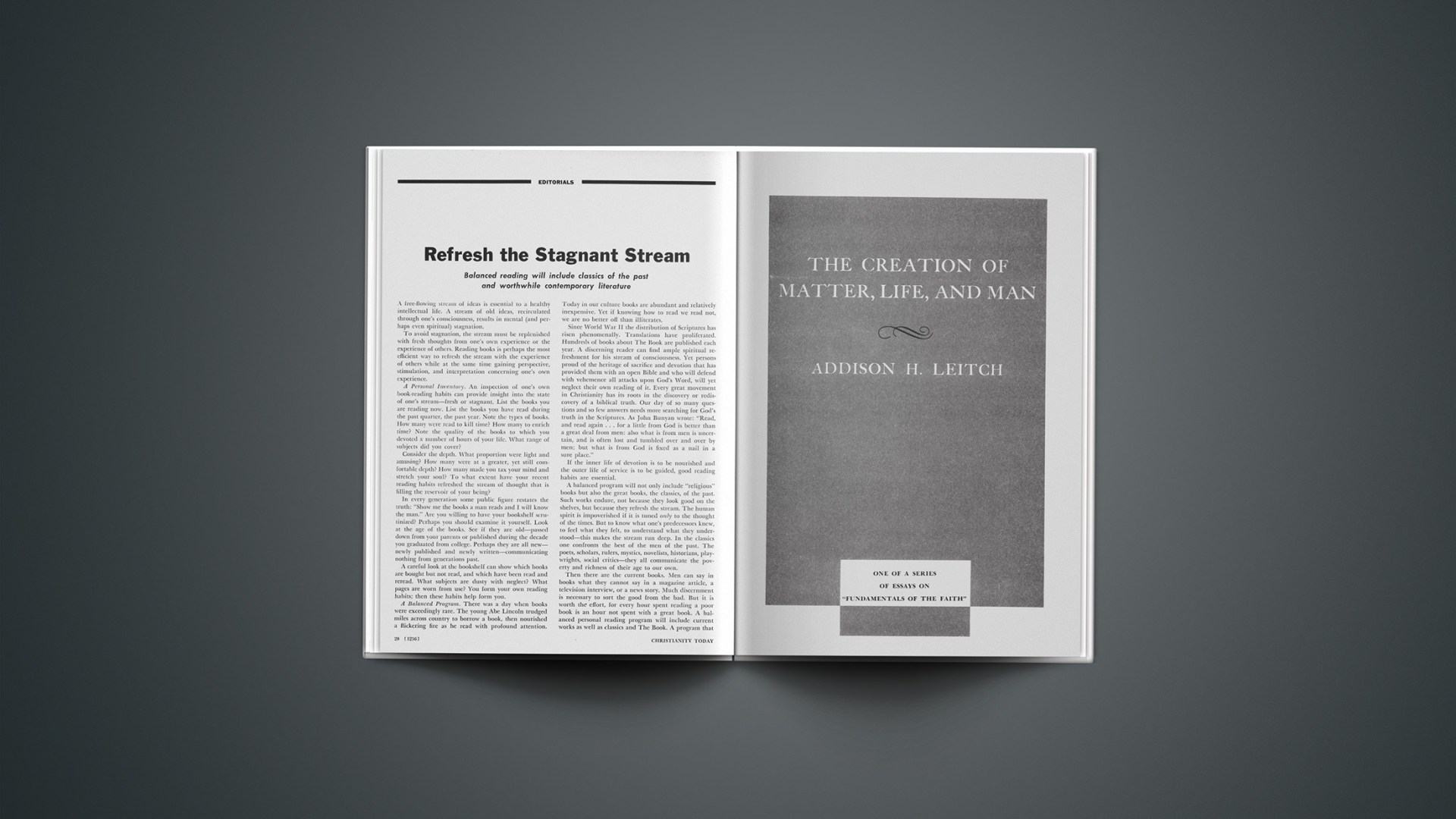
Refresh the Stagnant Stream

Balanced reading will include classics of the past and worthwhile contemporary literature

A free-flowing stream of ideas is essential to a healthy intellectual life. A stream of old ideas, recirculated through one’s consciousness, results in mental (and perhaps even spiritual) stagnation.

To avoid stagnation, the stream must be replenished with fresh thoughts from one’s own experience or the experience of others. Reading books is perhaps the most efficient way to refresh the stream with the experience of others while at the same time gaining perspective, stimulation, and interpretation concerning one’s own experience.

A Personal Inventory. An inspection of one’s own book-reading habits can provide insight into the state of one’s stream—fresh or stagnant. List the books you are reading now. List the books you have read during the past quarter, the past year. Note the types of books. How many were read to kill time? How many to enrich time? Note the quality of the books to which you devoted x number of hours of your life. What range of subjects did you cover?

Consider the depth. What proportion were light and amusing? How many were at a greater, yet still comfortable depth? How many made you tax your mind and stretch your soul? To what extent have your recent reading habits refreshed the stream of thought that is filling the reservoir of your being?

In every generation some public figure restates the truth: “Show me the books a man reads and I will know the man.” Are you willing to have your bookshelf scrutinized? Perhaps you should examine it yourself. Look at the age of the books. See if they are old—passed down from your parents or published during the decade you graduated from college. Perhaps they are all new—newly published and newly written—communicating nothing from generations past.

A careful look at the bookshelf can show which books are bought but not read, and which have been read and reread. What subjects are dusty with neglect? What pages are worn from use? You form your own reading habits; then these habits help form you.

A Balanced Program. There was a day when books were exceedingly rare. The young Abe Lincoln trudged miles across country to borrow a book, then nourished a flickering fire as he read with profound attention.

Today in our culture books are abundant and relatively inexpensive. Yet if knowing how to read we read not, we are no better off than illiterates.

Since World War II the distribution of Scriptures has risen phenomenally. Translations have proliferated. Hundreds of books about The Book are published each year. A discerning reader can find ample spiritual refreshment for his stream of consciousness. Yet persons proud of the heritage of sacrifice and devotion that has provided them with an open Bible and who will defend with vehemence all attacks upon God’s Word, will yet neglect their own reading of it. Every great movement in Christianity has its roots in the discovery or rediscovery of a biblical truth. Our day of so many questions and so few answers needs more searching for God’s truth in the Scriptures. As John Bunyan wrote: “Read, and read again … for a little from God is better than a great deal from men: also what is from men is uncertain, and is often lost and tumbled over and over by men; but what is from God is fixed as a nail in a sure place.”

If the inner life of devotion is to be nourished and the outer life of service is to be guided, good reading habits are essential.

A balanced program will not only include “religious” books but also the great books, the classics, of the past. Such works endure, not because they look good on the shelves, but because they refresh the stream. The human spirit is impoverished if it is tuned only to the thought of the times. But to know what one’s predecessors knew, to feel what they felt, to understand what they understood—this makes the stream run deep. In the classics one confronts the best of the men of the past. The poets, scholars, rulers, mystics, novelists, historians, playwrights, social critics—they all communicate the poverty and richness of their age to our own.

Then there are the current books. Men can say in books what they cannot say in a magazine article, a television interview, or a news story. Much discernment is necessary to sort the good from the bad. But it is worth the effort, for every hour spent reading a poor book is an hour not spent with a great book. A balanced personal reading program will include current works as well as classics and The Book. A program that refreshes the stream will include books outside of one’s own major field of interest. Certainly everyone should read books having to do with the technical aspects of his own work. But to have an adequate window on the world beyond, one must read books that do not directly bear on his own vocation.

A Workable Plan. “Have you read any good books lately?” the question is often answered with: “Not as many as I should. I really ought to read more.” A person can read more and better books if he sincerely wants to. Some simple techniques may help.

If you are out of the habit, pick up an interesting absorbing book—something you can read easily. A novel, a book on your hobby, something you can easily concentrate on will prime the pump and start you reading again.

Never stop a book when it becomes dull or uninteresting. Stop in the midst of a fast-moving narrative, an inspiring exposition, or a revealing insight. Stop when you want to read on, and you will find yourself picking up the book again soon.

Start a new book before you finish the one you are reading. Get involved in the new before you complete the old. Such a “reading chain” will not allow your habit to break.

Use your “sandwich” time for reading. This is the time you spend on the bus, train, or airplane, under the hairdryer or at the barbershop, waiting for the dentist or for your wife to call you to dinner. It is amazing how much reading time can be “made” in this way. Perhaps a bedside book will be read only late at night or early in the morning, while another is carried in a purse or kept in a desk. A third may demand longer periods of concentration and will lie on the study table or beside the living-room easy chair.

Don’t forget to increase your capacity by reading something a little beyond your present depth. Tall souls need deep roots, and a constantly increasing capacity for profound reading can expand the joy of reading.

By all means, read the Bible. Read familiar passages in a new translation for fresh revelations. Read whole books at a time, especially the books you have never read. See the glorious Word of God as a whole, not as a collection of isolated verses and paragraphs.

Fall Book Forecast 1966

A literary feast for theological gourmets?

The fall of 1966 will present readers of religious books with a literary horn of plenty. Theological gourmets may indeed find themselves set for a tantalizing feast if the quality of the forthcoming volumes matches their quantity and diversity.

The public appetite for religious books is growing, and publishers are stepping up their efforts to meet the demand. Writers are rushing their theological offerings into print before fickle religious tastes change. Remembering certain “radical” entrees of the past year, one suspects that readers may again find a few offerings that are half-baked, devoid of crucial ingredients, or possibly even downright raw. But our survey also indicates that the season’s fare includes a great many volumes that will nourish mind and soul.

The main offerings appear to be books that seek to satisfy the current desire of the Church for greater depth in biblical studies, clearer perception of the nature of the Church, and revitalized means of communicating the Gospel in a secular world. Readers will also be tempted by no fewer than ten new titles appraising the pronouncements of the recent and historic Vatican Council II. The continuing proliferation of paperback editions of original religious works and reprints will fortunately reduce the tab for many lean and hungry students of theology.

The titles here listed under certain major categories of religious interest are selected from publishers’ preview announcements. They indicate a variety of books that readers should relish whether their tastes run to theological profundities, scriptural exegesis, practical advice on Christian life and witness, or devotional materials. Readers should be warned, however, that the spice of excitement in current theological discussions may at times lead to intellectual indigestion or spiritual heartburn. They may reduce such discomfort by quaffing hearty goblets of the new wine of the Gospel and the water of the Word.

The season’s extensive literary fare will call for careful selection. But with such a choice of theological palate-pleasers, one should refrain from pushing away from the table too soon. The food looks too good.

APOLOGETICS, PHILOSOPHY, SCIENCE: Abingdon will publish Good God! Cry or Credo? by H. Black; Braziller, No Other God by G. Vahanian; Catholic University, Christian Philosophy in the College and Seminary by G. F. McLean and Christian Philosophy and Religious Renewal edited by G. F. McLean; Christopher, The Fool Has Said God Is Dead by W. H. Thompson; Exposition, Perspectives in Christian Humanism by J. M. Occhio, The Sum and the Substance by G. R. Gritton, and American Dialectics in Action by J. Brigham; Harper & Row, Man’s Place in Nature by P. Teilhard de Chardin, Off the Beaten Path by P. Lonning, The Deeds of Faith by S. C. Wyszynski and Thomism: An Introduction by P. Grenet; Helicon, Teilhard and the Supernatural by E. R. Baltazar; John Knox, Kierkegaard: An Introduction by H. Diem; McKay, Between Knowing and Believing by P. L. du Nouy; Norton, The Dead Sea Scrolls: A New Historical Approach by C. Roth; Oxford, Between Faith and Thought by R. Kroner; Prentice-Hall, Issues in Science and Religion by I. G. Barbour; Regnery, The Primacy of Existence in Thomas Aquinas by D. Banez; Westminster, The Historical Shape of Faith by R. G. Wilburn; and Yale University, Literature and the Christian Life by S. M. TeSelle.

ART AND ARCHITECTURE: Braziller will print The Hours of Catherine of Cleves by J. Plummer and Treasures of the Churches of France by J. Taralon; Harper & Row, 2000 Years of Christian Art by E. Newton and W. Neil; Westminster, Theology and the Arts by D. B. Harned and Communicating Reality Through Symbols by E. M. Stowe; and World, The Europe of the Cathedrals: 1140–1280 by G. Duby.

BIBLE COMMENTARIES AND DICTIONARIES: Beacon Hill will come out with The Beacon Bible Commentary, Vol. IV: Major Prophets; Cambridge, The Letter of Paul to the Romans by E. Best, The Letter of Paul to the Galatians by W. Neil, and New Testament Illustrations by C. M. Jones (all from “The Cambridge Bible Commentary”); Doubleday, The Jerusalem Bible, edited by A. Jones and The New Smith’s Bible Dictionary edited by R. Lemmons; Eerdmans, The Acts of the Apostles, Vol. II, by J. Calvin, The Epistle of James by C. L. Mitton, and The Wesleyan Bible Commentary, Vol. I, edited by C. W. Carter; and Revell, Everyone in the Bible by W. P. Barker.

BIBLICAL STUDIES: Augsburg will issue Older than Eden: Great Homes of the Bible by J. C. McKirachan; Baker, The Other Son of Man: Ezekiel/Jesus by A. W. Blackwood, Jr. and Studies in the Life of Christ: Introduction and Early Ministry by R. C. Foster; Beacon Hill, Christ’s Parables Today by Bowers; Broadman, Points for Emphasis, 1967, by C. J. Allen; Eerdmans, Index to Periodical Literature on Christ and the Gospels edited by B. M. Metzger, A Classified Bibliography of Literature on the Acts of the Apostles by A. J. and M. B. Mattill, and A Comparative Study of the Old Testament Text in the Dead Sea Scrolls and in the New Testament by J. de Waard; Exposition, The Sabbaths of God by J. L. Porter; Fortress, A Primer of Old Testament Text Criticism by D. R. Ap-Thomas and The Bible and the Role of Women by K. Stendahl; Harper & Row, Old and New in Interpretation by J. Barr; and Paulist-Newman, Mary of Nazareth, Myth or History? by B. Rinaldi.

BIOGRAPHY: In this field Abingdon announces Francis Asbury by L. C. Rudolph; Catholic University, St. Gregory of Nyssa—Ascetical Works translated by V. W. Callahan (from the “Fathers of the Church”); Eerdmans, Samuel, My Friend by H. Albus and God with Us: A Life of Jesus for Young Readers by M. Radius; Fortress, A Life of Luther by O. Thulin; Harper & Row, I Knew Dietrich Bonhoeffer: Reminiscences of His Friends by W. A. Visser’t Hooft and I Stand by the Doorby S. Shoemaker; Harvard University, The Wilberforces and Henry Manning: The Parting of Friends by D. Newsome; Prentice-Hall, The Lord Is My Counsel by M. E. Wade and G. D. Kittler and Pulpit in the Shadows by F. Gage and S. Redding; Regnery, The Conversion of Augustine by R. Guardini; and Word, Up Tight! by J. Giminez.

CHURCH HISTORY: Abingdon will offer John Wesley: His Puritan Heritage by R. C. Monk and The Serpent and the Dove by S. Laeuchli; Broadman, A Baptist Source Book by R. A. Baker and Baptists and Christian Unity by W. R. Estep; Concordia, Church, State and the American Indians by R. P. Beaver, Which Way to Lutheran Unity? by J. H. Tietjen, and Fundamentalism and the Missouri Synod by M. L. Rudnick; Exposition, Church and Clergy in the American Revolution by L. D. Joyce; Farrar, Straus and Giroux, Fourth Session: The Debates and Decrees of Vatican Council II by X. Rynne; Fortress, A Short History of Christian Doctrine by B. Lohse, Luther’s Works, Vol. 44, by J. Atkinson, The Nature of Revelation by N. Söderblom, and Jerusalem and Rome by H. Chadwick and H. von Campenhausen; Harper & Row, Pentecostalism by J. T. Nichol; Herald, Anabaptist Baptism by R. Armour and The Mennonite Church in America by J. C. Wenger; Judson, Baptists in Southern California by L. D. Hine; McGraw-Hill, The Council and the Future by J. von Galli, S. J., American Bishop at the Vatican Council by R. E. Tracy, and Colonialism and Christian Missions by S. Neill; Macmillan, The Church in the Next Decade by E. C. Blake and Tradition and Traditions by Y. Congar; Norton, The Crisis of the Reformation by N. Sykes; Paulist-Newman, What Is the Christian Orient? by P. I. Dick and The Second Vatican Council, Vol. I: The First Session by A. Wenger; Prentice-Hall, The Lutheran Way of Life by R. W. Loew; Seabury, History of Christian Worship by R. M. Spielmann, Creeds, Councils, and Controversies edited by J. Stevenson, and The Rise of Moralism: The Gospel from Hooker to Baxter by C. F. Allison; Sheed and Ward, The Hesitant Pilgrim: American Catholicism after the Council by A. M. Greeley; and Yale, The Pilgrim’s Progress and Traditions in Puritan Meditation by U. M. Kaufmann and The Heart Prepared: Grace and Conversion in Puritan Spiritual Life by N. Pettit.

DEVOTIONAL: Abingdon will present Direction and Destiny by M. D. Dunnam and Victory Through Surrender by E. S. Jones; Baker, Please Give a Devotion for Young People by A. Bolding and Meditations on Prayer by B. Smith; Broadman, What a Layman Believes by S. J. Schreiner; Concordia, The Radiant Life by N. Zastrow and The Lord’s Men by W. A. Buege; Coward-McCann, A Diary of Prayer by E. Goudge; Doubleday, The Healing of Sorrow by N. V. Peale; Eerdmans, Dialogues with God by O. T. Miles and Hymns for Youth edited by J. Hamersma, W. Vander Baan, and A. Bratt; Harper & Row, See Yourself in the Bible by W. R. Bowie and Prayers for Young People by W. Barclay; Helicon, Open to the World: Lay Spirituality for Today by A. Auer; Revell, Daily Will I Praise Thee by N. B. Kellow; and Upper Room, The Upper Room Disciplines, 1967, edited by S. G. Ferree, Prayers of the Modern Era by L. M. Starkey, Jr., and Bible Time by E. D. Staples.

DRAMA, FICTION, POETRY: Augsburg will be issuing In Due Season by H. F. Brokering and No Uncertain Sound by L. C. Proctor; Broadman, Devotional Dramas for Easter by S. W. Miller and Devotional Dramas for a Mission Witness by S. W. Miller; Christopher, Twilight for the Heroes by A. Bozarth; Fortress, Creed and Drama by W. M. Merchant and Three Church Dramas by O. Hartman; Herald, The Welfare Kid by D. Hill; Judson, Yeshua’s Diary by W. Shrader; Moody, Shadow Across the Sun by B. Swinford and Cherokee Run by B. Smucker; World, Bittersweet Grace: A Treasury of Religious Satire by W. D. Wakoner; and Zondervan, Vengeance Afoot by V. Whitman, The High Road by F. Shannon, The Promise by S. L. Bell, and Suki and the Old Umbrella by J. Blackburn.

ECUMENICS: In this category Augsburg will offer Challenge and Response: A Protestant Perspective of the Vatican Council edited by W. A. Quanback and V. Vajta; Concordia, Eucharist and Church Fellowship in the First Four Centuries by W. Elert; Fortress, The Councils of the Church edited by H. J. Margull; Harper & Row, The Church and the Jewish People by A. C. Bea; Judson, Ordination and Christian Unity by E. P. Y. Simpson; Paulist-Newman, Ecumenism and the Roman Catholic Church by L. G. M. Alting von Geusau; Sheed and Ward, The Open Circle: The Meaning of Christian Brotherhood by J. Ratzinger, Man’s Search for Himself: Modern and Biblical Images by L. Scheffczyk, Orthodoxy and Catholicity by J. Meyendorff, The Anonymous Christian by A. Roper, Religion and Society: The Ecumenical Impact by C. Nelson, The Seminary: Protestant and Catholic by W. Wagoner, and The Word in History edited by T. P. Burke; United Church Press, Vatican Diary 1965: A Protestant Observes the Fourth Session of Vatican Council II by D. Horton; and World, The Vatican Council and the Jews by A. Gilbert.

ETHICAL AND SOCIAL STUDIES: Abingdon will put out The Bible and the Family by H. G. Werner and James Bond’s World of Values by L. M. Starkey, Jr.; Baker, You and Your Teenager by L. and R. Moser; Broadman, The Many Faces of Ethyl by W. S. Garmon and Teaching about Sex—A Christian Approach by W. S. Garmon; Catholic University, Community Resocialization—a New Perspective by J. E. Garrett and P. O. Rompler; Exposition, White Man-Black Man by C. R. Frazer, Sr., and My Story in Black and White by J. O. Thomas; Fortress, Love, Sex and Life by M. L. Bracher, Theological Ethics, I, by H. Thielicke, Luther’s Doctrine of the Two Kingdoms by H. Bornkamm, and Affluence and the Christian by H. van Oyen; John Knox, Mandate for White Christians by K. Haselden and Moral Law in Christian Social Ethics by W. G. Muelder; McGraw-Hill, Judaism in a Christian World by R. Gordis; Macmillan, The Secular City Debate by D. Callahan; Oxford, The Restless Quest of Modern Man by W. G. Cole and The Secularization of Modern Cultures by B. E. Meland; Paulist-Newman, Love Seekers by B. Byrne; Regnery, Man and Woman by D. von Hildebrand and What God Has Joined Together by G. Thibon; Prentice-Hall, Documents of Dialogue by H. Ward; Revell, The Little People by D. Wilkerson; Seabury, The Creative Edge of American Protestantism by E. H. Brill; World, Biblical Ethics by T. B. Maston; and Zondervan, The Wider Place by E. Price and Under New Management by S. Shoemaker.

LITURGY: From Catholic University will come The Liturgy of Baptism in the Baptismal Instructions of St. John Chrysostom by T. M. Finn; Eerdmans, The Liturgy of the Church of England Before and After the Reformation by S. A. Hurlbut; and Harper & Row, Liturgy and Art by H. A. Reinhold.

MISSIONS (EVANGELISM): Baker will publish The Church Proclaiming and Witnessing by E. McDonald; Bethany Fellowship, A World to Win by N. Krupp; Broadman, Luther Rice: Believer in Tomorrow by E. W. Thompson, Baptists Around the World by T. F. Adams, and Go Out with Joy by N. Y. Stevens; Eerdmans, Pioneers in Mission edited by R. P. Beaver; Fortress, Living Mission by H. W. Gensichen; Harper & Row, The Christian Persuader by L. Ford; Holt, Rinehart and Winston, The Grass Roots Church: A Manifesto for Protestant Renewal by S. Rose; John Knox, The Coffee House Ministry by J. D. Perry; Moody, Forbidden Land: A Saga of Tibet by G. T. Bull; Seabury, Yes to Mission by D. Webster; Word, Vietnam Vignettes by L. Ward; and Zondervan, A Fire on the Mountains by R. J. Davis and Flame of Anger by E. Clark.

NEW TESTAMENT: Baker promises An Exposition of the Gospel of Ephesians by W. Hendriksen, and An Exposition of the Gospel of Luke by H. H. Hobbs; Broadman, The Meaning of the New Testament by B. M. Newman; Cambridge, The Theological Tendency of Codex Bezae Cantabrigiensis in Acts by E. J. Epp; Eerdmans, The Pursuit of Happiness and The Behaviour of Belief by S. Zodhiates; Exposition, My Lord and My God by T. Pitcairn; Fortress, The Last Adam by R. Scroggs; Harper & Row, Paul: the Man and the Myth by A. Q. Morton and J. McLeman, Jesus of the Parables by E. Linnemann, The Revelation of St. John the Divine by G. B. Caird, and Language, Hermeneutic and Word of God by R. W. Funk; Herald, Sayings of Jesus by E. Dumbald; Moody, A Guide to Modern Versions of the New Testament by H. Dennett; and Revell, The Sermon on the Mount by C. L. Allen, Men of Action in the Book of Acts by P. S. Rees, and James Speaks for Today by H. F. Stevenson.

OLD TESTAMENT: Among Baker’s titles will be An Exposition of Ecclesiastes by H. C. Leupold and The Holy Spirit in the Ancient Church by H. B. Swete; Broadman, Old Testament Teaching by J. W. Watts; Eerdmans, The Christian Church and the Old Testament by A. A. Van Ruler; Holt, Rinehart and Winston, You Shall Be As Gods: A Radical Interpretation of the Old Testament and Its Tradition by E. Fromm; John Knox, Worship in Israel by H. Kraus; Judson, Living with the Psalms by J. H. Scammon; McGraw-Hill, Understanding Genesis by N. M. Sarna; and Westminster, Deuteronomy: A Commentary by G. von Rad.

PASTORAL THEOLOGY (PREACHING, PSYCHOLOGY): Abingdon will be printing Basic Types of Pastoral Counseling by H. J. Clinebell and Preaching and Parish Renewal by W. E. Fisher; Christopher, The Case for Pastoral Clinical Training by W. P. Bell; Fortress, And You Visited Me by C. J. Scherzer, Principles and Practices of Pastoral Care by R. L. Dicks, Helping the Alcoholic and His Family by T. J. Shipp, Counseling the Serviceman and His Family by T. A. Harris, and The Anguish of Preaching by J. Sittler; Harper & Row, Urban Church Breakthroughby R. Moore and D. Day and The Person Reborn by P. Tournier; Judson, Preaching as Counseling by E. H. Linn; Moody, Pattern for Maturity by J. D. Pentecost; Revell, The Freedom to Fail by G. D. Gilmore, Formula for Fitness by R. E. Hunton, and The Adventure of Being You by R. J. St. Clair; Prentice-Hall, Referral in Pastoral Counseling by W. B. Ogelsby, Jr., and Ministering to Prisoners and Their Families by H. H. Cassler; World, A Sourcebook for Christian Worship by P. S. McElroy; and Zondervan, Counseling with Youth at School, Church and Camp by C. E. Narramore.

RELIGIOUS EDUCATION: Baker will be coming out with The Philosophies of Education by H. J. Boettcher; Broadman, Building and Maintaining a Church Staff by L. E. Wedel; Christopher, An Answer for Agnostics by R. J. Clinchy; Eerdmans, Under God by W. C. Hendricks and Hymns and Human Life by E. Routley; Exposition, The Rise of Religious Education Among Negro Baptists by J. D. Tyms; Herald, Creating Christian Personality by A. D. Augsburger; and Seabury, Youth in Crisis edited by P. Moore.

SERMONS: Among Abingdon’s titles will be His Church by R. H. Mueller, What Jesus Proclaimed by R. W. Ragsdale, and Windows on the Passion by C. C. Wise, Jr.; Baker, Minister’s Handbook Series by G. Brooks, et al., and The Wounded Word by S. P. Long; Biblical Research Press, The Great Commission by G. Nichols; Judson, The Children’s Moment by J. Fischbach; Kregel, True Saints by C. G. Finney; Revell, To Know God’s Way by D. R. Thomas; Word, The Cross in the Market Place by F. Valentine; and Zondervan, The Zondervan Pastor’s Annual for 1967 by W. Austin, Expository Sermons on Revelation, Vol. V, by W. A. Criswell, and Simple Sermons for Sunday Morning by W. H. Ford.

THEOLOGY: Abingdon will be publishing The Finality of Christ by D. Kirkpatrick, Encountering Truth by H. E. Hatt, The Fellowship of the Holy Spirit by G. Harkness and The Secularization of History by L. Shiner; Cambridge, Justin Martyr: His Life and Thought by L. W. Barnard and Events and Their Afterlife: The Dialectics of Christian Typology in the Bible and Dante by A. C. Charity; Eerdmans, Theology of the English Reformers by P. E. Hughes and The Christian Life and Salvation by D. G. Bloesch; Fortress, Dynamics of Doubts (A Preface to Tillich) by A. Unhjem, Theology and Proclamation by G. Ebeling and The Theology of Martin Luther by P. Althaus; Harper & Row, The Reality of God and Other Essays by S. M. Ogden, The Way to Freedom by D. Bonhoeffer, and Secular Christianity by R. G. Smith; Helicon, Religious Freedom in Church and State by P. Augustin; Herald, God’s Word Written by J. C. Wenger; John Knox, Christ the Meaning of History by H. Berkhof, The Hermeneutic of Erasmus by J. W. Aldridge, and How I Changed My Mind by K. Barth; Judson The Triumph of Suffering Love by K. Cauthen; Kregel, Reformed Dogmatics by H. Hoeksema; Moody, Hope Triumphant by W. K. Harrison; Oxford, The Mercersburg Theology by J. H. Nichols; Prentice-Hall, Readings in Biblical Morality edited by C. L. Sohm and Comprehensive Handbook of Christian Doctrine by J. Lawson; Reiner, The Doctrine of Sanctification by A. W. Pink; Seabury, The New Dialogue Between Philosophy and Theology by J. A. Martin, Jr.; Sheed and Ward, Christian in the Market Place by K. Rahner, God and the Human Condition, Volume I: God and the Human Mind by F. J. Sheed, and The Church Renewed by P. Riga; Westminster, Studies in Christian Existentialism by J. Macquarrie, Religion in Contemporary Debate by A. Richardson, and The Church in the Thought of Bishop Robinson by R. P. McBrien; World, Christian Faith and the Space Age by J. G. Williams; and Zondervan, Limiting God by J. E. Hunter, From Death to Life Through Christ by R. G. Lee, Is God Dead? by B. Graham, B. Ramm, V. Grounds and D. Hubbard, and The Is God Dead Controversy by J. W. Montgomery.

PAPERBACKS: Abingdon lists Scripture and Social Action by B. D. Rahtjen, The Churches’ War on Poverty by L. E. Schaller, Evangelism for Teenagers by H. W. Ellis, Christian Mission in Theological Perspective by G. H. Anderson, and The Death of God Controversy by T. W. Ogletree; Augsburg, If God Be for Us: A Study in the Meaning of Justification by J. M. Shaw, The Reformation, Then and Now by C. S. Anderson, and Renewing the Congregation by R. W. Long; Back to the Bible, The Other Comforter by T. H. Epp; Braziller, Wait Without Idols by G. Vahanian, The Future of Unbelief by G. Szczesny, and Symbolism in Religion and Literature by R. May; Broadman, May Perry of Africa by S. Anderson, Channels for Power by W. K. Price, Power for the Church by R. G. Witty, The Signature of God by E. Bailey, and A Christian Layman’s Guide to Public Speaking by H. C. Brown, Jr.; Cambridge, Studies in the Making of the English Protestant Tradition by E. G. Rupp; From Puritanism to the Age of Reason by G. R. Cragg, The Sermon on the Mount by W. D. Davies, and Christianity According to St. Paul by C. A. A. Scott; Concordia, Grace Under Pressure by F. D. Lueking and M. H. Franzmann; Eerdmans, Ernest Hemingway in Christian Perspective by N. A. Scott, Jr., T. S. Eliot in Christian Perspective by N. Braybrooke, The Church Between Temple and Mosque by J. H. Bavinck, They Called Him Mister Moody by R. Curtis, God’s Temples by W. C. Hendricks, Faith and the Physical World by D. L. Dye, The Sign Language of Our Faith by H. Griffith, Religion and the Schools by N. Wolterstorff, and Vital Words of the Bible by J. M. Furness; Fortress, Renewal in the Spirit by E. A. Steimle; Gospel Light (Regal Books), What the Bible Is All About by H. C. Mears, Power for Christian Living by E. Wilcox, Jesus the Revolutionary by H. S. Vigeveno, One Hundred Questions About God by J. E. Orr, and Henrietta Mears and How She Did It by E. M. Baldwin; Harper & Row, The Law and the Prophets: A Study of the Meaning of the Old Testament by W. Zimmerli, The Historical Geography of the Holy Land by G. A. Smith, and On Authority and Revelation by S. Kierkegaard; Helicon, Christianity in the Asian Revolution by H. Haas, Approaches to Christian Unity by C. J. Dumont, O. P., Living Today for God, by R. Schutz, God of the Scientist, God of the Experiment by R. Chauvin, and Christ and the Teacher of Righteousness by J. Carmignac; John Knox, Are You Nobody? by P. Tournier et al., Dietrich Bonhoeffer by E. H. Robertson, Paul Tillich by J. H. Thomas, Rudolf Bultmann by I. Henderson, and Teilhard de Chardin by B. Towers; Judson, The Work of the Usher by A. D. Johnson, Reading the Gospel of John by J. P. Berkeley, Call to Reflection by B. Keane, and The Monuments and the Old Testament by Price, Sellers and Carlson; Moody, As a Tree Grows by W. P. Keller, For More Than a Diamond by D. W. Hillis, A Christian’s Guide to the Old Testament by J. Taylor, Teaching Our Children the Christian Faith by B. Bye, and Conquest and Victory by C. Armerding; Oxford, Sex in Christianity and Psychoanalysis by W. G. Cole and The Interpretation of the New Testament, 1861–1961, by S. Neill; Prentice-Hall, Doomsday Cult: A Study of Conversion, Proselytization and Maintenance of Faith by J. Lofland; Reiner, Visions of Heaven and Hell by J. Bunyan; Seabury, Heroic Heart by K. Malthe-Bruun and City of Wrong by M. K. Hussein; United Church Press, We Believe: An Interpretation of the United Church Statement of Faith by R. L. Shinn and D. D. Williams and Grassroots Ecumenicity: Case Studies in Local Church Consolidation by H. S. Sills; Westminster, Treasure of Qumran by A. Y. Samuel, New Directions in Theology Today, Vol. I: Introduction by W. Hordern, New Directions in Theology Today, Vol. II: History and Hermeneutics by C. E. Braaten, Meaningful Nonsense by C. J. Ping, Toward Fullness of Life by S. de Dietrich, Honest Religion for Secular Man by L. New-bigin, and Pastoral Counseling in Social Problems by W. E. Oates; Word, Get in the Game! by B. Glass; World, Cross Currents of Psychiatry and Catholic Morality edited by W. Birmingham and J. E. Cunneen and Love and Justice: Selections from the Shorter Writings of Reinhold Niebuhr edited by D. B. Robertson; Yale, Reason and God by J. E. Smith; and Zondervan, Amos by D. D. Garland, Freedom from Deadly Sins by B. Graham, and Meals from the Manse by L. L. Parrott.

Eutychus and His Kin: September 16, 1966

The problem of a consensus on ‘good’

Perfectly Evident

Back in the good old days (whenever and whatever they were) I was in a situation in which off and on I was invited out to English tea. One of the nice things the English did was to invite at least one person as a center of attraction for the afternoon tea, and the rest of us clustered around. Of course, for undergraduates the center of attraction was usually a cake from home or a box of cookies, but people of greater age and spirit made their occasions on higher levels.

One Sunday afternoon, after enjoying a tea for the better part of an hour, I was introduced to Canon Dick Shephard, who at the time was at St. Martins-of-the-Fields in London and who was known as the leading exponent of pacifism in a day when this was a pretty live issue. I have to make two points here. One is that at this time Canon Dick Shephard was one of the biggest names in Great Britain and was also of world renown. The second point is that I didn’t know he was there until I was introduced to him. He made no effort in any way I could see to “make himself known,” and yet once you knew who he was all kinds of important things clustered around his name. He was listened to in high places, but he never had to raise his voice. Power and effectiveness are not always where we think they are.

On another afternoon I had the same experience with C. F. Andrews of India, who was back in Great Britain for a leave of absence. Again there was no effort on the great man’s part; and yet, as the afternoon moved on, the other guests were increasingly affected by his inner strength and the majesty of his manhood.

When Jesus cured the Gadarene demoniac, the man begged to be taken along in the disciples’ band. Instead of this he received what I think are amazing instructions: “Go tell what I have done for you.” With all the bone-crushing theology around these days, and with all the very evident effort on the part of a great many young theologians to be seen and heard and recognized as being alert and aware, it would be refreshing to have just one of them tell us just once what it is the Lord has done for him. Shephard had it. Andrews had it. The Gadarene demoniac had the right message, apparently. Just what are the rest of us talking about?

EUTYCHUS II

God’S Will And Man’S Brains

I share your concern over any possible attempt to alter mankind through biological tampering (“Are Man’s Brains Now at Stake?,” Aug. 19 issue). Some scientists feel that we are very close to having the knowledge necessary to allow man to shape himself into what he thinks he should be, and they are already thinking about the specifications for the end product. I do not think that your comments are premature and am very glad that you alerted Christians to this possibility.

A geneticist recently told me that he believed that within our lifetime the knowledge would be available to make man into whatever form was considered “good”—in fact, that it would be possible to alter genes to produce any desired characteristic and thereby create a “new” man. He further said that we scientists who are Christians should start now to define “good” so when that time comes we will be ready to influence the direction of the control to produce a man conforming to our definition of “good.”

My first reaction to this was one of concern over man’s ability to influence his own personality, and I questioned whether or not he should even attempt such a thing, just as you did in your editorial. I still question it but somehow feel that there is no earthly power that can force man to refrain from attempting to use any power he has available. There certainly has been none in the past. In the next-to-last paragraph of your editorial you speak of the “incredible powers science is gradually putting into [man’s] hands,” as though science is some indefinite force outside man. The fact is that this power is a gift of God that man has found through study of God’s creation, and there is no reason to believe that man will treat it with any more responsibility than he has any other gift of God. This makes it no less a gift of God through which he reveals to man his wonderful power and the order and wonder of his creation, and I believe it is a gift man should claim through scientific study.

My second reaction was to refer my friend to the New Testament for an example of the perfect man: Jesus Christ himself. That Christ is the measure of perfection for the saints is made clear in Ephesians 4:12, 13. What an advantage it would be if we could start children out with the best that breeding could offer. But this is no answer, because there is no indication that there is any hereditary “goodness” in any of us that manifests itself as an ability to walk closer to God or to be more Christ-like. So we are still no closer to an answer.

It seems to me, however, that the most serious flaw in the suggestion that man can and should control what he becomes is the fact that the suggestion would even be made. It is another way suggested by man to make himself acceptable to God without going by way of Christ. It has become clear that man has not become better when left on his own. His works have not saved him. Still unwilling to yield himself to Christ, he now wants to make himself over so that he may finally become “good”—or is it “God”?

ALBERT L. HEDRICH

Bethesda, Md.

“Putting Brains into Our Christianity,” by Dr. Hope (Aug. 19 issue) was, I am sure, a challenge to every Christian. Along that line, it reminded me of your international conference on evangelism to be held shortly in Berlin. I trust the brains put together at that meeting will, under the guidance of the Holy Spirit, find a method of increasing the outreach of the Gospel in Communist-dominated countries.…

JOHN D. GEISLER

Rochester, Minn.

Strong Language

May I add my compliments on your splendid editorial “Too Many Chiefs” (July 22 issue). Hooray for you; please let us have some more of this and advocate in strong language that we get ourselves “involved” with what is going on around us.

JACOB MAGENHEIMER

Fort Lauderdale, Fla.

Incomplete Picture

As participants in the Seminar on the Authority of Scripture, we believe that the editorial comments in CHRISTIANITY TODAY (July 22, 1966, p. 27) may present a somewhat incomplete picture. It would be wrong to deny or to obscure the fact that serious differences of opinion about the Bible were present.

Two mutually exclusive approaches to the Bible seemed to undergird much of the discussion. One approach held that it was possible to begin with the so-called phenomena of Scripture and from these to arrive at a proper view of the Bible. The other, which we believe to be the scriptural procedure, was to accept what the Bible had to say about itself and to interpret the phenomena in the light of Scripture’s explicit statements. Only upon the basis of the biblical doctrine concerning itself may the phenomena be properly studied.

Inasmuch as we adhere to this latter method, we heartily affirm our belief in the inerrancy of the sacred Scriptures and cannot understand how any Christian can hesitate to affirm such belief, for the Scripture “cannot be broken” (John 10:35b).

Another serious point of difference, which probably emerged as a result of beginning with the phenomena rather than with the express teaching of the Bible, was whether the message of the Bible or what the Bible teaches is to be distinguished from the whole extent of Scripture itself. Are there elements in the Bible which are to be set apart from the teaching of the Bible? We would answer this question with an emphatic negative, for God has plainly told us that all Scripture is “profitable for doctrine, for reproof, for correction, for instruction in righteousness” (2 Tim. 3:16). To maintain otherwise, we believe, is to fall into serious doctrinal error; and yet in the discussions at Wenham this erroneous view was vigorously defended.…

KENNETH S. KANTZER

Dean

Trinity Evangelical Divinity School

Deerfield, Ill.

EDWARD J. YOUNG

Prof. of Old Testament

Westminster Theological Seminary

Philadelphia. Pa.

Please. No Small A

The closing sentence in the news item concerning the NACCC on page 45 of the July 22 issue must have been printed in error. The National Association (please, no small a) is and has been concerned solely with the ongoing of the Congregational way of religious life. We were embroiled in the merger by those who were intent on establishing a new and completely different religious structure. The deviation from the Congregational polity (which was never going to be changed) is becoming clearer almost daily as the involvements of the COCU develop.…

ARCHIE PEACE

National Association

of Congregational Christian Churches

Norfolk, Conn.

No Victory At The Altar

Re “Ecumenism at the Altar” (News, July 22 issue):

If this is the first time a Southern Baptist pastor and a Roman Catholic priest participated together in a wedding ceremony, may I inquire, what does this prove? What is the victory? The article continues, “The bride says she will remain Baptist and her husband Catholic.” The Bible says, Amos 3:3, “Can two walk together except they be agreed?” The Bible says, Matthew 12:25, “Every house divided against itself shall not stand.” Any informed person knows a Baptist and a Catholic marriage is a house divided against itself. The Catholic Church knows this and speaks against such union with much more frankness than Baptists. A Baptist-Catholic marriage is saturated with insecurity from its inception regardless of who officiates or where it is performed. To live under the same roof, eat at the same table, sleep in the same bed does not prove a house is not divided.

What about the children born into this Baptist-Catholic Union? Is it right for any parent to sign away the freedom of an unborn child? Please do not refer me to the recent decision of the Ecumenical Council, which met in Rome. A member of my church married a Roman Catholic this month and prior to the ceremony had to sign the usual agreement to rear the children Catholic, etc., and not to interfere with her husband’s religion.…

A truthful report of this wedding would make interesting reading ten years hence.

H. B. SHEPHERD

First Baptist Church

Fairhope, Ala.

Water Conservation

Unfortunately, very little attention seems to be given to the stewardship of God’s handiwork by … Christians.

You are, therefore, to be commended for your plain and biblical editorial (“Water Is No Luxury,” July 8 issue) regarding the responsibility of the believer toward the world about him and the life which it supports.

P. E. TAYLOR

Vineland, N. J.

The Bible In The University

In the July 8 issue (News) you report correctly, “A court in Seattle turned down the demand of two Bible Presbyterian ministers for discontinuance of a University of Washington course, ‘The Bible as Literature’.” This case is being appealed. In the same issue Prof. Addison H. Leitch reviews An Introduction to Christianity (evidently used at Michigan State University) and states in the concluding paragraph: “Despite the authors’ refusal to support a position, a liberal position comes through.” The Bible may not be taught at public expense as revelation, but from a liberal, higher critical, point of view—well, that’s different!

PAUL DE KOEKKOEK

Seattle, Wash.

Symptoms Of Evil

All that Wolcott says (“India: Reality and Challenge,” June 24 issue) needs to be said, but it is far from all that can or should be said. Such things as allowing Christian girls to marry Hindus or Muslims because there are few Christian men prosperous enough; giving Hindu deities’ names to Christian children at baptism; encouraging Christians to go to law against Christians in direct violation of First Corinthians 6:1–8; permitting Christian brides to indulge in Hindu customs and procedures for personal adornment—these are symptoms of the evils within the Indian Church.…

PERCY SHASTRI

National Director

Indian Campus Crusade

for Christ

Hyderabad, India

All Windows, No Doors

In response to your editorial “Window in Philadelphia” (June 24 issue), I would like to call your attention to the expressed policies of the Westminster Press as stated in chapter 4 of the Board of Christian Education’s annual report to the General Assembly in 1965.…

“To the serious question of why an agency of the church should intentionally help stir up controversy … the equally serious answer is proposed: There is always a need to restate the gospel of Jesus Christ for each age, and when the gospel is stated in a new way it becomes controversial. In such a situation, it is wholesome that not just one side be presented, nor that the thinking in only one denomination be explored. Therefore, the publishing program of the Westminster Press in this area reflects a worldwide ecumenical conversation and is careful to present various sides giving voice to several traditions or outlooks of the faith.” …

I am glad to be part of a denomination which has enough confidence in Christ as Truth to be unafraid to present for study all possible viewpoints and interpretations, and not to seek to present only one-sided indoctrination.

CHESTER O’NEAL

Asst. Pastor

Faith United Presbyterian Church

Monmouth, Ill.

Too Many Confessions

The “Confession of 1967” adopted by the 178th General Assembly is not a bad statement for our day—especially given the wide spectrum of doctrinal diversity within the United Presbyterian Church in the United States of America.…

However, I continue to have serious misgivings about the resultant doctrinal confusion such an amorphous mass as the “Book of Confessions” is bound to produce. My impression is that almost all of the debate has focused on the “Confession of 1967” and that little importance has been attached to the “Book of Confessions” which was a part of the total confessional package approved by the recent General Assembly.

The “Book of Confessions” includes the Nicene Creed, the Apostles’ Creed, the Scots Confession, the Heidelberg Catechism, the Second Helvetic Confession, and the Theological Declaration of Barmen. This collection of creeds was not a part of the original intent that gave impetus to the new brief confessional statement. The concept of a “Book of Confessions” seems to have arisen after the original committee received its instructions.

One must be impressed with the various confessional statements that are included. The variety of backgrounds from which they come will add a richness to the theological foundations of our denomination. I am sure that the reaction of most who read them will be that, indeed, they all are good creeds.…

However, I am persuaded that the total effect of the “Book of Confessions” upon the constitution will be bad—however good the individual documents may be. The Westminster Confession is a part of our particular denominational history as these other documents are not. As a living constitutional document it has been amended. If it does not properly reflect the theological understanding of the church in our day, it may be amended again.

It is to the Westminster Confession that our ministers and other officers have subscribed for more than two hundred years. It is the Westminster Confession that has been particularly representative of the theological thinking of our denomination. It has had more of an influence upon the course of American Presbyterianism than any other confessional formulation. It has been ours in the same sense that the Heidelberg Catechism has been the confessional statement for many of the Continental Reformed churches. If nothing is to be achieved by giving constitutional status to these other fine documents, then there is no need to artificially alter our heritage by implying that these other documents have had the same status in American Presbyterianism as have the Westminster standards.

The proposed “Book of Confessions” is simply too vast for constitutional use. These documents would make a total addition to the doctrinal part of constitution of about 119 pages. Including the Westminster Confession and Shorter Catechism it would mean a section of about 156 pages plus the new confession, as compared with the present 37 pages.

If all of these documents are made a part of the constitution, they will be subject to amendment as is any part of the Constitution of the United Presbyterian Church in the United States of America. There is no such thing as an unamendable constitution. Any body that has authority to adopt law can at a later time, by the same process, change that law. Is it not somewhat preposterous to suggest that future general assemblies with the concurrence of two-thirds of the presbyteries also amend the Nicene Creed, the Scots Confession, the Heidelberg Catechism, the Second Helvetic Confession, and the Theological Declaration of Barmen, in addition to the “Confession of 1967”?

As fine as these other documents are, it must be recognized that in certain areas of doctrine they contradict one another. The legal consequences would be that the denomination would be left with no doctrine at all in such areas. When two laws of equal value contradict each other, the force of both is annulled.

For practical purposes, the law of the church is not simply the constitution as printed but the constitution as interpreted by the courts of the church. In other words, our confessional and doctrinal standards are the Westminster standards in the light of the interpretation that various courts of the church have set upon these standards. Raising all these other confessional statements to the same level as Westminster will have the effect of doing away with the great investment of time and energy that has gone into the decisions of the various judicatories. It will take a long time for a similar body of interpretative opinion to be rendered on the new “Book of Confessions.” This will require time, effort, and resources that could well be expended in more urgent causes.

It has been complained that the Westminster standards are archaic, not up to date. How will including even older and more archaic standards solve that problem? Again, it has been complained that people are not familiar with the Westminster standards. If they are not familiar with a doctrinal statement comprising some 37 pages, how are they to become more familiar with a statement that is certain to exceed 160 pages in length? If … the Westminster documents are inadequate because those in the denomination are generally ignorant of them, is it likely that they will be more familiar with documents that have been much less a part of our heritage?

It has also been stated that the Westminster standards do not adequately represent the doctrinal position of the United Presbyterian Church today. The implication is that in view of what we are—Westminster is not precise enough. How will theological formulations that are much more cumbersome and often less precise solve this difficulty?

The value of the documents contained in the “Book of Confessions” will not be enhanced by making them a part of the Constitution of the United Presbyterian Church in the U.S.A. The “Book of Confessions” should be accepted or rejected on its own merit—not because it is attached to an attractive brief contemporary statement.

FOSTER H. SHANNON

First Presbyterian Church

Ivanhoe, Calif.

Vigorous And Refreshing

Thank you for clear thinking, vigorous style, and refreshing, courageous journalism. Your reports and editorials on ecumenism are timely and trenchant, yet restrained and objective.…

JOHN M. PAXTON

San Bernardino, Calif.

Rainer Maria Rilke: A Poet Who Fled from God

Reflection of the tragedy of a “man-centered pagan night”

Rainer Maria Rilke (1875–1926) has been called Germany’s greatest lyric poet since Goethe and Heine. In mirroring his milieu (which had seen the wave of unbelief in his nation reach and pass its crest in Marx and Freud), he constantly deplored the dearth of seed and soil for a spiritual rebirth among his people. But in that culture that had grown hopelessly confused and confusing he was himself caught; and he sought his escape through music, specifically the music of poetry.

The intellectual climate of Germany, imbued as it was with Hegelian idealism, was too much for Rilke’s own faith. Born of Catholic parents in Prague, and a Catholic in his boyhood, Rilke had an ancestry both Czech and German. He was as much a cosmopolitan as Heine, if not more so. But where Heine was to repudiate at the last the pantheism in which he had been trained under Hegel himself, Rilke sacrificed his native Christianity for a belief in Orpheus, as symbol of the everlasting life of song. For, wasted and desecrated as his faith became, he never quite lost the artist’s fire.

Rilke had only the vaguest notion, of course, of the Orphic mysteries. But the thought of Song (and of only the old divinity’s being able to sing it, since song stays though song’s themes come and go, just as poets come and go) haunted him. Thus he wrote of and to “the singing god” in one of the Sonnets to Orpheus:

Over the thrust and throng,

Freer and higher,

Still lasts your prelude song,

God with the lyre.

Sorrows we misunderstand,

Love is still learning,

Death, whence there’s no returning,

No one unveils.

Song alone over the land

Hallows and hails.

(Translation by J. B. Leishman, quoted in E. M. Butler’s Rilke [Cambridge University Press, 1941]. Used by permission.)

“Still lasts your prelude song!” Rilke’s lifelong nostalgia for the changeless, which the relativist philosophy that supplanted his earlier Christian belief would deny, speaks—or better, sings—over and over in his poetry; and it is this that gives value to his verses. In Rilke’s lines translated by Ludwig Lewisohn as “The Song of Love,” we find the suggestion of a Reality standing at an immeasurable distance from the god with the lyre. The “Great Player” of the imagery is more than abstract song, and more too than Orpheus ever was to his followers.

How shall I guard my soul so that it be

Touched not by thine? And how shall it be brought,

Lifted above thee, unto other things?

Ah, gladly would I hide it utterly

Lost in the dark where are no murmurings,

In strange and silent places that do not

Vibrate when thy deep soul quivers and sings,

But all that touches us makes us two twin,

Even as the bow crossing the violin

Draws but one voice from the two strings that meet.

Upon what instrument are we two spanned?

And what great player has us in his hand?

O Song most sweet!

(An Anthology of World Poetry, edited by Mark Van Doren [Harcourt, 1936], pp. 937, 938.)

The supernatural presences—angels or powers or whatever else they are called—that fill Rilke’s poems from his early Book of Pictures and the Book of Hours to the Duino Elegies, and finally even the Sonnets to Orpheus, owe their extraordinary appeal to the poet’s original Christian heritage. Even in imagery as pagan as Rilke’s appeal to the Heraclitean fire, we find a lurking vestige of the spirit that makes all things new, a twist of the image to include Someone standing beyond the flame who looks on and is master of “the earthly”:

Will the changing. O be enthusiastic for the flame …

That contriving Spirit which masters the earthly,

Loves in the swing of the figure nothing so much

as the turning point.

(Except where otherwise noted, the translations of Rilke’s poetry in this essay are the author’s.) It may be noted that the Heraclitean relativists held to only one fixed principle—that of flux itself—but hardly gave it personal value! In a poem entitled Herbst (“Autumn”) the poet wrote, early in his career:

We all fall. This very hand falls.

And look at others: it’s the same for all of us.

And yet there is One Who holds this falling

With infinite gentleness in His hands.

The reader must ask: What pagan deity ever possessed “infinite gentleness”?

The thirteen poems of Rilke’s cycle Marienleben (“Life of Mary”) appeared in 1913, shortly before the opening of the First World War. The poet’s fatal belief that he dealt with a myth is absent from the cycle itself. Rilke said of the volume: “It is a little book that was presented to me, quite above and beyond myself by a peaceful, generous spirit, and I shall always get on well with it, just as I did when I was writing it.”

The reader may see readily enough why Rilke should have had such satisfaction as well as why he recognized the “given” quality of his poetic appreciation in the Marienleben. For he has reproduced the Christian story in its own terms from the first poem, “The Birth of Mary,” to the last one of the series. The Life of Mary ends with a long tripartite exposition of her death. Mary’s assumption into heaven as described by the angel of the Annunciation, Gabriel, to the Apostle Thomas—in the perfervid imagination of the poet—is tenderly portrayed:

Are you surprised how gently they could bring

Her from these burial clothes?

Could thus retrieve her?

The very heavens are shaken to receive her:

O man, kneel down, look after me, and sing!

“The Birth of Christ,” one of the longest poems of the cycle opens directly and is addressed to the Mother of Jesus:

Had you not such simplicity, this Birth

Could not have happened thus to light

our night

And, after showing the kings proffering their treasures in the cave of Bethlehem, the speaker goes on talking to Mary:

But look within the confines of your shawl

See, even now, He has outdone them all!

The rarest amber ever shipped afar,

Or goldsmith’s pride, or spice on southwinds blowing

Such as these great kings bear, lured by His star,

Pass swiftly, and pain marks them in their going.

But He (you’ll see) brings joy past all men’s knowing.

The short, stark “Pietà” is deeply moving:

My cup of misery brims; without a name

It fills me full

Greatly You grew

Yes, greatly grew

So that this larger pain

Wholly too much for my heart’s compassing

Might thus stand forth.…

The “Consoling of Mary by the Risen One” is in this same vers-libre form. According to an old tradition, Jesus first appeared to his mother on Easter morning. “Oh, first to her!” says Rilke in this poem, which ends,

So they began,

As still as trees in spring,

The endless

And immediate moment

Of their most high communing.

(It is to be stressed here that Mary is “symbol of the spiritual ego giving birth and form to the divine.”)

Not until 1923, ten years after the publication of The Life of Mary, did Rilke produce any more poetry. Then, the Sonnets to Orpheus and the Duino Elegies revealed this poet as, in Kurt Reinhardt’s words, “the late-born heir of the great culture of Europe who on the highest artistic level and in precious language sang the swan song of German romantic idealism and man-centered humanism.” In Germany: 2000 Years, Dr. Reinhardt describes Rilke’s works, before World War I particularly, as reflecting both his search for and his flight from God. “But the road that leads to Thee,” Rilke had said in the Book of Hours, “is fearfully long, and the track laid waste because no one has traveled it for so long.” Nevertheless—and even in the face of the incommensurable distance of Rilke’s own restless search from the Way of faith of a Kierkegaard, for example—we still recognize in his poetry the eternal seeker of the “I” for the “Thou,” the singer of a soul’s undying longing after God. But the German lyric poet was fleeing from God, as Reinhardt suggests, by ways of dream that lead to death.

For although Rilke, after he lost his native Christianity, still held to finite man’s dependence on infinite power, the Heraclitean fire to which he turned as a last personal defense against the despair of materialism assuredly had nothing to offer. The view of nature as a Heraclitean fire is, for the Christian, no more than the pagan imagery of relativism. Only in such a context as that of Gerard Manley Hopkins in his famous poem on this very subject can the ancient symbol carry Christian relevance. For Hopkins contrasts the Heraclitean fire with the “immortal diamond” of the living soul that has been creatured-in-Christ. The concept of the Light that enlightens everyone who comes into this world is of a wholly different order from any concept in Greek philosophy. Hopkins, who also saw the “world’s wildfire leave but ash,” knew himself saved by the beacon shining across his “foundering deck”—that of the “eternal beam” of the Resurrection:

In a flash, at a trumpet crash,

I am all at once what Christ is,

since he was what I am, and

This Jack, joke, poor potsherd,

patch, matchwood, immortal diamond

Is immortal diamond.

(From Poems of Gerard Manley Hopkins, edited by Robert Bridges [Oxford University Press, 1961]. Used by permission.)

Rilke, in turning back to himself, leaves as his final product only the reflection of the philosophical confusion rampant in German idealism. His own life shows in microcosm the course of Christianity’s prostitution that reduced its teachings to various forms of vague personal mysticism.

To compare Rilke’s poetry with that of the seventeenth-century metaphysical poets—notably Richard Crashaw in England, who also celebrated what he called “the universal Song”—is to show something of the distance between them. Where the modern writer’s song is man-centered, Crashaw’s is wholly Christ-centered. (In fact it is Christ who is held synonymous with Song in Crashaw’s 250-line poem, “Hymn to the Holy Name of Jesus.”) Instead of the agony and despair that mark Rilke’s poetry as a whole, we find, in eloquent contrast, a brightness and an ecstasy filling Crashaw’s poems. In this connection it is to be remembered that Crashaw, a contemporary of Descartes, had seen the beginning of the ratio movement that flowered and went to seed in German philosophy. Crashaw’s “Epiphany Hymn” contains references to the pagan “darkness made of too much day”—that of the ego’s “bright meridian night” which the Magi wisely left behind them for the Word which was made flesh in Bethlehem of Judea.

Rainer Maria Rilke’s tragedy, alas, is the tragedy of European culture as it returned to a man-centered pagan night. But the poet who wept for the lack of a spiritual climate in his homeland did not realize that his own betrayal of the faith in which he had been born added to the general desolation, even as he reflected it in his poetry. Plato’s famous quarrel with the poets was, after all, motivated in part by the fact that falsehoods gain a semblance of truth when they are combined with the music of poetry.

The Village Atheist Seeks Conversion

The other day I went to talk to that eloquent exponent of avant-garde Christianity, Bishop Golightly, and found him in his study mulling over his forthcoming bestseller, Is It Time to Throw out the Christ Child with the Baptismal Water? Suddenly, he picked up a New Testament, tore out the Gospels, and tossed them out the window. I greeted him while nimbly dodging a crucifix that followed hard upon the Gospels, and he in turn greeted me by dancing that elevating entrechat, Second Corinthians 13:13.

When we were seated at last, I said, “I am a village atheist. However, village atheists are becoming as old hat as village idiots, so I’ve decided to have a go at Christianity. One must keep up with the times.”

“At all costs,” said the bishop, a deep fervor intensifying the genial glint in his eye. “And it will be to your everlasting—if I may use that outmoded word—your eternal credit that you’ve come forward, despite the handicap of your heredity and environment.”

Quickening to this warm, contemporary approach, I confessed, “I was persuaded to come by a follower of yours, a woman journalist I met at a cocktail party.”

The good bishop’s face clouded. “Persuaded?” he said in awful tones. He struggled to regain his famed equanimity. “Oh, my dear chap, how intolerant of the poor, misguided woman! It’s against my principles to persuade, evangelize, preach, convert, and proselytize, and so forth. In fact, I really can’t say whether I can help you at all. I may be infringing upon your basic right to your own opinions, no matter how ill-informed.”

I knew I should accept this overwhelming logic, but I was already too far gone in my search for salvation. “Then,” I cried desperately, “how in God’s name will you spread the Gospel to me, considering what you’ve just thrown out the window?”

At once the bishop’s face brightened. I sensed we were on the verge of some penetrating analysis, if not some enormous revelation. He thrust a copy of his latest book at me: Christianity Rethought, Reshaped, and Repackaged. “Try this!” he cried. “Paperback, of course. Fourth printing.”

“Not since the Delphic oracle has there been anything like this,” I marveled, after I had scanned the first few pages.

But the bishop seized my arm, giving me, so to speak, a firm grip on reality. “Come, let us have a meaningful dialogue,” he murmured. “Tell me, how is the basic state of your being?”

Moved almost to tears by such profound concern, I answered, “Fine, except for a little sinus trouble. But speaking of things basic, I should very much like to hear some basic Christian doctrine. About salvation.…”

“Doctrine?” the bishop thundered, looking aghast. “Salvation? Are you asking me to violate my agnostic silence about such matters?” And as if to preserve his silence, he fainted dead away.

Stricken with remorse, I rushed about the study, until I found a bottle of wine. I poured a reviving draught down the bishop. “I hope I haven’t used the communion wine,” I said as he recovered. “I shouldn’t wish to use what may become a symbol of Christ’s blood.”

The bishop favored me with a tender, forgiving smile. “My dear sir, avant-garde Christianity isn’t flesh and blood. It’s free! Stark free! A bare skeleton stripped of all non-essentials! Prayer? Out! Virgin Birth? Out! Trinity? Out! Resurrection? Out! Eternal life? Out! Miracles? Divinity? All out!” His beatific smile warmed and melted me until I thought my legs might not support me any more.

“You’ve convinced me,” I said gratefully. “Why, I’ve been a Christian all along and haven’t known it. Thank you so much.”

“I’m sorry I can’t give you any more time today,” he said in reply, “but some gentlemen of the press are coming to interview me on nuclear physics.”

“What a brilliant mind!” I gasped to myself as I walked toward the door clutching Christianity Rethought, etc. I turned back to thank the bishop again, but that versatile man was already engrossed in a new task. He was polishing a large brass ring, and I stopped to watch. After a couple of minutes, he gave the ring a final swipe and then set it firmly on his head. Thus haloed, he returned to his daily labors of enlightening those in peril of believing.—E. N. BELL, Vancouver, British Columbia.

A Poet’s Life of Love for God

George Herbert’s challenge to evangelicals

George Herbert, admired by such men as Samuel Taylor Coleridge and T. S. Eliot, is praised in twentieth-century universities as the greatest poet of seventeenth-century England apart from John Milton and John Donne. Yet in recent decades, as many evangelicals have lost contact with their rich cultural heritage, Herbert’s poetry has fallen into unwarranted neglect in the very circles where it was formerly most cherished.

Praised and quoted by Richard Baxter in The Saint’s Everlasting Rest (1650); respected by other Puritan leaders like Thomas Hall and Peter Sterrey; quoted affectionately by Nonconformist preachers like Philip Henry and his son Matthew Henry; beloved by John Wesley, who adapted no fewer than forty-nine hymns and sacred poems from Herbert’s The Temple (see Elsie A. Leach, “John Wesley’s Use of George Herbert,” Huntington Library Quarterly, Feb., 1953)—in spite of all this, “holy Mr. Herbert” is rarely quoted, rarely read, and rarely reprinted in evangelical pulpits, homes, and publications. And few evangelical pastors have availed themselves of A Priest to the Temple, Herbert’s excellent treatise on the characteristics of the ideal minister. In this day when evangelical leaders are once again emphasizing the relevance of Christianity to every aspect of human endeavor, the time has arrived for a renewed awareness of George Herbert’s mind and art.

Herbert had a lifelong love affair with God. When he was only seventeen, he sent his mother two sonnets that expressed his passionate desire to write love poetry for God rather than for Venus:

Sure, Lord, there is enough in thee to dry

Oceans of Ink …

Each Cloud distills thy praise, and doth forbid

Poets to turn it to another use.

Herbert never did turn his poetry to another use; when he was dying he sent his book The Temple to Nicholas Ferrar, describing the collection as “a picture of the many spiritual conflicts that have past betwixt God and my Soul, before I could subject mine to the will of Jesus my Master, in whose service I have now found perfect freedom.” The dedicatory poem also indicates something of Herbert’s spirit:

Lord, my first fruits present themselves to thee;

Yet not mine neither: for from thee they came,

And must return. Accept of them and me,

And make us strive, who shall sing best thy name.

Turn their eyes hither, who shall make a gain:

Theirs, who shall hurt themselves or me, refrain.

So sincerely did Herbert desire God’s will before his own reputation that he gave his saintly friend Nicholas Ferrar permission to burn his life’s work if Ferrar should think that the poems would not be helpful to anyone.

T. S. Eliot has commented that “people who write devotional verse are usually writing as they want to feel, rather than as they do feel.” (The application to many evangelical prayers, testimonies, and hymns is painfully obvious.) But Herbert is never guilty of “pious insincerity,” of emotional dishonesty or disguise; in poem after poem he confronts the agony of being a man of God who sometimes feels cut off and alone:

O that thou shouldst give dust a tongue

To cry to thee,

And then not hear it crying! all day long

My heart was in my knee

But no hearing.

(“Deniall”)

At times Herbert became angry in his anguish; and for him, as for many twentieth-century Christians, the ultimate anguish lay in feeling useless:

Now I am here, what thou will do with me

None of my books will show:

I read, and sigh, and wish I were a tree;

For sure then I should grow

To fruit or shade: at least some bird would trust

Her household to me, and I should be just.

Herbert longs for a sense of being needed, or “just”—that is, justified for existing because he is at least as useful as a tree is. Tortured and tormented by his longing to do something that he could consider worth-while, Herbert concludes his first poem entitled “Affliction” with the following struggle and resolution:

Yet, though thou troublest me, I must be meek:

In weakness must be stout.

Well, I will change the service, and go seek

Some other master out.

Ah my dear God! though I am clean forgot,

Let me not love thee, if I love thee not.

That is the worst punishment Herbert can think of: simply being permitted not to love God. If he must be unhappy, he would at least like to be useful; but if he must be unused (“clean forgot”), he will simply love God for the sake of loving God. The occasional urge to leave God’s service he does not attempt to deny or to hide; as a matter of fact, in “The Collar” he gives to rebellion perhaps the most intense lyric expression it has ever received. He can afford to be honest about these aberrations, because he believes that “fractures well cured make us more strong” (“Repentance”).

The cure for Herbert’s “fractures” is never intellectual or argumentative; it is experiential, creatively emotional. In the midst of his rebellious ravings in “The Collar,” having suggested the possibility that what he had considered God’s will for him might be nothing but the product of his own “petty thoughts,” his thrashing is suddenly silenced:

But as I raved and grew more fierce and wild

At every word,

Me thought I heard one calling, Child!

And I replied, My Lord.

Just that: no more. Herbert has had an experience of being a member of God’s family; and all he needs is his heart’s reminder that relationship to quell his insurrection.

“The Flower” is a poem devoted to the sudden relief when the sense of alienation from God is dissolved:

How fresh, O Lord, how sweet and clean

Are thy returns!

Herbert goes on to express the human tendency to disbelieve former anguish as soon as it has been removed:

And now in age I bud again,

After so many deaths I live and write;

I once more smell the dew and rain,

And relish versing: O my only light,

It cannot be

That I am he

On whom thy tempests fell all night.

Herbert’s place in the canon of great English poetry is secured partly by his superb and original craftsmanship (at least 116 of his 169 poems are in stanza forms he never repeated!) and partly by his utter honesty, which expands most of his private Christian experience to universal validity. L. C. Knights remarks in Explorations that Herbert’s poems “are important human documents because they handle with honesty and insight questions that, in one form or another, we all have to meet if we wish to come to terms with life” (p. 148). Thus “The Collar” demonstrates that true freedom is never incoherent or purposeless, while “Affliction” demonstrates the painful process of achieving maturity, of overcoming what Helen Gardner has termed “the nerve-center of egoism,” the frantic desire to be useful.

Records of George Herbert’s life support the impression of passionate commitment one gains from his poetry. The best modern biography is Marchette Chute’s Two Gentle Men: The Lives of George Herbert and Robert Herrick, published by E. P. Dutton in 1959. The best edition of his poetry is still The Works of George Herbert, edited with a commentary by F. E. Hutchinson and published by Oxford University Press in 1941.

Perhaps the most important insight that Herbert’s poetry offers the twentieth-century evangelical is his concept of organic Christian living, of the significance of every “insignificant” act when it is performed in submission to the Lord. “Teach me,” he prays in “The Elixir”:

Teach me, my God and King,

In all things thee to see,

And what I do in anything,

To do it as for thee:

Not rudely as a beast,

To run into an action;

But still to make thee prepossest

And give it his perfection.

Here Herbert puts his finger on one of the chief faults of Christians in all ages: the tendency toward activism, toward running hither and yon doing all the “right” things instead of living with a quiet sense of the eternal repercussions of their motives. No action, Herbert implies, can be perfect unless it is performed in the eternal as well as the temporal dimension. Value lies not in external conformity but in deep-dwelling obedience to a Person.

He continues by touching on a second great destroyer of significant Christian living:

A man that looks on glass,

On it may stay his eye;

Or if he pleaseth, through it pass,

And then the heav’n espy.

All may of thee partake:

Nothing can be so mean,

Which with his tincture (for thy sake)

Will not grow bright and clean.

By means of the metaphor of looking either at a window or through it, Herbert dramatizes the shortsightedness of many human beings who have not realized that the heavens can be seen through any window that human life affords: through making or hearing music, through washing dishes, through writing books, through teaching school, through polishing shoes, through talking to friends—through absolutely anything done in willing obedience to God as he makes his will known through reality, through necessity. The secret lies in the parenthetic expression “for thy sake.” That phrase is “the elixer,” the philosopher’s stone that medieval alchemists sought in order to turn base metal into gold. “For thy sake,” added to even the meanest task, transforms it into a many-splendored act of affirmation and of love, appreciated by God even if overlooked by men:

A servant with this clause

Makes drudgery divine:

Who sweeps a room, as for thy laws,

Makes that and the action fine.

This is the famous stone

That turneth all to gold:

For that which God doth touch and own

Cannot for less be told.

These stanzas take on added significance when one realizes that George Herbert came of an aristocratic family and had occupied the important post of public orator at Cambridge University, yet willingly spent the last three years of his brief life ministering to country people in the tiny parish of Bemerton.

Ministering—and writing poetry “for thy sake.” Herbert recognized that writing verse was nothing very glamorous as compared to the career his education and breeding might have secured for him:

My God, a verse is not a crown,

No point of honor, or gay suit,

No hawk, or banquet, or renown,

Nor a good sword, nor yet a lute.

It is no office, art or news,

Nor the Exchange, or busy Hall:

But it is that which while I use

I am with thee, and most take all.

(“The Quidditie”)

The highest calling for each man, Herbert had discovered, is that which God through circumstances indicates that he should pursue:

Peace mutt’ring thoughts, and do not grudge to keep

Within the walls of your own breast:

Who cannot on his own bed sweetly sleep

Can on another’s hardly rest.

Gad not abroad at every quest and call

Of an untrained hope or passion.

To court each place or fortune that doth fall,

Is wantonness in contemplation.

Then cease discoursing soul, till thine own ground,

Do not thyself or friends importune.

He that by seeking hath himself once found,

Hath ever found a happy fortune.

(“Content”)

Know thyself; accept thyself; “till thine own ground,” no matter how humble. In his little-known sonnet “The Holdfast,” Herbert expresses his realization that man has no good gift to give to God anyway, except that which he has been given by God in Christ; and in his marvelous third poem entitled “Love,” Herbert dramatizes the ultimate reality of man’s relationship to God—that man cannot be worthy, cannot even serve at God’s feast, but must “sit and eat,” humbly accepting everything.

Again and again Herbert strikes at the “nerve-center of egoism,” man cannot outgive God, cannot even match God’s love, cannot make himself worthy, yet eagerly offers himself to God and is overwhelmed with yet greater love in return:

I got me flowers to straw thy way;

I got me boughs off many a tree:

But thou wast up by break of day,

And brought’st thy sweets along with thee.

(“Easter”)

In A Reading of George Herbert, Rosamund Tuve remarked that “Herbert’s poetry is personal for the same reason that it is Christocentric; the central principle of life as he in his person has been able to discover it is self-abnegating love. No man discovers this without pain; most of us will never do more than hear about it …” (p. 126; italics mine).

Paradoxically, as Miss Tuve implied, it was precisely Herbert’s Christocentricity that made him most completely himself as a creative individual. In “The Holdfast,” when the speaker is reduced to confessing that he has nothing to offer God and that God alone is his comfort, he finds that he must descend even lower:

But to have naught is ours, not to confess

That we have naught.

Even the confession is God’s! Bothered by this final blow to human pride, the reader is relieved to see Herbert’s admission and resolution:

I stood amazed at this,

Much troubled, till I heard a friend express,

That all things were more ours by being his.

The loss of self-reliance was the beginning of an enriched selfhood; he had lost himself to find himself.

The words of “holy Mr. Herbert” are as relevant to the whole spectrum of twentieth-century Christianity as they were to those seventeenth-century individualists, the Puritans—and to the King they executed. Even more important is the fact that after more than three centuries Herbert is still able to command respectful attention from the world at large because of his honest and precise artistic expression of Christian experience. For evangelicals, Herbert’s example provides an exacting challenge.

Richard Hooker, Theologian of the English Reformation

The convictions of the author of a classical statement of Anglican theology

Anglicans as well as others often claim that the Reformation in England was mainly ecclesiastical and jurisdictional rather than doctrinal. But do the doctrinal writings of the period support this interpretation? Was the reform in doctrine really confined to a vernacular edition of the Bible (1538) and a vernacular liturgy (1549)? Some formidable theological writers give pause to those who accept such a view uncritically.

Thomas Cranmer, a scholar and theologian of solid worth and historic importance, is one figure to consider in reviewing this claim about the English Reformation. Cranmer was a student of Holy Scripture and of the Church Fathers. He was architect of the Book of Common Prayer and is thought also to be the principal author of the Thirty-Nine Articles of Religion, that irenic, scriptural statement of systematic theology found in the back of nearly all editions of the Book of Common Prayer. Then there is John Jewel, whose Apology of the Church of England remains a monument of the sixteenth-century dialogue with the papacy. Jewel’s great work still deserves thoughtful reading by any Christian whose spiritual ancestry can be traced back to British Christianity.

A generation later, after the fires of Smithfield had been extinguished and the martyrs of reformed England had borne their testimony, there appeared a careful, thoughtful, courteous, and peace-loving scholar who is widely acknowledged as the greatest of all English theologians. The remarkable Mr. Hooker was born in Exeter in 1553 or 1554 and thus was a contemporary of Shapespeare. He seems to have been a youth of modest circumstances who through the influence of none other than Bishop John Jewel himself was admitted to Oxford. There in 1579 he became tutor in Hebrew.

In 1585 Hooker was appointed master of the temple, where he was the morning preacher and the Puritan Walter Travers was the afternoon preacher. Travers began to attack Hooker as unsound because Hooker did not urge the acceptance of a more radical Protestantism. Hooker was of a conciliatory temperament and entered this kind of controversy with great reluctance. As Calvin had described himself as “only a timid scholar,” so Hooker said to his bishop that he wished to be “free from noise.”

Yet out of this controversy grew Hooker’s magnum opus, The Laws of Ecclesiastical Polity. This monumental treatise in eight books (three of which were published posthumously) is generally considered the classic statement of Anglican divinity. While it is an argument in defense of the Anglican, or Prayer-Book, point of view against the Puritan point of view, it is very much more than a mere rebuttal; it sets forth a positive and very well thought-out position of its own. The tone of the work is not polemic but conciliatory.

No Mere Echo

To say that Hooker is to Anglicanism what Luther is to Lutheranism or Calvin is to the Reformed tradition might be misleading, but something of an analogy might be found in the relationship of John of Damascus to Eastern Orthodox theology. And yet this analogy has its limits also, for Hooker was by no means merely a synthesizer or collector of previous theological writers. He was a learned patrologist but no mere echo of the Fathers. He valued Thomas Aquinas, but recent efforts (such as that of Professor John Marshall of Sewanee) to make him out to be a Thomist are less than convincing. He was an admirer of Calvin, whom he calls “incomparably the wisest man that ever the French Church did enjoy,” and yet he was obviously not a conventional Calvinist. He was a biblical theologian, and yet one of the most prominent features of The Laws of Ecclesiastical Polity is his argument that not all needed knowledge can be derived from Scripture alone. Hooker was an original, constructive, and independent theologian, gratefully acknowledging sources but not enslaved by them. Just as the English Reformation was itself sui generis, so was its chief apologist, Richard Hooker.

Although Hooker differed from the Puritans in denying the absolute self-sufficiency of Scripture, he agreed with them and with the Reformers generally in asserting the ultimate authority of Scripure over both Church and reason. The supremacy of Scripture as a source of religious knowledge and the complete self-sufficiency of Scripture are not the same thing.

Hooker is famous, of course, for his defense of the role of reason in theology. But this is not so much rationalism as empiricism, an appeal to experience and, perhaps, common sense. Because of our tendency to confound reason with logic, the very word “reason” becomes misleading. While Hooker’s mentality would not deny reason access to historical event underlying the faith, it would not be congenial to the notion of reason as sovereign over Faith.

The incarnation, atonement, and resurrection of Christ are the basis of Hooker’s doctrine. Like some of the Greek Fathers, he keeps the Person and the Work of Christ closely intertwined. Deliverance from sin and death is by participation in Christ: “We are, therefore, adopted sons of God to eternal life by participation of the only-begotten Son of God, whose life is the well-spring and cause of ours” (The Laws of Ecclesiastical Policy, V, 56). Who Christ is underlies what Christ does. His Work is grounded in his person.

Hooker views Christ’s death as an expiatory sacrifice: “… this caused his voluntary death for others to prevail with God, and to have the force of an expiatory sacrifice” (ibid.). The voluntariness of Christ’s death is an aspect of his obedience, and this obedience was an instrument of the restoration of the world. There seems to be some sort of “divine exchange” by which Christ acts for us, or in our stead, and what is his becomes ours: “by removing through the death and merit of His own flesh that which hindered the life of ours” Christ acts on our behalf in such a way that his death becomes the basis of our life, his voluntary helplessness the basis of our deliverance.

Hooker gives Christ the title “Justice,” “because he hath offered up himself a sacrifice for sin.” Justice, sacrifice, and atonement are associated. The sacrifice of Christ is meritorious because of his divine nature; that which sanctified the human nature of Christ also undergirds his sacrifice: “The blood of Christ, as the Apostle witnesseth, doth therefore take away sin, because ‘through the eternal Spirit he offered himself to God without spot.’ That which made it a sacrifice available to take away sin, is the same which quickeneth it, raised it out of the grave after death, and exalted it unto glory” (ibid.).

Does Hooker teach a substitutionary view of the Atonement? Some passages suggest it: “We have redemption, remission of sins through his Blood, health by stripes; justice by him” (Discourse of Justification, 31). Certainly the calamites that befell Jesus are deemed in some way to have taken away our guilt. That Christ’s sacrifice is infinitely meritorious is quite clear; that it broke the threat of the Law and in some sense nullified its claim is also clear. What is less clear is whether this was accomplished because Jesus suffered some specific legal penalty in our stead.

Hooker apparently teaches that Christ died for all and that the benefits of his sacrifice are applicable to the whole world. These benefits, while applicable to the whole world, are in their fullness applied only to the elect. Calvin speaks of election in terms of being “in Christ”; Hooker’s view seems to be similar. Hooker mentions “our being in Christ by eternal foreknowledge,” and says that “through him according to the eternal purpose of God before the foundation of the world, born, crucified, buried, raised, we were in a gracious acceptation known unto God long before we were seen of men: God knew us, loved us, was kind to us in Jesus Christ; in Him we were elected to be heirs of life” (ibid., 31). It is in view of the infinite meritoriousness of Christ’s sacrifice that his people are elected in him. The ground of election and salvation is always in the work of Christ, never in ourselves. Like Calvin, Hooker rejects the idea that election is in view of foreseen works, “for the grace which electeth us is no grace, if it elect us for our work’s sake.” However, he does not teach double predestination.

Safe Till The End

Hooker does teach the perseverance of the saints, and he holds that the security of the Christian soul is found in the work of Christ. In The Certainty and Perpetuity of Faith in the Elect, he maintains that since the blood of none less than the God-Man has been shed for us, this sacrifice cannot have been made in vain and that therefore those who through faith are made its beneficiaries will be kept safe unto the end.

We are therefore delivered from estrangement and alienation, from sin and death, by participation in Christ, who saves us both by who he is and by what he does. To be made partakers of his nature and of the fruits of his sacrifice is the privilege of his elect, a privilege no one can take from them.

How is the risen Christ present to his people? Hooker discusses this question at some length in the fifth book of The Laws of Ecclesiastical Polity. He holds that Christ is not present physically in his natural human body, since ubiquity is not characteristic of a natural human body. He dissents from the German doctrine of the omnipresence of our Lord’s humanity.

Hooker does not mean that Christ’s resurrection was only a disembodied immortality of the soul, or that it was not the resurrection of a transformed and transfigured human body, but that the risen body continued to be a body with its normal characteristic of definite or local presence. Hooker, like Calvin, seeks to defend the complete reality of Christ’s humanity. Nevertheless, since God is omnipresent, Christ’s humanity, according to Hooker, can be said to be omnipresent “by conjunction.” Hooker seemingly wishes to avoid the very appearance of Nestorianism.

The risen Christ must be present in order for men to participate in him. Christ’s life and righteousness are made present to us both by imputation and by impartation. The view of the imputation of the fruits of his victory is closely related to Hooker’s idea of justification, which he develops in the Discourse of Justification. On justification Hooker agrees with Luther and Calvin.

The benefits of the work of Christ are made ours by faith, “for by Faith we are incorporated into Christ.” Although men are sinful in themselves, when they are incorporated into Christ by faith, God sees them in Christ and no longer imputes sin to them. Hooker criticizes the Roman view that justification is on the basis of something inherent in us. He follows Calvin’s line of thought in his distinction between justification, which he associates with imputed righteousness, and sanctification, which he associates with imparted righteousness. “God giveth us both the one justice and the other,” he says, “the one by accepting us for righteous in Christ; the other by working Christian righteousness in us.” Sanctification, characterized by good works, follows justification.

The Life In Grace

In considering how the new life in Christ is appropriated, it is interesting to note that Hooker excludes free will. This point of doctrine comes in somewhat incidentally and implicitly, although he specifically refers to “the Heresy of Free-will.” Life in Christ, then, is a life in grace, built upon the atoning sacrifice of Christ and made available to the believer through Christ’s resurrection and present cosmic Lordship. It is a work of Christ based upon the Work of Christ. By the work of Christ men become partakers of the divine nature so that they dwell in God and he in them. Thus they participate in Christ’s sacrifice and victory.

This participation in the life of Christ is realized by participation in the life of the Church, the Body of Christ, and especially by participation in the sacraments. Hooker retains the objective and community-centered note in this insistence upon the importance of life in the Church and the centrality of the sacramental system. Here again he resembles Calvin, for whom Church and sacraments were of decisive importance.

The spiritual reality of Church and sacraments rests upon the divine promise given in the Word. The Church lives in terms of promise; it is the promise that makes sacraments efficacious. The promise that was fulfilled in Christ’s atonement and resurrection is renewed in Church and sacraments. The magisterium of Church and the virtus of Sacraments rest upon the validity and the power of the promise of the Word.

Hooker recalls that it was to the college of apostles that the promises were given; and the witness and writings, not of isolated mystics, but of this apostolic college and community form the basis upon which Christianity rests. The New Testament and the Church cannot be separated.

Hooker disagrees with the Puritan tendency to treat sacraments as nothing more than subjective symbols, designed to stir men’s memories or emotions. Nor are sacraments intended primarily for instruction. Rather, they are means of grace, although they do not themselves contain grace nor are they efficacious ex opere operato. Their power is not inherent; it is from God. However, sacraments are the normal means by which God bestows grace and hence are necessary: “Neither is it ordinarily His will to bestow the grace of Sacraments on any but by the Sacraments; which grace also, they that receive by Sacraments or with Sacraments, receive it from Him, and not from them” (The Laws of Ecclesiastical Polity, V, 57). One may correctly say that Hooker teaches that sacraments are generally necessary to salvation.

What Is A Sacrament?

Following the lead of the continental Reformation, which defined the term “sacraments” more strictly than did the earlier Church, Hooker counts two sacraments: Holy Baptism and Holy Communion. There are, he says, three elements in a sacrament: the grace that is offered by the sacrament, the element that signifies the grace offered, and the Word that expresses what is done by the sacrament. Calvin says that “Christ is the substance of Sacraments,” and so does Hooker: “We receive Christ Jesus in Baptism once, as the first beginner, in the Eucharist often, as being by continual degrees the finisher of our life.” Participation in sacraments is participation in the life of Christ.

Hooker sees the Eucharist as preeminently a participation in Christ. He rejects both consubstantiation and transubstantiation as inadequate efforts to explain the inexplicable mystery of the presence of Christ. Yet he does affirm that presence as a reality of Christian experience. “The Real Presence of Christ’s most blessed Body and Blood,” he says, “is not to be sought for in the Sacrament, but in the worthy receiver of the Sacrament” (ibid.).

The presence of the risen and living Christ in the heart of the believing communicant is a method of interpreting the Eucharistic presence in terms of event, of divine reconciling action, of divine function and deliverance, of union with and participation in the divine nature.

So then Hooker regards the Holy Communion as a true and real participation in Christ, and not as merely figurative. He holds that the notion of oral manducation is nowhere taught in Scripture, but he strongly affirms a spiritual manducation of which the Holy Communion is an instrumental means. The sacrament is not merely an aid to memory, or a kind of memorial service; it is an act of union with Christ in his divine nature, in his sacrifice, and in his resurrection. In it we are mystically caught up in that great divine Act that took away the sin of the world, for, as Hooker puts it, “these Mysteries do, as nails, fasten us to His very Cross.”

Obviously, then, Hooker was not unfriendly to the continental Reformation, and on many crucial doctrines he came down quite solidly on the Reformed side. Even so he differs from the narrow, legalistic rigorism of the Puritans and recognizes the variety and richness of the ways of God with men. His theology is intensely Christ-centered, seeing in Christ’s incarnation and atoning sacrifice the ground of the victorious life of God’s elect.

Apple PodcastsDown ArrowDown ArrowDown Arrowarrow_left_altLeft ArrowLeft ArrowRight ArrowRight ArrowRight Arrowarrow_up_altUp ArrowUp ArrowAvailable at Amazoncaret-downCloseCloseEmailEmailExpandExpandExternalExternalFacebookfacebook-squareGiftGiftGooglegoogleGoogle KeephamburgerInstagraminstagram-squareLinkLinklinkedin-squareListenListenListenChristianity TodayCT Creative Studio Logologo_orgMegaphoneMenuMenupausePinterestPlayPlayPocketPodcastRSSRSSSaveSaveSaveSearchSearchsearchSpotifyStitcherTelegramTable of ContentsTable of Contentstwitter-squareWhatsAppXYouTubeYouTube