Editor’s Note from August 19, 1966

The midsummer strike against five major airlines did more than inconvenience the nation; it further deteriorated the American worker’s sense of public responsibility. Since many political leaders react timidly to the powerful labor union bosses, the unions readily amplify their misuse of power; the escalation of strikes has reached railroads, newspapers, the New York subway system, and now national air transport. In the Great Society, ironically, it appears that everyone may have to shift for himself after all.

The distinguished Friends philosopher Elton Trueblood, scheduled for a major interview for these columns, was unable to get a plane out of Detroit—and for all we know may still be there. To appear in a television panel on “Is God Dead?,” Baptist theologian Bernard Ramm reached Washington from Minneapolis only by flying through Dallas. These were minor inconveniences alongside those of hundreds who forewent attendance at funerals or weddings or had to postpone long-deserved vacations.

Many Americans now take for granted the blessing of air travel. Those of us who have been trapped abroad in crippling transport strikes—especially in Italy and France—are sorry indeed to see the same irrationalities and irresponsibilities marring the American scene. Perhaps the day has come for establishing labor courts to provide rational, judicial settlements of labor-management disputes.
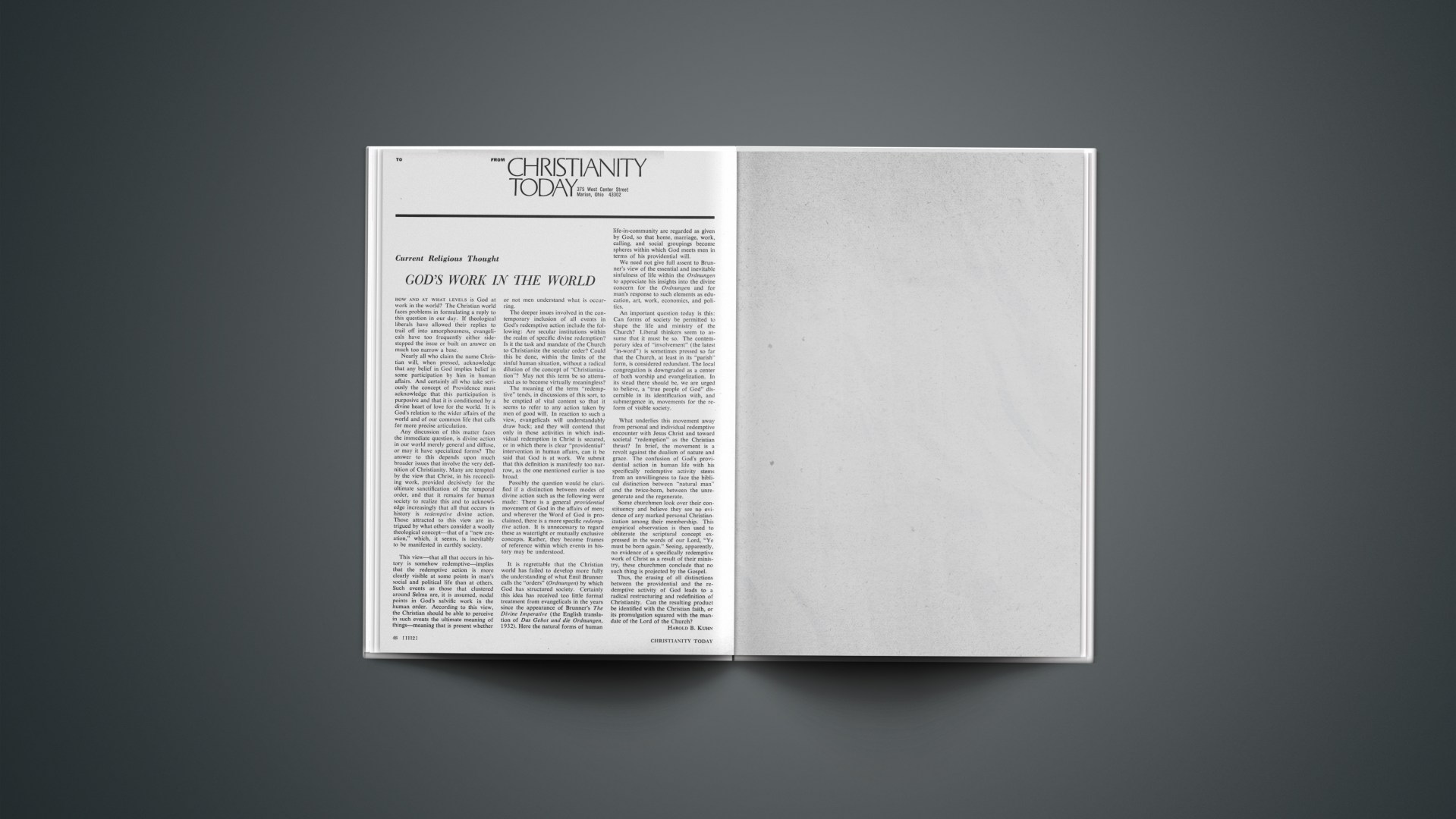
God’s Work in the World

How and at what levels is God at work in the world? The Christian world faces problems in formulating a reply to this question in our day. If theological liberals have allowed their replies to trail off into amorphousness, evangelicals have too frequently either sidestepped the issue or built an answer on much too narrow a base.

Nearly all who claim the name Christian will, when pressed, acknowledge that any belief in God implies belief in some participation by him in human affairs. And certainly all who take seriously the concept of Providence must acknowledge that this participation is purposive and that it is conditioned by a divine heart of love for the world. It is God’s relation to the wider affairs of the world and of our common life that calls for more precise articulation.

Any discussion of this matter faces the immediate question, is divine action in our world merely general and diffuse, or may it have specialized forms? The answer to this depends upon much broader issues that involve the very definition of Christianity. Many are tempted by the view that Christ, in his reconciling work, provided decisively for the ultimate sanctification of the temporal order, and that it remains for human society to realize this and to acknowledge increasingly that all that occurs in history is redemptive divine action. Those attracted to this view are intrigued by what others consider a woolly theological concept—that of a “new creation,” which, it seems, is inevitably to be manifested in earthly society.

This view—that all that occurs in history is somehow redemptive—implies that the redemptive action is more clearly visible at some points in man’s social and political life than at others. Such events as those that clustered around Selma are, it is assumed, nodal points in God’s salvific work in the human order. According to this view, the Christian should be able to perceive in such events the ultimate meaning of things—meaning that is present whether or not men understand what is occurring.

The deeper issues involved in the contemporary inclusion of all events in God’s redemptive action include the following: Are secular institutions within the realm of specific divine redemption? Is it the task and mandate of the Church to Christianize the secular order? Could this be done, within the limits of the sinful human situation, without a radical dilution of the concept of “Christianization”? May not this term be so attenuated as to become virtually meaningless?

The meaning of the term “redemptive” tends, in discussions of this sort, to be emptied of vital content so that it seems to refer to any action taken by men of good will. In reaction to such a view, evangelicals will understandably draw back; and they will contend that only in those activities in which individual redemption in Christ is secured, or in which there is clear “providential” intervention in human affairs, can it be said that God is at work. We submit that this definition is manifestly too narrow, as the one mentioned earlier is too broad.

Possibly the question would be clarified if a distinction between modes of divine action such as the following were made: There is a general providential movement of God in the affairs of men; and wherever the Word of God is proclaimed, there is a more specific redemptive action. It is unnecessary to regard these as watertight or mutually exclusive concepts. Rather, they become frames of reference within which events in history may be understood.

It is regrettable that the Christian world has failed to develop more fully the understanding of what Emil Brunner calls the “orders” (Ordnungen) by which God has structured society. Certainly this idea has received too little formal treatment from evangelicals in the years since the appearance of Brunner’s The Divine Imperative (the English translation of Das Gebot und die Ordnungen, 1932). Here the natural forms of human life-in-community are regarded as given by God, so that home, marriage, work, calling, and social groupings become spheres within which God meets men in terms of his providential will.

We need not give full assent to Brunner’s view of the essential and inevitable sinfulness of life within the Ordnungen to appreciate his insights into the divine concern for the Ordnungen and for man’s response to such elements as education, art, work, economics, and politics.

An important question today is this: Can forms of society be permitted to shape the life and ministry of the Church? Liberal thinkers seem to assume that it must be so. The contemporary idea of “involvement” (the latest “in-word”) is sometimes pressed so far that the Church, at least in its “parish” form, is considered redundant. The local congregation is downgraded as a center of both worship and evangelization. In its stead there should be, we are urged to believe, a “true people of God” discernible in its identification with, and submergence in, movements for the reform of visible society.

What underlies this movement away from personal and individual redemptive encounter with Jesus Christ and toward societal “redemption” as the Christian thrust? In brief, the movement is a revolt against the dualism of nature and grace. The confusion of God’s providential action in human life with his specifically redemptive activity stems from an unwillingness to face the biblical distinction between “natural man” and the twice-born, between the unregenerate and the regenerate.

Some churchmen look over their constituency and believe they see no evidence of any marked personal Christianization among their membership. This empirical observation is then used to obliterate the scriptural concept expressed in the words of our Lord, “Ye must be born again.” Seeing, apparently, no evidence of a specifically redemptive work of Christ as a result of their ministry, these churchmen conclude that no such thing is projected by the Gospel.

Thus, the erasing of all distinctions between the providential and the redemptive activity of God leads to a radical restructuring and redefinition of Christianity. Can the resulting product be identified with the Christian faith, or its promulgation squared with the mandate of the Lord of the Church?

Integrated Hierarchy Eludes Methodists

The Methodist Church is inching its way toward a racially integrated ecclesiastical framework, but it will probably be the last of the principal U. S. denominations to get there.

This means many Methodist clergymen who are Negroes will continue to get lower salaries and pensions than their white colleagues and fewer opportunities for career advancement. It now appears unlikely that the inequities will be resolved for another six years or more—until all conferences of Negro churches now under a separate hierarchy are absorbed into integrated jurisdictions. Full desegregation at local church level seems even more remote.

Actions of a number of Methodist conferences in the South last month indicated that they are moving toward integration, but very slowly. Generally speaking, Southern Methodist whites refuse to fix deadlines as demanded by Negroes. On June 27 negotiators from three jurisdictions met in Atlanta in an effort to map a new approach toward racially inclusive church government, but as a spokesman put it, “talked to a draw again.”

“In addition to other problems,” he said, “economic factors were frequently cited as blocks to progress in integration. Most troublesome are pensions and minimum salaries for pastors, since there is a wide gap between the white and Negro levels. Fear was expressed over the ability to provide funds to raise all to the same level when conferences are merged.”

The obstacles have their roots in an agreement reached in 1939 whereby the Methodist Church was formed out of the Methodist Episcopal Church, a northern body; the Methodist Episcopal Church, South; and the Methodist Protestant Church. In the interests of merger and over vigorous protests, segregationists got constitutional guarantees in return for their support for an administratively united church. Thus today any denomination-wide decree against segregation could be construed as a betrayal of the conditions set forth in the 1939 merger. It might also prompt a rash of court fights.

Nevertheless, a number of the more militant Methodists have been pressing for a basic constitutional change that would wipe out segregated ecclesiastical patterns with one sweep of the pen. Up to now, the quadrennial General Conference, top legislative body of American-oriented Methodism, has turned aside such suggestions in favor of step-by-step voluntary desegregation. The next General Conference will be a special session this fall to vote on a merger of The Methodist Church and the Evangelical United Brethren Church. A group called Methodists for Church Renewal headed by theology professor J. Robert Nelson of Boston University calls for defeat of the merger plan unless it contains “explicit provisions for the total elimination of racial segregation.”

Many who have worked hard for desegregation in Methodism are losing hope in the voluntary approach. At the last General Conference voluntarists predicted that segregation would be eliminated by 1968. The prediction failed to take into account the reluctance of whites to alter traditional patterns and the unwillingness of Negroes to yield their combined influence as a segregated bloc. The ever present threat of schism is still another of the factors that have and will continue to threaten the 10,300,000-member church, second largest Protestant denomination in North America.

Delays in Methodist desegregation are especially embarrassing to those clergymen and church leaders who have been in the forefront of the battle for federal civil rights legislation in the United States. They pressured the government to impose integration, even as the church was showing an unwillingness to do it among its own constituency.

Protestant Panorama

A special session of the Kentucky Baptist Convention turned down a recommendation of its executive board which would have allowed its colleges to accept government financial assistance. One bloc had sought to reduce drastically the convention’s involvement in higher education, contending that its four colleges cannot compete in either quality or quantity with state schools. One pastor complained that “Baptists are too tight and ornery to give God a tithe.”

The American Lutheran Church is granting autonomy to its 330 congregations and 80,000 members in Canada. The constituting convention for a separate body is to be held in Regina in November.

The Pacific Theological College at Suva, capital city of the Fiji Islands, was dedicated recently in a ceremony climaxing six years of planning. The school is sponsored by Anglican, Congregational, Methodist, and Presbyterian churches. It offers a diploma course emphasizing Bible study as well as a degree program in more specialized training such as development of liturgy and biblical languages.

Personalia

David Edward Ward, 30, was ordained a deacon in the Anglican Church of Canada and commissioned for work with Inter-Varsity Christian Fellowship. The appointment was believed to be the first ever made by the church for evangelistic work with an independent organization. Ward, a graduate of McGill University, will serve as an evangelist in the Montreal area.

The Rev. Ian Paisley, 40, was due to appear in a Belfast court this week charged with unlawful assembly. Widely advertised as moderator of the Free Presbyterian Church of Ulster, a body largely of his own creation, Paisley has been demonstrating largely on a platform of anti-Roman Catholicism. One national paper headlined him as “the man who could start an Irish war.”

The Rev. Walter Lang will resign from a Lutheran pastorate in Caldwell, Idaho, to become executive director of the Bible-Science Association. He will edit the association’s newsletter, develop its radio program, and lecture throughout the country.

Kenneth H. Wood, 48, was named editor-in-chief of the weekly Review and Herald of the Seventh-day Adventist Church. Wood has been an associate editor for the 116-year-old publication for the past eleven years.

Dr. M. Guy West was elected moderator-designate of the Church of the Brethren. West, pastor of the First Church of the Brethren of York, Pennsylvania, has served for ten years on the church’s top governing board. In the moderator’s post he will succeed Dr. Raymond R. Peters of North Manchester, Indiana.

The Rev. Sanko King Rembert was consecrated a bishop in the Reformed Episcopal Church, the first Negro ever to hold the office. Rembert, a native of South Carolina, received the B. D. and S. T. M. degrees from New York Theological Seminary.

Dr. Everett S. Graffam, since 1962 the executive director of the Evangelical Foundation, was appointed vice president of development at Malone College, a Quaker liberal arts school in Canton, Ohio.

Dr. Wilfred Scopes, veteran missionary figure and until recently an associate minister of New York’s Broadway United Church of Christ, was named first president of the new United Theological College of the West Indies. The school, expected to open in 1967, combines three theological schools—St. Peter’s College (Anglican), Calabar College (Baptist), and Union Theological Seminary of Jamaica. The campus is located in a suburb of Kingston.

Professor D. Elton Trueblood retired from the faculty of the Earlham School of Religion last month. He may return to teach on a part-time basis, however, following a year of scholarly research in England.

Miscellany

Leaders of the World Fellowship of Buddhists seek to renounce involvement in political activity. They acted at a meeting in Bangkok in the wake of an appeal by the Unified Buddhist Church of South Viet Nam for assistance in the Vietnamese Buddhists’ attempt to overthrow their country’s military government. A proposed amendment to the world fellowship’s constitution holds that participation of monks in politics is against the tenets and teachings of Buddha.

Yugoslavia and Vatican City signed an agreement last month re-establishing diplomatic relations after a lapse of fourteen years. Discussions were under way, meanwhile, for a similar resumption between the Holy See and Cuba.

Reform Jewish rabbis are calling for the immediate establishment of chairs of Jewish studies on college and university campuses. They also indicate they want to overhaul religious school curricula to upgrade subject matter for teen-agers especially.

A new building for the International Protestant Church in Vientiane, Laos, was dedicated last month. It was erected with the support of the Christian and Missionary Alliance, through whose missionary effort the Evangelical Church of Laos has developed.

Fourteen ousted faculty members of St. John’s University were reported to have appealed to the ecclesiastical court of the Brooklyn, New York, Roman Catholic diocese for a redress of their grievances against the school. St. John’s has declined to give specific reasons for the ousters, except to say that they were based generally on “unprofessional conduct.”

Three pastors of the state church were appointed by Denmark’s Ministry of Defense to the first full-time military chaplaincies. Previously clergymen have served military personnel on a voluntary basis.

The Churches of God in North America faced the loss of twenty-two of their congregations in Maryland, West Virginia, and Pennsylvania. Representativees of the separating churches said they were withdrawing in protest over what they regarded as liberal trends in the denomination.

Plans were announced in Kansas City for a new inner-city chapel to be built and operated jointly by Roman Catholics and three Protestant communions—Presbyterian, Episcopal, and United Church of Christ. It is believed to be the first such cooperative venture ever undertaken on the local parish level.

Dr. Juan Carlos Vittone, who headed the World Council of Churches’ refugee service in Argentina, was shot to death at his office in downtown Buenos Aires. Charged with the crime was Hwang Hiler, 35, a refugee from Communist China and a naturalized Argentine.

Deaths

B. D. ZONDERVAN 55, co-owner with a brother of the Zondervan publishing House; in Grand Rapids, Michigan.

ROY LAURIN, 67, noted author of a series of Bible study books; in Eagle Rock, California.

ALBERT BERECZKY, 73, former head of the Hungarian Reformed Church and active supporter of the Communist “peace” movement; in Budapest.

Fire destroyed the two-year-old sanctuary of the Newell Baptist Church near Charlotte, North Carolina. It was valued at $250,000. Pastor Dan Silver said the building debt was covered by insurance but the remainder of the loss was not.

Church of the Brethren Shuns COCU

Church of the Brethren. The largest of the Brethren denominations in North America said no to the Consultation on Church Union last month. By a decisive vote of 881 to 220, delegates to the annual conference of the Church of the Brethren adopted a study committee’s recommendation against full COCU participation. The denomination now maintains an observer-consultant relationship, and that will continue.

COCU leaders reportedly had held out a big hope that the 200,000-member Brethren body would be the next to join. There are already eight denominations participating in the COCU talks, representing a prospective new superdenomination of some 24,000,000 members.

The Brethren committee expressed doubts about such a “vast” church organization. Their report called on the constituency “to be even more creatively and responsibly involved” in the ecumenical movement but indicated anxiety over the effect of a merger on pacifist Brethren convictions.

Such a merger, the report added, might also endanger the denomination’s conversations with other churches. Exploratory talks on unity have been held during the past year between the Church of the Brethren and four other denominations: the American Baptist Convention; the Churches of God in North America, with headquarters in Harrisburg, Pennsylvania; the Brethren Church, with headquarters in Ashland, Ohio; and the Evangelical Covenant Church.

The committee noted that COCU, in its negotiations looking toward a united Protestant church, regards only baptism and communion as sacraments. This, it said, “diminishes the recognition of the presence of God in other acts of the church such as feet-washing, anointing, marriage, and ordination.”

In addition, the committee said, “the forms and office of the ministry in the merging united Church, based upon the acceptance of the historic episcopacy, seem to perpetuate the sharp cleavage between clergy and laity, and give insufficient recognition of the growing creativity of the ministry of all believers.”

Lutheran Church in America. The question most Protestants are asking of the Lutheran Church in America never got an answer during the 3,260,000-member denomination’s third biennial convention in Kansas City.

Why has the LCA, largest and most ecumenically minded of the Lutheran denominations, steered clear of the Consultation on Church Union? Both the LCA and the 2,600,000-member American Lutheran Church have rejected even observer status. Much to their surprise, the more conservative Lutheran Church—Missouri Synod listened in officially at the May meeting of COCU.

Franklin Clark Fry, the articulate LCA president who was re-elected, says Lutherans have “no doctrinal basis” for unity talks with COCU. Lutherans, he declared, feel that common doctrine is the only basis for unity, whereas leaders of Reformed bodies see unity gained through organic union, followed by the working out of doctrinal problems as the union matures.

“We would be willing to sit down right now and discuss doctrinal statements,” Fry said. “We emphasized there was no antipathy toward the discussions, and our rejection was received in good faith.”

What happens now? Even though Fry is a strong ecumenist (he heads the Central Committee of the World Council of Churches), he is obviously not advocating a rushing into Lutheran-Reformed talks. The LCA and the ALC are still working out the problems of the mergers that brought them into existence four years ago, and they don’t want to jeopardize hopes of a merger with Missouri’s 2,780,000 members.1The LCA, however, has implicity declined for the time being overtures from the other two churches for pulpit and altar fellowship. Such a union would represent 90 per cent of the nine million U. S. Lutherans.

As expected, last month’s LCA convention voted unanimously to become part of the Lutheran Council in the U. S. A., seen by some as another big step toward more Lutheran unity. This cooperative agency will replace the present National Lutheran Council, which has served the LCA and the ALC and their predecessors since 1918. Conventions of the ALC, Missouri, and the smaller (20,000 members) Synod of Evangelical Lutheran Churches have already approved participation in LCUSA. A parallel body is to be formed in Canada.

The new agency will engage in theological studies, public relations, military personnel and educational services, and welfare and mission activities. The Rev. Dr. C. Thomas Spitz, a Missouri Synod pastor long active in broadcasting, is to be selected general secretary, a position in which he has been working unofficially for several months. An organizational meeting is scheduled for November, and the new offices will open in New York in January.

In a statement on church-state relations, the convention chose a middle ground. Said one of the framers, Philadelphia seminary dean William H. Lazareth, “A political position which advocates separation between church and state presupposes separation between Creator and Redeemer. Since God is One, this would mean schizophrenia in the Godhead.”

“The state is God’s agent for his non-redemptive work,” Lazareth said. “This is not an endorsement of the principle of state aid to private education” or other institutions, he added, nor does it mean the Church feels it is “morally mandatory” for the state to offer financial aid.

The statement said, “The position rejects both the absolute separation of church and state and the domination of either one by the other, while seeking a mutually beneficial relationship in which each institution contributes to the common good by remaining true to its own nature and task.”

In the first step of a “master plan” toward realignment of seminaries, the convention voted to merge a small seminary at Fremont, Nebraska, with the Lutheran School of Theology in Chicago. In other action, delegates overrode a Fry recommendation and voted a study of the role of women in the ministry. (Fry felt the study is “unwise” at this time, explaining that Missouri now limits its ordination to men and that in view of current talks, he hopes to narrow, rather than widen, the gap between Lutheran bodies.)

The delegates also: passed a sixteen-point “manifesto,” designed as a checklist for local congregations, which reaffirms the theological position of the church and invites congregations to work with churches and secular groups “in activities that promote justice, relieve misery and reconcile the estranged”; spoke strongly for abolition of the death penalty, noting that capital punishment falls disproportionately upon those least able to defend themselves; heard Fry report that the church was forced to dip into reserves for more than $300,000 to complete its work last year because of lack of revenue; and expressed cautious approval of U. S. involvement in Viet Nam, commending men serving in the war but recognizing the right of those who feel they cannot participate in the war to hold this position.

The convention turned down an amendment offered by a Milwaukee industrialist to a statement dealing with programs to counteract deprivation. The amendment of Carl T. Swenson, a lay delegate, sought to shift the emphasis to non-governmental programs as a means of eliminating injustice and want. Swenson said that talent should be enlisted from industry to help carry out programs planned in a Christian framework.

A variable-income pension approved by delegates will give program participants the option of sharing directly in the value of common stocks. The pension plan provides payments for life, but they will increase or decrease according to fluctuations in dividend income and market value of stocks in which members’ contributions are invested.

Evangelical Free Church of America. Joining the swelling ranks of U. S. Protestants who need money for their schools and yet desire to keep church and state separate were delegates to the eighty-second annual conference of the Evangelical Free Church of America. A dean of the denomination’s college called for “judicious use” of federal aid, but a committee report turned thumbs down on the idea. The whole question was tabled pending further study.

Immediate effect of the action was a loss of $183,000 in a grant said to have been offered the church’s Trinity College by the federal government for a new science building.

National Association of Congregational Christian Churches. A banquet address by Mormon George Romney, governor of Michigan, was heard by some 1,000 persons during the annual meeting of the National Association of Congregational Christian Churches. Romney told them that churches should help provide the moral character needed for responsible citizenship in all areas of life. The association is the largest of the Congregational church groups opposing the merger that created the United Church of Christ.

Evangelical Covenant Church of America. Two official Sunday School curricula have been adopted by the Evangelical Covenant Church of America. One is the Covenant Life curriculum, a cooperative venture with the Presbyterian Church in the U. S. (Southern) and four other denominations. The other is that of Gospel Light Publications.

At the church’s 81st annual General Conference, held in Chicago, delegates adopted a resolution supporting President Johnson’s “willingness to negotiate unconditionally to achieve peace in Viet Nam.” They did not pass specific judgment, however, on the American military action there.

A committee on interchurch relations was instructed to continue explorations regarding merger with other denominations. Such talks have taken place during the year past with the Moravian Church in America, the Evangelical Free Church, the Church of the Lutheran Brethren, the Church of the Brethren, and others.

The Rev. Milton B. Engebretson, 45, was elected president of the 66,000-member church to succeed the retiring Dr. Clarence A. Nelson next year.

Toward A Consecrated Rebellion

Among the largest of American religious conventions is one where no laws are enacted, no resolutions passed, and no politics allowed. It is the annual North American Christian Convention, unofficial focal point of the conservative element of the Disciples of Christ. The only activities are naming of officers (president for 1966–67: L. Palmer Young, a minister from South Louisville, Kentucky), formal speeches, discussions, and fellowship.

This year’s convention in Louisville, which drew a staggering total of 25,000 registrants, included an incisive address by Donald H. Sharp, minister of Woodland Heights Christian Church in Crawfordsville, Indiana. Here are excerpts:

“Jesus rebelled against religious legalism, social injustice, and personal hypocrisy.

“Since Jesus there have been a parade of rebels. Among them there have been charlatans and fools. There have been egocentrics looking for some scrap of notoriety. There have been kooks rebelling for kicks. And yet every great leap forward seems to have come through the inspiration of some deeply consecrated rebel who, as Frank Meade has said, ‘objected not so much to men or institutions as to the abuses of men within those institutions.’ …

“We must remember that the separation of the rebel fools and the rebel greats is clearly defined in what man becomes indignant about. To wildly rebel against the establishment for the sake of rebelling is to play the part of the fool. Rebellion must have purpose beyond itself. To rebel against hypocrisy, social injustice, and religious bigotry is rebellion with a purpose and is to become at least in one sense God-like.

“Our brotherhood does not send delegates to conventions to pass resolutions and to impose decrees upon the brethren, and this is as it should be. However, our brotherhood does have positive responsibilities in convention, one of which is surely to instill into every hearer the will to be a God-like rebel.

“I’m tired of Christendom winking at hypocrisy, condoning social injustice, and upholding religious bigotry in the name of conservatism. I believe in conserving the faith once and for all delivered unto the saints, but I rebel against man-made traditions that draw little circles to shut men out. I believe in the separation of church and state but I rebel against this profane silence that we have fostered because we are afraid of being identified with the liberals.…

“Faith in Christ answers man’s need to rebel and be a rebel. We can rebel against the hypocrisy of our own lives.… We can rebel against social injustice beginning first with ourselves, for when we have removed the logs of injustice from our own eyes we shall be much better prepared to see how to correct the injustice fostered by others. We can rebel against religious Pharisaism by placing our pet opinions under the light of God’s Word and then quit imposing our opinions upon others as God’s law. Much of our brotherhood’s division is not on what the Bible has said but rather on what the Bible has not said.”

American Baptist Association. “Baptists have been slow to change,” said President Vernon E. Lierly of the American Baptist Association, “but many times their resistance has been based on tradition rather than truth.”

Lierly declared at the ABA’s national messenger meeting in Houston that “nothing is wrong because it is new, neither is anything right just because it is old.… Be sure your resistance to change is based on the Word and not on tradition and prejudice.” He added that “we should seek to make truth appealing to men of all ages and from every walk of life. It is wrong to present the truth in an offensive way when truth itself would not offend.”

The ABA is a fellowship of some 3,220 congregations with a total membership of some 726,000. Administrative offices and a publications business are located at Texarkana, Texas.

General Association of Regular Baptist Churches. Resolutions against neo-evangelicalism and against antidefamation bills now said to be under consideration in several state legislatures were adopted at the 35th annual conference of the General Association of Regular Baptist Churches held in Grand Rapids, Michigan. The most vehement denunciations, however, were aimed at death-of-God theologians Thomas J. J. Altizer, Paul M. Van Buren, and William Hamilton. The GARBC said all three should be discharged from their teaching posts.

Baptist General Conference. A 536–124 vote to bring the Baptist General Conference into the National Association of Evangelicals highlighted the denomination’s 87th annual meeting, held in San Jose, California. Delegates also reaffirmed affiliation with the Baptist World Alliance, but called for more study on whether to seek membership in the BWA’s newly-organized North American affiliate. The Baptist General Conference is composed of some 90,000 members in 633 churches.

Dr. Clifford E. Larson was elected moderator. Larson recently resigned as dean of Bethel College to become a professor of education at Bethel Seminary.

Cumberland Presbyterian Church. Final approval of the reunification of the Cumberland Presbyterian Church with its Negro branch was voted by the church’s 136th General Assembly at Memphis. The Negro group, known as the Second Cumberland denomination, must still ratify the merger with a three-fourths vote of its presbyteries. If they do, the General Assemblies of both bodies will meet jointly at Paducah, Kentucky, next June for the official reunion ceremony.

The white Cumberland church has about 85,000 members in 900 congregations. The Negro group has some 20,000 members in 125 local churches.

Ten Days at Wenham: A Seminar on Scripture

In a seminar unprecedented in recent evangelical history, fifty-one biblical scholars met at Gordon College and Divinity School (Wenham, Mass.) for ten days’ intensive discussion of the authority and inspiration of the Bible. Participants, most of them seminary professors and administrators, came from six European countries as well as from Australia, Korea, Canada, and the United States. They were members of various communions, including Anglican, Reformed, Lutheran, Baptist, Methodist, Congregational, Free Church, and independent bodies.

The lively discussions were conducted with remarkable freedom and candor in an atmosphere of Christian fellowship and submission to the authority of Scripture. Daily sessions, moderated by members of the convening committee (Harold J. Ockenga, chairman; Frank E. Gaebelein; and Russell T. Hitt), were supplemented by many hours of informal conversation.

Major papers and responses covered such subjects as archaeology, biblical authority in the light of exegesis and hermeneutics, Roman Catholic attitudes toward Scripture, liberal stereotypes of the evangelical view of the Bible, the contemporary relevance of Warfield’s approach to inspiration, and the theological definition of authority, inspiration, and inerrancy.

Among those presenting papers were Dr. Donald J. Wiseman, professor of Assyriology at the University of London; Dr. Herman Ridderbos, professor of New Testament at the Theological Seminary of the Reformed Churches, Kampen, The Netherlands; Dr. James I. Packer, warden of Latimer House, Oxford; Dr. Oswald C. J. Hoffmann, preacher on “The Lutheran Hour”; and Dr. Kenneth S. Kantzer, dean of Trinity Evangelical Divinity School.

Much of the wide-ranging discussion was on inerrancy. Some held this to be an essential biblical doctrine, while others preferred to speak of Scripture as infallible. There was general agreement that any definition of inerrancy must be framed in the light of all the biblical data, and there was also a consensus on the complete truthfulness of the Bible and its authoritativeness as the only infallible rule of faith and practice. No participants affirmed the errancy of the Bible.

At the conclusion of the seminar, this statement was adopted—not as a formal confession but as a report of mutual attitudes, common ground, and matters requiring further study:

Text Of Communique

A privately sponsored Seminar on the Authority of the Bible was held at Gordon College, Wenham, Massachusetts, June 20–29. The participants sought to clarify their understanding of scriptural authority in order that they might more faithfully acknowledge it as the authority of Christ himself.

The historic Protestant confession of the supreme authority of Scripture provided the background for discussion and the structure of hearty agreement. Among the agreed positions affirmed were the following:

That the Holy Scriptures, comprising the sixty-six canonical books given by the Holy Spirit, are verbally inspired and are the revealed Word of the Triune God;

That the Scriptures are completely truthful and are authoritative as the only infallible rule of faith and practice;

That because the Word of God was written by men in particular historical contexts, the disciplines of accurate scholarship have a full and proper use in its study;

That the Bible as a whole sets forth the history of redemption and directs us to Jesus Christ, the Word incarnate;

That God has committed the Scriptures to his people to search, obey, and proclaim, and that through the working of his Holy Spirit he effectively uses the Scriptures for the salvation of men, the instruction and government of his Church, and the consummation of his purpose.

In an endeavor to put such theological truth into the language of today, a committee drew up the following statement, which does not necessarily reflect the viewpoint of each member of the seminar:

Attitudes toward the importance of the Bible are changing throughout the Christian world. The renewal of biblical studies among Roman Catholics and the increasing concern for the biblical message through the whole Church, together with current confusions regarding that message, are facts which call for new endeavor on the part of evangelicals. In this situation we must acknowledge that neither our methods of expression nor our practices have sufficiently witnessed to our faith in God’s Holy Word; hence we offer the following testimony to its power and authority;

The Bible is wholly trustworthy, for its words speak God’s truth and give men final answers to the deepest problems of their lives. Scripture throughout the centuries has brought men to the saving Christ who died and rose again, and we affirm that it will do this today when it is read and proclaimed in the power of the Holy Spirit. We stand under it and commend it to a frustrated age that needs above all to hear the clear and powerful voice of God in judgment and in grace.

Holy Scripture sets forth abiding standards of conduct for men and nations. Christians have often failed to concern themselves sufficiently with the suffering and injustice of our sick society and to hold forth to dying men the Word of Life. We, therefore, give ourselves anew to declaring the biblical Word, which alone offers hope in this world and the next.

In the fruitful and candid discussions of the seminar, certain questions were found to require further study and consultation. They included the interpretation of historical, chronological, and literary difficulties in the Scriptures; the extent to which reconciliation of such difficulties should be sought; the bearing of modern science on biblical narratives; the concept of inerrancy, whether and in what sense it is a biblical doctrine, and its relation to biblical authority.

For those privileged to participate in it, the seminar brought rewards beyond those anticipated. Personal friendship and mutual understanding flourished in an arduous docket of meetings. The urgency of evangelical engagement in current theological debate became increasingly apparent. Above all, the clarity, excellence, and authority of the Bible itself commanded a response of praise in an enterprise where labor cannot be far from prayer.

Potions Under Study

Not only does LSD induce religious awareness, say the psychedelic prophets; it can also promote world peace, assuage the distress of the dying, help alcoholics, and boost learning processes. In short, this is what the world has been waiting for, according to some who participated in a landmark conference on LSD in San Francisco last month. The prospects of induced religious experience kept recurring, but a few of the more dubious participants had the nerve to challenge the cure-all claims and pointed instead to the rising incidence of LSD use among teen-agers, the hundreds of LSD-induced “acute panic” hospital admissions, and prolonged psychotic reactions—even suicides.

This was not enough to dampen the enthusiasm of Dr. Timothy Leary, flamboyant evangelist of the LSD cult, who said, “The present LSD boom is no less than a religious renaissance that is only just beginning.” The only real danger to a person, he asserted, is that he will “refrain from LSD and thus abide in his house of spiritual plague.” Further, “LSD’s first place of impact is in religious experience as it alters our attitudes toward ourselves and society.”

LSD is a chemical that is colorless, odorless, and tasteless when dissolved in water. It is the best known of a number of substances that, taken internally, produce hallucinations—or, as Leary and his disciples would have it, expand the person’s levels of consciousness (see June 24 issue, page 46, and July 8 issue, page 44). The six-day San Francisco conference, sponsored by the adult education branch of the University of California, was the first such scholarly colloquium on psychedelics (the technical term for so-called consciousness expanding compounds).

Because the word “religious” is “too loaded,” Dr. Paul Lee had misgivings about Leary’s view and preferred to label the LSD “session” or “trip” as “the most profound existential or mythical experience one can have.” Lee, who claims to have new insight into St. Augustine’s Confessions as a result of LSD intake, will teach philosophy beginning this fall at the University of California, Santa Cruz. He has been Protestant chaplain at Brandeis University and assistant professor of humanities at the Massachusetts Institute of Technology. Lee suggested that a psychedelic experience can be seen in “the myth of Genesis,” in which Adam and Eve partook of “the tree of all possibilities—a symbol of mental creativity.”

“I do believe in psychedelic religion, where LSD is the sacrament,” said Dr. Frank Barron, a University of California research psychologist, “but I do not agree with it.” He pointed out two dangers: LSD can convert latent psychoses into overt forms; and it can cause a basic change in values, such as loss of distinction between right and wrong.

Essential sensations of a “trip” were outlined by a prominent psychiatrist and UCLA professor of medicine, Dr. Sidney Cohen, author of The Beyond Within: The LSD Story. These include loss of ego boundaries and fusion with the universe (“you may see your body melting into the carpet”), a philosophical basis of some major religions. Said Cohen: “Many who have taken LSD say they have discovered the great white light of God; they say that this is the ‘real reality,’ and they yearn to return to this state.” Thus the experience—not the drug itself—becomes addictive, a point repeatedly referred to during discussions of legal and moral implications.

Along more scholarly lines, Dr. Abram Hoffer, a Canadian psychiatrist and university professor, reported his use of LSD in treating 800 alcoholics. He said that more than one-third were cured as against the average 10 per cent cure rate of all other treatments combined.

For most of those cured, the “healing” came within a context of religious experience, said Hoffer. For example, there was the priest named John who, under LSD’s influence, “saw” God and heard him say, “John, no more drinking!” From that day, months ago, the priest has remained sober. While admitting the unusual nature of this instance, Hoffer said that “properly used LSD therapy can, with great speed and economy, convert a large number of alcoholics into sober members of society.”

A “Center for Dying and Being Born,” where terminal patients would be LSD-enabled to face death “in a conscious and open way,” was called for by Dr. Richard Alpert, a research psychologist and former Leary colleague. His idea received weight from a paper by Eric C. Kast, a Chicago psychiatrist. Kast wrote that LSD administered by him to experimental groups of dying patients created “acceptance and surrender to the inevitable loss of control” and even gave some “a new will to live and a zest for experience.” Added Alpert, “A patient could choose to die in my ‘Center’ under whatever religious metaphor he wished, because psychedelic clergymen abound today.”

Ecumenism At The Altar

News reports last month disclosed two unusual and presumably unprecedented marriage ceremonies.

A Jesuit priest was married to a former nun by a fellow Jesuit colleague at the University of Detroit.

A Southern Baptist pastor and a Catholic priest participated together in a wedding ceremony at St. Michael Catholic Church in Memphis.

Father Lawrence Cross, 47, former head of the sociology department of the Jesuit-run University of Detroit, made front-page news with his marriage to Joan Renaud, 37, a nurse who had left the Sisters of Mercy three years ago. Father Thomas Blackburn, chaplain of the university, celebrated the marriage.

Father Cross, on leave since January to teach at Rome’s Pontifical Gregorian University, returned to the country in May and married Miss Renaud May 31. He entered the Jesuit order in 1937 and was ordained in 1951. In 1957 he joined the university faculty, after studying as a Fulbright scholar in Belgium. Father Cross has been active in civil rights work and served on the Archbishop’s Committee on Human Relations and in the Detroit chapter of the NAACP.

Under canon law, a priest who marries is automatically suspended of his “faculties” and cannot celebrate Mass, hear confession, or distribute the Holy Communion. He remains, however, a priest for life.

In Memphis, Joyce Jackson, a Baptist, and James M. Larkin, a Catholic, were married at St. Michael Church by Father James Miller, assistant pastor, and by Miss Jackson’s brother, William, pastor of the Bethel Baptist Church of Hebbardsville, Kentucky.

Father Miller led in the exchange of vows and Jackson delivered a sermon and gave the benediction. The sermon described love as presented in First Corinthians 13 as the basis for marriage.

The bride had visited Father Miller two days after the Vatican degree liberalizing restrictions on Catholic-Protestant marriage ceremonies and asked how her brother could participate in the wedding.

Jackson, a graduate of Southern Baptist Theological Seminary and Union University, said Father Miller had been very generous in allowing him time during the ceremony.

A Baptist Press release quoted Jackson as saying, “There were almost no restrictions given me, except that he had to exchange the vows and this is something that I would want to do at any wedding performed in my church.”

The bride said she will remain Baptist and her husband Catholic.

In a draft of a new hymnal for Presbyterian churches in the British Isles a hymn for burial services was inadvertently printed in the section for weddings. The misplaced hymn began, “Go happy soul, thy days are ended.”

Off LSD himself since February, Alpert theorized that the drug was possibly a key to show persons how to create and order their environment. He went on to link LSD-induced religious experience to most “rock and roll” groups: it makes possible mutual spontaneity in improvisation and rhythm which then becomes a high level of spiritual communication. He revealed plans already drawn up for a “discotheque church” that would include “rock and roll spiritual endeavor.”

The Leary-Alpert school came in for some hard knocks from Huston Smith, author of The Religions of Man. Smith questioned the “staying-power” of LSD-religion—“where faith is confirmed, awe felt, and obedience increased,” for true religious experience triggers from the core of man’s being a “triple movement of mind, emotions, and will.”

Smith chided the movement for “failure to integrate psychedelic experience with daily life” (referring to Leary’s radical doctrine of “quit society, quit work, quit school”) and also for its failure to face up to the problems of sexual irresponsibility, lethargy, and anarchy that grow out of its antinomian nature.

EDWARD E. PLOWMAN

Tribute In A Window

The FBI director was honored June 26 by the congregation of the Capitol Hill Methodist Church, Washington, D. C., who named a window in their new $1 million building the J. Edgar Hoover Window. Hoover, a Presbyterian, was born and grew to adulthood in a home on the site of the new Methodist church.

The colored-glass window, designed to symbolize statesmanship through Christian virtues, is twenty-two feet wide and thirty-three feet high. It is constructed in seven longitudinal sections framed on all sides in limestone.

“The window is designed to symbolize the Christian virtues of Hoover and other Christian statesmen,” said the Rev. Edward B. Lewis, pastor. He explained that the symbols in the window include: an anchor, symbol of hope; balance scales, law and justice; a compass, temperance; the cross, faith; a lamp, education and learning; a lily, purity; and the oak leaf, courage and fortitude.

Social Activist

The Rev. Lester Kinsolving, founder and president of the newly organized Association of Episcopal Clergy, is also being given the full-time job of lobbying for repeal of California laws prohibiting abortion. The appointment was made by the Rt. Rev. James A. Pike, the resigning Bishop of the Episcopal Diocese of California.

A campaign to repeal abortion laws was begun after nine San Francisco Bay area doctors were charged with performing illegal abortions on women exposed to German measles.

The outspoken Kinsolving, who leaves his work as vicar of the Church of the Holy Spirit in Salinas, California, says that “certain aspects of the Church … are definitely in a bad way.” He organized the clergy association to aid in the defense of clergy in trouble; to correct injustices in relations between clergy and church superiors; to study the Episcopal Church’s pension fund; and to serve as a placement bureau for clergy.

The organization met some initial criticism from the presiding bishop of the Episcopal Church, the Rt. Rev. John E. Hines, who called it a “trade union.” Kinsolving contends that the organization is comparable to the Association of University Professors or a teachers’ association and is not a trade union.

Federal Fever

The gradually growing religious lobby in Washington will soon have an Orthodox wing. Establishment of a secretariat in the nation’s capital at a cost of $100,000 per year was approved this month by delegates to the eighteenth biennial Clergy-Laity Congress of the Greek Orthodox Archdiocese of North and South America. The action came upon recommendation of Archbishop Iakovos, primate of the archdiocese, who indicated that he planned to spend considerable time in the new office. His rationale: “Because of the extent of our responsibilities and role as a major faith, we need a center in Washington to be in better direct contact with the nation and national politics.”

‘Up With People’ Ban

The Columbia Broadcasting System is refusing to let its television stations show the Moral Re-Armament film, “Up With People.” The film was to have been carried under the sponsorship of the Schick Safety Razor Company. Edward Baltz, vice president of the firm, said that a protest against the CBS ban would be lodged with the Federal Communications Commission.

According to Baltz, the reason given by the network for banning the show was a CBS policy that no sponsored program could be of ideological or editorial nature and that some segments of the film were contrary to this rule.

Prayers Under Protest

A federal judge ruled in Chicago last month that a traditional verse of thanksgiving without the word “God” does not constitute a prayer when recited by De Kalb, Ill., kindergarten children.

Judge Edwin A. Robson dismissed a request for an injunction against De Kalb’s Elwood School which asked children to recite:

“We thank you for the flowers so sweet.

We thank you for the food we eat.

We thank you for the birds that sing.

We thank you for everything.”

The ruling came in response to the request of Mr. and Mrs. Lyle Despain of De Kalb who charged that the constitutionally guaranteed freedoms of their five-year-old daughter were being violated when she was asked to recite the verse.

Mrs. Esther Wayne, 63, kindergarten teacher, said that she had already eliminated “God” from the last line of the verse at the request of the Despains. She contended that the verse was not a prayer but “a method of learning graces and manners.”

Mrs. Despain testified that some children concluded the recitation of the verse with an “amen” or by crossing themselves.

The judge said there was no indication that the children “took a devotional attitude” in reciting the verse. The verse simply “expresses gratitude,” he said.

The Chicago decision contrasted with a 1965 decision by the Federal Court of Appeals in New York which ruled that a similar prayer without the deletion of “God” was unconstitutional in a Whitestone kindergarten. In the Whitestone case, parents of kindergarten children took action against the school for disallowing prayer after principal Elihu Oshinsky stopped school prayers in keeping with a Board of Education ruling.

The U. S. Supreme Court refused to hear the case after parents appealed the ruling of the Federal Court of Appeals.

CAROLYN LEWIS

Moscow Charges Bible Smuggling

Moscow Radio reported this month that three British tourists and a Dutch citizen were expelled from the Soviet Union for attempting to smuggle religious literature in the country.

The report said that Anthony Richard Hippisley and his wife, Anne Marie, tried to smuggle through a border checkpoint 400 Bibles and other books which they had received from the British and Foreign Bible Society for “illegal” circulation in the Soviet Union. The books, the station added, were concealed in eight secret compartments in a specially adapted Volkswagen.

A second smuggling attempt at the Lyausheny checkpoint in Soviet Moldavia, Moscow Radio said, involved two Baptist ministers—identified as John Murray, a Briton, and Johannes Fisser, a Dutchman. It said they tried to bring in similar literature concealed in an automobile.

In each case, the “smugglers” were said to have been ordered out of the country and their books and cars confiscated.

London Crusade Produces Historic Climax

In June, Americans were all over London, that much publicized “swinging city”: tourists, tennis fans at Wimbledon, Cassius Clay, Hugh Hefner unveiling yet another Playboy Club, and as the head of the British Safety Council observed, “two American savers of souls,” Ralph Nader, author of Unsafe at Any Speed, and Billy Graham.

Evangelist Graham far outdrew the competition, speaking to more than 900,000 persons, his largest audience ever for a month of meetings. The crusade was also his longest since Philadelphia in 1961. The meetings at Earls Court, Britain’s biggest hall, put the career total of persons responding to Graham’s altar calls past one million.

The Greater London Crusade was a bench mark for at least one other reason—Graham used television as never before. Three services were recorded in color for telecast later this year in America. Big-screen theater-type TV accommodated overflow crowds in the main arena and simultaneous services in ten cities across Britain. Graham is now talking about a “national crusade” in America, using closed-circuit TV.

Supporters and skeptics alike will now maintain close scrutiny of the 40,000 persons who registered decisions for Christ. About a tenth of these responded to the appeal at the closing service July 2 in Wembley Stadium, England’s largest outdoor arena. Under a near-cloudless evening sky, they filed silently onto the tarpaulin-covered turf track where dogs had raced twenty-four hours earlier. In all, some 86,000 got into Wembley.

Surveying the dramatic throng, the purple-cloaked Lord Bishop of Coventry, Dr. Cuthbert Bardsley, inserted some commentary before his benediction. He said Graham “brought new life to our nation when we greatly needed it.” While critics say Graham doesn’t “preach a social message,” the bishop predicted thousands of reformed individuals would go forth from the crusade to help reform society.

Some considered the crusade as a holding action, merely reinforcing the faithful. Although a large part of the audience was churchgoers, figures on the “inquirers” tell a different story. Counselors’ cards show a third have no church connection at all, while another third have church membership but no regular participation.

Another significant fact: Two-thirds of the inquirers are under 25. This is in marked contrast to the three-month Harringay crusade in 1954, where those going forward were predominantly middle-aged. A magazine ad on Graham’s behalf seemed to capture the mood: “Make religion a real live switched-on thing.”

London will also be remembered for the stark silence as the inquirers responded. After thorough discussion, Graham’s team decided to eliminate the usual choir song of penitence, chiefly to counter criticism that an emotional spell was cast. Once the change was made, new critics popped up, claiming the shuffling of thousands of feet was just as hypnotic.

The spell of silence was interrupted three nights, twice by individual protesters and, on the final Tuesday, by a dozen youths chanting, “Save souls in Viet Nam.” As they were hustled out of the hall strewing leaflets, the sober converts filed past. The next night, antiwar demonstrators reportedly planned to interrupt Graham’s sermon every five minutes. But that day the United States bombed near the centers of Hanoi and Haiphong, and protests centered on the American embassy instead.

Another night, a gang of war critics planned to go forward and tie up as many counselors as possible in political arguments, but few went through with the plan. Before another service, a telephone crank threatened to bomb the counseling room.

Graham’s refusal to preach on international politics also caused criticism from clergymen. There was a string of other complaints: Graham shouldn’t “seek publicity,” should mention the sacraments, should be more intellectual, should take a parish in an underprivileged area. A common reservation was voiced by the Archbishop of York, a distinguished Graham supporter: “We may not like all the methods he uses.…”

But Congregationalist analyst Cecil Northcott says theology, not methods, was the basic issue. The week after the crusade closed, Northcott contended in the Church Times (Anglican) that the £1 million (nearly three million dollars) spent on Graham activities in 1954 and 1966 would have been better used to found and endow a “National Institute of Mission” for “ecumenical study” of evangelism, free of Graham’s “biblicism and servitude to the printed word.”

Amid all the Protestant complaints, Roman Catholic writer-editor Michael de la Bedoyere praised Graham for getting down to the essentials of the faith, asked prayers for his success, and said, “We may yet see him as ‘Saint Billy’!”

The Graham team took a turnabout look at the churches in a special meeting for clergymen. Lane Adams said that “the average church expects more maturity from crusade inquirers than veteran members” but should remember they are “spiritual infants.” Graham appealed for more basic, uncomplicated gospel preaching.

The evangelist’s approach to British churches came through in his nightly talks to inquirers. He said they must become active in a church even though many say “that’s the hardest thing you’ve asked me to do.” But he told them also to join one of the 6,000 Bible study groups now functioning in the London area. He urged the new Christians to take part in social service, such as visiting the sick or lonely or “making friends with someone of another race.”

A lot has happened to Great Britain and to Billy Graham since their encounter a dozen years ago. Something of an American curiosity in 1954, Billy Graham in 1966 is a world figure. He carried his biblical beliefs to luncheon with Queen Elizabeth, a charity ball to which he was invited by Princess Margaret, a breakfast meeting for 150 members of Parliament (many of whom had been debating on the floor of Commons until 7:30 A.M.), and 2,000 leaders of society and culture at a Foyles Literary Luncheon.

Graham’s sermons contained the same concise, dramatic Gospel he preaches everywhere, but these upper-crust gatherings produced some new material.

In introducing Graham at the literary luncheon, publishing magnate Lord Thomson said “the cynics are quieter than twelve years ago” because there is more crime, child cruelty, laziness, and selfishness. After being toasted with champagne, the teetotaling evangelist said that in Britain and America “there is a developing vacuum like that in prewar Germany. If it is not filled with something hopeful that will answer the ultimate problems of life, there will be trouble in the next generation.”

Graham said the life taught by Christ “never had all the taboos built up in the Victorian period.” And at the parliamentary breakfast, he called for a “new Puritanism” of “disciplined, New Testament living.” In the style of Earls Court, he said a new revival “could begin in the heart of someone here today.”

As for the crusade, Graham told a church audience to judge its results in five or ten years. (Dozens of ministers converted at Harringay were in evidence at Earls Court.)

The evangelist will return to London for two days in September to shore up new converts, on his way to a preaching mission in Poland. He has no major events scheduled over the summer.

The evangelist told an unofficial meeting at the Anglican Church Assembly July 5 that he found widespread religious interest in Britain but also “a revolt against the institution of the Church,” particularly among laboring classes. He said professionals alone cannot evangelize Britain. The laity must be mobilized, and this will require “a drastic revolution.” He said it is time for the Church to take the offensive, with “unambiguous proclamation.”

Graham labeled the “so-called radical movement” as “reactionary” because it is merely “defensive in the face of secularism, humanism, and rationalism.” He said the Church has also been defensive in morals by hesitating to denounce sin.

Billy And The British Press

One of Billy Graham’s most extraordinary achievements in Britain was making salvation into page-one news. There were hundreds of articles in stately journals and lowbrow dailies, notices of crusade trips in provincial papers, and seemingly endless letters to the editor. The treatment of Graham was rougher than anything he gets from secular journalists in the States.

The Communist Morning Star, in a huge headline, dismissed the crusade as “Sky-pie—in the new king-size, flip-top packet.” A Reading columnist said bluntly, “Go Home, Billy Graham.” In a similar vein, a Glasgow writer said that with “150 million scarlet sinners in the U. S. A.… Graham’s search for souls in London surely takes on some comic opera qualities.”

Anti-Americanism also cropped up in a letter to the Ipswich Evening Star: “It’s no use sobbing your socks off at Earls Court about your minor peccadilloes if you then go off and murder men, women, and children in Vietnam because President Johnson tells you to.”

The Mirror’s Cassandra, who is syndicated in the United States, said soberly, “Billy Graham hasn’t changed, but I think that we in Britain have—for the worse.” He considers Graham “a good, simple man who comes from a country where revivalism has a bad record.”

The Times, the “Establishment” daily, was rare in perceiving theological undertones to anti-Graham feeling within the Church. It said “few could deny the harsh truth” in much that he said.

Some reporters went into print with stories that the crusade might not be able to pay its bills. As it turned out, contributions proved to be more than enough.

Despite the barbs by columnists, Graham thanked the press from the pulpit for its objective coverage in the basic news stories and said he “felt sorry” for some reporters because “they don’t have a clue to what it’s all about.”

Book Briefs: July 22, 1966

Orthodox Anti-Semitism?

Christian Beliefs and Anti-Semitism, by Charles Y. Glock and Rodney Stark (Harper & Row, 1966, 290 pp., $8.50), is reviewed by James Daane, director, Pastoral Doctorate Program, Fuller Theological Seminary, Pasadena, Calif.

This is the first of seven projected volumes on “Patterns of American Prejudice,” based on five years of research conducted by the University of California Survey Research Center at Berkeley, with a $500,000 grant from the Anti-Defamation League of B’nai B’rith. Since, as the book shows, anti-Semitism is a widespread sin among Christians, it is disturbing that this first scientific research study into the religious roots of anti-Semitism was conducted not by the Church but by a secular institution and was financed by Jewish monies.

Glock and Stark are both professional sociologists; the former is a member of the American Lutheran Church, and the latter, a onetime Lutheran, is now unaffiliated. They admit that their findings, gleaned from responses to very long questionnaires by almost 3,000 people in the San Francisco Bay area, indicate that there is a high degree of anti-Semitism in the churches, although no church is deliberately fostering such prejudice. Their findings also reveal that there are several sources of Jewish prejudice (people dislike Jews because they allegedly are crooked in business, control international banking, are sinister conspirators against the rest of the world), and that a small percentage of Christians have anti-Semitic feelings but do not translate them into aggressive action. This latter fact confronts Glock and Stark with a phenomenon they admittedly cannot explain. Yet it does not long deter them, for they are quite willing to admit that even sociologists cannot explain everything.

This group ought not to be so easily dismissed, however, for it is sand in the book’s smooth working thesis. The thesis is that orthodoxy (a religious faith with a doctrinal content) involves particularism (if my faith is true, all others are untrue) and that this combination of orthodoxy and particularism spawns religious prejudice, which when directed toward the Jew is anti-Semitism. The authors, it should be noted, tentatively adopted their thesis and then formulated their questions. The nearly 3,000 responses confirmed what they suspected. The most orthodox Christians, those holding Christian doctrines as alone valid and salvation-bringing, were the most hostile toward the Jews. Who were they? The Southern Baptists and the Missouri Synod Lutherans. Whether this distinction of being the most orthodox and particularistic is to their discredit or credit depends on one’s appraisal of the researchers’ questions and particularly of their method.

The questions were necessarily geared to provide data that would either support or invalidate the projected thesis. This is not to say that the questions were loaded but to suggest that many of them were ambivalent and unfitted to a yes or no answer. The most critical questions concern Jewish responsibility for the Cross and the divine reaction to their role in the Crucifixion, particularly as both relate to the modern Jew. I suggest that from the biblical perspective of the orthodox Baptist and Missouri Lutheran, many of the questions could not be properly answered by a simple yes or no. Anyone acquainted with God’s dealings with the Jew and Gentile as taught in the New Testament, particularly in Paul’s description in Romans of the logically elusive and zigzag divine method of dealing with them, will recognize the impossibility of answering simply yes or no or even perhaps to questions about this method. The logic of divine grace in its historical workings is not suited to such questions and answers.

Serious questions can also be raised about Glock and Stark’s methods. These researchers were careful enough to recognize that the discovered correlation between orthodoxy-particularism and anti-Semitism might not be causal. They therefore put their thesis to test again, this time checking the attitudes of the same adherents of the orthodoxy-particularism to the Negroes. But their thesis held, for the responses showed no significant equivalence to the responses of the same people toward Jews. They also tested the possibility that the anti-Semitism of the polled people was due to any one of a long list of non-religious causes. But again their findings supported the thesis that religion was the chief source of anti-Jewish prejudice, and that the more orthodox-particularistic the higher the prejudice.

Nonetheless, the method remains open to serious question. Indeed, the book itself prompts the question and leaves it without a clear answer. Does this method show that Christianity per se fosters anti-Semitism? Or does it merely show that Christians, even the most orthodox, are also sinners? The first page of the first chapter (entitled “Orthodoxy”) asserts that “religion is many things,” and that for all these many things theology is “the bedrock,” and that, therefore, “if religious roots for anti-Semitism are to be uncovered, the place to begin the search is in this bedrock of theology, in the doctrines and dogmas making up the Christian solution to questions of ultimate meaning.” Aside from the pragmatic overtones of this assertion, the intended affirmation is correct. The Christian faith is a certain response to something, namely truth and dogma. This is correct. Moreover, this response is particularistic in Glock and Stark’s sense, namely in believing that no other truth will do.

Yet the last part of the book, while conceding the impracticability of asking Christians to give up that claim to truth on which they stake their lives, also suggests that anti-Semitism would be alleviated if Christians would be less insistent on orthodox-particularity. To this suggestion is attached the claim that in being less insistent, Christians would give up nothing essential to their faith. This is manifestly untrue. Furthermore, Stark, in his comments to a group of Jews, Roman Catholics, and Protestants that met in New York in May to discuss this book, broadly suggested that the findings of the five-year research were sociological and not theological; that is, the findings showed, not that Christianity per se spawned anti-Semitism, but that Christians, particularly the more orthodox kind, for whatever reasons did reveal a higher degree of anti-Semitism. Thus the first part of the book seems to support the thesis that an orthodox-particularistic Christianity spawns anti-Semitism, while the last half contains the suggestion that anti-Semitism is only a sociological Christian foible that could be abandoned without the surrender of anything essential to the Christian faith. At this crucial point of what the five-year research actually shows, the book is ambivalent. If the contention of Glock and of the first part of the book is true, then the anti-Semitism found among Christians could be eliminated only by the surrender of Christianity’s claim to be the unique saving truth; if, on the other hand, the suggestion of Stark and of the last part of the book is to be taken as true, then anti-Semitism within the Christian churches is not spawned by Christianity but is rather an incidental product, resulting from the failure of Christians to live up to the demands of Christianity. The difference is vast.

Christians of the orthodox-particularistic type would find the thrust of the latter part of the book theologically acceptable, for while it points up their anti-Semitic sin, they can admit sin without violating Christianity. They will, however, be initially jolted on discovering that the first part of the book was written by Glock, a member of a Christian church, and the last part by Stark, who is no longer affiliated with a church. All this is, at first thought, most confusing; for Glock is right in his presupposition that the Christian faith is orthodox and particularistic but wrong in his conclusion that Christianity per se spawns anti-Semitism, while Stark is correct in allowing the possibility that anti-Semitism has its roots not in Christianity but in sinful Christians.

I find myself more in sympathy with non-church member Stark’s sociological understanding than with church member Glock’s theological understanding of their research and its results.

It should be noted that the formula “orthodoxy and particularism produces religious prejudice” is a general formula having no special bearing on the unique relationship between Christianity and the Jews. This appears to me to be a flaw in a method to uncover the peculiar phenomenon of anti-Semitism.

Thus the book leaves us in confusion as to whether Christianity as an orthodox-particularistic religion spawns anti-Semitism or whether anti-Semitism stems from the Christian’s sin and lack of Christianity. This confusion may tend to make the book a contributor to rather than a solvent of anti-Semitism. And this is profoundly regrettable.

The book’s greatest value may well lie in its unintended disclosure of the beliefs—or lack of them—of church members. Here it is far more convincing than in its disclosures about anti-Semitism.

Finally, it is also regrettable that the writing is often something less than scientifically cool and objective. Judgmental assertions—that persons holding to an orthodox-particularistic religion are “self-righteous” and “think of themselves as having a patent on religious virtue and hence discredit all persons who do not share their faith,” and that their view of their religious status “implies invidious judgments of the religious legitimacy of persons of another faith”—are neither true to fact nor indicative of the kind of objectivity one expects in a scientific study. At these points somebody’s religious prejudices were showing.

JAMES DAANE

Feast Of Good Things

The Eucharistic Words of Jesus, by Joachim Jeremias (Scribners, 1966, 278 pp., $5.95), is reviewed by William Childs Robinson, professor of church history, church polity, and apologetics, Columbia Theological Seminary, Decatur, Georgia.

This is a translation of the third German edition, revised and expanded, of this work by our leading authority in the investigation and recovery of the very words of Jesus. In this study he finds that First Corinthians 11:23–25 was written in 54 but goes back to the usage in Antioch before 45, while the Markan form comes from the first decade after the death of Jesus. “We have every reason to conclude that the common core of what Jesus said at the Last Supper is preserved for us in an essentially reliable form.”

As to the Saviour’s meaning, Jeremias finds that “Jesus speaks of himself as a sacrifice.” In terms of Isaiah 53, the saving power of Jesus’ death is in the phrase “his blood.” “This is therefore what Jesus said at the Last Supper about the meaning of his death: his death is the vicarious death of the suffering servant, which atones for the sins of the ‘many,’ the peoples of the world, which ushers in the beginning of the final salvation and which effects the new covenant with God.” By their eating and drinking Jesus gives his disciples a share in the atoning power of his death, and they become part of the redeemed community. “Table fellowship with Jesus is an anticipatory gift of the final consummation. Even now God’s lost children may come home and sit down at their Father’s table.”

Among the illuminating sparks that fly from Jeremias’s anvil are the discernment of Eucharistic words and their meaning in John 6:51c–58, of the eschatological implications of the Lord’s dealing with the Canaanite woman (Mark 7:24–30), of the Aramaic original shining through First Corinthians 15: 3 f.; and of “in remembrance of me” as an appeal to God to remember the Messiah in that he causes the kingdom to break in by the Parousia.

But taste of this feast of good things for yourself!

WILLIAM C. ROBINSON

Evolutionary Salvation

The Appearance of Man, by Pierre Teilhard de Chardin, translated by J. M. Cohen (Harper & Row, 1966, 286 pp., $5), is reviewed by Boelo Boelens, pastor, Hessel Park Christian Reformed Church, Champaign, Illinois.

In evangelical circles, opponents of the theory of evolution hold that the Bible teaches creation rather than evolution, and proponents say that evolution was, and still is, the way of creation. The former, in other words, take it that the concepts of creation and evolution are mutually exclusive; the latter, that the concept of evolution is simply the philosophical counterpart of the doctrine of creation. Either group, however, in trying to prove that Holy Scripture is on its side, often seems to have forgotten that Scripture, by virtue of its very nature as witness to Jesus Christ, as the Word of God proclaiming salvation to believers and non-salvation to non-believers, neither explicitly affirms nor explicitly denies the validity of any philosophical concept. The Bible is not primarily concerned with philosophy and metaphysics; it deals with relationships. Only by way of inferences, and therefore never conclusively, can we “prove” from it the truth or the falsehood of philosophical and metaphysical assertions.

Teilhard de Chardin is, needless to say, one of the most vigorous proponents of the theory of evolution. The Appearance of Man is a series of essays he wrote on the subject between 1913 and 1955, the year of his death. Some of them are highly technical; all are an elaboration of Teilhard’s basic conviction that one day, and quite naturally, science and dogma will agree that man was created “not precisely from a little amorphous matter but by a prolonged effort of ‘Earth’ as a whole” (p. 32).

Humanity, according to Teilhard, is born from the prolonged play of the forces of cosmogenesis (p. 210). Over some billions of years the stuff of the universe has been ceaselessly weaving itself (p. 211), forming at last, and only recently, a thinking envelope around the earth, a new skin (p. 222), the Noosphere, mankind. It is not possible, of course, by virtue of this evolutionary principle, to consider our planet as the only planet with Noosphere; on the contrary, planets with Noosphere are quite simply the normal and ultimate product of matter carried to its completion (p. 229), which is another way of saying that there must be other inhabited worlds (pp. 229, 230).

What point has our own Noosphere reached in its evolution? One thing, in Teilhard’s opinion, is perfectly sure: the evolution of Homo sapiens, having hitherto been expansive, is now beginning (!) to become compressive; that is, it is drawing nearer (under the impact of collective reflection) to some supreme and saving pole of super-consciousness, to an ever-increasing biological selfunification, indeed to a peak of hominization called the point Omega, i.e., the Universal Christ.

Teilhard’s concept of mankind as having first evolved from the stuff of the universe and now concentrating itself irresistibly into the reality of the Universal Christ, consistent and fascinating though it may be, seems to this reviewer a blik (Hare) rather than a clearly discernible biblical concept or a clearly defined philosophical theory. It is an interpretation of world history and of the meaning of human life that is undoubtedly of the utmost importance and relevance to him who believes it, but that nevertheless is unverifiable as well as unfalsifiable from either a biblical or a philosophical point of view. For, on the one hand, as already remarked, the Bible is not primarily concerned with ontological concepts, and, on the other, ontological concepts cannot be shown conclusively to be in harmony with the Bible.

Yet speaking strictly theologically, Teilhard’s blik does leave us with some pertinent questions, particularly his blik of the future.

1. Mankind, says Teilhard optimistically, is irresistibly concentrating and internalizing itself into the Universal Christ, i.e., in biblical terms, into salvation. The first question is, Can nothing go wrong in this happy evolutionary process? What about the reality of man’s sinful nature, a sinfulness of which the biblical authors say that its wages are not salvation but non-salvation, indeed death (Rom. 6:23; James 1:15)? Is there any biblical justification for Teilhard’s belief that a sinful mankind will change into the Universal Christ simply and merely because of “the existence of the flux of biological convergence in which we are swimming” (p. 253)? Is, in other words, salvation also a matter of evolution? Must we take it that evolution is not only the way of creation but also the way of re-creation? But even if this were true, how could we avoid the unbiblical notion of universal salvation, that is, of salvation for all men? Behind Teilhard’s evolutionary concept of salvation there seems to be not only an inescapable universalism but also an unmistakable Roman Catholic optimism with regard to human nature.

2. A second question concerns Teilhard’s belief that one day, and “quite naturally” (p. 32), science and dogma will reach agreement in the burning field of human origins. Does Teilhard mean that one day and “quite naturally” science as such will come to recognize the reality of the Creator; that science as such will naturally find God; that one day it will adore the Universal Christ, the “Word incarnate”? But, first, how does Teilhard know that it is the “Word incarnate”—that it is, indeed, the biblical Christ—toward whom mankind is biologically converging? And, secondly, even if it were the biblical Christ, how is science as such ever to recognize and adore him? Is recognition of Christ a matter of study, thinking, reasoning? Is it not rather a matter not of what science is doing but of what the Spirit is doing (John 3:3, 5)?

3. Deism claims that God is transcendent; pantheism, that he is immanent; theism, that he is both. Evolution, as Teilhard conceives of it, is God’s immanency, his creative (and re-creative?) activity within the structures of our world. Thus it is a secular concept, a concept likely to be meaningful and relevant to a great many people in the midst of a world in which it has become increasingly difficult to grasp the supernatural. But to what extent can one couch the Christian message in terms of evolution and still be loyal to traditional theism? Has one perhaps, in doing so, become automatically and inevitably a “non-theist” and prepared the way for an ever further-going secularism? These questions, of course, are not meant to suggest that Teilhard ever intended to be a “non-theist” or to give any initial support to the rise of a death-of-God movement. They merely suggest that, unless some basic problems are sufficiently thought through and satisfactorily solved, we must be careful not to swallow Teilhard’s evolutionary system hook, line, and sinker.

BOELO BOELENS

Nothing Fixed

Theological Ethics, by James Sellers (Macmillan, 1966, 210 pp., $5.95), is reviewed by Gordon H. Clark, professor of philosophy, Butler University, Indianapolis, Indiana.

The value of any theological ethics depends on the kind of theology and the kind of ethics. First, the ethics.

The norms of ethics, according to this author, change. Dr. Sellers, professor of Christian ethics and theology at the Divinity School of Vanderbilt University, acknowledges no fixed principles. “We need a new morality,” he declares (p. ix), and, quoting from Paul Ramsey with approval, “At the level of theory itself, any formulation of Christian social ethics is always in need of reformulation” (p. 39).

For the present, at least, the main norm is “wholeness.” What the author means by wholeness and what actions the principle of wholeness requires are difficult to see. The term is vague, but it has something to do with the appropriation of secular culture (pp. 44, 49–51, 147, 151). For the most part, however, the author prefers to leave the details as vague as the principle. From page 146 on (“Operating Concepts for Fulfillment,” “Realization as End of Action,” “Sanctification and Eschatology”), the concepts of Calling, Compromise, Commonwealth, Kairos, and Sanctification permit trivialities only and prove concretely inapplicable.

The author’s defense against the charge of having omitted all concrete ethics, except civil rights, may be that his aim is to insist that ethics is based on theology. This is an excellent aim.

However, it is not surprising that a changing ethics is based on a changing theology. Most of the book is an attack against the Bible and Reformation theology. “We cannot rely on … the unilateral authority of the Bible” (p. 22); “To say sola fide is to invoke an obsolete view of human capacity” (pp. 43, 47, 48); “We can replace the limp passivity of older theology with a stout doctrine of human ability” (p. 60); “Worse, in some places where it is not silent, [the Bible] gives us advice that is manifestly bad.… As to the theme of race relations I am prepared to defend my own morality over that of the authors and editors of this portion of the Gospels” (p. 88).

Of course parts of the Bible, if not literally interpreted, are of use in ethics; but this source must be supplemented by “the Judeo-Christian tradition,” the “Church” (the author does not say which one), “natural human activity,” and the directive that “our guidelines should be aimed at shaping human wholeness and that alone” (p. 147). Such a combination is obviously impossible as a basis for theology, since it includes no criterion by which we can decide to accept one part of a component and reject another part. Indeed, if we had a criterion, the combination would not be needed.

Throughout the whole argument the author displays a vast ignorance of historic Protestantism. Queer misinterpretations abound. For example, “Protestantism normally has taken for its critical standard … faith” (p. 32). Normally, historically, the criterion of both theology and conduct—i.e., the critical standard—has been the Scriptures alone.

In rejecting sola Scriptura, the author misappropriates the Westminster Confession X, 2, which does not say “that natural man is ‘altogether passive’ until he has been ‘quickened and renewed by the Holy Spirit’.” This section of the confession concerns effectual calling, something that God does, and therefore man “is altogether passive therein, until, being quickened and renewed by the Holy Spirit, he is thereby enabled to answer this call.” By omitting the italicized words, Dr. Sellers alters the meaning completely (p. 43).

Later, when he contrasts the Protestant principle with Romish tradition and Quaker mysticism, he reworks it to fit neo-orthodox novelties. Historically Protestantism never said that “the written word” is “a witness to the revelation of God to man” (p. 93). The written word is itself the revelation, and Dr. Sellers has distorted history. He even alleges that “a better description of [Protestantism’s] emphasis than sola Scriptura might be scriptura prima inter pares” (p. 94). But he offers no support from Luther, Calvin, Knox, Turretin, Quenstedt, or any of our founders to support his allegation.

Finally, eschatology is redefined so as to refer not to the ultimate outcome of history but to matters of ultimate importance at present. It is true that Dr. Sellers regards Bultmann, whose phrases these are, as too existential; but Alan Richardson “is even worse: ‘The scene of the final salvation must be beyond earth and beyond history in the world to come’ ” (p. 193). The author seems to have no place for the life to come at all. Eschatology has to do with human action, not divine intervention. Eschatology is not eschatology. What wonders can be done with Christian terminology by giving it secular meaning!

GORDON H. CLARK

Book Briefs

Christ the Center, by Dietrich Bonhoeffer (Harper & Row, 1966, 126 pp., $3). Lectures on Christ, reconstructed from student notes, that cast a fuller light on Bonhoeffer’s “religionless Christianity.”

Words of Life, edited by Charles L. Wallis (Harper & Row, 1966, 248 pp., $4.95). A religious, inspirational album containing 1,100 quotations from writers of twenty centuries; illustrated by scenes of the Holy Land. For the coffee table of the thoughtful.

The World of the Bible (five volumes) (Educational Heritage, 1964, $49.50). Two thousand full-color illustrations with an accompanying scriptural verse for each and illuminating historical and archaeological data that create a sense of the world of the Bible.

The Child’s World (eight volumes), Anne Neigoff, managing editor (The Child’s World, Inc., 1965, $59.50). Well-written, well-illustrated books for children on such subjects as plants and animals, countries, and the arts. Except in religious matters, of which there are few, these are excellent; parents may forget they are for children. Revised edition.

Theology of Revelation, by Gabriel Moran, F.S.C. (Herder and Herder, 1966, 223 pp., $4.95). Revelation as understood by a Roman Catholic.

Analytical Philosophy of History, by Arthur C. Danto (Cambridge University, 1965, 318 pp., $10). A speculative philosophy of history is precluded because “we are temporarily provincial with regard to the future.” The “inevitability” of history is attributed solely to “the fact” that by the time men know what they have done, “it is too late to do anything about it.”

That Girl in Your Mirror, by Vonda Kay Van Dyke (Revell, 1966, 123 pp., $2.95). Comments and opinions from a Miss America for whom beauty is more than skin deep. For teenage girls.

Monastic Spirituality, by Claude J. Peifer, O. S. B. (Sheed and Ward, 1966, 555 pp., $12). An expansive explanation of the theory of monastic life, a force in the life of the Church for seventeen centuries; for the purpose of contributing to monastic aggiornamento.

Mani and Manichaeism, by Geo Widengren (Holt, Rinehart and Winston, 1965, 168 pp., $6). The story of Mani, “Apostle of Light,” and the religion he founded.

The Vatican Council and Christian Unity, by Bernard Leeming, S. J. (Harper & Row, 1966, 333 pp., $7.95). A commentary on the Decree on Ecumenism of the Second Vatican Council, with a translation of the text.

In Holy Marriage: A Guide to Making Marriage Work, by George E. Sweazey (Harper & Row, 1966, 114 pp., $2.95). A running comment, sometimes wide-ranging, on the wedding service of the United Presbyterian Church.

Southerner, by Charles Longstreet Weltner (Lippincott, 1966, 188 pp., $3.95). A candid and compassionate examination of the South and its problems by a Georgian deeply committed to justice and opportunity for all Southerners.

Thomas Jefferson, by Stuart Gerry Brown (Washington Square, 1966, 247 pp., $3.95). Gives some glimpses into Jefferson’s religious life.

The Martyrs: Sixteen Who Gave Their Lives for Racial Justice, by Jack Mendelsohn (Harper & Row, 1966, 227 pp., $5).

Studies in the Bible and Science, by Henry M. Morris (Baker, 1966, 186 pp., $3.50). An engineer discusses problems of religion and science.

To Conquer Loneliness, by Harold Blake Walker (Harper & Row, 1966, 172 pp., $3.95). Good reading.

Popes from the Ghetto: A View of Medieval Christendom, by Joachim Prinz (Horizon Press, 1966, 256 pp., $6.50). For the scholar only.

What Is Sin? What Is Virtue?, by Robert J. McCracken (Harper & Row, 1966, 94 pp., $2.95).

Understanding the Old Testament (second edition), by Bernhard W. Anderson (Prentice-Hall, 1966, 586 pp., $10.60). A scholarly work for the critical student. Told with dramatic effect.

This We Believe: Meditations on the Apostles’ Creed, by John A. Ross (Abingdon, 1966, 143 pp., $2.75). Good meditations.

God’s Man, by Lynd Ward (World, 1966, 279 pp., $5.95). A Faustian tale of an artist who sells his soul for a magic brush. Told entirely in woodcuts of varying merit. No text.

God’s Love for a Sinning World: Evangelistic Messages, by Charles G. Finney (Kregel, 1966, 122 pp., $2.50). Five good evangelistic sermons of a former day.

Nazi Culture: Intellectual, Cultural and Social Life in the Third Reich, edited by George L. Mosse (Grosset and Dunlap, 1966, 386 pp., $6.95). For those who want to see the quality of daily life in Hitler’s Germany.

Early Christian Thought and the Classical Tradition: Studies in Justin, Clement, and Origen, by Henry Chadwick (Oxford, 1966, 174 pp., $4). A cross section of the dialogue that took place between the early Church and the Greek world.

This Way to the Cross, by C. A. Roberts (Broadman, 1966, 83 pp., $1.95). The ways of life that led to the Crucifixion are still operative today. Light and brief.

Body, Soul, Spirit: A Survey of the Body-Mind Problem, by C. A. Van Peursen (Oxford, 1966, 213 pp., $4.80). A profound theological-philosophical study. Translated from the Dutch.

Funeral Meditations, by William R. Baird, Sr., and John E. Baird (Abingdon, 1966, 128 pp., $2.50). Evangelical funeral sermonettes that show fhe blessing of death.

Paperbacks

How the Catholic Church Is Governed, by Henrich Scharp (Paulist Press, 1966, 128 pp., $.75). An account of how the total power of the pope is structured in the Roman Catholic Church, plus a sketch of a pope’s typical day.

The Anarchists, by James Joll (Grosset and Dunlap, 1966, 303 pp., $2.45). A very fine study of anarchism as a religious faith and as a rational philosophy.

What Jesus Had to Say About Money, by Frank C. Laubach (Zondervan, 1966, 64 pp., $1). The “Apostle to the Illiterates” argues that anyone who has a bank account or property, or an automobile and a house, is rich.

Living Room Dialogues, edited by William B. Greenspun and William A. Norgren (National Council of Churches and Paulist Press, 1965, 256 pp., $1). A guide for discussion among Catholic, Orthodox, and Protestant laymen.

Essays Presented to Charles Williams, edited by C. S. Lewis (Eerdmans, 1966, 145 pp., $2.45). First published in 1947. Good reading for the literary-minded.

Reprints

Light from the Ancient East, by Adolf Deissman (Baker, 1965, 535 pp., $7.95). A classic. First published in 1922.

A Historical Commentary on St. Paul’s Epistle to the Galatians, by William M. Ramsay (Baker, 1965, 478 pp., $6.95). A commentary not on the text but on the complex of historical problems associated with Galatians. From the 1900 edition.

A System of Biblical Psychology, by Franz Delitzsch (Baker, 1966, 585 pp., $8.95). A book of considerable historical interest by an author whose Platonism often shines through. First printed in 1855.

The Creeds of Christendom, Volume III: The Evangelical Protestant Creeds, with Translations, by Philip Schaff (Baker, 1966, 966 pp., $12.95). A very valuable classic long out of print. There is still no substitute for it.

The Beginnings of Christianity, Part I: The Acts of the Apostles, Volume IV: English Translation and Commentary, by Kirsopp Lake and Henry J. Cadbury (Baker 1965, 423 pp., $7.95). Far better than the average.

Eutychus and His Kin: July 22, 1966

A layman with a fetish

Unripe Instincts

It is about time that more people know that Red Oak, Iowa, is a pretty important stop on the Burlington. All the big Zephyrs stop and go either east or west—the California Zephyr, the Denver Zephyr (one of the best trains in the world), and the Ak-Sar-Ben (which is Nebraska spelled backwards). So Red Oak is a good place to be if you want to go east or west.

Waiting for the California Zephyr a couple of months ago, I had a chance to watch the other customers. I never saw a happier group than some people, somewhere around forty-five to fifty years of age, who were seeing one of their gang off to the west. The only sour note was a high school girl belonging to one of the couples, who stood around with a bored and haughty mien.

So why was she bored? Well, there wasn’t much to people taking a trip on a grand train to the west, though the old folks were putting on a pretty giddy display. There she stood, with the last word in shoes and slacks, and on top an athletic jacket too big for her. This I presume was her status symbol, the jacket of some high school hero. In addition to a chenille letter, chenille stripes on the sleeve, a chenille name on the back (I want to look into this chenille business—it looks like a good one), and all kinds of awards pinned on and around the varsity letter, she wore a gold football on a chain around her neck. But with all this she was bored. One wonders why.

About two weeks ago I gave the baccalaureate address at a state university, and I had a chance to talk for a while with the president before we were put through our paces. We were commenting on how high school students are all “used up” before they get to college. There isn’t much left to do in college any more. It has all been done—bands, big-name orchestras at the proms, pep clubs, caps and gowns—the whole bit. And I have seen pictures of kindergarten groups graduated in caps and gowns.

Socially ambitious parents and selfish children demand everything, and right now. “The trouble with American youth,” said a very wise man, “is the overindulgence of unripe instincts.”

EUTYCHUS II

Fetishes And Quirks

Re “Clergymen I Have Known,” by Lance Zavitz (June 24 issue): Then there are laymen who have the fetish which assails fetishes of the cloth, but who do not, on the other hand, offer one sentence (in a page and three-quarters, for example) that explains the goal behind national discussion of these quirks.

CLEMENT WM. K. LEE

Detroit, Mich.

In my mailbox today were the June 24 issue of CHRISTIANITY TODAY, and the June 20 issue of the National Observer. I found articles in both to be relevant.…

In Lance Zavitz’s article I read: “One of the more recent fetish words is ‘relevance,’ which means ‘bearing upon or applying to the case in hand.’ It is something of a shock to hear a preacher question whether Christ’s teaching is relevant to world conditions today and then reply in the negative, while declaring in the same sermon that Christianity should permeate every area of Christian experience.”

The National Observer article on “What’s Buggin’ the Campus” says: “One criterion of a good education, strongly urged by a vocal and committed group of students is relevance … relevance to the world of modern politics and social ferment, relevance to the human condition in mass society, relevance to the doubts, fears and hopes of thoughtful youth.”

Three episodes are then quoted for relevance in this context. The first tells of a “tall quiet undergraduate at a big Midwestern university”—“his voice was tight, but his words were clear.” “Why do you guys keep badgering us about what we do in the South or on the picket lines? It’s a little more exciting, but it’s not very different from what we’re doing when we work in mental hospitals or tutor Negro kids. That’s where we really learn what kind of world we’re really living in, and how to get along in it. We don’t in your blank blank classrooms.”

I respectfully suggest that we might well consider the relevance of the campus article by simply substituting “churches” for “classrooms.” Personally, I fear that in many churches, including the one I serve, the worshipers don’t get what is relevant to the kind of world they are really living in. For example, what goes on in their minds, if anything, when they hear God addressed as “our Heavenly Father”?

W. FRED WILLS

Simi Valley Presbyterian Church

Santa Susana, Calif.

Spiritual Values In Psychology

No one could intelligently take issue with the premise of Richard Cox (“Pseudo-Psychology in the Church,” June 24 issue) that evangelicals should seek to determine the highest academic and professional qualifications of psychologists with whom they associate and invite into their church meetings. On the other hand, taking offerings at counseling seminars, writing letters to persons with problems, conducting one-day seminars in counseling, and recommending one’s own books to individuals with emotional needs seems far less incriminating than Dr. Cox’s significant silence regarding the spiritual qualifications of the professional psychologist. Perhaps he places this consideration below academic training and affiliation in the professional organizations.…

Of course we should always seek professionally competent psychologists. But Dr. Cox’s impressive neglect of the importance of spiritual values in the profession of psychology, and his further suggestion that Christians who are psychologists should place themselves under the regulatory jurisdiction of professional associations which obviously know nothing about the very heart and essence of that spiritual dimension which alone forms the basis of the Christian counselor’s ministry, is unthinkable.…

MARK ALLEN

Wilmington, Del.

Having a very personal interest in the Covenant Counseling Center, may I say “thank you” for “Pseudo-Psychology in the Church.”

MARY LYONS

West New York, N. J.

Permission Granted

The article “One Race, One Gospel, One Task” which appears in the April 29 issue of CHRISTIANITY TODAY, is such a stimulating message that we would like to have permission to reprint this article for a tract to be distributed free, for our church work in evangelism.

G. H. J. THIBODEAUX

Dept. of Evangelism General Secretary

A. M. E. Church

Shreveport, La.

Campus, Church, And Gospel

May I wholeheartedly congratulate you for printing “The Campus and the Church,” by Bob Auler (June 10 issue).…

College students are searching for the Truth. God’s Word has this Truth, and it is up to God’s messengers to see that the seekers find this Truth.…

BILL PHILLIPS

Assoc. Pastor

Chestnut Street Baptist

Ellensburg, Wash.

Southern Perspective

Many of us in the South are appalled by your attempted exoneration of James Meredith and his march on Jackson. How can you be possibly taken in by this cheap publicity stunt (as was also 1965’s notorious march on Montgomery)?…

Mississippi Negroes, who love the South as their homeland, will have nothing to do with this low-down riff-raff (white and colored) who invade the Southland with their cries of revolution.… Only an ostrich would deny that this philosophy is not Communistic.…

And all Southerners deeply resent your scurrilous reference to “the displaying of the Confederate flag in the South.” You owe an apology to those thousands of heroes who sincerely and honestly died for the lost cause of the Confederacy a hundred years ago!

JOHN H. KNIGHT

First Presbyterian

Opelika, Ala.

No Justification?

The review of my latest book, A New Approach to Sex (June 10 issue), contains a statement the reviewer had no justification for making: that my “theology is essentially non-Christian.”

I utterly deny that allegation. No one could be more firmly convinced than I that the life of Jesus is the most important event since the creation of the universe.…

WILLIAM FAY LUDER

Dept. of Chemistry

Northeastern University

Boston, Mass.

• The protest seems strange in the light of the following quotations from A New Approach to Sex:

Christians must admit that we cannot know any more of God than we can learn from Jesus. If they do this they can throw away irrelevant theology and pious phraseology (including some of Paul’s ideas) and return to the teaching of Jesus.…

God does not want to be worshiped. If we cannot understand what we see of the universe, can human beings—in this life at least—expect to know God? Why should we waste time on a theology of the unknowable?

We cannot know God. To claim that we can is the self-righteousness of the Pharisees.

The time has come for followers of Jesus to present him to the world as the scientist he was.—ED.

Reaching The Urban Millions

Let me congratulate CHRISTIANITY TODAY on an excellent issue (June 10) dealing effectively with a lot of practical problems of applying the Gospel to the life of the inner city.

Churches might do well to call a moratorium on a lot of things currently on the agenda and concentrate on the reaching of the urban millions in America. In the wisdom of God there must be some way.

ADIEL J. MONCRIEF

Church Editor

The Tampa Tribune

Tampa, Fla.

The Prophet Made His Point

Thank you for printing the article “Is There a Prophet in the Land?” (June 24 issue). In pointing out that the Church is failing in its prophetic mission, John Thompson has touched a sensitive spot, and his accusing finger is pointed so directly that all clergymen who read the article will surely feel uncomfortable. We need more writing like this to shake us loose from our complacency and lethargy, and to help point us back in the direction of our true mission as clergymen.

RICHARD GOINS

First Christian Church

Oskaloosa, Iowa

May I suggest humbly to the author that if his article is to take on the relevance that he asks for in the pulpit, his “applied Christianity” be taken to a local pastorate.

As a boy, I used to attend a small Baptist church in Maine. Every Sunday night they would sing this chorus, “Lord, Send a Revival, and Let It Begin in Me.” This is my word to the John Thompsons, the Peter Bergers, and the Gibson Winters: “The fields (the local pastorates) are white unto harvest” for the type of preaching that these men advocate.…

To all who would be reformers, and heaven knows we need them, I would say, “Lord, send a revival, and let it begin in me.” The fields are white unto harvest.

RICHARD D. ELDRIDGE

Pompey United Church

Pompey, N.Y.

Send It To The Bishop

I can’t tell you how I thank our Lord for a conservative publication such as CHRISTIANITY TODAY.… Bruce Metzger’s essay, “The Meaning of Christ’s Ascension,” (May 27 issue) was the best I’ve ever read on the subject of the Ascension. Please have a copy sent to Bishop Robinson (Honest to God) in England, whose mind is so limited by space and time that he can’t see beyond the existential.…

LONNIE KRAGEL

Hampton, Iowa

The True Teaching On Baptism

Re Dr. Daane’s Review of G. R. Beasley-Murray’s Baptism Today and Tomorrow (June 10 issue): Whatever values Beasley-Murray finds in infant baptism and regardless of Daane’s prejudices in favor of pedo-baptism, it is quite apparent that the conclusions of neither on this facet of baptism are biblical!…

Beasley-Murray’s belief that “all the chief Christian doctrines are involved in the theology of baptism” is a biblical conclusion borne out by Romans 6 among other texts. If evangelicals could get back behind “hereditary total depravity” on the one hand and “faith only” on the other and receive the Scriptures without Reformation presuppositions, then evangelicals could find a basis for oneness that has so far eluded the ecumenists.

Baptism, as taught by Paul, Peter, and Jesus himself, is neither “water salvation” nor “salvation by works” but rather the believer’s response in faith to God’s grace (1 Peter 3:21) and the point at which the believer identifies with, receives the benefits of, and unites in the death, burial, and resurrection of Jesus Christ (Romans 6:1–14), following which the Holy Spirit of God is imparted (Acts 2:38) and the new life is begun (John 3:1–15, Romans 6:4).…

CHARLES A. SHELTON

The Church of Christ

Campbell, Calif.

A Soldier Speaks

Re your editorial “The Church and the Viet Nam-Bound Soldier” (May 13 issue): To say the least, I believe that this article borders on a shocking truth, that the Church is guilty of indifference to the military man.…

The article stated that the soldier wanted to “know whether the Church regards this service as worthwhile.” Unfortunately, I do not believe that the Church can honestly answer that question. That the Church cannot answer that question is largely due to its obsolete concepts of the role of the fighting man and the importance and worth of his military career. The Church has outdated concepts that the military man is essentially corrupt and that a Christian cannot exist within the realms of military life without succumbing to its evils. Thus it is my opinion that the Church, though it superficially sympathizes with the soldier, cannot honestly, as a whole, sense his needs and longing desires for love and fellowship.…

RICHARD G. GARTRELL, Lt. jg.

U.S.S. Providence

San Francisco, Calif.

More On The Institute

Your suggestion for the establishment of an Institute for Advanced Christian Studies (May 13 issue) is most timely.

The great change which I noticed in the university world after coming back from Australia was the presence of great numbers of evangelical faculty members. It is still my feeling that the greatest single untapped source of manpower for the evangelical cause lies here.…

CHARLES TROUTMAN

Wheaton, Ill.

It’s a great idea. Here is my dollar and a quarter since we’re a little deflated in Canada just now.

K. E. HALL

Ottawa, Ontario

I am prompted to add my dollar.… I am a teacher in Denver public schools.

OSSIE JANE OZBIRN

Denver, Colo.

Here’s my dollar for the institute.…

LARRY WATKINS

Hays, Kan.

You are to be commended for pointing up two things in recent articles and editorials: the carefully cultivated illusion of far too many professionals in religious circles that evangelical Christianity is merely a reactionary nostalgia for frontier Christianity and the mistaken belief that it is to be reckoned with only in terms of some kind of theological therapy or re-education of those so afflicted.…

You are also to be commended for noting that evangelicals ought to bolster their intellectual status.…

Perhaps … your proposal for an Institute of Advanced Christian Studies should be seriously considered and implemented under adequate leadership as soon as possible. Nothing could be more advantageous to evangelicalism now than a genuine strengthening of its intellectual status.

Here’s my dollar!

MILTON D. HUNNEX

Dept. of Philosophy

Willamette University

Salem, Ore.

I am … sending you a check for $5.00, this being $1.00 for each member of our family plus an extra one for good measure.…

ELBERT H. HADLEY

Carbondale, Ill.

Enclosed please find two dollars from myself and my wife.…

CHRISTIANITY TODAY continues to be my window on the evangelical world, from which I am able to gain satisfying perspectives in the midst of seeming contradictions, cross-currents, and eddies.

RAYMOND P. JOSEPH

Reformed Presbyterian

Greeley, Colo.

Want to add our bit to your institute fund!

ORVILLE S. WALTERS

Director of Health Services

University of Illinois

Urbana, Ill.

Enclosed you will find two dollars, for my wife and myself.… I trust that the Lord will bless this venture of faith.

Should your plans materialize, be sure that we will be regular contributors.

R. HOWARD MCCUEN JR.

Webster Presbyterian

Webster, Pa.

I dare not praise you for your latest idea of a Christian advanced studies center without my dollar; it is herewith enclosed.…

DOUGLAS FEAVER

Dept. of Classical Languages

Lehigh University

Bethlehem, Pa.

The Institute for Advanced Christian Studies is an excellent idea. Enclosed is my dollar.…

E. EARLE ELLIS

New Brunswick Theological Seminary

New Brunswick, N. J.

The Bible as a Beacon

The recent Seminar on the Authority of Scripture, held at Gordon College and Divinity School, Wenham, Massachusetts, may prove of historic importance for intra-evangelical relationships. The ten days of independently sponsored discussion were a significant though wholly unofficial demonstration of evangelical ecumenicity on the scholarly level. As such, they undoubtedly led to better understanding among evangelical scholars. Participants did not always agree, but they expressed their differences with candor and mutual respect, and within the fellowship of those who acknowledge the authority of the Bible as that of Christ himself.

It is heartening that some fifty scholars from ten countries and from various ecclesiastical backgrounds could find agreement in such vital matters as the verbal inspiration of Holy Scripture, its complete truthfulness, and its authoritativeness as the only infallible rule of faith and practice. While important questions, among them the concept of inerrancy, were left for further study, the report adopted (see News, p. 41) shows that, when scholars who are committed to the supreme authority of Scripture talk to one another candidly and at length, they will discover important areas of agreement and be encouraged to increased scholarly activity.

In such discussion there might be tendencies that could lead on the one hand to isolationism within a doctrinaire orthodoxy and on the other hand to concessiveness to underlying liberal assumptions. But this need not happen if evangelical scholars continue to stand under the supreme authority of Scripture. Indeed, the ten days at Wenham may prove to be the catalyst evangelical scholarship has long needed for strengthening its forces and challenging liberalism anew. Certainly the following resolution passed by the seminar shows that there is much land yet to be taken:

In view of the great need within the evangelical community and in the whole Church, we recommend:

I. Work on the highest possible level of scholarship in these and similar fields:

A. The production of critical commentaries on the Hebrew and Greek texts.

B. An up-to-date statement of the Warfield position on Scripture.

C. Thorough discussion of inerrancy—the history of the use of the term, its scope, definition and so on.

D. Discussion of the inter-relationship of metaphysics, theology, and exegetical studies.

E. Discussion of language and Scripture, including divine communication through human elements.

F. Hermeneutics, including basic principles, close analysis of the history of hermeneutics, literary genre, and the use and control of presuppositions.

G. The nature of truth and the verification of the truth of Scripture.

II. The need for evangelical scholars to maintain fellowship and contact by:

A. Taking opportunities at such meetings as those of the Evangelical Theological Society, the American Academy of Religion, and other learned societies to meet on specific projects.

B. Theologians and biblical scholars continuing to meet together.

C. Finding means to extend this fellowship on an international level—e.g., the Tyndale Fellowship for biblical research in Britain.

III. A system of foundation grants, enabling individuals or small groups of scholars to pursue specific and agreed projects.

IV. The encouragement of evangelical institutions to strengthen their sabbatical-leave programs and to foster research by their faculty members.

V. A plea to the scholarly community to pay more attention to truly biblical research and academic writing and to resist temptation to popularize in areas already adequately covered.

Here is a call to evangelical scholars to lengthen their cords and strengthen their stakes. Heads of evangelical seminaries, colleges, and foundations, as well as Christian publishers, might well ponder these recommendations.

Why Hate The Bible?

The mailbag of a magazine contains everything from bombs to bonbons. The same bag that brings joy brings sorrow. One letter expresses the highest praise, the next the most scathing criticism.

Recently our mail bag has contained some printed material that explodes with hatred for the Bible. This does not come from readers in the neo-orthodox and liberal traditions, where the Bible may be badly used at times but is certainly not hated. It comes, rather, from people divorced from the Christian tradition who denigrate the Bible and refuse to find anything good in it.

One pamphlet alleges that there are contradictions, doctored passages, absurdities, tyranny, cannibalism, barbarities, atrocities, impossibilities, insane sex ideas, human sacrifice, and injustice to women within the Bible.

The author claims these facts are known to church leaders, who conceal them from the laity. “One-half the clergy are well-housed hypocrites,” he says; “the other half are poor ignoramuses.” Further, “the Bible is the greatest hoax in all history. The leading characters of the Old Testament would today be in the penitentiary and those of the New would be under observation in psychopathic wards.”

Why this hatred of a book that has led millions of people to a better life and produced fruits no one could object to? Some say, “It’s antiquated and outdated.” But nobody hates outdated textbooks in biology or chemistry. Others say, “It’s a collection of fables and myths.” But nobody hates Andersen’s Fairy Tales. No one wants to start a bonfire with Aesop’s Fables. No campaigns are mounted against Jupiter, Minerva, or Diana.

How ridiculous to say, as the author of this pamphlet does, that “if bad books are burned, the largest bonfire should consist of Bibles.” Yet what is perhaps most absurd of all is the assertion that “the Higher Critics have won. Their victory makes the Fall a fiction and the Atonement an absurdity. The descendants of apes need no savior.”

How true! Descendants of apes need no Saviour. Only men do.

Graham In A ‘Green And Pleasant Land’

“In America, it’s popular to go to church. In many places you have to go to be respectable or to get ahead in business. Here in London it’s the opposite—you’re sort of an odd person if you go to church.”

As usual, Billy Graham described the situation bluntly. Many American churchgoers are shams, but at least they go. In Britain, the situation is so bleak that many an active Christian has slipped into a kind of despondent minority-group attitude.

It took courage for Graham and his associates to enter this unpromising situation. The response they got (see p. 39) can be explained only as the result of the unheralded efforts of thousands of Britons and the miraculous work of the Holy Spirit.

Mass evangelism is nothing new to Britain. Graham has been there before, and Gipsy Smith and Dwight L. Moody were there before him. There are also many British evangelists. Yet somehow the call for public profession of commitment seems to go against the British grain.

On the eve of Graham’s arrival, lurking resentments boiled forth in Jim Hunter’s new novel The Flame, which appears to be England’s counterpart of Elmer Gantry. The Times Literary Supplement observed that the novel “assumes that evangelical fervour, conservative politics, and race hatred form an ineluctable syndrome. This, a flattering assumption for readers on the Left, is neither true nor helpful.” After watching the handling of Graham on a TV discussion program, a columnist in Newcastle-on-Tyne communicated that one would have thought the evangelist “was peddling something nasty like racialism, Fascism, or how to squeeze just one more gambling den into England’s green and pleasant land.”

Secular carping is predictable, but the abuse of a dedicated evangelist by those within the church is strange indeed. In an age when ecumenism seems to overcome all, Graham is ostracized by some on the grounds that his views of the Bible are too conservative. (If only these critics were as particular when it comes to liberal theology.)

Billy Graham is not simply an American-style evangelist but a New Testament-style evangelist. The main and continuing criticism is not that he uses TV, pancake makeup, a Southern accent, advertising, a fairly large staff, or popular-styled music, but that he does little more than preach what was preached in the first century, albeit with contemporary references.

The thousands of crusade converts, most of them young people, seem a small band compared to the armies of secularism. But quiet, grass-roots soul-winning will go on long after the Billy Graham team returns to America and the mass meetings are fading memories. And this could remake a nation.

The Good Gift Of Wholesome Humor

By the way, whatever happened to humor—honest humor, that good gift of God? The question was brought to mind in part by the recent death of Ed Wynn.

We recall pleasantly those ante-TV evenings of listening to Ed Wynn on the radio as the Texaco Firechief. Wynn, master of the pun and giggle, was a truly funny man. For half a century he brought his audiences a little bit of respite from the sometimes terrifying facts of daily life.

In a day when many comedians seem to feel that success depends on titillating their audiences with prurient appeals, it is refreshing to recall that Wynn rose to the top of his field by being not only funny but also wholesome.

We salute the memory of Ed Wynn, a master practitioner of the good gift of wholesome humor and hope for a worthy successor.

The Vacuum in Recent Theology

Current theories have lost not only an authoritative Word but God himself

Professor J. V. Langmead Casserley, of Seabury Western Theological Seminary (Episcopal), makes a devastating point when he indicts modern biblical scholarship for producing “a way of studying the word of God out of which no word of God ever seems to come.” And although he cannot agree with the fundamentalists, he sees them as men who “have tried to react against a real scandal.” His word is not too strong.

It is important to see that the modern critical method is, by its very nature, unable to give us a divine word. That no word from God has so far appeared is not simply an accident. It is inherent in the very method of modern scholarship that the divine utterance cannot be found. To a man, adherents of this method denounce propositional revelation. They pride themselves on employing an objective approach that should commend itself to every scientific observer, believer or not. By confining their appeal to what the unbeliever can accept, they effectively prevent themselves from making use of any idea they might have that there is some quality of inspiration about the Bible. Given their method, there cannot be a word from God; it is simply not there. The Bible contains words of prophets and apostles, but these are little if anything other than the thoughts that came to godly men of an earlier day as they wrestled with then-current problems. It is for us to heed their example and to grapple in the same spirit with the very different problems of our day. But we cannot say of any passage, “This is a word from God.”

Evangelicals do not agree completely on how inspiration and inerrancy are to be understood. Few would claim that any way of stating it is the last word on the matter. But at the very least, evangelicals have tried to give due weight to Scripture’s constantly repeated “Thus saith the Lord” and have seen in the Bible a book whose message is to be taken with full seriousness and proclaimed to the very ends of the world. In giving due emphasis to the human authors of the Bible, they have tried not to overlook the divine.

Not only has modern theology lost the authoritative word of God; it has lost God himself, for “God is dead.” Many who use this expression mean, of course, not that there is no God at all, but only that a wrong way of thinking of him is now seen to be false. But the result of much recent writing has been to rid theology of God’s presence. Bultmann speaks of substituting anthropology for theology, and Bishop John Robinson approves. Instead of seeing God as a person, Robinson prefers to think of “the Ground of our being,” though what that means he fails to make clear. Plainly, God can no longer be addressed as “Our Father,” and this is an immeasurable spiritual loss.

With the loss of God goes the loss of vital personal religion. Dietrich Bonhoeffer, with his demand for “religionless Christianity,” looked for a day when there would be no religion at all. For men “come of age,” he thought, religion is not necessary or even desirable. Such an approach stresses secular life and minimizes the place of the spiritual.

A marked feature of recent theological writing is the very slight attention given repentance. This should perhaps be qualified by adding, “as a demand upon the world.” The Church, it appears, should repent. Churchmen have been guilty of saying their prayers and reading their Bibles and singing their hymns when they might have been out in the secular world living out the implications of the secular gospel. They are rebuked and, though the term is not used, invited to repent and to reform their ways.

Through the centuries Christians have consistently called on the world to repent and believe in Jesus Christ. Until recently this has not appeared to be a course for which they should apologize. The call for repentance and trust has been considered a part of the message of the Gospel. Until they face and accept this radical demand, men have been regarded as not Christian. Today, while there is not an express repudiation of this, yet the thrust of the modern writers is clearly otherwise. Repentance and penitence have dropped out of their vocabulary, as has faith in Christ. Although they often seek a certain response of faith in the existential situation, this faith is featureless, without content.

Certainly such a faith is not faith in Christ crucified and risen as the Church has always understood it. One would have to be a wise man indeed to understand what some writers mean when they call Christ “the Man for others.” Their Christ is not the sinner’s Substitute standing between them and their sins. He is not “the propitiation for our sins,” as John describes him; nor was he made “a curse for us,” as Paul puts it. Evangelicals have sometimes interpreted the New Testament doctrine of the Atonement all too crudely; but despite all their errors they end up with a Christ who really did save men. They rejoice in a finished salvation available for men here and now. This gives them a Christian life they can experience for themselves and a Gospel they can preach with conviction. But the Christ of the modern critics does very little for men—so little, in fact, that it is difficult to say with any precision what he does.

It is perhaps fittingly trinitarian that just as God the Father has dissolved into “the Ground of out-being,” and God the Son into “the Man for others,” so God the Holy Spirit has gone into eclipse. He does not appear even to have a new designation. He is simply ignored. It is rare indeed in recent theological writing to see a reference to the enrichment of life and empowerment for service to be expected when the Holy Spirit comes into a man’s heart and life. This is all of a piece with the humanistic thrust of the whole new theology. There is no divine dynamic. How could there be, in a creed with so many negations?

Eschatology is one of the “in” subjects. We hear of “realized eschatology,” of “consistent eschatology,” of “reinterpreted eschatology,” of “inaugurated eschatology,” and much more. But somewhere in the multitude of eschatologies the personal return of the Lord Jesus Christ has been misplaced. “The blessed hope” has such a new look these days that we wonder why the noun is even retained.

Every generation must face the critical questions that arise out of the life of that generation. We are no exception. But when we are offered such husks as these, we must firmly refuse them. The spiritual hunger of today will not be satisfied with half-truths and negations.

There is room for criticism of evangelical theology. It is far from having met all the intellectual challenges that confront it. But with all its faults, it at least gives men something on which their souls can feed. It turns them to a heavenly Father who loves them and makes provision for them, to a Christ who loved them and gave himself up for them, and to a Holy Spirit who pours God’s love into their hearts and directs and empowers them so that they may be the kind of people they ought to be.

Doxology For The God-Slayers

We get more than a little weary of the many tributes paid the death-of-God theorists by religious spokesmen who are presumed to be guardians of the faith.

Altizer, Hamilton, and Van Buren, we are told, have “insights” that Christ’s Church dare not ignore; they fill an important apologetic role to the world in a secular age, it is said. Moreover, they have made faith in God a vital theme of discussion—so the tribute runs—in a day when spiritual concerns are widely neglected.

All this sounds much as if the case for theism gains its vitality in the long run from the activity of the devil.

It was curious indeed, some months ago, to hear the Anglican bishop of Woolwich, John Robinson, telling an audience at Indiana’s Wabash College that orthodox Christianity unwittingly undermined faith in the reality of the spiritual world by insisting on the reality of Satan. Yet, almost in the same breath, Robinson saluted God’s pallbearers. After describing the God-is-dead phenomenon as “a bubble that will soon burst,” he insisted that “this is the kind of protest we should listen to.”

A theology that no longer takes Satan seriously soon finds the shadow of the divine everywhere.

A theology that thinks the Living God gains vitality in the modern world through an affirmation of his demise is unworthy of Christian respect, however orthodox it professes to be.

A few weeks ago we were visiting with Elton Trueblood, who displayed his gift for the right comment in a reference to the paean of praise coming from theologians and denominational leaders over emergence of the death-of-God theology. “The immaturity of the response,” said Trueblood, “is almost as great as the immaturity of the attack.” We heartily agree.

Apple PodcastsDown ArrowDown ArrowDown Arrowarrow_left_altLeft ArrowLeft ArrowRight ArrowRight ArrowRight Arrowarrow_up_altUp ArrowUp ArrowAvailable at Amazoncaret-downCloseCloseEmailEmailExpandExpandExternalExternalFacebookfacebook-squareGiftGiftGooglegoogleGoogle KeephamburgerInstagraminstagram-squareLinkLinklinkedin-squareListenListenListenChristianity TodayCT Creative Studio Logologo_orgMegaphoneMenuMenupausePinterestPlayPlayPocketPodcastRSSRSSSaveSaveSaveSearchSearchsearchSpotifyStitcherTelegramTable of ContentsTable of Contentstwitter-squareWhatsAppXYouTubeYouTube