Editor’s Note from June 10, 1966
Mother’s Day held a special surprise for Mrs. Raymond C. Ortlund, wife of the pastor of Lake Avenue Congregational Church, Pasadena, California. In an unexpected presentation during morning services, she was announced winner of the hymn-writing competition for the World Congress on Evangelism. From this spokesman she delightedly accepted the first-place award of $100. Her hymn entitled “Macedonia,” selected from 780 entries from many countries, will be published in an early issue of CHRISTIANITY TODAY and will be translated into four languages as a feature hymn of the congress, to be held in Berlin October 26 to November 4. Five compositions given honorable mention will also be published in our pages.

Second Thoughts on ‘Child Benefit’

A wide assortment of Church-related agencies are complaining about the way the U. S. Office of Education is administering last year’s precedent-setting school-aid act. The Office of Education is charged with violating elements in the act designed to preserve the constitutional principle of church-state separation.

Among those expressing anxieties are influential spokesmen from the National Council of Churches, the National Association of Evangelicals, Americans United, the Baptist Joint Committee on Public Affairs, the American Jewish Committee, and the American Civil Liberties Union.

On one section of the law, “the Office of Education has not transmitted in any meaningful way the church-state settlement reached in the halls of Congress after strenuous and tense debate,” charges Director Dean M. Kelley of the NCC’s Commission on Religious Liberty. “Local and state administrators are left to find their way without the markers set along the outer limits of constitutionality.”

The Elementary and Secondary Education Act of 1965 was the first act providing funds for schools below the college level on a broad scale. Every previous attempt had been defeated, mainly through inability to resolve the church-state issue. The 1965 measure got around the problem with the so-called child-benefit concept.

The idea was that pupils in church-related and other private schools were just as entitled to federal funds as public school students. But the Constitution has been interpreted by the Supreme Court as forbidding the granting of public funds to parochial schools. Under the child-benefit concept, the money was to be given so that it aided the students in parochial schools but not the schools themselves. Public agencies were to keep control.

The distinction seemed a fine one but gained wide support. In recent months, however, there has been increasing feeling that it was too fine. Some who supported the bill are having second thoughts, primarily because of the type of regulation—or lack of it—by the Office of Education.

In New York City and other metropolitan centers, public school teachers are being required to go to parochial schools to provide special services. In Detroit, a suit has been filed by several public school teachers who contend that teaching in a parochial school violates their consciences.

In Louisville, a bloc of theater tickets was purchased for parochial school students with federal money. In Rhode Island, biographies of Roman Catholic leaders have been approved by the state government to be “loaned” to Roman Catholic schools as library books.

The Baptist public affairs office quotes Office of Education spokesmen as saying the 1965 act cannot be administered in accordance with the wishes of those who want strict adherence to understandings reached during the legislative process while the act was in the making. Critics counter that if the act cannot be administered along clean church-state lines, provisions that affect church-state relations should be dropped.

The 1965 law has been under congressional review this spring, since it is valid only until next month and must be renewed. The Administration is asking a four-year extension. But critics think that until the intent of Congress is carried out with greater fidelity, the legislation should be reviewed yearly.

Originally, the bill was to promote dual enrollment, and much of its aid for parochial school students was to be administered in this way. Parochial students were expected to go to public schools for some of the more religiously “neutral” subject matter. Kelley told a Congressional committee, however, that since enactment of the bill, “the scope of dual enrollment has been reduced and the scope of ‘mobile educational services’ has been expanded.”

The trouble with “mobile equipment” is that it hardly qualifies under the child-benefit concept. It tends to benefit the school as well as the child.

Experts in church-state relations had understood the 1965 act to specify that major equipment was to be placed in parochial schools only for therapeutic, remedial, or welfare services. That was an important distinction. Benefits for parochial school students that were already being provided in their schools were not to be supplied by public money. Many contend that this distinction is now widely ignored.

Textbook aid and library books are another sore spot. The Office of Education has received numerous complaints that loans of books are being so regarded only in a technical sense—that federal funds are providing parochial schools with books that they have no intention of ever returning. A spokesman for Americans United has asked that the Office of Education specifically require establishment of local public depositories.

Advocates of church-state separation are worried. There are rumblings that the government should erect special buildings for parochial schools, ostensibly for public-service activities. There is precedent for this in the science and language laboratory grants and loans that the federal government provides on the college level—to church-related as well as to public and private institutions.

Some observers feel the erosion of church-state separation will continue unless the U. S. Supreme Court draws a definite line in the matter of government aid and church-related education. Key cases are pending that might bring sweeping decisions by the court.

The I.A.C.S. Debate

The proposal by CHRISTIANITY TODAY for establishment of an Institute of Advanced Christian Studies is stimulating interest and debate among evangelical educators. Influential Christian leaders are endorsing the plan, but some express reservations. The proposal (see May 13 issue, page 28) calls for a center of evangelical research and writing to advance Christian truth in the modern academic milieu. Highly qualified scholars related to the institute might later become the graduate faculty core of a Christian university, but this development is not essential to the project. Ideally, the institute would be located near an outstanding secular campus. It could begin operating as early as the fall of 1967 or 1968, if support is mustered.

Some critics think the institute would compete with presently existing evangelical institutions; others view it as a move of isolation from the world.

Even some who favor the basic plan have reservations because of material obstacles. They contend that the growing taxation of wealth increasingly limits philanthropy, and that the problem of private financing today may be too acute to support such an evangelical breakthrough, however necessary.

Governor Mark O. Hatfield of Oregon, a former professor of political science at Willamette University, takes note of some of the problems but feels nevertheless that “the potential rewards in the invigoration of the intellectual climate of our churches is enormous. The challenge of this idea deserves our considered response.”

Editor Carl F. H. Henry, in a keynote address to the annual convention of the Evangelical Press Association this month, called on editors to urge 40 million U. S. evangelicals to give one dollar each to the project. If the center is not established by 1970, the money will revert to other tax-exempt projects listed in advance as alternatives by the contributors.

A number of strategically placed evangelicals would like to see the proposed institute established immediately.

Says Dr. Calvin D. Linton, a dean of George Washington University, “The intellectual and scholarly validity of historical, conservative Christianity deserves the clearest and worthiest academic visibility. For many reasons, the present structure of higher education is not able (or not willing) to support it adequately, surely not to a degree approaching the emphasis given to advanced study in science or social research. The proposal of an Institute of Advanced Christian Studies merits the most urgent attention and encouragement.”

One of America’s top business leaders says the idea “strikes a responsive note during a day of confused movements in the theological field.… Our age of science,” declares Dr. Elmer W. Engstrom, chief executive officer of RCA, “needs to be interpreted and understood through the eyes, ears, and voices of evangelical Christianity.”

According to Dr. George L. Bird, chairman of the graduate division of Syracuse University School of Journalism, “a new Christian institute to study Christian revelation and the divine influence in human life is deeply needed. The American youths I know cry out for spiritual guidance—but mostly in vain.” Bird regards the American campus as “one of the neediest mission fields on this globe.”

The “mechanism” of the institute, notes Professor Martin J. Buerger of MIT, “has great possibilities, and I heartily support it.” Buerger declares that “Christianity could profit by a standard-bearer of academic stature, especially as a nucleus for a great Christian university on an evangelical, trans-denominational base which would light a beacon in these days of materialism and deviation from the fundamentals.”

Dr. Orville S. Walters, director of health services at the University of Illinois, observes that “the establishment of such a center would provide evangelical scholars with the favorable conditions for scholarly work to be found in many large universities, but usually committed to secular projects. The plan would enable evangelical scholars, usually loaded heavily with teaching, to have some freedom for creative writing, and to make an adequate presentation of the conservative theological viewpoint in contemporary intellectual issues.”

Such a development, adds Dr. Gordon H. Clark, is “long overdue.” Clark, chairmen of the philosophy department at Butler University, believes that “the problems of establishing another liberal arts college would be gigantic. An Institute of Advanced Christian Studies is obviously more feasible, and, in view of the actual opposition to Christian scholarship in secular universities, much more needed.”

Million-Dollar Doctorate

At the cost of one million dollars, Pepperdine College of Los Angeles decided that neither its honor nor its honorary degrees are for sale.

The will of the late D. B. Lewis, wealthy manufacturer of “Dr. Ross” cat and dog food, left $1 million to help Dan Smoot carry on his work as a right-wing commentator, $1 million to the John Birch Society, $1.5 million to found Defenders of American Liberty as a counterpart of the American Civil Liberties Union, and $1 million to Pepperdine College.

The will stipulated that the Pepperdine bequest depended on the college’s granting an honorary doctorate to Dan Smoot within six months. Although almost half of Pepperdine’s approximately 1,500 students come from the Churches of Christ, the theologically conservative college is not denominationally owned or financed, and depends solely on gifts and tuition.

According to President M. Norvel Young, the school’s board of trustees unanimously rejected the bequest because “whatever the merits of a proposed recipient, the academic process precludes awarding a degree based on the contingency of any gift.” Norvel issued a statement declaring that Pepperdine, “as an independent, Christian, liberal arts institution of higher learning, is committed to the virtues of integrity, sincerity, morality, reverence for God, and respect for our fellow man.”

William Teague, Pepperdine’s vice-president, said that even if Pepperdine’s supporters had disapproved of the action 100 per cent, “we still would have done what we did.”

D. B. Lewis was long a member of the Pepperdine College Board.

JAMES DAANE

Rome Faces Modernism

Amid all the positive excitement within Roman Catholic circles about the renewal of the church, a surprising element of fear is also showing its head, fear lest renewal also bring forth a revival of modernism. The fear of a new modernism is present not only in the very conservative groups but also among the so-called progressives. These progressives, though they take their stand right in the middle of the present renewal movement, are eager to warn against excesses and dangerous tendencies.

The old modernism of the turn of the century is now coming in for review again. At that time, Rome very sharply exercised itself against modernism. Pius X issued an encyclical in 1907 (Pascendi dominici gregis) that denounced modernism as the most dangerous enemy the church had. The roots of this modernism lay, said Pius, in human pride, in lust for novelty, and (N.B.) in ignorance of scholasticism. Modernism was badly infected with agnosticism, atheism, and immanentism. It implicitly or explicitly rejected the infallible teaching authority of the church and undermined the unchangeability of dogma.

When Pius’s encyclical failed to achieve the desired results, he saw to it that opposition to modernism was expressed even more sharply. All who had places of leadership (especially those who taught) had to subject themselves unconditionally to the authority and teaching of the church. With this, the unrest created by modernism seemed to be stilled. Catholicism and modernism were declared to be unreconcilable. The church did not reject science, but it did draw a sharp line of church authority that it forbade science to cross.

As we look back on the conflict centering around modernism in the Catholic Church (see the extensive study by Emile Poulat, Histoire, dogme et critique dans la crise moderniste), we are inclined to wonder whether we can ever expect modernism to rise within it again.

Catholics have often said that the Roman reaction to modernism in the early years of this century was understandable and, in that situation, justifiable. But they add that many problems and questions remained unanswered at that time, and that if these problems are put on the agenda again today their presence does not mean a resurgence of modernism. Rather, the church must accept the task of dealing with them in honest recognition of their validity (as, for example, the question of evolution and other problems of natural science). While it may not have been possible to come to grips with them in the past, it is not possible to avoid them now.

Thus, it is said, we need not return to the anti-modernistic spirit of the early conflict, nor need we accept modernism to see that we must accept the legitimacy of many of the problems it raised. J. Ratzinger sees a bit of reactionary anti-modernism in the 1950 encyclical Humani Generis. But now, he says, the way is open to face the new problems with a sense of responsibility, and without fear, and so to protect the church from the unfruitfulness of isolation.

Now, it is clear that the old modernism of the century’s beginning was also much concerned with “new problems.” There were the problems of natural science and biblical science, for example. The Roman church, with a critical view to these problems, instituted the Biblical Commission in 1902, which issued a great many pronouncements about various problems. But these pronouncements give few answers that Catholic biblical scholars now find acceptable. Many problems remain unanswered as far as today’s scholars are concerned.

This is why it is important to note what John’s aggiornamento means in today’s theology. A new dogmatics of the new theology has just been published in which the renewal of the church can be studied (Mysterium Salutis, I, which has 1,034 pages and is only the first of five volumes). From this volume it is clear that there is no intention in the new theology of being trapped by modernism. But it is just as clear that this theology is truly open to all the new questions involved in the biblical sciences.

In this area of biblical sciences, Pius XII is pointed to as the pope who opened the gates to new paths. Since Pius XII, however, new problems raised by the literary genre of Scripture, form criticism, and the history of traditions have appeared on the table. That openness to such matters has created some tension is not surprising. But in the tensions, it is very important for proponents of the new theology—as well as their critics—to realize that openness to the questions is not a relapse into modernism.

In my own opinion, the position of the new theology on the question of modernism must be clear and definite. There are almost countless questions, questions that are namebranded by such familiar people as Tillich, Bultmann, Robinson, and Van Buren. These questions are directly connected with one’s attitude toward the biblical message.

In the Roman church, answering such questions in the manner of modernism is impossible; a new day has brought new ways of looking at old problems and at new problems, too. But if the answers given by the old modernism are excluded, what answers must be given? The question is urgent and radical, because the authority of the church and the infallibility of dogma cannot be seriously brought into today’s answers. One can ask, indeed: Does a binding authority like that exercised in 1907 have any room for genuine answers to new problems?

All Roman Catholic theologians answer this question affirmatively. In the development of present-day Roman theology—a development that has all sorts of parallels in Protestant theology—it is wholly clear that all who seek to deal with new problems must be bound to the Gospel of him who is the same yesterday, today, and forever. But it is also clear that anyone bound to that Gospel need have no fear of questions arising from the progress of science. Faith and fear are mutually exclusive.

We must not be superficial, however, nor come to hasty conclusions. Above all, we must take care that in our wrestling with problems, the clear sound of the Gospel is not muffled. The questions of our time are too deep and radical to allow for any shadowing of the unquestionable Gospel.

Flop Art

Dramatically underscoring the theme of the Twenty-seventh National Conference on Religious Architecture, “An End to False Witness,” was the decision of the jury of an ecclesiastical arts competition that the material submitted did not warrant exhibition, and the refusal of conference officials to allow the jury’s statement to be publicly displayed.

Not until the final session of the conference in San Francisco last month were delegates and observers able to listen to and participate in the debate. There a member of the jury, Mrs. Jane Dillenberger, art historian and wife of theologian John Dillenberger, brought to light the story of the disagreement between the jury and the conference officials.

Approximately 350 works were submitted by eighty-nine artists and craftsmen. These were studied by the jury, headed by Mario Ciampi, the architect who won the competition for the design of an art gallery to be built on the Berkeley campus of the University of California. The other jury members were Richard Diebenkorn, painter; Peter Voulkos, ceramist and sculptor; Robert Hudson, sculptor; and Mrs. Dillenberger. The unanimous decision was that, though there were some works of integrity and sound craftsmanship and some objects of beauty, they lacked sufficient carrying power to warrant an exhibition.

The jury recommended that its decision be placed in the room allotted for the showing, to dramatize for the Church and for architects and artists the poverty of the situation.

Conference officials, rather than accepting the challenge of an empty exhibition room and entering into discussion of the disturbing implications, refused to allow the statement to be posted, and accused the jury of “massive egotism” and “publicity seeking.”

“Their critics don’t seem to know that they are all artists of stature,” said Mrs. Dillenberger, in defense of the other members of the jury. “Their paintings and sculptures are owned by such venerable institutions as the Whitney Museum of American Art in New York, the Art Institute of Chicago, and the Los Angeles County Museum of Art. Protestantism, Catholicism, Judaism—all of us need the artist’s gift of imagery, but they will only be ours if we seek the artists out, and trust in their vision, and accord their works their ancient, honored place in the House of God.”

She went on to recommend that the Ecclesiastical Arts Committee for the next conference convene as soon as possible and seek the advice of critics and museum curators of national eminence in getting a roster of the nation’s most gifted sculptors, painters, ceramists, and the like, that invitations be sent very soon inviting the artists to submit work, and finally that the awards be large enough to honor the seriousness of the conference.

The three major speakers of the conference had already expressed agreement with the action of the jury. Said Robert McAfee Brown, in his address: “If there is a gap between artistic creativity and so-called religious art, must we not call attention to that gap, challenge mediocrity, and even highlight the problem of the present distance between churchmen and the artist—as the jury for this conference tried to do—rather than ignoring the need to challenge artist and churchman into a new kind of partnership?”

Peter Hammond quoted Susanne Langer’s saying, that “indifference to art is the most serious sign of decay in any institution; nothing bespeaks its old age more eloquently than that art, under its patronage, becomes literal and self-imitating. Then the most impressive living art leaves the religious context and draws on unrestricted feeling somewhere else.”

Edward Larrabee Barnes, in the final major address of the conference, congratulated the jury for taking its strong stand. “Let us not forget,” he said, “the redemptive effect of something beautiful.” He noted that art speaks to the individual and concluded by saying, “In the world today we need individual redemption—not just for the poor, but for all of us here.”

The chairman of the Ecclesiastical Arts Committee, Frederick W. Whittlesey, summed up the feelings of many: “It is my opinion that it will not be the absence of an art exhibit here which will further widen the breach between the church and the arts but, rather, the failure of the conference to take appropriate action.”

The implication was clear that the conference leadership, by its refusal to take seriously the jury’s decision, was not yet fully prepared to follow out its own theme but rather was unwittingly perpetuating the “witness of false ends” that has been the weakness of so much modern church art and architecture.

Four church designs were selected as outstanding architectural examples in this year’s contest: John Knox Presbyterian Church of Marietta, Georgia (see illustration); Westminster Congregational Society Church (Unitarian) of East Greenwich, Rhode Island; the parish hall at Christ Church (Episcopal) in Sausalito, California; and the remodeling work on St. Leo’s Catholic Church in Solano Beach, California.

The conference was sponsored by the National Council of Churches, American Institute of Architects, and Guild for Religious Architecture.

Personalia

Howard Schomer, 50, has resigned as president of Chicago Theological Seminary (United Church of Christ), explaining that “I simply have no interest in more administrative and financial tasks.”

Lutheran refugee pastor Richard Wurmbrand, 56, stripped off his clerical garb to the waist at a Senate subcommittee hearing to show scars he said were inflicted by secret police in Romania who sought “accusatory statements” against church leaders.

President Johnson presented Billy Graham the Big Brother of the Year award for “notable love for the children of the world” and emphasis on brotherhood and character development in his evangelism. Graham is the first Protestant churchman to receive the annual award.

Franklin H. Littell, noted Methodist church historian and professor at Chicago Theological Seminary, will be the new president of Iowa Wesleyan College.

Donald C. Bolles, former promotion director of the Episcopalian, will coordinate the new Partnership Plan for sharing diocesan income with the national Episcopal Church.

Charles T. Leber, Jr., urban mission strategist in New York City, is new chairman of “interpretation strategy” of the United Presbyterian Board of National Missions.

Judith Phillips, 25, daughter of Church of England Bishop John Phillips of Portsmouth, plans to marry a Roman Catholic. The marriage reportedly was discussed by Pope Paul and the Archbishop of Canterbury during their April meeting. Dual wedding services will be held if the Vatican approves.

Miscellany

Anglican Bishop Robert Neil Russell, 60, reports authorities in Zanzibar threw him out of the country on forty-eight hours’ notice, without giving any reason. Russell had sparred with officials on new laws on interreligious marriage.

‘Censoriousness’

Paul S. Rees of World Vision this month told 125 editors of Evangelical Press Association that he deplored “injudicious censoriousness” in the recently passed Wheaton Declaration (see previous issue, page 48). The declaration’s treatment of the ecumenical movement, he said, sometimes uses “critique by shotgun rather than by rifle.” At the EPA convention at Disneyland, California, Cable, the bimonthly of Overseas Crusades Inc., was named Periodical of the Year.

The president of Sudan’s largest political party, Sayed Sadiq al-Mahdi, proposed in a letter to Pope Paul that Christianity and Islam carry out missionary work among pagans throughout Africa on a “coexistence” basis. The Muslim politician said paganism is “the common enemy” of both faiths.

Synod delegates of the Evangelical Church of Cameroun asked churches in France and Switzerland to continue sending missionaries despite the murder of two of them there last August.

Translators working on the Old Testament and Apocrypha for the New English Bible report they will be finished by 1970 as planned.

East Germany’s State Secretary Hans Seigewasser plans to visit the Lutheran World Federation’s Geneva headquarters to plan LWF’s assembly scheduled for 1969 in Weimar, in the Soviet Zone. He will also visit World Council of Churches leaders and theologian Karl Barth.

Wisconsin Evangelical Lutheran Synod has withdrawn from its 70-year-old joint social work with the Lutheran Church—Missouri Synod in Wisconsin because of their doctrinal dispute.

The North Carolina Synod of the Lutheran Church in America wants the state legislature to amend a law that requires clergymen to give court testimony on confidential discussions.

The once-Methodist University of Southern California this fall unites undergraduate and graduate religion courses in a School of Religion.

Boston’s Park Street Church raised $274,416 for missions in its annual one-day fund-raising drive. The 2,200-member Congregational church backs nearly 100 missionaries and many institutions.

Massachusetts Governor Volpe signed the bill to end curbs on disseminating birth-control information and devices.

California’s Supreme Court threw out “Proposition 14,” which passed 2 to 1 in a 1964 referendum despite strong church opposition. The proposition forbade the state to interfere with sale or rental of housing, even if discriminatory.

Deaths

LUTHER A. GOTWALD, 67, former missionary to India, head of the United Lutheran Church missions board, and executive secretary of the National Council of Churches’ missions division; in New York City.

JOSIAH K. LILLY, 72, pharmaceutical manufacturer, Episcopal layman, and president of Lilly Endowment Inc., which annually gives about $1.5 million to religious causes; in Indianapolis.

Bishop Pike Resigns

Episcopal Bishop James A. Pike, who is full of surprises, came up with the biggest one yet this month. He resigned.

The dynamic and controversial bishop, noted for theological vagaries, wants to be relieved of the pressures of administering the Diocese of California to become a “scholar-teacher” at the freewheeling Center for the Study of Democratic Institutions in Santa Barbara, California.

Pike told Associated Press he was “not driven to my decision by critics; actually, my critics delayed the decision. Every so often, there would be a little flurry, so I stayed.”

Heresy charges against Pike have never gotten off the ground, but reaction was strong after his most recent assault on tradition in Look magazine (see CHRISTIANITY TODAY, February 18 issue, page 46). Authoritative church sources said several influential bishops held an extraordinary showdown meeting with Pike at Chicago’s O’Hare International Airport, where he was encouraged to seek a new post. The bishop had been thinking of returning to academic life as a result of a sabbatical leave in England. A second bishops’ meeting reportedly was held at O’Hare several weeks ago.

Pike would be the first Episcopal bishop ever to leave church work for a secular position. In his letter of resignation to Presiding Bishop John Hines, Pike said he would remain a bishop and participate in church affairs as requested.

Hines issued a noncommittal statement noting that Pike’s letter would be sent to members of the House of Bishops. A majority vote by letter would approve the change and is expected.

Pike’s move was a surprise even to associates at Grace Cathedral in San Francisco. He met with the diocesan standing committee May 10, and it accepted the resignation “with regret.” Notification then went to diocesan clergymen.

Pike led the diocese for nearly eight years. During that time it gained 113 additional clergymen and seventeen churches, and the budget went from $330,855 to $896,000. But Pike’s novel doctrines have caused increasing dissension in recent years, among both clergy and laity. Financial support for the diocese lagged noticeably this year, and a special convention was called to consider changing from voluntary giving to assessments. The night before he resigned, Pike defended his ideas at Trinity Episcopal Church in Hayward, whose rector had accused the bishop of “betrayal of the sacred vows that you made at the time of your ordination.”

Since Pike would still carry authority as a bishop, such critics as Canon Albert du Bois of the American Church Union aren’t satisfied. He believes Pike “could do great damage” if quoted as a church authority while under even less church restraint than before. Although Pike cannot resign as a bishop, Du Bois suggests he make it clear that he does not intend to exercise the office.

Pike was named head of the diocese at the rather early age of 45. He was originally a Roman Catholic who became an agnostic in college. A marriage during this period was annulled. He was a Navy officer and lawyer before entering the Episcopal ministry. Pike is married to the former Esther Yanovsky and they have had four children, of whom three are still living. The bishop, author of many books, holds the degrees of A.B., LL.B., J.S.D., and B.D., and a string of honorary doctorates.

Poland: Where Did It Start?

Roman Catholics in Poland showed their strength this month in a large pilgrimage to ancient Jasna Gora monastery at Czestochowa. Pilgrims have been coming to Czestochowa for centuries to pay homage at the Black Madonna shrine. This time the pilgrimage was part of a long series of observances marking 1,000 years of Christianity in Poland. The big parade apparently came off with no major incidents. Although relations between the Polish Roman Catholic hierarchy and Communist officials remain tense, there has been little direct confrontation, either verbal or physical.

Religious News Service estimates that about one million people filed past the famed image of Our Lady of Czestochowa, which was brought outside its monastery shrine for the anniversary celebrations.

The convent at Czestochowa is the oldest in Poland. Some tradition holds that the picture of the Virgin Mary there was the work of Luke. At any rate, miraculous events have been associated with her as “the Queen of Poland.” Three centuries ago, Polish Catholics established a covenant with the “Queen,” and adulation of Mary is still as strong in Poland today as anywhere else in the world.

Attention to Mary and the tensions with Communists seemed to push considerations of the real origins of Christianity in Poland into the background of the anniversary celebrations.

Tv Viewers In Dutch

A Dutch couple is barred from confirmation in an ultra-conservative church because the wife watched Princess Beatrix’s marriage on television. The 30,000-member Reformed Congregations took a stand last June not against TV as such but against the way it is “abused” and its temptations to worldliness.

Mr. and Mrs. C. J. M. van Hoef, a young couple, had been baptized as infants and were going through confirmation classes when the Rev. A. W. Verhoef lowered the boom. Contrary to published reports, he did not bar the van Hoefs from attending church, and the pastor says he is on friendly terms with the couple.

Van Hoef took it all rather philosophically, and his wife saw a silver lining as well—“at least we’ve bought the new clothes [for the confirmation service]. Otherwise I would never have gotten them!”

No one is quite sure who the first Polish Christians were. Some think the introduction of the Christian religion might be traced to Cyril and Methodius, brothers of Thessalonica who came as missionaries to central Europe’s Slavs in the mid-ninth century. The first well-authenticated conversion is that of the Duke Mieszka. In 965 or 966 he married Dobrawa, sister of Boleslav II of Bohemia. She was a Christian, and it is said that under her influence he was baptized in 966 or 967. The newlyweds had a great Christian influence upon the Poles. After Dobrawa died, Mieszka is said to have married a former nun and to have continued to evangelize among his people.

The masses did not take to Christianity easily. But neither did they revert to paganism. Official restrictions may have helped; the harsh discipline included such penalties as having teeth knocked out for violations of the fast.

Today the Roman Catholic Church claims about 30 million members in Poland, plus 5 million Poles in the United States and another 5 million scattered throughout the world. The total is nearly a tenth of the global constituency of Roman Catholicism.

Protestants are a tiny minority in Poland, but some recent reports indicate they may soon become a more important factor in the nation’s ecclesiastical makeup.

Burmese Exodus

All foreign missionaries are being forced to leave Burma by the end of this month. Now, as during World War II, Christians in this predominantly Buddhist land are on their own.

Anglican Bishop V. G. Shearburn calls the government move “a hard knock” but is confident about the future. The American Baptist Convention says of the Burmese, “They have come of age. They are ready. Missionaries have not been in positions of convention leadership for many years.”

About 300 missionaries are affected, including these from America: twenty-three Roman Catholics, twenty-three Baptists, seven Seventh-day Adventists, and five Methodists. There are more than 700 ordained Protestant nationals and a constituency of 750,000.

The London Observer says the government made the move both to appease the Buddhist hierarchy, which influences the vast majority of the population, and to chasten rebellious non-Burmese tribes, where Christianity has made its greatest inroads.

In neighboring Cambodia, missionaries continue to have trouble getting renewal of entry visas. Many churches remain closed, with Christians allowed to meet in small groups (not more than six persons) in private homes.

No Viet Calm

United States Ambassador Henry Cabot Lodge left Viet Nam this month for talks with Pope Paul and President Johnson during a lull between storms. But the touchy political truce was then shaken by Premier Ky’s statements that his military junta would be around for another year.

The forthcoming election of a constitutional convention is being preceded by furious activity. A Saigon bloc seeks to woo popular General Nguyen Chanh Thi from central Viet Nam (and the influence of Buddhist Tri Quang) as a new pro-American, anti-Communist leader.

In the central city of Da Nang, some Christians report they were held for days by Buddhists during the recent riots; others were accused of hiding arms in mission compounds. Known Communist cadres that formerly dared operate only in rural areas are now moving freely in Da Nang. Some missionaries who left the city have returned. In neighboring Hue, last-minute appeals to Buddhists kept the Protestant Youth Center open during disturbances.

Protestants’ stance in the political turmoil continues to be awkward. The government invited their participation in the recent Political Congress in Saigon, which planned formation of a civilian regime, and Pastor Doan Van Mieng named two laymen to attend. But the evangelical church executive committee had not been informed of the move. It met and released an official church statement that it does not engage in politics (although individual members are not proscribed front political activity).

DALE HERENDEEN

Maybe Even A Barkeeper

Translating the Bible into new languages can mushroom and diversify. Wycliffe Bible Translators has now expanded to the point where it needs not only linguists but also doctors, nurses, teachers, pilots, mechanics, printers, artists, accountants, radio technicians, agronomists, and a wide assortment of secretarial and administrative help.

“Virtually anyone but the barkeeper can be used,” says Wycliffe head Cameron Townsend. “And if he gets converted, we’d even like a second look at him.”

Wycliffe appointed 190 new missionary members last year and hopes to add 300 more during 1966.

COCU Wings Away

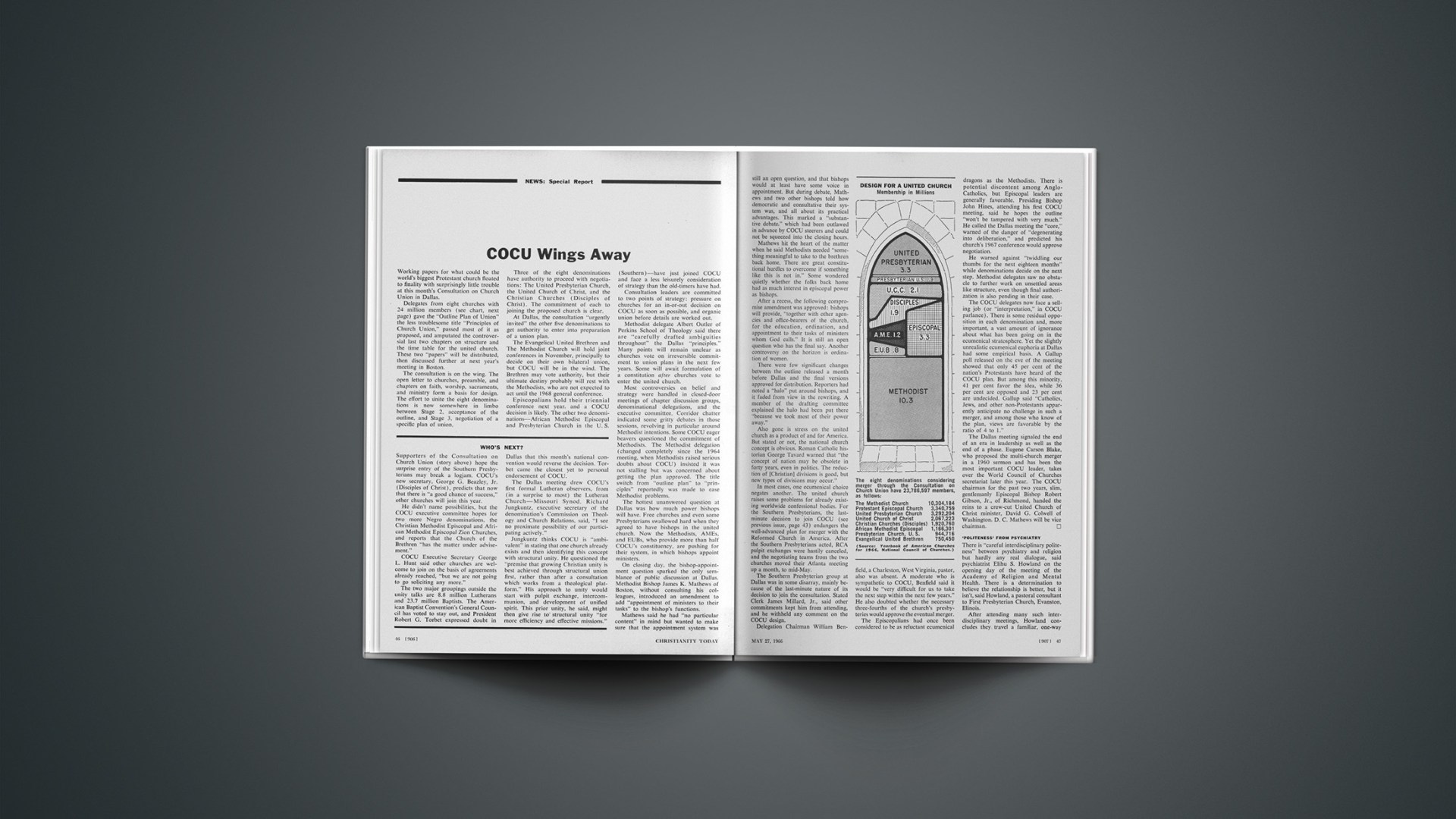
Working papers for what could be the world’s biggest Protestant church floated to finality with surprisingly little trouble at this month’s Consultation on Church Union in Dallas.

Delegates from eight churches with 24 million members (see chart, next page) gave the “Outline Plan of Union” the less troublesome title “Principles of Church Union,” passed most of it as proposed, and amputated the controversial last two chapters on structure and the time table for the united church. These two “papers” will be distributed, then discussed further at next year’s meeting in Boston.

The consultation is on the wing. The open letter to churches, preamble, and chapters on faith, worship, sacraments, and ministry form a basis for design. The effort to unite the eight denominations is now somewhere in limbo between Stage 2, acceptance of the outline, and Stage 3, negotiation of a specific plan of union.

Three of the eight denominations have authority to proceed with negotiations: The United Presbyterian Church, the United Church of Christ, and the Christian Churches (Disciples of Christ). The commitment of each to joining the proposed church is clear.

At Dallas, the consultation “urgently invited” the other five denominations to get authority to enter into preparation of a union plan.

The Evangelical United Brethren and The Methodist Church will hold joint conferences in November, principally to decide on their own bilateral union, but COCU will be in the wind. The Brethren may vote authority, but their ultimate destiny probably will rest with the Methodists, who are not expected to act until the 1968 general conference.

Who’S Next?

Supporters of the Consultation on Church Union (story above) hope the surprise entry of the Southern Presbyterians may break a logjam. COCU’s new secretary, George G. Beazley, Jr. (Disciples of Christ), predicts that now that there is “a good chance of success,” other churches will join this year.

He didn’t name possibilities, but the COCU executive committee hopes for two more Negro denominations, the Christian Methodist Episcopal and African Methodist Episcopal Zion Churches, and reports that the Church of the Brethren “has the matter under advisement.”

COCU Executive Secretary George L. Hunt said other churches are welcome to join on the basis of agreements already reached, “but we are not going to go soliciting any more.”

The two major groupings outside the unity talks are 8.8 million Lutherans and 23.7 million Baptists. The American Baptist Convention’s General Council has voted to stay out, and President Robert G. Torbet expressed doubt in Dallas that this month’s national convention would reverse the decision. Torbet came the closest yet to personal endorsement of COCU.

The Dallas meeting drew COCU’s first formal Lutheran observers, from (in a surprise to most) the Lutheran Church—Missouri Synod. Richard Jungkuntz, executive secretary of the denomination’s Commission on Theology and Church Relations, said, “I see no proximate possibility of our participating actively.”

Jungkuntz thinks COCU is “ambivalent” in stating that one church already exists and then identifying this concept with structural unity. He questioned the “premise that growing Christian unity is best achieved through structural union first, rather than after a consultation which works from a theological platform.” His approach to unity would start with pulpit exchange, intercommunion, and development of unified spirit. This prior unity, he said, might then give rise to’ structural unity “for more efficiency and effective missions.”

Episcopalians hold their triennial conference next year, and a COCU decision is likely. The other two denominations—African Methodist Episcopal and Presbyterian Church in the U. S. (Southern)—have just joined COCU and face a less leisurely consideration of strategy than the old-timers have had.

Consultation leaders are committed to two points of strategy: pressure on churches for an in-or-out decision on COCU as soon as possible, and organic union before details are worked out.

Methodist delegate Albert Outler of Perkins School of Theology said there are “carefully drafted ambiguities throughout” the Dallas “principles.” Many points will remain unclear as churches vote on irreversible commitment to union plans in the next few years. Some will await formulation of a constitution after churches vote to enter the united church.

Most controversies on belief and strategy were handled in closed-door meetings of chapter discussion groups, denominational delegations, and the executive committee. Corridor chatter indicated some gritty debates in those sessions, revolving in particular around Methodist intentions. Some COCU eager beavers questioned the commitment of Methodists. The Methodist delegation (changed completely since the 1964 meeting, when Methodists raised serious doubts about COCU) insisted it was not stalling but was concerned about getting the plan approved. The title switch from “outline plan” to “principles” reportedly was made to ease Methodist problems.

The hottest unanswered question at Dallas was how much power bishops will have. Free churches and even some Presbyterians swallowed hard when they agreed to have bishops in the united church. Now the Methodists, AMEs, and EUBs, who provide more than half COCU’s constituency, are pushing for their system, in which bishops appoint ministers.

On closing day, the bishop-appointment question sparked the only semblance of public discussion at Dallas. Methodist Bishop James K. Mathews of Boston, without consulting his colleagues, introduced an amendment to add “appointment of ministers to their tasks” to the bishop’s functions.

Mathews said he had “no particular content” in mind but wanted to make sure that the appointment system was still an open question, and that bishops would at least have some voice in appointment. But during debate, Mathews and two other bishops told how democratic and consultative their system was, and all about its practical advantages. This marked a “substantive debate,” which had been outlawed in advance by COCU steerers and could not be squeezed into the closing hours.

Mathews hit the heart of the matter when he said Methodists needed “something meaningful to take to the brethren back home. There are great constitutional hurdles to overcome if something like this is not in.” Some wondered quietly whether the folks back home had as much interest in episcopal power as bishops.

After a recess, the following compromise amendment was approved: bishops will provide, “together with other agencies and office-bearers of the church, for the education, ordination, and appointment to their tasks of ministers whom God calls.” It is still an open question who has the final say. Another controversy on the horizon is ordination of women.

There were few significant changes between the outline released a month before Dallas and the final versions approved for distribution. Reporters had noted a “halo” put around bishops, and it faded from view in the rewriting. A member of the drafting committee explained the halo had been put there “because we took most of their power away.”

Also gone is stress on the united church as a product of and for America. But stated or not, the national church concept is obvious. Roman Catholic historian George Tavard warned that “the concept of nation may be obsolete in forty years, even in politics. The reduction of [Christian] divisions is good, but new types of divisions may occur.”

In most cases, one ecumenical choice negates another. The united church raises some problems for already existing worldwide confessional bodies. For the Southern Presbyterians, the last-minute decision to join COCU (see previous issue, page 43) endangers the well-advanced plan for merger with the Reformed Church in America. After the Southern Presbyterians acted, RCA pulpit exchanges were hastily canceled, and the negotiating teams from the two churches moved their Atlanta meeting up a month, to mid-May.

The Southern Presbyterian group at Dallas was in some disarray, mainly because of the last-minute nature of its decision to join the consultation. Stated Clerk James Millard, Jr., said other commitments kept him from attending, and he withheld any comment on the COCU design.

Delegation Chairman William Ben-field, a Charleston, West Virginia, pastor, also was absent. A moderate who is sympathetic to COCU, Benfield said it would be “very difficult for us to take the next step within the next few years.” He also doubted whether the necessary three-fourths of the church’s presbyteries would approve the eventual merger.

The Episcopalians had once been considered to be as reluctant ecumenical dragons as the Methodists. There is potential discontent among Anglo-Catholics, but Episcopal leaders are generally favorable. Presiding Bishop John Hines, attending his first COCU meeting, said he hopes the outline “won’t be tampered with very much.” He called the Dallas meeting the “core,” warned of the danger of “degenerating into deliberation,” and predicted his church’s 1967 conference would approve negotiation.

He warned against “twiddling our thumbs for the next eighteen months” while denominations decide on the next step. Methodist delegates saw no obstacle to further work on unsettled areas like structure, even though final authorization is also pending in their case.

The COCU delegates now face a selling job (or “interpretation,” in COCU parlance). There is some residual opposition in each denomination and, more important, a vast amount of ignorance about what has been going on in the ecumenical stratosphere. Yet the slightly unrealistic ecumenical euphoria at Dallas had some empirical basis. A Gallup poll released on the eve of the meeting showed that only 45 per cent of the nation’s Protestants have heard of the COCU plan. But among this minority, 41 per cent favor the idea, while 36 per cent are opposed and 23 per cent are undecided. Gallup said “Catholics, Jews, and other non-Protestants apparently anticipate no challenge in such a merger, and among those who know of the plan, views are favorable by the ratio of 4 to 1.”

The Dallas meeting signaled the end of an era in leadership as well as the end of a phase. Eugene Carson Blake, who proposed the multi-church merger in a 1960 sermon and has been the most important COCU leader, takes over the World Council of Churches secretariat later this year. The COCU chairman for the past two years, slim, gentlemanly Episcopal Bishop Robert Gibson, Jr., of Richmond, handed the reins to a crew-cut United Church of Christ minister, David G. Colwell of Washington, D. C. Mathews will be vice chairman.

‘Politeness’ From Psychiatry

There is “careful interdisciplinary politeness” between psychiatry and religion but hardly any real dialogue, said psychiatrist Elihu S. Howland on the opening day of the meeting of the Academy of Religion and Mental Health. There is a determination to believe the relationship is better, but it isn’t, said Howland, a pastoral consultant to First Presbyterian Church, Evanston, Illinois.

After attending many such interdisciplinary meetings, Howland concludes they travel a familiar, one-way street, with psychiatrist leading clergyman. Dialogue cannot come, he said, until the psychiatrist “sees the necessity of a reorientation for himself, and becomes aware of a spiritual dimension which, until now, he has not realized was any of his business.”

But the Rev. George C. Anderson, honorary president of the academy, put some blame on churchmen during the organization’s seventh annual meeting in Chicago last month. He called a recent gathering of sixty-five leading psychiatrists and theologians sponsored in Geneva by the World Council of Churches “a major landmark.” But many of the theologians there, he said, had a “narrow, provincial attitude.… Many of them are trying to incorporate all psychiatric and psychological insights into a narrow Christian framework.”

Dr. Charles Stinnette, joint professor of theology and psychiatry at the University of Chicago, challenged the pragmatic use of religion as an adjunct to psychotherapy. He insisted that the pastoral function is to help persons find meaning whether they live or die, rather than to become healers.

Despite these critical notes, the prevailing tone was amicable. The heavy majority of clergymen were obviously reluctant to offer overt criticisms of psychiatry in discussion periods.

Britain’S New-Style ‘Sunday’

Bikini-clad girls on the cover, a papal blessing, and a circulation goal of half a million—these are features of the new British ecumenical magazine Sunday, which had its first issue this month. With an Anglican chief editor, flanked by Roman Catholic and Methodist associates, it tilts at “the Sabbath of prohibition,” advocating a policy of live-and-let-live; deprecates the “false image” of Britain as “a land of empty churches and pagan people” (some bewildering statistics are pressed into service here); and sees itself as marking “a further step towards greater understanding and unity between the Churches.”

Evident throughout the forty-eight pages is a desperate desire to exorcise the Ghost of Sunday Past. People come-of-age have a right to spend the day “according to their conscience and inclination,” argues Lord Willis. There is a piece on Roman Catholic Patrick McGoohan, star of the TV thriller Secret Agent, usually seen in Britain early Sunday evening (although it appears the day before in America). Five whole pages are devoted to an article on Pope Paul VI, except for one corner announcing a profile of Billy Graham for next month.

The articles are well presented and illustrated, and no one will complain of a surfeit of religion. Apart from a short word on the Lord’s Prayer by a Baptist minister, there is little theology apparent. In “Question Time,” however, Richard Tatlock tries to reconcile eternal damnation and God’s love, by beginning; “If I were to tell you that a girl had ‘melted into tears’ you wouldn’t for one minute suppose that she had suddenly turned into three or four buckets of salty water. And it’s essential to use the same kind of commonsense when you read and interpret the Bible.” Commented an evangelical minister on Sunday: “This will rock neither the ecumenical ship nor hell’s foundations.”

J. D. DOUGLAS

One optimist on interdisciplinary cooperation was keynoter Earl Dahl-strom, professor of pastoral care at North Park Seminary. He spoke of the dangers of materialism, professionalism, and cynicism, and warned pastors against practicing pastoral care as a means of satisfying their own unrecognized needs.

The psychiatry chief at Harvard University’s Health Service, Graham Blaine, condemned parents who fail to provide guidelines and limits. “We are becoming afraid of our children,” he concluded. “We are fooled by their verbal statements and fail to pick up the opposite message in their non-verbal cues.” He also deplored the new morality and situational ethics popularized by some bishops and other clergymen, declaring that young people need a firm voice of authority defining right and wrong.

ORVILLE S. WALTERS

Forecast For Guyana

On May 26 the Crown Colony of British Guiana on the northeast coast of South America becomes the sovereign nation of Guyana. It will probably be the last new nation in the Western hemisphere. In recent years, British Guiana, despite a population of little more than half a million, has made news around the world because of strong Communist elements that sometimes have held the reins of government. While Guyana enters independence with a government friendly toward the free world, there is considerable doubt about the new nation’s future.

Guyana is of special interest to Christians because it is perhaps the most thoroughly “churched” of the developing new nations. Mainline denominations and many independent groups from the United States, England, and Canada have been working in British Guiana for many years. There are strong national churches. The capital city, Georgetown, is a city of churches, and every small town has at least one Protestant church. A national hero, Martyr Smith, came from the London Missionary Society. Smith died in prison in 1823 while under sentence of death for inciting the slaves to revolt. (In truth Smith’s crime was teaching the slaves to read the Bible. A slave who could read the New Testament for himself was not likely to remain content with his lot in life.)

British Guiana’s last prime minister and Guyana’s first prime minister is Linden Forbes Sampson Burnham, a big, handsome, Negro lawyer who was a Methodist lay preacher before his law school days. Though friendly toward the West, Burnham is an avowed socialist. He frequently refers to the Scriptures in his speeches. Asked if he was a Christian, he replied that he is well aware that bishops of the Church of England owned some of his ancestors, but that people need an ethic to live by, and the Christian religion offers the best ethic.

Burnham’s political enemy is Dr. Cheddi Jagan, an American-educated dentist who is married to an American, the former Janet Rosenberg. Both Jagans are openly Marxist. Jagan’s People’s Progressive Party is the largest party in Guyana and has controlled the government three times. The first two times the Crown became so alarmed over the actions of the Jaganites that it suspended the constitution. The third time, Jagan was removed from office by a constitutional change that prevents total rule by a simple plurality. Jagan, who is of East Indian extraction and a nominal Hindu, is suspicious of and hostile toward the Christian churches, partly because of their opposition.

Informed observers tend to be pessimistic about the future of Guyana. Most of Jagan’s followers are descendants of laborers imported from India in the nineteenth century. Curiously, few of the East Indians are Communists. They just vote for their race. The East Indian segment of the population is increasing at a much faster rate than Guyana’s other ethnic groups. The pessimists say it is just a matter of time until Jagan’s party gains permanent control.

Burnham’s problems are gigantic. He must maintain a coalition with the United Force, a small party committed to free enterprise. He must break down the racial loyalties of the Guyanese, particularly the East Indians. He must attract badly needed foreign capital to a shaky young country. And he must guard against a Communist-inspired revolution. If Burnham’s coalition government can be maintained, the future for Guyana is bright. If Jagan’s party regains control, Cuba might have an ideological ally in the New World.

ALAN MARK FLETCHER

Book Briefs: May 27, 1966

Is Jesus Necessary?

The Theology of Rudolf Bultmann, edited by Charles W. Kegley (Harper and Row, 1966, 320 pp., $5.75), is reviewed by Clark H. Pinnock, associate professor of theology, New Orleans Baptist Theological Seminary, New Orleans, Louisiana.

This volume of essays was prepared in honor of Rudolf Bultmann’s monumental contribution to modern theology, and with the desire to elucidate aspects of his profound thought. Introduced by an autobiographical sketch and concluded by a full bibliography of Bultmann’s writings, the book contains seventeen constructive essays written for the most part by outstanding scholars who share his theological frame of reference. A fine feature of the book is the concise evaluation and response made to each essay by Bultmann himself; this creates a feeling of live discussion. Controversy arises only when attempts are made to modify one aspect of his theology or extend another. But no writer in the symposium appears to regard Bultmann’s influence in theology as negative (unless perhaps Michel), and most prefer to point ahead to new areas of relevance for it. What criticism there is comes chiefly from the “left,” from Ogden, who believes Bultmann should press on to greater consistency and cut back his insistence on the exclusive relevance of Jesus Christ. In the words of the editor, “Granted that Jesus actualised an authentic self-understanding, is man capable of acting freely and responsibly today independent of that historic paradigm?” (xvi). This is essentially the same complaint voiced by Bultmann’s non-Christian critics like Jaspers, who resents this arrogant restriction placed on the freedom of God. The book never really answers the problem, except by repeating an assertion (without proof, of course!) that “seeing the eschatological in the historical” is the scandal of the Gospel. Not a single essay really questions the extraordinary epistemological base on which this viewpoint is grounded.

In the lead paper, Gunther Bornkamm does the reader a fine service by indicating clearly the shape of Bultmann’s theology. The discerning reader is made aware of its skeleton and becomes acquainted with themes that often recur in the remaining pages. A challenge to Bultmann’s system should be registered in the reader’s mind by the first essay, in which Bornkamm discusses two critical issues: the relation of faith to history, and of theology to truth. In Bultmann, he writes, “there is a recognition of the paradoxical character of a revelation that can never be authenticated in the historical-empirical realm but can only be encountered in the Word event and grasped in faith” (p. 5). To preserve the “paradox” consistently, one must dispense with miracles, as Bultmann later observes (p. 272), lest objective evidence of this kind offend the modern mind and destroy the “paradox” as well. For in Jesus, God is both wholly revealed and wholly concealed (p. 47); otherwise, Bultmann asks, “What is there about the historical Jesus that lifts his incognito?” (p. 262). On this point we look in vain for any rebuttal to such nonsense. Any affirmation, it seems to this reviewer, that cannot in any way be verified and that actually excludes any possibility of being tested, is strictly meaningless. The further we remove the Gospel from history and fact, the more vulnerable it is, and the more irrelevant to any rational person. The glory of the Gospel is precisely what Bultmann despises, namely, the objectivity of redemptive events. To speak of “God’s gracious act” (p. 131) in this context is not a gospel paradox but sheer nonsense. It is mockery to offer the sinner a purely verbal solution when he needs the work of Christ.

Bornkamm’s second issue concerns theology and truth. It is axiomatic for Bultmann that the “objectified thinking of the New Testament” is impossible for contemporary man (p. 9). We are prevented, therefore, from making direct use of scriptural statements; instead, we must delve beneath the text to the possibilities of self-understanding hidden within. So the Bible has no normative significance for dogmatic theology (p. 10), and Bornkamm praises Bultmann for applying in the realm of cognition Luther’s discovery of justification by faith alone (p. 12; cf. Bultmann’s reaction, p. 258). The comparison would be funny if it were made in jest. But as a mature reflection, it is tragically fallacious and misleading. For there is all the difference in the world between turning from moral bankruptcy to the objective Cross and Resurrection (Luther) and turning from intellectual doubts to an existential leap in the dark (Bultmann). Bultmann’s thought indeed has a “relevance” for epistemology (p. 17); it renders theology an impossible subject for discussion. If Scripture is no principium theologiae, there is no Christian theologia. In the face of the analytical philosophy, the only term to describe Bultmann’s method of procedure is epistemological suicide.

Because not a single essayist successfully replies to these two errors, no real progress is made in the remainder of the book. This is not to say that the material is not extremely interesting and challenging. It is amusing, for example, to hear Ogden’s plea for Hartshorne instead of Heidegger, and to observe God’s obliviousness to the problem of what the Cross is now symbol of, if anything. Both Ott and Minear attempt to retain some degree of future eschatology to save their philosophy of history, but neither can manage to do so, while standing on Bultmann’s ground. Macquarrie rushes to the defense of existentialism by noting the “zone of common interest” with Christianity (p. 130). As for the other zones not held in common, we hear little of them. For in Bultmann’s thought, modern man himself defines the zones of his interest.

It is Ogden who, in the opinion of this reviewer, raises the book’s most urgent question. The demand for radical demythologizing is inconsistent with any stress on the unique role of Jesus Christ (pp. 120 f.). If salvation for man is, in fact, the realization of authentic existence) neither a divine nor a merely human Christ is an absolute necessity. Small wonder a Jew can be a full disciple of Bultmann (Sandmel, p. 220) without feeling uncomfortable. For no theology to which Jesus Christ bears so tenuous a relationship can deserve the name Christian. Bultmann’s scandal of non-verifiability is certainly not the biblical one. The biblical claim to objective truth and accomplished redemption is the scandal of the New Testament, and the one that Bultmann rejects out of hand.

The theology of Bultmann is not a depleted version of the biblical faith. It is a transmutation of it at every point. This volume presents his thought clearly and will meet with great applause from modern theologians still under Bultmann’s spell. Yet some men weep.

CLARK H. PINNOCK

A Great Work

The Encyclopedia of the Lutheran Church (three volumes), edited for the Lutheran World Federation by Julius H. Bodensieck (Augsburg, 1965, 2,599 pp., $37.50), is reviewed by Herbert T. Mayer, chairman, Department of Historical Theology, Concordia Seminary, St. Louis, Missouri.

The best description and evaluation of this work is found on the dust jacket: “… a valuable source of information for laymen, as well as for educators, theologians, and clergy … for all who want to know what the Lutheran Church is, thinks, and does. These three volumes, eleven years in preparation, provide a profile of the life and work of the Lutheran Church.… This Encyclopedia seeks to provide answers to practically any question which may be asked about Lutheranism. It is the most complete work on Lutheranism available in the English language.”

The reader can rightly ask two questions: How does it measure up as an encyclopedia of religion, for it claims to be this, and how does it measure up as a Lutheran encyclopedia? The answer to both questions is positive. For this project, sponsored by the Lutheran World Federation, more than 700 Lutheran scholars from all over the world combined their efforts under the general editorship of Julius Bodensieck. German scholars seem to have been preferred for many of the articles on contemporary scholarly subjects. Because the articles are often descriptive and even hortatory (compare the article on Bible study by L. Goppelt), instead of simply reportorial, the encyclopedia will influence the thinking of present and future generations of Lutheran Christians.

In general, the writing is at a popular level, which makes the work valuable for church and home libraries. The general theological orientation is toward conservative Lutheranism, in the sense that Johannes Knudsen describes it in his article on fundamentalism. He argues that Lutheranism was less affected by fundamentalism than some other denominations because “the stable confessional character of the Lutheran churches, combined with the belief in the Freedom of the Christian man, were instrumental in maintaining a balance between the fundamentals of the faith and the validity of human inquiry.” The articles that discuss biblical interpretation, ecumenical movements, and social action reflect the sound balance of most of the contributions.

The reader is struck by the editorial freedom the contributors exercised (as in the use of exclamation points in the text! or in the article on the “Lutheran Hour,” which reads almost like a press release). Other articles reflect a sort of homiletical or devotional character that strikes the reader of an encyclopedia as somewhat strange (e.g., “Warfare [Christian Life]”).

It is not always possible to determine the principles by which a subject was included (“cloister,” “dulcimer,” “wizard”) or excluded, nor the principles that led to its treatment under a specific subject entry (thus abuses in pre-Reformation theology are treated under “Abuses” in Volume I). Under the subject entry of “scholasticism,” one is surprised to find only a discussion of Lutheran scholasticism, with no cross-references to the Roman Catholic movement. The importance of the topic is apparently not to be determined by the space it receives: Baptists are covered in only ten lines, while Zoroastrianism occupies two full columns. Thus editorial consistency was not always maintained. In the article on Christology by Ernst Kinder, Nestorius is correctly not identified as the arch-heretic that tradition has made him out to be; but in the treatment of Nestorianism (there is no article on Nestorius), he is so identified. A cross-reference under “Braeuninger” directs the reader to “Indian, American,” but this subject entry serves only as a cross-reference to “Indigenous Americans.”

But criticisms of this nature are primarily designed to show that the reviewer has done his homework; they are not intended to detract from the value of this great work.

HERBERT T. MAYER

Two And A Half Minutes

Healing for You, by Bernard Martin (John Knox, 1965, 194 pp., $4.50), is reviewed by Frank C. Peters, associate professor of psychology, Waterloo Lutheran University, Waterloo, Ontario.

This book is a translation of Veux-tu guérir, published in Geneva in 1963. The author, a psychiatrist and pastor, writes as a believing Christian well versed in the modern healing arts. Moreover, one senses a refreshing approach to Scripture—refreshing in that a psychologist is seen to accept light for his practice from Scripture. The trend of late has been for ministers to sit at the feet of psychologists.

The thesis of the book is that healing is a spiritual process because sickness is related to spiritual well-being. To treat the body and not the spirit is to leave the job half done.

God is concerned about men, and he expresses his concern through men. Herein lies the commission of pastoral counseling. Unless such ministering leads men back to God, it has sold its birthright for psychological pottage.

The book has an intriguing approach to psychological normality. Against the background of the modern sociological and statistical approaches, Martin dares to define normality in Christian terms. “Man, true man as God wanted him, is only met in the person of the son of Man, Jesus Christ.” Apart from Jesus Christ, man is not what he ought to be; he has not accomplished God’s plan. In Jesus Christ, God gives us the full vision of the man he had wanted from the beginning, the man we are called to become. From this stance psychiatrist Martin proceeds to take sin seriously. It is not merely deviation from a social norm, nor man’s realization of his own inadequacy, it is actual estrangement from God. All man’s defenses testify of this sense of estrangement, which the author calls “the gloom of dissimulation.” But pastors are also men, and as such they have their own “trees” that serve as hideouts, secret places where they take shelter. If the pastor is to help others in becoming “open,” he must first have experienced “openness” himself.

This reviewer looked hard for a clear delineation of conversion and found none. However, the author alludes to his own experience of searching for freedom as a replica of Paul’s liberation in Romans 7. The basic ingredients of a biblical conversion are discussed. To repent is to recognize one’s sin unreservedly and to face up to it. The danger of “romanticizing” repentance is ever with us, a prelude of anguish that fails to lead men into the symphony of a divine-human relationship through faith in Christ. Reconciliation with God necessarily calls for reconciliation with oneself—self-acceptance. Repentance and acceptance of oneself go together in a liberating experience of Jesus Christ (John 8:32). The problem this reviewer had with Martin’s treatment of “conversion” was that it seemed so similar to Kierkegaard’s “becoming a Christian,” with no emphasis on the attainment of “sonship status” in grace.

As one might expect, Martin makes much of confession. It is refreshing that he does not fall into the trap of equating confession and catharsis. Quoting Thilo, he says: “Psychoanalysis and confession are not … irreconcilable opposites. They move, however, in two quite distinct paths. In psychoanalysis, the train is driven according to the will of the conductor (the psychologist). In confession, on the other hand, the train does not move according to the instructions of the conductor.…” Martin feels that many pastors are unable to hear confessions because of personal insufficiencies in their own lives. He tells of an American psychologist who visited about a hundred ministers with a list of problems he wanted to discuss with each of them. As soon as the minister interrupted him to take over, the psychologist pressed the button of a stop-watch. At best the psychologist was able to speak 2½ minutes!

According to Martin, parishioners would rather go to a doctor than to a pastor with their problems. This is interpreted as a failure of the ministry to relate significantly to real problems. What the author forgets to mention is that it may also be a significant commentary on modern scientific man, who does not want to face his problems morally. Perhaps we are now reaping the harvest of an amoral psychology sown for two generations in America.

Regarding forgiveness our author comes through in grand style. Since guilt is real, forgiveness must also be real. His concept of forgiveness is theological, not psychological.

The section on demon-possession is very helpful, though it stops short of a conclusion. While recognizing the reality of the devil and therefore the possibility of his power in men’s lives, the author “leaves the door open” for the possibility of demon-possession in our day. Since he accepts biblical demon-possession, he should have explained why he hesitates to accept it for today. That he would have grave clinical problems in this area is certain.

Pastors will find this an excellent book to give to friends in the healing arts. While it has a theological framework, it is almost completely devoid of theological technicalities.

FRANK C. PETERS

Conservative Wesleyanism

The Wesleyan Bible Commentary, Volume VI, Hebrews-Revelation (Eerdmans, 1966, 523 pp., $8.95), is reviewed by Robert Mounce, professor of biblical literature, Bethel College, St. Paul, Minnesota.

The more than twenty contributing authors of this six-volume commentary come from nine different denominations, but are all within the Wesleyan tradition. The Hebrews-Revelation volume is conservative throughout. The Apostle John is said to be the author of all three Epistles assigned to him as well as the Book of Revelation. Peter himself is responsible for both his letters, and James and Jude were written by brothers of our Lord. It is even with some reluctance that the case for a Pauline authorship of Hebrews is left as unproven. Dates are early: James comes before the Jerusalem Council in A.D. 50.

Each book has a brief but helpful introduction. Blaney’s material on Revelation is especially well done. The format is pleasing: double columns, outlined by paragraph. Footnotes indicate that the greatest amount of exegetical help has come from the older commentaries. Bibliographies are relatively complete but not annotated.

The theological stance of the authors is everywhere present but is not obtrusive. Not even Hebrews 6:4–8 is made to say more than it does. All in all we find here a helpful conservative commentary by men with high regard for sacred Scripture.

ROBERT MOUNCE

Welcome Stimulus

The Theology of St. John by Joseph Crehan, S.J. (Sheed and Ward, 1965, 160 pp., $3.50), is reviewed by Thomas W. Harpur, associate professor of New Testament, Wycliffe College, Toronto, Ontario.

The present quest for renewal in the Roman Catholic Church has been heralded and accompanied by a flowering of biblical scholarship for which all Christians must be profoundly grateful. (A. Wikenhauser’s work on New Testament introduction, for example, has already proved a great boon to those who teach.) It is in this spirit that Father Crehan’s latest contribution to the growing discussion of the Fourth Gospel will be welcomed.

The author’s aim, as stated on the dust jacket, is to make available to clergy, college students, and laymen the results of the most recent Johan-nine researches. The format is that of a series of very brief “essays” on various aspects of the thought of the Gospel, the Epistles, and the Apocalypse—twenty-four in all. The reader is thus presented with a kaleidoscopic survey that cannot fail to impress upon him afresh the amazing depth and richness of New Testament concepts and themes.

Effective as this approach may be in presenting to the non-specialist an up-to-date picture of the nature and range of Johannine ideas, it does have certain serious weaknesses. Most of the topics considered, such as “John’s Concept of Truth,” “The Concept of Life,” “The Logos Doctrine,” and “The Keeper of the Gate,” are treated in virtual isolation from the others; what emerges, consequently, is a theological necklace from which the string has been removed rather than a theology as such. One feels keenly the lack of some preliminary discussion of the nature and purpose of the Gospel, in particular, to provide a framework or basis for what follows. Furthermore, the attempt to deal with so many issues in so short a space often forces the author into a brevity that both tantalizes and frustrates the reader. In the 4½ pages devoted to “John and the Kerygma,” for example, nothing is said about the Cross or the Resurrection of Christ, although both are essential themes. The discussion of Qumran and Old Testament parallels that we are given instead, interesting though it may be, seems to hang suspended on the periphery rather than to emerge from the center of John’s main theological concern. Similarly, in the discussion of the cleansing of the Temple (chap. 10), we are led, somewhat surprisingly, to the doctrine of the bodily assumption of the Virgin Mary, while there is but a fleeting reference to the presentation of Jesus as initiating a radically reformed worship, with its corollary of the Christian Church as Christ’s Body, the new Temple.

Father Crehan accepts without discussion the conclusion of Father Martin-dale (The Catholic Commentary on Scripture, Edinburgh, 1953) that the Apocalypse has the same author as the Epistles and Gospel, i.e., John the Apostle. This estimate of the Revelation will not appeal to most modern scholars and results in what seems to be a strange mixing of otherwise distinctive motifs. The clearest example of this is in a discussion of the “Sign of the Woman” (Rev. 12), where we are led from early patristic exegesis of the passage interpreting the woman as the Church, through much later traditions identifying her as the Virgin Mary, back to the Fourth Gospel where the title “woman” twice given to Mary (John 2:4, 19:26) is regarded as a Messianic sign—a sign of the continuity of the Church, of which she is the mother.

On the positive side, students of the Johannine literature will be grateful for the numerous references to possible parallels in the Qumran and other Jewish sources, as well as to the Fathers. Frequently the author is able to throw fresh light on the difficult problem of the relation between the Gospel of John and the Synoptic Gospels, as in his treatment of the Logos doctrine. The discussion of the discourses of Jesus in John is particularly good in this connection, especially the examination of Bultmann’s claim to find in them the hand of a later editor. Crehan, here as in the rest of the book maintains a conservative position that is based, not upon personal prejudice, but upon solid learning and a command of the relevant materials. Perhaps the best feature of all is the opportunity the book affords for further cross-fertilization of scholarly thinking. Protestant New Testament scholars will continue to welcome the stimulus and encouragement to new avenues of thought provided by those whose background and tradition is in so many ways different from their own.

Whether or not the book will fulfill the aim of providing a fresh appreciation of John’s theology for the laity and parish clergy remains to be seen. This reviewer must confess to some doubt. The work remains a collection of scholarly notes on aspects of Johan-nine thought, rather than a unified presentation of a distinctive theological point of view.

THOMAS W. HARPUR

The Word In Prison

My Chains Fell Off, by Verdon Lamont Hollis (Carlton Press, 1966, 155 pp., $3.50), is reviewed by L. Nelson Bell, executive editor,CHRISTIANITY TODAY.

This is the story of a hardened criminal who reached the dregs of society, was guilty of almost every known crime, and spent many years in prisons. It is a painfully detailed account of human depravity, and of the brutalizing and dehumanizing life within prison walls. It tells of Hollis’s childhood, spent in grinding poverty without any spiritual training—no church, no contact with Christians. Of the 155 pages, 130 are given to utterly frank accounts of crime and debauchery.

Then in the last pages the reader encounters a miracle. The chains fall from Hollis’s soul and spirit, and the ensuing prision years become a time of intense study and an opportunity to witness to the power of a life transformed by Christ.

This conversion story is a modern-day account of the Holy Spirit’s speaking through the Word of God. A Christian inmate gave Hollis a Bible. For a long time he ignored it. Then the Spirit led him to start at Genesis 1:1—“In the beginning God …”—and to keep on reading. Stumbling, spiritually blind, not understanding, but dimly aware of a flickering light, Hollis read on and on. One day in the Psalms he read and prayed, “Purge me with hyssop, and I shall be clean: wash me, and I shall be whiter than snow.” At that moment the chains fell off, and he became a new creature in Christ.

The sordid details of this book are the backdrop against which one sees a moving drama of the grace and power of God, another demonstration that the Word of God is “quick and powerful” and is a living Book through which the Holy Spirit continues to speak.

L. NELSON BELL

The Best Thus Far

The Anchor Bible, Volume 16: Psalms I (1–50), introduction, translation, and notes by Mitchell Dahood, S. J. (Doubleday, 1966, 329 pp., $6), is reviewed by Ronald Youngblood, associate professor of Old Testament languages, Bethel Theological Seminary, St. Paul, Minnesota.

At least three times in his recent volume, History, Archaeology, and Christian Humanism, William F. Albright pays glowing tribute to the linguistic and exegetical abilities of his former student, Mitchell Dahood. The book here under review neither faults the appraisal of its author’s esteemed mentor nor disappoints those of us who have been anxiously awaiting its publication.

Jesuit Dahood, a faculty member at the highly prestigious Pontifical Biblical Institute in Rome, is professor there of a discipline that did not exist forty years ago. Today, however, the literature of ancient Ugarit is widely recognized as the most important single tool for a proper understanding of Old Testament Hebrew poetry. Dahood’s fine commentary on the first fifty Psalms is the best example thus far produced to demonstrate the truth of that judgment.

While agreeing that the consonantal Masoretic text of the first third of the Psalter is remarkably well preserved (emendation being required in scarcely half a dozen cases, as, e.g., Ps. 45:4), the author insists that since Masoretic vocalization is late it is therefore frequently misleading. Many of his attempts at textual reconstruction remain unconvincing (for example, his treatment of 2:11), as he himself would readily admit (pp. XLII f.). Nevertheless, in the opinion of the reviewer, the bulk of Dahood’s proposals will stand up well in the light of further investigation. Needless to say, the key to most of his new readings is his extensive knowledge of Ugaritic lexical, grammatical, and literary parallels.

“The bearing of the Ras Shamra tablets on biblical philology is most widely felt in the study and interpretation of prepositions” (p. 189). In addition to the importance of this dictum, the author points to our new recognition of the widespread use of the vocative case, double-duty suffixes and other forms of ellipsis, and the precative perfect as samples of Ugaritic syntactic subtleties that broaden the range of hermeneutical choice for the student of the Old Testament.

Nor does Ras Shamra limit its assistance to linguistic matters, for it aids in theological understanding as well. Dahood adduces many new synonyms in the Psalms for the concepts of God, heaven, and the nether world. Moreover, he notes in them a much more pervasive emphasis on resurrection and immortality than has been allowed by modern Psalter scholarship. Indeed, the generally conservative orientation of his commentary will doubtless be appreciated by its evangelical readers.

The author is at his weakest when citing Akkadian and Amarna parallels, which are far more plentiful than he seems to realize and which would have supported his theses at many points. Even his Ugaritic citations are on occasion undigested (as in divergent translations of the same Ugaritic phrase on pp. 110 and 122). His English renderings of the Psalms also frequently leave much to be desired, consisting far too often of mere sentence fragments (see, for example, 19:4; 19:11 [twice!]; 39:5b; 44:17). The woefully inadequate biblical index should have been either expanded greatly or omitted entirely. It is to be hoped that such flaws (including also a large number of typographical errors) will be corrected in future editions, for Dahood’s impressive and scholarly effort is a worthy addition to the generally excellent Anchor Bible series. One can only look forward with optimistic expectation to the publication of Volume 17 by the same author.

RONALD YOUNGBLOOD

For Laymen

God in the New Testament, by A. W. Argyle (Lippincott, 1966, 224 pp., $2.95), is reviewed by Steven Barabas, professor of theology, Wheaton College, Wheaton, Illinois.

This book, written by the former dean of Regents Park College, Oxford, who is now instructor in New Testament Greek at Oxford University, is part of the “Knowing Christianity” series, which is intended to provide for thinking laymen a reliable but nontechnical presentation of what the Christian religion is all about. The substance of the book is the Whitley Lectures given at two Baptist colleges in Britain.

The author summarizes a great deal of data on the New Testament doctrine of God, and does so very well. He begins with a chapter on the relation between the Old and the New Testament concepts of God, and then deals with important aspects of the Godhead one by one: the sovereignty of God, the fatherhood of God, the Son of God, the Spirit of God, the doctrine of the Trinity, and finally God as the giver of eternal life. The book is almost a systematic theology in miniature, for it treats of such diversified subjects (all, however, related to the God of the New Testament) as the Kingdom of God, election, love, angelology, the Atonement, the Resurrection, and the Second Coming.

Almost every statement Argyle makes is supported with references to Scripture. This makes for slow reading but is helpful to the reader who wants to know the scriptural reason for what is said. Since the book was written for laymen, it is not philosophical or speculative. The author tries to set forth simply and clearly what the New Testament teaches about God. Although presented in outline form, the subject is not over-simplified. Argyle never seems to move about uncertainly in an ethereal atmosphere or to try to hide his ignorance or real views in a thicket of verbiage.

The author belongs to a new school of British scholars who, while fully abreast of the latest research, take the witness of the Bible very seriously. Their attitude toward Scripture is refreshingly reverent. On matters of historical and literary criticism of the Bible, their viewpoint is moderately liberal. For example, whenever Argyle refers to the Epistle of the Ephesians, he says that it was probably written not by Paul but by a disciple of his; and he does not hesitate to say that Luke may have placed a saying of Jesus in a wrong context. He also thinks that those who die without Christ will probably be given a second chance, and that their future will grow ever more painful until they submit to Christ at last (for this he does not, however, give scriptural support). Nevertheless, he has not the slightest doubt of the truth of the main doctrines of Christianity, such as the Trinity, and the deity, resurrection, and virgin birth of Christ. The average layman can profit greatly from this book, although he may be a bit confused by an occasional statement in which Argyle reflects his somewhat liberal viewpoint.

STEVEN BARABAS

Book Briefs

Adventures with God, compiled by Harry N. Huxhold (Concordia, 1966, 230 pp., $3.50). One hundred fifty devotional writings with prayers and Bible readings; for children 8 to 12.

The Last Discourse of Jesus, by G. M. Behler, O. P. (Helicon, 1965, 286 pp., $5.95). A verse-by-verse commentary on St. John’s account of Christ’s farewell to his apostles at the Last Supper.

The Language of the New Testament, by Eugene Van Ness Goetchius (Scribners, 1965, 349 pp., $5.95; also paperback workbook, 277 pp., $2.95). A Greek language text which claims characteristics that will tempt people to study Greek.

Israel’s Sacred Songs: A Study of Dominant Themes, by Harvey H. Guthrie, Jr. (Seabury, 1966, 241 pp., $5.95). A critical study of the poetry of Israel (mostly the Psalms—and only some of them) that sees it not as expressions of propositional truth but as the praise of God by the community of Israel.

Time and History: A Study in the Revelation, by Mathias Rissi (John Knox. 1966, 147 pp., $4.50). A christological approach to the Book of Revelation that derives its essential category of interpretation from the meaning of time and history as disclosed in the cross and resurrection of Christ.

The Old Testament World, by Martin Noth, translated by Victor I. Gruhn (Fortress, 1966. 404 pp., $8). A concise yet comprehensive presentation of the geographical and historical setting of the Old Testament.

The Child’s Book of Psalms, selected by Edith Lowe, illustrated by Nan Pollard; Hear Our Prayer, selected by Sharon Stearns and illustrated by Helen Page; Hear Our Grace, selected and illustrated by Sharon Banigan (Follett, 1966, 44 pp. each, $1 each). Delightful for small children.

The Four Translation New Testament (Moody, 1966, 739 pp., $9.95). Four easy-to-read translations (King James, New American Standard. Williams—In the Language of the People, Beck—In the Language of Today) of the Greek New Testament in parallel columns.

Directors of American Philosophers III, 1966–67 (Archie Bahm, 1966, 514 pp., $12.50). The third biennial compilation of names, addresses, and duties of American philosophers, and an index of philosophical societies and journals.

Our Father: An Introduction to the Lord’s Prayer, by Ernst Lohmeyer, translated by John Bowden (Harper and Row, 1966, 320 pp., $4.95). An analysis and interpretation that blends scholarship and religious understanding.

Looking God’s Way, by Reuben K. Youngdahl (Augsburg. 1966, 170 pp., $3.95). Refreshing sermons in lively style.

The Thought of Teilhard de Chardin: An Introduction, by Michael H. Murray (Seabury, 1966, 177 pp., $4.95).

Bible Sermon Outlines, by Ian MacPherson (Abingdon, 1966. 192 pp., $3.95). Outlines with a wisp of logic and a whisper of content.

Calvin’s New Testament Commentaries: The Acts of the Apostles, Volume I translated by John W. Fraser and W. J. G. McDonald, edited by David W. Torrance and Thomas F. Torrance (Eerdmans, 1965, 410 pp., $6). A good, new translation.

The World Council of Churches: A Study of Its Background and History, by David P. Gaines (Richard R. Smith, 1966, 1,302 pp., $18.50). Complete data on the WCC. A very valuable reference work.

Doing What Comes Supernaturally, by Thomas A. Fry, Jr. (Revell, 1966, 126 pp., $2.95). Short perceptive essays that make good reading.

The Bible and the Schools, by William O. Douglas (Little, Brown, 1966, 65 pp., $3.75). A Supreme Court Justice reflects on Bible reading and prayer in public schools.

My God, Why?: And Other Questions from the Passion, by Wallace T. Viets (Abingdon. 1966. 112 pp., $2.25). Provocative writings often less than biblical.

Sex, Family, and Society in Theological Focus, edited by John Charles Wynn (Association, 1966, 256 pp., $4.95). Up-to-date reading that shows more about how things are than how they ought to be.

No Greater Love: The James Reeb Story, by Duncan Howlett (Harper and Row, 1966, 242 pp., $4.95). The spiritual odyssey that ended in an act of violence in the streets of Selma, Alabama, and galvanized the conscience of a nation.

Crusade Against Hunger, by I. W. Moo-maw (Harper and Row, 1966, 199 pp., $3.95). The story of unsung heroes of the soil, the agricultural missionaries battling starvation and spiritual misery in underdeveloped countries of the world.

Paperbacks

A Handbook of Contemporary Theology, by Bernard Ramin (Eerdmans, 1966, 141 pp., $1.95). Very lucid and trustworthy explanations of the meaning of theological concepts used in contemporary theology. Anyone who reads any theology or modern religious writings will find this little book very valuable.

The Church Inside Out, by J. C. Hoekendijk, translated by Isaac C. Rotten-berg (Westminster, 1966, 212 pp., $1.95). An attempt to make known to the English world an independent, sometimes controversial Dutch figure, a “troubler of Israel.” Here are his thoughts on evangelism, race, and the place and function of the Church in the changed modern world.

The Instant Bible, by Fred M. Wood (New Life Religious Library, 1966, 134 pp., $1). It was bound to come. But this too shall pass.

Brief Outline on the Study of Theology, by Friedrich Schleiermacher, translated by Terrence N. Tice (John Knox, 1966. 132 pp., $2.50).

Nature and God, by L. Charles Birch (Westminster, 1966, 128 pp., $1.45). Nature has the first word, God gets the last—sounding suspiciously like Whitehead and Tillich.

My Comforters, by Helen Good Brenne-man (Herald Press, 1966, 80 pp., $1.50). Written by someone who knows. A wonderful booklet for the ill and handicapped, or even for the short-term hospital patient.

The Holy Spirit in Your Teaching, by Roy B. Zuck (Scripture Press, 1963, 189 pp., $2.45). First published in 1963.

The Cost of Redemption

“AND THEY SANG a new song, saying,

‘Worthy art thou to take the scroll

and to open its seals,

for thou wast slain and by thy blood

didst ransom men for God

from every tribe and tongue and

people and nation’ ”

(Rev. 5:9, RSV).

The redemption of mankind was accomplished by the blood of the Son of God, shed on Calvary’s cross. This is affirmed many times in the New Testament, and the blood sacrifices of the Old Testament pointed toward the death of the Lamb of God, who would take away the sin of the world.

Man’s insistent question, “Why did God have to die for me?,” can be answered only when he understands the nature and depth of sin in the human heart. He must, by the illumination of the Holy Spirit, have some understanding of human depravity before he can appreciate that the cure could be effected only by the death of God’s Son on his behalf.

During forty years of practicing medicine, I repeatedly saw patients who showed, symptoms of great distress but whose sickness could be determined only after X-rays and extensive laboratory tests. To have treated symptoms without seeking out their cause would have made me guilty of quackery, while failure to treat the cause when discovered would have been malpractice.

In the spiritual realm there is an analagous situation. All around, one can see the symptoms of a sick society—that is, the elongated shadow of sin-sick individuals: bitterness, conflicts, crime, broken homes, delinquency (juvenile and adult), trouble and sorrow of every kind. We see a social order sick unto death—and we set up courts of inquiry, commissions, antipoverty programs, and a thousand and one agencies and institutions to treat the symptoms. Even the Church often joins in promoting secular programs while ignoring the one and only cure.

Satan will settle for any treatment that concentrates on symptoms and ignores God’s cure. We think of our generation as intelligent and sophisticated, but it is also lost as long as it ignores God’s solution to its problems. One day the Pharisees complained to Jesus that his disciples ate without the ceremonial washing of their hands. In reply our Lord spoke of the defilement Of sin, and his diagnosis applies equally to all of us: “What comes out of a man is what defiles a man. For from within, out of the heart of man, come evil thoughts, fornication, theft, murder, adultery, coveting, wickedness, deceit, licentiousness, envy, slander, pride, foolishness. All these evil things come from within, and they defile a man” (Mark 7:20–23). A very high percentage of the headlines of any newspaper have to do with one or more of these defiling things listed by our Lord.

At the forefront of the list Jesus put “evil thoughts.” How well he knows us! Little wonder that the Prophet Isaiah cried out, “Let the wicked forsake his way, and the unrighteous man his thoughts” (Isa. 55:7a), or that the Apostle Paul admonished us: “Do not be conformed to this world but be transformed by the renewal of your mind, that you may prove what is the will of God, what is good and acceptable and perfect” (Rom. 12:2).

Let us again go over the sordid list of sins that proceed from the human heart. Let us eliminate, if we can, any that do not apply to us in either our actual behavior or our unchecked imagination. If we are honest we will be forced to cry out in desperation, “Wretched man that I am! Who will deliver me from this body of death?” (Rom. 7:24).

The sickness of the human heart is indeed to death—spiritual, eternal death, separation from God. But for this disease of sin, of human tragedy, God has the remedy. It is nothing less than the blood of his Son shed on the Cross of Calvary.

Man may recoil from the thought that his sins required the death of God’s Son, He may insist that blood shed nearly two thousand years ago can have no power today. He may consider a blood-bought redemption to be distasteful. He may refuse to admit the disease of the human heart that separates man from God. And he may refuse to accept by faith the forgiveness of sin that God so freely offers. But the fact remains: This is God’s way and his offer, and there is no other.

Little wonder that our Lord said, “You must be born again.” for redemption is a supernatural act of God’s grace and mercy that demands a new heart.

Salvation has to do with man’s eternal soul. It has to do with those things that mar the spirit and offend a holy God. It is, in fact, nothing less than a miracle of God’s grace offered as a free gift to those who will accept it. Who is man to question how God saves?

The writer of the Epistle to the Hebrews gives this solemn warning: “A man who has violated the law of Moses dies without mercy at the testimony of two or three witnesses. How much worse punishment do you think will be deserved by the man who has spurned the Son of God, and profaned the blood of the covenant by which he was sanctified, and outraged the Spirit of grace?” (10:28, 29).

God has provided the detergent of the ages in the blood of his Son. It, and it alone, can atone for the guilty sinner and make him clean in God’s sight. Who is man to look askance at God’s offer?

The Apostle Paul, who cried out under conviction of sin and asked who could deliver him from spiritual death, went on to answer his own question: “Thanks be to God through Jesus Christ our Lord!” (Rom: 7:25a).

The Holy Spirit, speaking through Paul, goes on to answer every honest inquirer: “For God has done what the law, weakened by the flesh, could not do: sending his own Son in the likeness of sinful flesh and for sin, he condemned sin in the flesh, in order that the just requirement of the law might be fulfilled in us, who walk not according to the flesh but according to the Spirit” (Rom. 8:3, 4).

Our Lord diagnosed the desperate disease of the human heart and then gave himself to provide the divine cure. Deep in the human heart are the seeds of every evil deed. Proffered from the Cross is the perfect cure. The depth of man’s depravity is exceeded only by the greatness of God’s love.

The divine X-ray reveals “evil thoughts, fornification, theft, murder, adultery, coveting, wickedness, deceit, licentiousness, envy, slander, pride, foolishness.” Christ says, “I am the way, and the truth, and the life; no one comes to the Father, but by me” (John 14:6), and he describes the agent of redemption, “This is my body which is given for you.… This cup which is poured out for you is the new covenant in my blood” (Luke 22:19b, 20b).

Our redemption is blood-bought. Just as we do not question the antibiotic or surgical procedures by which we are cured of a disease, so we should say, “God forbid that we should question his means of redemption from sin!”

A Reply to the God-Is-Dead Mavericks

THE EDITOR

Religious professionals took the lead in crucifying Jesus of Nazareth; now they are conspiring to kill the Living God also.

Standing by, consenting, and in fact strongly advocating the death of God, are numerous theologians. In Christian schools they seek to rally a task force of confirmed God-slayers. The ranks include Altizer at Emory University (Methodist), Hamilton at Colgate Rochester Divinity School (Baptist), and in some respects Van Buren at Temple University (interdenominational).

A full public hearing of their views is encouraged by the ecumenical Sanhedrin. Their faith-and-order dialogue easily and swiftly seems to embrace almost every theological novelty. Meanwhile, it largely ignores traditional evangelical views or disdains them as heresy—the sole heresy-at that—even though biblical supernaturalism is not only the historic faith of Christianity but also the sincere faith of most churchgoers.

Conflict over the supernaturalism of the Bible is age-old. In the ancient world, both Judaism and Christianity contended constantly against polytheistic myths. In the Middle Ages, a mist of scholastic speculation and popular superstition often beclouded the Living God. Aided by this climate, modern philosophers swiftly recast the God of the Bible to suit their many rationalistic preferences. One anti-biblical theory quickly encouraged another, until Marx dramatically countered Hegel’s God is everything with the atheistic credo: God is nothing, and dialectical materialism everything.

Although anti-supernaturalism is not new, Christian leaders like Billy Graham, Charles Malik, and D. Elton Trueblood remind us that the tide of atheism is rising to unprecedented heights with alarming speed.

“Never in my life,” writes Trueblood, professor of philosophy at Earlham College, “have I known a time when the attacks on the Gospel were as vicious as they are now. I see about me a far more militant atheism than I have ever known, and I see it pressed with evangelistic fervor.”

Evangelist Billy Graham thinks the daring wickedness and unbelief of the modern world, when seen alongside divine judgment on earlier civilizations, may perhaps signal “God’s last great call” to a generation at the brink of destruction.

And the former chairman of the United Nations General Assembly, Charles Malik, notes that while organized society and governments in the Western world have taken no formal, official stand against religion and against Christ, “we see very virulent movements of secularism and atheism.”

This atheistic propaganda is spectacular not only for its scope and savagery but also for its entrenchment in Protestant institutions. A century ago when Ludwig Feuerbach lapsed to the view that a supernatural God is a product of human imagination and desire, his teaching career at Erlangen University, a center of Lutheran theology, ended abruptly. Feuerbach’s revolt against the inherited religion was extended by Lenin’s insistence that the capitalists advanced faith in God in order to comfort the (supposed) victims of their (supposed) exploitation—a theory that required the crudest of caricatures of the Founder of Christianity, the carpenter of Nazareth. But the revolt against Christianity carried Communists like Stalin, once a Greek Orthodox seminarian, outside the church in their defection to atheistic naturalism. Today, however, scholars disseminate their God-is-dead propaganda from Protestant institutions whose support comes from sacrificial, devout believers interested in promoting Christ’s Gospel. As Trueblood comments, “Some of the most damaging attacks on the validity of the Gospel are coming from those who claim some kind of marginal connection with Christianity.”

At the Montreal Faith and Order Conference of the World Council of Churches, a Russian Orthodox churchman told New Testament scholars of the Bultmann school (which contends that the miracles of the Bible are myths) that “in Russia we do not need theologians to tell us” that the gospel miracles are myths: this is part of the Communist creed.

Few people would deny another’s right to be an atheist (although the Roman Catholic Church only recently faced the issue of one’s right to be a Protestant). But for the sake of God and integrity let such propaganda be peddled not in Christian schools but in institutions dedicated to unbelief.

The current point of crisis in theism—namely, belief in a supernatural mind and will—is a by-product of the nineteenth-century modernist defection from the historic Christian faith. Radical German higher critics presumed to derive biblical religion from an evolutionary process that dispensed with supernatural being and revelation. Brilliant scholars like Cyrus H. Gordon and William F. Albright have long since exposed the indefensible rationalistic bias of these critics. Albright considers virtually all their arguments against early Israelite monotheism “as invalid and some of them as quite absurd” (History, Archaeology, and Christian Humanism, McGraw-Hill, 1964, p. 99). One God appears throughout all the history of Israel as an indictment against the multitude of deities cherished in the pagan world. The Canaanites named seventy, and the Babylonians alone listed thousands of divine names. But the Old Testament names one God alone who is in supreme control of reality, one God over all nature, over all men and nations.

What radical German critics could not fully achieve in their evolutionary assault on the religion of the Bible, German philosophers have more nearly accomplished. Their prejudices have often been borrowed and carried to still further extremes by enterprising, crusading Americans mounting an attack on the reality and claim of the Living God.

Almost everywhere in non-evangelical Protestant theology today, there links the destructive notion—so unstable a basis for faith, so highly serviceable to unbelief—that man can have no cognitive knowledge of transcendent Being, no rational knowledge of the supernatural world. For almost a century modern theology has built its “case for Christianity” on this highly vulnerable foundation. Time and again the superstructure has bent in the winds, and periodically it has even tumbled. But the architects of religious liberalism have simply erected new skyscrapers atop the crumbling ruins. It remained for the death-of-God theologians to find the courage to be consistent and, instead of trying to float religious principles in midair, to level them to the ground.

Behind this malformation of contemporary theology stands Immanuel Kant, who two centuries ago tried in a highly vulnerable way to salvage remnants of a supernaturalistic view from the supposedly scientific attacks of David Hume. A thoroughgoing empiricist, Hume virtually reduced reality to sense impressions and man to animality.

In his reply, The Critique of Pure Reason, Kant granted to Hume what neither Augustine nor Luther nor Calvin would have conceded, nor before them Moses, Isaiah, and Paul. In a costly surrender, Kant contended that all man’s knowledge comes from sense experience alone.

Ever since Kant’s influence affected modern theology, evangelical theologians have protested this needless relinquishment of cognitive knowledge of the spiritual world. They have emphasized that the God of the Bible is a rational God; that the divine Logos is central to the Godhead and is the agent in creation and redemption; that man was made in the divine image for intelligible communion with God; that God communicates his purposes and truths about himself in the biblical revelation; that the Holy Spirit uses truth as a means of persuasion and conviction; and that Christian experience includes not simply a surrender of the will but a rational assent to the truth of God. In brief, although fundamentalist theology was lampooned for half a century as anti-intellectual, nothing is clearer than the fact that in American Protestantism, only the evangelical movement energetically espoused the role of reason in religion.

The non-evangelical movements, meanwhile, increasingly minimized the place of reason in religious experience. Three times in the twentieth century the formative theology of Europe has collapsed, and in America the God-is-dead aberration now has emerged as its most widely publicized successor. There is an inner logical connection between these developments; namely, the inadequate reply of contemporary theology to Kantian criticism—or, seen from the other side, its failure to insist on rationality as a divine perfection, and on the intelligible character of divine revelation and of Christian experience.

The road from Ritschl’s modernism to the atheism of Altizer and Van Buren is not so circuitous as liberal Protestant seminaries imagine. One can get there swiftly by not allowing fancy rhetoric to detour him from attention to logical implications. A course in neo-orthodoxy or in existentialism may provide a long vacation on the way, but only an act of will—and surely not any logical necessity—requires such a delay.

A theological road map of the main route shows something like this: (1) Kant’s philosophy excluded rational knowledge of God, grounded the case for theism in man’s moral nature, and surrendered universally valid religious truth. (2) Ritschlian theology surrendered God’s rational revelation, held that in contrast to scientific truth the truth of religion falls into the sphere of value judgments, and located the essence of Christian experience in man’s trust or surrender of will. (3) Although Barthian theology reaffirmed God’s special self-disclosure and the distinctiveness of Christianity as the only redemptive revelation, it espoused its own inadequate theory of religious knowledge: divine revelation is assertedly not communicated in objective historical events, concepts, and words, but consummated dialectically in individual response. (4) Existential theology extended this emphasis on personal encounter (as against rational, propositional revelation) by dismissing all historical props and logical supports for faith. Said Bultmann: The Bible gives us, not new truth about God, but new truth about ourselves. Spurning the miracles as myths, Bultmann contended that faith is existential and rests in the apostolically preached Christ rather than in the Jesus of history.

The obscurity of God has, in fact, been a necessary consequence of every recent theology that asserts the reality of God and also his non-objectivity and yet concedes that religious experience nowhere includes universally valid religious knowledge. While existentialist theologians correlate the “silence” of God with existential awareness of Divine presence, the most influential existentialist philosophers turn this emphasis on God’s “absence” in quite another direction. Heidegger both denies God’s “existence” and revives Nietzsche’s emphasis on the “death of God.” Sartre views the silence of “the Transcendent” as among life’s profoundest problems, while Jaspers reduces the search for God to essentially “a search after the self”—a quest for divine reality in the primal depths of our own being.

It is therefore quite understandable that (5) Paul Tillich, who likewise viewed faith as existential rather than as rational, considered all qualities ascribed to the Unconditioned as symbolic, and not as literally true. Thus Tillich inverted the central emphasis of both neo-orthodox and existential theology on God’s self-disclosure; personality lost its status as an inherent perfection of divinity and instead became a way of viewing the Unconditioned in relation to us. As against a supernatural deity independent of the cosmos, Tillich deliberately emphasized the Unconditioned ground of all being, a god of the depths; transcendence survived mainly as a notion of the limit or boundary.

Significantly, the God-is-dead school found encouragement in Tillich’s theology of the impersonal Unconditioned, so deliberately contrasted with the transcendent personal God of the Bible. A more profound symbolism than any Tillich himself postulated is the fact that his death came shortly after a conference in which Altizer singled him out as spiritual father of the secular theologians. A passage from a recent book by J. Rodman Williams serves to illuminate this ready transition of existential theories to the secular point of view: “Existentialism, philosophical and theological, atheistic and non-atheistic, non-Christian and Christian, is quite closely related to the obscurity of God. It matters not whether this be the ‘silence of God’ (Sartre), the ‘absence of God’ (Heidegger), the ‘concealment of God’ (Jaspers), the ‘non-being of God’ (Tillich), or the ‘hiddenness of God’ (Bultmann).… The obscurity of God might indeed be called ‘the Eclipse of God’ ” (Contemporary Existentialism and Christian Faith, Prentice-Hall, 1965, pp. 63f.).

The penalty now being extracted from Protestant ecumenism for its increasing suppression of evangelical theology is the dooming of its own religious alternatives to irrationalism, and the inevitable decline of those alternatives to the silent contemplation of the death of God.

In a series of swift strokes, we may summarize this tragic twentieth-century decline from historic Christian theism to current secular atheism:

Historic Christianity expounds objective rational theism; that is, it affirms God’s intelligible revelation and man’s created capacity to know the supernatural in valid propositions.

Post-Kantian liberalism teaches objective non-rational theism; here faith is no longer thought to include intellectual assent to divinely revealed truths but is viewed as personal trust and obedience.

Neo-orthodoxy (dialectical theology) proclaims nonobjective non-rational theism; here the radical transcendence of God is said to preclude objective rational revelation, and individual response replaces propositional disclosure.

Existentialism depicts non-objective, non-rational, non-miraculous theism; here miracles are downgraded to myth, and the supernatural survives merely in the attenuated form of elements of experience that transcend scientific inquiry.

Tillich’s “Unconditioned” signifies non-objective, non-rational, non-miraculous, non-supernatural, non-personal theism; here the supernatural yields to the ground of being, while personality and all other attributes are regarded as symbolic rather than as literal representations.

Death-of-God speculation then yields non-theism.

Who Said ‘God Is Dead’?

Mahatma Gandhi was once approached by an atheist with the request to organize and promote an anti-God society. Gandhi replied, “It amazes me to find an intelligent person who fights against something which he does not at all believe exists.”

That incident reminds me of one that happened in Germany. A pastor entered a tavern where a man, wishing to embarrass him, rose and suddenly called out quite loudly, “Es gibt keinen Gott” (“There is no God”). The pastor went to him, calmly laid his hand on his shoulder, and said, “Friend, what you have said is not at all new. The Bible said that more than 2,000 years ago.” The man replied, “I never knew that the Bible made such a statement.” The pastor informed him, ‘Psalm 14, verse 1, tells us, ‘The fool says in his heart, there is no God.’ But there is a great difference between that fool and you. He was quite modest and said it only in his heart; he didn’t go about yelling it out in taverns.”—THE REV. MARTIN P. DAVIS, German Ministry, Phillipus United Church of Christ, Cincinnati, Ohio.

Before examining the argument presented by the God-is-dead contenders, one might well ask what gives their views a semblance of credibility. Even in biblical times the temptation apparently arose to serve as God’s pallbearer; but the Psalmist’s statement, “The fool hath said in his heart, ‘There is no God,’ ” suggests not only that unbelief is high folly but also that the fool had enough discretion to keep his unfounded doubts to himself. As a theology, the death-of-God view is doubtless unworthy of serious consideration; for if God is really dead, theology (the science of God) has lost its object and becomes sheer nonsense. But what is it that now lends the semblance of credibility to this increasing doubt about the reality of the supernatural?

Who of us cannot give an answer? And surely the reply need not begin with science, for the real place to begin is with the problem of preoccupation with the things of this world.

We plunge into this preoccupation from our very childhood, even from the cradle. Every waking moment we seem driven to physical adjustment, but what necessity is ever laid upon us for spiritual decision?

My mother was Roman Catholic and my father Lutheran; in a sense, I was nurtured at the juncture of the Protestant Reformation. Yet we had no prayers at home, nor Bible reading, nor grace at table. There was chinch at Christmas and Easter, and we children were sent to an Episcopal Sunday school. There, just before my confirmation, the parish priest learned to his dismay that I had never been baptized; within a few days, accordingly, I was both baptized and confirmed. I still vaguely remember the priest’s words to the godparents: “Seeing then, dearly beloved, that this child is now regenerate, and an inheritor of the promises of God.…” But I was no more regenerate than a Sears Roebuck catalogue. And I was a stranger to God’s promises.

As a pagan newspaperman on Long Island in my twenties—editor of a suburban weekly, and stringer for New York dailies like the Times and the Herald-Tribune—f had “enough experience” (or “little enough”) of “Christianity” to consider God a candidate for the obituary page.

If what the God-is-dead faddists mean is merely that the Deity is widely ignored as irrelevant and even obscured in much of the churchianity of our times, then I am quite ready to join their picket line against this high outrage. But I do not believe that this is all they mean, nor that it is the most important factor for assessing their views. Yet we dare not allow the fact of this cultural irrelevance of the Living God to be lost on us.

What of the multitude of members who consider church attendance, even it only sporadic, as little more than a respectable cultural custom, and who shun active identification and evangelistic engagement?

What impression of spiritual priorities do representatives of our so-called Christian nations make upon the pagan world?

Do not most statesmen conduct their political dialogue in the United Nations with no consideration of the will of God in national affairs?

Do we not promote staggering scientific successes as if human destiny depended more upon space exploration than upon human regeneration?

Is not the pearl of great price, for which Jesus said a wise merchant would exchange all that he had, still the most neglected commodity in our free-enterprise market?

Are not many intellectuals on our campuses now weighting thought against belief in the supernatural?

How neglected must God be, to be culturally and academically dead?

And what about those of us who are recognized as symbols of Christian commitment? How does our personal identity reflect our profession of the reality of God? What difference does it make in me as a person that the range of human experience includes the possibility of a relationship with the Living God? How does this reality bear on the routines of life—on fidelity to conscience, on fidelity in work, on fidelity in love? What do we do and say and think that demonstrates the presence of God in our lives? What discernible difference does it make today that we know God lives, and that Jesus Christ, the Son of the Living God, is risen from the dead?

Let me answer for the many thousands who would jump to their feet at this point.

When I was first challenged to believe, to confess Christ personally as my Saviour, to yield my life to the Living God, I realized from the moment of conversion that the New Testament does not exaggerate the contrast between faith and unbelief by its analogies of life and death, of light and darkness, of hope and doom. To know God personally, to share the forgiveness of sins, to experience the energy of the Holy Spirit in one’s life, to enter into Christ’s victory over sin and death—can anything be compared to this spiritual breakthrough except the discovery of a whole new world overflowing with life and power and purity and joy? Those who know that the Living God spectacularly transforms human lives dare to pray that in our fast-fading century some dark-skinned African may rise as a modern Augustine, or that Mao Tse-Tung may yet become the Billy Graham of Asia.

True as it is in our day, as in Paul’s, that “not many wise, not many mighty, not many noble” give their earthbound hearts to Christ, yet the cloud of witnesses is diverse and innumerable.

Billy Graham recalls a day when, putting the promises of God to the test, he found a spiritual reality about which he could not remain silent. “To many who are perishing in their sins, it is foolishness; but to us who are saved the Gospel is the power of God,” says Graham. “After nineteen hundred years, the Gospel has lost none of its ancient power.”

Charles Malik, too, recalls his spiritual revolt and rescue in essentially New Testament terms: “I meant to kill him [Christ] but I did not succeed. He triumphed over my evil desire. He lives now and sits gloriously on the right hand of God. I am cleansed from my sins because he actually and completely died exactly as I meant him to, but through the power of God, he actually and completely rose from the dead on the third day.… I beg his forgiveness, and what overpowers me is that he forgives me.”

Nor will the secular theologians succeed in their attempt to kill God, their bold plan to make religion effective by deleting its supernatural elements. These professional pallbearers, hired by the Devil, who advocate God’s death ostensibly to make Christianity relevant to the modern man, are motivated by concerns quite apart from the weak power of supernatural realities over modern life. They actually insist on God’s necessary irrelevance and unreality. They attack the existence of a transcendent spiritual realm, repudiate supernaturally revealed truths and precepts, and administer last rites to the God of the Bible.

What grounds do they claim for their case? Science, they say. So, whereas Christianity was really the mother of Western science, these academicians, not content to tolerate her even as a disaffected mother-in-law, now aim to banish the religion of the Bible as a veritable outlaw.

Empirical science, we are told, precludes any knowledge of supernatural entities; therefore the Christian religion can survive in our time only by eliminating all supernatural and transempirical elements. In keeping with this conviction, secular theologians discard the metaphysical aspects of revealed religion and reduce the relevant subject matter of theology to what is historical, human, and ethical. According to Van Buren (who assures us that, after all, only this ingredient is essential), what remains of Christianity is the man Jesus—his life and death and availability for others, his values, and the contagion of his perspective. In a word, 1966-styled Christianity is Jesus’ example of agape (love).

The secular theologians rest their case on a series of highly vulnerable assumptions. They blunder, in fact, in six respects.

The first blunder is their veneration of empirico-scientific categories as the filter for screening the whole of reality. Whoever considers this methodology as all-inclusive is automatically trapped in nature.

The second blunder is their naive notion that agape (or the moral value distinctively associated with Jesus) is really discerned and validated by this empirico-scientific approach. No less ardently than the American God-slayers, the Communists appeal to science to support their dogmas; and they scorn any appeal to agape as needlessly impeding the realization of a state-stipulated ethic by swift and violent revolutionary means.

The third blunder of the secular theologians is their notion that contemporary science tells how the universe is objectively structured. While nineteenth-century science entertained that presumption, twentieth-century science is more modest and presumes to tell us only what works. Most scientists, happily, are more ready to revise their notions about nature than many theologians their strange dogmas about what scientific theory demands. When Bultmann, for example, proposes an up-to-date revision of biblical cosmology in the name of science, he quite forgets that contemporary science no longer stipulates the objective constitution of reality. Thus he perpetuates a discarded nineteenth-century scientific mood.

The fourth blunder of the secularists is their selective appeal only to those scientists who share their naturalistic bias. Yet hundreds of highly qualified scientists earnestly believe in the reality of the supernatural and in the relevance of revealed religion. The American Scientific Affiliation is composed of professional scientists who espouse biblical theism. In a recent essay, Dr. Vannevar Bush of Massachusetts Institute of Technology declares it a misconception “that scientists can establish a complete set of facts about the universe, all neatly proved, and that on this basis men can securely establish their personal philosophy, their personal religion.… Science never proves anything, in an absolute sense.… On the most vital questions, it does not even produce evidence” (“Science Pauses,” in Fortune Magazine, May, 1965). Dr. Bush goes on to warn against leaning on science “where it does not apply.”

The secularists’ fifth blunder is to believe that they can reject the Living God and yet retain the Jesus of the Gospels. For Jesus acknowledged Simon Peter’s confession of him as “the Son of the living God” (Matt. 16:16) and attributed this recognition to God’s special disclosure. If he was mistaken about God, why should Jesus be trusted about the good? Even Nietzsche sensed that the death-of-God requires the renunciation of Jesus Christ and called for a “transvaluation” of Christian values—that is, for an overthrow of the morality of agape and a return to the old pagan views.

The sixth blunder is a confusion of corpses. It is not God but man the sinner who is dead—“dead in trespasses and sins,” as the Bible says, and in need of supernatural rescue.

There would be less misunderstanding if “secularized Christianity” were openly paraded not as an authentic revision but as an alternative religion. For more than a century, the makers of modern theology have offered every new fashion with the sales pitch that only this scantier version was guaranteed to appeal to the modern consumer. These trim reductions have attracted no permanent patrons, however; they have merely excited the modern appetite for more abbreviated styles. The death-of-God proposal now represents the bare exhaustion of possibilities; modern man ends up with a lifeless mannequin.

When introducing each successive style as the intellectual requirement of the modern mind, the promoters of these supposed religious fashions of tomorrow have simply indulged in special pleading. Either modern man is of all men most fickle, and wholly unable to make up his mind, or he has not really demanded—as recent generations were assured in sequence—the Kantian philosophy, the Ritschlian theology, the dialectical theology, the existentialist theology, and now (as Altizer thinks) the death of God.

Evangelist Billy Graham has said that “modern atheism is as dated as last week’s weather,” while Bishop Gerald Kennedy reminds us that “apostolic evangelism is as fresh as tomorrow.” The choice before the modern world remains the Gospel of Christ or the fables of men. Man is made for God, and without God he is not wholly man; the godless myths hold promise only for the making of monsters. To accept the death-of-God view is to head into a dead end for hope, for purity, and for spiritual renewal in our time.

Southern Baptists and the Bible

When the Southern Baptist Convention met in 1962, messengers adopted a significant motion reaffirming their faith “in the entire Bible as the authoritative, authentic, infallible Word of God.” A separate motion registered their objection to “the dissemination of theological views in any of our seminaries which would undermine such faith in the historical accuracy and doctrinal integrity of the Bible.” In an address on May 23 to the Pastors’ Conference of the annual convention, held in Detroit, Dr. Clark H. Pinnock, of the New Testament department of New Orleans Baptist Theological Seminary, pointed out that belief in biblical inspiration and authority lies at the heart of Southern Baptists’ historic witness and is crucial to the very nature of Christianity. “By its clear stand for biblical authority, this convention of churches holds out to a drifting world an anchor, and to a sick world a remedy,” he said. “Let us continue to believe the Book inspired of God, and increase the clarity of our conviction regarding it.”

Professor Pinnock’s remarks deserve a hearing beyond Southern Baptist circles, and we therefore reproduce them here:

Far from diminishing in intensity, the problem of authority continues to grow in the theological arena toward the closing decades of the twentieth century. Excursions into radical and speculative theology become daily more frequent. Exponents of unbiblical religious systems operate from beneath the umbrellas of the great Protestant denominations with increasing boldness. The chaotic state of American theology today can be traced directly back to an underlying uncertainty about revelation and authority. Our decision to uphold the divine integrity of Scripture must not be left to rest in the minutes and archives; it is a decision to stand resolutely, amid winds of theological change, for an uncompromised and undiluted Gospel, contained only in holy Scripture. The question of biblical inspiration cannot become the plaything of the theological specialist; it is the eminently practical basis of the very Gospel we preach. We do not appeal to the human intellect for the saving knowledge on which our soul’s salvation depends. Man’s mind is the source of endless confusion about the questions that matter most. Nor can we set aside God’s truth to make room for churchly tradition. The Gospel that saved lost men in the first century will suffice to save them in the twentieth. The provision of an inspired Bible was the gracious gift of divine love, the very capstone of the program of redemption, which culminated in Jesus Christ. We have the tremendous privilege of consulting and assimilating this precious transcript of the voice of the living God.

The Holy Scripture are a road map or pathfinder to assist the believer find his way about the spiritual order. A map that explains the direction to the seashore is certainly less exciting than the beach and sand, but it is the indispensable condition for one’s arrival there. A distorted compass or a faulty map can lead to ruin and shipwreck. It is a precious fact, therefore, that our Father gave us a Book we can trust, whose message we can with confidence preach.

A great amount of learned discussion continues to take place about the nature of biblical inspiration and authority, and much confusion still surrounds the subject. The basic solution, however, lies within the grasp of all; it is to ask what view of divine Scripture the Bible itself presents. It is not from Sigmund Freud that a person discovers God’s estimate of human nature and its condition; nor is it from the current consensus of critical scholarship that one determines the nature of inspiration. Every Christian doctrine is established by the same enquiry: What did Christ and the apostles teach about it? Their attitude toward the biblical record is the only one their disciples can hold. Inspiration is a biblical concept, treated in the documents themselves. Christianity worthy of the name holds to the position taught by our Lord and his apostles. Essentially the teaching is this:

1. Scripture is God-breathed (2 Tim. 3:16). The term “inspiration” refers, not to the impression made upon the mind of the reader, but to the unique character of Scripture as the infallible Word of God. “What the Scripture says, God says” expresses biblical teaching. This is the trustworthy utterance of the living God. The Bible does not err, because God cannot lie. Its accuracy is guaranteed by the trustworthiness of God (John 10:35).

2. The information Scripture conveys is reliable and true. It cannot deceive or mislead us. This is the sense of “infallible.” In it are contained revealed truths capable of saving men. Divine truth is not just “the way you see it”; it is reality as God declares it to be. Apostolic doctrine is not first-century human speculation about an undefined symbol like the cross or about a bare religious experience. It is saving truth guaranteed by the Holy Spirit and deposited in a Book that does not err.

3. The truth of Scripture does not facie out in the area of doctrine, nor of historical fact. The attempt to narrow down the field of reliability cannot evade the simple fact that Scripture in its parts and Scripture in its entirety is to be trusted and relied upon. Our infallible Bible is the gift of divine love. As a faulty prescription from a doctor could poison the patient, so belief in an error-ridden Bible can undermine the foundation of our certainty in the Gospel itself. The message of salvation through the finished work of Christ set forth clearly in the pages of the Bible is the very remedy required by our drifting and confused generation. Revival will never come if Christians dishonor the character of revelation by failing to recognize the divine authority of Scripture. Real renewal will transform the Church when it decisively puts away its vain imaginations and proclaims again the plain teachings of Scripture. We have one source of authority, the Bible, “the authoritative, authentic, infallible Word of God.” It is our perennial task and privilege to make unequivocal our stand on its integrity and reliability. To do so will lead us to swim against the stream today. But in the last analysis to do it will be to place history in our debt.

The First Twenty Dollars

After morning worship at Tremont Temple recently, a few of us were discussing the possibilities of the proposed Institute of Advanced Christian Studies during Sunday dinner at Boston’s Parker House. When this writer mentioned that there are 40 million evangelical Protestants in the United States, and that if they gave only a dollar each they could underwrite a great evangelical enterprise almost immediately, things began to happen. Gordon Sanders of the city desk of the Boston Herald-Traveler, said “Here’s my dollar!” Dr. E. Joseph Evans made it two. On the way to the bank to open an account, this writer added the third. Ken Birgfeld, vice-president of American Security and Trust Company in Washington, D.C., remarked: “Good idea; here’s mine.” When we recalled the experience at home, the lady of the house added: “This makes it five.”

We mentioned the matter during staff devotions at CHRISTIANITY TODAY, and six of our colleagues unobtrusively added their dollars. Dr. Bill Bright of Campus Crusade for Christ, Dr. Don Hustad, organist for the Billy Graham crusades, and Dr. Stanley Mooneyham, coordinator for the World Congress on Evangelism, wanted to be among the first. George M. Rideout, president of Babson’s Reports, gave the fifteenth dollar. When we sent our magazine receptionist to the bank, she added her dollar to the deposit.

A missionary from Santiago, Chile, has become the first from Latin America to take part. And Dr. Clyde Taylor, general director of the National Association of Evangelicals, gave the twentieth dollar.

The Institute of Advanced Christian Studies, as we were saying, could come into being almost by a miracle if 40 million evangelicals were to ask one another: “Have you given your dollar?”

Thirteenth-Century Thinking In Boston

Responsible spokesmen for the Roman Catholic Church made it clear at the Conference on Theological Issues of Vatican II, held recently at the University of Notre Dame, that pronouncements from such ultra-conservatives as Alfredo Cardinal Ottaviani, particularly as they relate to church-state relations and to family limitation, often reflect the thinking of but a small minority within the church. Therefore, it came as somewhat of a surprise to lead in the Boston Globe for April 21 that State Representative Charles Ianello of the Roxbury district of Boston urged the Massachusetts Commonwealth Assembly to postpone a vote on the amendment liberalizing the 1879 law on birth control until “the House gets a green light or a red light from Rome.” Happily, the legislative body rejected his plea. One cannot but marvel at a legislator who openly calls for this thirteenth-century procedure in matters of public policy in our pluralistic society.

Representative Ianello commented further that in his opposition he had in mind the protection of unmarried women, adding that married women “can take care of themselves.” This has a strangely odd sound, coming from Roxbury, where, if social workers may be believed, the percentage of chain-pregnancy, child-a-year married couples is higher than in any comparable place in the nation. It would be instructive for the public to know what Mr. Ianello regards to be the proper steps by which married women in his constituency “take care of themselves.”

Cardinal Cushing, universally respected for his enlightened concern in social issues, might well take this opportunity to press for aggiornamento with the representative from Roxbury.

Bishop Pike Steps Down

Many people will breathe more easily now that Bishop Pike has resigned as Episcopal-Bishop of California, though they will be saddened that things have come to this pass (see News, p. 49). While resignations can be refused, there reportedly is “no doubt whatever” that the House of Bishops will accept this one, effective July 15. Probably many of Pike’s fellow bishops will sigh with relief as he leaves for a secular post in Santa Barbara.

Dr. Pike has not renounced his clerical orders, nor has his church unfrocked him. He remains a bishop but without a charge. Yet it is clear that the bishop’s recent theological meanderings do not represent Episcopal conviction. And the use of his name in connection with the so-called Blake-Pike plan has been an embarrassment to ecumenists.

We predict for Bishop Pike a diminishing theological influence once he leaves his diocesan post, though he will then be free to publish wider-ranging and more radical pronouncements than have come from him so far.

However the change of leadership in the Diocese of California originated, the Episcopal Church has suffered no great loss. Indeed, its image is bound to improve as a consequence.

A Turning Point

All Christians are obligated to take seriously their responsibilities as citizens. Thus the recent primary elections in Alabama are of more than political interest. It is a heartening sign that for the first time since Reconstruction many thousands of Negroes voted, and that they did so, as Attorney General Nicholas Katzenbach said, “freely and comfortably.” The exercise of the franchise is no prescription for a perfect society, which, because of man’s fallen nature, will not exist this side of heaven. Yet voting is an essential ingredient of democracy, and its absence threatens the system and leads to the decline of a people.

What happened on May 3 will be remembered as a turning point in the exercise of voting rights by all Americans. May the Alabama primaries stand as a hopeful prophecy for the well-being of our democracy.

Honesty And The Offering Plate

From time to time we hear of shocking accounting procedures in churches. Often a speaker is invited to come to a church to tell of the work of his organization or to show a film, and usually the people are led to believe that what they give in the offering plates will go to the organization whose work has been presented. But this does not always happen.

We learned recently of a deserving group whose representative spoke to some two hundred people in an evening service. Having experienced some odd accounting in other churches, he put twenty-five dollars in small bills in the offering plate as an experiment. When he received the honorarium for his organization, he found it to be twenty-two dollars. What happened to the rest of the offering he never learned.

If this were an isolated instance, one might assume that there was a reasonable explanation. But such things happen too frequently, and too many good people have suffered in silence from dishonesty in the house of God. If an offering is taken for a cause, all of it should go to that cause. To hold back any of the money is stealing, whether it is done by a church or by a robber in a street.

Salute To Integrity

When Pepperdine College of Los Angeles with one mind turned down $1,000,000 rather than compromise its integrity, it rightfully gained wide attention and respect. We salute Pepperdine College for refusing to comply with the condition of the will of the manufacturer of Dr. Ross cat and dog food that broadcaster Dan Smoot be given an honorary doctor’s degree within six months.

It is more difficult than most of us know to say nay to $1,000,000. That Pepperdine is an independent Christian college dependent on gifts for its financing did not make the decision easier. The school needs money, but it did the right thing. Not only an honorary degree but also Pepperdine’s own honor was at stake. Its action will doubtless prompt other benefactors to give Pepperdine some added thought when making bequests.

Pepperdine acted on principle and presented a shining example of the “old morality.” One wonders what the outcome would have been, had the issue been decided on the basis of that “new morality” which rejects all moral principles.

Apple PodcastsDown ArrowDown ArrowDown Arrowarrow_left_altLeft ArrowLeft ArrowRight ArrowRight ArrowRight Arrowarrow_up_altUp ArrowUp ArrowAvailable at Amazoncaret-downCloseCloseEmailEmailExpandExpandExternalExternalFacebookfacebook-squareGiftGiftGooglegoogleGoogle KeephamburgerInstagraminstagram-squareLinkLinklinkedin-squareListenListenListenChristianity TodayCT Creative Studio Logologo_orgMegaphoneMenuMenupausePinterestPlayPlayPocketPodcastRSSRSSSaveSaveSaveSearchSearchsearchSpotifyStitcherTelegramTable of ContentsTable of Contentstwitter-squareWhatsAppXYouTubeYouTube