Ideas

Evangelicals in a Corner?

What happens to evangelical concerns in the “ecumenical consensus”?

In closing remarks to the United States Conference of the World Council of Churches, Dr. Eugene Carson Blake, the WCC’s next general secretary, expressed impatience with conservative Protestants who lack enthusiasm for the ecumenical movement because of its inclusive stance. His comments can scarcely be viewed as aimed at other than evangelical Protestants, who on the American scene number more than 40 million. Of these, two-fifths are inside the conciliar movement—many discernibly restive in their association—while three-fifths remain outside.

“Some believe they hold a corner on evangelical concern,” Dr. Blake complained, in warning delegates from twenty-eight major American denominations against sharply contrasting saints with sinners or theologically literate with theologically illiterate Christians. Deploring “the labeling sin of churchmen,” he stressed that the Christian task is not essentially one of judgment.

Dr. Blake’s remarks, reports Harold Schachern, religion editor for the Detroit News, were “an obvious reply” to a paper presented at the Buck Hill Falls Conference (by invitation of the WCC American Committee, on the topic of evangelicals and ecumenical developments) by the editor of CHRISTIANITY TODAY (see page 10). If this is actually Dr. Blake’s response, he apparently expresses a flat No! to suggested patterns of ecumenical reform that would stimulate evangelical interest in the conciliar movement.

“I get a little tired,” Dr. Blake is quoted as saying, “of those who somehow suppose that others who engage in ecumenism or social action, or leave the beaten track in search of answers, somehow are not interested in the Gospel and evangelism and the other things that are essential to every Christian belief.”

For an ecumenical stalwart who assertedly promotes a church “evangelical, catholic and reformed,” Dr. Blake’s interest in what evangelicals are thinking seems swiftly to have worn thin. For few evangelicals think that anybody has a corner on the evangelical movement (its organizational plurality ought to make that fact clear), but hundreds of thousands of them—in fact, we dare to suggest that tens of millions of them in America alone—have an uneasy feeling that some ecumenists would like to paint them into a corner. Dr. Blake contends that an “ecumenical consensus” is “guiding most of the churches in America today” and that “many fearful conservatives do not realize that the restatement of the ancient biblical faith and its defense is in fact the number one duty of the Church in our time.” So he indicated at Princeton Theological Seminary in his first public address as WCC general secretary-elect.

Ecumenical anxieties run high not only among evangelicals outside the conciliar movement but also among evangelicals inside the movement. If Dr. Blake does not sense this, he is less a student of the times than we have credited him with being. At the New Delhi general assembly, the WCC prominently publicized the entrance of the Pentecostals of Chile into the conciliar movement; why does it not give equal publicity to the recent exodus? The dilution of evangelical concerns within conciliar ecumenism encourages evangelicals inside the World Council to strengthen their transdenominational evangelical ties, and it discourages evangelicals outside from interest in conciliar ecumenism. The views of the evangelical clergy are not representatively reflected in the so-called ecumenical consensus. While it is true that the Protestant clergy outside the conciliar movement in the United States are evangelical, and that the bulk of non-evangelical clergy are in the conciliar movement, the number of conciliar clergymen who are theologically evangelical ought not to be misjudged. In the United States there are 250,000 ministers with charges—including Roman Catholics, Mormons, Jews, and so on. The NCC lists 144,000 churches and 113,482 clergymen having charges. In CHRISTIANITY TODAY’S scientific sampling of beliefs of the Protestant clergy in 1957, 20 per cent of the clergy indicated their subscription to non-evangelical (modernist or neo-orthodox) views. It one assumes, as seems likely, that the great majority of these non-evangelical clergy are in the conciliar movement (26 per cent of 200,000 in the sampling), then at least half the conciliar clergy in American Protestant ranks—even allowing for increasing ecumenical dilution of beliefs and for the theological deterioration of numerous seminaries—should be regarded as evangelical. But no student of ecumenical pronouncements would say that they reflect evangelical concerns in this depth. Ecumenical consensus in its present mood reflects evangelical dilution.

When the term “evangelical” is used in an ecumenical context, American Presbyterians are inclined to sense its significance in the transformation of their denominational seminaries into doctrinal cafeterias; or the loss of their last conservative seminary by United Presbyterian churchmen whose denominational merger was encouraged as promising to increase their evangelical impact; or they see books on death-of-God theology and situational ethics featured in the show-windows of their denominational publishing house while the great denominational classics in theology are forgotten even in the seminaries; or they have fresh memories of the shift of interest from changing individuals to changing political structures in the highly debatable “Confession of 1967.” If Ur. Blake thinks that bold rhetoric alone will placate evangelical anxieties, he has much to learn about evangelical devotion to the Bible and to the Great Commission.

The ecumenical movement regards the Bible, insists Dr. Blake, as “the rich central source” of our Christian belief and practice. Evangelicals want to know whether the Bible still stands, as it did for the Protestant Reformers, as the only infallible rule of faith and practice—and if so, why the “Confession of 1967” sought to erase that commitment.

Dr. Blake deplores the sin of labeling—and we stand more than ready to meet his interest in Christian unity on terms that do not imply that only ecumenically undefined Christianity is standard-brand, and that evangelically defined Christianity (unless ecumenically diluted) is off-brand. In his James J. Reeb Memorial Lecture, at Princeton Seminary, Dr. Blake stated:

The theology that now undergirds the churches, Protestant, Orthodox and Roman Catholic may be summed up in these four major convictions:

a. There is a transcendent God, who has revealed himself in Jesus Christ.

b. Knowledge of this God is found in reading the Bible and understanding what it says in historical context.

c. The heart of Christian faith remains what it has always been. God, who created the universe, is Redeemer through Jesus Christ and he is fulfilling his purpose in history.

d. “Time makes ancient good uncouth,” which fact requires us radically to revise our understanding of what should be expected of followers of Jesus Christ today as contrasted with what was required fifty years ago.

This is not an easy faith, or a minimum faith. This is the traditional faith restated for our times.

We rather think that neither Roman Catholic nor Orthodox Christians would consider this summary an acceptable restatement of the traditional faith for modern times. But of one fact we are sure. It is not adequate for evangelicals worthy of their heritage.

It is difficult to know exactly what to make of the attitude of contemporary ecumenism toward evangelical Christians. One moment influential ecumenical leaders may insist that they themselves are evangelicals; later they may urge all evangelicals to swim in the ecumenical mainstream for the sake of their evangelical witness; or again, they will criticize or deplore evangelical efforts.

One fact is sure. A generation ago liberalism was sufficiently related to reason and logic that it consciously distinguished itself from the evangelical alternative; no modernist wanted to be tagged as an evangelical, conservative, or fundamentalist in theology. Who wanted to be tied to an authoritative Bible? But recent religious speculation has had a different effect through its anti-intellectual, dialectical, and existential temper. Contemporary non-evangelical spokesmen may talk of the Bible as a “normative witness to Christ” or even as an “inspired” Book; but if they insist—as they do—that divine revelation is not rationally given in the form of intelligible, authoritative truths, they have departed from the controlling premise of evangelical Christianity. It is not only an inerrant Scripture that they now reject but the regard for Scripture as an intelligible, authoritative disclosure of God’s nature and will. Liberals who share this rejection of rational revelation (but who wish to be known as evangelicals!) have really departed farther from the Bible than modernists of two generations ago who clung—for a season at least—to the teaching of Jesus as authoritative rational disclosure.

Dr. Blake’s further defense of ecumenism and social action off “the beaten track” serves to fix attention on the continuing involvement of ecumenical leaders in matters of political expediency. While ecumenical spokesmen take every liberty in making controversial political pronouncements, irrespective of their divisive effect upon many congregations, they profess great anxiety over prominent evangelicals whose political comment as individuals might unsettle Communist tempers. It is not evangelicals but ecumenists mainly of a non-evangelical sort who seek to commit the institutional church to specific political positions, while some act behind the scenes to discourage evangelicals from expressing contrary views even as a matter of personal conviction, and sometimes to discredit them. While those who promote social revolution assail those who promote personal redemption, the issues remain of critical concern. It is not enough that here and there an ecumenist privately apologizes for the well-publicized attacks of other ecumenists on evangelicals and stresses that the critic was speaking only for himself. Unless the public is told that the ecumenical movement is unsympathetic to the critic and sympathetic to what he attacked, the public—and particularly the evangelical public—has every right to identify an ecumenical spokesman’s criticism with the movement he represents.

The ecumenical movement will decide its own destiny in its attitude toward evangelical priorities. It is ultimately a matter not of names or numbers but of truth. The title “evangelical” is today used in a variety of references; in Germany it was employed to describe the Lutheran church in distinction from the Roman; in the United States it has occurred in a few denominational titles, such as the Evangelical and Reformed Church and the Evangelical United Brethren Church; in Latin America, it designates Protestants in general. In this sense, of course, no Protestants have a corner on the title. But in the United States, it has been used since the modernist-fundamentalist controversy particularly to designate a conservative or biblical theology over against those that oppose the full inspiration and authority of the Bible and the doctrinal commitments this implies. The National Association of Evangelicals used the term when the leadership of the Federal Council of Churches understood full well that the NAE represented an alternative to the theological commitments of ecumenical leaders, and at that time few ecumenical spokesmen wanted either an evangelical theology or the term “evangelical.” This usage was anticipated by the Evangelical Alliance, formed in Britain in 1846, which espoused biblical theology and evangelism. On a common doctrinal basis, it promoted cooperation of denominational, interdenominational, and nondenominational effort in furthering evangelical objectives. In those days ecumenism as a common cause held out no welcome to modernist deviants from the Bible, either in their plans and proposals to restructure the Christian churches or the Christian faith.

Evangelicals are far from perfection, and in an early issue we plan to speak candidly of some of their flaws. There is good reason for observers of the current scene to point a finger at this or that phase of “evangelicalism” and to doubt whether what appears there really mirrors apostolic Christianity. In many respects we stand far removed from what would have pleased the apostles and need desperately to bring ourselves under the searching scrutiny of the New Testament. If the conciliar movement were an open invitation to that kind of engagement, evangelicals would welcome it. Or at least, evangelicals had better pursue that kind of engagement, in the midst of their uncertainty about the conciliar movement, lest they declare to all the world that their greatest concern is a mere promotion of evangelical self-satisfaction, rather than a burning zeal to serve Christ. In that case, evangelicals will simply be painting themselves into a corner, and the twentieth century will pass them by. But if they resolutely determine to find for themselves the biblical renewal whose absence elsewhere they lament, they can yet restore to twentieth-century Christianity in its last decades the bright luster that has faded in the recent past.
Eutychus and His Kin: May 27, 1966

Conception by chance and whim

Your Move

The criticism was leveled at a pedantic friend of mine that he made distinctions where there were no differences, which is a pretty nice way to say it so long as we evade the pitfall of believing that there are no differences and that, therefore, no distinctions should be made.

This sort of thinking is relevant to our ecumenical concerns in these ecumenical days. The rush is on. All kinds of first steps have been made toward uniting the churches, and those who begin to point out some differences will be considered spoilsports for questioning anything that looks so nice. The differences, nevertheless, will still be there; and, as Aristotle pointed out a long time ago, knowledge in the last analysis is the ability to make distinctions. This is a dog, that is a cat. There is no use pretending that it is any other way.

Some weeks ago I was given a tour of inspection at one of our military bases. The chaplains impressed me in many ways but particularly in the way in which they serve as missionaries all over the globe, often in places that missionaries cannot reach. By the nature of their assignment they have to be as ecumenical as possible, and I think that they may be front-runners in the whole ecumenical movement.

But there was a kind of shock in one of the military chapels. I hardly know what to do with it in my own thinking; perhaps sharing it with some others will give them a chance to think about it and a few other related things.

In order to have services for Catholics, Protestants, and Jews, they have had to plan a single building suitable for all three faiths. This chapel had a mechanical arrangement by which a cross could be turned around and be a crucifix, another by which the altar could be moved forward or backward, and another by which the whole Christian worship center could be replaced with another centering on the Star of David. Said my guide almost proudly, “Now we have an adjustable cross and a movable altar.” That’s really ecumenical!

EUTYCHUS II

It’S Great

Delighted to see an issue (April 29) on the theme of world population explosion and the missionary challenge it offers.…

Planned parenthood is a necessity for improving man’s spiritual, moral, and physical well-being. Man was given dominion over all the earth (Gen. 1: 28): certainly this includes control of conception. It is immoral to leave the conception of children to chance or whim. Planned parenthood should be a part of each missionary-medical program. Without it we can only look forward to disasters of war, infanticide, abortion, famine, and disease.

JAMES BRICE CLARK

President

Planned Parenthood of Nebraska

Omaha, Neb.

Your issue of April 29, which has for the theme throughout the subject of evangelism, is the ultimate. Of particular interest is the emphasis upon the increase in population and the theology of evangelism here and there in the issue. You and your staff are all to be commended for the phenomenal perspicacity and insight displayed therein. This should aid many and inspire many in renewing their efforts in the task.

H. LEO EDDLEMAN

President

New Orleans Baptist

Theological Seminary

New Orleans, La.

Congratulations on the issue. It is a profound encouragement and a great challenge to us all. Your forthright magazine is always stimulating, to-the-point, and relevant to the changing needs of today’s Christians.

PAUL RADER, JR.

Senior Editor

Reality Magazine

Minneapolis, Minn.

Altizer Says …

Thank you for the fair treatment given my statement (Dec. 17 issue). Believe it or not, I have more respect for you and your journal than for the middle-of-the-line Protestant publications, and I admire the skill and force with which you present traditional Protestantism even though I think your cause is hopeless.

THOMAS J. J. ALTIZER

Department of Bible and Religion

Emory University

Atlanta, Ga.

As yet the “God is dead” stir has not reached this side of the Atlantic, but it is of interest to me to know from what source the advocates of this “theology” obtained their information—assuming, of course, that it could not be a divine revelation.

CHRISTOPHER MOON

Orpington, Kent, England

I say God is not dead! Man is blind.…

ROBIN KREIDER

Director of Christian Education

First Methodist Church

Garden Grove, Calif.

A More Adequate Treatment

I read “Why Do Men Suffer?” (Apr. 1 issue). I find that this article and the writer really do not answer the question fully. I have done a great deal of research on this problem, and … I am enclosing a copy of my booklet, and hope you will find it helpful—and much more adequate.

Faith Community Church

Palmdale, Calif.

Suffering is the lot of all men (Job 5:7). Man is born to trouble as the sparks fly upward. No one is immune to it in some form at least.…

G. STEWART TIMM

Port Sydney, Ont.

An Appeal For Action

The initial shock that a “God is dead” enthusiast has been teaching at Emory University has given way to a deep concern at the official stand taken by those who represent the university.…

Years ago I entered college in preparation for a teaching career in mathematics. One of my first professors was an atheist, a man who attempted at every turn to cast doubt on Christian beliefs. This man was personable, attractive in appearance, and we could identify with him. Besides, a young boy or girl just out of high school has a subconscious desire for intellectual accord with those whom past experience has shown to be always correct. A learned professor’s ridiculing of one’s faith has a different result than does a religious discussion among students. In the latter a student can hold his own. Lectures by college authorities leave doubters. And it takes years to finally get back the faith once so natural. With me it was ten long years of real inside torment, years when I went to church and left with an empty feeling, years during World War II in England and Germany when I needed God so terribly and couldn’t find him. Then one day after the war, I had a personal experience … that stilled the turmoil and left a quiet knowing. Maybe I was more fortunate than some.

The Methodist Church has established institutions of higher learning for the purpose of providing educational opportunities under Christian influence. But since the universities themselves are committed to the “principle of academic freedom and the rule of tenure for faculty members,” the judgment and foresight of those responsible for faculty recruitment must be unquestionably reliable or the purpose to provide education under Christian influence will fall by the way.

Dr. Thomas J. J. Altizer’s recent publicity has thankfully brought to light the careless approach to this vital area. And the realization that the same employment practices can exist in other of our church schools is frightening.

Dr. Altizer was employed nine years ago to teach religion at Emory University, though not in the School of Theology. To the uninitiated his credentials looked good: a B.A., an M.A. in religion, and a Ph.D. in comparative religion. To Emory’s alumni this must have been impressive. Parents were, no doubt, pleased that their young had such an authority on God. But shortly Altizer was teaching, publishing, and at last going on national TV to proclaim that “God is dead.”

One cannot help but wonder if this man were hired by mail-order. Certainly an in-depth interview nine years ago would have brought to light his far-out thinking. The principles on which his publications were based must have been at least in the beginning stages then.…

Let’s examine the argument that Altizer should be allowed to continue using our university as a platform because we “ought to be confronted with ideas with which we violently disagree.” Our students should certainly be exposed to all great thought, including the controversial. But it does not follow that this is best accomplished by those mainly interested in espousing principles in direct conflict with Christianity.

Methodist families should be assured that if religion is to be taught in their schools, the youth will have the faith of their fathers strengthened, not weakened!… There is no doubt but that a person’s basic philosophy colors his teaching. Therefore does it not make sense that utmost precautions be taken to hire godly oriented men and women? Then if the courses need to be slanted, it will be in that direction. Is not that the least Methodists can expect of their colleges? Is not that the least we in our churches can expect of the universities we work to support?

What is the answer? The elimination of the obviously wrong teachers is only the beginning, for the Altizers are but the symptom of a deeper need. May I suggest—

1. the elimination of that part of the administrative staff which through carelessness or for other reason is responsible for the present employment practice and the hiring of a staff with the judgment and experience to employ qualified persons;

2. the untangling of the conflict between the stated purpose of our church-affiliated schools and the tenure rule for faculty members;

3. the unraveling of the system of red tape that allows only the godly oriented to be sent as teachers to foreign lands but makes no such requirement for its own.

There has been shock and disbelief in our churches, but probably few have written letters or raised their voices. In the sophisticated society of today, it is so much easier to raise an eyebrow. For 1,900 years have passed since the birth of Christ. And 1,900 years is a long time. But you know and I know that if we really cared, really wanted to continue the teachings of our faith, we could somehow and in some way, with no equivocation, make sure the atheists, anti-God crusaders, et al. weren’t offered a platform in our Methodist-affiliated colleges.

Some words written here are strong. But if they spur those at the top to create a godly teaching staff within our Methodist schools, they have been well chosen.

RUTH F. HILL

Leesburg, Va.

Send Your Sermons

I am attempting to conduct a study of the sermonic treatment of the “death of God” theme which has been in the news so much over the past few months.

If any of your readers have discussed the subject from the pulpit, I would deeply appreciate receiving a copy of that sermon.…

JOHN E. BAIRD

Assoc. Prof, of Speech and Homiletics

Phillips University

Enid, Okla.

God’S Premature Funeral

As an interested listener during Thomas Altizer’s visit to Duke University, I find myself greatly engaged by the position he set forth both at that time and in his recent writings. Having a propensity to understand myself as a “secular man,” and having given a good deal of study to contemporary theology and philosophy, I was surprised to find myself profoundly disappointed in his position.… My misgivings center in two main areas.…

First, I find myself disappointed by the epistemological structure which underlies his position. Even if one grants, and this is an extremely large assumption, that “God has died in our history,” the way in which he has developed this idea is, from an epistemological point of view, essentially irresponsible. Throughout his writings he stresses the view that as a result of the death of God our contemporary situation is altogether “new,” and thus Christian theology and the Church must be entirely recast. This emphasis is especially evident in his article in the October issue of Theology Today, “Word and History.” It also came up in his discussion session at Duke, when he replied to a question about the logical status of “death of God language” by affirming that what we need is an altogether new language for faith and theology.

Now, I have no interest in objecting to such an emphasis on the grounds that it fails to show the proper respect for the “faith of our fathers” and/or historical theology. I am, however, convinced that any attempt to cut oneself and one’s age off from the past is as ludicrous as it is unsound. Not only does such a move lead to profound psychological and sociological illness, it also cuts away the very ground of all human existence, thought, and communication. Fortunately, such a move is, in the final analysis, actually impossible, as his own positive use of such past thinkers as Buddha, Jesus, Blake, and Hegel clearly demonstrates.… Granted that change and reconstruction are constantly necessary within the theological enterprise, an absolute dichotomy between the present and the past is as impossible as it is self-defeating!

Another aspect of his epistemological position needs critical scrutiny: his emphasis on mysticism. In his writings on Eliade and in his Duke discussions, he stressed the importance of reinterpreting Christianity in terms of mysticism in order to overcome the dichotomy between the sacred and the profane. This theme forms the core of his article in the Winter, 1962, issue of the Christian Scholar, “Mircea Eliade and the Recovery of the Sacred.” Without going into his frequent equivocation in relation to the concepts of “sacred” and “profane” (for the law of non-contradiction has no place in the logic of Hegel), it is clear that he is of the opinion that the dialectical tension between these two aspects of reality and/or human experience can, and must, be overcome by identifying them in a transcendent synthesis.

Once again, I can agree that the dichotomy between the sacred and the profane stands in need of being overcome, but I cannot see that this is best done by identifying the two concepts.… To eliminate the sacred by reducing it to the profane … leaves a great deal to be desired on both the theoretical and existential levels. Moreover, the attempt to maintain both the sacred and the profane in a static dualism is equally inadequate. In epistemological terms, the subject/object dichotomy, as reflected in modern philosophy, certainly needs reworking. However, I am more impressed with those who are attempting this reconstruction by viewing the relationship between subject and object (and thus between the sacred and the profane) as dynamic, contextual, and relational. In this way the two concerns are neither absolutely separated nor absolutely identified, the latter of which is the case in Altizer’s position. Such an understanding of the epistemological situation makes it possible to speak of the two dimensions (not realms) existing simultaneously in such a fashion that the sacred is mediated by means of the profane. This concept of mediation combines the values of objectivism and mysticism (otherness without remoteness) while avoiding their limitations (scepticism and subjectivism). The paradigm for this epistomological perspective is our knowledge of persons (ourselves and others), which certainly goes beyond the profane (mere facts) in discerning the sacred (personal mystery), but which neither reduces one to the other, nor seeks to identify them beyond recognition. The work of Michael Polanyi (Personal Knowledge) and Ian Ramsey (Models and Mystery) is especially valuable in this context.

Secondly, my dissatisfaction with his position centers in his theology. This dissatisfaction expresses itself in a variety of ways, but primarily with regard to his views of the Bible and Jesus Christ. In his rather wholehearted rejection of Christian history, he has not tried to hide the fact that he does not regard the New Testament as authoritative. In his Duke discussions he said that the corruption of the true message of Christianity, as revealed in the concept of incarnation, actually had its beginning in the New Testament. Here, of course, he stands (and falls?) with Bultmann.

Now, because of my high evaluation of history hinted at earlier, I would take the New Testament more seriously than he does. His approach to the Bible, however, is extremely inconsistent with his practice. In appealing to the concept of incarnation as the touchstone of “true” Christianity, by means of which all other approaches are to be judged, he is guilty of appealing to one New Testament theme as authoritative. In fact, it is implicit in his positive evaluation of Blake, Hegel, and Nietzsche, and negative evaluation of such thinkers as Schleiermacher, that his criterion of authority is the concept of incarnation as found in the New Testament. This is highly inconsistent with his rejection of the authority of the New Testament.…

With regard to his actual interpretation of the Incarnation, I am extremely dubious about its exegetical basis. If I understand him correctly, he wants to maintain that the Incarnation is a symbol of the cosmic fact that God has actually “become flesh” in such a way as to have taken himself out of existence. In other words, he has so identified himself with man and the world that it no longer makes sense to speak of him as a distinct being. This is, of course, a much more radical understanding of the phrase “God is dead” than that of many theologians who use it.… If his view of the Incarnation has no exegetical basis in the New Testament, it certainly is appropriate to ask just what its basis is. And this leads us back to the epistemological question.

It is my conviction that until these and similar difficulties are faced up to, the wide hearing which his views are receiving is profoundly undeserved. In a word, I find his position both epistemologically and theologically irresponsible.

JERRY H. GILL

Durham, N. C.

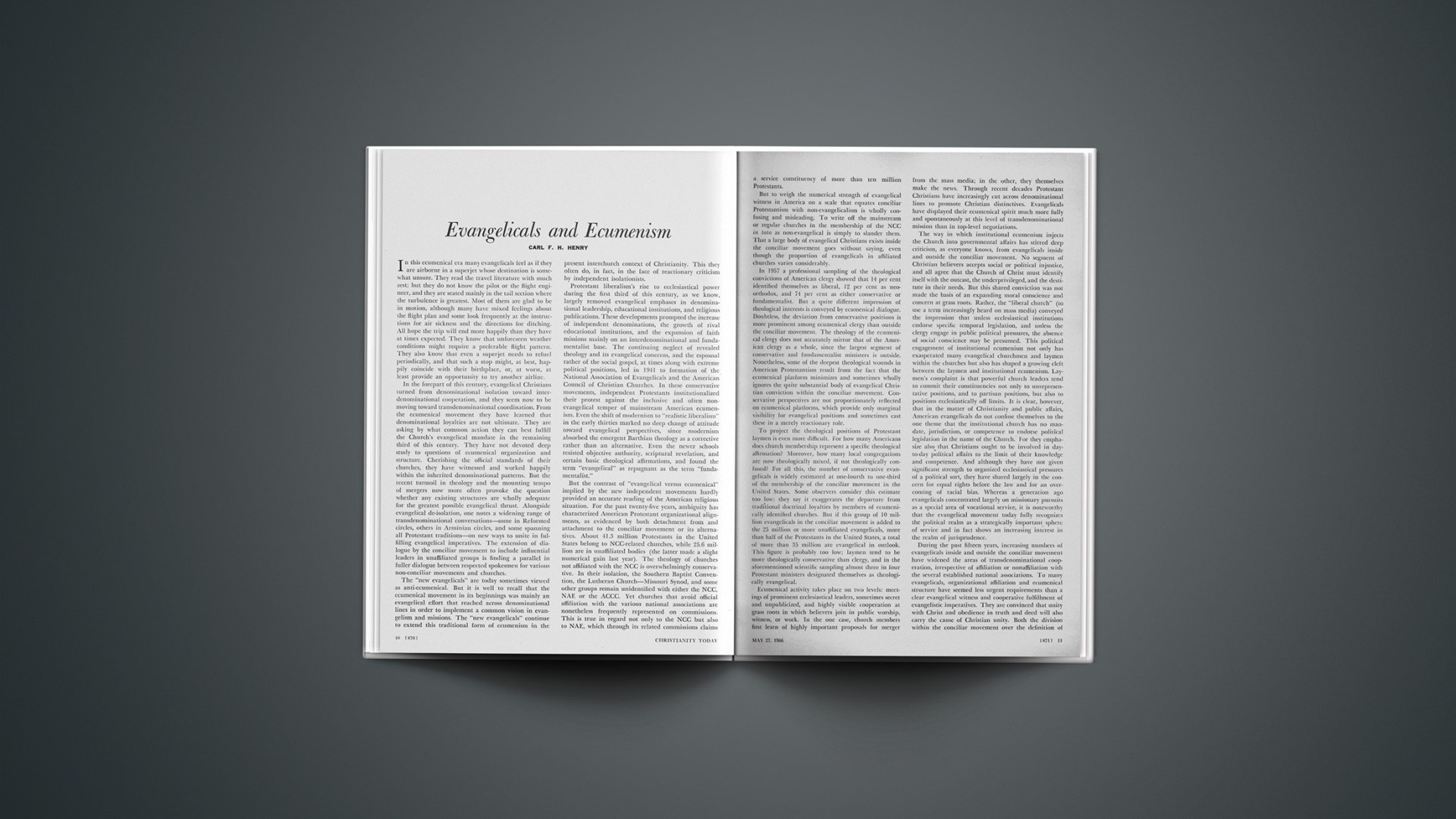
Evangelicals and Ecumenism

What Conservative Evangelicals Can Learn From The Ecumenical Movement

In my country, a person willing to apply the adjective “conservative” to himself is terribly hard to find. I have the impression, however, that elsewhere people are not intimidated by the word and, indeed, are happy to list themselves as “conservative evangelicals.” Such people, I assume, understand a “conservative evangelical” to be a person zealous for the fundamental truths of Scripture. He wants to “hold fast” to the confessions of the Church, the undoubted and catholic Christian faith which for many has today been watered down or filtered out of their thinking. My hunch is that for the most part “conservative evangelicals” are critical of the ecumenical movement because they suspect that—its basis notwithstanding—the World Council of Churches cannot be trusted to preserve the faith-heritage of the Christian Church. If they are not that negative, they at least doubt whether the movement is possessed by a heroic determination to defend the fundamentals of the historic faith.

However, I have not been asked to make a judgment of the ecumenical movement. The question is what the “conservative evangelicals” can learn from it. One need not approve of a movement to learn something from it; certainly one need not be prepared to join the movement before he can profit from it. As a Reformed person, I can learn a good deal from the Lutheran church—as, perhaps, a Lutheran can from mine—without being obliged to become a Lutheran. Perhaps, therefore, the stoutest holdouts from the ecumenical movement will be ready to pick up a few things from it to their own profit.

There are indeed some things to learn from the ecumenical movement. I shall mention two.

First, the ecumenical movement places before us all, inescapably and urgently, the question of the unity of the Church. Church unity plays an undeniably large role in the entire ecumenical movement. Indeed, critics of the movement often accuse it of placing so much stress on visible unity that it compromises the prior importance of the truth. Some people call its search for unity a “false ecumenism.” They say it is driven by a worldly lust for oneness and uniformity. Now, we may not all agree as to whether the present-day ecumenical movement seeks unity in the correct way. But we cannot avoid the fact that the Bible demands a deep concern for the unity of the Church, a concern that can hardly be stressed too strongly. And the ecumenical movement has alerted us to this biblical concern.

I once read a remark by a New Testament scholar that is true and very relevant at this point. He said that the expression “one Church” does not appear in the whole of the New Testament, and that this fact reveals how self-evident the New Testament writers considered the unity of the Church to be. We should have to complete the thought by recalling that we are frequently summoned to preserve the unity of the Church, but at the same time we agree that this summons is given precisely because the necessity of unity is assumed. “There is one body and one Spirit, just as you were called to the one hope that belongs to your call, one Lord, one faith, one baptism, one God and Father of us all, who is above all and through all and in all” (Eph. 4:4–6, RSV).

What Can We Learn?

In companion articles in this issue. Dr. G. C. Berkouwer, distinguished theologian and professor at the Free University in Amsterdam, and Dr. John A. Mackay, president emeritus of Princeton Theological Seminary and author of a recent book entitled Ecumenics, consider what conservative evangelical Protestants and the ecumenical movement can learn from each other.

After alluding to the fears of many evangelicals that the World Council of Churches may not preserve the faith-heritage of the Church, Dr. Berkouwer reminds us that one does not have to approve of a movement or join it in order to learn something from it. He sets forth two things evangelicals may learn from the ecumenical movement—the urgent importance of the unity of the Church and the dangers of an unbiblical eschatology.

Though he recognizes that the search for unity can be motivated by a desire for power, Dr. Berkouwer stresses the way in which the ecumenical movement confronts evangelicals with Christ’s High Priestly prayer. He is right; evangelical Protestants have much to learn about what it means to take seriously Christ’s words on the unity of the Church.

Dr. Berkouwer also warns about the tendency of some evangelicals to look forward so intensely to future unity in the coming kingdom that the seriousness of present divisions in the Church is obscured. His point is valuable that, by accepting uncritically the present division of the Church, conservative evangelicals might be perpetuating what is contrary to Christ’s will. But it could be balanced by mention of the parallel danger of consummating a unity based on unsound or inadequate doctrine likewise unacceptable to Christ.

Evangelicals may learn the lessons Dr. Berkouwer so clearly presents without compromising their essential doctrine and fidelity to the Word of God.

Dr. Mackay recognizes that there are many millions of evangelicals and that they constitute an important segment of the conciliar churches. He differentiates them from ecumenists, who pursue as their great objective the visible unity of the Church, by saying that for evangelicals the biblical revelation and its expression in the thought and life of Christians has priority over visible church organization. Noteworthy is his stress upon trans-denominational evangelical groups, such as the Graham association, World Vision, Inter-Varsity Christian Fellowship, and Young Life.

The first lesson that the ecumenical movement can learn from evangelical Protestants, says Dr. Mackay, is “the reality of Christian conversion.” He speaks plainly of the danger of a Protestant nominalism in conciliar churches that leads to the substitution of church membership for a vital personal relationship to Jesus Christ. We can only hope that evangelicals actually measure up to Dr. Mackay’s charitable estimate of the quality of spiritual reality among them.

The second lesson Dr. Mackay mentions relates to what the Bible can mean in the personal and corporate life of Christians. At this point he declares that the ecumenical movement may well find in conservative evangelicalism something belonging to the great classical evangelical tradition of Christianity—namely, the authority of Scripture and its devotional use.

His third point concerns missions. (Here he speaks con amore as one whose first love is missions in Latin America.) He has high praise for the contribution to world missions made through Evangelism-in-Depth, developed by the Latin America Mission, and looks appreciatively at the adoption by evangelicals of “the incarnational principle” whereby those engaged in evangelistic effort identify themselves fully with those they want to influence. He believes also that ecumenists may learn from conservative evangelicals in the field of Christian journalism.

Dr. Mackay is hopeful of better relations between ecumenical leaders and evangelical leaders, and approves consultation of such leaders.

CHRISTIANITY TODAY is grateful to Dr. Berkouwer and to Dr. Mackay for these candid but irenic essays and commends them to the careful attention of our wide readership, which represents evangelical and ecumenical circles.

Our readers will draw their own conclusions and raise their own questions regarding these interesting essays. Therein lies much of their value. The unity of Christ’s Church is a subject of abiding importance that Christians must face in obedience to their Lord. Certainly all of us have more to learn about it.—ED.

What we have here is not a pious wish but a vocation. We have the calling to seek and preserve the unity of the Church because the Church is not ours but Christ’s. We have, let us admit it, become used to talking about the multiplicity of churches. We like to think that the “pluriformity” of the Church reflects the many-splendored wisdom of God. We use the plural, “churches,” as though the many churches were natural and normal phenomena in Christian reality. But have we ever tried to use the plural of “the Body of Christ”? Would it not be grotesque?

Now, I am well aware that the multiplicity of churches is a fact, and that people who speak of one Church are called romantics. But the New Testament is not romantic, and it knows only of the one Body of Christ, of one Temple, of one flock living under one Shepherd. The divisions of the Church, therefore, are not merely to be regretted. They are to be looked at as an amazing and incredible mystery. A divided Church is an awful problem with deeply distressing dimensions. Recall that when the Corinthians were threatening the Church with division, Paul raised the piercing cry, “Is Christ divided?” (1 Cor. 1:13a).

Somehow we have managed to dull the edge of Paul’s question; indeed, some of us have rounded it off to a pious pleasantry. But it was a terrible problem that rose from the shadows of division, for the shadows of church division fell over Christ himself. Calvin was conscious of this, when he wrote that if the Church were divided, Christ himself would be divided. But, he added, this is impossible (quod fieri non potest).

Is it not understandable, then, that the ecumenical movement should confront us with the High Priestly Prayer of John 17, the prayer that is permeated and defined by the unity of the Church? Christ spoke of the glory he received from the Father and then gave to his own, “that they may be one even as we are one” (John 17:22). Then he prayed that they would “become perfectly one, so that the world may know that thou hast sent me” (17:23). The world is involved in the question of unity. And this makes the visible unity of the Church the pertinent matter. The world must see the unity of the Church, so that it can recognize the great mystery.

When we talk about the world, we are reminded that Paul speaks about the enemies of the cross only with wet eyes (Phil. 3:18). He awakens us to the possibility that unbelief is a counterpart of the fact that the world does not know, does not yet know, that God sent Jesus into the world, because it has not seen the unity of his followers.

A quest for unity can be motivated by the desire for power. But there is also a unity sought simply because we know there is one Shepherd and one flock. The ecumenical movement has something to teach us about this. I say this not because I suppose that the present movement is ideal, or that it has solved all its problems. But it has been stimulated by the restlessness that John 17 provokes within the divided Church. Realism about the Church’s divisions cannot undo the power of John 17, nor can it remove the evangelical earnestness of Jesus’ concern about unity in the presence of the world. Is it not clear that to be “conservative” and to be “evangelical”—if these point to a genuine preservation and the genuine evangel—is to be filled to the brim with the longing for unity and fellowship under the one Lord?

Among those of us who for various reasons raise objections to the present ecumenical movement, there is a temptation to capitulate to the fact of division. Jesus’ words about unity rise from the abyss of eternity. This is why we must stay unsettled and unresigned. If we capitulate to the facts, our conservatism will only seek to conserve what is unacceptable to Christ. And this is not evangelical conservatism.

In the second place, the ecumenical movement places before us, inescapably and urgently, a warning against the dangers of an unbiblical eschatology. Eschatology concentrates on the future. It has its eyes on the promises. Its windows are open to the return of Christ and to the end of the age. But the perspective of the future can be set in wrong focus. When we let our perspective of the future lead us into a futuristic attitude toward the present, when we appeal to what is going to-come to pass after our days for justification of our indifference to the events of our day, we have perverted eschatological truth.

The futuristic perversion of eschatology has had considerable influence on our vision of the Church. Many find it possible to take the divisions of the Church in stride, because they expect the unity of the Church to be revealed only in the future. This attitude often goes hand in glove with the distinction between a visible and an invisible Church. The visible Church is divided. But since the invisible cannot be divided, the divisions of the visible are not too serious. After all, spiritual unity is more important, we hear, than organizational unity. And so we can restfully wait until the Lord returns for the spiritual unity of the Church to be manifest in the open.

Such a view contains an objectionable ecclesiology. We cannot use the scalpel of spiritual unity to cut away our guilt for the visible disunity of the Church. Besides, the very idea is unbiblical. The eschaton in the New Testament is never unrelated to the present day. I know of no text that speaks about the future without at the same time speaking about the present. The eschatological outlook is never meant to be an escape from the problems of the present day. The future does not let us take the sharp edge off present problems. Everything that is proclaimed about the “last things” is pointed straight at today. We are told to pray to be given the powers of the future age, so that we can be in their service now.

When the Spirit creates one fellowship around the crucified and risen Lord and in the breaking of the bread, the “last days” have already broken into the present (Acts 2:17). The Bible surely speaks of a “not yet.” We still see darkly, and we still know only in part. But everything that is told us of the future is told as a calling to the tasks of today. Could this possibly be the reason why the ecumenical movement appeals so frequently to the Kingdom of God? Could this be the background of the book that Dr. Visser’t Hooft, general secretary of the World Council of Churches, wrote and called The Pressure of Our Common Calling?

Sometimes it has taken the odd, bizarre eschatological movements in the Church’s history to remind us that the future in Christian perspective is a summons to be alive to the requirement of this day. These groups have often reminded us of the eschatological call to watchfulness and obedience. “What I say to you I say to all: Watch” (Mark 13:37). Now, it is this same watchfulness that the ecumenical movement forces upon our attention. Whatever our judgment of any particular ecumenical movement may be, we are guilty of closing our ears to the Gospel’s own demands, if we close our ears to this.

Our “common calling” is not to be pushed ahead into the future age. We are not permitted the luxury of an enthusiastic but unbiblical eschatology. We ought to be spiritually alert enough to realize that an appeal to the future age can be an ecclesiological fatalism in disguise. The word “fatalism” has overtones of ironclad necessity, a mechanical drift of things that controls our destiny in spite of ourselves. There is also a kind of fatalism in existence that has to do with the Church. It springs up in our hearts whenever we isolate the future expectations from the present demands. We ought to be stripped of the illusion that this kind of futuristic expectation has any power to enable the Church to meet its calling in what is even now an apocalyptic age.

I have tried to reflect on what we can learn from the ecumenical movement by concentrating on these two facets—the unity of the Church and the dangers of an unbiblical eschatology. I have not tried to analyze the ecumenical movement as such. But as to what “conservative evangelicals” can learn from the movement, these two matters—though others could be named also—seem paramount. Indeed, the ecumenical movement itself must be seen and evaluated in terms of a homesickness for a visible expression of what we have “together with all the saints.” We cannot even begin to understand the motivations of the ecumenical movement until we too long for the reality of the one flock under the one Shepherd, and until we desire it “so that the world may believe.…”

What The Ecumenical Movement Can Learn From Conservative Evangelicals

One can say without fear of exaggeration that the two most significant terms in contemporary Christianity are “ecumenical” and “evangelical.” In both Protestant and Roman Catholic circles, these terms are gaining a new theological dimension and increased status.

The term “evangelical” designates that which centers in the “Evangel,” the “Gospel,” the “glad tidings.” It points to the “good news” both of what God has done for man in the person, life, death, and resurrection of Jesus Christ, and of what he can do in man through the transforming power of the Holy Spirit. To be “evangelical,” a person or a community must witness to the Evangel in thought, behavior, and sense of vocation.

“Ecumenical” means, etymologically, relating to the oikoumene, that is, to the “whole inhabited earth,” which for the Greeks meant the world unified by Greek culture and for the Romans the world unified by Roman law. In Christian history, “ecumenical” came to signify the unity produced by Jesus Christ and the Gospel and made manifest to the world by the community called the Christian Church. After the visible unity of the Church was shattered in the eighth century, the term “ecumenical” became lost for many centuries thereafter. It was restored to usage only in the present century, when the Christian churches of the world began to develop a sense of their common missionary responsibility to the oikoumene.

In 1950, two years after the World Council of Churches was founded, its Central Committee offered the first and only definition of “ecumenical” ever to emerge officially in council circles. “This word,” the committee said, “is properly used to describe everything that relates to the whole task of the whole Church to bring the Gospel to the whole world.” In this historic statement the “evangelical” and the “ecumenical” are inseparably related, so that no person or group can be truly “ecumenical” without being “evangelical,” nor truly “evangelical,” in consonance with the mind of Christ, without being “ecumenical.” It is important to affirm this because there are people for whom these two terms constitute a dichotomy, an absolute either/or.

The “ecumenical movement,” which in the early forties of this century the famous Anglican archbishop William Temple called “the great new fact of our time,” is the effort of many Protestant and Eastern Orthodox churches to give corporate expression to their concern for the unity and mission of the Church universal. This effort received concrete, organizational expression in 1948 with the founding of the World Council of Churches in Amsterdam. This body, composed of more than two hundred denominations and closely related to national councils of churches in many lands, has as its Basis of unity a single article of faith:

The World Council of Churches is a fellowship of Churches which confess the Lord Jesus Christ as God and Saviour according to the Scriptures and therefore seek to fulfill together their common calling to the glory of the one God, Father, Son and Holy Spirit.

In recent years, through the influence of Pope John XXIII and the spirit and findings of the Second Vatican Council (1962–65), the ecumenical movement began to have reality for the Roman Catholic Church. The church which had refused to send even an observer to the Amsterdam Assembly of the World Council of Churches, and for which the term “ecumenical” had ceased to have contemporary significance, invited representatives of non-Roman churches to attend the Vatican Council sessions as “separated brethren.” It gave its implicit sanction, moreover, to the term “Ecumenical Council” as descriptive of this epoch-making gathering in Rome. Evidence also grows, paradoxical though it may seem, that the church of Rome is beginning to assume a leading role in the ecumenical movement.

Over against the “ecumenists,” whether Protestant, Eastern Orthodox, or Roman Catholic, stand what may be called the “conservative evangelicals,” whose number is growing rapidly throughout the world. It has been estimated that in the United States conservative evangelicals include not only most of the 24 million Protestants not in conciliar churches but also a quarter to a third of the total membership of the conciliar churches.

Who are these conservative evangelicals? They are not bigots or fanatics, although such people are found among them (in minority status), just as they are found in the ranks of ecumenists. Speaking in general terms, the difference between the two groups might be expressed thus: Major leaders of the ecumenical movement pursue as their supreme objective the visible, structural unity of the Christian Church. Leading spokesmen for conservative evangelicals, on the other hand, consider the question of biblical revelation and its expression in the thought and life of persons and groups to have priority over any visible relationship, organizational or conciliar, among Christian churches in general, whether in the world, the nation, or the local community.

The spectrum of conservative evangelicals includes small, so-called sect churches as well as large Christian groups whose members cross all ecclesiastical boundaries and are dynamically united in the pursuit of some “evangelical” objective. Among these are such organizations as Young Life, World Vision, the Billy Graham Evangelistic Association, Inter-Varsity Christian Fellowship, Campus Crusade for Christ, and Christian Business Men’s Committee International. Organizations of this type begin to play the role of the historic Roman Catholic orders, of which there are today more than six hundred; though loyal to the Roman Catholic tradition, these orders are not controlled, nor is their polity shaped, either by the Vatican or by local bishops. In the category of conservative evangelicals there are also some large churches, such as the Lutheran Church—Missouri Synod, the Southern Baptist Convention, and major Pentecostal churches, that are unrelated to the ecumenical movement. Mention should also be made of the World Evangelical Fellowship, organized in 1951, which now comprises more than twenty national fellowships.

With these needed clarifications, we are ready for the question that inspired this article: “What can the persons, groups, and churches that form part of, or are committed to, the ecumenical movement learn from conservative evangelicals?”

The first thing they can learn is the importance of emphasizing the reality of Christian conversion.

Emphasis upon the Church, upon church relations and unity, and upon church membership and church growth can becloud or minimize the revolutionary Christian reality of rebirth, radical spiritual change, personal salvation, the “new man.” Indeed, emphasis upon the Church as such, upon formal and loyal church membership, upon unity among the churches, can give rise, and does give rise in many ecumenical circles, to an impersonal “churchianity” and a very nominal Christianity.

The Roman Catholic Church has become deeply concerned about Catholic nominalism. Last year an eminent Chilean theologian with whom I had a public dialogue on the ecumenical movement made this remark, “We Catholics must make Christians.” The plain truth is that ecclesiastically and even ecumenically speaking, a person can be a church member without being in any basic sense a Christian.

Church membership is becoming a substitute for Christian commitment. There is a widespread Protestant nominalism, in which belonging to the church takes the place of belonging to Christ in a vital sense. In recent years I have come to know loyal church members, admirable people, some of them officers in their congregations, who have admitted to me that they have no clear idea of what the Christian faith is. Their minds are a theological vacuum, their lives a spiritual wilderness. A Roman Catholic layman was once asked, “Tell me, my friend, what is it you believe?” He answered, “I believe what the Church believes.” “And tell me, what is it that the Church believes?” His reply, “The Church believes what I believe.” In conservative evangelical circles this could not occur, because primary emphasis is placed upon conversion to Christ, the new life in Christ, and a clear concept of what one believes.

Contemporary relevance must be given in ecumenical circles to what Jesus Christ said to that eminent religious leader, Nicodemus, “You must be born again.” The first-century concept of sainthood, as descriptive of “God’s men,” “God’s women,” people utterly and intelligently committed to God in their thinking and their living, must be restored. “The new man in Christ” must take on present-day meaning. The question arises in this connection whether what is today called “church renewal” is adequate in a situation in which Christian nominalism prevails. For the renewal of life presupposes the presence of life, and this precisely is what is lacking in so many church members. What a large proportion of them primarily need is not liturgical thrill but evangelical challenge, not renewal but rebirth, not concurrence with bureaucracy but conversion to Christ.

But the going may be rough. At a recent meeting in the ballroom of a famous hotel, a cultured lady, a loyal and leading member in a local Protestant congregation, said this, “If I were to mention the word ‘conversion’ as a Christian objective, they would put me out of the church.” In this context, two episodes that have occurred in the past year are prophetic and far-reaching in significance.

In his historic address before the United Nations in New York on October 4, 1965, Pope Paul VI, as he brought his discourse to a close, used these words:

The hour has struck for our “conversion,” for personal transformation, for interior renewal. We must get used to thinking of man in a new way; and in a new way also of men’s life in common; with a new manner, too, of conceiving the paths of history and the destiny of the world, according to the words of Saint Paul: “You must be clothed in the new self, which is created in God’s image, justified and sanctified through the truth” (Eph. 4:23).

Last July, in his annual report as director of the division of World Mission and Evangelism of the World Council of Churches, that eminent ecumenical figure Bishop Lesslie Newbigin, himself a profoundly evangelical spirit, said:

I suspect that the most fruitful and significant question with which we shall have to confront our colleagues in the ecumenical movement will be the question about the meaning of conversion.… We must be centrally concerned with the issue of conversion and its meaning in the kind of era in which we live—an era in which the Church is a minority in a secularized and religiously plural society. I think, if I may say so, that this will be found to be a more crucially important issue than the issue of church growth.

Hopeful and thrilling in this regard is a profound study entitled “Secularization and Conversion,” recently published by the Division of Studies of the World Council of Churches.

Secondly, the ecumenical movement has also very much to learn from conservative Evangelicals in the matter of what the Bible can be and should be in the personal and corporate life of Christians in every dimension of “togetherness.” It is important to mention that the new and more dynamic formulation of the Basis of the World Council was the result of a strong plea by Norwegian evangelicals, who felt that more explicit recognition should be given to the status of Holy Scripture. It was this influence—as I know, because I was a member of the WCC committee that made the final decision—that led to the revision of the Basis and the inclusion of the words “according to the Scriptures.” The text of the Basis now reads: “The World Council of Churches is a fellowship of churches which confess the Lord Jesus Christ as God and Saviour according to the Scriptures.…”

It is true that in certain conservative evangelical circles, devotion to the Bible and to ideas about the Bible becomes, in a very subtle way, a substitute for devotion to Christ and a personal relation to him. It is important, nevertheless, that the ecumenical movement should be inspired by conservative evangelicals to emphasize something that belongs to the great classical evangelical tradition of Christianity—namely, the authority of the Bible and the devotional use of Holy Scripture. For ecumenists, the Bible must become the companion of the Christian’s life, the Book whose reality takes on increasing significance in heart and home and work, in spiritual retreats, and in a prophetic ministry. Amid the rush and turmoil of contemporary living, the restoration of the Bible to the luminous and dynamic role that belongs to it will not be easy. But Christians committed to the worldwide unity of the Christian Church must give an ecumenical dimension to the practice of daily listening to the Book.

Thirdly, while the word “evangelical” is part of the classical heritage of the whole family of God, in conservative evangelical circles this classical term is given more of a missionary connotation than it has in ecumenical circles in general. Individual evangelicals are inspired to accept as their mission “winning” others to Christ and engaging in a dynamic way in Christian evangelism. Their supreme objective is not merely to do good to others in the spirit of Christ but to lead others to accept Christ as Saviour and Lord. That is to say, there is in evangelical circles a traditional Christian enthusiasm and sense of mission for the transformation of life in the spiritual, not merely the sociological, sense. This has a vital bearing upon the issue of evangelism, an issue that today is being confronted afresh in the ecumenical movement.

In the realm of evangelism, I know of no more significant and creative effort than one that originated about a decade ago in Latin America, “Evangelism-in-Depth.” This movement, whose headquarters are in San Jose, Costa Rica, is promoted, interestingly enough, by persons who are loyal to their own denominations and enjoy full ecclesiastical status in them but who carry on their work within an extra-denominational context. Evangelism-in-Depth is spoken of as “a program and a philosophy” that seeks “to relate evangelism to the total life of the believer and of the Church.” The growth of any movement,” it is stated, “is in direct proportion to the success of that movement in mobilizing its total membership for the propagation of its beliefs.” But “Evangelism-in-Depth,” according to Dr. W. Dayton Roberts, associate director of the Latin America Mission and a United Presbyterian minister, has as its aim not to take the place of the work being done by churches but to help churches do their work. In Latin America this movement receives the cooperation of churches that belong to the ecumenical movement and of churches that do not. Here “evangelicalism” transcends mere “ecumenism,” giving to the word “ecumenical” a very dynamic meaning. It is a striking example of unity in mission, and in mission that is not merely bureaucratic proclamation but grassroots action.

It would be embarrassing to single out individuals, groups, and churches that are dedicated to luminous and dynamic evangelistic effort of this kind. Suffice it to say that in all cases an understanding of the Gospel as involving what God has done for man, what God can do in man, and what man must do for God in the interest of his fellow man, leads people of the most diverse background to adopt the incarnational principle. In other words, those engaged in evangelistic effort identify themselves completely with the people whom they want to influence. They thereby win a right to be heard by these people, because of the qualities the latter have learned to admire in these persons identified with their life and environment.

To illustrate the “incarnational” approach in the interest of Christ and the Gospel, let me say this: In the realm of journalism there are magazines produced by conservative evangelicals that present the Christian faith, with relevance to contemporary issues, in more compelling literary style, with more communicative capacity, and with a wider circulation than do the products of circles committed to the ecumenical movement. This is a very remarkable achievement. In order not to be embarrassing, I mention only one example, Decision, which has a circulation today of more than three million copies a month and whose editor is a United Presbyterian minister.

Conservative evangelicals have little use for those in their ranks who are fanatically anti-ecumenical or for whom evangelical ideas become a mere badge, ostentatiously displayed or vociferously proclaimed. For the truth is, in some conservative evangelical circles there is found what might be described as evangelical pharisaism. Sound ideas become subtle idols; they take the place of the divine realities that the ideas are designed to express. This cult of the badge with its crusading anti-ecumenism can lead and does lead to evangelical sterility. But those related to the ecumenical movement should beware of identifying such people with the core of conservative evangelicalism. They should also be on the lookout for any similar fanaticism in their own ranks, and of any trend toward mere negativism in their approach to conservative evangelicals.

Things are happening today in the two groups we have been considering that give great promise and stir high hopes. In a very quiet way, distinguished figures in the ecumenical movement and in the conservative evangelical ranks meet from time to time. Without any fanfare or publicity, they come together to consider the differences that divide them and the spirit and goal that should inspire their common devotion. Of great significance in this regard is the article entitled “The Conservative Evangelicals and the World Council of Churches,” written by Eugene L. Smith and published in the January, 1963, issue of the Ecumenical Review. Dr. Smith, a leading Methodist churchman and a major ecumenical leader, represents in his person and spirit very much of what is best in “ecumenism” and “evangelicalism.”

May I close by referring to two moving experiences that came to me last March in California. It was my privilege to address a meeting in San Francisco that took place at the social headquarters of the Sixth Army. The audience was composed of area secretaries of Young Life and their wives. In the chair was the general of the Sixth Army, a devout Roman Catholic layman. How did it happen that a man of his eminence and background should preside at a gathering of that kind? The reason was this: Some years ago, while the general was on duty in West Germany, his son and daughter came under the influence of Young Life, and their lives were completely transformed. The father was so impressed by what happened to his two teen-agers, one of whom is now studying at the United States Military Academy at West Point, that he himself became a devotee of the Young Life fellowship.

The following day, I had lunch with the Pentecostalist, David du Plessis, a dear friend of many years whom it had been my privilege to introduce to the ecumenical movement. He told me of his recent experience at the Second Vatican Council. He had been invited by leaders of the Roman Catholic Church to attend that gathering at their expense. Several times during the council sessions, he met with a group of bishops and cardinals in whose life and outlook the “ecumenical” and the “evangelical” had become fused and who wanted to learn from their guest about the Pentecostal movement in the world of today.

Something is clearly happening at what have been traditionally regarded as two polar extremes, the Roman Catholic Church and the Pentecostal movement. Today the Roman church is becoming more evangelical, and the Pentecostal movement more ecumenical. Between the two is the great complex of Protestant churches dedicated to the ecumenical movement, to one of which I myself belong. Let these churches, and my own beloved church in particular, become aware that much that is significant for Christianity’s future in the world can Ire learned from conservative evangelicals, and not least from a maturing Pentecostalism.

Ecumenical Developments in the Roman Catholic Church in the U.S.

Ecumenism is making substantial though not sensational progress in the Roman Catholic Church in the United States. There are small pockets of resistance here and there but no large-scale opposition to the movement. The extent of ecumenical progress in Catholic circles can be gauged, I think, from the fact that it was only a little more than a decade ago that Cardinal Stritch of Chicago forbade any Catholic to attend the World Council General Assembly at Evanston.

The most immediate cause of the recent acceleration in the pace of our ecumenical progress has been the participation of the Catholic bishops themselves in the movement. Ten years ago ecumenism was thought to be a dubious and marginal hobby of specialists such as Father Gustave Weigel. Now the American hierarchy has set up the U. S. Bishops Commission for Ecumenical Affairs to foster the movement and to supply the bishops with guidelines for activities such as dialogue and joint prayer services. This official involvement of the bishops overshadows all the high-level dialogues by biblical scholars and theologians as well as the multitudinous projects for religious cooperation in civic and academic affairs. For the hierarchy now officially recognizes other Christians not merely as individuals but as churches, in line with the Vatican Council decree on ecumenism.

The Bishops Commission has established a number of subcommissions for dialogue with other churches: one for the Lutherans, one for the Methodists, the Anglicans, the Orthodox, the Presbyterians and Reformed, the Conservatives, the National Council of Churches and the World Council—and the Jews. The subcommission for the National and World Councils will be a counterpart of the joint Vatican—World Council working group that meets at Geneva. The subcommission is meeting May 25 and 20 in New York. Among the topics for discussion at this and other meetings will be mixed marriages, peace, baptism, and common prayer and worship.

This central Bishops Commission has also established a special committee for Education on Ecumenism. The chairman, Father Colman Barry, O. S. B., has stated that it will concern itself with the education of children as well as adults, with the Confraternity of Christian Doctrine as with Catholic schools, with the secular campus as well as the Catholic college, with the seminary as with parish life—all with the view of giving an ecumenical orientation to Catholic education.

Dr. Eugene L. Smith of the World Council of Churches has called attention to “rebellious ecumenism.” This is not a Roman Catholic problem, at least not yet. Our problem at present is protest from young priests and seminarians who claim that certain bishops are not carrying out Vatican Council reforms. Under the doctrine of collegiality enunciated at the council, the Pope will now exercise his authority in the framework of dialogue with the bishops of the church; and it was the mind of the council that every person in authority—bishop, pastor, or religious superior—should exercise his or her authority in dialogue by “talking things over” with his or her subjects.

Encouraged by the official involvement of the bishops, Catholic theologians and Bible scholars are meeting with Protestant and Orthodox scholars in public or private dialogues all over the country. Two of the most active centers for this top-level professional dialogue have been Packard Manse, outside Boston, and the Paulist Center in Boston. Catholic and Protestant seminaries and universities are exchanging guest lecturers, and several Catholic theologians and Bible scholars are visiting professors at Protestant Divinity Schools: Father Bernard Haring, for instance, succeeds Father Roland Murphy at Yale Divinity School for 1966–67. The presidents of Union Theological Seminary, New York, and Fordham University in New York recently announced that their institutions have set up a permanent relationship in which there will be an exchange of professors and reciprocal acceptance of academic credits on the graduate level. One especially interesting news item is that Martin Scharlemann, professor of New Testament studies at Concordia Lutheran Seminary in St. Louis, has gone to Rome to study at the Pontifical Biblical Institute, the first Lutheran ever to enroll there.

Ecumenism is of course a byword in religious publishing. A Catholic edition of the Revised Standard Version of the New Testament has received an imprimatur. Protestant scholars have been writing in Catholic periodicals, and Catholic newspapers feature Protestant columnists such as Marty, Pelikan, and Robert McAfee Brown. A Catholic-oriented press, the Guild Press, along with American Press and a Protestant press, Association Press, have just published (March 7) a paperback containing the sixteen council documents along with comments by Protestant and Orthodox observers. The Paulist Press publishes not only the Ecumenist, edited by Father Gregory Baum, but also a series of booklets on the Protestant churches written by Protestants and the booklet called Living Room Dialogues. This paperback, designed to further “grass roots” dialogue, appeals under the sponsorship of the National Council of Churches and the Good Will Apostolate of the Catholic Confraternity of Christian Doctrine. It is now in its second printing of 50,000. The Graymoor Friars publish the ecumenical magazine At-One-Ment, and Duquesne University publishes the Journal of Ecumenical Studies.

There is a lively ecumenical ferment in Catholic parishes across the land. The enthusiasm, usually fostered by younger clergy and laity, has expressed itself in joint prayer services in many areas, especially since Pope Paul himself set the example by participating in a Bible vigil with Protestant and Orthodox observers at St. Paul’s Outside the Walls on December 4. This year for the first time Roman Catholics, Protestants, and Orthodox used the same pamphlet of prayers and procedures for the Week of Christian Unity. It was published by the National Council of Churches and the Graymoor Friars. One picturesque example of a joint prayer service was that at Baltimore on January 23 in which Catholic and Protestant clergy preached, a combined Catholic-Protestant choir sang, and the Scriptures were read. The service opened with a processional of fifty-six clergy—Catholic, Protestant, Anglican, and Orthodox.

The impact of the ecumenical movement shows up in parishes in many ways. There has been a notable drop in the total number of converts to the Catholic Church. This may be due, of course, to the increasing secularization of American society and a corresponding decrease in interest in religion. However, it seems more probable that it is due to a realization that individual conversions do not usually help the ecumenical movement; this leads to an abandonment of high-pressure campaigns directed to Protestant or Orthodox partners in mixed marriages. Another reason for the drop might be the increased cooperation between ministers and priests in regard to prospective conversions. The chaplains at Yale recently drafted ground rules for convert making. Chaplains from twelve churches including the Roman Catholic agreed to avoid any means of evangelization that “compromises the intellect, spiritual integrity, dignity and freedom of any person on the campus.” Parish clergy, Catholic and Protestant, often arrive at a similar agreement about conversions.

Ecumenism received a setback last year with the conditional baptism of Luci Baines Johnson, a convert to the Roman Catholic Church. Episcopal Bishop Stephen F. Bayne commented: “What is significant about the whole degrading episode is how little attempt was made … to point out the true and supernatural dimensions of baptism as Christians understand it.” Father Thomas F. Stransky, C. S. P., an official of the Secretariat for Promoting Christian Unity at Rome, chided American priests for baptizing conditionally without making a proper investigation of the original baptism. One happy result of the entire episode was that certain diocesan guidelines now warn against rebaptizing without investigation. The guidelines for the diocese of Atlanta say that in the case of Christians entering the Roman Catholic Church, conditional baptism can be administered only when the priest has a prudent doubt about the original baptism, and even then the proper authorities should be consulted.

The decree on ecumenism states that training of young priests should have an ecumenical orientation. This will soon begin to bear fruit in parochial preaching in the biblical content of parish sermons. A unique ecumenical event this year was the annual convention of the Catholic Homiletic Society, at which Dr. Kyle Haselden, editor of the Pulpit, was main speaker. At one of the meetings, presided over by Dr. William Thompson of Eastern Baptist Theological Seminary, a Protestant biblical scholar, a Protestant educator, a Protestant counselor, and a Protestant rhetoric critic evaluated, a taped sermon by Ralph Lightbody.

The Roman Catholic laity seem to be adapting quickly to their role in grass-roots ecumenism. In St. Louis in January, 52,000 Roman Catholics and 150 parishes completed a six-weeks study course on the Constitution on the Church, and among the suggestions they offered their parish assemblies was “more contact with members of other churches.” The National Council of Catholic Men and the National Council of Catholic Women have launched a national closed-circuit TV dialogue with religious leaders and civic leaders in seventy major cities of the United States. It features a program kit produced in cooperation with Protestant and Jewish agencies to be distributed in parishes throughout the United States.

One of the most important lines in the decree on ecumenism is that which says: “There can be no ecumenism worthy of the name without interior conversion. Father Couturier, the early French ecumenist, emphasized this spiritual ecumenism, and European Catholics insist strongly on the need for ecumenists to cultivate a keen sense of the presence of God in order to achieve a more perfect obedience to the Holy Spirit. In American Catholic circles, the emphasis in ecumenism, is still on activism; but there are signs of more profound stirrings of the Spirit. There are meetings such as that of the Spiritual Life Institute held at Collegeville, Minnesota, last September where men of the stature of Douglas Steere and Godfrey Diekmann shared insights on the devotional side of religion. The Gustave Weigel Society established in Washington promotes ecumenical retreats. Co-chairmen are Dr. Douglas Horton and Father John Courtney Murray. On its immediate agenda are a retreat for Catholic priests, Protestant ministers and their wives, and Catholic religious, a retreat for Fellow Christian Clergymen, and one for Fellow Christian Laymen. Retreats for ministers conducted by Catholic priests have not been uncommon in recent years.

The Catholic and Protestant liturgical movements seem to run parallel and in some respects to converge. One interesting development has been the appearance of Catholic bishops at Protestant and Anglican funerals and at consecrations of Anglicans. Because of the immense crowd, Marymount College in Salina, Kansas, on January 6 made available its fine arts auditorium for the consecration of the Rev. William Davidson of the Protestant Episcopal Church. An Episcopal and Orthodox bishop had places of honor at the consecration of Bishop Breitenbeck as auxiliary bishop of Detroit, the first time in Detroit history that prelates of other Christian churches were seated in the sanctuary.

At the official top-level dialogues between Catholic and other Christian groups, the Eucharist and Baptism have figured prominently. At the Roman Catholic-Anglican meeting at Kansas City, February 2–4, 1966 the topic was “The Eucharist: Sign and Cause of Unity. The Church as a Eucharistic Fellowship.” Two position papers were presented, one by Father Bernard Cooke, S.J., and one by Father Arthur Vogel, an Anglican. Father Cooke’s paper asserted that if we really believe the Eucharist is a cause of unity, we should not unduly delay intercommunion. “Perhaps the most appropriate way,” he said, “is to make a proposal—why cannot we in the private and controlled situation that is ours in this conference celebrate together the Eucharist?” Father Vogel also spoke favorably about the possibilities of Roman Catholic-Anglican intercommunion before unity. Incidentally, at the Xavier College theology symposium last month, the noted English Catholic theologian Charles Davis said that attempts to rethink the doctrine of transubstantiation can be expected to continue.” It is well to observe that dissatisfaction with the older theology of transubstantiation is not primarily due to doubts about the Aristotelian philosophy as such. What is seen as defective is an explanation that draws upon a philosophy of nature while making no appeal to personal categories.”

At the Catholic-Lutheran meeting in Chicago February 4–6, 1966, the topic was the baptismal article of the Nicene Creed, “I confess one baptism for the remission of sins.” A joint statement published at the end of the meeting said, “We were reasonably certain that the teachings of our respective traditions regarding baptism are in agreement and this opinion has been confirmed at this meeting.”

One persistent source of Catholic-Protestant friction has been non-theological, the Protestant suspicion that the Roman Catholic hierarchy in centers of concentrated Catholic population have been exerting undue influence in the enacting or sustaining of laws pertaining to such matters as censorship, federal aid to Catholic schools, birth control, and divorce. The objection has been that the Catholic Church was imposing Catholic moral theology on the conscience of the public. In recent months, there has been a noticeable tendency on the part of American Catholic bishops to withdraw their support of many of these laws, especially when they are considered bad jurisprudence. In New York, the Committee of Catholic Citizens to Support Divorce Reform includes men like Frank O’Connor, New York City Council president; and the bishops of New York State have announced their readiness to accept divorce reforms if they do not encourage the breakup of marriages.

Since the great march at Selma, Roman Catholic participation in civic and social projects (which is recommended strongly by the Ecumenism decree) has been so common that I will not attempt to single out any examples. But there is a growing opinion in Catholic circles that this type of ecumenical enterprise may prove to be the most fruitful type in the future. I think most Catholics would agree with Dr. George Lindbeck, who says in Dialogue on the Way (p. 233) that the area of problems of the modern world “perhaps represents one of the most promising edges of ecumenism. Here, as in the area of biblical research, Protestants and Catholics can cooperatively seek common answers to common problems, rather than simply struggle with differences inherited from the past.” He goes on to say, however, that even here, the burden of our divisions is still with us, and that there are characteristic differences between the Catholic and Protestant approaches to the modern world.

You have undoubtedly read in Christianity and Crisis (April 4) about the new “secular ecumenists,” whose ecumenical interest lies in the relation between Church and world. You will find a similar line of thinking in other Catholic theologians. In a recent talk at Catholic University, the Catholic ecumenist Avery Dulles said: “From many quarters … one hears the call for a new ecumenism—one less committed to historical-theological controversies and more in touch with contemporary secular man: one less turned in upon itself, more open to the world and its concerns. The great decisions affecting man’s future are being made in the sphere of the secular and Christianity does not seem to be there.”

I said earlier that the ecumenical movement is making substantial though not sensational progress in the Roman Catholic Church in the United States. I think the pace of ecumenism is every bit as rapid in American Catholicism as in American Protestantism or Orthodoxy. But after all, we have just passed through a Vatican Council that has revitalized and renewed the Church, and our ecumenical dynamism should be far more pronounced.

The delay is due, I believe, not to a defect in Roman Catholic thinking but to the strength of deep-rooted Catholic reflexes. I find the Catholic clergy convinced by and large that ecumenism is the will of God and the mind of the Church, but they are slowed down by legalism. They are accustomed to taking orders, and they want to wait for official directives before taking action. They tend, moreover, to interpret the directives according to the rigid letter of the documents. I don’t believe this was the mind of the council. The bishops wanted the council documents implemented, of course; but they felt that the spirit and dynamism of aggiornamento should outrun the cautious wording of council documents or episcopal directives. As Father Thomas Stransky, C. S. P., says in the January Clergy Review, the decree on ecumenism is “an open charter for a movement, not an absolute statement of a static position.” And he quotes in support of this the conclusion of the ecumenism decree, which expresses the hope “that the initiatives of the sons of the Catholic Church joined with those of the separated brethren will go forward, without obstructing the ways of divine Providence and without prejudging the future inspirations of the Holy Spirit.”

This legalism is to be found among some bishops, especially those who seem to be deferring ecumenical programs until the Secretariat for Promoting Christian Unity issues its guidelines. Generally, legalism is found not among bishops of a theological bent who think in terms of pastoral administration but among those who are juridically trained and think in terms of canon law.

The two groups that show the greatest enthusiasm for the ecumenical movement are the nuns and the seminarians. They do not hesitate to demonstrate their enthusiasm. The laity generally are somewhat more reticent. Accustomed to many years of passive docility, they are not in any hurry to avail themselves of the benefits of Chapter IV of the Constitution on the Church, which says that laity should openly reveal to their pastors their needs and desires “with that freedom and confidence, which is fitting for children of God and brothers in Christ,” this chapter also says that laity are sometimes “obliged to express their opinions on those things that concern the good of the Church.”

However, enough of the dark side of the ecumenical picture. Pope John would want me to emphasize the bright side; and if we look at the Catholic ecumenical picture as it was in 1962, we can say that the picture is very bright today. In fact, what has happened in the last four years is nothing short of miraculous.

Ecumenical Developments in WCC Member Churches in the U.S.

The ecumenical obligation has become a concern of more Christians today than ever before. Never have so many been so challenged, and so puzzled, by that obligation. Its fulfillment has never seemed more imperative, the means of that fulfillment more elusive.

Ecumenical activities within U.S. member churches of the World Council of Churches are increasingly prolific and diffuse. The baffling puzzle that occupies each church in its own life, and all in their common concerns, is the relationship between ecumenical organization and ecumenical movement. We shall look at the nature of that problem in three relationships.

1. Relationships With Roman Catholics

The multiplication of new contacts between Roman Catholics and members of churches represented here is almost astronomic. From the parish, to the county, to the state, to the national and international level, there is an explosive spread of theological discussions, shared Bible studies, joint services for worship, alliances in civic programs, and pooling of resources for community, state, national, and international issues. Both communities and churches are enriched. On both sides there is awareness of continuing and profound theological difficulties. Nevertheless there is in countless communities a new atmosphere of hope both for a deeper understanding of the Gospel within churches and for a more vital witness of the churches to those communities.

This development is a notable example of ecumenical movement far outrunning ecumenical organization. It is an illuminating and a surprising sequel to the New Delhi statement on Christian unity, with its focus on “all in one place.” Most of us who were delegates voted for that statement and returned home with no particular intention of doing anything new because of that affirmation. Such a hiatus between word and deed is not unprecedented among us! The new initiative for examination by our people of the implications of such an affirmation came front a source that no delegate at New Delhi could have anticipated—our Roman Catholic brethren. The ensuing discussions have led many of our own members to a new understanding of their Roman Catholic neighbors and to a deepened encounter with the Gospel as they try in a new way to give a reason for the faith that is in them.

A major function in relationships at this stage is the shattering of stereotypes, and a mutual discovery on both sides of the real identity of the other. Another is the developing of the joint activities—of a range far wider than most would have anticipated—that are possible in the context of theological differences. For the new atmosphere that has developed, and for the Roman Catholic initiative in helping create it, we praise God.

2. Relations With Conservative Evangelicals

The description “conservative evangelicals” covers a wide spectrum—from Southern Baptists to Missouri Synod Lutherans, from Pentecostals to Dispensationalists. Many within our own communions are conservative theologically and socially, evangelical in faith, and also committed ecumenically. No generalization adequately describes so varied a group. The most important American meeting of conservative evangelicals in this decade was held April 10–16, 1966, at Wheaton, Illinois—a “Congress on the Church’s Worldwide Mission.”

In the United States there are five major groupings of foreign missionary agencies.

1. The Division of Overseas Ministries of the National Council of Churches (10,452 missionaries; $95,300,000 income in 1962).

2 The Evangelical Foreign Missions Association (5,993 missionaries; $30,700,000 income in 1962) (primarily denominational agencies of churches in the National Association of Evangelicals).

3. The Interdenominational Foreign Mission Association (5,506 missionaries; $19,700,000 income in 1962) (“faith missions” with personnel from various denominational backgrounds).

4. The Associated Missions of the American Council of Churches (missionaries and income not known) (the group to which Carl McIntire is related).

5. Agencies not organizationally related to any of the above (4,393 missionaries; $41,600,000 income in 1962) (Southern Baptists, Missouri Synod Lutherans, and other relatively small groups).

(The above totals include organizations in full and associate membership.)

The congress at Wheaton was sponsored jointly by the EFMA and the IFMA. Two hundred and fifty-six mission boards, societies, schools, and specialized agencies were represented among the nearly one thousand participants.

The congress was superbly organized. The fifteen major papers showed careful scholarship and exhaustive preparation. Discussion focused on preparation of a “Declaration on the Church’s Worldwide Mission.” Considering the number of missionaries related to the EFMA and IFMA agencies, the size of the churches they serve, and the keen interest within their circles about this meeting, this declaration will be among the more widely welcomed and read missionary documents of this decade.

The convening of the meeting was a major achievement that would have been impossible five years ago. Theological tensions within the group are acute. As far as I would know, they focus especially in the areas of Pentecostalism, ecclesiology, and dispensationalism.

Nevertheless, the sense of unity in the congress was vivid, and the process of discussion and formulation of the statement deeply creative. Delegates brought from other countries were of notable ability and training. The dynamics were familiar: excitement over the new discovery of broad and deep fellowship; intense discussion of issues; many plans for establishment or strengthening of area committees and of functional agencies in such fields as medicine, literature, and mass communication; proposals for merging independent missions and for uniting Bible schools, field ministries, and correspondence courses, as well as for “the unifying of church groups.” I am happy to record my conviction that the Christian mission will be enriched by the congress, although I must immediately express my concern as to one possible divisive result.

The distrust of the ecumenical movement within this group has to be experienced to be believed. Fifteen major papers were presented. Each had been through a thorough process of comment by reactors, revision, and final committee acceptance. Thus each in a sense represented more than individual opinion. Nine of the fifteen carried attacks on the ecumenical movement, and at times on the World Council of Churches by name. They ranged from the sadly irresponsible to one that was a careful analysis of church growth in the United Church of Canada and the Church of South India and a conclusion that church union does not of itself ensure evangelistic passion. There were frequent comparisons of the best in “evangelicalism” with what seems to them the worst in the “ecumenism.” It was carefully stated from the platform that only the formal document voted on by the congress was to be taken as the “mind” of the meeting; but in the heavy attacks upon the World Council of Churches, no World Council documents were cited—except one paragraph on proselytism. Robinson, Gerald Anderson, Tillich, Barth, and Bouquet were quoted as reasons for distrust in the ecumenical movement. The careful instruction we as observers received that we could attend discussion groups to which we were assigned but could not participate in any way was a wise decision. I was received in my group with courtesy, but so intense is the distrust of conciliar bodies that any participation by me would have been deeply disruptive.

The most frequent charges against us were theological liberalism, loss of evangelical conviction, universal-ism in theology, substitution of social action for evangelism, and the search for unity at the expense of biblical truth. These comparatively mild phrases by no means suggest, however, the deep intensity of conviction underlying them.

In a report of this length it is impossible to deal with the theological differences that I think do exist. I report these attacks only because of the divisive effect that the congress may produce in churches of Asia, Africa, and Latin America.

One of the clearly stated purposes of the meeting was to further the establishment of evangelical fellowships around the world. This process is under way. Such fellowships have recently been established in Africa, Canada, Ireland, Bolivia. Others will follow. Some, as in India, have been long established. There is a profound difference between the initiative which comes from the United Kingdom and that from the United States for the establishment of such fellowship. In the former case there is no desire to make such fellowship exclusive. Its emphasis is close to the carefully worded statement of the Evangelical Fellowship of India.

Membership in EFI is open “to Churches, missions, institutions, organizations, groups, or individuals.” Membership does not adversely affect other affiliations; therefore EFI will respect the conscience and convictions of its diverse membership in their current church and world affiliations provided that such members are unreservedly committed to the Lord Jesus Christ as revealed in the Holy Bible.

In sharp contrast is the statement of the recently established Evangelical Fellowship of Africa and Madagascar, which restricts participation to bodies that have no part in activities of the World Council of Churches or any related agencies. A number of well-informed persons at the congress said that the same intention will underlie the establishment of other evangelical fellowships sponsored by the EFMA and IFMA. One can only regret the divisions thus produced by forcing Christian bodies to make such a choice, especially in countries where Christians compose small minority groups confronting massive and entrenched paganism.

How should we react? We must remember that the attacks were probably much less extreme than they would have been five years ago. Moreover, an amazing range of persons at the congress, total strangers as well as friends, expressed to me (1) their regrets at the attacks, (2) their conviction that at many places the criticisms were unfair, and (3) their concern at the unnecessary limitations the group placed upon itself by its preoccupation with opposition. Alike for their sakes, for ours, and especially for the churches of Asia, Africa, and Latin America, we have an enormous job to do in furthering real understanding—on both sides. And, that job can be rewarding. No person could have received more gracious hospitality, more courteous care, than I at Wheaton. There is an enormous and urgent task to do in clearing away false stereotypes. When that is done, we will find important residual differences—but at least then they can be dealt with for what they really are. That step of itself will be a great gain toward healing this wound in the body of Christ.

3. The Relationship Between “Churchly” And “Rebellious” Ecumenism

This gathering is characteristic of what Albert van den Heuvel calls “churchly” ecumenism. It can be contrasted with the individual ecumenism of an earlier era (“Crisis in the Ecumenical Movement,” Christianity and Crisis, April 4, 1966). Churchly ecumenism is found in official organizations. It is constituted by the various churches, directed and financed by them. It is of, by, and for the churches in their life and witness. Its officialdom is senior in years. It is characteristically cautious. Its basic policies are voted upon by representatives, who come into conciliar bodies through designation by their own churches.

The development of churchly ecumenism in the last half century is one of the visible victories of God in our time. The Christian mission has been enriched, refugees have been housed, destitute persons have been cared for, the cause of peace has been strengthened, justice has been affirmed, religious liberty has been enlarged, the faith has been clarified for many, congregations have been served, the saving grace of God in Jesus Christ has been made more widely known.

The very fact that such ecumenism has been rooted in the churches has been a source of great power. That fact is also a source of danger. Increasing prestige of any churchly organization can mean a smothering weight of protocol.

Churchly ecumenism can be compared today with various other kinds. There is the conservative evangelical ecumenism that convened the Congress on the Church’s Worldwide Mission. Albert van den Heuvel writes of a “secular ecumenism,” John Cogley of a “private ecumenism”; and Hendrikus Berkhof speaks of an “anonymous ecumenism.”

Let me here coin my own term, and do it in rather extreme form in order to make the issue sharply clear. There is today a “rebellious ecumenism.” The phrase is to some degree self-contradictory. The ecumenical task is that of the whole Church taking the whole Gospel to the whole world. To call such an activity “rebellious” is, of course, a misuse of words. Nevertheless, there is a significant element of rebellion—part of it creative—underlying some ecumenical activities. The volume of it is sufficient to warrant use of the phrase. I do so because this element of rebellion must be taken seriously in our churchly ecumenism.

Theological students in both the United States and Canada are not nearly so excited about the proposals for church union in these two countries as we would have expected twenty years ago. Is there not a feeling that the merging of what seem to students to be obsolescent structures hardly promises of itself a new relevance?

There is apparently a strong element of rebellion in the development in Europe that Dr. Berkhof described as “anonymous ecumenism.” He reports that members of the most conservative as well as the liberal Protestant churches say “there is no bridge between us and what our preachers say,” and that they are reading Robinson, Van Buren, and Cox with intense interest. He reports that many active Roman Catholics are reading those writers more eagerly than the documents of the Vatican Council. Bible study groups, cell groups, youth action groups multiply, cutting squarely across Protestant-Catholic, liberal-conservative lines.

Such developments may be strongest where congregational life is most weak. Nevertheless, they are not limited to Europe. I have heard reports of intercommunion between Roman Catholics and Protestants in at least five European countries as well as in Canada and the United States, in some instances including faculty members of theological schools.

It is expectable that a rebellious ecumenism should be found especially among students. Ralph Hyslop of Union Theological Seminary, returning after a year’s sabbatical, reported his surprise at the rapid increase in that short time of estrangement between the more mature and deeply committed students and present forms of church life.

I met recently with an able group of younger pastors in an Eastern city. They were seeking a way for united action in that city but found themselves blocked by denominational structures. Some were in thriving parishes; but none could escape a feeling of helplessness within their present divisions before the massive human need and growing paganism they encounter. They discussed earnestly whether they should take secular jobs, in the pattern of “worker priests.” Their sense of imprisonment in churchly structure was strong. At last one said, slowly, amid a deepening silence in the group, “We will stay at our churches as long as we can; try to adapt our church structures as much as we can. When, and if, the time comes that we cannot breathe in this atmosphere any longer—then we will have to do as Abraham, and leave. We will have to leave our security in the church, our salaries, and perhaps some of our friends—but we may have to go. I hope we can stay.”

One strange aspect of this rebellious ecumenism is the fact that we churchly ecumenists are now getting what we have wanted. For long years we have talked about the need for “grass roots” ecumenism. Our wish has been granted. We are frightened by the results. The very “grass roots” nature of this development means that it is not under our control. It breaks out in unpredictable places, and sometimes in irresponsible behavior.

This “rebellious ecumenism” is rooted in two strong and strangely inter-related currents of public concern. One is a dissatisfaction with present church structures, the other an enormous concern about religious belief. Bishop Robinson’s book Honest to God sold 300,000 copies almost overnight in Britain and became a best seller here. Pierce Burton’s critical look at the Church, The Comfortable Pew, shattered all publishing records in Canada. The recent issue of Time, with the lead article “Is God Dead?,” has caused a volume of letters to the editors vastly greater than any previous issue.

Leadership of institutions and rebels against those institutions often have difficulty in understanding each other. As a matter of fact, these two ecumenisms profoundly need each other. Rebellious ecumenism may be God’s gift to save churchly ecumenism from early ossification. Churchly ecumenism has a major task to keep rebellious ecumenism from heresy and divisiveness.

The urgency of that need, however, is not found in the natural desire of ecumenical officials for a balanced and dynamic ecumenism. It is the need of the world for a movement able to proclaim with convincing joy the grace of our Lord Jesus Christ. The urgency of that need has been vividly stated by the young Jesuit Avery Dulles:

From many quarters … one hears the call for new ecumenism—one less committed to historical theological controversies and more in touch with contemporary secular man; one less turned in upon itself, more open to the world and its concerns. The great decisions affecting man’s future are being made in the sphere of the secular; and Christianity does not seem to be there. A cry to all the Churches rises up from the heart of modern man: “Come to us where we are. Help us to make the passage into the coming technocratic age without falling into the despair and brutality of a new paganism. Teach us sincere respect and affection for our fellow men. If the charity of the Good Samaritan burns in your hearts, show that you share our desires and aspirations. In our struggle to build the city of man, we need the support which your faith and hope alone can give. If you remain comfortably in your churches and cloisters we are much afraid that God will become a stranger to modern life. Christianity, secluded in a world of its own, will turn into a mere relic to be cherished by a few pious souls” [quoted by the Rev. Walter Burghardt, S. J., in The Theological Issues of Vatican II, University of Notre Dame, March 26, 1966].

Our calling as Christians is to take the whole Gospel to the whole world, with an evangelism rooted in the power of Pentecost and a social passion guided by the vision of the prophets. As we lose our lives for the sake of Christ and his Gospel in carrying out that task, we will find the Ecumenical Way to which he summons us.

Christendom’s Uneasy Frontiers

WORLD COUNCIL, EVANGELICAL, AND ROMAN CATHOLIC CONCERNS IN CUMENICAL DIALOGUE AND DEBATE

What important ecumenical issues are shaping American Christianity’s movable frontiers? At a meeting in Buck Hill Falls, Pennsylvania, the United States Conference for the World Council of Churches heard an assessment of ecumenical trends by Dr. Eugene L. Smith, executive secretary of the WCC American committee; Dr. Carl F. H. Henry, editor of CHRISTIANITY TODAY; and the Rev. John B. Sheerin, editor of the Catholic World.

The following essays present significant evaluations of church trends today, with special attention to the relation to the ecumenical movement of the religious communities best known to the spokesmen. Here are excerpts:

Dr. Smith: “There is today a ‘rebellious ecumenism’.… This element of rebellion must be taken seriously in our churchly ecumenism. Theological students in both the United States and Canada are not nearly so excited about the proposals for church union in these two countries as we would have expected twenty years ago. Is there not a feeling that the merging of what seem to students to be obsolescent structures hardly promises of itself a new relevance?”

Editor Henry: “Many of us dare to hope that a new day is dawning. We do not brashly assume that the Kingdom of God produces only photocopies of ourselves, for it would then be a highly monotonous society. We long for a day when labels will fall away because believers so reflect the truth of God and show the love of God that the simple term “Christian” recovers its apostolic purity. We weary of man-made mechanisms for repairing the man-made deformities of the Church of Christ. We pray that the Lord of the Church may surprise us all, undeserving as we are, by a majestic renewal in thought and deed, before we are surprised, deserving as we are, by some unlooked-for visitation of judgment.”

Father Sheerin: “There has been a notable drop in the total number of converts to the Catholic Church. This may be due, of course, to the increasing secularization of American society.… However, it seems more probable that it is due to a realization that individual conversions do not usually help the ecumenical movement; that leads to an abandonment of high-pressure campaigns directed to Protestant or Orthodox partners in mixed marriages. Another reason for the drop might be the increased cooperation between ministers and priests in regard to prospective conversions.”

Elsewhere in this issue, two prominent churchmen discuss what evangelicals and ecumenists can learn from each other. The articles, by Dr. G. C. Berkouwer, professor of systematic theology at Free University of Amsterdam, and Dr. John Mackay, former president of Princeton Theological Seminary, appear on pages 17–23.

The Meaning of Christ’s Ascension

Among the anniversaries in the Church’s calendar of holy days, the ascension of Jesus Christ probably causes modern Christians more embarrassment than joy. Coming forty days after Easter, Ascension Thursday used to be observed with special services and the cessation of ordinary work-a-day activities, but it is likely that May 19 this year finds most church members either entirely unaware of the religious significance of the day or vaguely uneasy that somehow a Christian is expected to believe that Jesus Christ returned to God in heaven by a kind of celestial elevator. Probably no other story in the New Testament creates for the modern reader a greater sense of conflict between what he knows of astrophysics and what he thinks the biblical account necessarily implies.

Statements in the New Testament concerning Jesus’ ascension can be set forth in three categories.

1. The Gospel According to John twice refers to the ascension in an anticipatory manner. In John 6:62, Jesus is represented as asking, “What if you were to see the Son of man ascending where he was before?” and in 20:17, Jesus cautions Mary Magdalene, “Do not hold me, for I have not yet ascended to … my Father and your Father, to my God and your God.”

2. In the Book of Acts, the account of Jesus’ final departure from his followers is told with circumstantial detail. While speaking with his apostles on the Mount of Olivet, “as they were looking on, he was lifted up, and a cloud took him out of their sight” (Acts 1:9). The same representation, though much more briefly reported, is preserved in the longer ending of Mark (16:19) and in most of the manuscripts of Luke 24:51 (see the marginal reading of the RSV or NEB).

3. Besides anticipatory and narrative references to the ascension, other New Testament passages reflect widespread currency in the early Church of what may be called a doctrine of the ascension and glorification of Christ. Many statements in the New Testament Letters link the resurrection and the exaltation of Christ. Thus in Romans 8:34 Paul refers to “Christ Jesus, who died, yes, who was raised from the dead, who is at the right hand of God, who indeed intercedes for us.” In Colossians 3:1 Christ’s resurrection and his glorification at the right hand of God are mentioned together: “If then you have been raised with Christ, seek the things that are above, where Christ is, seated at the right hand of God.” In First Peter 3:21, 22 another apostolic author refers to Christ’s resurrection, ascension, and glorification (“through the resurrection of Jesus Christ, who has gone into heaven and is at the right hand of God”). The Letter to the Hebrews makes repeated references to Christ’s exaltation and mediatorial work in heaven. Though it contains but one allusion to Jesus’ resurrection (13:20), there are several passages that speak of his entering the heavenly sanctuary (6:20; 9:12,24), as well as his sitting down at God’s right hand (1:3; 8:1; 10:12; 12:2) in order fully to accomplish his priestly and kingly work on our behalf.

Before discussing the meaning of Christ’s ascension, two preliminary points need to be made. The narrative of the ascension in Acts 1:9–11 is to be understood in the same way as the other New Testament accounts of Christ’s post-resurrection appearances. It is neither more nor less difficult to explain than they are. The impression the reader gains from the accounts of the ten or so appearances of Christ to his followers is that the risen Lord was not subject to the ordinary laws of nature. Taken as a whole, the narratives of the resurrection imply that Jesus’ body had passed into a condition new to human experience. He could appear suddenly and unexpectedly from the hiddenness of God, and he could disappear again just as suddenly and unexpectedly. As C. K. Barrett puts it, the implication of such texts as John 20:19, 20 is that the risen Jesus was “at once sufficiently corporeal to show his wounds and sufficiently immaterial to pass through closed doors” (Commentary on John, p. 472).

The post-resurrection accounts suggest that the risen Lord was not living at any one place in Jerusalem or Galilee. Instead, they imply that he had passed into a mode of being out of which he “appeared” in whatever form he willed, superior to all obstacles, and into which he disappeared again. Since we have no category from personal experience of this mode of being, theologians are accustomed to speak of the mystery of Christ’s resurrection. It is not the purpose of the present article to attempt to probe that mystery, but merely to inquire what, given the mystery of Christ’s resurrection, Luke’s account of the ascension in Acts 1:9–11 is intended to teach.

The other preliminary point is that belief in the ascension of Jesus follows necessarily from belief in his resurrection. For, if Jesus rose from the dead not with a natural but with a spiritual body (and this is undoubtedly the teaching of the New Testament), then it was impossible for him to remain on earth permanently. The translation of his body to that sphere of existence to which it properly belonged was both natural and necessary. The problem, however, is what meaning one should attach to the account in Acts 1:9–11.

Let us begin by considering the incarnation. It is perhaps too obvious to mention that one would be on the wrong track if he sought somehow to reckon the number of minutes, or days, or months, or years that it took for the eternal Christ to leave heaven and come to earth. As the incarnation is not to be thought of as the passage from God’s space to ours, so the ascension should not be regarded as a journey from earth to heaven that required a certain number of minutes, days, months, or years to be accomplished. In other words, the ascension, properly understood, has no more to do with astrophysics than does the incarnation. The statement that Jesus “ascended up on high” means, not that he was elevated so many feet above sea level, but that he entered a higher sphere, a spiritual existence. When a school boy says that he has been promoted to a higher class, we would do him an injustice if we took him to mean no more than that he was transferred from a classroom on the ground floor to one upstairs. Similarly, the New Testament writers use ordinary language of physical elevation to suggest a metaphorical or analogical meaning. To speak, as the Bible and the Apostles’ Creed do, of Christ ascending to heaven and of his sitting on the right hand of God, is to employ symbolic language.

The point was made above that the appearance of the risen Christ to his followers on Mount Olivet (Acts 1:6–11) is represented as an episode as real and objective as his other appearances during the approximately six-week period following the crucifixion and resurrection. All of these appearances were intended to convince his followers that he had conquered death and was indeed accredited as God’s messiah. How was he to make certain that they would understand that the period during which he had appeared to them in post-resurrection glory was now coming to an end, and that they should not expect to see him in this way again? He could, of course, have told them that this was now the last time he would appear to them, and that they should not look for him to appear again. Human nature being what it is, however, it is not hard to imagine that, without some dramatic imagery suggesting the close of the transitional period, it is likely that his disciples would have continued to live in suspense, hoping against hope that their Master would appear again. Later, when no subsequent manifestation occurred, such expectation would have been supplanted by all kinds of doubts and perplexities as to what had finally become of their Lord. What is being suggested, therefore, is that though Jesus did not need to ascend in order to return to that sphere which we call heaven, yet in fact according to Acts 1:9 he did rise a certain distance into the sky, until a cloud took him out of their sight. By such a sign he impressed upon his disciples the conviction that this was now the last time he would appear to them, and that henceforth they should not expect another manifestation but understand that the transitional period had ended.

The symbolism Jesus employed was both natural and appropriate. The transcendent realm of the Spirit is frequently referred to by the idea of height. The expression “the Most High” is a surrogate for God in the thinking of many people. At Jesus’ final appearance to his followers he rose from their midst, not because he had to do so in order to go to the Father, but for didactic reasons, in order to make his last act symbolically intelligible.

That the lesson was learned by the early Church seems to be clear from the fact that the records of the first and second centuries indicate that the disciples suddenly ceased to look for any manifestation of the risen Lord other than his second coming. It appears that some event must have taken place which assured them that the period of the resurrection appearances had definitely come to an end.

In addition to conveying the sense that his departure was final, his act of rising conveyed the clear impression that he had gone to his Father and that all power was put into his hands. Very likely those whose minds were first impressed by Jesus’ ascension believed, as we no longer believe, that heaven as a place was above their heads, and that the path of the ascending Jesus was the only way thither. But still today, with our superior knowledge of the cosmic system, we can imagine no other symbolical action that could convey the desired impression. In short, whatever else Jesus’ final withdrawal involved, it is certain that he parted from his followers in such a way that they thereby became certain of his royal power and rule.

One may ask, in conclusion, what is meant by the imagery, used by several New Testament theologians (see, for example, Eph. 1:20; 1 Pet. 3:22; Heb. 1:3), that Christ is seated at the right hand of God on high. What is God’s right hand? This is metaphorical language for the divine omnipotence. Where is it? Everywhere. For Christ to sit, therefore, at the right hand of God does not mean that he is resting; it affirms that he is reigning as king, wielding divine omnipotence.

The doctrine of the ascension is the Christian affirmation of the absolute sovereignty of Jesus Christ over every part of the universe. Though some may imagine that the ascension is the point at which the Christian faith became airborne, losing touch with this world altogether, it has, on the contrary, far-reaching implications of a quite pragmatic nature. That Christ has ascended and now sits at the right hand of God means that he lives and rules with all the authority and power of God himself. Ascension day proclaims that there is no sphere, however secular, in which Christ has no rights—and no sphere in which his followers are absolved from obedience to him. Instead of being a fairy tale from the pre-space age, Christ’s ascension is the guarantee that he has triumphed over principalities and powers, so that at his name “every knee should bow, in heaven and on earth and under the earth, and every tongue confess that Jesus Christ is Lord, to the glory of God the Father.”

Editor’s Note from May 27, 1966

Christianity Today’s first religious journalism fellowship award winner is Edward H. Pitts of Syracuse, New York, who will be one of ten select scholars admitted in September to the first class at the new Washington Journalism Center. The $2,000 CHRISTIANITY TODAY award applies to travel, housing, and other expenses. Mr. Pitts will study without tuition charges and will be assigned to this magazine for practical assignments. An alumnus of Aurora College (B.S., M.A.), he will graduate next month from Syracuse University School of Journalism.

Applicants for the second semester award should write immediately.

The June issue of Pageant magazine, just off the press, carries a shorter version of my reply to the God-is-dead mavericks. When soliciting the essay for its half-million readers, Pageant agreeably settled for the first worldwide English rights only, and we are therefore able to include this expanded version almost simultaneously in this issue of CHRISTIANITY TODAY.

Rome and Revelation

In the april 15 issue of this magazine (p. 42), Professor Leslie R. Keylock gave readers an overview of the International Conference on the Theological Issues of Vatican II, held at the University of Notre Dame on March 20–26. The present article has to do with one aspect of the conference’s concern, revelation.

It should be said at the outset that the differences of opinions (i.e., between conservatives and progressives) expressed in this area were much less pronounced than those that emerged during the discussions of the nature of the Church and the organization of the hierarchical structure. This Protestant observer was at times astonished to hear the statements of responsible Roman Catholic spokesmen about the primacy of the Bible, and to note their tributes to the work of Protestant Bible societies. Certainly the stereotyped idea that the Roman church is determined to “keep the Bible from the people” found little support at Notre Dame.

The interpreters of the Constitution on Divine Revelation accepted as a point of departure the position that divine revelation is a gift from God that man is obligated to accept. This gift (the divine Word) was declared to be a living communication of God himself to man, and in its written form to be the revealing echo of the unitary Living Word, through whom the Father of the Christian Trinity speaks. The centrality of Christ in the Word means, to the drafting fathers, that Jesus Christ sums up in himself everything the Father needs to say, and thus all threads and trends in the Scriptures can be seen to unite in the Son.

Chapter 3 of this constitution affirms that God chose men, infused their powers and faculties with the Holy Spirit, and acted in and through them to convey and affirm the divine will to man. The document insists upon the historical integrity and consequent truth-value of the two Testaments. The Old Testament, it was maintained at the conference, would have been a supremely valuable document even if our Lord had not become incarnate. Stress was laid repeatedly upon the place and role of even the imperfect parts of the Hebrew Scriptures in the divine pedagogy.

The panelists grappled with the question of the proper approach of the reader to the biblical narrative. It was pointed out repeatedly that great theological confusion has resulted from the study of the Bible from the point of view of modern historiography, particularly as this was formulated by the Mommsen-Van Ranke school. With reserve, assent was given to the more contemporary theological “study models,” notably the so-called eschatological model, and to the methodology indicated by the application of the concept of Heilsgeschichte. That is to say, a place was made for a Catholic interpretation of Scripture within other than the classical scholastic perspective. One frequently felt that the spirit of Teilhard de Chardin was present in the discussions.

The fact of revelation was shown—correctly, we believe—to be closely identified with the history of redemption. The entire thrust of Scripture seems to the drafters of this constitution to be evangelical, moving toward the gathering of the People of God. The claim that revelation consists of “both words and deeds” seemed to the interpreters of the document to be adequately met in the concept of the centrality of Jesus Christ in the written Word. In other words, the constitution is incongenial to the severance, common in some contemporary theological circles, of verbal revelation from “the saving acts of God.”

Against this, it was maintained that in reality every deed of our Lord was in itself a word. In him we encounter historical reality: as one panelist noted, “In him we deal with rock-bottom history.” It was pointed out that Roman Catholic scholarship accepts, with reserve, the conclusions of “redaction criticism” where such criticism does not rest upon philosophical presuppositions that negate the principles of the Christian Kerygma.

Admittedly, this leaves open many questions of theological and biblical interpretation. The major one of concern to Protestants is, of course, whether the Sacred Scriptures are or are not regarded to be the sole source of authority. One spokesman for Vatican II who is competent to speak from the inside explained that the statement to the effect that the Church derives her certainty about all that has been revealed “not through Holy Writ alone” was the result of pressure from the conservatives, and yet leaves Catholics free to say that the “whole deposit” is in the Bible. Thus, it seemed to the outsider that the typically Catholic view that authority issues from “the Bible and …” still prevails.

From one of the panel discussions came the significant statement that Vatican II demands, implicitly if not explicitly, that the Roman Catholic Church give the same emphasis to the Word that the “separated brethren” have historically given it. At least one speaker, saluting Protestant efforts toward scholarly linguistic translations, indicated that it will not be many years until a common Bible for all Christendom is a reality.

On the question of the reliability of the Scriptures in matters of historical fact, conclusions were expressed with a measure of reserve. For some reason, the term “infallible” was applied to the written Word with hesitancy; perhaps it was thought that the category of infallibility as applied in another connection was in need of clarification, and that its reassertion in a second area would have been inadvisable at this time. A hint was given that this question would be the subject for subsequent discussion at the highest level.

In the meantime, the emphasis was to be upon presenting the Bible in such a manner as to make eternal truth meaningful to men of the present day. It was indicated that a proposed draft on the sources of revelation was rejected by vote, on the ground that the door ought to be kept open for appropriate adjustments to modern mentalities. Thus was aggiornamento applied to the understanding of the Bible and its relation to contemporary thought.

Leaders of the Notre Dame conference sought to make the sessions into working models for what they hope will be new and more fruitful forms of interfaith theological discussion. Representatives of Protestantism and Judaism were welcomed, both as observers and as participants. With utter frankness, panelists, including several of those who framed the several constitutions during Vatican II, proclaimed the need of the Roman church for biblical revival. One feels that this is one aspect of Vatican II that will not die at the convention level.

It is conceivable that this impetus from the Vatican Council might give rise to a movement of reform within the Roman Catholic Church comparable to that which Christendom, under other circumstances, underwent in the sixteenth century. Dean Samuel H. Miller of Harvard Divinity School predicts she will emerge as “the Church of the Reformation.” Protestants will be well advised to guard their heritage lest it go to others by default.

Race Policies Cut Student Aid

The federal government tried last month to lure four Protestant colleges from their segregationist ways. It moved to cut off National Defense Education Act student loans, which have totaled $1,491,832 at the four schools.

It was the government’s first move on higher education under the Civil Rights Act of 1964, which forbids racial discrimination in federally assisted programs.1Section 601 reads: “No person in the United States shall, on the ground of race, color, or national origin, be excluded from participation in, be denied the benefits of, or be subjected to discrimination under any program or activity receiving federal financial assistance.” The colleges that refused to sign compliance with the act were, in order of size: Bob Jones University, Greenville, South Carolina; Mississippi College, Clinton, Mississippi; Sweet Briar (Virginia) College; and Free Will Baptist Bible College, Nashville, Tennessee. Also challenged was a non-church junior college for men, Marion (Alabama) Institute.

Several other schools also have refused to pledge non-discrimination, but the four initial test cases were believed to be the most intransigent. The four situations vary:

Sweet Briar, a fashionable women’s college, is not church-related. But it belongs to the Council of Protestant Colleges and Universities, and its charter specifies Christian purpose. The founder’s will limits admission to “white girls and young women.” Last year a state judge rejected the college’s request to have the will thrown out. Sweet Briar then signed a compliance form, but the government considers it unacceptable.

Mississippi College, the state’s oldest, is owned and governed by the Mississippi Baptist Convention of the Southern Baptist Convention. College President Richard A. McLemore said, “I’ve been trying to persuade the board of trustees and the convention to remove the restrictions, but this is a slow process.” The state convention will discuss a study report on race policy this November, and the college trustees meet the next month. Change is considered possible.

Free Will Baptist, official school for the denomination of 170,000 members, has no plans to continue federal student loans. President L. C. Johnson said the basic issue is not civil rights but “the government using funds to exercise a degree of control.” Civil rights, he said, “was the basic thing they were using.”

Johnson denied that the school has a segregationist policy, but when asked whether a qualified Negro would be accepted, he said the board of trustees would have to decide that when the time came. There are few, if any, Negro Free Will Baptists, he explained, and no Negro has ever applied for admission.

The most militantly segregationist school is Bob Jones, an independent fundamentalist college (see April 1 issue, page 45). School administrators also have often criticized federal aid and other national policies as socialistic. In last December’s alumni magazine, President Bob Jones, Jr., stated:

“The right kind of graduate wants Bob Jones University to maintain the same high standards which the University taught him to respect and maintain, and it is his wish that Bob Jones University be kept free from entangling alliances of every kind. It is in order to be able to preserve our standards that we refused to sign the Statement of Compliance with the Civil Rights Act and turn over the policies of this institution to the Department of Health, Education and Welfare. Our alumni are going to have to give sacrificially to offset the fact that our students can no longer participate in the so-called National Defense Student Loan Fund which should be rightly known as the ‘Fund for the Socialization of American Colleges and Universities.’ ”

But Jones said the school may challenge the federal decision and seek to continue U. S. loans. As the biggest school challenged by HEW, it stands to lose $135,900 per year in student aid. Also, it would have to return the bulk of the $774,442 previously granted by the U. S. to the revolving NDEA loan fund administered by the university.

Jones was blunt on his racial policies during a Charlotte newspaper interview: “The university does not admit Negroes. This is against the stated policy of the founder [Bob Jones Sr.], and the full board would have to reverse that policy. And I assure you the board has no intention of integrating.… College is the time of romance. That’s why Oriental students at Bob Jones University are not permitted to date white students.”

Of Interchurch Interest

Eugene Carson Blake, new head of the World Council of Churches, said that in theory “any Christian church is eligible for membership,” including the Roman Catholic Church.

The California-Nevada district of Missouri Synod Lutherans will cooperate in campus ministries with the other two major Lutheran denominations. Missouri Synod was rebuffed in a new attempt at reconciliation with the Wisconsin Evangelical Lutheran Synod.

The National Holiness Association, which represents eleven conservative Wesleyan-Arminian denominations, called a study conference for leaders of its constituency later this year to discuss greater cooperation or a structured holiness church federation.

The Baptist Unity Movement, which hopes to pull together various Baptist groups in America, decided at its annual meeting to incorporate, adopt by-laws, and apply for tax-exempt status.

Personalia

Richard C. Raines of Indianapolis was elected president of the Council of Bishops of The Methodist Church. A year from now San Francisco’s Donald H. Tippett assumes the post.

Robert S. Bilheimer, a Rochester Presbyterian minister, will head the new world peace committee and International Affairs Commission of the National Council of Churches. A peace official and agency were ordered by the NCC board in February.

W. C. Fields, public relations secretary of the Southern Baptist Convention, was named president of the Religious Public Relations Council.

Norman R. DePuy, American Baptist pastor in Moorestown, New Jersey, will be the new editor of the denominational magazine Missions, which claims to be the world’s oldest continuous Protestant periodical.

Anne Morrow Graham, daughter of evangelist Billy Graham who will be 18 this month, plans to marry September 2 in Montreat, North Carolina. The groom is Dr. Daniel Milton Lotz, a Chapel Hill, North Carolina, dentist, who was captain of the University of North Carolina basketball team voted the nation’s best in 1959.

Marge Saint, widow of martyred missionary pilot Nate Saint, plans this fall to marry longtime family friend Abe Van Der Puy, president of World Radio Missionary Fellowship, Quito, Ecuador.

Grady C. Cothen, an official in the Southern Baptist General Convention of California, was elected president of Oklahoma Baptist University by its trustees.

Eugene Stowe, superintendent of the Church of the Nazarene in central California, was appointed president of Nazarene Theological Seminary in Kansas City, Missouri.

Billy R. Lord, Southern Baptist chaplain in Viet Nam, was awarded the Silver Star for making a dozen trips under fire to carry wounded soldiers to an evacuation point.

Burton W. Marvin, Methodist layman and former journalism dean at the University of Kansas, is the new associate general secretary for communications of the National Council of Churches.

Hans Rohrbach, head of the mathematics department at the University of Mainz, Germany, and a participant in this fall’s World Congress on Evangelism, was named university president.

Miscellany

Evangelist Billy Graham plans to visit Poland in late September to participate in celebration of the 1,000th anniversary of Christianity in that country. Graham’s trip is in response to an invitation from Polish Baptist churches. Other Polish Protestant churches subsequently indicated they would support the meetings, tentatively scheduled for Warsaw and Cracow.

A nationwide poll by NBC-TV for use on a program testing political attitudes shows 76 per cent of Americans disagree that “prayer and Bible reading should not be allowed in public schools”; 17 per cent agree, and 7 per cent said they agree or disagree in part.

New York State’s divorce law was revised last month for the first time in 179 years. Grounds for divorce now include abandonment, separation, and imprisonment. Previously a marriage could be dissolved legally only on grounds of a narrow definition of adultery. That definition is now expanded to include sodomy and homosexuality.

Deaths

FRED HOSKINS, 60, head of the Congregational Christian Churches who led them into the United Church of Christ merger; of a heart attack at a church staff meeting in Garden City, Long Island.

ERLING OLSEN, 70, New York City investment executive and active evangelical layman and radio speaker; in Rye, New York.

FERENC KISS, director emeritus of the anatomy department at Medical University, Budapest, Hungary, who was president of the Free Churches in Hungary from 1945 to 1960.

The governor of East Pakistan has ordered compulsory religious education for all high schools, presumably in Islam. The status of Christians in the new program is unclear.

A civic association in Britain wants churches to turn over their old and neglected cemeteries to provide more parking lots for the nation’s burgeoning army of automobiles.

The director of the National Institutes of Health, Dr. James Shannon, said doctors should persuade carriers of genetic defects either not to marry or to have no children if they do.

Campus Crusade tried its first “saturation” campaign at Ohio State University last month in “Operation Other Side,” designed to describe Christianity to students who reject the faith without investigating it. During meetings ranging from 125 discussion groups to a campus-wide rally, nearly 500 students indicated first decisions for Christ.

The Latin America Mission concluded a year of evangelistic work with a rally and march of 10,000 in Santo Domingo, Dominican Republic. Churches report 11,500 new professions of faith.

Apple PodcastsDown ArrowDown ArrowDown Arrowarrow_left_altLeft ArrowLeft ArrowRight ArrowRight ArrowRight Arrowarrow_up_altUp ArrowUp ArrowAvailable at Amazoncaret-downCloseCloseEmailEmailExpandExpandExternalExternalFacebookfacebook-squareGiftGiftGooglegoogleGoogle KeephamburgerInstagraminstagram-squareLinkLinklinkedin-squareListenListenListenChristianity TodayCT Creative Studio Logologo_orgMegaphoneMenuMenupausePinterestPlayPlayPocketPodcastRSSRSSSaveSaveSaveSearchSearchsearchSpotifyStitcherTelegramTable of ContentsTable of Contentstwitter-squareWhatsAppXYouTubeYouTube