The Art of Public Bible Reading

Reading the Bible should not be dull.

Have you ever noticed that the reading of the Scripture lesson often reaches a low point in listener attention? This happens in Sunday school classes, women’s and men’s meetings, and other gatherings as well as in formal public worship. The Word of God is a sharp two-edged sword capable of penetrating to our spiritual-intellectual-emotional marrow and joints. But ministers and laymen alike often handle it as if it were a putty knife.

No matter how great its inherent force, a passage can become dull and spiritless if read in public casually and without preparation. “Ho, every one that thirst-eth; come ye to the waters …” (Isa. 55:1) can be droned in ho-hum fashion as if the reader had never known spiritual thirst—or the boundless joy of receiving “wine and milk without money and without price.”

There is a widespread assumption that anyone with average education and competence can read Scripture in public with little or no effort. And the next step is to conclude: “I have to spend my time on my lesson, my talk, my devotional, or my sermon.” The result is that many persons read Scripture in public without any previous preparation.

I should like to propose a rather radical idea. No matter what the occasion, the public reading of Scripture is of crucial importance. Therefore it requires careful preparation. The following five suggestions can help one wield the two-edged sword so that it achieves high listener attention and lasting results.

1. Write out the Scripture lesson—on the typewriter or by hand—and read from the manuscript rather than from a printed page. There are good reasons for suggesting this. One is that printers arrange their type so that the margins are straight. Therefore words must often be divided at the ends of the lines, and the reader’s eyes must jump from the right margin all the way back to the left in order to see the whole words. Equally important, the arrangement of material in lines of equal length tends to interrupt the natural flow of meaning. When one is reading from a printed page, it is easy to pause at places that ought to flow on and to skip by other points where the listeners need a brief stop.

Preparing a copy of the Scripture lesson will also foster union between you and the Word. As you copy, you will find meanings leaping toward you that would be overlooked in a casual reading. You will, in a sense, be made a captive of the Word. When that happens, your public reading becomes a pouring out of something that has become part of you. You are merely a channel through which the vital, living Word flows out to others.

2. Read the lesson in its larger context at least once. This will reinforce its grip upon your mind. At the same time, the lesson seen in its whole setting will “come alive” for you. It does not exist in isolation; nerves and arteries and sinews connect it with the whole body of Scripture of which it is a part.

Failure to take account of the larger context is, of course, a prime source of doubtful or even erroneous exposition. Treated as if it were an independent entity, a passage may lend itself to gross distortion. Such distortion is not limited to the sermon or lesson based upon a segment of Scripture. It can take place in the public reading by, for example, emphasis upon some word or phrase that deserves no such emphasis when the larger context is considered.

3. Try to imagine yourself in the situation with which the lesson deals. If action is involved, as it is in most Scripture other than the Psalms and the letters of Paul, try to take part in that action through the lives of the men and women involved. Try to be for a moment a hot and thirsty traveler, fresh from the desert, eagerly looking for a street vendor who will sell a drink of water from his goatskin bag—and in that mood hear the invitation to come without money. Once you have done this, your reading of Isaiah 55:1 will be transformed, and those who listen will catch the note of reality.

Even the accounts of the stirring events in our Lord’s last week on earth, and of what took place at Calvary, can be read in such a distant way that listeners automatically reject the words. But when a speaker begins to tell them about something that he almost seems to have witnessed, they will listen. The reverent use of your imagination will help the narrative portions of Scripture come alive for you and your hearers.

4. With your manuscript prepared so that its physical appearance aids the natural flow of meaning, go back over it and underline and mark for emphasis and shades of meaning. This will make it easier to preserve the very important eye-contact with listeners, while yielding yourself as a channel through which the meaning of the lesson can surge.

In making this suggestion, I am not recommending “theatrical” reading of Scripture. This hollow, phony procedure is the very opposite of what I have been trying to suggest. As someone has well said, “Scripture reading is not a performance but rather communication of the Word.” To the degree that a teacher or preacher or devotional leader becomes concerned with the impression he himself is making upon his listeners, he loses the ability to be a channel for the Word. A Scripture lesson is not a vehicle for showing off the reader’s skill as an actor, or his fine voice, or his power of visualization. To use it this way is to pervert the role of the witness-communicator. But when this ever-present danger is recognized as one subtle way in which the devil appeals to pride, a marked manuscript can help give power to public reading.

5. Finally, I strongly urge that you read your lesson aloud as many times as necessary in order to master it. Many slovenly readings, to say nothing of slips of speech and outright blunders, result from assuming that visual and oral reading are the same. That is far from true; the two forms are really quite different kinds of communication. Word combinations that give the eye no trouble may hopelessly twist the tongue. And in oral reading the voice must do for the listener what punctuation marks and capital letters do for the reader.

By following some of these practices and adapting others to fit your own personality and experience, you may well find that the reading of the Scripture lesson becomes the high point rather than the low point of any period in which you seek to be an intermediary between God and your fellow men.
Arts and Religion: They Need Not Clash

The fine arts as a field of Christian engagement.

A son of the Reformation is quite at home in the Rijksmuseum in Amsterdam. He finds here a milieu to which his sensibilities are immediately congenial. In the paintings of Pieter de Hooch, Hobbema, the van Ruysdaels, van de Velde, and, of course, Rembrandt van Rijn, he finds a vision of the world that he can share with no difficulty at all. The celebration and immortalization of the bucolic, the tranquil, the humble, and the commonplace responds to the call that he hears in his own sold (and indeed, a call that all men must sense) for a vision of life that is immediate, lucid, and uncomplicated by the demands of sacramental transfiguration which the works of, say, del Sarto, Filippo Lippi, or Fra Bartolommeo make. The clean blue-and-white tile floors of Vermeer, the portraits of Van Dyck, Jan Steen, and Frans Hals, and Rembrandt’s wonderful sketches of biblical scenes that look as though he drew them with a twig—here are things that evoke a world that he can understand and love.

But then he travels south into Bavaria and Austria and tumbles into a world of the baroque: a frantic scramble of gilded altars, painted statuary, frescoes, reliquaries, fonts, and baldachinos that he finds dizzying, if not altogether unsettling. He realizes that he has come upon a vision of God and the world that differs radically from his own, yet one that would call itself above all Christian. He can either decide that the whole thing is an unfortunate botch, or pause to ask himself whether or not it is worth looking into.

And then he comes to Florence and Michelangelo. Here, surely, true religion has flown out the window, and Pan and Cybele and Bacchus have surged through the door. Here is a town, a Paradise, with its warm sunlit stucco set in the enchanting hills of Tuscany, cypress and olive trees and vineyards all about—a town that is crowded with painting and sculpture celebrating at once the celestial and the earthy. He eventually makes the disturbing discovery that the glory of the human form shines more brightly here than does the glory of Christ, the Virgin, and the Apostles. And he asks himself: Have we two antithetical worlds here, with no bridge between them? Is there on the one hand a “religious” world, represented by the churches, and on the other a world that is unapologetically pagan? Or is there a unity of vision here that sees no breakdown between the true worship of God and a profound sense of wonder at all the phenomena of life, that is not embarrassed over its joy in the human form?

The question that finally emerges, and with which these notes are concerned, is whether or not it is possible to have a view that has the proper priorities and hierarchies and yet is able to affirm with joy the Creation and say, “Benedicite, omnia opera Domini.”

Only if the answer to this question is yes can the discussion about evangelicalism and the creative arts go on. For if the answer is no, then we would do well to pack in and concentrate on our mission of discursive preaching. For it comes to this: the creation of great art presupposes a view that sees the stuff of this existence to be radically significant; indeed, that sees it (and not Paradise) to be the only matrix from which high art can rise.

To a non-religious person, this of course presents no problem. There is no other existence to which he can refer, and therefore any commentary must spring from and speak to this one. But to a person with a vigorously eschatological view of things—and I think we evangelicals fit in here—whose theology has taught him that the phenomena of this existence are meaningful only in so far as they find an ultimate point of reference in Paradise, such a view is sometimes difficult.

The water is often muddied in that, without ever having examined just why we look askance at the fine arts—or at least the appropriateness of a Christian’s pursuing them—we argue that time is short and we must get on with the job of winning souls; or that painting, sculpture, and drama are mere embellishment to life, and that people with a task of ultimacy laid upon them cannot truckle with this sort of thing; or that the world of the arts is so rancid with beatniks, libertines, homosexuals, and other frightening types that a Christian has no business getting embroiled.

But the philosophical problem is prior to all these. And there is a problem. We must decide whether or not the patent transitoriness of this existence and the heavy urgency of being spokesmen for what we understand to be the Word from God cancel the fine arts as a field for excursion. Put more simply, it is the question that has hundreds of students in evangelical institutions gnashing their teeth: May I—can I—before God, explore passionately my obvious artistic or poetic or dramatic talent, without any immediately utilitarian motives? Or shall I find areas where my talents can be used “for the Lord”?

There is the rub. “For the Lord.” Our understanding of this has been a utilitarian one. To us it means one thing: souls. But how shall we test the work of Dante, Milton, Bach, Rembrandt, Dr. Johnson, G. M. Hopkins, T. S. Eliot, and a thousand others by this? These men were all Christian. Obviously it cannot be done. (One does not think of Dr. Johnson as a soul-winner. Boswell does not have much to say about his witness in the coffeehouses of the city.) So that either we must find warrant for art that is not subject to this test, or these things must retire as candidates for our attention.

This is, let us be candid, a partisan article. I am sure my position is no secret. I do not feel the utilitarian test to be valid. I believe that the radical affirmation of human experience crucial to art is one that can—nay, that must—be made by the Christian. We must have the courage to shape our anguish and our joy into beautiful forms—into poetry, into pictures, into ballet. We must celebrate beauty—all kinds of beauty—on instruments of ten strings, and with a chisel. We must paint the tawdry, the spurious, and the hideous as it is: shall we leave this to Toulouse-Lautrec, Rouault, and Kokoschka? We must try, with all that is in us, to affirm our conviction that form, and not havoc, lies at the bottom of things—and shall we leave this quest to Mondrian, Giacometti, and Larry Rivers?

Of the utilitarian test, I can only say that evangelism is one thing, art another. It is unfair to apply the canons of either to the other. We must have an end of pitting them against each other. They are no more at odds than apples and wool are.

It would be a mistake to suppose, however, that we can begin a concerted effort to produce “evangelical art.” Committees, movements, retreats, and courses have never, in the history of the world, produced art. It can come from one source alone: the soul of the artist. Here is the other side of the question, the personal and non-philosophical side, the side that is not subject to our views pro or con. What of the appearance in our midst of an artist? None of us can make himself an artist. But, anguish of anguish, if one of us, or one of our sons, discovers that he has been assaulted by strange inclinations, and that he must create or die, what shall our religion say to this?

I believe that we can call a loud bravo. I believe this because I believe in three great doctrines: the Creation, the Incarnation, and the Resurrection—three acts whereby God attests to the profound legitimacy of the human, the flesh (I do not use “the flesh,” as St. Paul uses it frequently, to mean a spirit that is anti-God). I do not see it to be our calling to cancel the earthly in the name of the eternal. This is not what the Church has understood its task to be. The Athanasian Creed speaks of the Incarnation as “not [the] conversion of the Godhead into flesh, but [the] taking of the Manhood into God.” It seems to me that there must be a seizing of human experience, with all of its beauty, ambiguity, and tragedy, and a transfiguration of it into forms that speak of the eternal.

And, given that elusive thing called genius, an artist is someone who has been assaulted by these three things: beauty, ambiguity, and tragedy. He cannot fend off this assault any more than he can slough off his own being. And so he is forced to come to terms with it by creation. Michelangelo, Mozart, Tiziano, Gide—what do they all have in common? I believe it is the attempt to exorcise the daemons of human experience; to shape into form the chaos of beauty, ambiguity, and tragedy that they sense. It might have been possible with all of them to have brought about quiescence in purely religious terms, but who will insist that the whole lifelong agony of creation was not God’s way of bringing them to himself?

Beauty, then. What, exactly, is a human being to do when his awareness of beauty becomes unmanageable? We applaud the results when we have the perspective of a few hundred years and can see the sublimity of Michelangelo’s creations. But was the course he took one that would have suited us at the time? How would we have dealt with his intoxication with the nude male form? Would we have tried to huddle him into safer, more obviously utilitarian pursuits? Would we have encouraged his frenzied dedication to his art—this art that has given us the David, an image of a sublimity and perfection and power and sensuousness that can only wrench from us tears of awe and joy. Who has ever said more eloquently than this statue does, “What a piece of work is a man”? And how is it possible, in a dissertation on the glory of the Creator, to say one-half of what this thing says? Then one goes from the Accademia, where the David stands, to the Sagrestia Nuova di San Loranzo, where there are nine marble figures by Michelangelo. Who can gainsay the serenity, the overpowering beauty, of these things? Shall we whittle down a man’s struggle with beauty in the name of religion?

For it is just that: a struggle. Alas for the man for whom the vision of beauty, in whatever form it approaches him (for Michelangelo it was the human body; for Wordsworth it was the Lake District; for Mozart it was music), becomes, no longer a reverie to be indulged at will in sybaritic melancholy, but a searing agony that ravages him daily, hourly, in images too sweet to bear. How shall our religion speak to this sort of thing?

Perhaps here is one difference between the artist and the rest of us. The artist is above all vulnerable. He finds himself wounded with stabbing visions of some aching and elusive joy, some burning fever of desire; and he knows that in order to be true to his own being, he must invite the shafts and ask where in God’s name they come from, while the rest of us must offset and quell these lance-like imaginings with practical considerations in order to make our way in the world and keep our sanity. It would, of course, be havoc if we were all artists; but let us be sure that we have not excluded them from our world.

Secondly, the artist is assaulted with the consciousness of ambiguity. One does not have to look far to find it. What shall we say, for instance, of the dreadful breakdown between aspiration and fulfillment that every human being experiences? or again, of radical limitation imposed on half the human race—blindness, insanity, poverty, injustice, paralysis? or of the awful hiatus between appearance and what we suspect to be reality? or of the jostling coexistence in human life of overpowering sexual desire and moral stricture? All of these things are answerable by theology; but when we have answered them they still make us cry out in anguish, and it is with this anguish that the artist wrestles. He must begin by being haunted, perplexed, astonished, and tormented by life. He must insist on asking the questions, loudly and shrilly, that plague all men, and that most of us try to meet by evasion, platitudes, and neuroses.

Thirdly, the artist senses the tragic nature of life. Shakespeare (in Hamlet), Pope (in the “Essay on Man”), and all artists have sensed the position of man, which is tragic: we are caught—strung—between the animal and the angelic, and we set one against the other to our destruction. Various forms of the hedonistic principle would have us assert the animal to the obliteration of the angelic, and various forms of religious asceticism would have us do the opposite. Both fail of God’s idea for man. We are not angels, but we have their consciousness of the divine and find, alas, our feet in the mud. Animals are free to be wholly animal without guilt; we sometimes want passionately to be wholly animal but are not free to be so. Sometimes (though not often) we want to be angelic, and find that we cannot if we will (cf. St. Paul).

The artist senses as ultimate the tragedy of decay. Fr. Hopkins, a Christian, said it as well as anyone:

no, nothing can be done

To keep at bay

Age and age’s evils, hoar hair,

Ruck and wrinkle, drooping, dying, death’s worst,

winding sheets, tombs and worms and

tumbling to decay;

So be beginning, be beginning to despair …

It bothered Keats too:

The weariness, the fever, and the fret

Here, where men sit and hear each other groan;

Where palsy shakes a few, sad, last gray hairs,

Where youth grows pale, and spectre-thin, and dies;

Where but to think is to be full of sorrow

And leaden-eyed despairs …

One contemplates the marbles of Michelangelo and realizes that here is the highest that we can achieve in immortalizing strength and youth and beauty. The stone is not subject to decay (relatively speaking). And so the stone David outlives the beautiful model, whoever he was; and the figures in the plastered frescoes outlive by centuries their flesh-and-blood originals. And yet, even here there is an ironic twist, for the mere flick of a vandal’s chisel would demolish instantly one of the most sublime things ever—the ceiling of the Sistine Chapel in Rome.

A great scholar and historian of the Reformation, J. H. Merle D’Aubigne, has this comment:

Protestantism has often been reproached as their [the arts’] enemy, and many Protestants willingly accept this reproach.… Let Roman Catholicism pride itself in being more favourable to the arts than Protestantism; be it so; paganism was still more favourable, and Protestantism places its glory elsewhere, There are some religions in which the esthetic tendencies of man hold a more important place than his moral nature. Christianity is distinct from these religions, inasmuch as the moral element is its essence. The Christian sentiment is manifested not by the productions of the fine arts, but by the works of a Christian life … so that if the papacy is above all an esthetical religion … Protestantism is above all a moral religion.… After a man has studied history or visited Italy, he expects nothing beneficial to humanity from this art [History of the Reformation, p. 376].

This is a view widely espoused. It is an unhappy one for an evangelical who finds in himself not only a great love for Florentine painting and sculpture but also a passionate conviction that there is something radically legitimate about the plastic immortalization of human beauty and the effort to shape visibly the chaotic phenomena of life; and who feels that there need be no tension between a vigorous evangelical orthodoxy and an assertion of the significance of the arts.

Cover Story

Does the Bible Conflict with Modern Science?

Prominent scientists state their views.

Is Christianity a friend or foe of science? Has science discredited miracles? This panel enlists three scientists in a discussion of science-and-faith concerns.

In a television studio in Washington, D. C., three distinguished scientists recently discussed aspects of Christianity and science during a half-hour panel program. They were Dr. Martin J. Buerger, world-renowned expert in crystallography and mineralogy and Distinguished Professor at Massachusetts Institute of Technology, where he served formerly as chairman of the faculty and director of the School of Advanced Studies; Dr. Charles Hatfield, chairman of the Department of Mathematics at the University of Missouri, in Rolla; and Dr. William G. Pollard, executive director of the Oak Ridge Institute of Nuclear Studies, who in 1954 was ordained to the Episcopal priesthood. Moderator of the discussion was Editor Carl F. H. Henry ofCHRISTIANITY TODAY.Church groups may rent videotapes of the program from its sponsoring agency, the Educational Communication Association (P.O. Box 114, Indianapolis, Indiana). A program discussion guide is available also at a cost of ten cents.

DR. HENRY: Welcome to our panel. Where do we take hold of this tremendous theme—the Bible and science? With faith and reason, creation and evolution, providence and chance? Is Christianity the friend or foe of modern science? Who wants to propose a beginning?

PROF. HATFIELD: Some churchmen have apparently said that science is the foe of Christianity, but a lot of others feel that it’s not the foe at all and can be a valued friend.

DR. POLLARD: Science and Christianity are complementary to each other. Christianity certainly isn’t the foe of science, because science is completely amoral.

DR. HENRY: I suppose that someone might also ask whether modern science is the friend or foe of man—let alone of God and Christianity—when one thinks of destructive bombs with their capacity to wipe out civilization today, and the automation of machinery that threatens to erase the jobs of so many workers, and the production of devices and techniques promising physical immunity in cases of immorality.

DR. POLLARD: Science is neutral on all these. If you take the bomb, uranium and thorium can be used equally well to preserve human civilization. We’re going to depend increasingly on these things for power. Science is completely neutral as to how we use it. Whether or not we blow ourselves up with it, whether it’s a blessing or a curse—that rests in man, not in science.

PROF. HATFIELD: I think the initial impetus of the scientist here is to understand the universe. These uses, whether peaceful or wartime, come afterwards. But this urge to understand, to see in things an intelligible order, is, I think, very important. I don’t feel as a mathematician that I have any special insight into the spiritual realm, but I do feel that when I look at the world around me—the external world as well as the internal world—that I see order, a lot of order. I’m very impressed with this. This isn’t a matter of proof; I can’t use this to prove the existence of God or anything like this. But I think it is very strong evidence. It was strong for Kant, too; he admitted the strength of this argument. And I see order in so many places in the universe. Christianity seems to me to be the most coherent understanding of the universe in the light of all the facts that I can see.

DR. HENRY: Professor Buerger, what would you say to the question of the faith or unfaith of the modern scientist? Do you think that the scientist today is more religious or more irreligious than his counterpart a generation ago?

PROF. BUERGER: Well, I think if you take the individual scientist, he is just as religious now as he ever was. But I do think that the number of scientists who are religious, who believe in God as their Creator, is rather limited compared with what it was, let us say, one or two centuries back.

PROF. HATFIELD: In the founding of the Royal Society of London (which I think was in 1660), 62 per cent of the charter membership list had religious backgrounds which were directly traceable to the Puritan form of faith. These men were not opposed to science. They relished the opportunity to study science because it was an opportunity to study God’s world, and this was an extra thrill to them. They were not studying some dead, inert globe and the things that pertained to it; they were studying God’s universe.

PROF. BUERGER: I think there are some reasons why the present-day scientist isn’t as religious. One is that he has so many things to study that the Bible and religious thought generally are pushed to the background. When I was a student, it was still possible for a person to become a pure research worker as he became a graduate student. But nowadays the poor graduate student is not only doing research and pursuing work towards his doctor’s degree but is also pursuing super-undergraduate work; that is, more and more knowledge has to be added to this poor man. And I think this is the same in other graduate work.

DR. POLLARD: It’s not confined to scientists; it’s a matter of our whole culture. Take lawyers or accountants or the working man; the same thing has happened in all phases apart from science. The proportion of believers has gone down in our century.

DR. HENRY: Well, in your busy life, Professor Buerger, you have felt all of these pressures. Why aren’t you numbered with those who are on the other side? Dr. Hatfield has indicated that he considers the Christian view the most coherent interpretation of the real world. Why aren’t you among the unbelieving scientists?

PROF. BUERGER: There are a lot of answers to that. One is that I was exposed to the Bible. I think that many scientists today are not exposed to the Bible for the very reason I gave, that they just don’t have time to study it in school. I very fortunately had Christian parents and I attended church, and thus I began to learn something about the Christian faith. Then, of course, I was so attracted by the beautiful coherence of the Christian faith that I followed it through. I just couldn’t keep my eyes off the Bible until I had read it through, and I continue to read it through year by year.

DR. HENRY: There’s a statement by Whitehead in Science and the Modern World.… You recall that great passage in which he says, indirectly, that Christianity is the mother of science.

DR. POLLARD: He makes quite a point that science couldn’t have arisen in a non-biblical culture. And in fact it didn’t; modern science is the product of Western Christian civilization. He has good reasons. What made modern science possible was the extraordinary enjoyment of all of God’s creatures, so that people would study a single flower. Anything that existed was interesting. Other cultures didn’t study particular things, weren’t interested in particular things.

PROF. HATFIELD: He lays heavy emphasis too, as I recall, on the inheritance from medieval culture of the idea that there was a belief—in fact, he calls it an inexpugnable belief—in the order of things, that God was behind this order, and that man had, by means of experiment, to detect that order, to cast an intellectual net and capture the regularities and the lawfulness.

DR. HENRY: When you have the polytheistic view of the Orient, in which you no longer have a single principle of explanation for all the phenomena of life but refer this to that principle, and this to that god, then you have a background in which science is impossible. But when you come to the idea of a sovereign rational mind in terms of which you are to understand the whole of reality, the Christian doctrine of creation and preservation and providence, then a mood has arisen.…

DR. POLLARD: Man is made in the image of God and therefore his mind.… He has the capacity for understanding the natural order which God created.

PROF. BUERGER: I think this matter of order is very important. I represent a science, crystallography, in which there is tremendous order. It appeals to me greatly. And I’ve questioned a number of my scientific colleagues who are also crystallographers and who are also Christians. I find that they are very much attracted to the order of the universe and cannot understand an order of the universe without a sovereign God behind it. An accidental universe which came into existence by chance seems inconceivable to them. So that we crystallographers, many of us, find that the order of the universe is the kind of thing that satisfies—the kind of thing that attracts us to crystallography order.

Faith In Rationality

“There seems but one source for the inexpugnable belief that every detailed occurrence can be correlated with its antecedents in a perfectly definite manner, exemplifying general principles.… It must come from the medieval insistence on the rationality of God.… Every detail was supervised and ordered; the search into nature could only result in the vindication of the faith in rationality.”—ALFRED NORTH WHITEHEAD, Science and the Modern World (New York: The Macmillan Company, 1946, p. 18).

DR. HENRY: Well, if at the beginning of modern science it was widely recognized that Christianity is the mother of science, why is it that today it’s more often regarded as an unwanted mother-in-law, or even as an outlaw, in relation to science? What accounts for this?

DR. POLLARD: Well, I rather think that this is the golden age of science. Science and technology are the great passion of our time, and this is a kind of prison. If you stick with a purely scientific point of view you’re trapped in nature, you can’t get out to any transcendent reality, and you are forced to rely wholly on those aspects of reality which are always and everywhere the same, which are timeless and universal. Singular events can’t have any meaning; you can’t do anything with them scientifically because you can’t repeat them or verify them. So that all of the substance of history and the sense of destiny in life and the purpose, the sense of the transcendent determinance of what happens to us, of grace and of providence and of the working out of divine purposes—all this—you have no way of dealing with it!

DR. HENRY: You’re saying in effect that since the objects of scientific study are by definition those objects which are repeatable, mechanical as it were, therefore there is …

DR. POLLARD: … that they are the same for everybody, everywhere, always.…

DR. HENRY: SO that the great biblical events, the once-for-all events, which are at the heart of biblical theology—what happens to these if you insist …

DR. POLLARD: You’re just helpless with this.

DR. HENRY: This sort of methodology screens them out arbitrarily?

DR. POLLARD: It arbitrarily screens them out.

PROF. HATFIELD: I’d like to turn to a modern-day science for what I think is an excellent illustration of the biblical concept of providence, and that is the science of cybernetics, whose father was the late Norbert Wiener. The word “cybernetics” comes from the Greek word which means governor, and the idea then is of controlling mechanism. The thermostat in our homes, for instance, tells the furnace when to kick on. This is an example of a servile mechanism, as it’s called; it governs, it controls. And the providence of God is a controlling providence. It has man’s best interests at heart. Sometimes we don’t understand things like suffering and affliction; but even this can be put in the order of things because God’s order is the heart of this matter. Even John Calvin had as his imagery for providence, the providence of God, what I think is a very well-chosen illustration. It was that of the pilot who has his eye on the waves and his hand on the wheel. He not only sees, which is what “providence” is from —pro video—but he also controls with his hand on the wheel. I think this is a wonderful picture.

DR. HENRY: Dr. Pollard, you’ve written a book on chance and providence. Why do you think the conception of providence is such a difficult one for the modern mind?

DR. POLLARD: Well, it’s again this trapping in scientific explanations. But if you stick just to science and try to give a scientific explanation of something like Dunkirk, which was a true miracle, really, all you can say is that it was “quite improbable”; it was “possible” but “improbable,” and the accident of the weather combining with other things led to this great rescue. You can’t go beyond chance and accident if you stick to a purely natural explanation.

DR. HENRY: SO that the scientific method per se doesn’t …

DR. POLLARD: It leads you to this barrier of chance and accident; that’s the boundary. And if you’re ever to get beyond that, you have to have supernatural, transcendent determinance of history. But many of the people involved in Dunkirk will tell you now, they know that God was operative in the passion, and the accidents in the way everything fell in place. And that’s the way miracle occurs. Things fall in place in the most “accidental” and improbable ways. Science can tell you what is most likely to happen, and most of the time what’s most likely to happen does happen. But the great creative factors in any history or in a person’s life are the great accidents, the great improbables. And that’s where providence reveals itself.

DR. HENRY: Would you care to spell out a bit the limits of the scientific method? When a scientist rails against the supernatural and against the miraculous, he certainly doesn’t do so on the basis of any …

What Of Providence?

“Among the several key elements of the historic Christian faith which are difficult for the modern mind, there is none so remote from contemporary thought forms as the notion of providence.…”—WILLIAM G. POLLARD, Chance and Providence: God’s Action in a World Governed by Scientific Thought (New York: Charles Scribner’s Sons, 1958, p. 17).

DR. POLLARD: … of any science. Because science by definition is the study of nature. It can’t get beyond three-dimensional space and time, all objects and events in space and time. That’s the domain of science. It has no competence to transcend space and time. So it can’t say whether reality transcendent to space and time exists or doesn’t exist. It has no competence in this.

PROF. BUERGER: The thing. I think, that repels many scientists about the miracles is that they never happened before. But I think this is a rather invalid point of view.

DR. POLLARD: I do, too.

PROF. BUERCER: Because as new scientific discoveries are made, the most improbable things become the realities. One of the things that has struck me because it happened during my lifetime was the discovery of the duality of the particle—that it is both a wave and a particle. It sometimes behaves as if it has mass; on other occasions it behaves as if it has a wave length and a frequency. And if there is anything more improbable than the same thing doing two different things in two different ways, I can’t think of it.

DR. POLLARD: A lot of people today have an image of science based on the science of the nineteenth century, or the early part of this century, when nature seemed shallow and science was rapidly getting at the one great formula, at the secret of things that lay just below the surface. Now we’ve gone deeper and deeper and to lower and lower levels. Every mystery that science clears up opens up ten more questions, and it’s a divergent series. The world seems very strange and weird in modern astronomy and physics, the structure of matter. We’re just led on deeper—more and more mysterious and strange—like your wave and particle. It’s really quite mysterious.

PROF. BUERGER: Well, this is a very interesting point of view, this divergent series. I never thought of it in this way. But you know good research is judged by how many other bits of research …

DR. POLLARD: … how many other questions it opens up.

PROF. BUERGER: HOW many times it reduplicates itself. And this is surely true of modern science. It opens more questions than it answers.

DR. HENRY: When you speak of miracles in this way, you apparently suggest that the scientist has no need to whisper about miracles. Some of the modern theologians are whispering about miracles, even about God. You have the death-of-God school today, as well as the death of miracles and everything else. Now when you say that the scientist has no need, on the basis of anything that science uncovers for him, to whisper about miracles, do you mean the great biblical miracles here, the miracles that are at the heart of the Christian religion?

DR. POLLARD: Surely.

DR. HENRY: The virgin birth of Christ, the bodily resurrection …?

DR. POLLARD: The incarnation, his resurrection, his ascension, the exodus, the exile—there are any number. That’s the heart of biblical theology.

PROF. HATFIELD: Because the miracle does excite wonder and awe by its unusual character, sometimes the real setting of it is lost sight of. I think that the purpose of the miracle in the Bible is an evidence for truth.… In the Old Testament the people were warned against accepting the merely miraculous. They were to examine very closely what the message was that went along with that alleged miracle.

DR. POLLARD: In the New Testament they kept asking Christ, Jesus, for signs and wonders, and he said no sign or wonder was going to be given. The character of the miracle there was deeply revelatory; it was something God was doing, and not just a great sign.

DR. HENRY: Or just a display of power. The miracles were this, a display of vast power. But more than this they were meaningful; they were signs, weren’t they, in the New Testament?

PROF. HATFIELD: The key is the purpose of the miracle, the purpose as understood in the truth which God was trying to communicate to us, whether through a personal dimension or through something in the universe. The key is the purpose, the purpose of God. If we understand the miracle this way, then there is a strong argument for its being understood; it’s put in the proper setting. The setting is not natural science; the setting is the will of God for the miracle, and if we look at it that way, it becomes much more intelligible, I think.

PROF. BUERGER: This is very much like saying that the Bible is hardly a textbook of science so you don’t go there to find your scientific information, although many of the things predicted there have been remarkably fulfilled. Nor is science a textbook of religion; it does not tell of God. The Bible and science are, as we mathematicians say, orthogonal to each other. They have nothing to do with each other necessarily.

PROF. HATFIELD: And it’s the misunderstanding of these purposes, the purpose of science and the purpose of the Bible, I think, that has gotten us into difficulty in the past. Luther was found in an embarrassing posture of criticizing Copernicus when he put forth his view with regard to the center of the universe being the sun rather than the earth. The conflict is not between the Bible and science. The conflict is between what people say the Bible says and what people say science says, and this has to be kept in mind.

DR. POLLARD: There are a lot of misunderstandings there. You know, I think one can’t really fully appreciate the biblical miracles without having a deep sense of the miraculous in one’s own life, a sense that great and wonderful things happen. Take the whole history of life on this earth that we call evolution. It’s a miraculous chain of events, really, to take DNA codes and go from single cells through great improbabilities and many accidents and have this work its way up through a really creative process, leading ultimately to man—which is a real phenomenon. It’s just a miraculous thing. And if you get this sense of the miraculous in all history, then this is the biblical context. When you approach the Bible from this kind of context, it seems natural and it comes alive.

DR. HENRY: And in all this order the fixed purpose of God worked through it. I think for example of a comment by Oswald Spengler in The Decline of the West. He says, you remember, that the most devastating refutation that he knew of Darwin’s premise that all the complex forms of life have emerged by slow, gradual, almost imperceptible change from simpler forms, is the fact that what we actually find in the paleontological record is the aboriginal forms which have survived through the long periods. It is not all a matter of fluidity.

Well, we have nearly come to the end of our time, but I think there is a moment for a closing statement by each member of the panel.

PROF. BUERGER: I think the Bible is a remarkable book, and not just as literature. It’s something worth studying, especially in this space age. So I would recommend to those who haven’t taken it seriously, in the words of the prophets: “Seek him who maketh seven stars in Orion. The Lord is his name.” The Bible tells about this. I think every scientist should know about this.

PROF. HATFIELD: I think the key to the question of the Bible and science is that each must be understood in terms of its own purpose. The Bible tells us that God created the universe, and science helps us to understand something of how this took place. There is no need for a conflict here. The categories of the Bible are the categories of good and evil, mercy, judgment, sin, salvation. The categories of science, on the other hand, are in terms of mass, energy, and the laws that we get from them. These two need not conflict at all.

DR. POLLARD: Well, to me they complement each other. Either without the other is a restricted view of the whole of reality. Science has opened up our understanding of the natural order of the universe. The Bible opens up our understanding of that which transcends the universe.

DR. HENRY: Thank you very much. We have scarcely exhausted our theme, I know, but we have surely suggested areas for further study in this field of the Bible and science. We have said that the Bible is not a textbook on science. If it were, it would have to be revised many times. And we have also said that modern science has not destroyed any of the great truths of the Christian religion. Modern man would not be modern were it not for the changes of science. But he would surely be less than a whole man did he not appropriate the realities of true religion.

Reply To Darwin

“There is no more conclusive refutation of Darwinism than that furnished by paleontology. Simple probability indicates that fossil hoards can only be test samples. Each sample, then, should represent a different stage of evolution, and there ought to be merely ‘transitional’ types, no definition and no species. Instead of this we find perfectly stable and unaltered forms persevering through long ages, forms that have not developed themselves on the fitness principle, but appear suddenly and at once in their definitive shape; that do not thereafter evolve towards better adaptation, but become rarer and finally disappear, while different forms crop up again. What unfolds itself, in ever-increasing richness of form, is the great classes and kinds of living beings which exist aboriginally and exist still, without transition types, in the grouping of to-day.”—OSWALD SPENCLER, The Decline of the West (New York: Knopf, 1934, Vol. II, p. 32).

Editor’s Note from January 21, 1966

Ever since we first asked cartoonist John Lawing to provide a fortnightly drawing for the “Eutychus and His Kin” section of CHRISTIANITY TODAY, we have considered inviting him to become a member of our staff.

At month-end he will come to us as art-production director, a new position that may extend our interest in design and color.

An ordained minister in the Presbyterian Church in the U. S., Mr. Lawing has been on the staff of Presbyterian Survey in Atlanta. He holds the B.A. from Columbia Bible College (1952) and the B.D. from Gordon Divinity School (1956).

To illustrate his imminent move to the Washington area with his wife and three children, Mr. Lawing sent this sketch of his family and possessions in transition:

Its mood is a noteworthy advance over that of a pen portrait he submitted a few years ago on a biographical data form we sent him. There, as “Special Distinctions,” he gave us only a beatnik drawing of himself with the legend: “My genius is unrecognized.”

Critical Bible Study

Was the biblical criticism of the eighteenth century in any sense rooted in the biblical vision of the Reformation? Was it possibly a fruit of Reformation principles that the Reformers themselves did not foresee? Did the Reformation’s investment in the principle of sola Scriptura carry, hidden but alive, a germ that later infected scriptural study in a way the Reformers would have rejected?

At least some scholars of the eighteenth century itself gave a Yes to these questions. One was Johann Salomo Sender (1725–1791). In a book that appeared in 1961 (Die Anfänge der historisch-critisches Theologie), Gottfried Hornig discussed thoroughly the relation between Semler and Luther. Semler, it seems, was critical of Luther but did have great respect for his idea of Scripture. Luther’s sola Scriptura, Sender thought, opened the way to a critical approach to the Scriptures.

Semler saw that Luther directed his attack against scholastic theology by demanding attention and obedience to Scripture itself. Luther proclaimed: Scripture is its own interpreter (Sana Scriptura sui ipsius interpret). That is, Scripture must not be interpreted by standards foreign to its own genius. Luther recalled Peter’s warning against “private interpretation” of Scripture (2 Pet. 1:20), which can also be read as “arbitrary” interpretation.

Neither Peter nor, after him, Luther was concerned with something purely negative in this warning. In fact, the statement that Scripture is not open to arbitrary interpretation is charged with positive intent. It means at least that the text itself must be the object of our study. Further, it means that we must listen to the text with an obedient and ready heart.

For Luther, this kind of listening involved a keen interest in the languages of Scripture. The Bible has come to us through the Greek and Hebrew languages; through them it must be studied. In short, attention was called to the very words of Scripture. This was what Calvin saw too, and perhaps especially, in his argument with the spiritualists who devalued the mere words in the name of independent spiritual insights. Thus, Calvin and Luther paved the way for a serious study of the text of Scripture.

This in turn opened up the possibility of scientific study of Scripture with full use of all the techniques developed later (historical, grammatical, philological). With these technical means, one could scientifically get at the meaning of Scripture. The Reformers resisted the traditional allegorical exegesis and chose to return to the literal sense. In this, Luther learned much from Erasmus, though far from him theologically.

Scientific study of the Bible did not bring the student closer to the Gospel content. The mystery of the Gospel is, we may recall, revealed to children. But scientific study can be pressed into the service of a better understanding of Scripture.

The reaction that the long period of rationalistic biblical criticism has aroused in more recent days has not carried with it a demand to get away from scientific study and back to a more spiritualistic approach to the Bible. The Reformation principle that kept the Reformers close to the text itself has had a great influence.

We must note, in fact, that historical critics of the Bible always appealed to the Reformation principle and practice as their own justification. The results of historical criticism brought scholars a long way from the exegesis of the Reformers. But the critics did appeal to the Reformers for their own critical study of the text itself.

So, in spite of the fact that a rationalistic spirit once controlled the scientific study of the Bible, we are obligated to keep ourselves to the text, and to do so with all the scientific means at our disposal. We must remember that while the Word comes as a voice from beyond nature, it comes through the human prophetic and apostolic witness.

Today we are being enriched by a tremendous concentration on biblical research. The movement has been gradual and steady within Protestantism; within the Roman church the door was suddenly opened by the encyclical Divino Afflante Spiritu in 1943. While Rome still controlled the interpretation of Scripture, the church allowed its scholars from then on to make use of modern techniques in their study of Scripture. This movement itself was part of a deeper appreciation within Rome of the greater significance of Scripture in comparison to tradition.

The development of biblical study goes hand in hand with several very complex and difficult problems. There exist tensions and sometimes anxiety and fear lest the simple secret of Scripture be lost in the maze of technical problems. More, it is sometimes feared that scientific study shaves something away from biblical authority.

In this situation there is always a danger that some people will flee the laborious and complex task of textual study to take a more spiritualistic approach to the Bible. Such a protest, however, would be a basic misreading of the Reformation principle. We must remember that the Reformers’ careful attention to the text was part of a protest against the spiritualists. We must shy away from the arbitrary interpretations of individual insights. In scientific study, the goal must always be the actual intent and meaning of Scripture.

It was in concern for the meaning of the text that Luther produced his commentary on Romans (in 1515!). It was in the same concern that Calvin produced his great library of commentaries. The later, rationalistic biblical criticism was not in error because it concentrated on the text of the Bible. It was the spirit ruling its study that was unbiblical. This is why we must not let ourselves be spurred by reaction against biblical criticism. We must accept as a calling the summons to come to Scripture with all the means at our disposal. For the Word of God has come to us in the words of ancient men.

Our fallible understanding is not going to open the gates to the mystery of the Scripture. The Gospel witnessed to in the Bible is not understood by scientific means. That is why we have to keep praying for an understanding heart. This is what the pious Israelites did, even though they had the Ten Commandments open and clear before them.

There is a stifling idea in some quarters that we are allowed to discover in the Bible only those things we already know. This is a barrier to the discovery of anything surprising or new in the Bible; it closes our eyes to any new perspectives. The mystery of Scripture (the proclamation of salvation) is not enhanced but threatened by this approach.

All this is very relevant to our times. The confession of the authority of Scripture must be subject to the touchstone found in First John 3:18: “Little children, let us not love in word or speech but in deed and in truth” (RSV). Without the deeds and truth of love, our confession of the authority of Scripture is without fruit and without blessing. Are we truly children of the Reformation?

1965: Religion in Review

The Top Story …

Even for those who have minimum truck with Roman Catholicism, the major religious event of 1965 was the culmination of the Second Vatican Council. Accompanying it were widely expressed hopes that the world’s oldest and largest church body had lurched forward.

Catholicism is on the move. But evangelicals are unsure whether that move is toward ultimate truth. Most would agree with Billy Graham that the conciliar bishops went “much further than I expected” in policy-changing. At least one special question remains, however: Did the council, in failing to alter traditional Roman reliance on individual works, perpetuate implicit denial of Christ’s finished work?

If so, the evangelicals are partly to blame. They stayed largely aloof from council proceedings, forfeiting initiative to Protestant liberals, Jews, Muslims, even Communists, all of whom seized numerous public and private opportunities to pressure the council in the direction of non-biblical presuppositions, with some success.

The conciliar years 1962–1965 showed the world that the Roman Catholic Church is not a monolith; indeed, that it tolerates a measure of doctrinal dissent within its clergy ranks. When liberal and other periti (theological experts) got a translation of Pope Paul VI’s encyclical Mysterium Fidei, which affirms that transubstantiation is to be taken literally, they reportedly shrugged “irreverently and publicly.”

Non-Catholics also learned that conservative prelates constitute a minority bloc within the hierarchy, but that their influence far surpasses their numerical strength.

Of the sixteen documents produced by the council in four annual sessions, the most disappointing probably was 1964’s decree on mass communications, which sanctions censorship conditions under which it is doubtful that the Bible itself could have been written. The document’s spirit was aptly illustrated by the fact that all important council sessions were closed to reporters. In modern times, no conference of comparable size can claim that distinction. A similar situation elsewhere would set up a news-media howl heard round the world.

(The loudest noise in Rome was what the Religious Newswriters Association newsletter calls a “very nasty fight” between part of the American press corps and the Rev. Vincent Yzermans, director of the Bureau of Information of the National Catholic Welfare Conference. RNA President Harold Schachern, prize-winning religion editor of the Detroit News and a Roman Catholic, protested “most vehemently” after disclosure by Baptist Press reporter Barry Garrett that wire services were getting preferred treatment on advance texts.)

The council action that may give Protestants the most to celebrate about is one that is already revolutionizing Roman Catholic liturgy. Vernacular language has been introduced in the Mass, but more important perhaps is the trend it reinforces toward new types of architecture and, especially, the interior appearance of churches. Statues, which to Protestants smack of idolatry, are on the way out.

Council documents are now producing volumes of comment, and the reflection can be expected to continue for centuries. Here is a sampling:

Of the catch-all Pastoral Constitution on the Church in the Modern World, Pastor Roger Schütz, prior of the Protestant Community at Taizé, France, says, “It will lead all baptized Christians to take an identical view of the man living in poverty in the Southern Hemisphere and the man living under excessive pressure in the Northern Hemisphere.” It also condemns war, nuclear stockpiling, and the arms race.

Of the Constitution on Divine Revelation, Schütz added that he thought it marked the end of the Counter-Reformation (see also December 17 issue, p. 36).

Of the Decree on Christian Education, Time observed that it is “little more than a cliché-ridden defense of parochial schools.”

Of the Declaration on Religious Liberty, Garrett, the Baptist newsman, said, “Although this new teaching of the Roman Catholic Church represents a reversal of its historic position and offers much hope for religiously oppressed minorities in Catholic-dominated countries, it did not go as far as many had hoped.” The document asserts that “all men are to be immune from coercion” but adds that they are duty-bound to embrace Catholicism as the one true faith when they recognize its claims. Most observers feel the document benefited from the year’s delay imposed during a furor at the end of the council’s third session, though many wonder how much its emphasis on the Catholic “stranglehold on truth” (Life) will do to dissolve the ill-conceived concordats the Vatican has with more than forty nations.

The Declaration on the Attitude of the Church Toward Non-Christian Religions, along with the document on religious liberty, prompted the most discussion. The four-page declaration is credited with an important gesture against anti-Semitism, the assertion that no collective guilt is to be attributed to the Jews for the death of Christ.

Other documents expected to stir continued comments are those on ecumenism (which ecumenical Protestants hope will provide new grounds for Christian unity), on the church, on the pastoral duties of bishops, on missionary activity, and on the apostolate of the laity. The remaining documents limit themselves mostly to internal Catholic matters.

Roman Catholicism faces continued problems basically because (1) it refuses to rescind any of the doctrines that have developed through the centuries, no matter how contradictory, and (2) all matters are subject to approval by the pope. There is some tendency to back off, as seen in Curia changes, annulment of mutual excommunications that led to the Eastern Orthodox schism of 1054, and a Bible vigil attended by Pope Paul VI and 99 non-Catholic council observers. But resistance to fundamental changes regarding birth control, celibate clergy, indulgences, Mariology, mixed marriages, and financial secrecy seems as intense as ever.

How well the church withstands modern pressure will be seen next in the meeting of the synod of bishops, created to consult with the pope. Therein lies new opportunity for evangelicals and other non-Catholics to speak through the opened window.

Other Events …

Although Vatican II won the biggest share of religious headlines during 1965, it was but one of a number of developments which church history is likely to record.

Mass evangelism, especially under Billy Graham, drew many thousands to Christ in crusades, over television and radio, via films, and through mediums such as the World’s Fair.

Theology lost two key liberal thinkers in Schweitzer and Tillich. So-called “radical Christians,” better known for their assertion that God is dead, registered an initial impact heard far and wide. “The new morality” bloc likewise made significant inroads.

The top denominational story of the year was the official introduction of a proposed new confession for United Presbyterians, which prompted widespread controversy.

In missions, Protestant forces by and large held their own. A few doors were opening in Spain.

The ecumenical movement saw no newly-enacted agreements, but, as Religious News Service put it, dialogue was the most oft-heard word in religion in 1965. The visit of Pope Paul VI to New York spurred inter-faith relations.

U. S. “Great Society” programs rammed a big hole in the wall of separation between church and state, but reaction was restrained.… A new brand of pacifism emerged as the Viet Nam war expanded.… Birth control continued as the leading unsettled moral issue of the day.… The civil rights struggle pricked Christian consciences as old injustices persisted and churchmen were attacked and killed because of their involvement. But integration made quiet progress, and several whites were convicted of crimes of violence against Negroes in the Deep South.

As The Year Ended …

Some important developments on the religious scene in December:

More than two dozen faculty members were fired in a dispute with the administration of St. John’s University, a Roman Catholic school in Brooklyn, New York. Dissident teachers demand higher salaries and more academic freedom.… A number of clergymen joined striking grape-pickers in California in support of bargaining rights and more pay.… The U. S. Supreme Court upheld a New York school principal’s ban on voluntary prayers. The high tribunal’s unsigned order had no comment, and experts differed on its interpretation.… The New Jersey Board of Education restored degree-awarding authority to Shelton College, affiliated with the American Council of Christian Churches.… Three decisions by the Methodist Judicial Council were hailed as steps for quicker elimination of denominational segregation.… Dr. Benjamin F. Payton (see Dec. 17 issue, page 38) was named executive director of the National Council of Churches’ Commission on Religion and Race.

NCC Skirmish over Viet Nam

Eight thousand miles from the scene of battle, ranking American churchmen squabbled last month over the war in Viet Nam. Should U. S. troops get out? A considerable number of the ecumenical elite, members of the General Board of the National Council of Churches meeting in Madison, Wisconsin, obviously thought so. Resistance to U. S. policy grew so apparent at the meeting that one churchman gave fellow board members a scolding:

“The lone here seems to be that anything supporting the Administration is basically unchristian.”

The Administration eventually got a fair measure of support, but cloves outlasted hawks in live hours of debate spread over two sessions. The consensus of the General Board belittled the merits of U. S. military involvement in Viet Nam and suggested more economic aid and new efforts toward a negotiated settlement with the Communists.

The discussion started with a 1,056-word “policy statement” proposed by the NCC s Sixth World Order Study Conference in St. Louis in October. An objective, relatively mild analysis, it generated little heat. It suggested nothing more drastic than temporary suspension of bombing raids on North Viet Nam as a strategic maneuver to encourage negotiations. It called for a parallel effort to induce Hanoi to stop sending troops and arms into South Viet Nam.

What roused the board was the introduction from the floor by noted ecumenist Dr. Eugene Carson Blake of a hurriedly prepared four-page “message” originally intended for “the members of our churches.” The document asserts “we must do more” than study the St. Louis paper. Blake hit sharply at the “unilateral” aspect of U. S. action in Viet Nam, charging that such a policy alienates Asians. He voiced concern that “Christians in the United States are failing thus far to make their specific contribution to the maintenance of peace in the world.” Citing a series of New Testament proof texts, he contended that war in this nuclear age settles little or nothing “and may destroy everything.”

The “message” came under stiff cross lire. Protests crystallized into a concerted move to delete the key section criticizing “unilateral” policy. But Blake held firm. A turnabout of sentiment in his favor came with a change from flat, declarative judgments into “we believe” expressions somewhat less suggestive of the get-out-of-Viet-Nam alternative. With that amendment, J. Irwin Miller, the Indiana industrialist who served a three-year term as NCC president, withdrew his announced opposition to this most controversial section of the message.

But the sharpest clash was yet to come. The St. Louis policy statement and Blake’s “message” were lumped together and carried easily.1By a vote of 93–10, with 6 abstentions. Out of 250 voting members, a record total of 123 were registered for the board meeting. A major question arose, however, over the relative relevance of the two declarations and how they should be distributed. Blake told the board he had been assured his “message” could be distributed separately from the policy statement and, hopefully, more widely. But Dr. Arthur S. Flemming, chief of the St. Louis conference, who sweated for days to get a carefully prepared consensus, insisted that they be kept together.

A related dispute had already developed over whether the documents should be addressed to member denominations of the NCC or directly to the rank and file. Many board members argued that the NCC can address itself only to the member denominations, who alone have the prerogative to determine distribution and use of the materials.

Flemming, president of the University of Oregon and a Cabinet member under Eisenhower, argued calmly but firmly as Blake fumed. At one point Blake whipped off his glasses and stalked toward the head table in the main ballroom of Madison’s Hotel Loraine. Cooler heads prevailed, however, and NCC officials said they would make an initial distribution of the two-part document to member denominations, which could then decide for themselves if and how they should present it to their constituencies. Later, one of the officials charged that Blake in his argument on the floor had misrepresented the advance agreement.

Immediately after its passage, the approved declaration was dispatched to Bangkok, Thailand, where an NCC delegation and a group of Asian churchmen also drafted a statement calling for negotiations in the Viet Nam war.

The hassle over Viet Nam took so long that the board put off until its February meeting a long string of other proposals emanating from the St. Louis conference, including those that deal with Communist China. Cuba, and Rhodesia, and a recommendation that future world order conferences be made joint efforts with Roman Catholic and Jewish groups.

The February meeting may also see some action on a proposal to create a special NCC Commission on Religion and Peace. This would be in line with a suggestion made by the newly formed “Clergy Concerned about Viet Nam” group. Former president Miller suggested publicly that NCC officialdom give serious thought to the matter, but no specific action was introduced.

The National Council initiated what was to be an extensive peace campaign in 1959, but the project faltered for lack of funds.

‘To Married Women Only …’

Contraceptives, mostly intrauterine devices, have been quietly distributed around the world during the last nine months by the National Council of Churches’ overseas relief agency.

Initial public announcement of the birth-control program was made unobtrusively last month at the NCC’s General Board meeting in Madison. Wisconsin. Birth-control information and materials have been supplied to doctors in thirty-one countries, including several predominantly Roman Catholic lands, according to the official report.

A spokesman said the contraceptives have been given “to married women only, as far as I know.” He said the program has relied primarily upon a $25,000 grant from the Pathfinder Foundation.

An Embarrassing Norm

New theologies apparently are making their impact upon policies of the National Council of Churches.

At last month’s meeting of the NCC’s General Board, a committee set forth its interpretation of the organization’s constitution and bylaws relating to membership. Communions confessing “Jesus Christ as Divine Lord and Savior” that seek NCC membership, the committee said, “should normally meet” ten specifications. A board member asked why the word “normally” was included.

Methodist Bishop John Wesley Lord, in presenting the report, said the committee felt that in view of emerging theologies there may well come a time when “even these guiding principles would be embarrassing to us.” Lord singled out Harvey Cox and Pierre Berton as examples of those who are calling for radical new theologies that might require the NCC to demonstrate more “flexibility.” The report, requiring no action, was one of several eyebrow-raisers at the board meeting (see also adjacent stories).

Former Congressman Brooks Hays was named to head a special committee to evaluate the NCC’s controversial Delta Ministry in Mississippi. Much of the criticism of the ministry has been shrugged off as racist-motivated. But an increasing number of progressives in the South, including Pulitzer Prize-winning editor Hodding Carter, have also been critical of the NCC’s approach. One of the Delta officials is an Episcopal priest who went to Communist China in 1957 against the advice of the U. S. State Department and was photographed with Premier Chou En-lai.

One official admitted that 1965 had been a rugged year for the National Council, and dwindling income from individuals, corporations, and foundations seemed to support his conclusion. One board member, in a morning devotional, attacked the implicit omniscience of NCC proceedings and asked whether church leaders as individuals were implementing the Christian principles they championed on the corporate plane. His plea was far removed from the long speeches of NCC officials who reveled in the organization’s achievements.

Five Deaths And Ten Years

A decade after her brother Nate and four fellow missionaries were slain by Auca Indians in Ecuador, Rachel Saint has written an epilogue with details she learned later from tribesmen involved. It will appear in Harper and Row’s new edition of The Dayuma Story, by Ethel Wallis, which has sold 100,000 copies.

The day the missionaries’ plane landed ten years ago this month, the Aucas were angry because a fellow tribesman wanted another wife they didn’t think he should have, and they vented their wrath on the strangers.

As the Aucas moved in, the five tried to tell why they had come by pointing to heaven and earth and repeating the word “father.” Nate Saint, the last to die, knelt and held up his hands to beg for mercy, but was speared by Gikita.

Many tribesmen later became Christians, and Dyuwi, one of the murderers, now plans to go downstream to an even more savage village to witness about his Saviour. Oncaye, a refugee from downstream, will accompany him. Rachel Saint is a delegate to the World Congress on Evangelism in Berlin next fall and plans to bring one or two converted Aucas with her, unless they are needed in the evangelism downstream.

Christmas Under Fire

Army chaplain Fred Hanley surveyed a bloody emergency ward, part of his parish since he came to Viet Nam in November. “Some deal! Christmas and the Prince of Peace and look at the mess we’re in!”

Despite this nightmarish paradox of war, the 200 chaplains in Viet Nam pitched in to plan celebrations. A Saigon service was canceled for fear a large gathering of GI’s would invite Viet Cong terror bombs. The Viet Cong buildup on the outskirts of Saigon has heightened the problem. Missionaries were active in treating victims of one of the worst bombings, a dawn attack on the Metropole barracks on December 4.

In rural areas there is a similar fear of bombs—from U. S. planes. Natives shudder each time an aircraft passes overhead, even though Americans try to avoid friendly areas. On December 3 a mission house, church, pastor’s home, and entire village were bombed out east of Da Nang, on the edge of Communist-held jungles.

Familiar Voice Stilled

Martin R. DeHaan’s raspy voice was a standby on the 600-station network of his “Radio Bible Class.” He taped his February 6 program in Grand Rapids on December 12; the next day, he was dead. The colorful, 74-year-old author, M.D., and gospel preacher had been in poor health since a July automobile accident.

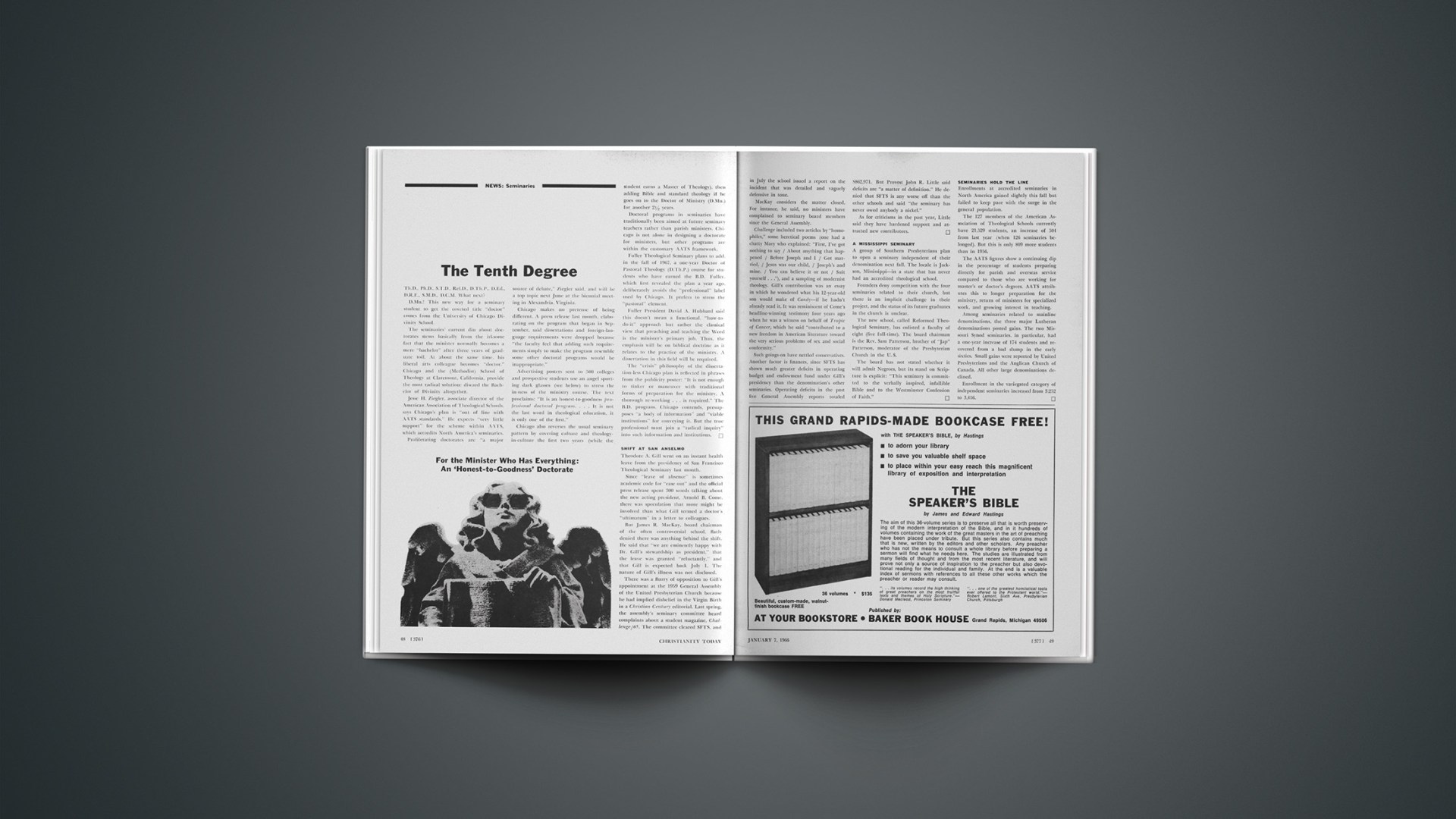
The Tenth Degree

Th.D., Ph.D., S.T.D., Rel.D., D.Th.P., D.Ed., D.R.E., S.M.D., D.C.M. What next?

D.Mn.! This new way for a seminary Student to get the coveted title “doctor” comes from the University of Chicago Divinity School.

The seminaries’ current din about doctorates stems basically from the irksome fact that the minister normally becomes a mere “bachelor” alter three years of graduate toil. At about the same time, his liberal arts colleague becomes “doctor.” Chicago and the (Methodist) School of Theology at Claremont, California, provide the most radical solution: discard the Bachelor of Divinity altogether.

Jesse H. Ziegler, associate director of the American Association of Theological Schools, says Chicago’s plan is “out of line with AATS standards.” He expects “very little support” for the scheme within AATS, which accredits North America’s seminaries.

Proliferating doctorates are “a major source of debate,” Ziegler said, and will be a top topic next June at the biennial meeting in Alexandria, Virginia.

Chicago makes no pretense of being different. A press release last month, elaborating on the program that began in September, said dissertations and foreign-language requirements were dropped because “the faculty feel that adding such requirements simply to make the program resemble some other doctoral programs would be inappropriate.”

Advertising posters sent to 500 colleges and prospective students use an angel sporting dark glasses (see below) to stress the in-ness of the ministry course. The text proclaims: “It is an honest-to-goodness professional doctoral program.… It is not the last word in theological education, it is only one of the first.”

Chicago also reverses the usual seminary pattern by covering culture and theology-in-culture the first two years (while the student earns a Master of Theology), then adding Bible and standard theology if he goes on to the Doctor of Ministry (D.Mn.) for another 2½ years.

Doctoral programs in seminaries have traditionally been aimed at future seminary teachers rather than parish ministers. Chicago is not alone in designing a doctorate for ministers, but other programs are within the customary AATS framework.

Fuller Theological Seminary plans to add, in the fall of 1967, a one-year Doctor of Pastoral Theology (D.Th.P.) course for students who have earned the B.D. Fuller, which first revealed the plan a year ago, deliberately avoids the “professional” label used by Chicago. It prefers to stress the “pastoral” element.

Fuller President David A. Hubbard said this doesn’t mean a functional, “how-to-do-it” approach but rather the classical view that preaching and teaching the Word is the minister’s primary job. Thus, the emphasis will be on biblical doctrine as it relates to the practice of the ministry. A dissertation in this field will be required.

The “crisis” philosophy of the dissertation-less Chicago plan is reflected in phrases from the publicity poster: “It is not enough to tinker or maneuver with traditional forms of preparation for the ministry. A thorough re-working … is required.” The B.D. program, Chicago contends, presupposes “a body of information” and “viable institutions” for conveying it. But the true professional must join a “radical inquiry” into such information and institutions.

Shift At San Anselmo

Theodore A. Gill went on an instant health leave from the presidency of San Francisco Theological Seminary last month.

Since “leave of absence” is sometimes academic code for “ease out” and the official press release spent 500 words talking about the new acting president, Arnold B. Come, there was speculation that more might be involved than what Gill termed a doctor’s “ultimatum” in a letter to colleagues.

But James R. MacKay, board chairman of the often controversial school, flatly denied there was anything behind the shift. He said that “we are eminently happy with Dr. Gill’s stewardship as president,” that the leave was granted “reluctantly,” and that Gill is expected back July 1. The nature of Gill’s illness was not disclosed.

There was a flurry of opposition to Gill’s appointment at the 1959 General Assembly of the United Presbyterian Church because he had implied disbelief in the Virgin Birth in a Christian Century editorial. Last spring, the assembly’s seminary committee heard complaints about a student magazine, Challenge/65. The committee cleared SFTS, and in July the school issued a report on the incident that was detailed and vaguely defensive in tone.

MacKay considers the matter closed. For instance, he said, no ministers have complained to seminary board members since the General Assembly.

Challenge included two articles by “homophiles,” some heretical poems (one had a chatty Mary who explained: “First, I’ve got nothing to say / About anything that happened / Before Joseph and I / Got married. / Jesus was our child, / Joseph’s and mine. / You can believe it or not / Suit yourself …”), and a sampling of modernist theology. Gill’s contribution was an essay in which he wondered what his 12-year-old son would make of Candy—if he hadn’t already read it. It was reminiscent of Come’s headline-winning testimony four years ago when he was a witness on behalf of Tropic of Cancer, which he said “contributed to a new freedom in American literature toward the very serious problems of sex and social conformity.”

Such goings-on have nettled conservatives. Another factor is finances, since SFTS has shown much greater deficits in operating budget and endowment fund under Gill’s presidency than the denomination’s other seminaries. Operating deficits in the past five General Assembly reports totaled $862,971. But Provost John R. Little said deficits are “a matter of definition.” He denied that SFTS is any worse off than the other schools and said “the seminary has never owed anybody a nickel.”

As for criticisms in the past year, Little said they have hardened support and attracted new contributors.

A Mississippi Seminary

A group of Southern Presbyterians plan to open a seminary independent of their denomination next fall. The locale is Jackson, Mississippi—in a state that has never had an accredited theological school.

Founders deny competition with the four seminaries related to their church, but there is an implicit challenge in their project, and the status of its future graduates in the church is unclear.

The new school, called Reformed Theological Seminary, has enlisted a faculty of eight (five full-time). The board chairman is the Rev. Sam Patterson, brother of “Jap” Patterson, moderator of the Presbyterian Church in the U. S.

The board has not stated whether it will admit Negroes, but its stand on Scripture is explicit: “This seminary is committed to the verbally inspired, infallible Bible and to the Westminster Confession of Faith.”

Seminaries Hold The Line

Enrollments at accredited seminaries in North America gained slightly this fall but failed to keep pace with the surge in the general population.

The 127 members of the American Association of Theological Schools currently have 21,529 students, an increase of 504 from last year (when 126 seminaries belonged). But this is only 809 more students than in 1956.

The AATS figures show a continuing dip in the percentage of students preparing directly for parish and overseas service compared to those who are working for master’s or doctor’s degrees. AATS attributes this to longer preparation for the ministry, return of ministers for specialized work, and growing interest in teaching.

Among seminaries related to mainline denominations, the three major Lutheran denominations posted gains. The two Missouri Synod seminaries, in particular, had a one-year increase of 174 students and recovered from a bad slump in the early sixties. Small gains were reported by United Presbyterians and the Anglican Church of Canada. All other large denominations declined.

Enrollment in the variegated category of independent seminaries increased from 3,252 to 3,416.

Cover Story

The Future of Evangelism: Is the Concept Still Valid?

Altizer: Protestants must either turn radical or ‘submit to Rome’

Bennett: Christians have no monopoly on the saving grace of God

Cushing: Preaching of God’s Word is ‘at the center of our mission’

Graham: The Cross remains man’s ‘only hope of redemption’

Evangelism is the lifeline of Christianity. Since apostolic times it has been hard, controversial work. And it has always produced opposition outside the Church.

Today, however, there is a struggle over evangelism within the Church. Methodists were informed at a recent evangelism conference that revival services are now ill advised, in fact unchristian. The speaker, the Rev. Dr. Edmund Perry, a religious historian at Methodist-rooted Northwestern University, told the Miami Herald’s Adon Taft, “I abhor the notion of individual salvation.”

CHRISTIANITY TODAY, which is preparing a World Congress on Evangelism for Berlin next fall, has asked a wide variety of famous churchmen: “Is the traditional apostolic concept of Christian evangelism still valid? If not, how must it be revised in the next decade?”

The most radical of the new death-of-God spokesmen. Thomas J. J. Altizer, gave the symposium its first and longest response, saying Protestants must either accept his radicalism or “submit to Rome.” In stark contrast were words on evangelism from leaders like Richard Cardinal Cushing (“Nothing will ever take the place of preaching”), Archbishop Iakovos (“the truest and most valid basis of Christianity”), and Eugene Carson Blake (“the source of the power of the ecumenical movement”).

The highest official in world Methodist circles, Fred Pierce Corson, said “I most assuredly believe that there is a greatly needed place for the proclamation of the evangelical message of Christianity. It should be positive, but not dogmatic, and it should be a belief that has the strength that is expressed in the strength of a conviction.”

The dynamic Methodist bishop of Los Angeles, Gerald Kennedy, stated. “I have never been more certain than I am right now that the traditional apostolic concept of Christian evangelism is valid. Furthermore, I believe it always will be valid as long as man and time exist. The good news is unchangeable. Man in the 1960s needs to hear it just as the man in the first century needed to hear it. While our conditions and our environment change, the essential human situation remains the same.

“I hasten to add that we have to find different methods in every generation, and we ought not to be satisfied with past approaches if they do not get to the people. Let us have plenty of experimentation and try some radical new ways of breaking through to the human need. Let us not be so foolish as to assume that the message of the evangel has to be revised.”

Similarly, Protestantism’s famous writer and broadcaster, Norman Vincent Peale, said the traditional concept has to be revised, even though it is still valid, “to the extent of new skills in communicating it. The old theological language is no longer generally understood. The timeless message must be put in language and thought-forms of the time.”

Franklin Clark Fry, president of the Lutheran Church in America and chairman of the Central Committee of the World Council of Churches, agreed: “I do unhesitatingly believe that the ‘apostolic concept’ is still valid. No question arises in my mind at that point at all. What we need to weigh and sift is the manner in which evangelism, containing the same aim and essential content that it has always had, can be made effective in the constantly changing mood of our day.”

W. A. Visser ’t Hooft, who this month rounds out a distinguished career as general secretary of the World Council, suggested some changes:

“1. Stronger emphasis on the prophetic ministry of the Church with regard to social, national, and international life:

2. Encouragement to the younger churches to express the Gospel in thought-forms of their environment rather than in Western categories:

“3. An attempt to distinguish more clearly between truly Christian standards and the values of Western civilization;

“4. Treatment of the younger churches as fully responsible and equal partners in the common Christian task.”

Visser ’t Hooft said the traditional concept is valid and that “the Christian Church is no longer the Church of Christ if and when it gives up that concept,” assuming that it is based on three convictions:

1. That it is the duty of the Church and of every Christian to proclaim the divine lordship of Jesus Christ;

2. That this Gospel is to be addressed to every man, whatever his religious or cultural background may be:

“3. That it is to be given in its purest form that is in accordance with the biblical witness and unmixed with extraneous religious or cultural elements.”

The president of the National Council of Churches, Reuben H. Mueller, affirmed the evangelistic tradition “if it refers to man’s need for forgiveness of sin upon his own repentance through faith in Jesus Christ as Saviour and Lord.… If it refers to method and organization for evangelism, then I would say that these things have frequently changed throughout Christian history and undoubtedly will continue to do so.

“While I believe that Christian evangelism must seek first the conversion of the individual, I also believe that it cannot stop there. Years ago, I heard Dr. Dan Poling say: ‘The Christian experience must be personal first, and social always. If it stops at being personal, if stops.’ I believe this.

“Where too many so-called liberals are in danger of throwing the baby out with the bath water’ today, it is just as true that too many so-called conservatives have gone to dry-as-dust seed, with nothing but a pharisaic crust that pretends to be spiritual. Some enthusiasts for new theories and methods of evangelism will find that there have been others, long before they came along, who tried out their ideas and methods, only to fail. God has been at the business of redeeming people through his Son, Jesus Christ, for a long time, and a few ‘bright lights’ who profanely proclaim that ‘God is dead’ will never be able to frustrate him. God doesn’t need my defense.…”

The outstanding man in America’s ecumenical movement, veteran Presbyterian leader Eugene Carson Blake, did not respond directly but shared a sermon in which he said:

“The source of the power of the ecumenical movement in the Church and in the world today rises out of its recapturing in purer and more pristine form that faith in Jesus of Nazareth that Peter proclaimed so boldly when, under pressure from the government and culture of his nation, he said: ‘There is salvation in no one else, for there is no other name under heaven given among men by which we must be saved.’

“… [Faith] is a very different thing from the intolerant or hypocritical imposition of our religious ideology upon other men. It is rather the humble response of men like the first Christians to the love and power of God in Jesus Christ which enabled Peter and John to say to those who pressed them to betray their Lord by silence: ‘Whether it is right in the sight of God to listen to you rather than to God, you must judge, for we cannot but speak of what we have seen and heard.’ ”

America’s most distinguished theologian, Reinhold Niebuhr, said he was not well enough to join the symposium, but commented through his secretary that he has “a rather controversial objection, not to apostolic evangelism, but to American evangelism.”

Niebuhr’s longtime colleague John C. Bennett, president of America’s top ecumenical seminary, Union Theological Seminary, said evangelistic claims must be “qualified by three concerns that we should emphasize today:

1. The recognition that much indirect evangelism consists of removing or trying to remove the elements in the thought and life of the Church which rightly keep many people at a distance. I refer to obscurantism in theology and to the identification of the churches with institutions of injustice. It is a sign of the failure of much Christian life and teaching that so many of those who care most about humanity feel that they must be atheists.

“2. The importance of respecting the consciences of non-Christians. So often are they clearer about the issues of social justice and of intellectual integrity than Christians that we need to emphasize what the churches can learn from them. Apart from that, we should avoid any tendency to allow deeds of love to be used for ulterior purposes, to bring pressure on the minds and consciences of non-Christians. God may so use them, but let Christians be very sensitive on this point.

“3. We must not surround evangelism with the assumption that Christians have a monopoly on the saving grace of God. We may believe that the revelation of God in Christ is normative, not only for us but for all men, but this is quite different from suggesting that God cannot save those who are outside the Christian circle. Belief in the sure mediation of God’s grace through Christ is motive enough to seek a Christian witness and a Christian presence in every community, but to stress the importance of this need not mean to deny that non-Christians are in relation to God and receive grace and truth from him in ways uncharted by Christian theology.”

Wide disagreement with this approach was expressed by Billy Graham, who has attracted more listeners than any other preacher:

“Among the basic things that have never changed are human nature, the Gospel, which is God’s remedy for it, and the Holy Spirit, who is the agent of divine communication. Our methods may change from age to age, culture to culture, and society to society, but these other things are constant from generation to generation. The Cross of Christ is still an offense to unregenerate man, but it remains his only hope of redemption. We dare not forget that the world is approaching an end-time, that there is a hell to escape and a heaven to gain.

“Many modern churchmen are accommodating themselves to the thought of our times, but Paul confronted the intellectuals of his day with the Gospel of Christ. We must proclaim the same message, and can count on the same divine consequences.”

Graham said the World Congress on Evangelism, of which he is honorary chairman, “can present to the Christian world an authentic biblical definition of evangelism which the World Council of Churches has been hesitant to espouse. One of the areas of greatest confusion today is over the mission of the Church, and the World Congress can illuminate this problem in the light of biblical truth.”

A more controversial mass preacher is faith-healing evangelist Oral Roberts, the world’s most renowned Pentecostalist. He said:

“The problem we face in evangelism today is the tendency for our evangelistic efforts to be non-person-centered. That is to say, we are prone to feature some particular theological approach or specific point of doctrine in the place of the person of Christ himself. In my opinion, the apostolic concept of Christian evangelism was:

“1. To be so Christ-centered that ‘they took knowledge of them that they had been with Jesus.’ They thought as he did, they exhibited love as he did, and they felt compassion for the suffering and lost of their generation.

“2. While they certainly enunciated specific doctrinal truths to help structure the philosophy of Christianity and the new converts, they did this only as a phase or part of Christ himself. For example, when they ‘broke bread’ they were feeding on the body of Jesus Christ; when they laid hands upon the sick to bring healing to them, they did so to bring Jesus’ life into body and spirit.

“3. The apostolic concept of evangelism was both private and public. They were soul-winners, and they won souls on an individual basis and on a mass scale as well. Actually what they did was more spontaneous than planned. Christ indwelt them. He was their light and life. He was the breath of their whole existence, and wherever they went they did what came naturally—to reproduce in people, by the power of the Holy Spirit, the same things that they had experienced themselves.…

“As I view Christian evangelism in the next decade, I see only a change in place and methods, certainly not of principle and practice. I see a willingness of the minister to preach, not only in his pulpit, but on radio, television, films, and in person wherever he can find an audience.… I am tremendously excited about the prospects of world evangelism. I am completely convinced that God is going to visit the world in a great charismatic outpouring, in which millions of people will feel the impact of the whole Gospel to make them whole men and women.”

There is no greater contrast in form than that between a Roberts meeting and the worship of the believers led by Archbishop lakovos, primate of Greek Orthodoxy in the Western Hemisphere. The archbishop said the apostolic tradition of evangelism “is today, and always will be for those who bear witness to Christ and his sacrifices for mankind, the truest and most valid basis of Christianity. Any qualification of this truism, however, centers on the meaning of the word ‘traditional.’ Even in early Christianity, traditional evangelistic concepts were augmented in the Church of Christ by the traditions of rite and ritual that took on living forms of worship and teaching, as they relate to everyday life.

“With the advent of the ecumenical movement for Christian unity, the churches of Christ have been increasingly seeking, working within a framework of basic evangelism, to bring the living force of the oneness of Christ’s Church to bear upon a multiplicity of problems involving humanitarian, social, and economic concerns. The evangelism of the next decade, and of the decades to come, must take into account these present considerations, so that the Gospel will continue to have essential meaning for all mankind for the betterment of man’s lot, as Christ himself intended in his precepts.”

Thomas J. J. Altizer also talked of the ecumenical trend, but rather than discussing evangelism as such, he said: “If the Protestant today is truly to accept a vocation of world evangelism, he must return to his radical roots.” Altizer then provided a much-sought definition of “radical Christians”:

“First, such Christians rebel against the Christian churches and their traditions, with the conviction that Christendom as a whole has betrayed its original foundations and regressed not simply to a pre-Christian but also to a demoniac and repressive religious form. They believe that Christendom has sealed Jesus in his tomb and resurrected the very evil and darkness that Jesus conquered, by [its] worshiping a transcendent Creator who is an absolutely sovereign and wholly other transcendent Judge.

“Again, they defy the moral law of the churches, identifying it as a satanic law of repression and heteronomous compulsion, and calling instead for a reversal of this law and an antinomian Christian freedom. So likewise they believe that the salvation history proclaimed by orthodox doctrine and liturgy isolates the reality of salvation in a distant and irrecoverable past, thereby foreclosing the possibility of the actual presence of Jesus or the Word in an actual and contemporary present.

“Finally, radical Christians are spiritual or apocalyptic in that they believe only in the Jesus of the third age of the Spirit, a Jesus who is not to be identified with the original historical Jesus, but who rather is known here in a new and more comprehensive and universal form, a form actualizing the eschatological promise of Jesus.

“Believing that Christendom has wholly negated the original Jesus, the radical Christian seeks a way to the new presence and reality of Jesus by returning to Jesus’ original apocalyptic proclamation with the conviction that such a return demands both an assault upon the established churches and a quest for a total or apocalyptic redemption. Here, everything depends upon the meaning of an apocalyptic redemption, for its original meaning was certainly lost in the long course of the history of Christendom, and the radical Christian faces the task not only of discovering that meaning but also of mediating it in a new and ‘spiritual’ form to his own time and situation.…”

Altizer said that after watching the papacy of John and Vatican II, “the honest Protestant must now face the question whether or not he should return to a Catholic Church that so obviously is in process of reforming itself. Moreover, the judgment would seem to be inescapable that the Body of Christ is far more active and real in the life of the Roman church than in the increasingly sterile Protestant denominations.…”

Radical Protestantism is the answer, he contends. If it is refused, then surely we “must submit to Rome! For surely it is Judicrous to imagine that an authentic Protestantism must be more traditional or more ‘orthodox’ than Rome.…”

The most colorful and quotable figure in America’s Roman Catholic hierarchy, Richard Cardinal Cushing, stated:

“Nothing will ever take the place of the preaching of God’s Worth which stands at the center of our Christian mission. How can we forget the Lord’s admonition: ‘Go into the whole world, preach the Gospel to every creature’? Yet we know that each generation must hear the evangelical message in terms that make it meaningful for man in the environment in which he lives. In this sense, the unchanging revelation of God must change its emphasis as the challenges of each age rise and fall.

“For Catholics, the apostolate of the Word has received a massive new impetus from the discussions and the decrees of Vatican Council II. Perhaps most visibly in the revisions of the Sacred Liturgy, which Catholics call the Mass, we see a new honor and prominence given to the Scriptures; with this the new emphasis on the homily, which should elaborate in simple terms the evangelical texts, is of high significance. The new developments in the so-called Bible Vigil, aside from its ecumenical aspects, are for Catholics a return to the sources of faith and the Word delivered to the saints.

“The Council Fathers have made a point of stressing, in their theological declarations, the strong evangelical roots of Catholic teaching, most notably perhaps in the constitution on the Church, which in so many ways is the fundamental document of the council. All of this is bound to have an effect in focusing Catholic attention on the Word of God in a way that will reveal itself in the total apostolate. We will surely see the fruits of all of this in the life of the church in the years ahead.

“Important, however, as will be the evangelical element, Catholics will of course continue to give attention to the immense riches of sacramental life, especially Baptism and the Eucharistic sacrifice. We are led to salvation by all the means given to us by the Lord, and we neglect any of them only at the peril of our soul.”

James R. Mutchmor is the eminent elder statesman of the United Church of Canada, one of the pioneer results of the ecumenical movement. He began by quoting a statement from the 1937 Oxford Conference: “The Church has many duties laid upon her, the chief of which is to proclaim the Word of God, to make disciples for Jesus Christ, and to order her life through the power of the Holy Spirit dwelling in her.” Mutchmor endorsed this as “sound evangelical teaching for today and tomorrow” that is New Testament-based.

“It is difficult, not to say presumptuous, to put God to the test to get support for the validity today of the apostolic concept of evangelism. Two things may be considered as well within the range and right of human inquiry.

“First, we begin with ourselves and our affluent society. And here let us think chiefly of our North American situation. It may be described by five words: production, power, pride, profligacy, and paganism. North America, with about one-twelfth of the world’s population, produces one-half of its goods and services. Our technological society is in high gear. This production gives us power, and as Lord Acton once remarked: ‘All power tends to corrupt and absolute power corrupts absolutely.’ So we are given to pride. It rules our wills. The steps to profligacy and paganism are short and steeply downward. Thus, in spite of our welfare society, our high finance, our amazing scientific achievements, our sins of pride and profligacy are too great a part of our record. We stand in need of God’s help. We are fearful in this thermonuclear day of a handful of atomic dust. We could tragically become the victims of angry men.

“Against this human dilemma the New Testament offers four wonderful words of life and hope. They are: repent, believe, go, and give. It’s hard for modern man to accept the essential need of the ‘turn ye’ to repentance, but there is no other door to God’s redeeming love. It’s the narrow and only door, and everyone who would be a child of God must humble himself and enter by the gate of repentance.

“The other words speak for themselves. The vital one is belief or faith. The just are to live by faith. Faith calls for trust and obedience. In spite of demythologizing and existentialism, faith today is deep and strong. The ‘go’ and ‘give’ are powerful apostolic and evangelistic words. Every last believer is a member of the apostolate. Always those in whose hearts Christ has made his home are disciple-making disciples. So the fellowship of believers grows with Jesus Christ and his cross and his resurrection in the midst. The fellowship grows to heal and bless even unto eternal life.”

Evangelical Jews?

America’s Reform Jews are rethinking their ideas about reaching and converting those outside their religion. This trend, added to the Vatican’s headline-making declaration on Jews, makes 1965 a landmark year in Christian-Jewish relations.

Concern about converts has been growing for years, spurred on by Gentiles who marry Jews and want to join the faith. By one estimate, 98 per cent of the converts come through marriage, their motives ranging from convenience to conviction.

A year ago, Dr. Maurice Eisendrath, president of the Union of American Hebrew Congregations, asked his Committee on Proselytism to bring a proposal on conversions to the UAHC convention, held in San Francisco last month.

The committee decided Jews should say clearly that “we shall seek converts among the unaffiliated, both the unsynagogued and the unchurched.” The report said some persons come to Judaism on their own, but “many more would be added to our congregations if we were more active and out-reaching in making Reform Judaism known and in telling the unchurched as well as the unsynagogued that a warm welcome awaits them, and a secure outlook can be found in their joining the household of Israel.”

Until the rise of Christianity, Judaism was quite evangelical in confronting the pagan religions which surrounded it. But this ended abruptly in A.D. 315 when the Emperor Constantine decreed that Jews who sought converts or persons who switched to Judaism would be executed. Later, militant Islam further drove the Jewish religion into a stance of defensive self-preservation. The Jews’ religious relativism was reinforced by the rabbinical law that only idol-worshipers are a legitimate target for proselytism.

The committee report which called for a change in this historic attitude was bolstered by Eisendrath’s own speech on the subject in San Francisco. “Our failure to launch an aggressive program of conversion reflects, I fear, an unbecoming distrust of the Gentile—an unpleasant, provincial attitude toward our faith, as if it were an exclusive club into which one has to be born.”

Some convention delegates proved more club-conscious than the committee, and the final resolution was watered down. Now the newly named Committee for the Winning of the Unaffiliated from the UAHC, which is dominated by laymen, must coordinate planning with a similar committee from the Central Conference of American Rabbis, the organization of Reform clergymen.

The head of the UAHC group, Boston can manufacturer Solomon Stern, and the CCAR chairman, Baltimore Rabbi Abraham Shusterman, joined a third man to write the report which went to San Francisco. Stern plans to be on hand in New York December 22 when Shusterman’s committee discusses what to propose to the rabbis at their meeting next June.

Whatever form the outreach takes, it won’t be called evangelism, a word distasteful to many Jews. They will use a small-scale, tolerant, educational approach. Some of the more dramatic ideas in the hopper are reading rooms à la Christian Science, films and pamphlets, and mass media advertising.

Jews aren’t interested in converting active members of Christian churches, and some Christians would like their faith to reciprocate. One is the Rev. Dr. Frederick Grant, former president of Seabury-Western Theological Seminary and professor emeritus at Union Theological Seminary. Last month, Episcopalian Grant, in a Sunday morning lecture at the Washington Hebrew Congregation (Reform), gave a resounding “No” to his title question, “Should Christians Seek Jewish Converts?”

Grant said a yes would be necessary if one believed all mankind was destined to hell apart from faith in Jesus Christ, but he doesn’t believe that. He listed several reasons why conversion is not necessary:

First, efforts to convert Jews have proven futile. Second, since the basic principle of Christianity is found in Judaism, why would one want to seek conversions? When a barbarian became a Christian there was a real change of life, Grant said, but when a Jew is converted, he simply adds “some additional matters” to what he already believes. Grant also said conversions are in “bad taste.”

Host Rabbi Norman Gerstenfeld couldn’t agree more: “No Jewish scholar could possibly object to anything Grant said.”

Book Briefs: January 7, 1966

Calvinism And Revolution

Calvinism and the Political Order, edited by George L. Hunt (Westminster, 1965, 216 pp., $4.50), is reviewed by Dirk W. Jellema, professor of history, Calvin College, Grand Rapids, Michigan.

This compact book (essentially 150 pages plus summary and notes) gives an excellent and scholarly introduction to two main themes: the political theory of Calvinism in its heyday (roughly 1550–1700) and the influence this theory had in America. The title is somewhat misleading; this is not a systematic study. In format, it is a series of essays on leading figures whose political ideas illustrate these themes. The essays deal with Calvinism, Calvin, Mornay, Rutherford (from the “classic age” of Calvinism); with John Locke, and the Puritans (strongly influenced by Calvinist motifs); and with Witherspoon, Lincoln, and Wilson (as Americans sympathetic to Calvinist emphases). The essays, originally given as lectures under the Woodrow Wilson Lectureship of the United Presbyterian Church’s National Presbyterian Center, are by experts, and the scholarship is thoroughly competent.

How did Calvinist political theory influence America? In at least two important ways, it becomes clear. First, much of the theoretical justification for our American Revolution is drawn from arguments developed by men like Locke, Mornay, Rutherford, and Calvin himself. Second, Calvinism’s stress on the civic responsibility of the Christian led, through Puritanism, to the American’s strong sense of this duty. Further, as the editor notes in his summary essay, concern with political and social problems does not begin with the modern social gospel but is part of a long tradition. Many other points of interest are touched on, such as the religious background of American ideas of toleration and the continuity between ideas of the “godly commonwealth” (as in Geneva) and later conviction of America’s God-given destiny.

What were the main concerns of the Calvinist political theorists? To begin with, of course, they desired to work out what they considered God’s will to be in this field—more particularly, to strike a balance between order and freedom. What materials did they use? As several of the essays make clear, they drew heavily not only on Scripture but also on medieval political thought and on the Graeco-Roman idea of the “law of nature.” (One is led to suspect that evangelicals interested in building a contemporary political theory might examine these sources, both generally unfamiliar.)

Despite Calvinist concern with order and authority, the defense of revolt against tyranny struck the rising absolute monarchs of the time as radical and seditious (and, indeed, wherever Calvinism spread, revolution followed). Something of the impact of the emphasis on the right (nay, the duty) to revolt against tyranny may perhaps be recaptured by applying the emphasis to contemporary situations. Do the “inferior magistrates” of a country such as, say, Haiti or Paraguay have the God-given duty to revolt against their tyrant? Should evangelicals say so? Even if the State Department objects? The issues debated by Mornay and the others are by no means dead issues.

A lecture series devoted to a broad theme frequently results in a “scatter-gun” approach that gives no sense of continuity. This series avoids this danger more than most. Readable as well as scholarly, compact as well as meaty, interesting and thought-provoking, it deserves recommendation.

DIRK W. JELLEMA

Adventure

The Adventure of Living, by Paul Tournier, translated by Edwin Hudson (Harper and Row, 1965, 250 pp., $5.75), is reviewed by Orville S. Walters, director of health services and lecturer in psychiatry, University of Illinois, Urbana.

This is Paul Tournier’s ninth book. The popularity of his writings cannot be attributed to the new or the profound, for there is little of either. He is referred to as a psychiatrist, and many of his examples are drawn from psychogenic illness; but his expositions are elementary, and no theoretical orientation is identifiable, unless it be the nondirective therapy he professes to employ. At times, his invoking of the unconscious implies a broad acceptance of Freud. Again, his emphasis upon meaning suggests common cause with Viktor Frankl. And his stress upon the whole person is often reminiscent of Daseinsanalyse. But Tournier’s frank acceptance of the Bible as divine revelation and his recurrent references to God’s sovereignty set him outside all contemporary psychology.

The Swiss physician has become noted as the leading spokesman and advocate of “the medicine of the person,” which seeks to make medicine “more humane” and commits the doctor to man-to-man dialogue with his patient. In every age, he believes, the best doctors have understood that man needs help in becoming a person, as well as medicines. His earlier books have elaborated this view. This concern for the individual in a time when the art has been increasingly supplanted by the science of medicine doubtless accounts for some of his popularity. The chatty, discursive character of his writing, which seems to record a process of thought just short of free association, may also attract lay readers. The inclusion of many examples from his medical practice adds interest.

Troubled neither by psychology’s rejection of the general concept of instincts nor by the limited acceptance of another well-known dual-instinct personality theory, Tournier postulates that man possesses an inborn instinct for adventure that is opposed by a second instinct for repose or fixity. This concept, more poetic and inspirational than scientific, provides the framework for the present book.

Since man is made in the image of God, Tournier reasons, the spirit of adventure exists in God himself. The creation of man in his own image was the great adventure for God, resulting in the tragedy of the Fall and continuing in the adventure of salvation. Jesus, too, was an adventurer, flouting the codes of his contemporaries, denouncing the hypocrisy of their morality, accepting the crucifixion. The Bible must be read as a volume of adventure.

The book is divided into chapters and sections, but there are few clear lines of division. Tournier ranges freely in and out of medicine, psychology, psychotherapy, and theology, unbound by precise definition or construction. There are fewer of the pat success stories that occur in his earlier writings, and he gives numerous warnings against oversimplification. References to literature are usually meant to give credit to a contemporary for some approved idea, rather than to lay the foundation for an orderly synthesis of psychology and Christian faith. Critics will find some of his positions inadequately developed, as when he asserts that “man is in a state of perpetual natural neurosis,” or when he seems to accept a situational ethic—“answers … depend upon the circumstances of the time.” Others will consider his reasoning superficial, as when he decided to resume smoking as an antidote to his own Pharisaism.

Tournier’s most valuable contribution in all his writing is his warm-hearted Christian testimony, “If is my own personal experience of God’s power that gives me the certainty that he can transform my patient’s life just as he transformed mine.” This fervid account of Paul Tournier’s zestful adventures with God is sure to inspire many of his leaders to break out of “fixity” and mediocrity to launch a similar spiritual adventure.

ORVILLE S. WALTERS

It’S A Hit

Sensei: The Life Story of Irene Webster-Smith, by Russell T. Hill. (Harper and Row, 1965, 250 pp., $3.95), is reviewed by D. Bruce Lockerbie, chairman, Department of English, The Stony Brook School, Stony Brook, New York.

I first read about the remarkable ministry of Irene Webster-Smith, whom her friends know as “Sensei” or “teacher,” in Richard Gehman’s Let My Heart Be Broken. That book, a cursory glimpse into the work of World Vision, treated Miss Webster-Smith as an important tog in the machinery of Christian social services cooperating with Dr. Bob Pierce’s organization. The treatment given “Sensei” was necessarily sketchy.

Not so in this fuller portrait drawn by Russell T. Hitt. Sensei is the newest volume in Harper and Row’s “Missionary Classics” series, narrated in very human terms. The books in this series are not treatises on the philosophical implications of foreign missions, nor psychological studies of the missionary. The “Missionary Classics” attempt only to answer the layman’s questions: “Why does the missionary go? What does she do?”

In the case of Sensei, the first question requires an explanation of the early life and training of Irene Webster-Smith. Born into an aristocratic Irish home, the young woman had every reason to anticipate a useful life of service at home. Perhaps she would become the wife of a pastor, for she was loved by a young ministerial student whom she had all but agreed to marry. But the need for someone to help in the unenviable labor of rescuing Japanese girls from the life of a geisha compelled this dynamic woman to offer her life to God.

To the second question Russell Hitt devotes most of his book. “Sensei,” like George Mueller before her, operates homes for children by trusting God for his provision. Having begun by trying to reach the young prostitutes, she quickly decided that “it is better to place a fence at the top of the cliff than an ambulance at the bottom.” Her approach, therefore, has been to ransom little girls before they are sold to the merciless tutors who will train them for immorality.

Some of “Sensei’s” stories are not unique: they are the reiterated evidences of God’s grace upon many faithful servants—the provision of food, clothing, or gifts of money at the crisis point. In other respects Irene Webster-Smith’s ministry has been unique. It was she whom General Douglas MacArthur invited to be the first missionary to return to Japan during the occupation; she who turned the Sugamo prison, full of Japanese war criminals, from a place of despair into a place of shining hope by her direct witness to the conquered and condemned Nipponese soldiers.

Sensei, told with all the warmth it deserves, is more than a typically inspiring missionary biography; it is a searching examination of the reader’s own dedication.

D. BRUCE LOCKERBIE

It Is A Bit Awkward

Teen-Agers and Sex: A Guide for Parents, by James A. Pike (Prentice-Hall, 1965, 146 pp., $3.95), is reviewed by Bernard E. Pekelder, college chaplain, Calvin College, Grand Rapids, Michigan.

This book was written not for the teenager but for his parents. The author, who is the Episcopal bishop of California, is convinced that there is no substitute for direct parental involvement in sex education.

In the sexual revolution of our day, youth face two conflicting standards of sexual conduct. The first the author describes as conventional, authoritarian, absolutistic; the other, the “new morality,” as existential and situational.

But Bishop Pike’s concern is not the right or wrong of these conflicting norms of conduct. He tries to detach himself from the role of ethical judge. In fact, he affirms that “though it would appear that as to sex ethics there is a distinct cleavage between absolutists and existentialists, in application there actually is not.” Thus in his role as mentor he feels he must take into account both sets of convictions if he is to give a “sensible plan of instruction and guidance.”

Yet this effort at ethical detachment does not come off very successfully. When the bishop describes his counseling role with a pregnant college girl, his existential slip shows rather noticeably (p. 84). He spends much more effort warning about chuck-holes on the conventional road (and the warnings are appropriate!) than about the rockiness of the existential road. His stance is unmistakable; one wishes he had stated it as clearly as he has in other writings.

This is not to criticize the bishop for lack of candor; indeed, one has come to expect candor from him. But in this book his effort to help people who stand at both ends of the moral spectrum is at best ambiguous, and at worst confusing. Don’t get this book if you expect clear guidance out of the moral confusion of our day; it is not written for this purpose (p. 3).

There are, however, good insights into the psychological and social factors influencing parent and child. Parents are given good advice about their own embarrassment and reluctance in this counseling role. Bishop Pike offers practical suggestions about approaching the child from age five on. Relevant issues are faced: sexual identity, petting, masturbation, premarital coitus, homosexuality, alcohol and sex.

But I was disappointed with this book. It is no better or worse than many other books available to parents who wish some social and psychological insights into proper sex education for their children. Undoubtedly my disappointment is the result of expectations I have when a Christian minister serves notice that he will be a guide in an age of moral confusion. I cannot see this role fulfilled by one who, facing the fork in the road, tries on proceed with one foot on each path. As I watch him do the split, meanwhile hearing him offer to show me the way down either or both paths. I do not only think he looks awkward; I begin to doubt his value as a guide.

BERNARD E. PEKELDER

The Old Modern Problem

God and World in Early Christian Theology, by Richard A. Norris, Jr. (Seabury, 1965, 177 pp., $4.95), is reviewed by Geoffrey W. Bromiley, professor of church history and historical theology, Fuller Theological Seminary, Pasadena, California.

This modest book is a valuable and important attempt to bring some of the pioneers of Christian theology into relation to the philosophical world of their day. It begins with a rapid but lucid and informative presentation of Greek thought from its beginning to Middle Platonism. It then studies in turn Justin Martyr, Irenaeus, Tertullian, and Origen in their varying interactions with Platonism and Gnosticism. A concluding chapter is devoted to an assessment of the achievements of these fathers.

The size of the book naturally precludes any detailed discussion. Only selected aspects of the writers can be dealt with, and even within these bounds the author has to seize on what he takes to be the essentials. This means that the reader not well acquainted with the field has to take a good deal on trust. On the other hand, Dr. Norris proves to be a reliable guide, and he is able to support his statements with apt quotations or references that are easily verified and amplified in the many available English editions of the works of the four writers.

The main importance of the work, however, is topical rather than historical. The questions raised are in every way modern. Was early theology right in making as much use as it sometimes did of philosophical materials and categories? How is a reasoned presentation of the Christian faith to relate to contemporary non-Christian modes of thought? How far may one safely go in making the Gospel relevant to the modern intellectual scene? All the great theologians of the day are in fact wrestling with these questions, though from different angles, and every preacher faces them when he attempts to present the revealed message to modern man.

Norris himself has some important insights to offer as he contemplates the successes, and especially perhaps the failures, of these early writers. In particular, he points out that in this accommodation there is always an element of tension or imbalance. Something has to go, and the danger is that it will be the essential matter of the revealed Gospel. If there is a criticism to be made of the study, it is perhaps that Norris tends to accept too easily the legitimacy of the attempt at fusion, of the transformation of the Gospel itself into a world-picture comparable with those offered by philosophy. Does a linguistic translation really have to be accompanied by this type of material transposition? In the measure that the fathers created a Christian theology in terms of contemporary philosophy, did they not perhaps introduce an inescapable element of falsification that has plagued Christian theology ever since? On the other hand, the mere fact that these deep issues are raised is a testimony to the value of the study, and the historical data Norris provides should give substance to many modern discussions of these problems.

It is a great pity, by the way, that the mixed letters of the jacket (e.g., CHRiSTiaN) give an air of the kindergarten to this serious work, and we trust that they do not give evidence of another of the stupid fads that the search for novelty initiates and that common sense fortunately brings to a just and speedy end.

GEOFFREY W. BROMILEY

The Fire And The Word

World Aflame, by Billy Graham (Doubleday, 1965, 267 pp., $3.95), is reviewed by David Allan Hubbard, president, Fuller Theological Seminary, Pasadena, California.

It would be hard to imagine a better summary of the major themes and central emphases of Mr. Graham’s preaching ministry. The combinations of law and Gospel, of judgment and grace, and of exhortation and invitation that stamp his evangelistic sermons have left their mark on his latest book.

The writing is simple and straightforward. Graham begins with an analysis of the human predicament, strikingly illustrated by the political, social, emotional, and moral chaos of our times. Next he shows how various human attempts to cope with this predicament have plunged twentieth-century man into even darker despair. The great gulf between man’s aspirations and his achievements cannot be bridged by cunning or muscle.

The answer to the rash of fires that has set our world aflame is symbolized by the burning bush—the revelation of God. What we could not discover for ourselves, God has made clear in his Word. The central figure of the written Word is Jesus Christ, the living Word. Three key chapters deal with his uniqueness, the meaning of his cross, and the importance of his resurrection.

Having laid the doctrinal foundation in the saving acts of Christ, Graham proceeds to explain conversion and the new life that flows from it. One of the fruits of the new life is a new social concern, to which the book gives about twenty pages—not as much as some might want to see, but enough to lay the ghost of the false accusations that Graham is interested in personal conversion only and not in the great social issues of the day. The book concludes with several chapters on the Second Coming and the full redemption and awful judgment which that event triggers.

All in all, World Aflame brings to the printed page what we have learned to expect and appreciate in Mr. Graham’s ministry: directness, simplicity, clarity, and conviction. Man’s inner needs are painfully exposed, and the healing grace of Jesus Christ is skillfully applied. One would be hard pressed to think of a better book to give a friend who wanted to know what the Christian message was all about. The compelling preaching that God has used to bring thousands to conversion in the arenas and stadiums of the world will now be heard in the family rooms and dens of our land. The impact, one feels, will be much the same.

DAVID ALLAN HUBBARD

On Saints And Sinners

Man’s Nature and His Communities: Essays on the Dynamics and Enigmas of Man’s Personal and Social Existence, by Reinhold Niebuhr (Scribners, 1965, 125 pp., $5.95), is reviewed by James Daane, assistant editor,CHRISTIANITY TODAY.

I have wondered—in idle moments—whether the Reformed doctrine of common grace was developed to account for the empirical fact that sinners sometimes act more like saints than sinners. But if this were the motive, then existence, as Tillich maintained, would raise the questions to which Christian theology was then only permitted, belatedly, to provide the required answers. Such a theology of common grace would not be an authentic theology of revelation but merely the kind that Niebuhr calls a theology of “realism.”

In this book Niebuhr, who for thirty-two years taught Christian ethics at Union Seminary in New York, takes inventory from the perspective of his years and presents us with a final testament of his theology. As I read his book, I experienced a number of distinct feelings.

The first was that Niebuhr’s theology of man and his communities lacks the dimension of a transcendent revelation. His description of the nature of man is not derived from what the divine Word discloses man to be but from a very shrewd and astute observation of saints and sinners as they go marching along through history.

Niebuhr admits that in his Nature and Destiny of Man he made a “rather unpardonable pedagogical error.” He used the symbol of original sin, he says, after he had “taken pains to deny the historicity of the primitive myth of the fall of Adam in the garden, which Paul associated the doctrine of original sin.” He later discovered that the use of “original sin” as a symbol was a mistake: the modern world cannot be reached by such a symbol because it does not believe in a historic fall of man. Such a misreading of the empirical situation would seem to be an almost fatal flaw in a theology committed to the method of realism.

Secondly, as I read this book I had the feeling that, had it been written by a conservative Reformed theologian, it would be a book about common grace, i.e., a book that attempted to show how and why sinners often act and look like saints. Niebuhr is at pains in this book to show that man, the self-seeking sinner, nevertheless shows some altruism in life, for he learns that seeking the self absolutely is self-defeating. Similarly, nations, always moved by self-interest, do not in fact seek their own good absolutely, without overtures of good to other nations, because also on the national level, as on every other level of human community, absolute self-seeking is self-defeating. Sinful men and sinful communities ordinarily learn this hard truth from life itself, and therefore do not ordinarily seek to absolutize themselves in their exercise of freedom. Hence they take on the appearance of saints. The saints, on the other hand—and just because they deal with absolutes—tend to absolutize their self-interests and fall into idolatry. There is, therefore, according to Niebuhr, no essential difference between saints and sinners; the saints are simultaneously sinners, and sinners are usually somewhat saintly.

Knowing that Niebuhr is not a conservative Reformed theologian, I was surprised to observe that he does conclude his book with a discussion of common grace. But I was not surprised when he contended that the Reformers erred in insisting on an essential difference between common and special (saving) grace, nor was I surprised when he raised common grace to special grace status, thus reducing the greater to the lesser grace. This blurring of the distinction between common and special grace corresponds to his blurring of the distinction between saints and sinners, between regenerate and unregenerate man. When a theology of realism takes its symbols from the Christian revelation and then derives what they symbolize from a reading of empirical man and society, it is indeed likely not only to misread the empirical situation, as Niebuhr admits doing in the case of the modern mind’s reaction to “original sin,” but also to fail to uncover the essential difference between saints and sinners, and between common and special grace. Moreover, such a theology cannot issue a summons to evangelize the world; it can only urge a better intellectual understanding of what the world is—and must remain.

According to Niebuhr, the distinctive essence of man is freedom, but a freedom within limits, limits that all men have defied, some men “absolutely,” as was done in Hitlerian Nazi Germany, but most men more relatively. Hence most men and societies reveal a form of conduct that suggests a combination of saint-sinner, or of sinner-saint.

Theologically speaking, Niebuhr’s theology of realism is a sub-Christian, common-grace theology. It lacks the dimension of transcendent revelation, one which discloses that things are not what they seem to be, whether these things be sinner, saint, or the moral nature of human communities.

Nonetheless, Niebuhr’s analysis of man and his communities and the behavior of both is brilliant and profoundly enlightening. And it is easy to see why his thinking has had such a great influence on American secular and religious thought. In actual life neither men nor their manifold types of community are in fact wholly saint or wholly sinner. That they are not is to be attributed, however, to other theological causes than those to which Niebuhr attributes them. Nonetheless, the ambiguities of individual and communal behavior which Niebuhr brilliantly analyzes are real, and he is helpful in pointing out on the basis of real evidence in actual life that, for example, Communists are not wholly and absolutely evil and incapable of change, and that the people of a free, democratic society are not always absolutely right and on the side of the angels. It is only regrettable that a more conservative theology did not understand and apply its own resources to the achievement of the same social and political understanding. Had this been done, the attention given to a realistic theology that owes its force to Christian sources but never really recognizes this, would have been directed toward its actual source.

JAMES DAANE

How Christian Croups Score

Faith and Prejudice: Intergroup Problems in Protestant Curricula, by Bernhard E. Olson (Yale University, 1963, 451 pp., $7.50), is reviewed by Jakob Joez, professor of systematic theology, Wycliffe College, Toronto, Canada.

This is a sociological approach to theological attitudes in so far as these impinge upon intergroup relations. The material is provided by the textbooks of four religious groups in the United States. The author follows the method of statistical analysis with a carefully worked-out scale of reference. Let it be said at once that this doctoral dissertation for Yale University represents prodigious effort and is a monument to Dr. Olson’s industry.

The main part of this work is an analysis of curricula published by the Beacon Press (Unitarian-Universalist), described as liberal; by the United—Presbyterian Church in the U. S. A., described as neo-orthodox; by the Lutheran Church—Missouri Synod, described as conservative; and by Scripture Press, described as fundamentalist. The rest of the book consists of explanatory appendices, charts, bibliography, and an index.

Those not familiar with statistical analysis will find the scoring in terms of positive and negative percentages somewhat complicated. But the evidence produced and the conclusions arrived at are easily grasped. The thesis carries the disturbing proof how theological prejudices can affect ordinary human relations.

Olson tries to assess his material impartially and goes out of his way to show understanding even to those who appear in the least favorable light. He is fully aware of the complex pattern underlying human attitudes, and he knows that religious ideology is often conditioned by sociological factors. In this respect conservatives and fundamentalists are specially vulnerable, for their minority status dictates an attitude of defensiveness. In addition, their approach to Scripture frequently acts as a restrictive element in intergroup relations. The danger lies in applying attitudes derived from the past to altered conditions in the present.

The most negative scoring falls to the conservative group. Olson gives as a reason the uncritical acceptance of inherited attitudes toward Jews and Roman Catholics. In relation to the Jews the score is at its lowest. Both fundamentalists and conservatives tend to emphasize “the inimical qualities of the Jews in the biblical drama,” with the result that Jewish persons assume a sinister quality quite out of keeping with experience in daily life. The real Jew disappears, and his place is taken by a “theological-exegetical abstraction.” Unless the negative aspect is sufficiently balanced by more positive material, the child carries away the impression that Jews are more wicked than everyone else. This impression is fortified by the age-old myth that the whole Jewish people is guilty of deicide and therefore under a curse.

Olson allows for the difference between the theology of conservatives and that of fundamentalists. The latter still hold to the election of Israel as God’s special people, while the former find no place for the Jews in their theology. It occurs to this reviewer that the conservative attitude may well be determined by Luther’s scurrilous expletives against the Jews.

The most positive scorers are the neo-orthodox. With considerable evidence Olson shows the advantage of a dialectical approach to sociological problems. By insisting upon the Christian’s share in sin, the neo-orthodox make it impossible for the educator to blame others without personal incrimination. This specially applies to the story of the Crucifixion, which forms the crucial test of the curriculum.

To the neo-orthodox, anti-Semitism is a form of atheism, for it is veiled rebellion against the God of the Jews. Behind anti-Semitism is the anti-Semite’s worship of his own race and people. Such an attitude can be achieved only by a complete lack of self-criticism.

Jews have always complained that Western anti-Semitism has its roots in the Christian Church. More recently, Jules Isaac’s pamphlet Has Anti-Semitism Roots in Christianity? (1961), to which Dr. Olson contributed one of the introductory essays, and Isaac’s later work: The Teaching of Contempt: Christian Roots of Anti-Semitism (1964), have raised the issue all over again. Dr. Olson’s study now verifies the rightness of the Jewish complaint. The question arises: Can children be taught the New Testament, in particular the Crucifixion story, without contempt for the Jew? Olson has shown that this is possible and that from a Christian point of view the whole attempt misses its purpose unless it is achieved. To present the Jewish people as especially culpable is a betrayal of the Christian message and a misrepresentation of man’s position before God. Olson maintains that a sub-Christian attitude towards others ultimately results in a sub-Christian church.

One particular chapter in this book will prove of special interest to missionaries among Jews. Theirs is a delicate task that makes them specially vulnerable to misunderstanding. In this area of Christian witness there is a pressing need for new insights and attitudes, and Olson raises some important questions.

The reviewer has greatly benefited from this important study. His criticism concerns only some minor points: repetition is inevitable considering the nature of the material, but a more stringent organization would greatly enhance this work; that humanists are reckoned among Protestants is puzzling to the reader and may even be a surprise to them; “Israel” cannot be an “it” and is certainly not a “she” in spite of modern usage (cf. Ps. 25:22 in Hebrew and English).

It is the reviewer’s hope that educators will take the challenge of this book to heart and realize the responsibility before God and man before they sow in the hearts of children prejudice that will ultimately become hatred. The sad part of the story is that so much of this is done innocently and unconsciously.

A shorter and cheaper edition of this work would make it more accessible to a wider public.

J. JOCZ

Book Briefs

The Two Faces of Apartheid, by Paul Giniewski (Regnery, 1965, 373 pp., $5.95). A French journalist tells both sides of the “apartheid” policy in South Africa.

The Christian View of Life: Meditations on the Meaning of Life in Christ, by Theodore Hoyer (Concordia, 1965, 112 pp., $1.50). Good.

Revell’s Minister’s Annual 1966, by David A. MacLennan (Revell, 1965, 363 pp., $3.95). Fifty-two complete sermons, many of them quite perceptive; fifty-two evening sermon outlines, communion meditations, suggestions for mid-week services—and much else. Contains many ideas that may suggest even more.

The Unreformed Church, by Robert E. McNally, Jr. (Sheed and Ward, 1965, 216 pp., $4.50). A discussion of four problems that confronted the Council of Trent. A good background for understanding present developments in the Roman Catholic Church.

Mastery in the Storm, by George B. Duncan (Christian Literature Crusade, 1965, 149 pp., $2.75). A book of Keswick (Britain) sermonettes.

The Oxford Annotated Bible with the Apocrypha: Revised Standard Version, edited by Herbert G. May and Bruce M. Metzger (Oxford, 1965, 1,928 pp., $10.50). The combined edition contains a special article, “The Number, Order and Names of the Books of the Bible,” by Bruce M. Metzger; a list of differences between the Roman Catholic Douay Version and the Revised Standard Version; an alphabetical index to the books of the Bible and the Apocrypha; and full-color maps, with index, to go with the Apocrypha.

Things Which Become Sound Doctrine, by J. Dwight Pentecost (Revell, 1965, 159 pp., $3.50). Essays on fourteen biblical concepts; popular, generally biblical, and sometimes imprecise, as, for example, in the contention that grace is an “intrinsic quality” of God’s essence which accounts for the fact that God is “spontaneously favorable.”

In the Beginning: Paintings of the Creation by Boys and Girls around the World, by World Council of Christian Education (Nelson, 1965, 32 pp., $3.50). Delightful paintings.

Today and Tomorrow: Devotions for People Who Are Growing with the Years, by Charles W. Behnke (Concordia, 1965, 120 pp., $2.95).

Paperbacks

Christian Marriage Today: A Comparison of Roman Catholic and Protestant Views (Revised Edition), by Mario Colacci (Augsburg, 1965, 204 pp., $1.95). A thorough analysis of the complex problems involved in Protestant-Roman Catholic marriages. First published in 1958.

A New Introduction to Moral Theology, by Herbert Waddams (Seabury, 1965, 240 pp., $2.25). A seasoned and mature attempt to revive and reform moral theology, with a counter-blast against the new morality.

The Ark of the Covenant from Conquest to Kingship, by Marten H. Woudstra (Presbyterian and Reformed, 1965, 152 pp., $3.50). A scholarly evangelical treatment. For serious students.

A Bibliographic History of Dispensationalism, compiled by Arnold D. Ehlert (Baker, 1965, 110 pp., $1.50).

The Strategy of Evangelism: A Primer for Congregational Evangelism Committees, by Charles S. Mueller (Concordia, 1965, 96 pp., $1.25).

A Layman’s Guide to Baptist Beliefs, by Harold L. Fickett, Jr. (Zondervan, 1965, 184 pp., $1.50). A popular writing in which Baptist speaks to Baptist.

Student’s Bible Atlas, by H. H. Rowley (World, 1965, 40 pp., $1.75). Includes maps illustrating the history and expansion of the Church, with introduction, glossary, and index.

A Good Steward, by George A. E. Salstrand (Baker, 1965, 76 pp., $1). A discussion of the Christian stewardship of time and talents, with a shaky attempt to build a case for tithing from the New Testament.

The Cross of Christ—The Throne of God, by F. J. Huegel (Bethany Fellowship, 1965, 143 pp., $1.50). A challenging and inspiring study showing the vast significance and utter centrality of the Cross in the great purposes of God.

Passion and Marriage, by Constance Robinson (SPCK [distributed by Morehouse-Barlow], 1965, 86 pp., $1.50). One rarely sees so distinguished a discussion of sex. It touches sex with a radiance that the modern world knows little of.

New Forms of Ministry, edited by David M. Paton (Edinburgh House Press, 1965, 102 pp., 9s. 6d., also Friendship, $1.50). With special attention given to whether a minister ought also, for the sake of his ministry, to have a secular occupation.

They Welcomed the Child: Sermons for Advent and Christmas, by John Schmidt (Augsburg, 1965, 128 pp., $1.95). Good and stimulating reading, brightly written.

Contemporary Existentialism and Christian Faith, by J. Rodman Williams (Prentice-Hall, 1965, 180 pp., $3.50). A good layout and critique of existentialism from the perspective of the Christian faith. One would have to look far for a more lucid and concise critique of the existentialism of Sartre, Jaspers, Heidegger, Bultmann, and Tillich. Highly recommended.

Living Witnesses: Studies in Personal Evangelism, by Odd Gornitzka (Augsburg, 1965, 87 pp., $1.50). A direct and plain-spoken consideration of how to bear a Christian witness and how to meet the many ways in which people react to such a witness. Worth reading.

Family, State, and Church: God’s Institutions, by Paul Woolley (Baker, 1965, 48 pp., $1). Brief but pithy discussions of the nature and functions of family, church, and state, followed by a discussion of many modern socio-religious problems, among them tax exemptions, Sunday laws, censorship, and aid to private schools. A sane and solid treatment, worthy of wide reading and careful study. Recommended.

Vatican Diary 1964: A Protestant Observes the Third Session of Vatican Council II, by Douglas Horton (United Church Press, 1965, 205 pp., $3).

The Irreversible Decision, 1919–1950, by Robert C. Batchelder (Macmillan, 1965, 306 pp., $2.45). The story of the bomb that changed the world and the problems that came with it.

Learning in Theological Perspective, by Charles R. Stinnette, Jr., edited by C. Ellis Nelson (Association, 1965, 96 pp., $2.50). An examination of the learning process.

The Interpretation of Religion: An Introductory Study of Theological Principles, by John Baillie (Abingdon, 1965, 477 pp., $2.45). First published in 1928.

A Short Baptist Manual of Polity and Practice, by Norman H. Mating and Winthrop S. Hudson (Judson, 1965, 160 pp., $1.75). A briefer edition of Edwin H. Tuller’s A Baptist Manual of Polity and Practice.

The Hiscox Standard Baptist Manual, by Edward T. Hiscox (Judson, 1965, 144 pp., $1.75). Eight chapters of The Hiscox Guide for Baptist Churches, plus the New Hampshire Confession of Faith.

Peace Corps and Christian Mission, by Roger D. Armstrong (Friendship, 1965, 126 pp., $1.75). A discussion of the possibility of exercising a Christian witness within the Peace Corps.

Mission in the New Testament, by Ferdinand Hahn (Alec R. Allenson, 1965, 184 pp., $4.50). A very substantial study of mission, as it relates to, among other things, the Jewish-Gentile question in Jesus, in Paul, and in the early Church.

Church Library Manual, prepared by Charlotte Newton (self-published [892 Prince Avenue, Athens, Georgia), 1965, 22 pp., $.50). Advice and instructions for church librarians.

Apple PodcastsDown ArrowDown ArrowDown Arrowarrow_left_altLeft ArrowLeft ArrowRight ArrowRight ArrowRight Arrowarrow_up_altUp ArrowUp ArrowAvailable at Amazoncaret-downCloseCloseEmailEmailExpandExpandExternalExternalFacebookfacebook-squareGiftGiftGooglegoogleGoogle KeephamburgerInstagraminstagram-squareLinkLinklinkedin-squareListenListenListenChristianity TodayCT Creative Studio Logologo_orgMegaphoneMenuMenupausePinterestPlayPlayPocketPodcastRSSRSSSaveSaveSaveSearchSearchsearchSpotifyStitcherTelegramTable of ContentsTable of Contentstwitter-squareWhatsAppXYouTubeYouTube