Cover Story

Is Protestant Christianity Being Sabotaged from Within?

What do the theologians owe thier schools?

Recently Protestant Christians have been warned by at least three writers that their faith is being sabotaged from within by their own theologians. The most detailed warning was given by Charles M. Nielsen, professor of historical theology at Colgate Rochester Divinity School (American Baptist). In an article entitled “The Loneliness of Protestantism,” he said: “Presumably a medical school would be upset if its students became Christian Scientists and wanted to practice their new beliefs instead of medicine in the operating rooms of the university hospital. And a law school might consider it unbecoming to admit hordes of Anabaptists who refused on principle to have anything to do with law courts. But almost nothing (including atheism but excluding such vital matters as smoking) seems inappropriate in some Protestant settings—nothing that is, except the traditions of Christianity and especially Protestantism. Traditions are regarded as ‘square,’ supposedly because they are not new. The modern theologian spends his time huddled over his teletype machine, like a nun breathless with adoration, in the hope that out of the latest news flash he can be the first to pronounce the few remaining shreds of the Protestant tradition ‘irrelevant’ …” (The Christian Century, Sept. 15, 1965).

In the preface to a new paperback edition of his earlier book, The Spirit of Protestantism, Robert McAfee Brown indicates that he too is alarmed by the current trends in Protestant theology. He says: “Much of what is going on at present on the Protestant scene gives the impression of being willing to jettison whatever is necessary in order to appeal to modern mentality.” He goes on to say—and most Protestants will agree with this heartily—that “it is not the task of Christians to whittle away their heritage until it is finally palatable to all.”

A third warning was given in a brief editorial in CHRISTIANITY TODAY (Nov. 5, 1965): “ ‘Christian atheism’ is the newest twist in a sick theological world. A group now vocal in some theological seminaries is spoken of as the ‘God is dead’ movement.… Men who carry a ‘Christian’ banner and whose salaries come from Christian sources teach and preach a new form of atheism. ‘Tenure’ is being maintained by men who, if operating in the business world, would be dismissed out of hand for disloyalty and treason to the institutions employing them. Academic freedom is being used to destroy the foundation that made such freedom possible.… No one will deny these men the right to be atheists, but (we say it reverently) for God’s sake let them be atheists outside of institutions supposedly training men to spread the Gospel that God is alive and that faith in his Son means life from the dead.”

None of these writers specified any particular seminary. But anyone familiar with what has been going on in Protestant theological education in the last decade or so knows that they were talking about something that is taking place in one form or another in some seminaries of all leading Protestant denominations.

We owe a word of thanks to these men, because they have boldly brought out into the open the major scandal of contemporary Protestantism—namely, the irresponsibility of many of our Christian theologians. Now we can talk about this scandal without fear of being labeled scandal-mongers or heresy-hunters. For these warnings come from men who represent the whole spectrum of theology from left to right. Now we have the opportunity to join in a fruitful discussion of what can and ought to be done about this crucial problem.

These writers are not referring to the denial of one or two tenets of Protestantism, such as the Virgin Birth, or to an untraditional way of interpreting some doctrines, such as the Atonement and the Resurrection. They are saying, in effect, that the Christian faith as a whole, as found in its only authentic source, the New Testament, is in danger of being displaced by another and non-biblical faith. This new, radical faith can conveniently be discussed under four hearings.

1. Christianity without belief in God. Those who proclaim this faith are now a “God is dead” movement. This movement has been widely publicized in both secular and religious publications. Its three most frequently mentioned leaders are Thomas J. J. Altizer, of Emory University (Methodist); Paul van Buren, of Temple University, an Episcopal minister; and William Hamilton, of Colgate Rochester Divinity School. Each is in his late thirties or early forties.

Professor Altizer is the most vocal spokesman for the group. In a magazine article he says, “Ours is a time in which God is dead,” he says. “The ‘new and radical’ movement must begin by attacking the very possibility of ‘God language’ in our situation.… If ours is a history in which God is no longer present, then we are called upon not simply to accept the death of God with stoic fortitude, but rather will the death of God with the passion of faith.” After making these bold assertions, he insists that he and his school of theologians are Christian theologians and that they are saying these things in order to bring a “new meaning of Christianity to our times” (“Creative Negation in Theology,” The Christian Century, July 7, 1965). It is no surprise to learn that his next book will be called The Gospel of Christian Atheism.

Such statements as these serve only to confuse the average Christian, because as he reads the New Testament he finds Christianity set forth as a religion and as a theistic faith. And he finds that, according to the dictionaries, “theism” means “belief in the existence of a god or gods,” “atheism” means “a disbelief in the existence of God or the doctrine that there is no God,” and “religion” means “the worship of a God or the supernatural.” Thus the definition of Christianity as an “atheistic religion” is a contradiction in terms.

The question, then, must be raised: Can this new form of atheism be called “Christian”? Christianity as it is set forth in the Christian Scriptures is unmistakably theistic. The Hebrew predecessors and ancestors of early Christians, Jesus and his followers, and all the early leaders in the original Christian Church believed fervently in the existence and the reality of God.

Furthermore, a theologian who calls himself an atheist ceases to be a theologian and becomes a philosopher or something else, because the dictionary says that a theologian is “a specialist in theology,” and that “theology deals specifically with God and his relation to the world.” The being or the existence of God and his action in the world are assumed when “theologians” discuss “theology”—or at least they used to be. Such expressions as “atheistic theology” and “atheistic Christianity” show a careless, irresponsible attitude toward the English language and misrepresent the nature of Christianity.

2. Christianity without religious experience. In his book Honest to God, published in 1963, Bishop John A. T. Robinson declared that our Christian concept of God as a “personal Being” who is “up there” or “out there” somewhere beyond our world is no longer tenable and should be discarded. It was amazing how quickly his book became accepted by liberal theologians and how enthusiastically they publicized it by promoting study conferences of theologians, theological students, laymen, and ministers. Its appearance seemed to be the very thing needed to make theologians bold to bring out into the open the doubts and disbeliefs they had long been secretly harboring. As a result, Protestants began to discover the extent to which their faith had already been undermined by some theologians. Shortly after the publication of this book, all sorts of articles and books began to appear calling attention to supposedly outworn doctrines of Christianity that ought to be superseded by a new theology similar to that of Bishop Robinson. And in time the “God is dead” movement began to attract public attention.

Among the novel doctrines put forth by the bishop, none became popular more quickly than the idea that God can no longer be thought of as a Person. Typical of those who hold this belief is William Ferm, dean of the chapel at Mount Holyoke College in Massachusetts, who set forth his ideas in “The Time Has Come” (The Christian Century, July 15, 1965). Among the major doctrines of the Christian faith that to him now “seem false, meaningless and irrelevant,” and that therefore should be abandoned or radically reinterpreted, he mentions first “the traditional notion that God is a personal being ‘out there’ beyond nature and history.”

Soon it became evident that the rejection of the idea of a personal God carried with it the rejection of a number of other beliefs that have been central and precious to Christians from the very beginning. If God is non-existent, or if he is impersonal, then all talk about human persons having fellowship with him is foolish. All those things that together constitute what is known as religious experience—communicating with God in prayer and in meditation, “hearing” an inner voice from God, being guided within one’s mind or judgment by God’s Spirit, indeed, any meeting of the human spirit with the divine Spirit in a mystical experience—are meaningless unless God is a person.

Soon we began to hear that in some seminaries, such things as daily chapel services, private devotions by individuals or by small, intimate groups, and prayers at the beginning of classes and at assemblies and lectures were being discouraged or discontinued. However, early this year Dr. Walter Houston Clark, professor of psychology of religion at Andover Newton Theological School, raised the question whether a theological seminary curriculum is complete without an effort to prepare the students to be as competent in religious experience as in conceptual and rational theology.

It must be remembered that the professors who are teaching the idea of an impersonal God call themselves and are regarded by others as Christian theologians teaching the Christian faith. Again the question must be asked: Can a faith that considers God to be impersonal and by implication rules out the validity of religious experience rightly be called the faith of the early Christians?

Jesus prayed, and taught his disciples to pray, as a son talks to his father. He talked constantly in terms that show a firm belief that the human spirit can have a personal relation with God. The writings of the early Christians reveal the same belief. The New Testament doctrine of the Holy Spirit clearly means that man and God can communicate with each other, that God speaks to human beings, makes his will known to them, manifests his love to them, guides them, cleanses them, transforms them into new creatures in Christ.

Dr. Frederick C. Grant once wrote that “religion is life controlled by the consciousness of God, life controlled, guided, held firmly to a fixed purpose and aim which is determined by this faith or ‘awareness of God’ ” (The Practice of Religion, pp. 22 ff.). Without belief in a personal God there can be no worship, no prayer, no real religion. The very heart of the Christian faith would be torn out if God were to be “depersonalized.” (For a thoughtful appraisal of this notion see “The Depersonalization of God,” by Calvin D. Linton, in the April 10, 1964, issue of CHRISTIANITY TODAY.)

3. Christianity without changed individuals. The new “doctrine” of Christian evangelism being preached by some recent graduates of Protestant seminaries is bewildering to church members who think they understand what the New Testament teaches about being a Christian.

This “doctrine” is frequently labeled “reconciliation theology,” because the few verses of the New Testament in which the word “reconciliation” occurs are often made the foundation for the whole Christian theological system. An example of this is the proposed “Confession of 1967” of the United Presbyterian Church. The drafters of this confession state in the preface that it is built upon the theme of “God’s reconciliation in Christ.” Accordingly, the words “reconciliation,” “reconciled,” and “reconciling” are used twenty-seven times in this brief document.

Two passages in the epistles of Paul are the main basis of this theology. One is Second Corinthians 5:18–20 (RSV): “All this is from God, who through Christ reconciled us to himself and gave us the ministry of reconciliation; that is, God was in Christ reconciling the world to himself, not counting their trespasses against them, and entrusting to us the message of reconciliation. So we are ambassadors for Christ, God making his appeal through us. We beseech you on behalf of Christ, be reconciled to God.” The second passage is Romans 5:10, 11: “For if while we were enemies we were reconciled to God by the death of his Son, much more, now that we are reconciled, shall we be saved by his life. Not only so, but we also rejoice in God through our Lord Jesus Christ, through whom we have now received our reconciliation.”

These passages are interpreted in the new theology to mean that the mission of the Church is to announce to all men that their sins have already been forgiven, that their salvation has been accomplished by Christ’s death, and that all they need to do is to accept forgiveness and salvation as the free gift of God. This makes it sound as if salvation could be had almost automatically. Evangelism, then, consists of informing people that they have already been saved and of trying to persuade them to accept that notion. It has now become common practice for Protestant ministers who subscribe to this explanation of evangelism to stand before their congregations and, after the prayer of confession, say something like this: “God loves you anyway. He accepts you just as you are. In the name of Jesus Christ I pronounce your sins forgiven. Go forth as saved men and women to live in peace.”

Dr. Jitsuo Morikawa, secretary of evangelism of the American Baptist Convention, has said: “God has already won a mighty redemption … for the entire world”; therefore “the task of the Church is to tell all men … that they already belong to Christ” and that “men are no longer lost” (quoted in CHRISTIANITY TODAY, March 13, 1964, p. 26).

This concept of evangelism implies that the task of the Church is to try to “save,” not individual men, but the social structure in which men live together. According to Dr. Morikawa, “The redemption of the world is not dependent upon the souls we win for Jesus Christ.… There cannot be individual salvation.… Salvation has more to do with the whole society than with the individual soul.… We must not be satisfied to win people one by one.… Contemporary evangelism is moving away from winning souls one by one, to the evangelization of the structures of the society” (ibid.). The news media often report that Christian leaders are carrying on “evangelistic campaigns” by working diligently for various kinds of social legislation. The organized church is using its power and influence to persuade legislative bodies to pass laws compelling citizens to treat their fellow men justly.

The trouble with this new evangelism is that it embodies only part of the truth found in the New Testament. It proclaims that God’s part in the redemption of man has been accomplished, and that redemption is free. The New Testament does make it clear that we are saved by the grace of God in Christ and not by our own efforts. The Apostle Paul wrote, “By grace you have been saved through faith; and this is not your own doing, it is the gift of God—not because of works, lest any man should boast” (Eph. 2:8, 9). But there is another half to the evangelism of the New Testament: the responsibilities laid upon the individual. First, the initiative to accept God’s grace is an individual one. Once a person accepts God’s gracious, forgiving love, he has certain obligations to fulfill. In the New Testament salvation is not represented as automatic. Hence, immediately after Paul told the Ephesians that grace is a gift, he wrote, “For we are his workmanship, created in Christ Jesus for good works, which God prepared beforehand, that we should walk in them” (Eph. 2:10).

Paul wrote to the Corinthians, “We beseech you on behalf of Christ, be reconciled to God” (2 Cor. 5:20b). Each person must choose to be reconciled. He must ask for and seek forgiveness, and be willing to repent of his sins and “bear fruits that befit repentance” (Luke 3:8); he must accept God’s proffered grace and desire to be changed by that grace, to live a new life in Christ, to “grow in the grace and knowledge of our Lord and Saviour Jesus Christ” (2 Pet. 3:18a), to “live by the Spirit,” “walk by the Spirit,” and bring forth the “fruit of the Spirit” (cf. Gal. 5:16–26). Those who accepted God’s proffered love in Christ are exhorted to consider themselves “dead to sin and alive to God in Christ Jesus,” to yield themselves “to God as men who have been brought from death to life” and their “members to God as instruments of righteousness” (see Rom. 6:1–14). They are urged to “grow up in every way into him who is the head, into Christ” (Eph. 4:15), to “put off your old nature … and be renewed in the spirit of your minds, and put on the new nature, created after the likeness of God in true righteousness and holiness” (Eph. 4:22–24; see also Col. 3:1–25 and 4:1–6).

To be sure, the New Testament makes it plain that Christianity is a “way” of life, a distinctive quality of living together in society, and that Christians are expected to uphold Christian principles in all their social relations and, by implication, in all their handling of social forces. But the basic duty of Christian evangelism was and still is to persuade individuals to commit their lives to Christ. Unless those who operate our social machinery do that, we can never hope merely by social legislation to build the Great Society on earth. Inasmuch as the new liberal theology leaves out the saving of individual souls, in the full New Testament meaning of that expression, and omits the part every Christian plays in his own growing Christian life, it cannot be regarded as fully biblical or fully Christian.

4. Christianity without the use of biblical language. There is widespread complaint among members of Protestant churches, including intelligent young people in colleges and universities and many who are well versed in the Scriptures, that their preachers are “talking over their heads.” In place of the language of the Bible, they use new philosophical and theological terms that mean little to their hearers. Such terms have to be analyzed and defined at such length that the speakers might as well use words from a foreign language.

In an article entitled “The Jargon that Jars,” one of the editors of Time expressed the exasperation felt by many Christians who have to listen to the language of the new theologians. Theology is “slicing its concepts so fine,” he says, that it seems to need a new lingo. “Plain words, knighted with a capital letter, take on reverent meanings; Greek and German syllables, in numbers from two to six are joined and set out to intimidate the outsider.… It takes fast footwork to keep up with the latest in theological fashions. Jargon changes as theologians change …” (Time, Nov. 8, 1963).

Dr. Henry P. Van Dusen, retired president of Union Theological Seminary, New York, states that the central intellectual motive in liberal theology is “to make the Christian faith intelligible and credible, comprehensible and convincing to intelligent, informed and honest minds of each successive era” (The Vindication of Liberal Theology, p. 27). I would say that this is—or should be—the central motive in all theology in every age. But it is the Christian faith, as it is found in the Christian Scriptures, that Christian theologians are supposed to make credible and comprehensible, not some other faith. A theology with which Christian theologians are to concern themselves must be biblical.

Protestant Christians generally assume, I think, that a professor of Christian theology in a Protestant theological school believes in the Christian faith, is personally committed to it, and is trained and equipped to understand, defend, and teach it and to prepare his students to do likewise. In my judgment, Protestant Christians of all schools also take it for granted that in performing his appointed task, a Christian theologian will spend considerable time in reinterpreting the Gospel, as it is found in the ancient book we call the Bible, and “translating” it into the actual language and thought-forms of the people so that they can better comprehend and practice it. Surely the average Protestant would be astonished to discover that a person responsible for teaching the Christian faith was denying or abandoning it. That would be universally thought to be unethical conduct and, no doubt, the betrayal of a sacred trust. This rejecting of the Christian faith is precisely what is being done by many Christian theologians in strategic positions. The time has come for this sad fact to be faced by our Protestant theologians, by the official bodies who employ them, and by the ministers and the members of Protestant churches.

This situation confronts Protestants with a number of questions for which answers must be diligently sought. What have we a right to expect of our theologians who are supposedly teaching the Christian faith and training others to communicate it? What is the duty of Christian theologians who accept positions in which they are expected to be Christians and to teach Christianity and to train Christian teachers and preachers? What is the ethics of our present situation, as I have described it? How do we begin to do something about it? Where is Protestantism going? What will it become if this trend is allowed to go on unchecked? I offer no answers. But of this I am certain: it is the responsibility of all Protestants to seek these answers now. The present predicament of Protestantism is too serious, the times too ominous, for any of us to try to wash his hands of the matter.
Editor’s Note from January 07, 1966

As the calendar turns to 1966, Watch Night services in many churches will plead the cause of the World Congress on Evangelism scheduled to take place in Germany from October 26 to November 4. From the ends of the earth evangelists and churchmen will come to Berlin carrying the spiritual plight of the masses on their hearts. Increasingly eager to reach our generation with the Gospel of Christ, these devout leaders from many lands will share their burdens and blessings and shape conviction and compassion to match the present hour. In Berlin’s modern Kongresshalle, simultaneous translation into English, French, German, and Spanish will keep delegates and observers abreast of proceedings.

Two scheduled participants (there will be more than 1,200) were called to be “with Christ” in the year just ended. They were Tom Allan of Scotland and Ken Strachan of Latin America, whose vision and burden have thereby been transferred to those of us who remain.

The World Congress on Evangelism aims to bring to view a prospect of peace and power, of joy and hope, in which men and women of all races and nations can fully share.

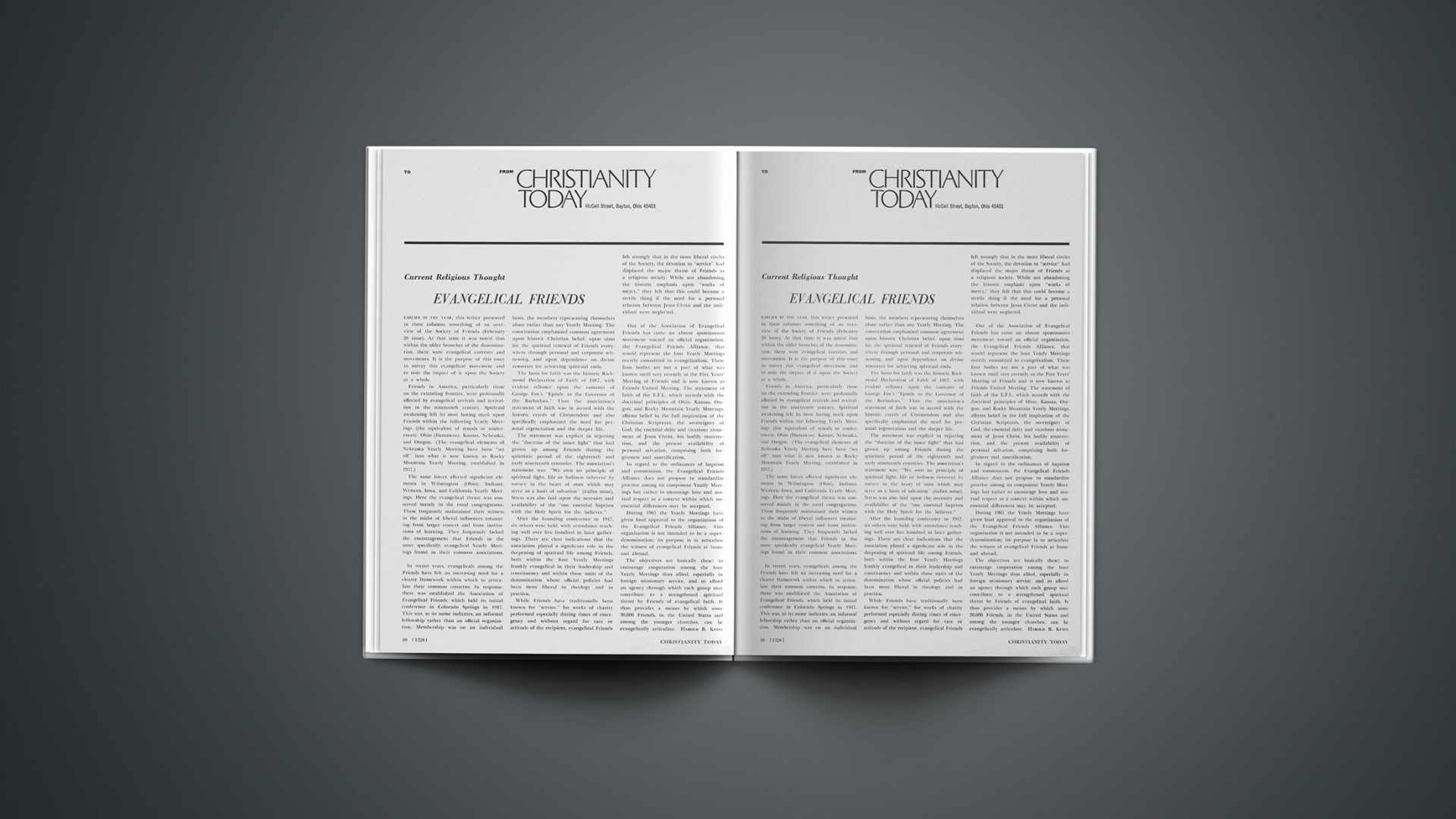
Evangelical Friends

Earlier in the year, this writer presented in these columns something of an overview of the Society of Friends (February 26 issue). At that time it was noted that within the older brandies of the denomination, there were evangelical currents and movements. It is the purpose of this essay to survey this evangelical movement and to note the impact of it upon the Society as a whole.

Friends in America, particularly those on the extending frontier, were profoundly affected by evangelical revivals and revivalism in the nineteenth century. Spiritual awakening left its most lasting mark upon Friends within the following Yearly Meetings (the equivalent of synods or conferences): Ohio (Damascus), Kansas, Nebraska, and Oregon. (The evangelical elements of Nebraska Yearly Meeting have been “set off” into what is now known as Rocky Mountain Yearly Meeting, established in 1957.)

The same forces affected significant elements in Wilmington (Ohio), Indiana, Western, Iowa, and California Yearly Meetings. Here the evangelical thrust was conserved mainly in the rural congregations. These frequently maintained their witness in the midst of liberal influences emanating from larger centers and from institutions of learning. They frequently lacked the encouragement that Friends in the more specifically evangelical Yearly Meetings found in their common associations.

In recent years, evangelicals among the Friends have felt an increasing need for a clearer framework within which to articulate their common concerns. In response, there was established the Association of Evangelical Friends, which held its initial conference in Colorado Springs in 1947. This was, as its name indicates, an informal fellowship rather than an official organization. Membership was on an individual basis, the members representing themselves alone rather than any Yearly Meeting. The constitution emphasized common agreement upon historic Christian belief, upon aims for the spiritual renewal of Friends everywhere through personal and corporate witnessing, and upon dependence on divine resources for achieving spiritual ends.

The basis for faith was the historic Richmond Declaration of Faith of 1887, with evident reliance upon the contents of George Fox’s “Epistle to the Governor of the Barbadoes.” Thus the association’s statement of faith was in accord with the historic creeds of Christendom and also specifically emphasized the need for personal regeneration and the deeper life.

The statement was explicit in rejecting the “doctrine of the inner light” that had grown up among Friends during the quietistic period of the eighteenth and early nineteenth centuries. The association’s statement was: “We own no principle of spiritual light, life or holiness inherent by nature in the heart of man which may serve as a basis of salvation” (italics mine). Stress was also laid upon the necessity and availability of the “one essential baptism with the Holy Spirit for the believer.”

After the founding conference in 1947, six others were held, with attendance reaching well over five hundred in later gatherings. There are clear indications that the association played a significant role in the deepening of spiritual life among Friends, both within the four Yearly Meetings frankly evangelical in their leadership and constituency and within those units of the denomination whose official policies had been more liberal in theology and in practice.

While Friends have traditionally been known for “service,” for works of charity performed especially during times of emergency and without regard for race or attitude of the recipient, evangelical Friends felt strongly that in the more liberal circles of the Society, the devotion to “service” had displaced the major thrust of Friends as a religious society. While not abandoning the historic emphasis upon “works of mercy,” they felt that this could become a sterile thing if the need for a personal relation between Jesus Christ and the individual were neglected.

Out of the Association of Evangelical Friends has come an almost spontaneous movement toward an official organization, the Evangelical Friends Alliance, that would represent the four Yearly Meetings overtly committed to evangelicalism. These four bodies are not a part of what was known until very recently as the Five Years’ Meeting of Friends and is now known as Friends United Meeting. The statement of faith of the E.F.I., which accords with the doctrinal principles of Ohio, Kansas, Oregon, and Rocky Mountain Yearly Meetings, affirms belief in the full inspiration of the Christian Scriptures, the sovereignty of God, the essential deity and vicarious atonement of Jesus Christ, his bodily resurrection, and the present availability of personal salvation, comprising both forgiveness and sanctification.

In regard to the ordinances of baptism and communion, the Evangelical Friends Alliance does not propose to standardize practice among its component Yearly Meetings but rather to encourage love and mutual respect as a context within which unessential differences may be accepted.

During 1965 the Yearly Meetings have given final approval to the organization of the Evangelical Friends Alliance. This organization is not intended to be a super denomination; its purpose is to articulate the witness of evangelical Friends at home and abroad.

The objectives are basically these: to encourage cooperation among the four Yearly Meetings thus allied, especially in foreign missionary service, and to afford an agency through which each group may contribute to a strengthened spiritual thrust by Friends of evangelical faith. It thus provides a means by which some 30,000 Friends, in the United States and among the younger churches, can be evangelically articulate.

Newest Rights Issue: The Negro Family

A potent debate on the moral status of America’s Negro families foamed last month behind the placidly staged exterior of a planning session for the White House Conference on Civil Rights. In choosing the 250 participants, White House staffers encouraged blandness by avoiding militant Negroes and those living in the depths of city ghettos. Most solution-seekers chanted, “more federal aid,” led by Honorary Chairman A. Philip Randolph, who urged a $100 billion “freedom budget.”

Discussion topics were also old stuff: jobs, voting, welfare, housing, justice, community action, and education. But a forum on Negro family problems was novel and would not have been scheduled a year ago.

This new element was largely the work of voluble, graying Daniel P. Moynihan, now a “resident scholar” at Wesleyan University, who lost the Democratic primary for New York City Council president this summer. His 30-minute closed-door debate with a young Negro sociologist, the Rev. Dr. Benjamin F. Payton, was the high point of drama at the two-day meeting.

In January, when Payton, an American Baptist, took charge of the Office of Church and Race of the Protestant Council of the City of New York, Moynihan, then assistant secretary of labor, was putting the finishing touches on his study of Negro family problems. His pessimistic findings reportedly shocked President Johnson into calling for the conference during a Howard University graduation speech in June.

The “Moynihan report” was handed the President on a confidential basis, but soon became Washington’s most-read and most-talked-about secret report in years.

The President said the conference should go beyond basic civil and legal rights to tear down “the walls which bound the condition of man by the color of his skin.”

Moynihan’s report contends one of these walls is the “highly unstable” family structure of lower-class Negroes which “in many urban centers is approaching complete breakdown.” It drew depressing pictures of divorce, separation, illegitimacy, delinquency, welfare dependency, drug addiction, and related crises in education and employment. And it said things have gotten worse—not better—during a decade of civil rights triumphs.

Moynihan. who has a liberal civil rights record, said his only aim was to portray social problems accurately so people would be moved to do something. He suggested broad federal programs to bolster the “stability and resources” of Negro families.

But there is some question whether Moynihan’s figures are worth heeding. A few weeks before the November meeting, Payton unleased a 22-page rejoinder to Moynihan. and the Protestant Council called its own preconference conference to lobby for Payton’s point of view.

Payton questioned Moynihan’s “assumptions, limited data and interests.” For example, he said charts on illegitimacy fail to consider the patchwork system of reporting, the much higher abortion rate among white women, unequal access to contraceptives, and differential adoption rates. He said family problems may be more a matter of center-city living than of race. To Payton, illegitimate children and fatherless homes are “themselves mere symptoms of other more basic problems” in housing, schools, and jobs.

Payton drew quiet support from Dr. Hylan Lewis, Howard University sociologist, who set the agenda for the family discussion and produced the basic resource paper. This disagreed with Moynihan’s findings. A new Doubleday book analyzing current census data, This U.S.A., similarly contends that Negro family life is not a one-sided saga of deterioration.

Moynihan—who started it all—was the forgotten man at the conference. But near the end, he asked for the floor in the family discussion, where his ideas had been brewing away unmentioned since the start, to answer Payton. All the conferees had read Moynihan: few knew what Payton had written. The two debated face to face for more than thirty minutes.

Afterwards, Moynihan charged that Payton hadn’t read his report and that the criticisms were “pathetic.” “For the Protestant Council to criticize my report is incredible.… The data on the family is impeccable,” He said his purpose was to show what “we as Christians should do.”

Payton, however, said he had indeed read the report. He believes the protest by him and others will succeed in reorienting the main White House Conference next spring. Others were more blunt than Payton. One woman called Moynihan “completely incompetent.”

A week after the session. Moynihan defended his views in a Washington Post essay, and drew significant backing from sociologist C. Eric Lincoln in a discussion of the “absent father” crisis in the New York Times Magazine.

Monsignor John C. Knott, director of the Family Life Bureau of the National Catholic Welfare Conference, said another family issue, birth control, was discussed for only a few minutes. Many consider federal programs on contraception—opposed by NCWC—a key solution for problems of impoverished Negroes.

The Moynihan report signaled a subtle new phase of the civil rights struggle. The legal basis now exists for civil equality, though it has not been achieved. Negro leaders, many of whom consider demonstrations generally passé, know the next stages will be more difficult. The failure of America to dissolve Negroes into the mainstream of its life has a thousand persistent causes, ranging from fear of interracial marriage or loss of jobs to such pedestrian barriers as Negro speech patterns.

Conference Co-Chairman Morris B. Abram, president of the American Jewish Committee, lamented that the planning session glossed over the basic questions of what causes prejudice and how it can be fought.

The Moynihan report dared say aloud what had been whispered. Though it was condemned by some as providing racist fuel, Professor Lee Rainwater of Washington University said, “Ten years ago, if you cited figures about poor performance of Negro students, you were accused of being a racist. Now those same statistics are being used as an argument to do something about the the school system.”

Personalia

Dr. Robert W. Spike, director of the National Council of Churches’ Commission on Religion and Race since its inception three years ago, resigned to initiate what he calls a “free-wheeling” professorship on the ministry at the University of Chicago Divinity School.

Canada’s recently re-elected Prime Minister Lester B. Pearson won the Family of Man Award of the Protestant Council of the City of New York.

Samuel Hepburn, Midwest leader of the Salvation Army, was appointed national commander.

Dr. George Thomas Peters will be the new chairman of the United Presbyterians’ Division of Evangelism.

Boston University’s president, Dr. Harold C. Case, plans to retire July 1, 1967.

Atlanta’s Emory College has hired its first full-time Negro professor, sociologist Daniel C. Thompson, who holds a B.D. from Gammon Theological Seminary.

The Rev. D. A. Loveday is new president of Canada’s Fellowship of Evangelical Baptist Churches.

Bishop Hans Jaenicke told the East Berlin Synod of the Evangelical Union Church that his country’s anti-West propaganda instills fear in its people, hampers reconciliation efforts, and “is simply not in harmony with the facts.”

Deaths

DR. C. OSCAR JOHNSON, 79, St. Louis pastor for twenty-seven years, first man to win high office in both the Southern and the Northern (now American) Baptist Conventions, and former president of the Baptist World Alliance; of leukemia, in Oakland, California.

LEON MACON, 57, editor of the Alabama Baptist; in Birmingham, after a series of strokes.

HENRY COLEMAN CROWELL, 68, retired Moody Bible Institute executive credited with developing its radio evangelism; in Evanston, Illinois.

Miscellany

A commission for uniting Latin American Protestants formed under a plan similar to one that failed in 1961. The first members will be church councils in Argentina, Brazil, Chile, Cuba, Puerto Rico, and Uruguay, and other organizations related to the World Council of Churches. Missionary News Service predicts that the union’s membership invitations to independent missions will split evangelicals, who now cooperate in numerous countries.

The Christian Council of Rhodesia, which includes Anglicans and several Protestant groups, has repudiated Rhodesia’s declaration of independence and vowed loyalty to Britain’s Queen.

New Zealand’s Presbyterian Church has approved a statement of faith drawn up by five Protestant groups as a key ecumenical step.

The government of Barbados, a West Indies island, wants to stop paying salaries of Anglican church clergymen and continue using Anglican schools without payment. The church, which opposes the plan, would retain its official status.

In Cameroun, a military tribunal sentenced four men to death for the August murder of two Swiss missionaries. One defendant was Thaddee Nya Nana, a deputy in the National Assembly.

One of the South’s top private academies, Atlanta’s Westminster Schools, has eliminated race as a factor in admitting students. It is an independent Christian institution with Presbyterian roots.

Florida Southern College (Methodist) will get at least $7 million from the estate of the late Mrs. T. G. Buckner, a longtime trustee. It is believed to be the biggest single gift ever to a Florida college.

Governor Dan K. Moore of North Carolina praised that state’s Baptist Convention for condemning the Ku Klux Klan.

School officials in Port Leyden, New York, fearful of the Supreme Court ban on religious exercises, rejected a yearbook advertisement that quoted Psalm 23. It was placed by a contractor disgusted with ads for taverns in the annual.

Revelation Schema: A Vatican Sleeper?

What was the most important document to come out of the Second Vatican Council? Which will be the most significant in the decades ahead?

Some Roman Catholic theologians are said to give that distinction to the council’s decree on divine revelation, officially promulgated last month by Pope Paul VI. They contend it is historic not so much for what it says as for what it leaves unsaid.

The document deals with the age-old question of the relative merits of Scripture and church traditions. Most conservative Catholics hold that Scripture and tradition are separate sources of revelation, a view that sets them at odds with Protestants.

Progressives among the Vatican Council fathers succeeded in minimizing somewhat the role of tradition. The final version of the document is generally more acceptable to evangelical Protestants than earlier drafts. It still suggests, however, a reliance on the double-source theory. Tradition and Scripture are said to be “like a mirror in which the pilgrim Church on earth looks at God.” At this point many Protestants will attribute to the Vatican the perpetuation of a historic heresy. Here is an excerpt front a translation issued by the National Catholic Welfare Conference in Washington, D. C.:

“… There exists a close connection and communication between sacred tradition and sacred Scripture. For both of them, flowing front the same divine wellspring, in a certain way merge into a unity and tend toward the same end. For sacred Scripture is the word of God inasmuch as it is consigned to writing under the inspiration of the divine Spirit, while sacred tradition lakes the word of God entrusted by Christ the Lord and the Holy Spirit to the Apostles, and hands it on to their successors in its full purity, so that led by the light of the Spirit of truth, they may in proclaiming it preserve this Word of God faithfully, explain it, and make it more widely known. Consequently it is not from sacred Scripture alone that the Church draws her certainty about everything which has been revealed. Therefore both sacred tradition and sacred Scripture are to be accepted and venerated with the same sense of loyalty and reverence.”

The document adds:

“It is clear, therefore, that sacred tradition, sacred Scripture, and the teaching authority of the Church, in accord with God’s most wise design, are so linked and joined together that one cannot stand without the others, and that all together and each in its own way under the action of the one Holy Spirit contribute effectively to the salvation of souls.”

Another portion of the document holding special interest for Protestants is that dealing with scriptural authenticity. Roman Catholic teaching has traditionally asserted the inerrancy of the Bible. Pope Leo XIII vowed, “It will never be lawful to restrict inspiration to certain parts of the Holy Scriptures, or to grant that the sacred writer could have made a mistake.”

The new statement on divine revelation does not go that far. It says merely that “the books of Scripture must be acknowledged as teaching solidly, faithfully, and without error that truth which God wanted put into the sacred writing for the sake of our salvation.” That is the extent of the document’s comment on inerrancy.

No distinction is made between theological, historical, and scientific truth. But the document calls for interpreters to seek out what the writers of Scripture “really intended” to say. For instance, “Attention should be given, among other things, to ‘literary forms.’ ”

A Confession? In 1967?

The presumptuously titled “Confession of 1967” probably must undergo major changes if it is to become an official creed of the United Presbyterian Church in the U. S. A.

It may also need a new name.

Those who drew up the 4,200-word statement had hoped it would gain official status by 1967. Resistance has been building up, however, and critics are demanding more time for revision.

Some critics even contend that the document as now constructed is not comprehensive enough to be dignified as a “confession.”

In Chicago’s Palmer House last month, the proposed confession underwent an intensive, twenty-four-hour critique aimed at making it more biblical. The special study session, sponsored by Presbyterians United for Biblical Confession, attracted 538 registrants from all parts of the country. They made no significant effort in behalf of the Bible as explicitly inerrant but agreed that the confession should assert the inspiration and overall reliability of the biblical message.

A PUBC editorial committee’s nine-page list of suggested revisions was worked over by forty discussion groups at the Chicago meeting. pubc leaders are pooling the results and will turn them over to a fifteen-member confessional revision committee appointed by the United Presbyterian General Assembly. The revision committee was scheduled to hear arguments this week.

The Confession of 1967 is the work of a small committee headed by Dr. Edward A. Dowey, Jr., professor of church history at Princeton Theological Seminary. It is based on the reconciliation theme in Second Corinthians 5:18–20, which the committee regards as “the touchstone for the meaning of salvation expressed especially for the conditions of our day.” The committee has suggested that this new statement and six older documents be given equal status with the Westminster Confession, traditional standard for Presbyterian groups around the world. The committee has further proposed that less binding questions be asked of candidates for the ministry.

The Chicago meeting of PUBC—a new organization that already has support from more than 5,000 clergy and lay evangelicals in United Presbyterian ranks—was a responsible effort. Pressed for time, participants worked far into the night to sort out the issues. They displayed extreme caution and bent backwards to avoid being labeled reactionaries. They showed considerable respect for Dowey, showering him with repeated applause, though one unidentified onlooker read the Chicago Tribune financial pages during Dowey’s address. United Presbyterian Moderator William Thompson, who pleaded for an irenic spirit, also was treated cordially.

As expected, the Chicago study indicated that the concern of theological conservatives was focused on what they feel is an inadequate statement on Scripture in the new confession. Even Dr. John Mackay, no fundamentalist, pleaded for a stronger stand on the Bible.

“This new statement is right when it says the Bible is the ‘normative witness,’ ” conceded Mackay, retired president of Princeton. “But it is much more. It is the authoritative source from which we draw.”

Drafters of the new confession readily acknowledge that its view of the Bible “is an intended revision of the Westminster doctrine, which rested primarily on a view of inspiration and equated the Biblical canon directly with the Word of God.” The new confession defines the Bible as the instrument of the revelation of the Word incarnate, namely Christ.

A related issue that nettles conservatives is the new confession’s assertion that understanding of Scripture “requires literary and historical scholarship.” This, they say, harks back to an old Roman Catholic heresy which contends that the Bible needs to be interpreted for laymen.

Liberals are likely to exploit at least one of the suggestions raised in Chicago. The groups proposed striking out a section that states the Church cannot condone poverty. The statement that was substituted prompted an immediate reaction from the Rev. Frank H. Heinze, chief information officer for United Presbyterians: “The Republican Party could have written that just as well.”

Few will venture a guess as to how the confession will come out. But evangelical strategists now apparently seek a revised confession that most United Presbyterians can live with, not a campaign against the very idea of a new confession. Some attempts may be made, however, to demote the document to the level of a mere theological statement for the times.

Dr. Cary N. Weisiger III, a California minister who is chairman of PUBC’s governing committee, has outspokenly lamented United Presbyterian failure to update the Westminster Shorter Catechism. The drafting committee was originally charged with preparing a contemporary introduction and revising scriptural references in the Shorter Catechism, but was relieved of the duty by the 1959 General Assembly “in view of the difficulty and importance of the remainder of its task.”

Showdown On Scripture

Two United Presbyterian scholars engaged in a verbal duel over Scripture last month. Their stage was the ornate, gold-and-white grand ballroom of the Palmer House in Chicago, and their sponsor Presbyterians United for Biblical Confession. The debate took most of a morning, and the mood alternated between tension and joviality.

The contenders were Dr. Edward A. Dowey, Jr., chief architect of the proposed “Confession of 1967,” and Dr. John Gerstner of Pittsburgh Theological Seminary, like Dowey a church history professor. The night before, battle-weary Dowey had yawned as he sat listening to remarks by Gerstner. But when he was put on the spot, Dowey’s appeal to historical precedent was engaging and persuasive. Nevertheless, Gerstner emerged as somewhat the more articulate of the two, though a bit more argumentative as well. Dowey lost the day with his audience of evangelicals when he suggested that Christ erred in considering the Jonah account historical.

Before the debate, Dowey, in a prepared address, took the liberty of some tangential swipes, including a remark that “Billy Graham sounds pretty Arminian to me.” He unleashed his most severe criticism at the recently formed Presbyterian Lay Committee, Inc. (see December 3 issue, page 48). Their statement in Presbyterian Life, he said, “reads like a millionaires’ manifesto.” Dowey did not specify the group by name, but the reference was clear. He charged that this committee “takes the church out of the business of corporate responsibility.”

Communist Star Rises over Nazareth

Nazareth, enshrined in history as the home town of Jesus Christ, is organizing its usual Christmas festivities this year, but holiday cosmetics mask a political pallor. Resurgent Communists have thrown things into a turmoil.

In last month’s election they won seven of fifteen city council seats; seven went to the Alignment (which won nationally in Israel under Prime Minister Levi Eshkol) and one to the small, left-wing Mapam party. The Reds could name the new mayor and set policy if the Mapam member were to cooperate.

How can an atheistic world force make such inroads in a nation officially committed to Judaism? For one thing, the local version is not atheistic. Party leader Fuad Khoury is Greek Orthodox, and his key lieutenant is a Muslim, Tewfiq Zaiyad.

Nazareth’s population of 28,100 is nearly half Christian and half Muslim, with a small Jewish minority. Khoury said the Communists capitalized on grievances from Arabs, who constitute a large majority of the citizenry, and graft in local government.

Khoury, a former schoolteacher, recounted that Communists held six seats in Nazareth from 1954 to 1959 but dropped to three during Arab bickering between Egypt’s General Nasser and Iraq’s Red-tinged Arif Kassem. Now things are back to normalcy, he said: the Reds won 37 per cent of Nazareth’s Arab voters in the municipal vote, and 45 per cent in the vote for candidates for the national legislature (where Communists now hold only four of 150 seats).

As for atheism, Khoury said, “To us, religion is a purely personal affair. If a man is a Muslim, Jew, or Christian, it is no concern of ours.” Communism may have replaced religion in the Soviet Union, he said, but secularism has done the same in America.

Tewfiq, a zealous Communist, elaborated on party doctrine in his home while his aged father knelt praying on a goatskin sujad, facing Mecca. Tewfiq pointed out a window. “See those destroyed Arab villages—Ma’lool, Saffouri, and many others? If it wasn’t for military government rule, the thousands of Arab villagers now living in and around Nazareth could return to their lands and villages and rebuild shattered lives. But now, if they dare go back, they will be arrested.”

Tewfiq, the only local Red who has lived in the Soviet Union, was asked how he reconciles Communist atheism with the strong monotheism of Islam.

“When you came in, you saw my old father praying. This is all right for the old generation, but it has no validity for youth. The basic conflict is between science and religious fantasy. Religion does nothing about bad local conditions. The people are poor and oppressed and they are religious. They live and die poor and oppressed. Nothing changes. What can religion do to solve their problems? Nothing.

“If a man wants to become a Communist and bring his Christianity, his Judaism, or his Islam with him, he may. He can pray 100 times a day and still be a Communist if he wishes.”

Other Communist councilors, Najib Fahoum, 45, and Abdul Hafez Daraushi, 27, also contended that Communism will help the Arabs.

This Nazareth party line sounded all too familiar. Israel’s Arabs are in a transition period, and it will take time to absorb them into the social and economic mainstream. Giant strides have been made, and Arabs in Israel enjoy higher standards of living, health services, and education than they would in Arab lands. Eshkol’s government has done much to ease Arab restrictions, and more of this was promised during his campaign.

The current vice-mayor is a Roman Catholic, Nadim Bathish. He said a new election is unlikely but could be forced by the Israel government if it cuts off financial aid. He hopes for a coalition between the Alignment and the lone Mapam member. The Reds say they won’t press for a Communist mayor but are willing to work within a broad coalition under a compromise mayor, conceivably the Mapam councifor.

As negotiations continue, the city prepares for its yearly season of glory. There is a new community center (built with U. S. counterpart funds) for receptions, and an almost-completed multi-million-dollar Catholic cathedral where Christmas Mass will be celebrated.

The Government Tourist Corporation is making preparations for Nazareth’s large influx of tourists and pilgrims. Signs in fourteen languages will welcome guests. Among official greeters will be the new mayor (if he is named by Christmas), Archbishop George Hakim (Greek Catholic), Metropolitan Isadoras (Greek Orthodox), and Bishop Hanna Kaldani (Latin Patriarehate).

A large Christmas tree will be raised over the central square, glittering with thousands of tiny bulbs. But city officials admit they are rather red-faced about the symbolic Red Star which has also been raised over this community of sacred memories.

Philippines: Ballots And Blocs

The Philippines’ newly elected president, Ferdinand Marcos, won last month with a margin—600,000 votes—almost identical to the voting strength of the Iglesia ni Cristo (Church of Christ), which backed him.

The Iglesia, a nationalistic cult with Protestant origins, thus maintained its prestige as a critical third force in the island nation’s political turmoil. Marcos supporters claimed the losing incumbent president, Diosdado Macapagal, had wooed the Iglesia and lost. Macapagal’s party splashed full-page ads in city dailies quoting Roman Catholic bishops who condemned candidates with Iglesia support. Macapagal said Marcos would be under the Iglesia thumb to the detriment of Catholicism.

The hopes of Catholic laymen to establish a strong political force of their own in this predominantly Catholic nation got lost in the religious shuffle.

The presidential candidate of the Party for Philippine Progress, Senator Raul Man-glapus, strongly backed a controversial religious education bill, still pending in the Senate, which Protestants fear. Many Catholic bishops and priests had campaigned openly for PPP, as did major Catholic organizations and Catholic students.

Then two days after Macapagal supporters left for Rome to confer with Rufino Cardinal Santos, the cardinal issued a statement urging Catholics to vote for the man most likely to win. Macapagal claimed this obviously meant him, but one thing was sure—it didn’t mean Manglapus.

Then another key spokesman in Rome—Archbishop Julio Rosales, chairman of the Catholic Welfare Organization, the top governing body of the national church—denied that the hierarchy was behind anyone. Some detected a split among top leaders. Many Catholics apparently thought the cardinal had deserted the PPP for political expediency and supported Marcos (also a Catholic) in protest.

An eloquent Protestant protest won journalistic praise. Dr. Enrique C. Sobrepeña, executive secretary of the United Church of Christ, said that “the church … must not meddle in partisan politics, nor interfere with government affairs.”

Besides provocative religious controversy, this fall’s campaign produced the most vicious propaganda ever seen. And there were numerous political murders—eight on election day—although observers said this year’s election was the least bloody since Liberation.

Life magazine, in a recent discussion of the campaign, reported that Marcos himself was convicted of a political murder in 1935 but was later acquitted on appeal. The same article documented the deep moral challenges the new president will face, including crime, pork-barrel politics, and corrupt legislators.

EUSTAQUIO RVMIIATOS, JR.

Going For Gold?

This has been a good year for rumpus-loving Athenians, thanks to a tottering government, a scarcely more stable monarchy, and the tireless mischief-making of Greek Communists, who are currently exploiting a new crisis. Thirty-six out of fifty-one Orthodox bishops, defying the law that decrees the promoting of archimandrites (unmarried priests) to Greece’s fifteen vacant dioceses, have been appointing bishops instead. At present (with a few exceptions) a bishop must stay all his working life in one place, with no hope of transfer to a larger and wealthier see where taxes on christenings, marriages, and funerals would supplement his basic monthly income of $330.

A 700-man police guard turned out to prevent the rebel bishops from meeting in Athens Cathedral, and the prelates turned away amid cries of, “Is it Christ or gold you want?” Persisting, they sent men off to be instituted in different areas.

After some wavering, the 90-year-old primate, Archbishop Chrysostomos, decided he could not act against civil law and advised local authorities not to recognize the “new” bishops. Most newspapers also were hostile, with the capital’s Eleftheria referring to “a rebellion and a coup against the law and the state.” A special Orthodox Church committee headed by Chrysostomos is now studying a parliamentary bill that would reform regulations on the election, assignment, and financial support of bishops.

LBJ Joins 61,000 at Texas Crusade

On the day after Washington demonstrations against American policies in Southeast Asia, President Johnson heard a different view expressed by evangelist Billy Graham in Houston’s Astrodome.

“Even a little handful can make a great noise and get national attention if they are protesting and demonstrating,” said Graham, who was winding up a crusade in Texas’s largest city.

Continuing his pre-address welcome to Mr. and Mrs. Johnson, the evangelist pointed out that in Houston nearly 400,000 people of every color and creed had attended the ten-day meetings “to protest sin and moral evil and to affirm their belief in moral integrity and old-fashioned religious convictions.” The fact that most of them had been under 25 indicated that “the youth of today, in spite of a noisy minority, are probably the most religious-minded of any generation in this century.”

The President and his wife had flown in specially from their ranch, where Graham and his associate Grady Wilson hail been guests the previous weekend. Johnson’s fulfillment of a promise made to Graham, a longtime friend, made history. It was probably the first time a President in office had attended an evangelistic meeting. And the experience was doubtless a novel one also for many members of the White House press corps, which was out in force. In view of the Texas tragedy of two years ago, pressmen and photographers were asked to watch their language: the President was to be “filmed,” not “shot.”

Two days before the beginning of a crusade twice postponed because of his illness, Graham had addressed a capacity crowd at the University of Houston auditorium. In this, his first public address in twelve weeks, the fit-looking evangelist pointed to the fallacy of waiting for problems to be solved in a society “ruled by computers, systems and mass media,” which take no account of the fact that man is more than a statistic. This address was relayed to a TV audience estimated at more than 300,000 students in an eighty-mile radius.

Other distinguished visitors during the crusade included Texas Governor John Connally, who introduced the evangelist at the opening service; veteran singer Ethel Waters (“God bless each and every one of his sparrows”); and Vonda Kay Van Dyke, Miss America of 1965, who spoke and sang at the next-to-last service, specially directed at youth. “Christ is the only one who can give you real happiness,” she told more than 37,000 listeners.

At the closing meeting Graham expressed violent disagreement with those “who would throw God and religion out of our schools” and outlined the dangers of educating a man without moral and spiritual strength. “This is one of the most dangerous aspects of Communism,” he declared, “and we are in danger of copying the Communists.” Taking his address from Paul’s famous Mars Hill message, Graham said that the Apostle would find in an American city “immorality, crime, and even more idols than in Athens.” Modern man tries to make God conform to his own wishful thinking, involving an absence of judgment and punishment for sin, the evangelist declared. “God is not suggesting that we repent of our sins—he commands it.”

The final day’s crowd of 61,000 was 10,000 more than had ever watched the Houston Astros in their home Dome. The 218-foot-high air-conditioned amphitheatre, built at a cost of $20 million, is 4½ times the size of Rome’s Pantheon. On seeing it for the first time, even a Texas sports writer was stopped in his tracks and gasped, “It’s like stepping through the gates of heaven.” And that’s precisely how many onlookers felt as 13,100 inquirers responded to Graham’s call for commitment. They stepped onto a playing held that developed extensive patches of dead grass after the Dome ceiling was painted to reduce glare in athletes’ eyes.

Expenses of the crusade, including rental of the Dome at $12,000 a night, were more than covered before the end, and the offering taken during the final meeting was designated by local sponsors to buy radio time for future evangelistic projects of the Graham association.

Not realizing that the final meeting was an afternoon one, a New Orleans man and his son flew in just as the presidential plane left Houston International Airport. Taking his disappointment philosophically, the Louisianian said: “Never mind, I’ll hear Billy Graham in Greenville.” The next crusade is planned in that South Carolina city March 4–13. Before then, Graham goes to Washington for his annual pre-Christmas appearance in the Pentagon concourse.

Solidarity In Bolivia

The world’s loftiest capital, La Paz, Bolivia, saw an unprecedented display of Protestant solidarity last month as 15,000 believers—many in colorful Indian attire—paraded peacefully through streets more accustomed to hostile mobs.

The two-hour procession and two weeks of services capped a year-long “Evangelism-in-Depth” drive coordinated by the Latin America Mission. Next is “consolidation,” with each of fourteen cooperating denominations launching its own program.

During the year, 20,000 Bolivians professed faith in Christ (1,000 in the final La Paz meetings) and hundreds of young people vowed to enter Christian service.

The picturesque parade drew wide press reaction, none more significant than that of the leading Roman Catholic daily, Presencia:

“The diverse Protestant sects have united here and have organized these activities in spite of their differences and with the Gospel as a backdrop. This is a great step and shows a very interesting spirit.” It said the neat, sober evangelicals offered proof of “a social action and of a philosophy of preaching which produces positive results for these people and for the nation.”

W. DAYTON ROBERTS

Hearth And Homily

United Presbyterians and Roman Catholics plan to publish a joint worship guide next fall. The project was revealed after a two-day private ecumenical meeting in Philadelphia, the second official encounter between the two churches.

The guide will have three sections: specimen worship services with sermons and “homilies” emphasizing such topics as peace, unity, and thanksgiving; Bible study and worship for smaller groups; and an elaboration on Bible selections with commentary to show where Protestants and Catholics differ.

The worship guide is reminiscent of a recent book on the informal “living room dialogues” being promoted by the National Council of Churches and the Confraternity of Christian Doctrine (Catholic education agency). These new “hearthside” discussions, scheduled to start next month, include prayer and Bible study but not worship services as in the Presbyterian project.

The “role of the Holy Spirit” was another topic at Philadelphia. After discussing a treatise, panelists agreed on three points:

1. The traditional trinitarian doctrine.

2. “The universal salvific will of God manifested in the God-man Jesus Christ, the mediator for all men.”

3. Church reform and renewal as the work of the Holy Spirit.

On point one, panelists said they took historic creeds at face value and never considered the possibility that modern theologians might be assigning new meaning to traditional formulations.

One of the Presbyterian leaders, Dr. David Ramage of the Board of National Missions, said after the meeting that the most troublesome area was the relation between Scripture and tradition, a topic on which the Catholic Church recently took action (see page 36).

JOHN MILLER

Thumbs Down To $1,111,898

Furman University turned down a $611,898 federal science grant and Mercer University shunned a $500,000 loan when the South Carolina and Georgia Baptist Conventions enforced traditional beliefs against government aid.

The pressing aid problem (see page 57, November 5 issue) also dominated fourteen other recent state meetings in the Southern Baptist Convention. The aid ban was upheld, at least for the present, in Texas, North Carolina, Louisiana, Virginia, New Mexico, and California, while seven states set up study committees to decide whether a change is due.

Among the seven is Kentucky, where Baptists raised only one-third of the $9 million they needed for four schools. The federal challenge at Furman spurred the South Carolina convention to provide the money.

In Maryland, Dr. Conwell Anderson denied reports he quit as president of a planned Baptist college because the state convention refused federal aid.

Contra Contraception

Pope Paul reportedly directed the Ecumenical Council to re-endorse the birth-control doctrines of Popes Piux XI and Pius XII in its “Modern World” schema.

Ecumenical Council commissioners who prepared the new version of the schema decided also to include Paul’s own statement of June, 1964. which affirms traditional Roman Catholic teachings until they are changed by himself, subject to advice from a special papal commission.

That commission has been unable to agree, although the majority is rumored to favor change in the church’s ban on contraception by any means other than the natural “rhythm” method.

The latest papal move is interpreted variously. It may be an attempt merely to clarify the current church stand. However, it may signal a freeze on the birth-control issue, which would mean no change is forthcoming, at least in the near future.

The onrush of events, however, will put the world spotlight on the Pope’s decision. Besides the ever-present challenge of population growth, there is the special White House advisory panel’s plea for greatly expanded birth-control programs sponsored by the U. S. government, both at home and overseas.

The panel, headed by Professor Richard Newton Gardner of the Columbia University Law School, said man has a “basic right” to choose family size, but two-thirds of mankind lacks both information and the means to do it. The United States should provide both, said the study group of thirteen, which had only one Roman Catholic member. George N. Shuster, assistant to the president of the University of Notre Dame.

There is also continuing scientific expforation. A controversial report of sex research now being prepared by two Washington University gynecologists reports discovery of a vaginal chemical that can kill sperm in ten seconds. The scientists hope it may provide an answer to Catholic objections. The Ford Foundation recently announced $14.5 million in new research grants on birth control and related fields.

Cover Story

Reflections on the God-Killers

The viewpoint of the “death of God” movement is hard to identify precisely, but it seems to boil down to one or a combination of the following propositions:

1. It is no longer meaningful to believe in the existence of God. This proposition cuts across several areas of our experience, (a) It is not meaningful to believe in God because such a belief is irrelevant to the problems of today’s world, (b) It is not meaningful to believe in God because we do not have the language or symbolic categories to discuss him precisely or with genuinely communicable understanding, (c) It is not meaningful to believe in God because propositions about such a being are not subject to empirical verification by any form of controlled observation, and assertions that cannot be verified empirically are meaningless.

2. It is no longer possible to believe in the existence of God. Modern science has brought supernaturalism of any sort into disrepute. Things that are outside the scope of the “natural” and that are not, at least ideally, comprehensible by the methods of science simply do not happen.

3. It is no longer necessary to believe in the existence of God. The “mysteries” of the universe have been or are being explained by scientific concepts and methods, so it is no longer necessary to postulate a God. And our ethical and moral structure finds a sufficient foundation and exemplar in Christ and the attitude of love and service he provided during his ministry; it adds nothing to assume that a transcendent God exists above and beyond that attitude.

These propositions, it is believed, point to the conclusion that God has died. But are the propositions intrinsically and inevitably sound, or do they rest upon some prior assumptions—a particular intellectual point of view’—that might be called into question?

Time quotes Professor Altizer as follows: “We must recognize that the death of God is a historical event: God has died in our time, in our history, in our existence”.… There are several possible interpretations of this quotation:

1. It could mean that people no longer take their belief in God seriously and no longer follow what they believe to be his will in their day-to-day conduct. Certainly there are vast numbers of people for whom God has ceased to exist. There are also vast numbers for whom he has never existed. On the other hand, there are vast numbers of people for whom he has not died, because they have believed and still believe in him and conscientiously seek and follow his will as they understand it. Thus, God has not died in any definitive sense.

2. The statement could mean that the systematic, empirically verified explanations of modern science have replaced God as an effective force in the universe. Here again, the power of the statement is weakened because of the many people for whom the achievements of science have not replaced God. Furthermore, this interpretation assumes that there is no God other than that which man himself “created” as a comfortable, catch-all explanation for phenomena that he does not understand. Further, this interpretation places far too much faith in the ability of science to provide “ultimate” answers; the inevitably partial and limited character of scientific explanation is overlooked. Here we might note the “humble” outlook of such scientific greats as Heisenberg and Einstein in forming our expectations about the kinds of answers science can provide.

3. The statement could mean that God and related biblical concepts have outlived their relevance in that they do not offer any solutions to the widespread personal, social, economic, and political problems that beset today’s world. In a sense, this interpretation combines the assumptions underlying the first two. (a) Since people no longer see or search for any relevance of biblical concepts in the “real” world, God has lost his meaning, i.e., has died, (b) Since people now place more confidence in the effectiveness of so-called rational, non-theistic approaches to their problems, the God that they created to help solve those problems is no longer necessary or useful. Once more, there are many people who see a vital relevance of biblical concepts for today’s world and bend every effort to apply them. For many of these individuals, the systematic and empirically supported advances of the natural and behavioral sciences are considered to augment rather than to replace a God-centered orientation to the world and its problems. A conscientious Christian might well consider it not merely his prerogative but his duty to bring all his resources to bear upon the problems he faces. These resources certainly include his ability to understand and apply the contributions of science.

Can it be that the “death of God” writers have fallen into the trap (so common to purveyors of intellectual abstractions) of assuming that most people see the same and the only reality that they themselves see?

If the “death of God” position is, as seems most plausible, that God has died because men no longer find him believable or useful, then it must follow that God never really lived except in the imaginations of men. Apparently, these men are saying, not that God has died, but that he never really had an independent existence. These theologians never say outright that there is no transcendent, independently existing God. Rather, the essence of their argument seems to be that we cannot know or comprehend God because of our limited perceptual, cognitive, and intellectual abilities. Moreover, such capabilities as we do have are inevitably confounded and trammeled by cultural forms and predefinitions. Here, the question seems not to be one of the nature of God but one of the nature of man as a knowing being.…

The “death of God” theologians seem to hail their admission of his demise as a breath of fresh air. Now that the theological air has cleared and Christianity has become thoroughly secularized, Christians can abandon doctrinal nonsense and express their Christianity in deep, heartfelt concern. The churchman will now be more free to demonstrate his Christian love by actually doing things for the economically deprived, for the undernourished millions, and for the ethnic and racial minorities in their struggle for equality. In other words, the Christian’s concern will shift from an “other-worldly” focus to a “this-worldly” focus.

But is this a safe assumption? Will booting God out of our churches by trying to bury him necessarily mean that church people will show an increased concern for persons and social problems?…

Are the “death of God” theologians really in a position to say that God has died? Or must they limit themselves to saying that within their own particular conceptual frameworks they have not been able to find him? What if they had made different assumptions or accepted the validity of different kinds of data or asked different questions? Would they still, of necessity, not be able to find God? Or does the question of whether God does or ever did exist still boil down to the age-old question. “To believe or not to believe?”

Persons of the more traditional, evangelical persuasion, using different assumptions, accepting different kinds of data, and holding to the validity of faith as a category of belief and experience, say that God does exist. We assume that God could and does reveal himself in various ways, including the written word as found in the Bible. We accept the life and works of Christ as, above all, the material expression of God’s love and grace. To support our sometimes intangible-looking faith, we fall back upon the evidence of history. For example, something happened shortly after the crucifixion of Christ to bring about a miraculous revitalization of his depressed, dejected, and utterly defeated disciples. Something happened that we remember as the “day of Pentecost” that stimulated a social, ethical, and religious movement that has had a tremendous impact upon the world. Is this sort of evidence sufficient reason for believing in God and in Christ as the Son of God? We naïve Christians think so, and we believe.

Assistant Professor of Psychology

The University of North Dakota

Grand Forks, N. D.

Eutychus and His Kin: December 17, 1965

Diagnosis praised; physician scorned

Cybernetics

Discussions about machines “taking over” usually end in an insecure half-laugh, because sometimes you just can’t be too sure. That automation is here to stay is undeniable. That some scientists think life can be created in the laboratory is supposed to pose all kinds of threats for theology and especially the doctrine of man. And that some combination of unemployment and living terror is ahead of us is increasingly becoming the theme of avant-garde writing.

But I think that in the long run we have the machine stopped. Neither machines nor laboratory cells can really replace human beings unless they reach the stage at which they start blaming one another. This practice is a reflection of the true human condition, and it seems an impossibility without somewhere the fact of sin.

One of C. S. Lewis’s best books is The Great Divorce. It was William Blake who made classic the hope of universal salvation when he wrote The Marriage of Heaven and Hell, meaning by his title that eventually heaven and hell could get together. But in The Great Divorce, C. S. Lewis, with his usual penetration and wit. sets before us the possibility of people in hell moving on into heaven. The only trouble is that they can’t bear to live in heaven because they carry hell around with them, and the hell is that they can’t forgive and, worse than that, can’t stand to be forgiven. Pride won’t allow it.

Lewis points out that Napoleon is moving into deeper and deeper hell because he insists on settling with his generals the question of whose fault it was at Waterloo. Not being able to let loose of this obsession, he moves on toward the deep darkness.

Try it on yourself. Is the burden of your sin finally the inability to quit blaming someone for yourself?

EUTYCHUS II

The Bible Is For People

When I started to read Dr. Hughes’s article. “What Is the Bible For?” (Nov. 19 issue), I wondered if he would present a lot of philosophical and theological ideas without explaining such a simple thing as why my wife and I love to read the Bible. But he came through wonderfully.…

JOHN STANTON

East Dennis, Mass.

Excellent diagnosis! Helpful witness!

PAUL IHLENFELD

St. Louis, Mo.

After reading the article … I have just one observation to make to the editors of CHRISTIANITY TODAY: “Physician, heal thyself”.…

If Luke were to write to Theophilus today, his manuscript would doubtlessly be returned with a rejection slip and the notation that, while his work was good, his subject had already been assigned to a staff writer.…

MIDGE SHERWOOD

San Marino, Calif.

Ecumenical Dialogue

I have just read Dr. C. Darby Fulton’s article (Nov. 5 issue), dealing with the subject of organic church union.

It is the finest thing l have read on this subject. He covered the subject marvelously in a few words. I believe time will reveal how right he is.…

FRED MCPHAIL

First Baptist Church

Aurora, Mo.

I feel a little unhappy about the headline on page 4, “Spiritual unity cannot exist without organic church union.” Perhaps this could be extracted from what I say in my article about a false antithesis between “spiritual unity” and “organic union”; yet it is a misreading of what I mean. I feel a very considerable degree of spiritual unity with many Christians from whom I am still visibly separated. What I will not do is to accept this state of affairs as being adequate to what our Lord requires of us or what the Bible teaches. The whole ecumenical movement springs, as it seems to me, from the joyful conviction that in Christ we have (underlying many differences) a spiritual unity, but that it remains for us to clothe it in forms that are less confusing, anachronistic, and unserviceable than the ones we now have.

PATRICK C. RODGER

Executive Secretary

Commission on Faith and Order

World Council of Churches

Geneva, Switzerland

It’s the compromising view that organic unity must be had at any cost and is the most important end, which most of us abhor.… The most important thing is that Christians, regardless of what other tags they put on themselves, must work together with love toward one another if they are to have a profound influence on the world.…

ESTON W. HUNTER

Anderson, Ind.

We must ask ourselves whether or not the current chase after “ecumenicity” is prompted more by factions seeking greater material gain and higher social status than by an actual outpouring of the Holy Spirit. Diminishing and perverting of practiced morals and ethics has never been more evident. Is it likely that a host of nominal Christians, seldom evincing goals beyond those of social affluence and personal pleasure, should suddenly express a collective desire for the organizational unity of a spiritual body?

Christ’s members are not known by the societies or institutions to which they may belong, nor are they distinguishable by the doctrines which they profess to believe. Christians … are only intimately known by the Spirit who indwells them and, generally, by each other as common works … manifest their faith.

HENRY A. GOERTSON

New Westminster, British Columbia

Dr. Darby Fulton’s article on church unity says what I have always felt.… I truly believe one faith must come first. Organic union first won’t last.

BETTLE D. BRIDEWELL

Donaldsville, La.

Musings On Music

Re “Quiet Revolt in Gospel Music” (News, Nov. 5 issue): There are two impressions given … which are not quite accurate. [The National Church Music Fellowship is] not really iconoclastic, eager to snatch away the “unworthy” music which is cherished by the man in the pew. Our program is a positive one, seeking to find the middle of the road between “the two extremes—those who judge music only by artistic ideals and those who aim only at the desires of the listener.” Our constitution states our purpose thus: to promote a ministry of music that may bring, “through the power of the Holy Spirit, the most powerful and permanent spiritual results.”

Secondly—I doubt that my friends at Moody Bible Institute have turned their backs on church music education that is broad in scope and excellent in quality. The same issue of the magazine announced that they will grant degrees. I understand that this includes a degree in church music that could be accredited by regional agencies and the National Association of Schools of Music.

DONALD P. HUSTAD

La Grange, Ill.

I was practically standing up cheering by the time I had finished it. I am an evangelical but I am also a musician, and I am often heartsick at the music standards which believe that if it is quality music it must be sinful, or at least a product of the liberal camp.…

MARY HOFFMAN

Vancouver, Wash.

For more than forty years I have labored in the music field of the Church and am one of those greatly disturbed by the present trend which seems to be a campaign by the American Guild of Organists to educate congregations to the use of more music by the three B’s. I find no fault in this save to point out that this does nothing to help people to worship. I have given up my membership in the A.G.O. and regret that this over-emphasis on music ability is causing many defections from the Church itself.…

WESLEY A. STRICKLAND

Stony Brook, N.Y.

You quote the results of the Lutheran effort to raise the standards of their music, and I am sure that they have worked very hard; but have you ever sat in a Lutheran church (as I do every Sunday) and listened to the deafening silence as the three trained musicians in the congregation try to carry the whole group when they are singing one of their liturgically correct, properly written songs? Or—have you observed the polite yawns and disinterest when some outstanding choir threads its way through a great old unintelligible oratorio? I can’t believe these things especially please the Lord.…

If other churches succeed in putting together such a mass of uncomprehendingly difficult and crashingly boring music as the Lutheran church has in its latest hymnal, then they can see, as we do, churches full of people … with their mouths closed as the organist perspires his way through a hymn.

Don’t mistake my criticism of the Lutheran church. I love it.…

KENNETH M. CLAAR

Palmdale, Calif.

Book Briefs: December 17, 1965

The Trouble Is The Pulpit

The Trouble with the Church: A Call for Renewal, by Helmut Thielicke, translated and edited by John W. Doberstein (Harper and Row, 1965, 136 pp., $3.50), is reviewed by Carl Kromminga, professor of practical theology and director of field education, Calvin Theological Seminary, Grand Rapids, Michigan.

This book is a translation of Helmut Thielicke’s Leiden an der Kirche. In it Thielicke applies his skill as a theologian and writer to diagnosing the trouble with the Church. The result is not just another jeremiad on the contemporary impotence of the Church, for Thielicke’s diagnosis and prescription are responsible as well as brilliant.

Thielicke locates the trouble primarily in preaching. Because he is a master preacher himself, his criticism certainly merits a careful hearing. Yet he is not out to exalt the gifted and “successful” preacher at the expense of the earnest and somewhat pedestrian one. His aim is to disclose the fatal flaw in Protestant preaching and to challenge preachers to correct it. Although this book was originally addressed to the German Protestant situation, it includes references to circumstances in American Protestantism with which Thielicke is acquainted through firsthand experience.

“Does the preacher himself drink what he hands out in the pulpit? This is the question that is being asked by the child of our time who has been burned by publicity and advertising” (p. 3). This quotation discloses what, in Thielicke’s view, is really wrong with the Church. Preaching lacks authenticity. The preacher’s unreal tone, strange words, and intolerable abstractness raise the question whether he really “exists” in the dogmas he proclaims. Does the preacher really bring his daily experiences, his study of modern literature, his humor—in short, the whole range of his life—into this house of dogma? The author testifies that many German preachers who passed through harrowing experiences in World War II can converse about those experiences with animation while their preaching remains general and colorless. This is why many of their hearers suspect that they are not really living in the house of the dogmas they proclaim.

Thielicke contends that people today are asking, not “Where shall I learn to believe?” but rather, “Where can I find credible witnesses?” The central problem is credibility, and the problem of credibility ultimately comes down to the question whether the witness really lives by the faith he proclaims. It is this concern for authentic witness that governs the further development of the book. Thielicke writes with deep feeling on the causes of pulpit jargon, the necessity of limiting the scope and purpose of each sermon, the need for textual-thematic preaching, the problem of addressing real rather than abstract man, and the preacher’s temptation to retreat into “busywork and liturgical artcraft.” No summary can do justice to his discussion; it must be read to be appreciated.

The writer observes that Protestantism stands before a “rubhish heap of dead words.” On the other hand, Roman Catholicism seems to be moving toward a rediscovery of the vitality of the word. This prompts him to ask whether Protestantism really has a right to separate existence.

As useful steps toward the revival of preaching Thielicke suggests that we pay close attention to life situations that call for answers from the Gospel, organize parent discussion groups in which we can hear genuine questions being raised, and postpone confirmation until it can be an act of individual decision. Although this part of the book is particularly suited to the German situation, it has a message for the “establishment” in America as well.

Has Thielicke really uncovered the basic cause of the uncertainty that robs so much of Protestant preaching of genuineness? It appears that his analysis has not penetrated far enough. In an excellent translator’s note, John W. Doberstein cites as one of the causes for the discouragement of preaching the current preoccupation in theological education with the problems of exegesis. He agrees with Thielicke that this preoccupation has made preaching sterile. Although he does not depreciate exegesis, he is concerned about the paralyzing effect on preaching of recent debates on the “hermeneutic question.”

It is precisely at this point, however, that the basic cause of many a modern preacher’s uncertainty shows itself. Until this cause has been eradicated, preaching will never become authentic as the proclamation of the Word of God. The hermeneutic question is simply this: “How can I hear the Word of God in the text of Scripture?” Basic to this question is that of inspiration. The right answer to the question of inspiration will not automatically eliminate all problems of exegetical detail. Unless that answer is found, however, the preacher will feel deep down that his affirmations lack a clear foundation in ultimate divine authority. And this uncertainty will inevitably inject a note of debilitating relativism into his preaching.

Once the question of biblical authority is properly answered, however, the preacher must pay close attention to what Thielicke has to say. The preacher’s convictions must be expressed in a way that clearly shows he is alert to the needs of men in his time. This alertness can be acquired only if the preacher is willing to participate fully in life in his time, both through the medium of significant current literature and through ongoing vital contact with the members of his congregation in their daily concerns.

The translator’s note is a fitting introduction to the book. Doberstein has served us well with a vigorous reaction to current laments that the pulpit is dead. He grants that we have made the preacher into a “pastoral director” and that this remodeling job has led to the degeneration of preaching. But he refuses to concede that the devitalized preaching of “directors” is proof that preaching is useless. Ministers who really believe this should be forbidden to preach. The congregation should not be required to listen to what these “slovenly defeatists” hand out as a “weekly chore.”

Thielicke and his translator have presented the case for vital preaching in the conviction that right preaching is still God’s way of powerfully confronting men with the Gospel of his Son.

CARL KROMMINGA

A Real Tonic

A History of Christian Missions (Volume IV in “The Pelican History of the Church”), by Stephen Neill (Eerdmans, 1965, 622 pp., $7.50), is reviewed by Herman J. Ridder, president, Western Theological Seminary, Holland, Michigan.

Bishop Stephen Neill was indeed the man to write this book. A wide knowledge of missions, the careful work of a scholar, and the zeal of a man long identified with world missions are reflected on every page. In a day when we have read much about the demise of the institutional church, it is a real tonic to read this volume.

Among the more interesting positions taken by Bishop Neill is his challenge of the idea that William Carey is the father of modern missions (p. 261). The exhaustive treatment he gives to the years preceding Carey is evidence enough that Carey was not the father but part of a great succession, the heir of many pioneers. Neill defends without apology the slogan of the Student Christian Federation in the 1880s and 1890s: “The Evangelization of the World in This Generation.” Believing that some have confused evangelization with conversion, and therefore have rejected the phrase, Neill defends the slogan on the basis that it is an “unexceptionable theological principle—that each generation of Christians bears responsibility for the contemporary generation of non-Christians in the world …” (p. 394).

This history, which concludes with an invaluable twenty-two-page bibliography on missions, meets the needs of both-missions scholar and concerned Christian. After reading the book one can sing “like a mighty army” without ambivalent feelings, proud to be a soldier in an army that fought this hard and accomplished so much in the name of Jesus Christ.

HERMAN J. RIDDER

For Beginners

The New Testament: Its History and Message, by W. C. van Unnik (Harper and Row, 1964, 192 pp., $3.95), is reviewed by William L. Lane, associate professor of New Testament, Gordon Divinity School, Wenham, Massachusetts.

This introduction to the New Testament, first published in Dutch in 1962. is intended for readers who are just beginning to study the Bible. It is very simply written, and there are no footnotes. It is, nevertheless, an adequate and interesting treatment of its subject, and it introduces the reader to some of the background and foreground of the New Testament.

Approximately three-fourths of the volume is concerned with the New Testament itself. Background information begins with the Roman period, and while the statements on the Stoics and the Cynics are helpful, those on the Epicureans, Skeptics, and Eclectics are too brief to be satisfying. New terms that should be known are italicized, e.g., “sanhedrin (a loan-word from the Greek meaning a council or court of law).” In his treatment of the New Testament, Professor van Unnik shows a high regard for the essential integrity of the record. He speaks openly of God’s intervention in history. There is an almost “chatty” approach, as when he writes. “You can find plenty of examples for yourself by reading through the Gospels.” From time to time there is sounded a distinctively evangelical note; on page 13, for instance, he defines what it means to believe on Jesus, and on page 38 he notes. “Then as now the encounter with Jesus Christ called for a decision: to receive or reject him.”

There are. naturally, positions open to challenge. Van Unnik appears to accept the authenticity of certain non-canonical agrapha (pp. 15 I.): he argues, on the basis of Colossians 4:16, that Paul wrote several letters that have not been preserved (p. 16); he feels that an eclipse of the sun accounts for the darkness at Jesus’ crucifixion (p. 90). The treatment of Second Peter is limited to a single, non-committal paragraph under the heading and treatment of Jude; First Peter alone is discussed under “Peter.” There are also instances where brevity of treatment, together with a momentary forgetfulness of the type of reader for whom the volume is intended, creates problems. Is it sufficient to say, without further explanation, to one beginning his study of the New Testament, “Also certain things were added as time went on: as with Matt. 6:13 and 1 John 5:7” (p. 21)? And the beginner may be pardoned if he is quite puzzled when he reads, “We must not forget, however, that as the New Testament record makes clear, the resurrection of Jesus means, not that he comes back into our world but that he goes forth into God’s” (p. 93). At such points brevity is not a virtue, and the beginner will need more help than Van Unnik has given him.

This is the kind of book to use with high school students or lay people who are becoming alert to the New Testament for the first time. But they must be encouraged to raise questions that Van Unnik raises or provokes and fails to answer, so that the conversation initiated by the author may be carried forward.

WILLIAM L. LANE

A Book To Read

What’s the Difference?: A Comparison of the Faiths Men Live By, by Louis Cassels (Doubleday, 1965, 221 pp., $4.50), is reviewed by fames Daane, assistant editor,CHRISTIANITY TODAY.

Not only are newspapers giving religion far better coverage than formerly; religious news editors of the secular press are writing religious books. One of the finest comes from Louis Cassels, twenty-year reporter for United Press International. Without becoming theologically ponderous, he presents with high adequacy the positions of the various religious faiths. The presentation is lucid, succinct, and a model of clarity. Perhaps the average minister would achieve something of this crisp, uncluttered style if his words had to be conveyed over a wire service. When words cost money, it is surprising how thrifty and concise language becomes!

Cassels writes with a purpose. He wants to show the differences among the various forms of Protestantism, Catholicism, Orthodoxy, various sects, and the non-Christian religions. The last two categories he merely touches, but the others he sketches amazingly well in very brief compass. Occasionally his thumbnail sketches are flawed by theological imprecision or faulty theology. But there are also times when he shows very shrewd theological insight.

He writes to show the differences because the question be has been asked most during his many years as a religious reporter is: “What’s the difference …?” His deeper reason is his belief that the differences do make a difference; his concluding section shows why “Christians cannot compromise.”

Cassels writes out of personal religious conviction and gives fair warning, “This is not an ‘objective’ book.… I do not see how it is possible for anyone to be truly neutral about religion.… So I think you are entitled to know that I write as a committed Christian, who has been nourished in the Protestant tradition.…” He adds that he has been “trained, during more than twenty years as a wire-service reporter, to be as fair and accurate as humanly possible in presenting the other fellow’s point of view. Even if UPI had not pounded this maxim into my head, I hope that my own conscience would not permit me to malign or misrepresent any person’s religious faith.”

I know of no other book that carries such a tight cargo of information about the various religious faiths. I would suggest that it is a valuable reference book, but this would obscure the fact that the book’s style is clean, touched with humor, and highly readable.

JAMES DAANE

Static

An Introduction to Communism, by Henlee H. Barnette (Baker, 1964, 117 pp., $1.95), is reviewed by Arthur F. Glasser, home director, Overseas Missionary Fellowship, Philadelphia, Pennsylvania.

This book was written by a member of the faculty of Southern Baptist Theological Seminary in Louisville, Kentucky, to provide future church leaders with a balanced introduction to an acute contemporary problem. In the preface one finds Barnette confessing his awareness of the seriousness of his task. He speaks of intense personal effort to be “objective and dispassionate” as well as “theological” in his treatment. Obviously, a review of his work should be devoid of the superficial.

Barnette’s development follows a rather irregular sequence. He begins with the aims and advance of Communism, and follows with sketches of its leading personalities to the fall of Khrushchev. Then he backtracks to describe what he terms “Communism’s basic ideas,” which he amplifies with two chapters on some general pros and cons. Next, for a theological critique, he summarizes a spread of opinions on Communism from several contemporary theologians but fails badly by including no evangelical among them. The book concludes with suggested guidelines for “Christian action” that are rather unrelated to a truly biblical orientation.

Obviously Barnette is a conscientious man, diligent in his documentation and outspoken in his convictions. He is widely read in his subject. But he does not really seem to attain his purpose. Indeed, his book is more a compilation of facts and opinions than a creative work. Perhaps that is what makes the style somewhat diffuse, often repetitive, and even pedestrian. Paragraphs are bundles of affirmations loosely tied together. Ideas do not flow smoothly. Some of the conclusions are unconvincing. This is unfortunate, in view of the good subject material Barnette has marshalled to his assistance.

But how shall the book be evaluated? The theological professor who seeks to introduce the subject of Communism to his students is tackling a formidable problem. Communism is at once a rather complex materialistic philosophy of life, an involved economic theory, a multi-sided political program, and a worldwide international problem. Furthermore, it is in great flux and change. Cold civil wars rage between its Moscow and Peking ideological poles. Much invective screams back and forth between Marx’s rigidly orthodox devotees and his liberalizing revisionists. Moreover, the Communist world is emotionally divided over the issues of race and nationalism. It is hardly the political monolith some evangelical Americans have allowed their fears to create. Not that this makes it less of a menace to the stability of the world; if anything, these tensions and divisions pose a greater threat to world peace than ever before.

In the face of Communism’s changing patterns of internal turmoil and exported subversion, one finds it a bit disturbing to come upon a book like this that presents the movement in rigid, static, editorialized categories. This sort of introduction is both out of date and inadequate. Indeed, a solid evangelical approach to this subject has yet to be written. And it is urgently needed. Just listen as today’s seminarians discuss Communism and you’ll discover why.

The greatest value of Barnette’s work lies in his abundance of documented sources and in his extensive bibliography.

ARTHUR F. GLASSER

The Gospel In The City

Mission in Metropolis, by Jesse Jai McNeil (Eerdmans, 1965, 148 pp., $3.50), is reviewed by Donald H. De Young, pastor, Elmendorf Reformed Church, New York, New York.

Mission in Metropolis is well named, well written, and well worth reading. Readers whose attitudes are neatly polarized around restrictive loyalties to brand labels on truth may come away disturbed, since the stance of the author defies pigeon-holing. To me it was an evangelical witness turned out toward the world. The thesis is not a systematized document designed to refute any popular or unpopular persuasions. Rather, it comes as a warm and courageous response of biblical faith to the needs of the world. “To be on mission in the world,” Mr. McNeil says, “is to be involved in positive and ultimately constructive programs of action which are inspired by ideal social ends, sustained by an evangelistic purpose, and given distinctively Christian content by the gospel of Jesus Christ” (p. 93). “To be sure, the redeeming love of God in Christ can save a man’s sold in the worst surrounding conditions. But is not the gospel call also to a man’s life—to the full-orbed, socially responsible life which is possible here and now?” (p. 70).

This train of thought can be traced through the book. McNeil relies heavily on the “let the world set the agenda” school. Feuerbach, Buber, and Jaspers are seen as thinkers who provide a necessary corrective for the narrow and self-centered pietism of many contemporary believers. Some statements may seem extreme, as they appear to place the verities of the faith at the disposal of the world. The author would assure us of the privilege to do so based on a vital reliance upon Christ to lead and guide the affairs of his Church. “The kerygma which was proclaimed by Paul and the other apostles must be faithfully and forcefully proclaimed today.” The Church centered on him who declared, “For I am the Ford; I change not” (Mal. 3:6), may boldly (even though at present she may not “see the solution to many of the problems that somehow must be solved”) face the “awesome task of giving direction to a changing urban and technological society.” The dynamic relation of faith and social responsibility is seen throughout the book in a steadfast resistance to the gravitational pull toward the myopic visionaries who dwell in camps and on sides.

Leaving the “pie in the sky by and by” social-adjustment theory, he presents a fine chapter of “A Realizable Faith.” The rapid changes in metropolis, in the Church, and in various perspectives on ministry have by this time already been focused in the book (along with, I might add, exceptionally well-defined and helpful summaries of the argument in each chapter). Then, having insisted on the Church’s involvement in realizable goals—practicing the Gospel now as well as proclaiming it—he lifts this involvement away from the clutches of humanistic hands bringing in the Kingdom of God on earth. “The doctrines of divine-providence and redemption through Christ Jesus are alien to their exclusively this-worldly, self-sufficient faith. What lies beyond does not matter. Consequently they cannot deal effectively with all the disappointments and anxieties, the frustrations and failure, the ambiguities and contradictions peculiar to our historical existence. The power to deal with such experiences does not lie within human resources and genius. It lies beyond what men can do, beyond even their best and most prodigious effort. It must come as the Christian faith declares it must come—from God in Christ” (p. 99).

The late Rev. Mr. McNeil brings to this book the insights gained from fourteen years as pastor of the Tabernacle Baptist Church in metropolitan Detroit. Dr. Martin Luther King said of the author that he “shows with unerring skill the Power of God’s word as a plumbline in giving balance to disordered lives.” It may be that the genius of the Negro leader and congregation in this day of revolution will be found in their providing deliverance for their white brothers who find it so easy to give up faith for activities of fear.

The love, determination, and dedication of faith at work may yet extricate the intimidated regiments of God’s army toward a new burst of biblically realistic idealism, the kind that so many young people seem eager to find. The end result of the thinking and challenge of this book will certainly bring something far nobler, richer, and truer to Christ than the ghettoized spiritual clubs of race and clan we have known till now.

DONALD H. DE YOUNG

Book Briefs

Dear Papa, by Thyra Ferré Bjorn (Holt, Rinehart and Winston, 1963, 191 pp„ $3.50). A delightful story, humorous and wise, of a minister’s family. The book is a sequel to the equally delightful Mama’s Way and Papa’s Daughter, and their author is a sister of Nels F. S. Ferre.

Mesopotamia, by Jean-Claude Marguéron (World, 1965, 212 pp., $12.50). First in a series (Arehaeologia Mundi) designed to cover arehaeological research around the world in laymen’s language. It does not concentrate directly on contributions of Mesopotamian archaeology to biblical studies but provides a useful and reliable background. The text, though carelessly printed, is good, and the 130 page-size illustrations (many in color) are superb.

War and Revolution, by Nicholas S. Timasheff (Sheed and Ward, 1965, 339 pp., $6.50). In the interest of showing that wars are not, as some suppose, inevitable, Timasheff analyzes the French, American, and Russian revolutions and the two World Wars to find the factors that make for war and for its cessation.

Paperbacks

The Baby Born in a Stable, by Janice Kramer, illustrated by Dorse Lampher; The Boy with a Sling: The Story of David and Goliath, by Mary Warren, illustrated by Sally Mathews; Jon and the Little Lost Lamb: The Parable of the Good Shepherd, by Jane Latourette, illustrated by Betty Wind; The Little Boat That Almost Sank, by Mary Warren, illustrated by Kveta Rada; The Story of Noah’s Ark, by Jane Latourette, illustrated by Sally Mathews; and The World God Made: The Story of Creation, by Alyce Bergey, illustrated by Obata Studio (Concordia, 1965, 32 pp. each, $.35 each or $2 per set). Bible stories for children; true to the Scriptures, with very attractive artwork.

Psalm 139: A Devotional and Expository Study, by Edward J. Young (Banner of Truth Trust, 1965, 117 pp., $.75).

Apple PodcastsDown ArrowDown ArrowDown Arrowarrow_left_altLeft ArrowLeft ArrowRight ArrowRight ArrowRight Arrowarrow_up_altUp ArrowUp ArrowAvailable at Amazoncaret-downCloseCloseEmailEmailExpandExpandExternalExternalFacebookfacebook-squareGiftGiftGooglegoogleGoogle KeephamburgerInstagraminstagram-squareLinkLinklinkedin-squareListenListenListenChristianity TodayCT Creative Studio Logologo_orgMegaphoneMenuMenupausePinterestPlayPlayPocketPodcastRSSRSSSaveSaveSaveSearchSearchsearchSpotifyStitcherTelegramTable of ContentsTable of Contentstwitter-squareWhatsAppXYouTubeYouTube