Vatican Inserts Limit on Liberty

The Second Vatican Council moved toward adjournment this month with religious liberty the most far-reaching issue still to be resolved.

On the eve of final voting on the religious liberty declaration, Belgian Bishop Emile de Smedt announced on behalf of the Vatican Secretariat for Promoting Christian Unity that an important new amendment had been introduced. It asserts that all men have the “sacred duty to profess and embrace the Catholic faith insofar as they are able to know it.”

The bishop said there had been no change in the portion of the text upholding the basic contention that all men have the right to believe and worship according to their consciences. He declared, however, that “in keeping with the wishes of many fathers, special care had been taken to declare explicitly that the right to religious liberty does not free either the individual or society from its moral duties toward the true religion.”

That brought groans of disappointment from champions of religious liberty throughout the world who were looking for a clear-cut affirmation. Dr. Stanley I. Stuber, American Baptist guest at the council, charged that the change “takes away freedom of conscience.”

Several other passages in the proposed declaration also came under fire. One said that states should not oblige children to attend schools where anti-religious subject matter is taught. Another warned against state school systems that exclude religious training. Associate Director C. Stanley Lowell of Americans United for Separation of Church and State, just back from Rome, told a rally in Washington’s Constitution Hall that the declaration “specifically exempts all existing concordats between the Vatican and Catholic countries.” He said it falls considerably short of the proposed U. N. Declaration of Human Rights.

Loopholes notwithstanding, the Vatican declaration states as the Catholic position that no person or group can be coerced in matters of religious practice. It says that full religious liberty must be guaranteed to all religious groups in both private and public exercise of their religion, and that it is the function of the state to guarantee these freedoms.

According to Baptist reporter W. Barry Garrett, “the changes in the text consist largely in the addition of a section designed to win the votes of traditionalist bishops who have been reluctant to favor the new position of the Catholic Church.”

The amended declaration went through the council despite 543 conditional “yes” votes, an unusually high number. There were 1,539 unqualified “yes” votes and 65 “no.”

There was still opportunity for changes, but these were supposed to be restricted to minor alterations with no bearing on substance or intent.

Evangelicals had reason to lament the Roman Catholic definition of religious liberty, but many found much to agree with in what the council was preparing to say on Scripture. First reports indicated that the schema on divine revelation, as approved by an overwhelming vote, said quite explicitly that God, for the salvation of men, has written down the truth without any error. The question of the relative importance of Scripture and tradition was said to have been left open. Rules for biblical research were liberalized.

At a special ceremony in St. Peter’s Basilica last month, Pope Paul VI promulgated four decrees and a much-discussed declaration on the church’s relations with other religions. The declaration includes an official Vatican position that Jews are not regarded as collectively guilty of the crucifixion of Christ.

One of the decrees involved prospects of a drastic overhaul of the Roman Curia, the church’s central administration, regarded as ultra-conservative. Another with obvious implications for the United States calls for public subsidies to be “paid out in such a way that parents are truly free to choose according to their conscience the schools they want for their children.” The others had to do with updating monastic life and the process by which men become priests.

Protestant Panorama

Methodism’s supreme court, the Judicial Council, put off for the third time in a year a decision on where ultimate authority lies for regional integration. The council will meet again in December.

The Burma Baptist Convention marked its 100th anniversary at a service of consecration attended by some 4,500. Speakers stressed what Christians can do in a country where Christian schools have been nationalized and where new missionaries are not being admitted.

Trustees of Davidson (North Carolina) College, a Presbyterian school, eliminated a faculty oath that had restricted full faculty tenure to Protestants.

Australia’s two Lutheran churches, which split some 120 years ago, will be reunited. The United Evangelical Lutheran Church gave unanimous approval to a consolidation plan with the Evangelical Church of Australia.

Miscellany

Ecumenical Patriarch Athenagoras, titular head of the world’s 140,000,000 Eastern Orthodox, was reported to be planning a trip to Rome to confer a second time with Pope Paul VI. Their meeting in Jerusalem nearly two years ago was the first face-to-face encounter between a Roman pope and an Orthodox ecumenical patriarch since 1439.

Religious bloc voting is often important in big cities like New York, where one-third of the electorate is Jewish and an even bigger slice is nominally Roman Catholic. But, despite religious bickering in the campaign (see “Fusion and Feuds,” News, November 5 issue), religious blocs did not materialize in the New York mayoralty race. Fusion candidate John Lindsay, an Episcopalian, won over Democratic Abraham Beame, who is Jewish, and conservative William Buckley, a Roman Catholic.

The Right Rev. Horace W. B. Donegan, Episcopal bishop of New York, says his support of civil rights caused many to welsh on pledges toward completion of the Cathedral of St. John the Divine. One man cut a $600,000 gift out of his will.

President Johnson signed a bill to establish a national memorial honoring Roger Williams in Providence, Rhode Island. Williams, a Baptist, was founder of the state and a noted champion of religious liberty.

A group of members of the First Baptist Church in Richmond, Virginia, initiated court action last month to reverse a decision by the church to admit two Nigerian students to membership. The group’s court petition asserts that admission of the pair violated the church constitution.

Thanks For $3 Billion

Each year, the National Council of Churches gets out a report on church contributions in time for Thanksgiving. This time, the churches of America and Canada have at least $3,101,639,604 to be thankful for.

The total is really much more than that. Only forty-one American and six Canadian denominations gave the NCC figures. Among the holdouts were key NCC members—the big Negro denominations and Orthodox communions. Many small evangelical groups outside the NCC also kept their finances to themselves.

All categories of giving in the NCC report were up for 1964. One help was inclusion of gifts from wills for the first time. Foreign missions contributions were up 8.56 per cent.

A survey designed to determine the quality, variety, and extent of religious programming by the nation’s television stations is being conducted by the National Association of Broadcasters. Results will be published in a book, says the NAB’s Television Information Office.

Personalia

Dr. Albert C. Winn was chosen president of Louisville Presbyterian Theological Seminary. He is now professor of doctrinal theology at the seminary.

Dr. Cyril D. Garrett was appointed professor of Christian education at California Baptist Theological Seminary. He has been executive vice-president and dean of Eastern Baptist College.

Dr. George W. Forell, professor of Protestant theology at the University of Iowa, was named acting director of the university’s school of religion.

Dr. David Hyatt was named executive vice-president of the National Conference of Christians and Jews.

Paul G. Elbrecht was elected president of Alabama Lutheran Academy and College.

Dr. Joel Nederhood was appointed radio minister of the Christian Reformed Church, succeeding the late Peter H. Eldersveld.

J. Elliott Stedelbauer was elected chairman of the Christian Business Men’s Committee International.

Dr. G. Barrett Rich III, a Presbyterian clergyman and program director of the Protestant-Orthodox Center at the New York World’s Fair, was named chaplain of the Protestant Chapel at John F. Kennedy International Airport.

Deaths

J. MARCELLUS KIK, 61, associate editor of CHRISTIANITY TODAY for its first three years; in Philadelphia, of cancer (see the editorial on page 32).

BRAVID W. HARRIS, 69, retired Episcopal bishop of Liberia; killed instantly when his car ran off a highway near Fredericksburg, Virginia.

FERDINAND SIGG, 63, Methodist bishop of eight European countries, Algeria, and Tunisia; in Zurich, Switzerland.

RAY FOOTE PURDY, 67, board chairman of Moral Re-Armament in the United States; in Atlanta.

Tillich’s 79-Year Quest

Paul Johannes Tillich’s subjective search for ultimates ended last month. The world-renowned theologian succumbed to a heart ailment in a Chicago hospital at age seventy-nine.

Did he ever define death? Probably not, but he once said it “has become powerful in our time, in individual human beings, in families, in nations.… But death is given no power over love. Love is stronger. It creates something new out of the destruction caused by death.”

If that observation was ambiguous, it was not untypical. Tillich was quoted by many more people than understood him. The terms most associated with his thought—“ground of being,” “the unconditioned,” “ultimate concern”—promise to be part of the language for a long time. (See the editorial on page 30.)

The career of Tillich was rather evenly divided between the Old World and the New. His life in Germany was dramatic. It ranged from chaplain service for four years in the Kaiser’s army and a little-known wartime marriage that ended in divorce, to a confrontation with the Hitler regime in the thirties. By contrast, his life in the United States was quiet and rather colorless, though it was in this period that he gained most of his theological prestige.

He was forty-seven when he came to America, an age when most men are at the height of their careers. He knew only a smattering of English then, but was to write fifteen books in his new language. Perhaps because of this late start, Encyclopaedia Britannica included no article on him until the year of his death.

Tillich was doubtless one of the most influential religious minds of modern times, but that influence is hard to capsulize. He was a philosopher among theologians, a theologian among philosophers. He stressed the need to talk to modern listeners, but most were not equipped to listen.

Tillich was sometimes called “the thinking man’s theologian,” but he had such an influence on society in general that he was chosen to give the main address at Time’s fortieth-anniversary banquet two years ago. In typical style, he told the glittering array that “religion … is the state in which we are grasped by the infinite seriousness of the question of the meaning of our life and our readiness to receive answers and to act according to them.”

Similarly, when asked about the resurgence of religion in America, Tillich said it was reflected not in increasing church membership or in crowds flocking to hear evangelists but in young people who were asking “the right question.”

Tillich was born in Starzeddel, Prussia, the son of a Lutheran minister. He studied at several German universities, including the one at Halle where he received his licentiate in theology. He earned a doctorate in philosophy from the University of Breslau and in 1912 was ordained a minister of the Evangelical Lutheran Church.1In America, Tillich belonged to the Evangelical and Reformed Church, and the subsequent United Church of Christ.

The years as chaplain exposed Tillich to the horrors of war and apparently caused him to remold his theological thought. During these difficult years he married for the first time. A divorce soon followed.

While teaching at the University of Berlin after the war, Tillich met Hannah Werner at an art students’ ball. He married her in 1924, when he was thirty-eight. Both she and his former wife survive him, as do the two children of the second marriage: a daughter, Mrs. Erdmuthe Farris, of New York, and a son, Rene Stephen, of Berkeley. California.

Tillich was exiled from Germany in 1933 because of his outspoken criticism of the Nazis. Years later he told the New York Post, “I had the great honor and luck to be about the first non-Jewish professor to be dismissed from a German university.”

Tillich had a friendship of four decades’ standing with another refugee from Germany, Karl Barth. While the two theologians’ beliefs differed, Tillich claimed there was “underground cooperation between us.”

Another theologian and friend, Reinhold Niebuhr, found a professorial home for Tillich at New York’s Union Theological Seminary, where he spent more than twenty years. In 1955 he was given a special scholar’s status at Harvard Divinity School. Seven years later, he was made John Nuveen professor of theology at the University of Chicago. He was to have left Chicago to join the New School for Social Research in New York in February, 1966.

Tillich was stricken with a heart attack on October 13, and died ten days later. After a simple private funeral service attended by the family and close associates, the body was cremated and the ashes buried in the family plot at East Hampton, Long Island. Tillich willed his brain to the University of Chicago Medical School for study.

Rhodesia: Rumors Of War

In a week during which Christine Keeler was married, Wales beat Russia at soccer, hanging was abolished, and a macabre search went on for more murdered bodies on a Yorkshire moor, the Archbishop of Canterbury stole the British headlines.

Speaking in Aberdeen at a meeting of the British Council of Churches (of which he is president), Dr. Michael Ramsey declared that “as Christians we have to say that it will be right to use force” against the Rhodesian government if it makes a unilateral declaration of independence. The primate drew an analogy with Britain’s obligation to Poland in 1939. He claimed, moreover, to speak for “a large body of Christian opinion.”

The latter is as obvious as the snows of yesteryear if the national dailies faithfully reflect public reaction. Even that pillar of the establishment, The Times, published one morning ten letters on the subject, only one of them supporting Dr. Ramsey (and that with qualifications). One reader remarked, “Last time we used force in answer to a unilateral declaration of independence we were defeated, and the result was the United States of America.”

Only five of twenty-eight diocesan bishops questioned by another paper agreed with the archbishop—a remarkable fact to those acquainted with the Church of England. A Church of Scotland synod that same week declared its unanimous opposition. On the other side, thirty-five members of parliament (one in eighteen) welcomed the speech.

There is no doubt but that the government was acutely embarrassed at a time when delicate negotiations were proceeding, and the Rhodesian government called the statement “inflammatory.”

Three days after Dr. Ramsey’s speech Canterbury Cathedral was desecrated in what might have been a protest against Dr. Ramsey’s stand. The high altar, the marble throne, and the tomb of the Black Prince were sprayed with paint, and tapestries were daubed with the word “Peace.” The next day, similar vandalism occurred at York Cathedral, where Dr. Ramsey was archbishop before coming to Canterbury.

In America, the World Order Conference of the National Council of Churches said Rhodesia should be independent only with effective guarantees of Africans’ part in national life. A majority called for economic sanctions if Rhodesia rebels. Evangelist Billy Graham wired Rhodesian Prime Minister Ian Smith on the eve of his meeting with Britain’s Prime Minister Harold Wilson and said, “Thousands of Christians throughout the world join me in praying that peace will prevail. May God grant you and the leaders of both races in Southern Rhodesia his wisdom in this fateful hour.”

J. D. DOUGLAS

Conservative Kudos For King

The intellectually vibrant Free University of Amsterdam, at age 85, is the foremost conservative Protestant university on the Continent. Last month it celebrated its anniversary with glitter and some breaks with tradition.

Since 1880, the school had granted only thirteen honorary degrees. During the celebration, it quickly added six to the list.

Doctorates have usually gone to Calvinists, but this time one recipient was a liberal Baptist, the Rev. Martin Luther King. However, he was honored for his civil rights achievements, not his theology.

The university also recognized two giants on its own faculty, Drs. Herman Dooyeweerd, 71, and G. C. Berkouwer, 62.

King overslept and missed his flight from England, and was running a fever because of a cold. But when it was over, he said the F.U. visit was one of the most important events of his life.

Some were less than happy that F.U. had become the first conservative Christian college anywhere to honor King. Critics included students from South Africa, bastion of racial segregation, and moderates who think integration must be gradual.

But the independent Protestant daily, Trouw, said F.U.’s stand on civil rights is wholly in line with the wishes of the university’s founder, Abraham Kuyper, who was once Dutch prime minister.

Kuyper led a great movement from the state Dutch Reformed Church, joined the secessionist Reformed Churches of the Netherlands, and founded the university whose name symbolizes its independence from both church and state. At the end of his life, Kuyper expressed dissatisfaction with his group’s limited achievements in social justice.

His separated university now draws nine-tenths of its income from the national government, and its international student body numbers 5,000. It is one of the Netherlands’ two private universities (the other is Catholic).

Dooyeweerd is retiring from the faculty after thirty-nine years. His impact is shown in reactions from Roman Catholics, and in the comment from G. B. Langemeer, professor and prosecutor of the Dutch Supreme Court, who disagrees with Dooyeweerd but calls him Holland’s most original philosopher, not excepting Spinoza.

Berkouwer, like his retiring colleague, has nine children, and this year is his twenty-fifth at F.U. His anniversary attracted most Dutch theological leaders, Catholic as well as Protestant, for his writings have established new points of contact between the two camps. In his remarks, Berkouwer, a contributing editor of CHRISTIANITY TODAY, acknowledged his evolving view of Catholicism but said this does not imply relativism. Karl Barth and Hans Küng wrote special essays on Berkouwer’s work for the anniversary.

Among other persons granted doctorates were Paul C. Hoffman, United Nations specialist in underdeveloped countries, and His Royal Highness Prince Bernhard, who was praised for improving Holland’s economic relations abroad.

The presence of the Dutch royal family and other dignitaries at the anniversary assured front-page coverage in the national press.

BERNARD ZYLSTRA

Two Educators, Two Views

A clash of ideas enlivened the eighth National Conference on Religion in Education, sponsored by the 68-year-old Council for Religion in Independent Schools and held last month at Washington’s Shoreham Hotel.

Two of the main speakers, Dr. Charles Malik of Lebanon, former president of the U. N. General Assembly, and the Rev. William Sloan Coffin, Jr., chaplain of Yale University, presented their contrasting views to about 300 delegates representing America’s leading independent preparatory schools.

After saying that Malik had been one of the heroes of his youth, Coffin referred to Malik’s forthright and detailed confession of his orthodox Christian faith in the opening conference address as “an American Legion and back-to-God” plea. Coffin also said conference seminars on such subjects as “Parental Equivocation and Student Moral Standards” represented preoccupation with “micro-ethics” at the expense of involvement in today’s great social issues.

Malik, who clearly recognized the social dimensions of faith, bore witness to the claims of Christ and asserted that “countless decent people, sane people, responsible people have believed these claims. Genuine theology is the science that humbly tries to explain them and does it by believing them first.… Nothing is more authentic than what we ultimately believe.”

Coffin said the personal appeal in the old biblical terms of commitment of the individual to Christ has no relevance for students today. His was an impassioned advocacy of nonconformity and a religion steeped in the social struggle.

Malik said that to talk about how to communicate is to miss the real problem: “Intelligibility to students is not a criterion of truth.” The divergence of opinion was aptly put in Malik’s retort to a reference by Coffin to his concern for “earthen vessels.” Said Malik, “But I am concerned with the treasure.”

What’S In A Name?

Biblical Seminary in New York will be renamed New York Theological Seminary, if the New York Regents approve. Trustees acted October 1, and a press release twelve days later said the change emphasizes the school’s involvement with New York City.

Another reason cited: the present label implied a Bible institute, rather than a graduate seminary. The board stressed that the school will continue its tradition of intensive Bible study.

There are other changes beside the name. Retirements and more visiting professors in the past two years have altered the faculty greatly. The seminary plans to house MUST, an interchurch urban service training center to be headed by the Rev. George W. Weber of East Harlem Protestant Parish.

Critics of U.S. Policy Win Again in NCC

The Sixth World Order Study Conference appealed for a Red Chinese seat in the United Nations, repeating a stand of the last conference (1958) that sparked a grassroots rebellion against the conference sponsor, the National Council of Churches.

But a nagging new issue has arrived since 1958: Viet Nam. Here, too, World Order countered American foreign policy in calling for an end to bombing of North Viet Nam.

There was anxiety throughout the conference about what would finally be said about Viet Nam. At a session marked by unusually strong disagreements, this issue proved the most divisive.

Dr. Harold Row, a pacifist who went on the NCC study tour of Viet Nam, led those who thought the United States should immediately slop all military operations in Viet Nam. He was opposed vigorously by Harold Stassen, Republican and Baptist leader.

The final compromise statement acknowledged “with repentance” America’s part in the growing war and called on the United States to request immediate negotiations with North and South Viet Nam. Stassen and others were soundly defeated when they tried to make the statement closer to present American policy.

The current rash of demonstrations over Viet Nam led to affirmation of the right of Americans “to appraise, criticize, and endeavor to mold opinion concerning our country’s foreign policy,” A bid to insert “by legal means” after “endeavor” was defeated. Civil disobedience was countenanced, if participants are willing to take the legal consequences of their action.

The Red China statement was significant in the light of that nation’s present belligerence toward the United States and the U. N. The conference also asked for free travel between American and mainland China, sale of food and other non-strategic products to China, cultural exchanges, and negotiations on such issues as disarmament. It asked study of diplomatic recognition.

No report condemned Communism as such, or mentioned its atheism. Both sides were blamed in the United States-Red China rift. Traditional concepts of patriotism were conspicuously absent. In conference terms, it was clear that national self-interest must yield to larger concerns of the community of nations.

In one report “alternatives to Communism” were offered, but nothing concrete was suggested except that the nation should not trust in military power. Originally, this report said a form of Communism might be preferable to anarchy and destruction. This was deleted and the following cryptic statement was inserted:

“Our support for democratic institutions and our anti-communist convictions should not compromise our belief in the right of a people to determine the form of government best suited to its time and needs.”

World Order made no specific judgment on U.S. action in the Dominican Republic, but it recommended strong protest against unilateral intervention. As for Cuba, the conference called for lifting of the travel embargo and sending of funds, food, and material on a people-to-people basis.

The 600 delegates who gathered in St. Louis October 20 to 23 also heard several provocative lectures. Most notable was that by eminent British economist Barbara Ward, who said the gap between rich and poor nations today is greater “now than the gap seventy years ago between a Rockefeller and an unemployed immigrant just landed from Europe.”

Miss Ward, a Roman Catholic, said perhaps “the first and greatest task of the ecumenical movement is to form and unite a Christian conscience” on the obligations of wealth and the rights and needs of the poor. Her theories were sociological, political, and economic, rather than distinctively Christian. She never related these theories to the Christian Gospel but made gratuitous allusions to “self-professedly Christian” nations which should share wealth. The conference heartily endorsed her one concrete suggestion, that rich nations give 1 per cent of their gross national product to social development, through the U. N.

But the study documents overshadowed these speeches and interviews. The topics included not only the Asian crises but a plethora of other issues such as the Connolly amendment; the Selden resolution; South Africa; the U. N. convention on genocide, slavery, forced labor, and women’s rights; and the Manned Orbiting Laboratory.

Unfortunately, there was not nearly enough time in the plenary sessions to deal adequately with the many thorny issues. Many times all discussion was cut off, and amendments were offered without debate. Yet it is doubtful that these stringent measures—necessitated by poor organization—really changed the vote on any issue.

At its heart, the conference was an anomaly. Perhaps because of the 1958 criticism, the St. Louis delegates were most anxious to have it known that World Order spoke only for itself, not for the NCC or its constituent denominations. As one delegate put it, “Whatever happens, don’t blame the NCC.” This contention conforms to the facts, especially when one considers that almost all recommendations were at odds with American policy. But such a position seriously weakens the impact a conference of this kind is calculated to make, and delegates sensed this. Just how seriously is a non-representative conference to be taken?

The conference failed to justify its existence in another respect. Nowhere did it relate its policies to theology, and to the more fundamental mission of the Church to preach the word of reconciliation. In other words, it failed to demonstrate why it, as a delegated conference of a council of churches, should speak on the broad spectrum of political issues under consideration.

Spirit Of St. Louis

Three church groups met the same week as the World Order conference (story above) and beat it to the punch.

The British Council of Churches asked negotiations that include the South Vietnamese rebels; the Methodist Board of Christian Social Concerns asked admission of Red China to the United Nations.

The Viet Nam protest movement in America caused continuing concern about the rights of pacifists and dissenters in general. One hundred New York clergymen upheld the right of protest. The co-ordinator of a peace march to the White House November 27 told a Washington church club that American policy is leading to “a new wave of McCarthyism.”

Dr. Eugene Carson Blake, top United Presbyterian executive, said that Christians increasingly oppose the Viet Nam policy and that repercussions of killing Asians will soon outweigh any advantages.

The Klan’s New Krisis

On a starlit southern hilltop, hundreds of white-robed zealots slowly circle a blazing cross. Through a tinny P.A. system the gospel song blares:

On a hill far away stood an old rugged cross;

The emblem of suff’ring and shame.

The words that the Ku Klux Klan chooses for itself are unwittingly fitting. Law enforcement officials from President Johnson to Alabama Attorney General Richmond Flowers (see following story) link the Klan and its emblem to many cases of Negro suffering, and to shame of Southerners who cherish law and order.

Accused of waging a futile guerrilla action against racial equality, the various new Klans—revived in the wake of the 1954 school integration case and subsequent rulings—claim they bear no resemblance to their powerful, violent namesake of the twenties.

They say they had nothing to do with the twenty-six killings of Negro and white civil rights workers in the South over the past five years. The Southern Regional Council recently reported that the legal punishment meted out for these deaths has amounted to one ten year jail sentence. By one account, Klansmen in Alabama have been mixed up in at least thirty-two bombings and ten racial killings in a decade.

The most recent controversy involved Klan member Collie LeRoy Wilkins. At a retrial, he was acquitted of a high-speed car chase and shooting, despite an eyewitness. At the first trial, which ended in a hung jury, Imperial Wizard Robert Shelton of the United Klans of America was a frequent partner at the defense table. Between trials, Collie and colleagues got heroes’ welcomes as they spoke and signed autographs at Klan rallies.

But a crisis is in the making for the new version of the “invisible empire.” which is suddenly becoming quite visible at a congressional investigation that began a week after Wilkins went free. Grass-roots opposition among Protestants in the South spells further trouble.

The Klan probe is being run by the Southern-dominated House Committee on Un-American Activities. Early hearings dealt with financial fiddling by Klan leaders, but then HCUA started looking into infiltration of law enforcement agencies in the South, stockpiling of weapons, and terrorism. The hearings probably will recess toward the end of the year, then resume when Congress convenes in January. Important revelations and Klan-control legislation are promised.

The only organized protest of HCUA’s Klan hearings came not from right-wingers but from liberal clergymen and civil rights leaders who have opposed HCUA activities for years. They stuck to their guns despite their resentment of the Klan, but other political groups that had assailed HCUA in its Communist-hunting days were significantly silent.

Christians are concerned not only about the Klan’s lawlessness but also about its extravagant use of its own brand of racist, white-makes-right Protestantism, which capitalizes on the cross and corrupts Christianity.

At super-secret initiations, the Klan converts (who claim to be white Protestant Anglo-Saxon Gentile 100 per cent Americans all) listen as their kludd (chaplain) adds new meaning to the time-honored words: “Be ye transformed by the renewing of your minds,” and “present your bodies a living sacrifice.” The enlistees mumble “yes” when asked. “Do you believe in the tenets of the Christian religion?”

In public Klan rites, fly-by-night preachers are used to warm up the crowd and call for a “turn to God” and America Past. They pray for new Klan recruits and wield their most important expertise when it comes time to pass the hat.

Television viewers won’t soon forget the bone-chilling boast of one of these Klan divines after the St. Augustine race riots last year: “We kicked the livin’ hell out of the niggers.”

Voluble Roy Woodle, a bricklayer and part-time preacher, used to be a kludd. But at the HCUA hearings he said he got disgusted at seeing men planted in the audience to put in $50 at offering time and encourage others to do likewise. The plants got their money back afterward.

The Klan claimed to be Christian, he said, but “there was nothin’ but cussin’ the name of the Lord, drinkin’ and drivin’ around in a big Cadillac.” After Woodle quit and told his troubles to a CBS-TV reporter, he got some pretty violent telephone calls.

A more faithful Klan reverend is B. H. Ingle of the small First Missionary Church in Raleigh. North Carolina. In late September, his church hosted 1,400 Klansmen at a service of dedication. Ingle, waving a Bible, told the faithful that “there are so many hypocrites in our church today, it’s made God sick and he’s vomited.”

The Imperial Kludd of Shelton’s outfit in North Carolina is George F. Dorsett, who founded South Side Baptist Church in Greensboro but now fills only a Klan pulpit. When he was called before Congress, he invoked his constitutional rights and refused to say anything about Klan finances. If he violated his sacred Klan oath of secrecy, Dorsett explained. “I would risk eternal damnation of my mortal soul.”

Most Klan leaders were equally silent before Congress. Wizard Shelton claimed the Fifth Amendment 73 times in 100 minutes. He had been more talkative when a reporter from sophisticated sex monthly Playboy came to call. He explained that the Klan’s burning cross “signifies that this is to light the way to Christ and to show light of truth to the world. We use it to rally Christians and to meet the oncoming tide.”

In contrast to the twenties, when the Klan enjoyed open backing from many Southern and Northern churchmen, Klan sympathy among Protestants today is mostly covert. An increasing number of leaders are fighting back, despite threats of economic reprisal and bodily harm.

A case in point is North Carolina, where HCUA reports there are 102 “klaverns” of the United Klans alone.

In Reidsville, where the Klan is disguised as the “Fine Fellows Club,” the ministerial association said Klan activities were unwelcome. An Episcopal rector went further, charging that the Klan’s use of intimidation and hate are incompatible with Christianity.

The pastoral protests are coming from the sort of small Southern towns where the Klan presents a “clear and present danger,” in the opinion of HCUA Chairman Edwin Willis of Louisiana.

Baptist associations in North Carolina’s Vance, Warren, and Harnett Counties have stated that a Christian cannot, in good conscience, join the Klan. The Cullom Baptist Association issued a strong repudiation, then reported some pastors had received threats for speaking out.

The threats extended into larger cities. In Charlotte, the pastor of Grace Baptist Church denounced the Klan’s poisonous doctrine and got a rash of telephone calls ranging from snarls of “nigger-lover” to predictions of bloodshed.

The Biblical Recorder, official North Carolina Baptist paper, praised the strong statements and hoped out loud that not many Baptists were Klan members.

One of the best summaries of current Southern Protestant feelings about the Klan came in this credo from the Little River Baptist Association, a group of thirty-three churches in central North Carolina:

“First, we deplore the resurgence of the Klan and believe that it is basically un-Christian in some of its aims and practices.

“Second, we oppose the burning of the cross, the great symbol of our crucified Savior, at any time, but especially as an instrument of intimidation.

“Third, we urge all Baptists to avoid the Klan and its program, giving ourselves rather to the preaching of the cross of Christ, and the message of salvation in love and compassion to all people.”

The Reporter And The Klansman

Pursuing a tip, lanky 37-year-old reporter John McCandlish Phillips of the New York Times sought a local Klan leader who was a Jew but hid his nationality and preached anti-Semitism. The confrontation between Phillips and Klansman Daniel Burros, 28, was that of a devout evangelical layman who keeps a Bible on his desk and a short, stocky follower of the Odinist religion, a Nordic supremacy sect, who was once an official of the American Nazi party. Their acquaintance lasted only forty-eight hours.

The two met in a Queens barber shop the morning of Friday, October 29. Phillips recalls that Burros was “civil, almost pleasant” until confronted with the facts of his Jewish parentage and upbringing. The Klansman retained his composure but told Phillips. “I’ll have to retaliate.… I’ll be ruined.” He vowed to murder Phillips if the story was published.

The following day, Burros telephoned Phillips and said he would “shoot up” the editorial offices of the Times if his Jewish identity were revealed by the newspaper. If it meant that he would “catch some lead” in the process, Burros said he would go in a “blaze of glory.”

How did Phillips feel about the threats? “I was scared, certainly,” he says. “I had a sense of the power of evil, and I was somewhat panicky inside, although I managed to retain my outward composure.”

Phillips wrote a story meticulously tracing the Jewish background of Burros and how he came to be involved with the Nazis as a teen-ager. The story was published on the front page of the Times’s Sunday edition.

Burros read the story, not in New York but in Reading, Pennsylvania, where he had an appointment with fellow Klansmen. According to their account, he came into their small apartment on Sunday morning with a copy of the Times and, in a state of extreme agitation, shot himself twice. Police found him dead, and an official suicide verdict was issued.

Although realizing that his story apparently prompted the suicide, Phillips has consolation in the fact that he was able to express personal concern for Burros’s spiritual welfare. After questioning the Klansman at length, Phillips quoted Scripture to him, declaring God’s love for him and the offer of salvation that Christ makes to all who believe. Phillips, who is a CHRISTIANITY TODAY correspondent, also gave him a copy of The Cross and the Switchblade, a popular documentation of the Christian conversion of numerous young hoodlums. The conversation thereafter alternated between the newsman’s witness and the Klansman’s threats.

Flowers Among Thorns

Richmond Flowers, Alabama’s tall, red-haired attorney general, says his motives for fighting the Ku Klux Klan are “more religious than political.”

In Flowers’s case, the religion is Methodist, as it is with Klan czar Robert Shelton and Alabama’s segregationist governor, George C. Wallace. It would be ironic if the 46-year-old Flowers succeeded his ideological foe Wallace, but he has feelers out to see whether he has enough supporters to try.

Wallace bypassed the integrated services Billy Graham held in Montgomery early this summer, but Flowers attended with Richmond, Jr., and accompanied his son when he went forward to commit his life to Christ. Flowers called it “one of the greatest thrills of my life … a new and rich experience.” Junior is now a freshman at the University of Tennessee.

His father has lately become famous for fighting the Klan in court (and losing) and getting slugged in the jaw for his efforts. He has also become a good-will ambassador to the outside world, presenting a moderate side of ’Bama in a tour of law schools and TV shows. He is discussing a book with Random House.

To Flowers, the Klan’s use of Christ’s name is “just a guise.… They reflect no part of Christ’s acts, words and deeds.… They are not dedicated to anything but violence.”

At heart, Flowers is no more happy with integration than a Klansman. “I was born into a segregated society,” he admits with a faint drawl, and while he believes the South will “get used to” integrated public accommodations with little trouble, problems will remain. But he knows public segregation “is no longer legally right, and I am a man of law.”

Book Briefs: November 19, 1965

A Roman Witness To Christ

A World to Win: The Missionary Methods of Paul the Apostle, by Joseph A. Grassi, M.M. (Maryknoll, 1965, 184 pp., $3.95), is reviewed by Arthur F. Glasser, home director, Overseas Missionary Fellowship, Philadelphia, Pennsylvania.

I heartily recommend this book. It could be used in our evangelical training schools as a text to introduce would-be missionaries to the methodology of the Apostle Paul. Almost devoid of quotations, it is a Bible-study book through and through that is refreshingly different, though somewhat similar in thrust to the work of missiologist Roland Allen at his best.

And yet, this is a Maryknoll publication, written by a Roman Catholic priest, published under the imprimatur of Cardinal Spellman, and concluded with an epilogue that relates the Apostle Paul’s total involvement with preaching the Word of God to De Ecclesia, a pronouncement of Vatican Council II.

Grassi is the professor of New Testament theology at the Maryknoll Major Seminary. He is a product of Manhattan College, of various Catholic seminaries—especially the Pontifical Biblical Institute in Rome—of a three-year term of missionary service in Guatemala, and of the grace of God. One wonders whether he is representative of the new type of missionary priest the Roman Catholic Church is sending to Latin America. If so, the future of that church is not going to resemble its past!

The book is well organized. It centers attention on those basic issues Paul had to face after he accepted his role as an apostle to the Gentiles. What goal should he set for his labors within the framework of God’s purpose in history? How should he personally regard the possibility of his being a co-laborer with God? Would it be possible for him to subordinate all evangelistic and discipling ministries so that nothing would interfere with his key task of multiplying congregations? What place would suffering have in his identification with the Christ who suffered to serve his generation? How would he establish contact with the idolatrous Gentiles to whom God was sending him? Could he be sure his preaching would elicit their response? Would prayer become his sharpest missionary weapon? Why are co-laborers so crucial to effective church planting? What strategic use should he make of households and family units? How could he, the outsider, identify with those he would seek to win? How could he avoid rigidity and proclaim not just another legalism but true freedom in Christ? What should he do to make certain that the new churches would be fully indigenous, and their leadership vital? How could he impart his missionary vision to them?

Although Grassi gives familiar answers to all these questions, his treatment of them is refreshingly different. He should be read alongside Bavinck. What makes the book especially helpful is that each chapter concludes with suggested applications of Paul’s methods to the missionary task today. Of course, one will not agree with every detail, nor with all the emphases of this book; but as a simple introduction to a very important subject, it is superb. It may surprise some to learn that in De Ecclesia, more than 150 Scripture quotations were used to present arguments for “reform within the Church” along some of the lines described by Grassi.

All this raises a question. We continually pray that God will bless his Word to all mankind. Here is the witness of a man who thinks like a Protestant and handles his Bible like an evangelical. But what of the almost uniform testimony of evangelical societies laboring in Latin America today? Almost none would say that any of their converts from the Roman church had had any experience of Jesus Christ before they were contacted by evangelicals. After reading this book, one cannot but conclude that among the Roman Catholic priests there are those who have a clear witness to Jesus Christ.

ARTHUR F. GLASSER

The Offense Remains

The Life and Teaching of Jesus, by William Neil (Lippincott, 1965, 190 pp., $2.95), is reviewed by David H. Wallace, professor of biblical theology, California Baptist Theological Seminary, Covina, California.

This little volume is one of the series entitled “Knowing Christianity,” of which four volumes have been published and several more are in preparation. The author of this book, who is lecturer in biblical studies at the University of Nottingham, is also the editor of the series.

Dr. Neil begins his discussion by reviewing the problem of faith and history as they relate to Jesus Christ. After a cursory treatment of the issue, he concludes that radical criticism, stemming mainly from Germany, has severely overstated the fruitfulness of form criticism and that in fact the Gospels evince far more credible historical detail than some form critics allow. The author is himself guilty of sweeping statements, such as the assertion that “no scholar today subscribes” to the reconstruction of Albert Schweitzer (p. 14). Again, his argument is too generalized when he implies that German scholars as a class are skeptical (pp. 17 f.). He rightly holds that the gospel narratives put the reader in contact with the mind of Jesus himself, and not merely the minds of the evangelists.

After this analysis of faith and history, two chapters are devoted to the evidence for the appearance of the gospel tradition that takes its rise from the life and ministry of Jesus and is preserved and augmented by the evangelists. The second major section summarizes the cultural setting in which the Christian faith arose, especially in respect to the Judaic, Greek, and Roman strands of life in that day. The third section contains eight chapters on the life of Christ and opens with a statement about the Resurrection. Thus is reflected the theological influence of Martin Kähler. The justification for this theologically informed approach is that the Resurrection is the key that unlocks the meaning of Christ, sets his life and ministry uniquely apart from other men, and provides the sanction of God upon the life, passion, and teaching of our Lord. Neil affirms that the Resurrection is a historical fact, not a myth, and that its final sense is apprehended by faith. The balance of this part of the book is a somewhat standard treatment of the data of the life of Jesus as drawn from the gospel records. In the chapter on miracles, Dr. Neil interestingly suggests that Bultmann may be right in “demythologizing” the demons that are alleged to be responsible for illness, but he defends the nature of Jesus’ cures as authentic miracle. Miracles are a sign of Jesus’ messianic office.

The last section briefly takes up the teachings of Jesus, which must never be hardened into an ethical system but must, if their vital quality is perceived, be lived out in a context of love and obedience. The Sermon on the Mount and the Lord’s Prayer are given a short but illuminating analysis that makes use of the best of contemporary scholarship.

“The Meaning for Today” is the title of the final chapter, and the author poses the obvious problem of the great cultural gap that separates the world of Jesus from our own, a gap so wide as to endanger faith in the scientific age. With sound judgment he points out that the problem of faith and commitment was not invented in and by the twentieth century but rather has been a constant problem in the entire life of the Church. The modern redefinitions concerning God, Christ, and man are not necessarily an advance in clarity but may serve on occasion merely to darken counsel with catchwords and new slogans. There is a persistent and ineradicable mystery in the very character of God and his acts in Christ, and these were as much an offense in the first century as in the twentieth. This is to say, then, that God still confronts man with the claim that the Gospel is his authentic Word; man has but the choice either to believe or to reject this claim. The new learning and scientific advance have not set aside this fact.

This book does not break new ground for the professional theologian. It does, however, cover the familiar ground quite competently, and it will prove of merit for the interested layman who desires to enlarge and clarify his understanding of the person of Christ. Therefore the book deserves a wide reading in adult classes for Christians who seek a clear statement on this subject.

DAVID H. WALLACE

A Long Way To Go

Christian Conscience and Negro Emancipation, by Ralph Moellering (Fortress, 1965, 214 pp., $3.75), is reviewed by Floyd W. Thatcher, vice-president in charge of publications, Zondervan Publishing House, Grand Rapids, Michigan.

Today none but the hopelessly naïve can fail to take notice of the current social revolution—a long overdue movement aimed at exposing the corrosive evil of favoring some persons because of the color of their skin. The revolution is here. And there are no alternatives to a sober confrontation of the conscience of the Christian community with a culture that continues to support the social bondage of millions of its citizens.

This is one of the most trenchant and provocative books to cross my desk in some time. With scalpel sharpness and precision, Moellering cuts through and peels back layer upon layer of devious white rationalization, prejudiced misuse of Scripture, pompous pietistic sermonizing, and self-induced blindness to moral responsibility. Speaking of the dynamiting of a Baptist Sunday school in Birmingham in which four Negro children were decapitated, he quotes the question of Charles Morgan, Jr., “Who threw that bomb?,” and the sobering answer, “We all did.”

The author devotes considerable space to a rehearsal of the sorry record of the Christian Church on slavery, racial equality, and integration. The fact that this backward look sometimes appears excessive in its scathing condemnation certainly does not negate the guilt that the Christian conscience must bear for its past apathy and hypocrisy. Far too often the Church’s thought has been molded by the misuse of Scripture and by the venomous myths of social inferiority and the “curse of Ham” as applied to the Negro race.

But, as the author points out, there have been and are dedicated people of God who assert that “the presence or absence of living faith in Christ is the only biblical criterion for separation among people.” Although large segments of the Church have abdicated their Christian responsibility in race relations out of prejudice or fear of the social gospel, a growing number of persons firmly believe that “all are one in Christ.” For these, and others yet to join them, Moellering describes in detail patterns of behavior for both the individual and the church that can lead to the total emancipation of the Negro and erase forever the color line in association between Christians.

Under no circumstances should this book be regarded as an attack on anything but evil. It is a powerful and practical polemic for Christian social responsibility in interpersonal relationships. The author’s insights in examining the past and present stance of the Church contribute to a perceptive view of a possible future. If his purpose was to incite emotion and creative tension, he has succeeded admirably in doing so, and in producing a work worthy of sober consideration by every layman and every minister of the Gospel.

FLOYD W. THATCHER

A Couple Of Religious Beeps

The Beloved Invader, by Eugenia Price (Lippincott, 1965, 284 pp., $4.50), and Olympia: A Novel of the Reformation, by Florence Whitfield Barton (Fortress, 1965, 256 pp., $4.95), are reviewed by Roderick Jellema, assistant professor of English, University of Maryland, College Park.

These two novels are a couple of beeps out of this year’s snarling and tumultuous traffic in “religious literature.” Religious-literature-in-quotation-marks, I should add, is a thriving business. The annual writers’ market handbooks always have plenty of tips on what they call “the Religious Market.” One such book on my shelf advises writers to “get in on the boom while it lasts.” Every time the word religious comes up, the handbooks and the publishers seem to wink. Religious: something simple, earnest, “decent,” aspiring, sentimental, uplifting—and unreal. The winks ring like cash registers.

Florence Barton’s Olympia is not all that bad. Let me come back to it. Miss Price’s The Beloved Invader is the real merchandise. It will, I fear, sell well in the Religious Market (place). It will be embraced by women who have read the pale fantasies of Grace Livingstone Hill Lutz during adolescence, have discovered that life is nothing like a Lutz novel, and now need a sedative for the pain of disillusionment. The easiest sedative is, of course, another dose of the same twilight unreality. In this way the traffic in the Religious Market, like the traffic in the dope market, becomes a traffic in addictive substance. After the first injection of its escapist euphoria, it creates and multiplies the need for more. The women who are hooked will clutch such books as Miss Price’s as a junkie clutches a freshly drawn hypodermic needle. Often unwittingly, a novelist in this marketplace becomes a kind of pusher. The publishers, shrugging and talking about popular demand, are the peddlers.

I have singled out women for a simple reason: I cannot conceive of any normal-minded male fighting his way through this kind of book. It is like thrashing and flailing one’s way through honey. It will drive him to the ball park, or to the Dow-Jones averages, or to TV westerns.

The hero of Miss Price’s book, the “beloved invader” who is more eulogized than created, is as unlike the average reader’s husband as is possible. He is, naturally, a minister. True to fictional type, he is innocuous and inoffensive (presumably so that we can love him); there are in him no such complications as a theologically disciplined mind or a tendency to talk about Christ and redemption; he is all human-nobility and natural-goodness and tree-hugging, God-in-the-leaves romanticism. Will he marry his beloved Ellen? Will they together rebuild the Civil-War-torn church on St. Simon’s Island? Will he win the affections of the mistrustful islanders and bring peace to his demented enemy? Of course, of course. And Anna, the plain, simple island girl who loves him, will get her pie, too. The love triangle dissolves in bliss when Ellen dies a conventional sad-and-beautiful death on her honeymoon in India, first having met “the same God” in the Taj Mahal and having written down in purple prose her spiritual legacy of courage, culled from the scriptures of that soaring old fakir, Thomas Carlyle. The indulgence in grief and morbidity, which never rises to drama, crawls at the pace of the nineteenth-century ships that carry hero and casket from India to Georgia. But it all ends sweetly. Ellen soars off to the book’s unmediated, pantheist heaven, where I imagine her in earnest quest of an autograph from St. Ralph Waldo Emerson, and patient, loyal, equally good but less ethereal Anna gets Ellen’s man. The hero gets both women—decently, of course.

In this never-never land of wish-fulfillment there are stock characters, unmixed human motives, simple issues, a diluted God, happy Georgia Negroes of the 1870s singing, of all things, Stephen Foster melodies to the rich Yankee, and an “uplifting religious tone” (wink, rinnng) throughout.

Olympia is much healthier, much more ambitious—but still not much more memorable. It brings to life its sixteenth-century setting, with vivid glimpses of courts and scholars and people caught in the confusions of the Reformation era. Idealization of character is compensated somewhat by a richness of social and historical texture. But the heroine, Olympia Morata, an Italian court poet who married a German Protestant, is more idolized than realized. Her poetry suggests that in more settled times she might have become a sort of sixteenth-century Phyllis McGinley with classical overtones. The only real worth of the book is its ability to evoke, by way of detail, style, and structure, something of the tensions of the age that forms its backdrop.

But it must be said that this is not enough. Although the book earns its way into homes and church libraries, it does so as subliterature. It reduces “literature” to the status of the old sugar-coated pill—in this instance, something that makes Reformation history palatable. Surely the novelist—particularly the Christian novelist—has a higher calling than that.

Each of these books works a different side of the street in the Religious Marketplace. When it comes to the essentials of art, neither of them is sufficiently serious, sufficiently dedicated to a Christian ideal of literature. But if that is an indictment, it is an indictment not so much of writers and publishers as of the Christian public. We don’t really seem to want anything more than beneficial doses of history or lulling injections of sentimentality. The Religious Market, after all, is the religious public; its books mirror that public. So long as the split between Christianity and culture is maintained, we can expect a continued flow of bad novels like The Beloved Invader and good subnovels like Olympia.

RODERICK JELLEMA

History Sans Sex

The Origin of I Corinthians, by John C. Hurd, Jr. (Seabury, 1965, 355 pp., $7.95), is reviewed by William L. Lane, associate professor of New Testament, Gordon Divinity School, Wenham, Massachusetts.

Dr. John Hurd, associate professor of New Testament at the Episcopal Theological School of the Southwest (Austin, Texas), has prepared a major and radical study of First Corinthians. The book bears the marks of a Ph.D. thesis, with long German quotations within the text, full footnotes (not all valuable), appended notes to chapter I giving extensive documentation for positions discussed, and an impressive bibliography (pp. 306–34).

Hurd’s purpose is a fresh approach to the epistle in the light of the background from which it arose. To clear the way for the acceptance of his thesis, he feels it necessary to show the falsity of some of the commonly accepted axioms of Pauline research. He therefore urges that it is not merely unnecessary but untenable to fit the letters of Paul into the framework of Acts, and he challenges the assumptions underlying the usual dating and sequence of the Pauline letters. On nearly every major critical question Hurd has followed the positions articulated by his former teacher, Dr. C. H. Buck, Jr. These positions are basic to his thesis, which is that by working from later to earlier stages it is possible to reconstruct Paul’s dialogue with the Corinthian Christians, and thus to reach a stage of Paul’s thought that is earlier than the usual date given to First Corinthians.

Hurd’s study is detailed and creative, displaying exact, demanding scholarship. It is also disturbing: the Paul of the first stage of contact with the Corinthians is presented as being much like the ascetic whom we encounter in the apocryphal Acts of Paul. This “early” Paul would prefer men never touch a woman and urged “spiritual marriages”; in fact, he may have been instrumental, says Hurd, in introducing such relationships as an expression of the angel-like existence thought to befit the Kingdom of God now come. The willingness of couples to take the vow to pursue a “spiritual” relationship was a token of that extraordinary enthusiasm thought to exist at Corinth and manifested in their worship, in their contempt for the present age, and in their intense expectation that the Lord would speedily return. The biblically perceptive reader will not be surprised to read, “this reconstruction of the sexual morality of the community established by Paul contrasts sharply with the scholarly opinions summarized in Chapter 4” (p. 277). The reason for this contrast? Scholars have usually taken first Corinthians seriously, that is, as a statement of Paul’s fundamental presentation, and thus not as a revision of his understanding of the Gospel.

There are in this book many solid insights into the epistle, but also much that has been gleaned from an ingenious reading between the lines. Hurd’s format, his carefully constructed reconstruction, and Seabury’s price will largely limit this volume to the specialist only.

WILLIAM L. LANE

Sound Scholarship

Vox Evangelica: Biblical and Historical Essays, edited by Donald Guthrie for the London Bible College (Epworth, 1965, 64 pp., 65.), is reviewed by Philip H. Buss, tutor, London College of Divinity, Northwood, Middlesex, England.

This year’s volume, number 4 in the series, illustrates two of the strengths of the London Bible College: wide scholarship and sound evangelical faith. Three papers deal with positions evangelicals have long sought to defend, and the fourth is the editor’s selective survey of “some recent books on the Gospels.”

In the first paper A. E. Cundall calls for a fresh look at the Book of Deuteronomy in the light of Israel’s faith and history. He argues for the basic Mosaic originality and finds the widely accepted seventh-century date unlikely from the point of view of contents, purpose, and recent scholarship. The legislation in chapter 12 concerning the central sanctuary is not absolute nor at variance with Exodus 20.

J. C. Connell argues forcibly for retaining, in the presentation of the Christian message, the “propitiatory element of the Atonement.” In examining the evidence he finds himself allied to Forsyth and Morris over against Westcott. Dodd, and Taylor, who have sought to extract from the Bible all ideas of God’s personal anger and from Christ’s death the ideas of substitution and satisfaction.

O. J. Thomas presents the scriptural case for the doctrine of “irresistible grace,” maintaining the pastoral as well as the dogmatic importance of this doctrine.

PHILIP H. BUSS

Conservative Or Liberal?

William Jennings Bryan, Volume I: Political Evangelist, 1860 to 1908, by Paolo E. Coletta (University of Nebraska, 1964, 486 pp., $6.50), and Defender of the Faith, by Lawrence W. Levine (Oxford, 1965, 388 pp., $7.50), are reviewed by C. Gregg Singer, professor of history, Catawba College, Salisbury, North Carolina.

William Jennings Bryan, who in the eyes of most evangelicals was for nearly forty years the hero in the fight against the forces of evolution, comes to life in these two biographies in a striking way. But the portraits will not please many of those who have claimed him as the champion of theological and social conservatism.

Professor Coletta has done a masterly reconstruction of the first forty-eight years in the life of the Great Commoner. He vividly recounts the events of the Democratic convention of 1896 that reached their climax in the “Cross of Gold” speech, and presents the other aspects of that convention as well. In his full treatment of the 1900 and 1908 conventions, he portrays Bryan as a political figure of continuing leadership and power. Coletta’s description of these conventions has no real rival among recent treatments of Bryan or of the forces struggling to gain control of the party.

The author has thoroughly mastered the large sources at his command and has achieved what seems to be an unusual insight into the real Bryan. He draws particular attention to the fact that Bryan never centered his interest in monetary problems to such an extent that he lost sight of the other issues of the day. Coletta very carefully traces Bryan’s relation with the Populists, proving that he accepted many of their ideas on government ownership of railroads and on the necessity of democratizing the Constitution to meet the changing needs of the new century. The author’s admiration for Bryan leads him to conclude that Bryan was to the Democratic Party from 1898 to 1908 what Theodore Roosevelt was to the Republican Party from 1900 on. Though the reader may not fully agree, he will be forced to admit that even in defeat Bryan was a powerful voice in Democratic policy.

Levine is as good as Coletta in portraying Bryan in his political activities, and he shows a greater awareness of Bryan’s religious and theological interest. He repudiates the usual picture of Bryan, 1915 to 1925, as a social and economic reformer transformed into a champion of reactionary religious and social views. And he presents a very convincing case for his idea that Bryan’s opposition to Darwinism was largely motivated by his social views. Levine is convinced that it was the popularity with the protagonists of Big Business and monopoly of William Graham Sumner’s interpretation of Darwinism, and not Bryan’s fidelity to the inerrancy of the Scriptures, that caused him to take up the cudgels against Darwinism.

Compared with Coletta, Levine shows a much greater sensitivity to the tension between Bryan’s religious conservatism and his political and economic liberalism. Both authors agree, however, that in his political life Bryan spoke for the West rather than for the East, whose big cities and policies he neither understood or trusted. This reviewer will await with great interest the appearance of Coletta’s second volume to see to what extent he agrees with Levine.

C. GREGG SINGER

Realized Forgiveness

The Dynamics of Forgiveness, by James G. Emerson, Jr. (Westminster, 1964, 203 pp., $4.50), is reviewed by Lewis B. Smedes, professor of religion and theology, Calvin College, Grand Rapids, Michigan.

Forgiveness does have a dynamic. Forgiveness is not just a word spoken, not even a divine word. Nor is it just a word to which a person assents. The reality of forgiveness is not achieved when one man says to another: I forgive you. Nor is its reality merely an objective state of affairs between a forgiving God and the forgiven man. Forgiveness that is real and free is one that costs the forgiven person a great deal. Unless forgiveness is creatively realized in the penitent life of the forgiven, it is abortive, a word in the air, an empty state of affairs. This is the burden and the truth of Emerson’s book.

He says that there are three foci of forgiveness, two of which have tended to preempt the field in both theology and pastorate, leaving the most crucial facet undeveloped and unrelated to the others. The first two he calls the “context” and the “instrumentality” of forgiveness. The “context” is the divine act of grace. The “instrumentality” (though not clearly explained) is the word spoken to relieve a person of guilt; it is either proclaimed from the pulpit or spoken in therapy. The facet Emerson is burdened with is the whole experience of renewal within the life of the forgiven person. This is “realized forgiveness.” And his argument is that without the experience of renewal, forgiveness is not realized even though it may be verbalized.

The theology of the Word, Emerson fears, makes the alleviation of guilt the whole of forgiveness. While it may be true that what God does for us is more important than what we do for ourselves, and while it is true that what God thinks of us is more important than what we think of ourselves, it is also true that there are two parties involved in the transaction of forgiveness. The action is not completed until the whole experience is realized in the total life of the forgiven man. The burden of the Gospel, says Emerson—rightly, I think—is the attainment of realized forgiveness.

Regrettably, Emerson overstates his case, thereby weakening his chances of getting his message across to the “objectivists” who need it most. The truth that the divine gift really does take precedence over human appropriation, and that the objective state of affairs that God created in Christ is really of paramount importance, gets lost in the author’s enthusiasm for the critical importance of the realization of forgiveness in the life of people. For instance, he wants pastoral theology to be a prolegomena to systematic theology. Here he may be tipping his hand. Parts of his own book are Exhibit A against the case for the priority of clinic over Word. But this does not prevent him from scoring a point that can be overlooked only to the great harm of the Church. Emerson may be weak on what he calls the “context” of forgiveness, the divine act of grace. But he warns us earnestly against abortion in the forgiving action. That is, he tells us not to let forgiveness be conceived but then not born alive and whole in the life of the forgiven.

LEWIS B. SMEDES

Book Briefs

Secular Salvations: The Rites and Symbols of Political Ideologies, by Ernest Koenker (Fortress, 1965, 220 pp., $3.75). The author observes and analyzes the new secular religions which call for blind, uncritical faith and unlimited loyalty and commitment, and which have offered millions more human lives on their altars than were offered by the persecution of Christians in ancient Rome. Worth reading and study.

Resurrection Messages, by John M. Gordon (Baker, 1964, 141 pp., $2.50). Good, lucid sermons, all on the Resurrection.

Today: Meditations for Every Day of the Year, edited and compiled by Reuben K. Youngdahl (Fortress, 1965, 394 pp., $3.50). Three hundred sixty-eight contributions by as many ministers of the Lutheran Church in America. The biblical character of some is a bit spotty.

Concilium, Volume IV: The Church and Ecumenism, edited by Hans Küng (Paulist Press, 1965, 215 pp., $4.50). Roman Catholic essays that could enlighten many Protestants about denominationalism and church union.

The Last Years: Journals 1853–1855, by Sören Kierkegaard, edited and translated by Ronald Gregor Smith (Harper and Row, 1965, 384 pp., $6.95). The rich material of Kierkegaard’s journal writings, most translated here into English for the first time.

The Shoe-Leather Globe: A Life of William Carey by Saxon Rowe Carver, illustrated by Paul Granger (Broadman, 1965, 183 pp., $2.95).

The Vision Which Transforms: Is Christian Perfection Scriptural?, by George Allen Turner (Beacon Hill, 1964, 348 pp., $3.95). In arguing for the possibility of Christian perfection in history, the book is strong in that it indicates that the idea is not so “far out” as some Christians assume, but weak in that it selects biblical material that appears to support the thesis but almost wholly ignores material that appears to prove the opposite.

The Last Revolution: The Destiny of Over-and Underdeveloped Nations, by L.-J. Lebret (Sheed and Ward, 1965, 213 pp., $4.50). A disturbing discussion of a world social situation in which many societies and nations are no longer willing to accept poverty abjectly.

He Came from Galilee, by Daniel A. Poling (Harper and Row, 1965, 246 pp., $3.75). First published in 1931 under title Between Two Worlds, later as The Romance of Jesus, and now under its third title. As good now as then.

Man Through His Art, Volume I: War and Peace, by Anil de Silva, Otto von Simson, and Roger Hinks (New York Graphic Society, 1964, 64 pp., $7.95). The story of war and peace told through commentary on twenty works of art.

Concilium, Volume V: Moral Problems and Christian Personalism, by Franz Böckle (Paulist Press, 1965, 183 pp., $4.50). Distinguished Catholic moral theologians explore the religious and moral implications of the Christian faith in order to clarify Christian life and action in today’s world.

Alcoholism: Its Facets and Phases, by Marvin A. Block (John Day, 1965, 320 pp., $5.95). This book approaches alcoholism from almost every angle in discussions free of technical language and understandable by laymen.

The Freedom Revolution and the Church, by Robert W. Spike (Association, 1965, 128 pp., $2.95). A tract whose announced intention is to guide the Church in the race issue in the days ahead. A welterweight book that punches like a heavyweight—though its comments on “propositional theology” resemble shadow boxing. The language is crisp, the style forceful; but the author’s ideas of revelation and of Christ as they appear in his chapter. “The Power Beyond the Churches” are far left of the Bible.

Paperbacks

Another Foundation: The Presbyterian Confessional Crisis, by Edmund P. Clowney (Presbyterian and Reformed, 1965, 25 pp., S.50). A very sober, sane, and telling critique of the United Presbyterians’ proposed new Confession of 1967. Its departures and differences from the Westminster Confession are made very clear. The author’s central criticism of the proposed confession’s “theology of reconciliation,” on which its idea of the Church and its calling rests, loses some of its force because his own interpretation of Second Corinthians 5:18–20 is somewhat vague on the precise point at issue.

The Christian Encounters the World That Is, by B. F. Kurzweg, The Christian Encounters the World of Pop Music and Jazz, by William Robert Miller, The Christian Encounters the New Leisure, by Rudolph F. Norden, and The Christian Encounters Politics and Government, by Paul G. Elbrecht (Concordia; 1965; 95, 112, 105, and 95 pp.; $1 each).

The Search for Jewish Identity in America, by Stuart E. Rosenberg (Doubleday, 1965, 300 pp., $1.45). Originally published as America Is Different, from which it differs but little.

Missionary Legal Manual, by Crawford M. Bishop (Moody, 1965, 158 pp., $2.50). Useful legal information for foreign missionaries.

Protestant Concepts of Church and State, by Thomas G. Sanders (Doubleday, 1965, 388 pp., $1.45). A scholarly, competent, lucid discussion. Good reading.

Politics as a Vocation, by Max Weber (Fortress, 1965, 57 pp., $.85). A famous essay by one of the greatest sociologists of the twentieth century.

Luther’s World of Thought, by Heinrich Bornkamm, translated by Martin H. Bertram (Concordia, 1965, 315 pp., $1.95). Excellent studies on various thoughts and ideas of Martin Luther.

Israel in Christian Religious Instruction, edited by Theodor Filthaut (University of Notre Dame, 1965, 125 pp., $1.25). Five Roman Catholics add to the swelling literature on that truth about the Jew which is a part of Christian theology and the Christian faith. Recommended reading.

The Anguish of the Jews: Twenty-Three Centuries of Anti-Semitism, by Edward H. Flannery (Macmillan, 1965, 332 pp., $1.25). A Catholic priest writes the whole sorry story of the history of anti-Semitism from its earliest appearance. A painstaking and scholarly contribution, which strangely lacks a biblically grounded critique of anti-Semitism.

Of Test Tubes and Testaments, by John R. Holum (Augsburg, 1965, 70 pp., $1.50). Good reading for young Christians troubled by religion-science conflicts.

Churches in North America, by Gustave Weigel, S. J. (Schocken, 1965, 152 pp., $1.75). The Protestant churches of America, plus some that are neither Protestant nor churches, described by the late Father Weigel, who was well known and loved by many Protestants. First printed in 1961.

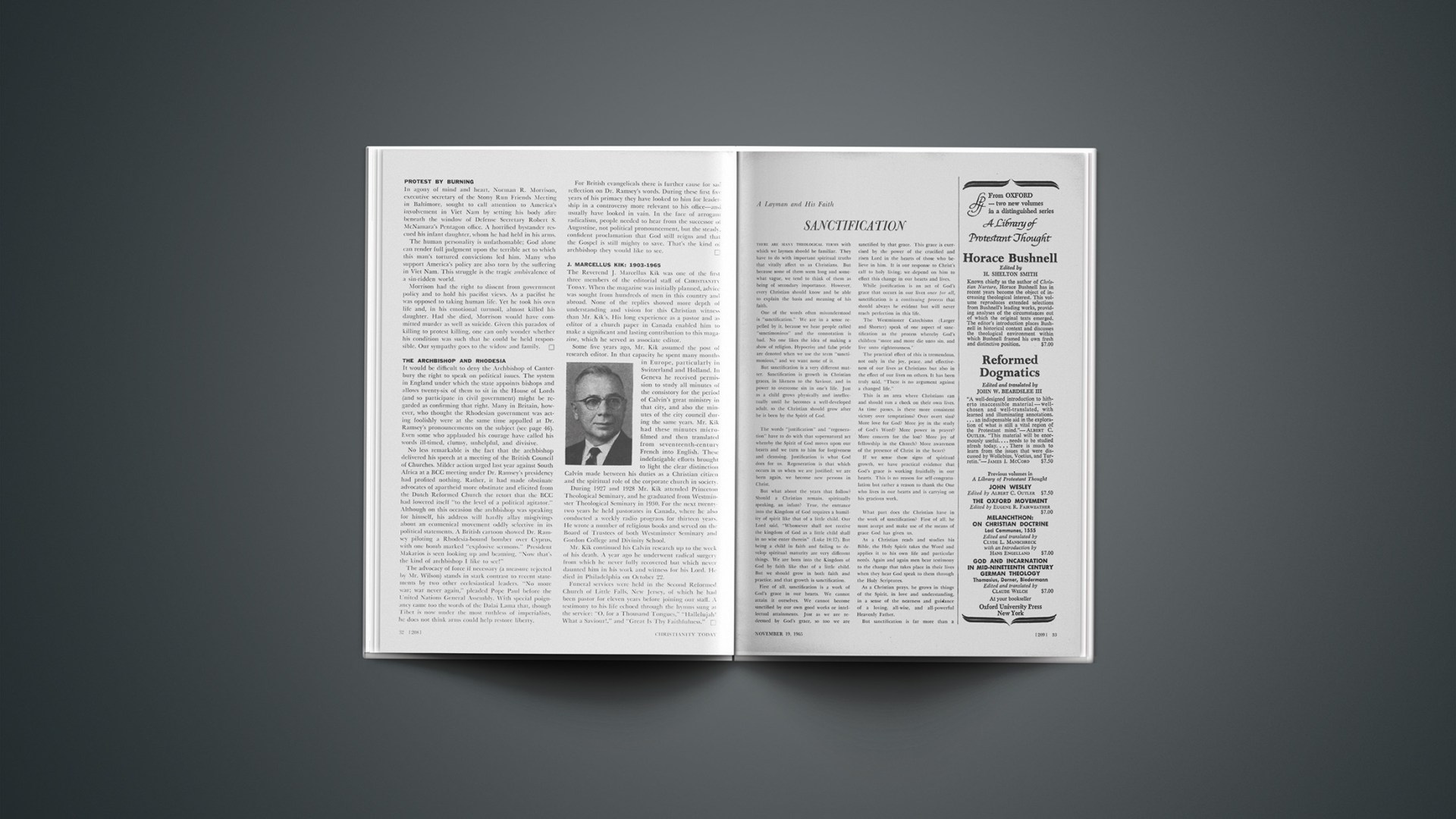
Sanctification

There are many theological terms with which we laymen should be familiar. They have to do with important spiritual truths that vitally affect us as Christians. But because some of them seem long and somewhat vague, we tend to think of them as being of secondary importance. However, every Christian should know and be able to explain the basis and meaning of his faith.

One of the words often misunderstood is “sanctification.” We are in a sense repelled by it, because we hear people called “sanctimonious” and the connotation is bad. No one likes the idea of making a show of religion. Hypocrisy and false pride are denoted when we use the term “sanctimonious,” and we want none of it.

But sanctification is a very different matter. Sanctification is growth in Christian graces, in likeness to the Saviour, and in power to overcome sin in one’s life. Just as a child grows physically and intellectually until he becomes a well-developed adult, so the Christian should grow after he is born by the Spirit of God.

The words “justification” and “regeneration” have to do with that supernatural act whereby the Spirit of God moves upon our hearts and we turn to him for forgiveness and cleansing. Justification is what God does for us. Regeneration is that which occurs in us when we are justified: we are born again, we become new persons in Christ.

But what about the years that follow? Should a Christian remain, spiritually speaking, an infant? True, the entrance into the Kingdom of God requires a humility of spirit like that of a little child. Our Lord said, “Whosoever shall not receive the kingdom of God as a little child shall in no wise enter therein” (Luke 18:17). But being a child in faith and failing to develop spiritual maturity are very different things. We are born into the Kingdom of God by faith like that of a little child. But we should grow in both faith and practice, and that growth is sanctification.

First of all, sanctification is a work of God’s grace in our hearts. We cannot attain it ourselves. We cannot become sanctified by our own good works or intellectual attainments. Just as we are redeemed by God’s grace, so too we are sanctified by that grace. This grace is exercised by the power of the crucified and risen Lord in the hearts of those who believe in him. It is our response to Christ’s call to holy living; we depend on him to effect this change in our hearts and lives.

While justification is an act of God’s grace that occurs in our lives once for all, sanctification is a continuing process that should always be evident but will never reach perfection in this life.

The Westminster Catechisms (Larger and Shorter) speak of one aspect of sanctification as the process whereby God’s children “more and more die unto sin, and live unto righteousness.”

The practical effect of this is tremendous, not only in the joy, peace, and effectiveness of our lives as Christians but also in the effect of our lives on others. It has been truly said, “There is no argument against a changed life.”

This is an area where Christians can and should run a check on their own lives. As time passes, is there more consistent victory over temptations? Over overt sins? More love for God? More joy in the study of God’s Word? More power in prayer? More concern for the lost? More joy of fellowship in the Church? More awareness of the presence of Christ in the heart?

If we sense these signs of spiritual growth, we have practical evidence that God’s grace is working fruitfully in our hearts. This is no reason for self-congratulation but rather a reason to thank the One who lives in our hearts and is carrying on his gracious work.

What part does the Christian have in the work of sanctification? First of all, he must accept and make use of the means of grace God has given us.

As a Christian reads and studies his Bible, the Holy Spirit takes the Word and applies it to his own life and particular needs. Again and again men bear testimony to the change that takes place in their lives when they hear God speak to them through the Holy Scriptures.

As a Christian prays, he grows in things of the Spirit, in love and understanding, in a sense of the nearness and guidance of a loving, all-wise, and all-powerful Heavenly Father.

But sanctification is far more than a passive exercise in the means of grace. Because it is a work of God’s Holy Spirit, the fruits of the Spirit begin to show in our lives. And as we receive their effect of joy and peace, there is also a growing change in our relations with others.

Such changes are not in full evidence at the beginning of the Christian walk; rather they develop as time goes on. Life becomes more disciplined. Concern for others increases. Love for God becomes more real and awareness of his will more compelling.

The Apostle Paul describes this work of God’s grace many times and in many ways. To the Corinthian Christians he wrote of his desire that they might “walk worthy of the Lord unto all pleasing, being fruitful in every good work, and increasing in the knowledge of God; strengthened with all might, according to his glorious power, unto all patience and longsuffering with joyfulness” (Col. 1:10, 11).

In his letter to the Philippian Christians he wrote: “That ye may be blameless and harmless, the sons of God, without rebuke, in the midst of a crooked and perverse nation, among whom ye shine as lights in the world; holding forth the word of life” (Phil. 2:15, 16a).

Does this mean that there is held out to the Christian the prospect of sinless perfection? Of course not! Sanctification is a continuing process all through life; no one will reach perfection until that day when we see the Lord in glory.

The greater the degree of sanctification, the greater the sense of one’s sinfulness and unworthiness. By this work of the Holy Spirit we increasingly see ourselves in the light of God’s holiness and realize the depths of his redeeming love—that we are redeemed not because of what we are or may have done but in spite of it.

There are two sides to the coin of sanctification—the working of God’s grace and the obedience of the believer. The Apostle Paul wrote the Christians in Philippi, “… work out your own salvation with fear and trembling; for it is God which worketh in you, both to will and to do of his good pleasure” (Phil. 2:12, 13).

Failure to grow in things of the Spirit is tragically common. A retarded Christian dishonors his Lord and lives a life in the valley of frustration and defeat when he should be treading more and more on the higher ground of victory.

Sanctification is a process of deepening faith, understanding, and obedience, and it pays abiding rewards.

“This is the will of God, even your sanctification” (1 Thess. 4:3a).

A Molder of Modern Theology Is Gone

I saw the American courage to go ahead, to try, to risk failures, to begin again after defeat, to lead an experimental life both in knowledge and in action, to be open toward the future, to participate in the creative process of nature and history. I also saw the dangers of this courage, old ones and new ones, and I confess that some of the new ones have begun to give me serious concern. Finally, I saw the point at which elements of anxiety have entered this courage and at which the existential problems have made an inroad among the younger generation.… Although this fact constitutes one of the new dangers, it also means openness for the fundamental question of human existence: “What am I?” the question which theology and philosophy both try to answer.—From Paul Tillich’s autobiographical reflections recorded in The Library of Living Theology: The Theology of Paul Tillich, Kegley and Bretall, editors.

Paul Tillich’s death removed from the current theological scene a leading molder of twentieth-century thought who was beyond doubt the most influential author of a systematic theology fashioned in America in this generation. Many intellectuals sharing the modern revolt against the supernatural were attracted by Tillich’s probing of science (including depth psychology), his retention of a theoretical apologetic and role for metaphysics in a non-metaphysical era, his postulation of the Unconditioned God of the depths “beyond naturalism and supernaturalism,” his view of faith as the state of absolute concern, and his espousal of the courage of self-affirmation in the face of meaninglessness.

Much of the appeal of Tillich’s thought lay in his emphasis on the ultimate unity of biblical religion and the philosophical quest for reality. Although these involve different methods of approach to reality, and different perspectives, the god of religion is identical—so Tillich insisted—with the ultimate reality that philosophy strives to know. A strength of Tillich’s religious view is the scope it allows for a doctrine of preservation of the world (his Unconditioned is the ground rather than creator of the world), for general revelation, and for history. It is true, of course, that he developed these interests in a nonbiblical way, though alternatively to Barth and Bultmann’s dismissal of general revelation and to Bultmann’s virtual espousal of a non-historical kerygma. Yet Tillich glimpsed a special side in revelation generally, and thus attached Judeo-Christian revelation to general revelation and history in a way that compromised its uniqueness. Along with other dialectical-existential theologians, he did not regard history as revelational (and therefore contended that historical criticism cannot impair revelation); yet he held that revelation does not occur apart from history. For Tillich the Christ-idea, a universal ideal toward which all men should aspire, took pre-eminence over the Jesus of history. His refusal to identify Jesus and the Christ led to the unscriptural notion that Jesus demonstrated himself to be the Christ by sacrificing “himself as Jesus to himself as the Christ” (Systematic Theology, II, 123).

But there was a timely thrust to Tillich’s warning against any effort to “use” God for personal, national, or cultural ends. (Evangelical theologians might well derive a similar warning from their own biblical heritage.) God is a fetish for many moderns, from the speeding taxi driver sporting his plastic madonna to the politician who advances his lust for power while invoking a tradition of piety. Even those who did not distinguish Tillich’s Unconditioned from the biblical Yahweh were given to spiritual decision when he unmasked their “ultimate concern” as alcohol, sex, or wealth. Yet Tillich’s exposition of “ultimate concern” was not unlike Schleiermacher’s “feeling of absolute dependence,” and at times he even spoke of Schleiermacher as his “spiritual father.” He detached divine transcendence from supernaturalism and put it in the context of a deity immanent in man’s experience and transcending man simply as the ground of experience.

Biblical theism he disdained as outdated and unsound. While dialectical theologians revived emphasis on the personal self-revealing God, Tillich considered unjustifiable any ascription of qualities to deity. He disparaged the long-standing Christian attempt to define God’s supernatural relation to the world literally in rational categories, and instead propounded a figurative or symbolic interpretation. Divine personality he viewed as mere symbolism. For Tillich, God is only symbolically personal—that is to say, he is continually “becoming a person” in divine relatedness to us (in our representations). The scriptural truths about divine love, mercy, and judgment Tillich reduced to symbolic statements of how the structures of existence are related to their ground, thus departing from essential Christianity.

This writer first met Tillich in Aberdeen, when Tillich was giving the first of two series of Gifford Lectures (later published in his Systematic Theology, completed only two years ago). A decade ago existentialism held little charm for Aberdonians, and, in contrast with the packed room that greeted Tillich’s final lectures earlier this year at the University of Chicago, the opening attendance was pathetically small. That night at dinner we talked of Kant’s shaping influence on the anti-intellectual theory of knowledge advocated by neo-orthodoxy and existentialism. Tillich considered the traditional Christian view—that divine revelation conveys information in the sense of conceptual and verbal knowledge of God’s nature and ways—to be “harmful.” Thus, in common with the views of Barth and Bultmann, his theory of revelation on its underside was slanted toward the Kantian exaggeration of the limits of human reason. Upon this revolt against the role of conceptual reason in religion Tillich superimposed a philosophical theology in which he allied “depth of reason” and faith against the dominance of “technical reason” in society. For him faith was existential, not theoretical knowledge.

What apparently impressed Tillich little, if at all, was the high cost of his loss of objective supernatural personal theism and the inadequacy of his proposed substitute, a non-objective, non-supernatural, impersonal Unconditioned. The self-revealing God of the Bible thus becomes a symbolic religious expression for a Tillichian substitute. Tillich’s view leaves no logical basis for speaking about the transcendent nature of God. His theology therefore fails to point a way out of the modern impasse in respect to divine transcendence, wherein speculative philosophers seek to speak of cognitive metaphysical knowledge while so-called theologians of “revelation” speak in super-rational postulations. For metaphysics worthy of the Christian religion, the center of revelation must be the Word, not symbol. In biblical theology, revelation is rational; the Scriptures profess to offer revealed truth given nowhere else.

Tillich’s social theory is also worthy of note, since it reaches back to his earlier years of teaching and writing in Germany. In the forepart of this century some Social Democrats abroad held that God is revolutionary, and that his kingdom, which was identified with Christian socialism, must therefore be implemented by revolutionary techniques because of the sluggishness of the churches. Tillich was the first non-Jewish professor to be dismissed by the Nazis. And in the decade before the Nazi revolution he gave philosophical leadership in Germany to Christian socialists who tried to discover how Christianity and Marxism could correct each other. Tillich’s move to the United States in 1933 came when religious socialism was making increasing inroads into church leadership. But instead of attracting alienated working classes to the churches, this theology led church officials into growing political involvement and commitment of the corporate church to radical social positions.

If Tillich widened the dissatisfaction with biblical theism among young intellectuals, it was his fate—like that of others of his contemporaries—to see his own alternative bypassed by a majority of scientifically minded moderns. Among the intellectual victims of scientism as well as the materialistic victims of Mammon, the gulf between modernity and revealed religion remains.

One of the most tragic vacuums in American religious life today exists in the ecumenical seminaries where doubt is as apparent as belief. The decline of ministerial candidates is noteworthy; young men are preferring other religious work to the pulpit, aware that many divinity schools are unsure of the essential content of Christian faith. Tillich encouraged doubt as a desirable element in the depths of faith, and he did this in a generation that needs to discover faith as a redeeming instrument in the depths of doubt. Our age has in common with Thomas and Peter and Paul the experience of a deep questioning of faith; what it lacks is the dynamic and triumphant faith of apostolic Christianity. The New Testament faith cannot be recovered or preserved by a demythologized theology or a detheologized vocabulary. The frustration of the displaced young intellectuals will continue until they turn from the myths of modernity to the evangelical witness.

Protest By Burning

In agony of mind and heart, Norman R. Morrison, executive secretary of the Stony Run Friends Meeting in Baltimore, sought to call attention to America’s involvement in Viet Nam by setting his body afire beneath the window of Defense Secretary Robert S. McNamara’s Pentagon office. A horrified bystander rescued his infant daughter, whom he had held in his arms.

The human personality is unfathomable; God alone can render full judgment upon the terrible act to which this man’s tortured convictions led him. Many who support America’s policy are also torn by the suffering in Viet Nam. This struggle is the tragic ambivalence of a sin-ridden world.

Morrison had the right to dissent from government policy and to hold his pacifist views. As a pacifist he was opposed to taking human life. Yet he took his own life and, in his emotional turmoil, almost killed his daughter. Had she died, Morrison would have committed murder as well as suicide. Given this paradox of killing to protest killing, one can only wonder whether his condition was such that he could be held responsible. Our sympathy goes to the widow and family.

The Archbishop And Rhodesia

It would be difficult to deny the Archbishop of Canterbury the right to speak on political issues. The system in England under which the state appoints bishops and allows twenty-six of them to sit in the House of Lords (and so participate in civil government) might be regarded as confirming that right. Many in Britain, however, who thought the Rhodesian government was acting foolishly were at the same time appalled at Dr. Ramsey’s pronouncements on the subject (see page 46). Even some who applauded his courage have called his words ill-timed, clumsy, unhelpful, and divisive.

No less remarkable is the fact that the archbishop delivered his speech at a meeting of the British Council of Churches. Milder action urged last year against South Africa at a BCC meeting under Dr. Ramsey’s presidency had profited nothing. Rather, it had made obstinate advocates of apartheid more obstinate and elicited from the Dutch Reformed Church the retort that the BCC had lowered itself “to the level of a political agitator.” Although on this occasion the archbishop was speaking for himself, his address will hardly allay misgivings about an ecumenical movement oddly selective in its political statements. A British cartoon showed Dr. Ramsey piloting a Rhodesia-bound bomber over Cyprus, with one bomb marked “explosive sermons.” President Makarios is seen looking up and beaming, “Now that’s the kind of archbishop I like to see!”

The advocacy of force if necessary (a measure rejected by Mr. Wilson) stands in stark contrast to recent statements by two other ecclesiastical leaders. “No more war; war never again,” pleaded Pope Paul before the United Nations General Assembly. With special poignancy came too the words of the Dalai Lama that, though Tibet is now under the most ruthless of imperialists, he does not think arms could help restore liberty.

For British evangelicals there is further cause for sad reflection on Dr. Ramsey’s words. During these first five years of his primacy they have looked to him for leadership in a controversy more relevant to his office—and usually have looked in vain. In the face of arrogant radicalism, people needed to hear from the successor of Augustine, not political pronouncement, but the steady, confident proclamation that God still reigns and that the Gospel is still mighty to save. That’s the kind of archbishop they would like to see.

J. Marcellus Kik: 1903–1965

The Reverend J. Marcellus Kik was one of the first three members of the editorial staff of CHRISTIANITY TODAY. When the magazine was initially planned, advice was sought from hundreds of men in this country and abroad. None of the replies showed more depth of understanding and vision for this Christian witness than Mr. Kik’s. His long experience as a pastor and as editor of a church paper in Canada enabled him to make a significant and lasting contribution to this magazine, which he served as associate editor.

Some five years ago, Mr. Kik assumed the post of research editor. In that capacity he spent many months in Europe, particularly in Switzerland and Holland. In Geneva he received permission to study all minutes of the consistory for the period of Calvin’s great ministry in that city, and also the minutes of the city council during the same years. Mr. Kik had these minutes microfilmed and then translated from seventeenth-century French into English. These indefatigable efforts brought to light the clear distinction Calvin made between his duties as a Christian citizen and the spiritual role of the corporate church in society.

During 1927 and 1928 Mr. Kik attended Princeton Theological Seminary, and he graduated from Westminster Theological Seminary in 1930. For the next twenty-two years he held pastorates in Canada, where he also conducted a weekly radio program for thirteen years. He wrote a number of religious books and served on the Board of Trustees of both Westminster Seminary and Gordon College and Divinity School.

Mr. Kik continued his Calvin research up to the week of his death. A year ago he underwent radical surgery from which he never fully recovered but which never daunted him in his work and witness for his Lord. He died in Philadelphia on October 22.

Funeral services were held in the Second Reformed Church of Little Falls, New Jersey, of which he had been pastor for eleven years before joining our staff. A testimony to his life echoed through the hymns sung at the service: “O, for a Thousand Tongues,” “Hallelujah! What a Saviour!,” and “Great Is Thy Faithfulness.”

A New Confession against Heresy

Among recent confessional statements there is one, little known to the English-speaking world, that stands out. The controversy that later gave birth to this confession came to light in 1961, when fifty persons in Württemberg, Germany, addressed an open letter to their church authorities and to the Lutheran faculty at the University of Tübingen. Signers of the letter, all non-professional theologians, were protesting the demythologizing influence of Bultmann on their younger pastors. The controversy thus pitted the congregational piety of the Lutheran laity against the prevailing theology taught in the German Lutheran faculties. From it came a remarkable confession composed by the presidium of the European Evangelical Alliance, a ministerial association. The following free translation was made by Dr. Henry Hamann, president of Concordia Seminary in Highgate, Australia:

Our Confession of the Holy Scripture

We remember with gratitude those theological instructors at universities and theological seminaries who as believing Christians led us into the treasures of the Holy Scriptures and who are still doing so.…

However, we declare with deep anxiety that certain movements of modern theology are gaining more and more ground which question truths of the Holy Scripture that cannot be surrendered, which falsify the Gospel through improper biblical criticism, confuse men by the importation of ideas foreign to the Gospel, and which endanger the full power of the message of salvation. Accordingly, we can no longer keep silent and feel ourselves obligated to utter a public warning against a theology which threatens the heart of our faith.

1. We confess the whole of the sacred Scriptures to be the Spirit-inspired revelation of God, which possess absolute authority, and which as the Word of God determine the teaching and life of believers. We reject the movement which views the Bible like any other document in the history of religion and which sees in it only the witness of special men favored by God, which, however, has no binding or authoritative meaning for us.

2. We accept our task to be that of setting forth the whole content of the sacred Scriptures in our exposition and proclamation of the Word of God, and of placing in its centre the heart of the Scripture, salvation in Christ. Accordingly, a proclamation which is based on an existential, demythologizing interpretation of Scripture we hold to be not only inadequate, but also misleading, because it does not give its full value to the work of God in Christ, which is the foundation of our faith, and because it thus robs preaching of its effective power and fulness. A proclamation with merely anthropocentric direction, making the new self-understanding of man its decisive principle, we reject, because it obscures the inner connection between the event of salvation and the witness to salvation.

3. We confess the reality of the living God who rules in holiness and majesty over the world, who deals with men in judgment and grace, in order to call them to Himself and to free them from sin and guilt. Accordingly, we cannot speak of God merely as the highest principle, the ground of being, the central point of our existence that defies closer definition, or understand Him even as a special form of love for humanity. Such a God is not the God and Father of our Lord Jesus Christ. In such a god we cannot trust, nor can we pray to him.

4. We confess Jesus Christ to be our Lord and Redeemer, who as God’s Son was sent by His Father into the world to bring to it salvation, and who died on the cross as an expiatory sacrifice for our sins to establish His eternal rule, until He comes again and brings about the completion of all things. Accordingly, we refuse to see in the historical Jesus only the rabbi of Nazareth, whose true person can no longer be known by us. We likewise hold it to be wrong to say that it was only the disciples who on the basis of their Easter experience made Him the one in whom we believe. On such a view His Messianic dignity and divine glory are taken away from Him. If it is only the honor of a prophet which is accorded Him in the days of His flesh, then He is no longer the incarnate Word in whom the fulness of the Godhead dwells, nor the Son of God with the authority to forgive sins.

5. We confess the saving acts of God which form the basis of our salvation and faith. Accordingly we reject the attempt to divest the saving acts of their decisive importance and to find the only valid saving occurrence in the word which is proclaimed here and now. The word of proclamation which has no anchorage in the action of God for our salvation becomes a freely floating word which no longer attests the truth.

6. We confess the powerful deed of God in the resurrection of Jesus Christ from the dead. Where the resurrection of Christ and with it the eternal divine existence of Christ are denied, as happens so widely in modern theology, there no personal access to Christ exists and no fellowship with Him. And then also the fact that the Church is the body of Christ is not something to be believed.

7. We confess the reality of the Holy Ghost and the powerful effects which come from Him. Therefore we add our testimony to that of the Holy Scriptures, that the Holy Spirit grants believers His gifts to the present day, keeps them in the true faith and the pure teaching, and brings forth in them the fruits of the Spirit. Where no reality is granted to the exalted, living Christ and His presence in the Church, there it is also difficult to believe in the Holy Ghost.

8. We confess the Scriptural teaching of the Last Things, the plan of God for the world and salvation, which will reach its goal at the end of time, beginning with the return of Christ. Therefore we reject that teaching which limits Biblical eschatology to the creation given with faith, and which rejects all statements of the Scripture which go beyond this as mythological and, therefore, as ideas not suitable for men of our age. The theology characterized by us in brief outline is determined by a reduction, or reinterpretation, or even falsification of fundamental Biblical truths. And it is for that reason also that its spiritual influence has been so extraordinarily meagre. But may God grant us the Spirit which leads into all truth and makes us fit for the service which is prescribed us and which we can properly carry out when we range ourselves in the full obedience of faith beneath the authority of the Holy Scriptures.

Ideas

Still the Word of God

The Bible still has its ancient power if read with open heart and receptive mind

There is in modern theology a strange and growing reluctance to refer to the Bible as “the Word of God.” This reluctance has gone so far that many speak of Holy Scripture as merely a human book. While they acknowledge that it bears witness to Christ as the incarnate Word of God, they deny that Scripture is actually God’s Word written. Ignoring the mass of biblical evidence equating Scripture with the utterance of God, and passing by Christ’s own authentication of its divine character, they reduce it to a human work. Others see it as no more than a book that through the agency of the Spirit has the potential of becoming the Word of God in the experience of those confronted by it.

If conservatism has at times slipped into an almost docetic view of Scripture that so stressed its divine character as to forget its human side, liberalism has gone to the opposite extreme of overlooking the truth that Scripture, while indeed written by men who retained their human characteristics and abilities, is nevertheless God-breathed and therefore originated under the inspiration of the Holy Spirit.

The modern attack upon the reality of Scripture as the Word of God runs counter to the Church’s unbroken testimony to its complete integrity. It does no honor to Jesus Christ to minimize the written Word that he, the incarnate Word, so constantly taught and relied upon. It is indeed passing strange that so many in this generation relegate to mere human effort the book that the apostles, church fathers, Reformers, and the greatest missionary leaders, evangelists, and preachers have all accepted as the Word of God. Had Luther considered Scripture only on its human level, he never could have declared, “My conscience is captive to the Word of God,” and there would never have been a Reformation. Similarly, had not Calvin accepted both the Old and New Testaments as God’s Word, as the Institutes abundantly indicate, there would never have been a Reformed theology.

The Bible is too great and dynamic a book to be shorn of its power by untraditional and unacceptable views of its nature. It is the Word of God, and regardless of what men think of it, it will remain so even though heaven and earth pass away.

The written Word can do what no other writing does. When it enters the human heart and is believed, darkness is dispelled and the light shines. It is the incorruptible seed whereby souls are born again. Its acceptance brings conviction of sin and cleansing of life. In it one learns the will of God. The Bible is the sourcebook of Christianity. Compared to it, all other writings, whether of saints, theologians, or scholars, are of secondary value and subsidiary authority. Rather than being just one among many religious writings, it stands apart from all other books, in a class by itself.

Only grievous harm can come to the Christian community when doubt is cast upon the unique authority of Scripture. To persuade a man that the Bible is not the Word of God and thus prevent him from taking it seriously is to take from him his spiritual capital. Every great revival in Christian history has been related to the Word of God. Even today, authentic Christianity in Red China survives through small meetings in homes where Christians at personal peril gather round the Scriptures. And if the English-speaking peoples of the world are in a state of moral decadence, it is because they are no longer actually the people of the Book.

The Bible is the Word of God. It still has its ancient power if read with an open heart and receptive mind. To insist that the Church today and its individual members, including its ministers, must get back to the Bible is no mere cliché. It is a call to face disturbing and imperative truth which, if honestly considered, makes radical claims upon the individual and upon society.

William Lyon Phelps once said that every Bible ought to have written on its cover these words: “Highly explosive, handle with care.” The Word of God is dynamite. Its truth can revolutionize life. Obedient to its teaching, men and women have left home and family to carry its message to the uttermost parts of the earth. But whether at home or abroad, those who take it seriously face the prospect of judgment upon their selfish ways and of being led through new paths of witness and service into the joys of their Lord.

A book that has such effects upon human life cannot be merely human.

China Revisited

In view of reactions the last time around, the National Council of Churches’ World Order Study Conference showed a certain boldness when it asked the United States to stop blocking Red China’s path to the United Nations (see News, p. 44). But boldness is not enough, and the seven years since the last World Order Conference have provided fresh evidence that Red China is a hoodlum nation with no legitimate interest in a world organization dedicated to peace.

Proponents of a seat for Mao’s China grasped at Pope Paul’s recent U. N. speech for help, but the Pope had merely expressed hope that all nations would “merit” admission. Red China’s “credentials” include an unyielding and unprincipled foreign policy that seeks to impose Communism through subversion, revolution, and armed force, as in Tibet.

The churchmen were even more presumptuous in offering advice on a situation as murky as that in Viet Nam after only hasty debate. Superficial treatment was guaranteed by a crammed, catchall agenda.

The NCC General Board will be faced with the problem of endorsing the sticky conclusions of the World Order Study Conference when it meets in Madison, Wisconsin, next month, and it may stress that the conference documents are not official. But official sanction is implicit in the St. Louis statements.

These activities, designed to give the NCC an upbeat image, have only tarnished its reputation. They are bound to cause discord, inasmuch as many sincere Christians cannot agree with the pronouncements. The secularized context in which the issues were debated suggests that the conferees were using church prestige to bolster prior political commitments, rather than injecting Christian principles into the secular sphere. Worse, their conclusions lend support to churchmen who are involved in social affairs to the neglect of proclaiming the Gospel of redemption.

Eutychus and His Kin: November 19, 1965

A few kind words for scholasticism

Typecasting

At a great university one time my wife and I were invited to what must be described as a “grand” dinner and were greatly impressed by being included. While we were standing about waiting for the dinner to begin, a very odd-looking character walked by, and I spoke the following imperishable words: “I wonder who let him in.” Shortly thereafter the aforesaid odd character was sitting at the head table, and shortly thereafter he gave the speech of the occasion. The man they had “let in” was an atomic physicist and a genuine genius. Either Hollywood or the picture magazines have somehow conditioned us to believe that heroes look like heroes, and geniuses like geniuses. It ain’t necessarily so!

“Genius,” said Alfred Noyes, “is exactly the opposite of what the clever people of today think it is. It arises in great simple persons, and masters them, and urges them on to ends that are beyond any that the conscious mind can aim at or attain.” Genius apparently is not something a person tries to put on or even develop. What happens to a genius is that something lays hold of him, and he is obsessed from then on with that something greater than himself from which he can never shake loose.

Some years ago a writer in one of our national magazines was relating interesting experiences in picking up hitchhikers. He said that he tried as far as possible not to pick up college boys, because they were generally such boring company. They tried too hard to be clever, and most of them had read just enough of Dale Carnegie to try using his mechanics to make the conversation just too, too interesting.

We might try all this on the ministry today, especially the young ministers. With all their getting, they might get humility. They have got all kinds of words. It would be better if the Word could get them.

EUTYCHUS II

Casting Type

The printer’s devil, if not theologically precise, was nonetheless active last issue (Nov. 5) in Patrick C. Rodger’s essay supporting organic church union. The garbled runover line connecting pages 6 and 7 should have read: “But the converse is also true: that it is only by seeking together for the pleroma, the fullness of truth, that the churches can hope to realize a genuine, as opposed to a spurious, unity.” This correction is published as a service to our readers. And to the essayist, our sincere regrets.—ED.

Intermural Debate

Gordon H. Clark’s readers have come to expect better things from him than “A Complete Reversal of Scholasticism” (Oct. 22 issue). The title of the article indicated that Professor Clark was at least superficially acquainted with the work of medieval scholasticism; yet the contents of this short essay were grossly misleading. Without defining the term “scholasticism,” Clark launched forth on a discussion studded with inadequacies. Nowhere does he mention that scholasticism was a tremendous effort to preserve, translate, organize, assimilate, and transmit antiquity’s store of learning—both pagan and Christian.…

The author rather quickly passes on to a mistake often made by those who have but little study in the medieval period. He writes that Aquinas “proved” the existence of God. Although Aquinas used the word “proof” (demonstratio), he was not using the term as we understand it and would be the first to admit it. He was trying to set forth “reasons of convenience” to show how the truth of faith “accords” with and suits what we know from our own experience. If Aquinas had been trying to do what Clark asserts he was doing, then the “Angelic Doctor” could hardly have written, as he did: “This is the extreme of human knowledge of God: to know that we do not know God”.… And, to leave the impression … that Aquinas was only a “laborious trifler” is dishonest.…

Professor Clark goes on to laugh slyly at that cute old story of those silly medievals sitting around discussing “how many angels can dance on the head of a pin” (not the point of a needle), without understanding that the subject under consideration was not really laughable at all. He would be even more amused by the discussion which has been recorded as occurring in a monastery on the Italian peninsula. The principals there debated for some days on the topic “how many teeth hath horse.” In both cases, the scholastics were pursuing serious questions. In the former, they were attempting to come to grips with the problem of “spirit”: What is it? What may it be likened to? Is it diffused or localized? How may we understand it? To put the topic in more contemporary language, they were searching for a religious x-factor. So also serious was the discourse on “how many teeth hath horse.” They were not really concerned as to the number of cuspids in the mouth of equus.… What they sought was a definitive understanding of the nature of “species”.…

CECIL B. CURREY

Assistant Professor of History

Nebraska Wesleyan University

Lincoln, Neb.

Mr. Currey’s letter contains some true and important observations. My title, “Fruits of the Reformation in Philosophy and Ethics” (not the editor’s in larger type), no doubt implies that I am at least superficially acquainted with medieval philosophy; yet it does not imply that I intended to write a history of it. Admittedly the article of fewer than 1,500 words is “studded with inadequacies” as to scholasticism. I am even willing to admit that it is inadequate as to the fruits of the Reformation.

At the same time, what I wrote is, I believe, correct. When Mr. Currey tries to maintain that St. Thomas did not intend to “demonstrate” the existence of God, but was only giving “reasons of convenience,” I am reminded of Thomas’s remarks in De veritate Q. 10. Art. 12, and passim: “Some have said, as Rabbi Moses relates, that the fact God exists is not self-evident, nor reached through demonstrations, but only accepted on faith.… [This] opinion is obviously false, for we find that the existence of God has been proved by the philosophers with unimpeachable proofs.” Further documentation may be found in my history of philosophy, Thales to Dewey (pp. 272–74). See also Etienne Gilson, The Philosophy of St. Thomas Aquinas, especially chapter 2. W. T. Jones also, in A History of Western Philosophy (I, 444), says that the Summa “is in fact a huge, logically organized structure of propositions, like a vast Euclid, in which the place of every proposition is determined by its logical relations to all the others.” Note that Euclid was not satisfied with “reasons of convenience.”

The same is true of Anselm as well. “Leaving Christ out of view, as if nothing had ever been heard of him. [Anselm’s argument] proves by absolute reasons [not only the existence of God, but even] the impossibility that any man should be saved without him.” He denies that his proof consists of aesthetic appreciation; he aims at rational proof, so as to convince one “unwilling to believe anything not previously proved by reason.”

Mr Currey says that I “laugh slyly at that cute old story” of angels dancing on the point of a needle. He assures us that it was not the point of a needle but the head of a pin. If Mr. Currey can show me the texts in which such a debate took place, I would be happy to see them. I admit my ignorance: I have not found any manuscript evidence that such a debate took place. As for the relation between spirits and space, and whether the Aristotelian form horse has teeth, these matters were not germane to my subject. Like so much else, therefore, they were omitted.

GORDON H. CLARK

Butler University Professor of Philosophy

Indianapolis, Ind.

More On The Social Struggle

During the past ten years I have been a faithful and avid reader of CHRISTIANITY TODAY and have been extremely benefitted by each issue.… “Evangelicals in the Social Struggle” (Oct. 8 issue) is a tremendous editorial and gives some answers that I feel the people of my church ought to have. I am wondering if this particular editorial has been, or will be, in a separate issue, such as a tract. If so, I would like to have fifty copies.…

LEWIS C. HOHENSTEIN

First Brethren

Whittier, Calif.

• We regret that reprints are unavailable. But next spring a volume on Christianity and Current Concerns will include “Evangelicals in the Social Struggle” along with the editor’s Griffith Thomas Memorial Lectures at Dallas Theological Seminary and other unpublished recent addresses.—ED.

I do not see any alternative whatsoever in what the evangelicals offer.

If I understand what the “evangelicals” are or pose to be, they are primarily an attempted resurrection of the defunct fundamentalist movement that has risen in the past fifty years or so, and which in turn was an attempt to revise decadent Calvinism and Reformism. It appears now that neo-evangelicalism is primarily a religious front for extremist rightist political and economic conservatism, rather than anything truly Christian.…

THOMAS D. HERSEY

The Methodist Church

Kellerton, Iowa

For Tube-Watchers

Clowney’s contribution of counterpoint (“Sound and Fury: The New Year in Television,” Oct. 22 issue) should be more than eye-opening to tube-watchers. It calls us to discriminate viewing and discipline after dark.…

JOHN LEWIS GILMORE

Mount Hermon United Church of Christ

Philadelphia, Pa.

The Case Against Pike

In reference to “Greek Philosophy or Biblical Truth?” (Oct. 8 issue), is the case against Bishop Pike to rest merely on the questionable exegesis of a biblical verse, his refusal to make an idol of certain formulations of theology, and a hermeneutics with which Politzer disagrees? Luther and Calvin would fall under the same condemnation, and so too would Dean Colet of St. Paul’s (d. 1519) and Richard Hooker (d. 1600). Do the Archbishops William Temple and Michael Ramsey belong to the Anglican tradition, the tradition of the Episcopal Church? If so, then why call Bishop Pike a deviationist? Does Politzer have any evidence that Bishop Pike has ever denied a belief in the Trinity or any other essentials of Christian belief? If so, let him state his case. In the meantime, a lot of us, fully aware that statements like the Athanasian Creed make no sense today, will keep trying to formulate the basic Christian beliefs in terms that our own people in a worshiping community can understand.

LEE A. BELFORD

The Episcopal Church of the Epiphany

New York, N. Y.

Concerning Dr. Belford’s letter, it is acknowledged that many theologians can be charged with occasional questionable exegesis. But to base one’s whole program of theological reconstruction upon an erroneous interpretation of Scripture, as Bishop Pike does, is to build upon a foundation of sand. I disagree with his use of Aristotelian hermeneutics because I am unable to find one responsible biblical commentator who does agree with this unbiblical approach to the interpretation of Scripture.

For the Church to affirm that the doctrines of the Trinity, the Atonement, and the Incarnation, along with the Scriptures, creeds, sacraments, and apostolic ministry, are essential for her existence is not to make idols of any of these things. A chemist who affirms that oxygen is essential to the life process is not making an idol of that element. He is stating a simple fact that should be known by anyone who has any knowledge of the subject.

In a widely publicized sermon preached at the opening of the General Convention of the Episcopal Church in St. Louis last fall, Bishop Pike referred to the doctrine of the Holy Trinity as being “excess luggage” and an “outdated liturgical formula.” In contrast, Archbishop Michael Ramsey, in a sermon based on Second Corinthians 13:14 delivered this past spring in Grace Cathedral, San Francisco, proclaimed the essential nature of the doctrine of the Trinity to the life and teaching of the Church. The late Archbishop William Temple delayed his ordination to the sacred ministry for two years until he could give full assent to the doctrine of the Virgin Birth of our Lord. There is no doubt that the teaching of these two men belongs to the Anglican tradition and the tradition of the Episcopal Church. There is reason, however, to question the teaching of Bishop Pike.…

JEROME F. POLITZER

St. George’s Episcopal Church

Salinas, Calif.

Apple PodcastsDown ArrowDown ArrowDown Arrowarrow_left_altLeft ArrowLeft ArrowRight ArrowRight ArrowRight Arrowarrow_up_altUp ArrowUp ArrowAvailable at Amazoncaret-downCloseCloseEmailEmailExpandExpandExternalExternalFacebookfacebook-squareGiftGiftGooglegoogleGoogle KeephamburgerInstagraminstagram-squareLinkLinklinkedin-squareListenListenListenChristianity TodayCT Creative Studio Logologo_orgMegaphoneMenuMenupausePinterestPlayPlayPocketPodcastRSSRSSSaveSaveSaveSearchSearchsearchSpotifyStitcherTelegramTable of ContentsTable of Contentstwitter-squareWhatsAppXYouTubeYouTube