Cover Story

Quiet Revolt in Gospel Music

Should a church musician perform what he considers good music or what the people in the pews want?

The musician is the man in the middle. He’s “torn apart,” in the phrase of Don Hustad, who, as a member of Billy Graham’s crusade team, is one of America’s most-heard organists.

There are two extremes, he says: those who judge music only by artistic ideals and those who aim only at the desires of the listener. “The two crowds are at each other’s throats constantly.”

Many music directors face pragmatic pressures: the sort of music they prefer is beyond the singing abilities of their choirs and congregations. Either they do poor music well or they do good music poorly. Besides this, what they consider worshipful may not mean much to the laymen.

Such artistic tensions hit hardest at evangelical churches, which often have small budgets, informal worship, and a tradition of entertainment-styled music. A growing core of trained musicians hopes to educate evangelicals away from their musical past.

Hustad is a leader in a key educational effort, the National Church Music Fellowship. Its program for small evangelical denominations and independent churches and colleges parallels that of mainline denominational efforts. Yet NCMF, which was fourteen years old at its convention last month in New York, predates such groups as the National Fellowship of Methodist Musicians and the Lutheran Society for Worship, Music and the Arts.

Hustad contends that these music societies are part of a renaissance in church music which has been taking place since World War II and which is the most important development in the professional music world. Other evidence: the growth of church music as a fulltime, lifetime vocation; better college courses; more music written and more written about music.

There are some crazy crosscurrents today in religious music. Some Christians seek to regain the lost heritage of ancient music, while others want immediacy with society through such means as current folk music. While evangelicals try to banish the influences of popular music, liturgical churches experiment with jazz in worship.

At the NCMF convention, the style of gospel music common in the constituency got short shrift. These comments from monographs in NCMF’s new publications program reflect the unrest among the leaders:

“Why is the Church so often the haven of the banal and the home of the tawdry?” asks Harold M. Best, music professor at Nyack Missionary College. “By what distorted decree of the human spirit must the glory of Christ be pitifully squeezed into the dry-rotted skins of a withered vocabulary?”

Lee Olson, chairman of Nyack’s sacred music division, contends that “the gospel hymn melodies call too much attention to themselves and not enough to the text.… This humanization of the gospel hymn is only a reflection of the spiritual state of the evangelical church.”

The NCMF president, Alfred E. Lunde of Philadelphia College of Bible, issued a stinging attack on the entertainment cult among gospel music publishers and record companies. Publishers justified this as an economic necessity (see the following story).

The NCMF ran anthem and music essay contests this year but considered none of the entries worthy of an award. This led Houghton College’s Charles H. Finney to remark that many evangelical composers are “technically incompetent … not up to the average of our more liberal friends.…”

Changes are due. Nyack has become the first Bible school with a fully accredited music school. Moody Bible Institute was on the road to professional standards when Hustad left as chairman, reportedly because administrators feared too much of a break with tradition and possible de-emphasis of Scripture courses.

Hustad, who sidesteps comment on that situation, is now advising the blonde, energetic Lunde and his colleagues, who plan on pioneering a five-year music degree with a core of Bible courses at Philadelphia.

Lunde thinks a critical soft spot is ministers’ attitudes. He says he never heard a word about music during four years in seminary. The problem is widespread. An NCMF survey of seminaries accredited by the American Association of Theological Schools showed dozens offer no courses in music.

The NCMF is growing but with 488 members cannot be called strong, and leaders fear they’re not getting through to the local church. Similarly, the Methodist music fellowship has 1,750 members, but there are 39,000 Methodist congregations. At this summer’s convention, a cry went out for a Methodist music leader—if not a fulltime professional—for each congregation.

One of NCMF’s strengths is the variety among its members. Lutheran and Regular Baptist listened with equal interest as an Alliance speaker discussed the importance of liturgical revival.

Music has proved an important ecumenical meeting point. The 2,500-member Lutheran society was one of the first cooperative ventures among the Lutheran Church in America, Missouri Synod, and American Lutheran Church. New President Paul O. Manz of St. Paul said the society plans a series of intensive, one-week courses in various cities this year to help church musicians brush up.

Another seminar for church musicians was held late last month at Louisville’s Southern Baptist Theological Seminary. The Southern Baptists have one of the largest denominational music efforts (see “Revolution in the Choir Loft,” News, March 27, 1964).

Similarly, the Episcopalians’ graduate-level College of Church Musicians in Washington, D. C., sponsored a two-day seminar the same days NCMF met. The college itself is significant, Now beginning its fourth year, it is the only school in America designed for the church organist and choirmaster. The select student body of fifteen includes eight non-Episcopal students.

In all this activity and change, some leading musicians want to preserve a place for the gospel song. One is the young dean of Baltimore’s famous Peabody Conservatory. Ray E. Robinson. Baptist Robinson edits NCMF’s smart new Dimension quarterly. He spent a decade in Youth for Christ music, where he said the programmers’ motive was entertainment, not worship.

The gospel song should have a role in evangelism, he said, and is “appropriate whenever people tell people what the Saviour has done for them, in good taste, as an outgrowth of worship.”

“You draw your own kind,” he concluded. “Christ, presented superficially, attracts superficial people.”

Hustad, who holds a doctorate in church music from Northwestern University, would agree. In his present job he faces these problems head-on. He admits many songs at Graham crusades do not satisfy him artistically, but he gets “vicarious pleasure” from seeing their effect on others.

The big-framed, congenial organist thinks that the “highly specialized” crusade music should he no “measuring stick” for church programming. “It is spiritually unhealthy to dote on my experience with Christ all the time. Me, me, me! We must exalt the excellencies of Christ also.”

But Hustad does not want to see gospel music traditions neglected, as he believes Southern Baptists are doing. “If we believe in a personal experience with God, it has to he expressed,” he said. Though “untutored, in artless words,” the gospel song can be meaningful, as well as being true folk music.

The gospel songs of recent decades, he fears, have sapped emphasis on hymns to such an extent that congregational singing and hymn-writing have suffered. “This is a negative symptom of revivalism,” he said. “When the Church prospers spiritually, there is a great flowering of song.”

Motives For Music Publishers

“We’re not real proud of everything we publish,” confessed a religious music salesman, but his company can’t take a chance on anthems the highbrows want.

“The people in the sticks couldn’t do them, and the people in the audience in the sticks couldn’t appreciate them,” Lorenz’s Eugene McCluskey told members of the National Church Music Federation during a publishers’ panel (see story above). He said Lorenz is in business to sell to the mainstream, not form tastes.

“A brutal business,” lamented his colleague, Robert J. Hughes. He said Lorenz and two other publishers represented at the conference, Hope and Rodeheaver, had bought out other houses that went broke trying to sell what people ought to sing, rather than what they will sing.

Music just for music’s sake is “vanity,” hence “unchristian,” he added. “You can’t tell people how to worship.”

The sales vs. quality debate seethes away, not only in music but also in book publishing and other trades. But some take a different view of economies.

Donald Griffith of Franco Colombo, which publishes mostly contemporary music, asserted: “For music we publish, we must create the demand. It costs very little to publish a twenty-five-cent octavo. The risk is in publicizing it.… We can help to set standards. If we have an experimental number we like, small sales over five years will pay the cost of publishing it.”

Concordia’s E. W. Klammer also took the high road, made easier because his house is part of the Lutheran Church—Missouri Synod. A denominational publisher has a financial cushion if it fails in market competition. This produces some rivalry between church houses and independents. For instance, Lillenas, the Church of the Nazarene publisher, is accused of undercutting independents because it offers anthems at fifteen or twenty cents below what unsubsidized publishers can afford.

Klammer said the starting point in religious music should be “the theology of worship,” not money. He echoed Missouri’s liturgical and historic character in saying music took a “nosedive” after Bach, from which it is still recovering. But he said Concordia is also interested in what men are writing now, since “God is always contemporary.”

“We definitely try to change tastes; not for the sake of change, but for the sake of the Gospel. We publish things we know won’t sell very well.…” He said Concordia favors texts based on the Bible, “not mixed with subjective reactions by the author.”

Wesley Bartlett said Carl Fischer, one of the secular publishing giants, is in business partly to improve public taste, and it consciously prints some popular, low-grade items so it can afford to publish prestige numbers. He advised composers to “have something striking in your music” that will stand out in the mountain of new pieces coming out daily.

Feeling The Draft

Draft-dodging has grown from covert art to organized rebellion during the Viet Nam escalation. The United Church of Christ executive council says the current campaign, which includes public burning of draft cards, subverts the legitimate religious principle of conscientious objection. Groups of sincere religious pacifists fear their cause is being degraded by the come-lately college demonstrators.

The swelling troop commitment overseas has produced a critical need for chaplains. The Pentagon offers no specifics on the number needed, but Army Chief of Chaplains Charles E. Brown, Jr., has asked churches for “several hundred” more new recruits this year.

The Methodist Commission on Chaplains is to double its supply. Normally it provides twenty new chaplains, added to a current Methodist force of 493 on duty.

The National Association of Evangelicals, clearing agency for forty small denominations, has a new quota of ninety, up ten.
After the Fair: Converts and Red Ink

It was the costliest, most-attended fair in history. Some predict it will be the last great fair where industrial giants invest untold millions for elusive publicity gains.

The 51 million who visited the New York World’s Fair were 19 million short of expectations. The general disillusionment and charges of mismanagement dulled the glitter of Flushing Meadow as surely as did widespread pilfering by visitors the last weekend.

On closing day, one group of exhibitors were content with their lot: the religions at this most religious of world’s fairs.

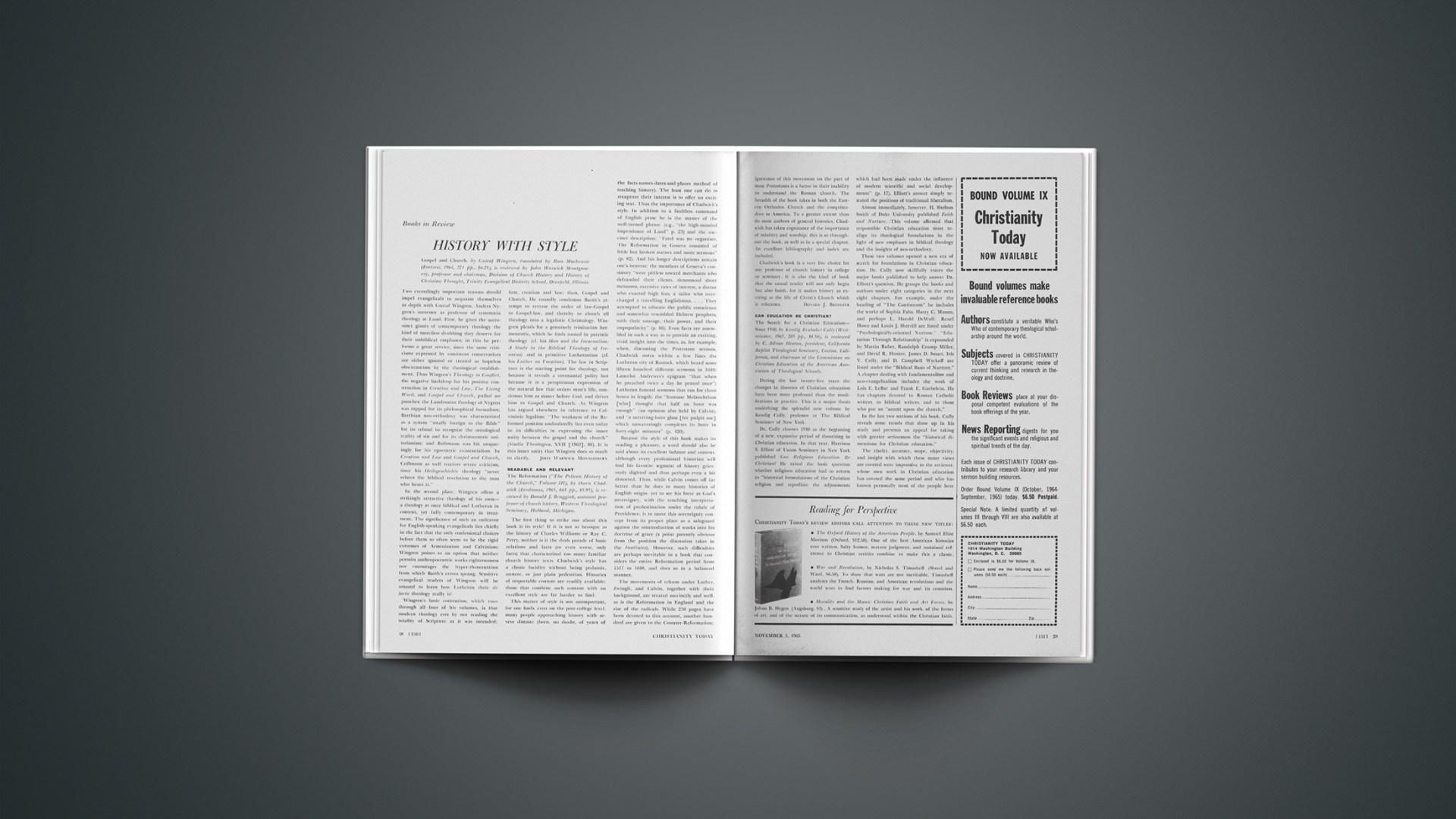
Cardinal Spellman was reluctant to get involved at first, but the Roman Catholic Church scored a smashing box-office coup. It offered, for free, a priceless show: Michelangelo’s world-traveling “Pieta” and other art treasures. The Vatican Pavilion drew half the people who came to the fair. It was second only to General Motors in attendance.

GM’s pavilion cost it $2 per visitor. Although the Vatican had the most expensive religious pavilion, it spent only nineteen cents per head. The posh Christian Science effort cost $1.56 per visitor. The religious pavilions as a whole spent over $13 million to draw 42¼ million people. In Madison Avenue terms, they notched a cost-per-thousand of $315.

The two cults with pavilions at Flushing Meadow, Christian Science and Mormonism, report their experiment in pavilion evangelism paid off in thousands of converts. More modest results were claimed by two Christian evangelistic efforts, Billy Graham’s pavilion and “Sermons from Science.”

The low-budget, low-key Wycliffe Bible Translators presentation gave the fair its foreign missions element. Wycliffe squeezed into the fair after the deadline, and despite some financial strain won unusual notice on TV networks, in the press, and from iconoclastic radio essayist Jean Shepherd.

The four pavilions not backed by a single church depended on donations to break even. Only Billy Graham managed to do it.

The biggest debt was at the Protestant-Orthodox Center, which is behind $250,000, mostly because churches failed to meet pledges.

It is counting on its controversial drawing card, the Parable film, to make up the difference at $35 per showing. Sponsors report more than 5,000 rental requests have come in, nearly half of them from Catholics.

At the fair, the film drew only half a million customers at fifty cents a scat—this despite pre-fair publicity in damnation from fair czar Robert Moses and continued notoriety through a diatribe at the nearby Singer Bowl from youth evangelist Jack Wyrtzen. The free Graham film, twice as long, attracted twice as many customers.

Free shows helped to draw the masses. Location was another key factor. On this score, the Mormon. Protestant-Orthodox, and Billy Graham pavilions had choice sites near the main subway-railroad gate.

Here are the religious results of the fair, as reported by pavilion managers:

BILLY GRAHAM—(Dan Piatt): More than a million saw the film, which called for commitment to Christ. About 5 per cent of the viewers sought counseling, a higher percentage than at most crusades.

Those responding came from fifty-five nations, and follow-up work was often difficult. The usual procedure is to refer the person to a nearby church, but in some cases it was hundreds of miles away. An impressed Catholic priest from Belgium told Piatt he would try to persuade his colleagues to invite Graham for another European crusade.

CHRISTIAN SCIENCE—(Admiral Edward C. Renfro): “The pavilion was one of the finest things the movement has done in many a year. Its effects have been widespread and indeterminable.” The pavilion aimed to explain Christian Science to the outsider, but also succeeded in producing new members (how many, like all membership data, is a state secret).

With the self-assurance typical of his church, Renfro said the pavilion was the “only one which dared mention God and explain who he is, what he is, and what we believe him to be.” The church recently recruited the Protestant pavilion’s Dr. G. B. Rich to praise the beauty of the Christian Science effort in a publicity film.

MORMON—(Bernard P. Brockbank): The pavilion is credited with reaping thousands of converts, more than 1,000 in the New York area alone. The full results can’t be known for years, because it will take that long for Mormon missionaries to contact the backlog of 750,000 persons Brockbank says asked for counseling.

“It changed the attitude toward the church in many parts of the country, especially the Eastern seaboard. They are more tolerant toward the Latter-Day Saints, more ready to make inquiry about us.”

PROTESTANT-ORTHODOX CENTER—(Leonard Moreland): The impact was “excellent,” the attendance higher than expected.

Moreland thought that Parable was provocative but that its symbolism went over the heads of many viewers. One professional fairgoer claims to have seen it 101 times and to have gotten something different out of it each time.

Polls showed Catholics liked the film better than Protestants and Jews liked it more than Catholics. Aside from the film, Moreland questions whether the twenty-two variegated booths at the pavilion did anything more than reinforce the constituencies of their sponsors.

SERMONS FROM SCIENCE—(W. Scott Nyborg): “We are thrilled.… The acceptance by non-Christians was amazing.”

Among the 125,000 who entered the counseling room after the Moody Institute of Science shows, 3,300 indicated decisions for Christ. While most pavilions, and the fair as a whole, drew smaller crowds the second year, “Sermons” audiences were up 35 per cent.

A large corps has contacted decision-makers, in some cases to find Mormons had already dropped by. Many nuns, intrigued by the four-step salvation presentation borrowed from Campus Crusade, asked for copies to present to their Catholic school classes.

VATICAN—(Monsignor John J. Gorman): “It was with some apprehension that the powers-that-be accepted the invitation to the fair. But I’m sure there are no regrets now. We had an opportunity to present the Church, and had good reception from the Protestant, the Jew, and the atheist.…”

WYCLIFFE 2,000 TRIBES—(Francis B. Dawson): “It was definitely worthwhile. We expect it to pay off for ten years or more. We had a chance to meet young folks and counsel them about missions. Many people hadn’t heard about Wycliffe before.” There were some heated discussions with people hostile toward missions, but many left with a different view, Dawson said.

Wycliffe, like most, ended up spending more than it expected, and the gap between cost and gifts for the pavilion is $155,000. All bills have been paid, by shifting funds; but it is the first financial bind of this size Wycliffe has ever been in, and there has been some controversy about it within the organization. The key problem: Wycliffe had planned to charge admission but soon found that if it did this, nobody would come.

Next Stop: Montreal

Flushing Meadow pavilions weren’t even down before eyes roamed to Montreal, site of EXPO ’67.

This next great superfair will feature the most ecumenical pavilion ever, a “Christian Pavilion” offered by Roman Catholics and seven Protestant groups (the latter with 60 per cent of the voting power). No role is currently planned for Orthodox churches.

The man who expects to direct it is Leonard Moreland, 64, lately the associate director of the New York fair’s Protestant-Orthodox Center.

His trim, white moustache nearly bristles in anticipation. “Roman Catholics and Protestants will promote a common purpose for the first time,” he said in his pavilion office during the twilight of Flushing. Moreland nibbled on a 7 P.M. ham sandwich that sufficed for supper. Behind him were charts tracing attendance and, scrawled on the wall, a big black “5” marking days to go.

The trouble in New York, he said, was “a rather abortive feeling of fragmentation … a cacophony of twenty-two exhibits” in contrast to other religious pavilions. Even so, he thinks of New York as a stepping-stone to Montreal, since it was a “pinnacle” in Protestant cooperative efforts.

But when it was over, he said, there was none of the “resurgence” he felt after participating in Billy Graham’s New York crusade.

Moreland predicted the Montreal program “will contain the art and culture of Christianity, and probably a motion picture.” One handicap: the classic Vatican art treasures reportedly won’t be available.

The EXPO umbrella is too wide for some groups, including the Billy Graham Association Moreland praised. It bowed out because it was prohibited from asking for commitments to Christ. But an evangelistic effort at Seattle and New York. “Sermons from Science,” is to reopen at Montreal under the chairmanship of Stanley Mackey.

Christian Science, present at the past two fairs, won’t be at EXPO. Said publicist David Sleeper, “They are presenting Christianity in one voice. We can’t say what our specific message is for mankind.”

Moreland, who is “retired” from Sperry Rand, put in seven long days a week for nearly three years, without pay, at the New York fairsite. But the day after it closed, he hopped a plane for Montreal to help get that show on the road.

Fusion And Feuds

The New York City Presbytery talked it over for an hour, then decided not to endorse John Lindsay for mayor. However, it did everything but. Its election advice, supposed to be read from 119 Presbyterian pulpits, echoed the Fusion candidate’s call for radical change at city hall and urged churches to get “involved” in the campaign.

Young Lindsay has fused Republicans and Liberals in a bold attempt to oust the entrenched Democratic regime and has attracted other ministerial backing. The Rev. Howard Moody of Judson Memorial Church (Baptist-United Church of Christ) is co-chairman of the Democrats for Lindsay movement. Leading Unitarian Dr. Donald S. Harrington said in a recent sermon that New York is a mess, that its citizens should “rise up and demand a decently governed city,” and that the only man who can change things is Lindsay.

But Lindsay could lose the election because of third-party inroads by Conservative candidate William F. Buckley, Jr. Religion became an issue when Lindsay’s Roman Catholic running mate for council president, Dr. Timothy Costello, questioned how good a Catholic Buckley is.

Close on the heels of Pope Paul’s historic trip to New York, Costello said a vote for Buckley November 2 would be anti-Catholic, against church teachings on the United Nations and on treatment of the poor and minority groups.

Costello charged Buckley’s doctrines are a “threat … to peace on earth, to the progress of the nation, the uplifting of our city, and the propagation of the social doctrine of the Catholic Church.” He spoke at Fordham University, from which he has received three degrees.

The deft-tongued Buckley, author of God and Man at Yale and editor of the National Review, replied that he would not “disgrace the Catholic Church by introducing the religions of the other candidates as issues of the campaign.” He also said he would lodge a protest with the Fair Campaign Practices Committee.

“One of the meanings of the Vatican Council is to stress the freedom within the Church, which encompasses men of many political faiths, now as before. If I am a bad Catholic, I shall be punished by Someone I fear far more than the New York Catholic voter.”

But the Catholic voter is worth fearing. He forms the largest religious bloc in a town where election tickets are famous for ethnic “balance.”

The Democratic candidate, Abraham D. Beame, is Jewish, while Lindsay is an Episcopalian. Of the moral issues of the campaign, all three hopefuls agree that crime is a pressing problem for New York.

Both Lindsay and Beame, by far the front-running candidates, have backed legalized off-track betting to help solve the city’s budget headaches. The proposal to give racetrack rakeoffs to the city instead of to bookies has been opposed consistently by the New York State Council of Churches, the Protestant Council of the City of New York, and the most prominent member of Lindsay’s party, Governor Nelson Rockefeller.

Costello’s statement was not the first Fusion bid for Catholic support. In September, Lindsay came out for limited tax assistance to Catholic and other private schools. He said that for now the aid should be carefully meted out to areas with serious overcrowding, to be used for equipment.

Paul’S Visit Revisited

The TV camera settled on a make-believe publicist phoning Pope Paul about the Yankee Stadium mass on the eve of his New York visit:

“… It would be an added attraction if there was an exhibition baseball game beforehand, between the New York Yankees and, in your honor, the St. Louis Cardinals. How does that grab you, Your Holiness?… Exactly. Sort of an ecclesiastical double-header. Now, then, we feel Your Holiness could attract an even larger number of viewers, and, incidentally, win your way into the hearts of every single American, if you would consent to just umpire a few innings of the game.… Why just think: you’d be the first umpire in the history of baseball really and truly infallible.…”

Many of the estimated three million persons who saw this satire on the Canadian Broadcasting Corporation network wondered whether anything was sacred. But the government-owned CBC’s latest quirk of courage enlivened a lackluster election campaign in Canada, where half the population is Roman Catholic.

A Presbyterian member of Parliament, Ralph Cowan, called it an “affront.” The show’s producer said the skit derided the TV industry, not Pope Paul. But the timing was unfortunate: the program followed a showing of the annual “Living Rosary” hour from Toronto, attended by 25,000 of the faithful in another instance of stadium sacrament.

South of the border, the Greek Orthodox archdiocese confirmed Religious News Service’s hunch that the Pope had met under wraps with Archbishop Iakovos in New York. The main topic: purported harrassment of Orthodox believers and Patriarch Athenagoras I in Turkey. Paul reportedly promised support.

Most of the criticism of Paul’s words in the New World focused on his U. N. assault on “artificial” birth control (see CHRISTIANITY TODAY, Oct. 22, 1965).

Blunt E. S. James, retiring editor of the Baptist Standard, was upset at all the free TV network time to cover the Yankee Stadium mass. Senator Claiborne Pell, a Protestant from predominantly Catholic Rhode Island, used the occasion of the visit to call for restudy of America’s policy against diplomatic links with Vatican City.

Cuban Exodus

A new wave of Cuban refugees began flowing into Florida last month, and religious agencies readied plans for relief and resettlement efforts. A mass exodus is expected if the U. S. government completes negotiations with Fidel Castro, who has promised to free thousands of people.

The welcome for the new refugees will not be so warm as that for the Cubans who preceded them to the American haven between 1960 and 1963. So many of that wave—perhaps 420,000—are packed into Miami and other Florida communities that they have burdened schools and hospitals and forced Negro laborers out of unskilled jobs. Even the earlier refugees fear the arrival of the new wave.

Religious leaders are pleading for “Christian compassion.” The Greater Miami Ministerial Association was the first to warn that community feelings were at a dangerous point, and to plead for acceptance of the Cubans. The cause was joined by the Greater Miami Council of Churches and Roman Catholic Bishop Coleman F. Carroll.

The council is ready with “all the practical assistance possible through resettlement, emergency relief, and social services” for the influx. Church World Service reports readiness for help in moving Cubans from Florida to other parts of the nation, and in adjustments necessary after families’ long separation.

Protestants have compiled a backlog of resettlement opportunities; they support a coordinated program for meeting emergency needs in three still-operating refugee centers and in two others that are being reactivated. The Catholic diocese has readied a downtown refugee center with food, medical treatment, and counseling. Nuns will conduct English classes.

ADON TAFT

Billy Graham Convalesces

Ailing evangelist Billy Graham, finding the road to recovery longer than expected, postponed his Houston crusade for a second time. The new dates are November 19–28.

When Graham underwent prostate surgery in early September, the crusade opening was shifted from October 8 to 15. But an infection developed, and physicians ordered him back to bed.

With the longer delay, crusade planners rescheduled a special student service to be telecast to 100 or more colleges and high schools across Texas via an educational channel. Public services will be held nightly in the new Astrodome.

From Switzerland last month came the cheerful news that Graham and his wife had become grandparents for the second time. Their oldest daughter. Virginia Tchvidijian, who is married to a Swiss, gave birth to an 8½-pound girl. The Tchvidijians, who also have a nineteen-month-old son, named the girl Virginia Bergett.

Graham also had encouraging news from London, where a major crusade is scheduled for next June. The Church of England Newspaper, which reflects evangelical views among Anglicans, conducted a poll among its readers and reported an overwhelming majority enthusiastic about the forthcoming crusade. The poll also asked, “Do you believe the Church of England is failing in its evangelistic task?” The result: 573, yes; 54, no.

Book Briefs: November 5, 1965

History With Style

Gospel and Church, by Gustaf Wingren, translated by Ross Mackenzie (Fortress, 1964, 271 pp., $6.25), is reviewed by John Warwick Montgomery, professor and chairman, Division of Church History and History of Christian Thought, Trinity Evangelical Divinity School. Deerfield, Illinois.

Two exceedingly important reasons should impel evangelicals to acquaint themselves in depth with Gustaf Wingren, Anders Nygren’s successor as professor of systematic theology at Lund. First, he gives the sacrosanct giants of contemporary theology the kind of merciless drubbing they deserve for their unbiblical emphases; in this he performs a great service, since the same criticisms expressed by consistent conservatives are either ignored or treated as hopeless obscurantism by the theological establishment. Thus Wingren’s Theology in Conflict, the negative backdrop for his positive construction in Creation and Law, The Living Word, and Gospel and Church, pulled no punches; the Lundensian theology of Nygren was rapped for its philosophical formalism; Barthian neo-orthodoxy was characterized as a system “totally foreign to the Bible” for its refusal to recognize the ontological reality of sin and for its christocentric unitarianism; and Bultmann was hit, unsparingly for his egocentric existentialism. In Creation and Law and Gospel and Church, Cullmann as well receives severe criticism, since his Heilsgeschichte theology “never relates the biblical revelation to the man who hears it.”

In the second place, Wingren offers a strikingly attractive theology of his own—a theology at once biblical and Lutheran in content, yet fully contemporary in treatment. The significance of such an endeavor for English-speaking evangelicals lies chiefly in the fact that the only confessional choices before them so often seem to be the rigid extremes of Arminianism and Calvinism; Wingren points to an option that neither permits anthropocentric works-righteousness nor encourages the hyper-theocentrism from which Barth’s errors sprang. Sensitive evangelical readers of Wingren will be amazed to learn how Lutheran their de facto theology really is!

Wingren’s basic contention, which runs through all four of his volumes, is that modern theology errs by not reading the totality of Scripture as it was intended: first, creation and law; then, Gospel and Church. He roundly condemns Barth’s attempt to reverse the order of law-Gospel to Gospel-law, ant! thereby to absorb all theology into a legalistic Christology. Wingren pleads for a genuinely trinitarian hermeneutic, which he finds rooted in patristic theology (cf. his Man and the Incarnation: A Study in the Biblical Theology of Irenaeus) and in primitive Lutheranism (cf. his Luther on Vocation). The law in Scripture is the starting point for theology, not because it reveals a covenantal polity but because it is a perspicuous expression of the natural law that orders man’s life, condemns him as sinner before God, and drives him to Gospel and Church. As Wingren has argued elsewhere in reference to Calvinistic legalism: “The weakness of the Reformed position undoubtedly lies even today in its difficulties in expressing the inner unity between the gospel and the church” (Stutdia Theologica, XVII [1963], 88). It is this inner unity that Wingren does so much to clarify.

JOHN WARWICK MONTGOMERY

Readable And Relevant

The Reformation (“The Pelican History of the Church,” Volume III), by Owen Chadwick (Eerdmans, 1965, 463 pp., $5.95), is reviewed by Donald J. Bruggink, assistant professor of church history, Western Theological Seminary, Holland, Michigan.

The first thing to strike one about this book is its style! If it is not so baroque as the history of Charles Williams or Ray C. Petry, neither is it the drab parade of basic relations and facts (or even worse, only facts) that characterized too many familiar church history texts. Chadwick’s style has a classic lucidity without being pedantic, austere, or just plain pedestrian. Histories of respectable content are readily available; those that combine such content with an excellent style are far harder to find.

This matter of style is not unimportant, for one finds, even on the post-college level, many people approaching history with severe distaste (born, no doubt, of years of the facts-names-dates-and-places method of teaching history). The least one can do to recapture their interest is to offer an exciting text. Thus the importance of Chadwick’s style. In addition to a faultless command of English prose he is the master of the well-turned phrase (e.g., “the high-minded imprudence of Laud” p. 23) and the succinct description: “Farel was no organizer. The Reformation in Geneva consisted of little but broken statues and more sermons” (p. 82). And his longer descriptions sustain one’s interest: the members of Geneva’s consistory “were pitiless toward merchants who defrauded their clients, denounced short measures, excessive rates of interest, a doctor who exacted high fees, a tailor who overcharged a travelling Englishman.… They attempted to educate the public conscience and somewhat resembled Hebrew prophets, with their courage, their power, and their unpopularity” (p. 86). Even facts are assembled in such a way as to provide an exciting, vivid insight into the times, as, for example, when, discussing the Protestant sermon, Chadwick notes within a few lines the Lutheran city of Rostock, which heard some fifteen hundred different sermons in 1640; Lancelot Andrewes’s epigram “that when he preached twice a day he prated once”; Lutheran funeral sermons that ran for three hours in length; the “humane Melanchthon [who] thought that half an hour was enough” (an opinion also held by Calvin), and “a surviving-hour glass [for pulpit use] which unwaveringly completes its hour in forty-eight minutes” (p. 420).

Because the style of this book makes its reading a pleasure, a word should also be said about its excellent balance and content, although every professional historian will find his favorite segment of history grievously slighted and thus perhaps even a bit distorted. Thus, while Calvin comes off far better than he does in many histories of English origin, yet to see his forte as God’s sovereignty, with the resulting interpretation of predestination under the rubric of Providence, is to move this sovereignty concept from its proper place as a safeguard against the reintroduction of works into his doctrine of grace (a point patently obvious from the position the discussion takes in the Institutes). However, such difficulties are perhaps inevitable in a book that considers the entire Reformation period from 1517 to 1648, and does so in a balanced manner.

The movements of reform under Luther, Zwingli, and Calvin, together with their background, are treated succinctly and well, as is the Reformation in England and the rise of the radicals. While 250 pages have been devoted to this account, another hundred are given to the Counter-Reformation; ignorance of this movement on the part of most Protestants is a factor in their inability to understand the Roman church. The breadth of the book takes in both the Eastern Orthodox Church and the conquistadors in America. To a greater extent than do most authors of general histories, Chadwick has taken cognizance of the importance of ministry and worship; this is so throughout the book, as well as in a special chapter. An excellent bibliography and index are included.

Chadwick’s book is a very live choice for any professor of church history in college or seminary. It is also the kind of book that the casual reader will not only begin but also finish, for it makes history as exciting as the life of Christ’s Church which it rehearses.

DONALD J. BRUGGINK

Can Education Be Christian?

The Search for a Christian Education—Since 1940, by Kendig Brubaker Cully (Westminster, 1965, 205 pp., $4.50), is reviewed by C. Adrian Heaton, president, California Baptist Theological Seminary, Covina, California, and chairman of the Commission on Christian Education of the American Association of Theological Schools.

During the last twenty-five years the changes in theories of Christian education have been more profound than the modifications in practice. This is a major thesis underlying the splendid new volume by Kendig Cully, professor at The Biblical Seminary of New York.

Dr. Cully chooses 1940 as the beginning of a new, expansive period of theorizing in Christian education. In that year, Harrison S. Elliott of Union Seminary in New York published Can Religions Education Be Christian? He raised the basic question whether religious education had to return to “historical formulations of the Christian religion and repudiate the adjustments which had been made under the influence of modern scientific and social developments” (p. 17). Elliott’s answer simply restated the positions of traditional liberalism.

Almost immediately, however, H. Shelton Smith of Duke University published Faith and Nurture. This volume affirmed that responsible Christian education must realign its theological foundations in the light of new emphases in biblical theology and the insights of neo-orthodoxy.

These two volumes opened a new era of search for foundations in Christian education. Dr. Cully now skillfully traces the major books published to help answer Dr. Elliott’s question. He groups the books and authors under eight categories in the next eight chapters. For example, under the heading of “The Continuum” he includes the works of Sophia Fahs, Harry C. Munro, and perhaps L. Harold DeWolf. Reuel Howe and Louis J. Sherrill are listed under “Psychologically-oriented Nurture.” “Education Through Relationship” is expounded by Martin Buber, Randolph Crump Miller, and David R. Hunter. James D. Smart, Iris V. Cully, and D. Campbell Wyckoff are listed under the “Biblical Basis of Nurture.” A chapter dealing with fundamentalism and neo-evangelicalism includes the work of Lois E. LeBar and Frank E. Gaebelein. He has chapters devoted to Roman Catholic writers, to biblical writers, and to those who put an “accent upon the church.”

In the last two sections of his book, Cully reveals some trends that show up in his study and presents an appeal for taking with greater seriousness the “historical dimensions for Christian education.”

The clarity, accuracy, scope, objectivity, and insight with which these many views are covered were impressive to the reviewer, whose own work in Christian education has covered the same period and who has known personally most of the people here treated. The analyses of Howe and Sherrill and the glimpse into Roman Catholic views were especially helpful. This reviewer was also delighted with the overview of the work of Frank E. Gaebelein, co-editor of CHRISTIANITY TODAY. Cully says Gaebelein’s writings “display a high intellectual interest and level of thought obviously designed to interest liberals, neo-orthodox, syncretists, as well as the various types of fundamentalists” (p. 110).

A little of Cully’s bias may be seen in his index, which shows nine references to the Protestant Episcopal Church but none to the Southern Baptist Convention, and none to Southern Baptist religious educators, such as J. M. Price and Gaines S. Dobbins.

C. ADRIAN HEATON

Borrowed—And Trimmed

Worship in the Free Churches, by John E. Skoglund (Judson, 1965, 156 pp., $3.93), is reviewed by Howard G. Hageman, pastor, North Reformed Church, Newark, New Jersey.

The liturgical renewal is now being fully explored by all denominations of classic Reformation tradition, but the attitude of the free churches toward it has been somewhat ambiguous. Many have flatly opposed it, and those in the free church tradition who are sympathetic have been left pretty much without guidance. The result, as Dr. Skoglund humorously describes it in his opening chapter, is often borrowed plumage.

To remedy this situation, the author has produced a basic introduction to the whole concept of liturgical renewal for the free churches. It has been done in a workmanlike way, making good use of reputable and established authorities in the field. If most of the material is neither original nor new, the ease of style with which it is presented makes the book a very acceptable introduction to the field. There is a good historical chapter that primarily uses Justin Martyr and Calvin as illustrative material. The chapter entitled “Principles of Christian Worship” is an excellent digest of the best Protestant liturgical thinking. The proposed order of worship is good, and there are some interesting suggestions about the offertory. Dr. Skoglund concludes his book with sound architectural advice and an introduction to the Christian year, together with a suggested lectionary.

It is with the last item that this reviewer has some difficulty. Not only does Dr. Skoglund’s proposal carry on the fairly meaningless tradition of “Sundays after Trinity” (surely Pentecost is the event from which this section of the Christian year takes its meaning); one wonders also whether he has given enough consideration to the free church tradition, which is not that of a lectionary but one of continuous exposition. It remains for someone to make a real free church contribution at this point by offering suggestions on how this tradition of continuous exposition can be correlated with the major aspects of the Christian year.

A second objection is to the way in which Dr. Skoglund ignores what work has been done with the free church tradition. While there can be no question that Calvin’s liturgy is, as the author indicates, the fons et origo, a study of what the free church tradition did with Calvin, and why, would seem to be a necessary prelude to any consideration of the situation today. Admittedly, material here is scarce; but in addition to some occasional papers of W. D. Maxwell’s there is Horton Davies’s sizable work on the worship of the English Puritans. A more careful use of these as historical background would have made the present work more authoritative.

HOWARD G. HAGEMAN

Reading To Think By

A Handbook of Christian Theologians, edited by Martin E. Marty and Dean G. Peerman (World, 1965, 506 pp., $6), is reviewed by James Daane, assistant editor, CHRISTIANITY TODAY.

It seems to follow from a kind of unnecessary logic that while the best biblical studies are produced by evangelicals, the best historical theological studies are produced by the liberals. This book seems to support such an empirically valid but logically unwarranted thesis. In it, twenty-six major theologians, almost all liberal, are reported on by as many eminent modern theologians, also mostly liberal.

The theological stories are told of such theologians as Schleiermacher, the late Schweitzer, Rauschenbusch, Berdyaev, Aulen, Cullmann, the Niebuhrs, Barth, Brunner, and Bultmann by such contemporary scholars as Macquarrie, Quanbeck, Guthrie, Jenkins, Fletcher, Spinka, and Buri.

The book is divided into three sections: “The Nineteenth Century Traditions,” “Between the Times” (which does not include Barth and Brunner), and “Recent Theological Works.” What is called the “plot” of each of these sections is the movement from “experience” to “empiric” to “existence.” Although this denouement is given, not in the fifth act as in a Shakespearean play, but in the introduction, I am not sure that I catch on even with this assist. Perhaps the plot means to say that each of these three movements of theology moved from religious experience to a concern for history (empirics) to religious existentialism in increasingly constrictive concentric circles.

But in this book the plot is really not “the thing.” What is important is the presentation, after a thumbnail biographical sketch, of the basic structure of the theologies of influential modern theologians. A beginner in theology will find this a good introduction to nineteenth- and twentieth-century theology, and the more advanced theological reader will find it a good means of bringing this theology into focus in his own mind. For both it will be a valuable reference book.

This book is intended as a companion to a volume published in 1958, A Handbook of Christian Theology, which is a theological dictionary of 101 theological terms whose definitions often little resemble the story of the 90 and 9. Yet the Handbook of Christian Theologians is best read without its companion, for he who needs the latter is not ready for the former. But for the man who is able to go it alone, this book is reading to think by.

JAMES DAANE

No Sacrifice Too Great

James Hudson Taylor, by Dr. and Mrs. Howard Taylor (China Inland Mission, 1965, 362 pp., 25s.), and The Fire Burns On, edited by Bishop Frank Houghton (China Inland Mission, 1965, 255 pp., 16s.), are reviewed by Meg. S. Foote, principal, Mount Hermon Missionary Training College, Ealing, London, England.

The publication of an abridged biography of Hudson Taylor and of the new anthology compiled by Bishop Frank Houghton is most relevant in this the centennial year of the China Inland Mission. The former is an essential study book for every missionary in training, throwing a spotlight on basic principles of Christian discipleship and work. No sacrifice was too great for Hudson Taylor. Separation from loved ones, terrible living quarters, poverty, physical suffering to the point of martyrdom—all this and much more was seen not as sacrifice but as a privilege for His sake.

In the passages listed in a most helpful index under headings such as answers to prayer, financial deliverances, and experiences is set forth a childlike, expectant trust that is characterized by implicit faith in the Word of God, has matured through much testing, and has learned to rest in God’s all-sufficient enabling and resources. Hudson Taylor wrote: “I had not then learned to think of God as the one great Circumstance in whom we live and move and have our being, and of all lesser circumstances as necessarily the kindest, wisest, best, because ordered and permitted by Him.”

The need of identification and partnership with national Christians, of teaching converts without shielding them from the cost of total committal to Christ and drawing them into full participation in the work as soon as possible, and of a dependable and adequate supporting base in the homelands—these factors, important for all missionaries to remember, are clearly portrayed in this biography; they were lessons learned the hard way in the early days of the China Inland Mission.

The Fire Burns On is very much a companion volume to the above. The extracts from letters and addresses of well-known members of the CIM set forth in succinct form how the “pattern in the mount” gradually revealed and worked out in the life of Hudson Taylor has been faithfully adhered to through the years. Both books eloquently affirm that “God’s work done in God’s way will never lack God’s supplies.”

MEG. S. FOOTE

Down With Ambiguity

All in Each Place, Towards Re-union in England, edited by J. I. Packer (Marcham Books, 1965, 237 pp., 18s.), is reviewed by Geoffrey S. R. Cox, vicar of Gorsley with Clifford’s Mesne, Gloucestershire, England.

This book is to be welcomed for three reasons: it is the first full-scale evangelical Anglican work to face seriously the question of reunion and has over 200 pages of provocative material by ten Anglican theologians and ministers; every writer dares to ask fundamental questions that need asking but have all too often been thrust into the background; and it is an honest attempt at constructive criticism of present-day theories and practices, primarily as these concern the Anglican-Methodist conversations.

Some supporters of the Anglican-Methodist report give the impression, both by their abruptness with questioners and by the ambiguous way they seek votes of confidence (approval in broadest outline is asked for regardless of the multitude of detailed objections and queries), that they wish first to steamroller this report through and then use it as a basis for all future reunion schemes.

This book, then, could be very important, not because it professes to give all the answers but because it is strongly constructive on biblical and theological lines. The aim of the writers is a united church on the South India pattern, the logic of this simply being that the CSI exists and is both biblical and practical. The method propounded is twofold—active promotion at the local level of church unity by intermingling Christians of different denominations, and a radical questioning of much that is now taken for granted. Matters that seem awkward should be faced and dealt with and not “left for some convenient time.”

GEOFFREY S. R. COX

Book Briefs

Christ’s Word to This Age, by J. Harold Gwynne (Eerdmans, 1964, 145 pp., $3). Essays or sermonettes of substance based on metaphors used by Jesus that impart security and solidity to Christian faith.

The False Prophet: A Fresh Call for an Authentic Pulpit Ministry, by Dwight E. Stevenson (Abingdon, 1965, 144 pp., $2.75). A forthright but non-acrimonious discussion of false prophetism in the modern pulpit.

No Ivory Tower: The Story of the Chicago Theological Seminary, by Arthur Cushman McGiffert, Jr. (The Chicago Theological Seminary, 1965, 324 pp., $5). An account of a well-known seminary, from the days when its code informed students that “gentlemen do not spit upon the floor” to its present position of prestige and religious-sociological concern.

A Piece of Blue Sky, by Darrell E. Berg (Zondervan, 1965, 148 pp., $2.95). An analysis of the triumph and failures of Abraham’s pilgrimage of faith. Good reading.

We Two Alone: Attack and Rescue in the Congo, by Ruth Hege (Nelson, 1965, 192 pp., $3.50). A moving story of two women missionaries’ faith in God while they were caught in violence in the Congo. One died, the other lived to write the story.

Judson Concordance to Hymns, by Thomas B. McDormand and Frederic S. Crossman (Judson. 1965, 375 pp., $7.50). A useful reference book indexing each line of 2,342 hymns by its key word. Enables the user to identify the hymn if he can recall any line of any stanza. The buyer should understand that the hymn itself is not given.

Tzeenah U-Reenah: A Jewish Commentary on the Book of Exodus, by Norman Gore (Vantage, 1965, 258 pp., $5). Written in 1550 by Jacob ben Isaac Ashkenazy, the commentary throws light on Jewish thinking and on the nature of Jewish religious education.

The Children’s Choir, Volume II, by Nancy Poore Tufts (Fortress, 1965, 309 pp., $5.95). A compilation of “Guild Letters” published monthly since 1957 by the Choristers Guild, an organization promoting “Christian Character Through Children’s Choirs.” Theoretical and practical material, based on the extensive experience of the author and many others, that covers everything from the small choir to the large multiple-choir program.

Herald of the Evangel: Sixty Years of American Christianity, edited by Edwin T. Dahlberg (Bethany Press, 1965, 221 pp., $4.95). Essays by such men as the editor, Eugene Carson Blake, Billy Graham, and David C. Read in honor of Jesse Moren Bader, who provided evangelistic leadership in the Federal Council and its successor, the National Council of Churches.

God Is for the Alcoholic, by Jerry G. Dunn (Moody, 1965, 205 pp., $3.95). The author, once an alcoholic, is now director of rehabilitation at the Open Door Mission, Omaha, Nebraska.

Robust in Faith: Men from Cod’s School, by J. Oswald Sanders (Moody, 1965, 219 pp., $3.50). Eighteen good biographical-type essays on seventeen biblical persons. With lots of ideas for sermons.

Philosophical Trends in the Contemporary World, by Michele Federico Sciacca (University of Notre Dame, 1965, 656 pp., $15). A very mature and sophisticated critique grounded in the conviction that philosophy is ultimately concerned with metaphysics and not merely with its own history. For scholars only. Translated from the Italian by Attilio M. Salerno.

Public Speaking Without Pain, by Maurice Forley (David McKay, 1965, 175 pp., $3.95). A complete, step-by-step guide to preparing and delivering effective speeches. Written by the executive director of Toastmasters International. Inc., the world’s largest organization of speechmakers.

A Bible Dictionary for Young Readers, by William N. McElrath, illustrated by Don Fields (Broadman, 1965, 126 pp., $2.95). A happy cross between a dictionary and an encyclopedia.

An Exposition of the Gospel of Matthew, by Herschel H. Hobbs (Baker. 1965, 422 pp., $6.95). A good practical commentary which sees Jesus as King as the theme of Matthew’s Gospel.

The Moral Teaching of the New Testament, by Rudolf Schnackenburg (Herder and Herder, 1965, 392 pp., $7.50). A serious and competent Roman Catholic study. For students only.

A Gift of Prophecy: The Phenomenal Jeane Dixon, by Ruth Montgomery (Morrow. 1965, 182 pp., $4.50). Mrs. Dixon publicly foretold President Kennedy’s assassination and other world-shaking events. These and many fascinating new predictions are documented in this book, one that will make many people wonder. She predicts that by 1999 there “will be peace on earth to all men of good will.” Those who will not be around in 1999 may find comfort in recalling that this occurred 1965 years ago!

Marriage and the Bible, by Ernest White (Broadman, 1965, 149 pp., $3.50). The author’s guidance is only less precarious than his theology.

Paperbacks

The New World of Urban Man, by Constantinos A. Doxiadis and Truman B. Douglass (United Church Press, 1965, 127 pp., $1.60). A theological concern for the city in which the concern is much better than the theology; read for the former, it is good reading.

Immortality and Resurrection, edited by Krister Stendahl (Macmillan, 1965, 149 pp., $1.45). Cullmann’s essay contrasts the Greek “immortality of the soul” with Christianity’s “resurrection of the body,” and Socrates’ calm with Jesus’ tearful approach to death. Further reactions by others; with an introduction by Krister Stendahl. Reading that will put dimensions in preaching.

Jonathan Edwards’ Sermon Outlines and Maclaren’s Sermon Outlines, both selected and edited by Sheldon B. Quincer (Eerdmans, 1964; 164 pp., 151 pp.; $1.65 each), and Matthew Henry’s Sermon Outlines, selected and edited by Sheldon B. Quincer (Eerdmans. 1963. 148 pp., $1.45). Much is lost in reduction.

Dufficulties about Baptism, by Douglas Bannerman (LM Press, 1965, 86 pp., 2s.). Reissue of a book first published in 1898. It aims at answering the questions: What is baptism? and Who should be baptized?, and will help ministers and teachers meet those difficulties about baptism that seem to weigh most with young people.

Race, Heredity, and Civilisation, by W. George (British Publishing Society, 1964, 47 pp., Is. 6d.). Dedicated to a “Just Solution” of the race problem. This solution demands the recognition that the Negro race’s “pool of genes” is made of poorer stuff than that of the white race—a truth, it is urged, that we whites can “disregard only at peril to our posterity.” Apparently the white man’s better pool of genes contributes little to the art of writing. First edition, 1961.

Noah, Elijah and the Fire from Heaven, The Baptism of Jesus, Paul Becomes an Apostle, Jesus and the Cripple, and The Man Born Blind, by J. M. Warbler and Harold Winstone (Macmillan, 1964. 28 pp. each, $.59 each). The text is sound, the art work impressive, and the pictures of God quite horrible.

Doing the Truth: A Summary of Christian Ethics, by James A. Pike (Macmillan, 1965, 178 pp., $1.45). The theory, practices, and motivation of Christian ethics in the spheres of politics, sex, and business. First published in 1961.

The Bible and the Ancient Near East: Essays in Honor of William Foxwell Albright, by G. Ernest Wright (Doubleday, 1965, 542 pp., $1.95). First published in 1961.

Church and State in Luther and Calvin: A Comparative Study, by William A. Mueller (Doubleday, 1965, 187 pp., $.95). First published in 1954.

Descent of the Dove, by Charles Williams (Eerdmans, 1965, 245 pp., $1.95). A short history of the Holy Spirit in the Church, by an author who was a poet, dramatist, literary critic, and scholar. First published in 1939.

The Gospel’s Continuing Relevance: Healing the World’s Deep Hurt

Within minutes after the Holy Spirit’s coming the disciples began preaching to the world

Here in epitome is the substance of the Gospel: “Thus it behooved Christ to suffer, and to rise from the dead the third day: and that repentance and remission of sins should be preached in his name among all nations, beginning at Jerusalem” (Luke 24:46, 47).

Two of these three propositions—the death and resurrection of our Lord—are the great foundational facts of our Christian faith. The third, the proclamation of repentance and remission of sins in his name, might scent to belong not to the substance of our faith but to the realm of obedience and action and thus to the program of the Church.

But a closer look reveals a striking coordination of the three affirmations. In the original, even the grammatical form is the same: three infinitives—to suffer, to rise, to be preached. All these are part of the Gospel, the third no less than the first two. For the death and resurrection of Christ are not the Good News in the fullest sense unless the forgiveness of sins is offered to all men through repentance and faith in him. Good news does not become good news until it is proclaimed.

This centrality of the proclamation is demonstrated in the immediate response of the disciples at Pentecost. Within minutes after the coming of the Holy Spirit they began preaching to the world; and within one generation the Gospel had been carried far and wide. What gives the proclamation centrality is its content—namely, Christ’s death and resurrection and the forgiveness of sins for all who repent and believe.

There is no scriptural sanction for the idea that God’s grace and salvation are automatically effective for the universal redemption of man. The Gospel operates only in a context of acceptance and faith. It has to be preached and believed. This is the consistent teaching of the New Testament. “Believe on the Lord Jesus Christ and thou shalt be saved.” “As many as received him, to them gave he power to become the sons of God, even to them that believe on his name.” The writings of Paul abound with such references. He speaks of being “justified by faith,” of “the righteousness which is by faith,” and of the righteousness which is “unto all and upon all that believe.” Or again, “For whosoever shall call upon the name of the Lord shall be saved. How then shall they call on him in whom they have not believed? And how shall they believe in him of whom they have not heard? And how shall they hear without a preacher? And how shall they preach except they be sent?… So then faith cometh by hearing, and hearing by the word of God.”

Now if God uses the foolishness of preaching to save those who believe, if faith comes by hearing and if by faith a man may lay hold on eternal life, and if all this is a part of the Good News we are commissioned to proclaim, ought we not to declare as strongly as possible the supreme importance of evangelism as the first business of the Church?

This is an age of very great social sensitivity. Yet evangelism must continue to be the Church’s primary task. Let no man underestimate the relevance of the Gospel. It is no mere theory or abstraction. In working with the souls of men the Church handles the very fabric of which life is woven. She is never so relevant to life as when she is proclaiming the Gospel of grace and salvation through Jesus Christ. This is her unique message, not only for individual salvation but also for the redemption of society and the establishment of the Kingdom of God. There can be no redeemed society apart from redeemed men. While we know that in his sovereignty and in the exercise of his common grace, God has used some non-Christians to ameliorate social injustices, we must also realize that as Christians we minister most effectively to the problems of those around us only when we bring to them that love of neighbor which is the overflow of the love of Christ, the sharing of the joys and benefits of our own salvation, and the fruit of the Holy Spirit in them that believe.

The Church is deeply concerned with human relations, with justice and social righteousness—so deeply that she would bring to these problems nothing less than the greatest and most radical solution, the transformation of the human heart through the grace and Gospel of the Lord Jesus Christ.

The deep hurt of the world is spiritual, and nothing less than a spiritual remedy will suffice. The cure must be related to the disease. It is easy to be found treating symptoms instead of causes, although symptoms are often very painful and must in mercy be relieved. And while we can never shirk the responsibility of giving a cup of cold water in Christ’s name, yet we must be sure that we get to the source of humanity’s trouble and that we do not exhaust our efforts in dealing with surface ailments that are but eruptions from poisons that lie deeper down.

The Church must never lose sight of her redemptive and evangelistic mission through absorption in the overwhelming social issues of the day. Not that we should be unconcerned about industrial relations, and civil rights, and world order; such things are vitally important. But we cannot suspend a great society in a spiritual vacuum. There are signs that our social concern is moving away from a spiritual motivation inherited from a generation that had a deeper and more virile faith than ours. We cannot live indefinitely on the spiritual capital of our fathers but must ourselves go to the source of grace and power.

The Gospel is relevant. We do not have to make it so. “Let the Church be the Church”—not a political action committee, or an economic conference, or a sociological congress, or a foreign policy association. Let her proclaim anew the great themes of sin and repentance, of faith and salvation. Let her exalt her glorious spiritual mission, beseeching men to be reconciled to God and to obey all of her divine Lord’s commands. This is her supreme commission and her inescapable obligation.

Not To Be Taken For Granted

On the edge of a Great Society that promises material abundance for us and for the world, we come to the Thanksgiving season fully aware that one or two years’ harvest separates all men from starvation. Already millions of people around the world starve to death every year, and the birth rate continues to soar while the production rate of food lags. Thus it is not trite but necessary to suggest that prayers of gratitude be raised to Almighty God for the many temporal blessings of this past year. We need also to remember that this earthly abundance did not come to us because we are good or because we are better than others; it came because of God’s grace.

We take almost all of our blessings for granted; but then God grants us many blessings that we do not take. Thus we cannot assume that life consists only in the abundance of the things we possess. It also has spiritual aspects, one of which, the new birth, is God’s greatest gift. We should pause to thank him for the gift of eternal life and the blessings that flow out of it. While we rejoice in spiritual and temporal blessings, such rejoicing may be nothing more than hypocrisy unless it leads us to open our purses to help the less fortunate of the world. James said: “If a brother or sister be naked and destitute of daily food, and one of you say unto them, Depart in peace, be ye warmed and filled; notwithstanding ye give them not those things which are needful for the body; what doth it profit?” (Jas. 2:15, 16).

Most of us fail to take seriously the universals of the Bible, such as Paul’s admonition that we are to give thanks “always for all things” (Eph. 5:20). We forget that this includes the afflictions of life allowed by God and ordered for our sanctification. How easy it is to thank God for plenty; how hard to thank him for suffering and privation. How easy to rejoice when health is good; how hard to give thanks when serious illness strikes us down. How easy to thank God for the turkey; how hard to be satisfied with mere bread.

On no day, least of all Thanksgiving, should the Christian fail to take time to thank God—thoughtfully, unhurriedly, and as Scripture invites us—for his unfailing mercies. We recommend that before the turkey is carved, the 118th Psalm be read aloud for all the table guests to hear.

The Living God And Atheist Theologians

“Christian atheism” is the newest twist in a sick theological world. A group now vocal in some theological seminaries is spoken of as the “God is dead” movement. In terms the average layman can understand, a secular news magazine (Time, Oct. 22 issue) has spelled out this blasphemy, while denominational publications apparently are silent.

Here we are not confronted only with theological modernism, or with the heresy of universalism. Men who carry a “Christian” banner and whose salaries come from Christian sources teach and preach a new form of atheism. “Tenure” is being maintained by men who, if operating in the business world, would be dismissed out of hand for disloyalty and treason to the institutions employing them. Academic freedom is being misused to destroy the foundations that made such freedom possible.

One of the “new breed” theologians, Professor Thomas J. J. Altizer of Emory University, calls us to “recognize that the death of God is a historical event: God has died in our time, in our history, in our existence.” The “death of God” theologians assert that Christianity, if it is to survive, will have to do so without God. This “Godless Christianity” affirms there must be a “nonreligious interpretation of Biblical concepts” amenable to the secular society “now come of age.” It casts off the anchor of revealed religion. It turns from Christianity to secularism, from a supernatural Christ to humanism with, at best, a Jesus-inspired morality. Within the Church in our generation few men have so blatantly denied everything the Christian faith stands for. While these men ridicule any fearful waiting for the judgment of the God whose death they herald, those who head up institutions in which such blasphemy is taught also bear a heavy responsibility. If administrators and trustees act responsibly they will do much to clarify the true nature of the Christian faith, a clarification that is long overdue in theologically tolerant circles.

No one will deny these men the right to be atheists; but (we say it reverently) for God’s sake let them be atheists outside of institutions supposedly training men to spread the Gospel that God is alive and that faith in his Son means life from the dead.

A ‘Stunning’ Improvement

Since the assignment of more policemen to patrol the subway trains and stations in New York last April, crime in the subways, which have been notorious for breaches of the law, has been reduced 61.5 per cent. Mayor Robert F. Wagner has with good reason called the decrease “stunning.”

Sociological conditions in New York have changed little during the time of this reduction in subway crime. It must therefore be the increase of police protection and the consequent fear of punishment that has so effectively deterred would-be criminals.

Statistics show a continuing upward trend of major crimes in this country. But in making its subways so much safer, New York has shown that something can be done about crime. Police protection, though not the only answer, is still a powerful deterrent.

Rome And The Vatican Council

Conscientious coverage of Vatican Council II can be one of the most frustrating journalistic assignments. After three years the disorganization in the press office is tolerated rather than remedied. Behind the desk, when it is manned at all, are Italian youths evidently chosen for their inability to understand any other language. If perchance the exasperated scribe should somehow stumble on the unadvertised fact that a press conference in English is about to be held in another building, disappointment dogs him even there. An American priest reads at breakneck speed a summary of recent council proceedings, and makes for the door. Given a seat near the front and a reasonable turn of speed, an inquiring journalist might just nail the fleet-footed cleric with a question. Gradually it becomes apparent that the council is still essentially a domestic Roman Catholic occasion, with carefully prepared press releases telling the reporter all that he and his constituents need know.

Now and then, however, an element of liveliness creeps into the wooden accounts, like the remark of Archbishop Franjo Franic of Split and Makarska, Yugoslavia. Intervening in the discussion on priestly life and ministry, he urged the necessity of communion in temporal as well as in spiritual things. Twenty years of living under Marxism, he declared, had demonstrated the truth of the Russian philosopher’s words: “If God cannot produce justice in the world through his children, then he will do it through the devil.”

One section of the schema dealing with the Roman Catholic Church’s relationship with non-Christian religions cleared the Jewish people of deicide. By 1875 votes to 188 the fathers affirmed that “responsibility for the death of Christ is not to be attributed indiscriminately to all Jews then living nor to the Jews of today,” and thereafter stated that the Jews are not to be regarded as cursed. Christians living in the Near East had made it clear beforehand that such a declaration would complicate their lives in predominantly Arab countries.

A significant contribution was made to the debate on missionary activity when Father Omer Degrijse, Superior General of the Missionaries of Scheut, criticized the text of the schema. He said it was deficient in its treatment of the ecumenical aspects of mission activity; did not give a clear picture of the harm done in the missions by the divisions of Christendom; and did not sufficiently stress the importance of re-establishing unity. He suggested cooperation in the actual work of evangelization as a concrete symbol of unity, provided adequate measures were taken to forestall any danger of confusion. Others agreed that rivalry between religions in mission territories is a cause of scandal to non-believers and of immense harm to the Church. Bishop Jean Gay of Basse-Terre, Guadeloupe, suggested that many young people who might feel the attraction of a missionary vocation were becoming discouraged because of a growing trend to teach that the chief aim of missionary activity is not to preach the Gospel but to prepare those human conditions that will make acceptance of the Gospel possible. The Right Rev. Paul Yu Pin, Archbishop of Nanking now resident on Formosa, asked that missionaries be trained for the time when they might return to the Communist Chinese mainland.

Just as the arrival of the council in 1962 made noticeably little impression on the Eternal City, so the intervening eleven hundred days have apparently done nothing to change that. La dolce vita has lost none of its sweetness; Roman drivers are still the most reckless in Europe and play a perpetual game of bluff that regards neither age nor sex nor clerical status; the café 200 yards from St. Peter’s Square that made capital out of foreign ignorance of lire is still up to the old malarkey. Militant Protestants no longer take turns reading aloud Revelation 17 on the edge of the square, but there is still opposition, albeit a different kind. Specchio, a Roman weekly and no respecter of persons, is currently running a series of articles on “red priests” at the council.

Twenty Years Of Nssa

The American Sunday school was losing ground in 1945 when the National Sunday School Association was begun as an expression of concern for the future. Its evangelical organizers traced the plight of the Sunday school to the incursion of liberal theology into the religious education movement. Their aim was the revitalization of the American Sunday school through a return to evangelical truth and biblical methods.

Now NSSA has celebrated its twentieth anniversary. Thousands of delegates attended its national convention in Milwaukee October 20–22. During two decades it has grown in strength and outreach. An arm of the National Association of Evangelicals, NSSA includes fifty affiliate Sunday school associations. Its uniform lessons have an estimated circulation of over three million, and ten publishers are authorized to use them. The association has a wide constituency, reaching far beyond the member denominations, and the total number it serves is said to be as high as 20 million.

The anniversary convention showed the vitality of NSSA. Aside from major meetings, 175 workshops were held covering Sunday school work from kindergarten through college. There was evident an awareness of modern methods and the problems of the Sunday school in a secular society. A further sign of the association’s strength was the dedication on October 23 of a handsome new headquarters building in the section of Wheaton, Illinois, that, already the site of headquarters of the National Association of Evangelicals, Youth for Christ, Evangelical Literature Overseas, and the Evangelical Teachers’ Training Association, with Wheaton College nearby, may become the evangelical capital of the nation. Whether this concentration of evangelical agencies spells isolationism or fellowship may be a question.

We salute NSSA on its anniversary. At a time when the American Sunday school is again showing signs of decline, this ministry is urgently needed.

Dodging The Draft

The United States has generally allowed conscientious objectors to forego military service. Last month the collegians and the Communists decided to test this policy; in a small nationwide effort they protested United States involvement in Viet Nam and expressed opposition to military service there. That the protest was stirred up, in part, by the Communist apparatus was verified by Attorney General Nicholas Katzenbach, who found “some Communists and some persons closely associated with Communists” working for the Students for a Democratic Society. That this was only one element of the situation was also obvious.

The protests of many of the objectors seemed less than conscientious and definitely lawless. Burning Selective Service cards is certainly a far cry from “panty raids” in the springtime. What these students did is perilously close to treason; it strikes at the heart of democracy and the use of responsible methods to express dissatisfaction with national policy.

Pacifists should be recognized as sincere people and promptly assigned to non-combatant work at home and abroad where they can bind up the wounds of those who are preserving their freedom to be pacifists. And the exhibitionists who express their frustrations extra-legally and under the cloak of pacifism should be allowed to do so in the confinement reserved for lawbreakers.

A college education is supposed to produce good citizens in a democracy, the strength of which depends upon the law and its proper use. We are grateful that the protests involved only a tiny fraction of the college community and offer our congratulations to the millions of collegians who kept their heads and refused to be stampeded.

Ideas

History Brought to Life

A distinguished historian speaks a good word for the Puritans and reminds us of the abiding role of the Christian ethic.

A distinguished historian speaks a good word for the Puritans and reminds us of the abiding role of the Christian ethic

High on the list of things for which Americans ought to thank God is their national heritage. Though short when measured by time’s “ever-rolling stream,” it has unique elements. In our democracy there came into being under Providence a new and dynamic concept of government, the full implications of which challenge us in this age of breathless change. Therefore when a scholar writes our history so as to bring it excitingly alive, he has done us a valuable service.

Such a scholar is Samuel Eliot Morison, one of our foremost historians. A member of the Harvard faculty from 1915 to 1955, he has recently completed The Oxford History of the American People1Copyright © 1965 by Samuel Eliot Morison. Excerpts used by permission. (New York, Oxford University Press, 1,150 pp. with index). Dr. Morison begins the preface to his wonderfully readable volume by saying, “This book, in a sense, is a legacy to my countrymen after studying, teaching, and writing the history of the United States for over half a century.”

A more useful and enjoyable legacy there could hardly be. The author has lived long enough to attain the wisdom of perspective. His comments are often salted with humor, his language uncomplicated, his judgments balanced. Best of all, he has a sturdy sense of moral and spiritual values and stands unashamedly for the Christian ethic.

But let him speak for himself. Here is a comment on the much maligned Puritans: “Puritanism was essentially and primarily a religious movement; attempts to prove it to have been a mask for politics or money-making are false as well as unhistorical. In the broadest sense Puritanism was a passion for righteousness; the desire to know and do God’s will.… In response to the light of conscience and the written Word, the Puritan yearned to know God and to approach Him directly without intermediary. If the Puritan rejected the ancient pageantry of Catholic worship, it was not because of any dislike for beauty. He loved beauty in women and children and, as his works proved, achieved beauty in silverware, household furniture and architecture.… As soon as the Puritan acquired the means to beautify the exterior of his meetinghouse (as he called his church building), he did so with classic columns, Palladian windows, and spires; but the interior he preferred to leave cold and bare so as not to distract the attention of the congregation.”

After a penetrating treatment of the Great Awakening in the eighteenth century, Morison gives us this estimate of Jonathan Edwards: “Edwards’s brand of revived Calvinist theology … ran its course.… But the works of Jonathan Edwards, after long neglect, are now reprinted; and today, whatever one’s belief, one owes a respectful glance to that faith which made God everything and man nothing, which plunged some men into despair but to many gave fortitude to face life bravely; and to a chosen few, the supreme joy that comes from union with the Eternal Spirit, and the supreme beauty that is the beauty of holiness.” It is in such observations that Morison reveals his insight into moral and spiritual trends.

Consider also this on the state of religion in America in the late nineteenth century: “But there is no doubt that it [the Darwinian controversy] weakened the hold of religion on the average American. He stopped reading the Bible when it no longer could be considered divine truth; and in so doing his character suffered. For, as Romain Rolland’s Jean Christophe says, ‘The Bible is the marrow of lions. Strong hearts have they who feed on it.… The Bible is the backbone for people who have the will to live.’ Darwin may have killed Adam as an historical figure, but the old Adam in man survives; and if his intellect fails to control the fell forces he has wrested from nature, the few, if any, who survive the holocaust will tardily bear witness to the realism of the Biblical portrait of mankind.”

One of the delightful aspects of this work is its author’s wit. Speaking of the growing employment of women after 1880, he says, “Salesladies then began to replace salesmen behind the counter, and the lady stenographer with her typewriter, which came into general use around 1895, replaced the Dickensian male clerk with his high stool, calf-bound ledger, steel pen, and tobacco quid; a great gain for the cleanliness and neatness of business offices.”

Regarding education in New England Morison writes: “Free popular education has been the most lasting contribution of early New England to the United States, and possibly the most beneficial. As Gertrude Stein once put it when writing on education: ‘In New England they have done it they do do it they will do it and they do it in every way in which education can be thought about.’ Compact villages made it possible to have and do, as well as talk about education. It is no accident that almost every educational leader and reformer in American history, from Benjamin Franklin through Horace Mann and John Dewey to James B. Conant, has been a New Englander of the Puritan stock.”

For further evidence of the scope of this picture of our people, look at the thumbnail sketch of the great “Babe” Ruth: “In professional baseball, ‘Ty’ Cobb, the hero of the early part of the century, gave way to George Herman (‘Babe’) Ruth, who began belting out home runs in 1914 and so continued for twenty-two years.… There never was another baseball player like ‘The Babe.’ A natural ham actor, his stream of Homeric insults to his opponents was alone worth the price of admission, and he could even dramatize striking out.”

An impressive feature of this history is its balance. A case in point is the treatment of General MacArthur:

“ ‘Could I have but a line a century hence,’ wrote General MacArthur, ‘crediting a contribution to the advance of peace, I would yield every honor which has been accorded by war.’

“Here’s your line, General; this historian salutes you. Your efforts for peace and good will entitle you to a place among the immortals. No proconsul, no conqueror in ancient or modern times succeeded to the degree that you did in winning the hearts of a proud and warlike people who had suffered defeat. Your victory was a dual one—military, and in the highest sense, spiritual.”

And then, after this magnificent tribute so ungrudgingly given, Morison writes: “One may debate endlessly whether MacArthur’s plan to crush China would or would not have brought in Russia and started a third world war. But there can be no doubt that Truman was right in relieving a general whose attitude to his civilian commander-in-chief had become insufferable. The only valid criticism of the President is that he did not sack the General months earlier.…” (Regardless of how one feels about MacArthur’s dismissal, he can savor this salty comment.)

When he turns to the revolution in morality begun in the twenties and continuing in present-day sexual license, Morison concludes like this: “Advocates of the new morals claim that the lifting of nineteenth-century repressions, inhibitions, etc., ‘freed’ the rising generation, made them more natural, wholesome, and the like. Probably some oversexed persons were injured by their efforts to be faithful to the Christian ethic. But, how many of the ‘pure in heart’ have been ruined by the present stimuli striking at them every day and from every direction, urging them to surrender to the cruder demands of the flesh? A recent glorifier of the Viennese doctor claims that Freud ‘demolished the ideals of the hypocritical Victorian age and turned a glaring light on the underworld by revealing the “filth” that had been repressed into the unconscious.’

“Possibly that would have been the best place to have left it.”

Christians who love their country—and every Christian should—have an obligation to exercise their citizenship thoughtfully and responsibly. To be informed is an essential of good citizenship. Behind the use of the ballot and participation in public affairs there ought to be an enlightened understanding of the history of one’s nation as well as of current issues. While most of us have studied United States history in our school days, the story of America needs to be read and reread. Dr. Morison’s book is not perfect; the only perfect historian is the living God who is sovereign over all men and nations. But The Oxford History of the American People reflects the mature wisdom of a scholar who has standards and holds to the eternal verities. Christians who read it will gain a deeper appreciation of the American heritage.

Man’s Inadequacy

One of the most difficult of all lessons, and one that many never learn, is man’s total inadequacy in the area of eternal values. This is the result of his disorientation from God with its resulting loss of spiritual perspective.

We like to think of ourselves as self-sufficient, the masters of our destinies and the architects of our own lives. The result is disastrous for us and for our influence on others.

The scientific achievements of today are so overwhelming that we forget that they have nothing to do with spiritual ends, only with the immediate and the material.

Throughout history man has repeatedly substituted his own opinions for the clear revelations of divine truth. The serpent’s question to Eve, “Yea, hath God said?,” is as modern as today’s newspaper because we fail to realize our utter inadequacy in the most important area of human existence.

Man is afflicted with spiritual blindness. But healing is available from the One who gave sight to the blind beggar by the Jericho road. The key to restoration was that he knew he was blind and turned for healing to the right person.

When man realizes his total inadequacy, he no longer can evade the fact of sin and his inability to cope with it. More than anything a man needs to have his sin forgiven and covered, but this is not within the scope of human ability. Only as the Holy Spirit enables man to see himself as God sees him can he understand the significance of sin, that it is man’s offense against a holy God and that the fig leaves of man-devised covering cannot withstand the burning purity of God’s holiness.

When we come to realize and admit the plight of those whose sins are unforgiven and the ultimate destiny of unrepentant sinners, we are ready to seek the forgiveness so freely offered. We cannot forgive ourselves; that is God’s prerogative and desire, and therein lies the basic solution.

We are also unable to cleanse our lives; yet we need to be cleansed. We are so prone to self-deception. We try to fool others and often do. But nothing is hidden from God, and he sees the filth we try to cover up by an external piety.

Honesty with ourselves is needed. Who would submit to having his picture taken by a camera capable of showing up the human heart? Who would be willing to have his innermost thoughts revealed? Probably no one. However, none can escape the all-seeing eye of the One with whom we have to do. If we are honest with ourselves, we must admit that the Augean stables of our hearts need cleansing.

Not only do we need forgiveness and cleansing; we also need filling. Self-reformation may give a good impression to others for the moment, but only the indwelling of the Holy Spirit can fill us with love, joy, peace, and the rest of the Christian graces.

It is precisely at this point that so many Christians fail. By too many the anointing of the Holy Spirit is regarded with either skepticism or fear. We do not want to “go overboard” in our religion. As a result, we live with a vacuum that in time will be filled either by God himself or by the Enemy who disfigures and destroys.

Only when we have been forgiven, cleansed, and filled—all by the loving mercy of the sovereign and redeeming God—are we ready to serve God and our fellow man, all for the glory of God.

Out of such an experience there comes power. Without it there is weakness and frustration. If we are willing to admit our own inadequacy and accept God’s total ability to save, keep, and supply, we then stand on the threshold of power—not power as the world understands it, but the power of a redeemed and renewed life lived in the conscious presence of God himself.

Otherwise we may have the faith that saves but that never goes on to victory in every area of life. How often we live lives of frustration and defeat, all because we have continued to hold back something from God. Every Christian is sorely tempted to keep in reserve some area of thought, word, or deed, and this reservation acts like a cancer in his spiritual life and witness.

And how we need wisdom to live aright! No Christian escapes problems and decisions that demand a wisdom he does not have. Where then is he to find this wisdom? Is he to base his decisions on the seeming demands of the moment? Is he to depend solely on the advice of others? Is he to “play by ear” the difficult situations of life with the hope that his own experience will lead him to the right answers?

God gives guidance and wisdom in various ways. He uses his written Word, our experiences, our contacts with others, emerging developments—many isolated or combined circumstances—to give leading and wisdom to the seeking soul. Without such help we run head-on into multiplied frustrations and defeats.

How strange that we presume to go it alone. How wonderful that God offers his own divine wisdom and guidance for the asking.

In all that has been said, and we are speaking to Christians, the issue is our usefulness in God’s Kingdom.

As a new creation in Christ the Christian does not live in a vacuum. He is in the world as “salt” in the midst of a decaying society, as “light” in the midst of spiritual darkness. This new life cannot be lived apart from the fullness of what Christ has to offer. Therefore everyone should set as his goal the fulfillment of God’s will for him. “Teach us to number our days, that we may apply our hearts unto wisdom”—this should be our daily prayer. When a realization of total inadequacy has been replaced by faith in the completeness of God’s ability, one then has started on the road to usefulness, to the place where life really counts.

The recurring attempts to reform society without redeemed men is an ever constant source of confusion. And Christians add to this confusion by not exhibiting in their lives the effects of the “great transaction” in which they realized their own inadequacy and God’s complete adequacy for everything in their lives.

One of the greatest of all benedictions is found at the conclusion of Jude’s epistle: “Now to him who is able to keep you from falling and to present you without blemish before the presence of his glory with rejoicing, to the only God, our Savior through Jesus Christ our Lord, be glory, majesty, dominion, and authority, before all time and now and for ever (vv. 24, 25, RSV).

Here we find reference to God’s ability to keep us now and on into the glory of his presence for all eternity. This keeping is for today and every day, and it depends on our letting go of self and taking hold of God by faith.

Self-sufficiency has been the downfall of many. A recognition of our total inadequacy is not a deterrent to highest accomplishments for God: it is rather the only route to success.

The Eternal Verities: Man’s Eternal Destiny

We are led up, in the consideration of the last things, to that which is for us the question of supreme concern on this subject—the question of individual destiny. To the question of the destiny of the unbeliever, several main answers have been given, and are given.

1. The first is that of dogmatic universalism. This was the view of Origen in the early Church and is the view of Schleiermacher, expressed in the words, “that through the power of Redemption there will result in the future a general restoration of all human souls”; the view expressed yet more dogmatically by Dr. Samuel Cox, “While our brethren hold the Redemption of Christ to extend only to the life that now is, and to take effect only on some men, we maintain, on the contrary, that it extends to the life to come, and must take effect on all men at the last.” It is a view which, I am sure, we would all be glad to hold, if the Scriptures gave us light enough to assure us that it was true.

2. The second answer is that of the theory of annihilation, or, as it is sometimes called, conditional immortality. This is the direct opposite of the universalistic view, inasmuch as it assumes that the wicked will be absolutely destroyed, or put out of existence. Rothe and others have held this view among Continental theologians; in this country it is best known through the writings of Mr. Edward White. A kindred view is that of Bushnell, who, reasoning “from the known effects of wicked feeling and practice in the reprobate characters,” expects “that the staple of being and capacity in such will be gradually diminished, and the possibility is thus suggested that, at some remote period, they may be quite wasted away, or extirpated.” The service which this theory has rendered is as a corrective to universalism, in laying stress on those passages in Scripture which appear to teach a final ruin of the wicked.

I proceed to offer a few remarks on these theories.

1. First, I cannot accept the view of dogmatic universalism. There is undoubtedly no clear and certain Scripture which affirms that all men will be saved; on the other hand, there are many passages which look in another direction, which seem to put the stamp of finality on the sinner’s state in eternity. Even Archdeacon Farrar, so strong an advocate of this theory, admits that some souls may ultimately be lost; and it is to be observed that, if even one sold is lost finally, the principle is admitted on which the chief difficulty turns. I am convinced that the light and airy assertions of dogmatic universalism one sometimes meets with are not characterized by a due sense of the gravity of the evil of sin, or of the awful possibilities of resistance to goodness that lie within the human will. It seems to me plain that deliberate rejection of Christ here means, at the very least, awful and irreparable loss in eternity; that to go from the judgment-seat condemned is to exclude oneself in perpetuity from the privilege and glory which belong to God’s sons. Even the texts, some of them formerly quoted, which at first sight might seem to favor universalism, are admitted by the most impartial expositors not to bear this weight of meaning. We read, for example, of “a restoration of all things”—the same that Christ calls the paliggenesia; but in the same breath we are told of those who will not hearken and will be destroyed. We read of Christ drawing all men unto him; but we are not less clearly told that at his coming, Christ will pronounce on some a tremendous condemnation. We read of all things being gathered, or summed up, in Christ, of Christ subduing all things to himself, and so forth; but representative exegetes like Meyer and Weiss show that it is far from Paul’s view to teach an ultimate conversion or annihilation of the kingdom of evil.

2. Neither can I accept the doctrine of the annihilation of the wicked. In itself considered, this may be admitted to be an abstractly possible hypothesis, and as such has received the assent of Rothe and others who are not materialistically disposed. There is a certain sense in which everyone will admit that a man has not a necessary or inherent immortality, that he depends for his continued existence, therefore for his immortality, solely on the will and power of God. Man can never rise above the limits of his creaturehood. As created, he is, and must remain, a dependent being. It is, therefore, a possible supposition—one not a priori to be rejected—that though originally made and destined for immortality, man might have this destiny canceled. There is force, too, in what is said, that it is difficult to see the utility of keeping a being in existence merely to sin and suffer. Yet, when the theory is brought to the test of Scripture proof, it is found to fail in evidence.—

An Evangelistic Sermon Checklist

Evangelistic preaching is the proclamation of the Gospel in the power of the Holy Spirit with the aim of a clear decision for Christ in the hearers. To be sure, all Christian preaching should expect a response in both faith and action, whether the sermon be a declaration of the facts of personal redemption or the teaching of some great moral truth. But in the more specialized sense, evangelistic preaching concerns the immediate message of salvation, a message that carries with it the imperative that all men must repent and believe the Gospel. Evangelistic preaching is not necessarily any special type of sermon or homiletical method; rather, it is preaching distinguished by the call for commitment to the Son of God who died for our sin and rose triumphant from the grave.

This passion for lost men to come to God is the consuming burden of the evangelist as he prepares and delivers his sermon. Everything he says is measured by it. Yet this does not take away the necessity for responsible homiletics. The very urgency of the evangelist’s mission demands that he use every principle of effective preaching.

Certain requirements in sermon-building relate especially to the evangelist’s purpose. Seven of these may serve as a checklist by which an evangelistic sermon may be evaluated—apart, of course, from the supernatural unction of the Holy Spirit in its delivery.

1. Is the sermon Christ-exalting? A gospel message, whatever its particular doctrinal emphasis, centers in Jesus Christ (1 Cor. 1:23; 2 Cor. 4:5; Acts 5:42). He is the Evangel—“the good news” incarnate, “the Lamb of God which taketh away the sin of the world” (John 1:29). He is “the fullness of the Godhead bodily” (Col. 2:9). In him every redemptive truth begins and ends. “There is none other name under heaven given among men, whereby we must be saved” (Acts 4:12b). Unless people see him, regardless of what else impresses them, they will not be drawn to God.

By the same token, since Christ is the ultimate Revelation by which all men are judged, the issue of the sermon turns on what men do with Jesus (Acts 17:31). The evangelist must be keenly aware of this fact, and he must seek to bring it into focus in the personal application of his subject. It matters little what the people think of the preacher; everything depends upon what they believe about the Son of God. That is why the first measure of a sermon’s power is the degree to which it exalts Christ and makes men aware of his claims upon their lives. With this in mind, it is very revealing to listen to the remarks of people after a preaching service. If they talk more about the preacher than about Jesus, it may be that the sermon missed the mark.

2. Is the sermon scriptural? Preaching that brings men to the Saviour is subject to the spirit and letter of God-breathed Scripture. The word written in the Book discloses Christ the Living Word (John 20:31). It is the means by which the mind is illuminated (2 Tim. 3:16), faith is kindled (Rom. 10:17), and the heart is recreated according to the purpose of God (1 Pet. 1:23; 2 Pet. 1:4: John 17:17). For this reason, the redemptive power of any sermon is in direct proportion to the way the Scriptures are proclaimed.

The Bible is the “sword of the Spirit” in the preacher’s hand (Eph. 6:17). It alone is the authority for his proclamation of the Gospel. Without its sure testimony, the sermon would be little more than a statement of human experience. It is indeed well for the preacher to support the message by his own personal witness; but the ultimate authority for what he preaches must be the written Word of God. Experience can be trusted only when it accords with Holy Scripture.

Thus the evangelist is commissioned simply to “preach the word” (2 Tim. 4:2). He is not called to speculate or argue about the conflicting opinions of men, nor is his message open for discussion. God has spoken, and the sermon imbued with this conviction is an inexorable declaration: “Thus saith the Lord!” Such preaching needs neither defense nor explanation. The Spirit of God who gave the Word will bear witness to its truthfulness (1 John 5:6; 2 Pet. 1:21), and he will not let it return unto him void (Isa. 55:11).

3. Is the sermon soul-searching? To meet human need a sermon must strike hard at the problem of sin. Under the firm touch of the Word of God, the cloak of self-righteousness is pulled away from the rebel heart and the hypocrisy of living independently from God is seen for what it is (John 15:22). Urging at one time the greatness of man’s guilt and at another the imminence of his danger, the evangelist awakens the human conscience. The awfulness of sin becomes vivid. Although all the diverse kinds of sin cannot be treated in one sermon, at least the basic issue of disobedience and unbelief can be disclosed, with perhaps a few specific applications to the local situation.

There should never be any confusion about whom the evangelist is addressing. It is not sin but the sinner that he is talking about. Indeed, it might well seem to the sinner that the preacher has been following him around all week. Although obvious considerations of propriety and good sense must be kept in mind, still a test of an evangelistic sermon is the way it gets under a person’s skin and makes the transgressor face himself. One thing is certain: If people do not see their problem, they are unlikely to want the remedy.

4. Is the sermon logical? From introduction to conclusion the sermon must be based on a convincing course of logic. Notwithstanding the fad of irrational thinking among some existentialist ministers, consistency is still a mark of truth, and a gospel sermon should reflect this fact. Not only should the objective of the message be perfectly clear: there should also be a progression of thought leading up to the appeal for decision. When this is clone well, the invitation seems as natural as it is necessary.

Brevity is important. The rule is to include nothing in the sermon that could be excluded. Illustrations and human interest stories can be used as needed to clarify or to make more impressive an idea. Yet it is well to remember that the strength of the sermon does not rest in the illustrative material. People like to be entertained with stories, and one cannot ignore the need to sustain interest; but what is more important is the irresistible logic of the truth presented.

5. Is the sermon simple! A well-prepared sermon will be simple in its basic organization and language (2 Cor. 11:3). Anybody can make the Gospel difficult to comprehend, but the man of wisdom says it so that a child can understand. Some preachers pathetically feign intellectual superiority by sermonizing in high-sounding philosophical terms, as if the Gospel needed to be sophisticated in order to appeal to the well-educated. That some clerics labor under this illusion may be one reason why so many people, including university students, scorn the Church. Whenever a theological discourse gets so complicated that only a college man can understand it, then something is wrong either with the theology or with its presentation.

The admonition is to speak “in simplicity and godly sincerity, not with fleshly wisdom, but by the grace of God” (2 Cor. 1:12). Plain speech and familiar words will help accomplish this. Not that everything in the message can be given a simple explanation: much that is revealed by God remains a mystery, such as the nature of the Trinity, the Incarnation, or the miraculous power of the Holy Spirit. But when the Gospel of salvation is stated plainly as a fact, it makes sense to the honest soul seeking after God. This is what counts. The evangelist does not need to answer all the curious problems of theology, but he must have an unequivocal answer to the fundamental question of perishing man: “What must I do to be saved?” How well this is done is surely one test of great preaching.

6. Is the sermon experiential! The evangelist is not content merely to state the Gospel; he expects men to be changed by it. His sermon thus becomes a plea in the Name of Christ that men be “reconciled to God” (2 Cor. 5:20). A living, personal, certain experience of salvation is the objective of the message. Definitions of that experience are not nearly so important as its reality. Without quibbling over terms, the evangelist directs the sinner to the mercy seat, where by faith he can be redeemed in the precious blood of the Lamb.

This keeps the sermon from becoming merely a pious statement of orthodoxy. To be sure, the message must be unequivocally sound in doctrine; but its orthodoxy must be bathed in the compassion of a preacher who knows that except for the grace of God he would be as those who have not yet found the Saviour. Humbled by this knowledge, the evangelist cannot be judgmental and brazen in pronouncements against others. Rather he enters into their sorrows with a compassion wrung from his own deep experience with God, and his sermon reflects this in a tenderness that the hearer is quick to recognize. There is a vicariousness about the sermon, expressing itself supremely in the yearning that all men might come and drink freely from the same fountains of living water that have satisfied the evangelist’s own soul. This outgoing invitation for men actually to partake of the grace of God and experience for themselves a new life in Christ is what makes an evangelistic sermon consistent with its mission. The water of life cannot be self-contained without becoming stagnant; it must be kept flowing to maintain its life-giving power.

7. Is the sermon demanding of a verdict! The final test of any sermon is what men do about it. If the will of man is not moved to action, there can be no salvation (Rom. 10:13). The decision is what makes the difference. The truth of the message is saved from degenerating into mere rationalism on the one band and mere emotionalism on the other if it is linked with a personal response. To stir people to great aspirations without also giving them something that they can do about it leaves them worse off than they were before. Consequently, once the Gospel is made clear, the evangelist must call to account each person who hears the message. So far as he knows, his work for eternity may rest upon this one discourse.

With this burden, the evangelist cries out almost with a note of desperation. Tremendous issues are at stake. Men are perishing. Jesus Christ died for their sin. Judgment is certain. God offers mercy, but men must repent and believe the Gospel. Heaven and hell are in the balance. Time is running out. “Behold, now is the accepted time; behold, now is the day of salvation” (2 Cor. 6:2b).

Preaching that does not convey this point lacks evangelistic relevance. The Gospel does not permit men the luxury of indecision. In the presence of the crucified and living King of kings, one cannot be neutral. To deliberately ignore Christ is to blaspheme God. “Knowing therefore the terror of the Lord,” the evangelist seeks to persuade men (2 Cor. 5:11). He cannot make the decision for them, but as God gives him grace he is responsible for doing everything within his means to make the issues plain. Eternal destinies are at stake.

This is the task of the evangelistic preacher—to present a Christ-exalting body of authoritative facts immediately relevant to human need, logically arranged, and simply stated, to the end that men might experience salvation by turning from sin and accepting the grace of God. In such a time as this, when the world is falling apart and multitudes grope in the darkness for some ray of hope, it would be well for the minister to measure more sermons by the extent to which they fulfill this task.—

The Minister’s Workshop: One Man’s Way of Working

Preaching is at once a privilege and a punishing responsibility of the pastor. The task of preparing one or two sermons each week is prodigious. The echoes of “I enjoyed that” have hardly faded away before the secretary wants to know title, theme, and text for next Sunday. Yet the opportunity to proclaim God’s Word is tremendous. We have truth in abundance, we have the attention of hundreds of persons, and we have the most influential spot in the community, the Protestant pulpit.

Seldom does the minister lift the curtain that screens his preparation of sermons from public view. But The Minister’s Workshop this issue initiates a new series disclosing some hard-won secrets of effective preaching.

The writers areCHRISTIANITY TODAY’Sministerial board members, contributing editors, and correspondents. The initial one-page essay on “One Man’s Way of Working” is from the pen of Dr. C. Ralston Smith, minister of First Presbyterian Church of Oklahoma City. The next essay in the series, written by the Rev. Robert S. Lutz of Corona Presbyterian Church in Denver, will be entitled “Preach the Word.”

The preparation and delivery of effective sermons is an essential element of the Protestant heritage and has its roots in the apostolic ministry. Preachers of long experience develop their own distinctive homiletical practices, and the willingness of some leading evangelical ministers to share their methods with our many thousand ministerial readers is a significant contribution to an era of more compelling evangelical proclamation.—ED.

Preparing sermons that do some good is not easy. The sheer burden of it keeps men from the pastorate and leads them into other fields less demanding in disciplined thought. With the help of the instruction and example of two great evangelicals, Andrew W. Blackwood and Clarence Edward Macartney, twenty-five years of week-after-week preaching have fashioned a method for me. In suggesting it, let me state two convictions about preaching. First, our task is to reveal the relevance of the biblical teaching in our day. The Scriptures are already as relevant to life as our latest breath. Our task is to mine the treasure. Second, sermons are meant primarily for hearing rather than reading. Exceptions are notable, but emphasis should be placed upon live communication. The thrust of “truth through personality” characterizes good preaching.

One very practical help is to plan preaching for several weeks ahead. A good division might be: Labor Day to Thanksgiving: Advent; New Year to Lent; Lent to Easter; Easter to Pentecost; the summer months. The seasons of Advent, Easter, and Pentecost are the only ones to which I give attention in preaching. Get the messages in a framework of weeks. Choose a course or series of sermons. The pious objection is sometimes raised that this precludes our being available for the leading of the Holy Spirit. I think this is groundless. The Holy Spirit is not whimsical. He can operate “when and where he will”—as easily through order and foresight as through impromptu chaos. The “workman who needeth not to be ashamed” is a planner as well as a student.

A course of sermons can be set in a scriptural context and at the same time directed to a current need. In our nomadic times, a series on “Highways of the Bible” could take one in temptation toward Sodom, in evangelism to Gaza, and in submissive discipleship to the hill called Golgotha. When one outlines a course, he gets it on paper and in his mind. His thinking and reading will be sensitive to the needs of his people in the next few weeks. It is continually amazing how items will leap to one’s attention as being appropriate to some coming theme.

With the general direction plotted, my between-Sundays order of working goes something like this. (As I write, I recognize this as an ideal not always reached.) Usually on Tuesday I get to work. Most of my topics are biblically based, and I begin by reading several versions of the passage I am using. Usually the variations in meaning from one to another are slight, but in some of the contemporary interpretations there are particularly helpful insights. I stay away from linguistic references unless they are dear as crystal (e.g., “bios, life, as we have it in biography or biology”).

I then put headings of an outline on separate sheets. Last Sunday the topic was “The Basis for Blessed Assurance,” based on John 5:24. In addition to the introduction and conclusion there were the headings; “What are the conditions of assurance?,” “Two major contributions to assurance,” and “Assurance is a contemporary trait.” On these sheets I write everything I can think of about the scriptural topic. (I find alliteration helpful to both preacher and hearer.) Next I read everything pertinent I can find in my library. Through the years I have catalogued by text, in an interleaved Bible, every book of sermons I own. These I read, as well as commentaries new and old. I am wary of long quotations and despise the kind of preaching that feels constrained to certify itself by repeated reference to the current high priest of startling scholars. Sec the truth in the Bible as it is needed today. Get all the light from other lamps you can, but when the radiance goes from the pulpit let it be Christ through you!

Thoughts that come through reading and ruminating are placed on the appropriate sheets. They are then rearranged into some kind of sequence and reviewed again and again. It is usually Friday by this time. I do not write out any sermon in full; with two messages each Sunday—one for duplicate morning services, one for vespers—and a church school lesson for adults (a book-of-the-Bible study), I have neither the time nor the inclination to do this.

Early Sunday morning I go over my full outline at home. Upon arrival at the church I reduce this outline to a few statements under each heading, paying particular attention to whatever quotations, illustrations, and poetry there may be. This I do from memory, without my sheets of notes. Many times I hate this little résumé in my gown pocket, but I take no notes into the pulpit. This “without notes” practice is good for me, though perhaps not for others. Although I recognize there are assets in manuscript preaching, I find few preachers who can communicate well week after week while chained to their papers.

My sermon follows immediately the reading of the Scripture passage on which it is based. In the first service the Scripture is announced for the benefit of the radio audience. The bulletin urges the congregation to follow the passage in the Bibles in the pews. I believe in this close connection of Scripture and sermon in the order of worship. It gives the idea that the Bible is the basis for what I am proclaiming!

Our first service allows less time for the sermon than does the second. The two sermons therefore are somewhat different. In the second service the sermon is recorded on a Gray Audiograph. My secretary transcribes this recording, and I correct, supplement, or delete from this transcription. Then the manuscript is filed with the record and catalogued by cross reference under at least the three T’s: Text, Topic, Title. By this time I am behind in getting to work on the sermons for the next Sunday. The treatment of the vesper sermon is similar but not identical. I try to get this well along first and familiarize myself early with the objective to be sought. In this way I seek to compensate for the physical weariness I invariably bring to that meeting at the close of the Lord’s Day.—

DR. C. RALSTON SMITH, First Presbyterian Church, Oklahoma City, Oklahoma.

The Stiff-Collar Commentary

(Invaluable exegetical comments for those preaching on the Experience of Lincoln’s Gettysburg Address. This highlight of the Lincoln-Event is reputed to have been given by President Abraham Lincoln at the dedication of the National Cemetery at Gettysburg on November 19, 1863.)

Fourscore and seven years ago

This phase is the work of E, an English professor and friend of Lincoln who had a propensity for utilizing ornate language. Lincoln, simple and uneducated man that he was, would have said “eighty-seven.”

our fathers brought forth on this continent a new nation, conceived in liberty

“Fathers” is a faulty translation of the original “forefathers.”

The use of “conceived” points to redactor M, presumably Mary Todd Lincoln, who proofread his speech and added her female bias. (See on “proposition” and “birth.”)

and dedicated to the proposition that all men are created equal.

“Proposition”—by M.

Use of “created” indicates a third author, P1, a priest accompanying Mr. Lincoln on the train to Gettysburg. Since Lincoln was only a layman, it was natural that he should seek clerical help in adding theological terminology. A second priest, P2, also added a few glosses. (See on “hallow.”)

Now we are engaged in a great civil war, testing whether that nation,

“That nation”—some scholars see here the work of one foreign-born (C?). An American would have said “this nation.”

or any nation so conceived and so dedicated, can long endure.

“Conceived”—M’s favorite interjection.

We are met on a great battlefield of that war.

“Are met” indicates the work of C, a conductor on the train, who used poor English. Lincoln would have used “are meeting.”

We have come to dedicate a portion of that field as a final resting-place for those who here gave their lives that that nation might live.

“Final resting-place” shows clearly that Lincoln rejected all belief in an after-life.

It is altogether fitting and proper that we should do this. But in a larger sense we cannot dedicate, we cannot consecrate, we cannot hallow this ground.

Redundant. A scribal gloss.

“Dedicate … consecrate … hallow”—undoubtedly the work of L (Lincoln), P1, and P2 respectively.

In the three negatives, “we cannot,” Lincoln’s basic insecurity becomes evident; he no longer feels capable of fulfilling the duties of his office.

The brave men, living and dead, who struggled here have consecrated it far above our poor power to add or detract.

Further evidence of his inability to handle such pressing responsibility.

The world will little note nor long remember what we say here; but it can never forget what they did here.

More negative thinking.

It is for us, the living, rather to be dedicated here to the unfinished work which they who fought here have thus far so nobly advanced.

The work of W, a warlike adviser who advocated more violence rather than peace talks. The “unfinished task” is undoubtedly killing the rest of the rebel soldiers.

It is rather for us to be here dedicated to the great task remaining before us, that from these honored dead we take increased devotion to that cause for which they gave the last full measure of devotion; that we here highly resolve that these dead shall not have died in vain; that this nation, under God, shall have a new birth of freedom,

Another call for bloodshed by W.

“Under God”—pious gloss by P1 or P2.

“New birth”—a redaction by M, showing fundamentalist bias.

and that government of the people, by the people, and for the people, shall not perish from the earth.

“Shall not perish from the earth”—a narrowly nationalistic eschatological recension by W, who is looking for an American millennium.

Faith Community (Reformed) Church

Stickney, Illinois

Apple PodcastsDown ArrowDown ArrowDown Arrowarrow_left_altLeft ArrowLeft ArrowRight ArrowRight ArrowRight Arrowarrow_up_altUp ArrowUp ArrowAvailable at Amazoncaret-downCloseCloseEmailEmailExpandExpandExternalExternalFacebookfacebook-squareGiftGiftGooglegoogleGoogle KeephamburgerInstagraminstagram-squareLinkLinklinkedin-squareListenListenListenChristianity TodayCT Creative Studio Logologo_orgMegaphoneMenuMenupausePinterestPlayPlayPocketPodcastRSSRSSSaveSaveSaveSearchSearchsearchSpotifyStitcherTelegramTable of ContentsTable of Contentstwitter-squareWhatsAppXYouTubeYouTube