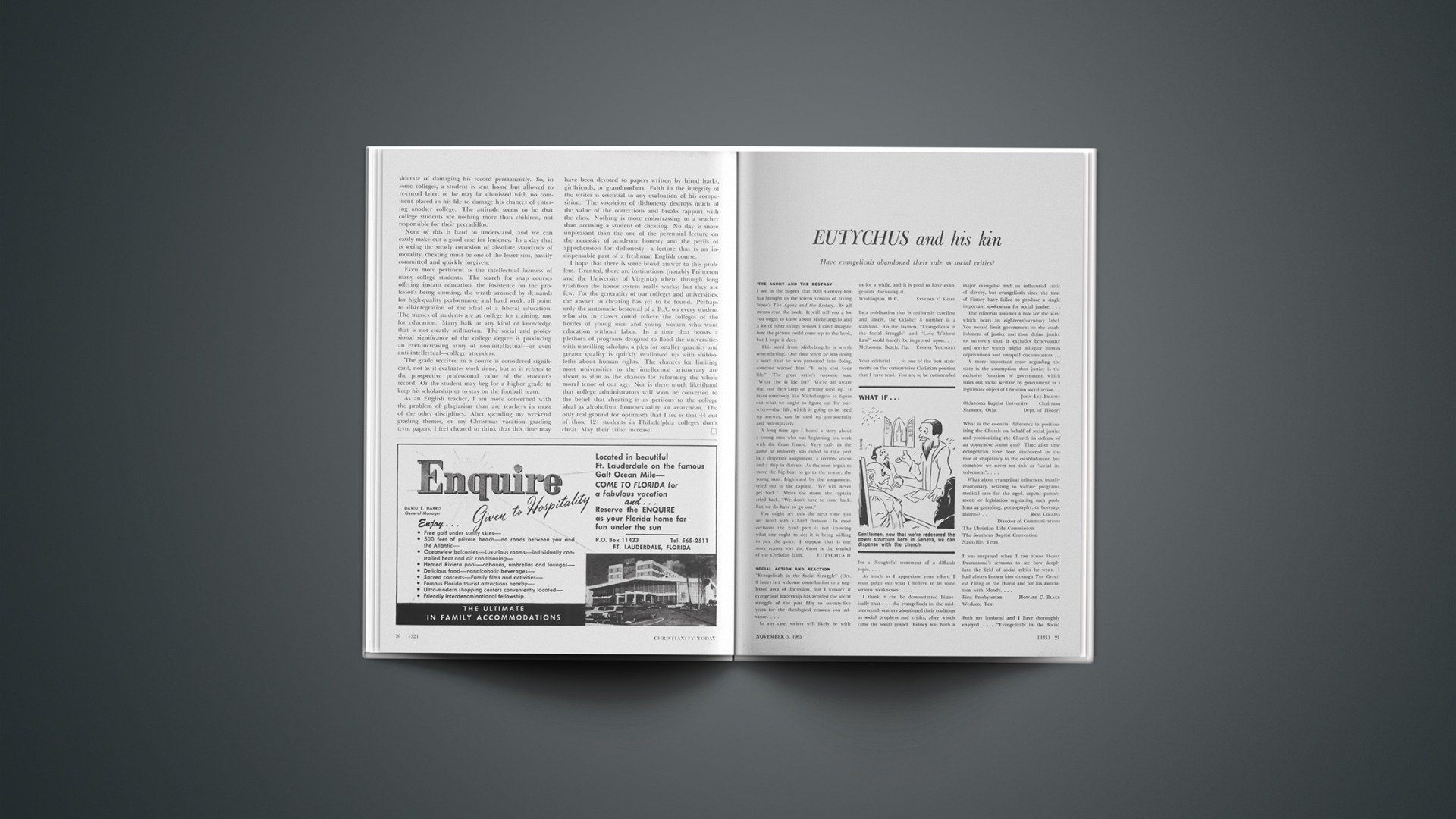
Eutychus and His Kin: November 5, 1965

Have evangelicals abandoned their role as social critics?

‘The Agony And The Ecstasy’

I see in the papers that 20th Century-Fox has brought us the screen version of Irving Stone’s The Agony and the Ecstasy. By all means read the book. It will tell you a lot you ought to know about Michelangelo and a lot of other things besides. I can’t imagine how the picture could come up to the book, but I hope it does.

This word from Michelangelo is worth remembering. One time when he was doing a work that he was pressured into doing, someone warned him, “It may cost your life.” The great artist’s response was, “What else is life for?” We’re all aware that our days keep on getting used up. It takes somebody like Michelangelo to figure out what we ought to figure out for ourselves—that life, which is going to be used up anyway, can be used up purposefully and redemptively.

A long time ago I heard a story about a young man who was beginning his work with the Coast Guard. Very early in the game he suddenly was called to take part in a desperate assignment, a terrible storm and a ship in distress. As the men began to move the big boat to go to the rescue, the young man, frightened by the assignment, cried out to the captain. “We will never get back.” Above the storm the captain cried back. “We don’t have to come back, but we do have to go out.”

You might try this the next time you are faced with a hard decision. In most decisions the hard part is not knowing what one ought to do; it is being willing to pay the price. I suppose that is one more reason why the Cross is the symbol of the Christian faith.

EUTYCHUS II

Social Action And Reaction

“Evangelicals in the Social Struggle” (Oct. 8 issue) is a welcome contribution to a neglected area of discussion, but I wonder if evangelical leadership has, avoided the social struggle of the past fifty to seventy-five years for the theological reasons you advance.…

In any case, society will likely be with us for a while, and it is good to have evangelicals discussing it.

SANFORD V. SMITH

Washington, D. C.

In a publication that is uniformly excellent and timely, the October 8 number is a stand-out. To the laymen, “Evangelicals in the Social Struggle” and “Love Without Law” could hardly be improved upon.…

EUGENE YOUNGERT

Melbourne Beach, Fla.

Your editorial … is one of the best statements on the conservative Christian position that I have read. You are to be commended for a thoughtful treatment of a difficult topic.…

As much as I appreciate your effort, I must point out what I believe to be some serious weaknesses.…

I think it can be demonstrated historically that … the evangelicals in the mid-nineteenth century abandoned their tradition as social prophets and critics, after which came the social gospel. Finney was both a major evangelist and an influential critic of slavery, but evangelicals since the time of Finney have failed to produce a single important spokesman for social justice.…

The editorial assumes a role for the slate which bears an eighteenth-century label. You would limit government to the establishment of justice and then define justice so narrowly that it excludes benevolence and service which might mitigate human deprivations and unequal circumstances.…

A more important error regarding the state is the assumption that justice is the exclusive function of government, which rules out social welfare by government as a legitimate object of Christian social action.…

JOHN LEE EIGHMY

Chairman

Dept. of History

Oklahoma Baptist University

Shawnee, Okla.

What is the essential difference in positionizing the Church on behalf of social justice and positionizing the Church in defense of an oppressive status quo? Time after time evangelicals have been discovered in the role of chaplaincy to the establishment, but somehow we never see this as “social involvement”.…

What about evangelical influences, usually reactionary, relating to welfare programs, medical care for the aged, capital punishment, or legislation regulating such problems as gambling, pornography, or beverage alcohol?…

ROSS COGGINS

Director of Communications

The Christian Life Commission

The Southern Baptist Convention

Nashville, Tenn.

I was surprised when I ran across Henry Drummond’s sermons to see how deeply into the field of social ethics he went. I had always known him through The Greatest Thing in the World and for his association with Moody.…

HOWARD C. BLAKE

First Presbyterian

Weslaco, Tex.

Both my husband and I have thoroughly enjoyed … “Evangelicals in the Social Struggle.” In fact, he said that it was the social overemphasis in Protestant Christianity in part that motivated him to become a Catholic about a decade ago. From first to last we found the articles informative and heartening, too. “Psychiatry anti Religion” is certainly interesting, timely, optimistic. So did I enjoy “When Sankey Sang,” just preceding the use of my poem.…

M. WHITCOMB HESS

Athens, Ohio

I do not see how the evangelical position could have been spelled out with more clarity or brilliance.…

J. RAY SHADOWENS

First Church of the Nazarene

Norman, Okla.

Mavrodes Vs. Pitts

For his “Salaried Housekeeper” comment (Eutychus and His Kin, Oct. 8 issue) on Mr. Pitts’s article, “If I Were a Church Member” (Sept. 10 issue), I nominate Mr. Mavrodes for a Nonbright Scholarship Award.…

Mr. Mavrodes’s irrelevant, nit-picking criticism shakes my faith in the professorial eminence traditionally associated with Ann Arbor, and also makes me wonder if your selection of letters to the editor is the result of throwing them all up a flight of stairs and printing those that land on the top three steps. Surely, someone must have written words of praise and appreciation for Mr. Pitts’s article—not to mention comprehension.

HENRY M. BARTLETT

The Federated Church

Charlemont, Mass.

• We received many letters of appreciation of Dr. Pitts’s article and approved many requests to reprint it.—ED.

The letter of George I. Mavrodes (of the University of Michigan philosophy department) in your current issue puzzles me. He seems totally to have misunderstood the point of my article.…

Apparently Mr. Mavrodes does not know that a Presbyterian minister is not a member of the local congregation in the usual sense—he is a member of presbytery. But I should think that a person who has presumably wrestled with the Platonic theory of ideas and Kant’s “synthetic unity of apperception” would realize that every minister is of necessity involved intimately in the fellowship of his congregation and is always under the discipline of the church.

His analogy of the “salaried housekeeper” is stupid as well as snide. It is obvious that he needs to do his “homework” before writing to the press.…

JOHN PITTS

Calvary Presbyterian

Pompano Beach, Fla.

Readers On Ramm

It is always a joy, fraught with anticipation of being spiritually edified, to note that your magazine contains an article by Dr. Bernard Ramm. This is also true of “The Continental Divide in Contemporary Theology” (Oct. 8 issue).…

MARY LYONS

West New York, N.J.

Never have I read such an enlightening article.…

MYRTLE R. WICK

West Chester, Pa.

Which is better: An orthodox ecclesiastic who burns his opponents alive and damns them to hell, or a kindly follower of Jesus who cannot agree with all the creeds and theology of the Church?

BERNARD T. HOLDEN

First Presbyterian

Clifton, Ariz.

• A kindly orthodox follower of Jesus.—ED.

Praise For Poetry

Your magazine has done more than anything else in recent years to raise the standards of Christian verse, and to give it outlet. I myself, having written verse for many years, have learned a great deal by studying what you produce. I think that countless other writers likewise study your pages to see what they can learn about contemporary writing in verse form. I don’t always like what you use, but mostly I do, and sometimes I am lifted to cloud nine by something in your columns.… You are to be greatly commended for the contribution you are making.…

It is my suspicion that the more good contemporary verse you, and other magazines of standards, publish, the more will be written. I feel your magazine has literally pioneered a new field here.…

E. MARGARET CLARKSON

Toronto, Ont.

Sankey’S Organ

I particularly enjoyed “When Sankey Sang” (Oct. 8 issue). We have the Sankey organ here in our office. I made a contribution to [the remodeling fund of the] Carrubers Close Mission [in Edinburgh] and brought the organ back in 1954. It went some ninety-five years ago to England from Chicago. It is a Baldwin organ manufactured in Chicago. Enclosed are a couple of recordings done on the organ.

GEORGE M. WILSON

Billy Graham Evangelistic Association

Minneapolis, Minn.

I really appreciated your recent article by Bernard R. DeRemer. As a lover of gospel music, I am especially interested in the field of evangelistic music.…

TIM J. GOOD

Logan, Ohio

God And Science

Enclosed is my subscription for the year. This one article (“What Some Scientists Say about God and the Supernatural,” Aug. 27 issue) alone was well worth it.

JOHN M. AEBY

Grace Brethren Church

Waterloo, Iowa

Man’s capacity to know God continues to increase as he increases in knowledge and wisdom. There are more people who are aware of God today than ever before in all history.… “Faith” is getting rid of old-fashioned ideas, which you seem loath to shake.

H. LINCOLN MACKENZIE

Cardigan, Prince Edward Island

In Re: The Pope

The United Nations does not need the Pope. It needs Jesus Christ.

MEROLD E. WESTPHAL

Seattle, Wash.

On Our Ninth

Happy, happy birthday to you and yours. I am just a layman and enjoy your magazine immensely.

CARL B. IKE

Deepwater, Mo.

DIVINE COMMUNICATION

Love is—because God is

from everlasting to everlasting.

It is in the waiting—in the brooding—in the silence—before

Let there be light was spoken.

Love is a bush burning without ash on a mountain.

Love is a voice in the night—“Samuel—Samuel”—calling.

Love is a coal of fire pressed against lips chosen for accolade.

Love is a gift wrapped in the womb of a virgin, delivered in a stable.

Love is a pattern of nails and flesh embroidered on wood with a hammer.

Love is recognition in a garden—“Mary”—“Master”—

in the breaking of bread at Emmaus.

Love is an ascension—witnessed.

Love is flame crowning the wind—descent of the Spirit.

Love is seed in the heart’s ground swelling toward harvest

sown for the need of the world.

Love is the speech of God—for God is Love.

Excuses char before His mandate, alibis are shattered.

Neither is there flight.

Nor hiding.

PORTIA MARTIN

CHRISTIANITY TODAY helped me free myself from the shackles of membership in the Jehovah’s Witnesses.…

SOLOMON M. LANDERS

Chapel Oaks, Md.

I have subscribed for over a year to CHRISTIANITY TODAY. It has been to me an anchor amidst stormy seas. It has been God’s saying again: “I have left me seven thousand in Israel, all the knees which have not bowed to Baal.”

You have aired both sides to many issues, and although some of the theological terms and phrases are too deep for my background, I have continually been “rooted and grounded in the faith”.…

MRS. VIRGIL E. CHANCE

Dover, Del.

You have the outstanding evangelical publication in circulation today, with high scholarship, sane understanding, and deep dedication. I read you every fortnight with joy and delight. Also, you are on my prayer list! Keep the fires burning.

JOHN BOB RIDDLE

Central Park Baptist Church

Birmingham, Ala.

I was among the first … subscribers to CHRISTIANITY TODAY when it began publication a few years ago. It is well edited, and it is constructive and positive. I wouldn’t be without it.

MERRILL C. SKAUG

Victor Federated Church

Victor, Mont.

It is always a pleasure to receive and read your fine magazine, which is defending the old and yet always new teaching of God as written in the Bible. The articles reflect the struggle between faith—true faith—and the so-called scientific knowledge. Judging on the ground of the articles published in your magazine, I am convinced faith as created by God in human hearts will be victorious at the end.

RUDOLPH FLACHBARTH

Nativity Lutheran

Windsor, Ont.

I want to commend the breadth of your coverage of the affairs of the churches round the world. CHRISTIANITY TODAY keeps me informed.…

DANIEL L. ECKERT

Danville, Ill.

Of all the publications that come to our desk, CHRISTIANITY TODAY has come to be the one that holds first place in our reading. I am thankful for this wonderful publication; it fills a need that for many years went unmet.…

RAY M. BAKER

Evangelical United Brethren Church

Boone, Iowa

Which Dante?

Wonderful article on Dante (Sept. 24 issue), but why leave out the bibliography? What is the best edition or translation to buy?… I am anxious to start right in. CHRISTIANITY TODAY gets better every issue.

T. BUCKTON

Herrin, Ill.

• The following are recommended: Dorothy Sayers’s translation (Penguin, three volumes) and the Carlyle-Wicksteed prose translation (Modern Library).—ED.

From The Front Line

I am in Viet Nam with a combat headquarters. The very day I left Fort Hood for the Far East your edition on Asia (July 30) hit my desk. Of course I brought it with me on the jet plane, and I have reread it several times since arriving. This one copy simply illustrates the relevance of most every edition to the world situation and to those of us in the field who are trying to interpret the Gospel in our particular area of responsibility.…

Thanks again … for your contribution in the middle years of this century.

WILBER K. ANDERSON

Chaplain (Col.), United States Army

Hq. U. S. Army Task Force ALFA

Viet Nam
Cover Story

I Hate Cheating Because …

Does faculty laxity spur student dishonestly?

A young college professor who was returning home late one night decided to pick up some examination papers at his office. Noticing a light in the office window, he quietly opened the front door of the building and ran up the steps. His office door was open and his desk in confusion. Following a hunch he went up another flight, to find a student crouched sheepishly on the landing. The student admitted entering the office to search for the final examination. His pleas for leniency affected the professor sufficiently for him to decide to forgive the student. Whereupon the student thrust out his hand and said in a satisfied tone, “Then it’s a deal? You won’t tell anyone?” The gesture grated on the professor. He felt that the ease with which the student was willing to shake on the “deal” suggested something of the ease with which he would forget the incident. He therefore determined to report the student.

However, in the weeks that followed the professor found his moral enthusiasm flagging. The administration hesitated to take action, and the professor began to wonder about his decision: both the ambiguous propriety of “squealing” and the spontaneous quality of his original decision seemed to cast doubt on the reality of his moral fervor. Eventually the student was punished, but the professor never again played apprehender.

This incident and its sequel have become symbolic to me of the attitude of students, faculty, and administration toward cheating in college. Two news stories have startled me into remembrance of this scene: the account of the 105 students who left the Air Force Academy for either cheating or failing to report cheating, and a more recent article appearing in the Philadelphia Bulletin (February 7, 1965) that discusses cheating in Philadelphia colleges. In the second story, the reporter found that 80 of the 124 students interviewed admitted to cheating—over 60 per cent! There can be no doubt of the prevalence of cheating.

But other factors are equally distressing. One is the amoral attitude of the cheaters. The Bulletin found that some of the people interviewed did not consider handing in ghost-written papers to be cheating. I have found that many of my students feel no pangs of conscience over plagiarism; as a rule they see the problem as a simple punctuation error—the mere omission of quotation marks. No moral struggle appears to precede the copying of a theme from the fraternity file; remorse apparently comes only if the student is caught.

Allied to this lack of sensitivity is the sniggering admiration accorded cheaters. Even faculty members regale one another with anecdotes about students’ coming to examinations with tape recorders cleverly disguised as hearing aids, formulas written inside matchbook covers, even radio transmitters concealed in hats. It is taken for granted that students must be frisked before tests, that no books may be allowed in the examination room, and that vigilant proctors must patrol the aisles. Efforts to set up an honor system often call forth the hackneyed response, “Yes, the faculty has the honor and the students have the system.”

Striking evidence of moral laxity pervading faculty attitudes toward cheating may be seen in the Van Doren television quiz scandal, but more common examples may be readily found in our schools of education, which produce a large number of our teachers and which are just as plagued with cheating as other colleges. The frequent explanation is that the pressure for higher degrees forces teachers into questionable practices, such as paying ghost-writers to produce theses.

This too seems part of the pattern. The students complain that they are forced to cheat because of home pressures—that their families demand more of them than they are able to produce honestly. Or they blame the faculty: professors are said to be either excessive in their demands or reprehensible in their teaching and examination techniques. It seems to be an axiom that any teacher who repeats assignments or examination questions deserves to have students cheat. Furthermore, if the teacher cannot motivate the student, or if the administration requires dreary or difficult courses, then each reaps the fruits of his iniquity. The shifting of responsibility to other shoulders—the family, the faculty, the peer group, or our modern, mechanized, dehumanized civilization—shows up as a frighteningly frequent part of the pattern in any survey of cheating. And equally frightening is the fact that teachers and families accept this responsibility. The student seldom needs to face the blame alone.

ON BEARING BURDENS

I am so weary, Lord.

I hear their laughter. Young and gay.

Mocking my heaviness.

What is life to them?

What do they know of sweat and tears?

Of a lonely heart torn by grief and fears?

I am so weary, Lord.

They come to me day by day,

Shattering my serenity.

How can I be strong, Lord?

Such a frail thing is life.

Ashes and dust.

“To dust return,” he said.

What can I do, Lord?

Brush a tear.

Speak a word.

Breathe a prayer.

So futile.

So tired, Lord. I cannot go on.

The muck and the mire. Too high.

I cannot bear my burdens, Lord.

And still they come.

Help me, Lord, or I sink.

Help me, Lord.

Help me.

MURRAY ETHRIDGE

There are undoubtedly as many reasons for cheating as there are cheaters. Certainly, for many students home pressures are more influential than the ideal of academic honesty. Just as clearly, an atmosphere of moral laxity makes extenuating circumstances seem more plausible. Nor has the administrative handling of cheating called great attention to the moral issue. For one thing, administrations tend to be timid about handling cheating cases. The issue is generally reduced to a conflict between the student’s word and the faculty member’s. Even in a clear case of cheating, the professor finds it easier to fail the student than to go through the endless inquiries of administrative procedure. The administration has an understandable fear of litigation; a suit for defamation of character can do considerable damage to the reputation and finances of a university. When a student is found guilty of cheating, the university may be overly considerate of damaging his record permanently. So, in some colleges, a student is sent home but allowed to re-enroll later; or he may be dismissed with no comment placed in his file to damage his chances of entering another college. The attitude seems to be that college students are nothing more than children, not responsible for their peccadillos.

None of this is hard to understand, and we can easily make out a good case for leniency. In a day that is seeing the steady corrosion of absolute standards of morality, cheating must be one of the lesser sins, hastily committed and quickly forgiven.

Even more pertinent is the intellectual laziness of many college students. The search for snap courses offering instant education, the insistence on the professor’s being amusing, the wrath aroused by demands for high-quality performance and hard work, all point to disintegration of the ideal of a liberal education. The masses of students are at college for training, not for education. Many balk at any kind of knowledge that is not clearly utilitarian. The social and professional significance of the college degree is producing an ever-increasing army of non-intellectual—or even anti-intellectual—college attenders.

The grade received in a course is considered significant, not as it evaluates work done, but as it relates to the prospective professional value of the student’s record. Or the student may beg for a higher grade to keep his scholarship or to stay on the football team.

As an English teacher, I am more concerned with the problem of plagiarism than are teachers in most of the other disciplines. After spending my weekend grading themes, or my Christmas vacation grading term papers, I feel cheated to think that this time may have been devoted to papers written by hired hacks, girlfriends, or grandmothers. Faith in the integrity of the writer is essential to any evaluation of his composition. The suspicion of dishonesty destroys much of the value of the corrections and breaks rapport with the class. Nothing is more embarrassing to a teacher than accusing a student of cheating. No day is more unpleasant than the one of the perennial lecture on the necessity of academic honesty and the perils of apprehension for dishonesty—a lecture that is an indispensable part of a freshman English course.

I hope that there is some broad answer to this problem. Granted, there are institutions (notably Princeton and the University of Virginia) where through long tradition the honor system really works; but they are few. For the generality of our colleges and universities, the answer to cheating has yet to be found. Perhaps only the automatic bestowal of a B.A. on every student who sits in classes could relieve the colleges of the hordes of young men and young women who want education without labor. In a time that boasts a plethora of programs designed to flood the universities with unwilling scholars, a plea for smaller quantity and greater quality is quickly swallowed up with shibboleths about human rights. The chances for limiting most universities to the intellectual aristocracy are about as slim as the chances for reforming the whole moral tenor of our age. Nor is there much likelihood that college administrators will soon be converted to the belief that cheating is as perilous to the college ideal as alcoholism, homosexuality, or anarchism. The only real ground for optimism that I see is that 44 out of those 124 students in Philadelphia colleges don’t cheat. May their tribe increase!

How Can I Help?

Reflecting the Good Samaritain along life’s way.

Reflecting the Good Samaritan along life’s way

The people who sold us the old farmhouse left us a black kerosene-burning kitchen stove, but they took with them the fifty-five-gallon oil drum and the stand on which it stood. So we telephoned Austin Corbett, the oil dealer, ordering both drum and kerosene.

It was early spring, a bright, brittle New England day, and my wife was there alone when Austin’s man drove down the lane. She showed him where he should put the barrel in the barn and went back inside the house. Soon she heard his knock.

“Does your husband have a handsaw?” he asked. “And may I cut up those old two-by-fours in the corner of the barn?”

Priscilla quickly said yes to both his questions. It would have been so simple for Austin’s man to have delivered what we had ordered—a barrel full of kerosene—and then gone on his way. But if he had, he would have left me with a problem when I came home from work. I could not have drained the barrel into the portable tank that hung behind the kitchen stove unless the drum lay horizontal on a stand. And there was no stand.

Swiftly the delivery man cut the old gray two-by-fours into proper lengths, spiked them together with rusty nails he had pulled screeching from the weathered wood, and toenailed the stand against the barn wall. Then he lifted the light and empty oil drum atop it and filled it up for us.

This was almost twenty years ago, but we have never forgotten this very helpful act. I don’t know how many thousands of winter oil furnace dollars we’ve spent with Austin’s company since then, or how many customers we’ve sent his way. I do know I wouldn’t think of dealing with any other company. For Austin’s man could have done so many other things—he could have filled the barrel and left it there for me to discover how to empty it (with siphon, with pump, with curses, certainly), or how to get all 400 pounds of it up on a stand (with plank or hoist, strain or sprain). Or he could have said, “You need a stand, Missus. Call me when you get one.” But he had not. He had helped us, and we are forever grateful.

What he did, and how he did it, is basic to a successful, happy, useful life. He had simply asked himself how he could help us, and then had gone ahead—without intrusion, without fanfare, without expecting a reward.

Somehow Austin always manages to hire men—and he does not know how he does it—who are exceptionally helpful. Not talking-helpful, or asking-helpful, but thinking-helpful and doing-helpful. Here in this New England village where I live, the Bells’ house on Pike Hill Road burned out some time ago. They saved six cows, some furniture, but not much more. They needed just about everything.

A neighbor drove up to smell and see the smoking cellar-hole and kick at the scorched stone of the fire-crumbled granite. He clucked his tongue and shook his head, then told old Mr. Bell, “If there’s anything I can do, just let me know.” And then he drove away, leaving only ritual words behind.

But one of Austin’s men went up there too. He didn’t ask what he could do. He looked and saw that everything was there to do. In a few hours he was back with a stake-body truck loaded with hay. Then other men and women—the do-ers, not the offerers, not the talkers—the philosophical kin to Austin’s men—came quietly up the hill with help. They brought beds and mattresses and sacks of potatoes and cooking utensils and clothes.

Why do some men offer words they never mean, and others quietly produce the help so badly needed? Once when I asked this question of a lawyer friend—one of the most truly helpful men I know—he simply snorted, “Aw, why are some people good-natured? It’s natural.”

Perhaps. But certainly the helpful man is less self-centered, much less greedy.

And perhaps he knows instinctively that genuine help is a very private, personal thing, and the phrase “How can I help?” is not a saying-phrase; it’s a thinking-phrase. You don’t say it; you think it. You ask it only of yourself. The man who asked Mr. Bell what he could do did not really want to help. His intention was to get on record as offering help. He was taking care of his conscience instead of Mr. Bell.

Yet there are those to whom helping is as natural—and perhaps as necessary—as breathing. I remember a paratroop major who shared a ward with me during the latter part of World War II. His right shoulder had been shot out by mortar fire, and his upper body was sheathed in a bulky plaster cast. But he could walk, while many of us among the 3,000 wounded in that hospital could not, and his left arm was free.

Over the months I watched him teach himself to write left-handed, and then one day he began to wander through the wards, clutching Army forms in duplicate and triplicate. In civilian life he had been an insurance salesman, and now he went from bed to bed, advising us about our National Service Life insurance, helping us apply for waiver of premium, converting our term insurance to other plans, changing beneficiaries. Some suggestions he made to me have not only saved me money over the years but also added invaluable comfort and security for my family. I am filled with gratitude for what he did for me, but I still wonder why he did it.

Perhaps boredom was the reason, for he was hospitalized for more than two years. Perhaps he was merely anticipating his discharge and practicing his trade; perhaps he hoped that some of us would become his clients. I think none of these is true, however. I suspect that, like Austin’s men, he simply had to help. For helpfulness is brother to usefulness, and I think this wounded major sensed more than most of us the meaning of Goethe’s comment that “a useless life is an early death.”

There have always been those selfish and insensitive souls who consider helping as quid pro quo—something, or some act, paid out hopefully so that at some later time it could be paid back swollen with profit. Something for something. But that’s not help; that’s dickering. A man who hopes for reward in return for his help—either now or in some later time or place—is not really helping; he’s speculating. True help is motiveless, uncontaminated; the best kind often is anonymous. It is never intruding, never unwelcome, and rarely requested. Although frequently it seems to reap rewards, these are by-products—not the purpose—of the helpful acts.

A few years ago the office manager for a large toy manufacturer, a man of forty who had worked his way through most of his company’s divisions in his twenty years of service, was suddenly informed of a company reorganization.

“It’s not that we don’t value you, Dick,” the president told him in gentle embarrassment. “But the board decided that we need a man from outside. He’ll be a vice-president. You’ll report to him.” He paused. “You know how it is.”

“No,” Dick blurted. “I don’t know how it is.” And he left the office angrily, a bypassed executive instinctively seeking ways to fight for survival.

With his knowledge Dick was well-equipped to sabotage the new vice-president, or at least to let him blunder into errors that Dick could swiftly see but never would correct in time. He couldn’t bring himself to sabotage, but he gave only the minimum. He was never curt, but he was never voluble. He never volunteered the knowledge and shortcuts and guidance and advice the new man looked to him to provide.

Then one day in the company coffee shop he sat next to an old machinist he’d known for years. “Well, Dick,” the older man asked, “earnin’ your pay?” It was a ritual greeting with the machinist, as other men say, “Fine day,” even when it is raining. The ritual answer was, “Well, not today,” and Dick said it, realizing that for the first time in his life he was answering truthfully.

And he knew then that for him to be happy—to think well of himself—he had to produce, to be useful. Thoughtfully he asked himself, “How can I help?” and he knew a multitude of answers. Because he knew the personalities of every department head in the plant, he could guide his boss away from conflict, and he did. He briefed his boss on how the company’s key men would react to innovation; and he wrote memos suggesting changes which he once had hoped to introduce himself. And he felt better; he was alive again.

A year later the new vice-president was offered an executive position with a larger company in the Mid-west. He did not want the job himself and recommended his assistant. Dick accepted, nearly doubling his salary.

Thus Dick’s success would seem to be a by-product of his helpfulness. Yet it might also be said that those qualities that make us helpful humans are also those needed for success.

A vice-president of one of the nation’s largest advertising agencies recently told me, “The magic thing you look for in the young man you’re hiring is his willingness to assume more responsibility than his job calls for. This is what makes people succeed.”

Such a man is really asking himself, “How can I help?” This is the man who becomes known first as the helpful man, then as the indispensable man, and later as the man who creates his own job. Ability is necessary for success, of course; but the special ingredient is willingness to perform beyond the merely acceptable requirements of the job—it is the desire to help.

Among other things, true help involves compassion, devotion, caring, and a willingness to give of self.

We can help others by sensing what they need, then asking ourselves the quiet question, “How can I help?” Sometimes the answer is simply to listen, or to be understanding. Sometimes a friend needs stimulation, and then pertinent questioning can be helpful. This, of course, is what a skillful teacher often does, and a teacher’s task is constantly involved with helping.

One of the most helpful acts I’ve ever seen happened in the lobby of our post office recently. A retired farmer pulled an envelope from his post office box and ripped it open. We heard his gasp as he read the letter. His news distressed him so that he seemed about to burst into tears. Then one of the mail clerks leaned out of his window and, in a voice loud enough to fill the lobby, distracted the old man with a stream of foolish chatter long enough for him to regain his self-control. Then he looked somberly at the clerk, said very precisely, “Thank you very much,” and left with dignity—to everyone’s relief. Because of the clerk’s timely distraction, the old man had been spared a painful public emotional breakdown.

It takes great strength and common sense to select the proper help sometimes. Last winter on the ski slope I watched a young mother teach her crippled daughter how to ski. The girl, a laughing, beautiful child of thirteen, fell frequently; her mother stood beside her smiling as she watched her child but did not help her as she struggled to her feet. It was difficult for both of them—perhaps much harder on the mother, and it was hard on me just to watch—but it was right. Both knew that for this child, falling down was growing up; they knew that physical help would not have strengthened the muscles that were weak: it would have made the child dependent. The easy way would have been to stay at home, but that would have been wrong; it would have been no help at all.

Parents often are tempted to be too helpful—and therefore un helpful, if not harmful—to their children because it is so much easier. Yet many parents do know how to help, despite the time and effort it requires.

My neighbor’s young son has been promised a 22 rifle. It would be easy for my neighbor to write a check for the rifle, but instead he and his son have agreed to share the cost. To earn his half, young Pete is selling bundles of white birch logs to summer residents. But Pete’s father drives Pete to the family woodlot to cut the trees; he handles the chainsaw; and he drives Pete to deliver the bundles. “It’s great,” Pete’s Dad told me recently, “but it’s sure busy.”

In the business world men often ask themselves how they can get ahead. If, instead, they asked themselves, “How can I help?” more would travel farther. Recently a highly successful lawyer told me, “It’s not always the man who graduates at the top of his class who becomes the most successful attorney. It’s the man who willingly spends a little extra time with his clients—even though he knows he’ll get no extra fee for it. He’s the man who is just naturally helpful.”

How can we learn to be more helpful? Like Austin’s helpful oilman we can ask ourselves the silent question and look about us to see what can be done. Then we should ask ourselves whether what we want to do is the right, honest, truthful way to help, or merely an expedient. Is it merely something that will make us feel good for “helping,” or is it a truly useful act?

“How can I help?” can be a silent guideline to us all—in our relationships with family and friends, in business, in civic enterprise. For everyone at some time needs some help, and help given is not expendable. It is like love; the more we give, the more we have. And the more we have, and give, the more we shall reflect the Good Samaritan in day-to-day relationships with our neighbors along life’s way.

Cover Story

Pollution of the Moral Waters

An ocean of obscenity is deluging in our land.

Many communities today are greatly concerned about air and water pollution, and rightly so, because foul air and filthy streams are a menace to health. States and cities are spending millions to check the smoke, smog, and dust in the air their people breathe. They are also taking steps to stop the dumping of waste into rivers that provide water for drinking and for the wholesome recreation of swimming, fishing, and boating.

But pollution of air and water is a small thing compared with the pollution of men’s minds that is rampant today. Our moral atmosphere and waters are being corrupted by lewd and lurid literature. The great menace now is the pornographic garbage being dumped into America’s moral streams.

It is said that more than fifteen million copies of “girlie” magazines are bought every month in the United States. In a year’s time, three billion copies of all kinds of pornographic publications—enough to fill to overflowing five Empire State Buildings—are purchased by adults and teen-agers.

It is also reported that the sale of salacious magazines is twenty times that of all religious publications—Protestant, Catholic, and Jewish—combined. And National Citizens for Decent Literature says that 75 to 90 per cent of all pornographic literature ends up in the hands and therefore in the minds of children.

Just what is pornography? According to Webster, it is “writings, pictures, etc., intended to arouse sexual desire.” So popular is the stuff that it takes 800 distributors of pornography to satisfy the popular hunger for it.

The scum publishers and sellers, of course, do not acknowledge the real purpose of their prurient products. They employ all kinds of subterfuge to give their degrading wares a mask of respectability. Some publishers even have the temerity to claim that their periodicals, jam-packed with page after page of nudity, are designed to appeal to the aesthetic sense and are for connoisseurs of fine art. Other publishers attempt to pawn off their pornography as marriage manuals or guides to successful sexual relations between man and wife. An increasing number of smut periodicals are seemingly for teen-age boys and young men interested in muscle-building, body culture, and weight-lifting.

As a matter of fact, it is not only the “girlie” magazines that are prominently displayed on newsstands today. Right out in front, for all to see, are publications featuring transvestism, homosexuality, sadism and masochism, and other perversions. Their publishers would have the public believe that such trash is either educational, or artistic, or both. Another artifice of the pornographers is to disguise their periodicals as guides for boys and young men interested in becoming professional models.

But let us not be naive. Pornography is serving no legitimate purpose. It is being published, sold, and purchased with a single idea in mind. And for that idea we refer back to Webster’s definition: “writings, pictures, etc., intended to arouse sexual desire.”

While one certainly cannot admire the pornography producers for their moral principles, when it comes to ingenuity and cleverness they are superb. Were they to use their photographic, engraving, advertising, and journalistic abilities in more wholesome pursuits, they might be a force for good.

The pornography industry does not, of course, confine itself to gutter-type magazines. It is also busy producing so-called “art” films for stag or bachelor parties, salacious desk and wall calendars for the pretentious “he-man,” and so-called physiology books. Nor are commercial motion pictures free from its taint.

“Although nudity is not itself obscenity, and might even have an artistic function in a film of quality, it is never a necessary or indispensable means to achieve dramatic effect,” says the Legion of Decency in giving a “C” (condemned) rating to The Pawnbroker, a recent Hollywood movie. “The good of the motion picture industry,” the Legion declares, “as well as of the national community requires that a marked effort on the part of some producers to introduce nudity into film treatment be discouraged, for such treatment is open to the gravest of abuse.”

The worst pollution in America, then, is not the gasoline fumes in the air or the waste in the waters. It is the dirty books, filthy films, and immoral magazines. Directly or indirectly, according to crime authorities, the reading and viewing of pornography leads to an increase of illegitimacy, venereal disease, especially among teen-agers, and major crimes, such as murder and rape.

Why does the pornography industry continue to flourish and to pollute the minds of youth? What can be done about this ocean of obscenity that is menacing the morals of millions?

As teachers and parents we must be realistic and honest with ourselves. Sex is just as sure as the proverbial death and taxes. It is not to be denied or deprived of rightful expression. But in the realm of sex education, many fathers and mothers have abdicated. They have forfeited their moral right and duty. Teen-agers from families in which any discussion of sex is taboo are ideal targets for the trash publishers. Sexual curiosity must and will be satisfied. And if it is not satisfied through wholesome instruction in the home, the two-billion-dollar-a-year pornography business is all prepared to do the job. Therefore, a share of responsibility for much of the vice and venereal disease that prevail today must be assumed by parents.

NZARETH

Nazareth,

Close by the historic plain

Of Esdraelon of the twenty battlefields,

Not far from the glistening waters

Of Galilee;

Nazareth, on whose neighboring hill

A boy might watch the ships

Embarking for Rome or Alexandria;

Nazareth, near whose site

The diffident camels passed

Up from Cathay;

Somnolent village,

Why do they call your inhabitants

Plain and crude?

Why do they say

You can produce no good thing?

How was the Wisdom generated

In your midst?

SUE ANN DYER

An anti-pollution program does not begin in the White House, in some governor’s office, or in a local city hall. It begins in the hearts and minds of parents. It begins with wholesome and positive attitudes toward sex in the home. It begins with the recognition that sex is something divine and sublime, something normal, natural, and necessary. Sex is the God-given power for the perpetuation of mankind and for the expression of love within marriage.

In homes where sex is treated with frankness and dignity, pornography should have little if any appeal to adolescent boys and girls. On the other hand, parents who adopt a hush-hush policy unwittingly become the very welcome allies of the purveyors of obscenity.

Legislation can also help. But all too often laws only drive pornography under the counter, into the back room of a bookstore, or to the black market. And enforcement of laws in this area is particularly difficult. Courts, however reluctantly, often side with publishers and peddlers of pornography because of such issues as freedom of press and speech and because of fear of censorship. Publishers do not call their filth pornography. They call it art, marriage guidance, sex information, physical culture, body-building, or employment advice for would-be male models. It is not easy for prosecuting attorneys to win convictions.

Legislative and judicial experts actually are at a loss when it comes to stamping out pornography. Legally, there are fine lines of distinction between slime and the sublime, between the obscene and the clean, between the venomous and the virtuous.

There are several things that we as individuals can do to help to purify the moral atmosphere and clear the muddied waters. We can boycott newsstands and bookstores that sell pornography. We can ask news-dealers and store-owners whom we know personally to stop selling questionable magazines and books. We can be guided by motion picture reviews published in church periodicals and by recommendations of such organizations as the Legion of Decency. We can write letters of protest to theaters showing filthy films.

But we must do more than boycott and protest. Our anti-pollution program must have positive aspects. Among other things, we can subscribe to church periodicals and worthwhile secular magazines, encourage Sunday school attendance and Bible study, and foster decent, constructive recreation, such as wholesome social activities, sports, and outdoor life.

If we want to badly enough, we can do something about pornography and moral pollution. But it will take alert and unremitting effort to stem the tide of indecency.

Heresies and Hearsays

Suspicion is as much a problem as heresy.

“Theological suspicion is as much a problem as theological heresy

The Bible sounds a scorching warning to those who bring into the Church “damnable heresies, even denying the Lord that bought them” (2 Pet. 2:1). Heresies are serious departures from God-given norms of belief and behavior, and the warning about them is as relevant now as it was when the Apostle Peter’s ink was drying.

But a companion danger faces believing people in the mid-sixties. It is the threat of damaging hearsays. There is a segment within evangelicalism that spots false doctrine and points to compromise with evil where these things do not exist. Protesting loyalty to the truth of the Gospel, such people unconsciously further the cause of untruth.

I was first exposed to heresy as a student in high school. The pastor who welcomed me into church membership was a theological conservative. But there were at least two liberals among his predecessors. One had leveled open attacks against the total reliability of Scripture. The other, who continued to live in town after his resignation, supplied the pulpit occasionally, delivering addresses that almost wholly bypassed the Bible. I heard from a Sunday school teacher that one could not be sure the Book of Daniel is true. Another asserted that the Beatitudes are outmoded. This modernist hangover aggravated my teen-age tendency to doubt. Only my consciousness of conversion and an inescapable call to the ministry held me steady.

The theological hearsay problem I did not face until nine years after seminary graduation. At that time I moved from one pastorate to another. Within three months my successor had insisted that the church leave its denomination, and he rammed his insistence through. In spite of the denomination’s historic stand for an inerrant Bible and a warm spiritual life, he declared it to be tainted with modernism because its headquarters was then transmitting a few thousand dollars a year from half a dozen churches to sound-in-the-faith missionaries serving under a sister denomination in the National Council of Churches.

That there is such a thing as heresy needs no argument. And it should be admitted that some pastors and laymen take little notice of it, unwisely assuming that heretics are merely straw men with no more power to hurt their fellows than a scarecrow.

Evangelicals generally are convinced that this assumption is false. They define their mission as that of declaring unhesitantly “all the counsel of God.” They are not middle-of-the-roaders. They know that unless they build a Chinese wall around themselves, they cannot help being aware of the presence of apostasy and sub-biblical religion.

Not only pastors but also Sunday school teachers in many churches are having their joy over improved teaching tools and techniques dampened by the discovery that the materials they use have been infiltrated by some of the radical conclusions of form criticism. Although they know that these new materials are produced and approved by their own denominations, they don’t like them. They want junior and senior high school youths to raise questions, but they are dismayed at some questions the lesson materials gratuitously raise. Young people, they readily grant, must be shaken into thinking. But should not thought, they ask, be challenged toward captivity to Christ?

Alert laymen do not have to read more than the newspapers and newsmagazines to be aware of the doctrinal fog over sections of Christendom. They are puzzled over disunity. But like their pastors they realize that the great cleavages of our day are often within rather than between denominations. It is not very hard to detect in most major church bodies a liberal-conservative split, sometimes about fifty-fifty.

A confusing topic for many church members is neo-orthodoxy. It is too patently a theology for philosophers. Many laymen are baffled by efforts to distinguish it from old-fashioned liberalism. It is beyond them how men can speak of the Word of God without accepting a fully authoritative Bible, or of the grace of God without offering assurance of salvation. They cannot fathom stress on sin without belief in hell. Although there are corrective insights to be gained from Barth and Brunner, many laymen have an intuitive feeling, built on the little they can grasp of neo-orthodoxy, that it departs from evangelical faith.

Heresy does indeed exist. But the opposite peril, theological hearsay, is an even more immediate problem in some areas. Whole congregations, whole denominations, whole schools major on it. They thrive on posting liberal or neo-orthodox signs over Christians and groups of Christians where they do not fit. Theirs is the mentality most largely responsible for the religious scandal sheets that deal mainly in labels and libel.

A penetrating and scintillating volume by Harry and Bonaro Overstreet, The Mind Goes Forth, throws the floodlight of clinical psychology on this problem. The Overstreets point out how the far right and far left wings of any movement, whether political, educational, or religious, easily fall prey to paranoid personalities. These emotionally ill people with their compulsive drive toward conflict-creating suspicion often gain footholds and strangleholds on the fringes of orthodoxy. They have persecution and Messiah complexes and usually hold that they are wholly right, while others who differ from them even slightly are utterly wrong. Evangelicalism, with its accent on biblical authority and on there being “none other name given under Heaven whereby we must be saved,” has lately become an unhappy hunting ground for such unfortunates. Persons with a steel will to be kings always succeed in locating some among the redeemed who are eager to be ruled.

Now the instinct of self-preservation must be gratefully counted as a divine gilt. The mercifully protective power to suspect goes with it. But what remains undeveloped in the naïve person who scents no doctrinal dangers becomes oversized in the one who sees midgets as monsters.

Neurotic suspicion is conspicuous in the unremitting war against Billy Graham. He is classed by some as a compromiser because he wins the support of most Protestants in a crusade city, and because his follow-up workers sometimes channel converts back into churches that are less than evangelical. That these new Christians ignite spiritual fires in some of these churches or soon look for fellowship elsewhere does not impress Graham’s right-wing critics. It never dawns on them that they are making common cause with those liberals who score the evangelist for being too uncompromising.

Guilt by association does not figure only in attitudes toward Graham and his team. An unswervingly evangelical seminary may invite a non-evangelical to lecture on a scholarly subject. Extremists soon publish and circulate a new tract, insinuating that the school has sold out to Satan because it sponsored a speaker who denies the Virgin Birth and ipso facto the deity of Christ. It does not matter that the administration and faculty do not endorse all the speaker’s ideas. The writer of the tract has not taken the pains to read the lecturer’s books, in which he affirms that Christ is God and died in the place of sinners. In his widely circulated leaflet, the extremist tells only part of the truth.

This fungus of ultra-conservatism has manifested a freak spurt of growth since the 1930s and 1940s. In those decades there was a notable exodus of local churches from top-ranking denominations because of foreign missions crises brought on by doctrinal defection on the fields. Such churches considered it their duty to separate themselves and their missionary giving from this collaboration with error.

What many viewed as a necessary separation soon, in some instances, went further. Today we find believers amputating themselves from solidly orthodox fellowships on the complaint that the separation of these groups is not radical enough: they are not making the combatting of error their central business! That the Spirit is working in such present-day movements as the Overseas Missionary Fellowship (formerly the China Inland Mission), Young Life, the Student Missionary Conventions at Urbana, or Evangelism in Depth, all of which draw sacrificial lay backing, does not register with their opponents.

This unhealthy and infectious misunderstanding blights still more areas. It refuses fellowship with Nazarenes because they are Arminian and disowns Pentecostals as “not quite fundamental.” This is the airtight mind-set that is unwilling to consider the evidence that there are believers among American Baptists, United Presbyterians, Episcopalians, or Methodists, or that there are ministers or churches in these and other communions aligned with the ecumenical movement that promote a biblical witness. This is a prime factor in a tragic spectacle. There are members of God’s family who stubbornly refuse to accept as family members thousands whom the Father has accepted.

Mainstream evangelicalism is not a mediating position. Yet it is squeezed into the middle of a muddle. On one side are those who settle for less than the Bible: on the other those with a beyond-the-Bible exclusiveness. Facing the former, we must graciously and firmly hold our ground, ready to grasp opportunities for communication, regardless of criticism. Facing the latter we must also be gracious and firm, welcoming communication but realizing that here it will come harder, though it ought to come easier.

In his classic treatment of the Church in Ephesians, Paul shows us our stance for confronting error: “That we henceforth be no more children, tossed to and fro, and carried about with every wind of doctrine, by the sleight of men, and cunning craftiness, whereby they lie in wait to deceive …” (4:14).

“But speaking the truth in love” (4:15) gives us our strategy for outlasting and outflanking the hearsay danger. Practiced faithfully, “speaking the truth in love” will stir brisk, cooling breezes to freshen the atmosphere in which ultra-fundamentalist witch-hunting now thrives.

Real or imagined heresies must not halt us. Our goal as soul-winning, life-nurturing Christians, churches, and denominations, members of the body of Christ, is, as this verse in Ephesians goes on to say, to “grow up into him in all things, which is the head, even Christ.”

Are Churchmen Ready?

NO One faith must come first; differences are now too wide

Most Christians are friendly to the ecumenical ideal in principle. If there could be one church, honoring to Christ, united in faith and fellowship, the fervent hopes of many hearts would be fulfilled.

At the same time, many Christians feel that any outward, structural, or organic “union” that does not rest upon an inner unity of belief and conviction is likely to be a snare. And the posture of this article is that such a unity does not exist today in sufficient measure to give reality to the “one church” idea. Further, any attempt to force an organic union (With majorities coercing minorities) might result in resentment and even open rebellion, with the last state being worse than the first.

It will probably be agreed that the greatest obstacle to union lies in our theological differences—that is, in the area of faith. Here the cleavages are wide and deep. The common vocabulary of Christian conversation tends to obscure them, but they are there. Traditional language continues to be used with little change but with widely divergent meanings. It can no longer be assumed that such words as “atonement,” “redemption,” and “reconciliation” are being employed in their primary and familiar biblical meaning. To one Christian “reconciliation” is a precious word, full of the deepest spiritual meaning, assuring the believer that he is at peace with God, that the estrangement of sin has been ended through the work of Christ, and that he is received into full fellowship with the Heavenly Father. As used by another, the word has little of such content and refers mainly to human relations, the breaking down of those barriers of class, nationality, culture, language, and race that separate men and engender misunderstandings between them. And there is no article of the Christian faith that is not a battleground for conflicting views as irreconcilable as opposites. Is the Bible the authentic and infallible Word of God, or is it a mixture of wisdom and error from which the truth must be separated by careful rational examination? Is the essence of the Gospel soteriology or sociology? And what of the person of Christ, the nature of salvation, the meaning of the Atonement, the life everlasting? In all these, the differences are overwhelming. Such differing views are not nuances of the same position. They are often completely antithetical, so that it strains the meaning of the word “Christian” to include them all in the one category. This is not to say at this point who may be right or wrong. It is rather to remind us of the magnitude of the gulf that separates us and to emphasize the untimeliness of the “one church” idea in the present situation.

To see how vitally the question of church union is related to matters of faith, one need only review the experience of certain communions that have been involved in union negotiations. In case after case, even among churches of the same theological tradition, overtures for union have been defeated on the primary ground of doctrinal divergencies, or of varying trends toward liberalism or conservatism. And even when such mergers have been successfully concluded, they have frequently left behind them dissident minorities large or small that have continued as separate bodies. If this happens with closely related denominations, how much greater the difficulties that must be encountered in any proposal for a single inclusive church!

It is difficult to escape the feeling that the advocates of one church are approaching the matter from the wrong end. One faith must come first; then one church may follow. There can be no genuine unity until the basis for unity is laid. Christian faith is grounded in the Bible. This is the norm. The shocking erosion of faith, so widespread in the Church today, is the sure result when men doubt the Word of God and join the secular confusion. And this sweeps away the very foundation on which any real unity can be built. The parable of our own national life illustrates the point. Our nation is established upon the broad principles of her Constitution, which provides the basis for unity. The Constitution is the contract or agreement by which the citizens of the United States propose to order their lives as a people, and which they are sworn to uphold. Any perversion of the Constitution or any habit of disregarding its clear provisions would threaten the solidarity of the nation, and might lead to confusion and anarchy. Similarly, nothing can more easily destroy the essential fraternity and oneness in the Church than vagueness or disagreement on the cardinal principles of faith. The divisions within Protestantism are in large measure the result of doctrinal aberrations of one kind or another, whether of modernism on the one hand or of narrow obscurantism on the other. The responsibility for this disunity must be laid more at the feet of those who advocate another gospel than at the feet of those who decline to join in a retreat from biblical faith.

Most of the insistent demands for one church come from the side of theological liberalism. Ironically, this very liberalism stands as the greatest single obstacle to union, making the unity effort suspect in the eyes of those who see it as a movement of compromise or of varying shades of unbelief. Thus the question of union itself has been, and continues to be, a chief cause of strife and disunity within many denominations.

Another deterrent to “one church” is the fear of ecclesiastical power. Monopolism, whether in business, government, or religion, easily becomes the instrument of abuse. The totalitarian church is as much to be dreaded as the totalitarian state—possibly more, for the monopolistic church extends its control over the hearts and consciences of men as well as over their political structures and social institutions. Millions of people still remember the lessons of history. They cannot erase easily from their minds the record of era after era, nation after nation, in which the church became the symbol of oppression, exercising dominance over every sphere of life, subjecting even the state to its decrees, ruling the consciences of men, and destroying human freedom. Examples are many, but one will suffice. In Mexico earlier in this century, the “one church” with its totalitarian power owned three-fourths of the land, controlled the banks and the national economy, directed public education, managed elections, and virtually ran the country while it underwent moral and spiritual decline. A revolution was necessary to wrest the nation from ecclesiastical oppression and restore freedom to the people.

Although we do not have one church in our country, the dangers of concentrated power are apparent in trends that have currently made the National Council of Churches a controversial subject in many denominations. Highly significant has been the impression created that the council speaks as the voice of Protestantism. Its pronouncements on almost every conceivable subject, many of which seem only remotely related to the Church’s primary spiritual mission and message, have aroused the deep concern of thousands of evangelicals. Anyone who so desires may obtain from the central office of the NCC a list of all pronouncements, statements of policy, and resolutions issued since the council’s organization fifteen years ago. A quick glance at these will reveal the alarming extent to which they are weighted with political, economic, and social issues, and how little there is of redemptive, evangelical content. They do not differ materially from the statements of secular organizations that speak in these fields except that they bear a Christian label. Many of them seem tantamount to partisan lobbying, whether so intended or not. There is a persistent emphasis on a largely secularized Christianity that is little more than a baptized humanism, devoid of grace and spiritual power. A preoccupation with social relevance appears to have led to a serious neglect of the Gospel of faith and salvation. To this extent there has been a distortion of the Christian message. It would be tragic indeed if in seeking to make her message relevant to contemporary life the Church lost her relevance to God, to Christ, and to the salvation of men.

It is doubtful whether the National Council of Churches has made any notable contribution to the cause of real Christian unity. If its Division of Overseas Ministries may be taken as an example, it would be difficult to find one significant service that was not already being performed by the former Foreign Missions Conference of North America and other agencies of cooperation before the council came into being. Actually, the formation of the council radically reduced the number of boards and societies engaged in cooperative planning and action in their overseas ministries.

These problems, apparent enough in the case of the National Council, would be greatly intensified if there were one church. The concentration of power within a single organization always presents a temptation to overbearing authority. In the case of the Church, as experience has shown, the power is manifested in the application of pressures through lobbying and manipulation in political and public issues, and in the final suppression of individual conscience and freedom.

As long as there is liberty to exist as distinct ecclesiastical bodies in which we find a congenial spiritual adjustment, to which we can yield our full loyalty and through which we can work in happy cooperation with others of like faith in sister denominations, why should we surrender that privilege? What is to be gained? Are the unions of churches more effective in leading men to Christ? Does the spiritual birthrate rise? Does Christian liberality flourish when churches unite? Are consciences free that are forced to bend to compromise? And what reality would there be to an organic union that harbored every kind of creedal and theological disunity? How long could it possibly last?

There is no particular virtue in union itself; everything depends upon the purposes for which the union exists. There can be union in unbelief. Yet some persons seem to feel that to be divided is itself a cardinal sin. They speak of denominations as the “scandal” of Christianity. We are told that the non-Christian world is confused by our many sects, and that this hinders its acceptance of our faith. The point, we believe, has been greatly overplayed. Christianity offers nothing novel in this respect. Every religious system has similar, and even wider, divergencies. The pattern is familiar all over the world.

The real “scandal” is not in the plurality of churches. Rather, it is in the disaffections in faith and doctrine that have made divisions inevitable. Was the Protestant Reformation a mistake? Were Luther, Calvin, Huss, and Zwingli irresponsible dissidents who splintered the Church and doomed it to perpetual division? Or were they courageous voices who challenged the evils of the day and called the Church to remembrance of her true role in the Gospel?

It is not “one church” that we need, but one faith; not union, but true Christian unity. The fact is more important than the form. And it is not something that we can have merely by voting it, or by desiring it. Christian unity is more than the sentimental “togetherness” about which we hear so much today. It is more than a spirit of sanctified camaraderie, more than a cup of coffee between Sunday school and church. It is not just a collegiate exuberance such as we express when we sing, “The more we get together, the happier we will be.” It is more than a mood or attitude, more than an outflowing of good will. Christian unity rests on real substance. It has definite and objective content. It derives from certain roots of common loyalty, of common acceptance of truth, and of mutual purpose and commitment. The koinonia is not something apart from the kerygma. The fellowship is in the Gospel and its proclamation.

Here, then, is something to which the Church can aspire—not “one church,” but one mind, one spirit, one faith. Let her give herself and all her energies to the fortifying of those foundations of her unity which Paul describes in that magnificent trilogy, “One Lord, one faith, one baptism.” If she pursues these goals with all her heart and soul and mind, perhaps that other ideal of “one church” will not always elude her.

Cover Story

Organic Church Union

YES Spiritual unity cannot exist without organic church union

Few expressions have been more widely misunderstood than “organic union.” The phrase has been taken to mean “contrived union” or “union artificially imposed from above.” Yet the dictionary definition of the word “organic” is plain: “of the bodily organs, affecting the structure of an organ, having vital organs.” Nor do we need to rest our case simply upon etymology, for the New Testament itself gives the fullest interpretation of “organic,” in a way that must surely command the obedience and stimulate the action of Christians today. Thus St. Paul, in a famous passage, describes vividly and succinctly his vision of the Church: “Rather, speaking the truth in love, we are to grow up in every way into him who is the head, into Christ, from whom the whole body, joined and knit together by every joint with which it is supplied, when each part is working properly, makes bodily growth and upbuilds itself in love” (Eph. 4:15, 16, RSV).

The analogy of the human body takes us so far: growth is something spontaneous, “from the inside”—it is not to be forced. And again, growth is a slow and steady process into something, into the stature of the full-grown man. But St. Paul’s use of his metaphor overflows its analogical use and needs to be taken with the whole of that great epistle of his. For the unity he describes is that appropriate to a spiritual fellowship: a unity in truth and love. The walls of hostility are broken down in Jesus Christ, the old nature is put away, the old incompatibles (Greek-Jew, male-female, black-white) find themselves reconciled by the Cross, and men are “renewed in the spirit of their minds.”

No antithesis, then, could be more false to the letter and the spirit of the Scriptures than the common modern antithesis between “spiritual unity” and “organic union.” There is no scriptural warrant (and this conviction has been an ecumenical spur to many) for the idea that “spiritual unity” implies indifference to external forms. And much of the present quest for “organic union,” which extends over so many continents and churches today, is precisely this: to find the external forms appropriate to the unity of spirit into which the good hand of God has been leading them more and more. This necessarily implies the humdrum (yet often difficult and painful) process of institutional reorganization: but the latter can only be regarded as worthwhile if there is a spiritual imperative underneath. The basic question is: “Is the Church itself a part of the Gospel? And if so, a Church divided, or indifferent to unity? Or a Church visibly witnessing to the power of Christ, which alone makes men ‘to be of one mind in a house’?”

The origin of the modern expression “organic unity” is hard to trace. The earliest use of it we can discover, referring to the union of churches, is in the Declaration of the South India Church (1907), where the uniting churches declare that they “have determined for the glory of God to unite organically into one body.” The phrase was used at the Edinburgh Missionary Conference of 1910, and it is found in an interesting publication of 1912: Messages of the Men and Religion Movement, Volume IV, Christian Unity: Missions (Association Press, New York). In the report of the Commission on Christian Unity, of which William Jennings Bryan was a member, it was stated that unity, at least in the mission field, should lead to “a virtual union of Protestantism and an organic union of our Protestant denominations” and would involve the adoption of “an ecumenical creed in which all the essential truths of Christianity shall be confessed” (p. 59).

One may trace the development of this concept in the ecumenical movement down to the most recent and perhaps the most celebrated expression of it, the so-called New Delhi Statement on Unity, which was issued from the Third Assembly of the World Council of Churches in 1961:

We believe that the unity which is both God’s will and his gift to his Church is being made visible as all in each place who are baptized into Jesus Christ and confess hint as Lord and Saviour are brought by the Holy Spirit into one fully committed fellowship, holding the one apostolic faith, preaching the one Gospel, breaking the one bread, joining in common prayer, and having a corporate life reaching out in witness and service to all and who at the same time are united with the whole Christian fellowship in all places and all ages in such wise that ministry and members are accepted by all, and that all can act and speak together as occasion requires for the tasks to which God calls his people.

One thing immediately strikes us in that statement (to which a remarkably wide range of churchmen, from Orthodox to Salvationists and Friends, subscribed), namely, that it spells out “organic union” very plainly in terms of “all in each place.” A question mark is set, not only against ill-feeling or competition between fellow Christians, but also against any form of institutional separation that is accepted as normal or permanent. For if we truly enjoy that spiritual unity which we claim to have as brothers in God’s household, where is its visible, nay local, manifestation?

At the same time, it is perfectly clear that the New Delhi Statement still leaves open a thousand questions. The way in which “organic union” is to be achieved is still a matter of intense discussion. It could not be otherwise, since the World Council of Churches “cannot and should not be based on any one particular conception of the Church. It does not prejudge the ecclesiological problem” (statement by the WCC Central Committee, Toronto, 1950). For if New Delhi revealed a fairly wide consensus on the marks of unity, the member churches are still far from agreement on the authentic form of that unity or the conditions which must be fulfilled in order to recover it. It would therefore be truer to say that the WCC creates a climate, or an opening, for the growth of organic union, than that it “promotes” such union, especially if the latter be understood in the sense of “administrative unification.” It should be remembered that the New Delhi report explicitly rejects union that would lead to “uniformity in organization, rite or expression,” and this rejection of the idea of “a single centralized administrative authority” was reiterated by the WCC Executive Committee at Odessa in 1964.

What, then, of the concept of “organic union” as it affects church union negotiations now in progress? At present there are more than forty separate negotiations, involving churches in six continents. Most of them cross the lines of denominational family and ecclesiastical polity. They seek to bring together episcopal, methodist, presbyterian, and congregational traditions, and in most cases (as in Nigeria, Ghana, and Ceylon) to create a united church within the framework of a single country. In nearly every scheme of union, it is intended that the united churches shall be in communion with one another and with the denominations from which they sprang—the New Delhi Statement’s reference to “a ministry and members … accepted by all” is taken with great seriousness. “Organic union” therefore implies unification (often gained by slow and painful degrees) in faith, worship, discipline, and organization—and at least an openness to wider union, under the sign of “one holy catholic and apostolic Church” in which Christians of many different traditions profess their belief.

The very number of such prospective unions poses a question: What trill be the relation between all in one place (country or nation) and all in every place? Is not the universality of the Church in danger of being swallowed up by a hundred nationalisms and provincialisms? No one can answer this question (though we may observe that this is the very contrary of the oft-discussed danger of “the one super-Church”). Professor Werner Küppers, an Old Catholic theologian, has indicated one line of approach to an answer, which combines the principle of self-government with that of conciliar consultation. He refers in particular to the way in which the various autocephalous (self-governing) Orthodox churches gather periodically in council to discuss matters of faith and practice. May this be the pattern for the “united churches” of the future? Already in the Report of the Second World Conference on Faith and Order, at Edinburgh in 1937, the need for “some permanent organ of conference and counsel” was noted (p. 253). Since that day, the need has begun to be filled in many different ways. Apart from the establishment of the World Council of Churches itself, there have been the assemblies or synods within denominational families (Frankfurt, Helsinki, Toronto, and so on) and the continuing life of such groups as joint missionary societies, national councils of churches, and associations of evangelicals. The overlapping relationships of all these groups raise many problems of ecclesiology, which have hardly yet received systematic study. How are they to be regarded as partners within the one Body of Christ, rather than as competing claimants for the time and loyalty of their members? One thing seems clear, at least: the fellowship which such groups, whether of a worldwide or interconfessional character, have engendered does not appear to have destroyed within the churches the desire for “organic union,” with full fellowship in Word and Sacrament and full recognition of ministry and members. Rather, it often seems to afford a necessary stage of preparation; for if we do not know one another, how can we love one another?

We have already suggested, as the most powerful motive for seeking “organic union,” that the churches cannot witness to the fullness of Christian truth unless they are trying to give visible and ordered expression to their unity in Christ. But the converse is also true: a genuine, as opposed to a spurious, unity. Those who fullness of truth, that the churches can hope to realize a genuine, as opposed to a spurious, unity. Those who take part in the ecumenical movement have long been accustomed to gibes about the “lowest common denominator” approach—and they ought constantly to assess what truth there may be in such criticisms. But it has been a basic principle of the Faith and Order movement since 1910 that if we have to “give up” parts of Christ’s truth in order to unite with one another, such a unity is not worth seeking. “Organic union” grows around the backbone of truth. It is if “we walk in the light, as he is in the light” that we “have fellowship one with another” (1 John 1:7). We can also say (though this should hardly be news in the year 1965!) that it is only as we engage in honest and open conversation with one another that we discover how partial has often been our own apprehension of the truth as it is in Christ. There are facets of our own traditions, previously hidden from our eyes by a kind of provincial myopia, that the exigencies of studying “organic union” bring to light. And when we delve into these traditions of ours, again and again we together strike the bedrock of the Tradition of the whole Church, which is Jesus Christ himself, “handed over” to the death of the Cross, “handed down” in the paradosis of Christian history and experience.

To sum up:

1. “Organic union,” by dictionary definition and by scriptural doctrine, refers to the healthy state of Christ’s body, in which human diversities are at once included and reconciled. To use the phrase as a synonym for “institutional amalgamation” argues a poverty-stricken theology, and also fails to take account of the living experience of united, or uniting, churches across the world.

2. “Organic union” has never been promoted by the World Council of Churches or its agencies, in the sense that a single method of unification, based upon a single doctrine of the Church, has been recommended as a panacea. As we have seen, the responsibility for action rests squarely with the churches themselves, in their various national and denominational situations. But such a declaration as the New Delhi Statement presses upon all churches (not excluding the Orthodox or the Roman Catholics) the question: “How does your church today measure up to the stature of Christ’s Body, as it is described, for example, in Ephesians 4?” (The same question evidently applies to all councils, federations, or other associations of Christians, which may by some be regarded as satisfactory alternatives to “organic union.” They do not escape the questioning of the New Testament.)

3. “Organic union” cannot afford to be indifferent either to the claims of truth or to the claims of holiness. For it is the Body of Christ that we are discussing, and in that Body alone unity, truth, and holiness cohere and give life to the members. Church history plainly indicates that indifference to either of the two latter aspects of the Body can only lead to a unity which, sooner or later, falls apart. This is why ecumenical work is at once so costly and so worthwhile.

Cover Story

Does Spiritual Unity Demand a Single World Church?

Pos and cons of organic union

In companion essays on the following pages, two well-informed churchmen present the pros and cons of organic church union. While there are no definitive statements drawn up either by those committed to church union or by those opposed to it, the essays by Patrick Rodger, executive secretary of the Faith and Order Department of the World Council of Churches, and C. Darby Fulton, executive secretary emeritus of the Board of World Missions of the Presbyterian Church in the U. S., open up the issue for further study.

The Rev. Mr. Rodger’s presentation rests on the following propositions: (1) The idea of spiritual unity cannot imply indifference to external forms. (2) “The most powerful motive for seeking ‘organic union’ [is] that the churches cannot witness to the fullness of Christian truth unless they are trying to give visible and ordered expression to their unity in Christ.” (3) “ ‘Organic union’ … implies unification … in faith, worship, discipline, and organization.”

Mr. Rodger’s viewpoint diverges from that of Dr. Fulton in that he believes that spiritual unity cannot exist without organic union. Alongside Dr. Fulton’s dissatisfaction with certain activities of already existing ecumenical bodies and his fear of a single world church, Mr. Rodger asserts that the most powerful motive for union springs from the need for the Church to witness visibly and with ordered expression. While he does not say explicitly that denominationalism is sinful, the whole thrust of his essay favoring organic union of the churches seems to lead to this conclusion. On the other hand, Dr. Fulton insists that “it is not ‘one church’ that we need, but one faith; not union, but true Christian unity. The fact is more important than the form.”

Dr. Fulton’s statement rests on three propositions: (1) Any scheme of church union not based on an inner unity of belief and conviction is “a snare.… The advocates of one church are approaching the matter from the wrong end. One faith must come first.” (2) Organic union carries with it the threat of monopoly and the misuse of ecclesiastical power; pronouncements by ecumenical organizations like the National Council of Churches in areas where they have no competence or jurisdiction are undesirable, and this problem would be intensified if there were one church. (3) Organic union of the churches has no particular value per se; denominations are not sinful in themselves, despite the argument or implication of some ecumenists that they are inherently wicked.

Dr. Fulton does not set forth the view of those who believe in the Church and the churches, i.e., those who hold to an ecclesiology embracing local church autonomy which regards each such church as a full and complete organism subject to no other human authority and answering to no one other than itself under the Lordship of Jesus Christ. Obviously, those who adhere firmly to congregational ecclesiology cannot accept the concept of organic union of the denominations.

Both writers agree on the need for spiritual unity. One insists that this unity must be visible in one organization; the other believes that true unity can exist without a single, consolidated structure.

Neither writer mentions the great problem posed by the Roman Catholic Church. To it, the ecumenical movement holds out an olive branch. Some would like to see some form of union, as anticipated years ago by Methodist bishop G. Bromley Oxnam in his vision of a day when there would be only two churches, one Protestant and the other Roman Catholic, and finally that time when in union there would be but a single world church. Others have deep reservations, contending that men like John Calvin called the Roman Catholic Church apostate and not a true church. This is the church from which the Reformers either were excommunicated or withdrew in order to establish true churches patterned after the apostolic norm. Up to this point, at least, there is no evidence whatever that the basic differences in theology which occasioned the Reformation have been dealt with by the Roman Catholic Church. In the light of the continuing Vatican Council, it will be interesting to see whether Rome ever changes—whether she will make concessions that will be a satisfactory response to the objections raised so dramatically by the Reformers.

Editor’s Note from November 05, 1965

Periodically members of the Board of CHRISTIANITY TODAY gather for business in New York, Philadelphia, or Washington. But a few days ago they converged for the first time upon Montreat, North Carolina. There they also attended a special dinner arranged by churchmen in recognition of Dr. L. Nelson Bell’s long service to the Church. Southern Presbyterian leaders recalled his many years in China as a medical missionary, his long and valuable service on many church boards, his ministry as a Bible teacher, and his influential role as an evangelical layman. Nor did they overlook his contribution as a writer.

Since Dr. Bell is a founding father of CHRISTIANITY TODAY and has for many years regularly contributed “A Layman and His Faith” and editorials to these pages, we took special pride in this recognition of our perambulating executive editor. One thing we have learned here at Washington headquarters: not even three coronary episodes could slow his determination to get out the Gospel. When not in Washington he is almost as likely to be in Korea as in Carolina on business for the King.

Dr. Bell’s page in CHRISTIANITY TODAY regularly draws appreciative mail. Many readers will be pleased to learn that Eerdmans soon will publish some of his best essays in a volume entitled Convictions to Live By. Nelson Bell has lived by those convictions on both sides of the globe through two generations, and the Montreat tribute echoed the esteem of a remarkable galaxy of appreciative friends.

The Spirit’s Certainty

No one was better than Luther at uttering quotable phrases. Many of his pointed verbal crystals have been swept into the public domain and become familiar to people who know little else of Luther’s theology. But, of course, all great phrase-makers have suffered this. Besides. Luther’s little remarks often contain a good bulk of theology in themselves.

Take, for instance, the famous words: simul peccator et justus, sinner and just at the same time. This phrase became the focal point of any number of theological controversies. Roman Catholics saw it as a betrayal that Luther meant to teach that grace remained wholly external to the Christian. There was a word of forgiveness, a word of pardon, but no grace that entered a sinner to make him a new and better man. The phrase revealed, Luther’s opponents said, that Luther was content to let the sinner remain a total sinner while enjoying the free grace of God.

But there are other phrases that Luther made immortal. I am thinking just now of this: Spiritus Sanctus non est scepticus. He said this in a context that included the remark that no more miserable slate of mind existed than that of uncertainty. Luther told us that we must remember that the Spirit writes no doubts and no mere opinions in our hearts. The Spirit breathes certainty.

In a time of uncertainty like our own, these words need capital letters. The truth of what Luther said is reflected in the Gospel. For if one thing is true of the New Testament, it is that the Spirit is set out in it as the faithful witness of Christ in the world. Anyone with a notion of studying this facet of the New Testament further would do well to look into two books: Der Paraklet, by O. Betz, published in 1963, and Zeuge und Märtyrer: Untersuchungen zur frühchristlichen Zeugnisterminologie, by N. Brose, published in 1961.

But in the event that the reader does not get to these books, he can do even better by comparing Luther’s words to the witness of Scripture itself. Perhaps Karl Barth had Luther in mind when he said that the word No is never a final piece of wisdom, and that he himself came increasingly to realize that the positive and the certain were the decisive things men had to live and die by. (See the foreword to his Kirchliche Dogmatik, IV/3.)

We live in a time when even theology is exploding with new and revolutionary problems. There is a danger that the serious student will be so impressed by all the problems in theology that he will circle all certainties by a ring of questions. When this happens, an inverse Pharisaism sets in. The doubting student says: I thank thee, Lord, that I am not as certain as those naïve people. Let Luther say it again: Spiritus Sanctus non est scepticus. Indeed, the Spirit is not a skeptic.

Well, of course, these words must not be allowed to cover up a simplistic certainty that is achieved by solving problems even before they have really been stated. The Spirit is no wavering doubter. But this does not mean that we know everything or can solve every problem. Paul, hardly a skeptic, did admit that he saw through smoky lenses. And even Luther often warned against false security.

That much must be said. But we have to watch out for people, including ourselves, who enjoy playing games with problems and glorifying uncertainty. Let Luther’s words be a living warning against such vicious sport. When problems pop up like bubbles in boiling water, doubt threatens to win the day from certainty. The impression is sometimes given that anyone having certainty has plucked a cheap triumph out of the air. I recall someone’s saying once that all certainty has something demonic in it.

The Reformation gave us a different outlook. Perhaps Reformed Christians more than anyone else have to be on guard against being know-it-alls. We know only in part, said St. Paul in connection with the riddles and the dark mirror we look through. But remember that he wrote this about not knowing it all in the chapter on love. He points a way through the riddles, a way that transcends the partial knowledge, a way we can walk in with blessing (1 Cor. 14).

Discriminating between evangelical certainty and false security may not be easy. We have to recognize the caricatures that even the friends of certainty make of it. But we want to brush aside caricatures only to get at the genuine article. If we really want to follow the right way into certainty, without falling into cheap security, we are going to have to remember that the Gospel is, after all, not yes and no, but only yes. We are going to have to keep in mind that the Gospel calls us into knowledge and not doubt, to certainty and not skepticism. Forgetting this, a man can stand in our day as an impressive poser of problems, but withal not as a witness.

We are not apostles, needless to say. But the message is here, and we are called to be witnesses. If the Spirit is in fact not a skeptic, then there are human witnesses to the truth. The witness must be faithful. We are not allowed to pass out opinions and guesses as if they were divine revelation. But we must stick to the message that points a way to certainty for doubting and problematic people. There is a right way to say “we know.” It must be said without pride if it is to be said in a way that will serve as a blessing to others and ourselves. But it can be and must be said—always humbly, but said nonetheless. To change Luther’s words just a bit: Christianus non est scepticus—The Christian is not a skeptic. Veni, Creator, Spiritus!

Apple PodcastsDown ArrowDown ArrowDown Arrowarrow_left_altLeft ArrowLeft ArrowRight ArrowRight ArrowRight Arrowarrow_up_altUp ArrowUp ArrowAvailable at Amazoncaret-downCloseCloseEmailEmailExpandExpandExternalExternalFacebookfacebook-squareGiftGiftGooglegoogleGoogle KeephamburgerInstagraminstagram-squareLinkLinklinkedin-squareListenListenListenChristianity TodayCT Creative Studio Logologo_orgMegaphoneMenuMenupausePinterestPlayPlayPocketPodcastRSSRSSSaveSaveSaveSearchSearchsearchSpotifyStitcherTelegramTable of ContentsTable of Contentstwitter-squareWhatsAppXYouTubeYouTube