The Greatest Revival since Pentecost

Since the Reformation, the Reformers’ message has been diluted.… Today the Church needs a new “outpouring of God’s Spirit”

Dining with a well-known evangelist not long ago, I was somewhat shocked to hear him remark that although the Reformation witnessed a rediscovery and re-enunciation of biblical doctrine, a real spiritual revival did not take place until the eighteenth century. He apparently did not feel that a great resurgence of interest in and obedience to the Scriptures in itself evidenced a deep spiritual movement. That secular historians who have had little interest in the teachings of the Reformation have described it as a great social revolution, in fact the beginning of Western capitalism, and have credited it with other achievements good and bad, seems natural. But that many Christians either ignore or deny the fact that the Reformation was probably the greatest revival ever to influence the Western world seems strange indeed.

Yet perhaps one should not be so surprised at this attitude. The Reformation had a strongly intellectual flavor. For one thing, at its very core was doctrine: justification by faith, the priesthood of believers, and, above all else, the sovereignty of God. Moreover, apart from the vernacular Bible, the most powerful and effective book of the movement was the first great work of Protestant systematic theology, Calvin’s Institutes of the Christian Religion. The Reformation also had a great effect on the intellectual world, being responsible not only for the reforming of many of the old universities but also for the creation of many new ones. Because of this, it had much to do with subsequent intellectual developments, such as the “scientific revolution” of the seventeenth century. Furthermore, it had wide repercussions in social, economic, and political thinking in many lands. For these reasons, today many Christians feel that the Reformation was too “intellectual” or too “worldly” to be spiritual, forgetting that at its heart was a dynamic, spiritual force without which it could have accomplished nothing.

It would seem well, therefore, that Christians stop to examine this matter, for a careful analysis of the Reformation should make it quite clear that the essence of the movement was a true Christian revival.

Probably the most important and most fundamental characteristic of the Reformation was that it restored to Christian thought Christ’s centrality in salvation. During the Middle Ages, although Christ had not been denied, others had tended to take his place. The saints and martyrs, the Virgin Mary, and the belief in the resacrifice of the Mass had all partially obscured his atoning work. Then, too, when good works became a means of avoiding or at least mitigating purgatory, the faithful found it more important to look to their own and the saints’ merits than to Christ’s. Thus when Luther sounded forth the biblical teaching that man is justified by faith in Christ alone, he introduced a change in the whole pattern of Christian thought. A little later John Calvin related this doctrine to other biblical doctrines, to make it clear that redemption through the life, death, and resurrection of Jesus Christ comes solely from divine grace. Thus the Reformation brought to light the central doctrine of the Atonement.

This revival of the doctrine of justification brought another change: a new emphasis on faith. True, during the Middle Ages great stress had been laid upon faith in what the Church taught, because the Church represented the realm of grace and revelation; but this was to be an implicit faith, that is, a general acceptance of and obedience to the Church’s teachings. To the Protestant Reformers, however, such faith meant nothing. Man as an individual must make his decision for Christ and by faith must personally commit himself to Christ as his Saviour. Faith was no longer thought to be merely a general or implicit acceptance; it became once more a matter of personal transaction between man and God. Moreover, the Reformers also recognized that no man comes to this position except by the drawing action of the Holy Spirit of God himself. In this way the Reformers became the means for a new proclamation of the Gospel of grace.

The revival of the doctrine of salvation by grace through faith had another natural but very important effect: it led to a revival of preaching. During the Middle Ages preaching had gradually declined, largely because of the emphasis upon the sacraments as the means of the conveyance of grace and upon the intercessory role of both saints and priests. The Reformers, however, with their New Testament conception of the importance of personal decision and self-committal to Christ, found that they had to take seriously the New Testament stress upon preaching. To reach sinners and persuade them to believe in Christ required not more ceremonies or symbols but the clear proclamation of the Word calling all men everywhere to repent and believe. Preaching again came into its own at the very center of the service of worship, for the preacher did not proclaim his own theories but set forth the Word of God. In this way preachers once more became conscious of themselves as ambassadors for Christ.

But when men had laid hold upon the Gospel, they also had to live by it. In medieval times, holiness was generally thought of as physical separation from the world. The holy men and women were those who separated themselves from the rest of mankind by going into monasteries or nunneries. And if one remained “in the world” he could seek and find holiness only through fastings, pilgrimages, and penances. Yet by 1500 monasticism had so deteriorated that monks and friars were often bywords for immorality, while pilgrimages and the like had become excuses for self-indulgence. It remained for the Reformers to point out that holiness in the biblical view consists not of outward conformity to human ordinances but of the outworking of Christian love, faith, and obedience toward God. From this true concept of holiness there came a revival of truly Christian living.

This revival then led to a further step. The Middle Ages had distinguished between nature and grace, nature being the realm of man’s life merely as man: his daily work, thoughts, and actions. In his actions he was always to obey the Church when it spoke of faith and morals; but if it said nothing, he could do whatever his autonomous reason directed. To the Reformers such a position contradicted biblical teaching. All of man’s life must come under the light of eternity. Christianity is totalitarian in its demands. The Reformers proclaimed Jesus Christ as Lord of life—all of life—and of the whole of the universe. Each Christian must be directly responsible to him and must see himself as a steward of God’s bounties. Thus the Christian found himself faced with his responsibility to God not merely as a churchman but also as a citizen, a businessman, a scientist, a teacher. Even today we have come nowhere near these New Testament objectives.

From the foregoing one can easily see that the Reformation was a revival in that it was a rediscovery of biblical Christianity. It brought to light teaching that pointed man once more to him who is the true object and source of faith, the triune God. The Church ceased to be the mediator between man and God, and man stood before God himself, to learn through Christ and the Holy Spirit how to know him, trust him, love him, and obey him. This in itself was a revival such as the Christian world has not seen since that day.

Even if one looks at it from other angles, however, the Reformation was still the greatest of revivals. For instance, it came at the end of a period of spiritual darkness greater than Europe had seen for a thousand years. Learning, education, culture had all reached very high points by 1500, but the moral and spiritual situation had hardly ever been worse. One need only think of the scandalous lives of the Borgia popes, of the flagrant disregard of nearly all moral standards throughout European society, of the superstition that abounded, and above all of the venality of the Church, with its selling of ecclesiastical benefices and its trade in indulgences that Christians might escape the terrors of purgatory. Out of this darkness, only God by his Spirit could bring forth light—and he did.

This light manifested itself in the many transformed lives that resulted from the preaching of the Gospel. True, none of those who heard the teaching of Luther or Calvin and believed became perfect overnight; the correspondence of the Reformers clearly indicates that. Christians in those days as in ours had their weaknesses, their failings, their sin. But still through it all one can see, in the changes that occurred in such men as Luther, Calvin, Knox, as well as in many of the humble and almost unknown Protestants, that the Spirit of God worked mightily in those days. How many, indeed, in France, Germany, Holland, England, Italy, and elsewhere went gladly to slow and painful deaths to bear testimony to Christ! Others expressed the newness of this life by their day-to-day living. One has only to read Knox’s account of Geneva or Palissy’s description of the Reformation in Saintonge to realize that this was indeed a tremendous revival.

Furthermore, this change of life did not take place merely in one or two places but affected over half of Europe. Sometimes it virtually captured a whole city, such as Lucca in Italy, so that when the Protestants had to migrate because of persecution, the city was left almost depopulated. The Reformation reached to out-of-the-way places such as Transylvania and Serbia; it gained a large part of the population in central and northern Germany and what is now Holland, and in England, Scotland, and France. Between 1517 and 1564 it had gained hundreds of thousands of adherents, practically turning the whole of Christendom upside down. True, in some places hostile rulers and ecclesiastics succeeded in crushing it out while in others it had a long fight for its life. Nevertheless, it had an effect upon the world for which one can adduce no parallel since the Day of Pentecost.

Finally, to look at the Reformation historically, it had the most lasting effect of any of the great Christian revivals. For four centuries its influence has been great. One can see this very easily in nearly every phase of Western thought: political, scientific, artistic. The Reformation has touched deeply every facet of Western life. But, perhaps even more important, the Reformation has provided the foundation for all subsequent revivals. This fact, very obvious when one considers the seventeenth-century Puritan movement, is also evident in the great revivals of the eighteenth century under the Moravians, the Wesleys, and Whitefield, or of the nineteenth century under Moody and Sankey and many others. These all drew their doctrine and their inspiration largely from the Protestant Reformation. The same is true in our own day and generation. The great trouble has been, however, that over the years the Reformers’ message has been undergoing dilution, with a consequent weakening of the power and influence of the more recent revivals.

Undoubtedly the Reformation still holds the position of the greatest Christian revival; it revivified the Church both intensively and extensively as no other has done. Thus today the Church needs not merely “a revival” but rather an outpouring of God’s Spirit such as that experienced in the sixteenth century. It needs a reforming that will not only give new enthusiasm and understanding to the Church but also, through the Church’s witness and testimony in every sphere of life, bring about a revolutionary re-forming of individual and social life. This will come only when the Church returns to its Reformation foundation and builds once again on the doctrines set forth and applied by the Reformers.
A Firm Foundation for Modern Science

Modern natural science, which received its charter in the seventeenth century, arose in Christendom during the century that produced the Protestant Reformation. This leads to the questions: Is modern natural science the offspring of Christianity? and, more particularly, Was it cradled in the Reformation? In answering these questions, Christians in general and Protestants in particular must be careful neither to claim nor to disclaim too much.

It is a fact that modern science arose in Europe not before but only after the continent was Christianized, and that it arose independently in no other part of the earth. This suggests that it owes much to Christian principles, which indeed it does. But, of course, it is also in debt to ancient Greece and Rome, as are all things Occidental. In its pure form it articulates the Christian mind, but it is not divorced from the Hellenic scientific tradition that culminated in Aristotle nor is it a stranger to the Latin sense of order transmitted to the Middle Ages by the Stoics. Its lineage is complex.

Modern natural science did not arise under pagan auspices, nor did it arise when the Roman Catholic understanding of Christianity was dominant in Europe. This suggests that for its emergence something was needed that neither medieval Christianity nor the revived paganism of the humanistic Renaissance could or did supply. Did the Reformation then supply what was needed? Did it touch off the scientific explosion? There are indications that it did, but Protestants are here obliged to press their claims with care.

There is no doubt that certain Christian principles which tend to stimulate men’s interest in God’s creation but which lay dormant or were compromised during the Middle Ages were disclosed and vigorously proclaimed in the Reformation. There is also no doubt that the Reformed teaching tended to draw men into a study of nature, for among the pioneers of the new science were numerous adherents of the evangelical faith. Yet Copernicus, Kepler, Galileo, Descartes, and many other distinguished scientists were loyal sons of the Roman church. To accommodate this fact it is not necessary, however, to withdraw the Protestant claim. It remains true that the Reformation purged and clarified the biblical conceptions that, when accepted and implemented, worked regeneratively in science. What must be acknowledged, however, is that the new understanding of Christianity thus attained was not absolutely new, nor could it be contained behind ecclesiastical walls; it bore relation to what had previously been confessed, and it worked as a leaven throughout the Christian Church. In view of this, it is perhaps best to say that it was Christianity that supplied the firm foundation for modern natural science, and that the Reformation was used by God so to delineate this foundation as to dispose men to build on it the vast new structure of science.

It is not necessary here to set forth, or even enumerate, all those points of Christian teaching that tended to evoke, and did in fact support, the new science of the sixteenth and seventeenth centuries. But it is essential to consider the three points of doctrine—the teachings concerning God, man, and nature in their interrelations—which appear to impinge most immediately upon the scientific enterprise, and which N. Berdyaev may have had in view when he declared, “I am convinced that Christianity alone made possible both positive science and technics” (The Meaning of History, p. 113).

1. A fundamental affirmation of Christianity is that nature is a revelation of God. This entails at least two further affirmations: Nature can be known and nature ought to be known.

a. In Christian teaching God is the all-knowing One who created all things after the counsel of his plan and who has since regulated and disposed them in accordance with his good and all-wise purposes. This means that nature proclaims the wisdom of God, a wisdom that is accessible, within the limits of finitude, to those created in God’s image. Nature is imbued with rationality and thus intrinsically intelligible.

The Greeks never attained to this conception of nature’s intelligibility. God was for Plato and Aristotle intelligent enough; he was indeed Pure Thought and Perfect Rationality. But he was not infinite and omnipotent. Beside him there existed an independent and essentially intractable Matter, which could not be completely “formed” or rationalized. A natural thing or process in its empirical concreteness could therefore never be completely known—not even by God; it always retained a residue of irrationality and unintelligibility. This is one of the reasons why a natural science, as distinct from a philosophy of essences, was never developed among the Greeks.

It was only after the Greek notion of material intractability and mathematical imprecision, also in its attenuated medieval form, was abandoned by the Protestant Reformation that the way was opened for natural science to go forward. Science, if it is to proceed with vigor and confidence, must believe that a recognizable pattern is to be found in nature. Modern science is animated by this belief, and continues to be so animated even since the promulgation of Planck’s Quantum theory and Heisenberg’s Principle of Indeterminacy. And the origin of this belief is plain. As A. E. Taylor says, “The conception of God as perfect and flawless intelligence is manifestly the source of our rooted belief in the presence of intelligible order and system throughout nature; it has created the intellectual temper from which modern science itself has arisen” (Does God Exist?, p. 2).

b. But the fact that nature is a revelation of God means not only that nature can be known but also that it ought to be known. That it ought to be known, and therefore diligently studied, the Reformers never ceased to declare. Nature, they taught, is a book to be read or, more dynamically considered, a discourse to be heard; and no Christian with the requisite talents may absolve himself from this task. The traces of God’s steps, the patterns of his wisdom, the signs of his power, and the evidences of his glory are in nature, and these are to be carefully observed.

Stimulated and driven forward by this idea, men like Bacon, Beeckman, Boyle, Harvey, Newton, and Ray—men of massive intellect, consuming curiosity, and authentic Christian piety—went out to nature and helped determine the structure and direction of modern science. And men of like mind and similar Christian faith have appeared upon the plane of science in every generation since. In the nineteenth century there were Davey, Faraday, Joule, Kelvin, Maxwell. They were all devout Christians, and it was their religion that enlisted them for science. The power of the Christian idea, accented in the Reformation, that God wants to be heard and read in general as well as in special revelation, forced the Christian scientists of the sixteenth and seventeenth centuries to make the same patient inquiries of nature that the conscientious theologians made of Scripture.

In the course of their investigations theologians and scientists might sometimes have arrived at incompatible conclusions, but both sorts of men knew that the message of nature and of Scripture is of one piece, and that where a difference appears, a mistake in reading has been made. What both understood, perhaps better than some of us today, is that the Bible is not to be interpreted in every place with strict literalness, nor to be regarded as a textbook on science. It would have been impossible for Calvin, for example, to oppose the Copernican theory on the ground that the inspired author of Psalm 96 had declared that “the world is established, it shall never be moved” (v. 10). He was too astute a student of the Bible to regard it as a purveyor of scientific lore. “He who would learn astronomy and other recondite arts,” he said, in commenting on Genesis 1:15 and 16, “let him go elsewhere.… The history of the creation … is the book of the unlearned.”

2. A second fundamental affirmation of Christianity is that nature is subject to man. The late M. Foster has pointed out a difference between ancient and modern attitudes to nature. “On the ancient view,” he says, “man is a part of nature and his true destiny is to conform himself to it, ‘to live according to nature’.… In modern times science has acquired a different aim, that of mastery over nature” (Free University Quarterly, May, 1959, p. 126). This is true. Bacon in his Instauratio celebrates and recommends the “dominion” of man, and Descartes in his Discourse on Method contemplates men as “lords and possessors of nature.” As a result of this attitude, science has produced a technical civilization such as antiquity never could produce.

The idea that man, through science, is called upon to “control” or “subjugate” nature comes, of course, from the Scriptures, and it was pressed upon the consciousness of men by the Reformers. It is rooted in the divine mandate: “God said to them … fill the earth and subdue it: and have dominion …” (Gen. 1:28). Bacon’s conception of the “Kingdom of Man” may seem to some to indicate humanistic pride, and it must be acknowledged that the conception readily lends itself to secularization and perversion; but in Bacon’s usage it was a simple translation of Psalm 8:5, 6: “Thou hast made him little less than God, and dost crown him with glory and honor. Thou hast given him dominion over the works of thy hands: thou hast put all things under his feet.”

It must be admitted, and even emphasized, that, the aim of science in Christian perspective is not merely “control.” The aim, as the Greeks discerned, is also “understanding.” And even more importantly, it is “praise.” It is significant that Psalm 8, which celebrates the “Kingdom of Man,” ends with the words, “O Lord, our Lord, how majestic is thy name in all the earth.” This indicates that “control” must always be by a man in subjection to God—by a man, that is, who in religious fear stands humbly before his Maker and in strict obedience to God’s law of love directs his domination toward the true betterment of man.

Along with this, however, it must be acknowledged that “control of nature” is an authentic biblical idea, and that it is in modern science only because it was first in Christianity. Because it is a Christian idea, the Christian is justified neither in lamenting the existence of technology nor in setting arbitrary limits upon man’s jurisdiction. The splitting of the atom, the exploration of space, the sowing of clouds to make rain—all this and more is the prerogative of the man who in subjection to God is Lord of nature.

3. A third fundamental affirmation of Christianity is that nature is created. This entails at least two further affirmations: Nature has a beginning and nature is contingent.

a. In the view of Greek science, nature was an organism that grew (phusis, from phuestai), and not a thing or machine that was made. Nature was a self-generating, eternal, divine being, which had no beginning. It was the living, throbbing, but impersonal reproductive matrix from which all things—even the gods—arose and into which they were periodically resolved. The consequences of this conception were many and diverse, but one of them was that Greek science put the emphasis not on efficient but on final causes. Not beginnings but ends were in focus. In modern science the opposite is true. Final causes, considered as immanent explanatory principles, have been banished altogether, and explanations are made in terms of efficient causes only.

The reason for this shift is basically a Christian one. It was stated succinctly by Newton in his Principia: “This Being [God] governs all things, not as the soul of the world, but as Lord over all” (Scholium Generale). What is here said is that nature is not divine but creaturely; not eternal but temporal; not self-generating but made. The events and processes that occur in it are not self-caused; rather, they occur through the play upon them of a Power from without. The ultimate explanation of their behavior is the transcendent God, who in and with time made nature out of nothing.

The banishment from nature of innate final causes was a great gain for science, and it was effected directly by the Christian teaching on creation. By the force of that teaching, which was compromised in medieval times by a foreign alliance with Greek modes of thought, the Reformers effected the death of Greek animism. Appetites, natural tendencies, sympathies, attractions became moribund concepts, and the way was opened for the development of the classical Newtonian physics, and indeed for every later advance in modern science.

To Christians, who believe that all things exist for the glory of God, it may appear unfortunate that, under Christian auspices, modern science should banish all final causes and deal only with efficient causes. But, as A. F. Smethurst correctly observes, Bacon, Descartes, and Newton “did not suggest that there are no final causes, but only that these are not the concern of natural science. Nor did they mean that there is no purpose in nature, but only that such a purpose cannot be discovered by scientific, experimental, empirical methods” (Modern Science and Christian Belief, Abingdon, 1955, p. 23). No doubt they were right.

b. Greek science, like Greek thought generally, was rationalistic. The Greek mind supposed it knew beforehand what things were like. This is evident in Greek theology. Whereas the Hebrew knew he had to be told by God himself what He was like, the Greek supposed that he already possessed a pattern of perfection according to which he could challenge every claimant to divinity. In science, too, the Greek proceeded aprioristically. He supposed he knew, for example, that there could not be any change in heavenly bodies and that they could not move except in circles. In the words of Professor Hooykaas, for the Greeks “that which is not comprehensible is hardly real, and what is not logically necessary but contingent, is considered a defect in nature, hardly worthy to be studied.” But, he continues, “the Christian physicists of the seventeenth century, Pascal, Boyle, and Newton, did not recognize an intrinsic necessity of physical events. In their opinion regularity of the sequence of events depends wholly on the will of God” (Free University Quarterly, October, 1961).

It was when this conception entered fully into the consciousness of men through the mediation of the Reformers that authentic empiricism was born. Modern science is nothing if not empirical, but the origin of this feature is found in Christianity. In the Christian view, God is the Creator and nature is radically contingent. What happens in it the scientist can learn only through observation. What can or cannot happen in it he does not know beforehand, for here as everywhere he must wait upon God’s revelatory activity.

Modern science, then, can rightfully be claimed by Protestant Christians as a fruit of the Reformation. Natural science as such is no enemy of the Christian faith but its child, and it can and should be utilized in the service of the Father.

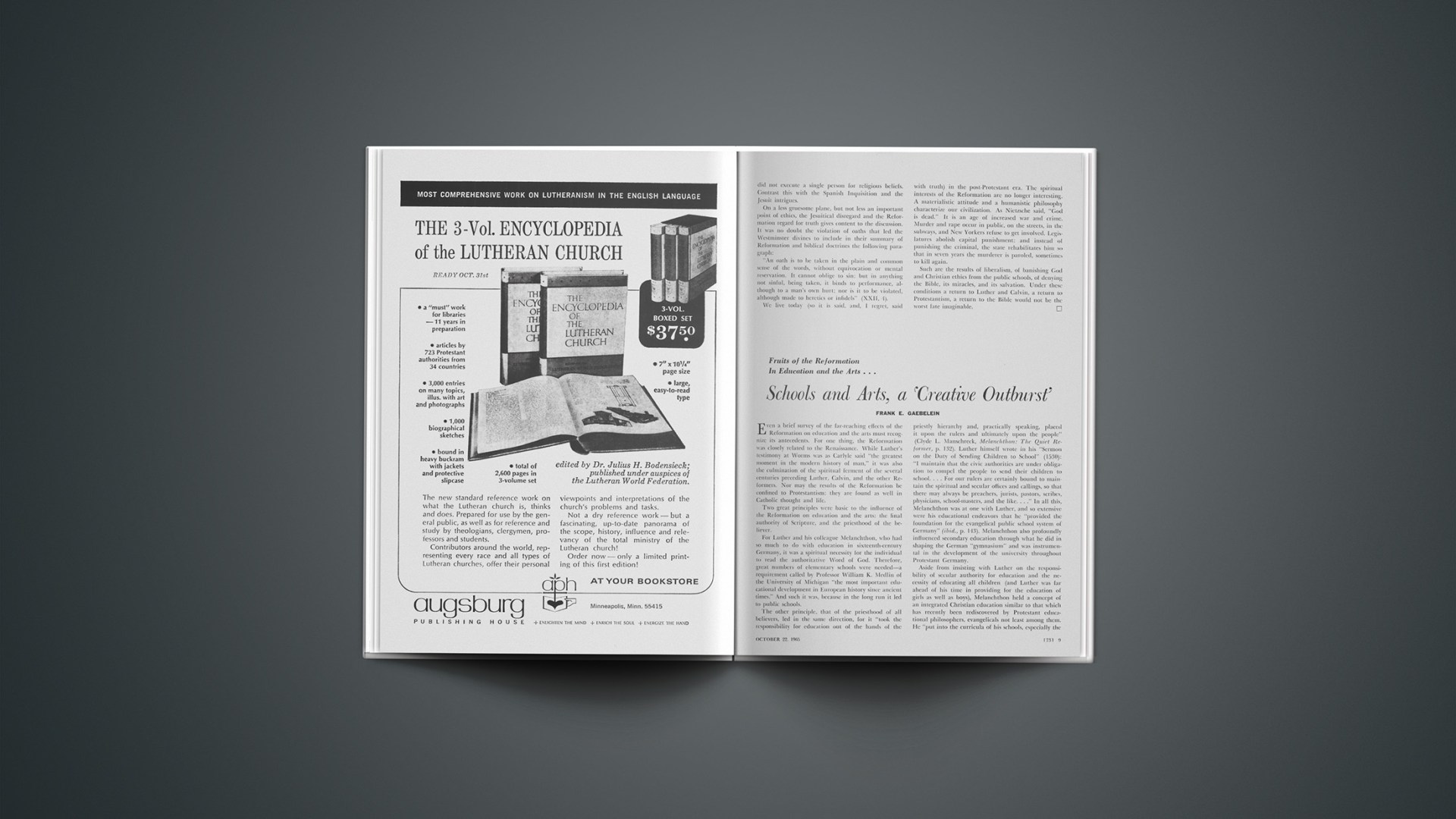
Schools and Arts, a ‘Creative Outburst’

Even a brief survey of the far-reaching effects of the Reformation on education and the arts must recognize its antecedents. For one thing, the Reformation was closely related to the Renaissance. While Luther’s testimony at Worms was as Carlyle said “the greatest moment in the modern history of man,” it was also the culmination of the spiritual ferment of the several centuries preceding Luther, Calvin, and the other Reformers. Nor may the results of the Reformation be confined to Protestantism; they are found as well in Catholic thought and life.

Two great principles were basic to the influence of the Reformation on education and the arts: the final authority of Scripture, and the priesthood of the believer.

For Luther and his colleague Melanchthon, who had so much to do with education in sixteenth-century Germany, it was a spiritual necessity for the individual to read the authoritative Word of God. Therefore, great numbers of elementary schools were needed—a requirement called by Professor William K. Medlin of the University of Michigan “the most important educational development in European history since ancient times.” And such it was, because in the long run it led to public schools.

The other principle, that of the priesthood of all believers, led in the same direction, for it “took the responsibility for education out of the hands of the priestly hierarchy and, practically speaking, placed it upon the rulers and ultimately upon the people” (Clyde L. Manschreck, Melanchthon: The Quiet Reformer, p. 132). Luther himself wrote in his “Sermon on the Duty of Sending Children to School” (1530): “I maintain that the civic authorities are under obligation to compel the people to send their children to school.… For our rulers are certainly bound to maintain the spiritual and secular offices and callings, so that there may always be preachers, jurists, pastors, scribes, physicians, school-masters, and the like.…” In all this, Melanchthon was at one with Luther, and so extensive were his educational endeavors that he “provided the foundation for the evangelical public school system of Germany” (ibid., p. 143). Melanchthon also profoundly influenced secondary education through what he did in shaping the German “gymnasium” and was instrumental in the development of the university throughout Protestant Germany.

Aside from insisting with Luther on the responsibility of secular authority for education and the necessity of educating all children (and Luther was far ahead of his time in providing for the education of girls as well as boys), Melanchthon held a concept of an integrated Christian education similar to that which has recently been rediscovered by Protestant educational philosophers, evangelicals not least among them. He “put into the curricula of his schools, especially the higher schools, those subjects which would contribute most to an understanding of the scriptures” (ibid., p. 146) and justified the various subjects, including physics and astronomy, by their relation to God. His was an integrated curriculum, centering in the principles of “back to the sources” and “knowledge of Christ.”

But the educational influence of the Reformation spread far beyond Germany. Along with the Lutheran there is the Calvinist influence. Like Luther, Calvin was committed to the extension of learning. Calvinism affected education in the Netherlands, where the Synod of Dort in 1618 required every parish to furnish elementary education for all and where the Protestant Christian school reached its fullest flowering and set the pattern for the Christian day school movement in America. In Scotland the educational impact of Geneva came through Knox, and in 1646 the Parliament required a school in each parish. Education in France and Switzerland was mightily affected by the Reformation. “No one,” said Calvin, “is a good minister who is not first a scholar.” In an essay entitled “The Reformed Tradition in the Life and Thought of France” (Theology Today, I, 349), Emile Cailliet stresses the essential democracy of the French Reformed movement: “The new Christian learning stayed in close contact with the people. In France as in Geneva, every Reformed church was bound to have a school. Mothers would learn to read so that they might be the first Bible teachers of the children.… It was a Protestant, the philosopher, Pierre Ramus, who at the time of the Renaissance organized higher education in France.” Moreover, in the nineteenth century many French Protestants were educators, Guizot being a pioneer of the public school system.

To be sure, educational progress under the impetus of the Reformation was not an unbroken development. There were setbacks and lapses into formalism. But the indestructible seed had been sown.

Americans are well acquainted with the fruition of that seed. At its beginnings in the Massachusetts Bay Colony, education in this country was rooted in Puritanism. That our colleges and universities and also our free schools are generically among the educational fruits of the Reformation is not arguable. If America has the most extensive system of education the world has known, this is in large part the result of the Reformation. According to the distinguished educational historian, Edward P. Cubberly, “The world owes much to the constructive, statesmanlike genius of Calvin and those who followed him, and we in America probably most of all” (The History of Education, p. 332).

Even so rapid a sketch of the educational results of the Reformation as this would be incomplete without some reference to Roman Catholicism. To the extent that the Council of Trent was the result of the Reformation, so the Reformation may be said to have influenced the improvements in Catholic education. Loyola and his followers assimilated into their own Jesuit system the best educational thought of the time, borrowing ideas from the College of Guyenne (headed by Cordier, Calvin’s teacher), the colleges of Geneva, and Johann Sturm’s school at Strassburg.

Through all the ebb and flow in education since the sixteenth century, the most productive event was Luther’s translation of the Bible into the vernacular. Setting the pattern for the German language, it also reached far beyond the confines of Germany. (William Tyndale, whose translation contributed so much to the King James Bible and who had visited Luther at Wittenberg, was greatly influenced by Luther’s German Bible.) Among Luther’s highest achievements was his giving the people God’s Word in their everyday speech. And it was Calvin who went on to develop from Scripture the great system of Reformed doctrine.

Let these things be kept clearly in mind, as our survey moves from education to another field. For the recovery of the Bible and the priesthood of the believer are at the roots of the influence of the Reformation in the arts as well as in education.

Two of the greatest arts—music and painting—must suffice to illustrate the aesthetic results of the Reformation, which also exclusively affected the other arts. Luther himself was a good musician. Through his emphasis upon the use of the chorale and through liturgical changes, he gave Protestant worship the inestimable gift of congregational singing; “Luther provided for liturgical forms that gave the congregation opportunities for direct participation in the service …” (Howard D. McKinney and W. R. Anderson, Music in History, p. 302).

In his love for music, Luther was a true child of sixteenth-century Germany, which was “bursting with song.” Zwingli, who was also a musician, banned music from the church as unworthy of sacred use. But Luther knew better. “The devil,” he said, “has no right to all the good tunes,” and his view prevailed. Calvin was not himself musical. Yet contrary to uninformed opinion, he did not object to the use of music by Christians but considered it among “the excellent gifts of the Holy Spirit.” In the Reformed tradition, the use of music was narrower than in Lutheranism; yet it had its place, chiefly in the musical setting of the psalter. And the Church is permanently indebted for some of its enduring hymns (“Old Hundredth” among them) to such a composer as Bourgeois, who lived and worked in sixteenth-century Geneva.

If Calvin’s attitude toward music has been misunderstood, that of the Puritans has been slandered. In a definitive study, Percy Scholes, whom the great musicologist Alfred Einstein calls “an unimpeachable British witness,” has demolished the persistent misrepresentation that the Puritans hated music (The Puritans and Music in England and New England).

But to speak of Reformation influence in music is to bring immediately to mind that most towering of musical geniuses, Johann Sebastian Bach. Bach was no isolated phenomenon. He came from a family so musically eminent that in Erfurt musicians were known as “Bachs,” even when no members of the family were there. He also had great Protestant predecessors, such as Buxtehude and particularly Schütz, who wrote some of the most spiritual of all music.

Bach is the man who in a single work, The Well-Tempered Clavichord, “opened up all the wealth of later music, with its absolute freedom of key change,” and who in his church music, notably the B minor Mass (a thoroughly Lutheran work, the form of which makes it impossible to use in the Catholic service), the St. Matthew Passion, and the cantatas, expressed the essence of the Reformation faith. The historian who said that in the course of three hundred years only one German ever really understood Luther, and that one was Johann Sebastian Bach, may have been guilty of a degree of overstatement, but he came close to the heart of the matter.

To trace the influence of Bach in musical history would require calling the roll of the great composers who succeeded him with the possible exceptions of Gluck and Berlioz. Although Bach was far from unknown to his major successors like Mozart and Beethoven, it was Mendelssohn who had much to do with the rediscovery of his choral music. At the age of twelve, Mendelssohn read an autograph of the St. Matthew Passion in the Royal Library at Berlin and did not rest until years later he had given the work its first performance since Bach’s death. Thus wide recognition of Bach’s church music came late. Today this music still stands supreme. At the heart of this supremacy is the man himself, the devoted Lutheran Christian, who could not view the passion of Christ as a spectator but only as one who was personally related to the Lord whose suffering he so poignantly portrayed in tone.

Side by side with Bach stands another great Protestant musician, Handel. Professor Carl J. Friedrich of Harvard says, “The crowning glory of baroque music, in which it reaches the pinnacle that transcends all limitations of period and style, was achieved by Johann Sebastian Bach (1685–1750) and Georg Friedrich Händel (1685–1759) …” (The Age of the Baroque, p. 87). It was Handel who took the oratorio, which had originated during the Catholic Reformation in the Oratory of Philip Neri in Rome, and made of it such a glorious work as The Messiah, the libretto of which is derived in every detail from Scripture. Different from Bach in the acclaim that came to him during his lifetime, which was largely lived in England, the man who wrote The Messiah could say that he hoped to die on Good Friday that he might rise with his Christ on Easter Day. Among the successors to his biblical oratorios, which also include Israel in Egypt and Samson, there stand Mendelssohn’s masterpieces, Elijah and St. Paul, as well as many later works, such as Stainer’s Crucifixion.

The chief glory of later Protestant music is the German Requiem of Johannes Brahms, a convinced Lutheran, of whom one biographer says, “The Christian teaching which he received from Pastor Geffcken, who prepared him for confirmation, laid the imperishable foundations of his love for old Protestant church music and its uncorrupted original melodies” (Brahms, Walter Niemann, p. 182). “People do not even know,” Brahms once said, “that we North Germans long for the Bible every day and do not let a day go by without it. In my study I can lay my hand on my Bible even in the dark.” Thus it is not surprising that for his Requiem Brahms himself chose the Scripture passages.

The Protestant spirit in music has many manifestations. Yet whether it be in the religious masterpieces of Bach or Brahms, or in the less known treasures of Moravian music rediscovered within recent years in the United States, the devotion to Scripture and the sense of the believer’s priesthood that are at the heart of the Reformation find musical expression. For the deepest strain in Protestant church music is that of spiritual inwardness.

These same principles carried over into painting, where they brought a new measure of freedom. The magnificent achievement of the great Italian Renaissance masters has enriched humanity, and the world can only be grateful for their work. Yet their art was largely aristocratic rather than of the people. It portrayed the Christ, the Virgin, and the saints with the utmost mastery of line and color. And perhaps some of it also tended to a kind of artistic docetism in which the essential humanity of Christ was submerged.

But the Reformation was not aristocratic. Nor did it encourage the Church to dominate art. In Protestantism, gorgeous ritual and the churchly display of magnificent painting gave way to the direct access of the believer in all his weak and fallible humanity to the Lord who was true man, “in all points tempted like as we are, yet without sin.” Thus the Reformation, particularly in its Calvinistic phase, worked in painting to free it from the patronage of the Church and to make it more accessible to all men everywhere (see chapter v of A. Kuyper’s Calvinism, the Stone Lectures for 1898 at Princeton Theological Seminary).

The tendency to bring Christ close to man in the reality of his divine manhood is evident in such works as the Crucifixion by Matthias Grünewald, the most powerful of all portrayals of Christ’s suffering. Standing on the threshold of the Reformation, Grünewald shows with unforgettable pathos that it was man as well as God who hung and suffered on the Cross. In a new book, Jane Dillenberger says of this picture, “The miracle is that through the intensity of physical suffering speaks the atoning sacrifice of ‘the Lamb of God who taketh away the sin of the world’.… The early years of the Reformation and the early twentieth century [Roualt] have both given us notable images of a Christ who died in order that the Christian believer may live and die in him” (Style and Content in Christian Art, p. 149).

The most representative of all German artists, Albrecht Dürer, spanned the transition from the Renaissance to the Reformation. He himself was deeply committed to Luther and his cause, and he “might have become the artist of the Reformation had not death intervened not too long after his crisis of the spirit” (Roland H. Bainton, Here I Stand, p. 125).

But it is to the Netherlands, that most Calvinistic of Protestant countries, that we must look to find the painter who is the epitome of the Reformed influence in art. That man is Rembrandt. From his mother he gained great familiarity with the Scriptures. (One of his earlier portraits shows her reading her Bible.) His small library of only fifteen books contained, according to the catalog inventory of 1656, “een oude Bijbel” (an old Bible), in which he was deeply read. A man of the people who was not always on good terms with his church, Rembrandt reflects most profoundly the environment in which he lived. If he was, as Paul Jamot says, “the most religious of the painters,” it was because “he was religious and human at once.”

It is perhaps not generally recognized that Rembrandt was chiefly a painter of biblical subjects. His religious works greatly exceed every other category, totaling 850, whereas the next largest group (portraits) numbers about 500 (Dillenberger, p. 194). Furthermore, it is significant that none of his commissioned religious paintings was done for churches. They were essentially an “unchurched” kind of religious art, presenting Christ for every man and thus similar in spirit to some of the religious painting of our own day. Not only did they have scriptural subjects; they also showed deep insight into biblical truth. Rembrandt’s portrayal of Christ is far removed from the conventionalized and sentimental picture Protestant America seems to have taken for its own. Rather is Rembrandt the graphic presenter of God’s majesty and Christ’s tenderness. The Lord he depicts is “richly human. His face seems worn and its expression is inward, as if the words spoken were given rather than proclaimed.… The authority with which this Christ teaches and proclaims the good news and speaks of the forgiveness of sins is of divine origin. And yet he is wholly human” (ibid., pp. 186,187).

Rembrandt occupies a place in painting comparable only to that of Bach in music. With him the Reformed tradition finds its deepest pictorial expression.

Music and painting are among the most subjective of the arts. By insisting that every man is a priest before God, the Reformation freed the individual Protestant musician and painter to participate in the creative outburst of activity loosed by the recovery of the Word of God for the individual.

A Complete Reversal of Scholasticism

That the Reformation caused tremendous changes in the spiritual and ecclesiastical conditions of Europe needs no emphasis. Its impact on politics is also indisputable. But its effect on philosophy and ethics no doubt requires some explanation.

During the early Middle Ages, philosophy (what there was of it) followed in general the principles of a Platonic Augustinianism. The spiritual realm was considered to be directly accessible to reason, while the sensible world neither provided the basis of knowledge nor contributed any great amount to its sum total. Philosophy in effect coalesced with theology.

In the thirteenth century Thomas Aquinas replaced Augustinian thought with that of Aristotle. Sensation became the basis of knowledge, and God’s existence was proved by a tortuous argument from physical motion to an Unmoved Mover. Here is not the place to discuss the theological results of abandoning Augustine, but the philosophical result was an intricate scholasticism that led Jerome Zanchius to remark that “Thomas Aquinas [was] a man of some genius and much application, who, though in very many things a laborious trifler, was yet on some subjects a clear reasoner and judicious writer” (Absolute Predestination, chap, iv, pos. 8, par. 4, footnote).

Although there is no evidence that the scholastics ever seriously debated how many angels could dance on the point of a needle, Aquinas did indeed discuss whether an angel is in a place, whether an angel can be in several places at once, and whether several angels can be at the same time in the same place. These things, along with arguments on the passive and active intellect, prime matter, and whether only boys and no girls would have been born if Adam had not sinned, can easily produce the impression that Aquinas was sometimes a “laborious trifler.”

Later scholastics, particularly Duns Scotus, increased the number of subtleties. Contrary to Augustinianism, the area common to philosophy and theology became less and less. William of Occam made the break complete: nothing theological could be proved by philosophy—Christianity is based on revelation alone. If now Occam’s philosophy can be shown to the skeptical, then there is a peculiar return to Augustinianism in which no knowledge is possible apart from revelation. Luther’s philosophy was in effect this type of Occamism.

In a very real sense the Protestant Reformation may be said to have had no effect whatever on the subsequent history of philosophy. The main line—Descartes, Spinoza, Leibniz, the British empiricists, Kant, and Hegel—would presumably have developed essentially as it did, Reformation or none. Leibniz was a Lutheran and Berkeley a zealous Anglican, but the few necessary adjustments to Protestant or even Catholic thought do not seem to have had any really basic influence at all. Modern philosophy stems from the Renaissance, not from the Reformation.

Protestant thought on philosophic themes, on the other hand, was a complete reversal of scholasticism. Not only was the point of view of a spectator in an ivory tower condemned as useless, as trifling, and indeed as impious, but also the existence of God, instead of being a conclusion to an intricate Aristotelian argument, became the basis of all truth.

In the first chapter of the Institutes, Calvin, disdaining even to mention physical motion and an Unmoved Mover, begins with a question of greater Augustinian flavor: Does a man first know himself and then learn of God, or does he know God first and later learn about himself? Briefly Calvin’s answer is: “No man can arrive at the true knowledge of himself, without having first contemplated the divine character, and then descended to the consideration of his own.… Though the knowledge of God and the knowledge of ourselves be intimately connected, the proper order of instruction requires us first to treat of the former, and then proceed to the discussion of the latter.”

In opposition to Aristotelian empiricism, Calvin, far from basing this knowledge on experience, refers it to natural instinct. “Some sense of the Divinity,” he says, “is inscribed on every hear.… All have by nature an innate persuasion of the divine existence, a persuasion inseparable from their very constitution.… We infer that this is a doctrine, not first to be learned in the schools, but which every man from his birth is self-taught” (I, iii, 1 and 3).

This Reformation theory of innate or a priori knowledge was not uniformly maintained in later centuries. Both deism and its Christian opponents introduced more and more natural theology. This should be regarded as a deterioration from the original position of Luther and Calvin.

Rejecting the ideal of one universal corrupt church, the Protestants were neither willing nor able to enforce philosophic uniformity. Jonathan Edwards was staunchly orthodox in theology, but he was peculiarly influenced by the British empiricists. Rudolf Bultmann thinks the New Testament anticipated Heidegger and existentialism; but since Bultmann is not staunchly orthodox, he may be a poor example. At any rate, Protestant theologians have oscillated between Scottish common sense and Hegelian personalism. Today the Free University of Amsterdam is the center of a serious attempt to produce a comprehensive Christian philosophy. With Calvin’s rejection of natural theology these men have brilliantly criticized non-Christian systems. Whether their constructive work will long endure remains to be seen.

The effect of the Reformation on ethics may be separated into theoretical and practical aspects. Consonant with the rejection of natural theology, the Reformation based its ethics on revelation and discarded natural law. This is pure theoretical gain. The theory of natural law commits a major logical blunder when it tries to deduce a normative conclusion from descriptive premises. No matter how carefully or how intricately one describes what men do, or what the provisions of nature are, or how natural inclinations function, it is a logical impossibility to conclude that this is or is not what men ought to do. The is never implies the ought. This criticism applies to all empirical theories. Both Thomism and utilitarianism insist that man is morally obligated to seek, not just his own good, but the common good. This principle, however, cannot be justified empirically.

When the Thomists argue that it is a natural law to seek what is good, because as a matter of fact everybody seeks what is good, they reduce the term good to the several objects of human desire. When they further state, “No one calls in doubt the need for doing good, avoiding evil, acquiring knowledge, dispelling ignorance …” (Gilson, The Philosophy of St. Thomas Aquinas, p. 329), they simply shut their eyes to beatniks, the Mafia, the tribes of the Congo, Schopenhauer, and Nietzsche. Tautology or falsity is their fate.

The Reformation’s ethical principles were the explicit commands in the Word of Cod. Of course this presupposes the existence of God—discussed above—and the possibility and truth of revelation. If revelation is false, then its ethical theory is false, too; but no one can accuse it of tautology.

The practical effect of the Reformation on ethics is more easily observed by the general public, and Jesuitical casuistry and Tetzel’s scheme to raise money for St. Peter’s provide the sharpest possible contrast with Puritan conscientiousness. The massacre of the Huguenots and the massacre of the Covenanters by the Catholic Stuarts are highlighted by the Presbyterians’ refusal to take revenge when they came to power. Even in the days of John Knox, after the martyrdoms of the early Reformation, the Presbyterians in power in Scotland did not execute a single person for religious beliefs. Contrast this with the Spanish Inquisition and the Jesuit intrigues.

On a less gruesome plane, but not less an important point of ethics, the Jesuitical disregard and the Reformation regard for truth gives content to the discussion. It was no doubt the violation of oaths that led the Westminster divines to include in their summary of Reformation and biblical doctrines the following paragraph:

“An oath is to be taken in the plain and common sense of the words, without equivocation or mental reservation. It cannot oblige to sin: but in anything not sinful, being taken, it binds to performance, although to a man’s own hurt; nor is it to be violated, although made to heretics or infidels” (XXII, 4).

We live today (so it is said, and, I regret, said with truth) in the post-Protestant era. The spiritual interests of the Reformation are no longer interesting. A materialistic attitude and a humanistic philosophy characterize our civilization. As Nietzsche said, “God is dead.” It is an age of increased war and crime. Murder and rape occur in public, on the streets, in the subways, and New Yorkers refuse to get involved. Legislatures abolish capital punishment; and instead of punishing the criminal, the state rehabilitates him so that in seven years the murderer is paroled, sometimes to kill again.

Such are the results of liberalism, of banishing God and Christian ethics from the public schools, of denying the Bible, its miracles, and its salvation. Under these conditions a return to Luther and Calvin, a return to Protestantism, a return to the Bible would not be the worst fate imaginable.

Global Repercussions Still Mounting

Major fruits of the Reformation have been in the inseparably related fields of evangelism and missions. Evangelism is seeking so to present the Gospel to men and women that through it they may be born anew. If they have entered into the wonder and joy of the new life made possible through Christ, men and women will inevitably seek to spread the Good News throughout the world, whether among their immediate neighbors or in other lands.

In its essence the Reformation originated among those who had experienced the new birth. Because Luther had learned through painful struggles the amazing truth that is at the heart of the biblical revelation and the New Testament, that salvation is achieved not by good works but by faith—“the just shall live by faith” (Rom. 1:17); “by grace are ye saved through faith; and that not of yourselves: it is the gift of God” (Eph. 2:8)—he sparked the Reformation. Many factors contributed to the spread of the Reformation, some political, some related to the ambitions of kings and princes to control the Church; but at the heart of it were men who were moved by God’s grace in giving his Son, by the willingness of Christ to follow his Father’s will and go to the cross, by the marvel of the Resurrection, and by the gift of the Holy Spirit. The new birth came in a variety of ways: to some, as to Calvin, in such a way that they were reticent about the details; to others, as to Menno Simons, by stages. But always it issued in the fruits of the Spirit and always it was contagious.

From time to time across the centuries, from the currents finding channel through the Reformation fresh streams of evangelism have issued. Such was Pietism. When, in Protestantism in the Netherlands and Germany, a deadening formalism seemed to have blocked the springs of the new life, preachers and pastors such as Spener spoke of the necessity and possibility of the new birth and gathered about them those who experienced it, cultivated it through fellowship in prayer and Bible study, and sought to win others. John Wesley was an outstanding leader of those, not alone in Methodism but as well in other circles, who experienced the new birth. As he described it, in an hour which was to him transforming he felt his heart “strangely warmed,” felt that he did “trust in Christ, Christ alone for salvation,” and received an assurance that Christ had taken away his sins and saved him from the law of sin and death. In a way that was different and yet essentially the same, God’s grace gripped Jonathan Edwards, Charles G. Finney, Dwight L. Moody, and in our own day Billy Graham. From them, and thousands of lesser fame, flowed “rivers of living water” (John 7:38).

The Reformation was late in giving rise to foreign missions. One reason was the belief of some of the early Reformers that the Great Commission was given only to the apostles. Another was that the Reformers were so engaged in the transformation of the Church in their own lands that they had little time for spreading the faith outside Europe. The major reason, however, was that for nearly a century after the start of the Reformation Protestant peoples had little contact with non-Christian peoples. The great exploring and colonizing powers of the sixteenth century were Spain and Portugal. Significantly, the great surge of Catholic missions that accompanied and followed their exploits was the fruit of the fresh awakening in the Roman Catholic Church which we sometimes inaccurately call the Counter-Reformation. That awakening arose through great spirits who wished the Catholic Church purified. Like Ignatius Loyola, a contemporary of Martin Luther who had had a profound and transforming experience of Christ and who founded the Society of Jesus dedicated to “the greater glory of God,” they were moved by a passion for souls. They planted the Gospel as they understood it in the Americas, Africa, and Asia, attempting to win the nominal Christians among their fellow countrymen to a vital faith and to protect the non-Europeans against exploitation and bring them into the Church.

Protestants planted missions wherever they had colonies and commerce. That was true of the early settlers in Virginia, of John Eliot and the Mayhews in New England, and of the Dutch in Ceylon and the East Indies. Those missions were minority enterprises; the majority of the settlers and merchants were not interested in them and even opposed them. Yet they were early fruits of the Reformation.

The major Protestant missions arose from Pietism on the continent of Europe and the related evangelicalism in the British Isles and America. The great pioneers were the Moravians. Refugees from persecution in Bohemia, they settled on the estates of Count Zinzendorf, who was a godchild of Spener. Zinzendorf saw in the little company of refugees, with their center in Herrnhut, instruments for fulfilling his dream of carrying the Gospel to all mankind. Under his initiative the Moravians founded missions in some of the few parts of the world to which Protestant peoples had access—among them Greenland, the Thirteen Colonies, and the Danish West Indies. German Pietists were the first Protestant missionaries in India, sent by the King of Denmark to a Danish trading post in Tranquebar. Out of the Great Awakening in New England came missions to the Indians, with David Brainerd as a famous figure. A prospective son-in-law of Jonathan Edwards, Brainerd died of tuberculosis contracted during heroic labors among the red men.

William Carey, rightly esteemed the major pioneer in modern Protestant missions, was converted in his youth. In 1795, three years after the founding of the Baptist Missionary Society which sent Carey to India, evangelicals of several denominations inaugurated the London Missionary Society. In 1799 evangelicals within the Church of England began what is known as the Church Missionary Society, to this day the largest missionary society supported by Anglicans. Out of what was known as the Second Awakening came the lads who at the Haystack prayer meeting in Williamstown, Massachusetts (1806), formed themselves into the Society of the Brethren with the purpose “to effect in the persons of its members a mission or missions to the heathen.” Through them came the American Board of Commissioners for Foreign Missions (1810), which, except for an earlier Moravian society, was the first in the United States to begin missions in other countries. This Protestant missionary effort of the last decade of the eighteenth and the first decade of the nineteenth century sprang from evangelicals at a time when Europe was racked by the French Revolution, with its religious skepticism, and the Napoleonic Wars. It showed that, in the darkest days, from the minorities of evangelical faith can come movements that will bless the world.

Significantly, too, the missionary awakening came when the British Empire was beginning the expansion that in the nineteenth century opened much of the world to Protestant missions. In 1815, just at the end of the Napoleonic Wars, German and Swiss Pietists opened a seminary in Basel. For a time its graduates went out under British societies, but in 1822 it began sending missionaries under its own auspices. Before the middle of the century several other German missionary societies were organized, some of them the outgrowth of Basel.

In 1865 J. Hudson Taylor founded the China Inland Mission. The son of warmly evangelical parents, Taylor had been converted in his teens. He soon determined to be a medical missionary in China, then only beginning to be opened to the foreigner. While studying medicine, through discipline and prayer he taught himself to depend completely on God for his physical needs. He continued that reliance during his initial years in China. Invalided home, he resumed his medical studies. The weight of China’s millions, dying without hearing the good news of Christ, became a crushing burden. He believed that God wished none of them to perish but all to come to a knowledge of the truth. He also believed that God must be waiting for someone to offer to be the instrument through whom the Gospel could be brought to the Chinese. With no organization behind him and no influential friends, he undertook, in faith, to be that instrument. The China Inland Mission was the result. Its program was to send its members to the interior where no other Protestants were at work, to depend entirely on God for personnel and funds, to have no fixed salaries, and never to go into debt.

Taylor found great strength in such biblical words as Ebenezer and Jehovah Jireh, carrying the assurance “hitherto hath the Lord helped us” and “the Lord will provide.” He accepted “willing, skillful workers,” regardless of their denomination. At the end of its first half century the China Inland Mission had more than 1,000 missionaries on its rolls. Wide attention was brought to it when in the 1880s it was joined by “the Cambridge Seven,” athletically and socially prominent converts of Moody in that university. Affiliated organizations sprang up in several countries, and other “faith” missions were inspired by it.

Marked reinforcement to Protestant missions came from the United States through the Student Volunteer Movement for Foreign Missions. That movement began in 1886 in a conference at Mt. Hermon, Massachusetts, led by Moody. Its members signed the “declaration”: “It is my purpose if God permit to become a foreign missionary.” By its “watchword,” “the evangelization of the world in this generation,” was meant, not that the world was to be converted in that generation, but that it is the obligation and privilege of each generation of Christians to make the Gospel known to everyone in the world of its day. The movement spread to other countries, and through it thousands of students were enlisted for missions. The Laymen’s Missionary Movement, begun in 1906, had as its object the raising of the funds needed to fulfill the watchword.

From the Student Volunteer Movement came a great enlargement of the missionary enterprise. John R. Mott, one of the original hundred who at Mt. Hermon inaugurated the movement, became the chairman of its executive committee. He himself had made his full commitment to Christ through contact with one of Moody’s Cambridge converts, Kynaston Studd, who was a brother of one of the Cambridge Seven and who later was knighted and became Lord Mayor of London. Mott succeeded Moody as chairman of the annual student conferences at Northfield, Massachusetts, in the buildings of the girls’ school founded by the evangelist. He became an evangelist to students and held evangelistic meetings in many of the universities of the world.

From the conviction that students were to be the future leaders of their peoples and, if won to Christ, would be the best means of giving the Gospel to their nations, Mott organized, in 1895, the World’s Student Christian Federation. In 1910 he and J. H. Oldham, a leader in the British affiliate of the Student Volunteer Movement, organized the World Missionary Conference in Edinburgh. Mott presided and became the chairman of the Continuation Committee of the conference, and later the chairman of the International Missionary Council which followed. He saw in that council a means for coordinating all Protestant foreign missions in such a way that the dream of “the evangelization of the world in this generation” could be realized and churches planted and strengthened in every land. From former members of the World’s Student Christian Federation came most of the initial leadership of the World Council of Churches. Fittingly, Mott, then in his early eighties, became the first honorary president of that organization.

In light of such a record, of which this is only the barest outline, something of the contribution of the Reformation to evangelism and missions can be discerned. The original impulse from which the Reformation sprang—the joyous recognition of salvation through faith in the grace of our Lord Jesus Christ revealing the love of God—has had global repercussions that are still mounting.

Cover Story

Our Protestant Heritage: Eight Imperishable Principles

The Reformation was not born on a particular day in a given month and year, It did not come into history as a finished act: it will not be completed until the end of time. It had its historical background and its crucial events, and has had a continuing influence.

The Reformation was not the millennium. Not everything done in its name can claim our wholehearted approval; it reflected the original sin of its chief proponents. Yet when it is viewed in its totality, and through the transformations to which it led and the continuing vitality and influence it has had, none can deny that the Reformation was the greatest movement in Christian history since the days of the apostles. Whatever its shortcomings, it bequeathed to all ages an imperishable heritage of which we need to be reminded again and again. It is true that this heritage has, at times, been squandered and impoverished by the unfaithfulness of Protestant churches to Reformation principles. Sometimes there has even been a repudiation of what the Reformation stood for. Yet this neither detracts from the heritage nor invalidates the principles undergirding it.

What, then, are the imperishable principles that were rediscovered in the Reformation and passed on to succeeding ages?

1. The uniqueness of the Bible, the Word of God, as the only rule of faith and practice. Church and tradition were subordinated to Scripture, which was looked upon as the court of final appeal for all questions. Moreover, the Bible could not be a useful criterion for men unless it was available to them in their own tongues. Thus the principle of translating the Word of God into the languages of the people has been a Reformation constant.

2. The justification of the believer by faith alone, without works or anything else. In one stroke this principle cut through all the accretions of the centuries: priestcraft, indulgences, penances, auricular confession, and the like. The Reformers enunciated afresh the biblical norm that men are justified by the merits of Christ through his vicarious atoning sacrifice. This justification is granted to the believer only by faith.

3. The universal priesthood of all believers. No man, hierarchy, or intermediary of any kind stands between the individual and Almighty God. This principle swept away, as Preserved Smith says, “the vast hierarchy of angels and canonized persons that made Catholicism quasi-polytheistic” and represented a return to pure monotheism.

4. Religious liberty. The Reformers insisted that human conscience can never be coerced, that a man has more than the right to religious toleration—he has the right to full liberty to embrace or to reject the Christian faith. And he must have this freedom of choice without being subjected to outside restraints, threats, inquisitions, or authorities. Today the Vatican Council is wrestling with the principle of religious liberty, one that the Roman Catholic Church has resisted for many centuries.

5. The strengthening of the state and its deliverance from subservience to Rome. It was in the name of this principle that post-Reformation developments reached the ideal of the separation of church and state. It has found its most extensive expression in America, where religious authority and political control have been divorced.

6. The ethical value of this life and the sanctity of daily labor and of marriage, children, and the home. This contravened the monastic ideal of celibacy, solitude, and mortification of the flesh. Preserved Smith wrote: “The man at the plough, the maid with the broom, said Luther, are doing God better service than does the praying, self-tormenting monk.”

7. The sanctity of human vocation, whether clerical or lay. Some men are called to mend shoes; others are called to preach and teach. One vocation is in itself no more spiritual than another, for all are sacred before God. Every man in his vocation belongs to the Lord God and must fulfill the obligations of his stewardship within the vocation to which he has been called.

8. The virtues of thrift and industry. Success and prosperity are not in themselves right or wrong. God has ordained thrift and industry, and any consequent success or prosperity must be used for the glory of God.

Some of these essential elements of the Reformation are discussed in the following essays.

Editor’s Note from October 22, 1965

A few days ago I walked along the wall that divides Berlin and symbolizes the split in the Western world. Luther’s Saxony, heartland of the Reformation, now lies in the lap of Communist overlords.

One of the paradoxes of this generation is that alongside a revival of Luther-research and of Calvin-research, ecclesiastical leaders too seem to be sealing off the modern world from the Protestant Reformation. In fact, some unity-questing churchmen have virtually narrowed the image of the Reformation to an ill-advised division in the ranks of Christendom. The great blessings of the Reformation to its generation and to ours seem all but forgotten. A fresh glimpse of this heritage will surprise many readers.

So vast a benefit has come to the Western world through the Reformation that, at a time when many non-evangelical Christians seem to have forgotten it, the Pope who is now calling so ardently for renewal in the Church would serve both Protestants and Catholics well were he to commend the faith and initiative of the Reformers.

Germany’s Spiritual Stew

To attempt to generalize about the religious and spiritual scene in a land as dynamic and diverse as present-day Germany is to invite the criticism of being superficial. The most that one can hope to do is to report what he himself has felt and observed, and to recognize continually that he sees in part and reports in part. A number of elements of significance have come to the attention of this writer during the past summer, spent in the German Federal Republic and in West Berlin.

It is noticeable, first, that the question of church and slate is by no means resolved in West Germany. The problem assumed prominence again this year in relation to the Roman Catholic Church, which has no national school system as such in the Federal Republic. The courts have ruled that education is a province of the Länder or states, and thus the Roman hierarchy is compelled to deal directly with each state in educational matters.

This year, the matter has reached what seems to be a critical stage with the preparation of a draft concordat between the Holy See and the state of Lower Saxony. The aim of the concordat is to increase the amount of Catholic religious training in the public schools. Lower Saxony is approximately 80 per cent Protestant, and thus the members of the predominantly non-Catholic state teachers’ association are disturbed. Some have said they will refuse to teach any classes in religion if the concordat is ratified. At present, the attempt is being made to prove the proposed draft unconstitutional.

What is significant in the entire affair is that the national Christian Democratic party, which is largely Catholic-based, opposes the concordat—for political reasons. Chancellor Ludwig Erhard seems to fear that its ratification will confirm some of the concern of anti-clericals and swing their votes to the Socialist party in the forthcoming national elections.

The problem is a thorny one, especially since the basic relations between the West German government and the Vatican are governed by pacts negotiated with the Hitler government. It would seem that both West Germany and Italy could afford to insist upon a renegotiation of their respective agreements made with the Holy See during the days of the Rome-Berlin Axis. Rome may, of course, feel that she could not hope in this decade to secure such favorable terms as she secured in the late twenties and early thirties.

To the outsider, it seems ironical that Germany, with her proud Christian heritage, should today be regarded with special interest by non-Christian religions. Buddhists, Hindus, and Muslims seem to consider West Germany their primary missionary territory in Europe.

Laborers are brought into the country from Muslim lands, notably Iran and Turkey, and there are now some 120,000 Muslims employed in Germany, with another 10,000 in the Federal Republic as university students. At least eight mosques operate in the land; and their services are attended, not only by foreign students and Muslim laborers, but also by Germans, who seem to be seeking for something not found in their own religious institutions. The most successful center of Muslim worship is in the town of Schwetzingen, and services are also held regularly in Frankfurt-am-Main and Nürnberg.

Buddhists from both Ceylon and Tibet are also active in Germany. There is a well-staffed Buddhist mission for Germany that claims 3,000 members among the German population. This figure does not tell the entire story, for there seems to be a wide interest in the investigation of Buddhism as a religious option within German intellectual circles. To many, this seems to be “the thing” for the fashionable intellectual to pursue.

This same interest in the exotic quality of Oriental thought is inclining some German intellectuals toward the more sophisticated varieties of Hindu thought. There are said to be nine schools of Yoga in the country. These use the cultivation of the cultic physical exercises as a means to introduce students to the beliefs of speculative Brahmanism. Emphasis is laid upon the technique of interweaving Indian religious thought with the psychology of the West. What is significant in all this is that there is a spiritual hunger and spiritual quest which German Christianity is not satisfying. Adherents of missionary movements from the East capitalize upon this.

Another factor noticeable in the mentality of many West Germans is spiritual neutralism. This writer and his wife had an earnest conversation with a well-educated young man who had very recently been married. When asked whether the wedding was solemnized in the Church, he replied matter-of-factly but firmly that it was not. He emphasized that he was neither for nor against the Church, but that to him it was essential to regard such matters in total and detached objectivity. Neutrality toward faith was to him a sort of a dogma.

When questioned a bit further about what filled the frame of his life, he made it perfectly clear that getting and furnishing an apartment and maintaining a comfortable manner of life were to him the essence of living. He revealed no antipathy to faith, Christian or other; to him, faith was simply redundant, the Church irrelevant.

Informed Christians feel that this attitude is widespread in the Federal Republic. It is, viewed from one angle, more difficult than avowed atheism. Although a short conversation with this man did not disclose all the ingredients of such a way of thinking, one thing seemed clear. The mood of detachment and non-involvement was mingled thoroughly with materialism. The young man’s values were exclusively material.

A final observation has to do with the current theological mood. Any attempt to generalize in this area involves the peril of oversimplification. But certain trends seem evident. First, the supreme reign of Rudolf Bultmann in German theological matters is drawing to a close. No longer can a frown or a negative comment from this theologian condemn the opinion of another capable thinker to oblivion or outer darkness. True, the tendency to form “schools” and the mechanics of filling professorships in German universities do serve to give abnormal power to strong personalities. But the dogmatic “quest for the existential Jesus” is no longer regarded as above criticism.

Again, there seems to be emerging a renewed emphasis upon the historical element in revelation. This may be an outgrowth of the stressing of Heilsgeschichte (salvation-history) by Oscar Cullmann and others. Thus, there seems to be a discernible trend toward acceptance of a possible continuity between the events described in the biblical revelation and the events of general history. It is too early to predict Whether or not this will finally bring to an end the mania for demythologizing in Continental theology. The trend may be the harbinger of a day in which first-line theologians will at least entertain the possibility of some factual validity and some propositional accuracy in the historic written Revelation.

Negro Baptists Confer in Watts’s Wake

America’s three major Negro Baptist groups reacted differently as the smoke and shame of riot hung over the Watts ghetto of Los Angeles last month.

The three met simultaneously in different cities three weeks after Watts. The most activist denomination on civil rights, the Progressive National Baptist Convention, convened at Los Angeles’ Zion Hill Baptist Church, on the fringe of the riot zone. But the riot seemed just as near at meetings in Jacksonville (National Baptist Convention, U. S. A., Inc.) and Houston (National Baptist Convention of America).

Two of the conventions are offshoots of the third and largest Negro body, the “Inc.” organization personified by its president of thirteen years, Chicago’s Dr. Joseph H. Jackson. He and his convention have been branded “Uncle Tom” by militant civil rights workers for their conservatism.

The “unincorporated” National Baptists stand somewhere in the middle on civil rights. Their president for eight years, Dr. C. D. Pettaway of Little Rock, Arkansas, has been cautious, but this year’s convention implied support of direct action and civil disobedience.

If the three conventions ever got together, they could represent a bloc of nearly nine million Negroes.1Current membership claims: National Inc., 5.5 million; National unincorporated, 2.8 million; Progressives, 500,000. But union is unlikely, despite lack of doctrinal differences. The two National conventions are more friendly now than in the past, but their schism dates to 1916. The Progressives left National, Inc., in 1962 after great turmoil at the latter’s 1961 convention (see News, September 25, 1961).

The Progressives pressed a stronger civil rights stand and repudiated the one-man image they felt National, Inc., had developed under Jackson.

These undercurrents continued in Los Angeles as the Progressives put tenure limits on their presidency. Dr. Cardner C. Taylor, who ran against Jackson for president in 1961, said the new convention is “cause-centered, not man-centered.”

He said Progressives also recognize “great restlessness at the mild commitment of the old conventions to the civil rights struggle.” Progressive ministers include Dr. Martin Luther King, Jr., and other rights activists. The Progressive resolution on Los Angeles abhorred the violence but considered it a symptom of widespread racial injustice.

In Jacksonville, the approach of the Nationals, Inc., was to condemn Los Angeles lawlessness. Their type of direct action was a milk fund for suffering children in Watts. A resolution asserted that civil rights laws have been passed and should now be given a chance to work.

Jackson, who has always been doubtful about boycotts, picketing, and sit-ins, said “We must … be most critical of all efforts that may not be in harmony with American ideals and with the objectives of our struggle.”

A pre-Watts statement by Jackson, which the convention board adopted June 16, said “all unlawful demonstrations” tend to create disrespect for the law and law officers, establish demonstrations as “the only method of correcting the evils of society,” and “disregard the rights of others and seek to punish the innocent while attempting revenge on the guilty.”

Jackson also contends that “togetherness” among Negroes is not segregation but common sense: “It is no sin for nationalities and races to support each other in business; it is their privilege and their right.” This may have been an answer to those who see Negro churches practicing discrimination in reverse, with leaders striving to protect their places in a one-race hierarchy.

The Nationals “unincorporated,” by contrast, said this “new day” requires a “reexamination of the structure of the church serving the Negro community,” particularly the “issue of segregation and discrimination in its effect upon the structure.…”

On civil rights, the “unincorporated” convention endorsed a report that provided a brief history of rights demonstrations and praised participants for their devotion and sacrifice. “The committed witnesses of Christ must be at work, ‘Where the action is,’ ” it said.

Turning to Los Angeles, the statement analyzed the climate “charged with racial hostility” which neither white nor Negro churches have confronted.

Although nonviolence and love have been major tactics in the civil rights struggle, the report continued, there are many not committed to these ideals and many resentful Negroes unaffected by the nonviolent organizations who lash back at “those they believe responsible for their condition.”

The convention appealed for a new aggressiveness by churches, urging them to take the Gospel from the institutional churches into “the market places.”

The Nationals, Inc., in choosing Jacksonville, held their first meeting in the South in a decade, and an official said there were few problems getting rooms for the 20,000 visitors, many of whom stayed in public hotels and motels. An “unincorporated” spokesman said Houston presented no problems at all on public accommodations.

Protestant Panorama

Representatives of the American Baptist Convention and the Church of the Brethren are engaged in exploratory union conversations. The first meeting took place July 8, according to American Baptist News Service. A second meeting, scheduled for December 3 and 4, will feature presentation of a “working document.”

Commissions on union from The Methodist Church and the Evangelical United Brethren Church adopted a proposed constitution and plan of union last month. They suggested that the new denomination be known officially as The United Methodist Church.

Presbyterians in the Caribbean islands and British Guiana created a joint assembly during a conference in Trinidad. In Jamaica, meanwhile, Presbyterians and Congregationalists agreed to establish a new United Church of Christ.

Miscellany

Two Swiss Protestant missionaries were murdered on August 21 at Bangante, Cameroon, according to Ecumenical Press Service. The victims were identified as Madame Gerard Markhoff, mother of five children, and M. Roland Waldvogel, a young teacher who had been in the Cameroon only a few days. Police had no immediate clues as to the motive.

The U. S. Senate, in a voice vote without opposition, approved a resolution to designate 1966 as “The Year of the Bible.” An identical resolution in the House was expected to win similar endorsement. The resolution singles out the American Bible Society’s 150th anniversary next year.

Anti-American literature disguised as Scripture is flooding South Korea, according to the Rev. James Roe of the British and Foreign Bible Society. Roe asserted in London following a trip to Korea that he had secured a book composed entirely of anti-American cartoons bound in a standard cover of the Gospel of Luke.

The Internal Revenue Service overruled a local office decision that Dallas Theological Seminary could not give ordained staff members non-taxable housing allowances because it is not church-affiliated. The national office said such an interpretation discriminates against independent seminaries.

The weekly voice of British Methodism, The Methodist Recorder, will no longer record opposition to merger with the Church of England in its advertising columns. Editorial sections will continue to discuss the issue, the editor said, but the paper’s first loyalty is to official Methodism, and it cannot accept “paid pressure advocacy” that seeks to “overturn the mind of the Church.”

Roland Gammon is syndicating a column through the North American Newspaper Alliance called “Faith Is a Star,” which will discuss the personal faith of a motley assortment of personalities including: Pablo Casals, U Thant, General Nasser, David Ben-Gurion, Harry Truman, Carl Sandburg, Mrs. John F. Kennedy, and Mickey Mantle.

At a Washington memorial service, Gabon’s Ambassador Aristide Issembe said Albert Schweitzer’s “paternalism was the paternalism that any doctor exhibits toward his sick patients.” To people in Gabon’s primitive forests, he said, Schweitzer was the first European to treat them as people of equal worth.

Samples of a new biweekly magazine, expanse, went to 100,000 ministers last month. Lutheran Wilfred Bockelman and his staff plan to read 100 religious and secular journals and offer 60- to 100-word descriptions of major articles. Bockelman said the magazine will not be a digest but will just describe articles so ministers can decide whether they want to read them.

A concert by Duke Ellington’s jazz band at Grace Episcopal Cathedral, San Francisco, was introduced as “an offering to God,” inasmuch as the musicians wailed at base union scale instead of their usual premium fee. For the 3,000 attendants, seats cost up to $25. Duke, who is 66, called the religious compositions his “most important statement.”

The Rev. John M. Norris, Bible Presbyterian minister who runs radio station WGCB in Red Lion, Pennsylvania, filed a suit in Washington’s Federal District Court asking a temporary injunction against the Federal Communications Commission’s “fairness doctrine” on balance in political programming, and $5 million damages from the Democratic National Committee for alleged harassment.

Five young men faced trial on charges growing out of a mob attack on Christians in Haifa, Israel. The five, described as Orthodox zealots, were accused of assault, damage to property, unruly behavior, and threats. Reports from the coastal town of Ashdod, meanwhile, indicated that religious peace had been restored there following attacks from the agitated Orthodox. Police were credited with speedy action and cooperation with the national ministry of religion.

Dr. E. S. James, editor and general manager of the Baptist Standard of Texas (circ. 400,000), says he has begun plans to retire “in about a year.” James, 65, is noted for his outspoken views on issues relating to Southern Baptists.

They Say

“Five years ago a Norwegian statistician set a computer to work counting history’s wars. The machine quickly, competently and a bit contemptuously announced that in 5.560 years of recorded human history there have been 14.531 wars, or, as the computer pointed out, 2.6135 a year. Of 185 generations of man’s recorded experience, the machine noted with a touch of sarcasm, only ten have known unsullied peace. And even as he always has, man these days is fighting man.…”—Time.

Deaths

DR. WILLIAM STRANG TINDAL. 66, professor of Christian ethics and practical theology at New College, University of Edinburgh; in Edinburgh.

DR. WILLIAM HEALEY CADMAN, 73, former professor of theology at Mansfield College, Oxford University; in Devon, England.

THE REV. RICHARD PYKE, 91, former president of the British Methodist Conference; in Bristol, England.

Vatican Liberals Win First Showdown

Vatican Council liberals flexed their muscles in a lopsided preliminary vote on religious liberty, just one week after Pope Paul opened the 1965 session by announcing a new “synod” of bishops that could counterbalance bureaucratic conservatism.

Final wording of the stand on liberty and implementation of the synod depend on Paul, a soul who has been called reticent, hesitant, and enigmatic in the midst of liberal-conservative battles.

The reformers took heart not only from the synod plan but also from the pontiff’s pleas for world peace and his extraordinary plan to visit the U. N. (see the opposite page). Traditionalists were reassured by Paul’s pre-council statements urging caution, his stinging rebuke of Communism, and the encyclical on the eve of the council’s opening that affirmed transubstantiation and other eucharistic traditions.

In the months after a liberty vote was canceled at the last session, 218 proposed changes were considered, but the sides were virtually unchanged. Spain’s Cardinal y Castro asserted, “… only the Catholic Church has the right to preach the Gospel. Proselytism … must be repressed not only by the church, but also by the state.…”

The moment of high drama belonged to the other side, in the person of durable little Josef Cardinal Beran, who suffered the denial of religious liberty by both Nazis and Communists. He said Catholicism in Czechoslovakia “seems to be expiating past faults and sins committed against freedom of conscience,” such as the torch execution of John Huss.

The vote of 1,997 to 224 reportedly came after the Pope interceded to end the repetitive debate and get a statement prior to his U. N. trip. The carefully couched motion made the draft “a basis for the definitive declaration,” subject to amendment but not major revision. The rewriting will be done by the largely liberal corps of Augustin Cardinal Bea.

The editor of the Catholic World had carped that the draft “brings us up to date with Roger Williams”; but once the vote was taken, liberals beamed with praise.

Among Protestant observers, Methodist William R. Cannon said conservatives cannot alter the basic principles, but he foresees some “conscientious objection.” Congregationalist Douglas Horton said, “Now we know that the strength of the negative forces is minimal”—the “guesswork” is over. C. Stanley Lowell of Americans United said “the Protestant Reformation has succeeded”: Rome, which failed to restore Christian unity with persecution, will now “recognize and deal with what could not be destroyed.”

The new synod of bishops becomes the liberals’ hope for a wedge into church policy councils.

In his keynote address to the council, the Pope said he would convene the synod “according to the needs of the church … for consultation and collaboration.… And in a special way it can be of use in the day-to-day work of the Roman Curia.…”

Last year’s church constitution endorsed in principle this collegiality of bishops in ruling the church with the Pope. It appears that the conservative Curia will remain independent from the synod, answerable only to the Pope and still able to act in his name. The Pope, who was a Curia official for three decades, will determine the synod’s real power and ideology. He will pass on the election of all members, name up to 15 per cent of them himself, and decide how often the synod meets and what it discusses.

But the synod will be “permanent” and roughly representative of the more than fifty national conferences. This is in marked contrast to the gerrymandered College of Cardinals and heavily Italian Curia.

Paul has yet to begin reform of the Curia itself, which he promised two years ago.

The tone of the Pope’s third encyclical, Mysterium Fidei (Mystery of Faith), was widely interpreted as a hint of conservatism to come. In it Paul reaffirmed that in the Mass, bread and wine are miraculously transformed into the body and blood of Christ, although they appear unchanged to the senses. Protestants hold varying views of the meaning of the elements but deny transubstantiation. The Pope also said public Mass should not be emphasized to the disparagement of Mass celebrated by priests in private.

A sharp exchange between the Italian press and the Netherlands’ liberal Bernard Cardinal Alfrink after the encyclical showed the potential for Catholic discord. Transubstantiation has cost the church some intellectual believers, and liberals have talked recently about “transignification,” that is, change in the elements’ significance, not substance.

Paul’s encyclical said that he did not want to deny investigation but that such opinions involve “grave dangers.” The Pope has been careful to balance the two sides of academic freedom in his typical “but … and” style. He told a recent Thomistic Congress that the teachings of St. Thomas Aquinas, backbone of traditional college thought, should not discourage further research by theologians and philosophers. The saint is “not to be considered as an exclusive exponent of God’s truths,” he said.

With the religious liberty discussion ended for the time being, the bishops have turned to other items. First in line was debate on the wide-ranging “Church in the Modern World” document, which drew immediate criticism on style. A spokesman for twenty Italian bishops said the much-belabored document was pedestrian, and he called for a forthright stand on birth control.

As this debate continued, voting began on final versions of other schemata. First ballots showed overwhelming approval of the new draft on revelation. Last in line for voting is the statement on non-Christian religions. On this issue, insiders report Paul has bowed to conservative and Arab pressures by watering down the key section on the traditional “deicide” belief concerning Jewish guilt in Christ’s death.

Sixty-nine delegate-observers and fifteen guest observers were registered at the opening of the council. Most significant of these was Metropolitan Emilianos, first Orthodox bishop to be a delegate. Orthodox Patriarch Athenagoras sent a telegram to Paul expressing “fervent and prayerful wishes for the happy conclusion of the [council’s] deliberations for the welfare of the Church of Christ.”

The most critical voice was not among the religious observers. It belonged to the Rome correspondent of the Soviet news agency, who sensed “an atmosphere of pessimism, and even of a certain indifference.” He predicted “no sensational decisions” at the council’s fourth session.

Graham: Back On His Feet

Evangelist Billy Graham, who has suffered several serious illnesses in the past ten years, walked out of Mayo Clinic last month after his latest and apparently most painful ordeal. Graham was fifteen pounds lighter but in good spirits, and he looked forward to two weeks of rest and recuperation at his Montreat, North Carolina, home. An offending prostate seemed subdued.

Immediately following his ten-day Denver crusade, Graham entered the clinic for what was to have been a minor operative procedure and a four-day stay. Continued hemorrhaging, however, necessitated a blood transfusion and a second operative procedure five days later. This was further complicated by phlebitis in one arm.

Contrary to a flurry of rumors, there was never any question of malignancy.

Many friends joined in prayer on Graham’s behalf, and the evangelist was deluged with messages from all over the world.

Graham plans to proceed with a scheduled ten-day crusade in Houston, beginning October 15, one week later than originally planned. The meetings will be held in the city’s huge new Astrodome. Graham will preach each evening and Sunday afternoon but has canceled all other activities that were to be part of his Houston visit.

President Johnson, who telephoned the evangelist three times at the hospital, told a recent White House visitor he plans to visit one of the crusade services.

The Houston Catholic diocese has told its members they may attend the meetings but not “participate actively.”

A Bible For Evangelicals

Evangelical scholars at a recent two-day conference decided yet another Bible translation is needed. Though sobered by reports on how much toil was needed to produce existing translations, the twenty-six participants held that the project is feasible.

The consensus was that no present English version does justice both to the meaning of Scripture and to the requirements of idiomatic modern English. The Revised Standard Version drew praise for clarity but questions on Christology. The New English Bible, while fresh and idiomatic, was judged too often an interpretation rather than a translation. Previous evangelical versions were found lacking in consistency and style. The new version will not be cast in the King James mold, either.

Dr. Burton L. Goddard of Gordon Divinity School will head a group to name the continuing fifteen-man project directorate. The conference was the result of preliminary work by a joint committee drawn from the National Association of Evangelicals and the Christian Reformed Church.

The Rev. Mrs. Edwards

The Episcopal House of Bishops, at its September meeting, told Bishop James A. Pike of California he could not ordain a woman as a deacon. A “deaconess” was all right, but with more limited duties than those of a deacon.

Pike proceeded to ordain as deaconess Phyllis Edwards, 48, a grandmother who has been active in civil rights causes. Pike said that as a minister she was entitled to be addressed as “the reverend.”

That did it, said the Rt. Rev. Francis W. Lickfield, Bishop of Quincy, Illinois, and president of the “high” American Church Union. “Minister” means “clergyman” to most people, he said, and “an Episcopal deaconess is not an Episcopal clergyman.”

Said Pike in reply, “The Rev. Mrs. Edwards is a minister, a member of the fourth order of the Ministry.” He added that the Roman Catholic Church also has women as ministers.

High And Low

Officials at New Orleans Baptist Theological Seminary estimate that insurance policies will cover three-fourths of the heavy property damage caused by Hurricane Betsy. Contrary to early reports minimizing the effects of the hurricane, damage estimates now run to two million dollars.

Class time was drastically curtailed to enable seminary personnel to help in emergency relief work in the community.

The seminary’s 160 buildings have been hit high and low. The hurricane caused extensive roof damage and lower floors were flooded. Two years ago, the seminary had to shore up the foundations of its buildings because of extensive termite damage.

Missionary In The Middle

Neutrality is not enough for the Indonesian goverment. Apparently it wanted missionary Harold Lovestrand, 40, to provide more active support for the central government in its drive to win over inhabitants of West Irian, now part of Indonesia.

There was a separatist uprising recently in the jungle area around Manokwari, where Lovestrand and three others ran a Bible institute for natives sponsored by The Evangelical Alliance Mission.

Lovestrand was taken to Jakarta early last month by the military and put under house arrest. TEAM General Director Vernon Mortenson said that no charges had been filed against the missionary, but that he was considered “too passive” in his support of the central government. The forty TEAM missionaries in West Irian have tried not to get embroiled in the political dispute there, he said.

Apple PodcastsDown ArrowDown ArrowDown Arrowarrow_left_altLeft ArrowLeft ArrowRight ArrowRight ArrowRight Arrowarrow_up_altUp ArrowUp ArrowAvailable at Amazoncaret-downCloseCloseEmailEmailExpandExpandExternalExternalFacebookfacebook-squareGiftGiftGooglegoogleGoogle KeephamburgerInstagraminstagram-squareLinkLinklinkedin-squareListenListenListenChristianity TodayCT Creative Studio Logologo_orgMegaphoneMenuMenupausePinterestPlayPlayPocketPodcastRSSRSSSaveSaveSaveSearchSearchsearchSpotifyStitcherTelegramTable of ContentsTable of Contentstwitter-squareWhatsAppXYouTubeYouTube