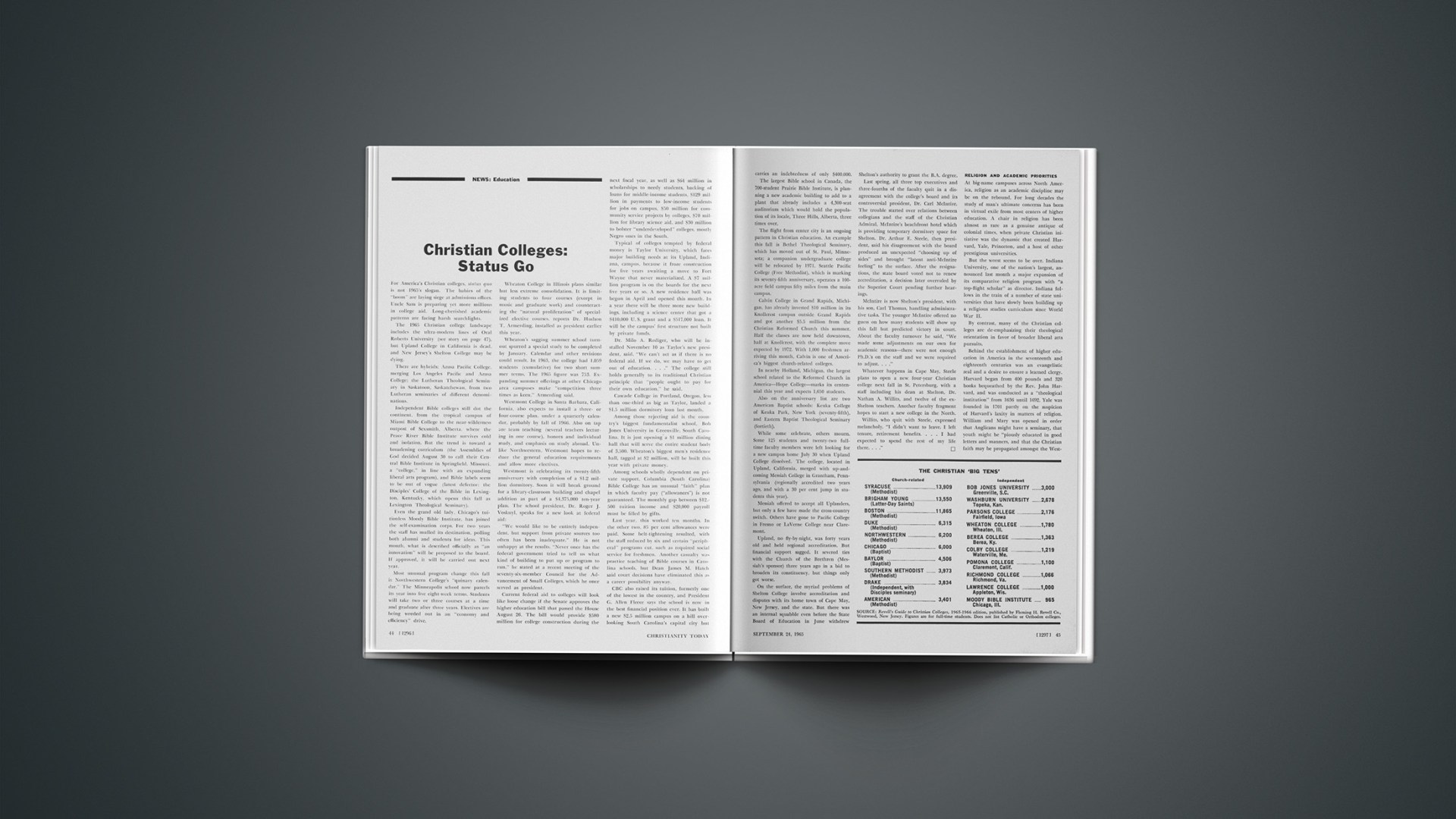
Christian Colleges: Status Go

For America’s Christian colleges, status quo is not 1965’s slogan. The babies of the “boom” are laying siege at admissions offices. Uncle Sam is preparing yet more millions in college aid. Long-cherished academic patterns are facing harsh searchlights.

The 1965 Christian college landscape includes the ultra-modern lines of Oral Roberts University (see story on page 47), but Upland College in California is dead, and New Jersey’s Shelton College may be dying.

There are hybrids: Azusa Pacific College, merging Los Angeles Pacific and Azusa College; the Lutheran Theological Seminary in Saskatoon, Saskatchewan, from two Lutheran seminaries of different denominations.

Independent Bible colleges still dot the continent, from the tropical campus of Miami Bible College to the near-wilderness outpost of Sexsmith, Alberta, where the Peace River Bible Institute survives cold and isolation. But the trend is toward a broadening curriculum (the Assemblies of God decided August 30 to call their Central Bible Institute in Springfield, Missouri, a “college,” in line with an expanding liberal arts program), and Bible labels seem to be out of vogue (latest defector: the Disciples’ College of the Bible in Lexington, Kentucky, which opens this fall as Lexington Theological Seminary).

Even the grand old lady, Chicago’s tuitionless Moody Bible Institute, has joined the self-examination corps. For two years the staff has mulled its destination, polling both alumni and students for ideas. This month, what is described officially as “an innovation” will be proposed to the board. If approved, it will be carried out next year.

Most unusual program change this fall is Northwestern College’s “quinary calendar.” The Minneapolis school now parcels its year into five eight-week terms. Students will take two or three courses at a time and graduate after three years. Electives are being weeded out in an “economy and efficiency” drive.

Wheaton College in Illinois plans similar but less extreme consolidation. It is limiting students to four courses (except in music and graduate work) and counteracting the “natural proliferation” of specialized elective courses, reports Dr. Hudson T. Armerding, installed as president earlier this year.

Wheaton’s sagging summer school turnout spurred a special study to be completed by January. Calendar and other revisions could result. In 1963, the college had 1,059 students (cumulative) for two short summer terms. The 1965 figure was 753. Expanding summer offerings at other Chicago area campuses make “competition three times as keen,” Armerding said.

Westmont College in Santa Barbara, California, also expects to install a three- or four-course plan, under a quarterly calendar, probably by fall of 1966. Also on tap are team teaching (several teachers lecturing in one course), honors and individual study, and emphasis on study abroad. Unlike Northwestern, Westmont hopes to reduce the general education requirements and allow more electives.

Westmont is celebrating its twenty-fifth anniversary with completion of a $.2 million dormitory. Soon it will break ground for a library-classroom building and chapel addition as part of a $4,375,000 ten-year plan. The school president, Dr. Roger J. Voskuyl, speaks for a new look at federal aid:

“We would like to be entirely independent, but support from private sources too often has been inadequate.” He is not unhappy at the results. “Never once has the federal government tried to tell us what kind of building to put up or program to run,” he stated at a recent meeting of the seventy-six-member Council for the Advancement of Small Colleges, which he once served as president.

Current federal aid to colleges will look like loose change if the Senate approves the higher education bill that passed the House August 26. The bill would provide $580 million for college construction during the next fiscal year, as well as $64 million in scholarships to needy students, backing of loans for middle-income students, $129 mil lion in payments to low-income students for jobs on campus, $50 million for community service projects by colleges, $70 million for library science aid, and $30 million to bolster “underdeveloped” colleges, mostly Negro ones in the South.

Typical of colleges tempted by federal money is Taylor University, which faces major building needs at its Upland, Indiana, campus, because it froze construction for five years awaiting a move to Fort Wayne that never materialized. A $7 million program is on the boards for the next five years or so. A new residence hall was begun in April and opened this month. In a year there will be three more new buildings, including a science center that got a $410,000 U. S. grant and a $517,000 loan. It will be the campus’ first structure not built by private funds.

Dr. Milo A. Rediger, who will be installed November 10 as Taylor’s new president, said, “We can’t act as if there is no federal aid. If we do, we may have to get out of education.…” The college still holds generally to its traditional Christian principle that “people ought to pay for their own education,” he said.

Cascade College in Portland, Oregon, less than one-third as big as Taylor, landed a $1.5 million dormitory loan last month.

Among those rejecting aid is the country’s biggest fundamentalist school. Bob Jones University in Greenville, South Carolina. It is just opening a $1 million dining hall that will serve the entire student body of 3,500. Wheaton’s biggest men’s residence hall, tagged at $2 million, will be built this year with private money.

Among schools wholly dependent on private support, Columbia (South Carolina) Bible College has an unusual “faith” plan in which faculty pay (“allowances”) is not guaranteed. The monthly gap between $12,500 tuition income and $20,000 payroll must be filled by gifts.

Last year, this worked ten months. In the other two, 85 per cent allowances were paid. Some belt-tightening resulted, with the staff reduced by six and certain “peripheral” programs cut, such as required social service for freshmen. Another casualty was practice teaching of Bible courses in Carolina schools, but Dean Janies M. Hatch said court decisions have eliminated this as a career possibility anyway.

CBC also raised its tuition, formerly one of the lowest in the country, and President G. Allen Fleece says the school is now in the best financial position ever. It has built a new $2.5 million campus on a hill overlooking South Carolina’s capital city but carries an indebtedness of only $400,000.

The largest Bible school in Canada, the 700-student Prairie Bible Institute, is planning a new academic building to add to a plant that already includes a 4,300-seat auditorium which would hold the population of its locale, Three Hills, Alberta, three times over.

The flight from center city is an ongoing pattern in Christian education. An example this fall is Bethel Theological Seminary, which has moved out of St. Paul, Minnesota; a companion undergraduate college will be relocated by 1971. Seattle Pacific College (Free Methodist), which is marking its seventy-fifth anniversary, operates a 100-acre field campus fifty miles from the main campus.

Calvin College in Grand Rapids, Michigan, has already invested $10 million in its Knollcrest campus outside Grand Rapids and got another $5.5 million from the Christian Reformed Church this summer. Half the classes are now held downtown, half at Knollcrest, with the complete move expected by 1972. With 1,000 freshmen arriving this month, Calvin is one of America’s biggest church-related colleges.

In nearby Holland, Michigan, the largest school related to the Reformed Church in America—Hope College—marks its centennial this year and expects 1,650 students.

Also on the anniversary list are two American Baptist schools: Keuka College of Keuka Park, New York (seventy-fifth), and Eastern Baptist Theological Seminary (fortieth).

While some celebrate, others mourn. Some 125 students and twenty-two fulltime faculty members were left looking for a new campus home July 30 when Upland College dissolved. The college, located in Upland, California, merged with up-and-coming Messiah College in Grantham, Pennsylvania (regionally accredited two years ago, and with a 30 per cent jump in students this year).

Messiah offered to accept all Uplanders, but only a few have made the cross-country switch. Others have gone to Pacific College in Fresno or LaVerne College near Claremont.

Upland, no fly-by-night, was forty years old and held regional accreditation. But financial support sagged. It severed ties with the Church of the Brethren (Messiah’s sponsor) three years ago in a bid to broaden its constituency, but things only got worse.

On the surface, the myriad problems of Shelton College involve accreditation and disputes with its home town of Cape May, New Jersey, and the state. But there was an internal squabble even before the State Board of Education in June withdrew Shelton’s authority to grant the B.A. degree.

Last spring, all three top executives and three-fourths of the faculty quit in a disagreement with the college’s board and its controversial president, Dr. Carl McIntire. The trouble started over relations between collegians and the staff of the Christian Admiral, McIntire’s beachfront hotel which is providing temporary dormitory space for Shelton. Dr. Arthur E. Steele, then president, said his disagreement with the board produced an unexpected “choosing up of sides” and brought “latent anti-McIntire feeling” to the surface. After the resignations, the state board voted not to renew accreditation, a decision later overruled by the Superior Court pending further hearings.

McIntire is now Shelton’s president, with his son, Carl Thomas, handling administrative tasks. The younger McIntire offered no guess on how many students will show up this fall but predicted victory in court. About the faculty turnover he said, “We made some adjustments on our own for academic reasons—there were not enough Ph.D.’s on the staff and we were required to adjust.…”

Whatever happens in Cape May, Steele plans to open a new four-year Christian college next fall in St. Petersburg, with a staff including his dean at Shelton, Dr. Nathan A. Willits, and twelve of the ex-Shelton teachers. Another faculty fragment hopes to start a new college in the North.

Willits, who quit with Steele, expressed melancholy. “I didn’t want to leave. I left tenure, retirement benefits.… I had expected to spend the rest of my life there.…”

Religion And Academic Priorities

At big-name campuses across North America, religion as an academic discipline may be on the rebound. For long decades the study of man’s ultimate concerns has been in virtual exile from most centers of higher education. A chair in religion has been almost as rare as a genuine antique of colonial times, when private Christian initiative was the dynamic that created Harvard, Yale, Princeton, and a host of other prestigious universities.

But the worst seems to be over. Indiana University, one of the nation’s largest, announced last month a major expansion of its comparative religion program with “a top-flight scholar” as director. Indiana follows in the train of a number of state universities that have slowly been building up a religious studies curriculum since World War II.

By contrast, many of the Christian colleges are de-emphasizing their theological orientation in favor of broader liberal arts pursuits.

Behind the establishment of higher education in America in the seventeenth and eighteenth centuries was an evangelistic zeal and a desire to ensure a learned clergy. Harvard began from 400 pounds and 320 books bequeathed by the Rev. John Harvard, and was conducted as a “theological institution” from 1636 until 1692. Yale was founded in 1701 partly on the suspicion of Harvard’s laxity in matters of religion. William and Mary was opened in order that Anglicans might have a seminary, that youth might be “piously educated in good letters and manners, and that the Christian faith may be propagated amongst the Western Indians, to the glory of Almighty God.”

The Great Awakening was a further stimulant to higher education. Princeton University was born out of it in 1746, for the special purpose of educating clergymen. Brown, fonnded in 1764, had a similar aim. So did Dartmouth, originally a missionary school for Indians. Columbia started with a grant of land from a church, and to this day its seal bears the scriptural “milk” citation of 1 Peter 2.

The latter part of the eighteenth century and to a lesser extent the nineteenth century saw Protestant initiative continue to produce institutions of higher education, especially in the northeastern United States. “It is no accident,” says the noted historian Samuel Eliot Morison, “that almost every education leader and reformer in American history … has been a New Englander of Puritan stock.”

Morison also notes Christian impact upon education in the South. There, he says, religious bodies were responsible for most of the colleges and universities that sprang up during the Revolutionary War and shortly thereafter. Northwest of the Ohio River, higher education was stimulated by the historic Ordinance of 1787, which encouraged establishment of schools in the same sentence that noted that “religion, morality, and knowledge” are necessary to good government and the happiness of mankind (under the ordinance was founded the University of Michigan, which began with a Presbyterian minister as president and a Roman Catholic priest as vice-president). In Canada, noted universities such as McMaster, Dalhousie, and Toronto got their start under religious auspices.

The land-grant college movement stole the initiative from Christian educators in the nineteenth century. About the time of the Civil War and immediately thereafter, however, a number of distinguished women’s schools, including Vassar, Smith, and Wellesley, were founded on Christian purposes. The last of the great universities with Protestant beginnings were Chicago (1890) and Southern Methodist University (1911).

For religious studies at the big state universities, the road back from the academic periphery is a long one. Most curriculum efforts are interdepartmental, with courses parceled out to denominational representatives. But there are schools of religion at Iowa, Kansas, Missouri, Montana, and Wyoming. Although Iowa is the only state university offering a Ph.D. in religion, a number of others seem to be moving in this direction, particularly in terms of cooperative programs with nearby seminaries.

Last year, the University of California at Santa Barbara opened a department of religious studies. Illinois, Minnesota, and Wisconsin are understood to be studying similar moves.

Dr. Robert Michaelsen, former director of the Iowa Religion School and now chairman of the Santa Barbara department of religion, predicts an increasing interest in religious studies by state universities: “Students today seem more inclined toward the study of religious subjects in such an environment. There is perhaps less push than in distinctly Christian or denominational colleges.”

Indiana’s announcement of an expansion in the comparative religion program cited not only increased student interest but “recent Supreme Court decisions [which] have clarified the terms under which academic instruction about religion may properly be given in public institutions.”

For evangelicals, the interest in religious studies shown by the state universities is a phenomenon worth pondering. The trend will most likely be toward uncritical acceptance of higher critical presuppositions, thus deferring biblical perspectives to speculative approaches. But an even deeper issue concerns the nature of the truth-claim associated with the Christian religion, at a time when many philosophy departments dispute the possibility of cognitive knowledge of transcendent realities. On American campuses, where philosophical idealism held sway in the forepart of the century, there has been a marked trend to philosophical naturalism, and to skepticism over religious realities. It is also noteworthy that philosophy and religion departments in the universities tend to be intolerant of evangelical associates.

If the university religion faculties make room for competent evangelical scholars, the development of such religion departments will afford new opportunities. Evangelical scholars manifest a vital personal experience of Christian faith at a moment when the Protestant alternatives of liberal, dialectical, and existential theology are clearly on the defensive.

Entirely True, Entirely Open

A new Christian college preparatory school for girls opens September 27 on Long Island, New York. The Stony Brook Girls’ School will be across town from the well-known boys’ academy. While it proposes to echo the philosophy of the older school, it is separate in organization.

The headmistress is Miss M. Judy Brown, 27, who has studied at Duke, Harvard, the University of Lausanne, Switzerland, and Trinity Evangelical Divinity School. Miss Brown says her school will be “entirely true to biblical religion, and entirely open to scholarship in general.” She contends that “most Christian high schools don’t believe that God also redeems the mind.”

Thirty girls, mostly from the Northeast, are expected for ninth-and tenth-grade classes. The boys’ school mailing list was used to advertise for students, but so were Vogue and the New York Herald-Tribune, and Miss Brown expects to have non-Christian students. “Our primary purpose is not to convert, but to teach,” she said. However, programs are being planned so that faculty members can express their convictions informally in chats with students outside the classroom. There will be two compulsory chapels a week, and daily periods for prayer and Bible study.

‘Spiritual Life Center’

Methodist-related American University in Washington, D.C., has a new $425,000 interfaith chapel with a 16-foot 600-pound bronze and gold flame on the top, symbolizing eternal life.

The chapel will be known as the Abraham S. Kay Spiritual Life Center after a Washington builder who made the first contribution toward its construction.

The structure will be formally dedicated October 3, when a two-week forum on religion and society is scheduled to begin. Charles Parlin, a president of the World Council of Churches and a trustee of American University, will give the dedication address.
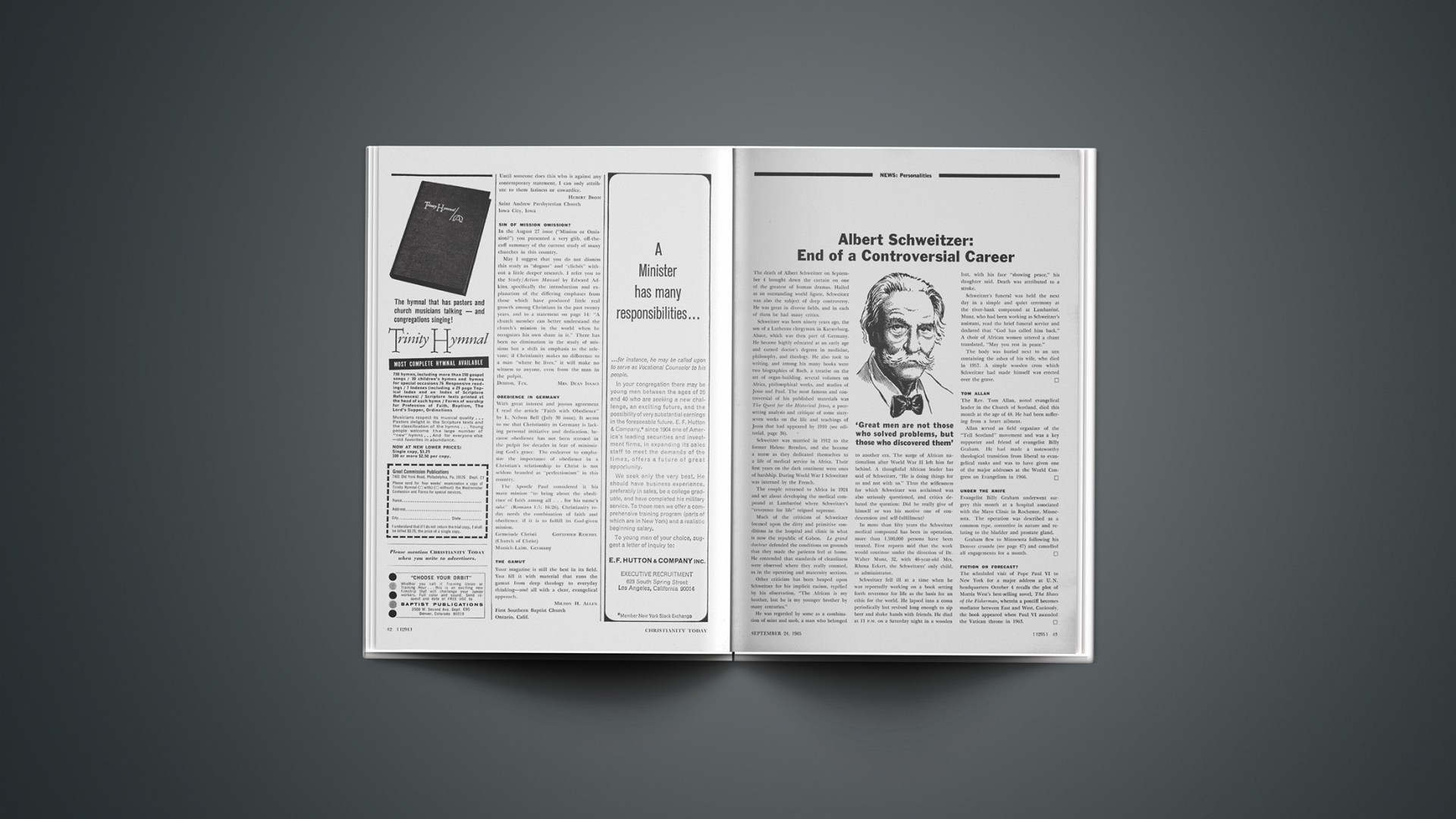
Personalities: Albert Schweitzer: End of a Controversial Career

The death of Albert Schweitzer on September 4 brought down the curtain on one of the greatest of human dramas. Hailed as an outstanding world figure, Schweitzer was also the subject of deep controversy. He was great in diverse fields, and in each of them he had many critics.

Schweitzer was born ninety years ago, the son of a Lutheran clergyman in Kayserburg, Alsace, which was then part of Germany. He became highly educated at an early age and earned doctor’s degrees in medicine, philosophy, and theology. He also took to writing, and among his many books were two biographies of Bach, a treatise on the art of organ-building, several volumes on Africa, philosophical works, and studies of Jesus and Paul. The most famous and controversial of his published materials was The Quest for the Historical Jesus, a pacesetting analysis and critique of some sixty-seven works on the life and teachings of Jesus that had appeared by 1910 (see editorial, page 36).

Schweitzer was married in 1912 to the former Helene Bresslau, and she became a nurse as they dedicated themselves to a life of medical service in Africa. Their first years on the dark continent were ones of hardship. During World War I Schweitzer was interned by the French.

The couple returned to Africa in 1924 and set about developing the medical compound at Lambaréné where Schweitzer’s “reverence for life” reigned supreme.

Much of the criticism of Schweitzer focused upon the dirty and primitive conditions in the hospital and clinic in what is now the republic of Gabon. Le grand docteur defended the conditions on grounds that they made the patients feel at home. He contended that standards of cleanliness were observed where they really counted, as in the operating and maternity sections.

Other criticism has been heaped upon Schweitzer for his implicit racism, typified by his observation, “The African is my brother, but he is my younger brother by many centuries.”

He was regarded by some as a combination of saint and snob, a man who belonged to another era. The surge of African nationalism after World War II left him far behind. A thoughtful African leader has said of Schweitzer, “He is doing things for us and not with us.” Thus the selflessness for which Schweitzer was acclaimed was also seriously questioned, and critics debated the question: Did he really give of himself or was his motive one of condescension and self-fulfillment?

In more than fifty years the Schweitzer medical compound has been in operation, more than 1,500,000 persons have been treated. First reports said that the work would continue under the direction of Dr. Walter Munz, 32, with 46-year-old Mrs. Rhena Eckert, the Schweitzers’ only child, as administrator.

Schweitzer fell ill at a time when he was reportedly working on a book setting forth reverence for life as the basis for an ethic for the world. He lapsed into a coma periodically but revived long enough to sip beer and shake hands with friends. He died at 11 P.M. on a Saturday night in a wooden hut, with his face “showing peace,” his daughter said. Death was attributed to a stroke.

Schweitzer’s funeral was held the next day in a simple and quiet ceremony at the river-bank compound at Lambaréné. Munz, who had been working as Schweitzer’s assistant, read the brief funeral service and declared that “God has called him back.” A choir of African women uttered a chant translated, “May you rest in peace.”

The body was buried next to an urn containing the ashes of his wife, who died in 1957. A simple wooden cross which Schweitzer had made himself was erected over the grave.

Tom Allan

The Rev. Tom Allan, noted evangelical leader in the Church of Scotland, died this month at the age of 48. He had been suffering from a heart ailment.

Allan served as field organizer of the “Tell Scotland” movement and was a key supporter and friend of evangelist Billy Graham. He had made a noteworthy theological transition from liberal to evangelical ranks and was to have given one of the major addresses at the World Congress on Evangelism in 1966.

Under The Knife

Evangelist Billy Graham underwent surgery this month at a hospital associated with the Mayo Clinic in Rochester, Minnesota. The operation was described as a common type, corrective in nature and relating to the bladder and prostate gland.

Graham flew to Minnesota following his Denver crusade (see page 47) and cancelled all engagements for a month.

Fiction Or Forecast?

The scheduled visit of Pope Paul VI to New York for a major address at U. N. headquarters October 4 recalls the plot of Morris West’s best-selling novel, The Shoes of the Fisherman, wherein a pontiff becomes mediator between East and West. Curiously, the book appeared when Paul VI ascended the Vatican throne in 1963.

Ideas

Schweitzer Rests in Lambaréné

His life was an enduring protest against the materialistic mania of modern man.

His life was an enduring protest against the materialistic mania of modern man

The religion of our age gives the same impression as an African river in the dry season—a great river bed, sand banks, and between, a small stream which seeks its way. One tries to imagine that a river once filled that bed; that there were no sand banks but that the river flowed majestically on its way; and that it will someday be like that again. So Albert Schweitzer once envisaged the fortunes of Christianity in the modern world, wherein ethical religion and the thought of the age no longer present a unified spiritual force.

Last week the dry river bed became even more visible, while the moving stream seemed more sluggish than ever. Stilled in death at ninety, the body of the world-famed medical missionary was buried in Lambaréné. There with his own hands, on the margin of civilization, he had built the medical compound to which he gave his life in the practice of Christian charity after achieving distinction and wealth as a musician and religious philosopher.

After Schweitzer’s half-century ministry in what is now Gabon, the works of love—especially social work—that he hopefully viewed as the means of realizing God’s Kingdom on earth seem remarkably unspectacular in this day of vaulting materialistic ambition, of vast scientific power, of mass movements, Communist intrigue, and international rivalries. Desperately as ever the modern world needs a voluntary fusion of truth and justice and power and love, but the majestic spiritual waters of Schweitzer’s vision seem widely unsought and even unwanted.

For more than half a century Schweitzer assailed the materialistic mania of modern man; indeed, his entire life was a protest against it. He rightly stressed that civilization inevitably collapses when its ethical foundations crumble. In a world of impersonal forces cementing the impression that one’s loves and hates and ideals ultimately count for nothing, that man’s life matters no more than a mosquito’s, and that this earth exists for no real purpose, Schweitzer proclaimed a reverence for life, and placed his brilliant mind and talents in the service of Africans amid physical and spiritual need.

While Schweitzer and his co-workers ministered in Lambaréné, the world outside underwent twentieth-century metamorphosis. The century that had opened with high promise of a scientific millennium was moving toward the dread possibility of scientific extinction; modern men were gripped not so much by a sense of reverence for life as by the lively prospect of getting away with lawlessness, perversion, and hatred. What happened outside the African compound, therefore, became more determinative than what happened inside. The drift of world events gave evidence that not reverence for life but a defective will dominated the human spirit, and that no ministration short of the whole Gospel of Christ could remedy that base defect. Schweitzer’s religious outlook was too thin to stave off “the suicide of civilization” that he said “is in progress” and to supply a comprehensive Christian alternative.

Schweitzer’s philosophy was pantheistic in orientation; “reverence for life” spared beetles around the mission compound from destruction and kept Schweitzer from fishing as a sport (he deplored using worms as bait) and from enjoying a menagerie (because of its captive animals). And his outlook included no deep understanding of human depravity, hence no full understanding of scriptural redemption.

He assuredly rejected Hegel’s notion that all men serve the cause of progress, and complained that Hegelian theory overlooked the passions of people. Progress does not come about automatically, Schweitzer stressed, but requires man’s transformation of reality. Yet he did not sense that beyond this it requires, first and foremost God’s transformation of man. Schweitzer rejected “dogmatic” religion because it is “more dominated by the thought of redemption than by that of the Kingdom of God.” This misunderstanding of the Kingdom was, in fact, a besetting fault.

Schweitzer’s once-influential The Quest of the Historical Jesus held that the Nazarene mistakenly expected the apocalyptic end of history during his lifetime. Schweitzer was not the first nor the last among modernists to insist that Jesus was mistaken in his point of view, while proclaiming in its place a self-assured speculative alternative. Jesus had indeed come preaching and healing, but his ministry to men now lost its character of a revelatory sign that the Divine Redeemer was manifested in the midst of a fallen race. Schweitzer associated the Divine Kingdom, not with redemptive Christianity and the new birth, but with social effort. Schweitzer’s goal became “the perfected world; the Kingdom of God.” He openly scorned Karl Barth’s emphasis on revealed religion as the Church’s one message to the world and his disinterest in “civilized Protestantism”; instead he viewed transformation of the world as the authentic Christian task. As one of the great modernists of this century, he was a symbol of a mentality that sifted the New Testament through alien presuppositions and elaborated a speculative philosophy of life. Yet he found in the great music of the Church and in the ministry of medical missions a unique and authentic Christian message.

Schweitzer’s death in some ways marks the end of a missionary era as well as of a distinguished missionary career. To his credit, Schweitzer associated Christian benevolence with voluntary self-sacrifice, not with political strategy. He warned that Christianity loses in spiritual power as it gains in external power. His ministry carried no hint of the notion, now becoming popular among American liberals, that government rather than the Church should become the instrument of divine compassion, if only churchmen can share the limelight with politicians while government pays the bills. Perhaps Europeans do not so easily forget how the medieval vision of the Christian state led on to the persecuting church and then beyond that to the persecuted church. Those American churchmen who eagerly embrace church-state partnership disclose either their inability to learn from history or their ignorance of it.

In Lambaréné predictions have long run rife that Schweitzer’s missionary hospital would close down after his death. The newly independent Gabon government is already operating more modern medical facilities, some with American foreign aid. Some government spokesmen had expressed an intention to burn down the Schweitzer compound after his death, because it is more primitive than a neighboring clinic. Schweitzer’s work was so romanticized in some ecclesiastical circles that his admirers seldom knew of the primitive conditions he perpetuated at the compound. Some critics claimed that Schweitzer was motivated by a desire to further the image of self-sacrifice, but he was a man of another era.

American liberals do not sense that their reliance on government rather than on voluntary benevolence may eventually edge the church out of the ministry of compassion and the state out of the ministry of justice. The Kingdom of American ecclesiastical liberalism is politico-economic, and it has even less in common with the Gospels than had Schweitzer’s vision. Just as in the last generation some liberals called the ultimate principle of life evolution while others called it god, in this generation some call political welfare programs Christianity while others call them socialism. Schweitzer somewhere wrote of modern states that devote themselves mainly to collecting money with which to prolong their own existence. It is doubly tragic when the Church suspends her mission largely on this political ability. In America the bleak river beds are showing, and the majestic stream of apostolic Christianity seems to be running dry.

Church Politicians In Partnership

The American religious establishments are deepening their commitments in cooperative political engagement. In Mississippi a Roman Catholic diocese has organized the agency that operates a $7 million government-financed project for retraining the unemployed. An agency set up by the New Mexico Council of Churches has a $1,261,000 federal grant to retrain migrant workers. The director of the Northeast regional office of the anti-poverty program is Samuel D. Proctor, who has been serving as associate general secretary of the National Council of Churches.

The laity in the American churches are not asked for opinions in such matters. They are precommitted by powerful ecclesiastical leaders operating in overlapping committees at an ecumenical level, and church members often learn of such ecclesiastical involvement through the public press, after the commitments have been made and can no longer be easily reversed. So the seeds of widespread revolt among the laity are being planted.

Kashmir—Another Powder Keg

The dispute over Kashmir between India and Pakistan has erupted on one of a dozen explosive geographic and political frontiers in the contemporary world. It follows the familiar and frightening pattern of military buildup and conflict that has characterized the past two decades of world history. And it mirrors the paradox of a world that knows all too well the ghastly consequences of war but remains a stranger to the reality and meaning of peace. Most distressing is that aspect of the conflict pitting Hinduism against Islam.

Once again the United Nations has shown itself woefully weak. Every power seems eager for peaceful solutions of all disputes except the one in which it is itself involved. Secretary General U Thant went to the subcontinent with a limited but essential objective—to obtain a ceasefire. Like every other informed person, he knows there is no facile solution to the Kashmir dispute. Had there been, India and Pakistan would not have resorted to a war that will work irreparable harm to both of these newly emergent nations.

The causes for the Kashmir conflict are many: geographic, political, economic, and, not least of all, religious. What makes the conflict ominous is the overarching lineup of powers. Ironically, the United States under SEATO commitments has guaranteed Pakistan’s territorial integrity, and now China and Indonesia have also lined up solidly behind Pakistan. India’s policy of neutrality and non-alignment, designed to play both ends against the middle in the Communist-vs.-free world struggle, leaves her without close supportive allies. Nehru’s promise of a plebiscite for Kashmir and Pakistan’s insistence upon the fulfillment of this pledge are key factors in the dispute. Yet a plebiscite can hardly be expected: it would inevitably favor Pakistan, and India cannot surrender Kashmir for reasons of nationalism, military strategy, and face-saving.

The real threat to world peace lies in the possibility of military involvement of other powers. Both Pakistan and India are already learning that it is easier to start wars than to end them. Moreover, war is always unpredictable and seldom turns out the way the participants expect; the smallest conflagration might lead to World War III. The most hopeful development at present would be a ceasefire, pending settlement of the dispute. Second best would be containment of the conflict to the two parties involved. The third alternative, too frightening to contemplate, is a third world war waged with atomic weaponry.

Christians are not naïve enough to suppose that wars will cease before the coming of the Prince of Peace. They should, however, pray for a resolution of the conflict and for the progress of the Gospel in this spiritually destitute area of the world, confident that God can bring good out of evil.

Not A Confession But An Accommodation

The deep concern felt and expressed by many members of the United Presbyterian Church over the so-called Confession of 1967 is significant. If it is to be effective, this concern must be backed fully by the laymen of that church who by and large retain confidence in the complete integrity and authority of the Word of God. These persons are unwilling to see their church base her faith on the shifting sands of human opinion rather than on the clear affirmations of Scripture.

The proposed “Confession” is not a confession but an accommodation to those who no longer accept at face value the words of the Apostle Peter, “First of all you must understand this, that no prophecy of scripture is a matter of one’s own interpretation, because no prophecy ever came by the impulse of man, but men moved by the Holy Spirit spoke from God” (2 Peter 1:20, 21, RSV), and who do not believe that “all scripture is inspired by God” (2 Tim. 3:16).

The weakness of the new “Confession” also lies in its vagueness of language, lack of scriptural orientation and confirmation, and hazy statements about Jesus Christ.

Calvin Research In This Century

If continuing research is indicative of vitality, Calvinism is still very much alive in the twentieth century. Not only do the thought and life of John Calvin continue to be the object of study and critical research, but quests are being conducted today for all fugitive Calvinalia. Since 1961 almost 400 titles have been recovered, titles which do not appear in Wilhelm Niesel’s Calvin-Bibliographia, which covered the period between 1901 and 1959.

Research conducted for the University of Michigan by Lester DeKoster, Calvin College librarian, disclosed that about 1800 books and articles on Calvin and Calvinism have appeared since 1900. This work is concerned with nine main themes, which include not only theology but also art and aesthetics, capitalism and social philosophy, education, science, and political philosophy and political liberty. This wide scholarly interest in so many issues that deeply concern the twentieth century bespeaks the uncommon significance of a man who at the turn of the century had already been dead for almost 350 years.

This persistent and very extensive interest in the teachings of John Calvin weighs heavily against the unreasoned, not to say glandular, assessments that have often been laid upon him. Will Durant, for example, said that Calvin darkened the human soul with “the most absurd and blasphemous conception of God in all the long and honored history of nonsense.” If this assessment were even half true, we would be left with the enigma why so much acknowledged scholarship has for so long been attracted to the thought of the man who has been described as God-intoxicated. Predictions are perilous and sure bets are cheating, but one could safely lay it on the line that the theologians of today who define Calvin’s God as the “ground of our being” will not engage the scholarly interest that generations have given to John Calvin.

Immorality Still Has Consequences

Ethical values inevitably affect life. This principle finds grim substantiation in the current epidemic of venereal disease that has led the American Medical Association to open a nationwide attack on the problem. An editorial in the September 6 issue of the Journal of the American Medical Association, after reviewing the “management” of venereal disease by penicillin, declares: “At the end of the decade [the fifties] the social disease began to reappear, to move back from its banishment to the horizons of society, to coincide with a subtle social change taking place in the late post-war period. The tiger was not dead, he had not become a docile kitten, and he was hungry. The recrudescence of syphilis in the last five years is accompanied by an annual million cases of gonorrhea. The rising incidence among young people is without parallel.”

The shocking extent of this “rising incidence” is shown by the more than 1,300 new cases (56 per cent of the total number of daily venereal infections) occurring every twenty-four hours in adolescents from fifteen to twenty years old. As an article in Today’s Health says, “Many of these adolescents come from very fine homes in suburbs where they are given ‘everything they need,’ including the cars in which many become infected.”

Immorality, whether of the kind permitted by “the new morality” or called by the old-fashioned name, “sin,” still has consequences. Learned theologians who tell young people that “love” makes sexual relations outside of marriage Christian should realize that promiscuity exacts a price. While the new morality did not initiate the moral toboggan on which many an immature youth finds himself, it cannot evade the heavy responsibility of accelerating its pace. The foggy casuistry of the moral relativists must reckon with the stark warning given in Scripture: “Be not deceived; God is not mocked: for whatsoever a man soweth, that shall he also reap.”

If The Good News Is Really Good …

If the Good News is really good, why don’t we find it easier to tell?

Of course to the non-Christian much of the Gospel is anything but good news. The facing of personal guilt, the humiliation of accepting God’s charity, the demand for a change in one’s whole life—a man’s instinct reacts against this. Since a stigma attaches to the confession that one cannot cope with himself, the non-Christian is likely to say, “I don’t need religion” (i.e., “I don’t need help from God or anyone else”).

If we reply according to the teaching of Christianity that one is neither a whole man nor a free man without God, we may expect the non-Christian to say to himself, if not to us, that Christianity is wrong. Unless he hears what we say as something genuinely meaningful to us and something we want to share with a person who is important to us, he may dismiss our remarks as “spiritual imperialism.”

Part of the trouble we have in telling the Good News, therefore, is bound up with the offense of the Cross. Satan designs that the unbeliever shall hear the Gospel as unnecessary and unwelcome change, and such malevolent “jamming” obviously makes it hard for him to hear it as freedom and rest and happiness that, by contrast, point to his own loneliness.

But perhaps we ourselves are part of our difficulty. We say, for example, that the proclamation of the Great Commission was never more urgent than today. Ministers occasionally remind their congregations that, by the cosmic clock, the time is now five minutes to twelve. But it is hard for any of us to live in that frame of mind, especially in an environment that conspires with our natural inclination to look for islands of refuge and security either in the world or far outside it. Perhaps to the extent that we are able to accept the insecurity of living in the world and being pilgrims in it, we shall also be able to live with the truth behind the overworked five-minutes-to-twelve metaphor. To every passing moment of life the Gospel says that “the monosyllable of the clock is loss, loss,” unless we devote ourselves to recovery and renewal.

Another difficulty is our fear of risking failure. Humanly speaking, this fear is understandable. Being the bearer of God’s message to man is, after all, a solemn responsibility; and if we think of nothing but the responsibility, its weight can crush us. We know about the letter that kills and the spirit that gives life, and we may wonder which we have, or which has us. Nonetheless, we have our orders; the possibility of failure does not cancel them. And the Spirit gives grace in weakness: grace to us and, through us, to someone else who may see, not how well we live our message, but the direction of our feet.

Speaking of the widespread ignorance of the true nature of evangelism, Wilhelm Brauer, former director of the City Mission of Berlin, says that the Church needs to concentrate on the “theology of evangelism.” Ignorance and confusion on this subject are a clear danger signal as well as a difficulty. The Church pays the price of a fragmented witness for its lack of accord in this and in other areas, and apparently it is going to keep on paying. We can only hope that, by the grace of God, the ecumenical efforts to achieve unity will not leave the Church so exhausted that it has little love and strength to minister to the world. Telling the Good News to the world is the one great task we were given; and a purpose of the World Congress on Evangelism scheduled for Berlin in 1966 is to rally evangelical resources to evangelistic priorities.

As we prepare ourselves for what may be the last opportunity to carry out our responsibility, we may receive both comfort and guidance from the knowledge that our role is a humble one. It is true that in a sense we become part of the message we bear, since the message is that God is reaching out to man, and we are the instrument through which God reaches out. But the messenger does not originate his message, as Brauer says. Any churchmen who have expanded their humble role and assumed the responsibility for saving people ought to go back to the more manageable job of messenger.

“The Gospel itself creates its own kairos—the moment when the redemptive work of God grips and transforms men,” says Brauer. Our task lies in learning to proclaim the Good News in such a way that our words do not close our hearers’ minds, in making sure we are not pouring new wine into old bottles, and in being faithful messengers.

Farel The Reformer

In every age there are great leaders to whom history pays tribute long after their death. Guillaume Farel is one of these. Born in 1489, he became the John the Baptist of the Reformation in Switzerland, and the forerunner of John Calvin. He died 400 years ago this month, at the age of seventy-six.

Small and feeble, with narrow forehead, fiery eyes, and a red, ill-combed beard, Farel was an orator, a born fighter whose major work like that of Jeremiah was “to root out, and to pull down, and to destroy.” It was he who urged Calvin, twenty years his junior, to build a new church on the ruins of the one Farel had torn down, and he gladly helped in the task.

Though he was intensely human and wanting in discretion and moderation, Farel was one of the leading lights of the Reformation. His faults were balanced by rugged honesty, unceasing labors, and unshakable evangelical beliefs. Philip Schaff has said that central to Farel’s outlook were the convictions “that salvation can be found only in Christ, that the word of God is the only rule of faith, and that the Roman traditions and rites are inventions of man.…”

Farel gave place to no man either in his ministry or in his sufferings. He was insulted, spat upon, beaten and bruised, and threatened with death; at least one attempt was made to poison him. Yet he persevered. His statue, along with those of Calvin, Beza, and Knox, stands in Geneva today as a constant reminder of his contribution to the faith of our fathers.

Daily Renewal

Becoming a christian is a once-for-all experience that involves a conscious faith in and acceptance of Jesus Christ as the Son of God and Saviour front sin. Just as a child is always the child of his parents, so a person who has been born again is always a redeemed child of his Heavenly Father.

But living as a Christian is a day-to-day experience in which the believer must be renewed by the grace of God. Otherwise life becomes a drab succession of defeats and frustrations, and there is neither joy of heart nor usefulness in service for God or for others.

There is a useful analogy in the daily needs of the body and mind. In the morning one must awake and then perform certain routines of washing, shaving, bathing, fixing one’s hair, dressing, and eating. After this there is the daily routine, the expected and unexpected experiences and contacts, the work and the recreation and exercise. During the day there are periods when additional food is necessary to maintain the needed strength. Finally, sleep and rest claim one again.

Christians should realize that they need certain spiritual things in order to live with peace of heart and for the glory of God. These things, which we need every day, are all the work and gifts of God’s grace.

First of all we need to awaken to the consciousness of God’s presence. There is no surer way to begin a day of blessing than to think of God in the first waking moments, to breathe a word of thanksgiving and praise to him and ask for his blessing on the day.

Then, in a time of quiet, set aside for prayer and the study of God’s Word, we should pray for certain specific things.

First, we should ask for forgiveness. There is not a day that the most mature saint does not sin against the holy God—possibly the greatest of all sins being a smug complacency about our own lives. We tend to think we have “arrived” and are unaware of the multiplied sins of omission and commission in thought, word, and deed. For all of these we need forgiveness, and a loving Heavenly Father forgives the penitent.

We can rightly be ashamed of our repeated failures, but shame is not enough. Nor do we solve the problem by sweeping our sins under the rug of frantic religious activity. When sins are confessed and forgiven, the soul is cleansed and the spirit lifted to new heights.

Not only do we need to ask forgiveness for our sins—we also need to be cleansed from them. Sin leaves a stain on the soul and dishonors the Lord. Those about us see the effect, even if they are unaware of that secret sin which so easily besets us. But the cleansed sinner exhibits a radiance of life no one can mistake, not the false front of piosity but the aura of one who has been with Jesus and who has him dwelling within.

For the repentant and forgiven sinner—yes, for the saint living in the world—there is the ever-available and ever-effective divine detergent, the blood of Calvary. If we reject or ignore the mysterious but glorious fact that God has given the blood of his Son as the means of our cleansing and forgiveness, we have missed the very heart of redemption. John tells us: “If we confess our sins, he is faithful and just, and will forgive our sins and cleanse us from all unrighteousness” (1 John 1:9, RSV).

Day by day we need forgiveness and cleansing. But that is not all. We need to be filled. We need something beyond ourselves, Someone to fill us and make us the kind of person God wants us to be. God has provided this in the third person of the Trinity, the Holy Spirit. God the Father forgives (because of his Son); God the Son cleanses (by his blood); and God the Holy Spirit lives within the Christian (in the measure in which we surrender to him). All this is by the grace of God.

These all contribute to the Christian’s readiness for the day, and from them come those spiritual benefits by which he can and will live for the glory of God.

There comes strength, a strength directly related to the presence of the Holy Spirit. How often we are aware of the struggle within, the desire to do what is right and the weakness that leads us to do the opposite, bearing out our Lord’s words, “The spirit is willing, but the flesh is weak.” Nevertheless we have the promise, “you shall receive power when the Holy Spirit has come upon you.”

It is the Holy Spirit of God who enables us to be strong in weakness, to have victory in spiritual battles, to have a power beyond the power of Satan.

For the Christian who enters the day in God’s way there is also guidance. God’s willingness to guide his children is one of the clearest promises of the Bible and one of the most blessed experiences of the Christian. There is not a day in which guidance is not needed. Decisions have to be made, some routine or trivial, others with deep implications for ourselves or others. For all of these we need the leading of the One who sees all eternity at a glance and who wants us to fit our lives into his perfect plan.

God guides in many ways, usually by giving us a sense of duty and direction but sometimes in ways that are miraculous evidences of his intervention on our behalf.

A safe rule of life is to do what is at hand with a consciousness that God may lead otherwise and with a sensitivity to his will that comes through the indwelling Spirit.

As recipients of the grace of God and as those intended to live for his glory, Christians find that these daily preparations of the mind, will, and spirit will always lead to usefulness in God’s Kingdom.

It is not given to many to live lives of spectacular achievement for the glory of God. For most of us, usefulness lies in performing routine duties and doing them well. It lies in living—in our homes, in our places of business, everywhere—in such a way that honor will be given to God, not only by what we say and do but also by what we refrain from saying and doing.

We are inclined to ignore the fact that being a Christian involves living like one, and that living as a Christian involves daily renewal in spiritual values and personal behavior. God has made full provision for this renewal in the fullness of his grace. Our part is to appropriate these means of grace for our own good and for the glory of his name.

No Christian has the right to live as a spiritual beggar when he should live as one possessing all spiritual riches in Christ.

No Christian should live on the same plane as that of the unregenerate world when he should live as a citizen of heaven.

In other words, Christians should live in the world with the perspective of eternity, subject to the infirmities of the flesh but triumphant in the hope that is theirs beyond the horizon of time.

God has made every needed provision. Christians should day by day accept and make use of his grace, for his honor and glory.

Cover Story

Fall Book Forecast 1965

The religious reader has never had it so good.

“The religious reader has never had it so good.…”

For the lover of religious books, it is a great time to be alive. No period in history has seen so massive an intellectual assault upon so many facets of the Christian faith and the life of the Church. This expansive research into every area of Christian thought and action not only crosses those no-man’s-lands of non-communication that traditionally separated Protestantism, Roman Catholicism, Orthodoxy, Judaism, and the non-Christian religions, but also reaches into the whole past of the Church’s history and tradition. The religious reader has never had it so good.

Anyone aware of the prodigious amount of written dialogue between Protestants and Roman Catholics, or between Christians and Jews—to mention nothing else—is both delighted and dismayed at how much he must read simply to keep abreast. But life waits for no man: writers keep writing, presses keep pressing, and the books keep tumbling out.

How can anyone keep up? It will take-more than speed-reading courses. Perhaps science will show the way. The Institute for the Scientific Restoration of Books, located in St. Peter’s Square in Vatican City, now injects and sprays vitamins into old books and manuscripts. This amazing process effectively restores old, limp, stained pages, making them readable. This of course increases the reader’s problem. But if books can take vitamins, perhaps a vitamin can be devised for readers who have that old, limp feeling. Who knows?

The forecast that follows is a select listing of books to be published by February. 1966. The selection is not infallible and doubtless includes some books that should receive a shot of vitamins before publication. Some ill fit categories, and some escape them altogether, as did Augsburg’s coming three-volume The Encyclopedia of the Lutheran Church, edited for the Lutheran World Federation by Julius H. Bodensieck.

APOLOGETICS, PHILOSOPHY, SCIENCE: Christopher will publish God Is a Spirit by C. W. Leslie, Christianity and Cosmopolitan Civilization by Van Ness H. Bates, and Haeckel’s Theory of the Unity of Nature by David H. DeGrood; Daughters of St. Paul, The Creed of a Catholic by W. G. Hurley, C. S. P.; Harper and Row, The Appearance of Man and The Making of a Mind by P. T. de Chardin, Paul Tillich’s Philosophy of Culture, Science and Religion by J. L. Adams, Italian Humanism by E. Garin, The Gift of Healing by A. and O. N. Worroll, and The Three Pillars of Zen by P. Kapleau; Hawthorn, Teilhard de Chardin: The Man and His Meaning by H. de Lubac and Spiritual Writers in Modern Times by L. Sheppard: Helicon, The Meaning of History by H. Marrou; Herder and Herder, Man and Cosmos: Scientific Phenomenology in Teilhard de Chardin by P. Chauchard; Flolt, Rinehart and Winston, Living Wisdom from the World’s Religions by G. Abernethy; Kregel, Christian Counseling and Occultism by K. Koch, translated from the German by A. Petter; McGraw-Hill, Summa Theologiae (Volumes 21, 50, 54) by St. Thomas Aquinas; Moody, The Bible, Science and Creation by S. M. Coder and G, Howe; Seabury, Shaw and Christianity by A. S. Abbot; Sheed and Ward, Christian Metaphysics by C. Tresmontant; and University of Notre Dame, Aquinas on Being and Essence: A Translation and Interpretation by J. Bobik.

ARCHAEOLOGY: Baker will present Light from the Ancient East by A. Deissman; Revell, The Untold Story of Qumran by J. C. Trever; and World, Persia by J. L. Huot and MinoanCrete by N. Platon.

ART AND ARCHITECTURE: Abingdon will print Style and Content in Christian Art by J. Dillenberger; Augsburg, Morality and the Muses: Christian Faith and Art Forms by J. B. Hygen; Funk and Wagnalls, A Reverence for Wood by E. Sloane; Hawthorn, Church Building by J. Rykwert and Modern Christian Art by W. Wilson; and World, The Structures of the Modern World: 1850–1900 by N. Ponente, Dimensions of the 20th Century: 1900–1945 by R. I. Delevoy, and The Golden Age of Spain by A. Cirici-Pellicer.

BIBLE COMMENTARIES AND DICTIONARIES: Baker will be coming out with Commentary on Zechariah by H. C. Leupold; Cambridge, Understanding the New Testament edited by O. J. Lace and The Gospel According to Mark with a commentary by C. F. D. Moule; Eerdmans, The Epistle of Paul to the Galatians by A. Cole and The Wesleyan Bible Commentary: Hebrews-Revelation by Carter, Thompson, Ball, and Blaney; Helicon, The Last Discourse of Jesus by C. M. Behler; Holt, Rinehart and Winston, A Dictionary of Biblical Allusions in English Literature by W. B. Fulghum, Jr.; Moody, Unger’s Bible Handbook by M. F. Unger; W. A. Wilde, Peloubet’s Select Notes for 1966 edited by W. M. Smith; and Zondervan, Handy Dictionary of the Bible by M. Tenney.

BIBLICAL STUDIES: Abingdon will produce Deutro-Isaiah by G. Knight; Baker, The Summarized Bible by K. L. Brooks; Harper and Row, Our Father by E. Lohmeyer, translated by J. Bowden; Herder and Herder, The Psalms, Their Structure and Meaning by P. Drijvers and The Inspired Word: Scripture in the Light of Language and Literature by L. Alons-Schökel; McGraw-Hill, The Problem of the Hexateuch and Other Essays by G. von Rad; Revell, Blessings Out of Buffetings by A. Redpath and Is the Bible True? by A. Bowman; and Zondervan. The Resurrection of Jesus by J. Orr and The Cross Through the Scripture by F. J. Huegel.

CHURCH HISTORY: In this field Abingdon announces Handbook of Denominations in the United States (fourth edition) by F. S. Mead; Augsburg, Scandinavian Churches: A Picture of the Development and Life of the Churches of Denmark, Finland, Iceland, Norway, and Sweden edited by L. St. Hunter; Baker. The Beginnings of Christianity: The Acts of the Apostles, VolumeIV, by F. Jackson and K. Lake; Columbia University, John Hus at the Council of Constance translated by M. Spinka and Religion in Japanese History by J. M. Kitagawa; Concordia, Henry VIII and the Lutherans by N. Tjernagel and Martin Luther, Creative Translator of the Bible by H. Bluhm; Daughters of St. Paul, The Great Blackrobe: Biography of Peter de Smet by J. M. Petrone; Eerdmans, The Morning Star (Wycliffe to Luther) by G. H. W. Parker (Volume III in “The Advance of Christianity Through the Centuries” series edited by F. F. Bruce) and The Church and Learning by Q. Breen; Exposition, Church and Clergy in the American Revolution by L. D. Joyce and The Rise of Religious Education Among Negro Baptists by J. D. Tyms; Fortress, Thomas Canmer by G. E. Duffield, Olavus Petri by C. Bergendoff, and Documents of Lutheran Unity in America by R. C. Wolf; Harper and Row, The Christian Intellectual by J. Pelikan and Finding the Historical Jesus by J. F. Peter; Harvard, Abelard by C. H. Whitman; Herder and Herder, Handbook of Church History, Volume I: From the Apostolic Community to Constantine by H. Jedin and J. Dolan; Holt, Rinehart and Winston, Mani and Manichaeism by G. Widengren; Lippincott, The Early Church by W. H. C. Frend; Nelson, Studies in Church History, Volume I edited by C. W. Dugmore; Princeton, Slavery and Methodism: A Chapter in American Morality, 1780–1845 by D. Mathews and Worship and Theology in England: The Ecumenical Century, 1900–1965 by H. Davies; Scribners, South African Tragedy: The Life and Times of Jan Hofmeyr by A. Paton and Religion in America by W. S. Hudson; Sheed and Ward, The Unreformed Church by R. McNally, S. J.; and United Church Press, Pilgrims and Pioneers in the Congregational Tradition by J. L. Lobinger.

DEVOTIONAL: Abingdon will issue Meditations for Adults by W. Fridy, The Twenty-Third Psalm by R. R. Meredith, and Meditations on Ephesians by L. T. Wolcott; Concordia, The Prophets for Today by T. Coates, The Christian View of Life by T. Hoyer, and Family Worship Idea Book by E. May; Doubleday, The Power of the Resurrection by M. Bach; Eerdmans, Keeping the Spirit of Christmas by H. H. Brown, The Plight of Man and the Power of God and Faith on Trial by D. M. Lloyd-Jones, Personal Religious Disciplines by J. E. Gardner, Convictions to Live By by L. Nelson Bell, and A Touch of Greatness by H. Kohn; Fortress, Today by R. K. Youngdahl; Holt, Rinehart and Winston, Are You Running with Me, Jesus? by M. Boyd; Loizeaux Brothers, The Name Above Every Name by C. J. Rolls and Living Patiently: A Devotional Study of the Book of Job by J. A. Blair; Revell, Putting Life Together Again by R. V. Ozment, If I Could Pray Again by D. A. Redding, The Quiet Corner by S. E. Wirt, and The Ten Commandments by C. L. Allen; Seabury, The Temple: A Book of Prayers by W. E. Orchard edited by M. Halverson; and Zondervan, Extraordinary Living for Ordinary Men by S. Shoemaker, Power for Today (daily devotionals) by N. E. Nygaard, Between Sundays by R. Halverson, and Not Somehow but Triumphantly by V. R. Edman.

DRAMA, FICTION, POETRY: Augsburg will offer Damsel fromAfar: The Story of Ruth by B. Larsen; Channel, Days of Grass: Stories from the ‘Christian Herald’ selected by R. Hartman; Concordia, Time of Tesling by J. R. Littlejohn; Devin-Adair, The Virgin of Tepayan: Mexico at the Time of the Conquistadores by P. P. Forrestal; Lippincott, The Beloved Invader by E. Price; and Zondervan, Dark Side of Nowhere by D. Kauffman and Light from the Hill by S. L. Bell.

ECUMENICS: Doubleday will publish The Case for the Chosen People by W. G. Plaut; Helicon, To Promote Good Will by Rabbi A. Shusterman, edited by M. Weller and L. Richmond; Philosophical Library, The Jew and the Cross by D. D. Runes; and United Church Press, Vatican Diary 1964: A Protestant Observes the Third Session of Vatican Council II by D. Horton.

ETHICAL AND SOCIAL STUDIES: Bethany Press will be publishing The Church—For Everyone by H. J. Brown; Columbia University, A Social and Religious History of the Jews, Volume IX: Under Church and Empire and Volume X: On the Empire’s Periphery by S. W. Baron and Modern Varieties of Judaism by J. L. Blau; Doubleday, World Aflame by B. Graham; Fortress, Secular Salvations by E. Koenker; Harper and Row, Ministers’ Wives by W. Douglas; Harvard, Religion in the Schools by P. A. Freund and R. Ulrich; Hawthorn, The Church and the Workingman by J. Cronin and H. Flannery and Primitive and Prehistoric Religions by F. M. Bergounioux and J. Goetz; Helicon, Perspectives in Evolution by R. T. Francoeur, Change and the Catholic Church by J. Newman, Catholics, Marriage, and Contraception by J. Marshall, and Birth Control and Natural Law by F. H. Drinkwater; Herald, Hutterite Life by J. A. Hostetler; Herder and Herder, Peter and Caesar: Political Authority and the Catholic Church by E. A. Goerner; Holt, Rinehart and Winston, Social Crisis and Christian Conscience: Questions for a Great Society by W. Stringfellow; Moody, What the Cults Believe by I. G. Robertson; Oxford, White Protestantism and the Negro by D. M. Reimers; Princeton, Religion and Politics in Burma by D. Smith; Revell, God and Jack Wilson by F. B. Speakman; Scribners, Man’s Nature and His Communities by R. Niebuhr and Racism and the Christian Understanding of Man by G. D. Kelsey; Seabury, Conflicting Images of Man by W. Nichols; Sheed and Ward, Sin, Liberty and Law by L. Monden, S. J.; and Westminster, The Challenge to the Church: The Niemöller-Blake Conversations by M. Niemöller and E. C. Blake.

LITURGY: Hawthorn promises This Is the Mass (new and revised edition) by the late Henri Daniel-Rops; Oxford, Worship: Its Theology and Practice by J. J. von Allmen and The Language of the Book of Common Prayer by S. Brook; and Westminster, The Interpretation of Prayer in the Early Church by R. L. Simpson.

MISSIONS (EVANGELISM): Abingdon will offer Cross and Crucifix in Mission by N. A. Horner and In This Land of Eve by J. B. Dibble; Augsburg, All the Bandits of China: Adventures of a Missionary in a Land Ravaged by Bandits and War Lords by B. Jurgensen; Bethany Press, The Christian World Mission by A. D. Fiers; Christopher, Ambassador to the Saints by C. S. Rice; Eerdmans, History of Modem Evangelism by P. Scharpff; Harper and Row, Sensei by R. T. Hitt, The Hour of the Tiger by I. Pahk, and Out of the Jaws of the Lion by H. E. Dowdy; Herald, The Witness by U. A. Bender; Herder and Herder, The Church as Mission by E. Hillman; McGraw-Hill, He Is in Heaven by A. Tucker; Moody, J. Hudson Taylor by Dr. and Mrs. Howard Taylor and A Voice for Missions by T. Watson, Jr.; and Zondervan, Go!: Revolutionary New Testament Evangelism by G. Kingsley and G. Delamarter, People Matter More Than Things by G. Burton, and Congo Crisis by J. Bayly.

NEW TESTAMENT: Abingdon will put out The New Testament, Its Background, Growth, and Content by B. M. Metzger; Doubleday, Invitation to the New Testament by W. D. Davies and Simon Peter by L. Elton; Harper and Row, The Study of the Synoptic Gospels by A. C. Bea and The Formation of the New Testament by R. Grant; Herder and Herder, The Church in the New Testament by R. Schnackenburg; Lippincott, God in the New Testament by A. W. Argyle; McGraw-Hill, Paul: A Man Who Changed the World by H. Buckmaster; Scribners, The Foundations of New Testament Christology by R. Fuller; Westminster, The Son of Man in the Synoptic Tradition by H. E. Tödt; and World, The Original King James Bible in Exact Facsimile.

OLD TESTAMENT: From Fortress will come God and Temple by R. E. Clements; Harper and Row, Old Testament Theology: Volume II by G. Von Rad; John Knox, Worship in Israel by J. Kraus; Westminster, Daniel: A Commentary by N. W. Porteous and Leviticus: A Commentary by M. Noth.

PASTORAL THEOLOGY (PREACHING, PSYCHOLOGY): Abingdon will be publishing The Art of Pastoral Conversation by H. Faber and E. Van Der Schoot; Augsburg, As One Who Speaks for God: The Why and How of Preaching by S. D. Schneider; Baker, A Manual for Bible Preaching by L. M. Perry and Effective Evangelistic Preaching by W. L. Stanfield; Christopher, Called of God by G. L. Guffin; Daughters of St. Paul, The States of Perfection by the Benedictine Monks of So-lesmes; Harper and Row, The Adventure of Living by P. Tournier, The Trouble With the Church by H. Thielicke, Minister’s Shop-Talk by J. Kennedy, and Sacred and Secular by M. Ramsey; Judson, Tensions in Modern Faith by R. G. Middleton; John Knox, Secrets by P. Tournier; Nelson, Psychological Studies of Clergymen: Abstracts of Research by R. J. Menges and J. E. Dittes; and Zondervan, Man in Conflict by P. F. Barkman and Encyclopedia of Psychological Problems by C. M. Narramore.

RELIGIOUS EDUCATION: Abingdon will be presenting The Act of Becoming by R. W. Hites; Herald, Learning to Understand People by L. Peachey; Nelson, Singer of Six Thousand Songs: A Life of Charles Wesley by E. P. Myers and In the Beginning: Paintings of Creation selected by the World Council of Christian Education; Revell, The Wonder Book of Bible Stories by D. Kyles; and United Church Press, Worship in Christian Education by P. H. Vieth.

SERMONS: Titles from Baker will be Dwight L. Moody’s Latest Sermons by D. L. Moody and Listening to God on Calvary by G. Gritter; Harper and Row, The Word God Sent by P. Scherer and The Ministers Manual by M. K. W. Heicher; Herder and Herder, To Hear the Word of God by G. S. Sloyan; Holt, Rinehart and Winston, From the Housetops: A Pastor Speaks to Adults by E. Stevens; Kregel, The Guilt of Sin and So Great Salvation by C. G. Finney; Lippincott, The True Wilderness by H. A. Williams; and Zondervan, Expository Sermons on Revelation, Volume IV by W. A. Criswell.

THEOLOGY: Abingdon will publish The Feminine Crisis in Christian Faith by E. Achteneier, Theological Transition in American Methodism, 1790–1935 by R. E. Chiles. Christian Faith and History by T. W. Ogletree, The Holy Spirit at Work in the Church by L. Starkey, Jr., and Christ and Methodism by J. J. Vincent; Augsburg, The Continuing Search for the Historical Jesus by J. Jervell; Baker, The Virgin Birth of Christ by J. G. Machen and The Grace of Law: A Study of Puritan Theology by E. F. Kevan; Bethany Fellowship, I Believe in the Holy Ghost by M. James; Cambridge, The Temptation and the Passion: The Markan Soteriology by E. Best; Concordia, Luther’s Works, Volume VIII: Lectures on Genesis, Chapters 45–50 translated by P. D. Pahl; Doubleday, The Christian Debate: Light from the East by G. Parrinder (shows Christians can learn from the great Oriental faiths); Eerdmans, Christian Faith and Practice by L. Hodgson and Living Themes in the Thought of John Calvin by L. De-Koster; Fortress, A History of Christian Thought, Volume II by O. W. Heick and Jesus and the Son of Man by A. J. B. Higgins; Harper and Row, The Theology of Rudolf Bullmann by C. W. Kegley; Helicon, Theological Investigations, Volume V: The Possibility of Belief Today by K. Rahner, S. J., and The Mystery of the Redemption by L. Richard; Herder and Herder, Theology in Transition: A Bibliographical Evaluation, 1954–1964 edited by E. O’Brien, S. J.; Holt, Rinehart and Winston, Christian Sacraments and Christian Personality by Bernard J. Cooke, S.J.; John Knox, Theology of the Pain of God by K. Kitamori; Nelson, The Apostolic Fathers, Volume III: The Didache and Barnabas by R. A. Kraft; Oxford, Horace Bushnell edited by H. S. Smith and Reformed Dogmatics edited and translated by J. W. Beardslee III; Philosophical Library, Children of the Devil by W. T. Bruner and Isms and Ologies by A. Kellett; Seabury, God and World in Early Christian Theology by R. A. Norris, Jr., New Directions in Anglican Theology: A Survey from Temple to Robinson by R. J. Page, 20th Century Defenders of the Faith by A. R. Vidler, and The Magnificent Defeat by F. Buechner; Sheed and Ward, The Natural Law: A Theological Investigation by J. Fuchs, S. J., and Saints: Their Place in the Church by P. Molinari, S.J.; University of Notre Dame, Man and Sin: A Theological View by P. Schoonenberg; and World, The Scope of Theology edited by D. Jenkins.

PAPERBACKS: Among Abingdon’s titles will be The Interpretation of Religion by J. Baillie and Revivalism in America by W. W. Sweet; Augsburg, Multiple Ministries: Staffing the Local Church by M. Anderson and They Welcomed the Child: Sermons for Advent and Christimas by J. Schmidt; Baker, The Voice from the Cross by A. W. Blackwood and The Epistles of John and Jude by R. Ward; Bethany Fellowship, The Cross of Christ by F. J. Huegel; Cambridge, Understanding the New Testament edited by O. J. Lace and The Gospel According to Mark by C. F. D. Moule; Minister’s Federal Income Tax Guide: 1966 Edition by S. Prerau; Concordia. The Strategy of Evangelism by C. S. Mueller, Law and Theology by A. J. Bueh-ner, and The Lord’s Prayer and the Lord’s Passion by P. G. Lessmann; Doubleday, Protestant Concepts of Church and State by T. G. Sanders, Varieties of Unbelief by M. Marty, and My People Is the Enemy by W. Stringfield; Eerdmans, A Serious Call to a Devout and Holy Life by W. Law, Minister’s Handbook of Contemporary Theolgy by B. Ramm. The Cruciality of the Cross by P. T. Forsyth, and The Theology of Missions in the Puritan Tradition by S. H. Rooy; Exposition. The Challenge of Pierre Teilhard de Chardin by C. Aller; Fortress, The Living Word by G. Wingren, The Bible and Social Ethics by H. Kraemer, Christ and the New Humanity by C. H. Dodd. Legal Responsibility and Moral Responsibility by W. Moberly, and What Christians Stand for in the Secular World by W. Temple; Harcourt, Brace and World, Saving the Appearances: A Study in Idolatry by O. Barfield; Harper and Row, The Divine Milieu by P. T. de Chardin, Western Mysticism by C. Butler, The Way of Israel: Biblical Faith and Ethics by J. Muilen-burgh, The Puritan Family by E. S. Morgan, Revivalism and Social Reform by T. L. Smith, The Burned-Out District by W. R. Cross, The German Reformation and Ulrich von Hutten by H. Holborn. A Reformation Debate by J. Calvin and J. Sadoleto. On First Principles by Origen, The Scope of Demythologizing by J. Macquarrie, and The Knowledge of Man by Martin Buber; Judson, God’s Revolution and Man’s Responsibility by H. Cox; Lippincott, The Comfortable Pew by P. Berton; Loizeaux Brothers, Cremation—Is It Christian? by J. W. Fraser and Hitchhiking on Purpose by G. Watmough (who hitchhiked for thirty-three years expressly to witness of the Lord Jesus to those who picked him up); McGraw-Hill, Way to Christ by J. Boehme and Daniel: Dialogues on Realization by M. Buber; Moody, Total Christianity by F Colquhoun, A History of Church Music by D. P. Appleby, and New Frontiers in Modern Theology by C. F. H. Henry; Nelson. Youth Considers Parents as People by R. C. Miller; Oxford, The Spirit of Protestantism by R. A. Brown; Princeton, The Archaeology of World Religions by J. Finegan, Buddhism, Confucianism, and Taoism by J. Finegan, Shinto. Islam. Sikhism by J. Finegan, and Men and Nations by L. Halle; Seabury, A New Introduction to Moral Theology by H. Waddams, A First Reader in Biblical Theology by R. C. Dentan, Thirty Psalmists by F. James, and Fear, Love and Worship by C. F. Allison; Westminster, What Is the World Coming To? by N. B. Baker and Life and Thought in the Ancient World by C. C. Eastwood; World, Prophetic Voices of the Bible by H. Staack, The Student’s Bible Crossword Puzzle Book by E. Balcomb, and Student’s Bible Atlas by H. H. Rowley; and Zondervan. The Rebellious Planet by L. Woodrum, A Bit of Honey by W. E. Thorn, But God! by V. R. Edman, Hellbent for Election by P. Speshock, Life and Love by C. Narramore, Young Only Once by C. Narramore, and Woman toWoman by E. Price.

Book Briefs: September 24, 1965

Protestantism in an Ecumenical Age: Its Root—Its Right—Its Task, by Otto A. Piper (Fortress, 1965, 254 pp., $4.50), is reviewed by M. Eugene Osterhaven, Professor of systematic theology, Western Theological Seminary, Holland, Michigan.

Some of the most pressing questions about the right of Protestantism and its many denominations, the relation of the churches to one another and to the ecumenical movement, and the future of Protestantism are discussed in this timely volume. And they are discussed from a solid theological perspective, with an appreciation of the spiritual values that have given the Church the strength it has had. Ecclesiastical and theological perspicacity, broad experience, and four decades of personal involvement enable the author to treat such questions admirably. In the judgment of this reviewer, there is probably no one on the American scene better qualified to write this book than Professor Piper.

Protestantism’s root is shown to have been Luther’s experience, where Christ made a new beginning in his Church. The office of reformer was, the author says, instituted by Christ. Like Calvin, who considered Luther to have exercised a special office, Dr. Piper sees Protestantism as a decisive event in God’s redemptive history with Luther being the instrument used to intiate it.

Protestantism’s right is seen in the use made of it by Christ in holy history. A denomination’s right to independent existence depends on its making a specific contribution to that history. When “it has irretrievably lost its original spiritual momentum and thus is no longer capable of making its specific contribution, or if it is obvious that the specific gift it has to impart has so completely become the common property of the whole Protestant church that no special denominational agency for its propagation is required,” then that denomination has lost its right to independent existence (p. 169).

Protestant unity, although desirable, must be “motivated by spiritual reasons and controlled by theological thought” (p. 176). Since the Church is the work of Christ, there can be no merely utilitarian approach in which the main concern is organizational bigness, financial and political power, or an impressive public image of Protestantism. Unity must come through spiritual perception and fellowship with Christ, the Head of the Church. In the experience of the presence of Christ effected by a “Spirit-guided understanding of the Bible which transcends all possible theologies,” Christians can come together (p. 214).

In the last chapter, Dr. Piper considers both Protestantism’s future and ecclesiological trends within the Roman Catholic Church. He sees some hopeful signs in the latter, but, as he had shown earlier (p. 93), Roman Catholic theology “is free within narrow limits only.” In confrontation with Rome and with society at large, “Protestantism must realize that the Reformation must go on indefinitely” (p. 239). Its “theology must be carried on as a confrontation of contemporary experience with one’s denominational past, and in particular, its exegesis of the Bible” (p. 247).

Apostle Of Grace

The Theology of P. T. Forsyth: The Cross of Christ and the Revelation of God, by John H. Rodgers (Independent Press [also Alec R. Allenson), 1965, 324 pp., 36s.), is reviewed by James Daane, assistant editor,CHRISTIANITY TODAY.

John H. Rodgers, assistant professor of systematic theology at the Protestant Episcopal Seminary in Virginia (located in Alexandria, Virginia), has presented a concise and sympathetic exposition of the main themes of one of the greatest British theologians of modern times. His book fills a need, for Forsyth suffered the fate of the great who prepare the way for the greater: obscurity. As one who attempted to break the grip of the nineteenth-century liberal Ritschl-Hermannian tradition, and also go beyond traditional orthodoxy, Forsyth anticipated the theology of Brunner and Barth; for that reason alone, if for no other, he ought not to be left in obscurity.

The basic motif of Forsyth’s theology is the burning Holy Love of God revealed at the Cross, where it overcomes sin and Satan and reestablishes communion with man the sinner. This objective disclosure of Holy Love is experienced and known by man in his moral self, i.e., in his conscience; here he knows that Holy Love is, therefore, grace. Forsyth was not a systematic theologian; but all the other rich and suggestive motifs of this restlessly questioning theologian are intended as an expanding exposition of this basic motif of God’s Holy Love.

Forsyth was critical of theological liberalism because it separated divine love from divine holiness and thereby reduced love to bland sentimentality. He was also critical of orthodoxy, regarding it as too rationalistic and impersonal. He wanted to overcome and go beyond both, since he regarded both as essentially anthropocentric rather than theocentric.

Did he really succeed? This reviewer thinks that Forsyth is open to more stringent criticisms than are expressed by Rodgers.

Forsyth stressed the unique character of God’s love at a time when it was regarded as human love raised to the divine exponent. In the light of the Cross he thought he discovered an inherent unity in God’s holiness and love; this, Forsyth regarded as God’s Holy Love. Love, according to Forsyth, is the outgoing of holiness. “If the holiness do not go out to cover, imbue, conquer, and sanctify all things, if it do not give itself in love, it is less than holy.” It is “holiness which makes sin damnable as sin and love active as grace.” Again, “everything begins and ends in our Christian theology with the holiness of God.” In the words of Rodgers, “it is the holiness of God which, in the face of sin, requires both the judgment of sin and the fulfillment of God’s movement toward his creatures in holy love.”

Through all this runs the idea that God’s holiness activates God’s love, and the idea that holiness must in burning love give itself to the removal of sin and the defeat of Satan. At the Cross man is said to experience this as grace. But does this unity of divine love and holiness which is said to be grace properly express the biblical idea of grace? Grace in biblical thought points to salvation as God’s free gift to man and to the freedom of God to give himself in both creation and salvation, as he wills, and only if he so wills. Grace is never a mere unity, it always involves a divine decision. Turning from liberalism’s being in love with love in order to become an “apostle of grace,” did not Forsyth fail to retain the freedom of God to give or not give himself in communion to uncreated, and later, fallen man—an idea that Barth has tried to retain in his idea of Ceschichte?

It is in any event a theological education to watch Forsyth as he contends with Lessing’s problem and grapples with the ideas of Historie and Geschichte, as he struggles with a theology of revelation and reconciliation in personal categories and with the ideas of corporate, racial salvation and individual faith—all within a mighty creative and sanctified imaginative effort to maintain seriously the holiness and love of God and the radical character of man’s sin. Few English theologians are as theologically fresh and exciting as Forsyth, and Rodgers has rendered a service in reconfronting us with him in this lucid introduction to his thought.

JAMES DAANE

Room For A Friend?

The Quaker Contribution, by Harold Loukes (Macmillan, 1965, 128 pp., $2.95), is reviewed by Paul Woolley, dean of the faculty, Westminster Theological Seminary, Philadelphia, Pennsylvania.

Like many another man, the Friend (Quaker) faces a problem in today’s ecumenical world. Does he have a contribution to Christian action valuable enough to be worth preserving in the move toward one great Christian Church, which may have little or no room for distinctive contributions?

The author of this book, a reader in education at Oxford and a Friend himself, believes that the followers of George Fox have developed values that we may not, either gleefully or resignedly, allow to pass into disuse. He would be a bold man who would say No to this, but then there are many bold men in the ecumenical movement.

What these contributions are is told in this little book by a joyful, patient, loving pursuit of what has happened at important stages of Quaker history. Again and again the reader is reminded that the Friend is interested in experience, in living, not in an institution. Men today may reach conclusions under inspiration of the same sort as did the writers of the Bible long ago. The Church is more hindered than helped by forms, by fixed theologies, by creeds. There is nothing to be gained by trying to define the relation between the inward and the historic Christ. The New Quest is not useful. The experience of the Christian, his concern for the needs of men, is what is important to the Friend. There are new needs in every generation. The Friend would confront them by his method of face-to-face consideration. A personal search in loving fellowship brings both fire and tears.

The Friend does not necessarily decide what is right for all men. He decides for himelf, and the group decides for itself. The group often communicates its concern to wider and wider groups. The method of decision involves making no decisions until there is agreement. This may not be successful, for lack of agreement may give a negative answer by sheer inaction when such is not consciously intended. But the values of the method are too great to lose. On the other hand, one may not withdraw from responsibility to preserve principles. It was a mistake, for example, for the Quakers to give up governing Pennsylvania in 1756.

The book is a quiet reminder of how much Quakers have done. John Bright is but one of the examples from English history the author recounts. A current instance of concern is seen in the publication of the unusual Towards a Quaker View of Sex (1963). Although the method of producing this work was atypical, the concern was not.

The Friends movement is not a substitute for the church; it is a warning, a theme, an element, a “side”—and a unique one. Friends’ “hearts are not in preaching. Their idiom is rather service and reconciliation” (pp. 121 f.). The theology is inarticulate. “Quakerism cannot stand alone.… But … Christianity … is about not standing alone, about love in difference” (p. 124). That is the Quaker message, and it is worth hearing. Will the ecumenical movement ignore the need of hearing everything that is valuable, in order that it may impose the rule of its hierarchs upon all Christians?

PAUL WOOLLEY

Kittel Is For Pastors

Theological Dictionary of the New Testament, Volume II, edited by Gerhard Kittel, translated by Geoffrey W. Bromiley (Eerdmans, 1965, 955 pp., $20.50), is reviewed by Everett F. Harrison, professor of New Testament, Fuller Theological Seminary, Pasadena, California.

The fame of this work has spread far and wide, so that those who have any acquaintance at all with the tools for biblical study have at least heard of Kittel. But appreciation of the basis of this fame has until recent times been confined to those who know German. Now through Dr. Bromiley’s able translation (he was assisted by Professor F. F. Bruce), the riches are available to many. The second volume covers delta through eta.

What does this multi-volume work do? Its stated purpose is “to mediate between ordinary lexicography and the specific task of exposition, more particularly at the theological level.” It is therefore much fuller than a Greek lexicon but less detailed than a commentary. Where the passages are numerous, not every occurrence of a word is treated; but the effort is made to convey the crucial nuances of meaning so that the interpreter has guidance where he most needs it.

The New Testament passages are not considered until a thorough groundwork has been laid by a survey of previous usage of the word in question. The survey begins with usage by leading classical Greek authors. Then the usual procedure is to follow the term through the Septuagint, noting any significant shifts in the meaning, and to round this off by tracing the term’s occurrence in Hellenistic sources (and frequently in Rabbinic also). By the time the student reaches the discussion of the word in the New Testament, he is able to see how the influences of the past have shaped the meaning of the word and to what extent the New Testament, by reason of the Christ-event, has risen to new heights in the use of old terminology.

Despite some theological differences among the contributing scholars, very little comes through to jar the reader, for these men have made an earnest effort to be objective. The lesson is plain: when workers stay close to the text and wrestle with its words, their agreement is far greater than when they resort to philosophizing.

It is hard to see how anyone could use Kittel without having his understanding of the biblical text greatly increased. Pastors ought not to shy away from the work as too technical. The use of Kittel will help a man to maintain his skill in Hebrew and Greek and provide him with many flashes of insight that will enrich his sermons. Congregations could make no finer gift to a dominie. And if the work has value for the pastor, it has even more for the teacher. In this connection the article by Rengstorf on didasko-didaskalos is a classic. Another impressive contribution by the same author is the treatment of doulos (slave). Grundmann’s “power” is also highly instructive.

EVERETT F. HARRISON

Does Goodness Grow?

The Early Christian Church, by J. G. Davies (Holt, Rinehart and Winston, 1965, 314 pp., $8.50), is reviewed by Bruce Shelley, professor of church history, Conservative Baptist Theological Seminary, Denver, Colorado.

For whatever comfort it may afford contemporary Christians, ministers in the early Church also inveighed against believers who preferred the theater to public worship, women who used “pigments and pencil-lings” as beauty aids, and men who surrendered to the “Belly-demon” (gluttony) and “Bacchic fuel” (wine). Can we then speak of the development of Christian ethics as we do of the development of Christian doctrine?

J. G. Davies’s book raises many such questions. The student of the early Church will find in this volume little that is new. It is not concerned with interpretation. It is instead a competent summation of the first five centuries of Christian history, and as such it glows with little flashes of insight.

Let me illustrate. Davies says, “Jesus demanded not a reformation of behavior but a transformation of character” (p. 22). He believes the Body of Christ image must be understood from the Hebrew perspective, which views things not as they are but as they are called to be (p. 54). He argues that the New Testament makes no essential distinction between worship and life (p. 57). He contends that the pagan charges of Christian immorality may not have been groundless because lewd assemblies of certain Gnostic sects were well known (p. 88). And he shows that orders of the ministry moved from function into office, from lifelong spheres of service to a graded hierarchy (p. 187).

Davies proves to be an able historian, familiar not only with original sources, but also with recent research. He ranges over a wide variety of subjects, including New Testament criticism, the meaning of history, the development of dogma, and early church architecture.

Reflecting recent studies Davies concludes that the Kingdom both now is and is yet to come, that the Jesus of history and the Jesus of faith are inseparable (p. 17), that Jesus’ moral demands presuppose a changed nature (p. 21), that the tests of canonicity are multiple (p. 85), and that early episcopal succession was from office-holder to office-holder, not from consecrated to con-secrator (p. 93).

The structure of the book is both novel and practical. Davies, Edward Cadbury Professor of Theology at the University of Birmingham, treats in each chapter six inter-related aspects of the early Christian community: the environment, sources, expansion, beliefs, worship, and social life. Because of this arrangement, the reader can follow the section on sources, for example, and have an abbreviated patrology. The work also contains illustrations of early Christian architecture and twenty-four glossy pages of archaeological material.

The volume is such a fine example of scholarship combined with readability that one hesitates to pick at details. Nevertheless, while his stress on the Hebrew view of man is praiseworthy, Davies’s explanation of apostolic sacraments (p. 58) strikes me as more Platonic than Pauline. He also fails to support his case linking the decline of belief in the millennium with the emerging belief in purgatory (p. 100). Finally, his treatment of views of the Church held by second-century Christians (p. 98) neglects entirely the continuing emphasis upon local congregations.

These, however, are but fly-specks on a Mount Rushmore. Since Davies carves the likeness of the early Church with experienced hands, the representation will be, I predict, an enduring one.

BRUCE SHELLEY

For Background

Ancient Mesopotamia: Portrait of a Dead Civilization, by A. Leo Oppenheim (University of Chicago, 1965, 433 pp., $8.50), is reviewed by LesterJ. Kuyper, professor of Old Testament, Western Theological Seminary, Holland, Michigan.

This is a popularly written, interesting survey of the history of Mesopotamia. Its author has given more than thirty years to study of Assyrian and Babylonian history and culture, and his work is therefore authoritative.

The book deals with the economic and social life of the ancient peoples, beginning with the Sumerians at the start of the third millennium. The amazing uncovering of a vast number of cuneiform writings has brought us much knowledge about the times of the Old Testament patriarchs. The chapter on Mesopotamian religion (IV) shows many interesting parallels and contrasts with the Hebrew religion, although the author does not intend to make a comparison with the Old Testament.

A student interested in ancient languages and the development of writing will find Chapter V of great interest. One cannot but admire the phenomenal amount of study that has been expended to decipher and compile grammars and dictionaries of these ancient writings.

Biblical students wanting to know something of the historical background of the Old Testament will find this book informative. The author has brought the scholarly data within ready grasp for the non-scientific reader.

LESTER J. KUYPER

A Single-Minded Man

Whitefield’s Journals, an autobiography (Banner of Truth Trust, 1965, 595 pp., 25s.), is reviewed by J. G. Norman, minister in the Baptist Church of Scotland.

We have been given a wealth of material in recent years about John Wesley, and now here is a book about Wesley’s fellow architect of the Evangelical Revival, George Whitefield. It includes a previously unpublished journal, an eyewitness account of the coming of Whitefield to an American town, and a letter from Whitefield to Wesley about their controversy over the doctrine of grace.

Autobiography, especially when written with an eye to publication, can make tedious reading. Whitefield shows himself to be a single-minded man, wholly absorbed in his Lord and in the spiritual welfare of men and women; yet this absorption never becomes monotonous. His transparent honesty and humility appear on page after page, and his brotherly spirit is very attractive. Even when he differs from other Christians on points of doctrine, it is always in charity, and his attitude toward those who actively hindered his work is free of malice. We may not agree with his child psychology (he speaks of breaking children’s wills as though one were breaking in a horse!), but it would be hard for us not to love a man in whom the grace and compassion of Christ so evidently appear.

He makes clear that he regarded America as his chief sphere of action, and this lends particular interest to his account of the revival in that country. It is helpful to compare his record with the similar accounts in Wesley’s journal, especially in the way he was led to field-preaching (“I now preach to ten times more people than I should if I had been confined to the churches”), and how he led the reluctant Wesley to this form of evangelism. Among other good things, we read of his contacts with men like Howell Harris, Isaac Watts, Philip Doddridge, Ralph Erskine, and Jonathan Edwards, and of his close friendship with Charles Wesley. He appears a convinced Anglican, but his catholicity embraced Quakers and Baptists. Reluctant to enter upon controversy, he did so only when compelled by his love of the truth. His Calvinism had none of the rigor often associated with the term but was compassionate and evangelical.

The text of the volume is misplaced on page 184 in two places, and on page 549 one line is illegible; but the book is otherwise well produced, and the publishers are to be commended for its reasonable price.

J. G. NORMAN

It’S Only One Way

Marriage Counseling: A Manual for Ministers, by J. Kenneth Morris (Prentice-Hall, 1965, 329 pp., $5.95), is reviewed by Truman G. Esau, director, Covenant Counseling Center, Chicago, Illinois.

This solid, comprehensive work was written by a minister with wide experience in marriage counseling. He presents counseling within the framework of Carl Roger’s client-centered therapy. Such an approach is perhaps the safest, but Morris does not clarify the special handling of organic, psychotic, or prepsychotic situations. These problems involve interviewing persons who should not be encouraged to open up their concerns. This non-directive approach has had wide influence in ministerial groups, but it is only one tool in the armamentarium of the experienced counselor.

Morris makes some reference to the possibility of seeing one person in marriage counseling when the partner is unwilling or for other reasons does not come. This seems risky, in view of what it would mean to the persons involved to have a counselor identified with one partner. A moral question is raised, also, in counseling one person and thereby changing the marital balance without the involvement of the other. The author suggests that husband and wife be seen separately at first. He feels that seeing them together brings out into the open the accusatory and destructive elements in the marriage. The reviewer wonders, however, whether sometimes there is not benefit in bringing out the hostility right at the beginning.

The author sees the minister-counselor also as a reconciler. It is unfortunate that he has leaned upon O. Hobart Mowrer for support, since Mowrer clearly does not see guilt in a Christian context. The author, however, does not fall in the pitfalls of Mowrer. He sees the resolution of guilt as a work of grace, and not simply as a psychological penance and resolution.

This volume can be highly recommended to the pastor. It is authoritative, reliable, and particularly perceptive about the minister’s place in dealing with disturbed marital partners. Morris recognizes that one cannot do anything for people who are not self-motivated, and that change must occur within the framework of the Gospel.

TRUMAN G. ESAU

Awe’S Window

Decision at Dawn, by Chulho Awe, as told to Herbert F. Webster (Harper and Row, 1965, 180 pp., $3.95), is reviewed by Henry W. Coray, minister, First Orthodox Presbyterian Church, Sunnyvale, California.

This electrifying story, the personal account of a young Korean who lived through the nightmarish days of the Communist takeover in North Korea, proves the idea that truth is not only stranger but also more fascinating than fiction. Awe is a university-trained mining engineer who for his Christian convictions refused to join the Party, thereby passing up material preferments and a lush berth on Easy Street. For his stand he incurred the wrath of the Party leaders and was arrested and thrown into prison. On his release lie identified himself with the Korean underground. He became an architect of the program of sabotage against the Communist masters without, participating in any direct action himself, and held out for a campaign that would not involve the taking of life.

Wrenched by circumstances from his family, Awe was forced to live in a society where he never knew whether or not former friends were now Red spies, neutrals, or patriots. Like Athanasius, he walked with perpetual danger. Arrest and execution lurked around every corner. For him, “in perils in the city, in perils in the wilderness” became a real and chilling experience.

Through Mr. Webster, Awe tells his tale simply and with an underplay of the dramatic. This is what gives the book its power. He weaves a thread of dry humor into the serious sections and so opens welcome breaks in the otherwise dark clouds.

The lifting of the oppression when the U. N. troops drove back the Communists, the joy that gripped the liberated cities, the subsequent entrance of the Red Chinese army into the war and the heartaches that followed, the escape to Pusan—these add up to a word picture that leaves the reader almost limp. Here is a window on Communist treachery that our Get-out-of-Viet-Nam-ers, Teach-in-ers, and troop-train-blockers would do well to look through.

HENRY W. CORAY

A New Direction

Tradition and Transmission in Early Christianity, by Birger Gerhardsson (C. W. K. Gleerup, 1964, 47 pp., 6 Swedish Crowns), is reviewed by C. H. Pinnock, assistant lecturer in New Testament, University of Manchester, Manchester, England.

A new star has appeared upon the horizon that promises to guide students of the Synoptic problem into new and better paths. This monograph by a pupil of Harald Riesenfeld is a sequel to his important study Memory and Manuscript (1961). It seeks to answer criticisms made by Morton Smith (Journal of Biblical Literature, 82 [1963], 169–76). Both works are directed against the current drift of form criticism, which ignores the conscious method of transmission employed in primitive Christianity. The form critical assumption that the early Church was unaware of pedagogic procedures common to the Jewish milieu, and exercised a free, unhindered creative function in transmitting the gospel material, is utterly unhistorical. Because form criticism continues to conduct its research along the lines of a “biology of the Saga,” its results are wild and almost useless. A method is required that respects the actual techniques of transmitting tradition shared by the early Church and her Jewish environment.

Gerhardsson, in his earlier book, traced this procedure back from the late Rabbinic period to the Old Testament itself. The main details stand out clearly: memorization, repetition, imitation. Learning of the teaching precedes even the understanding of it. It is apparent from our sources that Jesus taught after the Rabbinic manner and gathered disciples to himself. These men, to whom he entrusted his word, became the unrivaled leaders of the primitive Church. They exercised themselves in the “ministry of the word.” By recollection and exegesis, in their midst, the gospel tradition as we know it came to be formed. The controlling influence of the apostles cannot be forgotten. Form criticism’s picture of free-floating tradition is pure fancy. The evidence of the New Testament is all against it.

In this essay, the author further develops three basic points. (1) It is not anachronistic to read back the pedagogics of Rabbinic Judaism into the first century. For this process of learning can be shown to be remarkably stable even from Old Testament times. (2) This method of education was not peculiar to the Pharisaic sect but belonged to the broad Jewish stream in post-exilic times. (3) The mode of Jesus’ teaching is similar if not identical to the Jewish method. The Christian movement was eruptive and revolutionary in many respects, but its tradition was unique in content, not in form.

A typical criticism of Gerhardsson’s approach minimizes the thrust by labeling it “extreme.” It suggests the author overplayed his hand, and erred in his enthusiasm, in the same fashion as form criticism but in an opposite direction. The objection is superficial and has little force. Gerhardsson and the form critics are not equidistant from the truth. If he is right, that school is on the wrong track altogether. It is an either/or. Shall we move in the direction of myth or of history? If we make our choice on the basis of the evidence so well presented here, we will move decisively away from form criticism as currently practiced.

In the course of their criticisms, various interpreters have distorted Gerhardsson’s position. Paul Winter has scarcely troubled to understand him (Anglican Theological Review, 45 [1963], 416–19), and Morton Smith has frequently misrepresented him (loc. cit.). He does not, for example, wish to suggest that no differences exist between the apostolic collegium and a Rabbinic academy, or that no modification took place during the process of transmission. “But it is one thing to state that traditions have been marked by the milieu through which they passed; another to claim that they simply were created in this secondary milieu. The evidence suggests that memories of Jesus were so clear, and the traditions with which they were connected so firmly based that there can have been relatively little scope for alteration” (p. 43).

It is one thing to offer methodological objections to form criticism, and another to work out the alternative method exhaustively. There is certainly no single volume covering the ground of Bultmann’s History of the Synoptic Tradition which answers his skepticism point by point. Until there is, his wild conclusions will continue to plague us. Gerhardsson’s essay leaves us with a challenge. A new analysis of the Synoptic material is called for on the basis of his findings. He has scarcely begun to do this himself. The stakes are high—the authenticity of the Gospels and the historicity of Jesus Christ. A new direction has been shown us. It is our responsibility to move in it.

C. H. PINNOCK

Could Be

The Holy Spirit in Christian Theology (revised and enlarged edition), by George S. Hendry (Westminster, 1965, 168 pp., $3.50), is reviewed by Jerome L. Ficek, associate professor of church history, Trinity Evangelical Divinity School, Deerfield, Illinois.

The doctrine of the Holy Spirit, which David Friedrich Strauss once described as the Achilles heel of Protestantism, is described by the author of this book as the snorkel tube by which we reach out to the vivifying breath of God in order to avoid suffocation in the systematic shells which we have constructed (p. 12). To an earlier version of the book (1956) this edition adds two chapters dealing with the essential offices of the Holy Spirit as they are indicated in the ancient creeds and in the modern world. The new chapters are from lectures the author, who is the Charles Hodge professor of systematic theology at Princeton Seminary, gave at the Moravian Theological Seminary. The old part of the volume deals with the Christian doctrine of the Holy Spirit in relation to Christ, to God, to the Church, to the Word, and to the human spirit. This review will treat only the new material.

In the chapter, “The Holy Spirit the Giver of Life and Unity,” Hendry advances the thesis that at the time of the Reformation the threefold work of the Holy Spirit as given in the creeds—solidarity (koinonia), authority (“The Lord”), and vitality (“Giver of Life”)—was dissolved into three unitarianisms corresponding to the three fragments that resulted from the division of the Church (Roman Catholic, Protestant, and spiritualist). It is not bodiliness as such that is incompatible with the solidarity of the Spirit, but the imprisoning of the solidarity of the Spirit in the solidarity of the body so that it loses its renewing, re-creative, and eschatological power. The author is excessively severe on the spiritualists or enthusiasts, saying they insist that God works through individuals, not through institutions. The careful and detailed research of George H. Williams, Roland Bainton, Franklin H. Littell, and the Goshen Mennonite scholars who produce the Mennonite Quarterly Review does not support this general criticism of the movement.

In the last chapter, “The Holy Spirit Is Lord,” the author presses the notion that it is in the Reformation principle of the authority of Christ that the Catholic submersion of vitality under solidarity and the spiritualist submersion of solidarity under vitality are overcome. The Reformers emphasized the actuality of the Word in preaching, and the Word so preached as the source of solidarity. The first consequence of this, not explicit at the outset, was the affirmation of the authority of Scripture over and against the authority of the Church. Rejecting the view that the authority of Scripture was based upon the Church or upon rational arguments, Calvin declared that its authority is so essentially spiritual that there can be no access to it at any level save through the work of the Spirit. He ascribed even the prior conviction of the veracity of God in his Word to the inner witness of the Holy Spirit. The authority of the Holy Spirit must always be distinguished from the authority of any doctrine or doctrinal system, if it is to retain its dignity.

This reviewer was struck by the similarity between Hendry’s reinterpretation of the Reformation and Küng’s reinterpretation of the Council of Trent. Hendry asserts that the Reformers were saying that the official interpretation the Church had placed on Scripture could be wrong, and that the same Spirit who inspired the writers was free to interpret them afresh and in a new way. To understand the meaning of a past event, it is necessary to re-create it in its context, noting how contemporaries and succeeding generations have understood it, rather than reconstructing it in accordance with modern presuppositions. If the Reformers were appealing to their private interpretations as over against the official interpretation of the Church, they were doing just what Hendry criticizes the enthusiasts for doing. But they were appealing, in fact, not to private judgment but to the Scriptures, the Scriptures as the Holy Spirit had led the Fathers to interpret them.

JEROME L. FICEK

Book Briefs

There Was a Man, His Name: Paul Carlson, compiled by Carl Philip Anderson, drawings by L. Birger Sponberg (Revell, 1965, 107 pp., $2.50). About a martyr in the truest sense—one who chose to use his technical training to help, in the name of Christ, the diseased and the dying in the Congo. The choice cost him his life.

The Christian Year, Sermons of the Fathers, Volume 2: from Trinity Sunday to Advent, compiled and edited by George W. Forell (Nelson, 1965, 375 pp., $6.50).

John Courtney Murray: Contemporary Church-State Theory, by Thomas T. Love (Doubleday, 1965, 239 pp., $4.95). A complete, systematic analysis of the evolution of John Courtney Murray’s position on the problem of church-state relations in a pluralistic democracy.

Home Before Dark: Learning to Die Is Part of Living, by Bryant M. Kirkland (Abingdon, 1965, 160 pp., $2.75). Short essays that speak the word of Christian comfort and triumph over death. Good background material for funeral sermons.

Sermons I Should Like to Have Preached, edited by Ian Macpherson (Revell, 1964, 132 pp., $2.95). Fourteen sermons, brief but well wrought. Good reading.

Teilhard de Chardin: A Biographical Study, by Claude Cuénot (Helicon, 1965, 492 pp., $9.75). This study is a valuable contribution to the increasing corpus of Teilhardian literature available in English. Though it is perhaps pedantic in points and overly enthusiastic, a critical reader will find it a valuable source of information. The bibliography alone is a wonderful asset to the serious scholar, and the biographical detail appears to be the most extensive yet published.

Masterpieces of Catholic Literature, edited by Frank N. Magill (Harper and Row, 1965, 1139 pp., $9.95). Reviews by Roman Catholics of 300 important Catholic (most Roman Catholic) works from the first century to 1963. Each review is preceded by a brief statement of the work’s principal ideas. Not so much a reference book as a sampler for whetting the intellectual appetite.

Out of the Jaws of the Lion, by Homer E. Dowdy (Harper and Row, 1965, 254 pp., $3.95). The first complete on-the-scene report of the imprisonment, terror, and martyrdom endured in the Congo by Christian missionaries, including Dr. Paul Carlson. An inspiring story of courage and spiritual renewal even in the face of death.

Concordance to the New English Bible: New Testament, compiled by E. Elder (Zondervan, 1965, 401 pp., $4.95). A concordance (for the New English Bible) of the words not found in the King James Version at all, or not found in the corresponding verse in the King James Version. For all the other words, another concordance covering the KJV is needed.

The Church and Its Culture, by Richard M. Pope (Bethany Press, 1965, 618 pp., $8.95). More a story than a history of the Church.

Galileo: The Man, His Work, His Misfortunes, by James Brodrick, S. J. (Harper and Row, 1964, 152 pp., $3.50). An interesting account of an interesting man. The author says that the question of papal infallibility was not involved, for Pope Urban himself never officially taught that “heliocentrism was heretical.” But he does say that the pope “was wrong and stupid” and that of Pope Urban “so little good can be said.”

The Positive Thinkers, by Donald Meyer (Doubleday, 1965, 358 pp., $4.95). A study of the American quest for health, wealth, and personal power, from Mary Baker Eddy to Norman Vincent Peale.

Victory in Viet Nam, by Mrs. Gordon H. Smith (Zondervan, 1965, 246 pp., $3.95). The story of religious victories in a land where victories are scarce.

Phenomenology and Atheism, by William A. Luijpen (Duquesne University, 1964, 344 pp., $6.50). An eye on existential philosophy alert to its development in an atheistic direction.

The Praise of God in the Psalms, by Claus Westermann, translated by Keith R. Crim (John Knox, 1965, 172 pp., $4.25). A scholarly investigation of the Psalms for the sake of returning the praise of God to the position it deserves in the Church. First printed in Germany as Das Loben Gottes in den Psalmen in 1961.

The Breath of Life: The Problem of Poisoned Air, by Donald E. Carr (W. W. Norton, 1965, 175 pp., $3.95). “The air we breathe is as deadly as nuclear fallout: a report on the least recognized menace to human life.”

Beacon Bible Commentary, Volume II: Joshua through Esther, by Chester O. Mulder, R. Clyde Ridall, et al. (Beacon Hill, 1965, 704 pp., $5.95). A practical commentary, by men in the tradition of Wesleyan Arminian theology, which explicitly stresses the plenary inspiration of the Bible but gives little indication of appeal to the original Hebrew.

Born for Friendship: The Spirit of Sir Thomas More, by Bernard Basset (Sheed and Ward, 1965, 220 pp., $4.50). The life story of a great and interesting man in church history, rightly respected by both Roman Catholics and Protestants.

From the Mennonite Pulpit: Twenty-Six Sermons from Mennonite Ministers, edited by Paul Erb (Herald, 1965, 200 pp., $3.75).

The Ministers Manual, 1966, compiled and edited by M. K. W. Heicher (Harper and Row, 1965, 357 pp., $3.95). A treasury of sermonic outlines, practical religious suggestions and aids, Sunday school lessons (International), and much else, for the discriminating user.

No More Strangers, by Philip Berrigan, S. J. (Macmillan, 1965, 181 pp., $4.95). Father Berrigan summons men to rid society and Christianity “of the taints of poverty, discrimination, and racial hatred.” A hard-hitting book.

The Old Testament Stoty, by Carl Gordon Howie (Harper and Row, 1965, 183 pp., $4.50). Although the author’s concept of revelation remains vague and at times ambiguous, he has gathered the strands of Israel’s history into a unified pattern and presents a story that is very readable and informative.

God’s Son, by DeVere Ramsay, illustrated by Rita Endhoven (Eerdmans, 1965, 48 pp., $1.95). Stories about Jesus for little children. Biblically sound, attractive, and illustrated.

Fiction, Fact, and Truth

Does the subconscious notion that fiction is deceit dull interest in the evangelical novel?

Does the subconscious notion that fiction is deceit dull interest in the evangelical novel?

What is the relation between fiction and lying (“telling a story”)? What sort of message must the Christian novel or short story convey? And is there such a thing as artistic freedom in Christian fiction? These questions, ancient and basic and obvious as they seem, are still causing trouble in the evangelical world.

First things first. In his effort to get several prominent Christian magazines to publish fiction, Joseph T. Bayly (Eternity, April, 1965) quotes Dr. A. W. Tozer’s view that there can be no such thing as Christian fiction because “if it’s Christian, it’s true; but if it’s fiction, it’s false.” Dr. Tozer’s remark is reminiscent of Richard Baxter’s rejection of “false stories” in A Treatise of Self-Denial (1675) or of Thomas Goodwin’s condemnation of “playbooks, … romances, feigned stories” in The Vanity of Thoughts Discovered (1638). As Lawrence A. Sasek points out in his excellent study of The Literary Temper of the English Puritans, “the word ‘feigned’ appears regularly as a pejorative term indicating that the puritans thought of fiction not as an imaginative view of reality, but as simple falsehood” (p. 64). Fiction, of course, aims to tell the universal, philosophic truth, rather than the particular, historical truth; but popular misunderstanding of fiction forced many early American novelists to preface their noveltitles with The True History of … in order to avoid the stigma of “lying.” Ironically, the artist was thus forced to falsify in order to please the Christian public; for while good fiction presented as fiction is an embodiment of universal truth, fiction presented as fact involves a miserable deception. Dr. Tozer’s comment indicates that the concept of fiction-as-lying is by no means dead in certain evangelical circles.

Sir Philip Sidney wrote the definitive defense of the values of fiction in “An Apology for Poetry” (1595). About the writer of fiction, Sidney says:

Though he recount things not true, yet because he telleth them not for true, he lieth not—[unless] we will say that Nathan lied in his speech … to David; which as a wicked man durst scarce say, so think I none [is] so simple [that he] would say that Aesop lied in the tales of his beasts: for who [ever] thinks that Aesop writ it for actually true were well worthy to have his name chronicled among the beasts he writeth of.

Today the issue of fiction-as-lying is rarely mentioned openly; it merely lurks behind the façade of evangelical thought, causing a poor market for adult novels and apparently helping to close many evangelical adult magazines to short stories. The concept also causes a subconscious or scarcely conscious sense of shame in certain Christians who are readers of fiction but who have not properly understood its values. For all those who feel apologetic about spending their time reading “only a novel,” Jane Austen provides some thought-provoking satire:

“Only a novel!” replies the young lady; while she lays down her book with affected indifference, or momentary shame. It is only … some work in which the greatest powers of the mind are displayed, in which the most thorough knowledge of human nature, the happiest delineation of its varieties, the liveliest effusions of wit and humour, are conveyed to the world in the best chosen language.

More detrimental to the quality of Christian fiction than the concept of fiction-as-lying is the popular conception of the sort of message a Christian writer should express. Too many Christian authors feel compelled to use novels or short stories as thinly veiled sermons; but this is to confuse art with propaganda. Art is the incarnation, the fleshing-out in plot and character and setting, of an individual vision of reality, as opposed to the pleading or cajoling or persuasion of propaganda. Art attempts to share an experience, whereas propaganda attempts directly to impose the writer’s will on the reader’s.

Perhaps the paucity of interesting, compelling, artistically excellent Christian fiction reflects a confused notion of what the Bible means when it instructs the Christian to be a witness. Many evangelicals automatically equate witnessing with “winning souls,” but the scriptural emphasis is on knowing God: “Ye are my witnesses, saith the Lord … that ye may know and believe me, and understand that I am he …” (Isa. 43:10). If the Christian author is aware of this, he fearlessly writes the truth about man and life and God as he sees the truth, giving witness to that which God has shown him of Himself. He subscribes to the words Robert Browning put into the mouth of Fra Lippo Lippi:

God’s works—paint any one, and count it crime

To let a truth slip.…

… we’re made so that we love

First when we see them painted, things we have passed

Perhaps a hundred times nor cared to see;

And so they are better, painted—better to us,

Which is the same thing. Art was given for that;

God uses us to help each other so,

Lending our minds out.…

… This world’s no blot for us,

Nor blank; it means intensely, and means good:

To find its meaning is my meat and drink.

In other words, the Christian novelist is not under any obligation to preach the Gospel in any direct sense. His work is to delineate as accurately as possible the world as he sees it from his angle of vision; and if that angle of vision is genuinely Christian, then Christianity will breathe through his prose even though there may be no overt mention of basic Christian truths.

Joseph T. Bayly seems to be hoping with Van Wyck Brooks that soon the writers of the modern world will cease “to render” and will once again attempt “to elevate.” But if this world is God’s (and it remains God’s, no matter how fallen), and if by Christ all things consist, it should be quite enough for the Christian artist “to render,” for to render the universe as honest Christian eyes behold the universe is in itself an “elevation.” The artist should be under no other pressure than to write accurately and honestly about life, to “count it crime/To let a truth slip.”

No deliberately superimposed “message” can be allowed in a work of art. When Shaw spoke of the artist as prophet, and Kipling of his “mission to preach,” they were speaking of deeply felt truths that would inevitably emerge in their writing because they were so integral a part of their thinking. It is in this sense that fiction can be Christian, and in this sense only: never an overt polemic, but a sharing of the experience of being a Christian in this world of sweets and sours. Is it fear that perhaps the world does not“mean intensely, and mean good” which leads many Christian authors into falsification, the easy generalization or slick solution instead of the complex reality? Or is it simply a capitulation to the demands of the evangelical subculture? Either way, the situation must be remedied. Readers and writers must learn faith instead of fear.

It is the glory of art that it works obliquely, that it lets the reader arrive at the author’s intrinsic suppositions through sharing the experience the author has provided rather than through reading an extrinsic “message.” In other words, art shows rather than tells. Robert Browning illustrates this point very effectively in his masterpiece, The Ring and the Book, which consists of dramatic monologues concerning a seventeenth-century murder trial. In the course of the twelve long monologues Browning presents such a variety of viewpoints on the basic facts of the case that one feels the truth of his summary statement: “Our human speech is nought,/Our human testimony false, our fame/And human estimation words and wind.” Because of the extreme subjectivity of the human situation, Browning concludes, “Art remains the one way possible/Of speaking truth, to mouths like mine at least.” Human judgment is always conditioned by subjective factors like temperament and past experience; thus, in direct methods of truth-telling such as preaching or pointing out someone’s faults to him, the truth often becomes falsehood in the very telling of it because of the way it is received by the listener and because of the difficulties of precise articulation. On the other hand, “Art may tell a truth/Obliquely, do the thing shall breed the thought,/Nor wrong the thought, missing the mediate word.” That is, the artist stimulates the reader to draw his conclusions in the way best suited to the reader’s subjective state. Art is therefore sometimes able to tell the truth more effectively than preaching in “mediate words” that suit the speaker’s subjective climate but not the listener’s. Nathan the Prophet, for instance, accomplished more by stirring David’s reaction to a short story than he could possibly have accomplished by a direct and furious denunciation. His story “bred the thought” of justice in King David’s mind, so that the only preaching required was a simple, “Thou art the man.” David was willing to listen to the following pronouncement of judgment because he had caught an objective view of his own behavior in Nathan’s fiction.

The final problem, artistic freedom, is and always has been a sensitive one. The evangelical public, alas, too often desires “a stimulating book which will not disturb my preconceived notions”; and it raises the hue and cry against any author who reveals the failures of Christians to “the outside world” (as if the members of “the outside world” had no eyes of their own!). In matters both of doctrine and of behavior, the evangelical author soon feels pressure to abandon his own insights and to conform to existing patterns: “Assent, and you are sane;/Demur—you’re straightway dangerous,/And handled with a chain.” The Christian public thus demands that its authors lie in the interests of Christianity, either by pretending that all is happy or simple when all is not happy or simple, or by conforming against their own better judgment to certain rigid norms. But Christ, who is Truth, needs no falsifying to save his face.

Christian colleges have had to learn that if they are to maintain any sort of academic and spiritual standards, they must first hire qualified professors who know God, and then must trust those professors to teach in the integrity of their hearts the insights God gives them. And the same liberty must be extended to the Christian artist. If evangelicalism is to clear away its extensive cultural slums, it must offer not only academic freedom but also artistic freedom to those whose gifts qualify them for cultural contributions. It is time for evangelicals to exchange fear for faith, and to put away the chain.

T. Leo Brannon is pastor of the First Methodist Church of Samson, Alabama. He received the B.S. degree from Troy State College and the B.D. from Emory University.

Romans for Three Cents

He tried all the devices: newspaper ads, radio programs, give-away leaflets, mailing, even a coupon good for a sermon!

He tried all the devices: newspaper ads, radio programs, give-away leaflets, mailing, even a coupon good for a sermon!

The first step in any kind of evangelism is to attract the attention of the prospect. Before attention has been captured, no dialogue is possible.

Over the years, I have tried practically all the devices commonly used to draw attention to the Christian message and to churches in which it is proclaimed. These devices have included newspaper advertisements, radio programs, give-away brochures and leaflets, weekly and monthly mailing pieces, and even a coupon good for a mimeographed copy of a sermon when presented at the church door!

Year in and year out, however, I have seen the most impressive results of all come from the use of low-cost Scripture portions. For programs of mass distribution, or for literature racks in motels, bus stations, or other public places, the name of the church is usually printed on the back cover of each piece. No imprint is necessary on Scripture selections that are distributed in an every-member church canvass or in pastoral calling.

From time to time, I have tried printing brief messages of my own in leaflet form and have used some of the give-away pieces available from supply houses. That God works through tracts is unquestionable. Yet even the best of tracts is in a different category from Scripture. Sooner or later such material wears thin; and once it has lost its impact for me, I cannot distribute it with enthusiasm.

But with pocket-size Scriptures it is different. My own favorite is the Book of Psalms in the King James Version. After years of passing out this piece, I am more enthusiastic about it than when I began. I have also enjoyed giving away other portions of Scripture. While preaching on the parables of Luke for more than six months in one pastorate, I bought copies of Luke’s Gospel in the Revised Standard Version and used them for calling cards.

Whenever I am calling, whether for evangelistic purposes or for visiting the sick and the bereaved, I have a few copies of the Psalms and a Gospel or two in my pocket. Sometimes I make a few notes on the flyleaf before handing the booklet to the person visited. At other times, I talk briefly about the way Scripture can communicate with us in every situation of need and urge a troubled man or woman, “Read this little book. Read it three or four or hall a dozen times, until you find a personal message in it.”

Two important responses are likely to follow.

In the first place, the person who is given a Scripture selection does not usually throw it away. Even though he may realize that it cost only three cents, he has too much respect for the Word of God to drop it in the wastebasket. And that is definitely not the case with elaborate brochures describing the facilities and program of a church! While such pieces may cost as much as fifty cents or a dollar each, only the person who is interested will keep them. A large proportion of such give-aways are discarded within hours of their receipt.

But I have handed out Scripture portions and found them prominently displayed months later. To be sure, there is no assurance that they have been thoroughly read. Some of them have not even been opened. Yet they have been kept, and their presence in homes and offices serves to remind persons that the Church is still in existence. Viewed on the lowest of all bases, as an advertising piece for a religious institution, low-cost Scriptures probably exceed all other materials in returns per dollar invested.

Sometimes there is, however, a second and far more important response. At least some of the persons who receive attractively printed portions of God’s Word will open and read them and will respond to their message. Not long ago I was dealing with a man suffering from severe depression. He was upright and moral but not a professing Christian. I gave him a three-cent copy of Romans and urged him to read it over and over until he found assurance. He took that booklet with him into the psychiatric ward—and he brought it back out. He says that it did more for him than the doctors and the shock treatments. Although he has not yet made his public profession of faith, he seems well on the way and is rapidly maturing in his willingness to let God do for him what he himself cannot do.

No one knows how many persons have been spiritually awakened as a result of the American Bible Society’s decision three decades ago to offer low-cost booklets for general use. “Penny portions,” actually priced at one cent, were best-sellers at the famous Century of Progress exhibition in Chicago. Individual books of the Bible are now published in brightly colored jackets of eye-catching design with titles aimed to capture the attention of persons who would never voluntarily open a black-bound Holy Bible.

Most pastors and religious workers are familiar with Scripture selections (one chapter or more) designed for use at special seasons or for particular needs. For example, the American Bible Society began experimental distribution of a printing of the Sermon on the Mount in 1946. Now published in more than forty languages and dialects, it has reached a total circulation of more than 15,000,000 copies.

As a result of the overwhelmingly good reception given this publication, other selections have been prepared. Some are designed for general distribution at Easter, Pentecost, and Christmas. Others, like “Lost and Found.” (Luke 15, New English Bible), were especially designed for use in revivals, house-to-house Scripture-saturation programs, and other mass-distribution efforts. In 1964, just before Easter, 4,000 Detroit young people took copies of “Lost and Found” to 600,000 homes and distributed the Resurrection story from St. John to another 200,000.

In the United States, the use of portions and selections accounts for the phenomenal rise in distribution of the Scriptures since World War II. The American Bible Society, whose sole objective is to make God’s Word available without note or comment at a price the average working man can afford, will celebrate the 150th anniversary of its founding next May. During the calendar year 1964, the society distributed 682,000 Bibles and 1,437,000 New Testaments in this country—as compared with 4,966,000 Scripture portions and 18,255,000 briefer selections.

A somewhat more expensive and less generally used evangelistic tool is the hand-marked New Testament. John Pollard, a plastics manufacturer in Dallas, Texas, was accosted by an employee who asked him how to be saved. Fumbling for a reply, Mr. Pollard picked up a Testament and opened it to Luke 18:13, where the publican prayed, “God be merciful to me a sinner.” As a result of that experience, the manufacturing executive suggested that copies of the New Testament have underlined certain passages that answer vital questions about salvation. His idea proved so successful that it has been adapted for other purposes, such as the comfort of the bereaved and material for stewardship campaigns. Small Testaments (4¾″ by 2 ¾″) bound in blue simulated leather are available for only as little as twenty-two cents each. The real cost is the time expended in marking copies for distribution. But in congregation after congregation, the experience has been that persons who mark Testaments and then distribute them become personal evangelists in the best sense of the term.

There is no scarcity of materials, offered at prices so low that any congregation or Sunday school class can buy them in quantity. A complete catalogue is available from the American Bible Society (450 Park Avenue, New York City, 10022). Paperback New Testaments in either the King James or the Revised Standard Version are available for as little as fifteen cents each, and prices for portions and selections are much lower.

It would be false to suggest that enthusiastic large-scale distribution of the Scriptures will cure all the ailments of denominations and of individual congregations. Like every other program, this one is only as good as the persons who execute it in the light of the goals they have established under God.

But it is surely true that the fellowship in which the Scriptures are central—both for personal reading and for use in formal and informal evangelism—is likely to grow in grace and power as well as in numbers.

T. Leo Brannon is pastor of the First Methodist Church of Samson, Alabama. He received the B.S. degree from Troy State College and the B.D. from Emory University.

Cover Story

The Church Faces the Problem of Pornography

A discussion of Christian action in that gray area between police-court control and laissez-faire.

A discussion of Christian action in that gray area between police-court control and laissez-faire

Moral leaders today must determine how to train youth in those personal and ethical values that will preserve the best in our faith and our civilization. There has been widespread confusion in treating the problems of sexual looseness, pornography, and filthy speech. Do the first amendment to our Constitution guaranteeing free speech, our libertarian attitude toward life in general, and our well-founded fear of self- or state-appointed censors mean that anything goes? Time magazine (June 12, 1964) began a review of Candy with these words: “Since pornography is now available at every neighborhood bookshop and drug store, the idea of satirizing the pornographic novel was bound to occur to someone. If done with Swiftian skill it could be defended on moral as well as literary grounds.” The review concluded, “In the effort, Candy ends up dirty as hell.” Justice Hugo Black of the Supreme Court, in a recent dissenting opinion, argues that any ban on obscenity endangers free speech.

The biblical and prophetic position warns against the abuse and perversion of sex. Biblical spokesmen like Nathan did not hesitate to denounce in the strongest terms those in the highest places, such as King David, who transgressed the moral code. The Old Testament makes a profound judgment about sex. It is a good gift of God; children are a heritage from the Lord. Those who engage in sex should do so within the marriage bond and in a context of loyalty and trust. Even St. Paul had a correct understanding of sex, though his personal asceticism, growing out of his own cataclysmic experience with the risen Christ and the conjecture that a wife would not go along with him in his new faith, has caused the total impression of his view to be distorted. When Paul said in First Corinthians that “the husband should give to his wife her conjugal rights, and likewise the wife to her husband” (7:3, RSV), he was actually maintaining, as Wells Grogan points out, that “a woman is as much entitled to sexual enjoyment as the man.”

Today’s pulpit and Judeo-Christian leadership are strangely silent in facing up to this major problem. We have been so afraid of being considered “square,” old-fashioned, or irrelevant that we have kept silent in the face of the increasing amount of filth appearing on our newsstands and in our theaters and bookshops. We pass resolutions in our church assemblies, and like to think our duty done when we denounce a particularly obnoxious movie or smut magazine. What results we have achieved have all too often been associated with repressive and almost puerile censorship.

We have our classes in sex understanding for young people. Yet we who are parish ministers know we are failing because we are performing so many weddings for pregnant girls. Illegitimate births to teen-age mothers have risen from 8.4 per thousand in 1940 to 16 per thousand in 1961; in the 20–25 age group they have soared from 11.2 to 41.2 (Time, January 1, 1964).

Our unwillingness to speak out results from our frustration in feeling that we can do little and, as was pointed out earlier, from our confusion about rights and freedom. We have admitted that within marriage sex is good, and we know that pornography is bad; but we do not know where or how to draw the line. We are greatly embarrassed at the frequency and brazenness with which “four-letter” words appear in print. Yet we want to speak an honest, sure, and helpful word to a floundering age.

The church and synagogue must join together and let their voice again be heard. Forty years ago people as diverse theologically as John Roach Straton, John Haynes Holmes, and Stephen Wise were speaking to the nation on the moral breakdown in their day. Then people at least knew where major religious leaders stood. For too long now we have abdicated our responsibility to proclaim what we believe to be the right standards, allowing the academic, artistic, and judicial worlds to give what they think is the answer. And too often their position is one of laissez-faire, or at most of ridicule.

Yet the world of religion does have something to say. We have been puritanical, we have made mistakes, and we have been narrow when we should have been understanding; but at our best we have said with Jesus, “Neither do I condemn thee; go and sin no more.” The centuries have proved us more right than wrong. We can join forces with any who will help us—academic, artistic, judicial, civic groups—but speak out we must. The homes of a nation are at stake, and wise homemakers will be our allies. If we do not find a solution, we might be overcome by the sexual anarchy that engulfed Greece in the third and second centuries B.C. According to Pitirim Sorokin, Harvard sociologist, “there were men in those days who prided themselves on their objectivity as they calmly recorded the distressing picture of whole families getting together to indulge themselves in promiscuous behaviour. Adultery, prostitution, homosexuality, and even incest were so common that those who indulged were regarded merely as interesting fellows” (Time, January 11, 1954).

Take for instance the matter of filthy speech. According to news reports, there is actually a far-left group hanging around the University of California at Berkeley that has as its reason for being the use of obscene language. The anarchistic spirit that motivates such people is obvious. Having gone to sea as a wireless operator, served a stint in the Army, and taken part in many college bull sessions, I probably know all the dirty words there are; and I fail to see any point in using them. Our generation has rightly put a premium on forthrightness as a kind of revolt against Victorian prudery. But the large question of good taste enters here.

One of the ugliest words to be found in the English language is “snot,” which, though it has nothing to do with sex, is avoided in decent homes. In medical circles euphemisms have their place and spare from embarrassment the man of science, the lay person, and the child. “Bowel movement” is a perfectly acceptable expression for the much more direct but offensive four-letter word. Everyone knows the earthy word for copulation, but even breeders do not use it in their business. Certainly true lovers never would. I doubt whether even those who engage in sexual relations outside of wedlock use such a word, if they care at all for each other.

There is a certain fitness in things that makes it unseemly. A case in point is the review by John Phillips, published in the New York Review of Books, of the biography of General George Patton, and its use of a barrack-room term as being “relevant” even if shocking. I can grant its relevance in the barrack room, but I wonder whether Patton himself would have stood for it in his headquarters, even from an equal in rank. No amount of “relevance” would make it good usage for a mixed class, public platform, or church gathering. There are some expressions gentlemen just do not use in public. Prudery has nothing to do with it.

The Church and its leaders have made it abundantly clear that they believe sex is wise and right, as is proclaimed at every marriage ceremony. But parading of details of sex can be pornographic, especially when they are used to exploit a prurient interest, or for financial gain. To help in my pastoral counseling, some years ago I purchased Van der Velde’s Ideal Marriage, which is the definitive work on the subject. My name got on a mailing list. Ever since then I have been bombarded by announcements of various new or different books—always exorbitantly priced—on various aspects of sex, with the prurient interest obvious in the advertising blurbs.

In a discerning article in the March, 1965, issue of Harper’s Magazine, George P. Elliott defines pornography as “the representation of directly or indirectly erotic acts with an intrusive vividness which offends decency without aesthetic justification.” There are points at which I take issue with Elliott, but he does make a telling case for the idea that much of today’s pornography is of importance to the body politic because “it is used as a seat of operations by erotic nihilists who would like to destroy every sort of social and moral law. Pornography is one of their weapons.” One of the main cases to be made against pornography is that it is an insult to sex, a prostitution, a debasing of what is noble. To twist that which is given for the highest purpose of propagating the race (the biblical phrase is “be fruitful and multiply”), and of keeping the home together, is evil. It has been pointed out that a good share of the humor in today’s novels and plays is based on homosexuality. The most charitable find it difficult to find any social values here other than personal release.

Several years ago the Saturday Review carried an account of a conference between prominent American and Russian citizens at which one of the Russians asked some pertinent questions:

Why do your playwrights and authors insist on slandering your great country? Almost every motion picture we see about the United States does serious discredit and harm to your people. You are made to seem very vulgar and materialistic, as though you had no interest in the deeper things of life, which I know is not true.… I read as many books about America as I can find. They are far more responsible, of course, than your movies, but I still think the writers of these books do not do justice to your country and its people. Your writers make it appear that the United States is filled with people who are neurotic or over-sexed or who suffer from infantile emotions.… I saw an open-air store—I think you call it a newsstand. There seemed to be hundreds of magazines on display. Please do not think me critical, but most of these magazines were outrageously indecent. It creates the impression that the only things the American people are interested in are violence, drunkenness, and cheap women. It didn’t take me long to find out that this is not the case. But I still don’t understand why so much of your printed material, like your movies, should glorify the worst things about America and not your best [Saturday Review, December 15, 1962, p. 15].

It is a tragedy that those in the movie industry seem to feel that true expression can come only where taste is debased. Ingmar Bergman is unquestionably an artist. Yet the Church should say loudly that a film does not have to take people through sewers to be artistic. Sewers are necessary, but they are not the place for a family outing. Bergman said of his far-out scenes (at least one of which, I am told, goes to the length of depicting copulation):

Of course we have to educate the audience. It is our duty. At first you give the audience a pill that tastes good. And then you give them some more pills with vitamins, but with some poison, too. Very slowly you give them stronger and stronger doses [Time, November 11, 1963].

True art can express the whole gamut of human emotions without resorting to pornography. There is not a pornographic line in Anna Karenina; yet the basis of the plot of this masterpiece by Tolstoi is an illicit relation.

Let no one say that the Church does not have its prophets, its fearless spokesmen against the evils of our day. We have taken a forthright position on the question of racial justice. Men of good will are marching together to win human dignity for the Negro and to preserve it for all races. We are speaking out on the question of war and disarmament. We are concerning ourselves about poverty and decent housing. To deny our responsibility to speak to the pornography issue by saying, as one New York divine did, that “the bomb” is a greater obscenity, is to cloud the issue. (Of course the bomb is an “obscenity,” if one wishes to use that term, which raises a question of semantics.) It is frighteningly true that a civilization can be, and historically has been, destroyed as surely by sexual looseness as by the bomb.

The Church does have something to say and do in this struggle. First, let us continue to proclaim that sex is good and the marriage bed undefiled; and let us also proclaim chastity as a virtue—on the biblical ground of one man for one woman and, as a concession to a troubled age, on the weaker ground of prudence. Secondly, let us proclaim that censorship is out. It has smacked too much of police-court control and of blue lawyers who understand little of human nature. Thirdly, because of the close relation of the Church to the home as well as in its own right, let us feel obligated to preserve good taste. Fourthly, let us welcome every aid from critics whose judgment about the tawdriness of so much that claims to be “art” is above suspicion. Finally, let us join forces with right-minded citizens in seeing that infection is stopped at the source. The French finally did it in driving the Olympia Press out of business. It seems that certain publishers in the United States are interested, not in freedom of speech, but in exorbitant profits at the expense of the youth and the unstable of the land. In the article referred to above, George Elliott comes out for an intelligent “censorship.” The word carries so many connotations of unhappy and unwise repression that it should be avoided. However a wise and a fundamentally good people need not feel that they are helpless.

Why cannot concerned citizens sponsor a control board on a national level? It would be composed of a small group of top-flight persons from the artistic world, sociologists, jurists, educators, and clergymen, as well as some with wide experience and stature in the political field. Such a board would seek out the best ways of attaining the goal of an uncorrupted public. Its prestige would mean that it would rarely have to resort to legal action. Of course, any such board would be opposed as vigorously as are the advocates of laws against the indiscriminate sale of firearms by mail-order houses; but this should not deter us. The life of a President was forfeited because of the short-sighted, archaic view that a free man ought to be able to buy firearms just as he pleases. It has been said again and again, but it still is true, that freedom of speech does not give me the right to shout “Fire” in a crowded auditorium.

On two visits to Pompeii I saw an example of what can be done. In 1952 my companion and I were beseigecl by at least a dozen young men wanting to sell us “feelthy” pictures, photographs of scenes taken from brothels in ancient Pompeii. In 1964 they were no longer for sale. Some authoritative power had said, “This is not good for Italy or for the tourist trade.” My freedom was not infringed. If as a sociologist I had wanted to obtain such pictures, I could have arranged to do so. But the tourists visiting that fascinating area are now neither offended nor corrupted by other peoples’ lack of taste.

To sum up: The Church and its leaders ought to be clear about what it is for and what it is against. It is for sex between married partners. It is against pornography as an insult to sex and a debilitating factor in the body politic. It is against filthy speech as a matter of good taste. It should insist in these areas that its voice be heard along with those of the artistic, judicial, and educational worlds. It should join men of good will in working out a plan to continue the undergirding of freedoms while denying to a very small minority the opportunity to make great profit from the debauching of our youth.

What is the power of this masterpiece that forced one reader to forsake food, sleep, work, and correspondence?

This year marks the seven-hundredth anniversary of the birth of the great Italian poet, Dante Alighieri. His complex allegory, The Divine Comedy, is considered one of the greatest masterpieces of the literature of the Western world. Scores of persons are exposed to this great work year after year. Some stand in awe of the many levels of meaning and want to probe more deeply; others admit that there must be something great about the poem but are sure that its greatness must lie in its encyclopedic view of an age centuries removed from their own; and others declare that it is a work some have called great, but that they are not sure why.

No one would want to suggest that the Divine Comedy is easy to unlock. Dante himself found that the conception and writing of the work required an almost superhuman effort; but he wished his poem to be difficult. Perhaps he held what too many have forgotten: there is no easy route to excellence. But, as in any other undertaking, the only way to move forward in the one hundred cantos of the Divine Comedy is to begin.

Many who have come to enjoy Dante’s work thoroughly tell of their slow start and halting questionings at the beginning. The distinguished Columbia professor Gilbert Highet, who was brought up as a Presbyterian in Scotland, tells that he was given to believe that the Divine Comedy was a grim Roman Catholic book full of gloatings over the sufferings of heretics (such as his parents, his friends, and himself) and compressed within the intellectual system of the Middle Ages. Consequently, he did not read the poem until he was over thirty years of age. In fact, he says that he never thought of reading Dante seriously until he was virtually compelled to do so, adding parenthetically, “Much of the best education we get comes to us through compulsion; for it is not always true that ‘we needs must love the highest when we see it’ ” (“An Introduction to Dante,” p. 5).

Professor Highet first read the Divine Comedy in preparation for teaching the work in a humanities course. He frankly admits that he did not teach Dante well the first year; but by the following year the poem had been living in his mind, and he looked forward to rereading it and showing its beauties to his students. As his experience with Dante continued to grow and deepen, he could say, “I could read it all through with no reluctance, but rather with the same amazement as a visitor feels when he walks through a Gothic church full of symbols and decorations and sanctities and mysteries” (“An Introduction to Dante,” p. 8). After numerous rereadings, both in various translations and in the poet’s own language, he came to feel at home in the newly discovered world of Dante.

Another great lover of the Divine Comedy, Dorothy Sayers, who later became a translator and scholar of the work, discovered Dante late in life. When she was reading a work by Charles Williams entitled The Figure of Beatrice (not because it was about Dante, but because it was written by Charles Williams), she began to believe that the world had been right in calling Dante a great poet. Some time after that, she dusted off the three volumes of the Temple Divine Comedy which had originally belonged, she thought, to her grandmother. She began to read Canto I, “resolute, but inwardly convinced” that she would perhaps “read ten cantos with conscious and self-conscious interest, and then—in the way these things happen—one day forget to go on.” But instead, her reaction, as she later described it, was this:

However foolish it may sound, the plain fact is that I bolted my meals, neglected my sleep, work, and correspondence, drove my friends crazy … until I had panted my way through the three Realms of the Dead from top to bottom and from bottom to top; and that, having finished, I found the rest of the world’s literature so lacking in pep and incident that I pushed it all peevishly aside and started out from the Dark Wood all over again [Further Papers on Dante, p. 2].

But these two discoveries were made by persons who work in the field of literature as an academic discipline. Consider one further discovery. The well-known theologian Augustus Strong tells of a summer vacation which he and “a little company of fairly intelligent people” with him determined to put to use. Someone spoke of the Divine Comedy and wondered whether anybody among them had ever read it from beginning to end. None had, but several had read the “Inferno” and had to admit that after finishing the first lap of the journey, they really had not cared to go further.

On this vacation, a new resolve was taken. They would begin and finish Dante’s great work. Setting aside an hour and a half each morning, the vacationers completed their task. The distinguished theologian described the experience in this way: “Indeed, it was no task; the pauses for discussion were numberless; its beauty grew upon us; when we finally closed our books, the four weeks seemed four days for the love we bore the poet and the poem” (The Great Poets and Their Theology, p. 108).

Such expressions of exhilaration on the part of those who have discovered Dante do not necessarily show what his masterpiece is all about or why it grips the human mind. Where does one begin if he, too, wants to discover Dante?

In a letter that tradition assigns to Dante, addressed to his patron, Can Grande della Scala, the poet himself gives suggestions for a beginning point. He explicitly states, “… if the work is understood in its allegorical intention, the subject of it is man, of his free will, he is justly opened to rewards and punishments.” That letter may be a forgery, as some scholars insist, but it is implicitly obvious in the poem that Dante sets forth man, free to obey or disobey God but morally responsible for the choices he makes. Dante never excuses any person with the scores of “cheap” reasons known to contemporary man.

Dante declares in the same letter that his poem, with man as its subject, has at least four levels of meaning: narrative or literal, moral, allegorical, and anagogical. This could be one method through which the reader could study the subject of man throughout the various realms of the poem.

Ferreting out the multiple meanings of the elaborate allegory would be an endless task, but as one moves downward through the various circles of the Inferno, upward through the terraces of Purgatorio, and further around the sphere of Paradiso, he soon discovers that there is one unifying theme: man’s lost condition and his need for restoration. The multiple meanings converge in one central meaning as the poet envisions man in his journey from the lostness of a “dark wood” into the presence of a majestic God.

Dante tells us where and when he started the journey:

Midway this way of life we’re bound upon

I woke to find myself in a dark wood

Where the right road was wholly lost and gone.

Finding himself on the wrong road, the poet sees the light glowing atop a high hill. He then races up the slope to what would be immediate salvation if he could manage to reach that light. He knows he is in darkness and he wants the light; but deliverance is not obtained by racing up the hill to the light. Dante finds his way blocked by three beasts, each representative of sin which prevents man from reaching salvation. There is a She-wolf that represents the sins of Incontinence or the sins of self-indulgence, a Lion that represents the sins of Violence or the bestial sins, and a Leopard that represents Fraud or the malicious sins. Into these three categories fall all the sins common to mankind, and man must recognize how blinding and destructive sin is before he sees ultimate Light. The three beasts destroy Dante’s hope of continuing his ascent up the steep hill by blocking his way and driving him back into the darkness.

In that darkness there appears someone to tell Dante that there is no such easy road to light as he is attempting. “He must go by another way who would escape this wilderness,” says Dante’s new guide, Virgil (representative of the summation of human wisdom). And this “other way” is the long journey through the grim darkness of the Inferno, into the breaking light of the Purgatorio, and finally up to the climactic vision of God in the Paradiso. This is the route of the Divine Comedy. “It is,” as one student of Dante, the poet and critic John Ciardi, says, “the painful descent into Hell—to the recognition of sin. It is the difficult ascent of Purgatory—to the renunciation of sin. Then only may Dante begin the soaring flight into Paradise, guided now by Beatrice [representative of Divine Revelation or Infinite Love], to the rapturous presence of God” (“How to Read Dante,” Saturday Review, June 13, 1961). At the intercession of St. Bernard, Dante is enabled to gaze directly upon God; he is so moved that he prays grace may be given him to speak what he sees, that generations “yet unborn” may catch some glimpse of the sublime vision.

Some Protestant readers of the Divine Comedy are quick to point up their disagreement with Dante’s “way” to God. Certain aspects of his thinking are decidedly in the tradition of the Roman faith, but only the most petulant will overlook the basically Christian vision that underlies the poem. Surely none can forget the tremendous passages (as, for example, Canto VII of “Paradiso”) which reveal so clearly that man’s redemption from his guilt and sin is through the substitutionary work of Christ. Canto VII has sometimes been called “the finest poetic expression of Atonement theology ever written.” All readers may well keep in mind this cautious suggestion made by John Ciardi:

Dante expresses his arduous and ardent vision of Catholicism in the most monumental metaphoric structure to be found in all European Literature.… But Catholicism is no more a prerequisite to the reading than a belief in the gods of Olympus is a prerequisite to the reading of Homer [“700 Years After: The Relevance of Dante,” Saturday Review, May 15, 1965].

To this statement should be added a further word of counsel from Ciardi: “The Catholic reader who takes Dante literally, accepting the poetic details as stated creed rather than as metaphors, would, in fact, be confusing his own doctrine in the act of misunderstanding the poem.” The point is that the Divine Comedy is a poem—not a literary analogue of Thomas Aquinas’s Summa, as some would suggest. Undoubtedly the Thomistic synthesis captured Dante’s imagination and made it possible for him to set forth in the Divine Comedy a great, orderly view of the universe. To both Dante and Aquinas, the universe made sense; it had order. But if the reader fails to see Dante’s metaphoric structure, not as rhymed Aquinas theology, or as a synthesis of medieval European thought, but as what Ciardi calls “vast metaphoric perceptions of the human condition,” he misses the poem.

The Divine Comedy is an exciting artistic fusion of time and the timeless. Its author is preoccupied with man’s condition in relation to God. The poem is an allegory of the way to God, in which the finite will bows and stands in adoration of the Infinite will. Having made this discovery, the reader realizes that the numerous images of the vast poem continue to yield and that it is impossible to penetrate fully to the heart of the masterpiece. But as Gilbert Highet wisely cautioned in the work referred to earlier, “They [masterpieces] are too rich … to compass them fully.… They exist not so that we may swallow them down in a single gulp, but so that we can gradually learn from them, and use them to help ourselves to grow a little closer to their greatness.” And the growth does not start until we begin to discover.

T. Leo Brannon is pastor of the First Methodist Church of Samson, Alabama. He received the B.S. degree from Troy State College and the B.D. from Emory University.

Unity: To Sea in a Sieve

Current Religious Thought

Now and then i have an impish resolve to produce an article on “The Intolerance of Liberalism,” usually when some particularly chuckleheaded views are trotted out masquerading as honest opinion. No one can be more intolerant than the liberal in his attitude to those less liberal theologically than he—many of us can testify feelingly to the fact. His criticisms often tend to be criticisms of an evangelicalism of yesteryear, or of extreme examples (assiduously sought out) of an obtuseness that could find parallels in other traditions. The fallacious process generally continues with good liberals being contrasted with bad evangelicals. Somewhere along the line that blessed word “fundamentalism” is flung in for good measure—a law should be passed decreeing that all such terms must be scrupulously defined—and all evangelicals are expediently lumped together under that dubious banner. No account is taken, for example, of the fact that not all of us are such militant Protestants as the lady who noted with black disapproval that a Roman Catholic bishop entered my office a few months ago. When he came out half an hour later, she discharged her bounden duty by saying to me: “I hope you had a good go at him.” Thirty golden minutes of lost opportunity, and I call myself an evangelical!

When a beguiling ecumenical tune is piped to us, some of us don’t dance, tiresome children that we are, and so another batch of wrong conclusions is glibly drawn and we are dismissed as incorrigible. We went through it all in Britain after the Faith and Order Conference at Nottingham last fall; now we’re getting it again because of evangelical opposition to the Anglican-Methodist merger proposals approved this summer by British Methodists (see “Plymouth: Scrutiny of Unity,” CHRISTIANITY TODAY, July 30, 1965). The unionists have spent a lot of time trying to convince evangelical dissentients that unity matters. It is not always realized that the evangelical appreciates that fact so much that he is always out in front asking two questions: unity on what basis? unity to what end? Such a consideration of structure and purpose is seen to be vital, to avoid emulation of Edward Lear’s impetuous characters who, disregarding bad weather and good friends, went to sea in a sieve.

The proposed Service of Reconciliation came under renewed attack at the Plymouth conference. Both the nature and the effect of this service are obscure. Lord Fisher of Lambeth, the former Archbishop of Canterbury, says it does not involve episcopal ordination of Methodist ministers; so does Dr. Harold Roberts, chairman of the Methodist negotiating committee. The Bishops of Exeter and Ripon take the contrary view, as does the influential Church Times. Many approve what they regard as studied ambiguity in the procedure to be followed, thus: “Then shall the Bishop lay his hands on the head of each of the Methodist ministers in silence. After he has laid hands upon all of them the Bishop shall say: ‘We receive you into the fellowship of the ministry in the Church of England. Take authority to exercise the office of priest, to preach the Word of God and to minister the Holy Sacraments among us as need shall arise and you shall be licensed to do.’ ”

In an open letter to the archbishops and bishops some time ago, thirty-nine leading evangelicals described the suggested service as unacceptable in its present form and averred that they could not with a good conscience participate in it, because it implied “the ordination to a priesthood not hitherto exercised of Methodist ministers who are already true ministers of God’s word and sacraments.” The writers called for mutual recognition of ministries, with episcopal ordination the regular practice thereafter, as in the Church of South India. To this end they requested that full communion with the CSI be at once established. Nothing came of the open letter; the CSI is still on the wrong side of the ecclesiastical Iron Curtain with not a single Anglican province in communion with it.

Apart from the opposition of a large majority of Anglican evangelicals, the report generally has been attacked by the Voice of Methodism movement, the Methodist Revival Fellowship, the Anglo-Catholic Church Union, the Anglo-Roman Society of the Holy Cross, and many prominent individuals with no “party allegiance.” Professor Franz Hildebrandt of Drew University, one of the Methodist observers at the Second Vatican Council, has written in a widely distributed Church of England parish supplement: “If the scheme is accepted, the Methodist ministry (at Stage I, before full organic union) will be divided into newly-made priests, in communion with the Church of England, and inferior non-priests who refused to submit. The split in our ranks is already evident; we are headed for a new open schism.”

Needless to say, during all the discussions much has been made of that durable question-begger, the need for concerted action against the menace of atheism and materialism. The implication is, of course, that the formation of a great united church would not only present a formidable front against such forces but would also necessarily produce an increased quality of Christian witness. It may be true that nothing so unites people as a common enemy, but as Professor Norman Snaith once said, “A union that comes from the need to ‘close one’s ranks’ means a retraction of evangelistic effort, and a generation of consolidation.” The call for a closing of ranks might be not irrelevant also to the fact that the Methodist Church in Britain (present membership about 700,000) has lost 150,000 members since 1932.

Two years ago the then president of the Methodist Conference wrote in the Church Times that for proposals that “deeply affect the life of our two Churches we need the good will of a substantial majority of our members and especially (in the case of Methodism) of our synods and quarterly meetings.” Such a majority was not obtained, according to figures reported to the conference this year. In synods where votes were reported, 5,090 voted to give the “general approval” sought, 2,848 were against, and 117 were neutral. The respective figures for quarterly meetings were 26,440, 22,236, and 1,835. These statistics from the real core of Methodism should be set against the widely publicized 78 per cent majority vote of the members of this year’s conference. Final acceptance of the report is still made dependent on the solution of many difficulties. When the latter were listed, it was evident that we yet await the solution of a single basic problem between the two churches. Everything that is fundamental has been shelved for the moment. I disagree with the London vicar who wrote knowingly, “The devil is presumably very angry about the Anglican-Methodist Report.” Instead of making the devil a party to the transaction, I’d rather go to Lewis Carroll for the mot juste on the present state of the parties: “Curtsey while you’re thinking what to say. It saves time.”

Apple PodcastsDown ArrowDown ArrowDown Arrowarrow_left_altLeft ArrowLeft ArrowRight ArrowRight ArrowRight Arrowarrow_up_altUp ArrowUp ArrowAvailable at Amazoncaret-downCloseCloseEmailEmailExpandExpandExternalExternalFacebookfacebook-squareGiftGiftGooglegoogleGoogle KeephamburgerInstagraminstagram-squareLinkLinklinkedin-squareListenListenListenChristianity TodayCT Creative Studio Logologo_orgMegaphoneMenuMenupausePinterestPlayPlayPocketPodcastRSSRSSSaveSaveSaveSearchSearchsearchSpotifyStitcherTelegramTable of ContentsTable of Contentstwitter-squareWhatsAppXYouTubeYouTube